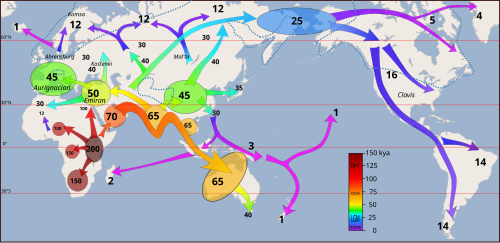
Traditional theories suggest that big-animal hunters crossed the Bering Strait from North Asia into the Americas over a land bridge (Beringia). This bridge existed from 45,000 to 12,000 BCE (47,000–14,000 BP).[1] Small isolated groups of hunter-gatherers migrated alongside herds of large herbivores far into Alaska. From c.16,500– c.13,500 BCE (c.18,500– c.15,500 BP), ice-free corridors developed along the Pacific coast and valleys of North America.[2] This allowed land animals, followed by humans, to migrate south into the interior of the continent. The people went on foot or used boats along the coastline. The dates and routes of the peopling of the Americas remain subjects of ongoing debate.[3] There were likely three waves of ancient settlers from the Bering Sea to the American continent.[4]
In South America, the site of Monte Verde indicates that its population was probably territorial and resided in their river basin for most of the year. Some other South American groups, on the other hand, were highly mobile and hunted big-game animals such as gomphotheres and giant sloths. They used classic bifacial projectile point technology, such as Fishtail points.
The primary examples are populations associated with El Jobo points (Venezuela), fish-tail or Magallanes points (various parts of the continent, but mainly the southern half), and Paijan points (Peru and Ecuador) at sites in grasslands, savanna plains, and patchy forests.[69]
これらの遺跡の年代は、約14,000 BP (ベネズエラのタイマタイマの場合) から約10,000 BP までである。[ 70 ]両尖頭のエル ホボの投射具は、主にベネズエラ北西部、ベネズエラ湾から高山や谷まで分布していた。これらを使用していた人々は、一定の限定された領域内に留まっていたと思われる狩猟採集民であった。[ 71 ] [ 72 ]エルホボの尖頭具はおそらく最も古く、約14,200 ~ 約12,980 BP に遡り、大型哺乳類の狩猟に使用された。[ 73 ]対照的に、パタゴニアで約 11,000 BP に遡る魚尾の尖頭具は、はるかに広い地理的分布を示したが、主に大陸の中央部と南部であった。[ 74 ] [ 75 ]
Human settlement of the Americas occurred in stages from the Bering sea coast line, with an initial layover on Beringia for the founding population.[81][82][83][84] The micro-satellite diversity and distributions of the Y lineage specific to South America indicates that certain Amerindian populations have been isolated since the initial colonization of the region.[85] The Na-Dené, Inuit and Indigenous Alaskan populations, however, exhibit haplogroup Q (Y-DNA) mutations that are distinct from other Amerindians with various mtDNA mutations.[86][87][88] This suggests that the earliest migrants into the northern extremes of North America and Greenland derived from later migrant populations.[89]
Evidence from full genomic studies suggests that the first people in the Americas diverged from Ancient East Asians about 36,000 years ago and expanded northwards into Siberia, where they encountered and interacted with a different Paleolithic Siberian population (known as Ancient North Eurasians), giving rise to both Paleosiberian peoples and Ancient Native Americans, which later migrated towards the Beringian region, became isolated from other populations, and subsequently populated the Americas.[90][91]
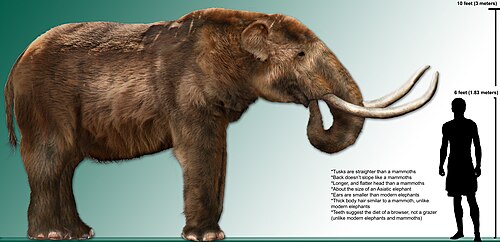
Due to the evidence that Paleoindians hunted now extinct megafauna (large animals), and that following a period of overlap, most large animals across the Americas became extinct as part of the Late Pleistocene megafauna extinctions, it has been argued by many authors that hunting by Paleoindians was an important factor in the extinctions,[92][93] though this suggestion is controversial, with other authors placing the blame on climatic change.[94] In a 2012 survey of archaeologists in The SAA Archaeological Record, 63% of respondents said that megafauna extinctions were likely the result of a "combination of factors".[95]
The Archaic period in the Americas saw a changing environment featuring a warmer, more arid climate and the disappearance of the last megafauna.[96] The majority of population groups at this time were still highly mobile hunter-gatherers, but now individual groups started to focus on resources available to them locally. Thus with the passage of time there is a pattern of increasing regional generalization like the Southwest, Arctic, Poverty, Dalton, and Plano traditions. These regional adaptations would become the norm, with reliance less on hunting and gathering, and a more mixed economy of small game, fish, seasonally wild vegetables, and harvested plant foods.[34][97] Many groups continued to hunt big game but their hunting traditions became more varied and meat procurement methods more sophisticated.[32] The placement of artifacts and materials within an Archaic burial site indicated social differentiation based upon status in some groups.[98]
↑ Ward, H. Trawick; Stephen Davis, RP (1999). Time before history: the archaeology of North Carolina . University of North Carolina Press . p. 2. ISBN978-0-8078-4780-02011年11月29日に取得。
↑ McCoy, RR; Fountain, SM (2017).アメリカ先住民の歴史:多様なルーツを探る. Bloomsbury Publishing. p. 3. ISBN978-0-313-38683-12023年11月13日に取得。
1 2 3 Wm. Jack Hranicky; Wm Jack Hranicky Rpa (2010年6月17日). North American Projectile Points – Revised . AuthorHouse. p. 135. ISBN978-1-4520-2632-92011年11月29日に取得。
1 2 3 Pielou, EC (1991). After the Ice Age: The Return of Life to Glaciated North America (Google Booksによるオンラインデジタル化) . University Of Chicago Press . ISBN978-0-226-66812-32009年11月18日に取得。
↑ Breitburg, Emanual; John B. Broster; Arthur L. Reesman; Richard G. Strearns (1996). "Coats-Hines Site: Tennessee's First Paleoindian Mastodon Association" (PDF) . Current Research in the Pleistocene . 13 : 6– 8. 2016-03-04 のオリジナル(PDF)からアーカイブ済み。2009-11-18に取得。
↑ deFrance, Susan D.; Keefer, David K.; Richardson, James B.; Alvarez, Adan U. (2010). "後期古インディアン沿岸の採集民:特殊化された採取". Latin American Antiquity . 12 (4): 413– 426. doi : 10.2307/972087 . JSTOR 972087 . S2CID 163802845 .
↑Torroni, A.; Schurr, T. G.; Yang, C. C.; Szathmary, E.; Williams, R. C.; Schanfield, M. S.; Troup, G. A.; Knowler, W. C.; Lawrence, D. N.; Weiss, K. M.; Wallace, D. C. (January 1992). "Native American Mitochondrial DNA Analysis Indicates That the Amerind and the Nadene Populations Were Founded by Two Independent Migrations". Center for Genetics and Molecular Medicine and Departments of Biochemistry and Anthropology, Emory University School of Medicine, Atlanta, Georgia. 130 (1). Genetics Society of America: 153–162. Retrieved 2009-11-28.
↑Raff, Jennifer (2020-06-09). Origin: A Genetic History of the Americas. Twelve. ISBN978-1-5387-4971-5.
↑Sapiens (2022-02-08). "A Genetic Chronicle of the First Peoples in the Americas". SAPIENS. Retrieved 2022-10-29.
↑Svenning, Jens-Christian; Lemoine, Rhys T.; Bergman, Juraj; Buitenwerf, Robert; Le Roux, Elizabeth; Lundgren, Erick; Mungi, Ninad; Pedersen, Rasmus Ø. (2024). "The late-Quaternary megafauna extinctions: Patterns, causes, ecological consequences and implications for ecosystem management in the Anthropocene". Cambridge Prisms: Extinction. 2 e5. doi:10.1017/ext.2024.4. ISSN2755-0958. PMC11895740. PMID40078803.
↑Politis, Gustavo G.; Messineo, Pablo G.; Stafford, Thomas W.; Lindsey, Emily L. (March 2019). "Campo Laborde: A Late Pleistocene giant ground sloth kill and butchering site in the Pampas". Science Advances. 5 (3) eaau4546. Bibcode:2019SciA....5.4546P. doi:10.1126/sciadv.aau4546. ISSN2375-2548. PMC6402857. PMID30854426.
↑Grayson, Donald K.; Meltzer, David J. (May 2003). "A requiem for North American overkill". Journal of Archaeological Science. 30 (5): 585–593. Bibcode:2003JArSc..30..585G. doi:10.1016/S0305-4403(02)00205-4.
↑Amber D. Wheat "Survey of professional opionions regarding the peopling of the Americas." The SAA Archaeological Record Volume 12, No. 2 March 2012
↑Campbell, Douglas Ian; Whittle, Patrick Michael (2017). Resurrecting Extinct Species: Ethics and Authenticity. Springer. pp.37–38. ISBN978-3-319-69578-5.
↑Salomon, Frank; Schwartz, Stuart B. (1999-12-28). The Cambridge History of the Native Peoples of the Americas(Digitised online by Google books). Cambridge University Press. ISBN978-0-521-63075-7. Retrieved 2009-11-17.
↑Imbrie, J.; Imbrie, K. P. (1979). Ice Ages: Solving the Mystery. Short Hills NJ: Enslow Publishers. ISBN978-0-226-66811-6.
Further reading
Jablonski, Nina G. (2002). The First Americans: The Pleistocene Colonization of the New World. California Academy of Sciences. ISBN978-0-940228-49-8.
Peter Charles Hoffer (2006). The Brave New World: A History of Early America. JHU Press. ISBN978-0-8018-8483-2.
Meltzer, David J (2009). First peoples in a new world: colonizing ice age America. University of California, Berkeley. ISBN978-0-520-25052-9.



 アメリカ大陸の先住民ポータル