
Loading article…
_(6982162417).jpg/500px-Inspecting_a_Drug_Manufacturer_(FDA034)_(6982162417).jpg)
製薬業界は、病気の治療や予防(場合によっては病気やけがの症状の緩和)を目的として、患者に投与(または患者自身による投与)することで機能する医薬品を発見、開発、製造、販売する医療にかかわる業界です。[ 1 ] [ 2 ]製薬会社は、知的財産権を伴わずに「ジェネリック」医薬品や医療機器を取り扱うこともあれば、「ブランド」資料が特定の会社の歴史に特に結びついていることもあり、あるいは異なる文脈内でその両方を扱うこともあります。業界にはさまざまな部門(生物製剤の製造などの異なる分野を含む)があり、これらすべてが、特許取得、有効性試験、安全性評価、およびこれらの医薬品のマーケティングを含む財務プロセス全体を統制するさまざまな法律や規制の対象となっています。世界の医薬品市場は2020年に総額1兆2,284.5億ドル相当の治療薬を生産し、最近の出来事( COVID-19パンデミックを含む)の結果を考慮すると、年平均成長率(CAGR)は1.8%を示しました。[3]
歴史的に見ると、知的概念としての製薬産業は、ドイツ、スイス、米国などの先進経済国で1800年代中期から後半にかけて生まれた。これは、コールタールから染料を大規模に生産する企業など、有機合成化学に従事する複数の企業が、人間の健康に関する人工材料の新たな用途を模索したことによる。資本投資の増加傾向は、病理学という学問の研究が著しく進歩した分野と並行して起こり、さまざまな企業が人間の傷害や病気を評価する学術研究室と協力関係を築いた。遠い始まりを経て今日まで存続している製薬中心の産業企業の例としては、バイエル(ドイツに拠点を置く)やファイザー(米国に拠点を置く)が挙げられる。[4]
歴史
1800年代半ば~1945年: 植物から最初の合成薬まで
製薬産業の近代は、1800年代半ばにモルヒネやキニーネなどの植物性医薬品を卸売りする伝統的な役割から拡大した地方の薬剤師と、応用研究から生まれた発見から始まった。植物からの意図的な薬物発見は、1803年から1805年の間に、ドイツの薬剤師助手フリードリヒ・ゼルテュルナーがアヘンからモルヒネ(鎮痛剤および睡眠導入剤)を単離したことに始まり、彼はこの化合物をギリシャの夢の神モルフェウスにちなんで名付けた。[5] 1880年代後半までには、ドイツの染料製造業者は、タールやその他の鉱物源から個々の有機化合物を精製する方法を完成させ、有機化学合成の基本的な方法も確立していた。[4]合成化学的方法の開発により、科学者は化学物質の構造を体系的に変化させることができるようになり、 [要出典]
エピネフリン、ノルエピネフリン、アンフェタミン
1890 年代までには、副腎抽出物が多くの異なる組織タイプに及ぼす大きな効果が発見され、化学シグナル伝達のメカニズムの探求と、これらの観察結果を新薬開発に利用する取り組みが開始されました。副腎抽出物の血圧上昇および血管収縮効果は、止血剤およびショック治療剤として外科医の間で特に関心を集め、多くの企業がさまざまな純度の有効成分を含む副腎抽出物をベースとした製品を開発しました。1897 年、ジョンズ ホプキンス大学のジョン エイベルは、有効成分がエピネフリンであると特定し、硫酸塩として不純な状態で単離しました。工業化学者の高峰譲吉は、後に純粋なエピネフリンを得る方法を開発し、その技術をパーク デイビスにライセンス供与しました。パーク デイビスは、エピネフリンをAdrenalin という商標名で販売しました。注射用エピネフリンは喘息発作の急性治療に特に有効であることが証明され、吸入用バージョンは2011年まで米国で販売されていました(Primatene Mist)。[6] [7] 1929年までにエピネフリンは鼻づまりの治療に使用するための吸入器として調合されました。
効果は高いものの、注射が必要なためエピネフリンの使用は限られており[説明が必要]、経口で有効な誘導体が求められていました。構造的に類似した化合物であるエフェドリンは、日本の化学者によりマオウ工場で特定され、イーライリリー社により喘息の経口治療薬として販売されました。バローズ・ウェルカム社のヘンリー・デールとジョージ・バーガーの研究に続いて、大学の化学者ゴードン・アレズはアンフェタミンを合成し、1929年に喘息患者でテストしました。この薬剤は抗喘息作用はわずかであることが判明しましたが、爽快感と動悸を引き起こしました。アンフェタミンは、スミス、クライン、フレンチ社により、ベンゼドリン吸入器という商標名で鼻づまり除去薬として開発されました。アンフェタミンは最終的に、ナルコレプシー、脳炎後パーキンソン病、うつ病やその他の精神疾患における気分高揚の治療薬として開発されました。 1937年にアメリカ医師会からこれらの用途に対する新規非公式治療薬として承認され、[8] 1960年代に三環系抗うつ薬が開発されるまで、うつ病の治療に一般的に使用され続けました。 [7]
バルビツール酸の発見と開発
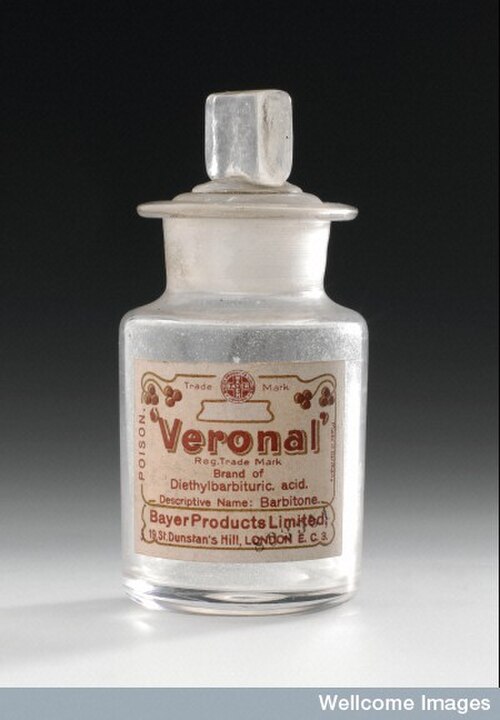
1903年、ヘルマン・エミール・フィッシャーとヨーゼフ・フォン・メリングは、ジエチルマロン酸、オキシ塩化リン、尿素の反応で生成されるジエチルバルビツール酸がイヌに睡眠を誘発するという発見を公表した。この発見は特許取得され、バイエル製薬にライセンス供与され、同社は1904年からこの化合物を睡眠補助薬としてベロナールという商標で販売した。構造変化が効力と作用持続時間に与える影響を系統的に調査した結果、1911年にバイエルでフェノバルビタールが発見され、1912年にはその強力な抗てんかん作用が発見された。フェノバルビタールは1970年代を通じててんかん治療に最も広く使用されていた薬の一つであり、2014年現在、世界保健機関の必須医薬品リストに残っている。[9] [10] 1950年代と1960年代には、バルビツール酸系薬物とアンフェタミンの依存性と乱用の可能性についての認識が高まり、その使用に対する規制が強化され、処方者に対する政府の監督が強化されました。今日では、アンフェタミンは主に注意欠陥障害の治療に、フェノバルビタールはてんかんの治療に使用されるように制限されています。[11] [12]
1958 年、レオ・スターンバックは最初のベンゾジアゼピンであるクロルジアゼポキシド(リブリウム) を発見しました。その後、数十種類のベンゾジアゼピンが開発され、使用されています。その中でも人気の高い薬は、ジアゼパム(バリウム)、アルプラゾラム(ザナックス)、クロナゼパム(クロノピン)、ロラゼパム(アティバン) です。ベンゾジアゼピンは安全性と治療効果がはるかに優れているため、特別な場合を除き、医療においてバルビツール酸系薬の使用に大きく取って代わっています。その後、ベンゾジアゼピンはバルビツール酸系薬と同様に、長期服用すると効力が大幅に低下し、深刻な副作用を引き起こす可能性があることが判明し、ヘザー・アシュトンはベンゾジアゼピン依存症を研究し、その使用を中止するためのプロトコルを開発しました。[要出典]
インスリン
1800 年代後半から 1900 年代前半にかけて行われた一連の実験により、糖尿病は膵臓で通常生成される物質の欠乏によって引き起こされることが明らかになりました。1869 年、オスカー ミンコフスキーとジョセフ フォン メリングは、膵臓の外科的除去によって犬に糖尿病を誘発できることを発見しました。1921 年、カナダの教授フレデリック バンティングと彼の学生チャールズ ベストはこの研究を繰り返し、膵臓抽出物の注射により膵臓除去によって生じた症状が改善することを発見しました。すぐに、抽出物が人間に効果があることが実証されましたが、十分な量と再現可能な純度で物質を製造することが困難であったため、日常的な医療処置としてのインスリン療法の開発は遅れました。研究者は、生物学的物質の大規模な精製に関する同社の経験に基づき、イーライ リリー社の産業協力者に支援を求めました。イーライ リリー社の化学者ジョージ B. ウォルデンは、抽出物の pH を慎重に調整することで、比較的純粋なグレードのインスリンを製造できることを発見しました。トロント大学からの圧力と、同様の精製方法を独自に開発した学術研究者による特許侵害の可能性により、複数の企業によるインスリンの非独占的生産で合意に達した。インスリン療法が発見され広く利用できるようになるまで、糖尿病患者の平均余命はわずか数か月だった。[13]
初期の抗感染研究:サルバルサン、プロントシル、ペニシリン、ワクチン
感染症の治療薬の開発は初期の研究開発活動の主要な焦点でした。1900年には、肺炎、結核、下痢が米国における3大死因であり、生後1年以内の死亡率は10%を超えていました。[14] [15] [検証失敗]
1911年、ベルリン実験療法研究所のポール・エールリッヒと化学者アルフレッド・ベルトハイムが、最初の合成抗感染薬であるアルスフェナミンを開発しました。この薬はサルバルサンという商品名で呼ばれました。 [16]エールリッヒは、ヒ素の一般的な毒性と、細菌による特定の染料の選択的吸収の両方に注目し、同様の選択的吸収特性を持つヒ素含有染料が細菌感染症の治療に使用できるという仮説を立てました。アルスフェナミンは、一連のそのような化合物を合成するキャンペーンの一環として準備され、部分的に選択的な毒性を示すことがわかりました。アルスフェナミンは、それまで不治の病であり、重度の皮膚潰瘍、神経学的損傷、そして死に不可避的につながっていた梅毒の最初の効果的な治療薬であることが判明しました。[17]
合成化合物の化学構造を体系的に変化させ、その変化が生物活性に与える影響を測定するというエールリッヒのアプローチは、バイエル社の科学者ヨーゼフ・クララー、フリッツ・ミーチ、ゲルハルト・ドーマクなどの産業界の科学者によって広く追求された。ドイツの染料産業で入手可能な化合物の試験に基づいたこの研究は、スルホンアミド系抗生物質の最初の代表であるプロントシルの開発につながった。アルスフェナミンと比較して、スルホンアミドはより広い活性スペクトルを持ち、毒性がはるかに低いため、連鎖球菌などの病原体による感染症に有効であった。[18] 1939年、ドーマクはこの発見によりノーベル医学賞を受賞した。[19] [20]それにもかかわらず、第二次世界大戦前に起こった感染症による死亡者の劇的な減少は、主に清潔な水や住宅の混雑緩和などの公衆衛生対策の改善によるものであり、抗感染薬やワクチンの影響は主に第二次世界大戦後に顕著であった。[21] [22]
1928年、アレクサンダー・フレミングはペニシリンの抗菌作用を発見したが、人間の病気の治療に利用するために、その大規模生産と精製法の開発を待たなければならなかった。これらは、第一次世界大戦中に米国と英国政府主導の製薬会社のコンソーシアムによって開発された。[23]
この期間を通じてワクチン開発の早い段階から進展があったが、それは主に、一般的な伝染病の原因となる病原体の特定に向けた学術研究および政府資金による基礎研究の形で行われた。1885年、ルイ・パスツールとピエール・ポール・エミール・ルーが最初の狂犬病ワクチンを開発した。最初のジフテリアワクチンは、ジフテリア毒素と抗毒素(接種した動物の血清から生成)の混合物から1914年に製造されたが、接種の安全性は最低限で、広くは使用されなかった。米国では1921年に206,000件のジフテリア症例が記録され、15,520人が死亡した。 1923年、パスツール研究所のガストン・ラモンとウェルカム研究所(後のグラクソ・スミスクラインの一部門)のアレクサンダー・グレニーによる並行した研究により、ジフテリア毒素をホルムアルデヒドで処理することで、より安全なワクチンを製造できることが発見されました。[24] 1944年、スクイブ製薬のモーリス・ヒルマンが日本脳炎の最初のワクチンを開発しました。[25]ヒルマンは後にメルクに移り、麻疹、おたふく風邪、水痘、風疹、A型肝炎、B型肝炎、髄膜炎のワクチン開発で重要な役割を果たしました。
危険な医薬品と早期の業界規制
20世紀以前は、医薬品は一般に小規模な製造業者によって生産されており、製造や安全性および有効性の主張に対する規制はほとんどなかった。そのような法律が存在したとしても、執行は緩いものだった。米国では、汚染された天然痘ワクチンおよびジフテリア抗毒素の流通によって引き起こされた破傷風の発生と死亡により、ワクチンおよびその他の生物学的医薬品に対する規制が強化された。[26] 1902年の生物製剤管理法は、すべての生物学的医薬品と、そのような医薬品を製造するプロセスおよび施設に対して、連邦政府が市販前承認を与えることを義務付けた。これに続いて1906年に純正食品および医薬品法が制定され、不純物が混入した、または偽装表示された食品および医薬品の州間流通が禁止された。医薬品にアルコール、モルヒネ、アヘン、コカイン、またはその他の潜在的に危険または中毒性のある薬物が含まれていて、ラベルにそのような薬物の量または割合が表示されていない場合、その医薬品は偽装表示であるとみなされた。政府は、根拠のない効能の主張をした製造業者を訴追するために法律を利用しようとしたが、連邦政府の執行権限を医薬品の成分の誤った指定のケースに限定するという最高裁判所の判決によって阻止された。[27]
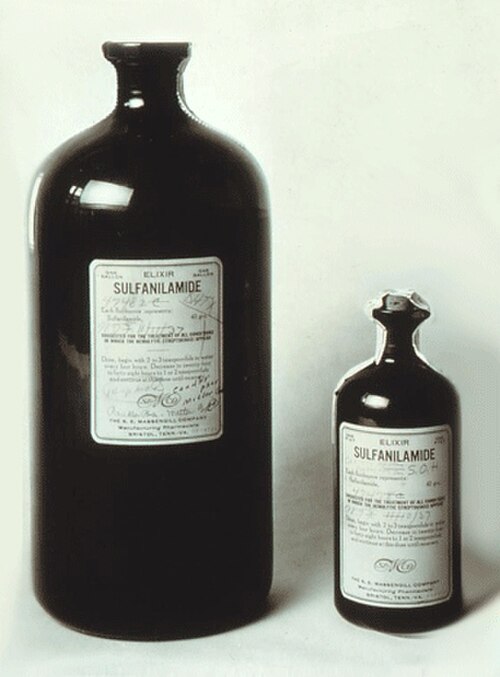
1937年、テネシー州のSEマッセンギル社が製造した「エリクサー スルファニルアミド」を摂取した100人以上が死亡した。この製品は、現在では不凍液として広く使用されている毒性の高い溶剤であるジエチレングリコールで調合されていた。[ 28]当時の法律では、製造業者を起訴できるのは、製品が「エリクサー」と呼ばれていたという技術的な理由からのみであり、文字通りエタノール溶液を意味していた。この事件を受けて、米国議会は1938年に連邦食品・医薬品・化粧品法を可決し、初めて医薬品の販売前に安全性の実証を義務付け、虚偽の治療効果の主張を明示的に禁止した。[29]
戦後、1945年から1970年
抗感染研究のさらなる進歩
第二次世界大戦後、新しいクラスの抗菌薬[30]の発見が爆発的に増加した。これには、セファロスポリン(ジュゼッペ・ブロッツとエドワード・エイブラハムの独創的な研究に基づいてイーライリリーが開発)、[31] [32] ストレプトマイシン(メルクが資金提供したセルマン・ワックスマンの研究室での研究プログラム中に発見[33])、テトラサイクリン[34] (レダレ研究所で発見、現在はファイザーの一部門)、エリスロマイシン(イーライリリー社で発見)[35]などがあり、その対象はますます幅広い細菌病原体へと拡大した。1943年にラトガース大学のセルマン・ワックスマンの研究室でメルクが資金提供した研究プログラム中に発見されたストレプトマイシンは、結核に対する最初の効果的な治療薬となった。発見当時、結核感染者を隔離するための療養所は先進国の都市のいたるところに存在し、入院後5年以内に50%が死亡していた。[33] [36]
1958 年に発行された連邦取引委員会の報告書は、抗生物質の開発がアメリカの公衆衛生に及ぼす影響を定量化しようと試みた。報告書によると、1946 年から 1955 年にかけて、抗生物質が有効な病気の発生率は 42% 減少したのに対し、抗生物質が無効だった病気の発生率は 20% しか減少しなかった。報告書は、「抗生物質の使用、早期診断、その他の要因により、伝染病の蔓延が抑えられ、これらの病気の発生数も抑えられたようだ」と結論付けている。この研究ではさらに、抗生物質が有効な治療となる 8 つの一般的な病気 (梅毒、結核、赤痢、猩紅熱、百日咳、髄膜炎菌感染症、肺炎) の死亡率を調べ、同じ期間に 56% 減少していることがわかった。[37]なかでも注目すべきは、結核による死亡が 75% 減少したことだ。[38]


1940年から1955年にかけて、米国の死亡率の低下率は年間2%から8%に加速し、その後、年間2%という歴史的な低下率に戻った。戦後間もない数年間の劇的な低下は、これらの年に起こった感染症の新しい治療法とワクチンの急速な開発によるものとされている。[40] [22] ワクチン開発は加速し続け、この時期の最も注目すべき成果は、非営利団体の全米小児麻痺財団の資金提供によるジョナス・ソークによる1954年のポリオワクチンの開発である。ワクチン製造法は特許取得されなかったが、代わりに製薬会社に委託され、低コストのジェネリックとして製造された。1960年にメルク・シャープ・アンド・ドーム社のモーリス・ヒルマンがSV40ウイルスを特定し、これが後に多くの哺乳類種で腫瘍を引き起こすことが示された。その後、SV40は米国の子供の90%に投与されたポリオワクチンのロットに汚染物質として存在していたことが判明しました。[41] [42]この汚染は、元の細胞ストックと製造に使用されたサルの組織の両方に由来しているようです。2004年に国立がん研究所は、 SV40は人間のがんとは関連がないという結論に達したと発表しました。[43]
この時期の他の注目すべき新しいワクチンには、麻疹(1962年、ボストン小児医療センターのジョン・フランクリン・エンダース、後にメルク社のモーリス・ヒルマンが改良)、風疹(1969年、ヒルマン、メルク社)、おたふく風邪(1967年、ヒルマン、メルク社)のワクチンがある[44]。米国では、風疹、先天性風疹症候群、麻疹、おたふく風邪の発生率が、ワクチン接種が広く普及した直後に95%以上減少した。[45]米国で麻疹ワクチンの認可を受けた最初の20年間で、推定5,200万人の麻疹症例、17,400人の知的障害症例、および5,200人の死亡が防がれた。[46]
降圧剤の開発と販売
高血圧は動脈硬化症[47] 、心不全[48] 、 冠動脈疾患[49]、[50] 、脳卒中[51] 、 腎疾患[52]、[53]、末梢動脈疾患[54]、[55]の危険因子であり、先進国における心血管疾患の罹患率および死亡率の最も重要な危険因子である。[56] 1940年以前は、50歳以上の人の死亡の約23%が高血圧に起因していた。重度の高血圧症は手術で治療された。[57]
高血圧治療の分野における初期の開発には、第四級アンモニウムイオン交感神経遮断剤が含まれていましたが、これらの化合物は、高血圧の長期的な健康への影響がまだ確立されておらず、また注射で投与する必要があったため、重篤な副作用のために広く使用されることはありませんでした。
1952年、チバの研究者らは、経口投与可能な初の血管拡張薬ヒドララジンを発見した。[58]ヒドララジン単独療法の大きな欠点は、時間が経つと効果がなくなること(タキフィラキシー)であった。1950年代半ば、メルク社のカール・H・ベイヤー、ジェームズ・M・スプレーグ、ジョン・E・ベア、フレデリック・C・ノヴェロは、今日でも最も広く使用されている降圧剤であるクロロチアジドを発見し、開発した。 [59]この開発は、高血圧患者の死亡率の大幅な低下と関連していた。 [ 60]発明者らは、1975年に「数え切れないほどの命を救い、高血圧の何百万人もの患者の苦しみを軽減した」として公衆衛生ラスカー賞を受賞した。 [61]
2009年のコクランレビューでは、チアジド系降圧薬は高血圧患者の死亡(相対リスク0.89)、脳卒中(相対リスク0.63)、冠状動脈性心疾患(相対リスク0.84)、心血管イベント(相対リスク0.70)のリスクを低下させると結論付けられました。 [62]その後の数年間で、ループ利尿薬(ラシックス/フロセミド、ヘキスト製薬、1963年)、[63] ベータ遮断薬(ICI製薬、1964年)[64] ACE阻害薬、アンジオテンシン受容体遮断薬など、他のクラスの降圧薬が開発され、併用療法で広く受け入れられました。 ACE阻害薬は、高血圧の有無にかかわらず、糖尿病患者の新規発症腎臓病[RR 0.71]および死亡[RR 0.84]のリスクを低下させます。[65]
経口避妊薬
第二次世界大戦前、多くの国で産児制限は禁止されており、米国では避妊方法についての議論だけでもコムストック法による訴追につながることがあった。したがって、経口避妊薬の開発の歴史は、産児制限運動や活動家のマーガレット・サンガー、メアリー・デネット、エマ・ゴールドマンの努力と密接に結びついている。グレゴリー・ピンカスが行った基礎研究と、シンテックスのカール・ジェラッシとGDサール社のフランク・コルトンが開発したプロゲステロンの合成方法に基づいて、最初の経口避妊薬であるエノビドがGDサール社によって開発され、1960年にFDAの承認を受けた。元の処方には過剰な量のホルモンが配合されていたため、重篤な副作用を引き起こした。それでも、1962年までに120万人のアメリカ人女性がピルを服用し、1965年までにその数は650万人に増加した。[66] [67] [68] [69]一時的な避妊具という便利な形態が利用可能になったことで、女性のライフスタイルの選択肢が広がり、避妊に関して男性に依存する女性の依存が減り、結婚の延期が奨励され、結婚前の同棲が増えるなど、社会規範に劇的な変化がもたらされました。[70]
サリドマイドとキーフォーバー・ハリス修正条項

米国では、 1959 年にテネシー州のエステス・キーフォーバー上院議員が主導した議会公聴会から、FD&C 法の改正を求める声が上がりました。公聴会では、広告の濫用、薬の有効性の疑問、業界の規制強化の必要性など、幅広い政策問題が取り上げられました。長期にわたる議論により、新しい法律制定の勢いが一時的に衰える中、新たな悲劇が起こり、より包括的な規制の必要性が強調され、新しい法律を可決する原動力となりました。
1960年9月12日、アメリカのライセンシーであるシンシナティのウィリアム・S・メレル社が、 1956年以来ヨーロッパで販売されていた鎮静剤ケバドン(サリドマイド)の新薬申請を提出した。この化合物の審査を担当していたFDAの医療担当官フランシス・ケルシーは、サリドマイドの安全性を裏付けるデータが不完全であると信じていた。同社はケルシーとFDAに申請を承認するよう圧力をかけ続けたが、1961年11月、この薬は重篤な先天異常との関連が指摘され、ドイツ市場から撤退した。ヨーロッパやその他の地域で数千人の新生児がサリドマイドの催奇形性作用に苦しんだ。FDAの承認を得ずに、同社は研究用と偽って1,000人を超える医師にケバドンを配布した。この「研究」では、624人の妊婦を含む2万人以上のアメリカ人がサリドマイドを投与され、約17人の新生児が薬の影響を受けたことが分かっている。[要出典]
サリドマイドの悲劇により、議会で行き詰まっていた薬物規制を強化するキーフォーバー法案が復活し、キーフォーバー・ハリス修正案が1962年10月10日に法律となった。これ以降、製薬会社は、米国市場に出す前に、自社の医薬品が安全であるだけでなく有効であることをFDAに証明しなければならなくなった。FDAは、処方薬の広告を規制し、適正製造基準を確立する権限を得た。この法律では、1938年から1962年の間に導入されたすべての医薬品は有効でなければならないと規定された。FDAと米国科学アカデミーの共同研究によると、これらの製品の約40%は無効だった。10年後には、市販薬に関する同様の包括的な研究が始まった。[71]
1970年代~1990年代
スタチン
1971年、製薬会社三共に勤務していた日本人生化学者の遠藤章は、ペニシリウム・シトリナムという菌類が生成する分子であるメバスタチン(ML-236B)が、体内でコレステロールを生成するために使われる重要な酵素であるHMG-CoA還元酵素の阻害剤であることを特定しました。動物実験では臨床試験と同様に非常に優れた阻害効果が示されましたが、イヌでの長期研究では高用量で毒性作用が見られ、結果としてメバスタチンは人間に使用するには毒性が強すぎると考えられました。メバスタチンは、実験犬に腫瘍、筋肉の劣化、時には死をもたらすという副作用があったため、市販されることはありませんでした。
メルク社の主任科学者で後にCEOとなったP・ロイ・ヴァジェロスは興味を持ち、1975年から日本を数回訪問した。1978年までにメルク社はアスペルギルス・テレウス菌からロバスタチン(メビノリン、MK803)を単離し、1987年にメバコールとして初めて販売した。[72] [73] [74]
1994年4月、メルク社がスポンサーとなった研究「スカンジナビア・シンバスタチン生存研究」の結果が発表された。研究者らは、後にメルク社がゾコールとして販売するシンバスタチンを、高コレステロールと心臓病を患う4,444人の患者で試験した。5年後、この研究は、患者のコレステロールが35%減少し、心臓発作で死亡する確率が42%減少したと結論付けた。[75] 1995年、ゾコールとメバコールはメルク社に10億ドル以上の利益をもたらした。遠藤は2006年に日本国際賞、 2008年にラスカー・ドゥベーキー臨床医学研究賞を受賞した。「コレステロールを下げるための新しい分子群の先駆的研究」により、[文の断片] [76] [77]
21世紀
数十年にわたり、低分子治療薬と比較して、生物製剤の重要性が高まっています。バイオテクノロジーサブセクター、動物医療、中国の製薬セクターも大幅に成長しました。組織面では、大手国際製薬企業の価値シェアが大幅に低下しました。また、コアジェネリックセクター(特許切れブランドの代替品)も競争により価値が低下しました。[78]
トレヤ氏は、製薬業界の時価総額は2021年2月までに7.03兆ドルに達すると推定しており、そのうち上場企業の価値は6.1兆ドルである。低分子モダリティの評価額シェアは2003年の84.6%から58.2%に低下した。生物製剤は14.5%から30.5%に上昇した。中国の製薬業界の評価額シェアは2003年から2021年にかけて1%から12%に増加し、現在7.7%で第3位のスイスを追い抜いた。米国は依然として世界的評価額の40%を占め、圧倒的に最も評価の高い製薬業界である。[79] 2023年は、ほとんどが中小企業ではあるものの、世界中の129の公開バイオテクノロジー企業で少なくとも1万人の人員削減が行われた年であった。これは2022年と比較して大幅な削減の増加であり、世界的な金融状況の悪化と「ジェネラリスト投資家」による投資の減少が一因となっている。 [ 80]民間企業でも2023年にベンチャーキャピタル投資が大幅に減少し、2021年に始まった下降傾向が続き、新規株式公開( IPO )の減少にもつながった。[80]
合併と買収の影響
2022年の記事では、この概念を「医薬品開発ビジネスでは、取引は科学的ブレークスルーと同じくらい重要になる可能性がある」と簡潔に表現しており、これは通常、製薬業界のM&A(合併と買収)と呼ばれています。[81]この記事は、21世紀初頭の最も影響力のある治療法のいくつかは、M&A活動を通じてのみ可能になったことを強調しており、特にキイトルーダとヒュミラに注目しています。[81]
研究開発
創薬とは、潜在的な薬剤を発見または設計するプロセスです。これまで、ほとんどの薬剤は、伝統的な治療薬から有効成分を分離するか、偶然の発見によって発見されてきました。現代のバイオテクノロジーは、病状や病原体に関連する代謝経路を理解し、分子生物学や生化学を使用してこれらの経路を操作することに重点を置いています。初期段階の創薬の多くは、伝統的に大学や研究機関によって行われてきました。
医薬品開発とは、化合物が潜在的な医薬品として特定された後に、その医薬品としての適性を確立するために行われる活動を指す。医薬品開発の目的は、適切な処方と投与量を決定し、安全性を確立することである。これらの分野の研究には、通常、in vitro研究、in vivo研究、臨床試験の組み合わせが含まれる。後期開発にはコストがかかることから、通常は大手製薬会社が行う。[82]製薬およびバイオテクノロジー業界は、純売上高の 15% 以上を研究開発に費やしており、これは他の業界と比較して圧倒的に高い割合である。[83]
多くの場合、大規模な多国籍企業は垂直統合を示し、医薬品の発見と開発、製造と品質管理、マーケティング、販売、流通の幅広い分野に関与しています。一方、小規模な組織は、医薬品候補の発見や製剤の開発など、特定の側面に焦点を当てることがよくあります。多くの場合、研究機関と大手製薬会社の間で協力契約が結ばれ、新しい薬物物質の可能性を探ります。最近では、多国籍企業は医薬品開発の管理を委託研究機関に頼る傾向が強まっています。[84]
イノベーションのコスト
新薬の発見と開発には多大な費用がかかる。ヒトへの使用が調査されているすべての化合物のうち、ほとんどの国で最終的に政府任命の医療機関または委員会によって承認されるのはごく一部であり、新薬はそれらの国で販売される前にこれらの機関または委員会によって承認される必要がある。2010年には18のNME(新規分子化合物)がFDAによって承認され、3つの生物製剤が承認され、合計21となったが、これは2009年の26件、2008年の24件から減少している。一方、2007年には合計で18件、2006年には22件しか承認されていなかった。2001年以来、医薬品評価研究センターは平均して年間22.9件の承認を行っている。[85]この承認は、前臨床開発と臨床試験 への多額の投資、および継続的な安全性監視への取り組みの後にのみ得られる。このプロセスの途中で失敗した薬は、多くの場合、多額の費用がかかる一方で、収益は生み出されない。これらの失敗した薬のコストを考慮すると、成功する新薬(新化学物質、NCE)の開発コストは13億ドルと推定されています[86] (マーケティング費用は含みません)。しかし、ライト教授とレクシン教授は2012年に、新薬の承認率は数十年にわたって平均15~25%と比較的安定していると報告しました。[87]
業界全体の研究と投資は2009年に過去最高の653億ドルに達した。[88]米国の研究費は1995年から2010年の間に約342億ドルであったが、収益はより速いペースで増加した(この期間に収益は2004億ドル増加した)。[87]
コンサルティング会社ベイン・アンド・カンパニーの調査によると、新薬(および失敗した候補薬)の発見、開発、発売(マーケティングおよびその他の事業経費を含む)にかかるコストは、5年間で2003年には17億ドル近くにまで上昇した。[89]フォーブスによると、2010年までに開発コストは1つの薬につき40億ドルから110億ドルになった。[90]
これらの推定値の中には、収益が実現する何年も前に資本を投資する機会費用も考慮に入れているものもあります( 「貨幣の時間価値」を参照)。医薬品の発見、開発、承認には非常に長い時間がかかることから、これらの費用は総費用のほぼ半分に達する可能性があります。製薬業界のバリューチェーン内での直接的な結果として、大手製薬多国籍企業は基礎研究に関連するリスクをますますアウトソーシングする傾向があり、これにより業界のエコシステムが多少再形成され、バイオテクノロジー企業がますます重要な役割を果たすようになり、全体的な戦略がそれに応じて再定義されています。[91]既存の有効成分の再処方に基づくもの(ライン拡張とも呼ばれる)など、承認された一部の医薬品は、開発コストがはるかに安価です。
製品承認
米国では、新しい医薬品は食品医薬品局(FDA)の安全かつ有効な承認を得る必要がある。このプロセスには通常、ヒト臨床試験を進めるための十分な前臨床データを含む治験薬申請書の提出が含まれる。治験薬申請書の承認後、段階的に規模を拡大する3段階のヒト臨床試験が実施される。第1段階では通常、健康なボランティアを使用して毒性を研究する。第2段階では、患者の薬物動態と投与量を検討し、第3段階では対象患者集団における有効性に関する非常に大規模な研究が行われる。第3段階の試験が無事完了すると、 FDAに新薬申請が提出される。FDAはデータを審査し、製品のベネフィット・リスク評価が肯定的であると判断された場合、米国での販売が承認される。[92]
最大規模の臨床試験でもまれな副作用の発生率を効果的に予測することはできないため、承認後監視の第 4 段階も必要となることがよくあります。市販後監視により、市販後に薬剤の安全性が厳密に監視されます。場合によっては、その適応症を特定の患者グループに限定する必要がある場合があり、また、その物質が市場から完全に撤去される場合もあります。
FDAはオレンジブックサイトで承認された医薬品に関する情報を提供しています。[93]
英国では、医薬品・医療製品規制庁が医薬品の使用を承認し、評価します。通常、英国および他のヨーロッパ諸国での承認は、米国よりも遅れます。その後、イングランドおよびウェールズの国立医療技術評価機構(NICE) が、国民保健サービス(NHS) が医薬品の使用を許可するかどうか、また許可する場合はどのように許可するか (費用を負担するという意味) を決定します。英国国立処方集は、薬剤師および臨床医にとっての中心的なガイドです。
米国以外の多くの西側諸国では、新しい技術を提供する前に、費用対効果分析という「第 4 のハードル」が生まれています。これは、問題の技術の「有効性の価格」(たとえば、QALYあたりのコスト)に焦点を当てています。イングランドとウェールズでは、NICE が NHS による医薬品と技術の提供の有無、およびその提供状況を決定します。一方、スコットランドのスコットランド医薬品コンソーシアムとオーストラリアの医薬品給付諮問委員会にも同様の取り決めがあります。製品が承認されるためには、費用対効果の基準を満たす必要があります。治療は「費用対効果」と社会への純利益を表さなければなりません。
希少疾病用医薬品
いくつかの主要な医薬品規制地域では、特定の希少疾患(「希少疾病」)に対する特別な規則があります。たとえば、米国で患者数が 20 万人未満の疾患、または特定の状況下では患者数が多い疾患は、希少疾病医薬品法の対象となります。 [94]このような疾患を治療するための医薬品の医学的研究および開発は経済的に不利なため、それを行う企業は、その医薬品が特許で保護されているかどうかに関係なく、減税、料金免除、および一定期間(7 年間)のその医薬品の市場独占権などの特典を受けます。
グローバル販売
In 2011, global spending on prescription drugs topped $954 billion, even as growth slowed somewhat in Europe and North America. The United States accounts for more than a third of the global pharmaceutical market, with $340 billion in annual sales followed by the EU and Japan.[96] Emerging markets such as China, Russia, South Korea and Mexico outpaced that market, growing a huge 81 percent.[97][98]
The top ten best-selling drugs of 2013 totaled $75.6 billion in sales, with the anti-inflammatory drug Humira being the best-selling drug worldwide at $10.7 billion in sales. The second and third best selling were Enbrel and Remicade, respectively.[99] The top three best-selling drugs in the United States in 2013 were Abilify ($6.3 billion,) Nexium ($6 billion) and Humira ($5.4 billion).[100] The best-selling drug ever, Lipitor, averaged $13 billion annually and netted $141 billion total over its lifetime before Pfizer's patent expired in November 2011.
IMS Health publishes an analysis of trends expected in the pharmaceutical industry in 2007, including increasing profits in most sectors despite loss of some patents, and new 'blockbuster' drugs on the horizon.[101]
Patents and generics
Depending on a number of considerations, a company may apply for and be granted a patent for the drug, or the process of producing the drug, granting exclusivity rights typically for about 20 years.[102] However, only after rigorous study and testing, which takes 10 to 15 years on average, will governmental authorities grant permission for the company to market and sell the drug.[103] Patent protection enables the owner of the patent to recover the costs of research and development through high profit margins for the branded drug. When the patent protection for the drug expires, a generic drug is usually developed and sold by a competing company. The development and approval of generics is less expensive, allowing them to be sold at a lower price. Often the owner of the branded drug will introduce a generic version before the patent expires in order to get a head start in the generic market.[104] Restructuring has therefore become routine, driven by the patent expiration of products launched during the industry's "golden era" in the 1990s and companies' failure to develop sufficient new blockbuster products to replace lost revenues.[105]
Prescriptions
In the U.S., the value of prescriptions increased over the period of 1995 to 2005 by 3.4 billion annually, a 61 percent increase. Retail sales of prescription drugs jumped 250 percent from $72 billion to $250 billion, while the average price of prescriptions more than doubled from $30 to $68.[106]
Marketing
Advertising is common in healthcare journals as well as through more mainstream media routes. In some countries, notably the US, they are allowed to advertise directly to the general public. Pharmaceutical companies generally employ salespeople (often called 'drug reps' or, an older term, 'detail men') to market directly and personally to physicians and other healthcare providers. In some countries, notably the US, pharmaceutical companies also employ lobbyists to influence politicians. Marketing of prescription drugs in the US is regulated by the federal Prescription Drug Marketing Act of 1987. The pharmaceutical marketing plan incorporates the spending plans, channels, and thoughts which will take the drug association, and its items and administrations, forward in the current scene.
To healthcare professionals
The book Bad Pharma also discusses the influence of drug representatives, how ghostwriters are employed by the drug companies to write papers for academics to publish, how independent the academic journals really are, how the drug companies finance doctors' continuing education, and how patients' groups are often funded by industry.[107]
Direct to consumer advertising
Since the 1980s, new methods of marketing for prescription drugs to consumers have become important. Direct-to-consumer media advertising was legalised in the FDA Guidance for Industry on Consumer-Directed Broadcast Advertisements.
Controversies
Drug marketing and lobbying
There has been increasing controversy surrounding pharmaceutical marketing and influence. There have been accusations and findings of influence on doctors and other health professionals through drug reps including the constant provision of marketing 'gifts' and biased information to health professionals;[108] highly prevalent advertising in journals and conferences; funding independent healthcare organizations and health promotion campaigns; lobbying physicians and politicians (more than any other industry in the US[109]); sponsorship of medical schools or nurse training; sponsorship of continuing educational events, with influence on the curriculum;[110] and hiring physicians as paid consultants on medical advisory boards.
Some advocacy groups, such as No Free Lunch and AllTrials, have criticized the effect of drug marketing to physicians because they say it biases physicians to prescribe the marketed drugs even when others might be cheaper or better for the patient.[111]
There have been related accusations of disease mongering[112] (over-medicalising) to expand the market for medications. An inaugural conference on that subject took place in Australia in 2006.[113] In 2009, the Government-funded National Prescribing Service launched the "Finding Evidence – Recognising Hype" program, aimed at educating GPs on methods for independent drug analysis.[114]
Meta-analyses have shown that psychiatric studies sponsored by pharmaceutical companies are several times more likely to report positive results, and if a drug company employee is involved the effect is even larger.[115][116][117] Influence has also extended to the training of doctors and nurses in medical schools, which is being fought.
It has been argued that the design of the Diagnostic and Statistical Manual of Mental Disorders and the expansion of the criteria represents an increasing medicalization of human nature, or "disease mongering", driven by drug company influence on psychiatry.[118] The potential for direct conflict of interest has been raised, partly because roughly half the authors who selected and defined the DSM-IV psychiatric disorders had or previously had financial relationships with the pharmaceutical industry.[119]
In the US, starting in 2013, under the Physician Financial Transparency Reports (part of the Sunshine Act), the Centers for Medicare & Medicaid Services has to collect information from applicable manufacturers and group purchasing organizations in order to report information about their financial relationships with physicians and hospitals. Data are made public in the Centers for Medicare & Medicaid Services website. The expectation is that relationship between doctors and Pharmaceutical industry will become fully transparent.[120]
In a report conducted by OpenSecrets, there were more than 1,100 lobbyists working in some capacity for the pharmaceutical business in 2017. In the first quarter of 2017, the health products and pharmaceutical industry spent $78 million on lobbying members of the United States Congress.[121]
Medication pricing
The pricing of pharmaceuticals is becoming a major challenge for health systems.[122] A November 2020 study by the West Health Policy Center stated that more than 1.1 million senior citizens in the U.S. Medicare program are expected to die prematurely over the next decade because they will be unable to afford their prescription medications, requiring an additional $17.7 billion to be spent annually on avoidable medical costs due to health complications.[123]
Regulatory issues
Ben Goldacre has argued that regulators – such as the Medicines and Healthcare products Regulatory Agency (MHRA) in the UK, or the Food and Drug Administration (FDA) in the United States – advance the interests of the drug companies rather than the interests of the public due to revolving door exchange of employees between the regulator and the companies and friendships develop between regulator and company employees.[124] He argues that regulators do not require that new drugs offer an improvement over what is already available, or even that they be particularly effective.[124]
Others have argued that excessive regulation suppresses therapeutic innovation and that the current cost of regulator-required clinical trials prevents the full exploitation of new genetic and biological knowledge for the treatment of human disease. A 2012 report by the President's Council of Advisors on Science and Technology made several key recommendations to reduce regulatory burdens to new drug development, including 1) expanding the FDA's use of accelerated approval processes, 2) creating an expedited approval pathway for drugs intended for use in narrowly defined populations, and 3) undertaking pilot projects designed to evaluate the feasibility of a new, adaptive drug approval process.[125]
Pharmaceutical fraud
Pharmaceutical fraud involves deceptions which bring financial gain to a pharmaceutical company. It affects individuals and public and private insurers. There are several different schemes[126] used to defraud the health care system which are particular to the pharmaceutical industry. These include: Good Manufacturing Practice (GMP) Violations, Off Label Marketing, Best Price Fraud, CME Fraud, Medicaid Price Reporting, and Manufactured Compound Drugs.[127] Of this amount $2.5 billion was recovered through False Claims Act cases in FY 2010. Examples of fraud cases include the GlaxoSmithKline $3 billion settlement, Pfizer $2.3 billion settlement and Merck & Co. $650 million settlement. Damages from fraud can be recovered by use of the False Claims Act, most commonly under the qui tam provisions which rewards an individual for being a "whistleblower", or relator (law).[128]
Every major company selling atypical antipsychotics—Bristol-Myers Squibb, Eli Lilly and Company, Pfizer, AstraZeneca and Johnson & Johnson—has either settled recent government cases, under the False Claims Act, for hundreds of millions of dollars or is currently under investigation for possible health care fraud. Following charges of illegal marketing, two of the settlements set records in 2009 for the largest criminal fines ever imposed on corporations. One involved Eli Lilly's antipsychotic Zyprexa, and the other involved Bextra, an anti-inflammatory medication used for arthritis. In the Bextra case, the government also charged Pfizer with illegally marketing another antipsychotic, Geodon; Pfizer settled that part of the claim for $301 million, without admitting any wrongdoing.[129]
On 2 July 2012, GlaxoSmithKline pleaded guilty to criminal charges and agreed to a $3 billion settlement of the largest health-care fraud case in the U.S. and the largest payment by a drug company.[130] The settlement is related to the company's illegal promotion of prescription drugs, its failure to report safety data,[131] bribing doctors, and promoting medicines for uses for which they were not licensed. The drugs involved were Paxil, Wellbutrin, Advair, Lamictal, and Zofran for off-label, non-covered uses. Those and the drugs Imitrex, Lotronex, Flovent, and Valtrex were involved in the kickback scheme.[132][133][134]
The following is a list of the four largest settlements reached with pharmaceutical companies from 1991 to 2012, rank ordered by the size of the total settlement. Legal claims against the pharmaceutical industry have varied widely over the past two decades, including Medicare and Medicaid fraud, off-label promotion, and inadequate manufacturing practices.[135][136]
Physician roles
In May 2015, the New England Journal of Medicine emphasized the importance of pharmaceutical industry-physician interactions for the development of novel treatments, and argued that moral outrage over industry malfeasance had unjustifiably led many to overemphasize the problems created by financial conflicts of interest. The article noted that major healthcare organizations, such as National Center for Advancing Translational Sciences of the National Institutes of Health, the President's Council of Advisors on Science and Technology, the World Economic Forum, the Gates Foundation, the Wellcome Trust, and the Food and Drug Administration had encouraged greater interactions between physicians and industry in order to improve benefits to patients.[141][142]
Response to COVID-19
In November 2020 several pharmaceutical companies announced successful trials of COVID-19 vaccines, with efficacy of 90 to 95% in preventing infection. Per company announcements and data reviewed by external analysts, these vaccines are priced at $3 to $37 per dose.[143] The Wall Street Journal ran an editorial calling for this achievement to be recognized with a Nobel Peace Prize.[144]
Doctors Without Borders warned that high prices and monopolies on medicines, tests, and vaccines would prolong the pandemic and cost lives. They urged governments to prevent profiteering, using compulsory licenses as needed, as had already been done by Canada, Chile, Ecuador, Germany, and Israel.[145]
On 20 February, 46 US lawmakers called for the US government not to grant monopoly rights when giving out taxpayer development money for any coronavirus vaccines and treatments, to avoid giving exclusive control of prices and availability to private manufacturers.[146]
In the United States the government signed agreements in which research and development and/or the building of manufacturing plants for potential COVID-19 therapeutics was subsidized. Typically, the agreement involved the government taking ownership of a certain number of doses of the product without further payment. For example, under the auspices of Operation Warp Speed in the United States, the government subsidized research related to COVID-19 vaccines and therapeutics at Regeneron,[147] Johnson and Johnson, Moderna, AstraZeneca, Novavax, Pfizer, and GSK. Typical terms involved research subsidies of $400 million to $2 billion, and included government ownership of the first 100 million doses of any COVID-19 vaccine successfully developed.[148]
American pharmaceutical company Gilead sought and obtained orphan drug status for remdesivir from the US Food and Drug Administration (FDA) on 23 March 2020. This provision is intended to encourage the development of drugs affecting fewer than 200,000 Americans by granting strengthened and extended legal monopoly rights to the manufacturer, along with waivers on taxes and government fees.[149][150] Remdesivir is a candidate for treating COVID-19; at the time the status was granted, fewer than 200,000 Americans had COVID-19, but numbers were climbing rapidly as the COVID-19 pandemic reached the US, and crossing the threshold soon was considered inevitable.[149][150] Remdesivir was developed by Gilead with over $79 million in U.S. government funding.[150] In May 2020, Gilead announced that it would provide the first 940,000 doses of remdesivir to the federal government free of charge.[151] After facing strong public reactions, Gilead gave up the "orphan drug" status for remdesivir on 25 March.[152] Gilead retains 20-year remdesivir patents in more than 70 countries.[145] In May 2020, the company further announced that it was in discussions with several generics companies to provide rights to produce remdesivir for developing countries, and with the Medicines Patent Pool to provide broader generic access.[153]
Developing world
Patents
Patents have been criticized in the developing world, as they are thought[who?] to reduce access to existing medicines.[154] Reconciling patents and universal access to medicine would require an efficient international policy of price discrimination. Moreover, under the TRIPS agreement of the World Trade Organization, countries must allow pharmaceutical products to be patented. In 2001, the WTO adopted the Doha Declaration, which indicates that the TRIPS agreement should be read with the goals of public health in mind, and allows some methods for circumventing pharmaceutical monopolies: via compulsory licensing or parallel imports, even before patent expiration.[155]
In March 2001, 40 multi-national pharmaceutical companies brought litigation against South Africa for its Medicines Act, which allowed the generic production of antiretroviral drugs (ARVs) for treating HIV, despite the fact that these drugs were on-patent.[156] HIV was and is an epidemic in South Africa, and ARVs at the time cost between US$10,000 and US$15,000 per patient per year. This was unaffordable for most South African citizens, and so the South African government committed to providing ARVs at prices closer to what people could afford. To do so, they would need to ignore the patents on drugs and produce generics within the country (using a compulsory license), or import them from abroad. After international protest in favour of public health rights (including the collection of 250,000 signatures by Médecins Sans Frontières), the governments of several developed countries (including The Netherlands, Germany, France, and later the US) backed the South African government, and the case was dropped in April of that year.[157]
In 2016, GlaxoSmithKline (the world's sixth largest pharmaceutical company) announced that it would be dropping its patents in poor countries so as to allow independent companies to make and sell versions of its drugs in those areas, thereby widening the public access to them.[158] GlaxoSmithKline published a list of 50 countries they would no longer hold patents in, affecting one billion people worldwide.
Charitable programs
In 2011 four of the top 20 corporate charitable donations and eight of the top 30 corporate charitable donations came from pharmaceutical manufacturers. The bulk of corporate charitable donations (69% as of 2012) comes by way of non-cash charitable donations, the majority of which again were donations contributed by pharmaceutical companies.[159]
Charitable programs and drug discovery & development efforts by pharmaceutical companies include:
- "Merck's Gift", wherein billions of river blindness drugs were donated in Africa[160]
- Pfizer's gift of free/discounted fluconazole and other drugs for AIDS in South Africa[161]
- GSK's commitment to give free albendazole tablets to the WHO for, and until, the elimination of lymphatic filariasis worldwide.
- In 2006, Novartis committed US$755 million in corporate citizenship initiatives around the world, particularly focusing on improving access to medicines in the developing world through its Access to Medicine projects, including donations of medicines to patients affected by leprosy, tuberculosis, and malaria; Glivec patient assistance programs; and relief to support major humanitarian organisations with emergency medical needs.[162]
See also




- List of industrial complexes – Economic concept
- Big Pharma conspiracy theories – Conspiracy theories about the pharmaceutical industry
- Clinical trial – Phase of clinical research in medicine
- Drug development – Process of bringing a new pharmaceutical drug to the market
- Drug discovery – Pharmaceutical procedure
- Legal drug trade – manufacture and sale of pharmaceutical drugs
- List of pharmaceutical companies
- Licensed production – Production under license of technology developed elsewhere
- Outsourcing – Contracting formerly internal tasks to an external organization
- Pharmaceutical marketing – Advertising by pharmaceutical companies
- Pharmacy – Clinical health science
- Pharmacy benefit management – Administration of prescription drug programs in the United States
- Unitaid – Global health initiative
- Valuation (finance) § Valuation of intangible assets
References
- ^ McGuire, John L.; Hasskarl, Horst; Bode, Gerd; Klingmann, Ingrid; Zahn, Manuel (2007). "Pharmaceuticals, General Survey". Ullmann's Encyclopedia of Industrial Chemistry. Wiley. doi:10.1002/14356007.a19_273.pub2. ISBN 978-3527306732.
- ^ Bozenhardt, Erich H.; Bozenhardt, Herman F. (18 October 2018). "Are You Asking Too Much From Your Filler?". Pharmaceutical Online (Guest column). VertMarkets. Archived from the original on 17 November 2020. Retrieved 30 October 2018.
The core mission of the pharmaceutical industry is to manufacture products for patients to cure them, vaccinate them, or alleviate a symptom, often by manufacturing a liquid injectable or an oral solid, among other therapies.
- ^ Markets, Research and (31 March 2021). "Global Pharmaceuticals Market Report 2021: Market is Expected to Grow from $1228.45 Billion in 2020 to $1250.24 Billion in 2021 - Long-term Forecast to 2025 & 2030". GlobeNewswire News Room (Press release). Archived from the original on 29 November 2021. Retrieved 29 November 2021.
- ^ a b "Emergence of Pharmaceutical Science and Industry: 1870-1930". Chem Eng News. 83 (25). 20 June 2005. Archived from the original on 10 November 2018. Retrieved 23 July 2022.
- ^ Multinational corporations including Merck, Hoffman-La Roche, Burroughs-Wellcome (now part of Glaxo Smith Kline), Abbott Laboratories, Eli Lilly and Upjohn (now part of Pfizer) began as local apothecary shops in the mid-1800s.
- ^ Sneader, Walter (31 October 2005). "13 Neurohormones". Drug Discovery: A History. John Wiley & Sons. pp. 155–156. ISBN 978-0-470-01552-0. Retrieved 23 July 2022.
- ^ a b Rasmussen, Nicolas (2006). "Making the First Anti-Depressant: Amphetamine in American Medicine, 1929-1950". J Hist Med Allied Sci. 61 (3): 288–323. doi:10.1093/jhmas/jrj039. PMID 16492800. S2CID 24974454.
- ^ Rasmussen N (June 2008). "America's First Amphetamine Epidemic 1929–1971". Am J Public Health. 98 (6): 974–985. doi:10.2105/AJPH.2007.110593. PMC 2377281. PMID 18445805.
- ^ Yasiry Z, Shorvon SD (December 2012). "How phenobarbital revolutionized epilepsy therapy: the story of phenobarbital therapy in epilepsy in the last 100 years". Epilepsia. 53 (Suppl 8): 26–39. doi:10.1111/epi.12026. PMID 23205960. S2CID 8934654.
- ^ López-Muñoz F, Ucha-Udabe R, Alamo C (December 2005). "The history of barbiturates a century after their clinical introduction". Neuropsychiatr Dis Treat. 1 (4): 329–43. PMC 2424120. PMID 18568113.
- ^ "Drug Abuse Control Amendments of 1965". NEJM (Editorial). 273 (22): 1222–1223. 25 November 1965. doi:10.1056/NEJM196511252732213.
Officers of the Food and Drug Administration, aware of the seriousness of the problem, estimate that approximately half the 9,000,000,000 barbiturate and amphetamine capsules and tablets manufactured annually in this country are diverted to illegal use. The profits to be gained from the illegal sale of these drugs have proved an attraction to organized crime, for amphetamine can be purchased at wholesale for less than $1 per 1000 capsules, but when sold on the illegal market, it brings $30 to $50 per 1000 and when retailed to the individual buyer, a tablet may bring as much as 10 to 25 cents.
- ^ "Sedative-Hypnotic Drugs — The Barbiturates — I". NEJM. 255 (24): 1150–1151. 1956. doi:10.1056/NEJM195612132552409. PMID 13378632.
The barbiturates, introduced into medicine by E. Fischer and J. von Mering in 1903, are certainly among the most widely used and abused drugs in medicine. Approximately 400 tons of these agents are manufactured each year; this is enough to put approximately 9,000,000 people to sleep each night for that period if each were given a 0.1-gm. dose
- ^ Rosenfeld L (December 2002). "Insulin: discovery and controversy". Clin Chem. 48 (12): 2270–88. doi:10.1093/clinchem/48.12.2270. PMID 12446492.
- ^ "Leading Causes of Death, 1900-1998" (PDF). CDC.gov. Archived (PDF) from the original on 13 December 2020. Retrieved 23 July 2022.
- ^ Anderson, Robert N. (13 December 1999). "United States Life Tables, 1997" (PDF). National Vital Statistics Reports. 47 (28): 1–37. PMID 10635683. Archived from the original (PDF) on 25 October 2020. Retrieved 23 July 2022.
- ^ Sepkowitz, Kent A. (July 2011). "One hundred years of Salvarsan". N. Engl. J. Med. (Perspective). 365 (4): 291–3. doi:10.1056/NEJMp1105345. PMID 21793743.
- ^ Williams, KJ (1 August 2009). "The introduction of 'chemotherapy' using arsphenamine – the first magic bullet". J. R. Soc. Med. 102 (8): 343–348. doi:10.1258/jrsm.2009.09k036. ISSN 0141-0768. PMC 2726818. PMID 19679737.
- ^ Aminov, Rustam I. (8 December 2010). "A brief history of the antibiotic era: lessons learned and challenges for the future". Front. Microbiol. 1: 134. doi:10.3389/fmicb.2010.00134. PMC 3109405. PMID 21687759.
- ^ Hager, Thomas (2006). The Demon Under the Microscope (1st ed.). New York: Harmony Books. ISBN 978-1-4000-8213-1.
- ^ "All Nobel Prizes in Physiology or Medicine". The Nobel Prize. Retrieved 22 July 2022.
- ^ Cutler, David M.; Meara, Ellen (October 2001). Changes in the Age Distribution of Mortality Over the 20th Century (PDF) (Report). National Bureau of Economic Research. doi:10.3386/w8556. Retrieved 23 July 2022.
- ^ a b Klein, Herbert (2012). A Population History of the United States. Cambridge University Press. p. 167.
- ^ Parascandola, John (1980). The History of antibiotics: a symposium. American Institute of the History of Pharmacy No. 5. ISBN 978-0-931292-08-8.
- ^ "Diphtheria — Timelines — History of Vaccines". Archived from the original on 14 May 2016. Retrieved 24 February 2022.
- ^ Ii, Thomas H. Maugh (13 April 2005). "Maurice R. Hilleman, 85; Scientist Developed Many Vaccines That Saved Millions of Lives - Los Angeles Times". Los Angeles Times. Archived from the original on 7 November 2014.
- ^ "Significant Dates in U.S. Food and Drug Law History". Food and Drug Administration. Archived from the original on 6 March 2013. Retrieved 16 December 2019.
- ^ "FDAReview.org, a project of The Independent Institute". Archived from the original on 2 December 2015. Retrieved 24 February 2022.
- ^ "Sulfanilamide Disaster". Food and Drug Administration. Archived from the original on 25 November 2020. Retrieved 16 December 2019.
- ^ "FDA History - Part II". Food and Drug Administration. Archived from the original on 1 January 2018. Retrieved 16 December 2019.
- ^ Zaffiri L, Gardner J, Toledo-Pereyra LH (April 2012). "History of antibiotics. From salvarsan to cephalosporins". J Invest Surg. 25 (2): 67–77. doi:10.3109/08941939.2012.664099. PMID 22439833. S2CID 30538825.
- ^ Hamilton-Miller JM (March 2008). "Development of the semi-synthetic penicillins and cephalosporins". Int. J. Antimicrob. Agents. 31 (3): 189–92. doi:10.1016/j.ijantimicag.2007.11.010. PMID 18248798.
- ^ Abraham EP (1987). "Cephalosporins 1945-1986". Drugs. 34 Suppl 2 (Supplement 2): 1–14. doi:10.2165/00003495-198700342-00003. PMID 3319494. S2CID 12014890.
- ^ a b Kingston W (July 2004). "Streptomycin, Schatz v. Waksman, and the balance of credit for discovery". J Hist Med Allied Sci. 59 (3): 441–62. doi:10.1093/jhmas/jrh091. PMID 15270337. S2CID 27465970.
- ^ Nelson ML, Levy SB (December 2011). "The history of the tetracyclines". Ann. N. Y. Acad. Sci. 1241 (1): 17–32. Bibcode:2011NYASA1241...17N. doi:10.1111/j.1749-6632.2011.06354.x. PMID 22191524. S2CID 34647314.
- ^ "ERYTHROMYCIN". Br Med J. 2 (4793): 1085–6. November 1952. doi:10.1136/bmj.2.4793.1085. PMC 2022076. PMID 12987755.
- ^ Anderson, Rosaleen (2012). Antibacterial agents chemistry, mode of action, mechanisms of resistance, and clinical applications. Oxford: WiBlackwell. ISBN 9780470972458.
- ^ Federal Trade Commission Report of Antibiotics Manufacture, June 1958 (Washington D.C., Government Printing Office, 1958) pages 98-120
- ^ Federal Trade Commission Report of Antibiotics Manufacture, June 1958 (Washington D.C., Government Printing Office, 1958) page 277
- ^ Anderson, Robert N. (13 December 1999). "United States Life Tables, 1997" (PDF). National Vital Statistics Reports: From the Centers for Disease Control and Prevention, National Center for Health Statistics, National Vital Statistics System. 47 (28): 1–37. PMID 10635683. Archived (PDF) from the original on 25 October 2020. Retrieved 8 September 2017.
- ^ Cutler, David; Meara, Ellen (October 2001). "Changes in the Age Distribution of Mortality Over the 20th Century" (PDF). NBER Working Paper No. 8556. doi:10.3386/w8556. Archived (PDF) from the original on 30 July 2020. Retrieved 24 February 2022.
- ^ SWEET BH, HILLEMAN MR (November 1960). "The vacuolating virus, S.V. 40". Proc. Soc. Exp. Biol. Med. 105 (2): 420–7. doi:10.3181/00379727-105-26128. PMID 13774265. S2CID 38744505.
- ^ Shah K, Nathanson N (January 1976). "Human exposure to SV40: review and comment". Am. J. Epidemiol. 103 (1): 1–12. doi:10.1093/oxfordjournals.aje.a112197. PMID 174424.
- ^ "Studies:No Evidence That SV40 is Related to Cancer - National Cancer Institute". Archived from the original on 28 October 2014.
- ^ "History of Vaccines — A Vaccine History Project of The College of Physicians of Philadelphia". Archived from the original on 19 February 2022. Retrieved 24 February 2022.
- ^ "Prevention of Measles, Rubella, Congenital Rubella Syndrome, and Mumps, 2013". Archived from the original on 10 November 2014. Retrieved 8 September 2017.
- ^ Bloch AB, Orenstein WA, Stetler HC, et al. (1985). "Health impact of measles vaccination in the United States". Pediatrics. 76 (4): 524–32. doi:10.1542/peds.76.4.524. PMID 3931045. S2CID 6512947.
- ^ Insull W (January 2009). "The pathology of atherosclerosis: plaque development and plaque responses to medical treatment". The American Journal of Medicine. 122 (1 Suppl): S3–S14. doi:10.1016/j.amjmed.2008.10.013. PMID 19110086.
- ^ Gaddam KK, Verma A, Thompson M, Amin R, Ventura H (May 2009). "Hypertension and cardiac failure in its various forms". The Medical Clinics of North America. 93 (3): 665–80. doi:10.1016/j.mcna.2009.02.005. PMID 19427498. Retrieved 20 June 2009.
- ^ Agabiti-Rosei E (September 2008). "From macro- to microcirculation: benefits in hypertension and diabetes". Journal of Hypertension. 26 (Suppl 3): S15–21. doi:10.1097/01.hjh.0000334602.71005.52. PMID 19363848.
- ^ Murphy BP, Stanton T, Dunn FG (May 2009). "Hypertension and myocardial ischemia". The Medical Clinics of North America. 93 (3): 681–95. doi:10.1016/j.mcna.2009.02.003. PMID 19427499. Retrieved 20 June 2009.
- ^ White WB (May 2009). "Defining the problem of treating the patient with hypertension and arthritis pain". The American Journal of Medicine. 122 (5 Suppl): S3–9. doi:10.1016/j.amjmed.2009.03.002. PMID 19393824.
- ^ Truong LD, Shen SS, Park MH, Krishnan B (February 2009). "Diagnosing nonneoplastic lesions in nephrectomy specimens". Archives of Pathology & Laboratory Medicine. 133 (2): 189–200. doi:10.5858/133.2.189. PMID 19195963. Retrieved 20 June 2009.
- ^ Tracy RE, White S (February 2002). "A method for quantifying adrenocortical nodular hyperplasia at autopsy: some use of the method in illuminating hypertension and atherosclerosis". Annals of Diagnostic Pathology. 6 (1): 20–9. doi:10.1053/adpa.2002.30606. PMID 11842376.
- ^ Aronow WS (August 2008). "Hypertension and the older diabetic". Clinics in Geriatric Medicine. 24 (3): 489–501, vi–vii. doi:10.1016/j.cger.2008.03.001. PMID 18672184. Retrieved 20 June 2009.
- ^ Gardner AW, Afaq A (2008). "Management of Lower Extremity Peripheral Arterial Disease". Journal of Cardiopulmonary Rehabilitation and Prevention. 28 (6): 349–57. doi:10.1097/HCR.0b013e31818c3b96. PMC 2743684. PMID 19008688.
- ^ Novo S, Lunetta M, Evola S, Novo G (January 2009). "Role of ARBs in the blood hypertension therapy and prevention of cardiovascular events". Current Drug Targets. 10 (1): 20–5. doi:10.2174/138945009787122897. PMID 19149532. Archived from the original on 12 January 2013. Retrieved 20 June 2009.
{{cite journal}}: CS1 maint: unfit URL (link) - ^ Craig WM (1939). "Surgical Treatment of Hypertension". Br Med J. 2 (4120): 1215–9. doi:10.1136/bmj.2.4120.1215. PMC 2178707. PMID 20782854.
- ^ Sneader, Walter (2005). Drug Discovery. A History. New York: Wiley. p. 371.
- ^ Beyer KH (1993). "Chlorothiazide. How the thiazides evolved as antihypertensive therapy". Hypertension. 22 (3): 388–91. doi:10.1161/01.hyp.22.3.388. PMID 8349332.
- ^ BORHANI NO, HECHTER HH (1964). "Recent Changes in CVR Disease Mortality in California: An Epidemiologic Appraisal". Public Health Rep. 79 (2): 147–60. doi:10.2307/4592077. JSTOR 4592077. PMC 1915335. PMID 14119789.
- ^ "The Lasker Foundation - Awards". Archived from the original on 23 December 2015. Retrieved 24 February 2022.
- ^ Wright, James M.; Musini, Vijaya M.; Gill, Rupam (18 April 2018). "First-line drugs for hypertension". The Cochrane Database of Systematic Reviews. 2018 (4): CD001841. doi:10.1002/14651858.CD001841.pub3. ISSN 1469-493X. PMC 6513559. PMID 29667175.
- ^ Stason WB, Cannon PJ, Heinemann HO, Laragh JH (November 1966). "Furosemide. A clinical evaluation of its diuretic action". Circulation. 34 (5): 910–20. doi:10.1161/01.cir.34.5.910. PMID 5332332. S2CID 886870.
- ^ Black JW, Crowther AF, Shanks RG, Smith LH, Dornhorst AC (1964). "A new adrenergic betareceptor antagonist". The Lancet. 283 (7342): 1080–1081. doi:10.1016/S0140-6736(64)91275-9. PMID 14132613.
- ^ Lv J, Perkovic V, Foote CV, Craig ME, Craig JC, Strippoli GF (2012). "Antihypertensive agents for preventing diabetic kidney disease". Cochrane Database Syst Rev. 12: CD004136. doi:10.1002/14651858.CD004136.pub3. PMC 11357690. PMID 23235603.
- ^ "A brief history of the birth control pill - The pill timeline | Need to Know | PBS". PBS. 7 May 2010. Archived from the original on 19 January 2018. Retrieved 8 September 2017.
- ^ Magazine, Smithsonian. "Why the Oral Contraceptive Is Just Known as "The Pill"". Smithsonian Magazine. smithsonianmag.com. Archived from the original on 28 April 2021. Retrieved 24 February 2022.
- ^ "BBC News | HEALTH | A short history of the pill". Archived from the original on 6 July 2021. Retrieved 24 February 2022.
- ^ "FDA's Approval of the First Oral Contraceptive, Enovid". Food and Drug Administration. Archived from the original on 23 July 2017. Retrieved 16 December 2019.
- ^ Cafe, Rebecca (4 December 2011). "BBC News - How the contraceptive pill changed Britain". BBC News. Archived from the original on 16 June 2019. Retrieved 21 June 2018.
- ^ "Brochure: The History of Drug Regulation in the United States". Food and Drug Administration. Archived from the original on 23 July 2017. Retrieved 16 December 2019.
- ^ Tobert, Jonathan A. (July 2003). "Lovastatin and beyond: the history of the HMG-CoA reductase inhibitors". Nature Reviews Drug Discovery. 2 (7): 517–526. doi:10.1038/nrd1112. ISSN 1474-1776. PMID 12815379. S2CID 3344720.
- ^ Endo A (1 November 1992). "The discovery and development of HMG-CoA reductase inhibitors". Journal of Lipid Research. 33 (11): 1569–82. doi:10.1016/S0022-2275(20)41379-3. PMID 1464741.
- ^ Endo, Akira (2004). "The origin of the statins". International Congress Series. 1262: 3–8. doi:10.1016/j.ics.2003.12.099.
- ^ Scandinaviansimvastatinsurvival (November 1994). "Randomised trial of cholesterol lowering in 4444 patients with coronary heart disease: the Scandinavian Simvastatin Survival Study (4S)". Lancet. 344 (8934): 1383–9. doi:10.1016/S0140-6736(94)90566-5. PMID 7968073. S2CID 5965882.
- ^ "National Inventors Hall of Fame Honors 2012 Inductees". PRNewswire. Archived from the original on 12 May 2014. Retrieved 11 May 2014.
- ^ "How One Scientist Intrigued by Molds Found First Statin". Wall Street Journal. Archived from the original on 24 February 2022. Retrieved 11 May 2014.
- ^ "Top Global Pharmaceutical Company Report - The Pharma 1000" (PDF). Torreya. Retrieved 19 August 2022.
- ^ "Top Global Pharmaceutical Company Report" (PDF). The Pharma 1000. November 2021. Retrieved 29 December 2022.
- ^ a b Alvarado, Delilah; Pagliarulo, Ned (8 January 2024). "Year of biotech layoffs leaves industry looking for spark". BioPharma Dive. Retrieved 10 January 2024.
- ^ a b Bell, Jacob (20 December 2022). "Biotech M&A is picking back up. Here are the latest deal". BiopharmaDive. Archived from the original on 24 December 2022. Retrieved 23 December 2022.
- ^ "Annual Impact Report". Tufts Center for the Study of Drug Development. Archived from the original on 3 February 2022. Retrieved 24 February 2022.
- ^ "The Pharmaceutical Industry in Figures Key Data 2021" (PDF). European Federation of Pharmaceutical Industries and Associations. Retrieved 30 April 2022.
- ^ Outsourcing-Pharma.com (25 May 2011). "Pfizer teams with Parexel and Icon in CRO sector's latest strategic deals". Outsourcing-Pharma.com. Archived from the original on 11 October 2013. Retrieved 24 February 2022.
- ^ "How Many New Drugs Did FDA Approve Last Year?". pharmalot.com. Archived from the original on 8 May 2011. Retrieved 23 April 2011.
- ^ "Research". Archived from the original on 20 July 2011. Retrieved 24 November 2006.
- ^ a b Perry, Susan (8 August 2012). "Donald Light and Joel Lexchin in BMJ 2012;345:e4348, quoted in: Big Pharma's claim of an 'innovation crisis' is a myth, BMJ authors say". MinnPost. Archived from the original on 11 August 2012. Retrieved 8 August 2012.
- ^ "About PhRMA - PhRMA". Archived from the original on 4 January 2013. Retrieved 23 April 2011.
- ^ "Has the Pharmaceutical Blockbuster Model Gone Bust?". bain.com. Archived from the original on 24 March 2016. Retrieved 19 May 2016.
- ^ Harper, Matthew (10 February 2012). "The Truly Staggering Cost Of Inventing New Drugs". Forbes. Archived from the original on 9 December 2020. Retrieved 8 September 2017.
- ^ IMS Health (18 June 2015). "Are European biotechnology companies sufficiently protected?". Portal of Competitive Intelligence. Archived from the original on 30 June 2015. Retrieved 27 June 2015.
- ^ Liberti L, McAuslane JN, Walker S (2011). "Standardizing the Benefit-Risk Assessment of New Medicines: Practical Applications of Frameworks for the Pharmaceutical Healthcare Professional". Pharm Med. 25 (3): 139–46. doi:10.1007/BF03256855. S2CID 45729390. Archived from the original on 6 February 2012. Retrieved 18 October 2011.
- ^ "Electronic Orange Book". U.S. Food and Drug Administration. Archived from the original on 7 April 2020. Retrieved 31 May 2007.
- ^ "The Orphan Drug Act (as amended)". U.S. Food and Drug Administration. Archived from the original on 7 April 2020. Retrieved 24 September 2007.
- ^ "The top 20 pharma companies by 2022 revenue".
- ^ "Standardseite der Domain www.vfa.de" (PDF). Archived from the original (PDF) on 11 August 2016. Retrieved 24 March 2008.
- ^ Herper, Matthew & Kang, Peter (22 March 2006). "The World's Ten Best-Selling Drugs". Forbes. Archived from the original on 5 May 2006. Retrieved 31 May 2007.
- ^ "Creating Connected Solutions for Better Healthcare Performance". IMS Health. Archived from the original (PDF) on 10 May 2020. Retrieved 23 February 2022.
- ^ Kollewe, Julia (27 March 2014). "World's 10 bestselling prescription drugs made $75bn last year". the Guardian. Archived from the original on 7 April 2020. Retrieved 12 December 2016.
- ^ "Top 100 Drugs for 2013 by Sales - U.S. Pharmaceutical Statistics". Archived from the original on 31 March 2014. Retrieved 23 January 2018.
- ^ "IMS Health Forecasts 5 to 6 Percent Growth for Global Pharmaceutical Market in 2007". IMS Health. 24 October 2006. Archived from the original on 3 May 2011. Retrieved 19 June 2007.
- ^ Frequently Asked Questions (FAQs) Archived 25 February 2013 at the Wayback Machine
- ^ "New Drug Approvals in 2006" (PDF). March 2007. Archived from the original (PDF) on 28 February 2008. Retrieved 23 February 2008.
- ^ "Assessment of Authorized Generics in the U.S" (PDF). IMS Consulting. June 2006. Archived from the original (PDF) on 28 February 2008. Retrieved 23 February 2008.
- ^ "Sanofi Laying Off 1,700 in US". Drug Discovery & Development. Archived from the original on 11 September 2011. Retrieved 24 February 2022.
- ^ "2007 Health and Nutrition - Census" (PDF). U.S. Census Bureau. Archived (PDF) from the original on 31 July 2020. Retrieved 19 May 2016.
- ^ Goldacre, Ben (2014). Bad pharma: how drug companies mislead doctors and harm patients (First American Paperback ed.). Macmillan. ISBN 9780865478060.
- ^ Kaufman, Marc (6 May 2005). "Merck CEO Resigns as Drug Probe Continues". Washington Post. Archived from the original on 9 November 2020. Retrieved 23 May 2007.
- ^ "Drug Lobby Second to None: How the pharmaceutical industry gets its way in Washington". publicintegrity.org. 7 July 2005. Archived from the original on 9 June 2007. Retrieved 23 May 2007.
- ^ Moynihan, R. (29 May 2003). "Drug company sponsorship of education could be replaced at a fraction of its cost". BMJ. 326 (7400): 1163. doi:10.1136/bmj.326.7400.1163. PMC 1126044. PMID 12775595.
- ^ "Dr. No Free Lunch". Mother Jones. Archived from the original on 16 November 2020. Retrieved 19 May 2016.
- ^ Moynihan, Ray; Cassels, Alan (2005). Selling Sickness: How the Drug Companies are Turning Us All into Patients. Crows Nest, N.S.W.: Allen & Unwin. ISBN 978-1-74114-579-3.
- ^ "A Collection of Articles on Disease Mongering". Public Library of Science. Archived from the original on 7 June 2007. Retrieved 23 May 2007.
- ^ "Pharmaceutical Market Research, Trends And Analysis Reports". literated.com. Archived from the original on 19 January 2016. Retrieved 17 January 2016.
- ^ Buchkowsky, SS; Jewesson, PJ (April 2004). "Industry sponsorship and authorship of clinical trials over 20 years". Ann Pharmacother. 38 (4): 579–85. doi:10.1345/aph.1D267. PMID 14982982. S2CID 43544256.
- ^ Perlis RH, Perlis CS, Wu Y, Hwang C, Joseph M, Nierenberg AA (October 2005). "Industry sponsorship and financial conflict of interest in the reporting of clinical trials in psychiatry". Am J Psychiatry. 162 (10): 1957–60. doi:10.1176/appi.ajp.162.10.1957. PMID 16199844.
- ^ Tungaraza, T; Poole, R (July 2007). "Influence of drug company authorship and sponsorship on drug trial outcomes". Br J Psychiatry. 191 (1): 82–3. doi:10.1192/bjp.bp.106.024547. PMID 17602130.
- ^ Healy, D (2006). "The Latest Mania: Selling Bipolar Disorder". PLOS Med. 3 (4): e185. doi:10.1371/journal.pmed.0030185. PMC 1434505. PMID 16597178.
- ^ Cosgrove, Lisa; Krimsky, Sheldon; Vijayaraghavan, Manisha; Schneider, Lisa (2006). "Financial Ties between DSM-IV Panel Members and the Pharmaceutical Industry". Psychotherapy and Psychosomatics. 75 (3): 154–160. doi:10.1159/000091772. PMID 16636630. S2CID 11909535.
- ^ "Open Payments". February 2019. Archived from the original on 22 February 2022. Retrieved 24 February 2022.
- ^ Lipton, Eric; Thomas, Katie (29 May 2017). "Drug Lobbyists' Battle Cry Over Prices: Blame the Others". New York Times. Archived from the original on 20 November 2020. Retrieved 30 May 2017.
- ^ Morgan, Steven G.; Bathula, Hannah S.; Moon, Suerie (2020). "Pricing of pharmaceuticals is becoming a major challenge for health systems". BMJ. 368: l4627. doi:10.1136/bmj.l4627. PMID 31932289. S2CID 210192662. Archived from the original on 27 November 2020. Retrieved 14 November 2020.
- ^ "High Drug Prices and Patient Costs: Millions of Lives and Billions of Dollars Lost". www.cidsa.org. West Health Council for Informed Drug Spending Analysis. 18 November 2020. Retrieved 20 February 2023.
- ^ a b Goldacre, Ben (2014). Bad pharma: how drug companies mislead doctors and harm patients (First American Paperback ed.). Macmillan. pp. 123–124. ISBN 9780865478060.
- ^ "Archived copy" (PDF). Office of Science and Technology Policy. Archived (PDF) from the original on 21 January 2017. Retrieved 1 March 2021 – via National Archives.
{{cite web}}: CS1 maint: archived copy as title (link) - ^ "Financial Crimes to the Public Report 2006". FBI. 2006. Archived from the original on 29 May 2016. Retrieved 28 July 2016.
- ^ "FBI-Health Care Fraud". FBI. Archived from the original on 2 July 2016. Retrieved 28 July 2016.
- ^ "Department of Justice". Department of Justice. 19 March 2015. Archived from the original on 9 November 2014. Retrieved 22 November 2020.
- ^ Wilson, Duff (2 October 2010). "Side Effects May Include Lawsuits". The New York Times. Archived from the original on 23 June 2017. Retrieved 25 February 2017.
- ^ "GlaxoSmithKline". BBC News. 4 July 2012. Archived from the original on 17 November 2020. Retrieved 21 June 2018.
- ^ "GlaxoSmithKline Agrees to Pay $3 Billion in U.S. Drug Settlement". Bloomberg. 2 July 2012. Archived from the original on 14 May 2014. Retrieved 11 March 2017.
- ^ Mogul, Fred (2 July 2012). "NY to Get Millions in GlaxoSmithKlein Settlement". WNYC. Archived from the original on 19 April 2013. Retrieved 2 July 2012.
- ^ "BBC News -GlaxoSmithKline to pay $3bn in US drug fraud scandal". BBC Online. 2 July 2012. Archived from the original on 17 November 2020. Retrieved 2 July 2012.
- ^ Thomas, Katie & Schmidt, Michael S. (2 July 2012). "Glaxo Agrees to Pay $3 Billion in Fraud Settlement". The New York Times. Archived from the original on 2 March 2017. Retrieved 3 July 2012.
- ^ "Rapidly Increasing Criminal and Civil Penalties Against the Pharmaceutical Industry: 1991-2010". citizen.org. Archived from the original on 16 May 2016. Retrieved 19 May 2016.
- ^ Thomas, Katie; Schmidt, Michael S. (2 July 2012). "GlaxoSmithKline Agrees to Pay $3 Billion in Fraud Settlement". The New York Times. Archived from the original on 12 November 2020. Retrieved 25 February 2017.
- ^ "GlaxoSmithKline to Plead Guilty and Pay $3 Billion to Resolve Fraud Allegations and Failure to Report Safety Data". 2 July 2012. Archived from the original on 9 September 2014. Retrieved 22 November 2020.
- ^ "JUSTICE DEPARTMENT ANNOUNCES LARGEST HEALTH CARE FRAUD" (PDF). US department of Justice. Archived (PDF) from the original on 2 December 2020. Retrieved 19 May 2016.
- ^ "Abbott Labs to Pay $1.5 Billion to Resolve Criminal & Civil Investigations of Off-label Promotion of Depakote". 7 May 2012. Archived from the original on 21 August 2014. Retrieved 22 November 2020.
- ^ "#09-038: Eli Lilly and Company Agrees to Pay $1.415 Billion to Resolve Allegationsof Off-label Promotion of Zyprexa (2009-01-15)". Archived from the original on 13 March 2016. Retrieved 22 November 2020.
- ^ Drazen, Jeffrey M. (2015). "Revisiting the Commercial–Academic Interface". New England Journal of Medicine. 372 (19): 1853–1854. doi:10.1056/NEJMe1503623. PMID 25946285.
- ^ Rosenbaum, Lisa (2015). "Reconnecting the Dots — Reinterpreting Industry–Physician Relations". New England Journal of Medicine. 372 (19): 1860–1864. doi:10.1056/NEJMms1502493. PMID 25946288.
- ^ "Covid vaccine front-runners: How much they cost, who's bought them and how they're stored". CNBC. 17 November 2020. Archived from the original on 1 December 2020. Retrieved 2 December 2020.
- ^ Henninger, Daniel (2 December 2020). "Opinion | Pharma Deserves the Nobel Peace Prize for the Covid Vaccines". Wall Street Journal. Archived from the original on 3 February 2021. Retrieved 4 December 2020.
- ^ a b "No profiteering on COVID-19 drugs and vaccines, says MSF". Médecins Sans Frontières (MSF) International. Archived from the original on 26 November 2021. Retrieved 22 April 2020.
- ^ Mazzucato, Mariana; Momenghalibaf, Azzi (18 March 2020). "Drug Companies Will Make a Killing From Coronavirus". The New York Times. Archived from the original on 23 November 2020. Retrieved 22 April 2020.
- ^ "HHS, DOD Collaborate with Regeneron on Large-Scale Manufacturing Demonstration Project of COVID-19 Investigational Therapeutic Treatment". 6 July 2020. Archived from the original on 18 December 2020. Retrieved 2 December 2020.
- ^ "COVID-19 Vaccines". 12 December 2020. Archived from the original on 19 December 2020. Retrieved 2 December 2020.
- ^ a b Lupkin, Sydney (24 March 2020). "FDA Grants Experimental Coronavirus Drug Benefits For Rare Disease Treatments". NPR. Archived from the original on 14 December 2020. Retrieved 24 March 2020.
- ^ a b c Conley, Julia (24 March 2020). "'This Is a Massive Scandal': Trump FDA Grants Drug Company Exclusive Claim on Promising Coronavirus Drug". Common Dreams. Archived from the original on 8 December 2020. Retrieved 22 April 2020.
- ^ Boodman, Eric (18 May 2020). "Gilead ups its donation of the Covid-19 drug remdesivir for U.S. hospitals". statnews.com. Archived from the original on 20 December 2020. Retrieved 19 July 2020.
- ^ Lawson, Alex (25 March 2020). "Don't Let Big Pharma Make a Killing by Profiteering Off COVID-19 Treatments". Common Dreams. Archived from the original on 9 November 2020. Retrieved 22 April 2020.
- ^ "Gilead Sciences Statement on Expanding Global Supply of Investigational Antiviral Remdesivir | Gilead". Archived from the original on 11 December 2020. Retrieved 16 July 2020.
- ^ See for example: 't Hoen, Ellen. "TRIPS, Pharmaceutical Patents, and Access to Essential Medicines: A Long Way from Seattle to Doha". Chicago Journal of International Law, 27(43), 2002; Musungu, Sisule F., and Cecilia Oh. "The Use of Flexibilities in TRIPS by Developing Countries: Can They Provide Access to Medicines?" Commission on Intellectual Property Rights, Innovation and Public Health, The World Health Organization, 2005.
- ^ "Declaration on the TRIPS agreement and public health". World Trade Organization. Archived from the original on 20 June 2016. Retrieved 19 May 2016.
- ^ Pharmaceutical Manufacturer's Association v. The President of South Africa (PMA), 2002 (2) SA 674 (CC) (S. Africa).
- ^ Helfer, Laurence R.; Austin, Graeme W. (7 March 2011). Human Rights and Intellectual Property: Mapping the Global Interface. Cambridge University Press. pp. 145–148. ISBN 978-1-139-49691-9. Archived from the original on 16 November 2020. Retrieved 28 July 2016.
- ^ "GlaxoSmithKline to 'drop patents in poor countries for better drug access'". BBC News. Archived from the original on 9 November 2020. Retrieved 19 May 2016.
- ^ "Bumper Year for Corporate Donations Reveals Profit Motives". corpwatch.org. Archived from the original on 11 November 2017. Retrieved 24 February 2022.
- ^ "Merk". Archived from the original on 26 August 2006. Retrieved 30 August 2006.
- ^ "Pfizer Will Donate Fluconazole to South Africa". Archived from the original on 24 October 2010. Retrieved 30 August 2006.
- ^ "Corporate Responsibility: Novartis". novartis.com. Archived from the original on 1 September 2017. Retrieved 19 May 2016.
External links
 Quotations related to Pharmaceutical industry at Wikiquote
- "Global Medicines Use in 2020". IMS Institute for Healthcare Informatics. November 2015.
- "The pharmaceutical industry and global health – Facts & figures 2017" (PDF). International Federation of Pharmaceutical Manufacturers & Associations. February 2017.
- "Licensing Agreements in the Pharmaceutical Industry".
- "The Pharmaceutical Industry in Figures – Key Data 2018" (PDF). European Federation of Pharmaceutical Industries and Associations.