Loading article…
| 1812年の戦争 | |||||||||
|---|---|---|---|---|---|---|---|---|---|
| 六十年戦争の一部であり、ナポレオン戦争 に関連する | |||||||||
 上から時計回りに:
| |||||||||
| |||||||||
| 交戦国 | |||||||||
|
同盟国: |
同盟国: | ||||||||
| 指揮官とリーダー | |||||||||
.svg/500px-Flag_of_the_United_States_(1795-1818).svg.png) ジェームズ・マディソン ヘンリー・ディアボーン ジョン・ロジャース スティーブン・ディケーター アンドリュー・ジャクソン ウィリアム・ヘンリー・ハリソン ウィリアム・ハル ジェームズ・マディソン ヘンリー・ディアボーン ジョン・ロジャース スティーブン・ディケーター アンドリュー・ジャクソン ウィリアム・ヘンリー・ハリソン ウィリアム・ハル |
 フィリップ・ブローク ジョルジュ・プレヴォ アイザック・ブロック † ロバート・ロス † ジョージ・ダウニー † フィリップ・ブローク ジョルジュ・プレヴォ アイザック・ブロック † ロバート・ロス † ジョージ・ダウニー †テカムセ † .svg/500px-Flag_of_Spain_(1785%E2%80%931873,_1875%E2%80%931931).svg.png) マテオ・ゴンザレス・マンリケ マテオ・ゴンザレス・マンリケ | ||||||||
| 強さ | |||||||||
|
軍:
レンジャー:3,049
|
軍:
地方海軍‡
同盟国
| ||||||||
| 死傷者と損失 | |||||||||
|
同盟国
| ||||||||
1812年の米英戦争は、アメリカ合衆国とその同盟国が北アメリカでイギリスとその同盟国と戦った戦争である。1812年6月18日にアメリカ合衆国がイギリスに宣戦布告したことで始まった。1814年12月のゲント条約で和平条件が合意されたが、 1815年2月17日にアメリカ合衆国議会が和平条約を批准するまで戦争は正式に終結しなかった。 [12] [13]
英米間の緊張は、北アメリカにおける領土拡大と、旧北西部への米国の植民地開拓に抵抗するテカムセ連合に対する英国の支援をめぐる長年の意見の相違から始まった。1807年、英国海軍がフランスとの米国貿易に対する規制を強め、元は英国国民であった水兵、さらには米国市民権を取得した者までも徴用し始めたことで、この緊張は高まった。 [ 14 ]米国では対応をめぐって意見が分かれ、下院と上院の両方で多数派が戦争に賛成票を投じたものの、民主共和党が賛成、連邦党が反対というように、厳密に党派的に分かれた。[d] [15]英国が戦争回避のために譲歩したというニュースは、7月下旬になってようやく米国に伝わり、その時にはすでに紛争が始まっていた。
海上では、イギリス海軍がアメリカの海上貿易を効果的に封鎖し、一方1812年から1814年にかけてイギリス正規軍と植民地民兵がアッパー・カナダへの一連のアメリカ軍の侵攻を撃退した。[16] 1814年4月のナポレオン退位により、イギリスは北アメリカに追加の軍隊を派遣してイギリス海軍の封鎖を強化し、アメリカ経済を麻痺させることができた。[17] 1814年8月、ゲントで交渉が始まり、双方とも和平を望んでいた。イギリス経済は貿易禁輸によって深刻な影響を受けており、連邦党は12月にハートフォード会議を招集して戦争への反対を公式化した。
1814年8月、イギリス軍はワシントンを占領したが、9月にアメリカ軍がボルチモアとプラッツバーグで勝利し、北部での戦闘は終結した。アメリカ南東部では、アメリカ軍とインディアン同盟軍が反米派のマスコギー族を破った。1815年初頭、アメリカ軍は、紛争を終結させたゲント条約調印の批准手続き中に発生したニューオーリンズへのイギリス軍の大規模な攻撃を撃退した。[18]
起源
1812年の戦争の終結以来、歴史家たちは戦争の起源となった複数の理由の相対的な重要性について長い間議論してきた。[19]
19世紀、歴史家たちは一般的に、戦争は国家の名誉、中立国の海上権利、そしてイギリスが公海で中立国の船舶とその積荷を拿捕したことが主な理由で宣言されたと結論づけた。このテーマは、 1812年6月1日にジェームズ・マディソン大統領が議会に送った戦争に関するメッセージの基盤となった。20世紀に入ると、当時の学問の多くはこの説明を再評価し、海事以外の要因にも大きな要因として注目し始めた。しかし、歴史家ウォーレン・H・グッドマンは、これらの考えにあまりに重点を置くと、同様に誤解を招く可能性があると警告している。[20]
歴史家たちは、単に拡張主義を強調し、海上戦争の因果関係を軽視する解釈に反対し、国家安全保障に対するアメリカの根深い不安、共和制のアメリカが大陸を完全に支配するという夢、そして多くのアメリカ人が1812年の戦争がアメリカが長年望んでいたカナダ併合を達成する機会になると信じていたという証拠を無視してきた。[...]トーマス・ジェファーソンは、戦争に関するアメリカの大多数の意見を「カナダの割譲は[...]平和条約の絶対条件でなければならない」とうまく要約した。- ホースマン[21]
歴史家リチャード・マースは、拡張主義というテーマは「専門家の間では、アメリカの第一の目的はイギリスの海上制限の撤廃であるという比較的共通認識」に反する神話であると主張している。[22]アメリカの指導者がカナダの領土獲得の問題をどの程度考慮したかは、それらの問題は「戦争の原動力としてではなく、結果として生じた」。[23]レジナルド・ホースマンは、拡張主義は海事問題に次ぐ二次的な原因であると考えている。彼は、拡張主義は、ルイジアナ準州へのアメリカの入植によって崩れた自由州と奴隷州の間の地域的バランスを維持する鍵であると考えられていたと指摘している。しかし、ホースマンは、彼の見解では「カナダへの欲求が1812年の戦争を引き起こしたわけではない」とし、「米国が戦争を宣言したのは、カナダを手に入れたかったからではなく、カナダの獲得は戦争の大きな付随的利益と見なされていた」と述べている。[24]
しかし、他の歴史家は、カナダを永久に併合したいという願望が戦争の直接の原因だったと考えている。[25] [26] アラン・テイラーは、ジョン・アダムズ・ハーパー、リチャード・メンター・ジョンソン、ピーター・ビューエル・ポーターなどの多くの民主共和党議員が「大陸からイギリスを追い出し、カナダを併合したいと望んでいた」と述べている。カナダが併合された場合、自由州と奴隷州の不均衡を恐れて、これに反対した南部人もいた。反カトリック主義も、主にカトリック教徒であるローワー・カナダの併合に反対する多くの人々を引き起こし、フランス語を話す住民は「共和制の市民権」にふさわしくないと信じていた。[27]
ヘンリー・クレイやジェームズ・モンローのような主要人物でさえ、少なくともアッパー・カナダは容易に征服できると予想していた。ウィリアム・ハルのような著名なアメリカの将軍は、戦争中にカナダ人に対して、合衆国への編入による共和制の解放を約束する布告を出した。アレクサンダー・スミス将軍も同様に、カナダ侵攻時に部隊に「あなた方は、合衆国の一部となる国に入ることになる。あなた方の同胞となる人々の中に到着することになるだろう」と宣言した。[27]しかし、アメリカの意図が明確でなかったため、これらの訴えは却下された。[27]
デイヴィッド・ハイドラーとジーン・ハイドラーは、「1812年の戦争は拡張主義によって引き起こされたのではなく、アメリカの愛国者たちがイギリス海軍の横暴な専横からアメリカの中立権を守ろうとする真の懸念を反映したものだということで、ほとんどの歴史家が同意している。だからといって、戦争から拡張主義の目的が生まれなかったというわけではない」と主張している。[28]しかし、彼らはまた、「カナダを獲得すればアメリカの拡張主義的欲求は満たされるだろう」とも主張し、また、カナダの獲得は西側の拡張主義者の主要目標であるとも述べている。彼らは、カナダにおけるイギリスの存在を排除することが、部族襲撃に対するイギリスの支援を阻止するという彼らの目標を最も達成できると信じていたと主張している。彼らは、「永続的な議論」は、要因としての拡張主義の相対的な重要性、そして「1812年の戦争を引き起こす上で、拡張主義が中立国の海上権の保護に対するアメリカの懸念よりも大きな役割を果たしたかどうか」についてであると主張している。[25]
1960年代には、ノーマン・K・リショード、レジナルド・ホースマン、ブラッドフォード・パーキンス、ロジャー・ブラウンらの研究により、新たな東部海洋問題に関するコンセンサスが確立された。これらの著者らはさまざまな観点から戦争の起源にアプローチしたが、いずれもイギリスの海洋政策が戦争の主因であったことを認めた。[29]
名誉と「第二次独立戦争」
歴史家ノーマン・リショードが指摘するように、アメリカ人の強力な動機は、独立の危機感と、チェサピーク・レパード事件のようなイギリスの侵略や侮辱とみなされるものに直面して国家の名誉を守りたいという願望であった。[30] HWブランズは次のように書いている。「他の戦争タカ派はイギリスとの戦いを第二次独立戦争と称した。第一次独立戦争の傷跡をまだ負っていた[アンドリュー]ジャクソンは、その見解を特に確信していた。迫りくる戦争はアメリカの権利の侵害に関するものであったが、アメリカのアイデンティティの擁護に関するものでもある。」[31]当時のアメリカ人やその後の歴史家の中には、これをアメリカにとっての「第二次独立戦争」と呼ぶ者もいる。[32] [33]
若い共和国は、独立国家としての権利と名誉を守るために、いくつかの闘争に巻き込まれました。第一次バーバリ戦争は、一見勝利に終わりましたが、身代金の支払いは続きました。フランスとの疑似戦争では、貿易権をめぐる一隻の海軍艦艇の衝突が起こりました。これは、英国との衝突と似ています。国家の名誉を守り、米国の権利を保護できることは、1800 年代初頭の英国に対する米国の政治的、外交的姿勢の背景の一部でした。
同時に、イギリス国民はリトルベルト事件のような侮辱とみなす出来事に憤慨していた。そのためイギリスはアメリカの旗艦 プレジデント号を拿捕することに特に関心を持ち、1815年にその行為に成功した。[34]またイギリスは、フランスとの戦争の一環として中立国の船舶を停止させて捜索する権利を維持し、さらに自国の商業的利益が保護されることを強く望んでいた。
徴用、貿易、海軍の行動
イギリスはアメリカ最大の貿易相手国であり、アメリカ産綿花の80% 、その他のアメリカ輸出品の50%を輸入していた。イギリス国民と報道機関は、商業と商業の競争が激化することに憤慨していた。[35] 歴史家レジナルド・ホースマンは、「影響力のあるイギリスの世論の大部分は、アメリカがイギリスの海上覇権に対する脅威であると考えていた」と述べている。[36]
七年戦争中、イギリスは敵国との貿易を統制する規則を導入した。ジェイ条約に署名した際にアメリカが暫定的に同意した1756年の規則では、戦闘開始前に貿易が禁止されていた場合、中立国は敵国と貿易を行うことができないとされていた。[37] 1793年にイギリスとフランスが戦争を開始して以来、アメリカの商船は両国との貿易を継続して巨額の富を築いており、[38]その過程で、大西洋横断貿易におけるアメリカのシェアは1790年の25万トンから1810年には98万1千トンに増加した。[39]
イギリスにとって特に懸念されていたのは、フランス領西インド諸島からフランスへの物資の輸送であったが、これはフランスの規則により、平時においてはアメリカには不可能であった。[40]アメリカの見解は、彼らが署名した条約は他国との貿易の権利を侵害しており、1756年の規則を回避するために、アメリカの船はフランスへ向かう前に中立国の港に寄港して貨物を降ろし、再び積み込むというものであった。これらの行為は1805年のエセックス事件で争われた。 [41]
ジェイ条約の一部は1806年に失効することになっていたため、新しい協定が求められた。モンロー・ピンクニー条約は米国に特恵貿易権を与え、英国とのほとんどの問題を解決したはずだった。しかし、この条約は1756年の規則を緩和せず、アメリカ人の強制徴用に関して「極度の注意」と「即時かつ迅速な是正」を行うことを提案しただけだった。この2点の削除を具体的に求めていたトーマス・ジェファーソン大統領は、この条約を上院に提出することを拒否した。[42]
1806年、ナポレオンのベルリン勅令はイギリス諸島の封鎖を宣言し、中立国の船舶がイギリスの港に寄港することを禁じ、中立国の船舶で運ばれるイギリス製の品物はすべて合法的な戦利品であると宣言した。イギリスは1807年に枢密院命令で同様にフランスへの輸送を禁じた。[43] 1807年、ナポレオンがミラノ勅令を導入し、イギリスの港に寄港するすべての船舶を合法的な戦利品であると宣言した頃には、アメリカが中立を保つことはほぼ不可能になっていた。[44] 1804年から1807年の間に、731隻のアメリカ船がイギリスまたはフランスによって封鎖違反で拿捕され、その約3分の2はイギリスによるものだった。[45]ジェイ条約以来、フランスもアメリカの中立に対して攻撃的な態度を取っていた。[46]
イギリスは先買権と呼ばれる手続きを通じてアメリカの船主に損失を補償したが、フランスはそうしなかった。[47]フランスのフリゲート艦はイギリスに向かうアメリカの穀物船を焼き払い、アメリカの船員を捕虜として扱った。米仏関係は悪化し、1812年までにマディソンはフランスとの戦争も検討していた。[46]
ナポレオン戦争中の貿易量の増加の結果、米国商船隊は世界最大の中立国船隊となった。[48] 1802年から1810年の間に[48]商船隊はほぼ倍増したが、これは米国に船員を乗せるのに十分な熟練した船員がいなかったことを意味した。この不足を補うために、より良い賃金と条件に惹かれた英国の船員が採用された。米国の船で雇用された7万人のうち、30%(23,000人)が英国人だったと推定されている。[49]ナポレオン戦争中、英国海軍は600隻の船に拡大し、14万人の水兵が必要となった。[50]
イギリス海軍は平時には志願兵で船員を編成できたが、戦時には商船や私掠船と熟練船員のプールを争うため、陸上や海上から徴用した。1795年以来、海軍に人員を供給するために割当制度が使われていたが、それだけでは十分ではなかった。大半の人は必要だと考えていたが、徴用という慣行はほとんどのイギリス人に嫌悪されていた。イギリスの法律では外国人船員を徴用することは違法だったが、戦時中は各国が自国の船員を外国海軍から引き取ることは当時の慣習となっていた。[51]しかし、1812年の戦争前の19年間、イギリスはフランスと戦争をしており、約1万人のアメリカ人がイギリス海軍に徴用された。[52] [e]
ジェファーソン大統領の下、ロンドン駐在のアメリカ大使ジェームズ・モンローは、1803年3月以来1万5000人以上のアメリカ人がイギリス海軍に徴用されたとイギリス外務省に抗議した。[54]しかし、リストの提出を求められたとき、マディソン政権は、6,257人の名前を含む伝聞に基づくリストしか作成できず、その多くは重複していた。リストには、合法的に志願した者も含まれていた。[55] 1804年までに、アメリカ人の徴用事件は急増した。この論争の根底には、イギリスとアメリカが国籍について異なる見解を持っているという問題があった。[56]アメリカは、海軍の脱走兵を含むイギリスの水兵にはアメリカ市民になる権利があると信じていた。実際には、正式な手続きを経た者はほとんどいなかった。[57]
いずれにせよ、英国は英国国民が市民権を放棄して他国の市民になる権利を認めなかった。そのため英国海軍は、英国生まれのアメリカ人は徴用対象とみなした。アメリカが正式な帰化書類の発行を渋り、船員の間で非公式または偽造の身分証明書や保護書類が広く使用されていたため[58]、英国海軍は米国生まれのアメリカ人と帰化したアメリカ人、さらには非アメリカ人を区別することが困難になり、英国人ではないアメリカ人船員を徴用することになった。
イギリスはアメリカ国籍を証明できれば誰でも兵役から解放する用意があったが、その手続きには何年もかかることが多く、その間、徴兵された兵士はイギリス海軍に徴用されたままだった。[59]しかし、1793年から1812年までに1万5000人ものアメリカ人が徴兵された[60]一方、多くの解放要請は単に無視されたり、他の理由で却下された。[61]アメリカ海軍がイギリスの水兵を徴兵したケースもあった。 [62]徴兵されると、国籍に関係なく、どんな水兵でも徴兵報奨金を受け取ることができ、徴兵された者ではなく「志願兵」とみなされ、事態はさらに複雑になった。[52]
イギリス海軍のフリゲート艦がアメリカ沿岸が見えるアメリカの港のすぐ外側に駐留し、フランス行きの貨物を捜索したり、アメリカ領海内の兵士を徴用したりすると、イギリスに対するアメリカの怒りは高まった。 [63]リアンダー事件やチェサピーク・レパード事件など、広く報道された事件はアメリカ国民を激怒させた。[64]
イギリス国民はリトルベルト事件に憤慨した。この事件では、イギリス軍のゲリエール号を捜索していた大型の米軍艦プレジデント号がイギリスの小型スループ船と衝突し、イギリス人船員11名が死亡した。双方とも相手が先に発砲したと主張したが、イギリス国民は特に小型船を攻撃したアメリカを非難し、一部の新聞は報復を求めた。[65]プレジデント号は午後中ずっとリトルベルト号を発見し、その正体を突き止めようと追跡していた。 [66]
最初の発砲は、夕闇が深まる中、交戦してもどちらの船も識別できなかった後に行われた。[67]暗闇の中で行われた45分間の戦闘の後、リトルベルトは大きな損害を受け、喫水線近くの船体にいくつかの穴が開き、索具は「バラバラに」なっていた。[68] 大統領のロジャーズ艦長はリトルベルトが先に発砲したと主張したが、夜明けまでその大きさや出身国を確かめることはできなかった。ロジャーズはボートを派遣した後、この「不幸な出来事」について遺憾の意を表し、謝罪した。[69]
リトルベルトのビンガム艦長は、それと正反対のことを主張した。プレジデント号が先に発砲し、攻撃を計画していると思わせるような動きをしていたという。[70]歴史家のジョナサン・フックスは、アルフレッド・T・マハンや他の歴史家と同様に、先に発砲したのは誰かを特定することは不可能だと主張している。[71]双方とも調査を行い、艦長の行動と事件の説明を支持した。[72]一方、アメリカ国民は、この事件をチェサピーク・レパード事件に対する正当な報復とみなし、イギリス海軍に対する勝利に勇気づけられたが、イギリスはこれをいわれのない侵略とみなした。[73]
カナダと米国

カナダ併合がアメリカの主たる戦争目的であったかどうかは、歴史家の間で議論されてきた。一部の人々は、それは経済的強制や交渉によってイギリスの政策を変えることができなかった結果であり、侵略がアメリカがイギリスに圧力をかける唯一の方法であったと主張している。[74]この見解は、ジェームズ・モンロー国務長官によって要約され、彼は「戦争の目的としてではなく、戦争を満足のいく結論に導く手段として、カナダ侵略は必要かもしれない」と述べた。[75]占領はまた、イギリス領西インド諸島の植民地とイギリス海軍への補給を妨害し、イギリスが旧北西部のインディアン国家の同盟国に武器を供給するのを妨げるだろう。[76] [77]
それでも、マディソン大統領は永久併合は目的ではないと主張したが、一度獲得したら「手放すのは難しい」と認識していた。[78]議会の大きな派閥がこの政策を積極的に支持した。リチャード・ジョンソンは「イギリスが北アメリカから追放され、その領土が合衆国に編入されるまで、私は決して満足して死ねない」と述べた。[79]ジョン・ハーパーは「自然の創造主自身が、南はメキシコ湾、北は永遠の凍土の領域によって我々の境界を定めた」と主張した。[80]両者とも戦争を米国とカナダを統一するための神の計画の一部と見なし、ジョンソンはその主導的な主張者であった。[81]
併合は国内の経済的、政治的必要性の問題だと考えた者もいた。テネシー州選出の下院議員フェリックス・グランディは、 1803年のルイジアナ買収で獲得した南東部の領土を併合することで奴隷州と自由州のバランスが崩れる恐れがあり、それを維持するために併合が不可欠だと考えた者の一人だった。[82]ヨーロッパと五大湖地域を結ぶ貿易の主要出口であるセントローレンス川の支配は、独立戦争の初期にまで遡るアメリカの長年の野望であり、北西部の強力な経済勢力によって支えられていた。[83]マディソンはまた、アメリカの密輸業者が川を彼の貿易政策を弱体化させるための経路として利用することを防ぐ方法だと考えていた。[80]
これらのグループはすべて、アメリカ軍が解放者として迎えられ、容易な征服が保証されるだろうと想定していた。ジェファーソンは、「今年、ケベックまでカナダを占領することは、単なる行軍の問題であり、アメリカ大陸からイギリスを追放する次の、そして最終的なハリファックス攻撃の経験となるだろう」と信じていた。 [84] 1812年、カナダには約525,000人の住民がおり、その3分の2はケベックに住むフランス語話者だった。現在のオンタリオ州南部であるアッパー・カナダの人口は75,000人未満で、主にロイヤリストの亡命者と米国北東部からの最近の移民であった。前者は米国に対して容赦なく敵対し、後者は政治にほとんど関心がなく、忠誠心も不明であった。 1845年のテキサス併合とは異なり、彼らの数は少なすぎて親米派の支持者を決定的に集めることはできず、多くはロイヤリストの隣人に従い、カナダ民兵に加わった。[85]地元の支援がなかったため、アメリカ軍はこの地域に足場を築くことができず、[86] 1812年から1814年の間にアッパー・カナダを侵略しようとした10回のうち、大多数は失敗に終わった。[要出典]
旧北西部における米国の政策

旧北西部は、五大湖、オハイオ川、アパラチア山脈、ミシシッピ川に挟まれた地域で、18世紀から19世紀初頭にかけて北米で長年にわたり紛争の原因となっていた。これは、13植民地からの入植者が、主にショーニー族、ワイアンドット族、レナペ族、マイアミ族、ポタワトミ族、キカプー族、メノミニー族、オダワ族など、アルゴンキン語族とイロコイ語族を話す先住民の土地に移住したときに起こった。[87] [88 ]
1783年、イギリスは旧北西部をアメリカ合衆国に割譲したが、アメリカ合衆国は同地域への定住を奨励し、そこに居住する部族の権利を無視した。[89]これに対し、部族は北西部連合を結成し、イギリスの軍事支援を受けて北西インディアン戦争でアメリカの拡大と戦った。 1794年にアメリカとジェイ条約を結んだ後、イギリスは旧北西部の部族を見捨て、部族は1795年にアメリカ政府とグリーンビル条約を結んだ。 [90]この条約により、部族は現在のオハイオ州の大半をアメリカ合衆国に割譲したが、残りの土地の永久所有権を認められた。条約に署名した時点で、アメリカ政府はすでにこの条項に違反し、旧北西部への拡大を続けることを決めていた。[91]
この政策の重要な要素は、1800年にフランスがルイジアナ準州を獲得したことであり、これは米国が弱いスペインではなく、北西国境の拡張主義勢力と対峙することを意味した。ミシシッピ川上流域の支配を確実にするため、ジェファーソンは同地域をインディアナ準州に組み入れた。インディアナ準州はもともと、現在のインディアナ州、イリノイ州、ミシガン州、ウィスコンシン州を含んでいた。[92]彼はウィリアム・ヘンリー・ハリソンを知事に任命し、必要なら欺瞞も用いて、グリーンビル境界線を越えて可能な限り多くの土地を獲得するよう命じた。[93]その際、ハリソンは曖昧で競合する主張に助けられた。土地の所有権が制限されていたり争いがあったりする部族は、賄賂と引き換えに喜んで土地を譲渡したからである。[94] 1803年12月のルイジアナ買収によりフランスの脅威は終結したが、1803年から1805年の間に、彼はフォートウェイン(1803年)、セントルイス、ビンセンズ、グラウスランドの条約で広範な領土割譲を獲得した。[95]

ハリソンが採用した政策は、1803年以降、地元の部族とアメリカ人入植者との間の小規模な紛争が急速に激化することを意味した。[96] 1805年、テンスクワタワという名のショーニー族の指導者がアメリカの文化と価値観を拒否する土着宗教運動を開始し、その兄のテカムセは入植者の侵略から領土を守るために新しい連合を組織した。[97] [98]彼らは1808年にプロフェッツタウンにコミュニティを設立し、ワイアンドット族の指導者ラウンドヘッドやポタワトミ族のメイン・ポックなど、若い戦士や伝統的な酋長の支援を得た。[99]ミシシッピ川上流域と五大湖西部に住んでいたスー族、ソーク族、メスクワキ族、オジブワ族は、毛皮貿易に依存していたため、当初はテンスクワタワのメッセージを拒否したが、入植者が彼らの土地に侵入し続けると、彼らも米国に敵対するようになった[100]。
イギリスは伝統的に旧北西部の部族と武器や弾薬などの贈り物を配ることで良好な関係を維持していたが、1795年以降はこの政策を中止し、部族にアメリカ政府と平和的に共存するよう勧告した。[101] 1808年のチェサピーク・レパード事件の後、イギリス政府は旧北西部をアッパー・カナダに対するアメリカの攻撃に対する緩衝地帯と見なし始めた。政府は贈り物の配給を再開し、アメリカとの戦争が勃発した場合の防衛同盟を部族に提供し、その間は攻撃的な行動を控えるよう促した。[102] 1809年、ハリソンはフォートウェイン条約でデラウェア族とマイアミ族から広大な土地を割譲したが、これは部分的にはデラウェア族とマイアミ族の交渉担当者に数百ガロンのウィスキーを分配することによって行われた。この割譲にはショーニー族が領有権を主張した土地が含まれていた。テカムセはすべての部族の同意がなければ割譲は無効だと主張した。[99] [103]
1811年、テカムセとテンスクワタワの脅威に警戒したハリソンは、連邦政府から攻撃の許可を得た。[104]テカムセの不在を利用し、彼は約1,000人の軍隊を率いてプロフェッツタウンに進軍した。その後のティッペカヌーの戦いで、アメリカ軍はまずテンスクワタワ率いる軍の攻撃を撃退し、次にプロフェッツタウンを破壊した。国境沿いの戦闘が激化する中、テカムセは連合を再結成し、イギリスと同盟を結んだ。[105]多くのアメリカ人は、旧北西部での紛争の原因を、自らの拡張政策ではなくイギリスのせいにした。1812年の戦争中、旧北西部の部族の大半は、以前は中立だったミシシッピ川上流の部族を含め、イギリスを支持した。[106]
アメリカ国内の政治的対立
アメリカ合衆国は、連邦党(主に北東部を基盤とする)と民主共和党(南部と西部に最大の勢力基盤を持つ)の間で重大な政治的対立の時期にあった。強力な中央政府を支持し、ナポレオン政権下のフランスとの戦いにおいてイギリスに公然と同情していた連邦党は、民主共和党からイギリスに近すぎると批判され、一方連邦党は、民主共和党は独裁者とみなされていたナポレオンが率いるフランスと同盟を結んでいると反論した。[107]
1812年までに、西部拡張主義に賛成していると見なされていた共和党は、ニューイングランドの連邦党が、カナダで「後期ロイヤリスト」を募集しながらさまざまな辺境インディアン部族と同盟を組んでいたイギリスと共謀して連邦を解体しようとしていると信じていた。しかし、戦争は連邦党を疎外させる結果となり、連邦党はイギリスと戦うよりもイギリスとの貿易や密輸さえも辞さなかった。1812年までに連邦党は大幅に弱体化し、共和党はジェームズ・マディソンが最初の任期を終えて議会を掌握するなど、強い立場にあった。[107]
北東部の連邦主義地域では、戦争中ずっと、志願兵が減り、銀行が戦争資金の調達を避けたため、アメリカの大義に対する支持は弱かった。連邦主義の否定主義は、1814年から1815年のハートフォード会議に象徴されるように、戦後の党の評判を台無しにし、党は散在した地域でのみ存続した。1815年、ニューオーリンズの戦いでの勝利後、国中から戦争への幅広い支持が得られた。これにより、勝利した民主共和党は、マディソンが1816年に再建した国立銀行など、いくつかの連邦主義政策を採用することができた。[108]
力
アメリカ人
1810年から1812年にかけて、アメリカ海軍の艦艇は2つの主要な艦隊に分かれており、ニューヨークを拠点とする「北部艦隊」はジョン・ロジャース提督が指揮し、ノーフォークを拠点とする「南部艦隊」はスティーブン・ディケーター提督が指揮していた。[109]
1812年当時、カナダにとってアメリカ海軍はそれほど脅威ではなかったが、5,000人以上の水兵と海兵隊員からなるよく訓練されたプロの軍隊だった。[110]開戦時には、外洋航行可能な軍艦は14隻あったが、5隻の「スーパーフリゲート」のうち3隻は運用不能だった。[110]主な問題は資金不足で、議会の多くは強力な海軍の必要性を感じていなかった。[111]アメリカ海軍の最大の艦船はフリゲート艦であり、イギリス海軍と艦隊戦闘を行える戦列艦はなかった。 [112]公海では、アメリカはフリゲート艦や私掠船でイギリス商船を拿捕または沈没させる通商破壊戦略をとった。[113]戦争前の海軍は主に大西洋岸に集中しており、戦争が始まった時点ではシャンプレーン湖に砲艦2隻、オンタリオ湖にブリッグ1隻、エリー湖にブリッグ1隻しかなかった。 [114]
当初、アメリカ陸軍は北米でイギリス陸軍よりはるかに規模が大きかった。多くの兵士が長銃を携行し、イギリス軍にはマスケット銃が支給されたが、500人のライフル兵からなる一部隊だけ例外だった。アメリカ軍の士官団の指揮には一貫性がなく、一部の士官は優秀だったが、政治的な恩恵を受けた役職のため無能な者が多かった。議会は常備軍に反対し、政府は戦争中に州民兵から45万人を召集した。 [114]州民兵は訓練も武装も指揮も不十分だった。ディアボーン将軍率いるシャンプレーン湖侵攻の失敗がこれを物語っている。[115] 1814年のブレデンスバーグの戦いでイギリス軍はメリーランド州とバージニア州の民兵を完膚なきまでに打ち負かし、マディソン大統領は「この日の光景を目にしていなかったら、正規軍と民兵の間にこれほど大きな差があるとは信じられなかっただろう」と述べた。[111]
イギリス

フランスとの戦争が続く限り、アメリカはイギリスにとって二次的な関心事でしかなかった。[114] 1813年、フランスは80隻の戦列艦を保有し、さらに35隻を建造中だった。フランス艦隊の封じ込めがイギリス海軍の主な関心事であり、[114]すぐに利用できるのは北アメリカ基地とジャマイカ基地の艦船だけだった。アッパー・カナダには、イギリスはプロビンシャル・マリーンを持っていた。彼らはほとんど武装していなかったが、[116]アッパー・カナダの道路はひどい状態だったため、軍隊の補給を維持するために不可欠だった。[114]戦争が始まったとき、プロビンシャル・マリーンはオンタリオ湖に4隻、エリー湖に3隻、シャンプレーン湖に1隻の小型武装船を持っていた。プロビンシャル・マリーンは、アメリカ軍が五大湖に投入できるものよりはるかに数が多かった。[117]
戦争勃発時、北アメリカに駐留していたイギリス軍は正規軍と護衛兵合わせて9,777名であった[118]。[f]イギリス軍が半島戦争に従事していた間、援軍はほとんどなかった。イギリス軍は数では劣勢だったが[114] 、長年従軍している正規軍と護衛兵は、急遽拡大したアメリカ軍よりもよく訓練され、より専門的であった。[119]アッパー・カナダとローワー・カナダの民兵は当初はるかに効果が薄かったが[114]、戦争中に相当数の常勤民兵が編成され、アメリカ軍がセントローレンス川戦域を放棄する原因となったシャトーゲーの戦いを含むいくつかの戦闘で重要な役割を果たした。[120]
先住民族
高度に分散した部族や部族は、自分たちをイギリスやアメリカの従属者ではなく同盟者だと考えていた。アメリカ軍と戦ったさまざまなインディアン部族は、彼らに「最も効果的な軽装兵」を提供した[121]が、イギリス軍は数的不利を補うために先住民の同盟者を必要としていた。イギリス軍の同盟者である西のテカムセ連合と東のイロコイ族は、激しい戦闘を避け、地形の知識を利用した襲撃や待ち伏せなどの非正規戦に頼った。さらに、彼らは機動力に優れ、1日に30~50マイル(50~80 km)行軍することができた[122]。
彼らの指導者たちは有利な状況でのみ戦うよう努め、大きな損失が見込まれる戦闘は避け、部族にとって最善と思われることを行なったが、これはアメリカとイギリスの将軍たちの怒りを買った。[123]先住民の戦士たちは、犠牲者を救うために必要であれば撤退することに何の問題も感じなかった。彼らは常に、包囲されることを避け、地形を有効活用するために、可能な限り敵を包囲しようとした。[122]彼らの主な武器は、マスケット銃、ライフル、弓、トマホーク、ナイフ、剣、棍棒、その他の近接武器の混合であり、銃よりも静かであるという利点があった。[124]
宣戦布告
米国の宣戦布告(左)とそれに対するアイザック・ブロックの宣言(右)

Wikisource にはこの記事に関連する原文があります:
イギリスに対する米国の宣戦布告
1812年6月1日、マディソンは議会にメッセージを送り、アメリカのイギリスに対する不満を述べたが、特に宣戦布告を求めていなかった。下院はその後4日間非公開で審議し、79対49(61%)で最初の宣戦布告に賛成票を投じた。上院は19対13(59%)の賛成票で宣戦布告に同意した。宣戦布告は主に海事問題、特にイギリスの封鎖に焦点が当てられ、告発内容の3分の2はイギリスの枢密院命令によって開始されたそのような強制に費やされた。[g]紛争は1812年6月18日に正式に始まり、マディソンは法案に署名した。翌日、彼はそれを宣言した。[125]これはアメリカが他国に宣戦布告した初めてのケースであり、議会の投票はアメリカの歴史上宣戦布告に最も近い投票であった。[126] [127]連邦議会の39人の議員のうち誰一人として戦争に賛成票を投じなかったが、他の批評家たちはこれを「マディソン氏の戦争」と呼んだ。[128] [126]戦争が宣言されてからわずか数日後、ボルチモアの少数の連邦党員が新聞に反戦の意見を掲載したために襲撃され、最終的に市内で1か月以上にわたる死者を出した暴動につながった。 [129]
5月11日、スペンサー・パーシヴァル首相がロンドンで暗殺され、リヴァプール卿が権力を握った。彼は米国とのより実際的な関係を望んでいた。6月23日、彼は枢密院命令の廃止を発表したが、米国はこれを知らず、その知らせが大西洋を渡るまでに3週間を要した。[130] 1812年6月28日、HMS コリブリ号が休戦旗を掲げてハリファックスからニューヨークに派遣された。同船は7月9日にサンディフック沖に停泊し、3日後に宣戦布告書のコピー、駐米英国大使オーガスタス・フォスター、領事トーマス・ヘンリー・バークレー大佐を乗せて出発した。同船は8日後にノバスコシア州ハリファックスに到着した。宣戦布告の知らせがロンドンに届くまでにはさらに時間がかかった。[131]
アッパー・カナダのイギリス軍司令官アイザック・ブロックは、この知らせをはるかに早く受け取った。彼は、市民に戦争状態を警告する布告を出し、すべての軍人に対し「任務遂行に警戒を怠らないように」と促し、敵との連絡を阻止し、アメリカ軍に協力した疑いのある者を逮捕するよう求めた。[132] [133]彼はまた、ヒューロン湖のセント・ジョセフ砦のイギリス軍守備隊に、マキナックのアメリカ軍砦を占領するよう命じた。この砦は、毛皮貿易に重要なヒューロン湖とミシガン湖の間の水路を見下ろす場所にあった。イギリス軍守備隊は、ノースウェスト会社の毛皮商人や、スー族、メノミニー族、ウィネベーゴ族、チッペワ族、オタワ族の支援を受け、直ちにマキナックを包囲し占領した。[134]
戦争の経過
戦争はいくつかの戦場で行われた。
- カナダとアメリカの国境:五大湖地域(オールド・ノースウェストとアッパー・カナダ)、ナイアガラ・フロンティア、セント・ローレンス川(ニュー・イングランドとローワー・カナダ)。
- 海上では、主に大西洋とアメリカ東海岸。
- メキシコ湾岸および米国南部(アラバマ川流域のクリーク戦争を含む)。
- ミシシッピ川流域。
準備不足

この戦争に先立っては、何年にもわたる外交紛争があったが、いざ戦争が始まったときにはどちらの側も戦争の準備ができていなかった。イギリスはナポレオン戦争に深く関与しており、イギリス陸軍の大半はポルトガルとスペインの半島戦争に展開し、イギリス海軍はヨーロッパ沿岸の大半を封鎖していた。[135] 1812年7月にカナダにいたイギリス正規軍の数は、公式には6,034人で、追加のカナダ民兵の支援を受けていた。[136]戦争中、イギリス陸軍大臣はバサースト伯爵だったが、戦争の最初の2年間は北アメリカの防衛を強化するために割ける兵力がほとんどなかった。彼はジョージ・プレヴォー中将に防御戦略を維持するよう促した。カナダ人の信頼を得ていたプレヴォーは、この指示に従い、アメリカ軍の攻撃を受けやすく攻撃行動がほとんど許されないアッパー・カナダを犠牲にして、ローワー・カナダの防衛に集中した。東海岸沿いの作戦とは異なり、プレボストはイギリス海軍の支援なしで作戦を遂行しなければならなかった。[137]
アメリカも戦争の準備ができていなかった。[138]マディソンは、州民兵が容易にカナダを占領し、交渉が続くだろうと考えていた。1812年、正規軍は1万2千人未満だった。議会は軍を3万5千人に拡大することを承認したが、兵役は志願制で不人気だった。給料は低く、当初は訓練を受けた経験豊富な士官が少なかった。[139]民兵は出身州以外での任務に反対し、規律がなく、見知らぬ地域での戦闘を要請されたときにイギリス軍に対して不十分なパフォーマンスを示した。[135]複数の民兵が国境を越えてカナダの領土で戦うよう命令を拒否した。[140]
アメリカによる戦争遂行は、特に反戦論者が声高に主張するニューイングランドでは不評で苦しんだ。マサチューセッツ州議会議員のエベネザー・シーバーとウィリアム・ウィドジェリーはボストンで「公然と侮辱され、ブーイングされた」一方、1812年8月3日には暴徒がプリマスの最高裁判所長官チャールズ・ターナーを捕らえ「町中を蹴り回した」。[141]アメリカは戦争資金の調達に非常に苦労した。国立銀行を解散し、北東部の民間銀行家は戦争に反対していたが、海外債券の債務を賄うためにロンドンに拠点を置くベアリングス銀行から資金を得た。[9]ニューイングランドは民兵部隊や財政支援を提供できなかったため、深刻な打撃となった。[142]ニューイングランドの各州はハートフォード会議で明らかなように脱退を声高に脅した。イギリスはこれらの分裂を利用し、戦争の大半の間ニューイングランドの港を封鎖しないことを選択し、密輸を奨励した。[143]
西部の戦争
カナダ侵攻、1812年

ウィリアム・ハルが指揮するアメリカ軍は7月12日にアッパー・カナダに侵攻し、デトロイト川を渡ってサンドウィッチ(オンタリオ州ウィンザー)に到着した。[144]ハルはすべてのイギリス国民に降伏を命じる布告を出した。[145]布告には、ハルはイギリスの「圧政」から彼らを解放し、自国が享受していた自由、安全、富を与えたいと書かれていたが、彼らが「戦争、奴隷制、破壊」を望まない限りはと書かれていた。[146]また、ハルは先住民の戦士たちと一緒に戦っているイギリス兵を捕らえたら殺すと脅した。[145]ハルの布告は、砲兵と補給品が不足していたため、アメリカ軍の攻撃に対する抵抗を強めるだけだった。[147] [148]
ハルは、アメリカ軍の補給船団を支援するために派遣されていたトーマス・ヴァン・ホーン少佐の200人の部隊がショーニー族の待ち伏せを受けたという知らせを受け、1812年8月7日に川のアメリカ側へ撤退した。ハルはまた、士官からの支援が不足し、兵士たちが非友好的な先住民族の勢力による虐殺の可能性を恐れていた。ジェームズ・ミラー中佐率いる600人の部隊はカナダに残り、サンドイッチ地域のアメリカ軍の陣地への補給を試みたものの、ほとんど成果はなかった。[149]
アイザック・ブロック少将は、カナダの入植者を落ち着かせ、イギリスが強いことを部族に納得させるためには、大胆な手段を取るべきだと考えていた。[150]彼は援軍とともにエリー湖の西端近くのアマーストバーグに移動し、フォート・マルデンを拠点としてデトロイトを攻撃した。ハルはイギリス軍の兵力が優勢であり、フォート・デトロイトには長時間の包囲に耐えるだけの火薬と砲弾が不足していることを恐れた。[151]彼は8月16日に降伏することに同意した。 [ 152] [153]ハルはまた、フォート・ディアボーン(シカゴ)からフォート・ウェインへの撤退を命じたが、ポタワトミ族の戦士が彼らを待ち伏せし、 8月15日に虐殺された砦まで連行した。砦はその後焼き払われた。[154] [h]
ブロックはエリー湖の東端に移動した。そこではアメリカのスティーブン・ヴァン・レンセリア将軍が2度目の侵攻を試みていた。[156]アメリカ軍は10月13日にナイアガラ川を渡って攻撃を試みたが、クイーンズトン高地で敗北した。しかし、ブロックは戦闘中に戦死し、彼の死後イギリス軍の指導部は苦しんだ。アメリカのヘンリー・ディアボーン将軍はシャンプレーン湖から北進する最後の試みをしたが、彼の民兵はアメリカ領土を超えることを拒否した。[157]
アメリカ北西部、1813年

ハルがデトロイトを降伏させた後、ウィリアム・ヘンリー・ハリソン将軍がアメリカ北西部軍の指揮を執った。彼はヘンリー・プロクター大佐とテカムセが守っていた都市の奪還に向かった。ハリソン軍の分遣隊は1813年1月22日、レーズン川沿いのフレンチタウンで敗北した。プロクターは捕虜に十分な警備を置かず、彼のポタワトミ族の同盟者は捕虜となったアメリカ人60人を殺害し、頭皮を剥いだ。[159]この敗北でハリソンのデトロイトに対する作戦は終了したが、「レーズン川を忘れるな!」がアメリカ人の合言葉となった。[160]
1813年5月、プロクターとテカムセはオハイオ州北西部のメイグス砦を包囲した。テカムセの戦士たちは包囲中に到着したアメリカ軍の援軍を待ち伏せしたが、砦は持ちこたえた。戦士たちはやがて解散し始め、プロクターとテカムセはカナダに戻らざるを得なくなった。[161]途中で彼らはエリー湖近くのサンダスキー川沿いにある小さなアメリカ軍の駐屯地、スティーブンソン砦を襲撃しようとした。彼らは大きな損失を出して撃退され、オハイオ作戦は終了した。[162]
オリバー・ハザード・ペリー大尉は1813年9月10日にエリー湖の戦いに参加した。プットインベイでの決定的な勝利により、アメリカ軍は湖を制圧し、一連の敗北後のアメリカ軍の士気を高め、イギリス軍をデトロイトから撤退させた。これによりハリソン将軍はアッパー・カナダへの再侵攻を開始することができ、 1813年10月5日のテムズ川の戦いでアメリカ軍は勝利し、テカムセは戦死した。[163]
アメリカ西部、1813-1815

- フォートベルフォンテーヌ、アメリカ本部
- 1813年に放棄されたオセージ砦
- マディソン砦、1813年に陥落
- シェルビー砦、1814年に敗北
- ロックアイランド・ラピッズの戦い(1814年7月)、およびクレジット島の戦い(1814年9月)
- フォート・ジョンソン、1814年に放棄
- キャップ・オー・グリ砦とシンクホールの戦い、1815年5月
ミシシッピ川流域は1812年、アメリカ合衆国の西の辺境であった。1803年のルイジアナ買収で獲得した領土には、セントルイス周辺とブーンスリックのいくつかの砦と交易所を除いて、ミシシッピ川より西側にアメリカ人の入植地はほとんどなかった。ベルフォンテーヌ砦は1804年に陸軍の駐屯地に改造された古い交易所で、地域本部として機能した。ミズーリ川沿いに1808年に建設されたオーセージ砦は、アメリカの最西端の前哨基地であったが、戦争開始時に放棄された。[164]マディソン砦は1808年にアイオワ州のミシシッピ川沿いに建設され、建設以来、イギリスと同盟を組んだソーク族の攻撃を繰り返し受けていた。アメリカ軍は、イギリス軍の支援を受けた先住民の戦士たちがマディソン砦を攻撃し包囲した後、1813年9月にマディソン砦を放棄した。これはミシシッピ川以西で行われた数少ない戦闘の一つであった。ブラックホークが指導的役割を果たした。[165]
エリー湖でのアメリカの勝利とデトロイトの奪還により、ヒューロン湖でイギリス軍は孤立した。冬には、ロバート・マクドゥーアル中佐率いるカナダ軍が、ヨークからジョージアン湾のノタワサガ湾までの新たな補給線を確立した。マクドゥーアル中佐は、物資と400人以上の民兵とインディアンを率いて5月18日にマキナック砦に到着し、続いて遠征隊を派遣して、ミシシッピ川上流の重要な交易拠点であるプレーリー・デュ・シーンを包囲し、奪還することに成功した。[166]アメリカ軍は砦を救出するために大規模な遠征隊を派遣したが、ブラック・ホーク率いるソーク族、フォックス族、キカプー族の戦士たちが砦を待ち伏せし、ロック・アイランド・ラピッズの戦いで大きな損失を出して撤退を余儀なくされた。 1814年9月、ソーク族、フォックス族、キカプー族は、プレリー・デュ・シアンのイギリス軍守備隊の一部に支援され、クレジット島の戦いでザカリー・テイラー少佐率いる第二のアメリカ軍を撃退した。[167]これらの勝利により、ソーク族、フォックス族、キカプー族は南方でアメリカ軍守備隊を攻撃することができ、アメリカ軍はイリノイ準州中央部のジョンソン砦を放棄した。 [168]その結果、アメリカ軍はセントルイス地域とミズーリ州東部は保持したものの、イリノイ準州のほぼ全域を失った。しかし、ソーク族はこれらの地域にまで襲撃を加え、1815年4月にミズーリ準州のオセージ川河口で行われたコート・サン・デサンの戦いや、 1815年5月にキャップ・オー・グリ砦付近で行われたシンクホールの戦いでアメリカ軍と衝突した。[169]これにより、イギリスとそのインディアン同盟は現在のイリノイ州の大部分と現在のウィスコンシン州の全てを支配することになった。[170]
一方、イギリス軍はモントリオールからマキナック経由で旧北西部のインディアンに補給を行っていた。[171] 7月3日、アメリカ軍はマキナック奪還のためデトロイトから5隻の船を派遣した。8月4日、正規軍と民兵の志願兵の混成部隊が島に上陸した。彼らは奇襲を試みなかったため、インディアンはマキナック島の戦いで彼らを待ち伏せし、再び上陸を余儀なくした。アメリカ軍はノタワサガ湾の新しい基地を発見し、8月13日にその要塞とそこで発見したスクーナー船ナンシーを破壊した。その後、彼らはデトロイトに戻り、マキナック島を封鎖するために2隻の砲艦を残した。9月4日、イギリス軍は2隻の砲艦を奇襲し、乗り込んで拿捕した。ヒューロン湖でのこれらの戦闘により、マキナック島はイギリス軍の支配下に入った。[172]
イギリスは戦後、マキナック島とその他の占領地をアメリカに返還した。イギリス軍将校やカナダ人の中には、ゲント条約の条項に基づきプレーリー・デュ・シーン、特にマキナック島を返還することに反対する者もいた。しかし、アメリカ軍はイギリスが条約に従うまで、アマーストバーグ近郊のフォート・マルデンの占領地を保持した。[173]アメリカ軍とソーク族、その他の先住民族との戦闘は、東部での戦争が終わった後も1817年まで続いた。[174]
アメリカ北東部の戦争
ナイアガラの国境、1813年

ナイアガラ半島
、砦や戦闘などの場所を描いた1812 年の米英戦争の地図。
、砦や戦闘などの場所を描いた1812 年の米英戦争の地図。
両軍とも、陸上からの連絡が困難だったため、五大湖とセントローレンス川の制圧を非常に重視した。イギリス軍は開戦時、すでにオンタリオ湖に小規模な艦隊を配備しており、当初は優位に立っていた。アメリカ軍は、オンタリオ湖の港であるニューヨーク州サケッツ港に海軍造船所を設立した。アイザック・チョウンシー代将は、そこに配属された数千人の水兵と造船工を指揮し、ニューヨークからさらに人員を募集した。彼らは45日で軍艦(コルベット艦USSマディソン)を完成させた。最終的に、造船所のほぼ3,000人の男性が11隻の軍艦と多くの小型船や輸送船を建造した。陸軍部隊もサケッツ港に駐留し、町中に野営したが、これは900人という小さな人口をはるかに上回っていた。将校たちは家族と一緒に住居を与えられた。マディソン兵舎は後にサケッツ港に建設された。[175]
急速な建設計画によって優位を取り戻したチョウンシーとディアボーンは、1813年4月27日にアッパー・カナダの首都ヨークを攻撃した。ヨークの戦いで、数で劣勢だったイギリス正規軍は砦と造船所を破壊して撤退し、民兵は町を降伏させた。アメリカ兵は州議会議事堂に火を放ち、いくつかの政府庁舎と市民の家を略奪し破壊した。[176]
1813年5月25日、ナイアガラ砦とアメリカのオンタリオ湖艦隊はジョージ砦への砲撃を開始した。[177]アメリカの水陸両用部隊は5月27日にナイアガラ川北端のジョージ砦を襲撃し、大きな損失なく占領した。[178]イギリス軍はエリー砦を放棄し、バーリントンハイツに向かった。[178]イギリス軍の陣地はアッパーカナダで崩壊寸前だった。イロコイ族は寝返ることを検討し、イギリス軍の救援要請を無視した。[178]しかし、アメリカ軍は撤退するイギリス軍が大部分脱出し、6月5日のストーニークリークの戦いで反撃を組織するまで追撃しなかった。イギリス軍は午前2時に奇襲を仕掛け 、混乱した戦闘[178]とイギリス軍の戦略的勝利を導いた。[179]
アメリカ軍はアッパー・カナダへの進撃を続けるのではなく、フォーティ・マイル・クリークまで撤退した。[178]この時点で、グランド川の6部族は、アメリカの勝利がもはや必然ではなくなったと思われ、イギリス軍のために戦い始めた。[178]イロコイ族はフォーティ・マイル・クリークでアメリカ軍の偵察隊を待ち伏せし、その間にキングストンに拠点を置くイギリス海軍の艦隊が航行してアメリカ軍の陣地を砲撃した。ディアボーン将軍は、数も火力も劣っていると誤解し、ジョージ砦まで撤退した。[180]イギリス軍のジョン・ヴィンセント准将は、約800人のイロコイ族が援軍に駆けつけ、勇気づけられた。[180]
6月24日、ビーバーダムズの戦いでローラ・セコードによる事前警告により、アメリカ軍はより小規模なイギリス軍に降伏し、アッパー・カナダへのアメリカ軍の攻勢はこれで終了した。[180]イギリスのフランシス・ド・ロッテンバーグ少将はジョージ砦を奪還する戦力を持たなかったため、封鎖を実施し、アメリカ軍が飢えて降伏するのを期待した。[181]一方、ジェームズ・ルーカス・ヨー代将は湖上のイギリス艦隊を指揮して反撃を開始したが、アメリカ軍はサケッツ港の戦いでこれを撃退した。その後、チョウンシーとヨーの艦隊は8月7日のナイアガラ沖と9月28日のバーリントン湾で決着のつかない2つの戦闘を行った。どちらの指揮官も完全な勝利を得るために大きなリスクを冒すつもりはなかった。[182]
1813年後半、アメリカ人はジョージ砦周辺を占領していたカナダ領土を放棄した。1813年12月10日、彼らはニューアーク村(現在のナイアガラオンザレイク)に火を放ち、カナダ人を激怒させた。住民の多くは避難場所もなく、雪の中で凍死した。イギリス軍は1813年12月18日にナイアガラ砦を占領した後、報復した。リアル率いるイギリス・インディアン軍は12月19日、ニューヨーク州ルイストンの隣町を襲撃し、戦闘後に酒に酔ったインディアンにアメリカ人民間人4人が殺害された。この戦闘中に、タスカローラ族の戦士の小部隊がリアルの部隊と交戦し、ルイストンの住民の多くが村から避難することができた。[183] [184]イギリス軍とそのインディアン同盟軍は、 1813年5月のフォートジョージとニューアークへのアメリカ軍の攻撃への報復として、1813年12月30日にエリー湖畔のバッファローを攻撃し焼き払った。[185] [186]
セントローレンスと下カナダ、1813年
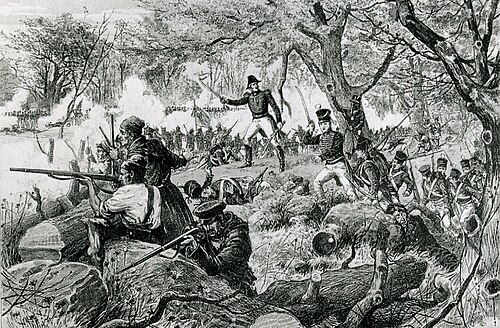
イギリス軍は、アッパー・カナダとアメリカ合衆国の間にあるセントローレンス川沿いで脆弱だった。1812年から1813年の冬、アメリカ軍はニューヨーク州オグデンズバーグから一連の襲撃を開始し、川を遡るイギリス軍の補給輸送を妨害した。2月21日、ジョージ・プレヴォーはアッパー・カナダへの援軍とともに川の対岸にあるオンタリオ州プレスコットを通過した。翌日彼が出発すると、援軍と地元民兵がオグデンズバーグの戦いで攻撃し、アメリカ軍は撤退を余儀なくされた。[187]
アメリカ軍は1813年にモントリオールに対してさらに2回の攻撃を行った。[188]ウェイド・ハンプトン少将はシャンプレーン湖から北進し、オンタリオ湖のサケッツ港を出航してセントローレンス川を下るジェームズ・ウィルキンソン将軍の部隊に加わることになっていた。ハンプトンは道路と補給の問題で遅れ、ウィルキンソンに対する強い嫌悪感も彼の計画を支援する意欲を制限した。[189] シャルル・ド・サラベリーは、カナダの選抜軍とモホーク族のより小規模な部隊を率いて、10月25日にシャトーゲー川でハンプトンの4,000人の部隊を破った。サラベリーの部隊はわずか339人だったが、強固な防御陣地を持っていた。[188]ウィルキンソンの8,000人の部隊は10月17日に出発したが、天候のために遅れた。ウィルキンソンは、ウィリアム・マルカスター大尉とジョセフ・ワントン・モリソン中佐の指揮するイギリス軍が彼を追跡しており、11月10日までにモントリオールから約150キロ (90 マイル) 離れたオンタリオ州モリスバーグ近くに上陸したという知らせを受けた。11月11日、彼の後衛2,500人がクライスラー農場でモリソンの800人の部隊を攻撃し、大きな損失を被って撃退された。[188]彼はハンプトンが前進を再開できないことを知り、米国に撤退して冬営に入った。彼はラコル・ミルズのイギリス軍前哨基地への攻撃に失敗した後、指揮官を辞任した。[190]
ナイアガラとプラッツバーグの戦い、1814年

アメリカ軍は再びナイアガラ国境に侵攻した。アメリカ軍は10月にモラビアンタウンでヘンリー・プロクター大佐を破った後、アッパー・カナダ南西部を占領しており、同州の残りを占領すればイギリス軍に割譲を強いられると考えていた。[191] 1814年4月にヨーロッパでナポレオンとの戦争が終結したことで、イギリス軍は北アメリカに軍を展開できるようになり、アメリカ軍は強い立場で交渉できるようアッパー・カナダを確保したいと考えた。アメリカ軍はナイアガラ国境を経由して侵攻し、同時に別の軍をマキナック島奪還に派遣する計画を立てた。[192]アメリカ軍は1814年7月3日にエリー砦を占領した。 [193]エリー砦の陥落やアメリカ軍の規模を知らなかったイギリス軍の将軍フィニアス・ライアルはウィンフィールド・スコットと交戦し、7月5日のチッパワの戦いでスコットはイギリス軍に勝利した。アメリカ軍はウィンフィールド・スコットの下で厳しい訓練を受けており、砲火の下でのプロとしての実力を証明していた。彼らは浅いU字隊形を組んで展開し、リアルの部隊に対して側面からの射撃と狙いを定めた一斉射撃を行った。リアルの部隊は戦場から追い出された。[194]
さらなる前進の試みは、7月25日の激戦となったが決着のつかなかったランディーズ・レーンの戦いで終わった。この戦いはナイアガラの滝近くのチペワ川の数マイル北で行われ、戦争中最も血なまぐさい、最も犠牲の大きい戦いと考えられている。[195] [196]戦闘後、アメリカ軍のジェイコブ・ブラウン将軍がジョージ砦まで撤退し、イギリス軍は追撃しなかったため、両軍とも持ちこたえた。[197]ライアル、スコット、ブラウン、ドラモンドの各指揮官は全員負傷し、スコットは負傷により戦争終了まで任務を解かれた。[198]
アメリカ軍は撤退したが、エリー砦の長期にわたる包囲に耐えた。イギリス軍は1814年8月14日にエリー砦を襲撃しようとしたが、アメリカ軍の死傷者は84名にとどまったのに対し、イギリス軍は950名が死亡、負傷、捕虜となり、大きな損失を被った。イギリス軍は、露出と補給不足でさらに弱体化した。最終的にイギリス軍は包囲を解いたが、アメリカのジョージ・イザード少将がナイアガラ戦線の指揮を引き継ぎ、消極的に追撃した。グランド川沿いのアメリカ軍の襲撃で多くの農場が破壊され、イギリス軍の兵站は弱体化した。1814年10月、アメリカ軍はアッパー・カナダに進軍し、クックス・ミルで小競り合いを起こしたが、同年9月にキングストンで進水した104門の大砲を装備した新しいイギリスの軍艦HMS セント・ローレンスが向かっていると聞いて撤退した。アメリカ軍は食糧が不足しており、エリー砦を破壊した後、ナイアガラ川を渡って撤退した。[199]

一方、ナポレオン退位後、ウェリントンの最も有能な4人の旅団指揮官の指揮下で15,000人のイギリス軍が北アメリカに派遣された。その半分以下が半島の古参兵で、残りは守備隊から来た者たちだった。プレヴォーはサケッツ港を焼き払って湖沼におけるアメリカ軍の勢力を無力化し、エリー湖、オンタリオ湖、アッパー・レイクスの海軍制圧と、ローワー・カナダへの攻撃からの防衛を命じられた。彼はローワー・カナダを防衛したものの、それ以外では目的を達成できなかったため、[200]ニューヨーク州への侵攻を決意した。彼の軍はプラッツバーグのアメリカ軍より数で勝っていたが、側面を懸念し、シャンプレーン湖の海軍制圧が必要だと判断した。プラッツバーグに到着すると、プレヴォーは急造の36門フリゲート艦 コンフィアンスに乗ったダウニーが到着するまで攻撃を延期した。コンフィアンスは未完成であったにもかかわらず、これまで一緒に働いたことのない未熟な乗組員が乗っていた。プレヴォーは急ぐ理由がないのにダウニーに時期尚早な攻撃を強いた。[201]
湖上のジョージ・ダウニー艦長率いるイギリス艦隊は、トーマス・マクドノー総司令官率いるアメリカ艦隊と互角の戦いを繰り広げた。1814年9月11日のプラッツバーグの戦いでは、イギリス艦隊は大型艦と大砲で優位に立った。アメリカの砲艦はシャンプレーン湖での戦闘に適しており、マクドノーは錨に取り付けた滑車を使って艦船を操縦することができた。戦闘の早い段階で両軍とも1隻ずつを失った。ダウニーは砲架の反動で死亡し、マクドノーは2度も打ち倒されて意識を失った。2時間半後、コンフィアンスは大きな損害を受けて旗を降ろし、イギリス艦隊の残りは撤退した。すでに服装規定を厳守することでベテラン士官たちから疎外されていたプレボストは、今度は彼らの信頼を失い、マクドノーは国民的英雄として浮上した。[202]

アメリカ軍はシャンプレーン湖を制圧し、セオドア・ルーズベルトは後にこれを「戦争最大の海戦」と呼んだ。[203]アレクサンダー・マコーム将軍が陸上防衛を成功させた。プレヴォーはその後、上級士官を驚かせて引き返し、海軍の優位を失った後に敵地に留まるのは危険すぎると述べた。彼はロンドンに呼び戻され、そこで海軍軍法会議は、敗北は主にプレヴォーが艦隊に早まった行動を促し、その後約束された陸軍からの支援を怠ったことが原因であると裁定した。彼は軍法会議が開かれる直前に突然亡くなった。カナダ人がブロック指揮下の民兵は任務を果たしたがプレヴォーは失敗したと主張したため、彼の評判は最低に落ちた。しかし、最近の歴史家はより寛容になっている。ピーター・バロウズは、限られた手段でカナダを守るために彼の準備は精力的で、よく考えられており、包括的であり、アメリカの征服を防ぐという主な目的は達成されたと主張している。[204]
メイン州の占領
当時マサチューセッツ州の一部であったメイン州は、アメリカとイギリスの間の密輸と違法貿易の拠点であった。1813年まで、この地域は海岸近くの私掠船の活動を除いて概して平穏であった。1813年9月、アメリカ海軍のブリッグ船エンタープライズは ペマクイドポイント沖でイギリス海軍のブリッグ船ボクサーと交戦し、拿捕した。[205]
1814年7月11日、トーマス・マスターマン・ハーディはムース島(メイン州イーストポート)を一発も撃たずに占領し、サリバン砦のアメリカ軍守備隊65名[206]は平和的に降伏した。[207]イギリス軍は占領した砦を一時的に「シャーブルック砦」と改名した。1814年9月、ジョン・コープ・シャーブルックはハリファックスの基地から3,000人のイギリス軍を率いて「ペノブスコット遠征」を行った。26日間で、彼はハンプデン、バンゴー、マチャイアスを襲撃して略奪し、17隻のアメリカ船を破壊または捕獲した。彼はハンプデンの戦いで2人を殺し、アメリカ軍は1人を殺したが勝利した。撤退するアメリカ軍はフリゲート艦アダムスを破壊せざるを得なかった。[208]
イギリス軍は戦争の残りの期間、カスティーンの町とメイン州東部の大半を占領し、戒厳令を敷いて統治し[209] 、ニューアイルランド植民地を再建した。ゲント条約により、この地域は米国に返還された。イギリス軍が1815年4月に撤退した際、カスティーンから1万750ポンドの関税を徴収した。この資金は「カスティーン基金」と呼ばれ、ハリファックスにダルハウジー大学を設立するために使用された。 [210]パサマクォディ湾の島々に関する決定は、1817年に合同委員会によって下された。[211]しかし、マチャイアスシール島は占領の一環としてイギリス軍に押収されており、委員会では取り上げられなかった。イギリス/カナダが保持しているが、今日まで争点となっている。[212] [213]
チェサピーク作戦

ポトマック川に近いチェサピーク湾は戦略的な位置にあり、イギリス軍にとって主要な攻撃目標となった。ジョージ・コックバーン少将は1813年3月にそこに到着し、10日後に作戦指揮を執ったウォーレン提督と合流した。[214] 3月からコックバーンの指揮する艦隊はハンプトン・ローズ港の湾口の封鎖を開始し、バージニア州ノーフォークからメリーランド州ハバー・ド・グレースまでの湾沿いの町を襲撃した。4月下旬、コックバーンはメリーランド州フレンチタウンに上陸して火を放ち、そこに停泊していた船を破壊した。その後数週間で、彼は地元の民兵を敗走させ、他の3つの町を略奪し、焼き払った。その後、彼はプリンシピオの鉄鋳物工場に進軍し、68門の大砲とともにそれを破壊した。[215]
1813年7月4日、アメリカ独立戦争時の海軍士官、ジョシュア・バーニー准将は、海軍省を説得してチェサピーク湾艦隊を建造させた。これは、チェサピーク湾防衛のために、小型帆またはオール(スウィープ)で動く20隻の艀からなる艦隊である。1814年4月に進水した艦隊は、すぐにパタクセント川で追い詰められた。イギリス海軍を妨害することには成功したものの、その後のイギリス軍の作戦を阻止することはできなかった。
ワシントンの焼失
1814年8月、ロス将軍の指揮下にある2,500人の兵士の部隊が、HMS ロイヤルオーク、3隻のフリゲート艦、3隻のスループ艦、その他10隻の船に乗ってバミューダに到着したばかりだった。半島戦争での勝利により解放されたイギリス軍は、メリーランド州とバージニア州の海岸沿いの陽動作戦にこの部隊を使用するつもりだった。プレヴォーの要請に応えて、[具体的に]イギリス軍は、この部隊を、すでに基地にいた海軍と陸軍の部隊と共に首都攻撃に使うことに決めた。攻撃を見越して、憲法原本を含む貴重な文書がバージニア州リースバーグに移された。[216]イギリス軍機動部隊はチェサピーク湾を遡って前進し、バーニー提督の砲艦隊を敗走させ、アレクサンドリア襲撃を遂行し、地上部隊を上陸させてブレデンスバーグの戦いでアメリカ軍の守備隊を打ち負かし、ワシントン焼き討ちを遂行した。
アメリカ合衆国陸軍長官ジョン・アームストロング・ジュニアは、イギリス軍の陸海軍部隊がワシントンへ向かっている最中であったにもかかわらず、イギリス軍はワシントンではなくボルチモアを攻撃するつもりであると主張した。この地域でいくつかの橋を焼き払ったウィリアム・H・ウィンダー准将は、イギリス軍がアナポリスを攻撃すると想定し、イギリス軍がイギリス軍の2倍の規模であると誤解していたため、交戦を躊躇した。[217]経験の浅い州民兵はブラーデンスバーグの戦いで簡単に敗走し、ワシントンへの道が開かれた。ロバート・ロス少将率いるイギリス軍はコックバーンを伴った第3旅団を率いて4,500人の兵力でワシントンを攻撃し、占領した。[218] 8月24日、イギリス軍が建物内の略奪を終えた後、ロスは部隊にホワイトハウスやアメリカ合衆国議会議事堂を含むいくつかの公共の建物に火を放つよう指示した。[i]その後、建物内とその中の物に甚大な被害があったと報告された。[219]アメリカ政府と軍当局者はバージニアに逃げ、アメリカ海軍長官ウィリアム・ジョーンズはワシントン海軍工廠と近くの砦の占領を防ぐために破壊を命じた。 [220] [221]ワシントンの公共の建物はイギリス軍によって破壊されたが、個人の住宅は破壊しないように命じられた。[222]
マクヘンリー砦の包囲

イギリス軍はワシントン弾薬庫から弾薬を奪った後、船に乗り込み[221]、主な目標である厳重に防備を固めた大都市ボルチモアへと向かった。アレクサンドリア襲撃で船が何隻か足止めされたため、移動を遅らせ、ボルチモアに防備を強化し、連邦軍と州民兵隊を新たに投入する機会を与えた。「ボルチモアの戦い」は、1814年9月12日にイギリス軍がノースポイントに上陸したことで始まった。そこでイギリス軍は、パタプスコ・ネック半島のさらに上流でアメリカ民兵隊と遭遇した。銃撃戦が始まり、双方に死傷者が出た。イギリス軍の指揮官ロバート・ロス少将は狙撃兵に殺された。イギリス軍はそこで休憩し、その後北西への行軍を続け、ゴッドリー・ウッドに駐屯していたメリーランド州民兵隊と対峙した。ノースポイントの戦いは、午後の数時間にわたるマスケット銃と砲撃の決闘となった。イギリス軍は翌日、同時に水上からボルチモアを攻撃する計画も立てたが、イギリス海軍はイギリス軍の北東からの攻撃を支援するためにボルチモア港の入り口にあるマクヘンリー砦を陥落させることができなかった。[要出典]
イギリス軍は最終的に、陸軍と連携してボルチモアを攻撃するための通路を強行することはできないと悟った。激しい嵐の中、チャールズ・ネイピア大尉の指揮の下、最後の夜、フェイントとはしけ攻撃が砦の周りを西のミドル・ブランチまで行われた。嵐で一部分断され方向を誤ったため、警戒していたコビントン砦とバブコック砲台の砲手によって大きな損害を受けた後、引き返した。イギリス軍は攻撃を中止し、ボルチモアの東側から撤退した軍隊を回収するために川を下った。攻撃当夜、ボルチモアのすべての明かりが消え、砦は25時間砲撃された。唯一の明かりはマクヘンリー砦上空の砲弾の炸裂で、砦の上にまだはためいていた旗を照らしていた。砦の防衛は、アメリカの弁護士フランシス・スコット・キーにインスピレーションを与え、「マヘンリー砦の防衛」という詩を書き、後に「星条旗」として曲付けされた。[223]
南部の劇場
この地域の人口は多言語を話すため、イギリスとアメリカの両国はメキシコ湾南部での戦争をローカントリーやチェサピークで起こっている戦争とは根本的に異なる紛争と認識していた。[224]
クリーク戦争

Before 1813, the war between the Creeks, or Muscogee, had been largely an internal affair sparked by the ideas of Tecumseh farther north in the Mississippi Valley. A faction known as the Red Sticks, so named for the colour of their war sticks, had broken away from the rest of the Creek Confederacy, which wanted peace with the United States. The Red Sticks were allied with Tecumseh, who had visited the Creeks about a year before 1813 and encouraged greater resistance to the Americans.[225] The Creek Nation was a trading partner of the United States, actively involved with British and Spanish trade as well. The Red Sticks as well as many southern Muscogee people like the Seminole had a long history of alliance with the British and Spanish empires.[226] This alliance helped the North American and European powers protect each other's claims to territory in the south.[227]
On 27 July the Red Sticks were returning from Pensacola with a pack train filled with trade goods and arms when they were attacked by Americans who made off with their goods. On 30 August 1813, in retaliation for the raid, the Red Sticks, led by chiefs of the Creeks Red Eagle and Peter McQueen, attacked Fort Mims north of Mobile, the only American-held port in the territory of West Florida. The attack on Fort Mims resulted in the horrific death of 400 refugee settlers, all butchered and scalped, including women and children, and became an ideological rallying point for the Americans.[228] It prompted the state of Georgia and the Mississippi militia to immediately take major action against Creek offensives. The Red Sticks chiefs gained power in the east along the Alabama River, Coosa River and Tallapoosa River in the Upper Creek territory. By contrast, the Lower Creek, who lived along the Chattahoochee River, generally opposed the Red Sticks and wanted to remain allied to the U.S. Indian agent Benjamin Hawkins recruited Lower Creek to aid the 6th Military District under General Thomas Pinckney and the state militias against the Red Sticks. The United States combined forces were 5,000 troops from East and West Tennessee, with about 200 indigenous allies.[229] At its peak, the Red Stick faction had 4,000 warriors, only a quarter of whom had muskets.[230]
The Indian frontier of western Georgia was the most vulnerable but was partially fortified already. From November 1813 to January 1814, Georgia's militia[clarification needed] and auxiliary Federal troops from the Creek and Cherokee indigenous nations and the states of North Carolina and South Carolina organized the fortification of defences along the Chattahoochee River and expeditions into Upper Creek territory in present-day Alabama. The army, led by General John Floyd, went to the heart of the Creek Holy Grounds and won a major offensive against one of the largest Creek towns at the Battle of Autossee, killing an estimated two hundred people. In November, the militia of Mississippi with a combined 1,200 troops attacked the Econachca encampment in the Battle of Holy Ground on the Alabama River.[231] Tennessee raised a militia of 5,000 under Major General Andrew Jackson and Brigadier General John Coffee and won the battles of Tallushatchee and Talladega in November 1813.[232]
Jackson suffered enlistment problems in the winter. He decided to combine his force, composed of Tennessee militia and pro-American Creek, with the Georgia militia. In January, however, the Red Sticks attacked his army at the Battles of Emuckfaw and Enotachopo Creek. Jackson's troops repelled the attackers, but they were outnumbered and forced to withdraw to his base at Fort Strother.[233]
In January, Floyd's force of 1,300 state militia and 400 Creek moved to join the United States forces in Tennessee, but they were attacked in camp on the Calibee Creek by Tukabatchee Muscogees on 27 January.[citation needed]

Jackson's force increased in numbers with the arrival of United States Army soldiers and a second draft of Tennessee state militia, Cherokee, and pro-American Creek swelled his army to around 5,000. In March 1814, they moved south to attack the Red Sticks.[234] On 27 March, Jackson decisively defeated a force of about a thousand Red Sticks at Horseshoe Bend, killing 800 of them at a cost of 49 killed and 154 wounded.[235]
Jackson then moved his army to Fort Jackson on the Alabama River. He promptly turned on the pro-American Creek who had fought with him and compelled their chieftains, along with a single Red Stick chieftain, to sign the Treaty of Fort Jackson, which forced the Creek tribe as a whole to cede most of western Georgia and part of Alabama to the U.S. Both Hawkins and the pro-American Creek strongly opposed the treaty, which they regarded as deeply unjust.[236] The third clause of the treaty also demanded that the Creek cease communicating with the British and Spanish, and trade only with United States-approved agents.[237][failed verification]
Gulf Coast
British aid to the Red Sticks arrived after the end of the Napoleonic Wars in April 1814 and after Admiral Alexander Cochrane assumed command from Admiral Warren in March. Captain Hugh Pigot arrived in May 1814 with two ships to arm the Red Sticks. He thought that some 6,600 warriors could be armed and recruited. It was overly optimistic at best. The Red Sticks were in the process of being destroyed as a military force.[238] In April 1814, the British established an outpost on the Apalachicola River (Prospect Bluff Historic Sites). Cochrane sent a company of Royal Marines commanded by Edward Nicolls,[239] the vessels HMS Hermes and HMS Carron and further supplies to meet the Indians in the region.[240] In addition to training them, Nicolls was tasked to raise a force from escaped slaves as part of the Corps of Colonial Marines.[240]
On 12 July 1814, General Jackson complained to the governor of Western Florida, Mateo González Manrique, situated at Pensacola that combatants from the Creek War were being harboured in Spanish territory and made reference to reports of the British presence on Spanish soil. Although he gave an angry reply to Jackson, Manrique was alarmed at the weak position he found himself in and appealed to the British for help. The British were observed docking on August 25 and unloading the following day.[241]
The first engagement of the British and their Creek allies against the Americans on the Gulf Coast was the 14 September 1814 attack on Fort Bowyer. Captain William Percy tried to take the United States fort, hoping to then move on Mobile and block United States trade and encroachment on the Mississippi. After the Americans repulsed Percy's forces, the British established a military presence of up to 200 Marines at Pensacola. In November, Jackson's force of 4,000 men took the town.[242] This underlined the superiority of numbers of Jackson's force in the region.[243] The United States force moved to New Orleans in late 1814. Jackson's army of 1,000 regulars and 3,000 to 4,000 militia, pirates and other fighters as well as civilians and slaves built fortifications south of the city.[244]
American forces under General James Wilkinson, himself a paid Spanish secret agent,[245] took the Mobile area from the Spanish in March 1813. This region was the rump of Spanish West Florida, the western portion of which had been annexed to the United States in 1810. The Americans built Fort Bowyer, a log and earthen-work fort with 14 guns, on Mobile Point to defend it.[246] Major Latour opined that none of the three forts in the area were capable of resisting a siege.[247]
At the end of 1814, the British launched a double offensive in the South weeks before the Treaty of Ghent was signed. On the Atlantic coast, Admiral George Cockburn was to close the Intracoastal Waterway trade and land Royal Marine battalions to advance through Georgia to the western territories. While on the Gulf coast, Admiral Alexander Cochrane moved on the new state of Louisiana and the Mississippi Territory. Cochrane's ships reached the Louisiana coast on 9 December and Cockburn arrived in Georgia on 14 December.[248]

The British army had the objective of gaining control of the entrance of the Mississippi.[249] To this end, an expeditionary force of 8,000 troops[250] under General Edward Pakenham attacked Jackson's prepared defences in New Orleans on 8 January 1815. The Battle of New Orleans was an American victory, as the British failed to take the fortifications on the East Bank. The British attack force suffered high casualties, including 291 dead, 1,262 wounded and 484 captured or missing[251][252] whereas American casualties were light with 13 dead, 39 wounded and 19 missing,[253] according to the respective official casualty returns. This battle was hailed as a great victory across the United States, making Jackson a national hero and eventually propelling him to the presidency.[254][255] In January 1815 Fort St. Philip endured ten days of bombardment from two bomb vessels of the Royal Navy. Robert V. Remini believes this was preventing the British moving their fleet up the Mississippi in support of the land attack.[256]
After deciding further attacks would be too costly and unlikely to succeed, the British troops withdrew on 18 January.[257] However, adverse winds slowed the evacuation operation and it was not until 27 January 1815 that the land forces rejoined the fleet, allowing for its final departure.[258] After New Orleans, the British moved to take Mobile as a base for further operations.[259] In preparation, General John Lambert laid siege to Fort Bowyer taking it on 12 February 1815. However HMS Brazen brought news of the Treaty of Ghent the next day and the British abandoned the Gulf Coast.[260] This ending of the war prevented the capture of Mobile, and any renewed attacks on New Orleans.[259]
Meanwhile, in January 1815, Cockburn succeeded in blockading the southeastern coast of Georgia by occupying Camden County. The British quickly took Cumberland Island, Fort Point Peter and Fort St. Tammany in a decisive victory. Under the orders of his commanding officers, Cockburn's forces relocated many refugee slaves, capturing St. Simons Island as well to do so. He had orders to recruit as many runaway slaves into the Corps of Colonial Marines as possible and use them to conduct raids in Georgia and the Carolinas.[261] Cockburn also provided thousands of muskets and carbines and a huge quantity of ammunition to the Creeks and Seminole Indians for the same purpose.[262] During the invasion of the Georgia coast, an estimated 1,485 people chose to relocate to British territories or join the British military. However, by mid-March, several days after being informed of the Treaty of Ghent, British ships left the area.[263]
The British government did not recognize either West Florida or New Orleans as American territory. The historian Frank Owsley suggests that they might have used a victory at New Orleans to demand further concessions from the U.S.[264] However, subsequent research in the correspondence of British ministers at the time suggests otherwise.[265] with specific reference to correspondence from the Prime Minister to the Foreign Secretary dated 23 December 1814.[266] West Florida was the only territory permanently gained by the United States during the war.[267]
The war at sea
Background

In 1812, Britain's Royal Navy was the world's largest and most powerful navy, with over 600 vessels in commission, following the defeat of the French Navy at the Battle of Trafalgar in 1805.[114] Most of these ships were employed blockading the French navy and protecting British trade against French privateers, but the Royal Navy still had 85 vessels in American waters, counting all North American and Caribbean waters.[j] However, the Royal Navy's North American squadron was the most immediately available force, based in Halifax and Bermuda (two of the colonies that made up British North America), and numbered one small ship of the line and seven frigates as well as nine smaller sloops and brigs and five schooners.[268] By contrast, the entire United States Navy was composed of 8 frigates, 14 smaller sloops and brigs, with no ships of the line. The United States had embarked on a major shipbuilding program before the war at Sackett's Harbor to provide ships for use on the Great Lakes, and continued to produce new ships.
Opening strategies
The British strategy was to protect their own merchant shipping between Halifax and the West Indies, with the order given on 13 October 1812 to enforce a blockade of major American ports to restrict American trade.[270]
Because of their numerical inferiority, the American strategy was to cause disruption through hit-and-run tactics such as the capturing prizes and engaging Royal Navy vessels only under favourable circumstances.
Days after the formal declaration of war, the United States put out two small squadrons, including the frigate President and the sloop Hornet under Commodore John Rodgers and the frigates United States and Congress, with the brig Argus under Captain Stephen Decatur. These were initially concentrated as one unit under Rodgers, who intended to force the Royal Navy to concentrate its own ships to prevent isolated units being captured by his powerful force.[citation needed] Large numbers of American merchant ships were returning to the United States with the outbreak of war and the Royal Navy could not watch all the ports on the American seaboard if they were concentrated together. Rodgers' strategy worked in that the Royal Navy concentrated most of its frigates off New York Harbor under Captain Philip Broke, allowing many American ships to reach home. However, Rodgers' own cruise captured only five small merchant ships, and the Americans never subsequently concentrated more than two or three ships together as a unit.[271]
Single-ship actions

The more recently built frigates of the US Navy were intended to overmatch their opponents. The United States did not believe that it could build a large enough navy to contest with the Royal Navy in fleet actions. Therefore, where it could be done, individual ships were built to be tougher, larger, and carry more firepower than their equivalents in European navies.[k] The newest three 44-gun ships were designed with a 24-pounder main battery. These frigates were intended to demolish the 36- to 38-gun (18-pounder) armed frigates that formed the majority of the world's navies, while being able to evade larger ships.[273] Similarly the Wasp class ship-sloops were an over-match to the Cruizer class brigs being employed by the British. The Royal Navy, maintaining more than 600 ships in fleets and stations worldwide, was overstretched and undermanned; most British ships enforcing the blockade were (with a few notable exceptions) less practiced than the crews of the smaller US Navy.[274][275][276][277][l] This meant that in single-ship actions the Royal Navy ships often found themselves against larger ships with larger crews, who were better drilled, as intended by the US planners.[m]
However naval ships do not fight as individuals by the code of the duel, they are national instruments of war, and are used as such. The Royal Navy counted on its numbers, experience, and traditions to overcome the individually superior vessels. As the US Navy found itself mostly blockaded by the end of the war, the Royal Navy was correct.[279] For all the fame that these actions received, they in no way affected the outcome of the results of Atlantic theatre of War. The final count of frigates lost was three on each side, with most of the US Navy blockaded in port.[n] During the war, the United States Navy captured 165 British merchantmen (although privateers captured many more) while the Royal Navy captured 1,400 American merchantmen.[280] More significantly, the British blockade of the Atlantic coast caused the majority of warships to be unable to put to sea and shut down both American imports and exports.[281][o]
Notable single-ship engagements include USS Constitution vs HMS Guerriere on 19 August 1812,[283] USS United States vs HMS Macedonian on 25 October,[284] USS Constitution vs HMS Java on 29–30 December,[156][285] HMS Shannon vs USS Chesapeake on 1 June 1813 (the bloodiest such action of the war),[286] HMS Phoebe vs USS Essex on 28 March 1814,[287] HMS Endymion vs USS President on 15 January 1815.[288]
In single ship battles, superior force was the most significant factor. In response to the majority of the American ships being of greater force than the British ships of the same class, Britain constructed five 40-gun, 24-pounder heavy frigates[289] and two "spar-decked" frigates (the 60-gun HMS Leander and HMS Newcastle) and others.[290] To counter the American sloops of war, the British constructed the Cyrus-class ship-sloop of 22 guns. The British Admiralty also instituted a new policy that the three American heavy frigates should not be engaged except by a ship of the line or frigates in squadron strength.[p]
The United States Navy's smaller ship-sloops had also won several victories over Royal Navy sloops-of-war, again of smaller armament. The American sloops Hornet, Wasp (1807), Peacock, Wasp (1813) and Frolic were all ship-rigged while the British Cruizer-class sloops that they encountered were brig-rigged, which gave the Americans a significant advantage. Ship rigged vessels are more manoeuvrable in battle because they have a wider variety of sails and thus being more resistant to damage. Ship-rigged vessels can back sail, literally backing up or heave to (stop).[292][293][294][q]
Privateering
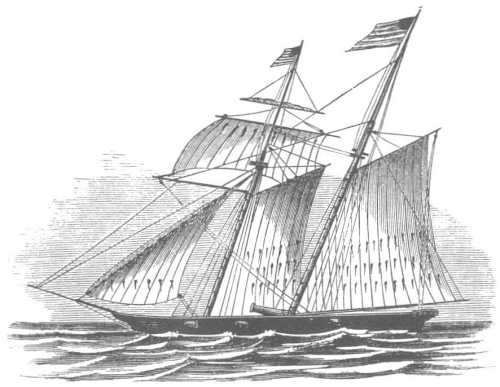
The operations of American privateers proved a more significant threat to British trade than the United States Navy. They operated throughout the Atlantic until the close of the war, most notably from Baltimore. American privateers reported taking 1300 British merchant vessels, compared to 254 taken by the United States Navy,[295][296][297] although the insurer Lloyd's of London reported that only 1,175 British ships were taken, 373 of which were recaptured, for a total loss of 802.[298] Canadian historian Carl Benn wrote that American privateers took 1,344 British ships, of which 750 were retaken by the British.[280] The British tried to limit privateering losses by the strict enforcement of convoy by the Royal Navy[299] and directly by capturing 278 American privateers. Due to the massive size of the British merchant fleet, American captures only affected 7.5% of the fleet, resulting in no supply shortages or lack of reinforcements for British forces in North America.[300] Of 526 American privateers, 148 were captured by the Royal Navy and only 207 ever took a prize.[280]
Due to the large size of their navy, the British did not rely as much on privateering. The majority of the 1,407 captured American merchant ships were taken by the Royal Navy. The war was the last time the British allowed privateering, since the practice was coming to be seen as politically inexpedient and of diminishing value in maintaining its naval supremacy. However, privateering remained popular in British colonies. It was the last hurrah for privateers in the insular British North American colony of Bermuda who vigorously returned to the practice with experience gained in previous wars.[301][302][303][304] The nimble Bermuda sloops captured 298 American ships.[305] Privateer schooners based in continental British North America, especially from Nova Scotia, took 250 American ships and proved especially effective in crippling American coastal trade and capturing American ships closer to shore than the Royal Navy's cruisers.[306]
British blockade

The naval blockade of the United States began informally in the late fall of 1812. Under the command of British Admiral John Borlase Warren, it extended from South Carolina to Florida.[270] It expanded to cut off more ports as the war progressed. Twenty ships were on station in 1812 and 135 were in place by the end of the conflict. In March 1813, the Royal Navy punished the Southern states, who were most vocal about annexing British North America, by blockading Charleston, Port Royal, Savannah, and New York City as well. Additional ships were sent to North America in 1813 and the Royal Navy tightened and extended the blockade, first to the coast south of Narragansett by November 1813 and to the entire American coast on 31 May 1814.[280][307] In May 1814, following the abdication of Napoleon and the end of the supply problems with Wellington's army, New England was blockaded.[308]
The British needed American foodstuffs for their army in Spain and benefited from trade with New England, so they did not at first blockade New England.[280] The Delaware River and Chesapeake Bay were declared in a state of blockade on 26 December 1812. Illicit trade was carried on by collusive captures arranged between American traders and British officers. American ships were fraudulently transferred to neutral flags. Eventually, the United States government was driven to issue orders to stop illicit trading. This put only a further strain on the commerce of the country. The British fleet occupied the Chesapeake Bay and attacked and destroyed numerous docks and harbours.[309] The effect was that no foreign goods could enter the United States on ships and only smaller fast boats could attempt to get out. The cost of shipping became very expensive as a result.[310][r]
The blockade of American ports later tightened to the extent that most American merchant ships and naval vessels were confined to port. The American frigates USS United States and USS Macedonian ended the war blockaded and hulked in New London, Connecticut.[311] USS United States and USS Macedonian attempted to set sail to raid British shipping in the Caribbean, but were forced to turn back when confronted with a British squadron, and by the end of the war, the United States had six frigates and four ships-of-the-line sitting in port.[312] Some merchant ships were based in Europe or Asia and continued operations. Others, mainly from New England, were issued licences to trade by Admiral Warren, commander in chief on the American station in 1813. This allowed Wellington's army in Spain to receive American goods and to maintain the New Englanders' opposition to the war. The blockade nevertheless decreased American exports from $130 million in 1807 to $7 million in 1814. Most exports were goods that ironically went to supply their enemies in Britain or the British colonies.[313] The blockade had a devastating effect on the American economy with the value of American exports and imports falling from $114 million in 1811 down to $20 million by 1814 while the United States Customs took in $13 million in 1811 and $6 million in 1814, even though the Congress had voted to double the rates.[17] The British blockade further damaged the American economy by forcing merchants to abandon the cheap and fast coastal trade to the slow and more expensive inland roads.[314] In 1814, only 1 out of 14 American merchantmen risked leaving port as it was likely that any ship leaving port would be seized.[315]
As the Royal Navy base that supervised the blockade, Halifax profited greatly during the war. From there, British privateers seized and sold many French and American ships. More than a hundred prize vessels were anchored in St. George's Harbour awaiting condemnation by the Admiralty Court when a hurricane struck in 1815, sinking roughly sixty of the vessels.[316]
Freeing and recruiting slaves

The British Royal Navy's blockades and raids allowed about 4,000 African Americans to escape slavery by fleeing American plantations aboard British ships. American slaves near to the British military rebelled against their masters and made their way to British encampments. The migrants who settled in Canada were known as the Black Refugees. The blockading British fleet in the Chesapeake Bay received increasing numbers of freed slaves during 1813. By British government order, they were considered free persons when they reached British hands.[10][318]
Alexander Cochrane's proclamation of 2 April 1814 invited Americans who wished to emigrate to join the British. Although it did not explicitly mention slaves, it was taken by all as addressed to them. About 2,400 escaped slaves and their families were transported by the Royal Navy to the Royal Naval Dockyard at Bermuda (where they were employed on works about the yard and organized as a militia to aid in the defence of the yard), Nova Scotia and New Brunswick during and after the war. Starting in May 1814, younger male volunteers were recruited into a new Corps of Colonial Marines. They fought for Britain throughout the Atlantic campaign, including the Battle of Bladensburg, the attacks on Washington, D.C., and the Battle of Baltimore, before withdrawing to Bermuda with the rest of the British forces. They were later settled in Trinidad after having rejected orders for transfer to the West India Regiments, forming the community of the Merikins (none of the freed slaves remained in Bermuda after the war). These escaped slaves represented the largest emancipation of African Americans prior to the American Civil War.[319][320][321] Britain paid the United States for the financial loss of the slaves at the end of the war.[322]
Treaty of Ghent
In August 1814, peace discussions began in Ghent. Both sides approached negotiations warily.[s] The British strategy for decades had been to create a buffer state in the American Northwest Territory to block American expansion. Britain also demanded naval control of the Great Lakes and access to the Mississippi River.[323] On the American side, Monroe instructed the American diplomats sent to Europe to try to convince the British to cede the Canadas, or at least Upper Canada, to the U.S.[324] At a later stage, the Americans also demanded damages for the burning of Washington and for the seizure of ships before the war began.[325]
.jpg/500px-Am%C3%A9d%C3%A9e_Forestier_-_Signing_of_Treaty_of_Ghent_(1814).jpg)
American public opinion was outraged when Madison published the demands as even the Federalists were now willing to fight on. A British force burned Washington, but it failed to capture Baltimore and sailed away when its commander was killed. In northern New York State, 10,000 British veterans were marching south until a decisive defeat at the Battle of Plattsburgh forced them back to Canada.[t] British Prime Minister Lord Liverpool, aware of growing opposition to wartime taxation and the demands of merchants for reopened trade with America, realized Britain also had little to gain and much to lose from prolonged warfare especially given growing concern about the situation in Europe.[326] The main focus of British foreign policy was the Congress of Vienna, at which British diplomats had clashed with Russian and Prussian diplomats over the terms of the peace with France and there were fears that Britain might have to go to war with Russia and Prussia. Export trade was all but paralyzed and France was no longer an enemy of Britain after Napoleon fell in April 1814, so the Royal Navy no longer needed to stop American shipments to France and it no longer needed to impress more seamen. The British were preoccupied in rebuilding Europe after the apparent final defeat of Napoleon.[327]
Consequently, Lord Liverpool urged the British negotiators to offer a peace based on the restoration of the pre-war status quo. The British negotiators duly dropped their demands for the creation of an Indian neutral zone, which allowed negotiations to resume at the end of October. The American negotiators accepted the British proposals for a peace based on the pre-war status quo. Prisoners were to be exchanged and escaped slaves returned to the United States, as at least 3,000 American slaves had escaped to British lines. The British however refused to honour this aspect of the treaty, settling some of the newly freed slaves in Nova Scotia[328][329] and New Brunswick.[330] The Americans protested Britain's failure to return American slaves in violation of the Treaty of Ghent. After arbitration by the Tsar of Russia the British paid $1,204,960 in damages to Washington, to reimburse the slave owners.[322]
On 24 December 1814, the diplomats had finished and signed the Treaty of Ghent. The treaty was ratified by the British Prince Regent three days later on 27 December.[331][332][333][334] On 17 February, it arrived in Washington, where it was quickly ratified and went into effect, ending the war. The terms called for all occupied territory to be returned, the prewar boundary between Canada and the United States to be restored, and the Americans were to gain fishing rights in the Gulf of Saint Lawrence.[citation needed] The British insisted on the inclusion of provisions to restore to the Indians "all possessions, rights and privileges which they may have enjoyed, or been entitled to in 1811".[335] The Americans ignored and violated these provisions.[335]
The Treaty of Ghent completely maintained Britain's maritime belligerent rights, a key goal for the British, without acknowledging American maritime rights or the end of impressment. While American maritime rights were not seriously violated in the century of peace until World War I, the defeat of Napoleon made the need for impressment irrelevant and the grievances of the United States no longer an issue. In this sense, the United States achieved its goals indirectly and felt its honour had been upheld despite impressment continuing.[336][337]
Losses and compensation
Losses figures do not include deaths among Canadian militia forces or Indigenous tribes. British losses in the war were about 1,160 killed in action and 3,679 wounded,[citation needed] with 3,321 British who died from disease. American losses were 2,260 killed in action and 4,505 wounded. While the number of Americans who died from disease is not known, it is estimated that about 15,000 died from all causes directly related to the war.[6]
The war added some £25 million to Britain's national debt.[339] In the United States, the cost was $105 million.[citation needed] The national debt rose from $45 million in 1812 to $127 million by the end of 1815, although by selling bonds and treasury notes at deep discounts – and often for irredeemable paper money due to the suspension of specie payment in 1814 – the government received only $34 million worth of specie.[340][341] Stephen Girard, the richest man in the United States at the time, was among those who funded the United States government's involvement in the war.[342][343] The British national debt rose from £451 million in 1812 to £841 million in 1814, although this was at a time when Britain was fighting a war against Napoleon. The war was bad for both economies.[344]
In the United States, the economy grew 3.7% a year from 1812 to 1815, despite a large loss of business by East Coast shipping interests. Prices were 15% higher – inflated – in 1815 compared to 1812, an annual rate of 4.8%.[345][346] Hundreds of new banks were opened; they largely handled the loans that financed the war since tax revenues were down. Money that would have been spent on foreign trade was diverted to opening new factories, which were profitable since British factory-made products were not for sale.[347] This gave a major boost to the Industrial Revolution in the United States as typified by the Boston Associates.[348][349]
Long-term consequences
The border between the United States and Canada remained essentially unchanged by the war, with neither side making meaningful territorial gains.[u] Despite the Treaty of Ghent not addressing the original points of contention and establishing the status quo ante bellum, relations between the United States and Britain changed drastically. The issue of impressment also became irrelevant as the Royal Navy no longer needed sailors after the war.[citation needed]
The long-term results of the war were generally satisfactory for both the United States and Great Britain. Except for occasional border disputes and some tensions during and after the American Civil War, relations between the United States and Britain remained peaceful for the rest of the 19th century. In the 20th century, spurred by multiple world conflicts, the two countries became close allies. The memory of the conflict played a major role in helping to consolidate a Canadian national identity after 1867, the year of Canadian confederation.[350]
The Rush–Bagot Treaty between the United States and Britain was enacted in 1817. It demilitarized the Great Lakes and Lake Champlain, where many British naval arrangements and forts still remained. The treaty laid the basis for a demilitarized boundary. It remains in effect to this day.[351]
Bermuda

Bermuda had been largely left to the defences of its own militia and privateers before American independence, but the Royal Navy had begun buying up land and operating from there beginning in 1795, after a number of years spent surveying the reefs to find Hurd's channel (which enabled large frigates and ships of the line to pass through the surrounding reefs to Murray's Anchorage and the enclosed harbours). As construction work progressed through the first half of the 19th century, Bermuda became an Imperial fortress and the permanent naval headquarters the Western hemisphere, housing the Admiralty and serving as a base and dockyard. Defence infrastructure remained the central leg of Bermuda's economy until after World War II.[316][352][353]
The Canadas
After the war, pro-British leaders in Upper Canada demonstrated a strong hostility to American influences, including republicanism, which shaped its policies.[354] Immigration from the United States was discouraged and favour was shown to the Anglican Church as opposed to the more Americanized Methodist Church.[355]
The Battle of York showed the vulnerability of Upper and Lower Canada (The Canadas). In the decades following the war, several projects were undertaken to improve the defence of the colonies against the United States. They included work on La Citadelle at Quebec City, Fort Henry at Kingston, and rebuilding Fort York at York. Additionally, work began on the Halifax Citadel to defend the port against foreign navies.[356] Akin to the American view that it was a "Second War of Independence" for the United States, the war was also somewhat of a war of independence for Canada.[357] Before the war Canada was a mix of French Canadians, native-born British subjects, loyalists and Americans who migrated there. Historian Donald R. Hickey maintains that the war that threatened Canada greatly helped to cement these disparate groups into a unified nation.[358]
Indigenous nations
The Indigenous tribes allied to the British lost their cause. The Americans rejected the British proposal to create an "Indian barrier state" in the American West at the Ghent peace conference and it never resurfaced.[359] Donald Fixico argues that "[a]fter the War of 1812, the U.S. negotiated over two hundred Indian treaties that involved the ceding of Indian lands and 99 of these agreements resulted in the creation of reservations west of the Mississippi River".[360]
The Indigenous nations lost most of their fur-trapping territory.[361] Indigenous nations were displaced in Alabama, Georgia, New York and Oklahoma, losing most of what is now Indiana, Michigan, Ohio and Wisconsin within the Northwest Territory as well as in New York and the South. They came to be seen as an undesirable burden by British policymakers, who now looked to the United States for markets and raw materials.[362] Everyone, including British fur traders were prohibited from entering in the United States for purposes of trade.[361]
British Indian agents however continued to meet regularly with their former allies among the tribes of the Old Northwest, but refused to supply them with arms or help them resist American attempts to displace them. The American government rapidly built a network of forts throughout the Old Northwest, thus establishing firm military control. It also sponsored American fur traders, who outcompeted the British fur traders.[362] Meanwhile, Euro-American settlers rapidly migrated into the Old Northwest, into the lands occupied by the tribes who were previously allied with the British.[363] The War of 1812 marked a turning point in the history of the Old Northwest because it established United States authority over the British and Indians of that border region.[364]
After the decisive defeat of the Creek Indians at the Battle of Horseshoe Bend in 1814, some Creek warriors escaped to join the Seminole in Florida.[citation needed] The remaining Creek chiefs signed away about half their lands, comprising 23,000,000 acres, covering much of southern Georgia and two-thirds of modern Alabama. The Creek were separated from any future help from the Spanish in Florida and from the Choctaw and Chickasaw to the west.[365]
United Kingdom

The war is seldom remembered in the United Kingdom. The war in Europe against the French Empire under Napoleon ensured that the British did not consider the War of 1812 against the United States as more than a sideshow.[358] Britain's blockade of French trade had worked and the Royal Navy was the world's dominant nautical power (and remained so for another century). While the land campaigns had contributed to saving Canada, the Royal Navy had shut down American commerce, bottled up the United States Navy in port and widely suppressed privateering. British businesses, some affected by rising insurance costs, were demanding peace so that trade could resume with the United States.[366] The peace was generally welcomed by the British, although there was disquiet about the rapid growth of the United States. The two nations quickly resumed trade after the end of the war and a growing friendship.[367]
The historian Donald Hickey maintains that for Britain, "the best way to defend Canada was to accommodate the United States. This was the principal rationale for Britain's long-term policy of rapprochement with the United States in the nineteenth century and explains why they were so often willing to sacrifice other imperial interests to keep the republic happy".[368]
United States

The nation gained a strong sense of complete independence as people celebrated their "second war of independence".[369] Nationalism soared after the victory at the Battle of New Orleans. The opposition Federalist Party collapsed due to its opposition to the war and the Era of Good Feelings ensued.[370]
No longer questioning the need for a strong Navy, the United States built three new 74-gun ships of the line and two new 44-gun frigates shortly after the end of the war.[371] In 1816, the United States Congress passed into law an "Act for the gradual increase of the Navy" at a cost of $1,000,000 a year for eight years, authorizing nine ships of the line and 12 heavy frigates.[372] The captains and commodores of the Navy became the heroes of their generation in the United States. Several war heroes used their fame to win elections to national office. Andrew Jackson and William Henry Harrison both benefited from their military successes to win the presidency, while representative Richard Mentor Johnson's role during the war helped him attain the vice presidency.[373]
During the war, New England states became increasingly frustrated over how the war was being conducted and how the conflict affected them. They complained that the United States government was not investing enough militarily and financially in the states' defences and that the states should have more control over their militias. Increased taxes, the British blockade, and the occupation of some of New England by enemy forces also agitated public opinion in the states.[374] At the Hartford Convention held between December 1814 and January 1815, Federalist delegates deprecated the war effort and sought more autonomy for the New England states. They did not call for secession but word of the angry anti-war resolutions appeared as peace was announced and the victory at New Orleans was known. The upshot was that the Federalists were permanently discredited and quickly disappeared as a major political force.[375]
This war enabled thousands of slaves to escape to freedom, despite the difficulties.[376] The British helped numerous escaped slaves resettle in New Brunswick and Nova Scotia, where Black Loyalists had also been granted land after the American Revolutionary War.[376]
Jackson invaded Florida (then part of New Spain) in 1818, demonstrating to Spain that it could no longer control that colonial territory with a small force. Spain sold Florida to the United States in 1819 under the Adams–Onís Treaty following the First Seminole War. Pratt concludes that "[t]hus indirectly the War of 1812 brought about the acquisition of Florida".[377]
Historiography
The historiography of the War of 1812 reflects the numerous interpretations of the conflict, especially in reference to the war's outcome.[378][379] The historical record has interpreted both the British and Americans as victors in the conflict, with substantial academic and popular literature published to support each claim.
The British viewed the War of 1812 as a minor theatre that was overshadowed by key victories at the Battle of Trafalgar in 1805 and the Battle of Waterloo in 1815, leading to the Pax Britannica. In the United States and Upper Canada, nationalistic mythology around the war took hold following its conclusion.[380][v]
With the failure of the invasion of British Canada advancing the concept of Canadian identity, Canada remained a distinct region that would continue to evolve into a nation.[382] Americans were able to enforce their sovereignty, and both the restoration of honor and what has been called the Second War of Independence are important themes in American historiography, and are considered significant results by historians.[383] Indigenous nations are generally held to have lost in the war.[384]See also
- Bibliography of early United States naval history
- Bibliography of the War of 1812
- Elgin Military Museum
- Indiana in the War of 1812
- Kentucky in the War of 1812
- List of War of 1812 battles
- North Carolina in the War of 1812
- Patriot War (Florida)
- Sixty Years' War
- Timeline of the War of 1812
- War of 1812 campaigns
Notes
- ^ see Results of the War of 1812
- ^ Includes 2,250 men of the Royal Navy.
- ^ Includes 1,000 combat casualties on the northern front.
- ^ The House declared war by 61.7% with a majority in all sections, 20 Members not voting, and the Senate was closer at 59.4%, four not voting. The former Federalist stronghold in Massachusetts had one Democrat-Republican and one Federalist for U.S. Senators, with ten Democrat-Republicans and seven Federalists in the House. Only two states had both Senators in the Federalist Party: Connecticut with 7 Federalist Representatives, and Maryland with 7 Democrat-Republicans and 3 Federalists in the House.
- ^ Estimates for the numbers of impressed have varied greatly, with 10,000 as a conservative estimate.[53]
- ^ units raised for local service but otherwise on the same terms as regulars
- ^ Hickey
- ^ Hull was later court-martialed for cowardice, neglect of duty and for lying about lack of supplies. He was convicted and sentenced to death, but President Madison granted him a pardon for his heroic service during the Revolutionary War.[155]
- ^ The task was directed by pyrotechnic experts Lieutenants George Lacy and George Pratt of the Royal Navy.[218]
- ^ Admiralty reply to British press criticism.[269]
- ^ "They are superior to any European frigate," Humphreys wrote of the design he had in mind, "and if others should be in [the enemy's] company, our frigates can always lead ahead and never be obliged to go into action, but on their own terms, except in a calm; in blowing weather our ships are capable of engaging to advantage double-deck ships." In another design Humphreys proposed "such frigates as in blowing weather would be an overmatch for double-deck ships, and in light winds evade coming into action."[272]
- ^ With sufficient training and drilling gunnery could be improved, but there was no immediate solution for the lack of crew numbers on British ships. There were six hundred ships in service, manned by only 140,000 seamen and marines. Subsequently the Royal Navy was spread out thin which compromised a crew's overall efficiency and could not rival the quality and efficiency of the crews employed in the smaller, all-volunteer U.S. Navy.[50]
- ^ Admiral Warren was evidently concerned, because he circulated a standing order, on March 6, directing his commanders to give priority to "the good discipline and the proper training of their Ships Companies to the expert management of the Guns." All officers and seamen on the North American station were urged to keep in mind "that the issue of the Battle will greatly depend on the cool, steady and regular manner in which the Guns shall be loaded, pointed & fired." Two weeks later, the Admiralty issued a circular to all the British admirals, discouraging the daily "spit and polish" scouring of the brasswork and directing that "the time thrown away on this unnecessary practice be applied to the really useful and important points of discipline and exercise at Arms."[278]
- ^ Compared to other nations, the British navy had mastered the practice of employing blockades, which severely compromised an enemy's freedom of movement, supply lines, and economic vitality. It also protected their commercial shipping by preventing enemy privateers and cruisers from going out to sea and capturing prizes. Britain's ten-year-old commercial and military blockade of continental Europe had largely succeeded in its twin goals of interdicting most seagoing commerce while keeping the French navy imprisoned in its ports. It was therefore to be expected that the main thrust of British naval strategy during the war was the employment of blockades along the American coast.[272]
- ^ The tightening grip of the British blockade was beginning to take a severe economic toll on communities throughout the country. The drain on the treasury remained a pressing concern, and the Republican-dominated Congress finally recognized the need for more tax revenue; a new levy fell on licences, carriages, auctions, sugar refineries, and salt.[282]
- ^ The superior force and scantlings of the American 44-gun frigates, now denounced as "disguised ships of the line," prompted the Admiralty to issue a "Secret & Confidential" order to all station chiefs prohibiting single-frigate engagements with the Constitution, President, or United States. A lone British frigate was henceforth ordered to flee from the big American frigates, or (if it could be done safely) to shadow them at a prudent distance, remaining out of cannon-shot range, until reinforcements.[291]
- ^ More significantly, if some spars are shot away on a brig because it is more difficult to wear and the brig loses the ability to steer while a ship could adjust its more diverse canvas to compensate for the imbalance caused by damage in battle.[292] Furthermore, ship-rigged vessels with three masts simply have more masts to shoot away than brigs with two masts before the vessel is unmanageable.[292][293]
- ^ "The British blockade had a crushing effect on American foreign trade. "Commerce is becoming very slack," reported a resident of Baltimore in the spring of 1813: "no arrivals from abroad, & nothing going to sea but sharp [that is fast] vessels." By the end of the year, the sea lanes had become so dangerous that merchants wishing to sell goods had to shell out 50 percent of the value of the ship and cargo."[310]
- ^ For details of the negotiations, see Samuel Flagg Bemis (1956), John Quincy Adams and the Foundations of American Foreign Policy, pp. 196–220; Remini 1991, pp. 94–122; Ward & Gooch 1922, pp. 537–542 and Mahan 1905, pp. 73–78.
- ^ The British were unsure whether the attack on Baltimore was a failure, but Plattsburg was a humiliation that called for court martial (Latimer 2007, pp. 331, 359, 365).
- ^ Spain, a British ally, lost control of the Mobile, Alabama area to the Americans as a consequence of the Patriot War (Florida) which took place concurrently with the War of 1812.
- ^ Theodore Roosevelt commented: "Latour is the only trustworthy American contemporary historian of this war, and even he at times absurdly exaggerates the British force and loss, Most of the other American 'histories' of that period were the most preposterously bombastic works that ever saw print. But as regards this battle, none of them are as bad as even such British historians as Alison. ... The devices each author adopts to lessen the seeming force of his side are generally of much the same character. For instance, [at New Orleans] Latour says that 800 of Jackson's men were employed on works at the rear, on guard duty, etc., and deducts them; James, for precisely similar reasons, deducts 553 men. ... Almost all British writers underestimate their own force and enormously magnify that of the Americans."[381]
References
- ^ a b c d Clodfelter 2017, p. 245.
- ^ Allen 1996, p. 121.
- ^ Tucker et al. 2012, p. 570].
- ^ a b Clodfelter 2017, p. 244.
- ^ a b c Stagg 2012, p. 156.
- ^ a b Hickey 2006, p. 297.
- ^ Leland 2010, p. 2.
- ^ Tucker et al. 2012, p. 311.
- ^ a b Hickey 2012n.
- ^ a b Weiss 2013.
- ^ Owsley 2000, p. 118.
- ^ Order of the Senate of the United States 1828, pp. 619–620.
- ^ Carr 1979, p. 276.
- ^ Hickey 1989, p. 44.
- ^ Hickey 1989, pp. 32, 42–43.
- ^ Greenspan 2018.
- ^ a b Benn 2002, pp. 56–57.
- ^ "The Senate Approves for Ratification the Treaty of Ghent". U.S. Senate. Retrieved 3 January 2024.
- ^ Goodman 1941, pp. 171–186; Trautsch 2013, pp. 273–293; Egan 1974.
- ^ Goodman 1941, p. 171.
- ^ Horsman 1987, p. 4.
- ^ Maass 2014, pp. 70–97.
- ^ Maass, Richard W. (2020). The Picky Eagle: How Democracy and Xenophobia Limited U.S. Territorial Expansion. Cornell University Press. p. 93. ISBN 978-1-5017-4875-2.
- ^ Horsman 1987, p. 24.
- ^ a b Heidler & Heidler 2002, p. 4.
- ^ Pratt 1925, pp. 9–15; Hacker 1924, pp. 365–395; Hickey 1989, p. 47; Carlisle & Golson 2007, p. 44; Stagg 2012, pp. 5–6; Tucker 2011, p. 236.
- ^ a b c Taylor 2010, pp. 137–139.
- ^ Heidler & Heidler 2003, p. 9.
- ^ Hatter, 2012, pp. 97–98
- ^ Risjord 1961, pp. 205, 207–209.
- ^ Brands 2005, p. 163.
- ^ Hickey 1989, pp. 8, 44.
- ^ Swanson 1945, pp. 103, 503.
- ^ Lambert 2012, pp. 44–46.
- ^ Toll 2006, p. 281.
- ^ Horsman 1962, p. 264.
- ^ Stagg 2012, p. 25.
- ^ Lambert 2012, p. 20.
- ^ Latimer 2007, p. 15.
- ^ Latimer 2007, p. 14.
- ^ Lambert 2012, p. 21.
- ^ Hickey 2012, p. 14.
- ^ Hickey 1989, p. 18.
- ^ Stagg 2012, p. 30.
- ^ Lambert 2012, pp. 26.
- ^ a b Stagg 2012, pp. 25–26.
- ^ Voelcker 2013, p. 54; Hickey 2012z, p. 12.
- ^ a b Crawford & Dudley 1985, p. 16.
- ^ Hickey 2012z, p. 11.
- ^ a b Toll 2006, p. 382.
- ^ Voelcker 2013, p. 51; Rodger 2005, p. 565.
- ^ a b Hickey 2006, p. 21.
- ^ Wolf 2015, pp. 45–46.
- ^ Toll 2006, p. 270.
- ^ Latimer 2007, pp. 31–32; Bickham 2012, p. 31.
- ^ Voelcker 2013, p. 53; Toll 2006, p. 270.
- ^ Hickey 2006, p. 20.
- ^ Rodger 2005, pp. 565–566.
- ^ Hickey 1989, p. 11; Ingersoll 1845, pp. 20–22; Latimer 2007, p. 17.
- ^ Hickey 1989, p. 110; Wolf 2015, p. 52.
- ^ Wolf 2015, p. 39; Zimmerman 1925, p. 29.
- ^ Deeben 2012.
- ^ Toll 2006, pp. 278–279.
- ^ Black 2002, p. 44; Taylor 2010, p. 104.
- ^ Hickey 1989, p. 22.
- ^ Toll 2006, p. 321.
- ^ Lambert 2012, p. 44.
- ^ Toll 2006, pp. 322–323.
- ^ Lambert 2012, pp. 42–44.
- ^ Lambert 2012, pp. 43–44.
- ^ Hooks 2012, p. 2; Toll 2006, p. 323.
- ^ Lambert 2012, p. 44; Toll 2006, p. 326.
- ^ Hooks 2009, p. ii; Hickey 1989, p. 24.
- ^ Horsman 1962, p. 267.
- ^ Brown 1971, p. 129.
- ^ Bowler 1988, pp. 11–32.
- ^ Stagg 1981, pp. 3–34; Stagg 1983, p. 46; Hickey 1989; Brown 1971, p. 72.
- ^ Horsman 1987, p. 14.
- ^ Langguth 2006, p. 262.
- ^ a b Benn 2002, p. 16.
- ^ Horsman 1987, p. 13.
- ^ Heller 2010, p. 98.
- ^ Nugent 2008, p. 75.
- ^ Hickey 2012, p. 68.
- ^ Nugent 2008, pp. 77–78.
- ^ Berton 2001, p. 206.
- ^ White 2010, pp. 315–320, 345–351.
- ^ Dowd 2002, pp. 43, 78–79, 177–179, 228.
- ^ Barnes 2003, pp. 43–66.
- ^ Taylor 2007, pp. 113–114, 116, 293.
- ^ Sword 1985, pp. 337–338.
- ^ Owens 2002, p. 406.
- ^ Horsman 1967, pp. 142–157.
- ^ Owens 2002, p. 415.
- ^ Owens 2002, pp. 419–420.
- ^ Edmunds 1997, pp. 61–62.
- ^ Dowd 1991, pp. 123–131, 138–141.
- ^ Edmunds 1997, pp. 91–93.
- ^ a b Edmunds 1997, pp. 80–85.
- ^ Willig 2008, pp. 231–236.
- ^ Willig 2008, pp. 59–91, 197–205.
- ^ Allen 1996, pp. 115–116.
- ^ Robert M. Owens, Mr. Jefferson's Hammer: William Henry Harrison and the Origins of American Indian Policy University of Oklahoma Press: Norman, Oklahoma, 2007, p. 201
- ^ Jortner 2012, p. 11.
- ^ Edmunds 1997, pp. 118–128.
- ^ Benn 2002, pp. 11, 22–23, 31.
- ^ a b Taylor 2010, pp. 6–8.
- ^ Hickey 1978, pp. 23–39, 279.
- ^ Crawford & Dudley 1985, p. 40.
- ^ a b Grodzinski 2013, p. 69.
- ^ a b Benn 2002, p. 20.
- ^ Benn 2002, pp. 20–21.
- ^ Benn 2002, pp. 20 & 54–55.
- ^ a b c d e f g h Benn 2002, p. 21.
- ^ Barney 2019.
- ^ Crawford & Dudley 1985, p. 268.
- ^ Caffrey 1977, p. 174.
- ^ Hitsman 1965, p. 295.
- ^ Elting 1995, p. 11.
- ^ Benn 2002, p. 21; Ingersoll 1845, pp. 297–299.
- ^ Carstens & Sanford 2011, p. 53.
- ^ a b Starkey 2002, p. 18.
- ^ Benn 2002, p. 25.
- ^ Starkey 2002, p. 20.
- ^ Woodworth 1812.
- ^ a b Summer 1812: Congress.
- ^ Clymer 1991.
- ^ Hickey 1989, p. 1.
- ^ Gilje 1980, p. 551.
- ^ Toll 2006, p. 329.
- ^ Stanley 1983, p. 4; Clarke 1812, p. 73.
- ^ Proclamation: Province of Upper Canada 1812.
- ^ Turner 2011, p. 311.
- ^ Alec R. Gilpin, The War of 1812 in the Old Northwest, Michigan State University Press, p. 89
- ^ a b Hannay 1911, p. 847.
- ^ Hickey 1989, pp. 72–75.
- ^ Hannay 1911, pp. 22–24; Hickey 1989, p. 194.
- ^ "War Of 1812 | Encyclopedia.com". www.encyclopedia.com. Retrieved 18 July 2023.
- ^ Quimby 1997, pp. 2–12.
- ^ Dauber 2003, p. 301.
- ^ Adams 1918, p. 400.
- ^ Hickey 1989, p. 80.
- ^ Heidler & Heidler 1997, pp. 233–234, 349–350, 478–479.
- ^ History of Sandwich.
- ^ a b Auchinleck 1855, p. 49.
- ^ Laxer 2012, p. 131.
- ^ Aprill 2015.
- ^ Clarke Historical Library.
- ^ Laxer 2012, pp. 139–142.
- ^ Benn & Marston 2006, p. 214.
- ^ Rosentreter 2003, p. 74.
- ^ Marsh 2011.
- ^ Hannings 2012, p. 50.
- ^ Hickey 1989, p. 84; Ingersoll 1845, p. 31.
- ^ Hickey 1989, p. 84.
- ^ a b Hannay 1911, p. 848.
- ^ Daughan, George C. 1812 (pp. 109–111). Basic Books. Kindle Edition
- ^ We Have Met.
- ^ National Guard History eMuseum.
- ^ Taylor 2010, pp. 201, 210.
- ^ "A History of Fort Meigs – Fort Meigs: Ohio's War of 1812 Battlefield". www.fortmeigs.org. Archived from the original on 14 November 2020. Retrieved 17 March 2021.
- ^ "Battle of Fort Stephenson | Birchard Public Library". www.birchard.lib.oh.us.
- ^ "Battle of the Thames | War of 1812". Encyclopedia Britannica. 9 October 2023.
- ^ Rodriguez 2002, p. 270.
- ^ Cole 1921, pp. 69–74.
- ^ Benn 2002, pp. 7, 47.
- ^ Barry M. Gough, Fighting Sail on Lake Huron and Georgian Bay: The War of 1812 and its Aftermath, Annapolis: Naval Institute Press, 2002, 77–79,
- ^ Nolan 2009, pp. 85–94.
- ^ Roger L. Nichols, Black Hawk and the Warrior's Path, Hoboken: John Wiley and Sons, 64–65
- ^ Concise Historical Atlas 1998, p. 85.
- ^ Benn 2002, p. 48.
- ^ Barry M. Gough, Fighting Sail on Lake Huron and Georgian Bay: The War of 1812 and its Aftermath, Annapolis: Naval Institute Press, 2002, 103–121
- ^ Elting 1995, p. 323.
- ^ First United States.
- ^ "Madison Barracks". www.northamericanforts.com.
- ^ Daughan, George C. 1812 (p. 178). Basic Books. Kindle Edition.
- ^ Benn 2002, p. 37.
- ^ a b c d e f Benn 2002, p. 40.
- ^ Ridler 2015.
- ^ a b c Benn 2002, p. 41.
- ^ Benn 2002, p. 44.
- ^ Malcomson 1998.
- ^ Historic Lewiston, New York.
- ^ Prohaska 2010.
- ^ Hickey 1989, pp. 143, 159.
- ^ "War of 1812 | History, Summary, Causes, Effects, Timeline, Facts, & Significance | Britannica". www.britannica.com. 2 July 2023. Retrieved 18 July 2023.
- ^ "WAR OF 1812". William G. Pomeroy Foundation. 19 December 2018.
- ^ a b c Benn 2002, p. 45.
- ^ Daughan, George C. 1812 (p. 220). Basic Books. Kindle Edition
- ^ Hickey 1989, p. 137.
- ^ Benn 2002, p. 47.
- ^ Benn 2002, p. 49.
- ^ "The Battle of Chippewa, 5 July 1814 – The Campaign for the National Museum of the United States Army". 16 July 2014.
- ^ Heidler & Heidler 2002, pp. 307–309.
- ^ Hickey 1989, p. 187.
- ^ Benn 2002, p. 51.
- ^ Heidler & Heidler 2002, p. 309.
- ^ Benn 2002, p. 52.
- ^ Grodzinski 2010, pp. 560–561.
- ^ 1812 The navy's war George C Daughan ISBN 0465020461 pp. 343–345
- ^ Hickey 1989, pp. 190–193.
- ^ Burroughs 1983.
- ^ Smith 2011, pp. 75–91.
- ^ Kilby 1888, p. 79.
- ^ Smith 2007, pp. 81–94.
- ^ "Adams I (Frigate)". Naval History and Heritage Command. Retrieved 9 May 2022.
- ^ Kilby 1888, p. 80.
- ^ Harvey 1938, pp. 207–213.
- ^ Anderson 1906.
- ^ Connolly 2018.
- ^ DeCosta-Klipa 2018.
- ^ Latimer 2007, pp. 156–157.
- ^ Hickey 1989, p. 153.
- ^ Latimer 2007, pp. 316–317.
- ^ Webed 2013, p. 126; Hickey 1989, p. 197.
- ^ a b Latimer 2007, p. 317.
- ^ Hickey 1989, pp. 196–197.
- ^ Herrick 2005, p. 90.
- ^ a b Benn 2002, p. 59.
- ^ Webed 2013, p. 129.
- ^ Coleman 2015, pp. 599–629.
- ^ Millett 2013, p. 31.
- ^ Wilentz 2005, pp. 23–25.
- ^ Braund 1993.
- ^ Hurt 2002.
- ^ Waselkov 2009, pp. 116, 225; Hickey 1989, pp. 147–148; Latimer 2007, p. 220.
- ^ Remini 1977, p. 72.
- ^ Adams 1918, p. 785.
- ^ Braund 2012.
- ^ Remini 2002, pp. 70–73.
- ^ Adams 1918, pp. 791–793.
- ^ Remini 1977, p. 213.
- ^ Hickey 1989, pp. 146–151.
- ^ Frank L. Owsley Jr., The Struggle for the Gulf Borderlands: The Creek War and the Battle of New Orleans, 1812–1815 LibraryPress@UF, Gainesville, Florida, 2017, 87–91
- ^ Bunn & Williams 2008.
- ^ Daughan 2011, pp. 371–372.
- ^ Sugden 1982, p. 284.
- ^ a b Sugden 1982, p. 285.
- ^ Hughes & Brodine 2023, pp. 876–879.
- ^ Heidler & Heidler 1997, pp. 409–11.
- ^ Sugden 1982, p. 297.
- ^ Tucker et al. 2012, p. 229.
- ^ McPherson 2013, p. 699.
- ^ Chartrand 2012, p. 27.
- ^ Latour (1816), p.7 'Fort Plaquemines, that of Petites Coquilles, and fort Bowyer at Mobile point, were the only advanced points fortified; and none of them capable of standing a regular siege.'
- ^ Owsley 2000.
- ^ Grodzinski 2011a, p. 1.
- ^ Hughes & Brodine 2023, p. 929.
- ^ Reilly 1974, pp. 303, 306.
- ^ Remini 1999, p. 167.
- ^ Remini 1977, p. 285.
- ^ Remini 1999, pp. 136–83.
- ^ Stewart 2005, pp. 144–146.
- ^ Remini 1977, p. 288.
- ^ Gleig 1836, p. 344.
- ^ Remini 1999, p. 181.
- ^ a b Owsley 1972, p. 36.
- ^ Frazer & Carr Laughton 1930, p. 294.
- ^ Owsley 1972, pp. 29–30.
- ^ Owsley 1972, pp. 32–33.
- ^ Bullard 1983, p. [page needed].
- ^ Owsley 1972, pp. 36–37.
- ^ Latimer 2007, pp. 401–402; Carr 1979; Eustace 2012, p. 293.
- ^ British Foreign Policy Documents, p. 495.
- ^ Introduction: War of 1812.
- ^ a b Gwyn 2003, p. 134.
- ^ Toll 2006, p. 180.
- ^ a b Arthur 2011, p. 73.
- ^ Black 2008.
- ^ a b Toll 2006, pp. 419–420.
- ^ Toll 2006, p. 50.
- ^ Lambert 2012, p. 372.
- ^ Toll 2006, pp. 418–419.
- ^ James 1817.
- ^ Roosevelt 1904, p. 257.
- ^ Toll 2006, p. 418.
- ^ "Milestones: 1801–1829 – Office of the Historian". history.state.gov.
- ^ a b c d e Benn 2002, p. 55.
- ^ Benn 2002, p. 220.
- ^ Toll 2006, p. 455.
- ^ Toll 2006, p. 385.
- ^ Toll 2006, p. 397.
- ^ Toll 2006, p. 377.
- ^ Toll 2006, pp. 411–415.
- ^ Latimer 2007, p. 253.
- ^ Lambert 2012, pp. 368–373.
- ^ Gardiner 1998, p. 162.
- ^ Gardiner 1998, pp. 163–164.
- ^ Toll 2006, p. 383.
- ^ a b c Lambert 2012, p. 138.
- ^ a b James 1817, p. [page needed].
- ^ Gardiner 2000, p. [page needed].
- ^ American Merchant Marine.
- ^ Franklin.
- ^ Brewer 2004.
- ^ Latimer 2007, p. 242.
- ^ Kert 2015, p. 146.
- ^ Lambert 2012, pp. 394–395.
- ^ Shorto, Lieutenant-Colonel A. Gavin (5 April 2018). "Bermuda in the Privateering Business". The Bermudian. City of Hamilton, Pembroke Parish, Bermuda: The Bermudian. Archived from the original on 17 December 2023. Retrieved 26 November 2023.
- ^ Jarvis, Michael (2010). In the Eye of All Trade: Bermuda, Bermudians, and the Maritime Atlantic World, 1680–1783. Chapel Hill: University of North Carolina Press.[page needed]
- ^ Kennedy, Sister Jean de Chantal (1963), Bermuda's Sailors of Fortune, Bermuda Historical Society, ASIN B0007J8WMW
- ^ Footner, Geoffrey (1998). Tidewater Triumph: The Development and Worldwide Success of the Chesapeake Bay Pilot Schooner. Schiffer Publishing. ISBN 978-0870335112.
- ^ Stranack 1990, p. 23.
- ^ Faye 1997, p. 171.
- ^ Hickey 1989, p. 152; Daughan 2011, pp. 151–152; Lambert 2012, p. 399.
- ^ Hickey 1989, p. 214.
- ^ Hannay 1911, p. 849.
- ^ a b Hickey 2012, p. 153.
- ^ Benn 2002, pp. 55–56.
- ^ Benn 2002, p. 56.
- ^ Leckie 1998, p. 255.
- ^ Benn 2002, p. 57.
- ^ Benn 2002, p. 57; Riggs 2015, pp. 1446–1449.
- ^ a b Stranack 1990, p. [page needed].
- ^ Whitfield 2006, p. 25.
- ^ Malcomson 2012, p. 366.
- ^ Bermingham 2003.
- ^ Black Sailors Soldiers 2012.
- ^ The Royal Gazette 2016.
- ^ a b Taylor 2010, p. 432.
- ^ Remini 1991, p. 117.
- ^ Donald Hickey, The War of 1812: A Forgotten Conflict, Urbana: University of Illinois Press, 1989, 284
- ^ Ward & Gooch 1922, p. 540.
- ^ Latimer 2007, pp. 389–391; Gash 1984, pp. 111–119.
- ^ Mahan 1905.
- ^ African Nova Scotians.
- ^ Whitfield 2005.
- ^ Black Loyalists in New Brunswick.
- ^ Updyke 1915, p. 360.
- ^ Perkins 1964, pp. 129–130.
- ^ Hickey 2006, p. 295.
- ^ Langguth 2006, p. 375.
- ^ a b Mahan 1905, pp. 73–78.
- ^ Heidler & Heidler 1997, pp. 208–209.
- ^ Langguth 2006, pp. 374–375.
- ^ Tucker 2012, p. 113.
- ^ Latimer 2007, p. 389.
- ^ Adams 1918, p. 385.
- ^ Hickey 1989, p. 303.
- ^ Adams 1978.
- ^ MacDowell 1900, pp. 315–316.
- ^ Kert 2015, p. 145.
- ^ $100 in 1812.
- ^ Johnston & Williamson 2019.
- ^ Nettels 2017, pp. 35–40.
- ^ Bergquist 1973, pp. 45–55.
- ^ Morales 2009.
- ^ Bickham 2012, pp. 262–280.
- ^ Christopher Mark Radojewski, "The Rush–Bagot Agreement: Canada–US Relations in Transition." American Review of Canadian Studies 47.3 (2017): 280–299.
- ^ Akenson 1999, p. 137.
- ^ Landon 1941, p. 123.
- ^ Hayes 2008, p. 117.
- ^ O'Grady 2008, p. 892.
- ^ a b Hickey 1989, p. 304.
- ^ Hatter 2016, p. 213.
- ^ Fixico.
- ^ a b Berthier-Foglar & Otto 2020, p. 26.
- ^ a b Calloway 1986, pp. 1–20.
- ^ Edmunds, 1978, p. 162
- ^ Francis Paul Prucha, American Indian Treaties: The History of a Political Anomaly, University of California Press, 1994, 129–145, 183–201
- ^ "Culture/History". Muscogee (Creek) Nation. Archived from the original on 18 March 2021. Retrieved 19 March 2021.
- ^ Heidler & Heidler 2002, p. 7; Latimer 2009, p. 88.
- ^ Stearns 2008, p. 547.
- ^ Hickey 2014.
- ^ Langguth 2006; Cogliano 2008, p. 247.
- ^ Dangerfield 1952, pp. xi–xiii, 95.
- ^ Toll 2006, pp. 456, 467.
- ^ Toll 2006, p. 457.
- ^ "Richard Mentor Johnson, 9th Vice President (1837–1841)". U.S. Senate. Archived from the original on 15 August 2021.
- ^ Hickey 1989, pp. 255ff.
- ^ Cogliano 2008, p. 234.
- ^ a b Smith, Gene Allen (14 August 2017). "Wedged Between Slavery and Freedom: African American Equality Deferred". U.S. National Park Service. Archived from the original on 19 July 2023.
- ^ Pratt 1955, p. 138.
- ^ Howe 2007, p. 74; Kohler 2013, p. 316: "While the debate about 'who won the war' continues, most historians agree that the clear loser was the First Nations/Native Americans."; Kohler 2013, p. 316; Clark & Hickey 2015, p. 103.
- ^ Carroll 1997: "The War of 1812 also had an impact on the border. A decisive military victory by either the United States or His Majesty's forces might well have settled the boundary controversy once and for all, but by and large, the war was fought to a stalemate."; Heidler & Heidler 2002, p. 137: "Britain finally accepted stalemate as the best bargain. The American delegation wisely did so as well."; Howe 2007, p. 74: "Considered as a conflict between Great Britain and the United States, the War of 1812 was a draw. For the Native Americans, however, it constituted a decisive defeat with lasting consequences."; Waselkov 2009, p. 177: "New Orleans ... retrieved the nation's honor and brought the war to close as a virtual stalemate."; Hickey 2012, p. 228: "Thus, after three years of campaigning, neither the United States nor Great Britain could claim any great advantage in the war, let alone victory. Militarily, the War of 1812 ended in a draw."; Clark & Hickey 2015, p. 103; Coles 2018, p. 255: "Militarily the War of 1812 was a draw."; USS Constitution Museum: "Ultimately, the War of 1812 ended in a draw on the battlefield, and the peace treaty reflected this."
- ^ Kaufman 1997, pp. 110–135; Buckner 2008, pp. 47–48; Sjolander 2014.
- ^ Roosevelt 1900.
- ^ Sjolander 2014.
- ^ Swanson 1945, p. 75; Brands 2005, p. 163; Hickey 2013.
- ^ Bowman & Greenblatt 2003, p. 142; Kessel & Wooster 2005, p. 145; Howe 2007, p. 74; Thompson & Randall 2008, p. 23; Kohler 2013, p. 316.
Bibliography
- "$100 in 1812 → 1815 – Inflation Calculator". Officialdata.org. Retrieved 8 February 2019.
- Adams, Donald R. (1978). "A Study of Stephen Girard's Bank, 1812–1831". Finance and enterprise in early America: a study of Stephen Girard's bank, 1812–1831. University of Pennsylvania Press. ISBN 978-0-8122-7736-4. JSTOR j.ctv4t814d.
- Adams, Henry (1918) [1891]. History of the United States of America during the First Administration of James Madison. Vol. II: History of the United States During the First Administration of James Madison. New York: Scribner & Sons.
- "African Nova Scotians in the Age of Slavery and Abolition". Government of Nova Scotia Programs, services and information. 4 December 2003.
- Akenson, Donald Harman (1999). The Irish in Ontario: A Study in Rural History. McGill-Queens. ISBN 978-0-7735-2029-5.
- Allen, Robert S. (1996). "Chapter 5: Renewing the Chain of Friendship". His Majesty's Indian allies: British Indian Policy in the Defence of Canada, 1774–1815. Toronto: Dundurn Press. ISBN 1-55002-175-3.
- "American Merchant Marine and Privateers in War of 1812". Usmm.org. Archived from the original on 11 April 2012. Retrieved 8 February 2019.
- Anderson, Chandler Parsons (1906). Northern Boundary of the United States: The Demarcation of the Boundary Between the United States and Canada, from the Atlantic to the Pacific ... United States Government Printing Office. Retrieved 25 July 2020.
- Aprill, Alex (October 2015). "General William Hull". Michigan Tech.
- Army and Navy Journal Incorporated (1865). The United States Army and Navy Journal and Gazette of the Regular and Volunteer Forces. Vol. 3. Princeton University.
- Arnold, James R.; Frederiksen, John C.; Pierpaoli, Paul G. Jr.; Tucker, Spener C.; Wiener, Roberta (2012). The Encyclopedia of the War of 1812: A Political, Social, and Military History. Santa Barbara, California: ABC-CLIO. ISBN 978-1-85109-956-6.
- Arthur, Brian (2011). How Britain Won the War of 1812: The Royal Navy's Blockades of the United States. Boydell Press. ISBN 978-1-84383-665-0.
- Auchinleck, Gilbert (1855). A History of the War Between Great Britain and the United States of America: During the Years 1812, 1813, and 1814. Maclear & Company. p. 49.
- Barnes, Celia (2003). Native American power in the United States, 1783-1795. Fairleigh Dickinson University Press. ISBN 978-0838639580.
- Barney, Jason (2019). Northern Vermont in the War of 1812. Charleston, South Carolina. ISBN 978-1-4671-4169-7. OCLC 1090854645.
{{cite book}}: CS1 maint: location missing publisher (link) - "Battle of Mackinac Island, 17 July 1812". HistoryofWar.org. Retrieved 23 May 2017.
- Benn, Carl (2002). The War of 1812. Oxford: Osprey Publishing. ISBN 978-1-84176-466-5.
- Benn, Carl; Marston, Daniel (2006). Liberty or Death: Wars That Forged a Nation. Oxford: Osprey Publishing. ISBN 1-84603-022-6.
- Bergquist, H. E. Jr. (1973). "The Boston Manufacturing Company and Anglo-American relations 1807–1820". Business History. 15 (1): 45–55. doi:10.1080/00076797300000003. ISSN 0007-6791.
- Bermingham, Andrew P. (2003). Bermuda Military Rarities. Bermuda Historical Society; Bermuda National Trust. ISBN 978-0-9697893-2-1.
- "Bermuda Dockyard and the War of 1812 Conference". Naval Historical Foundation. 7–12 June 2012. Archived from the original on 4 July 2020. Retrieved 31 July 2020.
- Berthier-Foglar, Susanne; Otto, Paul (2020). Permeable Borders: History, Theory, Policy, and Practice in the United States. Berghahn Books. ISBN 978-1-78920-443-8.
- Berton, Pierre (2001) [1981]. Flames Across the Border: 1813–1814. Doubleday Canada, Limited. ISBN 0-385-65838-9.
- Bickham, Troy (2012). The Weight of Vengeance: The United States, the British Empire, and the War of 1812. Oxford University Press. ISBN 978-0-19-994262-6.
- "Black History Month: British Corps of Colonial Marines (1808-1810, 1814-1816)". The Royal Gazette. City of Hamilton, Bermuda. 12 February 2016. Archived from the original on 4 July 2020. Retrieved 29 July 2020.
- "Black Sailors and Soldiers in the War of 1812". War of 1812. PBS. 2012. Archived from the original on 24 June 2020. Retrieved 1 October 2014.
- Black, Jeremy (2002). America as a Military Power: From the American Revolution to the Civil War. Westport, Connecticut: Praeger. ISBN 9780275972981.
- Black, Jeremy (August 2008). "A British View of the Naval War of 1812". Naval History Magazine. Vol. 22, no. 4. U.S. Naval Institute. Retrieved 22 March 2017.
- "Black Loyalists in New Brunswick, 1789–1853". Atlanticportal.hil.unb.ca. Atlantic Canada Portal, University of New Brunswick. Retrieved 8 February 2019.
- Bowler, R Arthur (March 1988). "Propaganda in Upper Canada in the War of 1812". American Review of Canadian Studies. 18 (1): 11–32. doi:10.1080/02722018809480915.
- Bowman, John Stewart; Greenblatt, Miriam (2003). War of 1812. Infobase Publishing. ISBN 978-1-4381-0016-6.
- Brands, H. W. (2005). Andrew Jackson: His Life and Times. Random House Digital. ISBN 978-1-4000-3072-9.
- Braund, Kathryn E. Holland (1993). Deerskins & Duffels: The Creek Indian Trade with Anglo-America, 1685–1815. University of Nebraska Press. ISBN 978-0-8032-1226-8.
- Braund, Kathryn E. Holland (2012). Tohopeka: Rethinking the Creek War and the War of 1812. University of Alabama Press. ISBN 978-0-8173-5711-5.
- Brewer, D. L. III (May 2004). "Merchant Mariners – America's unsung heroes". Sealift. Military Sealift Command. Archived from the original on 12 August 2004. Retrieved 22 October 2008.
- Brown, Roger H. (1971). The Republic in Peril (illustrated ed.). Norton. ISBN 978-0-393-00578-3.
- Buckner, Phillip Alfred (2008). Canada and the British Empire. Oxford University Press. pp. 47–48. ISBN 978-0-19-927164-1.
- Bullard, Mary Ricketson (1983). Black Liberation on Cumberland Island in 1815. M. R. Bullard.
- Bunn, Mike; Williams, Clay (2008). Battle for the Southern Frontier: The Creek War and the War of 1812. Arcadia Publishing Inc. ISBN 978-1-62584-381-4.
- Burroughs, Peter (1983). Prevost, Sir George. Vol. V. University of Toronto.
- Caffrey, Kate (1977). The Twilight's Last Gleaming: Britain vs. America 1812–1815. New York: Stein and Day. ISBN 0-8128-1920-9.
- Calloway, Colin G. (1986). "The End of an Era: British-Indian Relations in the Great Lakes Region after the War of 1812". Michigan Historical Review. 12 (2): 1–20. doi:10.2307/20173078. JSTOR 20173078.
- Carlisle, Rodney P.; Golson, J. Geoffrey (1 February 2007). Manifest Destiny and the Expansion of America. ABC-CLIO. ISBN 978-1-85109-833-0.
- Carr, James A. (July 1979). "The Battle of New Orleans and the Treaty of Ghent". Diplomatic History. 3 (3): 273–282. doi:10.1111/j.1467-7709.1979.tb00315.x.
- Carroll, Francis M. (March 1997). "The Passionate Canadians: The Historical Debate about the Eastern Canadian-American Boundary". The New England Quarterly. 70 (1): 83–101. doi:10.2307/366528. JSTOR 366528.
- Carstens, Patrick Richard; Sanford, Timothy L. (2011). Searching for the Forgotten War – 1812 Canada. Toronto: University of Toronto Press. ISBN 978-1-4535-8892-5.
- Chartrand, René (2012). Forts of the War of 1812. Bloomsbury Publishing. ISBN 978-1-78096-038-8.
- Clarke, James Stanier (1812). The Naval Chronicle, Volume 28. J. Gold.
- Clark, Connie D.; Hickey, Donald R., eds. (2015). The Routledge Handbook of the War of 1812. Routledge. ISBN 978-1-317-70198-9.
- Clarke Historical Library. "The War of 1812". Central Michigan University. Archived from the original on 4 August 2020. Retrieved 17 October 2018.
- Clodfelter, M. (2017). Warfare and Armed Conflicts: A Statistical Encyclopedia of Casualty and Other Figures, 1492–2015 (4th ed.). Jefferson, North Carolina: McFarland. ISBN 9780786474707.
- Clymer, Adam (13 January 1991). "Confrontation in the Gulf; Congress acts to authorize war in Gulf; Margins are 5 votes in Senate, 67 in House". The New York Times. Retrieved 30 July 2017.
- Cogliano, Francis D. (2008). Revolutionary America, 1763–1815: A Political History (2nd ed.). Routledge. ISBN 978-0-415-96486-9.
- Cole, Cyrenus (1921). A History of the People of Iowa. Cedar Rapids, Iowa: The Torch press. ISBN 978-1-378-51025-4.
- Coleman, William (Winter 2015). "'The Music of a well tun'd State': 'The Star-Spangled Banner' and the Development of a Federalist Musical Tradition". Journal of the Early Republic. 35 (4): 599–629. doi:10.1353/jer.2015.0063. S2CID 146831812.
- Coles, Harry L. (2018). The War of 1812. University of Chicago Press. ISBN 978-0-226-22029-1.
- "Come and discover more about the fortress once known as the Gibraltar of the West". Royal Naval Dockyard, Bermuda. Archived from the original on 25 August 2020. Retrieved 31 July 2020.
- Connolly, Amanda (5 July 2018). "What's Driving the Dispute over U.S. Border Patrols and Canadian fishermen around Machias Seal Island?". Global News. Retrieved 25 July 2020.
- Crawford, Michael J.; Dudley, William S., eds. (1985). The Naval War of 1812: A Documentary History. Vol. 1. Washington, DC: Naval Historical Center, Department of the Navy. ISBN 978-1-78039-364-3.
- Dangerfield, George (1952). The Era of Good Feelings. Harcourt, Brace. ISBN 978-0-929587-14-1.
- Dauber, Michele L. (2003). "The War of 1812, September 11th, and the Politics of Compensation". DePaul Law Review. 53 (2): 289–354.
- Daughan, George C. (2011). 1812: The Navy's War. New York: Basic Books. ISBN 978-0-465-02046-1.
- Dean, William G.; Heidenreich, Conrad; McIlwraith, Thomas F.; Warkentin, John, eds. (1998). "Plate 38". Concise Historical Atlas of Canada. Illustrated by Geoffrey J. Matthews and Byron Moldofsky. University of Toronto Press. p. 85. ISBN 978-0-802-04203-3.
- DeCosta-Klipa, Nik (22 July 2018). "The Long, Strange History of the Machias Seal Island Dispute". Boston.com. Retrieved 25 July 2020.
- Deeben, John P. (Summer 2012). "The War of 1812 Stoking the Fires: The Impressment of Seaman Charles Davis by the U.S. Navy". Prologue Magazine. Vol. 44, no. 2. U.S. National Archives and Records Administration. Retrieved 1 October 2014.
- Dowd, Gregory (2002). War Under Heaven: Pontiac, the Indian Nations, and the British Empire (2004 ed.). Johns Hopkins University Press. ISBN 978-0801878923.
- Dowd, Gregory (1991). A Spirited Resistance: The North American Indian Struggle for Unity, 1745–1815. Johns Hopkins University Press. ISBN 978-0801842368.
- Edmunds, David R (1997). Tecumseh and the Quest for Indian Leadership. Pearson Longman. ISBN 978-0673393364.
- Egan, Clifford L. (April 1974). "The Origins of the War of 1812: Three Decades of Historical Writing". Military Affairs. 38 (2): 72–75. doi:10.2307/1987240. JSTOR 1987240.
- Elting, John R. (1995). Amateurs to Arms. New York: Da Capo Press. ISBN 0-306-80653-3.
- Eustace, Nicole (2012). 1812: War and the Passions of Patriotism. Philadelphia: University of Pennsylvania Press. ISBN 978-0-81-220636-4.
- Faye, Kert (1997). Prize and Prejudice Privateering and Naval Prize in Atlantic Canada in the War of 1812. St. John's, Nfld: International Maritime Economic History Association.
- "First United States Infantry". Iaw.on.ca. Archived from the original on 28 July 2012. Retrieved 27 August 2012.
- Fixico, Donald. "A Native Nations Perspective on the War of 1812". The War of 1812. PBS. Retrieved 2 January 2021.[permanent dead link]
- Franklin, Robert E. "Prince de Neufchatel". Archived from the original on 6 December 2004. Retrieved 26 July 2010.
{{cite web}}: CS1 maint: unfit URL (link)[unreliable source?] - Frazer, Edward; Carr Laughton, L. G. (1930). The Royal Marine Artillery 1803–1923. Vol. 1. London: Royal United Services Institution. OCLC 4986867.
- Gardiner, Robert, ed. (1998). The Naval War of 1812: Caxton pictorial history. Caxton Editions. ISBN 1-84067-360-5.
- Gardiner, Robert (2000). Frigates of the Napoleonic Wars. London: Chatham Publishing.
- Gash, Norman (1984). Lord Liverpool: The Life and Political Career of Robert Banks Jenkinson, Second Earl of Liverpool, 1770–1828. Weidenfeld and Nicolson. ISBN 0-297-78453-6.
- Gilje, Paul A. (1980). "The Baltimore Riots of 1812 and the Breakdown of the Anglo-American Mob Tradition". Journal of Social History. 13 (4). Oxford University Press: 547–564. doi:10.1353/jsh/13.4.547. JSTOR 3787432.
- Gleig, George Robert (1836). The campaigns of the British army at Washington and New Orleans, in the years 1814–1815. Murray, J. OCLC 1041596223.
- Goodman, Warren H. (1941). "The Origins of the War of 1812: A Survey of Changing Interpretations". Mississippi Valley Historical Review. 28 (2): 171–186. doi:10.2307/1896211. JSTOR 1896211.
- Greenspan, Jesse (29 August 2018). "How U.S. Forces Failed to Capture Canada 200 Years Ago". History.com. Retrieved 20 July 2020.
- Grodzinski, John R. (September 2010). "Review". Canadian Historical Review. 91 (3): 560–561. doi:10.1353/can.2010.0011. S2CID 162344983.
- Grodzinski, John, ed. (September 2011a). "Instructions to Major-General Sir Edward Pakenham for the New Orleans Campaign". The War of 1812 Magazine (16).
- Grodzinski, John R. (2013). Defender of Canada: Sir George Prevost and the War of 1812. University of Oklahoma Press. ISBN 978-0-8061-5071-0.
- Gwyn, Julian (2003). Frigates and Foremasts: The North American Squadron in Nova Scotian Waters, 1745–1815. UBC Press.
- Hacker, Louis M. (March 1924). "Western Land Hunger and the War of 1812: A Conjecture". Mississippi Valley Historical Review. X (4): 365–395. doi:10.2307/1892931. JSTOR 1892931.
- Hannay, David (1911). . In Chisholm, Hugh (ed.). Encyclopædia Britannica. Vol. 1 (11th ed.). Cambridge University Press. pp. 847–849.
- Hannings, Bud (2012). The War of 1812: A Complete Chronology with Biographies of 63 General Officers. McFarland Publishing. p. 50. ISBN 978-0-7864-6385-5.
- Harvey, D. C. (July 1938). "The Halifax–Castine expedition". Dalhousie Review. 18 (2): 207–213.
- Hatter, Lawrence B. A. (2016). Citizens of Convenience: The Imperial Origins of American Nationhood on the U.S.-Canadian Border. University of Virginia Press. ISBN 978-0-8139-3955-1.
- Hatter, B. A. (Summer 2012). "Party Like It's 1812: The War at 200". Tennessee Historical Quarterly. 71 (2). Tennessee Historical Society: 90–111. JSTOR 42628248.
- Hayes, Derek (2008). Canada: An Illustrated History. Douglas & McIntyre. ISBN 978-1-55365-259-5.
- Heidler, David S.; Heidler, Jeanne T., eds. (1997). Encyclopedia of the War of 1812. Naval Institute Press. ISBN 0-87436-968-1.
- Heidler, David S.; Heidler, Jeanne T. (2002). The War of 1812. Westport; London: Greenwood Press. ISBN 0-313-31687-2.
- Heidler, David S.; Heidler, Jeanne T. (2003). Manifest Destiny. Greenwood Press.
- Heller, John Roderick (2010). Democracy's Lawyer: Felix Grundy of the Old Southwest. LSU Press. ISBN 978-0-8071-3742-0.
- Herrick, Carole L. (2005). August 24, 1814: Washington in Flames. Falls Church, Virginia: Higher Education Publications. ISBN 0-914927-50-7.
- Hickey, Donald R. (1978). "Federalist Party Unity and the War of 1812". Journal of American Studies. 12 (1): 23–39. doi:10.1017/S0021875800006162. S2CID 144907975.
- Hickey, Donald R. (1989). The War of 1812: A Forgotten Conflict. Urbana; Chicago: University of Illinois Press. ISBN 0-252-01613-0.
- The War of 1812: A Forgotten Conflict at Google Books
- Hickey, Donald R. (2012). The War of 1812: A Forgotten Conflict, Bicentennial Edition. Urbana: University of Illinois Press. ISBN 978-0-252-07837-8.
- Hickey, Donald R. (2006). Don't Give Up the Ship! Myths of The War of 1812. Urbana: University of Illinois Press. ISBN 978-0-252-03179-3.
- Hickey, Donald R. (2012z). The War of 1812, A Short History. University of Illinois Press. ISBN 978-0-252-09447-7.
- Hickey, Donald R. (November 2012n). "Small War, Big Consequences: Why 1812 Still Matters". Foreign Affairs. Council on Foreign Relations. Archived from the original on 16 January 2013. Retrieved 26 July 2014.
- Hickey, Donald R., ed. (2013). The War of 1812: Writings from America's Second War of Independence. Library of America. New York: Literary Classics of the United States. ISBN 978-1-59853-195-4.
- Hickey, Donald R. (September 2014). "'The Bully Has Been Disgraced by an Infant' – The Naval War of 1812" (PDF). Michigan War Studies Review.
- "Historic Lewinston, New York". Historical Association of Lewiston. Archived from the original on 10 October 2010. Retrieved 12 October 2010.
- "History of Sandwich". City of Winsdor. Archived from the original on 26 September 2020. Retrieved 16 July 2020.
- Hitsman, J. Mackay (1965). The Incredible War of 1812. Toronto: University of Toronto Press. ISBN 9781896941134.
- Hooks, J. W. (2009). "A friendly salute: The President-Little Belt Affair and the coming of the war of 1812 (PDF) (PhD). University of Alabama. p. ii. Archived from the original (PDF) on 12 April 2019. Retrieved 5 June 2018.
- Hooks, Jonathon (Spring 2012). "Redeemed Honor: The President-Little Belt Affair and the Coming of the War of 1812". The Historian. 74 (1). Taylor & Francis, Ltd.: 1–24. doi:10.1111/j.1540-6563.2011.00310.x. JSTOR 4455772. S2CID 141995607.
- Horsman, Reginald (1962). The Causes of the War of 1812. Philadelphia: University of Pennsylvania Press. ISBN 0-498-04087-9.
- Horsman, Reginald (1967). Expansion and American Indian Policy, 1783–1812 (1992 ed.). University of Oklahoma Press. ISBN 978-0806124223.
- Horsman, Reginald (1987). "On to Canada: Manifest Destiny and United States Strategy in the War of 1812". Michigan Historical Review. 13 (2): 1–24. JSTOR 20173101.
- Howe, Daniel Walker (2007). What Hath God Wrought. Oxford University Press. ISBN 978-0-19-507894-7.
- Hughes, Christine F.; Brodine, Charles E., eds. (2023). The Naval War of 1812: A Documentary History, Vol. 4. Washington: Naval Historical Center (GPO). ISBN 978-1-943604-36-4.
- Hurt, R. Douglas (2002). The Indian Frontier, 1763–1846. UNM Press. ISBN 978-0-8263-1966-1.
- Ingersoll, Charles Jared (1845). Historical sketch of the second war between the United States of America, and Great Britain ... Vol. II. Philadelphia: Lea and Blanchard.
- "Introduction". War of 1812. Galafilm. Archived from the original on 19 January 2000.
- James, William (1817). A Full and Correct Account of the Chief Naval Occurrences of the Late War Between Great Britain and the United States of America ... T. Egerton.
- Johnston, Louis; Williamson, Samuel H. (2019). "What Was the U.S. GDP Then? 1810–1815". Measuring Worth. Retrieved 31 July 2020.
- Jortner, Adam (2012). The Gods of Prophetstown: The Battle of Tippecanoe and the Holy War for the Early American Frontier. OUP. ISBN 978-0199765294.
- Kaufman, Erik (1997). "Condemned to Rootlessness: The Loyalist Origins of Canada's Identity Crisis" (PDF). Nationalism and Ethnic Politics. 3 (1): 110–135. doi:10.1080/13537119708428495. S2CID 144562711.
- Kert, Faye M. (2015). Privateering: Patriots and Profits in the War of 1812. Johns Hopkins University Press. ISBN 978-1-4214-1747-9.
- Kessel, William B.; Wooster, Robert (2005). Encyclopedia of Native American Wars and Warfare. Infobase Publishing. ISBN 978-0-8160-3337-9.
- Kilby, William Henry (1888). Eastport and Passamaquoddy: A Collection of Historical and Biographical Sketches. E. E. Shead.
- Kohler, Douglas (2013). "Teaching the War of 1812: Curriculum, Strategies, and Resources". New York History. 94 (3–4). Fenimore Art Museum: 307–318. JSTOR newyorkhist.94.3-4.307.
- Lambert, Andrew (2012). The Challenge: Britain Against America in the Naval War of 1812. Faber and Faber. ISBN 9780571273218.
- Landon, Fred (1941). Western Ontario and the American Frontier. McGill-Queen's Press. ISBN 978-0-7735-9162-2.
- Langguth, A. J. (2006). Union 1812: The Americans Who Fought the Second War of Independence. New York: Simon & Schuster. ISBN 978-0-7432-2618-9.
- Latimer, Jon (2007). 1812: War with America. Cambridge: Belknap Press. ISBN 978-0-674-02584-4.
- Latimer, Jon (2009). Niagara 1814: The Final Invasion. Osprey Publishing. ISBN 978-1-84603-439-8.[permanent dead link]
- Laxer, James (2012). Tecumseh and Brock: The War of 1812. House of Anansi Press. ISBN 978-0-88784-261-0.
- Leckie, Robert (1998). The Wars of America. University of Michigan. ISBN 0-06-012571-3.
- Leland, Anne (26 February 2010). American War and Military Operations Casualties: Lists and Statistics: RL32492 (PDF) (Report). Congressional Research Service.
- Maass, R. W. (2014). ""Difficult to Relinquish Territory Which Had Been Conquered": Expansionism and the War of 1812". Diplomatic History. 39: 70–97. doi:10.1093/dh/dht132.
- MacDowell, Lillian Ione Rhoades (1900). The Story of Philadelphia. American Book Company. p. 315.
- Mahan, A. T. (1905). "The Negotiations at Ghent in 1814". The American Historical Review. 11 (1): 60–87. doi:10.2307/1832365. JSTOR 1832365.
- Malcomson, Robert (1998). Lords of the Lake: The Naval War on Lake Ontario 1812–1814. Toronto: Robin Brass Studio. ISBN 1-896941-08-7.
- Malcomson, Thomas (2012). "Freedom by Reaching the Wooden World: American Slaves and the British Navy During the War of 1812" (PDF). The Northern Mariner. XXII (4): 361–392. doi:10.25071/2561-5467.294. S2CID 247337446.
- Marsh, James H. (23 October 2011). "Capture of Detroit, War of 1812". Canadian Encyclopedia. Retrieved 12 July 2019.
- McPherson, Alan (2013). Encyclopedia of U.S. Military Interventions in Latin America. Vol. 2. ABC-CLIO. p. 699. ISBN 978-1-59884-260-9.
- Millett, Nathaniel (2013). The Maroons of Prospect Bluff and Their Quest for Freedom in the Atlantic World. University Press of Florida. ISBN 978-0-8130-4454-5.
- Morales, Lisa R. (2009). The Financial History of the War of 1812 (PhD dissertation). University of North Texas. Retrieved 31 July 2020.
- Nettels, Curtis P. (2017). The Emergence of a National Economy, 1775–1815. Taylor & Francis. ISBN 978-1-315-49675-7.
- Nolan, David J. (2009). "Fort Johnson, Cantonment Davis, and Fort Edwards". In William E. Whittaker (ed.). Frontier Forts of Iowa: Indians, Traders, and Soldiers, 1682–1862. Iowa City: University of Iowa Press. pp. 85–94. ISBN 978-1-58729-831-8. Archived from the original on 5 August 2009. Retrieved 2 September 2009.
- Nugent, Walter (2008). Habits of Empire:A History of American Expansionism. New York: Random House. ISBN 978-1-4000-7818-9.
- O'Grady, Jean, ed. (2008). "Canadian and American Values". Interviews with Northrop Frye. Toronto: University of Toronto Press. pp. 887–903. doi:10.3138/9781442688377. ISBN 978-1-4426-8837-7. JSTOR 10.3138/9781442688377.
- Order of the Senate of the United States (1828). Journal of the Executive Proceedings of the Senate of the United States of America. Ohio State University.
- Owsley, Frank Lawrence (Spring 1972). "The Role of the South in the British Grand Strategy in the War of 1812". Tennessee Historical Quarterly. 31 (1): 22–38. JSTOR 42623279.
- Owens, Robert M. (2002). "Jeffersonian Benevolence on the Ground: The Indian Land Cession Treaties of William Henry Harrison". Journal of the Early Republic. 22 (3): 405–435. doi:10.2307/3124810. JSTOR 3124810.
- Owsley, Frank Lawrence (2000). Struggle for the Gulf Borderlands: The Creek War and the Battle of New Orleans, 1812–1815. University of Alabama Press. ISBN 978-0-8173-1062-2.
- Perkins, Bradford (1964). Castereagh and Adams: England and The United States, 1812–1823. Berkeley and Los Angeles: University of California Press. ISBN 9780520009974.
- Pratt, Julius W. (1925). Expansionists of 1812. New York: Macmillan.
- Pratt, Julius W. (1955). A history of United States foreign-policy. Prentice-Hall. ISBN 9780133922820.
- "Proclamation: Province of Upper Canada". Library and Archives Canada. 1812. Retrieved 20 June 2012 – via flickr.
- Prohaska, Thomas J. (21 August 2010). "Lewiston monument to mark Tuscarora heroism in War of 1812". The Buffalo News. Archived from the original on 11 June 2011. Retrieved 12 October 2010.
- Quimby, Robert S. (1997). The U.S. Army in the War of 1812: An Operational and Command Study. East Lansing: Michigan State University Press. Archived from the original on 27 June 2012. Retrieved 18 September 2017.
- Reilly, Robin (1974). The British at the Gates: The New Orleans Campaign in the War of 1812. New York: G. P. Putnam's Sons. ISBN 9780399112669.
- Remini, Robert V. (1977). Andrew Jackson and the Course of American Empire, 1767–1821. New York: Harper & Row Publishers. ISBN 0-8018-5912-3.
- Remini, Robert V. (1991). Henry Clay: Statesman for the Union. W. W. Norton & Co. ISBN 0-393-03004-0.
- Remini, Robert V. (1999). The Battle of New Orleans: Andrew Jackson and America's First Military Victory. London: Penguin Books. ISBN 0-14-100179-8.
- Remini, Robert V. (2002). Andrew Jackson and His Indian Wars. London: Penguin Books. ISBN 0-14-200128-7.
- Ridler, Jason (4 March 2015). "Battle of Stoney Creek". The Canadian Encyclopedia. Retrieved 22 September 2020.
- Riggs, Thomas, ed. (2015). "War of 1812". Gale Encyclopedia of U.S. Economic History. Vol. 3 (illustrated 2nd ed.). Cengage Gale. ISBN 978-1-57302-757-1.
- Risjord, Norman K. (1961). "1812: Conservatives, War Hawks, and the Nation's Honor". William and Mary Quarterly. 18 (2): 196–210. doi:10.2307/1918543. JSTOR 1918543.
- Rodger, N. A. M. (2005). Command of the Ocean. London: Penguin Books. ISBN 0-14-028896-1.
- Rodriguez, Junius P. (2002). The Louisiana Purchase: A Historical and Geographical Encyclopedia. Santa Barbara, California: ABC-CLIO. ISBN 978-1-57607-188-5.
- Roosevelt, Theodore (1904). The Naval War of 1812. Vol. I. New York and London: G. P. Putnam's Sons.
- Roosevelt, Theodore (1900). The Naval War of 1812. Vol. II. Annapolis: Naval Institute Press.
- Rosentreter, Roger (2003). Michigan's Early Military Forces: A Roster and History of Troops Activated Prior to the American Civil War. Great Lakes Books. ISBN 0-8143-3081-9.
- Smith, Joshua (2007). Borderland Smuggling. Gainesville: University Press of Florida. ISBN 978-0-8130-2986-3.
- Smith, Joshua (2011). Battle for the Bay: The War of 1812. Fredericton, New Brunswick: Goose Lane Editions. ISBN 978-0-86492-644-9.
- Sjolander, Claire Turenner (2014). "Through the Looking Glass: Canadian Identity and the War of 1812". International Journal. 69 (2): 152–167. doi:10.1177/0020702014527892. S2CID 145286750.
- Stagg, John C. A. (January 1981). "James Madison and the Coercion of Great Britain: Canada, the West Indies, and the War of 1812". William and Mary Quarterly. 38 (1): 3–34. doi:10.2307/1916855. JSTOR 1916855.
- Stagg, John C. A. (1983). Mr. Madison's War: Politics, Diplomacy, and Warfare in the Early American Republic, 1783–1830. Princeton, NJ: Princeton University Press. ISBN 9780691047027.
- Stagg, John C. A. (2012). The War of 1812: Conflict for a Continent. Cambridge Essential Histories. ISBN 978-0-521-72686-3.
- Stanley, George F. G. (1983). The War of 1812: Land Operations. Macmillan of Canada. ISBN 0-7715-9859-9.
- Starkey, Armstrong (2002). European and Native American Warfare 1675–1815. Routledge. ISBN 978-1-135-36339-0.
- Stearns, Peter N., ed. (2008). The Oxford Encyclopedia of the Modern World. Vol. 7. p. 547.
- Stewart, Richard W., ed. (2005). "Chapter 6: The War of 1812". American Military History, Volume 1: The United States Army and the Forging of a Nation, 1775–1917. Washington, DC: Center of Military History, United States Army. Retrieved 8 February 2019 – via history.army.mil.
- Stranack, Ian (1990). The Andrew and the Onions: The Story of the Royal Navy in Bermuda, 1795–1975 (2nd ed.). Bermuda Maritime Museum Press. ISBN 978-0-921560-03-6.
- Sugden, John (January 1982). "The Southern Indians in the War of 1812: The Closing Phase". Florida Historical Quarterly. 60 (3): 273–312. JSTOR 30146793.
- "Summer 1812: Congress stages fiery debates over whether to declare war on Britain". U.S. National Park Service. Retrieved 21 September 2017.
- Swanson, Neil H. (1945). The Perilous Fight: Being a Little Known and Much Abused Chapter of Our National History in Our Second War of Independence. Recounted Mainly from Contemporary Records. Farrar and Rinehart.
- Sword, Wiley (1985). President Washington's Indian War: The Struggle for the Old Northwest, 1790–1795. University of Oklahoma Press. ISBN 978-0806118642.
- Taylor, Alan (2007). The Divided Ground: Indians, Settlers, and the Northern Borderland of the American Revolution. Vintage Books. ISBN 978-1-4000-4265-4.
- Taylor, Alan (2010). The Civil War of 1812: American Citizens, British Subjects, Irish Rebels, & Indian Allies. Knopf Doubleday Publishing Group. ISBN 978-1-4000-4265-4.
- Thompson, John Herd; Randall, Stephen J. (2008). Canada and the United States: Ambivalent Allies. University of Georgia Press. ISBN 978-0-8203-3113-3.
- Toll, Ian W. (2006). Six Frigates: The Epic History of the Founding of the U.S. Navy. New York: W. W. Norton. ISBN 978-0-393-05847-5.
- Trautsch, Jasper M. (January 2013). "The Causes of the War of 1812: 200 Years of Debate". Journal of Military History. 77 (1): 273–293.
- Tucker, Spencer C., ed. (2011). "The Encyclopedia of North American Indian Wars, 1607–1890: A Political, Social, and Military History [3 volumes]". The Encyclopedia of North American Indian Wars, 1607–1890: A Political, Social, and Military History. ABC-CLIO. p. 1097. ISBN 978-1-85109-603-9.
- Tucker, Spencer C. (2012). The Encyclopedia of the War of 1812. Vol. 1 (illustrated ed.). Santa Barbara, California: ABC-CLIO. ISBN 978-1-85109-956-6.
- Turner, Wesley B. (2011). The Astonishing General: The Life and Legacy of Sir Isaac Brock. Dundurn Press. ISBN 9781459700079.
- "War of 1812 Overview". USS Constitution Museum. 17 August 2019. Retrieved 22 July 2020.
- Updyke, Frank Arthur (1915). The Diplomacy of the War of 1812. Johns Hopkins University Press.
- "The War of 1812: (1812–1815)". National Guard History eMuseum. Commonwealth of Kentucky. Archived from the original on 2 March 2009. Retrieved 22 October 2008.
- Voelcker, Tim, ed. (2013). Broke of the Shannon and the war of 1812. Barnsley: Seaforth Publishing.
- Ward, A. W.; Gooch, G. P. (1922). The Cambridge History of British Foreign Policy, 1783–1919: 1783–1815. Macmillan Company.
- Waselkov, Gregory A. (2009) [2006]. A Conquering Spirit: Fort Mims and the Redstick War of 1813–1814 (illustrated ed.). University of Alabama Press. ISBN 978-0-8173-5573-9.
- Webed, William (2013). Neither Victor nor Vanquished: America in the War of 1812. University of Nebraska Press, Potomac Books. doi:10.2307/j.ctt1ddr8tx. ISBN 978-1-61234-607-6. JSTOR j.ctt1ddr8tx.
- "We Have Met The Enemy, and They are Ours". Dictionary of American History. Encyclopedia.com. Retrieved 12 June 2018.
- Weiss, John McNish (2013). "The Corps of Colonial Marines: Black freedom fighters of the War of 1812". Mcnish and Weiss. Archived from the original on 8 February 2018. Retrieved 4 September 2016.
- Second Duke of Wellington, ed. (1862). "The Earl of Liverpool to Viscount Castlereagh". Supplementary despatches, correspondence and memoranda of the Duke of Wellington, K. G. Vol. 9. London: John Murray. OCLC 60466520.
- White, Richard (2010). The Middle Ground: Indians, Empires, and Republics in the Great Lakes Region, 1650–1815. Cambridge University Press. ISBN 978-1-107-00562-4.
- Whitfield, Harvey Amani (September 2005). "The Development of Black Refugee Identity in Nova Scotia, 1813–1850". Left History: An Interdisciplinary Journal of Historical Inquiry and Debate. 10 (2). doi:10.25071/1913-9632.5679. Retrieved 31 July 2020.
- Whitfield, Harvey Amani (2006). Blacks on the Border: The Black Refugees in British North America, 1815–1860. University of Vermont Press. ISBN 978-1-58465-606-7.
- Wilentz, Sean (2005). Andrew Jackson. New York: Henry Holt and Co. ISBN 0-8050-6925-9.
- Willig, Timothy D. (2008). Restoring the Chain of Friendship: British Policy and the Indians of the Great Lakes, 1783–1815 (2014 ed.). University of Nebraska Press. ISBN 978-0-8032-4817-5.
- Wolf, Joshua J. (2015). The Misfortnne to get Pressed:"The Impressment of American Seaman and the Ramifications of the United States, 1793–1812 (PDF) (PhD). University of Virginia Press.
- Woodworth, Samuel (4 July 1812). "The War". The War. New York: S. Woodworth & Co. Retrieved 8 February 2019 – via Internet Archive.
- Zimmerman, Scott Fulton (1925). Impressment of American Seamen. Columbia University.
Further reading
- Benn, Carl, ed. A Mohawk Memoir from the War of 1812: John Norton-Teyoninhokarawen (U of Toronto Press, 2019)
- Byrd, Cecil K. (March 1942). "The Northwest Indians and the British Preceding the War of 1812". Indiana Magazine of History. 38 (1). Indiana University Press: 31–50. JSTOR 27787290.
- Center for Military History. U.S. Army Campaigns of the War of 1812. "The U.S. Army Campaigns of the War of 1812". History.army.mil. Archived from the original on 7 August 2020. Retrieved 29 July 2020.
{{cite web}}: CS1 maint: numeric names: authors list (link) - Barbuto, Richard V. (2013). The Canadian Theater 1813. Center of Military History, United States Army. ISBN 978-0-16-092084-4.
- —— (2014). The Canadian Theater 1814. Government Printing Office. ISBN 978-0-16-092384-5.
- Blackmon, Richard D. (2014). The Creek War 1813–1814. Government Printing Office. p. 43. ISBN 978-0-16-092542-9.
- Maass, John R. (2013). Defending A New Nation 1783–1811. p. 59.
- Neimeyer, Charles P. (2014). The Chesapeake Campaign, 1813–1814. Government Printing Office. ISBN 978-0-16-092535-1.
- Rauch, Steven J. (2013). The Campaign of 1812. Center of Military History, United States Army. p. 58. ISBN 978-0-16-092092-9.
- Stoltz III, Joseph F. (2014). The Gulf Theater, 1813–1815.
- Cleves, Rachel Hope; Eustace, Nicole; Gilje, Paul (September 2012). "Interchange: The War of 1812". Journal of American History. 99 (2): 520–555. doi:10.1093/jahist/jas236. Historiography.
- Collins, Gilbert (2006). Guidebook to the historic sites of the War of 1812. Dundurn. ISBN 1-55002-626-7.
- Dale, Ronald J. (2001). The Invasion of Canada: Battles of the War of 1812. James Lorimer & Company. ISBN 1-55028-738-9.
- Foreman, Amanda (July 2014). "The British View the War of 1812 quite differently than Americans Do". Smithsonian Magazine.
- Fowler, William M. Jr. (2017). Steam Titans: Cunard, Collins, and the Epic Battle for Commerce on the North Atlantic. Bloomsbury. ISBN 978-1-62040-909-1.
- Fraser, Robert Lochiel (1985). "Mallory, Benajah". In Halpenny, Francess G (ed.). Dictionary of Canadian Biography. Vol. VIII (1851–1860) (online ed.). University of Toronto Press.
- Hattendorf, J. B. (28 January 2012). "The War Without a Loser". The Wall Street Journal. ProQuest 918117327. Retrieved 29 July 2020.
- Jensen, Richard (2012). "Military history on the electronic frontier: Wikipedia fights the War of 1812" (PDF). Journal of Military History. 76 (4): 523–556.
- Jones, Elwood H. (1983). "Willcocks, Joseph". In Halpenny, Francess G (ed.). Dictionary of Canadian Biography. Vol. V (1801–1820) (online ed.). University of Toronto Press.
- Knodell, Jane Ellen (2016). The Second Bank of the United States: "Central" Banker in an Era of Nation-building, 1816–1836. Taylor & Francis. ISBN 978-1-317-66277-8.
- Lloyd, Christopher (1970). The British Seaman 1200–1860: A Social Survey. Associated University Presse. ISBN 9780838677087.
- Lindsay, Arnett G. (October 1920). "Diplomatic Relations Between the United States and Great Britain Bearing on the Return of Negro Slaves, 1783–1828". Journal of Negro History. 55 (4).
- Hatzenbuehler, Ronald L.; Ivie, Robert L. (Autumn 1980). "Justifying the War of 1812: Toward a Model of Congressional Behavior in Early War Crises". Social Science History. 4 (4). Cambridge University Press: 453–477. JSTOR 1171017.
- Malcomson, Robert. Historical Dictionary of the War of 1812. Landham, Maryland: Scarecrow.
- Peppiatt, Liam. "Chapter 24: Andrew Mercer's Cottage". Robertson's Landmarks of Toronto Revisited.[permanent dead link]
- Perkins, Bradford (1961). Prologue to War: England and the United States, 1805–1812. Archived from the original on 3 December 2012.
- Quaife, Milo M. (March 1915). "The Fort Dearborn Massacre". The Mississippi Valley Historical Review. 1 (4). Oxford University Press: 561–573. doi:10.2307/1886956. JSTOR 1886956.
- Randall, William Sterne (2017). Unshackling America: How the War of 1812 Truly Ended the American Revolution. St. Martin's Press. ISBN 978-1-250-11184-5.
- Sapio, Victor (2015). Pennsylvania and the War of 1812. University Press of Kentucky.
- Simon, Richard (26 February 2012). "Who Really won the war of 1812". LA Times. Archived from the original on 13 December 2017. Retrieved 25 January 2018.
- Skeen, C. Edward. Citizen Soldiers in the war of 1812 (University Press of Kentucky, 1999), on militia's poor performance
- Smith, Gene Allen (2013). The Slaves' Gamble: Choosing Sides in the War of 1812. New York: Palgrave Macmillan.
- Smith, Joshua M. (June 2011). "The Yankee Soldier's Might: The District of Maine and the Reputation of the Massachusetts Militia, 1800–1812". New England Quarterly. LXXXIV (2): 234–264. doi:10.1162/tneq_a_00088. S2CID 57570925.
- Stacey, C. P. (1964). "The War of 1812 in Canadian History". In Turner, Wesley B.; Zaslow, Morris (eds.). The Defended Border: Upper Canada and the War of 1812. Toronto.
{{cite book}}: CS1 maint: location missing publisher (link) - Stagg, J. C. A. (2012). The War of 1812: Conflict for a Continent. Cambridge Essential Histories. ISBN 978-0-521-72686-3.
- Studenski, Paul; Krooss, Herman Edward (1963). Financial History of the United States. Beard Books. p. 77 tbl. 5 and p. 79 tbl. 6. ISBN 978-1-58798-175-3.
- Suthren, Victor (1999). The War of 1812. ISBN 0-7710-8317-3.
- Tanner, Helen H. (1987). Atlas of Great Lakes Indian History. University of Oklahoma Press. ISBN 0-8061-2056-8.
- Ward, John William 1955. Andrew Jackson, Symbol for an Age. New York: Oxford University Press.
- Watts, Steven (1987). The Republic Reborn: War and the Making of Liberal America, 1790–1820. Baltimore: The Johns Hopkins University Press. ISBN 0-8018-3420-1.
- White, Leonard D. (1951). The Jeffersonians: A Study in Administrative History 1801–1829.
- Williams, Mentor L. (Winter 1953). "John Kinzie's Narrative of the Fort Dearborn Massacre". Journal of the Illinois State Historical Society. 46 (4). University of Illinois Press: 343–362. JSTOR 40189329.
- Williams, William Appleman (1961). The Contours of American History. W. W. Norton. ISBN 0-393-30561-9.
- Wilson, Major L. (1974). Space, Time, and Freedom: The Quest for Nationality and the Irrepressible Conflict, 1815–1861.
Primary sources
- Hickey, Donald R. The War of 1812: Writings from America's second War of Independence (Library of America, 2013), 922 pp of documents and primary sources.,
External links
Wikimedia Commons has media related to War of 1812.
- "Arbitration, Mediation, and Conciliation – Jay's treaty and the treaty of ghent". American Foreign Relations. Retrieved 1 July 2013.
- "CMH: Origins of the Militia Myth". cdnmilitary.ca. 26 May 2007. Archived from the original on 4 May 2008.
- "People & Stories: James Wilkinson". War of 1812. Galafilm. Archived from the original on 4 March 2000. Retrieved 26 September 2014.
- "War of 1812 – Statistics". Historyguy.com. Retrieved 4 September 2016.
- "War of 1812–1815". Office of the Historian. United States Department of State. Retrieved 26 April 2016.
- The War of 1812, Government of Canada website.
- The War of 1812, Department of National Defence (Canada) website.
- Library of Congress Guide to the War of 1812, Kenneth Drexler.
- The War of 1812 in the South, The William C. Cook Collection, The Williams Research Center, The Historic New Orleans Collection
- War of 1812 collection William L. Clements Library.
- "Treaty of Ghent". Primary Documents in American History. The Library of Congress. 2010.
- Key Events of the War of 1812 Archived 6 July 2010 at the Wayback Machine, chart by Greg D. Feldmeth, Polytechnic School (Pasadena, California), 1998.
- The War of 1812, online exhibit on Archives of Ontario website
- Black Americans in the U.S. Military from the American Revolution to the Korean War: The War of 1812, David Omahen, New York State Military Museum and Veteran Research Center, 2006.
- President Madison's War Message, lesson plan with extensive list of documents, EDSitement.com (National Endowment for the Humanities).
- The War of 1812 on YouTube
- The short film "The War of 1812" U.S. Navy is available for free viewing and download at the Internet Archive.
- Indexed eLibrary of War of 1812 Resources Archived 9 January 2012 at the Wayback Machine at Fire Along the Frontier Resource Site.
- The War of 1812 Website.
- BBC Radio 4: In Our Time. The War of 1812, 31 January 2013.
- Indiana University Lilly Library Digital Collection of War of 1812 Archived 6 February 2014 at the Wayback Machine.
- The War: A War of 1812 Newspaper, Brock University Library Digital Repository.
- War of 1812 Collection, Brock University Library Digital Repository.