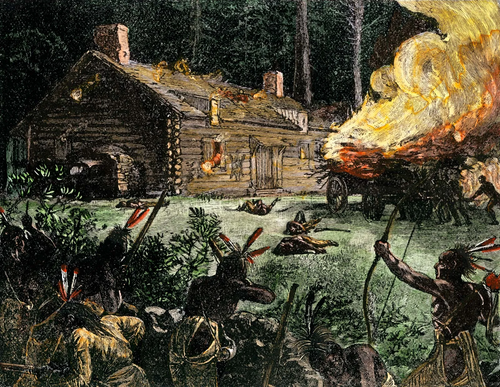
ウェールズの植民者サー・ウィリアム・ハーバートはアイルランドにプロテスタントの植民地を建設した。彼はアイルランドのカトリック貴族ジェラルド・フィッツジェラルド、第15代デズモンド伯爵から没収された土地を与えられた。ハーバートはアイルランドの植民地化を擁護する『Croftus Sive de Hibernia Liber』を著した。彼は植民者が先住民と混ざるべきではないと警告し、植民者に対し先住民を強制して植民者の文化に同化させるよう促した。[ 2 ]
King George III issues the Proclamation of Rebellion (August 23), de facto royal response to the Olive Branch Petition, dashing the hopes of loyalists and moderates; it declared anyone aiding the open rebellion to be traitors.
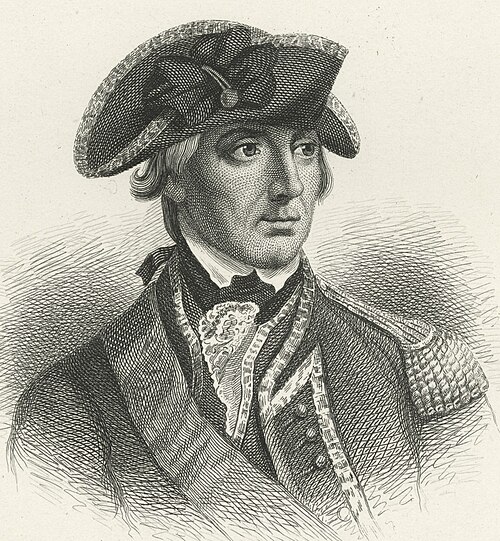
Gen. Wm. Howe
Gen. William Howe replaces Gen. Thomas Gage as Commander-in-Chief of British forces in North America. September.
Continental Navy established by the Second Continental Congress (October 13)
Dunmore's Proclamation issued by Virginia royal governor Lord Dunmore, offering freedom to enslaved men held by rebel masters if they fight for the British (November 7)
Hardliner Lord George Germain becomes chief architect of British policy in North America as Secretary of State for the American Department (Nov. 10). He served until 1782.
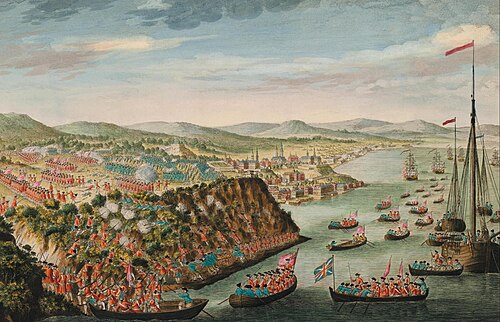
Battle of Quebec (December 31, 1775) major British victory; American Gen. Richard Montgomery killed, Gen. Benedict Arnold (then fighting for the Americans) wounded. French Canadians do not support the American invasion.
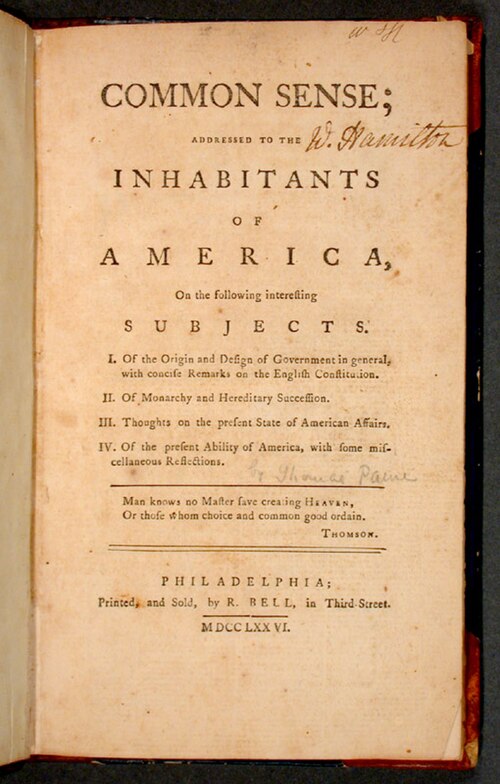
Publication of Common Sense by Thomas Paine (January 10). It becomes a runaway bestseller, selling 500,000 copies, convincing many colonists that independence was the only course. George Washington owns a copy from the first printing.
Publication of English philosopher Richard Price's Observations on the Nature of Civil Liberty, the Principles of Government, and the Justice and Policy of the War with America, justifying the American cause and refuting arguments for those policies. It goes through 13 printings after its first publication.
David Mathews appointed Mayor of New York, the highest ranking civilian officer for English North America for the duration of the Revolution; New York City is strategically important and held by the British until the end of the war.
Battle of Moore's Creek Bridge, North Carolina (February 27) North Carolina militia victory against Highlander Scots loyalists. North Carolina was not militarily threatened again until 1780. Memories of the battle negated efforts to recruit Loyalists in the area in 1781.
Battle of Nassau, Americans capture military stores, including gunpowder, and took the governor prisoner; first amphibious landing of the Continental navy (March 3–4)
British forces evacuate Boston
Fortification of Dorchester Heights, Boston - Continental Army under the command of George Washington installs cannons brought overland from Fort Ticonderoga NY to Boston, giving the Americans the ability to shell the British garrison and ships, forcing British forces evacuating Boston within two weeks. (March 4–5)
British evacuate Boston (March 17), major victory for the Americans over the British, with the withdrawal of their forces after the yearlong Siege of Boston. This is the first example of the British forces being able to take a major American city, but being forced to abandon it.
Beaumarchais funnels covert aid from France to the Americans
Silas Deane sent to France by the Continental Congress as a purchasing agent for the Continental Army (March). French king Louis XVI permits his foreign minister the Comte de Vergennes to lend £40,000 of covert French financial aid to the Americans against their longtime rivals.
Roderigue Hortalez and Company founded in May in Paris to coordinate clandestine financial and military aid from France and Spain to the American rebels to weaken Britain, but unwilling to commit to open war.
Continental Congress opens American ports to trade with all other nations except Britain (April 6)
Oliver Cromwell, a 20-gun corvette, launched in Connecticut (June 13). Named after the Puritan military and political leader, signatory of the death warrant of Charles I in 1649, Lord Protector of the Commonwealth of England until his death in office.
Thomas Hickey hanged for role in plot to assassinate George Washington (June 28). British Colonial Loyalist New York Mayor David Mathews previously arrested in Flatbush, Brooklyn for his role in the plot (June 22)
Battle of Long Island, a.k.a. Battle of Brooklyn (August 27) – British victory; British occupation of New York for the duration of the war; Washington's largely intact forces escape capture, a repeated strategy in the war
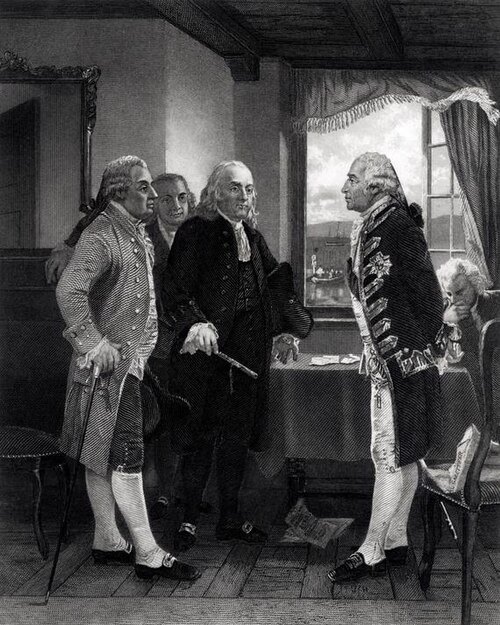
Staten Island Peace Conference (September 11) unsuccessful meeting between British authorities and members of the Continental Congress (Ben Franklin, John Adams) to end armed hostilities; Americans refuse to rescind the Declaration of Independence (Sept. 11)
Battle of Trenton (December 26) After a string of defeats and evasions of engagement with the British, and with Continental soldiers' enlistment about to expire, Washington needed a victory. His surprise attack on Hessian mercenaries captured the garrison, including 1,000 Hessians, a military victory and crucial psychological one for the Continental Army. Howe's army is forced to retreat from all British posts in New Jersey. The crossing of the Delaware River the night before the attack is an iconic image.
Flag Act of 1777 passed by the Continental Congress specifying the stars and stripes. (June 14) Flag Day is celebrated on the anniversary, but it is not a federal holiday.
Delegates in Vermont, which was not one of the Thirteen Colonies, establish a republic and adopt a constitution, the first in what is now the territory of the United States to prohibit slavery (July 8)
British occupation of Philadelphia, the American capital (September 26)
Battle of Germantown (October 4) British victory outside of Philadelphia, but the long-term strategic consequences favored the Americans, since Gen. Howe had failed to follow up on his success and allowed Washington and his army to escape, leading to their encampment at Valley Forge.
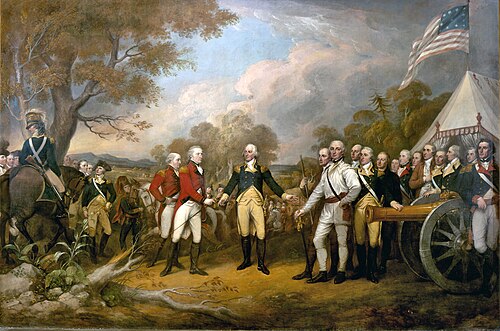
Battle of Saratoga (September 19 and October 7); surrender of the British army under General Burgoyne. Major American victory, demonstrating to France that the Americans could win in battle. The French now formally allied with the Americans in 1778, after providing covert aid since 1776.
Convention of Saratoga signed Oct. 20 by Gen. Burgoyne of general Horatio Gates setting the terms of Burgoyne's surrender, allowing for the evacuation of his whole army to Britain. George Washington opposes the terms, arguing the British would redeploy them to fight the Americans again.
Battle of Fort Mercer, New Jersey (October 22) American victory, a much-needed morale boost to the Americans, delaying British plans to consolidate gains in Philadelphia, and relieving pressure on the Continental Army, embedded north of Philadelphia.
Bicentennial Commemorative stamp
Articles of Confederation, formal legal framework for governance of the U.S. until 1787, adopted by the Second Continental Congress (November 15)
Baron von Steuben drills Continental soldiers at Valley Forge
Continental Army in third winter quarters at Valley Forge (December 19, 1777 – June 19, 1778) Washington's army of 12,000 struggled to manage a disastrous supply crisis while simultaneously retraining and reorganizing their units in an effort to mount successful counterattacks against the British. During the encampment at Valley Forge, an estimated 1,700 to 2,000 soldiers died from disease, possibly exacerbated by malnutrition and cold, wet weather.
1778
George III in the wake of the defeat at Saratoga, tells Prime Minister Lord North that either Lord Germain, minister in charge of the war, or General Howe, supreme commander of the army in North America, must retire.
Continental Congress rejects in January implementing the Convention of Saratoga, an agreement by British general John Burgoyne and American general Horatio Gates, which would have allowed the Convention Army that Burgoyne surrendered after losing the Battles of Saratoga to return to Britain on the promise the soldiers not return to America fight. The British and German troops remained prisoners until the 1783 end of the war.
Charles James Fox opposition Whig MP, who dressed for Parliament in blue and buff, the colors of George Washington, introduces a bill to prohibit the government from sending more regular troops to fight in America, arguing that Britain needed the troops for its own security, since France was preparing for war. (February 2)
Coat of Arms of France
American treaties of alliance with France with Treaty of Amity and Commerce and Treaty of Alliance (February 6). The full weight of the France, Britain's longstanding rival, provides crucial support (money, army and naval forces, war materiel) to the Americans. France is the first foreign country to recognize the flag of the United States, on the ship of John Paul Jones (February 14)
France declares war on Great Britain, starting the Anglo-French War (1778–1783) and formally allying with the United States (March 17). The war is transformed from an insurgency within the British Empire and one of its component parts into a global conflict between Britain and France (and later its ally Spain), to undermine British dominance. Britain must rethink its war strategy since its lucrative Caribbean colonies and India are now vulnerable to attack and Britain itself could be invaded. British redeploy resources in North America, believing it can rely on Loyalists. The British over-estimate the number of Loyalists and their willingness to take up arms.
John Paul Jones, Scottish-born commander of the American ship Ranger, attacks Whitehaven in England, America's first naval engagement outside North America (April 20)
The Great Chain across the Hudson River is completed, blocking navigation (April 30)
Battle of Ushant, first naval engagement between the British and French, inconclusively fought in the English Channel. Britain feels the threat of a French invasion following their alliance with the Americans. (July 27)
Treaty of Fort Pitt, first formal treaty between the United States and a Native American group, the Lenape, for military assistance (Sept. 17).
Spain declares war on Great Britain in alliance with France but not in alliance with the U.S. to recover Gibraltar and Minorca; gives material and logistical support to the American Revolution (June 21)
Battle of Grenada (July 6) (In the West Indies Between the French and the British)
Continental Army in fifth winter quarters at Morristown (December 1779 – May 1780)
1780
Congress establishes the first federal court - Court of Appeals in Cases of Capture to provide for final adjudication of appeals from state court prize cases involving disposition of ships and cargo allegedly seized from the British (January 15)
Massachusetts Constitution formally recognizes Harvard College as an educational institution tasked with promoting “virtue and knowledge” to sustain free government.
Battle of Cape St. Vincent Naval battle off the coast of Portugal; first major naval victory for the British over their European enemies in the war (January 16)
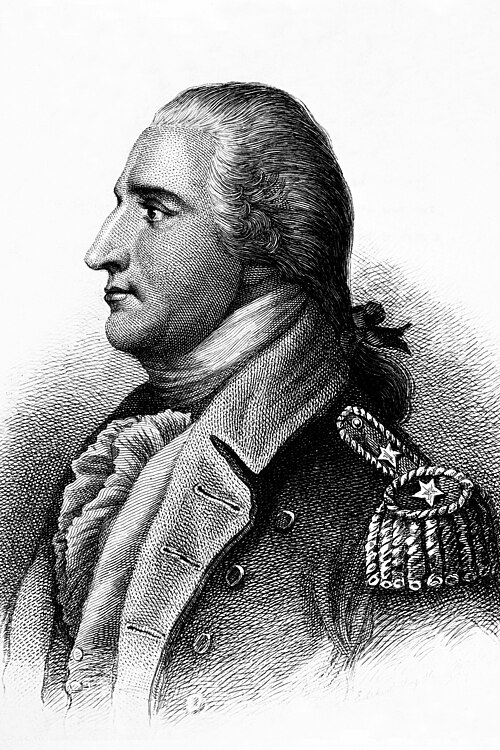
Treason of Gen. Benedict Arnold exposed; Major John André captured and executed as spy. (September 23) Arnold becomes a British general and recruits Loyalists
Battle of Kings Mountain, South Carolina, American militia victory against Loyalist militias in the southern campaign, following a string of American defeats, greatly raising their morale. (October 7)
Henry Laurens, American diplomat, captured by the British en route from the Dutch Republic while carrying a draft treaty between the U.S. and the Dutch. Laurens later exchanged for Lord Cornwallis in a prisoner swap.
Successful Massachusetts lawsuit, Brom and Bett v. Ashley, by an enslaved black woman for her freedom, arguing that the state constitution guaranteed liberty and equality; she took the name Elizabeth Freeman. In effect, the decision ended slavery in the state.
Battle of the Chesapeake, huge French naval victory over the British navy; France can now prevent the relief of Cornwallis in Yorktown and he is forced to surrender his army to the joint American-French army (September 5)
The British surrender at Yorktown, effective end of the land war in North America. (Oct. 19) Joint French-American armies of Washington and Rochambeau and the French navy trap Cornwallis and force the surrender of his entire army. War continues on other fronts until the Peace Treaty of 1783.
News of Cornwallis's surrender reaches the British government (Sept 25). Leaders inform Prime Minister North of the defeat, who exclaimed: "O God! It is all over!"[14]
Gnadenhutten monument, erected in 1872, honoring the murdered Christian Native Americans
Gnadenhutten massacre, murder and scalping of 96 Christian pacifist Moravian Native Americans by Pennsylvania militiamen, an attack based on the race of the victims. In 1889, Theodore Roosevelt called the atrocity "a stain on frontier character that the lapse of time cannot wash away." (March 8)
House of Commons votes to suspend the war in America (27 February 1782); Lord North resigns
Rockingham becomes Prime Minister, pursues peace (March 27-July 1)
Preliminary terms for peace between Britain and Americans: British recognition of U.S. independence; British pledge withdrawal of troops; U.S. ceded land in the Great Lakes and Ohio; U.S. granted fishing rights off of Newfoundland (30 November 1782)
Signing of the Treaty of Paris showing only the American representatives; the British refused to sit for paintingGeorge Washington resigns as commander-in-chief of the Continental ArmyAllegorical painting of the British Empire taking in American Loyalists, 1783
Congress refuses admission of the State of Franklin to the Union (May 16)
Treaty of Hopewell (South Carolina) signed between representatives of the Congress and the Cherokee, Choctaw, and Chickasaw peoples. The chief provision of the treaties was defining boundaries between sovereign tribal lands and lands open to white settlement. Despite affixing their signatures to the treaties, none of the Native American tribes recognized the sovereignty of the United States over their ancestral lands.
The Federalist Papers, essays in support of a strong national government anonymously written by Alexander Hamilton, James Madison, and John Jay under the pen-name "Publius", give reasons for ratifying the Constitution (October 1787 – May 1788)
Georgia ratifies the Constitution (Jan. 3@2); Connecticut (Jan. 9), Massachusetts (Feb. 6) and proposes amendments. Rhode Island rejects ratification in a referendum (March 24); Maryland ratifies (April 28); South Carolina May 23)
New Hampshire ratifies, becoming the ninth state to do so, the new constitution can come into effect (June 21)
Cyrus Griffin resigns as "President of the United States in Congress Assembled" (November 2), and with the exceptions of John Jay and John Knox remaining as Secretaries of Foreign Affairs and War respectively; and Michael Hillegas remaining as Treasurer, the United States of America temporarily ceases to exist.
Congress names New York as the site of the new federal government; fixes the date of elections and meeting of the new Congress.
The first federal elections for the House of Representatives begin
Confederation Government accepts a cession of land from Maryland for a new capital, the Federal District of Columbia, what becomes Washington, D.C. (Dec. 23)
Jay Treaty, the Treaty of Amity, Commerce, and Navigation, Between His Britannic Majesty and the United States of America, between Great Britain and the U.S. averted war, resolved issues remaining since the 1783 Treaty of Paris and facilitated ten years of peaceful trade between Americans and the British in the midst of the French Revolutionary Wars, which had begun in 1792. The treaty angered the French who had been the Americans' ally in the War of American Independence.
Whiskey Rebellion, a violent tax protest in western Pennsylvania, suppressed by the Federal government.
1795
Jay's Treaty ratified in June toward resolving post Revolution tensions between the United States and Great Britain. First use of arbitration in modern diplomatic history for Canada–United States border disputes.
1796
Six Northwest Territory forts and two Upstate New York forts that remained under British control are ceded to the United States.
↑Mancall, Peter C, Envisioning America: English Plans for the Colonization of North America, 2nd ed.. Bedford/ St Martin's 2017, 9-10
↑Harvard University and the American Revolution accessed 5 September 2025
↑Oxford Illustrated History of the British Monarchy, 499
↑Green, Jack P., "The Origins of the New Colonial Policy, 1748–1763" in The Blackwell Encyclopedia of the American Revolution. Cambridge: Basil Blackwell 1991, 95–106
↑Greene, Jack P. "The Origins of the New Colonial Policy, 1748–1763" in The Blackwell Encyclopedia of the American Revolution. Blackwell 1991, 99
↑Oxford Illustrated History of the British Monarchy, p. 486
↑Anderson, Fred. Crucible of War: The Seven Years' War and the Fate of Empire in British North America, 1754–1766. New York: Vintage Books 2000, 668–69, 824
↑Middlekauff, Robert. The Glorious Cause: the American Revolution, 1763–1789. New York: Oxford University Press 2005, 78–79
↑"Founders Online: The Final Hearing before the Privy Council Committee for Plant …".
↑Jasanoff, Maya, Liberty's Exiles: American Loyalists in the Revolutionary World, New York: Vintage Press 2011, 25–27
↑Becker, Ann M., "Smallpox in Washington's Army: Strategic Implications of the Disease During the American Revolutionary War," The Journal of Military History 68, no. 2 (April 2004): 381-430
↑O'Shaunnesy, Andrew Jackson. The Men Who Lost America: British Leadership, the American Revolution, and the Fate of Empire. Yale University Press 2013, p. 5
Further reading
Cullen, Joseph P. (1972). The Concise Illustrated History of the American Revolution. For secondary schools, 136pp
Fremont-Barnes, Gregory, and Richard Alan Ryerson, eds. (2006). The Encyclopedia of the American Revolutionary War: A Political, Social, and Military History (5 vol.)
George, Lynn (2002). A Timeline of the American Revolution. 24pp; for middle schools
Morris, Richard B. (7th ed., 1996). Encyclopedia of American History, detailed timeline