
Loading article…
| アメリカ独立戦争 | |||||||||
|---|---|---|---|---|---|---|---|---|---|
| アメリカ独立戦争の一部 | |||||||||
| |||||||||
| 交戦国 | |||||||||
愛国者:13植民地(1775年)連合植民地(1775年~1776年).svg/500px-Red_Ensign_of_Great_Britain_(1707%E2%80%931800,_square_canton).svg.png) .svg/500px-Flag_of_the_United_States_(1776%E2%80%931777).svg.png) | |||||||||
|
戦闘員
|
戦闘員 | ||||||||
| 指揮官とリーダー | |||||||||
|
|
| ||||||||
| 強さ | |||||||||
| 死傷者と損失 | |||||||||
|
| ||||||||


.svg/500px-Flag_of_the_United_States_(1777%E2%80%931795).svg.png)

.svg/500px-Flag_of_Spain_(1760%E2%80%931785).svg.png)
.svg/500px-Flag_of_Great_Britain_(1707%E2%80%931800).svg.png)



.svg/500px-Flagge_Herzogtum_Braunschweig_(-1814).svg.png)
.svg/500px-Wappen-HK_(1736-1804).svg.png)


.svg/500px-Blason_Principaut%C3%A9_d'Anhalt-Zerbst_(XVIIIe_si%C3%A8cle).svg.png)
.svg/500px-Flag_of_Hanover_(1692).svg.png)


.svg/500px-Royal_standard_of_Great_Britain_(1714%E2%80%931801).svg.png)
アメリカ独立戦争(1775年4月19日 - 1783年9月3日)は、アメリカ独立戦争またはアメリカ独立戦争としても知られ、アメリカ独立戦争の一部であった武力紛争であり、大陸軍として組織され、ジョージ・ワシントンが指揮したアメリカの 愛国者軍がイギリス軍を破った。
戦争中、北アメリカの愛国者軍はフランス、スペイン、オランダ共和国の支援を受け、一方イギリス軍とロイヤリスト軍はドイツからヘッセン兵を雇って支援を受けた。この戦争は北アメリカ、カリブ海、大西洋で戦われた。戦争は1783年のパリ条約で終わり、イギリスは最終的にアメリカの 独立と主権を承認した。
アメリカ植民地は17世紀と18世紀に王室の勅許により設立された。 1763年の七年戦争で大英帝国がフランスに勝利して北米で優位に立った後、印紙法やタウンゼンド法など様々な問題をめぐってイギリスと13植民地の間に緊張と紛争が生じた。その結果生じたイギリス軍の占領は1770年のボストン虐殺につながり、北米の愛国者たちのイギリスからの独立への欲求を強めた。更なる緊張の中、1774年半ばにイギリス議会は耐え難き諸法を施行した。イギリスがアメリカ人の武装解除を試み、その結果1775年4月にレキシントン・コンコードの戦いが起こり、戦争が勃発した。6月、第二次大陸会議は愛国者民兵を大陸軍に正式に編入し、ワシントンをその最高司令官に任命した。 1775 年 8 月、イギリス議会は植民地が反乱状態にあると宣言しました。戦争の賭け金は、1776 年 7 月 2 日にフィラデルフィアの議会でリー決議が可決され、その 2 日後の 1776 年 7 月 4 日に独立宣言が満場一致で批准されたことで正式に決定されました。
1776年3月、包囲戦が成功した後、ワシントン軍はイギリス軍をボストンから追い出し、イギリス軍総司令官ウィリアム・ハウはニューヨーク・ニュージャージー作戦を開始してこれに応えた。ハウは11月にニューヨーク市を占領した。ワシントンはこれに応えて密かにデラウェア川を渡り、トレントンとプリンストンで小規模だが重要な勝利を収め、愛国者の自信を回復した。1777年夏、ハウがフィラデルフィアを占領しようとしたとき、大陸会議はボルチモアに逃げた。1777年10月、ジョン・バーゴイン指揮下の別の北部イギリス軍はサラトガで降伏を余儀なくされ、アメリカの勝利がフランスとスペインに独立アメリカ合衆国が実現可能であることを納得させる上で決定的となった。サラトガの戦いの後、フランスは反乱軍と通商協定を結び、続いて1778年2月に同盟条約を結んだ。1779年、サリバン遠征隊は、主にイギリスと同盟を結んでいたイロコイ族に対して焦土作戦を開始した。しかし、アメリカ開拓地でのインディアンの襲撃は依然として問題であった。また、1779年、スペインは正式にはアメリカと同盟を結ばなかったものの、アランフェス条約でフランスと同盟を結びイギリスに対抗した。
ハウの後任ヘンリー・クリントンは、アメリカとの戦争を南部植民地に持ち込むつもりだった。当初は多少の成功を収めたものの、イギリスの将軍コーンウォリスは、1781年9月から10月にかけてヨークタウンでフランス・アメリカ軍に包囲された。コーンウォリスは10月に降伏を余儀なくされた。イギリスとフランスおよびスペインとの戦争はさらに2年間続いたが、北アメリカでの戦闘はほぼ停止した。1782年4月、北部内閣は新しいイギリス政府に取って代わられ、アメリカの独立を承認してパリ条約の交渉を開始し、1783年9月3日に批准された。イギリスはアメリカ合衆国の主権と独立を承認し、アメリカ独立戦争は終結した。ベルサイユ条約はイギリスとフランスおよびスペインとの紛争を解決し、イギリスはトバゴ、セネガルおよびインドの小さな領土をフランスに、メノルカ島、西フロリダおよび東フロリダをスペインに割譲することを余儀なくされた。[43] [44]
革命への序曲

フレンチ・インディアン戦争は、七年戦争として知られるより広範な世界的紛争の一部であり、1763年のパリ講和でフランスをヌーベルフランスの領有地から追放して終結した。[45]フランス語とスペイン語を話すカトリック教徒が大部分を占めるカナダ大西洋岸と西フロリダの領土を獲得したイギリス当局は、英語を話す入植者を移住させることで支配を強化した。アパラチア山脈の西側で入植者とインディアン部族との衝突を防ぐことで、高額な軍事占領の費用も回避できた。[46]
1763年の宣言は、ミシシッピ川をアメリカにおけるイギリス領とスペイン領の境界線として、北はノバスコシア、南はフロリダへと植民地拡大の焦点を再び定め、これらの目的を達成することを目的としていた。1763年の境界線を越えた入植は厳しく制限され、バージニアやマサチューセッツを含むこの境界線より西側の領有権主張は、各植民地が自らの境界は大西洋から太平洋にまで及ぶと主張していたにもかかわらず、取り消された。[46]
広大な領土の交換は、西部の開拓者とインディアンの間の既存の同盟と貿易ネットワークを最終的に不安定にし、宣言線を越えた侵入を防ぐことは不可能であることが判明しました。[47]西部の土地の権利を奪われたバージニアと他の例外を除いて、植民地議会は境界については同意しましたが、それをどこに設定するかについては意見が一致しませんでした。多くの開拓者は制限に完全に憤慨し、施行には国境沿いの恒久的な駐屯地が必要となり、誰がその費用を負担するかについてますます激しい論争につながりました。[48]
課税と立法
植民地は、地方総督を通じて国王が直接統治していたが、大部分は現地生まれの土地所有者によって統治されていた。対外関係はロンドンが管理し、植民地民兵は現地で資金提供されていたが、1763年にフランスの脅威が去ると、議会は増税ではなく減税を期待した。同時に、七年戦争で生じた巨額の負債と英国納税者からの政府支出削減の要求により、議会は植民地が自らの防衛費を賄うことを期待した。[48]植民地の臣民に課せられた新しい税は、ノースカロライナなどの植民地では特に貧困層にとって大きな負担となり、すぐに不満の種となった。[49]
1763年から1765年にかけてのグレンヴィル内閣は、イギリス海軍に密輸品の取引を中止し、アメリカの港で課せられた関税を執行するよう指示した。 [48]最も重要なのは1733年の糖蜜法である。1763年以前は日常的に無視されていたが、ニューイングランドのラム酒輸出の85%が輸入糖蜜から製造されていたため、経済に大きな影響を与えた。これらの措置に続いて砂糖法と印紙法が制定され、西部開拓の防衛費として植民地に追加税を課した。[50] 1765年7月、ホイッグ党は第一次ロッキンガム内閣を樹立し、印紙法を廃止してニューイングランド経済を支援するために外国産糖蜜への課税を軽減したが、宣言法で議会の権限を再び主張した。[51]
しかし、これで不満が収まることはほとんどなかった。1768年、ボストンで暴動が起こり、当局は密輸の疑いでスループ船リバティー号を拿捕した。 [52] 1770年3月、イギリス軍が石を投げる民間人に発砲し、ボストン虐殺として知られる事件で5人が死亡すると、緊張はさらに高まった。[53]この虐殺は、トーリー党を基盤とするノース内閣によるタウンゼンド諸法の部分的撤廃と時を同じくしており、ノース内閣は1770年1月に政権を握り、1781年までその職にあった。ノース内閣は、議会の植民地への課税権を保障するため、茶税の維持を主張した。税額は少額であったが、アメリカ人がまさにその原則に異議を唱えていたという事実を無視した。[54]
1772年4月、ニューハンプシャー州ウィアで植民地主義者がイギリス王室に対する最初のアメリカでの課税反乱を起こした。これは後にパインツリー暴動と呼ばれる。 [55]この出来事は後にパインツリー旗のデザインにインスピレーションを与えた。1772年6月のガスピー事件で税関船が破壊された後、緊張が高まり、1773年に頂点に達した。銀行危機により、イギリス経済を支配していた東インド会社は崩壊寸前となり、英国議会は同社を支援するために茶法案を可決し、 13植民地での貿易独占権を与えた。アメリカの茶のほとんどはオランダ人によって密輸されていたため、この法案は違法貿易を管理する人々から反対され、議会による課税原則を押し付けるもう一つの試みと見なされた。[56] 1773年12月、モホーク族に変装した自由の息子達と呼ばれる集団がボストン港に342箱の茶葉を投棄した。これは後にボストン茶会事件として知られる事件である。イギリス議会は、マサチューセッツを特に狙ったいわゆる「耐え難き諸法」を可決することで対応したが、多くの植民地人や反対派のホイッグ党員は、これらの行為を自由全般に対する脅威とみなした。これにより、地元、イギリス議会、ロンドンの新聞で愛国者運動への同情が高まった。 [57]
英国王室との決別
18世紀を通じて、植民地議会の選挙で選ばれた下院は、徐々に知事から権力を奪っていった。[58]小規模な地主や商人が支配するこれらの議会は、今や臨時の州議会(会議、コンベンション、カンファレンスなどと呼ばれる)を設立し、事実上、国王の統制に取って代わった。ジョージアを除く12の植民地が、危機に対する統一的な対応で合意するため、第1回大陸会議に代表を送った。 [59]代表者の多くは、全面的なボイコットが戦争につながることを恐れ、耐え難き諸法の撤回を求める請願書を国王に送った。 [60]しかし、議論の末、1774年9月17日、議会はマサチューセッツ・サフォーク決議を承認し、10月20日には大陸協会を可決した。 8月に第1回バージニア会議で作成された草案に基づいて、協会はイギリスに対する経済制裁と商品の全面ボイコットを実施した。[61]
ジェームズ・デュアンと後にロイヤリストとなる ジョセフ・ギャロウェイ率いる一派は、アメリカ国内の問題に関する権限を否定する一方で、議会が植民地貿易を規制する権利を認めるよう主張した。[61] [w]北部政権の譲歩を期待して、議会は植民地議会の超法規的委員会と会議にボイコットの実施を許可した。これにより、1774年から1775年にかけてイギリスの輸入が97%減少した。[62]しかし、2月9日、議会はマサチューセッツが反乱状態にあると宣言し、植民地の封鎖を実施した。[63] 7月、制限諸法は、植民地とイギリス領西インド諸島およびイギリスとの貿易を制限し、ニューイングランドの船舶がニューファンドランド島のタラ漁場に入ることを禁じた。緊張の高まりにより、各議会が防衛のために法的に維持する義務がある民兵の物資の支配権をめぐる争奪戦が勃発した。[64] 4月19日、イギリス軍がコンコード兵器庫を確保しようとした試みはレキシントン・コンコードの戦いに発展し、独立戦争が始まった。[65]
政治的反応
,_by_John_Trumbull.jpg/500px-Declaration_of_Independence_(1819),_by_John_Trumbull.jpg)
コンコードでの愛国者軍の勝利の後、ジョン・ディキンソン率いる議会の穏健派はオリーブの枝請願書を起草し、ジョージ3世が紛争の調停を行うことと引き換えに国王の権威を受け入れることを申し出た。[66]しかし、請願書の直後に武装解除の理由と必要性の宣言が出されたため、植民地大臣ダートマス卿はその申し出を不誠実とみなし、国王に請願書を提出することを拒否したため、9月初旬に却下された。[67]憲法上は正しかったが、ジョージは自分の政府に反対することができなかったため、彼が紛争の調停をしてくれることを期待していたアメリカ人を失望させ、また彼の敵意に満ちた言葉遣いは議会のロイヤリスト議員さえも苛立たせた。[66]バンカーヒルの戦いに応じて8月23日に発せられた反乱宣言と相まって、平和的解決の望みは終わった。[68]
ホイッグ党の支持を受けた議会は、当初、強硬な政策はアメリカを独立へと追い込むだけであると懸念し、170票差で強制措置の実施を拒否した。[69]しかし、1774年末までにイギリスの権威が崩壊したことで、ノース卿とジョージ3世はともに戦争は避けられないと確信した。[70]ボストンの戦いの後、ゲージは作戦を中止し、増援を待った。アイルランド議会は新連隊の募集を承認し、カトリック教徒の入隊を初めて認めた。[71]イギリスはまた、追加部隊を供給するためドイツ諸国と一連の条約を締結した。[72] 1年以内に、アメリカの軍隊は3万2千人を超え、当時ヨーロッパ外に派遣された軍隊としては最大規模となった。[73]ゲイジの活動不足と相まって、外国軍の使用に反対したことで愛国者たちは議会を掌握することができた。[74]
独立宣言
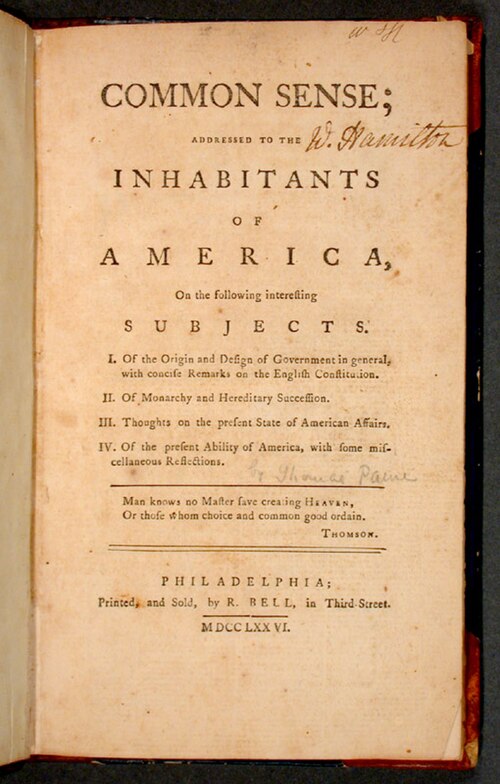
独立への支持は、 1776年1月10日に出版され、アメリカの自治を主張し、広く再版されたトーマス・ペインのパンフレット「コモンセンス」によって後押しされた。 [75]独立宣言を起草するために、第二次大陸会議は、トーマス・ジェファーソン、ジョン・アダムズ、ベンジャミン・フランクリン、ロジャー・シャーマン、ロバート・リビングストンからなる五人委員会を任命した。[76]宣言は、ジェファーソンによってほぼ独占的に書かれ、彼は1776年6月11日から6月28日の間に、フィラデルフィアのマーケットストリート700番地にある3階建ての邸宅で、ほとんど孤立して書いた。[77]
この宣言は、13植民地の住民を「一つの民族」とみなし、同時にイギリスとの政治的つながりを解消し、ジョージ3世が犯した「イギリスの権利」の侵害の長いリストを盛り込んだ。これはまた、植民地が、より一般的な「連合植民地」ではなく「合衆国」と呼ばれた最初の例の1つである。[78]
7月2日、議会は独立に賛成票を投じ、7月4日に宣言を発表した。[79]ジョージ・ワシントンは7月9日、ニューヨーク市で部隊に宣言を読み上げた。[ 80]この時点で、革命は貿易と税制をめぐる内部紛争ではなくなり、内戦に発展していた。議会に代表される各州は英国と闘争を繰り広げていたが、米国愛国者と米国ロイヤリストに分裂していた。[81]愛国者は一般的に英国からの独立と議会における新たな国家連合を支持したが、ロイヤリストは英国統治に忠実であり続けた。推定数は様々だが、1つの説では、人口全体が熱心な愛国者、熱心なロイヤリスト、無関心な人々に均等に分かれていたとされている。[82]愛国者40%、中立40%、ロイヤリスト20%と計算する人もいるが、地域によってかなりばらつきがある。[83]
戦争が始まったとき、第二次大陸会議はイギリスを倒すには外国との同盟と情報収集が必要であることを認識した。秘密通信委員会は「イギリスおよび世界の他の地域の友人と通信する唯一の目的」で結成された。1775年から1776年にかけて、委員会は秘密通信を通じて情報を共有し、同盟関係を構築したほか、ヨーロッパで秘密エージェントを雇って情報収集、潜入作戦の実施、外国の出版物の分析、愛国者プロパガンダ運動の開始を行った。[84]ペインが書記を務め、軍の技術者を募集するためにフランスに派遣されたベンジャミン・フランクリンとサイラス・ディーンは[85] 、パリでのフランス援助の確保に尽力した。[86]
戦争勃発
独立戦争には、13植民地内の2つの主要な戦域と、アパラチア山脈の西側にある小規模だが戦略的に重要な3つ目の戦域が含まれていた。戦闘は北部戦域で始まり、1775年から1778年にかけて最も激しかった。アメリカの愛国者は南部でいくつかの戦略的勝利を収めた。アメリカ軍は1777年10月にサラトガでイギリス軍を破り、フランス軍はアメリカ愛国者が戦争で勝利する可能性を見て、正式にアメリカの同盟国として戦争に参加した。[87]
1778年、ワシントンはイギリス軍がニューヨーク市から脱出するのを阻止し、その間にジョージ・ロジャース・クラーク率いる民兵はフランス語圏の入植者と同盟を組んだインディアンの支援を受けてケベック西部を征服し、北西部領土とした。1779年に北部で戦争が膠着状態となったため、イギリス軍は南部戦略を開始し、その地域でロイヤリストの支援を動員し、チェサピーク湾北部のアメリカ愛国者支配地域を占領することを狙った。この作戦は当初は成功し、イギリス軍によるチャールストン占領は南部愛国者にとって大きな後退となった。しかし、フランス系アメリカ人の部隊がヨークタウンでイギリス軍を包囲し、1781年10月にイギリス軍が降伏したことでアメリカ国内での戦闘は事実上終了した。[82]
イタリア系アメリカ人はアメリカ独立戦争で兵士と将校の両方として従軍した。フランチェスコ・ヴィゴは、北西部開拓地における独立戦争の主要な資金提供者の一人として、ジョージ・ロジャース・クラークの植民地軍を支援した。後に、彼はインディアナ州ビンセンズ大学の共同創設者となった。ヴィゴはインディアナ州制二百年祭を祝う収集家用コインに描かれている。[88]
初期の婚約


1775年4月14日、1763年以来北アメリカ大陸の最高司令官であり、1774年からはマサチューセッツ州知事も務めていたトーマス・ゲージ卿は、愛国者に対する行動を起こすよう命令を受けた。ゲージ卿は、マサチューセッツ州コンコードに保管されている民兵の兵器を破壊し、反乱の主犯と目されていたジョン・ハンコックとサミュエル・アダムズを捕らえることを決めた。作戦は4月19日の真夜中頃に開始され、アメリカの愛国者が反撃する前に完了することになっていた。 [89] [90]しかし、ポール・リビアがこの計画を知り、コンコード民兵の指揮官パーカー大尉に知らせ、民兵は奪取の試みに抵抗する準備をした。[91]戦争の最初の戦闘は、一般に世界中に響き渡った銃声と呼ばれ、レキシントンでの短い小競り合いと、それに続くレキシントン・コンコードの戦いであった。イギリス軍はボストンに撤退する前に約300人の死傷者を出し、ボストンは民兵に包囲された。 [92]
1775年5月、ウィリアム・ハウ将軍、ジョン・バーゴイン将軍、ヘンリー・クリントン卿の指揮する4,500人のイギリス軍の増援が到着した。[93] 6月17日、彼らはバンカーヒルの戦いでチャールズタウン半島を占領した。この正面攻撃で1,000人以上の死傷者を出した。[94]ほとんど利益を生まなかったこの攻撃の犠牲の大きさに失望したゲージは、[95]反乱鎮圧のためにロンドンに大軍を要請したが、[96]代わりにハウ将軍が指揮官の座を譲った。[94]
1775年6月14日、議会はボストン郊外のアメリカ愛国者軍の統制を引き継ぎ、議会指導者ジョン・アダムズはワシントンを新設された大陸軍の最高司令官に指名した。[97]ワシントンは以前にフレンチ・インディアン戦争でバージニア民兵連隊を指揮しており、[98] 6月16日、ハンコックは正式に彼を「連合植民地軍の将軍および最高司令官」と宣言した。[99]彼は7月3日に指揮権を握り、ボストン郊外のドーチェスター高地を攻撃するよりも要塞化することを選んだ。[100] 1776年3月初旬、ヘンリー・ノックス大佐がタイコンデロガ砦の占領で獲得した重砲を携えて到着した。[101] 3月5日、闇に紛れてワシントンはドーチェスター高地にこれらの砲を配置し、[102]そこからボストン港の町とイギリス艦船に発砲した。ハウはバンカーヒルの再来を恐れ、 3月17日にさらなる損失なくバンカーヒルから撤退し、ノバスコシア州ハリファックスへ航海した。一方ワシントンは南のニューヨーク市へ移動した。[103]
1775年8月から、アメリカの私掠船がセントジョン、シャーロットタウン、ヤーマスを含むノバスコシアの町を襲撃した。1776年には、ジョン・ポール・ジョーンズとジョナサン・エディがそれぞれカンソーとカンバーランド砦を攻撃した。ケベックのイギリス当局はイロコイ族の支援を求めて交渉を開始したが、 [104]アメリカの特使は中立を保つよう促した。[105]ネイティブアメリカンがイギリス寄りであることと、カナダからのアングロ・インディアンの攻撃を恐れた議会は、1775年4月に2度目の侵攻を承認した。[106] 12月31日のケベックの戦いでの敗北後、[107]アメリカ軍は1776年5月6日に撤退するまで、街を緩やかに封鎖した。[108] 6月8日のトロワリヴィエールでの2度目の敗北で、ケベックでの作戦は終了した。[109]
イギリス軍の追撃は当初、シャンプレーン湖でアメリカ海軍の艦艇によって阻止されたが、10月11日のバルクール島での勝利によりアメリカ軍はタイコンデロガ砦に撤退を余儀なくされ、12月にはマサチューセッツ州が支援したノバスコシア州の反乱がカンバーランド砦で敗北した。[110]これらの失敗は愛国者大義に対する国民の支持に影響を与え、[111]ニューイングランド植民地での積極的な反ロイヤリスト政策はカナダ人を疎外した。[112]
ヴァージニアでは、 1775年4月20日にダンモア知事が 民兵の物資を押収しようとしたことで緊張が高まったが、当面は衝突は回避された。[113] 1775年11月7日にダンモアの宣言が公布され、愛国者の主人から逃げ出し国王のために戦うことに同意した奴隷には自由を与えると約束された後、状況は一変した。 [114]イギリス軍は12月9日にグレートブリッジで敗れ、ノーフォーク港の近くに停泊していたイギリス船に避難した。第3回ヴァージニア会議が民兵の解散や戒厳令の受け入れを拒否すると、ダンモアは1776年1月1日にノーフォーク焼き討ちを命じた。[115]
サウスカロライナ州で11月19日、ロイヤリストと愛国者の民兵によるサヴェッジズ・オールド・フィールズの包囲戦が始まり[116] 、ロイヤリストはその後、雪の戦役で植民地から追い出された。[117]ノースカロライナ州でロイヤリストが徴兵され、南部におけるイギリスの統治を再び主張したが、ムーアズ・クリーク橋の戦いで決定的な敗北を喫した。[118]サウスカロライナの再征服のために派遣されたイギリスの遠征隊は、1776年6月28日のサリバン島の戦いでチャールストンへの攻撃を開始したが[119] 、失敗し、南部は1780年まで愛国者の支配下にあった。[120]
火薬不足のため、議会はバハマ諸島に保管されている兵器を確保するため海軍の遠征を承認した。[121] 1776年3月3日、エセク・ホプキンス指揮下のアメリカ艦隊がナッソーの東端に上陸し、モンタギュー砦で最小限の抵抗に遭遇した。その後、ホプキンスの部隊はナッソー砦に向かって行進した。ホプキンスはモンフォート・ブラウン知事とその地域の民間人に対し、抵抗しなければ生命と財産に危険はないと約束しており、住民はそれに従った。ホプキンスは大量の火薬やその他の軍需品を捕獲したが、その量は非常に多かったため、3月17日に出発した際に、物資を本国に輸送するために港で追加の船を徴用しなければならなかった。 [122] 1か月後、HMS グラスゴーとの短い小競り合いの後、彼らは独立戦争中のアメリカ海軍の作戦基地であったコネチカット州ニューロンドンに戻った。 [123]
イギリス軍のニューヨーク反撃

ノバスコシア州のハリファックスで再編成した後、ハウはアメリカ軍と戦うことを決意した。[124]彼は1776年6月にニューヨークに向けて出航し、7月2日にニューヨーク港の入り口近くのスタテン島に軍隊を上陸させ始めた。アメリカ軍は7月30日にハウの非公式な和平交渉の試みを拒否した。[125]ワシントンは市への攻撃が差し迫っていることを知っており、規律正しいイギリス正規軍に対処するには事前の情報が必要であることを認識していた。
1776年8月12日、愛国者トーマス・ノウルトンは偵察と秘密任務のためのエリート集団を結成するよう命令を受けた。ネイサン・ヘイルを含むノウルトンのレンジャーズは陸軍初の諜報部隊となった。[126] [x]ワシントンはロングアイランドから追い出された後、すぐにイギリス軍を倒すには軍事力とアマチュアスパイだけでは不十分だと悟った。彼は軍事諜報を専門化することに尽力した。ベンジャミン・トールマッジの援助を得て、ワシントンは6人からなるカルパースパイ団を結成した。[129] [y]ワシントンとカルパースパイ団の努力により、大陸軍連隊の戦場での効果的な配置と展開が大幅に増加した。[129]戦争中、ワシントンは軍事資金全体の10%以上を軍事諜報活動に費やした。 [130]
ワシントンは大陸軍をマンハッタンとロングアイランド西部のイースト川の対岸に2つに分けた。 [131] 8月27日のロングアイランドの戦いでハウはワシントンの側面を攻撃しブルックリンハイツまで押し返したが、ワシントン軍を包囲しようとはしなかった。[132] 8月28日の夜、ノックスはイギリス軍を砲撃した。圧倒的な戦力差を悟ったワシントンは8月29日に軍議を召集し、全員がマンハッタンへの撤退に同意した。ワシントンは素早く部隊を集め、平底貨物船でイースト川をマンハッタンまで運び、人員や兵器の損失はなかった。トーマス・ミフリン将軍の連隊を殿軍に残した。[133]
ハウは9月のスタテン島講和会議で第二次大陸会議の代表団と会談したが、和平交渉は失敗に終わった。これは主にイギリス代表団が恩赦を与える権限しかなく、独立を承認できなかったためである。[134] 9月15日、イギリス軍がキップ湾に上陸するとハウはニューヨーク市を掌握し、翌日のハーレムハイツの戦いでアメリカ軍と交戦したが失敗した。 [135] 10月18日、ハウはペルズポイントの戦いでアメリカ軍を包囲することに失敗し、アメリカ軍は撤退した。ハウは10月28日のホワイトプレーンズの戦いでワシントン軍と接近することを拒否し、代わりに戦略的価値のない丘を攻撃した。[136]
ワシントンの撤退により残存部隊は孤立し、イギリス軍は11月16日にワシントン砦を占領した。この砦でのイギリス軍の勝利は、3,000人の捕虜を失うというワシントンにとって最悪の敗北となった。[137]ロングアイランドに残っていたアメリカ軍連隊は4日後に撤退した。[138]ヘンリー・クリントン将軍はワシントンの混乱した軍を追撃したかったが、ロイヤリストの港を確保するにはまずロードアイランド州ニューポートを占領するために6,000人の兵士を投入する必要があった。 [139] [z]チャールズ・コーンウォリス将軍はワシントンを追跡したが、ハウはワシントンを妨害せずに残して追跡を停止するよう命じた。[141]
ワシントン砦での敗北後の見通しは、アメリカ軍にとって暗いものだった。大陸軍は5,000人以下にまで縮小し、年末に入隊期限が切れるとさらに縮小した。[142]国民の支持は揺らぎ、士気は低下した。1776年12月20日、大陸会議は革命首都フィラデルフィアを放棄してボルチモアに移動し、1777年2月27日まで2か月以上そこに留まった。[143]アメリカの敗北をきっかけにロイヤリストの活動が急増し、特にニューヨーク州で活発化した。[144]
ロンドンではロングアイランド作戦の勝利の知らせが歓迎され、首都では祝賀会が開かれた。国民の支持は最高潮に達し、[145]ジョージ3世はハウにバス勲章を授与した。 [146]愛国者軍の戦略的な欠陥は明らかだった。ワシントンは数の上で劣る軍を強力な軍と分断し、経験の浅い参謀は軍勢の状況を読み間違え、アメリカ軍は敵の砲火を前にして逃げた。これらの成功から、イギリス軍は1年以内に勝利できると予想された。[147]一方、イギリス軍はニューヨーク市周辺に冬営地を設け、翌春に新たな作戦を予定していた。[148]
愛国者の復活

.jpg/500px-James_Monroe_(1758-1831).jpg)
議会がボルチモアに撤退してから2週間後の1776年12月25日から26日の夜、ワシントンはデラウェア川を渡り、大陸軍の部隊を率いてフィラデルフィアから約30マイル上流にある現在のペンシルベニア州バックス郡から現在のニュージャージー州マーサー郡へと向かったが、これは兵站上困難かつ危険な作戦であった。
一方、ドイツ軍は愛国者小隊との衝突を何度も起こし、トレントンの戦いの数週間前には夜間に誤報で目が覚めることが多かった。クリスマスまでにドイツ軍は疲労困憊し、大吹雪のため指揮官のヨハン・ラール大佐は攻撃は起きないだろうと想定していた。[149] 26日の夜明け、アメリカ軍愛国者小隊はラールとその部隊を奇襲して圧倒し、ラールを含む20人以上が死亡し、[150] 900人の捕虜、ドイツ軍の大砲、大量の物資が捕獲された。[151]
トレントンの戦いはアメリカ軍の士気を回復させ、愛国者の大義を再び活気づけ、[152]彼らがヘッセン人の「傭兵」とみなしていたものに対する恐怖を払拭した。[153]イギリス軍のトレントン奪還の試みは1月2日にアサンピンク・クリークで撃退された。 [154]夜の間にワシントンはコーンウォリスを出し抜き、翌日プリンストンの戦いでその後衛を破った。この2つの勝利はフランスにアメリカが軍事同盟者としてふさわしいと確信させるのに役立った。[155]
プリンストンでの勝利の後、ワシントンはニュージャージー州モリスタウンで冬営し、5月までそこに留まった[156] 。そして議会から愛国者軍全員に天然痘の予防接種を行うよう指示を受けた[157]。[aa] 3月まで続いた両軍間の小規模な小競り合いを除いて[159]、ハウはアメリカ軍を攻撃しようとはしなかった[160] 。
イギリスの北部戦略は失敗

1776年の作戦は、ニューイングランドの奪還は長期戦になることを示し、イギリス軍の戦略変更につながった。ハドソン川を制圧して北部を国内の他地域から孤立させ、ロイヤリストの支持が相当あると考えられていた南部に焦点を絞ることだった。[161] 1776年12月、ハウは植民地大臣ジャーメイン卿に手紙を書き、第2の部隊がカナダからハドソン川を下る間にフィラデルフィアに対して限定的な攻勢を行うことを提案した。 [ 162]ジャーメイン卿は1777年2月23日にこの手紙を受け取り、その数日後には当時ロンドンで休暇中だったバーゴインからの覚書を受け取った。[163]
バーゴインはいくつかの代替案を提示したが、いずれも自分が攻勢を担当し、ハウは守勢に回るというものだった。選ばれた選択肢では、彼がモントリオールからハドソン渓谷を南下して主力を率い、その間にバリー・セント・レジャー指揮下の分遣隊がオンタリオ湖から東へ移動することになっていた。二人はオールバニーで合流し、ハウは合流するかどうかを決めることになっていた。[163]原則的には妥当だったが、これは兵站上の困難を考慮しておらず、バーゴインはハウが守勢に回ると誤って想定していた。ジャーメインがこれを明確にしなかったため、彼は代わりにフィラデルフィアを攻撃することを選んだ。[164]
バーゴインは1777年6月14日にイギリス正規軍、ドイツ職業軍人、カナダ民兵の混成部隊を率いて出発し、7月5日にタイコンデロガ砦を占領した。ホレイショ・ゲイツ将軍が撤退すると、彼の軍隊は道路を封鎖し、橋を破壊し、小川をせき止め、その地域の食糧を奪った。[165]これによりバーゴインの進軍は遅れ、大規模な食料調達遠征隊を派遣せざるを得なくなり、そのうちの1つで、8月16日のベニントンの戦いで700人以上のイギリス軍が捕虜になった。 [166]セントレジャーは東に移動してスタンウィックス砦を包囲した。 8月6日のオリスカニーの戦いでアメリカ軍の救援部隊を破ったにもかかわらず、彼はインディアン同盟軍に見捨てられ、8月22日にケベックに撤退した。 [167]孤立し、ゲイツ軍に数で劣勢となったバーゴインは、タイコンデロガ砦に撤退する代わりにアルバニーに進軍を続け、9月13日にサラトガに到着した。彼は町の周囲に防御陣地を構築する間、クリントンに支援を求めた。[168]
バーゴイン軍の士気は急速に低下し、9月19日のフリーマン農場の戦いでゲイツ軍を突破しようとしたが失敗し、イギリス軍は600人の死傷者を出した。 [169]クリントンが到達不可能と報告すると、バーゴインの部下は撤退を勧告した。 10月7日の偵察部隊はベミス高地の戦いでゲイツ軍に撃退され、大きな損失を被ってサラトガに後退を余儀なくされた。10月11日までに脱出の望みは完全に消えた。降り続く雨で野営地は泥と飢えた牛の「不潔な地獄」と化し、物資は危険なほど不足し、負傷者の多くは苦しんでいた。[170]バーゴインは10月17日に降伏し、フリードリヒ・アドルフ・リーデゼル将軍指揮下のドイツ軍を含む約6,222人の兵士が武器を手放し、ボストンに連行されてイギリスに輸送された。[171]
追加物資を確保した後、ハウは8月24日にチェサピーク湾に部隊を上陸させ、フィラデルフィアへの再挑戦を行った。 [172]ハウはバーゴイン支援の失敗を重ね、敵を殲滅する機会を何度も逃し、 9月11日のブランディワインの戦いでワシントンを破り、その後秩序立った撤退を許した。[173]コーンウォリスは9月20日にパオリでアメリカ軍の分遣隊を解散させた後、9月26日にフィラデルフィアを占領し、ハウ指揮下の9,000人の主力部隊はすぐ北のジャーマンタウンに駐留した。[174]ワシントンは10月4日に攻撃したが、撃退された。[175]
フィラデルフィアのハウ軍が海から補給を受けないように、愛国者らはデラウェア川の東岸と西岸にそれぞれミフリン砦と近くのマーサー砦を築き、市の南の川に障害物を置いた。これはデラウェア川に展開する大陸海軍の小艦隊と、ジョン・ヘイゼルウッド指揮下のペンシルバニア州海軍の支援を受けた。10月20日から22日にかけてのレッドバンクの戦いでイギリス海軍が砦を奪取しようとしたが失敗に終わった。 [176] [177] 2度目の攻撃で11月16日にミフリン砦が占領され、マーサー砦は2日後にコーンウォリスが壁を突破した際に放棄された。[178]ハウは補給線を確保し、ワシントンを挑発しようとしたが、12月5日から8日にかけてのホワイトマーシュの戦いで決着のつかない小競り合いが続いた後、冬季にフィラデルフィアに撤退した。[179]
12月19日、アメリカ軍はこれに倣い、バレーフォージで冬営に入った。国内のワシントンの反対派は、彼の戦場での成功のなさをゲイツのサラトガでの勝利と比較したが、[180]フリードリヒ大王などの外国の観察者も、粘り強さと決意を示したジャーマンタウンに同様に感銘を受けた。[181]冬の間、劣悪な環境、補給問題、士気の低下により2,000人が死亡し、さらに3,000人が靴不足で任務に就けなかった。[182]しかし、フリードリヒ・ヴィルヘルム・フォン・シュトイベン男爵は、この機会を利用してプロイセン軍の教練と歩兵戦術を大陸軍全体に導入した。彼は各連隊で「模範的な中隊」を訓練し、その後、その中隊が本国部隊を指導した。 [183] バレーフォージはわずか20マイルしか離れていないにもかかわらず、ハウは彼らのキャンプを攻撃しようとしなかった。一部の批評家は、攻撃すれば戦争は終結したかもしれないと主張している。[184]
外国の介入

フランスの外務大臣ヴェルジェンヌは、前任者たちと同様に、 1763年の講和を国家の屈辱とみなし、戦争を英国を弱体化させる機会とみなした。彼は当初、公然の紛争を避けたが、アメリカの船がフランスの港で貨物を積むことを許可した。これは厳密に言えば中立違反だった。[185]世論はアメリカの主張を支持していたが、財務大臣 テュルゴーは、独立のためにフランスの援助は必要なく、戦争は費用がかかりすぎると主張した。その代わりに、ヴェルジェンヌはルイ16世を説得して、愛国者のための軍需品を購入する政府のフロント企業に秘密裏に資金を提供し、中立国のオランダ船で運び、カリブ海のシント・ユースタティウス島経由で輸入させた。 [186]
多くのアメリカ人は「一つの圧政を別の圧政に置き換える」ことを恐れてフランスとの同盟に反対したが、1776年初頭の一連の軍事的挫折の後、状況は一変した。フランスは植民地がイギリスと和解しても何も得るものがなかったため、議会には3つの選択肢があった。イギリスの条件で和平を結ぶか、独自に闘争を続けるか、フランスが保証する独立を宣言するかである。1776年7月の独立宣言は国民の幅広い支持を得たが、アダムズはフランスとの同盟の代償を払うことに消極的な人々の一人であり、議会議員の20%以上が反対票を投じた。[187]議会は不承不承条約に同意し、戦争が議会に有利に傾くにつれて、次第に条約への関心を失っていった。[188]
サイラス・ディーンはパリに派遣され、ヴェルジェンヌとの交渉を開始した。ヴェルジェンヌの主要目的は、イギリスに代わって米国の主要な商業および軍事パートナーとなること、そしてフランス領西インド諸島を米国の拡大から守ることであった。[189]これらの島々は非常に価値が高く、1772年には、サン=ドマング島だけで生産された砂糖とコーヒーの価値は、米国の輸出品すべてを合わせた額を上回った。[190]交渉はゆっくりと進んだが、1777年10月、サラトガでの英国の敗北と、平和交渉への英国の明らかな意欲により、ヴェルジェンヌは恒久的な同盟のみが英米和解の「惨事」を防ぐことができると確信した。正式なフランスの支援が保証されたため、議会はカーライル平和委員会を拒否し、完全な独立を主張することができた。[191]
1778年2月6日、フランスとアメリカ合衆国は両国間の貿易を規制する修好通商条約に調印し、続いてイギリスに対する防衛軍事同盟である同盟条約に調印した。フランスがアメリカの独立を保証するのと引き換えに、議会は西インド諸島における自国の権益を守ることを約束し、一方で双方は単独講和を行わないことに同意した。この条項をめぐる争いが1798年から1800年にかけての準戦争へとつながった。[188] スペインのカルロス3世も同じ条件で参加するよう招かれたが、アメリカ大陸のスペイン植民地に対する革命の影響を懸念して断った。スペインは、ルイジアナへのアメリカ人入植者の侵入について何度も不満を訴えていたが、アメリカがイギリスに取って代われば問題は悪化するばかりだった。[192]

スペインは最終的にアメリカの成功に重要な貢献をしたが、アランフェス条約で、シャルル1世はジブラルタル、メノルカ島、スペイン領フロリダの奪還への支援と引き換えに、アメリカ国外でのフランスとイギリスの戦争を支援することに同意しただけだった。[193]条件はアメリカの目的と矛盾するものがいくつかあったため機密扱いだった。例えば、フランスはニューファンドランド島のタラ漁業の独占的管理権を主張していたが、これはマサチューセッツのような植民地にとっては譲れない条件だった。[194]この条約のあまり知られていない影響の1つは、アメリカが「外国との紛争」にいつまでも不信感を抱いたことだ。アメリカは1949年のNATO協定までフランスと新たな条約に署名することはなかった。 [188]これは、アメリカがフランス抜きで和平を結ばないことに同意した一方で、アランフェスはフランスにスペインがジブラルタルを奪還するまで戦い続けることを約束させ、事実上議会の承認なしにジブラルタルをアメリカ独立の条件にしたためである。[195]
フランスの独立運動への参加を促すため、パリ駐在の米国代表サイラス・ディーンは、大陸軍に加わったフランス人将校全員に昇進と指揮官の地位を与えると約束した。例えば、ラファイエット侯爵ジルベール・デュ・モティエは、議会によってディーンを通じて1777年7月31日に少将に任命された[196] [197] 。 [198]
戦争が始まると、イギリスはアメリカでの任務のためにオランダに拠点を置くスコットランド旅団を借りようとしたが、愛国者支持の感情からオランダ総督はこれを拒否した。[199]オランダ共和国はもはや大国ではなかったが、1774年以前はヨーロッパの運送貿易を支配しており、オランダ商人はフランスから供給された軍需品を愛国者に輸送して大きな利益を上げていた。これは、1780年12月にイギリスが宣戦布告したことで終わり、この紛争はオランダ経済に壊滅的な打撃を与えた。[200]オランダはまた、1780年3月にロシア、スウェーデン、デンマークによって結成された第一武装中立同盟からも除外された。この同盟は、中立国の船舶がイギリスとフランスによる禁制品の捜索や停止から守るためであった。[201]
イギリス政府は、アメリカ商船隊の強さとヨーロッパ諸国からの支援を考慮に入れなかったため、植民地は比較的罰せられることなく軍需品を輸入し、貿易を続けることができた。このことを十分に認識していたにもかかわらず、北アイルランドの政権はコスト上の理由からイギリス海軍の戦時体制への移行を遅らせた。このため効果的な封鎖が敷かれず、外交的抗議も効果のないものとなった。[202]イギリスの伝統的な政策は、ヨーロッパの陸上同盟国を利用して敵の進路を逸らすことであり、七年戦争ではプロイセンがその役割を果たした。1778年、プロイセンは外交的に孤立し、複数の戦線で戦争に直面した。[203]
一方、ジョージ3世は、イギリスがヨーロッパで戦わなければならない戦争を抱えていたため、アメリカを征服することを諦めていた。 [204]彼はフランスとの戦争を歓迎しなかったが、七年戦争でイギリスがフランスに勝利したことは、フランスに対する最終的な勝利を信じる理由であると信じていた。 [205]イギリスは、ヨーロッパ大陸でフランスと戦うために列強の中に強力な同盟国を見つけることができなかった。[206]その後、イギリスは焦点をカリブ海戦域に移し、[207]主要な軍事資源をアメリカから転用した。[208]
ヴェルジェンヌの同僚は、「フランスは名誉のために、この機会を利用して堕落から立ち上がらなければならなかった...もしそれを怠り、恐怖が義務に勝ったなら、フランスは屈辱にさらに堕落を加え、同世紀とすべての将来の人々にとって軽蔑の対象となるだろう」と述べた。[209]
北部の膠着状態

1777年末、ハウは辞任し、1778年5月24日にヘンリー・クリントン卿が後任となった。フランスが参戦したため、ハウはニューヨークで軍を統合するよう命じられた。[208] 6月18日、イギリス軍はフィラデルフィアを出発し、勢いを取り戻したアメリカ軍が追撃した。 6月28日のモンマスの戦いは決着がつかなかったが、愛国者の士気は高まった。ワシントンはチャールズ・リーの崩壊した連隊を再編し、大陸軍はイギリス軍の銃剣突撃を撃退し、イギリス軍の後衛はおそらく50パーセント以上の死傷者を出し、アメリカ軍はその日の終わりまで戦場をキープした。その日の真夜中、新しく就任したクリントンはニューヨークへの撤退を続けた。[210]
シャルル・アンリ・エクトル・デスタン提督率いるフランス海軍がワシントンの支援に派遣されたが、ニューヨークは手強い標的であると判断し、8月にジョン・サリバン将軍の指揮のもとニューポートへの共同攻撃を開始した。[211]結果として生じたロードアイランドの戦いは決着がつかず、嵐で大きな被害を受けたフランス軍は船を危険にさらすことを避けるために撤退した。 [212 ]イギリス軍のその後の活動は、10月のチェスナット・ネックとリトル・エッグ・ハーバーへの襲撃に限られていた。 [213]
1779年7月、アメリカ軍はストーニーポイントとパウルスフックのイギリス軍陣地を占領した。[214]クリントンはウィリアム・トライオン将軍をコネチカット襲撃に派遣し、ワシントンを決戦に誘い込もうとしたが失敗した。[215] 7月、アメリカ海軍の大規模な作戦であるペノブスコット遠征隊が当時マサチューセッツ州の一部であったメイン州の奪還を試みたが、敗北した。[216]
ニューヨークとペンシルベニアでのイロコイ族の執拗な襲撃は、1779年7月から9月にかけての懲罰的なサリバン遠征につながった。4,000人以上の愛国者兵士が参加した焦土作戦で、40以上のイロコイ族の村と16万ブッシェル(4,000メートルトン)のトウモロコシが破壊され、イロコイ族は貧困に陥り、アメリカの開拓地における独立勢力としてのイロコイ族連合は崩壊した。しかし、この軍事遠征は和平をもたらさなかった。5,000人のイロコイ族がカナダに逃げた。イギリス軍から補給と支援を受け、彼らは襲撃を続けた。[217] [218] [219]
1779年から1780年の冬、大陸軍はバレーフォージの時よりも大きな苦難を経験した。[220]士気は低く、長い戦争で国民の支持は薄れ、大陸ドルは事実上価値を失い、軍は補給問題に悩まされ、脱走は頻発し、 1780年初頭にはペンシルベニア連隊とニュージャージー連隊で状況に対する反乱が起こった。 [221]
1780年6月、クリントンはヴィルヘルム・フォン・クニプハウゼン指揮下の6,000人の兵士をニュージャージー奪還に派遣したが、コネチカット農場の戦いで地元民兵に阻止された。アメリカ軍は撤退したものの、クニプハウゼンはワシントンの主力と交戦できるほどの戦力ではないと感じて撤退した。[222] 2週間後の2度目の試みはスプリングフィールドの戦いでイギリス軍の敗北に終わり、ニュージャージーにおけるイギリスの野望は事実上終わった。[223] 7月、ワシントンはベネディクト・アーノルドをウェストポイントの司令官に任命した。砦をイギリス軍に裏切ろうとした彼の試みは無能な計画のために失敗し、彼のイギリス人連絡係ジョン・アンドレが捕らえられ、後に処刑されたことで陰謀が暴露された。[224]アーノルドはニューヨークに逃亡して寝返ったが、この行動は「アメリカの住民へ」というパンフレットで正当化された。愛国者たちは彼の裏切りを非難したが、一方で彼自身もイギリス人の間では同様に不人気であった。[225]
南部の戦争

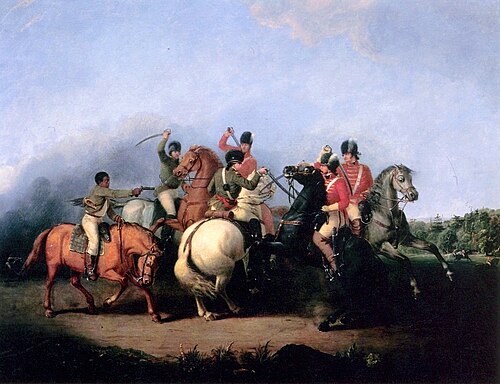
南部戦略は、ロンドンに拠点を置くロイヤリスト、ジョセフ・ギャロウェイらの意見を基にジャーメイン卿が作成した。ロイヤリストらは、ニューイングランドの経済は誰が統治するかに関わらず英国との貿易に依存している中、愛国者らが最も強い北部で戦うのは無意味であると主張した。一方、タバコ税は英国にとって南部の利益をはるかに増やし、地元の支援は少数の正規軍で確保できることを意味していた。勝利すれば、アメリカは南部に英国領、北にカナダ、西にオハイオという国境に直面することになる。大西洋岸は英国海軍が支配するため、議会は条件に同意しざるを得なくなる。しかし、ロイヤリストの支援レベルに関する想定は、非常に楽観的であったことが判明した。[226]
ジャーメインはこれに応じて、東フロリダのイギリス軍司令官オーガスティン・プレヴォストに1778年12月にジョージア州へ進軍するよう命じた。経験豊富な士官で、戦争の初期に捕虜となり、後にイーサン・アレンと交換されたアーチボルド・キャンベル中佐は、1778年12月29日にサバンナを占領した。キャンベルは1,100人近いロイヤリスト民兵を募集したが、その多くはキャンベルが財産を没収すると脅した後に入隊したとされている。[227]士気と訓練が不十分だったため、ロイヤリスト民兵は信頼できない部隊となり、 1779年2月14日のケトルクリークの戦いで愛国者民兵に敗れたことでそれが証明されたが、 3月3日のブライアークリークの戦いでイギリス軍が勝利したことでそれが相殺された。[228]
1779年6月、プレヴォーはチャールストンへの攻撃を開始したが失敗に終わり、サバンナに撤退した。この作戦はイギリス軍による広範囲にわたる略奪で悪名高く、ロイヤリストと愛国者双方を激怒させた。10月、デスタンとベンジャミン・リンカーン将軍の指揮するフランスとアメリカの合同作戦はサバンナ奪還に失敗した。[229]プレヴォーに代わったのはコーンウォリス卿で、ジェルマンの戦略を引き継いだ。彼はすぐにロイヤリストの支援の見積もりがかなり誇張されていることに気づき、正規軍のはるかに大きな数を必要とした。[230]
クリントンの増援を受けたコーンウォリスの部隊は1780年5月にチャールストンを占領し、愛国者にとってこの戦争で最も深刻な敗北を喫した。5,000人以上が捕虜となり、南部の大陸軍は事実上壊滅した。5月29日、バナスター・タールトン中佐の主にロイヤリストの部隊は、ワックスホーズの戦いで、エイブラハム・ビュフォード大佐の指揮する大陸軍のほぼ3倍の部隊を敗走させた。この戦いは虐殺の疑いで物議を醸しており、後に愛国者による募集の手段として利用された。[231]
クリントンはニューヨークに戻り、コーンウォリスに南部の監督を任せた。この作戦は成功したが、二人はほとんど口をきかないまま別れ、戦争のその後の展開に悲惨な結果をもたらした。[232]南部の戦略は地元の支持に依存していたが、一連の強制措置によってそれが損なわれた。以前は、捕らえられた愛国者は国王に対して武器を取らないと誓った後、帰国させられたが、今度はかつての同志と戦うことを要求され、愛国者が所有するプランテーションの没収によって、以前は中立だった「貴族」たちが愛国者に味方することになった。[233]ウィリアムソンズ・プランテーション、シーダー・スプリングス、ロッキー・マウント、ハンギング・ロックでの小競り合いは、サウスカロライナ全土で新しい誓いに対する広範な抵抗の兆しとなった。[234]
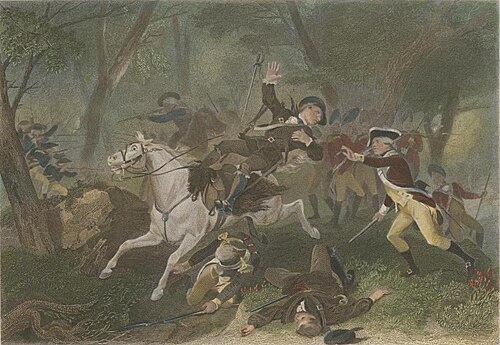
1780年7月、議会はゲイツを南部の司令官に任命したが、8月16日のカムデンの戦いでゲイツは敗北し、コーンウォリスはノースカロライナに自由に入ることができた。 [235]戦場での勝利にもかかわらず、イギリス軍は田舎を制圧できず、愛国者の攻撃は続いた。北に移動する前に、コーンウォリスはパトリック・ファーガソン少佐率いるロイヤリスト民兵を左翼の援護に派遣したが、両軍は互いに支援するには離れすぎていた。[236] 10月初旬、ファーガソンはキングスマウンテンの戦いで敗北し、その地域で組織化されたロイヤリストの抵抗を解散させた。 [ 237]それにもかかわらず、コーンウォリスはロイヤリストの支援を期待してノースカロライナに進軍を続け、一方ワシントンは1780年12月にゲイツをナサニエル・グリーン将軍に交代させた。[238]
グリーンは軍を分割し、主力を南東に導き、コーンウォリスに追わせた。ダニエル・モーガン指揮下の分遣隊は南西に派遣され、1781年1月17日にカウペンスでタールトンの英国在郷軍人会を破り、戦闘力としてはほぼ消滅した。[239]愛国者軍は、 1781年1月にベネディクト・アーノルドが率いたリッチモンド襲撃を除き、南部で主導権を握った。[240]グリーンはコーンウォリスを率いてノースカロライナ周辺で一連の反撃を行った。3月初旬までにイギリス軍は疲弊し、補給も不足していたため、グリーンは3月15日のギルフォード・コートハウスの戦いに十分戦えると感じた。勝利したものの、コーンウォリスは大きな損害を受け、補給と援軍を求めてノースカロライナ州ウィルミントンに撤退した。[241]
愛国者軍は沿岸部を除くカロライナ州とジョージア州の大半を支配し、ホブカークスヒルの戦いで多少の逆転があったものの、4月15日にワトソン砦とモット砦を奪還した。 [242] 6月6日、アンドリュー・ピケンズ准将がオーガスタを占領し、ジョージア州のイギリス軍はチャールストンとサバンナに限定された。[243]ロイヤリスト軍が戦闘の大半を行うと想定されたため、イギリス軍は兵力が不足し、戦場での勝利は補充できない損失を伴った。 9月8日のユートースプリングスの戦いでグリーン軍の進撃を食い止めたにもかかわらず、コーンウォリスは作戦の成果をほとんど残さずにチャールストンに撤退した。[244]
西部戦線

戦争の初めから、スペイン領ルイジアナの知事ベルナルド・デ・ガルベスは、アメリカ人がニューオーリンズに物資と軍需品を輸入し、それをピッツバーグに輸送することを許可した。[245]これにより、大陸軍は大西洋岸のイギリス軍封鎖を迂回する代替輸送ルートを確保できた。[246]
この貿易は、ハバナとニューオーリンズで成功した商人であり、米国の商務代理人に任命されたオリバー・ポロックによって組織された。 [247]また、この貿易は西部におけるアメリカの軍事作戦の支援にも役立った。
1778年2月、カイヤホガ川沿いの入植地にあるイギリス軍の物資を破壊する民兵の遠征は悪天候により中止された。[248]その年の後半、イリノイ地方をイギリスから奪取するための2回目の作戦が開始された。ジョージ・ロジャース・クラーク大佐の指揮するバージニア民兵、カナダ人入植者、およびインディアン同盟軍は7月4日にカスカスキアを占領し、続いてビンセンズを確保したが、ビンセンズはケベック州知事ヘンリー・ハミルトンによって奪還された。1779年初頭、バージニア軍はビンセンズ砦の包囲で反撃し、ハミルトンを捕虜にした。クラークはパリ条約でアメリカ北西部領土が独立戦争を終結させたため、イギリス領ケベック西部を確保した。 [249]
1779年の英仏戦争でスペインがフランスに加わりイギリスと戦ったとき、条約ではスペインの北アメリカでの軍事行動が明確に除外されていた。しかしその年の後半、ガルベスはイギリス軍の前哨基地に対する攻勢作戦を開始した。[ 250]まず、ルイジアナ州バトンルージュ、ミシシッピ州フォートビュート、ナチェズのイギリス軍駐屯地を掃討し、5つの砦を占領した。[ 251]そうすることで、ガルベスはミシシッピ川の北、ピッツバーグのアメリカ人入植地までの航行を開いた。[252]
1780年5月25日、イギリス軍のヘンリー・バード大佐は、ケベックからメキシコ湾岸にかけてのアメリカ軍の抵抗を排除するより広範な作戦の一環として、ケンタッキー州に侵攻した。ペンサコーラからニューオーリンズに進撃したが、モービルでスペイン総督ガルベスの攻勢に撃退された。同時に行われたイギリス軍の攻撃は、セントルイスではスペイン副総督デ・レイバが、イリノイ州カホキアのバージニア郡庁舎ではクラーク中佐が撃退した。バード率いるデトロイトのイギリス軍の先鋒は、クラークが近づいているという噂で終わった。[ab]リッキング川渓谷での暴力の規模は、「辺境の水準から見ても」極端だった。その結果、イギリス人とドイツ人が入植し、イギリス人と雇われたドイツ兵が五大湖に撤退すると、彼らはクラークの民兵隊に加わった。[253]アメリカ軍は8月にマッド川沿いで大規模な攻勢を仕掛け、ピクアの戦いである程度成功を収めたものの、インディアンの襲撃を終わらせることはできなかった。[254]
フランス軍のオーギュスタン・ド・ラ・バルムはカナダの民兵を率いてデトロイトを占領しようとしたが、リトル・タートル率いるマイアミの先住民が11月5日に野営していた開拓者を攻撃したため、民兵は解散した。 [255] [ac]西部での戦争は、イギリス軍がデトロイトに駐留し、バージニア軍がイギリスと同盟を組んだインディアンの抵抗に直面しながらオハイオ川の北で西の開拓地を拡大する中で膠着状態に陥った。[257]
1781年、ガルベスとポロックはメキシコ湾岸に沿って東に進軍し、イギリス領のモービルとペンサコーラを含む西フロリダを確保した。[258]スペインの作戦によりイギリスの同盟国インディアンへの武器供給が妨げられ、ミシシッピ川とアパラチア山脈の間の開拓者を攻撃するための軍事同盟は事実上停止した。[259] [広告]
1782年、この地域の開拓者とネイティブアメリカンの間で大規模な報復が起こり、グナデンハッテンの虐殺やクロフォード遠征が起こった。1782年のブルーリックスの戦いは、アメリカ独立戦争の最後の大きな戦闘の1つだった。イギリスとアメリカの条約のニュースはその年の終わりに届いた。この時までに、ケンタッキーの開拓者の約7%がネイティブアメリカンとの戦いで殺されていたが、13植民地の人口の1%が殺されたのとは対照的だった。戦争が公式に終わった後も、西部では恨みが消えず戦闘が続いた。
イギリスの敗北


クリントンは1781年の大半をニューヨーク市を拠点として過ごしたが、マリオット・アーバスノット提督との関係がうまくいかなかったこともあり、首尾一貫した作戦戦略を立てることができなかった。[260]チャールストンでは、コーンウォリスが独自にバージニアでの積極的な作戦計画を立て、カロライナ州でグリーン軍を孤立させ、南部の愛国者の抵抗を崩壊させることを狙っていた。この戦略はロンドンのジャーメイン卿によって承認されたが、どちらもクリントンに知らせなかった。[261]
一方、ワシントンとロシャンボーは選択肢について話し合った。ワシントンはニューヨークでイギリス軍を攻撃したいと考え、ロシャンボーはバージニアでイギリス軍を攻撃したいと考えていた。バージニアではコーンウォリス軍があまり定着しておらず、おそらく打ち破りやすいと考えられていた。 [262]ワシントンは最終的に譲歩し、ラファイエットはフランスとアメリカの連合軍をバージニアに派遣したが、[263]クリントンは彼の動きをニューヨーク攻撃の準備と誤解した。ニューヨークでの自分の陣地が脅かされていると感じたクリントンは、コーンウォリスに要塞化された海上基地を築くよう指示し、イギリス海軍がニューヨーク防衛を支援するためにイギリス軍を撤退できるようにした。[264]
ラファイエットがバージニアに入ると、コーンウォリスはクリントンの命令に従ってヨークタウンに撤退し、そこで強力な防御線を構築して撤退を待った。[265]スペイン海軍がフランス領西インド諸島の防衛に合意したことで、フランソワ・ジョセフ・ポール・ド・グラス提督は大西洋岸に移動できたが、これはアーバスノットが予想していなかった動きだった。[260]これによりラファイエットは海軍の支援を受けることができたが、ニューポートとサバンナでの以前の共同作戦が失敗したため、彼らの連携はより慎重に計画された。[266]部下からの再三の要請にもかかわらず、コーンウォリスはラファイエットが包囲線を確立するまで交戦しようとはしなかった。[267]数日以内に撤退することを予想して、彼は外側の防御線も放棄したが、それはすぐに包囲軍に占領され、イギリス軍の敗北を早めた。[268]
8月31日、トーマス・グレイブス指揮下のイギリス海軍艦隊がニューヨークを出発し、ヨークタウンに向かった。[269] 8月30日に包囲軍のために兵員と弾薬を上陸させた後、ド・グラスはチェサピーク湾に留まり、9月5日にこれを迎撃した。チェサピークの戦いは損害の点では決着がつかなかったが、グレイブスは撤退を余儀なくされ、コーンウォリスは孤立した。 [ 270]グロスター・ポイントでヨーク川を越える突破の試みは悪天候のために失敗した。[271]激しい砲撃と次第に減少する物資の下で、コーンウォリスは状況が絶望的であると感じ、10月16日にワシントン将軍に使者を送って降伏交渉を依頼した。12時間の交渉の後、翌日降伏条件が確定した。[272]敗北の責任はコーンウォリス、クリントン、ジャーメインの間で激しい公開討論の対象となった。下級将校からの批判にもかかわらず、コーンウォリスは同僚の信頼を保ち、後に一連の政府高官職に就いた。クリントンは最終的にほとんどの責任を負い、残りの人生を比較的無名のまま過ごした。[273]
ヨークタウンの戦いの後、アメリカ軍は、1782年1月に議会で制定された、イギリス軍の北アメリカにおけるさらなる攻撃を禁じる法律を受けて、イギリス軍の撤退を容易にするために結ばれたワシントンとクリントンの休戦協定を監視する任務を与えられた。パリでの英米交渉の結果、1782年11月にアメリカの独立を認める予備協定が調印された。議会で制定された戦争目的、つまりイギリス軍の北アメリカからの撤退とこれらの地域のアメリカへの割譲は、東海岸の都市で段階的に達成された。[274]
アメリカ南部では、グリーン将軍とウェイン将軍が撤退するイギリス軍をサバンナとチャールストンで緩やかに包囲し、1782年12月14日にイギリス軍がチャールストンから撤退するのを見届けた。[275]白人と自由黒人からなるロイヤリストの民兵と奴隷を連れたロイヤリストはノバスコシアとイギリス領西インド諸島に移送された。[ae]イギリス軍の同盟者であるネイティブアメリカンと一部の解放黒人は、アメリカ軍の戦線を抜けて独力で逃げ延びた。
ワシントンは軍をニューヨーク市から北に約60マイルのハドソン川沿いのニューウィンザーに移動させ、 [276]そこで大陸軍の実質的な兵士は、パリ条約で正式に戦争が終結した1783年9月3日まで、半額の給料で士官たちを帰国させた。その時点で、議会はワシントンの大陸軍の連隊を解散させ、戦争に尽くした退役軍人に北西部領土の土地の寄贈を始めた。イギリス軍によるニューヨーク市の最後の占領は、クリントンの後任のガイ・カールトン将軍の撤退とともに1783年11月25日に終わった。[277]
戦略と指揮官

反乱に勝つには、ワシントンと大陸軍はイギリス軍の戦闘継続の意志に打ち勝つ必要があった。イギリスはイギリス領アメリカ帝国を回復するために、最初の数か月で大陸軍を打ち負かし、フィラデルフィアで開かれた第二次大陸会議を解散させ、自治権の主張を撤回させなければならなかった。[279]ザ・シタデルの歴史家テリー・M・メイズは、独立戦争中の戦争を3つのタイプに分類している。1つ目は、帝国の貿易規制への反対が課税政策と同じくらい重要だった植民地紛争である。2つ目は、13植民地すべてがアメリカの愛国者、アメリカのロイヤリスト、そして革命と戦争で中立を望んだ人々に分かれた内戦である。特に南部では、イギリスの関与なしに愛国者とロイヤリストの間で多くの戦闘が行われ、独立後も分裂が続いた。[280]
3つ目の要素は、フランス、スペイン、オランダ共和国、イギリスの間で起こった世界戦争であり、アメリカはいくつかの異なる戦場の一つとして機能した。[280] 1778年に独立戦争に参戦した後、フランスはアメリカに資金、武器、兵士、海軍援助を提供し、フランス軍は北米で米国の指揮下で戦った。スペインはアメリカでの戦争には正式には参加しなかったが、ミシシッピ川へのアクセスを提供し、イギリス海軍の基地を奪取できなかったメキシコ湾のイギリス領を占領し、メノルカ島を奪還し、ヨーロッパでジブラルタルを包囲した。[281]
1774年以前にはネーデルラント連邦共和国はもはや大国ではなかったが、ヨーロッパの運送貿易を支配しており、オランダ商人はフランスから供給された軍需品を愛国者に輸送することで大きな利益を上げていた。これは1780年12月にイギリスが宣戦布告したことで終わり、この紛争はオランダ経済に壊滅的な打撃を与えた。[282]また、オランダは1780年3月にロシア、スウェーデン、デンマークによって結成された第一武装中立同盟からも排除され、この同盟は中立国の船舶をイギリスとフランスによる禁制品の捜索から守っていた。 [201]効果は限られていたものの、これらの介入によりイギリスは北アメリカから兵士と資源を転用せざるを得なくなった。[82]
アメリカの戦略
フィラデルフィアで開かれた第二次大陸会議は、アメリカ独立戦争が長期戦に発展した場合には有利な立場にあった。13の植民地州の住民は大部分が裕福で、食料や物資をイギリスからの輸入に頼るのではなく、現地生産に依存していた。イギリスからの輸入は大西洋を横断する船で到着するまでに6~12週間かかった。13の植民地は北アメリカ大西洋岸のほとんどに広がり、1,000マイルに及んでいた。植民地農場のほとんどは港から遠く離れており、4~5の主要港を支配してもイギリスはアメリカの内陸部を支配できなかった。各州は内部の配給システムを確立していた。[283]
13の植民地にはそれぞれ、長く確立された地方民兵組織があり、13年前にイギリス正規軍を支援して大英帝国の拡大を防衛するために実戦で鍛えられた。これらの民兵は、フレンチ・インディアン戦争でミシシッピ川以西の北アメリカに対するフランスの領有権主張を阻止した。13の植民地州議会は、地方民兵に独自に資金を提供し、統制した。アメリカ独立戦争では、各州議会は大陸軍連隊を訓練し、正規軍に提供し、各州議会は独自の州将校団を擁した。 [283]動機もまた大きな資産であった。各植民地の首都には独自の新聞社と印刷会社があり、愛国者党はロイヤリスト党よりも国民の支持を得ていた。イギリスはロイヤリスト党が戦闘の多くを担うことを期待したが、ロイヤリスト党は期待したほどには戦闘に参加しなかった。[14]
大陸軍

独立戦争が始まったとき、第二次大陸会議にはプロの陸軍や海軍がなかったが、各植民地は地元の民兵を維持していた。民兵は軽装備で、訓練もほとんど受けておらず、制服も持っていなかった。彼らの部隊は一度に数週間から数ヶ月しか任務に就かず、より経験豊富な兵士のような訓練や規律もなかった。地元の郡の民兵は故郷から遠く離れた場所への移動を嫌がり、長期の作戦には参加できなかった。[284]これを補うために、大陸会議は1775年6月14日に大陸軍と呼ばれる正規軍を設立し、これが現代のアメリカ陸軍の起源となった。そしてワシントンをその最高司令官に任命した。しかし、効果的な訓練プログラムの欠如と、経験の浅い将校や軍曹がほとんどで、それを補うように上級将校が数人いたため、大きな問題を抱えていた。[285]
各州議会は郡民兵と州民兵の両方の士官と、連隊の大陸軍の将校を任命した。ワシントンは議会の任命を受け入れる必要があったが、グリーン、砲兵隊長のノックス、参謀長のアレクサンダー・ハミルトンなどの将軍を自分で選び、指揮することが許されていた。 [286]ワシントンが最も成功した将官の一人は、プロイセン参謀本部のベテランで独立戦争の教練マニュアルを書いたシュトゥベンだった。[285]大陸軍の発展は常に進行中であり、ワシントンは戦争中ずっと正規軍と州民兵の両方を使用した。適切に使用すれば、この組み合わせにより、コンコード、ボストン、ベニントン、サラトガの戦闘でのように、より小規模なイギリス軍を圧倒することができた。両軍とも党派戦を繰り広げたが、英国正規軍がその地域にいないときは州民兵がロイヤリストの活動を効果的に抑制した。[284] [af]
ワシントンは議会と協力して独立戦争の全体的な軍事戦略を立案し、軍事問題における文民優位の原則を確立し、自ら上級将校団を募集し、各州が共通の目標に集中できるようにした。[289]フィラデルフィア陥落とバレーフォージでの6か月間の野営までの最初の3年間、大陸軍は主に地元の州民兵によって補強されていた。ワシントンは当初、イギリスの職業軍人や将校に正面攻撃を仕掛ける危険を冒すよりも、経験の浅い将校や訓練を受けていない兵士をファビアン戦略に投入した。 [290]戦争全体を通して、ワシントンは勝った戦闘よりも負けた戦闘の方が多かったが、軍隊を降伏させることはなく、イギリスの野戦軍に直面しても戦闘力を維持し、アメリカの大義のために戦うことを決してあきらめなかった。[291]
当時のヨーロッパの基準からすると、アメリカの軍隊は比較的小規模で、補給と兵站の不足が限界だった。イギリス軍は、大西洋を渡って兵を輸送する兵站上の難しさと、現地の補給物資への依存という制約を受けていた。戦争中、ワシントンが直接指揮した兵士は1万7千人を超えることはなく[292] 、ヨークタウンでの決定的なアメリカの勝利におけるフランス・アメリカ連合軍はわずか約1万9千人だった[293]。1776年の初め、愛国者軍は2万人で構成され、その3分の2が大陸軍、残りの3分の1が各州の民兵だった。戦時中の8年間で約25万人のアメリカ人が革命軍のために正規兵または民兵として従軍したが、武装した兵士が9万人を超えることはなかった[294] 。
全体として、アメリカの士官は戦術や機動においてイギリス軍に匹敵することはなく、ほとんどの会戦で負けた。ボストン(1776年)、サラトガ(1777年)、ヨークタウン(1781年)での大きな成功は、より多くの兵力でイギリス軍を基地から遠く離れた場所に閉じ込めることによって勝ち取ったものだった。[286]しかし、1778年以降、ワシントンの軍隊は、主にバロン・フォン・シュトゥイベンの軍事訓練の成果として、より規律正しく効果的な部隊に変身した。 [285]大陸軍は、1778年6月にバレーフォージから出現した直後、モンマスの戦いでイギリス軍の軍事力に匹敵する能力があることを証明した。これには、黒人ロードアイランド連隊がイギリス軍の銃剣攻撃をかわし、ワシントン軍の一部として初めてイギリス軍に反撃することが含まれていた。[295]モンマスの戦いの後、ワシントンは町全体を救うことは必要ではなく、軍隊を維持し、革命精神を生かし続けることの方が重要であると認識した。ワシントンは第二次大陸会議の議長ヘンリー・ローレンスに「我々が軍隊を戦場に残している間に我々の町を占領しても、彼らにはほとんど役に立たないだろう」と伝えた。[297]
大陸会議は戦争遂行の責任を負い、軍隊に物資を供給していたが、ワシントンは自ら議会と州議会に圧力をかけ、戦争に不可欠な物資を供給することを引き受けた。物資は決して十分ではなかった。[298]議会は委員会による監督体制を発展させ、軍人を含む戦争委員会を設立した。[299]戦争委員会も委員会であり、内部手続きに縛られていたため、議会は陸軍長官のポストも創設し、1781年2月にベンジャミン・リンカーン少将をその職に任命した。ワシントンはリンカーンと緊密に協力して文民と軍の当局を調整し、軍隊の訓練と物資供給を担当した。[300] [285]
大陸海軍

戦争の最初の夏、ワシントンはボストンのイギリス軍に物資を供給する船を襲うためにスクーナー船やその他の小型外洋船の艤装を始めた。[301]第二次大陸会議は1775年10月13日に大陸海軍を設立し、エセク・ホプキンスを初代司令官に任命した。[302]戦争のほとんどの間、大陸海軍は少数の小型フリゲート艦とスループ船で構成され、多数の私掠船に支援されていた。[303] 1775年11月10日、議会は大陸海兵隊の創設を承認し、これが最終的にアメリカ海兵隊へと発展し、その名称が付けられた。[288]
ジョン・ポール・ジョーンズは、1778年4月24日にHMSドレイクを拿捕し、アメリカ初の海軍の英雄となった。これは、イギリス海域におけるアメリカ軍艦の初の勝利であった。[304]このような最後の勝利は、ジョン・バリー艦長が指揮するフリゲート艦USSアライアンスによるものである。1783年3月10日、アライアンスは、スペインの金塊をハバナからフィラデルフィアの議会まで護衛している最中に、45分間の決闘でHMSシビルを武装で打ち負かした。 [305]ヨークタウンの後、アメリカ海軍の艦艇はすべて売却または譲渡された。アメリカの歴史上、公海上に戦闘部隊が存在しないのは初めてのことであった。[306]
議会は、主に経費削減と大英帝国に多くいる植民地船員の利益を生かすために私掠船を委託した。私掠船には合計1,700隻の船が含まれ、2,283隻の敵船を拿捕してイギリス軍に打撃を与え、積荷と船自体の売却益で議会は富を得た。[307] [ah]戦争中、約55,000人の船員がアメリカの私掠船に乗船した。[16]
フランス
独立戦争の初め、アメリカには主要な国際同盟国がなかった。ほとんどの国民国家は、イギリス領アメリカでの紛争の展開を見守っていたからである。時が経つにつれ、大陸軍は、ヨーロッパ列強に知られたイギリス正規軍と雇われたヘッセン軍を破ったり持ちこたえたりして、軍事的信頼性を確立していった。ベニントンの戦い、サラトガの戦い、ジャーマンタウンの戦いなどの戦闘、さらには敗北さえも、フランス、スペイン、オランダ共和国など、ヨーロッパの強国から注目と支援を得るのに決定的な役割を果たした。オランダは、これらのアメリカの勝利と紛争に感銘を受け、アメリカに秘密裏に武器や物資を供給することから、公然とアメリカを支援することへと移行した。[309]
サラトガでのアメリカの決定的な勝利は、すでにイギリスの長年のライバルであったフランスを説得し、アメリカに修好通商条約を提案させた。両国はまた、貿易を保護するための防衛同盟条約にも同意し、イギリスからのアメリカの独立も保証した。アメリカをフランスの同盟国として軍事的に関与させるため、この条約はイギリスがフランスとの戦争を起こしてアメリカとの貿易を阻止することを条件としていた。スペインとオランダ共和国はフランスとアメリカの両国からこの条約に参加するよう招請されたが、どちらもその要請に応じなかった。[310]
1778年6月13日、フランスはイギリスに宣戦布告し、フランスとアメリカの軍事同盟を発動した。これにより、カリブ海におけるフランス領土に対するアメリカの民間支援がさらに確保された。[ai]ワシントンは、主に参謀のラファイエットを通じて、フランスがアメリカに派遣する兵士や海軍と緊密に協力した。フランスの援助は、1781年にヨークタウンでコーンウォリスを破るのに必要な決定的な貢献を果たした。[313] [aj]
イギリスの戦略
イギリス軍は北アメリカでの戦闘経験が豊富で、最近では1763年にフランスにヌーベルフランスの放棄を強いた七年戦争のときだった。[315]しかし、以前の紛争では、イギリス軍は地元の兵站と植民地民兵の支援の恩恵を受けていたが、アメリカ独立戦争ではそれは得られなかった。増援はヨーロッパから来なければならず、そのような距離を越えて大規模な軍隊を維持するのは極めて複雑だった。船が大西洋を横断するには3か月かかることもあり、ロンドンからの命令は到着する頃には時代遅れになっていることが多かった。[316]
戦争以前、植民地は主に経済的、政治的に自立した存在であり、戦略的に極めて重要な中央集権的な地域は存在しなかった。[317]これは、首都の陥落で戦争が終わることが多かったヨーロッパとは異なり、アメリカではフィラデルフィア、連邦議会の所在地、ニューヨーク、チャールストンなどの主要な入植地を失った後も戦争が続いたことを意味している。[318]イギリスの力はイギリス海軍に依存しており、その優位性により、敵の港へのアクセスを防ぎながら自国の遠征軍に補給を行うことができた。しかし、アメリカの人口の大半は都市部ではなく農業に従事していたため、フランス海軍とオランダ領カリブ海に拠点を置く封鎖突破船の支援を受けて、経済は生き残ることができた。[319]
植民地の地理的な広さと人員の限界のため、イギリスは現地の支援なしに軍事作戦と領土の占領を同時に行うことはできなかった。イギリスの敗北は避けられなかったかどうかについては議論が続いている。あるイギリスの政治家はそれを「地図を征服しようとするようなもの」と表現した。[320]ファーリングは愛国者の勝利は奇跡にほかならなかったと主張するが、 [321] エリスは、特にハウが1776年にイギリスの決定的な勝利のチャンスを無駄にした後、常にアメリカが有利だったと示唆している。これは「二度と訪れることのない機会」だった。[322]アメリカの軍事史では、1780年に1万人の新たな部隊を追加投入していれば、イギリスの勝利は「可能性の範囲内」にあっただろうと推測している。[323]
イギリス陸軍

1763年にフランスが北アメリカから追放されたことで、植民地におけるイギリス軍の規模は大幅に縮小された。1775年には、280万人の民間人人口に対して正規軍はわずか8,500人だった。[324]アメリカ大陸における軍事資源の大半はカリブ海の砂糖島防衛に集中しており、ジャマイカだけで13のアメリカ植民地すべてを合わせたよりも多くの収入を生み出していた。[325]七年戦争の終結とともに、イギリスの常備軍も削減され、10年後に戦争が始まったときには管理上の困難を招いた。[326]
戦争中、イギリス軍の総司令官は4人いた。最初は1763年に任命されたトーマス・ゲージで、当初はカナダの旧フランス領地域にイギリスの統治を確立することに注力していた。正しいか間違っているかは別として、ロンドンでは反乱の原因を彼が早期に断固たる行動を取らなかったせいだとする者が多く、マサチューセッツ州チャールズタウンのバンカーヒルの戦いで大きな損害を受けた後、ゲージは解任された。[327]ゲージの後任はウィリアム・ハウ卿で、議会でホイッグ派に属し、ノース卿が主張した強制政策に反対した。後にヨークタウンで降伏したコーンウォリスは、当初は北米での任務を拒否した多くの上級将校の1人だった。[328]
1775年の作戦は、イギリス軍が自軍の能力を過大評価し、植民地民兵を過小評価していたことを示し、戦術と戦略の再評価が必要となった。[329]しかし、愛国者たちが主導権を握ることを許し、イギリス当局は急速にすべての植民地に対する統制力を失った。[330]ハウの責任は今も議論されている。バンカーヒルの戦いは、多数の援軍を受け取ったにもかかわらず、彼の自信に永久に影響を与えたようで、戦術的柔軟性の欠如により、彼はしばしば機会を逃した。[331]彼の決定の多くは、ニューヨーク作戦の開始の遅れや、ワシントンの敗れた軍隊を追撃できなかったことなど、補給の問題に起因するものだった。[332]部下の信頼を失った彼は、サラトガでバーゴインが降伏した後、呼び戻された。[333]
カーライル委員会の失敗を受けて、イギリスの政策は、愛国者を和解すべき臣民として扱うことから、打ち負かすべき敵として扱うことに変わった。[334] 1778年、ハウは、用心深すぎるとみなされたカールトンに代わってヘンリー・クリントン卿に交代した。[335]戦術と戦略の専門家とみなされていたクリントンは、[333]前任者と同様に慢性的な補給問題に悩まされていた。[336]その結果、1779年と1780年の大半はほとんど活動していなかった。1780年10月、ジャーメインに、状況が改善されなければ「致命的な結果」が待っていると警告した。[337]
さらに、クリントンの戦略は、ロンドンの政治的上司や北米の同僚、特にマリオット・アーバスノット提督との対立によって危うくなった。アーバスノット提督は1781年初めにロドニーに交代した。[260] 1781年にジャーメインがコーンウォリスの南部侵攻を承認し、ワシントン軍の大半がまだニューヨーク市外にいると信じて援軍の派遣を遅らせたとき、クリントンは通知も相談も受けなかった。[338]ヨークタウンでの降伏後、クリントンはカールトンに交代した。カールトンの主な任務は、サバンナ、チャールストン、ニューヨーク市からロイヤリストとイギリス軍の撤退を監督することだった。[339]
ドイツ軍

18世紀、イギリスを含む各国は外国の兵士を雇用するのが一般的だった。七年戦争中、外国の兵士はイギリス軍の10%を占め、その使用についてはほとんど議論がなかった。[340]アメリカでの反乱を鎮圧するために追加の兵力が必要であることが明らかになると、職業軍人のドイツ兵を雇うことが決定された。これには、愛国者大義に対する国民の同情、イギリス軍の拡大に対する歴史的な消極的態度、新しい連隊の募集と訓練に必要な時間など、いくつかの理由があった。 [341]神聖ローマ帝国では、多くの小国が軍隊を最高額の入札者に貸し出す長い伝統を持っていたため、代替の供給源が容易に利用可能であった。最も重要なのは「傭兵国家」として知られたヘッセン=カッセルであった。 [342]
最初の補給協定は1775年後半に北軍政権によって調印された。その後10年間で4万人以上のドイツ人が北アメリカ、ジブラルタル、南アフリカ、インドで戦い、そのうち3万人が米英戦争に従軍した。[343]一般的に「ヘッセン人」と呼ばれる彼らには、ハノーバーやブラウンシュヴァイクなど他の多くの州出身者も含まれていた。[344]ヘンリー・クリントン卿は、オスマン帝国との戦闘でロシア軍を非常に高く評価し、ロシア軍の徴兵を推奨したが、エカチェリーナ2世との交渉はほとんど進展しなかった。[345]
以前の戦争とは異なり、この条約の使用はイギリス、フランス、さらにはドイツで激しい政治的議論を巻き起こした。ドイツではフリードリヒ大王がアメリカ戦争のために雇われた軍隊の領土通過を拒否した。[346] 1776年3月、この協定は議会でホイッグ党によって異議を唱えられた。彼らは「強制」全般と「イギリス国民」を制圧するための外国軍の使用に反対した。[347]この議論はアメリカの新聞によって詳細に報道され、主要な演説が転載され、1776年5月には新聞は条約そのもののコピーを受け取った。イギリスの支持者によって提供されたこの条約は、釈放されたばかりのアメリカ人囚人ジョージ・マーチャントによってロンドンから北アメリカに密輸された。[348]
植民地で外国人ドイツ兵が使われるという見通しは、課税やその他の措置を合わせたよりも独立への支持を強めた。国王は自国民に宣戦布告したと非難され、今や二つの別々の政府があるという考えにつながった。[349] [350]イギリスが戦争に踏み切る決意をしていることが明らかになったことで、和解への希望は甘く絶望的なものに見え、一方で「外国人傭兵」と見なされるものの雇用は、独立宣言でジョージ3世に向けられた非難の1つとなった。[346]ドイツ国内でのヘッセン人の残忍さの評判も、ドイツ系アメリカ人移民の間で愛国者運動への支持を高めた。[351]
15万人以上のドイツ系アメリカ人がいたため、両陣営ともドイツ兵が脱走するかもしれないと感じていた。クリントンがロシア人を雇うことを提案した理由の1つは、彼らが脱走する可能性が低いと感じたためだった。1776年8月に最初のドイツ軍がスタテン島に到着したとき、議会は愛国者大義に加わる意思のある者には土地と市民権を与えると約束するビラの印刷を承認した。イギリスは、脱走兵は自分たちの戦争ではない戦争に干渉した罪で処刑されても構わないと主張して反撃を開始した。[352]ドイツ人の脱走は戦争中ずっと起こり、最も脱走率が高かったのはヨークタウンでの降伏からパリ条約締結までの期間だった。[353]ドイツ連隊はイギリスの戦争努力の中心であり、アメリカに送られた推定3万人のうち、約1万3千人が犠牲になった。[354]
内戦としての革命
ロイヤリスト
裕福なロイヤリストは、植民地の大半が王室に同情的であると英国政府を説得した。[355]その結果、英国軍の計画者はロイヤリストの募集に頼ったが、愛国者が幅広い支持を得ていたため、十分な数の募集に苦労した。[284] [ak]それでも、彼らは戦闘が終わる1年前の1780年まで、アメリカからの支援のレベルについて自らを欺き続けた。[356]
約25,000人のロイヤリストが戦争中ずっとイギリス軍のために戦った。[31]ロイヤリストは植民地人口の約20%を占めていたが、[83]彼らは明確なコミュニティに集中していた。彼らの多くは、カリブ海地域の砂糖の世界市場に匹敵するタバコとインディゴの換金作物を生産するタイドウォーター地域とサウスカロライナの大規模プランテーション所有者の間で暮らしていた。 [83]
1777年から1778年にかけてイギリス軍が奥地の探査を始めたとき、彼らは大きな問題に直面した。ロイヤリストの組織的な活動がある程度行われるには、イギリス正規軍の継続的な駐留が必要だったのだ。 [357]イギリス軍がアメリカ国内に保有していた人員は、ロイヤリストの領土を守り、アメリカ軍の攻勢に対抗するには不十分だった。[358]南部のロイヤリスト民兵は、近隣の愛国者民兵に絶えず敗北した。2つの党派民兵の間で最も決定的な戦闘はキングスマウンテンの戦いであり、愛国者が勝利したことで、南部におけるロイヤリスト民兵の能力は回復不能に損なわれた。[241]
初期の戦争政策がハウによって管理されていたとき、王室はロイヤリストの支持を維持する必要があったため、伝統的な反乱鎮圧方法を使用することができなかった。[359] 1779年のチャールストン攻撃が中止された際、イギリス軍が地元の家を略奪し、愛国者とロイヤリストの両方を激怒させたため、イギリスの立場は苦しんだ。[229] 1778年に議会がカーライル平和委員会を拒否し、クリントンの指揮下でウェストミンスターが「激戦」に転じた後、カロライナの中立植民地人は、トーリー党とホイッグ党の間で残忍な戦闘が発生するたびに、しばしば愛国者と同盟を結んだ。[360]逆に、愛国者がトーリー党と疑われる者を財産の破壊やタール塗りや羽根付けで脅迫すると、ロイヤリストの支持が集まった。[361]
ロイヤリスト民兵部隊である英国在郷軍人会は、英国軍の中でも最も優秀な部隊の一つであり、英国陸軍に任命された。[362]これは250人の竜騎兵と200人の歩兵からなる混成連隊で、飛行砲兵隊の支援を受けていた。[363] [al]タールトンが指揮し、植民地では「残忍さと無用な虐殺」で恐ろしい評判を得た。[364] [よりよい情報源が必要] 1779年5月、英国在郷軍人会はアメリカ軍団を形成した5つの連隊のうちの1つであった。[365]
女性

独立戦争中、女性は様々な役割を果たした。許可されれば、夫に同行することが多かった。例えば、戦争中、マーサ・ワシントンは夫のジョージを様々なアメリカ軍のキャンプに訪ねて援助していたことで知られており、[366]フレデリカ・シャーロット・リーデセルはサラトガ作戦を記録した。[367]女性はしばしばキャンプフォロワーとして軍隊に同行し、商品を販売したり、病院やキャンプで必要な仕事をしたりした。女性は18世紀の軍隊に欠かせない存在であり、戦争中は数千人の兵士がいた。[368]
女性も軍人としての役割を担った。負傷者の治療や野営地の設営といった軍務のほかに、戦闘を直接支援したり、戦ったり、独立戦争の両陣営でスパイとして活動したりするために男性の服を着た女性もいた。 [369]アンナ・マリア・レーンは夫とともに陸軍に入隊し、ジャーマンタウンの戦いが起こる頃には男性の服を着ていた。バージニア州議会は後に彼女の勇敢さを称え、男装して戦い、「並外れた軍務を果たし、ジャーマンタウンの戦いで重傷を負ったが、兵士としての勇気を持っていた」と述べた。[370]
1777年4月26日、シビル・ラディントンは、ニューヨーク州パットナム郡とコネチカット州ダンベリーの民兵にイギリス軍の接近を警告するために馬に乗って出かけたと言われており、彼女は「女性版ポール・リビア」と呼ばれている。[371]ニューイングランド・クォータリー誌の報告によると、この話を裏付ける証拠はほとんどなく、[372]実際に馬に乗っていたかどうかも疑問視されている。[372] [373] [374] [375]他の数人は男性に変装した。デボラ・サンプソンは性別が判明して除隊になるまで戦い、サリー・セントクレアは戦争中に戦死した。[370]
アフリカ系アメリカ人
,_by_Jean-Baptiste-Antoine_DeVerger.png/500px-Soldiers_at_the_siege_of_Yorktown_(1781),_by_Jean-Baptiste-Antoine_DeVerger.png)
戦争が始まったとき、13植民地の人口には推定50万人の奴隷が含まれており、主に南部のプランテーションで労働力として使われていた。[376] 1775年11月、バージニアの王室総督ダンモア卿は、武器を所持する意思のある愛国者所有の奴隷には自由を与えると約束する宣言を出した。この発表は一時的な人手不足を補うのに役立ったが、白人ロイヤリストの偏見により、新兵は最終的に非戦闘員の役割に再配置された。ロイヤリストの動機は奴隷制を終わらせることではなく、愛国者プランターから労働力を奪うことであったため、ロイヤリスト所有の奴隷は返還された。[377]
1779年にクリントンが発布したフィリップスバーグ宣言は、植民地中の愛国者所有の奴隷に自由を与えるという内容だった。この宣言は家族全員をイギリス軍の陣地へ逃亡させ、その多くは軍隊への奉仕義務をなくすことで農場で軍の食料を栽培する仕事に就いていた。クリントンは黒人開拓者を組織する一方で、逃亡奴隷がロイヤリストの所有者に返還されることを確実にし、逃亡を企てた罪で罰せられないようにした。[378]戦争が進むにつれ、イギリス軍部隊で正規兵として従軍することがますます一般的になり、黒人ロイヤリストは1783年にチャールストン駐屯軍の2個連隊を編成した。[379]
戦争中にイギリス軍に従軍した人数は、戦時中に逃亡した者を除いて25,000人から50,000人と推定されている。トーマス・ジェファーソンは、バージニア州では逃亡した奴隷が合計30,000人失われたと推定している。[380]サウスカロライナ州では、約25,000人の奴隷(奴隷人口の約30%)が逃亡、移住、または死亡し、戦中および戦後を通じてプランテーション経済に大きな混乱をもたらした。[381]
黒人愛国者は大陸軍に入隊できなかったが、1778年1月にワシントンが議会を説得して病気や脱走による損失を補う方法は他にないと納得させた。 2月に結成された第1ロードアイランド連隊には元奴隷も含まれ、その所有者には補償金が支払われた。しかし、225人の兵士のうち黒人はわずか140人で、1788年6月に募集は中止された。[382]最終的に、約5,000人のアフリカ系アメリカ人が大陸軍と海軍でさまざまな役割を担い、さらに4,000人が愛国者民兵隊、私掠船、御者、召使、スパイとして雇用された。戦後、少数の者が老齢で土地の寄付や議会の年金を受け取ったが、他の多くも自由の約束があったにもかかわらず、戦後に主人の元に返された。[383]
愛国者の勝利の可能性が高まるにつれ、黒人ロイヤリストの処遇が争点となった。1781年にヨークタウンが降伏した後、ワシントンは逃亡者全員の帰還を主張したが、コーンウォリスは拒否した。1782年と1783年には、約8,000人から10,000人の解放黒人がイギリス軍によってチャールストン、サバンナ、ニューヨークから避難させられた。一部はロンドンに移り、3,000人から4,000人はノバスコシアに定住し、バーチタウンなどの開拓地を築いた。[384]白人ロイヤリストは15,000人の奴隷黒人をジャマイカとバハマに移送した。イギリス領西インド諸島に移住した自由黒人ロイヤリストには、ダンモアのエチオピア連隊の正規兵と、リーワード諸島の守備隊を支援したチャールストンの兵士が含まれていた。[379]
ネイティブアメリカン

ミシシッピ川の東側に住んでいたほとんどのネイティブアメリカンは戦争の影響を受け、多くの部族は紛争への対応をめぐって分裂した。少数の部族は入植者に友好的だったが、ほとんどのネイティブアメリカンは植民地の統合が彼らの領土に対する潜在的な脅威となるとして反対した。約13,000人のネイティブアメリカンがイギリス側で戦い、最も大きなグループは1,500人ほどを派遣したイロコイ族だった。 [33]
1776年7月初旬、イギリスの同盟者であるチェロキー族は、短命に終わったノースカロライナ州のワシントン地区を攻撃した。彼らの敗北はチェロキーの入植地と人々を分裂させ、チカマウガ・チェロキーの台頭の直接的な原因となり、イギリスとの敵対関係が終わった後も数十年にわたってアメリカ人入植者に対するチェロキー・アメリカ戦争が続いた。 [385]
イギリスの同盟者であるマスコギー族とセミノール族は、ジョージア州とサウスカロライナ州でアメリカ人と戦った。1778年、800人のマスコギー族の軍隊がジョージア州のブロード川沿いのアメリカ人の入植地を破壊した。マスコギー族の戦士たちは、サウスカロライナ州へのトーマス・ブラウンの襲撃にも参加し、サバンナの包囲戦ではイギリスを支援した。[386]多くのネイティブアメリカンが、メキシコ湾岸とミシシッピ川のイギリス側でのイギリスとスペインの戦いに巻き込まれた。何千人ものマスコギー族、チカソー族、チョクトー族が、シャーロット砦の戦い、モービルの戦い、ペンサコーラの包囲戦などの主要な戦いで戦った。[387]
アメリカ独立戦争の結果、イロコイ連邦は、彼らがどちらの側についたかに関わらず崩壊した。セネカ族、オノンダガ族、カユガ族はイギリス側についた。モホーク族は双方で戦い、多くのタスカローラ族とオナイダ族はアメリカ側についた。ロイヤリストとその同盟インディアンによるアメリカ開拓地への襲撃に報復するため、大陸軍はサリバン遠征隊をニューヨーク全域に派遣し、イギリス側についたイロコイ族を弱体化させる懲罰遠征を行った。モホーク族の指導者ジョセフ・ルイス・クックとジョセフ・ブラントはそれぞれアメリカ側とイギリス側についたため、分裂はさらに悪化した。[388]
アメリカ独立戦争の西部戦線では、開拓者とネイティブアメリカンの対立が長引く不信感につながった。[389] 1783年のパリ条約で、イギリスは五大湖とオハイオ川の間の係争地の支配権を譲渡したが、インディアンの住民は和平交渉に参加しなかった。[390]北西部領土の部族は西部連合に加わり、アメリカ人の入植に抵抗するためにイギリスと同盟を組み、独立戦争後も北西インディアン戦争として対立が続いた。[391]
英国の「アメリカ戦争」と平和
首相の交代
1770年以来首相を務めたノース卿は、北アメリカでの戦争の指揮権をジョージ・ジャーメイン卿と、 1771年から1782年までイギリス海軍の長官を務めたサンドウィッチ伯爵に委任した。1777年のサラトガでの敗北は、特に1778年2月のフランスとアメリカの同盟と6月のフランスの宣戦布告の後では、反乱が容易に鎮圧されないことを明らかにした。スペインも紛争に加わると予想されていたため、イギリス海軍はアメリカでの戦争とヨーロッパでの戦争のどちらかを優先する必要があった。ジャーメインは前者を、サンドウィッチは後者を主張した。[392]
イギリスの交渉担当者は、今度は議会に第2次和平案を提案した。[393]カーライル和平委員会が提示した条件には、自治の原則を受け入れることが含まれていた。議会は議会を統治機関として認め、問題のある立法を一時停止し、植民地の地方税の権利を放棄し、下院にアメリカの代表者を含めることを議論する。その見返りとして、ロイヤリストから没収されたすべての財産は返還され、イギリスの負債は履行され、地方で施行された戒厳令は受け入れられる。しかし、議会は独立の即時承認かイギリス軍の撤退のいずれかを要求した。彼らは委員会がこれらを受け入れる権限がないことを知っていたため、交渉は急遽終了した。[394]
1778年11月に委員たちがロンドンに戻ると、彼らは政策の変更を勧告した。アメリカにおける新しいイギリス軍最高司令官ヘンリー・クリントン卿は、反乱軍を忠誠心を取り戻せるかもしれない臣民ではなく敵として扱うのをやめるよう命じられた。[334]これらの常設命令はクリントンが解任されるまでの3年間有効であった。[395]
ノースは当初、商業主義の北部と奴隷所有者の南部の分裂を利用しようとする南部の戦略を支持したが、ヨークタウンの敗北後、この政策が失敗したという事実を受け入れざるを得なくなった。[396]戦争に負けたことは明らかだったが、イギリス海軍は1781年11月にフランス艦隊をカリブ海に移動させ、アメリカ貿易の厳しい封鎖を再開した。[397]結果として生じた経済的損害とインフレの上昇により、アメリカは戦争を終わらせることに熱心になり、フランスはそれ以上の融資を提供できなくなり、議会は兵士に給料を支払うことができなくなった。[398]
1782年2月27日、アメリカでの攻勢戦争を終わらせるというホイッグ党の動議が19票差で可決された。[399]ノースは辞任し、国王はロッキンガム卿を招いて政府を樹立せざるを得なくなった。一貫して愛国者の大義を支持していたロッキンガム卿は、その条件としてアメリカ独立を約束した。ジョージ3世は渋々これを受諾し、新政府は1782年3月27日に発足した。しかし、ロッキンガム卿は7月1日に突然死去し、アメリカの独立を認めたシェルバーン卿が後任となった。[400]
アメリカ議会が平和条約に署名

ホイッグ党の指導者でアメリカの支持者でもあったロッキンガム卿が首相に昇格すると、議会はヨーロッパの外交領事をパリの和平代表団に統合した。全員が議会指導の経験があった。代表団の長はペンシルバニア州のフランクリンであった。彼はフランス宮廷で有名人になっていたが、イギリスの元同盟国であるプロイセンや、スペインと同じカトリック帝国であるオーストリアなど、ヨーロッパ列強の宮廷にも影響力を持つ啓蒙科学者でもあった。フランクリンは1760年代からイギリスとアメリカの植民地間の協力を組織し、その後ロンドンの議会で植民地のロビイストとして働いていた。マサチューセッツのジョン・アダムズはオランダ共和国の領事であり、初期のニューイングランドの著名な愛国者であった。ニューヨークのジョン・ジェイはスペインの領事であり、大陸会議の元議長であった。オランダ共和国の領事として、サウスカロライナ州のヘンリー・ローレンスは貿易協定の予備的合意を確保していた。彼はジョン・ジェイの後任として議会議長を務め、フランクリンとともにアメリカ哲学協会の会員であった。予備会議では活動していたものの、最終的な条約の署名者ではなかった。[274]
ロッキンガム卿とその後継者であるシェルバーン首相のホイッグ党の交渉担当者には、ベンジャミン・フランクリンのロンドン時代からの長年の友人であるデイビッド・ハートリーと、ロンドン塔からのローレンスの釈放を交渉したリチャード・オズワルドが含まれていた。 [274] 11月30日に調印された暫定和平協定は、独立、ミシシッピ川までの領土、メキシコ湾への航行権、ニューファンドランドでの漁業権という、議会の4つの主要な要求を満たしていた。[274]
イギリスの戦略は、フランスが北アメリカで再び足場を固めるのを阻止するためにアメリカを十分に強化することであり、イギリスはこの提案にほとんど関心がなかった。[402]しかし、両国間の分裂により、1782年9月のアメリカ代表団を皮切りに、両国はそれぞれ個別に交渉して全体的な立場を改善することができた。[403]フランスとスペインは、アメリカがイギリスに対する支援を自分たちに依存させることで立場を改善し、1763年の損失を覆そうとした。 [404]両国とも、アメリカ人を除外してイギリスとの和解交渉を試みた。フランスは、1763年のイギリス宣言線に合わせて、アメリカの西の境界線をアパラチア山脈沿いに設定することを提案した。スペインは、重要なミシシッピ川流域での追加譲歩を提案したが、フランスとアメリカの同盟に違反してジョージアの割譲を要求した。 [404]
ミシシッピ川をめぐるスペインとの領有権問題や、要求が満たされるまではアメリカの独立に同意することに依然として消極的だったフランスとの交渉に困難に直面したジョン・ジェイは、フランスとスペインを切り離して直接交渉する用意があると直ちにイギリスに伝え、イギリスの交渉責任者であった首相のシェルバーン卿も同意した。[405]和平を獲得する上でアメリカが得た重要な合意には、アメリカの独立の承認、ミシシッピ川東側、フロリダ北部、カナダ南部の全域をアメリカが獲得することの承認、グランドバンクス、ニューファンドランド沖、セントローレンス湾での漁業権の付与などがあり、アメリカとイギリスはそれぞれミシシッピ川への永久的なアクセス権を与えられた。[406] [407]
1782年11月に正式に英米暫定和平協定が締結され、1783年4月15日に議会が和平協定を承認した。和平協定は独立の達成を宣言し、最終条約は1783年9月2日にパリで調印され、翌9月3日にイギリスがフランスとの条約に調印した時点で発効した。条約の起草に協力したジョン・アダムズは、この条約が「地球上で起こった最も重要な政治的出来事の一つ」であると主張した。議会と国会でそれぞれ批准され、最終版は翌春パリで交換された。[408] 11月25日、アメリカに残っていた最後のイギリス軍がニューヨークからハリファックスに撤退した。[409]
余波

ワシントンは、アメリカが世界の主要な大国との戦争に勝利したことに驚きを表明し、アメリカの勝利を「奇跡に近い」と呼んだ。[410]英国国民と国王派の対立は、1775年から1783年まで8年間続いた。最後の制服を着た英国軍は、 1783年11月25日までにサバンナ、チャールストン、ニューヨーク市にある最後の東海岸の港町を出発し、新生アメリカ合衆国における英国占領の終わりを告げた。[411]
1783年4月9日、ワシントンは長い間待ち望んでいた命令を発した。それは「あらゆる敵対行為」を直ちに中止せよという命令だった。同日、ワシントンとの取り決めにより、カールトンもイギリス軍に同様の命令を発した。しかし、イギリス軍は捕虜交換が行われるまで撤退してはならないことになっていた。この交渉には長い時間がかかり、実行までに約7ヶ月を要した。[412]
1783年5月26日の議会決議により、下士官と下士官は全員「自宅」に一時帰休となり、「最終的な和平条約」が締結されれば自動的に除隊となる。1783年6月2日月曜日のワシントンの一般命令により、アメリカ軍は戦場で直接解散させられた。[413] 1783年9月3日にイギリスとパリ条約が締結されると、ワシントンは大陸軍の司令官を辞任し、マウントバーノンに退役した。[274]
地域
アメリカ合衆国となった広大な領土は、植民地母国からのみ割譲された。その領土には、アパラチア山脈とミシシッピ川の間の五大湖の南に広がる、人口のまばらな数百万エーカーの土地が含まれており、その多くはカナダの一部であった。西への植民地移住は、独立戦争の時代に急増した。例えば、バージニア州ケンタッキー郡の人口は、1775年には150人だったが、15年後の1790年には73,000人以上にまで増加した。[414]
イギリスの対米戦後政策は長期にわたり、1814年の米英戦争の際まで、五大湖の下流にインディアンの防壁国家を建設しようと試み続けた。正式に獲得されたアメリカ西部の土地には、大部分がイギリスの同盟国であった12ほどのアメリカインディアン部族が住み続けた。[390]彼らの土地にあるイギリスの砦は、アメリカ合衆国建国前にフランスかイギリスに割譲されていたが、[415]イギリスからアメリカへの割譲では先住民には言及されなかった[416]
条約締結にあたりイギリスは部族に相談しなかったが、実際にはイギリスは正式に譲渡した領土の砦を放棄することを拒否した。その代わりに、イギリスは国境襲撃を続けるために同盟軍に物資を供給し、オハイオ州モーミーにイギリス軍のマイアミ砦を増設するなど、北西インディアン戦争(1785年 - 1795年)を支援した。イギリスによる米国での地域戦争支援は、ハミルトンが起草した英米ジェイ条約が1796年2月29日に発効するまで続いた。 [416] [am]同時に、スペインは、フランスから英国に、そして英国から米国に割譲された南西部領土で、インディアンの代理による米国内での戦争も支援した。[414]
新しく設立されたアメリカ合衆国に隣接してアメリカの植民地を持つヨーロッパ列強のうち、スペインはアメリカの独立に最も脅かされ、それに応じてアメリカに対して最も敵対的であった。[an]アメリカに隣接する領土は比較的無防備であったため、スペインの政策は複数のイニシアチブを組み合わせたものとなった。スペインのソフトパワーは、ミシシッピ川西側とスペイン領フロリダの以前の北の境界線までのイギリスの領土割譲に外交的に異議を唱えた。[418]スペインはアメリカの商品に高い関税を課し、次にアメリカ人入植者がニューオーリンズ港にアクセスできないようにした。スペインのハードパワーは、アメリカ人の入植に抵抗するため、南西部の原住民に戦争同盟と武器を供与した。元大陸軍将軍のジェームズ・ウィルキンソンは、1784年にバージニア州ケンタッキー郡に定住し、そこでスペインと同盟を結んだチカマウガ・チェロキー族との紛争中に、バージニア州からの入植者の離脱を促進した。 1787年から、彼はスペインのエージェント13として給料を受け取り、その後、最初はワシントン政権下で、後にジェファーソン政権下で、アパラチア山脈の西側のアメリカ人入植者にアメリカ合衆国からの脱退を説得する活動を拡大した。[418]
死傷者と損失

The total loss of life throughout the conflict is largely unknown. As was typical in wars of the era, diseases such as smallpox claimed more lives than battle. Between 1775 and 1782, a smallpox epidemic broke out throughout North America, killing an estimated 130,000 among all its populations during those years.[41][ao] Historian Joseph Ellis suggests that Washington's decision to have his troops inoculated against the disease was one of his most important decisions.[419]
Up to 70,000 American Patriots died during active military service.[420] Of these, approximately 6,800 were killed in battle, while at least 17,000 died from disease. The majority of the latter died while prisoners of war of the British, mostly in the prison ships in New York Harbor.[421][ap] The number of Patriots seriously wounded or disabled by the war has been estimated from 8,500 to 25,000.[422]
The French suffered 2,112 killed in combat in the United States.[423][aq] The Spanish lost a total of 124 killed and 247 wounded in West Florida.[424][ar]
A British report in 1781 puts their total Army deaths at 6,046 in North America (1775–1779).[41][as] Approximately 7,774 Germans died in British service in addition to 4,888 deserters; among those labeled German deserters, however, it is estimated that 1,800 were killed in combat.[13][at]
Legacy
The American Revolution established the United States with its numerous civil liberties and set an example to overthrow both monarchy and colonial governments. The United States has the world's oldest written constitution, and the constitutions of other free countries often bear a striking resemblance to the U.S. Constitution, often word-for-word in places. It inspired revolutions in France, Haiti, Latin America, and elsewhere in the modern era.[432]
Although the Revolution eliminated many forms of inequality, it did little to change the status of women, despite the role they played in winning independence. Most significantly, it failed to end slavery which continued to be a serious social and political issue and caused divisions that would ultimately end in civil war. While many were uneasy over the contradiction of demanding liberty for some, yet denying it to others, the dependence of southern states on slave labor made abolition too great a challenge. Between 1774 and 1780, many of the states banned the importation of slaves, but the institution itself continued.[433]
In 1782, Virginia passed a law permitting manumission and over the next eight years more than 10,000 slaves were given their freedom.[434] With support from Benjamin Franklin, in 1790 the Quakers petitioned Congress to abolish slavery;[435] the number of abolitionist movements greatly increased, and by 1804 all the northern states had outlawed it.[436] However, even many like Adams who viewed slavery as a 'foul contagion' opposed the 1790 petition as a threat to the Union.[437] In 1808, Jefferson passed legislation banning the importation of slaves, but allowed the domestic slave trade to continue, arguing the federal government had no right to regulate individual states.[438]
Historiography
The body of historical writings on the American Revolution cite many motivations for the Patriot revolt that ultimately led to the nation's independence and establishment.[439] American Patriots stressed the denial of their constitutional rights as Englishmen, especially "no taxation without representation." Contemporaries credit the American Enlightenment with laying the intellectual, moral, and ethical foundations for the American Revolution among the Founding Fathers, who were influenced by the classical liberalism of John Locke and other enlightenment age writers and philosophers.
Two Treatises of Government has long been cited as a major influence on Revolutionary-era American thinking, but historians David Lundberg and Henry F. May contend that Locke's Essay Concerning Human Understanding was far more widely read than were his political Treatises.[440] Historians since the 1960s have emphasized that the Patriot constitutional argument was made possible by the emergence of a sense of American nationalism that united the Thirteen Colonies. In turn, that nationalism was rooted in a Republican value system that demanded consent of the governed and deeply opposed aristocratic control.[441] In Britain, on the other hand, republicanism was largely a fringe ideology since it challenged the aristocratic control of the British monarchy and political system. Political power was not controlled by an aristocracy or nobility in the 13 colonies; instead, the colonial political system was based on the winners of free elections, which were open at the time to the majority of white men. In analysis of the Revolution, historians in recent decades have often cited three motivations behind it:[442]
- The Atlantic history view places the American story in a broader context, including subsequent revolutions in France and Haiti. It tends to reintegrate the historiographies of the American Revolution and the British Empire.[443][444][445]
- The "new social history" approach looks at community social structure to find cleavages that were magnified into colonial cleavages.
- The ideological approach that centers on republicanism in the United States.[446] Republicanism dictated there would be no royalty, aristocracy or national church but allowed for continuation of the British common law, which American lawyers and jurists understood and approved and used in their everyday practice. Historians have examined how the rising American legal profession adopted British common law to incorporate republicanism by selective revision of legal customs and by introducing more choices for courts.[447][448]
Revolutionary War commemoration stamps
After the first U.S. postage stamp was issued in 1849, the U.S. Postal Service frequently issued commemorative stamps celebrating the various people and events of the Revolutionary War. The first such stamp was the Liberty Bell issue of 1926 on the 150th anniversary of American independence.[449]
- Selected issues:
-
 The Liberty Bell stamp, issued on the 150th anniversary of American independence in 1926
 -
 150th anniversary of the Battles of Saratoga stamp featuring Burgoyne's surrender, issued in 1927
 -
 Washington at prayer at Valley Forge stamp, issued in 1928
 -
 150th anniversary of the siege of Yorktown stamp featuring Rochambeau, Washington, and de Grasse, issued in 1931

See also
- 1776 in the United States: events, births, deaths, and other years
- Timeline of the American Revolution
Topics of the Revolution
- Committee of safety (American Revolution)
- Diplomacy in the American Revolutionary War
- Financial costs of the American Revolutionary War
- Flags of the American Revolution
- Naval operations in the American Revolutionary War
Social history of the Revolution
- Black Patriot
- Christianity in the United States#American Revolution
- The Colored Patriots of the American Revolution
- History of Poles in the United States#American Revolution
- List of clergy in the American Revolution
- List of Patriots (American Revolution)
- Quakers in the American Revolution
- Scotch-Irish Americans#American Revolution
Others in the American Revolution
Lists of Revolutionary military
- List of American Revolutionary War battles
- List of British Forces in the American Revolutionary War
- List of Continental Forces in the American Revolutionary War
- List of infantry weapons in the American Revolution
- List of United States militia units in the American Revolutionary War
Thirteen Colony economy
- Economic history of the US: Colonial economy to 1780
- Shipbuilding in the American colonies
- Slavery in the United States
Legacy and related
- American Revolution Statuary
- Commemoration of the American Revolution
- Founders Online
- Independence Day (United States)
- The Last Men of the Revolution
- List of plays and films about the American Revolution
- Museum of the American Revolution
- Tomb of the Unknown Soldier of the American Revolution
- United States Bicentennial
- United States Semiquincentennial
- List of wars of independence
Bibliographies
Notes
- ^ Including the United Colonies period from 1776 to 1781 and the Confederation period from 1781 to 1783.
- ^ Two independent "COR" Regiments, the Congress's Own Regiments, were recruited among British Canadiens. The 1st Canadian Regiment formed by James Livingston of Chambly, Quebec;[1] and the 2nd Canadian Regiment formed by Moses Hazen of Saint-Jean-sur-Richelieu, Quebec.[2]
- ^ Augustin de La Balme independently marched on Detroit under a French flag with British Canadien militia recruited from western Quebec (Illinois County, Virginia) at the county seat of Kaskaskia, Cahokia, and Vincennes.[3]
- ^ (until 1779)
- ^ Sixty-five percent of Britain's German auxiliaries employed in North America were from Hesse-Kassel (16,000) and Hesse-Hanau (2,422), flying this same flag.[6]
- ^ Twenty percent of Britain's German auxiliaries employed in North America were from Brunswick-Wolfenbüttel (5,723),[7] flying this flag.[8]
- ^ The British hired over 30,000 professional soldiers from various German states who served in North America from 1775 to 1782.[10] Commentators and historians often refer to them as mercenaries or auxiliaries, terms that are sometimes used interchangeably.[9]
- ^ (from 1779)
- ^ A cease-fire in North America was proclaimed by Congress[11] on April 11, 1783, under a cease-fire agreement between Great Britain and France on January 20, 1783. The final peace treaty was signed on September 3, 1783, and ratified on January 14, 1784, in the U.S., with final ratification exchanged in Europe on May 12, 1784. Hostilities in India continued until July 1783.
- ^ Arnold served on the American side from 1775 to 1780; after defecting, he served on the British side from 1780 to 1783.
- ^ 1780–1783
- ^ The total in active duty service for the American Cause during the American Revolutionary War numbered 200,000.[14]
- ^ 5,000 sailors (peak),[15] manning privateers, an additional 55,000 total sailors[16]
- ^ In 1780, General Rochambeau landed in Rhode Island with an independent command of about 6000 troops,[19] and in 1781 Admiral de Grasse landed nearly 4000 troops who were detached to Lafayette's Continental Army surrounding British General Cornwallis in Virginia at Yorktown.[20] An additional 750 French troops participated with the Spanish assault on Pensacola.[21]
- ^ For five months in 1778 from July to November, the French deployed a fleet to assist American operations off of New York, Rhode Island and Savannah commanded by Admiral d'Estaing, with little result.[22] In September 1781, Admiral de Grasse left the West Indies to defeat the British fleet off Virginia at the Battle of the Chesapeake, then offloaded 3,000 troops and siege cannon to support Washington's siege of Yorktown.[23]
- ^ Governor Bernardo de Gálvez deployed 500 Spanish regulars in his New Orleans-based attacks on British-held locations west of the Mississippi River in Spanish Luisiana.[25] In later engagements, Galvez had 800 regulars from New Orleans to assault Mobile, reinforced by infantry from regiments of Jose de Ezpeleta from Havana. In the assault on Pensacola, the Spanish Army contingents from Havana exceeded 9,000.[26] For the final days of the siege at Pensacola siege, Admiral Jose Solano's fleet landed 1,600 crack infantry veterans from that of Gibraltar.[21]
- ^ Admiral Jose Solano's fleet arrived from the Mediterranean Sea to support the Spanish conquest of English Pensacola, West Florida.[21]
- ^ British 121,000 (global 1781)[27] "Of 7,500 men in the Gibraltar garrison in September (including 400 in hospital), some 3,430 were always on duty".[28]
- ^ Royal Navy 94 ships-of-the-line global, 104 frigates global,[29] 37 sloops global,[29] 171,000 sailors[30]
- ^ Contains a detailed listing of American, French, British, German, and Loyalist regiments; indicates when they were raised, the main battles, and what happened to them. Also includes the main warships on both sides, and all the important battles.
- ^ Beyond the 2112 deaths recorded by the French Government fighting for U.S. independence, additional men died fighting Britain in a war waged by France, Spain, and the Dutch Republic from 1778 to 1784, "overseas" from the American Revolution as posited by a British scholar[specify] in his "War of the American Revolution".[38]
- ^ Clodfelter reports that the total deaths among the British and their allies numbered 15,000 killed in battle or died of wounds. These included estimates of 3000 Germans, 3000 Loyalists and Canadians, 3000 lost at sea, and 500 Native Americans killed in battle or died of wounds.[36]
- ^ "Resolved, 4. That the foundation of English liberty, and of all free government, is a right in the people to participate in their legislative council: ... they are entitled to a free and exclusive power of legislation in their several provincial legislatures, where their right of representation can alone be preserved, in all cases of taxation and internal polity, subject only to the negative of their sovereign, ...: But, ... we cheerfully consent to the operation of such acts of the British parliament, as are bonafide, restrained to the regulation of our external commerce, for the purpose of securing the commercial advantages of the whole empire to the mother country, and the commercial benefits of its respective members; excluding every idea of taxation internal or external, [without the consent of American subjects]." quoted from the Declarations and Resolves of the First Continental Congress October 14, 1774.
- ^ To learn when and where the attack would occur Washington asked for a volunteer among the Rangers to spy on activity behind enemy lines in Brooklyn. Young Nathan Hale stepped forward, but he was only able to provide Washington with nominal intelligence at that time.[127] On September 21, Hale was recognized in a New York City tavern, and was apprehended with maps and sketches of British fortifications and troop positions in his pockets. Howe ordered that he be summarily hung as a spy without trial the next day.[128]
- ^ Tallmadge's cover name became John Bolton, and he was the architect of the spy ring.[129]
- ^ The American prisoners were subsequently sent to the infamous prison ships in the East River, where more American soldiers and sailors died of disease and neglect than died in every battle of the war combined.[140]
- ^ The mandate came by way of Benjamin Rush, chair of the Medical Committee. Congress had directed that all troops who had not previously survived smallpox infection be inoculated. In explaining himself to state governors, Washington lamented that he had lost "an army" to smallpox in 1776 by the "Natural way" of immunity.[158]
- ^ Bird's expedition numbered 150 British soldiers, several hundred Loyalists, and 700 Shawnee, Wyandot, and Ottawa auxiliaries. The force skirted into the eastern regions of Patriot-conquered western Quebec that had been annexed as Illinois County, Virginia. His target was Virginia militia stationed at Lexington. As they approached downriver on the Ohio River, rumor among the natives spread that the feared Colonel Clark had discovered their approach. Bird's natives and Loyalists abandoned their mission 90 miles upriver to loot settlements at the Licking River. At the surrender of Ruddles Station, safe passage to families was promised, but 200 were massacred by Indian raiders. Grenier maintains that "The slaughter the Indians and rangers perpetrated was unprecedented".
- ^ Most Native Americans living in the area remembered the French better than any of the British they had met. Despite the British military nearby, the Miami people sought to avoid fighting with either Virginian Clark or Frenchman La Balme. On La Balme's horseback advance on Detroit, he paused two weeks to ruin a local French trader and loot surrounding Miami towns. La Balme might have treated them as allies, but he pushed Little Turtle into warrior leadership, converting most Miami tribes into British military allies, and launching the military career of one of the most successful opponents of westward settlement over the next 30 years.[256]
- ^ Governor Bernardo de Gálvez is only one of eight men made honorary US citizens for his service in the American Cause. see Bridget Bowman (29 December 2014). "Bernardo de Gálvez y Madrid's Very Good Year". Roll Call. The Economist Group. Retrieved April 25, 2020.
- ^ In Nova Scotia, a province that had been a Massachusetts county in the 1600s, British settlement of freed black Loyalists from the American Revolutionary War secured its Canadian claim there. Britain continued its last "Bourbon War" with the French and Spanish primarily amidst their mutually conflicting territorial claims adjacent the Caribbean Sea, including Jamaica, adjacent the Mediterranean Sea including Gibraltar and Isla Mallorca, and adjacent the Indian Ocean during the Second Mysore War.
- ^ Three branches of the United States Military trace their roots to the American Revolutionary War; the Army comes from the Continental Army; the Navy comes from the Continental Navy, appointing Esek Hopkins as the Navy's first commander.[287] The Marine Corps links to the Continental Marines, created by Congress on November 10, 1775.[288]
- ^ Laurens was president of the Second Continental Congress at this time.[296]
- ^ In what was known as the Whaleboat War, American privateers mainly from New Jersey, Brooklyn, and Connecticut attacked and robbed British merchant ships and raided and robbed coastal communities of Long Island reputed to have Loyalist sympathies.[308]
- ^ King George III feared that the war's prospects would make it unlikely he could reclaim the North American colonies.[311] During the later years of the Revolution, the British were drawn into numerous other conflicts about the globe.[312]
- ^ The final elements for US victory over Britain and US independence was assured by direct military intervention from France, as well as ongoing French supply and commercial trade over the final three years of the war.[314]
- ^ On militia see Boatner 1974, p. 707;
Weigley 1973, ch. 2 - ^ "British Legion Infantry strength at Cowpens was between 200 and 271 enlisted men". However, this statement is referenced to a note on pp. 175–176, which says, "The British Legion infantry at Cowpens is usually considered to have had about 200–250 men, but returns for the 25 December 1780 muster show only 175. Totals obtained by Cornwallis, dated 15 January, show that the whole legion had 451 men, but approximately 250 were dragoons". There would therefore appear to be no evidence for putting the total strength of the five British Legion light infantry companies at more than 200.[363]
- ^ For the thirteen years prior to the Anglo-American commercial Jay Treaty of 1796 under President George Washington, the British maintained five forts in New York state: two forts at northern Lake Champlain, and three beginning at Fort Niagara stretching east along Lake Ontario. In the Northwest Territory, they garrisoned Fort Detroit and Fort Michilimackinac.[417]
- ^ There had been native-born Spanish (hidalgo) uprisings in several American colonies during the American Revolution, contesting mercantilist reforms of Carlos III that had removed privileges inherited from the Conquistadors among encomiendas, and they also challenged Jesuit dominance in the Catholic Church there. American ship captains were known to have smuggled banned copies of the Declaration of Independence into Spanish Caribbean ports, provoking Spanish colonial discontent.
- ^ In addition to as many as 30% deaths in port cities, and especially high rates among the closely confined prisoner-of-war ships, scholars have reported large numbers lost among the Mexican population, and large percentage losses among the American Indian along trade routes, Atlantic to Pacific, Eskimo to Aztec.
- ^ If the upper limit of 70,000 is accepted as the total net loss for the Patriots, it would make the conflict proportionally deadlier than the American Civil War. Uncertainty arises from the difficulties in accurately calculating the number of those who succumbed to disease, as it is estimated at least 10,000 died in 1776 alone.[13]
- ^ Elsewhere around the world, the French lost another approximately 5,000 total dead in conflicts 1778–1784.[423]
- ^ During the same time period in the Fourth Anglo-Dutch War, the Dutch suffered around 500 total killed, owing to the minor scale of their conflict with Britain.[424]
- ^ British returns in 1783 listed 43,633 rank and file deaths across the British Armed Forces.[425] In the first three years of the Anglo-French War (1778), British list 9,372 soldiers killed in battle across the Americas; and 3,326 in the West Indies (1778–1780).[41] In 1784, a British lieutenant compiled a detailed list of 205 British officers killed in action during British conflicts outside of North America, encompassing Europe, the Caribbean, and the East Indies.[426] Extrapolations based upon this list puts British Army losses in the area of at least 4,000 killed or died of wounds outside of its North American engagements.[13]
- ^ Around 171,000 sailors served in the Royal Navy during British conflicts worldwide 1775–1784; approximately a quarter of whom had been pressed into service. Around 1,240 were killed in battle, while an estimated 18,500 died from disease (1776–1780).[427] The greatest killer at sea was scurvy, a disease caused by vitamin C deficiency.[428] It was not until 1795 that scurvy was eradicated from the Royal Navy after the Admiralty declared lemon juice and sugar were to be issued among the standard daily grog rations of sailors.[429] Around 42,000 sailors deserted worldwide during the era.[30] The impact on merchant shipping was substantial; 2,283 were taken by American privateers.[307] Worldwide 1775–1784, an estimated 3,386 British merchant ships were seized by enemy forces during the war among Americans, French, Spanish, and Dutch.[430]
Citations
- Year dates enclosed in [brackets] denote year of original printing
- ^ Smith 1907, p. 86
- ^ Everest 1977, p. 38
- ^ Seineke 1981, p. 36, fn
- ^ Tortora, Daniel J. (February 4, 2015). "Indian Patriots from Eastern Massachusetts: Six Perspectives". Journal of the American Revolution.
- ^ a b Bell 2015, Essay
- ^ Axelrod 2014, p. 66
- ^ Eelking 1893, p. 66
- ^ "Duchy of Brunswick until 1918 (Germany)". www.crwflags.com. Flags of the World. Retrieved February 5, 2024.
- ^ a b Atwood 2002, pp. 1, 23
- ^ Lowell 1884, pp. 14–15
- ^ "Avalon Project - British-American Diplomcay : Proclamation Declaring the Cesssation of Arms; April 11, 1783".
- ^ Simms 2009, pp. 615–618
- ^ a b c d e Duncan, L. 1931, p. 371
- ^ a b Lanning 2009, pp. 195–196
- ^ a b Greene & Pole 2008, p. 328
- ^ a b U.S. Merchant Marine 2012, "Privateers and Mariners"
- ^ Simmons 2003
- ^ Paullin 1906, pp. 315–316
- ^ Keiley 1912, "Rochambeau"
- ^ "Rochambeau", Dictionary of American Biography
- ^ a b c Beerman 1979, p. 181
- ^ Britannica 1911, "C. H. Estaing"
- ^ "F. J. P. de Grasse", Encyclopædia Britannica
- ^ Dull 1987, p. 110
- ^ Gayarré 1867, pp. 125–126
- ^ Beerman 1979, pp. 177–179
- ^ Rinaldi, "British Army 1775–1783"
- ^ Chartrand 2006, p. 63
- ^ a b Winfield 2007
- ^ a b Mackesy 1993 [1964], pp. 6, 176
- ^ a b Savas & Dameron 2006, p. xli
- ^ Knesebeck 2017 [1845], p. 9
- ^ a b Greene & Pole 2008, p. 393
- ^ Burrows 2008a, "Patriots or Terrorists"
- ^ Peckham (ed.) 1974
- ^ a b c Clodfelter 2017, pp. 133–134
- ^ Rignault 2004, pp. 20, 53
- ^ Clodfelter 2017, pp. 75, 135
- ^ Otfinoski 2008, p. 16
- ^ Archuleta 2006, p. 69
- ^ a b c d Clodfelter 2017, p. 134
- ^ Burrows 2008b, Forgotten Patriots
- ^ Lawrence S. Kaplan, "The Treaty of Paris, 1783: A Historiographical Challenge", International History Review, Sept 1983, Vol. 5 Issue 3, pp 431–442
- ^ Wallace 2015, "American Revolution"
- ^ Calloway 2007, p. 4
- ^ a b Lass 1980, p. 3.
- ^ Lass 1980, p. 4.
- ^ a b c Calloway 2007, p. 12
- ^ Kay, Marvin L. Michael (April 1969). "The Payment of Provincial and Local Taxes in North Carolina, 1748–1771". The William and Mary Quarterly. 26 (2): 218–240. doi:10.2307/1918676. JSTOR 1918676. Retrieved September 1, 2024 – via JSTOR.
- ^ Watson and Clark 1960, pp. 183–184
- ^ Watson and Clark 1960, pp. 116, 187
- ^ Morgan 2012, p. 40
- ^ Ferling 2007, p. 23
- ^ Morgan 2012, p. 52
- ^ "The Weare NH Historical Society". wearehistoricalsociety.org. Retrieved July 1, 2024.
- ^ Greene & Pole 2008, pp. 155–156
- ^ Ammerman 1974, p. 15
- ^ Olsen 1992, pp. 543–544
- ^ Ferling 2003, p. 112
- ^ Ferling 2015, p. 102
- ^ a b Greene & Pole 2008, p. 199
- ^ Paine, Kramnick (Ed.) 1982, p. 21
- ^ Ferling 2007, pp. 62–64
- ^ Axelrod 2009, p. 83
- ^ Fischer, D. 2004, p. 76
- ^ a b O'Shaughnessy 2013, p. 25
- ^ Brown 1941, pp. 29–31
- ^ Ketchum 2014a, p. 211
- ^ Maier 1998, p. 25
- ^ Ferling 2003, pp. 123–124
- ^ Lecky 1892, vol. 3, pp. 162–165
- ^ Davenport 1917, pp. 132–144
- ^ Smith, D. 2012, pp. 21–23
- ^ Miller, J. 1959, pp. 410–412
- ^ Maier 1998, pp. 33–34
- ^ McCullough 2005, pp. 119–122
- ^ "The Declaration House Through Time", National Park Services
- ^ Ferling 2007, pp. 112, 118
- ^ Maier 1998, pp. 160–161
- ^ Fischer, D. 2004, p. 29
- ^ Mays 2019, p. 2
- ^ a b c Mays 2019, p. 3
- ^ a b c Greene & Pole 2008, p. 235
- ^ CIA 2007, "Intelligence Until WWII"
- ^ Clary, 2007, pp. 86–87
- ^ Rose A. 2014 [2006], p. 43
- ^ Mays 2019, p. 8
- ^ "Indiana bicentennial coins". The Indianapolis Public Library. Retrieved April 14, 2021.
- ^ Ferling, 2007, p. 29
- ^ Fischer, p. 85
- ^ Ferling 2007, pp. 129–19[page needed]
- ^ Ketchum 2014a, pp. 18, 54
- ^ Ketchum 2014a, pp. 2–9
- ^ a b Higginbotham 1983 [1971], pp. 75–77
- ^ Ketchum 2014a, pp. 183, 198–209
- ^ Rankin 1987, p. 63
- ^ Chernow, 2010, p. 186
- ^ Taylor 2016, pp. 141–142
- ^ Chernow, 2010, p. 187
- ^ McCullough 2005, p. 53
- ^ Frothingham 1903, pp. 100–101
- ^ Ferling 2003, p. 183
- ^ Alden 1969, pp. 188–190
- ^ Smith, J. 1907 vol. 1, p. 293
- ^ Glatthaar 2007, pp. 91, 93
- ^ Greene & Pole 2008, pp. 504–505
- ^ Randall 1990, pp. 38–39
- ^ Lanctot 1967, pp. 141–246
- ^ Stanley 2006, pp. 127–128
- ^ Smith, J. 1907 vol. 1, p. 242
- ^ Watson and Clark 1960, p. 203
- ^ Lefkowitz 2007, pp. 264–265
- ^ Selby 2007, p. 2
- ^ Levy 2007, p. 74
- ^ Russell 2000, p. 73
- ^ McCrady 1901, p. 89
- ^ Landrum 1897, pp. 80–81
- ^ Wilson 2005, p. 33
- ^ Hibbert 2008, p. 106
- ^ Bicheno 2014, pp. 154, 158
- ^ Field 1898, p. 104
- ^ Field 1898, pp. 114–118
- ^ Field 1898, pp. 120–125
- ^ Fischer, D. 2004, pp. 78–76
- ^ Ketchum 2014 [1973], p. 104
- ^ Johnston 1897, p. 61
- ^ Burke 1975, p. 134
- ^ Baker 2014, Chap. 11
- ^ a b c Baker 2014, Chap. 12
- ^ CIA 2011, Historical Document
- ^ Fischer, D. 2004, pp. 89, 381
- ^ Adams 1963 [1895–96], p. 657
- ^ McCullough 2005, pp. 184–186
- ^ McGuire 2011, pp. 165–166
- ^ Fischer, D. 2004, pp. 102–107
- ^ Fischer, D. 2004, pp. 102–111
- ^ Ketchum 2014 [1973], pp. 111, 130
- ^ Fischer, D. 2004, pp. 109–125
- ^ McCullough 2005, p. 122
- ^ Lowenthal 2009, pp. 61, 131
- ^ Tucker 2002, pp. 22–23
- ^ Schecter 2003, pp. 266–267
- ^ Fischer, D. 2004, pp. 138–142
- ^ Morris, R.B. Morris 1983 (1965), p. 139
- ^ McCullough 2005, p. 195
- ^ Ketchum 2014 [1973], pp. 191, 269
- ^ Adams 1963 [1895–96], pp. 650–670
- ^ Schecter 2003, pp. 259–263
- ^ Stryker, 1898, p. 122
- ^ Fischer, 2006, pp. 248, 255
- ^ Fischer, D. 2004, pp. 206–208, 254
- ^ Wood 1995, pp. 72–74
- ^ Mauch 2003, p. 416
- ^ Fischer, D. 2004, p. 307
- ^ McCullough 2005, p. 290
- ^ Lengel 2005, p. 208
- ^ Washington 1932, "Writings" v. 7, pp. 38, 130–131
- ^ Washington 1932, "Writings" v. 7, pp. 131, 130
- ^ Fischer, D. 2004, pp. 345–358
- ^ Lecky 1891 Vol. 4, p. 57
- ^ Ketchum 1997, pp. 79–80
- ^ Ketchum 1997, pp. 81–82
- ^ a b Ketchum 1997, p. 84
- ^ Ketchum 1997, pp. 85–86
- ^ Ketchum 1997, pp. 244–249
- ^ Gabriel 2012, p. x
- ^ Ketchum 1997, p. 332
- ^ Ketchum 1997, pp. 337–339
- ^ Ketchum 1997, pp. 368–369
- ^ Ferling, 2007, pp. 238–239
- ^ Ketchum 1997, pp. 421–424
- ^ Stedman 1794, Vol. 1, pp. 317–319
- ^ Adams 1911, p. 43
- ^ Ward, C. 1952, pp. 361–362
- ^ Taaffe 2003, pp. 95–100
- ^ Daughan, 2011, pp. 148–155
- ^ McGeorge, 1905, pp. 4–8
- ^ Cadwalader 1901, p. 20
- ^ Cadwalader 1901, p. 22
- ^ Cadwalader 1901, pp. 22, 27
- ^ Fiske 1891, p. 332
- ^ Chernow 2010 (2011), pp. 327–328
- ^ Lockhart 2008, p.?[page needed]
- ^ Risch, 1981, pp. 322, 417–418
- ^ Ferling 2007, p. 117
- ^ Jones 2002, pp. 5–6
- ^ Ferling 2007, pp. 117–119
- ^ a b c Chambers 1999
- ^ Chambers 2004
- ^ Eclov 2013 pp. 23–24
- ^ Stockley 2001, pp. 11–14
- ^ Renouf, Stephen. "Spain in the American Revolution" (PDF). Spain Society; SAR. sar.org. Archived (PDF) from the original on October 9, 2022. Retrieved December 7, 2020.
- ^ Davenport 1917, pp. 145–146
- ^ Davenport 1917, p. 146
- ^ Weeks 2013, p. 27
- ^ Chernow, 2010, p. 298
- ^ Horn, 1989, pp. 24–25, 30
- ^ Axelrod, 2009, pp. 234–235
- ^ Edler 2001 [1911], pp. 28–32
- ^ Scott 1988, pp. 572–573
- ^ a b Grainger 2005, p. 10
- ^ Syrett 1998, p. 2
- ^ Syrett 1998, pp. 18–19
- ^ Ferling 2007, p. 294
- ^ Syrett 1998, p. 17
- ^ Scott 1990, pp. 264–272
- ^ Syrett 1998, p. 18
- ^ a b Higginbotham 1983 [1971], pp. 175–188
- ^ Piers Mackesy The war for America 1775–1783
- ^ Chernow 2010 (2011), p. 343
- ^ Morrissey 2004, pp. 77–78
- ^ Daughan 2011 [2008], pp. 174–176
- ^ Goos
- ^ Hazard 1829, p. 54
- ^ Nelson 1999, p. 170
- ^ Bicheno 2014, p. 149
- ^ Fischer, J. 2008, p. 86
- ^ Soodalter, Ron (July 8, 2011). "Massacre & Retribution: The 1779-1780 Sullivan Expedition". History Net. Retrieved May 8, 2024.
- ^ "The Clinton-Sullivan Campaign of 1779". National Park Service. Retrieved April 8, 2024.
- ^ Tolson 2008, "Washington's Savvy Won the Day"
- ^ Chandler 2017, pp. 363–380
- ^ Fleming 2005 [1973], pp. 174–175
- ^ Fleming 2005 [1973], pp. 232, 302
- ^ Palmer 2010, pp. 340–342
- ^ Palmer 2010, pp. 376–377
- ^ Pearson 1993, pp. 16–19
- ^ Wilson 2005, p. 87
- ^ Morrill 1993, pp. 46–50
- ^ a b Wilson 2005, p. 112
- ^ Pearson 1993, pp. 22–23
- ^ Piecuch 2004, pp. 4–8
- ^ Borick 2003, pp. 127–128
- ^ Gordon and Keegan 2007, pp. 101–102
- ^ Gordon and Keegan 2007, pp. 88–92
- ^ Rankin 2011 [1996], p.
- ^ Buchanan 1997, p. 202
- ^ Ferling, 2007, pp. 459–461
- ^ Buchanan 1997, p. 275
- ^ Golway 2005, pp. 238–242
- ^ Peterson 1975 [1970], pp. 234–238
- ^ a b Buchanan 1997, p. 241
- ^ Greene, F. 1913, pp. 234–237
- ^ Reynolds 2012, pp. 255–277
- ^ Pancake 1985, p. 221
- ^ Narrett 2015, p. 81
- ^ Chavez 2002, p. 108
- ^ Narrett 2015, p. 71
- ^ Nester 2004, p. 194
- ^ Harrison 2001, pp. 58–60
- ^ Chávez 2002, p. 170
- ^ Don Jaun Carlos I 1979, speech
- ^ Deane 2018, "Spanish New Orleans helped America"
- ^ Grenier 2005, p. 159
- ^ Nelson 1999, p. 118
- ^ Gaff 2004, p. 85
- ^ Hogeland 2017, pp. 88–89
- ^ Skaggs 1977, p. 132
- ^ Raab 2007, p. 135
- ^ O'Brien 2008, p. 124
- ^ a b c Ferling 2007, p. 444
- ^ Ketchum 2014b, pp. 423, 520
- ^ Ketchum 2014b, p. 139
- ^ Ferling 2007, pp. 526–529
- ^ Grainger 2005, pp. 43–44
- ^ Taylor 2016, pp. 293–295
- ^ Dull 2015 [1975], pp. 247–248
- ^ Ketchum 2014b, p. 205
- ^ Lengel 2005, p. 337
- ^ Middleton 2014, pp. 29–43
- ^ Black 1992, p. 110
- ^ Dale 2005, pp. 36–37
- ^ Ferling 2007, pp. 534–535
- ^ Middleton 2014, pp. 370–372
- ^ a b c d e Ferling 2003, pp. 378–379
- ^ Fiske 1902, p. 516
- ^ Fleming 2006, p. 194
- ^ Fleming 2006, p. 312
- ^ USMA History Dept., Map: "American Revolution Principal Campaigns"
- ^ Mays 2019, pp. 1–2
- ^ a b Mays 2019, pp. 2–3
- ^ Davenport 1917, p. 168
- ^ Scott 1988, pp. 572–573
- ^ a b Greene & Pole 2008, pp. 36–39
- ^ a b c Black 2001 [1991], p. 59
- ^ a b c d Ferling 2007, pp. 286–287
- ^ a b Higginbotham 1987, Chap. 3
- ^ Miller 1997, pp. 11–12, 16
- ^ a b Smith, D. 2012, pp. iv, 459
- ^ Lengel 2005, pp. 365–371
- ^ Ellis 2004, pp. 92–109
- ^ Rose, A. 2014 [2006], pp. 258–261
- ^ Boatner 1974, p. 264
- ^ Duffy 2005 [1987], p. 13
- ^ Crocker 2006, p. 51
- ^ Ferling 2007, pp. 294–295
- ^ Jillson and Wilson, 1994, p. 77
- ^ Chernow, 2010, p. 344
- ^ Carp 1990, p. 220
- ^ Freeman and Harwell (ed.), p. 42
- ^ Bell 2005, pp. 3–4"
- ^ Ferling 2007, p. 360
- ^ Miller 1997 [1977], pp. 11–12, 16
- ^ Higginbotham 1987 [1971], pp. 331–346
- ^ Higginbotham 1983 [1971], pp. 331–346
- ^ Thomas 2017, "Last Naval Battle"
- ^ Daughan 2011 [2008], p. 240
- ^ a b , "Privateers"
- ^ Philbrick 2016, p. 237
- ^ Trevelyan 1912a, p. 249
- ^ Morgan 2012 [1956], pp. 82–83
- ^ Ketchum 1997, p. 447
- ^ Ketchum 1997, pp. 405–448
- ^ Davis 1975, pp. 203, 303, 391
- ^ Higginbotham 1983 [1971], pp. 188–198
- ^ Cave 2004, pp. 21–22
- ^ Greene & Pole 2008, pp. 298, 306
- ^ Rossman 2016, p. 2
- ^ Curtis 1926, pp. 148–149
- ^ Greene & Pole 2008, pp. 42, 48
- ^ Curtis 1926, p. 148
- ^ Ferling 2007, pp. 562–577
- ^ Ellis 2013, p. xi
- ^ Stewart, R. 2005, vol. 4, p. 103
- ^ Clode 1869, Vol. 1, p. 268
- ^ Billias 1969, p. 83
- ^ Clayton 2014, p. 65
- ^ O'Shaunessy 2013, p. 86
- ^ Ketchum 1997, p. 76
- ^ Ketchum 2014a, p. 208
- ^ Miller 1959, pp. 410–412
- ^ Fleming 2006, p. 44
- ^ Davies, K. 1972, vol. 12 – 1776, 5:93, Howe to Germain, June 7 and July 7, 1776
- ^ a b O'Shaunessy 2013, p. 216
- ^ a b Hibbert 2000, pp. 160–161
- ^ O'Shaunessy 2013, p.
- ^ Davies, K. 1972, vol. 15 – 1778, 5:96, Clinton to Germain, September 15, 1778
- ^ Davies, K. 1972, vol. 18 – 1780, 5:100, Clinton to Germain, October 31, 1780
- ^ Ketchum 2014b, pp. 208–210
- ^ Cashin 2005, "Revolutionary War in Georgia"
- ^ Baer 2015, p. 115
- ^ Baer 2015, p. 117
- ^ Showalter 2007, "Best armies money could buy"
- ^ Baer 2015, pp. 111–112
- ^ Fetter 1980, p. 508
- ^ Baer 2015, pp. 118–119
- ^ a b Schmidt 1958, pp. 208–209
- ^ Baer 2015, pp. 121, 141–142
- ^ Baer 2015, pp. 143–144
- ^ Baer 2015, pp. 136–143
- ^ O'Saughnessy, 2004, p. 20
- ^ Baer 2015, p. 142
- ^ Mauch 2003, p. 415
- ^ Atwood, 2002, p. 194
- ^ Lowell 1884, pp. 20–21, 282–283
- ^ Ritcheson 1973, p. 6
- ^ Lecky 1892 vol. 3, p. 139
- ^ Black 2001 [1991], p. 12
- ^ Black 2001 [1991], pp. 13–14
- ^ Black 2001 [1991], p. 14
- ^ Black 2001 [1991], pp. 14–16 [16], 35, 38
- ^ Calhoon 1973, p. [page needed]
- ^ Buchanan 1997, p. 327
- ^ a b Babits 2011, p. 41
- ^ Bass 1957, pp. 548–550
- ^ Katcher 1973, p. 101
- ^ Chernow, 2010, p. 215
- ^ Berkin 2005, p. 84
- ^ Dunkerly 2014, "Camp Followers"
- ^ Howat 2017, "Women Spies"
- ^ a b Historical Essay 2009
- ^ Hunt 2015, pp. 188–222
- ^ a b Eschner, Kat (April 26, 2017). "Was There Really a Teenage, Female Paul Revere?". Smithsonian. Retrieved July 6, 2022.
- ^ Hunt, Paula D. (June 2015). "Sybil Ludington, the Female Paul Revere: The Making of a Revolutionary War Heroine". The New England Quarterly. 88 (2): 187–222. doi:10.1162/TNEQ_a_00452. ISSN 0028-4866. S2CID 57569643.
- ^ Tucker, Abigail (March 2022). "Did the Midnight Ride of Sibyl Ludington Ever Happen?". Smithsonian. Retrieved July 6, 2022.
- ^ Lewis, Jone Johnson (August 15, 2019). "Sybil Ludington, Possible Female Paul Revere". ThoughtCo. Retrieved July 6, 2022.
- ^ Nash 2012, p. 251
- ^ Nash, 2005, pp. 167–168
- ^ Canada' Digital Collections "Black Loyalists"
- ^ a b Bibko, 2016, pp. 68–69
- ^ Bibko, 2016, p. 59
- ^ Kolchin 1994, p. 73
- ^ Lanning 2012, p. 75
- ^ Alexander 2010, p. 356
- ^ Bibko, 2016, p. 61
- ^ Finger 2001, pp. 43–64
- ^ Ward, H. 1999, p. 198
- ^ O'Brien 2008, pp. 123–126
- ^ Ferling 2007, pp. 200–203
- ^ Reid, D. 2017, p.
- ^ a b Carroll 2001, p. 24
- ^ Ferling 2007, pp. 354–355
- ^ Syrett 1998, pp. 18–22
- ^ Hibbert 2000, p. 160
- ^ Whiteley 1996, p. 175
- ^ Greene & Pole 2008, p. 325
- ^ Hibbert 2008, p. 333
- ^ Davis, L. and Engerman 2006, p. 64
- ^ Rappleye 2010, pp. 300–313
- ^ Namier and Brooke 1985, p. 246
- ^ Ward and Prothero 1925, p. 458
- ^ Morris, R.B. Morris 1983 [1965], pp. 435–436
- ^ Black 2011, pp. 117–118
- ^ Harvey 2004, pp. 531–532
- ^ a b Cogliano 2003, p. 85
- ^ Morris, 1983 [1965], pp. 221–323, 331–333
- ^ Dull 1987 [1975], pp. 144–151
- ^ Morris, 1983 [1965], pp. 218–221
- ^ Kaplan, L. 1983, "Treaty of Paris"
- ^ Ketchum 2014b, p. 287
- ^ Ferling 2007, p. 562
- ^ Ferling 2007, pp. 557–558
- ^ Ferling 2007, p. 553
- ^ Armour 1941, p. 350
- ^ a b Herring 2011 [2008], p. 41
- ^ Treaty of Greenville 1795, U.S. Congress and "Tribes Northwest of the Ohio River"
- ^ a b Benn 1993, p. 17
- ^ Herring 2011 [2008], p. 45
- ^ a b Herring 2011 [2008], p. 46
- ^ Ellis 2004, p. 87
- ^ Peckham 1974, p.
- ^ Burrows 2008b, p.[page needed]
- ^ Chambers 1999 p. 849
- ^ a b Dawson 2017, "Frenchmen who died"
- ^ a b White 2010, "Essay"
- ^ Burke 1785, p.
- ^ Inman 1903, pp. 203–205
- ^ Debret 1781, p. 269
- ^ NIH GARD 2016, "Scurvy"
- ^ Vale 2013, p. 160
- ^ Conway 1995, p. 191
- ^ McDonald, Forrest. Novus Ordo Seclorum: The Intellectual Origins of the Constitution, pp. 6–7, Lawrence: University Press of Kansas, 1985. ISBN 0700602844.
- ^ Bailyn, 2007, pp. 35, 134–149
- ^ Morgan, 2012 [1956], pp. 96–97
- ^ Morgan, 2012 [1956], p. 97
- ^ Middlekauff, 2007 [1982], p. 557
- ^ Wood, 1992, pp. 3–8, 186–187
- ^ Wood, 2017, p. 348
- ^ Wood, 2017, p. 416
- ^ Paul David Nelson, "British Conduct of the American Revolutionary War: A Review of Interpretations." Journal of American History 65.3 (1978): 623–653. online
- ^ See David Lundberg and Henry F. May, "The Enlightened Reader in America", American Quarterly, vol. 28, no. 2 (1976): 267.
- ^ Tyrrell, Ian (1999). "Making Nations/Making States: American Historians in the Context of Empire". Journal of American History. 86 (3): 1015–1044. doi:10.2307/2568604. ISSN 0021-8723. JSTOR 2568604.
- ^ Robin Winks, ed. Historiography (1999) 5:95
- ^ Cogliano, Francis D. (2010). "Revisiting the American Revolution". History Compass. 8 (8): 951–963. doi:10.1111/j.1478-0542.2010.00705.x.
- ^ Eliga H. Gould, Peter S. Onuf, eds. Empire and Nation: The American Revolution in the Atlantic World (2005)
- ^ Gould, Eliga H. (1999). "A virtual nation: Greater Britain and the imperial legacy of the American Revolution". American Historical Review. 104 (2): 476–489. doi:10.2307/2650376. JSTOR 2650376.
- ^ David Kennedy; Lizabeth Cohen (2015). American Pageant. Cengage Learning. p. 156. ISBN 978-1305537422.
- ^ Ellen Holmes Pearson. "Revising Custom, Embracing Choice: Early American Legal Scholars and the Republicanization of the Common Law", in Gould and Onuf, eds. Empire and Nation: The American Revolution in the Atlantic World (2005) pp. 93–113
- ^ Anton-Hermann Chroust, Rise of the Legal Profession in America (1965) vol. 2.
- ^ Houseman; Kloetzel (2019). Scott Specialized Catalogue of United States Stamps and Covers. Amos Media Company. ISBN 978-0894875595.
Stamps listed in chronological order
Bibliography
- Abrams, Creighton W. (July 16, 2014). "The Yorktown Campaign, October 1781". National Museum, United States Army, Army Historical Foundation. Retrieved May 20, 2020.
- Adams, Charles Francis (1911). Proceedings of the Massachusetts Historical Society: Campaign of 1777. Vol. 44. Massachusetts Historical Society.
- —— (1963) [1895–1896]. Jameson, J. Franklin (ed.). The American historical review. New York: Kraus Reprints.
- —— (1969). A History of the American Revolution. Knopf Doubleday Publishing Group. ISBN 978-0306803666.
- Alden, John R. (1976). American Revolution, Seventeen Seventy Five to Seventeen Eighty-Three. Harper Collins. ISBN 978-0061330117.
- —— (2010). Encyclopedia of African American History. ABC-CLIO. p. 356. ISBN 978-1851097746.
- Allison, David K; Ferreiro, Larrie D., eds. (2018). The American Revolution: A World War. Smithsonian Institution. ISBN 978-1588346599.
- Ammerman, David (1974). In the Common Cause: American Response to the Coercive Acts of 1774. New York: Norton. ISBN 978-0813905259.
- Armour, Alexander W. (October 1941). "Revolutionary War Discharges". William and Mary Quarterly. 21 (4). Omohundro Institute of Early American History and Culture: 344–360. doi:10.2307/1920145. JSTOR 1920145.
- Archuleta, Roy A. (2006). Where We Come from. Where We Come From, collect. p. 69. ISBN 978-1424304721.
- Atwood, Rodney (2002). The Hessians: Mercenaries from Hessen-Kassel in the American Revolution. Cambridge University Press. ISBN 978-0521526371.
- Axelrod, Alan (2009). The Real History of the American Revolution: A New Look at the Past. Sterling Publishing Company, Inc. ISBN 978-1402768163.
- —— (2014). Mercenaries: A guide to Private Armies and Private Military Companies. SAGE Publications. ISBN 978-1608712489.
- Babits, Lawrence E. (2011). A Devil of a Whipping: The Battle of Cowpens. University of North Carolina Press. ISBN 978-0807887660.
- Bailyn, Bernard (2007). To Begin the World Anew: The Genius and Ambiguities of the American Founders. Knopf Doubleday Publishing Group. ISBN 978-0307429780.
- Baer, Friederike (Winter 2015). "The Decision to Hire German Troops in the War of American Independence: Reactions in Britain and North America, 1774–1776". Early American Studies. 13 (1). University of Pennsylvania Press: 111–150. doi:10.1353/eam.2015.0003. JSTOR 24474906. S2CID 143134975.
- Baker, Mark Allen (2014). Spies of Revolutionary Connecticut: From Benedict Arnold to Nathan Hale. Charleston, South Carolina: The History Press. ISBN 978-1626194076.
- Bass, Robert D. (October 1957). "The Green Dragoon: The Lives of Banastre Tarleton and Mary Robinson". The North Carolina Historical Review. 34 (4). North Carolina Office of Archives and History: 548–550. JSTOR 23517100.
- Beerman, Eric (October 1979). ""Yo Solo" Not "Solo": Juan Antoniao Riano". The Florida Historical Quarterly. Florida Historical Society. ISSN 0015-4113. Retrieved June 1, 2021.
- Belcher, Henry (1911). The first American Civil War, first period 1775–1778. Vol. 1. London, MacMillan.
- Bell, William Gardner (2005). Commanding Generals and Chiefs of Staff, 1775–2005: Portraits & Biographical Sketches of the United States Army's Senior Officer. Government Printing Office. ISBN 978-0160873300.
- Bellot, LJ (1960). Canada v Guadeloupe in Britain's old colonial empire: the Peace of Paris of 1763 (PDF) (PhD). Rice Institute.
- Bemis, Samuel Flagg; Ferrell, Robert H. (1958). The American Secretaries of State and Their Diplomacy. Pageant Book Company.
- Benn, Carl (1993). Historic Fort York, 1793–1993. Toronto: Dundurn Press Ltd. 1. ISBN 0920474799.
- Berkin, Carol (2005). Revolutionary Mothers. Women in the Struggle for America's Independence. New York: Alfred A. Knopf. ISBN 1400041635.
- Bibko, Julia (2016). "The American Revolution and the Black Loyalist Exodus". History: A Journal of Student Research. 1 (1). Archived from the original on April 12, 2021. Retrieved November 11, 2020.
- Bicheno, Hugh (2014). Rebels and Redcoats: The American Revolutionary War. HarperCollins. ISBN 978-0007390915.
- Billias, George Athan (1969). George Washington's Opponents: British Generals and Admirals in the American Revolution. University of California.
- Black, Jeremy (1992). "Naval Power, Strategy and Foreign Policy, 1775–1791". In Michael Duffy (ed.). Parameters of British Naval Power, 1650–1850. Exeter, UK: University of Exeter Press. pp. 95–120, here: 105. ISBN 978-0859893855.
- —— (2001) [1991]. War for America: The Fight for Independence, 1775–1783. Sutton Publishing. ISBN 978-0750928083.
- —— (2011). Fighting for America: The Struggle for Mastery in North America, 1519–1871. Indiana University Press. ISBN 978-0253005618.
- Boatner, Mark M. (1974) [1966]. Encyclopedia of the American Revolution'. D. McKay Company. ISBN 978-0679504405.
- Borick, Carl P. (2003). A Gallant Defense: the Siege of Charleston, 1780. University of South Carolina Press. ISBN 978-1570034879. OCLC 5051139.
- Britannica.com "François Joseph Paul, count de Grasse". Britannica.com. 2021. p. Wikisourse.
- Brown, Weldon A (1941). Empire Or Independence A Study in the Failure Of Reconciliation 1774–1783. Kennikat Press.
- Buchanan, John (1997). The Road to Guilford Courthouse: The American Revolution in the Carolinas. John Wiley & Sons. ISBN 978-0471164029.
- —— (1860). O'Callaghan, E. B. (ed.). Orderly book of Lieut. Gen. John Burgoyne, from his entry into the state of New York until his surrender at Saratoga, 16th Oct. 1777. Albany, N.Y., J. Munsell.
- Burke, Edmond, ed. (1785). Annual Register: World Events, 1783. London: Jay Dodsley.
- Burrows, Edwin G. (Fall 2008). "Patriots or Terrorists". American Heritage. 58 (5). Archived from the original on March 23, 2013. Retrieved November 29, 2014.
- —— (2008). Forgotten Patriots: The Untold Story of American Prisoners During the Revolutionary War. New York: Basic Books. ISBN 978-0786727049.
- Butterfield, Consul W. (1903). History of George Rogers Clark's Conquest of the Illinois and the Wabash Towns 1778–1779. Columbus, Ohio: Heer.
online at Hathi Trust
- Cadwalader, Richard McCall (1901). Observance of the One Hundred and Twenty-third Anniversary of the Evacuation of Philadelphia by the British Army: Fort Washington and the Encampment of White Marsh, November 2, 1777. Press of the New Era Printing Company. pp. 20–28. Retrieved January 7, 2016.
- Calhoon, Robert McCluer (1973). The Loyalists in Revolutionary America, 1760–1781. Harcourt Brace Jovanovich, Inc. ISBN 978-0801490088.
The Founding of the American Republic Series
- Calloway, Colin G. (2007). The Scratch of a Pen: 1763 and the Transformation of North America. Oxford University Press. ISBN 978-0195331271.
- Cannon, John; Crowcroft, Robert (2015). The Oxford Companion to British History (2nd ed.). Oxford University Press. ISBN 978-0199677832.
- Carp, E. Wayne (1990). To Starve the Army at Pleasure: Continental Army Administration and American Political Culture, 1775–1783. UNC Press Books. ISBN 978-0807842690.
- Carroll, Francis M. (2001). A Good and Wise Measure: The Search for the Canadian-American Boundary, 1783–1842. U of Toronto Press. ISBN 978-0802083586.
- Cashin, Edward J. (March 26, 2005). "Revolutionary War in Georgia". New Georgia Encyclopedia. Retrieved September 21, 2020.
Revolution & Early Republic, 1775–1800
- Cave, Alfred A. (2004). The French and Indian War. Westport, Connecticut; London: Greenwood Press. ISBN 978-0313321689.
- Chambers, John Whiteclay II, ed. (1999). The Oxford Companion to American Military History. Oxford University Press. ISBN 978-0195071986.
- Chandler, Jonathan (2017). "To become again our brethren': Desertion and community during the American Revolutionary War, 1775–83". Historical Research. 90 (March 2017). Oxford University Press: 363–380. doi:10.1111/1468-2281.12183. Retrieved March 20, 2020.
- Chávez, Thomas E. (2002). Spain and the Independence of the United States: An Intrinsic Gift. UNM Press. ISBN 978-0826327956.
- Chartrand, René (2006). Gibraltar 1779–1783: The Great Siege. Bloomsbury US. ISBN 978-1841769776.
- Chernow, Ron (2010). Washington: A Life. Penguin Press. ISBN 978-1594202667.
- Clayton, Anthony (2014). The British Officer: Leading the Army from 1660 to the present. Routledge. ISBN 978-1317864448.
- Clode, Charles M. (1869). The military forces of the crown; their administration and government. Vol. 1. London, J. Murray.
- Clodfelter, Micheal (2017). Warfare and Armed Conflicts: A Statistical Encyclopedia of Casualty and Other Figures, 1492–2015 (4th ed.). McFarland. ISBN 978-1476625850.
- Conway, Stephen (2002). The British Isles and the War of American Independence. OUP Oxford. ISBN 978-0199254552.
- Cogliano, Francis D. (2003). Revolutionary America, 1763–1815: A Political History. Francis and Taylor. ISBN 978-1134678693.
- Corwin, Edward Samuel (1916). French policy and the American Alliance of 1778. Princeton University Press.
online at Internet Archive
- Crocker, H.W. (2006). Don't Tread On Me: A 400-year History of American at War, from Indian Fighting to Terrorist Hunting. Three Rivers Press. p. 51. ISBN 978-1400053643.
- Curtis, Edward E. (1926). The Organization of the British Army in the American Revolution, Conclusion. Yale University Press.
- Dale, Anderson (2005). The Battle of Yorktown. New York: HarperCollins. ISBN 978-0836853933.
- Daughan, George (2011) [2008]. If By Sea: The Forging of the American Navy – from the Revolution to the War of 1812. Basic Books. ISBN 978-0465025145. OCLC 701015376.
- Davenport, Frances G; Paullin, Charles O. (1917). European Treaties Bearing on the History of the United States and Its Dependencies. Vol. IV. Washington, D.C. Carnegie Institution of Washington.
- Davies, K.G., ed. (1972–1981). Documents of the American Revolution, 1779–1783. Vol. 16 has title:Documents of the American Revolution, 1779–1780. Vol. 12, 15, 17, 18. Shannon: Irish University Press. ISBN 978-0716520856. OCLC 836225.
Colonial Office Series: Great Britain, America and Canada
- Davis, Lance E; Engerman, Stanley L (2006). Naval Blockades in Peace and War: An Economic History since 1750. Cambridge University Press. ISBN 978-1139458481.
- Davis, Burke (1975). George Washington and the American Revolution. Random House. ISBN 978-0394463889.
- Dictionary of American Biography "Jean Baptiste Donatien De Vimeur Rochambeau". Gale in Context. Charles Scribner's Sons. 1936. Retrieved June 1, 2021.
- Deane, Mark (May 14, 2018). "That time when Spanish New Orleans helped America win independence". WGNO-ABC-TV. Retrieved October 6, 2020.
Exhibit at the Cabildo Museum, 'Recovered Memories: Spain, New Orleans, and the Support for the American Revolution'
[permanent dead link] - Debrett, J., ed. (1781). Parliamentary Register, House of Commons, Fifteenth Parliament of Great Britain. Vol. 1. Printed for J. Almon.
- Donne, W. Bodham, ed. (1867). The correspondence of King George the Third with Lord North from 1768 to 1783. Vol. 2. J. Murray.
online at Hathi Trust
- Duffy, Christopher (2005) [1987]. The Military Experience in the Age of Reason, 1715–1789. Routledge. ISBN 978-1135794583.
- Dull, Jonathan R (2015) [1975]. The French Navy and American Independence: A Study of Arms and Diplomacy, 1774–1787. Princeton, NJ: Princeton University Press. ISBN 978-0691069203. OCLC 1500030.
- —— (1987). A Diplomatic History of the American Revolution. Yale University Press. ISBN 978-0300038866.
- Duncan, Louis Caspar (1931). Medical Men in the American Revolution, 1775–1783. Medical field service school.
- Dunkerly, Robert M. (April 2, 2014). "8 Fast Facts about Camp Followers". Journal of the American Revolution. Retrieved August 23, 2019.
- Eelking, Max von (1893). The German Allied Troops in the North American War of Independence, 1776–1783. Translated from German by J. G. Rosengarten. Joel Munsell's Sons, Albany, NY. LCCN 72081186.
- Eclov, Jon Paul (2013). Informal Alliance: Royal Navy And U.S. Navy Co-Operation Against Republican France During The Quasi-War And Wars Of The French Revolution (PhD). University of North Dakota.
- Edler, Friedrich (2001) [1911]. The Dutch Republic and The American Revolution. University Press of the Pacific. ISBN 0898752698.
- Ellis, Joseph J. (2004). His Excellency: George Washington. Knopf Doubleday Publishing. ISBN 978-1400032532.
- —— (2013). Revolutionary Summer: The Birth of American Independence. Random House. ISBN 978-0307701220.
- Encyclopædia Britannica . Encyclopædia Britannica. Vol. 09 (11th ed.). 1911. p. 789.
- Everest, Allan Seymour (1977). Moses Hazen and the Canadian Refugees in the American Revolution. Syracuse University Press. ISBN 978-0815601296.
- Faust, Albert Bernhardt (1909). The German element in the United States. Boston : Houghton Mifflin Co.
- Ferling, John (2003). A Leap in the Dark: The Struggle to Create the American Republic. Oxford University Press. ISBN 978-0199728701.
- —— (2007). Almost a Miracle. Oxford University Press. ISBN 978-0199758470.
- —— (2015). Whirlwind: The American Revolution and the War That Won It. Bloomsbury Publishing, US. ISBN 978-1620401736.
- Fernández y Fernández, Enrique (2004) [1885]. Spain's Contribution to the independence of the United States: An Intrinsic Gift. University of New Mexico Press. ISBN 978-0826327949.
- Field, Edward (1898). Esek Hopkins, Commander-in-Chief of the Continental Navy During the American Revolution, 1775 to 1778: Master Mariner, politician, Brigadier General, Naval Officer, and Philanthropist. Preston & Rounds Company.
- Finger, John (2001). Tennessee Frontiers: Three Regions in Transition. Indiana University Press. ISBN 978-0253108722.
- Fischer, David Hackett (2004). Washington's Crossing. Oxford University Press. ISBN 978-0195170344.
- Fischer, Joseph R. (2008). A Well-Executed Failure: The Sullivan Campaign against the Iroquois. University of South Carolina Press. ISBN 978-1570038372.
- Fiske, John (1891). The American Revolution: In Two Volumes. Vol. 1. Cambridge, MA: The Riverside Press.
- —— (1902). Harpers' Encyclopaedia of United States History. Vol. 9. Harper & brothers.
- Fleming, Thomas (2005) [1973]. Barbara J. Mitnick (ed.). New Jersey in the American Revolution. Rivergate Books, Rutgers University Press. ISBN 0813536022.
- —— (2006). Washington's Secret War. HarperCollins. ISBN 978-0060829629.
- Fortescue, John (1902). A history of the British army. Vol. 3.
- Freeman, Douglas Southall; Harwell, Richard Barksdale (2011). Washington. Simon and Schuster. ISBN 978-1439105337.
An abridgement in one volume by Richard Harwell of the seven-volume biography of George Washington
- French, Allen (1932). General Gage's Informers. University of Michigan Press.
- Frothingham, Richard (1903). History of the Siege of Boston, and of the Battles of Lexington, Concord, and Bunker Hill: also an Account of the Bunker Hill Monument. Little, Brown, & Company – via Google Books ebook.
- Gabriel, Michael P. (2012). The Battle of Bennington: Soldiers and Civilians. The History Press. ISBN 978-1609495152.
- Gaff, Alan D. (2004). Bayonets in the Wilderness. Anthony Waynes Legion in the Old Northwest. Norman: University of Oklahoma Press. ISBN 978-0806135854.
- George III, his Britannic Majesty; Commissioners of the United States of America. "Preliminary Articles of Peace" (30 November 1782). 18th Century; British-American Diplomacy. Yale Law School Avalon Project. Retrieved 6 October 2020.
- Glattharr, Joseph T. (2007). Forgotten Allies: The Oneida Indians and the American Revolution. Hill & Wang. ISBN 978-0809046003.
- Golway, Terry (2005). Washington's General: Nathanael Greene and the Triumph of the American Revolution. Henry Holt and Company, LLC. ISBN 0805070664.
- Goos, Norman. "A Very Large British Military Investment for Very Little Practical Profit" (PDF). Sons of the American Revolution. Archived (PDF) from the original on October 9, 2022. Retrieved December 5, 2020.
- Gordon, John W.; Keegan, John (2007). South Carolina and the American Revolution: A Battlefield History. Univ of South Carolina Press. ISBN 978-1570034800.
- Grainger, John D. (2005). The Battle of Yorktown, 1781: A Reassessment. Boydell Press. ISBN 978-1843831372.
- Greene, Francis Vinton (1913). General Greene. New York : D. Appleton & Co.
- Greene, Jack P.; Pole, J.R. (2008) [2000]. A Companion to the American Revolution. Blackwell Publishers. ISBN 978-0470756447.
Collection of essays focused on political and social history.
- Grenier, John (2005). The First Way of War: American War Making on the Frontier, 1607–1814. Cambridge University Press. ISBN 978-1139444705.
- Gutman, Alejandro; Avanzati, Beatriz (2013). Native North American Languages Distribution (Map). A. Gutman & B. Avanzati. Retrieved September 3, 2020.
- Harrington, Hugh T. (January 2013). "The strange oddessy of George Merchant". Journal of the American Revolution.
- Harrison, Lowell Hayes (2001). George Rogers Clark and the War in the West. University Press of Kentucky. ISBN 978-0813190143.
- Harvey, Robert (2004). A Few Bloody Noses: The American Revolutionary War. Robinson. ISBN 978-1841199528.
- Hazard, Samuel (1829). Hazard's Register of Pennsylvania. Vol. 4. W.F. Geddes.
- Herring, George C. (2011) [2008]. From Colony to Superpower: U.S. Foreign Relations since 1776. Oxford University Press. ISBN 978-0199765539.
Oxford History of the United States Book 12
- Hibbert, Christopher (2000). George III: A Personal History. Basic Books. ISBN 978-0465027248.
- —— (2008). Redcoats and Rebels. Pen and Sword. ISBN 978-1844156993.
- Higginbotham, Don (1983) [1971]. The War of American Independence: Military Attitudes, Policies, and Practice, 1763–1789. Northeastern University Press. ISBN 0930350448.
- —— (1987). George Washington and the American Military Tradition. University of Georgia Press. ISBN 978-0820324005.
- Hoffman, Ronald (1981). Diplomacy and Revolution: The Franco-American Alliance of 1778. University of Virginia Press. ISBN 978-0813908649.
- Hogeland, William (2017). Autumn of the Black Snake. New York: Farrar, Straus and Giroux. ISBN 978-0374107345.
- Horn, Pierre L. (1989). Marquis de Lafayette. New York : Chelsea House Publishers. ISBN 978-1555468132.
- Howat, Kenna (November 9, 2017). "Revolutionary Spies: Women Spies of the American Revolution". National Women's History Museum. Retrieved August 23, 2019.
- Hubbard, Robert Ernest (2017). Major General Israel Putnam: Hero of the American Revolution. Jefferson, North Carolina: McFarland & Company, Inc. ISBN 978-1476664538.
- Hunt, Paula D. (June 2015). "Sybil Ludington, the Female Paul Revere: The Making of a Revolutionary War Heroine". The New England Quarterly. 88 (2): 187–222. doi:10.1162/tneq_a_00452. ISSN 0028-4866. S2CID 57569643.
- Ingrao, Charles W. (2003). The Hessian Mercenary State: Ideas, Institutions, and Reform Under Frederick II, 1760–1785. Cambridge University Press. ISBN 978-0521533225.
- Inman, George (1903). "Losses of the Military and Naval Forces Engaged in the War of the American Revolution". The Pennsylvania Magazine of History and Biography. Vol. XXVII, no. 1. pp. 176–205.
open access online at Internet Archive
- Jackson, Kenneth T.; Dunbar, David S. (2005). Empire City: New York Through the Centuries. Columbia University Press. ISBN 978-0231109093.
- James, James Alton (2013). The Life of George Rogers Clark. Literary Licensing. ISBN 978-1494118921.
- Jasanoff, Maya (2012). Liberty's Exiles: American Loyalists in the Revolutionary World. Vintage Books. ISBN 978-1400075478.
- Jefferson, Thomas (2018). Julian P. Boyd (ed.). The Papers of Thomas Jefferson, Volume 4: October 1780 to February 1781. Princeton University Press. ISBN 978-0691184692.
- Johnston, Henry Phelps (1897). The Battle of Harlem Heights. Columbia University Press.
- Jones, Howard (2002). Crucible of Power: A History of American Foreign Relations to 1913. Scholarly Resources Inc. p. 5. ISBN 978-0842029162.
- Kaminski, John P., ed. (1995). A Necessary Evil?: Slavery and the Debate Over the Constitution. Rowman & Littlefield. ISBN 978-0945612339.
- Kaplan, Lawrence S. (September 1983). "The Treaty of Paris, 1783: A Historiographical Challenge". International History Review. 5 (3). Taylor & Francis, Ltd.: 431–442. doi:10.1080/07075332.1983.9640322. JSTOR 40105317.
- Katcher, Philip (1973). Encyclopedia of British, Provincial, and German Army Units, 1775–1783. Stackpole Books. ISBN 978-0811705424.
- Keiley, Jarvis (1912). . In Herbermann, Charles (ed.). Catholic Encyclopedia. Vol. 13. New York: Robert Appleton Company.
- Kelly, James; Smith, Barbara Clark (2007). Jamestown, Quebec, Santa Fe: Three North American Beginnings. Smithsonian. ISBN 978-1588342416.
- Kennedy, Frances H. (2014). The American Revolution: A Historical Guidebook. Oxford UP. p. 163. ISBN 978-0199324224.
- Ketchum, Richard M (2014) [1973]. The Winter Soldiers: The Battles for Trenton and Princeton. Henry Holt and Company (reprint of 1973). ISBN 978-1466879515.
- —— (1997). Saratoga: Turning Point of America's Revolutionary War. Macmillan. ISBN 978-0805046816.
- —— (2014). Decisive Day: The Battle for Bunker Hill. Henry Holt and Company. ISBN 978-1466879508.
- —— (2014). Victory at Yorktown: The Campaign That Won the Revolution. Henry Holt and Company. ISBN 978-1466879539.
- Kolchin, Peter (1994). American Slavery: 1619–1877. New York: Hill and Wang. ISBN 978-0809015542., p. 73
- Knesebeck, Ernst von dem (2017) [1845]. Geschichte der kurhannoverschen Truppen: in Gibraltar, Menorca und Ostindien. Im Verlage der Helwingschen Hof-Buchhandlung. ISBN 978-9925057382.
- Kupperman, Karen Ordahl (2009). The Jamestown Project. Harvard University Press. ISBN 978-0674027022.
- Lanctot, Gustave (1967). Canada and the American Revolution 1774–1783. Translated by Cameron, Margaret M. Harvard University Press. OCLC 70781264.
- Landrum, John Belton O'Neall (1897). Colonial and Revolutionary History of Upper South Carolina. Greenville, SC: Shannon. OCLC 187392639.
- Lanning, Michael (2009). American Revolution 100: The Battles, People, and Events of the American War for Independence, Ranked by Their Significance. Sourcebooks. pp. 195–196. ISBN 978-1402241703.
- Lanning, Michael (2012). Defenders Of Liberty: African Americans in the Revolutionary War. Citadel Press. ISBN 978-1559725132.
- Lass, William (1980). Minnesota's Boundary with Canada: Its Evolution Since 1783. Minnesota Historical Society Press. ISBN 978-0873511537.
- Lecky, William Edward Hartpole (1892). A History of England in the Eighteenth Century. Vol. 3. London: Longmans, Green.
- —— (1891). A History of England. Vol. 4. pp. 70–78.
- Lefkowitz, Arthur S. (2007). Benedict Arnold's Army: The 1775 American Invasion of Canada during the Revolutionary War. Savas Beatie. ISBN 978-1932714036.
- Lengel, Edward (2005). General George Washington. New York: Random House Paperbacks. ISBN 978-0812969504.
- Lockhart, Paul Douglas (2010). The Drillmaster at Valley Forge: The Baron de Steuben and the Making of the American Army. Harper Perennial. ISBN 978-0061451645.
- Louis XVI, his most Christian King; Commissioners of the United States of America. "Treaty of Alliance" (6 February 1778). 18th Century. Yale Law School Avalon Project.
- Lowell, Edward Jackson (1884). The Hessians and the other German auxiliaries of Great Britain in the revolutionary war. New York: Harper & Brothers.
- Lowenthal, Larry (2009). Hell on the East River: British Prison Ships in the American Revolution. Purple Mountain Press. ISBN 978-0916346768.
- Mackesy, Piers (1993) [1964]. The War for America: 1775–1783. University of Nebraska Press. ISBN 978-0803281929.– Highly regarded examination of British strategy and leadership. An introduction by John W. Shy with his biographical sketch of Mackesy.
- Mahan, Alfred Thayer (1890). The influence of sea power upon history, 1660–1783. Boston : Little, Brown and Company.
- —— (1898). Major Operations of the Royal Navy, 1762–1783: Being Chapter XXXI in The Royal Navy. A History. Boston: Little, Brown. OCLC 46778589.
- —— (2020) [1913]. The Major Operations of the Navies in the War of American Independence. Courier Dover Publications. ISBN 978-0486842103.
- Maier, Pauline (1998). American scripture: making the Declaration of Independence. Vintage Books. ISBN 978-0679779087.
- Mauch, Christof (Winter 1998). "Images of America—Political Myths—Historiography: "Hessians" in the War of Independence". Amerikastudien / American Studies. 48 (3). Universitätsverlag WINTER Gmbh: 411–423. JSTOR 41157873.
- Mays, Terry M. (2016). Historical Dictionary of the American Revolution. Rowman & Littlefield. ISBN 978-1538119723.
- McCrady, Edward (1901). The history of South Carolina in the Revolution, 1775–1780. New York, The Macmillan Company; London, Macmillan & Co., ltd.
- McCullough, David (2005). 1776. New York: Simon & Schuster. ISBN 978-0743287708.
- McGeorge, Wallace (1905). The battle of Red Bank, resulting in the defeat of the Hessians and the destruction of the British frigate Augusta, Oct. 22 and 23, 1777. Camden, New Jersey, Sinnickson Chew, printers.
- McGuire, Thomas J. (2011). Stop the Revolution: America in the Summer of Independence and the Conference for Peace. Stackpole Books. ISBN 978-0811745086.
- Middlekauff, Robert (2007) [1982]. The Glorious Cause: The American Revolution, 1763–1789. Oxford University Press. ISBN 978-0199740925.
- Middleton, Richard (2014). "Naval Resources and the British Defeat at Yorktown, 1781". The Mariner's Mirror. 100 (1): 29–43. doi:10.1080/00253359.2014.866373. S2CID 154569534.
- Miller, Hunter, ed. (1931). Treaties and Other International Acts of the United States of America: 1776–1818 (Documents 1–40). Vol. II. U.S. Government Printing Office.
- Miller, John C. (1959). Origins of the American Revolution. Stanford UP. ISBN 978-0804705936.
- Mitchell, Barbara A. (Autumn 2012). "America's Spanish Savior: Bernardo de Gálvez". MHQ (Military History Quarterly): 98–104.
- Montero, Francisco Maria (1860). Historia de Gibraltar y de su campo (in Spanish). Imprenta de la Revista Médica. p. 356.
- Morgan, Edmund S. (2012) [1956]. The Birth of the Republic: 1763–1789 (4th ed.). University of Chicago Press. ISBN 978-0226923420.
foreword by Joseph Ellis
- Morley, Vincent (2002). Irish Opinion and the American Revolution, 1760–1783. Cambridge UP. ISBN 978-1139434560.
- Morrill, Dan (1993). Southern Campaigns of the American Revolution. Nautical & Aviation Publishing. ISBN 978-1877853210.
- Morris, Richard B. (1983) [1965]. The Peacemakers: The Great Powers and American Independence. ISBN 978-1299106598.
- Morris, Richard B.; Morris, Jeffrey B., eds. (1982). Encyclopedia of American History (6th ed.). Harper & Row. ISBN 978-0061816055.
with Henry Steele Commager as chief consulting editor
- Morrissey, Brendan (1997). Yorktown 1781: The World Turned Upside Down. Bloomsbury. ISBN 978-1855326880.
- Mulhall, Michael G. (1884) [1884]. Mulhall's Dictionary of Statistics. George Boutleddge and Sons, London.
- Namier, Lewis; Brooke, John (1985). The House of Commons 1754–1790. Boydell & Brewer. ISBN 978-04363-0420-0.
- Nash, Gary B. (2012). "Chapter: The African Americans Revolution". In Gray, Edward G.; Kamensky, Jane (eds.). Oxford Handbook of the American Revolution. Oxford University Press. pp. 250–270. ISBN 978-0199746705.
Oxford Handbooks
- Nash, Gary (2005). The Unknown American Revolution: The Unruly Birth of Democracy and the Struggle to Create America. Viking Books. ISBN 978-0670034208.
- Nelson, Larry L. (1999). A Man of Distinction among Them: Alexander McKee and the Ohio Country Frontier, 1754–1799. Kent, Ohio: Kent State University Press. ISBN 978-0873387002.
- Nester, William R. (2004). The Frontier War for American Independence. Stackpole Books. ISBN 978-0811700771.
- O'Brien, Greg (2008). Pre-removal Choctaw history: exploring new paths. University of Oklahoma Press. ISBN 978-0806139166. Retrieved March 25, 2011.
- Olsen, Alison G (1992). "Eighteenth-Century Colonial Legislatures and Their Constituents". The Journal of American History. 79 (2): 543–567. doi:10.2307/2080046. JSTOR 2080046.
- Otfinoski, Steven (2008). The New Republic. Marshall Cavendish. ISBN 978-0761429388.
- O'Shaughnessy, Andrew Jackson (Spring 2004). "If Others Will Not Be Active, I Must Drive": George III and the American Revolution". Early American Studies. 2 (1). University of Pennsylvania Press: 1–46. doi:10.1353/eam.2007.0037. JSTOR 23546502. S2CID 143613757.
- —— (2013). The Men Who Lost America. Yale University Press. ISBN 978-0300191073.
- Paine, Thomas (1982). Kramnick, Isaac (ed.). Common Sense. Penguin Classics. ISBN 978-0140390162.
- Pancake, John (1985). This Destructive War. University of Alabama Press. ISBN 978-0817301910.
- Palmer, Dave Richard (2010). George Washington and Benedict Arnold: A Tale of Two Patriots. Simon and Schuster. ISBN 978-1596981645.
- Pares, Richard (1963) [1936]. War and Trade in the West Indies, 1739–1763. F. Cass Press.
online at Hathi Trust
- Paterson, Thomas G.; et al. (2009). American Foreign Relations, Volume 1: A History to 1920. Cengage Learning. pp. 13–15. ISBN 978-0547225647.
- Paullin, Charles (1906). The navy of the American Revolution: its administration, its policy and its achievements Oscar. The Burrows Brothers Co.
paullin massachusetts navy.
- Pearson, Jesse T (2005). The Failure of British Strategy during the Southern Campaign of the American Revolutionary War, 1780–81 (PDF) (Thesis). Faculty of the U.S. Army Command and General Staff College. Archived (PDF) from the original on February 28, 2021.
- Peckham, Howard Henry (1974). The Toll of Independence: Engagements & Battle Casualties of the American Revolution. University of Chicago Press. ISBN 978-0226653181.
- Peterson, Merrill D. (1975) [1970]. Thomas Jefferson and the New Nation. Oxford University Press. ISBN 978-0195019094.
- Philbrick, Nathaniel (2016). Valiant Ambition: George Washington, Benedict Arnold, and the Fate of the American Revolution. Penguin Books. ISBN 978-0698153233.
- Piecuch, Jim (October 2004). "Massacre or Myth? Banastre Tarleton at the Waxhaws, May 29, 1780" (PDF). Southern Campaigns of the American Revolution. 1 (2). Archived (PDF) from the original on October 9, 2022.
- Pybus, Cassandra (2005). "Jefferson's Faulty Math: The Question of Slave Defections in the American Revolution". The William and Mary Quarterly. 62 (2): 243–264. doi:10.2307/3491601. JSTOR 3491601.
- Raab, James W. (2007). Spain, Britain and the American Revolution in Florida, 1763–1783. McFarland. p. 135. ISBN 978-0786432134.
- Randall, Willard Sterne (Summer 1990). "Benedict Arnold at Quebec". MHQ: The Quarterly Journal of Military History. 2 (40): 38–39. Archived from the original on September 23, 2020. Retrieved March 31, 2020.
- Rankin, Hugh F. (1987). Rebels and Redcoats: The American Revolution Through the Eyes of Those who Fought and Lived it. Da Capo Press. ISBN 978-03068-03079.
- —— (2011) [1996]. Memory F. Blackwelder (ed.). The North Carolina Continentals. UNC Press Books. ISBN 978-1258093402.
- Rappleye, Charles (2010). Robert Morris: Financier of the American Revolution. Simon & Schuster. ISBN 978-1416570912.
- Reeve, John L. (2009). "British Naval Strategy: War on a Global Scale". In Hagan, Kenneth J.; McMaster, Michael T.; Stoker, Donald (eds.). Strategy in the American War of Independence: A Global Approach. Routledge. ISBN 978-1134210398.
- Reid, Darren R. (June 19, 2017). "Anti-Indian Radicalisation in the Early American West, 1774–1795". Journal of the American Revolution.
- Reid, John Phillip (1987). The Authority to Tax: Constitutional History of the American Revolution. University of Wisconsin Press. ISBN 978-0299112905.
- Renaut, Francis P. (1922). Le Pacte de famille et l'Amérique: La politique coloniale franco-espagnole de 1760 à 1792. Paris.
{{cite book}}: CS1 maint: location missing publisher (link) - Reynolds, William R. Jr. (2012). Andrew Pickens: South Carolina Patriot in the Revolutionary War. Jefferson, NC: McFarland & Company, Inc. ISBN 978-0786466948.
- Rignault, Daniel P. (2004). The History of the French Military Medical Corps. Translated by DeBakey, Michael E. Ministère de la défense, Service de santé des armées. NLM 101659674.
- Rinaldi, Richard A. "The British Army 1775–1783". Yumpu. Archived from the original on August 17, 2021. Retrieved September 23, 2013.
- Risch, Erna (1981). Supplying Washington's Army. Center of Military History, United States Army.
- Ritcheson, Charles R. (1973). ""Loyalist Influence" on British Policy Toward the United States After the American Revolution". Eighteenth-Century Studies. 7 (1). Johns Hopkins University Press: 1–17. doi:10.2307/3031609. JSTOR 3031609.
- Robinson Library "Battle of Monmouth Courthouse". Robinson Library. Self-published. Archived from the original on February 13, 2012. Retrieved June 20, 2017.
- Rose, Alexander (2014) [2006]. Washington's Spies: The Story of America's First Spy Ring. Bantam Books. ISBN 978-0553392593.
- Rose, Michael (2013). Washington's War: From Independence To Iraq. Orion Publishers. ISBN 978-1780227108.
- Rossman, Vadim (2016). Capital Cities: Varieties and Patterns of Development and Relocation. Taylor & Francis. ISBN 978-1317562856.
- Russell, David Lee (2000). The American Revolution in the Southern colonies. Jefferson, NC: McFarland. ISBN 978-0786407835. OCLC 248087936.
- Savas, Theodore P.; Dameron, J. David (2006). A Guide to the Battles of the American Revolution. Savas Beatie LLC. ISBN 978-1611210118.
- Scheer, George F.; Rankin, Hugh F. (1959). Rebels and Redcoats. New American library. ASIN B000ZLZW9I.
- Schecter, Barnet (2003). The Battle for New York: The city at the heart of the American Revolution. Penguin Books. ISBN 978-0142003336.
- Schmidt, H. D. (1958). "'The Hessian mercenaries: the career of a political cliche". History. 43 (149). Wiley: 207–212. doi:10.1111/j.1468-229X.1958.tb02208.x. JSTOR 24404012.
- Scott, Hamish M (1988). "Sir Joseph Yorke, Dutch Politics and the Origins of the Fourth Anglo-Dutch War". The Historical Journal. 31 (3): 571–589. doi:10.1017/S0018246X00023499. JSTOR 2639757. S2CID 154619712.
- Scott, Hamish M. (1990). British Foreign Policy in the Age of the American Revolution. Clarendon Press. ISBN 978-0198201953.
- Showalter, Dennis (2007). "Hessians: The Best Armies Money Could Buy". Military History Magazine/HistoryNet. Retrieved October 3, 2020.
- Schwamenfeld, Steven W. (2007). "The Foundation of British Strength": National Identity and the British Common Soldier (PHD). Florida State University.
- Seineke, Kathrine Wagner (1981). George Rogers Clark: Adventure in the Illinois and Selected Documents of the American Revolution at the Frontier Posts. Polyanthos. ISBN 9992016531.
- Selby, John E. (2007). The Revolution in Virginia, 1775–1783. Colonial Williamsburg. ISBN 978-0879352332.
- Simmons, Edwin Howard (2003). The United States Marines: A History (4th ed.). Annapolis, Maryland: Naval Institute Press. ISBN 1591147905.
- Simms, Brendan (2009). Three Victories and a Defeat: The Rise and Fall of the First British Empire, 1714–1783. Penguin Books Limited. ISBN 978-0140289848.
- Skaggs, David Curtis (1977). The Old Northwest in the American Revolution: An Anthology. State Historical Society of Wisconsin. ISBN 978-0870201646.
- Smith, David (2012). New York 1776: The Continentals' First Battle. Osprey Publishing. ISBN 978-1782004431.
- Smith, Justin Harvey (1907). Our Struggle for the Fourteenth Colony: Canada and the American Revolution. Vol. 1. New York & London: G.P. Putnam's Sons.
- —— (1907). Our Struggle for the Fourteenth Colony: Canada and the American Revolution. Vol. 1. New York & London: G.P. Putnam's Sons.
- Franklin, Benjamin; Lee, Arthur; Adams, John (1829). Sparks, Jared (ed.). The diplomatic correspondence of the American Revolution. Vol. 1. Boston: Hale, Gray & Bowen.
- Stanley, George (1973). Canada Invaded 1775–1776. Toronto: Hakkert. ISBN 978-0888665782. OCLC 4807930.
- Stedman, Charles (1794). The history of the origin, progress, and termination of the American war. Vol. 1. Dublin : Printed for Messrs. P. Wogan, P. Byrne, J. Moore, and W. Jones.
- Stephen, Leslie; Lee, Sidney, eds. (1885–1900). Dictionary of National Biography. Vol. 2. New York: Macmillan.
- Stewart, Richard W., ed. (2005). American Military History Volume 1 The United States Army and the Forging of a Nation, 1775–1917. Vol. 4. Washington, D.C.: Center of Military History, United States Army. ISBN 0160723620.
- Stockley, Andrew (2001). Britain and France at the Birth of America: The European Powers and the Peace Negotiations of 1782–1783. University of Exeter Press. ISBN 978-0859896153.
- Stone, Bailey (1994). The Genesis of the French Revolution: A Global Historical Interpretation. Cambridge University Press. ISBN 978-0521445702.
- Syrett, David (1998). The Royal Navy in European Waters During the American Revolutionary War. Univ of South Carolina Press. ISBN 978-1570032387.
- Stryker, William Scudder (1898). The Battles of Trenton and Princeton. Boston : Houghton, Mifflin and Company.
- Taafe, Stephen R. (2003). The Philadelphia Campaign, 1777–1778. University Press of Kansas. ISBN 978-0700612673.
- Taylor, Alan (2016). American Revolutions: A Continental History, 1750–1804. WW Norton & Company. ISBN 978-0393253870.
- Tellier, L.-N. (2009). Urban World History: an Economic and Geographical Perspective. Quebec: PUQ. ISBN 978-2760522091.
- Thomas, Molly (November 9, 2017). "The Last Naval Battle of the American Revolution". Florida Frontiers Article, The Florida Historical Society. Retrieved October 2, 2020.
- Tolson, Jay (June 27, 2008). "How George Washington's Savvy Won the Day:Despite his share of errors, the commander in chief prevailed as a strategist and a politician". Retrieved September 29, 2020.
- Trevelyan, George Otto (1912). George the Third and Charles Fox: the concluding part of The American revolution. Longmans, Green, and Company.
Archived online at HathiTrust.org
- —— (1912). History of the American Revolution. Vol. IV. Longmans, Green & Co.
- Tucker, Mary (March 1, 2002). Washington Crossing the Delaware. Lorenz Educational Press. pp. 22–23. ISBN 978-0787785642.
- U.S. Census Bureau (September 1975). "Historical Statistics of the United States, Colonial Times to 1970; Colonial and Pre-Federal Statistics".
Bicentennial Edition
- U.S. Central Intelligence Agency (December 5, 2007). "An Overview of American Intelligence Until World War II". US Central Intelligence Agency. Archived from the original on March 11, 2008.
Featured Story Archive, Historical Document
- U.S. Congress. "Treaty of Greenville 1795" (3 August 1795). Document Collection: 18th Century, 1700–1799. Yale Law School Avalon Project.
- U.S. Military Academy History Department. "Principal Campaigns of the War, 1775–1783" [map]. The American Revolutionary War, Series: Campaign Atlases of the United States Army. West Point, New York: United States Military Academy, History Department. 20 October 2020.
- Vale, Brian (March 22, 2013). "The Conquest of Scurvy in the Royal Navy 1793–1800: A Challenge to Current Orthodoxy". The Mariner's Mirror. 94, 2008 (2): 160–175. doi:10.1080/00253359.2008.10657052. S2CID 162207993.
- Walker, James W. St. (1992). The Black Loyalists: The Search for a Promised Land in Nova Scotia and Sierra Leone, 1783–1870. University of Toronto Press. ISBN 978-0802074027.
- Wallace, Willard M. (1954). Traitorous Hero: The Life and Fortunes of Benedict Arnold. New York: Harper & Brothers. ISBN 978-1199083234.
- ——; Ray, Michael (September 21, 2015). American Revolution. Encyclopedia Britannica. Retrieved August 24, 2020.
American Revolution, (1775–83), insurrection by which 13 of Great Britain's North American colonies won political independence and went on to form the United States of America.
{{cite book}}:|website=ignored (help) - Ward, A.W.; Prothero, G.W. (1925). Cambridge Modern History, vol.6 (18th Century). University of Oxford, The University Press.
Digital Library of India Item 2015.107358
- Ward, Christopher (1952). The War of the Revolution (2 volumes). New York: Macmillan. ISBN 978-1616080808.
History of land battles in North America
- Ward, Harry M. (1999). The war for independence and the transformation of American society. Psychology Press. ISBN 978-1857286564.
- Washington, George (1932). Fitzpatrick, John C. (ed.). The Writings of George Washington: from the Original Manuscript Sources 1745–1799. Vol. 7 January 13, 1777 – April 30, 1777. Washington, D.C.: United States Government Printing Office.
George Washington Bicentennial Edition in 35 volumes
- Watson, J. Steven; Clark, Sir George (1960). The Reign of George III, 1760–1815. Oxford University Press. ISBN 978-0198217138. Archived from the original on May 24, 2012. Retrieved August 24, 2017.
- Weeks, William (2015) [2013]. The New Cambridge History of American Foreign Relations: Volume 1. Cambridge University Press. ISBN 978-1107536227.
- Weigley, Russell F. (1977). The American Way of War. Indiana University Press. ISBN 978-0253280299.
- White, Matthew (2010). "Spanish casualties in The American Revolutionary war". Necrometrics.
- Whiteley, Peter (1996). Lord North: The Prime Minister Who Lost America. Hambledon Continuum. ISBN 978-1852851453.
- Wilson, David K (2005). The Southern Strategy: Britain's Conquest of South Carolina and Georgia, 1775–1780. Columbia, SC: University of South Carolina Press. ISBN 978-1570035739. OCLC 232001108.
- Winfield, Rif (2007). British Warships in the Age of Sail: 1714–1792. Seaforth Publishing. ISBN 978-1844157006. (See also:British Warships in the Age of Sail)
- Wood, Gordon S. (1992). 'The Radicalism of the American Revolution. Alfred A. Knopf, New York. ISBN 978-0307758965.
- Wood, Gordon S. (2017). Friends Divided: John Adams and Thomas Jefferson. Penguin Press, New York. ISBN 978-0735224711.
- Wood, W. J. (2003) [1995]. Battles of the Revolutionary War, 1775–1781. Da Capo Press. ISBN 978-0306806179.
- Yaniz, Jose I. (2009). "The Role of Spain in the American Revolution: An Unavoidable Mistake" (PDF). Marine Corps University. Archived (PDF) from the original on September 24, 2020.
- Websites without authors
- Franklin, Bruce H (November 30, 2015). "Which Side Benefitted the Most from the Native Americans". Journal of the American Revolution. Retrieved November 30, 2015.
- Canada's Digital Collections Program "The Philipsburg Proclamation". Black Loyalists: Our History, Our People. Industry Canada: Canada's Digital Collections Program. Archived from the original on November 17, 2007. Retrieved November 1, 2020.
- History.org Aron, Paul (2020) [2005]. "Women's Service with the Revolutionary Army : The Colonial Williamsburg Official History & Citizenship Site". The Colonial Williamsburg Foundation. Retrieved October 2, 2020.
- Maryland State House ""The Road to Peace, A Chronology: 1779–1784". William L. Clements Library / The Maryland State House. 2007. Retrieved June 3, 2020.
- The History Place "An Unlikely Victory 1777–1783". The History Place. Retrieved September 16, 2020.
American Revolution timeline
- Totallyhistory.com "Red Coats". Totallyhistory.com. 2012. Retrieved March 23, 2020.
- U.S. Merchant Marine "Privateers and Mariners in the Revolutionary War". U.S. Merchant Marine. 2012. Retrieved May 25, 2017.
- U.S. National Archives "Continental Congress: Remarks on the Provisional Peace Treaty". U.S. National Archives. 1783. Retrieved July 15, 2020.
- Valley Forge National Historic Park "Overview of History and Significance of Valley Forge". Valley Forge National Historical Park, Pennsylvania. August 12, 2019 [2007].
- Yale Law School, Massachusetts Act "Great Britain : Parliament – The Massachusetts Government Act; May 20, 1774". Yale Law School: The Avalon Project. 2008.
Further reading
A selection of works relating to the war not listed above;
- Allison, David, and Larrie D. Ferreiro, eds. The American Revolution: A World War (Smithsonian, 2018) excerpt
- Bancroft, George (1854–1878). History of the United States of America, from the discovery of the American continent – eight volumes.
Volumes committed to the American Revolution: Vol. 7; Vol. 8; Vol. 9; Vol. 10 - Bobrick, Benson. Angel in the Whirlwind: The Triumph of the American Revolution. Penguin, 1998 (paperback reprint)
- British Army (1916) [7 August 1781]. Proceedings of a Board of general officers of the British army at New York, 1781. New-York Historical Society. Collections. The John Watts de Peyster publication fund series, no. 49. New York Historical Society.
The board of inquiry was convened by Sir Henry Clinton into Army accounts and expenditures
- Burgoyne, John (1780). A state of the expedition from Canada : as laid before the House of commons. London : Printed for J. Almon.
- Butterfield, Lyman H. (June 1950). "Psychological Warfare in 1776: The Jefferson-Franklin Plan to Cause Hessian Desertions". Proceedings of the American Philosophical Society. 94 (3). American Philosophical Society: 233–241. JSTOR 3143556.
- Cate, Alan C. (2006). Founding Fighters: The Battlefield Leaders Who Made American Independence. Greenwood Publishing Group. ISBN 0275987078.
- Caughey, John W. (1998). Bernardo de Gálvez in Louisiana 1776–1783. Gretna: Pelican Publishing Company. ISBN 978-1565545175.
- Chartrand, Rene. The French Army in the American War of Independence (1994). Short (48 pp), very well illustrated descriptions.
- Christie, Ian R.; Labaree, Benjamin W. (1976). Empire or independence, 1760–1776. Phaidon Press. ISBN 978-0714816142.
- Clarfield, Gerard (1992). United States Diplomatic History: From Revolution to Empire. New Jersey: Prentice-Hall. ISBN 978-0130292322.
- Clode, Charles M. (1869). The military forces of the crown; their administration and government. Vol. 2. London, J. Murray.
- Commager, Henry Steele and Richard B. Morris, eds. The Spirit of 'Seventy-Six': The Story of the American Revolution as told by Participants. (Indianapolis: Bobbs-Merrill, 1958). online
- Conway, Stephen. The War of American Independence 1775–1783. Publisher: E. Arnold, 1995. ISBN 0340625201. 280 pp.
- Creigh, Alfred (1871). History of Washington County. B. Singerly. p. 49.
ann hupp indian.
- Cook, Fred J. (1959). What Manner of Men. William Morrow and Co. 59-11702.
Allan McLane, Chapter VIII, pp. 275–304
- Davies, Wallace Evan (July 1939). "Privateering around Long Island during the Revolution". New York History. 20 (3). Fenimore Art Museum: 283–294. JSTOR 23134696.
- Downes, Randolph C. (1940). Council Fires on the Upper Ohio: A Narrative of Indian Affairs in the Upper Ohio Valley until 1795. Pittsburgh: University of Pittsburgh Press. ISBN 0822952017.
- Duncan, Francis (1879). History of the Royal Regiment of Artillery. London: John Murray.
- Ferling, John E. (2002) [2000]. Setting the World Ablaze: Washington, Adams, Jefferson, and the American Revolution. Oxford University Press. ISBN 978-0195134094.
- Fleming, Thomas (1970). The Perils of Peace. New York: The Dial Press. ISBN 978-0061139116.
- Foner, Eric, "Whose Revolution?: The history of the United States' founding from below" (review of Woody Holton, Liberty Is Sweet: The Hidden History of the American Revolution, Simon & Schuster, 2021, 800 pp.), The Nation, vol. 314, no. 8 (18–25 April 2022), pp. 32–37. Highlighted are the struggles and tragic fates of America's Indians and Black slaves. For example, "In 1779 [George] Washington dispatched a contingent of soldiers to upstate New York to burn Indian towns and crops and seize hostages 'of every age and sex.' The following year, while serving as governor of Virginia, [Thomas] Jefferson ordered troops under the command of George Rogers Clark to enter the Ohio Valley and bring about the expulsion or 'extermination' of local Indians." (pp. 34–35.)
- Fortescue, John (1902). A history of the British army. Vol. 3.
- Fredriksen, John C. (2006). Revolutionary War Almanac Almanacs of American wars Facts on File library of American history. Infobase Publishing. ISBN 978-0816074686.
- Freedman, Russell (2008). Washington at Valley Forge. Holiday House. ISBN 978-0823420698.
- Fremont-Barnes, Gregory; Ryerson, Richard A, eds. (2006). Encyclopedia of the American Revolutionary War: A Political, Social, and Military History. ABC-CLIO. ISBN 978-1851094080.
- Frey, Sylvia R (1982). The British Soldier in America: A Social History of Military Life in the Revolutionary Period. University of Texas Press. ISBN 978-0292780408.
- Gilbert, Alan (2012). Black Patriots and Loyalists: Fighting for Emancipation in the War for Independence. University of Chicago Press. ISBN 978-0226101552.
- Grant, John N. (1973). "Black Immigrants into Nova Scotia, 1776–1815". The Journal of Negro History. 58 (3): 253–270. doi:10.2307/2716777. JSTOR 2716777. S2CID 150064269.
- Jensen, Merrill (2004). The Founding of a Nation: A History of the American Revolution 1763–1776. Hackett Publishing. ISBN 978-0872207059.
- Johnston, Henry Phelps (1881). The Yorktown Campaign and the Surrender of Cornwallis, 1781. New York: Harper & Bros. p. 34. OCLC 426009.
- Hagist, Don N. (Winter 2011). "Unpublished Writings of Roger Lamb, Soldier of the American War of Independence". Journal of the Society for Army Historical Research. 89 (360). Society for Army Historical Research: 280–290. JSTOR 44232931.
- Kaplan, Rodger (January 1990). "The Hidden War: British Intelligence Operations during the American Revolution". The William and Mary Quarterly. 47 (1). Omohundro Institute of Early American History and Culture: 115–138. doi:10.2307/2938043. JSTOR 2938043.
- Kepner, K. (February 1945). "A British View of the Siege of Charleston, 1776". The Journal of Southern History. 11 (1). Southern Historical Association: 93–103. doi:10.2307/2197961. JSTOR 2197961.
- Kilmeade, Brian.; Yaeger, Don (2013). George Washington's Secret Six: The Spy Ring That Saved the American Revolution. Penguin Books. ISBN 978-0698137653.
- Knight, Peter (2003). Conspiracy Theories in American History: An Encyclopedia. ABC-CLIO. pp. 184–185. ISBN 978-1576078129.
- Kohn, George C. (2006). Dictionary of Wars (3rd ed.). Infobase Publishing. ISBN 978-1438129167.
- Kwasny, Mark V. Washington's Partisan War, 1775–1783. Kent, Ohio: 1996. ISBN 0873385462. Militia warfare.
- Larabee, Leonard Woods (1959). Conservatism in Early American History. Cornell University Press. ISBN 978-0151547456.
Great Seal Books
- Lemaître, Georges Édouard (2005). Beaumarchais. Kessinger Publishing. ISBN 978-1417985364.
- Levy, Andrew (2007). The First Emancipator: Slavery, Religion, and the Quiet Revolution of Robert Carter. Random House Trade Paperbacks. p. 74. ISBN 978-0375761041.
- Library of Congress "Revolutionary War: Groping Toward Peace, 1781–1783". Library of Congress. Retrieved August 24, 2020.
- Lloyd, Earnest Marsh (1908). A review of the history of infantry. New York: Longmans, Green, and Co.
- May, Robin. The British Army in North America 1775–1783 (1993). Short (48pp), very well illustrated descriptions.
- McGrath, Nick. "Battle of Guilford Courthouse". George Washington's Mount Vernon: Digital Encyclopedia. Mount Vernon Ladies' Association. Retrieved January 26, 2017.
- Middleton, Richard (July 2013). "The Clinton–Cornwallis Controversy and Responsibility for the British Surrender at Yorktown". History. 98 (3). Wiley Publishers: 370–389. doi:10.1111/1468-229X.12014. JSTOR 24429518.
- —— (2014). The War of American Independence, 1775–1783. London: Pearson. ISBN 978-0582229426.
- Miller, Ken (2014). Dangerous Guests: Enemy Captives and Revolutionary Communities During the War for Independence. Cornell University Press. ISBN 978-0801454943.
- Nash, Gary B.; Carter Smith (2007). Atlas Of American History. Infobase Publishing. p. 64. ISBN 978-1438130132.
- National Institute of Health "Scurvy". National Institute of Health. November 14, 2016. Retrieved October 1, 2020.
Genetic and Rare Diseases Information Center
- Neimeyer, Charles Patrick. America Goes to War: A Social History of the Continental Army (1995) JSTOR j.ctt9qg7q2
- Nicolas, Paul Harris (1845). Historical record of the Royal Marine Forces, Volume 2. London: Thomas and William Boone.
port praya suffren 1781.
- Ortiz, J.D. "General Bernardo Galvez in the American Revolution". Retrieved September 9, 2020.
- Perkins, James Breck (2009) [1911]. France in the American Revolution. Cornell University Library. ASIN B002HMBV52.
- Peters, Richard, ed. (1846). A Century of Lawmaking for a New Nation: U.S. Congressional Documents and Debates, 1774–1875: Treaty of Alliance with France 1778, "Article II". Library of Congress archives.
- Ramsay, David (1819). Universal History Americanised: Or, An Historical View of the World, from the Earliest Records to the Year 1808. Vol. 4. Philadelphia : M. Carey & Son.
- Reich, Jerome R. (1997). British friends of the American Revolution. M.E. Sharpe. p. 121. ISBN 978-0765631435.
- Ridpath, John Clark (1915). The new complete history of the United States of America. Vol. 6. Cincinnati: Jones Brothers. OCLC 2140537.
- Royal Navy Museum "Ships Biscuits – Royal Navy hardtack". Royal Navy Museum. Archived from the original on October 31, 2009. Retrieved January 14, 2010.
- Sawyer, C.W. (1910). Firearms in American History. Boston: C.W. Sawyer.
online at Hathi Trust
- Schiff, Stacy (2006). A Great Improvisation: Franklin, France, and the Birth of America. Macmillan. p. 5. ISBN 978-1429907996.
- Scribner, Robert L. (1988). Revolutionary Virginia, the Road to Independence. University of Virginia Press. ISBN 978-0813907482.
- Selig, Robert A. (1999). Rochambeau in Connecticut, Tracing His Journey: Historic and Architectural Survey. Connecticut Historical Commission.
- Smith, Merril D. (2015). The World of the American Revolution: A Daily Life Encyclopedia. ABC-CLIO. p. 374. ISBN 978-1440830280.
- Southey, Robert (1831). The life of Lord Nelson. Henry Chapman Publishers. ISBN 978-0665213304.
- Stoker, Donald, Kenneth J. Hagan, and Michael T. McMaster, eds. Strategy in the American War of Independence: a global approach (Routledge, 2009) excerpt.
- Symonds, Craig L. A Battlefield Atlas of the American Revolution (1989), newly drawn maps emphasizing the movement of military units
- Trew, Peter (2006). Rodney and the Breaking of the Line. Pen & Sword Military. ISBN 978-1844151431.
- Trickey, Erick. "The Little-Remembered Ally Who Helped America Win the Revolution". Smithsonian Magazine January 13, 2017. Retrieved April 28, 2020.
- Turner, Frederick Jackson (1920). The frontier in American history. New York: H. Holt and company.
- Volo, M. James (2006). Blue Water Patriots: The American Revolution Afloat. Rowman & Littlefield Publishers, Inc. ISBN 978-0742561205.
- U.S. Army, "The Winning of Independence, 1777–1783" American Military History Volume I, 2005.
- U.S. National Park Service "Springfield Armory". Nps.gov. April 25, 2013. Retrieved May 8, 2013.
- Weir, William (2004). The Encyclopedia of African American Military History. Prometheus Books. ISBN 978-1615928316.
- Whaples, Robert (March 1995). "Where Is There Consensus Among American Economic Historians? The Results of a Survey on Forty Propositions". The Journal of Economic History. 55 (1): 144. CiteSeerX 10.1.1.482.4975. doi:10.1017/S0022050700040602. JSTOR 2123771. S2CID 145691938.
There is an overwhelming consensus that Americans' economic standard of living on the eve of the Revolution was among the highest in the world.
- Whaples, Robert (March 1995). "Where Is There Consensus Among American Economic Historians? The Results of a Survey on Forty Propositions". The Journal of Economic History. 55 (1): 144. CiteSeerX 10.1.1.482.4975. doi:10.1017/S0022050700040602. JSTOR 2123771. S2CID 145691938.
There is an overwhelming consensus that Americans' economic standard of living on the eve of the Revolution was among the highest in the world.
- Wood, Gordon (1969). The Creation of the American Republic, 1776–1787. Williamsburg, VA: Institute of Early American History and Culture. p. 653. ISBN 978-0393006445.
- Zeller-Frederick, Andrew A. (April 18, 2018). "The Hessians Who Escaped Washington's Trap at Trenton". Journal of the American Revolution. Bruce H. Franklin.
Citing William M. Dwyer and Edward J. Lowell, The Hessians: And the Other German Auxiliaries in the Revolutionary War, 1970
- Zlatich, Marko; Copeland, Peter. General Washington's Army (1): 1775–78 (1994). Short (48pp), very well illustrated descriptions.
- ——. General Washington's Army (2): 1779–83 (1994). Short (48pp), very well illustrated descriptions.
Primary sources
Many primary sources are available at Princeton University Law School's Avalon Project and at the Library of Congress' Digital Collections. Original editions for titles related to the American Revolutionary War are also available online at Internet Archive and HathiTrust digital library.
- Declaration of Independence (Report). National Archives, Washington D.C.: Continental Congress of the United States. 1776.
- Emmerich, Adreas. The Partisan in War, a treatise on light infantry tactics written in 1789.
Bibliographies online
- Library of Congress Guide to the American Revolution
- Bibliographies of the War of American Independence compiled by the United States Army Center of Military History
- Political bibliography from Omohundro Institute of Early American History and Culture
External links
Wikimedia Commons has media related to American Revolutionary War.
Look up American Revolutionary War in Wiktionary, the free dictionary.


- "The American Revolutionary War" Archived April 15, 2023, at the Wayback Machine at United States Military Academy

