
Loading article…
| アメリカ 独立宣言 | |
|---|---|
 1823年の独立宣言の写本の複製 | |
| 作成 | 1776年6月~7月 |
| 批准 | 1776年7月4日 |
| 位置 | 原本:国立公文書館 下書き:アメリカ議会図書館 |
| 著者 | トーマス・ジェファーソン、五人委員会 |
| 署名者 | 第2回大陸会議の代表56名 |
| 目的 | イギリスからの分離を発表し説明する[1] :5 |
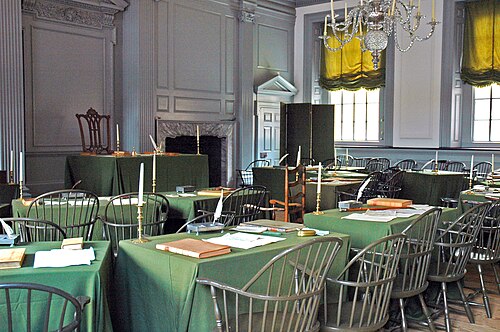
独立宣言は、正式版および原版の両方で「アメリカ合衆国13州の全会一致の宣言」と題され、アメリカ合衆国の建国の文書である。1776年7月4日、植民地時代の首都フィラデルフィアのペンシルバニア州議事堂(後に独立記念館と改名)に招集された第二次大陸会議の56名の代表者により全会一致で採択された。
この宣言は、 13 植民地がなぜ自らをもはやイギリスの植民地支配に従わない独立した主権国家とみなしたかを世界に説明しています。
独立宣言に署名した 56 人の代表は、国家建国の父として知られるようになり、独立宣言は世界史上最も多く頒布され、再版され、影響力のある文書の 1 つになりました。
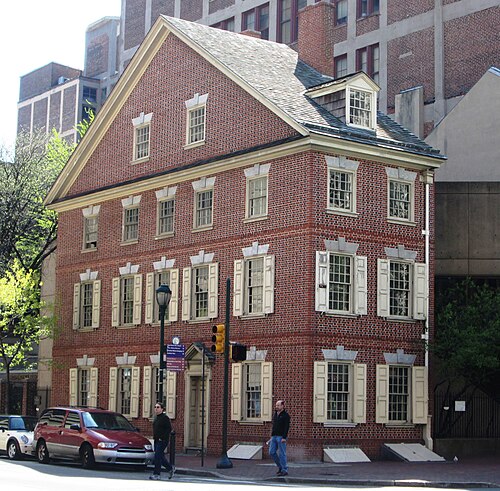
第二次大陸会議は、ジョン・アダムズ、ベンジャミン・フランクリン、トーマス・ジェファーソン、ロバート・R・リビングストン、ロジャー・シャーマンを含む五人委員会に宣言の起草を委託した。独立運動の主導的提唱者であるアダムズは、五人委員会を説得して、ジェファーソンに宣言の原案作成を委託し、その後、第二次大陸会議が編集した。ジェファーソンは、1776年6月11日から6月28日の間、フィラデルフィアのマーケット通り700番地に借りていた3階建ての家の2階で、ほとんど孤立して宣言を書いた。
この宣言は、 1775年4月にレキシントン・コンコードの戦いでアメリカ独立戦争が始まってから1年以上経ってから、大陸会議がなぜアメリカの独立をイギリス王国から宣言することに投票したかを正式に説明したものだった。宣言が満場一致で採択される2日前、第二次大陸会議は満場一致でリー決議を可決し、イギリスには13植民地に対する統治権がないとする会議の総意を確立した。
1776年7月4日に全会一致で批准した後、議会は独立宣言をいくつかの形式で発行しました。それは印刷されたダンラップのチラシとして出版され、広く配布されました。宣言は1776年7月8日の正午に、ペンシルベニア州イーストン、フィラデルフィア、ニュージャージー州トレントンの3つの指定された場所で同時に一般に初めて読み上げられました。[2]
ジェファーソンが「最初の下書き」と呼んだ、いくつかの改訂版のうちの1つ[3]は、ワシントンDCの議会図書館に保存されており、アダムズとフランクリンによる変更と、議会による変更に関するジェファーソンのメモが完備している。宣言の最もよく知られているバージョンは、ワシントンDCの国立公文書館に展示されている署名済みのコピーであり、一般に公式文書と見なされている。ティモシー・マトラックによって署名されたこのコピーは、1776年7月19日に議会によって発注され、1776年8月2日に主に署名された。[4] [5]
宣言は、ジョージ3世に対する27の植民地の不満を列挙し、革命権を含む特定の自然権と法的権利を主張することで、米国の独立を正当化した。1863年11月19日、アメリカ南北戦争で最も血なまぐさい戦いとなったゲティスバーグの戦いの後、エイブラハム・リンカーンは宣言をゲティスバーグ演説の中心に据えた。ゲティスバーグ演説は、後にゲティスバーグ国立墓地となる場所を献堂する271語の短いが力強く永続的な声明であった。[6]
独立宣言は、人権に関する、特にその第 2 文である「我々は、すべての人間は平等に創られ、創造主によって生命、自由、幸福の追求を含む奪うことのできない一定の権利を付与されていることは自明の理であると信じる」は、影響力があり、世界的に影響力のある人権宣言であることが証明されています。スティーブン ルーカスは、独立宣言を「英語で最もよく知られている文の 1 つ」と呼びました。[7]歴史家のジョセフ エリスは、この文書には「アメリカの歴史の中で最も強力で重要な言葉」が含まれていると書いています。[8]この一節は、米国が目指すべき道徳基準を表すようになりました。この見解は、リンカーンによって特に推進されました。リンカーンは、独立宣言を自身の政治哲学の基礎と見なし、米国憲法を解釈するための原則の声明であると主張しました。 [9] : 126
宣言に署名した 56 人の代表は、ニューハンプシャー、マサチューセッツ湾、ロードアイランド、プロビデンスの各植民地、コネチカット、ニューヨーク、ニュージャージー、ペンシルベニア、メリーランド、デラウェア、バージニア、ノースカロライナ、サウスカロライナ、ジョージアの 13 植民地をそれぞれ代表していました。
独立宣言は他の国々の多くの同様の文書に影響を与えたが、最初のものはオーストリア領ネーデルラントのブラバント革命中に発行された1789年のベルギー連合州宣言である。また、この宣言は採択後、ヨーロッパ、ラテンアメリカ、アフリカ、オセアニアの数多くの独立宣言の主要なモデルとなった。 [10] : 113
背景
(cropped).jpg/500px-Official_Presidential_portrait_of_Thomas_Jefferson_(by_Rembrandt_Peale,_1800)(cropped).jpg)
信じてください、親愛なる閣下。大英帝国において、私以上に英国との連合を心から愛する人間はいません。しかし、私を創造した神にかけて、英国議会が提案するような条件で連合に屈する前に、私は存在を終わらせるつもりです。そして、この点で、私はアメリカの感情を語っていると思います。
— トーマス・ジェファーソン、1775年11月29日[11]
1776年7月に独立宣言が採択された時点で、13植民地とイギリスは1年以上戦争状態にあった。植民地と本国との関係は1763年以来悪化していた。議会は1765年の印紙法や1767年のタウンゼンド法など、植民地からの収入を増やすための一連の措置を制定した。議会はこれらの法律が、植民地を大英帝国に留めておくための費用を植民地に公平に負担させる正当な手段であると信じていた。[12]
しかしながら、多くの植民地人は帝国について異なる見方をしていた。植民地は議会に直接代表されておらず、植民地人は議会には植民地に課税する権利はないと主張した。この課税紛争は、イギリス憲法と植民地における議会の権限の範囲に関するイギリスとアメリカの解釈のより大きな相違の一部であった。 [13] : 162 1688年の名誉革命以来のイギリスの正統派の見解は、議会が帝国全体の最高権力であり、議会が行うことはすべて合憲であるというものだった。[13] : 200–202 しかし、植民地では、イギリス憲法は議会を含むいかなる政府も侵害できない特定の基本的権利を認めているという考えが広まっていた。 [13] : 180–182 タウンゼンド諸法の後、一部の随筆家は、議会が植民地において正当な管轄権を持っているかどうかを疑問視した。[14]植民地におけるこの思想的変化の結果、多くの植民地人が1772年のパインツリー暴動や1773年のボストン茶会事件など、王権に対する税金抗議運動に参加した。 [15] [16]
1774年までに、サミュエル・アダムズ、ジェームズ・ウィルソン、トーマス・ジェファーソンなどのアメリカの作家は、イギリス連邦の設立を予期して、議会はイギリスのみの立法府であり、植民地は独自の立法府を持ち、国王への忠誠心を通じてのみ帝国の他の部分とつながっていると主張した。[13] : 224–225 [17]
大陸会議が開催される

1774年、議会は植民地で「耐え難き諸法」として知られる強制諸法を可決した。これは、1772年のガスピー事件と1773年のボストン茶会事件に対する植民地人の処罰を意図したものだった。多くの植民地人は、強制諸法は英国憲法に違反し、イギリス領アメリカ全体の自由に対する脅威であると考えていた。1774年9月、第1回大陸会議がフィラデルフィアで招集され、正式な対応を調整した。会議は英国製品のボイコットを組織し、諸法の撤回を国王に請願した。しかし、ジョージ王と首相ノース卿は13植民地に対する議会の優位性を強制する決意を固めていたため、これらの措置は成功しなかった。1774年11月、ジョージ王はノースへの手紙の中で、「彼らがこの国に従属するか独立するかは、打撃によって決定されなければならない」と書いた。[18] [19]
1775年4月にレキシントン・コンコードでアメリカ独立戦争の戦闘が始まった後も、ほとんどの植民地人はイギリスとの和解を望んでいた。[20] [21]第二次大陸会議は1775年5月にフィラデルフィアのペンシルバニア州議事堂(後に独立記念館と改名)で招集された。一部の代表は植民地の最終的な独立を支持したが、当時のイギリス王室の法律では死刑に処せられる反逆行為であったため、誰もそれを公に宣言していなかった。[21]
多くの植民地人は、議会はもはや自分たちに対する主権を持っていないと信じていたが、それでもジョージ王に忠誠を誓い、彼が自分たちのために仲裁してくれると考えていた。1775年後半、国王が議会の2度目の請願を却下し、反乱宣言を発し、10月26日に議会で反乱鎮圧のために「友好的な外国援助の申し出」を検討していると発表したことで、彼らの考えは改まった。[22] : 25 [23]議会内の親米派の少数派は、政府が植民地人を独立へと追いやっていると警告した。[22] : 25
独立への支持が高まる
独立に対する国民の支持が高まっていたにもかかわらず、第二次大陸会議には当初、独立を宣言する明確な権限がなかった。会議の代表は、法定外会議、特別委員会、選出議会を含む13の政府によって選出されており、与えられた指示に拘束されていた。代表は、個人的意見に関わらず、指示が許可しない限り、独立宣言に投票することはできなかった。[24]実際、いくつかの植民地は、代表がイギリスから分離する措置を取ることを明確に禁止し、他の代表はこの問題に関して曖昧な指示を持っていた。[22] : 30 そのため、独立支持者は会議の指示を改訂するよう求めた。会議が独立を宣言するには、代表の過半数の投票許可が必要であり、少なくとも1つの植民地政府が代表に独立宣言を会議に提案するよう具体的に指示する必要があった。
1776年4月から7月にかけて、これを実現するために「複雑な政治戦争」 [22] : 59が 繰り広げられた。 [25] : 671 [26]
1776年1月、トーマス・ペインのパンフレット「コモン・センス」がフィラデルフィアで出版されました。この本では、独立のためにイギリスと戦う困難な戦いは困難ではあるが達成可能で必要な目標であると述べられています。[27]コモン・センスの中で、ペインは有名なフレーズを書いています。
今は人々の魂が試される時です。夏の兵士や太陽を愛する愛国者は、この危機の中で祖国への奉仕を躊躇するでしょう。しかし、今それに耐える者は、男女の愛と感謝を受けるに値します。暴政は地獄のように簡単には克服できません。しかし、戦いが厳しいほど、勝利はより栄光に満ちたものになるという慰めが私たちにはあります。[28] [22] : 31–32
コモン・センスは、植民地では真剣に検討されていなかった独立を説得力のある情熱的な主張で訴えた。ペインは独立をプロテスタントの信仰と結びつけ、明確にアメリカ的な政治的アイデンティティを提示する手段として、ほとんどの人が議論しようとしなかったテーマについて公開討論を開始した。[29] [22] : 33
『コモン・センス』が13植民地中に広まるにつれ、イギリスからの独立を支持する世論は着実に高まっていった。それを読んだワシントンは、最近の軍事的敗北で士気が低下していた大陸軍の兵士たちにそれを読むよう命じた。1週間後、ワシントンは独立戦争で最も複雑かつ大胆な軍事作戦の一つであるデラウェア川の渡河を指揮し、トレントンのヘッセン軍守備隊を相手にトレントンの戦いで待望の軍事的勝利を収めた。[22] : 33–34 『コモン・センス』は広く販売・配布され、酒場や集会所で朗読された。当時の植民地の人口(250万人)に比例して、アメリカ史上最大の販売数と発行部数を記録した。[30] 2006年現在、この本はアメリカで史上最も売れている本であり、今日でも印刷されている。[31]
植民地人の中にはまだ和解を望んでいた者もいたが、独立に対する国民の支持は1776年初頭にかなり強まった。1776年2月、植民地人は議会が禁酒法を可決したことを知った。この法律はアメリカの港を封鎖し、アメリカの船舶を敵船と宣言するものだった。独立の強力な支持者ジョン・アダムズは、議会が事実上、連邦議会よりも先にアメリカの独立を宣言したと信じていた。アダムズは禁酒法を「独立法」と呼び、「大英帝国の完全な解体」と呼んだ。[32] [22] : 25–27 ジョージ王がアメリカ国民に対抗するためにドイツ人傭兵を雇っていたことが確認され、独立宣言への支持はさらに高まった。[33]
指示の修正
議会の指示を改訂する運動の中で、多くのアメリカ人は、事実上州および地方の独立宣言として、イギリスからの分離への支持を正式に表明した。歴史家ポーリン・マイヤーは、1776年4月から7月にかけて13植民地全体で発行されたそのような宣言を90件以上特定している。 [22] : 48、付録A これらの「宣言」はさまざまな形式をとった。 4月12日のハリファックス決議のように議会の代表団に対する正式な書面による指示もあった。これによりノースカロライナは、代表団に独立投票を明示的に許可した最初の植民地となった。[25] : 678–679 その他は、5月4日にロードアイランド州議会がイギリスへの忠誠を放棄した最初の植民地のように、個々の植民地におけるイギリスの統治を正式に終わらせる立法行為であった。[25] : 679 [34] [35]多くの宣言は、町や郡の集会で採択された、独立を支持する決議であった。少数は陪審員への指示の形で出された。例えば、1776年4月23日にサウスカロライナ州のウィリアム・ヘンリー・ドレイトン最高裁判所長官が出した声明は、「国の法律により、私は宣言する権限を与えられている...イギリス国王ジョージ3世は...我々に対して何の権限も持たず、我々は彼に従う義務もない。」というものである。 [22] : 69–72 これらの宣言のほとんどは、7月2日に議会で承認された独立決議と、7月4日に承認され印刷され、8月に署名された独立宣言の影に隠れて、今では知られていない。[22] : 48 現代の学者のコンセンサスでは、最もよく知られ、最も古い地方宣言であるメクレンブルク独立宣言は、おそらく偽物であると考えられています。この宣言は、1775年5月に採択されたとされています(他の地方宣言より1年前)。[22] : 174
いくつかの植民地は独立を支持するのを控えた。抵抗はニューヨーク、ニュージャージー、メリーランド、ペンシルベニア、デラウェアといった中部植民地に集中した。独立支持派はペンシルベニアを鍵とみなし、この植民地が独立支持に転じることができれば、他の植民地も追随すると信じていた。 [25] : 682 しかし、5月1日、独立問題に焦点を当てた特別選挙で、独立反対派がペンシルベニア議会の支配権を維持した。 [25] : 683 これに対して、議会は5月10日にジョン・アダムズとリチャード・ヘンリー・リーが推進した決議を可決し、「その問題の緊急性に対応できる政府」を持たない植民地に新しい政府を採用するよう求めた。[25] : 684 [22] : 37 [36]この決議は満場一致で可決され、議会における独立反対派のリーダーであるペンシルベニアのジョン・ディキンソンもこの決議を支持した。ディキンソンは、この決議は自分の植民地には適用されないと考えていた。 [25] : 684
5月15日序文
この日、議会はアメリカでこれまでに採択された中で最も重要な決議を可決しました。
—ジョン・アダムス、1776年5月15日[37]
慣例通り、議会は決議の目的を説明する序文を起草する委員会を任命した。ジョン・アダムズが書いた序文では、ジョージ王が和解を拒否し、植民地に対抗するために外国人傭兵を雇っていたため、「王室の下にあるあらゆる種類の権力の行使は完全に抑制される必要がある」と述べられていた。[22] : 37 [25] : 684 [38]アダムズの序文は、依然として植民地統治下にあったペンシルベニアとメリーランドの政府を打倒するよう促すことを意図していた。 [39] [25] : 684 [40]議会は数日間の議論の末、5月15日に序文を可決したが、中部植民地のうち4つが反対票を投じ、メリーランドの代表団は抗議のため退席した。[41] [25] : 685 アダムズは、5月15日の序文を事実上アメリカ独立宣言とみなしたが、正式な宣言はまだ行われなければならなかった。[22] : 38
リーの決意
議会がアダムズの前文を可決した同じ日に、バージニア会議は正式な議会による独立宣言の準備を整えた。5月15日、会議はバージニアの議会代表団に「連合植民地をイギリス国王または議会へのすべての忠誠または依存から解放し、自由で独立した国家であると宣言することをその尊敬すべき団体に提案する」ように指示した。[42] [22] : 63 [43]これらの指示に従って、バージニアのリチャード・ヘンリー・リーは6月7日に議会に3部構成の決議を提出した。 [44]この動議はジョン・アダムズによって支持され、議会に独立を宣言し、外国との同盟を形成し、植民地連合の計画を準備するよう求めた。独立宣言に関する決議の部分は次のように書かれていた。「これらの連合植民地は自由で独立した国家であり、当然そうあるべきであり、英国王室に対するすべての忠誠から解放され、それらと英国国との間のすべての政治的つながりは完全に解消され、解消されるべきである。」[22] : 41 [45]
リーの決議はその後の議論で抵抗に遭った。決議反対派はイギリスとの和解はありそうにないと認めたが、独立宣言は時期尚早であり、外国援助の確保を優先すべきだと主張した。[25] : 689–690 [22] : 42 決議支持派は、外国政府はイギリスの内紛に介入しないだろうから、外国援助の前に正式な独立宣言が必要だと反論した。彼らは、議会がすべきことは「すでに存在する事実を宣言する」ことだけだと主張した。[25] : 689 [10] : 33–34 [46]しかし、ペンシルベニア、デラウェア、ニュージャージー、メリーランド、ニューヨークの代議員はまだ独立に投票する権限がなく、彼らのうち何人かは決議が採択されれば議会を去ると脅した。そのため議会は6月10日にリーの決議のさらなる議論を3週間延期することを決議した。[22] : 42–43 [47]それまで、議会は、リーの決議が7月に再び提起され承認された場合に備えて、委員会が独立を発表し説明する文書を準備すべきであると決定した。
最後の追い込み

連邦議会による独立宣言への支持は、1776 年 6 月の最後の数週間で固まった。6 月 14 日、コネチカット議会は代表者に独立を提案するよう指示し、翌日、ニューハンプシャー州とデラウェア州の議会は代表者に独立宣言を承認した。[25] : 691–692 ペンシルバニア州では、政治闘争は植民地議会の解散で終わり、トーマス・マッキーンの指揮する新しい委員会会議は、 6 月 18 日にペンシルバニア州の代表者に独立宣言を承認した。[49] [25] : 691 ニュージャージー州議会は1776 年 1 月以来、同州を統治していた。同議会は 6 月 15 日に、ウィリアム・フランクリン総督を「この国の自由に対する敵」と決議し、彼を 逮捕した。[25] : 692 6 月 21 日、同議会は連邦議会への新しい代表者を選出し、独立宣言に参加する権限を与えた。[25] : 693
6月末の時点で、13植民地のうちメリーランドとニューヨークの2つだけがまだ独立を認可していなかった。メリーランドの代表は、大陸会議がアダムズの5月15日の序文を採択したときに退席し、アナポリス会議に指示を求めていた。[25] : 694 5月20日、アナポリス会議はアダムズの序文を拒否し、代表に独立に反対し続けるよう指示した。しかし、サミュエル・チェイスはメリーランドに行き、独立を支持する地元の決議のおかげで、6月28日にアナポリス会議の考えを変えさせることができた。[25] : 694–696 [50] [22] : 68 ニューヨークの代表だけは改訂された指示を得ることができなかった。6月8日に大陸会議が独立決議を検討していたとき、ニューヨーク植民地会議は代表に待つように言った。[51] [25] : 698 しかし6月30日、イギリス軍が接近したため植民地議会はニューヨークから撤退し、7月10日まで再び召集されなかった。これは、議会が決定を下すまでニューヨークの代表者は独立を宣言する権限がないことを意味した。[52]
草案と採択

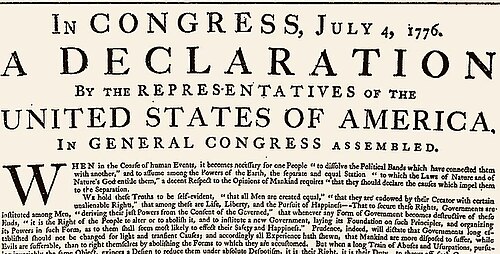

決定を説明する文書が書かれていた間も、政治的駆け引きによって正式な独立宣言の準備が進められていた。1776 年 6 月 11 日、議会は宣言の草案作成に5 人委員会を任命した。委員会のメンバーには、マサチューセッツ州のジョン・アダムズ、ペンシルベニア州のベンジャミン・フランクリン、バージニア州のトーマス・ジェファーソン、ニューヨーク州のロバート・R・リビングストン、コネチカット州のロジャー・シャーマンが含まれていた。
委員会は議事録を取らなかったため、起草過程がどのように進んだかについては不明な点がある。ジェファーソンとアダムズによって何年も後に矛盾した記述が書かれたが、彼らの記述は頻繁に引用されているものの、完全に信頼できると見なすには年月が経っている。[22] : 97–105 [56]確かなのは、委員会が文書が従うべき一般的な概要について議論し、ジェファーソンが最初の草案を書くことに決めたことである。[57]委員会全体、特にジェファーソンはアダムズが文書を書くべきだと考えていたが、アダムズはジェファーソンを選ぶよう説得し、個人的に相談することを約束した。[58]
ジェファーソンは、独立宣言書の大部分を、フィラデルフィアのマーケットストリート700番地に借りていた3階建ての家の2階で、1776年6月11日から6月28日の間に孤独に書き上げた。この家は現在、独立宣言書館と呼ばれており、独立記念館からも歩いて行ける距離にある。[59]議会の忙しいスケジュールを考えると、ジェファーソンがこの17日間で執筆に費やす時間はおそらく限られており、最初の草稿は急いで書いたものと思われる。[22] : 104
初期の宣言草稿のテキストを調査すると、ジョン・ロックと『常識』の著者トーマス・ペインがジェファーソンに与えた影響がわかる。ジェファーソンはその後、五人委員会の他の委員と協議し、小さな変更を提案してもらい、これらの変更を組み込んだ別のコピーを作成した。委員会はこのコピーを1776年6月28日に議会に提出した。文書のタイトルは「アメリカ合衆国代表者による、総会に集まった人々による宣言」であった。[1] : 4 イタリアの医師で自由の推進者であったフィリッポ・マッツェイは、トーマス・ジェファーソンの親友であり腹心であった。1774年に彼は「すべての人間は生まれながらにして平等に自由で独立している」というフレーズを含むパンフレットを出版し、ジェファーソンはそれを基本的にそのまま独立宣言に取り入れた。[53] [54] [55]
議会は草案を「テーブルの上に置く」よう命じ[25] : 701 、その後2日間ジェファーソンの主要文書を系統的に編集し、4分の1短縮し、不必要な言葉を削除し、文章構造を改善した[60] 。彼らは、ジョージ3世が植民地に奴隷制を強制したというジェファーソンの主張を削除し[61] 、文書を緩和し、奴隷貿易に大きく関与していたサウスカロライナ州とジョージア州の人々をなだめるためにした。
ジェファーソンは後に自伝の中で、北部諸州も条項の削除を支持していたと書いている。「北部諸州には奴隷がほとんどいなかったが、奴隷を他の州に運ぶことはかなり多かった」からである。[62]ジェファーソンは議会が彼の草案を「台無しにした」と書いているが、最終的に作成された宣言は伝記作家ジョン・ファーリングの言葉を借りれば「同時代の人々と後世の両方にインスピレーションを与えた荘厳な文書」であった。[60]
議会は7月1日月曜日に宣言の草案を提出し、バージニア州のベンジャミン・ハリソンの議長の下、全会一致で委員会を開き、リーの独立決議に関する議論を再開した。[63]ジョン・ディキンソンは、議会はまず外国との同盟を確保し、連合規約を最終決定することなく独立を宣言すべきではないと主張し、決定を遅らせる最後の努力をした。[25] : 699 ジョン・アダムズはディキンソンの演説に応えて、即時宣言の必要性を再度述べた。
長い一日の演説のあと、投票が行われた。いつものように、各植民地は1票を投じた。各植民地の代表団は2人から7人で構成され、各代表団は植民地の投票を決定するために自分たちの間で投票した。ペンシルベニアとサウスカロライナは独立宣言に反対票を投じた。ニューヨーク代表団は独立に投票する許可がなかったため棄権した。デラウェアは、賛成票を投じたトーマス・マッキーンと反対票を投じたジョージ・リードに代表団が分かれたため、投票しなかった。残りの9つの代表団は独立に賛成票を投じた。これは、決議が全会一致で承認されたことを意味した。次のステップは、決議を議会自身で投票することだった。サウスカロライナのエドワード・ラトレッジはリーの決議に反対したが、全員一致を望んでおり、投票を翌日まで延期するよう動議を提出した。[64] [25] : 700
7月2日、サウスカロライナ州は立場を一転し、独立に賛成票を投じた。ペンシルベニア代表団では、ディキンソンとロバート・モリスが棄権したため、代表団は3対2で独立に賛成票を投じた。デラウェア代表団の同票は、シーザー・ロドニーがタイミングよく到着し、独立に投票したことで決まった。ニューヨーク代表団は、独立に投票する権限がまだなかったため、再び棄権したが、1週間後、ニューヨーク地方議会によって投票を許可された。[22] : 45 独立決議は賛成12票、棄権1票で採択され、植民地は正式にイギリスとの政治的つながりを断ち切った。[45]ジョン・アダムズは翌日、妻に宛てた手紙で、7月2日はアメリカの大きな祝日になると予言した。[25] : 703–704 彼は、独立投票は記念されるだろうと考えていた。彼は、その法律の発表が確定した日にアメリカ人が独立記念日を祝うとは予想していなかった。 [22] : 160–161
私は、この独立記念日が、次の世代によって、偉大な記念祭として祝われるだろうと信じています。全能の神への厳粛な信仰行為によって、解放の日として記念されるべきです。この大陸の端から端まで、この時から永遠に、華やかなパレード、ショー、ゲーム、スポーツ、銃、鐘、かがり火、イルミネーションで厳粛に祝われるべきなのです。[65]
次に議会は委員会の宣言草案に注目した。議会は数日間の議論で文言に若干の変更を加え、文言のほぼ 4 分の 1 を削除した。独立宣言の文言は 1776 年 7 月 4 日に承認され、印刷所に送られて出版された。
この宣言のオリジナルのブロードサイド印刷と最終的な公式エングレーブ版の文言には明らかな変更がある。「全会一致」という言葉は、1776 年 7 月 19 日に可決された議会の決議の結果として挿入された。「決議、4 日に可決された宣言は、羊皮紙に「アメリカ合衆国 13 州の全会一致の宣言」というタイトルとスタイルでエングレーブされ、エングレーブされた後、議会のすべての議員によって署名される。」[66]歴史家のジョージ・アサン・ビリアスは次のように述べている。「独立は相互依存の新しい状態を意味した。米国は今や、その状態に伴う特権と責任を負った主権国家となった。アメリカはこうして国際社会の一員となり、それは条約や同盟の締結者、外交における軍事同盟者、より対等な立場での外国貿易のパートナーになることを意味した。」[67]
熱心に書かれた宣言の注釈付きテキスト
宣言は正式なセクションに分かれていないが、序文、前文、ジョージ3世の告発、英国国民の非難、結論の5つの部分で構成されているとよく議論されている。[68]
当時人々が目にした署名入りの文書のバージョンもメアリー・キャサリン・ゴダードの署名入りだった。彼女はボルチモアの郵便局長で、大陸会議から署名入りの宣言書の印刷を任されていた。メリーランド・ジャーナルの所有者としての彼女の通常の署名は「MK・ゴダード」だったが、彼女は独立宣言書にはフルネームで署名した。[71]
影響と法的地位
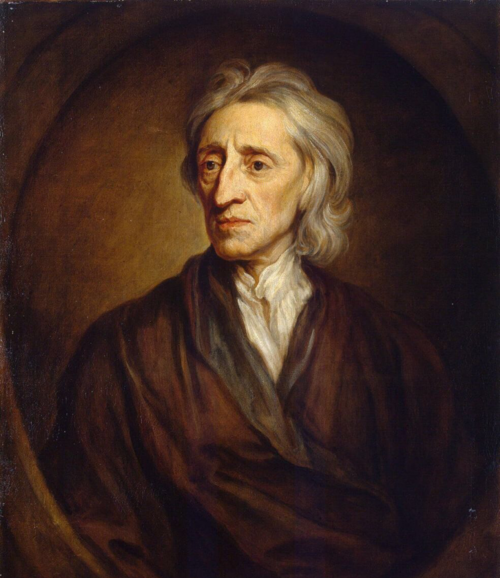
歴史家たちは、独立宣言の言葉や政治哲学に最も影響を与えた源泉を特定しようと努めてきた。ジェファーソン自身が認めているように、独立宣言には独創的な考えは含まれておらず、アメリカ独立戦争の支持者たちが広く共有していた感情を表明したものだった。彼は 1825 年に次のように説明している。
それは、原則や感情の独創性を目指すものではなく、また特定の過去の著作をコピーしたものでもなく、アメリカ人の精神を表現し、その表現に、その場面に求められる適切な調子と精神を与えることを意図していた。[72]
ジェファーソンの最も直接的な情報源は、1776年6月に書かれた2つの文書であった。彼自身のバージニア憲法前文の草案と、ジョージ・メイソンのバージニア権利宣言の草案である。これら2つの文書のアイデアとフレーズは、独立宣言に登場している。[73] [22] : 125–126 メイソンの冒頭部分は次の通りである。
第1条 すべての人間は生まれながらにして平等に自由かつ独立しており、社会の一員となった後も、いかなる契約によっても、その子孫から生命と自由の享受、財産の取得および所有、幸福と安全の追求および獲得の手段を奪ったり剥奪したりすることはできない固有の権利を有する。[74]
一方、メイソンは1689年のイギリス権利宣言から直接影響を受け、この宣言はジェームズ2世の統治を正式に終わらせた。[22] : 126–128 アメリカ独立戦争の間、ジェファーソンと他のアメリカ人は、不正な王の統治を終わらせる方法のモデルとしてイギリス権利宣言に目を向けた。[22] : 53–57 スコットランドのアーブロース宣言(1320) とオランダの奴隷解放法(1581) もジェファーソンの権利宣言のモデルとして提案されてきたが、現在これらのモデルを受け入れる学者はほとんどいない。マイアーは、オランダの奴隷解放法が宣言のモデルになったという証拠を見つけられず、その議論は「説得力がない」と考えている。[22] : 264 アーミテージは、スコットランド法とオランダ法の影響を軽視し、どちらもごく最近まで「独立宣言」と呼ばれていなかったと書いている。[10] : 42–44 スティーブン・E・ルーカスはオランダ法の影響を支持した。[75] [76]
ジェファーソンは、多くの著者が宣言文に全般的な影響を与えたと書いている。[77]イギリスの政治理論家ジョン・ロックは、通常、主要な影響者の一人として挙げられ、ジェファーソンは彼を「史上最も偉大な三人の人物」の一人と呼んだ。[78]
1922年、歴史家カール・L・ベッカーは「ほとんどのアメリカ人はロックの著作を一種の政治的福音として吸収しており、宣言はその形式、言い回しにおいて、ロックの第二の統治論のいくつかの文章を忠実に踏襲している」と書いている。[1] : 27 しかし、ロックがアメリカ独立戦争に与えた影響の程度については、その後の学者によって疑問視されてきた。歴史家レイ・フォレスト・ハーヴェイは1937年にスイスの法学者ジャン・ジャック・ブルラマキの影響が大きかったと主張し、ジェファーソンとロックは政治哲学において「2つの対極」にいたと断言した。これはジェファーソンが独立宣言で「財産」の代わりに「幸福の追求」というフレーズを使ったことからも明らかである。[79]他の学者は、ロックの古典的自由主義よりも共和主義の影響を強調した。[80]
歴史家ギャリー・ウィルスは、ジェファーソンはロックではなくスコットランド啓蒙主義、特にフランシス・ハッチソンの影響を受けたと主張したが[81] 、この解釈は強く批判されている[82] 。
法史家ジョン・フィリップ・リードは、宣言の政治哲学に重点を置くのは誤りだと書いている。宣言は自然権に関する哲学論文ではなく、むしろ法文書であり、植民地人の憲法上の権利を侵害したジョージ王に対する告発であるとリードは主張する。 [83]そのため、宣言は1550年のマクデブルク信仰告白の過程をたどっており、これは神聖ローマ皇帝カール5世に対する抵抗を、現在では下級行政官の教義として知られる多段階の法的公式で正当化した。[84]
歴史家デイヴィッド・アーミテージは、この宣言は、当時の国際法の主流であったヴァッテルの 『国際法』の影響を強く受けており、ベンジャミン・フランクリンはこの本を「議会の議員たちの手に常にあった」と述べていると主張している。 [85]アーミテージは、「ヴァッテルは独立を国家の定義の基本とした」と書いている。したがって、この宣言の主目的は「米国の国際法上の主権を表明すること」だった。米国がヨーロッパ列強に承認される望みを持つためには、まずアメリカの革命家たちが、もはや英国に依存していないことを明確にしなければならなかった。[10] : 21, 38–40 独立宣言は国内では法的効力を持たないが、それでも憲法やその他の法律に関する歴史的、法的明確さを提供するのに役立つかもしれない。[86] [87] [88] [89]
署名
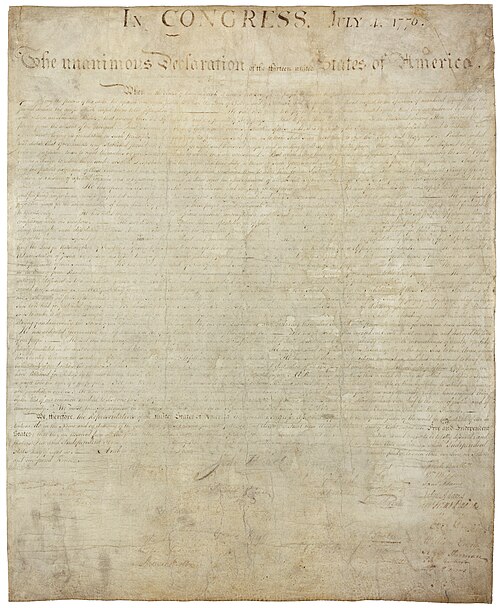


宣言は、議会が7月4日に文書採択の投票を記録した時に公式なものとなった。それは紙に転記され、その日、議会議長ジョン・ハンコックによって署名された。それをさらに認証するのに他の代表者の署名は必要なかった。 [90]宣言には56人の代表者の署名が付されているが、各人が署名した正確な日付は議論の余地がある。[90]ジェファーソン、フランクリン、アダムズはいずれも、宣言は議会によって7月4日に署名されたと書いている。 [91]しかし1796年、署名者のトーマス・マッキーンは、署名者の中にはその日以降に議会に選出されなかった者も含め、その場にいなかった者がいたとして、これに異議を唱えた。[90] [92]歴史家は一般的にマッキーンの出来事の説明を受け入れている。[93] [94] [95]歴史は特に、ほとんどの代表者が1776年8月2日に署名し、その場にいなかった者は後から名前を加えたことを示している。[96]
1811年にアダムズに宛てた手紙の中で、ベンジャミン・ラッシュは8月2日の署名の様子を「物思いにふけるような恐ろしい沈黙」の光景として、厳しい様子で回想している。ラッシュによると、代表者たちは次々に呼び出され、それぞれが死刑執行令状だと思っていたものに署名するために厳粛に列をなして進んだという。[97]ラッシュは、署名台で太ったバージニアのベンジャミン・ハリソンが小柄なマサチューセッツのエルブリッジ・ゲリーに「我々が今していることのせいで皆が絞首刑に処せられるとき、私は君よりかなり有利になるだろう、ゲリーさん。私の体の大きさと重さからして、私は数分で死んで天使たちといっしょになるだろうが、君の体の軽さからして、君は死ぬ1、2時間前に空中で踊るだろう」と言ったとき、「朝の陰鬱」が一時的に中断されたと伝えている。[97]ラッシュによれば、ハリソンの発言は「一時的な笑みを誘ったが、すぐにその出来事全体が厳粛に進行した」という。[97]
署名者には、後に大統領となるジョン・アダムズやトーマス・ジェファーソンも含まれるが、最も伝説的な署名はジョン・ハンコックの署名である。[98]彼の大きく派手な署名は象徴的となり、ジョン・ハンコックという言葉は米国で「署名」の比喩として使われるようになった。[99]よく流布されているが真偽の定かでない話によると、ハンコックが署名した後、マサチューセッツ州の代表は「英国政府は眼鏡なしでもその名前が読める」と述べたという。別の報告によると、ハンコックは誇らしげに「ほら! ジョージ王なら読めるだろう!」と宣言したという。[100]
数年後、この文書が重要な国家のシンボルとなった後、宣言の調印に関する伝説が生まれた。ジョン・ハンコックは、議会は宣言に調印したので「全員一致で取り組まなければならない」と言ったとされ、ベンジャミン・フランクリンは「そうだ、我々は全員一致で取り組まなければならない。さもなければ、我々は間違いなく別々に取り組まなければならない」と答えた。この引用文は、1837年にロンドンのユーモア雑誌に初めて掲載された。[101]
署名時に使用されたシングのインク壺は、1787 年のアメリカ合衆国憲法の署名時にも使用されました。
出版と反応


7月4日に議会が宣言の最終的な文言を承認した後、手書きのコピーが数ブロック離れたジョン・ダンラップの印刷所に送られた。ダンラップは一晩中、配布用に約200枚のチラシを印刷した。この印刷に使用された原本は紛失しており、トーマス・ジェファーソンの手書きのコピーだった可能性がある。[102]それは聴衆に読み上げられ、13州中の新聞に再掲載された。この文書の最初の正式な公開朗読は7月8日にフィラデルフィア(独立記念館の庭でジョン・ニクソンによって)、ニュージャージー州トレントン、ペンシルベニア州イーストンで行われた。これを最初に掲載した新聞は7月6日のペンシルベニア・イブニング・ポストだった。 [22] : 156 宣言のドイツ語訳は7月9日までにフィラデルフィアで出版された。 [10] : 72
連邦議会議長ジョン・ハンコックはジョージ・ワシントン将軍に大砲を飛ばし、「陸軍の先頭で、最も適切と思われる方法で」宣言するよう指示した。[22] : 155 ワシントンは7月9日、港の船に乗った何千人ものイギリス軍兵士がいたニューヨーク市で、部隊に宣言を読み上げさせた。ワシントンと連邦議会は、宣言が兵士たちを鼓舞し、他の人々が軍に加わるよう促すことを期待した。[22] : 156 宣言を聞いた後、多くの都市で群衆が王権を象徴する標識や像を引き倒し、破壊した。ニューヨーク市ではジョージ王の騎馬像が引き倒され、鉛はマスケット銃の弾丸の製造に使われた。[22] : 156–157
イギリス人による最初の宣言の朗読は、ニューヨーク州スタテン島のローズ・アンド・クラウン酒場で、ハウ将軍の出席のもと行われたと考えられている。[103]北アメリカのイギリス当局者は、宣言のコピーをイギリスに送った。[10] : 73 宣言は8月中旬からイギリスの新聞に掲載され、9月中旬までにはフィレンツェとワルシャワに届き、ドイツ語訳は10月までにはスイスに登場した。フランスに送られた宣言の最初のコピーは紛失し、2番目のコピーが到着したのは1776年11月になってからだった。 [104]宣言のニュースは、ロンドンのロシア臨時代理大使ニキータ・パニンからの伝言によって、8月13日にロシアに届いた。[105]宣言は、ニームでトーマス・ジェファーソンと会っていたブラジルの医学生「ヴェンデク」ホセ・ジョアキン・マイア・エ・バルバリョによってポルトガル領アメリカに届いた。
米西当局は宣言の頒布を禁止したが、ベネズエラのマヌエル・ガルシア・デ・セナ、コロンビアのミゲル・デ・ポンボ、エクアドルのビセンテ・ロカフエルテ、ニューイングランドのリチャード・クリーブランドとウィリアム・シェイラーらによって広く伝達され、翻訳された。シェイラーとリチャード・クリーブランドは1821年にチリのクレオール人とメキシコのインディアンに宣言とアメリカ合衆国憲法を配布した。 [106]北方内閣は宣言に対する公式の回答を出さなかったが、その代わりに密かにパンフレット作家のジョン・リンドに依頼して『アメリカ議会の宣言に対する回答』と題する回答を出版させた。[10] : 75 イギリスのトーリー党は、宣言の署名者が「生命、自由、幸福の追求」という同じ原則をアフリカ系アメリカ人に適用していないと非難した。[107] マサチューセッツ州の元知事トーマス・ハッチンソンも反論を出版した。 [108] [10] : 74 これらのパンフレットは、宣言のさまざまな側面に異議を唱えた。ハッチンソンは、アメリカ独立戦争は当初から独立を望んでいた少数の陰謀家によるものであり、最終的には、それまで忠実だった植民地人を反乱に駆り立てて独立を達成したと主張した。[13] : 155–156 リンドのパンフレットには、ジェレミー・ベンサムが書いた自然権の概念に対する匿名の攻撃が掲載されており、彼はフランス革命中にこの主張を繰り返した。[10] : 79–80 両方のパンフレットは、議会のアメリカの奴隷所有者が、自分たちの奴隷を解放することなく「すべての人間は平等に創られている」と宣言できるのか疑問を呈した。[10] : 76–77
独立宣言の署名者で戦争にも従軍したウィリアム・ウィップルは、革命的な理想のため奴隷のプリンス・ウィップルを解放した。戦後数十年で、他の奴隷所有者も奴隷を解放した。1790年から1810年にかけて、南部北部の自由黒人の割合は黒人人口の1%未満から8.3%に増加した。[109]北部諸州は独立戦争開始直後から奴隷制度廃止に着手し、1804年までに全州で奴隷制度が廃止された。
その後、1776年11月下旬、主にニューヨーク出身の547人のロイヤリストのグループが、ニューヨーク市マンハッタンのフランセス・タバーンで国王への忠誠を誓う従属宣言に署名した。 [110]
文書の歴史
独立宣言の公式コピーは、ジェファーソンの監督の下、1776 年 7 月 4 日に印刷されたものです。これは各州と陸軍に送られ、新聞に広く転載されました。わずかに異なる「エングレーブ コピー」(この記事の冒頭に表示) は、後にメンバーが署名できるように作成されました。エングレーブ バージョンは、21 世紀に広く配布されているものです。2 つのバージョンでは、冒頭の行が異なることに注意してください。[3]
議会によって署名された宣言の写しは、エングレース写しまたは羊皮紙写しとして知られている。これはおそらく書記官ティモシー・マトラックによってエングレースされた(つまり、丁寧に手書きされた)ものである。[111]エングレース写しは19世紀を通して保存状態が悪かったため、1823年に作成された複製が、オリジナルではなく、現代の複製のほとんどの基礎となっている。[111] 1921年、宣言のエングレース写しの管理は、アメリカ合衆国憲法とともに国務省から議会図書館に移管された。
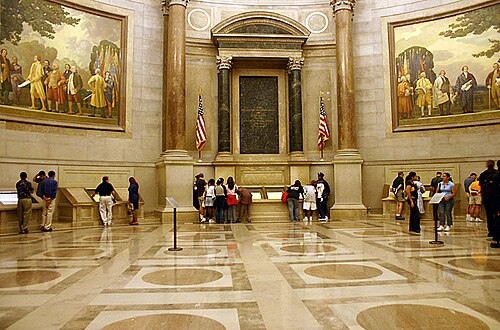
1941年の日本軍による真珠湾攻撃後、文書は保管のためケンタッキー州フォートノックスの米国金塊保管所に移され、1944年まで保管された。[112] 1952年、刷り上がった宣言は国立公文書館に移され、現在は国立公文書館の「自由の憲章のためのロタンダ」に常設展示されている。[113]
議会によって署名され国立公文書館に収蔵されている文書は、通常、独立宣言書とみなされているが、歴史家ジュリアン・P・ボイドは、宣言書はマグナ・カルタと同様に単一の文書ではないと主張した。ボイドは、議会によって印刷されたビラ紙も公式文書であるとみなした。宣言書は、フィラデルフィアのジョン・ダンラップによって7月4日の夜に印刷されたビラ紙として最初に出版された。ダンラップは約200枚のビラ紙を印刷し、そのうち26枚が現存することが知られている。26番目の写しは、2009年にイギリスの国立公文書館で発見された。[114]
1777年、議会はメアリー・キャサリン・ゴダードに、ダンラップのブロードサイドとは異なり、宣言の署名者をリストした新しいブロードサイドの印刷を依頼した。[111] [115]ゴダードのブロードサイドは9部が現存していることが知られている。[115]各州が印刷したさまざまなブロードサイドも現存しており、ソロモン・サウスウィックのブロードサイドも7部あり、そのうちの1部は2015年にセントルイスのワシントン大学が取得した。[115] [116]
独立宣言の初期の手書きのコピーや草稿もいくつか保存されている。ジェファーソンは晩年に「原案」と呼んだ4ページの草稿を保管していた。[117]現在、歴史家たちは、ジェファーソンの草稿は、議会に提出されて審議される前に五人委員会が使用した一連の草稿の1つであると理解している。ボイドによると、ジェファーソンの草稿に先立つ独立宣言の最初の「原案」は、草稿作成の過程で紛失または破損したという。[118]この草稿の前にジェファーソンが何本の草稿を書いたか、また、他の委員会メンバーがどの程度文章を寄稿したかは不明である。
1947年、ボイドはジェファーソンの手書きで、ジェファーソンの下書きより前の草稿の断片を発見した。[119] 2018年、トーマス・ペイン国立歴史協会は、宣言の追加の初期の手書き草稿、いわゆる「シャーマン・コピー」に関する調査結果を発表した。これは、ジョン・アダムズが失われた原案から、5人委員会のロジャー・シャーマンとベンジャミン・フランクリンの最初のレビューのためにコピーしたものである。文書に「おそらく始まり...」と記された碑文、テキストの初期の状態、この文書が急いで取られた様子から、この草稿は、マサチューセッツ歴史協会のコレクションにある公正なアダムズのコピーやジェファーソンの「下書き」よりも時系列的に古いものと思われる。[120]議会全体でテキストが最終決定された後、ジェファーソンとアダムズは、原案からの変更点を記した下書きのコピーを友人に送った。
執筆の過程で、ジェファーソンはアダムズとフランクリン、そしておそらく起草委員会の他のメンバーにも下書きを見せ、[117]彼らはさらにいくつかの変更を加えた。たとえば、フランクリンはジェファーソンの元のフレーズ「我々はこれらの真実を神聖かつ否定できないものと信じる」を「我々はこれらの真実を自明なものと信じる」に変更した可能性がある。[1] : 1:427–28 ジェファーソンはこれらの変更を委員会の名前で議会に提出したコピーに組み込んだ。[117] 6月28日に議会に提出されたコピーは紛失しており、おそらく印刷の過程で破棄されたか、[121]または議会の秘密保持規則に従って議論中に破棄された。[122]
2017年4月21日、イングランドのチチェスターにあるウェスト・サセックス州議会のアーカイブで、2つ目のエングレービングされたコピーが発見されたことが発表された。[123]発見者によって「サセックス宣言」と名付けられたこのコピーは、署名が州ごとにまとめられていないという点で、国立公文書館のコピー(発見者は「マトラック宣言」と呼んでいる)とは異なる。このコピーがどのようにしてイングランドに渡ったのかはまだわかっていないが、発見者は署名のランダム性から、宣言は州ではなく国民全体によって作成されたと強く主張した署名者ジェームズ・ウィルソンの起源を示していると考えている。[124] [125]
長年にわたる有害な光にさらされた結果、独立宣言の原本は1876年までにインクの大部分が色あせてしまった。[126] [127]
遺産
宣言は、アメリカの独立を宣言するという本来の目的を果たしたため、アメリカ独立戦争直後の数年間はほとんど注目されなかった。[10] : 87–88 [22] : 162, 168, 169 初期の独立記念日の祝賀行事では宣言はほとんど無視され、革命の初期の歴史でも同様であった。独立宣言の行為は重要とみなされたが、その行為を宣言する文章はほとんど注目されなかった。[128] [22] : 160 宣言は、アメリカ合衆国憲法に関する議論の中でめったに言及されず、その文言はその文書に組み込まれなかった。[10] : 92 ジョージ・メイソンによるヴァージニア権利宣言の草案の方が影響力があり、その文言はジェファーソンの言葉よりも頻繁に州憲法や州権利章典に反映された。[10] : 90 [22] : 165–167 「これらの文書のどれにも、独立宣言がアメリカの政治原則の古典的な声明として人々の心に生きていたという証拠はまったくありません」とポーリン・マイヤーは書いています。[22] : 167
世界的な影響力
フランス革命の指導者の多くは独立宣言を賞賛したが[22] : 167 、アメリカの新しい州憲法にも関心があった。[10] : 82 フランスの人権宣言(1789年)の着想と内容は、主にアメリカ独立戦争の理想から生まれたものである。[129] ラファイエットはパリで友人のトーマス・ジェファーソンと緊密に協力しながら、その主要草案を作成した。また、ジョージ・メイソンのヴァージニア権利宣言からも文言を借用している。[130] [131]この宣言はロシア帝国にも影響を与え、デカブリストの反乱や他のロシアの思想家に特に影響を与えた。
歴史家デイヴィッド・アーミテージによると、独立宣言は確かに国際的に影響力があったが、人権を宣言したものではなかった。アーミテージは、独立宣言は新国家の創設を宣言した新しいジャンルの独立宣言の最初のものであると主張する。他のフランスの指導者たちは、独立宣言自体の本文から直接影響を受けた。フランドル州宣言(1790年)は、独立宣言の最初の外国からの派生である。[10] : 113 他には、ベネズエラ独立宣言(1811年)、リベリア独立宣言(1847年)、アメリカ連合国による離脱宣言(1860-61年)、ベトナム独立宣言(1945年)などがある。 [ 10] : 120–135 これらの宣言は、新しい国家の独立を宣言するという点でアメリカ独立宣言を反映したものであったが、必ずしも元の宣言の政治哲学を支持するものではなかった。[10] : 104, 113
他の国々もこの宣言を参考にしたり、宣言の一部を直接コピーしたりしています。これらには、ハイチ革命中の1804年1月1日のハイチ宣言、 1811年のヌエバグラナダ連合州、 1816年のアルゼンチン独立宣言、1818年のチリ独立宣言、 1821年のコスタリカ、 1821年のエルサルバドル、1821年のグアテマラ、 1821年のホンジュラス、1821年のメキシコ、 1821年のニカラグア、1821年のペルー、1825年のボリビア独立戦争、 1825年のウルグアイ、1830年のエクアドル、1831年のコロンビア、1842年のパラグアイ、1844年のドミニカ共和国、1836年3月のテキサス独立宣言、1836年11月のカリフォルニア共和国、1846年のハンガリー1849年のアメリカ独立宣言、 1835年のニュージーランド独立宣言、そして1918年にワシントンDCで起草されたチェコスロバキア独立宣言(起草者の一人はガットスン・ボルグラム)である。ローデシアの独立宣言もアメリカの宣言に基づいており、1965年11月に批准されたが、「すべての人間は平等に創られている」と「統治者の同意」というフレーズが削除されている。[106] [132] [133 ] [134] 1860年12月のサウスカロライナ州の脱退宣言でもアメリカ独立宣言に言及しているが、「すべての人間は平等に創られている」と「統治者の同意」という表現が削除されている。
関心の復活
独立宣言への関心は、1790年代にアメリカ初の政党が出現したことで再び高まった。[135] 1780年代を通じて、アメリカ国民のほとんどは独立宣言の起草者が誰であるかを知らなかったし、気にも留めなかった。[136]しかし、次の10年間で、ジェファーソン支持の共和党員は、独立宣言の重要性とジェファーソンがその起草者であることを宣伝することで、ライバルの連邦主義者に対する政治的優位を求めた。 [137] [22] : 168–171 連邦主義者は、ジェファーソンの起草者または独創性に疑問を投げかけ、独立は議会全体によって宣言されたものであり、ジェファーソンは起草委員会のメンバーの1人に過ぎないことを強調することでこれに応えた。連邦主義者は、連邦主義者のジョン・アダムズが主要な役割を果たした議会の独立宣言行為の方が、それを発表する文書よりも重要であると主張した。[138] [22] : 171 しかし、この見解は連邦党自体と同様に消え去り、やがて独立宣言という行為は文書と同義になった。
米英戦争後の数年間、アメリカのナショナリズムの高まりと独立戦争の歴史への新たな関心のおかげで、宣言に対する評価はより党派的なものではなくなった。[139] : 571–572 [22] : 175–178 1817年、議会はジョン・トランブルに署名者たちの有名な絵画の制作を依頼し、それは国会議事堂に設置される前に大勢の観衆の前で展示された。[139] : 572 [22] : 175 宣言の最初の記念印刷物もこの時期に登場し、多くのアメリカ人が署名された文書を初めて目にすることとなった。[139] : 572 [22] : 175–176 [140] [141]署名者の集団伝記は1820年代に初めて出版され、[22] : 176 ギャリー・ウィルスが「署名者崇拝」と呼んだものが誕生した。[142]その後の数年間で、文書の作成と署名に関する多くの物語が初めて出版された。
When interest in the Declaration was revived, the sections that were most important in 1776 were no longer relevant: the announcement of the independence of the United States and the grievances against King George. But the second paragraph was applicable long after the war had ended, with its talk of self-evident truths and unalienable rights.[10]: 93 The identity of natural law since the 18th century has seen increasing ascendancy towards political and moral norms versus the law of nature, God, or human nature as seen in the past.[143] The Constitution and the Bill of Rights lacked sweeping statements about rights and equality, and advocates of groups with grievances turned to the Declaration for support.[22]: 196–197 Starting in the 1820s, variations of the Declaration were issued to proclaim the rights of workers, farmers, women, and others.[22]: 197 [144] In 1848, for example, the Seneca Falls Convention of women's rights advocates declared that "all men and women are created equal".[22]: 197 [10]: 95
John Trumbull's Declaration of Independence (1817–1826)
,_by_John_Trumbull.jpg/500px-Declaration_of_Independence_(1819),_by_John_Trumbull.jpg)
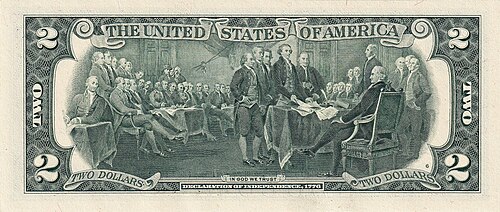
John Trumbull's painting Declaration of Independence has played a significant role in popular conceptions of the Declaration of Independence. The painting is 12-by-18-foot (3.7 by 5.5 m) in size and was commissioned by the United States Congress in 1817; it has hung in the United States Capitol Rotunda since 1826. It is sometimes described as the signing of the Declaration of Independence, but it actually shows the Committee of Five presenting their draft of the Declaration to the Second Continental Congress on June 28, 1776, and not the signing of the document, which took place later.[146]
Trumbull painted the figures from life whenever possible, but some had died and images could not be located; hence, the painting does not include all the signers of the Declaration. One figure had participated in the drafting but did not sign the final document; another refused to sign. In fact, the membership of the Second Continental Congress changed as time passed, and the figures in the painting were never in the same room at the same time. It is, however, an accurate depiction of the room in Independence Hall, the centerpiece of the Independence National Historical Park in Philadelphia, Pennsylvania.
Trumbull's painting has been depicted multiple times on U.S. currency and postage stamps. Its first use was on the reverse side of the $100 National Bank Note issued in 1863. A few years later, the steel engraving used in printing the bank notes was used to produce a 24-cent stamp, issued as part of the 1869 Pictorial Issue. An engraving of the signing scene has been featured on the reverse side of the United States two-dollar bill since 1976.
Slavery and the Declaration
The apparent contradiction between the claim that "all men are created equal" and the existence of slavery in the United States attracted comment when the Declaration was first published. Many of the founders understood the incompatibility of the statement of natural equality with the institution of slavery, but continued to enjoy the "Rights of Man".[147] Jefferson had included a paragraph in his initial rough Draft of the Declaration of Independence vigorously condemning the evil of the slave trade, and condemning King George III for forcing it onto the colonies, but this was deleted from the final version.[22]: 146–150 [61]
He has waged cruel war against human nature itself, violating its most sacred rights of life and liberty in the persons of a distant people who never offended him, captivating and carrying them into slavery in another hemispere, or to incure miserable death in their transportation hither. this piratical warfare, the opprobium of infidel powers, is the warfare of the Christian king of Great Britain. Determined to keep open a market where MEN should be bought and sold, he has prostituted his negative for suppressing every legislative attempt to prohibit or to restrain this execrable commerce: and that this assemblage of horrors might want no fact of distinguished die, he is now exciting those very people to rise in arms among us, and to purchase that liberty of which he had deprived them, by murdering the people upon whom he also obtruded them: thus paying off former crimes committed against the liberties of one people, with crimes which he urges them to commit against the lives of another.
Jefferson himself was a prominent Virginia slaveowner, owning six hundred enslaved Africans on his Monticello plantation.[148] Referring to this contradiction, English abolitionist Thomas Day wrote in a 1776 letter, "If there be an object truly ridiculous in nature, it is an American patriot, signing resolutions of independency with the one hand, and with the other brandishing a whip over his affrighted slaves."[10][149] The African-American writer Lemuel Haynes expressed similar viewpoints in his essay "Liberty Further Extended", where he wrote that "Liberty is Equally as pre[c]ious to a Black man, as it is to a white one".[150]
In the 19th century, the Declaration took on a special significance for the abolitionist movement. Historian Bertram Wyatt-Brown wrote that "abolitionists tended to interpret the Declaration of Independence as a theological as well as a political document".[151] Abolitionist leaders Benjamin Lundy and William Lloyd Garrison adopted the "twin rocks" of "the Bible and the Declaration of Independence" as the basis for their philosophies. He wrote, "As long as there remains a single copy of the Declaration of Independence, or of the Bible, in our land, we will not despair."[152] For radical abolitionists such as Garrison, the most important part of the Declaration was its assertion of the right of revolution. Garrison called for the destruction of the government under the Constitution, and the creation of a new state dedicated to the principles of the Declaration.[22]: 198–199
On July 5, 1852, Frederick Douglass delivered a speech asking the question, "What to the Slave Is the Fourth of July?".
The controversial question of whether to allow additional slave states into the United States coincided with the growing stature of the Declaration. The first major public debate about slavery and the Declaration took place during the Missouri controversy of 1819 to 1821.[153] Anti-slavery Congressmen argued that the language of the Declaration indicated that the Founding Fathers of the United States had been opposed to slavery in principle, and so new slave states should not be added to the country.[153]: 604 Pro-slavery Congressmen led by Senator Nathaniel Macon of North Carolina argued that the Declaration was not a part of the Constitution and therefore had no relevance to the question.[153]: 605
With the abolitionist movement gaining momentum, defenders of slavery such as John Randolph and John C. Calhoun found it necessary to argue that the Declaration's assertion that "all men are created equal" was false, or at least that it did not apply to black people.[22]: 199 [13]: 246 During the debate over the Kansas–Nebraska Act in 1853, for example, Senator John Pettit of Indiana argued that the statement "all men are created equal" was not a "self-evident truth" but a "self-evident lie".[22]: 200 Opponents of the Kansas–Nebraska Act, including Salmon P. Chase and Benjamin Wade, defended the Declaration and what they saw as its antislavery principles.[22]: 200–201
John Brown's Declaration of Liberty
In preparing for his raid on Harper's Ferry, said by Frederick Douglass to be the beginning of the end of slavery in the United States,[154]: 27–28 abolitionist John Brown had many copies printed of a Provisional Constitution. When the seceding states created the Confederate States of America 16 months later, they operated for over a year under a Provisional Constitution. It outlines the three branches of government in the quasi-country he hoped to set up in the Appalachian Mountains. It was widely reproduced in the press, and in full in the Select Senate Committee report on John Brown's insurrection (the Mason Report).[155]
Brown did not have it printed, and his Declaration of Liberty, dated July 4, 1859, was found among his papers at the Kennedy Farm.[156]: 330–331 It was written out on sheets of paper attached to fabric, to allow it to be rolled, and it was rolled when found. The hand is that of Owen Brown, who often served as his father's amanuensis.[157]
Imitating the vocabulary, punctuation, and capitalization of the 73-year-old U.S. Declaration, the 2000-word document begins:
July 4th 1859
A Declaration of Liberty
By the Representatives of the slave Popolation [sic] of the United States of America
When in the course of human events, it becomes necessary for an Oppressed People to Rise, and assert their Natural Rights, as Human Beings, as Native & mutual Citizens of a free Republic, and break that odious Yoke of oppression, which is so unjustly laid upon them by their fellow Countrymen, and to assume among the powers of Earth the same equal privileges to which the Laws of Nature, & natures God entitle them; A moderate respect for the opinions of Mankind, requires that they should declare the causes which incite them to this just & worthy action.
We hold these truths to be Self Evident; That All Men are Created Equal; That they are endowed by their Creator with certain unalienable rights. That among these are Life, Liberty; & the persuit of happiness. That Nature hath freely given to all Men, a full Supply of Air. Water, & Land; for their sustinance, & mutual happiness, That No Man has any right to deprive his fellow Man, of these Inherent rights, except in punishment of Crime. That to secure these rights governments are instituted among Men, deriving their just powers from the consent of the governed. That when any form of Government, becomes destructive to these ends, It is the right of the People, to alter, Amend, or Remoddel it, Laying its foundation on Such Principles, & organizing its powers in such form as to them shall seem most likely to effect the safety, & happiness of the Human Race.[158]
The document was apparently intended to be read aloud, but so far as is known Brown never did so, even though he read the Provisional Constitution aloud the day the raid on Harpers Ferry began.[159]: 74 Very much aware of the history of the American Revolution, he would have read the Declaration aloud after the revolt had started. The document was not published until 1894, and by someone who did not realize its importance and buried it in an appendix of documents.[156]: 637–643 It is missing from most but not all studies of John Brown.[160][159]: 69–73
Lincoln and the Declaration
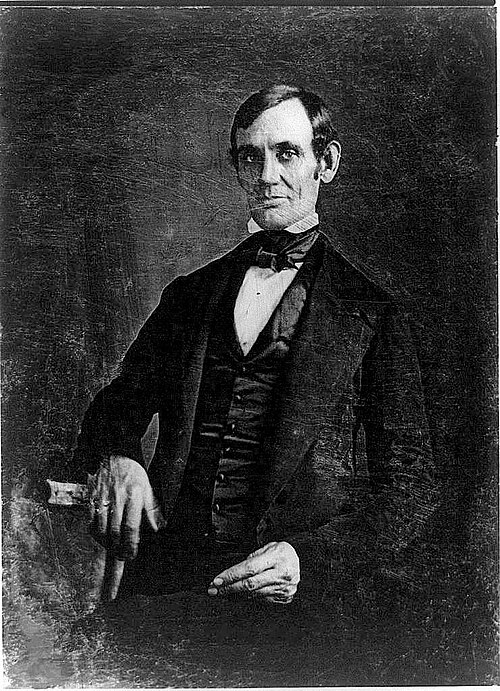
The Declaration's relationship to slavery was taken up in 1854 by Abraham Lincoln, a little-known former Congressman who idolized the Founding Fathers.[22]: 201–202 Lincoln thought that the Declaration of Independence expressed the highest principles of the American Revolution, and that the Founding Fathers had tolerated slavery with the expectation that it would ultimately wither away.[9]: 126 For the United States to legitimize the expansion of slavery in the Kansas–Nebraska Act, thought Lincoln, was to repudiate the principles of the Revolution. In his October 1854 Peoria speech, Lincoln said:
Nearly eighty years ago we began by declaring that all men are created equal; but now from that beginning we have run down to the other declaration, that for some men to enslave others is a "sacred right of self-government". ... Our republican robe is soiled and trailed in the dust. ... Let us repurify it. Let us re-adopt the Declaration of Independence, and with it, the practices, and policy, which harmonize with it. ... If we do this, we shall not only have saved the Union: but we shall have saved it, as to make, and keep it, forever worthy of the saving.[9]: 126–127
The meaning of the Declaration was a recurring topic in the famed debates between Lincoln and Stephen Douglas in 1858. Douglas argued that the phrase "all men are created equal", which appears in the Declaration. referred to white men only. The purpose of the Declaration, he said, had simply been to justify the independence of the United States, and not to proclaim the equality of any "inferior or degraded race".[22]: 204 Lincoln, however, thought that the language of the Declaration was deliberately universal, setting a high moral standard to which the American republic should aspire. "I had thought the Declaration contemplated the progressive improvement in the condition of all men everywhere", he said.[22]: 204–205 During the seventh and last joint debate with Stephen Douglas at Alton, Illinois, on October 15, 1858, Lincoln said about the declaration:
I think the authors of that notable instrument intended to include all men, but they did not mean to declare all men equal in all respects. They did not mean to say all men were equal in color, size, intellect, moral development, or social capacity. They defined with tolerable distinctness in what they did consider all men created equal—equal in "certain inalienable rights, among which are life, liberty, and the pursuit of happiness." This they said, and this they meant. They did not mean to assert the obvious untruth that all were then actually enjoying that equality, or yet that they were about to confer it immediately upon them. In fact, they had no power to confer such a boon. They meant simply to declare the right, so that the enforcement of it might follow as fast as circumstances should permit. They meant to set up a standard maxim for free society which should be familiar to all, constantly looked to, constantly labored for, and even, though never perfectly attained, constantly approximated, and thereby constantly spreading and deepening its influence, and augmenting the happiness and value of life to all people, of all colors, everywhere.[161]
According to Pauline Maier, Douglas's interpretation was more historically accurate, but Lincoln's view ultimately prevailed. "In Lincoln's hands," wrote Maier, "the Declaration of Independence became first and foremost a living document" with "a set of goals to be realized over time".[22]: 207
[T]here is no reason in the world why the negro is not entitled to all the natural rights enumerated in the Declaration of Independence, the right to life, liberty, and the pursuit of happiness. I hold that he is as much entitled to these as the white man.
—Abraham Lincoln, 1858[162]: 100
Like Daniel Webster, James Wilson, and Joseph Story before him, Lincoln argued that the Declaration of Independence was a founding document of the United States, and that this had important implications for interpreting the Constitution, which had been ratified more than a decade after the Declaration.[162]: 129–131 The Constitution did not use the word "equality", yet Lincoln believed that the concept that "all men are created equal" remained a part of the nation's founding principles.[162]: 145 He famously expressed this belief, referencing the year 1776, in the opening sentence of his 1863 Gettysburg Address: "Four score and seven years ago our fathers brought forth on this continent, a new nation, conceived in Liberty, and dedicated to the proposition that all men are created equal."
Lincoln's view of the Declaration became influential, seeing it as a moral guide to interpreting the Constitution. "For most people now," wrote Garry Wills in 1992, "the Declaration means what Lincoln told us it means, as a way of correcting the Constitution itself without overthrowing it."[162]: 147 Admirers of Lincoln such as Harry V. Jaffa praised this development. Critics of Lincoln, notably Willmoore Kendall and Mel Bradford, argued that Lincoln dangerously expanded the scope of the national government and violated states' rights by reading the Declaration into the Constitution.[162]: 39, 145, 146 [163][164][165][166]
Women's suffrage and the Declaration

In July 1848, the Seneca Falls Convention was held in Seneca Falls, New York, the first women's rights convention. It was organized by Elizabeth Cady Stanton, Lucretia Mott, Mary Ann McClintock, and Jane Hunt. They patterned their "Declaration of Sentiments" on the Declaration of Independence, in which they demanded social and political equality for women. Their motto was that "All men and women are created equal", and they demanded the right to vote.[167][168] Excerpt from "Declaration of Sentiments":
We hold these truths to be self-evident, that all men and women are created equal
— The Declaration of Rights and Sentiments 1848
Civil Rights Movement and the Declaration
In 1963, in Washington, D.C., at the March on Washington for Jobs and Freedom, Reverend Martin Luther King Jr. delivered his famous "I Have a Dream" speech. This speech was meant to inspire the nation, to take up the causes of the Civil Rights Movement. King uses quotations from the Declaration of Independence to encourage equal treatment of all persons regardless of race.
Excerpt from King's speech:
I have a dream that one day this nation will rise up and live out the true meaning of its creed: "We hold these truths to be self-evident: that all men are created equal."
— Reverend Martin Luther King, Jr., 1963
LGBTQ+ rights movement and the Declaration
In 1978, at the Gay Pride Celebration in San Francisco, activist and later politician Harvey Milk delivered a speech. Milk alluded to the Declaration of Independence, emphasizing that the inalienable rights established by the Declaration apply to all persons and cannot be hindered because of one's sexual orientation.
Excerpt from Milk's speech:
All men are created equal and they are endowed with certain inalienable rights... that's what America is. No matter how hard you try, you cannot erase those words from the Declaration of Independence.
— Harvey Milk, 1978
In 2020, the Unitarian Universalist Association, responding to threats from the Trump administration to undermine civil rights protections for transgender individuals, mirrored the language of the Declaration of Independence, stating any such actions would "threaten the inalienable right to life, liberty and the pursuit of happiness."[169]
20th century and later
The Declaration was one of the first texts to be made into an ebook (1971).[170]
The Memorial to the 56 Signers of the Declaration of Independence was dedicated in 1984 in Constitution Gardens on the National Mall in Washington, D.C., where the signatures of all the original signers are carved in stone with their names, places of residence, and occupations.
The new One World Trade Center building in New York City (2014) is 1776 feet high to symbolize the year that the Declaration of Independence was signed.[171][172][173]
Popular culture
The adoption of the Declaration of Independence was dramatized in the 1969 Tony Award-winning musical 1776 and the 1972 film version, as well as in the 2008 television miniseries John Adams.[174][175] In 1970, The 5th Dimension recorded the opening of the Declaration on their album Portrait in the song "Declaration". It was first performed on the Ed Sullivan Show on December 7, 1969, and it was taken as a song of protest by some opposed to the Vietnam War.[176]
The Declaration of Independence is a plot device in the 2004 American film National Treasure.[177]
Fallout 3 involves a quest where the playable character acquires the Declaration of Independence from the National Archives. The player is tasked with bringing the document back to a history lover who wants to reclaim pieces of America following a nuclear war.[178]
After the 2009 death of radio broadcaster Paul Harvey, Focus Today aired a clip of Harvey speaking about the lives of all the signers of the Declaration of Independence.[179]
See also
References
- ^ a b c d Becker, Carl L. (1970) [1922]. The Declaration of Independence: A Study in the History of Political Ideas (Revised ed.). New York: Vintage Books. ISBN 0-394-70060-0.
- ^ "The Declaration of Independence in Easton", The Historical Database]
- ^ a b c Julian P. Boyd, "The Declaration of Independence: The Mystery of the Lost Original" Archived February 12, 2015, at the Wayback Machine. Pennsylvania Magazine of History and Biography 100, number 4 (October 1976), p. 456.
- ^ "Did You Know ... Independence Day Should Actually Be July 2?" (Press release). National Archives and Records Administration. June 1, 2005. Archived from the original on June 26, 2012. Retrieved July 4, 2012.
- ^ "The Declaration of Independence: A History". The U.S. National Archives and Records Administration. January 17, 2010. Archived from the original on September 17, 2008. Retrieved January 15, 2022.
- ^ Hirsch, David; Van Haften, Dan (2017). The ultimate guide to the Declaration of Independence (First ed.). El Dorado Hills, California. ISBN 978-1-61121-374-4. OCLC 990127604.
{{cite book}}: CS1 maint: location missing publisher (link) - ^ Lucas, Stephen E. (1989). "Justifying America: The Declaration of Independence as a Rhetorical Document". In Benson, Thomas W. (ed.). American Rhetoric: Context and Criticism. Carbondale, Illinois: Southern Illinois University Press. p. 85.
- ^ Ellis, Joseph (2007). American Creation: Triumphs and Tragedies at the Founding of the Republic. New York: Knopf. pp. 55–56. ISBN 978-0-307-26369-8.
- ^ a b c McPherson, James (1991). Abraham Lincoln and the Second American Revolution. New York: Oxford University Press. ISBN 0-19-505542-X.
- ^ a b c d e f g h i j k l m n o p q r s t Armitage, David (June 30, 2009) [2007]. The Declaration of Independence: A Global History. Harvard University Press. ISBN 978-0-674-02282-9. Retrieved January 16, 2022. United States Declaration of Independence at Google Books.
- ^ Hazelton, Declaration History, 19.
- ^ Christie and Labaree, Empire or Independence, 31.
- ^ a b c d e f Bailyn, Bernard (1992) [1967]. The Ideological Origins of the American Revolution (Enlarged ed.). Harvard University Press. ISBN 0-674-44302-0.
- ^ Middlekauff, Glorious Cause, 241.
- ^ Murrow, Pamela (February 4, 2013). "The Pine Tree Riot". Journal of the American Revolution. Retrieved July 3, 2024.
- ^ "The Weare NH Historical Society". www.wearehistoricalsociety.org. Retrieved July 3, 2024.
- ^ Middlekauff, Glorious Cause, 241–42. The writings in question include Wilson's Considerations on the Authority of Parliament and Jefferson's A Summary View of the Rights of British America (both 1774), as well as Samuel Adams's 1768 Circular Letter.
- ^ Middlekauff, Glorious Cause, 168
- ^ Ferling, Leap in the Dark, 123–24
- ^ Hazelton, Declaration History, 13
- ^ a b Middlekauff, Glorious Cause, 318
- ^ a b c d e f g h i j k l m n o p q r s t u v w x y z aa ab ac ad ae af ag ah ai aj ak al am an ao ap aq ar as at au av aw ax ay az ba bb bc Maier, Pauline (1997). American Scripture: Making the Declaration of Independence. New York: Knopf. ISBN 0-679-45492-6.
- ^ The text of the 1775 king's speech is online Archived January 19, 2020, at the Wayback Machine, published by the American Memory project
- ^ Friedenwald, Interpretation, 77.
- ^ a b c d e f g h i j k l m n o p q r s t u v w Jensen, Merrill (1968). The Founding of a Nation: A History of the American Revolution, 1763–1776. New York: Oxford University Press.
- ^ Friedenwald, Interpretation, 78.
- ^ Rakove, Beginnings of National Politics, 88–90.
- ^ Christie and Labaree, Empire or Independence, 270
- ^ Rakove, Beginnings of National Politics, 89
- ^ Conway (1893)
- ^ Kaye (2005), p. 43.
- ^ Hazelton, Declaration History, 209
- ^ Friedenwald, Interpretation, 67.
- ^ Friedenwald, Interpretation, 92–93.
- ^ "Treasures from the Archives: The Act of Renunciation". Rhode Island Department of State. Archived from the original on July 29, 2019. Retrieved July 29, 2019.
Rhode Island was the first colony to renounce allegiance to Great Britain's King George III by an official legislative act.
- ^ "Journals of the Continental Congress". March 29, 2019. Archived from the original on March 29, 2019.
- ^ Burnett, Continental Congress, 159. The text of Adams's letter is online Archived March 29, 2019, at the Wayback Machine.
- ^ May 15 preamble Journals of the Continental Congress Archived March 29, 2019, at the Wayback Machine.
- ^ Rakove, National Politics, 96
- ^ Friedenwald, Interpretation, 94.
- ^ Rakove, National Politics, 97
- ^ Boyd, Evolution, 18
- ^ The text of the May 15 Virginia resolution is online Archived June 20, 2008, at the Wayback Machine at Yale Law School's Avalon Project.
- ^ Jefferson, Thomas (July 4, 1776). "Declaration of Independence. In Congress, July 4, 1776, a Declaration by the Representatives of the United States of America, in General Congress Assembled". World Digital Library. Philadelphia, Pennsylvania. Retrieved July 1, 2013.
- ^ a b Boyd, Evolution, 19.
- ^ Boyd, Papers of Jefferson, 1:311
- ^ Friedenwald, Interpretation, 106.
- ^ Dupont and Onuf, 3.
- ^ Friedenwald, Interpretation, 106–07
- ^ Friedenwald, Interpretation, 96
- ^ Friedenwald, Interpretation, 118
- ^ Friedenwald, Interpretation, 119–20.
- ^ a b Filippo Mazzei, The Virginia Gazette, 1774. Translated by a friend and neighbor, Thomas Jefferson:
Translated by Jefferson as follow:Tutti gli uomini sono per natura egualmente liberi e indipendenti. Quest'eguaglianza è necessaria per costituire un governo libero. Bisogna che ognuno sia uguale all'altro nel diritto naturale.
All men are by nature equally free and independent. Such equality is necessary in order to create a free government.
All men must be equal to each other in natural law - ^ a b Kennedy, John F. (2008). A Nation of Immigrants. Perennial. pp. 15–16. ISBN 978-0061447549.
The great doctrine 'All men are created equal' and incorporated into the Declaration of Independence by Thomas Jefferson, was paraphrased from the writing of Philip Mazzei, an Italian-born patriot and pamphleteer, who was a close friend of Jefferson. A few alleged scholars try to discredit Mazzei as the creator of this statement and idea, saying that "there is no mention of it anywhere until after the Declaration was published". This phrase appears in Italian in Mazzei's own hand, written in Italian, several years prior to the writing of the Declaration of Independence. Mazzei and Jefferson often exchanged ideas about true liberty and freedom. No one man can take complete credit for the ideals of American democracy.
. - ^ a b According to Resolution 175 of the 103rd Congress: the phrase in the Declaration of Independence 'All men are created equal', was suggested by the Italian patriot and immigrant Filippo Mazzei.
- ^ Boyd, Evolution, 21.
- ^ Boyd, Evolution, 22.
- ^ "Explorations: The Revolution". Digital History. University of Houston. May 4, 2015. Archived from the original on May 4, 2015. Retrieved January 15, 2022.
From Adams's notes: "Why will you not? You ought to do it." "I will not." "Why?" "Reasons enough." "What can be your reasons?" "Reason first, you are a Virginian, and a Virginian ought to appear at the head of this business. Reason second, I am obnoxious, suspected, and unpopular. You are very much otherwise. Reason third, you can write ten times better than I can." "Well," said Jefferson, "if you are decided, I will do as well as I can." "Very well. When you have drawn it up, we will have a meeting."
- ^ "Visit the Declaration House", National Park Service official website
- ^ a b John E. Ferling, Setting the World Ablaze: Washington, Adams, Jefferson, and the American Revolution, Oxford University Press. ISBN 978-0-19-513409-4. OCLC 468591593, pp. 131–37
- ^ a b Shipler, David K., The Paragraph Missing From The Declaration of Independence Archived July 8, 2020, at the Wayback Machine, The Shipler Report, July 4, 2020
- ^ "A Closer Look at Jefferson's Declaration". New York Public Library. Retrieved July 6, 2020.
- ^ Burnett, Continental Congress, 181.
- ^ Burnett, Continental Congress, 182
- ^ As quoted in Adams, John (2007). My Dearest Friend: Letters of Abigail and John Adams. Harvard University Press. p. 125. ISBN 978-0-674-02606-3.
- ^ "Journals of the Continental Congress --FRIDAY, JULY 19, 1776". memory.loc.gov. Archived from the original on January 22, 2020. Retrieved April 27, 2020.
- ^ George Billias American Constitutionalism Heard Round the World, 1776–1989 (2011) p 17.
- ^ a b c d e Lucas, Stephen E. "The Stylistic Artistry of the Declaration of Independence". National Archives and Records Administration. Archived from the original on June 30, 2012. Retrieved July 4, 2012.
- ^ "Declaration of Independence: A Transcription". National Archives. November 1, 2015. Archived from the original on July 6, 2019. Retrieved July 6, 2019.
- ^ "Index of Signers by State". ushistory.org – Independence Hall Association in Philadelphia. Archived from the original on September 29, 2006. Retrieved October 12, 2006.
- ^ Trickey, Erick. "Mary Katharine Goddard, the Woman Who Signed the Declaration of Independence". Retrieved July 12, 2024.
- ^ To Henry Lee – Thomas Jefferson The Works, vol. 12 (Correspondence and Papers 1816–1826; 1905). May 8, 1825.
- ^ Malone, Jefferson the Virginian, 221
- ^ see "Virginia Declaration of Rights" Archived July 4, 2021, at the Wayback Machine
- ^ Lucas, Stephen E. (1994). Hofte, Rosemarijn; Kardux, Johanna C. (eds.). "The 'Plakkaat van Verlatinge': A Neglected Model for the American Declaration of Independence". Connecting Cultures: The Netherlands in Five Centuries of Transatlantic Exchange. Vol. 31. Amsterdam. pp. 189–207. OCLC 808030037.
- ^ Wolff, Barbara (June 29, 1988). "Was the Declaration of Independence Inspired by the Dutch?". University of Wisconsin Madison News. Archived from the original on December 13, 2007. Retrieved July 3, 2013.
- ^ Boyd, Evolution, 16–17.
- ^ "The Three Greatest Men". Library of Congress. Archived from the original on June 1, 2009. Retrieved June 13, 2009.
Jefferson identified Bacon, Locke, and Newton as "the three greatest men that have ever lived, without any exception". Their works in the physical and moral sciences were instrumental in Jefferson's education and world view.
- ^ Ray Forrest Harvey, Jean Jacques Burlamaqui: A Liberal Tradition in American Constitutionalism (Chapel Hill, North Carolina, 1937), 120.
- ^ A brief, online overview of the classical liberalism vs. republicanism debate is Alec Ewald, "The American Republic: 1760–1870" (2004) Archived May 17, 2008, at the Wayback Machine.Historian Robert Middlekauff argues that the political ideas of the independence movement took their origins mainly from the "eighteenth-century commonwealthmen, the radical Whig ideology", which in turn drew on the political thought of John Milton, James Harrington, and John Locke. See Robert Middlekauff (2005), The Glorious Cause, pp. 3–6, 51–52, 136
- ^ Wills, Inventing America, especially chs. 11–13. Wills concludes (p. 315) that "the air of enlightened America was full of Hutcheson's politics, not Locke's".
- ^ Hamowy, "Jefferson and the Scottish Enlightenment", argues that Wills gets much wrong (p. 523), that the Declaration seems to be influenced by Hutcheson because Hutcheson was, like Jefferson, influenced by Locke (pp. 508–09), and that Jefferson often wrote of Locke's influence, but never mentioned Hutcheson in any of his writings (p. 514). See also Kenneth S. Lynn, "Falsifying Jefferson", Commentary 66 (Oct. 1978), 66–71. Ralph Luker, in "Garry Wills and the New Debate Over the Declaration of Independence" Archived March 25, 2012, at the Wayback Machine (The Virginia Quarterly Review, Spring 1980, 244–61) agreed that Wills overstated Hutcheson's influence to provide a communitarian reading of the Declaration, but he also argued that Wills's critics similarly read their own views into the document.
- ^ Reid, John Phillip (1981). "The Irrelevance of the Declaration". In Hartog, Hendrik (ed.). Law in the American Revolution and the Revolution in the Law. New York University Press. pp. 46–89. ISBN 978-0-8147-3413-1.
- ^ Whitford, David, Tyranny and Resistance: The Magdeburg Confession and the Lutheran Tradition, 2001, 144 pages and Kelly OConnell Archived December 21, 2018, at the Wayback Machine of Canada Free Press, August 4, 2014, parts II. Magdeburg Confession and III. Doctrine of Lesser Magistrates
- ^ Benjamin Franklin to Charles F.W. Dumas, December 19, 1775, in The Writings of Benjamin Franklin, ed. Albert Henry Smyth (New York: 1970), 6:432.
- ^ Gulf, C. & SFR Co. v. Ellis, 165 US 150 Archived May 23, 2020, at the Wayback Machine (1897): "While such declaration of principles may not have the force of organic law, or be made the basis of judicial decision as to the limits of right and duty...it is always safe to read the letter of the Constitution in the spirit of the Declaration of Independence."
- ^ Wills, Gary. Inventing America: Jefferson's Declaration of Independence Archived September 26, 2015, at the Wayback Machine, p. 25 (Houghton Mifflin Harcourt, 2002): "the Declaration is not a legal instrument, like the Constitution".
- ^ Cuomo, Mario. Why Lincoln Matters: Now More Than Ever, p. 137 (Harcourt Press 2004) (it "is not a law and therefore is not subjected to rigorous interpretation and enforcement").
- ^ Strang, Lee "Originalism's Subject Matter: Why the Declaration of Independence Is Not Part of the Constitution" Archived September 5, 2015, at the Wayback Machine, Southern California Law Review, Vol. 89, 2015.
- ^ a b c The U.S. State Department (1911), The Declaration of Independence, 1776, pp. 10, 11.
- ^ Warren, "Fourth of July Myths", 242–43.
- ^ Hazelton, Declaration History, 299–302; Burnett, Continental Congress, 192.
- ^ Warren, "Fourth of July Myths", 245–46
- ^ Hazelton, Declaration History, 208–19
- ^ Wills, Inventing America, 341.
- ^ Hazelton, Declaration History, 208–19.
- ^ a b c "Benjamin Rush to John Adams, July 20, 1811". National Park Service. Retrieved November 22, 2019.
- ^ Hazelton, Declaration History, 209.
- ^ Merriam-Webster online Archived April 24, 2009, at the Wayback Machine; Dictionary.com Archived April 9, 2009, at the Wayback Machine.
- ^ "TeachAmericanHistory.org: John Hancock" (PDF). Archived from the original (PDF) on May 10, 2013. Retrieved October 6, 2014.
- ^ "The Gurney Papers". The New Monthly Magazine and Humorist (Part 1): 17. 1837. Retrieved July 4, 2021.
- ^ Boyd (1976), The Declaration of Independence: The Mystery of the Lost Original, p. 438.
- ^ Papas, Philip. That Ever Loyal Island. Staten Island in the American Revolution. New York University Press, 2007, pgs 74-76
- ^ "The Declaration of Independence in World Context". July 10, 2006. Archived from the original on October 6, 2014. Retrieved October 6, 2014.
- ^ Bolkhovitinov, Nikolai N. (March 1999). "The Declaration of Independence: A View from Russia". The Journal of American History. 85 (4): 1389–1398. doi:10.2307/2568261. ISSN 0021-8723. JSTOR 2568261. Retrieved January 13, 2023 – via JSTOR.
- ^ a b "The Contagion of Sovereignty: Declarations of Independence since 1776" (PDF). Archived (PDF) from the original on September 16, 2012. Retrieved August 17, 2012.
- ^ Jessup, John J. (September 20, 1943). "America and the Future". Life. p. 105. Retrieved March 9, 2011.
- ^ Hutchinson, Thomas (1776), Eicholz, Hans (ed.), Strictures upon the Declaration of the Congress at Philadelphia in a Letter to a Noble Lord, &c., London
- ^ Peter Kolchin, American Slavery, 1619–1877 (1993), pp. 77–79, 81
- ^ McNamara, Sandra (December 20, 2018). "The Loyalist Declaration of Dependence, 1776". Journal of the American Revolution.
- ^ a b c "The Declaration of Independence: A History". Charters of Freedom. National Archives and Records Administration. Archived from the original on January 26, 2010. Retrieved July 1, 2011.
- ^ Malone, Story of the Declaration, 263.
- ^ "Charters of Freedom Re-encasement Project". National Archives and Records Administration. Archived from the original on September 19, 2011. Retrieved July 1, 2011.
- ^ "Rare copy of United States Declaration of Independence found in Kew". The Daily Telegraph. July 3, 2009. Archived from the original on November 13, 2011. Retrieved July 1, 2011.
- ^ a b c Dube, Ann Marie (May 1996). "The Declaration of Independence". A Multitude of Amendments, Alterations and Additions: The Writing and Publicizing of the Declaration of Independence, the Articles of Confederation, and the Constitution of the United States. National Park Service. Archived from the original on November 8, 2012. Retrieved July 1, 2011.
- ^ Henderson, Jane. "Made in 1776: Rare copy of the Declaration of Independence goes on view at Washington U." STLtoday.com. Archived from the original on July 2, 2018. Retrieved March 18, 2020.
- ^ a b c Boyd, "Lost Original", 446.
- ^ Boyd, Julian (1976). "The Declaration of Independence: The Mystery of the Lost Original". Pennsylvania Magazine of History and Biography. 100 (4).
- ^ Boyd, Papers of Jefferson, 1:421.
- ^ "TPNHA". www.thomaspaine.org. Retrieved October 10, 2022.
- ^ Boyd, "Lost Original", 448–50. Boyd argued that, if a document was signed on July 4 (which he thought unlikely), it would have been the Fair Copy, and probably would have been signed only by Hancock and Thomson.
- ^ Ritz, "From the Here", speculates that the Fair Copy was immediately sent to the printer so that copies could be made for each member of Congress to consult during the debate. All of these copies were then destroyed, theorizes Ritz, to preserve secrecy.
- ^ "Declaration of Independence document found". BBC News. July 4, 2018. Archived from the original on July 4, 2018. Retrieved July 4, 2018.
- ^ Yuhas, Alan (April 22, 2017). "Rare parchment copy of US Declaration of Independence found in England". The Guardian. Archived from the original on April 22, 2017. Retrieved April 22, 2017.
- ^ "The Sussex Declaration". Declaration Resources Project. Harvard University. Archived from the original on April 22, 2017. Retrieved April 22, 2017.
- ^ Pappalardo, Joe (July 3, 2020). "The Science of Saving the Declaration of Independence." Archived November 9, 2020, at the Wayback Machine Popular Mechanics. Retrieved February 3, 2020.
- ^ Ruane, Michael E. (October 21, 2016). "Was the Declaration of Independence 'defaced'? Experts say yes". The Washington Post. Retrieved August 27, 2021.
- ^ McDonald, "Jefferson's Reputation", 178–79
- ^ Lefebvre, Georges (2005). The Coming of the French Revolution. Princeton UP. p. 212. ISBN 0-691-12188-5. Archived from the original on September 13, 2015. Retrieved October 16, 2015.
- ^ Billias, George Athan, ed. (2009). American Constitutionalism Heard Round the World, 1776–1989: A Global Perspective. NYU Press. p. 92. ISBN 978-0-8147-9139-4. Archived from the original on May 27, 2016. Retrieved October 16, 2015.
- ^ Susan Dunn, Sister Revolutions: French Lightning, American Light (1999) pp. 143–145
- ^ Palley, Claire (1966). The Constitutional History and Law of Southern Rhodesia 1888–1965, with Special Reference to Imperial Control (First ed.). Oxford: Clarendon Press. p. 750. OCLC 406157.
- ^ Hillier, Tim (1998). Sourcebook on Public International Law (1st ed.). London & Sydney: Cavendish Publishing. p. 207. ISBN 1-85941-050-2.
- ^ Gowlland-Debbas, Vera (1990). Collective Responses to Illegal Acts in International Law: United Nations action in the question of Southern Rhodesia (1st ed.). Leiden and New York: Martinus Nijhoff Publishers. p. 71. ISBN 0-7923-0811-5.
- ^ McDonald, "Jefferson's Reputation", 172.
- ^ McDonald, "Jefferson's Reputation", 172, 179.
- ^ McDonald, "Jefferson's Reputation", 179
- ^ McDonald, "Jefferson's Reputation", 180–184
- ^ a b c Detweiler, Philip F. (October 1962). "The Changing Reputation of the Declaration of Independence: The First Fifty Years". The William and Mary Quarterly. 19 (4): 557–574. doi:10.2307/1920163. JSTOR 1920163.
- ^ Wills, Inventing America, 324
- ^ John C. Fitzpatrick, Spirit of the Revolution (Boston 1924).
- ^ Wills, Inventing America, 90.
- ^ Armitage, David (2002). "The Declaration of Independence and International Law". The William and Mary Quarterly. 59 (1). Williamsburg: Omohundro Institute of Early American History and Culture: 39–64. doi:10.2307/3491637. ISSN 0043-5597. JSTOR 3491637.
- ^ Philip S. Foner, ed., We, the Other People: Alternative Declarations of Independence by Labor Groups, Farmers, Woman's Rights Advocates, Socialists, and Blacks, 1829–1975 (Urbana 1976).
- ^ Wills, Inventing America, 348.
- ^ John Hazelton (1907). "The Historical Value of Trumbull's – Declaration of Independence". Pennsylvania Magazine of History and Biography. Vol. 31. p. 38.
- ^ Tsesis, Alexander (May 2012). "Self-government and the Declaration of Independence". Cornell Law Review. 97 (4). Ithaca: Cornell University. ISSN 0010-8847.
- ^ Cohen (1969), Thomas Jefferson and the Problem of Slavery
- ^ Day, Thomas. Fragment of an original letter on the Slavery of the Negroes, written in the year 1776. London: Printed for John Stockdale (1784). Boston: Re-printed by Garrison and Knapp, at the office of "The Liberator" (1831). p. 10. Archived from the original on March 16, 2016. Retrieved February 26, 2014.
If there be an object truly ridiculous in nature, it is an American patriot, signing resolutions of independency with the one hand, and with the other brandishing a whip over his affrighted slaves.
At: Internet Archive Archived March 4, 2014, at the Wayback Machine: The Johns Hopkins University Sheridan Libraries Archived April 23, 2014, at the Wayback Machine: James Birney Collection of Antislavery Pamphlets Archived August 6, 2014, at the Wayback Machine. - ^ "Lemuel Haynes' Liberty Further Extended". The Founding Project. February 24, 2020. Archived from the original on October 27, 2020. Retrieved November 17, 2020.
- ^ Wyatt-Brown, Lewis Tappan, 287.
- ^ Mayer, All on Fire, 53, 115.
- ^ a b c Detweiler, Philip F. (April 1958). "Congressional Debate on Slavery and the Declaration of Independence, 1819–1821". American Historical Review. 63 (3). Oxford University Press: 598–616. doi:10.2307/1848882. JSTOR 1848882.
- ^ Douglass, Frederick (1881). John Brown. An Address at the Fourteenth Anniversary of Storer College, May 30, 1881. Dover, New Hampshire: Morning Star job printing house. Also available at Project Gutenberg Archived October 15, 2011, at the Wayback Machine.
- ^ "Senate Select Committee Report on the Harper's Ferry Invasion". West Virginia Division of Culture and History. "His Soul Goes Marching On": The Life and Legacy of John Brown. June 15, 1860. Archived from the original on July 10, 2016. Retrieved July 25, 2016.
- ^ a b Hinton, Richard J. (1894). John Brown and his men; with some account of the roads they traveled to reach Harper's Ferry (Revised ed.). New York: Funk & Wagnalls.
- ^ Onion, Rebecca (December 2, 2013). "John Brown's Passionate 'Declaration of Liberty', Written on a Lengthy Scroll". Slate.
- ^ Brown, John (July 4, 1859). A Declaration of Liberty By the Representatives of the slave Popolation of the United States of America. Preserving American Freedom : The Evolution of American Liberties in Fifty Documents. Historical Society of Pennsylvania.
- ^ a b DeCaro, Louis A. Jr. (2020). The Untold Story of Shields Green: The Life and Death of a Harper's Ferry Raider. New York University Press. ISBN 978-1-4798-0275-3.
- ^ Mead, John (2008). "Declarations of Liberty: Representations of Black/White Alliances Against Slavery by John Brown, James Redpath, and Thomas Wentworth Higginson". Journal for the Study of Radicalism. 3 (1): 111–144. doi:10.1353/jsr.0.0017. JSTOR 41887620. S2CID 159213688.
- ^ "Abraham Lincoln (1809–1865): Political Debates Between Lincoln and Douglas 1897". Bartleby. p. 415. Archived from the original on May 10, 2013. Retrieved January 26, 2013.
- ^ a b c d e Wills, Garry (1992). Lincoln at Gettysburg: The Words That Rewrote America. New York: Simon & Schuster. ISBN 0-671-76956-1.
- ^ Harry V. Jaffa, Crisis of the House Divided (1959)
- ^ A New Birth of Freedom: Abraham Lincoln and the Coming of the Civil War (2000)
- ^ Willmoore Kendall and George W. Carey, The Basic Symbols of the American Political Tradition (1970)
- ^ M. E. Bradford (1976), "The Heresy of Equality: A Reply to Harry Jaffa", reprinted in A Better Guide than Reason (1979) and Modern Age, the First Twenty-five Years (1988)
- ^ Norton, et al (2010), p. 301.
- ^ "Modern History Sourcebook: Seneca Falls: The Declaration of Sentiments, 1848". Archived from the original on October 20, 2014. Retrieved October 6, 2014.
- ^ "Unitarian Universalism Holds that No Person's Identity is Dictated by Laws and Legislation". www.uua.org. Unitarian Universalist Association. Retrieved March 19, 2023.
- ^ Flood, Alison (September 8, 2011). "Michael Hart, inventor of the ebook, dies aged 64". The Guardian. Archived from the original on February 13, 2015. Retrieved December 13, 2016.
- ^ "Crews finish installing World Trade Center spire". CNN. May 10, 2013. Archived from the original on July 19, 2013. Retrieved July 17, 2013.
- ^ "Tallest buildings in NY". Skyscraperpage.com. Archived from the original on July 21, 2013. Retrieved June 23, 2012.
- ^ "Tallest buildings under construction in the world". Skyscraperpage.com. Retrieved June 23, 2012.
- ^ "1776: The Musical About Us". Pratico. Archived from the original on May 9, 2018. Retrieved May 8, 2018.
- ^ "John Adams: Independence". Home Box Office. Archived from the original on May 8, 2018. Retrieved May 8, 2018.
- ^ "Independence". Fort Wayne Journal Gazette. July 4, 2010. Archived from the original on March 31, 2019. Retrieved February 10, 2018.
- ^ "National Treasure". Rotten Tomatoes. 2004. Archived from the original on November 29, 2017. Retrieved June 10, 2018.
- ^ Gameguides, IGN (May 19, 2014). "Stealing Independence". IGN. Retrieved August 24, 2024.
- ^ The Price of Freedom. TheDove TV (Commentary). August 19, 2019. Event occurs at 1:36–8:50. Archived from the original on September 3, 2020. Retrieved June 20, 2020.
Bibliography
- Becker, Carl Lotus (1922). The Declaration of independence: A Study in the History of Political Ideas. New York: Harcourt, Brace and Company, Inc.
- Boyd, Julian P. (1945). The Declaration of Independence: The Evolution of the Text as Shown in Facsimiles of Various Drafts by its Author, Thomas Jefferson. Princeton, NJ: Princeton University Press.
- Boyd, Julian P., ed. The Papers of Thomas Jefferson, vol. 1. Princeton University Press, 1950.
- Boyd, Julian P. "The Declaration of Independence: The Mystery of the Lost Original" Archived February 12, 2015, at the Wayback Machine. Pennsylvania Magazine of History and Biography 100, number 4 (October 1976), 438–67.
- Burnett, Edmund Cody (1941). The Continental Congress. New York: The Macmillan Company.
- Christie, Ian R. and Benjamin W. Labaree. Empire or Independence, 1760–1776: A British-American Dialogue on the Coming of the American Revolution. New York: Norton, 1976.
- Dumbauld, Edward. The Declaration of Independence And What It Means Today. Norman: University of Oklahoma Press, 1950.
- Dupont, Christian Y. and Peter S. Onuf, eds. Declaring Independence: The Origins and Influence of America's Founding Document. Revised edition. Charlottesville, Virginia: University of Virginia Library, 2010. ISBN 978-0-9799997-1-0.
- Ferling, John E. (2003). A Leap in the Dark: The Struggle to Create the American Republic. New York: Oxford University Press, Inc. ISBN 0-19-515924-1.
- Friedenwald, Herbert (1904). The Declaration of Independence: An Interpretation and an Analysis. New York: The Macmillan Company.
- Gustafson, Milton. "Travels of the Charters of Freedom" Archived October 19, 2017, at the Wayback Machine. Prologue Magazine 34, no 4 (Winter 2002).
- Hamowy, Ronald. "Jefferson and the Scottish Enlightenment: A Critique of Garry Wills's Inventing America: Jefferson's Declaration of Independence". William and Mary Quarterly, 3rd series, 36 (October 1979), 503–23.
- Hazelton, John H. The Declaration of Independence: Its History. Originally published 1906. New York: Da Capo Press, 1970. ISBN 0-306-71987-8. 1906 edition available on Google Book Search
- Journals of the Continental Congress,1774–1789, Vol. 5 ( Library of Congress, 1904–1937)
- Lucas, Stephen E., "Justifying America: The Declaration of Independence as a Rhetorical Document", in Thomas W. Benson, ed., American Rhetoric: Context and Criticism, Carbondale, Illinois: Southern Illinois University Press, 1989
- Mahoney, D. J. (1986). "Declaration of independence". Society. 24: 46–48. doi:10.1007/BF02695936. S2CID 189888819.
- Maier, Pauline (1998). American Scripture: Making the Declaration of Independence. New York: Vintage Books. ISBN 978-0-307-79195-5.
- Malone, Dumas. Jefferson the Virginian. Volume 1 of Jefferson and His Time. Boston: Little Brown, 1948.
- Mayer, David (2008). "Declaration of Independence". In Hamowy, Ronald (ed.). The Encyclopedia of Libertarianism. Thousand Oaks, CA: SAGE; Cato Institute. pp. 113–15. doi:10.4135/9781412965811.n72. ISBN 978-1-4129-6580-4.
- Mayer, Henry. All on Fire: William Lloyd Garrison and the Abolition of Slavery. New York: St. Martin's Press, 1998. ISBN 0-312-18740-8.
- McDonald, Robert M. S. "Thomas Jefferson's Changing Reputation as Author of the Declaration of Independence: The First Fifty Years". Journal of the Early Republic 19, no. 2 (Summer 1999): 169–95.
- Middlekauff, Robert. The Glorious Cause: The American Revolution, 1763–1789. Revised and expanded edition. New York: Oxford University Press, 2005.
- Norton, Mary Beth, et al., A People and a Nation, Eighth Edition, Boston, Wadsworth, 2010. ISBN 0-547-17558-2.
- Rakove, Jack N. (1979). The Beginnings of National Politics: An Interpretive History of the Continental Congress. New York: Alfred A. Knopf, Inc. ISBN 0-394-42370-4.
- Ritz, Wilfred J. "The Authentication of the Engrossed Declaration of Independence on July 4, 1776". Law and History Review 4, no. 1 (Spring 1986): 179–204.
- Ritz, Wilfred J. "From the Here of Jefferson's Handwritten Rough Draft of the Declaration of Independence to the There of the Printed Dunlap Broadside" Archived July 7, 2008, at the Wayback Machine. Pennsylvania Magazine of History and Biography 116, no. 4 (October 1992): 499–512.
- Tsesis, Alexander (2012). For Liberty and Equality: The Life and Times of the Declaration of Independence. New York: Oxford University Press. ISBN 978-0-195-37969-3.
- Warren, Charles. "Fourth of July Myths". The William and Mary Quarterly, Third Series, vol. 2, no. 3 (July 1945): 238–72. JSTOR 1921451.
- United States Department of State, "The Declaration of Independence, 1776, 1911.
- Wills, Garry (1978). Inventing America: Jefferson's Declaration of Independence. Garden City, NY: Doubleday. ISBN 0-385-08976-7.
- Wyatt-Brown, Bertram. Lewis Tappan and the Evangelical War Against Slavery. Cleveland: Press of Case Western Reserve University, 1969. ISBN 0-8295-0146-0.
- "Declaration of Sentiments Full Text - Text of Stanton's Declaration - Owl Eyes." Owleyes.org, 2018.
- NPR. "Read Martin Luther King Jr.'s 'I Have a Dream" Speech in Its Entirety." NPR.org. NPR, January 18, 2010.
- "That's What America Is" Archived May 3, 2021, at the Wayback Machine, Harvey Milk,
External links
United States Declaration of Independence at Wikipedia's sister projects
 Media from Commons
 Quotations from Wikiquote
 Texts from Wikisource
- "Declare the Causes: The Declaration of Independence" lesson plan for grades 9–12 from National Endowment for the Humanities
- Declaration of Independence at the National Archives
- Declaration of Independence at the Library of Congress
- Mobile-friendly Declaration of Independence