
Loading article…
プリマス植民地 | |||||||||||
|---|---|---|---|---|---|---|---|---|---|---|---|
| 1620–1686 1689–1691 | |||||||||||
 シール
| |||||||||||
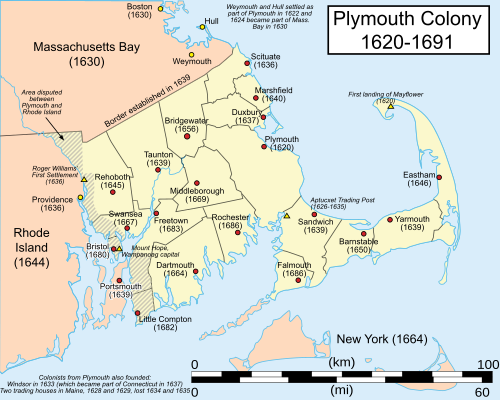 プリマス植民地の町の場所[画像参照が必要] | |||||||||||
| 状態 | イングランド植民地 | ||||||||||
| 資本 | プリマス 41°50′42″N 70°44′19″W / 41.8450°N 70.7387°W / 41.8450; -70.7387 | ||||||||||
| 共通言語 | 英語 | ||||||||||
| 宗教 | 清教 | ||||||||||
| 政府 | 自治植民地 | ||||||||||
| 知事 | |||||||||||
• 1620–1621 | ジョン・カーヴァー(初代) | ||||||||||
• 1689–1692 | トーマス・ヒンクリー(最後) | ||||||||||
| 立法府 | 一般裁判所 | ||||||||||
| 歴史時代 | イギリスによるアメリカ大陸の植民地化 ニューイングランドへのピューリタンの移住(1620年 - 1640年) | ||||||||||
• 憲章が与えられた | 1620 | ||||||||||
• 最初の感謝祭 | 1621 | ||||||||||
• ピクォート戦争 | 1636–1638 | ||||||||||
• ニューイングランド連合が結成される | 1643 | ||||||||||
• フィリップ王戦争 | 1675–1676 | ||||||||||
| 1686 1689–1691 | |||||||||||
| |||||||||||


.svg/500px-Red_Ensign_of_Great_Britain_(1707%E2%80%931800,_square_canton).svg.png)
プリマス植民地(プリマスとも呼ばれる)は、1620年にニューイングランドで最初の恒久的なイギリス植民地であり、ニューファンドランドとジェームズタウン植民地に続いてアメリカで3番目の恒久的なイギリス植民地でした。メイフラワー号の乗客によって、ジョン・スミス船長によって以前に測量され命名された場所に定住しました。この入植地は植民地の首都として機能し、マサチューセッツ州プリマスの町として発展しました。最盛期には、プリマス植民地は現在のマサチューセッツ州南東部のほとんどを占めていました。プリマス植民地にまつわる人々や出来事の多くは、アメリカの伝統である感謝祭やプリマス・ロックの記念碑など、アメリカの民間伝承の一部となっています。[1] : 2
プリマス植民地は、当初はブラウニスト移民と呼ばれ、後にピルグリムズとして知られるようになったプロテスタント分離派のグループによって設立されました。植民地はワンパノアグ族のマサソイト酋長と条約を結び、それが植民地の成功を確実なものにしました。この条約では、パトゥクセット族の一員であるスクアントの援助がありました。プリマスは、いくつかのインディアン戦争の1つであるフィリップ王戦争(1675年 - 1678年)で中心的な役割を果たしましたが、最終的には1691年にマサチューセッツ湾植民地およびその他の地域と合併してマサチューセッツ湾植民地を形成しました。
プリマス植民地の存在は比較的短かったが、アメリカの歴史において特別な役割を果たしている。プリマスの住民のほとんどは宗教的迫害から逃れ、自分たちが望むように礼拝できる場所を探していたのであり、バージニア州ジェームズタウンの開拓者の多くのような起業家ではなかった。植民地の社会制度や法制度は、彼らの宗教的信念やイギリスの慣習と密接に結びついた。[1] : 2
歴史
起源
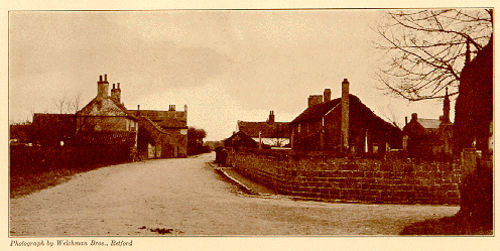
プリマス植民地は、後にピルグリムズとして知られるようになったブラウニスト(イングランドのプロテスタント非国教徒の一派)の集団によって設立された。中核グループ(成人の約40%、家族集団の約56%)[2]は、アメリカでウィリアム・ブラッドフォードとウィリアム・ブリュースターが率いた会衆の一員だった。彼らは、イングランドのノッティンガムシャー州イースト・レットフォード近郊のスクルービー村にいる間に、宗教的迫害の圧力を感じ始めた。[3] : 3 1607年、トビアス・マシュー大司教が家宅捜索を行い、会衆の数人を投獄した。[4] : 7–13 [5] : xiii–xiv 会衆は1608年にイングランドを離れ、オランダに移り、最初はアムステルダムに、その後ライデンに定住した。[5] : 51
ライデンでは、信徒たちは自由に礼拝することができたが、オランダ社会は彼らにとって馴染みのない場所だった。スクルービーは農業が盛んな町だったが、ライデンは工業が盛んな中心地で、生活のペースに困惑した。コミュニティは緊密な結びつきを保っていたが、子どもたちはオランダ語や習慣を身につけ始め、中にはオランダ軍に入隊した者もいた。彼らはまだイギリス王室の迫害から逃れられなかった。1618年、イギリス当局はライデンに来て、ウィリアム・ブリュースターを逮捕した。ブリュースターは逮捕を免れたが、この出来事をきっかけに信徒たちはイギリスからさらに遠くへ移住することになった。[4] : 16–18
会衆は1619年6月にプリマス会社から土地特許を取得した。彼らはオランダの影響を避けたいとの希望から、ニューネーデルラントのケープコッド南部に定住する機会を断っていた。 [6]この土地特許により、彼らはハドソン川の河口に定住することができた。彼らは、植民地を主に利益を上げる手段と見なしていたビジネスマンのグループであるマーチャント・アドベンチャラーズを通じて、事業の資金を調達しようとした。アメリカに到着すると、ピルグリムたちは借金を返済するために働き始めた。[4] : 19–20, 169 [a]
マーチャント・アドベンチャラーズから得た資金を使って、入植者たちは食料を購入し、メイフラワー号とスピードウェル号の乗船券を手に入れた。彼らは1620年初めに出発する予定だったが、マーチャント・アドベンチャラーズとの交渉が難航し、航海や資金計画が何度も変更されたため、出発は数か月遅れた。会衆と他の入植者たちは、 1620年7月にオランダの港デルフスハーフェンでスピードウェル号に乗船した。[4] : 20–23
メイフラワー航海
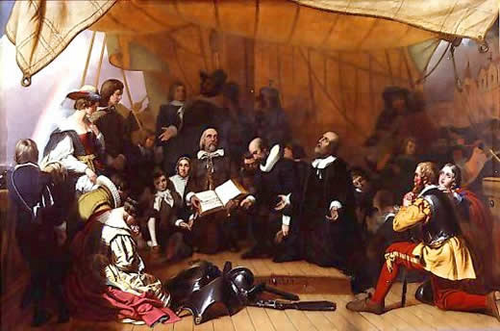
スピードウェル号は、オランダを出発し、 1620年7月末頃、イングランドのサウサンプトンでメイフラワー号と合流する前に、より大きなマストを取り付け直した。 [7] [8]メイフラワー号はロンドンで購入された。最初の船長は、スピードウェル号のレイノルズ船長とメイフラワー号のクリストファー・ジョーンズ船長であった。[9]サウサンプトンでこの一団に加わった乗客の中には、1年近く潜伏していたウィリアム・ブリュースターや、ライデンの会衆に「ストレンジャーズ」として知られていた一団もいた。この一団は主に、植民地に実際的な援助を提供し、植民地の事業のために働く追加の人手を提供するためにマーチャント・アドベンチャラーズによって募集された人々で構成されていた。この用語は、多くの年季奉公人にも使われた。
異邦人の中には、植民地の軍事指導者であったマイルス・スタンディッシュ、大西洋横断航海中にマーチャント・アドベンチャラーズによって船上の総督を務めるよう指名されたクリストファー・マーティン、そしてシェイクスピアの『テンペスト』の着想の元となったかもしれない失敗した植民地事業のベテラン、スティーブン・ホプキンスがいた。[4] : 24–25 後に船の合併後にライデン・リーダーズとなったグループには、ジョン・カーヴァー、ウィリアム・ブラッドフォード、エドワード・ウィンスロー、ウィリアム・ブリュースター、アイザック・アラートンが含まれていた。[10]
メイフラワー号とスピードウェル号の出航は遅れに見舞われた。マーチャント・アドベンチャラーズとの更なる意見の相違により、出航はサウサンプトンで延期された。最終的に8月5日に合計120名の乗客が出発した。そのうちメイフラワー号は90名、スピードウェル号は30名であった。[5] : 63 サウサンプトンを出発したスピードウェル号は重大な水漏れを起こし、直ちにダートマスに入港する必要があった。水漏れは一部にはマストが過剰に張られ、帆が過度に圧迫されたことによるものであった。[9]修理は完了したが、順風を待つため更なる遅れが生じた。2隻の船は最終的に8月23日に出航した。ランズ・エンドからわずか200マイル (320 km) 進んだところでスピードウェル号で別の重大な水漏れが起こり、遠征隊は再びイングランド、今度はプリマス港に戻らざるを得なくなった。スピードウェル号は航海に適さないことが判明した。乗客の中には移住を断念した者もいたが、他の者はメイフラワー号に乗り換え、ただでさえ重荷を背負っていた船にさらに人が集まった。後に、スピードウェル号の乗組員が危険な大西洋横断の航海を避けるために故意に船を破壊したのではないかと推測された。[4] : 27–28 この遅れは重大な結果をもたらした。修理費と港湾使用料のため、入植者は重要な食糧の一部を売らなければならなかった。さらに重要なことに、この航海が晩秋だったため、全員がケープコッド沖でますます劣悪な環境の中、来たる冬をメイフラワー号の船上で過ごさなければならなかった。
メイフラワー号は1620年9月6日、全長106フィート(32メートル)の小型船に102人の乗客と約30人の乗組員を乗せてイギリスのプリマスを出航した。 [11] 大西洋を航行した最初の1か月は海は荒れていなかったが、2か月目には北大西洋の強い冬の暴風雨に見舞われ、船体は激しく揺れ、構造上の損傷による浸水が発生した。航海中は船酔いが何度も発生し、船体の横梁が曲がったり割れたりするなど、多くの障害があった。ウィリアム・バトンが1人死亡した。[9]
2か月の航海の後、1620年11月9日、彼らはケープコッド沖で陸地を発見した。彼らはハドソン川河口の指定された上陸地点まで南下しようとしたが、ケープコッドとナンタケット島の間にある浅瀬のポロック・リップ付近でトラブルに遭遇した。冬が近づき、食料が危険なほど少なくなっていたため、乗客は北のケープコッド湾に戻り、当初の上陸計画を断念することにした。[4] : 35–36
以前の探査と入植
ピルグリムはこの地域に来た最初のヨーロッパ人ではなかった。 1497年のジョン・カボットによるニューファンドランドの発見は、アメリカ東海岸に対するイギリスの広範な領有権主張の基礎を築いた。[12]地図製作者ジャコモ・ガスタルディは 1540年頃にニューイングランドの最も古い地図の一つを作成したが、ケープ・ブレトンをナラガンセット湾と誤って特定し、ニューイングランドの海岸のほとんどを完全に省略した。[13]ヨーロッパの漁師も16世紀と17世紀のほとんどの間、ニューイングランドの海岸沖の海域で漁をしていた。
フランス人のサミュエル・ド・シャンプランは1605年にこの地域を広範囲に探検した。彼は特にプリマス港を探検し、そこを「ポート・セントルイス」と呼び、そこと周囲の土地の広範で詳細な地図を作成した。彼はパタクセット村(後にプリマスの町が建設された場所)を繁栄した入植地として示した。[1] : 55–56 しかし、1617年から1619年にかけて、メイフラワー号が到着する前のマサチューセッツ沿岸で、パタクセット族を含むインディアンの最大90パーセントが疫病で死亡した。この疫病は伝統的に天然痘であると考えられてきたが、[14]最近の分析では、あまり知られていないレプトスピラ症であった可能性があるという結論が出ている。[15]ピルグリムの入植に対するインディアンの真剣な反対がなかったことは、彼らの成功とアメリカにおけるイギリスの植民地化にとって極めて重要な出来事だったのかもしれない。
ポパム植民地はセントジョージ砦としても知られ、プリマス会社(プリマス植民地とは無関係)によって組織され、1607年に設立されました。メイン州の海岸に定住しましたが、内部の政治闘争、病気、天候の問題に悩まされ、1608年に放棄されました。[16]
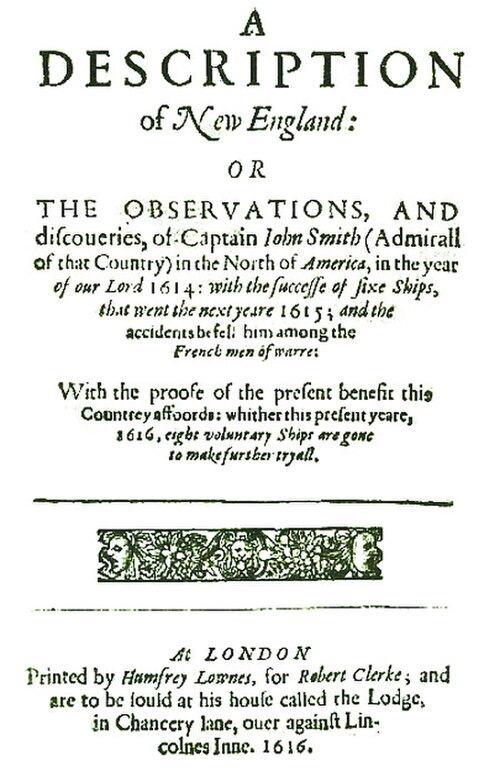
ジェームズタウンのジョン・スミス船長は1614年にこの地域を探検し、この地域をニューイングランドと名付けたとされている。彼は多くの場所にインディアンの言葉の近似語を使って名前を付けた。彼はピルグリムがプリマスを建設したパタクセットの入植地に「アコマック」という名前を与えたが、ジェームズ王の息子であるチャールズ皇太子に相談した後、ニュープリマスに変更した。1616年に出版された彼の著書「ニューイングランドの記述」に掲載された地図には、その場所が「ニュープリマス」と明確に記されている。[1] : 69–71
メイフラワー号の入植者たちが初めてケープコッドを探検したとき、彼らはヨーロッパ人が以前そこで長い時間を過ごしていたという証拠に遭遇した。彼らはヨーロッパ人の砦の遺跡を発見し、ヨーロッパ人の成人男性とインディアンの子供の遺骨が入った墓を発見した。 [1] : 46–48
プロビンスタウンとプリマスへの上陸

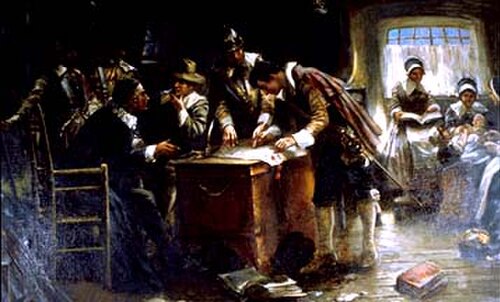
メイフラワー号は1620年11月11日にプロビンスタウン港に停泊した。ピルグリムたちはこの地域に入植する特許を持っていなかったため、乗客の中には自分たちの土地の権利に疑問を抱き始め、植民地を設立する法的権限はなく、したがって自分たちが開拓した土地の所有権を保持できる保証もないと異議を唱えた者もいた。これに対して、入植者の一団は停泊中の船上にいる間にメイフラワー誓約を起草し署名し、これが植民地の最初の統治文書となった。誓約の目的は植民地を統治する手段を確立することだったが、植民地が他のイギリスの町と同じように統治されることを確認する以上のことはほとんどしなかった。しかし、多くの入植者の財産に対する懸念を和らげる目的は果たした。[4] : 41 この社会契約は41人の男性乗客によって書かれ、署名された。それは会衆派教会が新しい会衆を形成するために使用した教会の契約をモデルにしていた。この条約は、植民地は「公正かつ平等な法律」によって統治されるべきであることを明確にし、署名者はそれらの法律を遵守することを約束した。[17] : 61
その日は日曜日だったため、一行は翌日も船上に留まり、祈りと礼拝を続けた。11月13日、彼らはついにプロビンスタウンに上陸した。最初の仕事は、シャロップ(浅喫水のボート)を再建することだった。シャロップとは、イングランドで建造され、メイフラワー号で輸送するために分解されたものである。メイフラワー号がイングランドに戻ったとき、このボートはピルグリムたちのもとに残っていた。11月15日、マイルス・スタンディッシュ船長は16人の隊を率いて探検に出かけ、インディアンの墓を荒らし、埋めてあったインディアン・コーンの隠し場所を見つけた。翌週、スザンナ・ホワイトはメイフラワー号で息子ペレグリン・ホワイトを出産した。彼は新世界でピルグリムたちに生まれた最初の子供だった。シャロップは11月27日に完成し、メイフラワー号の船長クリストファー・ジョーンズの指揮の下、それを使って2回目の探検に着手した。34人が向かったが、探検は悪天候に見舞われた。唯一の良い結果は、インディアンの墓地と死者のために用意されていたトウモロコシを発見し、将来の植え付けのためにトウモロコシを持ち帰ったことだった。ケープコッド沿いの3回目の遠征は12月6日に出発し、マサチューセッツ州イーストハムの近くで「最初の遭遇」として知られるインディアンとの小競り合いとなった。入植者たちは、定住地として適切な場所を確保できなかったことと、トウモロコシを奪って発砲したことでインディアンを怒らせたのではないかと恐れ、他の場所を探すことにした。メイフラワー号はプロビンスタウン港を出発し、プリマス港に向けて出航した。[4] : 55–77
メイフラワー号は 12月16日にプリマス港に錨を下ろし、3日間かけて入植地を探した。彼らはクラーク島やジョーンズ川河口などいくつかの候補地を却下し、パトゥクセット族が占拠していた最近放棄された入植地の跡地を選んだ。[18]この場所は主に防御的な位置にあるため選ばれた。入植地は2つの丘、村が建設されるコールズヒルと防御用の大砲が置かれるフォートヒルの2つの丘を中心とする。また、以前の村人が土地の多くを開墾しており、農業が比較的容易だったことも、この場所を選ぶ上で重要だった。植民地の真水はタウンブルックとビリントン海から供給された。伝説を裏付ける当時の記録はないが、プリマスロックは入植者が新しい故郷に初めて足を踏み入れた地点としてよく知られている。[4] : 78–80 [19]
入植者が定住した地域は、ジョン・スミスが1614年に出版した地図では「ニュープリマス」と記されていた。入植者たちは、最終出発地であるデボン州プリマスに敬意を表して、自分たちの入植地の名前をそのまま残すことを選んだ。[20]
最初の冬
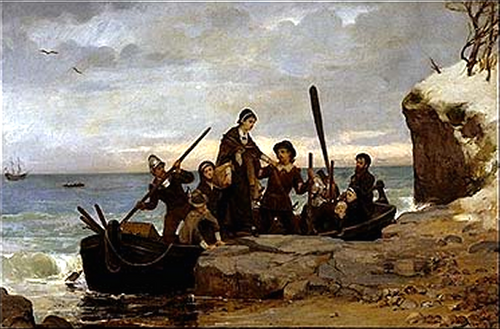
1620 年 12 月 21 日、最初の上陸部隊がプリマスの地に到着した。しかし、住宅建設の計画は悪天候のため 12 月 23 日まで延期された。建設が進むにつれ、20 人の男性が常に安全のために陸上に残り、残りの作業員は毎晩メイフラワー号に戻った。女性、子供、および病人はメイフラワー号に残り、その多くは 6 か月間船を離れていなかった。最初の建物は枝と泥でできた共同住宅で、ニューイングランドの厳しい冬に 2 週間かけて完成させた。その後の数週間で、入植地の残りの部分がゆっくりと形を整えていった。居住および作業用の建物はコールズ ヒルの比較的平坦な頂上に建設され、入植地を守る大砲を支えるために近くのフォート ヒルの頂上に木製のプラットフォームが建設された。
冬の間、メイフラワー号の入植者たちは、住む場所の不足、壊血病などの病気、船上の一般的な状況に非常に悩まされました。[6]男性の多くは働くには体が弱すぎました。102人の巡礼者のうち45人が亡くなり、コールズヒルに埋葬されました。そのため、最初の冬に計画されていた19軒のうち、7軒の住宅と4軒の共同住宅しか建設されませんでした。[4] : 80–84 1月末までには、メイフラワー号から食料を降ろし始めるのに十分な入植地が建設されました。
2月中旬、地元のインディアンとの数回の緊迫した衝突の後、入植地の男たちは軍隊を組織し、マイルズ・スタンディッシュが指揮官に任命された。その月の終わりまでに、5門の大砲がフォートヒルの防御に配置されていた。[4] : 88–91 ジョン・カーバーがマーティン知事の後任として知事に選出された。
1621 年 3 月 16 日、インディアンとの最初の正式な接触が起こった。サモセットはアベナキ族の サガモアで、もともとはメイン州ペマクイド ポイント出身だった。彼はメイン州の漁師や罠猟師から英語をいくらか学んでおり、大胆に集落の真ん中に歩み寄り、「ようこそ、イギリス人!」と叫んだ。この会合で、ピルグリムたちはパトゥセットの以前の住民が疫病で亡くなったことを知った。彼らはまた、この地域の重要な指導者がワンパノアグ族インディアンの酋長マサソイトであることも知った。[4] : 93, 155また、パトゥセットの唯一の生存者であるスクアント(ティスクアンタム)についても知った。スクアントはヨーロッパで過ごしたことがあり、英語をかなり上手に話した。サモセットはプリマスで一夜を過ごし、マサソイトの部下数人と会う約束をした。[4] : 93–94
マサソイトとスクアントは、ピルグリムたちを心配していた。彼の部族の何人かがイギリスの船員に殺されていたからだ。また、ピルグリムたちがプロビンスタウンに上陸した際に穀物の貯蔵庫をいくつか奪ったことも知っていた。[4] : 94–96 スクアント自身は1614年にイギリスの探検家トーマス・ハントに誘拐され、最初はスペインの修道士のグループの奴隷として、その後イギリスで自由民としてヨーロッパで5年間を過ごした。1619年にニューイングランドに戻り、探検家ロバート・ゴージス船長の案内人を務めたが、マサソイトとその部下は船の乗組員を虐殺し、スクアントを連れ去った。[4] : 52–53 [17] : 50–51
サモセットは3月22日にマサソイトの代表団を率いてプリマスに戻り、その代表団にはスクアントも含まれていた。マサソイトもすぐに合流し、カーバー総督と贈り物を交換して正式な平和条約を結んだ。この条約では、双方が相手に危害を加えないこと、マサソイトが同盟者を派遣してプリマスと平和交渉を行うこと、戦争時には互いに助け合うことが約束されていた。[4] : 97–99
メイフラワー号は、プリマス港に4か月近く停泊した後、1621年4月5日にイギリスに向けて出航した。[4] : 100–101 当初の102人の乗客のほぼ半数が最初の冬に亡くなった。[5] : 83–85 ウィリアム・ブラッドフォードは「この最初の船で一緒に渡ってきた100人のうち、大半の半数が一般的な死亡率で亡くなり、そのほとんどは2、3か月以内に亡くなった」と書いている。[21]コールズヒルの墓のいくつかは1855年に発見され、遺体は掘り起こされてプリマスロック近くの場所に移された。[5] : 83
最初の感謝祭


1621年11月、巡礼者たちは感謝祭を催した。これは19世紀に「最初の感謝祭」として知られるようになった。この祝祭はおそらく1621年10月初旬に催され、生き残った53人の巡礼者たちとマサソイトとその部下90人が祝った。この出来事に関する同時代の記録が3冊残っている。ウィリアム・ブラッドフォードの『プリマス植民地について』、おそらくエドワード・ウィンスローが書いた『モートの報告』、プリマス植民地長官(ブラッドフォードの甥)ナサニエル・モートン大尉の『ニューイングランドの記念碑』である。[22]祝祭は3日間続き、入植者たちが調達した数多くの種類の水鳥、野生の七面鳥、魚、そしてワンパノアグ族が持ち込んだ5頭の鹿がふるまわれた。[23]
ネイティブアメリカンとの初期の関係
マサソイトとその部下が去った後も、スクアントはプリマスに留まり、死んだ魚を土の肥料にするなど、ニューイングランドで生き延びる術をピルグリムたちに教えた。植民地生活の最初の数年間、毛皮貿易は、自給自足の農業、先住民から毛皮を購入し、ヨーロッパ人に売る以外に、主な収入源だった。[24]カーバー総督はメイフラワー号がイギリスに戻って間もなく急死した。ウィリアム・ブラッドフォードが後任に選出され、植民地の形成期のほとんどを率いた。[4] : 102–103
マサソイトの約束通り、1621年半ばには和平の誓いを携えた多数の原住民がプリマスに到着した。7月2日、エドワード・ウィンスロー(後に植民地の首席外交官となる)率いる巡礼者の一行が酋長との交渉を続けるために出発した。代表団には通訳を務めたスクアントも含まれていた。数日間の旅の後、彼らはナラガンセット湾近くのマサソイトのソワムズ村に到着した。食事と贈り物の交換の後、マサソイトはプリマス入植者との独占貿易協定に同意した。スクアントはプリマスに残り、その地域中を旅していくつかの部族と貿易関係を確立した。[4] : 104–109
7 月の終わりに、ジョン・ビリントンという少年が、植民地周辺の森でしばらく行方不明になった。彼は、ケープコッドのノーセット族に発見されたと伝えられている。この部族は、ピルグリムが前年に最初の探検でトウモロコシの種を盗んだのと同じ部族である。入植者たちはビリントンをプリマスに連れ戻すために一団を組織し、少年と引き換えに奪ったトウモロコシの代価をノーセット族に返済することに合意した。この交渉は、この地域の部族とのさらなる平和を確保するのに大いに役立った。[4] : 110–113
ジョン・ビリントンの釈放をめぐってノーセット族と交渉している間、ピルグリムたちはマサソイトが抱えている問題を知った。マサソイト、スクアント、その他数名のワンパノアグ族は、ナラガンセット族の酋長コービタントに捕らえられていた。マイルス・スタンディッシュ率いる10名の男たちがコービタントを探し出して処刑しようとした。コービタントを捜索しているうちに、スクアントが逃亡し、マサソイトが権力を握っていることがわかった。スタンディッシュとその部下が数名のネイティブ・アメリカンに怪我を負わせたため、入植者たちはプリマスで彼らに治療を施した。コービタントを捕らえることはできなかったが、スタンディッシュの武力示威はピルグリムたちの尊敬を集め、その結果、マサソイトとコービタントを含むこの地域で最も有力な酋長9名が9月に条約に署名し、ジェームズ王への忠誠を誓った。[4] : 113–116
1622年5月、スパロウ号という船がマーチャント・アドベンチャラーズの7人の男を乗せて到着した。彼らの目的は、この地域に新しい入植地を探すことだった。その後すぐに2隻の船が続き、60人の入植者全員を乗せた。彼らは7月と8月をプリマスで過ごした後、北上してマサチューセッツ州ウェイマスの入植地に移動し、ウェサガセットと名付けた。[25]ウェサガセットの入植地は短命だったが、地元の部族と入植者の間の政治的状況が劇的に変化するきっかけとなった。ウェサガセットに対する軍事的脅威の報告がプリマスに届き、マイルズ・スタンディッシュは彼らを守るために民兵を組織した。しかし、攻撃は行われていないことがわかった。そこでスタンディッシュは先制攻撃を決意し、歴史家ナサニエル・フィルブリックはこの出来事を「スタンディッシュの襲撃」と呼んでいる。スタンディッシュは、マサチューセッツ州の著名な軍指導者2人をウェサガセットの家に誘い込み、食事を共にして交渉するという口実で彼らを刺殺した。スタンディッシュと部下たちは地元の酋長オブタキエストを追跡したが、彼はウェサガセットから3人の囚人を連れて逃げ出し、スタンディッシュは彼らを処刑した。 [4] : 151–154 短期間でウェサガセットは解散し、生存者はプリマスの町に統合された。[25]
スタンディッシュの襲撃の知らせは先住民族の間ですぐに広まり、多くの先住民が村を捨ててその地域から逃げた。フィルブリックは「スタンディッシュの襲撃は、この地域の人間生態系に回復不能なダメージを与えた...この地域に新たな均衡が訪れるまでにはしばらく時間がかかった」と記している。[4] : 154–155 エドワード・ウィンスローは1624年の回想録『ニューイングランドからの良い知らせ』で「彼らは家を捨て、気が散った人のようにあちこち走り回り、沼地や他の砂漠地帯に住み、その結果、さまざまな病気を自分たちの間で持ち込み、その多くが亡くなった」と報告している。[26]ピルグリムたちは、地元の部族と享受していた毛皮の取引を失い、それがマーチャント・アドベンチャラーズへの負債を返済するための主な収入源となった。スタンディッシュの襲撃は、彼らの立場を強化するどころか、植民地にとって悲惨な結果をもたらした。ウィリアム・ブラッドフォードがマーチャント・アドベンチャラーズに宛てた手紙の中で証言しているように、「我々は貿易に大きな損害を受けた。我々が最も多くの毛皮を持っていた場所で、インディアンは住居から追い出されたのだ」。 [ 4] : 154–155 スタンディッシュの襲撃の唯一の良い影響は、この地域でピルグリムの最も近い同盟者であるマサソイト率いるワンパノアグ族の力が増したことだったようだ。[4] : 154–155
プリマスの成長
2隻目の船は、ピルグリムがニューイングランドに初めて足を踏み入れた1年後の1621年11月にマーチャント・アドベンチャラーズによって送られたフォーチュン号と名付けられ、プリマスへの37人の新しい開拓者を乗せて到着した。しかし、船の到着は予想外であり、また多くの物資も積んでいなかったため、追加の開拓者は植民地の資源に負担をかけた。フォーチュン号の乗客の中には、ウィリアム・ブリュースターの息子ジョナサン、エドワード・ウィンスローの兄弟ジョン、フィリップ・デラノ(旧姓は「デ・ラ・ノイエ」)など、元々のライデン会衆の数人がいた。彼らの子孫にはフランクリン・デラノ・ルーズベルト大統領がいる。フォーチュン号には、マーチャント・アドベンチャラーズからの手紙も積まれており、植民地は支援の見返りとしてメイフラワー号で約束されていた物資を返却しなかったとして非難されていた。フォーチュン号は500ポンド相当の品物を積んでイギリスへの帰途に着いた(2010年の価値で78,000ポンド、購買力平価で118,799ドルに相当)。これは植民地の人々が借金返済のスケジュールを守るのに十分な額だった。しかし、フォーチュン号は積み荷をイギリスに届ける前にフランスに拿捕され、植民地にとってさらに大きな赤字を生んだ。[4] : 123–126, 134
1623年7月、さらに2隻の船が到着した。キャプテン・マスター・ウィリアム・ピアースとマスター・ジョン・ブリッジスの指揮下にあるアン号と、キャプテン・エマニュエル・アルサムの指揮下にあるリトル・ジェームズ号である。 [28]これらの船は96人の新しい開拓者を乗せており、その中にはウィリアム・ブラッドフォードの将来の妻アリスやウィリアムとメアリー・ブリュースターの娘ペイシェンスとフィアを含むライデン人が含まれていた。アン号で到着した乗客の中には、開拓地での生活に備えていなかったり、植民地にとって望ましくない人々もおり、翌年イギリスに戻った。グリーソン・アーチャーによると、[29]「残った者たちはマーチャント・アドベンチャラーズとの協定の条件の下で植民地に加わるつもりはなかった。彼らは、自分たちのコミュニティに定住するか、少なくともプリマス入植者が奴隷にされていた束縛から解放されるというアドベンチャラーズとの合意に基づいてアメリカに向けて出航した。入植者に宛てて13人の商人が署名した手紙には、これらの事実が述べられており、指定された条件で新参者を受け入れるよう促されていた。」新参者たちには、プリマス・ロックの1マイル南にあるホブス・ホールとして知られるイール川の地域の土地が割り当てられた。この場所は後にウェリングスリーとなり、プリマス・ロックの1マイル南にあった。
1623年9月、失敗したウェイマス植民地を再建するべく移住者を乗せた別の船が到着し、彼らは一時的にプリマスに滞在した。1624年3月、さらに数人の移住者と最初の牛を乗せた船が到着した。1627年の牛の分割では、156人の移住者が13人ずつの12のグループに分かれていた。[30] 1629年8月には、やはりメイフラワー号と名付けられた別の船が到着し、ライデン会衆の35人の追加の信者を乗せていた。1629年から1630年の間、新しい移住者を乗せた船が到着したが、正確な数は不明である。同時代の文書によると、1630年1月までに植民地にはほぼ300人が住んでいた。1643年には、植民地には兵役に適した男性が600人と推定され、総人口は約2,000人であったことがわかる。プリマス郡の推定総人口は、植民地がマサチューセッツ湾植民地と合併する前日の1690年までに3,055人であった。[25]植民地が解散した時点での全人口は約7,000人であったと推定されている。[31]比較のために、1630年から1640年の間に2万人以上の入植者がマサチューセッツ湾植民地に到着したと推定されており(大移動として知られる期間)、ニューイングランド全体の人口は1678年までに約6万人であったと推定されている。プリマスはこの地域で最初の植民地であったが、合併した時点ではマサチューセッツ湾植民地よりもはるかに小さかった。[32]
軍事史
マイルズ・スタンディッシュ
マイルズ・スタンディッシュは、当初からプリマス植民地の軍事指導者であった。彼は、1620年12月にメイフラワー号が到着した直後の1621年2月に、正式に植民地の民兵隊の隊長に任命された。彼は、メイフラワー号からニューイングランドに足を踏み入れた最初の隊、プロビンスタウン港に到着したケープコッドの探検遠征を組織し、率いた。彼はまた、3回目の遠征を率い、このときスタンディッシュは、ピルグリム入植者による最初の記録に残る銃弾、いわゆる「ファースト・エンカウンター」を発射した。スタンディッシュはライデン大学で軍事工学を学んでおり、彼らが最終的にプリマスに到着したときに入植地の防御レイアウトを決定したのも彼であった。彼はまた、最初の冬の2月に、健常者を軍事組織に組織した。スタンディッシュは、初期の2つのインディアン村落への軍事襲撃を指揮した。クーデター未遂のコービタントを見つけて処罰するための襲撃と、「スタンディッシュ襲撃」と呼ばれるウェサガセットでの殺害である。前者は、地元のインディアンの尊敬を得るという望ましい効果があったが、後者は彼らを怖がらせ、追い散らすだけであり、貿易と収入の損失をもたらした。[4] : 57–58, 71, 84, 90, 115, 128, 155
ピクォート戦争とニューイングランド連合植民地
ニューイングランドで最初の大きな戦争は、1637年のピクォート戦争でした。この戦争の起源は、ハートフォード近郊のコネチカット川流域の支配をめぐってオランダの毛皮商人とプリマスの役人の間で紛争が起きた1632年に遡ります。オランダ東インド会社とプリマス植民地の代表は、どちらもピクォート族から土地を正当に購入したと主張する証書を持っていました。マサチューセッツ湾とプリマス植民地からの入植者がこの地域の入植でオランダ人に勝とうとしたため、一種の土地争奪戦が起こりました。この地域の他の部族はイギリス側に付き、その中にはピクォート族の伝統的な敵であったナラガンセット族やモヒガン族も含まれていました。正式な敵対関係のきっかけとなったのは、1636年に船が拿捕され、ジョン・オールダム船長が殺害されたことであり、この事件はピクォート族の同盟者のせいとされました。
1637年4月、ジョン・エンディコットがピクォート族の村を襲撃したのをきっかけに、ピクォート族の戦士たちがコネチカット州ウェザーズフィールドの町を襲撃し、30人ほどのイギリス人入植者が殺害された。これがさらなる報復につながり、ジョン・アンダーヒル大尉とジョン・メイソン大尉が率いる襲撃隊がミスティックのピクォート族の村を焼き払い、300人のピクォート族が殺害された。プリマス植民地は戦争の実際の戦闘にはほとんど関与していなかった。[33]
戦争が再開しそうになると、ニューイングランドの4つの植民地(マサチューセッツ湾、コネチカット、ニューヘイブン、プリマス)は、ニューイングランド植民地連合として知られる防衛協定を結成した。エドワード・ウィンスローは外交手腕ですでに知られており、植民地連合の主任設計者であった。ライデン条約時代にネーデルラント連邦共和国で経験したことが、連合を組織する鍵となった。ジョン・アダムズは後に、植民地連合がアメリカ国家政府の最初の試みであった連合規約の原型であると考えた。[4] : 180–181
フィリップ王戦争
メタコメットはマサソイトの次男で、ポカノケット族の酋長およびワンパノアグ族の最高指導者としてのマサソイトの地位を継承した。彼は入植者にはフィリップとして知られ、1662年にアレクサンダーとしても知られていた兄のワムサッタが突然亡くなったため、酋長となった。[4] : 205
フィリップのようなインディアン指導者たちは、入植者による土地買収の増加に憤慨し、それを遅らせたり逆転させる方法を模索した。[4] : 207–208 特に懸念されたのは、ワンパノアグ族の首都マウントホープからわずか数マイルのスウォンジーの町の設立であった。プリマスの総会は、町の入植者にワンパノアグ族の土地を売却するよう軍事力で強制し始めた。[34]
紛争の直接の原因は、1675年にジョン・ササモンという名の祈るインディアンが死亡したことだった。ササモンはフィリップ王の顧問であり友人であったが、キリスト教に改宗したことで二人の関係は悪化した。 [34]ササモン殺害の容疑者にはフィリップ王の最も上級の副官たちがいた。12人のイギリス人と6人の祈るインディアンからなる陪審は、インディアンたちに殺人罪の有罪判決を下し、死刑を宣告した。[4] : 221–223 今日に至るまで、フィリップ王の部下が実際に殺人を犯したかどうかについては議論がある。[34]
フィリップは既にマウントホープ近くの本拠地で戦争準備を始めており、イギリス人の農場を襲撃し、財産を略奪し始めた。これに対してジョサイア・ウィンスロー知事は民兵を召集し、民兵は組織化されてフィリップの陣地に向かって進軍を開始した。[4] : 229–237 フィリップの部下は身代金を得るために非武装の女性や子供を襲撃した。そのような襲撃の1つでメアリー・ローランドソンが捕らえられた。[4] : 288–289
戦争は1675年の残り期間と翌年まで続いた。入植者たちは、アメリカ原住民が決戦を拒否したことに常に苛立っていた。彼らは、イギリス軍を困惑させるゲリラ戦の形をとった。ベンジャミン・チャーチ大尉は、友好的なアメリカ原住民の協力を得て、フィリップの戦士団と対等に戦う方法を学ぶよう絶えず運動したが、アメリカ原住民を潜在的な敵とみなし、彼らを信用していなかったプリマスの指導者たちから、彼は常に拒絶された。最終的に、ウィンスロー知事とプリマスの軍司令官ウィリアム・ブラッドフォード少佐(故ウィリアム・ブラッドフォード知事の息子)は折れ、チャーチにイギリス人とアメリカ原住民の連合軍を組織する許可を与えた。サコネット族との同盟を確保した後、彼は連合軍を率いてフィリップを追跡した。フィリップは、彼の名を冠した戦争で、これまで大きな戦闘を避けていた。 1676年7月中、チャーチの部隊は何百人ものインディアン戦士を捕らえたが、その多くは大した戦闘もなく、フィリップは逃げおおせた。チャーチは捕らえられたインディアンのうち植民地側に加わることに同意する者には恩赦を与える許可を与えられ、彼の軍隊は大きく成長した。[4] : 311–323 フィリップはポカセットインディアンに殺され、戦争はすぐに植民地側の圧倒的勝利で終わった。[4] : 331–337
植民地の成人男性人口の8%が戦争中に死亡したと推定されているが、これはほとんどの基準からするとかなり大きな割合である。しかし、ネイティブアメリカンへの影響ははるかに大きかった。殺されたり、逃亡したり、奴隷として船で運ばれたりした人が多かったため、ニューイングランドの先住民人口は60~80%減少した。[4] : 332, 345–346
晩年
In 1686, the entire New England region was reorganized under a single government known as the Dominion of New England; this included the colonies of Plymouth, Rhode Island, Massachusetts Bay, Connecticut, and New Hampshire. In 1688, New York, West Jersey, and East Jersey were added.[35] Dominion President Edmund Andros was highly unpopular, and the union did not last. It was dissolved after news reached Boston in April 1689 of the Glorious Revolution, and the citizens of Boston rose up and arrested Andros.[36] When news of these events reached Plymouth, its magistrates reclaimed power.[35]: 17 [3]
The return of self-rule for Plymouth Colony was short-lived, however. A delegation of New Englanders led by Increase Mather went to England to negotiate a return of the colonial charters that had been nullified during the Dominion years. The situation was particularly problematic for Plymouth Colony, as it had existed without a formal charter since its founding. Plymouth did not get its wish for a formal charter; instead, a new charter was issued combining Plymouth Colony, Massachusetts Bay Colony, and other territories. The official date of the proclamation was October 17, 1691, ending the existence of Plymouth Colony, though it was not put into force until the arrival of the charter of the Province of Massachusetts Bay on May 14, 1692, carried by the new royal governor Sir William Phips. The last official meeting of the Plymouth General Court occurred on June 8, 1692.[35][3]: 17–18 [17]: 64–65
Life
Religion
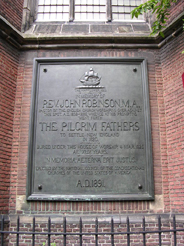

John Robinson was the original pastor of the Scrooby congregation and the religious leader of the separatists throughout the Leiden years. He never actually set foot in New England, but many of his theological pronouncements shaped the nature and character of the Plymouth church.[3]: foreword x For example, Robinson stated that women and men have different social roles but neither was lesser in the eyes of God. He taught that men and women have distinct but complementary roles in church, home, and society as a whole, and he referred to women as the "weaker vessel", quoting from 1 Peter 3:7.[3]: 84–84 In matters of religious understanding, he proclaimed that it was the man's role to "guide and go before" women.[3]: 83–84
The Pilgrims themselves were separatist Puritans, Protestant Christians who separated from the Church of England. They sought to practice Christianity as was done in the times of the Apostles. Following Martin Luther's and John Calvin's Reformation, they believed that the Bible was the only true source of religious teaching and that any additions made to Christianity had no place in Christian practice, especially with regard to church traditions such as clerical vestments or the use of Latin in church services. In particular, they were strongly opposed to the Anglicans' episcopal form of church government. They believed that the church was a community of Christians who made a covenant with God and with one another. Their congregations had a democratic structure. Ministers, teachers, and lay church elders were elected by and responsible to the entire congregation. Each congregation was independent of all the others and directly subject to Christ's government, hence the name Congregationalism.[37] The Pilgrims distinguished themselves from another branch of Puritans in that they sought to separate themselves from the Anglican Church, rather than reform it from within. It was this desire to worship from outside of the Anglican Communion that led them first to the Netherlands and ultimately to New England.[38]
Each town in the colony was considered a single church congregation; in later years, some of the larger towns split into two or three congregations. Church attendance was mandatory for all residents of the colony, while church membership was restricted to those who had converted to the faith. In Plymouth Colony, it seems that a simple profession of faith was all that was required for acceptance as a member. This was a more liberal doctrine than the congregations of the Massachusetts Bay Colony, where it was common to conduct detailed interviews with those seeking formal membership. There was no central governing body for the churches. Each individual congregation was left to determine its own standards of membership, hire its own ministers, and conduct its own business.[3]: 8
The church was the most important social institution in the colony. The Bible was the primary religious document of the society, and it also served as the primary legal document.[39] Church membership was socially vital. Education was carried out for religious purposes, motivated by a determination to teach the next generation how to read the Bible. The laws of the colony specifically asked parents to provide for the education of their children, "at least to be able duly to read the Scriptures" and to understand "the main Grounds and Principles of Christian Religion".[3]: 104–106, 140 It was expected that the male head of the household would be responsible for the religious well-being of all its members, children and servants alike.[3]: 104–106, 140
Most churches used two acts to sanction its members: censure and being "put out". Censure was a formal reprimand for behavior that did not conform with accepted religious and social norms, while being "put out" meant to be removed from church membership. Many social breaches were dealt with through church discipline rather than through civil punishment, from fornication to public drunkenness. Church sanctions seldom held official recognition outside church membership and seldom resulted in civil or criminal proceedings. Nevertheless, such sanctions were a powerful tool of social stability.[3]: 8–9
The Pilgrims practiced infant baptism. The public baptism ceremony was usually performed within six months of birth.[3]: 142 Marriage was considered a civil ceremony, rather than a religious one. The Pilgrims saw this arrangement as biblical, there being no evidence from Scripture that a minister should preside over a wedding.[4]: 104
Besides the theology espoused by their religious leaders, the people of Plymouth Colony had a strong belief in the supernatural. Richard Greenham was a Puritan theologian whose works were known to the Plymouth residents, and he counseled extensively against turning to magic or wizardry to solve problems. Massachusetts Bay Colony experienced an outbreak of witchcraft scares in the 17th century, but there is no evidence that Plymouth was engulfed in anything similar. Witchcraft was listed as a capital crime in the 1636 codification of the laws by the Plymouth General Court, but there were no actual convictions of witches in Plymouth Colony. The court records only show two formal accusations of witchcraft. The first was of Goodwife Holmes in 1661, but it never went to trial. The second was of Mary Ingram in 1677 which resulted in trial and acquittal.[1]: 92–98, endnotes
Marriage and family life
Edward Winslow and Susanna White both lost their spouses during the harsh winter of 1620–1621, and the two became the first couple to be married in Plymouth. Governor Bradford presided over the civil ceremony.[4]: 104
In Plymouth Colony, "courtships were usually initiated by the young people themselves, but as a relationship progressed toward something more permanent, the parents became more directly involved," according to John Putnam Demos.[40]: 272 Parents were concerned with the moral and religious qualities of the proposed spouse, as well as the financial means of each party's family.[40]: 272–277 The first step toward marriage was generally a betrothal or pre-contract, a ceremony carried out before two witnesses in which the couple pledged to wed in due time.[40]: 272 The couple's intentions were published several weeks or months after the betrothal was contracted.[40]: 272 "A betrothed couple was considered to have a special status, not married but no longer unmarried either."[40]: 272 Sexual contact was prohibited between a betrothed couple, but the penalty for it was one-fourth of what it was for single persons, and records indicate a relatively high number of babies born less than nine months after a wedding ceremony.[40]: 273–74
Women in Plymouth Colony had more extensive legal and social rights compared to 17th-century European norms. They were considered equal to men before God from the perspective of the Church. Women were, however, expected to take traditionally feminine roles, such as child-rearing and maintaining the household.[3]: 82–99 Plymouth women enjoyed extensive property and legal rights and could be signatories on contracts. A wife in Plymouth could not be "written out" of her husband's will and was guaranteed a full third of the family's property upon his death. In some cases, especially in second marriages, women were given exclusive right to retain control of their property separately from their husbands.[3]: 82–99 [3]: 66 Women were also known to occasionally sit on juries in Plymouth, a remarkable circumstance in seventeenth century legal practice. Historians James and Patricia Scott Deetz cite a 1678 inquest into the death of Anne Batson's child, where the jury was composed of five women and seven men.[1]: 99–100
Family size in the colony was large by modern American standards,[41][3]: 192 [b] though childbirth was often spaced out, with an average of two years between children. Most families averaged five to six children living under the same roof, though it was not uncommon for one family to have grown children moving out before the mother had finished giving birth. Maternal mortality rates were fairly high; one birth in thirty ended in the death of the mother, resulting in one in five women dying in childbirth.[3]: 64–69 However, "the rate of infant mortality in Plymouth seems to have been relatively low."[40]: 270–71
Childhood, adolescence, and education
Children generally remained in the direct care of their mothers until about the age of 8, after which it was not uncommon for the child to be placed in the foster care of another family.[3]: 141 Some children were placed into households to learn a trade, others to be taught to read and write. It was assumed that children's own parents would love them too much and would not properly discipline them. By placing children in the care of another family, there was little danger of them being spoiled.[3]: 71–75
Adolescence was not a recognized phase of life in Plymouth colony, and there was no rite of passage which marked transition from youth to adulthood. Several important transitions occurred at various ages, but none marked a single "coming of age" event. Children were expected to begin learning their adult roles in life quite early by taking on some of the family work or by being placed in foster homes to learn a trade.[3]: 141 Orphaned children were given the right to choose their own guardians at age 14. At 16, males became eligible for military duty and were also considered adults for legal purposes, such as standing trial for crimes. Age 21 was the youngest at which a male could become a freeman, though for practical purposes this occurred some time in a man's mid-twenties. Twenty-one was the assumed age of inheritance, as well, although the law respected the rights of the deceased to name an earlier age in his will.[3]: 147–149
Actual schools were rare in Plymouth colony. The first true school was not founded until 40 years after the foundation of the colony. The General Court first authorized colony-wide funding for formal public schooling in 1673, but only the town of Plymouth made use of these funds at that time. By 1683, though, five additional towns had received this funding.[3]: 142–143
Education of the young was never considered to be the primary domain of schools, even after they had become more common. Most education was carried out by a child's parents or foster parents. Formal apprenticeships were not the norm in Plymouth; it was expected that a foster family would teach the children whatever trades they themselves practiced. The church also played a central role in a child's education.[3]: 144 As noted above, the primary purpose of teaching children to read was so that they could read the Bible for themselves.[3]: 104
Government and laws
Organization

Plymouth Colony did not have a royal charter authorizing it to form a government, yet some means of governance was needed. The Mayflower Compact was the colony's first governing document, signed by the 41 Puritan men aboard the Mayflower upon their arrival in Provincetown Harbor on November 21, 1620. Formal laws were not codified until 1636. The colony's laws were based on a hybrid of English common law and religious law as laid out in the Bible.[39] The colonial authorities were deeply influenced by Calvinist theology, and were convinced that democracy was the form of government mandated by God.[42]
The colony offered nearly all adult males potential citizenship. Full citizens, or freemen, were accorded full rights and privileges in areas such as voting and holding office. To be considered a freeman, adult males had to be sponsored by an existing freeman and accepted by the General Court. Later restrictions established a one-year waiting period between nominating and granting of freeman status, and also placed religious restrictions on the colony's citizens, specifically preventing Quakers from becoming freemen.[39] Freeman status was also restricted by age; the official minimum age was 21, although in practice most men were elevated to freeman status between the ages of 25 and 40, averaging somewhere in their early thirties.[3]: 148 The colony established a disabled veterans' fund in 1636 to support veterans who returned from service with disabilities.[18] In 1641, the Body of Liberties developed protections for people who were unable to perform public service.[18] In 1660, the colonial government restricted voting with a specified property qualification, and they restricted it further in 1671 to only freemen who were "orthodox in the fundamentals of religion".[43]
The colony's most powerful executive was its Governor, who was originally elected by the freemen but was later appointed by the General Court in an annual election. The General Court also elected seven Assistants to form a cabinet to assist the governor. The Governor and Assistants then appointed Constables who served as the chief administrators for the towns, and Messengers who were the main civil servants of the colony. They were responsible for publishing announcements, performing land surveys, carrying out executions, and a host of other duties.[39]
The General Court was the chief legislative and judicial body of the colony. It was elected by the freemen from among their own number and met regularly in Plymouth, the capital town of the colony. As part of its judicial duties, it would periodically call a Grand Enquest, which was a grand jury of sorts elected from the freemen, who would hear complaints and swear out indictments for credible accusations. The General Court, and later lesser town and county courts, would preside over trials of accused criminals and over civil matters, but the ultimate decisions were made by a jury of freemen.[39]
The General Court as the legislative and judicial bodies, and the Governor as the chief executive of the colony constituted a political system of division of power. It followed a recommendation in John Calvin's political theory to set up several institutions which complement and control each other in a system of checks and balances in order to minimize the misuse of political power.[45] In 1625, the settlers had repaid their debts and thus gained complete possession of the colony.[46] The colony was a de facto republic, since neither an English company nor the King and Parliament exerted any influence—a representative democracy governed on the principles of the Mayflower Compact ("self-rule").
Laws
As a legislative body, the General Court could make proclamations of law as needed. These laws were not formally compiled anywhere in the early years of the colony; they were first organized and published in the 1636 Book of Laws. The book was reissued in 1658, 1672, and 1685.[39] These laws included the levying of "rates" or taxes and the distribution of colony lands.[3]: 7 The General Court established townships as a means of providing local government over settlements, but reserved for itself the right to control specific distribution of land to individuals within those towns. When new land was granted to a freeman, it was directed that only the person to whom the land was granted was allowed to settle it.[3]: 10 It was forbidden for individual settlers to purchase land from Native Americans without formal permission from the General Court.[3]: 14 The government recognized the precarious peace that existed with the Wampanoag, and wished to avoid antagonizing them by buying up all of their land.[4]: 214–215
The laws also set out crimes and their associated punishment. There were several crimes that carried the death penalty: treason, murder, witchcraft, arson, sodomy, rape, bestiality, adultery, and cursing or smiting one's parents.[1]: 133 [3]: 100 The actual exercise of the death penalty was fairly rare; only one sex-related crime resulted in execution, a 1642 incidence of bestiality by Thomas Granger.[1]: 135 Edward Bumpus was sentenced to death for "striking and abusing his parents" in 1679, but his sentence was commuted to a severe whipping by reason of insanity.[3]: 102 Perhaps the most notable use of the death penalty was in the execution of the Native Americans convicted of the murder of John Sassamon; this helped lead to King Philip's War.[4]: 223 Though nominally a capital crime, adultery was usually dealt with by public humiliation only. Convicted adulterers were often forced to wear the letters "A.D." sewn into their garments, much in the manner of Hester Prynne in Nathaniel Hawthorne's novel The Scarlet Letter.[47][3]: 96–98 [1]: 143
Several laws dealt with indentured servitude, a legal status whereby a person would work off debts or be given training in exchange for a period of unrecompensed service. The law required that all indentured servants had to be registered by the Governor or one of the Assistants, and that no period of indenture could be less than six months. Further laws forbade a master from shortening the length of time of service required for his servant, and also confirmed that any indentured servants whose period of service began in England would still be required to complete their service while in Plymouth.[48]
Official seal
The seal of the Plymouth Colony was designed in 1629 and is still used by the town of Plymouth. It depicts four figures within a shield bearing St George's Cross, each carrying the burning heart symbol of John Calvin. The seal was also used by the County of Plymouth until 1931.[49]
Geography
Boundaries
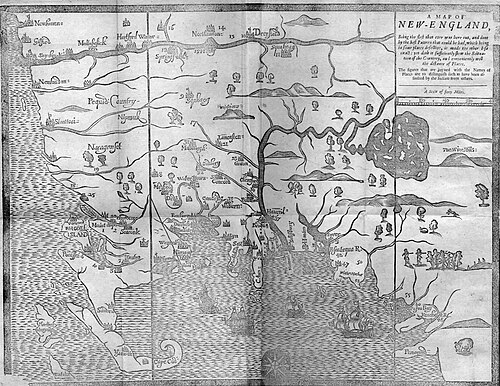
Without a clear land patent for the area, the settlers settled without a charter to form a government and, as a result, it was often unclear in the early years what land was under the colony's jurisdiction. In 1644, "The Old Colony Line"—which had been surveyed in 1639—was formally accepted as the boundary between Massachusetts Bay and Plymouth.[50]
The situation was more complicated along the border with Rhode Island. Roger Williams settled in the area of Rehoboth in 1636, near modern Pawtucket. He was forcibly evicted in order to maintain Plymouth's claim to the area. Williams moved to the west side of the Pawtucket River to found the settlement of Providence, the nucleus for the colony of Rhode Island, which was formally established with the "Providence Plantations Patent" of 1644. Various settlers from both Rhode Island and Plymouth began to settle along the area, and the exact nature of the western boundary of Plymouth became unclear. The issue was not fully resolved until the 1740s, long after the dissolution of Plymouth Colony itself. Rhode Island had received a patent for the area in 1693, which had been disputed by Massachusetts Bay Colony. Rhode Island successfully defended the patent, and a royal decree in 1746 transferred the land to Rhode Island along the eastern shore of the Narragansett Bay, including the mainland portion of Newport County and all of modern Bristol County, Rhode Island.[51][52] The border itself continued to be contested by Massachusetts, first as a colony and later as a state, until as late as 1898, when the boundary was settled and ratified by both states.
Counties and towns
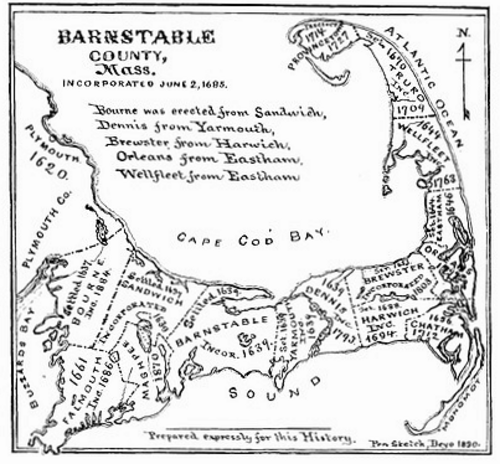
For most of its history, the town was the primary administrative unit and political division of the colony. Plymouth Colony was not formally divided into counties until June 2, 1685, during the reorganization that led to the formation of the Dominion of New England. Three counties were composed of the following towns.[1]: endnotes [c]
Barnstable County on Cape Cod:[53]
- Barnstable, the shire town (county seat) of the county, first settled in 1639 and incorporated 1650.[53]: 131
- Eastham, site of the "First Encounter", first settled 1644 and incorporated as the town of Nauset in 1646, name changed to Eastham in 1651.[53]: 285
- Falmouth, first settled in 1661 and incorporated as Succonesset in 1686.[53]: 302
- Rochester, settled 1638, incorporated 1686.[54][55]
- Sandwich, first settled in 1637 and incorporated in 1639.[53]: 581
- Yarmouth, Originally named Mattacheese by the native Americans, it was named for a seaport at the mouth of the Yar river in England and incorporated in 1639.[53]: 722
Bristol County along the shores of Buzzards Bay and Narragansett Bay; part of this county was later ceded to Rhode Island:[53]: 67
- Taunton, the shire town of the county, incorporated 1639 and grew due to the early discovery of bog-iron.[53]: 633
- Bristol, incorporated 1680 and including the former locations of Sowams and Montaup (Mount Hope), which were Massasoit's and King Philip's capitals, respectively. Ceded to Rhode Island in 1746 and is now part of Bristol County, Rhode Island.[52]
- Dartmouth, incorporated 1664. Dartmouth was the site of a significant massacre by the Indian forces during King Philip's War. It was also the location of a surrender of a group of some 160 of Philip's forces who were later sold into slavery.[53]: 263
- Freetown, Originally known as "Assonet" to the natives, and "Freemen's Land" by its first settlers. Settlement records are lost however it was incorporated under its current name in July 1683.[53]: 320
- Little Compton, incorporated as Sakonnet in 1682, ceded to Rhode Island in 1746 and is now part of Newport County, Rhode Island.[56]
- Rehoboth, first settled 1644 and incorporated 1645. Nearby to, but distinct from the Rehoboth settlement of Roger Williams, which is now the town of Pawtucket, Rhode Island.[53]: 561
- Swansea, founded as the township of Wannamoiset in 1667, incorporated as town of Swansea in 1668. It was here that the first English casualty occurred in King Philip's War.[53]: 631 [d]
Plymouth County, located along the western shores of Cape Cod Bay:[53]: 542
- Plymouth, the shire town of the county and capital of the colony. This was the original 1620 settlement of the Mayflower Pilgrims, and continued as the largest and most significant settlement in the colony until its dissolution in 1691.[57]
- Bridgewater, purchased from Massasoit by Myles Standish, and originally named Duxburrow New Plantation, it was incorporated as Bridgewater in 1656.[53]: 200
- Duxbury, founded by Myles Standish, it was incorporated in 1637. Other notable residents of Duxbury included John Alden, William Brewster, and Governor Thomas Prence.[53]: 280
- Marshfield, settled 1632, incorporated 1640. Home to Governor Edward Winslow. Also home to Josiah Winslow, who was governor of the colony during King Philip's War, and to Peregrine White, the first English child born in New England.[53]: 443
- Middleborough, incorporated 1669 as Middleberry. Named for its location as the halfway point on the journey from Plymouth to Mount Hope, the Wampanoag capital.[53]: 459
- Scituate, settled 1628 and incorporated 1636. The town was the site of a major attack by King Philip's forces in 1676.[53]: 585
Demographics
English
The settlers of Plymouth Colony fit broadly into three categories: Pilgrims, Strangers, and Particulars. The Pilgrims were a Puritan group who closely followed the teachings of John Calvin, like the later founders of Massachusetts Bay Colony to the north. (The difference was that the Massachusetts Bay Puritans hoped to reform the Anglican church from within, whereas the Pilgrims saw it as a morally defunct organization and removed themselves from it.)[38] The name "Pilgrims" was actually not used by the settlers themselves. William Bradford used the term to describe the group, but he was using it generically to define them as travelers on a religious mission. The Pilgrims referred to themselves as the Saints, First Comers, Ancient Brethren, or Ancient Men.[58] They used such terms to indicate their place as God's elect, as they subscribed to the Calvinist belief in predestination.[1]: 14 "The First Comers" was a term more loosely used in their day to refer to any of the Mayflower passengers.[58] There were also a number of indentured servants among the colonists. Indentured servants were mostly poor children whose families were receiving church relief and "homeless waifs from the streets of London sent as laborers".[59][60]
In addition to the Pilgrims, the Mayflower carried "Strangers", the non-Puritan settlers placed on the Mayflower by the Merchant Adventurers who provided various skills needed to establish a colony. This also included later settlers who came for other reasons throughout the history of the colony and who did not adhere to the Pilgrim religious ideals.[61][4]: 21–23 A third group known as the "Particulars" consisted of later settlers who paid their own "particular" way to America, and thus were not obligated to pay the colony's debts.[3]: 6
The presence of outsiders such as the Strangers and the Particulars was a considerable annoyance to the Pilgrims. As early as 1623, a conflict broke out between the Pilgrims and the Strangers over the celebration of Christmas, a day of no particular significance to the Pilgrims. Furthermore, a group of Strangers founded the nearby settlement of Wessagussett and the Pilgrims were highly strained by their lack of discipline, both emotionally and in terms of resources. They looked at the eventual failure of the Wessagussett settlement as Divine Providence against a sinful people.[4]: 128, 151–154 The residents of Plymouth also used terms to distinguish between the earliest settlers of the colony and those who came later. The first generation of settlers called themselves the Old Comers or Planters, those who arrived before 1627. Later generations of Plymouth residents referred to this group as the Forefathers.[1]: 14
Historian John Demos did a demographic study in A Little Commonwealth (1970). He reports that the colony's average household grew from 7.8 children per family for first-generation families to 8.6 children for second-generation families and to 9.3 for third-generation families. Child mortality also decreased over this time, with 7.2 children born to first-generation families living until their 21st birthday. That number increased to 7.9 children by the third generation.[3]: 192–194 Life expectancy was higher for men than for women. Of the men who survived until age 21, the average life expectancy was 69.2 years. Over 55 percent of these men lived past 70; less than 15 percent died before the age of 50. The numbers were much lower for women owing to the difficulties of childbearing. The average life expectancy of women at the age of 21 was 62.4 years. Of these women, fewer than 45 percent lived past 70, and about 30 percent died before the age of 50.[3]: 192–194
During King Philip's War, Plymouth Colony lost eight percent of its adult male population. By the end of the war, one-third of New England's approximately 100 towns had been burned and abandoned, and this had a significant demographic effect on the population of New England.[4]: 332, 345–346
Native Americans
The Native Americans in New England were organized into loose tribal confederations, sometimes referred to as nations. Among these confederations were the Nipmucks, the Massachusetts, the Narragansetts, the Niantics, the Mohegans, and the Wampanoags.[33] Several significant events dramatically altered the demographics of the indigenous population in the region. The first was "Standish's raid" on Wessagussett, which frightened indigenous leaders to the extent that many abandoned their settlements, resulting in many deaths through starvation and disease.[4]: 154–155 The second was the Pequot War, which resulted in the dissolution of the Pequot tribe and a major shift in the local power structure.[33] The third was King Philip's War which had the most dramatic effect on local populations, resulting in the death or displacement of as much as 80 percent of the total number of southern New England Natives and the enslavement and forced displacement of thousands to the Caribbean and other locales.[4]: 332, 345–346
Black and indigenous slaves
Some of the wealthier families in Plymouth Colony enslaved Black people and Native Americans. Colonists considered slaves to be the property of their owners, able to be passed on to heirs, unlike indentured servants. Slave ownership was not widespread and very few families possessed the wealth necessary to acquire slaves. In 1674, the inventory of Capt. Thomas Willet of Marshfield includes "8 Negroes" at a value of £200. In the July 29, 1680, codicil to the will of Peter Worden of Yarmouth, he bequeathed ownership of his "Indian servant" to his wife Mary, to be passed on to their son Samuel upon her decease. The unnamed slave was dutifully recorded in the January 21st, 1681 inventory of Worden's estate at the original purchase price of £4 10s. Other inventories of the time valued "Negro" slaves at £24–25 each (equivalent to £2,809 in 2010, or $4,300 at PPP), well out of the financial ability of most families. A 1689 census of the town of Bristol shows that, of the 70 families that lived there, only one owned a Black slave.[3]: 110–111, 110 fn No 10 So few were Black and indigenous slaves in the colony that the General Court never saw fit to pass any laws dealing with them.[48]
Economy
The largest source of wealth for Plymouth Colony was the fur trade. The disruption of this trade caused by Myles Standish's raid at Wessagussett created great hardship for the colonists for many years and was directly cited by William Bradford as a contributing factor to the economic difficulties in their early years.[4]: 154–155 The colonists attempted to supplement their income by fishing; the waters in Cape Cod bay were known to be excellent fisheries. However, they lacked any skill in this area, and it did little to relieve their economic hardship.[4]: 136 The colony traded throughout the region, establishing trading posts as far away as Penobscot, Maine. They were also frequent trading partners with the Dutch at New Amsterdam.[4]: 199–200
The economic situation improved with the arrival of cattle in the colony. It is unknown when the first cattle arrived, but the division of land for the grazing of cattle in 1627 represented one of the first moves towards private land ownership in the colony.[1]: 77–78 [e] Cattle became an important source of wealth in the colony; the average cow could sell for £28 in 1638 (£3,400 in 2010, or $5,200 at parity). However, the flood of immigrants during the Great Migration drove down the price of cattle. The same cows sold at £28 in 1638 were valued in 1640 at only £5 (£700.00 in 2010, or $1,060 at parity).[62] Besides cattle, there were also pigs, sheep, and goats raised in the colony.[19]
Agriculture also made up an important part of the Plymouth economy. The colonists adopted Indian agricultural practices and crops. They planted maize, squash, pumpkins, and beans. Besides the crops themselves, the Pilgrims learned productive farming techniques from the Indians, such as proper crop rotation and the use of dead fish to fertilize the soil. In addition to these native crops, the colonists also successfully planted Old World crops such as turnips, carrots, peas, wheat, barley, and oats.[63]
Overall, there was very little cash in Plymouth Colony, so most wealth was accumulated in the form of possessions. Trade goods such as furs, fish, and livestock were subject to fluctuations in price and were unreliable repositories of wealth. Durable goods represented an important source of economic stability for the residents, such as fine wares, clothes, and furnishings.[3]: 52–53 In 1652, the Massachusetts General Court authorized Boston silversmith John Hull to produce local coinage in shilling, sixpence, and threepence denominations to address a coin shortage in the colony.[64] To that point, the colony's economy had been entirely dependent on barter and foreign currency, including English, Spanish, Dutch, Portuguese, and counterfeit coins.[65] In 1661, after the restoration of the monarchy, the English government considered the Boston mint to be treasonous.[66] However, the colony ignored the English demands to cease operations until at least 1682, when Hull's contract expired, and the colony did not move to renew his contract or appoint a new mint master.[67] The coinage was a contributing factor to the revocation of the Massachusetts Bay Colony charter in 1684.[68]
Legacy
The events surrounding the founding and history of Plymouth Colony have had a lasting effect on the art, traditions, mythology, and politics of the United States of America, despite the colony's short existence of fewer than 72 years.
Art, literature, and film

The earliest artistic depiction of the Pilgrims was actually done before their arrival in America; Dutch painter Adam Willaerts painted a portrait of their departure from Delfshaven in 1620.[4]: 22 The same scene was repainted by Robert Walter Weir in 1844, and hangs in the Rotunda of the United States Capitol building. Numerous other paintings have been created memorializing various scenes from the life of Plymouth Colony, including their landing and the "First Thanksgiving", many of which have been collected by Pilgrim Hall, a museum and historical society founded in 1824 to preserve the history of the Colony.[69]
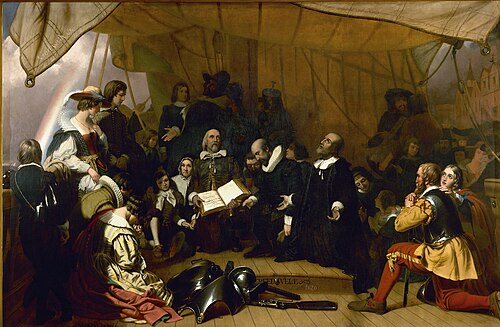
Several contemporaneous accounts of life in Plymouth Colony have become both vital primary historical documents and literary classics. Of Plimoth Plantation (1630 and 1651) by William Bradford and Mourt's Relation (1622) by Bradford, Edward Winslow, and others are both accounts written by Mayflower passengers that provide much of the information which we have today regarding the trans-Atlantic voyage and early years of the settlement.
Benjamin Church wrote several accounts of King Philip's War, including Entertaining Passages Relating to Philip's War, which remained popular throughout the 18th century. An edition of the work was illustrated by Paul Revere in 1772. The Sovereignty and Goodness of God provides an account of King Philip's War from the perspective of Mary Rowlandson, an Englishwoman who was captured and held by Philip's tribe during the war.[4]: 75, 288, 357–358 Later works have provided a romantic and partially fictionalized account of life in Plymouth Colony, such as "The Courtship of Miles Standish" by Henry Wadsworth Longfellow.[4]: 354
There are also numerous films about the Pilgrims, including the several film adaptations of "The Courtship of Miles Standish";[70] the 1952 film Plymouth Adventure starring Spencer Tracy;[71] and Desperate Crossings: The True Story of the Mayflower, a 2006 television documentary produced by the History Channel.[72]
Thanksgiving

Each year, the United States celebrates the holiday of Thanksgiving on the fourth Thursday of November. It is a federal holiday[73] and frequently involves a family gathering with a large feast, traditionally featuring a turkey. Civic recognitions of the holiday typically include parades and football games. The holiday is meant to honor the First Thanksgiving, which was a feast of thanksgiving held in Plymouth in 1621, as first recorded in the book Of Plymouth Plantation by William Bradford, one of the Mayflower pilgrims and the colony's second governor.
The annual Thanksgiving holiday is a more recent creation. Throughout the early 19th century, the U.S. government had declared a particular day as a national day of Thanksgiving, but these were one-time declarations meant to celebrate a significant event, such as victory in a battle. The northeastern states began adopting an annual day of Thanksgiving in November shortly after the end of the War of 1812. Sarah Josepha Hale, editor of Boston's Ladies' Magazine, wrote editorials beginning in 1827 which called for the nationwide expansion of this annual day of thanksgiving to commemorate the Pilgrim's first feast. After nearly 40 years, Abraham Lincoln declared the first modern Thanksgiving to fall on the last Thursday in November in 1863. Franklin Delano Roosevelt and Congress ultimately moved it to the fourth Thursday in November. After some sparring as to the date, the holiday was recognized by Congress as an official federal holiday in 1941.[74][75]
Plymouth Rock

One of the enduring symbols of the landing of the Pilgrims is Plymouth Rock, a large granodiorite boulder that was near their landing site at Plymouth. However, none of the contemporaneous accounts of the actual landing makes any mention that the Rock was the specific place of landing. The Pilgrims chose the site for their landing, not for the rock, but for a small brook nearby that was a source of fresh water and fish.[4]: 75, 78–79
The first identification of Plymouth Rock as the actual landing site was in 1741 by 90-year-old Thomas Faunce, whose father had arrived in Plymouth in 1623, three years after the Mayflower arrived. The rock was later covered by a solid-fill pier. In 1774, an attempt was made to excavate it, but it broke in two. The severed piece was placed in the Town Square at the center of Plymouth. In 1880, the intact half of the rock was excavated from the pier, and the broken piece was reattached to it. Over the years, souvenir hunters have removed chunks from the rock, but the remains are now protected as part of the complex of living history museums. These include the Mayflower II, a recreation of the original ship; Plimoth Patuxet (formerly called Plimoth Plantation),[76] a historical recreation of the original 1620 settlement; and the Wampanoag Homesite, which recreates a 17th-century Indian village.[4]: 351–356
Political legacy
The democratic setup of Plymouth Colony had a strong influence on shaping democracy in both England and America. William Bradford's Of Plimoth Plantation was widely read in England. It influenced the political thought of Puritan politician and poet John Milton, assistant to Oliver Cromwell, and philosopher John Locke. For example, Locke referred to the Mayflower Compact in his Letters Concerning Toleration.[77] In America, Plymouth Colony initiated a democratic tradition that was followed by Massachusetts Bay Colony (1628), Connecticut Colony (1636), the Colony of Rhode Island and Providence Plantations (1636), the Province of New Jersey, and Pennsylvania (1681). Roger Williams established Providence Plantations specifically as a safe haven for those who experienced religious persecution, thereby adding freedom of conscience to Plymouth's democratic model.[78]
The Mayflower Society
The General Society of Mayflower Descendants, or The Mayflower Society, is a genealogical organization of individuals who have documented their descent from one or more of the 102 passengers who arrived on the Mayflower in 1620. The Society was founded at Plymouth in 1897 and claims that tens of millions of Americans are descended from these passengers, and it offers research services for people seeking to document their descent.[79]
See also
- English colonial empire
- European colonization of the Americas
- British colonization of the Americas
- Colonial America
- Plantation (settlement or colony)
- List of colonial governors of Massachusetts (includes Plymouth)
Locations related to Plymouth Colony
- Alexander Standish House
- Burial Hill, site of the first fort at New Plymouth, originally known as Fort Hill
- Cole's Hill, contained the original cemetery at New Plymouth, later moved to Burial Hill
- First Parish Church in Plymouth, the modern descendant of the Scrooby congregation that founded Plymouth Colony
- First Parish Church (Duxbury, Massachusetts), another early congregation founded by the Pilgrims
- Harlow Old Fort House, a private house built in 1677 in Plymouth, partially out of timbers of the original fort built in 1621
- Jabez Howland House
- Jenney Grist Mill
- John and Priscilla Alden Family Sites
- Leyden Street, claimed to be the first street in Plymouth Colony
- Myles Standish Burial Ground contains remains of several important Pilgrims, including Myles Standish
- Plymouth Village Historic District
- Town Brook Historic and Archaeological District
Monuments and other commemorations
- Myles Standish Monument State Reservation
- National Monument to the Forefathers
- Pilgrim Hall Museum
- Pilgrim Monument
- Plimoth Patuxet
- Plymouth Antiquarian Society
- Plymouth Rock
Notes
- ^ The debts were paid off by working 6 days a week for the sponsors. It was not paid off until 1648 because of hardships experienced during the early years of the settlement, as well as corruption and mismanagement by their representatives.
- ^ By the third generation, the average family had 9.3 births, with 7.9 children living until adulthood. Most families had two parents, so this would extrapolate to an average of 10 people under one roof.
- ^ Deetz lists twenty towns as part of Plymouth Colony. In addition to the ones listed here, they include the towns of Edgartown and Tisbury on Martha's Vineyard, and Nantucket on its namesake island. However, several other sources note that Martha's Vineyard (Dukes County) and Nantucket Island (Nantucket County) were part of the Colony of New York prior to the Dominion (including the 1890 Massachusetts Gazetteer used here) and were not formally annexed until the 1691 charter that ended Plymouth Colony as an independent entity. Some towns north of the "Old Colony Line" may have been founded by Plymouth settlers or were temporarily administered as part of Plymouth Colony before the boundary was established with Massachusetts in 1644, such as Hull and Wessagussett.
- ^ Some confusion exists over the correct spelling of Swansea. The modern spelling is used here. Various records have listed the town as Swansea, Swanzey, Swanzea, and Swansey
- ^ There was a division of land in 1623 and a division (allotment) of cattle in 1627. See "Colonial Key Documents in Plymouth Colony Research", Plimoth Plantation™ and the New England Historic Genealogical Society®, n.d. Retrieved 3 Sept. 2018.
References
- ^ a b c d e f g h i j k l m n Deetz, James; Patricia Scott Deetz (2000). The Times of Their Lives: Life, Love, and Death in Plymouth Colony. New York: W. H. Freeman and Company. ISBN 0-7167-3830-9.
- ^ Deetz, Patricia Scott; Deetz, James F. (2000). "Passengers on the Mayflower: Ages & Occupations, Origins & Connections". The Plymouth Colony Archive Project. Archived from the original on 2010-12-02. Retrieved 2008-11-12.
- ^ a b c d e f g h i j k l m n o p q r s t u v w x y z aa ab ac ad ae af ag ah ai Demos, John (1970). A Little Commonwealth: Family Life in Plymouth Colony. New York: Oxford University Press. ISBN 978-0195128901.
- ^ a b c d e f g h i j k l m n o p q r s t u v w x y z aa ab ac ad ae af ag ah ai aj ak al am an ao ap aq ar as at au av aw ax ay az ba bb Philbrick, Nathaniel (2006). Mayflower: A Story of Courage, Community, and War. New York: Penguin Group. ISBN 0-670-03760-5.
- ^ a b c d e Addison, Albert Christopher (1911). The Romantic Story of the Mayflower Pilgrims, and Its Place in the Life of To-day. Boston: L.C. Page & Company. Retrieved 2008-11-11.
- ^ a b Rothbard, Murray (1975). ""The Founding of Plymouth Colony"". Conceived in Liberty. Vol. 1. Arlington House Publishers.
- ^ Bradford, William. Of Plymouth Plantation. New York: Dover Publications.
- ^ Donovan, Frank (1968). The Mayflower Compact. New York: Grosset & Dunlap.
- ^ a b c Bradford, William. Of Plymouth Plantation.
- ^ Donovan, Frank (1968). The Mayflower Compact. Grosset & Dunlap.
- ^ Eskridge; R., Charles. Modern Lessons From Original Steps Towards the American Bill of Rights.
- ^ Croxton, Derek (1991). "The Cabot Dilemma: John Cabot's 1497 Voyage & the Limits of Historiography". Essays in History. Corcoran Department of History at the University of Virginia. Archived from the original on March 17, 2007. Retrieved 2007-05-03.
- ^ Edney, Matthew H. "The Cartographic Creation of New England". Osher Map Library and Smith Center for Cartographic Education, University of Southern Maine. Archived from the original on April 28, 2007. Retrieved 2007-05-03.
- ^ Koplow, David A. (2003). "Smallpox The Fight to Eradicate a Global Scourge". University of California Press. Archived from the original on 2008-09-07. Retrieved 2009-02-22.
- ^ Marr, JS; Cathey, JT (2010). "New hypothesis for cause of an epidemic among Native Americans, New England, 1616–1619". Emerg Infect Dis. 16 (2): 281–6. doi:10.3201/edi1602.090276. PMC 2957993. PMID 20113559.
- ^ "Popham Colony: The First English Colony in New England". pophamcolony.org. Archived from the original on February 8, 2007. Retrieved 2007-05-03.
- ^ a b c Weinstein, Allen; David Rubel (2002). The Story of America: Freedom and Crisis from Settlement to Superpower. New York: DK Publishing. ISBN 0-7894-8903-1.
- ^ a b c Nielsen, Kim (2012). A Disability History of the United States. Boston, Massachusetts: Beacon Press. ISBN 978-080702204-7.
- ^ a b Johnson (1997), p. 37
- ^ See the editorial footnotes in: Bradford, William (1856). History of Plymouth Plantation. Boston, Massachusetts: Little, Brown, and Company. p. 96.
New Plimoth.
- ^ Patricia Scott Deetz; James F. Deetz (2000). "Mayflower Passenger Deaths, 1620–1621". The Plymouth Colony Archive Project. Retrieved 2008-11-12.
- ^ "Opinion". Archived from the original on July 13, 2009.
- ^ "Primary Sources for "The First Thanksgiving" at Plymouth". Pilgrim Hall Museum. 1998. Archived from the original on November 4, 2008. Retrieved 2008-11-12. Note: this reference contains partial transcriptions of Winslow's Mourt's Relations and Bradford's Of Plimoth Plantation, which describe the events of the First Thanksgiving.
- ^ Eric Jay Dolin. Fur, Fortune, and Empire.
- ^ a b c d Deetz, Patricia Scott; James Deetz (2000). "Population of Plymouth Town, County, & Colony, 1620–1690". The Plymouth Colony Archive Project. Archived from the original on 2011-03-02. Retrieved 2008-11-12.
- ^ Winslow, Edward (1624). Caleb Johnson (ed.). "Chapter 5". Good News From New England. The Plymouth Colony Archive Project. Retrieved 2008-11-12.
- ^ Purvis, Thomas L. (1999). Balkin, Richard (ed.). Colonial America to 1763. New York: Facts on File. pp. 128–129. ISBN 978-0816025275.
- ^ Charles Edward Banks, The English Ancestry and Homes of the Pilgrim Fathers: who came to Plymouth on the Mayflower in 1620, the Fortune in 1621, and the Anne and the Little James in 1623 (Baltimore, MD.: Genealogical Publishing Co., 2006) pp. 133, 167
- ^ With Axe and Musket at Plymouth. New York: The American Historical Society, Inc., 1936
- ^ "Residents of Plymouth according to the 1627 Division of Cattle". Plimoth Plantation: Living, Breathing History. Plimoth Plantation. Archived from the original on July 13, 2007. Retrieved 2007-05-02.
- ^ Leach, Douglas Edward (September 1951). "The Military System of Plymouth Colony". The New England Quarterly. 24 (3): 342–364. doi:10.2307/361908. JSTOR 361908. Note: login required for access
- ^ Taylor, Norris (1998). "The Massachusetts Bay Colony". Archived from the original on March 8, 2007. Retrieved 2007-03-30.
- ^ a b c "Perspectives: The Pequot War". The Descendants of Henry Doude. Archived from the original on March 15, 2007. Retrieved 2007-04-02.
- ^ a b c Aultman, Jennifer L. (2001). "From Thanksgiving to War: Native Americans in Criminal Cases of Plymouth Colony, 1630–1675". The Plymouth Colony Archive Project. Retrieved 2008-11-12.
- ^ a b c "Timeline of Plymouth Colony 1620–1692". Plimoth Plantation. 2007. Archived from the original on April 26, 2007. Retrieved 2007-04-02.
- ^ Moore, Jacob Bailey (1851). Lives of the Governors of New Plymouth and Massachusetts Bay. Boston: C. D. Strong. pp. 417–418. OCLC 11362972.
- ^ Clifton E. Olmstead, History of Religion in the United States, p. 64
- ^ a b Maxwell, Richard Howland (2003). "Pilgrim and Puritan: A Delicate Distinction". Pilgrim Society Note, Series Two. Pilgrim Hall Museum. Archived from the original on July 6, 2003. Retrieved 2003-04-04.
- ^ a b c d e f Fennell, Christopher (1998). "Plymouth Colony Legal Structure". The Plymouth Colony Archive Project. Archived from the original on 2012-04-29. Retrieved 2008-11-12.
- ^ a b c d e f g Demos, John (1965). "Notes on Life in Plymouth Colony" (PDF). The William and Mary Quarterly. 3. 22 (2) (published April 1965): 264–286. doi:10.2307/1920699. JSTOR 1920699 – via JSTOR.
- ^ Whipps, Heather (September 21, 2006). "Census: U.S. household size shrinking". NBC News. Archived from the original on February 8, 2013. Retrieved 2007-05-11. A study reported by NBC News found that the modern American household consists of 2.6 people.
- ^ Clifton E. Olmstead (1960), History of Religion in America. Prentice-Hall Inc., Englewood Cliffs, N. J., pp. 64–69. – M. Schmidt, Pilgerväter. In: Die Religion in Geschichte und Gegenwart, 3rd edition, Tübingen (Germany), Volume V, col. 384
- ^ Barck, Oscar T.; Lefler, Hugh T (1958). Colonial America. New York: Macmillan. pp. 258–259.
- ^ "Governors of Plymouth Colony". Pilgrim Hall Museum. 1998. Archived from the original on February 15, 2007. Retrieved 2007-04-02.
- ^ Clifton E. Olmstead, History of Religion in the United States, p. 10.
- ^ Clifton E. Olmstead, History of Religion in the United States, p. 67.
- ^ Johnson (1997), p. 53
- ^ a b Galle, Jillian (2000). "Servants and Masters in the Plymouth Colony". The Plymouth Colony Archive Project. Retrieved 2008-11-12.
- ^ Martucci, David (1997). "The Flag of New England". Archived from the original on April 1, 2007. Retrieved 2007-04-03.
- ^ Payne, Morse (2006). "The Survey System of the Old Colony". Slade and Associates. Archived from the original on 2007-09-28. Retrieved 2007-04-03.
- ^ "The Border is Where? Part II". The Rhode Islander: A depository of opinion, information, and pictures of the Ocean State. blogspot.com. 2007. Retrieved 2007-04-03.
- ^ a b "Town of Bristol". EDC Profile. Rhode Island Economic Development Corporation. 2007. Archived from the original on July 4, 2007. Retrieved 2007-07-13.
- ^ a b c d e f g h i j k l m n o p q r Nason, Elias; Varney, George (1890). A gazetteer of the state of Massachusetts : with numerous illustrations. Gazetteer of Massachusetts. Boston: B.B. Russell. Retrieved March 10, 2021.
{{cite book}}:|work=ignored (help) - ^ "Rochester (MA) Town History". Town of Rochester, Massachusetts. 2007. Archived from the original on 2007-08-23. Retrieved 2007-07-13.
- ^ Rochester was later transferred to Plymouth County some time after 1689; at the time of incorporation, however, it was part of Barnstable County. See: Freeman, Frederick (1860). History of Cape Cod. Vol. 1. Boston: Geo C. Rand & Avery & Cornhill. p. 312. Retrieved 2008-11-21.
- ^ "The Little Compton Historical Society Home Page". The Little Compton Historical Society. 2005. Archived from the original on June 8, 2007. Retrieved 2007-07-13.
- ^ Nason, Elias; Varney, George G. "Plymouth Massachusetts, 1890". Cape Cod History. Archived from the original on 2007-09-27. Retrieved 2023-03-15.
- ^ a b David Lindsay, Mayflower Bastard: A Stranger amongst the Pilgrims (St. Martins Press, New York, 2002) pp. x, xvi.
- ^ Donald F. Harris, The Mayflower Descendant (July 1993), vol. 43, no. 2, p. 124
- ^ Morison & Commager, The Growth of the American Republic (4th ed., New York, 1950), vol. 1, p.40
- ^ Cline, Duane A. (2006). "The Pilgrims and Plymouth Colony: 1620". Rootsweb. Retrieved 2007-04-04.
- ^ Chartier, Charles S. "Livestock in Plymouth Colony". Plymouth Archaeological Rediscovery Project. Retrieved 2007-05-03.
- ^ Johnson (1997), pp. 36–37
- ^ Barth 2014, p. 499
- ^ Clarke, Hermann F. (1937). "John Hull: Mintmaster". The New England Quarterly. 10 (4): 669, 673. doi:10.2307/359931. JSTOR 359931.
- ^ Barth 2014, p. 500
- ^ Barth 2014, p. 514
- ^ Barth 2014, p. 520
- ^ "History Paintings". Pilgrim Hall. 1998. Archived from the original on April 3, 2007. Retrieved 2007-04-05.
- ^ "IMDB search: Miles Standish". IMDB. Retrieved 2007-04-05.
- ^ "Plymouth Adventure (1952)". IMDB. 28 November 1952. Retrieved 2007-04-05.
- ^ "The Mayflower (2006)". IMDB. 23 November 2006. Retrieved 2007-04-05.
- ^ "2007 Federal Holidays". U.S. Office of Personnel Management. Retrieved 2007-04-04.
- ^ Wilson, Jerry (2001). "The Thanksgiving Story". Wilstar. Retrieved 2007-04-05.
- ^ "History of Thanksgiving: A Timeline". Twoop. 2006. Archived from the original on 2007-08-06. Retrieved 2023-03-15.
- ^ "Commemorating 400 Years, Reflecting On Our Mission" (Press release). Plimoth Patuxet. 6 July 2020. Archived from the original on 22 November 2021. Retrieved 11 May 2022.
- ^ Jeremy Waldron (2002), God, Locke, and Equality. Cambridge University Press. Cambridge, UK. ISBN 978-0-521-89057-1, pp. 223–224
- ^ Clifton E. Olmstead, History of Religion in the United States, pp. 74–75, 102–105, 114–117.
- ^ "The Mayflower Society Home Page". General Society of Mayflower Descendants. 2006. Archived from the original on 2016-11-20. Retrieved 2007-07-13.
Works cited
- Addison, Albert Christopher (1911). The Romantic Story of the Mayflower Pilgrims, and Its Place in the Life of To-day. Boston: L.C. Page & Company. Retrieved 2008-11-11.
- Barth, Jonathan Edward (2014). "'A Peculiar Stampe of Our Owne': The Massachusetts Mint and the Battle over Sovereignty, 1652–1691". The New England Quarterly. 87 (3): 490–525. doi:10.1162/TNEQ_a_00396. hdl:2286/R.I.26592. JSTOR 43285101. S2CID 57571000.
- Deetz, James; Patricia Scott Deetz (2000). The Times of Their Lives: Life, Love, and Death in Plymouth Colony. New York: W. H. Freeman and Company. ISBN 0-7167-3830-9.
- Demos, John (1970). A Little Commonwealth: Family Life in Plymouth Colony. New York: Oxford University Press.
- Demos, John (1965). "Notes on Life in Plymouth Colony" (PDF). The William and Mary Quarterly. 3. 22 (2) (published April 1965): 264–286. doi:10.2307/1920699. JSTOR 1920699 – via JSTOR.
- Johnson, Paul (1997). A History of the American People. New York: HarperCollins. ISBN 0-06-016836-6.
- Philbrick, Nathaniel (2006). Mayflower: A Story of Courage, Community, and War. New York: Penguin Group. ISBN 0-670-03760-5.
- Weinstein, Allen; David Rubel (2002). The Story of America: Freedom and Crisis from Settlement to Superpower. New York: DK Publishing. ISBN 0-7894-8903-1.
External links

Wikivoyage has a travel topic for Plymouth Colony.
- Colonial America: Plymouth Colony 1620—A short history of Plymouth Colony hosted at U-S-History.com, includes a map of all of the New England colonies.
- The Plymouth Colony Archive Project Archived 2013-03-04 at the Wayback Machine—A collection of primary sources documents and secondary source analysis related to Plymouth Colony.
- Pilgrim ships from 1602 to 1638—Pilgrim ships searchable by ship name, sailing date and passengers.
- History of the Town of Plymouth 1620...—Free Google eBook; PDF format
.svg/500px-North_America_(orthographic_projection).svg.png)