
Loading article…
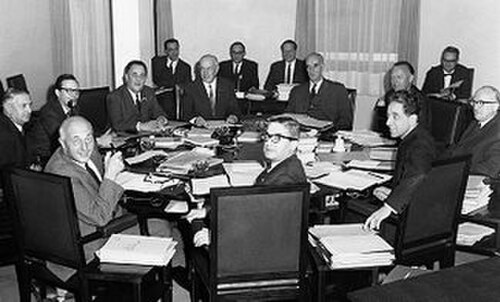
ハルシュタイン委員会は、1958年1月7日から1967年6月30日まで、欧州経済共同体(EEC)の欧州委員会として機能した。委員長はヴァルター・ハルシュタインで、2つの任期を務めた。
1965年、フランスのシャルル・ド・ゴール大統領はハルシュタインが提案した共通農業政策を拒否し、「空席危機」を引き起こした。フランスはボイコットを行い、ブリュッセル駐在の代表を召還し、閣僚理事会の議席に着くことを拒否した。この危機は1966年、加盟国が「極めて重要な国益」とみなされる事項について拒否権を持つというルクセンブルク妥協によって解決された。
欧州経済共同体の最初の委員会であり、1958 年 1 月 16 日にヴァル・デュシェス城で最初の正式な会合が開かれた。[ 1 ]後継はレイ委員会であった。2 期を務め、9 人の委員 (フランス、イタリア、ドイツからそれぞれ 2 人、ルクセンブルク、ベルギー、オランダからそれぞれ 1 人) で構成されていた。[ 2 ]欧州単一市場と共通農業政策の作業を開始した。[ 3 ]委員会は、ド・ゴールが英国の加盟に拒否権を行使した後に達成した穀物価格協定など、多くの成功を収めた。ド・ゴールは委員会の主要な反対者であり、穀物価格協定などの提案は、フランスを EEC にさらに強く結びつけ、EEC の解体を困難にすることを目的としていた。委員会の活動は、加盟国だけでなく、ケネディ ラウンドでデビューした際には共同体外からも尊敬と名声を得た。[ 4 ]
In 1965 president Hallstein put forward the commission's proposals for financing the Common Agricultural Policy (CAP). The proposals would have allowed the community to develop its own financial resources, independently of the states, and given more budgetary powers to parliament. Furthermore, though, it applied the majority voting into the council, which the government of France stated it could not agree to.[5] Hallstein knew of the risky nature of the proposals and was unusually active in drafting them (they would normally have been drafted by the agriculture commissioner). The tone of internal deliberations at the time also show the institution was aware of what they would cause and some commissioners (notably both the French commissioners) were opposing the plans. However, they were also seen as vital for the commission's long-term goals.[4]
The legislation would increase not only the commission's powers, but also the parliament's in an attempt to build a supranational structure and be rid of the power of veto. Because of this president Hallstein won support from the parliament who had long been campaigning for more powers. Indeed, Hallstein played to the parliament by presenting his policy to the Parliament on 24 March, a week before he presented them to the council. By this he associated himself with the Parliament's cause and demonstrated how he thought the community ought to be run, in the hopes of generating a wave of pro-Europeanism big enough to get past the objections of member states. However, in this it proved that, despite its past successes, Hallstein was overconfident in his risky proposals.[4] When Hallstein put forward his proposals, the council was already troubled.[4] Then-French President, Charles de Gaulle, was sceptical of the rising supranational power of the commission and accused Hallstein of acting as if he were a head of state. France was particularly concerned about protecting the CAP as it was only accepted by the other states after difficult negotiations and under a majority system it may be challenged by the other members.[5]
フランスと委員会との間の同様の相違は、フランスが議長国に就任したことで悪化し、[ 5 ]通常の調停システムが失われた。さらに、議論がフランスと他の加盟国との間のものとなり、理事会が議論の中心となったため、委員会は疎外された。そのため、委員会の専門知識を活用して提案を作成する機会は失われた。[ 4 ]最終的に、1965年6月30日、パリはブリュッセルの代表を召還し、自国の要求が通るまで理事会の議席には着かないと表明した。この「空席危機」(フランス語:Crise de la chaise vide)は、加盟国が原因でEECの運営が失敗した最初の事例であり[ 5 ]、理事会の運営上の欠陥を露呈した。[ 4 ]
パリは6か月間その政策を継続したが、経済への影響により交渉に戻らざるを得なくなった。1966年1月にルクセンブルクで会合が開かれ、合意に達した。「ルクセンブルク妥協」の下では、加盟国は自国の国益に影響を与えると考える決定に拒否権を行使できるが、どのような国益なのか、また紛争をどのように解決するのかについては詳細が規定されていなかった。しかし、その後、この拒否権は頻繁に行使されたため、理事会での全会一致を常態化させる拒否権となり、単一欧州議定書の下で廃止された。[ 6 ]危機後、委員会は理事会のスケープゴートとなり、ジャック・ドロールが登場するまで最も「ダイナミック」なリーダーであったにもかかわらず、理事会が任期更新を拒否したため、ハルシュタインは今回の出来事で職を失った唯一の人物となった。[ 4 ]
最初のカレッジは1958年1月1日から1962年1月9日まで運営された。
政治的傾向: [ 3 ] 左派 – [ 1 ] 中道 – [ 5 ] 右派 – [ 0 ]不明
2番目のカレッジは、1962年1月9日から1967年6月30日まで運営された。
政治的傾向: [ 3 ] 左派 – [ 1 ] 中道 – [ 5 ] 右派 – [ 0 ]不明