
Loading article…
| 共通安全保障防衛政策 (欧州防衛同盟) | |
|---|---|
 | |
| 設立 | 1999年(欧州安全保障防衛政策として) |
| 現在のフォーム | 2009年(リスボン条約) |
| 本部 | 軍事(MPCC) および民間(CPCC) の計画および実施能力、コルテンベルグ ビル、ブリュッセル、ベルギー |
| Webサイト | 欧州連合 |
| リーダーシップ | |
| 高等代表 | ジョセップ・ボレル |
| 軍事参謀総長 | エサ・プルッキネン中将 |
| 軍事委員会委員長 | ロバート・ブリーガー将軍 |
| 人事 | |
| 現役職員 | 1,410,626 (2016) [1] |
| 予備役 | 2,330,803 |
| 支出 | |
| 予算 | 2,234億ユーロ(2,493億ドル)(2018年)[2] |
| GDPの割合 | 1.5% (2020) [3] |
| 関連記事 | |
| 歴史 | 共通安全保障防衛政策の歴史 |
共通安全保障防衛政策(CSDP)は、防衛と危機管理の分野における欧州連合(EU)の行動方針であり、EUの共通外交安全保障政策(CFSP)の主要な構成要素です。
CSDPには、国連憲章の原則に従い、平和を維持し、紛争を予防し、国際安全保障を強化するための軍事または民間のミッションの展開が含まれます。軍事ミッションは、加盟国の軍隊からの出向により設立されたEU軍によって実行されます。CSDPには、加盟国間の集団的自衛権[a]と、27か国の軍隊のうち26か国が構造的統合を追求する常設構造的協力(PESCO)も含まれています。EUの上級代表(HR/VP)のジョセップ・ボレルが率いるCSDPの構造は、 EUの防衛部門としての将来的な発展に関連して欧州防衛同盟( EDU )と呼ばれることもあり[4]、[5] [6] [b]、次のもので構成されています。
- 欧州委員会の防衛産業総局
- 対外行動庁(EEAS)の危機管理計画局(CMPD)と、軍/民間戦略レベルの指揮統制(C2)のための常設作戦本部(OHQ) 、すなわちMPCCとCPCC。
- 軍事委員会(EUMC)などの外務理事会(FAC)準備機関の数
- 防衛庁(EDA)を含む4つの機関
EUの指揮統制構造は、領土防衛のために設立された北大西洋条約機構(NATO)の指揮統制構造(NCS)よりもはるかに小さい。NATOの同盟軍作戦指揮部(ACO)をEUの任務遂行に利用できることが合意されている。2017年に設立され、2020年に強化される予定のMPCCは、EU初の常設軍事OHQである。同時に、新たに設立された欧州防衛基金(EDF)は、 EU予算が多国籍防衛プロジェクトの資金として使用される初めてのケースとなる。
CSDPに関する決定は上級代表によって提案され、外務理事会で採択され、通常は全会一致で採択され、その後上級代表によって実施される。
歴史
戦後は、ソ連やドイツの潜在的な侵略から守ることを目的とした、ヨーロッパ防衛統合に向けた短命または不運な取り組みがいくつかありました。西側連合(WU、ブリュッセル条約機構、BTOとも呼ばれる) と提案された欧州防衛共同体(EDC) は、それぞれ北大西洋条約機構(NATO) によって吸収され、フランス議会によって拒否されました。ほとんど活動休止状態にあった西欧連合(WEU) は、1955 年に WU の残りを引き継ぎました。
1970 年、欧州政治協力(EPC) により、欧州共同体(EC) の最初の外交政策調整が実現しました。安全保障と防衛の問題を EPC に追加することに対する反対により、EC 加盟国でもある WEU 加盟国は 1984 年に WEU を再開しました。
欧州防衛統合は、冷戦終結後すぐに勢いを増したが、これはECがユーゴスラビア戦争を阻止できなかったことが一因である。1992年、WEUに新たな任務が与えられ、翌年マーストリヒト条約でEUが設立され、EPCに代わって共通外交安全保障政策(CFSP)が柱となった。1996年、NATOはWEUがいわゆる欧州安全保障防衛アイデンティティ(ESDI)を開発することに同意した。[7] 1998年のサン・マロ宣言は、伝統的に消極的だった英国がEUに自律的な防衛構造を提供する用意があることを示した。 [8]これにより、1999年にESDIがEUに移管され、欧州安全保障防衛政策(ESDP)へと変貌することが促進された。2003年、EUは最初のCSDPミッションを展開し、共通の脅威と目標を特定する欧州安全保障戦略を採択した。 2009年、リスボン条約は現在の名称であるCSDPを導入し、EEAS、相互防衛条項を確立し、一部の加盟国がPESCO内で防衛統合を追求できるようにした。2011年、EUに任務が移管されていたWEUは解散した。2016年に新しい安全保障戦略が導入され、ロシアのクリミア併合、英国のEU離脱、トランプの米国大統領選出とともに、CSDPに新たな弾みがついた。
展開

1999年の意図表明に続き、ESDPの下での欧州軍の最初の展開は、2003年3月のマケドニア共和国(現在の北マケドニア)であった。コンコルディア作戦はNATOの資産を活用し、成功とみなされ、その年の後半に小規模な警察ミッションであるEUPOLプロキシマに置き換えられた。それ以来、他の小規模な警察、司法、監視ミッションが実施されている。マケドニア共和国と同様に、EUはアルテア作戦の一環としてボスニア・ヘルツェゴビナに平和維持軍の展開を維持している。[9]
2003 年 5 月から 9 月にかけて、EU 軍は、イトゥリ紛争におけるさらなる残虐行為と暴力行為を防ぎ、コンゴ民主共和国の和平プロセスを軌道に戻すことを目的とした国連安全保障理事会決議 1484の任務の下、 「アルテミス作戦」中にコンゴ民主共和国に派遣されました。これにより、将来の派遣で使用される「枠組み国家」システムが確立されました。EU は、2006 年 7 月から 11 月にかけて、EUFOR RD コンゴとともにコンゴ民主共和国に戻り、同国の選挙期間中、 国連ミッションを支援しました。
地理的に見ると、EUのバルカン半島およびコンゴ民主共和国以外のミッションは、ジョージア、インドネシア、スーダン、パレスチナ、ウクライナ・モルドバで実施されている。また、イラクには司法ミッション(EUJUST Lex )がある。2008年1月28日、EUはアフリカに最大かつ最も多国籍なミッションであるEUFORチャド/RCAを派遣した。[10]国連の委託を受けたこのミッションには、25のEU加盟国(19が現地派遣)の部隊が参加し、チャド東部および中央アフリカ共和国北東部の地域に派遣され、これらの地域の治安改善に努めている。EUFORチャド/RCAは2008年9月中旬に完全作戦能力に達し、2009年3月中旬に治安任務を国連(MINURCATミッション)に引き渡した。[11]
EUは2008年12月12日、初の海上CSDP作戦(アタランタ作戦)を開始した。この作戦をきっかけに欧州連合海軍部隊(EU NAVFOR)の構想が生まれ、10年近くたった今もソマリア沖の海賊対策に成功している。2度目の介入は2015年に地中海南部の移民問題に取り組むため開始され(EUNAVFOR Med)、SOPHIA作戦という名称で活動している。
これまでに展開されたCSDPミッションのほとんどは、ホスト国の安全保障セクター改革(SSR)を支援することを任務としている。SSRに対するCSDP支援の核となる原則の1つは、現地のオーナーシップである。EU理事会は、オーナーシップを「共通に合意された目的と原則を現地当局が充当すること」と定義している。 [12] EUは現地のオーナーシップ原則を強く主張しているが、調査によると、CSDPミッションは依然として外部主導、トップダウン、供給主導の取り組みであり、その結果、現地の参加度が低いことが多い。[13]
構造
_Hearing_of_Josep_Borrell,_High_Representative_Vice_President-designate,_A_stronger_Europe_in_the_World_(48859228793)_(cropped).jpg/500px-(Josep_Borrell)_Hearing_of_Josep_Borrell,_High_Representative_Vice_President-designate,_A_stronger_Europe_in_the_World_(48859228793)_(cropped).jpg)
CSDPには、国連憲章の原則に従い、平和を維持し、紛争を予防し、国際安全保障を強化するために展開される軍事または民間のミッションが含まれます。軍事ミッションは、加盟国の軍隊からの寄付で設立されたEU軍によって実行されます。CSDPには、加盟国間の集団的自衛[a]と、27の国の軍隊のうち26が構造的統合を追求する常設構造的協力(PESCO)も含まれます 。EUの上級代表(HR / VP)であるジョセップ・ボレルが率いるCSDPの構造は、次のもので構成されています。
- 欧州委員会防衛産業総局
- 対外行動庁(EEAS)の関連部門(いわゆる軍事計画・行動能力(MPCC)を備えた軍事スタッフ(EUMS)を含む)
- 軍事委員会(EUMC)などの外務理事会(FAC)準備機関の数
- 防衛庁(EDA)を含む4つの機関
EUには指揮統制(C2)構造があるが、北大西洋条約機構(NATO)の同盟軍作戦司令部(ACO)のような常設の軍事構造はない。ただし、ACOの資源をEUのCSDPミッションの遂行に使用できることは合意されている。2017年に設立され、2020年に強化される予定のMPCCは、EUが常設の軍事本部を整備する第一歩となる。同時に、新設された欧州防衛基金(EDF)は、EUの予算が多国籍防衛プロジェクトの資金として使われる初めてのケースとなる。CSDP構造は、特にEUの防衛部門としての将来的な発展に関連して、欧州防衛連合(EDU )と呼ばれることもある。 [4] [5] [6] [c]
CSDP に関する決定は、HR/VP によって提案され、FAC によって採択され (通常は全会一致が必要)、その後 HR/VP によって実行されます。 EUの指揮統制(C2)構造は加盟国の代表者で構成される政治機関によって指揮され、通常は全会一致の決定が必要である。2019年4月現在:[14]
- 連絡担当者: アドバイスと推奨事項 サポートと監視 準備作業
- 1 CSDP 民間ミッションも現地に派遣される場合、民間計画・実施能力(CPCC) とその民間作戦指揮官 (Civ OpCdr)、および下位のミッション長 (HoM) との関係は、図に示すように調整されます。
- 2設置される可能性のある その他の構成司令官(CC)およびサービス部門。
- 3 MPCC は EUMS の一部であり、Dir MPCC は DGEUMS を兼任しています。MPCC が作戦本部 (OHQ) として使用されない場合、加盟国が提供する国家 OHQ またはNATO指揮構造 (NCS) のいずれかがこの目的を果たします。後者の場合、 Dir MPCC ではなく、欧州連合軍副最高司令官(DSACEUR) が作戦司令官 (OpCdr) を務めます。
- 4 MPCC が作戦本部 (OHQ) として使用されていない限り、MFCdr は部隊司令官 (FCdr) として知られ、MFHQ ではなく部隊本部 (FHQ) を指揮します。MFHQ は作戦レベルと戦術レベルの両方で機能しますが、FHQ は純粋に作戦レベルで機能します。
- 5 政治戦略レベルは、C2 構造自体の一部ではありませんが、ミッションの全体的な方向性を決定する関連サポート施設を備えた政治機関を表しています。理事会は、上級代表(HR/VP)の役割を決定します。上級代表は、欧州委員会の副委員長を務め、欧州理事会の会議に出席し、外務理事会(FAC) の議長を務め、危機時には政治安全保障委員会(PSC) の議長を務めることもあります。HR/VP は、CSDP の決定を提案し、実施します。
- 6常任代表委員会(COREPER)II と同じ構成で、FACのCSDP関連の作業も準備します。
戦略
欧州連合グローバル戦略(EUGS)は、加盟国の防衛と安全保障、民間人の保護、加盟国の軍隊間の協力、移民や危機の管理など、CSDPの有効性を向上させるためにEUが更新した教義である。2016年6月28日に採択され、[15] 2003年の欧州安全保障戦略に代わるものである。EUGSは、「安全保障と防衛に関する実施計画」(IPSD)と題する文書によって補完されている。 [16] 抑止理論は、共通安全保障防衛政策の中核的任務の1つとして侵略者を抑止するために適用されているが、リソース不足のために信頼性に欠けている。[17]
力
軍事機動性とサイバーレジリエンスに関する新たな行動計画が2022年11月10日に発表された。[18]
全国
各国軍人員合計(2016年)[19]
CSDPは、欧州連合条約(TEU)に基づき集団的自衛権の義務も負っている加盟国の軍隊からの民間および軍事的貢献によって実施される。
EUの5カ国が核兵器を保有している。フランスは独自の核計画を持っており、ベルギー、ドイツ、イタリア、オランダはNATOの核共有政策の一環として米国の核兵器を保有している。EUは合わせて300個の核弾頭を保有しており、90個から130個の米国の核弾頭を保有している。イタリアは70個から90個のB61核爆弾を保有しており、ドイツ、ベルギー、オランダはそれぞれ10個から20個を保有している。[20] EUは米国とロシアに次いで3番目に大きい核兵器庫を保有している。
支出と人員
以下の表は、欧州連合加盟国の軍事費をユーロ(€)で示したものです。加盟国の合計軍事費は2018年に2,234億ユーロに達しました。 [2]これは、欧州連合のGDPの1.4%に相当します。欧州の軍事費には、ユーロファイター タイフーンなどの共同プロジェクトや装備品の共同調達への支出が含まれます。2016年の欧州連合の現役軍人員は合計1,410,626人でした。[1]
2012年の演説で、スウェーデンのホーカン・シレン将軍は、欧州連合諸国の軍事支出レベルを批判し、将来的にこれらの国の軍事力が低下し、「重大な不足」が生じると述べた。[21]
表のガイド:
- 以下の表の数字はすべて、2016 年のドイツの人員数を除き、欧州防衛機関によって 2017 年に提供されたものです。他のソースからの数字は含まれていません。
- 「運用および保守支出」カテゴリには、状況によっては、国の防衛予算に加えて資金も含まれる場合があります。
- 「展開作戦に備えた部隊」および「展開および持続作戦に備えた部隊」のカテゴリには、陸軍要員のみが含まれます。
海軍
_underway_2009.jpg/500px-Charles_De_Gaulle_(R91)_underway_2009.jpg)
加盟国の海軍力を合わせた構成兵力は、就役中の軍艦約514隻である。就役中の軍艦のうち4隻は空母である。EUにはまた、4隻の強襲揚陸艦と20隻の揚陸支援艦が就役している。EUの潜水艦49隻のうち、10隻は原子力潜水艦で、39隻は通常攻撃型潜水艦である。
アタランタ作戦(正式名称は欧州連合ソマリア海軍部隊)は、欧州連合初の(そして現在も継続中の)海軍作戦である。これは、ソマリア危機に対処するためにアフリカの角で EU が行っているより大規模な世界的活動の一部である。2011 年 1 月現在、23 の EU 諸国がこの作戦に参加している。
フランスとイタリアは外洋海軍を持っている。[22]
表のガイド:
- 儀式船、調査船、補給船、訓練船、砕氷船は含まれません。
- この表には就役中(または同等)かつ活動中の軍艦のみをカウントします。
- 他の特性にかかわらず、排水量200トン未満の水上船舶は含まれません。
- 「揚陸支援艦」には、揚陸用ドック型輸送艦やドック型揚陸艦、戦車揚陸艦などが含まれます。
- 6,000トンを超えるフリゲート艦は駆逐艦に分類されます。
- 「巡視船」のカテゴリーにはミサイル艇も含まれます。
- 「対機雷艦」のカテゴリーには、機雷掃海艇、掃海艇、掃海艇が含まれます。
- 一般的に、船舶の総トン数は船舶の総数よりも重要であり、能力のより良い指標となる。
陸軍

欧州連合加盟国は合計すると、さまざまな陸上軍用車両や兵器を大量に保有しています。
表のガイド:
- この表は網羅的なものではなく、主に欧州通常戦力条約(CFE条約)に基づく車両とEU- NATO加盟国が含まれています。特に指定がない限り。
- CFE 条約には、ヨーロッパ内に配備されている車両のみが含まれ、海外で作戦中の車両はカウントされません。
- 「主力戦車」のカテゴリーには、駆逐戦車(イタリアのB1 チェンタウロなど)や、強力な火力を備えた自走装甲戦闘車両も含まれます。CFE 条約による。
- 「装甲戦闘車両」のカテゴリーには、主に歩兵の輸送用に設計され、少なくとも口径 20 mm の自動砲を装備した装甲車両が含まれます。CFE 条約による。
- 「砲兵」カテゴリには、口径 100 mm 以上の自走式または牽引式の榴弾砲および迫撃砲が含まれます。他の種類の砲兵は、特性に関係なく含まれません。CFE 条約による。
- 「攻撃ヘリコプター」のカテゴリには、標的を攻撃するために武装および装備されているか、または他の軍事機能を実行するために装備されている回転翼航空機(アパッチやワイルドキャットなど)が含まれます。CFE条約による。
- 「軍用物流車両」カテゴリには、軍事任務のために特別に設計された 4 トン、8 トン、14 トン以上の物流トラックが含まれます。CFE 条約の対象ではありません。
空軍
EU加盟国の空軍は、幅広い軍事システムとハードウェアを運用している。これは主に各加盟国の独自の要件と、一部の加盟国の国防産業によるものである。しかし、ユーロファイター タイフーンやユーロコプター タイガーなどのプログラムでは、多くのヨーロッパ諸国が単一の兵器プラットフォームを設計、構築、運用している。戦闘機全体の60%は加盟国によって開発、製造されており、32%は米国製だが、これらの一部はヨーロッパで組み立てられ、残りの8%はソビエト製の航空機である。2014年時点で、欧州連合には約2,000機の使用可能な戦闘機(戦闘機と地上攻撃機)があると推定されている。[46]
EUの空輸能力は、将来的にエアバスA400M(EU防衛協力のもう一つの例)が導入されることで進化している。A400Mは戦略的な能力を備えた戦術輸送機である。 [47]当初は5つの加盟国(ルクセンブルク、フランス、ドイツ、スペイン、ベルギー)で約140機が運用される予定である。
表のガイド:
- 表は、Flight Internationalが2020 年に提供した数字に基づいています。
- 航空機は主に 3 つのタイプに分類されます (色で示されます)。赤は戦闘機、緑は空中給油機、灰色は戦略および戦術輸送機です。
- 2 つの「その他」列には、色別に分類されたタイプ別の追加航空機が含まれます (つまり、赤色の「その他」カテゴリには戦闘機が含まれ、灰色の「その他」カテゴリには空中給油機と輸送機の両方が含まれます)。これは、すべての航空機タイプに独自の列を割り当てることが現実的ではなかったために行われました。
- 練習機、ヘリコプター、無人航空機、偵察機、監視機などのその他の航空機は、以下の表や図には含まれていません。
- 戦闘機と地上攻撃機
- 空中給油と輸送
多国籍
連合レベルで設立
.jpg/500px-Nordic_Battle_Group_ISTAR_Training_(5014209533).jpg)
ヘルシンキ・ヘッドライン目標カタログは、欧州連合によって管理されているが、欧州連合に軍隊を派遣する国々の管理下にある6万人の軍隊で構成される 即応部隊のリストである。
連合レベルで導入された部隊には以下のものが含まれます。
- 戦闘グループ(BG)はCSDPを遵守し、加盟国の連合からの貢献に基づいています。18の戦闘グループはそれぞれ、戦闘支援要素で強化された大隊規模の部隊(1,500人の兵士)で構成されています。 [51] [52]グループは常に交代制で、2つのグループが常に展開できる状態にあります。部隊は欧州連合理事会の直接管理下にあります。戦闘グループは2007年1月1日に完全な作戦能力に達しましたが、2013年1月現在、まだ軍事行動には参加していません。[53]これらは欧州連合(EU)が行っている既存の臨時任務に基づいており、ヨーロッパの新しい「常備軍」であると説明されているものもあります。[52]兵士と装備は「主導国」の下にあるEU加盟国から集められます。 2004年、国連事務総長コフィー・アナン氏はこの計画を歓迎し、紛争地帯への国連の取り組みを支援する戦闘グループの価値と重要性を強調した。[54]
- 医療司令部(EMC )は、 EUの任務を支援するために計画された医療司令センターであり、常設構造化協力(PESCO)の一環として設立されました。[55] EMCは、医療資源や迅速に展開可能な医療タスクフォースなど、海外での活動を支援するための常設の医療能力をEUに提供します。EMCはまた、医療避難施設、トリアージと蘇生、任務に復帰するまでの患者の治療と拘束、緊急歯科治療も提供します。また、医療基準、認証、法的(民事)枠組み条件の調和にも貢献します。[56]
- 危機対応作戦中核部隊(EUFOR CROC )は、常設構造化協力(PESCO)の一環として開発中の旗艦防衛プロジェクトである。EURFOR CROCは、軍事力の提供とEUの危機管理能力を迅速化するための「フルスペクトラムの軍事力パッケージ」の作成に貢献する。 [57]このプロジェクトは常備軍を創設するのではなく、EUが作戦開始を決定したときに部隊の設立を迅速化するための軍事力要素の具体的なカタログを作成することを含む。これは陸上に重点を置き、参加国だけで6万人の軍隊を編成することを目指している。いかなる形の「欧州軍」も創設しないが、単一の指揮下で展開可能で相互運用可能な部隊を想定している。[58]このプロジェクトの主導国はドイツだが、フランスも深く関与しており、これはエマニュエル・マクロン大統領の常備介入部隊創設の提案と結びついている。フランスはこれをPESCOの目的の1つとみなしている。[59]
TEU第42条3項により規定

このセクションでは、一部の加盟国の間で政府間で設立された部隊および組織の不完全なリストを示します。これらの組織は、加盟国の集団協定に基づいて部隊を展開します。これらは通常、技術的には、NATO、国際連合、欧州連合(EU) (TEU の第 42.3 条に基づく)、欧州安全保障協力機構、またはその他の国際機関の支援の下で展開できるものとしてリストされています。
しかし、欧州軍団を除いて、実際の軍事作戦に派遣された部隊はごくわずかであり、CSDP の下では歴史上一度も派遣されたことはない。
陸軍:
- ユーロコープスは、フランスのストラスブールに駐留する約1,000人の兵士からなる軍団である。フランスのストラスブール市に拠点を置くこの軍団は、フランス・ドイツ旅団の中核をなしている。[60]
- 第1ドイツ/オランダ軍団は、オランダ軍とドイツ軍の部隊から構成される多国籍軍です。NATO即応部隊の司令部としての役割を担っているため、他のNATO加盟国、米国、デンマーク、ノルウェー、スペイン、イタリア、英国などの兵士もミュンスターに駐留しています。
- デンマーク・ドイツ・ポーランドの多国籍軍である北東多国籍軍団
- 欧州憲兵隊は、危機管理を専門とする軍事警察機能を備えた介入部隊である。[61]
航空写真:
- 欧州航空輸送司令部は、参加国の空中給油能力と軍用輸送艦隊の大部分の運用管理を行っている。オランダのアイントホーフェン空軍基地に所在する同司令部は、演習、航空乗務員の訓練、関連する国内航空輸送規制の調和についても限定的に責任を負っている。[62] [63] 同司令部は、この分野における参加国の資産と資源のより効率的な管理を提供するために2010年に設立された。
海軍:
- 欧州海上軍(EUROMARFORまたはEMF )は、命令を受けてから5日以内に活動を開始し、海軍、航空軍、水陸両用作戦を実行できる非常勤の[64]軍事力[65]である。[66] この部隊は、ペータースベルク宣言で定義された海上制圧、人道活動、平和維持活動、危機対応活動、平和執行などの任務を遂行するために1995年に結成された。
NATOへの参加、関係
EU加盟27カ国のうち、23カ国はNATO加盟国でもある。NATO加盟国のうち、アルバニア、モンテネグロ、北マケドニア、トルコの4カ国はEU加盟申請中である。アイスランドとノルウェーの2カ国はEU域外に留まることを選択しているが、EU単一市場に参加している。EUとNATOの加盟国としての立場は明確であり、EU加盟国の中には伝統的に防衛問題に関しては中立の立場をとる国もある。EU加盟国の中には、かつてワルシャワ条約機構に加盟していた国もいくつかある。デンマークはCSDPから脱退したが[1]、2022年に国民投票でこの政策分野への参加を決定した。
非ヨーロッパ諸国
大陸横断諸国
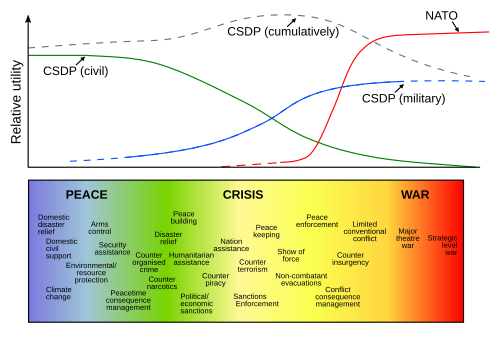
The Berlin Plus agreement is the short title of a comprehensive package of agreements made between NATO and the EU on 16 December 2002.[67] These agreements were based on conclusions of NATO's 1999 Washington summit, sometimes referred to as the CJTF mechanism,[68] and allowed the EU to draw on some of NATO's military assets in its own peacekeeping operations.
EUCAP Somalia
The EUCAP Somalia[69] is an example of a non-executive, civilian Common Security and Defence Policy (CSDP) Mission aimed at strengthening maritime security capacities, police sector, as well as promoting the Rule of Law in Somalia.[70] It provides strategic level advice, mentoring and training, on issues ranging from coast guard and police functions to police-prosecution cooperation and the drafting of laws. Initially launched as EUCAP Nestor[71] in 2012, the mission was reconfigured to focus on Somalia, thus renamed by the Council of the European Union, EUCAP Somalia in 2016.
Background
The mission was established in response to the persistent challenges posed by maritime insecurity in the Western Indian Ocean, particularly piracy, illegal fishing, human trafficking, and arms smuggling. These issues severely impacted both the security and economic stability of Somalia and the surrounding region. Somalia’s extensive coastline (the longest in mainland Africa) was unprotected for years due to the collapse of the government in the early 1990s.[72] Piracy flourished in the absence of effective maritime governance, leading to international efforts to assist the country in reclaiming control over its waters. EUCAP Somalia emerged as part of these efforts, complementing other international missions such as Operation Atalanta and EUTM Somalia.
Mandates
From 2012 to 2016
EUCAP Nestor's mandate is divided into two objectives: strengthening the maritime capacities of the beneficiary countries (excluding Somalia) and training a coastal police force and judges in Somalia, the primary aim being to get the countries in the region to work together to strengthen action at sea. EUCAP Nestor operates in five countries: Djibouti, Kenya, Seychelles, Somalia (Puntland/Somaliland) and Tanzania. This is why it is relatively large in terms of staff numbers, with almost 200 people spread across the different countries. These experts will provide legal, strategic and operational advice on maritime safety.[73]
From 2016 to 2021
When the name was changed in December 2016, so too was the mandate. EUCAP Somalia will drop its regional ambitions and focus solely on Somalia, and more specifically on the Coast Guard, with a view to strengthening ‘Somali maritime law enforcement capabilities’. The mandate is not limited to piracy, but covers any criminal activity or offence committed on the coast or in the sea.[74]
From 2021
In December 2020, the Council of the European Union extended Eucap's mandate until 31 December 20224. From 2021 onwards, the mission will also be helping Somalia to strengthen its police capabilities, in particular by developing the Federal Darwish police force and reinforcing the INTERPOL National Central Bureau in Mogadishu.[75] The EU's budget for the period 2023-2024 allocated is 81 million €.[76]
Achievements
Since its reconfiguration in 2016, EUCAP Somalia has made significant strides in enhancing Somalia’s maritime security capabilities. Recent achievements include improving the Somali Police Force's (SPF) command, control, and communication capabilities, as well as enhancing their ability to manage security incidents in Mogadishu. EUCAP has deployed a specialized multinational team to support the SPF's Maritime Police Unit and has played a key role in the development of Somaliland’s Coast Guard, conducting joint exercises with EUNAVFOR Operation ATALANTA. The mission also trained and equipped the Puntland Maritime Police Force, enhancing their capacity to enforce maritime law. Additionally, EUCAP has supported the Somali Attorney General’s Maritime Crimes Unit by providing training in internal procedures and investigations and launching an internship program for young lawyers. Despite the progress, Somalia continues to face challenges in maritime governance due to political instability and resource limitations, but EUCAP remains committed to addressing these issues with Somali authorities and international partners.[77]
See also
- European Union–NATO relations
- European Union as an emerging superpower
- European countries by military expenditure as a percentage of government expenditure
- Neutral country § European Union
- Strategic Compass for Security and Defence
Defence-related EU initiatives
- Military Mobility
- European Centre of Excellence for Countering Hybrid Threats (Hybrid CoE), an EU-supported intergovernmental think-tank
Pan-European defence organisations (intergovernmental)
- Finabel, an organisation, controlled by the army chiefs of staff of its participating nations, that promotes cooperation and interoperability between the armies.[78]
- Organisation for Joint Armament Cooperation (OCCAR), an organisation that facilitates and manages collaborative armament programmes through their lifecycle between its participating nations.
- European Air Group (EAG), an organisation that promotes cooperation and interoperability between the air forces of its participating nations.
- European Organisation of Military Associations and Trade Unions (EUROMIL)
- European Personnel Recovery Centre (EPRC), an organisation that contributes to the development and harmonisation of policies and standards related to personnel recovery.
- European Intervention Initiative
- European Centre of Excellence for Civilian Crisis Management
Regional, integorvernmental defence organisations in Europe
- Nordic Defence Cooperation (NORDEFCO)
- Central European Defence Cooperation (CEDC)
Atlanticist intergovernmental defence organisations
- North Atlantic Treaty Organisation (NATO)
- Movement Coordination Centre Europe (MCCE), an organisation aiming to coordinate the use of airlift, sealift and land movement assets owned or leased by participating nations.
Notes
- ^ a b The responsibility of collective self-defence within the CSDP is based on Article 42.7 of TEU, which states that this responsibility does not prejudice the specific character of the security and defence policy of certain member states, referring to policies of neutrality. See Neutral country§European Union for discussion on this subject.According to the Article 42.7 "If a Member State is the victim of armed aggression on its territory, the other Member States shall have towards it an obligation of aid and assistance by all the means in their power, in accordance with Article 51 of the United Nations Charter. This shall not prejudice the specific character of the security and defence policy of certain Member States." Article 42.2 furthermore specifies that NATO shall be the main forum for the implementation of collective self-defence for EU member states that are also NATO members.
- ^ Akin to the EU's banking union, economic and monetary union and customs union.
- ^ Akin to the EU's banking union, economic and monetary union and customs union.
- ^ Aircraft carrier Charles de Gaulle
- ^ Aircraft carrier Cavour and aircraft carrier Giuseppe Garibaldi
- ^ a b New universal ship of Trieste has the function of aircraft carrier and amphibious assault ship.
- ^ San Giorgio-class amphibious transport dock
- ^ a b Spain withdrew last classic aircraft carrier Príncipe de Asturias in 2013 (currently in reserve). New universal ship of Juan Carlos I has the function of fleet carrier and amphibious assault ship.
- ^ Galicia-class landing platform dock
- ^ F-100 class
- ^ Santa María class
References
- ^ a b c d e f g h i j k l m n o p q r s t u v w x y z aa ab ac ad Defence Data Portal, Official 2005–2017 defence statistics from the European Defence Agency
- ^ a b Defence Data 2017–2018, Official 2018 defence statistics from the European Defence Agency
- ^ "Defence Data 2019-2020: Key findings and analysis" (PDF). European Defence Agency. p.3
- ^ a b "Texts adopted - Tuesday, 22 November 2016 - European Defence Union – P8_TA(2016)0435". www.europarl.europa.eu.
- ^ a b "European Commission welcomes first operational steps towards a European Defence Union" (Press release). European Commission.
- ^ a b "Archived copy". Archived from the original on 25 December 2017. Retrieved 18 June 2018.
{{cite web}}: CS1 maint: archived copy as title (link) - ^ "Glossary of summaries - EUR-Lex". eur-lex.europa.eu.
- ^ "EU to spend €1.5bn a year on joint defence". EUobserver. 7 June 2017.
- ^ Christopher S. Chivvis, "Birthing Athena. The Uncertain Future of ESDP" Archived 27 June 2008 at the Wayback Machine, Focus stratégique, Paris, Ifri, March 2008.
- ^ "EUFOR Tchad/RCA" Archived 14 December 2014 at the Wayback Machine consilium.europa.eu
- ^ Benjamin Pohl (2013). "The logic underpinning EU crisis management operations". Archived 14 December 2014 at the Wayback Machine, European Security, 22(3): 307–325, doi:10.1080/09662839.2012.726220, p. 311.
- ^ "EU Concept for ESDP support to Security Sector Reform" (PDF).
- ^ Ejdus, Filip (2 October 2017). "'Here is your mission, now own it!' The rhetoric and practice of local ownership in EU interventions". European Security. 26 (4): 461–484. doi:10.1080/09662839.2017.1333495. hdl:1983/d77fa2b0-82f5-4bc7-82f8-0d796a02c2cd.
- ^ EU Command and Control, p. 13, Military Staff
- ^ EEAS (June 2016) Shared Vision, Common Action: A Stronger Europe A Global Strategy for the European Union’s Foreign And Security Policy
- ^ Council of the European Union (2016) Implementation Plan on Security and Defence
- ^ Nováky, Niklas I. M. (2018). "The Credibility of European Union Military Operations' Deterrence Postures". International Peacekeeping. 25 (2): 191–216. doi:10.1080/13533312.2017.1370581.
- ^ Tim Martin (11 November 2022) European Commission launches new defense package, with military mobility and cyber focus Action Plan on Military Mobility 2.0
- ^ European Defence Agency: DEFENCE DATA 2006-2016
- ^ "USAF Report: "Most" Nuclear Weapon Sites in Europe Do Not Meet US Security Requirements » FAS Strategic Security Blog". 10 March 2013. Archived from the original on 10 March 2013.
- ^ Croft, Adrian (19 September 2012). "Some EU states may no longer afford air forces-general". Reuters. Retrieved 31 March 2013.
- ^ Todd, Daniel; Lindberg, Michael (1996). Navies and Shipbuilding Industries: The Strained Symbiosis. Greenwood Publishing Group. pp. 56–57. ISBN 9780275953102
- ^ Marinecomponent Hoofdpagina. Mil.be. Retrieved on 17 December 2011.
- ^ Jane's Fighting Ships 2009
- ^ (in German) Offizieller Internetauftritt der Marine. www.marine.de. Retrieved on 17 December 2011.
- ^ Πολεμικό Ναυτικό – Επίσημη Ιστοσελίδα Archived 20 February 2007 at the Wayback Machine. Hellenicnavy.gr. Retrieved on 17 December 2011.
- ^ a b "Πολεμικό Ναυτικό - Επίσημη Ιστοσελίδα - Αρχική". www.hellenicnavy.gr. Archived from the original on 3 February 2020. Retrieved 9 November 2019.
- ^ Home | Defence Forces. Military.ie. Retrieved on 17 December 2011.
- ^ Marina Militare. Marina.difesa.it. Retrieved on 17 December 2011.
- ^ (in Lithuanian) Lithuanian Armed Forces :: Structure » Navy Archived 17 October 2014 at the Wayback Machine. Kariuomene.kam.lt (21 January 2010). Retrieved on 17 December 2011.
- ^ "P61-P62 (Offshore)". Armed Forces of Malta. Archived from the original on 16 June 2020.
- ^ Koninklijke Marine | Ministerie van Defensie. Defensie.nl. Retrieved on 17 December 2011.
- ^ (in Polish) Marynarka Wojenna Archived 11 September 2018 at the Wayback Machine. Mw.mil.pl. Retrieved on 17 December 2011.
- ^ Marinha Portuguesa Archived 22 November 2012 at the Wayback Machine. Marinha.pt. Retrieved on 17 December 2011.
- ^ (in Romanian) Fortele Navale Române[permanent dead link]. Navy.ro. Retrieved on 17 December 2011.
- ^ Slovensko obalo bo varovala "Kresnica" :: Prvi interaktivni multimedijski portal, MMC RTV Slovenija. Rtvslo.si. Retrieved on 17 December 2011.
- ^ Presentación Buques de Superficie – Ships – Armada Española. Armada.mde.es. Retrieved on 22 November 2018.
- ^ The Swedish Navy – Försvarsmakten Archived 18 November 2011 at the Wayback Machine. Forsvarsmakten.se (2 September 2008). Retrieved on 17 December 2011.
- ^ a b c d e f g h i j k l m n o Ministry of Defence - Vehicle & Aircraft Holdings within the scope of the Conventional Armed Forces in Europe Treaty: Annual: 2013 edition, gov.uk, (pp.10-13), Accessed 28 November 2014
- ^ "Braniteljski portal | ...Ne pitaj što domovina može učiniti za tebe, nego što ti možeš učiniti za Domovinu". Archived from the original on 4 March 2016. Retrieved 3 August 2015.
- ^ "Eesti hangib Soomest haubitsaid".
- ^ "The Artillery Corps". www.military.ie. Archived from the original on 3 July 2015.
- ^ "Lithuania".
- ^ "The Armed Forces of the Republic of Poland". Archived from the original on 3 March 2016. Retrieved 27 July 2018.
- ^ a b c d e f g h i j k l m n o p q r s t u v w x y z aa ab ac ad ae af ag ah ai aj ak al am an ao ap aq ar as at au av aw ax ay az ba bb bc bd be - Flight International, Flightglobal.com, Accessed 19 September 2020
- ^ "RAF – A400m." Archived 30 April 2009 at the Wayback Machine RAF, MOD. Retrieved: 15 May 2010.
- ^ "France confirms deal with Greece for six more Rafale fighter jets". France 24. 12 September 2021. Retrieved 6 October 2021.
- ^ a b The military balance 2021. James Hackett, International Institute for Strategic Studies. Abingdon, Oxon. 2021. ISBN 978-1-000-41545-2. OCLC 1239962384.
{{cite book}}: CS1 maint: location missing publisher (link) CS1 maint: others (link) - ^ "Aeronautica Militare".
- ^ "Choose a language - Consilium" (PDF). Archived from the original (PDF) on 28 April 2017. Retrieved 10 January 2018.
- ^ a b New force behind EU foreign policy BBC News – 15 March 2007
- ^ "Europe in a foreign field". The Economist. 19 January 2013.
- ^ Value of EU 'Battlegroup' plan stressed by Annan Archived 13 February 2009 at the Wayback Machine forumoneurope.ie 15 October 2004
- ^ "In Defence of Europe - EPSC - European Commission". EPSC. 31 March 2016.
- ^ "Permanent Structured Cooperation (PESCO) first collaborative PESCO projects" (PDF).
- ^ "Project outlines" (PDF).
- ^ "European Defence: What's in the CARDs for PESCO?" (PDF).
- ^ Barigazzi, Jacopo (10 December 2017). "EU unveils military pact projects". Politico. Retrieved 29 December 2017.
- ^ "Eurocorps' official website / History". Retrieved 23 February 2008.
- ^ Arcudi, Giovanni; Smith, Michael E. (2013). "The European Gendarmerie Force: A solution in search of problems?". European Security. 22: 1–20. doi:10.1080/09662839.2012.747511. S2CID 153388488.
- ^ "Eindhoven regelt internationale militaire luchtvaart".
- ^ "Claude-France Arnould Visits EATC Headquarters". Eda.europa.eu. Retrieved 19 February 2016.
- ^ EUROMARFOR – At Sea for Peace pamphlet[permanent dead link]. Retrieved 11 March 2012.
- ^ Biscop, Sven (2003). Euro-Mediterranean security: a search for partnership. Ashgate Publishing. p. 53. ISBN 978-0-7546-3487-4.
- ^ EUROMARFOR Retrospective – Portuguese Command[permanent dead link], page 12. Retrieved 11 March 2012.
- ^ NATO, Berlin Plus agreement, 21 June 2006."SHAPE Information". Archived from the original on 17 August 2007. Retrieved 19 August 2007.
- ^ The Heritage Foundation report, 4 October 2004: "Through the CJTF mechanism, NATO member states do not have to actively participate actively in a specific mission if they do not feel their vital interests are involved, but their opting out [...] would not stop other NATO members from participating in an intervention if they so desired." [1] Archived 5 February 2009 at the Wayback Machine
- ^ "About EUCAP Somalia". www.eeas.europa.eu. Retrieved 27 September 2024.
- ^ Décision 2012/389/PESC du Conseil du 16 juillet 2012 relative à la mission de l'Union européenne visant au renforcement des capacités maritimes régionales dans la Corne de l'Afrique (EUCAP NESTOR) (in French), 16 July 2012, retrieved 27 September 2024
- ^ "EUCAP NESTOR, Somali Coastguard and Maritime Police Unit Visit Operation Atalanta Flagship HNLMS Tromp | EUNAVFOR". eunavfor.eu. Retrieved 27 September 2024.
- ^ "EU Missions in Somalia: Successes, Challenges and Future Prospects". PubAffairs Bruxelles. Retrieved 27 September 2024.
- ^ archive.wikiwix.com https://archive.wikiwix.com/cache/index2.php?url=https://www.bruxelles2.eu/2012/05/16/eucap-nestor-une-mission-de-200-personnes-aux-multiples-facettes/#federation=archive.wikiwix.com&tab=url. Retrieved 27 September 2024.
{{cite web}}: Missing or empty|title=(help) - ^ "Decision - 2022/2445 - EN - EUR-Lex". eur-lex.europa.eu. Retrieved 27 September 2024.
- ^ archive.wikiwix.com https://archive.wikiwix.com/cache/index2.php?url=https://basedoc.diplomatie.gouv.fr/vues/Kiosque/FranceDiplomatie/kiosque.php?fichier=bafr2021-01-06.html#Chapitre5#federation=archive.wikiwix.com&tab=url. Retrieved 27 September 2024.
{{cite web}}: Missing or empty|title=(help) - ^ "About EUCAP Somalia | EEAS". www.eeas.europa.eu. Retrieved 27 September 2024.
- ^ The European Union Training Mission in Somalia: An Assessment (Report). SIPRI. November 2020.
- ^ "Finabel information folder: "Finabel: Contributing to European Army Interoperability since 1953"" (PDF). Archived from the original (PDF) on 20 July 2011.
Further reading
- Book – What ambitions for European defence in 2020?, European Union Institute for Security Studies
- Book – European Security and Defence Policy: The first 10 years (1999–2009), European Union Institute for Security Studies
- Book - Smith, Michael E. (2017). 'Europe's Common Security and Defence Policy: Capacity-Building, Experiential Learning, and Institutional Change' (Cambridge University Press).
- "Guide to the ESDP" nov.2008 edition Exhaustive guide on ESDP's missions, institutions and operations, written and edited by the Permanent representation of France to the European Union.
- Dijkstra, Hylke (2013). Policy-Making in EU Security and Defense: An Institutional Perspective. European Administrative Governance Series (Hardback 240pp ed.). Palgrave Macmillan, Basingstoke. ISBN 978-1-137-35786-1.
- Nugent, Neill (2006). The Government and Politics of the European Union. The European Union Series (Paperback 630pp ed.). Palgrave Macmillan, New York. ISBN 9780230000025.
- Howorth, Joylon (2007). Security and Defence Policy in the European Union. The European Union Series (Paperback 315pp ed.). Palgrave Macmillan, New York. ISBN 978-0-333-63912-2.
- PhD Thesis on Civilian ESDP - EU Civilian crisis management (University of Geneva, 2008, 441 p. in French)
- Hayes, Ben (2009). "NeoConOpticon: The EU Security-Industrial Complex". Statewatch: Newsletter (Paperback, 84 pp ed.). Transnational Institute/Statewatch. ISSN 1756-851X.
- Giovanni Arcudi & Michael E. Smith (2013). The European Gendarmerie Force: a solution in search of problems?, European Security, 22(1): 1–20, DOI:10.1080/09662839.2012.747511
- Teresa Eder (2014). Welche Befugnisse hat die Europäische Gendarmerietruppe?, Der Standard, 5 Februar 2014.
- Alexander Mattelaer (2008). The Strategic Planning of EU Military Operations – The Case of EUFOR Tchad/RCA, IES Working Paper 5/2008.
- Benjamin Pohl (2013). The logic underpinning EU crisis management operations, European Security, 22(3): 307–325, DOI:10.1080/09662839.2012.726220
- "The Russo-Georgian War and Beyond: towards a European Great Power Concert", Danish Institute of International Studies.
- U.S Army Strategic Studies Institute (SSI), Operation EUFOR TCHAD/RCA and the EU's Common Security and Defense Policy. Archived 8 April 2018 at the Wayback Machine, U.S. Army War College, October 2010
- Mai'a K. Davis Cross "Security Integration in Europe: How Knowledge-based Networks are Transforming the European Union." University of Michigan Press, 2011.
- Butler, Graham (2020). "The European Defence Union and Denmark's Defence Opt-out: A Legal Appraisal" (PDF). European Foreign Affairs Review. 25 (1): 117–150. doi:10.54648/EERR2020008. S2CID 216432180.
External links

Wikisource has original text related to this article:
Article 42–46 of the Treaty on European Union: Provisions on the Common Security and Defence Policy
- Official website, European External Action Service
- Security and Defence, European External Action Service
- EU cooperation on security and defence, Council of the European Union
- CFSP operational instrument: A proposed CSDP evolution in the Eurocorps and ESDI in NATO