
Loading article…

最大の先史時代の動物には、脊椎動物と無脊椎動物の両方の種が含まれます。それらの多くは、典型的なサイズの範囲とともに以下で説明されています(絶滅の一般的な日付については、それぞれのリンクを参照してください)。化石記録が不完全であるため、言及されている種の多くは、実際にはその系統群の最大の代表ではない可能性があります。また、完全な標本が見つかっていないため、示されているサイズの多くは推定値にすぎません。特に、軟部組織が化石化することはほとんどないため、体重は大部分が推測です。一般に、絶滅した種のサイズは、エネルギー的制約[1]と生体力学的制約を受けます。[2]
非哺乳類の単弓類(Synapsida)
カセアサウルス(カセアサウリア)
草食性のアリエラサウルスは、当時生息していた最大のカゼイド類であり、最大の有羊膜類で、体長は約6~7メートル(20~23フィート)と推定されています。 [3] コティロリンクス・ハンコッキも大型で、体長と体重は少なくとも6メートル(20フィート)[4] 、体重は500キログラム(1,100ポンド)以上と推定されています。[5]
エダフォサウルス類(エダフォサウルス科)
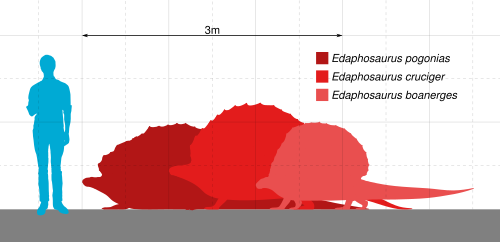
最大のエダフォサウルス科は、全長3メートル(9.8フィート)のルペオサウルス[6]と、全長が3メートル(9.8フィート)を超えるエダフォサウルス[7]でした。
スフェナコドン科
ペルム紀前期最大の肉食単弓類はディメトロドンであり、体長4.6メートル(15フィート)、体重250キログラム(550ポンド)に達した。[8]ディメトロドン属最大の種は、世界初の完全な陸生頂点捕食者でもあった。[9]
タッペノサウルス科
中期ペルム紀の タッペノサウルスは全長5.5メートル(18フィート)と推定されており、最大の恐竜とほぼ同じ大きさでした。[10]
獣弓類(Therapsida)
異歯類(異歯類)

草食性のディキノドン類 Lisowicia bojaniは、体長約4.5メートル(15フィート)、体高2.6メートル(8フィート6インチ)、体重9,000キログラム(20,000ポンド)で、哺乳類以外の単弓類の中で最大のものとして知られています。 [11] [12] [13]しかし、2019年に、推定される体全体の体積から質量をモデル化することで、より信頼性の高い体重の推定が行われました。これらの推定値は、胸郭の胴回りと骨格の周囲にモデル化された軟組織の量によって異なり、全体の平均体重は5.9トン(6.5ショートトン)、体脂肪やその他の組織が最小限の最低推定値は4.9トン(5.4ショートトン)、最大体重は7トン(7.7ショートトン)でした。[14]
ビアルモスクス類 (ビアルモスクス亜科)
ペルム紀後期の エオティタノスクス(ビアルモスクスの同義語の可能性あり[15])は、成体の標本では体長2.5メートル(8フィート2インチ)以上、最大で6メートル(20フィート)、体重600キログラム(1,300ポンド)以上あった可能性がある。[15]
恐竜類(恐竜亜科)

最大の肉食性非哺乳類単弓類は恐竜の アンテオサウルスで、体長5~6メートル(16~20フィート)、体重500~600キログラム(1,100~1,300ポンド)でした。 [ 16] [17]同じアンテオサウルス科の完全に成長したティタノフォネウスの頭骨の長さは1メートル(3.3フィート)あったと思われます。[17]
ゴルゴノプシアス(ゴルゴノプシア)

イノストランセビア・ラティフロンスは、頭蓋骨の長さが60cm(24インチ)を超え、全長が3.5m(11フィート)に近づき、体重が300kg(660ポンド)に達する、知られている中で最大のゴルゴノプス類である。 [18] ルビゲア・アトロクスは、頭蓋骨の長さが約45cm(18インチ)に達する、アフリカ最大のゴルゴノプス類である。 [19]その他の大型ゴルゴノプス類には、の長さが約40cm(16インチ)のディノゴルゴン[20]、 頭蓋骨の長さがほぼ40cm(16インチ)のレオントサウルス[19]、頭蓋骨の長さが約38cm(15インチ)のシコサウルスがいる。 [19]
テロセファリア人(テロセファリア)
最大の獣頭類はスキムノサウルス[ 21] [22]で、現代のハイエナと同じくらいの大きさに達しました。[23]
非哺乳類のキノドン類 (Cynodontia)
- 最大の非哺乳類キノドン類は横断歯類のスカレノドントイデスであり、断片的な標本に基づくと頭骨の最大長は約61.7センチメートル(24.3インチ)であった。[24]
- パセヨドン・ダビディは、哺乳類に近いキノドン類であるモルガヌコドン類の中で最大のものである。右下臼歯の長さは3.3mm(0.13インチ)で、他のモルガヌコドン類の臼歯よりも大きい。 [25]
- 最も大きなドコドン類として知られているのはカストロカウダで、体長は約50cm(20インチ)でした。[26]
哺乳類(Mammalia)
非獣類哺乳類
ゴビコノドント類(ゴビコノドンタ)
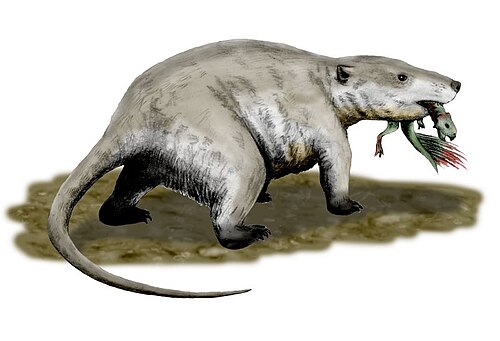
最大のゴビコノドン類であり、最もよく知られている中生代哺乳類はレペノマムスである。[27] [28] [29] [30] [31] [32]知られているレペノマムス・ギガンティクスの成体は全長約1メートル(3フィート3インチ)、推定体重12~14キログラム(26~31ポンド)に達した。[29]このようなパラメータでは、サイズは前期白亜紀のいくつかの小型獣脚類恐竜を上回った。[33]ゴビコノドンも大型哺乳類であり、[31] [32]体重は5.4キログラム(12ポンド)、[29]頭蓋骨の長さは10センチメートル(3.9インチ)、仙骨前部の長さは35センチメートル(14インチ)であった。[34]
多丘胞子虫類(Multituberculata)
最大の多丘状動物である[35] Taeniolabis taoensisは、知られている中で最大の非獣類哺乳類であり、体重はおそらく100kg(220ポンド)を超える。[36]
単孔類(モノトレマタ)

- これまで知られている最大の単孔類(卵生哺乳類)は、西オーストラリア州で発見された数本の骨から知られる、絶滅した長い嘴を持つハリモグラの一種、マレーグロッサス・ハケッティである。羊ほどの大きさで、体重はおそらく30kg(66ポンド)にも達した。[37]
- 最大の鳥類として知られているのはObdurodon tharalkooschildで、体長70cm(28インチ)のMonotrematum sudamericanumよりも大きかった。[38]
- コリコドン・リッチエイは中生代最大の単孔類であったと考えられている。体長は1メートル(3フィート3インチ)にも達した。 [39]
メタテリア(メタテリア)
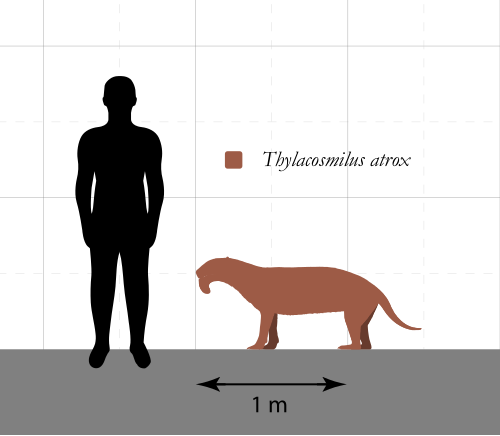
- 有袋類以外の最大の後獣類はティラコスミルス・アトロクスで、体重は80~120キログラム(180~260ポンド)であったが、[40] [41] 150キログラム(330ポンド)と推定されるものもある。[42] プロボヒアエナ科の Proborhyaena giganteaは体重が50キログラム(110ポンド)以上と推定され、150キログラム(330ポンド)に達した可能性もある。[43] アウストラロヒアエナも大型の後獣類で、体重は最大70キログラム(150ポンド)である。[44]
- スタゴドン科の哺乳類ディデルフォドンは、中生代の後獣類、そして白亜紀の哺乳類の中で最大のものの一つであった。[45]頭骨の長さは10センチメートル(3.9インチ)以上に達し、 [46]完全な動物の重量は5.2キログラム(11ポンド)であった。[47]
有袋類(Marsupialia)
- 最大の有袋類、そして最大の後獣類は絶滅したディプロトドンで、体長は約3メートル(9.8フィート)、直立すると2メートル(6フィート7インチ)、体重は最大2,786キログラム(6,142ポンド)でした。[48]同じボンバティフォーム類の パロルケステス・アザエルも体長が約2.5メートル(8.2フィート)で、体重は1,000キログラム(2,200ポンド)を超えると推定されています。[49]
- 知られている中で最大の肉食有袋類はティラコレオ・カルニフェクスである。いくつかの標本を計測したところ、平均体重は101~164kg(223~362ポンド)であった。[50] [51]
- 最大のカンガルーは、まだ名前のついていないマクロプス属の種で、体重は274kg(604ポンド)と推定されています。[52]これは、最大で体長2メートル(6フィート7インチ)、体重230kg(510ポンド)にもなるプロコプトドン属の最大の標本よりも大きいものです。 [53 ]ステヌルス属のいくつかの種は、現生のオオカンガルー(マクロプス・ギガンテウス)と同程度か、やや大きいものでした。[54]
- これまでに記録された最大のポトロイドはボルンガブーディーであり、現存する最大の種よりも約30%大きく、体重は最大10kg(22ポンド)でした。[55]
胎盤を持たない真獣類
シモレスターン人(シモレスタ)
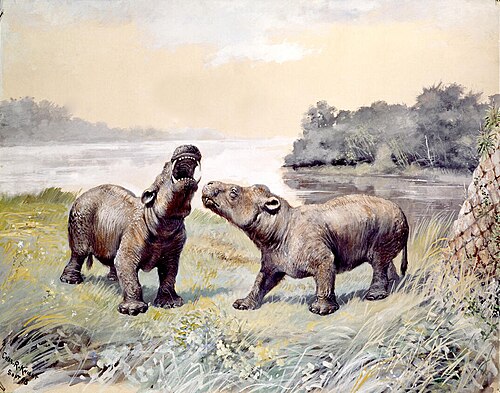
最大のシモレスターンはコリフォドンで、肩までの高さが1メートル(3フィート3インチ)、全長が2.5メートル(8フィート2インチ)[56] [57]、体重は最大700キログラム(1,500ポンド)でした。[58] バリヤラムダも巨大な哺乳類で、体重は650キログラム(1,430ポンド)でした。[59] テニオドン類のワートマニアとプシッタコテリウムは、前期暁新世最大の哺乳類でした。[60]ワートマニアは、 K-Pg境界から50万年後に生息し、体重は20キログラム(44ポンド)に達しました。200万年後に出現したプシッタコテリウムは、50キログラム(110ポンド)に達しました。[60]
レプティックス類(レプティックス目)
これまでに発見された最大のレプティックス科は、ドイツの中期始新世から発見されたレプティックティディウム・トビエニである。頭骨の長さは101 mm (4.0 in)、頭部と胴体の長さは375 mm (14.8 in)、尾の長さは500 mm (20 in)であった。[61]同じ科のPseudorhyncocyonidaeに属するヨーロッパの近縁種の頭骨の長さは67~101 mm (2.6~4.0 in)であった。[61]
テンレック類とその仲間(アフリカヒヒ目)
マダガスカル島に生息する絶滅したテンレックの近縁種であるビビマダガスカル(Plesiorycteropus madagascariensis)の2種のうち大きい方の体重は10~18キログラム(21~40ポンド)と推定されている。[62]
偶蹄類(偶蹄目)

- 陸上に生息する最大の偶蹄目動物として知られるカバ・ゴルゴプスは、体長4.3メートル(14フィート)、体高2.1メートル(6フィート11インチ)、体重5トン(11,000ポンド)であった。[63]
- ダエオドンと大きさや形態が似ているパラエンテロドン[64]は、全長3.7メートル(12フィート)、肩高1.77メートル(5.8フィート)で、これまでに生息した最大のエンテロドン類として知られている。 [65]内モンゴルの始新世に生息していた巨大なアンドリューサルクスは、頭骨の長さが83.4センチメートル(32.8インチ)あったが[66]、この属の分類学には異論がある。 [67] [68]
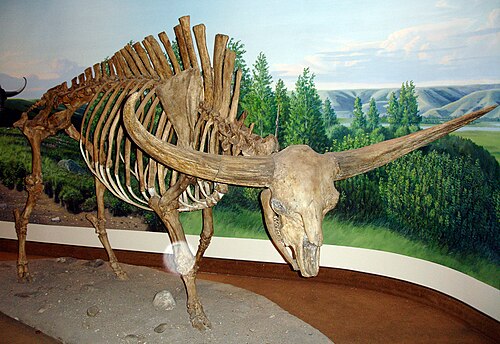
- ウシ亜科で最大のもので、最大のウシ科動物はバイソン・ラティフロンスである。体重は1,250 kg (2,760 lb) [69] [70]から2,000 kg (4,400 lb) [71]に達し、体長は4.75 m (15.6 ft)、肩高は2.31 m (7.6 ft) [72]で、角の開張は2.13 m (7 ft 0 in) であった。[73]北アメリカバイソン・アンティクウスは体長4.6 m (15 ft)、体高は2.27 m (7.4 ft)、体重は1,588 kg (3,501 lb) [74]に達し、角の開張は1 m (3.3 ft) であった。[72]アフリカのペロロヴィスは体重が2t(2.2ショートトン)に達し、角の骨芯は約1m(3フィート3インチ)の長さがありました。[75]もう一つの巨大なウシ科動物であるアフリカスイギュウ(Syncerus antiquus)は、鼻先から尾の先までの長さが3m(9.8フィート)、肩甲骨の高さが1.85m(6.1フィート) 、後肢の高さが1.7m(5.6フィート)に達しました。[76] [77]また、角の先端の間の距離は2.4m(7フィート10インチ)にもなりました。[76]スリランカのガウル個体群、イギリス諸島のヨーロッパバイソン、コーカサスバイソン、カルパティアバイソンなどの現存種の地域個体群と亜種を除けば、現代の絶滅したウシ科動物で最大のものはオーロックス(Bos primigenius)で、肩までの平均高さは雄で155~180cm(61~71インチ)、雌で135~155cm(53~61インチ)であるが、ハンガリーのオーロックス個体群では雄で155~160cm(61~63インチ)に達した。[78]肩までの高さが1.7~1.9メートル(5フィート7インチ~6フィート3インチ)に達するクープレイ(Bos sauveli)は[ 79 ] [ 80]中期更新世から生息しており[81]、絶滅した可能性があると考えられている。[82] [83]
- 脚の長いメガロトラガスは、おそらく知られているウシ科の動物の中で最大のもので、[84]現生のヌーよりも大きい。[85] M. priscusの角の先端は、互いに約1.2メートル(3フィート11インチ)の距離に位置していた。[86]
.jpg/500px-WLANL_-_Urville_Djasim_-_Iers_reuzenhert_-_Irish_elk_(2).jpg)
- 絶滅したシカ科の アイルランドヘラジカ(Megaloceros giganteus)は、体高2.1メートル(7フィート)以上、体重680キログラム(1,500ポンド)に達し、角の開きは最大4.3メートル(14フィート)で、ヘラジカの角の最大開きの約2倍でした。[87] [88]巨大ヘラジカ(Cervalces latifrons)は、体高2.1〜2.4メートル(6.9〜7.9フィート)に達し[89] 、体重はアイルランドヘラジカの2倍でしたが、角の開きは2.5メートル(8.2フィート)で、 Megalocerosよりも小さかったです。[90] [91]北米のオオヘラジカ(Cervalces scotti)は体長2.5メートル(8.2フィート)、体重708.5キログラム(1,562ポンド)に達した。[92] [93]
- 現存するキリンを除けば、最も大きいキリン科動物はシバテリウムで、体重は1,250kg(2,760ポンド)である。[94]
- 最大のプロトケラトス類はシンテトケラスで、体長2メートル(6フィート7インチ)、体重150~200キログラム(330~440ポンド)に達した。[95] [96]
- これまで存在した野生のイノシシ科動物の中で最大のものはクバノコエルス・ギガスで、体重は最大500kg(1,100ポンド)、肩までの高さは約1メートル(3フィート3インチ)あった。[97] メガロコエルスも同様の大きさで、体重は303kg(668ポンド)または526kg(1,160ポンド)だった可能性がある。[98]
- 最大の絶滅したペッカリー科の種であるプラティゴヌスは、現代のペッカリー、特にジャイアントペッカリーとサイズが似ており、体長は約1メートル(3.3フィート)で、長い脚を持っていたため、走るのが得意だった。また、豚のような鼻と長い牙を持っており、おそらく捕食者を撃退するために使われていたと思われる。[99]
- 最大のラクダ科動物は、北アメリカの中新世に生息していたティタノティロプスである。体重は2,485.6 kg (5,480 lb)、肩までの高さは3.4 m (11 ft) に達した可能性がある。[100] [101]シリアのラクダ( Camelus moreli ) は現代のラクダの2倍の大きさであった。[102]肩までの高さは3 m (9.8 ft) [103]、高さは4 m (13 ft) であった。[102]ラクダ科の動物は、脚がヒトコブラクダよりも20%長く、肩までの高さは約2.3 m (7 ft 7 in)、体重は約1,000 kg (2,200 lb) であった。[104]
- アノプロテリウム科のアノプロテ リウムは、 A. communeの場合は体重が271 kg (597 lb) 、 A. latipesの場合は体重が229 kg (505 lb)に達したと考えられています。[105] 特にA. latipes は体長が2.5 m (8 ft 2 in) 以上、肩高が1.25 m (4 ft 1 in) を超えていた可能性があります。おそらく通性二足歩行が可能だったため、体高は3 m (9.8 ft) 以上にも達した可能性があります。[106]
鯨類(クジラ目)
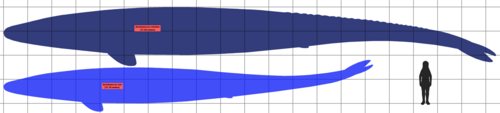
- 最も重い始祖鳥であり、おそらく最も重い哺乳類はペルケトゥスで、体重は85〜340t(84〜335長トン、94〜375米トン)と推定され、全長は17.0〜20.1メートル(55.8〜65.9フィート)と推定されており[107] 、質量ではシロナガスクジラに匹敵する可能性がある。しかし、2024年にモタニとピエンソンは、ペルケトゥスが体重でシロナガスクジラに匹敵するかそれを上回ることは極めて難しいと主張した。彼らは、ペルケトゥスの体長はシロナガスクジラよりはるかに短いため、体重を重くするには少なくとも3.375倍の密度、つまり1.83倍の脂肪が必要であると論じた。これは、全身の密度が0.75〜1.2の脊椎動物では不可能である。モタニとピエンソンは、さまざまな体重推定法を実行して、ビアヌッチらの仮説を検証した。回帰ベースおよび容積ベースの体重推定では、体長範囲17~20メートル(56~66フィート)に対して60~114トン(59~112長トン、66~126短トン)となったが、体重の範囲は60~70トン(59~69長トン、66~77短トン)の範囲内である可能性が高い。彼らはまた、以前の推定は仮定された等長性によって膨らんでおり、体重推定に対するパキオストシスの影響は過小評価につながるため無視できないと主張した。[108]始新世の始生代クジラ類で最長のものは、体長17~20メートル(56~66フィート)のバシロサウルスであった。 [109] [110] [111]
- 最大のスクアロデルフィニド類はマクロスクアロデルフィスで、体長は3.5メートル(11フィート)であった。 [112]
- 新第三紀の ナガスクジラ類の中には、現代の巨大な近縁種に匹敵する大きさのものもいた。パラバラエノプテラは現代のコククジラとほぼ同じ大きさと推定され、[113]体長は約16メートル(52フィート)だった。一部のヒゲクジラ類はおそらく大きさの点でシロナガスクジラに匹敵したが、 [113]他の研究では、中新世のヒゲクジラがそれほど大きく成長したとは考えられていない。[114]
奇蹄目(奇蹄目)
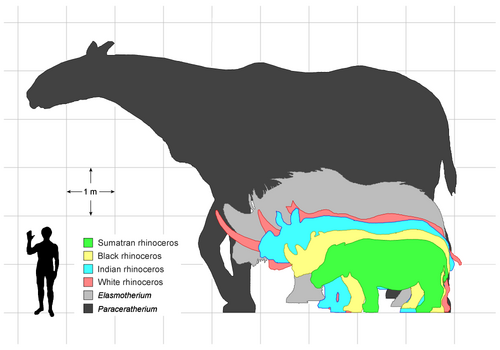

- 史上最大の奇蹄目動物の一つであり、史上2番目に大きい陸生哺乳類( Palaeoloxodon namadicusを参照)は、角のないサイのパラケラテリウムである。知られている最大の個体は、肩までの高さが4.8メートル(15.7フィート)、鼻から尻までの長さが7.4メートル(24.3フィート)、体重が17トン(18.7ショートトン)と推定されている。[115] [116]
- 関連種であるジュンガリオテリウムの無名の種の大型標本は約20.6トンと推定されている。[117]
- 先史時代の角のあるサイの中には大型に成長したものもいた。最大のエラスモテリウムは体長5~5.2メートル(16~17フィート)[118] 、体高2.5メートル(8フィート2インチ)[119]、体重3.5~5トン(3.9~5.5米トン)に達した。[120] [118] [119]これらのパラメータにより、エラスモテリウムは第四紀最大のサイとなっている。[120] 同時代のケブカサイ(Coelodonta antiquitatis )は体重が1,100~1,500kg(2,400~3,300ポンド) [121]または2,000kg(4,400ポンド)[122] 、 [123]肩の高さが1.93メートル(6フィート4インチ)、体長が4.6メートル(15フィート)に達しました。[124]
- アミノドン科のメタミノドンは体長4メートル(13フィート)に達し、大きさや形はカバに匹敵する。 [125]
- オオバク(Tapirus augustus )は、体重が約623kg(1,373ポンド)[126]、肩までの高さが1m(3.3フィート)あり、史上最大のバクでした。[127]以前は、この哺乳類はさらに大きく、高さ1.5m(4.9フィート)と推定され、別の属Megatapirusに分類されていました。[127]
- 最大のロフィオドン類はロフィオドンであり、L. lautricenseは体重が2,000kg(4,400ポンド)以上に達すると推定されている。[128]
- 最も大きなカリコテリスの一つはモロプスである。[129]肩までの高さは約2.4メートル(8フィート)であった。[130]
- 始新世後期のブロントテリウム科の奇蹄目恐竜は巨大な体格をしていた。北米のメガケロプス(ブロントテリウムとも呼ばれる[131])は肩高2.5メートル(8フィート2インチ)[132]、全長5メートル(16フィート)[131]、体重3トン(6,600ポンド)[133]に達した。アジアの エンボロテリウムも同様の大きさだった。[134]
- 先史時代最大の馬は北アメリカのEquus giganteusである。体重は1,250 kg(1.38ショートトン)、肩までの高さは2 m(6フィート7インチ)以上に成長すると推定されている。[135]最大のアンキテリウス亜科のウマはヒポヒップスで、体重は403~600 kg(888~1,323ポンド)で、現代の大型家畜馬に匹敵する。[136] [137] メガヒップスは別の大型アンキテリウス亜科の馬である。体重は266.2 kg(587ポンド)で、ほとんどの近縁種よりもはるかに重かった。[136]
- 馬の近縁種であるパレオテリウム属の中で最も大型の属の一つにパレオテリウムがあり、P. giganteum は体重が700 kg (1,500 lb) を超えると推定されている。[138] 1994年にP. giganteumが命名されるまでは、 P. magnum がパレオテリウム最大の種と考えられており[139]、肩高は1.3 m (4 ft 3 in)、体長は2.52 m (8 ft 3 in) に達する可能性がある。[140]もう一つのパレオテリウムであるカンタブロテリウムは体重が約600 kg (1,300 lb) と推定されている。[138]
フェナコドン類(フェナコドン科)
最大のフェナコドン科はフェナコドゥスである。体長は1.5メートル(4フィート11インチ)[141]、体重は最大56キログラム(123ポンド)であった。[142]
ディノセラタン(恐竜亜綱)
最大の恐竜角竜はエオバシレウスで、頭蓋長は102cm、背中の高さは2.1m、肩の高さは1.5mでした。[143]このグループのもう一つの巨大な動物はウインタテリウムで、頭蓋長76cm、肩の高さは1.5m、[143]全長4m、体重は2.25tでサイと同じくらいの大きさでした。[144]エオバシレウスもウインタテリウムもその大きな体格にもかかわらず、脳は非常に小さかった。[143] [144]
肉食動物(Carnivora)
イヌ目
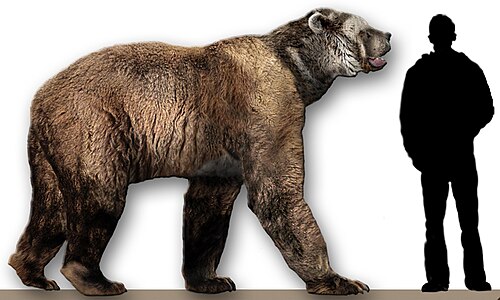


- 史上最大の陸生哺乳類肉食動物、最大のクマ、そして史上最大の陸上哺乳類捕食動物は、南米の短頭熊、アルクトテリウム・アンガスティデンスである。ブエノスアイレスで発見されたA. angustidensの上腕骨によると、この種の雄は体重が1,588~1,749 kg(3,501~3,856ポンド)、後肢の高さが少なくとも3.4メートル(11フィート)あったとされている。[145] [146]もう一つの巨大なクマはオオ短頭熊(Arctodus simus)で、平均体重は625 kg(1,378ポンド)、最大体重は957 kg(2,110ポンド)と推定されている。[147]この種の最大の個体はさらに大きな体重、1,200kg(2,600ポンド)に達したと推測されています。[145]絶滅した洞窟クマ(Ursus spelaeus)も、多くの現生クマよりも重かったです。最大の雄は1,000kg(2,200ポンド)の体重がありました。[148]更新世のAiluropoda baconiは、現代のジャイアントパンダ(Ailuropoda melanoleuca)よりも大きかったです。[149]
- 史上最大のオドベニダ類であり、最大級の鰭脚類の一つはポントリス・マグヌスで、頭蓋骨の長さは60cm(24インチ)(現代の雄セイウチの頭蓋骨の2倍)[150]、全長は4m(13フィート)以上である。[151] [152]現代の雄ゾウアザラシ(ミロウンガ)だけが同様のサイズに達する。[151] 2番目に大きい先史時代の鰭脚類はゴンフォタリア・プグナクスで、頭蓋骨の長さはほぼ47cm(19インチ)である。[150]
- 先史時代のオタリア科動物の中で最も大きい種の一つはタラソレオンであり、現存する最大のオットセイに匹敵する大きさである。T . mexicanusの推定体重は295~318kg(650~701ポンド)以上である。[153]
- これまで存在した中で最大のイタチ科動物は、おそらくオオカワウソのエンヒドリオドンだろう。体長は3メートル(9.8フィート)を超え、体重は約200キログラム(440ポンド)で、現生・絶滅を問わず、知られているどのイタチ科動物よりも大きかった。[154] [155] [156]オオカワウソには他にも、体重約50キログラム(110ポンド)のシアモガレ[157]や、現代のオオカワウソよりも大きいメガレンヒドリス[ 158]などがいた。 メガリクティスは、純粋に陸生のイタチ科動物としては最大だった[159](ただし、エンヒドリオドンは最近、陸生捕食者でもある最大のイタチ科動物として言及された[154])。メガリクティス・フェロックスはジャガーとサイズが似ているが、頭蓋骨はさらに幅広く、クロクマとほぼ同じ幅だった。[159]メガリクティスは強力な咬合力を持ち、現代のハイエナやジャガーのように大きな獲物を食べたり骨を砕いたりすることができた。[159]もう一つの大型イタチ科動物は、中新世のアフリカに生息していた表面上はネコ科のエコルスである。体重がほぼ44kg (97ポンド) あり、脚の長いエコルスはオオカミとほぼ同じサイズで[160] 、大型ネコ科動物が大陸にやってくる前はヒョウに似た生態学的地位を占めていた。 [161]他の巨大なイタチ科動物には、後期中新世のペルニウム[162]と超肉食性のエオメリヴォラがいる。[163]
- 最も重いクマムシ科動物は、おそらく南米のチャパルマラニアである。体長は1.5メートル(4.9フィート)、尾は短く、体重は150キログラム(330ポンド)に達し、アメリカクロクマ(Ursus americanus)とほぼ同じ大きさであった。[164]もう一つの巨大なクマムシ科動物はキョナスアで、体重は約15〜25キログラム(33〜55ポンド)で、中型犬とほぼ同じ大きさであった。[165]
- 史上最大のイヌ科動物はEpicyon haydeniで、肩高90cm、体長2.4m、体重100~125kg(220~276ポンド)あり、[166] [167][ 168]知られている最も重い個体は体重が170kg(370ポンド)に達した。[42]絶滅したダイアウルフ(Aenocyon dirus)は体長1.5m(4.9フィート)、体重は50~110kg(110~243ポンド)に達した。[42] [169]ヨーロッパに生息した最大のオオカミ(Canis lupus)の亜種は、フランスの後期更新世に生息したCanis lupus maximusである。その長骨は現生のヨーロッパのオオカミよりも10%大きく、 C. l. lunellensisよりも20%長い。[170]後期更新世のイタリアオオカミは形態測定学的にC. l. maximusに近かった。[171]
- 最大のベアドッグはPseudocyon属の一種で、体重は約773kg(1,704ポンド)あり、非常に大きな個体であった。[172]
フェリフォルミア


- 最大のニムラビッド類はおそらくクエルキュルス・マジョールスで、その化石から現代のヒグマと大きさが似ており、鼻腔動物であったことが示唆されている。[173] 2021年には、エウスミルスがホルプロフォニクスのニムラビッド類の中で最大であると宣言され、体重は111kg(245ポンド)近くに達し、小型のアフリカライオンに匹敵する。[174]しかし、最大のホプロフォネウスは160kg(350ポンド)と推定されている。[42]
- 最大のサーベルタイガーは、アムフィマカイロドゥス・カビールとスミロドン・ポピュレーターで、オスはそれぞれ350~490kg(770~1,080ポンド)、220~450kg(490~990ポンド)に達したと考えられている。[42] [175] [176]史上最大のネコ科動物のもう1つの候補はマカイロドゥスである。中国に生息するM.ホリビリスは405kg(893ポンド)と推定され[177]、北米に生息するM.ラハイシュッププは410kg(900ポンド)にもなった。[178] [179] [180] ゼノスミルスも巨大なネコ科動物であった。体長は約2メートル(6.6フィート)に達し[181]、体重は約300~350kg(660~770ポンド)であった。[177]
- 最も重いと知られているヒョウ科のネコ科 動物は、最大で体重が486kg(1,071ポンド)と推定されるンガンドントラ(Panthera tigris soloensis ) [176] 、最大体重が400~500kg(880~1,100ポンド)と推定される絶滅したライオン科のPanthera fossilis [182]、最大で体重が363kg(800ポンド)のアメリカライオン(Panthera atrox ) [183] [184] 、そして東アフリカのナトドメリライオンで、 Panthera atroxの大型種に匹敵する大きさであった。[185]
- 絶滅したネコ科の 動物の中には、現代のネコ科動物よりも体が大きいものもいる。ユーラシア大陸の巨大チーター(Acinonyx pardinensis )は体重が60~121kg(132~267ポンド)に達し、現代のチーターの約2倍の大きさだった。 [186]北アメリカのPratifelisは現生のピューマよりも大きかった。[187]
- 最大のバルボロフェリド類は肩高90cm(35インチ)のバルボロフェリス・フリッキであった。 [188]
- これまで存在が知られている最大のビヴェリッド類はViverra leakeyiで、体重は41kg(90ポンド)でオオカミや小型ヒョウと同程度の大きさだった。 [189]
- 最大の化石ハイエナはパキクロクタで、肩までの長さは90~100cm(35~39インチ)[190]、体重は190kg(420ポンド)と推定されています。[42]体重が100kg(220ポンド)を超えるもう1つの巨大なハイエナは、洞窟ハイエナです。これは実際にはアフリカブチハイエナの亜種であり、絶滅した洞窟ハイエナよりも10%小さいです。[191]
- フェロクティド・ネコ科のDinocrocutaは、現生のブチハイエナの2倍から3倍の大きさがあり、体重は160kgまたは240kg(350ポンドまたは530ポンド)であった。[192]
- 絶滅した巨大フォッサ(Cryptoprocta spelea)の体重は17kg(37ポンド)[193]から20kg(44ポンド)[194]の範囲で、現代のフォッサの体重(成体の雄で最大8.6kg(19ポンド)[195])よりもはるかに大きかった。
ヒエノドン類
最大のヒアエノドン類はシンバクブワで、体重は1,500kg(3,300ポンド)でした。[ 196 ]もう一つの巨大なヒアエノドン類であるメギストテリウムは体重が500kg(1,100ポンド)に達し[42]、頭蓋骨の長さは66.4cm(26.1インチ)でした。[197]
オキシアエニド(オキシアエニダエ科)
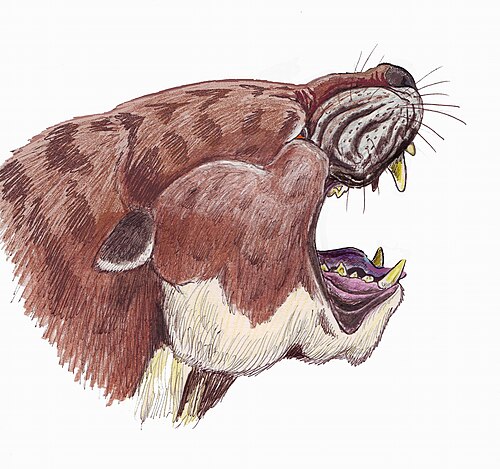
最大のオキシアエニア類はサルカストドンで、体重は800kg(1,800ポンド)あった。[42]
メソニク類(メソニク亜綱)
メソニクス類の中にはクマほどの大きさに達するものもいた。そのような大型種としては、アジアのモンゴルニクス[198]や北アメリカのアンカラゴン[199] [200]などがある。別の大型メソニクス類としてはハルパゴレステスがあり、一部の種では頭蓋骨の長さが50センチにもなる。[198]
コウモリ(翼手目)
南米と中央アメリカの第四紀の堆積層で発見されたデスモドゥス・ドラキュラエは、翼開長が0.5メートル(20インチ)、体重が最大60グラム(2.1オンス)でした。この体格は、これまでに進化した最大の吸血コウモリです。[201]
ハリネズミ、ギンザケ、トガリネズミ、モグラ(Eulipotyphla)

エウリポティフラ属で最大の動物はデイノガレリクス[202]で、全長は最大60cm(24インチ)、頭蓋骨の長さは最大21cm(8.3インチ)でした。[203]
齧歯類(齧歯目)

- 絶滅した南米の齧歯類の中には、現代の齧歯類よりもはるかに大きいものもいくつかあった。ジョセフォアルティガシア・モネシは史上最大の齧歯類で、体重はおよそ480~500 kg(1,060~1,100ポンド)と推定されている。 [204] フォベロミス・パターソニの体重は125~150 kg(276~331ポンド)であった。[204]ジョセフォアルティガシアとフォベロミスはどちらも肩までの高さが約1.5メートル(4フィート11インチ)に達した。[205]もう一つの巨大な齧歯類であるテリコミス・ギガンティッシムスの最小体重は200 kg(440ポンド)であった。[205]
- ヘプタクソドン科のAmblyrhiza inundataは巨大な動物で、体重は50~200kg(110~440ポンド)ありました。 [206] [205]
- 最大のビーバーは北アメリカに生息するオオビーバー(Castoroides)である。体長は2メートルを超え、体重はおよそ90~125キログラム(198~276ポンド)で、史上最大のげっ歯類の一つである。[207]
- 旧世界最大のヤマアラシはHystrix refossaで、現生ヤマアラシよりも大きかった。最も近い近縁種である現生のインドヤマアラシ( H. indica ) よりも約 20% 大きく、体長は 115 cm (45 インチ) を超える。
ウサギ、野ウサギ、ナキウサギ(ウサギ目)
最大の先史時代のウサギ目動物は、体重12kg(26ポンド)のミノルカ島産巨大ウサギ目のヌララグス・レックスである。 [208]
センザンコウ(センザンコウ亜科)
最も大きなセンザンコウは絶滅したManis palaeojavanicaである[209]。全長は最大2.5メートル(8.2フィート)と測定されている。[210]
霊長類(霊長類)
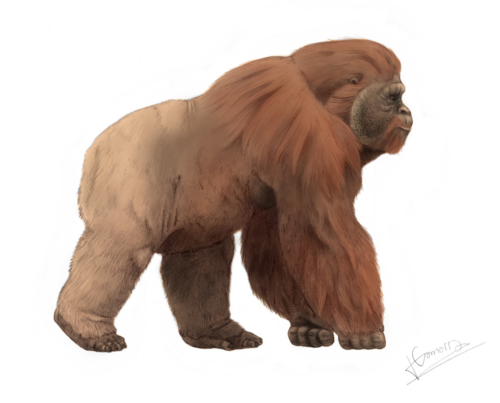
- 史上最大の霊長類であり、最大の人類亜種でもあるギガントピテクス・ブラックイは、体高3メートル(9.8フィート)、体重540キログラム(1,200ポンド)であった。[211] [212]しかし、2017年に行われた新たな研究では、この霊長類の体重は200~300キログラム(440~660ポンド)であると示唆された。[213]もう一つの巨大人類亜種は、体高2.4メートル(7フィート10インチ)のメガントロプス・パレオジャバニクスであるが、 [214]非常に貧弱な化石から知られている。[215]
- 更新世には、一部の旧人類は現生人類に近いか、それよりも体格が大きかった。ネアンデルタール人(ホモ・ネアンデルターレンシス)の平均体重は男性77.6kg(171ポンド)、女性66.4kg(146ポンド)で、現生人類(ホモ・サピエンス)の体重(男性68.5kg(151ポンド)、女性59.2kg(131ポンド))よりも大きかった。[216]カブエ(ザンビア)で発見された脛骨は、身長が181.2cm(71.3インチ)だったと推定されるホモ属の個体を示している。中期更新世の人類の中で最も背の高い部類に入り、現生人類と比べても著しく大きかった。[217]スペインの中期更新世に生息していた最も背の高いホモ・サピエンスの個体は、男性で194cm(76インチ)、女性で174cm(69インチ)に達しました。[217]ホモ・エレクトスの中には、身長185cm(73インチ)、体重68kg(150ポンド)に達するものもいました。[218] [219]
- 最も大きな旧世界ザルは先史時代のヒヒで、ディノピテクスの雄の個体は平均46kg(101ポンド)、最大57kg(126ポンド)の体重があったと推定されている。[220]これは現存する最大のヒヒであるチャクマヒヒの最大体重記録を上回っている。ある資料では、テロピテクス・オズワルドの個体の体重は72kg(159ポンド)だったと推定されている。[221]
- 知られている最大の新世界ザルは、プロトピテクスの標本として研究されているカルテルスで、体重は最大34.27kg(75.6ポンド)でした。カイポラ・バンブイオルムも大型種で、体重は最大27.74kg(61.2ポンド)でした。[222]
- 最大のオモミ科は中期始新世のマクロタルシウスとオウライアである。どちらも体重は1.5~2kg(3.3~4.4ポンド)に達した。[223]
- 先史時代のキツネザル類霊長類の中にも巨大なものが存在した。アーケオインドリスはマダガスカルに生息していた体長1.5メートル(4.9フィート)のナマケモノキツネザルで、体重は150~187.8キログラム(331~414ポンド)で、[224]雄のゴリラの成体と同じくらいの大きさだった。[225]同科のパレオプロピテクスも現代のキツネザルのほとんどよりも重く、25.8~45.8キログラム(57~101ポンド)だった。 [226]メガラダピスは絶滅した大型キツネザルで、体長は1.3~1.5メートル(4フィート3インチ~4フィート11インチ)[要出典]、平均体重は約140キログラム(310ポンド)である。[227]他の推定では46.5~85.1kg(103~188ポンド)とされているが、それでも現存するどのキツネザルよりもはるかに大きい。[226]
ゾウ、マンモス、マストドン(長鼻類)


- ゾウのPalaeoloxodon namadicusは、特に大きな部分的な大腿骨に基づいて、史上最大の陸生哺乳類であったと示唆されている。この部分的な大腿骨は、体重22t(24.3ショートトン)、肩までの高さが約5.2m(17.1フィート)の個体のものであったと推定されているが、推定の著者は、これは推測であり、慎重に扱う必要があると述べた。[115] 2023年、グレゴリー・S・ポールとララメンディによる出版物では、部分的な大腿骨のみが知られているcf. P. namadicusとして識別される別の標本の体重が18〜19トン(40,000〜42,000ポンド)であったと推定されている。他の著者は、単一の骨に基づく長鼻類の体重推定は、完全な骨格からの正確な推定と比較して「非常にありそうもない」推定につながる可能性があると指摘している。[228] 2024年にビスワス、チャン、ツァイは、台湾の標本から最大で肩高が4.5メートル(15フィート)以上であると推定し、測定された5つの標本の体重は13.2〜18.5トン(29,000〜41,000ポンド)の範囲であると示唆した。[229]ユーラシア大陸のステップマンモス(Mammuthus trogontherii )の報告された最大の個体は、肩高4.5メートル(14.8フィート)、体重14.3トン(15.8ショートトン)に達すると推定された。[115] [230]ステゴドンの最大種であるステゴドン・ズダンスキーは、体重が13トン(14.3ショートトン)であった。[115]もう一つの巨大な長鼻類は、体高4メートル(13フィート)以上、体重11~12トン(12.1~13.2ショートトン)のステゴテトラベロドン・シルティクスである。 [115]コロンビアマンモス(Mammuthus columbi)は、肩までの高さが約4メートル(13.1フィート)あったが、体重は他の巨大なマンモスほどではなかった。その平均体重は9.5トン(10.5ショートトン)で、異常に大きい個体では約12.5トン(13.8ショートトン)あった。[115]コロンビアマンモスは非常に長い牙を持っていた。知られているマンモスの牙の中で最大のものは、長さ4.9メートル(16フィート)で、この種に属していた。[231]
- マムット科の 「マムット」ボルソニは、知られている中では最大の長鼻類および陸生哺乳類の1つである。成熟した雄の平均体高は4.1メートル(13フィート)、体重は約16トン(17.6米トン)と推定され、非常に大きな雄は最大のパレオロクソドン・ナマディクスの推定体長に匹敵する可能性がある。[115]この種はまた、動物の中で最も長い牙を持ち、記録されている最大の標本は、湾曲に沿って根元から先端までの長さが5.02メートル(16.5フィート)であった。[232]
- デイノテリウムはデイノテリウム科で最大の長鼻類である。クレタ島で発見された骨から、肩までの高さが4.1メートル(13フィート)、体重が14トン(15.4ショートトン)を超える標本の存在が確認されている。 [115]
海牛(シレニア)
報告によると、ステラーカイギュウは成体になると体長8~9メートル(26~30フィート)に成長し、現存するどの 海牛類よりもはるかに大きい。[233]ステラーカイギュウの体重は8~10トン(8.8~11.0ショートトン)と推定されている。[234]
直接の祖先であるクエスタカイギュウは、体長約9メートル(30フィート)、体重はおそらく10トン(11ショートトン)であった。[235]
アルシノイテレス(アルシノイテリイデ科)

最大のアルシノイテリウムはアルシノイテリウムである。アルシノイテリウム・ジッテリは肩までの高さが1.75メートル(5フィート9インチ)、体長は3メートル(9.8フィート)であった。[236] [237] アルシノイテリウム・ギガンテウムはアルシノイテリウム・ジッテリよりもさらに大きなサイズに達した。[238]
ハイラックス(Hyracoidea)
先史時代のハイラックスの中には、現代の小型の近縁種に比べて非常に大きなものもあった。これまでに進化した最大のハイラックス上科はTitanohyrax ultimusである。[239]推定体重は 600 kg (1,300 lb) から 1,300 kg (2,900 lb) 以上で、スマトラサイに近い大きさであった。[240]もう一つの巨大なハイラックスはMegalohyraxで、頭蓋骨の長さは 391 mm (15.4 in) [241]あり、バクほどの大きさであった。[239] [242]より新しいGigantohyraxは現生の近縁種Procavia capensisの 3 倍の大きさであったが[243]、初期のMegalohyraxやTitanohyraxよりは明らかに小型である。[244]
デスモスチリア類(デスモスチリア)

最大のデスモスチルスはデスモスチルス属の一種で、頭蓋骨の長さは81.8cm(32.2インチ)で、ステラーカイギュウと大きさが匹敵する。[245]
パレオパラドキシアは体長3.03メートル(9.9フィート)で、デスモスチルス類の中でも最大級の種として知られています。 [246]
アルマジロ、グリプトドン、パンパテレス(Cingulata)
知られている最大の帯状疱疹はドエディクルスで、体長4メートル(13フィート)、体高1.5メートル(4フィート11インチ)[144]、体重は約1,910~2,370キログラム(2.11~2.61ショートトン)に達した。[要出典]グリプトドン属の最大種であるグリプトドン・クラビペスは、体長3~3.3メートル(9.8~10.8フィート)[247] [144]、体重2トン(2.2ショートトン)に達した。[要出典]
アリクイとナマケモノ(ピロサ)
メガテリウムの骨格とイラスト
最大のピロサン類として知られる地上性ナマケモノはエレモテリウムで、体重は最大6.55トン(7.22ショートトン)、体長は最大6メートル(20フィート)と推定され、[248]雄のアフリカゾウと同じくらいの大きさである。近縁種の地上性ナマケモノメガテリウムも同様に大きな体格であった。[249]
アストラポテリア (アストラポテリア)
知られている最大のアストラポテリウム類の中には、グラナストラポテリウム属[250]やパラストラポテリウム属(P. martiale)のいくつかの種など、体重が約3~4トン(3.3~4.4ショートトン)のものもあります。 [251]骨格の残骸から、ヒラルコテリウム・ミヨウという種はさらに大きく、体重が6.456トン(7.117ショートトン)あったことが示唆されています。[252]
リトプテルン(Litopterna)
知られている最大のリトプテルンはマクラウケニアで、足ごとに3つの蹄を持っていた。体長は約3メートル(9.8フィート)と比較的大きな動物だった。[253]
ノトゥングラータ(Notoungulata)
完全な化石が残っている最大の無蹄類はトクソドンである。体長は約2.7メートル(8フィート10インチ)、肩までの高さは約1.5メートル(4フィート11インチ)で、重いサイに似ていた。不完全ではあるが、保存された化石から、ミクソトクソドンは体重が約3.8トン(4.2ショートトン)で、このグループの中で最も重量があったことが示唆されている。[254]
ピロテリアン(ピロテリア)
南米のピロテリア目最大の哺乳類はピロテリウムで、体長2.9~3.6メートル(9フィート6インチ~11フィート10インチ)、体重1.8~3.5トン(4,000~7,700ポンド)でした。[255]
爬虫類(レプティリア)
トカゲとヘビ(有鱗目)

- モササウルス類は既知の有鱗目恐竜の中で最大である。最大のモササウルス類はモササウルス・ホフマニである可能性が高く、全長は17メートル(56フィート)以上と推定されている。[256] [257]しかし、これらの推定値は頭部と全身の長さの比率1:10に基づいており、モササウルスにはありそうになく、おそらくその比率は1:7程度である。[258]もう一つの巨大なモササウルス類はティロサウルスで、全長は10~14メートル(33~46フィート)と推定されている。[259] [260]もう一つのモササウルス類であるプログナトドンも同様の大きさに達した。
- 知られている最大の先史時代のヘビはTitanoboa cerrejonensisで、体長は12.8メートル(42フィート)または14.3メートル(47フィート)[261]、体重は1,135キログラム(2,502ポンド)[262]と推定されています。また、madtsoiid Vasuki indicus は、体長が11〜15メートル(36〜49フィート)に達すると推定されています。[263]これらのヘビに匹敵する大きさのヘビは、 palaeophis colossaeusで、体長は約9メートル(30フィート)[262] [264] [265]または最大で12.3メートル(40フィート)にもなったと考えられています。[266]もう一つの非常に大きな化石ヘビはGigantophis garstiniで、体長は9.3〜10.7メートル(31〜35フィート)と推定されていますが、[267] [268]後の研究では、より小さな推定値である約6.6〜7.2メートル(22〜24フィート)を示しています。[269]最大の化石ニシキヘビはLiasis dubudingalaで、体長は約9メートル(30フィート)です。[270]記録されている最大の毒蛇であり、最大の毒蛇は、ギリシャの前期鮮新世に生息していたLaophis crotaloidesです。このヘビは体長3メートル(9.8フィート)を超え、体重は26キログラム(57ポンド)に達しました。[271] [272]もう一つの巨大な化石ヘビは、 Viperaの不確定種です。体長は約2メートル(6フィート7インチ)で、鮮新世初期のマヨルカ島最大の捕食動物の一つであった。 [273]知られている最大の盲蛇はBoipeba tayasuensisで、全長は1.1メートル(3フィート7インチ)と推定されている。[274]
- 知られている最大の陸生トカゲは、おそらく体長7メートル(23フィート)のメガラニア(Varanus priscus )です。 [275]現生の近縁種であるメガラニアは有毒であった可能性があり、その場合、このトカゲはこれまでに進化した最大の有毒脊椎動物でもありました。[276]しかし、この動物の最大サイズは議論の余地があります。[277]最近の研究では、体長は5.5メートル(18フィート)と推定されています。[278]
カメ、リクガメ類および近縁種(パンテスチュディネス)
クリプトディラ
- これまで知られている最大のカメは、体長5メートル(16フィート)、体重2,200キログラム(4,900ポンド)のアーケロン・イスキロスである。 [279] 2番目に大きいウミガメは、全長3.9メートル(13フィート)のプロトステガである可能性がある。 [280] [281]この属には、全長4.2メートル(14フィート)と推定されるさらに大きな標本がテキサスに生息している。[282] [280]部分的に知られているクラトケロンは、全長4メートル(13フィート)に達すると推定されている。[283]もう一つの巨大な先史時代のウミガメは、白亜紀後期のギガンタティプスで、体長は3.5メートル(11フィート)以上と推定されている。[284]始新世の Psephophorus terrypratchettiは体長2.3~2.5メートル(7.5~8.2フィート)に達した。[285]
- 最大のリクガメはメガロケリス・アトラスで、甲羅の長さは最大2メートル(6.6フィート)[286]、体重は0.8〜1.0トン(1,800〜2,200ポンド)でした。[133] M. margaeは甲羅の長さが1.4〜2メートル(4.6〜6.6フィート)でした。ジャワ島に生息する無名の種の甲羅の長さは少なくとも1.75メートル(5.7フィート)に達しました。[287]新生代の ティタノケロンも現生のゾウガメよりも大きく、甲羅の長さは最大2メートル(6フィート7インチ)でした。[288] [289]他のゾウガメには、甲羅の長さが1.8〜2メートル(5.9〜6.6フィート)のセントロケリス・マロカナや、メソアメリカのヘスペロテストゥド属のリクガメがいます。甲羅の長さは1.5メートル(4.9フィート)であった。[287]
- これまでに記録された最大のトリオニクス科魚類は、パキスタンの中期始新世から発見された不確定標本GSP-UM 3019である。GSP-UM 3019の骨甲羅は長さ120cm(3.9フィート)、幅110cm(3.6フィート)で、甲羅全体の直径(軟縁を含む)は約2m(6.6フィート)である。[290]同じ地層から発見されたDrazinderetes tethyensisは、長さ80cm(2.6フィート)、幅70cm(2.3フィート)の骨甲羅を持っていた。[290]もう一つの巨大なトリオニクス科魚類は、全長2m(6.6フィート)を超える北米産のAxestemys byssinusである。 [291]
ヨコクビガメ(Pleurodira)

史上最大の淡水ガメは中新世のポドクネムシ科の ストゥペンデミスで、甲羅の長さは推定2.86メートル(9フィート5インチ)、体重は最大1,145キログラム(2,524ポンド)でした。[292]同じ科のCarbonemys cofriniiの甲羅の長さは約1.72メートル(5フィート8インチ)で、[293] [294] [295]完全な甲羅の長さは1.8メートル(5.9フィート)と推定されました。[296]
マクロバエ科(マクロバエ科)
最大のマクロベニド類は、白亜紀前期の ヤケミス類、白亜紀後期の アナトレミス類、暁新世の ジュディテミス類である。いずれも甲羅の長さは70cm(2.3フィート)に達した。[297]
メイオラニ目

最大のメイオラニア科魚類はメイオラニアである。メイオラニア・プラティセプスの甲羅の長さは100cm(3.3フィート)[287]で、全長はおそらく3m(9.8フィート)を超えた。[298]クイーンズランド州に生息した後期更新世の無名の種はさらに大きく、甲羅の長さは最大200cm(6.6フィート)に達した。[287] ニンジェミス・オウェニは甲羅の長さが100cm(3.3フィート) [287]、体重は200kg(440ポンド)に達した。[ 299]
竜鰭綱(竜鰭綱)
板歯類とその近縁種(板歯類)
プラコドゥスは板歯類の中でも最大級のもので、体長は最大3メートル(9.8フィート)に達した。 [300]
ノトサウルス類とその近縁種(ノトサウルス上科)
最大のノトサウルス類であり、三畳紀最大の 竜鰭類でもあるノトサウルスは、全長7メートル(23フィート)のノトサウルス・ギガンテウスであった。 [301]
プレシオサウルス(プレシオサウルス類)
- 最大のプレシオサウルス上科動物は、おそらくアリストネクテス(cf.アリストネクテス属と特定)に属する不確定標本で、体長は11~11.9メートル(36~39フィート)、体重は10.7~13.5トン(11.8~14.9米トン)であった。[302]もう1つの長大なプレシオサウルス上科動物はアルベルトネクテスで、体長は11.2~11.6メートル(37~38フィート)であった。[303] タラソメドンもサイズではこれに匹敵し、体長は10.86~11.6メートル(35.6~38.1フィート)であった。[304]その他の大型プレシオサウルス上科動物には、スティクソサウルスとエラスモサウルスがいる。どちらも体長は10メートル(33フィート)を超えた。[305] [306] ヒドラルモサウルス(以前はエラスモサウルスやスティクソサウルスと同義とされていた)は、全長9.44メートル(31.0フィート)に達した。[306]かつて、マウイサウルスは体長が8メートル(26フィート)以上であると考えられていたが、[307] [306]後に不審名と決定された。[308]
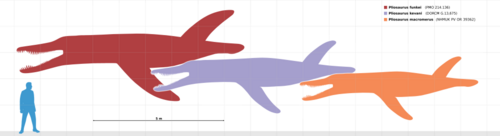
- プリオサウルス上科で最大のものが何であるかについては多くの論争がある。プリオサウルス・フンケイ(別名「捕食者X 」)は、2008年にノルウェーで発見された化石から知られる大型のプリオサウルスの一種である。このプリオサウルスの体長は10~13メートル(33~43フィート)と推定されている。[309]しかし、2002年にメキシコの古生物学者チームが「アランベリの怪物」というニックネームのプリオサウルスの化石を発見した。この化石も体長15メートル(49フィート)と推定されており、[310]より短いものは約11.5メートル(38フィート)と推定されている。[311]ただし、この種は幼体であると言われており、より大きなプリオサウルスに襲われたことがある。[312]一部のメディアは、アランベリのモンスターはリオプレウロドンであると主張したが、その種は今のところ確認されていない。[310]もう一つの非常に大きなプリオサウルス類は、長さ2.8メートル(9.2フィート)の不完全な下顎骨1本で知られるプリオサウルス・マクロメルスである。 [313]白亜紀前期のクロノ サウルス・クイーンズランディクスは、体長9~10.9メートル(30~36フィート)、体重10.6~12.1トン(11.7~13.3ショートトン)と推定されている。[314] [311]ジュラ紀後期の メガルネウサウルス・レックスは、体長7.6~9.1メートル(25~30フィート)に達した可能性がある。[315] [316]大きさでこれに匹敵するのは、白亜紀後期の メガケファロサウルス・エウレルティで、体長は6~9メートル(20~30フィート)でした。[317]
プロテロスクス科(プロテロスクス科)
プロテロスクス・ファーグシは、頭蓋骨の長さが47.7cm(18.8インチ)、体長が3.5~4m(11~13フィート)と推定される、知られている中で最大のプロテロスクス科の動物である。 [318]
エリスロスクス科

最大のエリスロスクス科はエリスロスクス・アフリカヌスで、最大体長は4.75~5メートル(15.6~16.4フィート)であった。[319]
植物竜類
知られている最大の植物竜類には、体長6.4メートル(21フィート)のレドンダサウルス[320]や、体長7メートル(23フィート)を超えるスミロスクス[321]などがある。
非ワニ形類偽鰭類(偽鰭類)

- 三畳紀最大のシュヴォサウルス科恐竜であり、偽鰓類の中でも最大級のものはシロスクスである。最大の標本は体長9~10メートル(30~33フィート)に達した可能性がある。[322] [323]
- 三畳紀最大の肉食擬鰭類はロリカタン亜科の ファソラスクス・テナクスで、体長は8~10メートル(26~33フィート)と推定されている。[322] [323] [324]これは科学的に知られている中で最大の「鰭類」であり、これまでに発見された恐竜以外の陸生捕食動物の中でも最大のものである。[要出典]ポストスクス[325]とサウロスクス[326]の最大個体の体長は約7メートル(23フィート)であった。 2010年に発見されたプレストスクスの標本によると、この動物も体長が約7メートル(23フィート)に達し、三畳紀最大の擬鰭類の1つとなった。[327]
- デスマトスクスはおそらく知られているアエトサウルス類の中で最大のものの一つで、体長は約4~6メートル(13~20フィート)、体重は280キログラム(620ポンド)であった。 [328] [329] [330]
ワニ類とその近縁種(Crocodylomorpha)
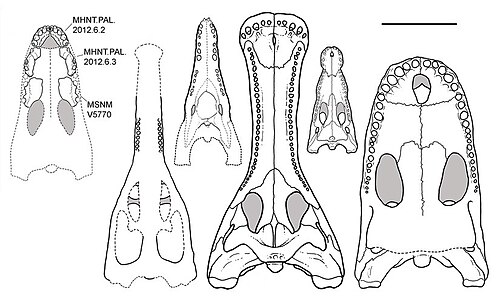
エジプトツキノワグマ科(エジプトツキノワグマ科)
白亜紀後期の アイギスクスは、当初、下限推定値で体長15メートル(49フィート)、上限推定値で22メートル(72フィート)に達すると推定されていたが、15メートルを超える体長は大幅な過大評価である可能性が高い。[331]しかし、この推定は誤算の結果である可能性があり、その体長はわずか3.9メートル(13フィート)程度である。[332]
ワニ類(Crocodylia)
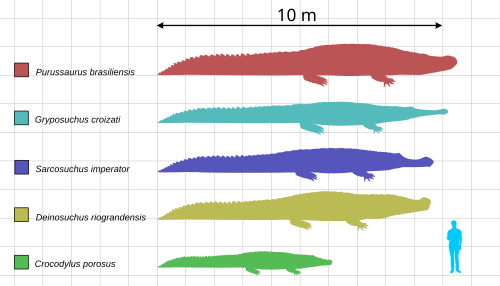
- 最大のカイマンであり、おそらく最大のワニ類の1つは、体長11~13メートル(36~43フィート)と推定されるプルサウルス・ブラジリエンシスである。 [333]別の情報によると、最大の推定値は、体長が11.4メートル(37フィート)、体重が約7.8トン(8.6ショートトン)である。 [334]しかし、2022年の研究では、系統学的アプローチを使用して、体長7.6~9.2メートル(25~30フィート)、体重2~6.2トン(2.2~6.8ショートトン)と推定され、非系統学的アプローチを使用して、体長9.2~10メートル(30~33フィート)、体重3.9~4.9トン(4.3~5.4ショートトン)と推定された。[335]
- もう一つの巨大なカイマンはモウラスクスです。様々な推定によると、最大の標本は体長9.47メートル(31.1フィート)、体重8.5トン(9.4ショートトン)に達したと言われています。 [336]しかし、より最近の推定では、体長は4.7〜5.98メートル(15.4〜19.6フィート)であるとされています。[335]
- 最大のワニ類はおそらくデイノスクス・リオグランデンシスで、体長12メートル(39フィート)、体重8.5トン(9.4ショートトン)である。[337] [338]
- アリゲーター属の最大の絶滅種はハイルアリゲーター(Alligator hailensis )で、頭蓋骨の長さは52.5cm(20.7インチ)で、現存するアメリカアリゲーター(Alligator mississippiensis)と大きさが似ていた。[339]
- 最大のガビアル科動物は、全長8~11メートル(26~36フィート)のアジアのラムフォスクス[340] [341] [334]と、全長10.15メートル(33.3フィート)の南米のグリポスクスであった[342] [341] 。
- 漸新世の基底的なワニ類 アストルゴスクス・ブグティエンシスは大型で、体長は8メートル(26フィート)と推定されている。[341]
- 知られている最大のワニはユーテコドンで、体長は6.4~8.6メートル(21~28フィート)、あるいは10メートル(33フィート)に達したと推定されている。[343] [334]現代のクロコダイルス属の最大種は、体長7.56メートル(24.8フィート)のケニアの Crocodylus thorbjarnarsoni [344] [334]、 体長7.5メートル(25フィート)のタンザニアの Crocodylus anthropophagus [345] [346] 、体長6~7メートル(20~23フィート)のカリゲデ(ジャワ島)の不定種である。 [347]
- 最大のメコサス類はPaludirex vincentiで、体長は5メートル(16フィート)に達すると推定されている。[348] [349] [275]鮮新世のキンカナのものとされる部分的な顎の標本によると、体長は約6~7メートル(20~23フィート)であったと示唆されているが、[275]他の種(漸新世から更新世にかけて知られている)はより小さく、体長は約1.5~3メートル(4フィート11インチ~9フィート10インチ)である。[350] [351] [352]
パラリガトリド類(パラリガトリダエ科)
最大のパラリガトリダ類はおそらくカンサジスクスで、体長は最大8メートル(26フィート)と推定されている。[353]
テティスクス類(テティスクス亜科)
- 絶滅したフォリドサウルス科の動物の中には巨大なものもいた。かつてはサルコスクス・インペラトルが最大のワニ形類であると考えられており、当初の推定では体長12メートル(39フィート)、体重8トン(8.8ショートトン)とされていた。[354]しかし、最近の推定では体長9~9.5メートル(29.5~31.2フィート)、体重3.5~4.3トン(3.9~4.7ショートトン)に縮小している。 [355]サルコスクスの近縁種であるチャラワン・タイランディクスは体長が10メートル(33フィート)以上に達した可能性があるが、[356]他の推定では7~8メートル(23~26フィート)とされている。[341]
- 最大のディロサウルス科はフォスファトサウルス・ガビアロイデスで、体長は9メートル(30フィート)と推定されている。[357] [341]
ストマトスズキ科
ストマトスクス(Stomatosuchus)は、ストマトスクス科の爬虫類で、体長は10メートル(33フィート)と推定されている。 [358]
ノトスクス類(ノトスチア)
- 陸生のノトスクス類ワニ形類で最大のものには、頭蓋長が95~110cm(37~43インチ)の中新世の セベシド科 バリナスクスや、下顎長が1m(3.3フィート)と推定される始新世のセベシド科デンタネオスクスがいる。 [359] [360]様々な推定によると、これらの動物の体長は3~10m(9.8~32.8フィート)の間とされている。同じく頭蓋長が47cm(19インチ)もあるストラティオトスクスの比率を用いると、 [361] バリナスクスの体長は少なくとも6.3m(21フィート)と推定される。[359] [360]
- もう一つの巨大なノトスクス類は、断片的な標本からしか知られていないが、初期の種であるラザナンドロンゴベであり、その頭骨の大きさはバリナスクスのそれを上回り、全長は約7メートル(23フィート)であった可能性がある。[362] [363]
タラットスクス類 (タラットスクス亜科)

- 最大のタラトスクス類であり、最大のテレオサウルス上科は、パヤ層から発見された名前の付いていない化石で、体長9.6メートル(31フィート)の動物である可能性があり、[364]これは、白亜紀前期の マキモサウルス・レックスの古い推定体長と同じ大きさで、最近では体長7.15メートル(23.5フィート)と推定されています。[365] ネオステネオサウルス・エドワーシ(以前はステネオサウルス・エドワーシとして知られていました[366])は、中期ジュラ紀最大のワニ形類で、体長6.6メートル(22フィート)に達しました。[365]
- プレシオスクスは非常に大きなメトリオリンクス科の恐竜である。体長は6.83メートル(22.4フィート)あり、同時代同地域に生息していたリオプレウロドンなどのプリオサウルス科の恐竜よりも体長が大きかった。 [367]他の巨大なメトリオリンクス科の恐竜としては、体長5メートル(16フィート)のティラノネウステス[368]や体長4.7メートル(15フィート)のトルヴォネウステスがいる。 [369]
基底的ワニ形類
レドンダベナトルは、これまでに記録された三畳紀のワニ形類の中で最大のもので、 [370]頭骨の長さは少なくとも60cm(2.0フィート)ありました。 [371] [372]もう1つの巨大な基底的ワニ形類は、未成熟にもかかわらず3m(9.8フィート)の体長を持つカルヌフェックスです。 [370 ]
翼竜(翼竜亜綱)

- 最大の翼竜として知られているのはケツァルコアトルス・ノースロピで、体重は127kg、翼開長は10~12mでした。[374]もう一つの有力候補はハツェゴプテリクスで、翼開長も12m以上ありました。[374]この推定値は、頭骨の長さが3mだったことに基づいています。[375]さらにもう一つの有力候補は、翼開長が10mのクリオドラコンでした。 [376]ネメグト層から発見された無名のプテロダクティルス上科の翼竜は、翼開長が10m近くに達した可能性があります。[377] [378]様々な仮説によれば、アラムボルジアニア・フィラデルフィアの翼開長は8メートル(26フィート)から10メートル(33フィート)以上に達した。[377] [376]南米のトロペオグナトゥスは最大で8.7メートル(29フィート)の翼開長に達した。[379] [380]
- 非プテロダクティロイド翼竜で最大のもので、ジュラ紀最大の翼竜[381]はディアークで、翼開長は2.2メートル(7フィート3インチ)から3.8メートル(12フィート)と推定されている。[382]これより大きいものは、ドイツで発見された断片的なランフォリンクス科の標本のみである(最大のランフォリンクスの大きさの184% )。[383]その他の大型の非プテロダクティロイド翼竜にはセリキプテルス、カンピログナトイデス、ハルパクトグナトゥスがおり、翼開長はそれぞれ1.73メートル(5フィート8インチ)[384]、1.75メートル(5フィート9インチ)[384]、2.5メートル(8フィート2インチ)[383]である。
コリストデレス(コリストデラ)
最大のコリストデラ類として知られるコスモドラコ・ダコテンシス(以前はシモエドサウルス・ダコテンシスとして知られていた[385])は、全長が約5メートル(16フィート)と推定されている。[386] [385]
タニストロフェイド(タニストロフェイダエ科)

タニストロフェウスはタニストロフェウス科の中で最も大きく、体長は5メートル(16フィート)に達した。 [387]
タラトサウルス(タラトサウルス亜科)
タラトサウルス類の中で最大の種であるミオデントサウルス・ブレビスは、体長が4メートル(13フィート)以上に成長した。[388]このグループで2番目に大きい種はコンカビスピナで、体長は3.64メートル(11.9フィート)である。[389]
魚竜(魚竜亜綱)
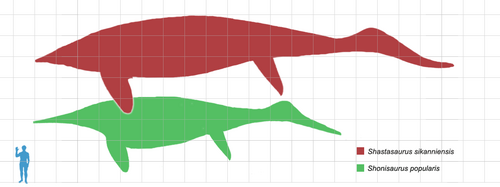
2018年4月、古生物学者は、これまで知られていなかった魚竜の発見を発表しました。この魚竜は、体長が26メートル(85フィート)に達した可能性があり、既知の動物の中で最大級で、一部のシロナガスクジラに匹敵します。[390] [391]これらの化石は後にイクチオティタンと命名され、最大で25メートル(82フィート)に達したと推定されており、史上最大の魚竜であり、最大の海生爬虫類です。[392]もう1つの大型魚竜は、後期三畳紀の シャスタサウルス・シカンニエンシスで、体長21メートル(69フィート)[393] [394]、体重81.5トン(18万ポンド)でした。 [ 395]もう1つの、より大きな魚竜は、1850年にオーストラリアで発見されました。[396]その化石は他の魚竜の測定値を上回っているように見えたが、研究者らは化石が断片的すぎて大きさを推定することはできないとコメントした。[396]もう一つの巨大な魚竜はショニサウルス・ポピュラリスで、体長15メートル(49フィート)、体重29.7トン(65,000ポンド)であった。 [394]中期三畳紀最大の魚竜であり、当時最大の動物であったキンボスポンディルス・ヤングオルムは体長17.65メートル(57.9フィート)[395]、体重44.7トン(99,000ポンド)であった。[395]
タンガサウルス類(タンガサウルス科)
最大のタンガサウルス科はホヴァサウルスで、吻部から肛門までの長さは30~35cm(12~14インチ)、尾の長さは60cm(24インチ)と推定されている。 [397]
パレイアサウルス(パレイアサウリア)
最大のパレイサウルスは体長が3メートル(9.8フィート)に達しました。このサイズの恐竜には、南アフリカの中期ペルム紀の ブラディサウルス、エンブリトサウルス、ノケレサウルス[398]、ロシアの後期ペルム紀のスクトサウルス[ 398]がいます。最も頑丈なスクトサウルスの体重は1.16トン(2,600ポンド)でした。[398]
カプトルヒニド科
体長2メートル(6フィート7インチ)の頑丈なモラディサウルス・グランディス[399]は、知られている中で最大のカプトルヒノド科恐竜である。[400] 2番目に大きいカプトルヒノド科恐竜はラビドサウリコスで、成体の頭蓋骨標本で最大のものは長さ28センチメートル(11インチ)であった。[401]
非鳥類恐竜(恐竜亜綱)
竜脚形類(竜脚形類)
竜脚類以外の竜脚形類(「古竜脚類」)の中で最大のものはエウスケロサウルスである。体長は12.2メートル(40フィート)、体重は2トン(2.2米トン)に達した。[402]もう一つの巨大な竜脚形類であるユンナノサウルス・ヤングイは体長が13メートル(43フィート)に達した。[403]
竜脚類(竜脚類)
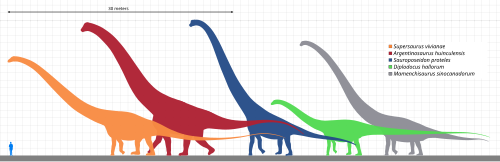
- 大型竜脚類のマラアプニサウルス・フラギリムス(旧称アンフィコエリアス・フラギリムス)は、史上最大の恐竜の候補である。最大体長は58~60メートル(190~197フィート)、体重は122,400キログラム(269,800ポンド)と推定されている。[404]残念ながら、この恐竜の化石は失われてしまった。[404]最近では、体長35~40メートル(115~131フィート)、体重80~120トン(180,000~260,000ポンド)と推定されている。[405]
- 不完全で現在は崩壊している化石から知られる白亜紀後期の ブルハトカヨサウルス・マトレイは、異常に巨大な竜脚類でした。[406]非公式の推定では、体長45メートル(148フィート)、体重139~220トン(306,000~485,000ポンド)という巨大なパラメータが示唆されています。[407]ただし、一部の推定では、体長37メートル(121フィート)、体重95トン(209,000ポンド)と示唆されていますが、それでも他のほとんどの竜脚類よりもはるかに重いです。[407] 2023年のグレゴリー・ポールによるより最近の推定では、その体重は約110トン(240,000ポンド)から170トン(370,000ポンド)とされています。もしこれが本当なら、ブルハトカヨサウルスは地球を歩いた最大の陸生動物となり、記録に残る最大のシロナガスクジラに匹敵することになる。[408]
- BYU 9024は、ユタ州で発見された巨大な頸椎[409]であり、バロサウルス・レントゥス[410] [411]またはスーパーサウルス・ビビアナエ[412]のものである可能性があり、体長はおそらく45~48メートル(148~157フィート)、体重は60~66トン(132,000~146,000ポンド)であった。[410] [413]スーパーサウルス・ビビアナエ自体は、3つの標本の調査で体長が39メートル(128フィート)または40メートル(130フィート)以上と示唆されたため、これまで発見された中で最も長い恐竜であった可能性がある。[412]

- マメンチサウルス・シノカナドルムはおそらく最大のマメンチサウルス科恐竜で、全長約35メートル(115フィート)、体重60~80トン(13万~18万ポンド)に達した。 [405]同科の シンジアンティタン・シャンシャネシスは首が15メートル(49フィート)あり、全長27メートル(89フィート)以上あると考えられる全長の約55%を占めていた。 [414]
- 中期ジュラ紀の ブレビパロプス・タグバロウテンシスは、全長48メートル(157フィート)で世界最長の恐竜としてギネスブックに掲載されているが、この動物は化石の足跡からしか知られていない。[415] [416]当初はブラキオサウルス科と考えられていたが、後に巨大なディプロドクス上科であると特定され、全長33.5メートル(110フィート)、体重62トン(137,000ポンド)あった可能性がある。[417]
- 最も背の高い竜脚類はサウロポセイドン・プロテレスで、推定体高は16.5~18メートル(54~59フィート)でした。[418] [419] [420] アシアトサウルスは体高17.5メートル(57フィート)に達する可能性がありましたが、この動物は歯からしか知られていません。[418] ギラファティタンは体高16メートル(52フィート)と推定されました。[421]

その他の巨大な竜脚類には、アルゼンチノサウルス、アラモサウルス、プエルタサウルスがおり、体長は30~33メートル(98~108フィート)、体重は50~80トン(55~88ショートトン)と推定されている。[422] パタゴティタンは体長37メートル(121フィート)[423]、平均体重は57トン(63ショートトン)[424]と推定されており、アルゼンチノサウルスやプエルタサウルスと大きさは似ていた。[425]スーパーサウルス、サウロポセイドン、ディプロドクスなどの巨大竜脚類は、体長ではおそらく匹敵するが、体重では匹敵しなかった。[404] ドレッドノートゥスは体重49トン(108,000ポンド)[424]、体長26メートル(85フィート)と推定されているが、最も完全な個体は死んだときには未成熟だった。[426] トゥリアサウルスはヨーロッパ最大の恐竜と考えられており、[427] [428]、推定体長30メートル(98フィート)、体重50トン(55米トン)である。[422] [428]しかし、21メートル(69フィート)、30トン(66,000ポンド)という低い推定値は、体長24メートル(79フィート)、体重34トン(75,000ポンド)に達したポルトガルのルソティタンよりも小さいことになる。 [429]
多くの大型竜脚類はまだ名前が付けられておらず、現在の記録保持者に匹敵する可能性があります。
- 1930年に発見された大型の腕竜「アーチビショップ」。2023年10月現在[update]、この標本に関する科学論文はまだ執筆中である。[430]
- ブラキオサウルス・ヌーガレディは、白亜紀前期の北アフリカに生息していたもう一つの大型腕竜である。化石は失われているが、仙骨の絵は残っている。仙骨の長さは1.3メートル(4.3フィート)近くあったと推定されており、 [431]アルゼンチノサウルスとアパトサウルスを除いて、これまでに発見された恐竜の仙骨としては最大である。 [432]
- 2010年、フランスで大型竜脚類の大腿骨が発見された。この大腿骨は、巨大なサイズに成長した動物であったことを示唆している。[433]
非鳥類獣脚類(獣脚類)

- これまで知られている最大の獣脚類であり、最大の陸上捕食動物はティラノサウルス・レックスである。ロイヤル・サスカチュワン博物館に所蔵されているスコッティ(RSM P2523.8)という愛称の最大の標本は、体長が13メートル(43フィート)と報告されている。大腿骨の周囲から推定する質量推定技術を使用すると、スコッティは体重が8.87メートルトン(9.78ショートトン)で、知られている最大の標本であると推定された[434]。
- その他の大型獣脚類にはギガノトサウルス・カロリンとスピノサウルス・エジプティアクスがおり、知られている最大の標本はそれぞれ全長13.2メートル(43フィート)[435]と12.3メートル(40フィート)[436]、体重4.2〜13.8トン(4.6〜15.2米トン)[437] [438] [439] [440]、全長14メートル(46フィート)、体重7.4トン(8.2米トン)[441]と推定されている(スピノサウルスは 最長の陸生肉食動物である)。その他の著名な巨大獣脚類(カルカロドントサウルス、アクロカントサウルス、マプサウルスなど)も大きさの点でこれらに匹敵した可能性がある。
- マクロエロンガトゥオリトゥスは、体長34~61cm(1.12~2.00フィート)で、 [442]知られている恐竜の卵の中では最大である。 [443]これは、ベイベイロンのようなオヴィラプトロサウルス類に分類される。 [443]
装甲恐竜(甲羅亜目)
これまで知られている最大の甲羅形類はアンキロサウルスで、体長9メートル(30フィート)、体重6トン(6.6ショートトン)あった。[444] [445] ステゴサウルスも体長9メートル(30フィート)あったが[428]、体重は約5トン(5.5ショートトン)あった。[要出典]
縁頭類(縁頭亜科)
パキケファロサウルス類(パキケファロサウルス亜科)
最大のパキケファロサウルスは、その名の通りパキケファロサウルスである。以前は体長7メートル(23フィート)と主張されていたが、[428]後に体長約4.5メートル(14.8フィート)、体重約450キログラム(990ポンド)と推定された。[446]
角竜類(角竜亜目)
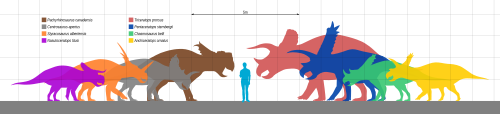
知られている最大の角竜はトリケラトプス・ホリドゥスで、近縁種のエオトリケラトプス・クセリンシュラリスも全長9メートルと推定されている。ペンタケラトプスや他の角竜も大きさでこれに匹敵する。[447] ティタノケラトプスは頭蓋骨が陸上動物の中で最も長く、長さは2.65メートルだった。[448]
鳥脚類(Ornithopoda)

- 知られている鳥脚類で最大のものは、シャントゥンゴサウルスのように、体重が最大23t(25ショートトン)で、中型の竜脚類と同じくらいの重さだった[449] [450]。体長は16.6m(54フィート)だった[449] 。 マグナパウリアは体長が12.5m(41フィート)に達し、[451]あるいは、元の記載によれば、15m(49フィート)にも達した。[452] [428]モンゴルの サウロロフス(S. angustirostris)は体長が13m(43フィート)に達し、おそらくはそれ以上だった。[453]このような動物の体重は最大11t(12ショートトン)にもなった可能性がある。[453]最大のエドモントサウルスは体長が12m(39フィート)、体重は約6t(6.6ショートトン)に達した。[454]ブラキロフォサウルスの最大体長は11メートル(36フィート)、体重は7トン(7.7ショートトン)と推定されています。[455] PASAC-1は非公式に「サビノサウルス」と呼ばれ、北米でよく知られている最大の竜脚類で、[456]体長は約11メートル(36フィート)で、他の既知の標本よりも約20%大きいです。[457] ヒプシベマ・ミズーリエンシスは最大で10.7メートル(35フィート)の体長がありました。[458] [ 459]後期白亜紀の カロノサウルスは、体長が約10メートル(33フィート)、体重が5トン(5.5ショートトン)と推定されています。[428] [460]
- ハドロサウルス上科以外で最大の鳥脚類はおそらくイグアノドンである。最大の標本は体長11メートル(36フィート)に達し[461] [462]、体重は約4.5トン(5.0ショートトン)であった。[463]もう一つの大型鳥脚類はイグアナコロッサスで、体長9メートル(30フィート)、体重5トン(5.5ショートトン)であった。[464] [465]
- 最大のラブドドン科はマセロノドンで、全長は4.8メートル(16フィート)と推定されている。 [466 ] 2016年の推定によると、 ラブドドンは全長約4メートル(13フィート)、体重約250キログラム(550ポンド)に達した。[467]
鳥類(鳥類)

化石記録に残る最大の鳥は、マダガスカルの絶滅したゾウガメ科の鳥類であるエピオルニス・マクシムスである可能性があり、これに最も近い現生の近縁種はキーウィである。巨大なゾウガメは体高が2.3メートル(7.5フィート)を超え、平均体重は850キログラム(1,870ポンド)であった[468]。
最大の鳥はオーストラリア のミヒルン である。体高は2.7メートル(8.9フィート)を超え、平均体重は500キログラム(1,100ポンド)であった[469]。
もう一つの候補は、南アメリカに生息していた絶滅した飛べない鳥であるブロントルニス・バーマイステリで、体重は319kg(703ポンド)、体高は約2.8メートル(9.2フィート)に達した。[470]
記録されている最も背の高い鳥は、ダチョウの仲間であるPachystruthio dmanisensisである。この種の鳥は、体高3.5メートル(11.5フィート)、平均体重450キログラム(990ポンド)であった[471]。
知られている最大の飛べない鳥は南米の恐怖鳥 パラフィソルニス・ブラジリエンシスで、ブラジルの恐怖鳥は体重が240kg(530ポンド)を超えていた。[472]
最も重い絶滅鳥類の表
エナンティオルニス人 (エナンティオルニス人)
最も大きなエナンティオルニス類の一つはエナンティオルニスで、[493]生存時の全長は約78.5cm (30.9インチ)、腰高は34cm (13インチ)、体重は6.75kg (14.9ポンド)、[494]翼開長は現代のカモメ類の一部に匹敵する約1.2m (3フィート11インチ)であった。[493] グリリニアはモンゴルに生息していた中生代最大の鳥で、全長53cm (21インチ)、腰高は23.2cm (9.1インチ)、体重は2.1kg (4.6ポンド)であった。[494]
アヴィサウルス科

後期白亜紀の アヴィサウルスはエナンティオルニスとほぼ同じ大きさでした。翼開長は約1.2メートル(3フィート11インチ)、[493]全長72センチメートル(28インチ)、腰高31.5センチメートル(12.4インチ)、体重5.1キログラム(11ポンド)でした。[494]ソロアヴィサウルスはそれよりも大きい可能性があります。脛足根骨の1つ(PVL-4033)は、全長80センチメートル(31インチ)、腰高35センチメートル(14インチ)、体重7.25キログラム(16.0ポンド)の動物を示しています。[494]しかし、PVL-4033をMartinavis sp.とみなしたWalkerとDyke (2009)によると、その脛足根の長さは85.6 mm (3.37 in)で、 [495] Lectavis(脛足根の長さ156 mm (6.1 in))[496]よりもはるかに短い。同じ本では、Lectavisの体長は41 cm (16 in)、腰高は30 cm (12 in)、体重は1.15 kg (2.5 lb)と推定されている。[494] ミラーチェは七面鳥に匹敵する大きさで、他のほとんどのエナンティオルニス亜科よりもはるかに大きかった。[497]
ペンゴルニス科
白亜紀前期の最大のエナンティオルニス科鳥類の一つはペンゴルニスで、体長50cm(1.6フィート)[428]、頭骨長54.7mm(2.15インチ)であった。[498]
ガルガントゥアビ科
ガルガンチュアビスは中生代最大の鳥類として知られ、ヒクイドリとダチョウの間の大きさで、現代のダチョウと同様に体重は140kg(310ポンド)である。 [499] 2019年に発見された標本MDE A-08とIVPP-V12325は、体長1.8m(5フィート11インチ)、腰高1.3m(4フィート3インチ)、体重120kg(260ポンド)と測定された。 [479]
ドロモルニス目

最大のドロモルニス科はドロモルニス・スティルトニで、体高は3メートル(9.8フィート)を超え[500]、オスの体重は528~584キログラム(1,164~1,287ポンド)でした[501] 。
ガストルニド科(ガストルニシ目)
ガストルニスの大型個体は体高が2メートル(6フィート7インチ)に達する。[502]ガストルニスの体重は、ヨーロッパ産の個体では100kg(220ポンド)から156kg(344ポンド)で、時には180kg(400ポンド)に達するものもあり、北米産の個体では160kg(350ポンド)から229kg(505ポンド)である。[503] [477] [504]
水鳥(カモ目)
.jpg/500px-Garganornis_ballmanni_(reconstruction_by_Stefano_Maugeri).jpg)
飛べなかったと思われる中新世の ガルガノルニス・バルマンニは、体重が15.3~22.3kg(34~49ポンド)で、現存するカモ目のどの種よりも大きかった。 [505]もう一つの巨大なカモ目動物は、飛べないニュージーランドガン(クネミオルニス)である。体重は15~18kg(33~40ポンド)に達し、小型のモア種に匹敵する大きさだった。[506]
白鳥(Cygnini)
知られている最大の白鳥は更新世のオオハクチョウ ( Cygnus falconeri )で、嘴から尾までの長さは約190~210cm(75~83インチ)に達し、[507]体重は約16kg(35ポンド)、翼開長は3m(9.8フィート)に達した。[488] [508] [509]ニュージーランドハクチョウ(Cygnus sumnerensis)の体重は最大10kg(22ポンド)であったが、近縁の現生のクロハクチョウはわずか6kg(13ポンド)であった。[510]日本の中新世に生息した大型の海鳥Annakacygna yoshiiensis は、大きさと体重の両方で現生のコブハクチョウをはるかに上回っていた。[511]
アナティナエ
フィンチアヒル(Chenonetta finschi)の体重は1~2kg(2.2~4.4ポンド)に達し、近縁種の現代のオーストラリアンウッドダック(800g(1.8ポンド))を上回った。[512]
ペリカン、トキおよびその近縁種(ペリカン目)
- 鮮新世初期の ペリカンは現存するペリカンのほとんどよりも大きかった。中新世後期のペリカン・オデッサヌスはおそらくP. schreiberiと同じ大きさで、その足根中足骨の長さは150 mm (5.9 in) である。[513]
- 最大のサギはベンヌサギ(Ardea bennuides)であった。[疑わしい–議論する]発見された化石に基づくと、体高は約2メートル(6.6フィート)、翼開長は最大2.7メートル(8.9フィート)で、サギ科で最大の現生種であるゴリアテサギのサイズを上回っていた。[514]
- ジャマイカトキ( Xenicibis xympithecus ) は、体重が約 2 kg (70 オンス) の大型トキでした。
コウノトリ類(コウノトリ目)

コウノトリ目最大のものはレプトプティロス・ロブストスで、体高1.8メートル(5フィート11インチ)、体重は推定16キログラム(35ポンド)でした。[515] [489] コウノトリ科の比較的大型の種であるCiconia malthaは、体高5フィート(1.5メートル)以上、翼開長は最大10フィート(3.0メートル)に達します。[516]
ツル類
ドイツの後期中新世(トルトン期)に生息していた大型のツル科(Gruinae)は、現存する最大のツル類と同等の大きさで、長い嘴を持つシベリアツル(Leucogeranus leucogeranus)に似ていた。[517]
シギ・チドリ類(チドリ目)
ミオマンカラ・ハワルディは、史上最大のカラドリ亜目ウミウシ科魚類として知られ、2番目に大きい種であるオオウミウシ( Pinguinus impennis)よりも約0.6kg(1.3ポンド)重い。 [518]
ヘスペロルニス類(ヘスペロルニス)
ヘスペロルニス科で最大のものは、体長2.2メートル(7フィート3インチ)のカナダガ・アークティカであった。 [519]
新世界ハゲワシ類(ナミハゲワシ目)

史上最も重い飛翔鳥類の一つは、中新世のテラトルニス科のアルゲンタヴィスである。この巨大な鳥の翼開長は5.09~6.5メートル(16.7~21.3フィート)[481] [520]、体重は70~72キログラム(154~159ポンド)と推定されている。[521] [481]アルゲンタヴィスの上腕骨は、人間の腕全体よりわずかに短いだけであった。[522]もう一つの巨大なテラトルニスはアイオロルニスで、翼開長は約5メートル(16フィート)であった。[523]更新世のTeratornis merriamiは体重13.7kg(30ポンド)、翼幅2.94~3.38m(9.6~11.1フィート)に達し、小さい方の推定サイズでもカリフォルニアコンドル(Gymnogyps californianus)の最大個体を上回っていた。[524]
セリエマ類とその近縁種(セリエマ目)
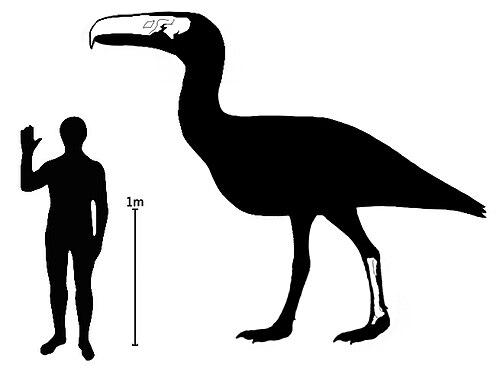
これまで知られている最大のカラミノスリ目および最大のフォルスラコス科、または「恐怖の鳥」(アメリカに生息する高度に捕食性の飛べない鳥)はブロントルニスで、肩までの高さが約175センチメートル(69インチ)で、頭を地面から2.8メートル(9フィート2インチ)上げることができ、体重は400キログラム(880ポンド)にも達した可能性がある。[525]巨大なフォルスラコス科のケレンケンは、高さ3メートル(9.8フィート)[526] [527]で、頭骨の長さは716ミリメートル(28.2インチ)(そのうち460ミリメートル(18インチ)はくちばし)で、知られている鳥の中で最も大きな頭を持っていた。[526]南米のフォルスラコスは体高2.4~2.7メートル(7.9~8.8フィート)、体重はオスのダチョウと同じくらいの130キログラム(290ポンド)近くあった。 [ 528] [529]北米最大のフォルスラコス科はティタニスで、体高は約2.5メートル(8.2フィート)に達し、[530]アフリカのマルミミゾウよりわずかに背が高かった。
ワシ類 (ワシ類)

史上最大の猛禽類として知られるのは巨大なハーストワシ(Hieraaetus moorei)で、翼開長は2.6~3メートル(8フィート6インチ~9フィート10インチ)と、サイズの割には短めだった。 [ 531] [532]全長はおそらくメスで1.4メートル(4フィート7インチ)にもなり、 [533]体重は10~15キログラム(22~33ポンド)ほどだった。[534]絶滅した巨大なタカとしては他に、体重約7.3キログラム(16ポンド)のティタノヒエラックスがおり、アンティル諸島とバハマ諸島に生息し、頂点捕食者の1つだった。[535]イスパニョーラ島で発見された第四紀後期の無名のワシは、現代のイヌワシ(Aquila chrysaetos )よりも15~30%大きかった可能性がある。[536] Buteogallus属の絶滅種の中には、現存する近縁種よりもサイズが大きいものもあった。Buteogallus borrasiは、現代のオオクロノスリ(B. urubitinga)よりも約33%大きかった。[537] 「歩くワシ」としても知られるB. daggettiは、サバンナノスリ(B. meridionalis)よりも約40%大きかった。[538] ニュージーランドの更新世から完新世にかけて生息していたアイルズチュウヒ(Circus eylesi)は、現存するC. approximansよりも2倍以上重かった。[539]
モア(ディノルニス目)
最も背の高い鳥として知られているのは、ニュージーランドのモア科に属する南島オオモア(Dinornis robustus )で、約500年前に絶滅した。体高は3.7メートル(12フィート)に達し、[540]比較的細い体格のため、体重は大型のゾウガメの約半分であった。[541]
シギ科(Tinamiformes)
MPLK-03はアルゼンチンに後期更新世に生息していたシギダネの標本で、おそらく現代のユードロミア属に属し、現存するE.エレガンスとE.フォルモサよりそれぞれ2.2~8%と6~14%大きい。[542]
ゾウドリ科(アエピオルニス目)
化石記録に残る最大の鳥は、おそらくマダガスカルの絶滅したゾウチョウ(Vorombe、Aepyornis)で、ダチョウの仲間である。ゾウチョウは体高3メートル(9.8フィート)、体重500キログラム(1,100ポンド)を超えていた。[541]
ダチョウ(ダチョウ目)
クリミア半島の下部更新統に生息していたPachystruthio dmanisensisは、体重450kg(990ポンド)で、ヨーロッパで記録された最大の鳥類である。その巨大な体にもかかわらず、走るのが得意だった。[543]河北省(中国)の下部更新統に生息していたPachystruthioの可能性のある標本は、体重が約300kg(660ポンド)で、普通のダチョウ(Struthio camelus)の2倍の重さであった。[544]鮮新統の巨大なアジアダチョウ(Struthio asiaticus)の化石[545]は、現生のStruthio camelusの成鳥の雄よりも20%大きいことを示している。[546]
ハト類(ハト目)
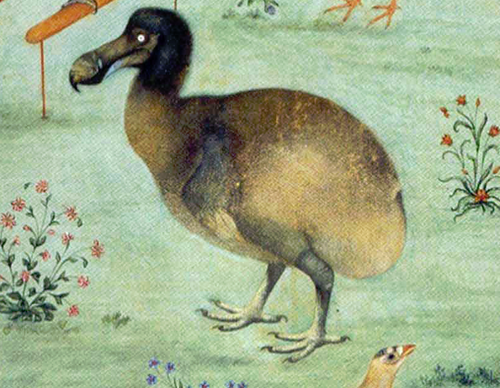
知られているハトの仲間で最大のものはドードー(Raphus cucullatus)で、体高はおそらく1メートル(3.3フィート)を超え、体重は28キログラム(62ポンド)にも達したが、最近の推定では野生のドードーの平均体重はそれよりはるかに軽く、約10.2キログラム(22ポンド)であったことが示されている。[547] [548]
キジ、七面鳥、狩猟鳥類およびその近縁種(キジ目)
キジ目鳥類で最大のものは、おそらく体重が7kg(15ポンド)に達することもあるオオキジバトであろう。 [549]
鳴鳥類(スズメ目)
知られている最大の鳴鳥は、絶滅したオオアオサギ(Chloridops regiskongi)で、体長は280 mm(11インチ)です。[出典が必要]
鵜類(ウ科)

- 知られている最大の鵜は北太平洋のメガネウ( Phalacrocorax perspicillatus )で、1850年頃に絶滅し、平均体重6.4kg(14ポンド)、体長1.15m(3フィート9インチ)でした。[492]
- 最も大きなヘビはギガンヒンガで、推定体重は約17.7kg(39ポンド)である。[487]以前の研究では、25.7kg(57ポンド)だったとさえ主張されている。[550]
- 最大のペンギンのような飛べない鳥であるプロトプテリクス科はコペプテリクス・ティタンで、大腿骨の長さは22cm(8.7インチ)と知られており、皇帝ペンギンのほぼ2倍である。[551]
カイツブリ類(カモメ目)
知られている最大のカイツブリであるアティトランカイツブリ(Podylimbus gigas)は、体長が約46~50センチメートル(18~20インチ)に達しました。[552]
骨歯鳥類(オドントプテリギフォルメ)
オドントプテリギフォルミス目(ミズゴケ目、ペリカン目、カモ目とさまざまに関連づけられてきたグループで、アルゲンタヴィスを除く史上最大の飛翔鳥類は、巨大なペラゴルニス、キポルニス、ダソルニス、ギガントルニス、オステオドントルニスである。[要出典]翼開長は5.5~6メートル(18~20フィート)、体高は約1.2メートル(3フィート11インチ)であった。[要出典]これらの鳥の骨は非常に薄く、軽くて壊れやすいため、正確なサイズの推定やどれが最大であったかを判断することはまだ不可能であり、そのためほとんどが非常に不完全な化石からしか知られていない。[要出典]
キツツキ類(キツツキ目)
知られている中で最大のキツツキは、絶滅した可能性のあるオオアカゲラ(Campephilus imperialis)で、全長は約56~60cm(22~24インチ)である。[553]
オウム類(オウム目)
知られている最大のオウムは絶滅したヘラクレス・イネクスペクタトゥスで、体長は約1メートル(3.3フィート)である。[554]
ペンギン(ペンギン目)
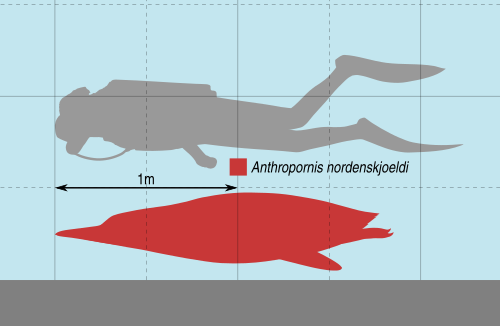
これまでに知られている中で最も重いペンギンの1つは、クミマヌ・フォーダイス(Kumimanu fordycei)で、上腕骨の測定から推定された体重は148〜159.7 kg(326〜352ポンド)です。[555]もう1つの例は、南極のPalaeeudyptes klekowskiiで、くちばしから尾までの長さは2.02 m(6フィート8インチ)、推定体重は84.2 kg(186ポンド)で、以前の推定よりもわずかに軽いです。[555] [556]始新世のアントロポルニス・ノルデンショエルディ(Anthropornis nordenskjoeldi )もサイズが似ており、かつては全長2.05 m(6フィート9インチ)、体重108 kg(238ポンド)に達すると推定されていました。[557]しかし、上腕骨の測定による最近の推定では、A. nordenskjoeldiの 体重は67kg(148ポンド)の範囲である。[555]その他の大型ペンギンには、体重が約65.4〜94.6kg(144〜209ポンド)のニュージーランドジャイアントペンギン(Pachydyptes pondeorsus)と、52.8〜73.0kg(116.4〜160.9ポンド)のIcadyptes salasiがいる。 [558] [555]
フクロウ(フクロウ目)
史上最大のフクロウとして知られるのはキューバ産の オルニメガロニクスで、体高は1,100 mm (43.3 in)、体重はおそらく9 kg (20 lb)を超えていた。[559]
両生類(両生類)
史上最大の両生類として知られる動物は、体長9.1メートル(30フィート)の海綿動物である プリオノスクスである。[560]
リサンプビアン(Lissamphibia)
カエルとヒキガエル(無尾目)

これまで知られている最大のカエルは、まだ名前が付けられていない始新世の種で、体長は約58〜59センチメートル(22.8〜23.2インチ)でした。[561]白亜紀後期の ベールゼブフォは、少なくとも23.2センチメートル(9.1インチ)(吻部から肛門までの長さ)に成長し、これは現代のアフリカウシガエルとほぼ同じ大きさでした。[562]
サンショウウオ、イモリおよびその仲間(有尾目)

- アンドリアス・マテウィは全長2.3メートル(7.5フィート)に達する、これまでに知られている最大のリス両生類であった。 [563]
- ハブロサウルスは最大のサイレン科恐竜で、体長は1.6メートル(5.2フィート)に達した。 [564]
ダイアデクトモルフ類(ダイアデクトモルファ)
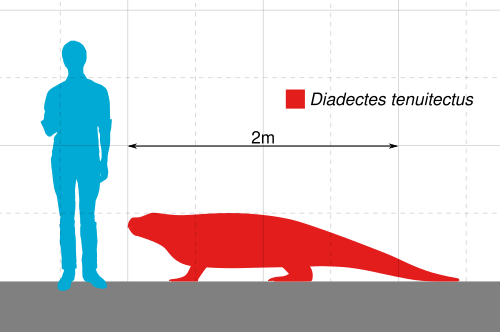
知られている中で最大の二角類である草食のディアデクテスは、体長が最大3メートル(9.8フィート)にもなり、厚い椎骨と肋骨を持つ頑丈な動物であった。[565] [566]
アントラコサウルス類
知られている最大の炭竜類はアントラコサウルスで、頭骨の長さは約40cm(16インチ)でした。[567]
エンボロメリ

このグループの中で最も長い種はエオギリヌス・アテイで、フォリデルペトン属に分類されることもある。[568]頭骨の長さは約41cm(16インチ)であった。[569]
テムノスポンディルス(テムノスポンディルス)
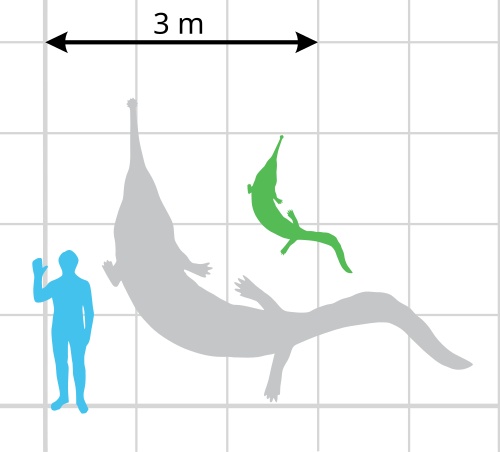
知られている最大の体躯脊椎動物はプリオノスクスで、体長は9メートル(30フィート)に成長した。[560]もう一つの巨大な体躯脊椎動物は、体長6メートル(20フィート)のマストドンサウルス・ギガンテウスである。 [570]レソト産の体躯脊椎動物の無名の種は部分的なものであるが、体長は7メートル(23フィート)と推定される。[571]
魚座(うお座)
無顎類(無顎類)
コノドント類(コノドンタ)
Iowagnathus grandisの体長は50cm(1.6フィート)以上と推定されている。[572]
異ストラカンス(異ストラキ)
オブルケビアやタルトゥオステウスなどのサメ科の一部の種は、体長が2メートル(6.6フィート)に達すると推定されている。[573]
テロドン類(テロドンティ)
部分的な標本からではあるが、Thelodus parvidens (= T. macintoshi ) は最大1メートル (3.3フィート) に達したと推定されている。[574]
頭鰭形類(頭鰭形類)
パラメテオラスピス属の一種は体長1メートル(3.3フィート)に達した。[575]
トゲザメ科(Acanthodii)
絶滅した棘皮動物の中で最大のものはキシラカンサス・グランディスで、長さ約35cm(14インチ)の顎骨に基づくイシュナカンサス形類である。近縁種のイシュナカンサスの比率に基づくと、キシラカンサス・グランディスの全長は2.5m(8フィート2インチ)と推定される。[576]
板皮類(板皮動物)

知られている最大の板皮類は巨大な肉食性のダンクルオステウスである。最も大きくてよく知られている種はD. terrelliで、様々な推定によるとその体長は4.1~10メートル(13.5~32.8フィート)、体重は1~4トン(1.1~4.4ショートトン)である。[577]もう1つの大型板皮類であるタイタニクティスも、その大きさに匹敵した可能性がある。[578] タイタニクティスの体長は4.1~7.5メートル(13~25フィート)と推定されている。[577] [579] [580] [581]
軟骨魚類(軟骨魚綱)
サメ科(サメ目)
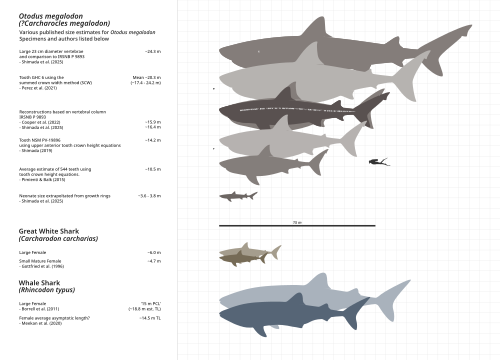
- 絶滅したオトドゥス属の種は巨大だった。巨大なサメであるオトドゥス・メガロドン[582] [583] [584]は、これまで知られているサメ類の中では群を抜いて大きい。[585]メガロドンの大きさの推定のほとんどは歯から推定されており、最大長は10.6~20メートル(35~66フィート)[583] [584] [586] 、平均長は10.5メートル(34フィート) [587] [588]と推定されている。断片的な化石のため、メガロドンの大きさの推定値は化石の歯と椎骨からしか導き出せないため、矛盾する推定値が多くある。[589] : 87 [590]成熟したオスのメガロドンの体重は12.6~33.9トン(13.9~37.4ショートトン)、成熟したメスは27.4~59.4トン(30.2~65.5ショートトン)だった可能性がある。これは、オスの体長が10.5~14.3メートル(34~47フィート)、メスが13.3~17メートル(44~56フィート)と仮定した場合である。[591]メガロドンの近縁種では、Otodus angustidensとO. chubutensisも大型化した。それぞれ9.3メートル(31フィート)[592]と12.2メートル(40フィート)[593]と推定されている。
- 他の巨大なサメ類としては、白亜紀に生息していたPseudoscapanorhynchidae科のサメがいた。クレトドゥス( C. crassidens)は体長9~11メートル(30~36フィート)であった[594] 。レプトスティラックスは体長6.3~8.3メートル(21~27フィート)に達した[595] 。
- 新生代の パロトドゥスは体長7.6メートル(25フィート)に達した。[596]
- 最も重いオナガザメはおそらくアロピアス・グランディスである。現存するホホジロザメと同程度かそれよりも大きく、現代の近縁種に特徴的な細長い背尾を持っていなかったと思われる。[597]
メジロザメ(メジロザメ目)
新生代の ヘミプリスティス・セラは現代の同族よりもかなり大きく、歯もはるかに大きかった。全長は6メートル(20フィート)と推定されている。[598]
ヒボドン類(ヒボドンティフォルメ)
最も大きなヒボドンティス類の一つは、ジュラ紀のアステラカンサスで、体長は最大3メートル(9.8フィート)でした。 [599] クラッソドゥス・レイフィは、化石が少ないものの、体長が3メートル(9.8フィート)を超えたと推定されています。[600]
クチバシ目
クテナカンサス目最大の種はSaivodus striatusで、体長は6~9メートル(20~30フィート)と推定されている。[601] [577]
ガンギエイ類とその仲間(Rajiformes)
巨大な硬骨魚類オンコ プリスティスは体長が約4.25メートル(13.9フィート)に達した。[602]
ユーゲネオドント(ユーゲネオドン科)

知られている中で最大の真正歯類は、アイダホ州で発見されたヘリコプリオンのまだ名前のついていない種である。標本は、体長がおそらく12メートル(39フィート)を超える動物であったことを示唆している。 [603]もう1つのかなり大きな真正歯類はパラヘリコプリオンである。ヘリコプリオンよりもスリムで、ほぼ同じ大きさに達し、[603]おそらく体長は12メートル(39フィート)に達した。[604]どちらも古生代の動物の中で最大の大きさであった。[605] [604]
肉鰭類(肉鰭綱)
シーラカンス(アクティニス亜綱)

最大のシーラカンスは白亜紀のMawsonia gigasで、全長は5.3メートル(17フィート)に達すると推定されています。ジュラ紀のトラキメトポンはそれに近い約5メートル(16フィート)の大きさに達した可能性があります。[606]モロッコのマーストリヒチアン堆積物から発見された未確認のmawsoniidは、全長3.65〜5.52メートル(12.0〜18.1フィート)に達したと考えられます。[607] [606]
肺魚(ディプノイ)
西部内陸部から発見された白亜紀のCeratodus属は、体長が約4メートル(13フィート)と推定されている。[608]
茎四肢動物(テトラポドモルファ)

.jpg/500px-Hyneria_(cropped).jpg)
- 知られている中で最大の根歯類であるだけでなく、最大の肉鰭類でもあるのが、体長5.63~7メートル(18.5~23.0フィート)のリゾドゥスである。[609] [577]その他の大型根歯類には、推定体長3~5メートル(9.8~16.4フィート)のストレプソドゥスや、体長3~4メートル(9.8~13.1フィート)と推定されるバラメダがいる。 [610] [611]
- トリコプター科の ヒネリアは体長が最大3.5メートル(11フィート)に達した。[577]
条鰭類(条鰭綱)
ワニ目
- 絶滅したアキノウオ目コンドロステ科に属するギロステウスは、標準的な体長が約6~7メートル(20~23フィート)と推定されている。 [612]
- 最大の化石チョウザメは断片的な化石から知られる巨大チョウザメ「Acipenser」で、体長は5.8メートル(19フィート)に達すると推定されている。[613]
- 最大の化石ヘラチョウザメはジュディス川層から発見された無名の化石で、体長は2メートル(6フィート7インチ)を超えていた可能性がある。既知の化石は、科学的には3メートル(9.8フィート)を超えていたと報告されている最近絶滅した中国のヘラチョウザメよりも大きい。[614]
パキコルミ目

史上最大の条鰭類および最大の硬骨魚類として知られるのは、全長約16.5メートル(54フィート)のパキコルム類、リードシクティス・プロブレマティカスである。 [615]以前の推定では、全長27メートル(89フィート)を超える大型の個体もいたと主張されていた。[616] [617]
魚類
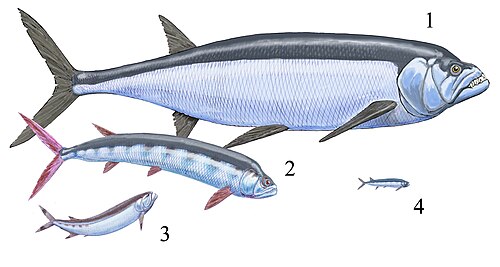
知られている最大の魚類は、長さが6.1メートル(20フィート)に達したシファクティヌスである。 [618] イクチオデクテスは長さが3メートル(9.8フィート)に達し、シファクティヌスの半分の長さであった。[619]
ウミウシ目
最大のピクノドン類はGyroduscircularisで、体長は最大2メートル(6フィート7インチ)であった。[620]
ビキル(Polypteriformes)
白亜紀後期の バウィティウスはおそらく史上最大のビキル類である。体長は3メートル(9.8フィート)に達した。 [621]
オオハナダイ、リュウグウノツカイ、リュウグウノツカイおよびその近縁種(ヤツメウナギ目)
メガランプリスはおそらく最大の化石アカマンボウである。この魚は生きているときの長さが約4メートル(13フィート)で、これは現生最大のアカマンボウ種であるランプリス・グッタトゥスの2倍の長さである。 [622]
サケとマス(サケ目)
最大のサケはOncorhynchus rastrosusで、大きさは1.9メートル(6フィート3インチ)、177キログラム(390ポンド)[623]から2.4メートル(7フィート10インチ)、200キログラム(440ポンド) [624]まで様々でした。[623]
フグ類、ハコフグ類、モンガラカワハギ類、マンボウ類およびその近縁種(フグ目)
- Austromola angerhoferiの全長は約3.2メートル(10フィート)、全高は4メートル(13フィート)で、最大のマンボウに匹敵します。 [625] [626]
- 絶滅したバリステス属の種の中には、B. vegaiやB. crassidensのように全長が1.8メートル(5フィート11インチ)に達するものもあると推定されている。[627]
エソ類(Aulopiformes)
最大のエサウオはストラトドゥスで、体長は5メートル(16フィート)に達する。[628]
棘皮動物(棘皮動物門)
クリノゾア
ウミユリ(ウミユリ科)
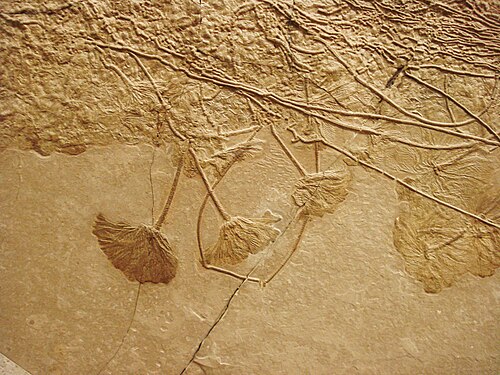
Seirocrinus subangularisの最長の茎は26メートル(85フィート)以上に達した。[629]
アステロゾア
ヒトデ(Asteroidea)
フンスリュック・スレートのヘリアンサスターの半径は約25cm(9.8インチ)であった。[630]
グラプトライト(グラプトリシナ)
最も長いグラプトロイドグラプトライトは、1.45メートル(4.8フィート)のスティムログラプタス・ハリである。これはイギリスのシルル紀の鉱床で発見された。[631]
キノリンクス(キノリンクス)
清江生物群のカンブリア紀のキノリンクスは「泥竜」としても知られ、体長は4cm(1.6インチ)に達し、体長が数ミリメートルにしか成長しない現存する同族よりもはるかに大きかった。[632] [633]
節足動物(節足動物)
ディノカリダ科
鰓のある葉足動物

口器の発見に基づいて、カンブリア紀の鰓葉足動物 Omnidens amplusは、1.5メートル(4.9フィート)であったと推定されています。[634]また、現存する最大のカンブリア紀の動物としても知られています。[634]
放射歯類(放射歯亜綱)

最大の放射歯類はAegirocassis benmoulaiで、体長は少なくとも2メートル(6フィート7インチ)あったと推定されている。[635] [636]
鋏角目
ウミグモ(ウミグモ目)
最大の化石ウミグモはPalaeisopus problematicusで、脚開長は約32cm(13インチ)である。[637]
カブトガニ類とその仲間(Xiphosura)
- ウィルウェラティアは甲羅の幅が9cm(3.5インチ)に達し、基底的(「シンジホスリン」)キシフォスラン類の中では最大の種であった。 [638] [639]しかし、デボン紀の マルディブラキアはほぼ11.5cm(4.5インチ)に達し、 [640] 2013年にキシフォスラン類に分類された。 [639]
- アインのケリンで発見されたカブトガニの足跡化石 Kouphichnium lithographicumは、動物の体長が77.4~85.1cm(30.5~33.5インチ)であったことを示している。[641]
Chasmataspidida (チャスマタスピディダ)

最大のカスマタスピス科はオルドビス紀の ホプリタスピスで、体長は29cm(11インチ)あり、カスマタスピスと同程度の大きさであった。[642]
ユーリプテルス類(ユーリプテルス目)
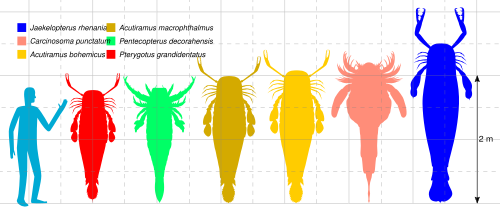
- 知られている最大の広翼竜は、体長2.5メートル(8フィート2インチ)のJaekelopterus rhenaniaeで、これは現存する最大の節足動物でもある。 [643] Erettopterus grandisもおそらくこれと同じ体長に達したと思われるが、これは不完全な尾節のみに基づいている。これに匹敵する種は、体長2.1メートル(6フィート11インチ)のAcutiramus bohemicusである。 [644]最大のメガログラプト類であり、最大のオルドビス紀広翼竜はペンテコプテルスである。体長は1.7メートル(5フィート7インチ)に達した。[645]これらはすべて広翼竜亜目広翼竜である。[644] [645]
- 最大の柱状軟骨魚類はヒベルトプテルスで、体長は1.8メートル(5フィート11インチ)であった。[644]
クモ類(クモ綱)
- 史上最大のクモ類、および史上最大のサソリとしては、 Pulmonoscorpius kirktonensis、Brontoscorpio anglicus、およびPraearcturus gigasの3種が候補に挙がっています。それぞれ70 cm (28 in) [646] 、 90 cm (35 in) [647]、最大100 cm (39 in) [648]と推定されています。
- Mongolarachne jurassicaは、記載されている化石クモの中では最大であり、メスの全長は約24.6 mm(0.97インチ)、前脚の長さは約56.5 mm(2.22インチ)に達する。 [649] Dinodiplura ambulacraは体長がより大きく、甲羅と後体部を合わせた長さは26.15 mm(1.030インチ)に達する。 [650]
- 先史時代の鞭サソリ類の中で最大で、おそらくこれまでに発見された鞭サソリ類の中でも最大のもの[651]は、メソプロクタス・レイオリである。タイプ標本の体長は65.9 mm (2.59 in)、甲羅の長さは25.7 mm (1.01 in) であるが、別の標本では甲羅の長さが32.5 mm (1.28 in)、幅が16 mm (0.63 in) で、現存するマスティゴプロクタスに匹敵するか、それよりも大きい。[652] [653]
- これまで存在した最大のトコジラミは体長21.77mm(0.857インチ)のCurculioides bohemondiであった。 [654]
- これまでに記録された最大の化石ダニ であり、また最大の赤ダニ類は、体長が8mm(0.31インチ)を超えるイメンスマリス・チューバッケイである。 [655]
- 知られている最大の三角類はクライシェリアで、最小体長は51 mm (2.0 in) でした。[656] 2番目に大きいのはプレオプリュヌスで、体長は36 mm (1.4 in) でした。[656]
節足動物(Artiopoda)
網状葉類はおそらく最大55cm(22インチ)に達した。 [657] テゴペルテは、三葉虫以外の大型節足動物のもう一つの例であり、体長は280mm(11インチ)に達し[658] 、バージェス頁岩の左右相称動物の中では最大で、他のすべての底生生物の少なくとも2倍の大きさであった。 [658]
三葉虫(三葉虫亜綱)
三葉虫の中には体長が60cmを超えるものもあった。マニトバ州で見つかったほぼ完全なイソテルス・レックスの標本は体長が70cmを超え、ポルトガルのオギギヌス・フォルテイもほぼ同じ長さだった。三葉虫の断片からは、さらに大きな記録が示唆されている。フンギオイデス・ボヘミカスの孤立したピギディウムからは、この動物の体長は90cmだったことが示唆されている。[659]
多足動物(多足類)

これまで知られている最大の多足動物はアースロプレウラである。体長は2.5メートル(8フィート2インチ)[660]、幅は50センチメートル(20インチ)[661]。一部の標本はさらに大きく、体長は最大2.63メートル(8フィート8インチ)、体重は50キログラム(110ポンド)に達した可能性がある。[662] [663]
非六脚類甲殻類(甲殻類)
サイクロイド(Cyclida)
最大のサイクロイドは、後期三畳紀のハリシンに似たサイクロイドであるオポランカ・デコロサで、甲羅の幅は6cm(2.4インチ)を超えていました。[664]
レミペデス(レミペディア)
テスヌソカリスの体長は少なくとも9.5cm(3.7インチ)あり、 [665]現生のレミペデス類の体長は最大4.5cm(1.8インチ)に達していたが、それよりも大きかった。 [666]
昆虫(昆虫綱)
ハバチ、スズメバチ、ハチ、アリおよびその仲間(膜翅目)

- このグループで最大のものは巨大アリのTitanomyrma giganteumで、女王アリの体長は6cm(2.4インチ)に成長した。翼開長は15cm(5.9インチ)であった。[667]
- Apis lithohermaeaはこれまでに発見されたミツバチの中で最大級のミツバチの一つで、現代のApis dorsataと大きさが匹敵する。 [668]
- オオハバチの 一種Ypresiosirex orthosemosは、不完全な産卵管を含めて全長67.9mm(2.67インチ)に達した。 [ 669]オオハバチの別の例としては、翼開長が92mm(3.6インチ)を超えるHoplitolyda duolunicaが挙げられる。[670]
ノミ(ノミ目)
ノミ目ウミウシ科で最大のものはおそらくPseudopulex magnusで、体長は0.90インチ(22.8 mm)に成長した。[671]
ハサミムシ類(ハサミムシ目)
.jpg/500px-Labidura_herculeana_(cropped).jpg)
1967年以降に絶滅し[672] [673]、完新世の亜 化石としても提出された[674]セントヘレナオオハサミムシ(Labidura herculeana、同義語Labidura loveridgei)は、34mm(1.3インチ)の鉗子を含めて全長84mm(3.3インチ)に達した。[672]
クレスモディ科
クレスモダ科は、現代のゲリダ科のように、長く特殊な脚を持っていた。クレスモダ科の一種であるクレスモダ・オブスキュラは、体長が約19センチメートル(7.5インチ)に達した可能性がある。[675]
甲虫類(甲虫目)
コガネムシ上科で最大の化石甲虫の一つは、プロトグナティヌス・スピルベルギである。下顎を含めた全長は約5.5センチメートル(2.2インチ)であった。[676]最大の化石甲虫は、推定体長5センチメートル(2.0インチ)のオリクトアンティクウス・ボレアリスであった。 [677]
ティタノプテラ類(Titanoptera)

現代の直翅目昆虫と関連があるが、三畳紀のティタノプテラル昆虫ははるかに大型であった。ギガティタン・ヴルガリスの翼開長は最大40センチメートル(16インチ)であった。[678 ]クラトロティタン・アンダーソンイもまた巨大なサイズに達し、前翅の長さは13.8センチメートル(5.4インチ)であった。[679]
アリジゴクおよび関連する網翅目昆虫(脈翅目)
クラト層に生息するマカルキニア・アダムシは、前翅が160mm(6.3インチ)と推定され、翼翅目昆虫の中で最も長いと推定されている。 [680]
ゴキブリ、シロアリ、カマキリおよびその仲間(網翅目)
- ゴキブリ目(Blattoptera)に属する石炭紀のゴキブリのような昆虫の中には、 Archoblatina beecheri [681]やNecymylacris (Xenoblatta) scudderi [682] [683]のように全長が約9センチメートルに達するものもあり、これは現代のMegaloblatta longipennisに匹敵する。
- 白亜紀のゴキブリ Ptiloteuthis foliatusは、7.9cm(3.1インチ)の長さの羽を持っていました。[684]
- オーストリアの中新世に発見された巨大シロアリGyatermes styriensisは、体長25mm(0.98インチ)、翼幅76mm(3.0インチ)に達しました。[685]
トンボ、イトトンボ、シロチョウ(トンボ目)

- 知られている最大のトンボ目昆虫は、片羽の長さが33cm(13インチ)のメガネウロプシス・ペルミアナである。メガネウラの羽の長さは32cm(13インチ)であった。[686]
- 三畳紀のTriadotypidodonatan Reisia gelasii(= Triadotypus guillaumei )は、 136ミリメートル(5.4インチ)の長さの翼を持ち、翼幅は280ミリメートル(11インチ)に達する。[687] [688]
カゲロウ(カゲロウ目)
- 知られている最大のカゲロウはペルム紀のPonalex maximusで、後翅の長さは55mm(2インチ)でした。[689]白亜紀のEpicharmeropsis quadrivenulosusの前翅の長さは37mm(1インチ)でした。[690]
- チェコ共和国のモラビアの上部石炭紀に生息するBojophlebia prokopiは翼幅が45cm(18インチ)あり、最大のカゲロウであると説明されているが[ 691] 、その後の研究ではこの昆虫はカゲロウとは関係がないことがわかった。[692]
古翅目
最大の古翅目昆虫はマゾタイロスで、翼開長は最大560 mm(22インチ)と推定されている。[693]ピエスベルグ採石場から発見された亜円形の翼が古翅目昆虫に属する場合、翼長は少なくとも30 cm(12インチ)あった可能性がある。[694]
始祖鳥類(跳躍性剛毛虫)およびその他の羽のない原始的な昆虫
- 最大のマキリッド類は三畳紀のギガマキリスで、糸の長さを除いて体長は40ミリメートル(1.6インチ)、全長は約80ミリメートル(3.1インチ)と推定されています。[695]
- 絶滅したモヌラ亜目の最大の標本は、糸の長さを除いて30ミリメートル(1.2インチ)以上に達した。[696]
- ラムスデレピディオンはかつては体長60ミリメートル(2.4インチ)のシミであると考えられていましたが、[697]後に分類が不確かであると考えられ、単に幹グループの昆虫として扱われるようになりました。[698]
- 初期の無羽昆虫であるカルボトリプルラは、尾の糸を除いて体長が約103ミリメートル(4.1インチ)でした。[699]
ヤムシ類(Chaetognatha)
カンブリア紀の幹毛顎類 Timorebestia kopriiは体長20cm(7.9インチ)、触角を含めると30cm(12インチ)に達した。[700] Capinatatorは体長の3分の1にあたる約10cm(3.9インチ)であったが、幹とはみなされず、それでも現代の最大のヤムシと同程度の長さであった。[700] [701]
輪形動物(環形動物)
ウェブステロプリオンは、知られている中で最大の化石環 形動物で、体長は0.42~8.3メートル(1フィート5インチ~27フィート3インチ)と推定されているが、近縁の現存する分類群と比較すると、体長は1~2メートル(3フィート3インチ~6フィート7インチ)程度であることが示唆されている。 [702]また、先史時代の多毛類の中でも最大のスコレコドン類で、体長は最大13.2ミリメートル(0.52インチ)で、さらに大きかった可能性もある。 [702]
軟体動物(Mollusca)
カタツムリとナメクジ(腹足類)

- 最大の腹足類として知られているのはカンパニーレ属で、絶滅したカンパニーレ・ギガンテウムの殻長は最大90cm(35インチ)[703]、120cm(47インチ)[704]を超えるものもあった。
- 知られている最大のタカラガイはVicelia bizzottoiで、殻長は33.5cm(13.2インチ)である。[705]
- Pebasiconcha immanisはこれまでに知られている中で最大の陸生カタツムリであり、殻高は25.6cm(10.1インチ)で、一部の標本では殻高が30cm(12インチ)を超えるものもある。 [706]
二枚貝類
- これまで知られている最大の二枚貝であり、最大のイノセラムス類はPlatyceramus platinusで、通常は体長が 1 m (3 フィート 3 インチ) の巨大種であるが、体長が 3 m (9.8 フィート) に達する個体もいた。[707]もう一つの大型先史時代の二枚貝はイノセラムスである。1952 年、グリーンランドの白亜紀後期の堆積物から、体長 187 cm (6.14 フィート) のイノセラムス・スティーンストルピの標本が発見された。[708]
- シカマイアのようなペルム紀のアラトコンキス科の属の中には、殻長が約1メートル(3フィート3インチ)のものもあった。[709]以前の推定では、シカマイアの殻長は約1.6メートル(5フィート3インチ)とされていた。[710]
- 最も長いカワハギ科魚類はコンボスレアで、殻高は最大1.2メートル(3フィート11インチ)に達する。[711]
- ルディスト・チタ ノサルコライトの全体の大きさは約2メートル(6フィート7インチ)でした。[712]
牙貝(Scaphopoda)
- 牙殻 Prodentalium onoiの全長は30cm(12インチ)以上と推定される。[713]
頭足動物

オウムガイ類(Nautiloidea)
知られているオウムガイ類の中で最大かつ最長のものは、殻長5.73メートル(18.8フィート)のエンドセラス・ギガンテウムである。殻長が9.14メートル(30.0フィート)に達した個体の記録もあるが、疑わしい。[714]
アンモナイト(アンモナイト上科)
最大のアンモナイトとして知られているのはパラプゾシア・セッペンラデンシスである。[715]ドイツで発見された部分的な化石標本の殻の直径は1.95メートル(6フィート5インチ)であったが、居住空間が不完全であったため、推定殻の直径はおそらく約3.5メートル(11フィート)、生存時の重量は約705キログラム(1,554ポンド)であった。[716]しかし、その後の研究では殻の直径は最大約2メートル(6フィート7インチ)と推定されている。[717]
ベレムナイト(ベレムノイデア)
最大のベレムナイトはメガテウティス・ギガンテアで、最大直径と吻部の長さはそれぞれ約50mmと700mm(2.0インチと27.6インチ)に達した。[718]
イカ、タコ、コウイカ類およびその近縁種(Neocoleoidea)
- タコ類の Enchoteuthis melanae ( Tusoteuthis longaの標本とされる)は、マントルの長さが最大2メートル(6フィート7インチ)あり、現代のダイオウイカに匹敵する。以前は、この分類群は腕を含めた全長が10メートル(33フィート)を超え、ダイオウイカに類似していると考えられていた。しかし、他の化石の近縁種を考慮すると、腕を含めた全長は約3メートル(9.8フィート)と推定されている。[719]
- 非タコ類のエゾテウティスとタコ類の ハボロテウティスは、どちらも現代のダイオウイカと大きさが似ていると推定されている。[720] [721]
腕足動物

これまでに進化した最大の腕足動物は、ロシアのアッカーマノフカ採石場から発見されたStratifera striataで、高さは最大0.5メートル(1フィート8インチ)でした。[722]もう一つの巨大な腕足動物は石炭紀のGigantoproductus giganteusで、殻の幅は30センチメートル(12インチ) [723]から35センチメートル(14インチ)以上でした。[712] [724] Titanaria costellataは幅35〜36センチメートル(14〜14インチ)の大きく長い殻を持ち、Gigantoproductusとほぼ同じ大きさでした。[725]
ハイオリス(Hyolitha)
最大の岩石はMacrotheca almgreeniで、長さは約50センチメートル(20インチ)です。[712] [726]
刺胞動物
クラゲ類とその仲間(クラゲ亜綱)
最大の化石クラゲはカンブリア紀の Cordubia giganteaで、直径は88センチメートル(35インチ)です。[727 ]ウィスコンシン州のカンブリア紀の標本は、長さが70センチメートル(28インチ)に達しました。[728]
ベンドビオント(ベンドビオンタ)
ペタロナミド類(ペタロナマエ)
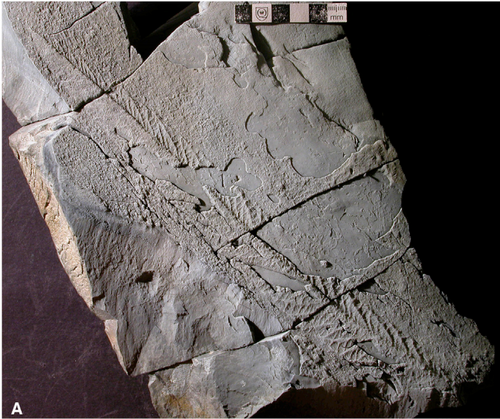
Trepassia wardae ( Charnia wardiとしても知られる)の最長の標本は、長さが185cm(73インチ)に達しました。[729] Charnia masoniは、わずか1cm(0.39インチ)の小さな標本から、長さ66cm(26インチ)の最大の標本まで知られています。[730]
前節足動物
ディッキンソニア・テヌイスは体長1.4メートル(4.6フィート)に達し、先カンブリア時代の生物としては最大級のものの一つとなった。 [731] [732]
海綿動物(海綿動物)
ペルム紀に生息していた最大の海綿動物ギガントスポンジアは、直径が最大2.5メートル(8フィート2インチ)ありました。[733]
参照
参考文献
- ^ Carbone, Chris; Teacher, Amber; Rowcliffe, J (2007). 「肉食のコスト」. PLOS Biology . 5 (2): e22. doi : 10.1371/journal.pbio.0050022 . PMC 1769424. PMID 17227145 .
- ^ Hokkanen, JEI (1986年2月). 「最大の陸上動物のサイズ」. Journal of Theoretical Biology . 118 (4): 491–499. Bibcode :1986JThBi.118..491H. doi :10.1016/S0022-5193(86)80167-9. PMID 3713220.
- ^ ロマーノ、マルコ;シトン、パオロ。マガヌコ、シモーネ。サッチ、エヴァ。カラテッリ、マルティナ。ロンキ、オーソニオ。ウンベルト、ニコシア(2019年5月)。 「トレ・デル・ポルティッチョーロ(イタリア、アルゲーロ)のペルム紀の露頭で新たな基底単弓類を発見」。地質学ジャーナル。54 (3): 1554 ~ 1566 年。Bibcode :2019GeolJ..54.1554R。土井:10.1002/gj.3250。S2CID 133755506。
- ^ 「ペルム紀地層学に関する小委員会」(PDF) . permian.stratigraphy.org . 国際地層学委員会 国際地質科学連合. 2018年12月3日時点のオリジナルよりアーカイブ(PDF) . 2022年9月8日閲覧。
- ^ Reisz, Robert R.; Fröbisch, Jörg (2014年4月16日). 「カンザス州ペンシルベニア紀後期の最古のカゼイド類単弓類と陸生脊椎動物の草食性の進化」. PLOS ONE . 9 (4): e94518. Bibcode :2014PLoSO...994518R. doi : 10.1371/journal.pone.0094518 . PMC 3989228. PMID 24739998 .
- ^ Romer, AS; Price, LW (1940). 「盤竜類のレビュー」アメリカ地質学会特別論文集(28): 400, 403. ISBN 978-0-8137-2028-9。
- ^ “エダフォサウルス”. Palaeos . 2022年2月20日時点のオリジナルよりアーカイブ。2022年9月9日閲覧。
- ^ Berman, DS; Reisz, RR; Martens, T.; Henrici, AC (2001). 「ドイツ下部ペルム紀の Dimetrodon (Synapsida: Sphenacodontidae) の新種が北米以外で初めて発見される」(PDF) . Canadian Journal of Earth Sciences . 38 (5): 803–812. Bibcode :2001CaJES..38..803B. doi :10.1139/cjes-38-5-803.
- ^ Brink, Kirstin S.; Reisz, Robert R. (2014年10月16日). 「最古の陸生頂点捕食者ディメトロドンの隠れた歯の多様性」. Nature Communications . 5 : 3269. Bibcode :2014NatCo...5.3269B. doi : 10.1038/ncomms4269 . PMID 24509889.
- ^ Olson, EC (1955). 「旧世界と新世界のペルム紀爬虫類動物相の進化における平行性」. Fieldiana . 37 (13): 395. 2022年9月8日閲覧。
- ^ セント・フルール、ニコラス(2019年1月4日)。「恐竜と並んで放牧していた象サイズの哺乳類の親戚」ニューヨーク・タイムズ。 2022年9月9日閲覧。
- ^ Sulej, Tomasz; Niedzwiedzki, Grzegorz (2019年1月4日). 「直立した手足を持つ、象ほどの大きさの後期三畳紀の単弓類」. Science . 363 (6422): 78–80. Bibcode :2019Sci...363...78S. doi : 10.1126/science.aal4853 . PMID 30467179.
- ^ 「巨大哺乳類の『いとこ』が発見される」。ScienceDaily(プレスリリース)。ウプサラ大学。2018年11月23日。
- ^ Romano, Marco; Manucci, Fabio (2021年4月3日). 「Lisowicia bojaniのサイズ変更:三畳紀後期の巨大ディキノドン類の体積体重推定と3D再構築」. Historical Biology . 33 (4): 474–479. Bibcode :2021HBio...33..474R. doi :10.1080/08912963.2019.1631819. ISSN 0891-2963.
- ^ ab "Eotitanosuchidae". Kheper . M.Alan Kazlev. 2019年8月6日時点のオリジナルよりアーカイブ。 2022年9月9日閲覧。
- ^ ヴァン・ヴァルケンバーグ、ブレア、ジェンキンス、イアン(2002)。「ペルム紀・三畳紀および新生代の単弓類捕食者の歴史における進化パターン」。古生物学会論文8:267-288。
- ^ ab “Brithopodidae / Anteosauridae”. Kheper . M.Alan Kazlev. 2019年8月12日時点のオリジナルよりアーカイブ。 2022年9月9日閲覧。
- ^プロセロ、ドナルド R. (2022 年 4 月 18 日)。「20 .単弓類: 哺乳類の起源」。脊椎動物の進化: 起源から恐竜まで、そしてその先へ。ボカラトン: CRC プレス。doi :10.1201/ 9781003128205-4。ISBN 978-0-367-47316-7. S2CID 246318785。
- ^ abc Kammerer, Christian F. (2016). 「Rubidgeinae(Therapsida: Gorgonopsia)の系統学」. PeerJ . 4 : e1608. doi : 10.7717/peerj.1608 . PMC 4730894. PMID 26823998 .
- ^ 158~159 ページ: Angielczyk, Kenneth D.; Kammerer, Christian F. (2018). 「非哺乳類の単弓類: 哺乳類の系統樹の深いルーツ」。哺乳類の進化、多様性、系統学。pp. 117~198。doi :10.1515 / 9783110341553-005。ISBN 978-3-11-034155-3。
- ^ J. Van Den Heever (1987)、ステレンボッシュ大学で哲学博士号取得のために提出された論文
- ^ Lydekker, R. (1908). 「今年の脊椎動物古生物学」。20世紀の科学の進歩 (1906-1916)。2 ( 7): 501–524。JSTOR 43776634 。
- ^ブルーム 、ロバート (1903)。「いくつかの新しい原始的な獣歯類について」南アフリカ博物館年報。4 。
- ^ フレデリック・トルチャード;カンメラー、クリスチャン F.バトラー、リチャード・J.ヘンドリックス、クリストフ。ブノワ、ジュリアン。アブダラ、フェルナンド。ショイニエール、ジョナ N. (2021 年 3 月 4 日)。 「南アフリカの三畳紀の新しい大型ゴンフォドン類とそのゴンドワナ生物層序への影響」(PDF)。脊椎動物古生物学のジャーナル。41 (2)。ビブコード:2021JVPal..41E9265T。土井:10.1080/02724634.2021.1929265。
- ^ William A. Clemens (2011). 「ウェールズ(イギリス)の初期ジュラ紀の亀裂充填物から発見された新しいモルガヌコドンタン」. 古生物学. 54 (5): 1139–1156. Bibcode :2011Palgy..54.1139C. doi : 10.1111/j.1475-4983.2011.01094.x .
- ^ ローズ2006、56ページ。
- ^ ポール・セルデン、ジョン・ナッズ(2012年9月19日)。化石生態系の進化。第2版。アカデミック・プレス。178ページ。ISBN 978-0-12-404629-0. 2022年8月25日閲覧。
- ^ ゾフィア・キエラン・ヤウォロウスカ、リチャード・L・チフェリ、ゼー・シー・ルオ(2004年)。「第12章:メタテリアン」。恐竜時代の哺乳類:起源、進化、構造。ニューヨーク:コロンビア大学出版局。243ページ。ISBN 978-0-231-11918-4。
- ^ abc プロセロ、ドナルド R. (2016 年 11 月 15 日)。プリンストン先史哺乳類フィールドガイド。プリンストン大学出版局。p. 33。ISBN 978-0-691-15682-8. 2022年9月22日閲覧。
- ^ フランク・ザコス、ロバート・アッシャー(2018年10月22日)。哺乳類の進化、多様性、系統学。デ・グリュイター。p.224。ISBN 978-3-11-034155-3. 2022年8月25日閲覧。
- ^ Rose 2006、62ページ。
- ^ ab Kielan-Jaworowska, Zofia (2013). In Pursuit of Early Mammals. Indiana University Press. p. 115. ISBN 978-0-253-00824-4. 2022年8月25日閲覧。
- ^ Hu, Yaoming; Meng, Jin; Wang, Yuanqing; Li, Chuankui (2005 年 1 月 13 日). 「若い恐竜を餌とする中生代の大型哺乳類」. Nature . 433 (7022): 149–152. Bibcode :2005Natur.433..149H. doi :10.1038/nature03102. PMID 15650737.
- ^ TS Kemp (2005). 哺乳類の起源と進化. オックスフォード大学出版局, 米国. p. 183. ISBN 978-0-19-850761-1. 2022年9月22日閲覧。
- ^ ローズ2006、60ページ。
- ^ Williamson, Thomas E.; Brusatte, Stephen L.; Secord, Ross; Shelley, Sarah (2016年5月)。「ニューメキシコ州ナシミエント層の中部プエルカン層から発見された新しいテニオラブイド多丘状動物(哺乳類)、およびテニオラブイドの系統分類と系統発生の改訂:テニオラブイド上科の改訂」。リンネ協会動物学雑誌。177 (1): 183–208。doi :10.1111/zoj.12336。
- ^ 「Zaglossus hacketti – 絶滅した巨大ハリモグラ」。Tourism Western Australia。2014年1月26日時点のオリジナルよりアーカイブ。2014年4月28日閲覧。
- ^ Pian, Rebecca; Archer, Michael; Hand, Suzanne J. (2013年11月1日). 「オーストラリア、リバーズリー世界遺産地域から発見された新種の巨大カモノハシ Obdurodon tharalkooschild (単孔類、Ornithorhynchidae)」Journal of Vertebrate Paleontology . 33 (6): 1255–1259. Bibcode :2013JVPal..33.1255P. doi :10.1080/02724634.2013.782876. S2CID 85776473.
- ^ Weil, Anne (2005). 「哺乳類の古生物学: 白亜紀に大規模に生息」. Nature . 433 (7022) (2005年1月12日発行): 116–117. Bibcode :2005Natur.433..116W. doi :10.1038/433116b. PMID 15650725. S2CID 52869101.
- ^ Prevosti, Francisco J.; Forasiepi, Analía; Zimicz, Natalia (2011年11月5日). 「南米における新生代陸生哺乳類捕食者ギルドの進化:競争か置き換えか?」Journal of Mammalian Evolution . 20 (1): 3–21. doi :10.1007/s10914-011-9175-9. hdl : 11336/2663 . S2CID 15751319.
- ^ エルコリ、マルコス・ダリオ;プレボスティ、フランシスコ・フアン(2011年12月1日)。 「Sparassodonta (哺乳類、メタテリア) de Edad Santacrucense (Mioceno Temprano) a Partir del Tamaño del Centroide de los Elementos Apendiculares: Inferencias Paleoecológicas」 [聖十字架の質量推定 (中新世初期) Sparassodonta (哺乳類、メタテリア)メタテリア)付属元素の重心サイズからの種:古生態学的推論]。アメギニアナ(スペイン語)。48 (4): 462–479。土井:10.5710/amgh.v48i4(347)。S2CID 129838311。
- ^ abcdefgh Sorkin, Boris (2008年12月). 「陸生哺乳類捕食動物の体重に対する生体力学的制約」. Lethaia . 41 (4): 333–347. Bibcode :2008Letha..41..333S. doi :10.1111/j.1502-3931.2007.00091.x.
- ^ エンゲルマン、ラッセル K.;ジョン・J・フリン(ジョン・ジョセフ);ウィス、アンドレ R.ダリン・A・クロフト(2020年7月17日)。エオマカイラ・モロッサス、チリのアンデス主山脈の漸新世初期(ティンギリリカン)カチャポアル産の新しい剣歯スパラソドン類(メタテリア:ティラコスミリナ科)。 (アメリカ博物館修練者、no. 3957) (レポート)。アメリカ自然史博物館。hdl :2246/7235。
- ^ Forasiepi, Analía M.; Judith Babot, M.; Zimicz, Natalia (2015年6月3日). 「Australohyaena antiqua (Mammalia, Metatheria, Sparassodonta)、パタゴニアの後期漸新世に生息した大型捕食動物」Journal of Systematic Palaeontology . 13 (6): 503–525. Bibcode :2015JSPal..13..503F. doi :10.1080/14772019.2014.926403. hdl : 11336/59430 .
- ^ ローズ2006、78ページ。
- ^ ゾフィア・キエラン・ヤウォロウスカ、リチャード・L・チフェリ、ゼー・シー・ルオ(2004年)。「第12章:メタテリアン」。恐竜時代の哺乳類:起源、進化、構造。ニューヨーク:コロンビア大学出版局。428ページ。ISBN 978-0-231-11918-4。
- ^ Wilson, GP; Ekdale, EG; Hoganson, JW; Calede, JJ; Linden, AV (2016). 「白亜紀後期の大型肉食哺乳類と有袋類の北米起源」Nature Communications . 7 : 13734. Bibcode :2016NatCo...713734W. doi :10.1038/ncomms13734. PMC 5155139. PMID 27929063 .
- ^ 「氷河期の有袋類、体重3トン超え、科学者が発表」。2010年4月13日時点のオリジナルよりアーカイブ。
- ^ Richards, Hazel L.; Wells, Rod T.; Evans, Alistair R.; Fitzgerald, Erich MG; Adams, Justin W. (2019年9月13日). 「奇妙な絶滅した有袋類の巨人科、Palorchestidaeの四肢の並外れた骨学と機能的形態学」. PLOS ONE . 14 (9): e0221824. Bibcode : 2019PLoSO..1421824R . doi : 10.1371/journal.pone.0221824 . PMC 6744111. PMID 31518353.
- ^ Alloing-Séguier, Léanie; Sánchez-Villagra, Marcelo R.; Lee, Michael SY; Lebrun, Renaud (2013). 「二先歯類有袋類哺乳類の骨迷路: 現存種と絶滅種の多様性、およびサイズと系統発生との関係」. Journal of Mammalian Evolution . 20 (3): 191–198. doi :10.1007/s10914-013-9228-3. S2CID 16385939.
- ^ Wroe, S.; Myers, TJ; Wells, RT; Gillespie, A. (1999). 「更新世の有袋類ライオン、Thylacoleo carnifex (Thylacoleonidae:有袋類) の体重の推定: 有袋類の超捕食者の生態形態学とオーストラリアの有袋類肉食動物相の減少の仮説への影響」. Australian Journal of Zoology . 47 (5): 489. doi :10.1071/ZO99006.
- ^ Hocknull, Scott A.; Lewis, Richard; Arnold, Lee J.; Pietsch, Tim; Joannes-Boyau, Renaud; Price, Gilbert J.; Moss, Patrick; Wood, Rachel; Dosseto, Anthony; Louys, Julien; Olley, Jon; Lawrence, Rochelle A. (2020年5月18日). 「サフル東部メガファウナの絶滅は持続的な環境悪化と一致する」. Nature Communications . 11 (1): 2250. Bibcode :2020NatCo..11.2250H. doi :10.1038/s41467-020-15785-w. PMC 7231803. PMID 32418985 .
- ^ Helgen, KM; Wells, RT; Kear, BP; Gerdtz, WR; Flannery, TF (2006). 「絶滅した巨大カンガルーのサイズの生態学的および進化学的意義」. Australian Journal of Zoology . 54 (4): 293–303. doi :10.1071/ZO05077.
- ^ Janis, CM; Buttrill, K; Figueirido, B (2014). 「絶滅した巨大カンガルーの移動:ステヌリン類は跳躍力のない怪物だったのか?」PLOS ONE . 9 (10): e109888. Bibcode :2014PLoSO...9j9888J. doi : 10.1371/journal.pone.0109888 . PMC 4198187 . PMID 25333823.
- ^ ロング、ジョン A. (2002)。オーストラリアとニューギニアの先史時代の哺乳類:1億年の進化。ジョンズホプキンス大学出版局。p. 174。ISBN 978-0-8018-7223-5。
- ^ Kazimierz Kowalski (1976). Mammals. An Outline of Theriology. Polish Scientific Publishers. p. 442 . 2022年9月17日閲覧。
- ^ ジョン・W・ホーガンソン (2007)。恐竜、サメ、マンモス。ノースダコタ州歴史協会。p. 36。ISBN 978-1-891419-33-1. 2022年9月17日閲覧。
- ^ Uhen, Mark D.; Gingerich, Philip D. (1995). 「北西ワイオミング州の後期暁新世および前期始新世におけるコリフォドン(哺乳類、パントドン亜綱)の進化」ミシガン大学古生物学博物館寄稿。29 (10): 264. hdl : 2027.42 / 48649 . OCLC 742731820.
- ^ “Paleocene mammals of the world”. 2022年9月11日時点のオリジナルよりアーカイブ。
- ^ ab “Paleocene mammals of the world”. www.paleocene-mammals.de . 2022年8月3日時点のオリジナルよりアーカイブ。2022年9月17日閲覧。
- ^ ab TJ Meehan、Larry D. Martin (2012年9月1日)。「米国サウスダコタ州後期古第三紀に発見された新しい大型レプティックス科食虫類」Acta Palaeontologica Polonica 57 ( 3): 509–518. doi : 10.4202/app.2011.0035 . S2CID 129358395。
- ^ MacPhee, RDE (1994). 「プレシオラクテロプスの形態、適応、関係:そして真獣類哺乳類の新種の診断」アメリカ自然史博物館紀要(220): 148. hdl :2246/828.
- ^ “Hippopotamus - paleofiles.com”. 2020年10月31日時点のオリジナルよりアーカイブ。
- ^ ドナルド・R・プロセロ、スコット・E・フォス(2007年)。偶蹄類の進化。ジョンズ・ホプキンス大学出版局。pp. 128–129。ISBN 978-0-8018-8735-2. 2020年9月26日閲覧。
- ^ Peterson, OA (1909). 「エンテロドン科の改訂版」.カーネギー博物館紀要. 4 (3): 41–158. doi :10.5962/p.234831. hdl : 2027/mdp.39015017493571 . S2CID 247000277.
- ^ オズボーン、ヘンリー・フェアフィールド; オルセン、ジョージ; 中央アジア探検隊 (1924)。「モンゴルの巨大メソニクス科動物アンドリューサルクス」アメリカ博物館新人研究(146) 。hdl : 2246/3226。
- ^ Thewissen、JGM ;クーパー、リサ・ノエル。マーク・T・クレメンツ;バジパイ、スニル。ティワリ、BN (2009)。 「Thewissenらの返答」。自然。458 (7236): E5。Bibcode :2009Natur.458....5T。土井:10.1038/nature07775。S2CID 4431497。
- ^ Tabuce, Rodolphe; Clavel, Julien; Antunes, Miguel Telles (2011年2月). 「ポルトガル最古の始新世におけるトリイソドン類とメソニク類(哺乳類、アクレオディ類)の中間構造」. Naturwissenschaften . 98 (2): 145–155. Bibcode :2011NW.....98..145T. doi :10.1007/s00114-010-0747-y. PMID 21181109.
- ^イースト、シャーリー G. ( 2011年 12 月 29 日)。ドリームハンターズ時代: パレオインディアンシリーズ。Xlibris Corporation。ISBN 978-1-4653-9694-5。
- ^ ファリーニャ、リチャード A.ビスカイノ、セルジオ F.ユリス、ジェリー・デ (2013 年 5 月 22 日) Megafauna: 更新世の南アメリカの巨大な獣。インディアナ大学出版局。ISBN 978-0-253-00719-3。
- ^ 「Bison Latifrons – 巨大バイソンであるBison Latifronsの特徴、行動、生息地」。2013年11月10日時点のオリジナルよりアーカイブ。
- ^ ab 「絶滅したロングホーンバイソンと古代バイソン(Bison latifronsとB. antiquus)ファクトシート:概要。サンディエゴ動物園グローバルライブラリ」。2021年1月15日時点のオリジナルよりアーカイブ。
- ^ クルテン、B.;アンダーソン、E. (1980)。 「偶蹄目目」。北アメリカの更新世の哺乳類(第 1 版)。ニューヨーク:コロンビア大学出版局。 295–339ページ。ISBN 0-231-03733-3。
- ^ 「Warkworth Western Weekend Rodeo | 競技者」。2011年8月21日時点のオリジナルよりアーカイブ。 2012年5月30日閲覧。
- ^ パーマー1999年、281頁。
- ^ ab Camps、ガブリエル (1992)。 「ブバルス・アンティーク」。キャンプにて、ガブリエル(編)。ベルベーレ百科事典(フランス語)。エクス アン プロヴァンス:エディスッド。 1642–1647ページ。土井:10.4000/encyclopedieberbere.1875。 2020年7月18日のオリジナルからアーカイブ。2022 年8 月 31 日に取得。
- ^ ポメル、オーギュスト(1893)。ブバルス・アンティーク。 Carte de Géologie de l'Algérie – Paléontologie Monographies de Vertébrés (フランス語)。アルジェ: プリミリー P. フォンタナ。 pp.1–94、pl.1–10。土井:10.5962/bhl.title.13867。
- ^ Kysely, René. 「中央ヨーロッパの石器時代におけるオーロックスおよび家畜牛との潜在的な交雑。デネマルク、クトナー・ホラ(チェコ共和国)の考古学遺跡から発見された骨の測定分析」。Anthropozoologica . 43 ( 2): 2008.
- ^ “Kouprey (Bos sauveli)”。2011年8月10日時点のオリジナルよりアーカイブ。
- ^ バーニー、D.、ウィルソン、DE、編(2005)。動物:世界の野生動物の決定版ビジュアルガイド。DKアダルト。ISBN 0-7894-7764-5。
- ^ K. スラプラシット; J.-J.イェーガー。 Y.チャイマニー。 O. シャヴァソー; C.ヤミー。 P.ティアン; S. パンハ (2016)。 「コックスン(タイ、ナコーンラーチャシーマー)産の中期更新世の脊椎動物相:生物年代学的および古生物地理学的意義」。ZooKeys (613): 1 ~ 157。Bibcode :2016ZooK..613....1S。土井:10.3897/zookeys.613.8309。PMC 5027644。PMID 27667928。
- ^ダグラス・M・コンシディン、グレン・D・コンシディン(2013年)。ヴァン・ノストランドの科学百科事典。 シュプリンガーUS。p.446。ISBN 978-1-4757-6918-0. 2022年8月28日閲覧。
- ^ ヘリング、アンディ D. (2014)。肉牛生産システム。CABI。p. 22。ISBN 978-1-78064-507-0. 2022年8月28日閲覧。
- ^ テリー・ハリソン(2011年1月27日)。ラエトリの古生物学と地質学:文脈における人類の進化。第2巻:化石人類と関連する動物相。シュプリンガー・オランダ。p.404。ISBN 978-90-481-9962-4. 2022年9月17日閲覧。
- ^ Discovery。エール大学ピーボディー自然史博物館の雑誌。第13~16巻。ピーボディー自然史博物館。1978年。9ページ。 2022年9月17日閲覧。
- ^ Churchill, SE; Brink, JS; Berger, LR; Hutchison, RA; Rossouw, L.; Stynder, D.; Hancox, PJ; Brandt, D.; Woodborne, S.; Loock, JC; Scott, L.; Ungar, P. (2000). 「Erfkroon: 南アフリカ、フリーステート西部の河川流域から発見されたフロリシアンの新たな化石産地」. South African Journal of Science . 96 (4): 161–163. hdl :10520/AJA00382353_8897.
- ^ David Petersen (1989). 「Of Moose, Megaloceros and Miracles」. Motherearthnews.com . 2017年5月4日時点のオリジナルよりアーカイブ。
- ^ Moen, Ron A.; Pastor, John; Cohen, Yosef (1999). 「アイルランドヘラジカの角の成長と絶滅」(PDF) .進化生態学研究: 235–249.
- ^ ケブレキディス、チャランポス;コストプロス、ディミトリス S. (2017)。ヨーロッパにおける Cervalces latifrons (Johnson、1874) (偶蹄目: シカ科) の最南端の出現。 44. Treffen des Arbeitskreises Wirbeltierpaläontologie、2017 年 3 月 24 ~ 26 日、ミュンスター。土井: 10.13140/RG.2.2.24751.53928。
- ^ガイスト、ヴァレリウス (1998)。世界の鹿:その進化、行動、生態。スタック ポールブックス。pp. 111、126、247–250。ISBN 978-0-8117-0496-0。
- ^ Breda, Marzia (2010). 「Cervalces latifrons」. 自然史博物館. 2014年1月4日時点のオリジナルよりアーカイブ。
- ^ ストラウス、ボブ。「Stag Moose – Facts and Figures」。Thoughtco.com。2021年11月4日時点のオリジナルよりアーカイブ。 2022年10月11日閲覧。
- ^ 「セルバルセス」。Escenarios prehistóriocos (スペイン語)。 Laignoranciadelconocimiento.blogspot.com.es。 2011 年 12 月 23 日。2022 年 1 月 27 日のオリジナルからアーカイブ。2022 年10 月 11 日に取得。
- ^ Basu, Christopher; Falkingham, Peter L.; Hutchinson, John R. (2016年1月). 「絶滅した巨大キリン科動物Sivatherium giganteum: 骨格復元と体重推定」. Biology Letters . 12 (1): 20150940. doi :10.1098/rsbl.2015.0940. PMC 4785933. PMID 26763212 .
- ^ パーマー1999、273ページ。
- ^ Janis, Christine M.; Theodor, Jessica M.; Boisvert, Bethany (2002 年 3 月 14 日)。「ラクダの歩行運動の進化の再考: 足の解剖学と歩調の獲得に関する定量分析」Journal of Vertebrate Paleontology。22 (1): 110–121。doi :10.1671/0272-4634(2002) 022 [0110:LEICRA]2.0.CO;2。
- ^ 歯: Kubanochoerus gigas lii (GUAN). tesorosnaturales.es
- ^ Pickford, M. (2006). "New suoid specimens from Gebel Zelten, Libya". Estudios Geológicos. 62 (1). doi:10.3989/egeol.0662147.
- ^ Palmer 1999, p. 269.
- ^ Giant Camel Disappeared Species Archived 10 November 2013 at the Wayback Machine. Intechinc.com (5 July 2011)
- ^ Mendoza, M.; Janis, C. M.; Palmqvist, P. (September 2006). "Estimating the body mass of extinct ungulates: a study on the use of multiple regression". Journal of Zoology. 270 (1): 90–101. doi:10.1111/j.1469-7998.2006.00094.x.
- ^ a b "Giant camel fossil found in Syria". BBC News. 10 October 2006. Archived from the original on 27 September 2019. Retrieved 17 April 2013.
- ^ Rebecca Wragg Sykes (17 June 2022). Néandertal, un parent: À la découverte de nos origines. Delachaux et Niestlé. ISBN 978-2-603-02968-8. Retrieved 28 August 2022.
- ^ Anthony J. Stuart, 2021, Vanished Giants: The Lost World of the Ice Age, "6.17 Yesterday's Camel: Camelops Hesternus", p.99, University of Chicago Press
- ^ Badiola, Ainara; De Vicuña, Nahia Jiménez; Perales-Gogenola, Leire; Gómez-Olivencia, Asier (2023). "First clear evidence of Anoplotherium (Mammalia, Artiodactyla) in the Iberian Peninsula: an update on the Iberian anoplotheriines". The Anatomical Record: Advances in Integrative Anatomy and Evolutionary Biology. doi:10.1002/ar.25238. PMID 37221992. S2CID 258864256.
- ^ Hooker, Jerry J. (2007). "Bipedal browsing adaptations of the unusual Late Eocene–earliest Oligocene tylopod Anoplotherium (Artiodactyla, Mammalia)". Zoological Journal of the Linnean Society. 151 (3): 609–659. doi:10.1111/j.1096-3642.2007.00352.x.
- ^ Bianucci, G.; Lambert, O.; Urbina, M.; Merella, M.; Collareta, A.; Bennion, R.; Salas-Gismondi, R.; Benites-Palomino, A.; Post, K.; de Muizon, C.; Bosio, G.; Di Celma, C.; Malinverno, E.; Pierantoni, P.P.; Villa, I.M.; Amson, E. (2023). "A heavyweight early whale pushes the boundaries of vertebrate morphology". Nature. 620 (7975): 824–829. Bibcode:2023Natur.620..824B. doi:10.1038/s41586-023-06381-1. PMID 37532931. S2CID 260433513.
- ^ Motani, Ryosuke; Pyenson, Nicholas D. (29 February 2024). "Downsizing a heavyweight: factors and methods that revise weight estimates of the giant fossil whale Perucetus colossus". PeerJ. 12: e16978. doi:10.7717/peerj.16978. ISSN 2167-8359. PMC 10909350. PMID 38436015.
- ^ Gingerich, P. D.; Arif, M; Bhatti, M Akram; Anwar, M; Sanders, William J (1997). "Basilosaurus drazindai and Basiloterus hussaini, New Archaeoceti (Mammalia, Cetacea) from the Middle Eocene Drazinda Formation, with a Revised Interpretation of Ages of Whale-Bearing Strata in the Kirthar Group of the Sulaiman Range, Punjab (Pakistan)". Contributions from the Museum of Paleontology, University of Michigan. 30 (2): 55–81. hdl:2027.42/48652. OCLC 742731913.
- ^ Kellogg R. A review of the Archaeoceti. Carnegie Institution of Washington Publications. 1936; 482: 1–366.
- ^ Voss, Manja; Antar, Mohammed Sameh M.; Zalmout, Iyad S.; Gingerich, Philip D. (2019). "Stomach contents of the archaeocete Basilosaurus isis: Apex predator in oceans of the late Eocene". PLOS ONE. 14 (1). e0209021. Bibcode:2019PLoSO..1409021V. doi:10.1371/journal.pone.0209021. PMC 6326415. PMID 30625131.
- ^ Bianucci, Giovanni; Bosio, Giulia; Malinverno, Elisa; de Muizon, Christian; Villa, Igor M.; Urbina, Mario; Lambert, Olivier (April 2018). "A new large squalodelphinid (Cetacea, Odontoceti) from Peru sheds light on the Early Miocene platanistoid disparity and ecology". Royal Society Open Science. 5 (4): 172302. Bibcode:2018RSOS....572302B. doi:10.1098/rsos.172302. hdl:11568/955787. PMC 5936943. PMID 29765678.
- ^ a b Deméré, T.A.; Berta, A.; McGowen, M.R. (2005). "The taxonomic and evolutionary history of fossil and modern balaenopteroid mysticetes". Journal of Mammalian Evolution. 12 (1/2): 99–143. doi:10.1007/s10914-005-6944-3. S2CID 90231.
- ^ Slater, Graham J.; Goldbogen, Jeremy A.; Pyenson, Nicholas D. (31 May 2017). "Independent evolution of baleen whale gigantism linked to Plio-Pleistocene ocean dynamics". Proceedings of the Royal Society B: Biological Sciences. 284 (1855). 20170546. doi:10.1098/rspb.2017.0546. PMC 5454272. PMID 28539520.
- ^ a b c d e f g h Larramendi, Asier (2015). "Proboscideans: Shoulder Height, Body Mass and Shape". Acta Palaeontologica Polonica. doi:10.4202/app.00136.2014.
- ^ Fortelius, M.; Kappelman, J. (1993). "The largest land mammal ever imagined". Zoological Journal of the Linnean Society. 108: 85–101. doi:10.1111/j.1096-3642.1993.tb02560.x.
- ^ Li, Shijie; Jiangzuo, Qigao; Deng, Tao (6 July 2022). "Body mass of the giant rhinos (Paraceratheriinae, Mammalia) and its tendency in evolution". Historical Biology: 1–12. doi:10.1080/08912963.2022.2095908. ISSN 0891-2963.
- ^ a b Zhegallo, V.; Kalandadze, N.; Shapovalov, A.; Bessudnova, Z.; Noskova, N.; Tesakova, E. (2005). "On the fossil rhinoceros Elasmotherium (including the collections of the Russian Academy of Sciences)" (PDF). Cranium. 22 (1): 17–40.
- ^ a b Schvyreva, A.K. (2016). Эласмотерии плейстоцена Евразии (PDF) (in Russian). pp. 103–105.
- ^ a b Kosintsev, P.; Mitchell, K. J.; Devièse, T.; van der Plicht, J.; Kuitems, M.; Petrova, E.; Tikhonov, A.; Higham, T.; Comeskey, D.; Turney, C.; Cooper, A.; van Kolfschoten, T.; Stuart, A. J.; Lister, A. M. (2019). "Evolution and extinction of the giant rhinoceros Elasmotherium sibiricum sheds light on late Quaternary megafaunal extinctions". Nature Ecology & Evolution. 3 (1): 31–38. doi:10.1038/s41559-018-0722-0. hdl:11370/78889dd1-9d08-40f1-99a4-0e93c72fccf3. PMID 30478308. S2CID 53726338.
- ^ Krause, Hans (2011). "Hkhpe 07 02". hanskrause.de. Archived from the original on 28 August 2022. Retrieved 10 September 2022.
- ^ Hans-Dieter Sues, Ross D.E. MacPhee (30 June 1999). Extinctions in Near Time. Causes, Contexts, and Consequences. Springer US. p. 262. ISBN 978-0-306-46092-0. Retrieved 17 September 2022.
- ^ Boeskorov, G. G. (2012). "Some specific morphological and ecological features of the fossil woolly rhinoceros (Coelodonta antiquitatis Blumenbach 1799)". Biology Bulletin. 39 (8): 692–707. Bibcode:2012BioBu..39..692B. doi:10.1134/S106235901208002X. S2CID 24868968.
- ^ "Coelodonta antiquitatis (Mammal)". Triebold Paleontology, Inc. Archived from the original on 2 June 2012. Retrieved 28 August 2022.
- ^ "Amynodonts". Archived from the original on 8 September 2006.
- ^ Maclaren, Jamie A; Hulbert, Richard C; Wallace, Steven C; Nauwelaerts, Sandra (5 October 2018). "A morphometric analysis of the forelimb in the genus Tapirus (Perissodactyla: Tapiridae) reveals influences of habitat, phylogeny and size through time and across geographical space". Zoological Journal of the Linnean Society. 184 (2): 499–515. doi:10.1093/zoolinnean/zly019.
- ^ a b Stanislav Drobyshevsky (2021). Палеонтология антрополога. Том 3. Кайнозой (Paleontology of anthropologist. Volume 3. Cenozoic). LitRes. ISBN 978-5-04-380567-6. Retrieved 19 September 2022.
- ^ Robinet, Céline; Remy, Jean A.; Laurent, Yves; Danilo, Laure; Lihoreau, Fabrice (2015). "A new genus of Lophiodontidae (Perissodactyla, Mammalia) from the early Eocene of La Borie (Southern France) and the origin of the genus Lophiodon Cuvier, 1822". Geobios. 48 (1): 25–38. Bibcode:2015Geobi..48...25R. doi:10.1016/j.geobios.2014.11.003.
- ^ Patricia Vickers Rich; Thomas Hewitt Rich; Mildred Adams Fenton; Carroll Lane (15 January 2020). The Fossil Book: A Record of Prehistoric Life. Dover Publications. p. 573. ISBN 978-0-486-83855-7. Retrieved 25 August 2022.
- ^ Agate Fossils National Monument NPS Natural Resource Report NPS/NRPC/GRD/NRR-2009/080 (J. Graham, March 2009)
- ^ a b Bob Strauss. "Overview of Brontotherium (Megacerops)". About. Archived from the original on 21 November 2021.
- ^ "Brontotherium – Titanothere – Oligocene epoch". Archived from the original on 26 May 2013.
- ^ a b Gregory S. Paul; Guy D. Leahy (1994). "Terramegathermy in the time of the titans: Restoring the metabolics of colossal dinosaurs" (PDF). The Paleontological Society Special Publications. 7 (Dino Fest): 177–198. doi:10.1017/S2475262200009515. Archived from the original (PDF) on 20 September 2022.
- ^ "Brontotheriidae. American Museum of Natural History". Archived from the original on 20 November 2021.
- ^ Eisenmann, Vera (2003). "Gigantic horses" (PDF). Advances in Vertebrate Paleontology.
- ^ a b Bruce J. MacFadden (1992). Fossil Horses: Systematics, Paleobiology, and Evolution of the Family Equidae. Cambridge University Press. p. 284. ISBN 0-521-47708-5. Retrieved 21 September 2022.
- ^ Kathleen M. Janis (1998). Evolution of Tertiary Mammals of North America: Volume 1, Terrestrial, Carnivores, Ungulates and Ungulatel-like mammals. Cambridge University Press. p. 545. ISBN 978-0-521-35519-3. Retrieved 21 September 2022.
- ^ a b Badiola, Ainara; Perales-Gogenola, Leire; Astibia, Humberto; Suberbiola, Xabier Pereda (2022). "A synthesis of Eocene equoids (Perissodactyla, Mammalia) from the Iberian Peninsula: new signs of endemism". Historical Biology. 34 (8): 1623–1631. Bibcode:2022HBio...34.1623B. doi:10.1080/08912963.2022.2060098. S2CID 248164842.
- ^ Franzen, Jens L. (1968). Revision der Gattung Palaeotherium Cuvier, 1804 (Palaeotheriidae, Perissodactyla, Mammalia) (Inaugural Dissertation). Vol. 1. University of Freiburg.
- ^ Roman, Frédéric (1922). Monographie de la faune de mammifères de Mormoiron (Vaucluse) ludien supérieur. Société géologique de France.
- ^ T. S. Kemp (4 November 2004). The Origin and Evolution of Mammals. Oxford University Press, USA. p. 237. ISBN 978-0-19-154517-7. Retrieved 21 September 2022.
- ^ Jerison, H.J. (2007). "What Fossils Tell Us about the Evolution of the Neocortex". Evolution of Nervous Systems. pp. 1–12. doi:10.1016/B0-12-370878-8/00065-3. ISBN 978-0-12-370878-6.
- ^ a b c Patricia Vickers Rich; Thomas Hewitt Rich; Mildred Adams Fenton; Carroll Lane Fenton (15 January 2020). The Fossil Book: A Record of Prehistoric Life. Dover Publications. p. 555. ISBN 978-0-486-83855-7. Retrieved 4 September 2022.
- ^ a b c d "Ice Age Mammals - EnchantedLearning.com".
- ^ a b Soibelzon, Leopoldo H.; Schubert, Blaine W. (January 2011). "The largest known bear, Arctotherium angustidens , from the early Pleistocene Pampean region of Argentina: with a discussion of size and diet trends in bears". Journal of Paleontology. 85 (1): 69–75. doi:10.1666/10-037.1. hdl:11336/104215.
- ^ Dell'Amore, C. (2011): Biggest Bear Ever Found, National Geographic News, Published 3 February 2011
- ^ Figueirido, Borja; Pérez-Claros, Juan A.; Torregrosa, Vanessa; Martín-Serra, Alberto; Palmqvist, Paul (29 January 2010). "Demythologizing Arctodus simus , the 'short-faced' long-legged and predaceous bear that never was". Journal of Vertebrate Paleontology. 30 (1): 262–275. Bibcode:2010JVPal..30..262F. doi:10.1080/02724630903416027. hdl:10630/33066.
- ^ "Huge Cave Bears: When and Why They Disappeared". Live Science. 25 November 2008.
- ^ Jin, Changzhu; Ciochon, Russell L.; Dong, Wei; Hunt, Robert M.; Liu, Jinyi; Jaeger, Marc; Zhu, Qizhi (26 June 2007). "The first skull of the earliest giant panda". Proceedings of the National Academy of Sciences. 104 (26): 10932–10937. Bibcode:2007PNAS..10410932J. doi:10.1073/pnas.0704198104. PMC 1904166. PMID 17578912.
- ^ a b Berta, Annalisa (2017). The Rise of Marine Mammals: 50 Million Years of Evolution. Johns Hopkins University Press. p. 110. ISBN 978-1-4214-2325-8. Retrieved 21 August 2022.
- ^ a b Xénia Keighley; Morten Tange Olsen; Peter Jordan; Sean P.A. Desjardins (2021). The Atlantic Walrus: Multidisciplinary Insights into Human-Animal Interactions. Charlotte Cockle. p. 17. ISBN 978-0-12-817431-9. Retrieved 21 August 2022.
- ^ Churchill, Morgan; Clementz, Mark T.; Kohno, Naoki (January 2015). "Cope's rule and the evolution of body size in Pinnipedimorpha (Mammalia: Carnivora)". Evolution. 69 (1): 201–215. doi:10.1111/evo.12560. PMID 25355195.
- ^ István Fozy; István Szente; Gareth Dyke (1977). Otarioid seals of the Neogene. Geological Survey Professional Paper, Volume 992. Geological Survey (U.S.). pp. 61–62. Retrieved 21 August 2022.
- ^ a b Grohe, Camille; Uno, Kevin; Boisserie, Jean-Renaud (2022). "Lutrinae Bonaparte, 1838 (Carnivora, Mustelidae) from the Plio-Pleistocene of the Lower Omo Valley, southwestern Ethiopia: systematics and new insights into the paleoecology and paleobiogeography of the Turkana otters". Comptes Rendus Palevol (in French). 30 (30): 684–693. doi:10.5852/cr-palevol2022v21a30. S2CID 252106648.
- ^ Geraads, Denis; Alemseged, Zeresenay; Bobe, René; Reed, Denné (2011). "Enhydriodon dikikae, sp. nov. (Carnivora: Mammalia), a gigantic otter from the Pliocene of Dikika, Lower Awash, Ethiopia". Journal of Vertebrate Paleontology. 31 (2): 447–453. Bibcode:2011JVPal..31..447G. doi:10.1080/02724634.2011.550356. S2CID 84797296.
- ^ "The Bear Otter". Wired. 26 March 2011.
- ^ "Siamogale melilutra: Giant Otter Fossils Reveal New Species – Paleontology – Sci-News.com". sci-news.com.
- ^ "Islands of otters and strange foxes". scienceblogs.com.[self-published source?]
- ^ a b c Valenciano, Alberto; Baskin, Jon A.; Abella, Juan; Pérez-Ramos, Alejandro; Álvarez-Sierra, M. Ángeles; Morales, Jorge; Hartstone-Rose, Adam (7 April 2016). "Megalictis, the Bone-Crushing Giant Mustelid (Carnivora, Mustelidae, Oligobuninae) from the Early Miocene of North America". PLOS ONE. 11 (4): e0152430. Bibcode:2016PLoSO..1152430V. doi:10.1371/journal.pone.0152430. PMC 4824437. PMID 27054570.
- ^ Prothero, Donald R. (2016). The Princeton Field Guide to Prehistoric Mammals. Princeton University Press. p. 144. ISBN 978-1-4008-8445-2. Retrieved 28 August 2022.
- ^ Turner, Alan; Antón, Mauricio (2004). Evolving eden: an illustrated guide to the evolution of the African large-mammal fauna. New York: Columbia University Press. pp. 106–107. ISBN 0-231-11944-5. OCLC 53900492.
- ^ Orlov, Jury A. (June 1948). "Perunium Ursogulo Orlov, A New Gigantic Extinct Mustelid (A Contribution to the Morphology of the Skull and Brain and to the Phylogeny of Mustelidae)". Acta Zoologica. 29 (1): 63–105. doi:10.1111/j.1463-6395.1948.tb00028.x.
- ^ Valenciano, Alberto; Abella, Juan; Sanisidro, Oscar; Hartstone-Rose, Adam; Álvarez-Sierra, María Ángeles; Morales, Jorge (4 July 2015). "Complete description of the skull and mandible of the giant mustelid Eomellivora piveteaui Ozansoy, 1965 (Mammalia, Carnivora, Mustelidae), from Batallones (MN10), late Miocene (Madrid, Spain)". Journal of Vertebrate Paleontology. 35 (4): e934570. Bibcode:2015JVPal..35E4570V. doi:10.1080/02724634.2014.934570.
- ^ Forasiepi, Analía M.; Prevosti, Francisco J. (2018). Evolution of South American mammalian predators during the Cenozoic: paleobiogeographic and paleoenvironmental contingencies. Cham: Springer. pp. 124–125. ISBN 978-3-319-03701-1.
- ^ Tarquini, Juliana; Toledo, Néstor; Soibelzon, Leopoldo H.; Morgan, Cecilia C. (March 2017). "Body mass estimation for †Cyonasua (Procyonidae, Carnivora) and related taxa based on postcranial skeleton". Historical Biology. 30 (4): 496–506. doi:10.1080/08912963.2017.1295042. hdl:11336/49670. S2CID 90408657.
- ^ Díaz-Sibaja, R. (2010). "Titanes Vol. 1 Mamíferos." Fósil Revista de Paleontología. ISSN 0717-9235
- ^ Andersson, Ki (2005). "Were there pack-hunting canids in the Tertiary, and how can we know?". Paleobiology. 41 (4): 333–347. Bibcode:2005Pbio...31...56A. doi:10.1666/0094-8373(2005)031<0056:WTPCIT>2.0.CO;2. S2CID 85306826.
- ^ Wang, Xiaoming; Tedford, Richard H. (2008). Dogs: Their Fossil Relatives & Evolutionary History.
- ^ "Wolves, Coyotes, and Dogs (Genus Canis)". Museum.state.il.us. Retrieved 23 October 2011.
- ^ Boudadi-Maligne, Myriam (October 2012). "Une nouvelle sous-espèce de loup (Canis lupus maximus nov. subsp.) dans le Pléistocène supérieur d'Europe occidentale". Comptes Rendus Palevol. 11 (7): 475–484. Bibcode:2012CRPal..11..475B. doi:10.1016/j.crpv.2012.04.003.
- ^ F.BERTÈ, DAVIDE; PANDOLFI, LUCA (30 November 2014). "CANIS LUPUS (MAMMALIA, CANIDAE) FROM THE LATE PLEISTOCENE DEPOSIT OF AVETRANA (TARANTO, SOUTHERN ITALY)". Rivista italiana di Paleontologia e Stratigrafia. 120. doi:10.13130/2039-4942/6079.
- ^ Figueirido, Borja; Pérez-Claros, Juan A.; Hunt, Robert M.; Palmqvist, Paul (June 2011). "Body Mass Estimation in Amphicyonid Carnivoran Mammals: A Multiple Regression Approach from the Skull and Skeleton". Acta Palaeontologica Polonica. 56 (2): 225–246. doi:10.4202/app.2010.0005.
- ^ Jordi Agusti and Mauricio Anton: Mammoths, Sabertooths, and Hominids 65 million years of Mammalian Evolution in Europe, Columbia University Press, 2002, pp.81–83
- ^ Barrett, Paul Zachary (26 October 2021). "The largest hoplophonine and a complex new hypothesis of nimravid evolution". Scientific Reports. 11 (1): 21078. Bibcode:2021NatSR..1121078B. doi:10.1038/s41598-021-00521-1. PMC 8548586. PMID 34702935. S2CID 240000358.
- ^ Peigné, S.; de Bonis, L.; Likius, A.; Mackaye, H. T.; Vignaud, P.; Brunet, M. (2005). "A new machairodontine (Carnivora, Felidae) from the Late Miocene hominid locality of TM 266, Toros-Menalla, Chad". Comptes Rendus Palevol. 4 (3): 243–253. Bibcode:2005CRPal...4..243P. doi:10.1016/j.crpv.2004.10.002.
- ^ a b Sherani, Shaheer (2016). "A new specimen-dependent method of estimating felid body mass" (PDF). PeerJ Preprints: 16. doi:10.7287/peerj.preprints.2327v2. Archived from the original (PDF) on 20 September 2022. Retrieved 25 August 2022.
- ^ a b Giovanni G. Bellani (2019). Felines of the World. Discoveries in Taxonomic Classification and History. Elsevier Science. pp. 30–31. ISBN 978-0-12-817277-3. Retrieved 19 September 2022.
- ^ "Newly identified saber-toothed cat is one of largest in history".
- ^ Orcutt, John D.; Calede, Jonathan J.M. (September 2021). "Quantitative Analyses of Feliform Humeri Reveal the Existence of a Very Large Cat in North America During the Miocene". Journal of Mammalian Evolution. 28 (3): 729–751. doi:10.1007/s10914-021-09540-1.
- ^ "Giant Saber-Toothed Cat Roamed North America during Miocene | Paleontology". Sci-News.com. 4 May 2021. Retrieved 19 September 2022.
- ^ "Xenosmilus". ucmp.berkeley.edu. Retrieved 4 September 2022.
- ^ Marciszak, Adrian; Gornig, Wiktoria (September 2024). "From giant to dwarf: A trend of decreasing size in Panthera spelaea (Goldfuss, 1810) and its likely implications". Earth History and Biodiversity. 1: 100007. doi:10.1016/j.hisbio.2024.100007.
- ^ Merriam, J. C. & Stock, C. 1932: The Felidae of Rancho La Brea. Carnegie Institution of Washington Publications 442, 1–231.
- ^ DeSantis, L. R.; Schubert, B. W.; Scott, J. R.; Ungar, P. S. (2012). "Implications of diet for the extinction of saber-toothed cats and American lions". PLOS ONE. 7 (12): e52453. Bibcode:2012PLoSO...752453D. doi:10.1371/journal.pone.0052453. PMC 3530457. PMID 23300674.
- ^ Manthi, Fredrick K.; Brown, Francis H.; Plavcan, Michael J.; Werdelin, Lars (March 2018). "Gigantic lion, Panthera leo , from the Pleistocene of Natodomeri, eastern Africa". Journal of Paleontology. 92 (2): 305–312. Bibcode:2018JPal...92..305M. doi:10.1017/jpa.2017.68.
- ^ Anne Schmidt-Kuentzel; Laurie Marker; Lorraine K. Boast (2017). Cheetahs: Biology and Conservation. Elsevier Science. p. 30. ISBN 978-0-12-804120-8. Retrieved 4 September 2022.
- ^ Lane, H. H. (1947). "Survey of the Fossil Vertebrates of Kansas: Part V: The Mammals (Continued)". Transactions of the Kansas Academy of Science. 50 (3/4): 273–314. doi:10.2307/3625600. JSTOR 3625600.
- ^ Antón, Mauricio (22 November 2013). Sabertooth. Indiana University Press. pp. 104–107. ISBN 978-0-253-01049-0. Retrieved 26 August 2022.
- ^ Alan Turner, National Geographic Prehistoric Mammals National Geographic, 2004, ISBN 0-7922-7134-3
- ^ Turner, Alan; Antón, Mauricio (1996). "The giant hyaena Pachycrocuta brevirostris (Mammalia, Carnivora, Hyaenidae)". Geobios. 29 (#4): 455–468. Bibcode:1996Geobi..29..455T. doi:10.1016/S0016-6995(96)80005-2.
- ^ Flannery, Tim (2018). Europe: The First 100 Million Years. Penguin Books Limited. p. 29: Other temperate giants. ISBN 978-0-14-198903-7.
- ^ "Sabertooth's Bane: Introducing Dinocrocuta". wordpress.com. 12 January 2016. Archived from the original on 12 November 2020.
- ^ Personal communication from R. Dewer in Burness et al., 2001, table 1
- ^ Wroe et al., 2004, p. 297
- ^ Goodman, S. (2009). "Family Eupleridae (Madagascar Carnivores)". In Wilson, D.; Mittermeier, R. (eds.). Handbook of the Mammals of the World. Volume 1: Carnivores. Lynx Edicions. ISBN 978-84-96553-49-1. Archived from the original on 25 July 2011. Retrieved 31 May 2010.
- ^ Borths, M. R.; Stevens, N. J. (2019). "Simbakubwa kutokaafrika, gen. et sp. nov. (Hyainailourinae, Hyaenodonta, "Creodonta," Mammalia), a gigantic carnivore from the earliest Miocene of Kenya". Journal of Vertebrate Paleontology. 39 (1): e1570222. Bibcode:2019JVPal..39E0222B. doi:10.1080/02724634.2019.1570222. S2CID 145972918.
- ^ Savage, R. J. G. (1973). "Megistotherium, gigantic hyaenodont from Miocene of Gebel Zelten, Libya". Bulletin of the British Museum (Natural History), Geology. 22 (7): 483–511. doi:10.5962/p.150151.
- ^ a b N. N. Kramarenko (1974). Зоогеография палеогена Азии [Zoogeography of Paleogene of Asia] (in Russian). Publishing office "Nauka". pp. 113–114. Retrieved 18 September 2022.
- ^ O'Leary, Maureen A.; Lucas, Spencer G.; Williamson, Thomas E. (2000). "A new specimen of Ankalagon (Mammalia, Mesonychia) and evidence of sexual dimorphism in mesonychians". Journal of Vertebrate Paleontology. 20 (2): 387–93. doi:10.1671/0272-4634(2000)020[0387:ANSOAM]2.0.CO;2. JSTOR 4524103. S2CID 86542114.
- ^ Paleocene mammals of the world "Carnivores, creodonts and carnivorous ungulates: Mammals become predators"
- ^ de Lazaro, Enrico (26 July 2021). "100,000-Year-Old Fossil of Giant Vampire Bat Found in Argentina | Sci.News". Sci.News.
- ^ Villier, Boris (18 January 2013). "Deinogalerix: a giant hedgehog from the Miocene". Sezione di Museologia Scientifica e Naturalistica. 6: 93–102. doi:10.15160/1824-2707/417.
- ^ Freudenthal, M. (1972). "Deinogalerix koenigswaldi nov. gen., nov. spec., a giant insectivore from the Neogene of Italy". Scripta Geologica. 14: 1–19.
- ^ a b Engelman, Russell K. (June 2022). "Resizing the largest known extinct rodents (Caviomorpha: Dinomyidae, Neoepiblemidae) using occipital condyle width". Royal Society Open Science. 9 (6): 220370. Bibcode:2022RSOS....920370E. doi:10.1098/rsos.220370. PMC 9198521. PMID 35719882.
- ^ a b c Defler, Thomas (2018). History of Terrestrial Mammals in South America. Springer International Publishing. pp. 151–154. ISBN 978-3-319-98449-0. Retrieved 27 August 2022.
- ^ Biknevicus, A. R.; McFarlane, D. A.; MacPhee, R. D. E. (1993). "Body size in Amblyrhiza inundata (Rodentia: Caviomorpha), an extinct megafaunal rodent from the Anguilla Bank, West Indies: Estimates and implications". American Museum Novitates (3079). New York: American Museum of Natural History: 1–25. hdl:2246/4976.
- ^ Swinehart, Anthony L.; Richards, Ronald L. (22 December 2001). "Palaeoecology of a Northeast Indiana Wetland harboring remains of the pleistocene giant beaver (Castoroides ohioenis)". Proceedings of the Indiana Academy of Science: 151–167. S2CID 130809143. Gale A83518043.
- ^ Milius, Susan (2011). "The Bunny That Ruled Minorca". Science News. 179 (9): 18. doi:10.1002/scin.5591790921.
- ^ Gaudin, Timothy J.; Emry, Robert J.; Wible, John R. (December 2009). "The Phylogeny of Living and Extinct Pangolins (Mammalia, Pholidota) and Associated Taxa: A Morphology Based Analysis". Journal of Mammalian Evolution. 16 (4): 235–305. doi:10.1007/s10914-009-9119-9.
- ^ Hooijer, D.A. (1947). "A femur of Manis palaeojavanica Dubois from Western Java". Proceedings of the Koninklijke Nederlandsche Akademie van Wetenschappen. 50 (4): 423–418.
- ^ Ciochon, Russell L. "The Ape that Was – Asian fossils reveal humanity's giant cousin". University of Iowa. Archived from the original on 25 May 2015. Retrieved 7 September 2022.
- ^ Pettifor, Eric (2000) [1995]. "From the Teeth of the Dragon: Gigantopithecus Blacki". Selected Readings in Physical Anthropology. Kendall/Hunt Publishing Company. pp. 143–149. ISBN 978-0-7872-7155-8. Archived from the original on 5 March 2016. Retrieved 7 September 2022.
- ^ Zhang, Yingqi; Harrison, Terry (January 2017). "Gigantopithecus blacki: a giant ape from the Pleistocene of Asia revisited". American Journal of Physical Anthropology. 162 (S63): 153–177. doi:10.1002/ajpa.23150. PMID 28105715. S2CID 46838584.
- ^ Wibowo, Andri (2020). Steps of the Asian Giants: Modeling the Body Size Related Foraging Ecology of Meganthropus palaeojavanicus, a 8 Feet Hominid in Central Java (Preprint). doi:10.20944/preprints202011.0504.v1.
- ^ Zanolli, Clément; Kullmer, Ottmar; Kelley, Jay; Bacon, Anne-Marie; Demeter, Fabrice; Dumoncel, Jean; Fiorenza, Luca; Grine, Frederick E.; Hublin, Jean-Jacques; Nguyen, Anh Tuan; Nguyen, Thi Mai Huong; Pan, Lei; Schillinger, Burkhard; Schrenk, Friedemann; Skinner, Matthew M.; Ji, Xueping; Macchiarelli, Roberto (8 April 2019). "Evidence for increased hominid diversity in the Early to Middle Pleistocene of Indonesia". Nature Ecology & Evolution. 3 (5): 755–764. Bibcode:2019NatEE...3..755Z. doi:10.1038/s41559-019-0860-z. PMID 30962558.
- ^ Froehle AW, Churchill SE (2009). "Energetic Competition Between Neandertals and Anatomically Modern Humans" (PDF). PaleoAnthropology: 96–116. Retrieved 12 September 2022.
- ^ a b Carretero, José-Miguel; Rodríguez, Laura; García-González, Rebeca; Arsuaga, Juan-Luis; Gómez-Olivencia, Asier; Lorenzo, Carlos; Bonmatí, Alejandro; Gracia, Ana; Martínez, Ignacio (2012). "Stature estimation from complete long bones in the Middle Pleistocene humans from the Sima de los Huesos, Sierra de Atapuerca (Spain)" (PDF). Journal of Human Evolution. 62 (2): 242–255. Bibcode:2012JHumE..62..242C. doi:10.1016/j.jhevol.2011.11.004. PMID 22196156.
- ^ Alan Walker, Richard Leakey (1993). The Nariokotome Homo erectus skeleton. Harvard University Press. p. 412. ISBN 978-0-674-60075-1. Retrieved 2 October 2022.
- ^ Migliano, Andrea Bamberg; Guillon, Myrtille (December 2012). "The Effects of Mortality, Subsistence, and Ecology on Human Adult Height and Implications for Homo Evolution". Current Anthropology. 53 (S6): S359–S368. doi:10.1086/667694.
- ^ Delson, Eric; Terranova, Carl J.; Jungers, William J.; Sargis, Sargis; Jablonski, Nina G.; Dechow, Paul C. (2000). "Body mass in Cercopithecidae (Primates, Mammalia): estimation and scaling in extinct and extant taxa". Anthropological Papers of the American Museum of Natural History. 83: 1–159.
- ^ Jablonski, N.G.; Leakey, M.G.; Anton, M. (2008). "Systematic Paleontology of the Cercopithecines". In Jablonski, N.G.; Leakey, M.G. (eds.). The Fossil Monkeys. Koobi Fora Research Project. Vol. 6. San Francisco: California Academy of Sciences. pp. 103–300. Retrieved 10 September 2022.
- ^ Perry, Jonathan M. G.; Cooke, Siobhán B.; Runestad Connour, Jacqueline A.; Burgess, M. Loring; Ruff, Christopher B. (2018). "Articular scaling and body mass estimation in platyrrhines and catarrhines: Modern variation and application to fossil anthropoids". Journal of Human Evolution. 115: 20–35. Bibcode:2018JHumE.115...20P. doi:10.1016/j.jhevol.2017.10.008. PMID 29150186.
- ^ Dunn, Rachel H. (May 2010). "Additional postcranial remains of omomyid primates from the Uinta Formation, Utah and implications for the locomotor behavior of large-bodied omomyids". Journal of Human Evolution. 58 (5): 406–417. Bibcode:2010JHumE..58..406D. doi:10.1016/j.jhevol.2010.02.010. PMID 20381124.
- ^ Jungers, W. L.; Demes, B.; Godfrey, L. R. (2008). "How Big were the "Giant" Extinct Lemurs of Madagascar?". In Fleagle, J. G.; Gilbert, C. C. (eds.). Elwyn Simons: A Search for Origins. Developments in Primatology: Progress and Prospects. p. 350. doi:10.1007/978-0-387-73896-3_23. ISBN 978-0-387-73895-6.
- ^ Godfrey, L. R.; Jungers, W. L. (2002). "Quaternary fossil lemurs". In Hartwig, W. C (ed.). The Primate Fossil Record. Cambridge University Press. p. 101. ISBN 978-0-521-66315-1.
- ^ a b Crowley, Brooke E.; Godfrey, Laurie R.; Irwin, Mitchell T. (January 2011). "A glance to the past: subfossils, stable isotopes, seed dispersal, and lemur species loss in Southern Madagascar". American Journal of Primatology. 73 (1): 25–37. doi:10.1002/ajp.20817. PMID 20205184.
- ^ Megaladapis edwardsi: Scientific information. Archived copy from 20 January 2021.[self-published source?]
- ^ Paul, Gregory S.; Larramendi, Asier (11 April 2023). "Body mass estimate of Bruhathkayosaurus and other fragmentary sauropod remains suggest the largest land animals were about as big as the greatest whales". Lethaia. 56 (2): 1–11. Bibcode:2023Letha..56..2.5P. doi:10.18261/let.56.2.5. ISSN 0024-1164.
- ^ Romano, Marco; Bellucci, Luca; Antonelli, Matteo; Manucci, Fabio; Palombo, Maria Rita (2023). "Body mass estimate of Anancus arvernensis (Croizet and Jobert 1828): comparison of the regression and volumetric methods". Journal of Quaternary Science. 38 (8): 1357–1381. Bibcode:2023JQS....38.1357R. doi:10.1002/jqs.3549. ISSN 0267-8179.
- ^ Osborn, H. F. (1942). Proboscidea, Vol. II. New York: The American Museum Press.
- ^ Lister, A.; Bahn, P. (2007). Mammoths – Giants of the Ice Age (3 ed.). London: Frances Lincoln. ISBN 978-0-520-26160-0.[page needed]
- ^ Mol, D. and van Logchem, W. 2009. The mastodon of Milia: the longest tusks in the world. Deposits 19: 28–32.
- ^ Marsh, Helene; O'Shea, Thomas J.; Reynolds III, John E. (2011). "Steller's sea cow: discovery, biology and exploitation of a relict giant sirenian". Ecology and Conservation of the Sirenia: Dugongs and Manatees. New York, New York: Cambridge University Press. pp. 18–35. ISBN 978-0-521-88828-8. OCLC 778803577.
- ^ Scheffer, Victor B. (November 1972). "The Weight of the Steller Sea Cow". Journal of Mammalogy. 53 (4): 912–914. doi:10.2307/1379236. JSTOR 1379236.
- ^ Mawatari, Shunsuke F. (1986). "A new genus and species of celleporid bryozoan with ancestrula triad from Hokkaido, Japan". Journal of Natural History. 20 (1): 193–202. Bibcode:1986JNatH..20..193M. doi:10.1080/00222938600770161. ISSN 0022-2933.
- ^ Andrews, C.W. (1906). A descriptive catalogue of the Tertiary Vertebrata of the Fayûm. British Museum, London. Taylor and Francis. p. 324.
- ^ Mondéjar-Fernández; et al. (2008). "El género Arsinoitherium: catálogo de la colección inédita del Muséum d'Histoire Naturelle de París y el problema del número de especies". Palaeontologica Nova (in Spanish). 8: 291–304.
- ^ Sanders, William J.; Kappelman, John; Rasmussen, D. Tab (2004). "New large-bodied mammals from the late Oligocene site of Chilga, Ethiopia - Acta Palaeontologica Polonica". Acta Palaeontologica Polonica. 49 (3): 365–392.
- ^ a b Rose 2006, p. 260.
- ^ Tabuce, Rodolphe (18 April 2016). "A mandible of the hyracoid mammal Titanohyrax andrewsi in the collections of the Muséum National d'Histoire Naturelle, Paris (France) with a reassessment of the species" (PDF). Palaeovertebrata. 40 (1): e4. doi:10.18563/pv.40.1.e4.
- ^ J. G. M. Thewissen; E. L. Simons (2001). "Skull of Megalohyrax eocaenus (Hyracoidea, Mammalia) from the Oligocene of Egypt". Journal of Vertebrate Paleontology. 21 (1): 98–106. doi:10.1671/0272-4634(2001)021[0098:SOMEHM]2.0.CO;2. JSTOR 4524175. S2CID 86063305.
- ^ Prothero, Donald R.; Schoch, Robert M. (1989). The Evolution of Perissodactyls. Oxford University Press. p. 65. ISBN 978-0-19-506039-3.
- ^ Skinner, J. D.; Chimimba, Christian T. (2005). The Mammals of the Southern African Sub-region. Cambridge University Press. p. 41. ISBN 978-1-107-39405-6. Retrieved 20 September 2022.
- ^ Werdelin, Lars; Sanders, William Joseph (2010). Cenozoic Mammals of Africa. University of California Press. p. 143. ISBN 978-0-520-25721-4. Retrieved 20 September 2022.
- ^ Pyenson, Nicholas D.; Vermeij, Geerat J. (2016). "The rise of ocean giants: Maximum body size in Cenozoic marine mammals as an indicator for productivity in the Pacific and Atlantic Oceans". Biology Letters. 12 (7). doi:10.1098/rsbl.2016.0186. PMC 4971165. PMID 27381883. S2CID 1652462.
- ^ Hayashi, Shoji; Houssaye, Alexandra; Nakajima, Yasuhisa; Chiba, Kentaro; Ando, Tatsuro; Sawamura, Hiroshi; Inuzuka, Norihisa; Kaneko, Naotomo; Osaki, Tomohiro (2 April 2013). "Bone Inner Structure Suggests Increasing Aquatic Adaptations in Desmostylia (Mammalia, Afrotheria)". PLOS ONE. 8 (4): e59146. Bibcode:2013PLoSO...859146H. doi:10.1371/journal.pone.0059146. PMC 3615000. PMID 23565143.
- ^ Lister, Adrian (24 April 2018). Darwin's Fossils. The Collection That Shaped the Theory of Evolution. Smithsonian. p. 57. ISBN 978-1-58834-617-9. Retrieved 4 September 2022.
- ^ Larmon, Jean T.; McDonald, H. Gregory; Ambrose, Stanley; DeSantis, Larisa R. G.; Lucero, Lisa J. (27 February 2019). "A year in the life of a giant ground sloth during the Last Glacial Maximum in Belize". Science Advances. 5 (2): eaau1200. Bibcode:2019SciA....5.1200L. doi:10.1126/sciadv.aau1200. PMC 6392778. PMID 30820449.
- ^ "Megatherium". BBC > Science & Nature > Animals > Wildfacts. 1 February 2014. Archived from the original on 1 February 2014. Retrieved 29 June 2017.
- ^ Johnson, Steven C. and Madden, Richard H.. Uruguaytheriinae Astrapotheres of Tropical South America. Chapter 22 in "Vertebrate Paleontology in the Neotropics. The Miocene Fauna of La Venta, Colombia". Edited by Richard F. Kay, Richard H. Madden, Richard L. Cifelli, and John J. Flynn. Smithsonian Institution Press. Washington and London.
- ^ Kramarz, Alejandro G.; Bond, Mariano (2008). "Revision of Parastrapotherium (Mammalia, Astrapotheria) and other Deseadan astrapotheres of Patagonia". Ameghiniana. 45 (3). Retrieved 1 March 2013.
- ^ Carrillo, Juan D.; Amson, Eli; Jaramillo, Carlos; Sánchez, Rodolfo; Quiroz, Luis; Cuartas, Carlos; Rincón, Aldo F.; Sánchez-Villagra, Marcelo R. (27 July 2018). "The Neogene Record of Northern South American Native Ungulates". Smithsonian Contributions to Paleobiology (101): iv–67. doi:10.5479/si.1943-6688.101. S2CID 135113342.
- ^ Gingerich, Philip D. (1998). "Paleobiological Perspectives on Mesonychia, Archaeoceti, and the Origin of Whales". In Thewissen, J.G.M. (ed.). The emergence of whales: evolutionary patterns in the origin of Cetacea. New York: Plenum Press. pp. 423–450. ISBN 978-0-306-45853-8.
- ^ Elissamburu, A (2012). "Estimación de la masa corporal en géneros del Orden Notoungulata". Estudios Geológicos. 68 (1): 91–111. doi:10.3989/egeol.40336.133. hdl:11336/197170.
- ^ Croft, Darin A.; Gelfo, Javier N.; López, Guillermo M. (30 May 2020). "Splendid Innovation: The Extinct South American Native Ungulates". Annual Review of Earth and Planetary Sciences. 48 (1): 259–290. Bibcode:2020AREPS..48..259C. doi:10.1146/annurev-earth-072619-060126.
- ^ Dortangs, Rudi W.; Schulp, Anne S.; Eric W. A. Mulder; John W.M. Jagt (2002). "A large new mosasaur from the Upper Cretaceous of The Netherlands". Netherlands Journal of Geosciences. 81 (1): 1–8. Bibcode:2002NJGeo..81....1D. doi:10.1017/S0016774600020515.
- ^ Grigoriev, Dimitry V. (2014). "Giant Mosasaurus hoffmanni (Squamata, Mosasauridae) from the Late Cretaceous (Maastrichtian) of Penza, Russia" (PDF). Proceedings of the Zoological Institute RAS. 318 (2): 148–167. doi:10.31610/trudyzin/2014.318.2.148. S2CID 53574339.
- ^ Fanti, Federico; Cau, Andrea; Negri, Alessandra (May 2014). "A giant mosasaur (Reptilia, Squamata) with an unusually twisted dentition from the Argille Scagliose Complex (late Campanian) of Northern Italy". Cretaceous Research. 49: 91–104. Bibcode:2014CrRes..49...91F. doi:10.1016/j.cretres.2014.01.003.
- ^ Everhart, Mike. "Research: Tylosaurus proriger – A new record of a large mosasaur from the Smoky Hill Chalk". Oceans of Kansas. Retrieved 12 May 2010.
- ^ "Fact File: Tylosaurus Proriger from National Geographic". Archived from the original on 7 February 2010. Retrieved 12 May 2010.
- ^ Head, Jason; Bloch, Jonathan; Moreno Bernal, Jorge; Rincón Burbano, Aldo Fernando; Bourque, Jason (October 2013). Cranial osteology, body size, systematics, and ecology of the giant Paleocene snake Titanoboa cerrejonensis. 73nd Annual Meeting of the Society of vertebrate Paleontology. Los Angeles, California: Society of Vertebrate Paleontology. pp. 140–141. Retrieved 22 May 2017.
- ^ a b Head, Jason J.; Bloch, Jonathan I.; Hastings, Alexander K.; Bourque, Jason R.; Cadena, Edwin A.; Herrera, Fabiany A.; Polly, P. David; Jaramillo, Carlos A. (5 February 2009). "Giant boid snake from the Palaeocene neotropics reveals hotter past equatorial temperatures". Nature. 457 (7230): 715–717. Bibcode:2009Natur.457..715H. doi:10.1038/nature07671. PMID 19194448.
- ^ Datta, Debajit; Bajpai, Sunil (18 April 2024). "Largest known madtsoiid snake from warm Eocene period of India suggests intercontinental Gondwana dispersal". Scientific Reports. 14 (1): 8054. Bibcode:2024NatSR..14.8054D. doi:10.1038/s41598-024-58377-0. PMC 11549349. PMID 38637509.
- ^ Rage, Jean-Claude; Bajpai, Sunil; Thewissen, Johannes G. M.; Tiwari, Brahma N. (2003). "Early eocene snakes from Kutch, Western India, with a review of the Palaeophiidae" (PDF). Geodiversitas. 25 (4): 695–716.
- ^ Rage, J.-C. (1983). "Palaeophis colossaeus nov. sp. (le plus grand Seprent connu?) de l'Eocène du Mali et le problème du genre chez les Palaeopheinae". Comptes Rendus des Séances de l'Académie des Sciences. 3 (296): 1741–1744.
- ^ McCartney, Jacob; Roberts, Eric; Tapanila, Leif; O'Leary, Maureen (2018). "Large palaeophiid and nigerophiid snakes from Paleogene Trans-Saharan Seaway deposits of Mali". Acta Palaeontologica Polonica. 63. doi:10.4202/app.00442.2017.
- ^ Head, J. & Polly, D. 2004. They might be giants: morphometric methods for reconstructing body size in the world's largest snakes. Journal of Vertebrate Paleontology 24 (Supp. 3), 68A-69A.
- ^ "A giant among snakes". newscientist.com.
- ^ Rio, Jonathan P.; Mannion, Philip D. (4 July 2017). "The osteology of the giant snake Gigantophis garstini from the upper Eocene of North Africa and its bearing on the phylogenetic relationships and biogeography of Madtsoiidae". Journal of Vertebrate Paleontology. 37 (4): e1347179. Bibcode:2017JVPal..37E7179R. doi:10.1080/02724634.2017.1347179. hdl:10044/1/48946. S2CID 90335531.
- ^ Scanlon, John D.; Mackness, Brian S. (1 January 2001). "A new giant python from the Pliocene Bluff Downs Local Fauna of northeastern Queensland". Alcheringa: An Australasian Journal of Palaeontology. 25 (4): 425–437. Bibcode:2001Alch...25..425S. doi:10.1080/03115510108619232. S2CID 85185368.
- ^ Owen, R. (1857). "On the Fossil Vertebrae of a Serpent (Laophis crotaloides, Ow.) discovered by Capt. Spratt, R.N., in a Tertiary Formation at Salonica". Quarterly Journal of the Geological Society. 13 (1–2): 196–199. doi:10.1144/GSL.JGS.1857.013.01-02.28. S2CID 131142130.
- ^ Benjamin P. Kear (2014). "Rediscovery of Laophis crotaloides – the worlds largest viper?". researchgate.net. Retrieved 14 September 2022.
- ^ Bailon, Salvador; Bover, Pere; Quintana, Josep; Alcover, Josep Antoni (June 2010). "First fossil record of Vipera Laurenti 1768 'Oriental vipers complex' (Serpentes: Viperidae) from the Early Pliocene of the western Mediterranean islands". Comptes Rendus Palevol. 9 (4): 147–154. doi:10.1016/j.crpv.2010.04.001.
- ^ Fachini, Thiago Schineider; Onary, Silvio; Palci, Alessandro; Lee, Michael S. Y.; Bronzati, Mario; Hsiou, Annie Schmaltz (18 December 2020). "Cretaceous Blind Snake from Brazil Fills Major Gap in Snake Evolution". iScience. 23 (12): 101834. Bibcode:2020iSci...23j1834F. doi:10.1016/j.isci.2020.101834. PMC 7718481. PMID 33305189.
- ^ a b c Molnar, Ralph E. (2004). Dragons in the Dust: The Paleobiology of the Giant Monitor Lizard Megalania. Indiana University Press. pp. 174–175. ISBN 978-0-253-34374-1. OCLC 52775128.
- ^ Fry, Bryan G.; Wroe, Stephen; Teeuwisse, Wouter; van Osch, Matthias J. P.; Moreno, Karen; Ingle, Janette; McHenry, Colin; Ferrara, Toni; Clausen, Phillip; Scheib, Holger; Winter, Kelly L.; Greisman, Laura; Roelants, Kim; van der Weerd, Louise; Clemente, Christofer J.; Giannakis, Eleni; Hodgson, Wayne C.; Luz, Sonja; Martelli, Paolo; Krishnasamy, Karthiyani; Kochva, Elazar; Kwok, Hang Fai; Scanlon, Denis; Karas, John; Citron, Diane M.; Goldstein, Ellie J. C.; Mcnaughtan, Judith E.; Norman, Janette A. (2 June 2009). "A central role for venom in predation by Varanus komodoensis (Komodo Dragon) and the extinct giant Varanus ( Megalania ) priscus". Proceedings of the National Academy of Sciences. 106 (22): 8969–8974. Bibcode:2009PNAS..106.8969F. doi:10.1073/pnas.0810883106. PMC 2690028. PMID 19451641.
- ^ Irmis, Randall B. (27 June 2005). "Dragons in the Dust: the Paleobiology of the Giant Monitor Lizard Megalania". Journal of Vertebrate Paleontology. 25 (2): 479. doi:10.1671/0272-4634(2005)025[0479:R]2.0.CO;2.
- ^ Fry, Bryan G.; Wroe, Stephen; Teeuwisse, Wouter; van Osch, Matthias J. P.; Moreno, Karen; Ingle, Janette; McHenry, Colin; Ferrara, Toni; Clausen, Phillip; Scheib, Holger; Winter, Kelly L.; Greisman, Laura; Roelants, Kim; van der Weerd, Louise; Clemente, Christofer J. (2 June 2009). "A central role for venom in predation by Varanus komodoensis (Komodo Dragon) and the extinct giant Varanus (Megalania) priscus". Proceedings of the National Academy of Sciences. 106 (22): 8969–8974. doi:10.1073/pnas.0810883106. ISSN 0027-8424. PMC 2690028.
- ^ Colston, T. J.; Kulkarni, P.; Jetz, W.; Pyron, R. A. (2020). "Phylogenetic and spatial distribution of evolutionary diversification, isolation, and threat in turtles and crocodilians (non-avian archosauromorphs)". BMC Evolutionary Biology. 20 (1): 81. Bibcode:2020BMCEE..20...81C. doi:10.1186/s12862-020-01642-3. PMC 7350713. PMID 32650718.
- ^ a b Mike Everhart. "Marine turtles from the Western Interior Sea". Oceans of Kansas. Archived from the original on 7 April 2022.
- ^ Danilov, Igor G.; Obraztsova, Ekaterina M.; Arkhangelsky, Maxim S.; Ivanov, Alexey V.; Averianov, Alexander O. (July 2022). "Protostega gigas and other sea turtles from the Campanian of Eastern Europe, Russia". Cretaceous Research. 135: 105196. Bibcode:2022CrRes.13505196D. doi:10.1016/j.cretres.2022.105196.
- ^ Derstler, K.; Leitch, A. D.; Larson, P. L.; Finsley, C.; Hill, L. (1993). "The World's Largest Turtles – The Vienna Archelon (4.6 m) and the Dallas Protostega (4.2 m), Upper Cretaceous of South Dakota and Texas". Journal of Vertebrate Paleontology. 13 (Supplement to No. 3).
- ^ Kear, Benjamin P. (11 September 2006). "Reassessment of Cratochelone Berneyi Longman, 1915, a giant sea turtle from the Early Cretaceous of Australia". Journal of Vertebrate Paleontology. 26 (3): 779–783. doi:10.1671/0272-4634(2006)26[779:ROCBLA]2.0.CO;2.
- ^ H. F. Kaddumi (2006). "A new genus and species of gigantic marine turtles (Chelonioidea: Cheloniidae) from the Maastrichtian of the Harrana Fauna-Jordan" (PDF). PalArch's Journal of Vertebrate Palaeontology. 3 (1): 1–14. Archived from the original (PDF) on 24 February 2012. Retrieved 4 February 2010.
- ^ Kohler, R. (September 1995). "A new species of the fossil turtle Psephophorus (Order Testudines) from the Eocene of the South Island, New Zealand". Journal of the Royal Society of New Zealand. 25 (3): 371–384. Bibcode:1995JRSNZ..25..371K. doi:10.1080/03014223.1995.9517495.
- ^ Naish, Darren (31 January 2024). "Megalochelys, Truly a Giant Tortoise". Tetrapod Zoology. Retrieved 30 May 2024.
- ^ a b c d e Rhodin, Anders; Thomson, Scott; Georgalis, Georgios; Karl, Hans-Volker; Danilov, Igor; Takahashi, Akio; de la Fuente, Marcelo; Bourque, Jason; Delfino, Massimo; Bour, Roger; Iverson, John; Shaffer, Bradley; Van Dijk, Peter Paul (2015). "Turtles and Tortoises of the World During the Rise and Global Spread of Humanity: First Checklist and Review of Extinct Pleistocene and Holocene Chelonians". Conservation Biology of Freshwater Turtles and Tortoises. Chelonian Research Monographs. Vol. 5. doi:10.3854/crm.5.000e.fossil.checklist.v1.2015. ISBN 978-0-9653540-9-7.
- ^ Pérez-García, Adán; Vlachos, Evangelos (1 November 2014). "New generic proposal for the European Neogene large testudinids (Cryptodira) and the first phylogenetic hypothesis for the medium and large representatives of the European Cenozoic record". Zoological Journal of the Linnean Society. 172 (3): 653–719. doi:10.1111/zoj12183.
- ^ Pérez-García, Adán; Vlachos, Evangelos; Arribas, Alfonso (March 2017). "The last giant continental tortoise of Europe: A survivor in the Spanish Pleistocene site of Fonelas P-1". Palaeogeography, Palaeoclimatology, Palaeoecology. 470: 30–39. Bibcode:2017PPP...470...30P. doi:10.1016/j.palaeo.2017.01.011. hdl:11336/53105.
- ^ a b Head, J. J.; Raza, S. M.; Gingerich, Philip D. (1999). "Drazinderetes tethyensis, a new large trionychid (Reptilia: Testudines) from the marine Eocene Drazinda Formation of the Sulaiman Range, Punjab (Pakistan)". Contributions from the Museum of Paleontology, University of Michigan. 30 (7): 199–214. hdl:2027.42/48657.
- ^ Grande, Lance (14 June 2013). The Lost World of Fossil Lake: Snapshots from Deep Time. University of Chicago Press. p. 200. ISBN 978-0-226-92296-6.
- ^ Cadena, E.-A.; Scheyer, T.M.; Carrillo-Briceño, J.D.; Sánchez, R.; Aguilera-Socorro, O.A.; Vanegas, A.; Pardo, M.; Hansen, D.M.; Sánchez-Villagra, M.R. (12 February 2020). "The anatomy, paleobiology, and evolutionary relationships of the largest extinct side-necked turtle". Science Advances. 6 (7): eaay4593. Bibcode:2020SciA....6.4593C. doi:10.1126/sciadv.aay4593. PMC 7015691. PMID 32095528.
- ^ "Researchers reveal ancient giant turtle fossil". Phys.org. 17 May 2012. Archived from the original on 22 September 2022. Retrieved 13 October 2022.
- ^ Maugh II, Thomas H. (18 May 2012). "Researchers find fossil of a turtle that was size of a Smart car". Los Angeles Times. Archived from the original on 23 September 2022. Retrieved 13 October 2022.
- ^ Freeman, David (17 May 2012). "Car-Sized Reptile Lived Alongside Titanoboa, Scientists Say". Huffington Post. Archived from the original on 23 September 2022. Retrieved 13 October 2022.
- ^ Cadena, Edwin A.; Ksepka, Daniel T.; Jaramillo, Carlos A.; Bloch, Jonathan I. (June 2012). "New pelomedusoid turtles from the late Palaeocene Cerrejón Formation of Colombia and their implications for phylogeny and body size evolution". Journal of Systematic Palaeontology. 10 (2): 313–331. Bibcode:2012JSPal..10..313C. doi:10.1080/14772019.2011.569031.
- ^ Tong, Haiyan; Chanthasit, Phornphen; Naksri, Wilailuck; Ditbanjong, Pitaksit; Suteethorn, Suravech; Buffetaut, Eric; Suteethorn, Varavudh; Wongko, Kamonlak; Deesri, Uthumporn; Claude, Julien (30 November 2021). "Yakemys multiporcata n. g. n. sp., a Large Macrobaenid Turtle from the Basal Cretaceous of Thailand, with a Review of the Turtle Fauna from the Phu Kradung Formation and Its Stratigraphical Implications". Diversity. 13 (12): 630. doi:10.3390/d13120630.
- ^ Brown, Lauren (October 2019). "The enigmatic palaeoecology and palaeobiogeography of the giant, horned, fossil turtles of Australasia: a review and reanalysis of the data". Herpetological Journal. 29 (4): 252–263. doi:10.33256/hj29.4.252263.
- ^ Ross D.E. MacPhee, Hans-Dieter Sues (1999). Extinctions in near time: causes, contexts, and consequences. Kluwer Academic/Plenum Publishers. p. 251. ISBN 978-0-306-46092-0.
- ^ "PLACODONTS: The bizarre "walrus-turtles" of the Triassic". Oceans of Kansas. Archived from the original on 30 January 2022.
- ^ Liu, Jun (27 November 2014). "A gigantic nothosaur (Reptilia: Sauropterygia) from the Middle Triassic of SW China and its implications for the Triassic biotic recovery". Scientific Reports. 4: 7142. doi:10.1038/srep07142. PMC 4245812. PMID 25429609.
- ^ O'Gorman, J.P.; Santillana, S.; Otero, R.; Reguero, M. (October 2019). "A giant elasmosaurid (Sauropterygia; Plesiosauria) from Antarctica: New information on elasmosaurid body size diversity and aristonectine evolutionary scenarios". Cretaceous Research. 102: 37–58. Bibcode:2019CrRes.102...37O. doi:10.1016/j.cretres.2019.05.004. S2CID 181725020.
- ^ Kubo, T.; Mitchell, M. T.; Henderson, D. M. (2012). "Albertonectes vanderveldei, a new elasmosaur (Reptilia, Sauropterygia) from the Upper Cretaceous of Alberta". Journal of Vertebrate Paleontology. 32 (3): 557–572. Bibcode:2012JVPal..32..557K. doi:10.1080/02724634.2012.658124. S2CID 129500470.
- ^ Smith, Elliott (1 January 2020). "Revision of the Genus Styxosaurus and Relationships of the Late Cretaceous Elasmosaurids (Sauropterygia: Plesiosauria) of the Western Interior Seaway". Theses, Dissertations and Capstones.
- ^ Mike Everhart (2005). "Bite marks on an elasmosaur (Sauropterygia; Plesiosauria) paddle from the Niobrara Chalk (Upper Cretaceous) as probable evidence of feeding by the lamniform shark, Cretoxyrhina mantelli" (PDF). PalArch's Journal of Vertebrate Paleontology. 2 (2). Archived (PDF) from the original on 16 July 2011. Retrieved 2 October 2009.
- ^ a b c O'Gorman, J. P. (2016). "A Small Body Sized Non-Aristonectine Elasmosaurid (Sauropterygia, Plesiosauria) from the Late Cretaceous of Patagonia with Comments on the Relationships of the Patagonian and Antarctic Elasmosaurids". Ameghiniana. 53 (3): 245–268. doi:10.5710/AMGH.29.11.2015.2928. hdl:11336/54311. S2CID 133139689.
- ^ Hiller, Norton; Mannering, Al A.; Jones, Craig M.; Cruickshank, Arthur R. I. (30 September 2005). "The nature of Mauisaurus haasti Hector, 1874 (Reptilia: Plesiosauria)". Journal of Vertebrate Paleontology. 25 (3): 588–601. doi:10.1671/0272-4634(2005)025[0588:TNOMHH]2.0.CO;2.
- ^ Hiller, Norton; O’Gorman, José P.; Otero, Rodrigo A.; Mannering, Al A. (3 April 2017). "A reappraisal of the Late Cretaceous Weddellian plesiosaur genus Mauisaurus Hector, 1874". New Zealand Journal of Geology and Geophysics. 60 (2): 112–128. Bibcode:2017NZJGG..60..112H. doi:10.1080/00288306.2017.1281317.
- ^ Knutsen, Espen M.; Druckenmiller, Patric S.; Hurum, Jørn H. (2012). "A new species of Pliosaurus (Sauropterygia: Plesiosauria) from the Middle Volgian of central Spitsbergen, Norway". Norwegian Journal of Geology. 92: 235–258.
- ^ a b Buchy, M.-C.; Frey, E.; Stinnesbeck, W.; López-Oliva, J.G. (2003). "First occurrence of a gigantic pliosaurid plesiosaur in the late Jurassic (Kimmeridgian) of Mexico" (PDF). Bulletin de la Société Géologique de France. 174 (3): 271–278. doi:10.2113/174.3.271. hdl:2042/260.
- ^ a b McHenry, Colin Richard (2009). Devourer of Gods: the palaeoecology of the Cretaceous pliosaur Kronosaurus queenslandicus (Thesis). hdl:1959.13/935911.[page needed]
- ^ "Monster von Arramberri". Archived from the original on 3 March 2012. Retrieved 10 September 2022.
- ^ "The Cumnor monster mandible". Archived from the original on 11 October 2011. Retrieved 10 September 2022.
- ^ Kear, Benjamin P. (June 2003). "Cretaceous marine reptiles of Australia: a review of taxonomy and distribution". Cretaceous Research. 24 (3): 277–303. Bibcode:2003CrRes..24..277K. doi:10.1016/S0195-6671(03)00046-6.
- ^ "The Largest Pliosaurid from North America". Archived from the original on 1 August 2016.
- ^ Massare, Judy A.; Wahl, William R.; Ross, Mike; Connely, Melissa V. (January 2014). "Palaeoecology of the marine reptiles of the Redwater Shale Member of the Sundance Formation (Jurassic) of central Wyoming, USA". Geological Magazine. 151 (1): 167–182. Bibcode:2014GeoM..151..167M. doi:10.1017/S0016756813000472.
- ^ Schumacher, Bruce A.; Carpenter, Kenneth; Everhart, Michael J. (May 2013). "A new Cretaceous Pliosaurid (Reptilia, Plesiosauria) from the Carlile Shale (middle Turonian) of Russell County, Kansas". Journal of Vertebrate Paleontology. 33 (3): 613–628. Bibcode:2013JVPal..33..613S. doi:10.1080/02724634.2013.722576.
- ^ Desojo 2013, p. 20.
- ^ Desojo 2013, p. 22.
- ^ "Redondasaurus". New Mexico Museum of Natural History and Science. Archived from the original on 20 December 2015. Retrieved 15 October 2022.
- ^ Hans-Dieter Sues (2019). The Rise of Reptiles: 320 Million Years of Evolution. Johns Hopkins University Press. p. 176. ISBN 978-1-4214-2867-3. Retrieved 28 August 2022.
- ^ a b Desojo 2013, p. 260.
- ^ a b Sterling J. Nesbitt (2011). "The Early Evolution of Archosaurs: Relationships and the Origin of Major Clades". Bulletin of the American Museum of Natural History. 352: 1–292. doi:10.1206/352.1. hdl:2246/6112. S2CID 83493714.
- ^ Nesbitt, Sterling J.; Brusatte, Stephen L.; Desojo, Julia B.; Liparini, Alexandre; De França, Marco A. G.; Weinbaum, Jonathan C.; Gower, David J. (January 2013). "Rauisuchia". Geological Society, London, Special Publications. 379 (1): 241–274. Bibcode:2013GSLSP.379..241N. doi:10.1144/SP379.1.
- ^ Desojo 2013, p. 527.
- ^ Benton, Michael J. (2014). Vertebrate Palaeontology. John Wiley & Sons. p. 158. ISBN 978-1-118-40755-4.
- ^ Liparini, Alexandre; Schultz, Cesar L. (January 2013). "A reconstruction of the thigh musculature of the extinct pseudosuchian Prestosuchus chiniquensis from the Dinodontosaurus Assemblage Zone (Middle Triassic Epoch), Santa Maria 1 Sequence, southern Brazil". Geological Society, London, Special Publications. 379 (1): 441–468. Bibcode:2013GSLSP.379..441L. doi:10.1144/SP379.20.
- ^ Parker, W.G. (2005). "A new species of the Late Triassic aetosaur Desmatosuchus (Archosauria: Pseudosuchia)". Comptes Rendus Palevol. 4 (4): 327–340. Bibcode:2005CRPal...4..327P. doi:10.1016/j.crpv.2005.03.002.
- ^ Desojo, Julia B.; Heckert, Andrew B.; Martz, Jeffrey W.; Parker, William G.; Schoch, Rainer R.; Small, Bryan J.; Sulej, Tomasz (January 2013). "Aetosauria: a clade of armoured pseudosuchians from the Upper Triassic continental beds". Geological Society, London, Special Publications. 379 (1): 203–239. Bibcode:2013GSLSP.379..203D. doi:10.1144/SP379.17.
- ^ von Baczko, M. Belén; Desojo, Julia. B.; Gower, David J.; Ridgely, Ryan; Bona, Paula; Witmer, Lawrence M. (October 2022). "New digital braincase endocasts of two species of Desmatosuchus and neurocranial diversity within Aetosauria (Archosauria: Pseudosuchia)". The Anatomical Record. 305 (10): 2415–2434. doi:10.1002/ar.24798. hdl:11336/152847. PMID 34662509.
- ^ Casey M. Holliday and Nicholas M. Gardner (2012). "A New Eusuchian Crocodyliform with Novel Cranial Integument and Its Significance for the Origin and Evolution of Crocodylia". PLOS ONE. 7 (1): e30471. Bibcode:2012PLoSO...730471H. doi:10.1371/journal.pone.0030471. PMC 3269432. PMID 22303441.
- ^ Gayford, Joel H.; Engelman, Russell K.; Sternes, Phillip C.; Itano, Wayne M.; Bazzi, Mohamad; Collareta, Alberto; Salas-Gismondi, Rodolfo; Shimada, Kenshu (2 September 2024). "Cautionary tales on the use of proxies to estimate body size and form of extinct animals". Ecology and Evolution. 14 (9): e70218. Bibcode:2024EcoEv..1470218G. doi:10.1002/ece3.70218. ISSN 2045-7758. PMC 11368419. PMID 39224151.
- ^ Bocquentin, Jean; Melo, Janira (2006). "Stupendemys souzai sp. nov (Pleurodira, Podocnemididae) from the Miocene-Pliocene of the Solimões Formation, Brazil". Revista Brasileira de Paleontologia. 9 (2): 187–192. doi:10.4072/rbp.2006.2.02.
- ^ a b c d "Крупнейшие крокодиломорфы". vk.com (in Russian). Retrieved 6 September 2022.
- ^ a b Paiva, Ana Laura S.; Godoy, Pedro L.; Souza, Ray B.B.; Klein, Wilfried; Hsiou, Annie S. (October 2022). "Body size estimation of Caimaninae specimens from the Miocene of South America". Journal of South American Earth Sciences. 118: 103970. Bibcode:2022JSAES.11803970P. doi:10.1016/j.jsames.2022.103970.
- ^ Cidade, Giovanne M.; Rincón, Ascanio D.; Solórzano, Andrés (3 October 2021). "New cranial and postcranial elements of Mourasuchus (Alligatoroidea: Caimaninae) from the late Miocene of Venezuela and their palaeobiological implications". Historical Biology. 33 (10): 2387–2399. Bibcode:2021HBio...33.2387C. doi:10.1080/08912963.2020.1795844.
- ^ Schwimmer, David R. (2002). "The Size of Deinosuchus". King of the Crocodylians: The Paleobiology of Deinosuchus. Indiana University Press. pp. 42–63. ISBN 978-0-253-34087-0.
- ^ Lucas, Spencer G.; Sullivan, Robert M.; Spielmann, Justin A. (2006). "The Giant Crocodylian Deinosuchus from the Upper Cretaceous of the San Juan Basin, New Mexico" (PDF). New Mexico Museum of Natural History and Science Bulletin. 35. Archived from the original (PDF) on 17 June 2009. Retrieved 11 May 2010.
- ^ Stout, Jeremy B. (23 October 2020). "New early Pleistocene Alligator (Eusuchia: Crocodylia) from Florida bridges a gap in Alligator evolution". Zootaxa. 4868 (1): zootaxa.4868.1.3. doi:10.11646/zootaxa.4868.1.3. PMID 33311408.
- ^ Head, J. J. (2001). "Systematics and body size of the gigantic, enigmatic crocodyloid Rhamphosuchus crassidens, and the faunal history of Siwalik Group (Miocene) crocodylians". Journal of Vertebrate Paleontology. 21 (Supplement to No. 3): 1–117. doi:10.1080/02724634.2001.10010852. S2CID 220414868.
- ^ a b c d e Martin, Jeremy E.; Antoine, Pierre-Olivier; Perrier, Vincent; Welcomme, Jean-Loup; Metais, Gregoire; Marivaux, Laurent (4 July 2019). "A large crocodyloid from the Oligocene of the Bugti Hills, Pakistan" (PDF). Journal of Vertebrate Paleontology. 39 (4): e1671427. Bibcode:2019JVPal..39E1427M. doi:10.1080/02724634.2019.1671427.
- ^ Riff, Douglas; Aguilera, Orangel A. (June 2008). "The world's largest gharials Gryposuchus: description of G. croizati n. sp. (Crocodylia, Gavialidae) from the Upper Miocene Urumaco Formation, Venezuela". Paläontologische Zeitschrift. 82 (2): 178–195. Bibcode:2008PalZ...82..178R. doi:10.1007/bf02988408.
- ^ Storrs, G. W. (2003). Late Miocene-Early Pliocene crocodilian fauna of Lothagam, southwest Turkana Basin, Kenya. In: Lothagam: The Dawn of Humanity in Eastern Africa pp. 137–159. New York. Columbia University Press. ISBN 0-231-11870-8.
- ^ Brochu, C. A.; Storrs, G. W. (2012). "A giant crocodile from the Plio-Pleistocene of Kenya, the phylogenetic relationships of Neogene African crocodylines, and the antiquity of Crocodylus in Africa". Journal of Vertebrate Paleontology. 32 (3): 587. Bibcode:2012JVPal..32..587B. doi:10.1080/02724634.2012.652324. S2CID 85103427.
- ^ "Crocodylus anthropophagus". Palaeocritti.com. Archived from the original on 14 June 2016.
- ^ Ewen Callaway (24 February 2010). "Monster crocodile was ancient human nightmare". New Scientist. Archived from the original on 7 December 2021.
- ^ Delfino, Massimo; De Vos, John (March 2014). "A giant crocodile in the Dubois Collection from the Pleistocene of Kali Gedeh (Java)". Integrative Zoology. 9 (2): 141–147. doi:10.1111/1749-4877.12065. hdl:2318/141647. PMID 24673759.
- ^ "Crikey! Massive prehistoric croc emerges from South East Queensland". ScienceDaily. Retrieved 9 January 2021.
- ^ Wroe, S.; Field, J.H.; Archer, M.; Grayson, D.K.; Price, G.J.; Louys, J.; Faith, T.; Webb, G.E.; Davidson, I.; Mooney, S.D. (2013). "Climate change frames debate over the extinction of megafauna in Sahul (Pleistocene Australia-New Guinea)". Proceedings of the National Academy of Sciences. 110 (22): 8777–8781. Bibcode:2013PNAS..110.8777W. doi:10.1073/pnas.1302698110. PMC 3670326. PMID 23650401.
- ^ Wroe, Stephen (2002). "A review of terrestrial mammalian and reptilian carnivore ecology in Australian fossil faunas, and factors influencing their diversity: the myth of reptilian domination and its broader ramifications". Australian Journal of Zoology. 50 (1): 1. doi:10.1071/zo01053.
- ^ Flannery, T. F. (1990). "Pleistocene faunal loss: implications of the aftershock for Australia's past and future". Archaeology in Oceania. 25 (2): 45–55. doi:10.1002/j.1834-4453.1990.tb00232.x.
- ^ Sobbe, Ian H.; Price, Gilbert J.; Knezour, Robert A. (2013). "A ziphodont crocodile from the late Pleistocene King Creek catchment, Darling Downs, Queensland". Memoirs of the Queensland Museum. 52 (2): 601–606.
- ^ Storrs, G. W.; Efimov, M. B. (2000). "Mesozoic crocodyliforms of north-central Eurasia". In Michael J. Benton; Mikhail A. Shishkin; David M. Unwin; Evgenii N. Kurochkin (eds.). The Age of Dinosaurs in Russia and Mongolia. Cambridge University Press. pp. 402–419.
- ^ Lyon, Gabrielle (9 December 2001). "Fact Sheet". SuperCroc. Project Exploration. Retrieved 22 September 2007.
- ^ O’Brien, Haley D; Lynch, Leigha M; Vliet, Kent A; Brueggen, John; Erickson, Gregory M; Gignac, Paul M (January 2019). "Crocodylian Head Width Allometry and Phylogenetic Prediction of Body Size in Extinct Crocodyliforms". Integrative Organismal Biology. 1 (1): obz006. doi:10.1093/iob/obz006. PMC 7671145. PMID 33791523.
- ^ Martin, J. E.; Lauprasert, K.; Buffetaut, E.; Liard, R. & Suteethorn, V. (2013). "A large pholidosaurid in the Phu Kradung Formation of north-eastern Thailand". Palaeontology. 57 (4): 757–769. doi:10.1111/pala.12086. S2CID 128482290.
- ^ Buffetaut, E. (1978). "Les Dyrosauridae (Crocodylia, Mesosuchia) des phosphates de l'Eocène inférieur de Tunisie: Dyrosaurus, Rhabdognathus, Phosphatosaurus". Géologie Méditerranéenne. 5 (2): 237–256. doi:10.3406/geolm.1978.1046.
- ^ Naish, D. 2002. Fossils explained 34: Crocodilians. Geology Today 2: 71–77. Archived copy from 24 January 2019.
- ^ a b Molnar RE, de Vasconcellos FM (2016). "Cenozoic dinosaurs in South America – revisited". Memoirs of Museum Victoria. 74: 363–377. doi:10.24199/j.mmv.2016.74.25.
- ^ a b Martin, Jeremy E.; Pochat-Cottilloux, Yohan; Laurent, Yves; Perrier, Vincent; Robert, Emmanuel; Antoine, Pierre-Olivier (28 October 2022). "Anatomy and phylogeny of an exceptionally large sebecid (Crocodylomorpha) from the middle Eocene of southern France". Journal of Vertebrate Paleontology. 42 (4). Bibcode:2022JVPal..42E3828M. doi:10.1080/02724634.2023.2193828.
- ^ Riff, D.; Kellner, A.W.A. (2011). "Baurusuchid crocodyliforms as theropod mimics: clues from the skull and appendicular morphology of Stratiotosuchus maxhechti (Upper Cretaceous of Brazil)". Zoological Journal of the Linnean Society. 163 (s1): s37–s56. doi:10.1111/j.1096-3642.2011.00713.x.
- ^ Dal Sasso, C.; Pasini, G.; Fleury, G.; Maganuco, S. (2017). "Razanandrongobe sakalavae, a gigantic mesoeucrocodylian from the Middle Jurassic of Madagascar, is the oldest known notosuchian". PeerJ. 5: e3481. doi:10.7717/peerj.3481. PMC 5499610. PMID 28690926.
- ^ "Giant croc had teeth like a T. rex". BBC News. BBC. 4 July 2017. Retrieved 22 April 2020.
- ^ Cortés, Dirley; Larsson, Hans C.E.; Maxwell, Erin E.; Parra Ruge, Mary Luz; Patarroyo, Pedro; Wilson, Jeffrey A. (6 October 2019). "An Early Cretaceous Teleosauroid (Crocodylomorpha: Thalattosuchia) from Colombia". Ameghiniana. 56 (5): 365. doi:10.5710/amgh.26.09.2019.3269. S2CID 210110716.
- ^ a b Young, Mt; Rabi, M; Bell, Ma; Foffa, D; Steel, L; Sachs, S; Peyer, K (2016). "Big-headed marine crocodyliforms and why we must be cautious when using extant species as body length proxies for long-extinct relatives". Palaeontologia Electronica. doi:10.26879/648.
- ^ Johnson, Michela M.; Young, Mark T.; Brusatte, Stephen L. (2020). "The phylogenetics of Teleosauroidea (Crocodylomorpha, Thalattosuchia) and implications for their ecology and evolution". PeerJ. 8: e9808. doi:10.7717/peerj.9808. PMC 7548081. PMID 33083104.
- ^ Young, M. T.; Brusatte, S. L.; De Andrade, M. B.; Desojo, J. B.; Beatty, B. L.; Steel, L.; Fernández, M. S.; Sakamoto, M.; Ruiz-Omeñaca, J. I.; Schoch, R. R. (2012). Butler, Richard J (ed.). "The Cranial Osteology and Feeding Ecology of the Metriorhynchid Crocodylomorph Genera Dakosaurus and Plesiosuchus from the Late Jurassic of Europe". PLOS ONE. 7 (9): e44985. Bibcode:2012PLoSO...744985Y. doi:10.1371/journal.pone.0044985. PMC 3445579. PMID 23028723.
- ^ Young, Mark T.; de Andrade, Marco Brandalise; Brusatte, Stephen L.; Sakamoto, Manabu; Liston, Jeff (May 2013). "The oldest known metriorhynchid super-predator: a new genus and species from the Middle Jurassic of England, with implications for serration and mandibular evolution in predacious clades". Journal of Systematic Palaeontology. 11 (4): 475–513. Bibcode:2013JSPal..11..475Y. doi:10.1080/14772019.2012.704948.
- ^ Young, Mark T.; Brusatte, Stephen L.; de Andrade, Marco Brandalise; Desojo, Julia B.; Beatty, Brian L.; Steel, Lorna; Fernández, Marta S.; Sakamoto, Manabu; Ruiz-Omeñaca, Jose Ignacio; Schoch, Rainer R. (18 September 2012). "The Cranial Osteology and Feeding Ecology of the Metriorhynchid Crocodylomorph Genera Dakosaurus and Plesiosuchus from the Late Jurassic of Europe". PLOS ONE. 7 (9): e44985. Bibcode:2012PLoSO...744985Y. doi:10.1371/journal.pone.0044985. PMC 3445579. PMID 23028723.
- ^ ab Zanno, Lindsay E.; Drymala, Susan; Nesbitt, Sterling J.; Schneider, Vincent P. (2015年3月19日). 「初期のワニ形類は恐竜の台頭中に最上位の捕食者の多様性を増加させた」. Scientific Reports . 5 (1): 9276. Bibcode :2015NatSR...5.9276Z. doi :10.1038/srep09276. PMC 4365386. PMID 25787306 .
- ^ Nesbitt, Sterling J.; Irmis, Randall B.; Lucas, Spencer G.; Hunt, Adrian P. (2005). 「ニューメキシコ州上部三畳紀の巨大ワニ形類」. Paläontologische Zeitschrift . 79 (4): 471–478. Bibcode :2005PalZ...79..471N. doi :10.1007/bf02988373. S2CID 128541365.
- ^ Crocodylomorpha. ワニとその近縁種、2022年6月20日のアーカイブコピー。
- ^ Zanno, Lindsay E.; Drymala, Susan; Nesbitt, Sterling J.; Schneider, Vincent P. (2015 年 3 月 19 日). 「初期のワニ形類は恐竜の台頭中に最上位の捕食者の多様性を増加させた」. Scientific Reports . 5 : 9276. Bibcode :2015NatSR...5E9276Z. doi :10.1038/srep09276. PMC 4365386. PMID 25787306 .
- ^ ab Witton, MP; Naish, D. (2008). McClain, Craig R (ed.). 「アズダルコ科翼竜の機能的形態と古生態学の再評価」. PLOS ONE . 3 (5): e2271. Bibcode : 2008PLoSO...3.2271W. doi : 10.1371/journal.pone.0002271 . PMC 2386974. PMID 18509539.
- ^ Buffetaut, E.; Grigorescu, D.; Csiki, Z. (2002). 「ルーマニアの白亜紀後期に発見された、頑丈な頭蓋骨を持つ新しい巨大翼竜」(PDF) . Naturwissenschaften . 89 (4): 180–184. Bibcode :2002NW.....89..180B. doi :10.1007/s00114-002-0307-1. PMID 12061403. S2CID 15423666.
- ^ ab Paul, Gregory S. (2022).プリンストンフィールドガイド 翼竜. プリンストン大学出版局. pp. 155–172. doi :10.1515/9780691232218. ISBN 978-0-691-23221-8. S2CID 249332375。
- ^ ab 津井地隆信; ブライアン・アンドレス; パトリック・M・オコナー; 渡部真人; キシグジャフ・ツォグトバータル; マインバヤル・ブヴェイ (2017). 「モンゴルの上部白亜紀の巨大翼竜化石」. Journal of Vertebrate Paleontology . 37 (5): e1361431. Bibcode :2017JVPal..37E1431T. doi :10.1080/02724634.2017.1361431. S2CID 134424023.
- ^ 「古代の有翼の恐怖は飛べる最も大きな動物の1つだった」2017年10月31日。2019年3月30日時点のオリジナルよりアーカイブ。
- ^ ケルナー、AWA;カンポス、DA;サヤオ、JM;サライバ、ANAF。ロドリゲス、T.オリベイラ、G.ルイジアナ州クルーズ。フランス、コスタ。シルバ、HP;フェレイラ、JS (2013)。 「ゴンドワナ大陸の最大の飛行爬虫類: トロペオグナトゥスの新しい標本 cf. T. Mesembrinus Wellnhofer、1987 (翼竜上、アンハンゲリ科) およびブラジル、白亜紀前期のロムアルド層から出土した他の大型翼竜」。アナイス・ダ・アカデミア・ブラジレイラ・デ・シエンシアス。85 (1): 113–135。土井:10.1590/S0001-37652013000100009。PMID 23538956。
- ^ Rodrigues, T.; Kellner, A. (2013). 「イングランドの白亜紀のオルニトケイルス複合体(翼竜類)の分類学的レビュー」ZooKeys (308): 1–112. Bibcode :2013ZooK..308....1R. doi : 10.3897/zookeys.308.5559 . PMC 3689139 . PMID 23794925.
- ^ 「スカイ島でジュラ紀最大規模の翼竜の化石が発見される」BBCニュース。2022年2月22日。 2022年2月22日閲覧。
- ^ ナタリア・ジャギエルスカ;マイケル・オサリバン。グレゴリー・F・ファンストン。他。 (2022 年 2 月)。 「スコットランドのジュラ紀中期の骨格から、大型翼竜の初期の起源が明らかになりました。」現在の生物学。32:1~8。土井:10.1016/J.CUB.2022.01.073。ISSN 0960-9822。ウィキデータ Q110984418。
- ^ ab スピンドラー、フレデリック;イフリム、クリスティーナ(2021)。 「Die Spur einer Spur – ein möglicher erster Flugsaurier aus Ettling 痕跡の痕跡 – エトリング産地からの推定最初の翼竜」。始祖鳥。37:75~83。
- ^ ab Andres, Brian; Clark, James M.; Xing, Xu (2010年1月29日). 「中国新疆ウイグル自治区の上部ジュラ紀から発見された新しいラムフォリンクス科翼竜と、基底翼竜の系統関係」. Journal of Vertebrate Paleontology . 30 (1): 163–187. Bibcode :2010JVPal..30..163A. doi :10.1080/02724630903409220.
- ^ ab Brownstein, CD (2022). 「奇妙な暁新世の捕食性淡水爬虫類相における高い形態的差異」BMC Ecol Evol . 22 (34): 34. doi : 10.1186/s12862-022-01985-z . PMC 8935759 . PMID 35313822.
- ^ 松本良;エヴァンス、SE (2010)。 「チョリストデレスとローラシアの淡水集団」。イベリア地質学ジャーナル。36 (2): 253–274。Bibcode :2010JIbG...36..253M。土井: 10.5209/rev_JIGE.2010.v36.n2.11。
- ^ デ・オリベイラ、ティアン M.ピニェイロ、フェリペ L.ストック・ダ・ローザ、アティラ・アウグスト。ディアス・ダ・シルバ、セルジオ。ケルバー、レオナルド(2020年4月8日)。 「南アメリカからの新しい主竜類は、タニストロフェイドの初期の多様化に関する洞察を提供します。」プロスワン。15 (4): e0230890。Bibcode :2020PLoSO..1530890D。土井:10.1371/journal.pone.0230890。PMC 7141609。PMID 32267850。
- ^ 趙、李軍;佐藤、環;劉潤;リー、チュン。ウー・シャオチュン(2010)。 「分類群のさらなる研究を伴うミオデントサウルス ブレビス (双足類: タラトサウルス科) の新しい骨格」(PDF)。脊椎動物 PalAsiatica。48 (1): 1-10。
- ^ Liu, Jun; Zhao, Li-Jun; Li, Chun; He, Tao (2013年3月). 「中国貴州省、関嶺、小巴層(カーニアン)産のConcavispina biseridens(爬虫綱、タラトサウルス亜科)の骨学」. Journal of Paleontology . 87 (2): 341–350. Bibcode :2013JPal...87..341L. doi :10.1666/12-059R1.1.
- ^ Lomax, Dean R.; De la Salle, Paul; Massare, Judy A.; Gallois, Ramues (2018年4月9日). 「英国産後期三畳紀の巨大魚竜とオーストクリフの『恐竜』骨の再解釈」. PLOS ONE . 13 (4): e0194742. Bibcode :2018PLoSO..1394742L. doi : 10.1371/journal.pone.0194742 . PMC 5890986. PMID 29630618 .
- ^ ピックレル、ジョン(2018年)。「先史時代の「海の怪物」は史上最大かもしれない」。2022年5月31日時点のオリジナルよりアーカイブ。
- ^ Lomax, Dean R.; Salle, Paul de la; Perillo, Marcello; Reynolds, Justin; Reynolds, Ruby; Waldron, James F. (2024年4月17日). 「最後の巨人: 英国で発見された三畳紀後期 (レーティアン) の巨大魚竜の新たな証拠」. PLOS ONE . 19 (4): e0300289. Bibcode :2024PLoSO..1900289L. doi : 10.1371/journal.pone.0300289 . PMC 11023487. PMID 38630678 .
- ^ “三畳紀の巨人”。2011年7月16日時点のオリジナルよりアーカイブ。2022年10月13日閲覧。
- ^ ab マーティン・サンダー、P.;ペレス・デ・ビジャール、パブロ・ロメロ。ファーラー、ハインツ。ウィントリヒ、ターニャ(2021年10月)。 「スイスアルプスのケッセン層から出土した三畳紀後期の巨大魚竜とその古生物学的意義」。脊椎動物古生物学のジャーナル。41 (6)。ビブコード:2021JVPal..41E6017M。土井:10.1080/02724634.2021.2046017。
- ^ abc Sander, P. Martin; Griebeler, Eva Maria; Klein, Nicole; Juarbe, Jorge Velez; Wintrich, Tanja; Revell, Liam J.; Schmitz, Lars (2021年12月24日). 「初期の巨人は、鯨類よりも魚竜の大型化の速度が速いことを明らかにした」。サイエンス。374 ( 6575 ): eabf5787. doi :10.1126/science.abf5787. PMID 34941418。
- ^ ab 「研究者らが、史上最大級の動物の一つの2億500万年前の顎骨を発見」。ニューズウィーク。2018年4月9日。2022年9月21日時点のオリジナルよりアーカイブ。
- ^ Currie, PJ (1981). 「マダガスカルの上部ペルム紀の水生エオスク類、ホヴァサウルス・ブーレイ」Palaeontologia Africana . 24 . hdl : 10539/16296 .
- ^ abc マルコ・ロマーノ;ファビオ・マヌッチ;ブルース・ルビッジ。マーク・J・ヴァン・デン・ブラント(2021年6月17日)。 「ロシアのパレイアサウルス類スクートサウルス・カルピンスキーの体積体重推定と生体内復元」。生態学と進化のフロンティア。9.土井:10.3389/fevo.2021.692035。hdl : 11573/1634310。
- ^ マギー、ジョージ・R・ジュニア(2018年8月7日)。『石炭紀の巨人と大量絶滅:後期古生代氷河期の世界』コロンビア大学出版局。ISBN 978-0-231-54338-52019年10月16日閲覧– Google ブックス経由。
- ^ ピニェイロ、グラシエラ;ヌニェス・デマルコ、パブロ。メネゲル、メリタ D. (2016 年 5 月 17 日)。 「メソサウルス科の足根の個体発生的変化:原始的な羊膜レンゲの起源への貢献」。ピアJ。4:e2036。土井:10.7717/peerj.2036。PMC 4878385。PMID 27231658。
- ^ Dodick, JT; Modesto, SP (1995). 「オクラホマ州下部ペルム紀のカプトルヒノド爬虫類Labidosaurikos meachamiの頭蓋解剖」古生物学38 ( 3): 687.
- ^ パトリシア・ヴィッカーズ・リッチ、トーマス・ヒューイット・リッチ、ミルドレッド・アダムス・フェントン、キャロル・レーン(2020年1月15日)。化石の本:先史時代の生命の記録。ドーバー出版。p.444。ISBN 978-0-486-83855-7. 2022年10月13日閲覧。
- ^ Lu, J., Li, T., Zhong, S., Azuma, Y., Fujita, M., Dong, Z., and Ji, Q. (2007). 「中国雲南省元謀のジュラ紀中期張河層から発見された新種のユンナノサウルス科恐竜(恐竜類、前竜脚類)". 福井県立恐竜博物館紀要、6: 1–15.
- ^ abc Kenneth Carpenter (2006). 「Biggest of the big: a critical re-evaluation of the mega-sauropod Amphicoelias fragillimus」. 「上部ジュラ紀モリソン層の古生物学と地質学」. ニューメキシコ自然史科学博物館紀要. 36 : 131–138.
- ^ abポール、グレゴリー(2019 年12月31日)。「最大の陸生動物の特定:絶滅した動物の体積と質量を復元するためのさまざまな方法の批判的比較」。カーネギー博物館紀要。85 (4):335。doi :10.2992/007.085.0403。
- ^ ピーター・M・ゴルトン;アヤサミ、クリシュナン(2017 年 7 月)。 「インド南部のマーストリヒチアン(白亜紀後期)産の『真皮プレート』であるメッキ恐竜(鳥盤目:ステゴサウリア)の最新の骨とされる。」Neues Jahrbuch für Geology und Paläontologie - Abhandlungen。285 (1): 91–96。土井:10.1127/njgpa/2017/0671。
- ^ ab モリーナ・ペレス & ララメンディ 2020、p. 46.
- ^ Paul, Gregory S.; Larramendi, Asier (2023年4月11日). 「ブルハトカヨサウルスとその他の断片的な竜脚類の遺体の体重推定値は、最大の陸上動物が最大のクジラとほぼ同じ大きさだったことを示唆している」Lethaia . 56 (2): 1–11. Bibcode :2023Letha..56..2.5P. doi :10.18261/let.56.2.5. S2CID 259782734.
- ^ Mike Taylor (2019). 「2019年のスーパーサウルス、ウルトラサウルス、ディスティロサウルス、パート2:ユタ州で発見されたもの」svpow.com。2022年9月21日時点のオリジナルよりアーカイブ。
- ^ ab モリーナ・ペレス & ララメンディ 2020、p. 36.
- ^ Mike Taylor (2016年9月16日). 「バロサウルスの首はどれほど恐ろしいのか?」svpow.com . 2022年9月22日時点のオリジナルよりアーカイブ。
- ^ ab Curtice, Brian (2021). 「ドライメサ恐竜採石場の新発見 Supersaurus vivianae (Jensen 1985) の軸要素により系統関係と大きさに関する新たな知見が得られ、体長 39 メートルを超える動物であった可能性が示唆される」(PDF)。p. 92。2022年 10 月 8 日時点のオリジナルよりアーカイブ(PDF) 。
- ^ Mike Taylor (2019年6月16日). “The size of the BYU 9024 animal”. svpow.com . 2022年4月16日時点のオリジナルよりアーカイブ。
- ^ モリーナ=ペレス&ララメンディ 2020、p. 156.
- ^ ピーター・マシューズ (1992)。ギネスブック。ギネス出版。p. 42。ISBN 9780851129785。
- ^ ティム・フットマン、マーク・C・ヤング(2001年5月)。ギネス世界記録2001。バンタムブックス。276ページ。ISBN 978-0-553-58375-5。
- ^ モリーナ=ペレス&ララメンディ 2020、p. 32.
- ^ ab モリーナ・ペレス & ララメンディ 2020、p. 55.
- ^ Wedel, Mathew J.; Cifelli, RL; Sanders, RK (2000). 「竜脚類恐竜サウロポセイドンの骨学、古生物学、および関係性」(PDF) . Acta Palaeontologica Polonica . 45 : 343–388. S2CID 59141243. 2020年6月26日時点のオリジナル(PDF)からアーカイブ。
- ^ ギネス世界記録。バンタムブックス。2004年。110ページ。ISBN 9780553587128。
- ^ Paul, GS (1988). 「モリソンとテンダグルのブラキオサウルスの巨人、新しい亜属ギラファティタンの説明、そして世界最大の恐竜の比較」(PDF)。ハンターリア2 ( 3): 1–14。 2022年6月27日時点のオリジナルよりアーカイブ(PDF) 。
- ^ ab Paul, GS、2010年、「プリンストンフィールド恐竜ガイド」、プリンストン大学出版局。
- ^ “巨大恐竜が少し痩せる” BBCニュース2017年8月10日。2022年9月21日時点のオリジナルよりアーカイブ。 2022年10月17日閲覧。
- ^ ab オテロ、アレハンドロ;カルバリド、ホセ・L.ペレス・モレノ、アグスティン(2020)。 「パタゴティタン マヨルム (恐竜目、竜脚類) の付属肢の骨学」。脊椎動物古生物学のジャーナル。40(4)。 e1793158。Bibcode :2020JVPal..40E3158O。土井:10.1080/02724634.2020.1793158。S2CID 225012747。
- ^ 「誇大宣伝を信じないでください。パタゴティタンはアルゼンチノサウルスより大きくはありませんでした」。今週の竜脚類脊椎動物の写真。2017年8月9日。 2018年11月18日閲覧。
- ^ Lacovara, Kenneth J.; Lamanna, MC; Ibiricu, LM; Poole, JC; Schroeter, ER; Ullmann, PV; Voegele, KK; Boles, ZM; Carter, AM; Fowler, EK; Egerton, VM; Moyer, AE; Coughenour, CL; Schein, JP; Harris, JD; Martínez, RD; Novas, FE (2014 年 9 月 4 日)。「アルゼンチン南部パタゴニアの巨大で非常に完全なティタノサウルス類竜脚類恐竜」。Scientific Reports . 4 (1): 6196. doi :10.1038/srep06196. PMC 5385829 . PMID 25186586。
- ^ ラファエル・ロヨ=トーレス;アルベルト・コボス。ルイス・アルカラ (2006)。 「ヨーロッパの巨大恐竜と新しい竜脚類クレード」(PDF)。科学。314 (5807): 1925 ~ 1927 年。Bibcode :2006Sci...314.1925R。土井:10.1126/science.1132885。PMID 17185599。S2CID 9343711 。
- ^ abcdefg Holtz, Thomas R. Jr. (2012). 「2011年冬季付録」。恐竜:あらゆる年齢層の恐竜愛好家のための最も完全で最新の百科事典(PDF) 。 2022年10月2日時点のオリジナルよりアーカイブ(PDF) 。
- ^ モリーナ=ペレス&ララメンディ 2020、p. 28.
- ^ 「『大司教』として知られるテンダグル属のブラキオサウルス類、NHMUK PV R5937 について記述した論文」。GitHub。2022年8月25日。
- ^ de Lapparent、AF (1960)。 "Les dinosauriens du "continental intercalaire" du Sahara Central" [サハラ中央部の "continental intercalaire" の恐竜] (PDF) . Mémoires de la Société Géologique de France . Nouvelle Séries (フランス語). 39 (1– 6) マシュー・カラーノ訳: 1-57。
- ^ Mannion, PD; Upchurch, Paul; Barnes, Rosie N.; Mateus, Octávio (2013). 「ジュラ紀後期のポルトガル竜脚類恐竜Lusotitan atalaiensis (Macronaria)の骨学と基底ティタノサウルス類の進化史」( PDF)。リンネ協会動物学誌。168 : 98–206. doi :10.1111/zoj.12029.
- ^ Nima. 「フランスの怪物はエウヘロポディッドか?」paleoking.blogspot.com。
- ^ パーソンズ、W. スコット; カリー、フィリップ J.; エリクソン、グレゴリー M. (2020 年 4 月)。「ティラノサウルス・レックスのより古く、例外的に大きな成体標本」。解剖学的記録。303 ( 4): 656–672。doi :10.1002/ar.24118。PMID 30897281 。
- ^ カルボ、ホルヘ O.コリア、ロドルフォ (1998)。 「ギガノトサウルス・カロリーニの新標本」(PDF)。ガイア: 117–122。 2008 年 2 月 16 日のオリジナル(PDF)からアーカイブ。
- ^ Henderson DM (1999年1月1日). 「3次元数学的スライスによる絶滅動物の質量と重心の推定」.古生物学. 25 (1): 88–106.
- ^ Coria, RA; Currie, PJ (2002). 「アルゼンチンの上部白亜紀のGiganotosaurus carolinii (恐竜類: 獣脚類) の脳頭蓋」 Journal of Vertebrate Paleontology . 22 (4): 802–811. doi :10.1671/0272-4634(2002)022[0802:TBOGCD]2.0.CO;2. S2CID 85678725.
- ^ Coria, RA; Salgado, L. (1995). 「パタゴニアの白亜紀から発見された新しい巨大肉食恐竜」. Nature . 377 (6546): 225–226. Bibcode :1995Natur.377..224C. doi :10.1038/377224a0. S2CID 30701725.
- ^ ジョー、カルボ; RA、コリア (1998)。 「ギガノトサウルス カロリーニの新しい標本 (CORIA & SALGADO、1995) は、これがこれまでに発見された最大の獣脚類であることを裏付けています。」(PDF)。ガイア。15:117–122。 2008 年 2 月 16 日のオリジナル(PDF)からアーカイブ。
- ^ Therrien, F.; Henderson, DM (2007). 「私の獣脚類はあなたのより大きい...またはそうではない:獣脚類の頭蓋骨の長さから体の大きさを推定する」Journal of Vertebrate Paleontology . 27 (1): 108–115. doi :10.1671/0272-4634(2007)27[108:MTIBTY]2.0.CO;2. S2CID 86025320.
- ^ Sereno, Paul C; Myhrvold, Nathan; Henderson, Donald M; Fish, Frank E; Vidal, Daniel; Baumgart, Stephanie L; Keillor, Tyler M; Formoso, Kiersten K; Conroy, Lauren L (2022年11月30日). 「スピノサウルスは水生恐竜ではない」. eLife . 11 . doi : 10.7554/eLife.80092 . PMC 9711522 . PMID 36448670.
- ^ Simon, DJ (2014). Giant Dinosaur (theropod) Eggs of the Oogenus Macroelongatoolithus (Elongatoolithidae) from Southeastern Idaho: Taxonomic, Paleobiogeographic, and Reproductive Implications (PDF) (博士論文). Bozeman: Montana State University. Archived (PDF) from 11 August 2021.
- ^ ab Pu、H.;ゼレニツキー、DK;ルー、J.ペタリン州カリー。カーペンター、K.徐、L.コッペルフス、EB;ジア、S.シャオ、L.チュアン、H.リー、T。クンドラット、M.シェン、C. (2017)。 「中国中央部の白亜紀後期の巨大なカエナグナティッド恐竜の周縁と卵」。ネイチャーコミュニケーションズ。8 : 14952。ビブコード:2017NatCo...814952P。土井:10.1038/ncomms14952。PMC 5477524。PMID 28486442。
- ^ Vickaryous, MK, Maryanska, T. , & Weishampel, DB 2004. Ankylosauria. Weishampel, DB, Dodson, P., & Osmólska, H. (Eds.). The Dinosauria (第2版). バークレー: カリフォルニア大学出版局. 363–392ページ.
- ^ Coombs, Walter P. (1978年12月). 「恐竜の行動適応の理論的側面」.四半期生物学レビュー. 53 (4): 393–418. doi :10.1086/410790. S2CID 84505681.
- ^ ポール、グレゴリー S. (2010)。『プリンストン恐竜フィールドガイド』。プリンストン、ニュージャージー州:プリンストン大学出版局。p. 244。ISBN 978-0-691-13720-9。
- ^ Holtz, Thomas R. Jr. (2008). 恐竜: あらゆる年齢の恐竜愛好家のための最も完全で最新の百科事典(PDF)。ニューヨーク: ランダムハウス。pp. 更新された付録。ISBN 978-0-375-82419-7。
- ^ Longrich, NR (2011). 「ニューメキシコ州カンパニアン後期の巨大な角竜、Titanoceratops ouranos 」.白亜紀研究. 32 (3): 264–276. Bibcode :2011CrRes..32..264L. doi :10.1016/j.cretres.2010.12.007.
- ^ ab Zhao、X。リー、D。下がる。;ハオ、H。リュー、F.リー、L。ファング、X. (2007)。 「山東省産Zhuchengosaurus maximus 」。 Acta Geoscientia Sinica。28 (2): 111–122。土井:10.1007/s10114-005-0808-x。S2CID 119700784。
- ^モリス 、ウィリアム J. (1981)。「バハカリフォルニアの上部白亜紀からのハドロサウルス類恐竜の新種:ランベオサウルス・ラティカウドゥス」。古生物学ジャーナル。55 (2): 453–462。
- ^ Prieto-Márquez, A.; Chiappe, LM; Joshi, SH (2012). Dodson, Peter (編). 「メキシコ北西部バハカリフォルニアの白亜紀後期のランベオサウルス亜科恐竜 Magnapaulia laticaudus」. PLOS ONE . 7 (6): e38207. Bibcode :2012PLoSO...738207P. doi : 10.1371/journal.pone.0038207 . PMC 3373519. PMID 22719869 .
- ^モリス 、ウィリアム J. (1981)。「バハカリフォルニアの上部白亜紀からのハドロサウルス類恐竜の新種:ランベオサウルス・ラティカウドゥス」。古生物学ジャーナル。55 (2): 453–462。
- ^ ab ポール、グレッグ (2010)。「プリンストン恐竜フィールドガイド」。ニュージャージー州:プリンストン大学出版局。335 ページ。
- ^ Wosik, M.; Evans, DC (2022). 「米国サウスダコタ州ルース・メイソン恐竜採石場後期白亜紀(マーストリヒチアン)産のエドモントサウルス・アネクテンス(鳥盤類:ハドロサウルス科)の骨組織学的および化石化史評価、および幼若ハドロサウルス類と成体ハドロサウルス類の発生学的分離への影響」。Journal of Anatomy . 241 (2): 272–296. doi :10.1111/joa.13679. PMC 9296034 . PMID 35801524.
- ^ ポール、GS、2010年、「プリンストンフィールド恐竜ガイド」、プリンストン大学出版、304ページ
- ^ コンティ、S.ヴィラ、B.セレス、AG;ガロバート、À。ミネソタ州ベントン。プリエト-マルケス、A. (2020)。 「ヨーロッパ最古のランベオサウルス類恐竜: チンタオサウリニの到来に関する洞察」(PDF)。白亜紀の研究。107 : 40。ビブコード:2020CrRes.10704286C。土井:10.1016/j.cretres.2019.104286。hdl :1983/be876efb-979c-4237-94f9-5f8d80121f7e。S2CID 208195457。2021年 4 月 27 日のオリジナルから アーカイブ(PDF) 。
- ^ Kirkland, J.I.; Hernández-Rivera, R.; Gates, T.; Paul, G.S.; Nesbitt, S.; Serrano-Brañas, C.I.; Garcia-de la Garza, J.P. (2006). "Large hadrosaurine dinosaurs from the latest Campanian of Coahuila, Mexico". In Lucas, S.G.; Sullivan, R.M. (eds.). Late Cretaceous Vertebrates from the Western Interior (PDF). New Mexico Museum of Natural History and Science Bulletin. Vol. 35. Albuquerque: New Mexico Museum of Natural History and Science. pp. 299–315. Archived (PDF) from the original on 14 July 2019.
- ^ Powers, Marc (11 July 2004). "Holden signs state dinosaur bill". The Daily Dunkin Democrat. Archived from the original on 4 February 2011. Retrieved 29 August 2022.
- ^ Powers, Marc (19 February 2004). "A bone to pick for Missouri". Southeast Missourian. Archived from the original on 18 November 2015. Retrieved 29 August 2022.
- ^ Paul, Gregory S. (2016). The Princeton Field Guide to Dinosaurs. Princeton University Press. p. 342. ISBN 978-1-78684-190-2. OCLC 985402380.
- ^ Verdú, F.J.; Godefroit, P.; Royo-Torres, R.; Cobos, A.; Alcalá, L. (2017). "Individual variation in the postcranial skeleton of the Early Cretaceous Iguanodon bernissartensis (Dinosauria: Ornithopoda)". Cretaceous Research. 74: 65–86. Bibcode:2017CrRes..74...65V. doi:10.1016/j.cretres.2017.02.006.
- ^ Gasulla, J.M.; Escaso, F.; Narváez, I.; Sanz, J.L.; Ortega, F. (2022). "New Iguanodon bernissartensis Axial Bones (Dinosauria, Ornithopoda) from the Early Cretaceous of Morella, Spain". Diversity. 14 (2): 63. doi:10.3390/d14020063.
- ^ Nye, E.; Feist-Burkhardt, S.; Horne, D.J.; Ross, A.J.; Whittaker, J.E. (2008). "The palaeoenvironment associated with a partial Iguanodon skeleton from the Upper Weald Clay (Barremian, Early Cretaceous) at Smokejacks Brickworks (Ockley, Surrey, UK), based on palynomorphs and ostracods". Cretaceous Research. 29 (3): 417–444. Bibcode:2008CrRes..29..417N. doi:10.1016/j.cretres.2008.01.004.
- ^ McDonald, A. T.; Kirkland, J. I.; DeBlieux, D. D.; Madsen, S. K.; Cavin, J.; Milner, A. R. C.; Panzarin, L. (2010). "New Basal Iguanodonts from the Cedar Mountain Formation of Utah and the Evolution of Thumb-Spiked Dinosaurs". PLOS ONE. 5 (11): e14075. Bibcode:2010PLoSO...514075M. doi:10.1371/journal.pone.0014075. PMC 2989904. PMID 21124919.
- ^ Paul, Gregory S. (2016). The Princeton Field Guide to Dinosaurs 2nd edition. New Jersey: Princeton University Press. p. 319.
- ^ Beall, A. (2017). "This "ugly" dinosaur had giant scissor-like teeth". Alphr. Dennis Publishing.
It was around five metres long, I guess.
- ^ Paul, Gregory S. (2016). The Princeton Field Guide to Dinosaurs. Princeton University Press. p. 312. ISBN 978-1-78684-190-2. OCLC 985402380.
- ^ a b c d e f g h i Murray, P. F. & Vickers-Rich, P. (2004)
- ^ a b c Degrange, F. J., Noriega, J. I., & Areta, J. I. (2012). Diversity and paleobiology of the Santacrucian birds. Early Miocene paleobiology in Patagonia: high-latitude paleocommunities of the Santa Cruz Formation, 138–155.
- ^ a b Lazaro, Enrico de (28 June 2019). "Giant Birds Roamed Europe Two Million Years Ago | Paleontology | Sci-News.com". Sci.News: Breaking Science News. Retrieved 3 March 2023.
- ^ a b Molina-Pérez & Larramendi 2019, p. 179.
- ^ Buffetaut, Eric; Angst, Delphine (2017). "How Large was the Giant Ostrich of China?". EVOLUÇÃO – Revista de Geistória e Pré-História. 2 (1): 6–8. Retrieved 9 January 2023.
- ^ Brennan, Imogen (19 February 2016). "Bones from ancestor of 'giant duck' discovered in Australia". PM. www.abc.net.au.
- ^ Tambussi, C. P., & Degrange, F. J. (2013). The dominance of zoophagous birds: just a cliché?. In South American and Antarctic Continental Cenozoic Birds (pp. 87–102). Springer, Dordrecht.
- ^ Gould, G. C.; Quitmyer, I. R. (2005). "Titanis walleri: Bones of Contention" (PDF). Bulletin of the Florida Museum of Natural History. 45 (4): 201–229. doi:10.58782/flmnh.xumx1681.
- ^ a b Eric Buffetaut und Delphine Angst: Stratigraphic distribution of large flightless birds in the Palaeogene of Europe and its palaeobiological and palaeogeographical implications. Earth-Science Reviews 32 (2), 2014, S. 394–408.
- ^ a b c d e f g h i j k l m n Meat Weights and Nutritional Yield Values for New Zealand Archaeofauna
- ^ a b Rubén Molina-Pérez; Asier Larramendi; David Connolly; Gonzalo Ángel Ramírez Cruz; Andrey Atuchin (25 June 2019). Dinosaur Facts and Figures: The Theropods and Other Dinosauriformes. Princeton University Press. p. 282. ISBN 978-0-691-19059-4. Retrieved 30 August 2022.
- ^ Hospitaleche, Carolina A. (2014). "New giant penguin bones from Antarctica: Systematic and paleobiological significance". Comptes Rendus Palevol. 13 (7): 555–560. Bibcode:2014CRPal..13..555A. doi:10.1016/j.crpv.2014.03.008. hdl:11336/32571.
- ^ a b c Alexander, David E. (24 July 2007). "Ancient Argentavis soars again". Proceedings of the National Academy of Sciences of the United States of America. 104 (30): 12233–12234. Bibcode:2007PNAS..10412233A. doi:10.1073/pnas.0705515104. PMC 1941455. PMID 17640902.
- ^ a b c Early Miocene Paleobiology in Patagonia: High-Latitude Paleocommunities of Patagonia" [1], geredigeerd door Sergio F. Vizcaíno, Sergio F. Vizcno, Richard F. Kay en M. Susana Bargo
- ^ Amadon (1947), Rasmussen et al. (1987, 2001)
- ^ Fisher, Harvey I. (1945). "Locomotion in the Fossil Vulture Teratornis". The American Midland Naturalist. 33 (3): 725–742. doi:10.2307/2421186. JSTOR 2421186.
- ^ Ksepka, Daniel T. (7 July 2014). "Flight performance of the largest volant bird". PNAS. 111 (29): 10624–10629. Bibcode:2014PNAS..11110624K. doi:10.1073/pnas.1320297111. PMC 4115518. PMID 25002475.
- ^ Perkins, Sid (9 April 2015). "New species of 'terror bird' discovered". Science. doi:10.1126/science.aab2465. Retrieved 14 April 2015.
- ^ a b Areta, J. I.; Noriega, J. I.; Agnolin, F. (2007). "A giant darter (Pelecaniformes: Anhingidae) from the Upper Miocene of Argentina and weight calculation of fossil Anhingidae". Neues Jahrbuch für Geologie und Paläontologie – Abhandlungen. 243 (3): 343–350. doi:10.1127/0077-7749/2007/0243-0343. hdl:11336/80812.
- ^ a b Northcote, E. Marjorie (April 1982). "SIZE, FORM AND HABIT OF THE EXTINCT MALTESE SWAN CYGNUS FALCONERI". Ibis. 124 (2): 148–158. doi:10.1111/j.1474-919x.1982.tb03753.x.
- ^ a b Meijer HJ, R ADue (2010). "A new species of giant marabou stork (Aves: Ciconiiformes) from the Pleistocene of Liang Bua, Flores (Indonesia)". Zoological Journal of the Linnean Society. 160 (4): 707–724. doi:10.1111/j.1096-3642.2010.00616.x.
- ^ Angst, D.; Buffetaut, E.; Abourachid, A. (March 2011). "The end of the fat dodo? A new mass estimate for Raphus cucullatus". Naturwissenschaften. 98 (3): 233–236. Bibcode:2011NW.....98..233A. doi:10.1007/s00114-010-0759-7. PMID 21240603. S2CID 29215473.
- ^ Worthy, Trevor H.; Hand, Suzanne J.; Archer, Michael; Scofield, R. Paul; De Pietri, Vanesa L. (August 2019). "Evidence for a giant parrot from the Early Miocene of New Zealand". Biology Letters. 15 (8): 20190467. doi:10.1098/rsbl.2019.0467. PMC 6731479. PMID 31387471.
- ^ a b California Academy of Sciences – Science Under Sail Archived 7 June 2012 at the Wayback Machine. Calacademy.org
- ^ a b c Colin Tudge (20 October 2009). The Bird: A Natural History of Who Birds Are, Where They Came From, and How They Live. Crown. p. 64. ISBN 978-0-307-45976-3. Retrieved 29 August 2022.
- ^ a b c d e Rubén Molina-Pérez; Asier Larramendi; David Connolly; Gonzalo Ángel Ramírez Cruz; Andrey Atuchin (25 June 2019). Dinosaur Facts and Figures: The Theropods and Other Dinosauriformes. Princeton University Press. p. 281. ISBN 978-0-691-19059-4. Retrieved 29 August 2022.
- ^ Walker, Cyril A.; Dyke, Gareth J. (2009). "Euenantiornithine Birds from the Late Cretaceous of El Brete (argentina)". Irish Journal of Earth Sciences. 27: 15–62. doi:10.1353/ijes.2009.a810006. JSTOR 25780698.
- ^ Chiappe, Luis M. "Enantiornithine (Aves) tarsometatarsi from the Cretaceous Lecho Formation of northwestern Argentina. American Museum novitates; no. 3083". Biodiversity Heritage Library. Retrieved 20 December 2023.
- ^ Atterholt, Jessie; Hutchison, J. Howard; O'Connor, Jingmai K. (13 November 2018). "The most complete enantiornithine from North America and a phylogenetic analysis of the Avisauridae". PeerJ. 6: e5910. doi:10.7717/peerj.5910. PMC 6238772. PMID 30479894.
- ^ Zhou, Zhonghe; Clarke, Julia; Zhang, Fucheng (May 2008). "Insight into diversity, body size and morphological evolution from the largest Early Cretaceous enantiornithine bird". Journal of Anatomy. 212 (5): 565–77. doi:10.1111/j.1469-7580.2008.00880.x. PMC 2409080. PMID 18397240.
- ^ Buffetaut, E.; Le Loeuff, J. (1998). "A new giant ground bird from the Upper Cretaceous of southern France". Journal of the Geological Society, London. 155 (155): 1–4. Bibcode:1998JGSoc.155....1B. doi:10.1144/gsjgs.155.1.0001. S2CID 128496095.
- ^ Musser, Anne. "Stirton's Thunder Bird". The Australian Museum. Archived from the original on 31 August 2022. Retrieved 10 September 2022.
- ^ Handley, Warren D.; Chinsamy, Anusuya; Yates, Adam M.; Worthy, Trevor H. (2 September 2016). "Sexual dimorphism in the late Miocene mihirung Dromornis stirtoni (Aves: Dromornithidae) from the Alcoota Local Fauna of central Australia". Journal of Vertebrate Paleontology. 36 (5): e1180298. Bibcode:2016JVPal..36E0298H. doi:10.1080/02724634.2016.1180298.
- ^ Witmer, Lawrence; Rose, Kenneth (1991). "Biomechanics of the jaw apparatus of the gigantic Eocene bird Diatryma: Implications for diet and mode of life" (PDF). Paleobiology. 17 (2): 95–120. Bibcode:1991Pbio...17...95W. doi:10.1017/S0094837300010435. S2CID 18212799. Archived from the original (PDF) on 28 July 2010.
- ^ Gerald Mayr: Gastornithidae. In: Gerald Mayr: Paleogene Fossil Birds. Springer-Verlag, Berlin und Heidelberg, 2009, S. 44–47.
- ^ Delphine Angst und Eric Buffetaut: Palaeobiology of Giant Flightless Birds. Oxford, 2017, S. 1–282 (S. 173–214).
- ^ Meijer, Hanneke Johanna Maria (January 2014). "A peculiar anseriform (Aves: Anseriformes) from the Miocene of Gargano (Italy)". Comptes Rendus Palevol. 13 (1): 19–26. Bibcode:2014CRPal..13...19M. doi:10.1016/j.crpv.2013.08.001.
- ^ T. H. Worthy, Richard N. Holdaway (2002). The Lost World of the Moa. Prehistoric Life of New Zealand. Indiana University Press. p. 232. ISBN 978-0-253-34034-4. Retrieved 1 October 2022.
- ^ Snow, D. W.; Perrins, C. M. (1998). The Birds of the Western Palearctic (Concise ed.). OUP. ISBN 0-19-854099-X.
- ^ Watanabe, Junya; Matsuoka, Hiroshige (2 November 2015). "Flightless diving duck (Aves, Anatidae) from the Pleistocene of Shiriya, northeast Japan". Journal of Vertebrate Paleontology. 35 (6): e994745. Bibcode:2015JVPal..35E4745W. doi:10.1080/02724634.2014.994745.
- ^ Watanabe, Junya (July 2017). "Quantitative discrimination of flightlessness in fossil Anatidae from skeletal proportions". The Auk. 134 (3): 672–695. doi:10.1642/auk-17-23.1. hdl:2433/227150.
- ^ Gibb, John (27 July 2017). "At last, NZ's own swan". Otago Daily Times. Archived from the original on 17 August 2017. Retrieved 1 October 2022.
- ^ Matsuoka H, Hasegawa Y (2022). "Annakacygna, a new genus for two remarkable flightless swans(Aves, Anatidae, Cygnini)from the Miocene of Gunma, central Japan: With a note on the birds' food niche shift and specialization of wings for parental care action" (PDF). Bulletin of Gunma Museum of Natural History. 26: 1–30.
- ^ Worthy, Trevor H.; Olson, Storrs L. (2002). "Relationships, adaptations, and habits of the extinct duck "Euryanas" finschi" (PDF). Notornis. 49 (1): 1–17. Archived from the original (PDF) on 19 October 2007.
- ^ Olson, Storrs L. (1999). "A new species of pelican (Aves: Pelecanidae) from the Lower Pliocene of North Carolina and Florida" (PDF). Proceedings of the Biological Society of Washington. 112 (3): 503–509. Archived from the original (PDF) on 10 October 2022.
- ^ Callahan, D. (2014). A History of Birdwatching in 100 Objects. Bloomsbury Publishing Plc. p. 15. ISBN 978-1408-1-8618-3.
- ^ "Giant bird found on hobbit island". 7 December 2010 – via BBC News.
- ^ Hulbert Jr., Richard C. & Valdes, Natali (2013). "Florida Vertebrate Fossils: Ciconia maltha". Florida Museum of Natural History. Retrieved 30 September 2015.
- ^ G. Mayr; Thomas Lechner; M. Böhme (14 July 2020). "A skull of a very large crane from the late Miocene of Southern Germany, with notes on the phylogenetic interrelationships of extant Gruinae". Journal of Ornithology. 161 (4): 923–933. Bibcode:2020JOrni.161..923M. doi:10.1007/s10336-020-01799-0. S2CID 220505689.
- ^ Smith, N. Adam (February 2016). "Evolution of body mass in the Pan-Alcidae (Aves, Charadriiformes): the effects of combining neontological and paleontological data". Paleobiology. 42 (1): 8–26. Bibcode:2016Pbio...42....8S. doi:10.1017/pab.2015.24.
- ^ Wilson, Laura; Chin, Karen; Cumbaa, Stephen; Dyke, Gareth (1 March 2011). "A high latitude hesperornithiform (Aves) from Devon Island: palaeobiogeography and size distribution of North American hesperornithiforms". Journal of Systematic Palaeontology. 9 (1): 9–23. Bibcode:2011JSPal...9....9W. doi:10.1080/14772019.2010.502910. S2CID 83749554.
- ^ Ksepka, Daniel T. (22 July 2014). "Flight performance of the largest volant bird". Proceedings of the National Academy of Sciences of the United States of America. 111 (29): 10624–10629. Bibcode:2014PNAS..11110624K. doi:10.1073/pnas.1320297111. PMC 4115518. PMID 25002475.
- ^ Chatterjee, S.; Templin, R. J.; Campbell, K. E. (24 July 2007). "The aerodynamics of Argentavis, the world's largest flying bird from the Miocene of Argentina". Proceedings of the National Academy of Sciences of the United States of America. 104 (30): 12398–12403. Bibcode:2007PNAS..10412398C. doi:10.1073/pnas.0702040104. PMC 1906724. PMID 17609382.
- ^ Campbell, Kenneth E. Jr.; Tonni, E. P. (1983). "Size and locomotion in teratorns" (PDF). Auk. 100 (2): 390–403. doi:10.1093/auk/100.2.390.
- ^ Campbell, Kenneth; Scott, Eric; Springer, Kathleen (1999). "A new genus for the incredible teratorn". Smithsonian Contributions to Paleobiology. 89: 169–175 – via ResearchGate.
- ^ Campbell, Kenneth E.; Tonni, Eduardo P. (April 1983). "Size and Locomotion in Teratorns (Aves: Teratornithidae)". The Auk. 100 (2): 390–403. doi:10.1093/auk/100.2.390.
- ^ Alvarenga, Herculano M.F.; Höfling, Elizabeth (2003). "Systematic revision of the Phorusrhacidae (Aves: Ralliformes)". Papéis Avulsos de Zoologia. 43 (4). doi:10.1590/S0031-10492003000400001.
- ^ a b Ksepka, Daniel T. (2014). "Flights of fancy in avian evolution". American Scientist. 102 (1): 39. doi:10.1511/2014.106.36. JSTOR 43707746.
- ^ Tambussi, Claudia P.; Degrange, Federico J. (2013). "Neogene Birds of South America". South American and Antarctic Continental Cenozoic Birds. Springer Briefs in Earth System Sciences. Springer. pp. 59–86. doi:10.1007/978-94-007-5467-6_7. ISBN 978-94-007-5466-9.
- ^ Croft, Darin A. (2016). Horned Armadillos and Rafting Monkeys: The Fascinating Fossil Mammals of South America. Indiana University Press. p. 120. ISBN 978-0-253-02084-0. Retrieved 30 March 2020.
- ^ Alvarenga, Herculano M. F.; Höfling, Elizabeth (2003). "Systematic revision of the Phorusrhacidae (Aves: Ralliformes)". Papéis Avulsos de Zoologia. 43 (4): 55–91. doi:10.1590/S0031-10492003000400001.
- ^ Reed Wicander, James S. Monroe (2015). Historical Geology. Cengage Learning. p. 368. ISBN 9781305480766. Retrieved 27 August 2022.
- ^ Maas, P. "Recently Extinct Animals – Species Info – Haast's Eagle". The Sixth Extinction. Archived from the original on 20 January 2013. Retrieved 19 April 2013.
- ^ "Haast's Eagle". Paleobiology and Biodiversity Research Group. Archived from the original on 5 May 2014. Retrieved 19 April 2013.
- ^ Worthy, T. & Holdaway, R., The Lost World of the Moa: Prehistoric Life of New Zealand. Indiana University Press (2003), ISBN 978-0-253-34034-4
- ^ Brathwaite, D. H. (December 1992). "Notes on the weight, flying ability, habitat, and prey of Haast's Eagle (Harpagornis moorei)" (PDF). Notornis. 39 (4). Ornithological Society of New Zealand: 239–247. Archived from the original (PDF) on 19 January 2012. Retrieved 26 January 2014.
- ^ Darren Naish (27 January 2008). "Titan-hawks and other super-raptors". Science Blogs. Archived from the original on 25 September 2022. Retrieved 30 September 2022.
- ^ Steadman, David W.; Almonte Milan, Juan N.; Mychajliw, Alexis M. (13 August 2019). "An Extinct Eagle (Aves: Accipitridae) from the Quaternary of Hispaniola". Journal of Raptor Research. 53 (3): 319. doi:10.3356/JRR-18-769.
- ^ Suárez, William; Olson, Storrs L. (December 2007). "The Cuban Fossil Eagle Aquila Borrasi Arredondo: A Scaled-Up Version of the Great Black-Hawk Buteogallus Urubitinga (Gmelin)". Journal of Raptor Research. 41 (4): 288–298. doi:10.3356/0892-1016(2007)41[288:TCFEAB]2.0.CO;2.
- ^ Olson, Storrs L. (2007). "The 'Walking Eagle' Wetmoregyps Daggetti Miller: A Scaled-up Version of the Savanna Hawk (Buteogallus meridionalis)". Ornithological Monographs (63): 110–114. doi:10.2307/40166902. JSTOR 40166902.
- ^ Holdaway, R. N.; Worthy, T. H. (January 1997). "A reappraisal of the late Quaternary fossil vertebrates of Pyramid Valley Swamp, North Canterbury, New Zealand". New Zealand Journal of Zoology. 24 (1): 69–121. doi:10.1080/03014223.1997.9518107.
- ^ Rahaman, Sadekur (8 November 2014). "Top 10 Largest Birds in The World (Living) » AllTopTens.com".
- ^ a b Wood, Gerald The Guinness Book of Animal Facts and Feats (1983) ISBN 978-0-85112-235-9
- ^ Marcos Cenizo; Jorge Noriega; Juan Diederle; Esteban Soibelzon; Leopoldo Soibelzon; Sergio Rodriguez; Elisa Beilinson (2018). "An unexpected large Crested Tinamou (Eudromia, Tinamidae, Aves) near to Last Glacial Maximum (MIS 2, late Pleistocene) of the Argentine Pampas". Historical Biology. 32 (3): 330–338. doi:10.1080/08912963.2018.1491568. hdl:11336/84901. S2CID 91851921.
- ^ Zelenkov, N. V.; Lavrov, A. V.; Startsev, D. B.; Vislobokova, I. A.; Lopatin, A. V. (2019). "A giant early Pleistocene bird from eastern Europe: unexpected component of terrestrial faunas at the time of early Homo arrival". Journal of Vertebrate Paleontology. 39 (2): e1605521. Bibcode:2019JVPal..39E5521Z. doi:10.1080/02724634.2019.1605521. S2CID 198384367.
- ^ Buffetaut, Eric; Angst, Delphine (26 January 2021). "A Giant Ostrich from the Lower Pleistocene Nihewan Formation of North China, with a Review of the Fossil Ostriches of China". Diversity. 13 (2): 47. doi:10.3390/d13020047. hdl:1983/0d3c1bba-d496-47b6-a61c-e141a472612a.
- ^ Gerald Mayr (31 October 2016). Avian Evolution. The Fossil Record of Birds and Its Paleobiological Significance. Wiley. p. 98. ISBN 978-1-119-02076-9. Retrieved 30 September 2022.
- ^ Cecile Mourer-Chauvire, Denis Geraads (January 2008). "The Struthionidae and Pelagornithidae (Aves: Struthioniformes, Odontopterygiformes) from the late Pliocene of Ahl Al Oughlam, Morocco". Oryctos. 7: 169–194.
- ^ Vermeij, Geerat J. (2004). Nature: An Economic History. Princeton University Press, ISBN 0-691-11527-3
- ^ Angst, D.; Buffetaut, E.; Abourachid, A. (2011). "The end of the fat dodo? A new mass estimate for Raphus cucullatus". Naturwissenschaften. 98 (3): 233–236. Bibcode:2011NW.....98..233A. doi:10.1007/s00114-010-0759-7. PMID 21240603. S2CID 29215473.
- ^ Vickers-Rich, Patricia; Knight, Frank (1985). Kadimakara – Extinct Vertebrates of Australia. Princeton University Press. ISBN 978-0-909674-26-7.
- ^ Rinderknecht, A.; Noriega, J.I. (2002). "Un nuevo género de Anhingidae (Aves: Pelecaniformes) del Plioceno–Pleistoceno del Uruguay (Formación San José)". Ameghiniana. 39 (2): 183–191. Archived (PDF) from the original on 9 May 2022. Retrieved 5 May 2022.
- ^ Mori, Hirotsugu; Miyata, Kazunori (April 2021). "Early Plotopteridae Specimens (Aves) from the Itanoura and Kakinoura Formations (Latest Eocene to Early Oligocene), Saikai, Nagasaki Prefecture, Western Japan". Paleontological Research. 25 (2). doi:10.2517/2020PR018.
- ^ Griscom, Ludlow (1929). "Studies from the Dwight collection of Guatemala birds. 1". American Museum Novitates (379). hdl:2246/5418.
- ^ "Imperial Woodpecker Campephilus imperialis ". BirdLife International. Archived from the original on 4 March 2016. Retrieved 28 February 2011.
- ^ Worthy, Trevor H.; Hand, Suzanne J.; Archer, Michael; Scofield, R. Paul; De Pietri, Vanesa L. (2019). "Evidence for a giant parrot from the early Miocene of New Zealand". Biology Letters. 15 (8). doi:10.1098/rsbl.2019.0467. PMC 6731479. PMID 31387471.
- ^ a b c d Ksepka, Daniel T.; Field, Daniel J.; Heath, Tracy A.; Pett, Walker; Thomas, Daniel B.; Giovanardi, Simone; Tennyson, Alan J.D. (March 2023). "Largest-known fossil penguin provides insight into the early evolution of sphenisciform body size and flipper anatomy". Journal of Paleontology. 97 (2): 434–453. Bibcode:2023JPal...97..434K. doi:10.1017/jpa.2022.88.
- ^ Acosta Hospitaleche, Carolina (1 October 2014). "New giant penguin bones from Antarctica: Systematic and paleobiological significance". Comptes Rendus Palevol. 13 (7): 555–560. Bibcode:2014CRPal..13..555A. doi:10.1016/j.crpv.2014.03.008. hdl:11336/32571.
- ^ Jadwiszczak, Piotr (2001). "Body size of Eocene Antarctic penguins". Polish Polar Research. 22 (2): 147–158.
- ^ Schmid, Randolph E. (25 June 2007). "Giant Penguins May Have Roamed Peru". Associated Press via Washington Post. Retrieved 29 June 2007.
- ^ Arredondo, Oscar (1976) translated Olson, Storrs L. The Great Predatory Birds of the Pleistocene of Cuba pp. 169–187 in "Smithsonian Contributions to Paleobiology number 27; Collected Papers in Avian Paleontology Honoring the 90th Birthday of Alexander Wetmore"
- ^ a b Daniel L. Levy, Rebecca Heald (August 2015). "Biological Scaling Problems and Solutions in Amphibians". Cold Spring Harbor Perspectives in Biology. 8 (1): a019166. doi:10.1101/cshperspect.a019166. PMC 4691792. PMID 26261280.
- ^ Rodrigo A. Otero; Paulina Jimenez-Huidobrob; Sergio Soto-Acuna; Roberto E. Yury-Yanez (2014). "Evidence of a giant helmeted frog (Australobatrachia, Calyptocephalellidae) from Eocene levels of the Magallanes Basin, southernmost Chile". Journal of South American Earth Sciences. 55: 133–140. Bibcode:2014JSAES..55..133O. doi:10.1016/j.jsames.2014.06.010.
- ^ Evans, Susan E.; Groenke, Joseph R.; Jones, Marc E. H.; Turner, Alan H.; Krause, David W. (2014). "New Material of Beelzebufo, a Hyperossified Frog (Amphibia: Anura) from the Late Cretaceous of Madagascar". PLOS ONE. 9 (1). e87236. Bibcode:2014PLoSO...987236E. doi:10.1371/journal.pone.0087236. PMC 3905036. PMID 24489877.
- ^ Naylor, Bruce G. (1981). "Cryptobranchid Salamanders from the Paleocene and Miocene of Saskatchewan". Copeia. 1981 (1): 76–86. doi:10.2307/1444042. JSTOR 1444042.
- ^ Wilson, Gregory P.; Clemens, William A.; Horner, John R.; Hartman, Joseph H. (21 January 2014). Through the End of the Cretaceous in the Type Locality of the Hell Creek Formation in Montana and Adjacent Areas. Geological Society of America. ISBN 978-0-8137-2503-1.
- ^ Laurie J. Vitt, Janalee P. Caldwell (25 March 2013). Herpetology. An Introductory Biology of Amphibians and Reptiles. Elsevier Science. p. 96. ISBN 978-0-12-386920-3. Retrieved 25 September 2022.
- ^ Georg F. Striedter, R. Glenn Northcutt (2020). Brains Through Time. A Natural History of Vertebrates. Oxford University Press. p. 276. ISBN 978-0-19-512568-9. Retrieved 25 September 2022.
- ^ Panchen, A. L. (1977). "On Anthracosaurus russelli Huxley (Amphibia: Labyrinthodontia) and the Family Anthracosauridae". Philosophical Transactions of the Royal Society of London. Series B, Biological Sciences. 279 (968): 447–512. Bibcode:1977RSPTB.279..447P. doi:10.1098/rstb.1977.0096. JSTOR 2417840.
- ^ Marjanović, David; Laurin, Michel (4 January 2019). "Phylogeny of Paleozoic limbed vertebrates reassessed through revision and expansion of the largest published relevant data matrix". PeerJ. 6: e5565. doi:10.7717/peerj.5565. PMC 6322490. PMID 30631641.
- ^ Panchen, A. L. (1972). "The Skull and Skeleton of Eogyrinus attheyi Watson (Amphibia: Labyrinthodontia)". Philosophical Transactions of the Royal Society of London. Series B, Biological Sciences. 263 (851): 279–326. Bibcode:1972RSPTB.263..279P. doi:10.1098/rstb.1972.0002. JSTOR 2417176.
- ^ Schoch, R.R. (1999). "Comparative osteology of Mastodonsaurus giganteus (Jaeger, 1828) from the Middle Triassic (Lettenkeuper: Longobardian) of Germany (Baden-Württemberg, Bayern, Thüringen)" (PDF). Stuttgarter Beiträge zur Naturkunde Serie B. 278: 1–175.
- ^ Steyer, J. Sébastien; Damiani, Ross (May 2005). "A giant brachyopoid temnospondyl from the Upper Triassic or Lower Jurassic of Lesotho". Bulletin de la Société Géologique de France. 176 (3): 243–248. doi:10.2113/176.3.243.
- ^ Liu, Huaibao P.; Bergström, Stig M.; Witzke, Brian J.; Briggs, Derek E. G.; McKay, Robert M.; Ferretti, Annalisa (2017). "Exceptionally preserved conodont apparatuses with giant elements from the Middle Ordovician Winneshiek Konservat-Lagerstätte, Iowa, USA". Journal of Paleontology. 91 (3): 493–511. Bibcode:2017JPal...91..493L. doi:10.1017/jpa.2016.155. S2CID 132698401.
- ^ "Heterostraci systematics, phylogenetics and macroevolution: investigating evolutionary patterns of extinct jawless vertebrates | Research Explorer | The University of Manchester". www.research.manchester.ac.uk. Retrieved 24 August 2022.
- ^ Turner, Susan (1986). "Thelodus macintoshi Stetson 1928, the largest known thelodont (Agnatha: Thelodonti)". Breviora. 486: 1–18.
- ^ Albert, James S.; Johnson, Derek M.; Knouft, Jason H. (2009). "Fossils provide better estimates of ancestral body size than do extant taxa in fishes". Acta Zoologica. 90: 357–384. doi:10.1111/j.1463-6395.2008.00364.x.
- ^ Ørvig, Tor (1967). "Some new acanthodian material from the Lower Devonian of Europe". Journal of the Linnean Society of London, Zoology. 47 (311): 131–153. doi:10.1111/j.1096-3642.1967.tb01400.x.
- ^ a b c d e Engelman, Russell K. (2023). "A Devonian Fish Tale: A New Method of Body Length Estimation Suggests Much Smaller Sizes for Dunkleosteus terrelli (Placodermi: Arthrodira)". Diversity. 15 (3): 318. doi:10.3390/d15030318.
- ^ Gilbert Powell Larwood, Paul D. Taylor (1990). Major Evolutionary Radiations. Systematics Association. p. 310. ISBN 978-0-19-857718-8. Retrieved 28 August 2022.
- ^ Bulletin 70. Ohio. Division of Geological Survey. 1996. p. 290. ISBN 9780931079054. Retrieved 28 August 2022.
- ^ Charlie Underwood; Martha Richter; Zerina Johanson (2019). Evolution and Development of Fishes. Cambridge University Press. p. 13. ISBN 978-1-107-17944-8. Retrieved 31 August 2022.
- ^ Bashford Dean (1895). Fishes, Living and Fossil: An Outline of Their Forms and Probable Relationships. Macmillan and Company. p. 130. ISBN 978-1-02-238982-3. Retrieved 28 August 2022.
- ^ Shimada, K.; Chandler, R. E.; Lam, O. L. T.; Tanaka, T.; Ward, D. J. (2016). "A new elusive otodontid shark (Lamniformes: Otodontidae) from the lower Miocene, and comments on the taxonomy of otodontid genera, including the "megatoothed" clade". Historical Biology. 29 (5): 1–11. doi:10.1080/08912963.2016.1236795. S2CID 89080495.
- ^ a b Shimada, Kenshu (2019). "The size of the megatooth shark, Otodus megalodon (Lamniformes: Otodontidae), revisited". Historical Biology. 33 (7): 1–8. doi:10.1080/08912963.2019.1666840. S2CID 208570844.
- ^ a b Cooper, J. A.; Pimiento, C.; Ferrón, H. G.; Benton, M. J. (2020). "Body dimensions of the extinct giant shark Otodus megalodon: a 2D reconstruction". Scientific Reports. 10 (14596): 14596. Bibcode:2020NatSR..1014596C. doi:10.1038/s41598-020-71387-y. PMC 7471939. PMID 32883981.
- ^ deGruy, Michael (2006). Perfect Shark (TV-Series). BBC (UK).
- ^ Perez, Victor; Leder, Ronny; Badaut, Teddy (2021). "Body length estimation of Neogene macrophagous lamniform sharks (Carcharodon and Otodus) derived from associated fossil dentitions". Palaeontologia Electronica. 24 (1): 1–28. doi:10.26879/1140.
- ^ Pimiento, C.; MacFadden, B. J.; Clements, C. F.; Varela, S.; Jaramillo, C.; Velez-Juarbe, J.; Silliman, B. R. (2016). "Geographical distribution patterns of Carcharocles megalodon over time reveal clues about extinction mechanisms". Journal of Biogeography. 43 (8): 1645–1655. Bibcode:2016JBiog..43.1645P. doi:10.1111/jbi.12754. S2CID 55776834.
- ^ Pimiento, C.; Balk, M. A. (2015). "Body-size trends of the extinct giant shark Carcharocles megalodon: a deep-time perspective on marine apex predators". Paleobiology. 41 (3): 479–490. Bibcode:2015Pbio...41..479P. doi:10.1017/pab.2015.16. PMC 4541548. PMID 26321775.
- ^ Renz, Mark (2002). Megalodon: Hunting the Hunter. Lehigh Acres, Florida: PaleoPress. pp. 1–159. ISBN 978-0-9719477-0-2. OCLC 52125833.
- ^ Portell, Roger W.; Hubbell, Gordon; Donovan, Stephen K.; Green, Jeremy L.; Harper, David A. T.; Pickerill, Ron (January 2008). "Miocene sharks in the Kendeace and Grand Bay formations of Carriacou, The Grenadines, Lesser Antilles". Caribbean Journal of Science. 44 (3): 279–286. doi:10.18475/cjos.v44i3.a2.
- ^ Gottfried, MD; Compagno, LJV; Bowman, SC (1996). "Size and skeletal anatomy of the giant megatooth shark Carcharodon megalodon". In Klimley; Ainley (eds.). Great White Sharks: The Biology of Carcharodon carcharias. San Diego, California: Academic Press. pp. 55–89. ISBN 978-0-12-415031-7.
- ^ Gottfried M.D., Fordyce R.E (2001). "An associated specimen of Carcharodon angustidens (Chondrichthyes, Lamnidae) from the Late Oligocene of New Zealand, with comments on Carcharodon interrelationships". Journal of Vertebrate Paleontology. 21 (4): 730–739. doi:10.1671/0272-4634(2001)021[0730:AASOCA]2.0.CO;2. S2CID 86092645.
- ^ Andres, Lutz. "Megatooth Fossils Found at the Calvert Cliffs of Maryland". Archived from the original on 26 August 2022. Retrieved 10 September 2022.
- ^ Amalfitano, Jacopo; Dalla Vecchia, Fabio Marco; Carnevale, Giorgio; Fornaciari, Eliana; Roghi, Guido; Giusberti, Luca (September 2022). "Morphology and paleobiology of the Late Cretaceous large-sized shark Cretodus crassidens (Dixon, 1850) (Neoselachii; Lamniformes)". Journal of Paleontology. 96 (5): 1166–1188. Bibcode:2022JPal...96.1166A. doi:10.1017/jpa.2022.23.
- ^ Frederickson, J.A.; Schaefer, S.N.; Doucette-Frederickson, J.A. (2015). "A gigantic shark from the Lower Cretaceous Duck Creek Formation of Texas". PLOS ONE. 10 (6): e0127162. Bibcode:2015PLoSO..1027162F. doi:10.1371/journal.pone.0127162. PMC 4454486. PMID 26039066.
- ^ Kent, B.W. (1999). "Speculations on the Size and Morphology of the Extinct Lamnoid Shark, Parotodus benedeni (le Hon)" (PDF). The Mosasaur. 6: 11–15.
- ^ Ward, D. J.; Kent, B. W. (2015). A new giant species of thresher shark from the Miocene of the United States (Report). Natural History Museum. doi:10.13140/RG.2.1.1723.0969.
- ^ Pimiento, Catalina; Cantalapiedra, Juan L.; Shimada, Kenshu; Field, Daniel J.; Smaers, Jeroen B. (March 2019). "Evolutionary pathways toward gigantism in sharks and rays" (PDF). Evolution. 73 (3): 588–599. doi:10.1111/evo.13680. PMID 30675721.
- ^ Stumpf, Sebastian; López-Romero, Faviel A.; Kindlimann, René; Lacombat, Frederic; Pohl, Burkhard; Kriwet, Jürgen (August 2021). "A unique hybodontiform skeleton provides novel insights into Mesozoic chondrichthyan life". Papers in Palaeontology. 7 (3): 1479–1505. Bibcode:2021PPal....7.1479S. doi:10.1002/spp2.1350.
- ^ Maisch, Michael W.; Matzke, Andreas T. (June 2016). "A new hybodontid shark (Chondrichthyes, Hybodontiformes) from the Lower Jurassic Posidonienschiefer Formation of Dotternhausen, SW Germany". Neues Jahrbuch für Geologie und Paläontologie - Abhandlungen. 280 (3): 241–257. doi:10.1127/njgpa/2016/0577.
- ^ Katz, B. (4 February 2020). "Jaw of 330-Million-Year-Old Shark Discovered in Kentucky Cave".
- ^ Villalobos-Segura, E.; Kriwet, J.; Vullo, R.; Stumpf, S.; Ward, D.J.; Underwood, C.J. (2021). "The skeletal remains of the euryhaline sclerorhynchoid †Onchopristis (Elasmobranchii) from the 'Mid'-Cretaceous and their palaeontological implications". Zoological Journal of the Linnean Society. 193 (2): 746–771. doi:10.1093/zoolinnean/zlaa166.
- ^ a b "Buzzsaw-toothed leviathans cruised the ancient seas". eartharchives.org. Archived from the original on 22 August 2021.
- ^ a b Stanislav Drobyshevsky (2022). Палеонтология антрополога. Книга 1. Докембрий и палеозой (Paleontology of anthropologist. Volume 1. Precambrian and Paleozoic). Eksmo. ISBN 978-5-04-209523-8. Retrieved 31 August 2022.
- ^ Tapanila, L.; Pruitt, J.; Wilga, C.D.; Pradel, A. (2020). "Saws, Scissors, and Sharks: Late Paleozoic Experimentation with Symphyseal Dentition". The Anatomical Record. 303 (2): 363–376. doi:10.1002/ar.24046. PMID 30536888. S2CID 54478736.
- ^ a b Cavin, Lionel; Piuz, André; Ferrante, Christophe; Guinot, Guillaume (3 June 2021). "Giant Mesozoic coelacanths (Osteichthyes, Actinistia) reveal high body size disparity decoupled from taxic diversity". Scientific Reports. 11 (1): 11812. Bibcode:2021NatSR..1111812C. doi:10.1038/s41598-021-90962-5. PMC 8175595. PMID 34083600.
- ^ Brito, Paulo M.; Martill, David M.; Eaves, Ian; Smith, Roy E.; Cooper, Samuel L.A. (June 2021). "A marine Late Cretaceous (Maastrichtian) coelacanth from North Africa". Cretaceous Research. 122: 104768. Bibcode:2021CrRes.12204768B. doi:10.1016/j.cretres.2021.104768.
- ^ Shimada, Kenshu; Kirkland, James I. (2011). "A mysterious king-sized Mesozoic lungfish from North America". Transactions of the Kansas Academy of Science. 114 (1/2): 135–141. doi:10.1660/062.114.0114. JSTOR 41309634. S2CID 84698238.
- ^ Jeffery, J.E. (2003). "Mandibles of rhizodontids: anatomy, function andevolution within the tetrapod stem-group". Transactions of the Royal Society of Edinburgh: Earth Sciences. 93 (3): 255–276. doi:10.1017/S0263593300000432. S2CID 129517553.
- ^ Jeffery, Jonathan E. (1 September 2012). "Cranial morphology of the Carboniferous rhizodontid Screbinodus ornatus (Osteichthyes: Sarcopterygii)". Journal of Systematic Palaeontology. 10 (3): 475–519. Bibcode:2012JSPal..10..475J. doi:10.1080/14772019.2011.595961. S2CID 84810001.
- ^ Holland, Timothy (2010). "Upper Devonian osteichthyan remains from the Genoa River, Victoria, Australia". Memoirs of Museum Victoria. 67: 35–44. doi:10.24199/j.mmv.2010.67.04.
- ^ Hornung, Jahn J.; Sachs, Sven (22 January 2020). "First record of Gyrosteus mirabilis (Actinopterygii, Chondrosteidae) from the Toarcian (Lower Jurassic) of the Baltic region". PeerJ. 8: e8400. doi:10.7717/peerj.8400. PMC 6982408. PMID 32002331.
- ^ Nessov, L.A. (1997). Cretaceous nonmarine vertebrates of northern Eurasia. Saint Petersburg: University of Saint Petersburg Institute of Earth Crust, 218 pp. [in Russian].
- ^ Grande, Lance; Bemis, William E. (1991). "Osteology and Phylogenetic Relationships of Fossil and Recent Paddlefishes (Polyodontidae) with Comments on the Interrelationships of Acipenseriformes". Memoir (Society of Vertebrate Paleontology). 1: ii–121. doi:10.2307/3889328. JSTOR 3889328.
- ^ Liston, J., Newbrey, M., Challands, T., and Adams, C., 2013, "Growth, age and size of the Jurassic pachycormid Leedsichthys problematicus (Osteichthyes: Actinopterygii) in: Arratia, G., Schultze, H. and Wilson, M. (eds.) Mesozoic Fishes 5 – Global Diversity and Evolution. Verlag Dr. Friedrich Pfeil, München, Germany, pp. 145–175
- ^ Martill, D.M., 1988, "Leedsichthys problematicus, a giant filter-feeding teleost from the Jurassic of England and France", Neues Jahrbuch für Geologie und Paläontologie Monatshefte 1988 (11): 670–680
- ^ [Ed.] "Catch the 100ft fish", The Mirror, London, England, 18 September 2003
- ^ "Major Fossil Discovery Underway in Morden" (PDF). Canadian Fossil Discovery Centre. 16 July 2010. Press release.
- ^ Everhart, Michael J. (11 September 2017). Oceans of Kansas: A Natural History of the Western Interior Sea. Indiana University Press. p. 110. ISBN 978-0-253-02715-3. Retrieved 26 August 2022.
- ^ Kriwet, Jürgen (August 2008). "The dentition of the enigmatic pycnodont fish, Athrodon wittei (Fricke, 1876) (Neopterygii, Pycnodontiformes; Late Jurassic; NW Germany)". Fossil Record. 11 (2): 61–66. Bibcode:2008FossR..11...61K. doi:10.1002/mmng.200800002.
- ^ Grandstaff, B. S; Smith, J. B.; Lamanna, M. C.; Lacovara, K. J.; Abdel-Ghani, M. S. (2012). "Bawitius, gen. nov., a giant polypterid (Osteichthyes, Actinopterygii) from the Upper Cretaceous Bahariya Formation of Egypt". Journal of Vertebrate Paleontology. 32 (1): 17–26. Bibcode:2012JVPal..32...17G. doi:10.1080/02724634.2012.626823. S2CID 140547157.
- ^ Gottfried, Michael D.; Fordyce, R. Ewan; Rust, Seabourne (2006). "Megalampris keyesi, a Giant Moonfish (Teleostei, Lampridiformes) from the Late Oligocene of New Zealand". Journal of Vertebrate Paleontology. 6 (3): 544–551. doi:10.1671/0272-4634(2006)26[544:MKAGMT]2.0.CO;2. S2CID 85849900.
- ^ a b Sankey, Julia; Biewer, Jacob; Basuga, Janis; Palacios, Francisco; Wagner, Hugh (2016). "The giant, spike-toothed salmon, Oncorhynchus rastrosus and the "Proto-Tuolumne River" (early Pliocene) of Central California". PaleoBios. 33: 1–16. doi:10.5070/P9331033123.
- ^ Stearley, R.F. and G.R. Smith. 2016. Salmonid fishes from Mio-Pliocene lake sediments in the Western Snake River Plain and the Great Basin. in W.L. Fink and N. Carpenter (eds.). Fishes of the Mio-Pliocene Western Snake River Plain and Vicinity. Misc. Pub. Museum Zoology, University of Michigan 204:1–45
- ^ Gregorova, Ruzena; Schultz, Ortwin; Harzhauser, Mathias; Kroh, Andreas; Ćorić, Stjepan (12 June 2009). "A giant early Miocene sunfish from the North Alpine Foreland Basin (Austria) and its implication for molid phylogeny". Journal of Vertebrate Paleontology. 29 (2): 359–371. Bibcode:2009JVPal..29..359G. doi:10.1671/039.029.0201. S2CID 54774567.
- ^ Troyer, Emily M.; Betancur-R, Ricardo; Hughes, Lily C.; Westneat, Mark; Carnevale, Giorgio; White, William T.; Pogonoski, John J.; Tyler, James C.; Baldwin, Carole C.; Ortí, Guillermo; Brinkworth, Andrew; Clavel, Julien; Arcila, Dahiana (11 July 2022). "The impact of paleoclimatic changes on body size evolution in marine fishes". Proceedings of the National Academy of Sciences. 119 (29): e2122486119. Bibcode:2022PNAS..11922486T. doi:10.1073/pnas.2122486119. PMC 9308125. PMID 35858316.
- ^ Viñola Lopez, Lazaro W.; Carr, Richard; Lorenzo, Logel (20 October 2020). "First occurrence of fossil Balistes (Tetradontiformes: Balistidae) from the Miocene of Cuba with the description of a new species and a revision of fossil Balistes". Historical Biology. 32 (9): 1290–1299. Bibcode:2020HBio...32.1290V. doi:10.1080/08912963.2019.1580278. S2CID 92003143.
- ^ Michaut, Marc (February 2012). Stratodontidae, Maastrichtien du Niger, partie 1 (Preprint).
- ^ Hess, Hans (18 January 2011). "Treatise Online, no. 16, Part T, Revised, Volume 1, Chapter 19: Paleoecology of pelagic crinoids". Treatise Online. doi:10.17161/to.v0i0.4086.
- ^ Blake, Daniel B. (1 June 2009). "Re-evaluation of the Devonian family Helianthasteridae Gregory, 1899 (Asteroidea: Echinodermata)". Paläontologische Zeitschrift. 83 (2): 293–308. Bibcode:2009PalZ...83..293B. doi:10.1007/s12542-009-0020-x. S2CID 131480746.
- ^ David K. Loydell, Robert F. Loveridge (23 April 2001). "The world's longest graptolite?". Geological Journal. 36 (1): 55–57. Bibcode:2001GeolJ..36...55L. doi:10.1002/gj.875. S2CID 129566263.
- ^ Fu, Dongjing; Tong, Guanghui; Dai, Tao; Liu, Wei; Yang, Yuning; Zhang, Yuan; Cui, Linhao; Li, Luoyang; Yun, Hao; Wu, Yu; Sun, Ao; Liu, Cong; Pei, Wenrui; Gaines, Robert R.; Zhang, Xingliang (22 March 2019). "The Qingjiang biota—A Burgess Shale–type fossil Lagerstätte from the early Cambrian of South China". Science. 363 (6433): 1338–1342. Bibcode:2019Sci...363.1338F. doi:10.1126/science.aau8800. PMID 30898931. S2CID 85448914.
- ^ "'Mindblowing' haul of fossils over 500m years old unearthed in China". The Guardian. 21 March 2019.
- ^ a b Vinther, Jakob; Porras, Luis; Young, Fletcher J.; Budd, Graham E.; Edgecombe, Gregory D. (November 2016). "The mouth apparatus of the Cambrian gilled lobopodian Pambdelurion whittingtoni". Palaeontology. 59 (6): 841–849. Bibcode:2016Palgy..59..841V. doi:10.1111/pala.12256.
- ^ Van Roy, Peter; Daley, Allison C.; Briggs, Derek E. G. (June 2015). "Anomalocaridid trunk limb homology revealed by a giant filter-feeder with paired flaps". Nature. 522 (7554): 77–80. Bibcode:2015Natur.522...77V. doi:10.1038/nature14256. PMID 25762145.
- ^ Lerosey-Aubril, Rudy; Pates, Stephen (14 September 2018). "New suspension-feeding radiodont suggests evolution of microplanktivory in Cambrian macronekton". Nature Communications. 9 (1): 3774. Bibcode:2018NatCo...9.3774L. doi:10.1038/s41467-018-06229-7. PMC 6138677. PMID 30218075.
- ^ Bergström, Jan; Stürmer, Wilhelm; Winter, Gerhard (1 June 1980). "Palaeoisopus, Palaeopantopus and Palaeothea, pycnogonid arthropods from the Lower Devonian Hunsrück Slate, West Germany". Paläontologische Zeitschrift. 54 (1–2): 7–54. Bibcode:1980PalZ...54....7B. doi:10.1007/BF02985882. S2CID 86746066.
- ^ Anderson, Lyall I.; Poschmann, Markus; Brauckmann, Carsten (November 1998). "On the Emsian (Lower Devonian) arthropods of the Rhenish Slate Mountains: 2. The synziphosurineWillwerathia". Paläontologische Zeitschrift. 72 (3–4): 325–336. Bibcode:1998PalZ...72..325A. doi:10.1007/BF02988363.
- ^ a b Lamsdell, James C. (January 2013). "Revised systematics of Palaeozoic 'horseshoe crabs' and the myth of monophyletic Xiphosura: Re-evaluating the Monophyly of Xiphosura". Zoological Journal of the Linnean Society. 167 (1): 1–27. doi:10.1111/j.1096-3642.2012.00874.x.
- ^ Edgecombe, Gregory D. (25 November 1998). "Early myriapodous arthropods from Australia: Maldybulakia from the Devonian of New South Wales". Records of the Australian Museum. 50 (3): 293–313. doi:10.3853/j.0067-1975.50.1998.1288.
- ^ Gaillard, Christian (1 December 2011). "A giant limulid trackway (Kouphichnium lithographicum) from the lithographic limestones of Cerin (Late Kimmeridgian, France): ethological and environmental implications". Swiss Journal of Geosciences. 104 (1): 57–72. Bibcode:2011SwJG..104...57G. doi:10.1007/s00015-010-0032-2. S2CID 140543244.
- ^ Lamsdell, James C.; Gunderson, Gerald O.; Meyer, Ronald C. (December 2019). "A common arthropod from the Late Ordovician Big Hill Lagerstätte (Michigan) reveals an unexpected ecological diversity within Chasmataspidida". BMC Evolutionary Biology. 19 (1): 8. Bibcode:2019BMCEE..19....8L. doi:10.1186/s12862-018-1329-4. PMC 6325806. PMID 30621579.
- ^ Braddy, Simon J; Poschmann, Markus; Tetlie, O. Erik (23 February 2008). "Giant claw reveals the largest ever arthropod". Biology Letters. 4 (1): 106–109. doi:10.1098/rsbl.2007.0491. PMC 2412931. PMID 18029297.
- ^ a b c Lamsdell, James C.; Braddy, Simon J. (2009). "Cope's Rule and Romer's theory: patterns of diversity and gigantism in eurypterids and Palaeozoic vertebrates". Biology Letters. 6 (2): 265–9. doi:10.1098/rsbl.2009.0700. PMC 2865068. PMID 19828493. Supplementary information. Archived from the original on 28 February 2018. Retrieved 5 September 2022.
- ^ a b Lamsdell, James C.; Briggs, Derek E. G.; Liu, Huaibao; Witzke, Brian J.; McKay, Robert M. (1 September 2015). "The oldest described eurypterid: a giant Middle Ordovician (Darriwilian) megalograptid from the Winneshiek Lagerstätte of Iowa". BMC Evolutionary Biology. 15 (1): 169. Bibcode:2015BMCEE..15..169L. doi:10.1186/s12862-015-0443-9. PMC 4556007. PMID 26324341.
- ^ Jeram, Andrew J. (1993). "Scorpions from the Viséan of East Kirkton, West Lothian, Scotland, with a revision of the infraorder Mesoscorpionina". Earth and Environmental Science Transactions of the Royal Society of Edinburgh. 84 (3–4): 283–299. Bibcode:1993EESTR..84..283J. doi:10.1017/S0263593300006106.
- ^ Kjellesvig-Waering, Erik N. (1972). "Brontoscorpio anglicus: A Gigantic Lower Paleozoic Scorpion from Central England". Journal of Paleontology. 46 (1): 39–42. JSTOR 1302906.
- ^ Kjellesvig-Waering, E. N. (1986). "A restudy of the fossil Scorpionida of the world". Palaeontographica Americana. 55: 1–287.
- ^ Selden, P. A.; Shih, C.K.; Ren, D. (2011). "A golden orb-weaver spider (Araneae: Nephilidae: Nephila) from the Middle Jurassic of China". Biology Letters. 7 (5): 775–8. doi:10.1098/rsbl.2011.0228. PMC 3169061. PMID 21508021.
- ^ Selden, Paul A.; Da Costa Casado, Fabio; Vianna Mesquita, Marisa (July 2006). "Mygalomorph spiders (Araneae: Dipluridae) from the Lower Cretaceous Crato lagerstätte, Araripe Basin, north-east Brazil". Palaeontology. 49 (4): 817–826. Bibcode:2006Palgy..49..817S. doi:10.1111/j.1475-4983.2006.00561.x. hdl:1808/8355.
- ^ David M. Martill; Günter Bechly; Robert F. Loveridge (2007). The Crato Fossil Beds of Brazil: Window into an Ancient World. Cambridge University Press. p. 124. ISBN 978-1-139-46776-6. Retrieved 22 August 2022.
- ^ Santana, William; Pinheiro, Allysson P.; Silva, Thiago Andrade; Lima, Daniel (3 January 2024). "Description of a new fossil Thelyphonida (Arachnida, Uropygi) and further record of Cratosolpuga wunderlichi Selden, in Selden and Shear, 1996 (Arachnida, Solifugae) from Crato Formation (Aptian/Albian), Araripe Basin, Brazil". PeerJ. 12: e16670. doi:10.7717/peerj.16670. PMC 10771091. PMID 38188171.
- ^ Jason A. Dunlop, David M. Martill. The first whipspider (Arachnida: Amblypygi) and three new whipscorpions (Arachnida: Thelyphonida) from the Lower Cretaceous Crato Formation of Brazil. Transactions of the Royal Society of Edinburgh: Earth Sciences, 92, 325–334, 2002.
- ^ Whalen, Niall; Selden, Paul (May 2021). "A new, giant ricinuleid (Arachnida, Ricinulei), from the Pennsylvanian of Illinois, and the identification of a new, ontogenetically stable, diagnostic character". Journal of Paleontology. 95 (3): 601–612. Bibcode:2021JPal...95..601W. doi:10.1017/jpa.2020.104.
- ^ Dunlop, Jason A.; Frahnert, Konrad; Mąkol, Joanna (23 October 2018). "A giant mite in Cretaceous Burmese amber". Fossil Record. 21 (2): 285–290. Bibcode:2018FossR..21..285D. doi:10.5194/fr-21-285-2018.
- ^ a b Rößler, Ronny & Dunlop, Jason A. (1997). "Redescription of the largest trigonotarbid arachnid – Kreischeria wiedei Geinitz 1882 from the Upper Carboniferous of Zwickau, Germany". Paläontologische Zeitschrift. 71 (3–4): 237–245. Bibcode:1997PalZ...71..237R. doi:10.1007/BF02988493. S2CID 129447249.
- ^ Zhang, Maoyin; Liu, Yu; Hou, Xianguang; Ortega-Hernández, Javier; Mai, Huijuan; Schmidt, Michel; Melzer, Roland R.; Guo, Jin (2022). "Ventral Morphology of the Non-Trilobite Artiopod Retifacies abnormalis Hou, Chen & Lu, 1989, from the Early Cambrian Chengjiang Biota, China". Biology. 11 (8): 1235. doi:10.3390/biology11081235. PMC 9405172. PMID 36009864.
- ^ a b Nicholas J. Minter, M. Gabriela Mángano & Jean-Bernard Caron (2011). "Skimming the surface with Burgess Shale arthropod locomotion". Proceedings of the Royal Society B: Biological Sciences. 279 (1733): 1613–1620. doi:10.1098/rspb.2011.1986. PMC 3282348. PMID 22072605.
- ^ Gutiérrez-Marco, Juan C.; Sá, Artur A.; Garcia-Bellido, Diego C.; Rabano, Isabel; Valério, Manuel (2009). "Giant Trilobites and Trilobite Clusters from the Ordovician of Portugal". Geology. 37 (5): 443–446. Bibcode:2009Geo....37..443G. doi:10.1130/G25513A.1.
- ^ George r. Mcghee, Jr. (12 November 2013). When the Invasion of Land Failed: The Legacy of the Devonian Extinctions. Columbia University Press. ISBN 978-0-231-16057-5.
- ^ "The Excitement of Discovery". Virtual Museum of Canada. Archived from the original on 4 February 2012. Retrieved 17 April 2006.
- ^ "Largest-ever millipede fossil found on Northumberland beach". BBC News. 21 December 2021. Retrieved 21 December 2021.
- ^ Neil Davies; et al. (21 December 2021). "The largest arthropod in Earth history: insights from newly discovered Arthropleura remains (Serpukhovian Stainmore Formation, Northumberland, England)". Journal of the Geological Society. 179 (3). doi:10.1144/jgs2021-115. S2CID 245401499.
- ^ Dzik, Jerzy (2008). "Gill structure and relationships of the Triassic cycloid crustaceans" (PDF). Journal of Morphology. 269 (12): 1501–1519. doi:10.1002/jmor.10663. PMID 18690662. S2CID 17617567.
- ^ Emerson, M.J.; Schram, F.R. (1991). "Remipedia, part 2: paleontology". Proceedings of the San Diego Society of Natural History. 7: 1–52.
- ^ Remipedia: Species – robustus, Godzillius. Crustacea.net (2 October 2002)
- ^ Schaal, Stephan (2006). "Messel". Encyclopedia of Life Sciences. doi:10.1038/npg.els.0004143. ISBN 978-0-470-01617-6.
- ^ Engel, M. S. (2006). "The giant honey bee, Apis lithohermaea Engel, from the Miocene of Japan and the geological history of Apis (Hymenoptera: Apidae)". Honeybee Science.
- ^ Archibald, S.B.; Rasnitsyn, A.P. (2015). "New early Eocene Siricomorpha (Hymenoptera: Symphyta: Pamphiliidae, Siricidae, Cephidae) from the Okanagan Highlands, western North America". The Canadian Entomologist. 148 (2): 209–228. doi:10.4039/tce.2015.55. S2CID 85743832.
- ^ Gao, Taiping; Shih, Chungkun; Rasnitsyn, Alexandr P.; Ren, Dong (3 May 2013). "Hoplitolyda duolunica gen. et sp. nov. (Insecta, Hymenoptera, Praesiricidae), the Hitherto Largest Sawfly from the Mesozoic of China". PLOS ONE. 8 (5): e62420. Bibcode:2013PLoSO...862420G. doi:10.1371/journal.pone.0062420. PMC 3643952. PMID 23671596.
- ^ Zhang, Yanjie; Shih, Chungkun; Rasnitsyn, Alexandr; Ren, Dong; Gao, Taiping (2020). "A new flea from the Early Cretaceous of China". Acta Palaeontologica Polonica. 65. doi:10.4202/app.00680.2019. S2CID 213622677.
- ^ a b "Labidura". St Helena and Ascension Island Natural History. Archived from the original on 17 July 2011. Retrieved 13 October 2022.
- ^ Walker, Matt (17 November 2014). "World's largest earwig is declared extinct". BBC Earth. Archived from the original on 1 May 2017. Retrieved 13 October 2022.
- ^ F. E. Zeuner. 1962. A subfossil giant dermapteron from St. Helena. Proceedings of the Zoological Society of London 138:651–653
- ^ "Fossil mit der ID: 1780 – Chresmoda obscura GERMAR, 1839 – Die Fossilien von Solnhofen". solnhofen-fossilienatlas.de. Archived from the original on 20 August 2022. Retrieved 13 October 2022.
- ^ Chalumeau, F.; Brochier, B. (2001). "Une forme fossile nouvelle de Chiasognathinae: Protognathinus spielbergi(Coleoptera, Lucanidae)" (PDF). Lambillionea. 101: 593–595. Archived (PDF) from the original on 20 September 2022.
- ^ Ratcliffe, Brett C.; Smith, Dena M.; Erwin, Diane (March 2005). "Oryctoantiquus borealis, New Genus and Species from the Eocene of Oregon, U.S.A., the World's Oldest Fossil Dynastine and Largest Fossil Scarabaeid (Coleoptera: Scarabaeidae: Dynastinae)". The Coleopterists Bulletin. 59 (1): 127–135. doi:10.1649/0010-065X(2005)059[0127:OBNGAS]2.0.CO;2.
- ^ Park, Tae-Yoon S.; Kim, Do-Yoon; Nam, Gi-Soo; Lee, Mirinae (6 May 2022). "A new titanopteran Magnatitan jongheoni n. gen. n. sp. from southwestern Korean Peninsula". Journal of Paleontology. 96 (5): 1111–1118. Bibcode:2022JPal...96.1111P. doi:10.1017/jpa.2022.30. S2CID 248592776.
- ^ McKeown, Keith C. (15 May 1937). "New fossil insect wings (Protohemiptera, family Mesotitanidae)". Records of the Australian Museum. 20 (1): 31–37. doi:10.3853/j.0067-1975.20.1937.565.
- ^ Bechly, G.; Makarkin, V. N. (2016). "A new gigantic lacewing species (Insecta: Neuroptera) from the Lower Cretaceous of Brazil confirms the occurrence of Kalligrammatidae in the Americas". Cretaceous Research. 58: 135–140. Bibcode:2016CrRes..58..135B. doi:10.1016/j.cretres.2015.10.014.
- ^ Sellards, E. H. (April 1903). "Some new structural characters of Paleozoic cockroaches". American Journal of Science. s4-15 (88): 307–315. Bibcode:1903AmJS...15..307S. doi:10.2475/ajs.s4-15.88.307.
- ^ Easterday, Cary Ray (2004). Stratigraphy and paleontology of Cemetery Hill (Desmoinesian-Missourian: Upper Carboniferous), Columbiana County, eastern Ohio (Thesis). The Ohio State University. Archived from the original on 20 September 2022. Retrieved 20 August 2022.
- ^ Schneider, Joerg; Scholze, Frank; Germann, Sebastian; Lucas, Spencer (16 April 2021). "THE LATE PENNSYLVANIAN NEARSHORE INSECT FAUNA OF THE KINNEY BRICK QUARRY INVERTEBRATE AND VERTEBRATE FOSSIL LAGERSTÄTTE, NEW MEXICO". Bulletin of the American Museum of Natural History. 84.
- ^ Genus Ptiloteuthis Gabb: Notulae Naturae of The Academy of Natural Sciences of Phila., No. 9. Academy of Natural Sciences. ISBN 978-1-60483-009-5.
- ^ Engel, M.S.; Gross, M. (2008). "A giant termite from the Late Miocene of Styria, Austria (Isoptera)". Naturwissenschaften. 96 (2): 289–295. Bibcode:2009NW.....96..289E. doi:10.1007/s00114-008-0480-y. PMID 19052720. S2CID 21795900.
- ^ Gand, G.; Nel, A. N.; Fleck, G.; Garrouste, R. (1 January 2008). "The Odonatoptera of the Late Permian Lodève Basin (Insecta)". Journal of Iberian Geology (in Spanish). 34 (1): 115–122.
- ^ Zhang, HaiChun; Zheng, DaRan; Wang, Bo; Fang, Yan; Jarzembowski, Edmund A. (1 May 2013). "The largest known odonate in China: Hsiufua chaoi Zhang et Wang, gen. et sp. nov. from the middle jurassic of inner mongolia". Chinese Science Bulletin. 58 (13): 1579–1584. Bibcode:2013ChSBu..58.1579Z. doi:10.1007/s11434-012-5567-3. S2CID 95712438.
- ^ Deregnaucourt, Isabelle; Wappler, Torsten; Anderson, John; Bethoux, Olivier (2017). "A new triadotypid insect from the Late Triassic of South Africa". Acta Palaeontologica Polonica. 62. doi:10.4202/app.00345.2017. S2CID 115149987.
- ^ Sinitshenkova, Nina (2012). "The biggest fossil mayfly (Insecta: Ephemerida = Ephemeroptera) from the Upper Permian locality of Isady, Northern European Russia". Far Eastern Entomologist.
- ^ Huang, Jiandong; Ren, Dong; Sinitshenkova, Nina D.; Shih, Chungkun (2 November 2007). "New genus and species of Hexagenitidae (Insecta: Ephemeroptera) from Yixian Formation, China". Zootaxa. 1629 (1): 39–50. doi:10.11646/zootaxa.1629.1.3.
- ^ Kukalová-Peck, Jarmila (April 1985). "Ephemeroid wing venation based upon new gigantic Carboniferous mayflies and basic morphology, phylogeny, and metamorphosis of pterygote insects (Insecta, Ephemerida)". Canadian Journal of Zoology. 63 (4): 933–955. Bibcode:1985CaJZ...63..933K. doi:10.1139/z85-139.
- ^ Sroka, Pavel; Staniczek, Arnold H.; Bechly, Günter (2 November 2015). "Revision of the giant pterygote insect Bojophlebia prokopi Kukalová-Peck, 1985 (Hydropalaeoptera: Bojophlebiidae) from the Carboniferous of the Czech Republic, with the first cladistic analysis of fossil palaeopterous insects". Journal of Systematic Palaeontology. 13 (11): 963–982. Bibcode:2015JSPal..13..963S. doi:10.1080/14772019.2014.987958. S2CID 84037275.
- ^ Kukalová-Peck, Jarmila; Richardson, Eugene S. (1983). "New Homoiopteridae (Insecta: Paleodictyoptera) with wing articulation from Upper Carboniferous strata of Mazon Creek, Illinois". Canadian Journal of Zoology. 61 (7): 1670–1687. Bibcode:1983CaJZ...61.1670K. doi:10.1139/z83-218.
- ^ Brauckmann, Carsten; HERD, KARL (2007). "A subcircular insect wing from the Late Carboniferous of Osnabrück, Germany". Clausthaler Geowissenschaften. 6: 79–85.
- ^ Montagna, Matteo; Haug, Joachim T.; Strada, Laura; Haug, Carolin; Felber, Markus; Tintori, Andrea (7 April 2017). "Central nervous system and muscular bundles preserved in a 240 million year old giant bristletail (Archaeognatha: Machilidae)". Scientific Reports. 7 (1): 46016. Bibcode:2017NatSR...746016M. doi:10.1038/srep46016. PMC 5384076. PMID 28387236.
- ^ Hoell, H.V.; Doyen, J.T. & Purcell, A.H. (1998). Introduction to Insect Biology and Diversity (2nd ed.). Oxford University Press. p. 321. ISBN 0-19-510033-6.
- ^ Shear, William A.; Kukalová-Peck, Jarmila (September 1990). "The ecology of Paleozoic terrestrial arthropods: the fossil evidence". Canadian Journal of Zoology. 68 (9): 1807–1834. Bibcode:1990CaJZ...68.1807S. doi:10.1139/z90-262.
- ^ Stockar, Rudolf. "The first Mesozoic record of the extinct apterygote insect genus Dasyleptus (Insecta: Archaeognatha: Monura: Dasyleptidae) from the Triassic of Monte San Giorgio (Switzerland)". Paleodiversity. 4.
- ^ Staniczek, Arnold H.; Sroka, Pavel; Bechly, GüNter (October 2014). "Neither silverfish nor fowl: the enigmatic C arboniferous Carbotriplura kukalovae K luge, 1996 (Insecta: C arbotriplurida) is the putative fossil sister group of winged insects (Insecta: P terygota)". Systematic Entomology. 39 (4): 619–632. Bibcode:2014SysEn..39..619S. doi:10.1111/syen.12076.
- ^ a b Park, Tae-Yoon S.; Nielsen, Morten Lunde; Parry, Luke A.; Sørensen, Martin Vinther; Lee, Mirinae; Kihm, Ji-Hoon; Ahn, Inhye; Park, Changkun; de Vivo, Giacinto; Smith, M. Paul; Harper, David A. T.; Nielsen, Arne T.; Vinther, Jakob (2024). "A giant stem-group chaetognath". Science Advances. 10 (1): eadi6678. Bibcode:2024SciA...10I6678P. doi:10.1126/sciadv.adi6678. PMC 10796117. PMID 38170772.
- ^ Briggs, Derek E.G.; Caron, Jean-Bernard (2017). "A Large Cambrian Chaetognath with Supernumerary Grasping Spines". Current Biology. 27 (16): 2536–2543.e1. doi:10.1016/j.cub.2017.07.003. ISSN 0960-9822.
- ^ a b Eriksson, Mats E.; Parry, Luke A.; Rudkin, David M. (February 2017). "Earth's oldest "Bobbit worm" – gigantism in a Devonian eunicidan polychaete". Scientific Reports. 7 (2): 239–260. Bibcode:2017NatSR...743061E. doi:10.1038/srep43061. PMC 5318920. PMID 28220886.
- ^ Zuerich, ETH-Bibliothek. "Giant gastropods of the genus Campanile from the Caribbean Eocene". E-Periodica (in German). Archived from the original on 15 June 2022.
- ^ Cerithium giganteum ou Campanile giganteum. Archived copy from 28 July 2016.
- ^ Dominici, Stefano; Fornasiero, Mariagabriella; Giusberti, Luca (14 December 2020). "The largest known cowrie and the iterative evolution of giant cypraeid gastropods". Scientific Reports. 10 (1): 21893. Bibcode:2020NatSR..1021893D. doi:10.1038/s41598-020-78940-9. PMC 7736312. PMID 33318588.
- ^ Wesselingh, Frank; Anderson, L. C.; Kadolsky, D. (January 2006). "Molluscs from the Miocene Pebas Formation of Peruvian and Colombian Amazonia". Scripta Geologica. 133: 19–290.
- ^ Journal of Paleontology, January 2007, Vol. 81, No. 1 (January 2007), pp. 64–81
- ^ "Verdens største musling". Archived from the original on 18 August 2022.
- ^ Asato, Kaito; Kase, Tomoki; Ono, Teruo; Sashida, Katsuo; Agematsu, Sachiko (October 2017). "Morphology, Systematics and Paleoecology of Shikamaia , Aberrant Permian Bivalves (Alatoconchidae: Ambonychioidea) from Japan". Paleontological Research. 21 (4): 358–379. doi:10.2517/2017PR002.
- ^ "化石館だより 5月号 No.25 金生山の大きな貝化石" (PDF). 金生山化石館.
- ^ CHINZEI, K. (1986). "Shell structure, growth, and functional morphology of an elongate Cretaceous oyster". Palaeontology. 29 (1): 139–154.
- ^ a b c Vermeij, Geerat J. (15 January 2016). "Gigantism and Its Implications for the History of Life". PLOS ONE. 11 (1): e0146092. Bibcode:2016PLoSO..1146092V. doi:10.1371/journal.pone.0146092. PMC 4714876. PMID 26771527.
- ^ Asato, Kaito; Kase, Tomoki (July 2021). "Gigantic scaphopods (Mollusca) from the Permian Akasaka Limestone, central Japan". Journal of Paleontology. 95 (4): 748–762. Bibcode:2021JPal...95..748A. doi:10.1017/jpa.2021.3.
- ^ Klug, Christian; De Baets, Kenneth; Kröger, Björn; Bell, Mark A.; Korn, Dieter; Payne, Jonathan L. (April 2015). "Normal giants? Temporal and latitudinal shifts of Palaeozoic marine invertebrate gigantism and global change". Lethaia. 48 (2): 267–288. Bibcode:2015Letha..48..267K. doi:10.1111/let.12104.
- ^ Payne, Jonathan L.; Boyer, Alison G.; Brown, James H.; Finnegan, Seth; Kowalewski, Michał; Krause, Richard A.; Lyons, S. Kathleen; McClain, Craig R.; McShea, Daniel W.; Novack-Gottshall, Philip M.; Smith, Felisa A.; Stempien, Jennifer A.; Wang, Steve C. (6 January 2009). "Two-phase increase in the maximum size of life over 3.5 billion years reflects biological innovation and environmental opportunity". Proceedings of the National Academy of Sciences. 106 (1): 24–27. Bibcode:2009PNAS..106...24P. doi:10.1073/pnas.0806314106. PMC 2607246. PMID 19106296.
- ^ Teichert, C. & B. Kummel 1960. Size of endoceroid cephalopods. Breviora Museum of Comparative Zoology 128: 1–7.
- ^ Ifrim, Christina; Stinnesbeck, Wolfgang; González, Arturo H. González; Schorndorf, Nils; Gale, Andrew S. (10 November 2021). "Ontogeny, evolution and palaeogeographic distribution of the world's largest ammonite Parapuzosia (P.) seppenradensis (Landois, 1895)". PLOS ONE. 16 (11): e0258510. Bibcode:2021PLoSO..1658510I. doi:10.1371/journal.pone.0258510. PMC 8580234. PMID 34758037.
- ^ Iba, Yasuhiro; Sano, Shin-Ichi; Goto, Michiharu (January 2015). "Large Belemnites were Already Common in the Early Jurassic—New Evidence from Central Japan". Paleontological Research. 19 (1): 21–25. doi:10.2517/2014PR025. S2CID 55001872.
- ^ Fuchs, Dirk; Iba, Yasuhiro; Heyng, Alexander; Iijima, Masaya; Klug, Christian; Larson, Neal L.; Schweigert, Günter (February 2020). "The Muensterelloidea: phylogeny and character evolution of Mesozoic stem octopods". Papers in Palaeontology. 6 (1): 31–92. Bibcode:2020PPal....6...31F. doi:10.1002/spp2.1254.
- ^ Tanabe, Kazushige; Hikida, Yoshinori; Iba, Yasuhiro (January 2006). "Two Coleoid Jaws from the Upper Cretaceous of Hokkaido, Japan". Journal of Paleontology. 80 (1): 138–145. doi:10.1666/0022-3360(2006)080[0138:TCJFTU]2.0.CO;2.
- ^ Tanabe, Kazushige; Misaki, Akihiro; Ubukata, Takao (2014). "Late Cretaceous record of large soft-bodied coleoids based on lower jaw remains from Hokkaido, Japan". Acta Palaeontologica Polonica. doi:10.4202/app.00052.2013.
- ^ Mychko, Eduard V.; Feldmann, Rodney M.; Schweitzer, Carrie E.; Alekseev, Alexander S. (25 October 2019). "New genus of Cyclida (Crustacea) from Lower Carboniferous (Mississippian, Viséan) of Russia and England and new species from Viséan of Russia". Neues Jahrbuch für Geologie und Paläontologie - Abhandlungen. 294 (1): 81–90. doi:10.1127/njgpa/2019/0847.
- ^ George R. McGhee, Jr. (2019). Convergent Evolution on Earth. Lessons for the Search for Extraterrestrial Life. MIT Press. p. 47. ISBN 9780262354189. Retrieved 23 August 2022.
- ^ Vojtěch Turek; J. Marek; Josef Beneš (1989). Fossils of the World. A Comprehensive Practical Guide to Collecting and Studying Fossils. Arch Cape Press. p. 146. ISBN 9780517679043. Retrieved 23 August 2022.
- ^ Helen Marguerite Muir-Wood, Gustav Arthur Cooper (1960). Morphology, Classification and Life Habits of the Productoidea (Brachiopoda). Geological Society of America. p. 334. ISBN 9780813710815. Retrieved 23 August 2022.
- ^ Peel, John S.; Yochelson, Ellis L. (July 1984). "Permian Toxeumorphorida from Greenland: an appraisal of the molluscan class Xenoconchia". Lethaia. 17 (3): 211–221. Bibcode:1984Letha..17..211P. doi:10.1111/j.1502-3931.1984.tb01619.x.
- ^ Mayoral, Eduardo; Liñán, Eladio; Vintaned, José Antonio Gámez; Muñiz, Fernando; Gozalo, Rodolfo (3 March 2021). "Stranded jellyfish in the lowermost Cambrian (Corduban) of Spain". Spanish Journal of Palaeontology. 19 (2): 191–198. doi:10.7203/sjp.19.2.20531. S2CID 126508499.
- ^ Clarke, Tom (30 January 2002). "Jellies roll back time". Nature. doi:10.1038/news020128-5.
- ^ Laflamme, M.; Narbonne, G. M.; Greentree, C.; Anderson, M. M. (January 2007). "Morphology and taphonomy of an Ediacaran frond: Charnia from the Avalon Peninsula of Newfoundland". Geological Society, London, Special Publications. 286 (1): 237–257. Bibcode:2007GSLSP.286..237L. doi:10.1144/sp286.17.
- ^ Dunn, Frances S.; Wilby, Philip R.; Kenchington, Charlotte G.; Grazhdankin, Dmitriy V.; Donoghue, Philip C. J.; Liu, Alexander G. (2019). "Anatomy of the Ediacaran rangeomorph Charnia masoni". Papers in Palaeontology. 5 (1): 157–176. Bibcode:2019PPal....5..157D. doi:10.1002/spp2.1234. PMC 6472560. PMID 31007942.
- ^ Jenkins, RJF (1992)。「エディアカリア群集の機能的および生態学的側面」。Lipps, J.、Signor, PW (編)。後生動物の起源と初期進化。ニューヨーク、NY: Springer。pp. 131–176。ISBN 978-0-306-44067-0. OCLC 231467647.
- ^ Fedonkin MA; Gehling JG; Grey K.; Narbonne GM; Vickers-Rich P. (2007). 動物の台頭。動物界の進化と多様化。ジョンズ・ホプキンス大学出版局。p. 326。ISBN 978-0-8018-8679-9。
- ^ Rigby, J. Keith; Senowbari-Daryan, Baba (1996). 「新属ギガントスポンジア、最も大きな既知のペルム紀海綿動物、キャピタン石灰岩、グアダルーペ山脈、ニューメキシコ州」。Journal of Paleontology . 70 (3): 347–355. Bibcode :1996JPal...70..347R. doi :10.1017/S0022336000038294. JSTOR 1306431. S2CID 130222477.
出典
- モリナ・ペレス、ルーベン; ララメンディ、アシエ (2019)。『恐竜の事実と数字:獣脚類』プリンストン大学出版局。ISBN 978-0-691-18031-1。
- モリナ・ペレス、ルーベン、ララメンディ、アシエ(2020年9月29日)。『恐竜の事実と数字:竜脚類とその他の竜脚形類』プリンストン大学出版局。ISBN 978-0-691-19069-3。
- ローズ、ケネス・デイビッド(2006年)。哺乳類の時代の始まり。ボルチモア:JHU Press。ISBN 978-0-8018-8472-6。
- デソジョ、ジュリア・ブレンダ(2013)。初期祖竜類とその近縁種の解剖学、系統学、古生物学。ロンドン:地質学会。ISBN 978-1-86239-361-5。
- パーマー、ダグラス編 (1999)。『マーシャル図解恐竜・先史動物百科事典』ロンドン:マーシャル・エディションズ。ISBN 978-1-84028-152-1。