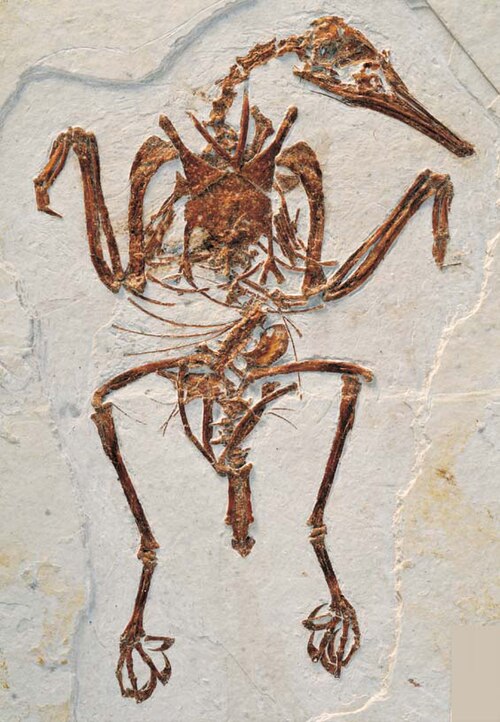
Enantiornithes appear to have included waders, swimmers, granivores, insectivores, fishers, and raptors. The vast majority of Enantiornithes were small, between the size of a sparrow and a starling,[23] however display considerable variation in size with some species. The largest species in this clade include Pengornis houi,[24]Xiangornis shenmi,[25]Zhouornis hani,[23] and Mirarce eatoni,[26] (with the latter species being described as similar in size to modern turkeys,) although at least a few larger species may have also existed, including a potentially crane-sized species known only from footprints in the Eumeralla Formation (and possibly also represented in the Wonthaggi Formation by a single furcula).[27] Among the smallest described specimens are unnamed hatchlings, although the holotype specimens of Parvavis chuxiongensis[28] and Cratoavis cearensis[29] are comparable in size to small tits or hummingbirds.
Given their wide range of habitats and diets, the cranial morphology of Enantiornithes varied considerably between species. Skulls of Enantiornithes combined a unique suite of primitive and advanced features. As in more primitive avialans like Archaeopteryx, they retained several separate cranial bones, small premaxillae (bones of the snout tip) and most species had toothy jaws rather than toothless beaks. Only a few species, such as Gobipteryx minuta, were fully toothless and had beaks. They also had simple quadrate bones, a complete bar separating each orbit (eye hole) from each antorbital fenestra, and dentaries (the main toothed bones of the lower jaw) without forked rear tips. A squamosal bone is preserved in an indeterminate juvenile specimen, while a postorbital is preserved in Shenqiornis and Pengornis. In modern birds these bones are assimilated into the cranium. Some Enantiornithes may have had their temporal fenestrae (holes in the side of the head) merged into the orbits as in modern birds due to the postorbitals either not being present or not being long enough to divide the openings.[30] A quadratojugal bone, which in modern birds is fused to the jugal, is preserved in Pterygornis.[31] The presence of these primitive features of the skull would have rendered the Enantiornithes capable of only limited cranial kinesis (the ability to move the jaw independent of the cranium).[32]
Wing
A micro-CT scan of an amber-encased wing attributable to Enantiornithes showing rachises, skin, muscle and claws.
Clarke et al. (2006) surveyed all fossils of Enantiornithes then known and concluded that none had preserved tail feathers that formed a lift-generating fan, as in modern birds. They found that all avialans outside of Euornithes (the clade they referred to as Ornithurae) with preserved tail feathers had only short coverts or elongated paired tail plumes. They suggested that the development of the pygostyle in Enantiornithes must have been a function of tail shortening, not the development of a modern tail feather anatomy. These scientists suggested that a fan of tail feathers and the associated musculature needed to control them, known as the rectrical bulb, evolved alongside a short, triangular pygostyle, like the ones in modern birds, rather than the long, rod- or dagger-shaped pygostyles in more primitive avialans like the Enantiornithes. Instead of a feather fan, most Enantiornithes had a pair of long specialized pinfeathers similar to those of the extinct Confuciusornis and certain extant birds-of-paradise.[36]
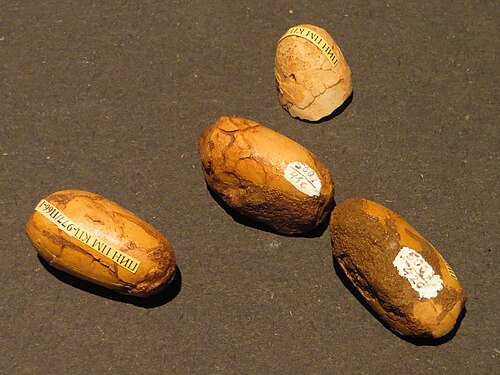
A few specimens preserve actual stomach contents. None of these preserve the skull, so direct correlation between their known diet and snout/tooth shape cannot be made. Eoalulavis was found to have the remains of exoskeletons from aquatic crustaceans preserved in its digestive tract,[42] and Enantiophoenix preserved corpuscles of amber among the fossilized bones, suggesting that this animal fed on tree sap, much like modern sapsuckers and other birds. The sap would have fossilized and become amber.[43] However, more recently it has been suggested that the sap moved post-mortem, hence not representing true stomachal contents. Combined with the putative fish pellets of Piscivorenantiornis turning out to be fish excrement, the strange stomachal contents of some species turning out to be ovaries and the supposed gastroliths of Bohaiornis being random mineral precipitates, only the Eoalulavis displays actual stomach contents.[44]
A study on paravian digestive systems indicates that known Enantiornithes lacked a crop and a gizzard, didn't use gastroliths and didn't eject pellets. This is considered at odds with the high diversity of diets that their different teeth and skull shapes imply,[45] though some modern birds have lost the gizzard and rely solely on strong stomachal acids.[46] An example was discovered with what was suspected to be gastroliths in the what would have been the fossil's stomach, re-opening the discussion of the use of gastroliths by Enantiornithes. X-ray and scanning microscope inspection of the rocks determined that they were actually chalcedony crystals, and not gastroliths.[47]
The cladogram below is from Wang et al., 2022, and includes most named taxa and recovers several previously named clades. Letters on branches indicate the positions of "wildcard" taxa, those which have been recovered in multiple disparate positions.[88]
Enantiornithes taxonomy is difficult to evaluate, and as a result few clades within the group are consistently found by phylogenetic analyses. Most Enantiornithes are not included in any specific family, and as such are listed here. Many of these have been considered Euenantiornithes, although the controversy behind this name means that it is not used consistently in studies of Enantiornithes.
1 2 3 Wang, X.; O'Connor, JK; Zheng, X.; Wang, M.; Hu, H.; Zhou, Z. (2014). "Insights into the evolution of rachis dominated tail feathers from a new basal enantiornithine (Aves: Ornithothoraces)" . Biological Journal of the Linnean Society . 113 (3): 805– 819. doi : 10.1111/bij.12313 .
1 2 3 Wang, Min; Zhou, Zhong-He; O'Connor, Jingmai K.; Zelenkov, Nikita V. (2014). "A new diverse enantiornithine family (Bohaiornithidae fam. nov.) from the Lower Cretaceous of China with information from two new species" (PDF) . Vertebrata PalAsiatica . 52 (1): 31– 76.
1 2 3 4 Chiappe, Luis M.; Walker, Cyril A. (2002). "白亜紀エウエナンティオルニス類(鳥胸類:エナンティオルニス類)の骨格形態と分類" . Chiappe, Luis M.; Witmer, Lawrence M. (編)『中生代の鳥類:恐竜の頭上』 . カリフォルニア大学出版局. pp. 240–67 . ISBN978-0-520-20094-4。
↑ LA ネソフ、AA ヤルコフ (1989)。Новые птицы мел-палеогена СССР и некоторые замечания по истории возникновения и эволюции класса (新白亜紀-古第三紀)ソ連の鳥と階級の起源と進化の歴史に関するいくつかのコメント)(PDF)(ロシア語)。 Vol. 197. ソ連科学アカデミー。 p. 82. 2019 年 3 月 27 日のオリジナルからアーカイブ(PDF) 。
1 2 Xing, Lida; O'Connor, Jingmai K.; McKellar, Ryan C.; Chiappe, Luis M.; Tseng, Kuowei; Li, Gang; Bai, Ming (2017 年 9 月). "珍しい羽毛を持つビルマ産琥珀に保存された白亜紀中期のエナンティオルニス類 (鳥類) の雛". Gondwana Research . 49 : 264– 277. Bibcode : 2017GondR..49..264X . doi : 10.1016/j.gr.2017.06.001 .
1 2 Xing, Lida; O'Connor, Jingmai K.; McKellar, Ryan C.; Chiappe, Luis M.; Bai, Ming; Tseng, Kuowei; Zhang, Jie; Yang, Haidong; Fang, Jun; Li, Gang (2018 年 2 月). "白亜紀中期のビルマ産琥珀中の扁平なエナンティオルニス類: 形態と保存状態" . Science Bulletin . 63 (4): 235– 243. Bibcode : 2018SciBu..63..235X . doi : 10.1016/j.scib.2018.01.019 . PMID 36659012 .
↑ Clark AD、Atterholt J、Scannella JB、Carroll N、O'Connor JK (2024) ヘルクリーク層における新たなエナンティオルニス類の多様性とアヴィサウルス科の足根中足骨の機能形態。PLoS ONE 19(10): e0310686。https ://doi.org/10.1371/journal.pone.0310686
↑ Clark, Alexander D.; O'Connor, Jingmai K. (2021年6月15日). "Exploring the Ecomorphology of Two Cretaceous Enantiornithines With Unique Pedal Morphology" . Frontiers in Ecology and Evolution . 9 654156. Bibcode : 2021FrEEv...954156C . doi : 10.3389/fevo.2021.654156 .
↑ Wang, Li; O'Connor, Zhou; You (2015). "中国北西部、下部白亜紀長馬盆地から発見されたエナンティオルニス類の2番目の鳥類と長馬鳥類相の分類学的多様性への影響". Cretaceous Research . 55 : 56– 65. Bibcode : 2015CrRes..55...56W . doi : 10.1016/j.cretres.2015.01.008 .
↑ Wang, M.; O'Connor, JK; Zhou, Z. (2014). "A new robust enantiornithine bird from the Lower Cretaceous of China with scansorial adaptations". Journal of Vertebrate Paleontology . 34 (3): 657– 671. Bibcode : 2014JVPal..34..657W . doi : 10.1080/02724634.2013.812101 . S2CID 85313872 .
↑エレーラ、ヘラルド・アルバレス。アニョリン、フェデリコ。ロザディージャ、セバスティアン。ロ・ココ、ガストン・E。真鍋 誠;ついひじ、たかのぶ。ノバス、フェルナンド E. (2022-12-16)。「アルゼンチン、パタゴニア南部の白亜紀(マーストリヒチアン)最上層に生息する新しいエナンティオルニチン類の鳥」。白亜紀の研究。144 105452.土井: 10.1016/j.cretres.2022.105452。ISSN 0195-6671。S2CID 254804249。
↑ Hu, Dongyu; Liu, Ying; Li, Jinhua; Xu, Xing; Hou, Lianhai (2015年7月). 「Yuanjiawaornis viriosus, gen. et sp. nov., 中国遼寧省西部の下部白亜紀から発見された大型エナンティオルニス類鳥類」. Cretaceous Research . 55 : 210–219 . Bibcode : 2015CrRes..55..210H . doi : 10.1016/j.cretres.2015.02.013 .
↑ O'Connor, Patrick M.; Turner, Alan H.; Groenke, Joseph R.; Felice, Ryan N.; Rogers, Raymond R.; Krause, David W.; Rahantarisoa, Lydia J. (2020年12月10日). 「マダガスカルの後期白亜紀の鳥類が嘴の独特な発達を明らかにする」Nature . 588 (7837): 272– 276. Bibcode : 2020Natur.588..272O . doi : 10.1038/s41586-020-2945-x . PMID 33239782 . S2CID 227174405 .
↑ Hu, Han; O'Connor, Jingmai K.; Zhou, Zhonghe; Farke, Andrew A. (2015年6月3日). "中国の下部白亜紀から発見されたペンゴルニス科(鳥類:エナンティオルニス類)の新種は、初期の鳥類ではこれまで知られていなかった特殊な樹上性生息地を示唆している" . PLOS ONE . 10 (6) e0126791. Bibcode : 2015PLoSO..1026791H . doi : 10.1371/journal.pone.0126791 . PMC 4454694 . PMID 26039693 .
↑ Chiappe, Luis M.; Qingjin, Meng; Serrano, Francisco; Sigurdsen, Trond; Min, Wang; Bell, Alyssa; Di, Liu (2019年10月25日). 「中国の白亜紀前期から発見されたボハイオルニスに似た新種の鳥:エナンティオルニス類の相互関係と飛行能力」 . PeerJ . 7 e7846 . doi : 10.7717/peerj.7846 . PMC 6816414. PMID 31667014 .





 ウィキメディア・コモンズにあるエナンティオルニス類に関するメディア