Loading article…
 | |
 セントラルパーク西側から見た東入口のファサード | |
| 設立 | 1869年4月6日[1] |
|---|---|
| 位置 | 200セントラルパークウェスト ニューヨーク, NY 10024 アメリカ合衆国 |
| 座標 | 北緯40度46分51秒 西経73度58分28秒 / 北緯40.78083度 西経73.97444度 / 40.78083; -73.97444 |
| タイプ | 民間501(c)(3)団体 自然史博物館 |
| 訪問者 | 500万人(2018年)[2] |
| 社長 | ショーン・M・ディケーター[3] |
| 公共交通機関へのアクセス | ニューヨーク市バス: M7、M10、M11、M79 ニューヨーク市地下鉄:   81番街の電車- 自然史博物館 81番街の電車- 自然史博物館 79番街の電車 79番街の電車 |
| Webサイト | 詳しくはこちら |
アメリカ自然史博物館 | |
| 構築済み | 1874年 |
| NRHP参照 番号 | 76001235 [4] |
| 重要な日付 | |
| NRHPに追加されました | 1976年6月24日 |
| 指定NYCL | 1967年8月24日 |
アメリカ自然史博物館(AMNH)は、ニューヨーク市マンハッタンのアッパーウエストサイドにある自然史博物館です。[5]セントラルパークの向かい側、セオドア・ルーズベルト公園に位置するこの博物館複合施設は、プラネタリウムと図書館に加えて、45の常設展示ホールを収容する21の相互接続された建物で構成されています。博物館のコレクションには、植物、動物、菌類、化石、鉱物、岩石、隕石、人間の遺物、人間の文化的遺物など、約3,200万の標本[6]と、凍結組織、ゲノムデータ、天体物理学的データの専門コレクションが含まれており、一度に展示できるのはそのうちのほんの一部だけです。博物館の面積は2,500,000平方フィート(232,258 m 2)を超えます。 AMNHには225人の常勤科学スタッフがおり、毎年120以上の特別フィールド探検を後援し、[7]年間平均約500万回の訪問があります。[8]
AMNHは民間の501(c)(3)団体です。[5]自然学者のアルバート・S・ビックモアが1861年にアメリカ自然史博物館の構想を考案し、数年にわたる運動の後、博物館は1871年5月22日にセントラルパークのアーセナル内にオープンしました。セオドア・ルーズベルト公園にある博物館初の専用建造物は、カルバート・ヴォークスとJ・レイ・モールドによって設計され、1877年12月22日にオープンしました。長年にわたり、1936年のメインエントランスパビリオン(セオドア・ルーズベルトにちなんで名付けられました)や2000年のローズ地球宇宙センターなど、多数の翼部が増築されてきました。
歴史
設立
初期の取り組み
博物学者アルバート・S・ビックモアは1861年にアメリカ自然史博物館の構想を考案した。[9]当時、彼はマサチューセッツ州ケンブリッジにあるルイ・アガシーの比較動物学博物館で学んでいた。[ 9] [10]ヨーロッパの自然史博物館の多くが人口の多い都市にあることに気づいたビックモアは、伝記に「現在、ニューヨークは我が国で最も富裕な都市であり、したがって、将来、我が国全体の自然史博物館にはおそらく最適な場所である」と記している。[9]ビックモアは数年にわたり、ニューヨークに自然史博物館を設立するためにロビー活動を行った。[11]アメリカ南北戦争の終結後、ビックモアはウィリアム・E・ドッジ・ジュニアなど多くの著名なニューヨーカーに博物館のスポンサーを依頼した。[12] [13]ドッジ自身は当時博物館に資金を提供できなかったが、彼は博物学者を将来の米国大統領セオドア・ルーズベルトの父、セオドア・ルーズベルト・シニアに紹介した。[12] [14]
1868年にバーナムのアメリカ博物館が火事で焼失した後、自然史博物館を求める声が高まった。[12]その年の12月、18人の著名なニューヨーカーがセントラルパーク委員会に手紙を書き、セントラルパークに自然史博物館を創設するよう要請した。 [10] [15] [16]セントラルパーク委員のアンドリュー・ハスウェル・グリーンは、1869年1月にこのプロジェクトへの支持を表明した。 [16] [15]博物館のために理事会が設立された。翌月、ビックモアとジョセフ・ホッジス・チョートは博物館の憲章を起草し、理事会はそれを変更せずに承認した。この憲章で初めて「アメリカ自然史博物館」という名前が使われた。[17]ビックモアは、博物館の名前には「私たちの博物館が最終的には大英博物館のような、国内でこの種の主要な施設になるという期待」を反映させたいと述べた。[17]博物館が設立される前に、ビックモアは権力と腐敗を抱えた政治組織タマニー・ホールのリーダーであるボス・ツイードの承認を得る必要があった。アメリカ自然史博物館を設立するための法案は、ツイードと関係のあったニューヨーク州知事ジョン・トンプソン・ホフマンの署名が必要だった。 [18]
創造と新しい建物
ホフマンは1869年4月6日に博物館設立法案に署名し、[19] [20]ジョン・デイヴィッド・ウルフが初代会長に就任した。[21] [a]その後、AMNHの執行委員会の委員長はグリーンに、博物館がセントラルパークのアーセナルの最上階2階を使用できるようにしてほしいと依頼し、グリーンは1870年1月にその要請を承認した。[20]昆虫標本はアーセナルの下層階に置かれ、[22]石、化石、哺乳類、鳥類、魚類、爬虫類は上層階に置かれていた。[23]博物館は1871年5月22日にアーセナル内にオープンした。[23] [24] AMNHはその後数年間で人気を博した。アーセナルの場所には1876年の最初の9か月だけで856,773人の訪問者があり、これは大英博物館が1874年全体で記録した数を上回った。 [25]
)_(17973760300).jpg/500px-The_American_Museum_journal_(c1900-(1918))_(17973760300).jpg)
)_(17971745188).jpg/500px-The_American_Museum_journal_(c1900-(1918))_(17971745188).jpg)
一方、AMNHの理事たちは、マンハッタン・スクエア(8番街/セントラル・パーク・ウェスト、81丁目、9番街/コロンバス・アベニュー、77丁目に囲まれた場所)を恒久的な建物の建設場所として特定していた。[10] [26]数人の著名なニューヨーク市民が新しい建物の建設資金として50万ドルを集めた。市の公園管理委員会はその後、マンハッタン・スクエアを恒久的な博物館の場所として確保し、さらに20万ドルが建設資金として集められた。[27] 1874年6月3日の博物館の起工式には、アメリカ大統領ユリシーズ・グラントを含む多数の高官や役人が出席した。 [28] [29] [30]
博物館は1877年12月22日に開館し、式典にはアメリカ大統領ラザフォード・B・ヘイズも出席した。[31] [25]古い展示品は1878年に兵器庫から撤去され、翌年までにAMNHは負債を完済した。[32]
19世紀
当初、AMNH へは溝を渡る仮設橋でアクセスしており、日曜日は閉館していた。博物館の理事会は 1881 年 5 月にセントラル パークからのアクセスを完成させることを決議し、[33]その年の後半に作業が開始された。[34]景観の変更は 1882 年半ばまでにほぼ完了し、[35]同年 11 月にはセントラル パーク西にかかる橋が開通した。[36] [37]この時点で、AMNH のマンハッタン スクエア ビルとアーセナルには物理的にこれ以上の展示物を収容できず、100 席の講堂などの既存の施設も需要を満たすのに不十分であった。[38]理事会は 1885 年 5 月に博物館を日曜日に開館する可能性について議論を開始し、[39]州議会は翌年、日曜日の開館を許可する法案を承認した。[40] [41]労働者階級からの支持にもかかわらず、[42]理事会は費用がかかるとして日曜の開館に反対した。[43]当時、博物館は水曜から土曜まで一般公開され、月曜と火曜は会員限定で公開されていた。[44]博物館のコレクションは1880年代を通じて成長を続け、[32] 19世紀を通じてさまざまな講演会が開催された。[45]
元の建物からいくつかの部門が追い出されたため、ニューヨーク州議会議員は1887年初頭にAMNHを拡張する法案を提出し、[46]何千人もの教師がこの法案を支持した。 [ 47]市の公園技師モンゴメリー・A・ケロッグは、敷地の造園計画を作成するよう指示された。[48] 1888年3月、理事会は77番街の高台中央にエントランスパビリオンを建設することを承認した。[49] [50]ニューヨーク市見積委員会は1889年後半にゼネコンから入札を募り始めた。 [51] [52]博物館のコレクションにある多くの物品や標本は、別館がオープンするまで展示できなかった。[53]元の建物は1890年に改装され、[54]その年、博物館の図書館は西棟に移された。[55] AMNHの理事会は1892年2月までに博物館を日曜日に開館することを検討し[56]、その年の7月に入場料の徴収を中止した。[57] [58]博物館は8月に日曜日の営業を開始し[59]、南入口のパビリオンはその年の11月にオープンした。[60] [61]新しい翼があっても、博物館のコレクションを収容するのに十分なスペースがなかった。[32]市の公園委員会は1893年1月に新しい講堂を承認したが[62] [63]、講堂は77番街の東に延びる翼のためにその年の5月に延期された。[64] [65]東翼の家具を揃える契約は1894年6月に締結された。[66]
1895年2月に東棟がほぼ完成すると、AMNHの理事たちは州議会議員たちに77丁目に西に延びる棟を建設するために20万ドルを要請した。[67] [68]東棟は8月になってもまだ家具が揃っていたが、[69]その年の12月に1階がオープンした。[70]この間も博物館の資金とコレクションは増え続けた。[71]哺乳類のホールは1896年11月に博物館内にオープンした。[72] [73]その年、AMNHはセントラルパーク西に沿って東棟を北に拡張し、L字型の構造にする承認を受けた。[74]東棟拡張の計画は1897年6月に承認され、[75] 2ヵ月後に契約が締結された。[76] [77]博物館長のモリス・K・ジェサップもコレクションのための物品を集めるために世界規模の遠征を後援した。[78] 1898年半ばまでに、西棟、拡張された東棟、博物館の中心にある講堂の建設が進められていた。[79]しかし、市の資金不足によりプロジェクトは遅れた。[80]西棟と東棟はいくつかの展示ホールとともに1899年後半までにほぼ完成したが、講堂は遅れていた。[81]その年の12月には古代メキシコ美術を専門とするホールがオープンした。[82] [83]
20世紀
1900年代から1940年代
博物館の1,350席の講堂は1900年10月にオープンし、西棟のネイティブアメリカンホールとメキシコホールも同様でした。[84] [85] 1900年代、AMNHはコレクションを増やすためにメキシコへの旅行、[86]太平洋岸北西部の動物相を収集する旅行、[87]中国での芸術品収集旅行、[88]地元の洞窟で岩石を収集する遠征など、いくつかの遠征を後援しました。[89]そのような展示の1つでは、1905年2月にオープンした恐竜ホールの目玉となったブロントサウルスの骨格が見つかりました。 [90] [91]
1920年代初頭、博物館長ヘンリー・フェアフィールド・オズボーンは、 AMNHの新しい入口を計画し、そこにはセオドア・ルーズベルトの記念碑が置かれることになっていた。[92]またその頃、ニューヨーク州政府はルーズベルト記念碑の実現可能性を調査する委員会を設置した。[92] [93]記念碑をアルバニーに置くかニューヨーク市に置くかをめぐる論争の後、 [94]ニューヨーク市政府は検討対象としてAMNHの隣の敷地を提供した。[95]委員会は「従来のギリシャの霊廟」のデザインを拒否し、代わりにローマ風の凱旋門とホールのデザインを選択した。 [92] 1925年、AMNHの理事会は建築デザインコンペを開催し、ジョン・ラッセル・ポープを記念ホールの設計者に選んだ。[96] [97]建設は1929年に始まり、[98]理事会は翌年最終計画を承認した。[99]ゼネコンはJ・ハリー・マクナリーだった。[100]ルーズベルトの従兄弟であるフランクリン・D・ルーズベルト大統領が1936年1月19日に記念碑を奉納した。[101] [102]
1950年代から1990年代
元の建物は後に「A棟」として知られるようになった。1950年代に最上階は図書館に改装され、ニューヨークタイムズのクリストファー・グレイが「天井を下げたり、その他いつもの失礼な装飾」と評したような装飾が施された。[103] AMNHの化石コレクションを収容していた10階建てのチャイルズ・フリック・ビルは、1970年代に博物館に増築された。[104] [105]
建築家ケビン・ロッシュと彼の会社ロッシュ・ディンケルーは、 1990年代から博物館のマスタープランニングを担当してきました。[106]内部と外部の両方でさまざまな改修が行われてきました。恐竜ホールの改修は1991年から行われ、[106]ロッシュ・ディンケルーは1992年に8階建てのAMNH図書館を設計しました。[107]博物館のローズ地球宇宙センターは2000年に完成しました。[108] [109]
21世紀

博物館の講堂は、サミュエル・J・レフラックがAMNHに800万ドルを寄付したことを受けて、2001年にサミュエル・J・アンド・エセル・レフラック劇場に改名された。[110]セントラルパーク西からコロンバスアベニューまでの77番街にまたがる博物館の南ファサードは、2009年に清掃、修復され、再整備された。博物館のスポークスマンであるスティーブン・ライヒルは、作業には650個のブラックチェリー材の窓枠の修復と石の修理が含まれると述べた。最新の改修における博物館のコンサルタントは、イリノイ州ノースブルックに本社を置く建築およびエンジニアリング会社のウィス、ジャニー、エルストナーアソシエイツ社であった。[111]博物館は2010年にルーズベルト記念館の壁画も修復した。[112]

2014年、博物館はコロンバス通り側に3億2500万ドル、195,000平方フィート(18,100平方メートル)の別館、リチャード・ギルダー科学教育イノベーションセンターの計画を発表しました。 [113] 2016年10月11日、ランドマーク保存委員会は満場一致で拡張を承認しました。設計開発と環境影響評価の段階を経て翌年に着工する予定だったギルダーセンターの建設には、1874年から1935年の間に建てられた3つの博物館の建物の取り壊しが含まれます。[114]博物館は2017年8月に拡張計画を提出しましたが、[115]地域の反対により、建設は2019年6月まで開始されませんでした。[116] [117]
ギルダーセンターは2023年5月4日にオープンし、[118] [119]、その後3か月間で150万人の来館者があった。[120] 2023年後半、博物館はコレクションからの人骨の展示をやめると発表した。[121] [122] 1990年にアメリカ先住民墓地保護送還法(NAGPRA)が可決されたにもかかわらず、2023年になっても、AMNHは推定1,900体のアメリカ先住民の遺骨を送還されていなかった。[123] 2024年1月にこの法律が改正された後、AMNHのイースタン・ウッドランズとグレート・プレーンズのホールは閉鎖された。ホール内のすべての遺物を展示するには博物館の許可が必要だったためである。[124] [125]博物館はその年の7月に遺骨を送還することに同意した。[126]
元の構造

元々のヴィクトリア朝ゴシック様式の建物は、セントラルパークの建築で既によく知られていたカルバート・ヴォークスとジェイ・レイ・モールドによって設計されました。 [127] [128]ヴォークスとモールドの当初の計画は、セントラルパークの反対側にあるメトロポリタン美術館を補完することを意図していました。[128]建設された元の建物は77番街の正面の中央にあり、幅は199 x 66フィート(61 x 20 m)でした。[129]長さ112フィート(34 m)、高さ200フィート(61 m)のギャラリーが特徴的でした。このギャラリーには、高くなった地下室、3階建ての展示物、ベネチアン・ゴシック様式のアーチ、ドーマー窓とスレート屋根のある屋根裏部屋がありました。[25]ギャラリーの裏側には2つの塔があり、1つには階段があり、もう1つには学芸員の部屋がありました。[129]オリジナルの建物は今も残っていますが、現在マンハッタン・スクエアの大部分を占める複合施設内の多くの建物に隠れています。[127]博物館は77番街のホワイエから入ることができますが、その後グランド・ギャラリーと改名されました。[130]
完全な計画では、元の建物とデザインが似ている12のパビリオンが求められていました。8つのパビリオンは正方形の辺として配置され、残りの4つは正方形の内部で互いに垂直になります。広場の周囲には8つの塔があり、中央には4つの内部パビリオンが交差する120フィート(37メートル)の幅のドームがありました。[25] [131] [132]各パビリオンには1階があり、2階にはギャラリー、3階には標本を展示し、4階は研究に使用されることになりました。[26]マスタープランが完成すると、博物館は広場からの投影を含めて南北に850フィート(260メートル)、東西に650フィート(200メートル)の大きさになります。[25] [131] [132]完成した建物は、敷地面積が18エーカー(7.3ヘクタール)を超え、[27] [132]北米最大の建物であると同時に、世界最大の博物館の建物となるはずでした。[128]マスタープランは完全に実現することはありませんでした。[133] 2015年までに、博物館は接続が不十分な25の独立した建物で構成されていました。[134]
当初の建物は、J・クリーブランド・ケイディが設計したブラウンストーンのネオロマネスク様式の建物である南側の正面にある西棟と東棟にすぐに影を潜めてしまった。[111]西77番街に沿って700フィート(210メートル)伸び、[135]角の塔は高さ150フィート(46メートル)である。セントローレンス川のグラインドストーン島で見つかったものと同様のピンク色のブラウンストーンと花崗岩は、ニューヨーク州ピクトン島の採石場から運ばれたものである。[136]南棟には、60×110フィート(18メートル×34メートル)から30×125フィート(9.1メートル×38.1メートル)までの大きさのホールがいくつかある。 [60] [61]両棟の端には丸い小塔のような塔がある。[79] [81]
ニューヨーク州セオドア・ルーズベルト記念碑
セントラルパーク西側のメインエントランスホールは、正式にはニューヨーク州セオドア・ルーズベルト記念碑として知られています。 1936年にジョン・ラッセル・ポープによって完成したこの記念碑は、元アメリカ大統領セオドア・ルーズベルトを記念した大規模なボザール様式の記念碑です。[93]このホールはもともと、セントラルパークを通る「博物館間プロムナード」の一端を形成し、東側のメトロポリタン美術館とつながる予定でしたが、 [137]プロムナードは完成しませんでした。[138]
記念館はローマ時代のアーチをモデルにしたピンク色の花崗岩のファサードを備えている。[98] [139]セントラルパーク西側の記念館の前には、長さ350フィート(110メートル)のテラスと一連の階段がある。正面玄関は高さ60フィート(18メートル)のアーチで構成されている。[98]アーチの下側には格天井の花崗岩の玄関ホールがあり、ブロンズ、ガラス、大理石のスクリーンへと続いている。[98] [140]アーチの両側には、バイソンとクマの彫刻が収められた壁龕がある。[140]両側には2対の柱があり、その上にはアメリカの探検家ジョン・ジェームズ・オーデュボン、ダニエル・ブーン、メリウェザー・ルイス、ウィリアム・クラークの像が置かれている。[141] [98] [139]これらの像はジェームズ・アール・フレイザーによって彫刻され[98]、高さは約30フィート(9.1メートル)です。[140]メインアーチの上の屋根裏部屋には、ルーズベルトの業績を記した碑文があります。[141] [98]この碑文の下のエンタブラチュアには「真実」、「知識」、「ビジョン」という言葉が彫られています。[141]
フレイザーはセオドア・ルーズベルトの騎馬像 もデザインし、両側にネイティブアメリカンとアフリカ系アメリカ人が描かれていた。この像は元々記念館の外に立っていた。21世紀になって、この像はルーズベルトの後ろにこれらの人物が従属的に描かれていることで物議を醸した。[142] [143]これを受けてAMNHの職員は2020年に像を撤去すると発表した。[144] [145]像は2022年1月に撤去され、ノースダコタ州のセオドア・ルーズベルト大統領図書館に長期貸与される予定である。[146] [147]

記念館の内部は幅67×120フィート(20×37メートル)で、樽型ヴォールト天井の高さは100フィート(30メートル)である。[148] [98] [149] [150]天井には八角形の格天井があり、床はモザイク模様の大理石タイルでできている。[149] [151]壁の最も低い9フィート(2.7メートル)は大理石の羽目板が張られ、その上の記念館の壁は石灰岩でできている。各壁の上部には大理石の帯とコリント式のエンタブラチュアがある。[152]記念館の4つの側面にはそれぞれ2本の赤い大理石の柱があり、それぞれ高さ48フィート(15メートル)で、ボッティチーノ大理石の台座から立ち上がっている。北壁と南壁の高窓の高さには丸い窓がある。[152] [151] ウィリアム・アンドリュー・マッケイは、ルーズベルトの生涯における重要な出来事を描いた幅62フィート(19メートル)の壁画を3枚デザインした。北壁にはパナマ運河の建設、西壁にはアフリカ探検、南壁にはポーツマス条約が描かれている。 [153] [154]東壁と西壁には、「自然」、「男らしさ」、「若さ」、「国家」という見出しの下に、ルーズベルトの4つの引用文が描かれている。[148] [152] [155]
記念ホールはもともと、様々な教室、展示室、600人収容の講堂とつながっていた。[98] [156]記念ホールの真下には、81丁目自然史博物館駅への入り口がある。[98]現在、ホールはアフリカ哺乳類のエイクリーホールとアジア哺乳類ホールとつながっている。記念ホールには、セオドア・ルーズベルトの青年期、成人初期、米国大統領時代、退任後の自然保護活動を説明する4つの展示がある。[157]
哺乳類のホール
旧世界の哺乳類
エイクリーアフリカ哺乳類ホール


剥製師カール・エイクリーにちなんで名付けられたエイクリー・アフリカ哺乳類ホールは、セオドア・ルーズベルト記念館の真西にある2階建てのホールで、西側ではアフリカ民族ホールとつながっています。[158]アフリカ哺乳類ホールの28のジオラマは、アフリカに見られる多様な生態系とそこに固有の哺乳類を細部まで描写しています。ホールの目玉は、特徴的な「警戒した」隊形をとった8頭のアフリカゾウの群れです。 [159]ジオラマでは哺乳類が主な目玉となることが多いですが、その地域の鳥や植物も時々取り上げられます。[160]現在の形のホールは1936年に完成しました。[161] [162]
アフリカ哺乳類ホールは、1909年頃にカール・エイクリーによって最初に博物館に提案された。エイクリーは、急速に消滅しつつあるアフリカの風景と動物をフィーチャーした40のジオラマを提案した。博物館の評議員でJPモルガンのパートナーであるダニエル・ポメロイは、資金提供と引き換えに、投資家に博物館のアフリカ探検に同行する機会を提供した。[163]エイクリーは1909年に早くもホールのための標本を集め始め、スミソニアン-ルーズベルトのアフリカ探検の最中にセオドア・ルーズベルトに遭遇したことは有名である。 [164]これらの初期の探検では、エイクリーは剥製の元弟子であるジェームズ・L・クラークと芸術家のウィリアム・R・リーに同行した。[163]エイクリーがホールの最初のジオラマ用のゴリラを集めるためにアフリカに戻ったとき、クラークはそこに残り、背景を作成する芸術家を求めて国中を探し始めた。最初の生息地グループの最終的な登場は、世界の鳥類、北米哺乳類ホール、東南アジア哺乳類ヴェルネイホール、海洋生物ホールなど、他のジオラマホールのデザインに影響を与えました。[163]

1926年のイーストマン=ポメロイ遠征中にエイクリーが予期せず亡くなった後、ホールの完成の責任はジェームズ・L・クラークに引き継がれ、クラークは1933年に建築アーティストのジェームズ・ペリー・ウィルソンを雇い、リーの背景画の補助をさせた。ウィルソンはリーの技法に多くの改良を加え、ジオラマの湾曲した壁によって生じる歪みを最小限に抑えるさまざまな方法を取り入れた。[163] 1936年、アフリカを見たいという熱望を持つ裕福な役員のウィリアム・デュラント・キャンベルは、自分で標本を入手することを許可されれば、いくつかのジオラマの制作に資金を提供すると申し出た。クラークはこの取り決めに同意し、多数の大型標本を入手することになった。[163] [165]ケインはリー、ウィルソン、その他数人のアーティストに加わり、ホールの残りのジオラマを完成させた。[166]ホールの建設は1936年に完了しましたが、[161] [162]ジオラマは1920年代半ばから1940年代初頭にかけて徐々にオープンしました。[166]
アジア哺乳類館


アジア哺乳類ホールは、ヴァーネイ=ファンソープアジア哺乳類ホールとも呼ばれ、セオドア・ルーズベルト記念館の真南にある。[158]インド、ネパール、ビルマ、マレーシアの6つの生息地グループと8つの完全なジオラマ、4つの部分的なジオラマがある。このホールは1930年にオープンし、エイクリーアフリカ哺乳類ホールと同様に、2頭のアジアゾウを中心に展示されている。かつてはジャイアントパンダとシベリアトラもこのホールのコレクションの一部だったが、当初は隣接する北アジア哺乳類ホール(現在のスタウトアジア人ホールの場所に計画)の一部となる予定だった。これらの標本は現在、生物多様性ホールで見ることができる。[159] [168]
アジア哺乳類ホールの標本は、英国生まれの骨董品商アーサー・S・ヴァーネイとジョン・フォンソープ大佐が率いた6回の探検で収集された(両方の入口にある様式化された銘板に記されている)。探検の資金はすべてヴァーネイが負担し、彼はその費用を第一次世界大戦へのアメリカの関与に対する英国の敬意と表現した。[169]最初のヴァーネイ=フォンソープ探検は1922年に行われたが、当時はスマトラサイやアジアライオンなど、ヴァーネイが探していた動物の多くが絶滅の危機に直面していた。ヴァーネイは狩猟許可証を取得するために地方当局に何度も訴えた。[170]その後のヴァーネイ率いる博物館関連の探検では、こうした訴えのおかげで、博物館は以前は外国人訪問者に制限されていた地域に立ち入ることができた。[171]芸術家のクラレンス・C・ローゼンクランツは、フィールドアーティストとしてヴェルネイ=ファウンソープ遠征隊に同行し、ホール内のジオラマの背景の大部分を描きました。[172]これらの遠征は写真とビデオの両方で十分に記録されており、最初の遠征の映像は長編映画『インドでのトラ狩り(1929年)』を制作するのに十分なものでした。[173]
新世界の哺乳類

北米哺乳類のバーナードファミリーホール

北米哺乳類のバーナード・ファミリー・ホールは、セオドア・ルーズベルト記念館の真西の1階にあります。[158]には、熱帯メキシコ以北のアメリカ大陸に生息する様々な哺乳類のジオラマが43点展示されています。各ジオラマは、最大級の大型動物から小型のげっ歯類や肉食動物まで、特定の種に焦点を当てています。注目すべきジオラマには、カワウソを追い払った後にサケを見つめるアラスカヒグマ、一組のオオカミ、一組のソノラ ジャガー、決闘する雄のアラスカヘラジカなどがあります。
北米哺乳類ホールは1942年にわずか10個のジオラマとともにオープンしました。[174] 1963年にさらに16個のジオラマが追加されました。 [175]ジルとルイス・バーナードからの多額の寄付を受けて、2011年後半に大規模な修復プロジェクトが開始されました。[176] [177] 2012年10月、ホールは北米哺乳類バーナードホールとして再オープンしました。[178]
小型哺乳類のホール
小型哺乳類ホールはバーナード家北米哺乳類ホールのすぐ西側にある分館です。[158]北米全土で見られる小型哺乳類を展示した小さなジオラマがいくつかあり、その中にはクビワペッカリー、アバートリス、クズリなどがあります。
鳥類、爬虫類、両生類の展示室
サンフォード北米鳥類館
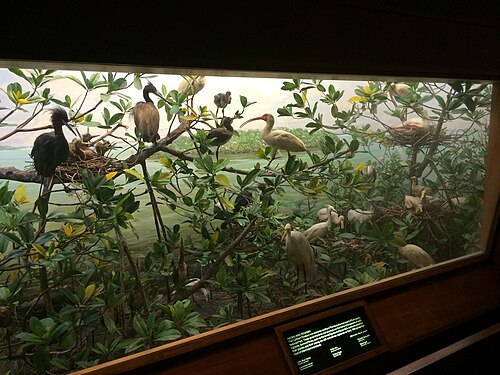
サンフォード北米鳥類館は、霊長類館とエイクリー館の2階の間にある3階建てのホールです。[158]北米全土の鳥をそれぞれの生息地で描いたジオラマが20以上あります。[179]ホールの奥には、鳥類学者で芸術家のルイ・アガシー・フエルテスによる2つの大きな壁画があります。[180]ホールには、ウグイス、フクロウ、猛禽類の大規模なコレクションを展示するケースもあります。
博物館の鳥類学者フランク・チャップマンが考案したこのホールは、チャップマンの友人でアマチュア鳥類学者のレナード・C・サンフォードにちなんで名付けられました。サンフォードはホールの建設資金の一部を出し、自身の鳥類標本コレクションのすべてを博物館に寄贈しました。ホールのジオラマの建設は1902年に始まり、1909年にオープンしました。これらは博物館で最初に展示されたものであり、現在も展示されているものの中では最古のものです。[181]ホールは1962年に改装されました。[182]
チャップマンは博物館のジオラマを作った最初の人物ではなかったが、特定の場所と特定の時間を捉えようと、アーティストをフィールドに連れ出した最初の人物だった。アフリカン・ホールのためにエイクリーが作った劇的なシーンとは対照的に、チャップマンはジオラマが科学的リアリズムを呼び起こし、最終的には絶滅の危機に瀕している生息地と種の歴史的記録となることを望んでいた。[181]チャップマンのジオラマはそれぞれ、種、その巣、および各方向に4フィート(1.2メートル)の周囲の生息地を描いていた。[183]
世界の鳥類のホール
世界の鳥類展示室は2階の南側にあります。[158]このホールでは、世界中の鳥類の多様性が展示されています。12のジオラマは世界中のさまざまな生態系を紹介し、そこに生息する鳥の多様性のサンプルを提供します。ジオラマの例には、キングペンギンとトウゾクカモメをフィーチャーしたサウスジョージア島、ヘビクイとノガンをフィーチャーした東アフリカ平原、ミツスイ、オウム、ワライカワセミをフィーチャーしたオーストラリアの奥地などがあります。[184]
ホイットニー海洋鳥類記念館
ホイットニー記念館は、もともとハリー・ペイン・ホイットニーにちなんで名付けられ、75万羽の鳥を展示しており、1939年にオープンしました。[185]後に海洋鳥類館として知られるようになったこの館は、1953年に完成し開館しました。[186] [187]この館は、もともと博物館のボランティアだったフランク・チャップマンとレナード・C・サンフォードによって設立され、太平洋諸島の鳥を展示する館の創設を進めていました。この館は、極楽鳥を展示する円形の展示を含む、完全に没入型のジオラマコレクションとして設計されました。[188] 1998年、蝶の温室が館内に設置されました。[189]
爬虫類・両生類のホール
爬虫類・両生類展示室は3階の南東隅近くにある。[158]爬虫類学の入門として機能し、爬虫類の進化、解剖学、多様性、生殖、行動を詳述する多くの展示がある。注目すべき展示には、コモドドラゴンの群れ、アメリカワニ、ロンサム・ジョージ、最後のピンタ島ゾウガメ、ヤドクガエルなどがある。[190]

1926年、W・ダグラス・バーデン、F・J・デフォッセ、エメット・リード・ダンが博物館のためにコモドドラゴンの標本を収集した。バーデンの著書「Look to the Wilderness」の「コモドドラゴン」の章では、探検、生息地、ドラゴンの行動について説明されている。[191]ホールは1927年にオープンし[192]、1969年から1977年にかけて130万ドルの費用をかけて再建された。[193]
生物多様性と環境ホール
生物多様性ホール
生物多様性ホールはセオドア・ルーズベルト記念館の下にあります。[158] 1998年5月にオープンしました。ホールには主に、生物多様性の概念、生物間の相互作用、絶滅が生物多様性に与える悪影響を強調した展示物や物品があります。 [194] [195]ホールには、160種を超える動物と植物種がいるザンガ・サンガ特別保護区の熱帯雨林を描いた2,500平方フィート(230平方メートル)のジオラマがあります。[195] [196]ジオラマは、手つかずの状態、人間の活動によって変化した状態、人間の活動によって破壊された状態の3つの状態の熱帯雨林を示しています。[194] [195]ホールのもう1つの見どころは、 9つの生態系の映像を表示するビデオウォール「生息地のスペクトル」です。生物多様性の変化を詳述する情報や物語が掲載された「変革の壁」と、生物多様性を高める方法に関する提案が掲載された「解決策の壁」があります。[195]
北米森林館

北米森林ホールは、博物館の1階にある平屋建てのホールで、セオドア・ルーズベルト記念館とニューヨーク州環境ウォーバーグ館の間にあります。[158]北米全土のさまざまな森林タイプを描いた10のジオラマと、森林保全と樹木の健康に関するいくつかの展示があります。このホールは、植物学者ヘンリー・K・スヴェンソンの指導の下で建設され、 [197] 1958年にオープンしました。[198]各ジオラマには、描かれた場所と正確な時期が具体的に記載されています。[197]ジオラマに登場する樹木や植物は、画材と実際の樹皮や現場で収集された他の標本を組み合わせて作られています。ホールの入り口には、1891年にシエラ山脈の西側にあるキングスリバー林から伐採された樹齢1,400年のセコイア、マーク・トウェイン・ツリーの断面が飾られています。 [199]

ニューヨーク州環境ウォーバーグホール

ニューヨーク州環境ウォーバーグホールは、博物館の1階にある平屋建てのホールで、北米森林ホールとグランドホールの間にあります。[158]ニューヨーク州ダッチェス郡パインプレーンズの町をモデルにしたこのホールでは、ニューヨーク特有の生態系を多面的に紹介しています。[200] [201]土壌の種類、季節の変化、人間と動物の両方が環境に与える影響などが取り上げられています。このホールはドイツ系アメリカ人の慈善家フェリックス・M・ウォーバーグにちなんで名付けられ、 [201]ウォーバーグ記念一般生態学ホールとして1951年5月14日にオープンしました。 [202]それ以来ほとんど変わっていませんが、今ではそのレトロモダンなスタイルでよく知られています。[203]
ミルシュタイン海洋生物館

ミルシュタイン海洋生物館は、1階の南東の象限、生物多様性館の西側にあります。[158]この館は、海洋生物学、植物学、海洋保全に焦点を当てています。館の中央には、全長94フィート(29メートル)のシロナガスクジラの模型があります。[204]館の上層階には、海洋に存在するさまざまな生態系が展示されています。ジオラマでは、ケルプの森、マングローブ、サンゴ礁、深海生物など、さまざまな環境での生物が比較対照されています。共通のテーマを促進しながら、海洋がいかに広大で多様であるかを示すことを目的としています。[205]館の下半分は、大型海洋生物の大きなジオラマ15体で構成されています。[206]この階には、2つの生物の仮想的な戦いを描いた有名な「イカとクジラ」ジオラマがあります。[205]このホールの他の注目すべき展示品には、2階建てのアンドロスサンゴ礁ジオラマがあります。[206] [207]
1910年、博物館長ヘンリー・F・オズボーンは、博物館の南東の中庭に大きな建物を建てて、新しい海洋生物館を建て、「クジラの模型と骨格」を展示することを提案した。[208]館は1924年にオープンし、 [206] 1962年に改装された。 [182] 1969年の改装では、哺乳類生物学館に掛けられていた人気のあった鋼鉄と張り子のクジラの模型の代わりに、本物そっくりのシロナガスクジラの模型が追加されるなど、海洋の大型動物にもっと明確に焦点を当てるようになった。リチャード・ヴァン・ゲルダーが、現在の姿の館の建設を監督した。[208]館は2003年に再度改装され、今度は環境保護が主な焦点となり、開発者のポール・ミルスタインとAMNH理事のイルマ・ミルスタインにちなんで改名された。 2003年の改修には、19,000平方フィート(1,800平方メートル)の展示フロアから高く吊り下げられた有名なシロナガスクジラの改修、1930年代と1960年代のジオラマの更新、電子ディスプレイが含まれていました。[183]
人類の起源と文化ホール
文化ホール
スタウト・アジア民族ホール
スタウト・アジア人ホールは、博物館の2階にある平屋建てのホールで、アジアの哺乳類と世界の鳥類のホールの間にあります。[158]このホールは、博物館の元会長であるガードナー・D・スタウトにちなんで名付けられ、博物館の長年の考古学者であるウォルター・A・フェアサービスによって主に組織されました。1980年にオープンしたスタウト・ホールは、博物館最大の人類学ホールであり、1869年から1970年代半ばまでに博物館が収集した遺物が収蔵されています。[209]博物館が後援した多くの有名な探検は、ホールの遺物に関連しており、その中には中央アジアのロイ・チャップマン・アンドリュース探検隊やヴァーネイ・ホップウッド・チンドウィン探検隊が含まれます。[210]
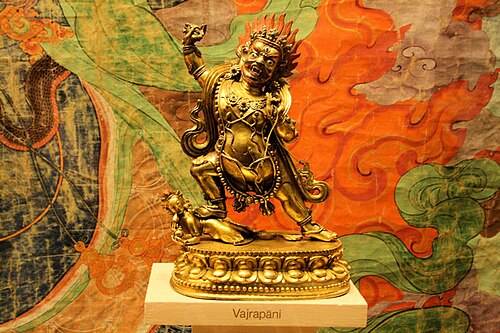
スタウト・ホールには2つのセクションがある。ユーラシアにおける人類文明の進化に焦点を当てた小さなセクション「古代ユーラシア」と、アジア大陸各地の文化遺物を展示するはるかに大きなセクション「伝統アジア」である。後者のセクションは、シルクロードの2つの主要な交易路に地理的に対応するように構成されている。博物館の多くの展示ホールと同様に、スタウト・ホールの遺物は、展示品、ミニチュアジオラマ、5つの実物大ジオラマなど、さまざまな方法で展示されている。古代ユーラシアセクションの注目すべき展示には、テシク・タシュとチャタル・ヒュユクの遺跡からの複製や、ハンムラビの石碑の実物大レプリカがある。伝統アジアセクションには、日本、中国、チベット、インドなどのアジアの主要国に焦点を当てたエリアがあり、アイヌ、セマイ、ヤクートなどのアジアの小部族も多数含まれている。[211]
-

-
 このジオラマではヤクート族のシャーマンが治癒の儀式を行っている。
 -
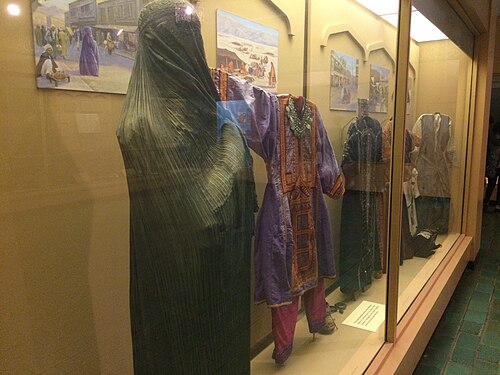 イスラムアジアの女性が着用するさまざまな衣装
アフリカ民族ホール
アフリカ民族ホールは、アフリカ哺乳類のエイクリーホールの後ろ、北米鳥類のサンフォードホールの下にあります。[158]この展示室は、アフリカに見られる4つの主要な生態系、すなわち河川渓谷、草原、森林・林地、砂漠ごとに構成されています。各セクションでは、アフリカ全土の生態系に住む人々の遺物や展示品が展示されています。ホールには3つのジオラマがあり、注目すべき展示品には森林・林地セクションで展示されている大規模な宗教衣装のコレクションがあります。ホールの各セクションをまとめているのは、狩猟採集、耕作、動物の家畜化に基づくアフリカ社会の多面的な比較です。それぞれのタイプの社会は、歴史的、政治的、精神的、生態学的な文脈で紹介されています。奴隷貿易によって広がったアフリカ人ディアスポラの小さなセクションも含まれています。 [212]取り上げられている部族と文明は次のとおりです。
メキシコと中央アメリカのホール

メキシコ・中央アメリカホールは、博物館の2階にある平屋建てのホールで、世界の鳥類展示室の後ろ、南アメリカ民族展示室の前にあります。[158]ここでは、かつてメソアメリカ全土に存在したマヤ、オルメカ、サポテク、アステカなど、コロンブス以前の幅広い文明の考古学的遺物が展示されています。これらの文明の文書記録の大部分はスペインの征服を生き延びなかったため、このホールの全体的な目的は、遺物だけからそれらについて何がわかるかをつなぎ合わせることです。
博物館は、考古学者によるプレコロンブス文明の発見から間もない1899年に開館して以来、プレコロンブス時代の遺物を展示しており、このテーマに特化した最初のホールは1899年に開館した。 [213]博物館のコレクションが増えるにつれて、ホールは1944年に大規模な改修工事が行われ、1970年に現在の形で再オープンした。[214] [215]展示されている注目すべき遺物には、クンツの斧や、もともと1939年の世界博覧会で展示されたモンテアルバン遺跡の墓104の実物大レプリカがある。
南アメリカの人々
南米民族ホールは、2階の北西隅にある平屋建てのホールで、メキシコ・中央アメリカホールの隣にあります。このホールは1904年に3階に初めてオープンし、ペルー、コロンビア、ボリビア、西インド諸島のミイラなどの考古学的遺物を展示していました。1931年に、ロナルド・オルソンとWCベネットのキュレーターの指揮の下、ホールは拡張され、2階に移転しました。新しいホールにはチリの銅山の再現が含まれ、後に「モンターニャの人々」と題された仮設ホールがあり、ペルーのカシボ族やパノア族の文化遺物を展示しました。[216] 1989年にホールは改装され、キュレーターのクレイグ・モリス、ジュニウス・バード、ロバート・カルネイロの指揮の下、古代アンデス文化と伝統的なアマゾン文化の技術と芸術性に焦点を当てた常設展示として再オープンしました。[217] [218] [216]ホールには、モチェ、チャビン、チャンカイ、パラカス、ナスカ、インカなど、南米の様々な古代文化のおよそ2,300点の品々が収蔵されています。[219] [220]展示されている遺物の多くは、セオドア・ルーズベルトが20世紀初頭に南米への探検で収集し、博物館に寄贈したルーズベルト・コレクションからのものです。[220]
マーガレット・ミード太平洋民族ホール

太平洋民族ホールは3階の南西隅にあり、平原インディアンホールを通ってアクセスできます。[158]文化人類学者マーガレット・ミードは1971年に太平洋民族ホールを設立しました。[221]ミードは1945年にホールのキュレーターとして働き始めたときから、太平洋地域の光景と音を展示で再現する展示環境を思い描いていました。[222]ミードが1978年に亡くなった後、ホールは1984年12月にマーガレット・ミード太平洋民族ホールとして再オープンしました。[223] [224]ユージン・バーグマンによって設計された新しいホールは、元のホールの青をテーマにした海と空の雰囲気を維持しています。[222]ホールは1997年に再び閉鎖され、1984年の改装で最初に設置された地理文化的「アルコーブ」を維持した最新のデザインで2001年に再オープンしました。[225]

マーガレット・ミード太平洋民族ホールには、ニュージーランド、オーストラリア、インドネシア、フィリピン、ミクロネシア、メラネシア、その他の太平洋諸島からの工芸品が収蔵されている。 [226] [227] [225]ホールの1,500点の品々のうち250点はミードが収集したものである。これらのうちのいくつかは、 1928年から1939年にかけてニューギニア島やその他の太平洋諸島でフィールドワークを行った際にアメリカ自然史博物館のために収集した3,284点の品々から選ばれたものと思われる。[228]バリ島の人形劇のセットなどは、ミードと人類学者の夫グレゴリー・ベイトソンが1936年から1938年にかけてバリ島でフィールドワークを行っていた際にアメリカ自然史博物館に送った約600点の品々から選ばれたものである。[225]マーガレット・ミード太平洋民族ホールの展示品には、イースター島のモアイ像のグラスファイバー鋳型や、ミツスイの羽で作られたケープも含まれています。[227]
ネイティブアメリカンのホール
ノースウェストコーストホール

ノースウェストコーストホールは、博物館の1階、グランドギャラリーの後ろ、ウォーバーグホールとスピッツァーホールの間にある平屋建てのホールです。[158]博物館で最も古いホールであり、1899年に人類学者フランツ・ボアズによってジェサップ北太平洋ホールとして設立されました。 [229] [230]現在、このホールには北太平洋沿岸文化圏(アラスカ南部、ワシントン州北部、ブリティッシュコロンビア州の一部)の部族の遺物や展示品が収められています。ホールで目立つのは、クワクワカワク族の4つの「ハウスポスト」と、ウィリアム・S・テイラーによる先住民の生活を描いた壁画です。[231] 2022年現在[update]、合計9,000点のアイテムがあり、その中には78本のトーテムポールや[229] 、天井から吊り下げられたハイダ族のカヌー(2020年にグランドギャラリーから移設)などがあります。 [232] [233]これらの遺物には、数多くのアメリカ先住民の言語で書かれた文章が添えられている。[230]
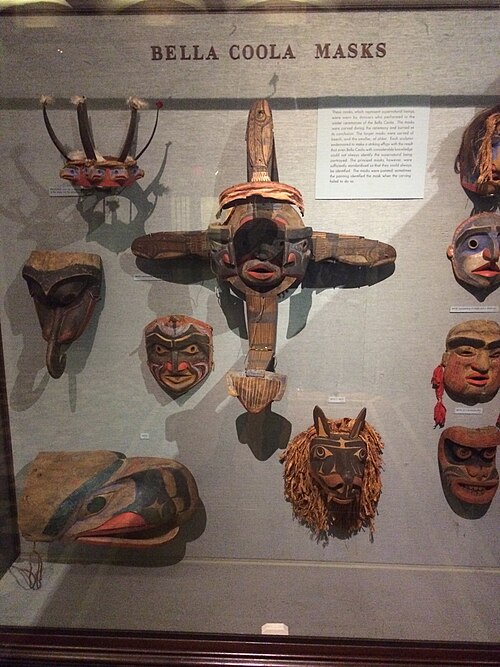
ホールの遺物は主に3つの出所から来ている。最も古いものは、ジョン・ウェズリー・パウエルが収集し、1882年に将来の理事ヒーバー・R・ビショップが寄贈したハイダ族の遺物である。これに続いて、博物館は1888年と1894年にジョージ・T・エモンズ中尉が収集したトリンギット族の遺物のコレクション2つを購入した。 [234]ホールの遺物の残りは、1897年から1902年にかけての有名なジェサップ北太平洋探検中に収集された。 [235] [236]ボアスが率い、博物館長モリス・ケッチャム・ジェサップが資金を提供したこの探検は、博物館の人類学部門にとって初の探検であり、現在では「アメリカ人類学における最も重要な探検」と考えられている。[236]多くの著名な民族学者が参加し、その中にはホール内のクワクワカワク・ハウスポストを確保したジョージ・ハントも含まれている。 [237]ホールに展示されている他の部族には、コースタル・サリッシュ族、ヌーチャヌルス族、チムシアン族、ヌクサルク族などがある。[238]
開館当時、ノースウェストコーストホールは、米国とカナダの先住民族に特化した4つのホールのうちの1つでした。当初は2つのセクションに分かれており、1つ目はその地域のすべての人々に関する一般的なエリア、2つ目は部族ごとに分かれた専門エリアでした。これは、ホール内のすべての遺物を適切な部族と関連付けたいと考えていたボアスにとっての論点であり(現在のように)、最終的にボアスと博物館の関係の解消につながりました。[234] [239] 2022年5月、ホールは5年間の年月と1900万ドルの改修工事を経て再オープンし、1,000点以上の遺物が展示されています。新しい展示には、グレッグ・コルファックス・クラウェイヒーやロバート・デイビッドソンなどの現代アーティストの作品が含まれています。[240] [241]
平原インディアンのホール
平原インディアンのホールは、博物館の西端近くの3階の南側にあります。[158]このホールは1967年2月にオープンしました。 [242] [243]このホールの主な焦点は、19世紀半ばの北米大平原の人々であり、ブラックフット(ブラックフット連邦も参照)、ヒダツァ、ダコタの文化の描写が含まれています。特に興味深いのは、 1926年にニューメキシコで発見されたフォルサムポイントで、アメリカ大陸への初期のアメリカ人の植民地化の証拠を提供しています。 [244]
イースタンウッドランズインディアンホール
イースタン・ウッドランド・インディアン・ホールは、プレーンズ・インディアン・ホールの3階南側の隣にあります。[158]このホールは1966年5月にオープンしました。 [245]北アメリカ東部の森林地帯に住む伝統的なネイティブ・アメリカンの生活と技術について詳しく説明しています。これには、クリー、モヒガン、オジブウェ、イロコイの文化が含まれます。展示では、先住民の籠細工、陶器、農業技術、食品調理、金属製のジュエリー、楽器、織物の例が紹介されています。その他の見どころには、メノミニーの白樺の樹皮でできたカヌーの模型や、オジブワのドーム型ウィグワム、イロコイのロングハウス、クリーク族の公営住宅、その他の東部森林地帯の住居様式など、さまざまな伝統的な宿泊施設があります。[246]
人類の起源のホール
アン・アンド・バーナード・スピッツァー人類起源館

アン・アンド・バーナード・スピッツァー人類起源ホール(旧人類生物学・進化ホール)は、博物館の西端近くの1階南側にあります。[158]現在の名称でオープンしたのは2007年2月10日です。[247] [248] 1921年に最初にオープンしたとき、このホールは「人類時代のホール」として知られ、人類の進化を詳細に調査した米国で唯一の主要な展示会でした。[249]展示はホモ・サピエンスの物語をたどり、人類の進化の道筋を明らかにし、人間の創造性の起源を調べました。[250]
オリジナルの展示室の展示の多くは、現在の拡大された形式でも見ることができます。これらには、人類の先祖であるアウストラロピテクス・アファレンシス、ホモ・エルガステル、ネアンデルタール人、クロマニヨン人の等身大ジオラマが含まれており、科学者が考えていた行動や能力をそれぞれの種が示している様子が示されています。また、320万年前のルーシーの骨格や170万年前のトゥルカナボーイなど重要な化石の実物大の鋳造物や、北京原人の鋳造物を含むホモ・エレクトスの標本も展示されています。[250]このホールには、フランス南西部のドルドーニュ地方で発見された氷河期の芸術のレプリカも展示されています。馬の石灰岩の彫刻は約26,000年前に作られたもので、人類の最も初期の芸術表現の一部であると考えられています。[248]
地球惑星科学館
アーサー・ロス隕石ホール

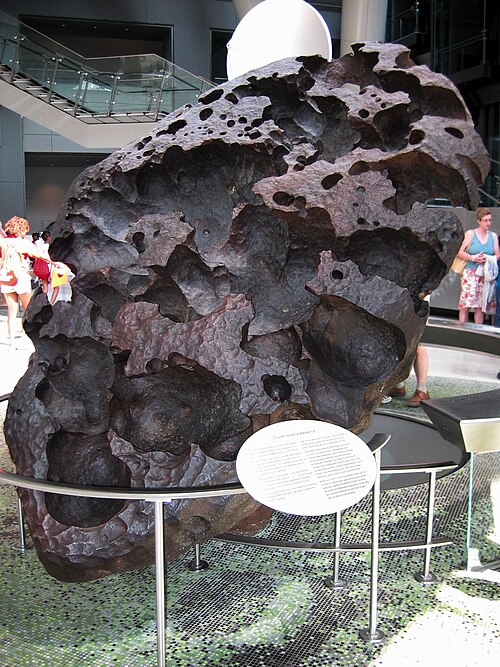
アーサー・ロス隕石ホールは1階の南西の角にある。[158]ここには世界でも最も優れた標本がいくつか収蔵されており、その中にはグリーンランドの隕石島を調査した際に非イヌイット文化圏に初めて知らされた200トンのケープヨーク隕石の一部であるアニーヒトも含まれている。その重量は34トンと非常に大きく、北半球で展示されているものの中では最大である。[251]展示は、床を貫通して博物館の下の岩盤まで伸びる柱によって支えられている。[252]
このホールには、50億年以上前の太陽系外ナノダイヤモンド(ナノメートルレベルの寸法を持つダイヤモンド)も展示されている。これらは化学的手段によって隕石サンプルから抽出されたもので、1立方センチメートル未満の体積に1000兆個が収まるほど小さい。[253]
アリソン・ミニョーネとロベルト・ミニョーネの宝石と鉱物のホール
アリソン&ロベルト・ミニョーネ宝石鉱物ホール(旧ハリー・フランク・グッゲンハイム宝石鉱物ホール)は、ロス隕石ホールの北側の1階にあります。[158]数千点の希少な宝石、鉱物標本、宝飾品が収蔵されています。ホールは2017年に閉鎖され、ラルフ・アッペルバウム・アソシエイツによる3200万ドルの再設計が行われ、2021年6月に一般公開されました。[254] [255]再設計された展示では、展示デザインの新しい哲学が採用されており、ストーリーテリング、インタラクティブ性、分野を超えたアイデアのつながりに重点を置いています。ホールでは、地球の歴史における鉱物種の多様化、プレートテクトニクス、特定の宝石の物語など、さまざまなトピックを探求しています。[256]
ホールには、スター・オブ・インディア、パトリシア・エメラルド、デロング・スター・ルビーなど、博物館のコレクションにある10万点以上の作品の中から選ばれた珍しい標本が展示されている。[257]
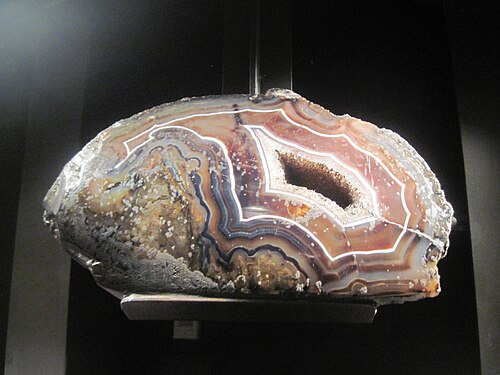
-
 ファセットカットや研磨された鉱物の各種
 -
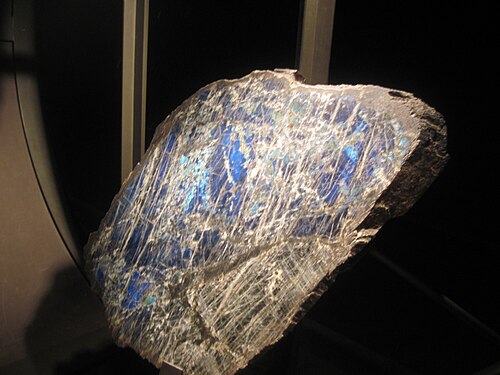 ラブラドライト標本
 -
-
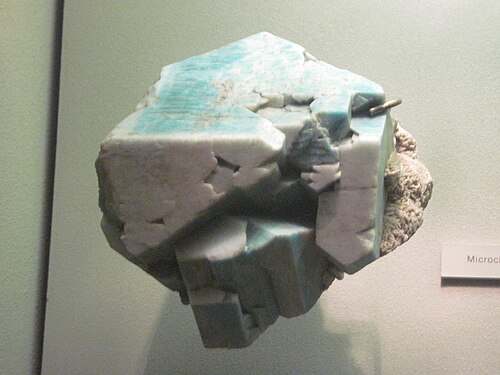 マイクロクリン標本
 -
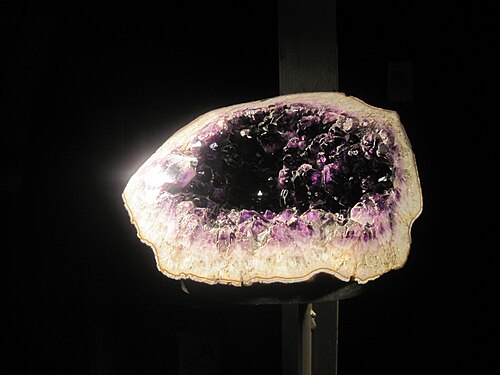 クォーツ var. アメジストジオード

デビッド・S・ゴッテスマンとルース・L・ゴッテスマン地球ホール
デイビッド・S・アンド・ルース・L・ゴッテスマン地球ホールは、博物館の1階北東隅にあります。[158] 1999年にオープンしたこの常設ホールは、集積から生命の起源、そして現代の人類が地球に及ぼした影響まで、地球の歴史に焦点を当てています。このホールは、5つの重要な質問に答えるために設計されました。「地球はどのように進化してきたのか?なぜ海盆、大陸、山があるのか?科学者はどのように岩石を読むのか?気候と気候変動の原因は何なのか?なぜ地球は居住可能なのか?」[258] [259]このホールには、28回の探検で収集された岩石やその他の物体が展示されています。最も古い岩石は43億年前のもので、最も新しい岩石は火山が固まった日に収集されたものです。ホールの中央には、地球儀を備えた30席の花崗岩の円形劇場もあります。[259]
いくつかのセクションでは、地質学、氷河学、大気科学、火山学など、地球システムの研究についても議論されています。展示には、触れることができる大きな岩石標本がいくつかあります。ホールには、縞状鉄鉱石や変形した礫岩の印象的なサンプル、花崗岩、砂岩、溶岩、3つの黒煙岩が展示されています。ホールの北側セクションは、主にプレートテクトニクスを扱っており、中心に核とマントル、周囲に地殻の特徴があり、地球の構造を模倣するように配置されています。 [260]
化石ホール


保管施設
博物館の哺乳類と恐竜の化石コレクションのほとんどは、一般の目に触れないよう隠されており、博物館の奥深くにある多くの保管庫に保管されています。[104]これらの中で最も重要な保管施設は、1969年に建設が開始され[261]、1973年に完成した10階建てのチャイルズ・フリック・ビルです。 [104] [105]フリック・ビルが完成した当時、博物館の化石化した哺乳類と恐竜のコレクションは、重量が600米トン(540長トン、540t)で、世界最大のコレクションでした。フリック・ビルの最上階3階には、研究室とオフィスがあります。[262]
博物館の他のエリアには、過去の生命に関する収蔵品が収められている。クジラの骨の保管室は巨大な化石の骨を移動させるために天井から強力なウインチが降りてくる洞窟のような空間である。博物館の2階の屋根裏には象の部屋などさらに多くの保管施設があり、屋根裏の階下には牙の保管室とイノシシの保管室がある。 [263]
公共ディスプレイ
一般公開されている化石のコレクションは、博物館の4階全体を占めています。[158] 4階の展示には、1996年にオープンしたミリアム・アンド・アイラ・D・ウォラック・オリエンテーション・センターからアクセスできます。 [264]博物館の77番街側では、オリエンテーション・センターから始まり、慎重にマークされた道をたどって、生命の進化の樹に沿って進みます。樹が「枝分かれ」するにつれて、クラドグラムと呼ばれる脊椎動物間の家族関係が示されます。博物館の4階にあるビデオ投影では、クラドグラムの概念が紹介されています。[265] [264]
展示されている化石の多くは、博物館の世界的な探検の黄金時代(1880年代から1930年代)に収集されたユニークで歴史的な品々です。[19]小規模ではありますが、探検は現在も継続されており、ベトナム、マダガスカル、南アメリカ、中央アフリカと東アフリカからの化石がコレクションに追加されています。
ホール
博物館の最初の恐竜ホールは1905年にオープンしました。[90] [91] 4階には以下のホールがあります。[266]
- 脊椎動物の起源のホール
- 竜盤類恐竜のホール(掴む手、長く動く首、下向きの恥骨の位置から、現代の鳥類の先駆者であると認識される)[267]
- 鳥盤類恐竜のホール(後ろを向いた恥骨で定義)
- 原始哺乳類のホール
- 高度な哺乳類のホール
恐竜館は1990年から改修工事のため一時閉鎖された。[268]最初に再開された館は、1994年にオープンしたライラ・アチソン・ウォレス哺乳類とその絶滅した近縁種展示棟の一部である原始哺乳類館と高度哺乳類館だった。 [269] [270]竜盤類恐竜館と鳥盤類恐竜館は、1200万ドルの拡張工事の一環として1995年に再開された。[271] [272]脊椎動物の起源館は1996年にオープンした。 [264]
展示されている化石

展示されている化石には以下のものがあります。
- ティラノサウルス・レックス:ほぼ完全に本物の化石骨で構成されており、力強い脚でバランスを取りながら水平に忍び寄るポーズで展示されています。この標本は実際には、有名な恐竜ハンターであるバーナム・ブラウンが1902年と1908年にモンタナ州で発見した2体のTレックスの化石骨で構成されています。 [273]
- マンモス:近縁種のマンモスよりも大きいこの化石は、11,000年前にインディアナ州に生息していた動物のものである。 [274]
- アパトサウルスまたはブロントサウルス:この巨大な標本は19世紀末に発見された。化石骨のほとんどはオリジナルのものだが、頭蓋骨は現場で発見されなかったためオリジナルではない。骨格は主に標本AMNH 460、および標本AMNH 222、AMNH 339、AMNH 592、およびブロントサウルス・エクセルススのホロタイプYPM 1980の鋳型から構成されている。 [275] [276]最初のアパトサウルスの頭蓋骨が発見されたのは何年も後のことであり、その頭蓋骨の石膏像が作られ、博物館の展示台に置かれた。正しい頭蓋骨が見つかるまで、カマラサウルスの頭蓋骨が誤って使用されていた。 [277]この標本がブロントサウルスなのかアパトサウルスなのかは完全には定かではない独自の属や種である可能性もあるため「未確認のアパトサウルス亜科」と考えられています。 [276]
- ブロントプス:馬やサイと遠縁の絶滅した哺乳類。現在のサウスダコタ州に3500万年前に生息していた。壮麗で珍しい一対の角で知られる。 [278]
- 大型の草食鳥脚類恐竜、エドモントサウルス・アネクテンスの骨格。この標本は、軟部組織と皮膚の痕跡が周囲の岩に埋め込まれた「ミイラ化した」恐竜化石の一例である。この標本は発見されたときのまま、脚を立てて頭を後ろに引いた状態で横たわっている。[279]
- 2007年9月26日、直径2フィート(61センチメートル)の8000万年前のアンモナイトの化石が博物館で初公開されました。この化石は宝石のアンモライトのみで構成されています。化石無脊椎動物の学芸員であるニール・ランドマンは、アンモナイト(殻を持つ頭足動物で、亜綱アンモナイト目)は6600万年前に絶滅しており、恐竜と同じ絶滅イベントで絶滅したと説明しました 。この化石はカナダのアルバータ州で発見された後、コライト・インターナショナルが寄贈しました。[280]
- ボーンキャビン採石場で発見されたアパトサウルス亜科の椎骨に大きな噛み跡が残っている化石を基にした、ブロントサウルスの死骸を漁るアロサウルスの骨格。 [281] [282] [283]
- アンドリューサルクス・モンゴリエンシスの唯一知られている頭骨。[284]
- メガロクヌス・ロデンス、スケリドテリウム・キュビエリ、メガロニクス・ウィートリー、グロッソテリウム・ロブストゥスなど、地上性ナマケモノのさまざまな種の展示

トリケラトプスとステゴサウルスも、他の多くの標本とともに展示されています 。
博物館に展示されている化石以外にも、科学者が利用できるコレクションに多くの標本が保管されています。それらには、完全なディプロドクス科の頭蓋骨、[285]ティラノサウルス科の歯、竜脚類の椎骨、そして多くのホロタイプなどの重要な標本が含まれています。
ローズ地球宇宙センター

博物館に隣接するヘイデンプラネタリウムは、現在、博物館の北側にあるローズ地球宇宙センターの一部となっている。[ 158 ]オリジナルのヘイデンプラネタリウムは、慈善家チャールズヘイデンの寄付により1933年に設立され、1935年にオープンした。 [286] AMNHは1995年初頭に現代のローズ地球宇宙センターを発表し、[133]同年に解体が始まった。[287]
フレデリック・フィニアス・アンド・サンドラ・プリースト・ローズ地球宇宙センターは2000年に2億1000万ドルの費用で完成した。[108] [109]ジェームズ・スチュワート・ポルシェクが設計した新しい建物は、6階建ての高さのガラスの立方体で構成され、87フィート(27メートル)の照明付きの球体を囲んでいる。この球体は浮いているように見えるが、実際にはトラス構造で支えられている。ポルシェクはこの作品を「宇宙の大聖堂」と呼んでいる。[108]この球体はスペースシアターとして知られている。[288]
この施設には、ヘイデン プラネタリウムのほか、333,500 平方フィート (30,980 m 2 ) の研究、教育、展示スペースがあります。また、この施設には、博物館で最も新しい学術研究部門である天体物理学部門もあります。ニール ドグラース タイソンがヘイデン プラネタリウムのディレクターを務めています。さらに、ポルシェクは、博物館の西側ファサードに沿って、高さ 43 フィート (13 m) の透明な「ウォーター ホワイト」ガラス構造である、1,800 平方フィート (170 m 2 ) のウェストン パビリオンを設計しました。この構造物は、ローズ センターの小さな姉妹品であり、博物館への新しい入口を提供するとともに、天文学関連のオブジェクトの展示スペースをさらに広げます。[289]ハイルブルン コズミック パスウェイは、ローズ センターで最も人気のある展示の 1 つです。[247]
リチャード・ギルダー科学・教育・イノベーションセンター
スタジオ・ギャングとランドスケープアーキテクトのリード・ヒルダーブランドが設計したリチャード・ギルダー科学・教育・イノベーションセンターは、2023年5月にオープンした。23万平方フィートの増築部分は地上6階、地下1階となっている。ギルダーセンターは、コロンバス・アベニューに新しく開設されたアクセスしやすい入り口で訪問者を迎え、中央の5階建てのアトリウムにつながり、既存の博物館と30以上のつながりを生み出している。[290]アトリウムの建築は、風や水の動きなど、地質学的景観を形作る自然のプロセスに影響を受けています。[291]連続した視覚的形状を実現するために、アトリウムは吹付けコンクリートで建設されています。曲線的なファサードは、以前のハイ・ビクトリアン・ゴシック、リチャードソン・ロマネスク、ボザール様式の建造物とは対照的ですが、ミルフォード・ピンクの花崗岩の外装は、博物館の西側に使用されているのと同じ石です。[292] [293]

リチャード・ギルダー・センターには、昆虫館や蝶の飼育室など、昆虫に特化した新しい展示エリアがあり、訪問者は緑豊かな熱帯の環境で飛び回る何百もの生きた標本の間を歩くことができます。また、科学標本を保管・展示する目に見える保管構造、拡張された研究図書館、教室と教育エリア、実験室も含まれています。[294]もう1つの常設施設は、「Invisible Worlds」と呼ばれる没入型でインタラクティブなビデオ体験で、脳のニューロンの発火、木の根の間の栄養素と水の交換、海洋生態系のプランクトンの微視的世界など、生命を支える重要で目に見えないつながりに焦点を当てています。[295]

この拡張部分はもともと既存の博物館の北側に建設される予定で、セオドア・ルーズベルト公園の一部を占めていた。拡張部分は既存の博物館の西側に移転され、公園内での建設反対により敷地面積が縮小された。この別館はコロンバス・アベニューの東側にある既存の建物3棟を置き換えたものである。[134]
展示ラボ
1869年に設立されたAMNH展示ラボは、それ以来何千ものインスタレーションを制作してきました。この部門は、新しい科学研究を没入型アートとマルチメディアプレゼンテーションに統合していることで有名です。本拠地の博物館とローズ地球宇宙センターの有名なジオラマに加えて、ラボはデジタルユニバースアトラスなどの国際的な展示会やソフトウェアも制作しています。[296]
展示チームは現在、60名以上のアーティスト、ライター、準備者、デザイナー、プログラマーで構成されています。この部門は、年間2~3件の展示の制作を担当しています。これらの大規模なショーは通常、国内の姉妹自然史博物館を巡回します。彼らは、ダーウィンの進化論[ 249] 、[297]、小惑星による中生代の大量絶滅について議論する最初の展示などを制作しました。
研究図書館
研究図書館は博物館の4階にあり、職員と一般の訪問者に開放されています。[298]図書館は、哺乳類学、地球惑星科学、天文学と天体物理学、人類学、昆虫学、爬虫類学、魚類学、古生物学、動物行動学、鳥類学、鉱物学、無脊椎動物、分類学、生態学、海洋学、貝類学、探検と旅行、科学史、博物館学、書誌学、ゲノム学、および周辺生物科学などの主題をカバーする資料を収集しています。コレクションには、15世紀にまで遡るものもありますが、他では見つけるのが難しい多くの回顧的な資料があります。[299]
図書館の初期のコレクションは、ジョン・クラークソン・ジェイの貝類学図書館[300] [301] 、 カーソン・ブレヴォートの魚類および一般動物学図書館[301] [302]、 ダニエル・ジロー・エリオットの鳥類学図書館[301] [302]、 S・ローウェル・エリオットの様々な主題に関する書籍およびパンフレットのコレクション[303]、 ハリー・エドワーズの昆虫学図書館[302] [304]、ヒュー・ジュエットの航海および旅行コレクション[55]、ジュール・マルクーの地質学コレクションなどの寄贈によって主に拡大されました。[304] [305] 1900年代には、エグバート・ヴィーレ、アメリカ民族学会、ジョエル・アサフ・アレン、ハーモン・ケアリー・バンパス、ヘンリー・フェアフィールド・オズボーンなどの人物や団体からの寄贈により、図書館は成長を続けました。[306]
新しい図書館は、 1992年にロッシュ・ディンケロー社によって設計されました。広さは55,000平方フィート(5,100平方メートル)で、50人用の閲覧室、公共オフィス、温度と湿度が制御された部屋など、5つの異なる「保存ゾーン」があります。[307]現在、図書館のコレクションには、モノグラフ、定期刊行物、パンフレット、再版、マイクロフォーム、オリジナルのイラスト、映画、写真、アーカイブ、原稿、美術品、記念品、希少本のコレクションなど、55万冊以上が含まれています。
特別コレクションには以下が含まれます:
- 機関アーカイブ、原稿、個人文書:博物館、その科学者とスタッフ、科学的な探検と研究、博物館の展示、教育、および一般管理に関連するアーカイブ文書、フィールドノート、切り抜き、その他の文書が含まれます。[308]
- 美術品および記念品コレクション。[309]
- 動画コレクション。[310]
- 縦型ファイル:展示会、探検、博物館の運営に関するもの。[311]
活動
研究活動

博物館には225人以上の科学スタッフがおり、毎年120を超える特別な野外調査を後援しています。展示されている化石の多くは、博物館の世界的な調査の黄金時代(1880年代から1930年代)に収集されたユニークで歴史的な品々です。AMNHが全額または一部を資金提供したこれらの調査の例として、ジェサップ北太平洋調査、ホイットニー南洋調査、ルーズベルト・ロンドン科学調査、クロッカーランド調査、リチャード・アーチボールドによるマダガスカルとニューギニアへの調査などがあります。小規模ではありますが、調査は現在も続いています。博物館は、アメリカ自然史博物館紀要など、査読付きジャーナルもいくつか発行しています。[312]
南西部研究ステーション
AMNHは、アリゾナ州ポータルのチリカワ山脈に生物学フィールドステーションを運営しています。南西部研究ステーションは1955年に設立され、慈善家デビッド・ロックフェラーの助成金で購入され、昆虫学者モン・カジエが初代所長を務めました。[313] 「生物多様性ホットスポット」にあるこのステーションは、研究者や学生が利用しており、一般向けのセミナーも時々開催しています。[314]
教育アウトリーチ
AMNHの教育プログラムには、ニューヨーク市の学校へのムーバブルミュージアムによるアウトリーチ活動が含まれる。[315] AMNHは、幼稚園から大学院レベルまでの学生を対象に、さまざまな教育プログラム、キャンプ、クラスを提供している。AMNHは、5年生から12年生を対象とした包括的な研究および科学教育プログラムであるラングサイエンスプログラムと、ペアになった学生がAMNHの科学者と1年間集中的に独自の研究を行う科学研究メンターシッププログラム(SRMP)を後援している。[316] 2023年現在[update]、毎年約40万人の小学生がAMNHに遠足に参加している。[317]ほとんどの学生は1日かそれ以下の訪問だが、2023年後半から博物館はBeyond Elementary Explorations in Scienceと呼ばれる1週間の教育プログラムも提供している。[317]
リチャード・ギルダー大学院
2006年10月23日、同博物館はリチャード・ギルダー大学院を開設し、米国で初めて同博物館の名で博士号を授与する米国博物館となった。[318] [319]この大学院は、学校に5000万ドルを寄付した実業家リチャード・ギルダーにちなんで名付けられた。 [319] [320] 2009年に認定され、[321] 2011年には11名の学生が在籍し、学芸員と密接に協力し、コレクションにアクセスできる。[322]最初の7名の卒業生は2013年に学位を授与された。[323] AMNHは、地球科学の教育学修士号(MAT)[324]と比較生物学の博士号を提供している。[325] [326]
MAT地球科学レジデンシープログラムは、ニューヨーク州の有資格理科教師の深刻な不足に対処するために2012年に開始されました。[327] 2015年に、MATプログラムは正式にリチャード・ギルダー大学院に加わり、ニューヨーク州理事会はギルダー大学院にMAT学位の授与を認可しました。[328]
著名人
大統領
博物館の最初の3人の会長は全員共同設立者でした。[16] [17]ジョン・デイビッド・ウルフは1869年から1872年に亡くなるまで会長を務めました。[329]その後を継いだロバート・L・スチュアートは1881年に辞任しました。[330] [331] 3代目の会長モリス・K・ジェサップは25年以上会長を務め、1908年に亡くなるまで務めました。 [332]ジェサップは死去時に博物館に100万ドルを遺贈しました。[333]
ジェサップの死後任命された第4代館長ヘンリー・フェアフィールド・オズボーンは、博物館の拡張を統合し、さらに発展させた。 [332]オズボーンの下で、博物館は高まる優生学運動を受け入れた。[334]オズボーンの友人で、博物館の執行委員会のメンバーであった著名な優生学者マディソン・グラントは、1916年の著書『偉大なる人種の消滅』の著者である。彼はまた、博物館で開催された1921年の第二回国際優生学会議の資金提供者であり、その形成者でもあった。[335]ダベンポートは、1932年第三回国際優生学会議でも議長を務めた。[336]
1933年にオズボーンが辞任した後、F・トゥルービー・デイヴィソンがAMNHの第5代会長に就任した。[337] [338]デイヴィソンは1951年に辞任し、アレクサンダー・M・ホワイトが博物館の会長に選出された。[339]その後、ガードナー・D・スタウトが1968年から1975年まで会長を務め、ロバート・ゲスティエ・ゴエレットが代わりに選出された。 [340]ゴエレットは1987年まで会長を務め、その後理事会に加わった。彼の後を継いだのはジョージ・D・ラングドン・ジュニアで、博物館史上初めて給与を受け取った会長となった。これまでの会長は全員無給だった。[341]
エレン・V・ファッターは1993年に同美術館初の女性館長に就任した。[342] [343]ファッターは2022年6月に、2023年3月にギルダーセンターがオープンしたときに退任する予定であると発表した。 [344] ショーン・M・ディケーターは2022年12月にファッターの後任に指名され、2023年4月3日に同美術館初のアフリカ系アメリカ人館長に就任した。 [3] [345]
その他の関連名称
博物館にゆかりのある著名人としては、ゴビ砂漠の恐竜ハンター、ロイ・チャップマン・アンドリュース(インディ・ジョーンズのモデルとなった人物の一人)、[346]写真家のイヴェット・ボルプ・アンドリュースとジョージ・ゲイロード・シンプソン、生物学者のエルンスト・マイヤーとスティーブン・ジェイ・グールド、文化人類学者の先駆者であるフランツ・ボアズとマーガレット・ミード、探検家で地理学者のアレクサンダー・H・ライス・ジュニア、鳥類学者のロバート・クッシュマン・マーフィーなどがいます。
周囲
The museum is at 79th Street and Central Park West. There is a direct entrance into the museum from the New York City Subway's 81st Street–Museum of Natural History station, served by the B and C trains.[347]
On a pedestal outside the museum's Columbus Avenue entrance is a stainless steel time capsule, which was created after a design competition that was won by Santiago Calatrava. The capsule was sealed at the beginning of 2000, to mark the beginning of the 3rd millennium. It takes the form of a folded saddle-shaped volume, symmetrical on multiple axes, that explores formal properties of folded spherical frames. Calatrava described it as "a flower". The capsule is to be opened in the year 3000.[348]
The museum is in a 17-acre (69,000 m2) city park known as Theodore Roosevelt Park that extends from Central Park West to Columbus Avenue, and from West 77th to 81st Streets and that contains park benches, gardens and lawns, and also a dog run.[349] On the west side of the park, between 80th and 81st Streets near Columbus Avenue, is the Nobel Monument honoring Nobel Prize winners from the United States.[350][351]
Commentary
In 2019, Hamid Dabashi, the Hagop Kevorkian Professor of Iranian Studies and Comparative Literature at Columbia University, wrote an opinion piece in Al Jazeera criticizing a bronze statue of Theodore Roosevelt, depicting him on horseback above a nameless Native American and African American individual. Having visited the museum, Dabashi reflected on the juxtaposition of scientific progress and what he sees as the persistent legacy of racism in the United States. The statue of Theodore Roosevelt is seen by Dabashi as a symbol of racial hierarchy and the ongoing struggle to reconcile the nation's past with its present. [352] The statue would later be removed in 2022, as a consequence of discussions about racism aroused by the 2020 protests surrounding the killing of George Floyd. [353]
A 2020 article by University of New Hampshire historian Julia Rodriguez contrasts the approaches respectively taken by the AMNH and the Musée de l'Homme in Paris, in terms of their human and cultural exhibits. While Rodriguez criticizes the AMNH's exhibits for their failure to acknowledge colonial histories, the Musée de l'Homme has made strides in decolonizing its displays. Rodriguez also posits that notably absent from such museums are exhibits dedicated to Northern European or New England cultures, suggesting a biased focus on "othering" non-Western societies while normalizing Western cultural norms.[354]
In a June 2024 essay published in Indian online paper ThePrint, Stanford University history professor Priya Satia argues that the museum's Hall of Asian Peoples is problematic because it portrays Asian cultures as static and frozen in time.[355] Satia believes various misrepresentations can lead to misunderstandings and perpetuate harmful biases against Asian and Middle Eastern people. In the same essay, Satia also delves into parts of the museum's own history, such as its 1921 hosting of the Second International Eugenics Congress.[355] Her essay was criticized by Samuel Abrams, who serves as a Nonresident Senior Fellow of the American Enterprise Institute, as a researcher at NYU, and as a Professor of Politics at Sarah Lawrence College.[356] Abrams states that "Critiquing an outdated museum is fine, but nothing about Satia’s thread was constructive or helpful."[357]
In popular culture
The museum is featured in many works of art and popular culture, including:
- A large portion of the 2017 film Wonderstruck takes place in the museum, showing the museum in 1927 as well as 1977.[358]
- The museum in the film Night at the Museum (2006) is based on a 1993 book that was set at the AMNH (The Night at the Museum). The interior scenes were shot at a sound stage in Vancouver, British Columbia, but exterior shots of the museum's facade were done at the actual AMNH. AMNH officials have credited the movie with increasing the number of visitors during the holiday season in 2006 by almost 20 percent.[359] Its sequels, Night at the Museum: Battle of the Smithsonian (2009) and Night at the Museum: Secret of the Tomb (2014), were also partially set in this museum.
- The main characters of the 2023 graphic novel Roaming visit the AMNH.
- The museum was the setting for the 1970 novel "The Great Dinosaur Robbery" by David Forrest, but was not featured in the film adaptation "One of Our Dinosaurs Is Missing", which was set in the Natural History Museum in London, England.
- As the "New York Museum of Natural History", the museum is a favorite setting in many Douglas Preston and Lincoln Child novels, including "Relic" (1995), "Reliquary" (1997), "The Cabinet of Curiosities" (2002), and "The Book of the Dead" (2007). FBI Special Agent Aloysius X. L. Pendergast plays a major role in all of these thrillers. Preston was manager of publications at the museum before embarking upon his fiction writing career.
- The museum has appeared repeatedly in the fiction of dark fantasy author Caitlín R. Kiernan, including appearances in her fifth novel "Daughter of Hounds", her work on the DC/Vertigo comic book "The Dreaming" (#47, "Trinket"), and many of her short stories, including "Valentia" and "Onion" (both collected in "To Charles Fort, With Love", 2005).
- The 2005 movie "The Squid and the Whale" takes its name from the diorama of the giant squid and the sperm whale in the museum's Hall of Ocean Life. The diorama is shown in the film's final scene.
- The plot of the 1993 film "We're Back! A Dinosaur's Story" revolves around the museum, with all four dinosaurs finally reaching the AMNH at the end.
- In the 1955 Czechoslovak film, "Journey to the Beginning of Time", (Czech: Cesta do pravěku, literally "Journey into prehistory") the four boys end their journey on a bench inside the AMNH's 77th St. entrance, beneath the exhibit of the long-boat, in which they'd had their adventure. While the story could be dismissed as a dream, one boy's journal has somehow suffered all the wear-&-tear of their journey through prehistoric eras. A dubbed and partly re-filmed US version of the film was released in 1966 under the title 'Journey to the Beginning of Time'.
- The 1914 animated film "Gertie the Dinosaur" was set in the Museum.
- In the NBC sitcom Friends, Ross works in the museum from 1994 until he is fired in 1999. In the 1996 episode "The One Where Ross and Rachel...You Know", Ross and Rachel have sex in one of the exhibits, stunning a group of schoolchildren when they wake up the following morning.
Gallery
-
 Bengal tiger at the American Museum of Natural History
 -
 Diorama in Akeley Hall of African Mammals
 -
 Diorama in Akeley Hall of African Mammals
 -
 Diorama in Akeley Hall of African Mammals
 -
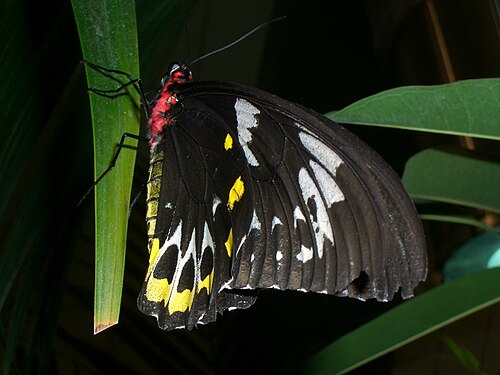 Butterfly Conservatory
 -
 Display in Milstein Hall of Ocean Life
 -
-
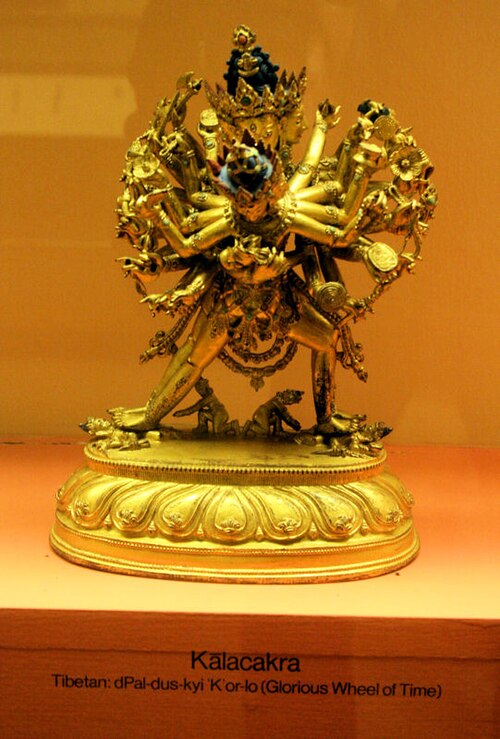 Tibetan Kalachakra statue
 -
 The museum's south range, and some of the west façade, in the 1920s
 -
 American bison and pronghorn diorama (right)
 -
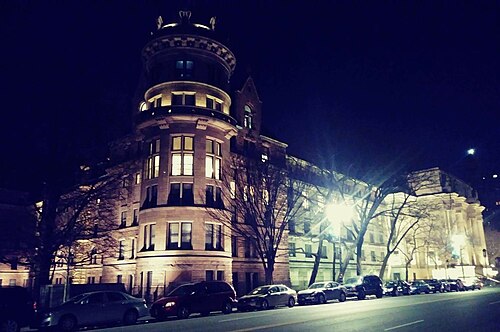 Night view of the museum, looking northwest from across Central Park West

.jpg/500px-American_Museum_of_Natural_History_in_Manhattan,_New_York_City,_United_States_of_America_(9860903214).jpg)
See also
- List of museums and cultural institutions in New York City
- List of most-visited museums in the United States
- List of New York City Designated Landmarks in Manhattan from 59th to 110th Streets
- National Register of Historic Places listings in Manhattan from 59th to 110th Streets
- Education in New York City
- Margaret Mead Film Festival
- Constantin Astori
References
Notes
- ^ The founders included Theodore Roosevelt Sr., John David Wolfe, William T. Blodgett, Robert L. Stuart, Andrew H. Green, Robert Colgate, Morris K. Jesup, Benjamin H. Field, D. Jackson Steward, Richard M. Blatchford, J. P. Morgan, Adrian Iselin, Moses H. Grinnell, Benjamin B. Sherman, A. G. Phelps Dodge, William A. Haines, Charles A. Dana, Joseph H. Choate, Henry G. Stebbins, Henry Parish, and Howard Potter.[16]
Citations
- ^ "History 1869–1900". AMNH. Archived from the original on January 24, 2016. Retrieved August 28, 2012.
- ^ "TEA-AECOM 2018 Theme Index and Museum Index: The Global Attractions Attendance Report" (PDF). Themed Entertainment Association. pp. 62–77. Archived (PDF) from the original on December 12, 2020. Retrieved February 10, 2020.
- ^ a b Pogrebin, Robin (December 6, 2022). "Natural History Museum Names College Leader as New Chief". The New York Times. Archived from the original on December 7, 2022. Retrieved December 7, 2022.
- ^ "NPS Focus". National Register of Historic Places. National Park Service. Archived from the original on July 25, 2008. Retrieved November 18, 2011.
- ^ a b "American Museum of Natural History". Charity Navigator. Archived from the original on February 4, 2022. Retrieved March 25, 2022.
- ^ "Dioramas at the Museum: Millions of Specimens in Context". Archived from the original on October 29, 2019. Retrieved February 22, 2020.
- ^ "American Museum of Natural History – Overview and Programs". Archived from the original on February 16, 2009. Retrieved February 18, 2009.
- ^ "No. 7 American Museum of Natural History, New York City". Travel + Leisure. Archived from the original on May 12, 2014. Retrieved May 12, 2014.
- ^ a b c Davey 2019, p. 22.
- ^ a b c Stern, Mellins & Fishman 1999, p. 182.
- ^ Rieppel, Lukas (2019). Assembling the Dinosaur: Fossil Hunters, Tycoons, and the Making of a Spectacle. Cambridge: Harvard University Press. pp. 48–55. ISBN 9780674737587.
- ^ a b c Davey 2019, p. 23.
- ^ Osborn 1911, p. 9.
- ^ Osborn 1911, pp. 9–10.
- ^ a b Davey 2019, pp. 23–24.
- ^ a b c d Osborn 1911, p. 10.
- ^ a b c Davey 2019, p. 24.
- ^ Davey 2019, pp. 24–25.
- ^ a b "Timeline: The History of the American Museum of Natural History". Archived from the original on February 11, 2009. Retrieved February 18, 2009.
- ^ a b Davey 2019, p. 26.
- ^ Osborn 1911, p. 12.
- ^ "Natural History Museum in New York". Hearth and Home. Vol. 3, no. 18. May 6, 1871. p. 342. ProQuest 88750696.
- ^ a b "Home News: the Weather Prominent Arrivals Departures New-York City Brooklyn Westchester County Long Island Staten Island New-Jersey Lectures, Meetings, Etc Haps and Mishaps". New-York Tribune. May 23, 1871. p. 8. ProQuest 572448008.
- ^ "Opening of the Museum of Natural History at Central Park". The New York Times. May 23, 1871. ISSN 0362-4331. Retrieved June 13, 2022.
- ^ a b c d e Stern, Mellins & Fishman 1999, p. 183.
- ^ a b "The Illustrations.: the New "Old Circular Church," Charleston, S.c. Mr. C. E. Parker, Architect. The American Museum of Natural History, New York. Messrs. Vaux and Mould, Architects". The American Architect and Building News. Vol. 1, no. 13. August 12, 1876. p. 261. ProQuest 124530453.
- ^ a b "Natural History Museum; Costly Building in Central Park. A Structure Which Will Cover Nearly Eighteen and a Half Acres". The New York Times. December 20, 1877. ISSN 0362-4331. Retrieved June 13, 2022.
- ^ Osborn 1911, p. 23.
- ^ "Natural History Museum.; Laying of the Corner-stone by President Grant. Brilliant Scene at Manhattan Square Yesterday". The New York Times. June 3, 1874. ISSN 0362-4331. Retrieved June 8, 2022.
- ^ "Science for the People: the Corner-stone of the Museum of Natural History Laid the Ceremony Performed by President Grant--addresses by President Stuart, Henry G. Stebbins, Gov. Dix, and Prof. Henry Address of Robert L. Stuart Address of Salem H. Wales Address of Gov. Dix Address of Prof. Joseph Henry". New-York Tribune. June 3, 1874. p. 2. ProQuest 572535543.
- ^ "New-York's New Museum". The New York Times. December 23, 1877. ISSN 0362-4331. Retrieved June 8, 2022.
- ^ a b c "Completed". The Standard Union. August 6, 1892. p. 4. Retrieved September 21, 2023.
- ^ "Museum of Natural History.: Meeting of the Trustees--the Sunday Question Still Open". The New York Times. May 10, 1881. ISSN 0362-4331. Retrieved September 20, 2023.
- ^ "An Aid to Science: the Museum of Natural History the Grounds Surrounding the Structure--plans for Making the Institute a Centre of Investigation and Original Research--additions to the Collection--a Course of Lectures What the Museum Contains the Museum as a Center of Investigation Means for Popular Instruction a New Department". New-York Tribune. August 1, 1881. p. 2. ISSN 1941-0646. ProQuest 572968872.
- ^ "The Museum of Natural History; Evident Necessity for More Room--beautifying the Surroundings". The New York Times. August 11, 1882. ISSN 0362-4331. Retrieved September 20, 2023.
- ^ "Home News: Prominent Arrivals". New-York Tribune. November 29, 1882. p. 8. ISSN 1941-0646. ProQuest 573029686.
- ^ "The Museum of Natural History". The New York Times. November 29, 1882. p. 3. ISSN 0362-4331. ProQuest 93994816.
- ^ "A Lecture Course for Teachers.; the Necessity for More Room in the Museum of Natural History". The New York Times. September 30, 1882. ISSN 0362-4331. Retrieved September 20, 2023.
- ^ "Museum of Natural History.: the Trustees Discussing the Question of Keeping It Open Sundays". The New York Times. May 12, 1885. p. 8. ISSN 0362-4331. ProQuest 94295081.
- ^ "The Sunday Museum Bill: Passed by the Assembly After Full Debate. The Fight Over the Measure to Give Mayor Grace Full Power of Appointing Excise Commissioners". The New York Times. April 2, 1886. ISSN 0362-4331. Retrieved September 20, 2023.
- ^ "Wanting Museums Open on Sundays: Debate on Assemblyman Hagan's Bill--excise Commissioners Work of Legislative Committees an Opinion by the Attorney-general". New-York Tribune. April 2, 1886. p. 3. ISSN 1941-0646. ProQuest 573216029.
- ^ "Open Museums on Sunday; the Movement Being Pushed Vigorously by Workingmen". The New York Times. January 17, 1886. ISSN 0362-4331. Retrieved September 20, 2023.
- ^ "The Trustees Perplexed; They Would Like to Have That Extra Sum. But They Do Not Like the Condition That the Museums Supported by the City Shall Be Open Sunday". The New York Times. December 29, 1886. ISSN 0362-4331. Retrieved September 20, 2023.
- ^ "Museums Must Have Money.; an Appeal From the Trustees of the Museum of Natural History". The New York Times. February 27, 1889. ISSN 0362-4331. Retrieved September 21, 2023.
- ^ "Lectures to Teachers; Bill to Continue the Work of the Museum of Natural History". The New York Times. January 21, 1897. ISSN 0362-4331. Retrieved September 21, 2023.
- ^ "Need of a New Museum Building". New-York Tribune. January 31, 1887. p. 8. Retrieved September 20, 2023.
- ^ "More Room for a Museum". New-York Tribune. February 3, 1887. p. 8. Retrieved September 20, 2023.
- ^ "Park Improvements.; Plans Whose Execution Will Cost a Million Dollars". The New York Times. February 19, 1887. ISSN 0362-4331. Retrieved September 21, 2023.
- ^ "The New Museum Building.: a Site Selected--Mr. Fuller Talks About the Driveway". The New York Times. March 29, 1888. ISSN 0362-4331. Retrieved September 21, 2023.
- ^ "Natural History Museum Plans: the Park Board Approves the Action of the Trustees in Choosing the Southern Site". New-York Tribune. March 29, 1888. p. 5. ISSN 1941-0646. ProQuest 573349669.
- ^ "$400,000 for the Metropolitan Museum". The Sun. December 17, 1889. p. 9. Retrieved September 20, 2023.
- ^ "Not to be Open Sundays". The Evening World. December 17, 1889. p. 6. Retrieved September 21, 2023.
- ^ "Enlarging the Museum.; Many Stored Specimens Awaiting the New Building's Completion". The New York Times. September 5, 1888. ISSN 0362-4331. Retrieved September 21, 2023.
- ^ "The Repairs to Be Finished Soon: Improving and Enlarging the Museum of Natural History". The New York Times. September 25, 1890. p. 4. ISSN 0362-4331. ProQuest 573563984.
- ^ a b American Museum of Natural History (1890). Annual Report ... American Museum of Natural History. American Museum of Natural History. p. 14.
- ^ "Natural History Museum: Officers Propose to Open, It Sunday the New Addition Nearly Completed--what It Will Contain". New-York Tribune. February 14, 1892. p. 4. ISSN 1941-0646. ProQuest 573719244.
- ^ "Wore of the Board of Estimate: Entrance Fete to the Natural History Museum to Be Abolished". New-York Tribune. July 29, 1892. p. 10. ISSN 1941-0646. ProQuest 573700422.
- ^ "To Be Free Every Day.; the Museum of Natural History Will Abolish Pay Days". The New York Times. July 26, 1892. ISSN 0362-4331. Retrieved September 20, 2023.
- ^ "A Great Success: First Sunday Opening of the Natural History Museum". The New York Times. August 8, 1892. p. 8. ISSN 0362-4331. ProQuest 1016048750.
- ^ a b "The Museum of Natural History: Formal Opening of the New Wing--a Fine Building With Perfect Fittings". New-York Tribune. November 3, 1892. p. 10. ISSN 1941-0646. ProQuest 573738176.
- ^ a b "In and About the City; Museum of Natural History. Formal Opening of the New Wing -- Thousands of Visitors". The New York Times. November 3, 1892. ISSN 0362-4331. Retrieved September 20, 2023.
- ^ "Are the Park Board's Plans Bad: Protesting Against the Adopted Design of the Wing of the Natural History Museum President Dana and the Museum". New-York Tribune. January 20, 1893. p. 9. ISSN 1941-0646. ProQuest 573844372.
- ^ "In Spite of Opposition.; Natural History Museum to Be Built on Mr. Cady's Plans". The New York Times. January 20, 1893. ISSN 0362-4331. Retrieved September 20, 2023.
- ^ "No Lecture Hall to Be Built; But the Natural History Museum Will Be Enlarged -- Money for the Health Board". The New York Times. May 5, 1893. ISSN 0362-4331. Retrieved September 20, 2023.
- ^ "Busy Day for the Park Board: Many Subjects Considered--the Natural History Museum Wing". New-York Tribune. May 11, 1893. p. 4. ISSN 1941-0646. ProQuest 573798149.
- ^ "To Furnish the Museum of Natural History: Contracts Awarded to John P. Smith for $184,750--trouble Over the Work on the Art Museum". New-York Tribune. June 28, 1894. p. 11. ISSN 1941-0646. ProQuest 573927961.
- ^ "More Room Needed for Specimens: Two Bills Before the Legislature in Aid of the American Museum of Natural History". New-York Tribune. February 14, 1895. p. 3. ISSN 1941-0646. ProQuest 574009754.
- ^ "The Free Pass Question; A Bill to Compel Railroads to Extend Courtesies". The New York Times. February 14, 1895. ISSN 0362-4331. Retrieved September 21, 2023.
- ^ "Filling the East Wing: Busy Times at the American Museum of Natural History". New-York Tribune. August 24, 1895. p. 7. ISSN 1941-0646. ProQuest 574077149.
- ^ "A Great Variety of Woods: Samples of American Trees in the Museum of N". New-York Tribune. December 8, 1895. p. 31. ISSN 1941-0646. ProQuest 574123861.
- ^ "Growing as the City Grows: the Natural History Museum's Good Year Increase in Its Endowment Fund and Its Collections--Morris K. Jesup's Report". New-York Tribune. May 3, 1896. p. 24. ISSN 1941-0646. ProQuest 574189462.
- ^ "A New Hall of Mammals: Specimens Added to the Museum of Natural History". The New York Times. November 25, 1896. p. 9. ISSN 0362-4331. ProQuest 1016137716.
- ^ "The Naturalist's Show". The Sun. November 29, 1896. p. 19. Retrieved September 21, 2023.
- ^ "The Museum to be Enlarged". New-York Tribune. April 3, 1896. p. 12. Retrieved September 21, 2023.
- ^ "Natural History Museum; Park Board Approves Specifications for the New Wing to the Building — Censors of Posters". The New York Times. June 29, 1897. ISSN 0362-4331. Retrieved September 21, 2023.
- ^ "Meeting of the Park Board; Bids Opened for the New Wing of the Natural History Museum". The New York Times. August 24, 1897. ISSN 0362-4331. Retrieved September 21, 2023.
- ^ "The Natural History Museum Wing". New-York Tribune. August 24, 1897. p. 4. ISSN 1941-0646. ProQuest 574459388.
- ^ "To Study Man's Progress; Morris K. Jesup Will Send an Expedition All Over the Known World". The New York Times. March 12, 1897. ISSN 0362-4331. Retrieved September 27, 2023.
- ^ a b "The Natural History Museum; Pushing Work on Three Important Additions at Once — Activity of the Important". The New York Times. April 17, 1898. ISSN 0362-4331. Retrieved September 21, 2023.
- ^ "Huge Fossil Lizard; A Notable Specimen Now in the American Museum of Natural History -Work of the Museum". The New York Times. June 11, 1899. ISSN 0362-4331. Retrieved September 21, 2023.
- ^ a b "Scientific Treasures: the Natural History Museum's New Material a Hall of May Sculpture Studying the "Amerind" ... And Butterflies Around New-york--magnificent Antelopes and Corals". New-York Tribune. September 17, 1899. p. 30. ISSN 1941-0646. ProQuest 574653780.
- ^ "Aztec Life Illustrated; Significance of the Exhibit of Ancient Mexican Art". The New York Times. December 17, 1899. ISSN 0362-4331. Retrieved September 21, 2023.
- ^ "Treasures of Mexican Hall". The Sun. December 13, 1899. p. 6. Retrieved September 21, 2023.
- ^ "Natural History Museum; New Lecture Hall Opened with Appropriate Ceremonies. Building Now Presents a Complete Facade — Addresses by Patrons of the Institution". The New York Times. October 31, 1900. ISSN 0362-4331. Retrieved September 26, 2023.
- ^ "New Relics and Fossils". New-York Tribune. October 28, 1900. p. 31. Retrieved September 26, 2023.
- ^ "Curiosities Brought Here From Mexico: Facts Gathered Concerning the Aztec Indians. Result of Seven Months' Tour by Dr. Ales Hrdlicka of the Museum of Natural History — Photographs and Measurements". The New York Times. August 24, 1902. p. 20. ISSN 0362-4331. ProQuest 96183425.
- ^ "New Group of Northwest Fauna: First Visible Result of Andrew J. Stone Fund in Place at the American Museum of Natural History--difficulties of the Undertaking". The New York Times. July 5, 1903. p. 29. ISSN 0362-4331. ProQuest 1013631335.
- ^ "Chinese Popular Art; New Representative Collection at the Natural History Museum". The New York Times. December 11, 1904. ISSN 0362-4331. Retrieved September 27, 2023.
- ^ "New Finds in Manhattan Rock Shelters and Kitchen Middens". The New York Times. January 5, 1902. ISSN 0362-4331. Retrieved September 27, 2023.
- ^ a b "A 'Dinosaur Tea'". The Buffalo Commercial. February 17, 1905. p. 2. Retrieved September 27, 2023.
- ^ a b "500 to Drink Tea Under Big Dinosaur; Sixty-seven-Foot Skeleton of Old Amphibian to Shade the Tables". The New York Times. February 15, 1905. ISSN 0362-4331. Retrieved September 27, 2023.
- ^ a b c Macaulay-Lewis 2021, p. 96.
- ^ a b Goldberger, Paul (January 27, 1995). "Natural History Museum Plans Big Overhaul". The New York Times. ISSN 0362-4331. Archived from the original on May 28, 2020. Retrieved May 31, 2022.
- ^ "Roosevelt Board at Odds Over Site; Memorial Commission, Divided Between Albany and New York, Leaves Question to Legislature". The New York Times. February 7, 1924. ISSN 0362-4331. Archived from the original on June 3, 2022. Retrieved May 31, 2022.
- ^ "City Offers a Site for Roosevelt Hall; Votes to Give Land in Square Occupied by Museum of Natural History". The New York Times. March 25, 1924. ISSN 0362-4331. Archived from the original on June 3, 2022. Retrieved May 31, 2022.
- ^ "J.R. Pope to Design Roosevelt Tribute; Trustees Select New York Architect in Contest for State Memorial". The New York Times. June 4, 1925. ISSN 0362-4331. Archived from the original on June 3, 2022. Retrieved May 31, 2022.
- ^ "Pope to Build Museum Memorial to Roosevelt: Architect Chosen From Eight Who Submitted Plans". New York Herald Tribune. June 4, 1925. p. 15. ProQuest 1113191892.
- ^ a b c d e f g h i j "President Honors Cousin Here Today; Dedication of Memorial Hall to Theodore Roosevelt to Draw Many Members of Family". The New York Times. January 19, 1936. ISSN 0362-4331. Archived from the original on March 16, 2018. Retrieved May 31, 2022.
- ^ "Plans Are Approved for Roosevelt Shrine; Memorial Group Says $3,500,000 Building at West 79th St. Will Be Ready in 1932". The New York Times. May 3, 1930. ISSN 0362-4331. Archived from the original on June 3, 2022. Retrieved May 31, 2022.
- ^ "Bids on Memorial to Roosevelt Let; Contract of $1,969,380 for General Work Awarded on $3,500,000 Building". The New York Times. December 7, 1930. ISSN 0362-4331. Archived from the original on June 3, 2022. Retrieved May 31, 2022.
- ^ "President Extols 'T.R.' as Defender of Social Justice; At Dedication of Memorial, He Finds Lesson in His Cousin's Progressive Policies". The New York Times. January 20, 1936. ISSN 0362-4331. Archived from the original on June 3, 2022. Retrieved May 31, 2022.
- ^ "'Square Deal' Tribute Paid By Roosevelt: President Dedicates New Wing at History Museum Hern as a Memorial to Theodore Roosevelt Says Predecessor Fought for Justice Lehman and LaGuardia Also Speak; Ceremonies Are Witnessed by 1,500". New York Herald Tribune. January 20, 1936. p. 1. ProQuest 1222212379.
- ^ Gray, Christopher (June 19, 1994). "Streetscapes/The American Museum of Natural History; A Vaux Masterpiece Eroded and, Now, Ignored". The New York Times. ISSN 0362-4331. Retrieved August 2, 2022.
- ^ a b c "Building 3A Project". American Museum of Natural History. November 2, 2012. Retrieved June 13, 2022.
- ^ a b Sullivan, Walter (April 9, 1975). "Natural History Museum Builds A Wing for 600 Tons of Fossils". The New York Times. ISSN 0362-4331. Retrieved August 2, 2022.
- ^ a b Collins, Glenn (December 1, 1991). "Clearing a New Path for T. Rex and Company". The New York Times. Archived from the original on August 29, 2021. Retrieved May 5, 2018.
- ^ Walker, Lawrence (December 26, 2013). "American Museum of Natural History | PureHistory". Archived from the original on June 3, 2022. Retrieved May 15, 2022.
- ^ a b c Glancey, Jonathan (May 8, 2000). "A cosmic cathedral on 81st Street". The Guardian. London. Archived from the original on May 28, 2020. Retrieved March 18, 2009.
- ^ a b Berger, Alisha (February 6, 2000). "Travel Advisory; In Manhattan, a New View of the Firmament". The New York Times. ISSN 0362-4331. Retrieved August 2, 2022.
- ^ "Postings: $8 Million for Natural History Museum; For Theater, A New Name, A New Look". The New York Times. July 15, 2001. ISSN 0362-4331. Retrieved August 2, 2022.
- ^ a b Gray, Christopher (July 29, 2007). "The Face Will Still Be Forbidding, But Much Tighter and Cleaner". The New York Times. Archived from the original on July 20, 2011. Retrieved March 3, 2009.
- ^ Barron, James (June 20, 2010). "Teddy Is Restored. In Paint, at Least". City Room. Archived from the original on November 2, 2021. Retrieved May 5, 2018.
- ^ Pogrebin, Robin (December 11, 2014). "American Museum of Natural History Plans an Addition". The New York Times. Archived from the original on November 11, 2020. Retrieved May 5, 2018.
- ^ Wachs, Audrey (October 11, 2016). "Landmarks Commission approves Natural History Museum expansion". Archpaper.com. Archived from the original on November 25, 2020. Retrieved May 5, 2018.
- ^ "Natural History Museum files plans for Gilder Center expansion". Real Estate Weekly. August 14, 2017. Archived from the original on June 27, 2018. Retrieved May 5, 2018.
- ^ Appel, Alex (June 13, 2019). "American Museum of Natural History Launches $383M Expansion". Commercial Observer. Archived from the original on July 9, 2019. Retrieved July 9, 2019.
- ^ "American Museum of Natural History to break ground on new center". am New York. June 10, 2019. Archived from the original on July 8, 2019. Retrieved July 8, 2019.
- ^ "Studio Gang's Richard Gilder Center Opens in New York". Metropolis. May 9, 2023. Retrieved July 12, 2023.
- ^ Santos, Gracelyn (May 5, 2023). "Visiting the new Gilder Center at the American Museum of Natural History: What you need to know". silive. Retrieved July 12, 2023.
- ^ Graeber, Laurel (August 10, 2023). "Gilder Center Flies, Wriggles and Surprises". The New York Times. ISSN 0362-4331. Retrieved September 21, 2023.
- ^ Small, Zachary (October 15, 2023). "Facing Scrutiny, a Museum That Holds 12,000 Human Remains Changes Course". The New York Times. ISSN 0362-4331. Retrieved October 15, 2023.
- ^ Helmore, Edward (October 15, 2023). "Top New York museum to remove all human remains from display". The Guardian. ISSN 0261-3077. Retrieved October 15, 2023.
- ^ Jaffe, Logan; Hudetz, Mary; Ngu, Ash; Brewer, Graham Lee (January 11, 2023). "America's Biggest Museums Fail to Return Native American Human Remains". ProPublica. Retrieved June 28, 2023.
- ^ "A famed NYC museum is closing 2 Native American halls, and others have taken similar steps". CBS News. January 27, 2024. Retrieved January 28, 2024.
- ^ Yang, Maya (January 27, 2024). "New York museum to close halls featuring Native American artifacts". the Guardian. Retrieved January 28, 2024.
- ^ Small, Zachary (July 26, 2024). "Museum of Natural History Says It Is Repatriating 124 Human Remains". The New York Times. ISSN 0362-4331. Retrieved July 26, 2024.
- ^ a b Preston 1986, pp. 19–20.
- ^ a b c Stern, Mellins & Fishman 1999, pp. 182–183.
- ^ a b "Natural History Museum.; Costly Building in Central Park. A Structure Which Will Cover Nearly Eighteen and a Half Acres—description of the Finished Part—the Contents of the Exhibition Halls—preparations for the Opening by President Hayes Next Saturday". The New York Times. December 20, 1877. ISSN 0362-4331. Retrieved September 20, 2023.
- ^ "Grand Gallery". American Museum of Natural History. August 2, 2018. Retrieved June 13, 2022.
- ^ a b "New-York's New Museum: Preparations of the American Museum of Natural History for Opening Next Saturday--the Building Entirely Filled With Valuable Curiosities--Programme of the Opening". New-York Tribune. December 15, 1877. p. 2. ProQuest 572700850.
- ^ a b c "The New Museum of Natural History in New York City". The London Reader : of Literature, Science, Art and General Information. Vol. 30, no. 773. February 23, 1878. p. 393. ProQuest 7976420.
- ^ a b Goldberger, Paul (January 27, 1995). "Natural History Museum Plans Big Overhaul". The New York Times. ISSN 0362-4331. Retrieved June 13, 2022.
- ^ a b "Museum of Natural History Reveals Design for Expansion". The New York Times. November 5, 2015. Archived from the original on January 25, 2021. Retrieved May 5, 2018.
- ^ Collins, Glenn (April 2, 2006). "Shoring Up a Castle Wall". The New York Times. Archived from the original on May 24, 2013. Retrieved March 3, 2009.
- ^ Newland, D. H. (January 1916). "The Quarry Materials of New York—Granite, Gneiss, Trap and Marble". New York State Museum Bulletin (181): 75.
- ^ "Great Roosevelt Memorial; New Entrance Hall to American Museum of Natural History on Central Park West Planned by Trustees-- Connecting Promenade Feature". The New York Times. March 12, 1922. ISSN 0362-4331. Archived from the original on June 3, 2022. Retrieved May 31, 2022.
- ^ "Park Plaza Plans Shelved by Moses; Approach to Museum Memorial to Theodore Roosevelt Is Abandoned for Present". The New York Times. May 16, 1935. ISSN 0362-4331. Archived from the original on June 3, 2022. Retrieved May 31, 2022.
- ^ a b Landmarks Preservation Commission 1975, p. 3.
- ^ a b c American Museum of Natural History 1936, p. 11.
- ^ a b c Macaulay-Lewis 2021, p. 97.
- ^ Macaulay-Lewis 2021, pp. 97–98.
- ^ "Family member of Theodore Roosevelt weighs in on statue removal: 'I think it gives the wrong message'". June 22, 2020. Archived from the original on December 5, 2020. Retrieved June 26, 2020.
- ^ Pogrebin, Robin (June 21, 2020). "Roosevelt Statue to Be Removed From Museum of Natural History". The New York Times. ISSN 0362-4331. Archived from the original on June 21, 2020. Retrieved May 31, 2022.
- ^ Durón, Maximilíano (June 21, 2020). "New York's Natural History Museum Will Remove Controversial Theodore Roosevelt Statue". ARTnews.com. Archived from the original on April 18, 2021. Retrieved May 31, 2022.
- ^ Suliman, Adela (January 20, 2022). "Theodore Roosevelt statue removed from outside New York's Museum of Natural History". MSN. The Washington Post. Archived from the original on January 20, 2022. Retrieved January 20, 2022.
- ^ "New York City's natural history museum has removed a Theodore Roosevelt statue". NPR.org. January 20, 2022. Archived from the original on April 21, 2022. Retrieved May 31, 2022.
- ^ a b Macaulay-Lewis 2021, p. 98.
- ^ a b Landmarks Preservation Commission 1975, pp. 3–4.
- ^ American Museum of Natural History 1936, pp. 11–12.
- ^ a b American Museum of Natural History 1936, p. 12.
- ^ a b c Landmarks Preservation Commission 1975, p. 4.
- ^ "Mural Portrays Work Of Theodore Roosevelt: Mackay Busy on 3 Panels, Each 62 by 39 Feet At Work on Mural of Theodore Roosevelt". New York Herald Tribune. February 28, 1934. p. 21. ProQuest 1114836167.
- ^ "Eras in 'T.R.'s' Life Depicted in Mural: Hugo Canvases for Memorial Being Painted From Stage in an 80-foot Well". The New York Times. February 25, 1934. ISSN 0362-4331. Archived from the original on June 3, 2022. Retrieved May 31, 2022.
- ^ American Museum of Natural History 1936, p. 13.
- ^ American Museum of Natural History 1936, p. 14.
- ^ "Theodore Roosevelt Memorial: Our Conservation President". American Museum of Natural History. June 26, 2019. Archived from the original on January 10, 2022. Retrieved May 31, 2022.
- ^ a b c d e f g h i j k l m n o p q r s t u v w x "Interactive Map". American Museum of Natural History. Retrieved June 13, 2022.
- ^ a b "Full text of "General guide to the exhibition halls of the American Museum of Natural History"". Retrieved May 12, 2014.
- ^ "Revisiting Akeley's Gorillas". YouTube. February 16, 2011. Archived from the original on December 12, 2021. Retrieved May 12, 2014.
- ^ a b Owen, Russell (May 17, 1936). "Africa Comes to Life in New York; In Akeley Hall the Wild Life of a Romantic Continent Is Brought to Vivid Reality". The New York Times. ISSN 0362-4331. Retrieved June 13, 2022.
- ^ a b "Natural History Museum Dedicates Akeley Exhibit: New African Hall, Result of 25 Years' Planning, Open Today As Museum of Natural History Opens Akeley Hall". New York Herald Tribune. May 20, 1936. p. 3A. ProQuest 1330087090.
- ^ a b c d e "Painting Actuality: Chapter 5: 1934: Joining the American Museum of Natural History". Peabody.yale.edu. September 28, 2011. Archived from the original on April 9, 2014. Retrieved May 12, 2014.
- ^ Pollak, Michael (October 27, 2012). "Roosevelt's Elephant". The New York Times. ISSN 0362-4331. Retrieved June 13, 2022.
- ^ Wolfgang Saxon (October 25, 1995). "W.D. Campbell, 88; Promoted Scouting In the Third World – New York Times". The New York Times. Archived from the original on April 13, 2014. Retrieved May 12, 2014.
- ^ a b c "Akeley Hall of African Mammals". Amnh.org. May 1, 2014. Archived from the original on May 5, 2014. Retrieved May 12, 2014.
- ^ "Painting Actuality: Chapter 6: The African Hall". Peabody.yale.edu. September 28, 2011. Archived from the original on April 9, 2014. Retrieved May 12, 2014.
- ^ "Hall of Asian Mammals". Amnh.org. May 1, 2014. Archived from the original on July 25, 2014. Retrieved May 12, 2014.
- ^ "Explorers hunt for pink duck" Archived August 31, 2021, at the Wayback Machine. Kingston Daily Freeman. October 11, 1923.
- ^ Explorer Embarks on Long Journey to Search for Rare Wild Animals Archived May 16, 2016, at the Wayback Machine Lawrence Journal- January 17, 1924
- ^ Nina Gregorev. "Vernay-Hopwood Chindwin Expedition | Anthropology". Anthro.amnh.org. Archived from the original on April 16, 2014. Retrieved May 12, 2014.
- ^ "Diorama diversity. – Free Online Library". Thefreelibrary.com. Archived from the original on April 16, 2014. Retrieved May 12, 2014.
- ^ Hall, Mordaunt (December 10, 1929). "Movie Review – Hunting Tigers in India – THE SCREEN". The New York Times. Archived from the original on April 18, 2014. Retrieved May 12, 2014.
- ^ "Preview Wednesday Opens Museum Show; Natural History Institution to Display American Mammals". The New York Times. April 3, 1942. ISSN 0362-4331. Retrieved June 13, 2022.
- ^ "New Mammal Display at Museum". The New York Times. December 18, 1963. ISSN 0362-4331. Retrieved June 13, 2022.
- ^ Fountain, Henry (October 21, 2011). "Behind the Glass, Primping Up Some Old Friends". The New York Times. ISSN 0362-4331. Retrieved June 13, 2022.
- ^ "Little Worlds". The New Yorker. August 8, 2011. Retrieved June 13, 2022.
- ^ "Taxidermists, Artists Bring Aging Museum Animals Back to Lifelike". Wired. September 27, 2012. Retrieved June 13, 2022.
- ^ "Hall of North American Birds". American Museum of Natural History. August 2, 2018. Retrieved June 10, 2022.
- ^ Kimmelman, Michael (November 24, 2000). "Art Review; Natural History, the Early Version". The New York Times. ISSN 0362-4331. Retrieved June 10, 2022.
- ^ a b "Painting Actuality: Chapter 7: Francis Lee Jaques and the American Museum of Natural History Bird Halls". Peabody.yale.edu. November 28, 2011. Archived from the original on April 10, 2014. Retrieved May 12, 2014.
- ^ a b "American Museum to Have a New Bird Hall in Time for World's Fair". The New York Times. October 30, 1962. ISSN 0362-4331. Retrieved June 10, 2022.
- ^ a b Collins, Glenn (February 3, 2003). "Rescuing the Diorama From the Fate of the Dodo; In New Appreciation of Old Technique, Museum Remakes the Sea on Dry Land". The New York Times. ISSN 0362-4331. Retrieved June 10, 2022.
- ^ "Birds of the World: Permanent Exhibit Halls". American Museum of Natural History. August 2, 2018. Retrieved June 10, 2022.
- ^ "750,000 Birds Housed in Museum Wing". Star-Gazette. June 16, 1939. p. 3. Retrieved September 27, 2023.
- ^ "C. V. Whitney Dedicates Family Memorial". Newsday. January 30, 1953. p. 32. Retrieved September 27, 2023.
- ^ "Museum Dedicates Bird Habitat Hall; Opening of Last 4 Displays of 22 in the Whitney Memorial Ends Work of 25 Years". The New York Times. January 30, 1953. ISSN 0362-4331. Retrieved September 27, 2023.
- ^ "American Museum of Natural History Research Library: American Museum of Natural History. Whitney Memorial Hall of Oceanic Birds. (amnhc_4000088)". data.library.amnh.org. February 22, 1999. Retrieved September 27, 2023.
- ^ "Travel Advisory; It's Butterfly Weather On the Upper West Side". The New York Times. December 13, 1998. ISSN 0362-4331. Retrieved March 14, 2023.
- ^ "Reptiles & Amphibians: Permanent Exhibit Halls". American Museum of Natural History. August 2, 2018. Retrieved June 17, 2022.
- ^ Burden, W. Douglas (1956). Look to the Wilderness. Boston: Little, Brown and Company. pp. 169–193.
- ^ "Reptilian Secrets Bared at Museum; Exhibit in Hall Just Opened to the Public Has New System to Teach Natural History". The New York Times. June 15, 1927. ISSN 0362-4331. Retrieved June 17, 2022.
- ^ Brody, Jane E. (November 16, 1977). "Museum Provides a New Look for Lizards and Snakes". The New York Times. ISSN 0362-4331. Retrieved June 17, 2022.
- ^ a b Wilford, John Noble (May 29, 1998). "Showing Why a Rain Forest Matters". The New York Times. ISSN 0362-4331. Retrieved June 15, 2022.
- ^ a b c d Shurstack, Mary (May 28, 1998). "Hall of Biodiversity". The Journal News. p. 47. Retrieved June 15, 2022.
- ^ "The Hall of Biodiversity: Abundance of Life on Earth". American Museum of Natural History. August 1, 2018. Retrieved June 15, 2022.
- ^ a b "Full text of "General guide to the exhibition halls of the American Museum of Natural History"". archive.org. 1911.
- ^ Knox, Sanka (May 14, 1958). "Museum Opening Hall of Forests; 10-Year Project Transplants North American Wilds to History Institution". The New York Times. ISSN 0362-4331. Retrieved June 10, 2022.
- ^ "Hall of North American Forests". AMNH. Archived from the original on September 5, 2017. Retrieved June 11, 2014.
- ^ "New Museum Hall to Open". Daily News. May 13, 1951. p. 248. Retrieved September 26, 2023.
- ^ a b "Warburg Hall Dedicated at N.Y. Museum". The Reporter Dispatch. May 15, 1951. p. 20. Retrieved September 26, 2023.
- ^ Fowler, Glenn (July 20, 1991). "Albert E. Parr, Museum Director and Oceanographer, Dies at 90". The New York Times. ISSN 0362-4331. Retrieved September 26, 2023.
- ^ "Mad men design a museum exhibit". Joseph Smith. Archived from the original on February 25, 2020. Retrieved June 11, 2014.
- ^ "Hall of Ocean Life". American Museum of Natural History. August 1, 2018. Retrieved June 13, 2022.
- ^ a b "The Milstein Hall of Ocean Life". American Museum of Natural History. Archived from the original on March 30, 2013. Retrieved December 23, 2012.
- ^ a b c United States (2002). Departments of Commerce, Justice, and State, the Judiciary, and Related Agencies Appropriations for Fiscal Year 2002: Hearings Before a Subcommittee of the Committee on Appropriations, United States Senate, One Hundred Seventh Congress, First Session, on H.R. 2500/S. 1215 ... for the Fiscal Year Ending September 30, 2002, and for Other Purposes. S. hrg. U.S. Government Printing Office. p. 402. ISBN 978-0-16-066932-3. Retrieved June 13, 2022.
- ^ "Milstein Hall of Ocean Life". amnh.org. December 8, 2008. Archived from the original on December 8, 2008. Retrieved June 13, 2022.
- ^ a b "History of the Hall of Ocean Life". American Museum of Natural History. Archived from the original on January 6, 2013.
- ^ Christopher Swan (November 13, 1980). "Hall of Asian People; Orienting the Americans". Christian Science Monitor. CSMonitor.com. Archived from the original on April 16, 2014. Retrieved May 12, 2014.
- ^ "Confluences: An American Expedition to Northern Burma, 1935" (PDF). AMNH. April 4, 2013. Archived from the original (PDF) on April 16, 2014. Retrieved January 22, 2018.
- ^ "Gardner D. Stout Hall of Asian Peoples". Amnh.org. May 1, 2014. Archived from the original on April 18, 2014. Retrieved May 12, 2014.
- ^ "Hall of African Peoples". American Museum of Natural History. August 2, 2018. Archived from the original on April 13, 2014. Retrieved June 15, 2022.
- ^ "Ancient Mexico and Central America". Internet Archive. 1970.
- ^ "The reopening of the Mexican and Central American hall, February 25, 1944, The American museum of natural history". Internet Archive. 1944.
- ^ "History 1961–1990". AMNH. Archived from the original on December 26, 2015. Retrieved August 12, 2014.
- ^ a b O' Dowd, Clare (August 28, 2017). "Hall of South American Peoples Biographical or Historical Note". American Museum of Natural History Library. Retrieved November 20, 2023.
- ^ Urton, Gary (July 1992). "The Hall of South American Peoples, at AMNH". Museum Anthropology. 16 (2): 46–48. doi:10.1525/mua.1992.16.2.46. ISSN 0892-8339.
- ^ Powell, Emma (July 7, 2021). "Why the American Museum of Natural History Needs to Change". Empire State Tribune. Retrieved November 20, 2023.
- ^ Carlisle, Anne (June 8, 2017). "Archaeological Method and The Hall of South American Peoples". Bard Research Forum Blog. Retrieved November 20, 2023.
- ^ a b "Hall of South American Peoples". American Museum of Natural History. Retrieved November 20, 2023.
- ^ "Margaret Mead Hall For American Museum". The New York Times. November 26, 1984. ISSN 0362-4331. Retrieved June 6, 2022.
- ^ a b Losche, Diane (2006). "The Fate of the Senses in Ethnographic Modernity: The Margaret Mead Hall of Pacific Peoples at the American Museum of Natural History". In Edwards, Elizabeth; Gosden, Chris; Phillips, Ruth (eds.). Sensible Objects: Colonialism, Museums and Material Culture. New York: Berg. pp. 223–244. ISBN 978-1-84520-323-8.
- ^ Unger, Michael (December 18, 1984). "Remembering Mead". Newsday. p. 135. Retrieved June 6, 2022.
- ^ "Margaret Mead Hall At American Museum". The New York Times. December 14, 1984. ISSN 0362-4331. Retrieved June 6, 2022.
- ^ a b c Mohan, Urmila (2021). "The Indonesian Alcove at the American Museum of Natural History: Art, Culture Areas, and the Mead-Bateson Bali Project". Museum Anthropology. 44 (1–2): 11–23. doi:10.1111/muan.12233. S2CID 244091621.
- ^ "Hall of Pacific Peoples". American Museum of Natural History. August 2, 2018. Retrieved June 6, 2022.
- ^ a b "At New Mead Hall, a Bygone World". The New York Times. December 21, 1984. ISSN 0362-4331. Retrieved June 6, 2022.
- ^ Jacknis, Ira (2015). "'America Is Our Field': Anthropological Regionalism at the American Museum of Natural History, 1895–1945". Museum & Society. 13 (1): 52–71. doi:10.29311/mas.v13i1.317.
- ^ a b Weaver, Shaye (May 6, 2022). "A first look at AMNH's stunning new Northwest Coast Hall". Time Out New York. Retrieved June 6, 2022.
- ^ a b Hajela, Deepti (May 16, 2022). "Native Americans are reshaping the narrative at one of America's most famous museums". Associated Press. Retrieved June 6, 2022.
- ^ "Encyclopedia Brunoniana – Taylor, Will S." brown.edu. Archived from the original on February 24, 2021. Retrieved June 28, 2014.
- ^ Lederman, Marsha (January 28, 2020). "'Iconic' Indigenous canoe moving to Northwest Coast Hall at New York's Museum of Natural History". The Globe and Mail. Retrieved June 13, 2022.
- ^ Vanasco, Jennifer (February 3, 2020). "The AMNH's Great Canoe Moves For The First Time in 60 Years". Gothamist. Retrieved June 13, 2022.
- ^ a b "Indians of the Northwest Coast". Internet Archive. 1945.
- ^ "Sample Application MA-30-17-0260-17 Project Category: Collections Stewardship Funding Level: $25,001-$500,000 American Museum of Natural History" (PDF). Museums for America. p. 2. Retrieved June 6, 2022.
- ^ a b "Jesup North Pacific Expedition | Anthropology". anthro.amnh.org. Archived from the original on January 25, 2022. Retrieved March 12, 2022.
- ^ "AMNH Special Collections — Jesup North Pacific Exhibition". amnh.org. Archived from the original on July 14, 2017. Retrieved June 28, 2014.
- ^ "Northwest Coast Hall". American Museum of Natural History. April 27, 2020. Retrieved June 6, 2022.
- ^ Collins, Glenn (November 14, 2006). "Canoe Goes Upriver, Without Its Paddlers". The New York Times. ISSN 0362-4331. Archived from the original on November 18, 2017. Retrieved June 6, 2022.
- ^ Lubow, Arthur (May 5, 2022). "Museum of Natural History's Renewed Hall Holds Treasures and Pain". The New York Times. ISSN 0362-4331. Archived from the original on May 18, 2022. Retrieved June 6, 2022.
- ^ Angeleti, Gabriella (May 18, 2022). "$19m renovation of American Museum of Natural History's Indigenous collection hall unveiled". The Art Newspaper - International art news and events. Retrieved June 6, 2022.
- ^ Teltsch, Kathleen (February 21, 1967). "Plains Indians Ride Again in Museum Here; Natural History Hall Shows Them at War and Play". The New York Times. ISSN 0362-4331. Retrieved June 15, 2022.
- ^ "Museum Opens Hall on Plains Indians". The Record. February 22, 1967. p. 9. Retrieved June 15, 2022.
- ^ "Hall of Plains Indians: Native American Peoples". American Museum of Natural History. August 2, 2018. Retrieved June 15, 2022.
- ^ "New Indian Hall Opens At American Museum". The New York Times. May 24, 1966. ISSN 0362-4331. Retrieved June 15, 2022.
- ^ "Hall of Eastern Woodlands Native Americans | AMNH". Archived from the original on November 27, 2021. Retrieved November 27, 2021.
- ^ a b "Timeline: The History of the American Museum of Natural History". Archived from the original on March 10, 2009. Retrieved March 3, 2009.
- ^ a b Wilford, John Noble (February 9, 2007). "Meet the Relatives. They're Full of Surprises". The New York Times. Archived from the original on April 2, 2009. Retrieved June 15, 2022.
- ^ a b Osborn, Henry Fairfield (April 21, 1921). "The Hall of the Age of Man in the American Museum". Nature. 107 (2686): 236–240. Bibcode:1921Natur.107..236O. doi:10.1038/107236a0.
- ^ a b "Hall of Human Origins: Six Million Years of Evolution". American Museum of Natural History. August 2, 2018. Retrieved June 15, 2022.
- ^ "The AMNH Meteorites Collection". Archived from the original on February 28, 2009. Retrieved March 4, 2009.
- ^ Wilford, John Noble (September 19, 2003). "New Hall for Meteorites Old Beyond Imagining". The New York Times. Archived from the original on May 24, 2013. Retrieved March 4, 2009.
- ^ "Arthur Ross Hall of Meteorites". Archived from the original on June 23, 2013. Retrieved July 15, 2013.
- ^ Dukes, Tanya (May 23, 2021). "Some Famous Gems Get a New Setting". The New York Times. Archived from the original on July 9, 2021. Retrieved July 7, 2021.
- ^ Roberts, Sam (October 17, 2017). "New Home for Gems and Minerals at the Museum of Natural History". The New York Times. Archived from the original on November 11, 2020. Retrieved July 7, 2021.
- ^ Zimmerman, Eileen (May 19, 2021). "A New York Museum Staple Gets a New Glimmer". The New York Times. Archived from the original on July 10, 2021. Retrieved July 7, 2021.
- ^ "Allison and Roberto Mignone Halls of Gems and Minerals". American Museum of Natural History. Archived from the original on November 1, 2020. Retrieved July 9, 2021.
- ^ Parks, Steve (June 11, 1999). "Journey to the Center of the Earth". Newsday. pp. 115, 118. Retrieved June 13, 2022.
- ^ a b Wilford, John Noble (June 11, 1999). "Shaping Restless Planet Earth". The New York Times. ISSN 0362-4331. Retrieved June 13, 2022.
- ^ "Hall of Planet Earth". American Museum of Natural History. August 2, 2018. Retrieved June 13, 2022.
- ^ Webster, Bayard (November 9, 1969). "History Museum Begins Frick Wing; Building: Wili House a Major Collection of Fossils". The New York Times. ISSN 0362-4331. Retrieved June 13, 2022.
- ^ Sullivan, Walter (April 9, 1975). "Natural History Museum Builds A Wing for 600 Tons of Fossils". The New York Times. ISSN 0362-4331. Retrieved June 13, 2022.
- ^ Preston 1986, pp. 119–120.
- ^ a b c Wilford, John Noble (June 7, 1996). "The Backbone Of Natural History". The New York Times. ISSN 0362-4331. Retrieved June 17, 2022.
- ^ "Fossil Halls Orientation Center". American Museum of Natural History. August 2, 2018. Retrieved June 17, 2022.
- ^ "Fossil Halls". AMNH. Archived from the original on September 5, 2016. Retrieved September 6, 2016.
- ^ Considine, J. D. (April 12, 2005). "Dinosaurs that flocked together". Toronto: The Globe and Mail. Archived from the original on October 18, 2015. Retrieved July 15, 2013.
- ^ Browne, Malcolm W. (November 29, 1990). "Dinosaur Displays Closing for Renovation". The New York Times. ISSN 0362-4331. Retrieved June 17, 2022.
- ^ Wilford, John Noble (May 13, 1994). "A Brand-New Hall for Some Very Old Mammals". The New York Times. ISSN 0362-4331. Retrieved June 17, 2022.
- ^ Coutro, Evonne (June 3, 1995). "New Digs for Old Bones". The Record. pp. 39, 40. Retrieved June 17, 2022.
- ^ Lescaze, Lee (June 1, 1995). "Big lizards, rehabbed, at Natural History Museum". The Wall Street Journal. p. A12. ISSN 0099-9660. ProQuest 398450267.
- ^ Wilford, John Noble (June 2, 1995). "Mesozoic Encore; The Dinosaurs Reappear In Top Form". The New York Times. ISSN 0362-4331. Retrieved June 13, 2022.
- ^ "Fossil Halls". Archived from the original on March 12, 2009. Retrieved March 18, 2009.
- ^ "Fossil Halls". Archived from the original on February 25, 2009. Retrieved March 18, 2009.
- ^ Osborn, H. F. (1898). Models of extinct vertebrates. Science, New Series, 7(192): 841-845.
- ^ a b Tschopp, E., Mateus, O., & Benson, R. B. (2015). A specimen-level phylogenetic analysis and taxonomic revision of Diplodocidae (Dinosauria, Sauropoda). PeerJ, 3, e857.
- ^ "Fossil Halls". Archived from the original on March 25, 2009. Retrieved March 18, 2009.
- ^ "Fossil Halls". Archived from the original on February 4, 2009. Retrieved March 18, 2009.
- ^ "Hall of Ornithischian Dinosaurs". AMNH. Archived from the original on June 30, 2017. Retrieved September 6, 2016.
- ^ "Iridescent Ammonite Goes On Display At The Museum". American Museum of Natural History (Press release). February 20, 2014. Retrieved September 26, 2023.
- ^ Osborn, H. F., & Granger, W. (1904). Manus, sacrum, and caudals of Sauropoda. Bulletin of the AMNH; v. 20, article 14.
- ^ "Allosaurus". AMNH. Archived from the original on September 11, 2016. Retrieved September 6, 2016.
- ^ Osborn, H. F. (1901). Fore and hind limbs of Sauropoda from the Bone Cabin Quarry Archived April 7, 2022, at the Wayback Machine (Vol. 3).
- ^ "Andrewsarchus, "Superb Skull of a Gigantic Beast"". AMNH. Archived from the original on August 24, 2016. Retrieved September 6, 2016.
- ^ Tschopp, E., Mateus O., & Norell M. (2018). Complex Overlapping Joints between Facial Bones Allowing Limited Anterior Sliding Movements of the Snout in Diplodocid Sauropods. American Museum NovitatesAmerican Museum Novitates. 1 – 16.
- ^ Gray, Christopher (August 16, 1996). "A Remnant of the 1930s, and Its Sky, Will Fall". The New York Times. Archived from the original on May 24, 2013. Retrieved March 18, 2009.
- ^ Barron, James (November 22, 1995). "Its Stars Eclipsed, Hayden Is Cleared for Demolition". The New York Times. ISSN 0362-4331. Retrieved June 13, 2022.
- ^ Goldberger, Paul (January 17, 2000). "Stairway to the Stars". The New Yorker. Archived from the original on July 17, 2008. Retrieved March 3, 2009.
- ^ Tyson, Neil deGrasse. "Hayden Planetarium and Digital Universe". American Museum of Natural History. Archived from the original on March 15, 2017. Retrieved July 25, 2009.
- ^ gazettebeckycoleman (September 15, 2023). "Architect Jeanne Gang on soaring Gilder Center design". Harvard Gazette. Retrieved January 11, 2024.
- ^ Pei-Ru Keh (April 30, 2023). "Studio Gang's Richard Gilder Center brings organic tactility to New York City". wallpaper.com. Retrieved January 11, 2024.
- ^ Bernstein, Fred (May 1, 2023). "Gilder Center for Science, Education, and Innovation opens in New York". The Architect’s Newspaper. Retrieved September 21, 2023.
- ^ M, Kathryn (June 5, 2019). "Gilder Center at the American Museum of Natural History by Studio Gang Architects". Dwell. Retrieved January 2, 2024.
- ^ Kimmelman, Michael; Fisher, Peter (April 25, 2023). "Wonder and Awe in Natural History's New Wing. Butterflies, Too". The New York Times. ISSN 0362-4331. Retrieved January 2, 2024.
- ^ Sutton, Benjamin (May 31, 2023). "American Museum of Natural History's soaring, $465M new science center opens". CNN. Retrieved May 31, 2023.
- ^ "AMNH Education Exhibition". Archived from the original on August 26, 2012. Retrieved June 4, 2013.
- ^ "In the Hall of Biodiversity". The New York Times. June 1, 1998. Archived from the original on November 25, 2012. Retrieved June 4, 2013.
- ^ "Research Library". Amnh.org. May 1, 2014. Archived from the original on May 9, 2014. Retrieved May 12, 2014.
- ^ "AMNH Library – About the Library". Archived from the original on February 24, 2009. Retrieved March 3, 2009.
- ^ The National Cyclopaedia of American Biography. The National Cyclopaedia of American Biography: Being the History of the United States as Illustrated in the Lives of the Founders, Builders, and Defenders of the Republic, and of the Men and Women who are Doing the Work and Moulding the Thought of the Present Time. J.T. White. 1896. p. 378.
- ^ a b c Osborn 1911, p. 120.
- ^ a b c Johnston, W.D.; Mudge, I.G. (1912). Special Collections in Libraries in the United States. Bulletin (United States. Bureau of Education). U.S. Government Printing Office. pp. 111–112.
- ^ Osborn 1911, pp. 120–121.
- ^ a b Osborn 1911, p. 121.
- ^ University Extension Bulletin. New York State Education Department. 1901. p. 464.
- ^ Osborn 1911, pp. 121–122.
- ^ Collins, Glenn (November 7, 1992). "Handling the (Fragile) Story of Man With Care; Museum of Natural History Library Moves Its Million-Item Collection to a New Home". The New York Times. Archived from the original on November 17, 2017. Retrieved February 5, 2017.
- ^ "Institutional Archives, Manuscripts, and Personal Papers". Amnh.org. Archived from the original on May 13, 2014. Retrieved May 12, 2014.
- ^ Art and Memorabilia Archived July 8, 2017, at the Wayback Machine- AMNH.org
- ^ Moving Image Collection Archived October 7, 2017, at the Wayback Machine- AMNH.org
- ^ Vertical Files Archived July 26, 2017, at the Wayback Machine- AMNH.org
- ^ AMNH Scientific Publications Archived May 10, 2013, at the Wayback Machine, American Museum of Natural History, Retrieved January 11, 2009.
- ^ Ascarza, William (2014). Chiricahua Mountains: History and Nature. Arcadia Publishing. ISBN 9781625847355. Archived from the original on June 3, 2022. Retrieved October 3, 2020.
- ^ Tyler, Aubin (December 25, 2011). "In Arizona, a biodiversity hot spot goes beyond science". The Boston Globe. Archived from the original on March 3, 2021. Retrieved March 11, 2019.
- ^ "Jimmy Van Bramer brings Moveable Museum to Queensbridge for Family Day" (PDF). Woodside Herald. June 25, 2010. Archived from the original (PDF) on June 27, 2012. Retrieved December 3, 2010.
"The Moveable Museum". Edwize.org. November 3, 2010. Archived from the original on July 26, 2011. Retrieved December 3, 2010.
"American Museum of Natural History 2009 Annual Report" (PDF). The American Museum of Natural History. Archived from the original (PDF) on November 30, 2010. Retrieved December 3, 2010.
"American Museum of Natural History Moveable Museum Program "Discovering the Universe" visits P.S. 225". NYC Department of Education. Archived from the original on April 21, 2014. Retrieved December 3, 2010.
"Moveable Museums Make Trip to D.C. (video)". AMNH Youtube Channel. October 27, 2010. Archived from the original on November 30, 2010. Retrieved December 3, 2010.
"Moveable Museum". National Lab Day. Archived from the original on April 19, 2013. Retrieved December 3, 2010.
"Moveable Museum". Stuyvesant Town Events. Archived from the original on November 28, 2010. Retrieved December 3, 2010.
"At Staten Island School, a Moving Way to Learn". SILive.com. October 3, 2010. Archived from the original on October 18, 2015. Retrieved December 3, 2010.
"Dinosaurs, Moveable Museums, and Science!". United States Department of Education. November 8, 2010. Archived from the original on November 15, 2010. Retrieved December 3, 2010.
"American Museum Of Natural History Brings Dinosaurs "Exhibit-On-Wheels" To Local Preschoolers". Educational Alliance. Archived from the original on May 12, 2011. Retrieved December 3, 2010.
"AMNH Moveable at Family Fun Day". Family Health Resource Center & Patient Library. Archived from the original on March 15, 2012. Retrieved December 3, 2010.
"M.O.N.H. Moveable Museum". ColoriumLaboratorium. Archived from the original on May 11, 2011. Retrieved December 3, 2010. - ^ "Programs for Teens: Science Learning at the Museum | AMNH". Archived from the original on November 1, 2018. Retrieved February 28, 2018.
- ^ a b Jorgensen, Jillian (December 18, 2023). "Students spend entire week at the American Museum of Natural History". Spectrum News NY1. Retrieved December 20, 2023.
- ^ Switek, Brian (November 5, 2007). "Richard Gilder Graduate School". Phenomena: A science salon hosted by National Geographic Magazine. Archived from the original on August 16, 2017. Retrieved May 24, 2014.
- ^ a b Arenson, Karen W. (October 24, 2006). "Museum of Natural History Soon to Grant Degrees, Too". The New York Times. ISSN 0362-4331. Retrieved September 27, 2023.
- ^ "American Museum of Natural History Receives $50 Million for Addition". Philanthropy News Digest (PND). September 20, 2023. Retrieved September 27, 2023.
- ^ "First US Museum to Award Ph.D. Degree: Dean John Flynn Assumes Helm at Richard Gilder Graduate School at AMNH". Education Update Online. February 2009. Archived from the original on March 5, 2021. Retrieved May 24, 2014.
- ^ Lewin, Tamar (July 22, 2011). "The Critter People". The New York Times. Archived from the original on February 13, 2019. Retrieved February 5, 2017.
- ^ "2013 Richard Gilder Graduate School Graduates". Richard Gilder Graduate School. American Museum of Natural History. Archived from the original on May 24, 2014. Retrieved May 24, 2014.
- ^ "Master of Arts in Teaching Earth Science Residency". American Museum of Natural History. October 28, 2021. Retrieved October 28, 2021.[dead link]
- ^ "AMNH Master of Arts in Teaching". AMNH. Archived from the original on September 22, 2013. Retrieved October 1, 2013.
- ^ "Richard Gilder Graduate School, School Overview". AMNH. Archived from the original on October 4, 2013. Retrieved October 1, 2013.
- ^ Quenqua, Douglas (January 16, 2012). "Back to School, Not on a Campus but in a Beloved Museum". The New York Times. ISSN 0362-4331. Retrieved September 27, 2023.
- ^ "Demographics & Evaluation: Museum MAT Program". American Museum of Natural History. December 8, 2021. Retrieved September 27, 2023.
- ^ Osborn 1911, p. 21.
- ^ Osborn 1911, p. 26.
- ^ Davey 2019, p. 44.
- ^ a b Davey 2019, p. 78.
- ^ "No Plan for Jesup Bequest; $1,000,000 for American Museum Will Be Used Mostly to Buy Specimens". The New York Times. January 29, 1908. ISSN 0362-4331. Retrieved June 8, 2022.
- ^ AMNH. "Museum Statement on Eugenics". www.amnh.org.
- ^ AMNH (October 29, 2019). "The American Museum of Natural History and How It Got That Way". The Gotham Center for New York City History.
- ^ "EUGENICS CONGRESS OPENS HERE TODAY; Scientists of Many Nations to Attend Sessions at the American Museum. OSBORN TO GIVE ADDRESS He Will Discuss "Birth Selection Versus Birth Control" -- Son of Darwin to Send Message". The New York Times. August 21, 1932. ISSN 0362-4331. Retrieved March 6, 2023.
- ^ Davey 2019, p. 87.
- ^ "Davison Is Named to Head Museum; Assistant Secretary of War Succeeds Osborn, Retiring After 25-Year Service". The New York Times. January 10, 1933. ISSN 0362-4331. Retrieved June 8, 2022.
- ^ "Museum Change Made; A. M. White Now Is President of Natural History Institute". The New York Times. June 7, 1951. ISSN 0362-4331. Retrieved June 8, 2022.
- ^ "American Museum Names Businessman To Head the Board". The New York Times. May 20, 1975. ISSN 0362-4331. Retrieved June 8, 2022.
- ^ Anderson, Susan Heller (September 25, 1987). "Natural History Museum Panel Selects First Salaried President". The New York Times. ISSN 0362-4331. Retrieved June 8, 2022.
- ^ Collins, Glenn (December 2, 1993). "Museum of Natural History Welcomes Its New President". The New York Times. ISSN 0362-4331. Retrieved June 8, 2022.
- ^ "Timeline: The History of the American Museum of Natural History". Archived from the original on July 30, 2012. Retrieved November 7, 2009.
- ^ Pogrebin, Robin (June 8, 2022). "President of Museum of Natural History to Step Down After Nearly 30 Years". The New York Times. ISSN 0362-4331. Retrieved June 8, 2022.
- ^ "American Museum of Natural History Names New President". US News & World Report. December 6, 2022. Retrieved April 6, 2023.
- ^ Preston 1986, pp. 97–98.
- ^ "MTA Neighborhood Maps: Upper West Side" (PDF). Metropolitan Transportation Authority. 2018. Retrieved October 1, 2018.
- ^ "Design Is Selected for Times Capsule". The New York Times. December 2, 1999. Archived from the original on May 24, 2013. Retrieved March 19, 2009.
- ^ "Theodore Roosevelt Park Highlights". New York City Department of Parks and Recreation. June 26, 1939. Archived from the original on June 20, 2014. Retrieved November 14, 2019.
- ^ Bogart, M.H. (2006). The Politics of Urban Beauty: New York and Its Art Commission. Emersion: Emergent Village Resources for Communities of Faith Series. University of Chicago Press. p. 227. ISBN 978-0-226-06305-8.
- ^ "Nobel Monument". New York City Department of Parks and Recreation. October 14, 2003. Retrieved July 12, 2023.
- ^ Dabashi, Hamid. "A day at the racist museum". Al Jazeera. Retrieved July 27, 2024.
- ^ Reilly, Sara Smart,CNN | Liam (January 21, 2022). "Theodore Roosevelt statue removed from NYC museum after sparking controversy". CNN. Retrieved July 27, 2024.
{{cite web}}:|first=has generic name (help)CS1 maint: multiple names: authors list (link) - ^ Rodriguez, Julia E. (January 10, 2020). "Decolonizing or Recolonizing? The (Mis)Representation of Humanity in Natural History Museums". History of Anthropology Review. Retrieved July 11, 2024.
- ^ a b Satia, Priya (June 29, 2024). "America, your Natural History museum has a problem. 'Hall of Asian Peoples' is a hall of shame". ThePrint. Retrieved July 6, 2024.
- ^ "Samuel Abrams". www.sarahlawrence.edu. Retrieved July 6, 2024.
- ^ Abrams, Samuel (June 11, 2024). "The Wrong Way to Help Improve a Museum". American Enterprise Institute. Retrieved July 6, 2024.
- ^ Lytal, Cristy (2017). "'Wonderstruck' strikes a powerful chord for production designer Mark Friedberg". The Los Angeles Times. Archived from the original on January 22, 2018. Retrieved January 29, 2023.
- ^ Dominguez, Robert; Cullen, Christopher (January 4, 2007). "'Night' Makes History Hot". Daily News. New York. Archived from the original on May 24, 2013. Retrieved September 29, 2012.
Sources
- American Museum of Natural History, Memorial Hall, Theodore Roosevelt Memorial Building (PDF) (Report). New York City Landmarks Preservation Commission. July 22, 1975. Archived (PDF) from the original on May 19, 2021.
- Davey, Colin (2019). The American Museum of Natural History and How It Got That Way: With a New Preface by the Author and a New Foreword by Neil deGrasse Tyson. Fordham University Press. ISBN 978-0-8232-8707-9.
- Macaulay-Lewis, Elizabeth (2021). Antiquity in Gotham: The Ancient Architecture of New York City. Fordham University Press. pp. 96–98. ISBN 978-0-8232-9384-1. OCLC 1176326519. Archived from the original on May 20, 2022. Retrieved May 31, 2022.
- The New York State Theodore Roosevelt Memorial (PDF) (Report). American Museum of Natural History. January 19, 1936. Archived (PDF) from the original on June 3, 2022.
- Osborn, Henry Fairfield (1911). The American Museum of Natural History: Its Origin, Its History, the Growth of Its Departments to December 31, 1909. "Curators' ed., 600 copies.". Irving Press.
- Preston, Douglas (1986). Dinosaurs in the Attic: An Excursion into the American Museum of Natural History. New York City: St. Martin's Press. ISBN 0-312-10456-1.
- Stern, Robert A. M.; Mellins, Thomas; Fishman, David (1999). New York 1880: Architecture and Urbanism in the Gilded Age. Monacelli Press. pp. 182–189. ISBN 978-1-58093-027-7. OCLC 40698653.
External links

Wikimedia Commons has media related to American Museum of Natural History.
- Official website
- American Museum of Natural History at About.com
- American Museum of Natural History at Google Cultural Institute
- Early history of the AMNH