Loading article…
| 湾岸戦争 | |||||||||
|---|---|---|---|---|---|---|---|---|---|
| |||||||||
| |||||||||
| 交戦国 | |||||||||
|
|
.svg/500px-Flag_of_Iraq_(1963%E2%80%931991).svg.png) イラク イラク | ||||||||
| 指揮官とリーダー | |||||||||
| |||||||||
| 強さ | |||||||||
|
兵士95万人以上、 戦車3,113台、 航空機1,800機、 大砲2,200門 |
兵士100万人以上(クウェートに約60万人)、 戦車5,500両、 航空機700機以上、 大砲3,000門[4] | ||||||||
| 死傷者と損失 | |||||||||
|
合計: 13,488 連合軍: |
合計: 175,000~300,000以上 イラク: 20,000~50,000人が死亡[17] [18] 75,000人以上が負傷[5] 80,000~175,000人が捕虜[17] [19] [20] 戦車3,300両が破壊[17 ] 装甲兵員輸送車2,100台が破壊[17] 砲2,200門が破壊[17] 航空機110機が破壊[要出典] 航空機137機が破壊を逃れてイランへ逃亡[21] [22] 船舶19隻が沈没、6隻が損傷[要出典] | ||||||||
|
クウェートの民間人損失: 1,000人以上が死亡[23] 600人が行方不明[24] イラクの民間人損失: 3,664人が直接殺害[25] イラクの総損失( 1991年のイラク蜂起を含む): 142,500~206,000人が死亡 ( Medact による) [a] [26]その他の民間人損失:イスラエルとサウジアラビアで75人が死亡、309人が負傷 | |||||||||


.jpg/500px-British_gulf_war_(cropped).jpg)




.svg/500px-Flag_of_the_Afghan_interim_government-in-exile_(1988%E2%80%931992).svg.png)

.svg/500px-Flag_of_Australia_(converted).svg.png)
.svg/500px-Flag_of_Bahrain_(1972%E2%80%932002).svg.png)

.svg/500px-Flag_of_Belgium_(civil).svg.png)
.svg/500px-Flag_of_Canada_(Pantone).svg.png)




.svg/500px-Flag_of_Honduras_(1949%E2%80%932022).svg.png)


.svg/500px-Flag_of_Japan_(1870%E2%80%931999).svg.png)






.svg/500px-Flag_of_Oman_(1970%E2%80%931995).svg.png)

.svg/500px-Flag_of_the_Philippines_(navy_blue).svg.png)




.svg/500px-Flag_of_South_Korea_(1984%E2%80%931997).svg.png)




湾岸戦争は、イラクと米国率いる42か国連合軍との間の武力紛争であった。連合軍のイラクに対する取り組みは、1990年8月から1991年1月にかけての軍備増強を特徴とする「砂漠の盾作戦」と、1991年1月17日のイラクに対する空爆作戦で始まり、1991年2月28日の米国主導のクウェート解放で終了した「砂漠の嵐作戦」という2つの主要な段階で行われた。
1990年8月2日、サダム・フセイン率いるイラクは隣国クウェートに侵攻し、2日以内に同国を完全に占領した。侵攻の主な目的は、イラクのルマイラ油田におけるクウェートの斜め掘削疑惑をめぐる紛争と、終結したばかりのイラン・イラク戦争でイラクがクウェートに負った多額の負債を帳消しにすることだった。イラクは「クウェート共和国」として知られる残党傀儡政権の下でクウェートを短期間占領した後、クウェートの主権領土を北部の「サッダーミヤット・アル・ミトラ地区」と南部の「クウェート県」に分割し、北部はイラクの既存のバスラ県に吸収され、南部はイラクの第19番目の県となった。
クウェート侵攻は直ちに国際社会の非難を浴び、国連安全保障理事会決議660号が採択されイラクにクウェートからの即時撤退を要求し、国連安全保障理事会決議661号を採択してイラクに対する包括的な国際制裁を課した。イギリスのマーガレット・サッチャー首相とアメリカのジョージ・H・W・ブッシュ大統領はサウジアラビアに軍隊と装備を派遣し、他国にも軍隊を派遣するよう促した。アメリカ主導の連合軍には多くの国が加わり、第二次世界大戦以来最大の軍事同盟が形成された。連合軍の軍事力の大半はアメリカが担い、サウジアラビア、イギリス、エジプトの順で最大の先鋒貢献国となった。
1990年11月29日に採択された国連安全保障理事会決議678号は、1991年1月15日まで有効の最後通牒をイラクに与え、決議660号を履行してクウェートから撤退するよう求め、加盟国にはイラクに従わせるために「あらゆる必要な手段」を使う権限が与えられた。クウェートからイラク人を追い出すための最初の取り組みは、1月17日のイラクへの空爆と艦砲射撃から始まり、5週間続いた。イラク軍が連合軍の攻撃に苦戦する中、イラクはイスラエルにミサイルを発射してイスラエル軍の反撃を誘発し、イスラム教が多数派を占めるいくつかの国が連合から撤退することを期待した。この挑発は成功せず、イスラエルは報復せず、イラクはイスラム教が多数派を占めるほとんどの国と対立し続けた。サウジアラビアの連合軍目標に対するイラクのミサイル集中砲火もほとんど成功せず、1991年2月24日、連合軍はイラク占領下のクウェートに大規模な地上攻撃を開始した。この攻勢は連合軍の決定的な勝利となり、クウェートは解放され、すぐにイラク・クウェート国境を越えてイラク領内に進撃を開始した。地上作戦開始から100時間後、連合軍はイラクへの進撃を中止し、停戦を宣言した。空中戦と地上戦はイラク、クウェート、およびイラク・サウジアラビア国境にまたがる地域に限定された。
この戦争は、主にアメリカのネットワークCNNによって、戦闘の最前線からの生中継のニュース放送が導入されたことを記念するものでした。また、砂漠の嵐作戦中にアメリカ軍の航空機に搭載されたカメラからの映像が毎日放送されたことから、この戦争はビデオゲーム戦争というニックネームも付けられました。湾岸戦争はまた、アメリカ軍史上最大級の戦車戦のいくつか、メディナリッジの戦い、ノーフォークの戦い、73イースティングの戦いでも有名です。
名前
この戦争は、第二次湾岸戦争、ペルシャ湾戦争、クウェート戦争、第一次イラク戦争、イラク戦争などとも呼ばれていた[27] [28] [29] [b]。その後、「イラク戦争」という用語は2003年のイラク戦争(米国では「イラクの自由作戦」とも呼ばれる)を指すようになった。[30]この戦争は、イラク当局によってウンム・アル・マアリク(「すべての戦いの母」)と名付けられた。 [31] 2003年の米国のイラク侵攻後、1990年から1991年の湾岸戦争は「第一次イラク戦争」と呼ばれることが多い。[32]
この紛争自体を説明するために、以下の名称が使われてきた。 湾岸戦争および湾岸戦争は、西側諸国でこの紛争を指す最も一般的な用語であるが、第一次湾岸戦争( 2003年のイラク侵攻およびそれに続くイラク戦争と区別するため)と呼ばれることもある。一部の研究者は、イラン・イラク戦争と区別するために第二次湾岸戦争と呼んでいる。[33]クウェート解放(アラビア語:تحرير الكويت)(taḥrīr al-kuwayt)は、クウェートおよび連合軍のアラブ諸国のほとんど(サウジアラビア、バーレーン、エジプト、アラブ首長国連邦を含む)によって使用されている用語である。他の言語での用語には、フランス語:la Guerre du Golfe、Guerre du Koweït(クウェート戦争)などがある。 «Tfd を参照»ドイツ語: Golfkrieg (湾岸戦争) およびZweiter Golfkrieg (第二次湾岸戦争)。[要出典]
運用名
連合国のほとんどは、その作戦や戦争の作戦段階にさまざまな名前を使用していました。これらは、特に米国の砂漠の嵐作戦のように、紛争全体の名前として誤って使用されることがあります。
- 砂漠の盾作戦は、 1990年8月2日から1991年1月16日までのアメリカ軍の増強とサウジアラビアの防衛のための作戦名であった[要出典]
- 砂漠の嵐作戦は、 1991年1月17日から1991年2月28日までの空陸紛争の米国での名称である[要出典]
- 砂漠のサーベル作戦(当初の名称は砂漠の剣作戦)は、1991年2月24日から28日までクウェート作戦地域(「100時間戦争」)でイラク軍に対して行われた空陸攻勢の米国による名称であり、それ自体は砂漠の嵐作戦の一部であった[要出典]
- 砂漠の別れ作戦は、 1991年にクウェート解放後にアメリカ軍の部隊と装備がアメリカに返還された作戦であり、砂漠の平静作戦とも呼ばれる[要出典]
- オペレーティボ・アルフィルはアルゼンチンの軍事活動のアルゼンチン名であった[要出典]
- ダゲ作戦は、この紛争におけるフランス軍の活動のフランス語名である[要出典]
- フリクション作戦はカナダ軍の作戦名である[34]
- グランビー作戦は、この作戦と紛争中のイギリス軍の活動に対するイギリスの名称であった[35]
- Operazione Locusta(イタリア語でイナゴ)は、この作戦と紛争のイタリア語名である[要出典]
キャンペーン名
米国は紛争を3つの主要な作戦に分けた。
- 1990年8月2日から1991年1月16日までの期間におけるサウジアラビアの防衛[要出典]
- 1991年1月17日から1991年4月11日までのクウェートの解放と防衛[要出典]
- 1991年4月12日から1995年11月30日までの南西アジア停戦(プロヴィッド・コンフォート作戦を含む) [要出典]
背景
冷戦を通じてイラクはソ連の同盟国であり、イラクと米国の間には摩擦の歴史があった。[36]米国はイスラエルとパレスチナの政治におけるイラクの立場を懸念していた。米国はまた、イラクがパレスチナの過激派グループを支援していることを嫌っており、 1979年12月にイラクは米国のテロ支援国家リストに掲載された。 [37]
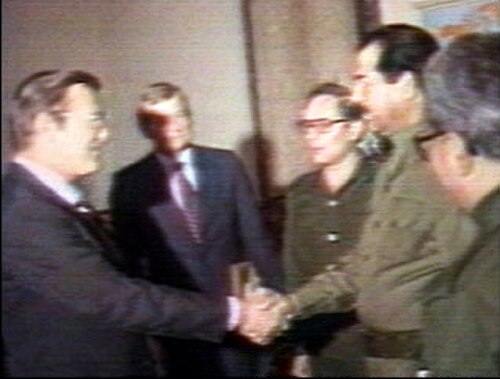
1980年にイラクがイランに侵攻し、それがイラン・イラク戦争となった後も、米国は公式には中立を保ったが、イラクに資源、政治的支援、および「非軍事」航空機を提供した。[38] 1982年3月、イランは反撃に成功し(否定できない勝利作戦)、米国はイランが降伏を強要するのを防ぐため、イラクへの支援を強化した。米国はイラクとの完全な外交関係を開こうと試み、イラクは米国のテロ支援国リストから除外された。[39]表面上は、これはイラク政権の記録の改善によるものだったが、元米国国防次官補ノエル・コッホは後に「[イラク人が]テロに関与し続けることに疑問を抱く者は誰もいなかった ...本当の理由は、彼らがイランとの戦争に勝つのを助けるためだった」と述べた。[40] [41]
イラクが戦争で新たな勝利を収め、7月にイランが和平提案を拒否したことで、 1982年にイラクへの武器販売は記録的な急増を記録した。1983年11月、イラクのサダム・フセイン大統領が米国の要請でアブ・ニダルをシリアに追放すると、レーガン政権はドナルド・ラムズフェルドを特使としてサダムと会談させ、関係を育んだ。1988年8月にイランとの停戦協定が調印された頃には、イラクは多額の負債を抱え、社会の緊張が高まっていた。[42]負債のほとんどはサウジアラビアとクウェートに対するものだった。 [43]イラクのクウェートに対する負債は140億ドルに上った。[44]イラクは両国に負債を免除するよう圧力をかけたが、両国は拒否した。[43] [45]
イラク・クウェート国境紛争は、イラクがクウェート領土を主張していることに関係していた。[38]クウェートはオスマン帝国のバスラ州の一部であったため、イラクはクウェートは正当なイラク領であると主張した。 [46]クウェートの統治王朝であるサバーハ家は、1899年に保護条約を締結し、クウェートの外交責任を英国に割り当てていた。英国は1922年にクウェートとイラクの間に国境を引いたため、イラクはほぼ完全に陸地に囲まれた状態になった。[38]クウェートは、この地域でさらなる保障を確保しようとするイラクの試みを拒否した。[46]
イラクはまた、クウェートが石油生産でOPECの割り当てを超えたと非難した。[47]カルテルが1バレルあたり18ドルの希望価格を維持するためには規律が必要だった。アラブ首長国連邦とクウェートは一貫して過剰生産していた。後者は少なくとも部分的には、イラン・イラク戦争でのイランの攻撃によって引き起こされた損失を修復し、経済スキャンダルの損失を支払うためだった。その結果、原油価格は暴落し、1バレルあたり10ドル(63ドル/m 3 )まで下がり、イラクは1989年の国際収支赤字に等しい年間70億ドルの損失を被った。[48]結果として生じた収入は、イラクの損傷したインフラの修復はおろか、政府の基本的費用を支えるのにも苦労した。ヨルダンとイラクはどちらもより規律を求めたが、ほとんど成功しなかった。[49]イラク政府はこれを経済戦争の一種と表現し、[49]クウェートが国境を越えてイラクのルマイラ油田に斜め掘削を行ったことで経済戦争が悪化したと主張した。[50]現地の石油労働者によると、イラクの斜め掘削の主張は捏造で、「ルマイラ油田からは石油が簡単に流出し、これらの技術は必要ない」とのことだ。[51]同時に、サダムは戦争でイラクを支援したアラブ諸国とのより緊密な関係を模索した。この動きは米国によって支持された。米国は、イラクと親欧米湾岸諸国とのつながりがイラクを米国の影響圏に取り込み、維持するのに役立つと信じていた。[52]
1989年、戦争中に強固だったサウジとイラクの関係は維持されるかに見えた。両国の間で不干渉・不可侵条約が締結され、続いてイラクがクウェートに飲料水と灌漑用の水を供給するというイラクとクウェートの協定が結ばれたが、クウェートがイラクのウンム・カスルをリースするという要請は却下された。[52]サウジが支援する開発プロジェクトは、20万人の兵士が動員解除されたにもかかわらず、イラクの多額の負債によって妨げられた。イラクはまた、輸出国になるために武器生産を増やそうとしたが、これらのプロジェクトの成功もイラクの義務によって制限された。イラクでは、OPECの統制に対する不満が高まった。[53]
イラクとアラブ諸国、特にエジプトとの関係は、イラク国内で、戦争中に十分に雇用されていた外国人グループに対して、復員した兵士を含む失業中のイラク人による暴力が激化したことにより悪化した。これらの出来事は、東ヨーロッパの共産主義の崩壊に直接関係する出来事が急速に進行していたため、アラブ世界以外ではほとんど注目されなかった。しかし、米国は、よく知られている拷問の使用を含むイラクの人権記録を非難し始めた。[54]英国はまた、英国の新聞オブザーバーに勤務していたジャーナリスト、ファルザド・バゾフトの処刑を非難した。[38]イスラエルがイラクに対して軍事力を使用した場合、「バイナリ化学兵器」を使用するとサダムが宣言したことを受けて、ワシントンは資金援助の一部を停止した。[55]暴動によりパレスチナ人が死亡したイスラエル占領地域への国連ミッションは米国によって拒否され、イラクは米国の中東エネルギー備蓄への依存と相まって、この地域における米国の外交政策の目的に深い疑念を抱くようになった。[56]
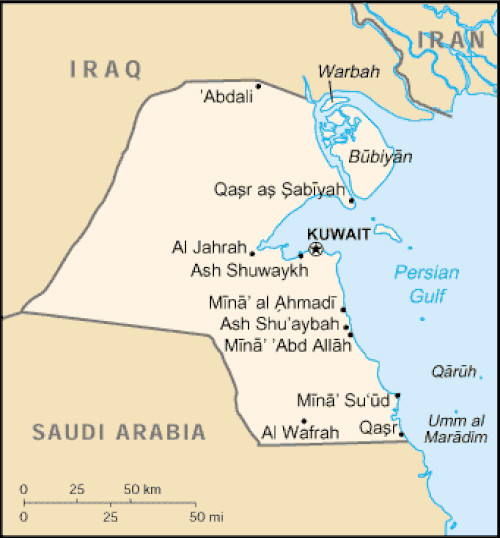
1990年7月初旬、イラクはクウェートの割り当て不遵守などの行動に不満を表明し、軍事行動を取ると公然と脅した。23日、CIAはイラクが3万人の兵士をイラク・クウェート国境に移動させ、ペルシャ湾の米海軍艦隊が警戒態勢を取ったと報告した。サダムは反イラク陰謀が展開していると信じていた。クウェートはイランとの交渉を開始し、イラクのライバルであるシリアはエジプト訪問を手配していた。[57] 1990年7月15日、サダム政権はアラブ連盟に対し、政策変更でイラクが年間10億ドルの費用を負担していること、クウェートが依然としてルマイラ油田を使用していること、UAEとクウェートによる融資は「アラブの兄弟」に対する負債とはみなせないことなど、統一した異議を唱えた。[57]彼はクウェートとUAEに対する武力行使を警告し、「一部のアラブ諸国の統治者の政策はアメリカ的だ...彼らはアメリカに触発されてアラブの利益と安全を損なっている」と述べた。 [58]米国はこれらの脅威に対応して、ペルシャ湾に空中給油機と戦闘艦を派遣した。 [59]アラブ連盟に代わってエジプトのホスニ・ムバラク大統領が仲介した協議が7月31日にサウジアラビアのジッダで行われ、ムバラク大統領は平和的な道筋を確立できると信じるようになった。[60]
2003年から2004年にかけてサダム・フセインが捕らえられた後の尋問で、経済紛争に加えて、クウェートの首長 アル・サバーハとイラク外務大臣の間の侮辱的なやり取り(その中でサダムは、首長が国を破産させることで「すべてのイラク人女性を10ドルの売春婦にする」という意図を表明したと主張した)がイラク侵攻を引き起こす決定的な要因であったことが明らかになった。[61]
25日、サダムはバグダッドで駐イラク米国大使のエイプリル・グラスピーと会談した。イラク指導者はクウェートとUAEに関する米国の政策を非難した。
では、アメリカが今や友好国を守ると言っているのは、一体何を意味するのだろうか。それはイラクに対する偏見に他ならない。この姿勢と、これまでになされた策動や発言は、UAE とクウェートにイラクの権利を無視するよう促してきた。… 圧力をかけるなら、我々も圧力と武力を行使する。我々は、脅迫はしないが、あなた方が我々に危害を加えることができることを知っている。しかし、我々もあなた方に危害を加えることができる。誰もが、能力と規模に応じて危害を加えることができる。我々は米国まで遠くまで行くことはできないが、個々のアラブ人はあなた方に近づくことができる。… 我々はアメリカを敵の中に入れない。我々は、我々が友好国であってほしい場所にアメリカを置き、友好国になろうと努める。しかし、昨年繰り返されたアメリカの発言は、アメリカが我々を友好国とみなしていないことを明らかにした。[62]
グラスピー氏はこう答えた。
あなた方が資金を必要としていることは知っています。私たちはそれを理解しており、あなた方が国を再建する機会を持つべきだというのが私たちの意見です。しかし、クウェートとの国境紛争のようなアラブ諸国間の紛争については意見がありません...率直に言って、あなた方が南部に大規模な軍隊を配備したことしかわかりません。通常、それは私たちの知ったことではありません。しかし、あなたの建国記念日の発言の文脈でこれが起こったとき、そして外務大臣の2通の手紙の詳細を読んだとき、そしてUAEとクウェートが取った措置が最終的にイラクに対する軍事侵略に匹敵するというイラクの見解を見たとき、私が懸念するのは当然です。[62]
サダムはクウェートとの最後の交渉を試みるが、イラクは「死を受け入れないだろう」と述べた。[62]
グラスピー自身の説明によれば、彼女はクウェートとイラクの正確な国境について、「…彼女は20年前にクウェートで勤務していたが、『当時も今も、我々はこれらのアラブ情勢についていかなる立場も取っていない』と述べた。」[要出典]グラスピーも同様に、戦争は差し迫っていないと信じていた。[60]
1990年7月26日、イラク侵攻のわずか数日前に、OPEC関係者は、クウェートとアラブ首長国連邦が、石油生産量を「それぞれ1日あたり約200万バレルから」150万バレル(24万立方メートル)に制限する提案に同意したと発表した。これにより、クウェートとイラクの石油政策をめぐる相違が解決される可能性がある。[63]
クウェート侵攻

ジッダ会談の結果、イラクはルマイラからの収入損失を補うために100億ドル[64]を要求し、クウェートは5億ドルを提示した。 [64]イラクの反応は直ちに侵攻を命じることであり[65] 、 1990年8月2日[66]にクウェートの首都クウェート市の爆撃が始まった。
侵攻前のクウェート軍は16,000人規模で、3個装甲旅団、1個機械化歩兵旅団、1個人員不足の砲兵旅団に分かれていたと考えられている。[67]戦前のクウェート空軍の兵力は、固定翼航空機80機、ヘリコプター40機を保有する約2,200人のクウェート人員であった。[67]イラクの軍事的威嚇にもかかわらず、クウェートは軍を動員しなかった。軍は7月19日に解散しており、[68]イラク侵攻中、多くのクウェート軍人が休暇中だった。[要出典]
1988年のイラン・イラク戦争終結までに、イラク軍は95万5000人の常備兵と人民軍の65万人の準軍事部隊からなる世界第4位の軍隊となった。ジョン・チャイルズとアンドレ・コルヴィジエによると、低く見積もってもイラク軍は戦車4500台、戦闘機484機、戦闘ヘリコプター232機を配備できるという。[69]マイケル・ナイツによると、高く見積もってもイラク軍は100万人の兵士と85万人の予備兵、戦車5500台、大砲3000門、戦闘機とヘリコプター700機を配備できるという。イラク軍は53の師団、20の特殊部隊旅団、いくつかの地域民兵を擁し、強力な防空体制を敷いていた。[4]
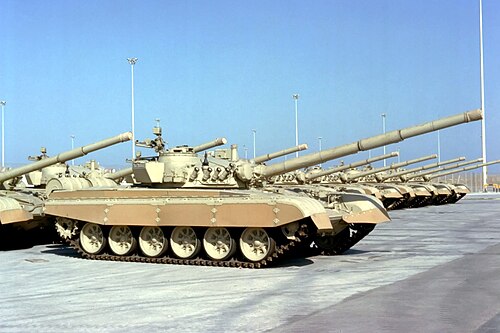
イラクの特殊部隊はまずクウェート国境に侵入し、真夜中に攻撃を開始した主要部隊に備えた。イラクの攻撃は2つの方向から行われ、主力部隊は幹線道路を南下してクウェート市に直行し、支援部隊はさらに西からクウェートに入り、その後方向転換して東に進み、クウェート市を国の南半分から切り離した。クウェートの装甲大隊である第35機甲旅団の指揮官は、イラクの攻撃に備えて部隊を展開し、クウェート市西方のアル・ジャフラ付近の橋の戦いで強力な防衛を行った。[70]
クウェートの航空機は侵攻軍を迎え撃つために出撃したが、約20%が失われるか捕獲された。イラクの地上部隊に対して数回の戦闘出撃が行われた。 [71]
イラク軍のクウェート市への主な攻撃は、ヘリコプターやボートで派遣された特殊部隊が海から市を攻撃することで行われ、他の部隊は空港と2つの空軍基地を占拠した。イラク軍は、クウェート首長ジャベル・アル・アフマド・アル・ジャベル・アル・サバーハの王宮であるダスマン宮殿を攻撃した。この宮殿は、 M-84戦車で支援された首長衛兵によって守られていた。その過程で、イラク軍は首長の末弟であるファハド・アル・アフメド・アル・ジャベル・アル・サバーハを殺害した。 [要出典]
12時間以内にクウェート国内の抵抗の大半は終息し、王族は逃亡し、イラクがクウェートの大半を掌握することになった。[65] 2日間の激しい戦闘の後、クウェート軍の大半はイラク共和国防衛隊に制圧されるか、サウジアラビアに逃亡した。首長と主要大臣は高速道路に沿って南に逃げ、サウジアラビアに避難した。イラク地上軍はクウェート市の支配を強化し、その後南に向かい、サウジアラビア国境沿いに再配置された。イラクの決定的な勝利の後、サダムは当初「自由クウェート暫定政府」として知られる傀儡政権を樹立し、その後8月8日に従兄弟のアリー・ハッサン・アル・マジドをクウェートの総督に任命した。[要出典]

侵攻後、イラク軍はクウェート中央銀行から10億ドル以上の紙幣を略奪した。[72]同時に、サダム・フセインはクウェート・ディナールをイラク・ディナールと同額にし、クウェートの通貨を元の価値の12分の1にまで下落させた。これに対し、シェイク・ジャベル・アル・アフマド・アル・サバーハは紙幣を無効とし、国連の禁輸措置により価値がなくなった盗難紙幣の返金を拒否した。紛争終結後、盗難紙幣の多くが再び流通した。今日、盗難紙幣は貨幣収集家にとって収集品となっている。[73]
クウェートの抵抗運動
イラクによるクウェート占領後、クウェート人は地元の武装抵抗運動を立ち上げた。[74] [75] [76]抵抗運動の死傷率は連合軍や西側諸国の人質のそれをはるかに上回った。[77]抵抗運動は主に、いかなる形の訓練も監督も受けていない一般市民で構成されていた。[77]
戦争への準備
外交手段
米国の政治、軍事、エネルギー経済計画の重要な要素が 1984 年初頭に発生した。イラン・イラク戦争は当時すでに 5 年間続いており、双方とも数十万人に上る甚大な死傷者を出していた。ロナルド・レーガン大統領の国家安全保障会議では、戦争が 2 つの交戦国の境界を越えて拡大するのではないかという懸念が高まっていた。当時のジョージ・H・W・ブッシュ副大統領が議長を務める国家安全保障計画グループの会議が組織され、米国の選択肢が検討された。紛争はサウジアラビアやその他のペルシャ湾岸諸国に拡大する可能性が高いが、米国にはこの地域を防衛する能力がほとんどないことが判明した。さらに、この地域での戦争が長期化すれば石油価格が大幅に上昇し、ようやく勢いづき始めた世界経済の脆弱な回復を脅かすことになると判断された。1984 年 5 月 22 日、レーガン大統領は、この研究を組織した国家安全保障会議のスタッフ長を務めていたウィリアム・フリン・マーティンから大統領執務室でプロジェクトの結論について説明を受けた。 (機密解除されたプレゼンテーションの全文は、こちらでご覧いただけます:[78])結論は3つありました。第1に、国際エネルギー機関(IEA)加盟国間で石油備蓄を増やす必要があり、石油市場が混乱した場合は必要に応じて早期に放出する必要があること、第2に、米国は地域の友好的なアラブ諸国の安全保障を強化する必要があること、第3に、イランとイラクへの軍事装備の販売を禁止する必要があることです。この計画はレーガン大統領によって承認され、後に1984年のロンドンサミットで、英国のマーガレット・サッチャー首相率いるG7首脳によって確認されました。この計画は実行され、1991年のイラクによるクウェート占領への対応に対する米国の準備の基礎となりました。[要出典]
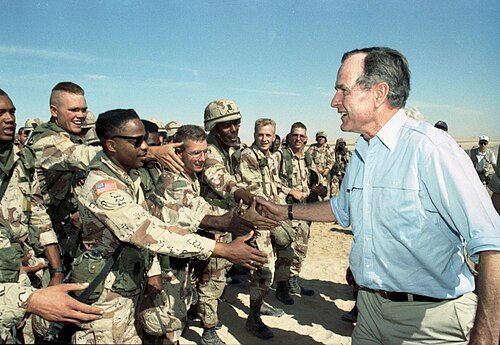
侵攻から数時間後、クウェートと米国の代表団は国連安全保障理事会の会合を要請し、同理事会は決議660を可決し、侵攻を非難しイラク軍の撤退を要求した。[79] [80] [明確化が必要] [81] 1990年8月3日、アラブ連盟は独自の決議を可決し、連盟内部での紛争解決を求め、外部からの介入に警告した。イラクとリビアは、イラクがクウェートから撤退するという決議に反対した唯一のアラブ連盟加盟国であり、パレスチナ解放機構(PLO) [c]もこれに反対した。[82]イエメンとヨルダンのアラブ諸国は、イラクと国境を接し経済支援をイラクに頼っていた西側同盟国[83]で あり、非アラブ諸国による軍事介入に反対した。[84]これとは別に、やはりアラブ連盟加盟国のスーダンはサダムと連携した。[83]
8月6日、決議661号はイラクに経済制裁を課した。[85] [79] [86] その後すぐに決議665号[81]が採択され、制裁を執行するために海上封鎖が承認された。決議では「必要に応じて特定の状況に応じた措置を講じ、すべての出入国海上輸送を停止し、積荷と目的地を検査・検証し、決議661号の厳格な実施を確保する」とされている。[87] [88]
米国政権は当初、侵略に対する諦めや既成事実としての適応といった「含み」を抱き、優柔不断だったが、英国の首相マーガレット・サッチャー[89]が強力な役割を果たし、1930年代の宥和政策が戦争に繋がったこと、サダムは湾岸全域と世界の石油供給の65%を掌握するだろうことを大統領に思い起こさせ、ブッシュ大統領に「動揺しないよう」強く促した。[89]
説得されると、米国当局は他の中東問題とは一切関係なく、イラクがクウェートから全面撤退することを主張し、いかなる譲歩も今後何年にもわたってイラクの地域における影響力を強めることになるという英国の見解を受け入れた。[90]

1990 年 8 月 12 日、サダムは「この地域におけるすべての占領事件、および占領とみなされてきた事件を同時に解決することを提案」した。具体的には、パレスチナ、シリア、レバノンの占領地域からイスラエルが撤退し、シリアがレバノンから撤退し、「イラクとイランの相互撤退とクウェート情勢の調整」を求めた。また、クウェートの侵攻に対応してサウジアラビアに動員された米軍を「アラブ軍」に置き換えるよう求めたが、その軍がエジプトを巻き込まない限りとした。さらに、「すべてのボイコットおよび包囲決定の即時凍結」とイラクとの関係の全般的な正常化を求めた。[91]危機の当初から、ブッシュ大統領はイラクのクウェート占領とパレスチナ問題との「関連」に強く反対していた。[92]
8月23日、サダムは出国ビザを拒否した西側諸国の人質とともに国営テレビに出演した。ビデオの中で、サダムはイギリス人の少年スチュアート・ロックウッドにミルクを飲んでいるか尋ね、通訳を介して「君が客としてここにいる時間が長くないことを願っている。君がここに、そして他の場所にいるのは、戦争の惨禍を防ぐためだ」と続けた。[93]
1990年8月に伝えられた別のイラク提案は、身元不明のイラク当局者によって米国国家安全保障担当補佐官 ブレント・スコウクロフトに伝えられた。この当局者はホワイトハウスに、国連が制裁を解除し、「クウェートのブビヤン島とワルバ島を通じたペルシャ湾への確実なアクセス」を認め、「クウェート領内にわずかに広がるルマイラ油田の完全な支配権を得る」ことをイラクに認めるという条件で、イラクは「クウェートから撤退し、外国人の出国を許可する」と伝えた。この提案には、「米国と『両国の国家安全保障上の利益に満足のいく』石油協定を交渉すること、イラクの経済および財政上の問題を軽減するための共同計画を策定すること、そして『湾岸の安定のために共同で取り組むこと』の提案も含まれていた」[94]。
1990年11月29日、安全保障理事会は決議678を可決し、イラクに1991年1月15日までにクウェートから撤退するよう命じ、期限後にイラクをクウェートから追い出すために「あらゆる必要な手段」を使用する権限を各国に与えた。[要出典]

1990年12月、イラクは、外国軍が同地域から撤退し、パレスチナ問題およびイスラエルとイラク両国の大量破壊兵器の廃棄に関する合意が成立することを条件に、クウェートから撤退する提案を行った。ホワイトハウスはこの提案を拒否した。[95] PLOのヤセル・アラファトは、イスラエルとパレスチナの問題を解決することがクウェートの問題を解決する前提条件であるべきだと自分もサダムも主張していないと述べたが、これらの問題の間には「強いつながり」があることを認めた。[96]
結局、米国と英国は、イラクがクウェートから撤退するまで交渉は行わず、イラクが軍事作戦で利益を得たという印象を与えないようにイラクに譲歩すべきではないという立場を堅持した。[90]また、1991年初頭、ジェームズ・ベイカー米国務長官がスイスのジュネーブでタリク・アジズと土壇場の和平交渉を行った際、アジズは具体的な提案を一切せず、イラクの想定される行動についても何も説明しなかったと伝えられている。[97]
1991年1月14日、フランスは国連安全保障理事会がクウェートからの「迅速かつ大規模な撤退」を求めるとともに、イラクに対して、理事会メンバーが「この地域の安全、安定、発展」を保証するために「適切な時期に国際会議を招集することにより、特にアラブ・イスラエル紛争、特にパレスチナ問題」など、この地域のその他の問題の解決に「積極的貢献」するという声明を出すよう提案した。フランスの提案は、ベルギー(当時は理事会の輪番制理事国)、ドイツ、スペイン、イタリア、アルジェリア、モロッコ、チュニジア、およびいくつかの非同盟諸国によって支持された。米国、英国、ソ連はこれを拒否した。米国のトーマス・ピカリング国連大使は、フランスの提案はイラク侵攻に関するこれまでの理事会決議の範囲を超えているため受け入れられないと述べた。[98] [99] [100]フランスはバグダッドから「関心の具体的な兆候」が見つからなかったため、この提案を取り下げた。[101]
軍事的手段

西側諸国の主な懸念の 1 つは、イラクがサウジアラビアに及ぼす重大な脅威であった。クウェートの征服後、イラク軍はサウジの油田を容易に攻撃できる距離にいた。これらの油田を支配し、クウェートとイラクの埋蔵量と合わせて、サダムは世界の石油埋蔵量の大部分を掌握していたであろう。イラクはサウジアラビアに対しても多くの不満を抱いていた。サウジはイラクとイランの戦争中にイラクに約 260 億ドルを貸し付けていた。サウジは、シーア派イランのイスラム革命が自国のシーア派少数派に影響を及ぼすことを恐れ、その戦争でイラクを支援していた。戦争後、サダムは、イランと戦うことでサウジを支援したため、融資を返済する必要はないと感じていた。[要出典]
クウェートを征服した直後、サダムはサウジを言葉で攻撃し始めた。彼は、米国が支援するサウジ国家は聖地メッカとメディナの不法かつ不相応な守護者であると主張した。彼は、最近アフガニスタンで戦ったイスラム主義グループの言語と、イランが長らくサウジを攻撃するために使ってきたレトリックを組み合わせた。[102]
カーター・ドクトリン政策に基づき、イラク軍がサウジアラビア侵攻を開始する恐れから、ジョージ・H・W・ブッシュ米大統領は、イラクのサウジアラビア侵攻を阻止するために、コードネーム「砂漠の盾作戦」の下、米国が「完全防衛」作戦を開始することを速やかに発表した。作戦は1990年8月7日に開始され、サウジアラビア国王ファハド国王の要請もあり、米軍がサウジアラビアに派遣された。ファハド国王は以前から米国による軍事支援を要請していた。[64]この「完全防衛」ドクトリンは、8月8日にイラクがクウェートをイラクの第19州と宣言し、サダムが従兄弟のアリー・ハッサン・アル・マジドをクウェートの軍事総督に任命すると、すぐに放棄された。[103]

米海軍は、航空母艦 ドワイト・D・アイゼンハワーとインディペンデンスを中心に編成された2つの海軍戦闘群をペルシャ湾に派遣し、8月8日までに準備を整えた。米国はまた、戦艦ミズーリとウィスコンシンもこの地域に派遣した。バージニア州ラングレー空軍基地の第1戦闘航空団のF-15戦闘機計48機がサウジアラビアに着陸し、直ちにサウジ・クウェート・イラク国境の24時間体制の空中哨戒を開始し、イラク軍の更なる進攻を阻止した。これにドイツのビットブルクの第36戦術戦闘航空団のF-15 A-D 36機が加わった。ビットブルク派遣隊は、リヤドから南東に約1時間のアル・ハルジ空軍基地を拠点としていた。第36戦闘航空団は戦争中にイラク空軍機11機を撃墜したことが確認されている。2つの空軍州兵部隊がアル・カルジ空軍基地に駐留し、サウスカロライナ空軍州兵の第169戦闘航空団は24機のF-16で爆撃任務を遂行し、2,000回の戦闘任務を遂行して400万ポンド(1,800,000キログラム、1,800メートルトン)の弾薬を投下した。また、シラキュースのニューヨーク州空軍州兵の第174戦闘航空団は24機のF-16で爆撃任務を遂行した。軍備増強はそこから続き、最終的には543,000人の兵士に達し、これは2003年のイラク侵攻時の2倍の数となった。物資の多くは空輸されるか、高速海上輸送船で集結地域に運ばれ、迅速な増強が可能となった。軍備増強の一環として、湾岸地域では米軍のミッドウェイ艦艇と15隻の艦艇、1,100機の航空機、1,000人の海兵隊員が参加した「イミネント・サンダー作戦」を含む水陸両用演習が実施された。 [104]シュワルツコフ将軍は記者会見で、これらの演習はイラク軍を欺き、クウェートの海岸線の防衛を継続させることを目的としていたと述べた。[105]
連合の結成

イラクのクウェート侵攻に関して、一連の国連安全保障理事会決議とアラブ連盟決議が可決された。1990年11月29日に可決された決議678は、イラクに1991年1月15日までの撤退期限を与え、「決議660を遵守し実施するために必要なあらゆる手段」を承認し、イラクが従わなかった場合には武力行使を認める外交文書を作成した。[106]
米国が経済支援を確実に受けられるように、ジェームズ・ベイカーは 1990 年 9 月に 9 か国を 11 日間かけて訪問した。マスコミはこれを「ティンカップ トリップ」と呼んだ。最初の訪問地はサウジアラビアだった。サウジアラビアは 1 か月前にすでに米国に施設の使用許可を与えていた。しかしベイカーは、サウジアラビアは自国を守るための軍事活動の費用の一部を負担すべきだと考えた。ベイカーがファハド国王に 150 億ドルを要請すると、国王は快く同意し、ベイカーはクウェートに同額を要請すると約束した。[引用が必要]
翌日の9月7日、彼はまさにそれを実行し、侵略された国外のシェラトンホテルに避難していたクウェート首長は簡単に同意した。その後、ベイカーはエジプトとの交渉に着手した。エジプトの指導者は「中東の穏健派の声」だと考えていた。エジプトのムバラク大統領は、サダムのクウェート侵攻と、サダムがムバラクに侵攻の意図はないと保証したという事実に激怒していた。エジプトは、米国主導の介入に対する支援と軍隊の提供に対して約70億ドルの債務免除を受けた。[107]
ベーカー氏は、ソ連との中東和平会議を求めるイラクの要求をなだめるためヘルシンキとモスクワに立ち寄った後、シリアへ向かい、シリアのハーフィズ・アサド大統領と危機における同国の役割について協議した。アサド氏はサダム氏に対して個人的な深い敵意を抱いており、それは「サダム氏は何年も彼(アサド氏)を殺そうとしていた」という事実に表れていた。この敵意を抱き、ベーカー氏のダマスカス訪問という外交的取り組みに感銘を受けたアサド氏は(両国の関係は1983年のベイルートの米海兵隊兵舎爆破事件以来断絶していた)、連合軍に最大10万人のシリア軍を派遣することに同意した。これは、アラブ諸国が連合軍に代表されるようにするための重要なステップだった。それと引き換えに、ワシントンはアサド氏にレバノンにおけるシリア支配に反対する勢力を一掃する許可を与え、主に湾岸諸国を通じて10億ドル相当の武器をシリアに提供するよう手配した。[108]米国政府は、イランが米国主導の介入を支持するのと引き換えに、イラン政府に対し、世界銀行の対イラン融資に対する米国の反対をやめると約束した。地上侵攻が始まる前日、世界銀行はイランに2億5000万ドルの最初の融資を行った。[108]
ベイカーはローマに飛び、イタリア人と短い会談を行い、軍事装備の使用を約束された後、ドイツに渡り、アメリカの同盟国であるコール首相と会談した。ドイツ憲法(基本的にはアメリカが仲介した)はドイツ国外での軍事介入を禁じていたが、コール首相は連合軍の戦争努力に20億ドルを拠出し、同盟国トルコへのさらなる経済的・軍事的支援、エジプトの兵士と船舶のペルシャ湾への輸送を約束した。[109]

イラクの侵略に反対する連合軍が結成され、アルゼンチン、オーストラリア、バーレーン、バングラデシュ、ベルギー、カナダ、チェコスロバキア、デンマーク、エジプト、フランス、ドイツ、ギリシャ、ホンジュラス、ハンガリー、イタリア、日本、クウェート、ルクセンブルク、モロッコ、オランダ、ニュージーランド、ニジェール、ノルウェー、オマーン、パキスタン、フィリピン、ポーランド、ポルトガル、カタール、ルーマニア、サウジアラビア、セネガル、シエラレオネ、シンガポール、韓国、スペイン、スウェーデン、シリア、トルコ、[110]アラブ首長国連邦、英国、米国の42か国の軍隊で構成されていた。[111]これは第二次世界大戦以来最大の連合であった。[112]戦争の終わり頃にはアフガニスタンのムジャヒディン兵士のグループも加わったと伝えられている。 [113]
ペルシャ湾地域の連合軍司令官には、米陸軍のノーマン・シュワルツコフ・ジュニア将軍が任命された。ソ連はバグダッドのクウェート侵略を非難したが、米国とその同盟国のイラク介入を支持せず、それを阻止しようとした。 [114]
日本とドイツは兵力は提供しなかったが、それぞれ100億ドルと66億ドルの財政的貢献をした。ルクセンブルクも連合軍に財政支援を行った。[115]イラク駐留の連合軍956,600人のうち73%は米軍だった。[116]
連合国の多くは軍事力の投入に消極的だった。戦争はアラブ諸国の内政問題であると考えたり、中東における米国の影響力を増大させたくないと考えたりした国もあった。しかし、最終的にはイラクの他のアラブ諸国に対する好戦的な姿勢、経済援助や債務免除の申し出、援助差し控えの脅しなどにより、多くの政府が説得された。[117]
介入の正当性
米国と国連は、この紛争への関与を正当化するいくつかの理由を公に挙げたが、最も顕著なのはイラクによるクウェートの領土保全の侵害である。さらに米国は、この地域における重要な石油供給国として、地政学的に重要な同盟国サウジアラビアの支援に動いた。イラク侵攻の直後、米国国防長官ディック・チェイニーは、数回にわたるサウジアラビア訪問の最初となり、ファハド国王は米国に軍事支援を要請した。1990年9月11日に行われた米国議会の特別合同会議での演説で、ブッシュは次のように理由をまとめた。「3日以内に、12万人のイラク軍と850両の戦車がクウェートに押し寄せ、サウジアラビアを脅かすために南に移動した。その時、私はその侵略を阻止するために行動することを決意した。」[118]
国防総省は、この情報の出所は国境沿いのイラク軍の集結を示す衛星写真であると述べたが、後にこれは誤りであると主張された。サンクトペテルブルク・タイムズの記者は、当時撮影された2枚のソ連の商用衛星画像を入手したが、そこには何も映っていない砂漠しか映っていなかった。[119]
外国の関与を正当化する他の理由としては、サダム政権下でのイラクの人権侵害の歴史が挙げられる。イラクは生物兵器と化学兵器を保有していることも知られており、サダムはイラン・イラク戦争中にイラン軍に対して、またアル・アンファル作戦では自国のクルド人に対してそれらを使用した。イラクは核兵器計画があることも知られていたが、1991年1月のそれに関する報告書は2001年5月26日にCIAによって部分的に機密解除された。[120]
一般市民を対象とした広報活動

イラク軍は侵攻中に人権侵害を犯したが、米国で最も注目を集めた疑惑の事件は、軍事介入を支持するよう米国民を説得するためにクウェート政府が雇った広報会社による捏造だった。 [121]イラクのクウェート侵攻の直後、米国で「自由なクウェートのための市民」という組織が結成された。同組織はクウェート政府から約1100万ドルを支払って広報会社ヒル・アンド・ノウルトンを雇った。[122]
同社は、イラクの残虐行為に関する本を地域に展開する米兵に配布したり、大学のキャンパスに「フリー・クウェート」Tシャツやスピーカーを配布したり、テレビ局に数十本のビデオニュースを配信するなど、米国の世論に影響を与える多くの手段を講じたほか、米国議会議員団の前での演説を手配し、クウェート市の病院で働く看護師を名乗る若い女性が、イラク兵が赤ちゃんを保育器から引きずり出し、床で死なせている様子を語った。[123]
この事件は、国民と議会の両方をイラクとの戦争へと向かわせる一因となった。6人の議員は、この証言はイラクに対する軍事行動を支持するのに十分であると述べ、7人の上院議員は討論でこの証言に言及した。上院は52対47の投票で軍事行動を支持した。しかし、戦争から1年後、この主張は捏造であることが明らかになった。証言した若い女性はクウェートの王族の一員であり、クウェート駐米大使の娘であることが判明した。[123]彼女はイラク侵攻中にクウェートに住んでいなかった。[要出典]
ヒル・アンド・ノウルトンの広報活動の詳細は、保育器証言を含め、ジョン・R・マッカーサーの著書『第二戦線:湾岸戦争における検閲とプロパガンダ』[124]に掲載され、マッカーサーの論説がニューヨーク・タイムズ紙に掲載されたことで広く世間の注目を集めた。これをきっかけにアムネスティ・インターナショナルは再調査を行った。アムネスティは当初、元の偽証言よりもさらに多くの赤ちゃんが保育器から引き離されたという主張を広めていたが、それを裏付ける証拠が見つからず、撤回を発表した。その後、ブッシュ大統領はテレビで保育器に関する主張を繰り返した。[要出典]
現実には、イラク軍はクウェート占領中に、 3人の兄弟を裁判なしで即決処刑し、その後彼らの死体を積み重ねて公道に放置するなど、記録に残るさまざまな犯罪を犯した。[125]イラク軍はまた、クウェートの民家を荒らし、略奪した。ある住宅では繰り返し排泄物が投げ込まれた。[126]ある住民は後にこうコメントした。「すべては暴力のための暴力、破壊のための破壊だった...サルバドール・ダリのシュールレアリズムの絵画を想像してみてほしい」[127]
ブッシュ米大統領は繰り返しサダム・フセインをヒトラーと比較した。[128]
初期の戦い
空中作戦
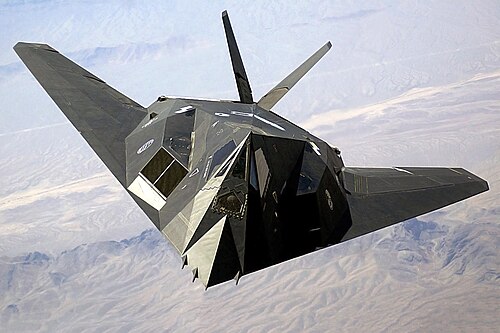
湾岸戦争は1991年1月16日の大規模な空爆作戦で始まった。42日間連続で連合軍はイラクを軍事史上最も激しい空爆にさらした。連合軍は10万回以上の出撃を行い、88,500トンの爆弾を投下し[129] 、軍と民間のインフラを広範囲に破壊した。[要出典]
携帯式防空システムを含むイラクの対空防衛は敵機に対して驚くほど効果がなく、連合軍は10万回以上の出撃でわずか75機の航空機を失ったのみで、そのうち44機はイラクの行動によるものだった。これらの損失のうち2機は、イラクの地上発射兵器を回避中に航空機が地面に衝突した結果である。[130] [131]これらの損失のうち1つは、空対空の勝利であることが確認された。[132]
イラクのスカッドミサイルがイスラエルとサウジアラビアを攻撃

イラク政府は、イスラエルが侵略されれば攻撃することを隠さなかった。戦争が始まる前、スイスのジュネーブで行われた米国とイラクの和平交渉が失敗に終わった後、記者がイラクの英語を話す外務大臣兼副首相のタリク・アジズに「外務大臣、戦争が始まったらイスラエルを攻撃しますか?」と尋ねたところ、彼の答えは「はい、もちろんです」だった。[133] [134]
最初の攻撃から5時間後、イラクの国営ラジオ放送は「この大決戦が始まり、勝利の夜明けが近づいている」と宣言した。イラクは翌日8発のミサイルを発射した。これらのミサイル攻撃は戦争中ずっと続いた。イラクは戦争の7週間の間に88発のスカッドミサイルを発射した。[135]
イラクはイスラエルの軍事的対応を誘発しようとした。イラク政府は、多くのアラブ諸国がイスラエルと並んで戦うことに消極的であるため、連合から撤退することを期待していた。[92]最初の攻撃の後、イスラエル空軍のジェット機がイラクと共に北部の空域をパトロールするために配備された。イスラエルは、過去40年間の政策が常に報復であったため、軍事的報復を準備した。しかし、ブッシュ大統領は、イスラエルがイラクを攻撃した場合、他のアラブ諸国が連合から離脱するかイラクに加わることを恐れ、報復せずイスラエルのジェット機を撤退させるようイスラエルの首相イツハク・シャミールに圧力をかけた。また、イスラエルがシリアまたはヨルダンの空域を使用してイラクを攻撃した場合、イラク側で戦争に介入するかイスラエルを攻撃するのではないかとも懸念された。連合は、イスラエルがスカッド攻撃に反応しない場合、イスラエルを守るためにパトリオットミサイルを配備することを約束した。 [136] [137]
イスラエルを狙ったスカッドミサイルは、極端に遠距離から発射すると精度とペイロードが劇的に低下したため、比較的効果が低かった。ミサイル攻撃の直接的な結果として、イスラエルの民間人2名が死亡した。[138]ガスマスクの誤用、心臓発作、化学兵器対策薬アトロピンの誤用により、11人から74人が死亡した。[138]約230人のイスラエル人が負傷した。[139]広範囲にわたる物的損害も発生し、イスラエル外務省によると、「一般財産への損害は、住宅1,302軒、アパート6,142軒、公共施設23棟、商店200軒、車50台」であった。[140]イラクがサリンなどの神経ガスを充填したミサイルを発射する恐れがあった。その結果、イスラエル政府は国民にガスマスクを支給した。イラクの最初のミサイルがイスラエルを襲ったとき、一部の人々は神経ガスの解毒剤を注射した。イスラエルの都市で使用されている頑丈な建設技術と、スカッドミサイルが夜間にのみ発射されるという事実が相まって、スカッド攻撃による死傷者数を抑えるのに重要な役割を果たしたと示唆されている。[141]
ミサイルから避難するイスラエルの民間人(上)とイスラエルのラマト・ガンでの攻撃後の様子(下)
イスラエルに対するスカッドミサイルの脅威に対応して、米国はパトリオットミサイル防空砲大隊をイスラエルに急派し、民間人保護のためにMIM-104パトリオットミサイル2個中隊を派遣した。[142]オランダ空軍もパトリオットミサイル中隊をイスラエルとトルコに派遣した。オランダ国防省は後に、パトリオットミサイルシステムの軍事的使用はほとんど効果がなかったが、被害を受けた住民に対する心理的価値は高かったと述べた。[143]
連合軍の空軍は、イラクの砂漠で「スカッド狩り」の訓練も広範に行い、イスラエルやサウジアラビアにミサイルを発射する前にカモフラージュされたトラックの位置を特定しようとした。地上では、特殊作戦部隊もイラクに潜入し、スカッドの位置を特定して破壊する任務を負った。これには、 SASの不運なブラボー ツー ゼロ哨戒機も含まれていた。特殊作戦が空中哨戒と組み合わされると、攻撃の数は急激に減少し、その後イラク軍が連合軍の戦術に適応するにつれてわずかに増加した。[要出典]
スカッド攻撃が続くにつれ、イスラエルはますますいらだちを募らせ、イラクに対して一方的な軍事行動を取ることを検討した。1991年1月22日、スカッドミサイルがイスラエルの都市ラマトガンに着弾したが、連合軍のパトリオット2機は迎撃に失敗していた。3人の高齢者が心臓発作で死亡、96人が負傷、20棟のアパートが損壊した。[144] [145]この攻撃の後、イスラエルは、米国が攻撃を阻止できない場合は自分たちが阻止すると警告した。ある時点で、イスラエルの特殊部隊はイラクへの飛行準備を整えたヘリコプターに乗り込んだが、米国防長官ディック・チェイニーからの電話により、スカッドを破壊しようとする連合軍の努力の程度が報告され、イスラエルの介入は米軍を危険にさらす可能性があると強調され、ミッションは中止された。[146]
イスラエルへの攻撃に加えて、47発のスカッドミサイルがサウジアラビアに発射され、1発はバーレーンに、もう1発はカタールに発射された。ミサイルは軍事目標と民間目標の両方に発射された。サウジアラビアの民間人1人が死亡し、78人が負傷した。バーレーンとカタールでは死傷者は報告されていない。サウジアラビア政府は、イラクが化学兵器を含む弾頭を搭載したミサイルを使用する場合に備えて、すべての国民と外国人にガスマスクを配布した。[147]政府はスカッド攻撃中に国民に警告するため、テレビで警報と「安全」メッセージを放送した。[要出典]
1991年2月25日、サウジアラビアのダフラーンに駐留していたペンシルベニア州グリーンズバーグの第14補給部隊の米軍宿舎にスカッドミサイルが命中し、兵士28人が死亡、100人以上が負傷した。[148]その後の調査で、割り当てられたパトリオットミサイル砲台が交戦に失敗した原因は、搭載コンピューターの浮動小数点計算における有意性喪失効果と100時間以上の連続使用による複合的な影響で、距離ゲートの位置が大きくずれ、追跡行動中にスカッドとの接触が失われたことだったことが判明した。[149]
イラクのサウジアラビア侵攻(カフジの戦い)

1月29日、イラク軍は戦車と歩兵で防御の手薄だったサウジアラビアの都市カフジを攻撃し占領した。カフジの戦いは2日後、イラク軍がカタール軍と米海兵隊の支援を受けたサウジアラビア国家警備隊に撃退されて終了した。 [150]連合軍は大規模な砲撃を行った。[要出典]
双方とも死傷者を出したが、イラク軍は連合軍よりもかなり多くの死者と捕虜を出した。2つの別々の友軍誤射事件で11人のアメリカ人が死亡し、AC-130ガンシップがイラクの地対空ミサイルによって撃墜されてさらに14人のアメリカ人空軍兵が死亡し、[151]戦闘中に2人のアメリカ人兵士が捕虜になった。サウジアラビア軍とカタール軍は合計18人が死亡した。カフジのイラク軍は60~300人が死亡し、400人が捕虜になった。[要出典]
カフジの戦いは、航空戦力が単独で敵地上軍の前進を阻止できる例である。イラク軍の動きを知ると、連合軍の航空機 140 機が、大隊規模の部隊からなる 2 個装甲師団からなる前進する縦隊を攻撃するために転用された。夜間から翌日にかけて、精密なスタンドオフ攻撃が行われた。イラクの車両損失には、戦車 357 台、装甲兵員輸送車 147 台、移動式砲 89 門が含まれる。一部の乗組員は、誘導爆弾で破壊される可能性があることに気付くと、車両を放棄し、師団が町への組織的な攻撃のために集結するのを阻止した。イラン・イラク戦争で戦ったイラク軍兵士の 1 人は、彼の旅団が「カフジでの 30 分間で、イランとの 8 年間の戦闘よりも多くの打撃を連合軍の航空戦力から受けた」と述べた。[152]
対偵察

タスクフォース1-41歩兵は、アメリカ陸軍第2機甲師団(前進)の重大隊タスクフォースであった。第7軍団の先鋒であり、主に第1大隊第41歩兵連隊、第3大隊第66機甲連隊、第4大隊第3野戦砲兵連隊で構成されていた。タスクフォース1-41は、1991年2月15日にサウジアラビア国境を突破し、1991年2月17日にイラクで敵との直接および間接の銃撃戦を行い、地上戦闘作戦を実施した最初の連合軍であった。[153]戦域に到着して間もなく、タスクフォース1-41歩兵は対偵察任務を受けた。[154]第1~41歩兵連隊は第1中隊、第4機甲騎兵連隊の支援を受けた。この共同作戦はタスクフォース・アイアンとして知られるようになった。[155]対偵察には通常、敵の偵察部隊を破壊または撃退し、指揮官が友軍を観測できないようにすることが含まれる。1991年2月15日、第3野戦砲兵連隊第4大隊は、アメリカ軍を監視していたイラク地区のトレーラーと数台のトラックに発砲した。[156]
1991年2月16日、イラクの車両数グループがタスクフォースを偵察していたようで、4-3 FAからの砲火で追い払われた。[157] 6台の車両を含む別の敵小隊がタスクフォースの北東にいると報告された。彼らは4-3 FAからの砲火と交戦した。[158]その日の夕方遅く、別のイラク車両グループがタスクフォースの中心に向かって移動しているのが目撃された。それらはイラクのソ連製のBTRと戦車のようだった。次の1時間、タスクフォースはイラクの偵察部隊と数回の小規模な戦闘を繰り広げた。TF 1-41 INはイラクの編隊にTOWミサイルを発射し、戦車1台を破壊した。編隊の残りは4-3 FAからの砲火で破壊されるか追い払われた。[158] 1991年2月17日、タスクフォースは敵の迫撃砲攻撃を受けたが、敵軍はなんとか脱出した。[159]その夜遅く、タスクフォースは敵の砲撃を受けたが、死傷者は出なかった。[160]その同じ夜、タスクフォースはイラクの迫撃砲陣地を特定し、直接射撃と間接射撃の両方で交戦した。 [161 ]イラク人はタスクフォースに対して約2時間偵察作戦を続けた。[161]次の2日間、タスクフォースはイラクの装輪車両と小部隊が自分たちの前を移動するのを観察した。数回、イラクの迫撃砲がタスクフォース1-41歩兵陣地に発砲した。[161] 2月18日、イラクの迫撃砲陣地はタスクフォースに対する射撃任務を続行した。タスクフォースは、4-3 FAと第1歩兵師団砲兵からの砲撃でイラクの陣地に反撃した。[162]イラクの迫撃砲攻撃中に、2人のアメリカ兵が負傷した。[163] [162]第7軍団の航空部隊と砲兵はイラクの防衛陣地に対して戦闘作戦を実施した。[162]
違反
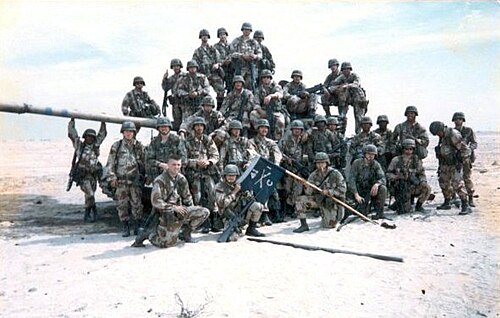
タスクフォース1-41歩兵は、1991年2月15日にサウジアラビア国境を突破し、イラクで地上戦闘作戦を実施した最初の連合軍であり、1991年2月17日に敵と直接的および間接的な銃撃戦を行った。[153]この行動に先立ち、タスクフォースの主要火力支援大隊である第3野戦砲兵連隊の第4大隊は、大規模な砲撃準備に参加した。複数の国から約300門の銃が砲撃に参加した。これらの任務中に14,000発以上の弾丸が発射された。M270多連装ロケットシステムは、イラクの標的に発射されたさらに4,900発のロケットに貢献した。[164]この砲撃の初期段階でイラクは22個砲兵大隊を失い、[165]イラクの約396門の砲が破壊された。[165]
これらの襲撃が終わるころには、イラクの砲兵資産はほぼ消滅していた。準備中に完全に破壊されたイラクの部隊の一つは、イラク第48歩兵師団砲兵グループであった。[166]このグループの指揮官は、部隊が砲兵準備により100門のうち83門を失ったと述べた。[166]この砲兵準備は、B-52爆撃機とロッキードAC-130固定翼ガンシップによる空襲によって補完された。 [167]第1歩兵師団のアパッチヘリコプターとB-52爆撃機は、イラクの第110歩兵旅団に対して襲撃を行った。[168]第1工兵大隊と第9工兵大隊は、敵の直接射撃と間接射撃の下で攻撃レーンをマークして防備し、敵の領土に足場を確保し、第1歩兵師団とイギリス第1機甲師団を前進させた。[153] [169]

1991年2月24日、第1騎兵師団はイラク砲兵部隊に対して数回の砲撃任務を遂行した。[170]ある砲撃任務では、イラク第25歩兵師団の戦区で、イラクT-55戦車で補強された一連のイラク軍バンカーを攻撃した。[170]同日、第1騎兵師団第2旅団は、第5騎兵連隊第1大隊、第32機甲連隊第1大隊、第8騎兵連隊第1大隊とともに、イラク第25歩兵師団の戦区でイラク軍バンカーと戦闘車両を破壊した。[170] 2月24日、第1歩兵師団第2旅団はワディ・アル・バティン西方のイラク防衛線の突破口を突破し、敵の抵抗の突破口となった北東戦区も一掃した。[153]第37機甲師団第3任務部隊はイラクの防衛線を突破し、4本の通路を掃討し、敵の直撃を受けて隙間を広げた。[153]また、2月24日には、第1歩兵師団が第1騎兵師団とともにイラクの前哨基地とイラク第26歩兵師団の哨戒隊を破壊した。[171]両師団は捕虜の捕獲も開始した。 [ 171 ]第1歩兵師団は、フェーズラインバーモントとフェーズラインカンザスの間の地帯を掃討した。 [171]第1歩兵師団第37機甲師団第3大隊がイラクの後方防衛陣地に到達すると、イラクのD-30砲兵隊と多くのトラックと掩蔽壕を破壊した。[172]
タスクフォース1–41歩兵は、イラク・サウジアラビア国境沿いのイラクの初期防御陣地を突破する任務を与えられた。[153]第4機甲騎兵連隊第1中隊も、その作戦区域で同様の任務を遂行した。 [153]第1歩兵師団第5大隊第16歩兵も塹壕の掃討で重要な役割を果たし、その過程で160人のイラク兵を捕虜にした。[172]イラク領内に侵入すると、タスクフォース1–41歩兵は複数のイラクの防御陣地と掩蔽壕に遭遇した。これらの防御陣地は、旅団規模の部隊によって占拠されていた。[153 ]タスクフォース1–41歩兵の部隊は下車し、これらの十分に準備され、厳重に防備された掩蔽壕を占拠した敵兵と交戦する準備を整えた。[153] [153]イラク軍は、小火器、RPG、迫撃砲、そして残っていたイラク砲兵部隊でタスクフォースと交戦した。一連の戦闘でイラク軍に多数の死傷者が出て、イラク軍は防御陣地から追い出され、多くが捕虜となった。逃亡した者もいたが、殺害されるか、他の連合軍に捕らえられた。[173]バンカー掃討の過程で、タスクフォース1-41は2つの旅団司令部とイラク第26歩兵師団の司令部を占拠した。[174]タスクフォースは、旅団長1人、大隊長数人、中隊長、参謀も捕虜にした。[174]戦闘作戦が進むにつれ、タスクフォース1-41歩兵は待ち伏せ陣地に潜む複数の敵戦車と近距離で交戦した。[153]数時間にわたり、迂回したイラクのRPG装備の対戦車部隊、T-55戦車、下車したイラク歩兵が通り過ぎるアメリカ軍車両に発砲したが、最初の部隊に続いて来た他のアメリカ軍の戦車や戦闘車両によって破壊された。[175]
第1歩兵師団の第2-16任務部隊は、イラク軍に多大な損害を与えながら、敵の要塞化された塹壕システムを通じて4つの車線を同時に掃討した。[153]第2-16任務部隊は攻撃を続け、21km(13マイル)以上の塹壕陣地を掃討し、多数の敵車両、装備、人員、司令部バンカーを捕獲または破壊した。[153]
地上作戦
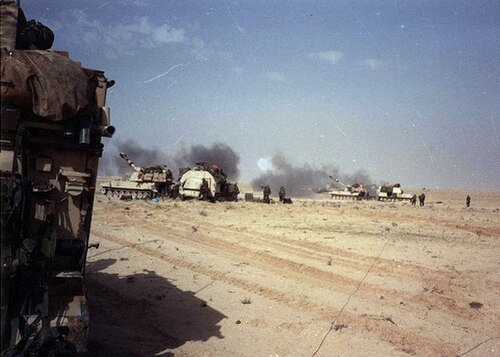
大規模な地上攻撃に先立ち、イラクの防衛陣地に対して9万発の砲兵準備射撃が行われ、2時間半続いた。[176]第4-3砲兵大隊を含む第1歩兵師団砲兵は、複数の襲撃と射撃任務を遂行する砲兵戦闘作戦で決定的な役割を果たした。これらの戦闘作戦の結果、敵の戦車50両、装甲兵員輸送車139台、防空システム30台、大砲152門、ミサイル発射装置27台、迫撃砲108門、装輪車両548台、塹壕線と掩蔽壕陣地61ヶ所、塹壕と露出歩兵目標92ヶ所、兵站拠点34ヶ所が破壊された。[177]地上作戦は、アメリカ軍史上最大規模の戦車戦3回、あるいは4回で構成された。 [178] [179]イースティング73、ノーフォーク、メディナリッジの戦いは、歴史的に重要な戦いとしてよく知られています。[178]メディナリッジの戦いは、戦争中最大の戦車戦だと考える人もいます。[153] [180]他の資料では、ノーフォークの戦いは戦争中最大の戦車戦であり、アメリカ史上2番目に大きな戦車戦だと考えています。[180]米海兵隊もクウェート国際空港で史上最大の戦車戦を戦いました。[179]米第3機甲師団も、ノーフォークの戦いが行われた場所からそう遠くない目標ドーセットで重要な戦いをしました。米第3機甲師団は、イラク軍とのこの特定の戦闘中に、約300台の敵戦闘車両を破壊しました。[153]
アメリカ第7軍団は連合軍の主力戦闘部隊であった。[181]それは1,487両の戦車、1,384両の歩兵戦闘車、568門の火砲、132台のMLRS、8台のミサイル発射装置、および242機の攻撃ヘリコプターからなる強力な戦闘部隊であった。[182]総兵力は146,321名であった。[183] その主な完全戦力戦闘部隊は、第1機甲師団(アメリカ) 、第3機甲師団(アメリカ)、および第1歩兵師団(アメリカ)であった。第2機甲師団(前進)は、第1歩兵師団の第3機動旅団として配属された。[184]その任務部隊1-41歩兵は第7軍団の先鋒となる。[185]さらに、軍団には偵察・監視部隊として行動する第2騎兵連隊(米国) 、さらに2つの重師団、第1騎兵師団(米国)、イギリス第1機甲師団、および米国第11航空集団があった。[153] [186] [187]第7軍団はイラク軍との大規模な戦闘を数多く戦った。そのいくつかは規模と範囲において歴史的なものであった。ノーフォーク、メディナリッジ、73イースティングでの3つの戦闘は、歴史上最大の戦車戦の一つと考えられている。[188] 1991年2月28日の戦闘作戦終了までに、米第7軍団は260キロメートル(160マイル)を進軍し、2万2000人のイラク兵を捕虜にし、1350台のイラク戦車、1224台の装甲兵員輸送車、285門の大砲、105基の防空システム、1229台のトラックを破壊した。[189]

アメリカ軍の師団の主力戦闘車両は、M1A1エイブラムス戦車とブラッドレー戦闘車両であった。[190]アメリカ軍の主力砲兵システムは、自走式のM109榴弾砲であった。[191]アメリカ軍の主力攻撃ヘリコプターは、ボーイングAH-64アパッチ(陸軍)であり、ベルAH-1コブラ(陸軍と海兵隊)も戦場にいた。[191]米国のフェアチャイルド・リパブリックA-10サンダーボルトII地上攻撃機は、 OH-58D JAATTの支援を受けて湾岸戦争で活躍した。この2機はイラク地上部隊に多大な損害を与えた。[192]米国のA-10「ウォートホッグ」の乗組員は、戦闘作戦中にイラク軍の戦車900台、その他の軍用車両2,000台、および大砲1,200門を破壊した。[要出典]
米海兵隊は第1海兵師団と第2海兵師団が代表を務めた。[193]米陸軍第2機甲師団のタイガー旅団が海兵隊に追加の装甲支援を提供するため、これらを支援した。[193]海兵隊の装甲部隊は主に旧式のM-60戦車で構成されていた。[193]第1海兵師団は、バーガン油田付近で約60両のイラク戦車を損害なく破壊した。[194]第1海兵師団リッパー任務部隊は、1991年2月27日にクウェート国際空港への進撃を率いた。リッパー任務部隊は、T-72戦車を含む約100両のイラク戦車と装甲兵員輸送車を破壊した。 [195]師団長のJMマイアット少将は次のように語っている。[196]「戦闘作戦初日に、第3戦車大隊D中隊第1小隊は、イラク戦車15両を破壊した」。[197]海兵隊はまた、装甲兵員輸送車25台を破壊し、300人の捕虜を捕らえた。[198]米海兵隊は作戦地域でイラク第3機甲師団と頻繁に遭遇した。第1海兵師団がクウェート国際空港に到着すると、同空港を守っていたイラク第12機甲旅団、第3機甲師団の残存部隊を発見した。海兵隊は、空港周辺で防御陣地を張っていたイラクのT-72戦車を30~40両破壊した。[197]イラク第3機甲師団の損失には、戦闘終了時までに250両以上のT-55/62と70両のT-72戦車が含まれていた。[197]イラク第3機甲師団は完全に壊滅した。第2海兵師団は、カフジの戦いとして知られるサウジアラビアへのイラクの侵攻の試みを撃退する上で大きな役割を果たした。第2海兵師団はクウェート国際空港の戦いでも激しい抵抗に直面した。この戦いでは「レヴェイユ交戦」が繰り広げられ、これは後にアメリカ海兵隊史上最大の戦車戦となった。[199]海兵予備隊の第4戦車大隊ブラボー中隊は第2海兵師団に配属された。[200]ブラボー中隊は戦闘終了までに合計119台の敵車両を破壊し、800人以上の捕虜を捕らえた。 [200]第1戦車大隊はイラク軍のT-55とT-62戦車50両と装甲兵員輸送車25両を破壊した。第3大隊はT-55とT-62を57両、T-72を5両、装甲兵員輸送車7両、トラック10台を破壊した。第8大隊は30両以上の戦車と多数の車両を破壊した。[201]米海兵隊の装甲部隊は、戦闘作戦の終了までにイラクの戦車数百両を破壊した。[197] [202]米海兵隊の戦車の損失は軽微で、戦闘作戦中にM-60戦車10両を失っただけであった。[203]

イギリスからはデザート・ラッツとして知られる第1機甲師団が参加した。イギリス第1機甲師団は、約176両のチャレンジャー1戦車を配備した。[205]イギリス歩兵は、ウォーリア装甲車に乗って戦闘に赴いた。この車は適度な装甲防御力と30mm砲を備えていた。この車の改良型には、迫撃砲運搬車、ミラン対戦車システム、指揮統制車両などがあり、イギリスはFV101スコーピオンの車台をベースにした優れた軽装甲車両を各種保有していた。イギリスの砲兵は主にアメリカ製のM109榴弾砲(155mm)、M110榴弾砲(203mm)、およびアメリカのシステムと互換性のあるM270 MLRSであった。航空支援は偵察用のガゼル・ヘリコプターと、アメリカのAH-1コブラに匹敵するリンクス・ヘリコプターであった。イギリス軍は工兵、兵站、医療部隊を完備していた。[206]
イギリス第1機甲師団は、第7軍団の右翼の防衛を担当していた。軍団の計画担当者は、イラク第52機甲師団がイラクの防衛線を突破したことが判明すれば、第7軍団に反撃すると想定していた。イギリス第1機甲師団には2個旅団(第4旅団と第7旅団)があり、1991年の湾岸戦争中のイギリス軍の作戦名であるグランビー作戦に参加した。イギリス第1機甲師団は97時間で217マイルを移動した。イギリス第1機甲師団は、約300台のイラク戦車[要出典]と、非常に多数の装甲兵員輸送車、トラック、偵察車両などを捕獲または破壊した。[207] [208]デザート・ラッツはイラクの複数の砲兵陣地も破壊した。[209]師団はまた、師団長2名と他の将校2名を含む7,000名以上のイラク人捕虜を捕らえた。[210]イギリス第1機甲師団はイラク歩兵4個師団(第26、第48、第31、第25)を破壊または孤立させ、いくつかの激しい戦闘でイラク第52機甲師団を制圧した。イラク第80機甲旅団もイギリス第1機甲師団の犠牲となった。[211]
イラクからは主に第7軍団とジハード軍団が参加した。[192]最も注目すべき参加者は、エリートの共和国親衛隊師団であるタワカルナ、メディナ、ハンムラビ、アドナンであった。[212] [213]最初の3つの師団は、660台以上の戦車、660台の歩兵戦闘車、数千の対戦車兵器、自走砲、その他の戦闘システムを擁していた。[192]タワカルナ共和国親衛隊師団は、約14,000人の兵士、220台のT-72戦車、284台の歩兵戦闘車、126門の大砲、18台のMLRSを擁するイラク最強の師団であった。[214]イラク第52機甲師団も主要な参加者であった。[208]この師団は、245台の戦車と195台の装甲戦闘車両で構成される強力な師団であった。[215]イラク第10機甲師団と第12機甲師団も存在した。この2つの師団はジハード軍団の基礎を形成した。[192]イラク第10機甲師団はイラク軍で最高の正規師団と考えられていた。[216]この師団は他のイラク正規部隊よりも近代的な装備を持っていた。[216]この師団はT-72とT-62戦車を装備していた。 [216] T-62戦車が主力システムであった。[216]イラク軍の主力戦車はT-55戦車であった。[217]イラク軍はT-55戦車を大量に配備した。[217]イラク軍はまた、他の2つの独立装甲旅団、第50機甲旅団と第29機甲旅団の一部を戦域に配備した。[218] イラクは複数の歩兵師団も配備した。[219]
イラク軍はアメリカ主導の連合軍との戦闘で3,000台以上の戦車と2,000台以上の戦闘車両を失った。[17]イラク軍は戦闘中に20,000~50,000人の兵士が死亡したと推定されている。 [17]また、75,000人以上のイラク兵が負傷したと推定されている。[220] 80,000~175,000人のイラク軍兵士が捕虜になった。[17] [19] [20]イラク軍は連合軍に最小限の損害しか与えなかった。[221] [222] [223]
クウェートの解放
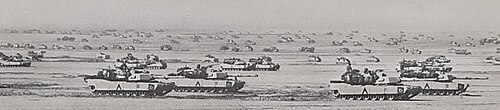
クウェート解放前夜の米国の囮攻撃と艦砲射撃は、連合軍の主力地上攻撃がクウェート中央部に集中するとイラク人に信じ込ませるために計画された。[要出典]数か月間、サウジアラビアの米軍部隊は、ほぼ絶え間ないイラクの砲撃、スカッドミサイル、化学攻撃の脅威にさらされていた。1991年2月24日、第1、第2海兵師団と第1軽装甲歩兵大隊がクウェートに渡り、クウェート市に向かった。彼らは塹壕、有刺鉄線、地雷原に遭遇した。しかし、これらの陣地は防御が手薄で、最初の数時間で制圧された。数回の戦車戦が行われたが、それ以外では連合軍は最小限の抵抗に遭遇し、ほとんどのイラク軍が降伏した。一般的なパターンは、イラク軍が降伏する前に短い戦いをするというものだった。しかし、イラクの防空軍は9機の米軍航空機を撃墜した。一方、アラブ諸国の軍隊は東からクウェートに進軍し、ほとんど抵抗に遭わず、死傷者もほとんど出なかった。[要出典]
連合軍の成功にもかかわらず、イラク共和国防衛隊が壊滅する前にイラクに逃げる恐れがあった。予定より15時間早くイギリスの機甲部隊をクウェートに派遣し、共和国防衛隊を追って米軍を派遣することが決定された。連合軍の前進に先立って大砲とロケット弾の集中砲火が浴びせられ、その後15万人の兵士と1,500両の戦車が前進を開始した。クウェートのイラク軍はサダム・フセイン本人の直接の命令により米軍に反撃した。激しい戦闘にもかかわらず、米軍はイラク軍を撃退し、クウェート市に向けて前進を続けた。[224]
クウェート軍は、この都市の解放を任務としていた。イラク軍は、わずかな抵抗しか示さなかった。クウェート軍は、兵士1名を失い、飛行機1機を撃墜されたにもかかわらず、すぐにこの都市を解放した。[要出典] 2月27日、サダムはクウェートからの撤退を命じ、[要出典]、ブッシュ大統領はクウェートの解放を宣言した。[225]しかし、クウェート国際空港のイラク軍部隊は、このメッセージを受け取っていないようで、激しく抵抗した。米海兵隊は、空港を確保するまで何時間も戦わなければならず、その後、クウェートは安全であると宣言された。4日間の戦闘の後、イラク軍はクウェートから追い出された。[要出典]焦土作戦の一環として、イラク軍は、約700の油井に火を放ち、消火を困難にするために油井の周囲に地雷を仕掛けた。[226] [検証失敗]
イラクへの最初の動き
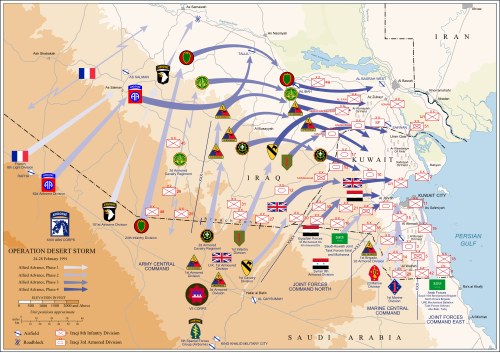
この戦争の地上段階は公式にデザート・セイバー作戦と名付けられた。[要出典]イラクに最初に移動した部隊は、1月下旬にイギリス空挺部隊B中隊の3つの哨戒隊で、コールサインはブラボー10、ブラボー20、ブラボー30であった。この8人からなる哨戒隊はイラク軍の背後に着陸し、スカッド移動式ミサイル発射装置の動きに関する情報を収集した。これらの発射装置は日中は橋や迷彩ネットの下に隠されていたため、上空からは探知できなかった。[227]その他の目標には、発射装置と、パイプライン内に敷設されイスラエルへの攻撃を開始するTELオペレーターに座標を中継する光ファイバー通信アレイの破壊が含まれていた。この作戦は、イスラエルの介入を阻止するように設計されていた。任務を遂行するのに十分な地上の援護がなかったため、10と30は作戦を放棄し、20は残ったが、後に危機に陥り、クリス・ライアン軍曹だけがシリアへ脱出した。[要出典]
アメリカ陸軍第1騎兵師団第5騎兵連隊第1大隊第2旅団の一部は、 1991年2月15日にイラクへの直接攻撃を実行し、続いて2月20日に大規模な攻撃を行い、不意を突かれたイラク軍7個師団を直接突破した。 [要出典] 1991年1月17日、第101空挺師団航空連隊が戦争初の砲火を浴びせ、AH-64ヘリコプター8機がイラクの早期警戒レーダーサイト2か所を破壊した。[228] 2月15日から20日にかけて、イラク国内でワディ・アル・バティンの戦いが行われた。これは、第1騎兵師団第5騎兵連隊第1大隊による2回の攻撃のうちの最初のものであった。これはイラク軍に南から連合軍の侵攻が行われると思わせるための陽動攻撃であった。イラク軍は激しく抵抗し、アメリカ軍は最終的に計画通りワディ・アル・バティンに撤退した。アメリカ軍は3人が死亡、9人が負傷し、M2ブラッドレー歩兵戦闘車の砲塔1基が破壊されたが、捕虜40名、戦車5両を破壊し、イラク軍を欺くことに成功した。この攻撃により、第18空挺軍団は第1騎兵隊の背後に回り込み、西側のイラク軍を攻撃することができた。1991年2月22日、イラクはソ連提案の停戦協定に同意した。この協定では、イラク軍は完全停戦後6週間以内に侵攻前の位置に軍を撤退させ、停戦と撤退の監視を国連安全保障理事会が監督することとされた。[要出典]
連合軍は提案を拒否したが、撤退中のイラク軍は攻撃されないと述べ[要出典]、イラク軍の撤退に24時間を与えた。2月23日、戦闘の結果、イラク兵500人が捕虜となった。2月24日、イギリスとアメリカの装甲部隊がイラク・クウェート国境を越えてイラクに大挙して侵入し、数百人の捕虜を捕らえた。イラクの抵抗は弱く、アメリカ人4人が死亡した[229] 。
連合軍がイラクに侵攻
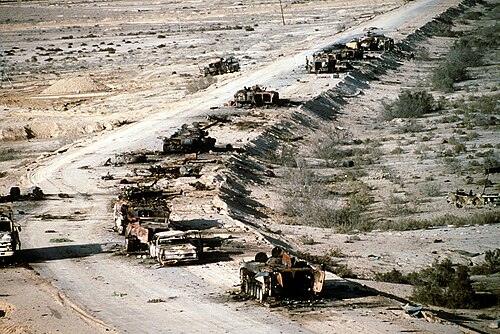
その後まもなく、第2機甲騎兵連隊を先頭に完全戦力となった米第7軍団は、2月24日早朝、クウェートの西方からイラクに機甲攻撃を開始し、イラク軍を驚かせた。同時に、米第18空挺軍団は、米第3機甲騎兵連隊と第24歩兵師団(機械化)の指揮の下、イラク南部のほぼ無防備な砂漠を横切る「左フック」攻撃を開始した。この攻撃の左翼は、フランス軍のダゲ師団によって守られていた。第101空挺師団は敵地への戦闘航空攻撃を実施した。[228]第101空挺師団は、敵陣から249km(155マイル)後方を攻撃した。[228]これは史上最も奥地への航空攻撃作戦であった。[228]約400機のヘリコプターが2,000人の兵士をイラクに輸送し、西に逃げようとしたイラク軍の列を破壊し、イラク軍の逃亡を阻止した。[230]第101空挺師団はさらに80~100km(50~60マイル)イラクに進軍した。 [228]日暮れまでに、第101師団はバスラとイラク軍を結ぶ重要な補給線である国道8号線を遮断した。 [ 228 ]第101師団は100時間戦争中に16人の兵士を失い、何千人もの敵軍捕虜を捕らえた。[要出典]
フランス軍はイラクの第 45 歩兵師団を素早く制圧し、軽微な損害と多数の捕虜を出し、連合軍の側面へのイラクの反撃を阻止する封鎖陣地を敷いた。連合軍の右翼はイギリスの第 1 機甲師団によって守られていた。連合軍はイラク領土の奥深くまで侵入すると東に転じ、エリート共和国防衛隊が逃げ出す前に側面攻撃を開始した。イラク軍は塹壕陣地や停車中の車両から激しく抵抗し、装甲突撃まで行った。[要出典]
これまでの多くの戦闘とは異なり、イラク軍の最初の戦車の破壊は大量降伏にはつながらなかった。イラク軍は多大な損害を被り、数十両の戦車と車両を失ったが、米軍の死傷者は比較的少なく、ブラッドレー戦車 1 台が撃破されただけだった。連合軍はイラク領内にさらに 10 km (6.2 マイル) 進攻し、3 時間以内に目標を制圧した。連合軍は 500 人を捕虜にし、大きな損害を与え、イラクの第 26 歩兵師団を破った。戦闘中、米兵 1 人がイラクの地雷で死亡し、さらに 5 人が味方の誤射で死亡し、30 人が負傷した。一方、イギリス軍はイラクのメディナ師団と共和国防衛隊の主要兵站基地を攻撃した。戦争で最も激しい戦闘の 2 日間近くで、イギリス軍は敵の戦車 40 台を破壊し、師団長を捕虜にした。[要出典]
一方、米軍はアル・ブサイヤ村を攻撃し、激しい抵抗に遭遇した。米軍は軍事装備を破壊し、捕虜を捕らえたが、死傷者は出なかった。[要出典]
1991年2月25日、イラク軍はサウジアラビアのダフラーンにある米軍基地にスカッドミサイルを発射した。このミサイル攻撃で米軍人28名が死亡した。[231]
連合軍の進撃は米軍将軍の予想よりはるかに速かった。2月26日、イラク軍は737基の油井に火をつけた後、クウェートから撤退を開始した。イラク軍の長い車列がイラク・クウェート幹線道路に沿って形成された。撤退中であったにもかかわらず、この車列は連合軍の空軍によって徹底的に爆撃されたため、死のハイウェイとして知られるようになった。数千人のイラク軍が死亡した。アメリカ、イギリス、フランスの軍は撤退するイラク軍を国境を越えてイラクに追い続け、最終的にバグダッドから240キロ(150マイル)以内まで移動した後、クウェートおよびサウジアラビアとのイラク国境まで撤退した。[232]
戦闘行為の終結
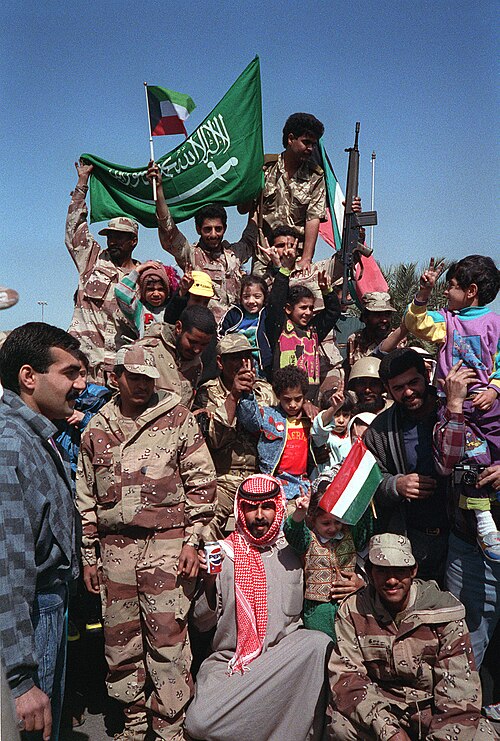
連合軍が占領したイラク領土で和平会議が開催され、双方が停戦協定を交渉し、署名した。会議でイラクは、民間インフラへの被害を受け、表面上は政府の移動のためと称して、暫定国境のイラク側で武装ヘリコプターを飛行させることを承認された。その後すぐに、これらのヘリコプターとイラク軍の大部分は、南部の蜂起と戦うために使用された。1991年3月1日、湾岸戦争停戦の翌日、イラク政府に対する反乱がバスラで勃発した。反乱は数日のうちに、南部イラクのシーア派の主要都市すべて、すなわちナジャフ、アマラ、ディワニヤ、ヒッラ、カルバラー、クート、ナシリーヤ、サマーワに広がった。1991年2月24日、サウジアラビアのCIA運営のラジオ局から放送された「自由イラクの声」が反乱を煽った。ボイス・オブ・アメリカのアラビア語放送は、反乱軍は十分な支援を受けており、間もなくサダムから解放されるだろうと述べて蜂起を支持した。[233]
北部では、クルド人指導者たちは反乱を支援するというアメリカの声明を真に受け、クーデターを起こそうと戦い始めた。しかし、アメリカの支援が得られなかったため、イラクの将軍たちはサダムに忠誠を誓い、クルド人の反乱と南部の反乱を容赦なく鎮圧した。[234]数百万のクルド人が山を越えてトルコやイランのクルド人地域に逃げた。4月5日、イラク政府は「イラク全土の町で扇動、破壊活動、暴動を完全に鎮圧する」と発表した。反乱で2万5千人から10万人のイラク人が死亡したと推定される。[235] [236]これらの事件により、後にイラク北部と南部に飛行禁止空域が設定された。 [要出典]
クウェートでは首長が復位し、イラク協力者と疑われた者たちは弾圧された。最終的に、PLOがサダムを支援したため、多数のパレスチナ人を含む40万人以上が国外追放された。ヤセル・アラファトはイラク支援について謝罪しなかったが、彼の死後、マフムード・アッバースは2004年にPLOを代表して正式に謝罪した。これはクウェート政府が正式にPLOを許した後に行われた。[237]
ブッシュ政権に対しては、バグダッドを占領して政府を打倒するよりも、サダムを権力の座に留めることを選んだとして批判もあった。1998年に共著した『変貌する世界』の中で、ブッシュとブレント・スコウクロフトは、そのようなやり方は同盟を分裂させ、多くの不必要な政治的、人的犠牲を伴ったであろうと主張した。[要出典]
1992年、戦争中の米国国防長官ディック・チェイニー氏も同様のことを指摘した。
もし我々がそこに進攻していたら、今もバグダッドに軍隊が駐留していただろう。我々は国を運営していただろう。全員を脱出させ、全員を帰国させることはできなかっただろう。
そして最後に、私が指摘する必要があると思うのは、犠牲者の問題です。米国の犠牲者がかなり多くなければ、あれだけのことを成し遂げられなかったと思います。1991年の戦争のコストが低かったことに誰もが非常に感銘を受けましたが、戦闘で亡くなった146人の米国人とその家族にとっては、安い戦争ではありませんでした。
そして私の疑問は、サダム [フセイン] がアメリカ人にどれだけの犠牲をもたらすのかということだ。答えは、それほど多くはない。だから、彼をクウェートから追放すると決めたときも、大統領が我々の目的は達成されたのでイラクを占領して統治しようとする問題にこだわるつもりはない、と決断したときも、我々は正しい判断をしたと思う。[238]
1991年3月10日、54万人の米軍がペルシャ湾から撤退を開始した。[要出典]
1991年3月15日、シェイク・ ジャベル・アル・アフマド・アル・サバーハはクウェートに戻り、自身の宮殿が破壊されたため、裕福なクウェート人の私邸に滞在した。彼は象徴的な到着を迎え、数十台の車にクラクションを鳴らし、クウェートの国旗を振りながら首長の車列を追おうとした人々でいっぱいだった。ニューヨーク・タイムズ紙によると、彼は留まる者と逃げる者に分かれた住民、権力を再び確立しようと奮闘する政府、そして女性の参政権を含むさらなる民主主義と戦後の改革を迫る活気ある野党に直面した。民主主義の擁護者は首長が1986年に停止した議会の復活を求めていた。[239]
連合の関与

連合国のメンバーには、アルゼンチン、オーストラリア、バーレーン、バングラデシュ、ベルギー、カナダ、チェコスロバキア、デンマーク、[240]エジプト、フランス、ドイツ、ギリシャ、ホンジュラス、ハンガリー、イタリア、日本、クウェート、ルクセンブルク、モロッコ、オランダ、ニュージーランド、ニジェール、ノルウェー、オマーン、パキスタン、フィリピン、ポーランド、ポルトガル、カタール、ルーマニア、[241]サウジアラビア、セネガル、シエラレオネ、シンガポール、韓国、スペイン、スウェーデン、シリア、トルコ、アラブ首長国連邦、英国、米国が含まれていた。[242]米国の兵士は70万人だった。[243] [244]
ドイツと日本は直接的な軍事援助は行わなかったものの、財政援助[245]と軍事装備の寄付を行った。これは後に小切手外交として知られるようになった。[要出典]
オーストラリア
オーストラリアは、ダマスク作戦の下、ペルシャ湾とオマーン湾の多国籍艦隊の一部を構成する海軍任務群を派遣した。さらに、医療チームが米国の病院船に配備され、海軍の掃海潜水チームは戦闘作戦の終了後、クウェートの港湾施設の機雷除去に参加した。オーストラリア軍は、砂漠の嵐作戦の最初の数週間に、戦闘部隊ズールーの外周の一部としてイラクからの重大な航空脅威を検出したこと、海上浮遊機雷を検出したこと、航空母艦USSミッドウェイへの支援など、いくつかの事件を経験した。オーストラリア任務部隊はまた、機雷の脅威に関して大きな危険にさらされ、HMASブリスベンが間一髪で機雷を回避した。オーストラリア人は、クウェートの侵攻後にイラクに対して実施された制裁の実施において重要な役割を果たした。戦争終結後、オーストラリアは、プロバイド・コンフォート作戦の一環として、ハビタット作戦で医療部隊をイラク北部に派遣した。[246]
アルゼンチン

アルゼンチンは1991年の湾岸戦争に参加した唯一の南米の国であった。駆逐艦ARAアルミランテ・ブラウン(D-10)、コルベットARAスピロ(P-43)(後に別のコルベットARAロサレス(P-42)に置き換えられた)、補給船ARAバイア・サン・ブラス(B-4)を派遣し、ペルシア湾の国連封鎖と海上制御活動に参加した。作戦地域で700回以上の迎撃と25,000海里(46,000 km)を航行した「オペレーション・アルフィル」(英語:オペレーション・ビショップ)の成功は、いわゆる「マルビナス症候群」を克服するのに役立った。[247]
アルゼンチンは後に、戦争中の貢献により、米国によって主要な非NATO同盟国に分類された。 [248]
カナダ
カナダはイラクのクウェート侵攻を最初に非難した国の一つで、すぐに米国主導の連合軍に参加することに同意した。1990年8月、ブライアン・マルロニー首相はカナダ軍に海軍任務部隊を派遣することを命じた。駆逐艦テラ ・ノヴァとアサバスカン はフリクション作戦で補給船プロテク トゥールの支援を受けた海上阻止部隊に加わった。カナダ任務部隊はペルシャ湾で連合軍の海上補給部隊を率いた。4隻目の艦艇ヒューロン は戦闘終了後に戦域に到着し、クウェートを訪れた最初の連合軍艦艇となった。[要出典]
国連の許可を得たイラクに対する武力行使の後、カナダ軍は地上戦の負傷者に対処するため、 CF-18ホーネットとCH-124シーキング飛行隊、支援要員、野戦病院を派遣した。空中戦が始まると、CF-18は連合軍に統合され、空中援護と地上目標の攻撃を任された。カナダ軍が攻勢作戦に参加したのは朝鮮戦争以来初めてのことだった。この紛争中に公式に勝利を記録した唯一のCF-18ホーネットは、イラク海軍とのブビヤンの戦いの初めに関与した航空機であった。[249]
フランス

2番目に大きいヨーロッパの派遣団はフランスで、18,000人の兵士を派遣した。[242]アメリカ第18空挺軍団の左翼で活動していたフランス陸軍は、フランス外人部隊の部隊を含むダゲ師団であった。当初、フランスは国家の指揮統制の下で独自に活動していたが、アメリカ(CENTCOM経由)およびサウジアラビアと緊密に連携していた。1月に、師団は第18空挺軍団の戦術的統制下に置かれました。フランスはまた、いくつかの戦闘機と海軍部隊を展開した。フランスは、その貢献をダゲ作戦と呼んだ。[要出典]
イタリア
1990年9月25日のイラクによるクウェート侵攻と併合を受けて、イタリア政府はペルシャ湾に、アラブ首長国連邦のアブダビ近郊のアルダフラ空軍基地に配備されていた第6、第36、第50嵐隊に属する多用途戦闘爆撃機トルネードIDS8機(および予備2機)を派遣した。 [250] [251] [252] 42日間の戦争中、イタリアの戦闘機は226回の出撃を行い、合計589時間の飛行を行った。湾岸戦争でイタリア空軍は1機の航空機の損失を記録した。砂漠の嵐作戦の一環としてのイタリア機の使用は、第二次世界大戦終結以来、イタリア空軍航空機の戦闘任務における最初の実戦投入であった。[要出典]
イギリス

イギリスは、この戦争の戦闘作戦に参加したヨーロッパ諸国の中で最大の派遣部隊を派遣した。グランビー作戦はペルシャ湾での作戦のコードネームである。イギリス陸軍連隊(主に第1機甲師団)、イギリス空軍、海軍航空隊、イギリス海軍の艦艇がペルシャ湾に動員された。イギリス空軍と海軍航空隊は、様々な航空機を使用してサウジアラビアの空軍基地から活動し、海軍航空隊はペルシャ湾の様々な艦艇から活動した。イギリスはノーフォークの戦いで主要な役割を果たし、その軍隊は200台以上のイラクの戦車と大量の他の車両を破壊した。[207] [208] 48時間の戦闘の後、イギリス第1機甲師団はイラク歩兵4個師団(第26、第48、第31、第25)を破壊または孤立させ、いくつかの激しい戦闘でイラク第52機甲師団を制圧した。[208]
ペルシア湾に展開したイギリス海軍の主力艦艇には、ブロードソード級フリゲート艦、シェフィールド級駆逐艦などがあり、その他のイギリス海軍およびロシア海軍の艦艇も展開した。軽空母アーク・ロイヤルは地中海に展開した。[要出典]
数個のSAS飛行隊が配備された。[要出典]
イギリスのチャレンジャー1は、イラクの戦車を4,700メートル(2.9マイル)以上射程距離を広げて徹甲安定型投射サボ(APFSDS)弾で破壊し、戦争中最長の戦車撃破距離記録を達成した。これは戦車同士の撃破としては最長の射撃記録である。[253] [254]
死傷者
民間人

1,000人以上のクウェート民間人がイラク軍によって殺害された。[255]イラク占領中に600人以上のクウェート人が行方不明となり、 [256]イラクの集団墓地で約375体の遺体が発見された。連合軍の戦闘機と巡航ミサイルの両方による空襲の重要性が増したため、砂漠の嵐作戦の初期段階での民間人の死者数をめぐる論争が巻き起こった。砂漠の嵐作戦の最初の24時間以内に、1,000回以上の出撃が行われ、その多くはバグダッドの標的であった。バグダッドはサダム政権とイラク軍の指揮統制の拠点であったため、激しい爆撃の標的となった。これが最終的に民間人の犠牲者につながった。[要出典]
有名な事件の一つでは、米空軍のステルス機2機がアミリヤのバンカーを爆撃し、シェルターにいたイラク民間人408人が死亡した。[257]その後、焼死体や切断された遺体の映像が放送され、バンカーの位置づけをめぐって論争が巻き起こり、民間人シェルターだったという意見もあれば、イラク軍の作戦の中心地であり、民間人は人間の盾として意図的に移動させられたという意見もあった。[要出典]
サダム政権はイスラム諸国からの支援を引き出すために民間人の犠牲者数を多くした。イラク政府は空爆作戦中に2,300人の民間人が死亡したと主張した。[258]防衛代替案プロジェクトの調査によると、この紛争で3,664人のイラク民間人が死亡した。[259]
3月と4月の湾岸戦争終結直後に起きたイラクのバース党政府に対する全国的な蜂起では、推定2万5千人から10万人のイラク人が殺害され、その大部分は民間人であった。 [235]
1991年6月に発表されたハーバード大学の調査では、イラクの発電能力の破壊によって引き起こされた「公衆衛生上の大惨事」により、1991年末までにイラクの民間人がさらに何万人も死亡すると予測された。「電気がなければ、病院は機能せず、傷みやすい薬は腐り、水は浄化できず、未処理の下水は処理できない」。米国政府はイラクの公衆衛生危機の影響に関する独自の調査を発表することを拒否した。[260]
1992年のベス・オズボーン・ダポンテによる調査では、戦争で直接的に死亡した民間人は約13,000人、戦争のその他の影響で間接的に死亡した民間人はさらに70,000人と推定されている。[261] [262] [263]国際研究チーム(IST)として知られる研究者らが1992年にニューイングランド医学ジャーナルに発表した研究によると、戦争の結果、乳幼児死亡率は3倍に増加し、1991年1月から8月の間に5歳未満の乳幼児46,900人が死亡した。[264]しかし、これらの数字は2017年にBMJに掲載された研究によって異議を唱えられており、「ISTの調査は、1985年から1990年までの乳幼児死亡率を過小評価し、1991年のレベルを過大評価している可能性が高い」と述べている。この研究によると、「1990年以降、イラクでは乳幼児死亡率の大幅な上昇はなかった」という。[265] 2002年にメダクトが発表した報告書では、湾岸戦争によって直接的、間接的に死亡したイラク人の総数は142,500人から206,000人と推定されており、このうち軍人の死者は100,000人から120,000人、内戦での民間人の死者は20,000人から35,000人、湾岸戦争終結後の難民の死者は15,000人から30,000人となっている。[26]
イラクはまた、イスラエルとサウジアラビアの民間人を標的とした攻撃を何度も行った。1991年のミドル・イースト・ウォッチの報告書によると、リヤドでイラクの砲撃により少なくとも1人のサウジアラビア民間人が死亡したという。[266]イラクのイスラエルへのロケット攻撃でも、死者の数は議論の余地がある。[要出典]
イラク
1991年3月の国連報告書は、米国主導の爆撃作戦がイラクに与えた影響は「ほぼ終末的」であり、イラクを「産業革命以前の時代」に逆戻りさせたと述べている。[267]イラクの戦闘犠牲者の正確な数は不明だが、多かったと考えられている。イラクの死者は2万人から3万5千人と推定する者もいる。[261]米空軍が委託した報告書は、空爆作戦で1万人から1万2千人のイラク人の戦死者、地上戦で1万人もの死者が出たと推定している。[268]この分析はイラク人捕虜の報告書に基づいている。[要出典]
防衛代替案プロジェクトの調査によれば、この紛争で2万人から2万6千人のイラク軍人が死亡し、7万5千人が負傷した。[259]
カナン・マキヤによれば、「イラク国民にとって、国連の意志を強制するためのコストはとてつもなく大きい」という。[269]シュワルツコフ将軍は「これらの部隊で非常に多くの死者が出た。実に非常に多くの死者だ」と語った。[270]下院軍事委員会の委員長レス・アスピンは「少なくとも6万5千人のイラク兵が死亡した」と推定した。[270]この数字はイスラエルの情報源によって裏付けられており、「イラク人の死傷者は10万から20万人」と語っている。殺害のほとんどは「地上戦中に起きた。逃亡中の兵士は『燃料空気爆薬』と呼ばれる装置で爆撃された」[270]
連合

米国防総省の報告によると、米軍は戦闘関連で148人が死亡し(うち35人は友軍の誤射による[284])、パイロット1人が行方不明となっている(遺体は2009年8月に発見され身元が確認された)。さらに145人のアメリカ人が非戦闘事故で死亡した。[271]英国では47人が死亡(うち9人は友軍の誤射による)、フランスでは9人が死亡[271]、クウェートを除くその他の国では37人が死亡した(サウジアラビア人18人、エジプト人1人、UAE人6人、カタール人3人)。[271]捕虜になってから10年経った今も、少なくとも605人のクウェート兵士が行方不明となっている。[285]
The largest single loss of life among coalition forces happened on 25 February 1991, when an Iraqi Al Hussein missile hit a US military barrack in Dhahran, Saudi Arabia, killing 28 US Army Reservists from Pennsylvania. In all, 190 coalition troops were killed by Iraqi fire during the war, 113 of whom were American, out of 358 coalition deaths. Another 44 soldiers were killed and 57 wounded by friendly fire. 145 soldiers died of exploding munitions or non-combat accidents.[286]
The largest accident among coalition forces happened on 21 March 1991, when a Royal Saudi Air Force C-130H crashed in heavy smoke on approach to Ras Al-Mishab Airport, Saudi Arabia. 92 Senegalese soldiers and six Saudi crew members were killed.[275]
The number of coalition wounded in combat was 776, including 458 Americans.[287]
190 coalition troops were killed by Iraqi combatants, the rest of the 379 coalition deaths were from friendly fire or accidents. This number was much lower than expected. Among the American combat dead were four female soldiers.[288]
Friendly fire
While the death toll among coalition forces engaging Iraqi combatants was very low, a substantial number of deaths were caused by accidental attacks from other Allied units. Of the 148 US troops who died in battle, 24% were killed by friendly fire, a total of 35 service personnel.[289] A further 11 died in detonations of coalition munitions. Nine British military personnel were killed in a friendly fire incident when a USAF A-10 Thunderbolt II destroyed a group of two Warrior IFVs.[citation needed]
Aftermath
Gulf War illness
Many returning coalition soldiers reported illnesses following their action in the war, a phenomenon known as Gulf War syndrome (GWS) or Gulf War illness (GWI). Common symptoms reported are chronic fatigue, fibromyalgia, and gastrointestinal disorder.[290] There has been widespread speculation and disagreement about the causes of the illness and the possibly related birth defects. Researchers found that infants born to male veterans of the 1991 war had higher rates of two types of heart valve defects. Some children born after the war to Gulf War veterans had a certain kidney defect that was not found in Gulf War veterans' children born before the war. Researchers have said that they did not have enough information to link birth defects with exposure to toxic substances.[291]
In 1994, the US Senate Committee on Banking, Housing, and Urban Affairs with Respect to Export Administration published a report entitled, "U.S. Chemical and Biological Warfare-Related Dual Use Exports to Iraq and their Possible Impact on the Health Consequences of the Gulf War". This publication, called the Riegle Report, summarized testimony this committee had received establishing that the U.S. had in the 1980s supplied Saddam Hussein with chemical and biological warfare technology, that Saddam had used such chemical weapons against Iran and his own native Kurds, and possibly against U.S. soldiers as well, plausibly contributing to the GWS.[citation needed]
A 2022 study by Dr. Robert W. Haley of the University of Texas Southwestern Medical Center, et al., of 1,016 U.S. Gulf War veterans found evidence of a causal link between GWS and exposure to low levels of the nerve agent sarin, which was released into the air by coalition bombing of Iraqi chemical weapons facilities. Significantly, the study found an increased incidence of GWS not only among veterans who recounted hearing nerve agent alarms, but also among veterans with the RR or QR (as opposed to the QQ) forms of the PON1 gene, which produces an enzyme that deactivates organophosphates (including sarin) through hydrolysis. By contrast, GWS was inversely associated with higher levels of the type Q isozyme, which is more efficient at breaking down sarin than its type R counterpart. The authors "found that the PON1 genotype and hearing nerve agent alarms were independent and the findings robust to both measured and unmeasured confounding, supporting a mechanistic [gene–environment] interaction. ... Moreover, the change in the combined effect from one category to the next was significantly greater than the sum of the independent effects of the environmental exposure and the genotype".[292]
Effects of depleted uranium
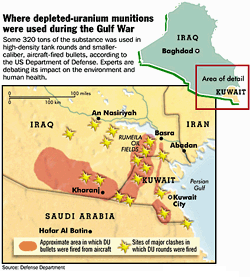
The US military used depleted uranium in tank kinetic energy penetrators and 20–30 mm (0.79–1.18 in) cannon ordnance. Significant controversy regarding the long term safety of depleted uranium exists, including claims of pyrophoric, genotoxic, and teratogenic heavy metal effects. Many have cited its use during the war as a contributing factor to a number of major health issues in veterans and in surrounding civilian populations, including in birth defects and child cancer rates. Scientific opinion on the risk is mixed.[293][294][295] In 2004, Iraq had the highest mortality rate due to leukemia of any country.[296][297][298][299]
Depleted uranium has 40% less radioactivity than natural uranium, but the negative effects should not be overlooked.[300] Depleted uranium is not a significant health hazard unless it is taken into the body. External exposure to radiation from depleted uranium is generally not a major concern because the alpha particles emitted by its isotopes travel only a few centimeters in air or can be stopped by a sheet of paper. Also, the uranium-235 that remains in depleted uranium emits only a small amount of low-energy gamma radiation. However, if allowed to enter the body, depleted uranium, like natural uranium, has the potential for both chemical and radiological toxicity with the two important target organs being the kidneys and the lungs.[301]
Highway of Death

In the night of 26–27 February 1991, some Iraqi forces began leaving Kuwait on the main highway north of Al Jahra in a column of some 1,400 vehicles. A patrolling E-8 Joint STARS aircraft observed the retreating forces and relayed the information to the DDM-8 air operations center in Riyadh, Saudi Arabia.[citation needed] These vehicles and the retreating soldiers were subsequently attacked by two A-10 aircraft, resulting in a 60 kilometres (37 mi) stretch of highway strewn with debris—the Highway of Death. New York Times reporter Maureen Dowd wrote, "With the Iraqi leader facing military defeat, Mr. Bush decided that he would rather gamble on a violent and potentially unpopular ground war than risk the alternative: an imperfect settlement hammered out by the Soviets and Iraqis that world opinion might accept as tolerable."[302]
Chuck Horner, Commander of US and allied air operations, has written:
[By February 26], the Iraqis totally lost heart and started to evacuate occupied Kuwait, but airpower halted the caravan of Iraqi Army and plunderers fleeing toward Basra. This event was later called by the media "The Highway of Death." There were certainly a lot of dead vehicles, but not so many dead Iraqis. They'd already learned to scamper off into the desert when our aircraft started to attack. Nevertheless, some people back home wrongly chose to believe we were cruelly and unusually punishing our already whipped foes.
...
By February 27, talk had turned toward terminating the hostilities. Kuwait was free. We were not interested in governing Iraq. So the question became "How do we stop the killing."[303]
Bulldozer assault

Another incident during the war highlighted the question of large-scale Iraqi combat deaths. This was the "bulldozer assault", wherein two brigades from the US 1st Infantry Division (Mechanized) were faced with a large and complex trench network, as part of the heavily fortified "Saddam Hussein Line". After some deliberation, they opted to use anti-mine plows mounted on tanks and combat earthmovers to simply plow over and bury alive the defending Iraqi soldiers. Not a single American was killed during the attack. Reporters were banned from witnessing the attack, near the neutral zone that touches the border between Saudi Arabia and Iraq.[304] Every American in the assault was inside an armored vehicle.[304]
Patrick Day Sloyan of Newsday reported, "Bradley Fighting Vehicles and Vulcan armored carriers straddled the trench lines and fired into the Iraqi soldiers as the tanks covered them with mounds of sand. 'I came through right after the lead company,' [Col. Anthony] Moreno said. 'What you saw was a bunch of buried trenches with peoples' arms and things sticking out of them.'"[305] However, after the war, the Iraqi government said that only 44 bodies were found.[306] In his book The Wars Against Saddam, John Simpson alleges that US forces attempted to cover up the incident.[307] After the incident, the commander of the 1st Brigade said: "I know burying people like that sounds pretty nasty, but it would be even nastier if we had to put our troops in the trenches and clean them out with bayonets."[305] Secretary of Defense Dick Cheney did not mention the First Division's tactics in an interim report to Congress on Operation Desert Storm.[304] In the report, Cheney acknowledged that 457 enemy soldiers were buried during the ground war.[304]
Palestinian exodus from Kuwait
A Palestinian exodus from Kuwait took place during and after the Gulf War. During the Gulf War, more than 200,000 Palestinians fled Kuwait during the Iraqi occupation of Kuwait due to harassment and intimidation by Iraqi security forces,[308] in addition to getting fired from work by Iraqi authority figures in Kuwait.[308] After the Gulf War, the Kuwaiti authorities forcibly pressured nearly 200,000 Palestinians to leave Kuwait in 1991.[308] Kuwait's policy, which led to this exodus, was a response to alignment of Palestinian leader Yasser Arafat and the PLO with Saddam Hussein.
The Palestinians who fled Kuwait were Jordanian citizens.[309] In 2013, 280,000 Jordanian citizens of Palestinian origin lived in Kuwait.[310] In 2012, 80,000 Palestinians (without Jordanian citizenship) lived in Kuwait.[311]
Saudi Arabia expelled Yemeni workers after Yemen supported Saddam during the Gulf War.[312]
Coalition bombing of Iraq's civilian infrastructure
In the 23 June 1991 edition of The Washington Post, reporter Bart Gellman wrote:
Many of the targets were chosen only secondarily to contribute to the military defeat of Iraq ... Military planners hoped the bombing would amplify the economic and psychological impact of international sanctions on Iraqi society ... They deliberately did great harm to Iraq's ability to support itself as an industrial society ...[313]
In the Jan/Feb 1995 edition of Foreign Affairs, French diplomat Eric Rouleau wrote:
[T]he Iraqi people, who were not consulted about the invasion, have paid the price for their government's madness ... Iraqis understood the legitimacy of a military action to drive their army from Kuwait, but they have had difficulty comprehending the Allied rationale for using air power to systematically destroy or cripple Iraqi infrastructure and industry: electric power stations (92 percent of installed capacity destroyed), refineries (80 percent of production capacity), petrochemical complexes, telecommunications centers (including 135 telephone networks), bridges (more than 100), roads, highways, railroads, hundreds of locomotives and boxcars full of goods, radio and television broadcasting stations, cement plants, and factories producing aluminum, textiles, electric cables, and medical supplies.[314]
However, the UN subsequently spent billions rebuilding hospitals, schools, and water purification facilities throughout the country.[315]
Abuse of Coalition POWs
During the conflict, coalition aircrew shot down over Iraq were displayed as prisoners of war on TV, most with visible signs of abuse. Amongst several testimonies to poor treatment,[316] USAF Captain Richard Storr was allegedly tortured by Iraqis during the Persian Gulf War. Iraqi secret police broke his nose, dislocated his shoulder and punctured his eardrum.[317] Royal Air Force Tornado crew John Nichol and John Peters have both alleged that they were tortured during this time.[318][319] Nichol and Peters were forced to make statements against the war on television. Members of British Special Air Service Bravo Two Zero were captured while providing information about an Iraqi supply line of Scud missiles to coalition forces. Only one, Chris Ryan, evaded capture while the group's other surviving members were violently tortured.[320] Flight surgeon (later General) Rhonda Cornum was sexually assaulted by one of her captors[321] after the Black Hawk helicopter in which she was riding was shot down while searching for a downed F-16 pilot.[citation needed]
Operation Southern Watch
Since the war, the US has had a continued presence of 5,000 troops stationed in Saudi Arabia – a figure that rose to 10,000 during the 2003 conflict in Iraq.[322] Operation Southern Watch enforced the no-fly zones over southern Iraq set up after 1991; oil exports through the Persian Gulf's shipping lanes were protected by the Bahrain-based US Fifth Fleet.[citation needed]
Since Saudi Arabia houses Mecca and Medina, Islam's holiest sites, many Muslims were upset at the permanent military presence. The continued presence of U.S. troops in Saudi Arabia after the war was one of the stated motivations behind the 11 September terrorist attacks,[322] the Khobar Towers bombing, and the date chosen for the 1998 US embassy bombings (7 August), which was eight years to the day that US troops were sent to Saudi Arabia.[323] Osama bin Laden interpreted the Islamic prophet Muhammad as banning the "permanent presence of infidels in Arabia".[324] In 1996, bin Laden issued a fatwa, calling for US troops to leave Saudi Arabia. In a December 1999 interview with Rahimullah Yusufzai, bin Laden said he felt that Americans were "too near to Mecca" and considered this a provocation to the entire Islamic world.[325]
Sanctions

Wikisource has original text related to this article:
United Nations Security Council Resolution 661
On 6 August 1990, after Iraq's invasion of Kuwait, the UN Security Council adopted Resolution 661 which imposed economic sanctions on Iraq, providing for a full trade embargo, excluding medical supplies, food and other items of humanitarian necessity, these to be determined by the council's sanctions committee. From 1991 until 2003, the effects of government policy and sanctions regime led to hyperinflation, widespread poverty and malnutrition.[citation needed]
During the late 1990s, the UN considered relaxing the sanctions imposed because of the hardships suffered by ordinary Iraqis. Studies dispute the number of people who died in south and central Iraq during the years of the sanctions.[326][327][328][329]
Draining of the Qurna Marshes
The draining of the Qurna Marshes was an irrigation project in Iraq during and immediately after the war, to drain a large area of marshes in the Tigris–Euphrates river system. Formerly covering an area of around 3,000 km2 (1,200 sq mi), the large complex of wetlands were nearly emptied of water, and the local Shi'ite population relocated, following the war and 1991 uprisings. By 2000, the United Nations Environment Programme estimated that 90% of the marshlands had disappeared, causing desertification of over 7,500 square miles (19,000 km2).[citation needed]
The draining occurred in Iraq and to a smaller degree in Iran between the 1950s and 1990s to clear large areas of the marshes. Formerly covering an area of around 20,000 km2 (7,700 sq mi), the large complex of wetlands was 90% drained before the 2003 Invasion of Iraq. The marshes are typically divided into three main sub-marshes, the Hawizeh, Central, and Hammar Marshes and all three were drained at different times for different reasons. Initial draining of the Central Marshes was intended to reclaim land for agriculture but later all three marshes would become a tool of war and revenge.[330]
Many international organizations such as the UN Human Rights Commission, the Islamic Supreme Council of Iraq, the Wetlands International, and Middle East Watch have described the project as a political attempt to force the Marsh Arabs out of the area through water diversion tactics.[330]
Oil spill
On 23 January, Iraq dumped 400 million US gallons (1,500,000 m3) of crude oil into the Persian Gulf,[332] causing the largest offshore oil spill in history at that time.[331] It was reported as a deliberate natural resources attack to keep US Marines from coming ashore (Missouri and Wisconsin had shelled Failaka Island during the war to reinforce the idea that there would be an amphibious assault attempt).[333] About 30–40% of this came from allied raids on Iraqi coastal targets.[334]
Kuwaiti oil fires

The Kuwaiti oil fires were caused by the Iraqi military setting fire to 700 oil wells as part of a scorched earth policy while retreating from Kuwait in 1991 after conquering the country but being driven out by coalition forces. The fires started in January and February 1991, and the last one was extinguished by November.[335]
The resulting fires burned uncontrollably because of the dangers of sending in firefighting crews. Land mines had been placed in areas around the oil wells, and a military cleaning of the areas was necessary before the fires could be put out. Somewhere around 6 million barrels (950,000 m3) of oil were lost each day. Eventually, privately contracted crews extinguished the fires, at a total cost of US$1.5 billion to Kuwait.[336] By that time, however, the fires had burned for approximately 10 months, causing widespread pollution.[citation needed]
Cost

The cost of the war to the United States was calculated by the US Congress in April 1992 to be $61.1 billion[337] (equivalent to $119 billion in 2023).[338] About $52 billion of that amount was paid by other countries: $36 billion by Kuwait, Saudi Arabia and other Arab states of the Persian Gulf; $16 billion by Germany and Japan (which sent no combat forces due to their constitutions). About 25% of Saudi Arabia's contribution was paid with in-kind services to the troops, such as food and transportation.[337] US troops represented about 74% of the combined force, and the global cost was therefore higher.[citation needed]
Effect on developing countries
Apart from the impact on Arab States of the Persian Gulf, the resulting economic disruptions after the crisis affected many states. The Overseas Development Institute (ODI) undertook a study in 1991 to assess the effects on developing states and the international community's response. A briefing paper finalized on the day that the conflict ended draws on their findings which had two main conclusions: Many developing states were severely affected and while there has been a considerable response to the crisis, the distribution of assistance was highly selective.[339]
The ODI factored in elements of "cost" which included oil imports, remittance flows, re-settlement costs, loss of export earnings and tourism. For Egypt, the cost totaled $1 billion, 3% of GDP. Yemen had a cost of $830 million, 10% of GDP, while it cost Jordan $1.8 billion, 32% of GDP.[340][citation needed]
International response to the crisis on developing states came with the channeling of aid through The Gulf Crisis Financial Co-ordination Group. They were 24 states, comprising most of the OECD countries plus some Gulf states: Saudi Arabia, United Arab Emirates, Qatar and Kuwait. The members of this group agreed to disperse $14 billion in development assistance.[citation needed]
The World Bank responded by speeding up the disbursement of existing project and adjustment loans. The International Monetary Fund adopted two lending facilities – the Enhanced Structural Adjustment Facility (ESAF) and the Compensatory & Contingency Financing Facility (CCFF). The European Community offered $2 billion[clarification needed] in assistance.[339]
Media coverage
US policy regarding media freedom was much more restrictive than in the Vietnam War.[341] The policy had been spelled out in a Pentagon document entitled Annex Foxtrot. Most of the press information came from briefings organized by the military. Only selected journalists were allowed to visit the front lines or conduct interviews with soldiers. Those visits were always conducted in the presence of officers, and were subject to both prior approval by the military and censorship afterward. This was ostensibly to protect sensitive information from being revealed to Iraq. This policy was heavily influenced by the military's experience with the Vietnam War, in which public opposition within the US grew throughout the war's course. It was not only the limitation of information in the Middle East; media were also restricting what was shown about the war with more graphic depictions like Ken Jarecke's image of a burnt Iraqi soldier being pulled from the American AP wire whereas in Europe it was given extensive coverage.[342][343][344]
Two BBC journalists, John Simpson and Bob Simpson (no relation), defied their editors and remained in Baghdad to report on the war's progress. They were responsible for a report which included an "infamous cruise missile that travelled down a street and turned left at a traffic light."[345]
Alternative media outlets provided views opposing the war.[346][347][348] Deep Dish Television compiled segments from independent producers in the US and abroad, and produced a 10-hour series that was distributed internationally, called The Gulf Crisis TV Project.[349] The series' first program War, Oil and Power[350] was compiled and released in 1990, before the war broke out. News World Order was the title of another program in the series; it focused on the media's complicity in promoting the war, as well as Americans' reactions to the media coverage.[351]
Media watchdog group Fairness and Accuracy in Reporting (FAIR) critically analyzed media coverage during the war in various articles and books, such as the 1991 Gulf War Coverage: The Worst Censorship was at Home.[352]
Technology

Precision-guided munitions were heralded as key in allowing military strikes to be made with a minimum of civilian casualties compared to previous wars, although they were not used as often as more traditional, less accurate bombs. Specific buildings in downtown Baghdad could be bombed while journalists in their hotels watched cruise missiles fly by.[citation needed]
Precision-guided munitions amounted to approximately 7.4% of all bombs dropped by the coalition. Other bombs included cluster bombs, which disperse numerous submunitions,[353] and daisy cutters, 15,000-pound bombs which can disintegrate everything within hundreds of yards.[citation needed]
Global Positioning System (GPS) units were relatively new at the time and were important in enabling coalition units to easily navigate across the desert. Since military GPS receivers were not available for most troops, many used commercially available units. To permit these to be used to best effect, the "selective availability" feature of the GPS system was turned off for the duration of Desert Storm, allowing these commercial receivers to provide the same precision as the military equipment.[354]
Airborne Warning and Control System (AWACS) and satellite communication systems were also important. Two examples of this are the US Navy's Grumman E-2 Hawkeye and the US Air Force's Boeing E-3 Sentry. Both were used in command and control area of operations. These systems provided essential communications links between air, ground, and naval forces. It is one of several reasons coalition forces dominated the air war.[citation needed]
American-made color photocopiers were used to produce some of Iraq's battle plans. Some of the copiers contained concealed high-tech transmitters that revealed their positions to American electronic warfare aircraft, leading to more precise bombings.[355]
Scud and Patriot missiles

The role of Iraq's Scud missiles featured prominently in the war. Scud is a tactical ballistic missile that the Soviet Union developed and deployed among the forward deployed Soviet Army divisions in East Germany.[citation needed]
Scud missiles utilize inertial guidance which operates for the duration that the engines operate. Iraq used Scud missiles, launching them into both Saudi Arabia and Israel. Some missiles caused extensive casualties, while others caused little damage.[citation needed]
The US Patriot missile was used in combat for the first time. The US military claimed a high effectiveness against Scuds at the time, but later analysis gives figures as low as 9%, with 45% of the 158 Patriot launches being against debris or false targets.[356] The Dutch Ministry of Defense, which also sent Patriot missiles to protect civilians in Israel and Turkey, later disputed the higher claim.[143] Further, there is at least one incident of a software error causing a Patriot missile's failure to engage an incoming Scud, resulting in deaths.[357] Both the US Army and the missile manufacturers maintained the Patriot delivered a "miracle performance" in the Gulf War.[356]
Popular culture
The Gulf War has been the subject of several video games including Conflict: Desert Storm, Conflict: Desert Storm II, Gulf War: Operation Desert Hammer, and Call of Duty: Black Ops 6. There have also been numerous depictions in film including Jarhead (2005), which is based on US Marine Anthony Swofford's 2003 memoir of the same name.[358] The 2016 Bollywood movie Airlift is based on Operation Ganga, the evacuation of Indian citizens stranded in Kuwait during the Gulf War.[359]
See also
- Operation Granby
- 1973 Samita border skirmish
- United Nations Iraq–Kuwait Observation Mission
- Iraq–Russia relations
- SIPRI Arms Transfers Database, Iraq 1973–1990
- Loss of Strength Gradient
- Military history of the United States
- Post–World War II air-to-air combat losses
- Organization of United States Air Force Units in the Gulf War
- The Gulf War Did Not Take Place
Notes
- ^ Including 100–120,000 military deaths, 3–15,000 civilian deaths during the war, 4–6,000 civilian deaths up to April 1991, and 35–65,000 civilian deaths from the Iraqi uprisings after the end of the Gulf War.
- ^ The numbering of Persian Gulf conflicts depends on whether the Iran–Iraq War (1980–1988) is referred to as the First (Persian) Gulf War (English language sources prior to the start of the Kuwait war in 1990 usually called it the Gulf War), which would make the 1990 war the Second (Persian) Gulf War. Different sources may call the conflicts by different names. The name 'Persian Gulf' is itself a subject of dispute. The start date of the Kuwait War can also be seen as either August 1990 (when Iraq's Saddam Hussein invaded Kuwait) or as January 1991 (the start of Operation Desert Storm, when the US-led coalition forced Iraq out of Kuwait), so that the war is also often called the 1991 Gulf War, the 1990–1991 Gulf War, the 1990s Gulf War, etc ... This dating is also used to distinguish it from the other two 'Gulf Wars'.
- ^ Since 1988 the PLO had assumed, for Arab League purposes, the seat for the State of Palestine.
References
- ^ a b c "Desert Shield And Desert Storm: A Chronology And Troop List for the 1990–1991 Persian Gulf Crisis" (PDF). apps.dtic.mil. Archived (PDF) from the original on 12 April 2019. Retrieved 18 December 2018.
- ^ Persian Gulf War, the Sandhurst-trained Prince
Khaled bin Sultan al-Saud was co-commander with General Norman Schwarzkopf www.casi.org.uk/discuss Archived 3 March 2016 at the Wayback Machine - ^ General Khaled was Co-Commander, with US General Norman Schwarzkopf, of the allied coalition that liberated Kuwait www.thefreelibrary.com Archived 30 April 2011 at the Wayback Machine
- ^ a b Knights, Michael (2005). Cradle of Conflict: Iraq and the Birth of Modern U.S. Military Power. United States Naval Institute. p. 20. ISBN 978-1-59114-444-1.
- ^ a b "Persian Gulf War". MSN Encarta. Archived from the original on 1 November 2009.
- ^ 18 M1 Abrams, 11 M60, 2 AMX-30
- ^ CheckPoint, Ludovic Monnerat. "Guerre du Golfe: le dernier combat de la division Tawakalna".
- ^ Scales, Brig. Gen. Robert H.: Certain Victory. Brassey's, 1994, p. 279.
- ^ Halberstadt 1991. p. 35
- ^ Atkinson, Rick. Crusade, The untold story of the Persian Gulf War. Houghton Mifflin Company, 1993. pp. 332–3
- ^ Captain Todd A. Buchs, B. Co. Commander, Knights in the Desert. Publisher/Editor Unknown. p. 111.
- ^ Malory, Marcia. "Tanks During the First Gulf War – Tank History". Archived from the original on 3 March 2016. Retrieved 5 July 2016.
- ^ M60 vs T-62 Cold War Combatants 1956–92 by Lon Nordeen & David Isby
- ^ "TAB H – Friendly-fire Incidents". Archived from the original on 1 June 2013. Retrieved 5 July 2016.
- ^ NSIAD-92-94, "Operation Desert Storm: Early Performance Assessment of Bradley and Abrams". Archived 21 February 2014 at the Wayback Machine US General Accounting Office, 10 January 1992. Quote: "According to information provided by the Army's Office of the Deputy Chief of Staff for Operations and Plans, 20 Bradleys were destroyed during the Gulf war. Another 12 Bradleys were damaged, but four of these were quickly repaired. Friendly fire accounted for 17 of the destroyed Bradleys and three of the damaged ones
- ^ Iraqi Invasion of Kuwait; 1990 (Air War) Archived 6 October 2014 at the Wayback Machine. Acig.org. Retrieved on 12 June 2011
- ^ a b c d e f g h Bourque (2001), p. 455.
- ^ "Appendix – Iraqi Death Toll | The Gulf War | FRONTLINE | PBS". www.pbs.org. Retrieved 24 July 2021.
- ^ a b Tucker-Jones, Anthony (31 May 2014). The Gulf War: Operation Desert Storm 1990–1991. Pen and Sword. ISBN 978-1-4738-3730-0. Archived from the original on 5 December 2022. Retrieved 22 April 2022.
- ^ a b "Human Rights Watch". Archived from the original on 22 April 2022. Retrieved 22 April 2022.
- ^ "Appendix A: Chronology – February 1991". Naval History and Heritage Command. Retrieved 4 February 2024.
- ^ "Iraq air force wants Iran to give back its planes". Reuters. 10 August 2007.
- ^ "The Use of Terror during Iraq's invasion of Kuwait". The Jewish Agency for Israel. Archived from the original on 24 January 2005. Retrieved 22 June 2010.
- ^ "Kuwait: missing people: a step in the right direction". Red Cross. Archived from the original on 7 March 2016. Retrieved 5 March 2014.
- ^ "The Wages of War: Iraqi Combatant and Noncombatant Fatalities in the 2003 Conflict". Project on Defense Alternatives. Retrieved 9 May 2009.
- ^ a b Collateral damage: The health and environmental costs of war on Iraq Archived 19 July 2020 at the Wayback Machine, Medact
- ^ "Frontline Chronology". Public Broadcasting Service. Retrieved 20 March 2007.
- ^ "Tenth anniversary of the Gulf War: A look back". CNN. 16 January 2001. Archived from the original on 22 October 2007. Retrieved 6 June 2007.
- ^ Kenneth Estes. "ISN: The Second Gulf War (1990–1991) – Council on Foreign Relations". Cfr.org. Archived from the original on 2 January 2011. Retrieved 18 March 2010.
- ^ Operation Iraqi Freedom: Strategies, Approaches, Results, and Issues for Congress Archived 5 December 2017 at the Wayback Machine. (PDF). Retrieved on 2014-05-24.
- ^ "A 1991 Dossier on the Role of the Iraqi Air Force in the Gulf War" (PDF). 5 November 1991. SH-AADF-D-000-396.
- ^ Stoker, Donald (2024). "16: The Gulf War, or First Iraq War, 1990-1991". Purpose and Power. Shaftesbury Road, Cambridge CB2 8EA, UK: Cambridge University Press. pp. 537–559. ISBN 978-1-009-25727-5. LCCN 2022040999.
{{cite book}}: CS1 maint: location (link) - ^ Iraq and the Second Gulf War: State Building and Regime Security, Mohammad-Mahmoud Mohamedou, 1997
- ^ Defence, National (11 December 2018). "Gulf War – FRICTION". www.canada.ca. Retrieved 21 November 2023.
- ^ "Gulf War – Op Granby | Royal Signals Museum". Retrieved 21 November 2023.
- ^ Sciolino, Elaine (1991). The Outlaw State: Saddam Hussein's Quest for Power and the Gulf Crisis. John Wiley & Sons. p. 160. ISBN 978-0-471-54299-5.
- ^ Sciolino, Elaine (1991). The Outlaw State: Saddam Hussein's Quest for Power and the Gulf Crisis. John Wiley & Sons. pp. 161-162. ISBN 978-0-471-54299-5.
- ^ a b c d Stork, Joe; Lesch, Ann M. (1990). "Background to the Crisis: Why War?". Middle East Report (167, November–December 1990). Middle East Research and Information Project (MERIP): 11–18. doi:10.2307/3012998. ISSN 0899-2851. JSTOR 3012998. (subscription required)
- ^ Sciolino, Elaine (1991). The Outlaw State: Saddam Hussein's Quest for Power and the Gulf Crisis. John Wiley & Sons. p. 163. ISBN 978-0-471-54299-5.
- ^ Douglas A. Borer (2003). "Inverse Engagement: Lessons from U.S.-Iraq Relations, 1982–1990". U.S. Army Professional Writing Collection. US Army. Archived from the original on 11 October 2006. Retrieved 12 October 2006.
- ^ Sciolino, Elaine (1991). The Outlaw State: Saddam Hussein's Quest for Power and the Gulf Crisis. John Wiley & Sons. p. 164. ISBN 978-0-471-54299-5.
- ^ Simons (2004), p. 333.
- ^ a b Simons (2004), pp. 341–342.
- ^ "On this day in 1990: The world decides to stop Saddam Hussein's forces marauding around Kuwait". The Daily Telegraph. 30 November 2017. Archived from the original on 10 January 2022.
- ^ Cooper, Tom; Sadik, Ahmad (6 August 2007). "Iraqi Invasion of Kuwait; 1990". Air Combat Information Group Journal. Archived from the original on 6 July 2013. Retrieved 27 October 2016.
- ^ a b Simons (2004), pp. 343–344.
- ^ "OPEC pressures Kuwait to moderate quota demand", New Straits Times, 7 June 1989
- ^ Simons (2004), pp. 339–340.
- ^ a b Simons (2004), p. 341.
- ^ Cleveland, William L. A History of the Modern Middle East. 2nd Ed pg. 464
- ^ Hayes, Thomas C. (3 September 1990). "Confrontation in the Gulf; The Oilfield Lying Below the Iraq-Kuwait Dispute". The New York Times.
Oil formations frequently run beneath political boundaries, whether they involve unfriendly leaseholders in West Texas or neighboring Arab states, and procedures have existed for years to settle disputes that arise. Typically, participants in the same field share both production costs and revenues, using a formula that sets percentages of ownership. But Iraq refused to negotiate with Kuwait on such an agreement. So Kuwait produced oil from Rumaila without any agreement, and then adopted a policy of producing far more oil than it was allowed under the quota system of the Organization of Petroleum Exporting Countries. ... But during the [Iran–Iraq War] Iraq mined its giant share of the Rumaila field to keep it from falling into Iranian hands, Western political experts say. Kuwait stepped up its total oil production, capturing some of Iraq's customers and pumping millions of barrels from the Rumaila field. ... Some Iraqi officials have accused Kuwait in the past of using advanced drilling techniques developed by American oilfield specialists to siphon oil from the Rumaila field, a charge that American drillers deny, noting that the oil flows easily from the Rumaila field without any need for these techniques. ... W. C. Goins, senior vice president of OGE Drilling Inc., a Houston company that provided oilfield supervisors and workers for Kuwait in the same area, said he was 'positive' all of the wells his employees drilled and operated ran vertically down to the Rumaila pay zone. 'That field crosses the border in north Kuwait,' he added. 'Iraqis were drilling on one side, and Kuwaitis on the other side.'
- ^ a b Simons (2004), p. 334.
- ^ Simons (2004), p. 335.
- ^ Simons (2004), p. 336.
- ^ Simons (2004), pp. 337–338.
- ^ Simons (2004), p. 338.
- ^ a b Simons (2004), p. 343.
- ^ Yousseff M. Ibrahim, "Iraq Threatens Emirates And Kuwait on Oil Glut" Archived 30 June 2017 at the Wayback Machine New York Times, 18 July 1990
- ^ Michael R. Gordon, "U.S. Deploys Air and Sea Forces After Iraq Threatens 2 Neighbors" Archived 30 June 2017 at the Wayback Machine New York Times, 25 July 1990
- ^ a b Finlan (2003), pp. 25–26.
- ^ "Interrogator Shares Saddam's Confessions". cbsnews.com. 24 January 2008.
- ^ a b c "CONFRONTATION IN THE GULF; Excerpts From Iraqi Document on Meeting With U.S. Envoy" Archived 11 January 2017 at the Wayback Machine New York Times, 23 September 1990
- ^ Ibrahim, Youssef M. (26 July 1990). "Iraq Said to Prevail in Oil Dispute With Kuwait and Arab Emirates". The New York Times.
- ^ a b c "The Operation Desert Shield/Desert Storm Timeline". Archived from the original on 26 May 2008. Retrieved 30 June 2010.
- ^ a b Finlan (2003), p. 26.
- ^ Abulhasan, Mohammad A. (2 August 1990). "Letter dated 2 August 1990 from the Permanent Representative of Kuwait to the United Nations addressed to the President of the Security Council" (PDF). S/21423. United Nations OFFICIAL DOCUMENT SYSTEM. Archived from the original (PDF) on 7 March 2023. Retrieved 7 March 2023.
- ^ a b "Kuwait: Organization and Mission of the Forces". Library of Congress Country Studies. Retrieved 14 April 2012.
- ^ Finlan (2003), p. 25.
- ^ Childs, John; Corvisier, André (1994). A Dictionary of Military History and the Art of War. Wiley-Blackwell. p. 403. ISBN 978-0-631-16848-5.
- ^ Dan Vaught. "Eyewitness, Col. Fred Hart 1". Users.lighthouse.net. Archived from the original on 18 August 2009. Retrieved 1 February 2011.
- ^ Cooper, Tom; Sadik, Ahmad (16 September 2003). "Iraqi Invasion of Kuwait; 1990". Air Combat Information Group. Archived from the original on 6 October 2014. Retrieved 17 April 2010.
- ^ "Iraqis loot Kuwait's central bank of gold, cash". UPI.
- ^ "The Stolen Dinars of Kuwait – PMG". www.pmgnotes.com.
- ^ "Iran, Israel and the Shi'ite Crescent" (PDF). S. Daniel Abraham Center for Strategic Dialogue. pp. 14–15. Archived from the original (PDF) on 6 November 2014. Retrieved 5 March 2014.
- ^ Al-Marashi, Ibrahim (Winter 2003). "Saddam's Security Apparatus During the Invasion of Kuwait and the Kuwaiti Resistance". The Journal of Intelligence History. 3 (2): 74–75. doi:10.1080/16161262.2003.10555087. S2CID 157844796.
- ^ "Two ethnicities, three generations: Phonological variation and change in Kuwait" (PDF). Newcastle University. 2010. Archived from the original (PDF) on 19 October 2013. Retrieved 5 March 2014.
- ^ a b Levins, John M. (March 1995). "The Kuwaiti Resistance". Middle East Forum.
- ^ "Presentation on Gulf Oil Disruption" (PDF). wpainc.com. 22 May 1984. Archived from the original (PDF) on 4 March 2016. Retrieved 17 January 2017.
- ^ a b Finlan (2003), p. 29.
- ^ "DRAFT RESOLUTION /CANADA, COLOMBIA, CÔTE D'IVOIRE, ETHIOPIA, FINLAND, FRANCE, MALAYSIA, UNITED KINGDOM OF GREAT BRITAIN AND NORTHERN IRELAND AND UNITED STATES OF AMERICA" (PDF). S/21425. United Nations OFFICIAL DOCUMENT SYSTEM. 2 August 1990. Archived from the original (PDF) on 7 March 2023. Retrieved 7 March 2023.
- ^ a b "Report of the Security Council: 16 June 1990 – 15 June 1991". Report of the Security Council (digital document). New York: United Nations: 30. 1993. ISSN 0082-8238.
- ^ "Myths & Facts – The Gulf Wars". Jewish Virtual Library. Retrieved 13 May 2011.
- ^ a b Ziad Swaidan; Mihai Nica (June 2002). "The 1991 Gulf War And Jordan's Economy". Middle East Review of International Affairs. 6 (2). Archived from the original on 4 August 2002.
- ^ Deese, David A. "Persian Gulf War, Desert Storm – War with Iraqi". The History Professor. Concord Learning Systems. Archived from the original on 14 January 2005.
- ^ "Report of the Security Council: 16 June 1990 – 15 June 1991". Report of the Security Council. New York: United Nations: 33–35. 1993. ISSN 0082-8238.
- ^ "Resolution 661 (1990)". United Nations. Retrieved 13 April 2012.
- ^ "Report of the Security Council: 16 June 1990 – 15 June 1991". Report of the Security Council. New York: United Nations: 52–53. 1993. ISSN 0082-8238.
- ^ Lori Fisler Damrosch, International Law, Cases and Materials, West Group, 2001
- ^ a b "George Bush (Sr) Library – Margaret Thatcher Foundation". www.margaretthatcher.org.
- ^ a b Friedman, Thomas L. (22 August 1990). "Confrontation in the Gulf: Behind Bush's Hard Line; Washington Considers a Clear Iraqi Defeat To Be Necessary to Bolster Its Arab Allies". The New York Times. New York. pp. A1. Retrieved 16 September 2010.
- ^ "Confrontation in the Gulf; Proposals by Iraqi President: Excerpts From His Address". The New York Times. New York. 13 August 1990. pp. A8. Retrieved 17 October 2010.
- ^ a b Waldman, Shmuel (2005). Beyond a Reasonable Doubt. Feldheim Publishers, p. 179. ISBN 978-1-58330-806-6
- ^ BBC News. "1990: Outrage at Iraqi TV hostage show Archived 1 February 2008 at the Wayback Machine". Retrieved 2 September 2007.
- ^ Royce, Knut (29 August 1990). "MIDDLE EAST CRISIS Secret Offer Iraq Sent Pullout Deal to U.S". Newsday. New York. Retrieved 17 October 2010.
- ^ Royce, Knut (3 January 1991). "Iraq Offers Deal to Quit Kuwait U.S. rejects it, but stays 'interested'". Newsday Washington Bureau. Long Island, N.Y. p. 5. Retrieved 24 October 2010.
- ^ Tyler, Patrick E. (3 January 1991). "CONFRONTATION IN THE GULF; Arafat Eases Stand on Kuwait-Palestine Link". The New York Times. New York. Retrieved 17 October 2010.
- ^ Friedman, Thomas L. (11 January 1991). "CONFRONTATION IN THE GULF; As U.S. Officials See It, Hands of Aziz Were Tied". The New York Times. pp. A10. Retrieved 30 September 2010.
- ^ See Paul Lewis, "Confrontation in the Gulf: The U.N.; France and 3 Arab States Issue an Appeal to Hussein," New York Times, 15 January 1991, p. A12
- ^ Michael Kranish et al., "World waits on brink of war: Late effort at diplomacy in gulf fails," Boston Globe, 16 January 1991, p. 1
- ^ Ellen Nimmons, A.P., "Last-ditch pitches for peace; But U.S. claims Iraqis hold key," Houston Chronicle, 15 January 1991, p. 1
- ^ Alan Riding, "CONFRONTATION IN THE GULF: France; Paris Says Its Last-Ditch Peace Effort Has Failed" Archived 26 October 2016 at the Wayback Machine New York Times 16 January 1991
- ^ Gilles Kepel Jihad: The Trail of Political Islam.
- ^ "15 Years After Desert Storm, U.S. Commitment to Region Continues". Archived from the original on 8 June 2011. Retrieved 29 March 2007.
- ^ "U.S., Saudi Forces Start 'Imminent Thunder' Exercise in Gulf". AP NEWS. Retrieved 20 May 2021.
- ^ Gen. Schwarzkopf's Famed News Conference. 29 December 2012. Archived from the original on 1 September 2021. Retrieved 20 May 2021 – via YouTube.
- ^ "UN Security Council Resolution 678, Iraq / Kuwait". Council on Foreign Relations. 29 November 1990. Archived from the original on 14 June 2009.
- ^ New York Times, 10 Apr. 1991, "Egypt's 'Reward': Forgiven Debt Archived 18 November 2018 at the Wayback Machine
- ^ a b New Statesman, 23 September 2002, "John Pilger Reveals How the Bushes Bribe the World, from Russia to Iran Archived 18 November 2018 at the Wayback Machine"
- ^ Baker, James Addison, and Thomas M. DeFrank. The Politics of Diplomacy: Revolution, War, and Peace, 1989–1992. New York: Putnam, 1995.
- ^ Haberman, Clyde (20 January 1991). "WAR IN THE GULF: Turkey; Turkey's Role in Air Assault Sets Off Fear of Retaliation (Published 1991)". The New York Times.
- ^ "Gulf war fast facts". CNN Editorial Research. 2020. Archived from the original on 12 November 2020. Retrieved 15 December 2020.
- ^ "The Unfinished War: A Decade Since Desert Storm". CNN In-Depth Specials. 2001. Archived from the original on 17 March 2008. Retrieved 5 April 2008.
- ^ "DESERT SHIELD AND DESERT STORM A CHRONOLOGY AND TROOP LIST FOR THE 1990–1991 PERSIAN GULF CRISIS" (PDF). apps.dtic.mil. Archived (PDF) from the original on 12 April 2019. Retrieved 18 December 2018.
- ^ "The Gulf War: Moscow's role". CNN. 2001. Retrieved 18 October 2020.
- ^ "Luxembourg (09/06)". U.S. Department of State. Retrieved 4 August 2023.
- ^ Freedman, Lawrence, and Efraim Karsh. The Gulf Conflict 1990–1991: Diplomacy and War in the New World Order. Princeton, New Jersey: Princeton University Press, 1993. Print.
- ^ Lynch, Colum (1 November 2006). "Security Council Seat Tied to Aid". The Washington Post. Retrieved 18 March 2010.
- ^ Bush, George H. W. (11 September 1990). "Address Before a Joint Session of Congress". Miller Center of Public Affairs. Archived from the original on 16 January 2011. Retrieved 1 February 2011.
- ^ Heller, Jean (6 January 1991). "Photos don't show buildup". St. Petersburg Times. Archived from the original on 4 February 2013. Retrieved 13 January 2012.
- ^ Bulletin of the Atomic Scientists, Volume 59, page 33, Educational Foundation for Nuclear Science (Chicago, Ill.), Atomic Scientists of Chicago, Bulletin of the Atomic Scientists (Organization), 2003.
- ^ Chardell, Daniel (29 June 2023). "The Origins of the Iraqi Invasion of Kuwait Reconsidered". Texas National Security Review.
- ^ "How PR Sold the War in the Persian Gulf | Center for Media and Democracy". Prwatch.org. 28 October 2004. Retrieved 1 February 2011.
- ^ a b Arthur E. (Ted) Rowse (September 1992). "Kuwaitgate - killing of Kuwaiti babies by Iraqi soldiers exaggerated". Washington Monthly. ISSN 0043-0633. Wikidata Q123698876.
- ^ John R. MacArthur, Second Front: Censorship and Propaganda in the Gulf War (Berkeley, CA: University of California Press, 1992)
- ^ Makiya (1993), p. 40.
- ^ Makiya (1993), pp. 31–33.
- ^ Makiya (1993), p. 32.
- ^ New York Times, 24 Oct. 1990, "Mideast Tensions; No Compromise on Kuwait, Bush Says Archived 12 November 2018 at the Wayback Machine"
- ^ Edwin E. Moïse. "Limited War: The Stereotypes". Clemson University. Retrieved 2 July 2010.
- ^ "CNN.com In-depth specials — Gulf War (via Internet Archive)". CNN. 2001. Archived from the original on 12 June 2008. Retrieved 23 March 2008.
- ^ Lee, Robin J. (2002). "Fixed-Wing Combat Aircraft Attrition in Desert Storm". Retrieved 30 January 2012.
Sources: Gulf War Airpower Survey, Vol. 5; Norman Friedman, Desert Victory; World Air Power Journal. Additionally, Mark Bovankovich and LT Chuck Chase offered corrections and several intriguing details on these incidents. All errors, however, remain entirely mine.
- ^ Atkinson, Rick (1994). Crusade: The Untold Story of the Persian Gulf War. Houghton Mifflin Harcourt, p. 47. ISBN 978-0-395-71083-8
- ^ Lawrence Freedman and Efraim Karsh, The Gulf Conflict: Diplomacy and War in the New World Order, 1990–1991 (Princeton, 1993), 332.
- ^ "Geneva Meeting on Persian Gulf Crisis". C-SPAN. 9 January 1991. Archived from the original on 1 May 2011. Retrieved 18 March 2010.
- ^ Rostker, Bernard (2000). "Information Paper: Iraq's Scud Ballistic Missiles". Wisconsin Project on Nuclear Arms Control from 2000 to 2006. Archived from the original on 14 May 2011. Retrieved 21 May 2009.
- ^ Lawrence Freedman and Efraim Karsh, The Gulf Conflict: Diplomacy and War in the New World Order, 1990–1991 (Princeton, 1993), 331–41.
- ^ Thomas, Gordon, Gideon's Spies: The Secret History of the Mossad
- ^ a b "The day Israel's wars changed forever". The Jerusalem Post | Jpost.com. Retrieved 1 March 2022.
- ^ Fetter, Steve; Lewis, George N.; Gronlund, Lisbeth (28 January 1993). "Why were Casualties so low?" (PDF). Nature. 361 (6410). London: Nature Publishing Group: 293–296. doi:10.1038/361293a0. hdl:1903/4282. S2CID 4343235.
- ^ "The Gulf War (1991)". Retrieved 5 July 2016.
- ^ Fetter, Steve; Lewis, George N.; Gronlund, Lisbeth (28 January 1993). "Why were Casualties so low?" (PDF). Nature. 361 (6410). London: 293–296. doi:10.1038/361293a0. hdl:1903/4282. S2CID 4343235.
- ^ "Three Israelis killed as Scuds hit Tel Aviv". The Tech. 1991. Archived from the original on 28 December 2008. Retrieved 11 January 2009.
- ^ a b "Betrokkenheid van Nederland" (in Dutch). Ministerie van Defensie. 2009. Archived from the original on 28 April 2011. Retrieved 11 January 2009.
- ^ Kifner, John (23 January 1991). "WAR IN THE GULF: TEL AVIV; 3 DIE 96 ARE HURT IN ISRAELI SUBURB". The New York Times.
- ^ Atkinson, Rick; Balz, Dan (23 January 1991). "Scud Hits Tel Aviv, Leaving 3 Dead, 96 Hurt". The Washington Post. Retrieved 2 June 2013.
- ^ Cheney, Richard: In My Time: A Personal and Political Memoir
- ^ Ottaway, David B. (31 August 1990). "SAUDI KING FAHD ORDERS GAS MASKS FOR EVERYONE". The Washington Post. ISSN 0190-8286. Retrieved 25 March 2021.
- ^ "DOD: Information Paper- Iraq's Scud Ballistic Missiles". Iraqwatch.org. Archived from the original on 14 May 2011. Retrieved 18 March 2010.
- ^ U. S. Government Accountability Office. "Patriot Missile Defense: Software Problem Led to System Failure at Dhahran, Saudi Arabia". www.gao.gov. Retrieved 25 January 2022.
- ^ "Washingtonpost.com: Fog of War – Post Archive". The Washington Post. ISSN 0190-8286. Retrieved 25 March 2021.
- ^ Wilkinson, Jeff (29 May 2016). "25 years ago, this University of South Carolina graduate gave his life in Desert Storm". The State. Retrieved 25 March 2021.
- ^ AirLand Reversal Archived 19 February 2014 at the Wayback Machine. Air Force Magazine. 1 February 2014.
- ^ a b c d e f g h i j k l m n o p Desert Storm/Shield Valorous Unit Award Citations.[full citation needed]
- ^ Hillman (1993), p. 6.
- ^ Bourque (2001), p. 95.
- ^ Bourque (2001), p. 96.
- ^ Bourque (2001), p. 98.
- ^ a b Bourque (2001), p. 99.
- ^ Bourque (2001), p. 102.
- ^ Bourque (2001), p. 103.
- ^ a b c Bourque (2001), p. 159.
- ^ a b c Bourque (2001), p. 160.
- ^ Bourque (2001), pp. 159–160.
- ^ Bourque (2001), p. 164.
- ^ a b Bourque (2001), p. 161.
- ^ a b "The Gulf War and "European Artillery" – The Campaign for the National Museum of the United States Army". 20 January 2015.
- ^ Bourque (2001), p. 163.
- ^ Bourque (2001), p. 201.
- ^ Bourque (2001), pp. 156–157.
- ^ a b c Bourque (2001), p. 206.
- ^ a b c Bourque (2001), p. 207.
- ^ a b Bourque (2001), p. 225.
- ^ Bourque (2001), pp. 113–133.
- ^ a b Bourque (2001), p. 259.
- ^ "CORRECTING MYTHS ABOUT THE PERSIAN GULF WAR: THE LAST STAND OF THE TAWAKALNA". 30 April 2015.
- ^ Bourque (2001), p. 194.
- ^ Lingamfelter P.190-191
- ^ a b "These were the 6 most massive tank battles in US history". 24 March 2016.
- ^ a b Chenoweth, H. Avery (2005). Semper Fi: The Definitive Illustrated History of the U.S. Marines. p. 408.
- ^ a b Logan Nye (16 April 2021). "These were the 6 most massive tank battles in US history". We Are The Mighty. Retrieved 20 November 2021.
- ^ "VII Corps leads armored surge into Iraq WAR IN THE GULF". 26 February 1991.
- ^ Bourque (2001), p. 90.
- ^ Bourque (2001), p. 473.
- ^ Dinackus (2000), p. 4–10.
- ^ "Operations DESERT SHIELD and DESERT STORM: Valorous Unit Award Citations | Unit Award Orders & Citations | U.S. Army Center of Military History".
- ^ Bourque & Burdan (2007), p. 275.
- ^ Bourque & Burdan (2007), p. 377.
- ^ Logan Nye (22 April 2022). "These were the 6 most massive tank battles in US history". We Are The Mighty. Retrieved 9 May 2022.
- ^ "Jayhawk Goes to War: VII Corps in Operation DESERT STORM – The Campaign for the National Museum of the United States Army". Armyhistory.org. 30 April 2016. Retrieved 20 November 2021.
- ^ Bourque (2001), pp. 75, 92.
- ^ a b Bourque (2001), p. 107.
- ^ a b c d Bourque (2001), p. 244.
- ^ a b c Paul W. Westermeyer (28 January – 1 February 1991). "The Battle of al-Khafji" (PDF). U.S. Marines in Battle.
- ^ Blitzkrieg in the Gulf by Yves Debay
- ^ U.S. Marines in the Persian Gulf, 1990–1991 With the 1st U.S. Marine Division in Desert Shield and Desert Storm. pp.92–93.
- ^ Nordeen & Isby (2010), p. 66.
- ^ a b c d Nordeen & Isby (2010), p. 73.
- ^ U.S. Marines in the Persian Gulf, 1990–1991 With the 1st U.S. Marine Division in Desert Shield and Desert Storm Cureton P.94
- ^ Col H. Avery Chenoweth (2005) Semper Fi: The Definitive Illustrated History of the U.S. Marines
- ^ a b "History of Bravo Company, 4th Tank Battalion in Desert Storm 1991". Archived from the original on 9 January 2016. Retrieved 5 January 2019.
- ^ M60 vs T-62 Cold War Combatants 1956–92, Nordeen & Isby, p.73
- ^ "M60: This Old Tank Crushed Saddam Hussein During the First Gulf War". 22 April 2020.
- ^ Nordeen & Isby (2010), p. 74.
- ^ "The British Challenger 1 Main Battle Tank".
- ^ Dunstan P.8
- ^ Bourque (2001), p. 260.
- ^ a b Bourque (2001), p. 275.
- ^ a b c d Bourque (2001), p. 377.
- ^ Halberstadt P.117, 121
- ^ Bourque (2001), p. 319.
- ^ Bourque (2001), p. 265.
- ^ Bourque (2001), p. 43.
- ^ Bourque (2001), p. 350.
- ^ Bourque (2001), p. 324.
- ^ Bourque (2001), p. 185.
- ^ a b c d Bourque (2001), p. 243.
- ^ a b Bourque (2001), p. 19.
- ^ Bourque (2001), pp. 333–337.
- ^ U.S. Marines in the Persian Gulf, 1990–1991 With the 1st U.S. Marine Division in Desert Shield and Desert Storm Cureton P.97
- ^ "Persian Gulf War". MSN Encarta. Archived from the original on 1 November 2009.
- ^ Bourque (2001), p. 471.
- ^ Carhart, Tom (1994). Iron Soldiers: How America's 1st Armored Division Crushed Iraq's Elite Republican Guard. New York: Random House. p.323 ISBN 0671791656
- ^ Archived copy" (PDF). Archived from the original (PDF) on 21 December 2016. Retrieved 28 October 2017.
- ^ Bourque (2001), p. 375.
- ^ Rosenthal, Andrew (28 February 1991). "War in the Gulf: Bush Halts Offensive Combat; Kuwait Freed, Iraqis Crushed". The New York Times. ISSN 0362-4331. Retrieved 26 February 2023.
- ^ International, Radio Canada (6 November 2015). "History: November 6, 1991 Canadians cap the last oil fire in the Gulf War". RCI | English. Retrieved 25 March 2021.
- ^ Riley (2010), p. 207.
- ^ a b c d e f Screaming Eagles 101st Airborne Division by Russ & Susan Bryant P.85
- ^ Andrew Leydon. "Carriers in the Persian Gulf War". Leyden.com. Retrieved 18 March 2010.
- ^ Screaming Eagles: The 101st Airborne Division from D-Day to Desert Storm by Christopher J Anderson P.8
- ^ Twentieth Century Battlefields, "The Gulf War".
- ^ Holsti, Ole R. (7 November 2011). "The United States and Iraq before the Iraq War". American Public Opinion on the Iraq War. University of Michigan Press. p. 20. ISBN 978-0-472-03480-2.
Air attacks inflicted heavy casualties on retreatng forces along what became known as 'the highway of death.' American, British, and French units pursued the Iraqis to within 150 miles of Baghdad.
- ^ Fisk, Robert. The Great War for Civilisation, Vintage (2007 reprint), at p. 646.
- ^ "Flashback: the 1991 Iraqi revolt". 21 August 2007. Retrieved 25 March 2021.
- ^ a b "ENDLESS TORMENT, The 1991 Uprising in Iraq And Its Aftermath". Hrw.org. Archived from the original on 15 June 2010. Retrieved 25 September 2009.
- ^ United Nations High Commissioner for Refugees. "Refworld | Human Rights Watch World Report 1992 – Iraq and Occupied Kuwait". UNHCR. Retrieved 14 August 2013.
- ^ "Abbas apology to Kuwait over Iraq". BBC News. 12 December 2004.
- ^ ""Cheney changed his view on Iraq", by Charles Pope, Seattle Post-Intelligencer, 29 September 2004". 28 September 2004. Retrieved 7 January 2005.
- ^ New York Times, 15 Mar. 1991, "After the War: Kuwait: Kuwaiti Emir, Tired and Tearful, Returns to His Devastated Land Archived 12 October 2017 at the Wayback Machine"
- ^ "Den 1. Golfkrig". Forsvaret.dk. 24 September 2010. Archived from the original on 12 January 2011. Retrieved 1 February 2011.
- ^ Alexandrescu, Grigore; Băhnăreanu, Cristian (2007). Operații militare expediționare (PDF) (in Romanian). Bucharest: Editura Universității Naționale de Apărare "Carol I". p. 33. ISBN 978-973-663-499-4.
- ^ a b Crocker III, H. W. (2006). Don't Tread on Me. New York: Crown Forum. p. 384. ISBN 978-1-4000-5363-6.
- ^ Gulf War coalition forces (latest available) by country "www.nationmaster.com". Archived from the original on 5 November 2013. Retrieved 13 September 2007.
- ^ Hersh, Seymour (2005). Chain of Command. Penguin Books. p. 181.
- ^ "Splitting the Check: When Allies Helped Pay for Middle East War". NBC News. 16 September 2014. Retrieved 25 March 2021.
- ^ Odgers 1999, pp. 356–371.
- ^ "La Armada Argentina en el Golfo" [The Argentine Armed Forces in the Gulf] (in Spanish). Fuerzas Navales Magazine. Archived from the original on 24 June 2018. Retrieved 14 January 2020.
- ^ "Overview of U.S. Policy Toward South America and the President's Upcoming Trip to the Region". Retrieved 14 January 2020.
- ^ Morin, Jean H.; Gimblett, Richard Howard (1997). Operation Friction, 1990–1991: The Canadian Forces in the Persian Gulf. Dundurn Press. p. 170. ISBN 978-1-55002-257-5. The Canadian Commander in the Middle East was Commodore Kenneth J. Summers.
- ^ "25 years from the "Locust" operation". 25 September 2015.
- ^ "Iraq (1990)". Minestero Della Difesa (in Italian).
- ^ "Celebrato il 93° Anniversario dell'Aeronautica Militare – Aviation Report" (in Italian). Retrieved 1 February 2018.
- ^ "Desert Storm Part 22: Charge of the Heavy Brigade". British Army Official Blog. 28 February 2016. Retrieved 27 December 2016.
- ^ "Desert Storm Part 24: Back to Germany". British Army Official Blog. 11 March 2016. Retrieved 27 December 2016.
- ^ "The Use of Terror During Iraq's Invasion of Kuwait". The Jewish Agency. 22 August 2007. Archived from the original on 20 September 2016. Retrieved 2 May 2016.
- ^ "Iraq and Kuwait Discuss Fate of 600 Missing Since Gulf War". Los Angeles Times. 9 January 2003. Archived from the original on 10 October 2017.
- ^ Scott Peterson, "'Smarter' bombs still hit civilians", Christian Science Monitor, 22 October 2002. Archived 9 July 2009 at the Wayback Machine.
- ^ Tucker (2010), p. 265.
- ^ a b Conetta, Carl (20 October 2003). "Wages of War – Appendix 2: Iraqi Combatant and Noncombatant Fatalities in the 1991 Gulf War". The Commonwealth Institute and the Project on Defense Alternatives. Retrieved 1 February 2011.
- ^ Tyler, Patrick E. (3 June 1991). "U.S. Officials Believe Iraq Will Take Years to Rebuild". The New York Times. ISSN 0362-4331. Archived from the original on 18 November 2018.
- ^ a b Robert Fisk, The Great War For Civilisation; The Conquest of the Middle East (Fourth Estate, 2005), p.853.
- ^ "Toting the Casualties of War". Businessweek. 6 February 2003. Archived from the original on 19 February 2003.
- ^ Ford, Peter (9 April 2003). "Bid to stem civilian deaths tested". Christian Science Monitor.
- ^ Ascherio, A.; Chase, R.; Coté, T.; Dehaes, G.; Hoskins, E.; Laaouej, J.; Passey, M.; Qaderi, S.; Shuqaidef, S.; Smith, M. C. (1992). "Effect of the Gulf War on infant and child mortality in Iraq". The New England Journal of Medicine. 327 (13): 931–936. doi:10.1056/NEJM199209243271306. PMID 1513350.
- ^ Dyson, Tim; Cetorelli, Valeria (1 July 2017). "Changing views on child mortality and economic sanctions in Iraq: a history of lies, damned lies and statistics". BMJ Global Health. 2 (2): e000311. doi:10.1136/bmjgh-2017-000311. ISSN 2059-7908. PMC 5717930. PMID 29225933.
- ^ "9". www.hrw.org. Retrieved 6 May 2022.
- ^ New York Times, 22 March 1991 "After the War; U.N. Survey Calls Iraq's War Damage Near-Apocalyptic Archived 18 November 2018 at the Wayback Machine"
- ^ Keaney, Thomas; Eliot A. Cohen (1993). Gulf War Air Power Survey. United States Dept. of the Air Force. ISBN 978-0-16-041950-8.
- ^ al-Khalil, Samir (11 April 1991). "Iraq and Its Future | by Samir al-Khalil | The New York Review of Books". www.nybooks.com.
- ^ a b c al-Khalil (1991).
- ^ a b c d e f "In-Depth Specials – Gulf War". CNN. 2001. Archived from the original on 10 May 2007.
- ^ Ranter, Harro. "ASN Aircraft accident Lockheed C-130H Hercules 469 Rash Mishab". Retrieved 5 July 2016.
- ^ "Roll of Honour". Britains-smallwars.com. Archived from the original on 1 May 2011. Retrieved 13 May 2011.
- ^ "Saudi Arabia – Persian Gulf War, 1991". Country-data.com. Retrieved 1 February 2011.
- ^ a b c Schmitt, Eric (22 March 1991). "After the War" Archived 20 October 2017 at the Wayback Machine. The New York Times.
- ^ "Soldier Reported Dead Shows Up at Parents' Doorstep" Archived 3 February 2014 at the Wayback Machine. Associated Press. 22 March 1991.
- ^ "The Role of the United Arab Emirates in the Iran-Iraq War and the Persian Gulf War". Country-data.com. Retrieved 1 February 2011.
- ^ Miller, Judith. "Syria Plans to Double Gulf Force." The New York Times, 27 March 1991.
- ^ "Muere en accidente de tráfico en Abu Dabi un cabo de la fragata 'Victoria'" [Corporal of the frigate "Victoria" dies in traffic accident in Abu Dhabi]. El País (in Spanish). 14 March 1991. Retrieved 13 July 2022.
- ^ "Role of Kuwaiti Armed Forces in the Persian Gulf War". Country-data.com. 24 February 1991. Retrieved 1 February 2011.
- ^ "FESTA, LACRIME E AMAREZZA PER I MARO' RIENTRATI DAL GOLFO". la Repubblica (in Italian). Taranto. 2 March 1991. Retrieved 13 July 2022.
- ^ "podporučík in memoriam Petr ŠIMONKA | inmemoriam.army.cz". inmemoriam.army.cz. Retrieved 19 April 2022.
- ^ Sornas, Ladislav (15 July 2021). "Střelecká soutěž – Memoriál ppor. Petra Šimonky". Sdružení válečných veteránů ČR (in Czech). Retrieved 19 April 2022.
- ^ Tucker (2010), p. 470.
- ^ Blanford, Nicholas (2001). "Kuwait hopes for answers on its Gulf War POWs". Christian Science Monitor.
- ^ Tucker (2010), p. 264.
- ^ Persian Gulf War – MSN Encarta. Archived from the original on 21 October 2009.
- ^ "The Cost of Women in Combat". ABC News. Retrieved 25 March 2021.
- ^ Tucker (2010), p. 207.
- ^ "Gulf War Veterans' Medically Unexplained Illnesses". U.S. Department of Veterans Affairs. Retrieved 25 February 2014.
- ^ "Gulf war syndrome; higher rates of specific birth defects in gulf war veterans' children". Medical Letter on the CDC & FDA: 14. 29 June 2003. ProQuest 211397084.
- ^ Haley, Robert W.; Kramer, Gerald; Xiao, Junhui; Dever, Jill A.; Teiber, John F. (11 May 2022). "Evaluation of a Gene–Environment Interaction of PON1 and Low-Level Nerve Agent Exposure with Gulf War Illness: A Prevalence Case–Control Study Drawn from the U.S. Military Health Survey's National Population Sample". Environmental Health Perspectives. 130 (5). National Institute of Environmental Health Sciences: 57001. doi:10.1289/EHP9009. PMC 9093163. PMID 35543525. S2CID 248694742. cf. "UTSW genetic study confirms sarin nerve gas as cause of Gulf War illness". University of Texas Southwestern Medical Center. 11 May 2022. Retrieved 11 May 2022.
For Gulf War veterans with the QQ genotype, hearing nerve agent alarms—a proxy for chemical exposure—raised their chance of developing GWI by 3.75 times. For those with the QR genotype, the alarms raised their chance of GWI by 4.43 times. And for those with two copies of the R gene, inefficient at breaking down sarin, the chance of GWI increased by 8.91 times. Those soldiers with both the RR genotype and low-level sarin exposure were over seven times more likely to get GWI due to the interaction per se, over and above the increase in risk from both risk factors acting alone. For genetic epidemiologists, this number leads to a high degree of confidence that sarin is a causative agent of GWI.
- ^ Elizabeth Neuffer Iraqis Trace Surge in Cancer to US Bombings Archived 2 September 2013 at the Wayback Machine Boston Globe 26 January 2003, Page: A11 Section: National/Foreign
- ^ Larry Johnson Iraqi cancers, birth defects blamed on U.S. depleted uranium Archived 20 November 2008 at the Wayback Machine Seattle Post-Intelligencer 12 November 2002. Retrieved 25 January 2009.
- ^ Ron McKay (14 January 2001). "Depleted Uranium: The Horrific Legacy of Basra". Sunday Herald. Scotland. Archived from the original on 27 May 2013. Retrieved 15 February 2013.
- ^ "WHO Data, 2004". Retrieved 4 September 2013.
- ^ "Doctor's Gulf War Studies Link Cancer to Depleted Uranium". The New York Times. 29 January 2001.
- ^ Hindin R.; et al. (2005). "Teratogenicity of depleted uranium aerosols: A review from an epidemiological perspective". Environmental Health. 4 (1): 17. Bibcode:2005EnvHe...4...17H. doi:10.1186/1476-069X-4-17. PMC 1242351. PMID 16124873.
- ^ Marshall, AC (2005). "An Analysis of Uranium Dispersal and Health Effects Using a Gulf War Case Study" (PDF). Sandia National Laboratories. Retrieved 16 July 2012.
- ^ US Department of Veterans Affairs, Veterans Health Administration. "Depleted Uranium – Public Health". www.publichealth.va.gov.
- ^ "Depleted Uranium Health Effects". ead.anl.gov. Archived from the original on 6 April 2013. Retrieved 24 May 2014.
- ^ Chediac, Joyce. "The massacre of withdrawing Soldiers on the highway of death". Archived from the original on 14 August 2014.
- ^ Clancy & Horner 1999, pp. 499–500.
- ^ a b c d Sloyan, Patrick. "Iraqis Buried Alive – U.S. Attacked With Bulldozers During War Ground Attack" Archived 30 June 2017 at the Wayback Machine. The Seattle Times. 12 September 1991. Retrieved 4 March 2014.
- ^ a b Sloyan, Patrick Day (12 September 1991), "Buried Alive: U.S. Tanks Used Plows To Kill Thousands in Gulf War Trenches", Newsday, New York, p. 1
- ^ "The gulf war: appendix: Iraqi death toll". Frontline. Retrieved 4 December 2005.
- ^ Simpson, John (2003), The Wars Against Saddam, Basingstoke: MacMillan
- ^ a b c Shafeeq Ghabra (8 May 1991). "The PLO in Kuwait". Archived from the original on 7 March 2023. Retrieved 2 September 2013.
- ^ Yann Le Troquer; Rozenn Hommery al-Oudat (Spring 1999). "From Kuwait to Jordan: The Palestinians' Third Exodus". Journal of Palestine Studies. 28 (3): 37–51. doi:10.2307/2538306. JSTOR 2538306.
- ^ "Jordanians of Kuwait". Joshua Project. 2013.
- ^ "Palestinians Open Kuwaiti Embassy". Al Monitor. 23 May 2013. Archived from the original on 22 May 2013.
- ^ "Yemen's president flees for medical treatment as search for new leader begins Archived 22 September 2018 at the Wayback Machine". The Daily Telegraph. 5 June 2011
- ^ 23 June 1991, Washington Post, Bart Gellman
- ^ "The View From France: America's Unyielding Policy toward Iraq," Foreign Affairs, Vol. 74, No. 1, January/February 1995, pp.61–62
- ^ Rubin, Michael (December 2001). "Sanctions on Iraq: A Valid Anti-American Grievance?" (PDF). Middle East Review of International Affairs. 5 (4): 100–115. Archived from the original (PDF) on 7 September 2006. Retrieved 24 May 2017.
- ^ "Frontline: War Stories". Pbs.org. Retrieved 1 February 2011.
- ^ Patrice O'Shaughness. "Gulf War POW denounces abuse of Iraqi detainees". New York Daily News. 12 May 2004.
- ^ "The Flight That Changed My Life". Johnnichol.com. Archived from the original on 29 April 2011. Retrieved 1 February 2011.
- ^ "War Story:John Peters". Pbs.org. Retrieved 1 February 2011.
- ^ The One that Got Away by Chris Ryan & Bravo Two Zero by Andy McNab
- ^ "A Woman's Burden". Time. 28 March 2003. Archived from the original on 4 April 2003.
- ^ a b "US pulls out of Saudi Arabia". BBC News. 29 April 2003. Retrieved 29 November 2009.
- ^ Plotz, David (2001) What Does Osama Bin Laden Want? Archived 10 August 2011 at the Wayback Machine, Slate
- ^ Bergen, Peter L. (2001). Holy War Inc. Simon & Schuster. p. 3.
- ^ Yusufzai, Rahimullah (26 September 2001). "Face to face with Osama". The Guardian. London. Archived from the original on 19 January 2008. Retrieved 30 June 2010.
- ^ "Iraq surveys show 'humanitarian emergency'". UNICEF. 12 August 1999. Archived from the original on 6 August 2009. Retrieved 29 November 2009.
- ^ Spagat, Michael (September 2010). "Truth and death in Iraq under sanctions" (PDF). Significance. Archived from the original (PDF) on 11 July 2018. Retrieved 21 December 2012.
- ^ Rubin, Michael (December 2001). "Sanctions on Iraq: A Valid Anti-American Grievance?". Middle East Review of International Affairs. 5 (4): 100–115. Archived from the original on 28 October 2012.
- ^ Dyson, Tim; Cetorelli, Valeria (1 July 2017). "Changing views on child mortality and economic sanctions in Iraq: a history of lies, damned lies and statistics". BMJ Global Health. 2 (2): e000311. doi:10.1136/bmjgh-2017-000311. ISSN 2059-7908. PMC 5717930. PMID 29225933.
- ^ a b "Marsh Arabs". American University School of International Service. Archived from the original on 27 June 2010. Retrieved 1 August 2010.
- ^ a b Jeffrey Pollack (March–April 2003). "Duke Magazine-Oil Spill-After the Deluge". Duke Magazine. Archived from the original on 13 June 2010. Retrieved 1 February 2011.
- ^ Note: The cited supporting source[331] uses the term Arabian Gulf to name this body of water. This article uses the proper name Persian Gulf. For more information, see the Persian Gulf naming dispute article.
- ^ "V: "Thunder And Lightning"- The War With Iraq (Subsection:The War at Sea)". The United States Navy in "Desert Shield" / "Desert Storm". United States Navy. Archived from the original on 5 December 2006. Retrieved 26 November 2006.
- ^ Leckie, Robert (1998). The Wars of America. Castle Books. ISBN 978-0-7858-0914-2.
- ^ Wellman, Robert Campbell (14 February 1999). ""Iraq and Kuwait: 1972, 1990, 1991, 1997." Earthshots: Satellite Images of Environmental Change". U.S. Geological Survey. Archived from the original on 28 October 2002. Retrieved 27 July 2010.
- ^ Husain, T. (1995). Kuwaiti Oil Fires: Regional Environmental Perspectives. Oxford: BPC Wheatons Ltd. p. 68.
- ^ a b "How much did the Gulf War cost the US?". People.psych.cornell.edu. 20 May 1997. Archived from the original on 21 August 2010. Retrieved 1 February 2011.
- ^ Johnston, Louis; Williamson, Samuel H. (2023). "What Was the U.S. GDP Then?". MeasuringWorth. Retrieved 30 November 2023. United States Gross Domestic Product deflator figures follow the MeasuringWorth series.
- ^ a b "The Impact of the Gulf Crisis on Developing Countries". ODI Briefing Paper. March 1991. Archived from the original on 3 August 2012. Retrieved 29 June 2011.
- ^ Peters, John E; Deshong, Howard (1995). Out of Area or Out of Reach? European Military Support for Operations in Southwest Asia (PDF). RAND Corporation. ISBN 978-0-8330-2329-2.
- ^ Guerra/Terrorismo – O maior bombardeio da história Archived 26 April 2012 at the Wayback Machine, access on 27 November 2011.
- ^ Lori Robertson (2007). "Images of War". AJR. Archived from the original on 24 July 2013. Retrieved 20 July 2007.
- ^ Ken Jarecke's account to the BBC World Service programme (9 May 2005). "Picture power: Death of an Iraqi soldier". BBC News. Retrieved 14 October 2010.
- ^ Lucas, Dean (2007). "Famous Pictures Magazine – Iraqi Soldier". Famous Pictures Magazine. Retrieved 23 May 2013.
- ^ Peter Ruff (31 July 2006). "Obituary: Bob Simpson". The Guardian. London. Retrieved 4 September 2011.
- ^ "Memória Globo". Archived from the original on 25 July 2011. Retrieved 26 March 2017., access on 29 March 2011.
- ^ "Livraria da Folha – Livro conta como Guerra do Golfo colocou a CNN no foco internacional – 08/09/2010". .folha.uol.com.br. Retrieved 13 May 2011.
- ^ A Guerra do Golfo Archived 4 February 2013 at the Wayback Machine, accessed on 29 March 2011
- ^ "Series (The Gulf Crisis TV Project)". 11 July 2010. Archived from the original on 11 July 2010. Retrieved 17 January 2017.
- ^ "War, Oil and Power". Retrieved 17 January 2017 – via Internet Archive.
- ^ "News World Order". Retrieved 17 January 2017 – via Internet Archive.
- ^ Naureckas, Jim (April 1991). "Gulf War Coverage: The Worst Censorship Was at Home". Fairness and Accuracy in Reporting (FAIR). Archived from the original on 6 April 2016. Retrieved 14 October 2010.
- ^ "Dumb Bombs". Fas.org. Archived from the original on 28 March 2010. Retrieved 18 March 2010.
- ^ McNamara, Joel (2007). GPS for Dummies. John Wiley & Sons. ISBN 978-0-470-19923-7.
- ^ "Something wrong with our **** chips today". The Economist. 7 April 2011. Retrieved 13 June 2011.
- ^ a b Cirincione, Joseph (October 1992). "The Performance of the Patriot Missile in the war" (PDF). Carnegie Endowment for International Peace. Archived from the original (PDF) on 23 December 2003. Retrieved 4 December 2005.
- ^ "The Patriot Missile Failure". Ima.umn.edu. Retrieved 1 February 2011.
- ^ Adams, Tim (23 March 2003). "Observer review: Jarhead by Anthony Swofford". The Guardian. ISSN 0261-3077. Retrieved 13 June 2018.
- ^ "Pics: From Kuwait airlift in 1990 to operation Ganga in 2022, here are a few evacuation missions by India". 27 February 2022.
Works cited
- Bourque, Stephen A. (2001). Jayhawk! The 7th Corps in the Persian Gulf War. Center of Military History, United States Army. LCCN 2001028533. OCLC 51313637.
- Bourque, Stephen A.; Burdan, John (2007). The road to Safwan the 1st Squadron, 4th Cavalry in the 1991 Persian Gulf War. Denton, TX: University of North Texas Press. ISBN 978-1-57441-232-1.
- Hillman, James L. (1993). "Task Force 1-41 Infantry: The Fratricide Experience in Southwest Asia" (PDF). Carlisle Barracks, PA: US Army War College. OCLC 28169776. Archived (PDF) from the original on 26 December 2014. Retrieved 26 December 2014.
- Desert Storm: Ground War by Hans Halberstadt
- Challenger Squadron by Simon Dunstan
- Desert Rats:The British 4 and 7 Armoured Brigades, WW2 to Today by Hans Halberstadt
- Dinackus, Thomas D. (2000). Order of Battle: Allied Ground Forces of Operation Desert Storm. Central Point, Oregon: Hellgate Press. ISBN 978-1-55571-493-2.
- Burton, James G. The Pentagon Wars: Reformers Challenge the Old Guard, Annapolis, Maryland: Naval Institute Press, 1993. ISBN 978-1-55750-081-6.
- Blitzkrieg in the Gulf: Armor of the 100 Hour war by Yves Debay
- Desert Redleg: Artillery Warfare in the First Gulf War by Col. L. Scott Lingamfelter
- Nordeen, Lon; Isby, David (2010). M60 vs T-62: Cold War Combatants 1956–92. Dual. Illustrated by Richard Chasemore. Oxford, UK: Osprey Publishing. ISBN 978-1-84603-694-1. LCCN 2010525413. OCLC 495780787.
Bibliography
- Arbuthnot, Felicity (17 September 2000). "Allies Deliberately Poisoned Iraq Public Water Supply in Gulf War". Sunday Herald. Scotland. Archived from the original on 5 December 2005. Retrieved 4 December 2005.
- Atkinson, Rick; Devroy, Ann (12 January 1991). "U.S. Claims Iraqi Nuclear Reactors Hit Hard". The Washington Post. Retrieved 4 December 2005.
- Austvik, Ole Gunnar (1993). "The War Over the Price of Oil". International Journal of Global Energy Issues.
- Bard, Mitchell. "The Gulf War". Jewish Virtual Library. Retrieved 25 May 2009.
- Barzilai, Gad (1993). Klieman, Aharon; Shidlo, Gil (eds.). The Gulf Crisis and Its Global Aftermath. Routledge. ISBN 978-0-415-08002-6.
- Blum, William (1995). Killing Hope: U.S. Military and CIA Interventions Since World War II. Common Courage Press. ISBN 978-1-56751-052-2. Retrieved 4 December 2005.
- Bolkom, Christopher; Pike, Jonathan. "Attack Aircraft Proliferation: Areas for Concern". Archived from the original on 27 December 2005. Retrieved 4 December 2005.
- Brands, H. W. "George Bush and the Gulf War of 1991." Presidential Studies Quarterly 34.1 (2004): 113–131. online Archived 29 April 2019 at the Wayback Machine
- Brown, Miland. "First Persian Gulf War". Archived from the original on 21 January 2007.
- Emering, Edward John (2005). The Decorations and Medals of the Persian Gulf War (1990 to 1991). Claymont, DE: Orders and Medals Society of America. ISBN 978-1-890974-18-3. OCLC 62859116.
- Finlan, Alastair (2003). The Gulf War 1991. Osprey. ISBN 978-1-84176-574-7.
- Forbes, Daniel (15 May 2000). "Gulf War crimes?". Salon Magazine. Archived from the original on 6 August 2011. Retrieved 4 December 2005.
- Hawley., T. M. (1992). Against the Fires of Hell: The Environmental Disaster of the Gulf War. New York u.a.: Harcourt Brace Jovanovich. ISBN 978-0-15-103969-2.
- Hiro, Dilip (1992). Desert Shield to Desert Storm: The Second Gulf War. Routledge. ISBN 978-0-415-90657-9.
- Clancy, Tom; Horner, Chuck (1999). Every Man a Tiger: The Gulf War Air Campaign. Putnam. ISBN 978-0-399-14493-6.
- Hoskinson, Ronald Andrew; Jarvis, Norman (1994). "Gulf War Photo Gallery". Retrieved 4 December 2005.
- Kepel, Gilles (2002). "From the Gulf War to the Taliban Jihad / Jihad: The Trail of Political Islam".
- Latimer, Jon (2001). Deception in War. London: John Murray. ISBN 978-0-7195-5605-0.
- Little, Allan (1 December 1997). "Iraq coming in from the cold?". BBC. Retrieved 4 December 2005.
- Lowry, Richard S. "The Gulf War Chronicles". iUniverse (2003 and 2008). Archived from the original on 15 April 2008.
- MacArthur, John. "Independent Policy Forum Luncheon Honoring". Retrieved 4 December 2005.
- Makiya, Kanan (1993). Cruelty and Silence: War, Tyranny, Uprising, and the Arab World. W.W. Norton. ISBN 978-0-393-03108-9.
- Moise, Edwin. "Bibliography: The First U.S. – Iraq War: Desert Shield and Desert Storm (1990–1991)". Retrieved 21 March 2009.
- Munro, Alan (2006). Arab Storm: Politics and Diplomacy Behind the Gulf War. I.B. Tauris. ISBN 978-1-84511-128-1.
- Naval Historical Center (15 May 1991). "The United States Navy in Desert Shield/Desert Storm". Archived from the original on 2 December 2005. Retrieved 4 December 2005.
- Wright, Steven (2007). The United States and Persian Gulf Security: The Foundations of the War on Terror. Ithaca Press. ISBN 978-0-86372-321-6.
- Niksch, Larry A; Sutter, Robert G (23 May 1991). "Japan's Response to the Persian Gulf Crisis: Implications for U.S.-Japan Relations". Congressional Research Service, Library of Congress. Retrieved 4 December 2005.
- Odgers, George (1999). 100 Years of Australians at War. Sydney: Lansdowne. ISBN 978-1-86302-669-7.
- Riley, Jonathon (2010). Decisive Battles: From Yorktown to Operation Desert Storm. Continuum. p. 207. ISBN 978-1-84725-250-0.
SAS first units ground January into iraq.
- Roberts, Paul William (1998). The Demonic Comedy: Some Detours in the Baghdad of Saddam Hussein. New York: Farrar, Straus and Giroux. ISBN 978-0-374-13823-3.
- Sifry, Micah; Cerf, Christopher (1991). The Gulf War Reader. New York, NY: Random House. ISBN 978-0-8129-1947-9.
- Simons, Geoff (2004). Iraq: from Sumer to post-Saddam (3rd ed.). Palgrave Macmillan. ISBN 978-1-4039-1770-6.
- Smith, Jean Edward (1992). George Bush's War. New York: Henry Holt. ISBN 978-0-8050-1388-7.
- Tucker, Spencer (2010). The Encyclopedia of Middle East Wars: The United States in the Persian Gulf, Afghanistan, and Iraq Conflicts. ABC-Clio. ISBN 978-1-84725-250-0.
- Turnley, Peter (December 2002). "The Unseen Gulf War (photo essay)". Retrieved 4 December 2005.
- Walker, Paul; Stambler, Eric (1991). "... and the dirty little weapons". Bulletin of the Atomic Scientists. Vol. 47, no. 4. Archived from the original on 3 February 2007. Retrieved 30 June 2010.
- Victoria, William L. Cleveland, late of Simon Fraser University, Martin Bunton, University of (2013). A History of the Modern Middle East (5th ed.). Boulder, CO: Westview Press. p. 450. ISBN 978-0-8133-4833-9.
Last paragraph: "On 16 January 1991 the air war against Iraq began
{{cite book}}: CS1 maint: multiple names: authors list (link) - Frank, Andre Gunder (20 May 1991). "Third World War in the Gulf: A New World Order". Political Economy Notebooks for Study and Research, No. 14, pp. 5–34. Retrieved 4 December 2005.
- Frontline. "The Gulf War: an in-depth examination of the 1990–1991 Persian Gulf crisis". PBS. Retrieved 4 December 2005.
- "Report to Congress on the Conduct of the Persian Gulf War, Chapter 6". Archived from the original on 31 August 2019. Retrieved 18 August 2021.
- "25 years since the "Locusta" Operation". 25 September 2015.
- "Iraq (1990)". Ministero Della Difesa (in Italian).
Films
- Dawn of the World (2008)
- Bravo Two Zero (1999)
- Courage Under Fire (1996)
- The Finest Hour (1991)
- The Heroes of Desert Storm (1991)
- Lessons of Darkness (1992) (a documentary)
- Live from Baghdad (2002)
- Towelhead (2007)
- Three Kings (1999)
- The Manchurian Candidate (2004)
- Used as a back drop for the film The Big Lebowski (1998). It is frequently discussed as well.
- Used in retconned backstory for The Punisher (2004)
- Airlift (2016) – A Bollywood film based on the true story of the evacuation of 170,000 Indians stranded in the war zone.
Novels
- Braving the Fear – The True Story of Rowdy US Marines in the Gulf War (by Douglas Foster) ISBN 978-1-4137-9902-6
- Bravo Two Zero (by Andy McNab) ISBN 978-0-440-21880-7
- The Fist of God (by Frederick Forsyth) ISBN 978-0-553-09126-7
- Glass (Pray the Electrons Back to Sand) (by James Chapman)
- Gulf in the War Story: A US Navy Personnel Manager Confides in You (diary from inside the real Top Gun, VF-1 "Wolfpack" by Bob Graham) ISBN 978-1-4751-4705-6
- Hogs dime novel series by James Ferro
- Jarhead (by Anthony Swofford) ISBN 978-0-7432-3535-8
- Savant (by James Follett)
- Summer 1990 (by Firyal AlShalabi)
- Third Graders at War (by Felix G)
- To Die in Babylon by Harold Livingston
- M60 vs T-62 Cold War Combatants 1956–92 (by Lon Nordeen & David Isby)
External links
Gulf War at Wikipedia's sister projects
 Media from Commons
 Quotations from Wikiquote
 Data from Wikidata
- Barbara Walters Interview with General Schwarzkopf, Coalition commander in the Persian Gulf War (Video: ABC, 1991)
- Gulf War Discussion from the Dean Peter Krogh Foreign Affairs Digital Archives
- Historical Context from the Dean Peter Krogh Foreign Affairs Digital Archives
- CBC Digital Archives – The 1991 Gulf War
- Master Index of Desert Storm Oral History Interviews Archived 31 December 2010 at the Wayback Machine by the United States Army Center of Military History
- Bibliography of the Desert Shield and Desert Storm compiled by the United States Army Center of Military History (via Wayback Machine)
- Desert Shield/Desert Storm Photographs Archived 17 October 2015 at the Wayback Machine US Army Heritage and Education Center, Carlisle, Pennsylvania
- Persian Gulf War
- 20th Anniversary of Desert Storm in Photos
- Air Force and Air Defense of Iraq before the war (not translated) exact list of the technical details
- Liberating Kuwait United States Marine Corps
- Friendly-fire Incidents Archived 1 June 2013 at the Wayback Machine – www.gulflink.osd.mil
- Operations Desert Shield and Desert Storm: Valorous Unit Award Citations by the United States Army Center of Military History