Loading article…
マニラ
マニラ (フィリピン語) | |
|---|---|
首都であり、高度に都市化された都市 | |
| マニラ市 | |
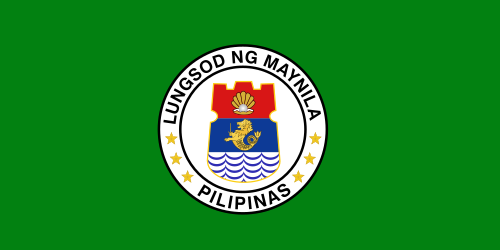 フラグ | |
| ニックネーム: 東洋の真珠[1 ]など | |
| モットー: マニラ、神第一 歓迎 Po Kayo sa Maynila (翻訳。 マニラへようこそ) | |
| 国歌:「Awit ng Maynila」(マニラの歌) | |
![マニラ首都圏の地図(マニラが強調表示されている)[a]](https://img-server.japedia.wiki/wikipedia/commons/thumb/f/f8/Manila_in_Metro_Manila.svg/500px-Manila_in_Metro_Manila.svg.png) マニラ首都圏の地図(マニラが強調表示)[a] | |
オープンストリートマップ | |
.svg/500px-Philippines_location_map_(square).svg.png)  マニラ フィリピン国内の位置 | |
| 座標: 14°35′45″N 120°58′38″E / 14.5958°N 120.9772°E / 14.5958; 120.9772 | |
| 国 |  フィリピン フィリピン |
| 地域 | 首都圏 |
| 立法区 | 第1~6地区 |
| 行政区 | 16の市区 |
| 設立 | 13世紀以前 |
| ブルネイ スルタン国(マニラ) | 1500年代 |
| スペインのマニラ | 1571年6月24日 |
| 都市憲章 | 1901年7月31日 |
| 高度に都市化された都市 | 1979年12月22日 |
| バランガイ | 897(バランガイと地区を参照) |
| 政府 [2] | |
| • タイプ | サングニアン パンルンソド |
| • 市長 | マリア・シェイラ・H・ラクナ・パンガン |
| • 副市長 | ジョン・マーヴィン・C・ニエト |
| • 代表者 | |
| • 市議会 | リスト |
| • 選挙民 | 1,133,042人の有権者(2022年) |
| エリア [3] | |
| • 市 | 42.34 km 2 (16.35 平方マイル) |
| • 都会的な | 1,873 km 2 (723 平方マイル) |
| • メトロ | 619.57 km 2 (239.22 平方マイル) |
| 標高 | 7.0 メートル (23.0 フィート) |
| 最高標高 | 108メートル(354フィート) |
| 最低標高 | 0 メートル (0 フィート) |
| 人口 (2020年国勢調査)[5] [6] | |
| • 市 | 1,846,513 |
| • 密度 | 43,611.5/km 2 (112,953/平方マイル) |
| • 都会的な | 13,484,482 [4] |
| • 都市の密度 | 21,764.3/km 2 (56,369/平方マイル) |
| • メトロ | 24,922,000 |
| • 地下鉄の密度 | 13,305.9/km 2 (34,462/平方マイル) |
| • 世帯 | 486,293 |
| 異名 | 英語: マニレニョ、マニラン語。 スペイン語: manilense、[7] manileño (f. -a ) フィリピン語: Manileño (f. -a )、Manileño (f. -a )、Taga-Maynila |
| 経済 | |
| • 所得階級 | 特別都市所得階級 |
| • 貧困率 | 1.10 |
| • HDI |  0.781 [9] –最高(2019) 0.781 [9] –最高(2019) |
| • 収益 | 19,692百万ペソ(2022年) |
| • 資産 | 73,694百万ペソ(2022年) |
| • 支出 | 16,047百万ペソ(2022年) |
| • 負債 | 26,765百万ペソ(2022年) |
| ユーティリティ | |
| • 電気 | マニラ電力会社 (メラルコ) |
| • 水 | •マニラッド(大部分) •マニラ ウォーター(サンタ アナおよびサン アンドレス) |
| タイムゾーン | UTC+8 (太平洋標準時) |
| 郵便番号 | +900 – 1-096 |
| PSGC | 133900000 |
| IDD :市外局番 | +63 (0)2 |
| 母国語 | タガログ語 |
| 通貨 | フィリピンペソ(₱) |
| Webサイト | マニラ |
.jpg/500px-Binondo_Skyline_(cropped).jpg)
.jpg/500px-38923-Manila_(35201250583).jpg)


_-_Flickr.jpg/500px-Roxas_Boulevard_(D._Stanley_pic)_-_Flickr.jpg)


マニラ(/ m ə ˈ n ɪ l ə / mə- NIL -ə ;フィリピノ語: Maynila、発音は [maɪˈnilɐʔ])、正式にはマニラ市(フィリピノ語: Lungsod ng Maynila [lʊŋˈsod nɐŋ maɪˈnilɐʔ])は、フィリピンの首都であり、ケソン市に次いで2番目に人口の多い都市です。ルソン島のマニラ湾東岸に位置し、高度に都市化された都市に分類されています。マニラは世界で最も人口密度の高い都市であり、[5] [6] 2020年の人口は1平方キロメートルあたり71,263人(184,570 /平方マイル)で1,846,513人です。[5]また、行政上の境界をはるかに超えて広がる市街地の歴史的中心地でもある。マニラは、1901年7月31日にフィリピン委員会法第183号によって指定された、国内で最初の認可都市である。1949年6月18日に共和国法第409号「マニラ市改訂憲章」が可決され、自治権を獲得した。[10]マニラは、その商業ネットワークが太平洋を越えて広がり、ガレオン船貿易を通じてアジアとスペイン領アメリカを結んだ最初の都市であったため、世界で最初のグローバル都市群の一部であると考えられている。これは、地球を一周する途切れることのない貿易ルートの連鎖が確立された最初の例であった。[11] [12]
1258年までに、マニラと呼ばれるタガログ語で要塞化された政体が、現在のマニラの場所に存在していました。1571年6月24日、政体の最後の先住民支配者、ラジャ・スレイマンがバンクサイの戦いで敗北した後、スペインの征服者ミゲル・ロペス・デ・レガスピは、スペイン語と英語の名前「マニラ」の由来となった古い集落の廃墟に、壁で囲まれたイントラムロスの要塞の建設を開始しました。マニラは、マリアナ諸島、グアム、その他の島々を含むスペイン領東インドの総司令官の首都として使用され、ヌエバ・エスパーニャ副王領のメキシコシティによってスペイン王室のために制御および管理されていました。
現代では、「マニラ」という名前は、首都圏全体、大都市圏、市自体を指すのによく使われます。公式に定義された首都圏であるマニラ首都圏は、フィリピンの首都圏であり、はるかに大きなケソン市とマカティ中央ビジネス地区が含まれます。フィリピンで最も人口の多い地域であり、世界でも最も人口の多い都市圏の1つであり、[13]東南アジアで最も裕福な地域の一つです。
パシグ川は市の中央を流れ、市を北部と南部に分けます。市は16の行政区で構成され、フィリピン議会への代表と市議会議員の選挙のために6つの政治区に分かれています。2018年、グローバリゼーションと世界都市研究ネットワークはマニラを「アルファ」グローバル都市に挙げ、[14]経済パフォーマンスでは世界第7位、地域で第2位にランク付けしました。[15]一方、世界金融センター指数ではマニラは世界第79位にランクされています。[16]マニラは世界で2番目に自然災害にさらされている都市でもありますが、[17]東南アジアで最も急速に発展している都市の1つでもあります。[18]
語源
この都市のフィリピン語名であるマニラは、「藍が見つかる場所」を意味するmay-nilàという語句に由来している。 [19] ニラはサンスクリット語のnīla ( नील ) に由来しており、藍染料、さらにはこの天然染料を抽出できるいくつかの植物種を指す。 [19] [20]マニラという名前は、藍染料を取引する集落として知られていたからというよりも、集落の周囲に藍を採れる植物が生えていたために付けられたものと思われる。[19]藍染料の抽出は、マニラ集落が設立され、その名前が付けられてから数百年後の 18 世紀になって初めて、この地域で重要な経済活動となった。 [19] マニラは最終的にスペイン化の過程を経て、スペイン語の名前であるマニラを採用した。[21]
メイニラド
古くて不正確で、現在では誤りとされている語源説によると、この都市の名前は「ニラドが見つかる場所」を意味する「may-nilad 」という言葉に由来している。 [19]この誤った語源説には2つのバージョンがある。1つは、古い言葉「nilad」がパシグ川の岸に生えるホテイアオイ(Eichhornia crassipes )を指しているという誤った考えである。[19]しかし、この植物種は最近になって南米からフィリピンに導入されたため、古いマニラの地名の由来ではあり得ない。[19]
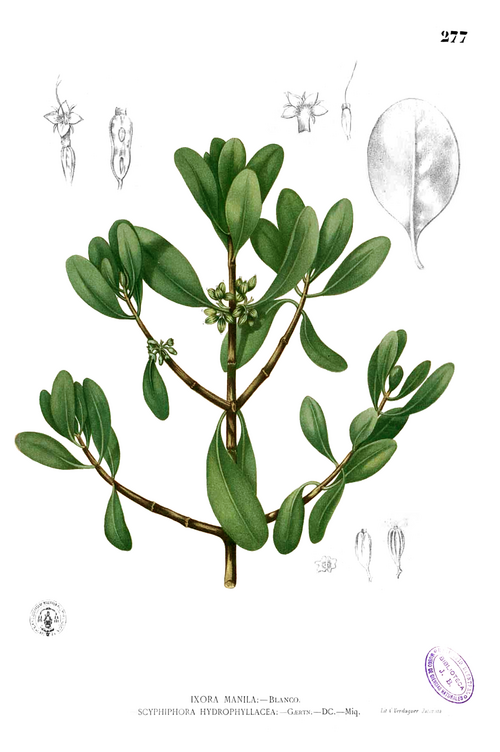
もう一つの誤った語源は、タガログ語でniládまたはnilárが、マングローブの沼地やその近くに生える低木のような木(Scyphiphora hydrophyllacea、以前はIxora manila Blanco)を指すという観察から生じた。 [19] [22] [23]しかし、言語分析は、 Maynilàという単語がこの用語から発展した可能性は低いことを示している。タガログ語を母国語とする人がniladの最後の子音/d/を完全に削除して、現在の形Maynilàに到達する可能性は低い。[19]例えば、近くのBacoorは、古いタガログ語のbakoód(「高くなった土地」)の最後の子音を保持しており、これは地名の古いスペイン語訳(例: Vacol、Bacor)でも保持されている。[24]歴史家アンベス・オカンポ[25] [26]とジョセフ・バウムガルトナー[19]は、あらゆる初期の文献において、地名マニラは常に末尾の/d/なしで書かれていたことを明らかにした。この文献は、may-niladの語源が偽りであることを示している。
もともと、niladが地名の由来であると誤って特定されたのは、おそらく 1887 年のTrinidad Pardo de Taveraのエッセイに端を発しており、その中で彼は、nilaという単語をIndigofera tinctoria (真の藍) とIxora manila (タガログ語では実際にはnilád ) の両方を指すのに誤って使用しました。 [23 ] 。[20] [19] 20 世紀初頭のJulio Nakpil、[27]や Blair と Robertsonなどの著作でも、この主張が繰り返されています。[28] [26]今日でも、この誤った語源は、文学での何気ない繰り返しや一般的な使用を通じて、引き続き存続しています。 [29] [30]この誤った語源が一般に採用されている例としては、地元の公益事業会社Maynilad Water Servicesの名前や、マニラ市役所に近い地下道の名前Lagusnilad (「Nilad Pass」の意) などがあります。[25]
一方、フィリピンの植物相についてのかなり最初の重要性の説明は、レイの 歴史『プランタルム』の付録として1704年に掲載された、ルゾネ島フィリピナルム プリマリア ナスセンティウムの植物標本標本である aliarumque Stirpiumです。Georg Josef Kamil [31]は、次のように述べています。Nilad arbor mediocris、rarissimi Recta、ligno folido、et Compacto ut Molavin、ubi豊富なマングル、locum vocant Manglar、ita ubi nilad、Maynilad、unde破損したマニラ(Niladは平均的な木です、非常に珍しい真っ直ぐで、葉の多い木で、マングルがたくさんあるモラヴィンのようにコンパクトで、その場所はマングラーと呼ばれ、ニラド(豊富)がある場所、マニラド、そこから腐敗したマニラ)[32]、これはこの変化の初期の説明である。名前。
歴史
初期の歴史
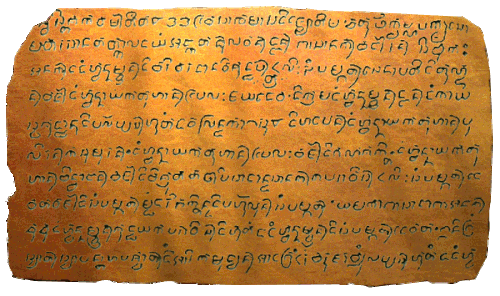
現在のマニラ周辺における人類最古の生命の証拠は、近くにあるアンゴノ・ペトログリフで、紀元前3000年頃のものとされる。フィリピンの先住民であるネグリト人は、マラヤ・ポリネシア人が到着して同化する以前は、マニラがあるルソン島全域に住んでいた。[33]
マニラは中国の宋代と元代との活発な貿易相手国であった。 [34]
トンドの政治は、中国との直接貿易関係の結果として、明朝後半に繁栄した。トンド地区は帝国の伝統的な首都であり、その支配者は首長ではなく統治者である王であった。トンドは、中国の南東に位置することから、福建語読みの繁体字中国語で「東都」と名付けられた。トンドの王は、タガログ語でパンギノオン(「領主」)、アナク・バンワ(「天子」)、またはラカンドゥラ(「宮殿の領主」)と呼ばれた。中国の皇帝は、古代マニラの支配者であるラカンを「王」(王)とみなした。 [35]
12世紀、中国の年代記『南海志』に記されているように、当時ヒンドゥー教徒だったブルネイは「ポンイ」と呼ばれ、サラワク州とサバ州、フィリピン王国ブトゥアン、スールー、マーイ(ミンドロ)、シャフーチョン沙胡重(現在のシオコン)、ヤチェン・オトン(現在のミンダナオ)、文杜陵ウェンドゥリン(現在のミンダナオ)も統治していたマリル(現在のマニラ)を侵略した。マニラは独立を取り戻した。[36] 13世紀、マニラはパシッグ川沿いの要塞化された集落と交易地区で構成されていた。その後、マハラジャ・ハヤム・ウルクによるこの地域の征服を描いた叙事詩『ナガラクレタガマ』によると、インド化したマジャパヒト帝国に征服された。マニラの歴史的名称であるセルロン(षेलुरोङ्)は、第14巻にスロト(現在のスールー)やカルカとともに記載されている。セルロンはスロトとともにその後独立を取り戻し、スールーは報復として当時マジャパヒトに侵略されていたポニ(ブルネイ)を攻撃し略奪した。[37]
1485年から1521年までのアラブ首長、スルタン・ボルキア(シャリフ・アリの子孫)の統治下で、ヒンドゥー教のマジャパヒトから離脱してイスラム教に改宗したブルネイ国がこの地域を侵略した。ブルネイ人は中国との直接貿易におけるトンドの戦略的位置を利用したいと考え、続いてこの地域を攻撃し、マニラ国(كوتا سلودوڠ;コタ・セルドン)を建国した。国はブルネイの支配下にあり、衛星国として毎年貢物を納めていた。[38]国はイスラム教を受け入れてラジャ・サラリラまたはスライマン1世となった地元の指導者の下で新しい王朝を築いた。彼はトンドの既に裕福であったラカン・デュラ家に対して貿易上の挑戦権を確立した。イスラム教は中東や東南アジアからのイスラム教徒の商人の到来によってさらに強化されました。[39]
スペイン時代
.jpg/500px-Walled_City_of_Manila,_detail_from_Carta_Hydrographica_y_Chorographica_de_las_Yslas_Filipinas_(1734).jpg)
.jpg/500px-Gerald_R_Mondala_Ayuntamiento_de_Manila_(Casas_Consistoriales).jpg)
1571年6月24日、征服者 ミゲル・ロペス・デ・レガスピがマニラに到着し、ここをヌエバ・エスパーニャ(メキシコ)の領土であると宣言し、現在のイントラムロス地区に市議会を設置した。レコンキスタ(ウマイヤ朝が支配していた国土の一部を再びキリスト教化して奪還するためのスペイン本土での戦争)に触発されたレガスピは、ヒンドゥー教徒のトンドとイスラム教徒のマニラとの領土紛争を利用して、マニラの家臣を支持するブルネイのイスラム教徒入植者を追放または改宗させることを正当化した。一方、メキシコ人の孫であるフアン・デ・サルセドは、トンドの王女カンダラパと恋愛関係にあった。[40]ロペス・デ・レガスピはマハルリカの陰謀が失敗した後、地元の王族を処刑または追放した。マハルリカの陰謀は、ダトゥ、ラジャ、日本の商人、ブルネイ王国の同盟が結託してスペイン人を、ラテンアメリカの新兵やビサヤの同盟者とともに処刑するという計画だった。勝利したスペイン人はマニラをスペイン領東インドとフィリピンの首都とし、その後3世紀にわたってスペイン帝国が支配した。1574年、マニラは中国人の海賊リム・ホンに包囲されたが、地元住民に阻止された。スペイン人が定住するとすぐに、マニラは教皇の勅令によりメキシコ大司教区の属司教区となった。スペイン国王フェリペ2世の勅令により、マニラは聖プデンティアナと導きの聖母の精神的保護下に置かれた。[あ]
マニラは、2世紀以上にわたって続いたマニラ・アカプルコ間のガレオン船貿易で有名になり、ヨーロッパ、アフリカ、ヒスパニック系アメリカの商品を太平洋諸島を越えて東南アジアに運び、またその逆も行われました。メキシコとペルーで採掘された銀は、中国の絹、インドの宝石、インドネシアとマレーシアの香辛料と交換されました。ヨーロッパと北アフリカで栽培されたワインとオリーブは、メキシコ経由でマニラに輸送されました。[41] 1549年に明が足利将軍家に対して貿易禁止令を発令したため、すべての日本人は中国に入国できず、中国船は日本に航行できなくなりました。マニラは、日本人と中国人が公に貿易できる唯一の場所になりました。[42] 1606年、スペインがスパイス栽培の独占国の一つであったテルナテ王国を征服した際、スペインはテルナテ王国の支配者スルタン・サイード・ディン・ブルカット[43]とその一族、側近をマニラに追放し、最初は奴隷として働かせた後、キリスト教に改宗させた。[44]後日、テルナテ島とティドル島出身のスペイン・メキシコ・フィリピン系とモルッカ・インドネシア・ポルトガル系の混血の約200家族が彼を追ってマニラに移った。[45]
この都市はシルクロード、香辛料の道、銀の道の合流点に位置していたため、莫大な富を得た。[46]この地域におけるヨーロッパとアジアの貿易を可能にした商人の仲介者としてのアルメニア人の役割は重要であった。フランスはアルメニア人のホジャを通じたマニラでのパートナーシップでアジア貿易の資金調達を試みた最初の国であった。最大の貿易量は鉄であり、1721年には1,000本の鉄の棒が取引された。 [47] 1762年、スペインが最近参戦した七年戦争の一環として、この都市はイギリスに占領された。 [48]イギリスは1762年から1764年までの20か月間、スペイン領東インドを占領しようとしてこの都市を占領したが、マニラより先に占領を拡大することはできなかった。[49]残りの群島を占領できないことに不満を抱いたイギリス軍は、1763年に調印されたパリ条約に従って撤退し、戦争は終結した。イギリス軍に同行したセポイと呼ばれるインド人兵士の数は不明だが、彼らは逃亡し、近くのリサール州カインタに定住した。[50] [51]

少数派の中国人はイギリスを支援したとして罰せられ、要塞都市イントラムロスは当初1,200の純粋なスペイン人家族が住み、400人のスペイン軍が駐屯していたが[52]、世界最古のチャイナタウンであるビノンドに大砲を向け続けた。[53]生粋のスペイン人の人口はマニラ南部に集中しており、1787年にはラ・ペルーズが1,300人のスペイン人連隊がマニラに駐屯していたと記録している。 [54]彼らはまた、スペインのアメリカ植民地からの船が停泊するカビテ[55]や、そこに住んでいたメキシコ人の隠者にちなんで名付けられたエルミタにも駐屯していた。その隠者司祭の名前はフアン・フェルナンデス・デ・レオンで、マニラに移住する前はメキシコで隠者だった。[56]司祭たちも通常は一人ではなく、信徒の兄弟姉妹を連れていた。1603年、1636年、1644年、1654年、1655年、1670年、1672年には、メキシコからマニラに900人、446人、407人、821人、799人、708人、667人のラテンアメリカ人兵士が派遣された。[57]フィリピンはアジアで唯一ラテンアメリカ人が設立した地区を抱えている。[58] [59]スペイン人はテルナテ島から撤退し、パプア難民を彼らの旧故郷にちなんで名付けられたカビテ州テルナテ島に定住させた。[60] 1603年には、マニラには25,000人の中国人[61] : 260 が住み、3,528のスペイン人とフィリピン人の混血家族が住んでいた。[61] : 539
スペイン領マニラの出現は、すべての半球と大陸が世界規模の貿易ネットワークで相互接続された初めての出来事であり、マニラはメキシコシティやマドリードと並んで、世界初のグローバル都市群となった。[62]スペインのイエズス会司祭は、マニラでは多くの外国語が交わるため、マニラの告解室は「世界で最も難しい」と評した。[63] [64] 1600年代の別のスペイン人宣教師フアン・デ・コボは、マニラの商業、文化の複雑さ、民族の多様性に非常に驚き、メキシコの同胞に次のように書き送った。
ここの多様性は計り知れないほどで、土地や民族を区別しようとすれば、いつまでも続けられるだろう。すべての州からカスティーリャ人がやってくる。ポルトガル人やイタリア人、オランダ人、ギリシャ人、カナリア諸島人、メキシコのインディアンがいる。スペイン人によって連れてこられたアフリカの奴隷もいる(アメリカ経由で)、ポルトガル人によって連れてこられた奴隷もいる(インド経由で)。ターバンを巻いたアフリカのムーア人もここにいる。ジャワからはジャワ人が、ベンガルからは日本人やベンガル人がやってくる。こうした人々のなかには、数え切れないほどの中国人がいて、他のすべての人々よりも多い。中国からは、互いに非常に異なる民族がやってくる。イタリアとスペインのように遠く離れた州からやってくる民族もいる。最後に、混血のメスティーソについては、マニラでは民族同士の組み合わせに限りがないので、書き記すことさえできない。これは、騒がしい街のことだ。(レメサル、1629:680-1)[65]
_by_Brambila.jpg/500px-Manila_Cathedral_(1792)_by_Brambila.jpg)
1821年にメキシコがスペインから独立した後、スペイン王室がマニラを直接統治し始めた。[66]スペインの直接統治下で、銀行、産業、教育は過去2世紀よりも繁栄した。[67] 1869年のスエズ運河の開通により、スペインとの直接貿易と通信が容易になった。マニラの富と教育の増大により、周辺州の先住民、ネグリト、マレー、アフリカ、中国、インド、アラブ、ヨーロッパ、ラテン系、パプア人が集まり、[68]自由主義的な思想を信奉するイルストラド階級の台頭が促進され、それがスペインからの独立を求めたフィリピン革命の思想的基礎となった。アンドレス・ノヴァレスによる反乱はラテンアメリカ独立戦争に触発されたものだったが、反乱そのものは、メキシコ、コロンビア、ベネズエラ、ペルー、チリ、アルゼンチン、コスタリカといった新しく独立した国々から市内に駐留していた降格されたラテンアメリカ軍将校によって主導された。[69]カビテの反乱とプロパガンダ運動に続いてフィリピン革命が始まった。マニラは反乱を起こした最初の8つの州の一つであり、その役割はフィリピン国旗に記念され、国旗上でマニラは象徴的な太陽の8つの光線のうちの1つで表された。[70]
アメリカの侵略時代
1898年のマニラの戦いの後、スペインは米国に市を割譲した。近くのブラカンに拠点を置いていた第一フィリピン共和国は、市の支配権をめぐって米国と戦った。[71]米国は第一フィリピン共和国を破り、大統領エミリオ・アギナルドを捕らえた。アギナルドは1901年4月1日に米国に忠誠を誓った。[72] 1901年6月にマニラの新憲章を起草した米国は、マニラ市がイントラムロスとその周辺地域で構成されることを公式に認めた。新憲章では、マニラはビノンド、エルミタ、イントラムロス、マラテ、パコ、パンダカン、サンパロック、サンミゲル、サンタアナ、サンタクルス、トンドの11の自治体区で構成されると宣言された。カトリック教会は5つの教区をマニラの一部として認めた。ガガランギン、トロゾ、バリバリック、サンタメサ、シンガロング。その後、バルートとサンアンドレスが追加されました。[73]
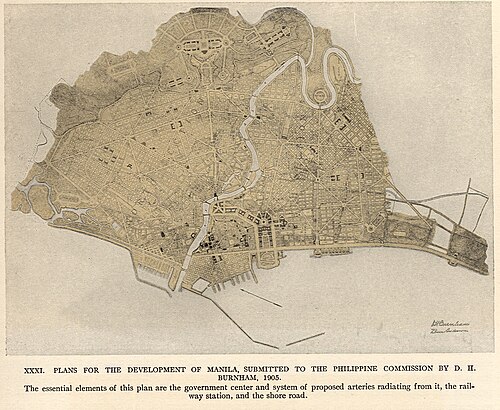
米国の支配下で、ウィリアム・ハワード・タフト総督率いる新しい民間志向の島嶼政府は、マニラを現代のニーズに適応させるため、都市計画家ダニエル・バーナムを招聘した。 [74]バーナム計画には、道路網の開発、輸送のための水路の利用、ウォーターフロントの改善と公園、公園道路、建物の建設によるマニラの美化が含まれていた。[75] [76]計画された建物には、リサール公園から現在のタフト通りまで広がるウォレスフィールド全体を占める政府センターが含まれていた。フィリピンの首都は、海に面したフィールドのタフト通りの端に建つことになっていた。政府局や部門の建物とともに、中央にラグーンがあり、フィールドの反対側の端にホセ・リサールの記念碑がある四角形を形成することになっていた。 [77]バーナムが提案した政府センターのうち、立法府と財務省、農業省の建物の3つの建物だけが第二次世界大戦前に完成した。
- アメリカ統治時代のマニラのギャラリー
-
 1900 年代初期のモラガ広場
 -

-

-
 マニラの航空写真、1936年
日本占領時代

日本軍によるフィリピン占領中、アメリカ軍はマニラから撤退するよう命令され、1941年12月24日までにすべての軍事施設が撤去された。2日後、ダグラス・マッカーサー将軍はさらなる死傷者と破壊を防ぐためにマニラを無防備都市と宣言したが、日本軍の戦闘機は市への爆撃を続けた。[78]日本軍は1942年1月2日にマニラを占領した。 [79]
1945年2月3日から3月3日まで、マニラは第二次世界大戦の太平洋戦域で最も血なまぐさい戦闘の一つの現場となった。日本軍の岩渕三治少将の命令により、撤退する日本軍は2月に約10万人のフィリピン民間人を殺害し、女性の集団強姦を犯した。[80] [81]戦争の終わりには、マニラは激しい爆撃に見舞われ、第二次世界大戦で2番目に破壊された都市となった。[82] [83]マニラはアメリカ軍とフィリピン軍によって奪還された。
戦後と独立の時代

戦後、復興の取り組みが始まった。マニラ市庁舎、立法府(現在の国立美術館)、マニラ郵便局などの建物が再建され、道路やその他のインフラが修復された。1948年、エルピディオ・キリノ大統領はフィリピンの政府所在地を、マニラの北東郊外にある新しい首都ケソン市に移した。ケソン市は、1939年にマヌエル・L・ケソン大統領の政権下で創設された。[84]この移転により、政府の中心地をルネタに置くというバーナム・プランの意図は実行されなくなった。 1952年にアルセニオ・ラクソンがマニラ初の市長に選出されると(それまでにすべての市長が任命されていた)、マニラは「黄金時代」を迎え、[85]戦前の「東洋の真珠」という呼び名を取り戻した。 1950年代のラクソンの任期の後、 1960年代の大半はアントニオ・ビジェガスがマニラを率いた。ラモン・バガトシングは1972年から1986年のピープルパワー革命まで市長を務めた。[86]
フェルディナンド・マルコス政権下では、1975年11月7日に大統領令第824号が制定され、マニラ首都圏が統合された。この地域は4つの都市と13の隣接する町を包含し、独立した地方政府単位となった。[87] 1976年6月24日、マニラ市創設405周年にあたり、マルコス大統領はスペイン統治時代以来の政府所在地としての歴史的重要性を理由にマニラをフィリピンの首都に復帰させた。[88] [89]同時に、マルコスは妻のイメルダ・マルコスをマニラ首都圏の初代知事に任命した。彼女は都市の再活性化を開始し、マニラを「人間の都市」と再ブランド化した。[90]
戒厳令時代
1970年1月のフェルディナンド・マルコス政権に対する最初の大規模な抗議から1986年2月の追放まで、歴史的時期の重要な出来事の多くはマニラ市内で起こった。最初の「第一四半期の嵐」のきっかけとなった1970年1月26日の国情演説抗議は、パドレ・ブルゴス通りの立法府(現在の国立美術館)で起こった。[91]そして最後の抗議では、マルコス一家がマラカニアン宮殿から米国に亡命した。 [92] [93] [94]
フェルディナンド・マルコス大統領の二期目の最初の数週間は、1969年の国際収支危機で特徴づけられたが、経済学者は、これが票集めのために大規模な政府プロジェクトに外国からの借款を利用した一期目の戦術に起因するとしている。[95] [96] [97] これに抗議して、主に学生が率いる抗議グループは、1月26日に議事堂で行われたマルコスの1970年の国情演説をピケで妨害することを決めた。抗議者たちは、穏健な改革派グループと急進派活動家グループの両方が出席し、舞台を掌握しようと争っていたため、当初は口論していた。しかし、彼らの主張に関わらず、全員がフィリピン警察によって暴力的に解散させられた。 [ 98] [99]これに続いて、1月末から1970年3月17日まで、さらに6つの大規模な抗議活動が暴力的に解散させられた。[93]
翌年も不安定な状況が続き、最も重大な事件は1971年8月のプラザ・ミランダ爆破事件で、現職上院議員のジョビト・サロンガ、エディ・イラルデ、エバ・エストラーダ・カラオ、自由党議長のヘラルド・ロハス、セルヒオ・オスメニャ・ジュニア、マニラ第2区議会議員のアンブロシオ・「キング」・ロレンソ・ジュニア、マニラ市長候補のラモン・バガツィン下院議員など、多くの著名な自由党政治家を含む9人が死亡、95人が負傷した。 [99]
マルコスは爆破事件に対して、まだ発足間もないフィリピン共産党を非難し、人身保護令状の停止を命じた。この停止は、エドガー・ジョプソンのような人物を含む穏健派野党の多くのメンバーを過激派に加わらせたことで知られている。爆破事件後、マルコスは野党全員をひとまとめにして共産主義者と呼び、多くの元穏健派はマルコス軍に逮捕されるのを避けるために過激派野党の山岳キャンプに逃げ込んだ。マルコス政権の行き過ぎに幻滅し、1971年以降に野党に加わりたいと考えた人々は、単にマルコス政権に声高に反対する唯一のグループであるという理由だけで、過激派に加わることが多かった。[100] [101]
1972年9月にマルコスが戒厳令を宣言すると、マニラを拠点とするマニラ・タイムズ、フィリピン・フリー・プレス、マニラ・トリビューン、フィリピン・ヘラルドなど、ケソン市のメディアを含むマルコスが承認していないすべてのメディアが即時閉鎖された。同時に、マルコスにとって政治的脅威と見なされた多くの学生、ジャーナリスト、学者、政治家が逮捕されたが、その多くはマニラ市の住民だった。最初の逮捕者はニノイ・アキノで、翌朝の上院委員会の準備をするためにUN通りのホテルに滞在していたところ、9月22日深夜直前に逮捕された。[99]
9月23日の最初の数時間だけで、マルコス政権を批判していた約400人が投獄され、最終的に約7万人がマルコス独裁政権下で政治犯として拘留された。そのほとんどは令状なしで逮捕されたため、囚人ではなく拘留者と呼ばれた。[102] [103] 少なくとも11,103人がその後、フィリピン政府によって公式に広範囲にわたる拷問と虐待を受けたと認定された。[104] [105]そして1973年4月、マニラ解放運動の学生ジャーナリスト、リリオサ・ヒラオが獄中で殺害された最初の被拘留者となった[106] 。これはマルコス大統領の最後の14年間に起きた3,257件の超法規的殺害のうちの1件である。 [107]
1975年、マルコスはマニラ、ケソン市、カロオカン、パサイの4都市と、ラス・ピニャス、マカティ、マラボン、マンダルヨン、マリキナ、モンテンルパ、ナボタス、パラニャーケ、パシグ、パテロス、サンファン、タギッグ、バレンズエラ。そして彼は、ドビー・ビームスのスキャンダルの際に彼の悪戯が暴露されて激怒していた妻のイメルダ・マルコスをマニラ首都圏知事に任命した。[108]
マルコスが戒厳令を布告したにもかかわらず、貧困やその他の社会問題は解決せず、軍を統制してもマルコスは騒乱を抑えることができなかった。トンドでは1975年にラ・トンデーニャ蒸留所のストライキという形で大きな転機が訪れた。これはマルコス独裁政権に対する最初の大きな公然の抵抗行動の一つであり、国内の他の地域での同様の抗議行動への道を開いた。[109]それ以来、マニラは抵抗活動の中心地であり続け、若者や学生のデモ隊は繰り返し警察や軍と衝突した。[110]
もう一つの大きな抗議活動は、 1984年9月にマニラとケソン市の境界で起きたウェルカム・ロトンダ抗議運動の解散だった。これは前年の1983年のアキノ大統領暗殺を受けて起こった。国際的な圧力によりマルコス大統領は報道の自由を強要され、報道によってフィリピン国民は、80歳の元上院議員ロレンソ・タナダや71歳のマニラ・タイムズ創刊者チノ・ロセスなどの野党指導者が虚弱体質にもかかわらず放水銃で撃たれたことや、学生リーダーのフィデル・ネメンゾ(後にフィリピン大学ディリマン校学長)が射殺されかけたことを知ることになった。[111] [112] [113]
ピープルパワー革命
1985年後半、国民の不満が高まり、外国の同盟国からの圧力を受け、マルコスは任期が1年以上残っている中で総選挙を呼びかけ、アルトゥーロ・トレンティーノを副大統領候補に選んだ。マルコス反対派はニノイの未亡人コラソン・アキノと副大統領候補サルバドール・ラウレルの支持に集まった。[114] [115]選挙は1986年2月7日に実施されたが、暴力や選挙結果の改ざんが広く報じられた。[116]
1986年2月16日、コラソン・アキノはルネタ公園で「タグムパイ・ング・バヤン(人民の勝利)」集会を開催し、市民的不服従運動を宣言し、支持者に対しマルコスやその取り巻きと関係のある出版物や企業をボイコットするよう呼びかけた。[117]この集会には約200万人が参加した。[118]アキノ陣営はさらなる集会の準備を始め、アキノ自身もセブ島に行き、より多くの人々を自分たちの大義に結集させた。[119]
選挙と不正行為の暴露の余波で、フアン・ポンセ・エンリレと、フィリピン軍の不満を抱く将校たちの陰謀団である軍改革運動(RAM)は、フェルディナンド・マルコスとイメルダ・マルコスに対するクーデターを企てた(AFP [120])。[ 121 ]エンリレとRAMのクーデターはすぐに発覚し、エンリレはフィリピン警察長官フィデル・ラモスに支援を求めた。ラモスはエンリレに合流することに同意したが、それでも彼らの連合軍はキャンプ・クラメとキャンプ・アギナルドに閉じ込められ、マルコス支持派の軍に制圧されそうになった。[122] [123] [124]何が起こっているのかを知ると、アキノの市民的不服従運動を組織していた部隊は、2つの陣営の間のエフィパニオ・デ・ロス・サントス通り(EDSA)の区間に行き、マルコス支持派の攻撃を防ぐための人間のバリケードを作り始めた。ラモスがマニラのハイメ・シン枢機卿に助けを求めて電話をかけると、群衆はさらに大きくなり、シンはラジオ・ベリタスに出演して、エンリレとラモスを守るためにカトリック教徒に加わるよう呼びかけた。[125]何が起こっているのかを見て、フィリピン軍の複数の部隊がマルコスから離反し、アントニオ・ソテロ将軍とチャールズ・ホッチキス大佐の指揮下にある航空部隊とともに、マラカニアン宮殿の敷地を銃弾で掃射し、近くのビジャモール空軍基地のガンシップを無力化するなど、計算された作戦を実行した。[122]
レーガン政権は最終的にマルコスに亡命の機会を与えることを決定した。1986年2月26日の真夜中過ぎに、マルコス一家はマラカニアン宮殿から逃げ出し、クラーク空軍基地に連行された後、ファビアン・バーやダンディン・コファンコなどの選ばれた支持者とともにホノルルに亡命した。[92]軍ではなく路上の民間人が勝利を勝ち取ったため、この出来事はピープルパワー革命と呼ばれた。フェルディナンド・マルコスのフィリピン大統領としての21年間、そして独裁的な指導者としての14年間は終わった。[92] [123]
コンテンポラリー
1986年から1992年まで、メル・ロペスは大統領指名によりマニラ市長を務め、1988年に選出された。 [126] 1992年、アルフレド・リムが市長に選出され、同職に就いた初の中国系フィリピン人となった。彼は反犯罪運動で知られていた。リムの後任は副市長を務めたリト・アティエンサで、彼は「マニラをよみがえらせろ」というスローガンを掲げたキャンペーンで知られ、いくつかの公園の設立や、老朽化した市の施設の修復と再生を行った。彼は任期満了まで9年間市長を務めた。リムは再び市長選に立候補し、2007年の市選挙でアティエンサの息子アリを破り、直ちにアティエンサの計画をすべて撤回した。 [127]リムは、計画は市の改善にほとんど貢献していないと述べた。両者の関係は悪化し、 2010年の市選挙では両者が立候補し、リムが勝利した。リムは2008年に人権問題をめぐって市会議員デニス・アルコレザから訴えられ、[128]公立学校の再建をめぐる汚職の罪で起訴された。 [129]
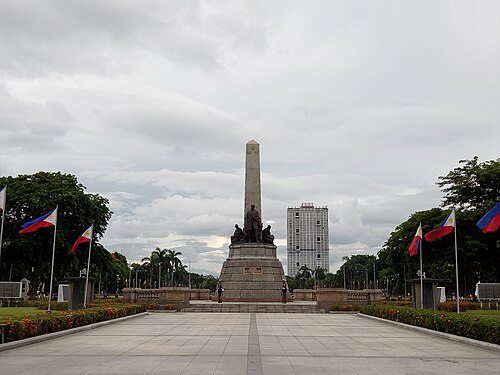
2012年、DMCIホームズはトーレ・デ・マニラの建設を開始したが、リサール公園の眺望を遮るとして物議を醸した。 [130]このタワーは「マニラのテロ」や「国民のフォトボンバー」として知られるようになり、[131]センセーショナルな遺産問題となった。2017年、フィリピン国立歴史委員会はロハス通りに「慰安婦」像を設置し、日本とフィリピンの良好な関係にもかかわらず、日本は像の設置について遺憾の意を表明した。[132] [133]
2013年の選挙で、ジョセフ・エストラーダ元大統領がリムの後任として市長に就任した。エストラーダ氏は任期中、市の負債50億ペソを返済し、市の歳入を増やしたとされる。2015年、ノイノイ・アキノ大統領の政権の進展に伴い、この都市はフィリピンで最も競争力のある都市となった。 2016年の選挙では、エストラーダ氏が僅差でリム氏に勝利した。[134]エストラーダ氏の任期中、数多くのフィリピン文化遺産が破壊され、内部が破壊され、あるいは破壊が承認された。これには、戦後のサンタクルスビル、キャピトルシアター、エルオガール、マグノリアアイスクリーム工場、リサール記念スタジアムなどがある。[135] [136] [137]これらの遺跡のいくつかは、政府の文化機関や文化遺産擁護団体の介入により救われた。[138] 2019年5月、エストラダはマニラは無借金であると述べた。[139]しかし、2ヵ月後、監査委員会はマニラは44億ペソの負債を抱えていると述べた。[140]
.jpg/500px-Binondo_skyline_skyscrapers_(Manila;_12-23-2023).jpg)
3期目かつ最後の任期で再選を目指していたエストラーダは、2019年の地方選挙でイスコ・モレノに敗れた。[141] [142]モレノはリム、エストラーダ両市長の下で副市長を務めた。エストラーダの敗北は、彼らの政治的一族としての統治の終焉と見られ、他の一族は国や地方の役職に立候補している。[143]就任後、モレノは市全体で違法なベンダーの一掃を開始し、オープンガバナンスを促進する行政命令に署名し、市内の賄賂と汚職を阻止することを誓った。[144]彼の政権下では、マニラの高齢者に追加の特典と特権を与える条例がいくつか署名され、[145]マニラ大学とマニラ市立大学の学生を含む市内のすべての公立学校の12年生マニレニョの学生に毎月の手当が支給された。[146] [147]
2022年、タイムアウトはマニラを世界で最も優れた53の都市のリストで34位にランク付けし、「ユニークな習慣と料理に加えて、過小評価されている芸術と文化の中心地」と評した。マニラはまた、その年の指標で3番目に回復力があり、最も失礼でない都市に選ばれた。[148] [149] 2023年、インターネットのジオタグを利用した検索サイトクロスワードソルムは、マニラが世界で最も愛情深い首都であることを示した。[150]
2023年8月、ボンボン・マルコス大統領はマニラ市を含むマニラ湾のすべての埋め立て事業を一時停止した。 [151]しかし、市は異議を唱えておらず、一時停止された埋め立て事業を続行する用意がある。[152]
地理

_wiki.jpg/500px-Manila_Bay_beach_(Roxas_Boulevard,_Manila;_09-19-2020)_wiki.jpg)
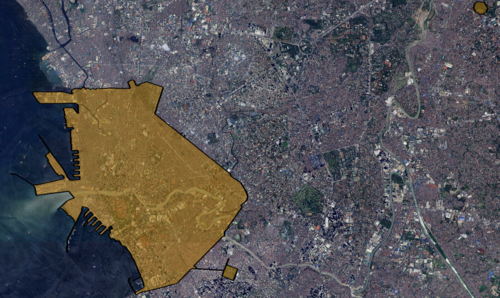
マニラ市はマニラ湾の東岸、ルソン島西岸に位置し、アジア大陸から1,300km(810マイル)離れている。[153]マニラが位置する保護された港はアジアで最も美しい港とみなされている。[154]パシグ川が市の中心部を流れ、市を南北に分割している。[155] [156]市の中心部の市街地の全体的な傾斜は、自然の地形の自然な平坦さと比較的一致しており、一般的にわずかな差異しか見られない。 [157]
マニラのほぼ全域は、パシグ川の水によって形成された先史時代の沖積堆積物とマニラ湾の干拓地の上に位置している。マニラの土地は人間の介入によって大幅に改変されており、20世紀初頭から中期にかけて、水辺沿いで大規模な干拓が行われた。都市の地形の自然な変化の一部は平らになっている。2013年現在[update]、マニラの総面積は42.88平方キロメートル(16.56平方マイル)である。[155] [156]
2017年に市政府は5つの埋め立てプロジェクトを承認した。ニューマニラベイ・シティ・オブ・パール(ニューマニラベイ国際コミュニティ)(407.43ヘクタール(1,006.8エーカー))、ソーラーシティ(148ヘクタール(370エーカー))、マニラハーバーセンター拡張(50ヘクタール(120エーカー))、マニラウォーターフロントシティ(318ヘクタール(790エーカー))、[158]およびホライズンマニラ(419ヘクタール(1,040エーカー))。計画されている5つのプロジェクトのうち、ホライズンマニラのみが2019年12月にフィリピン埋め立て局によって承認され、2021年に建設が予定されている。[159]別の埋め立てプロジェクトも可能であり、建設されると、市内の住宅移転プロジェクトが含まれることになる。[160]環境活動家やカトリック教会は、この埋め立てプロジェクトは持続可能ではなく、地域社会を洪水の危険にさらすとして批判している。[161] [162]今後の埋め立てプロジェクトに合わせ、フィリピンとオランダは、マニラ湾のプロジェクトに関する将来の決定を監督するために、2億5000万ペソのマニラ湾持続可能な開発マスタープランに関する協力に合意した。[163]
バランガイと地区


マニラは897のバランガイから構成されており、[164]統計上の便宜上、100のゾーンにグループ化されています。マニラはフィリピンのどの大都市よりもバランガイの数が多いです。[165]住民投票が行われなかったため、既存のバランガイを合併して896から150に数を減らすという地方立法(1996年4月23日に可決された条例7907号)にもかかわらず、バランガイの数を減らす試みは成功していません。[166]
- 第1地区(2020年の人口:441,282人) [167]はトンド西部を占め、136のバランガイで構成されている。最も人口密度の高い選挙区であり、トンドIとしても知られていた。この地区には、最大の都市貧困コミュニティの1つが含まれている。バロット島のスモーキーマウンテンは、かつて国内最大の埋立地として知られ、何千人もの貧困層がスラム街で暮らしていた。1995年に埋立地が閉鎖された後、その場所に中層住宅が建設された。この地区には、マニラ港のマニラ北港センター、マニラ北港、マニラ国際コンテナターミナルもある。第1地区の境界は、近隣の都市ナボタスと南部の飛び地カロオカンである。
- 第2地区(2020年の人口:212,938人) [167]はトンド東部を占め、122のバランガイを含む。トンドIIとも呼ばれる。トンドの名所であるガガランギンや、人気のショッピングエリアでフィリピン国鉄のメインターミナル駅があるディビソリアを含む。第2地区の境界は隣の都市カロオカンである。
- 第3地区(2020年の人口:220,029人) [167]は、ビノンド、キアポ、サンニコラス、サンタクルスをカバーしています。123のバランガイがあり、「ダウンタウンマニラ」、市の歴史的なビジネス地区、世界最古のチャイナタウンが含まれています。第3地区の境界は、隣の都市ケソン市です。
- 第4地区(2020年の人口:277,013人) [167]は、サンパロックとサンタメサの一部を占めています。192のバランガイがあり、事実上のサブ地区である市の「大学ベルト」に沿って多くの大学があります。サント・トーマス大学は、1611年に設立されたアジア最古の大学です。第4地区の境界は、近隣の都市サンファンとケソンシティです。この大学には、少なくとも30人のカトリックの聖人が住んでいました。 [168] [169]
- 第5区(2020年の人口:395,065人) [167]は、エルミタ、マラテ、港湾エリア、イントラムロス、サンアンドレスブキッド、パコの一部をカバーしています。184のバランガイで構成されています。歴史的な城壁都市は、ユネスコ世界遺産のマニラ大聖堂とサンアグスティン教会とともにここにあります。第5区の境界は、隣接する都市マカティとパサイです。この地区には、マカティ市に囲まれた飛び地であるマニラ南墓地も含まれます。
- 第6地区(2020年の人口:300,186人) [167]は、パンダカン、サンミゲル、サンタアナ、サンタメサ、パコの一部をカバーしています。139のバランガイが含まれます。サンタアナ地区は、18世紀のサンタアナ教会と歴史的な先祖代々の家々で知られています。第6地区の境界は、近隣の都市であるマカティ、マンダルヨン、ケソンシティ、サンファンです。
気候
.svg/500px-Climate-Manila_(Philippines).svg.png)
ケッペンの気候区分によれば、マニラは熱帯モンスーン気候(ケッペン Am)に属し、熱帯サバンナ気候(ケッペン Aw)とほぼ境界を接している。マニラはフィリピンの他の地域と同様、完全に熱帯地方に位置している。赤道に近いため、特に日中の気温は年間を通じて高く、19℃(66.2℉)を下回ったり、39℃(102.2℉)を超えることはめったにない。気温の極端差は、1914年1月11日の14.5℃(58.1℉)[171]から1915年5月7日の38.6℃(101.5℉)[172]までの範囲であった。
湿度は通常一年中非常に高いため、空気は実際の気温よりも熱く感じられます。マニラには12月下旬から4月上旬まで続く明確な乾季と、残りの期間に日中の気温がやや涼しくなる比較的長い雨季があります。雨季には一日中雨が降ることはめったにありませんが、短期間に非常に激しい雨が降ります。台風は通常6月から9月に発生します。[173]
自然災害
スイス・リーは、地震、津波、台風、洪水、地滑りなどの自然災害にさらされていることを理由に、マニラを居住に2番目にリスクの高い首都にランク付けした。 [ 17 ]地震活動が活発なマリキナ断層系は、推定マグニチュード6~7、最大で7.6の大規模地震の脅威をマニラ首都圏と近隣の州にもたらしている。[178]マニラは、 1645年と1677年の地震をはじめ、いくつかの致命的な地震を経験しており、石とレンガでできた中世の街を破壊した。[179]スペイン植民地時代の建築家は、地震バロック様式を使用して、この地域の頻繁な地震に適応した。[180]
マニラでは毎年5~7回の台風が発生しています。[181] 2009年に台風ケツァーナ(オンドイ)がフィリピンを襲い、マニラ首都圏とルソン島のいくつかの州で最悪の洪水の一つを引き起こし、被害額は推定110億ペソ(2億3,700万米ドル)[182] [183] 、マニラ首都圏だけで448人が死亡しました。台風ケツァーナの余波を受けて、市は河川の浚渫と排水網の改善に着手しました。
公園と緑地

マニラ首都圏は、高地の森林、マングローブ林、干潟、砂浜、海草の草原、珊瑚礁など、多様な生態系に囲まれています。マニラ首都圏には、都市公園、自然公園、広場、自然保護区、樹木園があります。しかし、アジアグリーンシティ指数によると、2007年のマニラの緑地面積は1人当たり平均4.5平方メートル(48平方フィート)で、指数平均の39平方メートル(420平方フィート)を大きく下回り[185]、世界保健機関(WHO)が推奨する1人当たり最低9平方メートル(97平方フィート)を下回っています。[186] [187]
アロセロス森林公園は、マニラ市街地の中心部、パシグ川南岸に位置する2.2ヘクタール(5.4エーカー)の自然公園です。「マニラの最後の肺」とみなされるこの公園は、1993年に専門家によって計画され、 61種類の在来樹種と8,000本の観賞用植物からなる二次林が、約10種類の鳥類の生息地となっています。[188]
汚染
_(Manila)(2018-02-07).jpg/500px-Manila_downtown_-_Binondo,_Quiapo,_Quezon_Bridge,_Pasig_River,_Arroceros_(close-up)_(Manila)(2018-02-07).jpg)
マニラの大気汚染は産業廃棄物と自動車によるものである。[189] [190]スイスのIQAir社は、2020年12月にマニラのPM2.5濃度は平均6.1 × 10 −6 g/m 3 (1.03 × 10 −8 lb/cu yd)で、世界保健機関の勧告によれば「良好」に分類されると報告 した。[191]
2003年の報告書によると、パッシグ川は世界で最も汚染された川の一つで、1日あたり150トン(150長トン、170短トン)の家庭ごみと75トン(74長トン、83短トン)の産業廃棄物が投棄されている。[192] [要更新]この都市は、1日あたり1,151.79トン(7,500.07立方メートル(264,862立方フィート))の廃棄物を排出する国内第2位の都市であり、1日あたり1,386.84トン(12,730.59立方メートル(449,577立方フィート))の廃棄物を排出するケソン市に次ぐ。両都市とも、ゴミの収集と処分の管理が不十分であると指摘されている。[193]
修復活動の結果、川沿いに公園が作られ、汚染規制が強化されました。[194] [195] 2019年、環境天然資源省はマニラ湾の修復プログラムを開始し、さまざまな政府機関が管理することになりました。[196] [197]
都市景観
_-_Flickr.jpg/500px-Manila_Harbour_View_by_night_(Thomas_Yie)_-_Flickr.jpg)
マニラは計画都市である。1905年、アメリカの建築家で都市計画家のダニエル・バーナムが新しい首都の設計を依頼された。[198]彼の都市設計は、長方形から放射状に広がる広い通りや大通りを好んだ「美しい都市運動」に基づいていた。マニラは、共和国法第409号(マニラ市改正憲章)に従って14の市区から構成され、その根拠として現在の市の境界が公式に定められている。[199]サンパロックから分割されたサンタメサ地区[200]とサンタアナから分割された サンアンドレス地区は、後に創設された。
マニラの建築様式の混合は、マニラとフィリピンの激動の歴史を反映しています。第二次世界大戦中、マニラは日本軍とアメリカ軍の砲撃によって完全に破壊されました。[201] [202]戦争が終わった後、再建が始まり、ほとんどの歴史的建造物が再建されました。しかし、マニラの歴史的中心地であるイントラムロスの歴史的な教会や建物の多くは、修復できないほど損傷していました。[203]マニラの現在の都市景観は、近代的で現代的な建築です。マニラの城壁都市と歴史的建造物群の項目の下にあるマニラの歴史的遺跡は、現在、将来のユネスコ 世界遺産の暫定リストに提案されています。[204]
建築

_-_Flickr.jpg/500px-Jones_Bridge_ML_PH_(M._Onod_pic)_-_Flickr.jpg)
マニラは、都市の歴史的、文化的時代にわたる幅広いスタイルを含む折衷的な建築で知られています。その建築スタイルは、アメリカ、スペイン、中国、マレーの影響を反映しています。[205]アントニオ・トレド、[206]フェリペ・ロハス、[207] フアン・M・アレジャノ[208]トマス・マプアなどの著名なフィリピン人建築家は、マニラの教会、政府機関、劇場、邸宅、学校、大学などの重要な建物を設計しました。[209]
マニラはアールデコ様式の劇場で知られており、そのいくつかはフアン・ナクピルやパブロ・アントニオによって設計されました。[210]ビノンドの歴史的なエスコルタ通りには、新古典主義やボザール様式の建築物が数多くあり、その多くは1920年代から1930年代後半のアメリカ植民地時代に著名なフィリピン人建築家によって設計されました。多くの建築家、芸術家、歴史家、遺産擁護団体が、かつてフィリピンの主要な通りであったエスコルタ通りの修復運動を行っています。[211]

マニラの戦前およびスペイン植民地時代の建築物のほぼ全ては、1945年のマニラ攻防戦でアメリカ空軍の激しい爆撃により破壊された。その後再建が行われ、破壊された歴史的なスペイン時代の建物は近代的な建物に置き換えられたが、都市の特徴の多くは消え去った。旧議事堂(現在の国立美術館)、マニラ市庁舎(現在の財務局)、建設中のサン・イグナシオ教会と修道院(イントラムロス博物館として)など、破壊された建物のいくつかは再建された。カルメン広場、サン・セバスチャン教会、NCCAメトロポリタン劇場など、放置されていたいくつかの歴史的建造物や場所を改修および修復する計画がある。ビノンド、キアポ、サン・ニコラスの各地区にあるスペイン時代の商店や家屋も、都市を戦前の状態に復元する運動の一環として修復される予定である。[212] [213]
マニラは地震が発生しやすいため、スペイン植民地時代の建築家は地震バロックと呼ばれる様式を考案し、スペイン植民地時代の教会や政府庁舎に採用されました。[180]その結果、18世紀と19世紀に続いた地震は、定期的に周辺地域を倒壊させたものの、マニラにはほとんど影響を与えませんでした。マニラとその周辺の現代の建物は、国の建築基準に従って、マグニチュード8.2の地震に耐えられるように設計または改修されています。[214]
人口統計
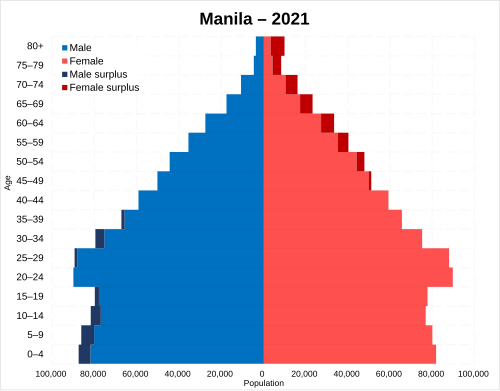

2020年のフィリピン国勢調査によると、マニラの人口は1,846,513人で、フィリピンで2番目に人口の多い都市となっている。 [220]マニラは世界で最も人口密度の高い都市であり、 2015年には1km2あたり41,515人の住民が住んでいた。 [6] 6区は1km2あたり68,266人の住民で最も密集しており、次いで1区が64,936人、2区が64,710人となっている。5区は19,235人で最も人口密度の低い地域である。[221]
マニラは、スペイン人の永住地が設立されて以来、フィリピン最大の都市とみなされ、最終的には国の政治、商業、教会の中心地となった。[222]植民地時代以来、マニラはインド[223]やラテンアメリカ[ 224]など幅広い起源を持つ人々の目的地となっている。法医人類学 を実践し、フィリピンのいくつかの墓地で頭蓋骨を発掘している研究者マシュー・C・ゴーは、発掘されたサンプルの平均量の7%がヨーロッパ系のものであると推定した。[225]法医学人類学ジャーナルに掲載された、当時の人類学データを照合した研究論文によると、フィリピン大学でサンプルが採取されたフィリピン人の遺体のうち、表現型的にアジア人(東アジア、南アジア、東南アジア)に分類されるものの割合は72.7%、ヒスパニック(スペイン系アメリカインディアンの混血、ラテンアメリカ人、および/またはスペイン系マレー人の混血)が12.7%、アメリカ先住民(ネイティブアメリカン)が7.3%、アフリカ人が4.5%、ヨーロッパ人が2.7%であった。[226] 1860年代から1890年代にかけて、フィリピンの都市部、特にマニラでは、埋葬統計によると、人口の3.3%が純粋なヨーロッパ系スペイン人で、純粋な中国人が市の人口の9.9%を占めていた。スペイン系フィリピン人と中国系フィリピン人の混血人口も変動しており、スペイン系フィリピン人の混血はマニラの人口の19%を占めていた。[61] : 539 最終的に、これらの非ネイティブのカテゴリーは、多数派であるオーストロネシア系フィリピン人の人口に同化したため減少した。[227]フィリピン革命の間、「フィリピン人」という用語は、フィリピンで生まれたあらゆる人種の人々を含んでいた。[228] [229]これにより、1903年の最初のアメリカ国勢調査の時点で、外国人と混血の人々が純粋なフィリピン人としてのみ認識されたため、全国の中国人、スペイン人、混血の人々の割合が急激に減少した。[230]マニラの人口は、1903 年の国勢調査以来、劇的に増加しました。これは、人々が農村部から町や都市に移動する傾向があったためです。1960 年の国勢調査では、マニラはフィリピンで初めて人口 100 万人を超えた都市となりました。これは 1903 年の人口の 5 倍以上です。都市は人口が 160 万人で安定するまで成長を続け、1990 年の国勢調査からは増減を繰り返しています。この現象は、郊外での高い成長と、すでに非常に高い都市の人口密度に起因すると考えられます。そのため、マニラは都市圏人口の割合が減少しており[231]、 1950年代の63%から1980年には27.5% [232]、2015年には13.8%となっている。はるかに規模の大きいケソン市の人口は1990年にマニラをわずかに上回り、2015年の国勢調査ではすでに110万人多い。全国的に見ると、マニラの人口は2020年までにカロオカンやダバオ市など、より広い地域にある都市に追い抜かれると予想されている[233]。方言はフィリピン語で、主に市内とその周辺のタガログ語がベースとなっている。このマニラ語のタガログ語は、マスメディアや娯楽を通じて群島全体に広まり、フィリピンの共通語となっている。英語は教育やビジネスで最も広く使用されている言語であり、マニラ首都圏およびフィリピンの他の地域で日常的に頻繁に使用されています。
フィリピン福建語は、地元では南方閩語の一種であるランナンオエとして知られており、主に市内の中国系フィリピン人コミュニティで話されている。移民局のデータによると、2016年1月から2018年5月までに312万人の中国人がフィリピンに到着した。[234]
犯罪
.jpg/500px-PNP_Policemen_(Rizal_Park,_Manila;_2015-06-12).jpg)
マニラの犯罪は貧困、薬物乱用、ギャングと関係のある地域に集中している。市内の犯罪は人口動態の変化や独特の刑事司法制度とも直接関係している。違法薬物取引は市内の大きな問題であり、 2015年2月にはマニラ首都圏だけでバランガイの92%が違法薬物の影響を受けた。[235]
2010年から2015年まで、マニラはフィリピンで2番目に高い犯罪発生率を記録し、54,689件、年間平均約9,100件に上った。[236] 2017年10月までに、マニラ警察署(MPD)は、2016年の5,474件から2017年の3,393件へと、犯罪発生件数が38.7%減少したと報告した。MPDの犯罪解決効率も向上し、10件に6~7件の犯罪が市警察によって解決された。[237] MPDは、2017年に最高の犯罪解決効率を記録したことで、メトロマニラのベスト警察署に選ばれた。[238]
宗教
キリスト教
スペイン文化の影響により、マニラはキリスト教徒が多数を占める都市となっている。2010年現在[update]、人口の93.5%がローマカトリック教徒、2%がイグレシア・ニ・クリスト信者、1.8%が各種プロテスタント、1.1%が仏教徒である。イスラム教徒やその他の宗教の信者は、残りの1.4%を占めている。[239]
マニラは著名なカトリック教会や施設の本拠地である。市内には113のカトリック教会があり、そのうち63は主要な聖地、バシリカ、または大聖堂とみなされている。[240] 国内最古の教会であるマニラ大聖堂は、マニラのローマカトリック大司教区の本拠地である。[241]市内には他にキアポ教会、ビノンド教会、サンセバスチャン小バシリカの3つのバシリカがある。[242]イントラムロスのサンアグスティン教会はユネスコの 世界遺産に登録されている。[243]
いくつかの主流プロテスタント宗派の本部がマニラ市にある。サンタクルス地区の聖ステファン 教区の正大聖堂は、フィリピン聖公会の中央フィリピン教区の司教区であり、タフト通りには、フィリピン革命の産物である国家主義教会であるイグレシア・フィリピン・インデペンディエンテ(アグリパヤン教会とも呼ばれる)の主要大聖堂と中央事務所がある。末日聖徒イエス・キリスト教会(LDS教会)はマニラ市内に寺院を構えており、フィリピンで運営されている2つのLDS寺院のうちの1つである。
先住民族のイグレシア・ニ・クリストは市内にいくつかの場所(教区に類似)を持っており、サンタアナのプンタにある最初の礼拝堂は現在博物館となっている。 [244] 福音派、ペンテコステ派、セブンスデー・アドベンチスト派の宗派も盛んである。フィリピン聖書協会の本部はマニラにある。カテドラル・オブ・プライズのメインキャンパスはタフト通りにある。ジーザス・イズ・ロード・チャーチ・ワールドワイドはマニラにいくつかの支部とキャンパスを持っている。
メンバーズ・チャーチ・オブ・ゴッド・インターナショナル(MCGI)[245]、イグレシア・ニ・クリスト、ジーザス・イズ・ロード・チャーチ・ワールドワイド、エル・シャダイ運動などの宗教団体は、リサール公園の広場にあるキリノ・グランドスタンドで記念日を祝っている。[246]
-
 マニラ大聖堂は、マニラのローマカトリック大司教区の所在地です。
 -
![サン・セバスティアンの小聖堂はアジアで唯一の全鋼鉄製の教会である。[247]](https://img-server.japedia.wiki/wikipedia/commons/thumb/0/04/Bas%C3%ADlica_de_San_Sebasti%C3%A1n%2C_Manila%2C_Filipinas%2C_2023-08-27%2C_DD_07.jpg/500px-Bas%C3%ADlica_de_San_Sebasti%C3%A1n%2C_Manila%2C_Filipinas%2C_2023-08-27%2C_DD_07.jpg) サン・セバスティアンの小聖堂はアジアで唯一の全鋼鉄製の教会である。[247]
サン・セバスティアンの小聖堂はアジアで唯一の全鋼鉄製の教会である。[247] -

-
 ビノンド教会はローマカトリックの中国人コミュニティに奉仕しています。
 -

![サン・セバスティアンの小聖堂はアジアで唯一の全鋼鉄製の教会である。[247]](https://img-server.japedia.wiki/wikipedia/commons/thumb/0/04/Bas%C3%ADlica_de_San_Sebasti%C3%A1n,_Manila,_Filipinas,_2023-08-27,_DD_07.jpg/500px-Bas%C3%ADlica_de_San_Sebasti%C3%A1n,_Manila,_Filipinas,_2023-08-27,_DD_07.jpg)
.jpg/500px-San_Agustin_Church_(Gen._Luna,_Intramuros,_Manila;_04-07-2023).jpg)

その他の信仰
マニラには、中国系フィリピン人コミュニティの精神的なニーズに応える道教や仏教の寺院が数多くあり、例えばセン・グアン寺院などがある。 [248]キアポには「イスラム教徒の街」があり、市内最大のモスクであるマスジド・アル・ダハブがある。[249]インド人駐在員コミュニティのメンバーは、市内の大きなヒンズー教寺院やユナイテッド・ネイションズ・アベニューのシク教のグルドワラで礼拝することができる。フィリピンのバハイ教の統治機関である国家精神議会は、マニラの東のマカティとの境界近くに本部を置いている。[要出典]
経済
マニラは商業、銀行・金融、小売、交通、観光、不動産、新メディア、伝統的メディア、広告、法律サービス、会計、保険、演劇、ファッション、芸術の主要な中心地です。市内には約6万の事業所があります。[250]
The National Competitiveness Council of the Philippines, which annually publishes the Cities and Municipalities Competitiveness Index (CMCI), ranks the country's cities, municipalities, and provinces according to their economic dynamism, government efficiency, and infrastructure. According to the 2022 CMCI, Manila was the second-most-competitive highly urbanized city in the Philippines.[251] Manila held the title of the country's most-competitive city in 2015, and since then has been in the top three, denoting Manila is consistently one of the best place to live in and do business.[252]
Binondo, the oldest and one of the largest Chinatowns in the world, was the center of commerce and business activities in the city. Numerous residential and office skyscrapers occupy its medieval streets. As of 2013, plans by the city government of Manila to turn the Chinatown area into a business process outsourcing (BPO) hub were in progress; thirty unoccupied buildings had been already identified for conversion into BPO offices. Most of these buildings are on Escolta Street, Binondo.[253]

The Port of Manila is the largest seaport in the Philippines and the main international shipping route into the country. The Philippine Ports Authority oversees the operation and management of the country's ports. International Container Terminal Services Inc., according to the Asian Development Bank, is one of the top-five major maritime terminal operators in the world,[254][255] and has its headquarters and main operations at the Port of Manila. Another port operator, Asian Terminal Incorporated, has its corporate office and main operations at Manila South Harbor, and its container depository is in Santa Mesa. Manila is classified as a Medium-Port Megacity, using the Southampton system for port-city classification.[256]
Manufacturers within the city produce industrial-related products such as chemicals, textiles, clothing, electronic goods, food, beverages, and tobacco products. Local businesses process primary commodities for export, including rope, plywood, refined sugar, copra, and coconut oil. The food-processing industry is one of the most-stable manufacturing sector in the city.[257]
.jpg/500px-Bangko_Sentral_(Roxas_Boulevard,_Manila;_01-30-2021).jpg)
Pandacan oil depot houses the storage facilities and distribution terminals of Caltex Philippines, Pilipinas Shell, and Petron Corporation; the major players in the country's petroleum industry. The oil depot has been a subject of various concerns, including its environmental and health impact on the residents of Manila. The Supreme Court ordered the oil depot to be relocated outside the city by July 2015,[258][259] but it failed to meet this deadline. Most of the oil depot facility inside the 33-hectare (82-acre) compound were demolished,[260] and plans have been made to convert it into a transport hub or food park.[261]
Manila is a major publishing center of the Philippines.[262] Manila Bulletin, the Philippines' largest broadsheet newspaper by circulation, is headquartered in Intramuros.[263] Other major publishing companies in the country The Manila Times, The Philippine Star, and Manila Standard Today are headquartered in the Port Area. The Chinese Commercial News, the Philippines' oldest existing Chinese-language newspaper, and the country's third-oldest newspaper,[264] is headquartered in Binondo. DWRK used to have its studio at the FEMS Tower 1 along Osmeña Highway in Malate before transferring to the MBC Building at the CCP Complex in 2008.[265]
Manila serves as the headquarters of the Bangko Sentral ng Pilipinas, which is located on Roxas Boulevard.[266] The Landbank of the Philippines and Philippine Trust Company also have their headquarters in Manila. Unilever Philippines used to have its corporate office on United Nations Avenue in Paco before transferring to Bonifacio Global City in 2016.[267] Vehicle manufacturer Toyota also has its regional office on UN Avenue.
Tourism

Manila welcomes over one million tourists each year.[262] Major tourist destinations include the historic Walled City of Intramuros, the Cultural Center of the Philippines Complex,[note 1] Manila Ocean Park, Binondo (Chinatown), Ermita, Malate, Manila Zoo, the National Museum Complex, and Rizal Park.[268] Both the historic Walled City of Intramuros and Rizal Park were designated as flagship destinations and as tourism enterprise zones in the Tourism Act of 2009.[269]
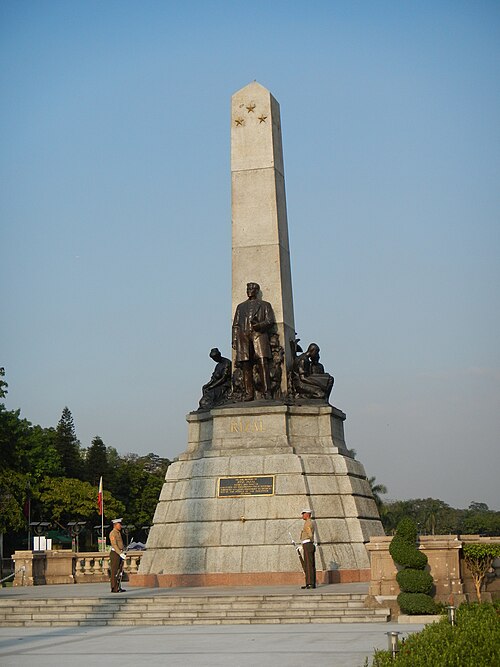
Rizal Park, also known as Luneta Park, is a national park and the largest urban park in Asia.[270] with an area of 58 hectares (140 acres),[271] The park was constructed to honor of the country's national hero José Rizal, who was executed by the Spaniards on charges of subversion. The flagpole west of the Rizal Monument is the Kilometer Zero marker for distances to locations across the country. The park is managed by the National Parks and Development Committee.[272]
The 0.67-square-kilometer (0.26 sq mi) Walled City of Intramuros is the historic center of Manila. It is administered by the Intramuros Administration, an attached agency of the Department of Tourism. It contains Manila Cathedral and the 18th Century San Agustin Church, a UNESCO World Heritage Site. Kalesa is a popular mode of transportation for tourists in Intramuros and nearby places including Binondo, Ermita and Rizal Park.[273] Binondo, the oldest Chinatown in the world, was established in 1521[274] and served as a hub of Chinese commerce before the Spaniards colonized the Philippines. Its main attractions are Binondo Church, Filipino-Chinese Friendship Arch, Seng Guan Buddhist Temple, and authentic Chinese restaurants.
Manila is designated as the country's leading destination for medical tourism, which is estimated to annually generate $1 billion in revenue.[275] Lack of a progressive health system, inadequate infrastructure, and the unstable political environment are seen as hindrances to its growth.[276]
Shopping


Manila is regarded as one of the best shopping destinations in Asia.[277][278] Major shopping malls, department stores, markets, supermarkets, and bazaars are located within the city.
Divisoria in Tondo has been locally described as a "shopping mecca" of Manila.[279][280] Shopping malls sell goods at bargain prices. Small vendors occupy several roads, causing pedestrian and vehicular traffic. A well-known landmark in Divisoria is the Tutuban Center, a large shopping mall that is a part of the Philippine National Railways' Main Station. It attracts 1 million people every month and is expected to add another 400,000 people upon the completion of the LRT Line 2 West Extension, making it Manila's busiest transfer station.[281] Another "lifestyle mall" is Lucky Chinatown. There are almost 1 million shoppers in Divisoria according to the Manila Police District.[282]
Binondo, the oldest Chinatown in the world,[53] is the city's center of commerce and trade for all types of businesses run by Filipino-Chinese merchants, with a wide variety of shops and restaurants. Quiapo is referred to as the "Old Downtown", where tiangges, markets, boutique shops, music and electronics stores are common.[283] Many department stores are on Recto Avenue.
Robinsons Place Manila is Manila's largest shopping mall.[284] The mall was the second and the largest Robinsons Malls built. SM Supermalls operates the shopping malls SM City Manila and SM City San Lazaro. SM City Manila is located on the former site of YMCA Manila beside Manila City Hall in Ermita, while SM City San Lazaro is built on the site of the former San Lazaro Hippodrome in Santa Cruz. The building of the former Manila Royal Hotel in Quiapo, which is known for its revolving restaurant, is now the SM Clearance Center and was established in 1972.[285] The site of the first SM Department Store is Carlos Palanca Sr. (formerly Echague) Street in San Miguel.[286]
Culture
Museums
.jpg/500px-National_Museum_of_Fine_Arts_fa%C3%A7ade_golden_hour_(Manila,_2024).jpg)
As the cultural center of the Philippines, Manila has a number of museums. The National Museum Complex of the National Museum of the Philippines, located in Rizal Park, is composed of the National Museum of Fine Arts, the National Museum of Anthropology, the National Museum of Natural History,[287] and the National Planetarium. Spoliarium, a famous painting by Juan Luna, can be found in the complex.[288]
The city hosts the National Library of the Philippines, a repository of the country's printed and recorded cultural heritage, and other literary and information resources.[289][290] The National Historical Commission of the Philippines maintains two history museums in the city, which are the Museo ni Apolinario Mabini – PUP and the Museo ni Jose Rizal – Fort Santiago.[291] Museums established or run by the National Library and by educational institutions such asDLS-CSB Museum of Contemporary Art and Design,[292] UST Museum of Arts and Sciences,[293] and the UP Museum of a History of Ideas are located in the city.[294]

Bahay Tsinoy, one of Manila's prominent museums, documents the lives of Chinese people and their contributions to the history of the Philippines.[295][296] Intramuros Light and Sound Museum chronicles Filipinos' desire for freedom during the revolution under Rizal's leadership and other revolutionary leaders. The Metropolitan Museum of Manila houses modern and contemporary visual arts, and exhibits Filipino arts and culture.[297]
Other museums in the city are the Museo Pambata,[298] a children's museum;[299] and Plaza San Luis, an outdoor heritage public museum that includes nine Spanish Bahay na Bato houses.[300] Ecclesiastical museums located in the city are the Parish of the Our Lady of the Abandoned in Santa Ana;[301] San Agustin Church Museum;[302] and the Museo de Intramuros, which houses the ecclesiastical art collection of the Intramuros Administration in the reconstructed San Ignacio Church and Convent.[303]
Sports

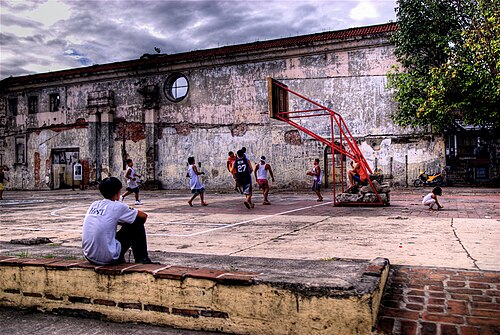
Sports in Manila have a long and distinguished history. The city's, and in general the country's, main sport is basketball. Most barangays have a basketball court or a makeshift one, and court markings are frequently drawn on the streets. Larger barangays have covered courts where inter-barangay leagues are held every April to May. Manila's major sports venues include Rizal Memorial Sports Complex and San Andres Gym, the base of the now-defunct Manila Metrostars.[304] Rizal Memorial Sports Complex houses a track and football stadium, a baseball stadium, tennis courts, Rizal Memorial Coliseum, and Ninoy Aquino Stadium; the latter two are indoor arenas. The Rizal complex had hosted several multi-sport events, such as the 1954 Asian Games and the 1934 Far Eastern Games. When the Philippines hosts the Southeast Asian Games, most of the events are held at the complex but in the 2005 Games, most events were held elsewhere. The 1960 ABC Championship and the 1973 ABC Championship, forerunners of the FIBA Asia Championship, were hosted at the memorial coliseum; the national basketball team won both tournaments.[305] The 1978 FIBA World Championship was held at the coliseum although the latter stages were held in the Araneta Coliseum in Quezon City.
Manila has several other well-known sports facilities such as Enrique M. Razon Sports Center and the University of Santo Tomas Sports Complex, both of which are private venues owned by a university; collegiate sports are also held in the city; the University Athletic Association of the Philippines and the National Collegiate Athletic Association basketball games held at Rizal Memorial Coliseum and Ninoy Aquino Stadium, although basketball events have been transferred to San Juan's Filoil Flying V Arena and Araneta Coliseum in Quezon City. Other collegiate sports are still held at Rizal Memorial Sports Complex. Professional basketball, which has been mostly organized by corporate teams, also used to play at the city but the Philippine Basketball Association now holds their games at Araneta Coliseum and Cuneta Astrodome at Pasay; the now-defunct Philippine Basketball League played some of their games, such as its 1995–96 Philippine Basketball League season, at Rizal Memorial Sports Complex.[306]
Manila Metrostars participated in the Metropolitan Basketball Association.[307] The Metrostars, named after the Metrostar Express – the brand name of the Metro Manila MRT-3, which does not have stations in the city – participated in its first three seasons and won the 1999 championship.[308] The Metrostars later merged with the Batangas Blades and subsequently played in Lipa, Batangas. Almost twenty years later, Manila Stars participated in the Maharlika Pilipinas Basketball League, reaching the Northern Division Finals in 2019. Both teams played in the San Andres Sports Complex. Other teams that represented Manila but did not host games in the city are the Manila Jeepney F.C. and FC Meralco Manila. The city's government acknowledged Jeepney as Manila's representative in the United Football League. Meralco Manila played in the Philippines Football League and designated Rizal Memorial Stadium as their home ground.[citation needed]
Manila's rugby league team Manila Storm trains at Rizal Park and plays matches at Southern Plains Field, Calamba, Laguna. Baseball was previously a widely played sport in the city but in 2022, Manila had the Philippines' only sizable baseball stadium, Rizal Memorial Baseball Stadium, which hosted games of the now-defunct Baseball Philippines; Lou Gehrig and Babe Ruth were the first players to score a home run at the stadium during their tour of the country on December 2, 1934.[309] Cue sports are also popular in Manila; billiard halls are present in most barangays. The 2010 World Cup of Pool was held at Robinsons Place Manila.[310]
Rizal Memorial Track and Football Stadium hosted the first FIFA World Cup qualifier in decades when the Philippines hosted Sri Lanka in July 2011. The stadium, which was previously unfit for international matches, had been renovated before the match.[311] The stadium also hosted its first rugby test for the 2012 Asian Five Nations Division I tournaments.[312]
Festivals and holidays

Manila celebrates civic and national holidays. Because most of the city's residents are Roman Catholic,[313][314] most of the festivals are religious in nature. Araw ng Maynila, which celebrates the city's founding on June 24, 1571 [315] by the Spanish conquistador Miguel López de Legazpi, was first proclaimed by the city's vice mayor Herminio A. Astorga on June 24, 1962. It has been annually commemorated under the patronage of John the Baptist, and has always been declared by the national government as a special, non-working holiday through presidential proclamations. Each of the city's 896 barangays also have their own festivities, which are guided by their own patron saints.[citation needed]
Manila also hosts the procession of the Feast of the Black Nazarene (Traslacíon), which is held every January 9 and draws millions of Catholic followers.[316] Other religious festivities held in Manila are the Feast of Santo Niño in Tondo and Pandacan, which is held on the third Sunday of January;[317][318] the Feast of Nuestra Señora de los Desamparados de Manila (Our Lady of the Abandoned), the patron saint of Santa Ana, which is held every May 12;[319] and the Flores de Mayo.[320] Non-religious holidays include New Year's Day, National Heroes' Day, Bonifacio Day, and Rizal Day.[321]
Government
Local government
.jpg/500px-Manila_City_Hall_(Manila;_07-22-2020).jpg)

Manila, which is officially known as the City of Manila, is the national capital of the Philippines and is classified as a special city according to its income,[322][323] and a highly urbanized city (HUC). The Mayor of Manila is the chief executive, and is assisted by the vice mayor and the 38-member City Council, who are elected as representatives of the six councilor districts within the city, and the municipal presidents of the Liga ng mga Barangay and Sangguniang Kabataan.[citation needed]
The city has no control over Intramuros and Manila North Harbor. The historic Walled City is administered by the Intramuros Administration while Manila North Harbor is managed by the Philippine Ports Authority. Both are national government agencies. The barangays that have jurisdictions over these places oversee the welfare of the city's constituents but cannot exercise their executive powers. Manila had a 12,971 personnel complement at the end of 2018.[324] Under the proposed form of federalism in the Philippines, Manila may no longer be the capital and Metro Manila may no longer be the seat of government; the committee has not yet decided on the federal capital and states they are open to other proposals.[325][326]
As of May 2022, the Mayor of Manila is Maria Shielah "Honey" Lacuna-Pangan, daughter of former Manila vice mayor Danilo Lacuna. Lacuna is the city's first female mayor.[327] The vice mayor is Yul Servo. The mayor and the vice mayor are limited to up-to three terms, each term lasting for three years. The city has an ordinance penalizing cat-calling since 2018, and is the second city in the Philippines to do so after Quezon City, which passed a similar ordinance in 2016.[328] In 2017, the city government planned to revise the existing curfew ordinance since the Supreme Court declared it unconstitutional in August that year. Of the three cities reviewed by the Supreme Court; the City of Manila, Navotas, and Quezon City; only the curfew ordinance of Quezon City was approved.[329][330]
National government
.jpg/500px-Malaca%C3%B1ang_Palace_(local_img).jpg)
Manila, being the seat of political power in the Philippines, has the headquarters of several national government offices. Planning for the city's role as the center of government started during the early years of American colonization, when the U.S. envisioned a well-designed city outside the walls of Intramuros, and chose Bagumbayan, a former town that is now Rizal Park to become the center of government. A design commission was given to Daniel Burnham to create a master plan for the city patterned after Washington, D.C.[331] but the plans were abandoned under the Commonwealth Government of Manuel L. Quezon.[citation needed] A new government center was to be built on the hills northeast of Manila, in what is now Quezon City. Several government agencies have set up their headquarters in Quezon City but several key government offices are still based in Manila. Many of the plans were substantially altered after the devastation of Manila during World War II and by subsequent administrations.[citation needed]

As the nation's capital, Manila hosts the Office of the President and the President's official residence. It also houses important government agencies and institutions such as the Supreme Court, the Court of Appeals, the Bangko Sentral ng Pilipinas, the Departments of Budget and Management, Finance, Health, Justice, Labor and Employment, and Public Works and Highways. Manila also hosts important national institutions such as the National Library, National Archives, National Museum of the Philippines, and Philippine General Hospital.[citation needed]. Other notable institutions based in Manila are the National Commission for Culture and the Arts, National Historical Commission, Film Development Council of the Philippines, and the Cultural Center of the Philippines.
Congress previously held office at the Old Congress Building.[332] In 1972, due to declaration of martial law, Congress was dissolved; its successor, the unicameral Batasang Pambansa, held office at the new Batasang Pambansa Complex. When a new constitution restored the bicameral Congress, the House of Representatives stayed at the Batasang Pambansa Complex and the Senate remained at the Old Congress Building. In May 1997, the Senate transferred to a new building, which it shares with the Government Service Insurance System on reclaimed land at Pasay. The Supreme Court was due to transfer to its new campus at Bonifacio Global City, Taguig, in 2019 but the move was postponed to a later year.[333]
In Congress, Manila has six representatives, one each from its six congressional districts.[334]
Finance
In the 2019 Annual Audit Report published by the Commission on Audit, the revenue of the City of Manila was ₱16.534 billion.[324] It is one of the cities with the highest tax collection and internal revenue allotment.[335] For the 2019 fiscal year, the tax revenue collected by the city was ₱8.4 billion. The city's Internal Revenue Allotment (IRA) from the National Treasury was ₱2.94 billion, and the city's total assets were worth ₱63.4 billion in 2019.[324] The City of Manila has the highest budget allocation for healthcare of all the cities and municipalities in the Philippines; the city maintains the six district hospitals, 59 health centers and lying-in clinics, and healthcare programs.[citation needed]
Infrastructure
Housing

Development of public housing in Manila began in the 1930s under U.S. rule; Americans had to deal with the problem of sanitation and concentration of settlers around business areas.[336] Business codes and sanitation laws were implemented in the 1930s. During this period until the 1950s, new communities were opened for relocation. Among these were Projects 1–8 in Quezon City[337] and the Vitas tenement houses in Tondo.[338] In 1947, the government implemented a public housing policy that established the People's Homesite and Housing Corporation (PHHC).[339] A few years later, it established a Slum Clearance Committee which, with the help of the PHHC, relocated thousands of families from Manila and Quezon City to Sapang Palay in San Jose del Monte, Bulacan in the 1960s.[340]
In 2016, the national government completed several medium-rise houses for 300 Manila residents whose slum community was destroyed by a fire in 2011.[341] As of 2019, the city government plans to retrofit dilapidated tenements within the city,[342] and will construct new housing buildings for the city's informal settlers such as the 14-story Tondominium 1 and Tondomium 2 buildings, containing 42-square-meter (450 sq ft), two-bedroom units. The construction of these new in-city vertical housing projects was funded by a loan from the Development Bank of the Philippines and the Land Bank of the Philippines.[343][344]
Since 2019, the Manila City Government has initiated six housing projects: Tondominium 1 & 2, Binondominium, Basecommunity, San Lazaro Residences, Pedro Gil Residences, and San Sebastian Residences.[345][346][347]
Transportation
(2018-02-22).jpg/500px-Line_2_Train_near_Pureza_Station_(Santa_Mesa,_Manila)(2018-02-22).jpg)

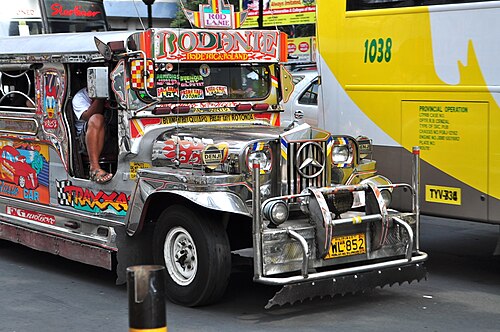
One of the best-known modes of transportation in Manila is the jeepney, which were patterned after U.S. Army jeeps and have been in use since the mid-to-late 1940s.[348] The Tamaraw FX, the third generation of the Toyota Kijang, once directly competed with jeepneys and followed fixed routes for a set price. They were replaced by the UV Express. All types of public road transportation in Manila are privately owned and operated under government-issued franchises.[citation needed]
On a for-hire basis, the city is served by taxicabs, "tricycles" – motorcycles with sidecars—the Philippine version of the auto rickshaw), and "trisikads", "sikads" or "kuligligs"; bicycles with sidecars, the Philippine version of pedicabs), which are popular In some areas, especially Divisoria. Spanish-era horse-drawn calesas are a popular tourist attraction and mode of transportation in Binondo and Intramuros. Manila will phase out all gasoline-run tricycles and pedicabs, and replace them with electric tricycles (e-trikes), and plans to distribute 10,000 e-trikes to qualified tricycle drivers from the city.[349][350] By January 2018, the city has distributed e-trikes to a number of drivers and operators in Binondo, Ermita, Malate, and Santa Cruz.[351]
Manila is serviced by LRT Line 1 (LRT-1) and Line 2 (LRT-2), which form the Manila Light Rail Transit System. Development of the light rail system began in the 1970s during the presidency of Ferdinand Marcos, when the LRT Line 1 was built, making it the first light-rail system in Southeast Asia. Despite its name, LRT-1 operates as a light metro, running on dedicated rights-of-way. LRT 2 operates as a full-metro, heavy rail system. As of 2015, these systems were undergoing a multi-billion-dollar expansion.[352] The LRT runs along the length of Taft Avenue (N170/R-2) and Rizal Avenue (N150/R-9), while LRT-2 runs along Claro M. Recto Avenue (N145/C-1) and Ramon Magsaysay Boulevard (N180/R-6) from Santa Cruz, through Quezon City, and to Masinag in Antipolo, Rizal.
_wiki.jpg/500px-PNR_Santa_Mesa_Station_with_INKA_train_(Manila;_02-01-2020)_wiki.jpg)
Tutuban station, the central terminal of the Philippine National Railways, lies within Manila.[353][354] Within Metro Manila, one commuter railway is in operation. The line runs in a general north–south direction from Tutuban (Tondo) toward the province of Laguna. The Port of Manila, which is located in the western section of the city on Manila Bay, is the largest and chief seaport of the Philippines.[355] The Pasig River Ferry Service is another form of transportation.[356] The city is also served by Ninoy Aquino International Airport, the country's main international airport and domestic air hub.[357]
Trolleys, hand-made human-powered metal handcarts operated by "trolley boys", transport people along sections of the PNR lines. This is a popular means of transportation because it is low-cost – roughly ₱10 or US$.20 per trip – and avoids traffic. Many trolley boys are homeless and live alongside the railroad line, which is actively used by passenger trains, making collisions with passenger trains a consistent danger, although casualties are rare. The trolley rides are unofficial and unregulated but tolerated by authorities.[358][359][360][361]
Satellite navigation company TomTom ranked Manila as the second world's most-traffic-congested city in 2019.[362] According to Waze's 2015 "Global Driver Satisfaction Index", Manila has the worst traffic worldwide.[363] Manila is notorious for its frequent traffic jams and high densities.[364] The government has undertaken several projects to alleviate the traffic in the city, some of which include the proposed construction of a new viaduct or underpass at the intersection of España Boulevard and Lacson Avenue;[365] the construction of Skyway Stage 3, NLEX Connector, and Pasig River Expressway; the proposed LRT Line 2 West Extension Project from Recto Avenue to Pier 4 of Manila North Harbor;[366] the proposed construction of the PNR east–west line through España Boulevard to Quezon City; and the expansion and widening of several national and local roads. These projects, however, had yet to make any meaningful impact by 2014, and the traffic jams and congestion continue.[367]
The government, under its 2014 Metro Manila Dream Plan aims to address these urban transport problems. The plan is a list of short-term priority projects and medium-to-long-term infrastructure projects that will last up to 2030.[368][369]
Water and electricity
Water services used to be provided by the Metropolitan Waterworks and Sewerage System (MWSS), which served 30% of the city; most other sewage was directly dumped into storm drains, septic tanks, and open canals.[370] MWSS was privatized in 1997, which split the water concession into the east and west zones. Maynilad Water Services took over the west zone, of which Manila is a part. As of 2001, Maynilad Water Services provides the supply and delivery of potable water, and sewerage system in Manila[371] but does not serve the southeastern part of the city, which belongs to the east zone that is served by Manila Water.[372] Electricity services are provided by Meralco, the sole electricity distributor in Metro Manila.[373]
Healthcare

Manila Health Department is responsible for the planning and implementation of healthcare programs provided by the city government. Manila Health Department operates 59 health centers and six city-run hospitals, which are free of charge for the city's constituents. The six public city-run hospitals are Ospital ng Maynila Medical Center, Ospital ng Sampaloc, Gat Andres Bonifacio Memorial Medical Center, Ospital ng Tondo, Santa Ana Hospital, and Justice Jose Abad Santos General Hospital.[375] Philippine General Hospital, a tertiary state-owned hospital in Manila, is operated by the University of the Philippines Manila. The city is planning to build an education, research, and hospital facility for cleft lip and cleft palate patients,[376][377] and to establish the first children's surgical hospital in Southeast Asia.[378]
Private corporations also provide healthcare in Manila. Private hospitals that operate in the city are Manila Doctors Hospital,[379] Chinese General Hospital and Medical Center,[380] José R. Reyes Memorial Medical Center,[381] Metropolitan Medical Center,[382] Our Lady of Lourdes Hospital,[383] and the University of Santo Tomas Hospital.[384]
The Department of Health (DOH) has its main office in Manila[385] and operates San Lazaro Hospital, a special referral tertiary hospital. DOH also operates Dr. Jose Fabella Memorial Hospital, Jose R. Reyes Memorial Medical Center, and Tondo Medical Center.[386] Manila is the home to the headquarters of the World Health Organization's Regional Office for the Western Pacific and Country Office for the Philippines.[387]
The city government provides free immunization programs for children, who are specifically targeted against hepatitis B, hemophilus influenza B pneumonia, diphtheria, tetanus, polio, measles, mumps, and rubella. As of 2016, 31,115 children aged one and below have been fully immunized.[388] Manila Dialysis Center, which provides free services for the poor, has been cited by the United Nations Committee on Innovation, Competitiveness and Public-Private Partnerships as a model for public-private partnership (PPP) projects.[389][390] The dialysis facility was named Flora V. Valisno de Siojo Dialysis Center in 2019, and was inaugurated as the largest free dialysis facility in the Philippines. It has 91 dialysis machines, which can be expanded up to 100, matching the capabilities of the National Kidney and Transplant Institute (NKTI).[391][392]
Education

_Campus;_Rizal_Memorial_Sports_Complex;_Harrison_Plaza_-_Aerial_Shot_(Taft_Avenue,_Malate,_Manila;_2015-06-25).jpg/500px-De_La_Salle_University_(DLSU)_Campus;_Rizal_Memorial_Sports_Complex;_Harrison_Plaza_-_Aerial_Shot_(Taft_Avenue,_Malate,_Manila;_2015-06-25).jpg)
Manila has been a center of education since the colonial period.[393] The city has several Philippine universities and colleges, some of which are the county's oldest. The city's University Belt has a high concentration of colleges and universities, which are a short walking distance of each other. The University Belt is at the boundaries between San Miguel, Quiapo, and Sampaloc districts, while other clusters colleges lie along the southern bank of the Pasig River – mostly in Intramuros and Ermita districts; and at the southernmost part of Malate near the city limits.
The historic district Intramuros once housed the University of Santo Tomas (1611), Colegio de San Juan de Letran (1620), and Ateneo de Manila University (1859).[393][394] Only Colegio de San Juan de Letran remains at Intramuros; the University of Santo Tomas transferred to a new campus at Sampaloc in 1927 and Ateneo de Manila University relocated to Loyola Heights, Quezon City, in 1952. In the 20th century, new non-sectarian schools were built; Mapúa University (1925), Lyceum of the Philippines University (1952), and Pamantasan ng Lungsod ng Maynila (1965) – which is owned and operated by the Manila city government.[395][396] The four schools in the district formed the Intramuros Consortium. Other notable universities in the city include National University (1900), San Beda University (1901), the only Benedictine university in Asia, De La Salle University (1911), the largest of all De La Salle University System of schools, Far Eastern University (1928), and Adamson University (1939).
The University of the Philippines (1908), the country's main state university, was established in Ermita, Manila. It moved its central administrative offices from Manila to Diliman in 1949 and eventually made the original campus the University of the Philippines Manila, the oldest of the constituent universities of the University of the Philippines System, and the center of health-sciences education in the country.[397] Manila is also the site of the main campus of the Polytechnic University of the Philippines, the largest university in the country in terms of student population.[398]
The city's three-tier public education system, the Division of the City Schools of Manila, is a branch of the Department of Education. The division oversees 71 public elementary schools and 32 public high schools, all located within the city's territory, except for Rafael Palma Elementary School, which is situated in Barangay La Paz, Makati, near the border with Manila.[399] The city also contains Manila Science High School, a pilot science high school.[400]
Sister cities
Asia
 Astana, Kazakhstan[401]
 Bacoor, Cavite[402]
 Bangkok, Thailand[403]
 Beijing, People's Republic of China[404][405]
 Dili, East Timor[406][407]
- Guangzhou, Guangdong, People's Republic of China[405]
 Haifa, Israel[408]
 Ho Chi Minh City, Vietnam[409]
 Incheon, South Korea[410]
 Jakarta, Indonesia[411]
 Nantan, Kyoto, Japan[412]
 Osaka, Japan (business partner)[413]
 Saipan, Northern Mariana Islands[414]
- Shanghai, People's Republic of China[415]
 Taipei, Taiwan[416]
 Takatsuki, Osaka, Japan[417][418]
 Yokohama, Kanagawa, Japan[418][419]
.svg/500px-Flag_of_Astana,_Kazakhstan_(latin).svg.png)

.svg/500px-Flag_of_Jakarta_(vectorised).svg.png)


Europe


The Americas
 Acapulco, Guerrero, Mexico[423]
 Buenos Aires, Argentina[424]
 Cali, Colombia
 Cartagena, Colombia[401]
 Havana, Cuba[401]
 Lima, Peru[401]
 Mexico City, Mexico
 Montevideo, Uruguay[425]
 Montreal, Quebec, Canada[426]
 New York City, New York, United States (global partner)[427]
 Panama City, Panama[428]
 Sacramento, California, United States
 San Francisco, California, United States[429]
 Santiago, Chile[401]
 Winnipeg, Manitoba, Canada[430]


Oceania
 Honolulu, Hawaii, United States[431]
 Maui County, Hawaii, United States[432]


International relations
Manila hosts the foreign embassies of the United States[433] and Vietnam.[434] Honorary consulates of Belize, Burkina Faso, Jordan, Nepal, Poland, Iceland, Paraguay, Thailand, and Tunisia are based in the city.[435]
Notable personalities
See also
Notes
- ^ This was spurred by a locally found sacred image, i.e., a Black Madonna of unknown origin; one theory is that it is from Portuguese-Macau, another is that it is a Tantric goddess and this was worshiped by the natives in a Pagan-Hindu manner and had survived Islamic iconoclasm by the Sultanate of Brunei. This image was interpreted to be of Marian nature, and it was found during the Miguel de Legazpi expedition and eventually, a Mexican hermit built a chapel around that image.
- ^ The city limits was at Vicente Sotto Street. The rest of the place south of the street belongs to Pasay. Buildings and structures in CCP that falls under the jurisdiction of Manila includes the National Theater.
References
- ^ "'Pearl of Orient' Stripped of Food; Manila, Before Pearl Harbor, Had Been Prosperous—Its Harbor One, of Best Focus for Two Attacks Osmeña Succeeded Quezon". New York Times. February 5, 1945. Retrieved March 3, 2014.
Manila, modernized and elevated to the status of a metropolis by American engineering skill, was before Pearl Harbor a city of 623,000 population, contained in an area of 14 square miles (36 km2).
- ^ [https://lgu201.dilg.gov.ph/view.php?r=13&p=39
- ^ "Manila". City Government of Manila.
- ^ "Demographia World Urban Areas PDF (July 2022)" (PDF). Demographia. Retrieved September 16, 2022.
- ^ a b c Census of Population (2020). Table B - Population and Annual Growth Rates by Province, City, and Municipality - By Region. Philippine Statistics Authority. Retrieved July 8, 2021.
- ^ a b c "Philippine Population Density (Based on the 2015 Census of Population)". Philippine Statistics Authority. Retrieved November 2, 2017.
- ^ The original form as used by José Rizal in El filibusterismo.
- ^ "PSA Releases the 2021 City and Municipal Level Poverty Estimates". Philippine Statistics Authority. April 2, 2024. Retrieved April 28, 2024.
- ^ Sub-national HDI. "Area Database – Global Data Lab". hdi.globaldatalab.org.
- ^ "Annual Audit Report: City of Manila" (PDF). Commission on Audit. 2014. Archived from the original on November 4, 2016. Retrieved November 4, 2016.
- ^ China and the Birth of Globalization in the 16th Century, by Dennis O. Flynn and Arturo Giráldez
- ^ Frank, Andre G. (1998). ReOrient: Global Economy in the Asian Age. Berkeley: University of California Press. pp. 131. ISBN 9780520214743.
- ^ "Highlights of the Philippine Population 2015 Census of Population". Philippine Statistics Authority. May 19, 2016. Retrieved April 12, 2017.
- ^ "GaWC – The World According to GaWC 2018". www.lboro.ac.uk. Retrieved February 28, 2020.
- ^ "Brookings – Global Metro Monitor 2018". www.brookings.edu. November 30, 2001. Retrieved April 6, 2020.
- ^ "The Global Financial Centres Index 27" (PDF). Long Finance. March 2020. Retrieved April 5, 2020.
- ^ a b Lozada, Bong (March 27, 2014). "Metro Manila is world's second riskiest capital to live in–poll". Philippine Daily Inquirer. Retrieved April 9, 2014.
- ^ "Global Metro Monitor". Brookings Institution. January 22, 2015. Retrieved April 12, 2017.
- ^ a b c d e f g h i j k Baumgartner, Joseph (March 1975). "Manila – Maynilad or Maynila?". Philippine Quarterly of Culture and Society. 3 (1): 52–54. JSTOR 29791188.
- ^ a b Chamberlain, Alexander F. (1901). "Philippine Studies: V. The Origin of the Name Manila". The American Antiquarian and Oriental Journal. 23 (5): 33.
- ^ Thomas, Hugh (August 11, 2015). World Without End: Spain, Philip II, and the First Global Empire. Random House Publishing Group. ISBN 978-0-8129-9812-2. Retrieved March 28, 2022.
- ^ "Ixora manila Blanco". World Marine Species Database. Retrieved August 20, 2018.
- ^ a b Merrill, Elmer Drew (1903). A Dictionary of the Plant Names of the Philippine Islands. Manila: Bureau of Public Printing.
- ^ Aloma Monte de los Santos (1994). Parish of Santo Niño de Molino – Bacoor, Cavite – 1984–1994: The Making of a Parish. Parish of Santo Niño de Molino. Retrieved August 20, 2018.
- ^ a b Ambeth Ocampo (June 25, 2008), Looking Back: Pre-Spanish Manila, Philippine Daily Inquirer, archived from the original on June 28, 2008, retrieved August 21, 2018
- ^ a b Ocampo, Ambeth R. (1990). Looking Back, Volume 1. Anvil Publishing Inc. ISBN 9789712700583. Retrieved August 21, 2018.
- ^ Nakpil, Julio. "A Suggestion to the Tagalistas to Elucidate the Origin of the Name of the Capital City of the Philippines: Manila. Which of these Three Terms or Names Is the More Accurate: Maynilad, Manilad, or Manila?". August 26, 1940.
- ^ Blair and Robertson, The Philippine Islands, 1493–1898, Vol. VIII, p. 96-141. The Arthur H. Clarke Company.; Census of the Philippines, 1903
- ^ Velasquez-Ty, Catalina; García, Tomas; Maceda, Antonio J. (1955). Your Country and Mine.
- ^ An example is: Saenger, Peter (June 29, 2013). Mangrove Ecology, Silviculture and Conservation. Springer Science & Business Media. p. 19. ISBN 9789401599627.
- ^ Rolfe, R.A. (1886) On the flora of Philippine Islands and its probable derivation. The Journal of the Linnean Society - Botany 21: 285.
- ^ Ray, John; Camel, Georg Joseph; Tournefort, Joseph Pitton de (1686). Historia plantarum : species hactenus editas aliasque insuper multas noviter inventas & descriptas complectens. Vol. 3 ([Large paper issue] ed.). Londini: Typis Mariæ Clark, prostant apud Henricum Faithorne [etc.] p. 86.
- ^ Mijares, Armand Salvador B. (2006). .The Early Austronesian Migration To Luzon: Perspectives From The Peñablanca Cave Sites Archived July 7, 2014, at the Wayback Machine. Bulletin of the Indo-Pacific Prehistory Association 26: 72–78.
- ^ Junker, Laura Lee (2000). Raiding, Trading, and Feasting: The Political Economy of Philippine Chiefdoms. Quezon City: Ateneo de Manila University Press. pp. 184–192. ISBN 978-9715503471.
- ^ Wakan Sansai Zue, Pages 202-216
- ^ Reading Song-Ming Records on the Pre-colonial History of the Philippines By Wang Zhenping Page 256.
- ^ Brunei Rediscovered: A Survey of Early Times By Robert Nicholl Page 12, citing: "Groenveldt, Notes Page 112"
- ^ "Pusat Sejarah Brunei" (in Malay). Government of Brunei Darussalam. Archived from the original on April 15, 2015. Retrieved March 3, 2014.
- ^ Agoncillo, Teodoro (1990) [1960]. History of the Filipino People (8th ed.). Quezon City: Garotech Publishing Inc. p. 22. ISBN 971-10-2415-2.
- ^ Wright, Hamilton M. (1907). "A Handbook of the Philippines", p. 143. A.C. McClurg & Co., Chicago.
- ^ Kane, Herb Kawainui (1996). "The Manila Galleons". In Bob Dye (ed.). Hawaiʻi Chronicles: Island History from the Pages of Honolulu Magazine. Vol. I. Honolulu: University of Hawaii Press. pp. 25–32. ISBN 978-0-8248-1829-6.
- ^ The "Indo-Pacific" Crossroads: The Asian Waters as Conduits of Knowledge, People, Cargoes, and Technologies Page 107 (Citing:"Wang 1953; Tanaka Takeo 1961.")
- ^ Bartolome Juan Leonardy y de Argensola, Conquistas de las islas Molucas (Madrid: Alonso Martin, 1909) pp. 351-8; Cesar Majul, Muslims in the Philippines (Quezon City: University of the Philippines Press, 1973) pp. 119-20; Hal, History of Southeast Asia, pp. 249-50.
- ^ Peter Borschberg (2015). Journal, Memorials and Letters of Cornelis Matelieff de Jonge. Security, Diplomacy and Commerce in 17th-Century Southeast Asia. Singapore: NUS Press. pp. 82, 84, 126, 421. Retrieved August 30, 2015.
- ^ Zamboangueño Chavacano: Philippine Spanish Creole or Filipinized Spanish Creole? By Tyron Judes D. Casumpang (Page 3)
- ^ The Silver Way: China, Spanish America and the birth of globalisation 1565-1815 By Morales, Juan Jose; Gordon, Peter
- ^ Bhattacharya, Bhaswati (March 2008). "Making money at the blessed place of Manila: Armenians in the Madras–Manila trade in the eighteenth century*". Journal of Global History. 3 (1): 1–20. doi:10.1017/S1740022808002416. ISSN 1740-0236.
- ^ "Manila (Philippines)". Britannica. Retrieved March 3, 2014.
- ^ Backhouse, Thomas (1765). The Secretary at War to Mr. Secretary Conway. London: British Library. pp. v. 40.
- ^ Fish, Shirley (2003). When Britain Ruled The Philippines 1762–1764. 1stBooks. p. 158. ISBN 978-1-4107-1069-7.
- ^ "Wars and Battles: Treaty of Paris (1763)". www.u-s-history.com.
- ^ Barrows, David (2014). "A History of the Philippines". Guttenburg Free Online E-books. 1: 179.
Within the walls, there were some six hundred houses of a private nature, most of them built of stone and tile, and an equal number outside in the suburbs, or "arrabales", all occupied by Spaniards ("todos son vivienda y poblacion de los Españoles"). This gives some twelve hundred Spanish families or establishments, exclusive of the religious, who in Manila numbered at least one hundred and fifty, the garrison, at certain times, about four hundred trained Spanish soldiers who had seen service in Holland and the Low Countries, and the official classes.
- ^ a b Raitisoja, Geni " Chinatown Manila: Oldest in the world" Archived April 2, 2011, at the Wayback Machine, Tradio86.com, July 8, 2006, accessed March 19, 2011.
- ^ "In 1637 the military force maintained in the islands consisted of one thousand seven hundred and two Spaniards and one hundred and forty Indians." ~Memorial de D. Juan Grau y Monfalcon, Procurador General de las Islas Filipinas, Docs. Inéditos del Archivo de Indias, vi, p. 425. "In 1787 the garrison at Manila consisted of one regiment of Mexicans comprising one thousand three hundred men, two artillery companies of eighty men each, three cavalry companies of fifty men each." La Pérouse, ii, p. 368.
- ^ (Page 10) Pérez, Marilola (2015). Cavite Chabacano Philippine Creole Spanish: Description and Typology (PDF) (PhD). University of California, Berkeley. Archived from the original on January 14, 2021.
The galleon activities also attracted a great number of Mexican men that arrived from the Mexican Pacific coast as ships' crewmembers (Grant 2009: 230). Mexicans were administrators, priests and soldiers (guachinangos or hombres de pueblo) (Bernal 1964: 188) many though, integrated into the peasant society, even becoming tulisanes "bandits" who in the late 18th century "infested" Cavite and led peasant revolts (Medina 2002: 66). Meanwhile, in the Spanish garrisons, Spanish was used among administrators and priests. Nonetheless, there is not enough historical information on the social role of these men. In fact some of the few references point to a quick integration into the local society: "los hombres del pueblo, los soldados y marinos, anónimos, olvidados, absorbidos en su totalidad por la población Filipina." (Bernal 1964: 188). In addition to the Manila-Acapulco galleon, a complex commercial maritime system circulated European and Asian commodities including slaves. During the 17th century, Portuguese vessels traded with the ports of Manila and Cavite, even after the prohibition of 1644 (Seijas 2008: 21). Crucially, the commercial activities included the smuggling and trade of slaves: "from the Moluccas, and Malacca, and India... with the monsoon winds" carrying "clove spice, cinnamon, and pepper and black slaves, and Kafir [slaves]" (Antonio de Morga cf Seijas 2008: 21)." Though there is no data on the numbers of slaves in Cavite, the numbers in Manila suggest a significant fraction of the population had been brought in as slaves by the Portuguese vessels. By 1621, slaves in Manila numbered 1,970 out of a population of 6,110. This influx of slaves continued until late in the 17th century; according to contemporary cargo records in 1690, 200 slaves departed from Malacca to Manila (Seijas 2008: 21). Different ethnicities were favored for different labor; Africans were brought to work on the agricultural production, and skilled slaves from India served as caulkers and carpenters.
- ^ "Jesuits In The Philippines (1581-1768)" Page 132 "In 1591 there arrived in Manila a secular priest named Juan Fernandez de Leon. He had led a hermit's life in Mexico and planned to continue it in the Philippines. For this purpose he built himself a retreat near a wayside shrine just outside the city walls which was dedicated to Our Lady of Guidance, Nuestra Sehora de Guia. His hermitage later gave its name to the entire district, which is called Ermita to this day."
- ^ Convicts or Conquistadores? Spanish Soldiers in the Seventeenth-Century Pacific By Stephanie J. Mawson AGI, México, leg. 25, núm. 62; AGI, Filipinas, leg. 8, ramo 3, núm. 50; leg. 10, ramo 1, núm. 6; leg. 22, ramo 1, núm. 1, fos. 408 r –428 v; núm. 21; leg. 32, núm. 30; leg. 285, núm. 1, fos. 30 r –41 v .
- ^ "West Coast of the Island Of Luzon | Tourist Attractions". Archived from the original on December 6, 2016. Retrieved December 6, 2016.
- ^ Colonial Latin Asia? The case for incorporating the Philippines and the Spanish Pacific into colonial Latin American studies
- ^ John. M. Lipski, with P. Mühlhaüsler and F. Duthin (1996). "Spanish in the Pacific" (PDF). In Stephen Adolphe Wurm & Peter Mühlhäusler (ed.). Atlas of Languages of Intercultural Communication in the Pacific, Asia, and the Americas: Texts, Volume 2. Walter de Gruyter. p. 276. ISBN 9783110134179.
- ^ a b c "ESTADISMO DE LAS ISLAS FILIPINAS TOMO PRIMERO By Joaquín Martínez de Zúñiga (Original Spanish)" (PDF). Archived (PDF) from the original on March 9, 2016. Retrieved February 3, 2024.
- ^ The Age of Trade: The Manila Galleons and the Dawn of the Global Economy by Arturo Giraldez
- ^ Robertson, James Alexander; Blair, Emma Helen (1906). The Philippine Islands, 1493–1898. Vol. XLIV. p. 29. Retrieved September 24, 2013.
- ^ Bartolomé de Letona, La perfecta religiosa (Puebla, 1662), as quoted in Irving, Colonial Counterpoint, page 245
- ^ "Connecting the Indies: the hispano-asian Pacific world in early Modern Global History". ResearchGate.
- ^ Criado, Buenaventura Delgado, ed. (1992). Historia de la educación en España y América (in Spanish). Vol. 3: La educación en la España contemporánea (1789–1975). Madrid: Fundación Santa María. p. 508. ISBN 978-84-7112-378-7.
- ^ John Bowring, "Travels in the Philippines", p. 18, London, 1875
- ^ Olsen, Rosalinda N. "Semantics of Colonization and Revolution". www.bulatlat.com. Retrieved January 8, 2011.
- ^ "Filipinos In Mexico's History 4 (The Mexican Connection – The Cultural Cargo Of The Manila-Acapulco Galleons) By Carlos Quirino". Archived from the original on August 4, 2020. Retrieved April 22, 2021.
- ^ Beede, Benjamin R. (May 1, 1994). The War of 1898 and U.S. Interventions, 1898T1934: An Encyclopedia. Routledge. pp. 417-418. ISBN 978-1-136-74690-1. Retrieved March 28, 2022.
- ^ The text of the amended version published by General Otis is quoted in its entirety in José Roca de Togores y Saravia; Remigio Garcia; National Historical Institute (Philippines) (2003), Blockade and siege of Manila, National Historical Institute, pp. 148–150, ISBN 978-971-538-167-3
See also s:Letter from E.S. Otis to the inhabitants of the Philippine Islands, January 4, 1899. - ^ Magoc, Chris J.; Bernstein, David (December 14, 2015). Imperialism and Expansionism in American History: A Social, Political, and Cultural Encyclopedia and Document Collection [4 volumes]: A Social, Political, and Cultural Encyclopedia and Document Collection. ABC-CLIO. p. 731. ISBN 978-1-61069-430-8. Retrieved September 15, 2022.
- ^ Joaquin, Nick (1990). Manila My Manila. Vera-Reyes, Inc. p. 137, 178.
- ^ Moore 1921, p. 162.
- ^ Moore 1921, p. 162B.
- ^ Moore 1921, p. 180.
- ^ Torres, Cristina Evangelista (2010). The Americanization of Manila, 1898-1921. UP Press. p. 169. ISBN 978-971-542-613-8.
- ^ "Japanese Bombs Fire Open City Of Manila; Civilian Toll Heavy; In=vaders Gain In Luzon". The New York Times. XCI (30, 654): 1. December 28, 1941.
- ^ Horner, David (January 15, 2010). World War II: The Pacific. The Rosen Publishing Group, Inc. p. 30. ISBN 978-1-4358-9133-3. Retrieved March 27, 2022.
- ^ Stich, Rodney (2010). Japanese and U.S. World War II Plunder and Intrigue. Silverpeak Enterprises. p. 26. ISBN 978-0-932438-70-6. Retrieved September 15, 2022.
- ^ White, Matthew. "Death Tolls for the Man-made Megadeaths of the 20th Century". Retrieved August 1, 2007.
- ^ Boldorf, Marcel; Okazaki, Tetsuji (March 24, 2015). Economies under Occupation: The hegemony of Nazi Germany and Imperial Japan in World War II. Routledge. pp. 194. ISBN 978-1-317-50650-8. Retrieved March 28, 2022.
- ^ Synott, John P. (November 22, 2017). Teacher Unions, Social Movements and the Politics of Education in Asia: South Korea, Taiwan and the Philippines. Routledge. ISBN 978-1-351-73424-0. Retrieved March 28, 2022.
- ^ "Milestone in History" Archived March 7, 2016, at the Wayback Machine. Quezon City Official Website. Retrieved April 22, 2013.
- ^ Hancock 2000, p. 16
- ^ Kahlon, Swarn Singh (September 13, 2016). Sikhs in Asia Pacific: Travels Among the Sikh Diaspora from Yangon to Kobe. Taylor & Francis. p. 184. ISBN 978-1-351-98741-7. Retrieved March 28, 2022.
- ^ Jones, Gavin W.; Douglass, Mike (2008). Mega-urban Regions in Pacific Asia: Urban Dynamics in a Global Era. NUS Press. p. 154. ISBN 978-9971-69-379-4. Retrieved March 28, 2022.
- ^ Yearbook of Philippine Statistics. Philippines Bureau of the Census and Statistics. 1994. p. 18. Retrieved March 28, 2022.
- ^ "Presidential Decree No. 940 June 24, 1976". Chan C. Robles Virtual Law Library. Retrieved April 22, 2013.
- ^ Lico, Gerard. Edifice Complex: Power, Myth, and Marcos State Architecture. Quezon City: Ateneo de Manila University Press, 2003.
- ^ Lacaba, Jose F. (February 7, 1970) The January 26 Confrontation: A Highly Personal Account. The Philippines Free Press.
- ^ a b c Joaquin, Nick (1986). The Quartet of the Tiger Moon: Scenes from the People-Power Apocalypse. Book Stop. p. 90. ISBN 971-8523-00-6.
- ^ a b Dacanay, Barbara Mae Naredo (February 24, 2020). "The 7 deadly protests of the First Quarter Storm". ABS CBN News and Public Affairs. Archived from the original on February 28, 2020. Retrieved February 28, 2020.
- ^ "A History of the Philippine Political Protest". Official Gazette of the Republic of the Philippines. Archived from the original on July 5, 2017. Retrieved December 10, 2018.
- ^ Balbosa, Joven Zamoras (1992). "IMF Stabilization Program and Economic Growth: The Case of the Philippines" (PDF). Journal of Philippine Development. XIX (35). Archived from the original (PDF) on September 21, 2021. Retrieved January 16, 2024.
- ^ Cororaton, Cesar B. "Exchange Rate Movements in the Philippines". DPIDS Discussion Paper Series 97-05: 3, 19.
- ^ Diola, Camille. "Debt, deprivation and spoils of dictatorship: 31 years of amnesia". The Philippine Star. Archived from the original on June 26, 2017. Retrieved May 2, 2018.
- ^ Talitha Espiritu Passionate Revolutions: The Media and the Rise and Fall of the Marcos Regime Athens, OH: Ohio University Press, 2017.
- ^ a b c Daroy, Petronilo Bn. (1988). "On the Eve of Dictatorship and Revolution". In Javate -de Dios, Aurora; Daroy, Petronilo Bn.; Kalaw-Tirol, Lorna (eds.). Dictatorship and revolution : roots of people's power (1st ed.). Metro Manila: Conspectus. ISBN 978-9919108014. OCLC 19609244.
- ^ Tan, Oscar Franklin (December 8, 2014). "Why Ateneo is honoring Edgar Jopson". Philippine Daily Inquirer. Retrieved December 4, 2018.
- ^ Pimentel, Benjamin (2006). U.G. an underground tale: the journey of Edgar Jopson and the first quarter storm generation. Pasig: Anvil Publishing, Inc. ISBN 9712715906. OCLC 81146038.
- ^ "Ricky Lee, martial law detainee, on historical revisionism: 'Para akong binubura'". September 16, 2021.
- ^ "Victims recall horrors of Marcos' martial law". ABS-CBN News. Retrieved June 15, 2018.
- ^ "They were tortured under Philippine dictator Ferdinand Marcos SNR. Now they fear their stories are being erased". September 30, 2022.
- ^ Rocamora, Rick (2023). Dark Memories of Torture, Incarceration, Disappeareance, and Death under Ferdinand E. Marcos Sr.'s Martial Law. Quezon City. ISBN 979-8-218-96751-2.
{{cite book}}: CS1 maint: location missing publisher (link) - ^ Medina, Kate Pedroso, Marielle (September 2015). "Liliosa Hilao: First Martial Law detainee killed".
{{cite web}}: CS1 maint: multiple names: authors list (link) - ^ "3,257: Fact checking the Marcos killings, 1975–1985 – The Manila Times Online". www.manilatimes.net. April 12, 2016. Archived from the original on April 12, 2016. Retrieved June 15, 2018.
- ^ Sicat, Gerardo P.; Virata, Cesar Enrique Aguinaldo (2014). Cesar Virata: life and times ; through four decades of Philippine economic history. Diliman, Quezon City: The Univ. of the Philippines Press. ISBN 978-971-542-741-8.
- ^ Pimentel, Benjamin (December 30, 2014). "10 anniversaries Filipinos should remember in 2015". Inquirer. Retrieved May 5, 2020.
- ^ Mathews, Jay (April 10, 1978). "Philippine Police Arrest Hundreds To Block Protest". Washington Post. Archived from the original on August 28, 2017. Retrieved January 12, 2023.
- ^ "'They are scared,' Martial law victim says of surprise Marcos burial". Manila Bulletin. Archived from the original on February 3, 2020. Retrieved January 16, 2024.
- ^ "Lorenzo Tañada undaunted in line of fire". October 8, 2017.
- ^ Oreña-Drilon, Ces (February 29, 2020). "The M-16 bullet that changed Fidel Nemenzo's life". ABS-CBN News and Public Affairs. Archived from the original on February 29, 2020. Retrieved March 2, 2020.
- ^ Pollard, Vincent Kelly (2004). Globalization, democratization and Asian leadership: power sharing, foreign policy and society in the Philippines and Japan. Ashgate Publishing. p. 50. ISBN 978-0-7546-1539-2.
- ^ Parnell, Philip C. (2003). "Criminalizing Colonialism: Democracy Meets Law in Manila". In Parnell, Philip C.; Kane, Stephanie C. (eds.). Crime's power: anthropologists and the ethnography of crime. Palgrave-Macmillan. p. 214. ISBN 978-1-4039-6179-2.
- ^ Zunes, Stephen; Asher, Sarah Beth; Kurtz, Lester (November 5, 1999). Nonviolent Social Movements: A Geographical Perspective. Wiley. p. 129. ISBN 978-1-57718-076-0. Archived from the original on November 7, 2023. Retrieved May 14, 2016.
- ^ "Speech of President Aquino at the anniversary of Tagumpay ng Bayan, February 16, 2012 (English translation)". Official Gazette of the Republic of the Philippines. Archived from the original on May 18, 2021. Retrieved May 18, 2021.
- ^ Schock, Kurt (1999). "People Power and Political Opportunities: Social Movement Mobilization and Outcomes in the Philippines and Burma". Social Problems. 46 (3): 355–375. doi:10.2307/3097105. ISSN 0037-7791. JSTOR 3097105.
- ^ Cruz, Elfren S. "The road to EDSA". Philstar.com. Retrieved May 18, 2021.
- ^ Vitug, Marites Dañguilan; Almonte, Jose T. (February 23, 2015). "Transfer power to the people". Philippine Daily Inquirer. Retrieved August 20, 2021.
- ^ Fineman, Mark (February 27, 1986). "The 3-Day Revolution: How Marcos Was Toppled". Los Angeles Times.
- ^ a b Paul Sagmayao, Mercado; Tatad, Francisco S. (1986), People Power: The Philippine Revolution of 1986: An Eyewitness History, Manila, Philippines: The James B. Reuter, S.J., Foundation, OCLC 16874890
- ^ a b "What was Edsa?". February 25, 2016.
- ^ Video on YouTube
- ^ McCargo, Duncan (2003), Media and Politics in Pacific Asia, Routledge, p. 20, ISBN 978-0-415-23375-0, retrieved December 3, 2007
- ^ Avecilla, Victor (January 17, 2017). "Remembering Manila's Mel Lopez". Manila Standard. Retrieved January 24, 2023.
- ^ Mundo, Sheryl (December 1, 2009). "It's Atienza vs. Lim Part 2 in Manila". ABS-CBN News. Manila. Archived from the original on December 3, 2009. Retrieved March 3, 2014.
Environment Secretary Jose "Lito" Atienza will get to tangle again with incumbent Manila Alfredo Lim in the coming 2010 elections.
- ^ Legaspi, Amita (July 17, 2008). "Councilor files raps vs Lim, Manila execs before CHR". GMA News. GMA Network. Retrieved March 4, 2014.
- ^ "Mayor Lim charged anew with graft over rehabilitation of public schools". The Daily Tribune. Archived from the original on June 11, 2011. Retrieved June 25, 2012.
- ^ Ranada, Pia (August 4, 2014). "Pia Cayetano to look into Torre de Manila violations". Rappler. Retrieved April 28, 2017.
- ^ Dario, Dethan (April 28, 2017). "Timeline: Tracking the Torre De Manila case". The Philippine Star. Archived from the original on April 28, 2017. Retrieved April 28, 2017.
- ^ "Duterte says "comfort woman" statue a "constitutional right"". ABS-CBN News. January 18, 2018. Retrieved January 21, 2018.
- ^ "Japan voices regret to Duterte over "comfort women" statue". ABS-CBN Corporation. January 10, 2018. Retrieved January 21, 2018.
- ^ Lopez, Tony (June 10, 2016). "Erap's hairline victory". The Standard Philippines. Archived from the original on August 18, 2016. Retrieved June 22, 2016.
- ^ "10 Heritage Sites in Manila That Need Your Attention". SPOT.PH.
- ^ "NHCP stops Erap's demolition of postwar Santa Cruz Building in Escolta". Philippine Daily Inquirer. June 2, 2019.
- ^ "Almost already gone: Santa Cruz Bldg. in Escolta saved from demolition". June 3, 2019.
- ^ Rola, Alyssa. "Rizal Memorial saved from demolition by NHCP". Rappler.
- ^ "Estrada declares Manila City government "debt-free" after paying off GSIS arrears". Manila Bulletin. Archived from the original on September 1, 2019. Retrieved September 1, 2019.
- ^ Tomacruz, Sofia. "Erap leaves Manila in debt by P4.4 billion – COA". Rappler.
- ^ Modesto, Catherine A. (May 14, 2019). "Isko Moreno is new Manila mayor, defeats "Goliaths" in politics". The Manila Times. Retrieved May 14, 2019.
- ^ Esguerra, Christian V. (May 14, 2019). "Ex-scavenger beats ex-president: Moreno in, Estrada out as Manila mayor". ABS-CBN News. Retrieved May 14, 2019.
- ^ Maru, Davinci (May 14, 2019). "End of an era for Estrada-Ejercito political clan?". ABS-CBN News. Retrieved May 14, 2019.
- ^ Cabico, Gaea Katreena (July 10, 2019). "Recto: Isko's efforts to fix Manila show charter change not sole solution". The Philippine Star. Retrieved July 11, 2019.
- ^ "Perks and privileges for Manila senior citizens". BusinessMirror. September 28, 2019. Retrieved March 22, 2020.
- ^ "Moreno signs ordinance granting monthly allowance for qualified PLM, UdM students". CNN Philippines. July 31, 2019. Archived from the original on March 22, 2020. Retrieved March 22, 2020.
- ^ "Students of PLM, UdM start receiving P1,000 allowance from Manila gov't". Philippine Daily Inquirer. January 28, 2020. Retrieved March 22, 2020.
- ^ "The 53 best cities in the world in 2022". Time Out. July 11, 2022. Retrieved July 16, 2022.
- ^ "Manila adjudged as one of world's best cities". Philippine News Agency. July 11, 2022. Retrieved July 16, 2022.
- ^ Manila named world's 'most loving capital city' By Marc Jayson Cayabyab
- ^ "Marcos suspends all Manila Bay reclamation projects under review". PhilStar Global. August 11, 2023. Retrieved November 26, 2023.
- ^ "Manila wants to pursue bay reclamation activities". PhilStar Global. November 23, 2023. Archived from the original on November 26, 2023. Retrieved November 26, 2023.
- ^ "Geography of Manila". HowStuffWorks. Archived from the original on February 2, 2014. Retrieved March 4, 2014.
- ^ "Environment – Manila". City-Data. Retrieved February 26, 2017.
- ^ a b "An Update on the Earthquake Hazards and Risk Assessment of Greater Metropolitan Manila Area" (PDF). Philippine Institute of Volcanology and Seismology. November 14, 2013. Archived from the original (PDF) on June 24, 2016. Retrieved May 16, 2016.
- ^ a b "Enhancing Risk Analysis Capacities for Flood, Tropical Cyclone Severe Wind and Earthquake for the Greater Metro Manila Area Component 5 – Earthquake Risk Analysis" (PDF). Philippine Institute of Volcanology and Seismology and Geoscience Australia. Retrieved May 16, 2016.
- ^ Guidelines for Settlement Planning In Areas Prone To Flood Disasters. UN-HABITAT. p. 77. ISBN 978-92-1-131296-6. Retrieved August 21, 2022.
- ^ Cabuenas, Jon Viktor D. (October 26, 2017). "Waterfront Manila to develop man-made island in Manila Bay". GMA News. GMA Network. Retrieved October 26, 2017.
- ^ "4 Manila Bay reclamation projects get greenlight as gov't dispels flooding fears". ABS-CBN News. December 12, 2019. Retrieved September 24, 2020.
- ^ Talabong, Rambo (May 12, 2017). "Manila to relocate 7,000 families in esteros". Rappler. Retrieved June 12, 2017.
- ^ Rambo Talabong (June 6, 2017). "Estrada approves building 3 islands at Manila Bay for new commercial district". Rappler. Retrieved June 12, 2017.
- ^ See, Aie Balagtas (June 7, 2017). "Erap OKs fourth reclamation project in Manila Bay". Philippine Daily Inquirer. Retrieved June 12, 2017.
- ^ "Philippines, Netherlands Sign MOU on Manila Bay Development". National Economic and Development Authority. January 22, 2018. Retrieved January 29, 2018.[permanent dead link]
- ^ "2015 Annual Financial Reports for Local Government Units (Volume III)". Commission on Audit. Archived from the original on December 1, 2016. Retrieved December 1, 2016.
- ^ Santos, Reynaldo Jr. (October 24, 2013). "Barangay in numbers". Rappler. Retrieved April 27, 2016.
- ^ Macairan, Evelyn (August 15, 2007). "Manila councilor wants fewer barangays". The Philippine Star. Retrieved April 27, 2016.
- ^ a b c d e f "TABLE 1 Population of Legislative Districts by Province and Selected Highly Urbanized/ Component City: 2020" (PDF). Philippine Statistics Authority. Archived from the original (PDF) on February 5, 2022. Retrieved January 12, 2023.
- ^ Pintakasi Chronicles of Philippine Popular Piety and Local Ecclesiastical History
- ^ Which University Has Most Saints?
- ^ "NCR by barangay". Philippine Statistics Authority. Archived from the original on July 7, 2021. Retrieved January 12, 2023.
- ^ "Temperatures drop further in Baguio, MM". The Philippine Star. Archived from the original on October 25, 2014. Retrieved October 12, 2014.
- ^ "Metro Manila temperature soars to 36.2C". ABS-CBN News. Retrieved October 12, 2014.
- ^ "Manila". Jeepneyguide. Archived from the original on August 22, 2016. Retrieved March 4, 2014.
- ^ "Port Area Manila (MCO) Climatological Normal Values 1991–2020" (PDF). Philippine Atmospheric, Geophysical and Astronomical Services Administration. Archived from the original (PDF) on March 2, 2022. Retrieved May 3, 2022.
- ^ "Port Area (MCO) Manila Climatological Extremes" (PDF). Philippine Atmospheric, Geophysical and Astronomical Services Administration. Archived from the original (PDF) on March 7, 2022. Retrieved May 3, 2022.
- ^ Cappelen, John; Jensen, Jens. "Filippinerne – Manila, Luzon" (PDF). Climate Data for Selected Stations (1931–1960) (in Danish). Danish Meteorological Institute. Archived from the original (PDF) on April 27, 2013. Retrieved December 17, 2019.
- ^ Nelson, Alan R.; Personius, Stephen F.; Rimando, Rolly E.; Punongbayan, Raymundo S.; Tungol, Norman; Mirabueno, Hannah; Rasdas, Ariel (2000). "Multiple Large Earthquakes in the Past 1500 Years on a Fault in Metropolitan Manila, the Philippines". Bulletin of the Seismological Society of America. 90 (1): 84. Bibcode:2000BuSSA..90...73N. doi:10.1785/0119990002. Archived from the original on August 20, 2017. Retrieved January 23, 2018.
- ^ Rimando, Rolly; Rolly E. Rimando; Peter L.K. Knuepfer (February 10, 2004). "Neotectonics of the Marikina Valley fault system (MVFS) and tectonic framework of structures in northern and central Luzon, Philippines". Tectonophysics. 415 (1–4): 17–38. Bibcode:2006Tectp.415...17R. doi:10.1016/j.tecto.2005.11.009.
- ^ "Fire and Quake in the construction of old Manila" Archived February 3, 2013, at the Wayback Machine. The Frequency of Earthquakes in Manila. Retrieved November 22, 2013.
- ^ a b "The City of God: Churches, Convents and Monasteries" Discovering Philippines. Retrieved July 6, 2011.
- ^ Atlantic Oceanographic and Meteorological Laboratory, Hurricane Research Division. "Frequently Asked Questions: What are the upcoming tropical cyclone names?". NOAA. Retrieved December 11, 2006.
- ^ Tharoor, Ishaan (September 29, 2009). "The Manila Floods: Why Wasn't the City Prepared?". TIME. Retrieved March 4, 2014.
- ^ "Situation Report: Ondoy" (PDF). Archived from the original (PDF) on May 30, 2011. Retrieved September 29, 2009.
- ^ "Manila's 'last lung'". Inquirer.net. Retrieved June 15, 2023.
- ^ Asian Green City Index (PDF). Munich, Germany: Economist Intelligence Unit, sponsored by Siemens. 2011. p. 80.
- ^ Centre, European Commission-Joint Research. "The Future of Cities". European Commission. Retrieved June 7, 2023.
- ^ Public Parks and Open Spaces: A Planning & Development Guide (PDF). The Alliance for Safe, Sustainable & Resilient Environments (ASSURE). pp. 2–3.
- ^ "Arroceros forest park should be preserved". The Philippine Star. Retrieved June 15, 2023.
- ^ "City Profiles:Manila, Philippines". United Nations. Archived from the original on August 15, 2010. Retrieved March 4, 2010.
- ^ Alave, Kristine L. (August 18, 2004). "Metro Manila Air Polluted Beyond Acceptable Levels". Clean Air Initiative – Asia. Manila: Cleanairnet.org. Archived from the original on December 3, 2005. Retrieved March 4, 2014.
- ^ "Air quality in Manila". IQAir. Archived from the original on February 12, 2022. Retrieved February 12, 2022.
- ^ de Guzman, Lawrence (November 11, 2006). "Pasig now one of world's most polluted rivers". Philippine Daily Inquirer. Archived from the original on May 30, 2012. Retrieved June 18, 2010.
- ^ Badilla, Nelson (December 28, 2017). "Quezon City, Manila, Caloocan biggest waste producers". The Manila Times. Retrieved December 28, 2017.
- ^ Santelices, Menchit. "A dying river comes back to life". Philippine Information Agency. Archived from the original on March 16, 2008.
- ^ "Estero de San Miguel: The great transformation". Yahoo! Philippines. Retrieved February 5, 2013.
- ^ Mayuga, Jonathan (January 14, 2019). "DENR, 12 agencies to craft Manila Bay rehab plan". BusinessMirror. Retrieved January 15, 2019.
- ^ Santos G., Tina (February 1, 2019). "Manila Bay Still Unsafe For Bathers". Philippine Daily Inquirer. Retrieved February 1, 2019.
- ^ Adams, Thomas (November 2004). Early Urban Planning. Taylor & Francis. p. 201. ISBN 978-0-415-16094-0. Retrieved March 28, 2022.
- ^ "Republic Act No. 409". Official Gazette of the Republic of the Philippines. Archived from the original on August 31, 2017. Retrieved June 30, 2015.
- ^ Alcazaren, Paulo (June 30, 2012). "Sta. Mesa: Manila's northeastern edge". The Philippine Star. Archived from the original on December 10, 2021. Retrieved August 21, 2022.
- ^ World and Its Peoples: Eastern and Southern Asia. Marshall Cavendish. 2007. p. 1261. ISBN 978-0-7614-7642-9. Retrieved August 12, 2022.
- ^ Byrne, Denis Richard (2007). Surface Collection: Archaeological Travels in Southeast Asia. Rowman Altamira. p. 6. ISBN 978-0-7591-1018-2. Retrieved August 12, 2022.
- ^ Wernstedt, Frederick L.; Spencer, Joseph Earle (January 1, 1967). The Philippine Island World: A Physical, Cultural, and Regional Geography. University of California Press. p. 388. ISBN 978-0-520-03513-3. Retrieved August 18, 2022.
- ^ "Pending Philippine UNESCO Nominations or Applications".
- ^ "Manila : : Architecture". Encyclopædia Britannica. Retrieved January 29, 2015.
- ^ Art: Perception & Appreciation. Goodwill Trading Co., Inc. p. 292. ISBN 978-971-11-0933-2. Retrieved September 15, 2022.
- ^ Harper, Bambi L. (January 2, 2001). "An architect named Roxas". Philippine Daily Inquirer. p. 9. Retrieved September 15, 2022 – via Google News.
- ^ Martinez, Melanio L. Jr. (May 10, 2022). "Juan Arellano and the Bulacan Provincial Capitol Building". The Manila Times. Archived from the original on May 9, 2022. Retrieved September 15, 2022.
- ^ Ronquillo, Aaron (August 30, 2022). "Tomas Mapua — first Philippine architect". The Manila Times. Archived from the original on August 29, 2022. Retrieved September 15, 2022.
- ^ Deocampo, Nick (November 9, 2017). Film: American Influences on Philippine Cinema. Anvil Publishing, Inc. ISBN 978-971-27-2896-9. Retrieved September 8, 2022.
- ^ "Escolta Street tour shows retro architecture and why it's worth reviving as a gimmick place". News5. Archived from the original on March 2, 2015. Retrieved January 30, 2015.
- ^ Jenny F. Manongdo (June 13, 2016). "Culture agency moves to restore "Manila, Paris of the East" image". Manila Bulletin. Retrieved July 6, 2016.
- ^ "Let's bring back the glory days of Manila with the rehabilitation of the Met!". Coconuts Manila. June 17, 2016. Retrieved July 6, 2016.
- ^ Lila Ramos Shahani (May 11, 2015). "Living on a Fault Line: Manila in a 7.2 Earthquake". The Philippine Star. Archived from the original on May 18, 2015. Retrieved May 26, 2015.
- ^ Census of Population (2020). "National Capital Region (NCR)". Total Population by Province, City, Municipality and Barangay. Philippine Statistics Authority. Retrieved July 8, 2021.
- ^ Census of Population (2015). "National Capital Region (NCR)". Total Population by Province, City, Municipality and Barangay. Philippine Statistics Authority. Retrieved June 20, 2016.
- ^ Census of Population and Housing (2010). "National Capital Region (NCR)" (PDF). Total Population by Province, City, Municipality and Barangay. National Statistics Office. Retrieved June 29, 2016.
- ^ Censuses of Population (1903–2007). "National Capital Region (NCR)". Table 1. Population Enumerated in Various Censuses by Province/Highly Urbanized City: 1903 to 2007. National Statistics Office.
- ^ "Province of Metro Manila, 1st (Not a Province)". Municipality Population Data. Local Water Utilities Administration Research Division. Retrieved December 17, 2016.
- ^ Census of Population (2015). Highlights of the Philippine Population 2015 Census of Population. Philippine Statistics Authority. Retrieved June 20, 2016.
- ^ "Manila – The city, History, Sister cities" (PDF). Cambridge Encyclopedia. Archived from the original (PDF) on November 21, 2008. Retrieved April 4, 2010. (from Webcite archive)
- ^ "The Philippines: The Spanish Period". Encyclopædia Britannica. Retrieved April 8, 2017.
- ^ Lorenzana, Jozon A. (2008). "Being Indian in Post-colonial Metro Manila: Ethnic Identities, Class, Race and the Media". Philippine Sociological Review. 56: 56–79. JSTOR 23902933.
- ^ Barrows, David (2014). "A History of the Philippines". Guttenburg Free Online E-books. 1: 229.
Reforms under General Arandía.—The demoralization and misery with which Obando's rule closed were relieved somewhat by the capable government of Arandía, who succeeded him. Arandía was one of the few men of talent, energy, and integrity who stood at the head of affairs in these islands during two centuries. He reformed the greatly disorganized military force, establishing what was known as the "Regiment of the King," made up very largely of Mexican soldiers. He also formed a corps of artillerists composed of Filipinos. These were regular troops, who received from Arandía sufficient pay to enable them to live decently and like an army.
- ^ Go, Matthew C. (January 15, 2018). "An Admixture Approach to Trihybrid Ancestry Variation in the Philippines with Implications for Forensic Anthropology". Human Biology. 232 (3): 178. doi:10.13110/humanbiology.90.3.01. PMID 33947174. Retrieved September 11, 2020.
Filipinos appear considerably admixed with respect to the other Asian population samples, carrying on average less Asian ancestry (71%) than our Korean (99%), Japanese (96%), Thai (93%), and Vietnamese (84%) reference samples. We also revealed substructure in our Filipino sample, showing that the patterns of ancestry vary within the Philippines—that is, between the four differently sourced Filipino samples. Mean estimates of Asian (76%) and European (7%) ancestry are greatest for the cemetery sample of forensic signifijicance from Manila.
- ^ Go MC, Jones AR, Algee-Hewitt B, Dudzik B, Hughes C (2019). "Classification Trends among Contemporary Filipino Crania Using Fordisc 3.1". Human Biology. 2 (4). University of Florida Press: 1–11. doi:10.5744/fa.2019.1005. S2CID 159266278. Retrieved September 13, 2020.
[Page 1] ABSTRACT: Filipinos represent a significant contemporary demographic group globally, yet they are underrepresented in the forensic anthropological literature. Given the complex population history of the Philippines, it is important to ensure that traditional methods for assessing the biological profile are appropriate when applied to these peoples. Here we analyze the classification trends of a modern Filipino sample (n = 110) when using the Fordisc 3.1 (FD3) software. We hypothesize that Filipinos represent an admixed population drawn largely from Asian and marginally from European parental gene pools, such that FD3 will classify these individuals morphometrically into reference samples that reflect a range of European admixture, in quantities from small to large. Our results show the greatest classification into Asian reference groups (72.7%), followed by Hispanic (12.7%), Indigenous American (7.3%), African (4.5%), and European (2.7%) groups included in FD3. This general pattern did not change between males and females. Moreover, replacing the raw craniometric values with their shape variables did not significantly alter the trends already observed. These classification trends for Filipino crania provide useful information for casework interpretation in forensic laboratory practice. Our findings can help biological anthropologists to better understand the evolutionary, population historical, and statistical reasons for FD3-generated classifications. The results of our studyindicate that ancestry estimation in forensic anthropology would benefit from population-focused research that gives consideration to histories of colonialism and periods of admixture.
- ^ Doeppers, Daniel F. (1994). "Tracing the Decline of the Mestizo Categories in Philippine Life in the Late 19th Century". Philippine Quarterly of Culture and Society. 22 (2): 82. JSTOR 29792149.
- ^ Hedman, Eva-Lotta; Sidel, John (2005). Philippine Politics and Society in the Twentieth Century: Colonial Legacies, Post-Colonial Trajectories. Routledge. p. 71. ISBN 978-1-134-75421-2. Retrieved July 30, 2020.
- ^ Steinberg, David Joel (2018). "Chapter – 3 A SINGULAR AND A PLURAL FOLK". THE PHILIPPINES A Singular and a Plural Place. Routledge. p. 47. doi:10.4324/9780429494383. ISBN 978-0-8133-3755-5.
The cultural identity of the mestizos was challenged as they became increasingly aware that they were true members of neither the Indio nor the Chinese community. Increasingly powerful but adrift, they linked with the Spanish mestizos, who were also being challenged because after the Latin American revolutions broke the Spanish Empire, many of the settlers from the New World, Caucasian Creoles born in Mexico or Peru, became suspect in the eyes of the Iberian Spanish. The Spanish Empire had lost its universality.
- ^ Doeppers, Daniel F. (1994). "Tracing the Decline of the Mestizo Categories in Philippine Life in the Late 19th Century". Philippine Quarterly of Culture and Society. 22 (2): 80–89. ISSN 0115-0243. JSTOR 29792149.
- ^ "Population estimates for Metro Manila, Philippines, 1950–2015". books.mongabay.com.
- ^ "Profile of Makati City" (PDF). Makati City Government.
- ^ Mercurio, Richmond S. "Philippine cities with over 1M population to nearly triple by 2025". The Philippine Star. Retrieved April 8, 2017.
- ^ "More than 3 million Chinese allowed entry into Philippines since 2016 – Immigration data". The Philippine Star. Retrieved October 4, 2018.
- ^ Ranada, Pia (January 5, 2016). "A look at the state of crime, drugs in the Philippines". Rappler. Rappler. Retrieved April 26, 2016.
- ^ "Top 15 cities with highest index crimes". ABS-CBN News. April 1, 2016. Retrieved December 5, 2017.
- ^ Aberia, Jaimie Rose (October 2, 2017). "Crime rate in Manila drops by 38% for past 12 months". Manila Bulletin. Archived from the original on December 5, 2017. Retrieved December 5, 2017.
- ^ Casas, Bill (August 22, 2017). "MPD is top NCR police district". Manila Standard. Retrieved March 3, 2018.
- ^ a b "Manila ("Maynila")" (PDF). Archived from the original (PDF) on January 25, 2011. Retrieved October 22, 2010.
- ^ "Manila churches under tight guard". The Manila Times. December 15, 2016. Retrieved December 21, 2016.
- ^ "Wow Philippines: Manila-Cosmopolitan City of the Philippines". Department of Tourism. Archived from the original on July 30, 2008. Retrieved March 4, 2014.
- ^ Madarang, Rhea Claire (April 15, 2014). "8 beautiful Metro Manila churches for Visita Iglesia". Rappler. Archived from the original on July 2, 2022. Retrieved August 12, 2022.
- ^ "Baroque Churches of the Philippines". UNESCO World Heritage Centre. Archived from the original on August 8, 2022. Retrieved August 12, 2022.
- ^ "House Honors Iglesia Ni Cristo on 108th Founding Anniversary". House of Representatives of the Philippines. August 8, 2022. Archived from the original on August 8, 2022. Retrieved August 18, 2022.
- ^ "Religious group na MCGI, namigay ng food packs sa Manila Police District". RMN Networks. May 26, 2021. Retrieved May 8, 2024.
- ^ Veer, Peter van der (May 19, 2015). Handbook of Religion and the Asian City: Aspiration and Urbanization in the Twenty-First Century. Univ of California Press. p. 78. ISBN 978-0-520-28122-6. Retrieved September 9, 2022.
- ^ "World Heritage: San Sebastian Church". Tentative List for the World Heritage List. UNESCO. Retrieved April 20, 2008.
- ^ Calvelo, George (January 27, 2022). "Seng Guan temple prepped for Lunar New Year". ABS-CBN News. Archived from the original on January 27, 2022. Retrieved August 18, 2022.
- ^ Saludes, Mark (June 25, 2019). "Manila tour promotes closer Muslim-Christian ties - UCA News". Union of Catholic Asian News. Archived from the original on August 18, 2022. Retrieved August 18, 2022.
- ^ Macapagal, Tony (February 8, 2017). "Manila dads hail fast CTO service". The Standard. Archived from the original on February 11, 2017. Retrieved February 10, 2017.
- ^ "2022 Rankings of Highly Urbanized Cities". Cities and Municipalities Competitiveness Index. Archived from the original on December 30, 2022. Retrieved December 30, 2022.
- ^ Rex Remitio (July 17, 2015). "Manila is Philippines' most competitive city – NCC". CNN Philippines. Archived from the original on August 18, 2016. Retrieved July 19, 2016.
- ^ "Plan to turn Chinatown into BPO hub gains ground". ABS-CBN News. Retrieved March 1, 2013.
- ^ "International Container Terminal Services Inc". Philippine Stock Exchange. Archived from the original on February 29, 2008. Retrieved October 22, 2008.
- ^ "Asia's 200 Best Under A Billion: International Container Terminal Services". Forbes. September 27, 2007. Retrieved October 22, 2008.
- ^ Roberts, Toby; Williams, Ian; Preston, John (2021). "The Southampton system: A new universal standard approach for port-city classification". Maritime Policy & Management. 48 (4): 530–542. doi:10.1080/03088839.2020.1802785. S2CID 225502755.
- ^ "Food Processing Ingredients Annual" (PDF). Foreign Agricultural Service. April 1, 2024. Retrieved June 28, 2024.
- ^ "Estrada: Oil depot closed by July 15". Philippine Daily Inquirer. December 16, 2014. Retrieved February 5, 2015.
- ^ "Pandacan oil depot "decontamination" pushed after Big 3 exit". Philippine Daily Inquirer. December 21, 2014. Retrieved February 5, 2015.
- ^ "Finally, Pandacan oil depot dismantled". The Manila Times. August 17, 2015. Retrieved September 15, 2022.
- ^ Lectura, Lenie (June 5, 2019). "SMC wants to turn Pandacan oil depot into bus, food terminal". BusinessMirror. Archived from the original on October 12, 2019. Retrieved September 15, 2022.
- ^ a b MSN Encarta: Manila. MSN Encarta. Archived from the original on October 28, 2009. Retrieved March 4, 2014.
- ^ "MB Website". Manila Bulletin.
- ^ Andrade, Jeannette (December 1, 2007). "Lino Brocka, 3 others installed on remembrance wall". Philippine Daily Inquirer. Archived from the original on May 2, 2014. Retrieved July 28, 2013.
- ^ "COMPANY PROFILE". 96.3 Easy Rock. Archived from the original on September 21, 2015. Retrieved December 30, 2022.
- ^ "BSP Website". Central Bank of the Phils.
- ^ "Unilever Philippines". Unilever.
- ^ "10 Best Places to Visit in Manila with Kids". Gofamgo. Archived from the original on January 20, 2019. Retrieved January 20, 2019.
- ^ "Republic Act No. 9593 otherwise known as Tourism Act of 2009 and Its Implementing Rules and Regulations" (PDF). Department of Tourism. Archived from the original (PDF) on April 30, 2015. Retrieved March 8, 2015.
- ^ Gwen de la Cruz (January 12, 2015). "FAST FACTS: Rizal Park". Rappler. Archived from the original on March 7, 2016. Retrieved March 8, 2015.
- ^ "Rizal Park". WordTravels. Archived from the original on April 20, 2009. Retrieved March 4, 2014.
- ^ Aning, Jerome (January 1, 2012). "Vatican City can fit in Rizal Park". Philippine Daily Inquirer. Archived from the original on January 7, 2012. Retrieved August 19, 2022.
- ^ Jovic Lee (July 20, 2014). "Intramuros cocheros: Hooves, history and hope for a fare hike". Philippine Daily Inquirer. Retrieved March 23, 2015.
- ^ Cortés, Carlos E. (August 15, 2013). Multicultural America: A Multimedia Encyclopedia. SAGE Publications. p. 485. ISBN 978-1-4522-7626-7. Retrieved August 19, 2022.
- ^ "Medical Tourism, Treatments and Surgery in Manila". World Guides. Retrieved October 27, 2014.
- ^ Edgardo S. Tugade (June 1, 2014). "Challenges to PH medical tourism". The Manila Times. Retrieved October 27, 2014.
- ^ "Manila 11th most attractive shopping destination in Asia Pacific –study – Yahoo! News Philippines". Ph.news.yahoo.com. November 1, 2012. Retrieved March 12, 2013.
- ^ Arveen, Kim (October 30, 2012). "Manila outperforms 15 Asian cities in "shopping" index – Yahoo! News Philippines". Ph.news.yahoo.com. Retrieved March 12, 2013.
- ^ Macas, Trisha (November 13, 2014). "Divisoria shopping guide: Where to shop for what in Manila's shopping mecca". GMA News Online. Archived from the original on June 20, 2017. Retrieved December 30, 2022.
- ^ "What NOT to buy in Divisoria". Rappler. November 10, 2012. Archived from the original on November 12, 2012. Retrieved December 30, 2022.
- ^ "Tutuban Center may become Manila's busiest transfer station". ABS-CBN News. Retrieved March 21, 2015.
- ^ "More cops on Manila streets". Tempo. November 27, 2017. Retrieved November 28, 2017.
- ^ "Quiapo: "Old Downtown" Manila". Pulitzer Center. August 12, 2011. Archived from the original on September 8, 2022. Retrieved September 8, 2022.
- ^ "Manila". Robinsons Malls. Archived from the original on March 8, 2013. Retrieved March 12, 2013.
- ^ "Miss Earth candidates visits 100 Revolving Restaurant". Retrieved January 12, 2012.
- ^ "Sanso mural hails 70-year friendship with Henry Sy". Philippine Daily Inquirer. November 4, 2007. Retrieved August 21, 2022 – via Google News.
- ^ Layug, Benjamin (November 26, 2021). "The Museum of the Filipino People reopens its doors". BusinessMirror. Archived from the original on November 26, 2021. Retrieved August 18, 2022.
- ^ Nicolas, Jino (May 17, 2018). "National Museum of Natural History: A focus on biodiversity". BusinessWorld. Archived from the original on May 7, 2022. Retrieved August 18, 2022.
- ^ "Philippines". Simmons University. Archived from the original on January 22, 2022. Retrieved August 20, 2022.
- ^ "Other Executive Offices (OEOs); National Library of the Philippines; Strategic Objectives" (PDF). Department of Budget and Management. Archived from the original (PDF) on June 27, 2021. Retrieved August 20, 2022.
- ^ Villafuerte, Din M. (March 2, 2019). "Water runs deep at Museo El Deposito". Philippine Daily Inquirer. Archived from the original on March 2, 2019. Retrieved August 20, 2022.
- ^ "About Us". Museum of Contemporary Art and Design. Archived from the original on February 3, 2021. Retrieved August 20, 2022.
- ^ "Home". UST Museum. Archived from the original on August 15, 2022. Retrieved August 20, 2022.
- ^ "About Us". UP Museum of a History of Ideas. Archived from the original on August 20, 2022. Retrieved August 20, 2022.
- ^ Mawis, Arch Vittoria Lou (February 10, 2018). "The house that Tsinoys built". Philippine Daily Inquirer. Archived from the original on July 9, 2021. Retrieved August 18, 2022.
- ^ Rocamora, Joyce Ann L. (June 13, 2019). "Visita Intramuros: Reintroducing Manila's tourism belt". Philippine News Agency. Archived from the original on August 18, 2022. Retrieved August 18, 2022.
- ^ "Metropolitan Museum of Manila". ASEF culture360. Asia-Europe Museum Network. Archived from the original on January 23, 2021. Retrieved August 20, 2022.
- ^ "Contact Information". Museo Pambata. Archived from the original on May 2, 2017. Retrieved August 20, 2022.
- ^ "Museo Pambata". ASEF culture360. Asia-Europe Museum Network. Archived from the original on December 4, 2020. Retrieved August 20, 2022.
- ^ "2021 Implementing Rules and Regulations (IRR) of Presidential Decree No. 1616, as Amended" (PDF). Official Gazette of the Republic of the Philippines. Intramuros Administration. p. 49. Archived from the original (PDF) on January 25, 2022. Retrieved August 20, 2022.
- ^ "Built Heritage Tradition of the Sta. Ana Church". National Museum of the Philippines. October 28, 2021. Archived from the original on July 31, 2022. Retrieved August 20, 2022.
- ^ Godinez, Bong (February 27, 2021). "Catch a Lenten exhibit at the reopened San Agustin Museum in Intramuros, Manila". GMA Entertainment. Archived from the original on February 27, 2021. Retrieved August 20, 2022.
- ^ Soliman, Michelle Anne P. (May 7, 2019). "Filipino faith and artistry at the Museo de Intramuros". BusinessWorld. Archived from the original on August 20, 2022. Retrieved August 20, 2022.
- ^ "Manila: Sports". Retrieved January 15, 2010.
- ^ Terrado, Reuben (July 13, 2022). "Five times the Philippines reigned as FIBA Asia Cup champion". Sports Interactive Network Philippines. Archived from the original on July 13, 2022. Retrieved December 30, 2022.
- ^ Terrado, Reuben (June 7, 2020). "Remembering that grand slam-winning Stag team in the PBL". Spin.ph. Retrieved September 9, 2022.
- ^ "Manila routes Cebu, 96-70". Manila Standard. March 8, 1998. Retrieved September 17, 2022 – via Google News.
- ^ "Manila is 1999 MBA Champion". Newsflash.org. December 9, 1999. Archived from the original on September 23, 2004. Retrieved September 17, 2022.
- ^ Talao, Tito (March 10, 2004). "Baseball loses no time in preparing for SEAG". Manila Bulletin. Archived from the original on September 13, 2012. Retrieved March 4, 2014.
- ^ "World Cup of Pool begins". ABS-CBN News. September 7, 2010. Retrieved July 4, 2011.
- ^ Fenix, Ryan (June 4, 2011). "All systems go for Azkals' World Cup qualifier at Rizal Memorial". Interaksyon.com. Archived from the original on January 26, 2013. Retrieved July 4, 2011.
- ^ "Teams ready for RWC Qualifiers in Manila". Rugbyworldcup.com. April 14, 2012. Archived from the original on April 17, 2012. Retrieved April 14, 2012.
- ^ Roque, EJ (June 6, 2019). "Palace declares June 24 holiday in Manila". Philippine News Agency. Archived from the original on September 6, 2019. Retrieved August 12, 2022.
- ^ "Living in Manila". InterNations. Archived from the original on October 25, 2017. Retrieved October 25, 2017.
- ^ Nicolas, Jino (June 25, 2018). "A blend of old and new Manila". BusinessWorld. Archived from the original on August 12, 2022. Retrieved August 12, 2022.
- ^ "Jan 9 is holiday in Manila due to Traslacion". ABS-CBN News. January 2, 2017. Archived from the original on January 2, 2017. Retrieved August 12, 2022.
- ^ Luci-Atienza, Charissa; Cahiles-Magkilat, Bernie (January 20, 2019). "Feast of Sto. Niño de Tondo". Manila Bulletin. Archived from the original on August 12, 2022. Retrieved August 12, 2022.
- ^ Marquez, Oliver (January 15, 2017). "Viva Sto. Nino De Pandacan". Philippine News Agency. Archived from the original on August 12, 2022. Retrieved August 12, 2022.
- ^ Siytangco, AJ; Hermoso, Christina (May 11, 2019). "Feast of Our Lady of the Abandoned, Saint Pancras". Manila Bulletin. Archived from the original on May 14, 2021. Retrieved August 12, 2022.
- ^ "Manila Hotel holds Flores de Mayo procession". BusinessWorld. April 28, 2019. Archived from the original on May 20, 2022. Retrieved August 12, 2022.
- ^ "Proclamation No. 1105, s. 2015". Official Gazette of the Republic of the Philippines. August 20, 2015. Archived from the original on June 23, 2017. Retrieved August 12, 2022.
- ^ "Income Classification Per DOF Order No. 23-08, dated July 29, 2008" (PDF). Bureau of Local Government Finance. Archived from the original (PDF) on December 31, 2016. Retrieved December 31, 2016.
- ^ "Position Classification and Compensation Scheme in Local Government Units" (PDF). Department of Budget and Management.
- ^ a b c "2019 Annual Audit Reports". Commission on Audit. Retrieved October 24, 2020.
- ^ "Manila may no longer be the PH capital under federal gov't: Cha-cha panel member". ABS-CBN News. June 19, 2018. Retrieved June 21, 2018.
- ^ Aurelio, Julie M. (June 19, 2018). "Roque: No problem if Manila no longer capital under federal gov't". Philippine Daily Inquirer. Retrieved June 21, 2018.
- ^ "Lacuna to be first woman mayor of Manila". Philippine News Agency. May 10, 2022. Retrieved July 1, 2022.
- ^ Ramos, Marjaleen (July 1, 2018). "Careful now: Catcalling is banned in Manila". Manila Bulletin. Archived from the original on July 1, 2018. Retrieved July 1, 2018.
- ^ Caliwan, Christopher Lloyd (September 25, 2017). "SC okays curfew for minors in QC, but not in Manila, Navotas". News5. Retrieved September 27, 2017.
- ^ Aberia, Jaimie Rose (September 27, 2017). "Manila city council planning to revise existing curfew ordinance". Manila Bulletin. Archived from the original on September 26, 2017. Retrieved September 27, 2017.
- ^ Morley, Ian (June 30, 2018). Cities and Nationhood: American Imperialism and Urban Design in the Philippines, 1898–1916. University of Hawaii Press. pp. 54–55. ISBN 978-0-8248-7551-0. Retrieved January 12, 2023.
- ^ "Homes of the Senate of the Philippines". Official Gazette of the Republic of the Philippines. Archived from the original on June 3, 2017. Retrieved August 19, 2022.
- ^ Lopez, Virgil (April 25, 2017). "SC picks PHL flag-inspired design for new "green" building in Taguig". GMA News. Retrieved April 27, 2017.
- ^ "House Members by Region". House of Representatives of the Philippines. Archived from the original on November 28, 2022. Retrieved December 30, 2022.
- ^ "Quezon City, Makati richest cities in RP". Philippine Today US. Archived from the original on October 24, 2011. Retrieved April 18, 2011.
- ^ United States Congressional Serial Set. U.S. Government Printing Office. 1932. pp. 74-75. Retrieved August 12, 2022.
- ^ Pante, Michael D. (2019). A Capital City at the Margins: Quezon City and Urbanization in the Twentieth-century Philippines. Kyoto CSEAS series on Philippine studies / Center for Southeast Asian Studies, Kyoto University. Ateneo de Manila University Press, Kyōto Daigaku. Quezon City, Philippines: Ateneo de Manila University Press in association with Kyoto University Press, Kyoto, Japan. pp. 159–160. ISBN 978-971-550-923-7.
- ^ Poppellwell, Teresa (1994). Slum Upgrading Revisited: An Evaluation of the Tondo Foreshore Urban Development Project. Open Collections - UBC Library Open Collections (M.A.). University of Regina. pp. 8–11. Archived from the original on February 9, 2020. Retrieved September 17, 2022.
- ^ The Philippine Economy Bulletin. National Economic Council. 1964. p. 37. Retrieved December 30, 2022.
- ^ Office of Economic Coordination (1963). Report. Philippines. p. 36.
{{cite book}}: CS1 maint: location missing publisher (link) - ^ "Aquino admin winds down with Manila housing project". Philippine Daily Inquirer. June 30, 2016. Retrieved July 11, 2019.
- ^ "Mayor Isko wants to improve Manila's old tenements, relocate residents". GMA News. GMA News Online. July 10, 2019. Retrieved July 11, 2019.
- ^ "Manila gov't working on vertical housing projects for illegal settlers". GMA News. GMA Network. January 7, 2020. Retrieved February 28, 2020.
- ^ "Isko on 2020 focus: Tondominium, reviving Manila". ABS-CBN News. January 7, 2020. Retrieved February 28, 2020.
- ^ Moaje, Marita (August 30, 2021). "Manila's 5th housing project begins construction". Philippine News Agency. Retrieved August 31, 2021.
- ^ Moaje, Marita (August 9, 2021). "Manila's 5th housing project breaks ground". Philippine News Agency. Retrieved August 31, 2021.
- ^ De Leon, Dwight (April 10, 2023). "LIST: The many housing projects in Isko Moreno's Manila". Rappler. Retrieved April 10, 2023.
- ^ "Transportation in the Philippines". AsianInfo.org. Retrieved April 24, 2010.
- ^ Clapano, Jose Rodel (September 18, 2016). "Manila: No more trikes, pedicabs next month". The Philippine Star. Retrieved September 19, 2016.
- ^ Coconuts Manila (September 18, 2016). "Manila will say goodbye to old school tricycles and pedicabs on Oct 15". Retrieved September 19, 2016.
- ^ "City of Manila to remove old, rusty tricycles from city streets". Manila Bulletin. January 23, 2018. Archived from the original on January 23, 2018. Retrieved January 23, 2018.
- ^ Republic of the Philippines. Office of the President. (July 21, 2005). "SONA 2005 Executive Summary". Archived from the original on May 13, 2010.
- ^ Philippine Yearbook. Republic of the Philippines, National Economic and Development Authority, National Census and Statistics Office. 1979. p. 763. Retrieved August 20, 2022.
- ^ "Help & Contacts". Philippine National Railways. Archived from the original on February 24, 2021. Retrieved August 20, 2022.
- ^ Sustainable Port Development and Improving Port Productivity in ESCAP Member Countries (PDF). United Nations Economic and Social Commission for Asia and the Pacific. February 2020. p. 39. Archived from the original (PDF) on August 4, 2020. Retrieved August 20, 2022.
- ^ Dela Cruz, Raymond Carl (October 16, 2020). "Pasig River Ferry Service resumes operation". Philippine News Agency. Archived from the original on November 19, 2020. Retrieved August 20, 2022.
- ^ Facility, Public-Private Infrastructure Advisory (January 1, 2000). Private Solutions for Infrastructure: Opportunities for the Philippines. World Bank Publications. p. 50. ISBN 978-0-8213-4873-4. Retrieved August 20, 2022.
- ^ "The "trolley boys" who dance with death on Manila's railway carts". South China Morning Post. November 25, 2018. Retrieved April 19, 2021.
- ^ "'Trolley boys' cheat death to make a living". Manila Standard. November 25, 2018. Retrieved April 19, 2021.
- ^ "Manila's "trolley boys"". BBC News. BBC. Retrieved April 19, 2021.
- ^ "The trolley boys of Manila – in pictures". The Guardian. November 26, 2018. Retrieved April 19, 2021.
- ^ Alcabaza, Gail (February 5, 2020). "Manila Ranks 2nd Worst Traffic Congestion in the World". Yahoo! News Philippines. Archived from the original on August 20, 2022. Retrieved August 20, 2022.
- ^ "Waze – Official Blog: Global Driver Satisfaction Index". Retrieved August 12, 2016.
- ^ "World's Densest Cities". Forbes. Retrieved October 25, 2012.
- ^ "Lacson-España flyover takes off despite protests". Inquirer.net. Philippine Daily Inquirer. August 6, 2012. Retrieved October 25, 2012.
- ^ Tomas S. Noda III (January 28, 2015). "DMCI gets $51.5m rail contract in PH". Retrieved February 1, 2015.
- ^ Rodis, Rodel (October 23, 2014). "Manila's traffic jams cost $57 million a day". Inquirer.net. Philippine Daily Inquirer. Retrieved March 20, 2015.
- ^ Archived at Ghostarchive and the Wayback Machine: (The Philippines) Mega Manila Infrastructure Roadmap (Long Version). JICAChannel02: The Official Global Channel of the Japan International Cooperation Agency (JICA). Japan International Cooperation Agency (JICA), National Economic Development Authority (NEDA). June 10, 2014.
- ^ Main Points of the Roadmap (PDF) (Report). Japan International Cooperation Agency. September 2014. Archived from the original (PDF) on October 11, 2014.
- ^ Orozco, G; Zafaralla, M (2011), Socio-Economic Study of Two Major Metro Manila Esteros (PDF), Makati, Philippines: Journal of Environmental Science and Management, archived from the original (PDF) on October 23, 2016, retrieved December 3, 2014
- ^ Inocencio, A; David, C (2001), Public-Private-Community Partnerships in Management and Delivery of Water to Urban Poor: The Case of Metro Manila (PDF), Makati, Philippines: Philippine Institute for Development Studies, archived from the original (PDF) on October 23, 2016, retrieved December 3, 2014
- ^ "Manila Water completes individualization project in Rizal". The Philippine Star. August 18, 2015. Archived from the original on September 12, 2018. Retrieved August 12, 2022.
- ^ Valderrama, Helena Agnes S.; Bautista, Carlos C. "Efficiency Analysis of Electric Cooperatives in the Philippines". Philippine Management Review 2011. 19. Diliman, Quezon City 1101, Philippines: University of the Philippines, College of Business Administration: 2. Archived from the original on August 12, 2022. Retrieved August 12, 2022.
{{cite journal}}: CS1 maint: location (link) - ^ "Philippine General Hospital". University of the Philippines Manila. Archived from the original on August 22, 2013. Retrieved April 19, 2023.
- ^ Joel E. Surbano (January 3, 2016). "Manila hospital going for upgrade". The Standard. Archived from the original on October 23, 2016. Retrieved January 3, 2016.
- ^ Jaime Rose R. Aberia (August 6, 2017). "World-class hospital to rise in Manila for cleft lip, palate patients". Manila Bulletin. Archived from the original on August 7, 2017. Retrieved August 7, 2017.
- ^ Rosabell C. Toledo (August 6, 2017). "Manila mayor eyes founding of PHL's first "world-class" cleft-palate facility". BusinessMirror. Retrieved August 7, 2017.
- ^ Tianco, Minka Klaudia (February 28, 2020). "First children's surgical hospital in Southeast Asia to be built in Manila". Manila Bulletin. Archived from the original on February 29, 2020. Retrieved February 29, 2020.
- ^ "Manila Doctors Hospital (MDH)". Pharmaceutical and Healthcare Association of the Philippines. Archived from the original on August 22, 2013. Retrieved August 21, 2022.
- ^ Fabonan III, Epi (November 24, 2014). "Chinese General Hospital's Dr. James Dy: Fulfilling a vow of service". The Philippine Star. Archived from the original on August 21, 2022. Retrieved August 21, 2022.
- ^ "Our History". Jose R. Reyes Memorial Medical Center. Archived from the original on February 18, 2017. Retrieved August 21, 2022.
- ^ "About Us". Metropolitan Medical Center. Archived from the original on September 22, 2020. Retrieved August 21, 2022.
- ^ "Our History". Our Lady of Lourdes Hospital - Manila. Archived from the original on August 4, 2020. Retrieved August 21, 2022.
- ^ "University of Santo Tomas Hospital". About USTH. Archived from the original on September 12, 2015. Retrieved August 21, 2022.
- ^ Gonzalez, Joaquin L. (October 26, 2018). Development Sustainability Through Community Participation: Mixed Results from the Philippine Health Sector. Routledge. ISBN 978-0-429-86819-1. Retrieved August 21, 2022.
- ^ "DOH Hospitals". Department of Health. Archived from the original on October 4, 2015. Retrieved August 21, 2022.
- ^ "Where we work". WHO Western Pacific. World Health Organization. Archived from the original on October 7, 2018. Retrieved August 21, 2022.
- ^ Odronia, Cris G. (February 25, 2017). "Manila intensifies free immunization program". Manila Bulletin. Archived from the original on February 25, 2017. Retrieved February 25, 2017.
- ^ Toledo, Rosabell C. (July 10, 2017). "UN lauds free dialysis center in Manila". BusinessMirror. Retrieved July 15, 2017.
- ^ Cabalza, Dexter (July 9, 2017). "Dialysis center for Manila's poor cited by UN body". Philippine Daily Inquirer. Retrieved July 15, 2017.
- ^ Lalu, Gabriel Pabico (October 24, 2019). "Manila opens country's largest free dialysis facility". Philippine Daily Inquirer. Retrieved October 26, 2019.
- ^ "Isko opens Philippine's largest dialysis center". The Philippine Star. October 26, 2019. Retrieved October 26, 2019.
- ^ a b Ricklefs, M. C.; Lockhart, Bruce; Lau, Albert (November 19, 2010). A New History of Southeast Asia. Bloomsbury Publishing. p. 224. ISBN 978-1-137-01554-9. Retrieved August 18, 2022.
- ^ "List of PACU Member Schools – Philippine Association of Colleges and Universities". Philippine Association of Colleges and Universities. Archived from the original on October 31, 2019. Retrieved August 18, 2022.
- ^ Bolido, Linda (December 29, 2008). "On hallowed ground". Philippine Daily Inquirer. Archived from the original on September 20, 2009. Retrieved September 8, 2022.
- ^ Montemayor, Ma. Teresa (July 31, 2019). "PLM, UDM students to get P1-K monthly allowance from Manila LGU". Philippine News Agency. Archived from the original on November 24, 2021. Retrieved September 8, 2022.
- ^ "About UP Manila". University of the Philippines Manila. Archived from the original on February 6, 2013. Retrieved February 5, 2013.
- ^ "PUP: Profile". Polytechnic University of the Philippines. March 30, 2011. Archived from the original on June 21, 2014. Retrieved March 4, 2014.
- ^ Cabayan, Itchie G. (April 7, 2010). "Good education a right, not privilege – Lim". City Government of Manila. Archived from the original on February 23, 2017. Retrieved April 24, 2010.
NO one should be deprived of a sound education for being poor
- ^ "A Brief History of Manila Science High School". Manila Science High School. Archived from the original on January 9, 2018. Retrieved January 9, 2018.
- ^ a b c d e f g h "About Manila: Sister Cities". City of Manila. Archived from the original on June 11, 2016. Retrieved November 24, 2016.
- ^ Jaimie Rose Aberia (August 16, 2017). "Manila, Bacoor sign sister city accord". Manila Bulletin. Archived from the original on August 16, 2017. Retrieved August 16, 2017.
- ^ "Relationship with Sister Cities: Manila". Bangkok Metropolitan Administration. Retrieved May 27, 2015.
- ^ "Beijing's Sister Cities". eBeijing. Archived from the original on February 16, 2010. Retrieved January 3, 2015.
- ^ a b "Overview of China-Philippines Bilateral Relations: III. Exchanges and Cooperation in the Fields of Culture, Education, Science and the Military, etc". Embassy of the People's Republic of China in the Republic of the Philippines. March 5, 2009. Retrieved February 4, 2015.
There are 24 pairs of sister-cities or sister-provinces between China and the Philippines, namely: Hangzhou and Baguio City, Guangzhou and Manila City, Shanghai and Metro Manila, Xiamen and Cebu City, Shenyang and Quezon City, Fushun and Lipa City, Hainan and Cebu Province, Sanya and Lapu-Lapu City, Shishi and Naya City, Shandong and Ilocos Norte Province, Zibo and Mandaue City, Anhui and Nueva Ecija Province, Hubei and Leyte Province, Liuzhou and Muntinlupa City, Hezhou and San Fernando City, Harbin and Cagayan de Oro City, Laibin and Laoag City, Beijing and Manila City, Jiangxi and Bohol Province, Guangxi Zhuang Autonomous Region and Davao City, Lanzhou and Albay Province, Beihai and Puerto Princessa City, Fujian Province and Laguna Province, Wuxi and Puerto Princessa City.
- ^ "Sisterhood Agreement With Democratic Republic Of Timor Leste". City of Manila. Archived from the original on July 14, 2015.
- ^ "Manila, Bacoor forge sisterhood pact". Philippine News Agency.
- ^ "Twin Cities". Hello Haifa. Retrieved August 16, 2016.
- ^ "Sister Cities – Ho Chi Minh City". Ho Chi Minh City. Retrieved February 7, 2015.
- ^ "Sister and Friendship Cities". Archived from the original on February 6, 2015. Retrieved February 7, 2015.
- ^ "About Manila: Sister Cities". City of Manila. Archived from the original on June 11, 2016. Retrieved September 2, 2009.
- ^ "Sister cities, towns and villages of Kyoto Prefecture". Kyoto Prefecture Website. Retrieved February 5, 2015.
- ^ "Business Partner Cities (BPC), the official website of Osaka city". Archived from the original on January 20, 2013. Retrieved August 5, 2009.
- ^ Todeno, Junhan B. (June 17, 2012). "Flores forges sister city ties with Manila". Marianas Variety. Retrieved November 10, 2015.
- ^ "Shanghai Foreign Affairs". Shfao.gov.cn. Archived from the original on May 18, 2011. Retrieved November 24, 2016.
- ^ "International Sister Cities". Taipei City Council. Archived from the original on October 23, 2016. Retrieved June 3, 2015.
- ^ "Manila-Takatsuki sisterpact". City of Manila. Archived from the original on January 8, 2015. Retrieved January 8, 2015.
- ^ a b "List of Sister City Affiliations with Japan (by country): Philippines". Singapore: Japan Council of Local Authorities for International Relations (CLAIR, Singapore). February 29, 2012. Archived from the original on October 23, 2016. Retrieved February 4, 2015.
- ^ "How the Filipino hero found his samurai wife in Yokohama". Philippine Daily Inquirer. Retrieved January 8, 2015.
- ^ "Twin Cities plan will boost Malacca". New Straits Times. Retrieved July 9, 2013.
- ^ "Hermanamientos y Acuerdos con ciudades". Ayuntamiento de Madrid. Archived from the original on March 15, 2016. Retrieved November 24, 2016.
- ^ "Villes jumelées avec la Ville de Nice" (in French). Ville de Nice. Archived from the original on October 29, 2012. Retrieved June 24, 2013.
- ^ "Sister Cities" (in Spanish). Archived from the original on March 7, 2016. Retrieved October 25, 2017.
- ^ "Manila eyes sister city agreement with Buenos Aires". MetroManilaPolitics.com.ph. October 4, 2022.
- ^ "Relaciones internacionales" (in Spanish). Intendencia Municipal de Montevideo. Archived from the original on November 8, 2011. Retrieved December 12, 2011.
- ^ Foreign Relations (June 24, 2005). "Manila-Montreal Sister City Agreement Holds Potential for Better Cooperation". The Republic of the Philippines. Archived from the original on December 5, 2009. Retrieved October 2, 2009.
- ^ "NYC's Partner Cities". New York City Global Partners. Archived from the original on August 14, 2013. Retrieved January 19, 2015.
- ^ "Declaración de Hermanamiento múltiple y solidario de todas las Capitales de Iberoamérica (12–10–82)" (PDF). October 12, 1982. Archived from the original (PDF) on May 10, 2013. Retrieved March 12, 2015.
- ^ "SF Mayor London Breed Fetes San Francisco-Manila Sister City Committee on 60th Anniversary". Philippine Consulate General in San Francisco. May 5, 2021. Archived from the original on August 12, 2022. Retrieved August 12, 2022.
- ^ "Winnipeg's Sister Cities: Manila (Maynila), Philippines (Republika ng Pilipinas)". Archived from the original on June 4, 2015. Retrieved June 2, 2015.
- ^ "Manila, Philippines". Sister Cities International. Archived from the original on October 27, 2014. Retrieved October 27, 2014.
- ^ "Sister Cities". Maui County, HI - Official Website. Archived from the original on May 17, 2016. Retrieved August 12, 2022.
- ^ "Contact us". U.S. Embassy in the Philippines. Archived from the original on April 9, 2022. Retrieved August 12, 2022.
- ^ "Vietnam Visa For Filipino; Vietnam Embassy in Philippines". Vietnam-Immigration.Org.Vn. Archived from the original on August 12, 2022. Retrieved August 12, 2022.
- ^ "Foreign Consulates". Department of Foreign Affairs. Archived from the original on August 11, 2022. Retrieved August 18, 2022.
Sources
- Hancock, Rose (April 2000). "April Was a Cruel Month for the Greatest Manila Mayor Ever Had". 1898:The Shaping of Philippine History. 35. Vol. II. Manila: Asia Pacific Communications Network, Inc. pp. 15–20.
- Moore, Charles (1921). "Daniel H. Burnham: Planner of Cities". Houghton Mifflin and Co., Boston and New York.
External links

Wikiquote has quotations related to Manila.

Wikisource has original works by or about:
Manila
Manila
- Official website
- Philippine Standard Geographic Code
 Geographic data related to Manila at OpenStreetMap
.svg/500px-Asia_(orthographic_projection).svg.png)