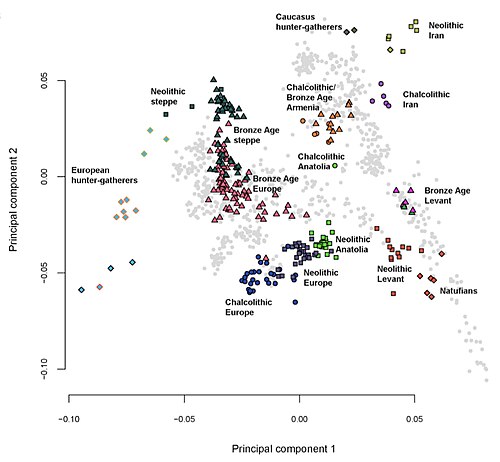
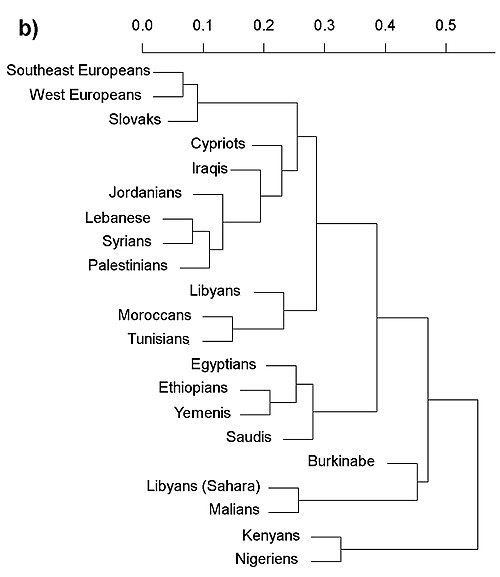
主成分分析。上の画像では、灰色以外の色が古代のサンプルを灰色の現代人集団の上に示し、下の画像ではラベル付けされた現代人集団を下に示しています。パレスチナ人は青銅器時代のレバント人サンプルとクラスターを形成しており、研究の著者らは「青銅器時代と現代のレバント人の重複は、この地域における遺伝的連続性の一端を示唆している」と結論付けています。(Haber et al., 2017)
2017年8月にMarc HaberらがThe American Journal of Human Geneticsに発表した研究では、著者らは「青銅器時代と現代のレバント人の重複は、この地域における遺伝的連続性の一端を示唆している」と結論付けた。[ 135 ]その後2024年にHaberは、現代のレバント人アラブ人はすべてカナン人のような祖先から派生しており、その後の移住が彼らの祖先に与えた影響はわずかであるとも述べている。[ 136 ]
ハンナ・アミット=コチャヴィは、イスラエル国内のパレスチナ人によって書かれたものと国外で書かれたものを区別する2つの流れのみを認めている(同書、11ページ)。[ 283 ]彼女はまた、1948年以前に制作された文学とそれ以降に制作された文学との間に時間的な区別も設けている。[ 283 ]スティーブン・サライタは、2003年に『Studies in the Humanities』に掲載された論文で、英語の作品、特に米国在住のパレスチナ人によって書かれた作品からなる第4の流れを提唱しており、それを「ディアスポラの国々に根ざしながらも、テーマと内容においてパレスチナに焦点を当てた作品」と定義している。[ 289 ]
1970年代にニューヨークで初めて登場した伝統的なラップ音楽から影響を受け、「若いパレスチナ人ミュージシャンは、自分たちの生活や仕事の場である社会や政治情勢に対する不満を表現するために、このスタイルを独自にアレンジしてきた」。パレスチナのヒップホップは、固定観念に挑戦し、イスラエルとパレスチナの紛争についての対話を促すことを目指している。[ 299 ]パレスチナのヒップホップアーティストは、アメリカのラッパーのメッセージに強く影響を受けている。タマル・ナファルは、「トゥパックが『It's a White Man's World』を歌っているのを聴いて、ヒップホップを真剣にやってみようと思った」と語っている。[ 300 ]アメリカのヒップホップの影響に加えて、アラビア語の話し言葉に例えられる「ザジャル、マワル、サージ」などのパレスチナ音楽やアラビア音楽の音楽的要素も取り入れているほか、アラビア音楽のパーカッシブさや叙情性も取り入れている。
1 2 「Zalaquett pone a Chile como modelo de convivencia Palestino-judía」[ザラクエットはチリをパレスチナ人とユダヤ人の共存のモデルに設定]。ディアリオ・ラ・ナシオン(スペイン語)。 2009 年 10 月 16 日。2016年 3 月 8 日のオリジナルからアーカイブ。2024 年12 月 27 日に取得。
↑ "Cómo llegó Chile a tener la Major comunidad de Palestinos fuera de Israel y del mundo árabe" [チリがイスラエルとアラブ世界の外で最大のパレスチナ人コミュニティを持つようになった経緯]。BBCムンド(スペイン語)。 2023 年 11 月 6 日。2024 年12 月 27 日に取得。
↑ホルヘ・アルベルト・アマヤ(2015年7月23日)。「Los Árabes y Palestinos en Honduras: su establecimiento e Impacto en la sociedad hondureña contemporánea: 1900–2009」[ホンジュラスのアラブ人とパレスチナ人: 現代ホンジュラス社会へのその確立と影響: 1900–2009 ] (スペイン語)。2016年8月18日のオリジナルからアーカイブ。En suma, los árabes y Palestinos, arribados al país a Finales del siglo XIX, dominan hoy en día la economía del país, y cada vez están emergiendo como actresss importantes de la clase politica hondureña y forman,チリの住民、アメリカ・ラテンアメリカのパレスチノ子孫の市長集中、15万人から20万人の人物が集まっています。要するに、19世紀末にホンジュラスに渡来したアラブ人とパレスチナ人は、今日ホンジュラス経済を支配しており、ホンジュラスの政治階級においてますます重要な役割を担うようになっている。彼らはチリに次いでラテンアメリカで2番目に大きなパレスチナ系住民の集中地域を形成しており、その数は15万人から20万人に上る。
↑ Andrea, Alfred J. ; Overfield, James H. (2011). The Human Record: Sources of Global History, Volume II: Since 1500 (7th ed.). Cengage Learning. p. 437. ISBN978-1-133-42004-0。
↑ Albanese, Francesca; Takkenberg, Lex (2020). Palestinian Refugees in International Law . Oxford University Press. p. 163. ISBN978-0-19-878404-32025年10月1日に取得。
↑ Farsoun, Samih K. (2005). "パレスチナのディアスポラ" . Ember, Melvin; Ember, Carol R.; Skoggard, Ian A. (編)『ディアスポラ百科事典:世界の移民と難民の文化』 Springer. pp. 234–. ISBN978-0-306-48321-92023年11月29日にオリジナルからアーカイブされました。2024年9月21日に取得。
1 2キューバート、ハロルド M. (2014年6月3日).中東におけるPFLPの役割の変化. ラウトレッジ. p. 36. ISBN978-1-135-22022-82023年12月31日取得。同年、アル・カルミルは「シオニストの植民地化に反対する目的で」ハイファで創刊され、1911年にはファラスティンが発行を開始し、読者を初めて「パレスチナ人」と呼んだ。
↑スミス、マーク (2002)。『神の初期の歴史:古代イスラエルのヤハウェとその他の神々』ウィリアム B. アードマンズ出版会社、 6-7頁。カナン人とイスラエル人は根本的に異なる文化を持つ人々であるという長きにわたる定説にもかかわらず、考古学的データは現在この見解に疑問を投げかけている。この地域の物質文化は、鉄器時代 I 期 (紀元前 1200 年~1000 年頃) のイスラエル人とカナン人の間に多くの共通点を示している。記録によれば、イスラエル人の文化はカナン人の文化と大きく重なり、そこから派生したものであったと考えられる。要するに、イスラエル人の文化は本質的にカナン人の文化に大きく影響を受けていた。入手可能な情報を考慮すると、鉄器時代 I 期のカナン人とイスラエル人の間に根本的な文化的分離を維持することはできない。
↑ホプキンス、デイビッド・C. (1985).カナン高地:初期鉄器時代の農業生活. アーモンド社. p. 22. ISBN978-0-907459-39-2。
↑ Bar, Doron (2003). "The Christianisation of Rural Palestine during Late Antiquity". The Journal of Ecclesiastical History . 54 (3): 401– 421. doi : 10.1017/s0022046903007309 . ISSN 0022-0469 .ビザンツ時代のパレスチナの歴史に関する支配的な見解は、4 世紀の土地の聖別初期段階と、聖地に教会を建てる際に伴う多額の外部からの資金投資を、住民のキリスト教化と結びつけている。教会は主に聖地に建てられ、12 同時に、キリスト教の「聖地」としてのパレスチナの位置づけと独特の地位がより強固になった。こうしたことすべてに加えて、移民や改宗も相まって、パレスチナのキリスト教化はローマ帝国の他の地域よりもはるかに急速に進み、異教の信仰が根絶され、5世紀半ばにはキリスト教徒が明らかに多数派となったと言われている。
↑Broshi, Magen (1979). "The Population of Western Palestine in the Roman-Byzantine Period". Bulletin of the American Schools of Oriental Research. 236 (236): 1–10. doi:10.2307/1356664. ISSN0003-097X. JSTOR1356664. S2CID24341643.
↑Broshi, Magen; Finkelstein, Israel (August 1992). "The Population of Palestine in Iron Age II". Bulletin of the American Schools of Oriental Research. 287 (1): 47–60. doi:10.2307/1357138. JSTOR1357138. Archived from the original on 5 March 2023.
12Levy-Rubin, Milka (2000). "New Evidence Relating to the Process of Islamization in Palestine in the Early Muslim Period: The Case of Samaria". Journal of the Economic and Social History of the Orient. 43 (3): 257–276. doi:10.1163/156852000511303. ISSN0022-4995. JSTOR3632444.
↑Ellenblum, Ronnie (2010). Frankish Rural Settlement in the Latin Kingdom of Jerusalem. Cambridge University Press. ISBN978-0-511-58534-0. OCLC958547332. From the data given above it can be concluded that the Muslim population of Central Samaria, during the early Muslim period, was not an autochthonous population which had converted to Christianity. They arrived there either by way of migration or as a result of a process of sedentarization of the nomads who had filled the vacuum created by the departing Samaritans at the end of the Byzantine period [...] To sum up: in the only rural region in Palestine in which, according to all the written and archeological sources, the process of Islamization was completed already in the twelfth century, there occurred events consistent with the model propounded by Levtzion and Vryonis: the region was abandoned by its original sedentary population and the subsequent vacuum was apparently filled by nomads who, at a later stage, gradually became sedentarized
↑Wickham, Chris (2005). Framing the Early Middle Ages: Europe and the Mediterranean, 400–900. Oxford University Press. p.130. ISBN978-0-19-926449-0. Archived from the original on 29 November 2023. In Syria and Palestine, where there were already Arabs before the conquest, settlement was also permitted in the old urban centres and elsewhere, presumably privileging the political centres of the provinces.
↑Avni, Gideon (2014). The Byzantine-Islamic Transition in Palestine: An Archaeological Approach. Oxford University Press. pp.312–324, 329. (theory of imported population unsubstantiated).
↑Lapidus, Ira M. (2014) [1988]. A History of Islamic Societies (3rded.). Cambridge University Press. p.156. ISBN978-1-139-99150-6. Archived from the original on 29 November 2023.
↑Tessler, Mark A. (1994). A History of the Israeli-Palestinian Conflict. Indiana University Press. p.70. ISBN0-253-20873-4. Archived from the original on 23 September 2024.
↑Ira M. Lapidus, Islamic Societies to the Nineteenth Century: A Global HistoryArchived 29 November 2023 at the Wayback Machine, Cambridge University Press, 2012, p. 201.
↑Al-Ju'beh, Nazmi (26 May 2009). Palestinian Identity and Cultural Heritage. Contemporain publications. Presses de l'Ifpo. pp.205–231. ISBN978-2-35159-265-6. Archived from the original on 15 October 2023. Retrieved 14 October 2023.
↑Kacowicz, Arie Marcelo; Lutomski, Pawel (2007). Population Resettlement in International Conflicts: A Comparative Study. Lexington Books. p.194. ISBN978-0-7391-1607-4. Archived from the original on 29 November 2023. Retrieved 29 November 2023.
↑Grossman, David (2017). Distribution and Population Density During the Late Ottoman and Early Mandate Periods (9781315128825ed.). New York: Routledge. pp.44–52. doi:10.4324/9781315128825. ISBN978-1-315-12882-5. Archived from the original on 29 June 2023. Retrieved 29 November 2023. They came from Circassia and Chechnya, and were refugees from territories annexed by Russia in 1864, and the Bosnian Muslims, whose province was lost to Serbia in 1878. Belonging to this category were the Algerians (Mughrabis), who arrived in Syria and Palestine in several waves after 1850 in the wake of France's conquest of their country and the waves of Egyptian migration to Palestine and Syria during the rule of Muhammad Ali and his son, Ibrahim Pasha. [...] In most cases the Egyptian army dropouts and the other Egyptian settlers preferred to settle in existing localities, rather than to establish new villages. In the southern coastal plain and Ramla zones there were at least nineteen villages which had families of Egyptian origin, and in the northern part of Samaria, including the 'Ara Valley, there are a number of villages with substantial population of Egyptian stock.
↑Frantzman, Seth J.; Kark, Ruth (16 April 2013). "The Muslim Settlement of Late Ottoman and Mandatory Palestine: Comparison with Jewish Settlement Patterns". Digest of Middle East Studies. 22 (1): 77. doi:10.1111/j.1949-3606.2012.00172.x. ISSN1060-4367. Some of these Muslims were Egyptian and Algerian immigrants who came to Palestine in the first half of the nineteenth century from foreign lands. There were also Algerians, Bosnians, and Circassians, who came in the second half of the nineteenth century, but most were from within the borders of Palestine.
↑Swedenburg, Ted (2003). Memories of Revolt: The 1936–1939 Rebellion and the Palestinian National Past. University of Arkansas Press. p.81. ISBN978-1-55728-763-2. These primordialist claims regarding the Palestinians' primeval and prior roots in the land operated at the level of the collective. When it came to an individual's own family, however, Arab-Islamic discourse took precedence over archaeological justifications. I ran across no Palestinian villager (or urbanite) who claimed personal descent from the Canaanites. Villagers typically traced their family or their hamila's origins back to a more recent past in the Arabian peninsula. Many avowed descent from some nomadic tribe that had migrated from Arabia to Palestine either during or shortly after the Arab-Islamic conquests. By such a claim they inserted their family's history into the narrative of Arab and Islamic civilization and connected themselves to a genealogy that possessed greater local and contemporary prestige than did ancient or pre-Islamic descent. Several men specifically connected their forefathers' date of entry into Palestine to their participation in the army of Salih al-Din al-Ayyubi (Saladin), a historical figure whose significance has been retrospectively enlarged by nationalist discourse such that he is now regarded not merely as a hero of "Islamic" civilization but as a "national" luminary as well.+ (Modern nationalist discourse tends to downplay Salah al-Din's Kurdish origins.) Palestinians of all political stripes viewed Salah al-Din's wars against the Crusaders as a forerunner of the current combats against foreign intruders. Many considered Salah al-Din's victory over the Crusaders at Hittin (A.D. 1187) as a historical precedent that offered hope for their own eventual triumph even if, like the Crusader wars, the current struggle with Israel was destined to last more than two centuries. Family histories affiliated to earlier "patriotic" struggles against European aggression tied interviewees to a continuous narrative of national resistance. Villagers claiming descent from Arabs who entered Palestine during the Arab-Islamic conquest equally viewed these origins as establishing their historical precedence over the Jews
↑Lowin, Shari (1 October 2010), "Khaybar", Encyclopedia of Jews in the Islamic World, Brill, pp.148–150, doi:10.1163/1878-9781_ejiw_com_0012910, retrieved 22 June 2023, Khaybar's Jews appear in Arab folklore as well. [...] The Muḥamara family of the Arab village of Yutta, near Hebron, trace their descent to the Jews of Khaybar. Families in other nearby villages tell of similar lineages.
↑Erlich (Zhabo), Ze'ev H.; Rotter, Meir (2021). "ארבע מנורות שומרוניות בכפר חג'ה שבשומרון"[Four Samaritan Menorahs from the village of Hajjeh, Samaria]. במעבה ההר. 11 (2). Ariel University Publishing: 188–204. doi:10.26351/IHD/11-2/3. S2CID245363335.
12Kim, Byung-Ju; Choi, Jaejin; Kim, Sung-Hou (2023). "On whole-genome demography of world's ethnic groups and individual genomic identity". Scientific Reports. 13 (1): 6316. Bibcode:2023NatSR..13.6316K. doi:10.1038/s41598-023-32325-w. PMC10113208. PMID37072456.
↑Nebel, Almut; Filon, Dvora; Weiss, Deborah A.; Weale, Michael; Faerman, Marina; Oppenheim, Ariella; Thomas, Mark G. (December 2000). "High-resolution Y chromosome haplotypes of Israeli and Palestinian Arabs reveal geographic substructure and substantial overlap with haplotypes of Jews" (PDF). Human Genetics. 107(6): 630–641. doi:10.1007/s004390000426. PMID11153918. S2CID8136092. According to historical records part, or perhaps the majority, of the Muslim Arabs in this country descended from local inhabitants, mainly Christians and Jews, who had converted after the Islamic conquest in the seventh century AD (Shaban 1971; Mc Graw Donner 1981). These local inhabitants, in turn, were descendants of the core population that had lived in the area for several centuries, some even since prehistorical times (Gil 1992)... Thus, our findings are in good agreement with the historical record...
12Agranat-Tamir L, Waldman S, Martin MS, Gokhman D, Mishol N, Eshel T, Cheronet O, Rohland N, Mallick S, Adamski N, Lawson AM, Mah M, Michel MM, Oppenheimer J, Stewardson K, Candilio F, Keating D, Gamarra B, Tzur S, Novak M, Kalisher R, Bechar S, Eshed V, Kennett DJ, Faerman M, Yahalom-Mack N, Monge JM, Govrin Y, Erel Y, Yakir B, Pinhasi R, Carmi S, Finkelstein I, Reich D (May 2020). "The Genomic History of the Bronze Age Southern Levant". Cell. 181 (5): 1153–1154. doi:10.1016/j.cell.2020.04.024. PMC10212583. PMID32470400.
↑Atzmon G, Hao L, Pe'er I, Velez C, Pearlman A, Palamara PF, Morrow B, Friedman E, Oddoux C, Burns E, Ostrer H (June 2010). "Abraham's children in the genome era: major Jewish diaspora populations comprise distinct genetic clusters with shared Middle Eastern Ancestry". American Journal of Human Genetics. 86 (6): 850–9. doi:10.1016/j.ajhg.2010.04.015. PMC3032072. PMID20560205.
↑Haber, Marc; Gauguier, Dominique; Youhanna, Sonia; Patterson, Nick; Moorjani, Priya; Botigué, Laura R.; Platt, Daniel E.; Matisoo-Smith, Elizabeth; Soria-Hernanz, David F.; Wells, R. Spencer; Bertranpetit, Jaume; Tyler-Smith, Chris; Comas, David; Zalloua, Pierre A. (2013). "Genome-wide diversity in the levant reveals recent structuring by culture". PLOS Genetics. 9 (2) e1003316. doi:10.1371/journal.pgen.1003316. PMC3585000. PMID23468648.
12Das, R; Wexler, P; Pirooznia, M; Elhaik, E (2017). "The Origins of Ashkenaz, Ashkenazic Jews, and Yiddish". Frontiers in Genetics. 8 87. doi:10.3389/fgene.2017.00087. PMC5478715. PMID28680441.
12Pearson, Nathaniel (11 January 2022). "The splendid tapestry: How DNA reveals truths, ancient & lasting". TED: Ideas Worth Spreading. Retrieved 5 February 2024.
↑Doron M. Behar; Bayazit Yunusbayev; Mait Metspalu; Ene Metspalu; Saharon Rosset; Jüri Parik; Siiri Rootsi; Gyaneshwer Chaubey; Ildus Kutuev; Guennady Yudkovsky; Elza K. Khusnutdinova; Oleg Balanovsky; Olga Balaganskaya; Ornella Semino; Luisa Pereira; David Comas; David Gurwitz; Batsheva Bonne-Tamir; Tudor Parfitt; Michael F. Hammer; Karl Skorecki; Richard Villems (July 2010). "The genome-wide structure of the Jewish people". Nature. 466 (7303): 238–42. Bibcode:2010Natur.466..238B. doi:10.1038/nature09103. PMID20531471. S2CID4307824.
↑Hajjej, Abdelhafidh; Almawi, Wassim Y.; Arnaiz-Villena, Antonio; Hattab, Lasmar; Hmida, Slama (9 March 2018). "The genetic heterogeneity of Arab populations as inferred from HLA genes". PLOS ONE. 13 (3) e0192269. Bibcode:2018PLoSO..1392269H. doi:10.1371/journal.pone.0192269. ISSN1932-6203. PMC5844529. PMID29522542.
↑Fernandes, Verónica; Triska, Petr; Pereira, Joana B.; Alshamali, Farida; Rito, Teresa; Machado, Alison; Fajkošová, Zuzana; Cavadas, Bruno; Černý, Viktor; Soares, Pedro; Richards, Martin B.; Pereira, Luísa (2015). Chaubey, Gyaneshwer (ed.). "Genetic Stratigraphy of Key Demographic Events in Arabia". PLOS ONE. 10 (3) e0118625. Bibcode:2015PLoSO..1018625F. doi:10.1371/journal.pone.0118625. ISSN1932-6203. PMC4349752. PMID25738654. Palestinians (similar to the Samaritans and some of the Druze), highlighting their primarily indigenous origin
↑Nebel A, Filon D, Weiss DA, Weale M, Faerman M, Oppenheim A, Thomas MG (December 2000). "High-resolution Y chromosome haplotypes of Israeli and Palestinian Arabs reveal geographic substructure and substantial overlap with haplotypes of Jews". Human Genetics. 107 (6): 630–41. doi:10.1007/s004390000426. PMID11153918. S2CID8136092.
↑Haber, M; Doumet-Serhal, C; Scheib, C; Xue, Y; Danecek, P; Mezzavilla, M; Youhanna, S; Martiniano, R; Prado-Martinez, J; Szpak, M; Matisoo-Smith, E; Schutkowski, H; Mikulski, R; Zalloua, P; Kivisild, T; Tyler-Smith, C (3 August 2017). "Continuity and Admixture in the Last Five Millennia of Levantine History from Ancient Canaanite and Present-Day Lebanese Genome Sequences". American Journal of Human Genetics. 101 (2): 274–282. doi:10.1016/j.ajhg.2017.06.013. PMC5544389. PMID28757201.
↑Marc Haber on X: "All Levantines descend from Canaanite-like ancestors (Haber et al 2017, Agranat-Tamir 2020). Later admixture slightly changed ancestry". 17 January 2024.
↑Badro, Danielle A.; Douaihy, Bouchra; Haber, Marc; Youhanna, Sonia C.; Salloum, Angélique; Ghassibe-Sabbagh, Michella; Johnsrud, Brian; Khazen, Georges; Matisoo-Smith, Elizabeth; Soria-Hernanz, David F.; Wells, R. Spencer; Tyler-Smith, Chris; Platt, Daniel E.; Zalloua, Pierre A.; Consortium, The Genographic (2013-01-30). "Y-Chromosome and mtDNA Genetics Reveal Significant Contrasts in Affinities of Modern Middle Eastern Populations with European and African Populations". PLOS ONE. 8 (1) e54616. Bibcode:2013PLoSO...854616B. doi:10.1371/journal.pone.0054616. ISSN1932-6203. PMC3559847. PMID23382925.
↑Ana Teresa Fernandes; Rita Gonçalves; Sara Gomes; Dvora Filon; Almut Nebel; Marina Faerman; António Brehm (November 2011). "Y-chromosomal STRs in two populations from Israel and the Palestinian Authority Area: Christian and Muslim Arabs". Forensic Science International: Genetics. 5 (5): 561–562. doi:10.1016/j.fsigen.2010.08.005. hdl:10400.13/4485. PMID20843760.
↑Richards, Martin; Rengo, Chiara; Cruciani, Fulvio; Gratrix, Fiona; Wilson, James F.; Scozzari, Rosaria; Macaulay, Vincent; Torroni, Antonio (2003). "Extensive Female-Mediated Gene Flow from Sub-Saharan Africa into Near Eastern Arab Populations". American Journal of Human Genetics. 72 (4): 1058–1064. doi:10.1086/374384. PMC1180338. PMID12629598.
12Tamir Sorek (2004). "The Orange and the Cross in the Crescent"(PDF). Nations and Nationalism. 10 (3): 269–291. doi:10.1111/j.1354-5078.2004.00167.x. Archived(PDF) from the original on 5 May 2023. Retrieved 29 November 2023.
↑Rashid Khalidi, "Palestinian Identity", pp. 117ff, p. 142Archived 29 November 2023 at the Wayback Machine.
↑Zachary J Foster, Emanuel Beška, "The Origins of the term 'Palestinian' ('Filasṭīnī') in late Ottoman Palestine, 1898–1914Archived 15 October 2023 at the Wayback Machine", Academic Letters 2021 pp.1–22
↑Karsh, Efraim. Arafat's War: The Man and His Battle for Israeli Conquest. New York: Grove Press, 2003. p. 43. "Upon occupying the West Bank during the 1948 war, King Abdallah moved quickly to erase all traces of corporate Palestinian identity."
↑Yehoshua Porath (1977). Palestinian Arab National Movement: From Riots to Rebellion: 1929–1939, vol. 2. Frank Cass and Co., Ltd. pp.81–82.
↑Don Atapattu (16 June 2004). "Interview With Middle East Scholar Avi Shlaim: America, Israel and the Middle East". The Nation. Archived from the original on 13 November 2019. Retrieved 9 March 2008.
↑Only "peoples" are entitled to self-determination in contemporary international law (See Self-determination and National Minorities, Oxford Monographs in International Law, Thomas D. Musgrave, Oxford University Press, 1997, ISBN0-19-829898-6, p. 170). In 2004, the International Court of Justice said that Israel had recognized the existence of a "Palestinian people" and referred a number of times to the Palestinian people and its "legitimate rights" in international agreements. The Court said those rights include the right to self-determination(See paragraph 118 of Legal Consequences of the Construction of a Wall in the Occupied Palestinian Territory "Cour internationale de Justice – International Court of Justice | International Court of Justice"(PDF). Archived from the original(PDF) on 6 July 2010. Retrieved 6 July 2010.). Judge Koroma explained "The Court has also held that the right of self-determination as an established and recognized right under international law applies to the territory and to the Palestinian people. Accordingly, the exercise of such right entitles the Palestinian people to a State of their own as originally envisaged in resolution 181 (II) and subsequently confirmed." Judge Higgins also said "that the Palestinian people are entitled to their territory, to exercise self-determination, and to have their own State"(See paragraph 5, Separate opinion of Judge Koroma "Cour internationale de Justice – International Court of Justice | International Court of Justice"(PDF). Archived from the original(PDF) on 4 June 2011. Retrieved 7 February 2010. and paragraph 18, Separate opinion of Judge Higgins "Cour internationale de Justice – International Court of Justice | International Court of Justice"(PDF). Archived from the original(PDF) on 12 January 2011. Retrieved 7 February 2010.). Paul De Waart said that the Advisory Opinion of the International Court of Justice in 2004 "ascertained the present responsibility of the United Nations to protect Palestine's statehood. It affirmed the applicability of the prohibition of acquisition of Palestinian territory by Israel and confirmed the illegality of the Israeli settlements in the Occupied Palestinian Territory. Moreover, the existence of the Palestinian people as the rightful claimant to the Occupied Palestinian Territory is no longer open to question (See De Waart, Paul J. I. M., "International Court of Justice Firmly Walled in the Law of Power in the Israeli–Palestinian Peace Process", Leiden Journal of International Law, 18 (2005), pp. 467–487).
↑"John Dugard's "Situation of human rights in the Palestinian territories occupied since 1967"". Domino.un.org. Archived from the original on 30 December 2007. Retrieved 22 April 2009.
↑Israel News (8 September 2012). "Palestinian Authority to revive statehood bid". Ynet News. Archived from the original on 24 July 2014. Retrieved 25 July 2014.
↑Benny Morris, Righteous Victims, p. 48 in the French edition.
↑Benny Morris, Righteous Victims, p.49 in the French edition.
↑Lauterpacht, H. International Law Reports: Cases 1938–1940, H. Lauterpacht, Cambridge University Press, 2004, ISBN 0-521-46354-8, page 49. Cambridge University Press. ISBN978-0-521-46354-6. Archived from the original on 29 November 2023. Retrieved 22 April 2009.
↑Weldon Matthews, Confronting an Empire, Constructing a Nation,I.B. Tauris, 2006, p. 33. Both Weldon Matthews and Prasenjit Duara interpret this aspect of the mandate system as tailored to the needs of imperial powers, which found it useful to avoid classifying colonies as nations: "This outlook was carried over to Palestine from India and Egypt where British administrators did not merely doubt the existence of a unifying national identity, but thwarted its development by creating sectarian institutions as a matter of policy."
↑"Correspondence with the Palestine Arab Delegation and the Zionist Organization". United Nations. 21 February 1922. Archived from the original on 16 October 2007. Retrieved 1 August 2007.
↑"Palestine Arabs." The Continuum Political Encyclopedia of the Middle East. Ed. Avraham Sela. New York: Continuum, 2002.
12345"The History of Palestinian Revolts". Al Jazeera. 9 December 2003. Archived from the original on 15 December 2005. Retrieved 17 August 2007.
↑Benny Morris, Righteous Victims, pp. 49–50 in the French edition.
12"Milestones: 1945–1952."Archived 7 June 2020 at the Wayback MachineOffice of the Historian. 7 December 2018.
12Sela and Neil Caplan. "Epilogue: Reflections on Post-Oslo Israeli and Palestinian History and Memory of 1948." The War of 1948: Representations of Israeli and Palestinian Memories and Narratives, edited by Sela and Alon Kadish, Indiana University Press, 2016, pp. 203–221.
↑Thrall, Nathan. "How 1948 Still Influences the ..."Archived 23 October 2023 at the Wayback MachineTime. 14 May 2018. 7 December 2018.
↑Nurhan Abujidi, Urbicide in Palestine: Spaces of Oppression and ResilienceArchived 29 November 2023 at the Wayback Machine, Routledge 2014 p.95.
↑Philip Mattar, The Encyclopedia of the PalestiniansArchived 20 March 2023 at the Wayback Machine, InfoBase Publishing 2005 p.329.
12Anderson, Perry (November–December 2015). "The House of Zion". New Left Review. No.96. pp.5–37, p.31 n.55. Archived from the original on 1 May 2021. Retrieved 21 September 2024, citing Brynen, Rex; E-Rifai, Roula, eds. (2013). Compensation to Palestinian Refugees and the Search for Palestinian-Israeli Peace. London: Pluto Press. p.10,132–69.
↑Benvenisti, Meron (1996), City of Stone: The Hidden History of Jerusalem, University of California Press, ISBN0-520-20521-9. 27
↑Avram Bornstein, 'Military Occupation as Carceral Society: Prisons, Checkpoints, and Wall in the Israeli-Palestinian Struggle,' in Avram Bornstein, Paul E. Farmer (et al.)An Anthropology Of War: Views from the Frontline, Berghahn Books, 2009 pp.106–130, p.108:'On the whole, the Israeli Occupation has created an increasing prison-like society for Palestinians'.
↑"The PNC program of 1974". Mideastweb.org. 8 June 1974. Archived from the original on 15 November 2017. Retrieved 17 August 2007.The PNC adopted the goal of establishing a national state in 1974.
↑Khalidi, 1997, p. 149. Khalidi writes: 'As with other national movements, extreme advocates of this view go further than this, and anachronistically read back into the history of Palestine over the past few centuries, and even millennia, a nationalist consciousness and identity that are in fact relatively modern.'
↑"Security Council"(PDF). WorldMUN2007– United Nations Security Council. 30 March 2007. Archived from the original(PDF) on 8 August 2007. Retrieved 31 July 2007.
12"48 Statement in the Knesset by Deputy Premier and Foreign Minister Allon – 26 November 1974". Ministry of Foreign Affairs (Israel). 26 November 1974. Archived from the original on 3 December 2013. Retrieved 30 November 2013.
↑See Committee on the Exercise of the Inalienable Rights of the Palestinian People Archived 5 September 2011 at the Wayback Machine
↑Steven J. Rosen (September 2012). "Kuwait Expels Thousands of Palestinians". Middle East Forum. Archived from the original on 11 May 2013. Retrieved 29 November 2023.
↑"Report of the Independent Fact Finding Committee on Gaza: No Safe Place"(PDF). The League of Arab States. 30 April 2009. p.145. Archived from the original(PDF) on 13 October 2009. Retrieved 20 September 2010.
↑Farsoun, Samih; Hasan Aruri, Naseer (2006). Palestine and the Palestinians: a social and political history. Westview Press. p.275.
↑Gordon, Neve (2008). Israel's occupation. University of California Press. p.198. ISBN978-0-520-25531-9. Archived from the original on 29 November 2023. Retrieved 29 November 2023.
↑"ICJ Opinion"(PDF). Archived from the original(PDF) on 6 July 2010. Retrieved 16 December 2008.
↑Thomas Giegerich (1999). "The Palestinian Autonomy and International Human Rights Law: Perspectives on an Ongoing Process of Nation-Building". In Amos Shapira; Mala Tabory (eds.). New Political Entities in Public and Private International Law: With Special Reference to the Palestinian Entity. Kluwer Law International. pp.198–200. ISBN978-90-411-1155-5. Archived from the original on 29 November 2023. Retrieved 29 November 2023.
↑Sonnenfeld, Jeffrey. "The Bahrain Conference: What the Experts and the Media Missed."Archived 20 November 2023 at the Wayback MachineFortune. 30 June 2019. 3 July 2019.
↑Brown, Nathan J. "Israel and Palestine: The Perils of Positive Thinking." The Fletcher Forum of World Affairs 49.2 (2025): 223-32. ProQuest. 15 Oct. 2025.
↑"LEGAL BRIEFER: States' Duty to Prevent Genocide under the 1948 Genocide Convention". International Committee of Jurists. 2025. Retrieved 26 May 2026.
↑Adams, Paul (26 January 2024). "Israel reined in by ICJ rulings on Gaza – but will it obey?". BBC News. Retrieved 21 June 2026.
↑Tulchinsky, Theodore H., et al. "Israel and Gaza: Keeping Room for Hope Based on Past Cooperation in Public Health." American Journal of Public Health. 115.7 (2025): 1046-9. ProQuest. 15 Oct. 2025.
12345678Farsoun, Samih K.; Zacharia, Christina E. (30 August 1996). Palestine and the Palestinians. WestviewPress. pp.128–129. ISBN978-0-8133-2112-7. Retrieved 21 April 2025.
12Gompert, David; Shine, Kenneth; Robinson, Glenn; Neu, C. Richard; Green, Jerrold (22 April 2001). "4. Demography". Building a Successful Palestinian State. Rand Corporation. p.76. ISBN978-0-8330-4050-3. JSTOR10.7249/mg146-1dcr.14.
↑Centre, Al-Zaytouna (1 October 2016). "The Palestinian Strategic Report 2014–2015". ResearchGate. Retrieved 21 April 2025.
↑"Palestinian population to exceed Jewish population by 2020". Ma'an News Agency. 1 January 2016. Archived from the original on 4 March 2016. Retrieved 18 August 2022.
↑Meron Rapaport, 'The Israeli right is the minority — the left need only realize it,'Archived 9 June 2023 at the Wayback Machine+972 magazine 12 January 2023
↑"Jews now a 47% minority in Israel and the territories, demographer says"Archived 23 November 2023 at the Wayback Machine, The Times of Israel 30 August 2022.
↑American-Israel Demographic Research Group (AIDRG)Archived 15 October 2011 at the Wayback Machine, is led by Bennett Zimmerman, Yoram Ettinger, Roberta Seid, and Michael L. Wise
↑Bennett Zimmerman, Roberta Seid & Michael L. Wise. "The Million Person Gap: The Arab Population in the West Bank and Gaza"(PDF). Begin-Sadat Center for Strategic Studies. Archived from the original(PDF) on 2 February 2007. Retrieved 20 February 2007.
↑Bennett Zimmerman, Roberta Seid, and Michael L. Wise, "Voodoo Demographics"Archived 4 January 2021 at the Wayback Machine, Azure, Summer 5766/2006, No. 25.
12Sergio DellaPergola, Letter to the editor, Azure, 2007, No. 27, "Correspondence"(PDF). Archived from the original(PDF) on 30 September 2011. Retrieved 21 June 2011.
↑Aluf Benn (28 January 2005). "You can count on them". Haaretz.com. Archived from the original on 10 October 2017. Retrieved 29 November 2023.
↑"Molad Analysis – Wrong Number". www.molad.org. Archived from the original on 24 September 2014. Retrieved 29 November 2023.
↑Hasson, Nir (30 June 2013). "How Many Palestinians Actually Live in the West Bank? – Diplomacy & Defense – Haaretz". Haaretz.com. Archived from the original on 1 November 2014. Retrieved 29 November 2023.
↑Ian Lustick (Spring 2013). "What Counts is the Counting: Statistical Manipulation as a Solution to Israel's "Demographic Problem""(PDF). Middle East Journal. 67 (2): 185–205. doi:10.3751/67.2.12. S2CID143466620. Archived from the original(PDF) on 13 November 2013. Retrieved 12 November 2013.
↑"Jordan revokes Palestinians' citizenships"Archived 16 January 2013 at the Wayback Machine. JTA. 21 July 2009.
↑Ray Hanania. "Chicago's Arab American Community: An Introduction". Archived from the original on 24 March 2006. Retrieved 7 April 2006.
↑"Palestinians". Encyclopedia of Chicago. Archived from the original on 26 November 2020. Retrieved 7 April 2006.
↑Matthew Ziegler. "El Salvador: Central American Palestine of the West?". The Daily Star. Archived from the original on 8 January 2009. Retrieved 7 April 2006.
↑Larry Lexner. "Honduras: Palestinian Success Story". Lexner News Inc. Archived from the original on 16 May 2006. Retrieved 25 August 2018.
↑Diego Mendez (30 January 2006). "Obituary; Shafik Handal; leader of El Salvador's leftist party; 75". Associated Press. Retrieved 10 February 2008.{{cite news}}: CS1 maint: deprecated archival service (link)
↑"Table 1.0: Total Registered Refugees per Country per Area"(PDF). UNRWA. Archived from the original(PDF) on 23 July 2008.
↑"Publications and Statistics". UNRWA. 31 March 2006. Archived from the original on 13 July 2008. Retrieved 30 May 2007.
↑"Badil Resource Centre for Palestinian Refugee and Residency Rights"(PDF). Archived from the original(PDF) on 14 December 2004. Retrieved 11 March 2007.
↑Internal Displacement Monitoring Centre (IDMC) – Norwegian Refugee Council. "Internal Displacement Monitoring Center". Internal-displacement.org. Archived from the original on 3 September 2006. Retrieved 22 April 2009.
↑Randa F arah, "The Marginalizastion of Palestinian Refugees", Niklaus Steiner, Mark Gibney, Gil Loescher (eds.) Problems of Protection: The UNHCR, Refugees, and Human RightsArchived 29 November 2023 at the Wayback Machine, Psychology Press, 2003 pp.155–178 p.161.
↑UN General Assembly Resolution 194 (III), "Progress Report of the United Nations Mediator", U.N. Doc. A/RES/194 (11 December 1948), para. 11, cited Leila Hilal, Transitional Justice Responses to Palestinian Dispossession: Focus on RestitutionArchived 5 March 2023 at the Wayback Machine, Brookings Institution/LSE August 2012 p.8.
123Gibney, Mathew (2005). Immigration and Asylum: From 1900 to the Present. ABC-CLIO. pp.469–470. ISBN978-1-57607-796-2. Israel refused to allow refugees to return to their homes 242.
123Muslih, Muhammad (2002). The Middle East in 2015 The Impact of Regional Trends on U.S. Strategic Planning. Diane Publishing reprint. Originally published by National Defense University Press. pp.104–105. ISBN978-1-4289-6100-5. Archived from the original on 29 November 2023. Retrieved 29 November 2023.
12"Egypt grants citizenship to 50,000 Palestinians". The Jerusalem Post. 30 January 2011. Archived from the original on 7 February 2013. Retrieved 29 November 2023.
↑Hall, Richard (24 August 2010). "Mired in poverty: Palestinian refugees in Lebanon see little hope in new law". the Guardian. Archived from the original on 13 September 2019. Retrieved 29 November 2023.
12345678Ali Qleibo (28 July 2007). "Palestinian Cave Dwellers and Holy Shrines: The Passing of Traditional Society". This Week in Palestine. Archived from the original on 27 September 2007. Retrieved 17 August 2007.
↑R. Conder, Claude (1877). "The Moslem Mukams". Palestine Exploration Quarterly. 9 (2): 89–91. doi:10.1179/peq.1877.9.2.89. ISSN0031-0328. In their religious observances and sanctuaries we find, as in their language, the true history of the country. On a basis of polytheistic faith which most probably dates back to pre-Israelite times, we find a growth of the most heterogeneous description: Christian tradition, Moslem history and foreign worship are mingled so as often to be entirely indistinguishable, and the so-called Moslem is found worshipping at shrines consecrated to Jewish, Samaritan, Christian, and often Pagan memories. It is in worship at these shrines that the religion of the peasantry consists. Moslem by profession, they often spend their lives without entering a mosque, and attach more importance to the favour and protection of the village Mukam than to Allah himself, or to Mohammed his prophet... The reverence shown for these sacred spots is unbounded. Every fallen stone from the building, every withered branch of the tree, is carefully preserved.
↑Janet Abu-Lughod. "The Demographic War for Palestine". Americans for Middle East Understanding. Archived from the original on 13 November 2020. Retrieved 30 November 2013.
↑Bernard Sabella. "Palestinian Christians: Challenges and Hopes". Bethlehem University. Archived from the original on 15 April 2010. Retrieved 25 April 2004.
↑Holston, Mark (1 November 2005), "Orgullosos palestinos de Chile", Américas, ISSN0379-0975, archived from the original on 5 May 2012, retrieved 29 July 2009
↑Melton, J. Gordon (2021). Religious Celebrations: An Encyclopedia of Holidays, Festivals, Solemn Observances, and Spiritual Commemorations. ABC-CLIO. p.334. ISBN978-1-59884-205-0. He is also the patron saint of the Palestinian Christian community.
↑Yoav Stern & Jack Khoury (2 May 2007). "Balad's MK-to-be: 'Anti-Israelization' Conscientious Objector". Haaretz. Archived from the original on 2 August 2009. Retrieved 29 July 2007.
↑Nissim Dana, The Druze in the Middle East: Their Faith, Leadership, Identity and Status, Sussex Academic Press, 2003, p. 201.
123Rosenblatt, Dana (14 October 2002). "Amid conflict, Samaritans keep unique identity". CNN. Archived from the original on 20 November 2018. Retrieved 30 May 2007.
↑Glass, Charles (1975). "Jews against Zion: Israeli Jewish Anti-Zionism". Journal of Palestine Studies. 5 (1/2): 56–81. doi:10.2307/2535683. JSTOR2535683.
↑Davis, Uri (December 2013). "Apartheid Israel: A Critical Reading of the Draft Permanent Agreement, known as the "Geneva Accords"". The Association for One Democratic State in Palestine-Israel. Archived from the original on 28 April 2020. Retrieved 11 January 2014.
↑"Letter to the United Nations Special Committee on Palestine". bic.org. Baháʼí International Community. 9 March 2012. Archived from the original on 15 April 2012. Retrieved 20 September 2025.
↑Smith, Peter (2008). An Introduction to the Baháʼí Faith. Cambridge University Press. p.26. ISBN978-0-521-86251-6. Archived from the original on 10 November 2023. Retrieved 29 November 2023.
↑"Palestinian Central Bureau of Statistics". Palestinian Central Bureau of Statistics. Archived from the original on 8 June 2014. Retrieved 28 December 2013.
↑"65th Independence Day – More than 8 Million Residents in the State of Israel"(PDF). Israel Central Bureau of Statistics. 14 April 2013. Archived from the original(PDF) on 28 November 2017. Retrieved 18 February 2014.
↑"World Directory of Minorities and Indigenous Peoples – Jordan – Palestinians". Minority Rights Group International. 2008. Archived from the original on 27 January 2016. Retrieved 24 January 2016.
↑Bonfil, Robert; Irshai, Oded; Stroumsa, Guy G.; Talgam, Rina, eds. (2011). Jews in Byzantium: Dialectics of Minority and Majority Cultures. BRILL. pp.317, 335, 320. ISBN978-90-04-20355-6. Archived from the original on 29 November 2023. Retrieved 29 November 2023.
↑Scribner's (1980). Cyril Mango. Byzantium: The Empire of New Rome. p.13. Archived from the original on 17 January 2013. Retrieved 14 January 2013.
↑Ammon, Ulrich (2006). Sociolinguistics/Soziolinguistik 3: An International Handbook of the Science. Walter de Gruyter. p.1922. ISBN978-3-11-018418-1. Archived from the original on 29 November 2023. Retrieved 16 May 2021.
12"Education (2014)"(PDF). United Nations Development Programme. United Nations. Archived from the original(PDF) on 11 March 2017. Retrieved 30 January 2017.
↑West Bank 44.6% versus 22.8% in Lebanon. See Elias H. Tuma, Haim Darin-Drabkin, The Economic case for Palestine, London: Croom Helm, 1978, p 48.
↑Interview with Elias Sanbar. Claude Cheysson, "The Right to Self-Determination", Journal of Palestine Studies, Vol. 16, no. 1 (Autumn 1986), pp. 3–12; p. 3.
↑Jordanian Poets: Samer Raimouny, Mustafa Wahbi, Haider Mahmoud, Ibrahim Nasrallah. General L.L.C Books. June 2010. ISBN978-1-158-40889-4.
↑"Biography Ibrahim Nasrallah". Pontas literary & film agency. Archived from the original on 26 May 2010. Retrieved 14 December 2010.
↑Second Class: Discrimination Against Palestinian Arab Children in Israel's Schools, p 8, 2001
1234Salim Tamari (Winter 2004). "Lepers, Lunatics and Saints: The Nativist Ethnography of Tawfiq Canaan and his Jerusalem Circle"(PDF). Jerusalem Quarterly (20). doi:10.70190/jq.I20.p24. Archived from the original(PDF) on 24 April 2015. Retrieved 31 May 2015.
↑Elmokadem, Ismail (10 December 2005). "Book records Palestinian art history". Al Jazeera. Archived from the original on 19 April 2007. Retrieved 18 April 2008.
↑Moran, Danny. "Manchester Festival of Palestinian Literature". Manchester Festival of Palestinian literature. Archived from the original on 31 March 2008. Retrieved 18 April 2008.
↑Regev Motti (1993), Oud and Guitar: The Musical Culture of the Arabs in Israel (Institute for Israeli Arab Studies, Beit Berl), ISBN965-454-002-9, p. 4.
12Revisiting our table...Archived 27 November 2013 at the Wayback Machine Nasser, Christiane Dabdoub, This week in Palestine, Turbo Computers & Software Co. Ltd. June 2006. Retrieved 8 January 2008.
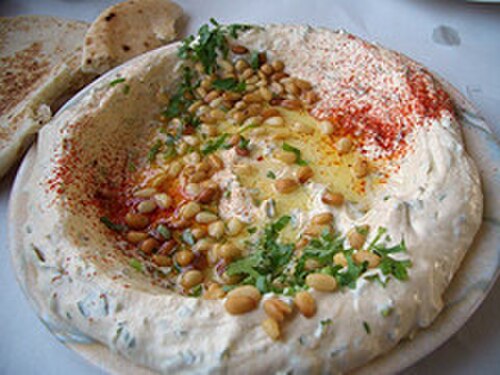
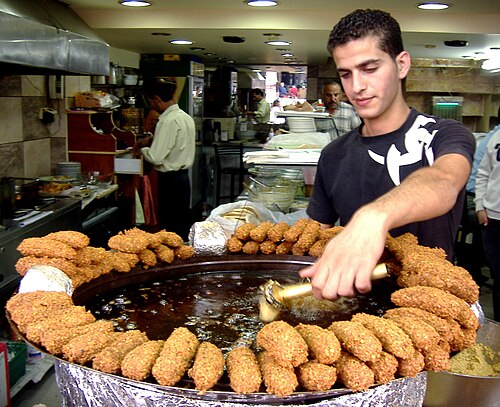
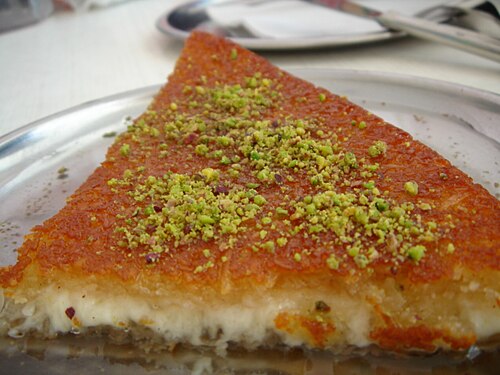
↑ABC of Arabic CuisineArchived 4 July 2011 at the Wayback Machine ArabNet. Retrieved 25 December 2007.
↑"Palestinian Kufta Recipe - Food.com". www.food.com. Archived from the original on 2 November 2020. Retrieved 29 November 2023.
↑Once Upon a Time in JerusalemISBN978-1-859-64323-5 ch. 2
↑"Palestine-Family.net – for the world-wide Palestine community". www.palestine-family.net. Archived from the original on 14 January 2018. Retrieved 13 January 2018.
↑Tal Ben Zvi (2006). "Hagar: Contemporary Palestinian Art"(PDF). Hagar Association. Archived(PDF) from the original on 16 January 2016. Retrieved 5 June 2007.
↑"Xan Brooks on Palestinian directors | Film | The Guardian". London: Film.guardian.co.uk. 12 April 2006. Archived from the original on 24 July 2008. Retrieved 22 April 2009.
↑"Palestine Film". Archived from the original on 12 June 2008. Retrieved 26 July 2011.
↑Jane Waldron Grutz (January–February 1991). "Woven Legacy, Woven Language". Saudi Aramco World. Archived from the original on 19 February 2007. Retrieved 4 June 2007.
↑Weir, Shelagh (1989) Palestinian Costume. British Museum. ISBN0-7141-1597-5. p. 112.
↑Skinner, Margarita (2007) PALESTINIAN EMBROIDERY MOTIVES. A Treasury of Stitches 1850–1950. Melisende. ISBN978-1-901764-47-5. p. 21.
↑Weir, Shelagh (1989) Palestinian Costume. British Museum. ISBN0-7141-1597-5. pp. 88, 113.
123Hannah Amit-Kochavi. "Hebrew Translations of Palestinian Literature– from Total Denial to Partial Recognition"(PDF). Beit Berl College, Israel. Archived(PDF) from the original on 8 March 2016. Retrieved 17 August 2007.
12Suleiman, Yasir; Muhawi, Ibrahim, eds. (2006). Literature and Nation in the Middle East. Edinburgh University Press. ISBN978-0-7486-2073-9. Archived from the original on 29 November 2023. Retrieved 29 November 2023.
↑"Palestinian Literature and poetry". Palestinian National Information Center. Archived from the original on 25 September 2007. Retrieved 28 July 2007.
123Adnan Soueif (21 October 2006). "Art of Resistance". The Guardian. Archived from the original on 10 October 2017. Retrieved 6 September 2007.
↑"Jewish filmmaker tells Palestinian story". Ynetnews. 6 September 2010. Archived from the original on 7 July 2018. Retrieved 6 December 2013.
↑Associated, The (8 October 2010). "Jewish film maker directs Palestinian story in 'Miral' – Haaretz Daily Newspaper | Israel News". Haaretz. Haaretz.com. Archived from the original on 4 March 2016. Retrieved 25 March 2011.
12Steven Salaita (1 June 2003). "Scattered like seeds: Palestinian prose goes global". Studies in the Humanities. Archived from the original on 13 June 2008. Retrieved 6 September 2007.
↑William McClure Thomson, (1860): The Land and the Book: Or, Biblical Illustrations Drawn from the Manners and Customs, the Scenes and Scenery, of the Holy LandArchived 29 November 2023 at the Wayback Machine Vol II, p. 578.
↑Christian Poche. "Palestinian music". Grove Dictionary of Music and Musicians. Retrieved 10 March 2008.
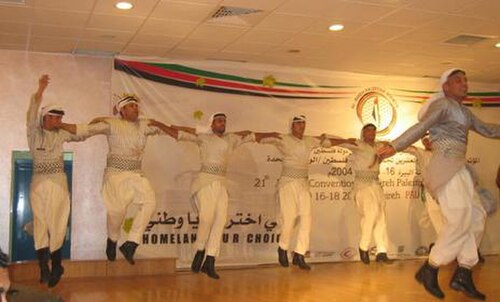
↑"El-Funoun Palestinian Popular Dance Troupe". Archived from the original on 5 January 2009. Retrieved 24 August 2009.
↑"Middle East & North Africa Reem Kelani World Music at Global Rhythm – The Destination for World Music". Archived from the original on 11 March 2014. Retrieved 3 April 2014.
↑"Reem Kelani". Archived from the original on 7 December 2013. Retrieved 3 April 2014.
↑Nissenbaum, Dion (29 September 2005). "'Palestinians' embracing hip-hop to push 'perspective of the victims'". Jewish World Review. Archived from the original on 16 August 2007. Retrieved 25 April 2007.
↑El-Sabawi, Taleed (2005). "Palestinian Conflict Bounces to a New Beat". Angelingo. Archived from the original on 18 April 2005. Retrieved 25 April 2007.
12Maira, Sunaina (2008). "We Ain't Missing: Palestinian Hip Hop – A Transnational Youth Movement". CR: The New Centennial Review. 8 (2): 161–192. doi:10.1353/ncr.0.0027. S2CID144998198.
↑Al-Taee, Nasser (2002). "Voices of Peace and the Legacy of Reconciliation: Popular Music, Nationalism, and the Quest for Peace in the Middle East". Popular Music. 21: 41–61. doi:10.1017/s0261143002002039. S2CID56388670.
↑Kaschl, Elke (2003). Dance and Authenticity in Israel and Palestine: Performing the Nation. BRILL. pp.71–82. ISBN978-90-04-13238-2. Archived from the original on 29 November 2023. Retrieved 29 November 2023.
Sources
Abu-Libdeh, Bassam; Turnpenny, Peter D.; Teebi, Ahmed (2012). "Genetic Disease in Palestine and Palestinians". In Kumar, Dhavendra (ed.). Genomics and Health in the Developing World. Oxford University Press. pp.700–11. OCLC990538497.
Al-Ali, Nadje; Koser, Khalid (2004). New Approaches to Migration?: Transnational Communities and the Transformation of Home. Taylor & Francis. ISBN978-0-203-16714-4. Archived from the original on 29 November 2023. Retrieved 29 November 2023.
Barzilai, Gad. (2003). Communities and Law: Politics and Cultures of Legal Identities. Ann Arbor: University of Michigan Press. ISBN0-472-11315-1
Ben Zvi, Yitzhak (8 October 1985). Oral telling of Samaritan traditions: Volume 780–785. A.B. Samaritan News. p.8.
Brice, William Charles; Faris, Nabih Amin; Khalidi, Rashid Ismail; Kenyon, Kathleen Mary. "Palestine". Encyclopedia Britannica. Archived from the original on 16 September 2024. Retrieved 21 September 2024.
Boyle, Kevin and Sheen, Juliet (1997). Freedom of Religion and Belief: A World Report. London: Routledge. ISBN0-415-15977-6
Cohen, Getzel M. (2006). The Hellenistic settlements in Syria, the Red Sea Basin, and North Africa (Illustrateded.). University of California Press. ISBN978-0-520-93102-2.
Cohen, Robin (1995). The Cambridge Survey of World Migration. Cambridge University Press. ISBN0-521-44405-5
Cordesman, Anthony H (2005). The Israeli-Palestinian War: Escalating to Nowhere. Greenwood Publishing Group. ISBN0-275-98758-2
Danver, S., ed. (2015). Native Peoples of the World: An Encyclopedia of Groups, Cultures and Contemporary Issues. Routledge. ISBN978-1-317-46399-3.
Dowty, A. (2023). Israel / Palestine (5thed.). Polity Press. ISBN978-1-5095-5483-6.
Drummond, Dorothy Weitz (2004). Holy Land, Whose Land?: Modern Dilemma, Ancient Roots. Fairhurst Press. ISBN0-9748233-2-5
Esposito, John L., ed. (2004). "Arab-Israeli Conflict". The Islamic World: Past and Present. Oxford University Press. doi:10.1093/acref/9780195165203.001.0001. ISBN978-0-19-516520-3.
Falk, Raphael (2017). Zionism and the Biology of Jews. History, Philosophy and Theory of the Life Sciences. Vol.19. Springer Cham. doi:10.1007/978-3-319-57345-8. ISBN978-3-319-57344-1.
Farsoun, Samih K. (2004). Culture and Customs of the Palestinians. Greenwood Press. ISBN0-313-32051-9
Feldman, Louis H. (1990). "Some Observations on the Name of Palestine". Hebrew Union College Annual. 61. Hebrew Union College – Jewish Institute of Religion: 1–23. JSTOR23508170.
Feldman, Louis (1996). "Some Observations on the Name of Palestine". Studies in Hellenistic Judaism. BRILL. pp.553–576. ISBN978-90-04-10418-1. Retrieved 17 October 2014.
Gelvin, J.L. (2005). The Israel-Palestine Conflict: One Hundred Years of War. Cambridge University Press. ISBN978-0-521-85289-0.
Gelvin, J.L. (2021). The Israel-Palestine Conflict: A History (4thed.). Cambridge University Press. ISBN978-1-108-48868-6.
Greenfield, Jonas C.; Paul, Shalom M.; Stone, Michael E; Pinnick, Avital (2001). Al Kanfei Yonah: Collected Studies of Jonas C. Greenfield on Semitic Philology (Illustrateded.). BRILL. ISBN978-90-04-12170-6.
Guzmán, Roberto Marín (2000). A Century of Palestinian Immigration into Central America. Editorial Universidad de C.R. ISBN9977-67-587-2
Haklai, Oded (2011). Palestinian Ethnonationalism in Israel. University of Pennsylvania Press. ISBN978-0-8122-0439-1. Archived from the original on 29 November 2023. Retrieved 29 November 2023.
Healey, John F. (2001). The Religion of the Nabataeans: A Conspectus. Brill Academic Publishers. ISBN90-04-10754-1
Herodotus. History of Herodotus. Archived from the original on 29 June 2011. Retrieved 21 September 2024.
Howell, Mark (2007). What Did We Do to Deserve This? Palestinian Life under Occupation in the West Bank, Garnet Publishing. ISBN1-85964-195-4
Hussain, Mir Zohair; Shumock, Stephan (2006). "Kurdish Ethnonationalism: A Concise Overview". In Saha, S. C. (ed.). Perspectives on Contemporary Ethnic Conflict: Primal Violence Or the Politics of Conviction. Lexington Books. ISBN978-0-7391-1085-0. Archived from the original on 29 November 2023.
Jacobs, Daniel; Eber, Shirley; Silvani, Francesca (1998). Israel and the Palestinian Territories: the rough guide. London: Rough Guides. ISBN978-1-85828-248-0.
Jacobson, David (2001), "When Palestine Meant Israel", Biblical Archaeology Review, 27 (3), archived from the original on 26 July 2023, retrieved 29 November 2023
Jabareen, Hassan (2002). "Chapter 11. The Future of Arab Citizenship in Israel:Jewish-Zionist Time in as Place with No Palestinian memory". In Levy, D.; Weiss, Y. (eds.). Challenging Ethnic Citizenship: German and Israeli Perspectives on Immigration. Berghahn Books. ISBN978-1-78238-163-1. Archived from the original on 29 November 2023.
Karmi, Ghada (2005). In Search of Fatima: A Palestinian Story. Verso. ISBN978-1-85984-694-0.
Kasher, Aryeh (1990). Jews and Hellenistic Cities in Eretz-Israel. Mohr Siebeck. ISBN3-16-145241-0. Archived from the original on 15 October 2023.
Khalidi, Rashid (2010) [1997]. Palestinian Identity: The Construction of Modern National Consciousness. New York: Columbia University Press. ISBN978-0-231-15075-0. Archived from the original on 29 November 2023.
"Beshara Doumani's "Rediscovering Ottoman Palestine: Writing Palestinians into History"(PDF). Archived from the original(PDF) on 6 November 2007. Retrieved 18 August 2013.
McCarthy, Justin (1994). "Palestine's Population During The Ottoman And The British Mandate Periods". Journal of the American Oriental Society. 114: 106–107. doi:10.2307/604972. JSTOR604972. Archived from the original on 18 January 2016. Retrieved 14 January 2009.
Nassar, Issam (2019). "Palestinian Identity: The Question of Historiography". In Hamdan Taha, Ilan Pappe, Ingrid Hjelm, Thomas L. Thompson (ed.). A New Critical Approach to the History of Palestine: Palestine History and Heritage Project 1. Taylor & Francis.{{cite book}}: CS1 maint: multiple names: editors list (link)
Nasser, Riad (2013). Palestinian Identity in Jordan and Israel: The Necessary 'Others' in the Making of a Nation. Routledge. ISBN978-1-135-93136-0. Archived from the original on 29 November 2023.
Khalidi, Rashid (2006). The Iron Cage: The Story of the Palestinian Struggle for Statehood, Houghton Mifflin. ISBN0-8070-0308-5
Khalidi, Walid (1984). Before Their Diaspora. Institute for Palestine Studies, Washington D.C.
Kish, George (1978). A Source Book in Geography (Reissue, illustrateded.). Harvard University Press. ISBN978-0-674-82270-2.
Kunstel, Marcia and Joseph Albright (1990). Their Promised Land: Arab and Jew in History's Cauldron-One Valley in the Jerusalem Hills. Crown. ISBN0-517-57231-1
Lewis, Bernard (1999). Semites and Anti-Semites, An Inquiry into Conflict and Prejudice. W.W. Norton and Company. ISBN978-0-393-31839-5.
Lybarger, Loren (2007). Identity and religion in Palestine: the struggle between Islamism and secularism in the occupied territories. Princeton University Press, ISBN978-0-691-12729-3
Lynd, S., Bahour, S. and Lynd, A. (editors) Homeland: Oral Histories of Palestine and Palestinians. New York: Olive Branch Press. ISBN1-56656-132-9
McCarthy, Justin (1990). "The Population of Palestine: Population Statistics of the Late Ottoman Period and the Mandate". Columbia University Press, ISBAN: 0231071108
McDowall, David (1989). The Uprising and BeyondArchived 15 October 2023 at the Wayback Machine. I.B.Tauris. ISBN1-85043-289-9
Parkes, James (1970) [1949]. Whose Land? A History of the Peoples of Palestine (Rev.ed.). Penguin.
Parmenter, Barbara McKean (1994). Giving Voice to Stones Place and Identity in Palestinian LiteratureUniversity of Texas Press
Porath, Yehoshua (1974). The Emergence of the Palestinian-Arab National Movement 1918–1929. London: Frank Cass and Co., Ltd. ISBN0-7146-2939-1
Porath, Yehoshua (1977). Palestinian Arab National Movement: From Riots to Rebellion: 1929–1939, vol. 2, London: Frank Cass and Co., Ltd.
Schulz, Helena Lindholm; Hammer, Juliane (2003). The Palestinian Diaspora: Formation of Identities and Politics of Homeland. Routledge. ISBN978-0-415-26820-2. Archived from the original on 29 November 2023. Retrieved 29 November 2023.
Shahin, Mariam (2005). Palestine: A Guide. Interlink Books.
Stavenhagen, Rodolfo (2009). "Indigenous Peoples". In Forsythe, David P. (ed.). Encyclopedia of Human Rights. Oxford University Press. doi:10.1093/acref/9780195334029.001.0001. ISBN978-0-19-533402-9.
Tamari, Salim (22 August 2017). The Great War and the Remaking of Palestine. Univ of California Press. ISBN978-0-520-29125-6.
Whitelam, Keith (1997). The Invention of Ancient Israel: The Silencing of Palestinian History, Routledge, ISBN0-415-10759-8, ISBN978-0-415-10759-4
Wilmer, Franke (15 January 2021). Breaking Cycles of Violence in Israel and Palestine: Empathy and Peacemaking in the Middle East. Rowman & Littlefield. ISBN978-1-7936-2352-2. Archived from the original on 29 November 2023. Retrieved 29 November 2023.
Charles Wilson, "Picturesque Palestine, Sinai and Egypt". New York, 1881.
Yakobson, Alexander; Rubinstein, Amnon (2009). Israel and the Family of Nations: The Jewish Nation-state and Human Rights. Taylor & Francis. ISBN978-0-415-46441-3. Archived from the original on 2 November 2023. Retrieved 29 November 2023.
Seminoら(2004)「Y染色体ハプログループEとJの起源、拡散、分化:ヨーロッパの新石器化と地中海地域におけるその後の移住イベントに関する推論」 American Journal of Human Genetics . 74(5):1023–1034 . Bibcode:2004AmJHG..74.1023S . doi:10.1086/386295 . PMC 1181965. PMID 15069642 .