
Loading article…
レバノンにおけるイスラム抵抗運動 アル・ムカーワマ・ アル・イスラムミーヤ・フィー・ルブナーン | |
|---|---|
 | |
| 事務総長 | 空いている |
| 創設者 | スビ・アル・トゥファイリ・ アッバス・アル・ムサウィ X ハッサン・ナスルラ X |
| 設立 | 1985年(公式) |
| 本部 | ベイルート、レバノン |
| 議会グループ | レジスタンス・ブロックへの忠誠[1] |
| 準軍事組織 | ジハード評議会 レバノン抵抗旅団 |
| イデオロギー | |
| 政治的立場 | シンクレティック[21] |
| 宗教 | シーア派イスラム教 |
| 国籍 | 3月8日同盟 |
| 国際提携 | 抵抗の軸 |
| 色 | 黄色と緑 |
| スローガン | فَإِنَّ حِزْبَ ٱللَّهِ هُمُ ٱلْغَالِبُونَ (アラビア語) 「まことに、勝利するのは神の党である。」 [クルアーン 5:56] |
議会の議席数[22] | 15 / 128 (12%)
|
| 党旗 | |
 | |
| Webサイト | |
| www.moqawama.org.lb | |
| ヒズボラ | |
|---|---|
| 運行日 | 1982年~現在 |
| 忠誠 |  イラン(IRGC)[23] イラン(IRGC)[23] |
| 本部 | ベイルート、レバノン |
| サイズ | 10万人(ハッサン・ナスララ氏によると)[24] [25] [26] |
| 同盟国 | 州の同盟国:
非国家同盟国: もっと見る |
| 対戦相手 | 州の反対者:
非国家反対派: |
| 戦闘と戦争 | 詳細を見る |
| テロリスト集団に指定 | こちらをご覧ください |





.svg/500px-Flag_of_Iraq_(1963%E2%80%931991).svg.png)




ヒズボラ(/ ˌ h ɛ z b ə ˈ l ɑː / ; [44] アラビア語:حزب الله、ローマ字表記: Ḥizbu 'llāh、発音: [ħizbu‿lːaːh]、直訳すると「神の党」)[a]は、レバノンのシーア派イスラム教徒の政党および過激派グループです。 [45] 1992年から2024年まで、ハッサン・ナスララ事務総長が率いていました。ヒズボラの準軍事組織はジハード評議会です。[46]組織全体、またはその軍事部門は、ほとんどの西側諸国を含むいくつかの国によってテロ組織に指定されています。[47] [48]ナスララは2024年9月にベイルートで空爆により暗殺された。[49]
ヒズボラは、1982年のイスラエルのレバノン侵攻に対抗するためにレバノンの聖職者によって設立された。[15]ヒズボラは、1979年のイラン革命後にホメイニ師が示したモデルを採用した。それ以来、イランとヒズボラの間には緊密な関係が築かれてきた。 [50]この組織は、1,500人のイスラム革命防衛隊(IRGC)の教官の支援を受けて設立され、[51]さまざまなレバノンのシーア派グループを統合して統一組織とした。[52] [53] [15] [54] [55]ヒズボラはレバノン内戦中に1985年に発表した宣言書でそのイデオロギーを明確に表現し、西側諸国の影響の排除、イスラエルの破壊、イランの最高指導者への忠誠、イランの影響を受けたイスラム主義政府の樹立、そしてレバノンの自決を強調するという同グループの主要目標を概説した。[23] [56]このグループは1983年のベイルートの米国大使館と米軍とフランス軍の兵舎への爆破事件、およびその後の爆破やハイジャックなどの攻撃に関与していると考えられている。[57] [58]ヒズボラは1985年から2000年にかけて南レバノン軍(SLA)およびイスラエルと戦った南レバノン紛争にも参加し、2006年のレバノン戦争でもイスラエルと戦った。1990年代には、ボスニア戦争中にボスニア・ヘルツェゴビナ共和国軍のために戦うボランティアも組織した。[59] [60] 2012年以来、ヒズボラはシリア内戦に関与し、シリア政府に加わってシリア反政府勢力と戦っている。ヒズボラは反政府勢力の蜂起を「ワッハーブ派とシオニストの陰謀」と表現している。[61] [62] 2013年から2015年の間、同組織はシリアとイラクの両国に準軍事組織を派遣し、イスラム国と戦うために地元民兵と戦ったり訓練したりした。[63] [64]
ヒズボラは「国家の中の国家」と評され、[65] [66]レバノン政府に議席を持ち、ラジオ局や衛星テレビ局、社会福祉事業、レバノン国境を越えた大規模な戦闘員の軍事展開を行う組織に成長した。[67] [68] [69] 1990年以来、ヒズボラは「ヒズボラのレバノン化」と呼ばれる過程でレバノンの政治に参加し、後にレバノン政府に参加し、政治同盟に加わった。2006年から2008年にかけてのレバノンの抗議活動[70]と衝突[71]の後、2008年にヒズボラとその反対派同盟による統一政府が結成された。 [72] 2008年8月、レバノンの新内閣は、武装組織としてのヒズボラの存在を認め、「占領地(シェバア農場など)を解放または回復する」権利を保証する政策声明を全会一致で承認した。ヒズボラは、 3月14日同盟に対抗するレバノンの3月8日同盟の一部である。2018年のレバノン総選挙では、ヒズボラは12議席を獲得し、その同盟はレバノン議会の128議席中70議席を獲得して選挙に勝利した。[73] [74]ヒズボラは現在、レバノンの政治システムで重要な役割を果たしており、[45]その政治部門である抵抗ブロックへの忠誠党は、レバノン議会で15議席を占めている。[要出典]ヒズボラに対するレバノン国内の支持は限られており、特に2020年のベイルート港爆発と説明責任の妨害の責任を問われて以来、その支持は限られている。2024年のアラブバロメーター調査によると、レバノン人の55%が同グループを「全く信頼していない」という。支持は主にシーア派住民に集中している。[75]
ヒズボラは、イスラエルが南レバノンから撤退した後も武装解除を行わなかったが、これは国連安全保障理事会決議1701に違反している。[76] 2006年以降、同組織の軍事力は著しく増大し、[77] [78]準軍事組織はレバノン軍よりも強力になった。[79] [80]現在、同組織はイランから軍事訓練、武器、資金援助を受けており、シリアからは政治的支援を受けているが、[81]シリア戦争の宗派間対立により、同組織の正当性は損なわれている。[67] [82] [83]同組織は、ガザ、イエメン、シリア、イラク各地のイラン主導の過激派連合と強力な同盟関係を維持している。 [84]ヒズボラは世界で最も武装が強化された非国家グループとみなされており、[84] 2016年にはその武装力が中規模軍と同等と評価された。[85] 2021年、ヒズボラの指導者ハッサン・ナスララは、同グループには約10万人の戦闘員がいると述べた。[86]
歴史
1982年、ヒズボラはイスラム教聖職者によって構想され、主にイスラエルのレバノン侵攻と戦うためにイランから資金提供を受けた。[15] 1982年と1978年のイスラエルの侵攻はレバノンで人道危機を引き起こした。南部の多くの村が破壊され、多数のシーア派が家を追われた。[87]さらに、シーア派は長い間レバノンの政治において過小評価されていた。[88]これらの両方の要因が地元のシーア派住民の間に憤りを助長し、彼らを勧誘の肥沃な土壌にした。[87]ヒズボラはルーホッラー・ホメイニの指導の下、地元のシーア派委員会によって設立された。[88]その部隊は、レバノン東部高地を占領していたシリア政府の許可を得てイランから到着した1,500人のイラン革命防衛隊の派遣団によって訓練され、組織され、当時レバノンを占領していた ベカー高原[ 51]の基地への移動を許可された。
ヒズボラがいつから独立した組織になったかについては、学者の間で意見が分かれている。さまざまな情報源によると、このグループの公式結成は1982年とされている[89] [90] [91]が、ディアスとニューマンは、ヒズボラは1985年まで様々な暴力的なシーア派過激派の融合体であったと主張している。[92]別のバージョンでは、ヒズボラは1984年にイスラエルによって殺害された南部シーア派抵抗運動の指導者、シェイク・ラゲブ・ハルブの支持者によって結成されたとされている。 [93]この名前が公式に使われるようになった時期に関係なく、イスラム聖戦、地上の被抑圧者のための組織、革命的正義機構など、いくつかのシーア派グループがゆっくりとこの組織に同化していった。[94]これらの名称は、米国、 [94]イスラエル[95]およびカナダによってヒズボラと同義であると見なされている。 [96]
ロバート・フィスク[97]とイスラエルのシモン・シャピラ将軍[98]によると、イスラエルのレバノン侵攻から2日後の1982年6月8日、ベイルート南部のカルデで50人のシーア派戦闘員がイスラエル国防軍の装甲車列を待ち伏せした日が、ヒズボラによって同組織の軍事部門であるレバノン・イスラム抵抗運動の創設神話とみなされている。イスラエルのベイルート進撃を6日間遅らせたこの戦いで、将来のヒズボラ軍事指導者ムスタファ・バドレディンが本格的な指揮官として名を馳せた。[99]シャピラによると、軽武装のシーア派戦闘員はその日、イスラエルの装甲車両を捕獲し、東レバノンのバールベックにある革命防衛隊の前線基地でそれを披露した。フィスクは次のように書いている。
カルデでは、驚くべき現象が形を成していた。シーア派民兵がイスラエルの砲火の中を徒歩で走り抜け、イスラエルの装甲車に手りゅう弾を発射し、実際に戦車から20フィート以内に移動して発砲した。シーア派戦闘員の中にはシャツを切り取って頭に巻き付け、殉教の印を作った者もいた。これは、1年前にイラン革命防衛隊が1,000マイル東で行われた湾岸戦争でイラクに対して最初の大規模攻撃を仕掛けたときに始めたことと同じだった。彼らがイスラエルの装甲車1台に火をつけると、武装兵は勇気づけられてさらに前進した。私たちの誰も、あの夜のカルデでの出来事が決定的に重要だとは思っていなかったと思う。レバノンのシーア派は殉教の原則を学び、それを実践していた。これらの男性がこのようにヘッドバンドを着けているのを見たことはなかった。私たちはこれもまた民兵のふりかと思ったが、違った。それは、真実の要素も強く含んだ伝説の始まりだった。シーア派は今やレバノンの抵抗勢力であり、民族主義者であることは間違いないが、宗教に触発された存在でもあった。神の党、アラビア語でヒズボラは、その夜、カルデの海岸にいた。[97]
1980年代
ヒズボラは、シーア派民兵組織の統合の過程で、南レバノンで、古いアマル運動のライバルとして出現した。ヒズボラはレバノン内戦で重要な役割を果たし、1982年から83年にかけてはアメリカ軍と、1985年から88年にかけてはアマルとシリアと対立した。しかし、ヒズボラの初期の主眼は、イスラエルによる1982年の侵攻とベイルートの包囲に続いて、イスラエルによる南レバノン占領を終わらせることだった[15] 。 [100]レバノンの主要シーア派政治グループであるアマルは、ゲリラ戦を開始した。2006年、元イスラエル首相のエフード・バラクは、「我々がレバノンに入ったとき、ヒズボラは存在しなかった。我々は南部のシーア派に香りのよい米と花で迎えられた。我々の存在がヒズボラを作ったのだ」と述べた[101] 。
ヒズボラは、イスラエル国防軍(IDF)とレバノン国外のイスラエルの標的に対して自爆攻撃を行い、非対称戦争を繰り広げた。 [102]ヒズボラは、中東で自爆攻撃、暗殺、外国人兵士の捕獲、[51]殺人[103]やハイジャック[104]などの戦術を最初に使用したイスラム抵抗グループの一つであると言われている。ヒズボラはまた、カチューシャロケットやその他のミサイルなど、より一般的な軍事戦術や兵器も使用した。 [103] [105] 1990年のレバノン内戦の終結時には、タイフ合意で「レバノンおよび非レバノンのすべての民兵の解散」を求めていたにもかかわらず、当時レバノンを支配していたシリアは、ヒズボラが兵器庫を維持し、イスラエルとの国境沿いのシーア派地域を支配することを許可した。[106]
1990年以降
1990年代、ヒズボラは革命グループから政治グループへと変貌を遂げ、この過程はヒズボラのレバノン化と呼ばれている。1980年代の妥協を許さない革命的姿勢とは異なり、ヒズボラはレバノン国家に対して寛容な姿勢を示した。[107]
1992年、ヒズボラは選挙に参加することを決定し、イランの最高指導者アリー・ハメネイがこれを承認した。ヒズボラの元書記長スブヒ・アル・トゥファイリはこの決定に異議を唱え、ヒズボラの分裂につながった。ヒズボラは選挙名簿に載っていた12議席すべてを獲得した。その年の終わりに、ヒズボラはレバノンのキリスト教徒との対話を開始した。ヒズボラはレバノンの文化的、政治的、宗教的自由を神聖なものとみなしているが、これらの価値観をイスラエルと関係のあるグループには適用していない。[108]
1997年、ヒズボラはイスラエルに対する国民的かつ世俗的な抵抗を復活させようと、イスラエル占領と戦うための多宗派レバノン旅団を結成し、抵抗の「レバノン化」を象徴した。 [109]
イスラム聖戦機構(IJO)
イスラム聖戦機構(IJO)がヒズボラの戦闘名であったか、あるいは別の組織であったかは議論の余地がある。ある情報源によると、IJOは単なる「電話組織」とされ、[110] [111]その名前は「関係者が正体を隠すために使用していた」という。[112] [113] [114] [115] [116]ヒズボラはイスラエルへの攻撃に「イスラム抵抗」(アル・ムカワマ・アル・イスラミヤ)という別の名前も使用していたと伝えられている。[117] : 67
2003年のアメリカの裁判所の判決では、IJOはヒズボラがレバノン、中東の一部、ヨーロッパでの攻撃に使用した名称であると認定された。[118]米国、[119]イスラエル[120]カナダ[96]は、「イスラム聖戦機構」、「地上の被抑圧者の組織」、「革命的正義機構」という名称をヒズボラと同義とみなしている。
イデオロギー
ヒズボラのイデオロギーはシーア派 過激主義として要約されている。[121] [122] [123]ヒズボラはイランの指導者アヤトラ・ルーホッラー・ホメイニが開発したイスラム・シーア派の神学に従っている。[51]ヒズボラは主に1980年代初頭にイスラム革命を広めるためにホメイニの支持者の支援を受けて結成され[124]、イランの「イスラム革命」の指導者であったホメイニが開発したイスラム・シーア派のイデオロギー(ウィラヤト・アル・ファキーフまたはイスラム法学者の守護)の独自のバージョンに従っている。[125] [120]ヒズボラは当初レバノンを正式なファキーヒ・イスラム共和国に変えることを目指していたが、この目標はより包括的なアプローチを支持して放棄された。[15]
1985年の宣言
1985年2月16日、シェイク・イブラヒム・アル・アミンはヒズボラのマニフェストを発表した。そこに示されたイデオロギーは過激と評された。[誰が? ]その第一の目的は、イスラエルによる南レバノンおよびその他の領土の占領を含む、ヒズボラがアメリカとイスラエルの帝国主義と評したものと戦うことだった。第二の目的は、すべてのイスラム教徒を「ウンマ」に集めることであり、その下でレバノンは1979年のイラン革命の目的を推進することになる。また、イスラエルと協力するコミュニティを除くすべてのレバノンのコミュニティを保護し、世界中のイスラム教徒と非イスラム教徒の両方の国民運動を支援すると宣言した。[誰が? ]その後、イデオロギーは進化し、今日ヒズボラは社会的不正義に焦点を当てた左翼の政治団体となっている。[126]
ヒズボラの1985年のオリジナルの宣言文からの翻訳抜粋は次の通り。
私たちはウンマ(イスラム教徒の共同体)の息子です... ... 私たちは、イスラム教の堅固な教義と宗教的つながりによって全世界のイスラム教徒と結ばれたウンマです。神はそのメッセージを預言者の印、すなわち預言者ムハンマドによって実現することを望んでいました。 ... 私たちの文化は、聖クルアーン、スンナ、そして私たちの模倣の源である法学者の法的判決に基づいています... [55]
2009年のマニフェスト
2009年11月30日、ナスララ事務総長はヒズボラの第7回政治会議で新しいマニフェストを発表した。[127]この32ページの文書は序文のほかに、米国の覇権戦略とグローバリゼーションの影響、レバノンに対するヒズボラのアプローチ、イスラエルに対するパレスチナの抵抗という3つの章から構成されている。[128]学者のベネデッタ・ベルティによると、このマニフェストは「再生」文書と自称しているが、外交政策に対する基本的なアプローチは過去と同じだが、より「政治的に巧妙」で非イスラム運動に訴える内容になっているという。それでも、このマニフェストは、これまで浸透してきたレバノンの政治制度に新たな支援を提供している。特に、政治的「宗派主義」に反対し、統一国家を理想化し、レバノン軍を敵としてではなく従属的な軍事部隊として扱うと述べている。[128]
イスラエルとシオニズムに関する態度、発言、行動
ヒズボラの創設以来現在に至るまで、[55] [129] イスラエル国家の消滅はヒズボラの主要目標の一つである。1985年のアラビア語によるヒズボラの宣言書の翻訳には、「この存在 [イスラエル] が消滅したときにのみ、我々の闘争は終わる」とある。[55]ヒズボラのナイム・カセム副総長によると、イスラエルに対する闘争はヒズボラの核心的な信念であり、ヒズボラの存在の中心的な根拠である。[130]
ヒズボラは、イスラエルに対する敵対行為の継続は、イスラエルのレバノンに対する作戦への報復であり、イスラエルによるレバノン領の占領に対する報復であるとして正当化されると主張している。[131] [132] [133]イスラエルは2000年にレバノンから撤退し、その撤退は1978年3月19日の決議425に従っていると国連によって確認された。しかし、レバノンはシェバア農場(1967年の戦争でイスラエルがシリアから奪取し、国連がイスラエルが占領したシリア領と見なした26平方キロメートル( 10平方マイル)の土地)をレバノン領と見なしている。[134] [135]最後に、ヒズボラはイスラエルを非合法国家と見なしている。これらの理由から、ヒズボラは自国の行動を防衛ジハード行為として正当化している。[136]
彼らがシェバアから去ったとしても、我々は彼らとの戦いをやめません。…我々の目標は、1948年のパレスチナ国境を解放することです。…この解放戦争を生き延びたユダヤ人は、ドイツや出身地に帰ることができます。しかし、1948年以前にパレスチナに住んでいたユダヤ人は「少数派として生活することを許され、イスラム教徒の多数派によって世話される」ことになります。
— ヒズボラのスポークスマン、ハッサン・エゼディン、イスラエル軍のシェバア農場からの撤退について[106]
ユダヤ人とユダヤ教に関する態度と行動
ヒズボラの幹部は、まれに、自分たちは「反シオニスト」であり反ユダヤ主義ではないと発言している。[5]しかし、学者によると、「これらの言葉は、詳しく調べると成り立たない」とのこと。ヒズボラは、ホロコースト否定に積極的に取り組み、反ユダヤ主義の陰謀説を広めている。[5]
ヒズボラの幹部らは、様々な反ユダヤ主義的発言をしたとされている。[137]レバノンの政治アナリスト、 アマル・サアド・ゴライエブは、シオニズムがヒズボラの反ユダヤ主義に影響を与えているものの、「ヒズボラのユダヤ人に対する憎悪は、政治的動機よりも宗教的動機によるものであるため、シオニズムに左右されるものではない」と主張している。[138]反ユダヤ主義研究を専門とする歴史家、 ロバート・S・ウィストリッチは、ユダヤ人に関するヒズボラのイデオロギーについて次のように述べている。
ヒズボラの指導者やスポークスマンの反ユダヤ主義は、一見無敵のユダヤ人の力と狡猾さのイメージと、通常は弱くて臆病な敵に向けられる軽蔑とを結び付けている。聖戦のためのハマスのプロパガンダと同様に、ヒズボラのプロパガンダは、ユダヤ人を「人類の敵」、「陰謀を企て、頑固で、うぬぼれの強い」敵、アラブ人を奴隷にするための「悪魔的な計画」に満ちた敵として際限なく中傷することに頼ってきた。伝統的なイスラムの反ユダヤ主義と、西洋の陰謀神話、第三世界の反シオニズム、そしてイランのシーア派による「儀式的に不浄」で堕落した異教徒としてのユダヤ人に対する軽蔑が融合している。シェイク・ファドララーは典型的に、ユダヤ人は経済的、政治的支配を進めるためにイスラム教とアラブの文化的アイデンティティを弱体化または消滅させたいと望んでいると主張する。[139]
矛盾する報告によると、ヒズボラが所有・運営するテレビ局アル・マナールは、イスラエルまたはユダヤ人が中東全域のアラブ人にHIVやその他の病気を故意に広めたと非難した。[140] [141] [142]アル・マナールは、ユダヤ人の世界征服陰謀論を描いたテレビドラマの形で「反ユダヤ主義のプロパガンダ」を放送したとして西側諸国で批判された。[143] [144] [145]このグループは、ホロコースト否定に関与しているとアメリカのアナリストから非難されている。[146] [147] [148]さらに、2006年の戦争中、同局はイスラエルのアラブ人(つまり非ユダヤ人)を殺害したことについてのみ謝罪した。[5]
ユダヤ通信社によると、2009年11月、ヒズボラはベイルート西部の「匿名を希望した」私立の英語学校に対し、ナチス占領下のオランダでユダヤ人の少女アンネ・フランクが家族とともに隠れていたときに書いた日記をまとめた本である『アンネの日記』の抜粋をカリキュラムから削除するよう圧力をかけたという。 [149]これは、ヒズボラのレバノン国会議員フセイン・ハッジ・ハッサンが同組織のアル・マナールテレビ局のインタビューで、学校が「教科書選びの判断が下手」だと批判し、レバノンがいつまで「シオニストの教育侵略の場であり続けるのか」と質問した後のことである。 [150]
ニューヨーカー誌2024年7月22日号で、デクスター・フィルキンスはイスラエルとヒズボラの国境紛争に関する記事の中で、レバノン国外で活動していたヒズボラの司令官の言葉を引用し、「シオニスト国家」と「神の党」との戦争は「ユダヤ人が乗ってきたのと同じ船で去れば、非常に簡単に」解決されるだろうと述べた。[151]
組織


当初、ヒズボラの指導者の多くは、この運動は「組織ではない。なぜなら、その構成員は身分証明書を持たず、特定の責任も負わないからである」[152]、また「明確に定義された組織構造」を持っていない[117]と主張した。 41 現在、ヒズボラの研究者マグナス・ランストルプの報告によると、ヒズボラは実際に正式な統治構造を持っており、イスラム法学者の保護( velayat-e faqih )の原則に従って、すべての権威と権力を宗教指導者に集中させており、その決定は「ウラマーからコミュニティ全体に伝わる」。
ヒズボラの最高意思決定機関は、レバノン全土におけるヒズボラの活動全般の戦術的決定と監督を担当する12人の上級聖職者によって率いられたマジュリス・アル・シューラ(諮問会議)と、シェイク・ムハンマド・フセイン・ファドラッラーが率い、すべての戦略事項を担当する11人の聖職者で構成されるマジュリス・アル・シューラ・アル・カラール(決定会議)に分かれていた。マジュリス・アル・シューラ内には、思想、財政、軍事・政治、司法、情報、社会問題を扱う7つの専門委員会が存在した。そして、マジュリス・アル・シューラとこれら7つの委員会は、ヒズボラの3つの主要作戦地域(ベッカー、ベイルート、南部)のそれぞれに複製されていた。[117] : 45
イランの最高指導者は最高宗教的権威であるため、ヒズボラの指導者たちは「ヒズボラの集団指導部が問題に関してあまりにも分裂し、合意に達することができなかった場合の指導と指示」を最高指導者に求めてきた。 [117] : 45 イランの初代最高指導者ホメイニの死後、ヒズボラの統治機関はより「独立した役割」を担うようになり、イランに訴えることは少なくなった。[117] : 45 しかし、第二次レバノン戦争以降、イランはハッサン・ナスララの権力を制限するためにヒズボラを再編し、ヒズボラの「再建」に数十億ドルを投資してきた。[153]
構造的に、ヒズボラはレバノン国内での政治・社会活動とイスラエルに対する軍事・ジハード活動を区別していない。ヒズボラの副司令官ナイム・カセムは「ヒズボラには単一の指導部がある」と語る。「すべての政治、社会、ジハード活動はこの指導部の決定に結びついている…議会と政府の活動を指揮している同じ指導部が、イスラエルに対する闘争におけるジハード活動も指揮している」[154]
2010年、イランの国会議長アリ・ラリジャニは「イランはレバノンのイスラム抵抗運動の揺るぎないイスラム的立場を誇りに思う。ヒズボラはイスラム聖戦の本来の理念を育んでいる」と述べた。また、西側諸国がイランをテロ支援で非難したと非難し、「真のテロリストはシオニスト政権に国民を爆撃するための軍事装備を提供する者たちだ」と述べた。[155]
資金調達
_02.jpg/500px-Seyyed_Ali_Khamenei_and_Seyyed_Hassan_Nasrallah_by_khamenei.ir_01(2005)_02.jpg)
ヒズボラの資金源は、イラン政府、レバノンのビジネス団体、個人、ビジネスマン、アフリカのダイヤモンド採掘に携わるレバノン人ディアスポラ、その他のイスラム教団体や国、そしてシーア派レバノン人が支払う税金である。[156]ヒズボラは、主な収入源は自身の投資ポートフォリオとイスラム教徒からの寄付であると主張している。
西側筋は、ヒズボラは資金、訓練、武器、爆発物、政治、外交、組織面での援助の大半をイランとシリアから受け取っていると主張している。[106] [119] [157]イランは1983年から1989年の間に寄付を通じて4億ドルを寄付したと言われている。表面上は経済問題を理由に、イランはヒズボラによる人道活動への資金提供を一時的に制限した。[156] 1980年代後半、リラの崩壊によりレバノンで3桁のインフレが起こったとき、英国の定期刊行物「ミドル・イースト・インターナショナル」は、ヒズボラがイランから毎月300万~500万ドルを受け取っていると報じた。[158]その後発表された報告書によると、ヒズボラはイランから4億ドルを受け取っていた。[159] [160] [161]
2009年、米国会計検査院(GAO )がベネズエラ政府関係者を「麻薬密売との戦いに全面的に協力していない」と非難し、「麻薬腐敗はベネズエラの大臣レベルにまで達している」と主張したとき、当時イスラエル外務省でラテンアメリカ・カリブ海問題を担当していたドリット・シャヴィットはエル・ティエンポ紙で、近年グアヒラ半島とマルガリータ島で「ヒズボラのゲリラ細胞」の存在が増加していると述べた。ベネズエラ外務省はこれらの主張を「ばかげている」として否定した。[162]
2011年、イランはラテンアメリカにおけるヒズボラの活動に700万ドルを割り当てた。[163]ヒズボラは西アフリカのシーア派レバノン人ディアスポラ、米国、そして最も重要なパラグアイ、アルゼンチン、ブラジルの国境沿いの三国国境地域からの資金にも依存している。[164]米国の法執行当局は、数百万ドル規模の違法なタバコ密輸資金集め活動[165]と麻薬密輸活動を特定した。[166] [167] [168]ナスララは南米の麻薬取引とヒズボラとのつながりを繰り返し否定し、そのような非難を「プロパガンダ」であり「ヒズボラのイメージを傷つける」試みであると述べた。[169] [170]
米国の推計によると、2018年現在、イランのヒズボラに対する金銭的支援は年間7億ドルと推定されている。[171] [172]
社会サービス
ヒズボラは広範な社会開発プログラムを組織・維持しており、病院、ニュースサービス、教育施設、ニカ・ムタの奨励を行っている。[159] [173]ヒズボラの設立機関の一つであるジハード・アル・ビンナ復興運動は、レバノンにおける数多くの経済・インフラ開発プロジェクトを担っている。[174]ヒズボラは殉教者協会(アル・シャヒド社会協会)を統括しており、戦闘で「死亡した戦闘員の家族」に給付金を支払っている。[160]国連人道問題調整事務所のIRINニュースレポートは次のように述べている。
ヒズボラは、武装・政治部門だけでなく、広範な社会開発プログラムも誇っている。ヒズボラは現在、少なくとも4つの病院、12の診療所、12の学校、農民に技術支援と訓練を提供する2つの農業センターを運営している。また、環境部門と広範な社会支援プログラムも持っている。医療費は、国内のほとんどの私立病院よりも安く、ヒズボラのメンバーには無料である。[159]
CNNによると、「ヒズボラは、ゴミ収集から病院の運営、学校の修復まで、政府がすべきことをすべて行った」という。[175] 2006年7月、イスラエルとの戦争中、ベイルートに水道がなかったとき、ヒズボラは市内で物資を調達していた。レバノンのシーア派は「ヒズボラを民兵組織であると同時に政治運動であり社会サービス提供者とみなしている」。[175]ヒズボラはまた、戦闘で負傷したゲリラメンバーをヒズボラが運営する遊園地に連れて行くことで報奨を与えている。[176]
したがって、ヒズボラはレバノン社会に深く根付いている。[51]
政治活動
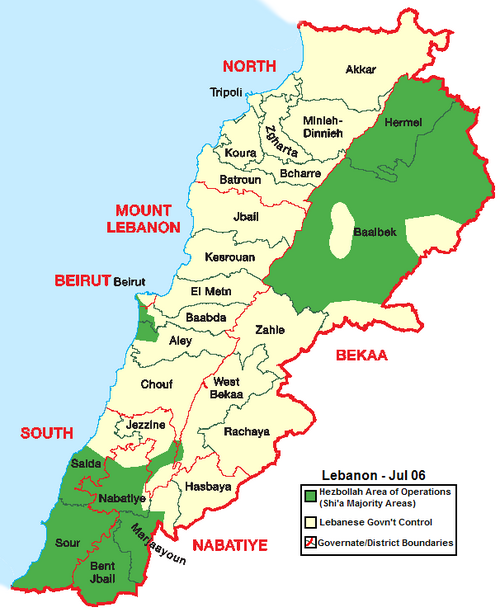
2006年7月のヒズボラ支配地域(レバノンのシーア派が多数を占める地域のほとんど)。

ヒズボラはアマルとともに、シーア派 イスラム教徒を代表するレバノンの二大政党の一つである。[177]レバノン南部で主に支持されているアマルとは異なり、ヒズボラは、シーア派イスラム教徒が多数派を占めるレバノンの3つの地域、すなわち南部、ベイルートとその周辺地域、北部ベッカー渓谷とヒルミル地域すべてで幅広い支持を維持している。[178]
ヒズボラはレバノン議会の128議席のうち14議席を占め、抵抗発展ブロックのメンバーである。ダニエル・L・バイマンによれば、ヒズボラは「レバノンで最も強力な単一の政治運動」である。[179]ヒズボラはアマル運動とともに、レバノンのシーア派のほとんどを代表している。アマルとは異なり、ヒズボラは武装解除していない。ヒズボラはレバノン議会に参加している。
政治同盟
ヒズボラは2005年3月以来、 3月8日同盟の主要政党の一つとなっている。ヒズボラは2005年に新政府に加わったが、3月14日同盟には断固として反対し続けた。[180] 2006年12月1日、これらのグループはフアード・シニオラ首相の政府に反対する一連の政治抗議活動と座り込みを開始した。[70]
2006年、ミシェル・アウンとハッサン・ナスララはチヤーのマル・ミハイル教会で会談し、自由愛国運動とヒズボラの関係構築と条件付きでのヒズボラの武装解除について協議する覚書に署名した。この合意では、シリアとの正常な外交関係の重要性、シリアのレバノン人政治犯に関する情報提供の要請、イスラエルに居住するすべての政治犯と離散者の帰還についても協議された。この出来事の後、アウンと彼の党は3月8日同盟に加わった。[181]
2008年5月7日、レバノンの17か月に及ぶ政治危機は制御不能に陥った。戦闘は、政府がヒズボラの通信ネットワークを遮断し、ヒズボラとの関係が疑われるベイルート空港の警備責任者を解任したことから始まった。ヒズボラの指導者ハッサン・ナスララは、同組織の軍事通信ネットワークを違法とする政府の決定は同組織に対する「宣戦布告」であるとし、政府にその撤回を要求した。[182]
ヒズボラが率いる反政府勢力は、支援する政府に忠誠を誓う未来運動民兵からベイルート西部のいくつかの地区を奪取したが、この市街戦で11人が死亡、30人が負傷した。反政府勢力が奪取した地域はその後レバノン軍に引き渡された。[71]軍も紛争解決を約束し、ヒズボラに通信網の維持を認め、空港の警備責任者を復職させることで政府の決定を覆した。[183]
結局、対立するレバノンの指導者たちは、 2008年5月21日にドーハ合意で合意に達し、戦闘に発展し、国を新たな内戦に陥れかけた18か月の政治的確執に終止符を打った。[184]この合意に基づき、ヒズボラとその反対派同盟は、レバノン議会で事実上拒否権を与えられた。紛争の終結後、 2008年7月11日にフアード・シニオラによって国民統一政府が樹立され、ヒズボラは1人の大臣と30の閣僚のうち11人を掌握した。[72]
2018年のレバノン総選挙で、ヒズボラのハッサン・ナスララ書記長は13人のヒズボラ候補者の名前を発表した。[185] 2018年3月22日、ナスララは次期議会における党の議会ブロックである抵抗への忠誠の主要な優先事項を概説した声明を発表した。[186]彼は、腐敗の根絶が抵抗への忠誠ブロックの最優先事項になると述べた。[186]同党の選挙スローガンは「我々は建設し、我々は保護する」だった。[187]最終的にヒズボラは12議席を獲得し、その同盟はレバノン議会の128議席のうち70議席を獲得して選挙に勝利した。[73] [74]
メディア運営
ヒズボラは衛星テレビ局アル・マナールTV(「灯台」)とラジオ局アル・ヌール(「光」)を運営している。[188]アル・マナールはレバノンのベイルートから放送している。 [ 188 ]ヒズボラは1991年にイランの資金援助を受けてこの放送局を開設した。 [190]自称「抵抗の放送局」(カナート・アル・ムカワマ)であるアル・マナールは、ヒズボラが「シオニストの敵に対する心理戦」と呼ぶものにおいて重要な役割を果たしており、 [190] [191] 、アラブ世界全体にメッセージを広めるというヒズボラの計画の不可欠な部分である。[190]ヒズボラは1984年に創刊された週刊誌アル・アフドを持っている。 [192]これはヒズボラと公然と提携している唯一のメディアである。[192]
ヒズボラのテレビ局アル・マナールは、ガザ、ヨルダン川西岸、イラクで自爆攻撃を煽動する番組を放送している。[106] [189] [193]アル・マナールのフランスでの放送は、フランスでは犯罪行為であるホロコースト否定を推進しているため禁止されている。[194]米国はアル・マナールテレビネットワークをテロ組織に指定している。[195]アル・マナールは「特別指定国際テロ組織」に指定され、2004年12月に米国によって禁止された。 [196]フランス、スペイン、ドイツでも禁止されている。[197] [198]
子供たちに国家主義とイスラムの原理を教え込むことを目的とした教材は、ヒズボラのメディア活動の一側面である。[199]ヒズボラ中央インターネット局は、2003年に「スペシャルフォース」 、 2007年に続編「スペシャルフォース2:真実の誓いの物語」という2つのビデオゲームをリリースした。これらのゲームでは、プレーヤーはイスラエル兵を殺害することでポイントと武器を報酬として受け取る。 [200] 2012年、アル・マナールは、ヒズボラのために募金活動を行い、「大きくなったら、ヒズボラの共産主義抵抗戦士になって、米国とイスラエルと戦う。彼らをバラバラにして、私が心から愛するレバノン、ゴラン高原、パレスチナから追い出す」と語った8歳の少年を称賛するテレビ特別番組を放映した。[201]
シークレットサービス
ヒズボラの秘密諜報機関は「世界でも最も優れた諜報機関の一つ」と評されており、イスラエル軍にも潜入している。ヒズボラの秘密諜報機関はレバノンの諜報機関と協力している。[156]
1982年夏、ヒズボラの特別保安部隊は、現在「ナスララ最高政治顧問」となっているフセイン・アル・ハリールによって創設された。[202]ヒズボラの防諜活動は当初イランのゴッズ部隊によって管理されていたが、[203] : 238 1990年代を通じて組織は成長を続けた。2008年までに、学者のカール・アンソニー・ウェーゲは「ヒズボラはレバノンの公式国家防諜機関を完全に掌握し、それが今や防諜目的におけるヒズボラの資産となっていた」と書いている。[204] : 775 レバノン諜報機関とのこの密接な関係は、ヒズボラの金融防諜部隊の強化に役立った。[204] : 772, 775
アフマド・ハムゼによれば、ヒズボラの防諜機関は、「外部」または「遭遇」の安全保障を担当するアムン・アル・ムダッドと、組織の完全性と指導者を保護するアムン・アル・ヒズブに分かれている。ウェーゲによれば、アムン・アル・ムダッドは「イラン、おそらく北朝鮮で専門的な諜報訓練を受けた可能性がある」という。[204] : 773–774 この組織には、軍事安全保障部門と、レバノン国外で秘密裏に活動する対外安全保障組織(アル・アムン・アル・ハリジまたはユニット910)も含まれている。[203] : 238
ヒズボラの防諜活動の成功例としては、 1994年にCIAが対外作戦責任者ハッサン・エズディンを誘拐しようとした事件の阻止、1997年に二重スパイを操ってアンサリヤ待ち伏せ攻撃を仕掛けた事件、2000年にモサド工作員とされるエルハナン・タネンバウムを誘拐した事件などがある。[204] : 773 2006年、ヒズボラはレバノン政府と協力して、元大佐のアディーブ・アル・アラムをイスラエルのスパイとして摘発した。[204] : 774 ヒズボラはイスラエル国防軍のオマル・アル・ヘイブ中佐を採用したが、アル・ヘイブは2006年にヒズボラのために監視活動を行った罪で有罪判決を受けた。[204] : 776 2009年にヒズボラは、ヒズボラ所有の車両に追跡装置を設置したガレージ所有者のマルワン・ファキーフを逮捕した。[204] : 774
ヒズボラの防諜装置は電子監視および傍受技術を使用している。2011年までに、ヒズボラの防諜は携帯電話のデータを分析し、スパイ行為を検出するソフトウェアを使用し始めた。疑わしい発信者はその後、従来の監視の対象となった。1990年代半ば、ヒズボラは「イスラエルのドローンから暗号化されていないビデオフィードをダウンロード」することができ、[204] : 777 イスラエルのSIGINT活動は2000年のレバノン撤退後に強化された。イランとロシアの FSBの支援を受けて、ヒズボラは電子防諜能力を強化し、2008年にサンニーン山付近と組織の光ファイバーネットワークでイスラエルの盗聴器を検出することに成功した。[204] : 774, 777–778
武力

ヒズボラは武装勢力を明らかにしていない。ドバイに拠点を置く湾岸研究センターは2006年に、ヒズボラの武装部隊は1,000人の常勤ヒズボラ隊員と、さらに6,000~10,000人の志願兵で構成されていると推定した。[205]イランのファルス通信によると、ヒズボラの戦闘員は最大65,000人である。[206] 2023年10月、アルジャジーラはヒズボラの専門家ニコラス・ブランフォードの推定を引用し、ヒズボラには常勤と予備役を含めて少なくとも60,000人の戦闘員がおり、ミサイル備蓄は2006年の14,000発から約150,000発に増加したと報じた。[44]ヒズボラはレバノン軍よりも軍事力が高いとよく言われる。[80] [207] [79]イスラエルの司令官ギー・ズールはヒズボラを「世界最大のゲリラ集団」と呼んだ。[208]
2010年、ヒズボラは4万5000発のロケット弾を保有していると考えられていた。[209]イスラエル国防軍参謀総長ガディ・アイゼンコットは、ヒズボラは「数万発」の長距離・短距離ロケット弾、ドローン、高度なコンピューター暗号化機能、 SA-6対空ミサイルシステムなどの高度な防衛能力を保有していると述べた。 [210]
ヒズボラは射程29km(18マイル)で15kg(33ポンド)の弾頭を搭載したカチューシャ122ロケットを保有している。ヒズボラは約100発の長距離ミサイルを保有しており、その中にはイラン製のファジュル3とファジュル5(後者は射程75km(47マイル)でイスラエルのハイファ港を攻撃可能)、ゼルザル1(推定射程150km(93マイル)でテルアビブまで到達可能)などがある。ファジュル3ミサイルの射程は40km(25マイル)で、弾頭は45kg(99ポンド)である。ファジュル5ミサイルは射程72km(45マイル)で、同じく45kg(99ポンド)の弾頭を搭載している。[205]ヒズボラはシリアから提供されたスカッドミサイルを保有しているとの報道があった。 [211]シリアはこの報道を否定した。[212]
さまざまな報告によると、ヒズボラは対戦車誘導ミサイル、すなわちロシア製のAT-3サガー、AT-4スピゴット、AT-5スパンドレル、AT-13サクソルン-2「メティス-M」、AT-14スプリガン「コルネット」、イラン製のラアド(AT-3サガーのバージョン)、トウサン(AT-5スパンドレルのバージョン)、トゥーファン( BGM-71 TOWのバージョン)、および欧州製のミランミサイルで武装している。これらの兵器は2006年のレバノン戦争中にイスラエル国防軍兵士に対して使用され、多くの死者を出している。[213]米国の裁判所は、2006年の戦争中に北朝鮮がヒズボラに武器を提供したと述べた。[214]イラン製のM47ドラゴン型であるサエゲ2も少数この戦争で使用された。[215]
ヒズボラは防空のために、ZU-23砲や携帯式肩撃ち式SA-7およびSA-18 地対空ミサイル(SAM)などの対空兵器を保有している。[216]ヒズボラが配備した最も効果的な兵器の一つはC-802 対艦ミサイルである。[217]
2010年4月、ロバート・ゲーツ米国防長官は、ヒズボラは大多数の国よりもはるかに多くのミサイルやロケットを保有しており、シリアとイランが同組織に武器を提供していると主張した。イスラエルもシリアが同組織にこれらの武器を提供していると主張している。シリアはこれらの武器の供給を否定し、これらの主張はイスラエルによる攻撃の口実であると見ている。[要出典]アメリカの外交官から漏洩した電報によると、アメリカはシリアが「レバノンのヒズボラに武器を供給する」のを阻止しようとしたが失敗しており、ヒズボラは「2006年のイスラエルとの戦争以来、膨大な武器を備蓄」しており、その武器は「ますます高度化している」と説明されている。[218]ゲーツは、ヒズボラは化学兵器や生物兵器、さらには米艦船を脅かす可能性のある65マイル(105 km)の対艦ミサイルを装備している可能性があると付け加えた。[219]
2017年現在[update]、イスラエル政府は、ヒズボラがレバノンとの国境に約15万発のロケット弾を配備していると考えている。[220]これらのミサイルのいくつかは、エイラートのような遠くの都市を貫通できると言われている。[221]イスラエル国防軍は、ヒズボラがこれらのロケットを病院、学校、民間人の家の地下に保管していると非難している。[221]ナスララが確認した報告書によると、ヒズボラは防空システムを突破してイスラエルに対してドローンを使用しており、「これは我々の能力のほんの一部に過ぎない」と付け加えた。[222]
イスラエル軍当局者やアナリストは、シリア内戦にヒズボラの戦闘員数千人が参加することで得られる経験と武器に注目している。「この種の経験はお金では買えない」とテルアビブ大学国家安全保障研究所軍事戦略問題プログラムディレクターのガビ・シボニ氏は言う。「これは我々が対処しなければならない追加要素だ。経験に代わるものはなく、軽視すべきものではない」[223]
2019年7月13日、セイエド・ハッサン・ナスララはヒズボラのアル・マナールテレビのインタビューで、「我々の兵器は質と量の両方で開発されており、精密ミサイルとドローンを持っている」と述べ、イスラエルの地図上に戦略的な軍事・民間の標的を示し、ヒズボラはベングリオン空港、武器庫、石油化学工場、淡水化工場、アシュドッド港、ハイファのアンモニア貯蔵庫を攻撃することができ、「数万人の死傷者」を出すことができると述べた。[224]
軍事活動
ヒズボラにはジハード評議会として知られる軍事部門があり、[46]その構成組織の一つにアル・ムカワマ・アル・イスラミヤ(「イスラム抵抗」)があり、被抑圧者組織、革命正義組織、正義に対する悪の組織、預言者ムハンマドの信奉者など、ヒズボラ自身のフロント組織に過ぎない可能性のある、あまり知られていない過激派グループのスポンサーとなっている可能性がある。[119]
国連安全保障理事会決議1559号は、レバノン内戦終結時のタイフ合意で民兵の武装解除を求めた[225]。ヒズボラはこの決議を非難し、抗議した[226] 。 2006年のイスラエルとの軍事衝突で論争はさらに激化した。武装解除の不履行は、同決議と合意、そしてその後の国連安全保障理事会決議1701号に違反したままである[227]。それ以来、イスラエルとヒズボラはともに、同組織が軍事力を増強していると主張している[78] 。
2006年8月に行われたレバノンの世論調査によると、シーア派の大半は2006年のレバノン戦争後にヒズボラが武装解除すべきだとは考えていないが、スンニ派、ドゥルーズ派、キリスト教徒の大半は武装解除すべきだと考えている。[228]ミシェル・スレイマン大統領とフアード・シニオラ首相率いるレバノン内閣のガイドラインでは、ヒズボラは「占領地を解放する」権利を有しているとされている。[229] 2009年、ヒズボラの司令官は匿名を条件に「我々は2006年よりもずっと多くのロケットとミサイルを持っている」と述べた。[230]
レバノン抵抗旅団
| レバノン抵抗旅団 サラヤ・アル・モウカワマ・アル・ルブナニヤ | |
|---|---|
| ニュース ニュース | |
 | |
| リーダー | モハメド・アクナン (ベイルート) モハメド・サレ (シドン) † |
| 運行日 | 1998–2000 2009–現在 |
| アクティブ領域 | 南レバノン、主にシドン |
| の一部 | ヒズボラ |
| 同盟国 | 3月8日同盟[231] |
| 対戦相手 |  イスラエル イスラエルSLAアル・ヌスラ戦線ファタハ・アル・イスラムジュンド・アル・シャームイスラム国 .svg/500px-Flag_of_the_Al-Nusra_Front_(Variant).svg.png)  |
| 戦闘と戦争 | シドンの戦い(2013) |
レバノン抵抗旅団(アラビア語:سرايا المقاومة اللبنانية、ローマ字: Sarāyā l-Muqāwama al-Lubnāniyya )は、イスラエルの占領に抵抗するレバノン旅団としても知られ、1997年にヒズボラによって結成され、イスラエルによる南レバノン占領と戦う多宗教(キリスト教、ドゥルーズ派、スンニ派、シーア派)の志願兵部隊であった。2000年にイスラエルがレバノンから撤退すると、組織は解散した。[232]
2009年、抵抗旅団は主に南部シドン市のスンニ派支持者で構成されて再活動した。2013年後半、同グループの一部の戦闘員が地元コミュニティとの緊張を悪化させているという住民の苦情により、その兵力は500人から200~250人に削減された。[233]
軍事活動の始まり:南レバノン紛争
ヒズボラはイスラエルとの武力衝突に何度か関与している。1982年から2000年にかけての南レバノン紛争では、ヒズボラは南レバノンを占領していたイスラエル軍に対してゲリラ作戦を展開した。1982年、パレスチナ解放機構(PLO)は南レバノンに拠点を置き、レバノンから北イスラエルに向けてカチューシャロケットを発射していた。イスラエルはPLOを追い出すためにレバノンに侵攻し、ヒズボラはイスラエルを追い出すための武装組織となった。[106]ヒズボラの勢力は、イラン革命防衛隊の1000~2000人の派遣とイランの資金援助によって強化された。 [234] [235] [236]
この活動を監督したのはイランの聖職者、特にフズロッラー・マハラティであった。[237]この組織はレバノンのシーア派コミュニティの主要な政治軍事勢力となり、後にレバノンのイスラム抵抗軍として知られるようになる組織の主力となった。SLAの崩壊とヒズボラ軍の急速な進撃により、イスラエルは発表されていた7月7日の6週間前の2000年5月24日に撤退した。[104]
ヒズボラは勝利パレードを開催し、レバノンでの支持が高まった。[238]イスラエルは1978年の国連安全保障理事会決議425に従って撤退した。[134]ヒズボラと多くのアナリストはこれを運動の勝利とみなし、それ以来レバノンでの支持は高まっている。[238]
自爆攻撃疑惑
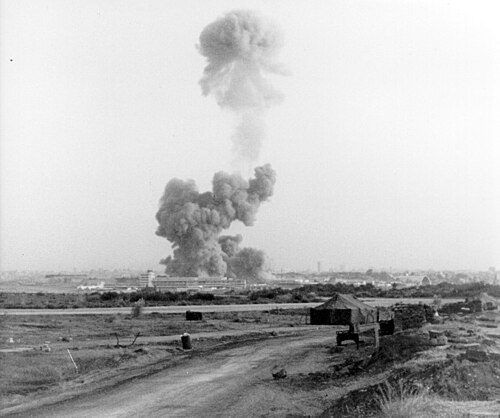
1982年から1986年の間に、レバノンではアメリカ、フランス、イスラエル軍に対して41人による36件の自爆攻撃があり、659人が死亡した。[102]ヒズボラはこれらの攻撃の一部への関与を否定しているが、一部またはすべての攻撃に関与または関連していると非難されている。[239] [240]
- 1982年から1983年にかけてのティール本部爆破事件
- 1983年4月のイスラム聖戦組織による米国大使館爆破事件。[241]
- 1983年のベイルート兵舎爆破事件はイスラム聖戦機構によるもので、ベイルートの米軍とフランス軍の兵舎で米海兵隊員241人、フランス軍空挺部隊員58人、民間人6人が死亡した。[242]
- 1983年のクウェート爆破事件はイラクのダワ党との協力によるものだった。[243]
- 1984年のアメリカ大使館別館爆破事件で24人が死亡。[244]
- 南レバノンにおけるイスラエル国防軍とSLA民兵に対する一連の攻撃。 [102]
- 1985年のTWA847便ハイジャック事件。[242]
- 1982年から1992年にかけてのレバノン人質事件。[245]
1990年以降、ヒズボラが関与したとされるテロ行為やテロ未遂には、民間人や外交官に対する以下の爆破事件や攻撃が含まれる。
- 1992年アルゼンチンのブエノスアイレスでイスラエル大使館が襲撃され、29人が死亡した。[242]ヒズボラの工作員は関与を自慢した。[246]
- 1994年、アルゼンチンのユダヤ文化センターでAMIAが爆破事件を起こし、85人が死亡した。 [242]ヒズボラと密接な関係のあるパレスチナのグループ、アンサル・アッラーが犯行声明を出した。[246]
- 1994年、パナマでAC901便が襲撃され、21人が死亡した。 [247]ヒズボラと密接な関係にあるパレスチナのグループ、アンサル・アッラーが犯行声明を出した。[246]
- 1996年のコバールタワー爆破事件で米軍兵士19人が死亡[248]
- 2002年、シンガポールは、 1990年代にシンガポール海峡で米国とイスラエルの船舶を攻撃しようとした失敗した計画でヒズボラがシンガポール人を募集したと非難した。[249]
- 2008年1月15日、ベイルートで米国大使館の車両が爆破された。[250]
- 2009年、エジプトでヒズボラの陰謀が発覚し、エジプト当局はシナイ半島のイスラエルとエジプトの標的に対する攻撃を計画していたとして49人の男を逮捕した。[251]
- 2012年ブルガリアのブルガスでバス爆弾テロが発生し、6人が死亡した。ヒズボラは犯行を否定した。[252]
- イラク戦争中に米軍に対抗するシーア派反乱軍を訓練する。[253]
ボスニア戦争中
ヒズボラはボスニア戦争中、イランの広範な関与の一環として、ボスニア・イスラム側に戦闘員を派遣した。「ボスニア・イスラム政府はイランの顧客だ」と戦争中にサラエボに駐留していたCIAエージェントのロバート・ベアは記している。「CIAとイランのどちらかを選べと言われたら、彼らはいつでもイランを選ぶだろう」。戦争が終わる頃には、世論調査でボスニア・イスラムの約86%がイランに対して好意的な意見を持っていた。[254]これに伴って、ヒズボラは当初150人の戦闘員を派遣し、戦争におけるボスニア・イスラムの主な敵であるボスニア・セルビア軍と戦わせた。 [59]紛争の終結とともに、シーア派の外国人顧問と戦闘員は全員ボスニアから撤退した。
イスラエルとの紛争
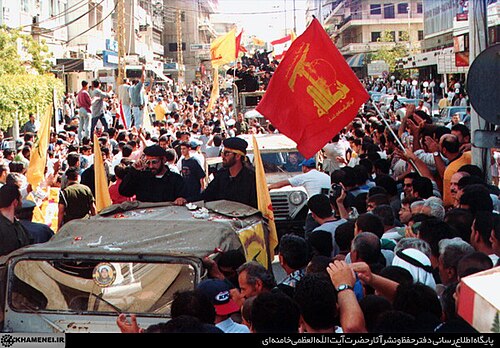
1993年7月25日、ヒズボラが南レバノンでイスラエル兵7人を殺害したことを受けて、イスラエルはアカウンタビリティ作戦(レバノンでは七日間戦争として知られる)を開始し、この作戦中、イスラエル国防軍は1982年以来最も激しい砲撃と空爆を南レバノンの標的に対して行った。作戦の目的は、ヒズボラの脅威を根絶し、民間人を北のベイルートに追いやり、レバノン政府にヒズボラを抑制するよう圧力をかけることだった。[255]戦闘は、交戦当事者間で暗黙の了解が合意されたことで終結した。明らかに、1993年の了解では、ヒズボラの戦闘員はイスラエル北部にロケット弾を発射せず、イスラエルはレバノンの民間人や民間標的を攻撃しないと規定されていた。[256]
1996年4月、ヒズボラがイスラエルの民間人に対してロケット弾攻撃を続けたため、[257]イスラエル軍は南レバノンのヒズボラ基地を壊滅させることを目的とした「怒りの葡萄作戦」を開始した。カナの国連基地への砲撃により100人以上のレバノン難民が死亡したが、イスラエル軍はこれを誤りだと主張した。[258]
数日間の交渉の後、両者は1996年4月26日に「怒りの葡萄」合意に署名した。イスラエルとヒズボラの間で停戦が合意され、1996年4月27日に発効した。[259]双方は民間人を標的にしないことで合意し、これはヒズボラがレバノン国内でイスラエル国防軍に対する軍事活動を継続することを許可することを意味した。[259]
2000年ヒズボラの国境越え襲撃
2000年10月7日、イスラエル占領下のゴラン高原とレバノンの国境をパトロール中、アディ・アビタン、ベニヤミン・アブラハム二等軍曹、オマール・サワイドウェレ二等軍曹の3名のイスラエル兵士がヒズボラに拉致された。[260]兵士らは攻撃中か攻撃直後に殺害された。[261]イスラエルのシャウル・モファズ国防相は、ヒズボラが兵士らを拉致し、殺害したと述べた。[262]殺害された兵士の遺体は2004年にレバノン人捕虜と交換された。[261]
2006年レバノン戦争

2006年のレバノン戦争は、レバノンとイスラエル北部で34日間続いた軍事紛争である。主な当事者は、ヒズボラの準軍事組織とイスラエル軍であった。この紛争は、ヒズボラがイスラエル兵を誘拐し殺害した国境を越えた襲撃によって引き起こされた。この紛争は、2006年7月12日に始まった。ヒズボラの過激派が、イスラエル側の国境フェンスを巡回していた2台の装甲ハンビーに対する対戦車ミサイル攻撃の陽動作戦として、イスラエルの国境の町にロケット弾を発射し、3人を殺害、2人を負傷させ、イスラエル兵2人を捕らえたのである。[263] [264]
イスラエルはレバノン国内の標的への空爆と砲撃で応戦し、ベイルートのラフィク・ハリリ国際空港を含むレバノンのインフラに損害を与えた。イスラエルによると、ラフィク・ハリリ国際空港はヒズボラが武器や物資の輸入に使用していたという。 [265]空中封鎖と海上封鎖、[266]およびレバノン南部への地上侵攻。その後ヒズボラはイスラエル北部に向けてさらに多くのロケット弾を発射し、強固な陣地からイスラエル国防軍とゲリラ戦を繰り広げた。[267]
戦争は2006年8月14日まで続いた。ヒズボラはイスラエル北部のイスラエルの民間都市に対するカチューシャロケット弾数千発の攻撃に関与しており、 [268]ヒズボラはイスラエルによる民間人の殺害とレバノンのインフラへの攻撃への報復だと主張している。[269]この紛争で、戦闘員を含むレバノン国民1,191~1,300人[270] [271] [272] [273] [274]と兵士を含むイスラエル人165人が死亡したとみられている。[275]
2010年のガス田の権利主張
2010年、ヒズボラは、イスラエルの排他的経済水域のハイファの西約50マイル(80キロ)でノーブル・エナジーが発見したダリット・タマル・ガス田はレバノンの領有権があると主張し、イスラエルにそこからガスを採掘しないよう警告した。ヒズボラの高官は、レバノンの天然資源を守るためなら武器を使うこともいとわないと警告した。これに対し、 3月14日軍の関係者は、ヒズボラが武器を保持する口実をもう1つ提示していると述べた。レバノンの国会議員アントワーヌ・ザフラは、この問題はヒズボラの兵器庫の存在を正当化するための「終わりのない言い訳のリスト」のもう1つの項目であると述べた。[276]
2011年イスタンブール攻撃
2011年7月、イタリアの新聞コリエレ・デラ・セラは、アメリカとトルコの情報源に基づいて、 2011年5月にイスタンブールで起きたトルコ民間人8名を負傷させた爆破事件の背後にヒズボラがいると報じた[277]。この報道では、この攻撃はトルコ駐在イスラエル領事モシェ・キムチに対する暗殺未遂だったとされている。トルコの情報筋はこの報道を否定し、「イスラエルはさまざまな新聞を使って偽情報キャンペーンを展開する習慣がある」と述べた[277] 。
2012年にキプロスで計画された攻撃
2012年7月、レバノン人男性がイスラエル人観光客への攻撃を計画したとして、テロ法に関連する可能性のある容疑でキプロス警察に拘留された。治安当局者によると、この男性はキプロスでヒズボラのために攻撃を計画しており、尋問後にこれを認めた。警察はイスラエル諜報機関からの緊急メッセージによりこの男性について通報を受けた。このレバノン人男性はイスラエルの標的の写真を所持しており、キプロスを往復するイスラエルの航空会社の情報も持っており、飛行機または観光バスを爆破する計画を立てていた。[278]イスラエルのベンヤミン・ネタニヤフ首相は、イランがレバノン人男性の攻撃計画を支援したと述べた。[279]
2012年ブルガス攻撃
2012年にブルガリアでイスラエル国民を狙ったブルガスバス爆破テロ事件の捜査後、ブルガリア政府は公式にレバノン武装組織ヒズボラによる攻撃であると非難した。[280]イスラエル国民5人、ブルガリア人バス運転手、爆弾犯が死亡した。爆弾はイスラエル人観光客が空港からホテルに向かうバスに乗車中に爆発した。
ブルガリアのツヴェタン・ツヴェタノフ内務大臣は、容疑者2人はヒズボラの過激派組織のメンバーであると報告した。容疑者は6月28日にブルガリアに入り、7月18日まで滞在していたという。イスラエルは以前からヒズボラが攻撃を行ったと疑っていた。イスラエルのベンヤミン・ネタニヤフ首相は、この報告を「ヒズボラとそのイランの後援者が、国や大陸をまたぐ世界的なテロキャンペーンを画策しているという、我々がすでに知っていることのさらなる裏付け」と呼んだ。[281]ネタニヤフ首相は、ブルガリアでの攻撃は、タイ、ケニア、トルコ、インド、アゼルバイジャン、キプロス、ジョージアでの攻撃を含め、ヒズボラとイランが計画し実行した多くの攻撃のうちの1つに過ぎないと述べた。[280]
中央情報局長官ジョン・ブレナンは、「ブルガリアの調査は、ヒズボラが何者であるかを暴露した。ヒズボラは、罪のない男性、女性、子供を無謀に攻撃することをいとわないテロリスト集団であり、ヨーロッパだけでなく世界の他の地域に対しても、現実的で増大する脅威となっている」と述べている。[282]ブルガリアの調査結果は、イスラエルが米国に続いてヒズボラをテロ組織に指定するよう欧州連合に請願している時期に発表された。[282]
2015年シェバ農場事件
2015年1月18日、シリア南部クネイトラでヒズボラとイランの将校らからなる軍用車列が攻撃を受けたことを受けて、ヒズボラは1月28日、イスラエル占領下のシェバア農場でイスラエル軍の車列に対し、国境を巡回中のイスラエル車両2台に対戦車ミサイルを発射して待ち伏せ攻撃を開始し、 [283]イスラエル軍が確認したところによると、イスラエル軍兵士と将校2名が死亡、7名が負傷した。
2023年~現在 イスラエルとヒズボラの紛争
2023年10月8日、イスラエルとハマスとの戦争中、ヒズボラはシェバ農場のイスラエル占領地に向けて誘導ロケット弾と砲弾を発射した。イスラエルはゴラン高原とレバノンの国境付近のヒズボラの陣地に対してドローン攻撃と砲撃で報復した。この攻撃は、ヒズボラがイスラエルに対するハマスの攻撃への支持と賞賛を表明した後に発生した。 [284] [285]この衝突は、 2006年のレバノン戦争以来、両国間の最大の激化となっている。
ラフィク・ハリリの暗殺
2005年2月14日、レバノンの元首相ラフィク・ハリリが、ベイルートで彼の車列が路上爆弾に襲われ、他の21人とともに死亡した。彼は1992年から1998年、および2000年から2004年に首相を務めていた。2009年、ハリリの殺害を調査していた国連特別法廷は、ヒズボラが殺害に関与した証拠を発見したと報じられている。[286]
2010年8月、国連法廷がヒズボラのメンバーを起訴するという通知を受けて、ハッサン・ナスララは、イスラエルは1993年という早い時期にハリリ暗殺の方法を模索していたと述べた。それは、シリアがレバノンから撤退せざるを得なくなるような政治的混乱を引き起こし、暗殺後に反シリアの雰囲気をレバノンに永続させるためだった。彼はさらに、1996年にヒズボラがアハメド・ナスララというイスラエルの工作員を逮捕したと述べた。ナスララはハッサン・ナスララとは血縁関係がなく、ハリリの警護部隊に連絡を取り、ヒズボラがハリリの命を狙っている確固たる証拠があると伝えたとされている。その後、ハリリはヒズボラに連絡を取り、状況を報告した。[287]サード・ハリリは、国連がこれらの主張を調査すべきだと応じた。[288]
2011年6月30日、ハリーリーの死を調査するために設置されたレバノン特別法廷は、ムスタファ・バドル・アル・ディンを含むヒズボラの幹部4人に対して逮捕状を発行した。[289] 7月3日、ハッサン・ナスララは起訴状を却下し、法廷は党に対する陰謀であると非難し、名前の挙がった人物はいかなる状況でも逮捕されないと誓った。[290]
シリア内戦への関与
ヒズボラは長い間、アサド一族が率いるシリアのバース党政権の同盟国であった。ヒズボラはシリア内戦中、シリア反政府勢力との戦いでシリア政府を支援してきたが、ヒズボラはこれをイスラエルに対するアサドとの同盟関係を破壊しようとするシオニストの陰謀だとしている。[62]ジェネーヴ・アブドは、シリア戦争におけるヒズボラのアサド支援は、同国を「2006年の戦いでイスラエルを破ったことでスンニ派から支持を得た」グループから「完全にシーア派の準軍事組織」へと「変貌させた」と論じた。[291]ヒズボラはイスラム国とも戦った。[292] [293]
2012年8月、米国はヒズボラが戦争で果たした役割を理由に制裁を科した。[294]ナスララ書記長は、ヒズボラがシリア政府のために戦っていたことを否定し、2012年10月12日の演説で「シリア反体制派は当初からメディアに対し、ヒズボラがシリアに3,000人の戦闘員を派遣したと伝えてきたが、我々はこれを否定している」と述べた。[295]しかし、レバノンのデイリー・スター紙によると、ナスララ書記長は同じ演説で、ヒズボラの戦闘員がシリア政府を助けて「レバノン国籍のシーア派が住む戦略的に重要な23の村を支配下に置いた」と述べた。ナスララ書記長は、ヒズボラの戦闘員がシリアで「聖戦任務」を遂行して死亡したと述べた。[296]
2012年、ヒズボラの戦闘員はレバノンから国境を越え、シリアのアル・クサイル地区の8つの村を占領した。 [297] 2013年2月16日〜17日、シリア反政府グループは、シリア軍の支援を受けたヒズボラが自由シリア軍(FSA)が支配する近隣のスンニ派の村3つを攻撃したと主張した。FSAのスポークスマンは「ヒズボラの侵攻は、シリア政権の空軍との組織、計画、調整の点で初めてのものだ」と述べた。ヒズボラは、FSAとの衝突で「自衛のために行動した」レバノンのシーア派3人が死亡したと述べた。[297] [298]レバノンの治安筋によると、3人はヒズボラのメンバーだった。[299]これに応じて、FSAは2月21日にシリアとレバノンでヒズボラの拠点2か所を攻撃したとされている。 5日後、シリア政府はヒズボラの戦闘員とシリア軍将校をレバノンへ運ぶ車列を破壊し、乗客全員を殺害したと発表した。[300]
2013年1月、ヒズボラにSA-17対空ミサイルを運ぶ兵器車列がイスラエル空軍によって破壊されたとされる。近くの化学兵器研究センターも被害を受けた。同年5月にも、ヒズボラ向けの兵器に対する 同様の攻撃が発生した。
3月14日同盟の指導者らと他のレバノンの著名人は、ヒズボラに対しシリアへの関与をやめるよう求め、ヒズボラはレバノンを危険にさらしていると述べた。[301]ヒズボラの元指導者 スブヒ・アル・トゥファイリは「ヒズボラは、自国民を殺害し、パレスチナ人を守るために一度も発砲したことのない犯罪政権を擁護すべきではない」と述べた。彼は「シリアで子供を殺し、人々を恐怖に陥れ、家を破壊しているヒズボラの戦闘員は地獄に落ちるだろう」と述べた。[302]
バールベック・ヘルメルのシーア派とスンニ派の指導者のグループである協議会も、ヒズボラに対しシリアへの「干渉」を行わないよう求めた。彼らは「シリア国民に対して前線を開き、レバノンをシリア国民との戦争に引きずり込むことは非常に危険であり、両国の関係に悪影響を及ぼすだろう」と述べた。[299] 進歩社会党のワリード・ジュンブラット党首もヒズボラに対し関与をやめるよう求め[301]、「ヒズボラはイランの命令でシリア国内で戦っている」と主張した。[303]
エジプトのムハンマド・モルシ大統領は「我々はシリア国民に対するヒズボラの侵略に反対する。シリアにはヒズボラの居場所はない」と述べてヒズボラを非難した。[304]シリア内戦中にヒズボラとイランがアサド政権の支援に関与して以来、シリア国民のヒズボラへの支持は弱まっている。[305] [より良い情報源が必要]
2013年5月12日、ヒズボラはシリア軍と連携してクサイルの一部を奪還しようとした。[306]レバノンでは、「最近ヒズボラ戦闘員の葬儀が増加している」ほか、「シリア反政府勢力がヒズボラ支配地域を砲撃している」という。[306]
2013年5月25日、ナスララはヒズボラがシリア内戦でイスラム過激派と戦っていると発表し、「彼のグループはシリア過激派がレバノン国境の地域を支配することを許さないと誓った」。[307]彼は、ヒズボラが戦略的なシリアの町アルクサイルでアサド軍と同じ側で戦っていることを確認した。[307]テレビ演説で彼は、「シリアがアメリカ、イスラエル、タクフィリ派の手に落ちれば、私たちの地域の人々は暗黒時代に入るだろう」と述べた。[307]
イラン主導のイラク介入への関与
2014年7月から、ヒズボラはイラクへのイランの介入(2014年から現在)を支援するため、技術顧問と情報分析官をバグダッドに派遣した(人数は明らかにしていない) 。その後まもなく、ヒズボラの司令官イブラヒム・アル・ハッジがモスル近郊で戦死したと報じられた。[308]
ラテンアメリカ事業
ヒズボラの南米での活動は20世紀後半に始まり、1948年の第一次中東戦争と1985年のレバノン内戦後に移住したアラブ人住民を中心に行われた。[309]特に疑われている活動はマネーロンダリングである。[310]ロサンゼルス・タイムズ紙は、同グループは1990年代、特に1992年のアルゼンチンでのイスラエル大使館爆破事件の際に活発に活動していたが、時が経つにつれてその関連性はますます不明瞭になったと報じている。[311] Voxは、2001年に愛国者法が採択された後、麻薬取締局(DEA)が麻薬テロという言葉を広め、過去にテロに関与した経歴のない個人を逮捕するようになり、疑わしいテロリスト集団とカルテルとの大規模な共謀に関する報告に対する懐疑的な見方を示唆していると書いている。[312]
2002年、ヒズボラはパラグアイのシウダー・デル・エステで公然と活動していると報じられた。[313] 2008年初頭、DEAはラテンアメリカでの麻薬密売に関するヒズボラの活動を取り締まるため、カサンドラ計画を開始した。 [314] DEAの調査によると、ヒズボラは年間約10億ドルを稼ぎ、数千トンのコカインを米国に密輸した。[315]ヒズボラによるコカイン密売のもう一つの行き先は、湾岸協力会議加盟国である。[316] 2013年、ヒズボラは南米に潜入し、ラテンアメリカの麻薬カルテルとつながりがあると非難された。[317]
活動地域の一つは三国境地帯で、ヒズボラはコカインの密売に関与しているとされ、パラグアイのレバノン大使館の職員はアメリカの主張や引き渡しの試みに対抗するために活動してきた。[318] 2016年には、麻薬販売で得た金がシリアでの武器購入に使われたとされた。[319] 2018年、インフォベーはヒズボラが対外安全保障機構の名でコロンビアで活動していると報じた。 [320]同年、アルゼンチン警察は国内でのヒズボラの犯罪活動に関与したとされる人物を逮捕した。[321]
ロサンゼルス・タイムズ紙は2020年に、当時ヒズボラは「ある種の悪魔」として機能し、「米国の評論家や政治家、特に極右の政治家は、ヒズボラや他のイスラム組織がラテンアメリカに深刻な脅威を与えていると長い間定期的に警告してきた」と指摘した。[311]キューバ[322]、 ニカラグア[ 323]、ベネズエラ[324] [325] [ 326] [327]がこの地域でのヒズボラの活動を支援しているとのさまざまな主張がなされている。 [328]ラテンアメリカにおけるヒズボラの存在に関するイスラエルの報告は、米国に拠点を置くラテンアメリカのアナリストの間で疑問を引き起こした[323]一方、専門家はラテンアメリカでの存在に関する報告は誇張されていると述べている。[311]
サザンパルスのディレクター兼アナリストであるサミュエル・ローガンは、ピューリッツァーセンターとのインタビューで「テヘランへの地政学的近接性は、国内でのヒズボラの活動に対する寛容さに直接つながるわけではない」と述べた。[323]ウィリアム・ニューマンは、2022年の著書『Things Are Never So Bad That They Can't Get Worse』の中で、ラテンアメリカにおけるヒズボラの存在の主張は「実際には最小限」であり、ベネズエラの野党がそのような主張を持ち出したのは、米国がベネズエラからの脅威に直面していると信じ込ませ、外国の介入を促すためだと書いている。[329]
米国での事業
米国で有罪判決を受けた最初のヒズボラ工作員であるアリ・コウラニは、2013年から捜査を受けており、ヒズボラのイスラム聖戦機構に標的とテロリストの募集情報を提供する活動を行っていた。[330]この組織は、ミネソタ州出身で軍の言語学者であるマリアム・タラ・トンプソンを募集していたが、彼女は米国の裁判所で発見され、起訴される前に「少なくとも8人の秘密の人的資源、少なくとも10人の米国人の標的、および複数の戦術、技術、手順の身元」を暴露していた。[331]
他の
2010年、アフバシュとヒズボラのメンバーは、駐車問題をめぐって路上での戦闘に巻き込まれたが、その後両グループは会合を開き、紛争の犠牲者のための共同補償基金を設立した。[332]
ロイター通信によると、2024年にはヒズボラとイラン革命防衛隊の司令官がイエメンに介入し、紅海の船舶に対するフーシ派の攻撃を監督・指揮していたと報じられている。[333]
財政・経済

During the September 2021 fuel shortage, Hezbollah received a convoy of 80 tankers carrying oil/diesel fuel from Iran.[334][335]
Attacks on Hezbollah leaders
Hezbollah has also been the target of bomb attacks and kidnappings. These include:
- In the 1985 Beirut car bombing, Hezbollah leader Mohammad Hussein Fadlallah was targeted, but the assassination attempt failed.
- On 28 July 1989, Israeli commandos kidnapped Sheikh Abdel Karim Obeid, the leader of Hezbollah.[336] This action led to the adoption of UN Security Council resolution 638, which condemned all hostage takings by all sides.
- On 16 February 1992, Israeli helicopters attacked a motorcade in southern Lebanon, killing the Hezbollah leader Abbas al-Musawi, his wife, son, and four others.[104]
- On 31 March 1995, Rida Yasin, also known as Abu Ali, was killed by a single rocket fired from an Israeli helicopter while in a car near Derdghaya in the Israeli security zone 10 km east of Tyre. Yasin was a senior military commander in southern Lebanon. His companion in the car was also killed. An Israeli civilian was killed and fifteen wounded in the retaliatory rocket fire.[337][338]
- On 12 February 2008, Imad Mughniyeh was killed by a car bomb in Damascus, Syria.[339]
- On 3 December 2013, senior military commander Hassan al-Laqis was shot outside his home, two miles (three kilometers) southwest of Beirut. He died a few hours later on 4 December.[340]
- On 18 January 2015, a group of Hezbollah fighters was targeted in Quneitra, with the Al-Nusra Front claiming responsibility. In this attack, for which Israel was also accused, Jihad Mughniyeh, son of Imad Mughniyeh, five other members of Hezbollah and an Iranian general of Quds Force, Mohammad Ali Allahdadi, were killed.[341][342][343]
- On 10 May 2016, an explosion near Damascus International Airport killed top military commander Mustafa Badreddine. Lebanese media sources attributed the attack to an Israeli airstrike. Hezbollah attributed the attack to Syrian opposition.[344][345][346]
Targeting policy
After the September 11, 2001 attacks, Hezbollah condemned al-Qaeda for targeting civilians in the World Trade Center,[347][348] but remained silent on the attack on The Pentagon.[51][349] Hezbollah also denounced the massacres in Algeria by Armed Islamic Group, Al-Gama'a al-Islamiyya attacks on tourists in Egypt,[350] the murder of Nick Berg,[351] and ISIL attacks in Paris.[352]
Although Hezbollah has denounced certain attacks on civilians, some people accuse the organization of the bombing of an Argentine synagogue in 1994. Argentine prosecutor Alberto Nisman, Marcelo Martinez Burgos, and their "staff of some 45 people"[353] said that Hezbollah and their contacts in Iran were responsible for the 1994 bombing of a Jewish cultural center in Argentina, in which "[e]ighty-five people were killed and more than 200 others injured."[354]
In August 2012, the United States State Department's counter-terrorism coordinator Daniel Benjamin said that Hezbollah "is not constrained by concerns about collateral damage or political fallout that could result from conducting operations there [in Europe]".[355][356][357]
Foreign relations
Hezbollah has close relations with Iran.[358] It also has ties with the leadership in Syria, specifically President Hafez al-Assad, until his death in 2000, supported it.[359] It is also a close Assad ally, and its leader pledged support to the embattled Syrian leader.[360][361] Although Hezbollah and Hamas are not organizationally linked, Hezbollah provides military training as well as financial and moral support to the Sunni Palestinian group.[362] Furthermore, Hezbollah was a strong supporter of the Second Intifada.[51]
American and Israeli counter-terrorism officials claim that Hezbollah has (or had) links to Al Qaeda, although Hezbollah's leaders deny these allegations.[363][364] Also, some al-Qaeda leaders, like Abu Musab al-Zarqawi[365] and Wahhabi clerics, consider Hezbollah to be heretics.[366] But United States intelligence officials speculate that there has been contact between Hezbollah and low-level al-Qaeda figures who fled Afghanistan for Lebanon.[367] However, Michel Samaha, Lebanon's former minister of information, has said that Hezbollah has been an important ally of the government in the war against terrorist groups, and described the "American attempt to link Hezbollah to al-Qaeda" to be "astonishing".[51]
Public opinion
As of 2024, Hezbollah's support within Lebanon is limited, especially after being blamed for the 2020 Beirut port explosion and the obstruction of accountability efforts. According to a 2024 Arab Barometer survey, 55 percent of Lebanese have "no trust at all" in the group. Support remains concentrated primarily among the Shiite population.[75]
According to Michel Samaha, Lebanon's minister of information, Hezbollah is seen as "a legitimate resistance organization that has defended its land against the Israeli occupying force, and consistently stood up to the Israeli army."[51] Samaha was sentenced for smuggling explosives to carry out terrorist attacks in Lebanon with the help of the Syrian regime.[368][369]
According to a survey released by the "Beirut Center for Research and Information", of 800 citizens polled between 24-26 July 2006, during the 2006 Lebanon War, "showed 87 percent support for Hizbullah's [sic] retaliatory attacks on northern Israel."[370] a rise of 29 percentage points from a similar poll conducted in February.[citation needed] More striking, however, was the level of support for Hezbollah's resistance from Sunni communities. "Eighty percent of Christians polled supported Hizbullah [sic] along with 80 percent of Druze and 89 percent of Sunnis."[371]
In a poll of Lebanese adults taken in 2004, 6% of respondents gave unqualified support to the statement "Hezbollah should be disarmed". 41% reported unqualified disagreement. A poll of Gaza Strip and West Bank residents indicated that 79.6% had "a very good view" of Hezbollah, and most of the remainder had a "good view". Polls of Jordanian adults in December 2005 and June 2006 showed that 63.9% and 63.3%, respectively, considered Hezbollah to be a legitimate resistance organization. In the December 2005 poll, only 6% of Jordanian adults considered Hezbollah to be terrorist.[372]
A July 2006 USA Today/Gallup poll found that 83% of the 1,005 Americans polled blamed Hezbollah, at least in part, for the 2006 Lebanon War, compared to 66% who blamed Israel to some degree. Additionally, 76% disapproved of the military action Hezbollah took in Israel, compared to 38% who disapproved of Israel's military action in Lebanon.[373] A poll in August 2006 by ABC News and The Washington Post found that 68% of the 1,002 Americans polled blamed Hezbollah, at least in part, for the civilian casualties in Lebanon during the 2006 Lebanon War, compared to 31% who blamed Israel to some degree.[373] Another August 2006 poll by CNN showed that 69% of the 1,047 Americans polled believed that Hezbollah is unfriendly towards, or an enemy of, the United States.[373]
In 2010, a survey of Muslims in Lebanon showed that 94% of Lebanese Shia supported Hezbollah, while 84% of the Sunni Muslims held an unfavorable opinion of the group.[374]
Some public opinion has started to turn against Hezbollah for their support of Syrian President Assad's attacks on the opposition movement in Syria.[375] Crowds in Cairo shouted out against Iran and Hezbollah, at a public speech by Hamas President Ismail Haniya in February 2012, when Hamas changed its support to the Syrian opposition.[376]
View of Hezbollah
A November 2020 poll in Lebanon performed by the pro-Israel, American Washington Institute for Near East Policy declared that support for Hezbollah is declining significantly. Below is a table of the results of their polls.[377]
Designation as a terrorist organization or resistance movement
Hezbollah's status as a legitimate political party, a terrorist group, a resistance movement, or some combination thereof is a contentious issue.[378]
As of October 2020, Hezbollah or its military wing are considered terrorist organizations by at least 26 countries, as well as by the European Union and since 2017 by most member states of the Arab League, with the exception of Iraq and Lebanon, where Hezbollah is the most powerful political party.[379] In June 2024, the Arab League leadership has announced that it no longer views Hezbollah as a terrorist organization.[380]
The countries that have designated Hezbollah a terrorist organization include: the Gulf Cooperation Council,[381] and their members Saudi Arabia,[382] Bahrain,[383] United Arab Emirates,[382] as well as Argentina,[384] Canada,[385] Colombia,[386] Estonia,[387] Germany,[388] Honduras,[389] Israel,[390] Kosovo,[391] Lithuania,[392] Malaysia,[393] Paraguay,[394] Serbia,[387] Slovenia,[395] United Kingdom,[396] United States,[397] and Guatemala.[398]
The EU differentiates between Hezbollah's political wing and military wing, banning only the latter, though Hezbollah itself does not recognize such a distinction.[387] Hezbollah maintains that it is a legitimate resistance movement fighting for the liberation of Lebanese territory.
There is a "wide difference" between American and Arab perception of Hezbollah.[51] Several Western countries officially classify Hezbollah or its external security wing as a terrorist organization, and some of their violent acts have been described as terrorist attacks. However, throughout most of the Arab and Muslim worlds, Hezbollah is referred to as a resistance movement, engaged in national defense.[125][399][400] Even within Lebanon, sometimes Hezbollah's status as either a "militia" or "national resistance" has been contentious. In Lebanon, although not universally supported, Hezbollah is widely seen as a legitimate national resistance organization defending Lebanon, and has been described by the Lebanese information minister as an important ally in fighting terrorist groups.[51][401]
The United Nations Security Council has never listed Hezbollah as a terrorist organization under its sanctions list, although some of its members have done so individually. The United Kingdom listed Hezbollah's military wing as a terrorist organization[402] until May 2019 when the entire organization was proscribed,[403] and the United States[404] lists the entire group as such. Russia has considered Hezbollah a legitimate sociopolitical organization,[405] and the People's Republic of China remains neutral and maintains contacts with Hezbollah.[citation needed][406]
In May 2013, France and Germany released statements that they will join other European countries in calling for an EU-blacklisting of Hezbollah as a terror group.[407] In April 2020 Germany designated the organization—including its political wing—as a terrorist organization, and banned any activity in support of Hezbollah.[408]
In the Western world
The United States Department of State has designated Hezbollah a terrorist organization since 1995. The group remains on Foreign Terrorist Organization and Specially Designated Terrorist lists. According to the Congressional Research Service, "The U.S. government holds Hezbollah responsible for a number of attacks and hostage takings targeting Americans in Lebanon during the 1980s, including the bombing of the U.S. Embassy in Beirut in April 1983 and the bombing of the U.S. Marine barracks in October 1983, which together killed 258 Americans. Hezbollah's operations outside of Lebanon, including its participation in bombings of Israeli and Jewish targets in Argentina during the 1990s and more recent training and liaison activities with Shiite insurgents in Iraq, have cemented the organization's reputation among U.S. policy makers as a capable and deadly adversary with potential global reach."[444]
The United Kingdom was the first government to attempt to make a distinction between Hezbollah's political and military wings, declaring the latter a terrorist group in July 2008 after Hezbollah confirmed its association with Imad Mughniyeh.[445] In 2012, British "Foreign Minister William Hague urged the European Union to place Hezbollah's military wing on its list of terrorist organizations."[446] The United States also urged the EU to classify Hezbollah as a terrorist organization.[citation needed] In light of findings implicating Hezbollah in the bus bombing in Burgas, Bulgaria in 2012, there was renewed discussion within the European Union to label Hezbollah's military wing as a terrorist group.[447] On 22 July 2013, the European Union agreed to blacklist Hezbollah's military wing over concerns about its growing role in the Syrian conflict.[448]
In the midst of the 2006 conflict between Hezbollah and Israel, Russia's government declined to include Hezbollah in a newly released list of terrorist organizations, with Yuri Sapunov, the head of anti-terrorism for the Federal Security Service of the Russian Federation, saying that they list only organizations which represent "the greatest threat to the security of our country".[449] Prior to the release of the list, Russian Defense Minister Sergei Ivanov called "on Hezbollah to stop resorting to any terrorist methods, including attacking neighboring states."[450]
The Quartet's fourth member, the United Nations, does not maintain such a list,[451] however, the United Nations has made repeated calls for Hezbollah to disarm and accused the group of destabilizing the region and causing harm to Lebanese civilians.[452][453][454] Human rights organizations Amnesty International and Human Rights Watch have accused Hezbollah of committing war crimes against Israeli civilians.[455][456][457][458]
Argentine prosecutors hold Hezbollah and their financial supporters in Iran responsible for the 1994 AMIA Bombing of a Jewish cultural center, described by the Associated Press as "the worst terrorist attack on Argentine soil", in which "[e]ighty-five people were killed and more than 200 others injured."[354][459] During the Israeli occupation of southern Lebanon, French Prime Minister Lionel Jospin condemned attacks by Hezbollah fighters on Israeli forces in south Lebanon, saying they were "terrorism" and not acts of resistance. "France condemns Hezbollah's attacks, and all types of terrorist attacks which may be carried out against soldiers, or possibly Israel's civilian population."[460]
Italian Foreign Minister Massimo D'Alema differentiated the wings of Hezbollah: "Apart from their well-known terrorist activities, they also have political standing and are socially engaged."[461] Germany does not maintain its own list of terrorist organizations, having chosen to adopt the common EU list. However, German officials have indicated they would likely support designating Hezbollah a terrorist organization.[462]
The Netherlands regards Hezbollah as terrorist discussing it as such in official reports of their general intelligence and security service[463] and in official answers by the Minister of Foreign Affairs.[464] On 22 July 2013, the European Union declared the military wings of Hezbollah as a terrorist organization; effectively blacklisting the entity.[465]
The United States,[404] the Gulf Cooperation Council,[381] Canada,[416] United Kingdom,[403] the Netherlands,[427] Israel,[37] and Australia[413] have classified Hezbollah as a terrorist organization. In early 2015, the US Director of National Intelligence removed Hezbollah from the list of "active terrorist threats" against the United States while Hezbollah remained designated as terrorist by the US,[466] and by mid 2015 several Hezbollah officials were sanctioned by the US for their role in facilitating military activity in the ongoing Syrian Civil War.[467] The European Union, France[420] and New Zealand have proscribed Hezbollah's military wing, but do not list Hezbollah as a whole as a terrorist organization.[428][419]
Serbia, which recently designated Iran-backed Hezbollah entirely as a terrorist organization, fully implement measures to restrict Hezbollah's operations and financial activities.[430]
In the Arab and Muslim world
.jpg/500px-Anti-Islam_Film_protests_(8009242499).jpg)
In 2006, Hezbollah was regarded as a legitimate resistance movement throughout most of the Arab and Muslim world.[125] Furthermore, most of the Sunni Arab world sees Hezbollah as an agent of Iranian influence, and therefore, would like to see their power in Lebanon diminished.[468] Egypt, Jordan, and Saudi Arabia have condemned Hezbollah's actions, saying that "the Arabs and Muslims can't afford to allow an irresponsible and adventurous organization like Hezbollah to drag the region to war" and calling it "dangerous adventurism".[469]
After an alleged 2009 Hezbollah plot in Egypt, the Egyptian regime of Hosni Mubarak officially classified Hezbollah as a terrorist group.[470] Following the 2012 Presidential elections the new government recognized Hezbollah as a "real political and military force" in Lebanon. The Egyptian ambassador to Lebanon, Ashraf Hamdy, stated that "Resistance in the sense of defending Lebanese territory ... That's their primary role. We ... think that as a resistance movement they have done a good job to keep on defending Lebanese territory and trying to regain land occupied by Israel is legal and legitimate."[471][472]
During the Bahraini uprising, Bahrain foreign minister Khalid ibn Ahmad Al Khalifah labeled Hezbollah a terrorist group and accused them of supporting the protesters.[473][474] On 10 April 2013, Bahrain blacklisted Hezbollah as a terrorist group, being the first Arab state in this regard.[475]
While Hezbollah has supported popular uprisings in Egypt, Yemen, Bahrain and Tunisia, Hezbollah publicly sided with Iran and Syria during the 2011 Syrian uprising.[476] This position has prompted criticism from anti-government Syrians. As Hezbollah supported other movements in the context of the Arab Spring, anti-government Syrians have stated that they feel "betrayed" by a double standard allegedly applied by the movement. Following Hezbollah's aid in Assad government's victory in Qusayr, anti-Hezbollah editorials began regularly appearing in the Arabic media and anti-Hezbollah graffiti has been seen in southern Lebanon.[477]
In March 2016, Gulf Cooperation Council designated Hezbollah as a terrorist organization due to its alleged attempts to undermine GCC states, and Arab League followed the move, with reservation by Iraq and Lebanon. In the summit, Lebanese Foreign Minister Gebran Bassil said that "Hezbollah enjoys wide representation and is an integral faction of the Lebanese community", while Iraqi Foreign Minister Ibrahim al-Jaafari said PMF and Hezbollah "have preserved Arab dignity" and those who accuse them of being terrorists are terrorists themselves. Saudi delegation walked out of the meeting.[478] Israel's Prime Minister Benjamin Netanyahu called the step, "'important' and 'even amazing'".[479]
A day before the move by the Arab League, Hezbollah leader Nasrallah said that "Saudi Arabia is angry with Hezbollah since it is daring to say what only a few others dare to say against its royal family".[480]
In 2020, a German security contractor accused Qatar of financing Hezbollah.[481] In September 2021, U.S' Secretary of State, Antony Blinken commended the combined efforts taken by the United States and the Government of Qatar against Hezbollah financial network which involved the abuse of international financial system by using global networks of financiers and front companies to spread terrorism.[482] In July 2022, Qatar participated in a 30-nation meeting led by the United States to counter Hezbollah, according to Axios.[483]
In June 2024, the Arab League Assistant Secretary-General Hossam Zaki has announced that the Arab League no longer considers Hezbollah a terrorist organization.[380]
In Lebanon

In an interview during the 2006 Lebanon War, then-President Emile Lahoud stated "Hezbollah enjoys utmost prestige in Lebanon, because it freed our country ... even though it is very small, it stands up to Israel."[484] Following the 2006 War, other Lebanese including members of the government were resentful of the large damage sustained by the country and saw Hezbollah's actions as unjustified "dangerous adventurism" rather than legitimate resistance. They accused Hezbollah of acting on behalf of Iran and Syria.[485] An official of the Future Movement, part of the March 14 Alliance, warned that Hezbollah "has all the characteristics of a terrorist party", and that Hezbollah is moving Lebanon toward the Iranian Islamic system of government.[486]
In August 2008, Lebanon's cabinet completed a policy statement which recognized "the right of Lebanon's people, army, and resistance to liberate the Israeli-occupied Shebaa Farms, Kafar Shuba Hills, and the Lebanese section of Ghajar village, and defend the country using all legal and possible means."[487]
Gebran Tueni, a late conservative Orthodox Christian editor of an-Nahar, referred to Hezbollah as an "Iranian import" and said "they have nothing to do with Arab civilization." Tuení believed that Hezbollah's evolution is cosmetic, concealing a sinister long-term strategy to Islamicize Lebanon and lead it into a ruinous war with Israel.[51]
By 2017, a poll showed that 62 percent of Lebanese Christians believed that Hezbollah was doing a "better job than anyone else in defending Lebanese interests in the region, and they trust it more than other social institutions."[488][better source needed]
Scholarly views
Academics specializing in a wide variety of the social sciences believe that Hezbollah is an example of an Islamic terrorist organization. Such scholars and research institutes include the following:
- Walid Phares, Lebanese-born terrorism scholar.[489]
- Mark LeVine, American historian[490]
- Avraham Sela, Israeli historian[491]
- Robert S. Wistrich, Israeli historian[492]
- Eyal Zisser, Israeli historian[493]
- Siamak Khatami, Iranian scholar[494]
- Rohan Gunaratna, Singaporean scholar[363]
- Neeru Gaba, Australian scholar[495]
- Tore Bjørgo, Norwegian scholar[496]
- Magnus Norell, of the European Foundation for Democracy[497]
- Anthony Cordesman, of the Center for Strategic and International Studies[498]
- Center for American Progress[499]
- United States Institute of Peace[500]
Views of foreign legislators
J. Gresham Barrett brought up legislation in the U.S. House of Representatives which, among other things, referred to Hezbollah as a terrorist organization. Congress members Tom Lantos, Jim Saxton, Thad McCotter, Chris Shays, Charles Boustany, Alcee Hastings, and Robert Wexler referred to Hezbollah as a terrorist organization in their speeches supporting the legislation.[501] Shortly before a speech by Iraqi Prime Minister Nouri al-Maliki, U.S. Congressman Dennis Hastert said, "He [Maliki] denounces terrorism, and I have to take him at his word. Hezbollah is a terrorist organization."[502]
In 2011, a bipartisan group of members of Congress introduced the Hezbollah Anti-Terrorism Act. The act ensures that no American aid to Lebanon will enter the hands of Hezbollah. On the day of the act's introduction, Congressman Darrell Issa said, "Hezbollah is a terrorist group and a cancer on Lebanon. The Hezbollah Anti-Terrorism Act surgically targets this cancer and will strengthen the position of Lebanese who oppose Hezbollah."[503]
In a Sky News interview during the 2006 Lebanon war, British MP George Galloway said that Hezbollah is "not a terrorist organization".[504]
Former Swiss member of parliament, Jean Ziegler, said in 2006: "I refuse to describe Hezbollah as a terrorist group. It is a national movement of resistance."[505]
See also

- Military equipment of Hezbollah
- Terrorism in Lebanon
- Politics of Lebanon
- Jihad al-Bina
- Mleeta museum
- January 2015 Mazraat Amal incident
- Hezbollah Movement in Iraq
- 2023 Israel–Hamas war
- Jaysh al-Mahdi (Iraq)
- Al-Ashtar Brigades (Bahrain)
- Liwa Assad Allah (Syria)
- Hezbollah al-Hejaz (Saudi Arabia)
- Harakah al-Sabireen (Palestine)
- Islamic Front for the Liberation of Bahrain
- Islamic Movement (Nigeria)
- Emtrasur Cargo
Notes
Footnotes
- ^ Other transliterations include Hizbullah, Hizballah, Hizbollah, Hezbolla, Hezballah, Hisbollah, Hizbu'llah and Hizb Allah.
Citations
- ^ "Fadlallah Hits Back at March 14 over Karam Release, Marouni Slams 'Treason Accusations'". Naharnet. 18 April 2013.
- ^ a b c Philip Smyth (February 2015). The Shiite Jihad in Syria and Its Regional Effects (PDF) (Report). The Washington Institute for Near East Studies. pp. 7–8. Archived from the original (PDF) on 2 April 2015. Retrieved 13 March 2015.
- ^ a b c Dalacoura, Katerina (2012). "Islamist Terrorism and National Liberation: Hamas and Hizbullah". Islamist Terrorism and Democracy in the Middle East. Cambridge: Cambridge University Press. pp. 66–96. doi:10.1017/CBO9780511977367.004. ISBN 978-0-511-97736-7. LCCN 2010047275. S2CID 150958046.
- ^ Stepanova, Ekaterina (2008). Terrorism in Asymmetrical Conflict: Ideological and Structural Aspects (PDF). Oxford University Press. p. 113. Archived from the original (PDF) on 10 March 2016.
- ^ a b c d Joshua L. Gleis; Benedetta Berti (2012). Hezbollah and Hamas: A Comparative Study. JHU Press. ISBN 978-1-4214-0671-8.
- ^ "Hezbollah, the Lebanese Sectarian State, and Sectarianism". Middle East Institute. Retrieved 13 April 2017.
- ^ Bassel F, Salloukh (2015). "The Sectarian Image Reversed: The Role of Geopolitics in Hezbollah's Domestic Politics". Middle East Political Pcience.
- ^ "Hezbollah and the Lebanese Popular Movement".
- ^ Salamey, Imad; Pearson, Frederic (2007). "Hezbollah: A Proletarian Party with an Islamic Manifesto – A Sociopolitical Analysis of Islamist Populism in Lebanon and the Middle East". Small Wars & Insurgencies. 18 (3): 416–438. doi:10.1080/09592310701674358. ISSN 0959-2318. S2CID 143896155.
- ^ Elie Alagha, Joseph (2011). Hizbullah's Documents: From the 1985 Open Letter to the 2009 Manifesto. Amsterdam University Press. pp. 15, 20. ISBN 978-90-8555-037-2.
Shehata, Samer (2012). Islamist Politics in the Middle East: Movements and Change. Routledge. p. 176. ISBN 978-0-415-78361-3. - ^ Husseinia, Rola El (2010). "Hezbollah and the Axis of Refusal: Hamas, Iran and Syria". Third World Quarterly. 31 (5): 803–815. doi:10.1080/01436597.2010.502695. S2CID 219628295.
- ^ Levitt, Matthew (2013). Hezbollah: The Global Footprint of Lebanon's Party of God. Hurst Publishers. p. 356. ISBN 978-1-84904-333-5.
Hezbollah's anti-Western militancy began with attacks against Western targets in Lebanon, then expanded to attacks abroad intended to exact revenge for actions threatening its or Iran's interests, or to press foreign governments to release captured operatives.
- ^ Hanhimäki, Jussi M.; Blumenau, Bernhard (2013). An International History of Terrorism: Western and Non-Western Experiences. Routledge. p. 267. ISBN 978-0-415-63540-0.
Based upon these beliefs, Hezbollah became vehemently anti-West and anti-Israel.
- ^ Siegel, Larry J. (2012). Criminology: Theories, Patterns & Typology. Cengage Learning. p. 396. ISBN 978-1-133-04964-7.
Hezbollah is anti-West and anti-Israel and has engaged in a series of terrorist actions including kidnappings, car bombings, and airline hijackings.
- ^ a b c d e f "Who Are Hezbollah?". BBC News. 21 May 2008. Retrieved 15 August 2008.
- ^ Julius, Anthony (2015). Trials of the Diaspora: A History of Anti-Semitism in England. Oxford University Press. ISBN 978-0-19-929705-4 – via Google Books.
- ^ Michael, Robert; Rosen, Philip (2015). Dictionary of Antisemitism from the Earliest Times to the Present. Scarecrow Press. ISBN 978-0-8108-5868-8 – via Google Books.
- ^ Perry, Mark (2015). Talking to Terrorists: Why America Must Engage with Its Enemies. Basic Books. p. 158. ISBN 978-0-465-01117-9.
- ^ "Analysis: Hezbollah's lethal anti-Semitism". The Jerusalem Post. 12 November 2012.
- ^ "Hezbollah chief in new attack on same-sex relations". France 24. 29 July 2023.
- ^ Revolutions: A Worldwide Introduction to Political and Social Change. Routledge. 2015. ISBN 978-1-317-26457-6.
- ^ "Interior Ministry releases numbers of votes for new MPs". The Daily Star. 9 May 2018. Archived from the original on 8 March 2021. Retrieved 24 October 2019.
- ^ a b "What Is Hezbollah?". Council on Foreign Relations. Retrieved 17 December 2023.
- ^ "Lebanon's Hezbollah chief Nasrallah says group has never been stronger". Reuters. 18 October 2021.
- ^ Agencies, The New Arab Staff & (18 October 2021). "Hassan Nasrallah says Hezbollah has 100,000 fighters". english.alaraby.co.uk/.
- ^ "Lebanon Hezbollah chief says movement has 100,000 fighters". France 24. 18 October 2021.
- ^ "Hezbollah is the Long Arm of Iran – Factsheet 5". 20 September 2019. Retrieved 8 February 2023.
- ^ "Why Assad's alliance with Iran and Hezbollah will endure". 8 February 2019. Retrieved 8 February 2023.
- ^ Pardo, Ramon Pacheco (February 2011). "Beyond Iran" (PDF). The Majalla. 1561: 12–14. Archived from the original (PDF) on 15 July 2012. Retrieved 5 April 2013.
- ^ a b "Iraq admits Lebanese Hezbollah and Iranian RG fight alongside Iraqi security forces". 9 November 2014. Archived from the original on 15 June 2018. Retrieved 28 July 2018.
- ^ "Hezbollah Fights Alongside LAF Demonstrating its Continuing Control over Lebanon". The Tower. 21 August 2017. Archived from the original on 2 February 2020. Retrieved 28 July 2018.
- ^ "New Experience of Hezbollah with Russian Military". 2 February 2016. Archived from the original on 28 July 2018.
- ^ Rosenfeld, Jesse (11 January 2016). "Russia is Arming Hezbollah, Say Two of the Group's Field Commanders". The Daily Beast.
- ^ "Yemeni FM slams Hezbollah's Houthi support: report". The Daily Star. Archived from the original on 28 July 2018. Retrieved 28 July 2018.
- ^ "Lebanon's Hezbollah denies sending weapons to Yemen". Reuters. 20 November 2017.
- ^ "Wagner Group 'tasked to deliver Russian weapons to Hezbollah' – US intelligence". 4 November 2023.
- ^ a b c "Hezbollah – International terrorist organization". Israel Ministry of Foreign Affairs. 22 July 2013.
- ^ Francis, Xavier (21 May 2020). "Israel Impressed How Turkish Army Crushed Hezbollah In Idlib, Syria". Latest Asian, Middle-East, EurAsian, Indian News.
- ^ "Israel learned from Hezbollah's defeat at the hands of Turkey". The Jerusalem Post.
- ^ "Turkish strike in Syria kills nine Hezbollah members, according to source". Haaretz.
- ^ a b Nimrod Raphaeli (11 February 2009). "The Iranian Roots of Hizbullah". MEMRI. Archived from the original on 11 February 2009.
- ^ "Beware Iran's 'Axis of Resistance' | People's Mojahedin Organization of Iran (PMOI/MEK)". Archived from the original on 31 October 2021. Retrieved 16 January 2020.
- ^ "Hezbollah fighters train Iraqi Shiite militants near Mosul". longwarjournal.org – FDD's Long War Journal. 5 November 2016.
- ^ a b
- "Hezbollah". The Collins English Dictionary. Glasgow: HarperCollins. 2013. Retrieved 7 May 2013.
- "Hezbollah". Webster's New World College Dictionary. Cleveland: Wiley Publishing, Inc. 2012. Retrieved 7 May 2013.
- ^ a b Faridi 2019, p. 2.
- ^ a b Levitt, Matthew (2013). Hezbollah: The Global Footprint of Lebanon's Party of God. Hurst Publishers. p. 15. ISBN 978-1-84904-333-5.
... the Jihad Council coordinates 'resistance activity'.
Ghattas Saab, Antoine (15 May 2014). "Hezbollah cutting costs as Iranian aid dries up". The Daily Star. Retrieved 1 June 2014.... Hezbollah's military wing ... Known as the 'Jihad Council'
- ^ Kanter, James; Rudoren, Jodi (22 July 2013). "European Union Adds Military Wing of Hezbollah to List of Terrorist Organizations". The New York Times. Retrieved 4 September 2013.
- ^ Roche, MaryClare; Robbins, Michael (12 July 2024). "What the Lebanese People Really Think of Hezbollah". Foreign Affairs. ISSN 0015-7120. Retrieved 28 September 2024.
- ^ "IDF confirms Hezbollah leader Hassan Nasrallah killed in Beirut attack". Jerusalem Post. 28 September 2024. Retrieved 28 September 2024.
- ^ Hirst, David (2010) Beware of Small States. Lebanon, battleground of the Middle East. Faber and Faber. ISBN 978-0-571-23741-8 p. 189
- ^ a b c d e f g h i j k l Adam Shatz (29 April 2004). "In Search of Hezbollah". The New York Review of Books. 51 (7). Archived from the original on 22 August 2006. Retrieved 14 August 2006.
- ^ Dominique Avon, Anaïs-Trissa Khatchadourian, Hezbollah: A History of the "Party of God", Harvard University Press, 2012 ISBN 978-0-674-07031-8 pp. 21ff.
- ^ E. Azani, Hezbollah: The Story of the Party of God: From Revolution to Institutionalization, Springer, 2011 ISBN 978-0-230-11629-0 pp. 59–63
- ^ Mariam Farida, Religion and Hezbollah: Political Ideology and Legitimacy, Routledge, 2019 ISBN 978-1-000-45857-2 pp. 1–3.
- ^ a b c d Itamar Rabinovich (2008). Israel in the Middle East. UPNE. ISBN 978-0-87451-962-4. Retrieved 18 November 2010.
- ^ Itamar Rabinovich (2008). Israel in the Middle East. UPNE. ISBN 978-0-87451-962-4. Retrieved 18 November 2010.
- ^ Laverty, Rory; Lamothe, Dan (21 September 2024). "For Americans scarred by Beirut bombings, a measure of delayed justice". The Washington Post.
Hezbollah was founded in 1982, as violence against U.S. troops in Lebanon spiked. In addition to its roles in the major bombings of 1983, the militant group was involved in the bombing of the U.S. Embassy annex in Beirut in 1984 that killed 23 people, the hijacking of TWA Flight 847 in 1985 and the Khobar Towers attack in Saudi Arabia in 1996 that killed 19 U.S. airmen, according to the Office of the Director of National Intelligence.
- ^ Lopez, German (24 September 2024). "Israel's Strikes on Lebanon". The New York Times.
Hezbollah first gained international notoriety in 1983, when it blew up the American embassy in Beirut, Lebanon's capital, and later American and French barracks there.
- ^ a b Fisk, Robert (7 September 2014). "After the atrocities committed against Muslims in Bosnia, it is no wonder today's jihadis have set out on the path to war in Syria". The Independent. Archived from the original on 17 July 2018. Retrieved 25 March 2016.
- ^ Al-Aloosy 2020, p. 163.
- ^ Barnard, Anne (3 January 2014). "Mystery in Hezbollah Operatives Life and Death". The New York Times. Archived from the original on 3 January 2022.
- ^ a b Barnard, Anne (9 July 2013). "Car Bombing Injures Dozens in Hezbollah Section of Beirut". The New York Times. Retrieved 30 August 2013.
Hezbollah has portrayed the Syrian uprising as an Israeli-backed plot to destroy its alliance with Mr. Assad against Israel.
- ^ Liz Sly and Suzan Haidamous 'Lebanon's Hezbollah acknowledges battling the Islamic State in Iraq,' The Washington Post 16 February 2015.
- ^ Ali Hashem, arrives in Iraq Archived 7 March 2016 at the Wayback Machine. Al Monitor 25 November 2014
- ^ "Iran-Syria vs. Israel, Round 1: Assessments & Lessons Learned". Defense Industry Daily. 13 September 2013. Retrieved 19 February 2013.
- ^ Ebrahim, Nadeen (24 September 2024). "Hezbollah is not Hamas. Can Israel afford another all-out war?". CNN. Retrieved 24 September 2024.
- ^ a b Hubbard, Ben (20 March 2014). "Syrian Fighting Gives Hezbollah New but Diffuse Purpose". The New York Times. Archived from the original on 3 January 2022. Retrieved 30 May 2014.
... the fighting has also diluted the resources that used to go exclusively to facing Israel, exacerbated sectarian divisions in the region, and alienated large segments of the majority Sunni population who once embraced Hezbollah as a liberation force... Never before have Hezbollah guerrillas fought alongside a formal army, waged war outside Lebanon or initiated broad offensives aimed at seizing territory.
- ^ Deeb, Lara (31 July 2006). "Hizballah: A Primer". Middle East Report. Archived from the original on 19 October 2011. Retrieved 31 May 2011.
- ^ Goldman, Adam (28 May 2014). "Hezbollah operative wanted by FBI dies in fighting in Syria". The Washington Post. Retrieved 30 May 2014.
... Hasan Nasrallah has called the deployment of his fighters to Syria a 'new phase' for the movement, and it marks the first time the group has sent significant numbers of men outside Lebanon's borders.
- ^ a b Ghattas, Kim (1 December 2006). "Political ferment in Lebanon". BBC News. Retrieved 15 August 2008.
- ^ a b Stern, Yoav; Issacharoff, Avi (10 May 2008). "Hezbollah fighters retreat from Beirut after 37 die in clashes". Haaretz. Archived from the original on 12 May 2008. Retrieved 20 October 2012.
- ^ a b "Hezbollah (a.k.a., Hizbollah, Hizbu'llah)". Council on Foreign Relations. 13 September 2008. Archived from the original on 13 September 2008. Retrieved 15 September 2008.
- ^ a b Perry, Tom (22 May 2018). "Factbox: Hezbollah and allies gain sway in Lebanon parliament". Reuters.
{{cite news}}: CS1 maint: url-status (link) - ^ a b Ajroudi, Asma. "Hezbollah and allies biggest winners in Lebanon polls". Al Jazeera.
- ^ a b Stroul, Dana (23 September 2024). "Israel and Hezbollah Are Escalating Toward Catastrophe". Foreign Affairs. ISSN 0015-7120. Retrieved 29 September 2024.
- ^ "Fears grow of all-out Israel-Hezbollah war as fighting escalates". The Guardian. 17 December 2023. Retrieved 27 December 2023.
- ^ "UN: Hezbollah has increased military strength since 2006 war". Haaretz. 25 October 2007. Retrieved 5 September 2013.
- ^ a b Frykberg, Mel (29 August 2008). "Mideast Powers, Proxies and Paymasters Bluster and Rearm". Middle East Times. Retrieved 31 May 2011.
And if there is one thing that ideologically and diametrically opposed Hezbollah and Israel agree on, it is Hezbollah's growing military strength.
- ^ a b Barnard, Anne (20 May 2013). "Hezbollah's Role in Syria War Shakes the Lebanese". The New York Times. Retrieved 20 June 2013.
Hezbollah, stronger than the Lebanese Army, has the power to drag the country into war without a government decision, as in 2006, when it set off the war by capturing two Israeli soldiers
- ^ a b Morris, Loveday (12 June 2013). "For Lebanon's Sunnis, growing rage at Hezbollah over role in Syria". The Washington Post. Archived from the original on 5 November 2013. Retrieved 20 June 2013.
... Hezbollah, which has a fighting force generally considered more powerful than the Lebanese army.
- ^ Filkins, Dexter (30 September 2013). "The Shadow Commander". The New Yorker. Retrieved 4 October 2013.
From 2000 to 2006, Iran contributed a hundred million dollars a year to Hezbollah. Its fighters are attractive proxies: unlike the Iranians, they speak Arabic, making them better equipped to operate in Syria and elsewhere in the Arab world.
- ^ "Hezbollah's Syrian Quagmires" (PDF). The Washington Institute for Near East Policy. Archived from the original (PDF) on 6 October 2014. Retrieved 17 September 2014.
By siding with the Assad regime, the regime's Alawite supporters, and Iran, and taking up arms against Sunni rebels, Hezbollah has placed itself at the epicenter of a sectarian conflict that has nothing to do with the group's purported raison d'être: 'resistance' to Israeli occupation.
- ^ Kershner, Isabel (10 March 2014). "Israel Watches Warily as Hezbollah Gains Battle Skills in Syria". The New York Times. Retrieved 30 May 2014.
... the Lebanese group's image at home and in the broader Arab world has been severely damaged because it is fighting Sunni rebels in Syria while its legitimacy rested on its role in fighting Israel.
- ^ a b Robinson, Lou (24 August 2024). "Hezbollah: What weapons does it have? A visual guide". CNN. Retrieved 24 September 2024.
- ^ "Hezbollah: Not a terror group but a midsized army". Haaretz. August 2016. Archived from the original on 8 April 2022.
- ^ El Deeb, Sarah (18 October 2021). "Hezbollah leader declares his group has 100,000 fighters". Associated Press News. Retrieved 21 October 2021.
- ^ a b Al-Aloosy 2020, p. 176-177.
- ^ a b Farida 2019, p. 2.
- ^ "Hezbollah (a.k.a., Hizbollah, Hizbu'llah)". Council on Foreign Relations. Archived from the original on 27 September 2006.
- ^ Morley, Jefferson (17 July 2006). "What Is Hezbollah?". The Washington Post.
- ^ Westcott, Kathryn (4 April 2002). "Who are Hezbollah?". BBC News Online. BBC News. Retrieved 23 September 2024.
{{cite news}}: CS1 maint: url-status (link) - ^ Diaz & Newman, 2005, p. 55
- ^ Helena Cobban, Boston Review Hizbullah's New Face Archived 12 July 2009 at the Wayback Machine Accessed 14 August 2006
- ^ a b U.S. Department of State (1 October 1999). "Background Information on Foreign Terrorist Organizations". Retrieved 25 July 2006.
- ^ Israel Ministry of Foreign Affairs (11 April 1996). "Hizbullah". Retrieved 25 July 2006.
- ^ a b "SOR/2003-53: Criminal Code; Regulations Amending the Regulations Establishing a List of Entities" (PDF). Canada Gazette Part II. 137 (1 extra): 1. 12 February 2003. Archived from the original (PDF) on 18 January 2012.
- ^ a b Fisk, Robert (2001). Pity the Nation: Lebanon at War. Oxford University Press. ISBN 978-0-19-280130-2.
- ^ Shapira, Shimon (10 August 2020). "Inside the Struggle Between Israel and Hezbollah". Tablet. Retrieved 14 March 2024.
- ^ "Hezbollah chief marking one week since Badreddine's killing: Mustafa was the first to fight Israeli military in Khalde battle". LBC International. 20 May 2016.
- ^ Shlaim, Avi (2001). "The Lebanese Quagmire 1981–1984". The Iron Wall: Israel and the Arab World. W.W. Norton. pp. 384–423. ISBN 978-0-393-32112-8.
- ^ Norton, Augustus (2009). Hezbollah: A Short History. Princeton University Press. p. 33. ISBN 978-0-691-13124-5.
- ^ a b c Pape, Robert (2005). Dying to win: the strategic logic of suicide terrorism. New York: Random House. ISBN 978-1-4000-6317-8. Specifically: "Suicide Terrorist Campaigns, 1980–2003", Appendix 1. (p. 253 of Australian paperback edition, published by Scribe Publications)
- ^ a b H. CON. RES. 190, 1st session 101st congress (4 August 1989). "Expressing the sense of the Congress over the reported murder of Lieutenant Colonel William Higgins and Hezbollah-sponsored terrorism". The Library of Congress. Archived from the original on 4 July 2016. Retrieved 8 August 2006.
{{cite web}}: CS1 maint: numeric names: authors list (link) - ^ a b c "Lebanon profile". BBC News. 3 September 2013. Retrieved 5 September 2013.
- ^ Harnden, Tony (21 February 2004). "Video games attract young to Hizbollah". The Daily Telegraph. London. Archived from the original on 21 July 2006. Retrieved 20 October 2012.
- ^ a b c d e "In the Party of God: Are terrorists in Lebanon preparing for a larger war? by Jeffrey Goldberg". The New Yorker. 14 October 2002. Retrieved 3 March 2007.
- ^ Ranstorp (1998)
- ^ Alagha (2006), pp. 41–44
- ^ Alagha (2006), p. 47
- ^ Marius Deeb, "Militant Islamic Movements in Lebanon: Origins, Social Basis, and Ideology", Occasional Paper Series (Washington, DC, Georgetown University, 1986) p. 19
- ^ al-Nahar, 7 September 1985
- ^ al-Nahar al-Arabi, 10 June
- ^ Ma'aretz, 16 December 1983
- ^ Le Point, 30 July 1987
- ^ al-Shira, 28 August 1988
- ^ Nouveau Magazine, 23 July 1988
- ^ a b c d e Ranstorp (1997)
- ^ see also Bates, John D. (Presiding) (September 2003). "Anne Dammarell et al. v. Islamic Republic of Iran" (PDF). District of Columbia, U.S.: The United States District Court for the District of Columbia. Archived from the original (PDF) on 31 December 2005. Retrieved 21 September 2006.
- ^ a b c US Department of State (8 October 1999). "Background Information on Foreign Terrorist Organizations". Retrieved 20 October 2012.
- ^ a b Israel Ministry of Foreign Affairs (11 April 1996). "Hizbullah". Retrieved 17 August 2006.
- ^ Barak, Oren. "Hizballah". The Continuum Political Encyclopedia of the Middle East. Ed. Avraham Sela. New York: Continuum, 2002. p. 350.
- ^ Rosenthal, Donna. The Israelis: Ordinary People in an Extraordinary Land. New York: Free Press, 2003. p. 15.
- ^ Collier, Robert. "Everyone casting suspicious eye on Iraq's Hezbollah". San Francisco Chronicle. 29 December 2003. 14 March 2008.
- ^ Wright, Robin (13 July 2006). "Options for U.S. Limited As Mideast Crises Spread". The Washington Post. p. A19.
- ^ a b c Jamail, Dahr (20 July 2006). "Hezbollah's transformation". Asia Times. Archived from the original on 20 July 2006. Retrieved 23 October 2007.
{{cite web}}: CS1 maint: unfit URL (link) - ^ Engeland, Dr Anisseh Van; Rudolph, Ms Rachael M (2013). From Terrorism to Politics. Ashgate Publishing, Ltd. p. 36. ISBN 978-1-4094-9870-4.
- ^ Ladki, Nadim (30 November 2009). "Hezbollah cuts Islamist rhetoric in new manifesto". Reuters.
- ^ a b Berti, Benedetta. "The “Rebirth” of Hizbollah: Analyzing the 2009 Manifesto." Strategic Assessment 12, no. 12 (2010): 91-100.
- ^ United Nations Document A/54/723 S/2000/55, citing Al Hayyat, 30 October 1999"Letter dated January 25, 2000 from the Permanent Representative of Israel to the United Nations addressed to the Secretary-General". Archived from the original on 10 March 2007. Retrieved 17 August 2006. . Retrieved 17 August 2006.
- ^ The Shifts in Hizbullah's Ideology: Religious Ideology, Political Ideology, and Political Program. Joseph Elie Alagha, Amsterdam University Press, 2006, ISBN 978-90-5356-910-8, p. 380.
- ^ Joshua Mitnick. Behind the dispute over Shebaa Farms, The Christian Science Monitor, 22 August 2006.
- ^ Whitaker, Brian (10 May 2006). "Flashpoint farmland". The Guardian. London. Retrieved 8 September 2013.
- ^ "Central to this issue is Hizballah's claim, which was also espoused by Lebanon's former pro-Syrian government, that the disputed Shebaa Farms are Lebanese rather than Syrian territories and are occupied by Israel. Therefore, Hizballah maintains that it is a legitimate resistance movement fighting for the liberation of Lebanese territory. Under this pretext, Hizballah, supported by some Lebanese parties, could argue that it is not a militia and thus it is outside the jurisdiction of Resolution 1559." Robert Rabil. Reinforcing Lebanon's Sovereignty, Washington Institute for Near East Policy, 8 November 2005.
- ^ a b "Security council endorses secretary-general's conclusion on Israeli withdrawal from Lebanon as of 16 June". United Nations Security Council. 18 June 2000. Retrieved 29 September 2006.
- ^ "Israeli views on Shebaa Farms harden". BBC News. 25 August 2006.
- ^ Thisreen (Syrian newspaper) 21 June 1999, reprinted by MEMRI Secretary General of Hizbullah Discusses the New Israeli Government and Hizbullah's Struggle Against Israel[unreliable source?] Archived 30 September 2008 at the Wayback Machine. Retrieved 30 July 2006.
- ^ "Lebanon and Israel: Nasrallah wins the war." The Economist. 17 August 2006. 18 November 2011.
- ^ Saad-Ghorayeb, Amal. Hizbu'llah: Politics and Religion. London: Pluto Press, 2002. pp. 168–186.
- ^ Wistrich, Robert S. A Lethal Obsession: Anti-Semitism from Antiquity to the Global Jihad. New York: Random House, 2010. pp. 766–767.
- ^ Block, Melissa. "'New Yorker' Writer Warns of Hezbollah's Radicalism." NPR. 16 August 2006. 16 February 2008.
- ^ Sciolino, Elaine. "French Court Delays Decision on Hezbollah-Run TV Channel." The New York Times 12 December 2004. 14 February 2008.
- ^ Carvajal, Doreen. "French Court Orders a Ban on hezbollah-Run TV Channel." The New York Times. 14 December 2004. 14 February 2008.
- ^ Sciolino, Elaine. " A New French Headache: When Is Hate on TV Illegal?" The New York Times. 9 December 2004. 16 February 2008.
- ^ "Anti-Semitic Series Airs on Arab Television." Archived 15 January 2013 at the Wayback Machine ADL. 9 January 2004. 16 February 2008.
- ^ "Urge President Chirac to Block Hezbollah's Antisemitic and Hate TV from broadcasting into France" Archived 2 May 2013 at the Wayback Machine. Simon Wiesenthal Center. 21 May 2008.
- ^ "Hezbollah Pressures School Into Dropping 'Anne Frank.'" The Jewish Daily Forward. 9 November 2009.
- ^ Satloff, Roger. "The Holocaust's Arab Heroes." Archived 1 May 2020 at the Wayback Machine The Washington Institute for Near East Policy. 8 October 2006. 14 January 2009.
- ^ Stalinsky, Steven. "Hezbollah's Nazi Tactics." Archived 10 October 2017 at the Wayback Machine The New York Sun. 26 July 2006. 14 January 2009.
- ^ "Hezbollah presses school into pulling Anne Frank" Archived 12 November 2009 at the Wayback Machine. Jewish Telegraphic Agency. 9 November 2009
- ^ "Anne Frank diary offends Lebanon's Hezbollah". Ynet. Agence France-Presse. 11 June 2009. Retrieved 15 August 2024.
- ^ Filkins, Dexter (22 July 2024). "Will Hezbollah and Israel Go to War?". The New Yorker. Retrieved 15 August 2024.
- ^ An-Nahar, 10–16 June 1985; and La Revue du Liban, 27 July–3 August 1985: quoted in Ranstorp (1997), p. 41
- ^ Nahmias, Roee. "Syria, Iran determined to protect Hizbullah." Ynetnews. 19 July 2006. 31 July 2010.
- ^ Daragahi, Borzou. "Lebanon's Hezbollah savors increasing legitimacy." Los Angeles Times. 13 April 2009. 17 April 2009.
- ^ "Larijani: Iran proud of backing Hezbollah". Siasat. 30 July 2010. Retrieved 21 May 2011.
- ^ a b c Engeland, Dr Anisseh Van; Rudolph, Ms Rachael M (2013). From Terrorism to Politics. Ashgate Publishing, Ltd. pp. 33–34. ISBN 978-1-4094-9870-4.
- ^ Levitt, Matthew. "Hezbollah Finances – Funding the Party of God." The Washington Institute. February 2005. 1 February 2015.
- ^ Middle East International (315). Lord Mayhew; Dennis Walters: 6–7. 19 December 1987.
{{cite journal}}: Missing or empty|title=(help) - ^ a b c UN Office for the Coordination of Humanitarian Affairs (29 March 2006). "Lebanon: The many hands and faces of Hezbollah". Retrieved 17 August 2006.
- ^ a b Edward Cody; Molly Moore (14 August 2006). "The Best Guerrilla Force in the World". The Washington Post.
- ^ Harel, Amos; Stern, Yoav (4 August 2006). "Iranian official admits Tehran supplied missiles to Hezbollah". Haaretz. Israel. Archived from the original on 22 January 2009. Retrieved 21 May 2011.
- ^ Colitt, Raymond (22 July 2009). "Venezuela denies U.S. drug report, Hezbollah charges". Reuters. Retrieved 18 August 2024.
- ^ Soibel, Leah. "Iran in our own backyard". Daily News. Archived from the original on 8 January 2012. Retrieved 4 February 2015.
- ^ Labaki, Boutros. "The Role of Transnational Communmities in Fostering Development in Countries of Origin." United Nations. 12 May 2006: 15–16. 31 July 2010.
- ^ "Cigarette Smuggling Linked to Terrorism". The Washington Post. 8 June 2004.
- ^ Levitt, Matthew (2007). Hamas. Yale University Press. p. 70. ISBN 978-0-300-12258-9.
- ^ Giraldo, Jeanne (2007). Terrorism Financing and State Responses. Stanford University Press. ISBN 978-0-8047-5565-8.
- ^ "US Treasury takes action against Hezbollah funders". The Jerusalem Post. 24 April 2013.
- ^ "Nasrallah decries 'propaganda'". Al Jazeera. 25 October 2008. Retrieved 29 September 2013.
- ^ "Hezbollah denies drugs and money laundering claims". Agence France-Presse. 22 December 2011. Retrieved 29 September 2013.
- ^ Iran pays Hezbollah $700 million a year, US official says, The National, 5 June 2018
- ^ Hezbollah paying the price of Iranian obstinance, YNET, 27 May 2019
- ^ "The Militarization of Sex: The story of Hezbollah's halal hookups." by Hanin Ghaddar Archived 29 November 2009 at the Wayback Machine, Foreign Policy, 25 November 2009
- ^ Sachs, Susan (31 May 2000). "Hezbollah Offers a Helping Hand in Southern Lebanon". The New York Times. Retrieved 20 October 2012.
- ^ a b "Hezbollah's secret weapon". CNN. 25 July 2006. Retrieved 25 July 2006.
- ^ Avakian, Alexandra. Windows of the Soul. Washington, D.C.: National Geographic. p. 186.
- ^ Seelye, Kate (1 April 2005). "Lebanon's religious mix". Frontline World. PBS. Retrieved 28 July 2006.
- ^ Norton, Augustus (2009). Hezbollah: A Short History. Princeton University Press. p. 6. ISBN 978-0-691-13124-5.
- ^ "Hezbollah: Most Powerful Political Movement in Lebanon". Council on Foreign Relations. 29 May 2008. Archived from the original on 17 June 2013. Retrieved 5 September 2013.
- ^ Gambill, Gary. "The Counter-revolution of the Cedars". Mideastmonitor.org. Archived from the original on 16 July 2011. Retrieved 20 October 2012.
- ^ William Harris (2012). Lebanon: A History, 600–2011. Oxford University Press. p. 274. ISBN 978-0-19-518111-1. Retrieved 7 April 2013.
- ^ "Lebanon tensions rise in clash with Hezbollah". Haaretz. Retrieved 10 May 2008.
- ^ Worth, Robert F.; Bakri, Nada (11 May 2008). "Hezbollah to Withdraw Gunmen in Lebanon". The New York Times. Retrieved 5 October 2008.
- ^ "Lebanese leaders 'expect to elect a president' in 24 hours". France 24. Archived from the original on 20 May 2011. Retrieved 31 May 2008.
- ^ Al-Monitor. Lebanon's new electoral law could spell trouble for traditional parties
- ^ a b Al-Manar. Sayyed Nasrallah Announces Hezbollah Electoral Platform: Combating Corruption Priority
- ^ L'Orient Le Jour. Les slogans électoraux de 2018 : un gros flop ? Archived 16 March 2018 at the Wayback Machine
- ^ a b Elise Labott; Henry Schuster (2006). "Lebanese media outlets' assets blocked". CNN.
- ^ a b "Terrorist Television Hezbollah has a worldwide reach". National Review Online. 22 December 2004. Archived from the original on 27 April 2007. Retrieved 31 March 2007.
- ^ a b c Avi Jorisch (Winter 2004). "Al-Manar: Hizbullah TV, 24/7". Middle East Quarterly. Retrieved 3 September 2006.
- ^ "Al-Manar Television". Archived from the original on 10 April 2003. Retrieved 27 March 2007.
- ^ a b Olfa Lamloum (2009). "Hezbollah's Media: Political History in outline". Global Media and Communication. 5 (3): 353–367. doi:10.1177/1742766509348673. S2CID 143704235.
- ^ Jorisch, Avi (April 2003). "Al-Manar and the War in Iraq". Middle East Intelligence Bulletin. Retrieved 24 August 2006.
- ^ "France pulls plug on Arab network". BBC News. 14 December 2004. Retrieved 5 September 2013.
- ^ "ADL Welcomes U.S. Designating Hezbollah's Al-Manar TV Station a Terrorist Organization: Calls On U.S. To Take Further Actions." Archived 11 August 2017 at the Wayback Machine ADL. 2 February 2015.
- ^ "U.S. Designates Al-Manar as a Specially Designated Global Terrorist Entity". U.S. Department of the Treasury. 23 March 2006.
- ^ "France pulls plug on Arab network". BBC News. 14 December 2004. Retrieved 9 August 2006.
- ^ Commission of the European Communities Commission document SEC(2006) 160 Archived 8 January 2007 at the Wayback Machine. Retrieved 31 July 2006.
- ^ Roee Nahmias (31 August 2006). "Hizbullah presents: How to recruit children". Ynetnews. Retrieved 27 January 2011.
- ^ " Hezbollah Releases Anti-Israel War Game." Archived 15 June 2010 at the Wayback Machine ADL. 17 August 2007. 10 July 2010.
- ^ "8 year-old boy donates money to Hezbollah." Ynetnews. 6 November 2012.
- ^ Masters, Jonathan; Laub, Zachary. "Hezbollah (a.k.a., Hizbollah, Hizbu'llah)". Council on Foreign Relations. Archived from the original on 28 March 2016. Retrieved 5 May 2016.
- ^ a b Wege, Carl Anthony (Summer 2016). "Anticipatory Intelligence and the Post-Syrian War Hezbollah Intelligence Apparatus". International Journal of Intelligence and CounterIntelligence. 29 (2): 236–259. doi:10.1080/08850607.2016.1121039. S2CID 155476605.
- ^ a b c d e f g h i Wege, Carl Anthony (2012). "Hizballah's Counterintelligence Apparatus". International Journal of Intelligence and CounterIntelligence. 25 (4): 771–785. doi:10.1080/08850607.2012.705185. S2CID 154283510.
- ^ a b "Analysis: Hezbollah a force to be reckoned with". Iiss.org. Agence France-Presse. 18 July 2006. Archived from the original on 7 June 2008. Retrieved 20 October 2012.
- ^ "پیشنهاد عربستان برای تشکیل نیروی مقابله با حزبالله". 15 January 2013. Archived from the original on 18 January 2013. Retrieved 16 January 2013.
- ^ "Hezbollah Upsets The Balance in Lebanon". Voice of America. 14 June 2013. Archived from the original on 21 June 2013. Retrieved 24 June 2013.
- ^ Richard Augustus Norton – Hizbollah. p. 140
- ^ Goldberg, Jeffrey (September 2010). "The Point of No Return". The Atlantic: 62.
- ^ Gross, Judah Ari. "IDF chief says Iranian missiles overhyped, but sent a message". The Times of Israel.
- ^ Harel, Amos (13 April 2010). "Syria is shipping Scud missiles to Hezbollah". Haaretz. Israel. Retrieved 27 January 2011.
- ^ "Syria: Israel's Scud accusation may be pretense for attack". Haaretz. Israel. 25 October 2008. Retrieved 27 January 2011.
- ^ Harvey, Benjamin (5 August 2006). "Missiles Neutralizing Israeli Tanks". The Washington Post. Associated Press. Retrieved 20 October 2012.
- ^ McElroy, Damien (29 July 2014). "North Korea denies reports of missile deal with Hamas". The Daily Telegraph. Archived from the original on 11 January 2022.
- ^ Weitz, Paul (12 August 2006). "Hezbollah, Already a Capable Military Force, Makes Full Use of Civilian Shields and Media Manipulation". Journal of International Security Affairs. Archived from the original on 7 January 2008. Retrieved 9 January 2008.
- ^ "Hezbollah Reportedly Acquires SA-18 SAMs". Middle East Intelligence Bulletin. April 2003.
- ^ Gardner, Frank (3 August 2006). "Hezbollah missile threat assessed". BBC News. Retrieved 27 January 2011.
- ^ Scott Shane; Andrew W. Lehren (28 November 2010). "Leaked Cables Offer Raw Look at U.S. Diplomacy". The New York Times. Retrieved 26 December 2010.
... Cables describe the United States' failing struggle to prevent Syria from supplying arms to Hezbollah in Lebanon, which has amassed a huge stockpile since its 2006 war with Israel. ... information that Syria was providing increasingly sophisticated weapons to the group.
- ^ Charley Keyes, "U.S. military needs flexibility due to poor predictions, Gates says", CNN, 24 May 2011
- ^ Danon, Danny. "Israel Deserves a Seat on the Security Council." Politico. 5 April 2017. 6 April 2017.
- ^ a b Israeli US envoy: Hizbullah has 15,000 rockets on border. The Jerusalem Post. Retrieved 19 October 2010.
- ^ "IAF shoots down hostile drone from Lebanon off Haifa". The Jerusalem Post. 25 April 2013.
- ^ Kershner, Isabel (10 March 2014). "Israel Watches Warily as Hezbollah Gains Battle Skills in Syria". The New York Times. Retrieved 27 August 2014.
[T]he only way for Mr. Assad, a longtime Hezbollah ally, to repay the group is by supplying it with sophisticated weapons.
- ^ "Nasrallah warns Israel could be 'wiped out' in war between US and Iran". The Times of Israel. Retrieved 13 July 2019.
- ^ United Nations Security Council (2 September 2004). "Resolution 1559 (2004)". Retrieved 1 May 2007.
3. Calls for the disbanding and disarmament of all Lebanese and non-Lebanese militias
- ^ "Hezbollah has no intention to disarm". Intelligence and Terrorism Information Center at the Center for Special Studies (Israeli). 7 September 2005. Archived from the original on 29 July 2012. Retrieved 1 May 2007.
- ^ "Hezbollah: Hezbollah and the Recent Conflict." Archived 4 May 2007 at the Wayback Machine ADL. 29 September 2006. 26 June 2007.
- ^ Gambill, Gary (September–October 2006). "Briefing: Lebanese Public Opinion". Mideast Monitor. Archived from the original on 27 September 2007. Retrieved 23 October 2012.
- ^ Haaretz 14 August 2008, "UN: We've cleared half the cluster bombs Israel dropped on Lebanon", by Shlomo Shamir
- ^ "Hizbullah says it's getting ready for new war with Israel". The Jerusalem Post. 8 November 2009. Archived from the original on 29 January 2012. Retrieved 21 May 2011.
- ^ "Army coordinating with Resistance Brigades in Sidon". NOW Lebanon. 24 June 2013. Archived from the original on 19 October 2017. Retrieved 26 April 2014.
- ^ Blanford, Nicholas (2011). Warriors of God: Inside Hezbollah's Thirty-Year Struggle Against Israel. New York: Random House. p. 582. ISBN 978-0-679-60516-4. Retrieved 26 April 2014.
- ^ "Wariness of Resistance Brigades grows in Sidon". Daily Star. 13 November 2013. Retrieved 26 April 2014.
- ^ Nizar Abdel-Kader. "Iraq and the Future of Gulf Security Cooperation: A Lebanese perspective". Lebanese Army Magazine. Archived from the original on 4 April 2006. Retrieved 25 July 2006.
- ^ Third World Quarterly, Vol 14, No 2, 1993, reprinted at Al Mashriq Lebanon's Hizbullah: from Islamic revolution to parliamentary accommodation Accessed 26 July 2006
- ^ Rex A. Hudson, "The Sociology and Psychology of Terrorism: Who Becomes a Terrorist and Why?", Federal Research Division, Library of Congress (September 1999). Retrieved 17 August 2006
- ^ Nasr, Vali, The Shia Revival, Norton, (2006), p. 115
- ^ a b "2000: Hezbollah celebrates Israeli retreat". BBC News. 26 May 2000. Retrieved 25 July 2006.
- ^ "Frontline: Target America: Terrorist attacks on Americans, 1979–1988", PBS News, 2001. Retrieved 4 February 2007.
- ^ "Hezbollah again denies involvement in deadly Buenos Aires bombing BEIRUT, March 19 (AFP)". Lebanon.com. 20 March 2003. Retrieved 27 January 2011.
- ^ "Timeline of Hezbollah Violence." CAMERA: Committee for Accuracy in Middle East Reporting in America. 17 July 2006. 18 November 2006. Later reprinted in On Campus magazine's Fall 2006 issue and attributed the article to author Gilead Ini.
- ^ a b c d Hezbollah Archived 27 September 2006 at the Wayback Machine CFR. org Staff, the US Council on Foreign Relations, 17 July 2006
- ^ Levitt, Matthew (2013). Hezbollah: The Global Footprint of Lebanon's Party of God. Georgetown University Press. p. 289.
- ^ Levitt, Matthew (2013). Hezbollah: The Global Footprint of Lebanon's Party of God. Georgetown University Press. p. 23.
- ^ Worley, D. Robert. Aligning Ends, Ways, and Means. Google Books. 2015. [ISBN missing]
- ^ a b c Levitt, Matthew (2013). Hezbollah: The Global Footprint of Lebanon's Party of God. Georgetown University Press. p. 102.
- ^ Argentine trials may shed light on Panama mystery, Eric Jackson, Panama News Online, 17 October 2001.
- ^ Leonnig, Carol D. (23 December 2006). "Iran Held Liable In Khobar Attack". The Washington Post. Retrieved 26 September 2014.
- ^ "Fast Facts: Hezbollah". Fox News. 13 July 2006. Archived from the original on 24 October 2010. Retrieved 20 October 2012.
- ^ Lebanon: Hezbollah and the Jan 15 Bombing Stratfor, 15 January 2008
- ^ "Egypt's Brotherhood backs Hizbullah in spat with Cairo". The Daily Star. 24 April 2009. Retrieved 4 September 2013.
- ^ "Hezbollah suspected in Bulgaria bus bombing". Al Jazeera. 5 February 2013. Retrieved 6 February 2013.
- ^ Levitt, Matthew (2013). Hezbollah: The Global Footprint of Lebanon's Party of God. Georgetown University Press. p. 297. [ISBN missing]
- ^ "Iran in the Balkans: A History and a Forecast". World Affairs Journal. Archived from the original on 29 November 2016. Retrieved 27 February 2016.
{{cite web}}: CS1 maint: unfit URL (link) - ^ "Operation Accountability – Increased Israeli casualties led to Operation Accountability in 1993". Ynet.co.il. 25 July 1993. Retrieved 21 May 2011.
- ^ "Israel/Lebanon, Unlawful Killings During Operation 'Grapes of Wrath'". BBC News. 24 July 1996. Archived from the original on 20 October 2007. Retrieved 24 October 2007.
- ^ "The Grapes of Wrath Understanding". Mideastweb.org. Retrieved 27 January 2011.
- ^ "History of Israel's role in Lebanon". BBC News. 1 April 1998. Retrieved 24 October 2007.
- ^ a b Cobban, Helena, "Hizbullah's New Face". Boston Review. April–May 2005. Archived from the original on 3 February 2007. Retrieved 2 February 2007.
- ^ "Israelis Held by the Hizbullah – October 2000 – January 2004". mfa.gov.il. Archived from the original on 21 April 2013.
- ^ a b "Israel, Hezbollah swap prisoners". CNN. 29 January 2004. Retrieved 2 April 2010.
- ^ Stevn, Yoav and Eli Ashkenazi. "New film leaves parents in the dark on sons' fate during kidnap." Haaretz. 6 September 2006. 28 February 2008.
- ^ "Timeline of the July War 2006". The Daily Star. Archived from the original on 10 December 2010. Retrieved 22 January 2015.
- ^ "Israel buries soldiers recovered in prisoner swap". ABC News. 17 July 2008. Retrieved 22 January 2015.
- ^ "Israeli warplanes hit Beirut suburb". CNN. 14 July 2006.
- ^ Cody, Edward (24 August 2006). "Lebanese Premier Seeks U.S. Help in Lifting Blockade". The Washington Post. Retrieved 2 April 2010.
- ^ Urquhart, Conal (11 August 2006). "Computerised weaponry and high morale". The Guardian. UK. Retrieved 8 October 2006.
- ^ Bard, Mitchell (24 July 2006). "Hezbollah Attacks Since May 2000". AIJAC. Archived from the original on 19 August 2006.
- ^ MacIntyre, Donald; Silver, Eric (14 July 2006). "Israel widens bombing campaign as Lebanese militia groups retaliate". The Independent. UK. Archived from the original on 25 January 2014. Retrieved 27 January 2011.
- ^ Fisk, Robert (22 May 2012). "Cloud of Syria's war hangs over Lebanese cleric's death". The Independent. London. Archived from the original on 2 April 2019. Retrieved 17 May 2013.
- ^ Reuters, 12 September 2006; Al-Hayat (London), 13 September 2006
- ^ "Country Report – Lebanon", The Economist Intelligence Unit, no. 4 (2006), pp. 3–6.
- ^ Fisk, Robert (17 August 2006). "Lebanon's pain grows by the hour as death toll hits 1,300". The Independent. London. Retrieved 17 May 2013.
- ^ "Lebanon Under Siege". Presidency of the Council of Ministers – Higher Relief Council (Lebanon). 9 November 2006. Archived from the original on 27 September 2006. Retrieved 30 August 2008.
- ^ Israel Vs. Iran: The Shadow War, By Yaakov Katz, (New York, 2012), p. 17 [ISBN missing]
- ^ H. Varulkar, "Internal Conflict in Lebanon Over Control of Oil and Gas Resources", MEMRI, Inquiry & Analysis Series Report No. 624 (12 July 2010). Retrieved 5 May 2013.
- ^ a b
"Report: Hezbollah tried to kill Israeli consul." Ynetnews. 18 July 2011.Quoting Washington sources, the paper said the attack was meant to avenge the death of Iranian nuclear scientist Masoud Ali Mohammadi who was killed last year. ... Turkish intelligence first attributed the Istanbul attack ... to the Kurdish resistance, but later concluded that Hezbollah, working on behalf of Iran, had organized it. According to the report, three Hezbollah operatives arrived in Istanbul from Beirut to assassinate Kimchi.
- ^ Ravid, Barak (14 July 2012). "Man detained in Cyprus was planning attack on Israeli targets for Hezbollah". Haaretz. Retrieved 15 July 2012.
- ^ "PMO: Iran connected to Hezbollah activity in Cyprus". Yedioth Ahronot. 14 July 2012. Retrieved 15 July 2012.
- ^ a b Tsvetelia Tsolova, "Bulgaria blames Hezbollah in bomb attack on Israeli tourists", Archived 15 October 2015 at the Wayback Machine Reuters (5 February 2013). Retrieved 5 May 2013.
- ^ "Israel unlikely to retaliate after Bulgaria report. Times of Israel. Jan 2013". The Times of Israel.
- ^ a b "Bulgaria: Hezbollah behind Burgas attack". 5 February 2013. Archived from the original on 6 February 2013. Retrieved 6 February 2013.
- ^ "Tel Aviv Diary: Netanyahu Loses His Security Edge", Marc Schulman, 1/28/15, Newsweek
- ^ Goldenberg, Tia; Shurafa, Wafaa (8 October 2023). "Hezbollah and Israel exchange fire as Israeli soldiers battle Hamas on second day of surprise attack". Associated Press News. Archived from the original on 8 October 2023. Retrieved 8 October 2023.
- ^ "Israel, Hezbollah exchange artillery, rocket fire". Reuters. 8 October 2023. Archived from the original on 8 October 2023. Retrieved 8 October 2023.
- ^ Follath, Erich (23 May 2009). "New Evidence Points to Hezbollah in Hariri Murder". Der Spiegel.
- ^ "Nasrallah: Israel used secret agent to turn Lebanon gov't against Hezbollah". Haaretz. 9 August 2010.
- ^ "Lebanon PM: UN must probe claims of Israeli complicity in Hariri murder". Haaretz. 12 August 2010.
- ^ "Hariri murder: UN tribunal issues arrest warrants". BBC News. 30 June 2011. Retrieved 3 July 2011.
- ^ "Hezbollah leader Nasrallah rejects Hariri indictments". BBC News. 3 July 2011. Retrieved 3 July 2011.
- ^ Abdo, Geneive (7 June 2013). "Why Sunni-Shia conflict is worsening". June 7, 2013. CNN. Retrieved 12 September 2013.
- ^ "Hezbollah leader vows to fight Islamic State group 'everywhere'". France24. 25 May 2015.
- ^ "Hezbollah seizes much of Islamic State enclave on Syrian-Lebanese border: Nasrallah". Reuters. 24 August 2017.
- ^ "US adds Hezbollah to Syria sanctions list". Al Jazeera. 10 August 2012.
- ^ "Drone flight over Israel: Nasrallah's latest surprise". 10 January 2009.
- ^ Hirst, David (23 October 2012). "Hezbollah uses its military power in a contradictory manner". The Daily Star. Beirut.
- ^ a b "Hezbollah fighters, Syrian rebels killed in border fighting". Al Arabiya. 17 February 2013. Archived from the original on 18 February 2013. Retrieved 18 February 2013.
- ^ "Hezbollah condemned for 'attack on Syrian villages'". BBC News, 18 February 2013. Retrieved 18 February 2013.
- ^ a b "Baalbek figures urge Hezbollah to stop fighting in Syria". The Daily Star. 25 February 2013. Retrieved 26 February 2013.
- ^ "Syrian rebels claim successful attack on Hezbollah". The Times of Israel, 26 February 2013. Retrieved 26 February 2013.
- ^ a b "March 14, PSP slam Hezbollah activities in Syria". The Daily Star, 19 February 2013. Retrieved 26 February 2013.
- ^ "Hezbollah fighters dying in Syria will go to hell, Tufaili". Ya Libnan, 26 February 2013. Retrieved 26 February 2013.
- ^ "Rival Lebanese groups fighting in Syria: Jumblatt". The Daily Star, 24 February 2013. Retrieved 26 February 2013.
- ^ "Morsi cuts Egypt's Syria ties, condemns Hezbollah". Ynet News. 15 June 2013. Retrieved 13 November 2020.
- ^ Eshman, Rob. "Syrian wake-up." Jewish Journal. 8 May 2013. 8 May 2013.
- ^ a b Barnard, Anne; Saad, Hwaida (20 May 2013). "Hezbollah Aids Syrian Military In a Key Battle". The New York Times. Retrieved 4 September 2013.
- ^ a b c Mroue, Bassej (25 May 2013). "Hezbollah chief says group is fighting in Syria". Associated Press. Retrieved 25 May 2013.
- ^ Beauchamp, Zack (23 September 2014). "Iran is fighting on the Iraqi government's side". vox.com. Vox. Retrieved 26 September 2014.
- ^ Gato, Pablo; Windrem, Robert (9 May 2007). "Hezbollah builds a Western base". Telemundo. NBC News. Retrieved 17 August 2018.
- ^ Talley, Ian (15 May 2018). "Hezbollah Said to Be Laundering Money in South American Tri-Border Region". The Wall Street Journal. Retrieved 17 August 2018.
- ^ a b c Linthicum, Kate (10 January 2020). "Could Iran – and Hezbollah – strike in Latin America?". Los Angeles Times. Retrieved 23 October 2023.
- ^ Beauchamp, Zack (1 February 2016). "The DEA says it just busted a Hezbollah operation laundering money for drug cartels". Vox. Retrieved 23 October 2023.
- ^ Goldberg, Jeffrey (28 October 2002). "In the Party of God". The New Yorker. Retrieved 17 August 2018.
- ^ Meyer, Josh (2017). "The secret backstory of how Obama let Hezbollah off the hook". Politico. Retrieved 17 August 2018.
- ^ Valencia, Robert (18 December 2017). "Hezbollah Smuggled Tons of Cocaine into the U.S. During Obama Administration, Report Reveals". Newsweek. Retrieved 17 August 2018.
- ^ "Hezbollah drug cartels in Latin America target GCC states". The Baghdad Post. 9 April 2018. Archived from the original on 18 August 2018. Retrieved 17 August 2018.
- ^ "Iran, Hezbollah mine Latin America for revenue, recruits, analysts say". CNN. 4 June 2013. Retrieved 4 June 2013.
- ^ Ottolenghi, Emanuele (15 August 2018). "Lebanon Is Protecting Hezbollah's Cocaine Trade in Latin America". Foreign Policy. Retrieved 17 August 2018.
- ^ Brooks-Pollock, Tom (2 February 2016). "Worldwide drug trafficking ring 'links Hezbollah to Latin American cartels'". Independent. United Kingdom. Retrieved 17 August 2018.
- ^ Chaya, George (7 April 2018). "Interpol detecta actividades ilícitas de Hezbollah en Colombia". Infobae (in Spanish). Retrieved 17 August 2018.
- ^ Diaz, Shlomi (25 July 2018). "Argentine authorities nab terror cell funneling money to Hezbollah". Florida Jewish Journal. Miami Sun-Sentinel. Retrieved 17 August 2018.
- ^ Gantz, Menachem (1 September 2011). "Report: Hezbollah opens base in Cuba". Ynet. Retrieved 12 October 2023.
- ^ a b c Rogers, Tim (10 September 2012). "What's Behind Nicaragua's Rumored Links to Hezbollah?". Pulitzer Center.
- ^ Humire, Joseph M. (7 October 2020). "The Maduro-Hezbollah Nexus: How Iran-backed Networks Prop up the Venezuelan Regime". Atlantic Council. Retrieved 23 October 2023.
- ^ Clarke, Colin P. (9 February 2019). "Hezbollah Is in Venezuela to Stay". Foreign Policy. Retrieved 23 October 2023.
- ^ P, Jeferson Guarin (30 December 2020). "FARC-Hezbollah: The success of Venezuela-Iran proxy groups and their convergence in the Americas". Security and Defence Quarterly. 31 (4): 117–134. doi:10.35467/sdq/130934. ISSN 2300-8741.
- ^ Vianna de Azevedo, Christian (2018). "Venezuela's toxic relations with Iran and Hezbollah: an avenue of violence, crime, corruption and terrorism". Florida International University.
- ^ "Hezbollah in South America: The Threat to Businesses". Stratfor. 5 February 2018. Retrieved 17 August 2018.
- ^ Neuman, William (2022). Things Are Never So Bad That They Can't Get Worse. St. Martin's Publishing. pp. 278–279. ISBN 9781250266163.
- ^ Al Arabiya News. (4 December 2019. Updated 20 May 2020). "Hezbollah operative in US sentenced to 40 years in spying case shows no remorse". Al Arabiya English website Retrieved 23 June 2021.
- ^ Hsu, Spencer C. (23 June 2021). "Pentagon linguist sentenced to 23 years for exposing U.S. sources in Iraq to Hezbollah in rare terrorism espionage case". The Washington Post. Retrieved 24 June 2021.
- ^ Yalib, Yalib (30 August 2010). "Hezbollah, Al Ahbash chiefs meet over Borj Abi Haidar incident".
- ^ Nakhoul, Samia; Hafezi, Parisa (20 January 2024). "Exclusive: Iranian and Hezbollah commanders help direct Houthi attacks in Yemen, sources say". Reuters. Retrieved 21 January 2024.
- ^ "Hezbollah flexes its muscles in Lebanon and provides free Iranian fuel". The Washington Post. Retrieved 14 October 2021.
- ^ "Hezbollah brings Iran fuel to Lebanon despite US sanctions". Associated Press News. 16 September 2021. Retrieved 14 October 2021.
- ^ "Abduction of Sheikh Obeid, Security Council Resolution 638". Jewishvirtuallibrary.org. Retrieved 27 January 2011.
- ^ "ISRAEL KILLS A HEZBOLLAH LEADER AND AIDE IN S. LEBANON RAID". Deseret News. Associated Press. 31 March 1995.
- ^ Middle East International No 498, 14 April 1995; Publishers Lord Mayhew, Dennis Walters MP; Editor Michael Adams; Jim Muir pp. 6–7
- ^ "Hezbollah's most wanted commander killed in Syria bomb". Reuters. 13 February 2008. Archived from the original on 22 June 2013. Retrieved 5 September 2013.
- ^ "Slain Hezbollah honcho held key role in drone program". The Times Of Israel. Archived from the original on 21 January 2015. Retrieved 22 January 2015.
- ^ "Masses chant 'Death to Israel' at funeral for Hezbollah commander slain in alleged Israeli strike". The Jerusalem Post. Retrieved 4 March 2015.
- ^ "Hezbollah fighters killed in Israeli attack". Al Jazeera. Retrieved 4 March 2015.
- ^ "Hezbollah mourns fighters killed in attack". Al Jazeera. Retrieved 4 March 2015.
- ^ Tomson, Chris (13 May 2016). "Breaking: Israel kills Hezbollah commander in airstrike over Damascus". Archived from the original on 13 May 2016. Retrieved 13 May 2016.
- ^ "Leading Hezbollah commander and key Israel target killed in Syria". The Guardian. 13 May 2016.
- ^ "Hezbollah blames insurgent shelling for death of top commander in Syria". Ynet. 14 May 2016.
- ^ James A Russell; James J. Wirtz, eds. (2009). Globalization and WMD Proliferation: Terrorism, Transnational Networks and International Security. Routledge. p. 86. ISBN 978-1-134-07970-4.
- ^ "FS_184". CJPME – English.
- ^ Wright, Robin (16 July 2006). "Inside the Mind of Hezbollah". The Washington Post. Retrieved 1 August 2006.
- ^ Saad-Ghorayeb, Amal (2002). Hizbul̉lah : politics and religion. Internet Archive. London ; Sterling, Va. : Pluto Press. p. 101. ISBN 978-0-7453-1793-9.
- ^ Usher, Sebastian (13 May 2004). "Muted Arab reaction to Berg beheading". BBC News. Retrieved 5 September 2013.
- ^ "Hezbollah chief condemns Paris attacks" (video). The New York Times. Reuters. 15 November 2015. Retrieved 21 October 2016.
- ^ Larry Luxner (4 March 2006). "AMIA Probe Was Botched: Argentina". The Jewish Week. Archived from the original on 15 July 2010. Retrieved 5 February 2007.
- ^ a b "Former Iran leader sought in bombing". The Jerusalem Post. Associated Press. 25 October 2006. Retrieved 21 May 2011.
- ^ "US warns Hezbollah may strike in Europe". Yahoo News. Agence France-Presse. 10 August 2012. Archived from the original on 13 August 2012. Retrieved 10 August 2012.
- ^ "Hezbollah could hit Europe at any time, with no warning". The Jerusalem Post. 10 August 2012. Retrieved 10 August 2012.
- ^ "Hezbollah may strike in Europe at any time: US". France 24. Agence France-Presse. 10 August 2012. Archived from the original on 11 August 2012. Retrieved 10 August 2012.
- ^ Halliday, Fred. "A Lebanese fragment: two days with Hizbollah." Archived 20 August 2006 at the Wayback Machine openDemocracy. 20 July 2006. 17 February 2007.
- ^ Rabil, Robert G (Fall 2007). "Has Hezbollah's Rise Come at Syria's Expense?". Middle East Quarterly: 43–51. Retrieved 23 January 2015.
- ^ Calamur, Krishnadev (28 August 2013). "Who Are Syria's Friends And Why Are They Supporting Assad?". Parallels. NPR. Retrieved 23 January 2015.
- ^ "Hezbollah leader Nasrallah vows victory in Syria". BBC News. Retrieved 23 January 2015.
- ^ "Israel-Hamas-Hezbollah: The Current Conflict" (PDF). CRS Report for Congress. 21 July 2006. Retrieved 8 September 2006.
- ^ a b Gunaratna, Rohan. Inside Al Qaeda: Global Network of Terror. New York: Columbia University Press, 2002. p. 146. [ISBN missing]
- ^ Stinson, Jeffrey. "Minister: Hezbollah doesn't need al-Qaeda's help fighting Israel in Lebanon." USA Today. 28 July 2006. 17 February 2006.
- ^ "'Zarqawi tape' urges Sunni unrest". BBC News. 2 June 2006. Retrieved 5 September 2013.
- ^ "Saudi religious leader blasts Hizbullah". The Jerusalem Post. 5 August 2006. Archived from the original on 16 April 2009. Retrieved 6 August 2006.
- ^ Boettcher, Mike; Schuster, Henry (13 August 2003). "New terror alliance suspected in Iraq". CNN World News. Retrieved 26 July 2006.
- ^ "Lebanon military court seeks death penalty for Samaha, Mamlouk". Middle East Online. 20 February 2013. Archived from the original on 4 March 2016. Retrieved 20 February 2013.
- ^ Muir, Jim (9 August 2012). "Syria crisis: Lebanese detention highlights faultlines". BBC. Beirut. Retrieved 29 December 2012.
- ^ "Poll finds support for Hizbullah's retaliation". Beirut Center for Research and Information. 29 July 2006. Archived from the original on 30 August 2006.
- ^ Blanford, Nicholas (28 July 2006). "Israeli strikes may boost Hizbullah base". The Christian Science Monitor. Retrieved 29 July 2006.
- ^ Zarour, Khoder. "What led to the rapid increased popularity of Hezbollah in Lebanon". Arab News. Archived from the original on 3 February 2015. Retrieved 3 February 2015.
- ^ a b c "Israel/Palestinians." PollingReport.com. 10 December 2006.
- ^ Muslims offer mixed views on Hamas, Hezbollah, reject al Qaeda Archived 6 December 2010 at the Wayback Machine, CNN. 3 December 2010
- ^ "Sunni Cleric Rises To Challenge Hezbollah In Lebanon". NPR. 10 August 2012. Retrieved 25 August 2012.
- ^ Akram, Fares (24 February 2012). "In Break, Hamas Supports Syrian Opposition". The New York Times. Archived from the original on 3 January 2022.
- ^ "Lebanon Poll Shows Drop in Hezbollah Support, Even Among Shia; Plurality Back Israel Boundary Talks".
- ^ "Hezbollah's Military and Politics: Any Difference? – World Policy". Archived from the original on 19 October 2017. Retrieved 30 April 2020.
- ^ Ben Wedeman,Arab League states condemn Hezbollah as 'terrorist organization' CNN News 20 November 2017.
- ^ a b "Arab League ceases labeling Hezbollah 'terrorist organization'". Middle East Monitor. 29 June 2024. Retrieved 24 September 2024.
- ^ a b c "GCC: Hezbollah terror group". Arab News. 3 June 2013. Retrieved 3 June 2013.
- ^ a b c Fitch, Asa; Dana Ballout (2 March 2016). "Gulf Cooperation Council Labels Hezbollah a Terrorist Group". The Wall Street Journal. Archived from the original on 1 December 2016. Retrieved 1 December 2016.
- ^ "Bahrain Terrorist List (individuals – entities)". Ministry of Foreign Affairs of the Kingdom of Bahrain. Retrieved 30 December 2020.
- ^ Ministerio de Justicia y Derechos Humanos de la Nación. "RePET" (in Spanish). Retrieved 30 December 2020.
- ^ "Currently listed entities". Public Safety Canada. Government of Canada. 21 December 2018. Archived from the original on 1 March 2020. Retrieved 30 December 2020.
- ^ a b "Pompeo celebra designación de Hezbolá como terrorista por Colombia, Honduras y Guatemala" [Pompeo Celebrates Hezbollah's Designation as Terrorist by Colombia, Honduras and Guatemala] (in Spanish). Anadolu Agency. 21 January 2020. Archived from the original on 6 November 2023. Retrieved 6 November 2023.
- ^ a b c d "Estonia imposes sanctions on Hezbollah". The Jerusalem Post. Retrieved 20 December 2020.
- ^ "Germany designates Hezbollah as terrorist group, conducts raids on suspects". France 24. 30 April 2020. Retrieved 7 October 2020.
- ^ "Colombia and Honduras designate Hezbollah a terrorist organization". The Jerusalem Post. 20 January 2020.
- ^ "Hezbollah a recognized terrorist organization". idf.il. Retrieved 7 October 2020.
- ^ "Saudi welcomes Kosovo Government's decision". Bahrain News Agency. 26 June 2020.
- ^ "Bahrain welcomes Lithuania's designation of Hezbollah as terrorist organisation". Bahrain News Agency. 15 August 2020. Archived from the original on 5 November 2023.
- ^ "List of Individuals, Entities and Other Groups and Undertakings Declared by the Minister of Home Affairs as Specified Entity Under Section 66B(1)" (PDF). Ministry of Home Affairs of Malaysia. Archived from the original (PDF) on 9 October 2022. Retrieved 30 December 2020.
- ^ "Paraguay adds Hamas, Hezbollah to terrorism list". Middle East Monitor. 20 August 2019. Archived from the original on 20 August 2019. Retrieved 30 December 2020.
- ^ a b Ahren, Raphael. "Slovenia declares all of Hezbollah a 'criminal and terrorist organization'". The Times of Israel. Retrieved 20 December 2020.
- ^ "Proscribed terrorist groups". Home Office. Retrieved 30 December 2020.
- ^ "Foreign Terrorist Organizations". United States Department of State. Archived from the original on 27 February 2020. Retrieved 30 December 2020.
- ^ a b "Guatemala designates Hezbollah as terrorist organization". The Jerusalem Post.
- ^ "Hizbullah: Views and Concepts". Almashriq. 20 June 1997. Retrieved 27 January 2011.
- ^ "Statement of purpose". Almashriq. 20 March 1998. Retrieved 27 January 2011.
- ^ Dionigi, Filippo (2014). Hezbollah, Islamist Politics, and International Society. Palgrave Macmillan. pp. 153–156. ISBN 978-1-137-40302-5.
- ^ Proscribed terrorist organisations (Report). Home Office. 27 March 2015. p. 10. Retrieved 6 July 2015.
Hizballah's External Security Organisation was proscribed March 2001 and in 2008 the proscription was extended to Hizballah's Military apparatus including the Jihad Council.
- ^ a b c "Britain bans Hezbollah – Middle East". The Jerusalem Post | Jpost.com.
- ^ a b Designation of Foreign Terrorist Organizations, Department of State, Federal Register, Vol. 62, No. 195, 8 October 1997
- ^ a b ' Russia says Hezbollah, Hamas not terror groups,' The Times of Israel 16 November 2015.
- ^ a b Nashabe, Omar (4 May 2012). "China's Ambassador in Lebanon: Hezbollah Arms a Trade Matter". Al-Akhbar. Archived from the original on 30 January 2017.
- ^ "Blacklisting Hezbollah EU is Blacklisting Hezbollah". The Times of Israel.
- ^ Ivana Kottasová; Frederik Pleitgen; Nadine Schmidt (30 April 2020). "Germany bans Lebanese militant group Hezbollah". CNN.
- ^ "Hezbollah branded as terrorist organization in Argentina, assets frozen". The Jerusalem Post. 19 July 2019. Retrieved 19 July 2019.
- ^ staff, T. O. I. (17 July 2019). "Argentina moves toward designating Hezbollah a terror group". The Times of Israel.
- ^ "Australia to list Hezbollah as 'terrorist organization'". Deutsche Welle. 24 November 2021.
- ^ Belot, Henry (24 November 2021). "Australia lists neo-Nazi organisation The Base, Lebanese Shia party Hezbollah as terrorist organisations". ABC News. Australian Broadcasting Corporation. Retrieved 26 November 2021.
- ^ a b "Australia lists neo-Nazi group The Base and Hezbollah as terrorist organisations". The Guardian. Retrieved 24 November 2021.
- ^ a b "Israel praises Czech Republic for designating Hezbollah a terrorist organization". JNS.org. 28 October 2020.
- ^ "Bahrain's parliament declares Hezbollah a terrorist group". The Jerusalem Post. 26 March 2013.
- ^ a b "Listed Terrorist Entities – Currently Listed Entities". Government of Canada. Public Safety Canada. 24 March 2014. Retrieved 11 July 2014.
- ^ a b Harkov, Lahav (8 December 2019). "Colombia and Honduras designate Hezbollah a terrorist organization". Jpost.com – The Jerusalem Post. Retrieved 21 January 2020.
- ^ "EU places Hezbollah military wing on terror blacklist". The Jerusalem Post. 22 July 2013. Retrieved 22 July 2013.
- ^ a b Kanter, James; Rudoren, Jodi (22 July 2013). "European Union Adds Military Wing of Hezbollah to List of Terrorist Organizations". The New York Times. Retrieved 4 September 2013.
- ^ a b "Jewish Leaders Applaud Hezbollah Terror Designation by France". Algemeiner Journal. 4 April 2013. Retrieved 4 September 2013.
- ^ Madeline Chambers; Andreas Rink. "Germany classifies Hezbollah as terrorist organisation, conducts raids". NASDAQ. Reuters.
- ^ "After U.S., Israeli pressure, Germany bans Hezbollah activity, raids mosques". Reuters. 30 April 2020. Retrieved 30 April 2020.
- ^ "Honduras declares Hezbollah a terrorist organization". Reuters. 20 January 2020.
- ^ "Honduras becomes latest to officially declare Hezbollah a terrorist organization". Al Arabiya. 20 January 2020.
- ^ Weinthal, Benjamin. "The Republic of Kosovo ...." The Jerusalem Post. 30 June 2019. 2 July 2019.
- ^ "Lithuania bans Hezbollah affiliates in move hailed by Israel". Al Jazeera. 13 August 2020. Retrieved 6 November 2023.
- ^ a b Norman, Lawrence; Fairclough, Gordon (7 September 2012). "Pressure Mounts for EU to Put Hezbollah on Terror List". The Wall Street Journal. Retrieved 7 June 2015.
- ^ a b "Lists associated with Resolution 1373". New Zealand Police. 20 July 2014. Retrieved 16 August 2014.
- ^ "Paraguay labels Hezbollah a terror group, Brazil may follow". The Jerusalem Post. 19 August 2019. Retrieved 19 August 2019.
- ^ a b "Kosovo, Israel agree to normalize ties; Serbia to move embassy to Jerusalem". 4 September 2020.
- ^ "Foreign Terrorist Organizations (FTOs)". United States Department of State. 11 October 2005. Archived from the original on 17 November 2017. Retrieved 16 July 2006. "Current List of Designated Foreign Terrorist Organizations ... 14. Hizballah (Party of God)".
- ^ "Arab League No Longer Views Hezbollah as Terrorist Group, Top Official Says - Israel News - Haaretz.com".
- ^ "Arabs remove Hezbollah from list of terrorist organizations — senior Arab League official". TASS.
- ^ "Algeria's Hezbollah stance 'reflects view on resistance, not terrorism'". Middle East Eye. 29 January 2019.
- ^ "Report: Hezbollah opens base in Cuba". Ynet news. 9 January 2011. Retrieved 16 July 2020.
- ^ "A Lebanese fragment: two days with Hizbollah". openDemocracy. Archived from the original on 20 August 2006. Retrieved 8 August 2006.
- ^ Farquhar, Scott. Back to Basics: A Study of the Second Lebanon War and Operation CAST LEAD (PDF). Combat Studies Institute Press. p. 9. Archived (PDF) from the original on 13 October 2011.
- ^ Kirchner, Magdalena (2016). Why States Rebel. Understanding State Sponsorship of Terrorism. Opladen: Barbara Budrich. pp. 220–30. ISBN 978-3-8474-0641-9.
- ^ Miller, James (28 September 2015). "Putin's New Axis of Resistance: Russia, Iran, Iraq, Syria, and Hezbollah". The Daily Beast.
- ^ Rubin, Alissa J. (26 June 2020). "Iraq Raids Iranian-Backed Militia Accused of Attacking U.S. Forces". The New York Times. Retrieved 10 January 2022.
- ^ "Al-Kadhimi and the Kataib Hezbollah raid". Middle East Institute. Retrieved 10 January 2022.
- ^ "Iraq forces raid HQ of Iran-backed Hezbollah Brigades". Middle East Monitor. 26 June 2020. Retrieved 10 January 2022.
- ^ "The Harrowing of Mustafa Kadhimi". The Washington Institute. Retrieved 10 January 2022.
- ^ Casey L. Addis & Christopher M. Blanchard, Hezbollah: Background and Issues for Congress, Congressional Research Service, 3 January 2011
- ^ "EU Listing of Hezbollah: Inevitable Decision with Unpredictable Consequences". Chatham House. Archived from the original on 21 June 2015. Retrieved 5 May 2015.
- ^ "UK urges EU to classify Hezbollah military wing as terrorist group." Jewish Journal. 11 September 2012.
- ^ "Germany backs terror label for Hezbollah." Ynetnews. 22 May 2013.
- ^ Kanter, James (22 July 2013). "European Union Adds Military Wing of Hezbollah to List of Terrorist Organizations". The New York Times. Retrieved 6 November 2013.
- ^ Meyer, Henry (28 July 2006). "Hezbollah not on Russia's "terrorist" list". The Washington Post. Associated Press. Retrieved 27 October 2007.
Sapunov told Rossiiskaya Gazeta the list of 17 "includes only those organizations which represent the greatest threat to the security of our country." Groups linked to separatist militants in Chechnya and Islamic radicals in Central Asia made the list.
- ^ "Russian defense minister says Hezbollah uses 'terrorist methods'". Haaretz Service and News Agencies. 15 July 2006. Retrieved 27 October 2007.
- ^ United Nations Security Council Counter-Terrorism Committee Portal. Retrieved 7 August 2006.
- ^ Bajpai, Arunoday. "Pratiyogita Darpan." Pratiyogita Darpan. October 2006. 9 January 2011.
- ^ "Lebanon truce holds despite clashes". CNN. 15 August 2006. Retrieved 4 September 2013.
- ^ Frank, Thomas. "Israel says it doesn't plan to occupy Lebanon." USA Today. 18 July 2006. 9 January 2011.
- ^ "Israel/Lebanon: Hezbollah Must End Attacks on Civilians." Human Rights Watch. 4 August 2006. 9 January 2011.
- ^ "Amnesty: Hezbollah guilty of war crimes". CNN. 14 September 2006. Retrieved 4 September 2013.
- ^ Cowell, Alan (14 September 2006). "Amnesty International Says Hezbollah Committed War Crimes". The New York Times. Retrieved 4 September 2013.
- ^ Katie Fretland (14 September 2006). "Amnesty: Hezbollah committed war crimes against Israel". Globe and Mail /AP. Toronto. Archived from the original on 5 June 2008. Retrieved 20 October 2012.
- ^ "Judge: Arrest Ex-President Of Iran". The New York Sun. 10 November 2006. Archived from the original on 23 November 2021. Retrieved 21 May 2011.
- ^ "French PM lashes Hezbollah 'terrorism'". BBC News. 24 February 2000. Retrieved 5 September 2013.
- ^ Dershowitz, Alan M. (29 August 2006). "Italian FM: Hezbollah, Hamas are not al-Qaida". The Jerusalem Post. Retrieved 21 May 2011.
- ^ Germany's Relations with Israel: Background and Implications for German Middle East Policy Congressional Research Service (19 January 2007)
- ^ "Annual Report 2004" (PDF). Netherlands General intelligence and security service.
- ^ "Answers to questions on Hezbollah and the EU (in Dutch)". Netherlands Ministry of Foreign Affairs. 14 October 2008. Archived from the original on 7 January 2009.
- ^ Kanter, James; Rudoren, Jodi (22 July 2013). "European Union Adds Military Wing of Hezbollah to List of Terrorist Organizations". The New York Times.
- ^ "US intel report scrapped Iran from list of terror threats", The Times of Israel, 16 March 2015.
- ^ "U.S. imposes sanctions on Hezbollah officials for Syria support". Reuters. Archived from the original on 15 October 2015. Retrieved 15 October 2015.
- ^ Javedanfar, Meir. "An Israeli Opportunity in a Lebanese Crisis" The Atlantic. 31 January 2011. 10 August 2011.
- ^ Khaled Abu Toameh (17 July 2006). "Arab world fed up with Hizbullah". The Jerusalem Post.
- ^ "Egypt: Cairo calls Hezbollah terrorist organization", LA Times (13 April 2009). Retrieved 5 May 2013.
- ^ Kais, Roi (30 December 2012). "Envoy: Egypt to tighten relations with Hezbollah". Ynetnews. Retrieved 25 April 2013.
- ^ Williams, Lauren (29 December 2012). "New Egypt warms up to Hezbollah: ambassador". The Daily Star. Lebanon. Retrieved 25 April 2013.
- ^ Spangler, Timothy (25 March 2011). "Bahrain complains over Hezbollah comments on protests". The Jerusalem Post. Retrieved 22 November 2011.
- ^ Kahn, Gabe (31 March 2011). "Bahrain: Hizbullah a Terrorist Group". Arutz Sheva. Retrieved 1 April 2011.
- ^ "Bahrain first Arab state to blacklist Hezbollah". The Jerusalem Post. 10 April 2013. Retrieved 10 April 2013.
- ^ Spangler, Timothy. "Syria uprising stirs old divisions in neighboring Lebanon". The Jerusalem Post. Retrieved 22 November 2011.
- ^ Kais, Roi (8 June 2013). "Hezbollah is a 'cancer,' say Arab media". Ynetnews. Retrieved 9 June 2013.
- ^ George Fakhry (11 March 2016). "Arab League declares Hezbollah 'terrorist organization'". An-Nahar. Archived from the original on 2 April 2019. Retrieved 30 April 2020.
- ^ "Reactionary Persian Gulf Arab States Praised by Netanyahu". Communist Party of Israel. Archived from the original on 15 March 2016. Retrieved 14 March 2016.
- ^ "Arab League labels Hezbollah a 'terrorist' group". Al Jazeera.
- ^ "Qatar finances Hezbollah terrorism, declares 'Jews are enemies' – report". The Jerusalem Post. 18 July 2020.
- ^ "The United States and Qatar Take Actions Against Hizballah Financial Network". United States Department of State. Retrieved 7 October 2021.
- ^ Ravid, Barak (13 July 2022). "30 countries took part in U.S.-led meeting on countering Hezbollah". Axios.
- ^ Spiegel Interview with Lebanese President Emile Lahoud: 'Hezbollah Freed Our Country'. Der Spiegel. 25 July 2006.
- ^ Itani, Faysal (2007). "Hizbullah and Lebanese Nationalism". Bologna Center Journal of International Affairs. 10. Archived from the original on 1 May 2013.
- ^ Allouch: Hezbollah qualifies as a terrorist group. YaLibnan. 23 May 2011
- ^ Nafez Qawas (6 August 2008). "Berri summons Parliament to vote on policy statement". The Daily Star. Retrieved 6 August 2008.
- ^ "Meeting Middle East Christians is where Western stereotypes go to die", John L. Allen Jr., 19 October 2017, angelusnews.com
- ^ Phares, Walid. Future Jihad: Terrorist Strategies against America. New York: Palgrave MacMillan, 2005. p. 148.
- ^ LeVine, Mark. "Israel, Lebanon, Hezbollah, Hamas, fighting, terrorism, peace, by Mark LeVine". Beliefnet.com. Retrieved 18 January 2011.
- ^ "Hizballah employed anti-Israel terrorism to pursue its goal of turning Lebanon into a state and society ruled solely by the Shari'a." Sela, Avraham. "Terrorism." The Continuum Political Encyclopedia of the Middle East. Ed. Avraham Sela. New York: Continuum, 2002. pp. 822–836.
- ^ "The Shiite Hezbollah has indeed become a trusted mentor and role model to the Sunni fundamentalist Hamas. Both organizations have inscribed on their banner the rejection of any treaties or peace agreements with Israel, energetically work for its demise and encourage suicide terrorism to that end." Wistrich, 731.
- ^ Zisser, Eyal. "The Threat Posed by Hezbollah." Middle East Forum. 26 November 2002. 18 January 2011.
- ^ Khatami, Siamak. Iran: A View from Within. Janus Publishing Company Lim. 2011. [ISBN missing]
- ^ Gaba, Neeru. Hezbollah: in transition. La Trobe University. 2007. 21 January 2011.
- ^ Bjørgo, Tore. Root Causes of Terrorism. Psychology Press. 21 January 2011.
- ^ "EU: Designate Hezbollah a Terrorist Organisation Now". washingtoninstitute.org.
- ^ "Terrorist and Extremist Movements in the Middle East" (PDF). Archived from the original (PDF) on 18 August 2016. Retrieved 6 June 2016.
- ^ Hezbollah's Impact on Security and Political Dynamics in the Middle East, 30 September 2010
- ^ Special Report 111: Global Terrorism after the Iraq War, October 2003
- ^ Congress. Congressional Record, V. 151, Pt. 4 ...." Government Printing Office. 11 March to 6 April 2005. 23 January 2011.
- ^ Weisman, Jonathan (27 July 2006). "Iraqi Prime Minister Presses for More Aid". The Washington Post. Retrieved 4 September 2013.
- ^ "Reps. Berman, Issa, Boustany, Rahall Introduce Bipartisan Legislation to Make Certain No Taxpayer Funds Benefit Hezbollah". The United States House of Representatives. 16 June 2011. Archived from the original on 20 June 2011.
- ^ George Galloway, Anna Botting. Getting a word in (TV) (News). Sky News. Event occurs at 3:59–4:04. Archived from the original on 16 November 2021. Retrieved 22 January 2011.
But they're not a terrorist organization.
- ^ Weinthal, Benjamin (14 August 2013). "Switzerland nominates Hezbollah advocate for UN Human Rights Council". The Jerusalem Post. Retrieved 14 August 2013.
Sources
- Al-Aloosy, Massaab (2020). The Changing Ideology of Hezbollah. Springer International Publishing.
- Blanford, Nicholas; Salim, Arab (23 June 2013). "Why Hezbollah has openly joined the Syrian fight". The Christian Science Monitor. Retrieved 28 July 2020.
- Avon, Dominique; Khatchadourian, Anaïs-Trissa (2012). Hezbollah: A History of the "Party of God". Harvard University Press. ISBN 978-0-674-07031-8.
- Daher, Aurélie (2019). Hezbollah: Mobilization and Power. Oxford University Press. ISBN 978-0-190-09263-4.
- Dionigi, Filippo (2014). Hezbollah, Islamist Politics, and International Society. Springer. ISBN 978-1-137-40302-5.
- Farida, Mariam (2019). Religion and Hezbollah: Political Ideology and Legitimacy. Routledge. ISBN 978-1-000-45857-2.
- Norton, Augustus Richard (2014). Hezbollah: A Short History (2 ed.). Princeton University Press. ISBN 978-1-400-85144-7.
- Saouli, Adham (2018). Hezbollah: Socialisation and its Tragic Ironies. Edinburgh University Press. ISBN 978-1-474-41954-3.
- Worrall, James; Mabon, Simon; Clubb, Gordon (2015). Hezbollah: From Islamic Resistance to Government: From Islamic Resistance to Government. ABC-CLIO. ISBN 978-1-440-83135-5.
- Zirulnick, Ariel (21 December 2012). "In Hezbollah stronghold, Lebanese Christians find respect, stability". The Christian Science Monitor. Retrieved 28 July 2020.
- Ranstorp, Magnus (1997). Hizb'Allah in Lebanon: The Politics of the Western Hostage Crisis. St. Martin's Press. ISBN 978-0-312-16491-1.
- Ranstorp, Magnus (Summer 1998). "The strategy and tactics of Hizballah's current Lebanonization process". Mediterranean Politics. 3 (1): 103–134. doi:10.1080/13629399808414643.
Further reading
Books
- Joseph Alagha (2006). The Shifts in Hizbullah's Ideology: Religious Ideology, Political Ideology. Amsterdam University Press. ISBN 978-90-5356-910-8.
- Tom Diaz, Barbara Newman (2005). Lightning Out of Lebanon: Hezbollah Terrorists on American Soil. Presidio Press. ISBN 978-0-345-47568-8.
- Ahmad Nizar Hamzeh (2004). In The Path Of Hizbullah. Syracuse University Press. ISBN 978-0-8156-3053-1.
- Judith Palmer Harik (2006). Hezbollah: The Changing Face of Terrorism. I.B. Tauris. ISBN 978-1-84511-024-6.
- Hala Jaber (1997). Hezbollah. Columbia University Press. ISBN 978-0-231-10834-8.
- Avi Jorisch (2004). Beacon of Hatred: Inside Hizballahs Al-Manar Television. Washington Institute for Near East Policy. ISBN 978-0-944029-88-6.
- Augustus Richard Norton (2000). Hizballah of Lebanon: Extremist Ideals vs. Mundane Politics. Council on Foreign Relations. Archived from the original on 20 July 2006.
- Augustus Richard Norton (2007). Hezbollah: A Short History. Princeton University Press. ISBN 978-0-691-13124-5.
- Qassem, Naim (2005). Hizbullah: The Story from Within. Saqi Books. ISBN 978-0-86356-517-5.
- Amal Saad-Ghorayeb (2001). Hizbullah: Politics and Religion. Pluto Press. ISBN 978-0-7453-1793-9.
- Jamal Sankari (2005). Fadlallah: The Making of a Radical Shi'ite Leader. Saqi Books. ISBN 978-0-86356-596-0.
Articles
- Natalia Antelava (2 June 2006). "Inside Lebanese Hezbollah militia". BBC News. Retrieved 24 July 2009.
External links
Hezbollah at Wikipedia's sister projects
 Media from Commons
 Quotations from Wikiquote
 Texts from Wikisource
UN resolutions regarding Hezbollah
- UN Press Release SC/8181. UN. 2 September 2004.
- Lebanon: Close Security Council vote backs free elections, urges foreign troop pullout. UN. 2 September 2004.
Other links
- Is Hezbollah Confronting a Crisis of Popular Legitimacy? (PDF) Eric Lob, Crown Center for Middle East Studies, March 2014.
- Hezbollah. Archived 28 October 2020 at the Wayback Machine: Financing Terror through Criminal Enterprise, Testimony of Matthew Levitt, Hearing of the Committee on Homeland Security and Governmental Affairs, United States Senate.
- Hizbullah's two republics by Mohammed Ben Jelloun, Al-Ahram, 15–21 February 2007.
- "Inside Hezbollah" – short documentary and extensive information from Frontline/World on PBS
- Hizbullah – the 'Party of God' – fact file at Ynetnews