
Loading article…

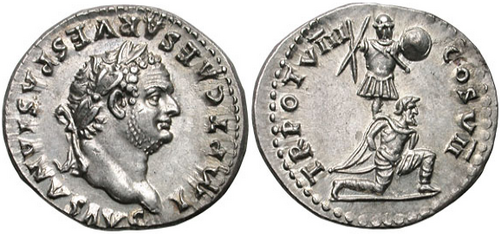

ユダヤ征服貨幣( Judea Captaとも綴られ、多くの貨幣ではIVDAEA CAPTAとも表記される)はもともとローマ皇帝ウェスパシアヌス、西暦 70 年に第一次ユダヤ戦争息子ティトゥスユダヤを征服し第二神殿を破壊したことを記念貨幣である。この貨幣にはいくつかのバリエーションがある。貨幣の裏面には、ヤシの木の根元で右向きに嘆き悲しむ姿勢で座る女性が描かれ、左向きに両手を後ろ手に縛られた髭を生やした捕虜の男性が立っているか、勝利した皇帝の立像、または左側に武器、盾、兜の戦利品を持ったヴィクトリア女神が
一部の硬貨の下部には、SC というイニシャルが刻印されています。これはSenatus consulto 、「元老院の布告により」の略で、皇帝は金貨と銀貨を管理していましたが、銅合金貨幣は元老院によって管理され、その価値が保証されていました。[ 1 ] [ 2 ]
碑文にはいくつかのバージョンがあり、IUDAEA CAPTA(「ユダヤは征服された」/「征服されたユダヤ」)、まれに、より厳しいIUDAEA DEVICTAまたはDEVICTA IUDAEA(「ユダヤは敗北した」/「敗北したユダヤ」)、またDE IUDAEIS(「ユダヤ人からの戦利品」)およびIUDAEA(「ユダヤ」)などがあります。[ 3 ] [ 4 ]碑文はギリシャ語のIOYΔAIAΣ EAΛΩKYIAΣ(Ioudaias Healōkyias)[ 5 ] (ラテン語のIUDAEA CAPTAの翻訳)である場合もあり、また、碑文がない場合もあり、その場合は、コインがそのシリーズに属するかどうかの評価は、造幣局で使用されている典型的な図像に基づいて行われます。[ 4 ]
コインの表面には、通常、ウェスパシアヌスまたはより一般的にはティトゥスの肖像が描かれていた。[ 6 ]裏面には、ユダヤの象徴であるナツメヤシの木の下に座る、ユダヤの人々を表す嘆き悲しむ女性など、象徴的な図像が描かれていた。[ 7 ]ナツメヤシの木は、嘆き悲しむ女性と組み合わされてコインに描かれる場合と、女性なしで描かれる場合がある。[ 4 ]アンドレア・モレシーノ=ジッパーは、前者の場合、女性が敗北したユダヤを象徴し、ナツメヤシは勝利したローマを表しているのに対し、後者の場合、ナツメヤシの木はユダヤを表していると主張している。[ 4 ]
ユダヤ征服記念硬貨は、ウェスパシアヌス帝と、彼に続いて皇帝となった2人の息子、ティトゥス帝とドミティアヌス帝の治世下25年間鋳造された。これらの記念硬貨は、ローマ、ローマ帝国全土、そしてユダヤ自体の造幣所で青銅、銀、金で発行された。[ 8 ]あらゆる額面で発行され、少なくとも48種類の異なるタイプが知られている。[ 9 ] [ 10 ]
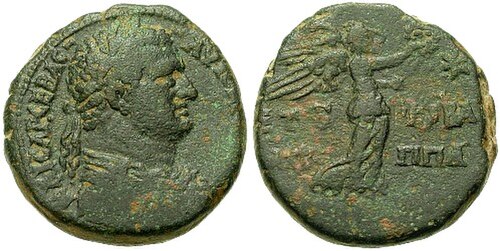
Only bronze 'Judaea Capta' coins were struck in Caesarea, in the defeated Roman province of Judaea. These coins are much cruder than the Roman issues, and the inscriptions are in Greek rather than Latin. The designs seems to have modified the imagery to avoid offending the Jewish population, omitting provocative motifs such as a half-naked captive.[6] They feature the goddess Nike writing on a shield, Minerva with a spear, shield, trophy and palm tree, etc. Most such coins were issued during the reign of the Emperor Domitian (AD 81-96).[8][10]
Unusually, a 'Judaea Capta' coin was also minted by the Jewish ruler Agrippa II, the great-grandson of Herod the Great. Brought up in Rome at the court of Claudius, Agrippa was thoroughly Romanised and was a close friend of Titus, whom he supported throughout the First Jewish Revolt. His bronze coin was minted at Tiberias and shows a portrait of Titus on the obverse with the Greek inscription ΚΑΙΣΑΡ ΣΕΒΑΣ ΑΥΤΟΚΡ ΤΙΤΟΣ (abbreviated for Καῖσαρ Σεβαστὸς Αυτοκράτωρ Τίτος, in Latin: CaesarAugustusImperator Titus), while the reverse depicted the goddess Nike advancing right holding a wreath and palm branch over her shoulder, with a star in upper right field and the inscription 'ETO - KS BA AGRI-PPA'.
{{cite book}}:|work=無視されました (ヘルプ)