
Loading article…
 ルーブル美術館 | |
| 設立 | 1793年8月10日 |
|---|---|
| 位置 | Musée du Louvre、75001、パリ、フランス |
| タイプ | 美術館と史跡 |
| コレクションのサイズ | 2019年615,797台[1](展示台数35,000台)[2] |
| 訪問者 | 890万人(2023年)[3]
|
| 監督 | ローレンス・デ・カーズ |
| キュレーター | マリー=ロール・ド・ロシュブリュヌ |
| 公共交通機関へのアクセス | |
| Webサイト | ルーブル美術館 |


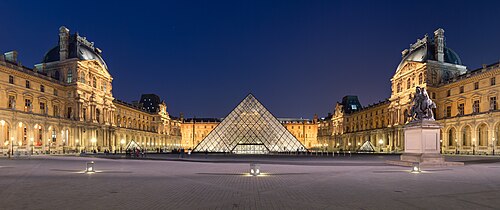
ルーヴル美術館(英語: / ˈ l uː v ( r ə )/ LOOV( -rə) )、[4]またはルーヴル美術館(フランス語: Musée du Louvre [myze dy luvʁ]) 美術館(ルーヴルこうえん、英: Luvlourパリにある国立美術館、世界でも有数の美術館である。1区のセーヌ川右岸モナ・リザ、ミロのヴィーナス、ニケの勝利の女神など、西洋美術代表的な作品ルーヴル宮殿内にありフィリップ2世の治世下、12世紀後半から13世紀にかけて建てられたものである中世のルーヴル要塞の名残が美術館の地下に残っている。都市の拡大により、要塞は最終的に防御機能を失い、1546年にフランソワ1世フランス国王の主要な住居に改築された。[5]
建物は何度も再設計され、拡張されて現在のルーブル宮殿となった。1682年、ルイ14世はヴェルサイユ宮殿を住居として選び、ルーブルは主に王室コレクションを展示する場所となった。1692年からは古代ギリシャとローマの彫刻のコレクションも展示された。 [6] 1692年、この建物には碑文・美文アカデミーと王立絵画・彫刻アカデミーが入居し、1699年には一連のサロンの最初の開催地となった。アカデミーは100年間ルーブルに留まった。[7]フランス革命の間、国民議会はルーブルを国の傑作を展示する美術館として利用することを布告した。
美術館は 1793 年 8 月 10 日に開館し、537 点の絵画が展示されました。作品の大部分は王室および教会から没収された財産でした。建物の構造上の問題のため、美術館は 1796 年から 1801 年まで閉館していました。コレクションはナポレオンの治世中に増加し、美術館はナポレオン美術館と改名されましたが、ナポレオンの退位後、彼の軍隊によって押収された多くの作品が元の所有者に返還されました。コレクションはルイ 18 世とシャルル 10 世の治世中にさらに増加し、フランス第二帝政時代には美術館は 20,000 点を獲得しました。第三共和政以降、寄贈や遺贈により所蔵品は着実に増加しています。コレクションは 8 つの学芸部門に分かれています。古代エジプト美術、近東古代美術、古代ギリシア・エトルリア・ローマ美術、イスラム美術、彫刻、装飾美術、絵画、版画と素描です。
ルーヴル美術館には約50万点の所蔵品[8]があり、8つの学芸部門に3万5千点の美術作品が展示されており、常設コレクションは6万600m 2 (65万2千平方フィート)以上の広さがあります。[2]ルーヴル美術館では、彫刻、美術品、絵画、素描、考古学的発見物が展示されています。常に、先史時代から21世紀までの約3万8千点の美術品が7万2,735m 2 (78万2,910平方フィート)の面積に展示されており、世界最大の美術館となっています。 2023年の来場者数は890万人で、2022年より14%増加したが、2018年の1010万人を下回った。ルーブル美術館はバチカン美術館を上回り、世界で最も来場者が多い美術館となっている。[9] [10]
場所と訪問

ルーブル美術館はパリ中心部のルーブル宮殿内、チュイルリー庭園に隣接している。最寄りの地下鉄駅はルーブル・リヴォリ駅とパレ・ロワイヤル・ルーブル美術館駅の2つで、後者は地下道でカルーゼル・デュ・ルーブル商業モールに直結している。[11]
1980年代後半から1990年代にかけての大ルーヴル改修工事が行われる前、ルーヴル美術館には地上階の入口がいくつかあったが、そのほとんどは現在は閉鎖されている。1993年以降、美術館のメイン入口はルーヴル・ピラミッドの下の地下空間、またはナポレオン・ホールとなっており、ピラミッド自体、地下のカルーゼル・デュ・ルーヴル、または(許可された訪問者の場合)近くのリヴォリ通りに繋がるリシュリュー・パサージュから入ることができる。ドゥノン翼の西端近くにあるポルト・デ・リオンの第二入口は1999年に作られたが、常時開いているわけではない。[12]
美術館の入場条件は時代とともに変化してきた。1850年代以前は、芸術家や外国人観光客は特別入場が可能だった。1793年の最初の開館当時、フランス共和暦では10日間の「週」(フランス語:décades)が定められており、最初の6日間は芸術家や外国人の訪問用に、最後の3日間は一般の訪問用に予約されていた。[13] : 37 1800年代初頭、7日間の週が復活した後、一般の人々は1週間に土曜日と日曜日の午後2時から午後4時までの4時間しか美術館に入場できなかった。[14] : 8 1824年、新しい規則により、一般の入場は日曜日と祝日のみとなり、その他の日は月曜日の休館を除き、芸術家と外国人のみ入場可能となった。[13] : 39 1855年に状況は変わり、美術館は月曜日を除く毎日一般公開されるようになった。[13] : 40 1922年までは入場料は無料だったが、その後日曜日を除いて入場料が導入された。[13] : 42 第二次世界大戦後の1946年に再開されて以来、[13] : 43 ルーブル美術館は火曜日が休館日となっており、一部の祝日を除いて他の曜日は一般に公開されている。
館内ではカメラやビデオカメラの使用は許可されているが、フラッシュ撮影は禁止されている。[15]
2012年から、ニンテンドー3DSポータブルビデオゲームシステムが美術館の公式オーディオガイドとして使用されました。翌年、美術館は任天堂と契約し、3DSベースのオーディオビジュアル訪問者ガイドを作成しました。[16] 「ニンテンドー3DSガイド:ルーブル」と題されたこのガイドには、30時間以上の音声と、3Dビューを含む芸術作品や美術館自体の写真1,000枚以上が含まれています。[17]また、美術館内に設置された差動GPSトランスミッターのおかげでナビゲーションも提供しています。 [18]
2013年に改良されたルーヴル美術館ガイドは、岩田聡氏と宮本茂氏が美術館でデモンストレーションを行うNintendo Direct特別版でも発表され、 [19]ガイドがプリロードされた3DS XLが美術館でレンタル可能となっている。[20] 2023年8月現在、部屋やギャラリーを巡るバーチャルツアーがオンラインで利用可能となっている。
歴史
博物館の前に
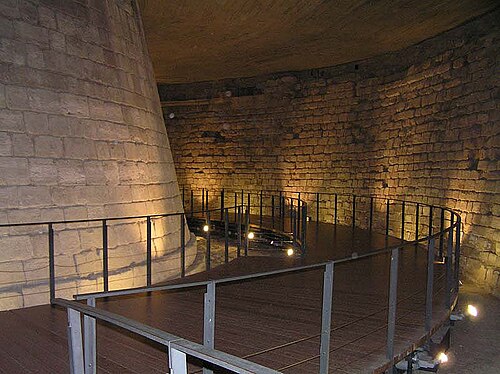
美術館が入っているルーブル宮殿は、当時イングランド王国がまだノルマンディーを領有していたため、西からの攻撃から街を守るためにフィリップ2世によって12世紀後半に建設が開始されました。中世のルーブルの名残は今でも地下室に残っています。[21] : 32 これがその場所に建てられた最初の建物かどうかは不明で、フィリップが既存の塔を改造した可能性があります。[22]
「ルーヴル」という名前の由来については、多少議論がある。権威ある大ラルース百科事典によれば、この名前は狼狩りの巣穴(ラテン語:lupus、下帝政期:lupara)との関連に由来している。 [22] [23] 7世紀、モーの女子修道院長ブルグンドファラ(サン・ファレとしても知られる)は、「パリ地方にあるルーヴラと呼ばれる別荘」の一部を修道院に寄贈したと言われているが、[24]この土地が現在のルーヴル美術館の場所と正確に一致していたかどうかは疑わしい。
ルーブル宮殿は建設以来、何度も改修されてきた。14世紀には、シャルル5世がこの建物を軍事用途から住居に転用した。1546年、フランソワ1世がフランス・ルネッサンス様式での再建を開始した。 [25]ルイ14世が1682年にヴェルサイユを居住地に選んだ後、建設工事は停滞した。王室がパリから移転したことにより、ルーブルは王室の支援を受けて芸術家の住居として使われるようになった。[25] [21] : 42 [26]例えば、ブール家の4世代にわたる職人芸術家は王室の支援を受け、ルーブルに住んでいた。[27] [28] [29]
一方、ルーヴル美術館のコレクションはフランス王家の君主による絵画やその他の芸術作品の収集に端を発している。フランソワ1世はフォンテーヌブロー宮殿で、レオナルド・ダ・ヴィンチの「モナ・リザ」など、後にルーヴル美術館のコレクションの一部となる芸術作品を収集した。[30]
王の部屋は、改装されたプチ・ギャラリーの上階、アポロン・ギャラリーの西側にある7つの部屋から成っていた。1673年にこの部屋が美術館となり、一部の美術愛好家が一種の博物館として利用できるようになったとき、王の絵画の多くがこの部屋に置かれていた。1681年に宮廷がヴェルサイユに移った後、26点の絵画が移され、コレクションはいくらか減少したが、1684年以降はパリのガイドブックに取り上げられ、1686年にはシャムの大使に披露された。 [31]
18 世紀半ばまでに、ルーヴル美術館に公共のギャラリーを作ろうという提案が増えていった。美術評論家のエティエンヌ・ラ・フォン・ド・サン=イェンヌは 1747 年に王室コレクションの展示を求める声明を発表した。1750 年 10 月 14 日、ルイ 15 世は王室コレクションから 96 点の作品を展示することを決定し、リュクサンブール宮殿の王室絵画ギャラリーに展示した。ル・ノルマン・ド・トゥルネムとマリニー侯爵は、水曜日と土曜日に「王の絵画」(王の絵画)を一般公開するためのホールを開設した。リュクサンブール ギャラリーには、アンドレア・デル・サルトの「慈愛」や、ラファエロ、ティツィアーノ、ヴェロネーゼ、レンブラント、プッサン、ヴァン・ダイクの作品が含まれていた。1778年に国王がリュクサンブール宮殿をプロヴァンス伯(後の国王ルイ18世)に贈与したため、1780年に閉館した。[32]ルイ16世の治世下、ルーヴル美術館に王立美術館を建てるという構想が実現に近づいた。[33]アンジヴィレール伯爵はコレクションを拡大し、1776年にルーヴル美術館のグランド・ギャラリー(当時はフランス内外の主要な要塞の平面図や立体模型を収蔵していた)を「フランス美術館」に改築することを提案した。ルーヴル美術館を美術館に改築するための設計案が数多く提出されたが、最終決定には至らなかった。そのため、美術館はフランス革命まで未完成のままだった。[32]
革命的なオープニング
ルーブル美術館はフランス革命中にようやく公立美術館となった。1791年5月、国民憲法制定議会はルーブル美術館を「あらゆる科学と芸術の記念碑を集める場所」と宣言した。[32] 1792年8月10日、ルイ16世は投獄され、ルーブル美術館の王室コレクションは国有財産となった。破壊行為や盗難の恐れから、国民議会は8月19日、美術館の準備を緊急に行うよう宣言した。10月、「国民の記憶を保存する」委員会が展示用にコレクションを集め始めた。[34]
美術館は、王政崩壊の1周年にあたる1793年8月10日に共和国芸術中央博物館として開館した。一般の人々は週3日間無料で入場できたが、これは「大きな功績とみなされ、広く評価された」。[36]コレクションには537点の絵画と184点の美術品が展示されていた。4分の3は王室コレクションからのもので、残りは没収された亡命者や教会の財産 ( biens nationaux ) からのものであった。[37] [21] : 68-69 コレクションの拡大と整理のため、共和国は 年間10万リーブルを費やした。 [32] 1794年、フランス革命軍は北ヨーロッパから美術品を持ち込み始め、トレンティーノ条約(1797年)後にはラオコーン像やベルヴェデーレのアポロ像などバチカンの美術品も追加され、ルーヴル美術館を美術館として、「人民主権の象徴」として確立した。[37] [38]
初期の頃は慌ただしかった。特権階級の芸術家たちが引き続きこの邸宅に住み、ラベルのない絵画は「床から天井まで額縁ごと」に掛けられていた。[37]建物自体は構造上の欠陥により1796年5月に閉鎖された。 1801年7月14日に再開されたが、時系列に並べられ、新しい照明と柱が設置されていた。[37] 1797年8月15日、アポロン画廊が素描の展示会でオープンした。一方、ルーヴル美術館の古代彫刻ギャラリー ( musée des Antiques ) は、フィレンツェとバチカンから運ばれた工芸品を展示しており、アポロン画廊の真下の1階にある アンヌ・ドートリッシュのかつての夏の別荘に1800年11月にオープンしていた。
ナポレオン時代
1802年11月19日、ナポレオンは、古物研究家エンニオ・キリノ・ヴィスコンティ、画家ジャック=ルイ・ダヴィッド、彫刻家アントニオ・カノーヴァ、建築家レオン・デュフルニーやピエール・フォンテーヌなどの候補者を抑え、1798年から1801年にかけてのエジプト遠征に参加した学者で博学者のドミニク・ヴィヴァン・ドノンを美術館の初代館長に任命した。[39] 1803年7月のドノンの提案により、美術館自体はナポレオン美術館と改名された。[40] : 79
コレクションは軍事作戦の成功により拡大した。[21] : 52 スペイン、オーストリア、オランダ、イタリアの作品が戦争による略奪やトレンティーノ条約などの条約によって取得された。[41] 1797年、ナポレオンの第一次イタリア遠征の終わりに、オーストリア王国のフィリップ・フォン・コベンツル伯爵とカンポ・フォルミオ条約が締結された。この条約はナポレオンのイタリア征服の完了とフランス革命戦争の第一段階の終結を象徴するものであった。この条約はイタリアの都市に対し、ルーブル美術館に収蔵される前にパリを通るナポレオンの「戦利品パレード」に美術品や文化遺産を寄贈することを義務付けた。 [ 42] 1204年のコンスタンティノープル略奪後、ヴェネツィアのサン・マルコ寺院を飾っていたサン・マルコの馬はパリに運ばれ、1797年にナポレオンのカルーゼル凱旋門の上に置かれました。 [42]トレンティーノ条約に基づき、ナイル川とテヴェレ川の2つの像は1797年にバチカンからパリに運ばれ、両方とも1815年までルーブル美術館に保管されていました。(ナイル川は後にローマに返還されましたが、[43]テヴェレ川は今日までルーブル美術館に残っています。)イタリアの教会や宮殿の略奪は、イタリア人と彼らの芸術的、文化的感受性を激怒させました。[44]
フランスがワーテルローで敗北した後、略奪された作品の元の所有者は返還を求めた。ルーヴル美術館の管理者ドゥノンは返還条約がないため、要求に応じることを嫌がった。これに対し、諸外国はロンドンに使者を派遣して助けを求め、多くの作品が返還されたが、全てではなかった。[41] [21] : 69 [45] 1815年にルイ18世はついにオーストリア政府と協定を結び[46] [47]、ヴェロネーゼの「カナの婚礼」などの作品をル・ブランの大作と交換したり、アルバーニ・コレクションを買い戻したりして保管した。
1815年から1852年

19世紀の大半、ナポレオンの時代から第二帝政に至るまで、ルーヴル美術館やその他の国立美術館は君主の行政管理下で運営され、統治者の個人的な関与に大きく依存していた。最も象徴的なコレクションは依然としてグランド・ギャラリーの絵画であったが、広大な建物内では他の数多くの取り組みが急増し、それらは概ね同じ行政傘下で運営されていたにもかかわらず、あたかも別々の美術館であるかのように名付けられていた。それに応じて、美術館群は単数形ではなく複数形(「ルーヴル美術館」)で呼ばれることが多かった。[48]
ブルボン王政復古(1814-1830年)の間、ルイ18世とシャルル10世がコレクションを増補した。クール・カレ南西側1階にあるギリシャ・ローマ彫刻ギャラリーは、ペルシエとフォンテーヌの設計で完成した。1819年にはクール・カレ南翼2階で工業製品の展示会が開かれ、1820年代半ばまでそこにあった。[40] : 87 シャルル10世は1826年にエジプト博物館を創設し、1827年にそれをより広いシャルル10世博物館に含めた。シャルル10世博物館はクール・カレ南翼2階の豪華に装飾された一連の部屋に位置する博物館複合施設の新しいセクションであった。当初ジャン=フランソワ・シャンポリオンがキュレーションしたエジプトコレクションは、現在のルーヴル美術館のエジプト古代美術部門の基礎となった。この博物館は、エドメ=アントワーヌ・デュラン、アンリ・ソルト、ベルナルディーノ・ドロヴェッティの第2コレクション(最初のコレクションはサルデーニャ王ヴィットーリオ・エマヌエーレ1世が購入し、現在のトリノのエジプト博物館の中核を形成している)の購入コレクションから構成されています。王政復古期には、1824年にアングレーム・ギャラリーがオープンした。クール・カレ北西側の1階には、主にフランスの彫刻作品が展示されていた。その作品の多くは、ヴェルサイユ宮殿や、1816年に閉館したアレクサンドル・ルノワールのフランス建造物博物館から持ち込まれたものである。一方、フランス海軍は1827年12月にルーブル美術館で船の模型の展示会を開催した。当初は、18世紀のアンリ=ルイ・デュアメル・デュ・モンソーの構想に基づき、王太子ルイ・アントワーヌに敬意を表して王太子博物館と名付けられた。[49]このコレクションは1833年に海軍博物館と改名され、後に国立海洋博物館に発展し、当初はクール・カレの北翼の1階に置かれていたが、1838年に1つ上の2階の屋根裏部屋に移され、1世紀以上もそこにあった。[50]
- シャルル10世美術館の部屋
-
 最初の部屋
最初の部屋 -
 27号室
27号室 -
 29号室
29号室 -
 サル・デ・コロンヌ
 -
 35号室
35号室 -
 36号室
36号室 -
 38号室
38号室
.jpg/500px-Derni%C3%A8re_salle_des_antiquit%C3%A9s_%C3%A9gyptiennes_(Louvre).jpg)


七月革命後、ルイ・フィリップ国王は国民和解のプロジェクトとしてヴェルサイユ宮殿をフランス歴史博物館に改修することに関心を集中させ、ルーブル美術館は比較的放置された。しかしルイ・フィリップは、ポール・エミール・ボッタがパリに持ち込んだ記念碑的なアッシリア彫刻作品を収容するため、クール・カレ東入口北側の1階ギャラリーにアッシリア美術館の創設を後援した。アッシリア美術館は1847年5月1日に開館した。 [51]これとは別に、ルイ・フィリップは1838年1月7日からルーブル美術館のクール・カレ東翼(列柱) 2階の5つの部屋にスペインのギャラリーを展示したが、[52]コレクションは彼の個人所有のままであった。その結果、1848年にルイ・フィリップが廃位された後、作品は撤去され、最終的には1853年に競売にかけられました。
短命に終わった第二共和政は、ルーヴル美術館に対してさらなる野心を抱いていた。修復工事が開始され、アポロンの間と七つの大広間が完成し、サロン・カレ(象徴的な年次サロンの旧会場)とグランド・ギャラリーが全面的に改修された。[21] : 52 1848年、クール・カレの屋根裏にあった海軍博物館がルーヴル美術館の共同管理下に入ったが、[50]この変更は1920年に再び撤回された。1850年、学芸員アドリアン・ド・ロンペリエの指揮の下、ルーヴル美術館内にメキシコ美術館が開館した。これはプレ・コロンブス美術を専門とするヨーロッパ初の美術館である。[53]
第二帝政
ナポレオン3世の統治は、ルーヴル美術館にとって、建物と美術館の両方にとって変革をもたらした。1852年、彼は列柱翼にスーヴェラン美術館を創設した。これは、自身の正当性を強化することを目的としたイデオロギー的なプロジェクトだった。1861年、彼はカンパーナ・コレクションの絵画641点、ギリシャの金、その他の古代遺物を含む11,835点の美術品を購入した。その展示のために、彼はルーヴル美術館内にナポレオン3世美術館と名付けた別の新しいセクションを創設し、建物のさまざまな部分のいくつかの部屋を占めた。1852年から1870年の間に、美術館は20,000点の新しい工芸品をコレクションに加えた。[54]
この時期の主な変化は建物自体に起こった。1850年代に建築家ルイ・ヴィスコンティとエクトール・ルフュエルは、現在ナポレオンの中庭と呼ばれている場所の周囲に巨大な新空間を造り、その一部(南翼、現在のエール・ドノン)は美術館となった。[21] : 52-54 1860年代には、ルフュエルはチュイルリー宮殿のナポレオン3世の住居に近い場所に新しい国家の間を造り、パビリオン・デ・セッションの建設も指揮した。これにより、グランド・ギャラリーの長さは以前の約3分の1に短縮された。第二帝政時代の小規模だが重要なプロジェクトは、サロン・カレの下の皇帝の間を装飾することだった。 [要出典]
-
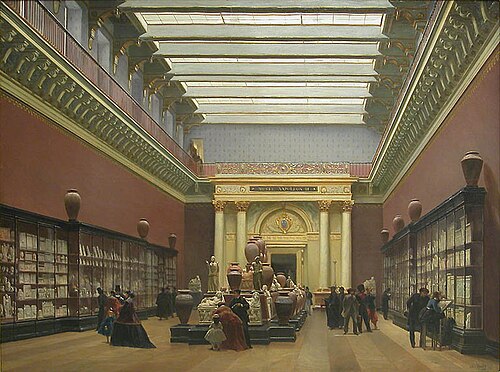 交霊会サルからナポレオン 3 世美術館の一部への入り口、その後 2 倍の高さのスペース
 -
 ナポレオン3世のルーブル新美術館建設計画の一部であるギャラリー・ダリュ
 -
 ギャラリー・ダリュの上にあるサレ・ダリュもナポレオン3世の時代に作られた。
 -
 新ルーブル美術館のエスカリエ・モリエン
 -
 皇帝の部屋
皇帝の部屋
.jpg/500px-Salle_Daru_du_Louvre_(30612872064).jpg)
.jpg/500px-Escalier_Mollien_in_2010_(1).jpg)
1870年から1981年

ルーヴル美術館はパリ・コミューン鎮圧の際に、かろうじて深刻な被害を免れた。1871年5月23日、フランス軍がパリに進軍すると、ジュール・ベルジュレ率いるコミューン派の部隊が隣接するチュイルリー宮殿に放火した。火は48時間燃え続け、チュイルリー宮殿の内部は完全に破壊され、隣接する美術館の北西翼に燃え広がった。皇帝のルーヴル図書館(ビブリオテーク・デュ・ルーヴル)と、現在のリシュリュー翼にある隣接するホールのいくつかは、別々に破壊された。しかし、美術館は、学芸員アンリ・バルベ・ド・ジュイ率いるパリの消防士と美術館職員の努力により救われた。[55]
王政の終焉後、ルーヴル美術館の南翼のいくつかのスペースは美術館に譲渡された。マネージュの間は1879年に美術館に移管され、1928年に正面玄関ロビーとなった。[56]ルフュエルがグランド・ギャラリーとパヴィヨン・ドノンの間に作った大きな国家の間は、1886年にルフュエルの後継者でルーヴル美術館の建築家であるエドモン・ギヨームによって改装され、広々とした展示室としてオープンした。[57] [58]エドモン・ギヨームはクール・カレの北西角にある1階の部屋も装飾し、1890年にその天井に、もともと1879年にリュクサンブール宮殿のために制作されたカロリュス・デュランの記念碑的な絵画「マリー・ド・メディシスの勝利」を置いた。[58]

一方、第三共和政(1870-1940年)の間、ルーヴル美術館は主に寄贈、贈答品、海外での発掘調査による共有協定を通じて新しい工芸品を入手した。1869年にルイ・ラ・カーズから寄贈された583点のラ・カーズ・コレクションには、シャルダン、フラゴナール、レンブラント、ヴァトーの作品が含まれていた。[21] : 70-71 1883年には、1863年にエーゲ海で発見された『サモトラケのニケ』が、エスカリエ・ダルーの中心として目立つように展示された。[21] : 70-71 イランのスーサで発掘された主要な工芸品には、同地のダレイオス宮殿から出土した巨大なアパダナの柱頭や彩釉レンガの装飾などがあり、1880年代に東洋(近東)古代美術部門に収蔵された。ルーヴル美術館友の会は1897 年に設立され、ヴィルヌーヴ=レ=ザヴィニョンのピエタなどの著名な作品を寄贈しました。しかし、ジョルジュ・ド・ラ・トゥールの「聖トマ」や、エドモンド・ド・ロスチャイルド男爵が 1935 年に寄贈した版画 4,000 点、素描 3,000 点、挿絵入り本 500 冊など、いくつかの著名な作品を購入したにもかかわらず、第一次世界大戦後は美術館とそのコレクションの拡張は鈍化しました。
19世紀後半から、ルーヴル美術館は徐々に20世紀半ばの普遍性という野心から方向転換し、イランから大西洋に至る範囲をカバーするフランス、西洋、近東美術のより焦点を絞った美術館へと変貌していった。ルーヴル美術館のメキシコ美術館のコレクションは、1887年にトロカデロ民族学博物館に移管された。海洋博物館は、クール・カレ北半分の2階屋根裏という限られたスペースに中核となる海軍をテーマにしたコレクションを展示することにますます制約を受けるようになったため、1905年に非西洋の工芸品の重要な所蔵品の多くがトロカデロ民族学博物館、サンジェルマンアンレーの国立古代博物館、フォンテーヌブロー宮殿の中国博物館に移管された。[59]海洋博物館自体は1943年にシャイヨー宮に移転した。ルーヴル美術館の膨大なアジア美術コレクションは1945年にギメ美術館に移された。しかし、ルーヴル美術館初のイスラム美術ギャラリーは1893年にオープンした。[60]


1920年代後半、ルーヴル美術館館長アンリ・ヴェルヌは美術館の展示を合理化するためのマスタープランを考案し、それは次の10年間に部分的に実行された。1932年から1934年にかけて、ルーヴル美術館の建築家カミーユ・ルフェーブルとアルベール・フェランがエスカリエ・ダリュを現在の外観に再設計した。南翼のクール・デュ・スフィンクスは1934年にガラスの屋根で覆われた。クール・カレの北翼1階では装飾美術の展示が拡張され、フランス初期の展示室もいくつか含まれていた。1930年代後半、ラ・カーズの寄贈品は、サル・デ・カリアティードの上にある改装されたサル・ラ・カーズに移され、高さを低くして2階に部屋を増やし、アルベール・フェランによる落ち着いた内装となった。[要出典]
第二次世界大戦中、ルーヴル美術館は美術コレクションの避難計画を綿密に実行した。ドイツがズデーテン地方を占領すると、モナ・リザなどの多くの重要な美術作品が一時的にシャンボール城に移された。1年後に戦争が正式に宣言されると、美術館の絵画のほとんどもそこに移された。サモトラケのニケやミロのヴィーナスなどの厳選された彫刻はヴァランセ城に送られた。[62] 1939年8月27日、2日間の梱包作業の後、トラックの護送隊がパリを出発し始めた。12月28日までに、美術館は重すぎるものや「重要でない絵画」を除いてほとんどの作品を撤去した。[63] 1945年初頭、フランスが解放されると、美術品はルーヴル美術館に戻り始めた。[64]
戦後の新たな配置は、19世紀後半の贅沢な装飾習慣から離れて、趣味がさらに進化したことを明らかにした。1947年、エドモン・ギヨームの天井装飾が、1966年にモナ・リザが初めて展示された国家の間[58]から取り除かれた。[65] 1950年頃、ルーヴル美術館の建築家ジャン=ジャック・ハフナーグランド・ギャラリーの内装を合理化した。[58] 1953年、ジョルジュ・ブラックによる新しい天井が、サル・ラ・カーズの隣にあるサル・アンリ2世に設置された。[66] 1960年代後半には、ピエール・ポランがデザインした座席がグランド・ギャラリーに設置された。[67] 1972年、サロン・カレの展示空間は、ルーヴル美術館の建築家マルク・サルテ、ジョセフ・アンドレ・モット、ポーリンの協力を得て設計した吊り下げ式の管状ケースの照明で作り直されました。[68]
1961年、財務省は、ヴェルヌが1920年代の計画で提案した通り、ルーブル美術館の南西端にあるフロール館を残すことを承認した。1960年代後半には、政府の建築家オリヴィエ・ラアールの設計により、彫刻(1階)と絵画(2階)の新しい展示スペースがそこにオープンした。[69]
グランドルーブル
1981年、フランソワ・ミッテランフランス大統領は、自らのグラン・プロジェクトの一つとして、それまでルーブル美術館の北翼にあった財務省を移転し、ルーブル美術館の建物のほぼ全体(装飾芸術美術館が入っている北西端を除く)を美術館に充て、それに応じて再編する計画であるグラン・ルーブル計画を提案した。1984年、ミッテラン大統領が自ら選んだ建築家イ・エム・ペイは、ルーブル美術館中央の中庭であるナポレオン広場に、ガラスのピラミッドを通って地下に入る入口スペースを設けるマスタープランを提案した。[21] : 66
ピラミッドを囲むオープンスペースは 1988 年 10 月 15 日に開設され、地下ロビーは 1989 年 3 月 30 日にオープンしました。大ルーブル美術館より前に計画が始まっていたクール・カレ2 階のフランス初期近代絵画の新しいギャラリーも 1989 年にオープンしました。イタロ・ロータが設計した同じ順序のさらなる部屋は1992 年 12 月 15 日にオープンしました。[出典が必要]
1993 年 11 月 18 日、ミッテランはグラン ルーブル計画の次の主要フェーズである、財務省の旧敷地に改装された北翼 (リシュリュー翼) の開館式を行った。これは美術館史上最大の単独拡張であり、ペイ、彼のフランス人仲間のミシェル マカリ、ジャン=ミシェル ウィルモットの設計によるものである。さらに、逆ピラミッドを中心としペイとマカリが設計したカルーゼル デュ ルーブルと呼ばれる地下空間は1993 年 10 月にオープンした。イタリアの彫刻やエジプトの古代遺物を展示するその他の改装されたギャラリーは 1994 年にオープンした。計画の 3 番目で最後の主要フェーズは主に 1997 年に展開され、シュリー翼とドゥノン翼の新しい部屋が改装された。1998年にはポルト デ リオンの新しい入口がオープンし、1 階のスペイン絵画の新しい部屋に通じていた。[出典が必要]
2002年時点で、ルーヴル美術館の来場者数はグラン・ルーヴル以前の2倍に増加した。[70]

21世紀

1995年にミッテラン大統領の後を継いだジャック・シラク大統領は、友人で美術収集家でディーラーのジャック・ケルシャッシュケ・ブランリ美術館 - ジャック・シラク美術館となるコレクションから選りすぐりの名品がパビヨン・デ・セッションの1階に設置され、ケ・ブランリ美術館より6年早い2000年にオープンした。
グラン・ルーヴル計画の余波におけるもう一つの主な取り組みは、2003年8月1日の大統領令によりイスラム美術部門を新設し、それに関連するコレクションをリシュリュー翼の地下にあった場所からドゥノン翼のより目立つ場所に移すというシラクの決定であった。この新しいセクションは、マリオ・ベリーニとルディ・リッチオッティの設計により、アル・ワリード・ビン・タラール財団の資金援助を受けて、ローマ時代の東地中海のコレクションとともに2012年9月22日にオープンした。[71] [72] [73]
2007年、ドイツ人画家アンゼルム・キーファーがペローの 列柱の北階段の作品『アタノール』の制作を依頼された。この決定は、美術館が現代美術家ジョルジュ・ブラックに最後の注文をしてから50年後、アンリ・ロワレットの指揮のもと現代美術に再び取り組むことを宣言するものであった。[74]
2010年、アメリカの画家サイ・トゥオンブリーは、 1953年に隣接するサル・アンリ2世にブラックが設置した天井と対照的な、サル・デ・ブロンズ(旧サル・ラ・カーズ)の新しい天井を完成させた。この部屋の床と壁は、ルーヴル美術館の建築家ミシェル・グタールによって2021年に再設計され、前任者のアルベール・フェランが1930年代後半に行った変更を元に戻したが、当時亡くなっていた画家の作品が部屋の以前の装飾に合うように作成されたという理由で、サイ・トゥオンブリー財団からの抗議を引き起こした。[75]
同年、ルーヴル美術館はフランス人芸術家フランソワ・モレレに、1階のルフュエル階段の作品制作を依頼した。モレレは「L'esprit d'escalier」のために階段の窓を再設計し、元の構造を反映させながらも歪ませて不穏な視覚効果を生み出した。[76]
2014年6月6日、クール・カレ北翼1階の装飾美術セクションが全面改修工事を終えてオープンした。 [77]
2020年1月、ジャン=リュック・マルティネスの指揮の下、美術館はベネズエラのキネティックアーティスト、エリアス・クレスパンによる新しい現代美術作品「L'Onde du Midi」を開設しました。この彫刻は、ペロー列柱の南にある階段「エスカリエ・デュ・ミディ」の下に浮かんでいます。[78]
ルーヴル美術館は、他の多くの美術館やギャラリーと同様に、芸術と文化遺産に対するCOVID-19パンデミックの影響を感じた。フランスのコロナウイルスロックダウン中に6か月間閉鎖され、来館者数は2019年の960万人、記録的な年だった2018年の1020万人から、2020年には270万人に急落した。[79] [80]
2024年のオリンピック に備えて、ルーブル美術館はオリンピックの古代の始まりから現代までを結びつけるオリンピックの歴史に関する展示会を開催した。[81]
2023年の観客数は890万人に増加し、2022年より14%増加したが、2018年の記録的な1020万人には及ばなかった。[10]
-
-
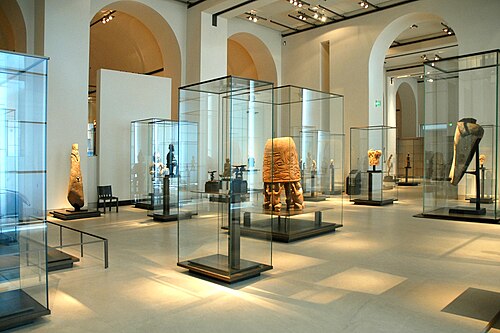
 ヴィスコンティの1階は2012年に新しいイスラム美術部門を収容するために改装されました。
 -
 屋根付きのヴィスコンティ中庭でのイスラム美術展示、2012年
 -
 イスラム美術部門の地下展示、2012年
_D201512a.jpg/500px-Cour_Visconti_(Louvre)_D201512a.jpg)
.jpg/500px-Les_arts_de_lIslam_au_Louvre_(8055981963).jpg)
コレクション
ルーヴル美術館は615,797点の作品を所蔵しており[1]、そのうち482,943点が2021年3月24日からオンラインで公開されており[82]、8つのキュレーター部門で35,000点の芸術作品を展示している。[2]
ルーブル美術館は、多様な文化や時代の作品を含む世界最大級の美術コレクションを所蔵しています。モナ・リザやサモトラケのニケなどの象徴的な作品のほか、エジプト、ギリシャ、ローマなどの古代文明の作品も鑑賞できます。また、装飾美術、イスラム美術、彫刻のコレクションも展示されています。[83]
エジプトの古代遺物
この部門は5万点以上を収蔵しており[21] 、 紀元前4000年から紀元後4世紀までのナイル文明の遺物が含まれています。 [84]このコレクションは世界最大級で、古代エジプト、中王国時代、新王国時代、コプト美術、ローマ時代、プトレマイオス朝、ビザンチン時代にわたるエジプトの生活を概観しています。[84]
この部門の起源は王室コレクションにあるが、ナポレオンが1798年にルーブル美術館の将来の館長となるドミニク・ヴィヴァンを伴って遠征した際に拡大された。 [21] : 76-77 ジャン=フランソワ・シャンポリオンがロゼッタ・ストーンを翻訳した後、シャルル10世はエジプト古代美術部門の設置を命じた。シャンポリオンはエドメ=アントワーヌ・デュラン、アンリ・ソルト、ベルナルディーノ・ドロヴェッティが形成した3つのコレクションの購入を勧め、これにより7,000点の作品が追加された。カイロのエジプト博物館の創設者であるオーギュスト・マリエットによる購入によって成長は続いた。マリエットはメンフィスの発掘後、 『書記座像』を含む考古学的発見物の箱を返還した。[21] : 76-77 [85]
タニスの大スフィンクスに守られたコレクションは、20以上の部屋に収められている。所蔵品には、美術品、パピルスの巻物、ミイラ、道具、衣類、宝石、ゲーム、楽器、武器などがある。[21] : 76-77 [84]古代の作品には、紀元前3400年のゲベル・エル・アラクのナイフ、書記座像、ジェドエフラー王の頭部などがある。中王国時代の美術は「金細工と彫像で知られる」が、写実主義から理想主義へと移行した。これは、アメンエムハタンクの片岩像と木製の供物担ぎ手に例えられる。新王国時代とコプトエジプト時代のセクションは奥が深いが、女神ネフティスの彫像と石灰岩で描かれた女神ハトホルは、新王国時代の感情と富を示している。[84] [85]
-
 ゲベル・エル・アラクのナイフ; 紀元前3300-3200年; 柄: 象牙、刃: フリント; 長さ: 25.8 cm
 -

-
 タニスの大スフィンクス。紀元前 2600 年頃。バラ色の花崗岩。高さ: 183 cm、幅: 154 cm、厚さ: 480 cm。
 -


近東の古代遺物
2番目に新しい部門である近東古代遺物は1881年に始まり、イスラム教到来以前の初期近東文明と「最初の居住地」の概要を紹介しています。この部門は、レバント、メソポタミア(イラク)、ペルシア(イラン)の3つの地理的地域に分かれています。コレクションの発展は、ポール・エミール・ボッタによる1843年のホルサバード探検やサルゴン2世の宮殿の発見などの考古学的研究と一致しています。 [84] [21] : 119 これらの発見は、今日の部門の前身であるアッシリア博物館の基礎を形成しました。[84]
博物館にはシュメールとアッカドの都市からの展示品があり、紀元前2450年のラガシュ王子のハゲタカの石碑や、ザグロス山脈での蛮族に対する勝利を祝ってアッカド王ナラム・シンが建てた石碑などの記念碑があります。1901年に発見された高さ2.25メートルのハンムラビ法典には、バビロニアの法律が目立つように記載されており、誰も無知を主張することはできません。古代都市国家マリで発見された紀元前18世紀のジムリリムの叙任式の壁画と紀元前25世紀のエビフ・イルの像も博物館に展示されています。[86]
この部門の大部分は古代レヴァント地方をカバーしており、その中には1855年に発見され、エルネスト・ルナンによる1860年のフェニキア紀行のきっかけとなったエシュムナザル2世の石棺も含まれています。この部門には、世界最大かつ最も包括的なカナン語およびアラム語の碑文のコレクションの1つが含まれています。このセクションでは、19世紀にフランスがこの地域に大きく存在していたことを考慮して、北アフリカのカルタゴ(カルタゴ=西フェニキア語)の古代遺物もカバーしており、初期の発見には1843年のアイン・ネクマ碑文の発見などがあります。
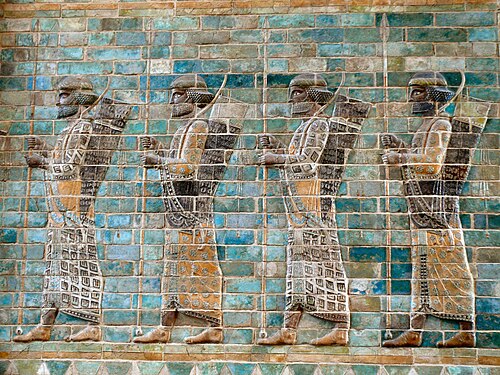
ルーヴル美術館のペルシア部分には、ダレイオス1世の葬祭用頭部像やペルシア弓兵像などの古代の作品[84] [ 87]やペルセポリスからの珍しい品々[88]が収蔵されている。
-
 エシュムナザル2世の石棺。エジプト国外で発見された古代エジプトの石棺はわずか3つしかなく、フェニキアで発見された最初のフェニキア語の碑文でもある。
 -
 キプロス島のフェニキアの金属ボウル
 -

-

-

-
-
 シドンのミトラ神殿の彫像
.jpg/500px-Eshmunazar_II_sarcophagus_(cleaned_up).jpg)
.jpg/500px-Sidon_Mithraeum_'Collection_P%C3%A9reti%C3%A9',_Louvre_(2014-02-02a).jpg)
ギリシャ、エトルリア、ローマ

ギリシャ、エトルリア、ローマ部門には、新石器時代から6世紀までの地中海沿岸地域の遺物が展示されている。[89]コレクションは、キクラデス諸島からローマ帝国の衰退期までを網羅している。この部門は美術館で最も古い部門の一つで、フランソワ1世が購入した作品も含まれている。[84] [21] : 155-58 当初、コレクションはミロのヴィーナスなどの大理石彫刻に重点を置いていた。ベルヴェデーレのアポロなどの作品はナポレオン戦争中にもたらされ、その一部は1815年のナポレオン1世の失脚後に返還された。ボルゲーゼの花瓶などの他の作品はナポレオンが購入した。19世紀後半には、ルーヴル美術館はデュラン・コレクションの花瓶やブロンズなどの作品を入手した。[21] : 92 [89]
古代の様式は、紀元前640年の石灰岩の『オーセールの貴婦人』や紀元前570-560年頃の円筒形の『サモス島のヘラ』などの宝飾品や作品に表れています。 [84] [90]紀元前4世紀以降は、ボルゲーゼの剣闘士に代表されるように、人間の姿への焦点が高まりました。ルーブル美術館には、古典芸術の象徴である『サモトラケのニケ』(紀元前190年)や『ミロのヴィーナス』など、ヘレニズム時代の傑作が所蔵されています。 [21] : 155 長いカンパーナ・ギャラリーには、1000点を超えるギリシャ陶器の優れたコレクションが展示されています。セーヌ川と並行するギャラリーには、美術館のローマ彫刻の多くが展示されています。[89]ローマの肖像画はそのジャンルの代表であり、例としてはアグリッパやアニウス・ウェルスの肖像画があります。ブロンズ像の中にはギリシャのピオンビーノのアポロも含まれています。


![ラス・インカンターダス、テッサロニキのローマのフォーラムを飾った柱廊の彫刻、西暦150-230年[91]](https://img-server.japedia.wiki/wikipedia/commons/thumb/8/8f/Las_Incantadas_(Louvre)_4.jpg/500px-Las_Incantadas_(Louvre)_4.jpg)
イスラム美術
イスラム美術コレクションは、この博物館で最も新しいもので、「13世紀と3大陸」にまたがっています。[92]これらの展示品には、陶磁器、ガラス、金属製品、木材、象牙、カーペット、織物、ミニチュアなどがあり、5,000点以上の作品と1,000点以上の破片が含まれています。[93]もともと装飾美術部門の一部であったこのコレクションは、2003年に独立したものになりました。作品の中には、アンダルシアの10世紀の象牙の箱である「ピクシデ・ダル・ムギラ」、13世紀または14世紀のマムルーク朝時代の彫刻が施された真鍮の水盤である「サン・ルイ洗礼堂」、イランの10世紀のサン・ジョスの聖骸布などがあります。 [21] : 119-121 [92]コレクションには、ペルシャ語で書かれたフェルドウスィーの叙事詩集『シャー・ナーメ』の3ページと、シリアの金属細工『バルベリーニの花瓶』が含まれています。[93] 2019年9月、ラミア・ビント・マジェド・アル・サウード王女によって、新しく改良されたイスラム美術部門が開設されました。新しい部門では、7世紀から19世紀にかけてスペインからアラビア半島を経由してインドまで収集された3,000点の作品が展示されています。[94]
-
 アル・ムギラのピクシス、10世紀(おそらく968年)、象牙、15 x 8 cm
 -
 ビスミラー付きイランタイル。13~14世紀初頭。成型陶器、ラスター釉、釉薬
 -
 サン・ルイ洗礼堂;ムハンマド・イブン・アル・ザイン作; 1320-1340年; 真鍮、金、銀の打ち出し、彫刻、象嵌; 50.2 x 22.2 cm
 -
 ドア、15~16世紀、彫刻、塗装、金箔を施したクルミ材
彫刻

彫刻部門は、1850年以前に制作され、エトルリア、ギリシア、ローマ部門に属さない作品で構成されています。[95]ルーヴル美術館は宮殿だった時代から彫刻の宝庫でしたが、ミケランジェロの「瀕死の奴隷」と「反抗的な奴隷」を除いて、1824年までは古代建築のみが展示されていました。[21] : 397-401 当初、コレクションには100点しか含まれておらず、王室彫刻コレクションの残りはヴェルサイユ宮殿にありました。1847年にレオン・ラボルドが部門の管理を任されるまで、コレクションは小規模のままでした。ラボルドは中世セクションを開発し、コレクションの最初の彫像と彫刻であるそれぞれキルデベルト王とスタンガの扉を購入しました。[21] : 397-401 このコレクションは古代美術部門の一部であったが、1871年にフランス作品のより広範な展示を組織したディレクターのルイ・クラジョの下で自治権を与えられた。 [95] [21] : 397-401 1986年、1850年以降の作品はすべて新しいオルセー美術館に移された。グラン・ルーヴル計画により、部門は2つの展示スペースに分割され、フランスコレクションはリシュリュー翼に、外国の作品はドゥノン翼に展示されている。[95]
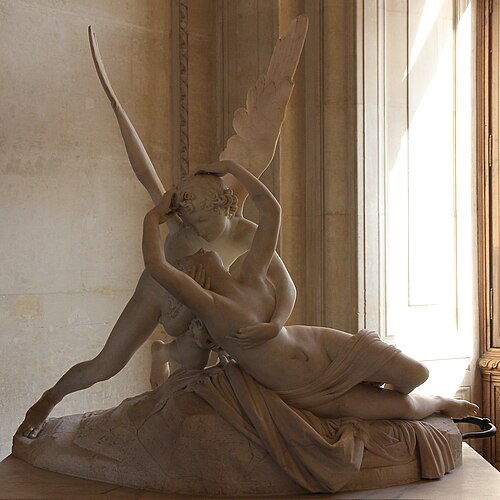
コレクションのフランス彫刻の概要には、11世紀の『ライオンの穴のダニエル』や12世紀の『オーヴェルニュの聖母』などのロマネスク様式の作品が含まれています。16世紀には、ルネサンスの影響により、ジャン・グージョンの浅浮彫やジェルマン・ピロンの『十字架降下とキリストの復活』に見られるように、フランス彫刻はより抑制されたものになりました。17世紀と18世紀を代表するのは、ジャン・ロレンツォ・ベルニーニの1640– 1年のリシュリュー枢機卿の胸像、エティエンヌ・モーリス・ファルコネの『水浴の女』と『脅迫的な愛』、フランソワ・アンギエのオベリスクです。新古典主義の作品には、アントニオ・カノーヴァの『クピドの口づけで蘇るプシュケ』(1787年)があります。[21] : 397-401 18世紀と19世紀は、 アルフレッド・バリやエミール・ギユマンのようなフランスの彫刻家によって代表されます。
-
 フィリップ・ポットの墓; 1477年と1483年; 石灰岩、塗料、金、鉛; 高さ: 181 cm、幅: 260 cm、奥行き: 167 cm
 -
 ペガサスに乗る王の名声、アントワーヌ・コワズヴォ作、1701-1702年、カララ大理石、高さ: 3.15 m、幅: 2.91 m、奥行き: 1.28 m
 -
 群像彫刻、ニコラ・クストゥ作、1701-1712年、大理石、高さ2.44m
 -


装飾芸術
美術品コレクションは中世から19世紀半ばまでの期間を網羅しています。この部門は彫刻部門のサブセットとして始まり、王室の財産と、フランス国王の戴冠剣を所蔵するフランス君主の墓地であるサン・ドニ大聖堂からの作品の移管に基づいていました。[96] [21] : 451-454 芽生えつつあるコレクションの最も貴重な作品の中には、ピエトル・デュレの花瓶とブロンズがありました。デュラン・コレクションの1825年の買収により「陶器、エナメル、ステンドグラス」が追加され、800点がピエール・レヴォワルから寄贈されました。ロマン主義の始まりにより、ルネッサンスと中世の芸術作品への関心が再燃し、ソヴァジョの寄贈により、1,500点の中世およびファイアンス焼きの作品で部門が拡大しました。 1862年、カンパーナコレクションに主に15世紀と16世紀の金の宝飾品とマヨリカ陶器が加わった。[21] : 451-454 [97]
作品はリシュリュー翼の2階とアポロギャラリーに展示されている。アポロギャラリーは、太陽王ルイ14世の依頼で太陽をテーマにした装飾を施した画家シャルル・ルブランによって名付けられた。中世のコレクションには、ルイ15世の戴冠、シャルル5世の王笏、12世紀の斑岩の花瓶などがある。[98]ルネサンス美術の所蔵品には、ジャンボローニャのブロンズ像『ネッソスとデイアニラ』やタペストリー『マクシミリアンの狩り』などがある。[96]後期のハイライトには、ポンパドゥール夫人のセーヴル陶器の花瓶コレクションやナポレオン3世の居室などがある。 [96]
2000年9月、ルーブル美術館は、ジルベール・シャゴリーとローズ・マリー・シャゴリーのギャラリーを開設し、シャゴリー夫妻から寄贈されたタペストリーを展示しました。その中には、パリで海軍大臣コルベール・ド・セニュレーのために発注され、海の神々を表現した金糸と銀糸で縫い付けられた16世紀の6部構成のタペストリー一式も含まれています。
-
![ヘンリー2世様式のワードローブ。1580年頃。クルミ材とオーク材、部分的に金メッキと塗装。高さ2.06m、幅1.50m、奥行き0.60m[99]](https://img-server.japedia.wiki/wikipedia/commons/thumb/8/83/Armoire_Louvre_OA_6968.jpg/500px-Armoire_Louvre_OA_6968.jpg) ヘンリー2世様式のワードローブ。 1580年頃。クルミ材とオーク材、部分的に金メッキと塗装。高さ2.06m、幅1.50m、奥行き0.60m [99]
ヘンリー2世様式のワードローブ。 1580年頃。クルミ材とオーク材、部分的に金メッキと塗装。高さ2.06m、幅1.50m、奥行き0.60m [99] -
 ルイ14世様式のキャビネット、スタンド付き。アンドレ・シャルル・ブール作。 1690年頃~1710年。オーク材のフレーム、樹脂質の木材とクルミ材、黒檀の突き板、べっ甲、真鍮とピューターの寄木細工、金銀細工。
 -
![ルイ16世様式の箪笥、1772年製、オーク材のフレーム、ナシ材、ローズウッド材、キングウッド材のベニヤ、軟質ペーストのセーヴル磁器、金メッキのブロンズ、白大理石、ガラス、高さ0.87m、幅1.19m、奥行き0.48m[100]](https://img-server.japedia.wiki/wikipedia/commons/thumb/2/29/Commode_de_la_comtesse_du_Barry_%28Louvre%2C_OA_11293%29.jpg/500px-Commode_de_la_comtesse_du_Barry_%28Louvre%2C_OA_11293%29.jpg)
-
![ルイ16世様式の気圧計・温度計。1776年頃。軟質セーヴル磁器、エナメル、オルモル製。高さ1m、幅0.27m[101]](https://img-server.japedia.wiki/wikipedia/commons/thumb/9/95/Barom%C3%A8tre_-_thermom%C3%A8tre_%28Louvre%2C_OA_10545%29.jpg/500px-Barom%C3%A8tre_-_thermom%C3%A8tre_%28Louvre%2C_OA_10545%29.jpg) ルイ16世様式気圧温度計、 1776年頃、軟質セーヴル磁器、エナメル、オルモル、高さ1m、幅0.27m [101]
ルイ16世様式気圧温度計、 1776年頃、軟質セーヴル磁器、エナメル、オルモル、高さ1m、幅0.27m [101]
![ルイ16世様式の箪笥、1772年製、オーク材のフレーム、ナシ材、ローズウッド材、キングウッド材のベニヤ、軟質ペーストのセーヴル磁器、金メッキのブロンズ、白大理石、ガラス、高さ0.87m、幅1.19m、奥行き0.48m[100]](https://img-server.japedia.wiki/wikipedia/commons/thumb/2/29/Commode_de_la_comtesse_du_Barry_(Louvre,_OA_11293).jpg/500px-Commode_de_la_comtesse_du_Barry_(Louvre,_OA_11293).jpg)
![ルイ16世様式の気圧計・温度計。1776年頃。軟質セーヴル磁器、エナメル、オルモル製。高さ1m、幅0.27m[101]](https://img-server.japedia.wiki/wikipedia/commons/thumb/9/95/Barom%C3%A8tre_-_thermom%C3%A8tre_(Louvre,_OA_10545).jpg/500px-Barom%C3%A8tre_-_thermom%C3%A8tre_(Louvre,_OA_10545).jpg)
絵画

絵画コレクションは7,500点以上の作品[13] : 229点、 13世紀から1848年までのもので、コレクションの展示を監督する12人の学芸員によって管理されています。約3分の2はフランスの芸術家の作品で、1,200点以上は北欧の芸術家の作品です。イタリアの絵画はフランソワ1世とルイ14世のコレクションの残りの大部分を占め、その他はナポレオン時代の未返還の芸術作品であり、いくつかは購入されました。[102] [21] : 199-201, 272–273, 333–335 コレクションはフランソワから始まり、彼はラファエロやミケランジェロなどのイタリアの巨匠の作品を購入し[103]、レオナルド・ダ・ヴィンチを宮廷に招きました。[104] [105]フランス革命後、王室コレクションはルーヴル美術館の中核を形成しました。 1986年にオルセー駅がオルセー美術館に改装された際、コレクションは分割され、1848年の革命後に完成した作品は新しい美術館に移されました。フランスと北ヨーロッパの作品はリシュリュー翼とクール・カレに、スペインとイタリアの絵画はドゥノン翼の2階にあります。[21] : 199
フランス派の代表例としては、アンゲラン・カルトンの初期の『アヴィニョン・ピエタ』、匿名のジャン・ル・ボン王の絵画( 1360年頃)(おそらくポスト古典主義時代に生き残った西洋絵画最古の独立した肖像画)、[21] : 201 イアサント・リゴーの『ルイ14世』、ジャック=ルイ・ダヴィッドの『ナポレオンの戴冠式』、テオドール・ジェリコーの『メデューズ号の筏』、ウジェーヌ・ドラクロワの『民衆を導く自由の女神』などがある。ニコラ・プッサン、ル・ナン兄弟、フィリップ・ド・シャンパーニュ、ル・ブラン、ラ・トゥール、ヴァトー、フラゴナール、アングル、コロー、ドラクロワもよく代表されている。[106]
北欧の作品には、ヨハネス・フェルメールの『レース編みの女』と『天文学者』、カスパー・ダーヴィト・フリードリヒの『カラスの木』、レンブラントの『エマオの晩餐』、『水浴のバテシバ』、『屠殺された雄牛』などがある。
イタリアの所蔵品、特にルネサンスコレクションは注目に値する。[107]作品には、アンドレア・マンテーニャとジョヴァンニ・ベリーニの『ゴルゴタの丘』があり、これらは「より偉大な精神世界の重要な出来事を描くことを意図した」写実主義と細部を反映している。[108]盛期ルネサンスコレクションには、レオナルド・ダ・ヴィンチの『モナ・リザ』、『聖母子と聖アンナ』、『洗礼者ヨハネ』 、『岩窟の聖母』などがある。バロックコレクションには、ジャンバッティスタ・ピットーニの『スキピオの禁欲』、 『スザンナと長老たち』、『バッカスとアリアドネ』、『マルスとヴィーナス』などがあり、カラヴァッジョは『占い師』と『聖母の死』で代表される。 16世紀のヴェネツィアからは、ルーヴル美術館にティツィアーノの『槍の合唱』、『墓』、『茨の冠』が展示されている。[21] : 378 [109]
ルイ・ラ・カーズが1869年にルーヴル美術館に遺贈したラ・カーズ・コレクションは、ルーヴル美術館史上最大の個人寄贈であった。ラ・カーズは自身のコレクションから584点の絵画を美術館に寄贈した。遺贈にはアントワーヌ・ヴァトーの『ピエロの弾き手』(『ジル』)も含まれていた。2007年、この遺贈は「1869年:ヴァトー、シャルダン…ルーヴル美術館入館。ラ・カーズ・コレクション」展のテーマとなった。[110]
美術館の最も有名な絵画のいくつかは、フランス美術館研究修復センターによってデジタル化されています。[111]
-
 両替商とその妻;クエンティン・マシス作; 1514年 ; 油彩・板 ; 70.5 × 67 cm
 -
 春;ジュゼッペ・アルチンボルド作; 1573年 ; キャンバスに油彩 ; 76 × 64 cm
 -
 スザンナと長老たち;ジャンバッティスタ・ピットーニ作; 1720年 ; 油彩・板 ; 37 × 46 cm
 -
 スキピオの節制;ジャンバッティスタ・ピットーニ作; 1733年 ; 油彩・板 ; 96 × 56 cm
 -
 入浴後のダイアナ;フランソワ・ブーシェ; 1742年 ; キャンバスに油彩 ; 73 × 56 cm
 -
 ホラティウス兄弟の誓い;ジャック=ルイ・ダヴィッド作; 1784年 ; キャンバスに油彩 ; 高さ: 330 cm、幅: 425 cm
 -


- フランソワ1世が購入したレオナルド・ダ・ヴィンチの絵画
-

-

.jpg/500px-Virgin_of_the_Rocks_(Louvre).jpg)
版画と絵画
版画・素描部門には紙の作品が含まれます。[21] : 496 コレクションの起源は、王室コレクション ( Cabinet du Roi ) の8,600点の作品で、国の予算、1806年のフィリッポ・バルディヌッチのコレクションからの1,200点などの購入、寄贈によって増加しました。[21] : 92 [112]この部門は1797年8月5日に開設され、415点の作品がアポロン・ギャラリーに展示されました。コレクションは3つのセクションに分かれています。中心となるCabinet du Roi、14,000点の王室銅版、およびエドモンド・ド・ロスチャイルドの寄贈品[ 113 ]で、40,000点の版画、3,000点の素描、5,000冊の挿絵入り本が含まれています。所蔵品はパビリオン・ド・フロールに展示されています。紙媒体の脆弱性のため、一度に表示されるのは一部のみです。[21] : 496
-
 3 つのライオンのような頭。シャルル ル ブラン作 。1671年頃。黒チョーク、ペンとインク、ブラシと灰色のウォッシュ、白のグアッシュ、紙に描かれている。21.7 × 32.7 cm。
 -

-
 女性の頭部と男性の頭部の習作;アントワーヌ・ヴァトー; 18 世紀前半 ; 灰色の紙に赤紫、黒チョーク、白チョーク ; 28 × 38.1 cm
 -

-
 マティアス・グリューネヴァルトによる老女の肖像画
 -
 ハンス・ホルバインによる若い女性の肖像
 -
 アンドレア・デル・サルト作「男性の頭部」
 -
 ビアジオ・プピーニ作『聖母子 』


.jpg/500px-Edgar_Degas_-_Ballet_(L'%C3%89toile).jpg)

管理、運営、パートナーシップ


ルーブル美術館はフランス政府の所有である。1990年代以降、その管理と統治はより独立性を持たせてきた。[114] [115] [116] [117] 2003年以降、美術館はプロジェクトのための資金を調達することが求められている。[116] 2006年までに、政府からの資金は総予算の75%から62%に減少した。ルーブル美術館は現在、毎年、国から受け取るのと同額の約1億2,200万ユーロを調達している。政府は運営費(給与、安全、維持費)を支払い、残り(新棟、改修、購入)は美術館の負担となっている。[118]さらに、ルーブル美術館は他の美術館のために企画する展覧会から年間300万〜500万ユーロを調達し、入場料は主催美術館が受け取る。[118]ルーブル美術館は書籍『ダ・ヴィンチ・コード』と、その書籍を原作とした2006年の映画で注目の的となり、美術館はギャラリーでの撮影を許可することで250万ドルの収入を得た。[119] [120] 2008年、フランス政府はルーブル美術館の年間予算3億5000万ドルのうち1億8000万ドルを提供し、残りは個人からの寄付とチケット販売で賄われた。[115]
ルーヴル美術館は、フランス文化通信省に報告するジャン=リュック・マルティネス館長を筆頭に2,000人の職員を雇用している。[121] マルティネスは2013年4月にアンリ・ロワレットの後任となった。2001年にピエール・ローゼンバーグの後任となったロワレットのもと、ルーヴル美術館は以前よりも多くの作品を貸し借りできる方針変更を行った。[114] [116] 2006年には1,300点の作品を貸し出し、より多くの外国作品を借りることが可能になった。2006年から2009年にかけて、ルーヴル美術館はジョージア州アトランタのハイ美術館に美術作品を貸し出し、改修工事に充てられる690万ドルの支払いを受けた。[116]
In 2009, Minister of culture Frédéric Mitterrand approved a plan that would have created a storage facility 30 km (19 mi) northwest of Paris to hold objects from the Louvre and two other national museums in Paris's flood zone, the Musée du Quai Branly and the Musée d'Orsay; the plan was later scrapped. In 2013, his successor Aurélie Filippetti announced that the Louvre would move more than 250,000 works of art[122] held in a 20,000 square metres (220,000 sq ft) basement storage area in Liévin; the cost of the project, estimated at €60 million, will be split between the region (49%) and the Louvre (51%).[123] The Louvre will be the sole owner and manager of the store.[122] In July 2015, a team led by British firm Rogers Stirk Harbour + Partners was selected to design the complex, which will have light-filled work spaces under one vast, green roof.[122][124]
In 2012, the Louvre and the Fine Arts Museums of San Francisco announced a five-year collaboration on exhibitions, publications, art conservation and educational programming.[125][126] The €98.5 million expansion of the Islamic Art galleries in 2012 received state funding of €31 million, as well as €17 million from the Alwaleed Bin Talal Foundation founded by the eponymous Saudi prince. The Republic of Azerbaijan, the Emir of Kuwait, the Sultan of Oman and King Mohammed VI of Morocco donated in total €26 million. In addition, the opening of the Louvre Abu Dhabi is supposed to provide €400 million over the course of 30 years for its use of the museum's brand.[71] Loyrette has tried to improve weak parts of the collection through income generated from loans of art and by guaranteeing that "20% of admissions receipts will be taken annually for acquisitions".[116] He has more administrative independence for the museum and achieved 90 percent of galleries to be open daily, as opposed to 80 percent previously. He oversaw the creation of extended hours and free admission on Friday nights and an increase in the acquisition budget to $36 million from $4.5 million.[115][116]
In March 2018, an exhibition of dozens of artworks and relics belonging to France's Louvre Museum was opened to visitors in Tehran, as a result of an agreement between Iranian and French presidents in 2016.[127] In the Louvre, two departments were allocated to the antiquities of the Iranian civilization, and the managers of the two departments visited Tehran. Relics belonging to Ancient Egypt, Rome and Mesopotamia as well as French royal items were showcased at the Tehran exhibition.[128][129][130]
Iran's National Museum building was designed and constructed by French architect André Godard.[131] Following its time in Tehran, the exhibition is set to be held in the Khorasan Grand Museum in Mashhad, northeastern Iran in June 2018.[132]
On the 500th anniversary of Leonardo da Vinci's death, the Louvre held the largest ever single exhibit of his work, from 24 October 2019 to 24 February 2020.[133][134] The event included over a hundred items: paintings, drawings and notebooks. A full 11 of the fewer than 20 paintings that Da Vinci completed in his lifetime were displayed.[135] Five of them are owned by the Louvre, but the Mona Lisa was not included because it is in such great demand among visitors to the Louvre museum; the work remained on display in its gallery. Salvator Mundi was also not included since the Saudi owner did not agree to move the work from its hiding place. Vitruvian Man, however, was on display, after a successful legal battle with its owner, the Galleria dell'Accademia in Venice.[136][137]
In 2021, a Renaissance era ceremonial helmet and breastplate stolen from the museum in 1983 were recovered. The museum noted that the 1983 theft had "deeply troubled all the staff at the time." There are few publicly accessible details on the theft itself.[138][139]
The current director of the Louvre is Laurence des Cars, who was selected by French president Emmanuel Macron in 2021.[140][141] She is the first woman to hold this position.[142] During the COVID-19 pandemic, the Louvre has launched a digital platform where most of its works, including those that are not on display, can be seen. The database includes more than 482,000 illustrated records, representing 75% of the Louvre's collections.[143] The museum was visited by over 7.6 million visitors in 2022, up 170 percent from 2021, but still below the 10.8 million visitors in 2018 before the COVID-19 pandemic.[144]
In 2023, the Louvre Museum in Paris implemented a significant change in its pricing policy, marking the first price increase since 2017.[145] The decision to raise ticket prices by 30% is part of a broader strategy aimed at supporting free entry during the Olympics and effectively managing the anticipated crowd. Director Laurence des Cars has introduced measures to regulate attendance, including capping daily visitors at 30,000 and planning a new entrance to alleviate congestion. These efforts are geared towards ensuring a top-notch experience for art enthusiasts during the Olympic Games, as the museum expects to host approximately 8.7 million visitors this year, with a remarkable 80% seeking to view the renowned Mona Lisa.
Archaeological research

The Louvre's ancient art collections are to a significant extent the product of excavations, some of which the museum sponsored under various legal regimes over time, often as a companion to France's diplomacy and/or colonial enterprises. In the Rotonde d'Apollon, a carved marble panel lists a number of such campaigns, led by:
- Louis-François-Sébastien Fauvel in Greece (1818)
- Jean-François Champollion in Egypt (1828–1829)
- Guillaume-Abel Blouet and Léon-Jean-Joseph Dubois with the Morea expedition in Greece (1829)
- Adolphe Delamare in Algeria (1842–1845)
- Paul-Émile Botta in the Nineveh Plains (1845)
- Joseph Vattier de Bourville in Cyrenaica (1850)
- Auguste Mariette in Egypt (1850–1854)
- Victor Langlois in Cilicia (1852)
- Ernest Renan with the Mission de Phénicie following the 1860 civil conflict in Mount Lebanon and Damascus (1860–1861)
- Léon Heuzey and Honoré Daumet in Macedonia (1861)
- Eugène-Melchior de Vogüé and Edmond Duthoit in Cyprus (1863–1866)
- Charles Champoiseau in Samothrace (1863)
- Emmanuel Miller in Thessaloniki and Thasos (1864–1865)
- Olivier Rayet and Albert-Félix-Théophile Thomas in Ionia (1872–1873)
- Charles Simon Clermont-Ganneau in Palestine (1873)
- Antoine Héron de Villefosse in Algeria and Tunisia (1874)
- Ernest de Sarzec in Tello / ancient Girsu, Mesopotamia (1877–1900)
- Paul Girard in Greece (1881)
- Edmond Pottier, Salomon Reinach and Alphonse Veyries in Myrina (Aeolis) (1872–1873)
- Marcel-Auguste Dieulafoy and Jane Dieulafoy in Susa, Persia (1884–1886)
- Charles Huber in Tayma, Arabia (1885)
- Alfred Charles Auguste Foucher in India and present-day Pakistan (1895–1897)
- Arthur Engel and Pierre Paris in Spain (1897)
- Jacques de Morgan in Susa (1897)
- Gaston Cros in Tello / ancient Girsu (1902)
- Paul Pelliot in Chinese Turkestan (1907–1909)
- Maurice Pézard in Northern Palestine (1923)
- Georges Aaron Bénédite in Egypt (1926)
- François Thureau-Dangin in Northern Syria (1929)
- Henri de Genouillac in Mesopotamia (1912, 1929)
- the Institut Français d'Archéologie Orientale in Cairo, created in 1880
The rest of the plaque combines donors of archaeological items, many of whom were archaeologists themselves, and other archaeologists whose excavations contributed to the Louvre's collections:
- Frédéric Moreau in France (1899)
- Édouard Piette in France (1902)
- Joseph de Baye in France (1899–1906)
- Henri and Jacques de Morgan in Susa (1909–1910)
- Léon Henri-Martin (1906–1920) and his daughter Germaine in France (1976)
- Louis Capitan in France (1929)
- René de Saint-Périer and his wife Suzanne in France (1935)
- Fernand Bisson de la Roque in Egypt (1922–1950)
- Bernard Bruyère in Egypt (1920–1951)
- Raymond Weill in Egypt (1952)
- Pierre Montet in Egypt (1921–1956)
- Jean Marie Casal in the Indus Valley and Afghanistan (1950–1973)
- Suzanne de Saint-Mathurin in France (1973)
- André Parrot in Mari, Syria (1931–1974)
- Claude Frédéric-Armand Schaeffer in Ugarit, Syria (1929–1970)
- Roman Ghirshman in Iraq and Iran (1931–1972)
Satellites and offshoots
Several museums in and outside France have been or are placed under the Louvre's administrative authority or linked to it through exclusive partnerships, while not being located in the Louvre Palace. Since 2019, the Louvre has also maintained a large art storage and research facility in the Northern French town of Liévin, the Centre de conservation du Louvre, which is not open to the public.[146]
Musée de Cluny (1926–1977)
In February 1926, the Musée de Cluny, whose creation dates back to the 19th century, was brought under the aegis of the Louvre's department of decorative arts (Objets d'Art).[147] That affiliation was terminated in 1977.[148]
Musée du Jeu de Paume (1947–1986)
The Jeu de Paume building in the Tuileries Garden, initially intended as a sports venue, was repurposed from 1909 as an art gallery. In 1947, it became the exhibition space for the Louvre's collections of late 19th and early 20th paintings, most prominently Impressionism, as the Louvre Palace was lacking space to display them, and was consequently brought under direct management by the Louvre's Département des Peintures. In 1986, these collections were transferred to the newly created Musée d'Orsay.[149]
Musée du Petit Palais, Avignon (since 1976)
The Musée du Petit Palais opened in 1976 in the former urban mansion of the archbishops of Avignon, close to the Papal Palace in Avignon. An initiative led by Avignon Mayor Henri Duffaut and Louvre President-Director Michel Laclotte, part of its permanent collection is made of artworks from the Collection Campana deposited by the Louvre. On 2 April 2024, a new agreement between the City of Avignon and the Louvre allowed its rebranding as Musée du Petit Palais - Louvre en Avignon.[150]
Gypsothèque du Louvre (since 2001)
The gypsothèque (plaster cast gallery) of the Louvre is a collection of plaster casts that was formed in 1970 by the reunion of the corresponding inventories of the Louvre, the Beaux-Arts de Paris and the Art and Archaeology Institute of the Sorbonne University, the latter two following depredations during the May 68 student unrest. Initially called the Musée des Monuments Antiques from 1970 to 1978, the project was subsequently left unfinished and only came to fruition after being brought under the Louvre's management by ministerial decision in 2001.[151] It is located in the Petite Écurie, a dependency of Versailles Palace, and has been open to the public since 2012.[152]
Musée Delacroix (since 2004)
The small museum located in Eugène Delacroix's former workshop in central Paris, created in the 1930s, has been placed under management by the Louvre since 2004.[153]
Louvre-Lens (since 2012)
The Louvre-Lens follows a May 2003 initiative by then culture minister Jean-Jacques Aillagon to promote cultural projects outside of Paris that would make the riches of major Parisian institutions available to a broader French public, including a satellite (antenne) of the Louvre.[154] After several rounds of competition, a former mining site in the town of Lens was selected for its location and announced by Prime Minister Jean-Pierre Raffarin on 2004-11-29. Japanese architects SANAA and landscape architect Catherine Mosbach were respectively selected in September 2005 to design the museum building and garden. Inaugurated by President François Hollande on 2012-12-04, the Louvre-Lens is run by the Hauts-de-France region under a contract (convention scientifique et culturelle) with the Louvre for art loans and brand use. Its main attraction is an exhibition of roughly 200 artworks from the Louvre on a rotating basis, presented chronologically in a single large room (the Galerie du Temps or "gallery of time") that transcends the geographical and object-type divisions along which the Parisian Louvre's displays are organized. The Louvre-Lens has been successful at attracting around 500,000 visitors per year until the COVID-19 pandemic.[155]
Louvre Abu Dhabi (since 2017)
The Louvre Abu Dhabi is a separate entity from the Louvre, but the two entities have a multifaceted contractual relationship that allows the Emirati museum to use the Louvre name until 2037, and to exhibit artworks from the Louvre until 2027.[156] It was inaugurated on 2017-11-08 and opened to the public three days later. A 30-year agreement, signed in early 2007 by French Culture Minister Renaud Donnedieu de Vabres and Sheik Sultan bin Tahnoon Al Nahyan, establishes that Abu Dhabi shall pay €832,000,000 (US$1.3 billion) in exchange for the Louvre name use, managerial advice, art loans, and special exhibitions.[157] The Louvre Abu Dhabi is located on Saadiyat Island and was designed by the French architect Jean Nouvel and engineering firm of Buro Happold.[158] It occupies 24,000 square metres (260,000 sq ft) and is covered by an iconic metallic dome designed to cast rays of light mimicking sunlight passing through date palm fronds in an oasis. The French art loans, expected to total between 200 and 300 artworks during a 10-year period, come from multiple museums, including the Louvre, the Centre Georges Pompidou, the Musée d'Orsay, Versailles, the Guimet Museum, the Musée Rodin, and the Musée du quai Branly.[159]
Controversy
The Louvre is involved in controversies that surround cultural property seized under Napoleon I, as well as during World War II by the Nazis.[160][161] In the early 2010s, workers' rights in the construction of Louvre Abu Dhabi were also a point of controversy for the museum.[162]
Napoleonic looting
Napoleon's campaigns acquired Italian pieces by treaties, as war reparations, and Northern European pieces as spoils as well as some antiquities excavated in Egypt, though the vast majority of the latter were seized as war reparations by the British army and are now part of collections of the British Museum. On the other hand, the Dendera zodiac is, like the Rosetta Stone, claimed by Egypt even though it was acquired in 1821, before the Egyptian Anti-export legislation of 1835. The Louvre administration has thus argued in favor of retaining this item despite requests by Egypt for its return. The museum participates too in arbitration sessions held via UNESCO's Committee for Promoting the Return of Cultural Property to Its Countries of Origin.[163] The museum consequently returned in 2009 five Egyptian fragments of frescoes (30 cm x 15 cm each) whose existence of the tomb of origin had only been brought to the authorities attention in 2008, eight to five years after their good-faith acquisition by the museum from two private collections and after the necessary respect of the procedure of déclassement from French public collections before the Commission scientifique nationale des collections des musées de France.[164]
Nazi looting
During Nazi occupation, thousands of artworks were stolen.[165] But after the war, 61,233 articles of more than 150,000 seized artworks returned to France and were assigned to the Office des Biens Privés.[166] In 1949, it entrusted 2,130 unclaimed pieces (including 1,001 paintings) to the Direction des Musées de France in order to keep them under appropriate conditions of conservation until their restitution and meanwhile classified them as MNRs (Musées Nationaux Recuperation or, in English, the National Museums of Recovered Artwork). Some 10% to 35% of the pieces are believed to come from Jewish spoliations[167] and until the identification of their rightful owners, which declined at the end of the 1960s, they are registered indefinitely on separate inventories from the museum's collections.[168]
They were exhibited in 1946 and shown all together to the public during four years (1950–1954) in order to allow rightful claimants to identify their properties, then stored or displayed, according to their interest, in several French museums including the Louvre. From 1951 to 1965, about 37 pieces were restituted. Since November 1996, the partly illustrated catalogue of 1947–1949 has been accessible online and completed. In 1997, Prime Minister Alain Juppé initiated the Mattéoli Commission, headed by Jean Mattéoli, to investigate the matter and according to the government, the Louvre is in charge of 678 pieces of artwork still unclaimed by their rightful owners.[169] During the late 1990s, the comparison of the American war archives, which had not been done before, with the French and German ones as well as two court cases which finally settled some of the heirs' rights (Gentili di Giuseppe and Rosenberg families) allowed more accurate investigations. Since 1996, the restitutions, according sometimes to less formal criteria, concerned 47 more pieces (26 paintings, with 6 from the Louvre including a then displayed Tiepolo), until the last claims of French owners and their heirs ended again in 2006.[citation needed]
According to Serge Klarsfeld, since the now complete and constant publicity which the artworks got in 1996, the majority of the French Jewish community is nevertheless in favour of the return to the normal French civil rule of prescription acquisitive of any unclaimed good after another long period of time and consequently to their ultimate integration into the common French heritage instead of their transfer to foreign institutions like during World War II.[citation needed]
Construction of Louvre Abu Dhabi
In 2011, over 130 international artists urged a boycott of the new Guggenheim museum as well as Louvre Abu Dhabi, citing reports, since 2009, of abuses of foreign construction workers on Saadiyat Island, including the arbitrary withholding of wages, unsafe working conditions, and failure of companies to pay or reimburse the steep recruitment fees being charged to laborers.[170][171] According to Architectural Record, Abu Dhabi has comprehensive labor laws to protect the workers, but they are not conscientiously implemented or enforced.[172] In 2010, the Guggenheim Foundation placed on its website a joint statement with Abu Dhabi's Tourism Development and Investment Company (TDIC) recognizing the following workers' rights issues, among others: health and safety of the workers; their access to their passports and other documents that the employers have been retaining to guaranty that they stay on the job; using a general contractor that agrees to obey the labor laws; maintaining an independent site monitor; and ending the system that has been generally used in the Persian Gulf region of requiring workers to reimburse recruitment fees.[173]
In 2013, The Observer reported that conditions for the workers at the Louvre and New York University construction sites on Saadiyat amounted to "modern-day slavery".[174][175] In 2014, the Guggenheim's Director, Richard Armstrong, said that he believed that living conditions for the workers at the Louvre project were now good and that "many fewer" of them were having their passports confiscated. He stated that the main issue then remaining was the recruitment fees charged to workers by agents who recruit them.[176][177] Later in 2014, the Guggenheim's architect, Gehry, commented that working with the Abu Dhabi officials to implement the law to improve the labor conditions at the museum's site is "a moral responsibility."[172] He encouraged the TDIC to build additional worker housing and proposed that the contractor cover the cost of the recruitment fees. In 2012, TDIC engaged PricewaterhouseCoopers as an independent monitor required to issue reports every quarter. Labor lawyer Scott Horton told Architectural Record that he hoped the Guggenheim project will influence the treatment of workers on other Saadiyat sites and will "serve as a model for doing things right."[172][178]
See also




- Center for Research and Restoration of Museums of France
- Hôtel du Louvre
- List of museums in Paris
- Musée de la mode et du textile
- List of tourist attractions in Paris
- List of largest art museums
References
- ^ a b Rapport d'activité 2019 du musée du Louvre, p. 29, website www.louvre.fr.
- ^ a b c "Louvre Museum". museums.eu.
- ^ [1] Franceinfo Culture, 4 January 2024
- ^ The New Oxford American Dictionary gives the respelling "/'loov(rə)/", which has been converted to its IPA equivalent. The portion within parentheses indicates a variant pronunciation.
- ^ "Louvre Museum". Inexhibit. Retrieved 15 October 2016.
- ^ "Louvre Website – Chateau to Museum, 1672 and 1692". Louvre.fr. Archived from the original on 15 June 2011. Retrieved 21 August 2011.
- ^ "Louvre Website – Chateau to Museum 1692". Louvre.fr. Archived from the original on 15 June 2011. Retrieved 21 August 2011.
- ^ "Rapport d'activité 2022" (PDF). Louvre. Archived (PDF) from the original on 15 December 2023.
- ^ "Louvre retains its place as the most-visited art museum in the world". The Art Newspaper - International art news and events. 27 March 2023. Retrieved 17 May 2024.
- ^ a b "En 2023, le Louvre a retrouvé une fréquentation pré-Covid avec près de 9 millions de visiteurs". 3 January 2024.
- ^ "How to get here". Louvre Museum. Archived from the original on 21 September 2008. Retrieved 28 September 2008.
- ^ Menon, Lakshmi (22 July 2019). "Which Louvre Entrance Suits You Best | All About The 4 Louvre Entrances". Headout Blog. Retrieved 6 July 2023.
- ^ a b c d e f Pierre Rosenberg (2007). Dictionnaire amoureux du Louvre. Paris: Plon.
- ^ Philippe Malgouyres (1999). Le Musée Napoléon. Réunion des Musées Nationaux.
- ^ "Museum rules". Le Louvre. Retrieved 7 December 2022.
- ^ Phillips, Tom (27 November 2013). "Nintendo's 3DS Louvre guide released on eShop". Eurogamer. Archived from the original on 7 September 2015. Retrieved 30 June 2023.
- ^ "The Louvre Guide for Nintendo 3DS". Nintendo. Archived from the original on 20 February 2016.
- ^ Netburn, Deborah (16 April 2012). "How the Louvre and Nintendo are reinventing the museum audio tour". Los Angeles Times. Archived from the original on 30 June 2023. Retrieved 30 June 2023.
- ^ Iwata, Satoru; Miyamoto, Shigeru (27 November 2013). Nintendo Direct – Nintendo 3DS Guide: Louvre (Video presentation) (in Japanese and English). Louvre, Paris: Nintendo. Retrieved 9 July 2023 – via YouTube.
- ^ Warr, Philippa (2 December 2013). "Nintendo 3DS Louvre guide escapes region locking". Wired. Archived from the original on 25 April 2016.
- ^ a b c d e f g h i j k l m n o p q r s t u v w x y z aa ab ac ad ae af ag Claude Mignot (1999). The Pocket Louvre: A Visitor's Guide to 500 Works. New York: Abbeville Press. ISBN 0-7892-0578-5. OCLC 40762767.
- ^ a b Edwards, pp. 193–94
- ^ In Larousse Nouveau Dictionnaire étymologique et historique, Librairie Larousse, Paris, 1971, p. 430: ***loup 1080, Roland (leu, forme conservée dans à la queue leu leu, Saint Leu, etc.); du lat. lupus; loup est refait sur le fém. louve, où le *v* a empêché le passage du *ou* à *eu* (cf. Louvre, du lat. pop. lupara)*** the etymology of the word louvre is from lupara, feminine (pop. Latin) form of lupus.
- ^ In Lebeuf (Abbé), Fernand Bournon, Histoire de la ville et de tout le diocèse de Paris par l'abbé Lebeuf, Vol. 2, Paris: Féchoz et Letouzey, 1883, p. 296: "Louvre".
- ^ a b Edwards, p. 198
- ^ Nore, p. 274
- ^ "Jean Philippe Boulle, Son of André-Charles Boulle". V&A. 21 July 2019.
- ^ "Death of André-Charles Boulle". Mercure de France. March 1732.
- ^ "Masters of marquetry in the 17th century: Boulle". Khanacademy. Archived from the original on 8 March 2020. Retrieved 30 November 2017.
- ^ Chaundy, Bob (29 September 2006). "Faces of the Week". BBC. Retrieved 5 October 2007.
- ^ Robert W. Berger (1999). Public Access to Art in Paris: A Documentary History from the Middle Ages to 1800. University Park: Pennsylvania State University Press. pp. 83–86.
- ^ a b c d Nora, p. 278
- ^ Carbonell, p. 56
- ^ Oliver, pp. 21–22
- ^ Monaghan, Sean M.; Rodgers, Michael (2000). "French Sculpture 1800–1825, Canova". 19th Century Paris Project. School of Art and Design, San Jose State University. Archived from the original on 20 April 2008. Retrieved 24 April 2008.
- ^ Oliver, p. 35
- ^ a b c d Alderson, pp. 24, 25
- ^ McClellan, p. 7
- ^ Vivien Richard (Summer 2021), "Quand Bonaparte nomme Denon", Grande Galerie – le Journal du Louvre, 55: 74
- ^ a b Geneviève Bresc (1989). Mémoires du Louvre. Paris: Gallimard.
- ^ a b Alderson, p. 25
- ^ a b Plant, p. 36
- ^ Swetnam-Burland, Molly (2009). "Egypt Embodied: The Vatican Nile". American Journal of Archaeology. 113 (3): 440. doi:10.3764/aja.113.3.439. JSTOR 20627596. S2CID 191377908.
- ^ Popkin, p. 88
- ^ For example, Mantegna's Calvary, Veronese's The Wedding at Cana|The Marriage of Cana, and Rogier van der Weyden's Annunciation were not returned.
- ^ "Paolo Veronese". The Gentleman's Magazine. No. December 1867. A. Dodd and A. Smith. 1867. p. 741.
- ^ Johns, Christopher M. S. (1998). Antonio Canova and the Politics of Patronage in Revolutionary and Napoleonic Europe. University of California Press. p. 190. ISBN 978-0520212015.
- ^ Marcy, Pierre (1867). Guide populaire dans les Musées du Louvre. Paris: Librairie du Petit Journal. Retrieved 14 June 2024.
- ^ Geneviève Lacambre (2008). "Les collections chinoises et japonaises du musée de la Marine avant 1878 : un cas marginal pour l'ethnographie ?". Le rôle des voyages dans la constitution des collections ethnographiques, historiques et scientifiques. Actes du 130e Congrès national des sociétés historiques et scientifiques, « Voyages et voyageurs », La Rochelle, 2005. Paris: Editions du CTHS. pp. 94–109.
- ^ a b Géraldine Barron (April 2021), "Le musée de Marine du Louvre : un musée des techniques ?", Artefact, 5 (5): 143–162, doi:10.4000/artefact.695
- ^ "The opening of the Assyrian museum at the Louvre". Grands sites archéologiques: Khorsabad.
- ^ Jeannine Baticle; Cristina Marinas (1981), La galerie espagnole de Louis-Philippe au Louvre: 1838–1848, Paris: Réunion des musées nationaux
- ^ "Metropolitan Museum Journal, v. 56 - The Metropolitan Museum of Art". www.metmuseum.org. Retrieved 14 June 2024.
- ^ "What is the Louvre? | Hobble Creek". hobblecreek.us. Retrieved 9 December 2022.
- ^ René Heron de Villefosse (1959). Histoire de Paris. Bernard Grasset.
- ^ Frédéric Lewino; Anne-Sophie Jahn (16 May 2015). "Visite interdite du Louvre #4 : la magnifique rampe en fer à cheval de la cour des Écuries". Le Point.
- ^ Olivia Tolede (9 February 2010). "Guillaume, Edmond (24 juin 1826, Valenciennes – 20 juillet 1894, Paris)". INHA Institut national d'histoire de l'art.
- ^ a b c d Geneviève Bresc-Bautier (2008). The Louvre, a Tale of a Palace. Paris: Louvre éditions. Archived from the original on 6 March 2023. Retrieved 1 May 2021.
- ^ Max Charles Emmanuel Champion de Nansouty (1906). Actualites scientifiques, Volume 3. p. 282.
- ^ "An Introduction to Islamic Art - The Cour Visconti". Le Louvre. Retrieved 17 January 2024.
- ^ Life (4 November 1940), p. 39.
- ^ Alan Riding, And the Show Went On: Cultural Life in Nazi-Occupied Paris. Alfred A Knopf, New York: 2010. p. 34.
- ^ Matila Simon, "The battle of the Louvre;: The struggle to save French art in World War II". Hawthorn Books, 1971. p. 23.
- ^ Simon, p. 177
- ^ Vincent Delieuvin. "Les accrochages de la Joconde de 1797 à nos jour" (PDF). Louvre. Archived from the original (PDF) on 1 May 2021. Retrieved 1 May 2021.
- ^ Devorah Lauter (27 March 2010). "Hitting the Louvre ceiling". Los Angeles Times.
- ^ Rita Salerno (30 May 2019). "Pierre Paulin, the man who made design an art". Elle Decor.
- ^ Michel Conil Lacoste (9 February 1972). "Le "salon Carré", prestigieux vestibule à la Grande Galerie". Le Monde.
- ^ Pierre Mazars (18 November 1964). "1964 : Le Louvre sera le plus beau musée du monde". Le Figaro.
- ^ "Online Extra: Q&A with the Louvre's Henri Loyrette". Business Week Online. 17 June 2002. Archived from the original on 10 December 2013. Retrieved 26 April 2015.
- ^ a b Gareth Harris (13 September 2012), Islamic art, covered Financial Times.
- ^ Carol Vogel (19 September 2012), The Louvre's New Islamic Galleries Bring Riches to Light The New York Times.
- ^ Denis Bocquet (20 February 2013). "Structural Innovation and the Stakes of Heritage: The Bellini-Ricciotti Louvre Dpt of Islamic Arts". Academia.edu.
- ^ Serafin, Amy (21 October 2007). "The Louvre Now Accepts the Living". The New York Times. ISSN 0362-4331. Retrieved 16 January 2023.
- ^ Doreen Carvajal (5 March 2021). "Palace Intrigue at the Louvre, as a Paint Job Leads to a Lawsuit". New York Times. Archived from the original on 28 December 2021.
- ^ ""L'esprit d'escalier", François Morellet | Cnap". www.cnap.fr. Retrieved 16 January 2023.
- ^ Didier Rykner (8 June 2014). "La réouverture des salles d'objets d'art du Louvre, de Louis XIV à Louis XVI". La Tribune de l'Art.
- ^ "Elias Crespin, l'art de la ligne au Louvre". LEFIGARO (in French). 20 January 2020. Retrieved 16 January 2023.
- ^ "Louvre museum visitors dropped more than 70% in virus-wracked 2020". France 24. 8 January 2021. Retrieved 13 January 2021.
- ^ Makoni, Abbianca (19 May 2021). "Bienvenu! Louvre museum reopens after six month shutdown". Evening Standard. Retrieved 7 December 2022.
- ^ LaBarge, Emily (26 April 2024). "At the Louvre, the Olympics Are More French Than You Might Think". The New York Times.
- ^ Le Louvre lance un site Internet plus immersif et une base publique recensant ses collections, Le Journal du Dimanche, Marie-Anne Kleiber, 24 mars 2021, website le jdd.fr.
- ^ "Louvre". Archived from the original on 7 April 2023. Retrieved 7 April 2023.
- ^ a b "Egyptian Antiquities". Musée du Louvre. Archived from the original on 11 March 2008. Retrieved 30 April 2008.
- ^ Caubet, Annie (1991). The Louvre : Near Eastern antiquities. Internet Archive. Paris : Ed. Scala, Réunion des musées nationaux. ISBN 978-2-7118-2477-9.
- ^ "Decorative Arts". Musée du Louvre. Archived from the original on 20 October 2007. Retrieved 20 May 2008.
- ^ "Forgotten Empire: The World of Ancient Persia". University of California Press. 2006. Archived from the original on 9 November 2011. Retrieved 12 November 2007.
- ^ a b c "Greek, Etruscan, and Roman Antiquities". Musée du Louvre. Archived from the original on 4 November 2007. Retrieved 30 April 2008.
- ^ Hannan, p. 252
- ^ "L'Incantada". collections.louvre.fr. Retrieved 5 January 2024.
- ^ a b "Islamic Art". Musée du Louvre. Archived from the original on 9 November 2007. Retrieved 30 April 2008.
- ^ a b Ahlund, p. 24
- ^ "Saudi Arabia's Princess Lamia opens new and improved Islamic art space at Louvre in Paris". Arab News. 10 September 2019. Retrieved 11 September 2019.
- ^ a b c "Sculptures". Musée du Louvre. Archived from the original on 7 November 2007. Retrieved 23 April 2008.
- ^ "Decorative Arts". Musée du Louvre. Archived from the original on 3 December 2007. Retrieved 30 April 2008.
- ^ Lasko, p. 242
- ^ Barbier Muriel. "Armoire said to be by Hugues Sambin". louvre.fr. Archived from the original on 10 May 2021. Retrieved 12 March 2021.
- ^ Barbier Muriel. "Commode of Madame du Barry". louvre.fr. Archived from the original on 10 May 2021. Retrieved 12 March 2021.
- ^ Catherine Voiriot. "Barometer-thermometer". louvre.fr. Archived from the original on 10 May 2021. Retrieved 12 March 2021.
- ^ Hannan, p. 262
- ^ According to Giorgio Vasari, Michelangelo's Leda and the Swan, (now lost) was acquired by Francis I.
- ^ Chaundy, Bob (29 September 2006). "Faces of the Week". BBC. Retrieved 5 October 2007.
- ^ "Paintings". Musée du Louvre. Archived from the original on 23 March 2008. Retrieved 23 April 2008.
- ^ "French artists in Louvre Museum". Paris Digest. 2018. Retrieved 13 September 2018.
- ^ "At the Heart of the Renaissance Palace". Le Louvre. Retrieved 9 December 2022.
- ^ Hannan, p. 267
- ^ Hannan, pp. 270–78
- ^ www.louvre.fr – Musée du Louvre – Exhibitions – Past Exhibitions – The La Caze Collection. Retrieved 23 May 2009. Archived 17 September 2011 at the Wayback Machine
- ^ "Galerie de tableaux en très haute définition". c2rmf.fr. Archived from the original on 12 November 2018. Retrieved 29 October 2012.
- ^ "Prints and Drawings". Musée du Louvre. Archived from the original on 20 December 2008. Retrieved 23 April 2008.
- ^ "Edmond de Rothschild Collection at the Louvre". www.edmondderothschildfoundations.org. Retrieved 7 December 2022.
- ^ a b "New Boss at Louvre's helm". BBC News. 17 June 2002. Retrieved 25 September 2008.
- ^ a b c Gumbel, Peter (31 July 2008). "Sacre Bleu! It's the Louvre Inc". Time Magazine. Archived from the original on 29 December 2008. Retrieved 25 September 2008.
- ^ a b c d e f Baum, Geraldine (14 May 2006). "Cracking the Louvre's code". Los Angeles Times. Retrieved 25 September 2008.
- ^ "Louvre, Organization Chart". Louvre.fr Official Site. Archived from the original on 10 May 2008. Retrieved 24 May 2008.
- ^ a b Farah Nayeri (20 January 2009), Banks compete to manage Louvre's endowment International Herald Tribune.
- ^ Matlack, Carol (28 July 2008). "The Business of Art: Welcome to The Louvre Inc". Der Spiegel Online. Retrieved 25 September 2008.
- ^ Lunn, p. 137
- ^ (in French)Un archéologue prend la direction du Louvre, Le Monde du 3 April 2013.
- ^ a b c Vincent Noce (13 July 2015), Louvre's superstore to go ahead despite protests Archived 15 July 2015 at the Wayback Machine The Art Newspaper.
- ^ Victoria Stapley-Brown (10 November 2014), Designers chosen for Louvre's €60m storage outpost Archived 11 November 2014 at the Wayback Machine The Art Newspaper.
- ^ "Rogers Stirk Harbour + Partners Breaks Ground on Green Roof Topped Louvre Storage Facility". ArchDaily. 15 December 2017. Retrieved 7 December 2022.
- ^ Scarlet Cheng (15 November 2012), Louvre and Sll Francisco museums sign five-year deal Archived 16 June 2013 at the Wayback Machine The Art Newspaper.
- ^ "Fine Arts Museums of San Francisco and the Musée du Louvre Sign Accord". www.artforum.com. 15 November 2012. Retrieved 7 December 2022.
- ^ "Louvre show opens in Tehran as cultural diplomacy thrives". the Guardian. 6 March 2018. Retrieved 7 December 2022.
- ^ Noce, Vincent (5 March 2018). Against the odds, Louvre exhibition opens in Tehran in historic deal. The Art Newspaper.
- ^ "Louvre lends art to Tehran for 'unprecedented' show". France24, 5 March 2018.
- ^ "The Louvre at Tehran". Louvre's Press Room. March 2018.
- ^ "Exhibition of Louvre Museum's Items Opens in Tehran". IFP News (Iran Front Page). Retrieved 5 March 2018.
- ^ "Mashhad to Host Louvre Exhibit after End of Tehran Show". 16 April 2018.
- ^ Prisco, Jacopo (18 October 2019). "Louvre debuts its biggest ever Leonardo exhibition". CNN. Retrieved 9 December 2022.
- ^ "Decoding da Vinci: Inside the largest Leonardo exhibition ever assembled". The Irish Times. Retrieved 9 December 2022.
- ^ Greenberger, Alex (23 October 2019). "A Guide to the Louvre's Gargantuan Leonardo da Vinci Retrospective". ARTnews.com. Retrieved 9 December 2022.
- ^ "Leonardo da Vinci's Unexamined Life as a Painter". The Atlantic. 1 December 2019. Retrieved 1 December 2019.
- ^ "Louvre exhibit has most da Vinci paintings ever assembled". Aleteia. 1 December 2019. Retrieved 1 December 2019.
- ^ "The Louvre Recovers Armor Pieces Stolen Nearly 40 Years Ago", The New York Times, 6 March 2021, archived from the original on 6 March 2021, retrieved 7 March 2021
- ^ "Paris Louvre recovers 16th-century armour stolen nearly 40 years ago". the Guardian. 3 March 2021. Retrieved 17 January 2023.
- ^ "Louvre appoints Laurence des Cars as first female president". the Guardian. 26 May 2021. Retrieved 9 December 2022.
- ^ Greenberger, Alex (26 May 2021). "Laurence des Cars to Become First Woman to Direct Louvre". ARTnews.com. Retrieved 26 January 2023.
- ^ "Laurence des Cars to Become First Woman to Direct Louvre". 26 May 2021.
- ^ Fernando da Silva, Alexandre (8 April 2021). "O Louvre ao alcance de todos!" [The Louvre within everyone's reach!] (in Portuguese). Jornal O Maringá. Retrieved 25 July 2021.
- ^ [2] FranceInfo Culture, 6 January 2023
- ^ Bennet, Oliver (13 December 2023). "Louvre Museum Implements 30% Ticket Price Increase Ahead of Olympics Year". THESPORTSHEAVEN. Archived from the original on 13 December 2023. Retrieved 13 December 2023.
- ^ "A New, Safe Home for the Louvre's Unseen Treasures". The New York Times. 12 February 2021. ISSN 0362-4331. Retrieved 17 January 2023.
- ^ Hélène Brossier (2014). "Archives des musées nationaux, musée de cluny (Série J) – répertoire numérique n° 20144783". French National Archives. p. 7.
- ^ Sophie Jugie (Autumn 2020), "Alain Erlande-Brandebourg, l'homme des cathédrales", Grande Galerie – le Journal du Louvre, 52: 12
- ^ "Le Jeu de Paume en 10 dates". Jeu de Paume. Archived from the original on 19 August 2021. Retrieved 19 August 2021.
- ^ Valérie Coudin (Summer 2024), "Louvre en Avignon, Acte 2 : Rencontre entre Laurence des Cars, présidente-directrice du musée du Louvre, et Cécile Helle, maire d'Avignon", Grande Galerie – le Journal du Louvre, 67: 14
- ^ Jean-Luc Martinez (2009). "La gypsothèque du musée du Louvre à Versailles". Comptes rendus des séances de l'Académie des Inscriptions et Belles-Lettres. 153 (3): 1127–1152.
- ^ Benoît Lafay (17 October 2012). "La gypsothèque du Louvre rouvre à Versailles". Connaissance des Arts.
- ^ "The musée national Eugène-Delacroix". Louvre.
- ^ "Jean-Jacques Aillagon dévoile son plan de décentralisation culturelle". LaDepeche.fr. 27 May 2003.
- ^ Claire Mesureur (10 January 2020). "2019 a été un excellent millésime pour le Louvre-Lens avec plus de 530 000 visiteurs". France Bleu.
- ^ "The Louvre Abu Dhabi". Le Louvre. Retrieved 9 December 2022.
- ^ "Louvre to build branch in Abu Dhabi". NBC News. 6 March 2007. Retrieved 17 January 2023.
- ^ "Louvre Abu Dhabi". Ateliers Jean Nouvel. Retrieved 9 December 2022.
- ^ Riding, Alan (6 March 2007). "The Louvre's Art: Priceless. The Louvre's Name: Expensive". The New York Times. Retrieved 24 April 2008.
- ^ "Napoleon plundered Europe's art to bring prestige home to France". Christian Science Monitor. ISSN 0882-7729. Retrieved 15 May 2024.
- ^ Riding, Alan (25 October 1994). "Art Looted by Nazis Goes on Show in Paris, Seeking Its Owners". The New York Times. ISSN 0362-4331. Retrieved 15 May 2024.
- ^ "The Louvre Abu Dhabi's Unlovely Back Story | Human Rights Watch". 8 November 2017. Retrieved 15 May 2024.
- ^ Merryman, abstract
- ^ "Le Louvre se dit "satisfait" de la restitution des fresques égyptiennes Culture". Tempsreel.nouvelobs.com. 9 October 2009. Retrieved 21 August 2011.
- ^ Breeden, Aurelien (8 February 2018). "Art Looted by Nazis Gets a New Space at the Louvre. But Is It Really Home?". The New York Times. ISSN 0362-4331. Retrieved 9 December 2022.
- ^ National Museums Recovery, MNR works at the musée du Louvre, website louvre.fr.
- ^ "Rapport Matteoli, Le pillage de l'art en France pendant l'occupation et la situation des 2000 oeuvres confiées aux Musées nationaux, pp. 50, 60, 69" (PDF). Retrieved 21 August 2011.
- ^ National Museum Recovery, MNR works at the musée du Louvre, website collections.louvre.fr.
- ^ Rickman, p. 294
- ^ Nicolai Ouroussoff (16 March 2011). "Abu Dhabi Guggenheim Faces Protest". The New York Times. Archived from the original on 3 January 2022. Retrieved 21 October 2011.
- ^ "Artists urge Guggenheim boycott". Al Jazeera. 3 April 2011.
- ^ a b c Fixsen, Anna. :What Is Frank Gehry Doing About Labor Conditions in Abu Dhabi?", Architectural Record, 25 September 2014
- ^ "Joint Statement on Workers' Rights". Solomon R. Guggenheim Foundation. 22 September 2010. Archived from the original on 3 July 2014. Retrieved 8 October 2014.
- ^ Carrick, Glenn and David Batty. "In Abu Dhabi, they call it Happiness Island. But for the migrant workers, it is a place of misery", The Observer, 22 December 2013, accessed 30 June 2014; Batty, David. "Conditions for Abu Dhabi's migrant workers 'shame the west'", The Observer, 22 December 2013, accessed 1 December 2014; Batty, David. "Campaigners criticise UAE for failing to tackle exploitation of migrant workers", The Observer, 22 December 2013, accessed 30 June 2014
- ^ Rosenbaum, Lee. "Guardian Exposé: Substandard Conditions Reportedly Persist for Some Abu Dhabi Construction Workers (plus Guggenheim's, TDIC's reactions) updated", CultureGrrl, ArtsJournal.com, 24 December 2013
- ^ Rosenbaum, Lee. "'Satellite Museums' Panel: My Interchange with Guggenheim's Richard Armstrong on Abu Dhabi Human-Rights Concerns", CultureGrrl, ArtsJournal.com, 24 April 2014
- ^ Kaminer, Ariel and Sean O'Driscoll. "Workers at N.Y.U.'s Abu Dhabi Site Faced Harsh Conditions", The New York Times, 18 May 2014
- ^ Rosenbaum, Lee. "Guggenheim Abu Dhabi Still Stalled, as Monitoring Report Is Issued on Saadiyat Island Labor Conditions", CultureGrrl, ArtsJournal.com, 4 February 2016
Works cited
- Alderson, William T.; Alexander, Edward (1996). Museums in motion: an introduction to the history and functions of museums. Walnut Creek, CA: Published in cooperation with the American Association for State and Local History [by] AltaMira Press. ISBN 0-7619-9155-7. OCLC 33983419.
- Ahlund, Mikael (2000). Islamic art collections: an international survey. Richmond, Surrey, England: Curzon. ISBN 0-7007-1153-8. OCLC 237132457.
- Bierman, Irene A (2003). Napoleon in Egypt. Ithaca Press. ISBN 0-86372-299-7.
- Bowkett, Stephen; Porter, Tom (2004). Archispeak: an illustrated guide to architectural terms. London: Spon Press. ISBN 0-415-30011-8. OCLC 123339639.[permanent dead link]
- Carbonell, Bettina (2004). Museum Studies: An Anthology of Contexts. Blackwell Pub. ISBN 978-0-631-22825-7. OCLC 52358814.
- Edwards, Henry Sutherland (1893). Old and New Paris: Its History, Its People, and Its Places. Paris: Cassell and Co. p. 194. Retrieved 30 April 2008.
history of the word louvre.
- Hannan, Bill and Lorna (2004). Art for Travellers: France. Northampton, MA: Interlink Books. ISBN 1-56656-509-X. OCLC 51336501.
- Lasko, Peter (1995). Ars Sacra, 800–1200. Yale University Press. ISBN 978-0-300-06048-5. OCLC 231858991.
- McClellan, Andrew (1999). Inventing the Louvre: Art, Politics, and the Origins of the Modern Museum.... Berkeley: University of California Press. ISBN 0-520-22176-1. OCLC 40830142.
inventing the louvre luxembourg gallery.
- Merryman, John Henry (2006). Imperialism, art and restitution. Cambridge: Cambridge University Press. ISBN 0-521-85929-8. OCLC 183928459.
- Mroue, Haas (2003). Frommer's Paris from $90 a Day. Frommer's. ISBN 0-7645-5806-4. OCLC 229256386.
- Miltoun, Francis (1910). Royal Palaces and Parks of France. L.C. Page & Co. ISBN 9781465544346.
- Lunn, Martin (2004). Da Vinci code Decoded. New York: Disinformation. ISBN 0-9729529-7-7. OCLC 224340425.
- Nave, Alain (1998). Treasures of the Louvre. Barnes & Noble Publishing. ISBN 0-7607-1067-8. OCLC 40334510.
- Nora, Pierre; Lawrence D. Kritzman (1996). Realms of Memory. New York: Columbia University Press. ISBN 978-0-231-10926-0. OCLC 234041248.
- Oliver, Bette Wyn (2007). From Royal to National: The Louvre Museum and the Bibliothèque Nationale. Lexington Books. ISBN 978-0-7391-1861-0. OCLC 70883061.
- Plant, Margaret (2002). Venice Fragile City. Yale University Press. ISBN 978-0-300-08386-6.
Venice Fragile City.
- Popkin, Jeremy D (2015). A Short History of the French Revolution (6th ed.). Yale University Press. ISBN 978-0-205-96845-9.
- Rickman, Gregg (1999). Swiss Banks and Jewish Souls. Transaction Publishers. ISBN 1-56000-426-6. OCLC 40698624.
- Rogers, Elizabeth A. (2001). Landscape design: a cultural and architectural history. New York: Harry N. Abrams. ISBN 0-8109-4253-4. OCLC 186087857.
results tuileries fire louvre axis.
- Strathern, Paul (2009). Napoleon in Egypt. Bantam. ISBN 978-0-553-38524-3. OCLC 299706472.
- Sturdy, David (1995). Science and social status: the members of the Académie des sciences 1666–1750. Woodbridge, Suffolk: Boydell Press. ISBN 0-85115-395-X. OCLC 185477008.
External links

Wikimedia Commons has media related to Musée du Louvre.
- Official website
- Digital Collection
- Louvre's 360x180 degree panorama virtual tour
- Louvre virtual tours
48°51′40″N 2°20′9″E / 48.86111°N 2.33583°E / 48.86111; 2.33583