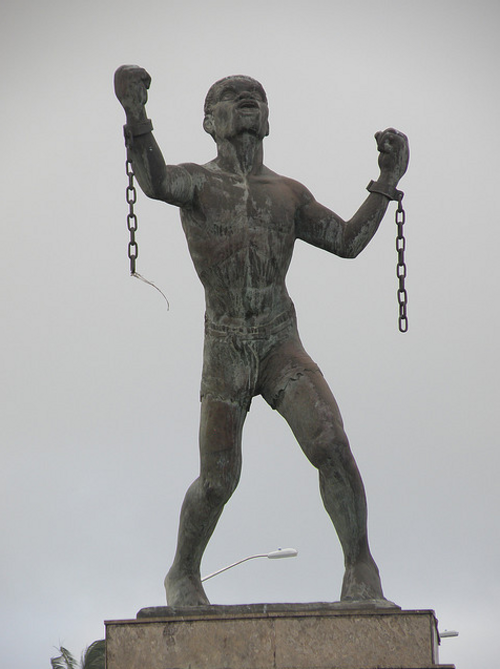
The issue of an apology is linked to reparations for slavery and is still being pursued by entities across the world. For example, the Jamaican Reparations Movement approved its declaration and action plan. In 2007, British Prime Minister Tony Blair made a formal apology for Great Britain's involvement in slavery.[401]
On February 25, 2007, the Commonwealth of Virginia resolved to 'profoundly regret' and apologize for its role in the institution of slavery. Unique and the first of its kind in the U.S., the apology was unanimously passed in both Houses as Virginia approached the 400th anniversary of the founding of Jamestown.[402]
On August 24, 2007, Mayor of LondonKen Livingstone issued a public apology for London's role in Atlantic slave trade, which took place at an event commemorating the 200th anniversary of the British slave trade's abolition. In his speech, Livingstone described the slave trade as "the racial murder of not just those who were transported but generations of enslaved African men, women and children. To justify this murder and torture black people had to be declared inferior or not human... We live with the consequences today."[403] City officials in Liverpool, which was a large slave trading port, apologized in 1999.[404]
On July 30, 2008, the United States House of Representatives passed a resolution apologizing for American slavery and subsequent discriminatory laws.[405] In June 2009, the U.S. Senate passed a resolution apologizing to African-Americans for the "fundamental injustice, cruelty, brutality, and inhumanity of slavery". The news was welcomed by President Barack Obama, the nation's first president of African descent.[406] Some of President Obama's ancestors may have been slave owners.[407]
In 2010, Libyan leader Muammar Gaddafi apologized for Arab involvement in the slave trade, saying: "I regret the behavior of the Arabs... They brought African children to North Africa, they made them slaves, they sold them like animals, and they took them as slaves and traded them in a shameful way."[408]
Reparations
There have been movements to achieve reparations for those formerly held as slaves or for their descendants. Claims for reparations for being held in slavery are handled as a civil law matter in almost every country. This is often decried as a serious problem, since former slaves' relatives lack of money means they often have limited access to a potentially expensive and futile legal process. Mandatory systems of fines and reparations paid to an as yet undetermined group of claimants from fines, paid by unspecified parties, and collected by authorities have been proposed by advocates to alleviate this "civil court problem." Since in almost all cases there are no living ex-slaves or living ex-slave owners these movements have gained little traction. In nearly all cases the judicial system has ruled that the statute of limitations on these possible claims has long since expired.
In June 2023, The Brattle Group presented a report at an event at the University of the West Indies in which reparations were estimated, for harms both during and after the period of transatlantic chattel slavery, at over 100 trillion dollars.[409][410]
Film has been the most influential medium in the presentation of the history of slavery to the general public around the world.[411] The American film industry has had a complex relationship with slavery and until recent decades often avoided the topic. Films such as The Birth of a Nation (1915)[412] and Gone with the Wind (1939) became controversial because they gave a favourable depiction. In 1940 The Santa Fe Trail gave a liberal but ambiguous interpretation of John Brown's attacks on slavery.[413]
The Civil Rights Movement in the 1950s made defiant slaves into heroes.[414] The question of slavery in American memory necessarily involves its depictions in feature films.[415]
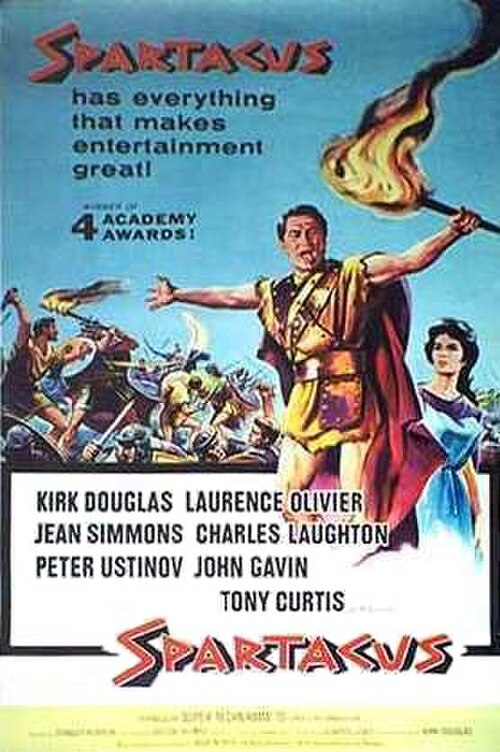
Most Hollywood films used American settings, although Spartacus (1960), dealt with an actual revolt in the Roman Empire known as the Third Servile War. The revolt failed, and all the rebels were executed, but their spirit lived on according to the film.[416]Spartacus stays surprisingly close to the historical record.[417]
The Last Supper (La última cena in Spanish) was a 1976 film directed by Cuban Tomás Gutiérrez Alea about the teaching of Christianity to slaves in Cuba, and emphasizes the role of ritual and revolt. Burn! takes place on the imaginary Portuguese island of Queimada (where the locals speak Spanish) and it merges historical events that took place in Brazil, Cuba, Santo Domingo, Jamaica, and elsewhere.
Historians agree that films have largely shaped historical memories, but they debate issues of accuracy, plausibility, moralism, sensationalism, how facts are stretched in search of broader truths, and suitability for the classroom.[418][416] Berlin argues that critics complain if the treatment emphasizes historical brutality, or if it glosses over the harshness to highlight the emotional impact of slavery.[419]
↑Allain, Jean (2012). "The Legal Definition of Slavery into the Twenty-First Century". In Allain, Jean (ed.). The Legal Understanding of Slavery: From the Historical to the Contemporary. Oxford: Oxford University Press. pp.199–219. ISBN978-0-19-164535-8.
↑Harper, Kyle (2015). Slavery in the Late Roman World, AD 275-425. Cambridge University Press. p.11. ISBN9781107640818. Slavery is an economic phenomenon, and a history of slavery must be situated within the economic history of the ancient world.
↑Baker-Kimmons, Leslie C. (2008). "Slavery". In Schaefer, Richard T. (ed.). Encyclopedia of Race, Ethnicity, and Society. Vol.3. SAGE Publishing. p.1234. ISBN9781412926942.
↑Pargas, Damian (2023). "Introduction: Historicizing and Spatializing Global Slavery". The Palgrave Handbook of Global Slavery throughout History. Palgrave MacMillan. ISBN978-3031132629.
↑Engerman, Stanley; Paquette, Robert; Drescher, Seymour, eds. (2001). Slavery (Oxford Reader) (Reprinteded.). Oxford University Press. p.1. ISBN9780192893024. By the end of the twentieth century, slavery was no longer legally or morally acceptable anywhere in the world. Only two centuries ago, slavery was still among the most ubiquitous institutions in human societies, and had existed in most times and places throughout history.
↑White, Shelley K.; White, Jonathan M.; Korgen, Kathleen Odell (2014). Sociologists in Action on Inequalities: Race, Class, Gender, and Sexuality. SAGE Publishing. p.43. ISBN978-1-4833-1147-0.
12"Slavery in the 21st century". Newint.org. Archived from the original on May 27, 2010. Retrieved August 29, 2010.
↑Villegas, Christina G. (2020). Modern Slavery: A Reference Handbook. ABC-CLIO. pp.27–28. ISBN9781440859762.
↑Hodal, Kate (May 31, 2016). "One in 200 people is a slave. Why?". The Guardian. Archived from the original on April 30, 2019.
↑"Religion & Ethics – Modern slavery: Modern forms of slavery". BBC. January 30, 2007. Archived from the original on January 6, 2014. Retrieved June 16, 2009.
↑Variants include σκλαῦος, ἐσκλαβηνός, σκλαυηνός, σκλαβινός, σκλαυινός, σκλαυῖνος, σκλαβοῦνος.
↑Jankowiak, Marek (February 2017). "What Does the Slave Trade in the Saqaliba Tell Us about Early Islamic Slavery?". International Journal of Middle East Studies. 49 (1): 169–172. doi:10.1017/S0020743816001240. ISSN0020-7438.
↑"The international slave trade". Encyclopædia Britannica.
↑Kluge, Friedrich (1899). "Artikel Sklave"[Article Slave]. Etymologisches Wörterbuch Der Deutschen Sprache[Etymological dictionary of the German language] (in German) (6ed.). Strassburg: Trübner. p.366.
↑Dostoevsky, Fyodor (1981). "Самое последнее слово цивилизации". In В. Г. Базанов и др., ИРЛИ (ed.). Polnoye sobraniye sochineniy. V 30 tomakhПолное собрание сочинений. В 30 томах[Full composition of writings. In 30 volumes] (in Russian). Vol.23. Дневник писателя за 1876 год. Май-октябрь. Leningrad: Наука. Ленингр. отд-ние. pp.63, 382. Archived from the original on May 20, 2018.
↑Korth, Georg (1970). "Zur Etymologie des Wortes 'Slavus' (Sklave)" [On the etymology of the word 'Slavus' (slave)]. Glotta, Zeitschrift für Griechische und Lateinische Sprache (in German). 48 (1/2). Göttingen: Vandenhoeck & Ruprecht (GmbH & Co. KG): 145–153. JSTOR40266114.
↑Kluge, Friedrich (1989). "Artikel Sklave". In Elmar Seebold (ed.). Etymologisches Wörterbuch Der Deutschen Sprache (in German) (22ed.). Berlin & New York: De Gruyter. p.676. ISBN3-11-006800-1.
↑Köbler, Gerhard (1995). "Sklave"[Slave]. Deutsches Etymologisches Rechtswörterbuch[German Etymological Legal Dictionary] (in German). Tübingen: Mohr. p.371. ISBN978-3-8252-1888-1.
↑Scholten, Daniel (2020). "Sklave und Slawe" [Slave and Slav]. Deutsch für Dichter und Denker: Unsere Muttersprache in neuem Licht[German for poets and thinkers: Our mother tongue in a new light] (in German). Bright Star Books. ISBN978-3-948287-06-1. Archived from the original on October 24, 2020.
↑Ditten, Hans (1972). "Kritik an G. Korth". Byzantinoslavica. Vol.33. Prague: Academia, de l'Academie Tchecoslovaque des Sciences et Lettres. pp.183–184.
↑Waldman, Katy (May 19, 2015). "Slave or Enslaved Person? It's not just an academic debate for historians of American slavery". Slate. Archived from the original on May 21, 2015.
↑Mohaiemen, Naeem (July 27, 2004). "Slaves in Saudi". The Daily Star. Vol.5, no.61. Archived from the original on April 5, 2014. Retrieved February 7, 2021.
↑Brace, Laura (2004). The Politics of Property: Labour, Freedom and Belonging. Edinburgh University Press. p.162. ISBN978-0-7486-1535-3. Retrieved May 31, 2012.
↑Keith Bradley (March 7, 2016). "slavery, Roman". Oxford Classical Dictionary. Oxford University Press. doi:10.1093/acrefore/9780199381135.013.7311. ISBN978-0-19-938113-5. Retrieved June 27, 2023. chattel-slavery, whereby the slave‐owner enjoyed complete mastery (dominium) over the slave's physical being […] was evident throughout the central era of Roman history, and in Roman no less than Greek thought was regarded as both the necessary antithesis of civic freedom
↑Bradley, Keith (November 2, 2020). "'The Bitter Chain of Slavery': Reflections on Slavery in Ancient Rome". Harvard University. Archived from the original on April 11, 2021. Retrieved November 15, 2022.
↑Finley, Moses I. (1980). Ancient Slavery and Modern Ideology. Viking Press. p.71. ISBN9780670122776.
↑Alexander, J. (2001). "Islam, Archaeology and Slavery in Africa". World Archaeology. 33 (1): 51. doi:10.1080/00438240120047627. JSTOR00438243. Chattel-slaves were needed, especially from the ninth to thirteenth centuries, in the gold and emerald (carbuncle) mines of the Wadi Allaqi in the deserts east of the Nile's 2nd Cataract
↑Burkholder, Mark A.; Johnson, Lyman L. (2019). "1. America, Iberia, and Africa Before the Conquest". Colonial Latin America (10thed.). Oxford University Press. p.10. Wealth rested heavily on the possession of slaves across the large empires of West Africa as well as in Benin and other kingdoms […] Slave owners in sub-Saharan Africa also employed their chattel in a variety of occupations.
↑Bergad, Laird W. (2007). The Comparative Histories of Slavery in Brazil, Cuba, and the United States. New York: Cambridge University Press. pp.57, 132, 165, 166. ISBN9780521872355.
↑Slavery and Social Death: A Comparative Study, Orlando (1982). Patterson. Cambridge, Mass.: Harvard University Press. pp.X. ISBN9780674986909.
↑Wendy Warren (2016). New England Bound (1st.ed.). W. W. Norton & Company. pp.110–111. ISBN978-0-87140-672-9. Iroquoian raids took captives from neighboring tribes in hopes of assimilating them into Iroquoian culture. Whether that integration was successful or not is a matter of debate, but the adoption of captives to replace dead tribe members was its stated goal. This form of captivity thus offered myriad roads out of bondage; in general terms, though not always and not everywhere, Indian slavery, albeit forcefully, assimilated captives into their new culture, and the children of captives became fully part of the society.
↑"Traditional or Chattel Slavery". FSE Project. The Feminist Sexual Ethics Project. Retrieved August 31, 2014.
123Miers, S. (2003). Slavery in the Twentieth Century: The Evolution of a Global Problem. USA: AltaMira Press.
↑Ghanem, Omar (August 21, 2007). "Slavery in Mauritania Emancipating the Free". Onislam.net. Archived from the original on October 28, 2014. Retrieved October 28, 2014.{{cite web}}: CS1 maint: bot: original URL status unknown (link)
12Okeowo, Alexis (September 8, 2014). "Freedom Fighter: A slaving society and an abolitionist's crusade". The New Yorker. Archived from the original on January 6, 2018. Retrieved October 16, 2014.
123"Mauritanian MPs pass slavery law". BBC News. August 9, 2007. Retrieved May 23, 2010.
↑"Debt bondage remains the most prevalent form of forced labour worldwide". United Nations. September 15, 2016. Retrieved July 27, 2021.
↑"Nigeria's young daughters are sold as 'money wives'". Al Jazeera. September 21, 2018. Retrieved May 12, 2020.
↑Sleightholme; Indrani (1996). Guilty Without Trial. Rutgers University Press. pp.11–12. ISBN0-8135-2381-8.
↑Chatterjee, Indrani; Eaton, Richard (2006). Slavery and South Asian History. Indiana University Press. p.3. ISBN978-0-253-11671-0.
↑Dandamayev, M. A.; Barda; Bardadārī. Encyclopædia Iranica.
↑Farazmand, Ali (1998). "Persian/Iranian Administrative Tradition". In Shafritz, Jay M. (ed.). International Encyclopedia of Public Edict and Administration. Boulder, CO: Westview Press. pp.1640–1645 (1642). Persians never practiced mass slavery, and in many cases the situations and lives of semi-slaves (prisoners of war) were in fact better than the common citizens of Persia.
↑"Experts encourage action against sex trafficking". November 2, 2009. Archived from the original on December 23, 2009.
↑"Rights–Mexico: 16,000 Victims of Child Sexual Exploitation". ipsnews.net. August 13, 2007. Retrieved February 11, 2016.
↑"Campaign Page: Child Soldiers". Human Rights Watch. June 2001. Archived from the original on February 13, 2008.
↑Chikwanine, Michel; Humphrey, Jessica (September 1, 2015). Child Soldier: When Boys and Girls Are Used in War. Kids Can Press Ltd. ISBN978-1-77138-126-0.
↑Sullivan, Kevin (December 26, 2008). "In Togo, a 10-Year-Old's Muted Cry: 'I Couldn't Take Any More'". Archived from the original on June 12, 2018. Retrieved January 15, 2024.
↑"Two-year-old 'at risk' of forced marriage". BBC News. March 5, 2013.
↑"Honor Diaries: Child/Forced Marriage: Factsheet"(PDF). Honordiaries.com. Archived from the original(PDF) on September 24, 2015. Retrieved September 29, 2015.
↑Black, Debra (September 20, 2013). "Forced marriages rampant in Ontario". The Hamilton Spectator. Archived from the original on March 26, 2017. Retrieved September 20, 2013.
↑"Without Consent: Forced Marriage in Australia"(PDF). Archived(PDF) from the original on June 13, 2015.
↑"UNICEF supports fight to end marriage by abduction in Ethiopia". reliefweb.int. November 9, 2004. Retrieved August 29, 2013.
↑Krembs, Peter (January 20, 2003). "An Idea Not Worth Drafting: Conscription is Slavery". Capmag.com. Retrieved September 29, 2015.
↑Kopel, Dave. "Nationalized Slavery; A policy Italy should dump". davidkopel.com. Archived from the original on October 12, 2007.. Refers to both the military and national service requirements of Italy as slavery
↑"wage slave". merriam-webster.com. Retrieved March 4, 2013.
↑"Constitution Society – Advocates and enforcers of the U.S. and State Constitutions". Archived from the original on December 21, 2020. Retrieved February 6, 2021. ...vulgar are the means of livelihood of all hired workmen whom we pay for mere manual labour, not for artistic skill; for in their case the very wage they receive is a pledge of their slavery.
↑North, Douglass C.; Thomas, Robert Paul (December 1971). "The Rise and Fall of the Manorial System: A Theoretical Model". The Journal of Economic History. 31 (4): 777–803. doi:10.1017/S0022050700074623. JSTOR2117209. S2CID154616683.
↑Domar, Evsey D. (March 1970). "The Causes of Slavery or Serfdom: A Hypothesis". The Journal of Economic History. 30 (1): 18–32. doi:10.1017/S0022050700078566. JSTOR2116721. S2CID154921369.
↑Lagerlöf, Nils-Petter (November 12, 2006). "Slavery and other property rights". MPRA Paper 372. Retrieved May 6, 2009.
↑"Technology". History.com. January 4, 2008. Archived from the original on April 23, 2008. Retrieved May 6, 2009.
↑Helper, Hinton Rowan (1857). The Impending Crisis of the South: How to Meet It. New York: Burdick Brothers.
↑McKivigan, John R.; Snay, Mitchell (1998). Religion and the Antebellum Debate Over Slavery. University of Georgia Press. p.68. ISBN978-0-8203-2076-2. Retrieved May 31, 2012.
↑Griswold, Charles L. (1999). Adam Smith and the Virtues of Enlightenment. Cambridge University Press. p.198. ISBN978-0-521-62891-4. Retrieved May 31, 2012.
123Kara, Siddharth (2008). Sex Trafficking – Inside the Business of Modern Slavery. Columbia University Press. ISBN978-0-231-13960-1.
↑"Slave Branding". Spartacus-educational.com. Retrieved June 21, 2026.
↑"Louis Dor (Saturday 30 April 2016) Kim Jong-un is recruiting a new 'pleasure squad' of teenage girls". April 30, 2016.
↑Ryall, Julian (April 2, 2015). "Kim Jong-un brings back 'pleasure troupe' entertainers". The Telegraph.
↑"From private to state slavery and back again". Eurozine. July 31, 2017. Retrieved August 12, 2021.
↑Lockhart, James; Schwartz, Stuart. Early Latin America. New York: Cambridge University Press. p.138. The encomienda in its early heyday granted a lifetime monopoly on the utilization of temporary Indian labor in a given area to one Spaniard, the encomendero.
↑"One day we will start a big war". Foreign Policy. Archived from the original on February 5, 2017. Retrieved February 13, 2017.
↑Stengers, Jean (1969). "The Congo Free State and the Belgian Congo before 1914". In Gann, L. H.; Duignan, Peter (eds.). Colonialism in Africa, 1870–1914. Vol.I. Cambridge: Cambridge University Press. p.272.
↑Pollak, Michael (March 28, 2014). "Determining the Legal Rights of Slaves". The New York Times. ISSN0362-4331. Retrieved February 11, 2021.
↑Ober, Josiah (June 26, 2018). Athenian Legacies: Essays on the Politics of Going On Together. Princeton University Press. ISBN978-0-691-19016-7.
123456"Historical survey: Slave-owning societies". Encyclopædia Britannica. Archived from the original on February 23, 2007.
↑Harris, W. V. (February 3, 2011). Demography, Geography, and the Sources of Roman Slaves. Rome's Imperial Economy. Oxford University Press. pp.88–110. doi:10.1093/acprof:osobl/9780199595167.003.0005. ISBN978-0-19-959516-7.
↑Perbi, Akosua (April 5, 2001). "Slavery and the Slave Trade in Pre-colonial Africa"(PDF). latinamericanstudies.org. Retrieved August 11, 2016.
↑"Welcome to Encyclopædia Britannica's Guide to Black History". Britannica.com. Archived from the original on December 30, 2007. Retrieved March 19, 2018.
↑Bindman, David; Gates (Jr.), Henry Louis; Dalton, Karen C. C., eds. (2010). The Image of the Black in Western Art. Vol.2. Belknap Press of Harvard University Press. p.27. ISBN978-0-674-05271-0.
↑Ochiengʼ, William Robert (1975). Eastern Kenya and Its Invaders. East African Literature Bureau. p.76. Retrieved May 15, 2015– via Google Books.
12Lodhi, Abdulaziz (2000). Oriental influences in Swahili: a study in language and culture contacts. Acta Universitatis Gothoburgensis. p.17. ISBN978-91-7346-377-5.
↑"Focus on the slave trade". BBC. September 3, 2001. Archived from the original on May 25, 2017.
↑Shillington, Kevin (July 4, 2013). Encyclopedia of African History 3-Volume Set. Routledge. p.1401. ISBN978-1-135-45670-2.
↑"Slow Death for Slavery: The Course of Abolition in Northern Nigeria, 1897–1936 (review)". Journal of World History. Archived from the original on April 11, 2016. Retrieved December 31, 2021.
↑""Freedom is a good thing but it means a dearth of slaves": Twentieth Century Solutions to the Abolition of Slavery"(PDF). Archived from the original(PDF) on May 15, 2011. Retrieved August 29, 2010.
↑Bagley, H. R. C. (August 1, 1997). The Last Great Muslim Empires. BRILL. ISBN978-90-04-02104-4.
↑Asquith, Christina. "Revisiting the Zanj and Re-Visioning Revolt: Complexities of the Zanj Conflict – 868–883 AD – slave revolt in Iraq". Archived from the original on March 6, 2016.
↑"Islam, From Arab To Islamic Empire: The Early Abbasid Era". History-world.org. Archived from the original on September 24, 2018. Retrieved March 23, 2016.
↑Kissling, H. J.; Spuler, Bertold; Barbour, N.; Trimingham, J. S.; Braun, H.; Hartel, H. (August 1, 1997). The Last Great Muslim Empires. BRILL. ISBN978-90-04-02104-4.
↑Syed, Muzaffar Husain (2011). A Concise History of Islam. New Delhi: VIJ Books (India) Pty Ltd. p.453. ISBN978-93-81411-09-4. According to Robert Davis, from the 16th to 19th century, pirates captured 1 million to 1.25 million Europeans as slaves.
↑Davis, R. (September 16, 2003). Christian Slaves, Muslim Masters: White Slavery in the Mediterranean, The Barbary Coast, and Italy, 1500–1800. Palgrave Macmillan UK. ISBN978-1-4039-4551-8– via Google Books.
↑"When Europeans Were Slaves: Research Suggests White Slavery Was Much More Common Than Previously Believed". Research News. Archived from the original on July 25, 2011. Retrieved October 10, 2007.
12Carroll, Rory (March 11, 2004). "New book reopens old arguments about slave raids on Europe". The Guardian. ISSN0261-3077. Retrieved December 11, 2017.
↑Wright, John (2007). "Trans-Saharan Slave Trade". Routledge.
12Davis, Robert (February 17, 2011). "British Slaves on the Barbary Coast". BBC.
↑Baepler, B. (January 1999). "White Slaves, African Masters: An Anthology of American Barbary Captivity Narratives". The SHAFR Guide Online. University of Chicago Press: 5. doi:10.1163/2468-1733_shafr_sim030170256.
↑"Swahili Coast". National Geographic. October 17, 2002. Archived from the original on December 30, 2007. Retrieved September 30, 2015.
↑"Remembering East African slave raids". BBC News. March 30, 2007. Retrieved February 6, 2021.
↑"Focus on the slave trade". BBC News. September 3, 2001. Retrieved February 6, 2021.
↑Veenhoven, Willem A. (1977). Case Studies on Human Rights And Fundamental Freedoms: A World Survey. Martinus Nijhoff Publishers. p.440. ISBN978-90-247-1956-3. Retrieved May 31, 2012.
12Snell, Daniel C. (2011). "Slavery in the Ancient Near East". In Keith Bradley and Paul Cartledge (ed.). The Cambridge World History of Slavery. New York: Cambridge University Press. pp.4–21.
↑Lovejoy, Paul E. (1989). "The Impact of the Atlantic Slave Trade on Africa: A Review of the Literature". Journal of African History: 30.
↑Foner, Eric (2012). Give Me Liberty: An American History. New York: W. W. Norton & Company. p.18.
↑M'bokolo, Elikia (April 1, 1998). "The impact of the slave trade on Africa". Le Monde diplomatique. Retrieved February 7, 2021.
↑Bortolot, Alexander Ives (October 2003). "The Transatlantic Slave Trade]". metmuseum.org. Retrieved February 6, 2021.
↑"Nigeria – The Slave Trade". countrystudies.us. U.S. Library of Congress. Archived from the original on February 7, 2021. Retrieved February 6, 2021.
↑Rubinstein, W. D. (2004). Genocide: a history. Pearson Education. pp.76–78. ISBN978-0-582-50601-5.
↑Mancke, Elizabeth; Shammas, Carole (May 31, 2005). The Creation of the British Atlantic World. Johns Hopkins University Press. pp.30–31. ISBN978-0-8018-8039-1.
↑Corrigan, Terence (September 6, 2007). "Mauritania: Country Made Slavery Illegal Last Month". South African Institute of International Affairs. The East African Standard. Archived from the original on August 4, 2011. Retrieved January 21, 2008.
↑"Mesopotamia: The Code of Hammurabi". #7. Archived from the original on May 14, 2011. ...the shepherd of the oppressed and of the slaves ... If any one buy from the son or the slave of another man
↑Shaw, Garry J. (October 26, 2012). "Slavery, Pharaonic Egypt". The Encyclopedia of Ancient History. Hoboken, New Jersey, USA: John Wiley & Sons, Inc. doi:10.1002/9781444338386.wbeah15006. ISBN978-1-4443-3838-6.
↑"Ancient Egypt: Slavery, its causes and practice". reshafim.org.il. Archived from the original on August 30, 2012. Retrieved March 6, 2019.
↑David, Rosalie (April 1, 1998). The Ancient Egyptians (Beliefs & Practices). Sussex Academic Press. p.91.
↑Everett, Susanne (October 24, 2011). History of Slavery. Chartwell Books. pp.10–11.
↑Dunn, Jimmy (October 24, 2011). "Slaves and Slavery in Ancient Egypt". Retrieved April 9, 2016.
↑"Horrible Traffic in Circassian Women – Infanticide in Turkey". New York Daily Times. August 6, 1856. Archived from the original on March 14, 2023. Retrieved August 29, 2010– via The Lost Museum Archive.
↑"Soldier Khan". Avalanche Press. Retrieved August 29, 2010.
↑"Sexual slavery – the harem". BBC – Religion & Ethics. Archived from the original on May 21, 2009.
↑Dalman, Gustaf (2020). Abdulhadi-Sukhtian, Nadia (ed.). Work and Customs in Palestine, volume II. Vol.2 (Agriculture). Translated by Schick, Robert. Ramallah: Dar Al Nasher. pp.176–177. ISBN978-9950-385-84-9.
↑"The Freeing of the Slaves". Khiva.info. Retrieved August 29, 2010.
123Miers, S. (2003). Slavery in the Twentieth Century: The Evolution of a Global Problem. Storbritannien: AltaMira Press. p.16
123Miers, S. (2003). Slavery in the Twentieth Century: The Evolution of a Global Problem. Storbritannien: AltaMira Press. p. 17
↑Veenhoven, Willem Adriaan; Ewing, Winifred Crum; Samenlevingen, Stichting Plurale (1975). Case Studies on Human Rights and Fundamental Freedoms: A World Survey. BRILL. p.452. ISBN978-90-247-1779-8. Retrieved May 31, 2012.
↑"Religion & Ethics – Islam and slavery: Abolition". BBC. Archived from the original on May 21, 2009. Retrieved May 1, 2010.
↑Gallay, Alan (2016). "Indian Slavery". The Oxford Handbook of Slavery in the Americas. Oxford University Press. ISBN9780198758815. Slavery existed among the indigenous peoples of the Americas before the European arrival. Its character varied from place to place. In societies that practiced human sacrifice, slaves were captured from enemies for ritualistic purposes. This occurred, for instance, among the Aztecs in Mexico and the Indians of the Pacific Northwest. More commonly, native peoples captured enemies to procure slave laborers for agricultural production and public works projects, particularly in Central and South America. Captivity, however, was not the only rationale for enslavement.
↑Lawson, Russell M.; Lawson, Benjamin A. (October 11, 2019). Race and Ethnicity in America: From Pre-contact to the Present [4 volumes]. ABC-CLIO. p.16. ISBN978-1-4408-5097-4.
↑"Slavery in the New World". Encyclopædia Britannica. Retrieved February 25, 2011.
↑Ames, Kenneth M. (June 2001). "Slaves, Chiefs and Labour on the Northern Northwest Coast". World Archaeology. 33 (The Archaeology of Slavery) (1): 1–17. doi:10.1080/00438240120047591. JSTOR827885. S2CID162278526.
↑"The World Factbook". CIA. Archived from the original on June 29, 2011. Retrieved August 8, 2010.
↑"Sicut Dudem -Against the Enslavement of Black Natives of the Canary Islands". papalencyclicals.net. January 13, 1435.
↑"Sublimus Dei – On the Enslavement and Evangelization of Indians". papalencyclicals.net. May 29, 1537.
↑Hanke, Lewis (1974). All Mankind Is One: A Study of the Disputation Between Bartolomé de Las Casas and Juan Ginés de Sepúlveda on the Religious and Intellectual Capacity of the American Indians. Northern Illinois University Press. p.xi. ISBN0-87580-043-2."For the first time, and probably for the last, a colonizing nation organized a formal enquiry into the justice of the methods used to extend its empire. For the first time, too, in the modern world, we see an attempt to stigmatize an entire race as inferior, as born slaves according to the theory elaborated centuries before by Aristotle."
↑"Health In Slavery". Archived from the original on October 3, 2006.
↑Panzer, Joel S. (1996). The Popes and Slavery. Alba House. p.3. ISBN0-8189-0764-9."The earlier forms of servitude were varied, complex, and very often of a different sociological category than those which were prevalent after the 14th century. While all forms of servitude are certainly unacceptable to most people today, this has not always been the case. Formerly, the rules of war and society were such that servitude was often imposed as a penalty on criminals and prisoners of war, and was even freely chosen by many workers for economic reasons. Children born of those held in servitude were also at times considered to be in the same state as that of their parents. These types of servitude were the most common among those generally considered to establish the so-called 'just titles' of servitude."
↑Galenson, David W. (March 1984). "The Rise and Fall of Indentured Servitude in the Americas: An Economic Analysis". The Journal of Economic History. XLIV (1): 1–26. doi:10.1017/S002205070003134X. JSTOR2120553. S2CID154682898.
↑"Slave Laws". Virtual Jamestown. Retrieved November 4, 2013.
↑Billings, Warren M. (2009). The Old Dominion in the Seventeenth Century: A Documentary History of Virginia, 1606–1700: Easyread Super Large 18pt Edition. ReadHowYouWant.com. pp.286–87. ISBN978-1-4429-6090-9.
↑Federal Writers' Project (1954). Virginia: A Guide to the Old Dominion. US History Publishers. p.76. ISBN978-1-60354-045-2.{{cite book}}: ISBN / Date incompatibility (help)
↑Childs, Matt D. (2006). 1812 Aponte Rebellion in Cuba and the Struggle against Atlantic Slavery. University of North Carolina Press. ISBN978-0-8078-5772-4.
↑Ali, Arif (1997). Barbados: Just Beyond Your Imagination. Hansib Publishing (Caribbean) Ltd. pp.46, 48. ISBN978-1-870518-54-3.
↑Streissguth, Tom (2009). Suriname in Pictures. Twenty-First Century Books. p.23. ISBN978-1-57505-964-8.
↑Mentelle, Simon M. (1777). "Extract of the Dutch Map Representing the Colony of Surinam". wdl.org. Digital World Library via Library of Congress. Archived from the original on May 9, 2020. Retrieved February 7, 2021.
↑"Vergonha Ainda Maior: Novas informações disponíveis em um enorme banco de dados mostram que a escravidão no Brasil foi muito pior do que se sabia antes"[Even Greater Shame: New information available from a huge database shows that slavery in Brazil was far worse than previously known]. Veja (in Portuguese). Archived from the original on March 13, 2015. Retrieved March 16, 2015.
↑"African Heritage and Memories of Slavery in Brazil and the South Atlantic World By Ana Lucia Araujo". cambriapress.com. Archived from the original on March 22, 2023. Retrieved February 7, 2021.
↑Fischer, Brodwyn; Grinberg, Keila (2023), "Slavery and Freedom in Nineteenth-Century Brazil", in Fischer, Brodwyn; Grinberg, Keila (eds.), The Boundaries of Freedom: Slavery, Abolition, and the Making of Modern Brazil, Afro-Latin America, Cambridge: Cambridge University Press, pp.1–32, ISBN978-1-009-28797-5, retrieved June 16, 2026
↑Wallech, Steven; Daryaee, Touraj; Hendricks, Craig; Negus, Anne Lynne; Wan, Peter P.; Bakken, Gordon Morris (January 22, 2013). World History: A Concise Thematic Analysis, Volume 2. John Wiley & Sons. p.444. ISBN978-1-118-53273-7.
↑Farmer, Paul (April 15, 2004). "Who removed Aristide?". London Review of Books. pp.28–31. Archived from the original on June 8, 2008. Retrieved February 19, 2010.
↑Kiple, Kenneth F. (2002). The Caribbean Slave: A Biological History. Cambridge University Press. p.145. ISBN978-0-521-52470-4.
↑Wood, Peter (2003). "The Birth of Race-Based Slavery". Slate. Archived from the original on January 20, 2023.
↑Smith, Julia Floyd (1973). Slavery and Plantation Growth in Antebellum Florida, 1821–1860. Gainesville: University of Florida Press. p.44. ISBN978-0-8130-0323-8– via Google Books.
12Moore, Wilbert Ellis (1980). American Negro Slavery and Abolition: A Sociological Study. Ayer Publishing.
↑Clinton, Catherine (1999). Scholastic Encyclopedia of the Civil War. Scholastic Reference. p.8. ISBN978-0-590-37228-2.
↑McInnis, Maurie D. (2011). Slaves Waiting for Sale: Abolitionist Art and the American Slave Trade. University of Chicago Press. p.129. ISBN978-0-226-55933-9.
↑Behrendt, Stephen (1999). "Transatlantic Slave Trade". Africana: The Encyclopedia of the African and African American Experience. New York: Basic Civitas Books. ISBN978-0-465-00071-5. Based on "records for 27,233 voyages that set out to obtain slaves for the Americas".
12"Social Aspects of the Civil War". National Park Service. Archived from the original on July 14, 2007.
↑"Why Did So Many Christians Support Slavery?". christianitytoday.com. January 1992. Retrieved August 28, 2017.
↑"1860 Census Results". Archived from the original on June 4, 2004.
↑Lowe, Jaime (July 27, 2021). "What Does California Owe Its Incarcerated Firefighters?". The Atlantic. Retrieved August 29, 2023.
↑Pargas, Damian Alan; Roşu, Felicia (December 7, 2017). Critical Readings on Global Slavery (4 vols.). BRILL. ISBN978-90-04-34661-1.
↑"Slavery and forced labour in Ancient China and the Ancient Mediterranean". The University of Edinburgh. University of Edinburgh. Archived from the original on March 6, 2019. Retrieved March 6, 2019.
↑Ober, Josiah; Scheidel, Walter; Shaw, Brent D.; Sanclemente, Donna (April 18, 2007). "Toward Open Access in Ancient Studies: The Princeton-Stanford Working Papers in Classics". Hesperia. 76 (1): 229–242. doi:10.2972/hesp.76.1.229. ISSN0018-098X. S2CID145709968.
↑"Outline of the Senmin system during the Ritsuryo period"(PDF). June 14, 2024.
↑Williams, R. Owen (November 2006). Encyclopedia of Antislavery and Abolition [Two Volumes]. Greenwood Press. ISBN978-0-313-01524-3.
↑Zhao, Gang (1986). Man and Land in Chinese History: An Economic Analysis. Stanford University Press. ISBN978-0-8047-1271-2.
↑Huang, Philip C. (2001). Code, Custom, and Legal Practice in China: The Qing and the Republic Compared. Stanford University Press. ISBN978-0-8047-4111-8.
↑"Kao-li maid-servant". Memoirs of the Research Department of the Tōyō Bunko (2). Tokyo: Tōyō Bunko: 63. 1928. ISSN0082-562X.
↑Schafer, Edward H. (1963). The Golden Peaches of Samarkand: A Study of Tʻang Exotics. University of California Press. pp.45–46. ISBN978-0-520-05462-2.{{cite book}}: ISBN / Date incompatibility (help)
↑Granet, Marcel (2013) [1930], "The History of Civilization", Chinese Civilization, London: Routledge, pp.500–503, doi:10.4324/9781315005508-24, ISBN978-1-315-00550-8
↑Lipman, Jonathan Neaman (2004). Familiar strangers: a history of Muslims in Northwest China. Seattle: University of Washington Press. p.69. ISBN978-0-295-97644-0. Retrieved November 28, 2010.
↑Brook, Timothy; Wakabayashi, Bob Tadashi (2000). Opium regimes: China, Britain, and Japan, 1839–1952. University of California Press. p.148. ISBN978-0-520-22236-6. Retrieved November 28, 2010.
123Klein, Martin A. (2014). Historical Dictionary of Slavery and Abolition. Rowman & Littlefield Publishers. p.13. ISBN978-0-8108-7528-9.
↑Rhee, Young-hoon; Yang, Donghyu (December 1999). "Korean Nobi in American Mirror: Yi Dynasty Coerced Labor in Comparison to the Slavery in the Antebellum Southern United States". Working Paper Series. Institute of Economic Research, Seoul National University. Archived from the original on November 6, 2018. Retrieved February 14, 2017.
↑Palais, James B. (1998). Views on Korean social history. Institute for Modern Korean Studies, Yonsei University. p.50. ISBN978-89-7141-441-5. Retrieved February 15, 2017. Another target of his critique is the insistence that slaves (nobi) in Korea, especially in Choson dynasty, were closer to serfs (nongno) than true slaves (noye) in Europe and America, enjoying more freedom and independence than what a slave would normally be allowed.
↑Kim, Youngmin; Pettid, Michael J. (2011). Women and Confucianism in Choson Korea: New Perspectives. SUNY Press. p.141. ISBN978-1-4384-3777-4. Retrieved February 14, 2017.
12Kim, Youngmin; Pettid, Michael J. (2011). Women and Confucianism in Choson Korea: New Perspectives. SUNY Press. pp.140–41. ISBN978-1-4384-3777-4. Retrieved February 14, 2017.
↑Korean National Commission for UNESCO (2004). Korean History: Discovery of Its Characteristics and Developments. Hollym. p.14. ISBN978-1-56591-177-2.
↑Hoffman, Michael (May 26, 2013). "The rarely, if ever, told story of Japanese sold as slaves by Portuguese traders". The Japan Times. Archived from the original on May 5, 2019. Retrieved March 2, 2014.
↑"Europeans had Japanese slaves, in case you didn't know…". Japan Probe. May 10, 2007. Archived from the original on March 4, 2016. Retrieved January 7, 2018.
↑Hertel, Ralf; Keevak, Michael (2017). Early Encounters between East Asia and Europe: Telling Failures. Routledge. ISBN978-1-317-14718-3.
↑Michael Weiner, ed. (2004). Race, Ethnicity and Migration in Modern Japan: Imagined and imaginary minorities (illustrateded.). Taylor & Francis. p.408. ISBN978-0-415-20857-4. Retrieved February 2, 2014.
↑Robert Gellately; Ben Kiernan, eds. (2003). The Specter of Genocide: Mass Murder in Historical Perspective (reprinted.). Cambridge University Press. p.277. ISBN978-0-521-52750-7. Retrieved February 2, 2014. Hideyoshi korean slaves guns silk.
↑McCormack, Gavan (2001). Reflections on Modern Japanese History in the Context of the Concept of "genocide". Edwin O. Reischauer Institute of Japanese Studies. Harvard University, Edwin O. Reischauer Institute of Japanese Studies. p.18.
↑Lidin, Olof G. (2002). Tanegashima – The Arrival of Europe in Japan. Routledge. p.170. ISBN978-1-135-78871-1. Retrieved February 2, 2014.
↑Stanley, Amy (2012). Selling Women: Prostitution, Markets, and the Household in Early Modern Japan. Vol.21 of Asia: Local Studies / Global Themes. Matthew H. Sommer. University of California Press. ISBN978-0-520-95238-6. Retrieved February 2, 2014.
↑Spence, Jonathan D. (1985). The memory palace of Matteo Ricci (illustrated, reprinted.). Penguin Books. p.208. ISBN978-0-14-008098-8. Retrieved May 5, 2012. countryside.16 Slaves were everywhere in Lisbon, according to the Florentine merchant Filippo Sassetti, who was also living in the city during 1578. Black slaves were the most numerous, but there were also a scattering of Chinese
↑Leite, José Roberto Teixeira (1999). A China no Brasil: influências, marcas, ecos e sobrevivências chinesas na sociedade e na arte brasileiras (in Portuguese). UNICAMP. Universidade Estadual de Campinas. p.19. ISBN978-85-268-0436-4. Idéias e costumes da China podem ter-nos chegado também através de escravos chineses, de uns poucos dos quais sabe-se da presença no Brasil de começos do Setecentos.17 Mas não deve ter sido através desses raros infelizes que a influência chinesa nos atingiu, mesmo porque escravos chineses (e também japoneses) já existiam aos montes em Lisboa por volta de 1578, quando Filippo Sassetti visitou a cidade,18 apenas suplantados em número pelos africanos. Parece aliás que aos últimos cabia o trabalho pesado, ficando reservadas aos chins tarefas e funções mais amenas, inclusive a de em certos casos secretariar autoridades civis, religiosas e militares.
12Pinto, Jeanette (1992). Slavery in Portuguese India, 1510–1842. Bombay: Himalaya Pub. House. p.18. ISBN978-81-7040-587-0. ing Chinese as slaves, since they are found to be very loyal, intelligent and hard working' ... their culinary bent was also evidently appreciated. The Florentine traveller Fillippo Sassetti, recording his impressions of Lisbon's enormous slave population circa 1580, states that the majority of the Chinese there were employed as cooks.
↑Boxer (1968), p.225: "be very loyal, intelligent, and hard-working. Their culinary bent (not for nothing is Chinese cooking regarded as the Asiatic equivalent to French cooking in Europe) was evidently appreciated. The Florentine traveller Filipe Sassetti recording his impressions of Lisbon's enormous slave population circa 1580, states that the majority of the Chinese there were employed as cooks. Dr. John Fryer, who gives us an interesting ...".
↑Leite, José Roberto Teixeira (1999). A China No Brasil: Influencias, Marcas, Ecos E Sobrevivencias Chinesas Na Sociedade E Na Arte Brasileiras[China in Brazil: Influences, Marks, Echoes and Chinese Survivals in Brazilian Society and Art] (in Portuguese). UNICAMP. Universidade Estadual de Campinas. p.19. ISBN978-85-268-0436-4.
↑Finkelman, Paul; Miller, Joseph Calder (1998). Macmillan encyclopedia of world slavery. Vol.2. Macmillan Reference US. p.737. ISBN978-0-02-864781-4. OCLC39655102.
↑de Sande (2012); Saunders (1982), p.168; Boxer (1968), p.225: "be very loyal, intelligent, and hard-working. Their culinary bent (not for nothing is Chinese cooking regarded as the Asiatic equivalent to French cooking in Europe) was evidently appreciated. The Florentine traveller Filipe Sassetti recording his impressions of Lisbon's enormous slave population circa 1580, states that the majority of the Chinese there were employed as cooks. Dr. John Fryer, who gives us an interesting ...".
↑Nelson, Thomas (Winter 2004). "Slavery in Medieval Japan". Monumenta Nipponica. 59 (4): 463–492. JSTOR25066328.
↑Kitagawa, Joseph Mitsuo (2013). Religion in Japanese History (illustrated, reprinted.). Columbia University Press. p.144. ISBN978-0-231-51509-2. Retrieved February 2, 2014.
↑Calman, Donald (2013). Nature and Origins of Japanese Imperialism. Routledge. p.37. ISBN978-1-134-91843-0. Retrieved February 2, 2014.
↑Kshetry, Gopal (2008). Foreigners in Japan: A Historical Perspective. Xlibris Corporation. ISBN978-1-4691-0244-3.
↑Moran, J.F. (2012). Japanese and the Jesuits. Routledge. ISBN978-1-134-88112-3. Retrieved February 2, 2014.
↑Dias, Maria Suzette Fernandes (2007). Legacies of slavery: comparative perspectives. Cambridge Scholars Publishing. p.71. ISBN978-1-84718-111-4.
↑footnote 2: (...) While it is likely that the institution of slavery existed in India during the Vedic period, the association of the Vedic 'Dasa' with 'slaves' is problematic and likely to have been a later development.
↑Levi, Scott C. (November 2002). "Hindus Beyond the Hindu Kush: Indians in the Central Asian Slave Trade". Journal of the Royal Asiatic Society. 12 (3): 277–288. doi:10.1017/S1356186302000329. JSTOR25188289. S2CID155047611. Sources such as the Arthasastra, the Manusmriti and the Mahabharata demonstrate that institutionalized slavery was well established in India by beginning of the common era
↑V.B. Lieberman, Burmese Administrative Cycles: Anarchy and Conquest, c. 1580–1760 (Princeton, N.J., 1984); G.D. Winius, "The 'Shadow Empire' of Goa in the Bay of Bengal," Itinerario 7, no. 2 (1983); D.G.E. Hall, "Studies in Dutch relations with Arakan," Journal of the Burma Research Society 26, no. 1 (1936):; D.G.E. Hall, "The Daghregister of Batavia and Dutch Trade with Burma in the Seventeenth Century," Journal of the Burma Research Society 29, no. 2 (1939)
↑VOC 1479, OBP 1691, fls. 611r–627v, Specificatie van Allerhande Koopmansz. tot Tuticurin, Manaapar en Alvatt.rij Ingekocht, 1670/71–1689/90; W. Ph. Coolhaas and J.van Goor, eds, Generale Missiven van Gouverneurs-Generaal en Raden van Indiaan Heren Zeventien der Verenigde Oostindische Compagnie (The Hague, 1960–present), passim; T. Raychaudhuri, Jan Company in Coromandel, 1605–1690: A Study on the Interrelations of European Commerce and Traditional Economies (The Hague, 1962)
↑For exports of Malabar slaves to Ceylon, Batavia, see Generale Missiven VI; H.K. s'Jacob ed., De Nederlanders in Kerala, 1663–1701: De Memories en Instructies Betreffende het Commandement Malabar van de Verenigde Oostindische Compagnie, Rijks Geschiedkundige Publication, Kleine serie 43 (The Hague, 1976); R. Barendse, "Slaving on the Malagasy Coast, 1640–1700," in S. Evers and M. Spindler, eds, Cultures of Madagascar: Ebb and Flow of Influences (Leiden, 1995). See also M.O. Koshy, The Dutch Power in Kerala (New Delhi, 1989); K.K. Kusuman, Slavery in Travancore (Trivandrum, 1973); M.A.P. Meilink-Roelofsz, De Vestiging der Nederlanders ter Kuste Malabar (The Hague, 1943); H. Terpstra, De Opkomst der Westerkwartieren van de Oostindische Compagnie (The Hague, 1918).
↑Of 2,467 slaves traded on 12 slave voyages from Batavia, India, and Madagascar between 1677 and 1701 to the Cape, 1,617 were landed with a loss of 850 slaves, or 34.45%. On 19 voyages between 1677 and 1732, the mortality rate was somewhat lower (22.7%). See Shell, "Slavery at the Cape of Good Hope, 1680–1731," p. 332. Filliot estimated the average mortality rate among slaves shipped from India and West Africa to the Mascarene Islands at 20–25% and 25–30%, respectively. Average mortality rates among slaves arriving from closer catchment areas were lower: 12% from Madagascar and 21% from Southeast Africa. See Filliot, La Traite des Esclaves, p. 228; A. Toussaint, La Route des Îles: Contribution à l'Histoire Maritime des Mascareignes (Paris, 1967); Allen, "The Madagascar Slave Trade and Labor Migration."
12Bowie, Katherine A. (1996). "Slavery in Nineteenth-Century Northern Thailand: Archival Anecdotes and Village Voices". Kyoto Review of Southeast Asia. 44. Yale University Southeast Asia Studies Monograph Series: 16–33.
↑Klein, Martin A. (2014). "Maori". Historical Dictionary of Slavery and Abolition. Historical Dictionaries of Religions, Philosophies, and Movements Series (2ed.). Lanham, Maryland: Rowman & Littlefield. p.253. ISBN978-0-8108-7528-9. Retrieved February 23, 2019. Slaves called mokai were an important part of pre-colonial Maori society.
↑"Blackbirding: Australia's history of kidnapping Pacific Islanders". ABC News. September 16, 2017.
↑Lauffer, Siegfried (August 1, 1957). Berneker, Erich (ed.). "Die Bergwerkssklaven von Laureion, I. Teil" [The Mine Slaves of Laureion, Part I]. Zeitschrift der Savigny-Stiftung für Rechtsgeschichte: Romanistische Abteilung (in German). 74 (1): 916. doi:10.7767/zrgra.1957.74.1.403. ISSN2304-4934. S2CID179216974.
↑"Slavery in Ancient Rome". Dl.ket.org. Archived from the original on February 22, 2010. Retrieved August 29, 2010.
↑Harper, Kyle (2011). Slavery in the Late Roman World, AD 275–425. Cambridge University Press. pp.59–60. ISBN978-1-139-50406-5. Retrieved August 11, 2016.
↑"Resisting Slavery in Ancient Rome". BBC News. November 5, 2009. Retrieved August 29, 2010.
↑Thomas, Hugh (2006). The Slave Trade: History of the Atlantic Slave Trade, 1440–1870. Weidenfeld & Nicolson. p.35. ISBN978-0-7538-2056-8.
↑Hayes, Diana (2003). "Reflections on Slavery". In Curran, Charles E. (ed.). Change in Official Catholic Moral Teachings. Paulist Press. ISBN978-0-8091-4134-0.
↑"Slave trade". Encyclopedia Britannica. May 14, 2020. Retrieved February 13, 2021.
↑"Slavery Encyclopedia of Ukraine". Encyclopediaofukraine.com. Retrieved August 29, 2010.
↑Postan, Michael Moïssey; Miller, Edward (1987). The Cambridge Economic History of Europe: Trade and industry in the Middle Ages. Cambridge University Press. p.417. ISBN978-0-521-08709-4. Retrieved May 31, 2012.
↑Boyce Davies, Carole Elizabeth (2008). Encyclopedia of the African Diaspora: Origins, Experiences, and Culture. ABC-CLIO. p.1002. ISBN978-1-85109-705-0. Retrieved May 31, 2012.
↑Jurasinski, S. (2015). The Old English Penitentials and Anglo-Saxon Law. Studies in Legal History. Cambridge University Press. p.96. ISBN978-1-107-08341-7. Retrieved May 11, 2023– via Google Books.
↑Foot, S. (2011). AEthelstan: The First King of England. The English Monarchs Series. Yale University Press. p.139. ISBN978-0-300-12535-1. Retrieved May 11, 2023– via Google Books.
↑Goose, Nigel (October 18, 2007). "Victoria county history: a history of the county of Chester, vol. V, 2, The city of Chester: culture, buildings and institutions – Edited by Christopher P. Lewis and Alan T. Thacker Victoria county history: a history of the county of Durham, vol. IV, Darlington – Edited by Gillian Cookson Victoria county history: a history of the County of Oxford, vol. XV, Carterton, Minster Lovell, and environs (Bampton Hundred part three) – Edited by S. Townley". The Economic History Review. 60 (4): 830–832. doi:10.1111/j.1468-0289.2007.00401_3.x. ISSN0013-0117.
↑Clapham, John H.A Concise Economic History of Britain from the Earliest Times. CUP Archive. p.63. GGKEY:HYPAY3GPAA5.
↑"Medieval English society". University of Wisconsin. Archived from the original on February 14, 2005. Retrieved September 5, 2009.
↑Hudson, John (2012). The Oxford History of the Laws of England. Vol.II (871–1216) (Firsted.). Oxford: Oxford University Press. pp.424–425. ISBN978-0-19-163003-3.
↑Gillingham, John (Summer 2014), "French chivalry in twelfth-century Britain?", The Historian, pp.8–9
↑"The Saxon Slave-Market in Bristol". Building History. July 2006. Retrieved February 6, 2021.
↑"Erskine May on Slavery in Britain (Vol. III, Chapter XI)". Retrieved November 2, 2017.
↑Phillips, William D. Jr. (1985). Slavery from Roman times to the Early Transatlantic Trade. Manchester: Manchester University Press. p.37. ISBN978-0-7190-1825-1.
↑Nicolle, David (1995). "The Janissaries". Osprey Publishing. Retrieved February 7, 2021.
↑"Famous Battles in History The Turks and Christians at Lepanto". Trivia-library.com. Archived from the original on November 19, 2017. Retrieved August 29, 2010.
↑Davies, Brian (2007). Warfare, State and Society on the Black Sea Steppe, 1500–1700. Routledge. p.17. ISBN978-0-415-23986-8.
↑Brodman, James William. "Ransoming Captives in Crusader Spain: The Order of Merced on the Christian-Islamic Frontier". Libro.uca.edu. Retrieved August 29, 2010.
↑"British Slaves on the Barbary Coast". Archived from the original on March 10, 2008.
↑Goodman, Joan E.; McNeely, Tom (2001). A Long and Uncertain Journey: The 27,000 Mile Voyage of Vasco Da Gama. Mikaya Press. ISBN978-0-9650493-7-5. Retrieved May 31, 2012.
123Marques, António Henrique R. de Oliveira (1972). History of Portugal: From Lusitania to empire. Columbia University Press. pp.158–160, 362–370. ISBN978-0-231-03159-2.
↑Lowe, K. J. P. (2005). Black Africans In Renaissance Europe. Cambridge University Press. p.156. ISBN978-0-521-81582-6. Retrieved May 31, 2012.
↑Northrup, David (2002). Africa's Discovery of Europe: 1450 to 1850. Oxford University Press. p.8. ISBN978-0-19-514084-2. Retrieved May 31, 2012.
↑Inalcik, Halil (1979). "Servile Labor in the Ottoman Empire". In Ascher, Abraham; Halasi-Kun, Tibor; Kiràly, Béla K. (eds.). The Mutual Effects of the Islamic and Judeo-Christian Worlds: The East European Pattern. New York: Columbia University Press. pp.25–43. Archived from the original on September 11, 2009.
↑Darjusz Kołodziejczyk, as reported by Kizilov, Mikhail (2007). "Slaves, Money Lenders, and Prisoner Guards:The Jews and the Trade in Slaves and Captivesin the Crimean Khanate". The Journal of Jewish Studies. 58 (2): 189–210. doi:10.18647/2730/JJS-2007.
↑Matsuki, Eizo. "The Crimean Tatars and their Russian-Captive Slaves"(PDF). Archived from the original(PDF) on June 5, 2013.
↑Glyn Williams, Brian (2013). "The Sultan's Raiders: The Military Role of the Crimean Tatars in the Ottoman Empire"(PDF). The Jamestown Foundation. p.27. Archived from the original(PDF) on October 21, 2013.
↑Forsythe, David P. (August 27, 2009). Encyclopedia of Human Rights. OUP USA. ISBN978-0-19-533402-9.
↑"Historical survey: Ways of ending slavery". Encyclopædia Britannica. Archived from the original on October 16, 2014.
↑"Träldom". Nordisk familjebok (in Swedish). 1920. pp.159–160. Retrieved February 6, 2021– via Project Runeberg.
↑Tyson, Thomas N; Oldroyd, David (May 2019). "Accounting for slavery during the Enlightenment: Contradictions and interpretations". Accounting History. 24 (2): 212–215, 217–218. doi:10.1177/1032373218759971.
↑Alexander, Nathan G. (2019). Race in a Godless World: Atheism, Race, and Civilization, 1850-1914. New York University Press. pp.7–8. ISBN9781479835003.
↑Curran, Andrew S. (2013). The Anatomy of Blackness: Science & Slavery in an Age of Enlightenment. Johns Hopkins Univ. Press. pp.215, 220–221. ISBN9781421409658.
↑"Enlightenment, Freedom, and Slavery". Monticello.
↑Alexander, Nathan G. (2019). "Atheism and Polygenesis in the Nineteenth Century: Charles Bradlaugh's Racial Anthropology". Modern Intellectual History. 16 (3): 836, 838. doi:10.1017/S1479244317000622.
↑"Nazi slave fund passes final hurdle". May 30, 2001. Retrieved February 6, 2021.
↑Beyer, John; Schneider, Stephan. "Forced Labour under Third Reich"(PDF). Archived from the original(PDF) on April 3, 2017. Retrieved February 1, 2023.
↑Steinert, Johannes-Dieter. Kleine Ostarbeiter: Child Forced Labor in Nazi Germany and German Occupied Eastern Europe. 127th Annual Meeting American Historical Association. ...apart from Jewish forced labourers – workers from Belarus, Ukraine and Russia had to endure the worst working and living conditions. Moreover, German occupation policies in the Soviet Union were far more brutal than in any other country, and German deportation practices the most inhuman.
↑"The Holocaust in Belarus". Facing History and Ourselves. May 12, 2020. Retrieved December 29, 2020. The non-Jewish population was subjected to Nazi terror, too. Hundreds of thousands were deported to Germany as slave laborers, thousands of villages and towns were burned or destroyed, and millions were starved to death as the Germans plundered the entire region. Timothy Snyder estimates that 'half of the population of Soviet Belarus was either killed or forcibly displaced during World War II: nothing of the kind can be said of any other European country.'
↑For sources about forced slave labor in GULAG camps, see Applebaum (2003), p.xv, Introduction: "Gulag is the word an acronym for Glavnoe Upravlenie Lagerei or Central Administration of Camps. Over time, it has also indicated not only the administration of concentration camps, but also the very system of Soviet slave labor, in all its forms and varieties"; Gregory & Lazarev (2003), p.112: "From the perspective of the Kremlin, Magadan existed as the center of a domestic colony based on slave labor."; Barnes (2011), pp.7, 36, 262; Dobson (2012), pp.735–743
↑Gregory & Lazarev (2003), p.vii: "Much has been written, and much is still to be written, about the Gulag. We all know of its status as an "archipelago" (in Solzhenitsyn's words) of penal slavery, inflicted on millions and held as a threat over the rest of the population."
↑Alexopoulos, Golfo (2017). Illness and Inhumanity in Stalin's Gulag. Yale University Press. New Haven, CT: Yale University/The Hoover Institution. p.5.
↑Applebaum, Anne (2007). "Introduction". Gulag: A History. Anchor. Archived from the original on September 5, 2017.
↑"Inaugural Global Slavery Index Reveals More Than 29 Million People Living In Slavery". Global Slavery Index 2013. October 4, 2013. Archived from the original on April 7, 2016. Retrieved October 17, 2013.
↑A Global Alliance Against Forced Labour. International Labour Organisation. 2005. ISBN978-92-2-115360-3.
↑Fortin, Jacey (January 16, 2013). "Mali's Other Crisis: Slavery Still Plagues Mali, And Insurgency Could Make It Worse". International Business Times.
↑Coursen-Neff, Zama; Tribune, International Herald (January 30, 2003). "For 15 million in India, a childhood of slavery". The New York Times. ISSN0362-4331. Retrieved February 11, 2021.
↑"Child Slaves Abandoned to India's Silk Industry". Human Rights Watch. January 23, 2003. Retrieved February 11, 2021.
↑Žižek, Slavoj (2018). The Courage of Hopelessness: A Year of Acting Dangerously. Melville House. p.29. ISBN978-1-61219-003-7. Archived from the original on July 27, 2020. Retrieved July 11, 2018– via Google Books.
↑"27 Million People Said to Live in 'Modern Slavery'". The New York Times. June 20, 2013.
↑DeLuca, Matthew (June 19, 2013). "'Modern-day slavery': State Dept. says millions of human trafficking victims go unidentified". NBC News. Archived from the original on June 23, 2013. Retrieved February 12, 2021.
↑Sebastian, Clare (July 30, 2018). "She escaped domestic slavery, now she helps other survivors". CNN. Retrieved February 7, 2021.
↑Pinnell, Owen; Kelly, Jess (November 1, 2019). "Kuwait moves on Instagram slave traders after BBC investigation". BBC News. Retrieved February 7, 2021.
↑Pattisson, Pete (September 25, 2013). "Qatar's World Cup 'slaves'". Archived from the original on September 26, 2013. Retrieved January 16, 2024.
↑Booth, Robert (March 24, 2016). "UN gives Qatar a year to end forced labour of migrant workers". The Guardian. Retrieved February 7, 2021.
↑Helmore, Edward (July 19, 2018). "Over 400,000 people living in 'modern slavery' in U.S., report finds". The Guardian. Retrieved July 21, 2018.
↑"Global Slavery Index". globalslaveryindex.org. Retrieved June 20, 2022.
↑Tutton, Mark (July 19, 2018). "Modern slavery in developed countries more common than thought". CNN. Retrieved July 21, 2018.
↑Xu, Vicky Xiuzhong; Cave, Danielle; Leiboid, James; Munro, Kelsey; Ruser, Nathan (February 2020). "Uyghurs for Sale". Australian Strategic Policy Institute. Archived from the original on August 24, 2020. Retrieved January 20, 2021.
↑"China: 83 major brands implicated in report on forced labour of ethnic minorities from Xinjiang assigned to factories across provinces; Includes company responses – Business & Human Rights Resource Centre". business-humanrights.org.
↑Quackenbush, Casey (December 1, 2017). "The Libyan Slave Trade Has Shocked the World. Here's What You Should Know". Time.
↑"African migrants 'sold in slave markets'". BBC News. April 11, 2017.
↑"African migrants sold as 'slaves' for $200 in Libya". Nation Media Group. Agence France-Presse. April 12, 2017. Archived from the original on April 12, 2017.
↑Doctorow, Cory (April 11, 2017). "West African migrants are kidnapped and sold in Libyan slave markets". Boing Boing.
↑Adams, Paul (February 28, 2017). "Libya exposed as child migrant abuse hub". BBC News.
↑"Immigrant Women, Children Raped, Starved in Libya's Hellholes: Unicef". ::ALWAGHT. February 28, 2017. Archived from the original on March 30, 2019. Retrieved November 19, 2017.
↑"The Abolition season on BBC World Service". BBC News. Retrieved August 29, 2010.
↑Sutter, John D. (March 2012). "Slavery's last stronghold". CNN. Retrieved May 28, 2012.
↑"Mauritania". genocidewatch. Retrieved March 7, 2025.
↑"UN: There is hope for Mauritania's slaves". CNN. March 17, 2012. Archived from the original on March 23, 2022. Retrieved January 3, 2014.
↑"Anti-slavery law still tough to enforce". The New Humanitarian. December 11, 2012. Retrieved February 6, 2021.
↑"Issues North Korea". Amnesty International UK. Archived from the original on July 2, 2014. Retrieved July 1, 2014.
↑"VII. Conclusions and Recommendations". Report of the Commission of Inquiry on Human Rights in the Democratic People's Republic of Korea. United Nations Office of the High Commissioner for Human Rights. February 17, 2014. p.365. Archived from the original on February 27, 2014. Retrieved July 1, 2014.
↑World Report 2014: North Korea. Human Rights Watch. January 21, 2014. Archived from the original on July 7, 2014. Retrieved July 1, 2014.
↑"Modern day slavery". Missionary Society of St. Columban. January 25, 2018. Archived from the original on May 22, 2024. Retrieved May 19, 2024. Many of them are locked in the house of their Taiwanese employers, never allowed to have a day off, and virtually under the control of their employer," Fr O'Neill said. "Some are also victims of sexual abuse – raped by the husband who is their employer. They run away and become undocumented workers, then they are lured by the illegal brokers to find work. Some of them end up in brothels and become victims of sex trafficking.
↑Death By Fishing: How Taiwan's Seafood Got Tainted With Blood | CNA Correspondent (Television production). CNA. March 3, 2022. Retrieved May 19, 2024– via YouTube.
↑"Greenpeace Condemns Biden Administration's Top Tier Ranking of Taiwan in latest Trafficking in Persons Report". Greenpeace. June 15, 2023. Retrieved May 19, 2024.
↑Peter Bengtsen (October 31, 2023). "Debt Bondage in Space, and Taiwan". The Diplomat.
↑"Swaziland: Students in Taiwan Forced to Work 'Like Slaves' in Frozen Chicken Factory". AllAfrica. November 20, 2018. Archived from the original on November 20, 2018.
↑Max Hirsch (May 23, 2007). "Officials divided on sex slave issue". Taipei Times. Retrieved May 22, 2024.
↑"Exclusive - Houthis Restore Slavery in Yemen". english.aawsat.com. Retrieved October 23, 2024.
12Srebrnik, Henry (February 4, 2024). ""Henry Srebrnik: The world ignores slavery in Yemen"". Telegraph-Journal. Retrieved October 24, 2024.
123"Yemen's Houthis and STC accused of forcing Ethiopian women into 'sexual slavery'". Middle East Eye. Retrieved October 23, 2024.
↑"Yemen". Antislavery in Domestic Legislation. Retrieved October 23, 2024.
↑"Economics and Slavery"(PDF). Du.edu. Archived from the original(PDF) on October 20, 2013. Retrieved August 18, 2013.
↑Bradford, Laurence (July 23, 2013). "Modern day slavery in Southeast Asia: Thailand and Cambodia". Inside Investor. Archived from the original on March 23, 2015. Retrieved July 24, 2013.
↑"Trafficking FAQs – Amnesty International USA". Amnesty International. March 30, 2007. Archived from the original on July 8, 2009. Retrieved August 29, 2010.
↑"Lost Daughters – An ongoing tragedy in Nepal". Women News Network. December 5, 2008. Archived from the original on June 12, 2018. Retrieved February 6, 2021.
12"US State Department Trafficking report". State.gov. Retrieved August 29, 2010.
↑Clarence-Smith, William. "Religions and the abolition of slavery – a comparative approach"(PDF). Archived from the original(PDF) on March 29, 2017. Retrieved August 28, 2013.
↑The Earth and Its Peoples: A Global History. Cengage Learning. 2009. p.165. ISBN978-0-618-99238-6.
↑Dussel, Enrique (January 4, 2021). "Bartolomé de Las Casas". Encyclopedia Britannica. Retrieved February 13, 2021.
↑Jacobs, Julia (May 15, 2019). "New Statue of Liberty Museum Illuminates a Forgotten History". The New York Times. Archived from the original on June 21, 2024. Retrieved April 19, 2026.
↑"Statue of Liberty Wears Chains and Shackles Honoring Freed Slaves". LA Progressive. Retrieved April 19, 2026.
↑Green, Howard L. (1995). Words that Make New Jersey History: A Primary Source Reader. Rutgers University Press. p.84. ISBN978-0-8135-2113-8. 1804: With passage of the law excerpted here, New Jersey became the last state in the North to abolish slavery.
↑Foner, Eric (December 30, 2007). "Opinion | Forgotten Step Toward Freedom (Published 2007)". The New York Times. ISSN0362-4331. Retrieved February 6, 2021.
↑"The 13th Amendment of the U.S. Constitution". National Constitution Center – The 13th Amendment of the U.S. Constitution. Retrieved April 19, 2026.
↑Dorigny, Marcel, ed. (2003). The Abolitions of Slavery: From L. F. Sonthonax to Victor Schoelcher, 1793, 1794, 1848. Paris: UNESCO Publishing. p.vi. ISBN978-1-57181-432-6. Retrieved August 16, 2022– via Google Books.
↑Dwyer, Philip (2008). "Remembering and Forgetting in Contemporary France: Napoleon, Slavery, and the French History Wars". French Politics, Culture & Society. 26 (3). Berghahn Books: 110–122. doi:10.3167/fpcs.2008.260306. JSTOR42843569.
↑Peabody, Sue (1984). "Race, Slavery, and the Law in Early Modern France". The Historian. 56 (3). Taylor & Francis: 501–510. doi:10.1111/j.1540-6563.1994.tb01322.x. JSTOR24448702.
↑Chatman, Samuel L. (2000). "'There are no Slaves in France': A Re-Examination of Slave Laws in Eighteenth Century France". The Journal of Negro History. 85 (3). University of Chicago Press on behalf of the Association for the Study of African American Life and History: 144–153. doi:10.2307/2649071. JSTOR2649071. S2CID141017958.
↑Wise, Steven M. (2006). Though the Heavens May Fall: The Landmark Trial that Led to the End of Human Slavery. Pimlico. ISBN978-1-84413-430-4.
↑Rothschild, Emma (2013). The inner life of empires: an eighteenth-century history (1. paperback pred.). Princeton, NJ: Princeton Univ. Press. ISBN978-0-691-15612-5.
↑"Royal Navy and the Slave Trade: Battles: History: Royal Navy". Archived from the original on January 28, 2009. Retrieved September 29, 2015.
↑"Devon – Abolition – Sailing against slavery". BBC. February 28, 2007. Retrieved September 29, 2015.
↑"The West African Squadron and slave trade". Pdavis.nl. Retrieved August 29, 2010.
↑"Anti-Slavery International: UNESCO Education". UNESCO. November 13, 2002. Retrieved September 29, 2015.
↑"Home Page | Agrarian Studies"(PDF). Yale University. Archived from the original(PDF) on May 2, 2013. Retrieved September 30, 2015.
↑"The law against slavery". BBC. Retrieved October 5, 2008.
12Belardelli, Giulia (December 2, 2014). "Pope Francis And Other Religious Leaders Sign Declaration Against Modern Slavery". HuffPost.
↑"Routes of Enslaved Peoples". UNESCO. Retrieved July 13, 2023.
↑Boahen, A. Adu.; Ajayi, J. F. Ade.; Tidy, Michael (1986). Topics in West African history (2ed.). Burnt Mill, Harlow, Essex, England: Longman Group. ISBN0-582-58504-X. OCLC15580435.
↑Person-Lynn, Kwaku. "Afrikan Involvement In Atlantic Slave Trade". Africawithin.com. Archived from the original on April 18, 2008. Retrieved August 29, 2010.
↑Ball, Jeremy R. (November 2003), "Alcohol and Slaves", H-Net Reviews (Review), archived from the original on January 22, 2005, retrieved February 6, 2021
12Services, Tribune News. "Benin Officials Apologize for Role in U.S. Slave Trade". Chicago Tribune. Retrieved February 6, 2021.
↑"Blair 'sorry' for UK slavery role". BBC News. March 14, 2007. Retrieved February 6, 2021.
↑"Virginia 'sorry' for slavery role". BBC News. February 25, 2007. Retrieved August 29, 2010.
↑Muir, Hugh (August 24, 2007). "Livingstone weeps as he apologises for slavery". The Guardian. London. Archived from the original on January 7, 2020. Retrieved January 7, 2020.
↑Coslett, Paul (September 24, 2014). "Liverpool's slavery apology". BBC News. Retrieved January 7, 2020.
↑"Congress Apologizes for Slavery, Jim Crow". NPR. Retrieved February 6, 2021.
↑"Obama praises 'historic' Senate slavery apology". Google News. Agence France-Presse. June 19, 2009. Archived from the original on February 25, 2014. Retrieved July 22, 2009.
↑Nitkin, David; Merritt, Harry (March 2, 2007). "A New Twist to an Intriguing Family History". The Baltimore Sun. Archived from the original on September 30, 2007.
↑Akhalbey, Francis (November 15, 2019). "Watch Gaddafi apologize on behalf of Arabs for their cruel treatment of Africans during the Arab slave trade". Face2Face Africa. Retrieved February 27, 2022.
↑Brown, Kim (July 10, 2023). "Brattle Consultants Quantify Reparations for Transatlantic Chattel Slavery in Pro Bono Paper". Brattle. Retrieved July 29, 2023.
↑Mahon, Leah (August 2023). "£18 Trillion What Britain owes in reparation". The Voice. pp.6–7.
↑Martin, Michael T.; Wall, David C. (February 19, 2013). The Politics of Cine-Memory. A Companion to the Historical Film. Oxford, UK: Blackwell Publishing Ltd. pp.445–467. doi:10.1002/9781118322673.ch22. ISBN978-1-118-32267-3.
↑Stokes, Melvyn (January 15, 2008). D.W. Griffith's The Birth of a Nation: A History of the Most Controversial Motion Picture of All Time. Oxford University Press. ISBN978-0-19-804436-9.
↑Morsberger, Robert E. (1977). "Slavery and 'The Santa Fe Trail,' or, John Brown on Hollywood's Sour Apple Tree". American Studies. 18 (2): 87–98. Archived from the original on November 6, 2018. Retrieved May 16, 2013.
↑Vera, Hernán; Gordon, Andrew M. (2003). Screen saviors: Hollywood fictions of whiteness. Rowman & Littlefield. pp.54–56. ISBN978-0-8476-9947-6.
↑Worthington-Smith, Hammet; Deburg, William L. Van (1984). "Slavery & Race in American Popular Culture". Black American Literature Forum. 18 (4): 181. doi:10.2307/2904301. ISSN0148-6179. JSTOR2904301.
↑Mintz, Steven (1998). "Spielberg's Amistad and the History Classroom". The History Teacher. 31 (3): 370–73. doi:10.2307/494885. JSTOR494885.
↑Berlin, Ira (2004). "American Slavery in History and Memory and the Search for Social Justice". Journal of American History. 90 (4): 1251–1268. doi:10.2307/3660347. JSTOR3660347.
Bibliography
Anderson, Gary M.; Tollison, Robert D. (1985). "Life in the Gulag: A Property Rights Perspective". Cato Journal. 5. Retrieved December 30, 2020.
Applebaum, Anne (2003). Gulag: A History. New York: Knopf Doubleday Publishing.
Arasaratnam, Sinnappah (1995). "Slave Trade in the Indian Ocean in the Seventeenth Century". In Mathew, Kuzhippalli S. (ed.). Mariners, Merchants and Oceans: Studies on Maritime History. New Delhi: Manohar. ISBN978-81-7304-075-7.
Arasaratnam, Sinnappah (1996). Ceylon and the Dutch: 1600-1800: External Influences and Internal Change in Early Modern Sri Lanka. Brookfield, VT: Variorum. ISBN978-0-86078-579-8.
Bales, Kevin (2004). New slavery: a reference handbook (2nded.). Santa Barbara, Calif.: ABC-CLIO. ISBN1-85109-816-X. OCLC61363605.
Barnes, Steven A. (April 4, 2011). Death and Redemption: The Gulag and the Shaping of Soviet Society. Princeton, NJ: Princeton University Press.
Bavis, Barbara. "Research Guides: American Women: Resources from the Law Library: Introduction". guides.loc.gov. Law Library of Congress. Retrieved February 11, 2021.
Burnham, Philip (1993). "Selling Poor Steven". American Heritage Magazine. Archived from the original on May 7, 2006.
Campbell, Gwyn (2004). The Structure of Slavery in Indian Ocean Africa and Asia. London: Frank Cass. ISBN978-1-135-75917-9.
Campbell, Gwyn; Miers, Suzanne; Miller, Joseph Calder, eds. (2007). Women and Slavery: Africa, the Indian Ocean world, and the medieval north Atlantic. Vol.1. Athens: Ohio University Press. ISBN978-0-8214-1723-2.
Conquest, Robert (1978). Kolyma: The Arctic Death Camps. New York: Viking Press.
Conway, John (2008). A Look at the Thirteenth and Fourteenth Amendments: Slavery Abolished, Equal Protection Established. Enslow Publishers. ISBN978-1-59845-070-5.
Danver, Steven (2010). Popular Controversies in World History. ABC-CLIO. ISBN978-1-59884-078-0.
Dobson, Miriam (October 2012). "Stalin's Gulag: Death, Redemption and Memory". The Slavonic and East European Review. 90 (4): 735–743. doi:10.5699/slaveasteurorev2.90.4.0735. S2CID148284255.
Donoghue, John (2010). "Out of the Land of Bondage": The English Revolution and the Atlantic Origins of Abolition". The American Historical Review. 115 (4): 943–974. doi:10.1086/ahr.115.4.943.
Foner, Philip S. (1980). History of Black Americans: From Africa to the emergence of the cotton kingdom. Oxford University Press. Archived from the original on October 14, 2013.
Forbes, Robert P. (1998). "Slavery and the Evangelical Movement". In McKivigan, John R.; Snay, Mitchell (eds.). Religion and the Antebellum Debate Over Slavery. Athens, GA: University of Georgia Press. pp.68–106. ISBN978-0-8203-2076-2.
Gregory, Paul R.; Lazarev, Valery (October 1, 2003). The Economics of Forced Labor: The Soviet Gulag. Stanford, CA: Hoover Press.
Love, Henry Davison (1913). Vestiges of Old Madras, 1640-1800. London: Government of India. OL1773373W.
Meltzer, Milton (1993). "Slavery: A World History". Personal Research Collection.
Millward, James A. (1998). Beyond the Pass: Economy, Ethnieitya and Empire in Qing Central Asia, 1759-1564. Stanford: Stanford University Press. ISBN978-0-8047-2933-8.
Prakash, Om (January 1, 1985). The Dutch East India Company and the Economy of Bengal, 1630-1720. Princeton University Press. doi:10.1515/9781400857760. ISBN978-1-4008-5776-0.
Prakash, Om (June 28, 1998). European Commercial Enterprise in Pre-Colonial India. Vol.II. New York: Cambridge University Press. p.5. ISBN978-0-521-25758-9.
Raychaudhuri, Tapan; Habib, Irfan, eds. (1982). The Cambridge Economic History of India I. Cambridge: Cambridge University Press.
Richards, John F. (2012). The Mughal Empire. The New Cambridge History of India, Part I. Vol.5. Cambridge: Cambridge University Press. ISBN978-0-511-58406-0.
Rodriguez, Junius P. (1997). The Historical Encyclopedia of World Slavery. Vol.1. Santa Barbara, Calif: ABC-CLIO. ISBN978-0-87436-885-7.
Rodriguez, Junius P. (2007a). Slavery in the United States: A Social, Political, and Historical Encyclopedia. Santa Barbara, Calif: ABC-CLIO. ISBN978-1-85109-544-5.
Salisbury, Joyce E. (2004). The Greenwood Encyclopedia of Daily Life: The medieval world. Greenwood Press. p.316. ISBN978-0-313-32543-4. Retrieved January 9, 2011.
de Sande, Duarte (2012). Massarella, Derek (ed.). "Japanese Travellers in Sixteenth-century Europe: A Dialogue Concerning the Mission of the Japanese Ambassadors to the Roman Curia (1590)". Works Issued by the Hakluyt Society. Third Series. 25 (25). Ashgate Publishing, Ltd. ISBN978-1-4094-7223-0. ISSN0072-9396.
Saunders, A.C. de C.M. (1982). A Social History of Black Slaves and Freedmen in Portugal, 1441–1555 (illustrateded.). Cambridge University Press. p.168. ISBN978-0-521-23150-3. Retrieved February 2, 2014.
Subrahmanyam, Sanjay (1997). "Slaves and Tyrants: Dutch Tribulations in Seventeenth-Century Mrauk-U". Journal of Early Modern History. 1 (3): 201–253. doi:10.1163/157006597x00028. ISSN1385-3783.
Toppin, Edgar (2010). The Black American in United States History. Allyn & Bacon. ISBN978-1-4759-6172-0.
Vink, Markus P. M. (June 1998). Encounters on the Opposite Coast: Cross-Cultural Contacts between the Dutch East India Company and the Nayaka State of Madurai in the Seventeenth Century (PhD). Vol.1. University of Minnesota. ISBN978-0-591-92325-4. ProQuest304436379. Retrieved February 14, 2021.
Davies, Stephen (2008). "Slavery, World". In Hamowy, Ronald (ed.). The Encyclopedia of Libertarianism. Thousand Oaks, CA: Sage; Cato Institute. pp.464–469. doi:10.4135/9781412965811.n285. ISBN978-1-4129-6580-4. LCCN2008009151. OCLC750831024.
Greene, Jacqueline Dembar (2001). Slavery in Ancient Egypt and Mesopotamia. Turtleback Books. ISBN978-0-613-34472-2.
Heuman, Gad J. (2003). The Slavery Reader. Psychology Press. ISBN978-0-415-21304-2.
Hogendorn, Jan; Johnson, Marion (2003). The Shell Money of the Slave Trade. Cambridge University Press. ISBN978-0-521-54110-7.
Lal, K.S. (1994). Muslim Slave System in Medieval India. Aditya Prakashan. ISBN978-81-85689-67-8. Archived from the original on May 12, 2008.
Miers, Suzanne; Kopytoff, Igor (1979). Slavery in Africa: Historical and Anthropological Perspectives. Madison: University of Wisconsin Press. ISBN978-0-299-07334-3.
Montejo, Esteban (2016). Barnet, Miguel (ed.). Biography of a Runaway Slave: Fiftieth Anniversary Edition. Northwestern University Press. ISBN978-0-8101-3342-6.
Morgan, Kenneth (2007). Slavery and the British Empire: From Africa to America. Oxford University Press. ISBN978-0-19-156627-1.
Westermann, William Linn (1955). The Slave Systems of Greek and Roman Antiquity. American Philosophical Society. ISBN978-0-87169-040-1.{{cite book}}: ISBN / Date incompatibility (help)
Bartlett, Will (May 1994). "Review: Property and Contract in Economics". Economic and Industrial Democracy. 15 (2): 296–298. doi:10.1177/0143831x94152010. S2CID220850066.
Burczak, Theodore (June 2001). "Ellerman's Labor Theory of Property and the Injustice of Capitalist Exploitation". Review of Social Economy. 59 (2): 161–183. doi:10.1080/00346760110035572. JSTOR29770104. S2CID144866813.
Devine, Pat (November 1, 1993). "Review: Property and Contract in Economics". Economic Journal. 103 (421): 1560–1561. doi:10.2307/2234490. JSTOR2234490.
Lawson, Colin (1993). "Review: Property and Contract in Economics". The Slavonic and East European Review. 71 (4): 792–793. JSTOR4211433.
Lutz, Mark A. (1995). "Book Reviews: Property and Contract in Economics". Review of Social Economy. 53 (1): 141–147. doi:10.1080/00346769500000007.
Pole, J. R. (June 1977). "Review: Slavery and Revolution: The Conscience of the Rich". The Historical Journal. 20 (2): 503–513. doi:10.1017/S0018246X00011171. JSTOR2638543. S2CID162624457.
Smith, Stephen C. (December 1994). "Property and Contract in Economics". Journal of Comparative Economics. 19 (3): 463–466. doi:10.1006/jcec.1994.1115.
Woltjer, Geert (March 1996). "Book review: Property and Contract in Economics". European Journal of Law and Economics. 3 (1): 109–112. doi:10.1007/bf00149085. S2CID195243866.
United States
Baptist, Edward (2016). The Half Has Never Been Told: Slavery and the Making of American Capitalism. Basic Books. ISBN978-0-465-09768-5.
Berlin, Ira (2009). Many Thousands Gone: The First Two Centuries of Slavery in North America. Harvard University Press. ISBN978-0-674-02082-5.
Berlin, Ira; Favreau, Marc; Miller, Steven (2011). Remembering Slavery: African Americans Talk About Their Personal Experiences of Slavery and Freedom. New Press. ISBN978-1-59558-763-3.
Blackmon, Douglas A. (2012). Slavery by Another Name: The re-enslavement of black americans from the civil war to World War Two. Icon Books Limited. ISBN978-1-84831-413-9.
Engerman, Stanley Lewis (1999). Terms of Labor: Slavery, Serfdom, and Free Labor. Stanford, CA: Stanford University Press. ISBN978-0-8047-3521-6.
Genovese, Eugene D. (2011). Roll, Jordan, Roll: The World the Slaves Made. Knopf Doubleday Publishing Group. ISBN978-0-307-77272-5.
King, Richard H.; Genovese, Eugene (1977). "Marxism and the Slave South". American Quarterly. 29 (1): 117. doi:10.2307/2712264. ISSN0003-0678. JSTOR2712264.
Mintz, S. "Slavery Facts & Myths". Digital History. Archived from the original on November 6, 2006.
Parish, Peter J. (1989). Slavery: History and Historians. New York: Westview Press. ISBN978-0-06-437001-1.
Parish, Peter J. (2018). Slavery: History And Historians. Routledge. ISBN978-0-429-97694-0.
Phillips, Ulrich Bonnell (1918). American Negro Slavery: A Survey of the Supply, Employment and Control of Negro Labor as Determined by the Plantation Régime. D. Appleton. p.1.
Resendez, Andres (2016). The Other Slavery: The Uncovered Story of Indian Enslavement in America. Houghton Mifflin Harcourt. p.448. ISBN978-0-544-60267-0– via Google Books.
Stampp, Kenneth Milton (1969). The Peculiar Institution: Slavery in the Antebellum South. A.A. Knopf.
Trenchard, David (2008). "Slavery in America". In Hamowy, Ronald (ed.). The Encyclopedia of Libertarianism. Thousand Oaks, CA: Sage; Cato Institute. pp.469–70. doi:10.4135/9781412965811.n286. ISBN978-1-4129-6580-4. LCCN2008009151. OCLC750831024.
Vorenberg, Michael (May 21, 2001). Final Freedom: The Civil War, the Abolition of Slavery, and the Thirteenth Amendment. Cambridge University Press. ISBN978-0-521-65267-4.
Weinstein, Allen; Gatell, Frank Otto; Sarasohn, David, eds. (1979). American Negro Slavery: A Modern Reader. Oxford University Press. ISBN978-0-19-502470-8.
Slavery in the modern era
Brass, Tom; van der Linden, Marcel (1997). Free and unfree labour: the debate continues. Peter Lang. ISBN978-3-906756-87-5.
Brass, Tom (2015). Towards a Comparative Political Economy of Unfree Labour: Case Studies and Debates. Taylor & Francis. ISBN978-1-317-82735-1.
Craig, Gary (2007). Contemporary Slavery in the UK: Overview and Key Issues(PDF). York: Joseph Rowntree Foundation. ISBN978-1-85935-573-2. Archived from the original(PDF) on June 14, 2007. Retrieved December 17, 2007.
Hawk, David R. (2012). The Hidden Gulag: The Lives and Voices of "those Who Are Sent to the Mountains"(PDF). Washington, DC: U.S. Committee for Human Rights in North Korea. ISBN978-0-615-62367-2. Archived from the original(PDF) on March 13, 2015. Retrieved September 21, 2012.
Mémoire St Barth (archives & history of slavery, slave trade and their abolition), Comité de Liaison et d'Application des Sources Historiques 2010
Archives of the Middelburgsche Commercie Compagnie (MCC), 1720–1889 'Trade Company of Middelburg', Inventory of the archives of the Dutch slave trade across the Atlantic (in Dutch)