
Loading article…
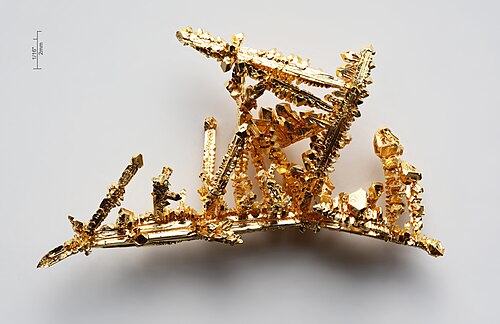 | ||||||||||||||||||||||||||||||||||||||
| 金 | ||||||||||||||||||||||||||||||||||||||
|---|---|---|---|---|---|---|---|---|---|---|---|---|---|---|---|---|---|---|---|---|---|---|---|---|---|---|---|---|---|---|---|---|---|---|---|---|---|---|
| 外観 | メタリックイエロー | |||||||||||||||||||||||||||||||||||||
| 標準原子量 A r °(Au) | ||||||||||||||||||||||||||||||||||||||
| ||||||||||||||||||||||||||||||||||||||
| 周期表における金 | ||||||||||||||||||||||||||||||||||||||
| ||||||||||||||||||||||||||||||||||||||
| 原子番号 ( Z ) | 79 | |||||||||||||||||||||||||||||||||||||
| グループ | グループ11 | |||||||||||||||||||||||||||||||||||||
| 期間 | 期間6 | |||||||||||||||||||||||||||||||||||||
| ブロック | dブロック | |||||||||||||||||||||||||||||||||||||
| 電子配置 | [ゼ] 4f 14 5d 10 6s 1 | |||||||||||||||||||||||||||||||||||||
| 殻あたりの電子数 | 2、8、18、32、18、1 | |||||||||||||||||||||||||||||||||||||
| 物理的特性 | ||||||||||||||||||||||||||||||||||||||
| STPでの フェーズ | 固体 | |||||||||||||||||||||||||||||||||||||
| 融点 | 1337.33 K (1064.18 °C、1947.52 °F) | |||||||||||||||||||||||||||||||||||||
| 沸点 | 3243 K (2970 °C、5378 °F) | |||||||||||||||||||||||||||||||||||||
| 密度(20℃) | 19.283 g/cm3 [ 3] | |||||||||||||||||||||||||||||||||||||
| 液体の場合( mp) | 17.31グラム/ cm3 | |||||||||||||||||||||||||||||||||||||
| 融解熱 | 12.55kJ /モル | |||||||||||||||||||||||||||||||||||||
| 気化熱 | 342kJ/モル | |||||||||||||||||||||||||||||||||||||
| モル熱容量 | 25.418 J/(モル·K) | |||||||||||||||||||||||||||||||||||||
蒸気圧
| ||||||||||||||||||||||||||||||||||||||
| 原子特性 | ||||||||||||||||||||||||||||||||||||||
| 酸化状態 | −3、−2、−1、0、[4] +1、+2、+3、+5( 両性酸化物) | |||||||||||||||||||||||||||||||||||||
| 電気陰性度 | ポーリングスケール: 2.54 | |||||||||||||||||||||||||||||||||||||
| イオン化エネルギー |
| |||||||||||||||||||||||||||||||||||||
| 原子半径 | 経験的: 午後144時 | |||||||||||||||||||||||||||||||||||||
| 共有結合半径 | 136±6時 | |||||||||||||||||||||||||||||||||||||
| ファンデルワールス半径 | 午後166時 | |||||||||||||||||||||||||||||||||||||
 | ||||||||||||||||||||||||||||||||||||||
| その他のプロパティ | ||||||||||||||||||||||||||||||||||||||
| 自然発生 | 原始的な | |||||||||||||||||||||||||||||||||||||
| 結晶構造 | 面心立方(fcc) ( cF4 ) | |||||||||||||||||||||||||||||||||||||
| 格子定数 | 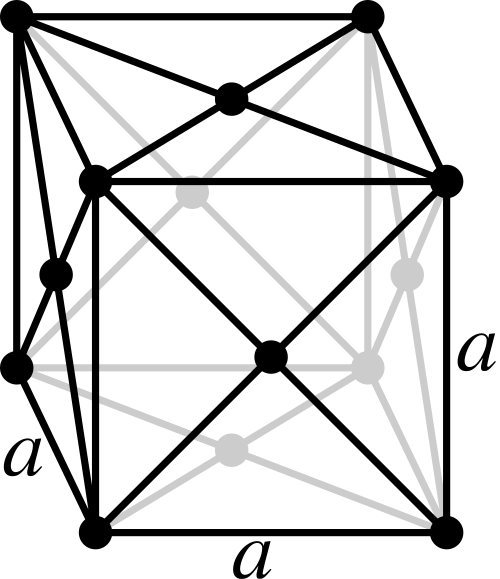 | |||||||||||||||||||||||||||||||||||||
| 熱膨張 | 14.13 × 10 -6 /K (20 °C 時) [3] | |||||||||||||||||||||||||||||||||||||
| 熱伝導率 | 318 W/(m⋅K) | |||||||||||||||||||||||||||||||||||||
| 電気抵抗率 | 22.14 nΩ⋅m(20℃) | |||||||||||||||||||||||||||||||||||||
| 磁気秩序 | 反磁性[5] | |||||||||||||||||||||||||||||||||||||
| モル磁化率 | −28.0 × 10 −6 cm 3 /モル(296 K)[6] | |||||||||||||||||||||||||||||||||||||
| 抗張力 | 120MPa | |||||||||||||||||||||||||||||||||||||
| ヤング率 | 79GPa | |||||||||||||||||||||||||||||||||||||
| せん断弾性係数 | 27GPa | |||||||||||||||||||||||||||||||||||||
| 体積弾性率 | 180GPa [7] | |||||||||||||||||||||||||||||||||||||
| 音速の 細い棒 | 2030 m/s ( 室温で) | |||||||||||||||||||||||||||||||||||||
| ポアソン比 | 0.4 | |||||||||||||||||||||||||||||||||||||
| モース硬度 | 2.5 | |||||||||||||||||||||||||||||||||||||
| ビッカース硬度 | 188~216MPa | |||||||||||||||||||||||||||||||||||||
| ブリネル硬度 | 188~245MPa | |||||||||||||||||||||||||||||||||||||
| CAS番号 | 7440-57-5 | |||||||||||||||||||||||||||||||||||||
| 歴史 | ||||||||||||||||||||||||||||||||||||||
| ネーミング | ラテン語の aurum 「金」から | |||||||||||||||||||||||||||||||||||||
| 発見 | 中東(紀元前6000年以前) | |||||||||||||||||||||||||||||||||||||
| シンボル | 「Au」:ラテン語のaurumから | |||||||||||||||||||||||||||||||||||||
| 金の同位体 | ||||||||||||||||||||||||||||||||||||||
| ||||||||||||||||||||||||||||||||||||||

金は化学元素であり、記号は Au (ラテン語の aurumに由来)、原子番号は79 です。純粋な状態では、明るく、わずかにオレンジがかった黄色で、密度が高く、柔らかく、展性があり、延性のある 金属です。化学的には、金は遷移金属、第 11 族元素、貴金属の 1 つです。反応性が最も低い化学元素の 1 つであり、反応性シリーズでは 2 番目に低い元素です。標準条件下では固体です。
金は、多くの場合、自由元素(自然状態)で、岩石、鉱脈、沖積鉱床中にナゲットまたは粒として存在します。金は、自然元素である銀(エレクトラムなど)との固溶体系列で存在し、銅やパラジウムなどの他の金属と自然に合金化しており、黄鉄鉱などの鉱物包有物にも含まれています。あまり一般的ではありませんが、鉱物中に金化合物として存在し、テルル(テルル化金) と共存することがよくあります。
金はほとんどの酸に耐性がありますが、王水(硝酸と塩酸の混合物)には溶けて、可溶性のテトラクロロ金 酸アニオンを形成します。金は銀や卑金属を溶かす硝酸だけに不溶であり、この特性は金の精錬や金属物質中の金の存在を確認するために古くから使用されており、「酸試験」という用語の由来となっています。金は、鉱業や電気メッキに使用されるシアン化物のアルカリ溶液に溶解します。金は水銀にも溶解してアマルガム合金を形成しますが、金は単なる溶質として機能するため、これは化学反応ではありません。
金は比較的希少な元素であり[9] [10]、有史以来、貨幣、宝飾品、その他の芸術作品に使用されてきた貴金属です。過去には、金本位制が金融政策として頻繁に実施されていました。1930年代には金貨の流通通貨としての鋳造が中止され、 1971年の ニクソンショック以降、世界金本位制は放棄され、不換紙幣制度に移行しました。
2020年、世界最大の金生産国は中国で、ロシアとオーストラリアがそれに続いた。[11] 2020年現在、地上には[update]合計で約201,296トンの金が存在する。 [12]これは、各辺が約21.7メートル(71フィート)の立方体に等しい。世界で生産された新しい金の消費量は、約50%が宝飾品、40%が投資、 10%が産業となっている。[13]金は、その高い展性、延性、腐食およびほとんどの他の化学反応に対する耐性、ならびに電気伝導性により、あらゆる種類のコンピューター化されたデバイスの耐腐食性電気コネクタに引き続き使用されている(主な産業用途)。金はまた、赤外線シールド、色ガラスの製造、金箔、および歯の修復にも使用されている。特定の金塩は、医療において抗炎症剤として現在も使用されている。
特徴
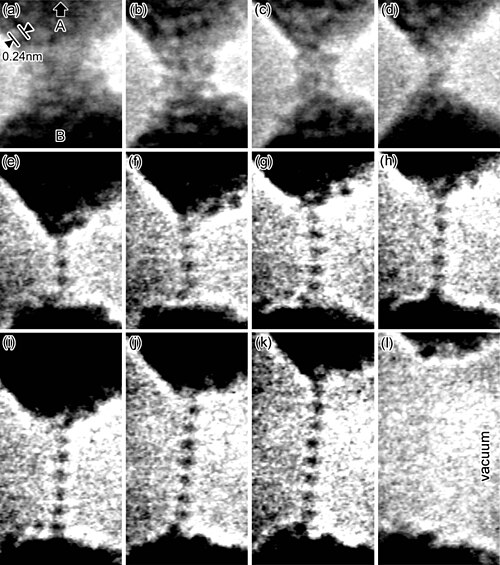

金はすべての金属の中で最も展性が高い。単一原子幅のワイヤに引き伸ばすことができ、その後、かなり引き伸ばしてからでないと切れない。[14]このようなナノワイヤは、目立った硬化を伴わずに、転位や結晶双晶の形成、再配向、移動によって変形する。[15] 1グラムの金を叩いて1平方メートル(11平方フィート)のシートにすることができ、1オンス(約14.5g)なら28平方メートル(300平方フィート)のシートにすることができる。金箔は半透明になるほど薄く叩くことができる。金は黄色と赤を強く反射するため、透過光は緑がかった青に見える。[16]このような半透明のシートは赤外線も強く反射するため、耐熱服のバイザーや宇宙服のサンバイザーの赤外線(放射熱)シールドとして有用である。[17]金は熱と電気の優れた伝導体である。
金の密度は19.3 g/cm 3で、タングステンの19.25 g/cm 3とほぼ同じである。そのため、タングステンは金でメッキするなど、金の延べ棒の偽造に使用されている。 [18] [19] [20] [21]比較すると、鉛の密度は11.34 g/cm 3で、最も密度の高い元素であるオスミウムの密度は11.34 g/cm 3である。22.588 ± 0.015 g/cm3 . [ 22]
色

ほとんどの金属は灰色または銀白色であるのに対し、金はわずかに赤みがかった黄色です。[23]この色は金属の価電子間のプラズマ振動の周波数によって決まり、ほとんどの金属では紫外線範囲ですが、金の場合は金原子の周りの軌道に影響を与える相対論的効果により可視範囲にあります。 [24] [25]同様の効果により、金属セシウムに金色の色合いが与えられます。
一般的な色の金合金には、銅を加えて作られる独特の18金ローズゴールドがあります。パラジウムやニッケルを含む合金も、ホワイトゴールド合金を作るため、商業用ジュエリーでは重要です。14金の金銅合金は、特定の青銅合金とほぼ同じ色で、どちらも警察バッジやその他のバッジを作るのに使用できます。銀のみを含む14金と18金の金合金は緑がかった黄色に見え、グリーンゴールドと呼ばれます。ブルーゴールドは鉄と合金にすることで作ることができ、パープルゴールドはアルミニウムと合金にすることで作ることができます。あまり一般的ではありませんが、マンガン、インジウム、その他の元素を加えると、さまざまな用途でより珍しい色の金を作ることができます。[26]
電子顕微鏡で用いられるコロイド状の金は、粒子が小さい場合は赤色で、粒子が大きい場合は青色です。[27]
同位体
金には安定同位体が1つしかなく、197
Auは金の唯一の天然同位体でもあるため、金は一核種であり、一同位体元素でもある。原子質量169から205までの36の放射性同位体が合成されている。最も安定しているのは195
Auの半減期は186.1日です。最も不安定なのは171
Auは陽子放出により半減期30μsで崩壊します。原子質量が197未満の金の放射性同位体のほとんどは、陽子放出、α崩壊、β +崩壊の組み合わせにより崩壊します。例外は次のとおりです。195
Auは電子捕獲により崩壊し、196
Auは、電子捕獲(93%)によって最も頻繁に崩壊し、β崩壊経路(7%)は少ない。[28]原子質量が197を超える金の放射性同位体はすべてβ崩壊によって崩壊する。 [ 29]
少なくとも32の核異性体も特徴付けられており、原子質量は170から200の範囲です。その範囲内では、178
オー、180
オー、181
オー、182
Au、および188
Auには異性体は存在しない。金の最も安定した異性体は198m2
Auの半減期は2.27日です。金の最も不安定な異性体は177m2
半減期がわずか 7 ns のAu 。184m1
Auにはβ +崩壊、異性体遷移、アルファ崩壊の3つの崩壊経路があります。金の他の異性体や同位体には3つの崩壊経路はありません。 [29]
合成
鉛などのより一般的な元素から金を生成できるかどうかは、長い間人類の探究の対象であり、古代および中世の錬金術の分野ではしばしばこれに焦点が当てられてきました。しかし、化学元素の変換は20世紀に原子核物理学が理解されるまで可能ではありませんでした。金の最初の合成は、1924年に中性子照射によって水銀から金を合成した日本の物理学者長岡半太郎によって行われました。 [30]長岡の先行研究を知らないアメリカの研究チームが1941年に同じ実験を行い、同じ結果を達成し、それによって生成された金の同位体がすべて放射性であることを示しました。[31] 1980年、グレン・シーボーグはローレンス・バークレー研究所で数千個のビスマス原子を金に変換しました。[32] [33]金は原子炉で製造できるが、それは非常に非現実的であり、生産される金の価値よりもはるかにコストがかかる。[34]
化学
_chloride_solution.jpg/500px-Gold(III)_chloride_solution.jpg)
金は貴金属の中で最も貴な金属であるが、[35] [36]多様な化合物を形成している。金の化合物中の酸化状態は -1 から +5 の範囲であるが、その化学的性質は Au(I) と Au(III) が支配的である。Au(I) は金イオンとも呼ばれ、チオエーテル、チオラート、有機ホスフィンなどのソフトリガンドとの最も一般的な酸化状態である。Au(I) 化合物は典型的には直線状である。良い例としてAu(CN)が挙げられる。−2、これは鉱山で見つかる金の可溶性形態である。AuClなどの二成分金ハロゲン化物はジグザグのポリマー鎖を形成し、これもAuでの線状配位を特徴とする。金をベースにしたほとんどの医薬品はAu(I)誘導体である。[37]
Au(III)(オーリックとも呼ばれる)は一般的な酸化状態で、塩化金(III)、Au 2 Cl 6で表されます。Au(III)錯体の金原子中心は、他のd 8化合物と同様に、通常は平面四角形で、共有結合とイオン結合の両方の性質を持つ化学結合をしています。混合原子価錯体の例として、塩化金(I,III)も知られています。
金はどんな温度でも酸素と反応せず[38]、100℃まではオゾンの攻撃にも耐性がある。[39]

![{\displaystyle {\ce {Au{}+O3->[{} \atop {t<100^{\circ }{\text{C}}}]}}({\text{反応なし}})}](https://wikimedia.org/api/rest_v1/media/math/render/svg/15de1bb6553c547be049cb1fcc9c63c2de6f0f1d)
一部の遊離ハロゲンは反応して対応する金ハロゲン化物を形成する。[40]金は鈍い赤色の熱でフッ素に強く侵され[41] 、フッ化金(III) AuF 3 を形成する。粉末金は 180 °C で塩素と反応して塩化金(III) AuCl 3を形成する。[42]金は 140 °C で臭素と反応して臭化金(III) AuBr 3と臭化金(I) AuBrの組み合わせを形成するが、ヨウ素とは非常にゆっくりと反応してヨウ化金(I) AuI を形成する。
![{\displaystyle {\ce {2Au{}+3F2->[{} \atop \Delta ]2AuF3}}}](https://wikimedia.org/api/rest_v1/media/math/render/svg/a5ec545264fef0a0abf4c09d5ffec587e9e919db)
![{\displaystyle {\ce {2Au{}+3Cl2->[{} \atop \Delta ]2AuCl3}}}](https://wikimedia.org/api/rest_v1/media/math/render/svg/7637609dc04da97bf24afe9c25062b02a88d1e05)
![{\displaystyle {\ce {2Au{}+2Br2->[{} \atop \Delta ]AuBr3{}+AuBr}}}](https://wikimedia.org/api/rest_v1/media/math/render/svg/340466f370c6d89ba2884d7e05ef60976bf50cb5)
![{\displaystyle {\ce {2Au{}+I2->[{} \atop \Delta ]2AuI}}}](https://wikimedia.org/api/rest_v1/media/math/render/svg/78c9bd40b7a429514a3a1e848b3886039c71e1b7)
金は硫黄と直接反応しませんが[43]、硫化水素を塩化金(III)または塩化金酸の希薄溶液に通すことで硫化金(III)を作ることができます。
硫黄とは異なり、リンは高温で金と直接反応してリン化金(Au 2 P 3)を生成する。[44]
金は室温で水銀に容易に溶解してアマルガムを形成し、高温では他の多くの金属と合金を形成します。これらの合金は、硬度やその他の冶金特性を変更したり、融点を制御したり、珍しい色を作り出すために製造することができます。 [26]
金はほとんどの酸の影響を受けません。フッ化水素酸、塩酸、臭化水素酸、ヨウ化水素酸、硫酸、硝酸とは反応しません。セレン酸とは反応し、硝酸と塩酸の 1:3 の混合物である王水で溶解します。硝酸は金属を +3 イオンに酸化しますが、その量はごくわずかで、反応の化学平衡のため純粋な酸では通常検出されません。しかし、塩酸によってイオンが平衡から外れ、AuCl が形成されます。−4イオン、または塩化金酸となり、さらなる酸化が可能になります。
![{\displaystyle {\ce {2Au{}+6H2SeO4->[{} \atop {200^{\circ }{\text{C}}}]Au2(SeO4)3{}+3H2SeO3{}+3H2O}}}](https://wikimedia.org/api/rest_v1/media/math/render/svg/71cbeede6cfa81718a8252d5ce67d63065357027)

金も同様にほとんどの塩基の影響を受けません。水溶液、固体、溶融状態の水酸化 ナトリウムや水酸化カリウムとは反応しません。しかし、酸素が存在するアルカリ条件下ではシアン化ナトリウムやシアン化カリウムと反応して可溶性錯体を形成します。[43]
金の一般的な酸化状態には、 +1(金(I)または金化合物)と+3(金(III)または金化合物)があります。溶液中の金イオンは、還元剤として他の金属を加えることで容易に還元され、金属として沈殿します。加えられた金属は酸化されて溶解し、金は溶液から置換され、固体沈殿物として回収されます。
稀な酸化状態
金のあまり一般的ではない酸化状態には、-1、+2、+5 などがあります。
−1の酸化状態は、Au −アニオンを含む化合物である金化物で発生します。例えば、セシウム金化物(CsAu)は、セシウム塩化物モチーフで結晶化します。[45]ルビジウム、カリウム、テトラメチルアンモニウム金化物も知られています。[46]金は222.8 kJ/molとあらゆる金属の中で最も高い電子親和力を持ち、Au − を安定した種にします。 [47]ハロゲン化物に類似しています。
金はまた、チタンテトラオーリドや類似のジルコニウムやハフニウム化合物などの第4族遷移金属との共有結合錯体でも-1の酸化状態をとる。これらの化学物質は、チタン(IV)水素化物と同様に金架橋二量体を形成すると予想される。[48]
金(II)化合物は通常、 Au-Au結合を持つ反磁性体であり、[ Au(CH 2 ) 2 P(C 6 H 5 ) 2 ] 2 Cl 2などである。濃硫酸中のAu(OH) 3溶液を蒸発させると、硫酸金( II ) 、 Au 2 ( SO 4 ) 2の赤色結晶が生成される。当初は混合原子価化合物であると考えられていたが、 Auを含むことが示された。4歳以上2陽イオン、よく知られている水銀(I)イオン、Hg2歳以上2[49] [50]キセノンを配位子として含む金(II)錯体であるテトラキセノノ金(II)カチオンは、 [AuXe 4 ](Sb 2 F 11 ) 2に存在する。[51] 2023年9月、結晶構造中にAu 3+とAu 2+カチオンからなる新しいタイプの金属ハロゲン化物ペロブスカイト材料が発見された。 [52]通常の条件下では予想外に安定していることが示されている。
五フッ化金およびその誘導体アニオンであるAuF−6およびその二フッ素錯体である七フッ化金は、検証された最高の酸化状態である金(V)の唯一の例である。[53]
一部の金化合物は親金結合を示します。親金結合とは、従来の Au-Au 結合には長すぎるが、ファンデルワールス結合よりも短い距離で金イオンが相互作用する傾向を指します。この相互作用の強さは、水素結合に匹敵すると推定されています。
よく定義されたクラスター化合物は数多く存在する。[46]金は、場合によっては部分酸化状態をとる。代表的な例としては、八面体種{Au( P(C 6 H 5 ) 3 )}がある。2歳以上6。
起源
宇宙における金の生産

金は超新星の元素合成や中性子星の衝突によって生成されたと考えられており[54]、太陽系を形成した塵の中に存在していたとも考えられています[55]。
伝統的に、宇宙の金は超新星爆発の元素合成におけるr過程(急速中性子捕獲)によって形成されたと考えられてきましたが、[56]最近では、金や鉄より重い他の元素も中性子星の衝突におけるr過程で大量に生成される可能性があることが示唆されています。[57]どちらの場合も、衛星分光計は当初、生成された金を間接的にしか検出しませんでした。[58]しかし、2017年8月、重力波検出器によってこのイベントが中性子星の合体であることが確認された後、GW170817中性子星合体イベントで、金を含む重元素の分光特性が電磁観測所によって観測されました。 [59]現在の天体物理学モデルは、この単一の中性子星合体イベントで地球の3〜13質量の金が生成されたことを示唆しています。この量と中性子星の合体現象の発生率の推定値から、このような合体によって宇宙に存在するこの元素のほとんどを占めるほどの金が生成される可能性があることが示唆される。[60]
小惑星の起源に関する理論
地球は形成されたときに溶融していたため、初期の地球に存在していた金のほとんどは惑星の核に沈んだと考えられます。したがって、あるモデルで仮説が立てられているように、地球の地殻とマントルにある金のほとんどは、約40億年前の後期重爆撃期に小惑星の衝突によって地球に運ばれたと考えられています。[61] [62]
人間が到達できる金は、あるケースでは、特定の小惑星の衝突と関連付けられてきました。20億2000万年前にフレデフォート衝突構造を形成した小惑星は、南アフリカのウィットウォーターズランド盆地に地球上で最も豊富な金鉱床をもたらしたとよく言われています。[63] [64] [65] [66]しかし、このシナリオは現在疑問視されています。金を含むウィットウォーターズランドの岩石は、フレデフォート衝突の7億年から9億5000万年前に堆積しました。[67] [68]さらに、これらの金を含む岩石は、隕石衝突前にはベンタースドルプ溶岩とトランスバール超群の厚い層に覆われていたため、金は実際には小惑星/隕石に到着しませんでした。しかし、フレデフォートの衝突によってウィットウォーターズランド盆地は歪んでしまい、金を含む岩石は、隕石衝突によってできた直径300kmのクレーターの縁のすぐ内側、ヨハネスブルグのウィットウォーターズランドの現在の浸食面に運ばれました。1886年にこの鉱床が発見され、ウィットウォーターズランド・ゴールドラッシュが始まりました。現在地球上に存在すると確認されている金の約22%は、これらのウィットウォーターズランドの岩石から抽出されたものです。[68]
マントルリターン理論
地球上の残りの金の多くは、惑星の誕生当初から微惑星がマントルを形成した際に地球に取り込まれたと考えられています。2017年、国際的な科学者グループは、アルゼンチンのパタゴニアにあるデセアード山塊での発見によって証明されたように、金は「地球の最も深い部分」であるマントルから地球の表面に来た[69]ことを証明しました。[70] [説明が必要]
発生
_4_(16848647509).jpg/500px-Gold_nugget_(Australia)_4_(16848647509).jpg)
地球上では、金は先カンブリア時代以降に形成された岩石の鉱石の中に見つかっています。[71]金はほとんどの場合、天然金属として、典型的には銀との金属固溶体(すなわち金銀合金)として存在します。このような合金の銀含有量は通常8~10%です。エレクトラムは20%以上の銀を含む元素金であり、一般にホワイトゴールドとして知られています。エレクトラムの色は銀含有量に応じて金銀色から銀色まで変化します。銀が多いほど、比重は低くなります。

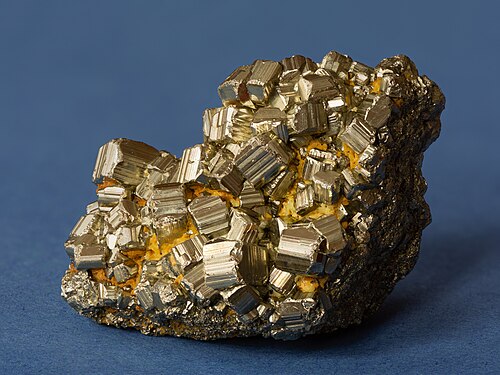
自然金は、岩石に埋め込まれた極小から微細な粒子として存在し、石英や「愚者の金」と呼ばれる黄鉄鉱などの硫化鉱物と一緒に存在することが多い。[72]これらは鉱脈鉱床と呼ばれる。自然状態の金属は、岩石から浸食されて砂金鉱床と呼ばれる沖積鉱床に堆積した、自由な薄片、粒、またはより大きな塊[71]の形でも見つかる。このような自由な金は、付随する鉱物の酸化とそれに続く風化、および塵が小川や川に流れ込み、そこに集まり、水の作用で溶けて塊を形成するため、金鉱脈の露出した表面に常に豊富に存在する。
金は、テルル化物鉱物のカラベライト、クレネライト、ナギャジャイト、ペツァイト、シルバナイト(テルル化物鉱物を参照)として、また稀にビスマス化物マルドナイト(Au 2 Bi)やアンチモン化物オーロスチバイト(AuSb 2 )としてテルル化物と結合して産出することがある。金は銅、鉛、水銀との稀な合金、すなわち金銅鉱(Cu 3 Au)、ノボドネプライト(AuPb 3)、ワイシャナイト((Au,Ag)3 Hg 2)の鉱物としても産出する。
2004年の研究論文によると、微生物は金鉱床の形成において重要な役割を果たすことがあり、金を運搬して沈殿させ、沖積鉱床に集まる粒子や塊を形成する可能性があると示唆されています。[73]
2013年の研究では、断層内の水が地震の際に蒸発し、金が堆積すると主張している。地震が発生すると、水は断層に沿って移動する。水はしばしば断層の潤滑剤として機能し、亀裂や隆起を埋める。地表から約10キロメートル(6.2マイル)下の非常に高い温度と圧力の下にある水は、高濃度の二酸化炭素、シリカ、金を運んでいる。地震が発生すると、断層の隆起が突然大きくなる。空隙内の水は瞬時に蒸発し、蒸気となり、鉱物の石英を形成するシリカと金を流体から押し出して近くの表面に放出する。[74]
海水
世界中の海には金が含まれています。大西洋と北東太平洋で測定された金の濃度は50~150フェムトモル/L、つまり10~30パーツパー京(約10~30 g/km 3)です。一般的に、南大西洋と中央太平洋のサンプルの金の濃度は同じ(約50フェムトモル/L)ですが、確実性は低いです。地中海の深海には、風で運ばれた塵や川が原因で、わずかに高い濃度の金(100~150フェムトモル/L)が含まれています。10パーツパー京では、地球の海には15,000トンの金が含まれていることになります。[75]これらの数字は、1988年より前の文献で報告されたものより3桁も低く、以前のデータに汚染の問題があったことを示しています。
海水から金を経済的に回収できると主張する人は数多くいるが、彼らは間違っていたか、故意に騙していたかのどちらかである。プレスコット・ジャーネガンは1890年代に米国で海水から金を取り出す詐欺を働いたし、1900年代初頭には英国の詐欺師も同じようなことをした。[76] フリッツ・ハーバーは第一次世界大戦後のドイツの賠償金の支払いに役立てようと、海水から金を抽出する研究を行った。[77]海水中の金の濃度が2~64ppbと公表されていたことから、商業的に成功する抽出は可能と思われた。4,000個の水サンプルを分析した結果、平均0.004ppbという結果が出たため、抽出は不可能であることが明らかとなり、ハーバーはプロジェクトを終了した。[78]
歴史


.jpg/500px-Gold_Museum,_Bogota_(36145671394).jpg)
人類が使用した金属として記録されている最も古いものは金のようで、金は自由または「天然」に見つかる。紀元前 4万年頃の旧石器時代後期に使われていたスペインの洞窟で、少量の天然金が発見されている。[80]
世界最古の金の工芸品はブルガリアのもので、紀元前5千年紀(紀元前4600年から紀元前4200年)に遡る。ヴァルナ湖と黒海沿岸のヴァルナ墓地で発見されたものは、歴史上最も古い「年代がはっきりした」金の工芸品の発見と考えられている。[81] [71] [82]ブルガリアの先史時代の発見物の中には、ホトニツァ、ドゥランクラクの金の財宝、パザルジク近郊のクルガン集落ユナツィテの工芸品、サカルの金の財宝、クルガン集落プロヴァディア・ソルニツァタ(「塩の採掘場」)で発見されたビーズや金の宝飾品など、同様に古いと考えられているものもいくつかある。しかし、ヴァルナの金は最も大きく、最も多様であるため、最も古いと言われることが多い。[83]
金の工芸品が古代エジプトに初めて登場したのは、おそらく先王朝時代の始まり、紀元前5千年紀の終わりから紀元前4千年紀の初め頃で、精錬は紀元前4千年紀の間に発達しました。金の工芸品は、紀元前4千年紀の初めに下メソポタミアの考古学に登場します。[84] 1990年の時点で、紀元前4千年紀のヨルダン川西岸のワディ・カナ洞窟墓地で発見された金の工芸品は、レバント地方で発見された最も古いものでした。[85]黄金の帽子やネブラ円盤などの金の工芸品は、紀元前2千年紀の青銅器時代から中央ヨーロッパに登場しました。
金鉱の地図として知られている最古のものは、古代エジプト第19王朝(紀元前1320年~1200年)に描かれたものであるが、金に関する最初の文献は、紀元前1900年頃の第12王朝に記録されている。[86] 紀元前2600年という早い時期のエジプトの象形文字には金について記述されており、ミタンニのトゥシュラッタ王はエジプトでは金が「土よりも豊富」であると主張している。[87]エジプト、特にヌビアには、歴史上ほとんどの期間、主要な金生産地域となるだけの資源があった。最も古い地図の1つであるトリノのパピルスの地図には、ヌビアの金鉱の計画図と地元の地質が示されている。原始的な作業方法はストラボンとシケリアのディオドロスによって記述されており、火をつける方法も含まれていた。大規模な鉱山は、現在のサウジアラビアの紅海にも存在していた。

金については紀元前14世紀頃のアマルナ書簡第19 [88]号と第26 [89]号に言及されている。 [90] [91]
金は旧約聖書で頻繁に言及されており、創世記2章11節(ハビラ)から始まり、金の子牛の物語、メノーラーや金の祭壇を含む神殿の多くの部分で言及されている。新約聖書では、マタイによる福音書の最初の章で、東方の三博士の贈り物に金が含まれている。ヨハネの黙示録21章21節では、新エルサレムの街は「水晶のように澄んだ純金でできた」通りがあると説明されている。黒海の南東隅での金の採掘はミダスの時代から始まっていると言われており、この金は紀元前610年頃のリディアでおそらく世界最古の貨幣の制定に重要な役割を果たした。[92]紀元前8世紀の金羊毛の伝説は、古代世界で砂金鉱床から金粉を捕らえるために羊毛が使われたことを指しているのかもしれない。紀元前6世紀または5世紀から、楚(国家)は四角い金貨の一種である 英元を流通させました。
ローマの冶金学では、水力採掘法の導入により、大規模な金の採掘方法が開発され、特に紀元前25年以降はヒスパニアで、紀元後106年以降はダキアで顕著であった。ローマ最大の鉱山の一つはレオンのラス・メドゥラスにあった。7本の長い水路によって、広大な沖積鉱床の大部分を水路でくみ上げることができた。トランシルヴァニアのロシア・モンタナの鉱山も非常に大規模で、ごく最近まで[いつ? ]露天掘りで採掘が行われていた。また、イギリス国内の小規模な鉱床、例えばドラウコシの砂金鉱床や硬岩鉱床も採掘された。ローマ人が使用した様々な方法は、紀元1世紀末頃に書かれた 大プリニウスの百科事典『博物誌』に詳しく記述されている。
マンサ・ムーサ( 1312年から1337年までマリ帝国を統治)が1324年にメッカにハッジした際、彼は1324年7月にカイロを通過したが、伝えられるところによると、数千人の人々と100頭近くのラクダを含むラクダの列が同行していた。そこで彼は大量の金を配ったため、エジプトでの金の価格は10年以上も下落し、高インフレを引き起こした。[93]同時代のアラブの歴史家は次のように述べている。
彼らがその年にエジプトに来るまで、金は高値でした。メスカルは25ディルハムを下回ることはなく、通常はそれ以上でしたが、その時からその価値は下がり、価格は安くなり、現在まで安いままです。メスカルは22ディルハム以下になることはありません。彼らがエジプトに持ち込み、そこで消費した大量の金が原因で、今日まで約12年間この状況が続いています[...]。
— チハブ・アル・ウマリ、マリ王国[94]

ヨーロッパ人によるアメリカ大陸の探検は、特にメソアメリカ、ペルー、エクアドル、コロンビアの先住民が大量に展示していた金の装飾品に関する報告によって、少なからず促進された。アステカ人は金を神の産物とみなし、文字通り「神の排泄物」(ナワトル語でテオクイトラトル)と呼んでいた。モクテスマ2世が殺害された後、この金の大半はスペインに輸送された。[96]しかし、北アメリカの先住民にとって、金は役に立たないと考えられており、彼らは黒曜石、フリント、スレートなど、彼らの実用性に直接関係する他の鉱物に、はるかに大きな価値を見出していた。[97]
エルドラドは、金貨とともに宝石が大量に見つかったという伝説の物語に当てはめられています。エルドラドの概念はいくつかの変遷を経て、最終的には以前の神話の記述も伝説の失われた都市の記述と組み合わされました。エルドラドは、スペイン帝国がコロンビアのムイスカ原住民の神話上の部族長 (ジパ) を表すために使用した用語で、入会の儀式として、金粉をまとってグアタビタ湖に沈められました。エルドラドにまつわる伝説は、それが人から都市、王国、そして最終的に帝国へと変化するにつれて、時間とともに変化しました。[要出典]
近世初期から、ヨーロッパ人による西アフリカの探検と植民地化は、主にこの地域の金鉱床の報告によって推進され、最終的にヨーロッパ人はこの地域を「ゴールドコースト」と呼ぶようになった。[98] 15世紀後半から19世紀初頭にかけて、この地域におけるヨーロッパ人の貿易は、象牙や奴隷と並んで、主に金に集中していた。[99]西アフリカの金貿易はアシャンティ帝国によって支配されており、同帝国は当初ポルトガル人と貿易を行っていたが、その後分岐してイギリス、フランス、スペイン、デンマークの商人とも貿易を行った。[100]西アフリカの金鉱床の支配権を確保したいというイギリスの願望は、19世紀後半のアングロ・アシャンティ戦争で役割を果たし、アシャンティ帝国はイギリスに併合された。[101]
西洋文化では、金は欲望と堕落の原因としての役割を果たしており、これは『ルンペルシュティルツキン』(農民の娘が王女になった時にその子供と引き換えに干し草を金に変える) や『ジャックと豆の木』での金の卵を産む鶏の盗難といった子供向けの寓話で語られている通りである。
オリンピックや他の多くのスポーツ競技における最高賞は金メダルです。
現在採掘されている金の 75% は 1910 年以降に採掘されており、3 分の 2 は 1950 年以降に採掘されたものである。 [引用が必要]
錬金術師たちの主な目標の一つは、鉛などの他の物質から金を生み出すことだった。おそらくは、賢者の石 と呼ばれる神話上の物質との相互作用によってだったと思われる。金を生み出そうとする試みは、錬金術師たちが物質を使って何ができるかを体系的に見つけることにつながり、これが今日の化学の基礎となり、原子核変換を利用して(非経済的ではあるが)金を生み出すことができるようになった。[102]彼らが金を表す記号として使ったのは、中心に点がある円(☉)で、これは占星術の記号でもあり、古代中国語では太陽を表す文字でもあった。
岩のドームは極薄の金のガラスで覆われている。シク教の黄金寺院、ハルマンディル・サーヒブは金で覆われた建物である。同様に、タイのワット・プラケオ・エメラルド仏教 寺院(ワット)には、装飾的な金箔の彫像と屋根がある。ヨーロッパの王と女王の王冠の中には金で作られたものがあり、金は古代から花嫁の王冠に使われていた。紀元後100年頃の古代タルムードのテキストには、ラビ・アキバの妻ラケルが「黄金のエルサレム」(王冠)を受け取ったと記されている。金で作られたギリシャの埋葬冠が紀元前370年頃の墓で発見された。
-
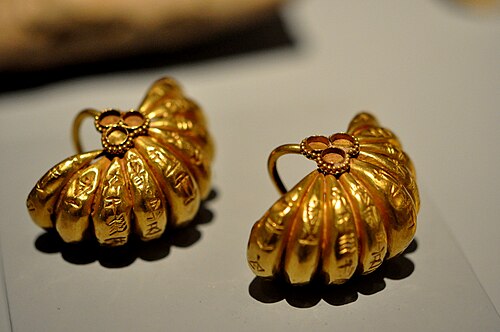
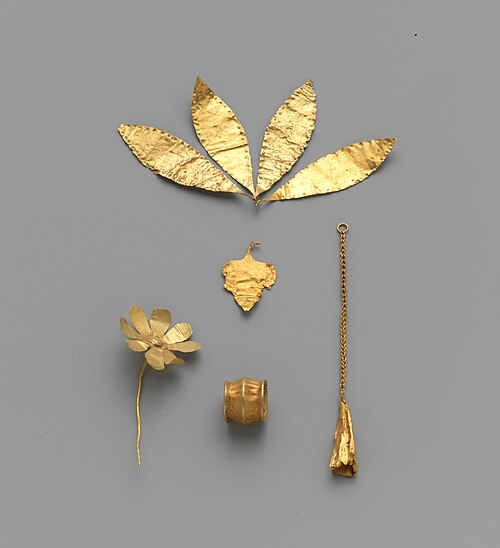 ミノア文明の宝飾品、紀元前2300~2100年、金、メトロポリタン美術館、ニューヨーク
 -
-
![ミノアのカップ、アイギナ島の宝物の一部、紀元前1850-1550年、金、大英博物館[103]](https://img-server.japedia.wiki/wikipedia/commons/thumb/c/c9/Aegina_treasure_10.jpg/500px-Aegina_treasure_10.jpg) ミノアのカップ、アイギナ島の宝物の一部、紀元前1850-1550年、金、大英博物館[103]
ミノアのカップ、アイギナ島の宝物の一部、紀元前1850-1550年、金、大英博物館[103] -

-
 古代エジプトの印章指輪、紀元前664~525年、金、大英博物館
 -
![古代中国の鋳造透かし彫り短剣の柄、紀元前6~5世紀、金、大英博物館[104]](https://img-server.japedia.wiki/wikipedia/commons/thumb/9/95/Openwork_dagger_handle-IMG_4418-black.jpg/500px-Openwork_dagger_handle-IMG_4418-black.jpg) 古代中国の鋳造透かし彫り短剣の柄、紀元前6~5世紀、金、大英博物館[104]
古代中国の鋳造透かし彫り短剣の柄、紀元前6~5世紀、金、大英博物館[104] -

-
 エトルリアの葬祭用花輪、紀元前4~3世紀、金製、メトロポリタン美術館
 -

-
 キンバヤ石灰容器、5~9世紀、金、メトロポリタン美術館
 -
![サットン・フーのアングロサクソンのベルトバックル、ニエロ織り模様、7世紀、金製、大英博物館[105]](https://img-server.japedia.wiki/wikipedia/commons/thumb/5/53/British_Museum_-_Room_41_%2820626313758%29.jpg/500px-British_Museum_-_Room_41_%2820626313758%29.jpg)
-

-
 槍を持ったコウモリの頭をした戦士 2 人が描かれたプレコロンブス期のペンダント、11~16 世紀、金製、メトロポリタン美術館
 -
![インカのラマの中空模型、14-15世紀、金製、大英博物館[106]](https://img-server.japedia.wiki/wikipedia/commons/thumb/d/d0/AHOTWgold_lama.JPG/500px-AHOTWgold_lama.JPG) インカのラマの中空模型、14-15世紀、金製、大英博物館[106]
インカのラマの中空模型、14-15世紀、金製、大英博物館[106] -
![パリスの審判を描いたルネサンス時代の帽子バッジ、16世紀、エナメル加工された金、大英博物館[107]](https://img-server.japedia.wiki/wikipedia/commons/thumb/1/13/The_Judgement_of_Paris%2C_Waddeson_Bequest.jpg/500px-The_Judgement_of_Paris%2C_Waddeson_Bequest.jpg)
-
 ロココ調の箱、ジョージ・マイケル・モーザー作、1741年、金製、メトロポリタン美術館
 -
 ロココ様式の燭台、ジャン・ジョセフ・ド・サンジェルマン作、 1750年頃、金銅、クリーブランド美術館
 -
![ミネルヴァを描いたロココ調嗅ぎタバコ入れ、ジャン=マルキ・ルカン作、1750-1752年、金彩とエナメル、ルーヴル美術館[108]](https://img-server.japedia.wiki/wikipedia/commons/thumb/8/8d/Tabati%C3%A8re_Minerve%2C_Mercure%2C_P%C3%A9gase_%28Louvre%2C_OA_2121%29.jpg/500px-Tabati%C3%A8re_Minerve%2C_Mercure%2C_P%C3%A9gase_%28Louvre%2C_OA_2121%29.jpg) ミネルヴァを描いたロココ調嗅ぎタバコ入れ、ジャン=マルキ・ルカン作、1750-1752年、金彩とエナメル、ルーヴル美術館[108]
ミネルヴァを描いたロココ調嗅ぎタバコ入れ、ジャン=マルキ・ルカン作、1750-1752年、金彩とエナメル、ルーヴル美術館[108] -
![ルイ16世様式の嗅ぎタバコ入れ、ジャン・フレマン作、1763-1764年、金彩とエナメル塗装、ルーヴル美術館[109]](https://img-server.japedia.wiki/wikipedia/commons/thumb/e/ee/Tabati%C3%A8re_J-Fr%C3%A9min_%28Louvre%2C_OA_6857%29.jpg/500px-Tabati%C3%A8re_J-Fr%C3%A9min_%28Louvre%2C_OA_6857%29.jpg) ルイ16世様式の嗅ぎタバコ入れ、ジャン・フレマン作、1763-1764年、金彩とエナメル塗装、ルーヴル美術館[109]
ルイ16世様式の嗅ぎタバコ入れ、ジャン・フレマン作、1763-1764年、金彩とエナメル塗装、ルーヴル美術館[109] -
 新古典主義の洗面台(アテニエンヌまたはラバボ)、1800~1814年、脚、台座、棚板はイチイ材、金メッキのブロンズ製台座、棚板下は鉄板、メトロポリタン美術館
 -
 ゴシック リバイバルクロック、フランス人製作者不明、 1835-1840年頃、金メッキおよび緑青加工を施したブロンズ、パリ装飾美術館
 -
 アールヌーボーのティーポット、アルフォンス・ドゥバン作、金箔銀と象牙、装飾美術館
.jpg/500px-Anillo_de_Sheshonq_(46627183381).jpg)
_MET_DT1262.jpg/500px-Lime_Container_(Poporo)_MET_DT1262.jpg)
![サットン・フーのアングロサクソンのベルトバックル、ニエロ織り模様、7世紀、金製、大英博物館[105]](https://img-server.japedia.wiki/wikipedia/commons/thumb/5/53/British_Museum_-_Room_41_(20626313758).jpg/500px-British_Museum_-_Room_41_(20626313758).jpg)

![パリスの審判を描いたルネサンス時代の帽子バッジ、16世紀、エナメル加工された金、大英博物館[107]](https://img-server.japedia.wiki/wikipedia/commons/thumb/1/13/The_Judgement_of_Paris,_Waddeson_Bequest.jpg/500px-The_Judgement_of_Paris,_Waddeson_Bequest.jpg)
.jpg/500px-Box_with_scene_depicting_Roman_hero_Gaius_Mucius_Scaevola_before_the_Etruscan_king_Lars_Porsena_MET_DP170836_(cropped).jpg)

![ミネルヴァを描いたロココ調嗅ぎタバコ入れ、ジャン=マルキ・ルカン作、1750-1752年、金彩とエナメル、ルーヴル美術館[108]](https://img-server.japedia.wiki/wikipedia/commons/thumb/8/8d/Tabati%C3%A8re_Minerve,_Mercure,_P%C3%A9gase_(Louvre,_OA_2121).jpg/500px-Tabati%C3%A8re_Minerve,_Mercure,_P%C3%A9gase_(Louvre,_OA_2121).jpg)
![ルイ16世様式の嗅ぎタバコ入れ、ジャン・フレマン作、1763-1764年、金彩とエナメル塗装、ルーヴル美術館[109]](https://img-server.japedia.wiki/wikipedia/commons/thumb/e/ee/Tabati%C3%A8re_J-Fr%C3%A9min_(Louvre,_OA_6857).jpg/500px-Tabati%C3%A8re_J-Fr%C3%A9min_(Louvre,_OA_6857).jpg)
_MET_DP106594.jpg/500px-Washstand_(ath%C3%A9nienne_or_lavabo)_MET_DP106594.jpg)


語源
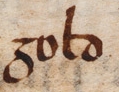
金は多くのゲルマン語族の類似語と同源であり、インド・ヨーロッパ祖語の*ǵʰelh₃- 「輝く、きらめく、黄色または緑色である」からゲルマン祖語の*gulþąを経て派生した。[110] [111]
Auという記号はラテン語の aurum 「金」に由来する。[112] aurumの祖先であるインド・ヨーロッパ語は*h₂é-h₂us-o-で、 「輝く」を意味する。この単語はラテン語のaurora「夜明け」の祖先である*h₂éu̯sōsと同じ語源(インド・ヨーロッパ語の*h₂u̯es- 「夜明け」)から派生した。[113]この語源関係は、 aurumが「輝く夜明け」を意味するという科学出版物での頻繁な主張の背後にあると思われる。[114]
文化

大衆文化において、金は優秀さの高水準であり、賞によく使われる。[47]偉大な業績は、金メダル、金のトロフィー、その他の装飾品の形で、金で報われることが多い。運動競技やその他の段階的な競技の優勝者には通常、金メダルが授与される。ノーベル賞などの多くの賞も金で作られている。その他の賞の像や賞品は金で描かれていたり、金メッキされていたりする(アカデミー賞、ゴールデングローブ賞、エミー賞、パルムドール、英国アカデミー賞など)。[115]
アリストテレスは倫理学において、現在では黄金比として知られているものについて言及する際に金の象徴を用いた。同様に、金は黄金比や黄金律の場合のように、完璧または神聖な原理と関連付けられている。金はさらに、老化と結実の知恵とも関連付けられている。結婚50周年は黄金である。人の最も価値ある、または最も成功した晩年は、「黄金時代」または「黄金の50周年」と見なされることがある。文明の絶頂期は黄金時代と呼ばれる。[116]
宗教

先史時代の人類による金の最初の使用法は宗教的な性質を持っていた。[117]
キリスト教やユダヤ教の一部では、金は神聖なものと邪悪なものの両方と関連づけられてきた。出エジプト記では、金の子牛は偶像崇拝の象徴であり、創世記ではアブラハムは金銀に富んでいたと言われ、モーセは契約の箱の慈悲の座を純金で覆うように命じられた。ビザンチンの図像では、キリスト、聖母マリア、聖人の光輪は金色であることが多い。[ 118 ]
イスラム教では、[119]金(絹とともに)[120] [121]は男性が着用することが禁じられているとよく言われます。[122] アブー・バクル・アル・ジャザエリはハディースを引用して、「私の国の男性は絹と金の着用を禁じられていますが、女性は着用しても問題ありません」と述べています。[123]しかし、これはオスマン帝国など、歴史を通じて一貫して施行されたわけではありません。[124]さらに、刺繍などで衣服に小さな金のアクセントを付けることは許可される場合があります。[125]
古代ギリシャの宗教と神話では、テイアは金、銀、その他の宝石の女神とみなされていました。[126]
クリストファー・コロンブスによれば、金を持っている人は、地球上で非常に価値のあるもの、さらには魂を天国に導く物質を所有していたという。[127]
結婚指輪は一般的に金で作られています。金は長持ちし、時間の経過に左右されず、神の前での永遠の誓いと結婚が意味する完璧さを象徴する指輪として役立ちます。正統派キリスト教の結婚式では、新郎新婦は式典中に金の冠で飾られます (ただし、代わりに花輪を選ぶ人もいます)。これは象徴的な儀式の融合です。[さらに説明が必要]
2020年8月24日、イスラエルの考古学者が中心都市ヤヴネ近郊でイスラム初期の金貨の山を発見した。極めて珍しい425枚の金貨コレクションを分析したところ、9世紀後半のものであることが判明した。約1100年前に遡るこの金貨はアッバース朝時代のものだった。[128]
生産

2016年の米国地質調査所によると、約57億2600万トロイオンス(178,100トン)の金が埋蔵されており、そのうち85%が現在も使用されています。[129]
鉱業と探鉱
.jpg/500px-Miner_underground_at_Pumsaint_gold_mine_(1294028).jpg)

1880年代以降、南アフリカは世界の金供給の大部分を占めており、現在世界の金の約22%は南アフリカ産である。1970年の生産量は世界の供給量の79%、約1,480トンであった。2007年には中国(276トン)が南アフリカを抜いて世界最大の金生産国となったが、南アフリカが世界最大の生産国でなくなったのは1905年以来初めてである。[130]
2020年、中国は世界最大の金採掘国であり、ロシア、オーストラリア、アメリカ、カナダ、ガーナの順で続いた。[11]

南米では、物議を醸しているパスクア・ラマ計画が、チリとアルゼンチンの国境にあるアタカマ砂漠の高山地帯の豊かな土地の開発を目指している。
世界の年間金生産量の最大4分の1は、職人による小規模採掘によるものであると推定されています。[131] [132] [133]
南アフリカのヨハネスブルグ市は、歴史上最大級の天然金鉱床の発見につながったウィットウォーターズランド・ゴールドラッシュの結果築かれた。金鉱床はウィットウォーターズランド盆地の北端と北西端に限られており、ウィットウォーターズランド盆地は、ほとんどの場所でフリーステイト州、ハウテン州、および周辺州の地下深くに位置する、太古代の岩石でできた厚さ5~7kmの層である。 [134]これらのウィットウォーターズランドの岩石は、ヨハネスブルグ市内および周辺のウィットウォーターズランドの地表に露出しているが、ヨハネスブルグの南東と南西にも点在し、ウィットウォーターズランド盆地の中心近くにあるフレデフォート・ドームの周囲の弧にも見られる。 [67] [134]これらの地表露出部から盆地は大きく傾斜しており、採掘の一部はほぼ4,000メートル(13,000フィート)の深さで行われる必要があり、特にヨハネスブルグの南西にあるサブカとタウトナの鉱山は地球上で最も深い鉱山となっている。金は、北と北西からの太古代の川が広大な小石の多い網状河川デルタを形成し、その後「ウィットウォーターズランド海」に流れ込み、残りのウィットウォーターズランド堆積物が堆積した6つの地域でのみ発見されている。[134]
1899年から1901年にかけてイギリス帝国とアフリカーナー・ボーア人の間で起こった第二次ボーア戦争は、少なくとも部分的には南アフリカの鉱山労働者の権利と金の富の所有権をめぐる戦争であった。

19世紀には、大きな金鉱が発見されるたびにゴールドラッシュが起こりました。米国で最初に記録に残る金の発見は、1803年にノースカロライナ州ジョージビル近郊のリード金鉱山でのことでした。 [135]米国で最初の大規模な金鉱脈は、ジョージア州北部の小さな町ダロネガで発見されました。[136]さらに、カリフォルニア、コロラド、ブラックヒルズ、ニュージーランドのオタゴ、オーストラリア各地、南アフリカのウィットウォーターズランド、カナダのクロンダイクでもゴールドラッシュが起こりました。
インドネシアのパプアにあるグラスバーグ鉱山は世界最大の金鉱山である。 [137]
抽出と精製

金の抽出は、大規模で採掘しやすい鉱床で最も経済的です。鉱石の品位が 0.5 ppm 程度であれば経済的です。露天掘りの鉱山の一般的な鉱石の品位は 1 ~ 5 ppm ですが、地下鉱山や硬岩鉱山の鉱石の品位は通常 3 ppm 以上です。金が肉眼で見えるようになるには、通常 30 ppm の鉱石の品位が必要であるため、ほとんどの金鉱山では金は目に見えません。
2007年の金の採掘と抽出の平均コストは1トロイオンスあたり約317ドルでしたが、これは採掘の種類や鉱石の品質によって大きく異なります。世界の鉱山生産量は2,471.1トンでした。[138]
最初の生産後、金は多くの場合、電気分解に基づくウォルウィル法、または溶融塩中の塩素処理であるミラー法によって工業的に精製されます。ウォルウィル法は純度が高くなりますが、より複雑で、小規模な設備でのみ適用されます。 [139] [140]少量の金を分析および精製する他の方法には、分離および分液法、および灰吹法、つまり王水での金の溶解に基づく精製方法があります。[141]
リサイクル
1997年には、市場に供給された2700トンの金のうち、リサイクルされた金が約20%を占めました。[142]ジェネレーションコレクションなどの宝飾品会社やデルなどのコンピューター会社がリサイクルを行っています。[143]
2020年現在、金1キログラムの採掘で排出される二酸化炭素 CO2の量は16トンであるのに対し、金1キログラムをリサイクルすると53キログラムのCO2相当が発生します。2020年現在、世界の金供給量の約30%はリサイクルされており、採掘されていません。[ 144]
消費
The consumption of gold produced in the world is about 50% in jewelry, 40% in investments, and 10% in industry.[13][148]
According to the World Gold Council, China was the world's largest single consumer of gold in 2013, overtaking India.[149]
Pollution
Gold production is associated with contribution to hazardous pollution.[150]
Low-grade gold ore may contain less than one ppm gold metal; such ore is ground and mixed with sodium cyanide to dissolve the gold. Cyanide is a highly poisonous chemical, which can kill living creatures when exposed in minute quantities. Many cyanide spills[151] from gold mines have occurred in both developed and developing countries which killed aquatic life in long stretches of affected rivers. Environmentalists consider these events major environmental disasters.[152][153] Up to thirty tons of used ore can be dumped as waste for producing one troy ounce of gold.[154] Gold ore dumps are the source of many heavy elements such as cadmium, lead, zinc, copper, arsenic, selenium and mercury. When sulfide-bearing minerals in these ore dumps are exposed to air and water, the sulfide transforms into sulfuric acid which in turn dissolves these heavy metals facilitating their passage into surface water and ground water. This process is called acid mine drainage. These gold ore dumps contain long-term, highly hazardous waste.[154]
It was once common to use mercury to recover gold from ore, but today the use of mercury is largely limited to small-scale individual miners.[155] Minute quantities of mercury compounds can reach water bodies, causing heavy metal contamination. Mercury can then enter into the human food chain in the form of methylmercury. Mercury poisoning in humans causes incurable brain function damage and severe retardation.[156]
Gold extraction is also a highly energy-intensive industry, extracting ore from deep mines and grinding the large quantity of ore for further chemical extraction requires nearly 25 kWh of electricity per gram of gold produced.[157]
Monetary use

Gold has been widely used throughout the world as money,[158] for efficient indirect exchange (versus barter), and to store wealth in hoards. For exchange purposes, mints produce standardized gold bullion coins, bars and other units of fixed weight and purity.
The first known coins containing gold were struck in Lydia, Asia Minor, around 600 BC.[92] The talent coin of gold in use during the periods of Grecian history both before and during the time of the life of Homer weighed between 8.42 and 8.75 grams.[159] From an earlier preference in using silver, European economies re-established the minting of gold as coinage during the thirteenth and fourteenth centuries.[160]
Bills (that mature into gold coin) and gold certificates (convertible into gold coin at the issuing bank) added to the circulating stock of gold standard money in most 19th century industrial economies. In preparation for World War I the warring nations moved to fractional gold standards, inflating their currencies to finance the war effort. Post-war, the victorious countries, most notably Britain, gradually restored gold-convertibility, but international flows of gold via bills of exchange remained embargoed; international shipments were made exclusively for bilateral trades or to pay war reparations.
After World War II gold was replaced by a system of nominally convertible currencies related by fixed exchange rates following the Bretton Woods system. Gold standards and the direct convertibility of currencies to gold have been abandoned by world governments, led in 1971 by the United States' refusal to redeem its dollars in gold. Fiat currency now fills most monetary roles. Switzerland was the last country to tie its currency to gold; this was ended by a referendum in 1999.[161]

Central banks continue to keep a portion of their liquid reserves as gold in some form, and metals exchanges such as the London Bullion Market Association still clear transactions denominated in gold, including future delivery contracts. Today, gold mining output is declining.[162] With the sharp growth of economies in the 20th century, and increasing foreign exchange, the world's gold reserves and their trading market have become a small fraction of all markets and fixed exchange rates of currencies to gold have been replaced by floating prices for gold and gold future contract. Though the gold stock grows by only 1% or 2% per year, very little metal is irretrievably consumed. Inventory above ground would satisfy many decades of industrial and even artisan uses at current prices.
The gold proportion (fineness) of alloys is measured by karat (k). Pure gold (commercially termed fine gold) is designated as 24 karat, abbreviated 24k. English gold coins intended for circulation from 1526 into the 1930s were typically a standard 22k alloy called crown gold,[163] for hardness (American gold coins for circulation after 1837 contain an alloy of 0.900 fine gold, or 21.6 kt).[164]
Although the prices of some platinum group metals can be much higher, gold has long been considered the most desirable of precious metals, and its value has been used as the standard for many currencies. Gold has been used as a symbol for purity, value, royalty, and particularly roles that combine these properties. Gold as a sign of wealth and prestige was ridiculed by Thomas More in his treatise Utopia. On that imaginary island, gold is so abundant that it is used to make chains for slaves, tableware, and lavatory seats. When ambassadors from other countries arrive, dressed in ostentatious gold jewels and badges, the Utopians mistake them for menial servants, paying homage instead to the most modestly dressed of their party.
The ISO 4217 currency code of gold is XAU.[165] Many holders of gold store it in form of bullion coins or bars as a hedge against inflation or other economic disruptions, though its efficacy as such has been questioned; historically, it has not proven itself reliable as a hedging instrument.[166] Modern bullion coins for investment or collector purposes do not require good mechanical wear properties; they are typically fine gold at 24k, although the American Gold Eagle and the British gold sovereign continue to be minted in 22k (0.92) metal in historical tradition, and the South African Krugerrand, first released in 1967, is also 22k (0.92).[167]
The special issue Canadian Gold Maple Leaf coin contains the highest purity gold of any bullion coin, at 99.999% or 0.99999, while the popular issue Canadian Gold Maple Leaf coin has a purity of 99.99%. In 2006, the United States Mint began producing the American Buffalo gold bullion coin with a purity of 99.99%. The Australian Gold Kangaroos were first coined in 1986 as the Australian Gold Nugget but changed the reverse design in 1989. Other modern coins include the Austrian Vienna Philharmonic bullion coin and the Chinese Gold Panda.[168]
Price

Like other precious metals, gold is measured by troy weight and by grams. The proportion of gold in the alloy is measured by karat (k), with 24 karat (24k) being pure gold (100%), and lower karat numbers proportionally less (18k = 75%). The purity of a gold bar or coin can also be expressed as a decimal figure ranging from 0 to 1, known as the millesimal fineness, such as 0.995 being nearly pure.
The price of gold is determined through trading in the gold and derivatives markets, but a procedure known as the Gold Fixing in London, originating in September 1919, provides a daily benchmark price to the industry. The afternoon fixing was introduced in 1968 to provide a price when US markets are open.[169] As of September 2017[update], gold was valued at around $42 per gram ($1,300 per troy ounce).
History
Historically gold coinage was widely used as currency; when paper money was introduced, it typically was a receipt redeemable for gold coin or bullion. In a monetary system known as the gold standard, a certain weight of gold was given the name of a unit of currency. For a long period, the United States government set the value of the US dollar so that one troy ounce was equal to $20.67 ($0.665 per gram), but in 1934 the dollar was devalued to $35.00 per troy ounce ($0.889/g). By 1961, it was becoming hard to maintain this price, and a pool of US and European banks agreed to manipulate the market to prevent further currency devaluation against increased gold demand.[170]
The largest gold depository in the world is that of the U.S. Federal Reserve Bank in New York, which holds about 3%[171] of the gold known to exist and accounted for today, as does the similarly laden U.S. Bullion Depository at Fort Knox. In 2005 the World Gold Council estimated total global gold supply to be 3,859 tonnes and demand to be 3,754 tonnes, giving a surplus of 105 tonnes.[172]
After 15 August 1971 Nixon shock, the price began to greatly increase,[173] and between 1968 and 2000 the price of gold ranged widely, from a high of $850 per troy ounce ($27.33/g) on 21 January 1980, to a low of $252.90 per troy ounce ($8.13/g) on 21 June 1999 (London Gold Fixing).[174] Prices increased rapidly from 2001, but the 1980 high was not exceeded until 3 January 2008, when a new maximum of $865.35 per troy ounce was set.[175] Another record price was set on 17 March 2008, at $1023.50 per troy ounce ($32.91/g).[175]
On 2 December 2009, gold reached a new high closing at $1,217.23.[176] Gold further rallied hitting new highs in May 2010 after the European Union debt crisis prompted further purchase of gold as a safe asset.[177][178] On 1 March 2011, gold hit a new all-time high of $1432.57, based on investor concerns regarding ongoing unrest in North Africa as well as in the Middle East.[179]
From April 2001 to August 2011, spot gold prices more than quintupled in value against the US dollar, hitting a new all-time high of $1,913.50 on 23 August 2011,[180] prompting speculation that the long secular bear market had ended and a bull market had returned.[181] However, the price then began a slow decline towards $1200 per troy ounce in late 2014 and 2015.
In August 2020, the gold price picked up to US$2060 per ounce after a total growth of 59% from August 2018 to October 2020, a period during which it outplaced the Nasdaq total return of 54%.[182]
Gold futures are traded on the COMEX exchange.[183] These contacts are priced in USD per troy ounce (1 troy ounce = 31.1034768 grams).[184] Below are the CQG contract specifications outlining the futures contracts:
Other applications
Jewelry


Because of the softness of pure (24k) gold, it is usually alloyed with other metals for use in jewelry, altering its hardness and ductility, melting point, color and other properties. Alloys with lower karat rating, typically 22k, 18k, 14k or 10k, contain higher percentages of copper, silver, palladium or other base metals in the alloy.[26] Nickel is toxic, and its release from nickel white gold is controlled by legislation in Europe.[26] Palladium-gold alloys are more expensive than those using nickel.[185] High-karat white gold alloys are more resistant to corrosion than are either pure silver or sterling silver. The Japanese craft of Mokume-gane exploits the color contrasts between laminated colored gold alloys to produce decorative wood-grain effects.
By 2014, the gold jewelry industry was escalating despite a dip in gold prices. Demand in the first quarter of 2014 pushed turnover to $23.7 billion according to a World Gold Council report.
Gold solder is used for joining the components of gold jewelry by high-temperature hard soldering or brazing. If the work is to be of hallmarking quality, the gold solder alloy must match the fineness of the work, and alloy formulas are manufactured to color-match yellow and white gold. Gold solder is usually made in at least three melting-point ranges referred to as Easy, Medium and Hard. By using the hard, high-melting point solder first, followed by solders with progressively lower melting points, goldsmiths can assemble complex items with several separate soldered joints. Gold can also be made into thread and used in embroidery.
Electronics
Only 10% of the world consumption of new gold produced goes to industry,[13] but by far the most important industrial use for new gold is in fabrication of corrosion-free electrical connectors in computers and other electrical devices. For example, according to the World Gold Council, a typical cell phone may contain 50 mg of gold, worth about three dollars. But since nearly one billion cell phones are produced each year, a gold value of US$2.82 in each phone adds to US$2.82 billion in gold from just this application.[186] (Prices updated to November 2022)
Though gold is attacked by free chlorine, its good conductivity and general resistance to oxidation and corrosion in other environments (including resistance to non-chlorinated acids) has led to its widespread industrial use in the electronic era as a thin-layer coating on electrical connectors, thereby ensuring good connection. For example, gold is used in the connectors of the more expensive electronics cables, such as audio, video and USB cables. The benefit of using gold over other connector metals such as tin in these applications has been debated; gold connectors are often criticized by audio-visual experts as unnecessary for most consumers and seen as simply a marketing ploy. However, the use of gold in other applications in electronic sliding contacts in highly humid or corrosive atmospheres, and in use for contacts with a very high failure cost (certain computers, communications equipment, spacecraft, jet aircraft engines) remains very common.[187]
Besides sliding electrical contacts, gold is also used in electrical contacts because of its resistance to corrosion, electrical conductivity, ductility and lack of toxicity.[188] Switch contacts are generally subjected to more intense corrosion stress than are sliding contacts. Fine gold wires are used to connect semiconductor devices to their packages through a process known as wire bonding.
The concentration of free electrons in gold metal is 5.91×1022 cm−3.[189] Gold is highly conductive to electricity and has been used for electrical wiring in some high-energy applications (only silver and copper are more conductive per volume, but gold has the advantage of corrosion resistance). For example, gold electrical wires were used during some of the Manhattan Project's atomic experiments, but large high-current silver wires were used in the calutron isotope separator magnets in the project.
It is estimated that 16% of the world's presently-accounted-for gold and 22% of the world's silver is contained in electronic technology in Japan.[190]
Medicine
Metallic and gold compounds have long been used for medicinal purposes. Gold, usually as the metal, is perhaps the most anciently administered medicine (apparently by shamanic practitioners)[191] and known to Dioscorides.[192][193] In medieval times, gold was often seen as beneficial for the health, in the belief that something so rare and beautiful could not be anything but healthy. Even some modern esotericists and forms of alternative medicine assign metallic gold a healing power.
In the 19th century gold had a reputation as an anxiolytic, a therapy for nervous disorders. Depression, epilepsy, migraine, and glandular problems such as amenorrhea and impotence were treated, and most notably alcoholism (Keeley, 1897).[194]
The apparent paradox of the actual toxicology of the substance suggests the possibility of serious gaps in the understanding of the action of gold in physiology.[195] Only salts and radioisotopes of gold are of pharmacological value, since elemental (metallic) gold is inert to all chemicals it encounters inside the body (e.g., ingested gold cannot be attacked by stomach acid). Some gold salts do have anti-inflammatory properties and at present two are still used as pharmaceuticals in the treatment of arthritis and other similar conditions in the US (sodium aurothiomalate and auranofin). These drugs have been explored as a means to help to reduce the pain and swelling of rheumatoid arthritis, and also (historically) against tuberculosis and some parasites.[196]
Gold alloys are used in restorative dentistry, especially in tooth restorations, such as crowns and permanent bridges. The gold alloys' slight malleability facilitates the creation of a superior molar mating surface with other teeth and produces results that are generally more satisfactory than those produced by the creation of porcelain crowns. The use of gold crowns in more prominent teeth such as incisors is favored in some cultures and discouraged in others.
Colloidal gold preparations (suspensions of gold nanoparticles) in water are intensely red-colored, and can be made with tightly controlled particle sizes up to a few tens of nanometers across by reduction of gold chloride with citrate or ascorbate ions. Colloidal gold is used in research applications in medicine, biology and materials science. The technique of immunogold labeling exploits the ability of the gold particles to adsorb protein molecules onto their surfaces. Colloidal gold particles coated with specific antibodies can be used as probes for the presence and position of antigens on the surfaces of cells.[197] In ultrathin sections of tissues viewed by electron microscopy, the immunogold labels appear as extremely dense round spots at the position of the antigen.[198]
Gold, or alloys of gold and palladium, are applied as conductive coating to biological specimens and other non-conducting materials such as plastics and glass to be viewed in a scanning electron microscope. The coating, which is usually applied by sputtering with an argon plasma, has a triple role in this application. Gold's very high electrical conductivity drains electrical charge to earth, and its very high density provides stopping power for electrons in the electron beam, helping to limit the depth to which the electron beam penetrates the specimen. This improves definition of the position and topography of the specimen surface and increases the spatial resolution of the image. Gold also produces a high output of secondary electrons when irradiated by an electron beam, and these low-energy electrons are the most commonly used signal source used in the scanning electron microscope.[199]
The isotope gold-198 (half-life 2.7 days) is used in nuclear medicine, in some cancer treatments and for treating other diseases.[200][201]
Cuisine
- Gold can be used in food and has the E number 175.[202] In 2016, the European Food Safety Authority published an opinion on the re-evaluation of gold as a food additive. Concerns included the possible presence of minute amounts of gold nanoparticles in the food additive, and that gold nanoparticles have been shown to be genotoxic in mammalian cells in vitro.[203]
- Gold leaf, flake or dust is used on and in some gourmet foods, notably sweets and drinks as decorative ingredient.[204] Gold flake was used by the nobility in medieval Europe as a decoration in food and drinks,[205]
- Danziger Goldwasser (German: Gold water of Danzig) or Goldwasser (English: Goldwater) is a traditional German herbal liqueur[206] produced in what is today Gdańsk, Poland, and Schwabach, Germany, and contains flakes of gold leaf. There are also some expensive (c. $1000) cocktails which contain flakes of gold leaf. However, since metallic gold is inert to all body chemistry, it has no taste, it provides no nutrition, and it leaves the body unaltered.[207]
- Vark is a foil composed of a pure metal that is sometimes gold,[208] and is used for garnishing sweets in South Asian cuisine.
Miscellanea


- Gold produces a deep, intense red color when used as a coloring agent in cranberry glass.
- In photography, gold toners are used to shift the color of silver bromide black-and-white prints towards brown or blue tones, or to increase their stability. Used on sepia-toned prints, gold toners produce red tones. Kodak published formulas for several types of gold toners, which use gold as the chloride.[209]
- Gold is a good reflector of electromagnetic radiation such as infrared and visible light, as well as radio waves. It is used for the protective coatings on many artificial satellites, in infrared protective faceplates in thermal-protection suits and astronauts' helmets, and in electronic warfare planes such as the EA-6B Prowler.
- Gold is used as the reflective layer on some high-end CDs.
- Automobiles may use gold for heat shielding. McLaren uses gold foil in the engine compartment of its F1 model.[210]
- Gold can be manufactured so thin that it appears semi-transparent. It is used in some aircraft cockpit windows for de-icing or anti-icing by passing electricity through it. The heat produced by the resistance of the gold is enough to prevent ice from forming.[211]
- Gold is attacked by and dissolves in alkaline solutions of potassium or sodium cyanide, to form the salt gold cyanide—a technique that has been used in extracting metallic gold from ores in the cyanide process. Gold cyanide is the electrolyte used in commercial electroplating of gold onto base metals and electroforming.
- Gold chloride (chloroauric acid) solutions are used to make colloidal gold by reduction with citrate or ascorbate ions. Gold chloride and gold oxide are used to make cranberry or red-colored glass, which, like colloidal gold suspensions, contains evenly sized spherical gold nanoparticles.[212]
- Gold, when dispersed in nanoparticles, can act as a heterogeneous catalyst of chemical reactions.
- In recent years, gold has been used as a symbol of pride by the autism rights movement, as its symbol Au could be seen as similar to the word "autism".[213]
Toxicity
Pure metallic (elemental) gold is non-toxic and non-irritating when ingested[214] and is sometimes used as a food decoration in the form of gold leaf.[215] Metallic gold is also a component of the alcoholic drinks Goldschläger, Gold Strike, and Goldwasser. Metallic gold is approved as a food additive in the EU (E175 in the Codex Alimentarius). Although the gold ion is toxic, the acceptance of metallic gold as a food additive is due to its relative chemical inertness, and resistance to being corroded or transformed into soluble salts (gold compounds) by any known chemical process which would be encountered in the human body.
Soluble compounds (gold salts) such as gold chloride are toxic to the liver and kidneys. Common cyanide salts of gold such as potassium gold cyanide, used in gold electroplating, are toxic by virtue of both their cyanide and gold content. There are rare cases of lethal gold poisoning from potassium gold cyanide.[216][217] Gold toxicity can be ameliorated with chelation therapy with an agent such as dimercaprol.
Gold metal was voted Allergen of the Year in 2001 by the American Contact Dermatitis Society; gold contact allergies affect mostly women.[218] Despite this, gold is a relatively non-potent contact allergen, in comparison with metals like nickel.[219]
A sample of the fungus Aspergillus niger was found growing from gold mining solution; and was found to contain cyano metal complexes, such as gold, silver, copper, iron and zinc. The fungus also plays a role in the solubilization of heavy metal sulfides.[220]
See also
- Bulk leach extractable gold, for sampling ores
- Chrysiasis (dermatological condition)
- Digital gold currency, form of electronic currency
- GFMS business consultancy
- Gold fingerprinting, use impurities to identify an alloy
- Gold standard in banking
- List of countries by gold production
- Tumbaga, alloy of gold and copper
- Iron pyrite, fool's gold
- Nordic gold, non-gold copper alloy
References
- ^ "Standard Atomic Weights: Gold". CIAAW. 2017.
- ^ Prohaska, Thomas; Irrgeher, Johanna; Benefield, Jacqueline; Böhlke, John K.; Chesson, Lesley A.; Coplen, Tyler B.; Ding, Tiping; Dunn, Philip J. H.; Gröning, Manfred; Holden, Norman E.; Meijer, Harro A. J. (4 May 2022). "Standard atomic weights of the elements 2021 (IUPAC Technical Report)". Pure and Applied Chemistry. doi:10.1515/pac-2019-0603. ISSN 1365-3075.
- ^ a b c Arblaster, John W. (2018). Selected Values of the Crystallographic Properties of Elements. Materials Park, Ohio: ASM International. ISBN 978-1-62708-155-9.
- ^ Mézaille, Nicolas; Avarvari, Narcis; Maigrot, Nicole; Ricard, Louis; Mathey, François; Le Floch, Pascal; Cataldo, Laurent; Berclaz, Théo; Geoffroy, Michel (1999). "Gold(I) and Gold(0) Complexes of Phosphinine‐Based Macrocycles". Angewandte Chemie International Edition. 38 (21): 3194–3197. doi:10.1002/(SICI)1521-3773(19991102)38:21<3194::AID-ANIE3194>3.0.CO;2-O. PMID 10556900.
- ^ Lide, D. R., ed. (2005). "Magnetic susceptibility of the elements and inorganic compounds". CRC Handbook of Chemistry and Physics (PDF) (86th ed.). Boca Raton (FL): CRC Press. ISBN 0-8493-0486-5.
- ^ Weast, Robert (1984). CRC, Handbook of Chemistry and Physics. Boca Raton, Florida: Chemical Rubber Company Publishing. pp. E110. ISBN 0-8493-0464-4.
- ^ Kelly, P. F. (2015). Properties of Materials. CRC Press. p. 355. ISBN 978-1-4822-0624-1.
- ^ Kondev, F. G.; Wang, M.; Huang, W. J.; Naimi, S.; Audi, G. (2021). "The NUBASE2020 evaluation of nuclear properties" (PDF). Chinese Physics C. 45 (3): 030001. doi:10.1088/1674-1137/abddae.
- ^ Duckenfield, Mark (2016). The Monetary History of Gold: A Documentary History, 1660–1999. Routledge. p. 4. ISBN 9781315476124.
Its scarcity makes it a useful store of value; however, its relative rarity reduced its utility as a currency, especially for transactions in small denominations.
- ^ Pearce, Susan M. (1993). Museums, Objects, and Collections: A Cultural Study. Smithsonian Books. p. 53. ISBN 9781588345172.
Its scarcity makes it a useful store of value; however, its relative rarity reduced its utility as a currency, especially for transactions in small denominations. ... Rarity is, nevertheless, in itself a source of value, and so is the degree of difficulty which surrounds the winning of the raw material, especially if it is exotic and has to be brought some distance. Gold is, geologically, a relatively rare material on Earth and occurs only in specific places which are remote from most other places.
- ^ a b "Gold Production & Mining Data by Country". 7 June 2023.
- ^ "Above-ground stocks". gold.org. Retrieved 18 October 2021.
- ^ a b c Soos, Andy (6 January 2011). "Gold Mining Boom Increasing Mercury Pollution Risk". Advanced Media Solutions, Inc. Oilprice.com. Retrieved 26 March 2011.
- ^ a b Kizuka, Tokushi (1 April 2008). "Atomic configuration and mechanical and electrical properties of stable gold wires of single-atom width" (PDF). Physical Review B. 77 (15): 155401. Bibcode:2008PhRvB..77o5401K. doi:10.1103/PhysRevB.77.155401. hdl:2241/99261. ISSN 1098-0121. Archived (PDF) from the original on 16 July 2021.
- ^ Che Lah, Nurul Akmal; Trigueros, Sonia (2019). "Synthesis and modelling of the mechanical properties of Ag, Au and Cu nanowires". Science and Technology of Advanced Materials. 20 (1): 225–261. Bibcode:2019STAdM..20..225L. doi:10.1080/14686996.2019.1585145. ISSN 1468-6996. PMC 6442207. PMID 30956731.
- ^ "Gold: causes of color". Retrieved 6 June 2009.
- ^ Mallan, Lloyd (1971). Suiting up for space: the evolution of the space suit. John Day Co. p. 216. ISBN 978-0-381-98150-1.
- ^ Gray, Theo (14 March 2008). "How to Make Convincing Fake-Gold Bars". Popular Science. Retrieved 18 June 2008.
- ^ Willie, Jim (18 November 2009) "Zinc Dimes, Tungsten Gold & Lost Respect Archived 8 October 2011 at the Wayback Machine". Kitco
- ^ "Largest Private Refinery Discovers Gold-Plated Tungsten Bar | Coin Update". news.coinupdate.com.
- ^ "Austrians Seize False Gold Tied to London Bullion Theft". The New York Times. 22 December 1983. Retrieved 25 March 2012.
- ^ Arblaster, J. W. (1995). "Osmium, the Densest Metal Known" (PDF). Platinum Metals Review. 39 (4): 164. doi:10.1595/003214095X394164164. S2CID 267393021. Archived from the original (PDF) on 18 October 2016. Retrieved 14 October 2016.
- ^ Encyclopædia of Chemistry, Theoretical, Practical, and Analytical, as Applied to the Arts and Manufacturers: Glass-zinc. J.B. Lippincott & Company. 1880. pp. 70–.
- ^ "Relativity in Chemistry". Math.ucr.edu. Retrieved 5 April 2009.
- ^ Schmidbaur, Hubert; Cronje, Stephanie; Djordjevic, Bratislav; Schuster, Oliver (2005). "Understanding gold chemistry through relativity". Chemical Physics. 311 (1–2): 151–161. Bibcode:2005CP....311..151S. doi:10.1016/j.chemphys.2004.09.023.
- ^ a b c d Jewellery Alloys. World Gold Council
- ^ Electron Microscopy in Microbiology. Academic Press. 1988. ISBN 978-0-08-086049-7.
- ^ "Nudat 2". National Nuclear Data Center. Retrieved 12 April 2012.
- ^ a b Audi, Georges; Bersillon, Olivier; Blachot, Jean; Wapstra, Aaldert Hendrik (2003), "The NUBASE evaluation of nuclear and decay properties", Nuclear Physics A, 729: 3–128, Bibcode:2003NuPhA.729....3A, doi:10.1016/j.nuclphysa.2003.11.001
- ^ Miethe, A. (1924). "Der Zerfall des Quecksilberatoms". Die Naturwissenschaften. 12 (29): 597–598. Bibcode:1924NW.....12..597M. doi:10.1007/BF01505547. S2CID 35613814.
- ^ Sherr, R.; Bainbridge, K. T. & Anderson, H. H. (1941). "Transmutation of Mercury by Fast Neutrons". Physical Review. 60 (7): 473–479. Bibcode:1941PhRv...60..473S. doi:10.1103/PhysRev.60.473.
- ^ Aleklett, K.; Morrissey, D.; Loveland, W.; McGaughey, P.; Seaborg, G. (1981). "Energy dependence of 209Bi fragmentation in relativistic nuclear collisions". Physical Review C. 23 (3): 1044. Bibcode:1981PhRvC..23.1044A. doi:10.1103/PhysRevC.23.1044.
- ^ Matthews, Robert (2 December 2001). "The Philosopher's Stone". The Daily Telegraph. Retrieved 22 September 2020.
- ^ Shipman, James; Wilson, Jerry D.; Higgins, Charles A. (2012). An Introduction to Physical Science (13th ed.). Cengage Learning. p. 273. ISBN 9781133709497.
- ^ Hammer, B.; Norskov, J. K. (1995). "Why gold is the noblest of all the metals". Nature. 376 (6537): 238–240. Bibcode:1995Natur.376..238H. doi:10.1038/376238a0. S2CID 4334587.
- ^ Johnson, P. B.; Christy, R. W. (1972). "Optical Constants of the Noble Metals". Physical Review B. 6 (12): 4370–4379. Bibcode:1972PhRvB...6.4370J. doi:10.1103/PhysRevB.6.4370.
- ^ Shaw III, C. F. (1999). "Gold-Based Medicinal Agents". Chemical Reviews. 99 (9): 2589–2600. doi:10.1021/cr980431o. PMID 11749494.
- ^ "Chemistry of Oxygen". Chemwiki UC Davis. 2 October 2013. Archived from the original on 14 July 2016. Retrieved 1 May 2016.
- ^ Craig, B. D.; Anderson, D. B., eds. (1995). Handbook of Corrosion Data. Materials Park, Ohio: ASM International. p. 587. ISBN 978-0-87170-518-1.
- ^ Wiberg, Egon; Wiberg, Nils & Holleman, Arnold Frederick (2001). Inorganic Chemistry (101st ed.). Academic Press. p. 1286. ISBN 978-0-12-352651-9.
- ^ Wiberg, Egon; Wiberg, Nils (2001). Inorganic Chemistry. Academic Press. p. 404. ISBN 978-0-12-352651-9.
- ^ Wiberg, Wiberg & Holleman 2001, pp. 1286–1287
- ^ a b Emery, J. F.; Ledditcotte, G. W. (May 1961). "Nuclear Science Series (NAS-NS 3036) The Radio Chemistry of Gold" (PDF). Oak Ridge, TN: National Academy of Sciences — National Research Council — Subcommittee on Radio Chemistry. US Atomic Energy Commission. Archived (PDF) from the original on 10 November 2004. Retrieved 24 February 2021.
- ^ Wolfgang Jeitschko; Manfred H. Moller (1979). "The crystal structures of Au2P3 and Au7P10I, polyphosphides with weak Au–Au interactions". Acta Crystallographica B. 35 (3): 573–579. Bibcode:1979AcCrB..35..573J. doi:10.1107/S0567740879004180.
- ^ Jansen, Martin (2005). "Effects of relativistic motion of electrons on the chemistry of gold and platinum". Solid State Sciences. 7 (12): 1464–1474. Bibcode:2005SSSci...7.1464J. doi:10.1016/j.solidstatesciences.2005.06.015.
- ^ a b Holleman, A. F.; Wiberg, E. (2001). Inorganic Chemistry. San Diego: Academic Press. ISBN 978-0-12-352651-9.
- ^ a b Jansen, Martin (2008). "The chemistry of gold as an anion". Chemical Society Reviews. 37 (9): 1826–1835. doi:10.1039/b708844m. PMID 18762832.
- ^ Jung, Jaehoon; Kim, Hyemi; Kim, Jong Chan; Park, Min Hee; Han, Young-Kyu (2011). "Gold Behaves as Hydrogen in the Intermolecular Self-Interaction of Metal Aurides MAu4 (M=Ti, Zr, and Hf)". Chemistry: An Asian Journal. 6 (3): 868–872. doi:10.1002/asia.201000742. PMID 21225974.
- ^ Wickleder, Mathias S. (2001). "AuSO4: A True Gold(II) Sulfate with an Au24+ Ion". Journal of Inorganic and General Chemistry. 627 (9): 2112–2114. doi:10.1002/1521-3749(200109)627:9<2112::AID-ZAAC2112>3.0.CO;2-2.
- ^ Wickleder, Mathias S. (2007). Devillanova, Francesco A. (ed.). Handbook of chalcogen chemistry: new perspectives in sulfur, selenium and tellurium. Royal Society of Chemistry. pp. 359–361. ISBN 978-0-85404-366-8.
- ^ Seidel, S.; Seppelt, K. (2000). "Xenon as a Complex Ligand: The Tetra Xenono Gold(II) Cation in AuXe42+(Sb2F11−)2". Science. 290 (5489): 117–118. Bibcode:2000Sci...290..117S. doi:10.1126/science.290.5489.117. PMID 11021792.
- ^ University, Stanford. "Striking rare gold: Researchers unveil new material infused with gold in an exotic chemical state". phys.org. Retrieved 2 October 2023.
- ^ Riedel, S.; Kaupp, M. (2006). "Revising the Highest Oxidation States of the 5d Elements: The Case of Iridium(+VII)". Angewandte Chemie International Edition. 45 (22): 3708–3711. doi:10.1002/anie.200600274. PMID 16639770.
- ^ "Earth's Gold Came from Colliding Dead Stars". David A. Aguilar & Christine Pulliam. cfa.harvard.edu. 17 July 2013. Retrieved 18 February 2018.
- ^ Seeger, Philip A.; Fowler, William A.; Clayton, Donald D. (1965). "Nucleosynthesis of Heavy Elements by Neutron Capture". The Astrophysical Journal Supplement Series. 11: 121. Bibcode:1965ApJS...11..121S. doi:10.1086/190111.
- ^ "Supernovas & Supernova Remnants". Chandra X-ray Observatory. Retrieved 28 February 2014.
- ^ Berger, E.; Fong, W.; Chornock, R. (2013). "An r-process Kilonova Associated with the Short-hard GRB 130603B". The Astrophysical Journal Letters. 774 (2): 4. arXiv:1306.3960. Bibcode:2013ApJ...774L..23B. doi:10.1088/2041-8205/774/2/L23. S2CID 669927.
- ^ "we have no spectroscopic evidence that [such] elements have truly been produced," wrote author Stephan Rosswog.Rosswog, Stephan (29 August 2013). "Astrophysics: Radioactive glow as a smoking gun". Nature. 500 (7464): 535–536. Bibcode:2013Natur.500..535R. doi:10.1038/500535a. PMID 23985867. S2CID 4401544.
- ^ "LIGO and Virgo make first detection of gravitational waves produced by colliding neutron stars" (PDF). LIGO & Virgo collaborations. 16 October 2017. Archived (PDF) from the original on 31 October 2017. Retrieved 15 February 2018.
- ^ "Neutron star mergers may create much of the universe's gold". Sid Perkins. Science AAAS. 20 March 2018. Retrieved 24 March 2018.
- ^ Willbold, Matthias; Elliott, Tim; Moorbath, Stephen (2011). "The tungsten isotopic composition of the Earth's mantle before the terminal bombardment". Nature. 477 (7363): 195–8. Bibcode:2011Natur.477..195W. doi:10.1038/nature10399. PMID 21901010. S2CID 4419046.
- ^ Battison, Leila (8 September 2011). "Meteorites delivered gold to Earth". BBC.
- ^ "Mangalisa Project". Superior Mining International Corporation. Retrieved 29 December 2014.
- ^ Therriault, A. M.; Grieve, R. A. F. & Reimold, W. U. (1997). "Original size of the Vredefort Structure: Implications for the geological evolution of the Witwatersrand Basin". Meteoritics. 32: 71–77. Bibcode:1997M&PS...32...71T. doi:10.1111/j.1945-5100.1997.tb01242.x.
- ^ Meteor craters may hold untapped wealth. Cosmos Magazine (28 July 2008). Retrieved on 12 September 2013.
- ^ Corner, B.; Durrheim, R. J.; Nicolaysen, L. O. (1990). "Relationships between the Vredefort structure and the Witwatersrand basin within the tectonic framework of the Kaapvaal craton as interpreted from regional gravity and aeromagnetic data". Tectonophysics. 171 (1): 49–61. Bibcode:1990Tectp.171...49C. doi:10.1016/0040-1951(90)90089-Q.
- ^ a b McCarthy, T., Rubridge, B. (2005). The Story of Earth and Life. Struik Publishers, Cape Town. pp. 89–90, 102–107, 134–136. ISBN 1 77007 148 2
- ^ a b Norman, N., Whitfield, G. (2006) Geological Journeys. Struik Publishers, Cape Town. pp. 38–49, 60–61. ISBN 9781770070622
- ^ University of Granada (21 November 2017). "Scientists reveal the mystery about the origin of gold". ScienceDaily. Retrieved 27 March 2018.
- ^ Tassara, Santiago; González-Jiménez, José M.; Reich, Martin; Schilling, Manuel E.; Morata, Diego; Begg, Graham; Saunders, Edward; Griffin, William L.; O’Reilly, Suzanne Y.; Grégoire, Michel; Barra, Fernando; Corgne, Alexandre (2017). "Plume-subduction interaction forms large auriferous provinces". Nature Communications. 8 (1): 843. Bibcode:2017NatCo...8..843T. doi:10.1038/s41467-017-00821-z. ISSN 2041-1723. PMC 5634996. PMID 29018198.
- ^ a b c La Niece, Susan (senior metallurgist in the British Museum Department of Conservation and Scientific Research) (15 December 2009). Gold. Harvard University Press. p. 10. ISBN 978-0-674-03590-4. Retrieved 10 April 2012.
- ^ Heike, Brian. "Formation of Lode Gold Deposits". Arizona Gold Prospectors. Archived from the original on 22 January 2013. Retrieved 24 February 2021.
- ^ "Environment & Nature News – Bugs grow gold that looks like coral". abc.net.au. 28 January 2004. Retrieved 22 July 2006. This is doctoral research undertaken by Frank Reith at the Australian National University, published 2004.
- ^ "Earthquakes Turn Water into Gold". 17 March 2013. Retrieved 18 March 2013.
- ^ Kenison Falkner, K.; Edmond, J. (1990). "Gold in seawater". Earth and Planetary Science Letters. 98 (2): 208–221. Bibcode:1990E&PSL..98..208K. doi:10.1016/0012-821X(90)90060-B.
- ^ Plazak, Dan A Hole in the Ground with a Liar at the Top (Salt Lake: Univ. of Utah Press, 2006) ISBN 0-87480-840-5 (contains a chapter on gold-from seawater swindles)
- ^ Haber, F. (1927). "Das Gold im Meerwasser". Zeitschrift für Angewandte Chemie. 40 (11): 303–314. Bibcode:1927AngCh..40..303H. doi:10.1002/ange.19270401103.
- ^ McHugh, J. B. (1988). "Concentration of gold in natural waters". Journal of Geochemical Exploration. 30 (1–3): 85–94. Bibcode:1988JCExp..30...85M. doi:10.1016/0375-6742(88)90051-9. Archived from the original on 7 March 2020.
- ^ "Furthermore the second member of Delegation XVIII is carrying four small but evidently heavy jars on a yoke, probably containing the gold dust which was the tribute paid by the Indians." in Iran, Délégation archéologique française en (1972). Cahiers de la Délégation archéologique française en Iran. Institut français de recherches en Iran (section archéologique). p. 146.
- ^ Yannopoulos, J. C. (1991). The Extractive Metallurgy of Gold. Boston, MA: Springer US. pp. ix. doi:10.1007/978-1-4684-8425-0. ISBN 978-1-4684-8427-4.
- ^ "Mystery of the Varna Gold: What Caused These Ancient Societies to Disappear?".
- ^ "World's Oldest Gold Object May Have Just Been Unearthed in Bulgaria".
- ^ "Archaeologists have discovered the oldest treasure in the world – Afrinik". 15 May 2021.
- ^ Sutherland, C.H.V, Gold (London, Thames & Hudson, 1959) p 27 ff.
- ^ Gopher, A.; Tsuk, T.; Shalev, S. & Gophna, R. (August–October 1990). "Earliest Gold Artifacts in the Levant". Current Anthropology. 31 (4): 436–443. doi:10.1086/203868. JSTOR 2743275. S2CID 143173212.
- ^ Pohl, Walter L. (2011) Economic Geology Principles and Practice. Wiley. p. 208. doi:10.1002/9781444394870.ch2. ISBN 9781444394870
- ^ Montserrat, Dominic (21 February 2003). Akhenaten: History, Fantasy and Ancient Egypt. Psychology Press. ISBN 978-0-415-30186-2.
- ^ Moran, William L., 1987, 1992. The Amarna Letters, pp. 43–46.
- ^ Moran, William L. 1987, 1992. The Amarna Letters. EA 245, "To the Queen Mother: Some Missing Gold Statues", pp. 84–86.
- ^ "Akhenaten" Archived 11 June 2008 at the Wayback Machine. Encyclopaedia Britannica
- ^ Dodson, Aidan and Hilton, Dyan (2004). The Complete Royal Families of Ancient Egypt. Thames & Hudson. ISBN 0-500-05128-3
- ^ a b "A Case for the World's Oldest Coin: Lydian Lion". Rg.ancients.info. 2 October 2003. Retrieved 27 October 2013.
- ^ Mansa Musa. Black History Pages
- ^ "Kingdom of Mali – Primary Source Documents". African studies Center. Boston University. Retrieved 30 January 2012.
- ^ Monnaie, Eucratide I. (roi de Bactriane) Autorité émettrice de. [Monnaie : 20 Statères, Or, Incertain, Bactriane, Eucratide I].
- ^ Berdan, Frances; Anawalt, Patricia Rieff (1992). The Codex Mendoza. Vol. 2. University of California Press. p. 151. ISBN 978-0-520-06234-4.
- ^ Sierra Nevada Virtual Museum. Sierra Nevada Virtual Museum. Retrieved on 4 May 2012.
- ^ Anderson, James Maxwell (2000). The History of Portugal. Greenwood Publishing Group. ISBN 0-313-31106-4.
- ^ Newitt, Malyn (28 June 2010). The Portuguese in West Africa, 1415–1670: A Documentary History. Cambridge University Press. ISBN 978-1-139-49129-7.
- ^ Green, Toby (31 January 2019). A fistful of shells : West Africa from the rise of the slave trade to the age of revolution (Penguin Books Ltd. Kindle-Version ed.). London. pp. 108, 247. ISBN 978-0-241-00328-2.
{{cite book}}: CS1 maint: location missing publisher (link) - ^ Edgerton, Robert B. (2010). The Fall of the Asante Empire: The Hundred-Year War For Africa's Gold Coast. Simon and Schuster. ISBN 9781451603736.
- ^ Matson, John (31 January 2014). "Fact or Fiction?: Lead Can Be Turned into Gold". scientificamerican.com. Retrieved 21 November 2021.
- ^ La Niece, Susan (2009). Gold. The British Museum Press. p. 8. ISBN 978-0-7141-5076-5.
- ^ La Niece, Susan (2009). Gold. The British Museum Press. p. 25. ISBN 978-0-7141-5076-5.
- ^ La Niece, Susan (2009). Gold. The British Museum Press. p. 76. ISBN 978-0-7141-5076-5.
- ^ La Niece, Susan (2009). Gold. The British Museum Press. p. 66. ISBN 978-0-7141-5076-5.
- ^ La Niece, Susan (2009). Gold. The British Museum Press. p. 20. ISBN 978-0-7141-5076-5.
- ^ "Tabatière". collections.louvre.fr. Retrieved 18 November 2023.
- ^ "Tabatière ovale". collections.louvre.fr. Retrieved 18 November 2023.
- ^ Harper, Douglas. "gold". Online Etymology Dictionary.
- ^ Hesse, R W. (2007) Jewelrymaking Through History: An Encyclopedia Archived 1 November 2022 at the Wayback Machine, Greenwood Publishing Group. ISBN 0313335079
- ^ Notre Dame University Latin Dictionary Archived 5 February 2016 at the Wayback Machine Retrieved 7 June 2012
- ^ de Vaan, Michel (2008). Etymological Dictionary of Latin and the other Italic languages. Leiden: Boston: Brill. p. 63. ISBN 978-90-04-16797-1.
- ^ Christie, A and Brathwaite, R. (Last updated 2 November 2011) Mineral Commodity Report 14 — Gold, Institute of geological and Nuclear sciences Ltd – Retrieved 7 June 2012
- ^ H. G. Bachmann, The lure of gold : an artistic and cultural history (2006).
- ^ Lubna Umar and Sarwet Rasul, "Critical Metaphor Analysis: Nawaz Sharif and the Myth of a Golden Time" NUML Journal of Critical Inquiry 15#2, (Dec 2017): 78–102.
- ^ Lioudis, Nick (30 April 2023). "What Is the Gold Standard? Advantages, Alternatives, and History". Investopedia. Retrieved 21 September 2023.
- ^ Alborn, Timothy (2017). "The Greatest Metaphor Ever Mixed: Gold in the British Bible, 1750–1850". Journal of the History of Ideas. 78 (3): 427–447. doi:10.1353/jhi.2017.0024. PMID 28757488. S2CID 27312741.
- ^ Moors, Annelies (2013). "Wearing gold, owning gold: the multiple meanings of gold jewelry". Etnofoor. 25 (1): 78–89. ISSN 0921-5158. OCLC 858949147.
- ^ Boulanouar, Aisha Wood (2011). Myths and Reality: Meaning in Moroccan Muslim Women's Dress (Thesis, Doctor of Philosophy). University of Otago. CiteSeerX 10.1.1.832.2031. hdl:10523/1748.
- ^ Poonai, Anand (2015). "Islamic Male Clothing". Who We Are & What We Wear. Retrieved 17 June 2020.
- ^ Aziz, Rookhsana (November 2010). "Hijab – The Islamic Dress Code: Its historical development, evidence from sacred sources and views of selected Muslim scholars". UNISA EDT (Electronic Theses and Dissertations) (Thesis, Master of Arts). University of South Africa. CiteSeerX 10.1.1.873.8651. hdl:10500/4888.
- ^ Toronto, James A. (1 October 2001). "Many Voices, One Umma: Sociopolitical Debate in the Muslim Community". BYU Studies Quarterly. 40 (4): 29–50.
- ^ Jirousek, Charlotte (2004). "Islamic Clothing". Encyclopedia of Islam. Retrieved 17 June 2020.
- ^ Omar, Sara (28 March 2014). "Dress". The Encyclopedia of Islam and Law, Oxford Islamic Studies Online. [permanent dead link]
- ^ Daly, Kathleen N.; Rengel, Marian (1992). Greek and Roman Mythology, A to Z. Chelsea House Publishers. p. 153. ISBN 978-1-60413-412-4.
- ^ Bernstein, Peter L. (2004). The Power of Gold: The History of an Obsession. John Wiley & Sons. p. 1. ISBN 978-0-471-43659-1.
- ^ "Israeli dig unearths large trove of early Islamic gold coins". Associated Press. 24 August 2020. Retrieved 24 August 2020.
- ^ Munteen, John L.; Davis, David A.; Ayling, Bridget (2017). The Nevada Mineral Industry 2016 (PDF) (Report). University of Nevada, Reno. OCLC 1061602920. Archived from the original (PDF) on 9 February 2019. Retrieved 9 February 2019.
- ^ Mandaro, Laura (17 January 2008). "China now world's largest gold producer; foreign miners at door". MarketWatch. Retrieved 5 April 2009.
- ^ Fritz, Morgane; McQuilken, James; Collins, Nina; Weldegiorgis, Fitsum (January 2018). "Global Trends in Artisanal and Small-Scale Mining (ASM): A review of key numbers and issues" (PDF) (Report). Winnipeg Canada: International Institute for Sustainable Development. Retrieved 24 February 2021 – via Intergovernmental Forum on Mining, Minerals, Metals and Sustainable Development.
- ^ "What is artisanal gold and why is it booming?". reuters.com. Reuters. 15 January 2020. Retrieved 24 February 2021.
- ^ Beinhoff, Christian. "Removal of Barriers to the Abatement of Global Mercury Pollution from Artisanal Gold Mining" (PDF) (Report). Archived from the original (PDF) on 26 January 2016. Retrieved 29 December 2014.
- ^ a b c Truswell, J.F. (1977). The Geological Evolution of South Africa. pp. 21–28. Purnell, Cape Town. ISBN 9780360002906
- ^ Moore, Mark A. (2006). "Reed Gold Mine State Historic Site". North Carolina Office of Archives and History. Archived from the original on 15 January 2012. Retrieved 13 December 2008.
- ^ Garvey, Jane A. (2006). "Road to adventure". Georgia Magazine. Archived from the original on 2 March 2007. Retrieved 23 January 2007.
- ^ "Grasberg Open Pit, Indonesia". Mining Technology. Retrieved 16 October 2017.
- ^ O'Connell, Rhona (13 April 2007). "Gold mine production costs up by 17% in 2006 while output fell". Archived from the original on 6 October 2014.
- ^ Noyes, Robert (1993). Pollution prevention technology handbook. William Andrew. p. 342. ISBN 978-0-8155-1311-7.
- ^ Pletcher, Derek & Walsh, Frank (1990). Industrial electrochemistry. Springer. p. 244. ISBN 978-0-412-30410-1.
- ^ Marczenko, Zygmunt & Balcerzak, María (2000). Separation, preconcentration, and spectrophotometry in inorganic analysis. Elsevier. p. 210. ISBN 978-0-444-50524-8.
- ^ Renner, Hermann; Schlamp, Günther; Hollmann, Dieter; Lüschow, Hans Martin; Tews, Peter; Rothaut, Josef; Dermann, Klaus; Knödler, Alfons; Hecht, Christian; Schlott, Martin; Drieselmann, Ralf; Peter, Catrin; Schiele, Rainer (2000). "Gold, Gold Alloys, and Gold Compounds". Ullmann's Encyclopedia of Industrial Chemistry. doi:10.1002/14356007.a12_499. ISBN 3527306730.
- ^ Paton, Elizabeth (23 April 2021). "Does Recycled Gold Herald a Greener Future for Jewelry?". The New York Times. ISSN 0362-4331. Archived from the original on 28 December 2021. Retrieved 17 May 2021.
- ^ Baraniuk, Chris (27 October 2020). "Why it's getting harder to mine gold". BBC. Retrieved 29 October 2020.
- ^ "Gold jewellery consumption by country". Reuters. 28 February 2011. Archived from the original on 12 January 2012.
- ^ "Gold Demand Trends | Investment | World Gold Council". Gold.org. Retrieved 12 September 2013.
- ^ "Gold Demand Trends". 12 November 2015.
- ^ "Country wise gold demand". Retrieved 2 October 2015.
- ^ Harjani, Ansuya (18 February 2014). "It's official: China overtakes India as top consumer of gold". CNBC. Retrieved 2 July 2014.
- ^ Abdul-Wahab; Marikar, Fouzul (24 October 2011). "The environmental impact of gold mines: pollution by heavy metals". Central European Journal of Engineering. 2 (2): 304–313. Bibcode:2012CEJE....2..304A. doi:10.2478/s13531-011-0052-3. S2CID 3916088.
- ^ Cyanide spills from gold mine compared to Chernobyl's nuclear disaster Archived 14 July 2018 at the Wayback Machine. Deseretnews.com (14 February 2000). Retrieved on 4 May 2012.
- ^ Death of a river Archived 9 January 2009 at the Wayback Machine. BBC News (15 February 2000). Retrieved on 4 May 2012.
- ^ Cyanide spill second only to Chernobyl Archived 25 May 2017 at the Wayback Machine. Abc.net.au. 11 February 2000. Retrieved on 4 May 2012.
- ^ a b Behind gold's glitter, torn lands and pointed questions Archived 8 April 2015 at the Wayback Machine, The New York Times, 24 October 2005
- ^ "Pollution from Artisanal Gold Mining, Blacksmith Institute Report 2012" (PDF). Archived (PDF) from the original on 2 April 2015. Retrieved 22 September 2015.
- ^ Wroblewski, William (12 January 2022). "'Babies here are born sick': are Bolivia's gold mines poisoning its indigenous people?". The Guardian. Retrieved 12 January 2022.
- ^ Norgate, Terry; Haque, Nawshad (2012). "Using life cycle assessment to evaluate some environmental impacts of gold". Journal of Cleaner Production. 29–30: 53–63. doi:10.1016/j.jclepro.2012.01.042.
- ^ Rothbard, Murray N. (2009). Man, Economy, and State, Scholar's Edition. Ludwig von Mises Institute. ISBN 978-1-933550-99-2.
- ^ Seltman, C. T. (1924). Athens, Its History and Coinage Before the Persian Invasion. ISBN 978-0-87184-308-1. Retrieved 4 June 2012.
- ^ Postan, M. M.; Miller, E. (1967). The Cambridge Economic History of Europe: Trade and industry in the Middle Ages. Cambridge University Press, 28 August 1987. ISBN 978-0-521-08709-4.
- ^ "Swiss Narrowly Vote to Drop Gold Standard". The New York Times. 19 April 1999. Retrieved 1 July 2022.
- ^ King, Byron (20 July 2009). "Gold mining decline". BullionVault.com. Archived from the original on 15 May 2016. Retrieved 23 November 2009.
- ^ Lawrence, Thomas Edward (1948). The Mint: A Day-book of the R.A.F. Depot Between August and December 1922, with Later Notes. p. 103.
- ^ Tucker, George (1839). The theory of money and banks investigated. C. C. Little and J. Brown.
- ^ "Currency codes – ISO 4217". International Organization for Standardization. Retrieved 25 December 2014.
- ^ Valenta, Philip (22 June 2018). "On hedging inflation with gold". Medium. Retrieved 30 November 2018.
- ^ "The Ever Popular Krugerrand". americansilvereagletoday.com. 2010. Archived from the original on 3 February 2011. Retrieved 30 August 2011.
- ^ "What Are the Different Purities of Sovereign Gold Coins?". goldsilver.com. Retrieved 29 March 2021.
- ^ Warwick-Ching, Tony (28 February 1993). The International Gold Trade. Woodhead. p. 26. ISBN 978-1-85573-072-4.
- ^ Elwell, Craig K. (2011). Brief History of the Gold Standard (GS) in the United States. DIANE. pp. 11–13. ISBN 978-1-4379-8889-5.
- ^ Hitzer, Eckhard; Perwass, Christian (22 November 2006). "The hidden beauty of gold" (PDF). Proceedings of the International Symposium on Advanced Mechanical and Power Engineering 2007 (ISAMPE 2007) between Pukyong National University (Korea), University of Fukui (Japan) and University of Shanghai for Science and Technology (China), 22–25 November 2006, hosted by the University of Fukui (Japan), pp. 157–167. (Figs 15,16,17,23 revised.). Archived from the original (PDF) on 27 January 2012. Retrieved 10 May 2011.
- ^ "World Gold Council > value > research & statistics > statistics > supply and demand statistics". Archived from the original on 19 July 2006. Retrieved 22 July 2006.
- ^ "historical charts:gold – 1833–1999 yearly averages". kitco. Retrieved 30 June 2012.
- ^ Kitco.com Archived 14 July 2018 at the Wayback Machine, Gold – London PM Fix 1975 – present (GIF), Retrieved 22 July 2006.
- ^ a b "LBMA statistics". Lbma.org.uk. 31 December 2008. Archived from the original on 10 February 2009. Retrieved 5 April 2009.
- ^ "Gold hits yet another record high". BBC News. 2 December 2009. Retrieved 6 December 2009.
- ^ "PRECIOUS METALS: Comex Gold Hits All-Time High". The Wall Street Journal. 11 May 2012. Retrieved 4 August 2010. [dead link]
- ^ Gibson, Kate; Chang, Sue (11 May 2010). "Gold futures hit closing record as investors fret rescue deal". MarketWatch. Retrieved 4 August 2010.
- ^ Valetkevitch, Caroline (1 March 2011). "Gold hits record, oil jumps with Libya unrest". Reuters. Archived from the original on 15 October 2015. Retrieved 1 March 2011.
- ^ Sim, Glenys (23 August 2011). "Gold Extends Biggest Decline in 18 Months After CME Raises Futures Margins". Bloomberg. Archived from the original on 10 January 2014. Retrieved 24 February 2021.
- ^ "Financial Planning|Gold starts 2006 well, but this is not a 25-year high!". Ameinfo.com. Archived from the original on 21 April 2009. Retrieved 5 April 2009.
- ^ Mandruzzato, GianLuigi (14 October 2020). "Gold, monetary policy and the US dollar". Archived from the original on 6 November 2020.
- ^ a b "Historical Gold Intraday Futures Data (GCA)". PortaraCQG. Retrieved 28 April 2022.
- ^ "Troy Ounce". Investopedia. Retrieved 28 April 2022.
- ^ Revere, Alan (1 May 1991). Professional goldsmithing: a contemporary guide to traditional jewelry techniques. Van Nostrand Reinhold. ISBN 978-0-442-23898-8.
- ^ Uses of gold Archived 4 November 2014 at archive.today Accessed 4 November 2014
- ^ Krech III, Shepard; Merchant, Carolyn; McNeill, John Robert, eds. (2004). Encyclopedia of World Environmental History. Vol. 2: F–N. Routledge. pp. 597–. ISBN 978-0-415-93734-4.
- ^ "General Electric Contact Materials". Electrical Contact Catalog (Material Catalog). Tanaka Precious Metals. 2005. Archived from the original on 3 March 2001. Retrieved 21 February 2007.
- ^ Fulay, Pradeep; Lee, Jung-Kun (2016). Electronic, Magnetic, and Optical Materials, Second Edition. CRC Press. ISBN 978-1-4987-0173-0.
- ^ Peckham, James (23 August 2016). "Japan wants citizens to donate their old phone to make 2020 Olympics medals". TechRadar.
- ^ Kean, W. F.; Kean, I. R. L. (2008). "Clinical pharmacology of gold". Inflammopharmacology. 16 (3): 112–25. doi:10.1007/s10787-007-0021-x. PMID 18523733. S2CID 808858.
- ^ Moir, David Macbeth (1831). Outlines of the ancient history of medicine. William Blackwood. p. 225.
- ^ Mortier, Tom. An experimental study on the preparation of gold nanoparticles and their properties Archived 5 October 2013 at the Wayback Machine, PhD thesis, University of Leuven (May 2006)
- ^ Richards, Douglas G.; McMillin, David L.; Mein, Eric A. & Nelson, Carl D. (January 2002). "Gold and its relationship to neurological/glandular conditions". The International Journal of Neuroscience. 112 (1): 31–53. doi:10.1080/00207450212018. PMID 12152404. S2CID 41188687.
- ^ Merchant, B. (1998). "Gold, the Noble Metal and the Paradoxes of its Toxicology". Biologicals. 26 (1): 49–59. doi:10.1006/biol.1997.0123. PMID 9637749.
- ^ Messori, L.; Marcon, G. (2004). "Gold Complexes in the treatment of Rheumatoid Arthritis". In Sigel, Astrid (ed.). Metal ions and their complexes in medication. CRC Press. pp. 280–301. ISBN 978-0-8247-5351-1.
- ^ Faulk, W. P.; Taylor, G. M. (1971). "An immunocolloid method for the electron microscope". Immunochemistry. 8 (11): 1081–3. doi:10.1016/0019-2791(71)90496-4. PMID 4110101.
- ^ Roth, J.; Bendayan, M.; Orci, L. (1980). "FITC-protein A-gold complex for light and electron microscopic immunocytochemistry". Journal of Histochemistry and Cytochemistry. 28 (1): 55–7. doi:10.1177/28.1.6153194. PMID 6153194.
- ^ Bozzola, John J. & Russell, Lonnie Dee (1999). Electron microscopy: principles and techniques for biologists. Jones & Bartlett Learning. p. 65. ISBN 978-0-7637-0192-5.
- ^ "Nanoscience and Nanotechnology in Nanomedicine: Hybrid Nanoparticles In Imaging and Therapy of Prostate Cancer". Radiopharmaceutical Sciences Institute, University of Missouri-Columbia. Archived from the original on 14 March 2009.
- ^ Hainfeld, James F.; Dilmanian, F. Avraham; Slatkin, Daniel N.; Smilowitz, Henry M. (2008). "Radiotherapy enhancement with gold nanoparticles". Journal of Pharmacy and Pharmacology. 60 (8): 977–85. doi:10.1211/jpp.60.8.0005. PMID 18644191. S2CID 32861131.
- ^ "Current EU approved additives and their E Numbers". Food Standards Agency, UK. 27 July 2007.
- ^ "Scientific Opinion on the re-evaluation of gold (E 175) as a food additive". EFSA Journal. 14 (1): 4362. 2016. doi:10.2903/j.efsa.2016.4362. ISSN 1831-4732.
- ^ "The Food Dictionary: Varak". Barron's Educational Services, Inc. 1995. Archived from the original on 23 May 2006. Retrieved 27 May 2007.
- ^ Kerner, Susanne; Chou, Cynthia; Warmind, Morten (2015). Commensality: From Everyday Food to Feast. Bloomsbury Publishing. p. 94. ISBN 978-0-85785-719-4.
- ^ Baedeker, Karl (1865). "Danzig". Deutschland nebst Theilen der angrenzenden Länder (in German). Karl Baedeker.
- ^ King, Hobart M. "The Many Uses of Gold". geology.com. Retrieved 6 June 2009.
- ^ Gold in Gastronomy Archived 4 March 2016 at the Wayback Machine. deLafee, Switzerland (2008)
- ^ Toning black-and-white materials. Kodak Technical Data/Reference sheet G-23, May 2006.
- ^ Martin, Keith. 1997 McLaren F1.
- ^ "The Demand for Gold by Industry" (PDF). Gold bulletin. Archived from the original (PDF) on 26 July 2011. Retrieved 6 June 2009.
- ^ "Colored glass chemistry". Archived from the original on 13 February 2009. Retrieved 6 June 2009.
- ^ "Why 'Going Gold' is important on Autism Acceptance Day". Edpsy. 2 April 2021.
- ^ Dierks, S. (May 2005). "Gold MSDS". Electronic Space Products International. Archived from the original on 10 November 2006. Retrieved 21 December 2021.
- ^ Louis, Catherine; Pluchery, Olivier (2012). Gold Nanoparticles for Physics, Chemistry and Biology. World Scientific. ISBN 978-1-84816-807-7.
- ^ Wright, I. H.; Vesey, J. C. (1986). "Acute poisoning with gold cyanide". Anaesthesia. 41 (79): 936–939. doi:10.1111/j.1365-2044.1986.tb12920.x. PMID 3022615. S2CID 32434351.
- ^ Wu, Ming-Ling; Tsai, Wei-Jen; Ger, Jiin; Deng, Jou-Fang; Tsay, Shyh-Haw; et al. (2001). "Cholestatic Hepatitis Caused by Acute Gold Potassium Cyanide Poisoning". Clinical Toxicology. 39 (7): 739–743. doi:10.1081/CLT-100108516. PMID 11778673. S2CID 44722156.
- ^ Tsuruta, Kyoko; Matsunaga, Kayoko; Suzuki, Kayoko; Suzuki, Rie; Akita, Hirotaka; Washimi, Yasuko; Tomitaka, Akiko; Ueda, Hiroshi (2001). "Female predominance of gold allergy". Contact Dermatitis. 44 (1): 48–49. doi:10.1034/j.1600-0536.2001.440107-22.x. PMID 11156030. S2CID 42268840.
- ^ Brunk, Doug (15 February 2008). "Ubiquitous nickel wins skin contact allergy award for 2008". Archived from the original on 24 June 2011.
- ^ Singh, Harbhajan (2006). Mycoremediation: Fungal Bioremediation. John Wiley & Sons. p. 509. ISBN 978-0-470-05058-3.
Further reading
- Bachmann, H. G. The lure of gold : an artistic and cultural history (2006) online
- Bernstein, Peter L. The Power of Gold: The History of an Obsession (2000) online
- Brands, H.W. The Age of Gold: The California Gold Rush and the New American Dream (2003) excerpt
- Buranelli, Vincent. Gold : an illustrated history (1979) online' wide-ranging popular history
- Cassel, Gustav. "The restoration of the gold standard." Economica 9 (1923): 171–185. online
- Eichengreen, Barry. Golden Fetters: The Gold Standard and the Great Depression, 1919–1939 (Oxford UP, 1992).
- Ferguson, Niall. The Ascent of Money – Financial History of the World (2009) online
- Hart, Matthew, Gold: The Race for the World's Most Seductive Metal Gold : the race for the world's most seductive metal", New York: Simon & Schuster, 2013. ISBN 9781451650020
- Johnson, Harry G. "The gold rush of 1968 in retrospect and prospect". American Economic Review 59.2 (1969): 344–348. online
- Kwarteng, Kwasi. War and Gold: A Five-Hundred-Year History of Empires, Adventures, and Debt (2014) online
- Vilar, Pierre. A History of Gold and Money, 1450–1920 (1960). online
- Vilches, Elvira. New World Gold: Cultural Anxiety and Monetary Disorder in Early Modern Spain (2010).
External links

Wikiquote has quotations related to Gold.

Wikimedia Commons has media related to Gold.

Look up gold in Wiktionary, the free dictionary.
- . Encyclopædia Britannica. Vol. 11 (11th ed.). 1911.
- Chemistry in its element podcast (MP3) from the Royal Society of Chemistry's Chemistry World: Gold www.rsc.org
- Gold at The Periodic Table of Videos (University of Nottingham)
- Getting Gold 1898 book, www.lateralscience.co.uk
- Technical Document on Extraction and Mining of Gold at the Wayback Machine (archived 7 March 2008), www.epa.gov
- Gold element information – rsc.org