Loading article…
| 天然痘 | |
|---|---|
| その他の名前 | 天然痘、[1]真性痘瘡、[2]痘瘡、[3]赤ペスト[4] |
 | |
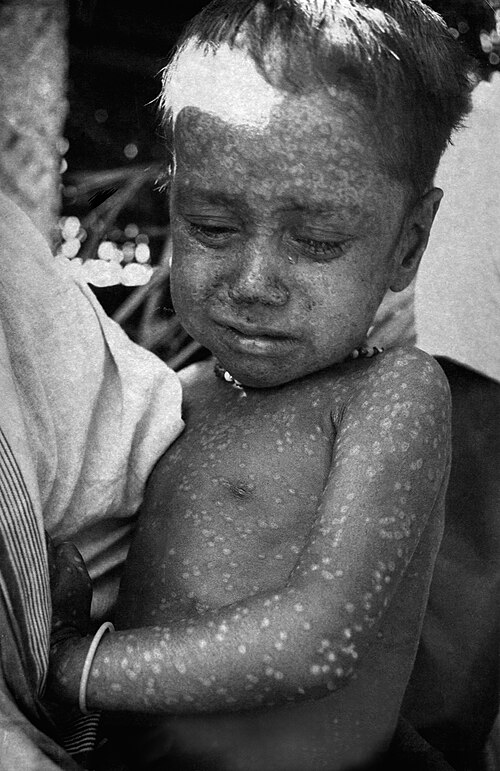
| 1973 年、バングラデシュで天然痘に罹った子供。濃い液体が詰まった隆起と、中央のくぼみまたはえくぼが特徴的。 | |
| 専門 | 感染症 |
| 症状 | |
| 合併症 | 皮膚の瘢痕化、失明[6] |
| 通常の発症 | 曝露後1~3週間[5] |
| 間隔 | 約4週間[5] |
| 原因 | 天然痘ウイルス、天然痘ウイルス(人から人への感染)[6] [7] |
| 診断方法 | 症状に基づきPCRで確認[8] |
| 鑑別診断 | 水痘、伝染性膿痂疹、伝染性軟属腫、水痘[8] |
| 防止 | 天然痘ワクチン[9] |
| 処理 | 支持療法[10] |
| 薬 | ブリンシドフォビル |
| 予後 | 死亡リスク30% [5] |
| 頻度 | 根絶(最後の自然発生例は1977年) |
天然痘は、オルトポックスウイルス属に属する天然痘ウイルス(天然痘ウイルスとも呼ばれる)によって引き起こされる感染症である。[7] [11]最後の自然発生的な症例は1977年10月に診断され、世界保健機関(WHO)は1980年に天然痘の世界的根絶を認定し、 [10]天然痘は現在までに根絶された唯一のヒト疾患となった。[12]
この病気の初期症状は、発熱と嘔吐でした。[5]その後、口の中に潰瘍ができ、皮膚の発疹ができました。[5]数日後には、皮膚の発疹は、中央にへこみのある特徴的な液体で満たされた水疱に変わりました。 [5]その後、隆起はかさぶたになって剥がれ落ち、傷跡が残りました。[5]この病気は、主に感染者との長時間の対面接触、または(まれに)汚染された物体を介して人から人へと伝染しました。[6] [13] [14]予防は主に天然痘ワクチンによって達成されました。[9]病気が発症すると、特定の抗ウイルス薬が役立つ可能性がありましたが、そのような薬は病気が根絶されるまで利用できませんでした。[9]死亡リスクは約30%で、乳児ではより高い割合でした。[6] [15]生き残った人の皮膚には広範囲の瘢痕が残ることが多く、中には失明した人もいました。[6]
この病気の最古の証拠は、紀元前1500年頃のエジプトのミイラにさかのぼります。[16] [17]この病気は歴史的に流行しました。 [ 10]これは、コロンブスが新世界に持ち込んだいくつかの病気の1つであり、その結果、多くのネイティブアメリカンが死亡しました。18世紀のヨーロッパでは、年間40万人がこの病気で死亡し、失明の3分の1が天然痘によるものと推定されています。[10] [18]天然痘は、20世紀に最大3億人を殺し、 [19] [20]存在した最後の100年間で約5億人を殺したと推定されています。[21]以前の死亡者には、 1774年のフランスのルイ15世を含む6人のヨーロッパの君主が含まれていました。 [10] [18]最近の1967年には、年間1500万件の症例が発生しました。[10]最後に知られている致命的な症例は1978年にイギリスで発生しました。
天然痘の予防接種は1500年代頃に中国で始まったようです。[22] [23]ヨーロッパは18世紀前半にアジアからこの習慣を取り入れました。[24] 1796年、エドワード・ジェンナーが現代の天然痘ワクチンを導入しました。[25] [26] 1967年、WHOは天然痘根絶への取り組みを強化しました。[10]天然痘は根絶された2つの感染症のうちの1つであり、もう1つは2011年の牛疫(偶蹄類の病気)です。 [27] [28]「天然痘」という用語は、16世紀にイギリスで初めて使用され、当時「大痘」と呼ばれていた梅毒と区別しました。 [29] [30]この病気の他の歴史的な名前には、痘瘡、斑点のある怪物、赤い疫病などがあります。[3] [4] [30]
米国とロシアは天然痘ウイルスのサンプルを研究室に保管しており、安全性をめぐる議論が巻き起こっている。
分類
天然痘には2つの形態がある。大痘瘡は重症で最も一般的な形態で、より広範な発疹と高熱を伴う。小痘瘡はよりまれな症状で、それほど重症ではないが典型的には天然痘として現れる。これまでの死亡率は1%以下である。[32]天然痘ウイルスによる無症状の感染は報告されているが、一般的ではない。[33]さらに、発疹のない天然痘と呼ばれる形態が、一般的にワクチン接種を受けた人に見られる。この形態は、通常の潜伏期間後に起こる発熱が特徴で、抗体検査、またはまれにウイルス培養によってのみ確認できた。[33]さらに、天然痘には非常にまれで劇症化する2つのタイプ、悪性(扁平)型と出血型があり、通常は致命的であった。
兆候と症状
| 外部ビデオ | |
|---|---|
 YouTube の「天然痘(米軍、1967 年)」 YouTube の「天然痘(米軍、1967 年)」 |
初期症状は、インフルエンザや風邪など、現在も存在する他のウイルス性疾患と似ており、38.3℃以上の発熱、筋肉痛、倦怠感、頭痛、疲労感などがある。消化管が侵されることが多いため、吐き気、嘔吐、腰痛がよく起こる。初期の前駆症状は通常2~4日間続く。12~15日目には、口、舌、口蓋、喉の粘膜に最初の目に見える病変(粘膜粘膜と呼ばれる小さな赤みがかった斑点)が現れ、体温はほぼ正常まで下がる。これらの病変は急速に拡大して破裂し、大量のウイルスが唾液中に放出される。[34]
天然痘ウイルスは皮膚細胞を攻撃する傾向があり、この病気に特徴的な吹き出物、つまり斑点を引き起こします。粘膜の病変が現れてから24~48時間後に皮膚に発疹ができます。通常、斑点は最初に額に現れ、次に急速に顔全体、四肢の近位部、体幹、最後に四肢の遠位部に広がります。このプロセスは24~36時間以内に完了し、その後新しい病変は現れません。[34]この時点で、天然痘の大病はいくつかの非常に異なる経過をたどる可能性があり、ラオ分類に基づくと4つのタイプの天然痘疾患が発生しました。[35]通常型、改変型、悪性(または平坦型)、出血性天然痘です。歴史的に、通常の天然痘の全体的な致死率は約30%で、悪性型と出血性型は通常致命的でした。改変型が致命的になることはほとんどありませんでした。初期の出血性症例では、皮膚病変が現れる前に出血が起こりました。[36]感染から病気の最初の明らかな症状が現れるまでの潜伏期間は7~14日でした。 [37]
普通
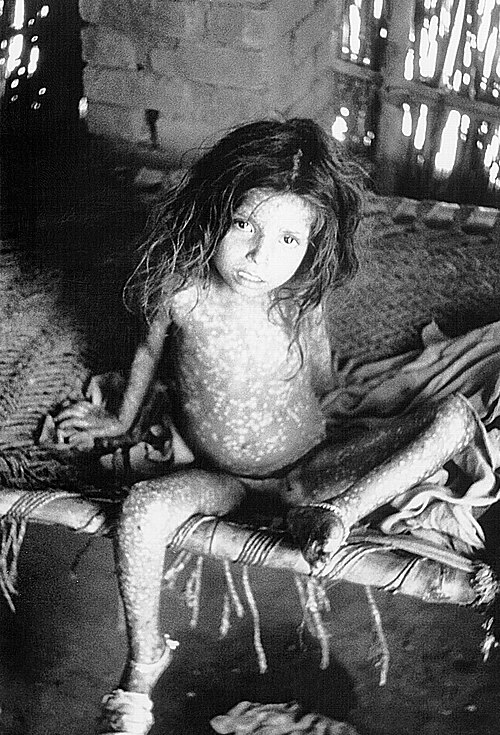
ワクチン接種を受けていない人の天然痘症例の少なくとも90%は通常のタイプでした。[33]このタイプの病気では、発疹の2日目までに斑点が隆起した丘疹に変わります。3日目または4日目までに、丘疹は乳白色の液体で満たされ、水疱になります。この液体は24〜48時間以内に不透明で濁り、膿疱になります。
6日目か7日目には、皮膚病変はすべて膿疱になった。7日目から10日目には膿疱は成熟し、最大の大きさに達した。膿疱は鋭く盛り上がり、典型的には丸く、張りがあり、触ると硬い。膿疱は真皮に深く埋め込まれており、皮膚に小さなビーズがあるような感触だった。膿疱からゆっくりと液体が漏れ出し、2週間目の終わりには膿疱は萎縮して乾燥し始め、痂皮またはかさぶたを形成した。16日目から20日目には、すべての病変にかさぶたが形成され、剥がれ始め、脱色した傷跡が残った。[38]
通常の天然痘では、一般的には個別の発疹が現れ、膿疱が皮膚上で別々に目立つ。発疹の分布は顔面で最も密で、四肢は胴体よりも密で、四肢の遠位部は近位部よりも密であった。ほとんどの症例で手のひらと足の裏が影響を受けた。[33]
合流
時には、水疱がシート状に融合して融合性の発疹を形成し、皮膚の外側の層がその下の肉から剥がれ始める。融合性天然痘の患者は、すべての病変にかさぶたができた後も病気が残ることが多い。ある症例シリーズでは、融合性天然痘の致死率は62%であった。[33]
修正済み
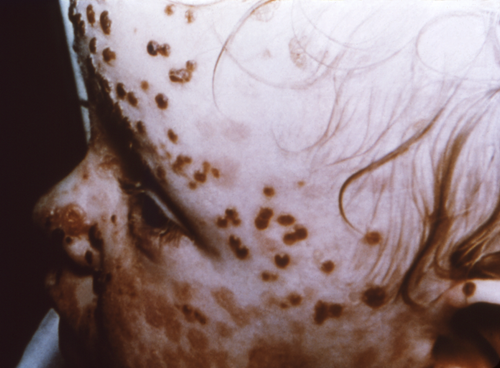
発疹の特徴と進行の速さから、修正天然痘は主に以前にワクチン接種を受けた人に発症した。ワクチン未接種者では稀で、ある症例研究では修正症例の1~2%に対し、ワクチン接種者では約25%であった。この形態では、前駆症状は依然として発生するが、通常のタイプよりも重症度は低かった可能性がある。発疹の進行中に発熱は通常ない。皮膚病変はより少なく、より速く進行し、より表面的で、より典型的な天然痘の均一な特徴を示さなかった可能性がある。[38]修正天然痘が致命的になることは、ほとんどなかった。この形態の大痘は、水痘と混同されやすかった。[33]
悪性
.jpg/500px-Malignant_smallpox_(cropped).jpg)
悪性型天然痘(扁平天然痘とも呼ばれる)では、通常型では隆起した水疱が形成される時期に、病変が皮膚とほぼ面一のままであった。なぜ一部の人がこの型を発症するのかは不明である。歴史的には、症例の5~10%を占め、そのほとんど(72%)は子供であった。[3]悪性天然痘では、3~4日間続く重篤な前駆期、長引く高熱、重篤なウイルス血症の症状が伴う。前駆症状は発疹が現れた後も続いた。[3]粘膜(粘膜下層)の発疹は広範囲であった。皮膚病変はゆっくりと成熟し、典型的には融合または半融合し、7日目または8日目には平らになり、皮膚に埋もれているように見えた。通常の天然痘とは異なり、水疱には液体がほとんど含まれておらず、触ると柔らかくビロードのような感触で、出血があった可能性もある。悪性の天然痘はほぼ常に致命的であり、死亡は通常、発症後8日目から12日目の間に起こる。死亡の1、2日前に病変が灰色に変わることが多く、腹部の膨張とともに予後不良の兆候であった。[3]この型は、天然痘に対する細胞性免疫の欠陥によって引き起こされると考えられている。回復した場合、病変は徐々に薄くなり、瘢痕やかさぶたは形成されなかった。[39]
出血性
出血性天然痘は、皮膚、粘膜、消化管、内臓への広範囲の出血を伴う重篤な形態である。この形態は、感染者の約 2% に発生し、主に成人に発生する。[33]出血性天然痘では、通常、膿疱は形成されない。代わりに、皮膚の下で出血が起こり、黒焦げのように見えるため、[33]この形態の病気は、天然痘または「黒痘」とも呼ばれる。[40]出血性天然痘が、天然痘ウイルスによって引き起こされることは非常にまれである。[41]軽症では出血が起こり、結果に影響しないことがあるが、[42]出血性天然痘は通常、致命的である。[43]ワクチン接種は、どちらの形態の出血性天然痘に対しても免疫を与えないようであり、直前に再ワクチン接種を受けた人々の間で発生した症例もある。出血性天然痘には 2 つの形態がある。[3]
早い
.jpg/500px-Hemorrhagic_smallpox_2_(cropped).jpg)
出血性天然痘の初期または劇症型(天然痘性紫斑病と呼ばれる)は、高熱、激しい頭痛、および腹痛を特徴とする前駆期から始まります。[39]皮膚は暗褐色で紅斑になり、これに続いてすぐに皮膚、結膜、粘膜に点状出血や出血が発生します。死亡は、わずかな重要でない皮膚病変が存在する病気の5日目から7日目の間に突然起こることがよくあります。数日長く生き残る人もいますが、その間に皮膚が剥がれてその下に体液が蓄積し、わずかな損傷で破裂します。患者は通常、死亡するか死亡する直前まで意識があります。[43]剖検では、脾臓、腎臓、漿膜、骨格筋、心膜、肝臓、生殖腺、膀胱に点状出血と出血が見られます。[41]歴史的に、この病気は誤診されることが多く、正しい診断は剖検でのみ下されました。[41]この病型は、一般人口よりも妊婦に発生する可能性が高くなります(ワクチン接種を受けていない妊婦の症例の約16%が早期出血性天然痘であったのに対し、非妊娠女性と成人男性では約1%)。[43]早期出血性天然痘の致死率は100%に近づきます。[43]
遅い
出血性天然痘の後期型(晩期出血性天然痘または天然痘性膿疱症と呼ばれる)もある。前駆症状は重度で、初期出血性天然痘に見られたものと似ており、発熱は病気の経過中ずっと続く。[3]出血は発疹期初期(ただし、天然痘性紫斑病よりも遅い)に現れ、発疹は平坦であることが多く、水疱期を超えて進行することはない。粘膜出血は初期出血型よりも発生頻度が低いようである。[33]発疹が膿疱を形成し、その基部で出血し、その後、通常の天然痘と同じ過程を経ることがある。この型の病気は、凝固カスケードのすべての要素の減少と、循環アンチトロンビンの増加を特徴とする。[34]この型の天然痘は、天然痘株の毒性に応じて、致死症例の3%から25%を占める。[36]末期型のほとんどの人は、発病後8日から10日以内に死亡する。回復する少数の人では、長い療養期間を経て出血性病変が徐々に消える。[3]末期出血性天然痘の致死率は約90~95%である。[35]妊婦はこの型の病気にかかる可能性がわずかに高いが、早期出血性天然痘ほどではない。[3]
原因
| 天然痘ウイルス | |
|---|---|

| |
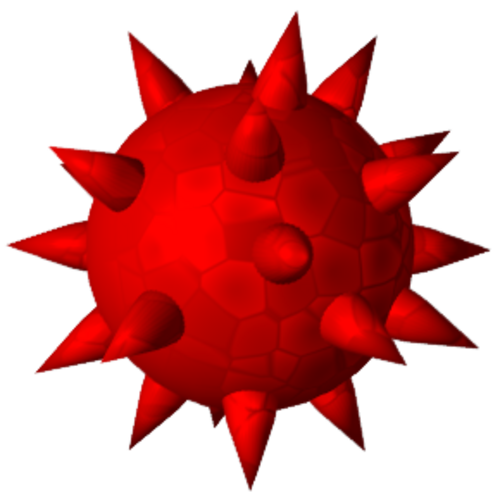
| この透過型電子顕微鏡写真は、天然痘ウイルス粒子を多数示しています。ウイルス粒子内部の「ダンベル型」構造はウイルス核で、ウイルス DNA を含んでいます。倍率 = 約 370,000 × | |
ウイルスの分類 
| |
| (ランク外): | ウイルス |
| レルム: | バリドナビリア |
| 王国: | バンフォードヴィラエ |
| 門: | 核細胞ウイルス門 |
| クラス: | ポッケスビリケテス |
| 注文: | キトビラ目 |
| 家族: | ポックスウイルス科 |
| 属: | オルソポックスウイルス |
| 種: | †天然痘ウイルス |
天然痘は、ポックスウイルス科、コルドポックスウイルス亜科、オルソポックスウイルス属に属する天然痘ウイルスの感染によって引き起こされます。
進化
天然痘の出現時期は確定していない。おそらく68,000年から16,000年前にアフリカの陸生齧歯類ウイルスから進化したと考えられる。[44]日付に幅があるのは、分子時計を較正するために使用された記録が異なるためである。1つの系統群は、400年から1,600年前にアジアから広がった天然痘主要株(臨床的に重篤な天然痘)である。2番目の系統群には、アメリカ大陸で記載されたアラストリム(表現型的には軽度の天然痘)と、現在から1,400年から6,300年前に祖先株から分岐した西アフリカの分離株の両方が含まれていた。この系統群は、少なくとも800年前にさらに2つのサブ系統群に分岐した。[45]
2番目の推定では、天然痘ウイルスがタテラポックス(スナネズミを含む一部のアフリカ齧歯類のオーソポックスウイルス)から分離されたのは3,000~4,000年前とされている。[46]これは、天然痘が人間の病気として出現したことに関する考古学的および歴史的証拠と一致しており、比較的最近の起源を示唆している。変異率がヘルペスウイルスと同様であると仮定すると、天然痘ウイルスがタテラポックスから分岐した日付は5万年前と推定されている。[46]これは他の公表された推定と一致しているが、考古学的および歴史的証拠が非常に不完全であることを示唆している。これらのウイルスの変異率のより良い推定が必要である。
1650年頃の株を調べたところ、この株は現在配列が決定されている他の株の基底にあることが判明した。 [47]このウイルスの変異率は分子時計によってよくモデル化されている。株の多様化は18世紀と19世紀にのみ起こった。
ウイルス学
天然痘ウイルスは大きくレンガのような形をしており、およそ302~350ナノメートル×244~270ナノメートルの大きさで、[48] 186キロベースペア(kbp)の大きさの単一の線状二本鎖DNA ゲノムを持ち、両端にヘアピンループが含まれています。 [49] [50]
ヒトに感染するオルソポックスウイルスは4種類あり、天然痘、ワクシニア、牛痘、サル痘である。天然痘ウイルスは自然界ではヒトにのみ感染するが、実験では霊長類や他の動物にも感染したことがある。ワクシニア、牛痘、サル痘ウイルスは自然界ではヒトと他の動物の両方に感染する可能性がある。[33]
ポックスウイルスのライフサイクルは、細胞侵入のメカニズムが異なる複数の感染形態を持つため複雑です。ポックスウイルスは、細胞の核ではなく細胞質で複製するという点で、ヒト DNA ウイルスの中で独特です。複製するために、ポックスウイルスは他のDNA ウイルスでは生成されないさまざまな特殊なタンパク質を生成しますが、その中で最も重要なのはウイルス関連のDNA 依存性 RNA ポリメラーゼです。
エンベロープを持つウイルス粒子と持たないウイルス粒子の両方に感染性がある。ウイルスエンベロープは、ヘマグルチニンを含むウイルス特異的ポリペプチドを含む改変ゴルジ膜でできている。[49]天然痘ウイルスまたは天然痘ウイルスのいずれかに感染すると、他方に対する免疫が付与される。[34]
大痘瘡
より一般的で感染力の強い病気は、天然痘ウイルス株によって引き起こされ、その対照である小痘瘡と比較して死亡率が著しく高いことで知られています。大痘瘡の死亡率は約30%でしたが、小痘瘡の死亡率は約1%でした。18世紀を通じて、大痘瘡はヨーロッパだけで年間約40万人の死者を出しました。この病気の生存者は、失明や重度の瘢痕など、生涯にわたる後遺症に直面することが多く、回復した人々にはほぼ例外なく見られました。[51]
20世紀前半、天然痘はアジアとアフリカの大部分で発生した天然痘の主な原因でした。一方、天然痘小症はヨーロッパ、北米、南米、アフリカの一部でより一般的に見られました。[52]
天然痘
小痘瘡ウイルスは、アラストリムとも呼ばれ、あまり一般的ではないウイルスで、致死性もはるかに低い。小痘瘡は天然痘と同じ潜伏期間と発病段階をたどったが、死亡率は大痘瘡の 30% に対して 1% 未満だったと考えられている。大痘瘡と同様に、小痘瘡は対面接触または媒介物を介して空気中のウイルスを吸入することで感染する。小痘瘡ウイルスに感染すると、より危険な大痘瘡ウイルスに対する免疫が付与される。
小痘瘡は天然痘ほど衰弱させない病気であったため、人々はより頻繁に歩行し、したがってより急速に他人に感染させることができた。そのため、小痘瘡は20世紀初頭に米国、英国、南アフリカを席巻し、これらの地域でこの病気の支配的な形態となり、死亡率を急速に低下させた。大痘瘡とともに、小痘瘡は現在では地球上から完全に根絶されている。土着の小痘瘡の最後の症例は、1977年10月にソマリアの料理人、アリ・マオ・マーリンで報告され、1980年5月に天然痘は世界中で根絶されたと公式に宣言された。[16]小痘瘡は、白痘、カフィール痘、キューバ痘、西インド痘、乳痘、偽痘とも呼ばれた。
ゲノム構成
大痘ウイルスのゲノムの長さは約186,000塩基対である。[53]これは線状二本鎖DNAからできており、約200個の遺伝子のコード配列を含む。[54]遺伝子は通常重複しておらず、典型的にはゲノムのより近い末端領域を指すブロックで発生する。[55]ゲノムの中央領域のコード配列はオルトポックスウイルス間で非常に一貫しており、遺伝子の配置はコルドポックスウイルス間で一貫している。[54] [55]
天然痘ウイルスゲノムの中心部には、構造タンパク質、DNA複製、転写、mRNA合成の遺伝子など、必須のウイルス遺伝子の大部分が含まれています。 [54]ゲノムの末端は、オルトポックスウイルスの株や種によって大きく異なります。[54]これらの領域には、宿主の免疫系を調節するタンパク質が含まれており、オルトポックスウイルス科全体の毒性の多様性の主な原因となっています。[54]ポックスウイルスのこれらの末端領域は、逆方向末端反復(ITR)配列です。[55]これらの配列はゲノムの両端で同一ですが反対方向を向いているため、ゲノムは連続したDNAループになっています。[55] ITR配列の構成要素には、不完全な塩基対を形成したA/Tに富むヘアピンループ、コンカトメリックDNA(同じ配列の複数のコピーを含むDNAの領域)を解読するために必要な約100塩基対の領域、いくつかのオープンリーディングフレーム、および数と長さが異なる短い直列反復配列が含まれる。 [55]ポックスウイルス科のITRの長さは、株と種によって異なる。[55]天然痘ウイルスのほとんどのウイルスタンパク質のコード配列は、天然痘のワクチン接種に使用される関連ウイルスであるワクシニアのゲノムと少なくとも90%の類似性がある。[55]
遺伝子発現
天然痘ウイルスの遺伝子発現は、完全に宿主細胞の細胞質内で起こり、感染中は明確な進行をたどる。[55]感染性ウイルス粒子が宿主細胞に侵入すると、20分以内にウイルスmRNAの合成が検出される。[55]ウイルスゲノムの約半分は、ウイルスDNAの複製前に転写される。 [55]発現する遺伝子の最初のセットは、感染ウイルス粒子内に含まれる既存のウイルス機構によって転写される。[55]これらの遺伝子は、ウイルスDNA合成と、発現する遺伝子の次のセットの転写に必要な因子をコードしている。[55]ほとんどのDNAウイルスとは異なり、天然痘ウイルスや他のポックスウイルスのDNA複製は、感染細胞の細胞質内で起こる。[55]宿主細胞への感染後のDNA複製の正確なタイミングは、ポックスウイルス科によって異なります。[55]ゲノムの組み換えは、活発に感染した細胞内で起こります。 [55]ウイルスDNAの複製開始後、中間遺伝子セットが後期遺伝子発現の転写因子をコードする。 [55]後期遺伝子の産物には、新しいウイルス粒子の初期遺伝子を転写するために必要な転写因子、およびウイルスRNAポリメラーゼや新しいウイルス粒子に不可欠なその他の酵素が含まれる。[55]これらのタンパク質はその後、他の細胞に感染できる新しい感染性ウイルス粒子にパッケージ化される。[55]
研究
天然痘ウイルスの生きたサンプルが2つ残っており、1つは米国アトランタのCDC、もう1つはロシアのコルツォボにあるベクター研究所にあります。[56]残りのウイルスサンプルを使った研究は厳しく管理されており、各研究提案はWHOと世界保健総会(WHA)の承認を得る必要があります。[56]痘瘡ウイルスに関する研究のほとんどは、近縁種のワクシニアウイルスをモデル生物として使って行われています。 [55]天然痘のワクチン接種に使われるワクシニアウイルスは、無関係の病気のワクチンのウイルスベクターとしての研究も行われています。[57]
天然痘ウイルスのゲノムは、1990年代に初めて全ゲノムが解読されました。 [54]完全なコード配列はオンラインで公開されています。天然痘ウイルスの現在の参照配列は、1967年にインドで流行した株から解読されました。さらに、WHOの根絶キャンペーン中に収集された他の株のサンプルの配列もあります。 [54]天然痘ウイルスと他の痘ウイルスの注釈付き配列の完全なデータベースのゲノムブラウザは、ウイルスバイオインフォマティクスリソースセンターを通じて公開されています。[58]
遺伝子工学
WHOは現在、天然痘ウイルスの遺伝子工学を禁止している。 [59]しかし、2004年にWHOの諮問委員会は、マーカー遺伝子を追加するために、天然痘ウイルスの残り2つのサンプルのゲノムを編集することを許可することに賛成票を投じた。[59]この遺伝子はGFP(緑色蛍光タンパク質)と呼ばれ、ウイルスの生きたサンプルを蛍光灯の下で緑色に光らせる。[60]この遺伝子の挿入はウイルスの毒性に影響を与えず、ゲノムの唯一の許可された改変となる。 [60]委員会は、提案された改変により、潜在的な治療法がウイルスサンプルを殺すのに効果的かどうかを評価しやすくなるため、治療法の研究に役立つと述べた。[60]この勧告は、 WHAの承認を得た場合にのみ発効する。[60] WHAが2005年にこの提案を議論したとき、WHAは提案に対する正式な投票を控え、個々の研究提案を1つずつ検討すると述べた。[61]ワクシニアゲノムへのGFP遺伝子の追加は、近縁種のワクシニアウイルスの研究では日常的に行われている。[62]
論争
天然痘ウイルスの完全な配列が公開されたことで、感染性ウイルスの違法合成の可能性に対する懸念が高まっている。[63] 天然痘ウイルスの親戚であるワクシニアは、2002年にNIHの科学者によって人工的に合成された。[64]彼らは、組み換えウイルスゲノムを使用してウイルス粒子を生成する自己複製細菌プラスミドを作成するという、以前に確立された方法を使用した。[64]
2016年、別のグループが馬痘の公開されている配列データを使用して馬痘ウイルスを合成した。 [65]研究者らは、効果的なワクチンはすでに利用可能であるものの、彼らの研究は天然痘のより安全で効果的なワクチンの開発に役立つと主張した。 [65]馬痘ウイルスは以前は絶滅したと思われていたため、天然痘の潜在的な復活に対する懸念が高まり、他の科学者は彼らの動機に疑問を抱いた。[63]批評家は、このグループが比較的少ない費用と労力で短期間で生存可能なウイルスを再現できたことを特に懸念した。[65] WHOは個々の研究室が一度にゲノムの20%以上を合成することを禁止し、天然痘ゲノム断片の購入は監視および規制されているが、悪意のあるグループが複数のソースから、生存可能なウイルスを生成するために必要な完全な合成ゲノムをコンパイルする可能性がある。[65]
伝染 ; 感染
天然痘は感染力が強かったが、他のウイルス性疾患に比べると一般的にゆっくりと広がり、範囲も狭い。これは感染には濃厚接触が必要で、発疹が出た後に起こるためと考えられる。感染率は感染期間が短いことも影響した。温帯地域では、天然痘感染者数は冬と春に最も多かった。熱帯地域では季節変動があまり見られず、天然痘は年間を通じて存在していた。[33]天然痘感染者の年齢分布は獲得免疫に依存していた。ワクチン接種による 免疫は時間の経過とともに低下し、おそらく30年以内に失われた。[34]天然痘は昆虫や動物によって伝染することは知られておらず、無症状の保菌者状態は存在しなかった。[33]
感染は空気感染する天然痘ウイルスの吸入によって起こり、通常は感染者の口腔、鼻腔、咽頭 粘膜から排出される飛沫によって起こります。主に感染者との長時間の対面接触によって人から人へと感染します。[14]
汚染された寝具を扱った後に洗濯作業員が天然痘に感染した事例の一部は、天然痘が汚染された物体(媒介物)との直接接触によって広がる可能性を示唆したが、これはまれであることが判明した。[14] [35]また、まれに、建物、バス、電車などの密閉された環境で空気中に運ばれたウイルスによって天然痘が広がることもある。 [32]ウイルスは胎盤を通過できるが、先天性天然痘の発生率は比較的低い。[34]天然痘は前駆期には顕著な感染性はなく、ウイルスの排出は通常、発疹が現れるまで遅れ、発疹には口や咽頭の病変が伴うことが多かった。ウイルスは病気の経過中ずっと伝染する可能性があるが、これは発疹が現れてから最初の1週間、皮膚病変のほとんどが無傷であったときに最も頻繁に起こった。[33]感染力は7~10日で病変の上にかさぶたができ、弱まりますが、最後のかさぶたが剥がれるまで感染者は感染力を持ちます。[66]
天然痘が生物兵器に使用される可能性に対する懸念から、ドナルド・K・ミルトンは2002年に、天然痘の感染に関する既存の研究と、当時の天然痘の拡散防止に関する勧告を詳細に検討した。ミルトンはラオ、フェナー、その他の研究者を引用し、「注意深い疫学的調査では、媒介物が感染源となることはほとんどなかった」という意見に同意し、「天然痘の二次感染防止に関する現在の勧告では、『飛沫による近距離接触(6~7フィート以内)』による感染を強調している」と指摘したが、「大きな飛沫による感染拡大を強調すると、より困難な空気感染予防策(より細かい飛沫は長距離を移動し、下気道の奥深くまで浸透する)の警戒が薄れる可能性がある」と警告した。[67]
機構
一度吸入されると、天然痘ウイルスは口、喉、呼吸器の粘膜に侵入し、そこから局所リンパ節に移動して増殖し始めた。初期の増殖段階では、ウイルスは細胞から細胞へと移動しているように見えたが、12日目頃までに感染細胞の広範な溶解が起こり、ウイルスが血流中に大量に存在し、ウイルス血症と呼ばれる状態となった。その結果、脾臓、骨髄、リンパ節 で第2波の増殖が起こった。
診断
通常の天然痘の臨床的定義は、38.3℃(101℉)以上の急性発熱の後に、他の明らかな原因がなく、同じ発達段階にある硬くて深い水疱または膿疱を特徴とする発疹が続く病気です。[33]臨床例が観察された場合、天然痘は臨床検査によって確認されました。
顕微鏡的に見ると、ポックスウイルスは特徴的な細胞質 封入体を生成する。そのうち最も重要なものはグァルニエリ小体として知られ、ウイルスの複製の場となる。グァルニエリ小体は、ヘマトキシリンおよびエオシンで染色した皮膚生検で容易に同定され、ピンク色の斑点として現れる。これらは事実上すべてのポックスウイルス感染症で見られるが、グァルニエリ小体が存在しないからといって天然痘を除外することはできない。[68]オルソポックスウイルス感染症の診断は、膿疱液またはかさぶたの電子顕微鏡検査によっても迅速に行うことができる。すべてのオルソポックスウイルスは、電子顕微鏡で同一のレンガ形のウイルス粒子を示す。[34]ヘルペスウイルスの特徴的な形態の粒子が見られれば、天然痘および他のオルソポックスウイルス感染症は排除される。
天然痘ウイルスの決定的な実験室同定には、鶏の胚の一部である漿尿膜上でウイルスを増殖させ、規定の温度条件下で生じた痘瘡病変を検査することが含まれていた。[69]株はポリメラーゼ連鎖反応(PCR)と制限酵素断片長多型(RFLP)分析によって特徴付けられた。天然痘ウイルス特異的免疫グロブリンおよび抗原を測定する血清学的検査および酵素結合免疫吸着測定法(ELISA)も、感染の診断を支援するために開発された。[70]
水痘は、根絶直後の時代には天然痘とよく混同されていました。水痘と天然痘はいくつかの方法で区別できます。天然痘とは異なり、水痘は通常、手のひらや足の裏には影響しません。さらに、水痘の膿疱は、膿疱の発疹のタイミングが異なるため、サイズが異なります。天然痘の膿疱は、ウイルスの影響がより均一に進行するため、すべてほぼ同じサイズです。天然痘の疑いのある症例の評価では、水痘を検出するためのさまざまな実験室方法が利用可能でした。[33]
-
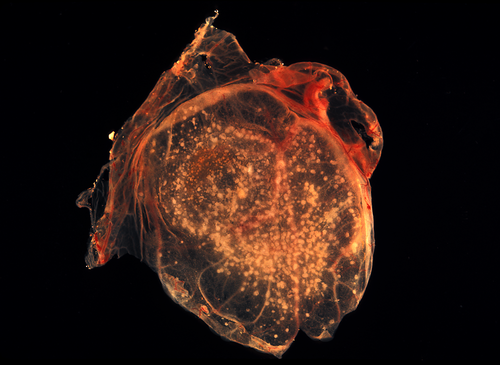 成長中のヒナの漿尿膜上の天然痘ウイルス病変
 -
 天然痘の発疹とは対照的に、水痘の発疹は主に胴体に現れ、手足に広がることはあまりありません。
 -
 1965年、皮膚に後期融合性斑状丘疹瘢痕の特徴を示したイタリア人女性天然痘患者
防止
.jpg/500px-Smallpox_vaccine_(cropped).jpg)
天然痘を予防するために使用された最も古い処置は、天然痘ウイルスの接種であった(天然痘ワクチンの導入後、混乱を避けるために後に人痘接種と呼ばれるようになった方法)。これは、ヨーロッパに導入されるよりかなり前に、インド、アフリカ、中国で行われていた可能性が高い。[15]接種がインドで始まったという考えには異論があり、古代サンスクリットの医学文献には接種の過程を記述したものがほとんどない。[71]中国における天然痘に対する接種の記録は、10世紀後半にはすでに見られ、この処置は16世紀の明王朝時代には広く行われていた。[72]接種が成功すれば、天然痘に対する永続的な免疫が得られた。人が天然痘ウイルスに感染しているため、重度の感染症を引き起こす可能性があり、その人から他の人に天然痘を感染させる可能性がある。人痘接種の死亡率は0.5~2%で、天然痘の死亡率20~30%よりかなり低い。[33] 1700年にロンドンの王立協会は、中国での予防接種の実践に関する2つの報告書を受け取りました。1つは中国に駐在していた東インド会社の従業員からの報告書を受け取ったマーティン・リスター博士によるもので、もう1つはクロプトン・ヘイバーズによるものでした。[73]
メアリー・ウォートリー・モンタギュー夫人はオスマン帝国滞在中に天然痘の予防接種を観察し、手紙にその詳細を記し、1718年に帰国するとイギリスでその方法を熱心に推進した。[74]ヴォルテール(1742年)によると、トルコ人は予防接種を隣国のチェルケスから得たものである。ヴォルテールはチェルケス人がその技術をどこから得たかについては推測していないが、中国人は「この100年間」それを実践してきたと報告している。[75] 1721年、コットン・マザーと同僚はボストンで数百人に予防接種を行い、論争を巻き起こした。 1767年に『天然痘の予防接種の現在の方法』を発表した後、トーマス・ディムズデール博士はロシアに招かれ、ロシアのエカチェリーナ2世と息子のパーヴェル大公に人痘接種を行い、1768年に成功した。1796年、イギリスの田舎町グロスターシャー州バークレーの医師エドワード・ジェンナーは、牛痘の病変から採取した材料を人に接種することで天然痘に対する免疫を作れることを発見した。牛痘は天然痘と同じ科に属するポックスウイルスである。ジェンナーは接種に使用した材料をラテン語で牛を意味するvaccaという語源からワクチンと名付けた。この手順は人痘接種よりもはるかに安全で、天然痘の伝染の危険もなかった。天然痘を予防するためのワクチン接種はすぐに世界中で行われるようになった。19世紀には、天然痘のワクチン接種に使用されていた牛痘ウイルスがワクシニアウイルスに取って代わられた。ワクシニアウイルスは牛痘ウイルスや天然痘ウイルスと同じ科に属しますが、遺伝的には両者と異なります。ワクシニアウイルスの起源やそれがどのようにしてワクチンに含まれるようになったのかはわかっていません。[33]

天然痘ワクチンの現在の処方は、感染性ワクシニアウイルスの生ウイルス製剤である。ワクチンは、ワクチン溶液に浸した二股の針を使用して投与される。針は、数秒間に皮膚(通常は上腕)を数回刺すために使用される。成功すると、3〜4日後にワクチンを接種した場所に赤くかゆみを伴う隆起が発生する。最初の週に、隆起は大きな水疱(「ジェンナー水疱」と呼ばれる)になり、膿が溜まって排出され始める。2週間目には、水疱が乾燥し始め、かさぶたが形成される。かさぶたは3週間目に剥がれ、小さな傷跡が残る。[76]
ワクシニアワクチンによって誘導される抗体は、サル痘、牛痘、天然痘(天然痘)ウイルスなど、他のオルソポックスウイルスに対して交差防御作用がある。中和抗体は、初回接種後10日、再接種後7日で検出される。歴史的に、このワクチンは接種者の95%で天然痘感染を予防するのに効果的であった。[77]天然痘ワクチンは、3〜5年間は高いレベルの免疫を提供し、その後は免疫力が低下します。後に再度ワクチン接種を受けると、免疫はさらに長く持続します。1950年代と1960年代のヨーロッパでの天然痘症例の研究では、感染前10年未満のワクチン接種者の死亡率は1.3%、11〜20年前にワクチン接種を受けた人では7%、感染前20年以上にワクチン接種を受けた人では11%であることが実証されました。対照的に、ワクチン未接種者の52%が死亡した。[78]

天然痘ワクチンには副作用やリスクがある。過去には、初めてワクチン接種を受けた1,000人中約1人が、ワクチン接種部位の毒性またはアレルギー反応(多形紅斑)、ワクシニアウイルスの体の他の部分への拡散、他の人への拡散など、重篤だが命にかかわらない反応を経験した。潜在的に命にかかわる反応は、初めてワクチン接種を受けた100万人中14人から500人に発生した。過去の経験に基づくと、ワクチン接種を受けた100万人中1人または2人(0.000198%)が結果として死亡する可能性があると推定されており、最も多いのはワクチン接種後脳炎またはワクチン接種部位の重度の壊死(進行性ワクシニアと呼ばれる)である。[77]
これらのリスクを考慮して、天然痘が効果的に根絶され、自然発症例数がワクチン誘発性の疾患および死亡者数を下回るようになったため、米国では1972年に小児の定期予防接種が中止され、1970年代初頭にはほとんどのヨーロッパ諸国でも中止されました。[10] [79]米国では医療従事者の定期予防接種が1976年に中止され、軍の新兵の間では1990年に中止されました(ただし、中東と韓国に派遣された軍人は今でも予防接種を受けています[80])。1986年までに、すべての国で定期予防接種が中止されました。[10]現在では、職業上の曝露のリスクがある研究室の作業員に主に推奨されています。[33]しかし、天然痘ウイルスが生物兵器として使用される可能性があることから、新しいワクチンの開発への関心が再燃しています。[81]天然痘ワクチンは天然痘の予防にも有効であるため、その予防のために投与されます。[82]
処理
感染後3日以内に天然痘ワクチンを接種すれば、ほとんどの人において天然痘の症状を予防するか、症状の重症度を大幅に軽減できる。感染後4~7日後にワクチンを接種すれば、ある程度の予防効果が得られるか、あるいは症状の重症度を軽減できる可能性がある。[77]ワクチン接種以外の天然痘の治療は、創傷ケアや感染制御、輸液療法、人工呼吸器の使用など、主に支持療法である。扁平型および出血型の天然痘は、輸液蘇生など、ショックの治療に使用されるのと同じ療法で治療される。半合流型および合流型の天然痘患者は、広範囲の皮膚熱傷患者と同様の治療上の問題を抱える可能性がある。[83]
2018年7月、米国食品医薬品局は天然痘の治療薬として初めてテコビリマットを承認した。 [84]前回の天然痘の大流行以来、 抗ウイルス治療は改善されており、研究では抗ウイルス薬シドフォビルが治療薬として有用である可能性が示唆されている。この薬は静脈内投与する必要があり、重篤な腎毒性を引き起こす可能性がある。[85]
ACAM2000は、アカンビス社が開発した天然痘ワクチンである。 2007年8月31日に米国FDAにより米国での使用が承認された。このワクチンには、以前のワクチンであるドライバックスで使用されたものと同じ株からクローン化された生ワクチンウイルスが含まれている。ドライバックスウイルスは子牛の皮膚で培養され凍結乾燥されたが、ACAM2000のウイルスはアフリカミドリザルの腎臓上皮細胞(ベロ細胞)で培養される。有効性と副作用の発生率はドライバックスと同様である。[81]このワクチンは米国民が日常的に入手できるものではないが、軍で使用され、戦略国家備蓄に保管されている。[86]
2021年6月、ブリンシドフォビルは米国で天然痘ウイルスによるヒトの天然痘疾患の治療薬として承認されました。[87] [88]
予後
.jpg/500px-Man_with_facial_scarring_and_blindness_due_to_smallpox,_1972_(cropped).jpg)
小痘瘡による死亡率は約1%であるのに対し、大痘瘡による死亡率は約30%である。[89]
通常型の合流型では約 50~75% の確率で致死的であり、通常型の半合流型では約 25~50% の確率で致死的であり、発疹がはっきりしない場合は致死率が 10% 未満である。1 歳未満の子供の全体的な致死率は 40~50% である。出血型と扁平型の致死率は最も高い。扁平型または後期出血型の天然痘の致死率は 90% 以上であり、早期出血型の天然痘の場合にはほぼ 100% の致死率が観察される。[43]小痘の致死率は 1% 以下である。[38]天然痘ウイルスの慢性または再発感染の証拠はない。[38]ワクチン接種を受けた人の扁平型天然痘の症例では、症状は極めてまれであるが致死率は低く、1 つの症例シリーズでは死亡率が 67% であることが示された。[3]
通常の天然痘の致死的な症例では、死亡は通常、発症後10~16日目に起こる。天然痘による死亡原因は明らかではないが、感染症は複数の臓器に影響を及ぼすことが現在ではわかっている。循環免疫複合体、圧倒的なウイルス血症、または制御不能な免疫反応が要因となっている可能性がある。[33]初期の出血性天然痘では、発熱後約6日で突然死亡する。初期の出血症例の死因は、一般的に心不全と肺水腫によるものである。後期の出血症例では、高濃度で持続的なウイルス血症、重度の血小板減少、免疫反応不良が死因として挙げられることが多い。[3]扁平性天然痘の死因は、熱傷の場合と似ており、体液、タンパク質、電解質の喪失、および劇症敗血症を伴う。[83]
合併症
天然痘の合併症は呼吸器系に最も多く見られ、単純な気管支炎から致命的な肺炎まで多岐にわたります。呼吸器系の合併症は発症後8日目頃に発症する傾向があり、ウイルス性または細菌性の原因となります。皮膚の二次細菌感染は天然痘の比較的まれな合併症です。これが起こると、通常、発熱は高いままです。[33]
その他の合併症には、成人に多く、一時的な障害を引き起こす可能性がある脳炎(患者500人に1人)、特に顔面に残る永久的な陥凹性瘢痕、および眼の合併症(全症例の2%)がある。まぶた、結膜、角膜に膿疱が形成され、結膜炎、角膜炎、角膜潰瘍、虹彩炎、虹彩毛様体炎、視神経萎縮などの合併症を引き起こす可能性がある。角膜炎および角膜潰瘍を患った眼の約35~40%は失明に至ります。出血性天然痘は、結膜下出血および網膜出血を引き起こす可能性があります。天然痘に罹患した幼児の2~5%では、ウイルス粒子が関節や骨に達し、天然痘骨髄炎を引き起こします。骨病変は対称性で、肘や脚に最もよく見られ、骨端線の分離や顕著な骨膜反応を引き起こすのが特徴です。関節の腫れにより動きが制限され、関節炎により四肢の変形、強直、骨の奇形、動揺関節、指の短小化が生じることがあります。 [34]
生存者の 65 ~ 80% に深い陥没傷跡 (ポックマーク) が残り、最も目立つのは顔面です。
歴史
病気の発生

天然痘の最も古い信頼できる臨床的証拠は、古代インド(紀元前1500年頃)[90] [91]と中国(紀元前1122年)[92]の医学文献における天然痘のような疾患の記述、およびエジプトの ラムセス5世(紀元前1145年に死亡)のミイラの研究に見いだされる。 [91] [93]紀元前1千年紀にエジプトの商人が天然痘をインドに持ち込み、そこで少なくとも2000年間は風土病として残ったと推測されている。天然痘はおそらく紀元1世紀に南西から中国に持ち込まれ、6世紀に中国から日本に運ばれた。[3]日本では、735~737年の流行で人口の3分の1が死亡したと考えられている。[18] [94]西アフリカのヨルバ族の宗教の神ソポナなど、少なくとも7つの宗教の神が天然痘に捧げられてきました。インドでは、天然痘のヒンズー教の女神シタラが全国の寺院で崇拝されていました。[95]
別の見方としては、天然痘は1588年に出現し、それ以前に報告された症例は誤って天然痘と特定されたというものがあります。[96] [47]
天然痘がヨーロッパや南西アジアに到来した時期は、はっきりしていません。天然痘は、旧約聖書や新約聖書、ギリシャやローマの文献にも明確には記載されていません。エチオピアとエジプト で発生したと言われるアテネの疫病や、紀元前396年にカルタゴがシラクサを包囲していたときに流行した疫病を 天然痘と同一視する人もいますが、[3]多くの学者は、大痘のような深刻な病気がヒポクラテスの存命中に地中海地域に存在していたとしても、ヒポクラテスが記述を逃れることはほとんどなかっただろうと同意しています。[42]
165年から180年にかけてローマ帝国を襲ったアントニヌス疫病は天然痘が原因だった可能性があるが、 [97]ランスの聖ニカシウスは450年の流行から生き延びたとされることから天然痘患者の守護聖人となり、[3]トゥールの聖グレゴリウスは580年にフランスとイタリアで同様の流行を記録しており、これが天然痘という用語の使用例の最初である。[3]他の歴史家は、7世紀と8世紀にアラブ軍が初めて天然痘をアフリカから南西ヨーロッパに持ち込んだと推測している。 [3] 9世紀にはペルシャの医師ラージーが天然痘に関する最も決定的な記述の一つを提供し、著書『天然痘と麻疹の書』で天然痘を麻疹や水痘と区別した最初の人物となった。[98]中世にはヨーロッパで天然痘が何度か流行した。しかし、十字軍による人口増加と移動が進むまで天然痘は定着しなかった。16世紀までに天然痘はヨーロッパのほとんどの地域で定着し、[3]死亡率は30%にも達した。ヨーロッパでの天然痘の風土病的発生は特に歴史的に重要である。ヨーロッパ人による探検と植民地化が進むにつれて、この病気が他の国々に広まる傾向があったからである。16世紀までに、天然痘は世界中の多くの地域で罹患率と死亡率の主な原因となっていた。[3]

15世紀にヨーロッパ人が西方へと探検する以前、アメリカ大陸には天然痘のような病気についての信頼できる記述はなかった。 [45]天然痘は1507年にカリブ海のイスパニョーラ島に持ち込まれ、1520年にイスパニョーラ島からメキシコに到着したスペイン人入植者が、うっかり天然痘を持ち込んだことで本土に持ち込まれた。先住のアメリカ・インディアン人口はこの新しい病気に対する免疫を獲得していなかったため、彼らの民族は流行病によって壊滅した。このような混乱と人口減少は、スペイン人がアステカ人とインカ人を征服する上で重要な要因であった。[3]同様に、1633年にイギリス人が北アメリカ東海岸のマサチューセッツ州プリマスに定住した際にも、先住アメリカ人人口の間で壊滅的な天然痘の発生が起こり、[99]その後、先住の入植者の間でも発生した。[100]アメリカ先住民の間で流行した際の致死率は90%にも達した。[101]天然痘は1789年と1829年にオーストラリアに持ち込まれたが、 [3] 1829年までに天然痘と水痘(どちらもアボリジニにとってほぼ同等の致死率を持つ)を区別しようとしていた植民地の外科医の間では、1829年から1830年の流行が水痘か天然痘かで意見が分かれていた。[102]天然痘は大陸で風土病になったことはなかったが、[3] 1780年から1870年にかけてアボリジニの主な死因だったとされている。 [103]
.svg/500px-Global_number_of_reported_smallpox_cases_(1920-2016).svg.png)

18世紀半ばまでに、天然痘はオーストラリアと外部の探検の影響を受けていない小さな島々を除く世界中で主要な風土病となった。18世紀のヨーロッパでは、天然痘は主な死亡原因であり、毎年推定40万人のヨーロッパ人が死亡していた。 [104]スウェーデンの乳児の最大10%が毎年天然痘で死亡し、[18]ロシアの乳児の死亡率はさらに高かった可能性がある。[92]英国、その北米植民地、中国など、いくつかの国で人痘接種が広く行われたことで、18世紀後半には富裕層の間で天然痘の影響がいくらか軽減されたが、発生率が実際に減少したのは19世紀末にワクチン接種が一般的になったときだった。ワクチンの改良と再接種の実施により、ヨーロッパと北米での症例は大幅に減少したが、天然痘は世界の他の地域ではほとんど抑制されないままであった。 20世紀半ばまでに、アフリカの多くの地域で、天然痘と並んで小痘瘡がさまざまな割合で発生しました。小痘瘡患者は軽度の全身症状しか出ず、病気の経過中も歩行可能であることが多く、そのため病気をより簡単に広めることができます。小痘瘡ウイルスに感染すると、より致死性の高い大痘瘡に対する免疫が誘導されます。そのため、小痘瘡が全米、カナダ、南米諸国、イギリスに広がると、天然痘の主流となり、死亡率がさらに低下しました。[3]
根絶

天然痘の予防接種についての最初の明確な言及は、1549年に出版された中国の著述家万権( 1499–1582)の著書『痘疹心法』[105] で、中国でこの習慣が最初に現れたのは10世紀であった。[106]中国では、健康な人の鼻に天然痘のかさぶたの粉末を吹き込んだ。すると人々は軽症を発症し、それ以降は免疫ができた。この方法の死亡率は0.5~2.0%であったが、この病気自体の死亡率20~30%よりかなり低かった。 1700年にロンドンの王立協会は、中国での予防接種の習慣に関する2つの報告書を受け取った。1つは中国に駐在していた東インド会社の従業員からの報告書を受け取ったマーティン・リスター博士によるもので、もう1つはクロプトン・ヘイバーズによるものである。[107]ヴォルテール(1742年)は、中国人が「この100年間」天然痘の予防接種を行っていたと報告している。[75]天然痘接種はトルコでもメアリー・ウォートリー・モンタギュー夫人によって目撃されており、彼女は後にそれを英国に導入した。[108]
天然痘根絶の可能性について早くから言及されていたのは、スコットランドのシェトランド諸島出身の独学で予防接種を行っていたジョニー・ノーションズの研究についてであった。ノーションズは正式な医学的背景がなかったにもかかわらず、自分で考案した方法で少なくとも1780年代後半から人々を治療することに成功した。[109] [110]彼の方法は、天然痘の膿を泥炭の煙にさらし、それを樟脳とともに最大8年間地中に埋め、次にナイフを使って膿を人の皮膚に挿入し、キャベツの葉で切開部を覆うというものであった。[111]彼は一人の患者も亡くさなかったと評判であった。[111]アーサー・エドモンドストンは、1809年に出版されたノーションズの治療法に関する著作の中で、「すべての医師が彼のように一様にこの病気に成功していたら、天然痘は地球上から駆逐されていたかもしれない。そのシステムを傷つけることもなく、その事実に疑問を残さずに。」と述べています。[112]

1796年、イギリスの医師エドワード・ジェンナーは牛痘が天然痘から人間を守るのに効果的であることを実証し、その後、地域規模で天然痘を根絶するためのさまざまな試みがなされた。1796年、ロシアではこの治療を受けた最初の子供にエカチェリーナ2世から「ワクチノフ」という名前が与えられ、国の費用で教育を受けた。[113]
新世界へのワクチンの導入は、1800年にニューファンドランド島トリニティで、ジェンナーの幼なじみで医師仲間のジョン・クリンチ博士によって行われた。 [114]スペイン国王は1803年に早くもバルミス遠征隊を組織し、アメリカ大陸とフィリピンのスペイン植民地にワクチンを輸送し、そこで大規模な予防接種プログラムを確立した。 [115]米国議会は、安全な天然痘ワクチンが米国民に利用可能であることを保証するために、1813年にワクチン法を可決した。1817年頃までに、オランダ領東インドでは強力な国家予防接種プログラムが存在していた。[116]
1807年8月26日、バイエルンは世界で初めて強制予防接種を導入した国となった。バーデンは1809年、プロイセンは1815年、ヴュルテンベルクは1818年、スウェーデンは1816年、ドイツ帝国は1874年に帝国予防接種法を通じてこれに続いた。[117] [118]ルーテル派のスウェーデンでは、プロテスタントの聖職者が1800年に早くも自発的な天然痘予防接種の先駆的な役割を果たした。[119]最初の予防接種は1801年にリヒテンシュタインで行われ、1812年から予防接種が義務付けられた。[120]
イギリス領インドでは、ヨーロッパの役人の監督の下、インド人の種痘師を通じて天然痘の予防接種を広めるプログラムが開始された。[121]しかし、インド、特にビルマにおけるイギリスの予防接種の取り組みは、厳しい法律、ワクチンとワクチン保存料の現地での効能の改善、教育努力にもかかわらず、先住民の予防接種への好みと予防接種への不信感によって妨げられた。[122] 1832年までに、米国連邦政府はネイティブアメリカンのための天然痘予防接種プログラムを確立した。[123] 1842年、英国は予防接種を禁止し、後に義務的な予防接種へと進んだ。英国政府は1853年に議会法により天然痘の予防接種の義務化を導入した。[124]
アメリカ合衆国では、1843年から1855年にかけて、まずマサチューセッツ州、次いで他の州で天然痘の予防接種が義務づけられた。この措置を嫌う者もいたが、[92]天然痘に対する協調的な取り組みは続けられ、富裕国では天然痘は減少し続けた。北欧では1900年までに多くの国で天然痘が根絶され、1914年までにほとんどの先進国で発生率が比較的低いレベルまで減少した。
先進国では1970年代半ばから後半まで、再侵入を防ぐためワクチン接種が続けられた。オーストラリアとニュージーランドは注目すべき例外で、どちらも風土病としての天然痘を経験しておらず、広範囲にワクチン接種が行われたこともなく、代わりに距離による防御と厳格な検疫に頼っていた。[125]

天然痘を根絶するための最初の西半球規模の取り組みは、1950年に汎米保健機構によって行われました。[126]このキャンペーンは、アルゼンチン、ブラジル、コロンビア、エクアドルを除く南北アメリカ大陸のすべての国から天然痘を撲滅することに成功しました。[125] 1958年、ソ連の保健副大臣であったヴィクトル・ジダーノフ教授は、世界保健総会に天然痘を根絶するための世界的な取り組みを呼びかけました。[127]この提案(決議WHA11.54)は1959年に承認されました。 [127]この時点で、毎年200万人が天然痘で亡くなっていました。全体的に、根絶に向けた進歩は期待外れであり、特にアフリカとインド亜大陸ではそうでした。1966年、国際チームである天然痘根絶ユニットが、アメリカ人のドナルド・ヘンダーソンのリーダーシップの下で結成されました。[127] 1967年、世界保健機関は天然痘の根絶活動に年間240万ドルを拠出し、チェコの疫学者カレル・ラシュカが推進する新しい疾病監視方法を採用して活動を強化した。[128]
1950年代初頭、天然痘は世界で毎年5000万件発生したと推定されています。[10]天然痘を根絶するには、患者を隔離し、近隣に住むすべての人にワクチンを接種することで、発生の拡大を阻止する必要がありました。[129]このプロセスは「リングワクチン接種」として知られています。この戦略の鍵は、コミュニティ内での症例の監視(サーベイランスと呼ばれる)と封じ込めでした。
WHOチームが最初に直面した問題は、天然痘症例の報告が不十分で、多くの症例が当局の注意を引かなかったことだった。天然痘感染の唯一の宿主は人間であり(ウイルスは人間にのみ感染し、他の動物には感染しない)、キャリアが存在しないという事実は、天然痘の根絶に重要な役割を果たした。WHOは、各国が監視および封じ込め活動を開始するのを支援するコンサルタントのネットワークを設立した。当初、ワクチンの寄付は主にソ連と米国から提供されていたが、1973年までにすべてのワクチンの80%以上が開発途上国で生産された。[125]ソ連は1958年から1979年の間に15億回分のワクチンを提供し、医療スタッフも提供した。[130]
ヨーロッパにおける天然痘の最後の大規模な流行は1972年にユーゴスラビアで起きた。中東でウィルスに感染したコソボからの巡礼者が帰国した後に起きた。この流行で175人が感染し、35人が死亡した。当局は戒厳令を発令し、検疫を実施し、WHOの協力を得て住民の広範な再ワクチン接種を実施した。2か月で流行は終息した。[131]これ以前には、1963年5月から7月にかけてスウェーデンのストックホルムで、スウェーデン人船員が極東から持ち込んだ天然痘の流行があったが、これは検疫措置と地元住民へのワクチン接種で対処された。[132]

1975年末までに、天然痘はアフリカの角でのみ存続した。道路がほとんどないエチオピアとソマリアでは状況が非常に厳しかった。内戦、飢餓、難民が作業をさらに困難にした。1977年初頭から中頃にかけて、オーストラリアの微生物学者フランク・フェナーの指揮の下、これらの国々で集中的な監視、封じ込め、およびワクチン接種プログラムが実施された。キャンペーンが目標に近づくにつれ、フェナーと彼のチームは根絶を確認する上で重要な役割を果たした。[134]土着天然痘( Variola minor)の最後の自然発生症例は、1977年10月26日にソマリアのメルカにある病院の調理師、アリ・マオウ・マーリンで診断された。 [33]より致死性の高いVariola majorの最後の自然発生症例は、1975年10月に3歳のバングラデシュ人少女ラヒマ・バヌで確認された。[40]
天然痘の世界的根絶は、1979年12月9日に著名な科学者の委員会によって徹底的な検証活動に基づいて認定され、その後1980年5月8日に世界保健総会で承認されました。[10] [135]決議の最初の2つの文は次の通りです。
1958年にWHOによって開始され、1967年以降強化されてきた天然痘根絶に関する世界的計画の進展と成果を考慮し、…世界とその国民が天然痘からの解放を勝ち取ったことを厳粛に宣言する。天然痘は、はるか昔から多くの国々で流行し、死、失明、外見の損傷を引き起こした最も破壊的な病気であり、わずか10年前にはアフリカ、アジア、南米で猛威を振るっていた。[136]
コストとメリット
1967年から1979年までの天然痘根絶活動の費用はおよそ3億ドルだった。そのうちおよそ3分の1は、数十年前に天然痘をほぼ根絶していた先進国からの資金だった。このプログラムへの最大の貢献国である米国は、それ以来、ワクチン接種や発生コストに費やされなかった資金で、26日ごとにその投資を回収していると報告されている。[137]
根絶以来

天然痘の最後の症例は、1978年に英国で発生した流行であった。[138]医療写真家のジャネット・パーカーは、バーミンガム大学医学部でこの病気にかかり、1978年9月11日に死亡した。パーカーがどのように感染したかは不明であるが、感染源は医学部の研究所で研究目的で培養された天然痘ウイルスであることが判明した。[139] [140]その後、世界中の天然痘の既知の在庫はすべて破壊されるか、 BSL-4設備を備えた2つのWHO指定参照研究所、米国疾病予防管理センター(CDC)とソビエト連邦(現ロシア)の国立ウイルス学・バイオテクノロジー研究センターVECTORに移送された。[141]
WHOは1986年に初めてウイルスの破壊を勧告し、その後、破壊の期限を1993年12月30日と定めた。これは1999年6月30日に延期された。[142]米国とロシアの抵抗により、2002年の世界保健総会は、特定の研究目的のためにウイルスの在庫を一時的に保管することを認めることに同意した。[143]既存の在庫を破壊すれば、進行中の天然痘研究に伴うリスクが軽減される。在庫は天然痘の発生に対応するために必要ではない。[144]科学者の中には、在庫は新しいワクチン、抗ウイルス薬、診断検査の開発に役立つ可能性があると主張する者もいる。[145] WHOが任命した公衆衛生専門家チームによる2010年のレビューでは、米国とロシアがウイルスの在庫を保管し続けることで、重要な公衆衛生上の目的が果たされないという結論に達した。[146]後者の見解は、科学界、特にWHO天然痘根絶プログラムのベテランの間で頻繁に支持されている。[147]
2003年3月31日、ニューメキシコ州サンタフェで、 1888年に出版された南北戦争の医学に関する本の封筒の中に天然痘のかさぶたが見つかりました。[148]この封筒には予防接種のかさぶたが入っていると書かれており、CDCの科学者に米国における天然痘予防接種の歴史を研究する機会を与えました。
2014年7月1日、メリーランド州ベセスダにある国立衛生研究所のFDA研究所の冷蔵室で、1954年製の天然痘ウイルスの密封ガラス瓶6本が、他の病原体のサンプル瓶とともに発見された。天然痘ウイルスの瓶はその後アトランタのCDCの管理下に移され、少なくとも2本の瓶から採取されたウイルスは培養で生存可能であることが証明された。[149] [150]研究が行われた後、CDCは2015年2月24日にWHOの監視下でウイルスを破壊した。[151]
2017年、アルバータ大学の科学者たちは絶滅した馬痘ウイルスを再現し、専門知識のない科学者チームでも、小さな研究室で約10万ドルの費用で天然痘ウイルスを再現できることを実証した。[152]これにより、すべてのサンプルが破壊されたとしてもウイルスは簡単に再現できるため、保持論争は無関係になります。科学者たちは新しいワクチンの開発を支援し、天然痘の歴史をたどるために研究を行いましたが、その技術が悪意のある目的で使用される可能性があることがすぐに認識され、二重使用の研究と規制に関する疑問が生じました。[153] [154]
2019年9月、天然痘サンプルを保管していたロシアの研究室でガス爆発が発生し、作業員1名が負傷した。爆発はウイルス保管エリアの近くでは発生せず、サンプルも被害を受けなかったが、この事件をきっかけに封じ込めリスクの見直しが行われた。[155]
社会と文化
生物兵器
In 1763, Pontiac's War broke out as a Native American confederacy led by Pontiac attempted to counter British control over the Great Lakes region.[156][157][158] A group of Native American warriors laid siege to British-held Fort Pitt on June 22.[159] In response, Henry Bouquet, the commander of the fort, ordered his subordinate Simeon Ecuyer to give smallpox-infested blankets from the infirmary to a Delaware delegation outside the fort. Bouquet had discussed this with his superior, Sir Jeffrey Amherst, who wrote to Bouquet stating: "Could it not be contrived to send the small pox among the disaffected tribes of Indians? We must on this occasion use every stratagem in our power to reduce them." Bouquet agreed with the proposal, writing back that "I will try to inocculate [sic] the Indians by means of Blankets that may fall in their hands".[160] On 24 June 1763, William Trent, a local trader and commander of the Fort Pitt militia, wrote, "Out of our regard for them, we gave them two Blankets and an Handkerchief out of the Small Pox Hospital. I hope it will have the desired effect."[161][156] The effectiveness of this effort to broadcast the disease is unknown. There are also accounts that smallpox was used as a weapon during the American Revolutionary War (1775–1783).[162][163]
According to a theory put forward in Journal of Australian Studies (JAS) by independent researcher Christopher Warren, Royal Marines used smallpox in 1789 against indigenous tribes in New South Wales.[164] This theory was also considered earlier in Bulletin of the History of Medicine[165] and by David Day.[166] However it is disputed by some medical academics, including Professor Jack Carmody, who in 2010 claimed that the rapid spread of the outbreak in question was more likely indicative of chickenpox – a more infectious disease which, at the time, was often confused, even by surgeons, with smallpox, and may have been comparably deadly to Aborigines and other peoples without natural immunity to it.[167] Carmody noted that in the 8-month voyage of the First Fleet and the following 14 months there were no reports of smallpox amongst the colonists and that, since smallpox has an incubation period of 10–12 days, it is unlikely it was present in the First Fleet; however, Warren argued in the JAS article that the likely source was bottles of variola virus possessed by First Fleet surgeons. Ian and Jennifer Glynn, in The life and death of smallpox, confirm that bottles of "variolous matter" were carried to Australia for use as a vaccine, but think it unlikely the virus could have survived till 1789.[103] In 2007, Christopher Warren offered evidence that the British smallpox may have been still viable.[168] However, the only non-Aborigine reported to have died in this outbreak was a seaman called Joseph Jeffries, who was recorded as being of "American Indian" origin.[169]
W. S. Carus, an expert in biological weapons, has written that there is circumstantial evidence that smallpox was deliberately introduced to the Aboriginal population.[170] However Carmody and the Australian National University's Boyd Hunter continue to support the chickenpox hypothesis.[171] In a 2013 lecture at the Australian National University,[172] Carmody pointed out that chickenpox, unlike smallpox, was known to be present in the Sydney Cove colony. He also suggested that all c. 18th century (and earlier) identifications of smallpox outbreaks were dubious because: "surgeons … would have been unaware of the distinction between smallpox and chickenpox – the latter having traditionally been considered a milder form of smallpox."[173]
During World War II, scientists from the United Kingdom, United States, and Japan (Unit 731 of the Imperial Japanese Army) were involved in research into producing a biological weapon from smallpox.[174] Plans of large scale production were never carried through as they considered that the weapon would not be very effective due to the wide-scale availability of a vaccine.[162]
In 1947, the Soviet Union established a smallpox weapons factory in the city of Zagorsk, 75 km to the northeast of Moscow.[175] An outbreak of weaponized smallpox occurred during testing at a facility on an island in the Aral Sea in 1971. General Prof. Peter Burgasov, former Chief Sanitary Physician of the Soviet Army and a senior researcher within the Soviet program of biological weapons, described the incident:
On Vozrozhdeniya Island in the Aral Sea, the strongest recipes of smallpox were tested. Suddenly I was informed that there were mysterious cases of mortalities in Aralsk. A research ship of the Aral fleet came to within 15 km of the island (it was forbidden to come any closer than 40 km). The lab technician of this ship took samples of plankton twice a day from the top deck. The smallpox formulation – 400 gr. of which was exploded on the island – "got her" and she became infected. After returning home to Aralsk, she infected several people including children. All of them died. I suspected the reason for this and called the Chief of General Staff of the Ministry of Defense and requested to forbid the stop of the Alma-Ata–Moscow train in Aralsk. As a result, the epidemic around the country was prevented. I called Andropov, who at that time was Chief of KGB, and informed him of the exclusive recipe of smallpox obtained on Vozrazhdenie Island.[176][177]
Others contend that the first patient may have contracted the disease while visiting Uyaly or Komsomolsk-on-Ustyurt, two cities where the boat docked.[178][179]
Responding to international pressures, in 1991 the Soviet government allowed a joint U.S.–British inspection team to tour four of its main weapons facilities at Biopreparat. The inspectors were met with evasion and denials from the Soviet scientists and were eventually ordered out of the facility.[180] In 1992, Soviet defector Ken Alibek alleged that the Soviet bioweapons program at Zagorsk had produced a large stockpile – as much as twenty tons – of weaponized smallpox (possibly engineered to resist vaccines, Alibek further alleged), along with refrigerated warheads to deliver it. Alibek's stories about the former Soviet program's smallpox activities have never been independently verified.
In 1997, the Russian government announced that all of its remaining smallpox samples would be moved to the Vector Institute in Koltsovo.[180] With the breakup of the Soviet Union and unemployment of many of the weapons program's scientists, U.S. government officials have expressed concern that smallpox and the expertise to weaponize it may have become available to other governments or terrorist groups who might wish to use virus as means of biological warfare.[181] Specific allegations made against Iraq in this respect proved to be false.[182]
Notable cases

Famous historical figures who contracted smallpox include Lakota Chief Sitting Bull, Ramses V,[183] the Kangxi Emperor (survived), Shunzhi Emperor and Tongzhi Emperor of China, Emperor Komei of Japan (died of smallpox in 1867), and Date Masamune of Japan (who lost an eye to the disease). Cuitláhuac, the 10th tlatoani (ruler) of the Aztec city of Tenochtitlan, died of smallpox in 1520, shortly after its introduction to the Americas, and the Incan emperor Huayna Capac died of it in 1527 (causing a civil war of succession in the Inca empire and the eventual conquest by the Spaniards). More recent public figures include Guru Har Krishan, 8th Guru of the Sikhs, in 1664, Louis I of Spain in 1724 (died), Peter II of Russia in 1730 (died),[184] George Washington (survived), Louis XV of France in 1774 (died) and Maximilian III Joseph of Bavaria in 1777 (died).
Prominent families throughout the world often had several people infected by and/or perish from the disease. For example, several relatives of Henry VIII of England survived the disease but were scarred by it. These include his sister Margaret, his wife Anne of Cleves, and his two daughters: Mary I in 1527 and Elizabeth I in 1562. Elizabeth tried to disguise the pockmarks with heavy makeup. Mary, Queen of Scots, contracted the disease as a child but had no visible scarring.
In Europe, deaths from smallpox often changed dynastic succession. Louis XV of France succeeded his great-grandfather Louis XIV through a series of deaths of smallpox or measles among those higher in the succession line. He himself died of the disease in 1774. Peter II of Russia died of the disease at 14 years of age. Also, before becoming emperor, Peter III of Russia caught the virus and suffered greatly from it.[citation needed] He was left scarred and disfigured. His wife, Catherine the Great, was spared but fear of the virus clearly had its effects on her. She feared for the safety of her son, Paul, so much that she made sure that large crowds were kept at bay and sought to isolate him. Eventually, she decided to have herself inoculated by a British doctor, Thomas Dimsdale. While this was considered a controversial method at the time, she succeeded. Paul was later inoculated as well. Catherine then sought to have inoculations throughout her empire stating: "My objective was, through my example, to save from death the multitude of my subjects who, not knowing the value of this technique, and frightened of it, were left in danger." By 1800, approximately two million inoculations had been administered in the Russian Empire.[185]
In China, the Qing dynasty had extensive protocols to protect Manchus from Peking's endemic smallpox.
U.S. Presidents George Washington, Andrew Jackson, and Abraham Lincoln all contracted and recovered from the disease. Washington became infected with smallpox on a visit to Barbados in 1751.[186] Jackson developed the illness after being taken prisoner by the British during the American Revolution, and though he recovered, his brother Robert did not.[186] Lincoln contracted the disease during his presidency, possibly from his son Tad, and was quarantined shortly after giving the Gettysburg address in 1863.[186]
The famous theologian Jonathan Edwards died of smallpox in 1758 following an inoculation.[187]
Soviet leader Joseph Stalin fell ill with smallpox at the age of seven. His face was badly scarred by the disease. He later had photographs retouched to make his pockmarks less apparent.[188]
Hungarian poet Ferenc Kölcsey, who wrote the Hungarian national anthem, lost his right eye to smallpox.[189]
Tradition and religion

In the face of the devastation of smallpox, various smallpox gods and goddesses have been worshipped throughout parts of the Old World, for example in China and India. In China, the smallpox goddess was referred to as T'ou-Shen Niang-Niang (Chinese: 痘疹娘娘).[190] Chinese believers actively worked to appease the goddess and pray for her mercy, by such measures as referring to smallpox pustules as "beautiful flowers" as a euphemism intended to avert offending the goddess, for example (the Chinese word for smallpox is 天花, literally "heaven flower").[191] In a related New Year's Eve custom it was prescribed that the children of the house wear ugly masks while sleeping, so as to conceal any beauty and thereby avoid attracting the goddess, who would be passing through sometime that night.[191] If a case of smallpox did occur, shrines would be set up in the homes of the victims, to be worshipped and offered to as the disease ran its course. If the victim recovered, the shrines were removed and carried away in a special paper chair or boat for burning. If the patient did not recover, the shrine was destroyed and cursed, to expel the goddess from the house.[190]
In the Yoruba language smallpox is known as ṣọpọná, but it was also written as shakpanna, shopona, ṣhapana, and ṣọpọnọ. The word is a combination of 3 words, the verb ṣán, meaning to cover or plaster (referring to the pustules characteristic of smallpox), kpa or pa, meaning to kill, and enia, meaning human. Roughly translated, it means One who kills a person by covering them with pustules.[192] Among the Yorùbá people of West Africa, and also in Dahomean religion, Trinidad, and in Brazil, The deity Sopona, also known as Obaluaye, is the deity of smallpox and other deadly diseases (like leprosy, HIV/AIDS, and fevers). One of the most feared deities of the orisha pantheon, smallpox was seen as a form of punishment from Shopona.[193] Worship of Shopona was highly controlled by his priests, and it was believed that priests could also spread smallpox when angered.[193] However, Shopona was also seen as a healer who could cure the diseases he inflicted, and he was often called upon by his victims to heal them.[194] The British government banned the worship of the god because it was believed his priests were purposely spreading smallpox to their opponents.[194][193]
India's first records of smallpox can be found in a medical book that dates back to 400 CE. This book describes a disease that sounds exceptionally like smallpox.[191] India, like China and the Yorùbá, created a goddess in response to its exposure to smallpox. The Hindu goddess Shitala was both worshipped and feared during her reign. It was believed that this goddess was both evil and kind and had the ability to inflict victims when angered, as well as calm the fevers of the already affected.[195][92] Portraits of the goddess show her holding a broom in her right hand to continue to move the disease and a pot of cool water in the other hand in an attempt to soothe patients.[191] Shrines were created where many Indian natives, both healthy and not, went to worship and attempt to protect themselves from this disease. Some Indian women, in an attempt to ward off Shitala, placed plates of cooling foods and pots of water on the roofs of their homes.[196]
In cultures that did not recognize a smallpox deity, there was often nonetheless a belief in smallpox demons, who were accordingly blamed for the disease. Such beliefs were prominent in Japan, Europe, Africa, and other parts of the world. Nearly all cultures who believed in the demon also believed that it was afraid of the color red. This led to the invention of the so-called red treatment, where patients and their rooms would be decorated in red. The practice spread to Europe in the 12th century and was practiced by (among others) Charles V of France and Elizabeth I of England.[3] Afforded scientific credibility through the studies by Niels Ryberg Finsen showing that red light reduced scarring,[3] this belief persisted even until the 1930s.
See also
- List of epidemics
- List of epidemics and pandemics § Chronology
- Population history of indigenous peoples of the Americas § Depopulation by Old World diseases
- 1971 Aral smallpox incident
- Jacobson v. Massachusetts
References
- ^ Barton LL, Friedman NR (2008). The Neurological Manifestations of Pediatric Infectious Diseases and Immunodeficiency Syndromes. Springer Science & Business Media. p. 151. ISBN 978-1-59745-391-2.
- ^ Schaller KF (2012). Colour Atlas of Tropical Dermatology and Venerology. Springer Science & Business Media. p. Chapter 1. ISBN 978-3-642-76200-0.
- ^ a b c d e f g h i j k l m n o p q r s t u v w x Fenner F, Henderson DA, Arita I, Ježek Z, Ladnyi ID (1988). "The History of Smallpox and its Spread Around the World" (PDF). Smallpox and its eradication. History of International Public Health. Vol. 6. Geneva: World Health Organization. pp. 209–44. hdl:10665/39485. ISBN 978-92-4-156110-5. Archived (PDF) from the original on 12 December 2019. Retrieved 14 December 2017.
- ^ a b Medicine: The Definitive Illustrated History. Pengui. 2016. p. 100. ISBN 978-1-4654-5893-3.
- ^ a b c d e f g h i "Signs and Symptoms". CDC. 7 June 2016. Archived from the original on 7 June 2020. Retrieved 14 December 2017.
- ^ a b c d e "What is Smallpox?". CDC. 7 June 2016. Archived from the original on 7 June 2020. Retrieved 14 December 2017.
- ^ a b Ryan KJ, Ray CG, eds. (2004). Sherris Medical Microbiology (4th ed.). McGraw Hill. pp. 525–28. ISBN 978-0-8385-8529-0.
- ^ a b "Diagnosis & Evaluation". CDC. 25 July 2017. Archived from the original on 9 December 2017. Retrieved 14 December 2017.
- ^ a b c "Prevention and Treatment". CDC. 13 December 2017. Archived from the original on 15 December 2017. Retrieved 14 December 2017.
- ^ a b c d e f g h i j k "Smallpox". WHO Factsheet. Archived from the original on 21 September 2007.
- ^ Babkin, I, Babkina, I (March 2015). "The Origin of the variola Virus". Viruses. 7 (3): 1100–12. doi:10.3390/v7031100. ISSN 1999-4915. PMC 4379562. PMID 25763864.
- ^ "Smallpox – Symptoms and causes". Mayo Clinic. Archived from the original on 20 April 2022. Retrieved 27 April 2022.
- ^ Lebwohl MG, Heymann WR, Berth-Jones J, Coulson I (2013). Treatment of Skin Disease E-Book: Comprehensive Therapeutic Strategies. Elsevier Health Sciences. p. 89. ISBN 978-0-7020-5236-1.
- ^ a b c Donald K. Milton (29 November 2012). "What was the primary mode of smallpox transmission? Implications for biodefense". Front Cell Infect Microbiol. 2 (150): 150. doi:10.3389/fcimb.2012.00150. PMC 3509329. PMID 23226686.
the rarity of smallpox transmission via fomites suggests that mucosal exposure was not the primary means of transmission and is consistent with a preference for infection via the lower respiratory tract. The rarity of transmission on crowded buses and trains could be evidence that airborne transmission was not important. However, Fenner et al. (1988) state that transmission on public transport was rare because patients seldom traveled after becoming ill.
- ^ a b Riedel S (January 2005). "Edward Jenner and the history of smallpox and vaccination". Proceedings. 18 (1): 21–25. doi:10.1080/08998280.2005.11928028. PMC 1200696. PMID 16200144.
- ^ a b "History of Smallpox". CDC. 25 July 2017. Archived from the original on 14 June 2020. Retrieved 14 December 2017.
- ^ Thèves C, Crubézy E, Biagini P (2016). "History of Smallpox and Its Spread in Human Populations". Microbiology Spectrum. 4 (4). doi:10.1128/microbiolspec.PoH-0004-2014. ISSN 2165-0497. PMID 27726788. Archived from the original on 8 October 2022. Retrieved 11 September 2022.
- ^ a b c d Hays JN (2005). Epidemics and Pandemics: Their Impacts on Human History. ABC-CLIO. pp. 151–52. ISBN 978-1-85109-658-9.
- ^ Koprowski H, Oldstone MB (1996). Microbe hunters, then and now. Medi-Ed Press. p. 23. ISBN 978-0-936741-11-6.
- ^ Henderson DA (December 2011). "The eradication of smallpox – an overview of the past, present, and future". Vaccine. 29 (Suppl 4): D7–9. doi:10.1016/j.vaccine.2011.06.080. PMID 22188929.
- ^ Henderson D (2009). Smallpox : the death of a disease. Prometheus Books. p. 12. ISBN 978-1-61592-230-7.
- ^ Needham J (2000). Science and Civilisation in China: Volume 6, Biology and Biological Technology, Part 6, Medicine. Cambridge University Press. p. 134. ISBN 978-0-521-63262-1. Retrieved 30 March 2020.
- ^ Silverstein AM (2009). A History of Immunology (2nd ed.). Academic Press. p. 293. ISBN 978-0080919461..
- ^ Strathern P (2005). A Brief History of Medicine. London: Robinson. p. 179. ISBN 978-1-84529-155-6.
- ^ Wolfe RM, Sharp LK (August 2002). "Anti-vaccinationists past and present". BMJ. 325 (7361): 430–32. doi:10.1136/bmj.325.7361.430. PMC 1123944. PMID 12193361.
- ^ "Smallpox vaccines". WHO. Archived from the original on 30 September 2020. Retrieved 27 March 2020.
- ^ Guidotti TL (2015). Health and Sustainability: An Introduction. Oxford University Press. p. T290. ISBN 978-0-19-932568-9.
- ^ Roossinck MJ (2016). Virus: An Illustrated Guide to 101 Incredible Microbes. Princeton University Press. p. 126. ISBN 978-1-4008-8325-7.
- ^ Harper D. "Smallpox". Online Etymology Dictionary.
- ^ a b Barquet N, Domingo P (October 1997). "Smallpox: the triumph over the most terrible of the ministers of death". Annals of Internal Medicine. 127 (8 Pt 1): 635–42. CiteSeerX 10.1.1.695.883. doi:10.7326/0003-4819-127-8_Part_1-199710150-00010. PMID 9341063. S2CID 20357515.
- ^ Fenner, Frank, Henderson, Donald A, Arita, Isao, Jezek, Zdenek, Ladnyi, Ivan Danilovich. et al. (1988). Smallpox and its eradication / F. Fenner ... [et al.]. World Health Organization. https://apps.who.int/iris/handle/10665/39485 Archived 26 May 2020 at the Wayback Machine
- ^ a b "CDC Smallpox". Smallpox Overview. Archived from the original on 2 April 2013. Retrieved 26 December 2007.
- ^ a b c d e f g h i j k l m n o p q r s t u Atkinson W, Hamborsky J, McIntyre L, Wolfe S, eds. (2005). "Smallpox" (PDF). Epidemiology and Prevention of Vaccine-Preventable Diseases (The Pink Book) (9th ed.). Washington DC: Public Health Foundation. pp. 281–306. Archived from the original (PDF) on 6 March 2010.
- ^ a b c d e f g h "Smallpox". Armed Forces Institute of Pathology: Department of Infectious and Parasitic Diseases. Archived from the original on 9 October 2007. Retrieved 28 October 2008.
- ^ a b c Rao AR (1972). Smallpox (1st ed.). Bombay: Kothari Book Depot. OCLC 723806.
- ^ a b Hogan CJ, Harchelroad F (22 August 2018). "CBRNE – Smallpox". EMedicine. Archived from the original on 17 October 2008. Retrieved 23 September 2006.
- ^ Payne DC, Parashar UD, Lopman BA (February 2015). "Developments in understanding acquired immunity and innate susceptibility to norovirus and rotavirus gastroenteritis in children". Current Opinion in Pediatrics. 27 (1): 105–09. doi:10.1097/MOP.0000000000000166. PMC 4618547. PMID 25490691.
- ^ a b c d "Smallpox Disease and Its Clinical Management" (PDF). From the training course titled "Smallpox: Disease, Prevention, and Intervention" (www.bt.cdc.gov/agent/smallpox/training/overview). Archived from the original (PDF) on 10 May 2016. Retrieved 26 December 2007.
- ^ a b "Clinical Disease | Smallpox". CDC. 15 February 2019. Archived from the original on 21 December 2021. Retrieved 6 February 2020.
- ^ a b Preston R (12 July 1999). "A reporter at large: Demon in the Freezer". The New Yorker. Archived from the original on 7 September 2014. Retrieved 3 January 2008.
- ^ a b c Downie AW, Fedson DS, Saint Vincent L, Rao AR, Kempe CH (December 1969). "Haemorrhagic smallpox". The Journal of Hygiene. 67 (4): 619–29. doi:10.1017/S0022172400042078. PMC 2130761. PMID 4311573.
- ^ a b Dixon CW (1962). Smallpox. London: Churchill.
- ^ a b c d e Lane JM (April 2011). "Remaining questions about clinical variola major". Emerging Infectious Diseases. 17 (4): 676–80. doi:10.3201/eid1704.101960. PMC 3377426. PMID 21470458.
- ^ Esposito JJ, Sammons SA, Frace AM, Osborne JD, Olsen-Rasmussen M, Zhang M, Govil D, Damon IK, Kline R, Laker M, Li Y, Smith GL, Meyer H, Leduc JW, Wohlhueter RM (August 2006). "Genome sequence diversity and clues to the evolution of variola (smallpox) virus". Science (Submitted manuscript). 313 (5788): 807–12. Bibcode:2006Sci...313..807E. doi:10.1126/science.1125134. PMID 16873609. S2CID 39823899. Archived from the original on 8 October 2022. Retrieved 23 August 2020.
- ^ a b Li Y, Carroll DS, Gardner SN, Walsh MC, Vitalis EA, Damon IK (October 2007). "On the origin of smallpox: correlating variola phylogenics with historical smallpox records". Proceedings of the National Academy of Sciences of the United States of America. 104 (40): 15787–92. Bibcode:2007PNAS..10415787L. doi:10.1073/pnas.0609268104. PMC 2000395. PMID 17901212.
- ^ a b Hughes AL, Irausquin S, Friedman R (January 2010). "The evolutionary biology of poxviruses". Infection, Genetics and Evolution. 10 (1): 50–59. Bibcode:2010InfGE..10...50H. doi:10.1016/j.meegid.2009.10.001. PMC 2818276. PMID 19833230.
- ^ a b Duggan AT, Perdomo MF, Piombino-Mascali D, Marciniak S, Poinar D, Emery MV, Buchmann JP, Duchêne S, Jankauskas R, Humphreys M, Golding GB, Southon J, Devault A, Rouillard JM, Sahl JW, Dutour O, Hedman K, Sajantila A, Smith GL, Holmes EC, Poinar HN (December 2016). "17th Century variola Virus Reveals the Recent History of Smallpox". Current Biology. 26 (24): 3407–12. doi:10.1016/j.cub.2016.10.061. PMC 5196022. PMID 27939314.
- ^ Dubochet J, Adrian M, Richter K, Garces J, Wittek R (March 1994). "Structure of intracellular mature vaccinia virus observed by cryoelectron microscopy". Journal of Virology. 68 (3): 1935–41. doi:10.1128/JVI.68.3.1935-1941.1994. PMC 236655. PMID 8107253.
- ^ a b Moss B (2006). "Poxviridae: the viruses and their replication". In Fields BN, Knipe DM, Howley PM, et al. (eds.). Fields Virology. Vol. 2 (5th ed.). Philadelphia, PA: Lippincott-Raven. pp. 2905–46. ISBN 978-0-7817-6060-7.
- ^ Damon I (2006). "Poxviruses". In Fields BN, Knipe DM, Howley PM, et al. (eds.). Fields Virology. Vol. 2 (5th ed.). Philadelphia, PA: Lippincott-Raven. pp. 2947–76. ISBN 978-0-7817-6060-7.
- ^ "Smallpox: Background, Etiology, Epidemiology". 21 March 2024.
{{cite journal}}: Cite journal requires|journal=(help) - ^ "The Spread and Eradication of Smallpox | Smallpox | CDC". www.cdc.gov. 19 February 2019. Retrieved 11 September 2024.
- ^ "Variola virus, complete genome". 20 December 2020. Archived from the original on 11 May 2022. Retrieved 11 May 2022.
{{cite journal}}: Cite journal requires|journal=(help) - ^ a b c d e f g Thèves C, Biagini P, Crubézy E (1 March 2014). "The rediscovery of smallpox". Clinical Microbiology and Infection. 20 (3): 210–218. doi:10.1111/1469-0691.12536. ISSN 1198-743X. PMID 24438205.
- ^ a b c d e f g h i j k l m n o p q r s Fields virology. Bernard N. Fields, David M. Knipe, Peter M. Howley (6th ed.). Philadelphia: Wolters Kluwer Health/Lippincott Williams & Wilkins. 2013. ISBN 978-1-4511-0563-6. OCLC 825740706.
{{cite book}}: CS1 maint: others (link) - ^ a b Vogel G (19 November 2004). "WHO Gives a Cautious Green Light to Smallpox Experiments". Science. 306 (5700): 1270–71. doi:10.1126/science.306.5700.1270a. ISSN 0036-8075. PMID 15550627. S2CID 28863021. Archived from the original on 11 May 2022. Retrieved 11 May 2022.
- ^ Kaynarcalidan O, Moreno Mascaraque S, Drexler I (26 November 2021). "Vaccinia Virus: From Crude Smallpox Vaccines to Elaborate Viral Vector Vaccine Design". Biomedicines. 9 (12): 1780. doi:10.3390/biomedicines9121780. ISSN 2227-9059. PMC 8698642. PMID 34944596.
- ^ "Home". Viral Bioinformatics Research Centre. Archived from the original on 24 March 2023. Retrieved 11 May 2022.
- ^ a b Check E (1 November 2004). "Unanimous vote approves tweak to smallpox genome". Nature. 432 (7015): 263. Bibcode:2004Natur.432..263C. doi:10.1038/432263a. ISSN 1476-4687. PMID 15549065. S2CID 70459338.
- ^ a b c d Altman LK (11 November 2004). "W.H.O. Panel Backs Gene Manipulation in Smallpox Virus". The New York Times. ISSN 0362-4331. Archived from the original on 11 May 2022. Retrieved 11 May 2022.
- ^ "WHO smallpox vaccine reserve gains support". CIDRAP. 1 June 2005. Archived from the original on 11 May 2022. Retrieved 11 May 2022.
- ^ Daian e Silva DS, Pinho TM, Rachid MA, Barbosa-Stancioli DF, Da Fonseca FG (15 March 2019). "The Perennial Use of the Green Fluorescent Protein Marker in a Live Vaccinia Virus Ankara Recombinant Platform Shows No Acute Adverse Effects in Mice". Brazilian Journal of Microbiology. 50 (2): 347–55. doi:10.1007/s42770-019-00067-5. ISSN 1517-8382. PMC 6863200. PMID 30877662.
- ^ a b "A paper showing how to make a smallpox cousin just got published. Critics wonder why". www.science.org. Archived from the original on 11 May 2022. Retrieved 11 May 2022.
- ^ a b Domi A, Moss B (17 September 2002). "Cloning the vaccinia virus genome as a bacterial artificial chromosome in Escherichia coli and recovery of infectious virus in mammalian cells". Proceedings of the National Academy of Sciences. 99 (19): 12415–20. Bibcode:2002PNAS...9912415D. doi:10.1073/pnas.192420599. ISSN 0027-8424. PMC 129459. PMID 12196634.
- ^ a b c d "How Canadian researchers reconstituted an extinct poxvirus for $100,000 using mail-order DNA". www.science.org. Archived from the original on 16 May 2022. Retrieved 11 May 2022.
- ^ Henderson DA, Inglesby TV, Bartlett JG, Ascher MS, Eitzen E, Jahrling PB, Hauer J, Layton M, McDade J, Osterholm MT, O'Toole T, Parker G, Perl T, Russell PK, Tonat K (June 1999). "Smallpox as a biological weapon: medical and public health management. Working Group on Civilian Biodefense". JAMA. 281 (22): 2127–37. doi:10.1001/jama.281.22.2127. PMID 10367824.
- ^ Donald K. Milton, ibid.
- ^ Riedel S (January 2005). "Smallpox and biological warfare: a disease revisited". Proceedings. 18 (1): 13–20. doi:10.1080/08998280.2005.11928026. PMC 1200695. PMID 16200143.
- ^ "Smallpox: Current, comprehensive information on pathogenesis, microbiology, epidemiology, diagnosis, treatment, and prophylaxis". Center for Infectious Disease Research & Policy. Archived from the original on 4 January 2008. Retrieved 27 December 2007.
- ^ LeDuc JW, Jahrling PB (2001). "Strengthening national preparedness for smallpox: an update". Emerging Infectious Diseases. 7 (1): 155–57. doi:10.3201/eid0701.010125. PMC 2631676. PMID 11266310.
- ^ Wujastyk D (1995). "Medicine in India". Oriental Medicine: An Illustrated Guide to the Asian Arts of Healing. London: Serindia Publications. pp. 19–38 [29]. ISBN 0-906026-36-9.
- ^ Temple R (1986). The Genius of China: 3,000 Years of Science, Discovery, and Invention. New York: Simon and Schuster, Inc. pp. 135–37. ISBN 0-671-62028-2.
With a foreword by Joseph Needham
- ^ Silverstein AM (2009). A History of Immunology (2nd ed.). Academic Press. p. 293. ISBN 978-0-08-091946-1.
- ^ "Modern History Sourcebook: Lady Mary Wortley Montagu (1689–1762): Smallpox Vaccination in Turkey". Fordham.edu. Archived from the original on 4 December 2010. Retrieved 15 October 2010.
- ^ a b Voltaire (1742). "Letter XI". Letters on the English. Archived from the original on 16 October 2018. Retrieved 6 July 2017.
- ^ "Frequently Asked Questions About Smallpox Vaccine". Centers for Disease Control and Prevention. 7 February 2007. Archived from the original on 16 November 2015. Retrieved 28 December 2010.
- ^ a b c "Vaccine Overview" (PDF). Smallpox Fact Sheet. Archived from the original (PDF) on 2 January 2008. Retrieved 2 January 2008.
- ^ Mack TM (February 1972). "Smallpox in Europe, 1950–1971". The Journal of Infectious Diseases. 125 (2): 161–69. doi:10.1093/infdis/125.2.161. PMID 5007552.
- ^ Pütz MM, Alberini I, Midgley CM, Manini I, Montomoli E, Smith GL (November 2005). "Prevalence of antibodies to Vaccinia virus after smallpox vaccination in Italy". The Journal of General Virology. 86 (Pt 11): 2955–60. doi:10.1099/vir.0.81265-0. PMID 16227216.
- ^ "Questions and Answers". DoD Smallpox Vaccination Program (SVP). Archived from the original on 16 September 2008.
- ^ a b Metzger W, Mordmueller BG, et al. (Cochrane Infectious Diseases Group) (July 2007). "Vaccines for preventing smallpox". The Cochrane Database of Systematic Reviews. 2007 (3): CD004913. doi:10.1002/14651858.CD004913.pub2. PMC 6532594. PMID 17636779.
- ^ Aljabali AA, Obeid MA, Nusair MB, Hmedat A, Tambuwala MM (September 2022). "Monkeypox virus: An emerging epidemic". Microbial Pathogenesis. 173 (Pt A): 105794. doi:10.1016/j.micpath.2022.105794. PMC 9534103. PMID 36179973. S2CID 252612981.
- ^ a b Fenner F, Henderson DA, Arita I, Ježek Z, Ladnyi ID (1988). "Chapter 9: Development of the Global Smallpox Eradication Programme, 1958–1966" (PDF). Smallpox and Its Eradication. History of International Public Health. Vol. 6. Geneva: World Health Organization. pp. 31, 125. ISBN 978-92-4-156110-5. Archived from the original (PDF) on 15 January 2011. Retrieved 2 January 2008.
- ^ Office of the Commissioner. "Press Announcements – FDA approves the first drug with an indication for treatment of smallpox". www.fda.gov. Archived from the original on 23 April 2019. Retrieved 28 July 2018.
- ^ Bray M, Roy CJ (July 2004). "Antiviral prophylaxis of smallpox". The Journal of Antimicrobial Chemotherapy. 54 (1): 1–5. doi:10.1093/jac/dkh286. PMID 15163655.
- ^ "Smallpox Preparedness and Response Updates from FDA". U.S. Food and Drug Administration. 4 June 2021. Archived from the original on 30 July 2020. Retrieved 12 April 2020.
- ^ "FDA approves drug to treat smallpox". U.S. Food and Drug Administration (FDA). 4 June 2021. Archived from the original on 8 June 2021. Retrieved 7 June 2021.
 This article incorporates text from this source, which is in the public domain.
- ^ "NDA Approval – Animal Efficacy" (PDF). U.S. Food and Drug Administration (FDA). 4 June 2021. Archived (PDF) from the original on 8 June 2021. Retrieved 7 June 2021.
- ^ "Smallpox". Biologicals:Vaccines and Immunization. Geneva, Switzerland: World Health Organization. 13 January 2014. Archived from the original on 25 March 2013. Retrieved 26 December 2020.
- ^ Shchelkunov SN (December 2011). "Emergence and reemergence of smallpox: the need for development of a new generation smallpox vaccine". Vaccine. 29 (Suppl 4): D49–53. doi:10.1016/j.vaccine.2011.05.037. PMID 22185833.
- ^ a b Vaccine and Serum Evils, by Herbert M. Shelton, p. 5
- ^ a b c d Hopkins DR (2002). The Greatest Killer: Smallpox in history. University of Chicago Press. ISBN 978-0-226-35168-1. Originally published as Hopkins DR (1983). Princes and Peasants: Smallpox in History. University of Chicago Press. ISBN 0-226-35177-7.
- ^ Hopkins D. "Ramses V: Earliest known victim?" (PDF). WHO. Archived from the original (PDF) on 19 September 2007. Retrieved 6 July 2010.
- ^ Thieme HR (2003). Mathematics in population biology. Princeton University Press. p. 285. ISBN 0-691-09291-5.
- ^ Henderson DA, Preston R (2009). Smallpox- the Death of a Disease: The Inside Story of Eradicating a Worldwide Killer (1st ed.). Prometheus Books. p. 334. ISBN 978-1-59102-722-5. Archived from the original on 21 July 2020. Retrieved 12 September 2017.
- ^ McKenna M (8 December 2016). "Child Mummy Found With Oldest Known Smallpox Virus". National Geographic. National Geographic Society. Archived from the original on 7 November 2018.
- ^ Murphy V (7 November 2005). "Past pandemics that ravaged Europe". BBC News. Archived from the original on 7 October 2017. Retrieved 22 February 2009.
- ^ Otri AM, Singh AD, Dua HS (October 2008). "Abu Bakr Razi". British Journal of Ophthalmology. 92 (10): 1324.
- ^ Hoxie FE (1996). Encyclopedia of North American Indians. p. 164. ISBN 0-395-66921-9.[permanent dead link]
- ^ Koplow DA (2003). "Smallpox The Fight to Eradicate a Global Scourge". University of California Press. Archived from the original on 7 September 2008. Retrieved 22 February 2009.
- ^ Aufderheide AC, Rodríguez-Martín C, Langsjoen O (1998). The Cambridge Encyclopedia of Human Paleopathology. Cambridge University Press. p. 205. ISBN 0-521-55203-6.
- ^ Peter J Dowling, "A Great Deal of Sickness": Introduced diseases among the Aboriginal People of colonial Southeast Australia 1788–1900 Archived 10 June 2020 at the Wayback Machine, 1997 ANU PhD thesis. pp. 60–62, 89.
- ^ a b Glynn I, Glynn J (2004). The life and death of smallpox. Cambridge University Press. p. 145. ISBN 978-0-521-84542-7.
- ^ Plotkin SA, Orenstein WA, Henderson DA, Moss B. "Smallpox and Vaccinia". Archived from the original on 1 June 2009. Retrieved 15 October 2010.
- ^ Needham J (1999). "Part 6, Medicine". Science and Civilization in China: Volume 6, Biology and Biological Technology. Cambridge: Cambridge University Press. p. 134.
- ^ Needham J (2000). Science and Civilisation in China: Volume 6, Biology and Biological Technology, Part 6, Medicine. Cambridge University Press. p. 154. ISBN 978-0521632621.
- ^ Silverstein AM (2009). A History of Immunology (2nd ed.). Academic Press. p. 293. ISBN 978-0080919461..
- ^ Montagu MW (1997). Grundy I (ed.). Selected Letters. Penguin Books. ISBN 978-0-14-043490-3.
- ^ Smith B (July 1998). "Camphor, cabbage leaves and vaccination: the career of Johnie "Notions" Williamson, of Hamnavoe, Eshaness, Shetland" (PDF). Proceedings of the Royal College of Physicians of Edinburgh. 28 (3). Royal College of Physicians of Edinburgh: 395–406. doi:10.1177/147827159802800312. PMID 11620446. S2CID 734446. Archived (PDF) from the original on 31 July 2020. Retrieved 12 October 2019.: 400
- ^ Conacher ID (November 2001). "The enigma of Johnnie "Notions" Williamson". Journal of Medical Biography. 9 (4): 208–12. doi:10.1177/096777200100900403. PMID 11595947. S2CID 41392514.
- ^ a b Dishington A (1999) [1792]. Sinclair SJ (ed.). "United Parishes of Mid and South Yell". The Statistical Account of Scotland Drawn up from the Communications of the Ministers of the Different Parishes. 2 (50). University of Edinburgh, University of Glasgow: Edinburgh: William Creech: 569–71. OCLC 1045293275. Archived from the original on 29 August 2021. Retrieved 10 October 2019 – via The Statistical Accounts of Scotland online service.
- ^ Edmondston A (1809). A view of the ancient and present state of the Zetland islands. Vol. II. Edinburgh: John Ballantyne and Co. pp. 83–91. OCLC 213599237. OL 23529045M – via archive.org.
- ^ Ben-Menahem A (2009). Historical Encyclopedia of Natural and Mathematical Sciences. Springer. p. 1497. Bibcode:2009henm.book.....B. ISBN 978-3-540-68831-0. Archived from the original on 14 January 2023. Retrieved 31 January 2017.
- ^ Handcock G. The Story of Trinity. Trinity: The Trinity Historical Society. p. 1. ISBN 978-0-9810017-0-8.
- ^ Ong WT. "Dr. Francisco de Balmis and his Mission of Mercy". Society of Philippine Health History. Archived from the original on 23 December 2004. Retrieved 14 July 2015.
- ^ Shino P (2007). "Against all odds: vanquishing smallpox in far-flung Japan" (PDF). IIAS News Letter. 48. The International Institute for Asian Studies (IIAS). Archived from the original (PDF) on 24 September 2015. Retrieved 14 July 2015.
- ^ C. Meyer, S. Reiter (1 December 2004), "Impfgegner und Impfskeptiker", Bundesgesundheitsblatt – Gesundheitsforschung -Gesundheitsschutz (in German), vol. 47, no. 12, pp. 1182–88, doi:10.1007/s00103-004-0953-x, ISSN 1437-1588, PMID 15583889, S2CID 23282373, archived from the original on 20 May 2022, retrieved 5 November 2021
- ^ Silvia Klein, Irene Schöneberg, Gérard Krause (21 October 2012), "Vom Zwang zur Pockenschutzimpfung zum Nationalen Impfplan", Bundesgesundheitsblatt (in German), vol. 55, pp. 1512–23, doi:10.25646/1620
{{citation}}: CS1 maint: multiple names: authors list (link) - ^ Anders Jarlert: Sveriges Kyrkohistoria. Band 6. Stockholm 2001, S. 33–54.
- ^ Rudolf Rheinberger: Zum 200. Geburtstag von Landesphysikus Gebhard Schaedler. Archived 27 October 2021 at the Wayback Machine In: Jahrbuch des Historischen Vereins für das Fürstentum Liechtenstein. Band 76. 1976, S. 337–43.
- ^ "The control and eradication of smallpox in South Asia". University of York. 2015. Archived from the original on 14 July 2015. Retrieved 14 July 2015.
- ^ Naono A. "State of Vaccination: The Fight Against Smallpox in Colonial Burma". ABIM – An Annotated Bibliography of Indian Medicine. Hyderabad: Orient BlackSwan. Archived from the original on 24 July 2011. Retrieved 15 October 2010.
- ^ "Chapter 3 – Indian Health Program". Indian Health Manual. Rockville, MD: Indian Health Service. 1976. Archived from the original on 14 July 2015. Retrieved 8 February 2012.
- ^ Durbach N (2005). Bodily Matters: The Anti-Vaccination Movement in England, 1853–1907. Duke University Press. ISBN 978-0-8223-3423-1.
- ^ a b c Orenstein WA, Plotkin SA (1999). Vaccines (e–book). Philadelphia: W.B. Saunders Co. ISBN 978-0-7216-7443-8. Archived from the original on 12 February 2009. Retrieved 12 September 2017.
- ^ Rodrigues BA (1975). "Smallpox eradication in the Americas". Bulletin of the Pan American Health Organization. 9 (1): 53–68. PMID 167890.
- ^ a b c Fenner F, Henderson DA, Arita I, Ježek Z, Ladnyi ID (1988). "Chapter 9: Development of the Global Smallpox Eradication Programme, 1958–1966" (PDF). Smallpox and Its Eradication. History of International Public Health. Vol. 6. Geneva: World Health Organization. pp. 366–418. ISBN 978-92-4-156110-5. Archived (PDF) from the original on 19 February 2015. Retrieved 7 September 2007.
- ^ Zikmund V (March 2010). "Karel Raška: An active participant in the eradication program of smallpox" (PDF). Central European Journal of Public Health. 18 (1): 55–56. PMID 20586232. Archived (PDF) from the original on 15 July 2015. Retrieved 15 July 2015.
- ^ Metzger WG, Köhler C, Mordmüller B (December 2015). "Lessons from a modern review of the smallpox eradication files". Journal of the Royal Society of Medicine. 108 (12): 473–77. doi:10.1177/0141076815605211. ISSN 0141-0768. PMC 4698834. PMID 26432815.
- ^ Zhdanov V. "Человек и вирусы (Man and viruses)". Наука и человечество (Science And Mankind), 1984 (in Russian). Moscow: Знание (издательство, Москва) (Knowledge): 44–55.
- ^ Flight C (17 February 2011). "Smallpox: Eradicating the Scourge". BBC History. Archived from the original on 14 February 2009. Retrieved 28 July 2015.
- ^ Centers for Disease Control Prevention (CDC) (June 1996). "Smallpox – Stockholm, Sweden, 1963". MMWR. Morbidity and Mortality Weekly Report. 45 (25): 538–45. PMID 9132571. Archived from the original on 21 July 2020. Retrieved 12 September 2017.
- ^ "1613.001 | Collections Online". collections.thackraymuseum.co.uk. Retrieved 29 May 2024.
- ^ Grimes W (25 November 2010). "Frank Fenner Dies at 95". The New York Times. Archived from the original on 9 March 2014. Retrieved 27 November 2010.
- ^ Fenner F (2006). Nature, Nurture and Chance: The Lives of Frank and Charles Fenner. Canberra, ACT 0200: Australian National University Press. ISBN 978-1-920942-62-5.
{{cite book}}: CS1 maint: location (link) - ^ Pennington H (2003). "Smallpox and bioterrorism" (PDF). Bulletin of the World Health Organization. 81 (10): 762–67. PMC 2572332. PMID 14758439. Archived from the original (PDF) on 23 March 2022.
- ^ Jane Seymour, Eradicating Smallpox (PDF), Center for Global Development, Wikidata Q99372019.
- ^ Pallen M (2018). The Last Days of Smallpox: Tragedy in Birmingham. UK: Amazon KDP. ISBN 978-1-9804-5522-6.
- ^ Rimmer M (10 August 2018). "How smallpox claimed its final victim". BBC News. Archived from the original on 20 February 2020. Retrieved 8 December 2019.
- ^ Behbehani AM (December 1983). "The smallpox story: life and death of an old disease". Microbiological Reviews. 47 (4): 455–509. doi:10.1128/mmbr.47.4.455-509.1983. PMC 281588. PMID 6319980.[permanent dead link]
- ^ Connor S (3 January 2002). "How terrorism prevented smallpox being wiped off the face of the planet for ever". The Independent. London. Archived from the original on 28 October 2011. Retrieved 18 May 2016.
- ^ Altman L (25 January 1996). "Final Stock of the Smallpox Virus Now Nearer to Extinction in Labs". New York Times. Retrieved 23 November 2007.
- ^ MacKenzie D (26 January 2002). "Stay of execution". New Scientist. Archived from the original on 24 July 2008. Retrieved 23 November 2007.
- ^ Hammond E (April 2007). "Should the US and Russia destroy their stocks of smallpox virus?". BMJ. 334 (7597): 774. doi:10.1136/bmj.39155.695255.94. PMC 1851992. PMID 17431261.
- ^ Agwunobi JO (April 2007). "Should the US and Russia destroy their stocks of smallpox virus?". BMJ. 334 (7597): 775. doi:10.1136/bmj.39156.490799.BE. PMC 1851995. PMID 17431262.
- ^ Comments on the Scientific Review of Variola Virus Research, 1999–2010. Advisory Group of Independent Experts to review the smallpox research program (AGIES) WHO document WHO/HSE/GAR/BDP/2010.4
- ^ Lane JM, Poland GA (April 2011). "Why not destroy the remaining smallpox virus stocks?". Vaccine. 29 (16): 2823–24. doi:10.1016/j.vaccine.2011.02.081. PMID 21376120.
- ^ "Century-old smallpox scabs in N.M. envelope". USA Today: Health and Behavior. 26 December 2003. Archived from the original on 3 May 2008. Retrieved 23 September 2006.
- ^ "Forgotten smallpox vials found in cardboard box at Maryland laboratory". The Guardian. 8 July 2014. Archived from the original on 6 August 2016. Retrieved 16 July 2015.
- ^ "FDA found more than smallpox vials in storage room". The Washington Post. 16 July 2014. Archived from the original on 21 May 2017. Retrieved 24 February 2017.
- ^ "Report of the Blue Ribbon Panel to Review the 2014 Smallpox (variola) Virus Incident on the NIH Campus" (PDF). National Institutes of Health. Archived (PDF) from the original on 3 December 2018. Retrieved 24 February 2018.
- ^ Noyce RS, Lederman S, Evans DH (19 January 2018). "Construction of an infectious horsepox virus vaccine from chemically synthesized DNA fragments". PLOS ONE. 13 (1): e0188453. Bibcode:2018PLoSO..1388453N. doi:10.1371/journal.pone.0188453. PMC 5774680. PMID 29351298.
- ^ Kupferschmidt K (6 July 2017). "How Canadian researchers reconstituted an extinct poxvirus for $100,000 using mail-order DNA". Science Magazine. Archived from the original on 9 July 2017. Retrieved 11 August 2023.
- ^ Noyce RS, Evans DH (October 2018). "Synthetic horsepox viruses and the continuing debate about dual use research". PLOS Pathogens. 14 (10): e1007025. doi:10.1371/journal.ppat.1007025. PMC 6171955. PMID 30286190.
- ^ Kritz F (19 September 2019). "Russian Lab Explosion Raises Question: Should Smallpox Virus Be Kept Or Destroyed?". NPR. Archived from the original on 23 July 2020. Retrieved 11 August 2023.
- ^ a b Jennings F (1988). "Crucible of War". Empire of fortune : crowns, colonies, and tribes in the Seven Years War in America. Replica Books. pp. 541–42. ISBN 978-0-7351-0021-3.
- ^ Peckham HH (1947). Pontiac and the Indian Uprising (1st ed.). Princeton University Press. p. 226.
- ^ Grenier J (2008). The First Way of War: American War Making on the Frontier, 1607–1814 (1st ed.). Cambridge University Press. p. 144. ISBN 978-0-521-73263-5.
- ^ Nester WR (2000). Haughty Conquerors: Amherst and the Great Indian Uprising of 1763. Greenwood Publishing Group. pp. 114–15.
- ^ Dixon D (2005). Never Come to Peace Again: Pontiac's Uprising and the Fate of the British Empire in North America. University of Oklahoma Press. pp. 152–55. ISBN 0-8061-3656-1.
- ^ Gill Jr HB (April 2004). "Colonial germ warfare". Journal of Colonial Williamsburg. Archived from the original on 1 August 2015. Retrieved 15 April 2010.
- ^ a b Flight C (17 February 2011). "Silent Weapon: Smallpox and Biological Warfare". BBC History. Archived from the original on 11 August 2015. Retrieved 28 July 2015.
- ^ Fenn EA (March 2000). "Biological warfare in eighteenth-century North America: beyond Jeffery Amherst". The Journal of American History. 86 (4): 1552–80. doi:10.2307/2567577. JSTOR 2567577. PMID 18271127.
- ^ Warren C (2013). "Smallpox at Sydney Cove – who, when, why?". Journal of Australian Studies. 38: 68–86. doi:10.1080/14443058.2013.849750. S2CID 143644513.
- ^ Bennett MJ (2009). "Smallpox and cowpox under the Southern Cross: the smallpox epidemic of 1789 and the advent of vaccination in colonial Australia". Bulletin of the History of Medicine. 83 (1): 37–62. doi:10.1353/bhm.0.0167. PMID 19329841. S2CID 24057488.
- ^ Day D (2001). Claiming a Continent: A New History of Australia. Sydney: Harper Collins Publishers PTY Limited. p. 42. ISBN 978-0-7322-6976-0.
- ^ "Chicken pox or smallpox in the colony at Sydney Cove in April, 1789". Radio National. 17 September 2010. Archived from the original on 25 September 2015. Retrieved 7 July 2014.].
- ^ Warren C. "Could First Fleet smallpox infect Aborigines? – A note". Aboriginal History. 31: 152–64. Archived from the original on 5 March 2016. Retrieved 31 March 2019.
- ^ "Joseph Jeffries [Crew "Supply" 1788]". www.geni.com. 1767. Archived from the original on 7 August 2020. Retrieved 29 March 2019. "Friends of the First Government House Site Inc – Smallpox Epidemic". www.ffghs.org.au. Archived from the original on 7 August 2020. Retrieved 29 March 2019.
- ^ Carus WS (2015). "The History of Biological Weapons Use: What We Know and What We Don't". Health Security. 13 (4): 219–55. doi:10.1089/hs.2014.0092. PMID 26221997.
- ^ See a fuller discussion of their views and those of Dr. G. E. Ford in "The History Wars: Smallpox Debates".
- ^ "The 'myth' of smallpox at Sydney Cove in April 1789". 3 August 2013. Archived from the original on 29 June 2020. Retrieved 28 June 2020.
- ^ See also Chickenpox blamed for Aboriginal deaths Archived 30 June 2020 at the Wayback Machine, by Tom McIlroy, WA Today, 8 August 2013.
- ^ "USAMRIID's Medical Management of Biological Casualties Handbook" (PDF). Archived from the original (PDF) on 12 August 2015. Retrieved 18 July 2015.
- ^ Alibek K, Handelman S (1999). Biohazard: The Chilling True Story of the Largest Covert Biological Weapons Program in the World – Told from Inside by the Man Who Ran It. New York: Delta. ISBN 978-0-385-33496-9.
- ^ Shoham D, Wolfson Z (2004). "The Russian biological weapons program: vanished or disappeared?". Critical Reviews in Microbiology. 30 (4): 241–61. doi:10.1080/10408410490468812. PMID 15646399. S2CID 30487628.
- ^ "Smallpox – not a bad weapon". Interview with General Burgasov (in Russian). Moscow News. Archived from the original on 14 October 2007. Retrieved 18 June 2007.
- ^ Enserink M (June 2002). "Biowarfare. Did bioweapons test cause a deadly smallpox outbreak?". Science. 296 (5576): 2116–17. doi:10.1126/science.296.5576.2116. PMID 12077372. S2CID 27029430.
- ^ Bellomo M, Zelicoff AP (2005). Microbe: are we ready for the next plague?. New York: American Management Association. p. 101. ISBN 978-0-8144-0865-0.
- ^ a b Preston R (2003). The Demon in the Freezer. Fawcett. pp. 105–15. ISBN 978-0-345-46663-1.
- ^ "History and Epidemiology of Global Smallpox Eradication" (PDF). Smallpox: Disease, Prevention, and Intervention. CDC and the World Health Organization. Archived from the original (PDF) on 15 July 2007.
Slide 16–17
- ^ Burkeman O (19 September 2003). "No evidence of smallpox". The Guardian. Archived from the original on 27 August 2013. Retrieved 10 May 2012.
- ^ Koplow D (2003). Smallpox: The Fight to Eradicate a Global Scourge. Berkeley and Los Angeles: University of California Press. ISBN 978-0-520-23732-2.
- ^ "President Abraham Lincoln: Health & Medical History". 24 March 2007. Archived from the original on 10 July 2015. Retrieved 18 June 2007.
- ^ Massie RK (2011). Catherine the Great: Portrait of as Woman. New York: Random House. pp. 387–88. ISBN 978-0-679-45672-8.
- ^ a b c Oldstone M (2010). Viruses, Plagues, and History. Oxford University Press. pp. 65–71. ISBN 978-0-19-532731-1.
- ^ "Biography at the Edwards Center at Yale University". Yale University. Archived from the original on 12 October 2008. Retrieved 13 September 2009.
- ^ Montefiore SS (2008). Young Stalin. Phoenix. p. 61. ISBN 978-1-4072-2145-8.
- ^ Szinnyei J (2000). Magyar írók élete és munkái. Budapest: Arcanum. ISBN 963-86029-9-6. Archived from the original on 6 September 2014. Retrieved 19 January 2010.
- ^ a b Hopkins DR (1983). Princes and Peasants: Smallpox in History. Chicago: University of Chicago Press.
- ^ a b c d Giblin JC (1995). When Plague Strikes: The Black Death, Smallpox, AIDS. United States: HarperCollins Publishers.
- ^ Keane AH (1920). Man, past and present. Cambridge: University Press.
- ^ a b c "Shapona, the Yoruba god of smallpox | David J. Sencer CDC Museum". 30 April 2021. Archived from the original on 21 July 2020. Retrieved 11 July 2020.
- ^ a b "Smallpox controlfrom Africa to America and back again | African Art". 3 July 2017. Archived from the original on 7 August 2020. Retrieved 11 July 2020.
- ^ Wiley AS, Allen JS (2009). Medical Anthropology: A Biocultural Approach. New York: Oxford University Press.
- ^ Tucker JB (2001). Scourge: The Once and Future Threat of Smallpox. New York: Atlantic Monthly Press.
Further reading
- Fenn, Elizabeth A. Pox Americana: the great smallpox epidemic of 1775–82 (Macmillan, 2001) online.
- Fenner F (1988). Smallpox and Its Eradication (History of International Public Health, No. 6) (PDF). Geneva: World Health Organization. ISBN 978-92-4-156110-5. Archived (PDF) from the original on 19 February 2015. Retrieved 7 September 2007.
- Henderson, Donald Ainslie. Smallpox: the death of a disease: the inside story of eradicating a worldwide killer. (Prometheus Books, 2009).
- Hopkins, Donald R. The greatest killer: smallpox in history (U of Chicago press, 2002) online, a major scholarly history
- Koplow, David A. Smallpox: The Fight to Eradicate a Global Scourge (U of California Press, 2003)
- Kotar, S.L. and J.E. Gessler. Smallpox: A History (McFarland, 2013) online anecdotal accounts from letters and editorials in local newspapers.
- Pallen M (2018). The Last Days of Smallpox: Tragedy in Birmingham. UK: Amazon KDP. ISBN 978-1-9804-5522-6.
- Reinhardt BH (2015). The End of a Global Pox: America and the Eradication of Smallpox in the Cold War Era. University of North Carolina Press. pp. xviii, 268.
- Tucker JB (2001). Scourge: The Once and Future Threat of Smallpox. New York: Grove Press. ISBN 978-0-8021-3939-9.
- Wharncliffe L, Thomas WM, eds. (1861). The Letters and Works of Lady Mary Wortley Montagu. Vol. 1. London: Henry G. Bohn.
External links
Smallpox at Wikipedia's sister projects
 Definitions from Wiktionary
 Media from Commons
 Quotations from Wikiquote
 Texts from Wikisource
 Taxa from Wikispecies
- Smallpox Biosafety: A Website About Destruction of Smallpox Virus Stocks
- Detailed CIDRAP Smallpox overview Archived 6 May 2013 at the Wayback Machine
- Agent Fact Sheet: Smallpox, Center for Biosecurity
- Smallpox Images and Diagnosis Synopsis Archived 29 July 2008 at the Wayback Machine
- Virus Pathogen Database and Analysis Resource (ViPR): Poxviridae[permanent dead link]
- Episode 1 (of 4): Vaccines of the BBC Four and PBS show: Extra Life: A Short History of Living Longer (2021)