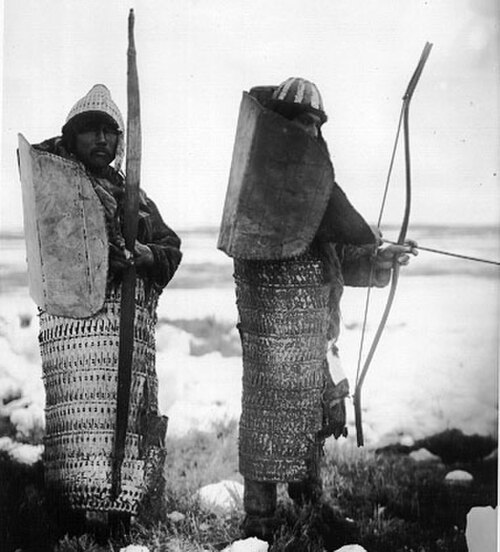
The Ancient Paleo-Siberians () formed from the Ancient North Eurasians (ANE, ) and Ancient Northern East Asian ancestry (ANEA, ), and are closely connected to the first wave of humans into the Americas.[1]The Koryaks are closely related to the Ancient Paleo-Siberians.
In archaeogenetics, the term Ancient Paleo-Siberian is the name given to an ancestral component that represents the lineage of the hunter-gatherer people of the 15th–10th millennia before present, in northern and northeastern Siberia. The Ancient Paleo-Siberian population is thought to have arisen from an Ancient East Asian lineage, which diverged from other East Asian populations sometime between 26kya to 36kya, which later merged with Ancient North Eurasians (ANE) sometime between 20kya to 25kya. The ANE themselves are described as the "result of a palaeolithic admixture" between ancient West Eurasians and East Eurasians.[2][3][4][5] The source for the East Asian component among Ancient Paleo-Siberians is to date best represented by the Ancient Northern East Asian individual AR14K from the Amur region.[6] Other studies define Ancient Paleo-Siberians by their distinct mixture of ANE, Ancient Northeast Asian and first Native American-related ancestries, especially in the context of mainland Northeast Asia.[7]
Phylogenetic position of the Paleo-Siberian lineage among other Eastern Eurasians
↑ Grebenyuk et al. 2022 , p. 96 : 「最新の古遺伝学的データによると、東アジアの人々は紀元前約20,000~18,000年頃に北東シベリアへ移住した。この移住に伴い、ヤナとマルタの個体のゲノムで代表される「古代北シベリア人」の子孫との混血が起こった。これらの過程は、この地域におけるベーリング海峡文化の広範な普及に反映され、極北東アジアにおいていくつかの祖先系統(図1)の出現につながった。すなわち、ドゥヴァンニ・ヤールの個体のゲノムで代表される古代古シベリア人集団と、先祖アメリカ先住民である。後者のタイプはその後、古代ベーリング人とその他のすべてのアメリカ先住民に分かれた(Moreno-Mayar et al. 2018; Sikora et al. 2019)。」
↑ Zhang D, Sun B, Li F, Zhao X, Zhao Z, Li J, Gao S, Li Y, Quan Q, Berdnikova N, Berdnikov I, Chen S, Zhang F, Li C, Jeong C, Cui Y (2025). "新石器時代のゲノムが燕山地域の農牧境界地帯における長距離相互作用を明らかにする" . Science Bulletin . 71 (1): 148– 158. doi : 10.1016/j.scib.2025.11.013 . PMID 41350168 .
↑ Zhang D, Sun B, Li F, Zhao X, Zhao Z, Li J, Gao S, Li Y, Quan Q, Berdnikova N, Berdnikov I, Chen S, Zhang F, Li C, Jeong C, Cui Y (2025). "新石器時代のゲノムが燕山地域の農牧境界地帯における長距離相互作用を明らかにする" . Science Bulletin . 71 (1): 148– 158. doi : 10.1016/j.scib.2025.11.013 . PMID 41350168 .
↑ Liu T, Zhao Z, Guo M, Bennett EA, Cao P, Zhuang L, Dai Q, Zhang W, Liu F, Shi H, Song M, Wang T, Bai F, Ran J, Ping W, Zhang G, Feng X, Fu Q (2025). "モンゴル高原南東部周辺の遺伝史は東アジア北部の新石器文化の拡散をたどる" . The Innovation . 7 (1) 101186. doi : 10.1016/j.xinn.2025.101186 . PMC 12925868 . PMID 41737312 .
Yu, He; Spyrou, Maria A.; Karapetian, Marina; et al. (2020年6月1日). 「旧石器時代から青銅器時代のシベリア人が、最初のアメリカ人やユーラシア大陸全体とのつながりを明らかにする」 . Cell . 181 (6): 1232–1245.e20. doi : 10.1016/j.cell.2020.04.037 . ISSN 0092-8674 . PMID 32437661 .
Zeng, Tian Chen; Vyazov, Leonid A.; Kim, Alexander; et al. (2023年10月4日). 「北ユーラシア全域の狩猟採集民の氷河期後のゲノムは、ウラル語族とエニセイ語族の拡散に関連した先史時代の移動性を明らかにしている」. bioRxiv 10.1101/2023.10.01.560332 .