
Loading article…
奴隷制とは、特に労働に関して、人を財産として所有することです。 [1]奴隷制には通常、強制労働が伴い、奴隷の労働場所と居住地は奴隷を拘束する側によって決定されます。奴隷化とは人を奴隷の状態に置くことであり、その人は奴隷または奴隷化された人と呼ばれます(§ 用語を参照)。
歴史上、奴隷化の多くは、法律違反、負債、軍事的敗北、またはより安い労働力の搾取の結果として起こった。人種や性別などの人口統計学的基準に基づいて、他の形態の奴隷制度が制定された。奴隷は終身、または一定期間拘束され、その後自由を与えられることもあった。[2]奴隷制度は通常、非自発的で強制を伴うが、借金を返済するため、または貧困のために金を稼ぐために自発的に奴隷となる場合もある。人類の歴史において、奴隷制度は文明の典型的な特徴であり、[3]ほとんどの社会で合法であったが、現在では犯罪に対する罰としてを除き、世界のほとんどの国で違法となっている。[4] [5]
動産奴隷制では、奴隷は法的に奴隷所有者の個人的財産(動産)とみなされます。経済学では、事実上の奴隷制という用語は、ほとんどの奴隷が耐える不自由な労働と強制労働の状況を表します。[6]

モーリタニアは1981年に奴隷制度を公式に禁止した世界で最後の国であり[7] 、 2007年には奴隷所有者の法的訴追が確立されました。[8]しかし、2019年には、奴隷制度が違法であるにもかかわらず、世界中で約4000万人(そのうち26%が子供)が依然として奴隷状態でした。現代の世界では、奴隷の50%以上が強制労働に従事しており、通常は国の経済の民間部門の工場や搾取工場で働いています。 [9]先進国では、人身売買は奴隷制度の現代版です。非先進国では、債務による束縛が奴隷制度の一般的な形態であり[6] 、捕らわれた家事使用人、強制結婚の人々、少年兵などが挙げられます。[10]
語源
奴隷という言葉は、最終的にはビザンチンギリシャ語のσκλάβος ( sklábos ) またはεσκλαβήνος ( ésklabḗnos )に由来する古期フランス語のesclaveを通じて中期英語に借用されました。
18世紀から広く知られている見解によれば、ビザンチンのΣκλάβινοι ( Sklábinoi )、Έσκλαβηνοί ( Ésklabēnoí )は、スラヴ人の部族の自称*Slověneから借用され、 8世紀から9世紀に捕虜奴隷、奴隷を意味するσκλάβος、εσκλαβήνος (後期ラテン語sclāvus )に変化したとされている。これは、彼らがしばしば捕らえられ、奴隷にされたためである。[11] [12] [13] [14]しかし、このバージョンは19世紀から議論の的となっている。[15] [16]
現代の別の仮説では、中世ラテン語の sclāvus via * scylāvusは、ビザンチン語のσκυλάω ( skūláō、skyláō )またはσκυλεύω ( skūleúō、skyleúō )に由来し、「(戦闘で殺された)敵から裸にする」または「戦利品を作る/戦利品を取り出す」という意味であると主張している。[17] [18] [19] [20]このバージョンも批判されている。[21]
用語
奴隷制の犠牲者を描写する際に「奴隷」ではなく「自由のない労働者」や「奴隷にされた人」といった用語を使うべきかどうかについて、歴史家の間で論争がある。用語の変更を提案する人々によると、奴隷は、犠牲者を「所有物ではなく人間として前進させる」のではなく、非人間的な名詞に貶めることで、言語における奴隷制の犯罪を永続させるという(人間中心の言語も参照)。他の歴史家は、奴隷という用語が親しみやすく短いため、または奴隷制の非人間性を正確に反映しており、人という用語が奴隷制では許されない程度の自律性を暗示しているため、奴隷という用語を好む。[22]
動産奴隷制
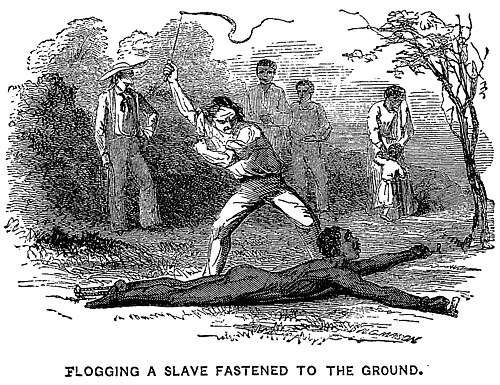


社会制度としての動産奴隷制度では、奴隷は奴隷所有者の所有する動産(個人財産)として分類され、家畜のように自由に売買できる。[23]動産奴隷制度は歴史的に奴隷制度の通常の形態であり、ローマ帝国や古代ギリシャ などの場所で実践され、社会の要と考えられていた。[24] [25] [26]動産奴隷制度 が広く実践されていた他の場所としては、中世エジプト、[27]サハラ以南のアフリカ、[場所? ] [いつ? ] [28]ブラジル、[いつ? ]米国[いつ? ] キューバやハイチなどのカリブ海諸国の一部[いつ? ] [29] [30] イロコイ族は「動産奴隷制度に非常によく似た」方法で他者を奴隷にした。[31]
18世紀初頭、奴隷制度廃止運動が相次ぎ、奴隷制度は奴隷の人間としての権利(「すべての人間は平等に創られた」)を侵害するものとみなし、廃止を求めた。奴隷制度廃止運動は激しい抵抗に遭ったが、最終的には成功した。アメリカのいくつかの州は、アメリカ独立戦争中に奴隷制度を廃止し始めた。フランス革命は1794年に奴隷制度を廃止しようとしたが、1848年まで永久廃止は実現しなかった。イギリス帝国の多くの地域では、1833年に奴隷制度が廃止され、アメリカ全土では1865年に、キューバでは1886年に廃止された。アメリカ大陸で最後に奴隷制度を廃止した国は、1888年のブラジルであった。[32]
動産奴隷制度は中東で最も長く存続した。大西洋奴隷貿易が禁止された後も、古代のサハラ砂漠横断奴隷貿易、インド洋奴隷貿易、紅海奴隷貿易がアフリカ大陸から中東への奴隷の密輸を続けた。20世紀には、動産奴隷制度の問題は、1924~1926年の臨時奴隷委員会、1932年の奴隷制度専門家委員会、 1934~1939年の奴隷制度専門家諮問委員会など、国際連盟と国連によって設立された国際機関によって世界的に取り上げられ、調査された。 [33] 1950~1951年の国連奴隷制度特別委員会 の時点では、合法的な動産奴隷制度はまだアラビア半島、オマーン、カタール、サウジアラビア、休戦諸国、イエメンにのみ存在していた。 [ 33] アラビア半島における合法的な動産奴隷制度は1960年代にようやく廃止された。サウジアラビアとイエメンでは1962年、ドバイでは1963年、そして最後にオマーンでは1970年に廃止された。[33]
奴隷制度を廃止した最後の国はモーリタニアで、1981年に廃止された。1981年の奴隷制度禁止は、奴隷を使用した者を訴追する法的仕組みがなかったため、実際には施行されず、2007年にようやく導入された。[7] [34]
強制労働
契約労働は、債務奴隷とも呼ばれ、担保として自分自身を差し出すことで借金を返済するために働く不自由労働の一種です。借金を返済するために必要なサービスとその期間は、定義されていない場合があります。債務奴隷は世代から世代へと受け継がれ、子供たちは先祖の借金を返済する必要があります。[35]これは今日最も広く普及している奴隷制度です。[36]債務奴隷は南アジアで最も一般的です。[35] 金銭結婚とは、通常、少女が両親の借金を返済するために男性と結婚する結婚を指します。[37]チュクリシステムは、ベンガルの一部で見られる債務奴隷制度で、借金を返済するために女性が売春を強要されることがあります。 [38]
扶養家族
奴隷制という言葉は、他の誰かに法的に依存している状態を指すためにも使われてきました。[39] [40]例えば、ペルシャでは、そのような奴隷の状況と生活は一般市民よりも良いものでした。[41]

強制労働
強制労働、または不自由労働は、暴力やその他の処罰の脅威の下で、自分の意志に反して働くことを強いられている個人を指すために使用されることがあります。これには、農奴制、徴兵、懲罰労働など、一般的に奴隷制として分類されない制度も含まれる場合があります。奴隷制はすべての国で法的に禁止されているため、今日の強制労働(多くの場合、「現代の奴隷制」と呼ばれます)は、違法な管理を中心に展開されています。
人身売買は主に女性や子どもを売春に強制するもので、強制労働の中で最も急速に増加している形態であり、タイ、カンボジア、インド、ブラジル、メキシコが児童の商業的性的搾取の主要なホットスポットとして特定されている。[42] [43]
子ども兵士と児童労働
2007年、ヒューマン・ライツ・ウォッチは、当時の紛争で20万人から30万人の子どもたちが兵士として従軍したと推定した。[44] 16歳未満の少女のうち、家事労働者として働く者の数は他のどの児童労働よりも多く、ハイチのレスタベックのように貧困な地方で暮らす親によって都市に送り出されることが多い。[45]
強制結婚
強制結婚や早婚は、しばしば奴隷制の一種とみなされる。強制結婚は、アジアやアフリカの一部、西洋の移民コミュニティなど、世界各地で今も行われている。[46] [47] [48] [49] 誘拐による結婚は今日でも世界の多くの場所で起こっており、2003年の調査では、エチオピアでは全国平均で結婚の69%が誘拐によるものであることがわかった。[50]
この用語の他の用法
奴隷制という言葉は、強制的に従わされるあらゆる活動を表す軽蔑語としてよく使われる。徴兵やその他の強制的な政府労働は「国家運営の奴隷制」を構成すると主張する者もいる。[51] [52]一部の自由主義者や無政府資本主義者は、政府による課税を奴隷制の一形態とみなしている。[53]
「奴隷制」は、精神病患者を自発的に治療できない状態と定義するために、精神医学反対派によって使われてきた。精神病患者は精神科医の指示に従わなければならないと主張している。彼らは、奴隷を拘束するために鎖を使うのではなく、精神科医は薬物を使って精神をコントロールすると主張している。 [54] ドラペトマニアは、自由を望む奴隷に対する疑似科学的な精神医学的診断であり、「症状」には怠惰や監禁から逃げようとする傾向が含まれていた。[55] [56]
動物の権利を主張する人の中には、人間が所有する動物の一部またはすべての状態に奴隷制という言葉を適用し、その地位は人間の奴隷の地位に匹敵すると主張する人もいる。 [57]
現代の資本主義システムのもとで制度化された労働市場は、主流派社会主義者やアナルコサンディカリストによって批判されてきた。彼らは賃金奴隷制という用語を賃金労働の軽蔑語または偽語として使用している。 [58] [59] [60]社会主義者は、商品としての労働力の売買と奴隷制の間に類似点を見出している。キケロもそのような類似点を示唆したことで知られている。[61]
特徴
経済
経済学者は奴隷制(および農奴制などの派生)が出現し消滅する状況をモデル化してきた。ある理論的モデルは、土地は豊富だが労働力が乏しい場合、地主にとって奴隷制はより望ましいものとなり、地代は低く、賃金労働者は高い賃金を要求できるというものである。もしその逆が真実ならば、競争の激しさゆえに低い賃金しか要求できない賃金労働者を雇うよりも、奴隷を守る方が地主にとってはコストがかかる。[62]このように、ヨーロッパでは人口が増加するにつれて、まず奴隷制、次いで農奴制が徐々に減少した。アメリカ大陸とロシアでは、住民の少ない広大な土地が利用可能になると、奴隷制が再導入された。[63]
奴隷制度は、作業が比較的単純で監督が容易な場合、例えばサトウキビや綿花などの大規模な単一作物で、生産量が規模の経済性に依存する場合によく見られる。これにより、米国のギャングシステムなどの労働システムが、工場のような精密さで畑作業員が働く大規模なプランテーションで顕著になった。当時、各作業ギャングは内部分業に基づいており、ギャングのメンバー全員に作業が割り当てられ、各労働者のパフォーマンスは他の労働者の行動に依存するものだった。奴隷は綿花の周りの雑草や余分な芽を刈り取った。耕作ギャングはその後について、綿花の近くの土をかき混ぜて、それを綿花の周りに投げ返した。このように、ギャングシステムは流れ作業のように機能していた。[64]
18世紀以来、批評家たちは奴隷制度が技術の進歩を妨げていると主張してきた。なぜなら奴隷の効率性を向上させることよりも、単純な仕事をする奴隷の数を増やすことに焦点が当てられているからだ。例えば、この狭い焦点のために、ギリシャ、そして後にローマの技術は肉体労働を楽にしたり製造業を改善したりするために応用されなかったと主張されることがある。[65] [66]

スコットランドの経済学者アダム・スミスは、自由労働は奴隷労働より経済的に優れており、自由で民主的、あるいは共和制の政府では、議員や政治家の多くが奴隷所有者であり、自らを罰しないので奴隷制を終わらせることはほぼ不可能であると述べた。彼はさらに、奴隷は中央集権的な政府、つまり国王や教会のような中央権力のもとで自由を獲得しやすいと述べた。[67] [68]同様の議論は後にオーギュスト・コントの著作にも登場し、特にスミスの三権分立、あるいはコントが中世と奴隷制の終焉における「精神と現世の分離」と呼んだものに対する信念、およびスミスの過去と現在の主人に対する批判を考慮すると、それは顕著である。スミスは法学講義でこう述べている。「聖職者の強大な権力が国王の権力と一致すると、奴隷は自由になることができる。しかし、国王と聖職者の権威が両方とも強大であることが絶対に必要だった。どちらかが欠けていたところでは、奴隷制度は依然として存続する...」[69]

奴隷制度が犯罪となった後も、奴隷所有者は高い利益を得ることができた。研究者シッダールト・カラによると、2007年に世界中であらゆる形態の奴隷制度によって生み出された利益は912億ドルだった。これは、世界的な犯罪組織として、麻薬密売に次ぐ規模だった。当時、奴隷の加重平均世界販売価格はおよそ340ドルと推定され、最高は人身売買された性奴隷の平均で1,895ドル、最低はアジアとアフリカの一部の債務奴隷で40~50ドルだった。2007年に奴隷が生み出した加重平均年間利益は3,175ドルで、最低は債務労働の平均で950ドル、人身売買された性奴隷で29,210ドルだった。毎年の奴隷利益の約40%は人身売買された性奴隷によって生み出されており、これは世界の奴隷2,900万人の4%強にあたる。[70]
識別
_-_men_and_women_eminent_in_the_evolution_of_the_American_of_African_descent_(1914)_(14597416438).jpg/500px-The_Negro_in_American_history_(microform)_-_men_and_women_eminent_in_the_evolution_of_the_American_of_African_descent_(1914)_(14597416438).jpg)


奴隷を所有物として明確に印をつけるため、あるいは罰として、 焼印を押すという慣習が広く行われていた。
法的側面
民間奴隷と国有奴隷
奴隷は個人が私的に所有していたこともあるが、国家所有のものもあった。例えば、近代以前の韓国ではキーセンは低カーストの女性で、官吏と呼ばれる政府職員のもとで国家所有となり、貴族に娯楽を提供することが義務付けられていた。2020年代の北朝鮮では、キップムジョ(「快楽旅団」)は一般住民から選ばれた女性で構成され、北朝鮮の支配者たちの娯楽や側室として働いている。[ 71] [72] 「貢物労働」は国家の義務労働であり、強制労働、ミタ、レパルティミエントなどさまざまな形で使用されてきた。ナチスやソ連などの全体主義政権の収容所では、収容所で提供される労働がますます重要視され、歴史家の間ではそのような制度を奴隷制と呼ぶ傾向が高まっている。[73]
これらの組み合わせには、スペイン国王が特定の地域の特定数の原住民の無償労働の権利を個人に与えたエンコミエンダ制度が含まれる。 [74]コンゴ自由国とフランス統治下のウバンギ・シャリの「赤ゴム制度」では、[75]労働は課税として要求され、民間企業はゴム生産を増やすためにあらゆる手段を講じることが認められた。[76] 囚人リースは、州が囚人を企業に無償労働としてリースする南部アメリカで一般的であった。
法的権利
時代や国によっては、奴隷の法的権利が限定的である場合もあった。例えば、ニューヨーク州では、故意に奴隷を殺害した者は1686年の法令により処罰の対象となった。[77]また、すでに述べたように、朝鮮のノビ、さまざまなアフリカ社会の奴隷、フランス領ルイジアナの黒人女性奴隷には一定の法的権利が付与されていた。奴隷に法的権利を与えることは、時には道徳の問題であったが、時には自己利益の問題でもあった。例えば、古代アテネでは、奴隷を虐待から守ることは、同時に奴隷と間違われる可能性のある人々を守ることであり、奴隷に限定的な財産権を与えることは、奴隷がより多くの財産を得るためにより一生懸命働くことを奨励した。[78] 1865年に奴隷制度が廃止される前のアメリカ南部では、奴隷制度を支持する法律論文で、罪に問われた奴隷には通常、弁護士を雇う法的権利、二重処罰からの自由、より重大な事件における陪審裁判を受ける権利、大陪審による起訴を受ける権利があったが、白人成人が持つ自らの人生をコントロールする能力など、他の多くの権利が欠如していたと報告されていた。[79]
歴史
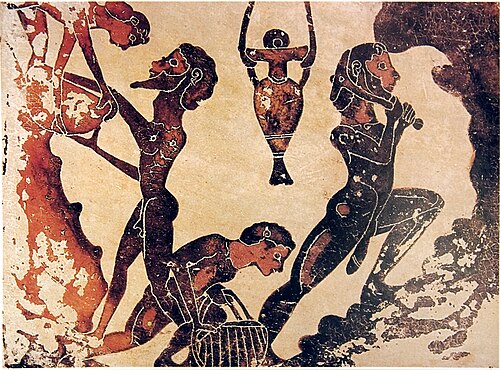
奴隷制度は、文字による記録が残る以前から存在し、多くの文化に存在してきた。[3]狩猟採集民の間では、奴隷制度は経済的余剰と相当な人口密度を必要とするため、稀である。したがって、太平洋岸北西部のサケの豊富な川に住むアメリカインディアンなど、異常に資源が豊富な狩猟採集民の間では奴隷制度が存在していたが、奴隷制度が広く普及したのは、約11,000年前の新石器革命の間に農業が発明されてからである。 [80]奴隷制度は、ほぼすべての古代文明で実践されていた。[3]奴隷制度には、債務による束縛、犯罪に対する罰、戦争捕虜の奴隷化、子供の遺棄、奴隷の子孫の奴隷化などがあった。[81]
アフリカ
アフリカでは奴隷制度が広く普及しており、国内および国外で奴隷貿易が行われていました。[82]セネガンビア地域では、1300年から1900年の間に人口の約3分の1が奴隷にされていました。ガーナ、マリ、セグー、ソンガイを含む西サヘルの初期のイスラム諸国では、人口の約3分の1が奴隷にされていました。[83]
ヨーロッパの宮廷社会や貴族社会では、1300年代後半から1400年代にかけて、黒人アフリカ人奴隷とその子供たちが目立つようになった。神聖ローマ皇帝フリードリヒ2世の時代から、黒人アフリカ人は従者の中に含まれていた。1402年にはエチオピアの使節がヴェネツィアに到着した。1470年代には、マントヴァとフェラーラに展示された壁画に、黒人アフリカ人が宮廷の従者として描かれた。1490年代には、ミラノ公爵の紋章に黒人アフリカ人が含まれていた。[84]

サハラ砂漠横断奴隷貿易では、西アフリカの奴隷がサハラ砂漠を越えて北アフリカに運ばれ、地中海や中東の文明国に売られた。紅海奴隷貿易では、アフリカから紅海を越えてアラビア半島に奴隷が運ばれた。インド洋奴隷貿易は東アフリカ奴隷貿易とも呼ばれ、多方向であった。アフリカ人は奴隷としてアラビア半島、インド洋諸島(マダガスカルを含む)、インド亜大陸、そして後にアメリカ大陸に送られた。これらの奴隷貿易業者は、現在のケニア、モザンビーク、タンザニアの内陸部からバントゥー族(ザンジ)を捕らえ、海岸に連れてきた。[86] [87]そこで、奴隷たちは徐々に農村部、特にウングジャ島とペンバ島に同化した。 [88]
歴史家の中には、1500年から1900年の間に、インド洋、中東、北アフリカの海岸で1,700万人もの人々が奴隷として売られ、約500万人のアフリカ人奴隷がイスラム教徒の奴隷商人によって買われ、紅海、インド洋、サハラ砂漠を越えてアフリカから連れてこられたと主張する者もいる。 [89]捕虜は中東全域で売られた。この貿易は、優れた船舶によって貿易が増加し、この地域のプランテーションでの労働力に対する需要が高まったため加速した。最終的に、毎年何万人もの捕虜が連れてこられるようになった。[88] [90] [91]インド洋の奴隷貿易は多方向的で、時とともに変化した。単純労働の需要を満たすため、東アフリカの奴隷商人が南東アフリカから買ったバントゥー族の奴隷は、何世紀にもわたってエジプト、アラビア、ペルシャ湾、インド、極東のヨーロッパの植民地、インド洋諸島、エチオピア、ソマリアの顧客に累積的に大量に売られた。[92]
アフリカ史百科事典によると、「1890年代までに世界最大の奴隷人口である約200万人がソコト・カリフ国の領土に集中していたと推定される。奴隷労働は特に農業において広範囲に及んだ。」[93] [94]奴隷制度反対協会は、1930年代初頭のエチオピアの推定人口800万~1600万人のうち200万人が奴隷であったと推定している。[95]
東アフリカの奴隷労働力は、東アフリカ沿岸に住んでいたバントゥー族のザンジ人から引き出された。 [87] [96]インド洋奴隷貿易の間、ザンジ人は何世紀にもわたってアラブの商人によってインド洋に面するすべての国に奴隷として輸送された。ウマイヤ朝とアッバース朝のカリフは多くのザンジ人奴隷を兵士として採用し、早くも696年には、イラクのウマイヤ朝カリフのもとで奴隷状態にあったアラブの奴隷主に対してザンジ人の奴隷反乱が起こった。ザンジの反乱は、現在のイラクにあったアッバース朝の奴隷制度に反対して、869年から883年の間にバスラ(バサラとしても知られる)近郊で起こった一連の反乱で、もともとアフリカ大湖地域や東アフリカのさらに南の地域から捕らえられた奴隷のザンジ人が関与していたと考えられている。[97]この紛争はイスラム帝国全土から輸入された50万人以上の奴隷と自由人を巻き込み、「イラク南部で数万人以上の命を奪った」[98] 。
奴隷として中東に連れて行かれたザンジ族は、しばしば過酷な農作業に従事させられた。[99]プランテーション経済が繁栄し、アラブ人が豊かになると、農業やその他の肉体労働は屈辱的なものと考えられるようになった。その結果、労働力不足が起こり、奴隷市場の拡大につながった。

アルジェリアの首都アルジェでは、捕らえられたキリスト教徒やヨーロッパ人が奴隷にされた。1650年頃、アルジェには3万5000人ものキリスト教徒奴隷がいた。[100]ある推計によると、16世紀から19世紀の間に、イタリアからアイスランドにかけての沿岸の村や船を襲撃したバルバリア奴隷商人の手によって、推定100万から125万人のヨーロッパ人が奴隷にされた。[101] [102] [103]しかし、この推計は、バルバリア海賊に捕らえられたヨーロッパ人奴隷の数が250年間一定であったと仮定した外挿法によるものである。
奴隷にされた男性、女性、子供の数は記録に残っていないが、人口を一定に保ち、死亡、逃亡、身代金で身代金を要求された奴隷、イスラム教に改宗した奴隷を補充するために必要だったであろう新たな捕虜の数を大まかに計算することは可能である。これに基づくと、1580年から1680年までの100年間で約85万人の捕虜を補充するために毎年約8,500人の新たな奴隷が必要だったと考えられる。これを拡張すると、1530年から1780年までの250年間で、その数は簡単に1,250,000人まで上昇した可能性がある。[104]
デイヴィッド・アールなど他の歴史家はデイヴィッド・アールの数字に反論しており、アールは海賊が東ヨーロッパから非キリスト教徒の白人も捕らえたという事実によって、ヨーロッパ人奴隷の本当の姿が曖昧になっていると警告している。 [104]さらに、奴隷の売買は活発で[説明が必要] 、ピーク時の数を基に数世紀、あるいは千年単位の平均を計算した誇張された推定値があった。そのため、奴隷の輸入を考慮すると、特に18世紀と19世紀には年ごとに大きな変動があり、1840年代以前には一貫した記録がないという事実も考慮されている。中東専門家のジョン・ライトは、現代の推定値は人間の観察からの逆算に基づいていると警告している。[105] 16世紀後半から17世紀初頭にかけての観察者によるこうした観察によれば、この時期を通じてバーバリ海岸、トリポリ、チュニス、そして主にアルジェで拘束されたヨーロッパ人キリスト教徒奴隷は約3万5000人いたとされている。そのほとんどは船員(特にイギリス人)で、船とともに連れて行かれたが、漁師や沿岸の村人もいた。しかし、これらの捕虜のほとんどはアフリカに近い土地、特にスペインとイタリアから来た人々だった。[34]これは最終的に1816年に英蘭艦隊によるアルジェ砲撃につながった。[106] [107]
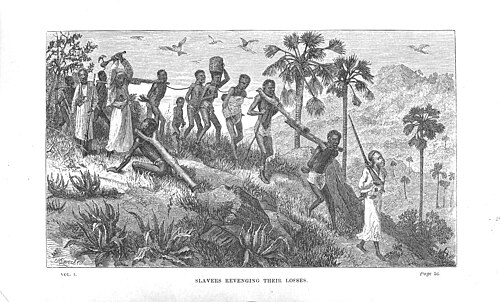
オマーン・アラブ人の支配下で、ザンジバルは東アフリカの主要な奴隷港となり、19世紀には毎年5万人ものアフリカ人奴隷がここを通過した。[108] [109]歴史家の中には、650年から1900年の間に1100万から1800万人のアフリカ人奴隷が紅海、インド洋、サハラ砂漠を渡ったと推定する者もいる。[3] [検証失敗] [110] エドゥアルド・リュッペルは、エジプトまで徒歩で運ばれたスーダン人奴隷の損失について次のように述べている。「1822年にダフタルダール・ベイがヌバ山脈南部で行った作戦の後、4万人近くの奴隷が捕らえられた。しかし、劣悪な扱いや病気、砂漠の旅により、エジプトにたどり着いたのはわずか5千人だった。」[111] WAフェーンホーフェンは次のように書いている。「目撃者のドイツ人医師グスタフ・ナハティガルは、市場に到着した奴隷一人につき、3~4人が途中で死んだと信じていた...ケルティ(『アフリカ分割』ロンドン、1920年)は、アラブ人が海岸に連れてきた奴隷一人につき、少なくとも6人が途中で、または奴隷商人の襲撃中に死んだと信じている。リヴィングストンは、その数字を10対1としている。」[112]
奴隷制度は、古代世界の多くの地域と同様に、アフリカの一部でも一般的でした。奴隷制度が普及していた多くのアフリカ社会では、奴隷は動産奴隷として扱われず、世界の他の地域の年季奉公と同様の制度で一定の権利が与えられていました。アフリカの奴隷制度の形態は、親族構造と密接に関連していました。土地を所有できない多くのアフリカのコミュニティでは、個人の奴隷化は、個人の影響力を高め、つながりを広げる手段として使用されました。[113]これにより、奴隷は主人の家系の永久的な一部となり、奴隷の子供はより大きな家族のつながりと密接につながることができました。[114]家族に生まれた奴隷の子供は、主人の親族グループに統合され、社会の中で重要な地位に昇進し、場合によっては首長のレベルにまで上り詰めることができました。しかし、汚名はしばしばつきまとい、親族グループの奴隷メンバーと主人の親戚との間には厳格な分離がありました。[113]奴隷制度は様々な形で実践されていました。借金奴隷、戦争捕虜の奴隷化、軍事奴隷、犯罪奴隷はすべてアフリカのさまざまな地域で実践されていました。[115]家庭内や裁判所の目的のための奴隷制度はアフリカ全土で広まっていました。
.jpg/500px-Kenneth_Lu_-_Slave_ship_model_(_(4811223749).jpg)
大西洋奴隷貿易が始まると、多くの現地の奴隷制度がアフリカ外の動産奴隷市場に捕虜を供給し始めた。大西洋奴隷貿易はアフリカからの唯一の奴隷貿易ではなかったが、量と激しさの点で最大のものだった。エリキア・ムボコロはル・モンド・ディプロマティーク紙に次のように書いている。
アフリカ大陸は、あらゆるルートで人的資源を奪われた。サハラ砂漠を越え、紅海を抜け、インド洋の港から、そして大西洋を渡って。イスラム諸国の利益のために、少なくとも10世紀にわたって奴隷制度が続いた(9世紀から19世紀まで)。紅海経由で400万人、インド洋のスワヒリの港経由でさらに400万人、サハラ砂漠を横断するキャラバンルート経由でおそらく900万人、大西洋を渡って1100万人から2000万人(著者による)が奴隷として輸出された。[116]
大西洋を横断する奴隷貿易は、西アフリカ内陸部への襲撃遠征で捕らえられた奴隷が最も多かった18世紀後半にピークを迎えた。
これらの遠征は、オヨ王国(ヨルバ族)、アシャンティ王国[117]、ダホメ王国[118]、アロ連邦[119 ]などのアフリカの王国によって典型的に実行されました。航海中に奴隷の約15%が死亡したと推定されており、アフリカ自体でも先住民を捕らえて船に移送する過程で死亡率がかなり高くなりました。[120] [121]
アメリカ大陸
メキシコにおける奴隷制度はアステカにまで遡ることができる。[122]アンデスのインカ族、ブラジルのトゥピナンバ族、ジョージアのクリーク族、テキサスのコマンチ族など他のアメリカインディアンも奴隷制度を実施していた。 [3]
カナダにおける奴隷制度は、先住民とヨーロッパからの入植者によって実践されていた。[123]カナダとなった地域の奴隷所有者には、例えばユロック族などの漁業社会があり、彼らはアラスカからカリフォルニアまでの太平洋岸に住んでいた。 [124]この地域は太平洋岸または北北西海岸と呼ばれることもある。ハイダ族やトリンギット族など、太平洋岸北西海岸の先住民の中には、カリフォルニアまで襲撃する勇猛果敢な戦士や奴隷商人として伝統的に知られていた。奴隷制度は世襲制で、奴隷は戦争捕虜であり、その子孫も奴隷であった。[125]ブリティッシュコロンビア州の一部の部族は、1970年代まで奴隷の子孫に対する隔離と追放を続けた。[126]
アメリカにおける奴隷制度は、いまだに論争の的となっている問題であり、革命、内戦、そして数多くの反乱を 引き起こし、一部の国々の歴史と発展に大きな役割を果たしました。
輸送された奴隷の数で見ると、大西洋横断奴隷市場の大部分を支配していた国は、イギリス、ポルトガル、フランスでした。

アメリカ帝国としての地位を確立するために、スペインは新世界の比較的強力な文明と戦わなければならなかった。アメリカ大陸の先住民に対するスペインの征服には、原住民を強制労働に従事させることも含まれていた。スペインの植民地は、キューバやイスパニョーラ島などの新世界でアフリカ人奴隷を使用した最初のヨーロッパ人であった。[127]同時代の著述家の中には、それは本質的に不道徳であると主張する者もいた。[128] [129] [130] 16世紀のドミニコ会修道士でスペインの歴史家であったバルトロメ・デ・ラス・カサスは、キューバ(バヤモとカマグエイ)での作戦に参加し、アトゥエイの虐殺にも居合わせた。彼はその虐殺を観察したことで、原住民を奴隷として使わない社会運動に反対する闘いを始めた。また、原住民の人口が驚くほど減少したことから、原住民を保護する最初の王法が制定された。最初のアフリカ人奴隷は1501年にイスパニョーラ島に到着した。[131]この時代は人種に基づく奴隷制度が拡大した。[132]イギリスは大西洋奴隷貿易で重要な役割を果たした。「奴隷三角地帯」はフランシス・ドレークとその仲間によって開拓されたが、イギリスの奴隷貿易が本格的に始まったのは17世紀半ばになってからであった。
17世紀から18世紀にかけて北アメリカにやってきた白人の多くは、年季奉公の契約を結んだ。[133]年季奉公から奴隷への変化は、バージニアでは徐々に進んだ。そのような変化に関する最も古い法的文書は、1640年に黒人のジョン・パンチが逃亡を企てたために終身奴隷の判決を受け、残りの人生を主人のヒュー・グウィンに仕えることを余儀なくされた事件である。この事件が重要だったのは、黒人としての彼の判決と、彼と一緒に逃亡した2人の白人年季奉公人(1人はオランダ人、もう1人はスコットランド人)の判決の不一致を明らかにしたからである。これは、黒人が終身奴隷の判決を受けた最初の文書化された事件であり、黒人年季奉公人と白人年季奉公人の間に人種的区別を設けた最初の法的事件の1つと考えられている。[134] [135]
1640年以降、農園主は年季奉公契約の期限を無視し、使用人を終身奴隷として雇い続けるようになった。これは1655年のジョンソン対パーカー事件で実証され、裁判所は民事訴訟の結果、黒人のアンソニー・ジョンソンが別の黒人のジョン・カソルの所有権を認める判決を下した。 [136]これは13植民地で、犯罪を犯していない人物を終身奴隷にできるという司法判断の最初の例であった。 [137] [138]
スペイン植民地時代のアメリカ
1519年、エルナン・コルテスがこの地域に最初の近代的奴隷を連れてきた。 [139] 16世紀半ば、スペインの新法により、アステカ人を含む先住民の奴隷制度が禁止された。その結果、労働力不足が生じた。このため、天然痘にかかりにくいアフリカ人奴隷が輸入されるようになった。その代わりに、多くのアフリカ人は自由を買う機会を与えられ、最終的には主人から自由を与えられた者もいた。[139]ジャマイカでは、スペイン人が多くのタイノ族を奴隷にした。一部は逃げたが、大半はヨーロッパ人の病気と過労で死亡した。スペイン人は最初のアフリカ人奴隷も連れてきた。[140]
スペインは、1810 年にアメリカ領土または副王領が反乱を起こして独立するまで、実質的に奴隷貿易を行っていませんでした。ナポレオンの侵略後、スペインは産業とアメリカ領土を失いましたが、キューバとプエルトリコでは例外で、1810 年以降、アフリカ人奴隷のキューバへの貿易が大規模に始まりました。この貿易は、フランスの失われた植民地サン ドマング (ハイチ) から追放されたフランス人農園主がキューバ東部に定住したことで始まりました。
1789年、キューバで奴隷労働の需要が高まっていたため、スペイン王室は奴隷制度改革の取り組みを主導した。王室はCódigo Negro Español(スペイン黒人法典)という法令を発布し、食料や衣服の規定、労働時間の制限、刑罰の制限、宗教教育の義務付け、結婚の保護、母親から引き離した幼児の売買の禁止などを定めた。イギリスはキューバの奴隷制度に他の変更を加えた。しかし、農園主はしばしばこの法律を無視し、権威への脅威であり私生活への侵害であるとみなして抗議した。[141]
イギリスとオランダ領カリブ海
,_plate_III_-_BL.jpg/500px-Slaves_working_on_a_plantation_-_Ten_Views_in_the_Island_of_Antigua_(1823),_plate_III_-_BL.jpg)
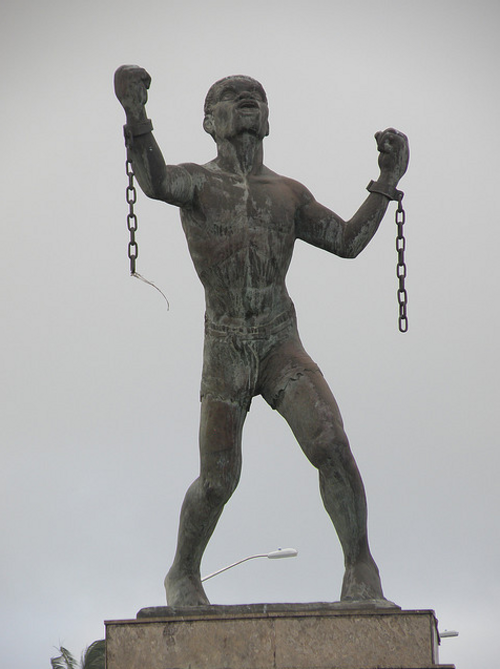
17世紀初頭、バルバドスにおける労働力の大半は、主にイギリス人、アイルランド人、スコットランド人などのヨーロッパ人年季奉公人によって提供され、アフリカ人奴隷とアメリカ先住民奴隷はほとんど労働力を提供しなかった。 1640年にサトウキビが導入されたことで、社会と経済は完全に変貌した。バルバドスは最終的に世界最大級の砂糖産業を持つようになった。[142]実用的な砂糖プランテーションには、多額の投資と多くの重労働が必要だった。最初はオランダの貿易業者が設備、資金、アフリカ人奴隷を供給し、さらに砂糖のほとんどをヨーロッパに輸送した。1644年のバルバドスの人口は3万人と推定され、そのうち約800人がアフリカ系で、残りは主にイギリス系だった。1700年までに、1万5000人の自由白人と5万人の奴隷アフリカ人がいた。ジャマイカでは、1670 年代と 1680 年代のアフリカ人奴隷の人口は 10,000 人を超えることはなかったものの、1800 年までに 300,000 人以上に増加しました。奴隷法や黒人法の施行が進み、アフリカ人と白人労働者および支配的な農園主階級の間に差別的な扱いが生まれました。この時期にはこれらの法に対抗して、奴隷反乱が何度か試みられたり計画されたりしましたが、どれも成功しませんでした。

オランダ植民地スリナムの農園主たちは、コーヒー、カカオ、サトウキビ、綿花などの農作物の栽培、収穫、加工をアフリカ人奴隷に大きく依存していた。[143]オランダは1863年にスリナムにおける奴隷制度を廃止した。
多くの奴隷がプランテーションから逃げ出した。隣接する熱帯雨林に住む南米原住民の助けを借りて、逃亡奴隷たちは内陸部に独自の新しい文化を築き上げ、それは非常に成功した。彼らは英語ではマルーン、フランス語ではネグ・マロン(文字通り「褐色の黒人」、つまり「肌の白い黒人」を意味する)、オランダ語ではマロンと総称された。マルーンは、異なるアフリカ民族の奴隷で構成されていたため、民族形成の過程を経て徐々にいくつかの独立した部族を形成していった。これらの部族には、サラマカ、パラマカ、ンデュカ(アウカン)、クウィンティ、アルク(ボニ)、マタワイなどがある。マルーンは、奴隷から新しいメンバーを募集して女性を捕らえるため、また武器、食料、物資を得るために、しばしばプランテーションを襲撃した。彼らは襲撃の際にプランターとその家族を殺害することもあった。[144]植民者たちはマルーン族に対しても武力攻撃を仕掛けたが、マルーン族は熱帯雨林を通って逃げるのが一般的で、植民者たちは植民者たちよりも熱帯雨林のことをよく知っていた。敵対行為を終わらせるため、18世紀にヨーロッパの植民地当局はさまざまな部族といくつかの平和条約を締結した。彼らはマルーン族に内陸領土における主権と貿易権を与え、自治権を与えた。
ブラジル


ブラジルにおける奴隷制度は、 1532年に最初のポルトガル人入植地が設立されるずっと前から始まっており、ある部族のメンバーが捕らえた他の部族のメンバーを奴隷にしていた。[145]
その後、ポルトガル人植民者は、入植初期段階では自給自足の経済を維持するために先住民の労働力に大きく依存し、先住民はしばしばバンデイラと呼ばれる遠征隊によって捕らえられました。アフリカ人奴隷の輸入は16世紀半ばに始まりましたが、先住民の奴隷化は17世紀と18世紀までずっと続きました。
大西洋奴隷貿易時代、ブラジルは他のどの国よりも多くのアフリカ人奴隷を輸入した。1501年から1866年の間に、約500万人の奴隷がアフリカからブラジルに連れてこられた。[146] 1850年代初頭まで、ブラジルの海岸に到着したアフリカ人奴隷のほとんどは、西中央アフリカの港、特にルアンダ(現在のアンゴラ)で乗船することを余儀なくされた。今日、ナイジェリアを除いて、アフリカ系人口が最も多い国はブラジルである。[147]
奴隷労働はブラジルの砂糖経済成長の原動力であり、1600年から1650年まで砂糖は植民地の主な輸出品だった。1690年にブラジルで金とダイヤモンドの鉱床が発見され、この新たに利益の出る市場を動かすためにアフリカ人奴隷の輸入が増加した。採掘インフラのための輸送システムが開発され、金とダイヤモンドの採掘に参加しようとする移民によって人口が急増した。18世紀後半に鉱業が衰退した後も、アフリカ人奴隷の需要は衰えなかった。人口増加後には牛の牧場経営と食料生産が急増したが、どちらも奴隷労働に大きく依存していた。1700年から1800年にかけて170万人の奴隷がアフリカからブラジルに輸入され、1830年代のコーヒーの隆盛は奴隷貿易の拡大をさらに促した。
ブラジルは西欧諸国で奴隷制度を廃止した最後の国です。アメリカ大陸に連れてこられた奴隷の総数の 40% がブラジルに送られました。ちなみに、米国が受け取ったのは 10% です。奴隷制度は廃止されましたが、21 世紀のブラジルでもまだ奴隷のような状況で働いている人々がいます。
ハイチ
ハイチにおける奴隷制度は、1492年にクリストファー・コロンブスが島に到着したときに始まった。この慣習は原住民に壊滅的な打撃を与えた。 [148]先住民のタイノ族が強制労働、病気、戦争でほぼ絶滅した後、スペイン人はカトリックの司祭バルトロメ・デ・ラス・カサスの助言の下、先住民を保護したいと願っていたカトリック教会の祝福を受けて、アフリカ人奴隷の使用に本格的に取り組み始めた。 [説明が必要] 1625年に始まったフランス植民地時代、ハイチ(当時はサン=ドマングと呼ばれていた)の経済は奴隷制度に基づいており、そこでの慣習は世界で最も残酷なものと見なされていた。


1697年のリスウィック条約に続いて、イスパニョーラ島はフランスとスペインに分割された。フランスは西側の3分の1を獲得し、後にサン=ドマングと名付けた。サトウキビ農園に開発するため、フランスはアフリカから何千人もの奴隷を輸入した。砂糖は18世紀を通じて利益の高い商品作物だった。1789年までに、約4万人の白人入植者がサン=ドマングに住んでいた。白人の数は、主にサトウキビ生産のための農園で働くために輸入した何万人ものアフリカ人奴隷の数に大幅に劣っていた。島の北部では、奴隷はアフリカの文化、宗教、言語との多くのつながりを維持することができ、これらのつながりは新たに輸入されたアフリカ人によって絶えず更新されていた。黒人の数は白人の約10倍であった。
フランスで制定された黒法典は、ジャン=バティスト・コルベールが起草し、ルイ14世が批准したもので、奴隷の扱いと自由の許容範囲に関する規則を定めていた。サン=ドマングは最も残酷な奴隷植民地の一つと言われており、新たに輸入されたアフリカ人の3分の1が数年のうちに死亡した。[149]多くの奴隷が天然痘や腸チフスなどの病気で死亡した。[150]出生率は約3%で、子供を奴隷の束縛の中で生きることを許すよりも、胎児を中絶したり、幼児殺害を行った女性もいたという証拠がある。 [151] [152]
ルイジアナ植民地と同様に、フランス植民地政府は、自由有色人種、すなわち白人男性入植者と黒人女性奴隷(後には混血女性)との混血の子孫に一定の権利を認めた。時が経つにつれ、多くが奴隷から解放され、別の社会階級を確立した。白人のフランス系クレオール人の父親は、混血の息子を教育のためにフランスに送ることが多かった。有色人種の男性の中には、軍隊に入隊させられた者もいた。自由有色人種の多くは島の南部、ポルトープランス近郊に住み、多くはコミュニティ内で結婚した。彼らは職人や商人として働くことが多く、財産を所有し始めた。奴隷所有者となった者もいた。自由有色人種は、植民地政府に権利拡大を請願した。
大西洋を横断してハイチにたどり着いた奴隷とハイチで生まれた奴隷は、最初にハイチの公文書館に記録され、その後フランス国防省と外務省に移管された。2015年現在[update]、これらの記録はフランス国立公文書館に保管されている。1788年の国勢調査によると、ハイチの人口は白人約4万人、自由黒人3万人、奴隷45万人で構成されていた。[153]
1804 年のハイチ革命は人類史上唯一成功した奴隷反乱であり、 1848 年にフランス植民地すべてで奴隷制度の終焉を促した。
アメリカ合衆国

アメリカ合衆国における奴隷制度は、アメリカ合衆国がイギリスから独立してから南北戦争が終わるまでの18世紀から19世紀にかけて存在した、主にアフリカ人とアフリカ系アメリカ人を対象とした人身売買の法的制度であった。奴隷制度は植民地時代初期からイギリス領アメリカで実践されており、 1776年の独立宣言の時点では13植民地すべてで合法であった。アメリカ独立戦争の頃までには、奴隷の地位はアフリカ系の祖先に関連する人種的カーストとして制度化されていた。[154]アメリカ合衆国は奴隷制の問題で二極化しており、自由州のペンシルベニアと奴隷のメリーランド州およびデラウェア州を隔てるメイソン・ディクソン線によって奴隷州と自由州が分断された。
ジェファーソン政権下の連邦議会は、1808年に奴隷の輸入を禁止したが、密輸(違法輸入)は珍しくなかった。[155]しかし、ディープサウスの綿花プランテーションの発展に伴う労働力の需要に後押しされ、国内の奴隷取引は急速に続いた。これらの州は、国内での政治的権力を維持するため、新しい西部の領土に奴隷制度を拡大しようとした。新しく批准された州への奴隷制度の拡大を継続するために連邦議会に提案された法律には、カンザス・ネブラスカ法などがある。
アメリカ合衆国における奴隷の扱いは、状況、時代、場所によって大きく異なっていた。奴隷制度の力関係は、奴隷に対して権力を持っていた多くの白人を堕落させ、子供たちも残酷な行為を見せた。主人や監督者は、自分の意志を押し付けるために肉体的な罰に訴えた。奴隷は、鞭打ち、足かせ、絞首刑、殴打、火あぶり、身体切断、焼印、投獄などの刑に処された。罰はほとんどの場合、不服従や違反とみなされた行為に対して与えられたが、奴隷の主人や監督者の優位性を再び主張するために虐待が行われることもあった。[156]大規模なプランテーションでは、扱いは通常より厳しく、それらはしばしば監督者によって管理され、不在奴隷所有者によって所有されていた。
逃亡して自由を得たウィリアム・ウェルズ・ブラウンは、ある農園では、奴隷の男性は1日80ポンド(36kg)、女性は70ポンド(32kg)の綿花を摘むことを義務付けられていたと報告している。ノルマを達成できなかった奴隷は、不足分1ポンドごとに鞭打ちの対象となった。鞭打ち柱は綿花秤の横にあった。[157] 19世紀半ばに奴隷オークションに参加したニューヨークの男性は、売りに出されていた男性奴隷の少なくとも4分の3は背中に鞭打ちの傷があったと報告している。[158]対照的に、小規模な奴隷所有家族では、所有者と奴隷の関係が緊密で、その結果、より人道的な環境になることもあったが、当然のことではなかった。[156]
労働力が余っていたアッパーサウスから100万人以上の奴隷が売られ、強制移住によってディープサウスに連れて行かれ、多くの家族がバラバラになった。ディープサウスではアフリカ系アメリカ人文化の新しいコミュニティが開発され、南部の奴隷人口は最終的に解放までに400万人に達した。 [159] [160] 19世紀、奴隷制度の支持者はしばしばこの制度を「必要悪」として擁護した。当時の白人は、黒人奴隷の解放は奴隷制度の継続よりも有害な社会的、経済的結果をもたらすことを恐れていた。フランスの作家で旅行家のアレクシ・ド・トクヴィルは、『アメリカのデモクラシー』 (1835年)で、アメリカ社会に及ぼす奴隷制度の影響を観察しながら、奴隷制度に反対を表明した。彼は、黒人に権利が与えられるにつれて黒人に対する偏見が増すと考え、奴隷制度のない多民族社会は維持できないと感じていた。ジェームズ・ヘンリー・ハモンドのような他の人々は、奴隷制度は「良いこと」であると主張し、「そのような階級は必ず存在しなければならない。そうでなければ、進歩、文明、洗練を導く他の階級は存在しないだろう」と述べた。
南部の州政府は、議会における政治的な力関係を保つために、奴隷州と自由州の数のバランスを保ちたいと考えていた。イギリス、フランス、メキシコから獲得した新しい領土は、大きな政治的妥協の対象となった。1850年までに、綿花栽培で新たに富を得た南部は連邦からの脱退を脅かし、緊張が高まり続けた。教会の牧師を含む多くの南部の白人キリスト教徒は、キリスト教の家父長制によって修正された奴隷制への支持を正当化しようとした。[161]最大の宗派であるバプテスト、メソジスト、長老派教会は、奴隷制問題をめぐって北部と南部の地域組織に分裂した。

1860年の米国国勢調査によると、エイブラハム・リンカーンが奴隷制度の拡大を阻止するという公約を掲げて1860年の選挙に勝利したとき、米国の全世帯の8%を占めるおよそ40万人が400万人近くの奴隷を所有していた。[162]南部の世帯の3分の1が奴隷を所有していた。[163]南部は奴隷制度に大きく関わっていた。そのため、リンカーンの選出後、7つの州が離脱してアメリカ連合国を結成した。最初に離脱した6つの州が南部で最も多くの奴隷を所有していた。その直後、奴隷制度の問題をめぐって米国は全面的な南北戦争に突入し、1865年12月の戦争後、奴隷制度は法的に廃止された。
1865年、アメリカ合衆国は合衆国憲法修正第13条を批准し、奴隷制と強制的な隷属を「当事者が正当に有罪判決を受けた犯罪に対する処罰を除く」禁止し、国内で強制労働を継続する法的根拠を提供した。これにより、主にアフリカ系アメリカ人に影響を与えた囚人リース制度が生まれた。アメリカの刑事司法シンクタンクであるプリズン・ポリシー・イニシアティブは、2020年の米国の刑務所収容者数を230万人としており、ほぼすべての健常な受刑者が何らかの形で働いているとしている。テキサス州、ジョージア州、アラバマ州、アーカンソー州では、受刑者は労働に対して一切賃金が支払われない。他の州では、受刑者は1時間あたり0.12ドルから1.15ドルの間で支払われている。連邦刑務所産業は2017年、受刑者に平均時給0.90ドルを支払った。労働を拒否する受刑者は無期限に独房監禁に拘留されるか、家族との面会が取り消される可能性がある。2010年から2015年、そして2016年と2018年に、米国では一部の受刑者が労働を拒否し、賃金の改善、労働条件の改善、強制労働の廃止を求めて抗議した。ストライキのリーダーたちは無期限の独房監禁の刑に処された。強制囚人労働は、政府が運営する刑務所と民間の刑務所の両方で行われている。CoreCivicとGEO Groupは民間刑務所の市場シェアの半分を占め、2015年には両社合わせて35億ドルの収益を上げた。米国の受刑者によるすべての労働の価値は数十億ドルと推定されている。カリフォルニア州では、CDCRの保全キャンププログラムを通じて、2,500人の受刑者が1時間あたりわずか1ドルで山火事と戦い、州に年間1億ドルもの節約をもたらしました。[164]
アジア太平洋
東アジア

古代中国では、早くも商王朝の時代に奴隷制度が存在した。[165]奴隷制度は主に政府によって公的労働力の維持手段として用いられた。[166] [167]漢代 まで、奴隷は差別されることはあったが、法的地位は保障されていた。「寿郷侯の端勝は女奴隷を殺害したため領地を没収された」(東莞漢代記録)、「王莽の息子の王霖が奴隷を殺害したため、王莽はこれを厳しく非難し、自殺に追い込んだ」(『漢書王莽伝』)など、奴隷に対する殺人は自由人に対する殺人と同様にタブーとされ、加害者は常に厳しく処罰された。漢王朝は、奴隷の人権の面では、同時代の他の国々と比べて非常に特徴的であると言えます(ほとんどの場合、領主は奴隷を自由に殺害することができました)。
南北朝以降、長年の凶作、異民族の流入、それに伴う戦争などにより、奴隷の数が爆発的に増加した。奴隷は階級となり、「贱民」と呼ばれた。文字通り「下等な人」を意味する。『唐法典』の注釈に「奴隷と下等な人は法的に畜産物に等しい」とあるように、奴隷は常に社会的地位が低く、故意に殺害されたとしても懲役1年で済み、領主の犯罪を告発しただけでも処罰された。[168] しかし、後期になると、奴隷数の増加が再び鈍化したためか、奴隷に対する犯罪の刑罰は再び厳しくなった。例えば、同時代の有名な女性詩人である于玄機は、自分の奴隷を殺害した罪で公開処刑された。
モンゴルによる中国本土への侵攻の過程で、多くの漢人が奴隷にされた。[169]日本の歴史家、杉山正明と舩田善之によると、モンゴル人奴隷は元の時代に漢人によって所有されていた。[170] [171]中国の歴史を通じて、奴隷制度は様々な形をとってきた。奴隷制度は、1909年の法律[172] [173]で廃止されたと伝えられており、 1910年に完全に施行されたが[174] 、少なくとも1949年までは奴隷制度が続いた。[169]唐の中国の兵士と海賊は、朝鮮人、トルコ人、ペルシャ人、インドネシア人、内モンゴル、中央アジア、北インドの人々を奴隷にした。[175] [176]奴隷の最大の供給源は、タイ人や福建省、広東省、広西チワン族自治区、貴州省などの南部諸州の原住民を含む南部の部族であった。マレー人、クメール人、インド人、および「黒い肌の」人々(東南アジアや太平洋諸島のオーストロネシア系ネグリト、またはアフリカ人、もしくはその両方)も唐代に奴隷として購入された。[177]
17世紀の清朝には、ブーイ・アハ(満州語:booi niyalma、中国語音訳:包衣阿哈)と呼ばれる世襲奴隷の民族がいた。これは満州語で文字通り「世帯主」と翻訳され、「 nucai」と表現されることもある。満州人は主人と奴隷の間に親密な個人的かつ父権的な関係を築いており、ヌルハチは「主人は奴隷を愛し、同じ食べ物を食べるべきだ」と述べた。[178]しかし、ブーイ・アハは「中国語の「奴僕」というカテゴリーと正確には一致しない。むしろ、それは主人に対する個人的な依存関係であり、理論上は親密な個人的な関係と平等な扱いを保証するものであったが、多くの西洋の学者は「ブーイ」を「奴僕」と直接翻訳した(ブーイの中には自分の召使いがいた者もいた)。[169]異端宗教を実践したとして告発された 中国人ムスリム(トゥンガ人)のスーフィーは、新疆に追放され、スーフィーの物乞いなどの他のムスリムに奴隷として売られるという罰を受けた。[179]アヘン取引などの犯罪を犯した 漢人は物乞いの奴隷になったが、この慣行は清の法律によって施行された。[180]アルティシャーフルの中国人のほとんどはトルキスタンの物乞いの追放奴隷であった。[181]自由な中国人商人は一般に東トルキスタンの物乞いとの関係を持たなかったが、女性たち、物乞いに属する中国人奴隷の一部、緑旗兵士、旗人、満州人は、東トルキスタンの女性たちと深刻な関係を持っていた。[182]
.jpg/500px-Gesang_School_(i.e._kisaeng_school).jpg)
朝鮮における奴隷制度は、三国時代以前、紀元前1世紀から存在していた。[183] 奴隷制度は「中世の朝鮮では非常に重要で、おそらく他の東アジアのどの国よりも重要だったが、16世紀までには人口増加により不要になった」とされている。[184]奴隷制度は10世紀頃に衰退したが、朝鮮で奴隷反乱が何度も起こった高麗時代後期に復活した。[183] 朝鮮時代の朝鮮では、奴隷階級のメンバーはノビと呼ばれていた。ノビは、支配階級である両班以外の自由民(つまり、中流階級と平民)と社会的に区別がつかず、財産権、法的権利、公民権を持つ者もいた。そのため、一部の学者は彼らを「奴隷」と呼ぶのは不適切であると主張し、[185]農奴と呼ぶ学者もいる。[186] [187]奴婢人口は全体の約3分の1まで変動することがあったが、平均して奴婢は総人口の約10%を占めていた。[183] 1801年に、官吏の大半が解放され、[188] 1858年までに、奴婢人口は韓国の人口の約1.5%に達した。[189]朝鮮時代、奴婢人口は人口の最大約3分の1まで変動することがあったが、平均して奴婢は総人口の約10%を占めていた。[183] 奴婢制度は18世紀から衰退した。[190]朝鮮王朝の始まり、特に17世紀以来、韓国の著名な思想家の間では奴婢制度について厳しい批判があった。朝鮮政府内でも、奴婢に対する態度の変化の兆候が見られた。[191]英祖は1775年に段階的な解放政策を実施し、[184]英祖と後継者の正祖は多くの提案や開発を行って奴婢の負担を軽減し、1801年には官奴婢の大多数が解放された。[191]さらに、人口増加、[184]多数の逃亡奴隷、[183] 農業の商業化の進展、独立した小農階級の台頭により、1858年までに奴婢の数は総人口の約1.5%にまで減少した。 [189]世襲の奴婢制度は1886年から1887年頃に公式に廃止され、[183] [189]奴婢制度の残りの部分は1894年の甲午改革で廃止された。 [183] [192]しかし、朝鮮では1930年の日本統治時代まで奴隷制度は完全には消えなかった。第二次世界大戦前後の日本帝国による朝鮮占領期間中、一部の朝鮮人は日本帝国によって奴隷制に匹敵する状況で強制労働に従事させられた。[183] [193]これには、第二次世界大戦前と戦中に日本帝国軍によって性奴隷にされた「慰安婦」として知られる女性も含まれている。[183] [193]
1543年にポルトガル人が初めて日本と接触した後、奴隷貿易が発達し、16世紀から17世紀にかけて、ポルトガル人は日本で日本人を奴隷として購入し、ポルトガルを含む海外の様々な場所に売却した。[194] [195]多くの文書は、日本人の奴隷化に対する抗議とともに奴隷貿易について言及している。日本人奴隷はヨーロッパにたどり着いた最初の奴隷であると考えられており、ポルトガル人は多くの日本人奴隷の少女を購入し、性的目的でポルトガルに連れてきたと、教会は1555年に記している[196] 。日本人奴隷の女性は、日本と貿易を行うポルトガル船に乗っていたヨーロッパ人の乗組員だけでなく、アジアの奴隷やアフリカ人の乗組員の側室として売られたこともあったと、ポルトガルのイエズス会士ルイス・セルケイラは1598年の文書で述べている。[197]日本人奴隷はポルトガル人によってマカオに連れてこられ、そこでポルトガル人の奴隷になったり、他の奴隷の奴隷になったりした。[198] [199]朝鮮人奴隷の中には、日本が朝鮮を侵略した(1592-98年)際に日本に移送された何万人もの朝鮮人捕虜の中に含まれていたものがあり、ポルトガル人によって買われて日本からポルトガルに連れ戻された者もいた。[200] [201]歴史家は、秀吉がポルトガルによる日本奴隷貿易に憤慨し憤慨したのと同時に、日本で朝鮮人捕虜の大量奴隷貿易を行っていたと指摘している。[202] [203] フィリッポ・サセッティは1578年にリスボンの大規模な奴隷コミュニティの中に中国人と日本人の奴隷が何人かいたのを見たが、そのほとんどは黒人だった。[204] [205] [206] [207] [208]
ポルトガル人はまた、希少価値の高い東洋人奴隷をアフリカ黒人やムーア人よりも高く評価した。中国人奴隷はムーア人や黒人よりも高価で、所有者の高い地位を誇示するものであった。[209]ポルトガル人は中国人、日本人、インド人奴隷に知性や勤勉さといった資質があると考えていた。[210] [206]ポルトガルのセバスティアン王は、奴隷制度の蔓延がカトリックの布教に悪影響を及ぼしていることを恐れ、1571年に奴隷制度の禁止を命じた。[211] 秀吉は、自国の日本人が九州で大量に奴隷として売られていることに憤慨し、1587年7月24日にイエズス会副管区長ガスパール・コエーリョに手紙を書き、ポルトガル人、シャム人(タイ人)、カンボジア人に日本人の購入と奴隷化をやめ、インドまでたどり着いた日本人奴隷を返還するよう要求した。[212] [213] [214]秀吉はポルトガル人とイエズス会がこの奴隷貿易を行ったと非難し、キリスト教の布教を禁止した。[215] [自費出版ソース] [216] 1595年、ポルトガルは中国人と日本人の奴隷の売買を禁止する法律を可決した。[217]
南アジア
インドにおける奴隷制度は紀元前6世紀までに広まっており、おそらくヴェーダの時代にまで遡ると思われる。[218] 11世紀以降、北インドがイスラム教徒に支配されていた時代に奴隷制度は激化した。 [219] 16世紀以降、ポルトガル領インドでは奴隷制度が存在した。オランダ人も、インドでハブシまたはシーズとして知られるアビシア人奴隷を主に扱っていた。[220] 1660年代まで、アラカン/ベンガル、マラバール、コロマンデルが強制労働の最大の供給源であり続けた。
1626年から1662年の間、オランダ人はアラカン・ベンガル海岸から毎年平均150人から400人の奴隷を輸出した。バタビアの存在の最初の30年間、インド人とアラカン人の奴隷は、アジア本部であるオランダ東インド会社の主力労働力であった。コロマンデルの奴隷が増加したのは、南インド(タンジャヴール、センジー、マドゥライ)のナヤカ・インド人支配者がビジャプールの覇権に対して反乱を起こし(1645年)、その後ビジャプール軍がタンジャヴール地方を荒廃させた後に飢饉が起こったときであった。伝えられるところによると、15万人以上の人々が侵略してきたデカン・イスラム軍によってビジャプールとゴールコンダに連れて行かれた。1646年には2,118人の奴隷がバタビアに輸出され、その圧倒的多数は南コロマンデルからであった。さらに南のトンディ、アディランパトナム、カヤルパトナムでも奴隷が獲得された。1659年から1661年にかけて、ビジャプリ族による一連の襲撃の結果、タンジャヴールからの奴隷売買が再び増加した。ナガパトナム、プリカットなどで、会社は8,000人から10,000人の奴隷を購入し、その大部分はセイロンに送られ、一部はバタビアやマラッカに輸出された。最後に、1673年にマドゥライと南コロマンデルで長い干ばつが発生し、タンジャヴールをめぐるマドゥライとマラータ族の長期にわたる争いと懲罰的な財政慣行が激化したため、タンジャヴールの何千人もの人々、ほとんどが子供たちが奴隷として売られ、ナガパティナムのアジア人商人によってアチェ、ジョホールなどの奴隷市場に輸出された。
1687年9月、665人の奴隷がイギリス人によってマドラスのセントジョージ砦から輸出された。そして1694年から1696年にかけて、南インドが再び戦争で荒廃すると、合計3,859人の奴隷が個人によってコロマンデルからセイロンに輸入された。[221] [222] [223] [224]オランダ領インド洋奴隷貿易の総額は、大西洋奴隷貿易の約15~30%と推定されており、サハラ砂漠を横断する奴隷貿易よりわずかに小さく、スワヒリと紅海沿岸およびオランダ西インド会社の奴隷貿易の1.5~3倍の規模である。[225]
ヘンリー・バートル・フリア卿(総督評議会の委員)によると、1841年当時、インドには800万から900万人の奴隷がいたと推定されている。マラバールの人口の約15%が奴隷だった。 1843年のインド奴隷法により、東インド会社の領土内では奴隷制度は法的に廃止された。[3]
東南アジア
インドシナの山岳民族は「シャム人(タイ人)、アナム人(ベトナム人)、カンボジア人によって絶え間なく狩られ、奴隷として連れ去られた」。[226] 1876年のラオスでのシャム軍の軍事作戦は、イギリスの観察者によって「大規模な奴隷狩りの襲撃に変わった」と表現された。[226] 1879年に行われた国勢調査では、マレーのスルタン国ペラの人口の6%が奴隷であったことが示された。[227] 1880年代、北ボルネオの一部では、奴隷化された人々が人口の約3分の2を占めていた。 [227]
オセアニア
奴隷(ヘ・モカイ)はニュージーランドの伝統的なマオリ社会において社会的役割が認められていた。 [228]
クロウタドリの観察は、特に 19 世紀に太平洋やオーストラリアの島々で行われました。
ヨーロッパ
古代ギリシャとローマ

古代ギリシャにおける奴隷制度の記録は、ミケーネ文明に始まる。古代アテネには最大の奴隷人口があり、紀元前6世紀と5世紀には8万人にも上った。[229]ローマ共和国が拡大するにつれ、ヨーロッパと地中海全域で全住民が奴隷化された。奴隷は労働力としてだけでなく、娯楽(剣闘士や性奴隷など)にも使用された。この少数のエリートによる抑圧は、最終的に奴隷反乱(ローマ奴隷戦争を参照)につながった。第三次奴隷戦争はスパルタクスが指揮した。
共和政ローマ後期までには、奴隷制度はローマ社会のみならず、ローマの富の経済的支柱となっていた。[230]古代ローマの人口の25%以上が奴隷であったと推定されているが、実際の割合は学者によって議論されており、地域によっても異なる。[231] [232]奴隷はイタリアの人口の15~25%を占め、 [233]ほとんどが戦争捕虜であり、[233]特にガリア[234]とエピロスから来た人々であった。ローマ帝国における奴隷の数の推定によると、その大半はイタリア国外の属州に散らばっていたことが示唆されている。 [233]一般的に、イタリアの奴隷はイタリア原住民であった。[235]イタリア国外で生まれた外国人(奴隷と解放奴隷の両方を含む)は、その数が最も多かった首都で全体の5%に達したと推定されている。ヨーロッパ国外から来た人々は主にギリシャ系であった。ユダヤ人奴隷はローマ社会に完全に同化することはなく、少数派として識別されたままであった。これらの奴隷(特に外国人)は現地人よりも死亡率が高く出生率が低く、時には大量追放の対象となった。[236]ローマの奴隷の平均死亡年齢は17歳半(男性17.2歳、女性17.9歳)と記録されている。[237]
中世および近世ヨーロッパ

中世初期のヨーロッパでは奴隷制度が一般的であったため、カトリック教会は繰り返し奴隷制度を禁止し、少なくともキリスト教徒の奴隷を非キリスト教国に輸出することを禁止した。例えば、コブレンツ公会議(922)、ロンドン公会議 (1102) (主にイギリスの奴隷をアイルランドに売ることを目的とした) [238]、アーマー公会議 (1171) などである。一方、農奴制は広く受け入れられていた。1452年、教皇ニコラウス5世は教皇勅書 「Dum Diversas」を発布し、スペインとポルトガルの王に「サラセン人 (イスラム教徒)、異教徒、その他の不信心者」を永久に奴隷にする権利を与え、戦争の結果として奴隷貿易を合法化した。[239]これらの状況下での奴隷制の承認は、1455年のローマ教皇勅書で再確認され、拡大された。大規模な奴隷貿易は主に中世初期ヨーロッパの南部と東部に限られていた。奴隷の目的地はビザンチン帝国とイスラム世界であり、異教徒の 中央ヨーロッパと東ヨーロッパ(コーカサスとタタール)は重要な供給源であった。ヴァイキング、アラブ人、ギリシャ人、ラダニ派 ユダヤ人の商人はすべて、中世初期に奴隷貿易に関わっていた。[240] [241] [242]ヨーロッパの奴隷貿易は、アラブ世界でのアフリカ人奴隷の使用を抑制したザンジの反乱後の10世紀にピークに達した。[243] [244]
イギリスでは、ローマ帝国の崩壊後も奴隷制度が継続され、アゼルスタンの法律とヒュウェル善良公の法律の一部が、それぞれ中世イングランドと中世ウェールズの奴隷を扱っていた。[245] [246]貿易は特にヴァイキングの侵略後に活発化し、チェスター[247]とブリストル[248]の主要市場は、デンマーク人、マーシア人、ウェールズ人が互いの国境地帯を襲撃して供給された。ドゥームズデイ・ブックの時点では、イギリス人口のほぼ10%が奴隷であった。[249] ウィリアム征服王は、海外での奴隷の売買を禁止する法律を導入した。[250]歴史家ジョン・ギリンガムによると、1200年までにイギリス諸島に奴隷制度は存在しなかった。[251]イングランドとウェールズでは奴隷制度が法律で認められたことは一度もなく、1772年のサマーセット対スチュワート事件でマンスフィールド卿はイングランドでもコモンローでは奴隷制度は認められていないと宣言した。奴隷貿易は1807年の奴隷貿易法で廃止されたが、ヨーロッパ以外の地域では奴隷制度は1833年の奴隷制度廃止法と1843年のインド人奴隷法が可決されるまで合法であった。[252]しかし、イングランドがアメリカ大陸に植民地を築き始めると、特に1640年代から、アフリカ人奴隷がイングランドに現れ始め、18世紀まで存在し続けた。スコットランドでは、奴隷は18世紀後半まで動産として売買され続けた(1722年5月2日、エディンバラ・イブニング・クーラント紙に、盗まれた奴隷が見つかったが、2週間以内に引き取り手がない場合は費用を支払うために売却するとの広告が掲載された)。[253]スコットランドの炭鉱の歴史において、ほぼ200年にわたり、炭鉱労働者は1606年の「炭鉱および塩田業者に関する法律」によって「主人」と結びついていた。1775年の炭鉱および塩田業者(スコットランド)法は、「多くの炭鉱労働者と塩田業者が奴隷状態と束縛状態にある」と述べ、解放を宣言した。1775年7月1日以降に仕事を始めた者は奴隷にはならず、すでに奴隷状態にある者は、年齢に応じて7年または10年後に、治安判事裁判所に自由を認める判決を申請できた。 1799年にさらなる法律が制定され、奴隷の自由が確立され、この奴隷制度と束縛が違法になるまで、これに耐えられる人はほとんどいなかった。[253] [254]

ビザンツ・オスマン戦争およびヨーロッパにおけるオスマン戦争により、イスラム世界に大量の奴隷がもたらされた。[255]オスマン帝国は官僚機構の人員増強のためイェニチェリ制度を確立し、デヴシルメ制度を通じて数十万人のキリスト教徒の少年を捕らえた。少年たちは手厚い保護を受けていたが、法的には政府の所有する奴隷であり、結婚は認められなかった。少年たちが売買されることはなかった。帝国は少年たちに重要な行政上および軍事上の役割を与えた。この制度は1365年頃に始まり、制度が終了した1826年には13万5千人のイェニチェリがいた。[256]レパントの海戦後、1万2千人のキリスト教徒のガレー船奴隷がオスマン帝国艦隊から再び捕らえられ、解放された。[257]東ヨーロッパは一連のタタール人の侵略に見舞われたが、その目的は奴隷を略奪し捕らえ、オスマン帝国にヤスィリとして売ることだった。[258] 1474年から1569年の間にポーランド・リトアニアへのクリミア・タタール人の襲撃は75回記録されている。[259]

中世のスペインとポルトガルは、キリスト教徒が多数を占める地域へのイスラム教徒の侵略がほぼ絶え間なく続いた場所だった。アル・アンダルスから定期的に襲撃隊が派遣され、イベリアのキリスト教王国を荒らし、戦利品と奴隷を持ち帰った。例えば、1189年のリスボン襲撃では、アル・ムワッハド朝のカリフ、ヤクブ・アル・マンスールが3,000人の女性と子どもを捕虜にし、コルドバの総督は1191年にポルトガルのシルヴェスを襲撃し、3,000人のキリスト教徒奴隷を捕らえた。[260] 11世紀から19世紀にかけて、北アフリカのバルバリア海賊がヨーロッパの海岸沿いの町を襲撃し、キリスト教徒の奴隷を捕らえてアルジェリアやモロッコなどの奴隷市場で売った。 [261]
海岸都市ラゴスは、ポルトガル(アメリカ大陸の最古の植民国の一つ)で最初に作られた奴隷市場であり、輸入されたアフリカ人奴隷を売るための市場であるエスクラボス市場が1444年に開設された。 [262] [263] 1441年、最初の奴隷が北モーリタニアからポルトガルに連れてこられた。[263] 1552年までに、黒人アフリカ人奴隷はリスボンの人口の10%を占めていた。[264] [265] 16世紀後半、王室は奴隷貿易の独占を放棄し、ヨーロッパのアフリカ人奴隷貿易の焦点は、ヨーロッパへの輸入から、アメリカ大陸、特にブラジルの熱帯植民地への奴隷輸送へと移った。[263] 15世紀には、奴隷の3分の1が金と引き換えにアフリカ市場に転売された。[266]
18世紀後半まで、クリミア・ハン国(イスラム教徒のタタール人国家)は、オスマン帝国や中東との大規模な奴隷貿易を維持していた。 [258]奴隷はロシア南部、ポーランド・リトアニア、モルダビア、ワラキア、チェルケスでタタール人の騎手によって捕らえられ[267]、クリミアの港カッファで売られた。[268] 16世紀から17世紀にかけて、約200万人の主にキリスト教徒の奴隷が輸出された[269]が、 1783年にロシア帝国によってクリミア・ハン国が滅ぼされた。 [270]
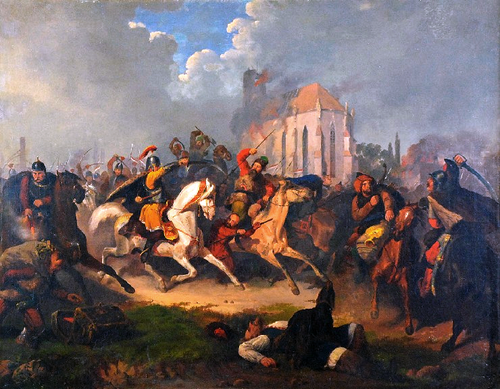
キエフ大公国とモスクワ大公国では、奴隷は通常ホロップスに分類されていた。デイヴィッド・P・フォーサイスによれば、「1649年にはモスクワ大公国の農民の最大4分の3、つまり1,300万から1,400万人が農奴であり、その物質的な生活は奴隷とほとんど区別がつかなかった。おそらくさらに150万人が正式に奴隷とされ、ロシア人奴隷がロシア人の主人に仕えていた」という。[272 ]奴隷制度は、ピョートル大帝が家事奴隷を家事農奴に変えた1723年まで、ロシアの主要な制度であり続けた。ロシアの農業奴隷は、1679年より前に正式に農奴に変えられた。 [273]ポーランドの奴隷制度は15世紀に禁止され、リトアニアでは1588年に奴隷制度が正式に廃止され、第二の農奴制に置き換えられた。
スカンジナビアでは、奴隷制度は14世紀半ばに廃止されました。[274]
第二次世界大戦

第二次世界大戦中、ナチスドイツは、好ましくない人々と征服国の国民合わせて約1200万人を事実上奴隷化した。その目的は、これらのUntermenschen (劣等人種)を、アーリア人種としての権利も法的地位も持たない、死ぬまで働かされる劣等な存在の永久奴隷階級として扱うことであった。[275]
ユダヤ人以外にも、ポーランド、 [276]ベラルーシ、ウクライナ、ロシアの住民に対して最も厳しい追放と強制労働政策が適用されました。戦争の終わりまでに、ベラルーシの人口の半分が殺害されるか追放されました。[277] [278]
共産主義国家

アン・アップルバウムと「クレムリンの視点」によれば、1930年から1960年の間にソ連はグラーグ(ロシア語:ГУЛаг、ローマ字: GULAG)と呼ばれる奴隷労働収容所の制度を創設した。 [279]
これらの収容所の囚人は、過酷な生産ノルマ、肉体的・精神的虐待、飢餓、医療の欠如、そして厳しい環境により、死ぬまで働かされた。 8年間の強制収容所生活を生き延びたアレクサンドル・ソルジェニーツィンは、収容所についての直接の証言として『収容所群島』を出版し、ノーベル文学賞を受賞した。[280] [281]多くの収容所では、最初の数か月間の死亡率が80%にも達した。数十万人、おそらく数百万人が、ソ連下での強制労働の直接的な結果として死亡した。[282]
ゴルフォ・アレクソプロスは、スターリンの強制収容所における病気と非人道性の中で、強制収容所での労働を「他の形態の奴隷労働」と比較することを提案し、その「人間搾取の暴力」を指摘している。[283]
スターリンのグラーグは、多くの点で、強制収容所というよりは強制労働収容所であり、監獄というよりは奴隷制度でした。奴隷のイメージは、グラーグの回想録文学によく登場します。ヴァルラム・シャラモフは次のように書いています。「空腹で疲れ果てた私たちは、胸に血豆を浮かべながら、石を詰めた荷車を傾斜した鉱山の床まで引っ張って馬の首輪に寄りかかりました。首輪は、はるか昔、古代エジプト人が使っていたのと同じ道具でした。」ソ連の強制労働と他の形態の奴隷労働との思慮深く厳密な歴史的比較は、学術的に注目に値すると私は考えます。なぜなら、世界的な奴隷制度の場合と同様に、グラーグは、危険と罪悪感の推定を伴う、精巧な差異の物語に正当性を見出したからです。この差異のイデオロギーと人間の搾取の暴力は、現代のロシアに永続的な遺産を残しました。
歴史家のアン・アップルバウムは著書の序文で、GULAGという言葉は「ソ連の奴隷労働システムそのもの、そのあらゆる形態と多様性」を表すようになったと書いている。[284]
「グラーグ」という言葉は、ソ連の収容所を運営していた機関である収容所管理局(Glavnoe Upravlenie Lagerei)の頭文字をとったものです。しかし、時が経つにつれて、この言葉は、労働収容所、懲罰収容所、犯罪者および政治犯収容所、女性収容所、児童収容所、通過収容所など、あらゆる形態と種類のソ連の奴隷労働システムそのものを意味するようになりました。さらに広く、「グラーグ」は、ソ連の抑圧システムそのもの、アレクサンドル・ソルジェニーツィンがかつて「私たちの肉挽き機」と呼んだ一連の手順、つまり逮捕、尋問、暖房のない家畜車での移送、強制労働、家族の崩壊、流刑生活の年月、早すぎる不必要な死を意味するようになりました。
アップルバウムの序文はグラーグ研究者のウィルソン・ベルから批判されており、[285]彼女の本は「序文を除けばグラーグの概要はよくできているが、ソルジェニーツィンのパラダイムをはるかに超える解釈の枠組みを提供していない」と述べている。[286]
中東
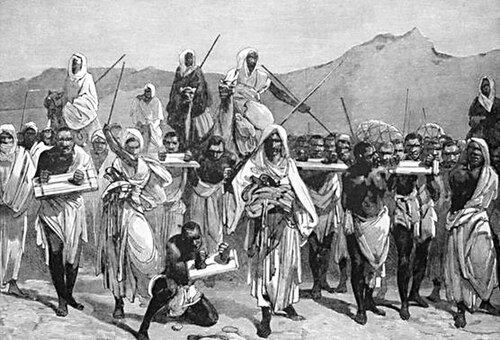
最も古い記録では、奴隷制度は確立された制度として扱われている。例えば、ハンムラビ法典(紀元前 1760年頃)では、奴隷の逃亡を助けたり逃亡者をかくまったりした者は死刑に処されると規定されていた。 [287]聖書では奴隷制度が確立された制度として言及されている。 [3]奴隷制度はファラオ時代のエジプトにも存在したが、その研究は、エジプト人が歴史を通じて異なる奴隷階級を指すために使用した用語によって複雑になっている。古代エジプトの奴隷階級に関する文献の解釈は、言葉の使い方だけでは困難であった。[288] [289]古代エジプトの奴隷制度には、動産奴隷制、債務労働、強制労働の3つの種類があった。[290] [291] [292]
歴史的に、アラブ世界の奴隷は、サハラ以南アフリカ(主にザンジ人) [293]、コーカサス(主にチェルケス人) [294]、中央アジア(主にタタール人)、中央および東ヨーロッパ(主にスラヴ人サカリバ)[295]など、さまざまな地域から来ていました。これらの奴隷は、アフリカ からはトランスサハラ奴隷貿易、バクト条約、紅海奴隷貿易、インド洋奴隷貿易を通じて、アジアからはブハラ奴隷貿易を通じて、ヨーロッパからはプラハ奴隷貿易、ヴェネツィア奴隷貿易、バルバリ奴隷貿易を通じて、それぞれアラブ世界へと運ばれました。

1517年から1917年の間、中東の大部分はオスマン帝国の支配下にあった。オスマン帝国の首都コンスタンティノープルでは、人口の約5分の1が奴隷であった。[80]この都市は15世紀以降、奴隷貿易の主要な中心地であった。
東ヨーロッパの奴隷は、タタール人によるスラブ人の村の襲撃によるクリミア奴隷貿易を通じてオスマン帝国に提供されたが[296]、征服や反乱の鎮圧によっても提供された。反乱の鎮圧の結果、時には全住民が奴隷にされ、帝国中で売られ、将来の反乱のリスクが軽減された。オスマン帝国は、ヨーロッパやアフリカから帝国に奴隷を持ち込む商人からも奴隷を購入した。1800年から1909年の間に、約20万人の奴隷(主にチェルケス人)がオスマン帝国に輸入されたと推定されている[227] 。 1908年には、オスマン帝国ではまだ女性奴隷が売られていた。[297] ドイツの東洋学者グスタフ・ダルマンは、1899年にオスマン帝国領シリアのアレッポのイスラム教徒の家で奴隷を見たと報告しており、1909年にはダマスカスとカイロで少年が奴隷として買われたとも報告している。[298]
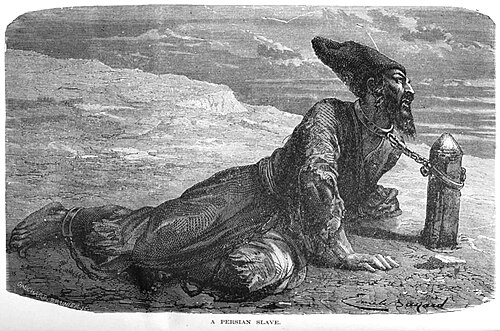
中東への奴隷貿易の主要中心地は中央アジアであり、古代から1870年代まで何千年もの間、ブハラ奴隷貿易によって中東に奴隷が供給されていた。捕らえられたロシア人とペルシャ人の奴隷のための奴隷市場は、中央アジアのヒヴァ・ハン国を中心とするヒヴァン奴隷貿易であった。[299] 1840年代初頭、ウズベク人のブハラとヒヴァの人口には約90万人の奴隷が含まれていた。[227]
1870年までに、コーカサス、アフリカ、湾岸諸国のイスラム教地域を除く世界のほとんどの地域で、動産奴隷制度は少なくとも正式に禁止されていました。[300] 1870年代までに奴隷制度は西洋では道徳的に受け入れられないものと見なされていましたが、イスラム世界では奴隷制度は不道徳とは見なされていませんでした。なぜなら、それはコーランで認められた制度であり、非イスラム教徒に対する戦争という名目で道徳的に正当化されていたからです。そして、非イスラム教徒は、バルカン半島、コーカサス、バルチスタン、インド、南西アジア、フィリピンなど、イスラム世界各地でイスラム教徒に誘拐され、奴隷にされました。[300] 奴隷たちは足かせをつけられてスーダン、エチオピア、ソマリアの海岸まで連行され、ダウ船に乗せられてインド洋からペルシャ湾やアデンへ、あるいは紅海からアラビアやアデンへと運ばれ、その間弱い奴隷たちは海に投げ込まれた。あるいはサハラ砂漠を越えてトランスサハラ奴隷貿易によってナイル川へ運ばれ、寒さや足の腫れで死んでいった。[300]
オスマン帝国の反奴隷法は19世紀後半には施行されておらず、特にヒジャズでは施行されていなかった。1857年に紅海奴隷貿易を禁止する最初の試みはヒジャズ州で反乱を引き起こし、その結果ヒジャズは禁止を免除された。[301] 1880年の 英オスマン条約は紅海奴隷貿易を正式に禁止したが、アラビア半島のオスマン帝国の州では施行されなかった。[301] 19世紀後半、モロッコのスルタンは西側外交官に対し、奴隷制を禁止することは不可能であると述べたが、そのような禁止は施行できないため、イギリスはスルタンに、モロッコでの奴隷貿易が少なくとも外国人の目に触れないように慎重に扱われるように求めた。[301]
動産奴隷制度は中東のほとんどの地域で20世紀まで続いた。紅海の奴隷貿易は、第二次世界大戦後もアフリカからアラビア半島に奴隷を供給し続けた。1960年代には、サウジアラビアの奴隷人口は30万人と推定されていた。[302]イエメンとともに、サウジアラビアは1962年に奴隷制度を廃止した。[303]
現代の奴隷制度

奴隷制度は現在どの国でも違法であるが、今日の奴隷の数は1200万から2980万人と推定されている。[304] [305] [306]奴隷制の広義の定義によれば、1999年には世界中に2700万人の奴隷がいた。[307] 2005年、国際労働機関は強制労働者の数は1230万人と推定した。[308] シッダールト・カラもまた、2006年末の奴隷の数は2840万人と推定しており、これを債務労働/束縛(1810万人)、強制労働(760万人)、人身売買された奴隷(270万人)の3つのカテゴリーに分けた。[70]カラは毎年の世界中の奴隷の数を計算する動的モデルを提供しており、2009年末の推定数は2920万人である。

ヒューマン・ライツ・ウォッチの2003年の報告書によると、インドでは債務奴隷状態にある推定1500万人の子供たちが家族の借金を返済するために奴隷のような環境で働いている。[310] [311]
スラヴォイ・ジジェクは、冷戦後のグローバル資本主義の時代に、アラビア半島における基本的公民権を剥奪された移民労働者、アジアの搾取工場における労働者の完全な管理、中央アフリカにおける天然資源の搾取における強制労働の使用など、新しい形態の現代奴隷制が生み出されたと主張する。[312]
分布
2013年6月、米国国務省は奴隷制度に関する報告書を発表した。報告書では、ロシア、中国、ウズベキスタンを最悪の犯罪国に分類した。キューバ、イラン、北朝鮮、スーダン、シリア、ジンバブエは最低レベルだった。リストには、アルジェリア、リビア、サウジアラビア、クウェートの21カ国も含まれていた。[313] [314]
クウェートには、強制労働の危険にさらされ、雇用主と法的に結びついている移民家事労働者が60万人以上おり、雇用主はパスポートを不法に取り上げることが多い。[315] 2019年には、インスタグラムなどのアプリ上でオンライン奴隷市場が発覚した。[316]
2022年にカタールで開催されるワールドカップの準備において、労働者の最大集団である数千人のネパール人が、賃金の不払い、書類の没収、職場を離れられないという形で奴隷制に直面した。[317] 2016年、国連はカタールに対し、移民労働者の奴隷制を終わらせなければ調査を受けると12ヶ月の猶予を与えた。[318]
ウォーク・フリー財団は2018年に、裕福な西洋社会における奴隷制度はこれまで考えられていたよりもはるかに蔓延しており、特に米国と英国ではそれぞれ40万3000人(800人に1人)と13万6000人の奴隷がいると報告した。同団体の創設者アンドリュー・フォレスト氏は、「米国は世界で最も先進的な国の一つであるが、40万人以上の現代の奴隷が強制労働環境下で働いている」と述べた。[319]世界中で推定4030万人が奴隷となっており、最も多くの奴隷を抱えているのは北朝鮮で260万人(10人に1人)である。現代の奴隷状態にある推定4030万人のうち、71%が女性で、29%が男性である。報告書によると、現代の奴隷状態にある4030万人のうち、1540万人が強制結婚、2490万人が強制労働である。[320]同財団は現代の奴隷制を「脅迫、暴力、強制、権力の乱用、欺瞞により、人が拒否したり離れたりできない搾取の状況」と定義している。[321]
中国
2020年3月、中国政府が少数民族ウイグル族をスウェットショップで強制労働させていることが判明した。オーストラリア戦略政策研究所(ASPI)が当時発表した報告書によると、少なくとも約8万人のウイグル族が新疆ウイグル自治区から強制的に連れ出され、少なくとも27の企業工場で強制労働させられていた。[322]ビジネスと人権リソースセンターによると、アバクロンビー&フィッチ、アディダス、アマゾン、アップル、BMW、フィラ、ギャップ、H&M、インディテックス、マークス&スペンサー、ナイキ、ノースフェイス、プーマ、PVH、サムスン、ユニクロなどの企業が、ASPI報告書の発表前にこれらの工場から製品を調達していた。[323]
リビア
第二次リビア内戦の間、リビア人はリビアを経由してヨーロッパに渡ろうとするサハラ以南のアフリカからの移民を捕らえ、奴隷市場で売ったり、身代金目的で人質に取ったりし始めた。 [324]女性はしばしば強姦され、性奴隷として使われたり、売春宿に売られたりした。[325] [326] [327]リビアでは子供の移民が虐待や児童レイプに苦しんでいる。 [328] [329]
モーリタニア
モーリタニアは奴隷制度を廃止した最後の国(1981年)であり、人口300万人のうち20%が債務労働者として奴隷化されていると推定されている。[330] [331] [332]モーリタニアでの奴隷制度は2007年8月に犯罪化された。[333]しかし、奴隷制度は1981年に法的に禁止されたものの、2007年までは奴隷を所有することは犯罪ではなかった。[334] 2007年以降、多くの奴隷が逃亡したり解放されたりしたが、2012年の時点で[update]、懲役刑を宣告された奴隷所有者は1人だけである。[335]
北朝鮮
北朝鮮の人権状況は世界最悪とみなされ、国際社会から非難されており、国連、欧州連合、ヒューマン・ライツ・ウォッチなどの団体はいずれも北朝鮮の人権状況を批判している。拷問、強制労働、虐待の形態はすべて蔓延している。ほとんどの国際人権団体は、自由の侵害に関して北朝鮮は現代に匹敵するものがないと考えている[336] 。 [337] [338] [339] [340]
台湾
台湾の出稼ぎ労働者人口は2018年に66万人に達すると推定されているが、家事労働分野での性的虐待[341]や漁業分野での強制労働など、奴隷のような状況に直面していると報告されている。[342] [343]台湾は、他の国では雇用主が人件費として負担しているサービスを、出稼ぎ労働者に労働斡旋業者が請求することを合法的に認めている世界でも数少ない国の一つである。[344]台湾のいくつかの大学は、エスワティニ[345] 、ウガンダ、スリランカの学生を騙して、大学のプログラムの費用として工場で強制労働をさせたと報告されている。[346] 2007年には、一部の慈善団体も、外国人女性(主に中国と東南アジア出身)が売春を強要されていると主張したが、台南の地元警察はこれに反対し、彼女たちはわざと「売春をするために」台湾に来たと述べた。[347]
経済
1809年のアメリカの奴隷は約4万ドル(インフレ調整後のドル)で売られていたが、今日では奴隷はたった90ドルで買えるため、長期のケアを提供するよりも補充する方が経済的である。[348]奴隷制度は数十億ドル規模の産業であり、年間350億ドルの収益を生み出していると推定されている。[349]
人身売買
人身売買の被害者は、通常、詐欺や策略(偽の就職、偽の移住、偽の結婚の申し出など)、家族による売買、元奴隷による勧誘、または完全な誘拐によって勧誘される。被害者は、強制、詐欺、詐欺、脅迫、隔離、脅迫、身体的強制、債務による束縛、さらには薬物による強制的な摂取によって「債務奴隷」状態に追い込まれ、被害者を支配する。[ 350]「2006年に完了した米国政府後援の調査によると、毎年約80万人が国境を越えて人身売買されているが、これには自国内で人身売買される数百万人は含まれていない。国境を越えた被害者の約80%は女性と少女であり、最大50%は未成年者であると、米国国務省は2008年の調査で報告している。[351]
人身売買の被害者の大半は売春を強いられる女性(この場合、性的人身売買と呼ばれる)であるが、肉体労働を強いられる男性、女性、子供も被害者に含まれる。[352]人身売買は違法であるため、その規模は不明である。2005年に発表された米国政府の報告書では、毎年世界中で約70万人が国境を越えて人身売買されていると推定されている。この数字には国内で人身売買された人は含まれていない。[352]別の調査では、毎年約150万人が国内または国外で人身売買されており、そのうち約50万人が性的人身売買の被害者であることが明らかになった。[70]
奴隷制度廃止論

奴隷制度は、人類の記録された歴史を通じて、何らかの形で存在してきました。また、さまざまな時期に、大規模または個別の奴隷集団を解放する運動も存在してきました。[要出典]
古代では

紀元前269年から紀元前232年までインド亜大陸のマウリヤ帝国を統治したアショーカ王は奴隷貿易を廃止したが、奴隷制度は廃止しなかった。 [354]紀元前221年から紀元前206年まで中国を統治した秦王朝は奴隷制度を廃止し、農奴制を奨励しなかった。しかし、秦王朝が倒されると、多くの法律が覆された。[355]奴隷制度は紀元17年に王莽によって再び廃止されたが、彼の暗殺後に復活した。[356]
アメリカ大陸
スペインによるアメリカ大陸の植民地化は、アメリカ先住民を奴隷にする権利についての議論を引き起こした。スペイン領新世界植民地における奴隷制の著名な批判者は、スペインの宣教師で司教のバルトロメ・デ・ラス・カサスであり、彼は「アメリカ大陸におけるヨーロッパ人による先住民の抑圧を暴露し、そこでの奴隷制の廃止を求めた最初の人物」であった。[357]
アメリカ合衆国では、1804年までに北部諸州すべてが奴隷制度を廃止していたが、ニュージャージー州が最後に行動を起こした。[358]奴隷制度廃止論者の圧力により、解放に向けて小さな一歩が次々と踏み出された。 1808年1月1日に奴隷輸入禁止法が発効すると、アメリカ合衆国への奴隷の輸入は禁止されたが、[359]国内の奴隷貿易や国外の国際奴隷貿易への関与は禁止されなかった。北部諸州以外では合法的な奴隷制度が存続し、アメリカ合衆国内に既にいた奴隷のほとんどは1863年にようやく法的に解放された。多くのアメリカの奴隷制度廃止論者は、地下鉄道を支援することで奴隷制度反対に積極的に取り組んだ。奴隷制度反対派と賛成派のアメリカ人の間で起きた激しい衝突には、1854年から1858年にかけてカンザスが奴隷州として、あるいは自由州として合衆国に加わるかどうかをめぐって起こった一連の政治的、武力紛争である「流血のカンザス」が含まれる。1860年までに奴隷の総数はほぼ400万人に達し、 1861年に始まった南北戦争によって合衆国における奴隷制度は終焉を迎えた。[360] 1863年、リンカーンは奴隷解放宣言を発布し、南部連合諸国に拘束されていた奴隷を解放した。合衆国憲法修正第13条は、国中でほとんどの形態の奴隷制度を禁止した。
解放された奴隷の多くは小作農や年季奉公人になった。このようにして、ジム・クロウ法によって差別が継続し、教育が制限され、正当な手続きを経ない迫害が促進され、貧困が続く結果となったため、奴隷として生まれた土地に縛られ、自由や経済的機会がほとんどない奴隷もいた。不当な投獄やリンチなどの報復に対する恐怖が、さらに上昇志向を阻んだ。

ヨーロッパ
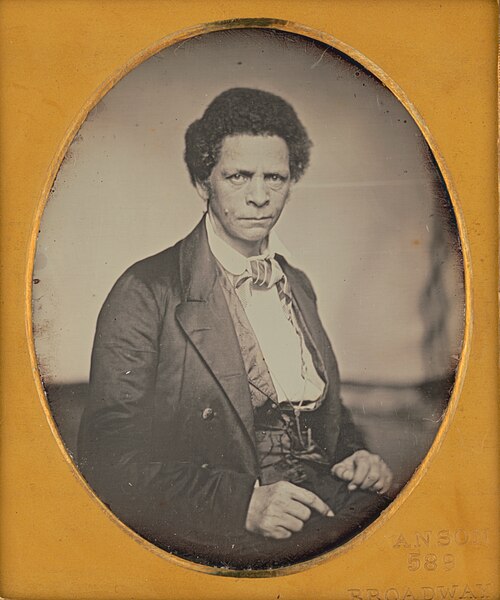
フランスは1794年の革命中に奴隷制度を廃止したが[361]、1802年にナポレオンの下で復活した。[362]革命前は、フランス本土(植民地とは対照的に)では奴隷制度は違法であったと主張されてきたが[363] 、これは反論されている。[364]
世界中で奴隷制度を廃止する運動の中で最も重要な出来事の一つは、1772年にイギリスで起こった。イギリスの判事マンスフィールド卿のサマーセット事件における判決は、イギリスでは奴隷制度は違法であるとの判決と広く受け取られた。この判決は、他の管轄区域で締結された奴隷制度はイギリスでは執行できないという原則も定めた。[365]
アフリカの息子たちは18世紀後半にイギリスで奴隷制度廃止運動を行った団体である。メンバーはロンドンのアフリカ人、解放奴隷で、オットーバ・クゴアノ、オラウダ・エクィアノ、その他ロンドンの黒人コミュニティの指導的メンバーがいた。この団体は、1787年に設立された無宗派の団体、奴隷貿易廃止協会と密接な関係があり、そのメンバーにはトーマス・クラークソンもいた。イギリス国会議員のウィリアム・ウィルバーフォースがイギリスにおける奴隷制度廃止運動を主導したが、その基礎はクラークソンの奴隷制度廃止の論文であった。ウィルバーフォースは親友である首相ウィリアム・ピット(小ピット)からこの問題を自分の問題としてとらえるよう促され、改革派福音主義者のジョン・ニュートンからも支援を受けた。1807年3月25日、イギリス議会は奴隷貿易法を可決し、大英帝国全土で奴隷貿易を違法とした。[ 366 ]ウィルバーフォースは大英帝国における奴隷制度の廃止運動も展開し、 1833年に奴隷制度廃止法が成立するのを目の当たりにした。
1807年に奴隷貿易を廃止する法律が可決されると、これらの運動家たちは、フランスやイギリス植民地など他の国々に追随するよう促すようになった。1808年から1860年にかけて、イギリス西アフリカ艦隊はおよそ1,600隻の奴隷船を拿捕し、乗船していた15万人のアフリカ人を解放した。[367]また、奴隷貿易を禁止するイギリスの条約に同意することを拒否したアフリカの指導者に対しても行動がとられた。例えば、1851年に退位した「ラゴスの王位簒奪者」に対してである。50人以上のアフリカの統治者と奴隷制度廃止条約が締結された。[368]
全世界
1839年、世界最古の国際人権団体である反奴隷インターナショナルがイギリスでジョセフ・スタージによって設立され、他国における奴隷制度の廃止を訴えた。[369] 2007年には、イギリス反奴隷協会の活動を通じて、イギリスにおける奴隷貿易廃止200周年を記念する式典が開催された。
In the 1860s, David Livingstone's reports of atrocities within the Arab slave trade in Africa stirred up the interest of the British public, reviving the flagging abolitionist movement. The Royal Navy throughout the 1870s attempted to suppress "this abominable Eastern trade", at Zanzibar in particular. In 1905, the French abolished indigenous slavery in most of French West Africa.[370]
On December 10, 1948, the United Nations General Assembly adopted the Universal Declaration of Human Rights, which declared freedom from slavery is an internationally recognized human right. Article 4 of the Universal Declaration of Human Rights states:
No one shall be held in slavery or servitude; slavery and the slave trade shall be prohibited in all their forms.[371]
In 2014, for the first time in history, major leaders of many religions, Buddhist, Hindu, Christian, Jewish, and Muslim met to sign a shared commitment against modern-day slavery; the declaration they signed calls for the elimination of slavery and human trafficking by 2020.[372] The signatories were: Pope Francis, Mātā Amṛtānandamayī, Bhikkhuni Thich Nu Chân Không (representing Zen Master Thích Nhất Hạnh), Datuk K Sri Dhammaratana, Chief High Priest of Malaysia, Rabbi Abraham Skorka, Rabbi David Rosen, Abbas Abdalla Abbas Soliman, Undersecretary of State of Al Azhar Alsharif (representing Mohamed Ahmed El-Tayeb, Grand Imam of Al-Azhar), Grand Ayatollah Mohammad Taqi al-Modarresi, Sheikh Naziyah Razzaq Jaafar, Special advisor of Grand Ayatollah (representing Grand Ayatollah Sheikh Basheer Hussain al Najafi), Sheikh Omar Abboud, Justin Welby, Archbishop of Canterbury, and Metropolitan Emmanuel of France (representing Ecumenical Patriarch Bartholomew.)[372]
Groups such as the American Anti-Slavery Group, Anti-Slavery International, Free the Slaves, the Anti-Slavery Society, and the Norwegian Anti-Slavery Society continue to campaign to eliminate slavery.[citation needed]
UNESCO has been working to break the silence surrounding the memory of slavery since 1994, through The Slave Route Project.[373]
Apologies
On May 21, 2001, the National Assembly of France passed the Taubira law, recognizing slavery as a crime against humanity. Apologies on behalf of African nations, for their role in trading their countrymen into slavery, remain an open issue since slavery was practiced in Africa even before the first Europeans arrived and the Atlantic slave trade was performed with a high degree of involvement of several African societies. The black slave market was supplied by well-established slave trade networks controlled by local African societies and individuals.[374]
There is adequate evidence citing case after case of African control of segments of the trade. Several African nations such as the Calabar and other southern parts of Nigeria had economies depended solely on the trade. African peoples such as the Imbangala of Angola and the Nyamwezi of Tanzania would serve as middlemen or roving bands warring with other African nations to capture Africans for Europeans.[375]
Several historians have made important contributions to the global understanding of the African side of the Atlantic slave trade. By arguing that African merchants determined the assemblage of trade goods accepted in exchange for slaves, many historians argue for African agency and ultimately a shared responsibility for the slave trade.[376]
In 1999, President Mathieu Kérékou of Benin issued a national apology for the central role Africans played in the Atlantic slave trade.[117] Luc Gnacadja, minister of environment and housing for Benin, later said: "The slave trade is a shame, and we do repent for it."[377] Researchers estimate that 3 million slaves were exported out of the Slave Coast bordering the Bight of Benin.[377] President Jerry Rawlings of Ghana also apologized for his country's involvement in the slave trade.[117]
The issue of an apology is linked to reparations for slavery and is still being pursued by entities across the world. For example, the Jamaican Reparations Movement approved its declaration and action plan. In 2007, British Prime Minister Tony Blair made a formal apology for Great Britain's involvement in slavery.[378]
On February 25, 2007, the Commonwealth of Virginia resolved to 'profoundly regret' and apologize for its role in the institution of slavery. Unique and the first of its kind in the U.S., the apology was unanimously passed in both Houses as Virginia approached the 400th anniversary of the founding of Jamestown.[379]
On August 24, 2007, Mayor of London Ken Livingstone issued a public apology for London's role in Atlantic slave trade, which took place at an event commemorating the 200th anniversary of the British slave trade's abolition. In his speech, Livingstone described the slave trade as "the racial murder of not just those who were transported but generations of enslaved African men, women and children. To justify this murder and torture black people had to be declared inferior or not human... We live with the consequences today."[380] City officials in Liverpool, which was a large slave trading port, apologized in 1999.[381]
On July 30, 2008, the United States House of Representatives passed a resolution apologizing for American slavery and subsequent discriminatory laws.[382] In June 2009, the U.S. Senate passed a resolution apologizing to African-Americans for the "fundamental injustice, cruelty, brutality, and inhumanity of slavery". The news was welcomed by President Barack Obama, the nation's first president of African descent.[383] Some of President Obama's ancestors may have been slave owners.[384]
In 2010, Libyan leader Muammar Gaddafi apologized for Arab involvement in the slave trade, saying: "I regret the behavior of the Arabs... They brought African children to North Africa, they made them slaves, they sold them like animals, and they took them as slaves and traded them in a shameful way."[385]
Reparations
There have been movements to achieve reparations for those formerly held as slaves or for their descendants. Claims for reparations for being held in slavery are handled as a civil law matter in almost every country. This is often decried as a serious problem, since former slaves' relatives lack of money means they often have limited access to a potentially expensive and futile legal process. Mandatory systems of fines and reparations paid to an as yet undetermined group of claimants from fines, paid by unspecified parties, and collected by authorities have been proposed by advocates to alleviate this "civil court problem." Since in almost all cases there are no living ex-slaves or living ex-slave owners these movements have gained little traction. In nearly all cases the judicial system has ruled that the statute of limitations on these possible claims has long since expired.
In June 2023, The Brattle Group presented a report at an event at the University of the West Indies in which reparations were estimated, for harms both during and after the period of transatlantic chattel slavery, at over 100 trillion dollars.[386][387]
Media
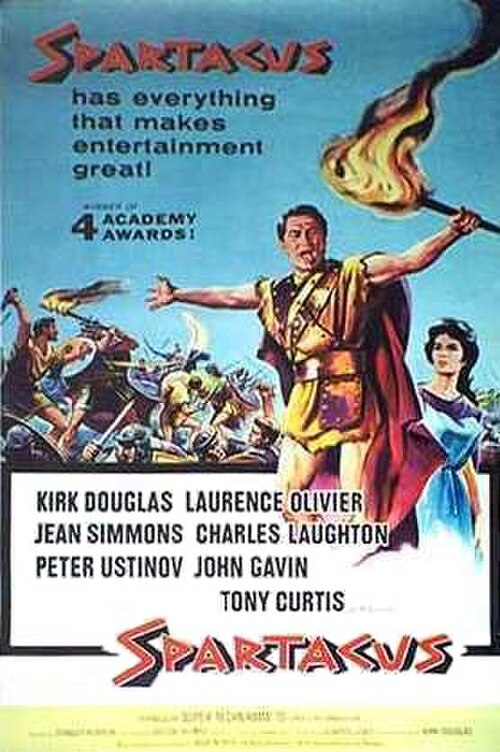
Film has been the most influential medium in the presentation of the history of slavery to the general public around the world.[388] The American film industry has had a complex relationship with slavery and until recent decades often avoided the topic. Films such as The Birth of a Nation (1915)[389] and Gone with the Wind (1939) became controversial because they gave a favourable depiction. In 1940 The Santa Fe Trail gave a liberal but ambiguous interpretation of John Brown's attacks on slavery.[390] Song of the South gave a favorable outlook on slavery in the United States in 1946.[citation needed]
The Civil Rights Movement in the 1950s made defiant slaves into heroes.[391] The question of slavery in American memory necessarily involves its depictions in feature films.[392]
Most Hollywood films used American settings, although Spartacus (1960), dealt with an actual revolt in the Roman Empire known as the Third Servile War. The revolt failed, and all the rebels were executed, but their spirit lived on according to the film.[393] Spartacus stays surprisingly close to the historical record.[394]
The Last Supper (La última cena in Spanish) was a 1976 film directed by Cuban Tomás Gutiérrez Alea about the teaching of Christianity to slaves in Cuba, and emphasizes the role of ritual and revolt. Burn! takes place on the imaginary Portuguese island of Queimada (where the locals speak Spanish) and it merges historical events that took place in Brazil, Cuba, Santo Domingo, Jamaica, and elsewhere.
Historians agree that films have largely shaped historical memories, but they debate issues of accuracy, plausibility, moralism, sensationalism, how facts are stretched in search of broader truths, and suitability for the classroom.[395][393] Berlin argues that critics complain if the treatment emphasizes historical brutality, or if it glosses over the harshness to highlight the emotional impact of slavery.[396]
See also
- Bodmin manumissions, the names and details of slaves freed in Medieval Bodmin
- International Day for the Abolition of Slavery
- International Slavery Museum
- Involuntary servitude
- List of slaves
- List of slave owners
- Mukataba
- Slave rebellion
- Slave-owning slaves
- Supplementary Convention on the Abolition of Slavery
- Wilberforce Institute for the Study of Slavery and Emancipation
References
- ^ Allain, Jean (2012). "The Legal Definition of Slavery into the Twenty-First Century". In Allain, Jean (ed.). The Legal Understanding of Slavery: From the Historical to the Contemporary. Oxford: Oxford University Press. pp. 199–219. ISBN 978-0-19-164535-8.
- ^ Baker-Kimmons, Leslie C. (2008). "Slavery". In Schaefer, Richard T. (ed.). Encyclopedia of Race, Ethnicity, and Society. Vol. 3. SAGE Publishing. p. 1234. ISBN 9781412926942.
- ^ a b c d e f g "Historical survey: Slave-owning societies". Encyclopædia Britannica. Archived from the original on February 23, 2007.
- ^ Bales 2004, p. 4.
- ^ White, Shelley K.; White, Jonathan M.; Korgen, Kathleen Odell (2014). Sociologists in Action on Inequalities: Race, Class, Gender, and Sexuality. SAGE Publishing. p. 43. ISBN 978-1-4833-1147-0.
- ^ a b "Slavery in the 21st century". Newint.org. Archived from the original on May 27, 2010. Retrieved August 29, 2010.
- ^ a b Okeowo, Alexis (September 8, 2014). "Freedom Fighter: A slaving society and an abolitionist's crusade". The New Yorker. Archived from the original on January 6, 2018. Retrieved October 16, 2014.
- ^ Corrigan, Terence (September 6, 2007). "Mauritania: Country Made Slavery Illegal Last Month". The East African Standard. Archived from the original on August 4, 2011. Retrieved January 21, 2008.
- ^ Hodal, Kate (May 31, 2016). "One in 200 people is a slave. Why?". The Guardian. Archived from the original on April 30, 2019.
- ^ "Religion & Ethics – Modern slavery: Modern forms of slavery". BBC. January 30, 2007. Archived from the original on January 6, 2014. Retrieved June 16, 2009.
- ^ "slave". Oxford English Dictionary (2nd ed.). 1989.
- ^ Jankowiak, Marek (February 2017). "What Does the Slave Trade in the Saqaliba Tell Us about Early Islamic Slavery?". International Journal of Middle East Studies. 49 (1): 169–172. doi:10.1017/S0020743816001240. ISSN 0020-7438.
- ^ "The international slave trade". Encyclopædia Britannica.
- ^ Lewis 1992, Chapter 1.
- ^ Kluge, Friedrich (1899). "Artikel Sklave" [Article Slave]. Etymologisches Wörterbuch Der Deutschen Sprache [Etymological dictionary of the German language] (in German) (6 ed.). Strassburg: Trübner. p. 366.
- ^ Dostoevsky, Fyodor (1981). "Самое последнее слово цивилизации". In В. Г. Базанов и др., ИРЛИ (ed.). Polnoye sobraniye sochineniy. V 30 tomakh Полное собрание сочинений. В 30 томах [Full composition of writings. In 30 volumes] (in Russian). Vol. 23. Дневник писателя за 1876 год. Май-октябрь. Leningrad: Наука. Ленингр. отд-ние. pp. 63, 382. Archived from the original on May 20, 2018.
- ^ Korth, Georg (1970). "Zur Etymologie des Wortes 'Slavus' (Sklave)" [On the etymology of the word 'Slavus' (slave)]. Glotta, Zeitschrift fur Griechische und Lateinische Sprache (in German). 48 (1/2). Göttingen: Vandenhoeck & Ruprecht (GmbH & Co. KG): 145–153. JSTOR 40266114.
- ^ Kluge, Friedrich (1989). "Artikel Sklave". In Elmar Seebold (ed.). Etymologisches Wörterbuch Der Deutschen Sprache (in German) (22 ed.). Berlin & New York: De Gruyter. p. 676. ISBN 3-11-006800-1.
- ^ Köbler, Gerhard (1995). "Sklave" [Slave]. Deutsches Etymologisches Rechtswörterbuch [German Etymological Legal Dictionary] (in German). Tübingen: Mohr. p. 371. ISBN 978-3-8252-1888-1.
- ^ Scholten, Daniel (2020). "Sklave und Slawe" [Slave and Slav]. Deutsch für Dichter und Denker: Unsere Muttersprache in neuem Licht [German for poets and thinkers: Our mother tongue in a new light] (in German). Bright Star Books. ISBN 978-3-948287-06-1. Archived from the original on October 24, 2020.
- ^ Ditten, Hans (1972). "Kritik an G. Korth". Byzantinoslavica. Vol. 33. Prague: Academia, de l'Academie Tchecoslovaque des Sciences et Lettres. pp. 183–184.
- ^ Waldman, Katy (May 19, 2015). "Slave or Enslaved Person? It's not just an academic debate for historians of American slavery". Slate. Archived from the original on May 21, 2015.
- ^ Brace, Laura (2004). The Politics of Property: Labour, Freedom and Belonging. Edinburgh University Press. p. 162. ISBN 978-0-7486-1535-3. Retrieved May 31, 2012.
- ^ Keith Bradley (March 7, 2016). "slavery, Roman". Oxford Classical Dictionary. Oxford University Press. doi:10.1093/acrefore/9780199381135.013.7311. ISBN 978-0-19-938113-5. Retrieved June 27, 2023.
chattel-slavery, whereby the slave‐owner enjoyed complete mastery (dominium) over the slave's physical being […] was evident throughout the central era of Roman history, and in Roman no less than Greek thought was regarded as both the necessary antithesis of civic freedom
- ^ Bradley, Keith (November 2, 2020). "'The Bitter Chain of Slavery': Reflections on Slavery in Ancient Rome". Harvard University. Archived from the original on April 11, 2021. Retrieved November 15, 2022.
- ^ Finley, Moses I. (1980). Ancient Slavery and Modern Ideology. Viking Press. p. 71. ISBN 9780670122776.
- ^ Alexander, J. (2001). "Islam, Archaeology and Slavery in Africa". World Archaeology. 33 (1): 51. doi:10.1080/00438240120047627. JSTOR 00438243.
Chattel-slaves were needed, especially from the ninth to thirteenth centuries, in the gold and emerald (carbuncle) mines of the Wadi Allaqi in the deserts east of the Nile's 2nd Cataract
- ^ Burkholder, Mark A.; Johnson, Lyman L. (2019). "1. America, Iberia, and Africa Before the Conquest". Colonial Latin America (10th ed.). Oxford University Press. p. 10.
Wealth rested heavily on the possession of slaves across the large empires of West Africa as well as in Benin and other kingdoms […] Slave owners in sub-Saharan Africa also employed their chattel in a variety of occupations.
- ^ Bergad, Laird W. (2007). The Comparative Histories of Slavery in Brazil, Cuba, and the United States. New York: Cambridge University Press. pp. 57, 132, 165, 166. ISBN 9780521872355.
- ^ Slavery and Social Death : A Comparative Study, Orlando (1982). Patterson. Cambridge, Mass.: Harvard University Press. pp. X. ISBN 9780674986909.
- ^ Wendy Warren (2016). New England Bound (1st. ed.). W. W. Norton & Company. pp. 110–111. ISBN 978-0-87140-672-9.
the Iroquois confederacy, people who practiced a form of captive taking that in some ways looked very like chattel slavery
- ^ "Traditional or Chattel Slavery". FSE Project. The Feminist Sexual Ethics Project. Retrieved August 31, 2014.
- ^ a b c Miers, S. (2003). Slavery in the Twentieth Century: The Evolution of a Global Problem. USA: AltaMira Press.
- ^ a b "Mauritanian MPs pass slavery law". BBC News. August 9, 2007. Retrieved May 23, 2010. Cite error: The named reference "BBC" was defined multiple times with different content (see the help page).
- ^ a b Bales 2004, pp. 15–18.
- ^ "Debt bondage remains the most prevalent form of forced labour worldwide". United Nations. September 15, 2016. Retrieved July 27, 2021.
- ^ "Nigeria's young daughters are sold as 'money wives'". Al Jazeera. September 21, 2018. Retrieved May 12, 2020.
- ^ Sleightholme; Indrani (1996). Guilty Without Trial. Rutgers University Press. pp. 11–12. ISBN 0-8135-2381-8.
- ^ Chatterjee, Indrani; Eaton, Richard (2006). Slavery and South Asian History. Indiana University Press. p. 3. ISBN 978-0-253-11671-0.
- ^ Dandamayev, M. A.; Barda; Bardadārī. Encyclopædia Iranica.
- ^ Farazmand, Ali (1998). "Persian/Iranian Administrative Tradition". In Shafritz, Jay M. (ed.). International Encyclopedia of Public Edict and Administration. Boulder, CO: Westview Press. pp. 1640–1645 (1642).
Persians never practiced mass slavery, and in many cases the situations and lives of semi-slaves (prisoners of war) were in fact better than the common citizens of Persia.
- ^ "Experts encourage action against sex trafficking". November 2, 2009. Archived from the original on December 23, 2009.
- ^ "Rights–Mexico: 16,000 Victims of Child Sexual Exploitation". ipsnews.net. August 13, 2007. Retrieved February 11, 2016.
- ^ "Campaign Page: Child Soldiers". Human Rights Watch. June 2001. Archived from the original on February 13, 2008. [verification needed]
- ^ Sullivan, Kevin (December 26, 2008). "In Togo, a 10-Year-Old's Muted Cry: 'I Couldn't Take Any More'". Archived from the original on June 12, 2018. Retrieved January 15, 2024.
- ^ "Two-year-old 'at risk' of forced marriage". BBC News. March 5, 2013.
- ^ "Honor Diaries: Child/Forced Marriage: Factsheet" (PDF). Honordiaries.com. Archived from the original (PDF) on September 24, 2015. Retrieved September 29, 2015.
- ^ Black, Debra (September 20, 2013). "Forced marriages rampant in Ontario". The Hamilton Spectator. Archived from the original on March 26, 2017. Retrieved September 20, 2013.
- ^ "Without Consent: Forced Marriage in Australia" (PDF). Archived (PDF) from the original on June 13, 2015.
- ^ "UNICEF supports fight to end marriage by abduction in Ethiopia". reliefweb.int. November 9, 2004. Retrieved August 29, 2013.
- ^ Krembs, Peter (January 20, 2003). "An Idea Not Worth Drafting: Conscription is Slavery". Capmag.com. Retrieved September 29, 2015.
- ^ Kopel, Dave. "Nationalized Slavery; A policy Italy should dump". davidkopel.com. Archived from the original on October 12, 2007.. Refers to both the military and national service requirements of Italy as slavery
- ^ Machan, Tibor R. (April 13, 2000). "Tax Slavery". Ludwig von Mises Institute. Retrieved October 9, 2006.
- ^ Valenstein, Elliot (2002). Blaming the Brain: The Truth About Drugs and Mental Health. Simon & Schuster. p. 26. ISBN 978-0-7432-3787-1.
- ^ Szasz, Thomas Stephen. Psychiatric Slavery. Retrieved September 29, 2015 – via Google Books.
- ^ Schaler, J. A. (2003). "Slavery and psychiatry". British Journal of Psychiatry. 183: 77–78. doi:10.1192/bjp.183.1.77-a. PMID 12835252.
- ^ Spiegel, Marjorie (1996). The Dreaded Comparison: Human and Animal Slavery. New York: Mirror Books.
- ^ For sources about the concept of "wage slavery" and its various interpretations, see "wage slave". dictionary.com. Retrieved March 4, 2013.
- ^ Ellerman 1992.
- ^ "wage slave". merriam-webster.com. Retrieved March 4, 2013.
- ^ "Constitution Society – Advocates and enforcers of the U.S. and State Constitutions". Archived from the original on December 21, 2020. Retrieved February 6, 2021.
...vulgar are the means of livelihood of all hired workmen whom we pay for mere manual labour, not for artistic skill; for in their case the very wage they receive is a pledge of their slavery.
- ^ North, Douglass C.; Thomas, Robert Paul (December 1971). "The Rise and Fall of the Manorial System: A Theoretical Model". The Journal of Economic History. 31 (4): 777–803. doi:10.1017/S0022050700074623. JSTOR 2117209. S2CID 154616683.
- ^ Domar, Evsey D. (March 1970). "The Causes of Slavery or Serfdom: A Hypothesis". The Journal of Economic History. 30 (1): 18–32. doi:10.1017/S0022050700078566. JSTOR 2116721. S2CID 154921369.
- ^ Lagerlöf, Nils-Petter (November 12, 2006). "Slavery and other property rights". MPRA Paper 372. Retrieved May 6, 2009.
- ^ "Technology". History.com. January 4, 2008. Archived from the original on April 23, 2008. Retrieved May 6, 2009.
- ^ Helper, Hinton Rowan (1857). The Impending Crisis of the South: How to Meet It. New York: Burdick Brothers.
- ^ McKivigan, John R.; Snay, Mitchell (1998). Religion and the Antebellum Debate Over Slavery. University of Georgia Press. p. 68. ISBN 978-0-8203-2076-2. Retrieved May 31, 2012.
- ^ Griswold, Charles L. (1999). Adam Smith and the Virtues of Enlightenment. Cambridge University Press. p. 198. ISBN 978-0-521-62891-4. Retrieved May 31, 2012.
- ^ Forbes 1998, p. 74.
- ^ a b c Kara, Siddharth (2008). Sex Trafficking – Inside the Business of Modern Slavery. Columbia University Press. ISBN 978-0-231-13960-1.
- ^ "Louis Dor (Saturday 30 April 2016) Kim Jong-un is recruiting a new 'pleasure squad' of teenage girls". April 30, 2016.
- ^ Ryall, Julian (April 2, 2015). "Kim Jong-un brings back 'pleasure troupe' entertainers". The Telegraph.
- ^ "From private to state slavery and back again". Eurozine. July 31, 2017. Retrieved August 12, 2021.
- ^ Lockhart, James; Schwartz, Stuart. Early Latin America. New York: Cambridge University Press. p. 138.
The encomienda in its early heyday granted a lifetime monopoly on the utilization of temporary Indian labor in a given area to one Spaniard, the encomendero.
- ^ "One day we will start a big war". Foreign Policy. Archived from the original on February 5, 2017. Retrieved February 13, 2017.
- ^ Stengers, Jean (1969). "The Congo Free State and the Belgian Congo before 1914". In Gann, L. H.; Duignan, Peter (eds.). Colonialism in Africa, 1870–1914. Vol. I. Cambridge: Cambridge University Press. p. 272.
- ^ Pollak, Michael (March 28, 2014). "Determining the Legal Rights of Slaves". The New York Times. ISSN 0362-4331. Retrieved February 11, 2021.
- ^ Ober, Josiah (June 26, 2018). Athenian Legacies: Essays on the Politics of Going On Together. Princeton University Press. ISBN 978-0-691-19016-7.
- ^ Cobb, Thomas (1999) [1858]. An Inquiry into the Law of Negro Slavery in the United States of America. University of Georgia Press. pp. 268–269.
- ^ a b Hellie, Richard (May 6, 2023). "Slavery". Encyclopædia Britannica.
- ^ Harris, W. V. (February 3, 2011). Demography, Geography, and the Sources of Roman Slaves. Oxford University Press. pp. 88–110. doi:10.1093/acprof:osobl/9780199595167.003.0005. ISBN 978-0-19-959516-7.
{{cite book}}:|work=ignored (help) - ^ Perbi, Akosua (April 5, 2001). "Slavery and the Slave Trade in Pre-colonial Africa" (PDF). latinamericanstudies.org. Retrieved August 11, 2016.
- ^ "Welcome to Encyclopædia Britannica's Guide to Black History". Britannica.com. Archived from the original on December 30, 2007. Retrieved March 19, 2018.
- ^ Bindman, David; Gates (Jr.), Henry Louis; Dalton, Karen C. C., eds. (2010). The Image of the Black in Western Art. Vol. 2. Belknap Press of Harvard University Press. p. 27. ISBN 978-0-674-05271-0.
- ^ Mohaiemen, Naeem (July 27, 2004). "Slaves in Saudi". The Daily Star. Vol. 5, no. 61. Retrieved February 7, 2021.
- ^ Ochiengʼ, William Robert (1975). Eastern Kenya and Its Invaders. East African Literature Bureau. p. 76. Retrieved May 15, 2015 – via Google Books.
- ^ a b Ogot, Bethwell A. (April 1970). "Zamani: a survey of East African history". African Affairs: 104. doi:10.1093/oxfordjournals.afraf.a096007. ISSN 1468-2621.
- ^ a b Lodhi, Abdulaziz (2000). Oriental influences in Swahili: a study in language and culture contacts. Acta Universitatis Gothoburgensis. p. 17. ISBN 978-91-7346-377-5.
- ^ "Focus on the slave trade". BBC. September 3, 2001. Archived from the original on May 25, 2017.
- ^ Fage, John Donnelly; Tordoff, William (2001). A History of Africa (4 ed.). Budapest: Routledge. p. 258. ISBN 978-0-415-25248-5.
- ^ Tannenbaum, Edward R.; Dudley, Guilford (1973). A History of World Civilizations. Wiley. p. 615. ISBN 978-0-471-84480-8.
- ^ Campbell 2004, p. ix.
- ^ Shillington, Kevin (July 4, 2013). Encyclopedia of African History 3-Volume Set. Routledge. p. 1401. ISBN 978-1-135-45670-2.
- ^ "Slow Death for Slavery: The Course of Abolition in Northern Nigeria, 1897–1936 (review)". Journal of World History. Archived from the original on April 11, 2016. Retrieved December 31, 2021.
- ^ ""Freedom is a good thing but it means a dearth of slaves": Twentieth Century Solutions to the Abolition of Slavery" (PDF). Archived from the original (PDF) on May 15, 2011. Retrieved August 29, 2010.
- ^ Bagley, H. R. C. (August 1, 1997). The Last Great Muslim Empires. BRILL. ISBN 978-90-04-02104-4.
- ^ Rodriguez 2007a, p. 585.
- ^ Asquith, Christina. "Revisiting the Zanj and Re-Visioning Revolt: Complexities of the Zanj Conflict – 868–883 AD – slave revolt in Iraq". Archived from the original on March 6, 2016.
- ^ "Islam, From Arab To Islamic Empire: The Early Abbasid Era". History-world.org. Archived from the original on September 24, 2018. Retrieved March 23, 2016.
- ^ Kissling, H. J.; Spuler, Bertold; Barbour, N.; Trimingham, J. S.; Braun, H.; Hartel, H. (August 1, 1997). The Last Great Muslim Empires. BRILL. ISBN 978-90-04-02104-4.
- ^ Syed, Muzaffar Husain (2011). A Concise History of Islam. New Delhi: VIJ Books (India) Pty Ltd. p. 453. ISBN 978-93-81411-09-4.
According to Robert Davis, from the 16th to 19th century, pirates captured 1 million to 1.25 million Europeans as slaves.
- ^ Davis, R. (September 16, 2003). Christian Slaves, Muslim Masters: White Slavery in the Mediterranean, The Barbary Coast, and Italy, 1500–1800. Palgrave Macmillan UK. ISBN 978-1-4039-4551-8 – via Google Books.
- ^ "When Europeans Were Slaves: Research Suggests White Slavery Was Much More Common Than Previously Believed". Research News. Archived from the original on July 25, 2011. Retrieved October 10, 2007.
- ^ a b Carroll, Rory (March 11, 2004). "New book reopens old arguments about slave raids on Europe". The Guardian. ISSN 0261-3077. Retrieved December 11, 2017.
- ^ Wright, John (2007). "Trans-Saharan Slave Trade". Routledge.
- ^ Baepler, B. (January 1999). "White Slaves, African Masters: An Anthology of American Barbary Captivity Narratives". The SHAFR Guide Online. University of Chicago Press: 5. doi:10.1163/2468-1733_shafr_sim030170256.
- ^ "History – British History in depth: British Slaves on the Barbary Coast". BBC. Retrieved March 12, 2013.
- ^ "Swahili Coast". National Geographic. October 17, 2002. Archived from the original on December 30, 2007. Retrieved September 30, 2015.
- ^ "Remembering East African slave raids". BBC News. March 30, 2007. Retrieved February 6, 2021.
- ^ "Focus on the slave trade". BBC News. September 3, 2001. Retrieved February 6, 2021.
- ^ Campbell 2007, p. 173.
- ^ Veenhoven, Willem A. (1977). Case Studies on Human Rights And Fundamental Freedoms: A World Survey. Martinus Nijhoff Publishers. p. 440. ISBN 978-90-247-1956-3. Retrieved May 31, 2012.
- ^ a b Snell, Daniel C. (2011). "Slavery in the Ancient Near East". In Keith Bradley and Paul Cartledge (ed.). The Cambridge World History of Slavery. New York: Cambridge University Press. pp. 4–21.
- ^ Lovejoy, Paul E. (1989). "The Impact of the Atlantic Slave Trade on Africa: A Review of the Literature". Journal of African History: 30.
- ^ Foner, Eric (2012). Give Me Liberty: An American History. New York: W. W. Norton & Company. p. 18.
- ^ M'bokolo, Elikia (April 1, 1998). "The impact of the slave trade on Africa". Le Monde diplomatique. Retrieved February 7, 2021.
- ^ a b c Gates, Henry Louis Jr. (April 22, 2010). "Opinion | Ending the Slavery Blame-Game". The New York Times. ISSN 0362-4331. Retrieved February 13, 2021.
- ^ Bortolot, Alexander Ives. "The Transatlantic Slave Trade]". metmuseum.org. Retrieved February 6, 2021.
- ^ "Nigeria – The Slave Trade". countrystudies.us. U.S. Library of Congress. Archived from the original on February 7, 2021. Retrieved February 6, 2021.
- ^ Rubinstein, W. D. (2004). Genocide: a history. Pearson Education. pp. 76–78. ISBN 978-0-582-50601-5.
- ^ Mancke, Elizabeth; Shammas, Carole (May 31, 2005). The Creation of the British Atlantic World. Johns Hopkins University Press. pp. 30–31. ISBN 978-0-8018-8039-1.
- ^ "Aztec Social Structure". University of Texas at Austin. Archived from the original on February 23, 2011.
- ^ Lawson, Russell M.; Lawson, Benjamin A. (October 11, 2019). Race and Ethnicity in America: From Pre-contact to the Present [4 volumes]. ABC-CLIO. p. 16. ISBN 978-1-4408-5097-4.
- ^ "Slavery in the New World". Encyclopædia Britannica. Retrieved February 25, 2011.
- ^ Ames, Kenneth M. (June 2001). "Slaves, Chiefs and Labour on the Northern Northwest Coast". World Archaeology. 33 (The Archaeology of Slavery) (1): 1–17. doi:10.1080/00438240120047591. JSTOR 827885. S2CID 162278526.
- ^ Donald, Leland (1997). "Aboriginal Slavery on the Northwest Coast of North America". University of California Press. ISBN 978-0-520-91811-5. Retrieved December 25, 2019 – via Google Books.
- ^ "The World Factbook". CIA. Archived from the original on June 29, 2011. Retrieved August 8, 2010.
- ^ "Sicut Dudem -Against the Enslavement of Black Natives of the Canary Islands". papalencyclicals.net. January 13, 1435.
- ^ "Sublimus Dei – On the Enslavement and Evangelization of Indians". papalencyclicals.net. May 29, 1537.
- ^ Hanke, Lewis (1974). All Mankind Is One: A Study of the Disputation Between Bartolomé de Las Casas and Juan Ginés de Sepúlveda on the Religious and Intellectual Capacity of the American Indians. Northern Illinois University Press. p. xi. ISBN 0-87580-043-2."For the first time, and probably for the last, a colonizing nation organized a formal enquiry into the justice of the methods used to extend its empire. For the first time, too, in the modern world, we see an attempt to stigmatize an entire race as inferior, as born slaves according to the theory elaborated centuries before by Aristotle."
- ^ "Health In Slavery". Archived from the original on October 3, 2006.
- ^ Panzer, Joel S. (1996). The Popes and Slavery. Alba House. p. 3. ISBN 0-8189-0764-9."The earlier forms of servitude were varied, complex, and very often of a different sociological category than those which were prevalent after the 14th century. While all forms of servitude are certainly unacceptable to most people today, this has not always been the case. Formerly, the rules of war and society were such that servitude was often imposed as a penalty on criminals and prisoners of war, and was even freely chosen by many workers for economic reasons. Children born of those held in servitude were also at times considered to be in the same state as that of their parents. These types of servitude were the most common among those generally considered to establish the so-called 'just titles' of servitude."
- ^ Galenson, David W. (March 1984). "The Rise and Fall of Indentured Servitude in the Americas: An Economic Analysis". The Journal of Economic History. XLIV (1): 1–26. doi:10.1017/S002205070003134X. JSTOR 2120553. S2CID 154682898.
- ^ Bavis; Donoghue (2010), pp. 943–974; Higginbotham (1978), p. 7
- ^ "Slave Laws". Virtual Jamestown. Retrieved November 4, 2013.
- ^ Billings, Warren M. (2009). The Old Dominion in the Seventeenth Century: A Documentary History of Virginia, 1606–1700: Easyread Super Large 18pt Edition. ReadHowYouWant.com. pp. 286–87. ISBN 978-1-4429-6090-9.
- ^ Federal Writers' Project (1954). Virginia: A Guide to the Old Dominion. US History Publishers. p. 76. ISBN 978-1-60354-045-2.
- ^ Danver (2010), p. 322; Kozlowski (2010), p. 78; Conway (2008), p. 5; Toppin (2010), p. 46; Foner (1980); Burnham (1993)
- ^ a b Agurilar-Moreno, Manuel (2006). Handbook to Life in the Aztec World. California State University, Los Angeles.
- ^ "Jamaican History I". Discover Jamaica. Archived from the original on August 5, 2013. Retrieved August 23, 2013.
- ^ Childs, Matt D. (2006). 1812 Aponte Rebellion in Cuba and the Struggle against Atlantic Slavery. University of North Carolina Press. ISBN 978-0-8078-5772-4.
- ^ Ali, Arif (1997). Barbados: Just Beyond Your Imagination. Hansib Publishing (Caribbean) Ltd. pp. 46, 48. ISBN 978-1-870518-54-3.
- ^ Streissguth, Tom (2009). Suriname in Pictures. Twenty-First Century Books. p. 23. ISBN 978-1-57505-964-8.
- ^ Mentelle, Simon M. (1777). "Extract of the Dutch Map Representing the Colony of Surinam". wdl.org. Digital World Library via Library of Congress. Retrieved February 7, 2021.
- ^ "Domínio Público – Pesquisa Básica" [Public Domain – Basic Research]. dominiopublico.gov.br (in Brazilian Portuguese).
- ^ "Vergonha Ainda Maior: Novas informações disponíveis em um enorme banco de dados mostram que a escravidão no Brasil foi muito pior do que se sabia antes" [Even Greater Shame: New information available from a huge database shows that slavery in Brazil was far worse than previously known]. Veja (in Portuguese). Archived from the original on March 13, 2015. Retrieved March 16, 2015.
- ^ "African Heritage and Memories of Slavery in Brazil and the South Atlantic World By Ana Lucia Araujo". cambriapress.com. Archived from the original on March 22, 2023. Retrieved February 7, 2021.
- ^ Reséndez, Andrés (2016). The Other Slavery: The Uncovered Story of Indian Enslavement in America. Houghton Mifflin Harcourt. p. 17. ISBN 978-0-547-64098-3.
- ^ Farmer, Paul (April 15, 2004). "Who removed Aristide?". London Review of Books. pp. 28–31. Archived from the original on June 8, 2008. Retrieved February 19, 2010.
- ^ Kiple, Kenneth F. (2002). The Caribbean Slave: A Biological History. Cambridge University Press. p. 145. ISBN 978-0-521-52470-4.
- ^ Campbell 2008, pp. 27–53.
- ^ Moitt, Bernard (2001). Women and Slavery in the French Antilles, 1635–1848. Indiana University Press. p. 63.
- ^ Coupeau, Steeve (2008). The History of Haiti. Greenwood Publishing Group. p. 18. ISBN 978-0-313-34089-5.
- ^ Wood, Peter (2003). "The Birth of Race-Based Slavery". Slate. Archived from the original on January 20, 2023.
- ^ Smith, Julia Floyd (1973). Slavery and Plantation Growth in Antebellum Florida, 1821–1860. Gainesville: University of Florida Press. p. 44. ISBN 978-0-8130-0323-8 – via Google Books.
- ^ a b Moore, Wilbert Ellis (1980). American Negro Slavery and Abolition: A Sociological Study. Ayer Publishing.
- ^ Clinton, Catherine (1999). Scholastic Encyclopedia of the Civil War. Scholastic Reference. p. 8. ISBN 978-0-590-37228-2.
- ^ McInnis, Maurie D. (2011). Slaves Waiting for Sale: Abolitionist Art and the American Slave Trade. University of Chicago Press. p. 129. ISBN 978-0-226-55933-9.
- ^ Behrendt, Stephen (1999). "Transatlantic Slave Trade". Africana: The Encyclopedia of the African and African American Experience. New York: Basic Civitas Books. ISBN 978-0-465-00071-5. Based on "records for 27,233 voyages that set out to obtain slaves for the Americas".
- ^ "Social Aspects of the Civil War". National Park Service. Archived from the original on July 14, 2007.
- ^ "Why Did So Many Christians Support Slavery?". christianitytoday.com. January 1992. Retrieved August 28, 2017.
- ^ "1860 Census Results". Archived from the original on June 4, 2004.
- ^ Coates, Ta-Nehisi (August 9, 2010). "Small Truth Papering Over a Big Lie". The Atlantic. Retrieved September 29, 2015.
- ^ Lowe, Jaime (July 27, 2021). "What Does California Owe Its Incarcerated Firefighters?". The Atlantic. Retrieved August 29, 2023.
- ^ Pargas, Damian Alan; Roşu, Felicia (December 7, 2017). Critical Readings on Global Slavery (4 vols.). BRILL. ISBN 978-90-04-34661-1.
- ^ "Slavery and forced labour in Ancient China and the Ancient Mediterranean". University of Edinburgh. Archived from the original on March 6, 2019. Retrieved March 6, 2019.
- ^ Ober, Josiah; Scheidel, Walter; Shaw, Brent D.; Sanclemente, Donna (April 18, 2007). "Toward Open Access in Ancient Studies: The Princeton-Stanford Working Papers in Classics". Hesperia. 76 (1): 229–242. doi:10.2972/hesp.76.1.229. ISSN 0018-098X. S2CID 145709968.
- ^ "Outline of the Senmin system during the Ritsuryo period" (PDF). June 14, 2024.
- ^ a b c Rodriguez 1997, pp. 146–147.
- ^ 杉山正明《忽必烈的挑战》,社会科学文献出版社,2013年,第44–46頁
- ^ 船田善之《色目人与元代制度、社会 – 重新探讨蒙古、色目、汉人、南人划分的位置》,〈蒙古学信息〉2003年第2期
- ^ Williams, R. Owen (November 2006). Encyclopedia of Antislavery and Abolition [Two Volumes]. Greenwood Press. ISBN 978-0-313-01524-3.
- ^ Zhao, Gang (1986). Man and Land in Chinese History: An Economic Analysis. Stanford University Press. ISBN 978-0-8047-1271-2.
- ^ Huang, Philip C. (2001). Code, Custom, and Legal Practice in China: The Qing and the Republic Compared. Stanford University Press. ISBN 978-0-8047-4111-8.
- ^ "Kao-li maid-servant". Memoirs of the Research Department of the Tōyō Bunko (2). Tokyo: Tōyō Bunko: 63. 1928. ISSN 0082-562X.
- ^ Lee (1997), p. 49; Davis (1988), p. 51; Salisbury (2004), p. 316
- ^ Schafer, Edward H. (1963). The Golden Peaches of Samarkand: A Study of Tʻang Exotics. University of California Press. pp. 45–46. ISBN 978-0-520-05462-2.
- ^ Granet, Marcel (2013) [1930], "The History of Civilization", Chinese Civilization, London: Routledge, pp. 500–503, doi:10.4324/9781315005508-24, ISBN 978-1-315-00550-8
- ^ Lipman, Jonathan Neaman (2004). Familiar strangers: a history of Muslims in Northwest China. Seattle: University of Washington Press. p. 69. ISBN 978-0-295-97644-0. Retrieved November 28, 2010.
- ^ Brook, Timothy; Wakabayashi, Bob Tadashi (2000). Opium regimes: China, Britain, and Japan, 1839–1952. University of California Press. p. 148. ISBN 978-0-520-22236-6. Retrieved November 28, 2010.
- ^ Millward 1998, p. 145.
- ^ Millward 1998, p. 206.
- ^ a b c d e f g h i Rodriguez 1997, pp. 392–393.
- ^ a b c Klein, Martin A. (2014). Historical Dictionary of Slavery and Abolition. Rowman & Littlefield Publishers. p. 13. ISBN 978-0-8108-7528-9.
- ^ Rhee, Young-hoon; Yang, Donghyu. "Korean Nobi in American Mirror: Yi Dynasty Coerced Labor in Comparison to the Slavery in the Antebellum Southern United States". Working Paper Series. Institute of Economic Research, Seoul National University. Archived from the original on November 6, 2018. Retrieved February 14, 2017.
- ^ Campbell 2004, pp. 153–157.
- ^ Palais, James B. (1998). Views on Korean social history. Institute for Modern Korean Studies, Yonsei University. p. 50. ISBN 978-89-7141-441-5. Retrieved February 15, 2017.
Another target of his critique is the insistence that slaves (nobi) in Korea, especially in Choson dynasty, were closer to serfs (nongno) than true slaves (noye) in Europe and America, enjoying more freedom and independence than what a slave would normally be allowed.
- ^ Kim, Youngmin; Pettid, Michael J. (2011). Women and Confucianism in Choson Korea: New Perspectives. SUNY Press. p. 141. ISBN 978-1-4384-3777-4. Retrieved February 14, 2017.
- ^ a b c Campbell 2004, pp. 162–163.
- ^ Campbell 2004, p. 157.
- ^ a b Kim, Youngmin; Pettid, Michael J. (2011). Women and Confucianism in Choson Korea: New Perspectives. SUNY Press. pp. 140–41. ISBN 978-1-4384-3777-4. Retrieved February 14, 2017.
- ^ Korean National Commission for UNESCO (2004). Korean History: Discovery of Its Characteristics and Developments. Hollym. p. 14. ISBN 978-1-56591-177-2.
- ^ a b Tierney, Helen (1999). Women's Studies Encyclopedia. Greenwood Publishing Group. p. 277. ISBN 978-0-313-31071-3.
- ^ Hoffman, Michael (May 26, 2013). "The rarely, if ever, told story of Japanese sold as slaves by Portuguese traders". The Japan Times. Archived from the original on May 5, 2019. Retrieved March 2, 2014.
- ^ "Europeans had Japanese slaves, in case you didn't know…". Japan Probe. May 10, 2007. Archived from the original on March 4, 2016. Retrieved January 7, 2018.
- ^ Hertel, Ralf; Keevak, Michael (2017). Early Encounters between East Asia and Europe: Telling Failures. Routledge. ISBN 978-1-317-14718-3.
- ^ Michael Weiner, ed. (2004). Race, Ethnicity and Migration in Modern Japan: Imagined and imaginary minorities (illustrated ed.). Taylor & Francis. p. 408. ISBN 978-0-415-20857-4. Retrieved February 2, 2014.
- ^ Appiah, Kwame Anthony; Gates, Henry Louis Jr., eds. (2005). Africana: The Encyclopedia of the African and African American Experience. Vol. 3. Oxford: Oxford University Press. p. 479. ISBN 978-0-19-517055-9. Retrieved February 13, 2021.
- ^ Appiah, Kwame Anthony; Gates, Henry Louis Jr., eds. (2010). Encyclopedia of Africa. Vol. 1. Oxford: Oxford University Press. p. 187. ISBN 978-0-19-533770-9. Retrieved February 13, 2021.
- ^ Robert Gellately; Ben Kiernan, eds. (2003). The Specter of Genocide: Mass Murder in Historical Perspective (reprint ed.). Cambridge University Press. p. 277. ISBN 978-0-521-52750-7. Retrieved February 2, 2014.
Hideyoshi korean slaves guns silk.
- ^ McCormack, Gavan (2001). Reflections on Modern Japanese History in the Context of the Concept of "genocide". Edwin O. Reischauer Institute of Japanese Studies. Harvard University, Edwin O. Reischauer Institute of Japanese Studies. p. 18.
- ^ Lidin, Olof G. (2002). Tanegashima – The Arrival of Europe in Japan. Routledge. p. 170. ISBN 978-1-135-78871-1. Retrieved February 2, 2014.
- ^ Stanley, Amy (2012). Selling Women: Prostitution, Markets, and the Household in Early Modern Japan. Vol. 21 of Asia: Local Studies / Global Themes. Matthew H. Sommer. University of California Press. ISBN 978-0-520-95238-6. Retrieved February 2, 2014.
- ^ Spence, Jonathan D. (1985). The memory palace of Matteo Ricci (illustrated, reprint ed.). Penguin Books. p. 208. ISBN 978-0-14-008098-8. Retrieved May 5, 2012.
countryside.16 Slaves were everywhere in Lisbon, according to the Florentine merchant Filippo Sassetti, who was also living in the city during 1578. Black slaves were the most numerous, but there were also a scattering of Chinese
- ^ Leite, José Roberto Teixeira (1999). A China no Brasil: influências, marcas, ecos e sobrevivências chinesas na sociedade e na arte brasileiras (in Portuguese). UNICAMP. Universidade Estadual de Campinas. p. 19. ISBN 978-85-268-0436-4.
Idéias e costumes da China podem ter-nos chegado também através de escravos chineses, de uns poucos dos quais sabe-se da presença no Brasil de começos do Setecentos.17 Mas não deve ter sido através desses raros infelizes que a influência chinesa nos atingiu, mesmo porque escravos chineses (e também japoneses) já existiam aos montes em Lisboa por volta de 1578, quando Filippo Sassetti visitou a cidade,18 apenas suplantados em número pelos africanos. Parece aliás que aos últimos cabia o trabalho pesado, ficando reservadas aos chins tarefas e funções mais amenas, inclusive a de em certos casos secretariar autoridades civis, religiosas e militares.
- ^ a b Pinto, Jeanette (1992). Slavery in Portuguese India, 1510–1842. Bombay: Himalaya Pub. House. p. 18. ISBN 978-81-7040-587-0.
ing Chinese as slaves, since they are found to be very loyal, intelligent and hard working' ... their culinary bent was also evidently appreciated. The Florentine traveller Fillippo Sassetti, recording his impressions of Lisbon's enormous slave population circa 1580, states that the majority of the Chinese there were employed as cooks.
- ^ Boxer (1968), p. 225: "be very loyal, intelligent, and hard-working. Their culinary bent (not for nothing is Chinese cooking regarded as the Asiatic equivalent to French cooking in Europe) was evidently appreciated. The Florentine traveller Filipe Sassetti recording his impressions of Lisbon's enormous slave population circa 1580, states that the majority of the Chinese there were employed as cooks. Dr. John Fryer, who gives us an interesting ...".
- ^ Leite, José Roberto Teixeira (1999). A China No Brasil: Influencias, Marcas, Ecos E Sobrevivencias Chinesas Na Sociedade E Na Arte Brasileiras [China in Brazil: Influences, Marks, Echoes and Chinese Survivals in Brazilian Society and Art] (in Portuguese). UNICAMP. Universidade Estadual de Campinas. p. 19. ISBN 978-85-268-0436-4.
- ^ Finkelman, Paul; Miller, Joseph Calder (1998). Macmillan encyclopedia of world slavery. Vol. 2. Macmillan Reference US. p. 737. ISBN 978-0-02-864781-4. OCLC 39655102.
- ^ de Sande (2012); Saunders (1982), p. 168; Boxer (1968), p. 225: "be very loyal, intelligent, and hard-working. Their culinary bent (not for nothing is Chinese cooking regarded as the Asiatic equivalent to French cooking in Europe) was evidently appreciated. The Florentine traveller Filipe Sassetti recording his impressions of Lisbon's enormous slave population circa 1580, states that the majority of the Chinese there were employed as cooks. Dr. John Fryer, who gives us an interesting ...".
- ^ Nelson, Thomas (Winter 2004). "Slavery in Medieval Japan". Monumenta Nipponica. 59 (4): 463–492. JSTOR 25066328.
- ^ Daigaku, Jōchi (2004). Monumenta Nipponica. Sophia University. p. 465.
- ^ Kitagawa, Joseph Mitsuo (2013). Religion in Japanese History (illustrated, reprint ed.). Columbia University Press. p. 144. ISBN 978-0-231-51509-2. Retrieved February 2, 2014.
- ^ Calman, Donald (2013). Nature and Origins of Japanese Imperialism. Routledge. p. 37. ISBN 978-1-134-91843-0. Retrieved February 2, 2014.
- ^ Kshetry, Gopal (2008). Foreigners in Japan: A Historical Perspective. Xlibris Corporation. ISBN 978-1-4691-0244-3.[self-published source]
- ^ Moran, J.F. (2012). Japanese and the Jesuits. Routledge. ISBN 978-1-134-88112-3. Retrieved February 2, 2014.
- ^ Dias, Maria Suzette Fernandes (2007). Legacies of slavery: comparative perspectives. Cambridge Scholars Publishing. p. 71. ISBN 978-1-84718-111-4.
- ^ footnote 2: (...) While it is likely that the institution of slavery existed in India during the Vedic period, the association of the Vedic 'Dasa' with 'slaves' is problematic and likely to have been a later development.
- ^ Levi, Scott C. (November 2002). "Hindus Beyond the Hindu Kush: Indians in the Central Asian Slave Trade". Journal of the Royal Asiatic Society. 12 (3): 277–288. doi:10.1017/S1356186302000329. JSTOR 25188289. S2CID 155047611.
Sources such as the Arthasastra, the Manusmriti and the Mahabharata demonstrate that institutionalized slavery was well established in India by beginning of the common era
- ^ "Windows – Slice of history". The Tribune.
- ^ Subrahmanyam (1997), pp. 201–253; Prakash (1998), p. 5; Prakash (1985); Richards (2012); Raychaudhuri & Habib (1982); Arasaratnam (1995); Vink (1998); Arasaratnam (1996); Love (1913)
- ^ V.B. Lieberman, Burmese Administrative Cycles: Anarchy and Conquest, c. 1580–1760 (Princeton, N.J., 1984); G.D. Winius, "The 'Shadow Empire' of Goa in the Bay of Bengal," Itinerario 7, no. 2 (1983); D.G.E. Hall, "Studies in Dutch relations with Arakan," Journal of the Burma Research Society 26, no. 1 (1936):; D.G.E. Hall, "The Daghregister of Batavia and Dutch Trade with Burma in the Seventeenth Century," Journal of the Burma Research Society 29, no. 2 (1939)
- ^ VOC 1479, OBP 1691, fls. 611r–627v, Specificatie van Allerhande Koopmansz. tot Tuticurin, Manaapar en Alvatt.rij Ingekocht, 1670/71–1689/90; W. Ph. Coolhaas and J.van Goor, eds, Generale Missiven van Gouverneurs-Generaal en Raden van Indiaan Heren Zeventien der Verenigde Oostindische Compagnie (The Hague, 1960–present), passim; T. Raychaudhuri, Jan Company in Coromandel, 1605–1690: A Study on the Interrelations of European Commerce and Traditional Economies (The Hague, 1962)
- ^ For exports of Malabar slaves to Ceylon, Batavia, see Generale Missiven VI; H.K. s'Jacob ed., De Nederlanders in Kerala, 1663–1701: De Memories en Instructies Betreffende het Commandement Malabar van de Verenigde Oostindische Compagnie, Rijks Geschiedkundige Publication, Kleine serie 43 (The Hague, 1976); R. Barendse, "Slaving on the Malagasy Coast, 1640–1700," in S. Evers and M. Spindler, eds, Cultures of Madagascar: Ebb and Flow of Influences (Leiden, 1995). See also M.O. Koshy, The Dutch Power in Kerala (New Delhi, 1989); K.K. Kusuman, Slavery in Travancore (Trivandrum, 1973); M.A.P. Meilink-Roelofsz, De Vestiging der Nederlanders ter Kuste Malabar (The Hague, 1943); H. Terpstra, De Opkomst der Westerkwartieren van de Oostindische Compagnie (The Hague, 1918).
- ^ Of 2,467 slaves traded on 12 slave voyages from Batavia, India, and Madagascar between 1677 and 1701 to the Cape, 1,617 were landed with a loss of 850 slaves, or 34.45%. On 19 voyages between 1677 and 1732, the mortality rate was somewhat lower (22.7%). See Shell, "Slavery at the Cape of Good Hope, 1680–1731," p. 332. Filliot estimated the average mortality rate among slaves shipped from India and West Africa to the Mascarene Islands at 20–25% and 25–30%, respectively. Average mortality rates among slaves arriving from closer catchment areas were lower: 12% from Madagascar and 21% from Southeast Africa. See Filliot, La Traite des Esclaves, p. 228; A. Toussaint, La Route des Îles: Contribution à l'Histoire Maritime des Mascareignes (Paris, 1967); Allen, "The Madagascar Slave Trade and Labor Migration."
- ^ a b Bowie, Katherine A. (1996). "Slavery in Nineteenth-Century Northern Thailand: Archival Anecdotes and Village Voices". Kyoto Review of Southeast Asia. 44. Yale University Southeast Asia Studies Monograph Series: 16–33.
- ^ a b c d Clarence-Smith, W. G. (2006). Islam and the Abolition of Slavery. Oxford University Press. p. 13. ISBN 978-0-19-522151-0.
- ^ Klein, Martin A. (2014). "Maori". Historical Dictionary of Slavery and Abolition. Historical Dictionaries of Religions, Philosophies, and Movements Series (2 ed.). Lanham, Maryland: Rowman & Littlefield. p. 253. ISBN 978-0-8108-7528-9. Retrieved February 23, 2019.
Slaves called mokai were an important part of pre-colonial Maori society.
- ^ Lauffer, Siegfried (August 1, 1957). Berneker, Erich (ed.). "Die Bergwerkssklaven von Laureion, I. Teil" [The Mine Slaves of Laureion, Part I]. Zeitschrift der Savigny-Stiftung für Rechtsgeschichte: Romanistische Abteilung (in German). 74 (1): 916. doi:10.7767/zrgra.1957.74.1.403. ISSN 2304-4934. S2CID 179216974.
- ^ "Slavery in Ancient Rome". Dl.ket.org. Archived from the original on February 22, 2010. Retrieved August 29, 2010.
- ^ Harper, Kyle (2011). Slavery in the Late Roman World, AD 275–425. Cambridge University Press. pp. 59–60. ISBN 978-1-139-50406-5. Retrieved August 11, 2016.
- ^ "Resisting Slavery in Ancient Rome". BBC News. November 5, 2009. Retrieved August 29, 2010.
- ^ a b c Scheidel, Walter. "The Roman slave supply" (PDF). Stanford University.
- ^ Joshel, Sandra R. (August 6, 2010). Slavery in the Roman World. Cambridge University Press. ISBN 978-0-521-53501-4.
- ^ Santosuosso, Antonio (2001). Storming the Heavens. Westview Press. pp. 43–44. ISBN 978-0-8133-3523-0.
- ^ Noy, David (2000). Foreigners at Rome: Citizens and Strangers. Duckworth with the Classical Press of Wales. ISBN 978-0-7156-2952-9.
- ^ Harper, James (April 1972). "Slaves and Freedmen in Imperial Rome". The American Journal of Philology. 93 (2). Johns Hopkins University Press: 341–342. doi:10.2307/293259. JSTOR 293259.
- ^ Thomas, Hugh (2006). The Slave Trade: History of the Atlantic Slave Trade, 1440–1870. Weidenfeld & Nicolson. p. 35. ISBN 978-0-7538-2056-8.
- ^ Hayes, Diana (2003). "Reflections on Slavery". In Curran, Charles E. (ed.). Change in Official Catholic Moral Teachings. Paulist Press. ISBN 978-0-8091-4134-0.
- ^ "Slave trade". Encyclopedia Britannica. May 14, 2020. Retrieved February 13, 2021.
- ^ Singer, Isido Singer; Jacobs, Joseph. "Slave-trade". Jewishencyclopedia.com. Retrieved August 29, 2010.
- ^ "Slavery Encyclopedia of Ukraine". Encyclopediaofukraine.com. Retrieved August 29, 2010.
- ^ Postan, Michael Moïssey; Miller, Edward (1987). The Cambridge Economic History of Europe: Trade and industry in the Middle Ages. Cambridge University Press. p. 417. ISBN 978-0-521-08709-4. Retrieved May 31, 2012.
- ^ Boyce Davies, Carole Elizabeth (2008). Encyclopedia of the African Diaspora: Origins, Experiences, and Culture. ABC-CLIO. p. 1002. ISBN 978-1-85109-705-0. Retrieved May 31, 2012.
- ^ Jurasinski, S. (2015). The Old English Penitentials and Anglo-Saxon Law. Studies in Legal History. Cambridge University Press. p. 96. ISBN 978-1-107-08341-7. Retrieved May 11, 2023 – via Google Books.
- ^ Foot, S. (2011). AEthelstan: The First King of England. The English Monarchs Series. Yale University Press. p. 139. ISBN 978-0-300-12535-1. Retrieved May 11, 2023 – via Google Books.
- ^ Goose, Nigel (October 18, 2007). "Victoria county history: a history of the county of Chester, vol. V, 2, The city of Chester: culture, buildings and institutions – Edited by Christopher P. Lewis and Alan T. Thacker Victoria county history: a history of the county of Durham, vol. IV, Darlington – Edited by Gillian Cookson Victoria county history: a history of the County of Oxford, vol. XV, Carterton, Minster Lovell, and environs (Bampton Hundred part three) – Edited by S. Townley". The Economic History Review. 60 (4): 830–832. doi:10.1111/j.1468-0289.2007.00401_3.x. ISSN 0013-0117.
- ^ Clapham, John H. A Concise Economic History of Britain from the Earliest Times. CUP Archive. p. 63. GGKEY:HYPAY3GPAA5.
- ^ "Medieval English society". University of Wisconsin. Archived from the original on February 14, 2005. Retrieved September 5, 2009.
- ^ Hudson, John (2012). The Oxford History of the Laws of England. Vol. II (871–1216) (First ed.). Oxford: Oxford University Press. pp. 424–425. ISBN 978-0-19-163003-3.
- ^ Gillingham, John (Summer 2014), "French chivalry in twelfth-century Britain?", The Historian, pp. 8–9
- ^ "The Saxon Slave-Market in Bristol". Building History. July 2006. Retrieved February 6, 2021.
- ^ a b "Erskine May on Slavery in Britain (Vol. III, Chapter XI)". Retrieved November 2, 2017.
- ^ Barrowman, James (September 14, 1897). "Slavery In The Coal-Mines Of Scotland". Scottish Mining Website. Retrieved November 2, 2017.
- ^ Phillips, William D. Jr. (1985). Slavery from Roman times to the Early Transatlantic Trade. Manchester: Manchester University Press. p. 37. ISBN 978-0-7190-1825-1.
- ^ Nicolle, David (1995). "The Janissaries". Osprey Publishing. Retrieved February 7, 2021.
- ^ "Famous Battles in History The Turks and Christians at Lepanto". Trivia-library.com. Archived from the original on November 19, 2017. Retrieved August 29, 2010.
- ^ a b Kizilov, Mikhail (2007). "Slave Trade in the Early Modern Crimea From the Perspective of Christian, Muslim, and Jewish Sources". Journal of Early Modern History. 11 (1): 1–31. doi:10.1163/157006507780385125.
- ^ Davies, Brian (2007). Warfare, State and Society on the Black Sea Steppe, 1500–1700. Routledge. p. 17. ISBN 978-0-415-23986-8.
- ^ Brodman, James William. "Ransoming Captives in Crusader Spain: The Order of Merced on the Christian-Islamic Frontier". Libro.uca.edu. Retrieved August 29, 2010.
- ^ "British Slaves on the Barbary Coast". Archived from the original on March 10, 2008.
- ^ Goodman, Joan E.; McNeely, Tom (2001). A Long and Uncertain Journey: The 27,000 Mile Voyage of Vasco Da Gama. Mikaya Press. ISBN 978-0-9650493-7-5. Retrieved May 31, 2012.
- ^ a b c Marques, António Henrique R. de Oliveira (1972). History of Portugal: From Lusitania to empire. Columbia University Press. pp. 158–160, 362–370. ISBN 978-0-231-03159-2.
- ^ Lowe, K. J. P. (2005). Black Africans In Renaissance Europe. Cambridge University Press. p. 156. ISBN 978-0-521-81582-6. Retrieved May 31, 2012.
- ^ Northrup, David (2002). Africa's Discovery of Europe: 1450 to 1850. Oxford University Press. p. 8. ISBN 978-0-19-514084-2. Retrieved May 31, 2012.
- ^ Klein, Herbert S. (2010). The Atlantic Slave Trade. Cambridge University Press. ISBN 978-1-139-48911-9.
- ^ Subtelny, Orest (2000). Ukraine: A History. University of Toronto Press. p. 106. ISBN 978-0-8020-8390-6. Retrieved May 31, 2012.
- ^ Inalcik, Halil (1979). "Servile Labor in the Ottoman Empire". In Ascher, Abraham; Halasi-Kun, Tibor; Kiràly, Béla K. (eds.). The Mutual Effects of the Islamic and Judeo-Christian Worlds: The East European Pattern. New York: Columbia University Press. pp. 25–43. Archived from the original on September 11, 2009.
- ^ Darjusz Kołodziejczyk, as reported by Kizilov, Mikhail (2007). "Slaves, Money Lenders, and Prisoner Guards:The Jews and the Trade in Slaves and Captivesin the Crimean Khanate". The Journal of Jewish Studies. 58 (2): 189–210. doi:10.18647/2730/JJS-2007.
- ^ Matsuki, Eizo. "The Crimean Tatars and their Russian-Captive Slaves" (PDF). Archived from the original (PDF) on June 5, 2013.
- ^ Glyn Williams, Brian (2013). "The Sultan's Raiders: The Military Role of the Crimean Tatars in the Ottoman Empire" (PDF). The Jamestown Foundation. p. 27. Archived from the original (PDF) on October 21, 2013.
- ^ Forsythe, David P. (August 27, 2009). Encyclopedia of Human Rights. OUP USA. ISBN 978-0-19-533402-9.
- ^ "Historical survey: Ways of ending slavery". Encyclopædia Britannica. Archived from the original on October 16, 2014.
- ^ "Träldom". Nordisk familjebok (in Swedish). 1920. pp. 159–160. Retrieved February 6, 2021 – via Project Runeberg.
- ^ "Nazi slave fund passes final hurdle". May 30, 2001. Retrieved February 6, 2021.
- ^ Beyer, John; Schneider, Stephan. "Forced Labour under Third Reich" (PDF). Archived from the original (PDF) on April 3, 2017. Retrieved February 1, 2023.
- ^ Steinert, Johannes-Dieter. Kleine Ostarbeiter: Child Forced Labor in Nazi Germany and German Occupied Eastern Europe. 127th Annual Meeting American Historical Association.
...apart from Jewish forced labourers – workers from Belarus, Ukraine and Russia had to endure the worst working and living conditions. Moreover, German occupation policies in the Soviet Union were far more brutal than in any other country, and German deportation practices the most inhuman.
- ^ "The Holocaust in Belarus". Facing History and Ourselves. May 12, 2020. Retrieved December 29, 2020.
The non-Jewish population was subjected to Nazi terror, too. Hundreds of thousands were deported to Germany as slave laborers, thousands of villages and towns were burned or destroyed, and millions were starved to death as the Germans plundered the entire region. Timothy Snyder estimates that 'half of the population of Soviet Belarus was either killed or forcibly displaced during World War II: nothing of the kind can be said of any other European country.'
- ^ For sources about forced slave labor in GULAG camps, see Applebaum (2003), p. xv, Introduction: "Gulag is the word an acronym for Glavnoe Upravlenie Lagerei or Central Administration of Camps. Over time, it has also indicated not only the administration of concentration camps, but also the very system of Soviet slave labor, in all its forms and varieties"; Gregory & Lazarev (2003), p. 112: "From the perspective of the Kremlin, Magadan existed as the center of a domestic colony based on slave labor."; Barnes (2011), pp. 7, 36, 262; Dobson (2012), pp. 735–743
- ^ Gregory & Lazarev (2003), p. vii: "Much has been written, and much is still to be written, about the Gulag. We all know of its status as an "archipelago" (in Solzhenitsyn's words) of penal slavery, inflicted on millions and held as a threat over the rest of the population."
- ^ Applebaum 2003.
- ^ For sources about life in the Gulag camps, please see: Conquest (1978); Lester & Krysinska (2008), pp. 170–179; Anderson & Tollison (1985), p. 295: "This is the fact that the forced labor system of the Gulag is an example of slavery in the absence of well-defined and enforced property rights in slaves."; Meltzer (1993)
- ^ Alexopoulos, Golfo (2017). Illness and Inhumanity in Stalin's Gulag. New Haven, CT: Yale University/The Hoover Institution. p. 5.
{{cite book}}:|newspaper=ignored (help) - ^ Applebaum, Anne (2007). "Introduction". Gulag: A History. Anchor. Archived from the original on September 5, 2017.
- ^ "Wilson Bell". Academia.edu.
- ^ Barenberg, Alan; Bell, Wilson T.; Kinnear, Sean; Maddox, Steven; Viola, Lynne (November 14, 2017). "New directions in Gulag studies: a roundtable discussion". Canadian Slavonic Papers. 59 (3–4): 2. doi:10.1080/00085006.2017.1384665. S2CID 165354205.
- ^ "Mesopotamia: The Code of Hammurabi". #7. Archived from the original on May 14, 2011.
... the shepherd of the oppressed and of the slaves ... If any one buy from the son or the slave of another man
- ^ Shaw, Garry J. (October 26, 2012). "Slavery, Pharaonic Egypt". The Encyclopedia of Ancient History. Hoboken, New Jersey, USA: John Wiley & Sons, Inc. doi:10.1002/9781444338386.wbeah15006. ISBN 978-1-4443-3838-6.
- ^ "Ancient Egypt: Slavery, its causes and practice". reshafim.org.il. Retrieved March 6, 2019.
- ^ David, Rosalie (April 1, 1998). The Ancient Egyptians (Beliefs & Practices). Sussex Academic Press. p. 91.
- ^ Everett, Susanne (October 24, 2011). History of Slavery. Chartwell Books. pp. 10–11.
- ^ Dunn, Jimmy (October 24, 2011). "Slaves and Slavery in Ancient Egypt". Retrieved April 9, 2016.
- ^ Lewis 1992, p. 53.
- ^ "Horrible Traffic in Circassian Women – Infanticide in Turkey". New York Daily Times. August 6, 1856. Retrieved August 29, 2010 – via The Lost Museum Archive.
- ^ "Soldier Khan". Avalanche Press. Retrieved August 29, 2010.
- ^ Kizilov, Mikhail (2007). "Slave Trade in the Early Modern Crimea From the Perspective of Christian, Muslim, and Jewish Sources". Journal of Early Modern History. 11 (1): 1–31. doi:10.1163/157006507780385125.
- ^ "Sexual slavery – the harem". BBC – Religion & Ethics. Archived from the original on May 21, 2009.
- ^ Dalman, Gustaf (2020). Abdulhadi-Sukhtian, Nadia (ed.). Work and Customs in Palestine, volume II. Vol. 2 (Agriculture). Translated by Schick, Robert. Ramallah: Dar Al Nasher. pp. 176–177. ISBN 978-9950-385-84-9.
- ^ "The Freeing of the Slaves". Khiva.info. Retrieved August 29, 2010.
- ^ a b c Miers, S. (2003). Slavery in the Twentieth Century: The Evolution of a Global Problem. Storbritannien: AltaMira Press. p.16
- ^ a b c Miers, S. (2003). Slavery in the Twentieth Century: The Evolution of a Global Problem. Storbritannien: AltaMira Press. p. 17
- ^ Veenhoven, Willem Adriaan; Ewing, Winifred Crum; Samenlevingen, Stichting Plurale (1975). Case Studies on Human Rights and Fundamental Freedoms: A World Survey. BRILL. p. 452. ISBN 978-90-247-1779-8. Retrieved May 31, 2012.
- ^ "Religion & Ethics – Islam and slavery: Abolition". BBC. Archived from the original on May 21, 2009. Retrieved May 1, 2010.
- ^ "A Mauritanian Abolitionist's Crusade Against Slavery". The New Yorker. September 8, 2014. Retrieved September 29, 2015.
- ^ "Forced labour – Themes". International Labour Organization. Archived from the original on February 9, 2010. Retrieved March 14, 2010.
- ^ "Inaugural Global Slavery Index Reveals More Than 29 Million People Living In Slavery". Global Slavery Index 2013. October 4, 2013. Archived from the original on April 7, 2016. Retrieved October 17, 2013.
- ^ Bales 1999, p. 9, Chapter 1.
- ^ A Global Alliance Against Forced Labour. International Labour Organisation. 2005. ISBN 978-92-2-115360-3.
- ^ Fortin, Jacey (January 16, 2013). "Mali's Other Crisis: Slavery Still Plagues Mali, And Insurgency Could Make It Worse". International Business Times.
- ^ Coursen-Neff, Zama; Tribune, International Herald (January 30, 2003). "For 15 million in India, a childhood of slavery". The New York Times. ISSN 0362-4331. Retrieved February 11, 2021.
- ^ "Child Slaves Abandoned to India's Silk Industry". Human Rights Watch. January 23, 2003. Retrieved February 11, 2021.
- ^ Žižek, Slavoj (2018). The Courage of Hopelessness: A Year of Acting Dangerously. Melville House. p. 29. ISBN 978-1-61219-003-7. Archived from the original on July 27, 2020. Retrieved July 11, 2018 – via Google Books.
- ^ "27 Million People Said to Live in 'Modern Slavery'". The New York Times. June 20, 2013.
- ^ DeLuca, Matthew (June 19, 2013). "'Modern-day slavery': State Dept. says millions of human trafficking victims go unidentified". NBC News. Archived from the original on June 23, 2013. Retrieved February 12, 2021.
- ^ Sebastian, Clare (July 30, 2018). "She escaped domestic slavery, now she helps other survivors". CNN. Retrieved February 7, 2021.
- ^ Pinnell, Owen; Kelly, Jess (November 1, 2019). "Kuwait moves on Instagram slave traders after BBC investigation". BBC News. Retrieved February 7, 2021.
- ^ Pattisson, Pete (September 25, 2013). "Qatar's World Cup 'slaves'". Archived from the original on September 26, 2013. Retrieved January 16, 2024.
- ^ Booth, Robert (March 24, 2016). "UN gives Qatar a year to end forced labour of migrant workers". The Guardian. Retrieved February 7, 2021.
- ^ Helmore, Edward (July 19, 2018). "Over 400,000 people living in 'modern slavery' in U.S., report finds". The Guardian. Retrieved July 21, 2018.
- ^ "Global Slavery Index". globalslaveryindex.org. Retrieved June 20, 2022.
- ^ Tutton, Mark (July 19, 2018). "Modern slavery in developed countries more common than thought". CNN. Retrieved July 21, 2018.
- ^ Xu, Vicky Xiuzhong; Cave, Danielle; Leiboid, James; Munro, Kelsey; Ruser, Nathan (February 2020). "Uyghurs for Sale". Australian Strategic Policy Institute. Archived from the original on August 24, 2020. Retrieved January 20, 2021.
- ^ "China: 83 major brands implicated in report on forced labour of ethnic minorities from Xinjiang assigned to factories across provinces; Includes company responses – Business & Human Rights Resource Centre". business-humanrights.org.
- ^ Quackenbush, Casey (December 1, 2017). "The Libyan Slave Trade Has Shocked the World. Here's What You Should Know". Time.
- ^ "African migrants 'sold in slave markets'". BBC News. April 11, 2017.
- ^ "African migrants sold as 'slaves' for $200 in Libya". Nation Media Group. Agence France-Presse. April 12, 2017. Archived from the original on April 12, 2017.
- ^ Doctorow, Cory (April 11, 2017). "West African migrants are kidnapped and sold in Libyan slave markets". Boing Boing.
- ^ Adams, Paul (February 28, 2017). "Libya exposed as child migrant abuse hub". BBC News.
- ^ "Immigrant Women, Children Raped, Starved in Libya's Hellholes: Unicef". February 28, 2017. Archived from the original on March 30, 2019. Retrieved November 19, 2017.
- ^ "Mauritanian MPs pass slavery law". BBC News. August 9, 2007. Retrieved January 8, 2011.
- ^ "The Abolition season on BBC World Service". BBC News. Retrieved August 29, 2010.
- ^ Sutter, John D. (March 2012). "Slavery's last stronghold". CNN. Retrieved May 28, 2012.
- ^ "Mauritanian MPs pass slavery law". BBC News. August 9, 2007. Retrieved August 29, 2010.
- ^ "UN: There is hope for Mauritania's slaves". CNN. March 17, 2012. Archived from the original on March 23, 2022. Retrieved January 3, 2014.
- ^ "Anti-slavery law still tough to enforce". The New Humanitarian. December 11, 2012. Retrieved February 6, 2021.
- ^ "Issues North Korea". Amnesty International UK. Archived from the original on July 2, 2014. Retrieved July 1, 2014.
- ^ "VII. Conclusions and Recommendations". Report of the Commission of Inquiry on Human Rights in the Democratic People's Republic of Korea. United Nations Office of the High Commissioner for Human Rights. February 17, 2014. p. 365. Archived from the original on February 27, 2014. Retrieved July 1, 2014.
- ^ World Report 2014: North Korea. January 21, 2014. Archived from the original on July 7, 2014. Retrieved July 1, 2014.
{{cite book}}:|work=ignored (help) - ^ "North Korea". Christian Solidarity Worldwide. Archived from the original on July 14, 2014. Retrieved July 1, 2014.
- ^ "ICNK welcomes UN inquiry on North Korea report, calls for action". International Coalition to Stop Crimes Against Humanity in North Korea. February 20, 2014. Archived from the original on October 6, 2014. Retrieved July 1, 2014.
- ^ "Modern day slavery". Missionary Society of St. Columban. January 25, 2018. Retrieved May 19, 2024.
Many of them are locked in the house of their Taiwanese employers, never allowed to have a day off, and virtually under the control of their employer," Fr O'Neill said. "Some are also victims of sexual abuse – raped by the husband who is their employer. They run away and become undocumented workers, then they are lured by the illegal brokers to find work. Some of them end up in brothels and become victims of sex trafficking.
- ^ Death By Fishing: How Taiwan's Seafood Got Tainted With Blood | CNA Correspondent (Television production). CNA. March 3, 2022. Retrieved May 19, 2024 – via YouTube.
- ^ "Greenpeace Condemns Biden Administration's Top Tier Ranking of Taiwan in latest Trafficking in Persons Report". Greenpeace. June 15, 2023. Retrieved May 19, 2024.
- ^ Peter Bengtsen (October 31, 2023). "Debt Bondage in Space, and Taiwan". The Diplomat.
- ^ "Swaziland: Students in Taiwan Forced to Work 'Like Slaves' in Frozen Chicken Factory". AllAfrica. November 20, 2018. Archived from the original on November 20, 2018.
- ^ Huang Rongwen (February 10, 2022). "Exploitation cases of Sri Lankan students in Taiwan expose education sector flaws". The Morning (Sri Lanka). National Changhua University of Education. Archived from the original on May 22, 2024. Retrieved May 20, 2024.
- ^ Max Hirsch (May 23, 2007). "Officials divided on sex slave issue". Taipei Times. Retrieved May 22, 2024.
- ^ "Economics and Slavery" (PDF). Du.edu. Retrieved August 18, 2013.
- ^ Bradford, Laurence (July 23, 2013). "Modern day slavery in Southeast Asia: Thailand and Cambodia". Inside Investor. Archived from the original on March 23, 2015. Retrieved July 24, 2013.
- ^ "Trafficking FAQs – Amnesty International USA". Amnesty International. March 30, 2007. Archived from the original on July 8, 2009. Retrieved August 29, 2010.
- ^ "Lost Daughters – An ongoing tragedy in Nepal". Women News Network. December 5, 2008. Archived from the original on June 12, 2018. Retrieved February 6, 2021.
- ^ a b "US State Department Trafficking report". State.gov. Retrieved August 29, 2010.
- ^ Haydon, Benjamin Robert (1841). "The Anti-Slavery Society Convention, 1840 – National Portrait Gallery". London: NPR. Retrieved February 11, 2021. Donated by British and Foreign Anti-Slavery Society in 1880
- ^ Clarence-Smith, William. "Religions and the abolition of slavery – a comparative approach" (PDF). Archived from the original (PDF) on March 29, 2017. Retrieved August 28, 2013.
- ^ The Earth and Its Peoples: A Global History. Cengage Learning. 2009. p. 165. ISBN 978-0-618-99238-6.
- ^ Encyclopedia of Antislavery and Abolition. Greenwood Publishing Group. 2011. p. 155. ISBN 978-0-313-33143-5.
- ^ Dussel, Enrique (January 4, 2021). "Bartolomé de Las Casas". Encyclopedia Britannica. Retrieved February 13, 2021.
- ^ Green, Howard L. (1995). Words that Make New Jersey History: A Primary Source Reader. Rutgers University Press. p. 84. ISBN 978-0-8135-2113-8.
1804: With passage of the law excerpted here, New Jersey became the last state in the North to abolish slavery.
- ^ Foner, Eric (December 30, 2007). "Opinion | Forgotten Step Toward Freedom (Published 2007)". The New York Times. ISSN 0362-4331. Retrieved February 6, 2021.
- ^ "Soldiers and Sailors Database – The Civil War (U.S. National Park Service)". Itd.nps.gov. September 19, 2015. Archived from the original on July 14, 2007. Retrieved September 29, 2015.
- ^ Dorigny, Marcel, ed. (2003). The Abolitions of Slavery: From L. F. Sonthonax to Victor Schoelcher, 1793, 1794, 1848. Paris: UNESCO Publishing. p. vi. ISBN 978-1-57181-432-6. Retrieved August 16, 2022 – via Google Books.
- ^ Dwyer, Philip (2008). "Remembering and Forgetting in Contemporary France: Napoleon, Slavery, and the French History Wars". French Politics, Culture & Society. 26 (3). Berghahn Books: 110–122. doi:10.3167/fpcs.2008.260306. JSTOR 42843569.
- ^ Peabody, Sue (1984). "Race, Slavery, and the Law in Early Modern France". The Historian. 56 (3). Taylor & Francis: 501–510. doi:10.1111/j.1540-6563.1994.tb01322.x. JSTOR 24448702.
- ^ Chatman, Samuel L. (2000). "'There are no Slaves in France': A Re-Examination of Slave Laws in Eighteenth Century France". The Journal of Negro History. 85 (3). University of Chicago Press on behalf of the Association for the Study of African American Life and History: 144–153. doi:10.2307/2649071. JSTOR 2649071. S2CID 141017958.
- ^ Wise, Steven M. (2006). Though the Heavens May Fall: The Landmark Trial that Led to the End of Human Slavery. Pimlico. ISBN 978-1-84413-430-4.
- ^ "Royal Navy and the Slave Trade : Battles: History: Royal Navy". Archived from the original on January 28, 2009. Retrieved September 29, 2015.
- ^ "Devon – Abolition – Sailing against slavery". BBC. February 28, 2007. Retrieved September 29, 2015.
- ^ "The West African Squadron and slave trade". Pdavis.nl. Retrieved August 29, 2010.
- ^ "Anti-Slavery International: UNESCO Education". UNESCO. November 13, 2002. Retrieved September 29, 2015.
- ^ "Home Page | Agrarian Studies" (PDF). Yale University. Archived from the original (PDF) on May 2, 2013. Retrieved September 30, 2015.
- ^ "The law against slavery". BBC. Retrieved October 5, 2008.
- ^ a b Belardelli, Giulia (December 2, 2014). "Pope Francis And Other Religious Leaders Sign Declaration Against Modern Slavery". HuffPost.
- ^ "Routes of Enslaved Peoples". UNESCO. Retrieved July 13, 2023.
- ^ Boahen, A. Adu.; Ajayi, J. F. Ade.; Tidy, Michael (1986). Topics in West African history (2 ed.). Burnt Mill, Harlow, Essex, England: Longman Group. ISBN 0-582-58504-X. OCLC 15580435.
- ^ Person-Lynn, Kwaku. "Afrikan Involvement In Atlantic Slave Trade". Africawithin.com. Archived from the original on April 18, 2008. Retrieved August 29, 2010.
- ^ Ball, Jeremy R. (November 2003), "Alcohol and Slaves", H-Net Reviews (Review), archived from the original on January 22, 2005, retrieved February 6, 2021
- ^ a b Services, Tribune News. "Benin Officials Apologize for Role in U.S. Slave Trade". Chicago Tribune. Retrieved February 6, 2021.
- ^ "Blair 'sorry' for UK slavery role". BBC News. March 14, 2007. Retrieved February 6, 2021.
- ^ "Virginia 'sorry' for slavery role". BBC News. February 25, 2007. Retrieved August 29, 2010.
- ^ Muir, Hugh (August 24, 2007). "Livingstone weeps as he apologises for slavery". The Guardian. London. Archived from the original on January 7, 2020. Retrieved January 7, 2020.
- ^ Coslett, Paul (September 24, 2014). "Liverpool's slavery apology". BBC News. Retrieved January 7, 2020.
- ^ "Congress Apologizes for Slavery, Jim Crow". NPR. Retrieved February 6, 2021.
- ^ "Obama praises 'historic' Senate slavery apology". Agence France-Presse. June 19, 2009. Archived from the original on February 25, 2014. Retrieved July 22, 2009 – via Google News.
- ^ Nitkin, David; Merritt, Harry (March 2, 2007). "A New Twist to an Intriguing Family History". The Baltimore Sun. Archived from the original on September 30, 2007.
- ^ Akhalbey, Francis (November 15, 2019). "Watch Gaddafi apologize on behalf of Arabs for their cruel treatment of Africans during the Arab slave trade". Face2Face Africa. Retrieved February 27, 2022.
- ^ Brown, Kim (July 10, 2023). "Brattle Consultants Quantify Reparations for Transatlantic Chattel Slavery in Pro Bono Paper". Brattle. Retrieved July 29, 2023.
- ^ Mahon, Leah (August 2023). "£18 Trillion What Britain owes in reparation". The Voice. pp. 6–7.
- ^ Martin, Michael T.; Wall, David C. (February 19, 2013). The Politics of Cine-Memory. Oxford, UK: Blackwell Publishing Ltd. pp. 445–467. doi:10.1002/9781118322673.ch22. ISBN 978-1-118-32267-3.
{{cite book}}:|work=ignored (help) - ^ Stokes, Melvyn (January 15, 2008). D.W. Griffith's The Birth of a Nation: A History of the Most Controversial Motion Picture of All Time. Oxford University Press. ISBN 978-0-19-804436-9.
- ^ Morsberger, Robert E. (1977). "Slavery and 'The Santa Fe Trail,' or, John Brown on Hollywood's Sour Apple Tree". American Studies. 18 (2): 87–98. Archived from the original on November 6, 2018. Retrieved May 16, 2013.
- ^ Vera, Hernán; Gordon, Andrew M. (2003). Screen saviors: Hollywood fictions of whiteness. Rowman & Littlefield. pp. 54–56. ISBN 978-0-8476-9947-6.
- ^ Worthington-Smith, Hammet; Deburg, William L. Van (1984). "Slavery & Race in American Popular Culture". Black American Literature Forum. 18 (4): 181. doi:10.2307/2904301. ISSN 0148-6179. JSTOR 2904301.
- ^ a b Davis 2002, Chapter 2.
- ^ Davis 2002, Chapter 3.
- ^ Mintz, Steven (1998). "Spielberg's Amistad and the History Classroom". The History Teacher. 31 (3): 370–73. doi:10.2307/494885. JSTOR 494885.
- ^ Berlin, Ira (2004). "American Slavery in History and Memory and the Search for Social Justice". Journal of American History. 90 (4): 1251–1268. doi:10.2307/3660347. JSTOR 3660347.
- ^ "Films about Slavery and the transAtlantic Slave Trade". Ama. africatoday.com. Retrieved June 3, 2011.
Bibliography
- Anderson, Gary M.; Tollison, Robert D. (1985). "Life in the Gulag: A Property Rights Perspective". Cato Journal. 5. Retrieved December 30, 2020.
- Applebaum, Anne (2003). Gulag: A History. New York: Knopf Doubleday Publishing.
- Arasaratnam, Sinnappah (1995). "Slave Trade in the Indian Ocean in the Seventeenth Century". In Mathew, Kuzhippalli S. (ed.). Mariners, Merchants and Oceans: Studies on Maritime History. New Delhi: Manohar. ISBN 978-81-7304-075-7.
- Arasaratnam, Sinnappah (1996). Ceylon and the Dutch: 1600-1800: External Influences and Internal Change in Early Modern Sri Lanka. Brookfield, VT: Variorum. ISBN 978-0-86078-579-8.
- Bales, Kevin (1999). Disposable People: New Slavery in the Global Economy. Berkeley: University of California Press. ISBN 978-0-520-21797-3.
- Bales, Kevin (2004). New slavery: a reference handbook (2nd ed.). Santa Barbara, Calif.: ABC-CLIO. ISBN 1-85109-816-X. OCLC 61363605.
- Barnes, Steven A. (April 4, 2011). Death and Redemption: The Gulag and the Shaping of Soviet Society. Princeton, NJ: Princeton University Press.
- Bavis, Barbara. "Research Guides: American Women: Resources from the Law Library: Introduction". guides.loc.gov. Law Library of Congress. Retrieved February 11, 2021.
- Boxer, C. R. (1968) [1948]. Fidalgos in the Far East 1550–1770 (2nd revised ed.). Hong Kong: Oxford University Press. ISBN 978-0-19-638074-2.
- Burnham, Philip (1993). "Selling Poor Steven". American Heritage Magazine. Archived from the original on May 7, 2006.
- Campbell, Gwyn (2004). The Structure of Slavery in Indian Ocean Africa and Asia. London: Frank Cass. ISBN 978-1-135-75917-9.
- Campbell, Gwyn; Miers, Suzanne; Miller, Joseph Calder, eds. (2007). Women and Slavery: Africa, the Indian Ocean world, and the medieval north Atlantic. Vol. 1. Athens: Ohio University Press. ISBN 978-0-8214-1723-2.
- Campbell, Gwyn; Miers, Suzanne; Miller, Joseph Calder, eds. (2008). Women and Slavery: The Modern Atlantic. Vol. 2. Athens: Ohio University Press. ISBN 978-0-8214-1725-6.
- Conquest, Robert (1978). Kolyma: The Arctic Death Camps. New York: Viking Press.
- Conway, John (2008). A Look at the Thirteenth and Fourteenth Amendments: Slavery Abolished, Equal Protection Established. Enslow Publishers. ISBN 978-1-59845-070-5.
- Danver, Steven (2010). Popular Controversies in World History. ABC-CLIO. ISBN 978-1-59884-078-0.
- Davis, Natalie Zemon (2002). Slaves on Screen: Film and Historical Vision. Cambridge, MA: Harvard University Press. ISBN 978-0-674-00821-2.
- Dobson, Miriam (October 2012). "Stalin's Gulag: Death, Redemption and Memory". The Slavonic and East European Review. 90 (4): 735–743. doi:10.5699/slaveasteurorev2.90.4.0735. S2CID 148284255.
- Donoghue, John (2010). "Out of the Land of Bondage": The English Revolution and the Atlantic Origins of Abolition". The American Historical Review. 115 (4): 943–974. doi:10.1086/ahr.115.4.943.
- Ellerman, David Patterson (1992). Property and Contract in Economics: The Case for Economic Democracy. Cambridge, Mass: Blackwell Publishing. ISBN 978-1-55786-309-6.
- Foner, Philip S. (1980). History of Black Americans: From Africa to the emergence of the cotton kingdom. Oxford University Press. Archived from the original on October 14, 2013.
- Forbes, Robert P. (1998). "Slavery and the Evangelical Movement". In McKivigan, John R.; Snay, Mitchell (eds.). Religion and the Antebellum Debate Over Slavery. Athens, GA: University of Georgia Press. pp. 68–106. ISBN 978-0-8203-2076-2.
- Gregory, Paul R.; Lazarev, Valery (October 1, 2003). The Economics of Forced Labor: The Soviet Gulag. Stanford, CA: Hoover Press.
- Higginbotham, A. Leon Jr. (1978). In the Matter of Color: Race and the American Legal Process: The Colonial Period. New York: Oxford University Press. p. 7. ISBN 978-0-19-502745-7.
- Kozlowski, Darrell (2010). Colonialism: Key Concepts in American History. Infobase Publishing. ISBN 978-1-60413-217-5.
- Lee, Kenneth B. (1997). Korea and East Asia: the story of a Phoenix. Greenwood Publishing Group. p. 49. ISBN 978-0-275-95823-7. Retrieved July 4, 2010.
- Lester, David; Krysinska, Karolina (2008). "Suicide in the Soviet Gulag Camps" (pdf). Archives of Suicide Research. 12 (2): 170–179. doi:10.1080/13811110701857541. PMID 18340600. S2CID 205804782. Retrieved December 30, 2020.
- Lewis, Bernard (1992). Race and Slavery in the Middle East: An Historical Enquiry. New York: Oxford University Press. ISBN 978-0-19-505326-5.
- Love, Henry Davison (1913). Vestiges of Old Madras, 1640-1800. London: Government of India. OL 1773373W.
- Meltzer, Milton (1993). "Slavery: A World History". Personal Research Collection.
- Millward, James A. (1998). Beyond the Pass: Economy, Ethnieitya and Empire in Qing Central Asia, 1759-1564. Stanford: Stanford University Press. ISBN 978-0-8047-2933-8.
- Prakash, Om (January 1, 1985). The Dutch East India Company and the Economy of Bengal, 1630-1720. Princeton University Press. doi:10.1515/9781400857760. ISBN 978-1-4008-5776-0.
- Prakash, Om (June 28, 1998). European Commercial Enterprise in Pre-Colonial India. Vol. II. New York: Cambridge University Press. p. 5. ISBN 978-0-521-25758-9.
- Raychaudhuri, Tapan; Habib, Irfan, eds. (1982). The Cambridge Economic History of India I. Cambridge: Cambridge University Press.
- Richards, John F. (2012). The Mughal Empire. The New Cambridge History of India, Part I. Vol. 5. Cambridge: Cambridge University Press. ISBN 978-0-511-58406-0.
- Rodriguez, Junius P. (1997). The Historical Encyclopedia of World Slavery. Vol. 1. Santa Barbara, Calif: ABC-CLIO. ISBN 978-0-87436-885-7.
- Rodriguez, Junius P. (2007a). Slavery in the United States: A Social, Political, and Historical Encyclopedia. Santa Barbara, Calif: ABC-CLIO. ISBN 978-1-85109-544-5.
- Salisbury, Joyce E. (2004). The Greenwood Encyclopedia of Daily Life: The medieval world. Greenwood Press. p. 316. ISBN 978-0-313-32543-4. Retrieved January 9, 2011.
- de Sande, Duarte (2012). Massarella, Derek (ed.). Japanese Travellers in Sixteenth-century Europe: A Dialogue Concerning the Mission of the Japanese Ambassadors to the Roman Curia (1590). Third Series. Vol. 25 of 3: Works, Hakluyt Society. Ashgate Publishing, Ltd. ISBN 978-1-4094-7223-0. ISSN 0072-9396.
{{cite book}}:|journal=ignored (help) - Saunders, A.C. de C.M. (1982). A Social History of Black Slaves and Freedmen in Portugal, 1441–1555 (illustrated ed.). Cambridge University Press. p. 168. ISBN 978-0-521-23150-3. Retrieved February 2, 2014.
- Subrahmanyam, Sanjay (1997). "Slaves and Tyrants: Dutch Tribulations in Seventeenth-Century Mrauk-U". Journal of Early Modern History. 1 (3): 201–253. doi:10.1163/157006597x00028. ISSN 1385-3783.
- Toppin, Edgar (2010). The Black American in United States History. Allyn & Bacon. ISBN 978-1-4759-6172-0.
- Vink, Markus P. M. (June 1998). Encounters on the Opposite Coast: Cross-Cultural Contacts between the Dutch East India Company and the Nayaka State of Madurai in the Seventeenth Century (PhD). Vol. 1. University of Minnesota. ISBN 978-0-591-92325-4. ProQuest 304436379. Retrieved February 14, 2021.
Further reading
Surveys and reference
- Books
- Beckert, Sven (2014). Empire of Cotton: A Global History. Knopf Doubleday. ISBN 978-0-385-35325-0.
- Davies, Stephen (2008). "Slavery, World". In Hamowy, Ronald (ed.). The Encyclopedia of Libertarianism. Thousand Oaks, CA: Sage; Cato Institute. pp. 464–469. doi:10.4135/9781412965811.n285. ISBN 978-1-4129-6580-4. LCCN 2008009151. OCLC 750831024.
- Davis, David Brion (1988) [1966]. The Problem of Slavery in Western Culture. Oxford: Oxford University Press. ISBN 978-0-19-505639-6.
- Davis, David Brion (1999). The Problem of Slavery in the Age of Revolution, 1770–1823. Oxford University Press. ISBN 978-0-19-988083-6.
- Drescher, Seymour (2009). Abolition: A History of Slavery and Antislavery. Cambridge University Press. p. 281. ISBN 978-1-139-48296-7.
- Eden, Jeff (2018). Slavery and Empire in Central Asia. Cambridge University Press. ISBN 978-1-108-63732-9.
- Gordon, Murray (1989). Slavery in the Arab World. Rowman & Littlefield. ISBN 978-0-941533-30-0.
- Greene, Jacqueline Dembar (2001). Slavery in Ancient Egypt and Mesopotamia. Turtleback Books. ISBN 978-0-613-34472-2.
- Heuman, Gad J. (2003). The Slavery Reader. Psychology Press. ISBN 978-0-415-21304-2.
- Hogendorn, Jan; Johnson, Marion (2003). The Shell Money of the Slave Trade. Cambridge University Press. ISBN 978-0-521-54110-7.
- Lal, K.S. (1994). Muslim Slave System in Medieval India. Aditya Prakashan. ISBN 978-81-85689-67-8. Archived from the original on May 12, 2008.
- Miers, Suzanne; Kopytoff, Igor (1979). Slavery in Africa: Historical and Anthropological Perspectives. Madison: University of Wisconsin Press. ISBN 978-0-299-07334-3.
- Montejo, Esteban (2016). Barnet, Miguel (ed.). Biography of a Runaway Slave: Fiftieth Anniversary Edition. Northwestern University Press. ISBN 978-0-8101-3342-6.[permanent dead link]
- Morgan, Kenneth (2007). Slavery and the British Empire: From Africa to America. Oxford University Press. ISBN 978-0-19-156627-1.
- Postma, Johannes (2005). The Atlantic Slave Trade. University Press of Florida. ISBN 978-0-8130-2906-1.
- Reséndez, Andrés (2016). The Other Slavery: The Uncovered Story of Indian Enslavement in America. Houghton Mifflin Harcourt. ISBN 978-0-547-64098-3.
- Rodriguez, Junius P. (2007). Encyclopedia of Slave Resistance and Rebellion. Vol. 2. Westport, Conn: Greenwood Press. ISBN 978-0-313-33273-9.
- Shell, Robert Carl-Heinz (1994). Children of Bondage: A Social History of the Slave Society at the Cape of Good Hope, 1652–1838. Hanover, NH: University Press of New England [for] Wesleyan University Press. ISBN 978-0-8195-5273-0.
- Westermann, William Linn (1955). The Slave Systems of Greek and Roman Antiquity. American Philosophical Society. ISBN 978-0-87169-040-1.
- Journal articles and reviews
- Bartlett, Will (May 1994). "Review: Property and Contract in Economics". Economic and Industrial Democracy. 15 (2): 296–298. doi:10.1177/0143831x94152010. S2CID 220850066.
- Burczak, Theodore (June 2001). "Ellerman's Labor Theory of Property and the Injustice of Capitalist Exploitation". Review of Social Economy. 59 (2): 161–183. doi:10.1080/00346760110035572. JSTOR 29770104. S2CID 144866813.
- Devine, Pat (November 1, 1993). "Review: Property and Contract in Economics". Economic Journal. 103 (421): 1560–1561. doi:10.2307/2234490. JSTOR 2234490.
- Lawson, Colin (1993). "Review: Property and Contract in Economics". The Slavonic and East European Review. 71 (4): 792–793. JSTOR 4211433.
- Lutz, Mark A. (1995). "Book Reviews: Property and Contract in Economics". Review of Social Economy. 53 (1): 141–147. doi:10.1080/00346769500000007.
- Pole, J. R. (June 1977). "Review: Slavery and Revolution: The Conscience of the Rich". The Historical Journal. 20 (2): 503–513. doi:10.1017/S0018246X00011171. JSTOR 2638543. S2CID 162624457.
- Smith, Stephen C. (December 1994). "Property and Contract in Economics". Journal of Comparative Economics. 19 (3): 463–466. doi:10.1006/jcec.1994.1115.
- Woltjer, Geert (March 1996). "Book review: Property and Contract in Economics". European Journal of Law and Economics. 3 (1): 109–112. doi:10.1007/bf00149085. S2CID 195243866.
United States
- Baptist, Edward (2016). The Half Has Never Been Told: Slavery and the Making of American Capitalism. Basic Books. ISBN 978-0-465-09768-5.
- Beckert, Sven; Rockman, Seth, eds. (2016). Slavery's Capitalism: A New History of American Economic Development. University of Pennsylvania Press. ISBN 978-0-8122-2417-7.
- Berlin, Ira (2009). Many Thousands Gone: The First Two Centuries of Slavery in North America. Harvard University Press. ISBN 978-0-674-02082-5.
- Berlin, Ira; Favreau, Marc; Miller, Steven (2011). Remembering Slavery: African Americans Talk About Their Personal Experiences of Slavery and Freedom. New Press. ISBN 978-1-59558-763-3.
- Blackmon, Douglas A. (2012). Slavery by Another Name: The re-enslavement of black americans from the civil war to World War Two. Icon Books Limited. ISBN 978-1-84831-413-9.
- Boles, John B. (2015). Black Southerners, 1619–1869. University Press of Kentucky. p. 3. ISBN 978-0-8131-5786-3.
- Engerman, Stanley Lewis (1999). Terms of Labor: Slavery, Serfdom, and Free Labor. Stanford, CA: Stanford University Press. ISBN 978-0-8047-3521-6.
- Genovese, Eugene D. (2011). Roll, Jordan, Roll: The World the Slaves Made. Knopf Doubleday Publishing Group. ISBN 978-0-307-77272-5.
- King, Richard H.; Genovese, Eugene (1977). "Marxism and the Slave South". American Quarterly. 29 (1): 117. doi:10.2307/2712264. ISSN 0003-0678. JSTOR 2712264.
- Mintz, S. "Slavery Facts & Myths". Digital History. Archived from the original on November 6, 2006.
- Morgan, Edmund Sears (1975). American Slavery, American Freedom: The Ordeal of Colonial Virginia. New York: Norton. ISBN 978-0-393-05554-2.; online review
- Parish, Peter J. (1989). Slavery: History and Historians. New York: Westview Press. ISBN 978-0-06-437001-1.
- Parish, Peter J. (2018). Slavery: History And Historians. Routledge. ISBN 978-0-429-97694-0.
- Phillips, Ulrich Bonnell (1918). American Negro Slavery: A Survey of the Supply, Employment and Control of Negro Labor as Determined by the Plantation Régime. D. Appleton. p. 1.
- Phillips, Ulrich Bonnell (2007). Life and Labor in the Old South. University of South Carolina Press. ISBN 978-1-57003-678-1.
- Resendez, Andres (2016). The Other Slavery: The Uncovered Story of Indian Enslavement in America. Houghton Mifflin Harcourt. p. 448. ISBN 978-0-544-60267-0 – via Google Books.
- Sellers, James Benson (1994). Slavery in Alabama. University of Alabama Press. ISBN 978-0-8173-0594-9.
- Stampp, Kenneth Milton (1969). The Peculiar Institution: Slavery in the Antebellum South. A.A. Knopf.
- Trenchard, David (2008). "Slavery in America". In Hamowy, Ronald (ed.). The Encyclopedia of Libertarianism. Thousand Oaks, CA: Sage; Cato Institute. pp. 469–70. doi:10.4135/9781412965811.n286. ISBN 978-1-4129-6580-4. LCCN 2008009151. OCLC 750831024.
- Vorenberg, Michael (May 21, 2001). Final Freedom: The Civil War, the Abolition of Slavery, and the Thirteenth Amendment. Cambridge University Press. ISBN 978-0-521-65267-4.
- Weinstein, Allen; Gatell, Frank Otto; Sarasohn, David, eds. (1979). American Negro Slavery: A Modern Reader. Oxford University Press. ISBN 978-0-19-502470-8.
Slavery in the modern era
- Brass, Tom; van der Linden, Marcel (1997). Free and unfree labour: the debate continues. Peter Lang. ISBN 978-3-906756-87-5.
- Brass, Tom (2015). Towards a Comparative Political Economy of Unfree Labour: Case Studies and Debates. Taylor & Francis. ISBN 978-1-317-82735-1.
- Bales, Kevin, ed. (2005). Understanding Global Slavery: A Reader. University of California Press. ISBN 978-0-520-93207-4.
- Bales, Kevin (2007). Ending Slavery: How We Free Today's Slaves. University of California Press. ISBN 978-0-520-25470-1.
- Craig, Gary (2007). Contemporary Slavery in the UK: Overview and Key Issues (PDF). York: Joseph Rowntree Foundation. ISBN 978-1-85935-573-2. Archived from the original (PDF) on June 14, 2007. Retrieved December 17, 2007.
- Hawk, David R. (2012). The Hidden Gulag: The Lives and Voices of "those Who Are Sent to the Mountains" (PDF). Washington, DC: U.S. Committee for Human Rights in North Korea. ISBN 978-0-615-62367-2. Archived from the original (PDF) on March 13, 2015. Retrieved September 21, 2012.
- Nazer, Mende; Lewis, Damien (2009). Slave: My True Story. PublicAffairs. ISBN 978-0-7867-3897-7.
- Sage, Jesse (2015). Enslaved: True Stories of Modern Day Slavery. St. Martin's Press. ISBN 978-1-250-08310-4.
- Sowell, Thomas (2010). "The Real History of Slavery". Black Rednecks and White Liberals. ReadHowYouWant.com. ISBN 978-1-4596-0221-2.
External links

Look up slavery in Wiktionary, the free dictionary.

Wikimedia Commons has media related to Slavery.

Wikiquote has quotations related to Slavery.

Wikisource has the text of the 1905 New International Encyclopedia article "Slavery".
Historical
- Slavery in America: A Resource Guide at the Library of Congress
- The Bibliography of Slavery and World Slaving, University of Virginia: a searchable database of 25,000 scholarly works on slavery and the slave trade
- Digital Library on American Slavery at University of North Carolina at Greensboro
- "Slavery Fact Sheets". Digital History. University of Houston. Archived from the original on February 9, 2014.
- The West African Squadron and slave trade, history of the Victorian Royal Navy
- Slavery and the Making of America at WNET
- "Understanding Slavery". Discovery Education. Archived from the original on March 26, 2010.
- Slavery archival sources, University of London, Senate House Library
- Mémoire St Barth (archives & history of slavery, slave trade and their abolition), Comité de Liaison et d'Application des Sources Historiques 2010
- Archives of the Middelburgsche Commercie Compagnie (MCC), 1720–1889 'Trade Company of Middelburg', Inventory of the archives of the Dutch slave trade across the Atlantic (in Dutch)
- Slave Ships and the Middle Passage at Encyclopedia Virginia
- The Trans-Atlantic and Intra-American slave trade databases at Emory University
Modern
- 2018 Global Slavery Index at the Walk Free Foundation
- What is Modern Slavery?; Office To Monitor And Combat Trafficking In Persons, U.S. Department of State.