
Loading article…
この植物用語集は、植物学および植物全般に関連する用語と概念の定義の一覧です。植物形態学の用語は、より具体的な植物形態学用語集および葉形態学用語集とともにここに含まれています。その他の関連用語については、植物病理学用語集、地衣類用語集、および系統名でよく使用されるラテン語とギリシャ語のリストを参照してください。
あ
- アブ-
- 「離れた位置」を意味する接頭辞。[1]
- 背軸
- 器官の軸から離れた面。例:葉や花びらなどの側方器官の下面。[2]対比:向軸。
- アボート
- 構造や器官の発達を放棄すること。[3]
- 離脱
- 熟した果実や古い葉など、成熟または老化した器官の自然な脱落。[4]
- 離層帯
- 成熟または老化した器官が分離して脱落できるようにする特殊な組織層。このような組織は、通常、例えば葉柄または小花柄の基部に形成されます。
- 無色の
- 明らかな茎を持たない、または少なくとも地表より上には茎が見えない。[2]例としては、カタバミ類のいくつかの種、[5] ノリナ、[6]ユッカなどがある。[7] 反意語:有茎性(茎を持つ)。
- 増加する
- 年齢とともにサイズが大きくなること。例えば、花冠が落ちた後も萼が成長し続けることなど。[2]例えば、 Physalis peruvianaの場合。
- 現職
- 植物の別の部分に横たわっていること。子葉に適用される場合、子葉の端が種子の折り畳まれた幼根に沿っていることを意味します。[8]
- -アセア科
- 属名の語幹に付加され、分類学上の科名を形成する接尾辞。[9]例えば、Rosaceaeはバラ科であり、そのタイプ属はRosaである。[10]
- 痩果
- 乾燥した、1つの種子を持つ非裂開性の果実[11]で、真の果実はいわゆる「液果」ではなく、果実序上のいわゆる「種子」である痩果である。例えば、イチゴ属など。
- 針状の
- 細長いまたは針状の形。[11]葉の形も参照。
- 上頂の
- 植物における分子シグナルなど、根から葉への移動。
- アクロフィル
- 深葉とは対照的に、成熟した植物の基部より上に生じる通常の葉。
- アクロスティコイド
- (ソーラスの一種を説明) 葉の裏側全体を、通常は密に覆う。例: ElaphoglossumおよびAcrostichum。
- アクチノ
- 放射状のパターン、形状、または形態を示す接頭辞。
- 行動回遊性の
- (葉脈について) ほとんどの種では、掌状または放射状に配置された葉脈で、3 本以上の主葉脈が葉の基部またはその近くから始まり、葉の縁に達しますが、すべてではありません。
- 放射状の
- 規則的または放射状に対称である。[12]少なくとも2つの平面で相似形に二分できる。例えば、各輪生内の花被片の大きさと形が似ている石柱や花に適用される。「規則的」を参照。「非対称」、「不規則」、「双形」を対比。
- 鋭い
- 棘を備えたもの[13]、例えばバラの茎など。
- 洞察力
- 長くて先細りの先端、特に尖った葉の頂点。
- 尖った
- 先端に向かって徐々に細くなり、先端に向かって凹面になる。[13]鋭角と微角を対比。葉の形も参照。
- 急性
- 1. 鋭く尖っているが、引き伸ばされておらず、直線の側面が先端に近づいている。[13]対比:acuminate。「葉の形」も参照。
- 2. 90°未満の角度で収束します。コントラストは鈍角です。
- 広告-
- 「近くまたは向かって」を意味する接頭辞。また「追加される」という意味もある。[13]
- 向軸
- 器官の軸に面した表面[13]、例えば葉や花弁などの側方器官の上面。対比は背軸。
- アデルフィア
無花序の花の中で一つの単位を形成する雄しべの束または構造。例えば、ハイビスカスの雌しべの周りの雄しべ筒。
- アデルフォス
- アオイ科などの科でよく見られるように、特に雄しべなどの花糸が、束状または管状の1つ以上の花糸につながっている。この用語の使用法は一貫しておらず、著者によっては密集した花糸も含める一方、花糸が基部で最小限しかつながっていない花糸のみを含める人もいる。例えば、Simsは「花糸が非常に密集しているため、一重花のように見える」と述べている。[14]派生語のmonadelphous (例えばハイビスカス)やdiadelphous( 2つの束になって生えている雄しべを持つ)などと比較してほしい。
- 固執する
- 他の種類の器官とわずかに結合しており[13]、通常は他の輪生器官の一部、例えば花弁に結合している萼片など。adnateと対照的。
- 付属する
- 異なる種類の器官から成長した、または密接に融合した[13]、特に縁に沿って、例えば雄しべが花弁に融合したもの。付性葯は、その半分が花糸にほぼ全長にわたって付着している。connateと対比。
- 偶発的な
- 予測できない、または異常な位置で生成される。 [13]例えば、葉のより一般的な葉腋からではなく茎から生成される不定芽。不定根は、一部の植物種の匍匐茎の節から発生する場合や、発芽中の単子葉植物の幼根ではなく胚軸から発生する場合がある。
- 先天的な
- 偶然に導入された[13](通常は雑草を指す)。
- 航空写真
- 空気中のもの、地面や水面より上に生えたり運ばれたりしたもの。[15]
- 夏眠
- 開花していない花芽における萼片と花弁またはその裂片の配置。対照的な葉脈。
- aff.(アフィニス)
- 他の種と類似しており、類似している。暫定的に認識されているが名前のない分類群で、その名前に近いと考えられるもの、おそらく雑種または極端な変種によく使用される。
- 集合果実
- ブラックベリーなど、単一の花の自由心皮から形成された果実の房。複数の果実と比較してください。
- アゴコリック
- 偶発的な輸送によって拡散した植物。
- 農業雑草
- 雑草を参照してください。
- 農業植物
- 在来植物に侵入し、人間の介入なしにそこで生き残ることができる植物種。それらは自然の生息地に定着し、人間の影響がなくなった後も自然植生の一部として残り、人間とは独立して存在し続けます。[16]
- 農業的な
- 一次または二次の静脈の片側から分岐する櫛状の静脈の列。
- アグロストロジー
- イネ科植物の科学的研究。最も厳密な意味では、イネ科植物のみを対象とします。より広い意味では、カヤツリグサ科、イネ科、ガマ科のイネ科植物に似た種も含まれることがあります。
- 羽化する
- 翼を持つ。
- 卵白
- 顕花植物の胚乳の古い名称。栄養素を貯蔵する組織であること以外は、動物の胚の卵白(卵白)とは異なります。
- タンパク質
- (種子の)胚乳を含む。
- -エール
- 分類上の目の名前を形成するために、属名または記述名の語幹に追加される接尾辞。
- エイリアン
- 自然分布域外の地域に導入された植物。外来、外来種、非在来種、非土着種と互換的に、または組み合わせて使用されることが多い。
- アルカロイド
- 多くの植物種の組織に含まれる、大まかに定義された有機化合物のクラスのいずれか。アルカロイド分子は、炭素構造内に 1 つ以上のアルカリ反応性窒素原子を持ちます。多くのアルカロイドは、カフェイン、モルヒネ、キニーネ、ストリキニーネなど、特定の植物に自然に発生する薬物や毒物として商業的に重要です。
- アレロパシー
- 植物が分泌する生化学物質が、近くの植物の成長と繁殖に影響を与えます。
- 異所性の
- 地理的に分離し、重複しない分布範囲を持つこと。[17]同所的とは対照的。
- 代替
- 1. (形容詞) (葉や花が) 茎に沿ってさまざまな高さに単独で生え、らせん状の部分も含まれます。反対の意味。
- 2. (前置詞) 何か他のものの間に発生すること。例: 雄しべと花びらが交互に現れること。
- 交互に
- 花の一部、例えば雄しべが花びらと交互に並ぶ配置。[18]
- 条項
- catkinの同義語。
- 両生類の
- (胚珠が) 両端が互いに近くなるように曲がっている。anatropous、campylotropous、orthotropousと対比してください。
- アンプレキシカウル
- 基部が拡張して茎を抱きしめ、通常は葉を付ける。
- アミラムスター
- デンプン(デンプン質)を含んだ栄養繁殖体で、特定の石藻類の下部の節の周囲に分布する。
- 吻合する
- 葉脈のように、枝分かれして再び結合します。
- 吻合
- 通常は分岐または枝分かれしている 2 つ以上の静脈が接続または融合して、ネットワークを形成します。
- アナトロプス
- (胚珠が) 卵門が胎盤に面するように反転している (これは顕花植物で最も一般的な胚珠の方向です)。両向性、匍匐性、直向性を比較してください。
- 元本の
- 平らで、2つのエッジがある(丸いのではなく)。[19]
- 両性異株の
- 両性花と雄花が別々の個体に咲く。両性同株、一夫多妻同株、一夫一妻同株、一夫多妻を比較してください。
- アンドロエキウム
- 花の雄の生殖器官の総称。花の雄しべをまとめて指す。雌しべと対照。略語はA 。例えば、A 3+3 は2 つの輪生に 6 本の雄しべがあることを示す。
- 両性具有者
- 花被片の挿入位置より上の位置に花の雄花被片と雌花被片の両方を持つ茎。
- 両性具有の
- 同じ花序に雄花と雌花があること。
- 雄性生殖器
- 特定の花の雄しべを支える茎または柱。
- 両性具有の
- 同じ植物に両性花と雄花が咲く。両性花、雌性同株、一夫多妻二夫株、一夫一妻同株、一夫多妻を比較してください。
- 風媒性の
- 風による受粉に適応した。
- 風向風速
- 風による受粉への適応。
- 被子植物
- 開花植物。子房の中に成長中の種子がある植物。
- 異性
- 他の花輪とは異なる(通常はより少ない)数の部分を持つ花輪を持つ状態。
- 異形
- 幹と枝のように、枝の直径が不等である分岐。等尺性と対比。
- 年間
- 1 年または生育期内にライフサイクル(発芽、繁殖、枯死)を完了する植物。
- 環状
- 1. リング状の構造。リング状。冠毛は痩果嘴の先端にある環状部または円盤部と呼ばれるリングに付着していることがある。花粉粒によっては、開口部の周囲の外膜が厚い場合と薄い場合がある。孔では、この境界は環状部と呼ばれる。フエルニアやウマノスズクサなど、花の口にリング状の狭窄部がある花もある。
- 2. 胞子嚢上の特殊細胞の輪。
- 前部
- 先端に向かって前方に位置します。遠位部と比較してください。
- 類疽
- キク科の花柱において、各花柱枝の先端にブラシのような毛の房がある花柱。
- 葯
- 雄しべの花粉をつける部分。
- アンテリディウム
- コケ植物において、雄性配偶子を生成する特殊な配偶体器官。
- 造精器
- ゼニゴケ目の植物では、雄の配偶体、つまり造精器を持つ特殊な柄のある構造物がある。
- 雄蕊
- 仮雄蕊の不妊葯。
- 開花
- 1. (花について) 花粉が存在する期間、および/または柱頭が花粉を受け入れる期間。
- 2. (開花植物の場合) 開花期の花が存在する期間。花粉がつぼみに放出される時期など、場合によっては定義されません。
- 果皮
- 花の一部が果皮に付着したまま残っているタイプの果物。例:ニクチナシ科。
- 花柄
- 萼と花の他の部分の間に位置する、茎のような構造の節間。
- 逆斜面
- 上向き、表面から離れる、または表面に対して垂直を指す。ペリクナルと対比。
- 前屈み
- 前方または上方に向いている(例:茎の毛)。対比retrorse。
- 花弁のない
- 花びらが欠けている。
- 頂点
先端。接続点から最も遠い点。
- 幻影のような
- (花について)目立たない、または控えめなこと。幻影のような、または派手なこととは対照的。
- アフレビア
不完全または不規則な葉の先端は、石炭紀のシダ植物やその化石によく見られます。
- 無葉性の
- 葉がない。[20]
- 頂点
- 構造の頂点、通常はシュート、茎、または樹木の幹、例えば頂端分裂組織または頂端芽。
- 尖った
- 特に葉の形は、短い三角形の先端で終わります。葉の形も参照してください。
- 親和性
- ミツバチによって花粉が散布される受粉の形態。
- アポ
- 「離れて、別々に、なしで」を意味する接頭辞。
- 無果性の
- (雌花群について) 互いに独立した(またはほぼ独立した) 1 枚以上の心皮で構成されます。例:キンポウゲ科およびディルニア科の植物。
- 無融合生殖
無性生殖の一種で、受精せずに無性的に生存可能な種子または胞子が生成され、含まれる遺伝物質は親の遺伝物質のクローンになります。この方法で生成された植物は、アポミクトと呼ばれます。
- 異形性
- 分岐論において、系統群の所属を決定する際に使用される、祖先の形態とは異なる形態(つまり、革新)のこと。
- 不敬虔な
- 花弁が融合せず、別々の花弁を持つ(合弁性)。
- 無葉性の
- 花被片やその他の節は結合せず、自由である。合葉、合葉、多葉と比較してください。
- 骨端線
- 1. 円錐スケールの外側部分。
- 2. 器官の成長または茎の拡大。
- 付属物
- 主構造に付属する二次的な部分。明らかな機能を持つことはほとんどない外部成長物であるため、付属器と呼ばれます。
- 付録
- 付属物の性質を持つ、または付属物を持つ。
- 抑圧された
- 密着しているが融合していない、例えば葉が茎に接している。
- 水生植物
- 自然の生息地が水であり、その生涯のすべてまたは大部分を水中または水上で生活する植物。通常は淡水または内水に限定されます。
- クモ膜
- クモの巣状、細かい白い毛で覆われている。
- 樹木状の
- 成長または全体的な外観が樹木に似ている。
- 樹木園
分類学的に整理された樹木のコレクション。
- 古植物
- 特定の地理的領域に長い間存在していた非在来植物。新生植物と対比してください。
- アルケゴニウム
- 特定の植物の配偶体段階の多細胞半数体構造または器官。卵子または雌性配偶子を生成し、保持します。対応する雄性器官は造精器と呼ばれます。
- アーケゴニオフォア
- ゼニゴケ目の苔類では、雌性配偶体:造卵器と胞子体を持つ特殊な柄のある構造。
- アークトトイド
- キク科の花柱において、花柱枝の基部の花柱軸に広がる輪状の毛を持つ花柱。
- 孤立した
- 楯状地衣類のように、楯状地衣類を持つか、楯状地衣類で構成されている。
- アレオーレ
- 1. 網の糸の間の空間。例えば、葉脈網の各要素によって定義される葉の表面の部分。サボテンの場合、葉の細脈の間の領域。
- 2.サボテンの幹の節にある構造で、形態学的には特殊化した枝。サボテンの棘、節、花が付く部分。
- アリル
- 種子を部分的または全体的に覆う、索の拡張によって形成された膜状または肉質の付属物。例:ライチ果実の肉質の外層、またはムクロジ科の植物に見られるもの。
- 貴族
- 硬い剛毛のような芒または先端を持つ。葉の形も参照。
- 記事
- 種子の間に狭窄部がある、節のある茎または果実の部分。関節または関節部分で器官の残りの部分から簡単に分離できる器官部分。
- 明確に表現する
- 接合する。自由に分離し、きれいな傷跡を残す。例えば、特定のシダの葉が根茎と接合する部分など。
- 上昇
- 1. (茎が) 水平に広がり、その後上向きになる。上行する茎は、基部近くではほぼ伏しており、その後直立する。
- 2. (胚珠が)基部のやや上に付着する。
- アシジエート
- ウツボカズラやサラセニアなどのウツボカズラの葉と同様に、捕虫器のような形をしている。[21]
- 無性生殖
- 配偶子を伴わない生殖。栄養生殖と互換的に使用されることが多い。
- 無菌性の
- ざらざらとした紙やすりのような質感を持つ。例えば、一部の葉の表面など。
- 非対称の
- 不規則または不均等。対称面が欠けている。例:カンナの花。
- 減衰
- 徐々に狭くなっています。葉の形も参照してください。
- 耳介
- 耳の形をした葉、特に葉または葉のような器官の小さく丸い側面の付属物。
- 耳介状の
- 基部に耳状の付属器(耳介)が付いています。葉の形も参照してください。
- 自殖
- 自家受粉、自家受粉 – 開花植物の場合
- 芒
- 1. 長い剛毛のような付属物。
- 2.イネ科のイネ科植物において、一部のイネ科植物の小穂の穎または外穎の先端または背面にある付属器。
- 3.フウロソウ科において、花柱のうち、心皮から分離して残った部分。
- 4. 一般的には真っ直ぐで硬い冠毛要素で、硬い剛毛状から硬くて針状まで様々です。ストロファントゥスでは、芒は種子の嘴、芒毛の柄です。
- 腋窩
- 植物の一部と他の部分(茎と葉など)の間の上側の角度。
- 軸
- 軸上; 胎盤の、卵巣の中心軸上。
- 腋窩
- 葉腋から生じる、または葉腋に発生する。通常は葉の腋を指します。
- 軸
- 植物全体または花序の主茎。また、この茎が伸びる線。

芽の段階では、テトラデニア リパリアの葉は上面が茎と葉腋に向いています。下面は背軸(軸から離れた方向)で、上面は向軸です。

ガマズミの 落葉

ウェルウィッチア・ミラビリスは、これほど大きな植物種では珍しい、無茎の成長習性の一例です

エゾウコギ(旧称ケイランサス)の種子における子葉と幼根の横向き配列の模式図

イチゴの果実序の茎の表面にある痩果

ゼラニウム・インカナムの花は放射状花で、対称軸が 5 本あります。これは、関連属であるペラルゴニウム属のほとんどの種の対称軸が 2 本であるのに対し、ゼラニウム・インカナムの花は対称軸が 5 本であるのとは対照的です。
_(14595221459).jpg/500px-Ferns-_British_and_exotic.._(1856)_(14595221459).jpg)
尖った小葉を持つシダの葉
.jpg/500px-Starr-091104-0742-Gossypium_tomentosum-flower-Kahanu_Gardens_NTBG_Kaeleku_Hana-Maui_(24961202116).jpg)
Gossypium tomentosumの花のアデルフォス雄しべ

ワトソニアの花が開き、1本の雄しべが上向きに曲がって花びらに付着しているの
_(20677430362).jpg/500px-Contributions_from_the_New_York_Botanical_Garden_(1899-)_(20677430362).jpg)
ココナッツの果実の図。胚乳はAlbと表記されています。

カフェインは炭素骨格に4つの窒素原子を持つアルカロイドです。

広範囲に吻合する葉脈を持つロスマニアの葉

サンダーソニア・オーランティアカの両性花を縦に切り開き、中央の緑色の雌蕊を囲む葯からなる雄蕊を見せた。

開花し、裂開して花粉を放出している状態のユリの葯
.jpg/500px-Neea_sp.,_Nyctaginaceae,_Atlantic_forest,_northeastern_Bahia,_Brazil_(9463277249).jpg)
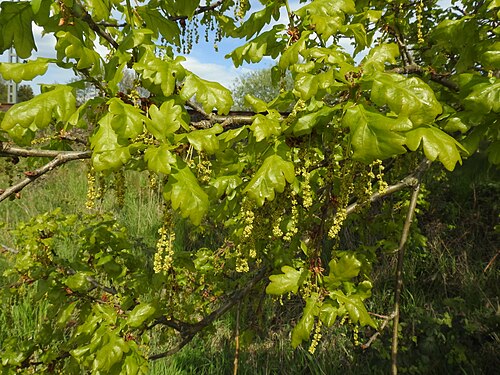
Quercus roburなどのオークの無形の花は風媒花であるため、受粉動物に目立つ必要はありません。
.jpg/500px-Populus_angustifolia_%C3%97_balsamifera_(5001208139).jpg)
ポプラの新芽の頂芽

Ochrosia borbonicaの一見別々のナッツは、実際には各花から 2 つずつ取れる無果性の心皮です。

Araucaria cunninghamiiの円錐形の鱗の先端にある突起は、穂状になっている。
.jpg/500px-Alyssum_linifolium_leaf2_ST_(14931806424).jpg)
Meniocus linifolius (旧称Alyssum linifolium )の葉の毛は星状で、葉の表面に密着しています。

未確認のガザニア種のクモ膜葉

茎節の刺座から出てくるサボテンGymnocalycium Bayrianumの棘
_Bobo-Dioulasso,BF_thu14nov2013-0953h.jpg/500px-2013.11-411-169_Akee,seed&aril(whole,LS)_Bobo-Dioulasso,BF_thu14nov2013-0953h.jpg)
ブリギア(アキー)の種子。1つは丸ごと、もう1つは縦断面で、淡い仮種皮が見える。
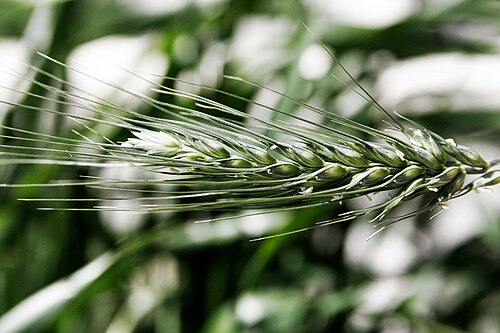
野生ライ麦の果実序、顕著な芒が見られる
.jpg/500px-Rytidosperma_longifolium33_floret19_(9412598806).jpg)
オーストラリアの草の一種Rytidosperma longifoliumの芒と剛毛の解剖学
_axillary_and_apical_buds_5471.jpg/500px-Searsia_angustifolia_(Rhus_angustifolia)_axillary_and_apical_buds_5471.jpg)
葉の腋芽
B
- バカテ
- ベリーのように見える果実だが、本当のベリーであるかどうかは不明である。[22]
- バキュロフォーム
- 棒状。幅より長さが長い。円筒形と比較してください。
- バーブ
- 魚の針のように後ろ向きの先端。
- とげのある
- とげが一方向を向いている。
- 口ひげを生やす
- とげのある毛(barbellae)を持つ。
- 吠える
- 木本樹木および低木の幹と根の保護外層組織。形成層の外側にあるすべての生体組織と非生体組織が含まれます。
- 基礎
- (植物または系統樹の) 基部またはその近くに位置または付属している。
- 固定された
- 基部で付着しているもの、例えば花糸に付着している葯。dorsifixed と比較してください。
- 基底弁状
- 頂点から基部に向かって(つまり、最も若いものが基部に向かって)連続的に発達すること(例:花序の花)。また、葉から根への移動(例:植物の分子シグナル)。
- 深海底
- 植物の基部に通常未成熟時に生成される特殊な葉で、植物を基質に固定する役割を果たします。特にシダ類のテラトフィルムで顕著です。アクロフィルと対比してください。
- 嘴
- 特に心皮または果実の、突出した尖った先端の突起。
- ベリー
- トマトなど、種子が果肉の中に浸っている非裂開性の果物の一種。
- 双方向
- 「2」を意味する接頭辞。例: bisulcate は 2 つの溝または溝を持つ。
- 隔年
- 2 年または生育期内にライフサイクル (つまり発芽、繁殖、枯死) を完了する植物。2 年生植物は通常、1 年目に根元の葉のロゼットを形成し、2 年目に花を咲かせて実をつけます。
- 二分脊椎
- 二股に分かれた枝。長さの約半分のところで二つに切る。三股と比較してください。
- 二葉の
- (複葉について) ちょうど 2 枚の小葉を持ち、通常は対称的な対になっている。例: Colophospermum mopaneの葉。Bauhiniaのほとんどの種の腹葉と比較。
- 二紡錘形
- 真ん中がつままれた紡錘形。
- 両唇
- 唇弁が2つあること。例えば、多くの不規則な花の花びらの形状。
- 二国間
- 1. 背腹葉の 2 つの面のように、区別できる 2 つの側面があること。
- 2. 反対側に配置されている、例:茎の上の葉。distichousとoppositeを比較してください。
- 3. 左右対称の輪郭を持つ葉のように左右対称である。
- 二房状の
- 葯や子房などに 2 つの室がある。
- 二項式
- 2 つの単語からなる名前を利用して、ラテン語形式の学名 (または組み合わせ) を作成します。たとえば、最初の単語は種が属する属の名前であり、2 番目の単語は、同じ属の他の種と区別するためにその種に付けられた種小名です。
- 二名法
- 種の学名(他の階級の分類群の学名ではない)が 2 つの名前の組み合わせである命名システム。最初の名前は属名です。2 番目の名前は植物学的には種小名と呼ばれます。2 つの名前(2 番目の名前だけではない)が一緒になって種名を構成することに注意してください。
- 二羽状
- 二重羽状。例えば、個々の小葉が羽状に分かれた複葉。
- 二羽状複葉
- 深く切れ込んだ部分を持つ羽状複葉。
- 両性愛者
- 雄性生殖器と雌性生殖器の両方を持つ。通常、花には雄しべと雌しべの両方がある。両性花、同株花、単斜花と同義。両性花は雌雄同株植物にのみ発生する。両性花、単性花、植物の生殖形態も参照。
- 噛みつき
- (胚珠の) 2 枚の外皮で覆われている。対比unitegmic。
- 二期的
- テルナテ島、各地区は3つに分かれています。
- 二枚貝
- 2 つのバルブまたはヒンジ部分を持つ。三弁と対比。
- ブレード
- 葉柄や葉柄を除いた葉身または平らな部分。
- 咲く
- 植物の一部、通常は茎、葉、果実に発生する細かい白または青みがかったワックス状の粉末。こすると簡単に除去できます。
- 幹
- 木の幹。通常は一番下の枝の下の部分。樹冠と比較してください。
- ボストリコイド
- 円錐形の表面(カタツムリの殻のような)に配列されています。長く先細りの円錐形の花梗の外側に、芽がほぼ螺旋状に配列されている花序を表すために使用されます。
- 苞葉
- 花または花序に付随し、他の葉とは形、大きさ、または色が異なり、腋芽を持たない、変化した葉。
- 苞葉状の
- 苞葉を持つ。
- 小苞
- 小花柄または萼片に単独または対になって生じる小さな苞。小苞と同義。
- 有柄の
- 小苞を持つ。
- 苞葉状体
- 苞葉が多数または目立つ。[23]
- 小苞
- 小苞を参照。
- 小枝
- 小さな枝。
- 短落葉性の
- 新しい葉が生える前、ほんの少しの間だけ葉がすべて落ちる植物。そのため、葉のない期間はほんの短い期間、たとえば約 2 週間だけになります。
- 剛毛
- まっすぐで硬い毛(滑らかまたは微細な鋸歯がある)。芒の上部(芒が曲がっていて、柱と呼ばれる下部のより太く、通常はねじれた部分がある場合)。
- 風船回遊性の
- 二次葉脈が葉の縁で終わらず、一連の顕著な弧状に結合している羽状の葉脈。
- ブローカス
花粉粒の網状体の 1 つの内腔の幅と周囲の壁の幅の半分。したがって、内腔のサイズがそれぞれ異なる場合は異毛状、同じ場合は同毛状となります。
- コケ植物
- 非公式には、コケ類、ツノゴケ類、ゼニゴケ類の植物を指します。正式には、これらの植物は、ツノゴケ類 (ツノゴケ類)、ゼニゴケ類 (ゼニゴケ類)、コケ類 (蘚苔類) の 3 つの別個の部門に分類されます。
- バルブ
- 通常は地下にある、茎と葉の基部(内側のものは肉質)からなる厚い貯蔵器官。
- ブルベル
- 別の球根から生じた球根。子球を参照してください。
- 球根
- 葉または羽片の腋に形成される小さな落葉性の球根または塊茎。栄養繁殖の手段。
- 球根
- 別の球根から発生する球根。球根。
- ブルレート
- 1. 丸みを帯びた、または水ぶくれのような外観、アーチ型またはアーチ状の形状。
- 2. (葉について) 各側脈の間に弓状の葉組織があり、すなわち葉脈が葉の表面でくぼんでいるように見える。
- バール
- 木の枝や幹の変形や節。木工では求められることもある。[24]
- バリ
- 1. とげのある果物。
- 2. 種子または果実と、それに付随する花の部分または苞葉からなる、ざらざらまたはとげのある繁殖体。
- 支柱根
- 地上の茎または幹から成長し、支えとなる根。例えば、イチジク属が一般的。

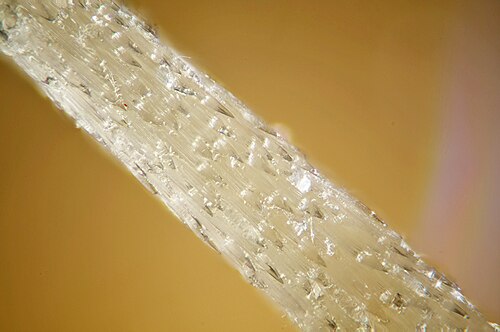
ここに示すように、一部のサボテンの種の棘には棘があります。拡大して示します。

オリニア・ベントーサの果実。断面を見ると、果肉の中に硬い種子が見える。
_leaves_(11683653383).jpg/500px-Mopane_(Colophospermum_mopane)_leaves_(11683653383).jpg)
モパネの木 ( Colophospermum mopane ) の二出複葉は、「バタフライ ツリー」という一般名の由来となっています。

Arabidopsis thalianaの長角果の断面。2 つの心皮から形成された二室状の果実で、形態的には長角果であり莢ではない。

Gymnocladus dioicusの二回羽状葉

二互生複葉の構造
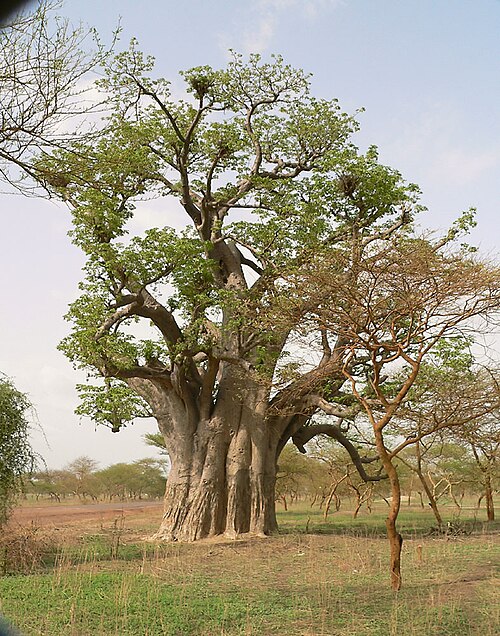
このアフリカのバオバブ、Adansonia digitata は、この種の典型的な比較的控えめな樹冠の下に巨大な幹を持っています。

ブーゲンビリアの大きくて色鮮やかな苞葉は、よく花びらと間違われます。

バリ、Arctium種の果実
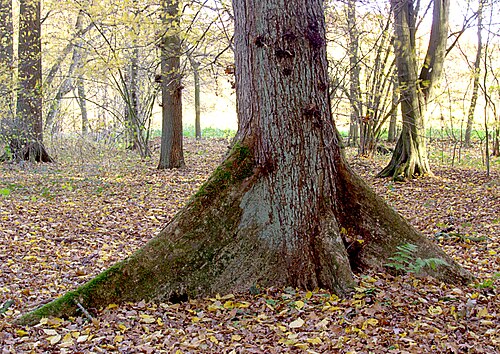
成熟したニレの支柱根
C
- 脱落した
- 早く落ちてしまうこと。例えば、ポピーの萼片は花びらが開き始めると落ちてしまいます。持続性と一過性を比較してください。
- 不合理な
- 房状または芝状のもの。例えば、一部のイネ科植物やスゲ科植物の成長形態。
- 計算する
- 拍車を持っている。
- 石灰質の
- 炭酸カルシウムを豊富に含む、または大部分が炭酸カルシウムで構成されている土壌タイプまたは地衣類の基質岩石タイプ。
- 計算する
- スリッパのような形をしている。[25]
- カルシウム
- 石灰質土壌で育つ植物。また、好石灰植物、石灰質植物とも呼ばれる。反意語:石灰分離植物。[25]
- カロース
- 硬化した、厚くなった、硬くなった。
- たこ
1. 突出した組織の塊
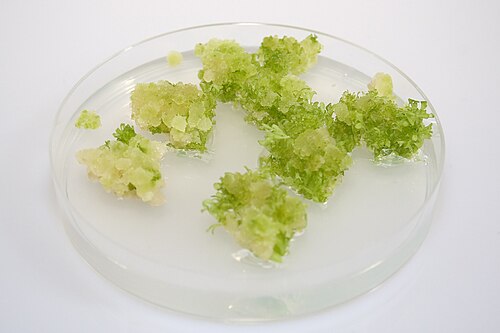
- 2. 創傷に反応して形成される未分化組織の成長。in vitro で増殖できる場合がある。
- 3. ラン科植物において、唇弁から生える肉質の突起で、乳頭から板状までさまざまな形をとる。
- 4. イネ科植物において、小花の基部(花梗節および/または花筵の基部から形成される)から硬化した伸長部分。伸長する場合としない場合があり、毛や剛毛で覆われていることが多い。
- 萼花の
- 花びらと雄しべが萼片に付いている。
- カリコフィル
- 萼片または萼片片から形成される葉のような構造で、開花前または開花後に通常何倍にも拡大します。特に、他の萼片または萼片片の大部分が元の大きさを保っている場合に顕著です。萼片が増大するよりも極端な萼葉は、アカネ科に見られます。萼葉と翼葉を比較してください。
- 有鱗状の
- 上花冠を持つ。
- 萼片
- 1. 外側の萼に似た苞葉から形成されたカップ状の構造。
- 2. 一部のキク科植物では、総苞の下にある輪状の苞葉。
- カリプトラ
- フードまたは蓋。operculum を参照。
- 萼片
1 つの花の萼片の総称。花の外側の輪生部分で、通常は緑色。花冠と比較してください。
- 萼筒
- 少なくとも基部で萼片(萼片)が融合して形成された管。
- 形成層
- 植物の成長に必要な部分的に未分化の細胞を提供する組織層。
- 鐘形の
- ベル型。
- キャンプ旅行
- 二次静脈が縁に向かって湾曲し、場合によっては縁とほぼ平行になり、他の静脈と再接続してループを形成しない羽状静脈。
- カンピロトロプス
- 胚珠が横向き(胚軸が柄に対して直角)で、胚嚢が湾曲している場合。両向性、反向性、直向性を比較してください。
- 細管化する
- チャネル付き。縦方向の溝がある。
- 白熱した
- 白い羽毛や羊毛で覆われた葉のように、色が白に近づきます。
- 天蓋
- 木の枝と葉、樹冠。森林の保護上層部も指します。幹と比較してください。
- 毛細血管
- 1. 内部の断面が狭い管、細孔、または通路。
- 2. 細い; 髪の毛のような。
- 有頭
- 1. (花序について) 瘤状の頭花を持ち、花は柄がなく密集して集まっている。
- 2. (汚名が) ピンの頭のような。
- 頭状部
- 無柄または半無柄の花または小花が密集したもの。例:キク科のヒナギクの頭花。pseudanthiumを参照。
- カプセル
- 2 つ以上の結合した心皮から形成され、熟すと裂開する乾燥した果実(通常は断片に分裂するか、歯または気孔によって頂部が開く)。
- カーデュオイド
- キク科の花柱を持ち、花柱枝の下の花柱幹に輪状の毛が生えている。
- カリーナ
- キールを参照してください。
- 分岐管
- トクサ属および絶滅したトクサ類の茎にある縦方向の空洞。茎の表面の尾根と一致する。
- 肉質の
- 特に一部の花に適用される肌色。
- カルノーズ、カルヌース
- 特に一部の組織や臓器に適用される場合、肉質または果肉質の質感。coriaceousおよびcorneousと対照的。
- カロポディウム
- セリ科の顕花植物の属。原産地はトルコからイラン。Carpopodium と混同しないように。
- 心皮
- 被子植物の基本的な雌の生殖器官。単一の胞子葉または複合子房の単一の室から成り、花柱と柱頭を持つ。雌蕊は単一の花のすべての心皮の総称である。
- 心皮質
- 心皮または心皮の付随構造や成長物、例えばスイレン科の心皮に付着する仮雄蕊は、しばしば心皮付着部と呼ばれていた。「心皮付着部」、「傍心皮」、「仮雄蕊」という用語の現在および過去の使用法は混乱しており、著者によって異なる。
- カルポポディウム
- 痩果(Cypselae)では、雌蕊の基部がはっきりと伸び、痩果が花托から分離する離層部となる。
- 2.アブラナ科のCarpopodium属。Caropodiumと混同しないように。
- 軟骨性の
- 硬くて丈夫。骨ばった。corneousとcoriaceousを比較してください。
- カルンクル
- 通常は塊状またはイボ状の肉質のような組織の小片で、種皮の門付近に生える。仮種皮とは対照的。
- 穎果
- ほとんどのイネ科植物に見られるように、種皮が果壁に密着して融合した、乾燥した非裂開性の 1 種子果実。
- カスパリー線
- 維管束植物の茎と根の内皮の放射状の一次細胞壁にあるスベリンの連続帯。外部の水と溶質が維管束組織に受動拡散するのを防ぐ透過性バリアを形成します。
- カシデス
- フード、ヘルメット、またはボンネットの形。一般的には、トリカブトやサティリウムなどの花のように、花の構造を指します。
- 荒廃した
- 栗色、赤褐色。[26]
- カジュアルなエイリアン
- 明らかに人間の援助がないのに出現したが、持続的な個体群を形成しない、または繰り返し新しいものが導入されることによってのみ存続する外来植物。外来植物と比較してください。
- カタフィル
- 形態的には葉であるが、せいぜい偶発的または一時的な光合成機能を持つ植物構造。主な機能が完了すると落とされるか、または死んだときに保護または支持の目的を果たす構造に組み込まれます。
- 連鎖する
- 鎖状。鎖のようにつながっている部分や細胞で形成されます。例: 一部の珪藻類、藻類、およびアナベナなどのシアノバクテリア。連結も参照。
- 花穂
- 柳、ポプラ、オーク、モクマオウなどの花穂で、通常は垂れ下がり、ほとんどが小さな単性花で、目立つ花被片がありません。個々の花は鱗片状の苞葉を持つことが多く、一般に風媒花です。尾状花序は通常、一塊として散ります。
- 尾状
- 細い尾のような付属器または先端を持つ(例:ドリップチップ)。acuminate、cuspidate、mucronateと対照的。
- 塊茎
植物の茎、特に木質の茎。また、台木、特に新しい成長が生じる基部の茎構造または貯蔵器官を意味することもあります。lignotuberと比較してください。
- 塊茎状
- 茎状または塊茎状。時には「太い茎」を意味する「pachycaul 」の意味で使われる。
- 有茎性の
- 地上によく発達した茎を持ち、茎葉植物に似ている。反意語:無茎(明らかな茎がない)。
- カリフラワー
木の枝や幹から直接花や果実が生える。[27]
- 茎状
- 葉、花、果実などと同様に、地上茎または茎葉部に生じる(後者の 2 つの器官に適用される場合、通常は古い茎を指す)。
- カリロスレート
- 葉や苞と同様に、茎や茎頂部に生じる。
- 細胞
- 1. 植物構造の基本的な微視的単位。通常、細胞壁に囲まれた粘性流体内の区画で構成されます。
- 2. 葯または子房の空洞。
- セナンサス
- (花被について) 雄しべと雌しべの両方が欠けている、つまり雄しべも雌しべもない花。
- 中心固定された
- 中央で結合した2つの枝に分かれた器官、例えば毛や葯など。
- セラセウス
- ワックス状の外観、色、または質感を持つ。例: Ceropegia属の多くの種の花、およびMyrica属のいくつかの種のワックス状の果実。
- 熱心な
- うなずく、真っ逆さまに倒れる、または顔を下にする、傾く、身をかがめる、または前にかがむ。多くのナルキッソス属やディエラマ属など、うなずいたり身をかがめたりする習性を持つ多くの種に適用される。多くの植物種には、種小名「cernua」がある。
- チェスピートース
- caespitose の別の綴りで、房状の、または芝のようなという意味で、例えば、ある種の草の成長形態。
- チャンバー
- 卵巣の空洞。
- 導かれた
- 表面の下に沈み、丸い溝が形成されます。
- 褐色の
- 紙のような質感を持つ。
- 交配性の
- 花被が開いたときに受粉する花。閉鎖花序と比較してください。
- カスモファイト
- 崖面などの割れ目や窪みに生育するのに適した植物。cremnophyteと比較してください。[28] [29]
- キメラ
- 2 つ以上の遺伝的に異なる組織から構成される個体。最も一般的には移植の結果として、また時には種子発育中の細胞分裂または細胞移動中に発生する突然変異によって構成される。
- 翼竜を好む
- コウモリによって受粉される。
- クロロフィル
- 光合成に不可欠な葉緑体中のさまざまな化学色素のいずれか。
- 葉緑体
- 植物細胞内に存在するクロロフィルを含む細胞小器官。
- クロロシス
- 通常は緑色の器官の色が異常に欠けているか青白くなっている状態。
- 繊毛
まつげのように、器官の縁に多かれ少なかれ限定されている非常に小さな毛または毛のような突起。運動細胞では、運動を助ける微細な毛のような突起。
- 灰白色の
- 灰色がかった灰色で、通常は短い毛で覆われているため、白熱色よりやや暗い色です。
- 循環する
- 先端が最も内側になるように螺旋状に巻かれており、例えばほとんどのシダ植物の発達中の葉は環状に巻かれています。
- 肝硬変
- (葉が)先端で巻きひげ状に終わる。
- 巻雲
- 「巻きひげ」を参照してください。
- 枝葉
- 光合成を行う枝または茎。多くの場合は葉に似ており、通常は葉がないか、または大幅に減少しています。葉状体と比較してください。
- クラス
- 分類群を門と目の間で順位付けるための主なカテゴリ。
- クラスレート
- 網や格子のような形をしており、ケージのように開口部が開けられている。
- 棍棒
- クラブ型。
- クラバンキュラ
- キョウチクトウ科の花で、側面と下面が受容部となる、拡大したドラム状の柱頭。葯と一体化している場合とそうでない場合がある。
- 爪
- 1. 花弁、萼片、または苞の基部の細い茎のような部分。
- 2.メラレウカでは、雄しべの束の結合部分。
- 閉鎖生殖の
- 自家受粉して完全には開花しない花、または開花する前に自家受粉する花を持つ。混受花と比較してください。
- 更年期の
- 収穫後にエチレン呼吸の増加に先行して、またはエチレン呼吸の増加を伴って熟成段階を経る可能性のある果物の大まかな分類。
- クライマー
- 支えを得るために他の構造物に寄りかかったり巻き付いたり、あるいは巻きひげでしがみついたりして、多かれ少なかれ直立して成長する植物。
- クライミング
- 登山家を参照してください。
- クライン
1 つの種内、または場合によっては 2 つの種間での継続的な形態学的変化。
- クローン
- 親植物の無性生殖によって生成された植物で、両方の植物は同一の遺伝子構成を持っています。
- 合体した
- 植物の部分が融合したり一緒に成長して単一のユニットを形成すること。
- 蝸牛状
- 凹型でスプーン型。
- 渦巻状の
- カタツムリの殻のように丸まっています。
- コエノビウム
- 一つの生物のように機能する、整然とした藻類のコロニー。
- 多細胞細胞
- 核分裂の後に細胞質分裂が起こらなかった場合に形成される、複数の核を持つ単一の細胞。
- 子葉鞘
- 単子葉植物の種子の構造における鞘の一種。子葉鞘は保護用の鞘または傘(傘)で、一般的には多かれ少なかれ尖っており、単子葉植物の幼芽が土から出てくるときにそれを覆う。子葉鞘は一般的に緑色に変わり、苗の主成長によってその機能が置き換えられるまで光合成に貢献する。これとは対照的に、子葉鞘は根が出てくると置き換えられるまで地中に残る。
- 根茎
- 単子葉植物の種子の構造における鞘の一種。鞘は子葉鞘を幼根につなぎ、発芽時に単子葉植物の幼根を保護する。子葉鞘とは異なり、鞘は根に付随しており、発芽時に土壌から出てくることはない。子葉鞘と対比。
- コルレンキマ
- 不均一に厚くなったセルロースとペクチンの細胞壁を持つ生きた細胞からなる特殊な組織で、主要な植物組織で構成される葉や若い茎などの器官で支持機能を果たします。
- 収集者
- 多細胞の腺毛で、通常は粘液質を生成し、萼片、托葉、葉柄、または茎の近くの部分に生えています。リンドウ目の植物によく見られます。
- 柱状
- 顕花植物において、球果または果実の中心軸。例:Callitris。
- カラム
- 1. 子房の上に伸び、花柱と雄しべを含む構造。蘭やトウワタなどで、雌蕊とも呼ばれる。
- 2. イネ科植物の芒の下部の太くて通常はねじれた部分。細い上部または剛毛とは区別される。
- 円柱状の
- 柱のような形をしています。
- コマ
- 1. ストロファントゥス、アスクレピアス、アルストニアなどの一部の種子の片端または両端にある種皮または索の毛の房。
- 2. 無菌の苞、例えばウコン、アナナス、またはユーコミス。
- 3.ムスカリやレオポルディアなどの一部の花序の先端に不稔花が見られる。
- 4. 一部の花の基部にある毛の房。例:Pfaffia gnaphalioides。
- 5. 小穂の先端または基部にある毛の房。
- 6. 一部のイネ科、例えばEragrostis comata の花序にある腋窩の毛の房。
- 商号
- 多くの場合、植物学上の地位がなく、 ICNCPによって管理されていない名前。この用語は一般に、商標名、植物育種者権利で保護されている名前、特許、および植物の販売を促進するために使用されることが多いプロモーション名などの名前に適用されます。
- 交連
- 2 つの心皮が接着する継ぎ目または面。裂溝と縫合も参照。
- コミュニティ
- 特徴的に一緒に生息する植物の生態学的集合体。
- 複合
- いくつかの部分から構成されます。たとえば、複数の小葉から構成される葉、複数の心皮から構成される雌花序、または複数の小さな花序から構成される花序などです。
- 複合掌状
- 中心点(通常は葉柄の上部)から放射状に広がる小葉を持ち、手のひらから放射状に広がる指のようなものです。掌状と比較してください。
- 圧縮された
- 横方向(左右)または背方向(前後)に、縦方向に平らになっています。
- 連結する
- 鎖状に結合されます。連結および連結も参照してください。
- 同色の
- 全体的に同じ色であること。均一に着色されていること。
- 重複する
- 平らな面の 2 つの側面が正中線に沿って折り畳まれ、互いに向かい合うように配置されています。ptyxis、aestivation、およびvernationも参照してください。
- 円錐
- 果実の一種で、通常は木質で、中心軸の周りに配置された鱗片、苞葉、または小苞を含む、卵形から球形。裸子植物、特に針葉樹やモクマオウなどに見られる。
- 共花
- 花序の全体構造とその個々の枝の構造の間に大きな違いがあることを説明するためにあまり使用されない用語。例: Callistemon属のブラシ状多花頭花。
- 結合する
- 同種の別の器官(単数または複数)と融合する(例:合弁花冠筒の花弁)。付属花と比較。
- 接続詞
- 葯細胞を連結する葯の部分。
- 共謀する
- 接触したり、収束したりすること。
- 同種の
- 同じ種に属する。
- 連続した
- 隣接し、接触しているが、結合していない。
- 歪める
- (萼片または花弁の) 重なり合う夏眠の一種で、各節の片側が隣接する節の 1 つと重なり、反対側が他の隣接する節と重なる。重なり合う を参照してください。
- 歪んだ
- 通常の形状からねじれています。
- 複雑な
- 1. 蕾の花や葉の器官の配置で、各器官または節の 1 つの端が隣接する器官または節と重なっている状態を指します。重なり合う配置の一種です。「ねじれ」を参照してください。
- 2. (葉について) 1 枚の葉が他の葉の中に巻き込まれた形の葉脈の一種。
- 3. 節に 2 枚の葉がある形態の一種で、各葉の半分が露出し、残りの半分が他の葉の内側に巻き付いている。
- コルクル
- 植物の胚、幼芽、または幼芽と幼根を組み合わせたもの。
- 心臓形の
- ハート形で、切り込みが一番下にあります。葉の基部はハートの切り込み部分に似ています。obcordate と対比してください。
- 革質の
- 革のような、硬くて丈夫だが、柔軟性がある。corneousと比較してください。
- 球茎
肉質で膨らんだ茎の基部。通常は地下にあり、食料貯蔵庫として機能し、芽は裸か非常に薄い鱗片で覆われている。台木の一種。
- コルメル
- 成長する大きな球茎の基部に形成される小さな球茎(または球茎小球茎)。[30]
- 角質の
- 角質質。硬くて硬いが、やや丈夫。coriaceousと比較してください。
- 花冠
- 花びらの総称。萼と比較してください。
- コロナ
- 1. 顕花植物において、花冠または花被から生じ、花被片と雄しべの間にある、管状に結合している可能性のある構造の輪。ラッパ状の部分は花冠である。
- 2. イネ科植物において、一部の種では外套管の上にある硬化した輪状の組織。
- 皮質
表面細胞と血管円筒の間に位置する組織領域。[31]
- 皮質性の
- 樹皮または樹皮を剥いだ木材に生える。lignicolous と比較。
- 散房花序
枝が異なる地点から発生するが、ほぼ同じ高さに達する花序で、花房が平らな頂部を持つ外観になります。
- コスタ
- 肋骨。
- 肋骨パルマテ
- 典型的な掌状葉や扇状葉とは異なり、明確な肋(中肋)を持ちますが、小葉は掌状葉のように放射状に配置されています。
- 子葉
- 植物の胚の最初の葉。発芽すると子葉または最初の葉に成長します。
- よちよち歩きの
- 二次脈が縁で終わる羽状脈で、多くの場合は歯状になっています。
- クレーター状の
- ソーサーまたは浅いカップの形、半球形またはそれより浅い形。
- クレムノファイト
- 崖の表面や割れ目に生育し、特にそこから垂れ下がるように適応した植物。chasmophyteと比較してください。[28] [29]
- 鋸歯状の
- 歯が鈍い、または丸い、波形である。
- 鋸歯状の
- 細かく波型に加工されています。
- カリカリ
- 葉や花びらの縁のように細かくカールしている。
- クリスタルクセル
- 堅果類には晶洞があり、細胞壁にリグニンが偏心的に沈着してカップ状、または断面が∪状を形成します。
- クラウン
- キャノピーを参照してください。
- クロス
- 何かを交配させること。交雑行為。
- 十字形
- 十字形。
- 甲殻類
- 硬くて薄くて脆い。
- 痂皮状
- 密に塗布された表面層または外皮を形成します。
- 隠花植物
- 胞子を作り、雄しべ、子房、種子を持たない「下等植物」のいずれか。文字通り、生殖器官が目立たない植物。このグループには通常、シダ植物、コケ植物、藻類が含まれ、菌類(地衣類化した菌類を含む)が含まれることもあります。顕花植物と比較してください。
- 曲線を描く
- フードのような、またはフード付きの、一般的には葉や花びらの形を指します。例:Pelargonium cucullatum。同様の派生語には、cuculliformやcuccularis などがあります。
- 稈
- イネ科植物、スゲ科植物、イグサ科植物、その他の単子葉植物において、花序を持つ地上茎。厳密には植物の基部から最下部の総苞葉(または花序の基部)まで伸びる。
- 栽培する
- 起源または選択が主に人間の意図的な活動による植物。
- 栽培品種
- 「栽培品種」から派生した用語で、1 つ以上の特性 (形態的、生理的、細胞学的、化学的、またはその他の特性) によって明確に区別される栽培植物の集合体を表します。有性生殖または無性生殖で繁殖すると、集合体はその特徴を保持します。栽培品種は、栽培中に発生する場合もあれば、野生から導入される場合もあります。園芸上の関心や価値がある変種です。栽培品種名は、一重引用符で囲んで表記されます (例: 'Blue Carpet' または 'Alba')。1959 年 1 月 1 日以降に確立されたすべての新しい名前は、共通言語 (つまり、ラテン語ではない) でなければなりませんが、この日付より前にラテン語で確立された名前は、ラテン語形式で保持されます。
- 品種名
- 栽培品種を表す名前の定義部分。栽培品種は、属する分類群の学名または一般名に付加された特殊形容詞 (qv) によって指定されます。特殊形容詞はイタリック体ではなく、一重引用符で囲みます (例: Rubus nitidoides 'Merton Early')。'Merton Early' は栽培品種の特殊形容詞です。
- 楔形
- くさび形で、直線の側面が基部で収束します。
- カップル
- ドングリのカップのような、癒合した苞葉で構成されたカップ状の構造。 calybium を参照。
- カップ状の
- カップ状の形をしています。
- カップ状の
- ベアリングカップル。
- カップ状
- ほぼ半球形で、キューポラまたはドームのような形をしています。
- 尖端
- 先端が硬く尖っており、マクロよりも堅くて頑丈なので、尖頭器官と呼ばれます。
- 尖頭
- 一部の葉と同様に先端が尖っています。
- キューティクル
- 地上植物の表面の表皮を覆い、クチン、クタン、ワックスなどのポリマーで構成された防水層。
- 切断
- 植物から切り取られ、無性生殖のために使用される、シュート構造、根、または葉の先端部分。
- シアチウム
総苞葉に囲まれた単性花の花序、特にユーフォルビアの花。
- シアトフィル
- ユーフォルビアでは、総苞が付いている苞葉のような構造で、通常は 2 つあるが、常にあるとは限らない。鮮やかな色をしていて、花びらと見間違えられることもある。
- 円筒形の
- 棒状で長さは幅の2~3倍。バキュリフォームと比較してください。
- シナロイド
- カーデュオイドを参照してください。
- 集散花序
主軸とすべての側枝が花で終わる花序の一種(各側枝は繰り返し分岐することがある)。
- シモス
- 集散花序を持つ。
- キプセラ
- 下位の子房から形成される、乾燥した、種子が 1 つある、裂開しない果実の一種。

Dianthus chinensis はカエスピトーシスの成長習性を持っています。
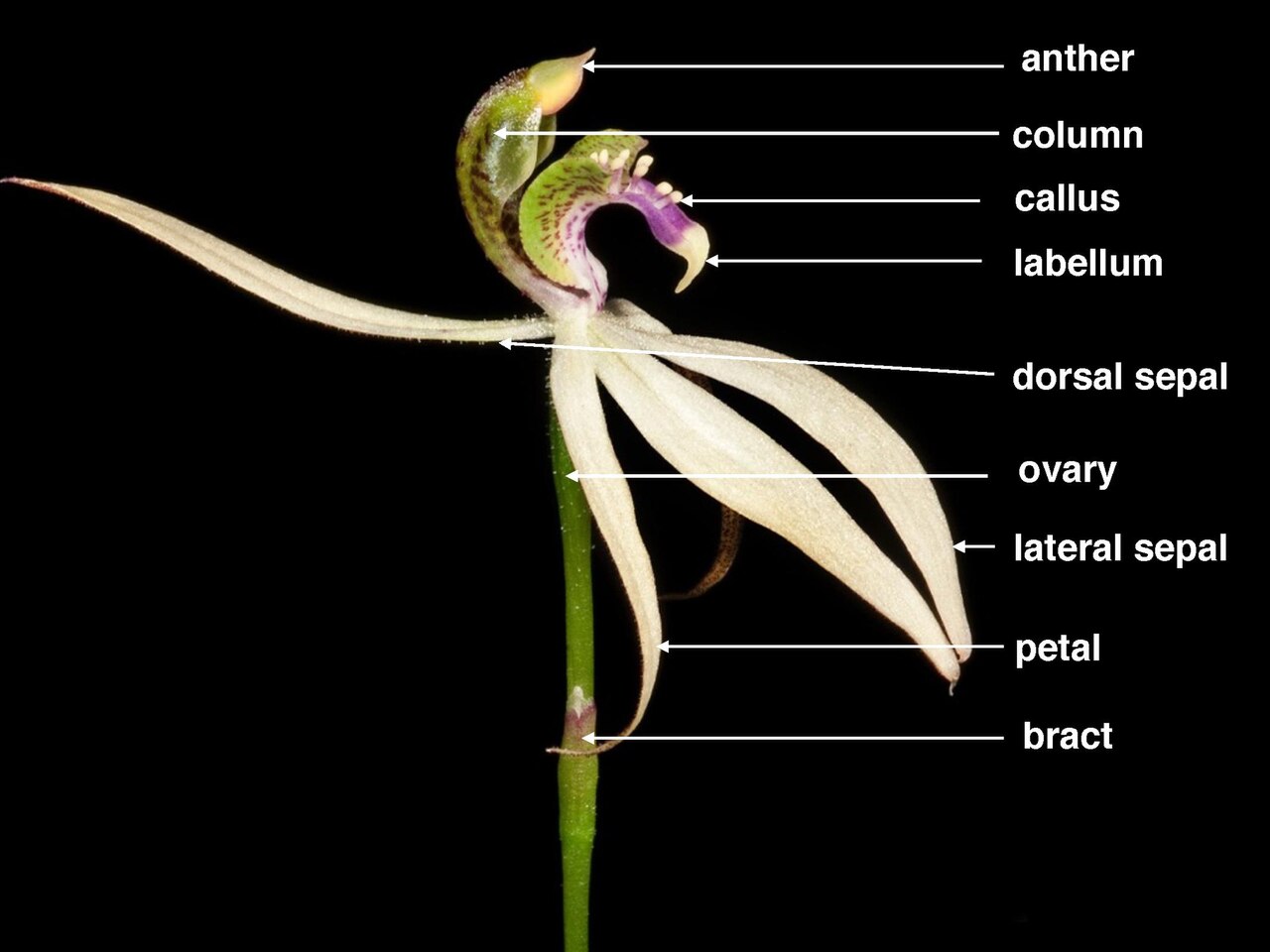
Praecoxanthus属のランの花の構造。カルスにはラベルが貼られている。
.jpg/500px-Chrysopogon_filipes_callus_(6914259711).jpg)
草種クリソポゴン・フィリペスの小花のひげを生やしたカルス

キク科のZyzyura mayanaの痩果様果実の基部にある果床の走査型電子顕微鏡写真
_showing_imbricate_cataphylls_5405.jpg/500px-Leaf_bud_of_American_Sweet_gum_(Liquidambar_styraciflua)_showing_imbricate_cataphylls_5405.jpg)
落葉樹の休眠中の葉芽は、一般的に、芽が発芽するときに落葉する重なり合った片葉板によって保護されています。

シラカンバの雄花序

Dioscorea elephantipesの塊茎は主に地表より上に生育します。塊茎を形成する多くの種は、塊茎を地中に生育します。

カリフラワーの一種であるSyzygium mooreiの枝から生える花
_(14285633322).jpg/500px-Frailej%C3%B3n_(Espeletia_sp.)_(14285633322).jpg)
エスペレティア属の一部の種は、茎葉型の成長習性を示す。

張り出した崖に生えるモエリンギア属の植物

コケBryum capillareの葉の細胞内の葉緑体

すべての葉緑体の形状が単純というわけではありません。アオミドロの葉緑体は、藻類糸状の管状細胞内でらせん状になっています。

.jpg/500px-New_cladode_and_bud_of_Velvet_Tree_Pear,_Opuntia_tomentosa_(10921285475).jpg)
このOpuntia tomentosaのようなサボテンのいわゆる「肉厚の葉」は、実際には枝葉です。本当の葉は枝葉に生えている棘で、この若い枝葉ではまだ肉厚です。

_D130902_closeup.jpg/500px-Asclepias_syriaca_(fruits_and_seeds)_D130902_closeup.jpg)
アスコルピアス・シリアカの種子。冠毛に毛が密集している。
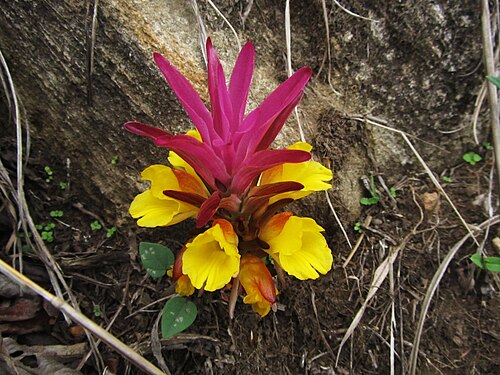
赤いコマ苞を持つウコン

基部にコマ毛のあるPfaffia gnaphalioides の花
.jpg/500px-Muscari_armeniacum_flowerhead3_ST_(14999577633).jpg)
ムスカリの上にコマがあり、不稔の花を咲かせている

Aeonium arboreumの円錐形の複花序は、小さな円錐花序から構成される複花序であり、そのいくつかは、それ自体が複花序です。

カリフォルニアトチノキ ( Aesculus californica )は複葉の掌状葉を持ち、小葉は中心点から放射状に広がっています。

ニコチアナの花の合弁花冠の裂片は、蕾の中では重なり合っている。
.jpg/500px-Starr-170624-0907-Casuarina_equisetifolia-male_and_female_flowers_and_cones-Abandoned_Runway_Near_Rusty_Bucket_Sand_Island-Midway_Atoll_(36059371970).jpg)
カジュアリーナ・エクイセティフォリアの雄花と雌花、そして球果
合弁花のワトソニアの花は、花冠筒の合生形成を示すために2枚の花弁の間に開きます。雄しべの基部の合生付着部と対応する花弁を比較してください。

球茎、1つは被膜のまま、1つは被膜片葉が見えるように部分的に剥がされ、もう1つは内部構造が見えるように分割されている。

このパッションフルーツの花冠は、花びらと雄しべの間にある紫色の糸状の輪です。

コエルロイテリアの実生の子葉。1 つの植物では子葉の上に最初の新しい葉が現れ、残りの植物では子葉のさまざまな若い段階が現れています。

.jpg/500px-Nymphoides_crenata_leaf1_(16826924328).jpg)
Nymphoides crenata の葉の縁は鋸歯状です。

Mimetes cucullatus は、白い花がフード状の鳩尾形をしていることからこの名がつけられた。
.jpg/500px-Murraya_paniculata_leaves_at_Peravoor_(cropped).jpg)
ムラヤ・パニクラタの葉は基部が楔形になっています。

_A._Gray_var._cuspidatus_A._L._Grant_20000508_01.jpg/500px-Diplacus_bigelovii_(A._Gray)_A._Gray_var._cuspidatus_A._L._Grant_20000508_01.jpg)
Diplacus bigelovii var.の尖頭葉。犬歯

ユーフォルビア・ミリイは、花序の下にある、シアトフィルと呼ばれる鮮やかな色の苞葉のような構造の美しい外観のために商業的に栽培されています
だ
- 落葉樹
- 樹皮、葉、花びらなどと同様に、季節的に裂けて落ちる。持続的とは対照的。
- 偏角する
- 下向きにカーブし、先端で上向きにカーブします。多くの場合、declinate-ascendant のように修飾されます。
- 分解する
- 複数のレベルに分かれている。例えば、二回羽状の葉では、本来は羽状の葉である小葉自体が羽状に分かれている。
- 剥皮する
- 1. (動詞の挿入) 通常は自然の成長周期の一環として季節ごとに樹皮を剥ぐこと。
- 2. (tr. v.) 植物または収穫された材料から、皮、外皮、樹皮、またはその他の表面組織を剥ぐこと。たとえば、収穫されたアガベの葉から繊維を抽出すること。
- 横臥した
- 枝は地面に沿って水平に伸びるが、先端は上向きになっている。
- 逆流する
- 挿入点を超えて下方に伸びること。例えば、葉の基部または菌類のひだは、茎に沿って隆起した線または狭い翼状に下方に伸びます。
- 交差する
- decussateの同義語。decussantの使用法は疑問視されており、おそらく誤りとして、めったに使用されません。正式に正しい使用法はdecussateです。
- 交差する
- 向かい合っていて、次の対は最後の対に対して直角に生えている。一般的には葉の配置に適用される。
- 明確な
- 一定の数、例えば雄しべの数が花弁や萼片の 2 倍(またはそれ以下)、または花または花芽が中断した状態で終わる花序(典型的には集散花序)。対比は不定。
- 曲がった
- 下向きに曲がっています。コントラストが内屈しています。
- 裂開した
- 成熟時に開いて内容物を放出すること。例えば、果実が開いて種子を放出したり、葯が開いて花粉を放出したり、胞子嚢が開いて胞子を放出したりすることを指す。非裂開とは対照的。
- 三角筋
- ギリシャ文字の大文字Δのような形、つまりほぼ正三角形のような形です。
- デンドロイド
- 木のような; 木のように枝分かれしている。
- 歯状
- 特に葉の縁に鋸歯がある。
- 歯状の
- 細かい歯がある。有歯動物の縮小形。
- 砂漠のような
- 砂漠に生息。
- 決定的な
- 成長が限られており、通常は不定。対比は不確定。
- ディアデルフォス
- 雄しべまたは類似の器官が 1 つではなく 2 つの雄しべにつながっている雄しべ構造のクラスを指します。
- ディアスポア
- 散布および新しい植物の定着に適応した植物の生殖部分。種子などの散布体、または特殊な芽、枝、花序、果実などの他の部分である場合があります。
- 二カ国語
- 頂花の下のすべての枝が規則的に向かい合って対になっている集散花序。monochasiumとpleiochasiumを比較してください。
- 二層構造
- 花被が別々の萼片と花冠に分かれている。homochlamydeous と比較。
- 二分法的な
- 2 つの等しい枝に分岐する。これは、成長先端が等しく分裂することによって生じる場合もあれば、成長先端が中断されて置き換わる合生枝の場合もある。通常は、アロイデンドロン・ディコトムムのように枝の成長モードを指すが、葉の脈理パターン、カリサ属のさまざまな種の棘(形態学的には枝)、さまざまな藻類や菌類の葉状体または菌糸など、他の器官を指すこともある。
- 双子葉植物
胚に2枚以上の子葉(種子葉)がある顕花植物。単子葉植物と対比。
- 指で触れる
- 共通の中心から手の指のように広がるセグメントを持つ。掌状および掌状節も参照。葉の形状も参照。
- 指状の
- 指のような形をしています。
- 二形性の
- 2 つの異なる形態(形状および/またはサイズに関して)で発生する。例:雄しべ、葉、または葉。単形性(単一の形態を持つ)および多形性(多くの形態を持つ)も参照。
- 雌雄異株の
- (維管束植物について) 雄と雌の生殖器官を持ち、それらは異なる個体にのみ発達し、同じ個体には決して発達しない。雌雄同株と対比。
- 雌雄異株
- (コケ植物配偶体について) 雄と雌の生殖器官を持ち、それらは異なる個体でのみ発達し、同じ個体では決して発達しない。単性生殖とは対照的。
- 二倍体
- 胞子体細胞の核に2 つの完全な染色体セット、つまり親配偶子のそれぞれから 1 セットずつを持つ。これは2nと記号で表現されることが多く、n は半数体配偶子の染色体数です。
- 複眼的な
- 雄しべは2つの輪生状に配置され、外側の輪生は花弁と交互になり、内側の輪生は花弁の反対側にあります。obdiplostemonousとhaplostemonousを比較してください。
- ディスク
花托から派生した構造の板またはリングで、花器の輪生の間にあります。一部のグループ、特にムクロジ科では、蜜腺は目立つ円盤状になっています。ヒナギクでは、頭花の中央部分が円盤状であるため、そこに咲く花は円盤花または小花と呼ばれます。
- 円盤状の
- 円盤または板に似ており、厚みと平行面があり、縁が丸い。舌状花がなく、筒状花しかないキク科の花頭を表すときにも使用される。
- 変色した
- (葉の)表と裏の色が違う。
- 分離した
- 広く離れた地理的領域に存在し、明確に分離している。1 つ以上の個体群が、交配の可能性がある他の個体群から、それらの間の遺伝子流動を妨げるのに十分な距離で分離されている不連続な範囲に適用されます。
- ディスク小花
- キク科の花の頭花盤に最も典型的に発生する小花で、スカビオサなど、花盤のある頭花をつける他の植物にもある程度発生します。
- 解剖された
- 深く分割された、多くのセグメントに切断された。
- 失望
- 植物の一部にある仕切りまたは隔壁。通常は、蒴果または複数の仕切りを持つ他の果実の小室間の隔壁を指します。
- 遠位
- 起始点または付着点から遠い自由端。近位とは対照的。
- 二重の
- 2 つの反対の列 (つまり同じ平面) に配置されます。
- 明確な
- 分離または自由。統一されていない。
- 不格好に
- ある種の花が、花柱と雄しべの長さのみが異なる 2 つの形態で発生し、1 つの植物にはこれらの形態のうちの 1 つの花のみが現れる状態。異形花柱と比較してください。
- 昼行性の
- 日中の; 日中に起こる、または始まる。
- 分岐する
- 広範囲に広がっています。
- 異なる
- さまざまな方向、一般的には上向きに広がります。
- 分割
- 標準的な分類階層において、界より下の分類上のランク。「部門」は一般に植物にのみ使用され、動物や他の界に使用される「門」という用語とほぼ植物学上同義です。
- ドマティア
植物によって形成された、アリやダニなどの動物が生息する中空構造。
- 背側
- ラテン語のdorsumから来ており、動物の尾根または背中を意味します。この用語はもともと植物ではなく動物を指していたため、植物学での使用法は文脈や出典によって異なります。一般的に「 dorsal」は「後部または背面または上面」を指しますが、植物学での使用法では、このような概念が必ずしも明確に定義されているわけではなく、矛盾している場合もあります。例:
- 直立した植物の側方器官において軸から離れて(背軸)を向いている
- 直立した植物のどの部分でも基質から離れて面している部分、例えば、ほぼ水平な葉(向軸)の上面や植物の冠の上部など
- 匍匐性植物、蔓性植物、またはスイレンなどの浮葉では基質から離れた方向を向いている。
- 背固定された
- 背面にまたは背面によって付着する(例:花糸上の葯)。
- 背腹方向
- 一部の葉のように、上面と下面が構造的にも視覚的にも異なるもの。両側性と等両側性を比較します。
- ドリップチップ
- 葉または小葉の先端にある、長くて狭い、尖った、尾状の、または尖った形の突起。通常、雨の多い条件に適応したもので、狭い先端から滴り落ちる水によって水がはじけるのを促進します。ドリップ チップという用語は、たとえば尖ったまたは尖った形のように解剖学的に説明的なものではなく、形状自体の特定の幾何学に関係なく、滴り落ちるのを助ける機能的な形状の説明です。
- 核果
- 1 つの心皮から形成される多肉質の果実の一種。桃やオリーブなどでは、1 つの種子が果壁の石質層に囲まれています。仁とも呼ばれます。
- ドロペレット
- 有果花の心皮の 1 つから形成される小さな核果。核果は通常、キイチゴのように複合果実を形成しますが、オクナのように大きく離れることもあります。
- ドゥルーズ
- シュウ酸カルシウム結晶の球状の塊。通常、結晶は有機質の核から放射状に広がっています。

ユーカリ・グランディスの外樹皮の季節的な健全な剥皮

葉から繊維を集める皮剥ぎ機

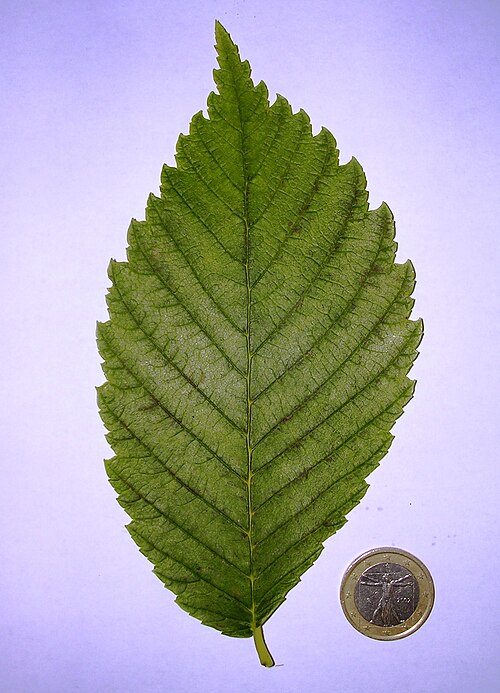
ニレの歯状葉

Ziziphus mauritianaの歯状の葉

Astragalus austriacus は、主花房に付いていない雄しべが 1 本あるため、diadelphousとみなされます。

トウゴマ(Ricinus communis )の実生の対になった子葉は双子葉植物の典型です。

Brachylaena discolorの変色した葉は、上面と下面の色が異なります。

栽培されたヒマワリの頭花に開く筒状花。筒状の花は、縁から中心に向かって徐々に開きます。


Boophone disticha は葉が特徴的です。
.jpg/500px-Acacia_drepanolobium--_Whistling_Thorn_(25396927222).jpg)
口笛を吹くトゲであるVachellia drepanolobiumのトゲの根元にあるドマチア。アクセスホールが見える。
_leaves_of_Syzygium_gerrardii_and_Triadica_sebifera_IMG_1994c.jpg/500px-Dorsiventral_(bilateral)_leaves_of_Syzygium_gerrardii_and_Triadica_sebifera_IMG_1994c.jpg)
Syzygium gerrardiiとTriadica sebiferaの背腹(両側)葉

Epipremnum aureum (ゴールデンポトス)の葉には尖った滴りの先端があります。
え
- -えー
- 属名の語幹に追加されて族名を形成する接尾辞。例: Aster → Astereae。
- 無乳頭の
- 苞葉を欠く。ebracteolateと同義。
- 生態学的振幅
- 生物が生存できる環境条件の範囲。
- 土着の
- 土壌の、または土壌の影響を受ける。
- 無腺性の
腺がない。
- エライオソーム
- 多くの植物種の種子に付着している外部構造。エライオソームは一般に肉質で、一部の種では油分やその他の栄養分を豊富に含んでいる。その機能は様々で、必ずしも明らかではない。一般的にはアリや他の動物を引き寄せて種子の散布を助けるが、他の動物が種子を食べるのを防ぐ働きもある。[32]
- 象牙
- ラフレシア・アルノルディのように、ゾウの足によって花粉や胞子が散布される受粉形式。
- 楕円
- 長軸を通るすべての断面が楕円形である 3 次元形状。
- 楕円形の
平面的で、平らな円のような形をしており、長軸と短軸の両方に関して対称で、先端と基部の両方が均等に細くなっています。楕円形。
- 矮小化する
- 一般的には葉の縁を指します。先端などの縁の一部に切り込みや凹みがあるもので、凹みは通常広く浅いです。葉の縁の位置は、先端、側方、基部の 1 つまたは複数の場合があります。
- 胚
- 発芽前の種子に含まれる若い植物。
- 出現した
- 周囲の植物よりも背の高い植物、または水生植物種の中で、花や葉が水面より上に出る植物。水生植物の例としては、スイレン、葦、パピルスなどがあります。スタッケニアなどの一部の池草は開花するまで浮上せず、開花すると花だけが水面上に現れます。
- 化
- 表面から葉のような突起が生えている。[33]
- 鏡像的に
- 雌性器が雄性器の右側(右方突出)または左側(左方突出)に外側に突出している状態(例:セナ) 。
- 風土病の
- 特定の地理的地域に限定された自然分布を持つ。ネイティブと比較してください。
- 内果皮
- 果実の壁の最も内側の層。核果では種子を囲む石質の層。
- 内皮
- 維管束植物の根の皮質の最内層で、シダ植物の茎にも存在する。放射状の壁にはスベリンが浸透し、カスパリー線として知られる透過性バリアを形成する。
- 胚乳
- 1. (被子植物)種子の胚を取り囲む栄養組織。通常は三倍体で、卵子の受精後に両極核と 1 つの配偶子が融合して生じる。
- 2. (裸子植物)胚嚢内の前葉体。
- エンドスポリー
- 胞子壁内に含まれる縮小した多細胞配偶体に発芽する胞子の生成。外胞子とは対照的。
- エンシフォーム
- 剣の刃のような形をしています。
- 全体
- 1. 分割されていません。
- 2. (縁が) 滑らかで、裂け目や鋸歯がない (ただし、波状または波型になっている可能性はある)。葉の形態の用語集の「全体」も参照。
- 昆虫学
- 昆虫によって花粉や胞子が散布される受粉の形態。
- 浮遊植物
- 最近出現した種で、通常は国内に多数かつ一定数生息しているが、牧草地や荒地などの人工的な生息地に限定されており、生存のために人間に依存している。[34]
- はかない
- 短命。caducous も参照。
- エピカリクス
- ハイビスカスなどの外萼に似た総苞。
- 外果皮
- 果物の壁の外側の層、つまり「皮」。
- 先史時代の
- 特に損傷や火災の後に、古い樹木から発生する芽、新芽、または花を指すために使用されます。
- 上胚軸
- 子葉節と最初の葉の間の植物の軸または茎の部分。
- エピクチクラワックス
- キューティクルの表面に沈着した結晶性または非晶質ワックスの層。
- 表皮
- 臓器の最も外側の細胞層。通常は 1 個の細胞のみの厚さです。
- 上位の
- 子房に生じる。子房より上のレベルに付着し、子房壁に融合した組織から生じる花の部分を指す。下子性花と周子房性花を比較してください。
- 石器時代の
- 石の上で育つ。石の上で育つ植物であるlithophyticと比較してください。
- 上花弁状の
- 花びらに付いている雄しべ。
- 上皮性の
- 岩や石の上に生育し、岩生、岩上生。
- 上睾丸
- 樹皮の表面に生育します。endophloedal (樹皮の上ではなく、内部に生育する)とepilithic(樹皮ではなく、岩の上に生育する)を対比してください。
- 着生植物
- 他の植物から栄養を得るのではなく、それを支えとして利用しながら、その植物上で成長する植物、藻類、または菌類。
- 着生の
- 着生植物の; 植物の表面に生息する。epilithic 、lithophyticと比較してください。
- 上皮性の
- 萼片に付着している雄しべ。
- 上皮質の
- 花被片に付着している雄しべ。
- 形容詞
- 二名法の学名の形容詞的要素。通常、より具体的には種小名と呼ばれる。個々の分類群を表す複数の単語(階級を表す用語以外)の名前の最後の単語または単語の組み合わせ。最も単純で一般的な例は、Welwitschia mirabilisの「 mirabilis」のように、2 語からなる種の名の 2 番目の単語です。
- 動物間伝染病
- 種子または果実が脊椎動物の体の外側に物理的に付着することによって発生する種子散布の一種。
- エプルイノーズ
- 白っぽくない。
- 同等の
- (葉を)縦に折り、別の葉を挟む。
- 直立
- 直立、地面または接続点に対してほぼ垂直。 erect と patent を比較してください( spreading ) 。
- エリコイド
- ヨーロッパのヒース(エリカ)の葉に似ており、小さく鋭く尖っています。
- 侵食する
- (余白が)かじられたり磨り減ったりしたように不規則な。
- エテロコリック
- 人間が新しい生息地に苗木、種子、または植物を意図的に導入すること。
- 黄化
- 光不足により成長が弱くなり、茎が長くなり黄色くなります。[35]
- 偶数羽状
- 複葉で小葉の数が偶数である。不羽状と同義。
- 常緑樹
- 落葉樹ではなく、一年中葉が茂っています。
- 元
- 命名法において、前の著者が名前を提案したものの正当に公表しておらず、後続の著者が名前を正当に公表する際に最初の著者を参照したことを示します。著者引用 (植物学)を参照してください。
- 脱アルブミン
- 特定の種の種子には胚乳、すなわち卵白がなく、例えばマメ科やシクンシ科など。
- 外果皮
- 果皮の外層。肉質の果物の皮を指すことが多い。
- 外胞子状の
- 胞子が生成し、自由に生活する多細胞配偶体に発芽する。胞子形成とは対照的。
- エキゾスタ
- 種皮(種子殻)の外層。胚珠の外皮から得られる。
- エキゾチック
- 原産地ではなく、他の地域または国から導入されたものです。
- 主張した
- 突出している、例えば雄しべが花冠筒部を越えている。
- 放棄する
- 托葉がない。
- 雄雄異体の
- 雄しべまたは雄しべ花序の外側。通常は蜜腺の位置を指します。
- 押し出す
- (葯室の) 花の外側に向かって開く。introrseとlatrorse を対比してください。

コリダリス属の植物は、様々な機能を持つエライオソームが付着した種子をつけますが、一般的にはアリを引き寄せます。コリダリス属のいくつかの種では、アリを引き寄せるエライオソームがネズミを撃退する働きもします。[32]

イチジク属の植物は、側方および頂端が陥没した二重陥没葉の一例ですが、基部が陥没した葉として見ることもできます。

ヘラクレウム・スフォンディリウムの花びらは、先端が多種多様に裂けています。花序の中央の花は花びらがわずかに裂けていますが、周囲の花は深く裂けていて、ほとんど2つに裂けています。
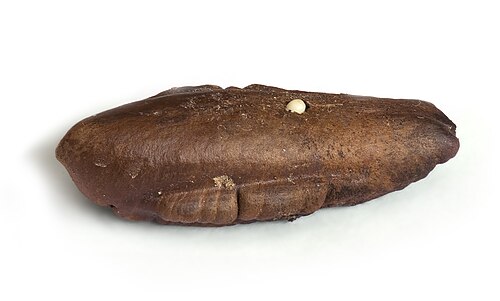
発芽したナツメヤシの種子の上部表面から現れる淡い色の胚は、種子の残りのほぼすべてを構成する主な栄養源である胚乳と比べると非常に小さい。

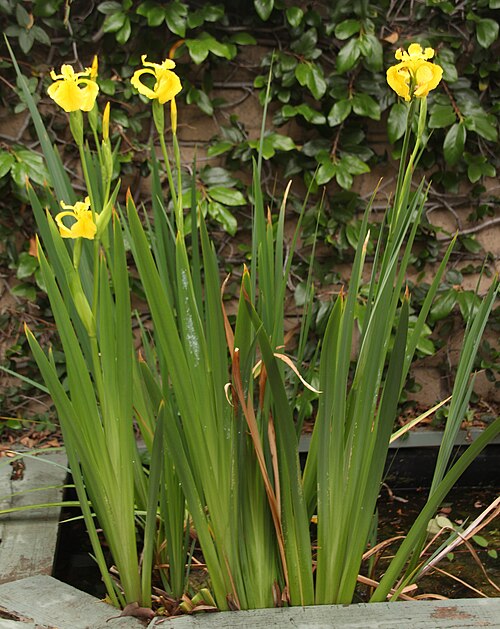
アイリス・シューダコルスは、明らかに剣形の葉を持ちます。つまり、細く、縁が真っ直ぐで、剣のような形です。

ハイビスカス・サブダリファの拡大した萼と小さな上萼


ティランジア・レクルバタは、木の幹に無害で非寄生性の 着生植物として生育しており、その幹にも着生葉状地衣類が付着している。

種子や果実は動物の毛皮に付着して付着散布される。

等分葉の基部は茎の後の葉を囲みます。

胚乳のない種子の切片
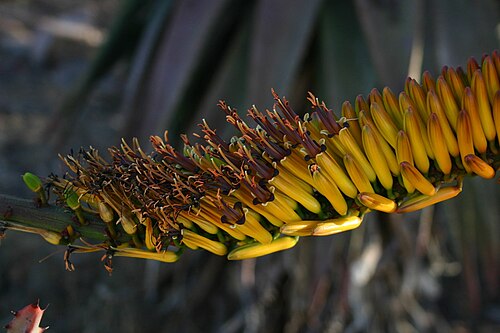
アロエ・マルロティの花。成熟した花の雄しべと柱頭が花筒の口から突き出ている。
ふ
- F1ハイブリッド
- 一回の交配。2 つの純血種の系統間で繰り返し交配を行った結果を表す植物育種用語。
- F2ハイブリッド
- 2 つの F1 雑種間の交配から生じた植物の育種用語。F1 雑種集団における自家受粉を指す場合もあります。
- ファビフォーム
- インゲン豆のような形をしています。
- 任意
- 特定の生活機能を複数の方法で実行したり、一般的に生活したりできること。[36]絶対的と比較してください。
- 鎌形
- 鎌の刃のように湾曲しています。
- 家族
- 共通の特徴、祖先、またはその両方を持つ 1 つ以上の属の分類グループ。目と属の間の主要な階級を表す用語です。
- ファリーナ
- プリムラなどの植物に含まれるフラボノイドからなる、粉末状の淡黄色の結晶性分泌物。
- 澱粉質の
- 粉っぽい、粉っぽい感じ。
- 束
花、葉、針葉、維管束組織などの集まり。たとえば、すべて同じ節から生じる葉の房など。
- 束状化する
- 枝が集まって枝分かれする、例えば棒や針の束、束がある。
- 断食する
- 1.植物形態学では、特に先端または尖端に向かって細くなる場合、直立した多かれ少なかれ平行な枝または茎の束から部分的に構成される植物の習性。(ラテン語fastigiatusは「先端がある」という意味)
- 2.花粉学において、花粉の外壁の層の間の空洞の上に尖った先端を持つ花粉粒の形状。
- フォーカル
- 花托に関連する。萼片または花冠の喉部に位置する。
- 蛇口
- 萼または花冠の喉部。口と筒の先端の間の著しく広がった部分。ムラサキ科では、特徴的な付属肢がある場所。
- ファベオレートする
- 蜂の巣状。規則的で角度のある穴がある。小窩状と比較してください。
- フェルト
- 絡み合った毛が絡み合って絡み合っている。[28]
- 雌花
- 雌花を参照してください。
- 窓を開ける
- 光を通す半透明または透明な部分があること。これは、訪れる動物の行動にさまざまな影響を与えたり、土壌表面でのみ成長する多くの乾燥地帯の植物の光合成を可能にしたりします。また、穿孔もゆるやかに指しますが、穿孔するの方が正確な用語です。
- 鉄質の
- 赤みがかった色またはさび色。
- 肥沃な
- 果実を生産できるもの、種子を生産する花、または花粉を含む葯を持つもの。
- 受精
- 有性生殖における雄性配偶子と雌性配偶子の結合。
- ファイバ
- 1. ファイバーセル。
- 2. 柔軟で、強く、糸状で、非常に細長い構造。
- ファイバーセル
- 厚壁組織に見られる細胞の一種。非常に細長く、細胞壁の大幅な変化の後にすぐに死滅する。細胞壁は通常は厚く木質化しているが、ゼラチン状の場合もある。
- フィラメント
- 1. 雄しべの柄。
- 2. 1 個または数個の細胞の厚さの非常に細い糸状の構造。
- 糸状の
- フィラメントまたは繊維で構成され、髪の毛のような形をしています。
- 糸状の
- 糸状、例えば雄しべの花糸や葉の形状。
- フィンブリア
細い、髪の毛のような突起、フリンジ。
- 毛状突起
- 縁飾り、例えば花弁の端が2つ以上に分かれているもの。[37]繊毛を持つ。
- 亀裂
- 裂け目または亀裂。樹皮の亀裂を指すことが多い。裂開の線または開口部。
- 瘻孔
- 管状の空洞。
- 瘻孔
- 中空。通常はリードなどの管状の空洞に適用されます。
- 羽状になる
- 扇形、例えば扇形の葉。
- 弛緩
- しなびている; しおれやすい。turgid と比較してください。
- 柔軟に
- 雄しべの成熟度に応じて、花柱は上または下に移動します(カタフレキシスタイルまたは(アナ)ハイパーフレキシスタイル)。
- 屈曲した
- 屈曲する
- 交互に異なる方向に曲がる、ジグザグ。
- フロコーズ
- 柔らかく羊毛のような毛で覆われている。
- フローラ
- 1. 特定の地域または国で生育するすべての植物。
- 2. 一般的には識別ガイド付きの植物の一覧(例:北アメリカの植物相、中国の植物相、ビクトリア州の植物相、ニューサウスウェールズ州の植物相など)。この場合、植物相は大文字のFで表記されます。
- 花柄の封筒
- 花被を参照してください。
- 花の葉
- 花が咲いている枝の基部にある上部の葉。
- 花の図
- 花の構造を図示する手段。通常は若い花の断面を模式的に表したもの。
- 花のフォーミュラ
- 数字、文字、さまざまな記号を使用して花の構造を説明します。
- 花筒
- 不正確な用語で、花托、花冠筒、萼筒の同義語として使用されることもあります。
- 小花
- 小さな花で、通常は花序の中に集まった個々の花、特にイネ科のイネ科植物やキク科のニセアカシアの花を指します。
- 花
- 被子植物の有性生殖構造。通常は雌器、雄器、花被、および軸から構成されます。
- 葉状の
- 特定の数の小葉を持つことを示すために数字が先行します。たとえば、3-foliate は「3 枚の小葉を持つ」という意味です。
- 葉状の
- 維管束植物の葉の上で好んで生育する特定の地衣類、藻類、菌類の生育習性。
- 卵胞
- 種子が付いている単一の縫合線に沿って裂けた1つの心皮から形成された乾燥した果実。例:マメ科植物のさやから。 [38]
- 葉状体
- 前面または背面にある小さな葉のような付属物。[何の? ]
- 葉状の
- 葉のような、葉のように平らな。
- 雑草
- 草、スゲ、イグサ以外の非木本の花の咲く植物。
- 森
- 一本の幹を持つ木々が優勢な植生。下層に低木や草本植物があるかどうかにかかわらず、密集した木々も含まれます。
- forma (一般的な用法では、form )
- 分類上の階層内では種に従属し、変種 ( varietas ) の下位に位置し、通常は副次的な特徴によって区別されます。略語は「f」です。
- 中心窩状の
- 規則的な小さな穴がある。faveolate と比較してください。
- 無料
- 同じ種類の他の器官と結合しておらず、一方の端で接続されていない。
- 無料の中央
- (胎盤について) 単房性の子房の中央にある独立した柱に付着した胚珠。
- 葉状体
- シダ、ソテツ、ヤシの葉。
- 果実のような
- 低木状(果樹状)または低木状になりつつある。
- 果皮質
- 低木状の; 低木のような枝分かれした性質を持つ。
- フルーツ
- すべての被子植物に存在する種子を持つ構造で、受精すると成熟した子房と、場合によっては関連する花の部分から形成されます。
- 一時的な
- 消える、落ちる、または枯れる。persistentとcaducousを比較してください。
- ケーブルカー
- 胚珠の茎。
- ファネルフォーム
- 基部から先端にかけて徐々に広がる形状で、漏斗状。
- 分岐する
- 二股に分かれており、通常は末端の分裂部に適用され、2 つの長い裂片がある。
- 融合した
- 一緒に結合しました。
- 紡錘形の
- 棒状で、中央から両端に向かって徐々に細くなる、紡錘形。
.jpg/500px-Astragalus_falcatus_(7441409300).jpg)
Astragalus falcatus の鞘は目立つ鎌形をしており、鎌形の解剖学的構造がこれほど顕著に湾曲しているものは多くありません。

Rhigozum obovatum は、明確な束状の葉を出します。

_(33327394770).jpg/500px-Orange_Pore_Fungus_(Favolaschia_calocera)_(33327394770).jpg)
オレンジ色の孔を持つ菌類Favolaschia calocera は、目立つ葉柄のある子実体を持っています。

オルデンブルギア・グランディスの新葉は重くフェルト状になっています。
.jpg/500px-Darlingtonia_californica_ne1_(crop).jpg)
ダルリントンの窓枠状の葉


Digitalis ferrugineaの種名は、鉄色(さび色)の花に由来しています。

Calochortus fimbriatusには、繊毛状の花が咲きます。
_Britzelm_447936.jpg/500px-Panaeolus_cinctulus_(Bolton)_Britzelm_447936.jpg)
Panaeolus cinctulusは柄が緩やかに曲がります。

.jpg/500px-Medicago_sativa_plant1_(10603928013).jpg)
アルファルファまたはルーサンは、飼料、土壌改良、その他の目的で大量に栽培される、農業上重要な雑草です。

フィソクラナ・フィサロイデスの小窩種子
グ
- ガルブルス
- 裸子植物における肉質の球果(メガストロビルス)。主にジュニパーやヒノキの球果に関連し、しばしば誤ってベリー類と呼ばれる。
- ガレア
- 雨、風、または望ましくない訪問者から生殖器官を保護する、張り出したヘルメット型の構造。
- 胆汁
- ウイルス、真菌、細菌から他の植物、昆虫、ダニに至るまでのさまざまな寄生虫によって引き起こされる、外部植物組織の異常な成長。
- 配偶子
- 有性生殖中に異性の細胞または核と融合する細胞または核。
- 配偶体
- いくつかのコケ植物種、例えばゼニゴケ目の多くの種の配偶体上の特殊な構造。このような種では配偶子は配偶体上で生成される。
- 配偶体
- 植物や藻類の世代交代における、配偶子を持つ半数体多細胞段階。コケ植物では配偶体が主要な栄養段階です。シダ植物とその仲間では、前葉体と呼ばれる小さな自由生活植物です。裸子植物と被子植物では、配偶体は胞子体に依存する微細構造に縮小され、雄配偶体は花粉粒に含まれ、雌配偶体は胚珠内にあります。
- 合弁花弁
- 花びらが結合または融合している
- ガモフィラス
- 合体した節からなる単一の花被輪。symphyllous (同義語) 、 apophyllous 、 polyphyllousと比較してください。
- ジェマ
- 苔類やコケ類に見られる無性生殖構造。
- 遺伝子プール
- 集団内に見られる遺伝的変異の完全な範囲。
- 属
共通の特徴または祖先(またはその両方)を持つ 1 つ以上の種のグループ。属は、標準的な命名階層において科と種の中間に位置する分類群の主要なカテゴリです。
- 総称
- アカシアやユーカリなどの分類上の属名。
- 遺伝子型
- 個人の遺伝的構成。
- 地質愛好家
- 地中で成長したり根を張ったりする。
- 発芽
- 1. 種子の休眠段階から成長段階にかけて起こる複雑な生理学的および構造的変化の順序を説明します。
- 2. 花粉粒が、花粉を受け入れる柱頭に接触すると花粉管が形成される。
- 3. 菌類/細菌の胞子の状態変化(休止状態から栄養状態へ)。
- 凸凹
- (臓器の一部が)腫れ、通常は基部の部分が袋状に膨らんでいる。
- 光沢のある
- 無毛になる、ほぼ無毛になる。
- 無毛の
- 毛、鱗、剛毛などの表面装飾がなく、滑らか。
- 腺
- 植物の内部または表面にある分泌構造。
- 腺毛
- 先端に腺のある毛。
- 青みがかった
- 植物の一部が白っぽく覆われた、場合によっては青みがかった外面を表します。羊毛状またはクモ状の表面を持つ植物によく使われますが、正確には白っぽい表面、つまり蝋のような花を持つ植物を指します。多くのユーカリの若葉の表面が良い例であり、一部の乾生植物も同様です。
- 球形
ほぼ球形。亜球形も参照。
- 球状
- ほぼ球形。
- グロキド
- 小さなとげのある毛または剛毛。例:オプンティアなどのサボテン類の防御用の細い毛。
- 小穂
- スゲまたは類似の植物の小花の基部となる苞葉。イネ科植物では小穂の最下部の器官を形成する(通常は 2 個あるが、1 個が減少することもある。また、まれに両方とも存在しないこともある)。
- 粘り気のある
- 粘着性がある。
- 接ぎ木
- 1. 植物の各部分を人工的に結合すること。
- 2. 接ぎ木に適した植物の芽。大まかに言えば、穂木、吸芽、または枝。
- 接木キメラ(時には接木ハイブリッド)
- 接ぎ木によって生じた 2 種類以上の植物の組織が密接に関連して成る分類群。接ぎ木キメラを示すために、加算記号「+」が式の一部として (例: Crataegus monogyna + Mespilus germanica )、または略称の前 (例: + Crataegomespilus 'Dardari') に使用されます。接ぎ木雑種の命名法は、栽培植物の国際命名規約によって規定されています。
- イネ科の
草の、または草に関する。
- イネ科植物
- 草のような形態を持つ草本植物。
- 粒状
- (表面が)小さな丸い突起で覆われている。
- 草
- イネ科の植物。
- 草原
- 草が優勢な低木植生。
- グランドカバー
- 1. 地面を覆う密集した植生。
- 2. 土壌表面を非常に密に覆い、その下にあるものをすべて覆い尽くす植物を表す用語。
- グループ
- 属のランクと同等かそれ以下の正式なカテゴリで、
- 種または交雑種内の 2 つ以上の栽培品種の集合体。
- 親種の1つ以上が不明であるか起源が不明である雑種から派生した植物、または、
- 種または雑種の栽培植物の範囲。変異を示す場合もありますが、1 つ以上の特徴を共有しているため、単位として区別する価値があります。
- ガードセル
- 気孔を囲む 2 つの細胞のそれぞれが、植物のアポプラストと外部環境との間のガス交換を制御します。
- 滴状の
- 滴状の斑点がある。点状斑と斑状斑を比較してください。
- ガッタション
- 植物の損傷を受けていない部分から液体の水を分泌すること。「水胞」を参照。
- 喉から出る
- 油滴が斑点状になっているか、斑点状になっているように見えるもの。胞子の内部に油滴があるもの。
- 裸子植物
- 胞子葉の表面に胚珠を持つ種子植物。裸子植物は維管束植物の最も古い系統群の 1 つで、現在では針葉樹、イチョウ、グネツム、ソテツなど、世界中に約 1,000 種の現存種が存在します。被子植物と比較してください。
- 婦人科
- gynoeciumの別名ですが、語源が一部異なります。
- 婦人科
- 雌蕊の基部近く、例えば子房の小葉の間から発生する花柱。
- 雌雄異株の
- 種の中には、両性花のみをつける植物もあれば、雌花のみをつける植物もある。
- 雌雄同株の
- 同じ植物に両性花と雌花が咲く種。
- 雌性器
- 花の雌性生殖器官、または結合しているか分離しているかにかかわらず花の心皮の総称。対比はアンドロエキウム。略語: G。たとえば、G は上位子房を示し、G(5) は 5 つの癒合した心皮を持つことを示します。
- 雌雄同体
- 雌蕊を支え、他の花器の挿入位置より上に位置する茎。
- アマチャヅル
- トウワタ科(ガガイモ科)とラン科の花糸と雄しべの融合によって形成される複合器官。花柱とも呼ばれる。

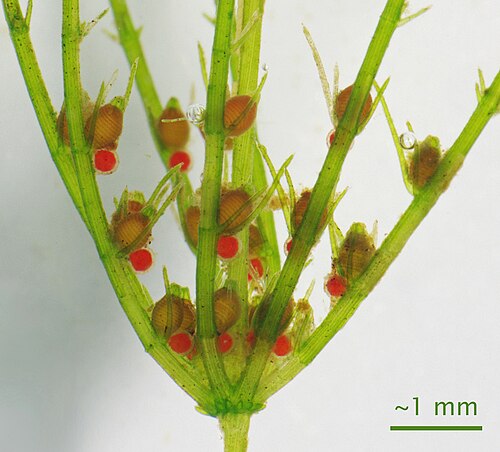

未成熟の雄の松かさの縦断面。松かさの鱗片の間に雄の配偶体(花粉粒)が発達している様子がわかる。

ゼラニウム・ディセクタムの茎の腺毛

ユーカリの葉、芽、若い茎は灰白色で、厚いワックス状の白髪で覆われています。

オプンティアサボテンの棘の根元にいるグロキス

かなり大きな花序を持つイネ科植物の穎花
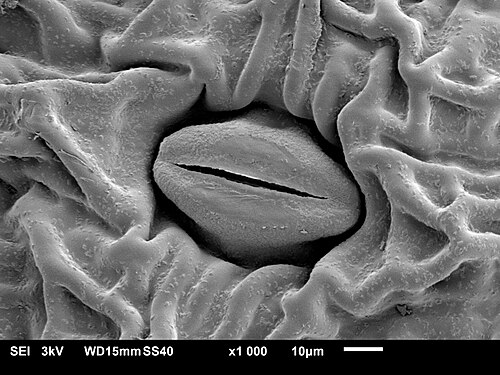
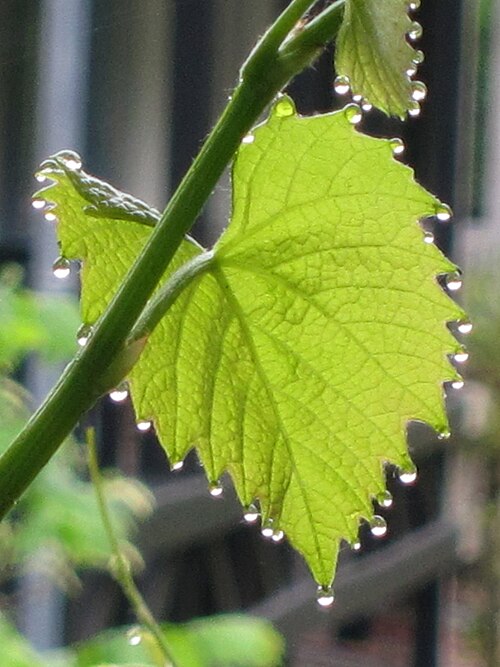
ブドウの未熟な葉の縁にある歯状突起に滴る溢液
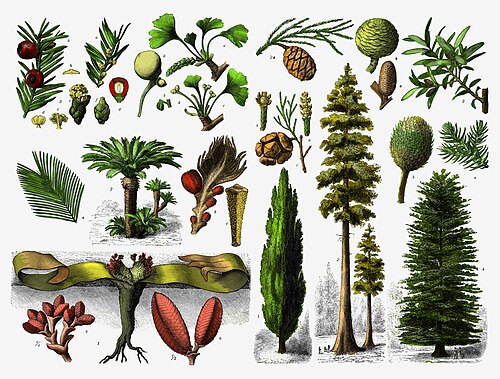
裸子植物の例
左1-ウェルウィッチア ミラビリス
2-ソテツ
3-イチイ バッカータ
4-イチョウ
右
1-クスノキ
2-セコイアデンドロン ギガンテウム
3-アガチス ダンマラ
4-アラウカリア ヘテロフィラ
H
- 癖
- 植物の全体的な外観。大きさ、形、質感、向きなどが含まれます。
- 生息地
- 植物が生息する場所、その生息地の環境条件。
- 髪
- 臓器の表面にある単一の細長い細胞または細胞の列。
- 半下卵巣
- 他の花器官の付着レベルより一部は下、一部は上に位置する子房。下子房と上子房を比較してください。
- ハロネート
- 透明なコーティングを持つ、または胞子の外層である。
- 塩生植物
- 塩分濃度の高い生息地に適応した植物。組織内に高濃度の塩分を蓄積する植物。
- 人工授粉
- 開放受粉の可能性を排除する制御された受粉行為。
- 半数体
- 染色体のセットが 1 つあること。たとえば、配偶体の各細胞、配偶子の核、胞子の染色体の補数などです。これは記号的にnと表されます。ここで、n は配偶子の染色体数です。二倍体、三倍体、四倍体を比較してください。
- ハプロステモナス
- 雄しべは花弁の数と同じ数だけ一列に並び、花弁と交互に並ぶ。diplostemonousとobdiplostemonousを比較してください。
- ハーモメガシー
- 乾燥した環境で花粉粒が水分の損失を避けるために開口部を閉じるプロセス
- 急ぐ
- 輪郭は三角形で、基部の裂片が外側を向いており、基部が切り取られているように見える。このような裂片を持つ葉の基部のみを指すこともある。基部の裂片が後方を向いている「矢状」と比較してください。
- 吸器
- 寄生植物において、宿主の組織に侵入するために発達した構造。
- 頭
- pseudanthium の capitulum を参照してください。
- ヒースランド
- 通常エリコイド状の葉を持つ小さな低木が主な植生。
- ヘリコイド
- 渦巻状の; 集散花序で、分岐が同じ側で繰り返し起こる場合(先端はしばしば反り返っている)。スコーピオイドと比較してください。
- 好太陽性
- 強い直射日光を必要とする、または耐える。
- 血脈絡膜
- 人間が自発的または非自発的に、その植物が本来の自然な伝播機構では定着できなかった、あるいは少なくともそれよりはるかに遅い速度で定着できなかった領域に運んだ植物。[34]
- 半マメ科植物
- 種子と鞘の1つの鞘が一体となって散布されるマメ科の果実。アカシア・テヌイフォリアやペルトギネ・パニクラタのように、鞘が風を受けて種子とともに飛ばされる。
- ハーブ
- 生涯を通じて木質の茎を発達させない維管束植物(例:ラッパスイセン)。
- 草本の
- 木質ではなく、通常は緑色で質感は柔らかい。
- 植物標本
識別と比較のために使用される、保存され、通常は圧縮され、乾燥された植物材料のコレクション。また、そのようなコレクションを保管する建物。
- 両性具有
- バイセクシュアルの同義語。
- ヘスペリディウム
- 柑橘類属に最も一般的に見られるベリーの一種。果実はベリー類としては大きい傾向があり、ムラヤなどの小果実の属では 1 センチメートル強、柑橘類 のいくつかの品種では15 センチメートル以上にもなります。外皮は通常厚くて硬く、油腺が多く、内側の心皮には水分の多い繊維が詰まっています。
- 異芽性
- 幼植物と成植物の段階では、特に葉などの部分が明らかに異なる。
- 異葉性の
- 同じ植物に複数の種類の葉があること。例えば、ラナンキュラス・アクアティリスでは、屋外に適応した葉と水中に適応した葉がある。[39]
- 異葉性の
- 異葉植物。[40]
- 異形の
- 2 つ以上の異なる形態を持つ (例: 異なるサイズや形状)。同形と比較してください。
- 異胞子性
- 陸上植物の胞子体による 2 つの異なるサイズ (小さいものと大きいもの) の胞子の生成。同胞子と比較してください。
- 異形で
- 種によって花柱や雄しべの長さが異なるが、1 つの植物の花はすべて同じであるという状態。二花柱性を参照してください。
- 門
- 種皮が茎(穂軸)から離れる部分の傷跡。
- ヒップ
- バラの果実。
- ヒッポクレピフォーム
- 馬蹄形。
- 毛深い
- 粗く、ざらざらした、長めの毛がある。被毛を参照。
- ヒスピド
- 長く、直立した、硬い毛または剛毛があり、触ると硬い。
- 白髪の
- 非常に短く密に絡み合った毛の灰色がかった層から白っぽい層で覆われており、霜が降りたような外観を呈しています。
- ホロタイプ
- 名前の作成者が選択したタイプ。レクトタイプと比較してください。
- ホモクラミデス
- 花被が萼片と花冠に分かれていない。二花弁型と対照的。
- 同胞子性
- 陸上植物の胞子体による単一サイズの胞子の生成。異胞子性胞子と比較してください。
- ホルト。
庭園の著者名として、2つの意味で使用されている。1
. 庭師によって誤って使用されている名前として- 2. 著者が混乱している園芸学上の文献に由来する無効な名前として。
- 殻
- 特定の種子を保護する外側の覆い。たとえば、トウモロコシの穂の葉のような外側の覆い、クルミの革のような外側の覆い、またはクリのとがった外側の覆いなど。
- 透明
- 半透明。通常は繊細な膜状で無色。
- ハイブリッド
- 属、種、変種、亜種、形式など、2 つの異なる名前のグループに属する親の交配によって生成された植物。つまり、2 つの異なる植物内で、または 2 つの異なる植物間で生じた子孫です。F1ハイブリッドは、このような交配の主な産物です。F2 ハイブリッドは、2 つの F1 ハイブリッド間の交配から生じる植物です (または、F1 ハイブリッドの自家受粉から生じる植物です)。
- ハイブリッド式
- 雑種の親の名前を乗算記号で結合したもの。例: Cytisus ardonoi × C. purgans。
- 親水性
- 水の流れによって花粉が散布される受粉の形態。
- ハイパンティウム
- 花の中の管またはカップ状の構造で、萼片、花弁、雄しべの基部を含み、子房につながっている(付属器官)場合とつながっていない場合があります。
- 過剰反り返り
- 植物学では、通常の位置にあるが、 360 度ねじれた葉柄または花柄に付いた葉や花を表します。この用語は、通常、倒生する蘭の花などの器官を表すために使用されます。倒生と比較してください。
- 下皮
- 果実の下の花托または果托から形成される、肥大した肉質構造。
- 胚軸
- 胚または実生において、子葉と節の下、根の上にある植物軸の部分。根から茎の発達への移行を示します。
- ヒポクラテス様
- 皿型。salverformの同義語。ギリシャ語のkratḗrion (容器)から。
- 下雌子性
- 子房の下に生じる。子房の挿入レベルより下に挿入される花の部分を表すときに使用する。上性花と周性花を比較してください。
- ヒステリックな
- 開花後に新しい葉が現れる成長のタイプ。histeranthous とも綴ります。proteranthousと synanthous を比較してください。
.jpg/500px-Vicia_villosa_leaf_hairs1_(14692343921).jpg)
植物の葉の表皮毛

ベロニカ・サブロバタの萼片の縁にある多細胞毛

雄しべと花弁の単雄性配置

サルビア・カナリエンシスの顕著に早咲きの葉

Viscum capenseの膨らんだ吸器により、枝の先端は枝の下部に比べて成長が阻害されます。

ポンシルスの果実は典型的なヘスペリジウムです。

異葉性成長は、成木で等双葉となるユーカリ属の種では一般的で、一般的に背腹葉から成長します。これらの若木の一部は、下枝に背腹葉、上枝に等双葉という両方の形態の葉を持つ過渡期にあります。
.jpg/500px-Erythrina_-_seeds_(6531865875).jpg)
多くの種の種子では、へそが種皮の残りの部分と顕著なコントラストをなしています。エリスリナ属の種の場合、その色は種子が有毒であることを警告している可能性があります。
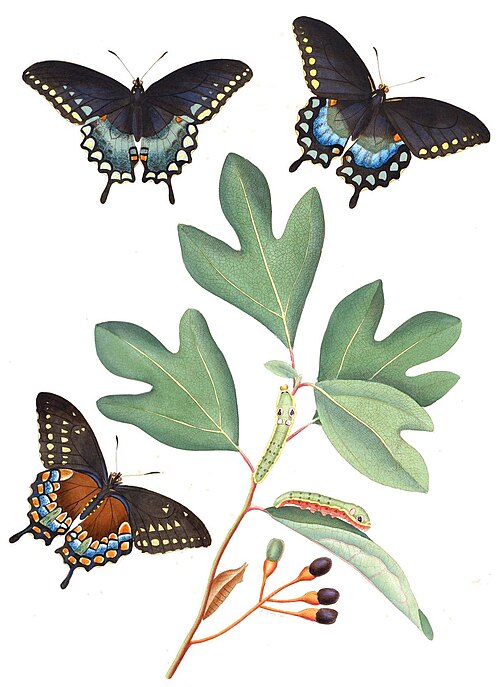
サッサフラス・アルビダムの果実の下には下果皮層が形成される。
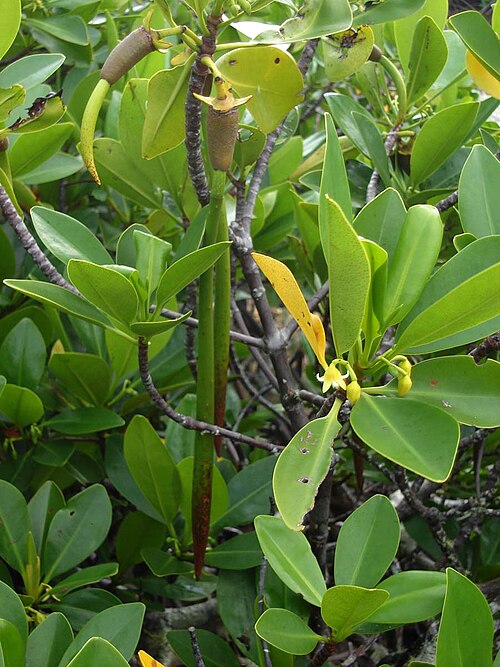
Rhizophoraの「マングル」またはマングローブの花、果実、および繁殖体。繁殖体の見かけ上の根は、実際には胚軸から発達した分裂組織です。新しい植物は、特に新しい植物が定着できる泥の中にうまく浸透した場合、主にこの組織から発達します。
私
- 異質細胞
- 特に葉の細胞で、周囲の細胞とは著しく異なります。結晶などの特殊な生成物を合成することがよくあります。
- 非嫡名(非嫡名)
- 植物学規約の規則に従わない名前、例えば、後代の同音異義語、1959年1月1日以降にラテン語化された栽培品種、10音節または30文字を超える栽培品種名、他の植物の紛らわしい名前を使用している栽培品種名(例:Camellia 'Rose')。
- 重なり合う
- ラテン語の「タイル張り」から。花被片が重なり合うこと、芽の中で縁が重なり合うこと(渦巻き状の配置は重なりの特殊な形)。多くの落葉樹種の休眠芽は、芽鱗片と呼ばれる保護用の片葉で重なり合うように覆われている。軽く重なり合うことを意味する「subimbricates」と比較。
- 不等羽状
- 奇数の小羽を持つ羽状の葉(単一の小葉で終わる)。paripinnate と比較してください。
- で
- 命名法では、前の著者が後続の著者が執筆または編集した記事または書籍で名前を発表した場合。
- -イナエ
- 属名の語幹に追加され、亜族の名前を形成する接尾辞。たとえば、Corydalis + -inaeからCorydalinaeになります。
- 近親交配
- 近親者同士の子孫の誕生により、高い類似性が得られる。自家受精は、近親交配の最も激しい形態である。
- 不確かな
- 分類上の類似性は不明で、関係は不明瞭です。
- 刻まれた
- 深く、(通常は)不均一に切れます(鋸歯状と裂片状の中間の状態)。
- 含まれる
- 突出せず、閉じた状態。例えば、雄しべが花冠の内側にある。
- 不完全な花
- 心皮、萼片、花弁、雌蕊、雄蕊など、通常の花の部分のうち 1 つ以上が欠けている花。
- 湾曲した
- 内側に曲がったり湾曲したりします。葉の縁は、背側に向かって湾曲します。
- 開始されました。
- 未発表の作品を意味するラテン語ineditaの略語。植物名が未発表の原稿にのみ登場し、その原稿が出版されていないため、その名前が無効であることを示すために使用されます。
- 不定
- 数は様々で、通常は多数。例えば、雄しべの数は花弁や萼片の 2 倍以上であるが、雄しべの数に特定の標準はない。別の用法では、これは、花序が花で終わらず、生理的要因によって制限されるまで成長し続ける状態を意味する、より好ましい用語であるindeterminateの同義語である。many を参照。definiteと対比。
- 裂開しない
- 成熟しても明確な開きがない。通常は果実を指す。対比:裂開。
- 不確定
- 通常、成長を止めて茎の伸長を終わらせる特定の末端芽や分裂組織を持たない茎または花序を指し、生理的要因が成長を止めるまで茎の伸長は続きます。多くのアロエなどの一部のキク科植物や、ワトソニアなどの多くのアヤメ科植物の総状花序は不定形です。定形とは対照的です。
- 先住民族
- 地域固有の植物であり、外来種ではなく、必ずしも議論されている地域に限定されているわけではなく、その地域全体に存在するわけでもない(「在来種」と区別がつきにくいが、通常はより狭い地域に適用される)。たとえば、クータマンドラワトルはオーストラリア原産だが、ニューサウスウェールズ州南部のクータマンドラ地域に固有の植物である。固有種と比較。
- 被服
- 毛や鱗片など、あらゆる種類の毛状突起で覆われた表面の総称。
- 重複しない
- 上向きに折り曲げるか、または 2 つの向軸面を合わせて折り曲げます。
- インダジウム
- 1. 一部のシダ植物の胞子を覆う膜。[41]
- 2.グッデニア科の柱頭を囲むカップ[41]
- 下卵巣
- 他の花器官の付着レベルより少なくとも部分的に下にある子房。上位子房と半下位子房を比較してください。
- 膨らんだ
- 膀胱のように腫れています。
- 屈曲した
- 鋭く上方または前方に曲がっている。deflexed と比較してください。
- 花序
- いくつかの花が密集して効率的な構造単位を形成すること。植物上の花のグループ化または配置。
- 種内
- 亜種など、種のレベルより下の分類上の階級を表します。
- 下位属
- 属レベル以下の分類上の階級、例えば亜属、節、系列などを表します。
- 果序
- 植物上の果実の集まりまたは配置。
- 漏斗状(漏斗状)
- たとえば花の花冠のように漏斗状。
- 登録した
- 内側に巻き込まれました。
- 食虫性の
- 昆虫を捕まえて栄養を摂取する。
- 挿入、ポイント
- 1 つの器官または構造 (葉など) が、それを支える構造 (茎など) に結合する点。
- 挿入された
- から成長する
- 外皮
- 一般的にはあらゆる被覆、特に胚珠の被覆。
- 閏年
- (例えば、成長の)器官の頂点と基底の間に発生する
- 介在分裂組織
- 器官の頂点と基底の間に位置する分裂組織
- 膣間腺
- 羽状葉では、羽状葉の間の葉軸に沿って腺が存在します(羽状葉の付着部またはそのすぐ下にある、単一の、そしてしばしばわずかに大きい腺の下に存在します)。腋窩腺と比較してください。
- 節間
- 2 つの節の間の茎の部分。
- 葉柄間
- (托葉の)対生の葉の葉柄の間、例えばアカネ科。
- 境界内の
- 葉の縁の内側にあるが、縁に近いところにある脈。たとえば、縁内脈は葉の縁と平行で、縁に非常に近いところにある脈です。
- 雄蕊内
- 雄しべまたは雄しべ花序の内側にあり、通常は蜜腺の位置を指します。
- 内向する
- 葯室は花の中心に向かって開きます(少なくとも蕾では)。extrorseとlatrorseを比較してください。
- 無効
- 規約に従って有効に公表されていない名前の使用、すなわち、国際植物命名規約の意味での厳密には「名前」ではない名前の使用。
- 総苞
- 通常は頭花を囲む、または支える構造。キク科では、開花前に花序を取り囲む一群の葉状体(苞葉)で、花序が開くと、頭花が乗るカップ状の花托を支える。トウダイグサ科では、蜜腺、蜜、頭花を保持するカップ状の構造で、苞葉状の葉肉構造の上にある。総苞は、ゼニゴケ類、ソテツ類、菌類、その他多くのグループに見られる。
- インボリュート
- 内側に巻かれます。たとえば、葉の縁が向軸面 (通常は上面) に向かって巻かれます。回転 (revolute ) と比較してください。
- 虹色の
- 構造色によって生成された反射色の光沢を持ち、例えば、鏡蘭Ophrys speculumの鏡がそうである。
- 不規則な
- Not able to be divided into two equal halves through any vertical plane. See also asymmetrical. Compare zygomorphic, actinomorphic, and regular.
- isobifacial
- (of flat structures, especially leaves) Having both surfaces similar, usually referring to cell types or to the number and distribution of stomata.
- isomerous
- Having an equal number of parts in the whorls.
- isomorphic
- with all features morphologically similar, i.e. of similar size and shape. Compare heteromorphic.
- isotomic
- Having branches of equal diameter. Compare anisotomic.

Quercus roburの休眠芽に重なり合う保護片葉

メスピルス・ゲルマニカの花は開花する前に花びらが重なり合います。

メリア・アゼダラクの二重無羽状複葉

深く切れ込んだペラルゴニウムの葉

ヒペリカムの不定雄しべ


アロエ・ブレビフォリアは不定形の総状花序をつける。

ヤシ科ヤシ属の葉は、重複した葉を持つ他の多くのヤシ属とは対照的に、非重複に折り畳まれています。

Calotropis giganteaの雄しべは花冠の基部に挿入されます。

この葉の縁近くの縁内葉脈は白く縁取られています。

これら 3 つの緑色のキク科 の総苞のうち 2 つは、まだ開いていない花頭を包み、3 つ目は、開花した色鮮やかな花頭を支えます。このMalacothrix coulteriの頭の周りの重なり合った葉状体は、ヘビの竜骨状の鱗を連想させ、この植物に「ヘビの頭」という一般名が付けられています。

このベゴニアの葉は、植物としては珍しい虹彩光沢を呈しています。
J
- joint
- A node or junction of two parts; articulation.
- jugary
- associated with a jugum or something yoke-like; see for example jugary gland.
- jugary gland
- A gland occurring on the rachis of a pinnate or bipinnate leaf on a jugum, the junction or attachment of pairs of pinnae or pinnules, as in some Acacia species. Compare interjugary.
- jugate
- yoke-like; describing a structure of paired items joined together as in a jugum or something yoke-like, such as some leaves and fruit.
- jugum
- applied to various yoke-like organs, usually in the sense of their being paired, such as a pair of pinnae on a rachis.
- juvenile leaves
- Leaves formed on a young plant, typically differing from the adult leaves in form.

Vachellia karroo bipinnate leaf
A. Rachilla
B. Pinnule
C. Jugary glands
D. Juga (plural of jugum)
E. Base of petiole
F. Petiolary gland
G. Rachis
.jpg/500px-Bauhinia_glabra_(11135932776).jpg)
Jugate leaf of Bauhinia glabra
_fruit_(11822645486).jpg/500px-Toad-tree_(Tabernaemontana_elegans)_fruit_(11822645486).jpg)
Jugate fruit of Tabernaemontana elegans

Eucalyptus camaldulensis has dorsiventral juvenile leaves.
K
- keel
A prominent longitudinal ridge like the keel of a boat, e.g. the structure of the corolla formed by the fusion of the lower edge of the two abaxial anterior petals of flowers in the Fabaceae.
- kernel
- See drupe.
- kettle trap
- another term for the kettle-like pitchers of any of the carnivorous pitcher plants, in which they trap their prey.
- key innovation
- A novel phenotypic trait that allows subsequent evolutionary radiation and success of a taxonomic group.
- kidney shape
- A term describing a kidney-shaped object such as a bean or a leaf; more formally, oblately cordate, or crescent-shaped with the ends rounded.
- kingdom
- the highest generally employed category of the taxonomic hierarchy, above that of division (phylum). The Plant Kingdom includes vascular plants, bryophytes and green algae and is also known as the clade Viridiplantae.
- Klausenfrucht
- Klausen or Klausenfrucht (German) is a special type of fruit in Lamiaceae and Boraginaceae. A dry, dehiscent fruit formed from a superior ovary with axil or basal placentation, with an adherent calyx, from more than one carpel and usually breaking apart into one-seeded units by separating each carpel by false septa. One unit is a half carpel. Mostly there are four units, seeds. English terms are eremocarp, schizocarp, mericarp or nutlet.
- knee
- abrupt bend in a root or stem, commonly at a node; a cypress knee, or pneumatophore, is a type of bend or knob in the root of some plants, especially conifers such as some of the Taxodioideae, that shows as a projection of the root above ground level or mud level.

One form of the kettle traps of a pitcher plant

Kidney-shaped leaf of Cucurbita maxima

Typical knee at a node in a grass stem

Unusually dense stand of cypress knees around the parent tree
L
- labellum
- lip; one of three or five petals which is (usually) different from the others, e.g. in Orchidaceae, Zingiberaceae, Cannaceae and Stylidiaceae.
- labiate
- lipped; where a corolla is divided into two parts, called an upper and lower lip, the two resembling an open mouth with lips.
- lacerate
- jagged, as if torn.
- laciniate
- Of lobes – with ends irregularly divided into deeply divided, narrow, pointed segments; Of margins – deeply divided into pointed segments in an irregular manner.
- lacuna
- An empty space, hole, cavity, pit, depression, or discontinuity.
- lamella
Thin, plate-like layer.
Composed of an assemblage of many layers.
- lamina
- the blade of a leaf or the expanded upper part of a petal, sepal or bract.
- lanate
- covered in or composed of wooly hairs.
- lanceolate
- longer than broad, narrowly ovate, broadest in the lower half and tapering to the tip, like a lance or spear head; (sometimes, and incorrectly, used to mean narrowly elliptic).
- lanuginose
- covered in long hairs that cross and/or interweave with each other. More commonly the term lanate is used.[42]
- lateral
- attached to the side of an organ, e.g. leaves or branches on a stem. For more detail see dorsal.
- latex
- a milky fluid that exudes from such plants such as spurges, figs and dandelions.
- laticiferous
- latex-bearing, producing a milky juice.
- latrorse
- a type of anther dehiscence in which the anthers open laterally toward adjacent anthers. Compare introrse and extrorse.
- lauroid
- resembling Laurus, the laurel genus, particularly its leaves.
- lax
- loose, not compact.
- leaf
- an outgrowth of a stem, usually flat and green; its main function is food manufacture by photosynthesis. Abbreviation: lvs.
- leaf gap
- a parenchymatous area in the stele above (distal to) a leaf trace.
- leaf scar
- A healing layer forming on a stem where a leaf has fallen off.
- leaf trace
- A vascular bundle connecting the stele to a leaf.
- leaflets
- The ultimate segments of a compound leaf.
- legume
- 1. a fruit characteristic of the family Fabaceae, formed from one carpel and either dehiscent along both sides, or indehiscent.
- 2. a crop species in the family Fabaceae.
- 3. a plant of the family Fabaceae.
- lemma
- the lower of 2 bracts enclosing a grass flower.
- lenticel
- Typically lenticular (lens-shaped) porous tissue in bark with large intercellular spaces that allows direct exchange of gases between the internal tissues and atmosphere through the bark.
- lenticellate
- Having lenticels
- lenticular
- 1. lens-shaped.
- 2. covered in lenticels.
- lepidote
- covered with small scales.
- leprose
- powdery
- liana
- a woody climbing plant, rooted in the ground (liane is also used).
- liane
- a woody climbing plant, rooted in the ground. See also liana.
- ligneous
- having hard lignified tissues or woody parts, woody
- lignum
- Dead wood, typically in the context of a substrate for lichens.
- lignicolous
- Growing on wood tissue after bark as fallen or been stripped off (compare to corticolous).
- lignotuber
- a woody swelling of the stem below or just above the ground; contains adventitious buds from which new shoots can develop, e.g. after fire.
- ligulate
- 1. bearing a ligule.
- 2. strap-shaped.
- ligule
- 1. A small membranous appendage on the top of the sheath of grass leaves.
- 2. A minute adaxial appendage near the base of a leaf, e.g. in Selaginella.
- 3. An extended, strap-like corolla in some daisy florets.
- linea, line, British line, Paris line
- Various pre-metric units somewhat larger than 2 mm, used in botany into the 20th century. See Line (unit) and Paris line.
- linear
- Very narrow in relation to its length, with the sides mostly parallel. See Leaf shape.
- lingulate
- tongue-shaped.
- lip
- A labellum.
- lithophytic
- A plant growing on rocks; an epilithic plant.
- lobe
- Part of a leaf (or other organ), often rounded and formed by incisions to about halfway to the midrib.
- lobulate
- Having, consisting of or relating to a lobe or lobes.
- loculicidal
- (of a fruit) Dehiscing through the centers of loculi. Compare septicidal.
- locule
- A chamber or cavity containing seeds within an ovary, pollen within an anther or spores in a sporangium.
- lodicule
- One of two or three minute organs at the base of the ovary of a grass flower, representing parts of a strongly reduced perianth.
- lomentum or loment
- A pod-like indehiscent fruit that develops constrictions between the segments and at maturity breaks into one-seeded segments instead of splitting open.
- longicidal
- (of anthers) Opening lengthwise by longitudinal slits. Compare poricidal.
- lunate
- Crescent-shaped.
- lumen
- The cavity bounded by a plant cell wall.
- lyrate
- Lyre-shaped; deeply lobed, with a large terminal lobe and smaller lateral ones.

Labiate flowers of Prunella vulgaris
Laciniate, deeply incised, leaves of Pelargonium crispum

Most Euphorbias are laticiferous and instantly exude latex when even mildly punctured.

A leaf scar on Juglans regia, showing the layer of corky protective tissue that remained after the leaf separated along the abscission zone. It also shows the leaf traces of the vascular bundles that broke off when the abscission zone failed. The axillary bud associated with the leaf shows just above the scar.
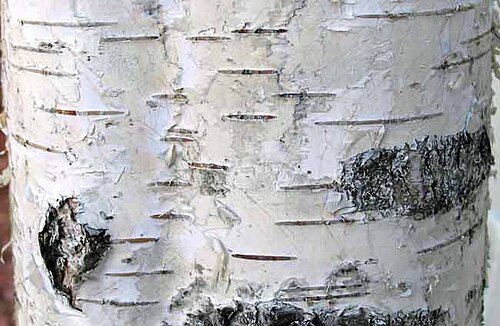
The dark horizontal lines on silver birch bark are lenticels.

Lignotubers of Lambertia formosa growing sprouts after a bush fire
.jpg/500px-Holcus_lanatus_ligule1_(7325929936).jpg)
Ligule between the leaf sheath and leaf of a grass
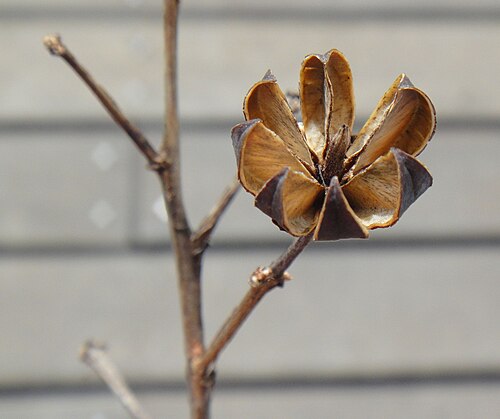
Loculicidal dehiscence of a fruit capsule. The locule walls split at the back, and the valves separate, bearing the septa on their centers.
.jpg/500px-Hedysarum_occidentale_(28915806450).jpg)
The loment (or lomentum) of Hedysarum occidentale splits into single-seeded segments along the visible lines of weakness when ripe.
M
- maculate
- Spotted; marked with spots.
- male flower
- See staminate flower.
- mallee
- A growth habit in which several woody stems arise separately from a lignotuber; a plant with such a growth habit, e.g. many Eucalyptus species; vegetation characterized by such plants.
- mangrove
- Any shrub or small tree growing in salt or brackish water, usually characterized by pneumatophores; any tropical coastal vegetation characterized by such species.
- margin
- The edge of a structure, as in the edge of a leaf blade.
- marginal
- Occurring at or very close to a margin.
- marsh
- A waterlogged area or swamp.
- mast
- Edible fruit and nuts produced by woody species of plants (e.g. acorns and beechmast) which is consumed on the ground by wildlife species and some domestic animals.
- mealy
- Covered with coarse, floury powder.
- medulla
- pith. See also medullary rays in wood.
- megasporangium
- the larger of two kinds of sporangium produced by heterosporous plants, producing large spores that contain the female gametophytes. Compare microsporangium.
- megaspore
- the larger of two kinds of spores produced by a heterosporous plant, giving rise to the female gametophyte. Compare microspore.
- megasporophyll
- in hetersoporous plants, a modified leaf bearing one or more megasporangia. Compare microsporophyll.
- megastrobilus
- the larger of two kinds of cones or strobili produced by gymnosperms, being female and producing the seeds. Compare microstrobilus.
- membranous
- thin, translucent and flexible, seldom green.
- mericarp
- one segment of a fruit (a schizocarp) that splits at maturity into units derived from the individual carpels, or a carpel, usually 1-seeded, released by the break-up at maturity of a fruit formed from 2 or more joined carpels.
- meristem
- Any actively dividing plant tissue.
- mesic
- Moist, avoiding both extremes of drought and wet; pertaining to conditions of moderate moisture or water supply; applied to organisms (vegetation) occupying moist habitats.
- mesocarp
- The fleshy portion of the wall of a succulent fruit inside the skin and outside the stony layer (if any), surrounding the seed(s); sarcocarp.
- mesomorphic
- Soft and with little fibrous tissue, but not succulent.
- mesophyll
- 1. The parenchyma tissues between the upper and lower epidermis. They vary in function, but usually include the photosynthetic tissue of a leaf.
- 2. In ecology, the blade of a leaf or leaflet that has a surface area 4500–18225 mm2; a plant, or vegetation, that has mesophyll (sized) leaves.
- mesophyllous
- (of vegetation) Of moist habitats and having mostly large and soft leaves.
- mesophyte
- A plant thriving under intermediate environmental conditions of moderate moisture and temperature, without major seasonal fluctuations.
- micropyle
- Opening at apex of ovule.
- microsporangium
- The smaller of two kinds of sporangium produced by a heterosporous plant, producing microspores that contain the male gametophyte. Compare megasporangium.
- microspore
- The smaller of two kinds of spores produced by a heterosporous plant. Compare megaspore.
- microsporophyll
- In heterosporous plants, a modified leaf bearing one or more microsporangia. Compare megasporophyll.
- microstrobilus
- The smaller of two kinds of cones or strobilus produced by gymnosperms, being male and producing the pollen. Compare megastrobilus.
- midrib
The central and usually most prominent vein of a leaf or leaf-like organ.
- midvein
- See midrib.
- monad
- A single individual that is free from other individuals, not united with them into a group. The term is usually used for pollen to distinguish single grains from tetrads or polyads.
- monadelphous
- A term describing stamen filaments that are fused for the greater part of their length, forming a tube around the style.
- moniliform
- Resembling a string of beads.
- monocarpic
- Flowering and setting seed only once before dying. See also semelparous.
- monochasium
- A cymose inflorescence with the branches arising singly. Compare dichasium and pleiochasium.
- monocot
- An abbreviation of monocotyledon.
- monocotyledon
- A flowering plant whose embryo contains one cotyledon (seed-leaf). Compare dicotyledon.
- monoecious
- (of vascular plants) Hermaphroditic, with all flowers bisexual, or with male and female reproductive structures in separate flowers but on the same plant, or of an inflorescence that has unisexual flowers of both sexes. Contrast dioecious.
- monoicous
- (of bryophyte gametophytes) Hermaphroditic or bisexual, where both male and female reproductive structures develop on the same individual. Contrast dioicous.
- monograph
- Of a group of plants, a comprehensive treatise presenting an analysis and synthesis of taxonomic knowledge of that taxon; the fullest account possible (at the time) of a family, tribe or genus. It is generally worldwide in scope and evaluates all taxonomic treatments of that taxon including studies of its evolutionary relationships with other related taxa, and cytological, genetic, morphological, palaeobotanical and ecological studies. The term is often incorrectly applied to any systematic work devoted to a single taxon. Compare revision.
- monomorphic
- Of one type, rather than several. See also dimorphic (two types) and polymorphic (many types).
- monophyllous
- Having a single leaf.
- monopodial
- A mode of stem growth and branching in which the main axis is formed by a single dominant meristem. Contrast sympodial.
- monostromatic
- Being a single cell thick, as in the alga Monostroma.
- monothecous
- having a sole compartment or cell. Compare Dithecous.
- monotypic
- Containing only one taxon of the next lower rank, e.g. a family with only one genus, or a genus that includes only a single species.
- morphology
- The shape or form of an organism or part thereof.
- mucro
A sharp, short point, generally at the tip of a leaf or the tip of the midrib of a compound leaf.[28]
- mucronate
- Terminating in a mucro.
- multiple fruit
- A cluster of fruits produced from more than one flower and appearing as a single fruit, often on a swollen axis, as with many species of the family Moraceae. Compare aggregate fruit.
- muricate
- Covered with short, hard protuberances.
- mutation
- In times before the nature of genetic encoding was understood, mutation was regarded as an abrupt, and sometimes heritable, variation from the norm of a population; for example a plant might unexpectedly produce "double" flowers, a novel color, or a habit of growth uncharacteristic of the species or variety. Advances in genetics and molecular biology in the mid-twentieth century, showed that biological mutations comprise and reflect changes in the nucleic acid molecules that encode the genome of an organism or virus. The nucleic acid affected could be DNA in the chromosomes, or it could be extrachromosomal DNA (typically DNA in the mitochondria or chloroplasts). In RNA viruses a mutation would be a change to the genetic information that the RNA encodes.
- mycelium
- The "vegetative" (nonreproductive) part of a fungus, mostly composed of aggregations of hyphae. It functions in substrate decomposition and absorption of nutrients.
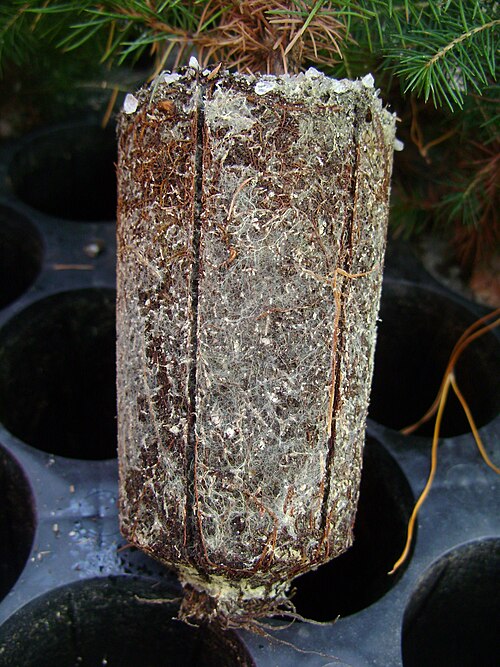
- mycorrhiza
One of several types of symbiotic association between a fungus and the roots of a plant.
- mycotroph
A plant that obtains most or all of its carbon, water, and nutrients by associating with a fungus.

Maculate leaves

Eucalyptus socialis, showing its mallee habit, a single tree with several trunks growing from an underground lignotuber

Mast from beeches on the forest floor

Geranium incanum schizocarp and mericarp
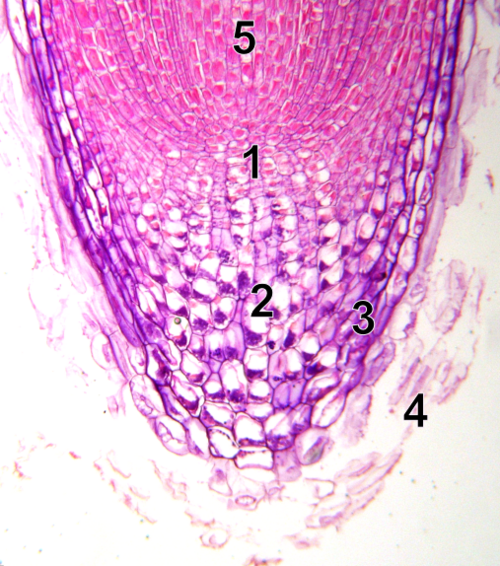
Apical meristem in root tip:
1: Meristem2: Columella
showing statocytes with statoliths
3: Lateral part of the tip
4: Dead cells
5: Elongation zone
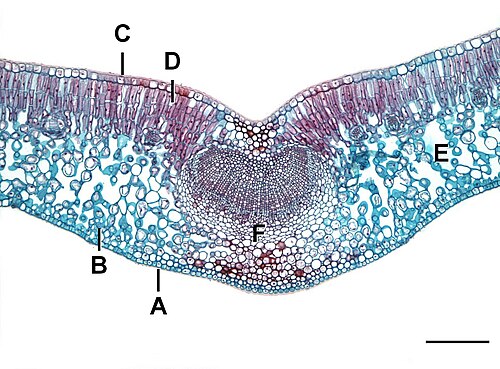
Mesophyll as seen in the cross section of a dicotyledonous leaf
A-Lower epidermisB-Lower palisade mesophyll
C-Upper epidermis
D-Upper palisade mesophyll
E- Spongy mesophyll
F-Leaf vein
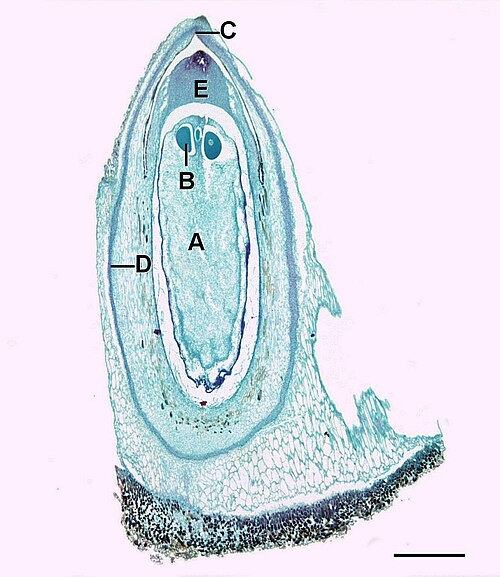
Longitudinal section of Pinus ovule
A=GametophyteB=Egg cell
C=Micropyle
D=Integument
E=Megasporangium
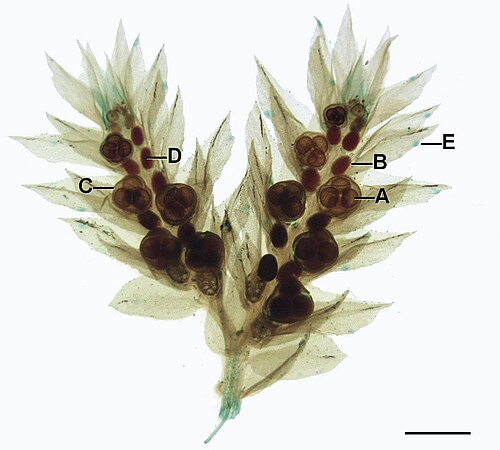
Strobilus of a Selaginella
A-MegasporeB-Microsporangium
C-Megasporangium
D-Microspore
E-Sporophyll

Moniliform pods on Vachellia nilotica

A germinating date palm, Phoenix dactylifera, a monocotyledon, showing its single cotyledon

Mucro at the tip of the rachis of a compound leaf of Vachellia karroo
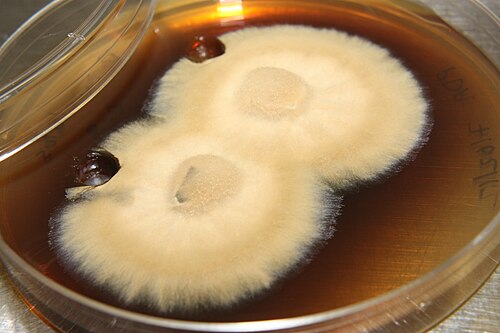
Fungal mycelium grown in culture dish
N
- native
- Naturally occurring in an area, but not necessarily confined to it. Compare endemic.
- natural hybrid
- A hybrid taxon produced by chance in the wild.
- naturalised
- Describing a plant, introduced from another region, that grows and reproduces readily in competition with the natural flora.
- nectar
- A usually sweet, nutrient-rich fluid produced by the flowers of many plants and collected by bees and other pollinators.
- nectary
A specialized gland that secretes nectar.
- neophyte
- A plant that has recently been introduced to a geographic area. Contrast archaeophyte.
- nerve
- Another name for a vein.
- node
- The part of a stem from which leaves or branches arise.
- nomen conservandum
- (Latin) A conserved name, usually a name that became so much better known than the correct name, that a substitution was made.
- nomen illegitimum
- A name that is either superfluous at its time of publication because the taxon to which it was applied already has a name, or the name has already been applied to another plant (a homonym).
- nomen invalidum
- A name that is not validly published, and technically is therefore not a botanical name. Abbreviation: nom. inval. See valid publication.
- nomen nudum
- A name not published in accordance with the International Code of Nomenclature for algae, fungi, and plants, usually without a diagnosis or description of the entity to which it applies, and without reference to either; such a name should not be used.
- nomenclature
- The naming of things; often restricted to the correct use of scientific names in taxonomy; a system that sets out provisions for the formation and use of names.
- noxious
- Of plants, containing harmful or unwholesome qualities. Applied in conjunction with 'weed' to specifically describe a plant which legislation deems harmful to the environment. Each state and territory in Australia has specific legislation governing noxious weeds.
- nucellus
- The tissue of the ovule of a seed plant that surrounds the female gametophyte. It is enclosed by integuments and is not of epidermal origin.
- numerous
- Stamens are described as numerous when there are more than twice as many as sepals or petals, especially when there is no set number of them. Compare indefinite.
- nut
- A hard, dry, indehiscent fruit containing only one seed.
- nutlet
- 1. A small nut.
- 2. One of the lobes or sections of the mature ovary of some members of the Boraginaceae, Verbenaceae, and Lamiaceae.

Hoya carnosa secretes so much nectar that it falls in drops if no pollinators remove it.

The small green petals of Helleborus argutifolius act as floral nectaries. The sepals function as petals.

Some Senna species have extrafloral nectaries that attract ants to defend them from pests.
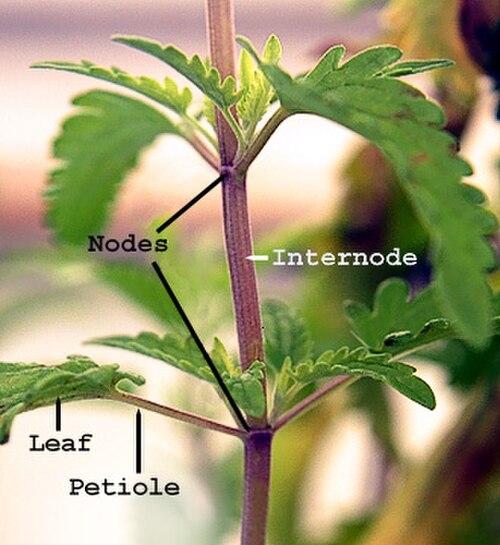
Plant stem nodes and internodes
O
- ob-
- A prefix meaning "inversely"; usually the same shape as that described by the word stem, but attached by the narrower end. See obcordate, oblanceolate and obovate.
- obconic
- (of a fruit, hypanthium, pistil, or calyx) Shaped like an inverted cone, attached at the apex.
- obcordate
- (of a leaf blade) Broad and notched at the tip; heart-shaped but attached at the pointed end.
- obdiplostemonous
- Having stamens arranged in two whorls, and having twice as many stamens as petals, with the outer whorl being opposite the petals. Compare diplostemonous and haplostemonous.
- oblanceolate
- Having a lanceolate shape but broadest in the upper third.
- oblate
- Having a spherical shape but flattened at the poles.
- obligate
- (of parasites) Unable to survive without a host. Contrast facultative.
- oblique
- Slanting; of a leaf or stem, larger on one side of the midrib than the other, in other words asymmetrical.
- obloid
- Having a three-dimensional oblong shape, e.g. a fruit.
- oblong
- Having a length a few times greater than the width, with sides almost parallel and ends rounded.
- obovate
- (of a leaf) Having a length about 1.5 times the width, and widest above the center.
- obsolete
- Not evident, or at most rudimentary or vestigial.
- obtrapeziform
- trapeziform, but attached by the narrower trapezoidal base (e.g. of a leaf)
- obtuse
- Blunt or rounded; having converging edges that form an angle of more than 90°. Compare acute.
- ocrea
A sheath formed from two stipules encircling the node in members of the Polygonaceae.
- odd-pinnate
Having an odd number of leaflets in a compound pinnate leaf, such that there is only one terminal leaflet.
- oft.
- An abbreviation of "often". Compare usu. and s.t..
- -oideae
- A suffix added to the stem of a generic name to form the name of a subfamily, e.g. Fumaria → Fumarioideae.
- olim
- Formerly, e.g. "olim B", formerly in the Berlin herbarium (Herbarium Berolinense).
- ontogeny
- The sequence of developmental stages through which an organism passes as it grows.
- operculum (calyptra)
- A lid or cover that becomes detached at maturity, e.g. in Eucalyptus, a cap covering the bud and formed by the fusion or cohesion of perianth parts.
- opposite
- 1. Describing leaves or flowers borne at the same level but on directly opposite sides of their common axis.
- 2. Describing the occurrence of something on the same radius as something else, e.g. anthers opposite sepals. Compare alternate.
- opus utique oppressum
Listed after the botanical name of a plant, or the name of a publication, this indicates that a publication is listed in the International Code of Nomenclature for algae, fungi, and plants as a suppressed work. Botanical names of the specified rank in the publication are considered not validly published (article 34).
- orbicular
- Flat and more or less circular.
- order
- A group of one or more families sharing common features, ancestry, or both.
- ortet
- The original single parent plant from which a clone ultimately derives.
- orthotropous
- Describes an ovule that is erect, with the micropyle directed away from the placenta; atropous. Compare amphitropous, anatropous, and campylotropous.
- oval
- See elliptical.
- ovary
- The basal portion of a carpel or group of fused carpels, enclosing the ovules.
- ovate
- Shaped like a section through the "long axis" of an egg and attached by the wider end.
- ovoid
- Egg-shaped, with wider portion at base; 3-dimensional object, ovate in all sections through long-axis.
- ovule
- Loosely, the seed before fertilization; a structure in a seed plant within which one or more megaspores are formed (after fertilization it develops into a seed).
.jpg/500px-Starr-010330-0591-Ficus_carica-fruit-Kahului-Maui_(24236554100).jpg)
Obconical syconium (infructescence) of Ficus carica

Obcordate leaflets of a ternate leaf of Oxalis pes-caprae
.jpg/500px-Kummerowia_striata_leaf1_(10355256105).jpg)
Obovate leaflets of a ternate leaf of Kummerowia

Obtuse leaves of Dovyalis zeyheri

Open flower of Eucalyptus macrocarpa, next to a shed operculum
.jpg/500px-HK_%E7%81%A3%E4%BB%94_Wan_Chai_%E5%9B%8D%E5%8C%AF_The_Avenue_Rooftop_Garden_terrace_plants_Oct_2017_IX1_opposite_green_leaves_(2).jpg)
Opposite arrangement (phyllotaxis) of leaves

Orbicular leaves of Dombeya rotundifolia
.jpg/500px-Vigna_parkeri_leaf2_(10737009993).jpg)
Ovate leaflets on a ternate leaf of a Vigna species
P
- pachycaul
- with a disproportionately thick trunk
- pachycladous
- with disproportionately thick stems
- palate
- An expanded lower lip of a flower that nearly or entirely blocks the opening of a flower tube, as in a snapdragon flower.[43]
- palea
1. The upper of two bracts enclosing a grass flower, major contributors to chaff in harvested grain.
- 2. Chaffy scales on the receptacles of many Asteraceae.
- 3. Chaffy scales on the stipe of many ferns.
- paleate
- Bearing paleae or chaffy scales, as in description of the receptacle of a capitulum of a plant in the Asteraceae.
- paleaceous
- Chaff-like in texture.
- palmate
- 1. leaf with veins radiating out from a central point (usually at the top of a petiole), resembling spread out fingers pointing away from the palm.
- 2. A compound palmate leaf has leaflets that radiate from a central point (usually at the top of a petiole).
- palmatifid
- Deeply divided into several lobes arising from more or less the same level.
- palmatisect
- Intermediate between palmate and palmatifid, i.e. the segments are not fully separated at the base; often more or less digitate.
- pandurate
- shaped like the body of a fiddle (mainly, of plant leaves)
- panicle
A compound raceme; an indeterminate inflorescence in which the flowers are borne on branches of the main axis or on further branches of these.
- papilionate
- Butterfly-like; having a corolla like that of a pea.
- papilla
A small, elongated protuberance on the surface of an organ, usually an extension of one epidermal cell.
- pappus
- In daisy florets, a tuft or ring of hairs or scales borne above the ovary and outside the corolla (representing the reduced calyx); a tuft of hairs on a fruit.
- paracarpel
- Ill-defined term, variously interpreted and applied to: organs attached to carpels; staminodes close to the gynoecium; and to a pistillode in a staminate flower
- paraperigonium
An anomalous secondary outgrowth of the perianthal meristem with ramifying vasculature. See also perigonium, perianth, and corona.[44]
- parasite
- An organism living on or in a different organism, from which it derives nourishment. Some plant species are parasitic. Compare saprophyte and epiphyte.
- parenchyma
- A versatile ground tissue composed of living primary cells which performs a wide variety of structural and biochemical functions in plants.
- parietal
- Attached to the marginal walls of a structure, e.g. ovules attached to placentas on the wall of the ovary. See placentation.
- paripinnate
- Having an even number of leaflets (or pinnae), i.e. terminated by a pair of pinnae as opposed to a single pinna. Compare imparipinnate.
- parthenocarpy
- The development or production of fruit without fertilization. Compare stenospermocarpy.
- patent
Spreading; standing at 45–50° to the axis. See also erecto-patent.
- patulous
- See patent.
- pauciflor
- Having few flowers per inflorescence. Compare pluriflor and uniflor.
- pectinate
- Pinnately divided with narrow segments closely set like the teeth of a comb.
- pedate
- Having a terminal lobe or leaflet, and on either side of it an axis curving outward and backward, bearing lobes or leaflets on the outer side of the curve.
- pedicel
The stalk of a flower; may also be applied to the stalk of a capitulum in the Asteraceae.
- peduncle
The stalk of an inflorescence.
- peltate
- Shield-like, with the stalk attached to the lower surface and not to the margin.
- pellucid
- Transmitting light; for example, said of tiny gland dots in the leaves of e.g. Myrtaceae and Rutaceae that are visible when held in front of a light.
- pendulous
- Hanging, for example an ovule attached to a placenta on the top of the ovary. Compare suspended.
- penicillate
- Tufted like an artist's brush; with long hairs toward one end.
- penninervation
With pinnately arranged veins.
- pentamerous
- In five parts, particularly with respect to flowers, five parts in each whorl. See also trimerous and tetramerous.
- pepo
- A type of berry formed from an inferior ovary and containing many seeds, usually large with a tough outer skin (e.g. a cucumber, pumpkin or watermelon).
- perennating
- Of an organ that survives vegetatively from season to season. A period of reduced activity between seasons is usual.
- perennial
- A plant whose life span extends over several years.
- perfect
- (of a flower) Bisexual; containing both male and female reproductive parts in the same inflorescence. Contrast imperfect.
- perfoliate
- With its base wrapped around the stem (so that the stem appears to pass through it), e.g. of leaves and bracts.
- perforate
- With many holes. Used to describe the texture of pollen exine, and also to indicate that tracheary elements have a perforation plate. See also fenestrate.
- perforation plate
- in a tracheary element, part of the cell wall that is perforated; present in vessel members but not in tracheids. Should not be confused with a pit.
- perianth
- The collective term for the calyx and corolla of a flower (generally used when the two are too similar to be easily distinguishable). Abbreviation: P; for instance, P 3+3 indicates the calyx and corolla each have 3 elements, i.e. 3 sepals + 3 petals.
- pericarp
- The wall of a fruit, developed from the ovary wall.
- periclinal
- Curved along parallel to a surface. Compare anticlinal.
- pericycle
- A cylinder of parenchyma or sclerenchyma cells that lies just inside the endodermis and is the outer most part of the stele of plants.
- perigonium
- In flowering plants, synonym of perianth.
- 2. In mosses, the leaves surrounding the antheridia, also called a splash-cup, e.g. in Polytrichum juniperinum.
- perigynium
- A sac from a modified tubular bract, or when fully closed an utricle, around the pistillate flower of sedges
- perigynous
- Borne around the ovary, i.e. of perianth segments and stamens arising from a cup-like or tubular extension of receptacle (free from the ovary but extending above its base). Compare epigynous and hypogynous.
- persistent
- Remaining attached to the plant beyond the usual time of falling, for instance sepals not falling after flowering, flower parts remaining through maturity of fruit. Compare deciduous and caducous.
- perule
1. The scales covering a leaf or flower bud, or a reduced scale-like leaf surrounding the bud. Buds lacking perulae are referred to as "naked".
- 2. In Camellias the final bracts and sepals become indistinguishable and are called perules.
- 3. A kind of sac formed by the adherent bases of the two lateral sepals in certain orchids.
- petal
- In a flower, one of the segments or divisions of the inner whorl of non-fertile parts surrounding the fertile organs, usually soft and conspicuously colored. Compare sepal, tepal.
- petalody
- The transformation of reproductive organs of flower into petals.
- petaloid
- Like a petal; soft in texture and colored conspicuously.
- petiolary (or petiolar)
- Associated with a petiole, as in petiolary glands.
- petiolate
- (of a leaf) Having a petiole. Contrast sessile.
- petiole
- The stalk of a leaf.
- petiolule
- The stalk of a leaflet.
- petricolous
- Rock-dwelling; living on or among rocks.
- phaneranthous
- Showy, as in showy flowers that advertise to pollinators, as opposed to aphananthous (unshowy)
- phanerogam
- Gymnosperms and angiosperms; plants producing stamens and gynoecia; literally plants with conspicuous sexual reproductive organs. Compare cryptogams.
- phenology
- The study of the timing of seasonal biological phenomena, such as flowering, leaf emergence, fruit ripening and leaf fall.
- phloem
- Specialized conducting tissue in vascular plants that transports sucrose from the leaves to other plant organs.
- photosynthesis
- Process by which energy from sunlight is used to convert carbon dioxide and water into simple sugars in cells containing chloroplasts. All plants, except certain parasites, can perform photosynthesis.
- phyllary
- Individual bract within an involucre or involucel.
- phyllid
- Leaf-like extension of the stem in Bryophytes
- phyllode
A leaf with the blade much reduced or absent, and in which the petiole and or rachis perform the functions of the whole leaf, e.g. many acacias. Compare cladode.
- phyllopodium
- (in ferns) A short outgrowth of the stem on which the frond is borne and which remains attached to the rhizome after the frond has been shed.
- phylloplane
- the surface of a leaf, considered as a habitat for organisms.
- phyllosphere
- The above-ground surface of plants as a habitat for epiphytic microorganisms.
- phylum
- A level of classification or taxonomic rank below kingdom and above class. Traditionally, in botany the term division has been used instead of phylum.
- phytomelan
A black, inert, organic material that forms a crust-like covering of some seeds, commonly found in Asparagales, Asteraceae, etc.
- pileate
- Having a cap, a pileus.
- pileus
- A cap or cap-shaped structure, such as the cap of mushrooms or the plumule of some monocotyledons.
- piliform
- Having the shape of a cap, a pileus.
- pilose
- covered with soft, weak, thin and clearly separated hairs, which are usually defined as long and sometimes ascending.
- pinna
A primary segment of a compound leaf.
- pinnate
- A compound leaf with leaflets arranged on each side of a common petiole or axis; also applied to how the lateral veins are arranged in relation to the main vein.
- pinnatifid
- Pinnately lobed.
- pinnatisect
- pinnately divided almost to midrib but segments still confluent.
- pinnule or pinnula
- Usage varies:
ultimate free division (or leaflets) of a compound leaf,
or
a pinnate subdivision of a multipinnate leaf. - pistil
- 1. a single carpel when the carpels are free.
- 2. a group of carpels when the carpels are united by the fusion of their walls.
- pistillate flower
- a flower containing one or more pistils but no fertile stamens. Sometimes called a female flower. Contrast with staminate flower
- pistillode
- A sterile or rudimentary pistil such as may appear in a staminate flower.
- pit
- In tracheary elements, a section of the cell wall where the secondary wall is missing, and the primary wall is present. Pits generally occur in pairs and link two cells.
- pith
- The central region of a stem, inside the vascular cylinder; the spongy parenchymatous central tissue in some stems and roots.
- placenta
- The tissue within an ovary to which the ovules are attached.
- placentation
- The arrangement of ovules inside ovary; for example axile, free-central, parietal, marginal, basal, or apical.
- Plant Breeders Rights (PBR)
- These rights, governed by Plant Breeder's Rights Acts give the plant breeder legal protection over the propagation of a cultivar, and the exclusive rights to produce and to sell it, including the right to license others to produce and sell plants and reproductive material of a registered, deliberately bred variety. Compare UPOV.
- Plant Variety Rights (PVR)
- Governed by the Plant Variety Rights the registration of new varieties is now governed by Plant Breeders Rights.
- plastochron
- The time between successive leaf initiation events.
- pleiochasium
- pl. pleiochasia. An inflorescence in which several buds come out at the same time. Compare monochasium and dichasium.
- plicate
- Pleated; folded back and forth longitudinally like a fan, such as the leaves of fan palm species. The concept often appears in specific names in forms such as Kumara plicatilis and Acacia plicata. Commonly such names are not correctly appropriate, but are applied to distichous structures rather than plicate.
- -plinerved
- (of leaves) A suffix indicating that the main nerves are lateral and arise from a point distinctly above the base of the leaf. Combined with a numerical prefix to form words like 3-plinerved, 5-plinerved, and so on. Such leaves are especially characteristic of the family Melastomataceae. See for example Dissotis.
- plumose
- Like a feather; with fine hairs branching from a main axis.
- plumule
- The part of an embryo that gives rise to the shoot system of a plant. Compare radicle.
- pluriflor
- Having many flowers per inflorescence. See also pauciflor and uniflor.
- pluriovulate
- Having many ovules as in placentae, carpels, or ovaries.
- pneumatophore
- A vertical appendage, aerial at low tide, on the roots of some plants. Pneumatophore functions are unclear, but possibly related to gas exchange, or to root anchoring. Pneumatophores typically occur on mangrove roots, but some versions occur on species of conifers, such as some in the Taxodioideae.
- pod
- 1. A legume, the fruit of a leguminous plant, a dry fruit of a single carpel, splitting along two sutures.
- 2. A siliqua and silicula, the fruit of Brassicaceae, a dry fruit composed of two carpels separated by a partition.
- podocarpium
- In four genera of the coniferous family Podocarpaceae (Acmopyle, Dacrycarpus, Falcatifolium, and Podocarpus), a group of fleshy fused bracts beneath the female cone, often brightly-colored, which swell to enclose the developing seeds above and attract fruit-eating animals.[45]
- pollen
- powdery mass shed from anthers (of angiosperms) or microsporangia (of gymnosperms); the microspores of seed plants; pollen-grains.
- pollen-mass
- pollen-grains cohering by a waxy texture or fine threads into a single body; pollinium, e.g. in orchids.
- pollen transmitting tissue
- the tissue in the style of a flower through which the pollen tubes grow.
- pollination
- The transfer of pollen from a male organ (such as an anther) to the receptive region of a female organ (such as a stigma).
- pollinium
- See pollen-mass.
- polygamodioecious
- Having bisexual and male flowers on some plants and bisexual and female flowers on others. Compare androdioecious, andromonoecious, dioecious, monoecious, polygamomonoecious, and polygamous.
- polygamomonoecious
- having male, female, and bisexual flowers on the same plant. Compare androdioecious, andromonoecious, polygamodioecious, and polygamous.
- polygamous
- having bisexual and unisexual flowers on the same plant.
- polymorphic
- Of several different kinds (in respect to shape and/or size), hence polymorphism. See also monomorphic (a single type) and dimorphic (two types)
- polyphyllous
- having many leaves or perianth segments. Compare symphyllous, gamophyllous, and apophyllous.
- polyploid
- with more than two of the basic sets of chromosomes in the nucleus; any sporophyte with cells containing three or more complete sets of chromosomes. Various combinations of words or numbers with '-ploid' indicate the number of haploid sets of chromosomes, e.g. triploid = 3 sets, tetraploid = 4 sets, pentaploid = 5 sets, hexaploid = 6 sets, and so on.
- polystemonous
- having numerous stamens; the number of stamens being at least twice the number of sepals or petals, but not strictly three or four times that number.
- pome
- A fruit that has developed partly from the ovary wall but mostly from the hypanthium (e.g. an apple).
- population
- 1. All individuals of one or more species within a prescribed area.
- 2. A group of organisms of one species, occupying a defined area and usually isolated to some degree from other similar groups.
- 3. In statistics, the whole group of items or individuals under investigation.
- poricidal
- Opening by pores, as with the capsule of a poppy or the anthers in several families of plants. Compare longicidal.
- posterior
- Positioned behind or toward the rear. Contrast anterior.
- prickle
A hard, pointed outgrowth from the surface of a plant (involving several layers of cells but not containing a vein); a sharp outgrowth from the bark, detachable without tearing wood. Compare thorn.
- primary vein
- The single vein or array of veins that is conspicuously larger than any others in a leaf. In pinnate venation, the single primary vein can generally be found in the middle of the leaf; in palmate venation, several such veins radiate from a point at or near the base of the leaf.
- procumbent
- Spreading along the ground but not rooting at the nodes; not as close to the ground as prostrate.
- propagule
- Any structure capable of generating a new plant; includes seeds, spores, bulbils, etc.
- pro parte
- In part. In nomenclature, used to denote that the preceding taxon includes more than one currently recognized entity, and that only one of those entities is being considered.
- prophyll
- A leaf formed at the base of a shoot, usually smaller than those formed later.
- prostrate
- Lying flat on the ground; commonly rooting at nodes that touch the soil surface.
- protandrous
- Having male sex organs which mature before the female ones, e.g. a flower shedding pollen before the stigma is receptive. Compare protogynous.
- proteranthous
- With new leaves appearing before flowers. See also hysteranthous and synanthous.
- prothallus
- A gametophyte plant, usually flattened and delicate, e.g. in ferns and fern allies.
- protogynous
- Having female sex organs which mature before the male ones, e.g. a flower shedding pollen after the stigma has ceased to be receptive. Compare protandrous.
- proximal
- Near the point of origin or attachment. Compare distal.
- pruinose
- Covered with a powdery, waxy material; having a bloom.
- pseudanthium
- A type of inflorescence occurring in the Asteraceae and Euphorbiaceae, in which multiple flowers are grouped together to form a flower-like structure, commonly called a head or capitulum.
- pseudo-
- A prefix meaning "false, not genuine", e.g. a pseudo-bulb is a thickened, bulb-like internode in orchids, but not an actual bulb.
- pseudobasifixed
- (of an anther) Connected to the filament of the stamen by connective tissue which extends in a tube around the filament tip. See also basifixed and dorsifixed.
- pseudostipule
- An enlarged, persistent axillary bud scale that resembles a stipule; common in Bignoniaceae.
- pseudoverticillate
- Having the appearance of being whorled (verticillate), without actually being so.
- puberulous
Covered with minute soft erect hairs.
- pubescent
- Downy; covered with short, soft hairs, especially erect hairs.
- pulverulent
- Having powdery or crumbly particles as if pulverized.
- pulvinate
- Having a pulvinus.
- pulvinus
- a swelling at either end of a petiole of a leaf or petiolule of a leaflet, e.g. in Fabaceae, that permits leaf movement.
- punctate
- (from Latin puncta= puncture or prick-mark) marked with an indefinite number of dots, or with similarly small items such as translucent glands or tiny hollows.
- punctiform
- Dot-like or in the shape of a prick-mark.
- pungent
- Having a sharp, hard point.
- pustule
- A blister-like swelling.
- pustulate
- Having pustules.
- pyramidal
- (of a growth habit) Conical or pyramid-shaped. Most familiar in some coniferous trees, especially species adapted to snowy climates
- pyrene
- The stone of a drupe, consisting of the seed surrounded by the hardened endocarp.
- pyriform
- Pear-shaped; a term for solid shapes that are roughly conical in shape, broadest one end and narrowest at the other. As a rule the distal third of their length is the broadest, and they are narrowest near the proximal end, the base, where the stalk, if any, attaches.
- pyrophile
- Plants which need fire for their reproduction.
- pyrophyte
- Plants which have adapted to tolerate fire.

The thick trunk of Brachychiton rupestris accumulates moisture as a means of survival of droughts, and presents a marked example of a pachycaul habit.

This Curio articulatus is pachycladous in that it has a disproportionately thick stem.
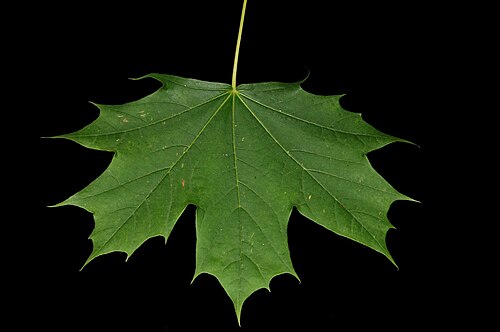
A maple (Acer platanoides) leaf has palmate venation, as its veins radiate out from a central point, like fingers from the palm of a hand.
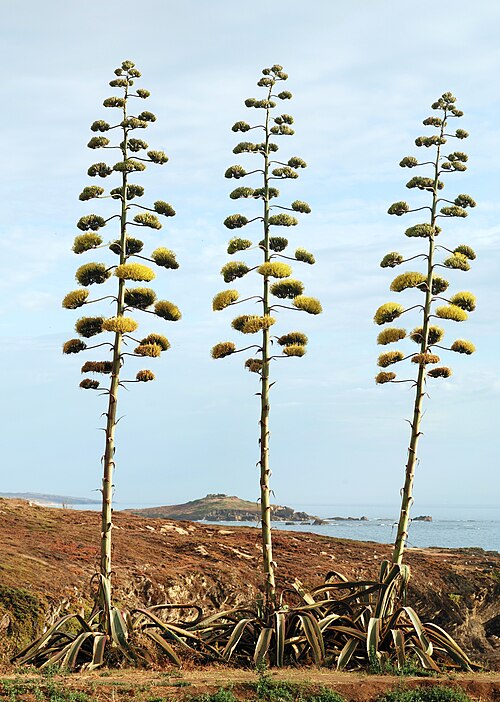
The inflorescence of Agave americana is a giant panicle.
.jpg/500px-Starr-030210-0016-Asclepias_physocarpa-seeds_and_pappus-Auwahi-Maui_(24252209689).jpg)
Asclepias physocarpa shedding seeds, each with its silky pappus

Doubly paripinnate leaves of Delonix regia

Aloe ferox in flower, bearing two inflorescences on peduncles

Stephania japonica is a vine with peltate leaves.
.jpg/500px-Doorwaskervel_-_Smyrnium_perfoliatum_(2).jpg)
Perfoliate leaves of Smyrnium perfoliatum with stems passing through them

The leaves of Aponogeton madagascariensis are perforate.

The perigonium of a moss (red in this case), also called a splash-cup, surrounds the antheridia and aids in dispersal of sperm.

Liquidambar styraciflua bud emerging from its protective brown imbricate cataphyll scales, also known as perules

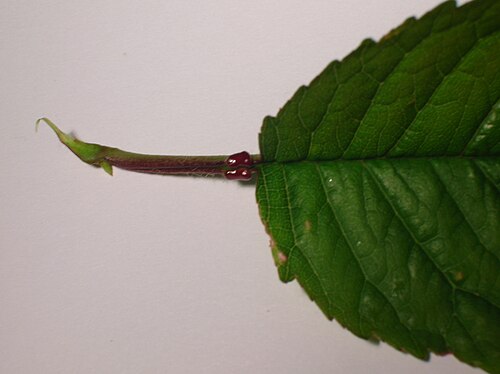
Petiolary glands on the petiole of a cherry leaf
_(13960371426).jpg/500px-Large-leaved_Rock_Fig_(Ficus_abutilifolia)_(13960371426).jpg)
Rock-splitting roots of the petricolous large-leaved rock fig, Ficus abutilifolia

The phaneranthous habit of the red flowering gum, Corymbia ficifolia, can attract pollinators such as the honey eater, Anthochaera chrysoptera, from a considerable distance.

Seedlings of Acacia fasciculifera bear leaves that illustrate the ancestral function of their phyllodes as petioles.

Pileus of the fruiting body of the fungus Pluteus admirabilis

Glandular pilose hairs on the stem of Aquilegia grata

Bipinnate leaf anatomy showing a pinna (or pinnule)

Simple pinnate leaf of Ekebergia capensis
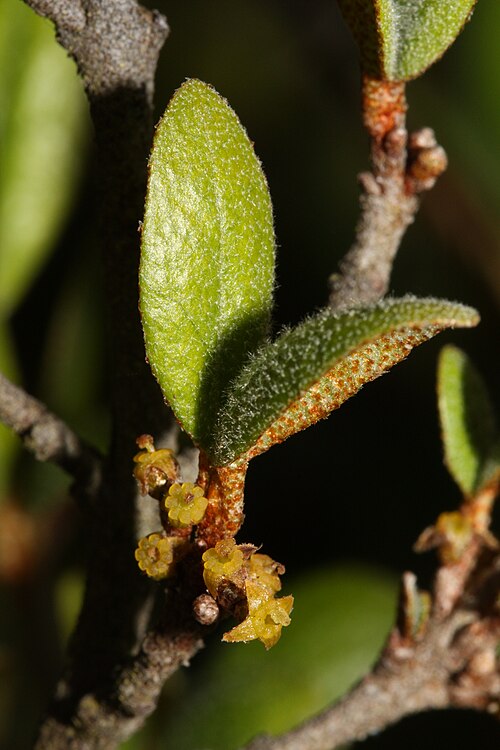
Pistillate flowers of Shepherdia canadensis.
Compare staminate flower.
Compare staminate flower.

Electron micrographs of sections of wood of a conifer (Picea abies) show pits in the tracheid walls.

Flowers in the inflorescence of Euphorbia platyphyllos open simultaneously, as a pleiochasium.

The corolla of Datura discolor is plicate.
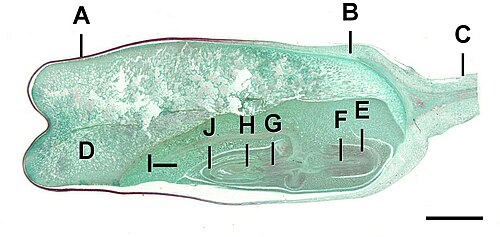
.jpg/500px-Pneumatophores_of_Avicennia_by_Dr._Raju_Kasambe_DSCN9864_(13).jpg)
Pneumatophores on a species of mangrove

The sharp projections on the trunk of the knobthorn, Senegalia nigrescens, are prickles rather than thorns, botanically speaking.
.jpg/500px-Starr-150330-0516-Sagina_procumbens-flowering_habit-Tarmac_Near_Fire_Station_Sand_Island-Midway_Atoll_(25244594686).jpg)
Procumbent growth habit of Sagina procumbens, growing mainly along the soil surface, but without rooting
.jpg/500px-Carpobrotus_acinaciformis_(plants).jpg)
Carpobrotus and other prostrate plants growing on sand in Sicily, striking root and binding the soil as they grow

Floral stages of the protandrous species: Geranium incanum. The flower at first has intensely colored petals, and both androecium and gynoecium. After a day or so in bloom, it sheds the stamens and the color of the petals becomes somewhat paler.
.jpg/500px-Gomphrena_celosioides_flowerhead3_(14646694313).jpg)
Pubescent stem and inflorescence of Gomphrena celosioides
.jpg/500px-Artemisia_nova_(5061071225).jpg)
Punctate glands on Artemisia nova are visible because they are not covered with epidermal hairs.

Punctiform glands on the undersurface of a Plectranthus leaf
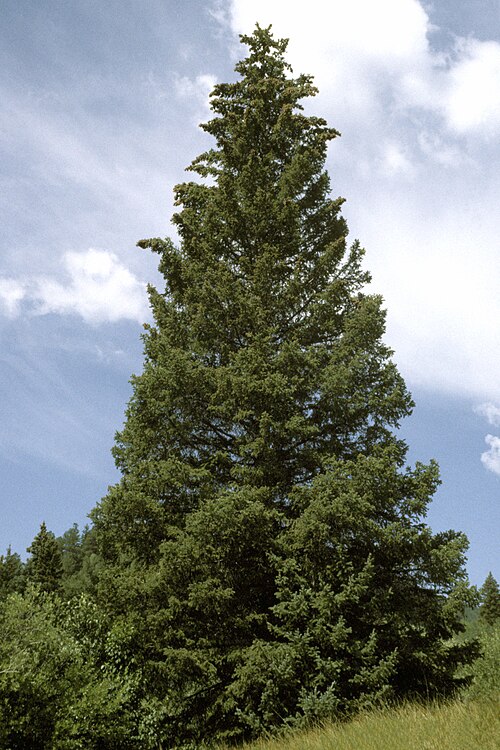
Pyramidal growth habit of Picea pungens
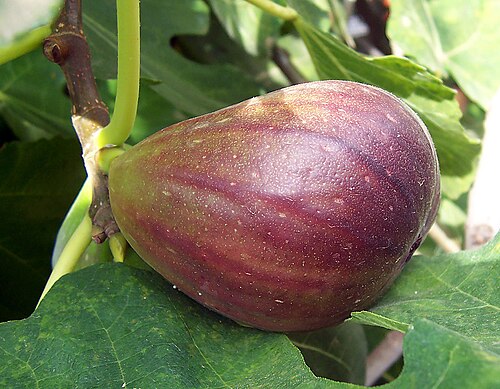
Pyriform syconium ("fruit") of domestic fig
Q
- quadrate
- More or less square.

Siliques of Conringia orientalis tend toward a quadrate cross section.
R
- raceme
An indeterminate inflorescence in which the main axis produces a series of flowers on lateral stalks, the oldest at the base and the youngest at the top. Compare spike. Also racemiform or racemoid - having the form of a raceme.
- rachilla (rhachilla)
- 1. the axis of a grass spikelet, above the glumes; see spikelet.
- 2. the rachis of higher order in leaves that are compound more than once
- rachis
The axis of an inflorescence or a pinnate leaf; for example ferns; secondary rachis is the axis of a pinna in a bipinnate leaf distal to and including the lowermost pedicel attachment.
- radial
- With structures radiating from a central point as spokes on a wheel (e.g. the lateral spines of a cactus).
- radiate
- (of daisies, of a capitulum) With ray floret surrounding disc florets.
- radical
- Springing from the root; clustered at base of stem.
- radicle
- The part of an embryo giving rise to the root system of a plant. Compare plumule.
- rainforest
- A moist temperate or tropical forest dominated by broad-leaved trees that form a continuous canopy.
- ramet
- An individual member of a clone.
- ramicaul
- a single-leafed stem, as in Pleurothallis orchids.[46]
- ramify
- To divide or spread out into individual branches or branchlike parts.
- ray
- 1. zygomorphic (ligulate) flowers in a radiate flowerhead, that is, ray-florets/flowers, for example Asteraceae.
- 2. each of the branches of an umbel.
- receptacle
- the axis of a flower, in other words, floral axis; torus; for example in Asteraceae, the floral base or receptacle is the expanded tip of the peduncle on which the flowers are inserted.
- recumbent
- bent back toward or below the horizontal.
- recurved
- bent or curved backward or downward.
- reduplicate
- folded outward, or with the two abaxial surfaces together.
- reflexed
- bent sharply back or down.
- registered name
- a cultivar name accepted by the relevant International Cultivar Registration Authority.
- registration
- 1. the act of recording a new cultivar name with an International Cultivar Registration Authority.
- 2. recording a new cultivar name with a statutory authority like the Plant Breeder's Rights Office.
- 3. recording a trademark with a trade marks office.
- regular
- See actinomorphic.
- reniform
- Kidney-shaped.
- replum
- a framework-like placenta to which the seeds attach, and which remains after each valve drops away.
- resupinate
- Describing leaves or flowers that are in an inverted position because the petiole or pedicel, respectively, is twisted 180 degrees. compare: hyper-resupinate.
- reticulate
- forming a network (or reticulum), e.g. veins that join one another at more than one point.
- retrorse
- Bent backward or downward. Compare antrorse.
- retuse
- Having a blunt (obtuse) and slightly notched apex.
- revision
- an account of a particular plant group, like an abbreviated or simplified monograph. Sometimes confined to the plants of a particular region. Similar to a monograph in clearly distinguishing the taxa and providing a means for their identification. Compare monograph.
- revolute
- rolled under (downward or backward), for example when the edges of leaves are rolled under toward the midrib. Compare involute.
- rhachis
- See rachis.
- rhizodermis
- the root epidermis, the outermost primary cell layer of the root
- rhizome
- a perennial underground stem usually growing horizontally. See also stolon. Abbreviation: rhiz.
- rhizomatous
- (adj.) having above-ground stems that are derived from below-ground stems (rhizomes). Compare arhizomatous (arhizomatic).
- rhizosphere
- the below-ground surface of plants and adjacent soil as a habitat for microorganisms.
- rhytidome
- the dead region of the bark and root that lies outside the periderm.
- rhombic
- like a rhombus: an oblique figure with four equal sides. Compare trapeziform and trullate.
- rhomboid
- a four-sided figure with opposite sides parallel but with adjacent sides an unequal length (like an oblique rectangle); see also rhombic.
- rhomboidal
- a shape, for instance of a leaf, that is roughly diamond-shaped with length equal to width.
- rimose
- with many cracks, as in the surface of a crustose areolate lichen.
- root
- a unit of a plant's axial system which is usually underground, does not bear leaves, tends to grow downward, and is typically derived from the radicle of the embryo.
- root hairs
- outgrowths of the outermost layer of cells just behind the root tips, functioning as water-absorbing organs.
- root microbiome
- the dynamic community of microorganisms associated with plant roots.
- rootstock
- 1. the part of a budded or grafted plant which supplies the root system, also simply called a stock.
- 2. plants selected to produce a root system with some specific attribute, e.g. a virus-free rootstock.
- rosette
- when parts are not whorled or opposite but appear so, due to the contractions of internodes, e.g. the petals in a double rose or a basal cluster of leaves (usually close to the ground) in some plants.
- rostellate
- possessing a beak (rostellum). Synonym of rostrate.
- rostrate
- with a beak.
- rotate
- circular and flattened; for example a corolla with a very short tube and spreading lobes (for instance some Solanaceae).
- ruderal
- a plant that colonises or occupies disturbed waste ground. See also weed.
- rudiment
- In the structure of a plant, an item that is at best hardly functional, either because it is immature and has not yet completed its development (such as a leaf still incompletely formed inside a bud), or because its role in the organism's morphology cannot be completed and therefore is futile (such as the leaf rudiment at the tip of a phyllode, that will be shed while immature, because the leaf function will be taken over by the phyllode). Compare cataphyll and vestige.
- rudimentary
- Being of the nature of a rudiment; at most barely functional because incompletely developed; begun, but far from completed, either temporarily or permanently. Compare vestigial.
- rugose
- Wrinkled, either covered with wrinkles, or crumpled like a wrinkled leaf, either as a stiffening structure, or in response to disease or insect damage.
- rugulose
- Finely wrinkled.
- ruminate
- (usually applied to endosperm) Irregularly grooved or ridged; appearing chewed, e.g. the endosperm in certain members of Myristicaceae.
- runcinate
- Sharply pinnatifid or cleft, with the segments directed downward.
- runner
- See stolon.
- rupicolous
- Rupestral, saxicolous, growing on or among rocks. Compare epilithic and lithophytic.
- rush
- A plant of the family Juncaceae or, more loosely, applied to various monocotyledons.

Bulbinella latifolia racemes. The flowers are already open at the bottom; at the top, the axis is still growing and budding.
Rachis of Vachellia karroo bipinnate leaf, with components labelled as follows:
A. Rachilla (the diminutive of rachis)B. Pinnule
C. Jugary glands
D. Juga (plural of jugum)
E. Base of petiole
F. Petiolary gland
G. Rachis

Radicles emerging from germinating seeds

Reniform kidney bean seeds

A leaf of Ficus carica, illustrating reticulate venation

The central leaflets of the ternate leaves of Searsia glauca are oblate and commonly retuse.

Typical rhizome. This one is a specimen of Iris pseudacorus.

Grafting kiwifruit vine scion onto rootstock below

Unidentified Gasteria bearing leaves with a rugose surface, banded with callosities

Rugose leaves of Alocasia are stiffer than flat leaves of the same size and thickness would be.

Unidentified Crassula bearing rugulose leaves with fine wrinkles in the epidermis

The runcinate lobes of a Taraxacum officinale leaf point downward, i.e. toward the stem.
S
- saccate
- Pouched or shaped like a sack.
- sagittate
- Shaped like the head of an arrow; narrow and pointed but gradually enlarged at the base into two straight lobes directed downward; may refer only to the base of a leaf with such lobes. Compare hastate.
- salverform
- Shaped like a salver - Trumpet-shaped; having a long, slender tube and a flat, abruptly expanded limb
- samara
- A dry, indehiscent fruit with its wall expanded into a wing, e.g. in the genus Acer.
- samphire
- A common name given to various edible coastal plants, such as Salicornia spp. (Amaranthaceae), Crithmum maritimum (Apiaceae) and Limbarda crithmoides (Asteraceae).
- sanguine
- (from Latin sanguineus) Blood-colored: crimson; the color of blood.
- saprophyte
A plant, or loosely speaking, a fungus or similar organism, deriving its nourishment from decaying organic matter such as dead wood or humus, and usually lacking chlorophyll. Compare parasite, saprotroph, and epiphyte.
- saprotroph
An organism deriving its nourishment from decaying organic matter. Contrast parasite and epiphyte.
- sarment
- A long, slender, prostrate stolon, commonly called a runner.
- sarmentose
- Reproducing by sarments; strawberry plants are the most familiar example.
- saxicolous
- Growing on stone, like some lichens.
- scabrid
Rough to the touch, with short hard protrusions or hairs.
- scalariform
- Ladder-like in structure or appearance.
- scale
- 1. A reduced or rudimentary leaf, for example around a dormant bud.
- 2. A flattened epidermal outgrowth, such as those commonly found on the leaves and rhizomes of ferns.
- scandent
- Climbing, by whatever means. See also: scandent in Wiktionary.
- scape
Usages vary, e.g.: a leafless peduncle arising directly from the ground, or a stem-like flowering stalk of a plant with radical leaves.
- scapose
- Having the floral axis more or less erect with few or no leaves; consisting of a scape.
- scarious
- Dry and membranous.
- schizocarp
- A dry fruit formed from more than one carpel but breaking apart into individual carpels (mericarp) when ripe. For illustration, see mericarp
- scion
- The aerial part of a graft combination, induced by various means to unite with a compatible understock or rootstock.
- sclereid
- A cell with a thick, lignified, cell wall that is shorter than a fiber cell and dies soon after the thickening of its cell wall.
- sclerenchyma
- A strengthening or supporting tissue composed of sclereids or of a mixture of sclereids and fibers.
- sclerophyll
A plant with hard, stiff leaves; any structure stiffened with thick-walled cells.
- scorpioid
- (of a cymose inflorescence) Branching alternately on one side and then the other. Compare helicoid.
- scrobiculate
- Having very small pits.
- scrubland
- Dense vegetation dominated by shrubs.
- scurf
- Minute, loose, membranous scales on the surface of some plant parts, such as leaves.
- secondary metabolite
- Chemicals produced by a plant that do not have a role in so-called primary functions such as growth, development, photosynthesis, reproduction, etc.
- secretory tissue
- The tissues concerned with the secretion of gums, resins, oils and other substances in plants.
- section (sectio)
- The category of supplementary taxa intermediate in rank between subgenus and series. It is a singular noun always written with a capital initial letter, in combination with the generic name.
- secund
- Having all the parts grouped on one side or turned to one side (applied especially to inflorescences).
- sedge
- A plant of the family Cyperaceae.
- seed
- A ripened ovule, consisting of a protective coat enclosing an embryo and food reserves; a propagating organ formed in the sexual reproductive cycle of gymnosperms and angiosperms (together, the seed plants).
- segment
- A part or subdivision of an organ, e.g. a petal is a segment of the corolla. A term sometimes used when the sepals and petals are indistinguishable.
- self-pollination
- (also selfing) The acceptance by stigmas of pollen from the same flower or from flowers on the same plant, which means they are self-compatible.
- semaphyll
- A structure such as a bract or sepal (if the remainder of the perianth is inconspicuous) which has become modified to attract pollinators.
- semelparity
- When a plant flowers once then dies.
- semiterete
- Rounded on one side but flat on the other. See also terete.
- senecioid
- See anthemoid.
- sensitive
- A descriptive term for stigmas that, in response to touch, close the two lobes of the stigma together, ending the receptivity of the stigma, at least for the time that the lobes are closed together. Mimulus is perhaps the best-known example.
- sensu
- In the sense of.
- sensu auct.
- (of a plant group or name) As cited by a named authority.
- sensu amplo
- (of a plant group or name) In a generous or ample sense.
- sensu lato
- (of a plant group) In a broad sense.
- sensu strictissimo
- (of a plant group) In the narrowest sense.
- sensu stricto
- (of a plant group) In a narrow sense.
- sepal
- In a flower, one of the segments or divisions of the outer whorl of non-fertile parts surrounding the fertile organs; usually green. Compare petal, tepal.
- septicidal
- (of a fruit) Dehiscing along the partitions between loculi. Compare loculicidal.
- septum
A partition, e.g. the membranous wall separating the two valves of the pod of Brassicaceae.
- seriate
- Arranged in rows.
- sericeous
- Silky with dense appressed hairs.
- series
- The category of supplementary taxa intermediate in rank between section and species. It is often used as a plural adjective, as in "Primula subgenus Primula sect. Primula series Acaules".
- serrate
- Toothed with asymmetrical teeth pointing forward; like the cutting edge of a saw.
- serrulate
- Finely serrate.
- sessile
- Attached without a stalk, e.g. of a leaf without a petiole or a stigma, when the style is absent.
- seta
A bristle or stiff hair (in Bryophytes, the stalk of the sporophyte). A terminal seta is an appendage to the tip of an organ, e.g. the primary rachis of a bipinnate leaf in Acacia.
- sheath
- A tubular or rolled part of an organ, e.g. the lower part of the leaf in most grasses.[47]
- sheathing
- When the rolled or tubular part of a plant contains another it is described as sheathing.[47]
- shoot
- The aerial part of a plant; a stem and all of its dependent parts (leaves, flowers, etc.).
- shrub
- A woody perennial plant without a single main trunk, branching freely, and generally smaller than a tree.
- sigmoid
- Shaped like the letter 'S'.
- silicula or silicle
- A fruit like a siliqua, but stouter, not more than twice as long as wide.
- silique
- siliqua
- A dry, dehiscent fruit (in contrast to a silicula, more than twice as long as wide) formed from a superior ovary of two carpels, with two parietal placentas and divided into two loculi by a 'false' septum.
- silky
- Densely covered with fine, soft, straight, appressed hairs, with a lustrous sheen and satiny to the touch.
- silviculture
- The science of forestry and the cultivation of woodlands for commercial purposes and wildlife conservation.
- simple
- Undivided or unsegmented, e.g. a leaf not divided into leaflets (note, however, that a simple leaf may still be entire, toothed or lobed) or an unbranched hair or inflorescence.
- sinuate
- Having deep, wave-like depressions along the margins, but more or less flat. Compare undulate.
- sinus
- A notch or depression between two lobes or teeth in the margin of an organ.
- solitary
- Single, of flowers that grow one plant per year, one in each axil, or widely separated on the plant; not grouped in an inflorescence.
- sorus
A cluster of sporangia. Sori typically occur in ferns, some Algae and some fungi. In many fern species the sorus is covered by a protective indusium.
- sp.
- An abbreviation of species (singular), often used when the genus is known but the species has not been determined, as in "Brassica sp." See spp..
- spp.
- An abbreviation of species (plural), often used to collectively refer to more than one species of the same genus, as in "Astragalus spp." See sp..
- spadix
- A spicate (spike-like) inflorescence with the flowers crowded densely, even solidly, around a stout, often succulent axis. Particularly typical of the family Araceae
- spathe
A large bract ensheathing an inflorescence. Traditionally any broad, flat blade.
- spathulate or spatulate
- Spoon-shaped; broad at the tip with a narrowed projection extending to the base.
- species
- A group, or populations of individuals, sharing common features and/or ancestry, generally the smallest group that can be readily and consistently recognized; often, a group of individuals capable of interbreeding and producing fertile offspring. The basic unit of classification, the category of taxa of the lowest principal rank in the nomenclatural hierarchy. Strict assignment to a species is not always possible, as it is subject to particular contexts, and the species concept under consideration.
- specific epithet
- Follows the name of the genus, and is the second word of a botanical binomial. The generic name and specific epithet together constitute the name of a species, i.e. the specific epithet is not the species name.
- speirochoric
- Unintentional introduction by seeds.[48] Compare agochoric.
- spica
Another name for a spike.
- spike
An unbranched, indeterminate inflorescence in which the flowers are without stalks. Compare raceme.
- spikelet
- A subunit of a spike inflorescence, especially in grasses, sedges, and some other monocotyledons, consisting of one to many flowers and associated bracts or glumes.
- spine
A stiff, sharp structure formed by the modification of a plant organ that contains vascular tissue, e.g. a lateral branch or a stipule; includes thorns.
- spinescent
- Ending in a spine; modified to form a spine.
- spiral
- Of arrangement, when plant parts are arranged in a succession of curves like the thread of a screw, or coiled in a cylindrical or conical manner.
- splash-cup (sporangia)
- A cup-like structure in fungi such as Nidulariaceae and in cryptogams such as some mosses. The cups function in spore dispersal, in which the energy of raindrops falling into the cup causes the water to splash outward carrying the spores.[49]
- sporangium (sporangia)
- A structure in which spores are formed and from which the mature spores are released
- sporangiophore
- An organ bearing sporangia, e.g. the cones of Equisetum.
- spore
- A haploid propagule, produced by meiosis in diploid cells of a sporophyte that can germinate to produce a multicellular gametophyte.
- sporocarp
- A fruiting body containing spores.
- sporophyll
- In pteridophytes, a modified leaf that bears a sporangium or sporangia.
- sporophyte
- The diploid multicellular phase in the alternation of generations of plants and algae that produces the spores. Compare gametophyte.
- sport
- A naturally occurring variant of a species, not usually present in a population or group of plants; a plant that has spontaneously mutated so that it differs from its parent plant.
- spreading
- Extending horizontally, e.g. in branches. Standing out at right angles to an axis, e.g. in leaves or hairs.
- spur
- 1. a short shoot.
- 2. a conical or tubular outgrowth from the base of a perianth segment, often containing nectar.
- squamula
A small scale.
- squamule
- A small scale.
- squamulose
- Covered with small scales (squamules).
- squarrose
- Having tips of leaves, stems, etc. radiating or projecting outward, e.g. in the moss Rhytidiadelphus squarrosus.
- s.t.
- An abbreviation for "sometimes". Compare usu. and oft..
- stalk
- The supporting structure of an organ, usually narrower in diameter than the organ itself.
- stamen
The male organ of a flower, consisting (usually) of a stalk called the filament and a pollen-bearing head called the anther.
- staminate flower
A flower with stamens but no pistil.
- staminode
- A sterile stamen, often rudimentary, sometimes petal-like. Commonly has a function in attracting pollinators that feed on the staminodes.
- staminophore
- A structure, around the apex of eucalypt, myrtaceae hypanthia, that supports the stamens.
- standard
- The large posterior petal of pea-flowers.
- standard specimen
- A representative specimen of a cultivar or other taxon which demonstrates how the name of that taxon should be used.
- stele
- The primary vascular system (including phloem, xylem, and ground tissue) of plant stems and roots.
- stellate
- Star-shaped.
- stem
- The plant axis, either aerial or subterranean, which bears nodes, leaves, branches, and flowers.
- stem-clasping
- See amplexicaul.
- stenospermocarpy
- The development or production of fruit that is seedless or has minute seeds because of the abortion of seed development. Compare parthenocarpy.
- sterile
- Infertile, as with a stamen that does not bear pollen or a flower that does not bear seed.
- stigma
- The pollen-receptive surface of a carpel or group of fused carpels, usually sticky; usually a point or small head at the summit of the style.
- stilt root
- A descending root growing from the trunk above ground and sometimes featuring lenticels; characteristic of e.g. Rhizophora.[50]
- stipe
- Generally a small stalk or stalk-like structure. The stalk of a frond of a fern; the stalk supporting the pileus of a mushroom; the stalk of a seaweed such as a kelp; the stalk-like support of a gynaecium or a carpel
- stipella
One of two small secondary stipules at the base of leaflets in some species.
- stipitate
- stalked; borne on a stipe; of an ovary, borne on a gynophore.
- stipulate
- Bearing stipules.
- stipule
- A small appendage at the bases of leaves in many dicotyledons.
- stock
- See rootstock.
- stolon
A slender, prostrate or trailing stem, producing roots and sometimes erect shoots at its nodes. See also rhizome.
- stoloniferous
- Having stolons.
- stoma
A pore or small hole in the surface of a leaf (or other aerial organ) allowing the exchange of gases between tissues and the atmosphere.
- stone cell
- a sclereid cell, such as the cells that form the tissue of nut shells and the stones of drupes.
- striate
- Striped with parallel, longitudinal lines or ridges.
- strigillose
- Minutely strigose.
- strigose
- Covered with appressed, straight, rigid, bristle-like hairs; the appressed equivalent of hispid.
- strobilus
A cone-like structure consisting of sporophylls (e.g. conifers and club mosses) or sporangiophores (e.g. in Equisetopsida) borne close together on an axis.
- style
- An elongated part of a carpel or a group of fused carpels between the ovary and the stigma.
- stylodium
- An elongate stigma that resembles a style; a false style, e.g. commonly found in the Poaceae and Asteraceae.
- stylopodium
- A swelling on top of the ovary, at the base of the styles commonly found in flowers of the Apiaceae.
- stylulus
- The elongated apex of a free carpel which functions like the style of a syncarpous ovary, allowing pollen tubes from its stigma to enter the locule of only that carpel.
- subacute
- Having a tapered but not sharply pointed form; moderately acute. See also acute.
- subcoriaceous
- Slightly leathery or coriaceous.
- subgenus
- A category of supplementary taxa intermediate between genus and section. The name of a subgenus is a singular noun, always has a capital initial letter and is used in combination with the generic name, e.g. Primula subgenus Primula.
- subglobose
- Inflated, but less than spherical. See also globose.
- suborbicular
- Nearly orbicular, flat and almost circular in outline. See also orbicular.
- subpetiolate
- (of a leaf) Having an extremely short petiole, and may appear sessile.
- subquadrangular
- Not quite square. Compare quadrangular.
- subshrub
A small shrub which may have partially herbaceous stems, but generally a woody plant less than 1 metre (3.3 ft) high.
- subspecies
- A taxonomic category within a species, usually used for geographically isolated or morphologically distinct populations of the same species. Its taxonomic rank occurs between species and variety.
- subtend
- To stand beneath or close to, as in a bract at the base of a flower.
- subulate
- Narrow and tapering gradually to a fine point.
- succulent
- 1. Juicy or fleshy.
- 2. A plant with a fleshy habit.
- sucker
- A shoot of more or less subterranean origin; an erect shoot originating from a bud on a root or a rhizome, sometimes at some distance from the stem of the plant.
- suffruticose
- Having a woody base, but herbaceous higher up.
- suffrutex
A subshrub or undershrub.
- sulcate
- Furrowed; grooved. May be single (monosulcate), two (bisulcate) or many (polysulcate).
- superficial
- On the surface.
- superior ovary
- An ovary borne above the level of attachment of the other floral parts, or above the base of a hypanthium. Compare inferior ovary and half-inferior ovary.
- suspended
- Of an ovule, when attached slightly below the summit of the ovary. Compare pendulous.
- suture
- A junction or seam of union. See fissure and commissure.
- sward
- Extensive, more or less even cover of a surface, e.g. a lawn grass. Compare tussock.
- sympatric
- Having more or less similar or overlapping ranges of distribution.
- sympodial
- A mode of growth in which the main axis is repeatedly terminated and replaced with a lateral branch. Examples occur in the family Combretaceae, including the genera Terminalia and Combretum. Compare monopodial.
- syconium
- A hollow infructescence containing multiple fruit, such as that of a fig.
- syn-
A prefix meaning "with, together".
- symmetrical
- Capable of being divided into at least two equal, mirror-image halves (e.g. zygomorphic) or having rotational symmetry (e.g. regular or actinomorphic). Compare irregular and asymmetrical.
- sympetalous
- Having united (connate or fused) petals, not free (apopetalous). See also syntepalous (having fused tepals).
- symphyllous
- a single perianth-whorl of united segments. Compare gamophyllous (synonym), apophyllous, and polyphyllous.
- synangium
- A fused aggregate of sporangia, e.g. in the trilocular sporangia of the whisk fern Psilotum.
- synanthous
- A type of growth in which new leaves and flowers appear and die back at the same time. See also hysteranthous and proteranthous.
- synaptospermy
- The dispersal of diaspores as units, where each bears more than one seed, for example where each diaspore comprises an entire inflorescence, as in Brunsvigia or multi-seeded fruit as in Tribulus zeyheri. Ephemeral synaptospermy is the term for when the diaspores split into units containing fewer or single seeds each, as in most tumbleweeds. True synaptospermy is when the diaspore generally remains entire until germination, as commonly happens in species of Grielum.
- syncarpous
- (of a gynoecium) Composed of united carpels.
- synonym
- An outdated or 'alternative' name for the same taxon.
- synoecious
- A synonym of bisexual.
- syntepalous
- Having fused tepals. See also sympetalous (having fused petals).
.jpg/500px-Starr-110209-0812-Alocasia_x_amazonica-leaves-Resort_Management_Group_Nursery_Kihei-Maui_(24444063964).jpg)
Sagittate leaves of an Alocasia plant
.jpg/500px-Starr-070207-4265-Plumbago_auriculata-flowers-Hookele_Rd_Kahului-Maui_(24255038073).jpg)
Salverform flowers of Plumbago auriculata
.jpg/500px-Turkey_tail_Fungus._(41856600312).jpg)
Trametes versicolor, the turkey tail fungus, is a saprotroph that consumes dead wood in forests. Its common name comes from the conspicuously patterned brackets, but the main body of the saprotroph consists of the largely invisible mycelium that penetrates the dead wood and digests it.

Strawberry plants reproduce mainly by sarments, stolons such as these, often called runners; at their nodes the sarments put up tufts of leaves and strike root if there is any good soil beneath.
_sl26.jpg/500px-Stipa_pulcherrima_(subsp._pulcherrima)_sl26.jpg)
Micrograph of the scabrid undersurface of the leaf of Stipa pulcherrima.

_(45415678955).jpg/500px-Cape_Snow_(Syncarpha_vestita)_(45415678955).jpg)
Involucral bracts of Syncarpha species are as scarious as tissue paper, but look like live petals for years, so they are known as "Everlastings" and valued for dried arrangements.

Isolated sclereid or stone cell in plant tissue
.jpg/500px-Stone_cells_in_Pyrus_pear_(36452689990).jpg)
Sclereids in gritty particles of pear tissue
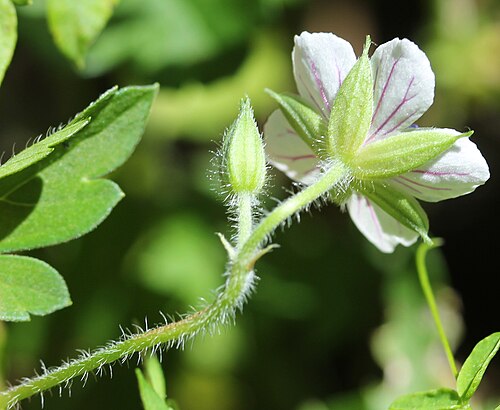
Sepals on Geranium thunbergii, five separated behind the petals of an open flower, and a connected set enclosing an unopened bud

Sericeous leaves of Podalyria sericea, the silver sweet pea bush
.jpg/500px-Lepidium_bonariense_fruit1_(14652857933).jpg)
The fruits of Lepidium bonariense are silicles, green and circular, with a notch at the apex.

Silky foliage of the silvertree, Leucadendron argenteum

Sori under the leaf of the fern Rumohra adiantiformis. Some are still covered by their indusia.
.jpg/500px-Amorphophallus_maximus_-_inflorescence_detail_(6592569989).jpg)
Spadix of Amorphophallus maximus within its spathe. The female flowers are around the bottom of the spadix, the male flowers above, and the sterile top part is the major source of pollinator attractants.

The convolute spathe around the spadix of Zantedeschia aethiopica
.jpg/500px-Drosera_spatulata_leaves4_(16806065992).jpg)
Drosera spatulata leaves are markedly spathulate.

The flowering spike of this Salvia nemorosa differs from a raceme in that the flowers are practically sessile.
.jpg/500px-Echinopsis_candicans_(3).jpg)
Spines emerging from the areoles of an Echinopsis species

Spinescent leaves of Salsola australis: stiff, narrowed, and with lobes ending in spiny points
.jpg/500px-Bird_nest_fungi._(35408587773).jpg)
Bird nest fungi, Nidulariaceae, bear examples of splash-cups with spores that are spread by raindrops.

Sporangia of the fungus Rhizopus
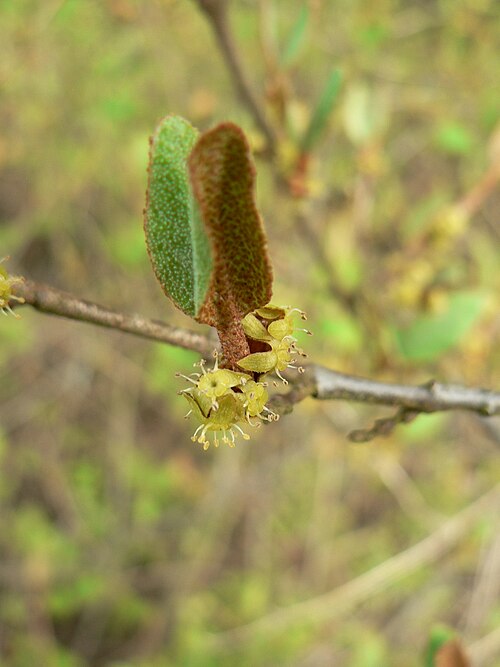
Staminate flowers of Shepherdia canadensis

Manilkara hexandra flowers have both stamens with anthers and staminodes that have no anthers.

Subulate leaves are narrow with an elongated, tapering tip, as seen on this species of Aloe.

.jpg/500px-Starr-060922-9132-Chrysalidocarpus_lutescens-trunk_and_suckers-Kahului_Airport-Maui_(24772270571).jpg)
Suckers around the trunk of Dypsis lutescens

Sulcate (specifically polysulcate) grooves along the stem of Scorzonera cana

Superior ovary ovary in an Aloe species. One flower is sectioned to display the pistil and hypanthium.
.jpg/500px-Starr-130320-3453-Crotalaria_incana-fuzzy_pods_and_bluish_seeds-Mokolea_Pt_Kilauea_Pt_NWR-Kauai_(25182906376).jpg)
The suture along the concave curve of the pod of a Crotalaria incana, along which the seeds are attached, is where the single carpel has folded shut.

An undamaged syconium of a Ficus species, plus two more cut open longitudinally to display the fruit within
T
- taproot
- The primary descending root of a plant with a single dominant root axis.
- tartareous
- Having a surface that is coarse, thick, rough, and crumbling.
- taxon
A group or category in a system of biological classification.
- taxonomy
- The study of the principles and practice of classification.
- tegmen
- The inner layer of the testa (seed coat). It develops from the inner integument of the ovule.
- tendril
- Any slender organ modified from a stem, leaf, leaflet, or stipule and used by climbing plants to cling to an object.
- tepal
- A segment of a perianth, either sepal or petal; usually used when all perianth segments are indistinguishable in appearance.
- terete
Circular in cross-section; more or less cylindrical without grooves or ridges.
- terminal
- Situated at the tip or apex.
- ternate
- In groups of three; of leaves, arranged in whorls of three; of a single leaf, having the leaflets arranged in groups of three.
- terrestrial
- Of or on the ground; of a habitat, on land as opposed to in water (aquatic), on rocks (lithophytic), or on other plants (epiphytic).
- tessellate
- With cracks or fissures arranged in squares so as to give a chequered appearance. Usually applied to the appearance of the bark of a tree
- testa
- The seed coat.
- tetrad
- A group of four; usually used to refer to four pollen grains which remain fused together through maturity (e.g. in the Epacridaceae).[51]
- tetragonal
- Square; having four corners; four-angled, e.g. the cross-sections of stems of herbaceous Lamiaceae.
- tetramerous
- In four parts, particularly with respect to flowers; four parts in each whorl. See also trimerous and pentamerous.
- tetraploid
- Having four complete sets of chromosomes in each sporophyte cell.
- tetraspore
- The asexual spore of red algae. It is so named because each sporangium produces just four spores. See Rhodophyceae.[52]
- thalamus
1. A synonym for receptacle.
- 2. The inflorescence disk of members of the Asteraceae.
- 3. A calyx, as used by Carl Linnaeus.
- having a thallus-like structure; in the form of a thallus; thalloid
- thallus
A vegetative structure that is not differentiated into stem and leaves, as in lichens, algae, thallose liverworts, and certain vascular plants, e.g. Lemna
- theca
- One of the usually two synangia in which pollen is produced in flowering plants. It consists of two fused sporangia known as pollen sacs. The wall between the pollen sacs disintegrates before dehiscence, which is usually by a common slit.
- thorn
- A sharp, stiff point, usually a modified stem, that cannot be detached without tearing the subtending tissue; a spine. Compare prickle.
- throat
- The opening of a corolla or perianth.
- thyrse
- A branched inflorescence in which the main axis is indeterminate (racemose) and the lateral branches determinate (cymose).
- tomentellous
- Minutely tomentose.
- tomentum
A dense covering of short, matted hairs. Tomentose is often used as a general term for bearing an indumentum, but this is not a recommended use.
- toothed
- Having a more or less regularly incised margin.
- torus
- See receptacle.
- transmitting tissue
- See pollen transmitting tissue.
- trapeziform
- 1. Like a trapezium (a four-sided figure with two parallel sides of unequal length).
- 2. Like a trapezoid (a four-sided figure, or quadrilateral, with neither pair of sides equal); sometimes used erroneously as a synonym for rhombic.
- tree
- A woody plant, usually with a single distinct trunk and generally more than 2–3 metres (6.6–9.8 ft) tall.
- triad
- A group of three.
- triangular
- Planar and with 3 sides.
- tribe
- A taxonomic grouping that ranks between genus and family.
- trichome
- In non-filamentous plants, any hair-like outgrowth from the epidermis, e.g. a hair or bristle; sometimes restricted to unbranched epidermal outgrowths.
- trichotomous
- 3-forked or branched into three. Compare dichotomous.
- trifid
- Split into three parts. See also bifid.
- trifoliate
- A compound leaf of three leaflets; for example, a clover leaf.
- trifoliolate
- See trifoliate.
- trigonous
- Triangular in cross-section and obtusely angled. Compare triquetrous.
- trimerous
- In three parts, particularly with respect to flowers; having three parts in each whorl. See also tetramerous and pentamerous.
- trinerved
- Having three nerves or veins.
- triplinerved
- (of leaves) Having three main nerves with the lateral nerves arising from the midnerve above the base of the leaf.
- triporate
- (of pollen) Having three pores.
- triquetrous
- More or less triangular in cross-section, but acutely angled (with 3 distinct longitudinal ridges). Compare trigonous.
- trivalve
- Divided into three valves. Also trivalvar. See also bivalve.
- trivial name
- The second word in the two-part scientific name of an organism. Compare specific epithet.
- trophophyll
- A vegetative, nutrient-producing leaf or microphyll whose primary function is photosynthesis. It is not specialized or modified for some other function. Compare sporophyll.
- trullate
- Ovate but angled, as with a bricklayer's trowel; inversely kite-shaped. Compare rhombic.
- truncate
- Cut off squarely; having an abruptly transverse end.
- trunk
- The upright, large and typically woody main stem of a tree.
- truss
- A compact cluster of flowers or fruits arising from one center; evident in many rhododendrons.
- tuber
- Any of many types of specialized vegetative underground storage organs. They accumulate food, water, or in protection from death by fire, drought, or other hard times. Tubers generally are well differentiated from other plant organs; for example, informally a carrot is not generally regarded as a tuber, but simply a swollen root. In this they differ from the tuber of a sweet potato, which has no special root-like function. Similarly, corms are not generally regarded as tubers, even though they are underground storage stems. Tubers store food for the plant, and also have important roles in vegetative reproduction. They generally are of two main types: stem tubers form by the swelling of an underground stem growing from a root, or from structures such as underground stolons. Stem tubers generally produce propagative buds at their stem nodes, forming a seasonal perennating organ, e.g. a potato. The main other class is the root tuber, also called tuberoid. They differ from stem tubers in features such as that, like any normal root, they do not form nodes.
- tubercle
- A small wart-like outgrowth or protuberance of tissue.
- tuberculate
- Covered in tubercles. See warty.[53]
- tuberoid
- An alternative name for underground storage organ formed by the swelling of a root; occurs in many orchids.
- tuberous
- Resembling a tuber or producing tubers.
- tubular
- Having the form of a tube or cylinder.
- tufted
- Densely fasciculate at the tip.
- tunic
- The outer covering of some bulbs and corms.
- tunicate
- (of bulbs) Consisting of concentric coats.
- turbinate
- Shaped like a spinning top or beetroot.
- turgid
- Swollen with liquid; bloated; firm. Compare flaccid.
- tussock
- A dense tuft of vegetation, usually well separated from neighbouring tussocks, for example in some grasses. Compare sward.
- two-ranked
- Having leaves arranged in two rows in the same plane, on opposite sides of the branch. See distichous.
- type
- An item (usually an herbarium specimen) to which the name of a taxon is permanently attached, i.e. a designated representative of a plant name. Important in determining the priority of names available for a particular taxon.
- type genus
- In nomenclature, a single genus on which a taxonomic family is based.
-
 Leucaena leucocephala taproot exposed in a roadcut
 -
 Cross sections of Brazil nut seeds, showing the tegmen and testa
 -
 Tendrils of Cucurbita pepo, some supporting the stem on the frame, some failing to find a point of attachment
 -
 Nerine bowdenii, showing the lack of visible sepals, and the inferior ovaries. The sepals are incorporated into the corolla as tepals.
 -
 Terete raceme of Kniphofia shown together with a cross section of a peduncle. A: Inflorescence; B: Terete peduncle; C: Cross section of a terete peduncle
 -
 Gymnosporia buxifolia has true thorns, that is, modified branches. In some species such branches are complete with buds and leaves.
 -
 Sweet potato tubers exposed, showing them to be root tubers. Morphologically, they differ from stem tubers of potatoes, for example, in that root tubers do not have nodes that bear buds. The root tubers of some species of plants, however, can produce adventitious buds for vegetative reproduction.
 -
 Oxalis tuberosa, a stem tuber
 -
 Corms of Crocosmia bear typical tunics formed of cataphylls growing from the nodes of the corm. The illustration shows still-living cataphylls as white tissue, whereas the functional, hard, resistant tunic is brown.
 -
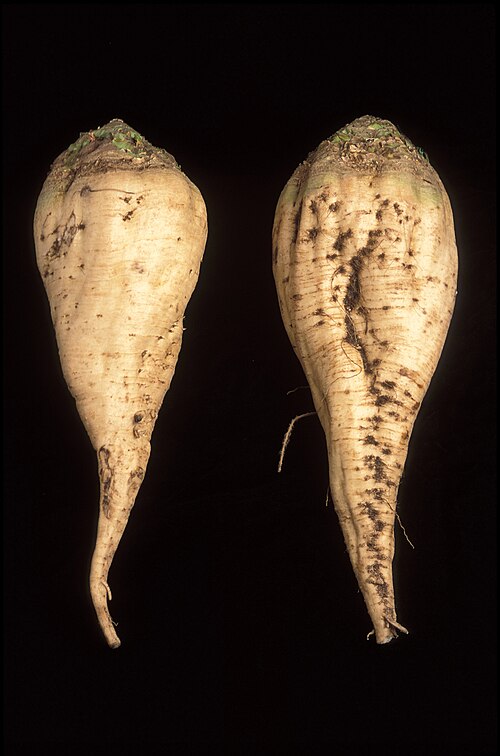 Turbinate (spinning top-shaped) roots of sugar beet
 -
 Haworthia lockwoodii, with its leaves turgid and green after seasonal rains, store water against the coming dry period.
 -
 Tussock grasses on mountain slopes
.jpg/500px-Starr-070404-6562-Leucaena_leucocephala-taproot_profile_in_roadcut-Keomoku_Rd-Lanai_(24258711924).jpg)
U
- umbel
- A racemose inflorescence in which all the individual flower stalks arise in a cluster at the top of the peduncle and are of about equal length; in a simple umbel, each stalk is unbranched and bears only one flower. A cymose umbel looks similar to an ordinary umbel but its flowers open centrifugally.
- umbo
- A rounded elevation, such as in the middle of the top of an umbrella or mushroom; a central boss or protuberance, such as on the scale of a cone.
- umbonate
- Having an umbo, with a conical or blunt projection arising from a flatter surface, as on the top of a mushroom or in the scale of a pine cone.
- unciform
- Hook-shaped.
- uncinate
- Having a hook at the apex.
- undershrub
- A low shrub, often with flowering branches that die off in winter. Compare subshrub.
- understory
- Plant life growing beneath the forest canopy.
- undulate
- Wavy and not flat. Compare sinuate.
- uniflor
- Having a single flower (uniflory). Compare pauciflor (few) and pluriflor (many).
- unilocular
- Having one loculus or chamber, e.g. the ovary in the families Proteaceae and Fabaceae.
- uniserial
- Arranged in a single row or series. Unbranched. Uniseriate.
- uniseriate
- Arranged in a single row or series. Unbranched. Uniserial.
- unisexual
- Of one sex; bearing only male or only female reproductive organs, dioecious, dioicous. See Sexual reproduction in plants.
- unitegmic
- (of an ovule) Covered by a single integument. See also bitegmic, having two integuments.
- urceolate
- Shaped like an urn or pitcher, with a swollen middle and narrowing top. Examples include the pitchers of many species of the pitcher plant genera Sarracenia and Nepenthes.
- usu.
- An abbreviation of usually. Compare s.t. and oft..
- utricle
- 1. A small bladder; a membranous bladder-like sac from the ovary wall, thin pericarp, becomes more or less bladdery or inflated at maturity enclosing an ovary or fruit.
- 2. In sedges, a fruit in which the fruit is loosely encloses from a modified tubular bract, see perigynium.

Umbo in the middle of the cap of Cantharellula umbonata

Thorny prickles of Senegalia mellifera subspecies detinens are unciform.
.jpg/500px-Mammillaria_bocasana_(26413016563).jpg)
Mammillaria bocasana has uncinate tips on its major spines.

Pitchers of the species Nepenthes ventricosa tend to be markedly urceolate.
V
- vallecular canal
- A resin canal coinciding with a longitudinal groove in the seeds of Asteraceae. A longitudinal cavity in the cortex of the stems of Equisetum, coinciding with a groove in the stem surface.
- valvate
- (of sepals and petals in bud) Meeting edge-to-edge but not overlapping.
- valve
- A portion of an organ that fragments or splits open, e.g. the teeth-like portions of a pericarp in a split (dehisced) capsule or pod when ripe.
- var.
- An abbreviation of varietas.
- variant
- A plant or group of plants showing some measure of difference from the characteristics associated with a particular taxon.
- variegated
- Irregularly marked with blotches or patches of another color.
- varietas
A taxonomic rank below that of species and between the ranks of subspecies and form.
- vascular
- Referring to the conducting tissues (xylem and phloem) of vascular plants.
- vascular bundle
- A bundle of vascular tissue in the primary stems of vascular plants, consisting of specialized conducting cells for the transport of water (xylem) and assimilate (phloem).
- vasculum
- A container used by botanists for collecting field specimens.
- vein
A strand of vascular tissue, e.g. in the leaves of vascular plants.
- veinlet
- A small vein; the ultimate (visible) division of a vein.
- velamen
- A spongy tissue covering the aerial roots of orchids and some other epiphytes.
- velutinous
- See velvety.
- velvety
- Densely covered with fine, short, soft, erect hairs.
- venation
- The arrangement of veins in a leaf.
- ventral
- From Latin venter, meaning "belly". The opposite of dorsal. Partly because the term originally referred to animals rather than plants, usage in botany is arbitrary according to context and source. In general "ventral" refers to "the belly or lower part", but in botanical usage such concepts are not always clearly defined and may be contradictory. For example:
- facing toward the axis (adaxial) in referring to a lateral organ of an erect plant
- facing toward the substrate in any part of an erect plant, for example the lower surface of a more or less horizontal leaf (abaxial)
- facing toward the substrate in a prostrate or climbing plant.
- vernation
- The arrangement of unexpanded leaves in a bud; the order in which leaves unfold from a bud.
- vernicose
- Having a shiny or polished surface as if covered in varnish and a slick or smooth texture.[54]
- vernonioid
- In the family Asteraceae, style with sweeping hairs borne on abaxial surfaces of style branches.
- verruciform
- Wart-like in form.
- verrucose
- Having warts.
- verruculose
- Minutely verrucose; minutely warty.
- versatile
- (of anthers) Swinging freely about the point of attachment to the filament.
- verticillate
- Arranged in one or more whorls, i.e. several similar parts arranged at the same point of the axis, e.g. leaf arrangement. Compare pseudoverticillate (appearing whorled or verticillate but not actually so).
- verticillaster
- A type of pseudoverticillate inflorescence, typical of the Lamiaceae, in which pseudo-whorls are formed from pairs of opposite cymes.
- vesicular
- (of hairs) Bladder-like; vesiculous, bearing such hairs.
- vessel
- A capillary tube formed from a series of open-ended cells in the water-conducting tissue of a plant.
- vestigial
- Reduced in form and function from the normal or ancestral condition.
- villosulous
- Minutely villous.
- villous
- Abounding in or covered with long, soft, straight hairs; shaggy with soft hairs.
- vine
- 1. Scandent plants climbing by means of trailing or twining stems or runners.
- 2. Such a stem or runner.[28][55]
- 3. A member of the genus Vitis.
- virgate
Wand-shaped, twiggy, especially referring to erect, straight stems. In mycology, referring to a pileus with radiating ribs or lines.
- Viridiplantae
- A clade of autotrophic organisms that includes the green algae, Charophyta and land plants, all of which have cellulose in their cell walls, chloroplasts derived from primary endosymbiosis with cyanobacteria that contain chlorophylls a and b and lack phycobilins.
- viscid
- Sticky; coated with a thick, syrupy secretion.
- vitta
An oil tube in the fruit of some plants.[56]
- viviparous
- 1. Referring to seeds or fruits which germinate before being shed from the parent plant.
- 2. The development of plantlets on non-floral organs, e.g. leaves.
-
 Photomicrograph of a cross section of a vascular bundle in the stem of a typical herbaceous dicotyledonA: Phloem
B: Cambium
C: Xylem
D: Fibrous sheath of vascular bundle -
 Leaf veins and velutinous hairs of Nepeta
 -
 Velamen, the pale grey membrane covering the mature part of the root of an epiphyte
 -
 Flower stalks and sepal tubes of Pueraria phaseoloides are covered with velutinous (velvety) hairs.
 -
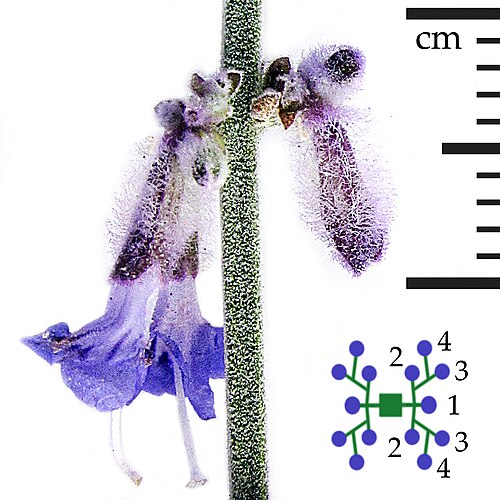 Verticillaster of Salvia yangii
 -
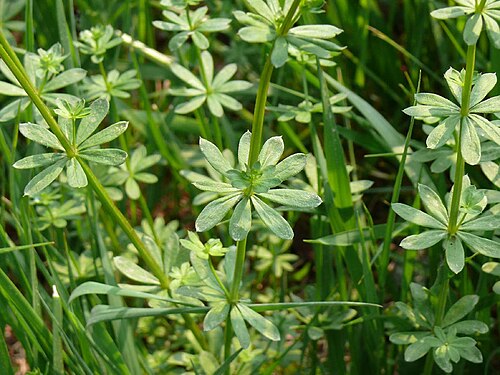 Verticillate leaves and emerging branchlets of a forb
 -
 Vestigial leaf scales on stem nodes of Viscum capense
 -
 Asparagus virgatus owes its specific epithet virgatus to the twiggy appearance of its virgate shoots.

W
- warty
- A surface covered with small round protuberances, especially in fruit, leaves, twigs and bark. See tuberculate.
- watershoot
- An erect, strong-growing, or epicormic shoot developing from near the base of a shrub or tree, but distinct from a sucker.
- weed
- 1. Any plant growing where it is not wanted; commonly associated with disrupted habitats. See also ruderal.
- 2. An unwanted plant which grows among agricultural crops.
- 3. A naturalised, exotic, or ecologically "out-of-balance" indigenous species outside of the agricultural or garden context, which, as a result of invasion, adversely affects the survival or regeneration of indigenous species in natural or partly natural vegetation communities.[57]
- wild
- Originating from a known wild or purely natural habitat (wilderness).
- whorl
- A ring of organs borne at the same level on an axis (e.g. leaves, bracts, or floral parts).
- wing
- 1. A membranous expansion of a fruit or seed which aids in dispersal, for instance on pine seeds.
- 2. A thin flange of tissue extending beyond the normal outline of a structure, e.g. on the column of some orchids, on stems, on petioles.
- 3. One of the two lateral petals of a flower of subfamily Faboideae of family Fabaceae, located between the adaxial standard (banner) petal and the two abaxial keel petals.
- woody
- hard and lignified; not herbaceous
- wooly
- woolly
- Very densely covered with long, more or less matted or intertwined hairs, resembling a sheep's wool.
-
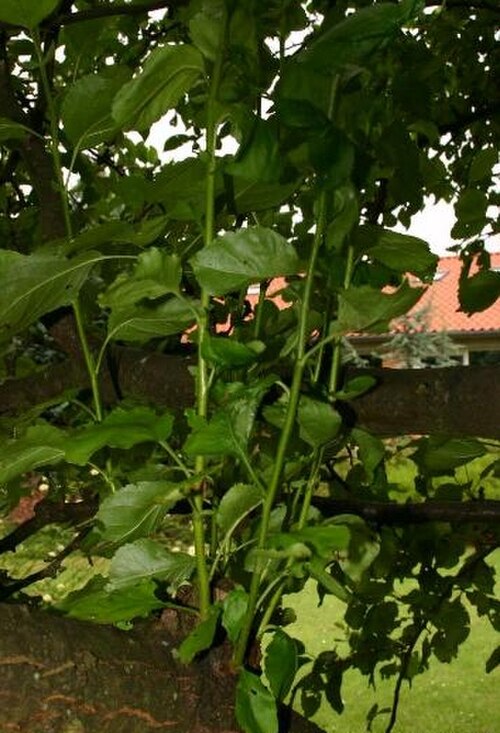 Watershoots
 -
 The verticillate whorls of leaves on Brabejum stellatifolium are unusual among trees in its native region.
 -
 Winged seeds of Catalpa bignonioides are nearly all wing. Tufts at the tips increase aerodynamic drag, thereby improving wind dispersal.
 -
 Leaves of some species of Citrus have winged petioles.
 -
 Senecio haworthii leaves have an unusually dense wooly coat.
X
- xeromorph
- A plant with structural features (e.g. hard or succulent leaves) or functional adaptations that prevent water loss by evaporation; usually associated with arid habitats, but not necessarily drought-tolerant. Compare xerophyte.
- xerophyte
- A plant generally living in a dry habitat, typically showing xeromorphic or succulent adaptation; a plant able to tolerate long periods of drought. Compare xeromorph.
- xylem
- A specialized water-conducting tissue in vascular plants.
Z
- zonate
- Having light and dark circular bands or rings, typically on leaves or flowers.
- zygomorphic
- Bilaterally symmetrical; symmetrical about one vertical plane only; applies to flowers in which the perianth segments within each whorl vary in size and shape. Contrast actinomorphic and irregular.
- zygote
- A fertilized cell, the product of fusion of two gametes.
-
 Zonate markings on the leaves of a garden variety of Pelargonium zonale
 -
 Like most of the genus Pelargonium, and unlike most members of the genus Geranium, Pelargonium quercifolium bears flowers that are bilaterally symmetrical. Accordingly, because the yoke of an ox is bilaterally symmetrical, such flowers are said to be zygomorphic, which literally means "yoke-shaped".
See also

- Floral formula – abbreviations used in describing flower parts
- Glossary of biology
- Glossary of plant morphology
- Glossary of leaf morphology
- Glossary of lichen terms
- Glossary of mycology
- Glossary of scientific naming
- Plant morphology
References
- ^ New Oxford Dictionary v1 2007, p. 2.
- ^ a b c Harris & Harris 2001, p. 3.
- ^ New Oxford Dictionary v1 2007, p. 7.
- ^ New Oxford Dictionary v1 2007, p. 8.
- ^ Shreve & Wiggins 1964, p. 738.
- ^ Shreve & Wiggins 1964, p. 355.
- ^ Shreve & Wiggins 1964, p. 351.
- ^ New Oxford Dictionary v1 2007, p. 16.
- ^ Turland et al. 2018, Article 18.
- ^ IPNI 2022.
- ^ a b Harris & Harris 2001, p. 4.
- ^ Harris & Harris 2001, pp. 4–5.
- ^ a b c d e f g h i Harris & Harris 2001, p. 5.
- ^ Sims 1803, [p. 93].
- ^ Harris & Harris 2001, p. 6.
- ^ Cappers & Neef 2012, p. 95.
- ^ Pell & Angell 2016, p. 15.
- ^ Pell & Angell 2016, p. 16.
- ^ Pell & Angell 2016, p. 17.
- ^ Pell & Angell 2016, p. 20.
- ^ Pell & Angell 2016, p. 24.
- ^ Pell & Angell 2016, p. 27.
- ^ Pell & Angell 2016, p. 35.
- ^ Pell & Angell 2016, p. 39.
- ^ a b Pell & Angell 2016, p. 41.
- ^ Pell & Angell 2016, p. 46.
- ^ Pell & Angell 2016, p. 47.
- ^ a b c d e Jackson 1928.
- ^ a b Jaeger 1959.
- ^ Pell & Angell 2016, p. 58.
- ^ Beentje 2010, p. 33.
- ^ a b Hanzawa, Beattie & Holmes 1985.
- ^ Pell & Angell 2016, p. 78.
- ^ a b Schulze & Zwölfer 2012, p. 261.
- ^ Pell & Angell 2016, p. 83.
- ^ Copied definition from Wiktionary entry for faculative biology adjective. See that page's history for attribution.
- ^ Copied definition from Wiktionary entry for fimbriate biology adjective. See that page's history for attribution.
- ^ Rendle 1911.
- ^ Hickey & King 2000, p. 20, 87.
- ^ Hickey & King 2000, p. 20.
- ^ a b Carolin & Tindale 1994, p. 23.
- ^ Beentje 2010, p. 67.
- ^ "Glossary: P". Go Botany. Native Plant Trust. Archived from the original on 28 September 2023. Retrieved 4 January 2024.
- ^ Meerow et al. 1999.
- ^ Eckenwalder 2009, pp. 648–661.
- ^ Pell & Angell 2016, p. 169.
- ^ a b Beentje 2010, p. 107.
- ^ Kucewicz, Maćkiewicz & Źróbek-Sokolnik 2010.
- ^ Brodie 1951.
- ^ Mandal & Bar 2018, p. 64.
- ^ Beach 1914a.
- ^ Beach 1914b.
- ^ "tuberculate". Dictionary of botany. Retrieved 7 January 2024.
- ^ Harris & Harris 2001, p. 132.
- ^ New Oxford Dictionary v2 2007, p. 3534.
- ^ Beentje 2010, p. 129.
- ^ Carr, G.W., in Foreman & Walsh, 1993.
Bibliography
- Allaby, Michael (2012). A Dictionary of Plant Sciences. Oxford University Press. ISBN 978-0-19-960057-1 – via Google Books (preview only).
- Beach, Chandler B., ed. (1914a). "Tetrad". The New Student's Reference Work. Chicago: F. E. Compton and Co.
- Beach, Chandler B., ed. (1914b). "Tetraspore". The New Student's Reference Work. Chicago: F. E. Compton and Co.
- Beentje, Henk (2010). The Kew Plant Glossary, an Illustrated Dictionary of Plant Terms. Richmond, London: Kew Publishing. ISBN 978-1-84246-422-9.
- Brodie, Harold J. (May 1951). "The splash-cup dispersal mechanism in plants". Canadian Journal of Botany. 29 (3). Ottawa, Ontario: Canadian Science Publishing: 224–234. doi:10.1139/b51-022.
- Cappers, René T.J.; Neef, Reinder (2012). Handbook of Plant Palaeoecology. Barkuis Publishing. ISBN 9789492444264 – via Google Books (preview only).
- Carolin, Roger C.; Tindale, Mary D. (1994). Flora of the Sydney Region (4th ed.). Chatswood, NSW: Reed. ISBN 0730104001. OCLC 32821788.
- Don, George (1831). A General History of Dichlamydeous Plants...Arranged According to the Natural System. Vol. 1. London. Retrieved 15 December 2022 – via Biodiversity Heritage Library.
- Eckenwalder, James E. (2009). Conifers of the World: the Complete Reference. London: Timber Press. ISBN 978-0-88192-974-4.
- Gifford, Ernest M.; Foster, Adriance S. (1989). Morphology and Evolution of Vascular Plants (3rd ed.). W. H. Freeman. ISBN 978-0-7167-1946-5.
- Hanzawa, Frances M.; Beattie, Andrew J.; Holmes, Anne (November 1985). "Dual function of the elaiosome of Corydalis aurea (Fumariaceae): attraction of dispersal agents and repulsion of Peromyscus maniculatus, a seed predator". American Journal of Botany. 72 (11). St. Louis, Missouri: Botanical Society of America: 1707–1711. doi:10.1002/j.1537-2197.1985.tb08442.x. JSTOR 2443727.
- Harris, James G.; Harris, Melinda Woolf (2001). Plant Identification Terminology: an Illustrated Glossary (2nd ed.). Spring Lake, Utah, US: Spring Lake Publishing. ISBN 0-9640221-6-8.
- Hickey, Michael; King, Clive (2000). The Cambridge Illustrated Glossary of Botanical Terms. Cambridge, England: Cambridge University Press. ISBN 978-0-521-79401-5 – via Google Books.
- Hughes, Colin (2017). "About the Field Guides Project". The Virtual Field Herbarium (herbaria-old.plants.ox.ac.uk). Oxford University Herbaria. Archived from the original on 5 March 2017. Retrieved 4 March 2017.
- * "Plant Characteristics". The Virtual Field Herbarium (herbaria-old.plants.ox.ac.uk). Archived from the original on 5 March 2017. Retrieved 4 March 2017. In Hughes (2017).
- IPNI (2022). "Rosaceae Juss., Gen. Pl. [Jussieu] 334 (1789), nom. cons". International Plant Names Index (IPNI). Royal Botanic Gardens, Kew; Harvard University Herbaria & Libraries; Australian National Botanic Gardens. Retrieved 24 December 2022.
- Jackson, Benjamin Daydon (1928). A Glossary of Botanic Terms with their Derivation and Accent. New York: Hafner Publishing Co. Inc. Retrieved 15 December 2022 – via Biodiversity Heritage Library.
- Jaeger, Edmund Carroll (1959). A Source-book of Biological Names and Terms. Springfield, Illinois, US: Thomas. ISBN 978-0-398-06179-1 – via Internet Archive.
- Kucewicz, Magdalena; Maćkiewicz, Katarzyna; Źróbek-Sokolnik, Anna (2010). "Selected aspects of tiny vetch [Vicia hirsuta (L.) Gray S.F.] seed ecology: generative reproduction and effects of seed maturity and seed storage on seed germination". Acta Agrobotanica. 63 (1). Warsaw: Polish Botanical Society: 205–212. doi:10.5586/aa.2010.023.
- Lellinger, David B. (2002). A Modern Multilingual Glossary for Taxonomic Pteridology (Pteridologia) (in English, Spanish, French, and Portuguese). Vol. 3. American Fern Society, Inc. ISBN 978-0-933500-02-0. Retrieved 15 December 2022 – via Biodiversity Heritage Library.
- Mandal, R. N.; Bar, R. (2018). Mangroves for Building Resilience to Climate Change. CRC Press. ISBN 9780429946974 – via Google Books.
- Meerow, Alan W.; Fay, Michael F.; Guy, Charles L.; Li, Qin-Bao; Zaman, Faridah Q.; Chase, Mark W. (September 1999). "Systematics of Amaryllidaceae based on cladistic analysis of plastid sequence data". American Journal of Botany. 86 (9). St. Louis, Missouri: Botanical Society of America: 1325–1345. doi:10.2307/2656780. JSTOR 2656780. PMID 10487820.
- Neotropikey (2017). "Glossary of Botanical Terms". www.kew.org. Royal Botanic Gardens, Kew. Archived from the original on 21 January 2017. Retrieved 18 February 2017.
- New Shorter Oxford English Dictionary on Historical Principles (A–M). Vol. 1 (6th ed.). Oxford, England: Oxford University Press. 2007. ISBN 978-0-19-920687-2. Retrieved 17 December 2022 – via Internet Archive.
- New Shorter Oxford English Dictionary on Historical Principles (N–Z). Vol. 2 (6th ed.). Oxford, England: Oxford University Press. 2007. ISBN 978-0-19-920687-2. Retrieved 16 December 2022 – via Internet Archive.
- NYBG (2019). "Glossary for Vascular Plants". The William & Lynda Steere Herbarium, New York Botanical Garden. Retrieved 20 September 2019.
- Pell, Susan K.; Angell, Bobbi (2016). A Botanist's Vocabulary: 1300 Terms Explained and Illustrated. Portland, Oregon, US: Timber Press. ISBN 978-1-604-69563-2.
- Rendle, Alfred Barton (1911). "Fruit". In Chisholm, Hugh (ed.). Encyclopædia Britannica. Vol. 11 (11th ed.). Cambridge University Press. pp. 257–258.
- Schulze, Ernst-Detlef; Zwölfer, Helmut, eds. (2012). Potentials and Limitations of Ecosystem Analysis, Extinction and Naturalization of Plant Species. Springer Berlin Heidelberg. ISBN 9783642716300. Retrieved 16 December 2022 – via Google Books (preview only).
- Shreve, Forrest; Wiggins, Ira L. (1964). Vegetation and Flora of the Sonoran Desert. Vol. 1. Stanford, California, US: Stanford University Press. ISBN 9780804701631. OCLC 710084 – via Internet Archive.
- Simpson, Michael G. (August 2011). Plant Systematics. Academic Press. ISBN 978-0-08-051404-8 – via Google Books (preview only).
- Sims, John (1803). Curtis's Botanical Magazine, Or, Flower-garden Displayed: In which the Most Ornamental Foreign Plants, Cultivated in the Open Ground, the Green-house, and the Stove, are Accurately Represented in Their Natural Colours ... Vol. 17. London: T. Curtis. Retrieved 15 December 2022 – via Google Books.
- Stearn, William T. (1983). Botanical Latin (3rd ed.). Newton Abbot & London & North Pomfret, Vermont, US: David & Charles. ISBN 0-7153-8548-8. Retrieved 15 December 2015 – via Internet Archive.
- Turland, N.J.; Wiersema, J.H.; Barrie, F.R.; Greuter, W.; Hawksworth, D.L.; Herendeen, P.S.; Knapp, S.; Kusber, W.-H.; Li, D.-Z.; Marhold, K.; May, T.W.; McNeill, J.; Monro, A.M.; Prado, J.; Price, M.J.; Smith, G.F., eds. (2018). International Code of Nomenclature for algae, fungi, and plants (Shenzhen Code) adopted by the Nineteenth International Botanical Congress Shenzhen, China, July 2017. Regnum Vegetabile. Vol. 159. Glashütten, Germany: Koeltz Botanical Books. doi:10.12705/Code.2018. ISBN 978-3-946583-16-5. OCLC 1043552267. Retrieved 21 December 2022.
External links
Look up Category:li:Plants in Wiktionary, the free dictionary.
- Glossary at APweb
- A glossary of botanical terms (in English at Flora, etc.)
- Garden Web
- eFloras
- Categorical Glossary for the Flora of North America Project
Royal Botanical Gardens at Kew
- Standard glossary (archive)
- Stuppy, W. Glossary of Seed and Fruit Morphological Terms
Australia and New Zealand
- University of Sydney: Eflora—Glossary
- Florabase (Western Australia)
- Flora of Australia Online Glossary
- Flora of Australia Abbreviations
- Flora of S Australia
- Botany Word of the Day—Illustrated with New Zealand natives
- New Zealand Plant Conservation Network
Africa
- Herman, P. P. J. (2015). "Botanical glossary" (PDF). SANBI. Archived from the original (PDF) on 18 October 2020. Retrieved 21 May 2020.
- Plants of southern Africa (Archived 17 October 2016 at the Wayback Machine)