
Loading article…
| 総人口 | ||||||||||||||||||||||||||||
|---|---|---|---|---|---|---|---|---|---|---|---|---|---|---|---|---|---|---|---|---|---|---|---|---|---|---|---|---|
| 812,728人(2021年国勢調査)[1] オーストラリアの人口の3.2% | ||||||||||||||||||||||||||||
| 州/地域別の人口分布 | ||||||||||||||||||||||||||||
| ||||||||||||||||||||||||||||
| 言語 | ||||||||||||||||||||||||||||
| 主に英語(オーストラリア英語、オーストラリア先住民英語、少数のトレス海峡英語) 少数派: オーストラリア先住民の言語(歴史的) トレス海峡クレオール語 オーストラリアクリオール語 | ||||||||||||||||||||||||||||
| 宗教 | ||||||||||||||||||||||||||||
| ||||||||||||||||||||||||||||
| 関連民族 | ||||||||||||||||||||||||||||
| パプア人、メラネシア人 | ||||||||||||||||||||||||||||
先住民オーストラリア人は、イギリスによる植民地化 以前に現在のオーストラリア領土内に住んでいた様々な民族グループの血統を受け継いだ、またはそれらのグループの一員として認められている人々です。[3] [4]彼らは、多くの民族グループを含む2つの異なるグループで構成されています。本土とタスマニアを含む多くの島々に住むアボリジニオーストラリア人と、メラネシアに位置するクイーンズランド州とパプアニューギニアの間の海域に住むトレス海峡諸島民です。
2021年オーストラリア国勢調査では、 812,728人がアボリジニおよび/またはトレス海峡諸島民出身であると自認しており、オーストラリアの総人口の3.2%を占めている。これらの先住民オーストラリア人のうち、91.4%がアボリジニ、4.2%がトレス海峡諸島民、4.4%が両方のグループに属していると自認している。 [5]しかし、政府は、2021年6月30日現在、983,700人のアボリジニとトレス海峡諸島民がおり、オーストラリアの総人口の3.8%を占めていると述べており、これは「最終的な2021年国勢調査に基づく推定居住人口」である。これらのうち、91.7%がアボリジニ、4.0%がトレス海峡諸島民、4.3%が両方のグループに属していると自認している。[6]
「アボリジニとトレス海峡諸島民」あるいはその人の特定の文化グループという用語が好まれることが多いが、「オーストラリア先住民族」、「オーストラリア先住民族」、「先住民オーストラリア人」という用語もますます一般的になってきている。 [7] [a] 1995年以来、オーストラリア先住民の旗とトレス海峡諸島民の旗はオーストラリアの公式旗となっている。
オーストラリアに最初の人類が到着した時期については議論があり、現在も調査が続けられている。オーストラリアで発見された最も古い人類の遺骨は、マンゴマン LM3 とマンゴレディのもので、約4万年前のものとされているが[10] 、先住民オーストラリア人は6万5千年以上前からオーストラリアに住んでいた可能性が高い。[11]最終氷期後の海水上昇により数千年にわたって孤立していたオーストラリアの先住民アボリジニの人々は、さまざまな地域文化や言語を発達させ、独特の芸術的・宗教的伝統を生み出し、狩猟、火打ち石農業、そしておそらくは犬の導入を通じて、さまざまな形で大陸の環境に影響を与えた。ブーメランや槍などの戦争や狩猟の技術は、ディジュリドゥなどの楽器と同様に、自然素材で作られていた。
先住民オーストラリア人の間には多くの文化的共通点があるが、異なるコミュニティ間にも大きな多様性がある。[12] 2022年のオーストラリア国勢調査では、約76,978人の先住民とトレス海峡諸島民が自宅で167のアボリジニとトレス海峡諸島民の言語を使用していることが記録されている。[5]ヨーロッパ人が植民地化した当時、250以上のアボリジニ言語があったと推定されている。現在では、残りの13の先住民言語を除くすべての言語が絶滅の危機に瀕していると推定されている。[13] [14]今日、アボリジニの人々は主に英語を話し、アボリジニのフレーズや単語が追加されてオーストラリアのアボリジニ英語が作られている(音韻と文法構造にも先住民言語の具体的な影響がある)。オーストラリアの地名の約4分の3はアボリジニ起源である。[15]
ヨーロッパ人が入植する前の先住民の人口は少なく、総数は31万8千人[16]から300万人以上[17]と幅広く推定されており、分布は現在のオーストラリアの人口と似ており、大多数は南東部、マレー川沿いに集中している。[18]イギリス人入植者の第1船団は、先住民と「友好と親切に暮らす」ようにという指示を受けて到着した。[19]しかし、ヨーロッパ人の植民地化の後、主に病気による人口減少が起こり、[20] [21]ヨーロッパ人の到着から3年後に広がった天然痘の流行が始まった。ヨーロッパ人入植者を巻き込んだ虐殺や国境紛争も人口減少の一因となった。[22] [23] 19世紀から20世紀半ばにかけて、政府の政策により多くの混血児がアボリジニ社会から排除され、これは「彼らを故郷に連れ戻す」報告書(1997年)で「大量虐殺」と判断された。[24] [25]
用語

バリエーション
オーストラリアの先住民を指す際に使用する適切な用語は数多くあるが、先住民を指す際には「個人、家族、コミュニティの好みを尊重し、彼らが最も心地よいと思うものを定義できるようにする」ことが重要であることについては、一般的に合意されている。[7]
「アボリジニ」という単語は、少なくとも16世紀から英語で「最初の、または最も古い、先住民」という意味で使われてきました。これはラテン語の ab(から)とorigo(起源、始まり)に由来しています。[26]この用語は、オーストラリアでは1789年にはすでにアボリジニの人々を表すために使われていました。大文字で表記されるようになり、アボリジニとトレス海峡諸島民の両方を指す共通名として使われましたが、今日では後者はこの用語に含まれていません。「アボリジニ」という用語は(「アボリジニ」の反対語として)植民地主義的な意味合いを持つと見なされ、しばしば好まれません。[3] [7] [27]
「先住民オーストラリア人」という用語は1980年代から人気が高まっているが[28] 、多くのアボリジニとトレス海峡諸島民は、それが一般的すぎると感じており[9]、自分たちのアイデンティティを奪うと感じてそれを嫌っている。しかし、多くの人々は、この用語は有用で便利であり、適切な場合には使用できると考えている。[7]
近年では、「ファースト・ネーションズ」[29] 、 「ファースト・ピープルズ」[30]、「ファースト・オーストラリアン」という呼称が一般的になってきた。[7]
できるだけ具体的にすること、たとえば言語グループ( Arrernteなど) や地理的な地域に関連する地名 ( Nungaなど) に名前を付けることが、ベストプラクティスであり、最も敬意を表する行為であると考えられています。[誰によると? ]
「ブラック」と「ブラックフェラ」という用語
「ブラック」という用語は、ヨーロッパ人がオーストラリアに植民地化して以来、アボリジニのオーストラリア人を指すのに使われてきた。[31]もともと肌の色に関連していて、しばしば軽蔑的に使われてきたが、[7]今日では、アボリジニの伝統や文化全般を指すために使われ、肌の色素レベルに関係なく、そのような伝統を持つ人々を指す。[32] 1970年代には、ゲイリー・フォーリーなどの多くのアボリジニ活動家が「ブラック」という用語を誇りを持って受け入れ、作家ケビン・ギルバートの当時の本は「リビング・ブラック」と題されていた。この本には、ロバート・ジャバヌンガを含むアボリジニ社会の複数のメンバーへのインタビューが含まれており、現代のアボリジニ文化について考察している。[33]この用語の使用は文脈によって異なり、不適切とみなされる可能性があるため注意が必要である。[7] 「ブラック」という用語は、アフリカ系移民と混同されることがある。[34]
リビング・ブラックは、オーストラリアのニュースと時事問題を扱う番組で、「オーストラリアのアボリジニとトレス海峡諸島民に影響を与える問題」を扱っています。 [35]アレンテ族の女性、カーラ・グラントが司会とプロデューサーを務めています。 [36]
多数のアボリジニとトレス海峡諸島民は、オーストラリアの先住民を指す際に「ブラックフェラ」という用語やその関連語を使用している。 [7] [37] [38]
「ブラック」
「ブラック」という用語は、より広範な社会運動の一部として使用されることがある(「ブラックティビズム」や「ブラック歴史月間」[39]などの用語に見られる)。この用語は、1991年に写真家でマルチメディアアーティストのデスティニー・ディーコンによって、 「Blak lik mi」と題された展覧会で造られた。ディーコンが2004年に現代美術館で行った展覧会では、博物館のガイドで「ブラック」は次のように定義された。「一部のアボリジニの人々が、黒人または黒人であることについての歴史的、表現的、象徴的、ステレオタイプ的、ロマンチックな概念を取り戻すために使用する用語。多くの場合、武器やインスピレーションとして使用される。」[40]ディーコンは、 「「黒人の女」という用語の武器化を解除する」ために「ブラック」から「 c」を削除すること[41]は、 「「植民地主義者」の言語を引き受けて、それをひっくり返すこと」であると述べた。[42] 現代のアボリジニ芸術は「ブラック」芸術運動と呼ばれることもあり、ブラックダンス、[43]ブラックラッシュ・コレクティブ、[44]テルマ・プラムの歌とアルバムのタイトル「ベター・イン・ブラック」、メルボルンのブラック&ブライト文学祭、[45]ブラック・ドット・ギャラリー、ブラック・マーケット、ブラック・キャバレーなどの名前に反映されています。[42]
地域グループ
先住民グループ


オーストラリアの先住民族は、トレス海峡諸島を除くオーストラリア本土および関連する島々に居住するさまざまな民族です。
オーストラリア先住民という広い用語には、現地の言語、地域、または近隣のグループからの呼び名に基づいて識別される可能性のある多くの地域グループが含まれます。一部のコミュニティ、文化、またはグループは他のコミュニティを包含し、変化したり重複したりする場合があります。植民地化後の世代で大きな変化が起こっています。「コミュニティ」という言葉は、血縁関係、言語、または特定の場所や「国」への所属によって識別されるグループを説明するためによく使用されます。コミュニティは個別の文化的価値観に基づいている場合があり、個人はオーストラリア内の複数のコミュニティに属する可能性があります。それらのコミュニティ内での識別は採用される場合もあれば、拒否される場合もあります。個々のコミュニティは多くの名前で識別される可能性があり、それぞれに別の英語の綴りがある場合があります。

民族の命名は複雑で多層的であるが、その例としては、南オーストラリア州北部と西オーストラリア州およびノーザンテリトリーの隣接地域のアナング族、オーストラリア中央部のアレンテ族、ニューサウスウェールズ州およびビクトリア州のクーリ族(またはクーリー族、ビクトリア州のアボリジニ)、クイーンズランド州南東部およびニューサウスウェールズ州北部の一部のグーリー族(クーリの発音および綴りの変形)、クイーンズランド州およびニューサウスウェールズ州北部で特定の集団名が使用されていない地域で使用されているムリ族、ノーザンテリトリー沖のティウィ諸島のティウィ族、およびタスマニア島のパラワ族などが挙げられる。最大のアボリジニコミュニティであるピチャンチャチャラ族、アレンテ族、ルリジャ族、ワルピリ族はすべて中央オーストラリア州出身である。[要出典]
大陸の歴史を通じて、多くの異なるアボリジニのグループが存在し、それぞれが独自の言語、文化、信仰構造を持っていました。イギリス人が入植した当時、200を超える異なる言語がありました。[46]

タスマニアの先住民は、最終氷期に島とオーストラリア本土の残りの部分を結ぶ陸橋を経由して、約4万年前に初めてタスマニアに渡ったと考えられている。[47]ヨーロッパ人が到着する前のタスマニアの先住民の人口は3,000人から15,000人と推定されているが、遺伝子研究ではそれよりかなり高い数字が示唆されており、これは、入植前にイギリス人とアメリカ人のアザラシ猟師によって持ち込まれた病気のために人口が減少したことを示す先住民の口承によって裏付けられている。[48] [b]当初の人口は、病気、 [49]戦争、およびイギリス人入植者のその他の行動により、 1803年から1833年の間に約300人にまでさらに減少した。[50]この絶滅寸前の状況の原因が誰または何であるかについて170年以上議論されているが、その起源、プロセス、またはそれがジェノサイドであったかどうかについてはコンセンサスが得られていない。しかし、ベンジャミン・マドレーによれば、「国連の定義によれば、タスマニアの大惨事を大量虐殺と指定するのに十分な証拠が存在する」という。[48] 1876年に亡くなったトゥルガーナンナー(トゥルガニニと表記されることが多い)という女性は、当時も今も「純血」のタスマニア先住民の最後の一人であると広く信じられている。しかし、1889年に議会はファニー・コクラン・スミス(1905年没)を「純血」のタスマニア先住民の最後の生き残りとして認定した。[c] [d]
2016年の国勢調査では、タスマニア州には23,572人の先住民オーストラリア人が住んでいると報告されている。[51]
トレス海峡諸島民
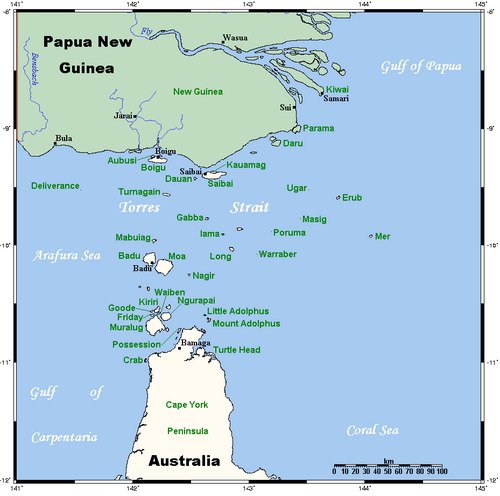
トレス海峡諸島民は、アボリジニの伝統とは異なる遺産と文化史を持っている。特に東部トレス海峡諸島民はニューギニアのパプア人と関係があり、パプア語を話す。[52]したがって、彼らは一般的に「アボリジニオーストラリア人」という呼称には含まれない。これは、より包括的な「先住民オーストラリア人」という用語を推進するもう1つの要因となっている。先住民オーストラリア人の6%は、完全にトレス海峡諸島民であると自認している。さらに4%の先住民オーストラリア人は、トレス海峡諸島民とアボリジニの両方の遺産を持っていると自認している。[53]
トレス海峡諸島は100以上の島々から構成されており[54]、1879年にクイーンズランド州に併合されました[54]。多くの先住民組織は、オーストラリアの先住民人口におけるトレス海峡諸島民の独自性と重要性を強調するために、「アボリジニとトレス海峡諸島民」というフレーズを取り入れています。
エディ・マボは、1992年の有名なマボ判決の対象となったトレス海峡の「マー」またはマレー島の出身でした。[54]
-
![トレス海峡諸島民先住民の地理的分布[55]](https://img-server.japedia.wiki/wikipedia/commons/thumb/e/e9/Torres_Strait_Islander_Indigenous_Status.jpg/500px-Torres_Strait_Islander_Indigenous_Status.jpg) トレス海峡諸島民先住民の地理的分布[55]
トレス海峡諸島民先住民の地理的分布[55] -
![アボリジニとトレス海峡諸島民の先住民としての地位を持つ人々の地理的分布[55]](https://img-server.japedia.wiki/wikipedia/commons/thumb/3/3d/Both_Aboriginal_and_Torres_Strait_Islander_Indigenous_Status.jpg/500px-Both_Aboriginal_and_Torres_Strait_Islander_Indigenous_Status.jpg) アボリジニとトレス海峡諸島民の先住民族としての地位を持つ人々の地理的分布[55]
アボリジニとトレス海峡諸島民の先住民族としての地位を持つ人々の地理的分布[55] -
![トレス海峡諸島民の地理的分布[55]](https://img-server.japedia.wiki/wikipedia/commons/thumb/5/53/Torres_Strait_Islander_ancestry.jpg/500px-Torres_Strait_Islander_ancestry.jpg) トレス海峡諸島民の地理的分布[55]
トレス海峡諸島民の地理的分布[55] -
![トレス海峡諸島民の人口がかなりの割合を占める地域における住民の先住民としての地位[55]](https://img-server.japedia.wiki/wikipedia/commons/thumb/a/a5/Torres_Strait_Islander_localities_by_Indigenous_Status.jpg/500px-Torres_Strait_Islander_localities_by_Indigenous_Status.jpg) トレス海峡諸島民の人口がかなりの割合を占める地域における住民の先住民としての地位[55]
トレス海峡諸島民の人口がかなりの割合を占める地域における住民の先住民としての地位[55] -
![トレス海峡諸島民の人口がかなりの割合を占める地域の住民の祖先(トレス海峡諸島民またはその他の人々)[55]](https://img-server.japedia.wiki/wikipedia/commons/thumb/a/af/Torres_Strait_Islander_localities_by_ancestry.jpg/500px-Torres_Strait_Islander_localities_by_ancestry.jpg) トレス海峡諸島民の人口がかなりの割合を占める地域の住民の祖先(トレス海峡諸島民またはその他)[55]
トレス海峡諸島民の人口がかなりの割合を占める地域の住民の祖先(トレス海峡諸島民またはその他)[55] -
![トレス海峡諸島民の人口がかなりの割合を占める地域におけるトレス海峡諸島民が家庭で使用している言語[55]](https://img-server.japedia.wiki/wikipedia/commons/thumb/6/6f/Torres_Strait_Islander_Languages_used_at_home.jpg/500px-Torres_Strait_Islander_Languages_used_at_home.jpg) トレス海峡諸島民の人口がかなりの割合を占める地域におけるトレス海峡諸島民が家庭で使用している言語[55]
トレス海峡諸島民の人口がかなりの割合を占める地域におけるトレス海峡諸島民が家庭で使用している言語[55] -
![トレス海峡諸島民の人口がかなりの割合を占める地域におけるトレス海峡諸島民の宗教的所属[55]](https://img-server.japedia.wiki/wikipedia/commons/thumb/2/2a/Torres_Strait_Islander_Religious_affiliation.jpg/500px-Torres_Strait_Islander_Religious_affiliation.jpg) トレス海峡諸島民の人口がかなりの割合を占める地域におけるトレス海峡諸島民の宗教的所属[55]
トレス海峡諸島民の人口がかなりの割合を占める地域におけるトレス海峡諸島民の宗教的所属[55]
その他のグループ
アボリジニやトレス海峡諸島民も、自分たちの生態学的環境に関連した形容詞で自分たちを指すことがある。例えば、沿岸部に住む人々を塩水民(トレス海峡諸島民[56]を含む)、[57] [58 ] [ 59 ] [60] [61] 淡水民、[62] [63] 熱帯雨林民、[64] [65] [66] 砂漠民、[67] [68] [69]あるいはスピニフェックス民[9](後者は西オーストラリア州のピラ・ングールを指す)[70] [71]
歴史
オーストラリアへの移住
先住民
オーストラリアにおける人類の居住地は、約49,000年前に遡ることが判明している。 [72] [73] オーストラリア北部の岩陰にあるマジェドベベの石造遺物の周囲の堆積物のルミネッセンス年代測定によると、65,000年前に人類が活動していたことがわかった。 [74]遺伝子研究では、到着時期は50~70,000年前であることが裏付けられている。[75]
オーストラリア(およびアフリカ以外)で発見された最も古い解剖学的に現代的な人間の遺骨は、マンゴマンのものであり、42,000年前のものと年代測定されている。[10] [76]マンゴ湖3号(LM3)として知られる骨格のミトコンドリアDNAを古代および現代のアボリジニの人々のものと最初に比較したところ、マンゴマンはオーストラリアのアボリジニの人々とは関連がないことが示された。[77]しかし、これらの発見は科学界で一般的に受け入れられていない。[要出典]この配列は独立した検査が行われていないため批判されており、結果はDNAの死後の改変と熱による劣化によるものである可能性が示唆されている。[78] [79] [80] [81]議論の余地のある結果は、マンゴマンが現代人の最も最近の共通祖先より前に分岐した絶滅した亜種であった可能性があることを示しているようですが、[77]マンゴ国立公園の管理機関は、現在の地元の先住民はマンゴ湖の遺跡の子孫であると考えています。[82]先住民の管理者がさらなる侵襲的な調査を許可するとは予想されていないため、独立したDNA検査が行われる可能性は低いです。[83]
先住民は、東アジア人の祖先から分岐した、大陸への単一移住者の子孫であると一般に信じられています。[84] [85]
ミトコンドリアDNAを使った最近の研究では、観察された遺伝的多様性を生み出す創始者集団は1,000人から3,000人の女性であったと示唆されており、「大陸への初期の植民地化には、数百人の人々が関与する意図的な組織的な海上移動が必要だった」ことを示唆している。[86]アボリジニの人々は、現在絶滅したオーストラリアの大型動物と同じ環境で長い間暮らしていたようだ。[87]
木炭や遺物の分析から、人類の使用を示す証拠は、65,000年前という早い時期から存在していることを示唆している。 [88] [89] 発光年代測定法では、アーネムランドに6万年前から居住していたことが示唆されている。[ 90]ビクトリア州南西部の火災の証拠は、「12万年前にオーストラリアに人類が存在していた」ことを示唆しているが、さらなる研究が必要である。[91]
遺伝学
遺伝子研究により、オーストラリア先住民は主に初期後期旧石器時代の東ユーラシア人の人口波の子孫であり、メラネシア人などの他のオセアニア人と最も近縁であることが明らかになっています。オーストラリア先住民は、ネグリト人などの他のオーストラレーシア人や、アンダマン人などの古代祖先南インド人グループ、および東アジアの人々とも類似性を示しています。系統発生データによると、初期の東部非アフリカ人(ENA)または東ユーラシア人のメタ集団が三分化し、オーストラリア人(オセアニア人)、古代祖先南インド人、アンダマン人、およびネイティブアメリカンの祖先を含む東アジア/東南アジアの系統を生み出したが、パプア人はまた、サフル地域での追加の古代混合に加えて、約2%の以前のグループ(xOOA)からの遺伝子流入も受けた可能性がある。[92] [93 ] [e] [94]

Rasmussen et al 2011 は、オーストラリア先住民はアジア人に比べてヨーロッパの対立遺伝子の割合が低いことを示しており、これは多重分散モデルを示していると彼らは考えています。[96]遺伝的には、オーストラリア先住民はメラネシア人やパプア人と最も近縁ですが、McEvoy et al 2010 [97]は、古代祖先南インド人の混合またはより最近のヨーロッパの影響を示す可能性のある別の要素もあると考えています。研究によると、単一の創始者サフル族グループがあり、その後、地域集団間で孤立したことが示されています。これらの集団は、4~5,000年前にディンゴを持ち込んだ可能性があるアジア本土からの後の移住による影響は比較的受けませんでした。この研究では、約32,000年前にニューギニアのパプア人やフィリピンのママナワ人から分岐し、約5,000年前に人口が急速に増加したことも示唆されています。[97] 2011年の遺伝子研究では、アボリジニ、パプア、ママヌワの人々がアジアのデニソワ人に関連する対立遺伝子のいくつかを持っているという証拠が見つかりました(アジア本土の集団には見つかりませんでした)。これは、オーストラリアがニューギニアから分離してオーストラリアに移住する前の約44,000年前に、現代人と古代人がアジアで混血していたことを示唆しています。[98] [99] 2012年の論文では、インドからオーストラリア北部へのかなりの遺伝子の流れが4000年強前にあったと推定される証拠もあると報告されており、この時期には道具技術や食品加工の変化がオーストラリアの考古学的記録に現れており、これらが関連している可能性があることを示唆しています。[100] Mallick et al. 2016およびMark Lipson et al. 2017年の研究では、東ユーラシア人と西ユーラシア人の分岐は少なくとも45,000年前に遡り、オーストラリア人は東ユーラシア人の系統群内に位置していたことが判明した。[84] [85]
オーストラリア先住民の男性はハプログループ C-M347 を高頻度に保有しており、ピーク時には 60.2% [101]から68.7% と推定されています。[102]さらに、極めて古いハプログループ K2の基底型 K2* (K-M526) は、そのサブクレードであるハプログループ R、ハプログループ Q、ハプログループ M、ハプログループ S がヨーロッパ人、北南アジア人、ネイティブアメリカン、オセアニアの先住民の大部分に見られますが、現在生きている人間ではオーストラリア先住民のアボリジニにしか見つかっていません。彼らの 27% が K2* を保有している可能性があり、オーストラリア先住民の男性の約 29% がK2b1のサブクレード、別名MとSに属しています。[103]
オーストラリアの先住民は、mtDNAハプログループMとハプログループNの両方の系統を深く根付かせている。[104]
トレス海峡諸島
インドネシア諸島とニューギニアからオーストラリア本土に人々が移住したのは約7万年前と推定されているが、 [105] 2020年現在、[update]考古学者によってトレス海峡での人類の定住の証拠が発見されたのは、約2500年前まで遡るのみである。[106] [107]
ヨーロッパとの接触以前
先住民
.jpg/500px-thumbnail.jpg)
一部の地域の先住民は、土地から食べ物を狩り、採集する採食民や狩猟採集民として暮らしていました。先住民社会は一般的に移動性があり、半遊牧民で、季節の移り変わりとともにさまざまな地域で見つかる食料の入手可能性に応じて移動していましたが、生活様式や物質文化は地域によって大きく異なり、一部の地域では恒久的な集落[108]や農業[109]がありました。人口密度が最も高かったのは大陸の南部と東部、特にマレー川渓谷でした[110] 。マレー川では樹皮で カヌーが作られていました。

外部との接触以前に、オーストラリアの先住民の一部のグループが農業の要素を含む複雑な生活システムを持っていたという証拠がいくつかあるが、それはヨーロッパ人探検家によってのみ記録されている。ある初期の入植者は、ビクトリア州で近くに住んでいたワタウルング族の生活様式についてメモを取っていた。彼は、女性たちがムルノン塊茎を収穫しているのを見た。ムルノン塊茎は、現在ではほぼ絶滅している在来のヤムイモである。しかし、収穫していた地域はすでに他の植物が伐採されていたため、ムルノン(ヤムデイジーとしても知られる)だけを収穫するのは容易だった。[110]
オーストラリアの北海岸では、パースニップのヤムイモは、同じ場所で再び育つように、ヤムイモの下部を地面に刺したままにして収穫されていました。[111]世界中の他の多くの農民と同様に、アボリジニの人々は、土壌の栄養分を豊かにするために焼畑農業を行っていました。しかし、後にヨーロッパ人によって持ち込まれた羊や牛は、この土壌を踏み荒らして台無しにしました。[111]アボリジニの農法の複雑さをさらに増すのは、農民が意図的に種子を交換し、自然に生息していない場所で植物を育て始めたことです。[112]実際、オーストラリアのアボリジニが農地を複雑な方法で管理した例は非常に多く、オーストラリアの人類学者ノーマン・ティンデール博士は、かつて作物が生産されていた特定の地域を詳細に説明したアボリジニ穀物ベルトを描くことができました。[113]
養殖業に関しては、探検家トーマス・ミッチェルは、ブルーワリーナのダーリング川に大きな石造りの魚捕り罠があることに気付いた。それぞれの罠は池を覆い、後に閉じられる小さな入り口から魚を捕らえる。罠は洪水や干ばつの間の水位の変化に対応するために、異なる高さに設置された。[114]
ヨーロッパ人と接触する前のオーストラリア先住民社会で使用されていた技術には、武器、道具、住居、船、伝言棒などがあった。武器にはブーメラン、石や魚の骨の先端が付いた槍(ウーメラで投げることもある)、棍棒、(まれに)斧などがあった。[115]石器時代の道具には、刃を研磨したナイフ、研磨器具、食事用の容器などがあった。繊維工芸は発達しており、繊維製の網、籠、袋が魚釣り、狩猟、液体の運搬に使われた。交易網は大陸全土に広がり、輸送手段にはカヌーも使われた。住居は地域によって異なり、アサートン高原のウィルチャ、アーネムランドの紙の樹皮と糸状の樹皮のシートと高床、現在の南オーストラリア州の鯨骨の小屋、現在のビクトリア州西部の石造りの住居、コランダークで見つかった複数部屋の柱と樹皮の構造物などがある。[116]樹皮でできたテントや片流れ屋根はハンピー、グニャ、ワーリーなどと呼ばれています。衣服には南東部ではポッサムの皮でできた外套、南西部ではブカの外套、北東部ではリジ(真珠貝) などがありました。
オーストラリア北部の先住民の一部は、ヨーロッパ人が到着する以前からインドネシアのマカッサル漁師と定期的に交易を行っていたという証拠がある。 [117] [118]
ヨーロッパ人との最初の接触の時点では、1788年以前の人口は314,000人だったと一般に推定されていますが、最近の考古学的発見では、500,000人から750,000人の人口が維持されていた可能性があることが示唆されており、一部の生態学者は、人口が100万人、さらには200万人に達する可能性もあったと推定しています。[119] [120] [f] より最近の研究では、先住民の人口は500年前に120万人を超えていましたが、過去500年間にユーラシアから病原体が持ち込まれたことでいくらか減少した可能性があることが示唆されています。[86]人口は250の個別の民族に分かれており、[121]その多くは互いに同盟を結んでおり、各民族の中には5、6人から30、40人もの別々の、多くの場合は 関連する氏族が存在していました。各民族には独自の言語があり、いくつかの民族は複数の言語を持っていました。
オーストラリア大陸の現在のクイーンズランド州が占める地域は、接触以前のオーストラリアで最も人口密度の高い地域であったことを示唆する証拠がいくつかあります。[122]また、ニューサウスウェールズ州の北東部、カーペンタリア湾から西にかけての北岸、ノーザンテリトリーと西オーストラリアの一部を含む地域では、アボリジニの人口密度が比較的高かったことを示す兆候もあります。[要出典]
トレス海峡諸島民
トレス海峡の人々の漁業経済は、彼ら自身が建造した船に依存していました。また、大家族が一緒に暮らすために、竹で作った茅葺き屋根の高床式やドーム型の構造物で、大きくて複雑な建物を建てたという証拠もあります。 [110] [信頼できない情報源? ]
イギリスの植民地化
最初の接触

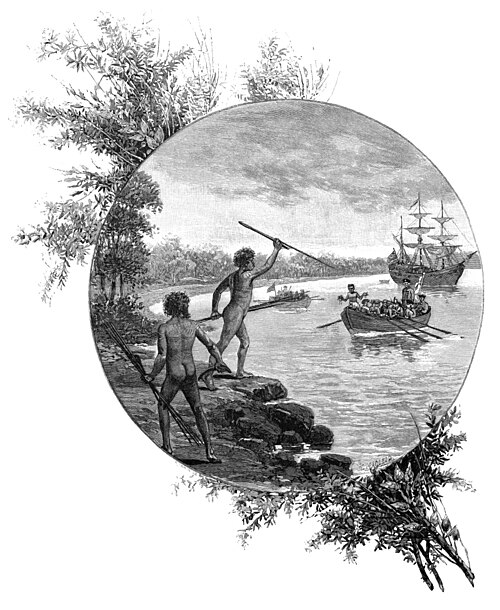
イギリスによるオーストラリア海岸の探検は、1688年と1699年に海賊ウィリアム・ダンピアによって始まった。ダンピアは、オーストラリア西部の海岸の土地にも住民にも感銘を受けなかった。 [123]ほぼ1世紀後、探検家ジェームズ・クックはオーストラリア東海岸の地図を作成し、ジョージ3世の名の下にイギリス領であると宣言した。[124]クックは、出会った土地と住民の両方に感銘を受け、日記に次のように記している。「ニューホランドの原住民について私が述べたことから、彼らは地球上で最も惨めな人々であると思われるかもしれないが、実際には彼らは私たちヨーロッパ人よりもはるかに幸福である。彼らは、ヨーロッパで非常に求められている余分なものだけでなく、必要な便利さにも全く精通していないため、それらの用途を知らないことに満足している。彼らは、不平等な状況に邪魔されることのない平穏な生活を送っている。」[125]
それにもかかわらず、クックは日誌に、ボタニー湾にいた二人の男が「彼の最初の上陸に反対する決心をしていたようだ」とも記している。クックによると、男の一人が石を投げた後、クックは小粒の弾を装填したマスケット銃を発射したが、ほとんど効果はなかったという。[126]弾丸の一部は男の一人の盾に突き刺さり、クックはそれをイギリスに持ち帰り、大英博物館に保管されている。[127]
クックは、現在のクイーンズランド州クックタウン周辺のグーグ・イミティル族と長い時間を過ごした。彼の船はグレートバリアリーフで難破しそうになった。ここでの関係は概ね友好的で、クックは彼らの言語から「カンガルー」を含む単語を記録したが、イギリス人が川からカメを奪い、分け与えなかったために争いが起こった。長老がクックに和解の贈り物として先端の折れた槍を贈ったことで平和が回復した。これは最初の「和解行為」として記憶されている。この出会いは今日までグーグ・イミティル族によって毎年記念されている。[128]
クックがオーストラリア東海岸に好印象を持ったことが、1788年にシドニーで始まったイギリスによるオーストラリア植民地化の始まりに直接つながった。イギリス船団の第一艦隊はアーサー・フィリップ総督の指揮下にあった。総督は「あらゆる手段を講じて原住民との交流を開き、彼らの愛情をなだめる」よう、またイギリス国民に「彼らと友好的に親切に暮らす」よう命じ、「我々が彼らより優れていると彼らに思わせることなく、彼らとの知り合いを育む」よう命じられていた。[19]
地域別の日程

イギリスによるオーストラリアの植民地化は、1788年にニューサウスウェールズ州のボタニー湾に最初の艦隊が到着したことから始まった。その後、タスマニア(1803年)、ビクトリア(1803年)、クイーンズランド(1824年)、西オーストラリア(1826年)、南オーストラリア植民地(1836年)に入植地が設立された。[129]
ノーザンテリトリーにおける最初の入植地は、ゴードン・ブレマー船長がバサースト島とメルヴィル島のティウィ諸島を占領し、ニューサウスウェールズの植民地と宣言した後に建設されたが、その入植は数年後に失敗し、[130]その後の数回の試みとともに失敗し、恒久的な入植地がようやくダーウィンに設立されたのは1869年のことであった。
オーストラリアは、北米やニュージーランドの場合のように、入植者と先住民の所有者との間で合意条件を定めた条約が結ばれなかったという点で、イギリス帝国の植民地化慣行の例外であった。[129]第一艦隊の乗組員の多くは、北米の先住民部族の中で軍事経験を持っており、北半球で慣れ親しんだ首長制や部族のような異質で誤解を招くシステムや概念を、先住民に帰属させる傾向があった。 [131]
トレス海峡諸島におけるイギリスの行政支配は、1862年にロックハンプトンの警察判事ジョン・ジャーディンがトレス海峡の政府駐在官に任命されたことに始まる。ジャーディンは当初アルバニー島に小さな入植地を築いたが、1864年8月1日にサマーセット島に向かった。[132]イギリス人宣教師は1871年7月1日にエルブ島(ダーンリー島)に到着した。 [133] 1872年にクイーンズランド州の境界線が拡大され、クイーンズランド州の海岸から60マイル(97km)以内にあるトレス海峡の木曜日島と他のいくつかの島々が含まれるようになり、1879年にクイーンズランド州は他の島々を併合し、それらはイギリスの植民地クイーンズランドの一部となった。[132]
インパクト
その直接的な影響の一つは、麻疹、天然痘、結核など、ヨーロッパから伝わった病気の流行が続いたことだ。19世紀、天然痘は先住民の死亡の主な原因であり、1840年代までには「先住民」へのワクチン接種が本格的に始まった。[21] 1789年のこの天然痘の流行では、ダルグ族の90%が死亡したと推定されている。流行の原因は議論の余地がある。一部の学者は、ヨーロッパ人入植者が原因だと考えているが、[134] [135]南スラウェシ島や近隣の島々のマカッサル人漁師が、ヨーロッパ人が到着する前にオーストラリアに天然痘を持ち込んだのではないかという主張もある。 [136] 3つ目の説は、流行は第一船団のメンバーとの接触が原因だというものである。[137] 4番目の説は、この流行は天然痘ではなく水痘であり、第一船団のメンバーによって運ばれ、アボリジニの人々には免疫がなかったというものである。[138] [139] [140] [141]さらに、アボリジニの人々は性感染症、特に梅毒と淋病に感染していた。
イギリスの植民地化によるもう一つの結果は、ヨーロッパ人による土地と水資源の奪取であり、カンガルーやその他の食料源の破壊が19世紀から20世紀初頭にかけて続き、農村地帯は羊や牛の放牧地として利用された。[142]入植者たちは先住民女性に対する強姦や強制売春にも加担した。[143]
脱獄囚などのヨーロッパ人の中には、アボリジニやトレス海峡諸島民のコミュニティに住んでいた者もいた。[144]
1834年には、オーストラリアの地形を探索し、人々を見つけることに非常に長けていたアボリジニの追跡者の存在が初めて記録されました。 [145]
1860 年代、タスマニアのアボリジニの頭蓋骨は、頭蓋顔面人体測定学の研究のために特に国際的に求められていました。1876年に亡くなったタスマニアのアボリジニ、トゥルガニニの骨格は、彼女の嘆願にもかかわらず、死後 2 年以内にタスマニア王立協会によって掘り起こされ、後に展示されました。アボリジニの遺体を埋葬のためにオーストラリアに返還する運動は続いており、トゥルガニニの遺体は 1976 年に返還され、火葬され、遺灰は彼女の希望に従って散骨されました。[出典が必要]
地名は、クイーンズランド州ロックハンプトンのジム・クロウ山(現在のバガ山)のように差別や、ブリスベンの境界通りのように人種差別的な政策を明らかにすることがあります。境界通りは、かつてはアボリジニの人々が一日の特定の時間帯に越えることを許されなかった境界線を示していました。[146]これらの名前の多くを変更することについて、現在も議論が続いています。[147] [148]

19世紀から20世紀の大半を通じて、アボリジニとトレス海峡諸島民は、さまざまな州ベースの保護法の管轄下で生活していた。これらの議会法は、先住民オーストラリア人の生活を管理する役割を担うアボリジニ保護官とアボリジニ保護委員会を任命した。 [149]賃金は保護官によって管理され、先住民オーストラリア人は雇用において非先住民よりも収入が少なかった。[150] [151]
この間、多くのアボリジニの人々は、ブラックバーディングとして知られる慣習で、故郷から誘拐された太平洋諸島の人々とともに、入植者による奴隷の犠牲者となった。1860年から1970年の間、保護政策を装って、12歳の子供を含む人々が、恐ろしい環境の下での土地での強制労働を強いられ、ほとんどが賃金を受け取らなかった。[152]真珠産業では、アボリジニの人々は5ポンド程度で買われ、妊娠中のアボリジニの女性は「肺の空気容量が大きいと信じられていたため珍重された」。[153]ロットネスト島のアボリジニ専用刑務所のアボリジニの囚人は、その多くが捏造された容疑で収監されており、鎖につながれて強制労働を強いられた。[154] 1971年、373人のアボリジニ男性が、島の墓石のない墓に埋葬されているのが発見された。[155] 2018年6月まで、この旧刑務所は休暇用の宿泊施設として使用されていました。[156]

1810年から、アボリジニの人々は教会と国家が運営する宣教所に移された。[157]アボリジニの人々を隔離し管理することを目的とした保護政策の期間の後、1937年に連邦政府は同化政策に移行することに同意した。これらの政策は、「アボリジニ問題」を解消するために、「純血ではない」アボリジニの人々を白人社会に統合することを目的としていた。その一環として、強制的に自宅から連れ出され、施設や里親宅で白人の元に預けられる子供の数が増加した。[158]
国境戦争と虐殺


植民地化の過程の一環として、大陸や島々の各地で、植民者とアボリジニおよびトレス海峡諸島民との間で多くの紛争や衝突が起こった。クイーンズランド州では、アボリジニの殺害は主に民間の「狩猟」隊と先住民警察によって行われた。先住民警察は、アボリジニの抵抗を排除するために銃を突きつけられて徴集され、政府職員に率いられたアボリジニの武装集団である。[159]イギリス人植民者の到着とともに始まったアボリジニおよびトレス海峡諸島民の虐殺は、1930年代まで続いたという証拠がある。ニューカッスル大学のリンダル・ライアン教授率いる研究者らは、虐殺の地図を作成している。[160] 2020年現在、[update]彼らは虐殺が起こった場所を約500か所地図に記しており、12,361人の先住民と204人の入植者が殺害され、[161]約140年間で少なくとも311件の虐殺があったことになる。一撃で社会単位のかなりの部分を失った後、生存者は非常に脆弱な状態に置かれ、食料を集める能力、繁殖する能力、儀式の義務を果たす能力、そしてさらなる攻撃から身を守る能力が低下した。[162]
記録が不足していることと、アボリジニとトレス海峡諸島民の虐殺の多くが秘密にされていたことから、開拓戦争中の死者総数を推定することは困難である。[160]開拓戦争で2万人のオーストラリア先住民と2000人の入植者が死亡したとよく言われるが、[163]最近の調査では、少なくとも4万人の先住民と2000人から2500人の入植者が死亡したとされている。[164]他の調査では、クイーンズランド州だけで少なくとも6万5000人の先住民が殺害された可能性があることが示唆されている。[165]
特にタスマニアにおけるアボリジニの人々の殺害や、アボリジニのコミュニティからの子供たちの強制的な連れ去りがジェノサイドを構成するかどうかについては議論がある。[166]アボリジニの人々の虐殺と扱いについては、21世紀人文科学センターのリンダル・ライアンによる研究、[167]フロンティア紛争データベース、[168]オーストラリア連邦政府の人権および機会均等委員会(HREOC)によるアボリジニとトレス海峡諸島民の子供たちの家族からの引き離しに関する国家調査報告書など、幅広い歴史的研究が行われてきた。[169]
ロナルド・ウィルソン判事の人権と機会均等報告書の分析によれば、オーストラリアの強制移住政策は本質的に大量虐殺的であった。ラファエル・レムキンの言葉を引用して、ウィルソン判事は大量虐殺を「民族集団の生活の基本的な基盤を破壊し、その集団自体を絶滅させることを目的とした、さまざまな行動の協調計画」と定義した。[170]その目的は「民族集団の政治・社会制度、文化、言語、国民感情、宗教、経済的存在の崩壊、個人の安全、自由、健康、尊厳、さらにはそのような集団に属する個人の生命の破壊」であった。[170]
ウィルソンは、「ジェノサイドは、実際の物理的絶滅以外の手段でも実行できる。犯罪の他の要素が確立されていれば、子供の強制的な移送によってもジェノサイドは実行される」と述べている。[ 169]彼は、「ジェノサイドは、破壊が実行されていなくても実行される。ジェノサイドを犯すための陰謀とジェノサイドの試みは、実際の破壊が起こったかどうかに関係なく、どちらも実行される犯罪である」と指摘している。[169]さらに、ウィルソンは、「ジェノサイド条約の起草時の議論は、行為または政策が複数の目的によって動機付けられている場合、依然としてジェノサイド的であることを明確に示している。ジェノサイド行為を構成するには、グループの計画的な絶滅が敵意や憎悪によってのみ動機付けられている必要はない」と結論付けた。...そして、「合理的な予見可能性は...条約の意図要素を確立するのに十分である」と述べた。[169]彼は、「オーストラリア先住民の子供たちを他のグループに強制的に連れ去り、彼らの文化や人々から隔離し、彼らについて無知な状態で育てるという政策は、少なくとも1946年12月11日以降、拘束力のある国際法に違反する『大量虐殺』と適切に分類できる...この慣行はその後ほぼ四半世紀にわたって続いた」と結論付けた。[169]
オーストラリアには先住民族に対する広範囲にわたる虐殺を認める記念碑はほとんどなく、それをジェノサイドと表現する記念碑もない。しかし、オーストラリア人は虐殺を地名として記録することが多かった。例えば、ニューキャッスルのマーダリング・ガリー、ウェイバ湖のマーダリング・クリーク、ケアンズ近郊のスカル・ポケットとスケルトン・クリーク、クイーンズランド州モロイ山近郊のライフル・クリーク、クイーンズランド州カーバイン山近郊のスカル・ラグーン、クイーンズランド州ウィントン近郊のスカル・ホール、クイーンズランド州ローラ東部のバトル・キャンプ・ロード、レンジ・アンド・ステーション、ニューサウスウェールズ州のスローターハウス・クリーク(ウォータールー・クリーク)など。[171]
政治的抵抗
入植者の到着から現在に至るまで、アボリジニとトレス海峡諸島民の抵抗は常に存在してきた。[172]
- 1938年、100人以上のアボリジニの人々がシドニーで「アボリジニ会議」に集まり、この日を「抗議と追悼の日」と定め、オーストラリアデーの祝賀行事の一つに抗議した。 [173]この日は現在、先住民によって「生存の日」または「侵略の日」と呼ばれることが多い。
- 1963年、アーネムランドのイルカラのヨルング族は、彼らの土地での採掘権の付与に抗議するため、オーストラリア政府に樹皮による請願書2通を送付した。イルカラ樹皮請願書は、連邦法の下で認められるべき伝統的なアボリジニ文書であった。[174]
- 1972年のオーストラリア記念日、最初の「抗議と追悼の日」から34年後、先住民活動家たちは旧国会議事堂の芝生にアボリジニのテント大使館を設置し、アボリジニの土地権利の現状に抗議した。テント大使館は1995年に文化遺産に指定され、2012年に40周年を迎えた。[175]これは世界で最も長く、反響がない抗議キャンプとなった。[176]
1871–1969: 盗まれた世代
「盗まれた世代」という用語は、オーストラリアの連邦政府、州政府機関、教会の宣教団が、それぞれの議会の法令に基づき、アボリジニ文化を根絶する目的で、家族から強制的に連れ去ったオーストラリアのアボリジニおよびトレス海峡諸島民の子供たちを指します。 [ h] [178]これらの子供たちの強制的な連れ去りは、およそ1871年[179]から1969年[180] [181]の間に発生しましたが、一部の地域では、1970年代にも子供たちが連れ去られていました。[i]
20世紀初頭
1900年までに、オーストラリアの記録された先住民人口は約93,000人にまで減少した。[16]しかし、これは部分的な数に過ぎず、アボリジニの人々とトレス海峡諸島民は両方とも十分にカバーされておらず、砂漠のアボリジニの人々は1930年代までまったくカウントされていなかった。[要出典] 20世紀前半、多くの先住民オーストラリア人が羊牧場や牛牧場で非常に低い賃金で牧夫として働いていた。先住民人口は減少し続け、1933年には74,000人という最低値に達したが、その後は回復し始めた。1995年までに人口は植民地化前のレベルに達し、2010年には先住民オーストラリア人の数は約563,000人であった。[120]
イギリス国民として、すべての先住民オーストラリア人は名目上は投票権があったが、一般的には主流社会に溶け込んだ者だけが投票権を持っていた。西オーストラリア州とクイーンズランド州だけが、アボリジニとトレス海峡諸島民を選挙人名簿から明確に除外した。1902年連邦選挙権法では、「オーストラリア、アジア、アフリカ、ニュージーランドを除く太平洋諸島のアボリジニ」は1901年以前に名簿に登録されていない限り投票権から除外されていたが、南オーストラリア州は、その境界内で選挙権を持つすべての有権者が連邦で投票する資格を維持すると主張し、アボリジニとトレス海峡諸島民は、無計画ではあったものの、引き続き名簿に追加されていった。[要出典]

入隊を禁止しようとする動きにもかかわらず、1,000人を超えるオーストラリア先住民が第一次世界大戦でオーストラリアのために戦いました。[182]
1934年、オーストラリアの先住民が初めて高等法院に上訴し、これが認められた。ダキヤルは白人警官殺害の罪で誤って有罪判決を受け、死刑判決を受けていたことが判明し、この事件は先住民の権利問題に国民の注目を向けさせた。ダキヤルは釈放後行方不明になった。[183] [184] 1938年、イギリス第一艦隊到着150周年は、シドニーの先住民集会で追悼と抗議の日とされ、以来オーストラリア全土で先住民の抗議者とその支持者によって「侵略の日」または「生存の日」として祝われるようになった。[185]
第二次世界大戦中、何百人もの先住民オーストラリア人がオーストラリア軍に従軍した。その中には、オーストラリア北部を日本軍の侵略の脅威から守るために設立されたトレス海峡軽歩兵大隊や北部準州特別偵察部隊などが含まれていた。 [186]しかし、ビクトリア州を除いて、ほとんどの先住民は年金受給権や軍の配給を拒否された。ビクトリア州では、先住民の従軍による権利が全面的に否定されることなく、各ケースが個別に判断された。[j]
20世紀後半

.jpg/500px-Internationale_tenniskampioenschappen_bij_Melkhuisje_te_Hilversum,_Evonne_Goolag_(3x4).jpg)
1960年代は、アボリジニの権利主張において極めて重要な10年間であり、アボリジニ活動家と白人オーストラリア人活動家との協力が深まった時期でもあった。[187] 1962年、連邦法により、アボリジニの人々に連邦選挙での投票権が明確に与えられた。[188] 1965年、シドニー大学の学生グループが、アボリジニの健康状態と生活状況に対する意識を高めるために、ニューサウスウェールズ州西部と沿岸部の町を巡るバスツアーを企画した。このフリーダム・ライドは、アボリジニの人々が直面している社会的差別を強調し、アボリジニの人々自身が差別に抵抗するよう促すことも目的としていた。[189]
前述のように、先住民オーストラリア人は雇用されている非先住民よりも低い賃金しか受け取っていなかった。特にクイーンズランド州のアボリジニとトレス海峡諸島民は保護官によって収入が隔離され、最低限の収入しか認められなかった。[150] [151] 1966年、ヴィンセント・リンギアリは、劣悪な賃金と労働条件に抗議して、ウェーブヒル駅の先住民従業員による有名なウェーブヒル・ストライキ(グリンジ・ストライキ)を主導した[190](後にポール・ケリーとケヴ・カーモディの曲「From Little Things Big Things Grow」の主題となった)。[191] 1999年以来、クイーンズランド州政府は、クイーンズランド労働組合評議会の圧力を受けて、当時受け取っていなかった稼得所得を先住民オーストラリア人に返還するいくつかの制度を確立した。[150] [151]
1967年にハロルド・ホルト首相が呼びかけた画期的な国民投票により、連邦は憲法第51条(xxvi)を改正して先住民に関する法律を制定できるようになり、また第127条を廃止して国が選挙代表を決定するために集計する際に先住民も含められるようになった。国民投票は90.77%の支持を得て可決された。[192]
1971年の物議を醸したゴーブ土地権利訴訟で、ブラックバーン判事は、オーストラリアはイギリス人の入植以前から無主地であり、オーストラリアの法律には先住権という概念は存在しないとの判決を下した。1973年のウッドワード委員会に続いて、1975年にゴフ・ホイットラム率いる連邦政府はアボリジニ土地権利法案を起草した。これは翌年フレーザー政権下で1976年アボリジニ土地権利(北部準州)法として制定され、北部準州におけるアボリジニ・オーストラリア人の土地権利制度を承認し、北部準州のアボリジニの人々が伝統的な占有に基づいて土地の権利を主張できる基礎を確立した。[193] [194] [195] [196]
1985年、オーストラリア政府はウルル(エアーズロック)の所有権をピチャンチャチャラ・アボリジニの人々に返還した。[197] 1992年、オーストラリア高等裁判所はブラックバーン判事の判決を覆し、マボ事件における判決を下し、それまでの無主地の法的概念は無効であると宣言し、オーストラリアにおける先住民の所有権の存在を確認した。[198] [199]
先住民族オーストラリア人は1960年代後半から議会で働き始めました。[200] 1971年、ネヴィル・ボナーが自由党のクイーンズランド州上院議員としてオーストラリア上院に加わり、連邦議会における最初の先住民族オーストラリア人となりました。1年後、キャンベラの国会議事堂の階段にアボリジニテント大使館が設立されました。1976年、ダグラス・ニコルズ卿が南オーストラリア州の第28代知事に任命され、副王職に任命された最初のアボリジニとなりました。[201] 2010年の総選挙では、自由党のケン・ワイアットがオーストラリア下院議員に選出された最初の先住民オーストラリア人となりました。2016年の総選挙では、オーストラリア労働党のリンダ・バーニーがオーストラリア下院議員に選出された2人目の先住民族オーストラリア人、そして初の先住民族オーストラリア人女性となった。[202]彼女は直ちに影の人間サービス大臣に任命された。 [203]
スポーツでは、イヴォンヌ・グーラゴング・コーリーが1971年に世界ランキング1位のテニス選手となり、キャリアを通じて14回のグランドスラムタイトルを獲得した。1973年、アーサー・ビートソンは、オーストラリア代表ラグビーリーグチーム、カンガルーを初めて率い、あらゆるスポーツで自国のキャプテンを務めた初の先住民オーストラリア人となった。[204] 1982年、マーク・エラは、オーストラリア代表ラグビーユニオンチームのキャプテンになった。[205] 2000年、アボリジニの短距離走者キャシー・フリーマンは、シドニーで開催された2000年夏季オリンピックの開会式で聖火を点火し、同大会で400メートル走で優勝した。2019年、テニス選手のアシュリー・バーティが世界ランキング1位になった。[206]
1984年、伝統的な狩猟採集生活を送っていた砂漠に住むピントゥピ族の一団が西オーストラリアの ギブソン砂漠で発見され、集落に連れ戻された。彼らはオーストラリアで最後の未接触部族であったと考えられている。[207] [208]
この期間中、連邦政府は先住民オーストラリア人に関する重要だが物議を醸す政策を数多く制定した。代表機関であるアボリジニ・トレス海峡諸島民委員会(ATSIC)が1990年に設立された。[209]
和解
20世紀後半、オーストラリアの政治において、非先住民と先住民の和解が重要な課題となった。1991年、和解を促進するために連邦政府によって先住民和解評議会が設立された。1998年、国民投票に共和党モデルを選んだ憲法制定会議には先住民がわずか6人しか参加しなかったため、君主主義代表ネヴィル・ボナーは、先住民代表の数が少なかったことを悲しみ、ジャゲラ族の「Sorry Chant」で会議への出席を終えた。[210]
1995年にキーティング政権によって「盗まれた世代」に関する調査が開始され、1997年に提出された最終報告書「彼らを故郷に連れ戻す報告書」では、政策の期間中に全アボリジニの子供の約10%から33%が家族から引き離されていたと推定されている。[211]その後のハワード政権は、報告書で示された勧告をほとんど無視したが、その勧告の1つは「盗まれた世代」についてアボリジニのオーストラリア人に正式に謝罪することだった。[211]
共和制モデルと、アボリジニとトレス海峡諸島民を「尊重」する内容を含む新しい憲法前文の提案は国民投票にかけられたが、成功しなかった。[210] 1999年、オーストラリア議会は、ジョン・ハワード首相がアボリジニの上院議員エイデン・リッジウェイと協議して起草した和解動議を可決したが、ハワード首相は正式な謝罪を拒否した。[212]
2008年2月13日、ケビン・ラッド首相はオーストラリア連邦政府を代表して、盗まれた世代によって引き起こされた苦しみについてオーストラリア先住民に対して正式な謝罪を行った。 [213]
21世紀
2001年、連邦政府はキャンベラに和解の場を開設した。2008年2月13日、ケビン・ラッド首相はハワード首相の決定を覆し、オーストラリア政府を代表して「盗まれた世代」のメンバーに公式に謝罪した。[214]
ATSICは汚職疑惑により2004年にオーストラリア政府によって廃止された。[209]
緊急対応/より強い未来
ノーザンテリトリー国家緊急対応(介入としても知られる)は、ノーザンテリトリーのアボリジニ社会における児童虐待の申し立てに関する「小さな子供は神聖である」報告書への対応として、ジョン・ハワード首相の政府によって2007年に開始された。政府は、ノーザンテリトリー内の指定されたコミュニティでの飲酒を禁止し、生活必需品の購入のための福祉給付金の一定割合を隔離し、この地域に追加の警察と医療関係者を派遣し、アボリジニ社会へのアクセス許可制度を停止した。[215]これらの措置に加えて、軍隊がコミュニティに派遣され[216]、警察の権限が強化された。これは後に、いわゆる「ペーパーレス逮捕」法によってさらに強化された。[217]
2010年、国連特別報告者のジェームズ・アナヤは、緊急対応は人種差別的であり、その側面は「個人の自治」を制限するものであると述べた。[218] [219]これらの調査結果は、政府の先住民問題担当大臣ジェニー・マックリン、野党、ウォーレン・マンディンやベス・プライスなどの先住民指導者から批判された。[220] [221]
2011年、オーストラリア政府は「より強固な未来」政策を実施する法律を制定した。この政策は、失業、就学、アルコール乱用、地域社会の安全と児童保護、食糧安全保障、住宅と土地改革など、北部準州の先住民コミュニティ内に存在する主要な問題に対処することを目的としている。この政策は、緊急対応法の「人種差別的」要素を維持し、「先住民とその土地」に対する連邦政府による管理を継続しているという理由で、アムネスティ・インターナショナルなどの組織やその他のグループから批判されている。[222]
憲法改正提案
2010年、連邦政府は先住民族の指導者、その他の法律専門家、および一部の国会議員(ケン・ワイアットを含む)からなる委員会を任命し、連邦憲法でアボリジニとトレス海峡諸島民をどのように認めるのが最善かについて助言を与えた。2012年1月に連邦政府に報告された委員会の勧告[214]には、人種に言及する憲法の条項(第25条および第51条(xxvi))の削除、および意味のある承認と差別からのさらなる保護に関する新しい条項が含まれていた。[k]その後、先住民族オーストラリア人の憲法承認に関する国民投票の提案は、最終的に2013年に廃案となった。
心からのウルル声明[ 223]は、2017年5月26日、オーストラリア中央部のウルル近郊で開催されたアボリジニとトレス海峡諸島民の国民投票会議の代表者によって発表された。声明は、オーストラリア憲法に「先住民の声」を盛り込むことと、政府とアボリジニとトレス海峡諸島民の間の「合意形成」と「真実の告白」のプロセスを監督する「マカラタ委員会」の設置を求めている。[224]声明は、先住民オーストラリア人を憲法に含める改正をもたらした1967年の国民投票に言及している。
人口
植民地化以前
イギリス人入植者が到着する前、オーストラリアの先住民(おそらくアボリジニのみ)の人口は約318,000~1,000,000人であったと様々な推定がなされている[119]。その分布は現在のオーストラリアの人口と似ており、大多数は南東部、マレー川沿いに集中している[18]。
意味
オーストラリアは、血統、血統量、出生、自己決定 など、民族集団の所属を決定するために、長年にわたりさまざまな手段を使用してきました。1869年から1970年代に入るまで、25%以下のアボリジニの血を持つ12歳未満の子供は「白人」とみなされ、オーストラリア連邦政府および州政府機関、教会の宣教団によって、それぞれの議会の法令に基づいて、家族から引き離されることがよくありました。これは、彼らが「正当に属する白人コミュニティに吸収される妥当な機会」を持つようにするためでした。[227]民族性の決定におけるグレーゾーンにより、混血の人々は分裂的な政策の真っ只中に巻き込まれ、しばしば不条理な状況を引き起こしました。[228]
1935年、先住民の血を引くオーストラリア人が、保護区の自宅を離れ近くのホテルを訪れたが、アボリジニであるために追い出された。彼は家に戻ったが、アボリジニではないという理由で保護区への入場を拒否された。彼は子供たちを保護区から連れ出そうとしたが、アボリジニであるためにそれはできないと告げられた。その後、彼は隣の町まで歩いたが、アボリジニの浮浪者であるとして逮捕され、そこの保護区に送られた。第二次世界大戦中、彼は入隊しようとしたがアボリジニであるために拒否されたため、別の州に移り、非アボリジニとして入隊した。戦争が終わった後、彼はパスポートを申請したがアボリジニであるために拒否され、アボリジニ保護法の下で免除を得たが、今度はアボリジニではないので親族を訪問できなくなったと告げられた。彼は後に、アボリジニであるために退役軍人クラブには入隊できないと告げられた。
1983年、オーストラリア高等裁判所(連邦対タスマニア、または「タスマニアダム事件」)[229]は、アボリジニまたはトレス海峡諸島民を「アボリジニまたはトレス海峡諸島民の血統を持ち、アボリジニまたはトレス海峡諸島民であると自認し、居住するコミュニティによってそのように受け入れられている人」と定義した。この判決は、血統、自己認識、コミュニティの認識からなる3つの部分からなる定義であった。最初の部分である血統は遺伝的血統であり、明確であったが、祖先を証明する記録がないため、一部の人が除外されるケースが生じた。自己認識とコミュニティの認識は、家族間の争いによりコミュニティから引き離された先住民が、もはやアボリジニであると自認できないことを意味するため、より問題があった。[230] [231]
その結果、1990年代を通じて、排除された人々が自分たちのアボリジニ性を認定するよう求める裁判が起こった。その結果、下級裁判所はその後高等法院のテストを適用する際にそれを改良した。1995年、連邦裁判所のドラモンド判事はギブス対ケープウェル事件で「…状況に応じて、アボリジニとしての真の自己認識のみ、またはアボリジニのコミュニティとしての認識のみで十分である可能性がある」と判決した。これにより、1991年の国勢調査と比較して、1996年の国勢調査で先住民オーストラリア人であると自認する人の数が31%増加した。[232] 1998年、マーケル判事はショー対ウルフ事件で、アボリジニの血統は「実際」ではなく「技術的」であると判決し、遺伝的要件を排除した。[231]この判決により、コミュニティによってアボリジニとして受け入れられていれば、誰でも法的に自分自身をアボリジニとして分類できることが確立されました。[230]
人口統計
国勢調査への登録

先住民オーストラリア人は、おおよその数字で一貫性のない定義を用いてはいるものの、すべての国勢調査で数えられてきた。[233] [234] 1967年に廃止された憲法第127条は、各州および準州、ならびに全国全体の人口統計から「先住民」を除外し、司法長官[誰? ]が「純血の先住民」であれば「先住民」であるとの法的助言を与えていた。[235] [236]第127条の結果、非先住民オーストラリア人が住んでいない遠隔地に住む先住民オーストラリア人は、1967年以前の国勢調査では数えられず、時には推定値で数えられていた。[236]
1967年以降、トレス海峡諸島民は別個の先住民族とみなされた。[237] 1947年以前は、国勢調査ではトレス海峡諸島民はアボリジニとみなされていた。 [237] 1947年の国勢調査では、トレス海峡諸島民はポリネシア人とみなされ、1954年と1961年の国勢調査では太平洋諸島民とみなされた。[237] 1966年の国勢調査では、トレス海峡諸島民はアボリジニとみなされた。[237]
オーストラリア先住民の「連邦の作業定義」は1968年から作成され、1978年に内閣によって承認されました。これには、以前のアボリジニの血統の定義が優勢であったのとは対照的に、血統、自己認識、コミュニティの認識の要素が含まれています。[238] [239]
どのコミュニティにも受け入れを記録する正式な手続きがないため、先住民の人口を決定する主な方法は、国勢調査用紙の自己認識です。オーストラリア国勢調査には、アボリジニ、トレス海峡諸島民、またはその両方の起源としての個人の自己認識に関する質問に基づく数が含まれています。[240]過小評価につながるさまざまな困難のため、オーストラリア統計局(ABS)は、総数を推定するために定められた方法に従っています。[241]
分布と成長
2006年のオーストラリア国勢調査では、先住民人口(517,000人と記録)の増加率が、1996年の先住民人口283,000人以来の総人口増加率の2倍であることが示された。[要出典] 2011年の国勢調査では、アボリジニであると自認する人が20%増加した。[242] 2016年の国勢調査では、2011年の数字からさらに18.4%増加した。590,056人の回答者がアボリジニ、32,345人がトレス海峡諸島民、さらに26,767人がアボリジニとトレス海峡諸島民の両方であると自認した。[51] 2021年のオーストラリア国勢調査では、812,000人がアボリジニおよび/またはトレス海峡諸島民であると特定され、人口の3.2%を占めています。これは、2016年の2.8%(つまり約25%の増加[243])、2011年の2.5%から増加しています。 [244]しかし、アボリジニとトレス海峡諸島民の純過少カウントは17.4%であり、[245]推定先住民人口は約952,000人から1,000,000人、つまり全人口の4%弱です。[243]
2016年までの増加は、主にオーストラリアの主要都市と東海岸沿いで見られました。2018年にABSはこれらの調査結果の理由を調査したレポートを発行し、増加の背後にある要因のいくつかは、先住民女性の出生率の高さ、移住によって人口に流入する人々、国勢調査のカバー率と回答率の変動、国勢調査の年間での自己認識の変化であると述べています。[246]もう1つの要因は、異人種間の結婚による子供である可能性があります。非アボリジニの配偶者と結婚(事実婚または法律婚)しているアボリジニ成人の割合は、2016年の国勢調査で78.2%に増加しました[247](2011年の74%、[248] 1996年の64%、1991年の51%、1986年の46%から増加)。 2002年には、混血結婚で生まれた子どもの最大88%がその後、先住民オーストラリア人であると自認していると報告された。[232]
2016年には、先住民の人口の33%以上が主要都市に住んでいたのに対し、非先住民の人口は約75%で、さらに24%が「内陸地方」に住み(18%)、20%が「外陸地方」に住み(8%)、約18%が「遠隔地」または「非常に遠隔地」に住んでいた(2%)。[249](10年前は、31%が主要都市に住み、24%が遠隔地に住んでいた。[250])
州別のオーストラリア先住民
クイーンズランド
-
 2016年の国勢調査によると、先住民居住地(ILOC)別に、アボリジニとトレス海峡諸島民の両方の先住民であると自認する人口の地理的分布
 -
 2016年の国勢調査によると、先住民居住地(ILOC)別に見た、先住民(アボリジニのみ)であると自認する人口の地理的分布
 -
 先住民人口が5%を超える統計地域1(SA1)において、先住民(アボリジニ、トレス海峡諸島民、またはその両方)であると自認するクイーンズランド州の人々の祖先に関する一般的な第1の回答
 -
 2016年の国勢調査によると、先住民の地位(アボリジニ、トレス海峡諸島民、またはその両方)を自認するクイーンズランド州の人口の、先住民居住地(ILOC)別の地理的分布
 -
 2016年の国勢調査によると、クイーンズランド州で先住民(アボリジニ、トレス海峡諸島民、またはその両方)であると自認する人口の地方自治体(LGA)別の地理的分布
 -
 2016 年の国勢調査によると、州郊外 (SSC) 別に、先住民 (アボリジニ、トレス海峡諸島民、またはその両方) であると自認するクイーンズランド州の人口の地理的分布 (無人メッシュ ブロック (MB) は除く)
 -
 先住民人口が5%を超える統計地域1(SA1)において、先住民(アボリジニ、トレス海峡諸島民、またはその両方)であると自認する人々が家庭で最も頻繁に話す言語
 -
 統計地域1(SA1)別に、先住民族であると自認し(トレス海峡諸島民のみ)、家庭でオーストラリア先住民族の言語のいずれかを話す人口の地理的分布
 -
 統計地域1(SA1)において、先住民であると自認する人々(アボリジニ、トレス海峡諸島民、またはその両方)の主な宗教的所属。先住民であると自認する人口が5%を超える地域。
 -
 2016年の国勢調査によると、先住民居住地(ILOC)別に見た、先住民の地位(トレス海峡諸島民のみ)を有すると自認するクイーンズランド州の人口の地理的分布
言語
先住民の言語
2005年の全国先住民言語調査(NILS)によると、オーストラリア大陸が植民地化された当時、約250の異なる先住民言語があり、大きな言語グループにはそれぞれ最大100の関連する方言がありました。[251]これらの言語のいくつかは、おそらく50〜100人によってのみ話されていました。先住民言語は、10〜24の言語ファミリーが確認されている言語グループに分かれています。[13]現在、最大145の先住民言語が使用されていると推定されており、そのうち20未満が、すべての年齢層で現在も話されているという意味で強力であると考えられています。[13] [252] 13を除くすべての先住民言語は絶滅の危機に瀕していると考えられています。[14]いくつかの絶滅した先住民言語は再構築されています。たとえば、録音と文書記録を参考にして、2009年にンガリンジェリ語の辞書が出版され[253]、現在ではンガリンジェリ語は完全な文章で話されています[13] 。
言語学者はオーストラリア本土の言語の多くをパマ・ニュンガン語族という大きなグループに分類している。残りは「非パマ・ニュンガン語族」という用語でまとめられることもある。パマ・ニュンガン語族はオーストラリアの大部分を占める大多数を占め、一般的に関連言語族であると考えられている。北部では、西キンバリーからカーペンタリア湾まで広がり、パマ・ニュンガン語族とも相互にも関連が示されていない非パマ・ニュンガン語族の言語が数多く見られる。[254]パマ・ニュンガン語族内の家族関係を解明することは難しいことが時々あるが、多くのオーストラリアの言語学者は、かなりの成果があったと感じている。[255]これに対して、 RMWディクソンなどの一部の言語学者は、パマ・ニュンガン語族、そして実際にはオーストラリアの言語圏全体は、遺伝的言語族ではなく、むしろ非常に長く密接な接触を持つ言語群であると主張している。 [ 256]
アボリジニの言語はオーストラリアに長く存在していたことから、特定のサブグループを形成していると考えられています。タスマニアの言語の位置は不明であり、特定の言語族を 1 つまたは複数含んでいたかどうかも不明です。[引用が必要]
オーストラリアの地名のほぼ 4 分の 3 は、アボリジニの言語に由来しています。しかし、初期の植民地測量士が使用した地名の記録方法は、信頼性が低い場合が多かったです。測量士が川の名前を探していたとき、アボリジニの回答者は「砂」または「水」を意味する単語を挙げたかもしれません。1930 年代に先住民言語の体系的な研究が始まったときに元の言語を話していた人がまだ生きていなかったため、多くの地名の意味は失われたか、現在では複数の解釈が可能になっています。[15] 「キャンベラ」という言葉は、国の首都として選ばれました。これは「会合場所」を意味すると一般に信じられていますが、これには異論があります。人類学者のアルド・マッソラによると、この名前は「キャンプ場」を意味するnganbirraという言葉に由来しています。[257]
異文化コミュニケーション
異文化間の誤解は、先住民と非先住民の間で起こることがある。マイケル・ウォルシュとギラッド・ズッカーマンによると、西洋の会話のやりとりは典型的には「二者間」、つまり特定の二人の間で行われ、アイコンタクトが重要で、話し手がやりとりをコントロールし、比較的短い、決められた時間枠に「収束」している。しかし、伝統的なアボリジニの会話のやりとりは「共同体」で、多くの人に放送され、アイコンタクトは重要ではなく、聞き手がやりとりをコントロールし、「継続的」で、より長く、不確定な時間枠に広がっている。[258] [259]
トレス海峡諸島の言語
トレス海峡諸島では、2 つの先住民言語と英語ベースのクレオール語の3 つの言語が話されています。西部および中央部の島々で主に話されている先住民言語は、オーストラリア本土のパマ・ニュンガン語族に関連する言語であるKalaw Lagaw Yaです。東部の島々で主に話されているもう 1 つの先住民言語は、ニューギニア島南岸付近で話されているトランス・フライ語族の 1 つであるMeriam Mirです。オーストラリア領土で話されている唯一のパプア語族の言語です。どちらの言語も膠着語ですが、Kalaw Lagaw Ya は屈折言語への移行が進んでいるようで、Meriam Mìr はより明らかに膠着語です。3番目の言語であるYumplatok、またはトレス海峡クレオール語は、非典型的な太平洋英語クレオール語であり、島々の主なコミュニケーション言語です。[出典が必要]
信念体系

伝統的な信仰
アボリジニ
アボリジニ社会では、知識と意思決定は部族の長老の間で共有されている。旅行者は長老の承認を求め、地元の長老に敬意を表さなければならなかったが、これはオーストラリアの公共の行事でますます実践されている。アボリジニの信仰体系では、「ドリーミング」または「ドリームタイム」として知られる形成期は、先住民として知られる創造主の祖先がこの土地を旅し、旅先で名前を付けた遠い過去にまで遡る。オーストラリア先住民の口承伝統と宗教的価値観は、土地への畏敬とこのドリームタイムへの信仰に基づいている。[260]ドリーミングは、古代の創造の時代であると同時に、現在のドリーミングの現実でもある。異なる言語と文化グループにはそれぞれ独自の信仰構造があり、これらの文化は多かれ少なかれ重なり合い、時間とともに進化した。主要な祖先の霊には、虹の蛇、バイアメ、ディラウォン、ブンジルなどがある。[要出典]ドリームタイムに含まれる知識は、様々な物語、歌、踊り、儀式を通して受け継がれ、今日でも継続的な関係、親族の責任、そして国を守るための枠組みを提供しています。 [261]
伝統的な治療師(中央オーストラリア西部の砂漠地帯ではンガンカリとして知られている)は、治療師や医師としてだけでなく、一般的に重要なドリームストーリーの管理者でもあり、非常に尊敬されている男女であった。[262]
トレス海峡諸島民
トレス海峡諸島民は独自の伝統的な信仰体系を持っている。タガイ族の物語では、トレス海峡諸島民は星々とつながりを持つ海の民であり、すべてのものが世界で所定の位置を占める秩序体系を持っていると表現されている。[261] [263]トレス海峡諸島民の中には、口承で伝えられてきたアボリジニの人々の夢や「いつでも」の概念に似た信仰を持つ者もいる。[264]
植民地化後
キリスト教とヨーロッパ文化は、先住民オーストラリア人とその宗教と文化に大きな影響を与えてきました。多くの植民地時代の状況と同様に、教会は先住民文化と宗教の喪失を助長しただけでなく、その維持も促進しました。[265]ノーザンテリトリーのヘルマンスバーグやアデレードのピルタウォドリなど、いくつかのケースでは、宣教師の働きが後の言語復興の基礎を築きました。ドイツ人宣教師のクリスチャン・タイヘルマンとシュールマンはアデレードに行き、地元のカウルナ族に彼ら自身の言語のみを教え、その言語の教科書を作成した。[266] [267]しかし、一部の宣教師は英語のみで教え、一部のキリスト教宣教団は政府の命令により親から引き離されたアボリジニとトレス海峡諸島民の子供たちの配置に関与していたため、「盗まれた世代」に関与していると見なされています。
先住民
キリスト教徒のアボリジニ問題への関与は1788年以来大きく進展した。[265]ヨーロッパ人が大陸の大部分を支配するようになると、19世紀に教会はアボリジニの人々への宣教活動に関与するようになり、最終的に住民の大部分が改宗した。シドニー初のカトリック大司教ジョン・ビード・ポルディングなどの植民地の聖職者は、アボリジニの権利と尊厳を強く主張した。[268] 2000年頃、多くの教会や教会組織が、先住民の文化を適切に尊重せず、先住民の土地収奪の不当性に対処できなかった過去の失敗について公式に謝罪した。[265] [269]
少数のアボリジニは、19世紀後半から20世紀初頭に内陸部の探検と開拓のためにオーストラリアに連れてこられた「アフガニスタン」のラクダ使いとの結婚の結果、イスラム教を信仰している。 [270]
トレス海峡諸島民
1870 年代から、キリスト教はトレス海峡諸島全体に広まり、今日でもトレス海峡諸島民の間で根強く残っています。サミュエル・マクファーレン牧師率いるロンドン宣教協会の宣教団は、1871 年 7 月 1 日にエルブ (ダーンリー島)に到着し、この地域で最初の拠点を築きました。島民はこれを「光の到来」または「光の到来」と呼び、[271]すべての島のコミュニティは毎年 7 月 1 日にこの出来事を祝います。[133]しかし、キリスト教の到来は人々の伝統的な信仰の終わりを意味するものではありませんでした。キリスト教の神は歓迎され、新しい宗教は日常生活のあらゆる側面に統合されたため、彼らの文化は新しい宗教に対する理解に影響を与えました。 [271]
最近の国勢調査の数字
2016年の国勢調査では、オーストラリアの先住民と非先住民の人口はおおむね似ており、54% (非先住民は55%) がキリスト教に属していると回答し、2%未満が伝統的信仰を宗教として回答し、36%が無宗教であると回答した。無宗教を回答した先住民の割合は2001年以降徐々に増加し、2016年には36%となっている。「表8: 先住民ステータスによる宗教所属」によると、347,572人の先住民 (オーストラリア全土の649,171人中) が何らかの形のキリスト教に属していると回答しており、この数ではトレス海峡諸島民の方がアボリジニよりも高い割合となっている。7,773人が伝統的信仰、1,511人がイスラム教、その他の宗教はそれぞれ1,000人未満であると回答した。ただし、この質問は任意である。 48,670人が回答せず、さらに約4,000人が「説明が不十分」と報告された。[l] (2006年の国勢調査では、先住民の73%がキリスト教宗派に属していると報告し、24%が宗教に属していないと報告し、1%がオーストラリア先住民の伝統的な宗教に属していると報告した。[272])
文化
美術
オーストラリアには数千年の歴史を持つアボリジニ美術の伝統があり、最もよく知られているのはオーストラリアの岩絵と樹皮画である。アボリジニ美術の証拠は少なくとも3万年前に遡ることができ、[273]大陸全土に古代の岩絵の例がある。これらのいくつかは、ノーザンテリトリーのウルルやカカドゥ国立公園などのユネスコ世界遺産のような国立公園内にあるが、シドニーのクーリンガイチェイス国立公園など都市部の保護公園内にも例がある。[274] [275] [276]シドニーの岩絵は5000年から200年前のものである。西オーストラリア州のムルジュガは2007年に世界遺産に登録された。[277]
オーストラリアの洞窟壁画は、その年代と豊富さにおいて、ラスコーやアルタミラ(ヨーロッパの上部旧石器時代の遺跡)のものに匹敵し、 [278]アボリジニ美術は世界で最も古くから続く美術の伝統であると考えられている。[279]地域的な様式には、同心円、弧、点で知られる中央オーストラリア、タスマニア、キンバリー、ビクトリアに見られる幾何学的様式、クイーンズランドに見られる単純な具象様式、そしてアーネムランドとキンバリーに見られる複雑な具象様式の3つがある。これらのデザインは、一般的にドリームタイムの精神性と結びついた意味を持っている。[273]絵画は通常、黄土色から作られた絵の具で作られた土色で描かれた。そのような黄土色は、儀式のために体を塗るのにも使われた。[280] [281]
ヘルマンスバーグ派の水彩画や、パプニャ・トゥーラの「ドットアート」運動など、アボリジニ美術のいくつかのスタイルが現代に発展しました。著名なアボリジニ芸術家としては、ウィリアム・バラク( 1824 年頃- 1903 年) やアルバート・ナマジラ(1902 年 - 1959 年)などがいます。
1970 年代以降、先住民の芸術家たちはアクリル絵の具を使用するようになり、西部砂漠芸術運動などのスタイルは20 世紀の芸術運動として世界的に知られるようになりました。
オーストラリア国立美術館では、伝統的な彫刻や帽子で知られるトレス海峡諸島の作品を含む、数多くの先住民族の芸術作品が展示されています。 [282]
Aboriginal art has influenced many non-Indigenous artists, such as Margaret Preston (1875–1963) and Elizabeth Durack (1915–2000).
Music, dance and ceremony
.jpg/500px-Didgeridoo_(Imagicity_1070).jpg)

Music and dance have formed an integral part of the social, cultural and ceremonial observances of people through the millennia of the individual and collective histories of Australian Indigenous peoples to the present day.[284][285][286][287] Around 1950, the first research into Aboriginal music was undertaken by the anthropologist A. P. Elkin, who recorded Aboriginal music in Arnhem Land.[288]
The various Aboriginal peoples developed unique musical instruments and styles. The didgeridoo, which is widely thought to be a stereotypical instrument of Aboriginal people, was traditionally played by Aboriginal men of the eastern Kimberley region and Arnhem Land (such as the Yolngu).[289] Bullroarers and clapsticks were used across Australia. Songlines relate to the Dreamtime in Aboriginal culture, overlapping with oral lore.[290] Corroboree is a generic word to explain different genres of performance, embracing songs, dances, rallies and meetings of various kinds.[291]
Indigenous musicians have been prominent in various contemporary styles of music, including creating a sub-genre of rock music as well as participating in pop and other mainstream styles. Hip hop music is helping preserve some Indigenous languages.[292]
The Aboriginal Centre for the Performing Arts in Brisbane teaches acting, music and dance, and the Bangarra Dance Theatre is an acclaimed contemporary dance company.
For Torres Strait Islander people, singing and dancing is their "literature" – "the most important aspect of Torres Strait lifestyle. The Torres Strait Islanders preserve and present their oral history through songs and dances;... the dances act as illustrative material and, of course, the dancer himself is the storyteller" (Ephraim Bani, 1979).[293]
Literature
There was no written form of the many languages spoken by Indigenous peoples before colonisation. A letter to Governor Arthur Phillip written by Bennelong in 1796 is the first known work written in English by an Aboriginal person.[294] The historic Yirrkala bark petitions of 1963 are the first traditional Aboriginal documents recognised by the Australian Parliament.[295]
In the 20th century, David Unaipon (1872–1967), known as the first Aboriginal author, is credited for providing the first accounts of Aboriginal mythology written by an Aboriginal person, in his Legendary Tales of the Aborigines (1924–1925). Oodgeroo Noonuccal (1920–1995) was a famous Aboriginal poet, writer and rights activist, credited with publishing the first book of verse by an Aboriginal author, We Are Going (1964).[296] Sally Morgan's novel My Place (1987) was considered a breakthrough memoir in terms of bringing Indigenous stories to a wider audience. The talents of playwrights Jack Davis and Kevin Gilbert were recognised. Poetry by Indigenous poets, including traditional song-poetry – ranging from sacred to everyday – has been published since the late 20th century.[m]
Writers coming to prominence in the 21st century include Alexis Wright; Kim Scott (twice winner of the Miles Franklin Award); Tara June Winch; Melissa Lucashenko; playwright and comedy writer Nakkiah Lui; in poetry Yvette Holt; and in popular fiction Anita Heiss. Leading activists Marcia Langton, who wrote First Australians (2008) and Noel Pearson (Up From the Mission, 2009) are as of 2020[update] active contemporary contributors to Australian literature. Journalist Stan Grant has written several non-fiction works on what it means to be Aboriginal in contemporary Australia, and Bruce Pascoe has written both fiction and non-fiction works. AustLit's BlackWords project provides a comprehensive listing of Aboriginal and Torres Strait Islander Writers and Storytellers. The Living Archive of Aboriginal Languages contains stories written in traditional languages of the Northern Territory.
Film and television
Australian cinema has a long history, and the ceremonies of Indigenous Australians were among the first subjects to be filmed in Australia – notably a film of Aboriginal dancers in Central Australia, shot by the anthropologist Baldwin Spencer and F.J. Gillen in 1900–1903.[297]
Jedda (1955) was the first Australian feature film to be shot in colour film, the first to star Aboriginal actors in lead roles (Ngarla Kunoth and Robert Tudawali), and the first to be entered at the Cannes Film Festival.[298] 1971's Walkabout was a British film set in Australia; it was a forerunner to many Australian films related to indigenous themes and introduced David Gulpilil to cinematic audiences. Chant of Jimmie Blacksmith (1976), directed by Fred Schepisi, was an award-winning historical drama from a book by Thomas Keneally, about the tragic story of an Aboriginal bushranger. Peter Weir's 1977 mystery drama The Last Wave, also starring Gulpilil and featuring elements of Aboriginal beliefs and culture, won several AACTA Awards.
The canon of films related to Indigenous Australians increased from the 1990s, with Nick Parson's film Dead Heart (1996) featuring Ernie Dingo and Bryan Brown;[299] Rolf de Heer's The Tracker (2002), starring Gary Sweet and David Gulpilil;[300] and Phillip Noyce's Rabbit-Proof Fence (2002).[301]
The soundtrack of the 2006 film Ten Canoes directed by Rolf de Heer was filmed entirely in dialects of the Yolŋu Matha language group, with the main version featuring subtitles and English narration by David Gulpilil. The film won the Un Certain Regard Special Jury Prize at the 2006 Cannes Film Festival.[302][303] The Straits, a 2012 drama series for TV based on an idea by Torres Strait Islander actor Aaron Fa'aoso, was partly filmed in the Torres Strait Islands and starred Fa'aoso and Jimi Bani (from Mabuiag Island), as well as Papua New Guinean actors.[304] The documentary TV series Blue Water Empire (aired 2019), featuring Fa'aoso and Bani, tells the story of Torres Strait Islands from pre-colonial era up to contemporary times.
Many Indigenous actors, directors, producers and others have been involved in the production of film and TV series in the 21st century: Ivan Sen, Rachel Perkins (with her company Blackfella Films), Aaron Pedersen, Deborah Mailman, Warwick Thornton, Leah Purcell, Shari Sebbens, Sally Riley, Luke Carroll and Miranda Tapsell, Wayne Blair, and Trisha Morton-Thomas, among others, with many of them well-represented in award nominations and wins.[305] The films Sweet Country (2017), Top End Wedding (2019) and TV series Cleverman and Total Control (2019), all made by Aboriginal film-makers and featuring Aboriginal themes, were well-received and in some cases won awards.
The third series of the sketch comedy TV series Black Comedy, co-written by Nakkiah Lui, Adam Briggs, Steven Oliver and others, and featuring many Indigenous actors, began to air in January 2020.[306]
Theatre
Recreation and sport
.jpg/500px-Marn_grook_illustration_1857_(cropped).jpg)
Though lost to history, many traditional forms of recreation were played and while these varied from tribe to tribe, there were often similarities. Ball games were quite popular and played by tribes across Australia, as were games based on use of weapons. There is extensive documented evidence of traditional football games being played. Perhaps the most documented is a game popularly played by tribes in western Victorian regions of the Wimmera, Mallee and Millewa by the Djab wurrung, Jardwadjali and Jarijari people. Known as Marn Grook, it was a type of kick and catch football game played with a ball made of possum hide.[310] According to some accounts, it was played as far away as the Yarra Valley by the Wurundjeri people,[311] Gippsland by the Gunai people, and the Riverina in south-western New South Wales. Some historians claim that Marn Grook had a role in the formation of Australian rules football, and many Aboriginal people, from children in remote communities to professional players at the highest level, the Australian Football League, play the modern game. Well-known players include Graham Farmer, Gavin Wanganeen, Adam Goodes and Lance Franklin. Goodes was also the Australian of the Year for 2014.

A team of Aboriginal cricketers from the Western District of Victoria toured England in 1868, making it the first Australian sports team to travel overseas. Cricketer and Australian rules football pioneer Tom Wills coached the team in an Aboriginal language he learnt as a child, and Charles Lawrence accompanied them to England. Johnny Mullagh, the team's star player, was regarded as one of the era's finest batsmen.[312]
Evonne Goolagong became the world number-one ranked female tennis player, with 14 major tennis titles. Ashleigh Barty, inspired by Goolagong, also reached number-one and won three major singles titles. Sprinter Cathy Freeman earned gold medals in the Olympics, World Championships, and Commonwealth Games. Lionel Rose earned a world title in boxing. Arthur Beetson, Laurie Daley and Gorden Tallis captained Australia in rugby league, while Mark Ella captained Australia in rugby union. Nathan Jawai and Patty Mills have played in the National Basketball Association.
Sporting teams include the Indigenous All-Stars, Flying Boomerangs and Indigenous Team of the Century in Australian rules football, and the Indigenous All Stars, NSW Koori Knockout and the Murri Rugby League Team in rugby league.
Contemporary issues
Closing the Gap
To this day, the forced removal of children known as the Stolen Generations has had a huge impact on the psyche, health and well-being of Indigenous Australians; it has seriously impacted not only the children removed and their parents, but their descendants as well. Not only were many of the children abused – psychologically, physically, or sexually – after being removed and while living in group homes or adoptive families, but were also deprived of their culture alongside their families.[211] This has resulted in the disruption of oral culture, as parents were unable to communicate their knowledge to their children, and thus much has been lost.[211]
There are many issues facing Indigenous people in Australia today when compared with the non-Indigenous population, despite some improvements. Several of these are interrelated, and include health (including shorter life expectancy and higher rates of infant mortality), lower levels of education and employment, inter-generational trauma, high imprisonment rates, substance abuse and lack of political representation.[313]
Some demographic facts are related to these issues, as cause and/or result:
- In the 2016 Australian Census, over 33% of the Indigenous population lived in major cities, compared with about 75% of the non-Indigenous population, with a further 24% in "inner regional" areas (compared with 18%), 20% in "outer regional" (8%), while nearly 18% lived in "remote" or "very remote" areas (2%).[249]
- The Indigenous population of Australia is much younger than the non-Indigenous population, with an estimated median age of 21 years (37 years for non-Indigenous), due to higher rates of birth and death.[314] For this reason, age standardisation is often used when comparing Indigenous and non-Indigenous statistics.[315]
The federal government's Closing the Gap strategy, created in 2008 and coordinated by the National Indigenous Australians Agency since July 2019, aims to address multiple areas to improve the lives of Indigenous peoples. Draft targets for 2019 were created by the Council of Australian Governments (COAG) in December 2018. These were in the following areas:[316]
- families, children and youth
- health
- education
- economic development
- housing
- justice (including youth justice)
- land and water, "where Aboriginal and Torres Strait Islander peoples' land, water and cultural rights are realised"
- cross-system priorities, which "addresses racism, discrimination and social inclusion, healing and trauma, and the promotion of culture and language for Aboriginal and Torres Strait Islander peoples"
Health
Social and cultural determinants such as discrimination, lack of education or employment (and therefore income), and cultural disconnection can impact both physical and mental health, and contemporary disadvantage is related to colonisation and its ongoing impact.[313][317]
Successive censuses have shown, that (after adjusting for demographic structures) Indigenous Australians experience greater rates of renal disease, several communicable diseases (such as tuberculosis and hepatitis C virus), type 2 diabetes, respiratory disease, poor mental health and other illnesses than the general population.[317][315]
Life expectancy
The life expectancy of Indigenous Australians is difficult to quantify accurately. Indigenous deaths are poorly identified, and the official figures for the size of the population at risk include large adjustment factors. Two estimates of Indigenous life expectancy in 2008 differed by as much as five years.[318] The ABS introduced a new method in 2009,[319] but problems remained. A 2013 study, referring to the national Indigenous reform policy, Closing the Gap, looked at the difficulties in interpreting the extent of the gap because of differing methods of estimating life expectancy between 2007 and 2012.[n] The 2019 report by the Close the Gap campaign reported that the gap in life expectancy was "widening rather than closing".[320] Life expectancy for Aboriginals and Torres Strait islanders was 71.6 for men and 75.6 for women as of 2016-17.
Infant mortality (ages 0–4) was twice as high as for non-Indigenous children in 2014–6.[313]
Mental health
Mental health, suicide and self-harm remain major concerns, with the suicide rate being double that of the non-Indigenous population in 2015, and young people experiencing rising rates of mental health difficulties.[313] There are high incidences of anxiety, depression, PTSD and suicide amongst the Stolen Generations, with this resulting in unstable parenting and family situations.[313]
Substance abuse
Many Indigenous communities suffer from a range of health, social and legal problems associated with substance abuse of both legal and illegal drugs, including but not limited to alcohol abuse, petrol sniffing, the use of illegal drugs such as methamphetamine ("ice") and cannabis and smoking tobacco.[317] Tobacco use has been estimated to be the "greatest contributor (23%) to the gap in the disease burden between Indigenous and non-Indigenous Australians", with Indigenous people 2.5 times more likely to smoke daily than non-Indigenous Australians.[321]
Indigenous Australians were 1.6 times as likely to abstain completely from alcohol than non-Indigenous people in 2012–3. Foetal alcohol syndrome has been a problem, but the rate of pregnant women drinking had halved between 2008 and 2015 (from 20% to 10%).[317]
Petrol sniffing has been a problem among some remote communities.[322] A 2018 longitudinal study by the University of Queensland (UQ), commissioned by the National Indigenous Australians Agency,[o] reported that the number of people sniffing petrol in the 25 communities studied had declined by 95.2%, from 453 to just 22, related to the distribution of a new, low aromatic petrol, Opal, in NT in 2005.[323][324][325][326]
The 2018 UQ study also reported that alcohol and cannabis were the drugs causing most concern. Ice was reported present in 8 of the 25 communities, but nearly all only occasional use.[325]
Education
There is a significant gap between Indigenous and non-Indigenous people in educational attainment. This presents significant issues for employment. As of 2018[update], Indigenous students or adults, when compared with non-Indigenous peers:[327]
- Have a lower school attendance rate, with these rates at 82% and 93% respectively (in remote areas, as low as 63%)
- Have lower literacy and numeracy, although rates had improved significantly on some NAPLAN (standardised school testing) measures
- Reach Year 12 at a lower rate, with improvement from 59% to 74% between 2006 and 2016, with the gap at 24% in 2016
- Are underrepresented in higher education and have lower completion rates
Closing the Gap has focused on improving education for Indigenous people, with some success. Attainment of Year 12 or equivalent for ages 20–24 has increased from 47.4% in 2006 to 65.3% in 2016. This has led to more Indigenous people undertaking higher or vocational education courses. According to the Closing the Gap report, Indigenous students in higher education award courses more than doubled in number over the decade from 2006 (9,329) to 2017 (19,237).[327]
However, most of the Closing the Gap targets for education are not on track. In general, the gaps have improved (such as in NAPLAN results) or not devolved (school attendance rate remaining stable for several years) have not met targets. Remoteness seems to be a factor; students in isolated or remote communities do not perform or attend as well as students in urban areas.[328] The Closing the Gap Report 2019 reported that of the seven targets, only two – early childhood education and Year 12 attainment – had been met. Only Year 9 numeracy was on track in all states and territories, with variations among them.[327]
The Aboriginal Centre for the Performing Arts was established as a training centre by the state and federal governments in 1997.
Employment
Compared to the national average, Indigenous people experience high unemployment and poverty rates. As of the 2018 Closing the Gap Report, the Indigenous employment rate had decreased from 48% to 46.6% between 2006 and 2016, while the non-Indigenous employment rate remained steady at around 72% (a 25.4% gap). The employment rate for Indigenous women, however, increased from 39% to 44.8% in the same period.[329]
The Racial Discrimination Act was introduced in 1975, and the Anti-Discrimination Act, in 1977. Legal action alone cannot prevent all forms of racism, however, these Acts were put into law to place checks on the system.[330]
A 2016 ABS report on labour force characteristics show low employment rates.[331] An analysis of the figures suggested significant barriers to Indigenous people gaining employment, possibly including job location, employer discrimination, and lack of education and others. A big factor is education. Those with a degree had an employment probability of 85% (for males) and 74% (for females) for gaining employment, decreasing along with qualifications, so that those who have completed Year 9 and below have a 43% (male) and 32% (female) probability of gaining employment. Other factors, unlike education, are not covered by government policy, such as discrimination and unfair treatment. Employed Indigenous Australians were more likely to experience discrimination than those who are unemployed, and it has been found that the second most common source of unfair treatment (after members of the public) is at work or applying for work. There was also a significant lack of consultation with Indigenous peoples on the methods they think best to tackle issues like unemployment.[332]
Crime
Indigenous Australians are over-represented in Australia's criminal justice system. As of September 2019[update], Aboriginal and Torres Strait Islander prisoners represented 28% of the total adult prisoner population,[333] while accounting for 3.3% of the general population.[240] In May 2018, Indigenous women made up 34% of all women imprisoned in Australia.[334] A 2017–2018 report into youth justice undertaken by the Australian Institute of Health and Welfare reported that about half (a total of 2,339) of the young people aged 10–17 under supervision in 2016–17 were Indigenous, although of that age group, Indigenous youth represent 5% of the general population. It concludes from the data that there is a clear issue occurring not only within Australia's criminal justice system, but within communities as a whole.[335]
Explanations given for this over-representation include the economic position of Indigenous Australians, the knock-on effects of the stolen generations and disconnection from land, the effects of their health and housing situations, their ability to access an economic base such as land and employment, their education, and the use of alcohol and other drugs.[336][337]
Indigenous Australians are also over-represented as victims of crime, in particular, assault. Indigenous women are highly over-represented in this figure, accounting for a higher proportion of assault victims than the non-Indigenous category.[338]
In 2007, the Northern Territory Government commissioned a Board of Inquiry into the Protection of Aboriginal Children from Sexual Abuse, which produced a report known as the Little Children are Sacred report. This suggested, based largely on anecdotal evidence, that children in remote Aboriginal communities in NT were suffering from widespread sexual abuse.[339] The Australian Human Rights Commission's Social Justice Report 2008 said that the 2005–2006 ABS statistics did not appear to support the "allegations of endemic child abuse... that was the rationale for the NTER" ("The Intervention" by the Howard government) that followed.[340]
Family violence
The rate of family violence in Indigenous Australian communities, especially in the Northern Territory, has been high for many years, and under-reported.[341] It has been estimated to be around 34 times greater than the national rate, and, in the worst areas, up to 80 times.[342] There is no single cause for this high rate, but several probable causes or aggravating factors have been suggested by various researchers and stakeholders, including: dispossession of land and subsequent displacement of communities; childhood abuse experienced by the Stolen Generations, along with intergenerational trauma; economic disadvantage; violent family environments; poor health; inadequate housing; racism; loss of Aboriginal identity; and many others.[343] An AIHW survey covering eight years to 2019, published in December 2021, revealed that Aboriginal and Torres Strait Islander people accounted for 28 per cent of all hospitalisations due to family violence, despite only making up 3.3% of the total population. Various reasons were suggested by experts, including Aboriginal men's control of decision-making, and limited independence for women owing to economic factors; barriers in access to services; racism by some police and other services; and lack of enough Aboriginal-run organisations providing culturally safe services.[344]
As the federal government, upon being urged by experts to create the means to halt the violence in 2021,[345] announced an extra A$10.7 million "to boost frontline services in the Northern Territory... and to work towards our Closing the Gap commitments", in addition to other funding already committed to the states and NT under the National Partnership on Family, Domestic and Sexual Violence Responses.[346]
Efforts towards recognition and reparations
In 2021, Australia's government, led by Prime Minister Scott Morrison, announced the creation of a reparations fund for members of the Stolen Generations—Indigenous Australians who were forcibly removed from their homes as children. This policy of forced assimilation, which continued into the 1970s, has had lasting impacts on Indigenous communities. The reparations fund includes one-off payments of 75,000 Australian dollars to victims, as part of a broader initiative to address the serious disadvantages faced by Australia's Indigenous population.[347]
In addition, there's an emerging solidarity between Black and Indigenous communities for finding land justice and reparations. Initiatives like the Indigenous-led Land Back movement and various Black community organizations are working towards reclaiming land and advocating for financial restitution for civil and human rights violations. These movements utilize cooperative structures to advance land justice, emphasizing the importance of communal wealth and regenerative systems that are not extractive of people or the planet.[348]
Political issues
Timeline
Since the 20th century there have been a number of individuals and organisations who have instigated significant events in the struggle for political representation, land rights and other political issues affecting the lives of Indigenous Australians:[349]
- 1937: Yorta Yorta man William Cooper collects 1800 signatures to petition King George VI for representation of the original occupants of Australia in federal Parliament.
- 26 January (Australia Day) 1938: The Aborigines Progressive Association holds a Day of Mourning, to protest 150 years of callous treatment and the seizure of land.
Political representation
Under Section 41 of the Australian Constitution, Aboriginal Australians always had the legal right to vote in Australian Commonwealth elections if their State granted them that right. This meant that all Aboriginal peoples outside Queensland and Western Australia had a legal right to vote. The right of Indigenous ex-servicemen to vote was affirmed in 1949 and all Indigenous Australians gained the unqualified right to vote in Federal elections in 1962.[188] Unlike other Australians, however, voting was not made compulsory for Indigenous people, and it was not until the repeal of Section 127 of the Constitution of Australia following the 1967 referendum that Indigenous Australians were counted in the population for the purposes of distribution of electoral seats.[citation needed]
As of January 2020[update], six Indigenous Australians have been elected to the Australian Senate: Neville Bonner (Liberal, 1971–1983), Aden Ridgeway (Democrat, 1999–2005), Nova Peris (Labor, 2013–2016), Jacqui Lambie (2014–2017, 2019–incumbent), Pat Dodson (Labor, 2016–incumbent), and former Northern Territory MLA Malarndirri McCarthy (Labor, 2016–incumbent).
Following the 2010 Australian Federal Election, Ken Wyatt of the Liberal Party won the Western Australian seat of Hasluck, becoming the first Indigenous person elected to the Australian House of Representatives.[350][351] His nephew, Ben Wyatt, was concurrently serving as Shadow Treasurer in the Western Australian Parliament and in 2011 considered a challenge for the Labor Party leadership in that state.[352] Linda Burney became the second Indigenous person, and the first woman, to serve in the federal House of Representatives.
In March 2013, Adam Giles of the Country Liberal Party (CLP) became Chief Minister of the Northern Territory – the first Indigenous Australian to become head of government in a state or territory of Australia.[353] Hyacinth Tungutalum, also of the CLP, was the first Indigenous person elected to any Australian (state or territory) parliament. A Tiwi man from Bathurst Island, he was elected to the Northern Territory Legislative Assembly in October 1974 as the member for Tiwi.[354]
A number of Indigenous people represent electorates at state and territory level, and South Australia has had an Aboriginal Governor, Sir Douglas Nicholls. The first Indigenous Australian to serve as a minister in any government was Ernie Bridge, who entered the Western Australian Parliament in 1980. Carol Martin was the first Aboriginal woman elected to a State parliament in Australia (the Western Australian Legislative Assembly) in 2001, and the first woman minister was Marion Scrymgour, who was appointed to the Northern Territory ministry in 2002 (she became Deputy Chief Minister in 2008).[188] Representation in the Northern Territory has been relatively high, reflecting the high proportion of Aboriginal voters. The 2012 Territory election saw large swings to the conservative CLP in remote Territory electorates, and a total of five Aboriginal CLP candidates won election to the Assembly, along with one Labor candidate, in a chamber of 25 members. Among those elected for the CLP were high-profile activists Bess Price and Alison Anderson.[355]
Forty people identifying as being of Indigenous Australian ancestry have been members of the ten Australian legislatures.[200] Of these, 22 have been in the Northern Territory Legislative Assembly. The Northern Territory has an exceptionally high Indigenous proportion (about one third) of its population. Adam Giles, who was Chief Minister of the Northern Territory from 2013 to 2016, was the first Indigenous head of government in Australia.[353] In 1974, the year of its creation, the Northern Territory Legislative Assembly was also the first Australian parliament to have an Indigenous member elected to it.[356]
The 2022 election featured the largest number of Indigenous candidates in Australian history, with four running for the Coalition, eleven for Labor, and seventeen for the Greens.[357] The Greens Victorian senate ticket were all Aboriginal.[358][359][360]
As of 2023[update], Indigenous Australians members of the senate represent 10.5% of the 76 Senate seats, and 1.9% in the House. The total representation is at 4.8%, far above the national population of 3.3%.[361]
Federal government initiatives
The Aboriginal and Torres Strait Islander Commission (ATSIC) was set up as a representative body in 1990 under the Hawke government. In 2004, the Howard government disbanded ATSIC and replaced it and the Aboriginal and Torres Strait Islander Services (ATSIS) Regional and State Offices[362] with an appointed network of Indigenous Coordination Centres (ICC) that administer Shared Responsibility Agreements and Regional Partnership Agreements with Aboriginal communities at a local level.[363] ICCs operate as whole-of-government centres, housing staff from a number of departments to deliver services to Indigenous Australians.[362]
Major political parties in Australia have tried to increase Indigenous representation within their parties. One suggestion for achieving this is to introduce seat quotas, as in the Maori electorates in New Zealand.[364][365]
In October 2007, just before the calling of a federal election, the then Prime Minister, John Howard, revisited the idea of bringing a referendum to seek recognition of Indigenous Australians in the Constitution (his government having previously sought to include recognition of Indigenous peoples in the Preamble to the Constitution in the 1999 Australian republic referendum). His announcement was seen by some as a surprising adoption of the importance of the symbolic aspects of the reconciliation process, and reaction was mixed. The Australian Labor Party initially supported the idea; however Kevin Rudd withdrew this support just before the election, earning a rebuke from activist Noel Pearson.[366]
The Gillard government (2010–2013), with bi-partisan support, convened an Expert Panel to consider changes to the Australian Constitution that would see recognition for Indigenous Australians, who delivered their report, which included five recommendations for changes to the Constitution as well as recommendations for the referendum process, in January 2012.[367][368] The Government promised to hold a referendum on the constitutional recognition of Indigenous Australians on or before the federal election due for 2013.[369] The plan was abandoned in September 2012, with Minister Jenny Macklin citing insufficient community awareness for the decision.[citation needed]
In December 2015, the 16-member Aboriginal and Torres Strait Islander Referendum Council was jointly appointed by the Prime Minister, Malcolm Turnbull, and Leader of the Opposition, Bill Shorten. After six months of consultation, the First Nations National Constitutional Convention met over four days from 23 to 26 May 2017, and ratified the Uluru Statement from the Heart by a standing ovation from the gathering of 250 Indigenous leaders. The Statement calls for a "First Nations Voice" in the Australian Constitution and a "Makarrata Commission"[349] (Makarrata is a Yolngu word "describing a process of conflict resolution, peacemaking and justice").[370]
2019: Indigenous voice to government
In May 2019, Prime Minister Scott Morrison created the position of Minister for Indigenous Australians, a Cabinet portfolio in the Second Morrison Ministry, with Ken Wyatt as the inaugural officebearer.[371][372] On 30 October 2019, Wyatt announced the commencement of a "co-design process" aimed at providing an Indigenous voice to Parliament. The Senior Advisory Group is co-chaired by Professor Tom Calma AO, Chancellor of the University of Canberra, and Professor Dr Marcia Langton, Associate Provost at the University of Melbourne, and comprises a total of 20 leaders and experts from across the country.[373] The other members are Father Frank Brennan, Peter Buckskin, Josephine Cashman, Marcia Ella-Duncan, Joanne Farrell, Mick Gooda, Chris Kenny, Vonda Malone, June Oscar, Alison Page, Noel Pearson, Benson Saulo, Pat Turner, Maggie Walter, Tony Wurramarrba, Peter Yu, and Dr Galarrwuy Yunupingu.[374] The first meeting of the group was held in Canberra on 13 November 2019.[375]
Native title, sovereignty and treaties
About 22% of land in Northern Australia (Kimberley, Top End and Cape York) is now Aboriginal-owned.[376][377] In the last decade, nearly 200 native title claims covering 1.3 million km2 of land – approximately 18% of the Australian continent – have been approved.[378]
In 1992, in Mabo v Queensland, the High Court of Australia recognised native title in Australia for the first time. The majority in the High Court rejected the doctrine of terra nullius, in favour of the concept of native title.[379]
In 2013, an Indigenous group describing itself as the Murrawarri Republic declared independence from Australia, claiming territory straddling the border between the states of New South Wales and Queensland.[378] Australia's Attorney General's Department indicated it did not consider the declaration to have any meaning in law.[378]
In 2014, another Indigenous group describing itself as the Sovereign Yidindji Government declared independence from Australia.[380]
Unlike in other parts of the former British Empire, like the Treaty of Waitangi in New Zealand, no treaty has ever been concluded between Indigenous Australians and an Australian government. However, although there is still no move toward a treaty at federal level, it is contended that the Noongar Settlement (South West Native Title Settlement) in Western Australia in 2016 constitutes a treaty, and at the state and territory levels there are currently (early 2018) other negotiations and preparatory legislation.[381] In South Australia, however, following the 2018 state election negotiations have been "paused".[382] In June 2018, the Parliament of Victoria passed a bill to advance the process of establishing a treaty with Aboriginal Victorians.[383] The Victorian First Peoples' Assembly was elected in November 2019 and sat for the first time on 10 December 2019.[384][385]
Prominent Indigenous Australians

After the arrival of European settlers in New South Wales, some Indigenous Australians became translators and go-betweens; the best-known was Bennelong, who eventually adopted European dress and customs and travelled to England where he was reportedly presented to King George III.[386] Others, such as Pemulwuy, Yagan, and Windradyne, became famous for armed resistance to the European settlers.
During the twentieth century, as social attitudes shifted and interest in Indigenous culture increased, there were more opportunities for Indigenous Australians to gain recognition. Albert Namatjira became a painter, and actors such as David Gulpilil, Ernie Dingo, and Deborah Mailman became well known. Bands such as Yothu Yindi, and singers Christine Anu, Jessica Mauboy and Geoffrey Gurrumul Yunupingu, have combined Indigenous musical styles and instruments with pop/rock, gaining appreciation amongst non-Indigenous audiences. Polymath David Unaipon is commemorated on the Australian $50 note.
While relatively few Indigenous Australians have been elected to political office (Neville Bonner, Aden Ridgeway, Ken Wyatt, Nova Peris, Jacqui Lambie and Linda Burney remain the only Indigenous Australians to have been elected to the Australian Federal Parliament), Aboriginal rights campaigner Sir Douglas Nicholls was appointed Governor of the State of South Australia in 1976, and many others have become famous through political activism – for instance, Charles Perkins' involvement in the Freedom Ride of 1965 and subsequent work; or Torres Strait Islander Eddie Mabo's part in the landmark native title decision that bears his name. The voices of Cape York activists Noel Pearson and Jean Little, and academics Marcia Langton and Mick Dodson, today loom large in national debates. Some Indigenous people who initially became famous in other spheres – for instance, poet Oodgeroo Noonuccal – have used their celebrity to draw attention to Indigenous issues.
In health services, Kelvin Kong became the first Indigenous surgeon in 2006 and is an advocate of Indigenous health issues.[387][388][389][390]
See also

.jpg/500px-Lascar_Avenue_of_the_Dead_and_the_Pyramid_of_the_Sun_in_the_background_(4566574277).jpg)
- Aboriginal Australians
- Aboriginal deaths in custody
- Aboriginal sites of New South Wales
- Animal Management in Rural and Remote Indigenous Communities
- Australian Aboriginal sacred sites
- Australian Indigenous HealthInfoNet
- Australian Institute of Aboriginal and Torres Strait Islander Studies
- Australian outback literature of the 20th century
- Australo-Melanesian
- Customary law in Australia
- Domestic violence in Australia#Indigenous Australians
- Indigenous Protected Area
- IndigenousX, media platform
- List of Indigenous Australian firsts
- List of laws concerning Indigenous Australians
- NAIDOC Week
- Repatriation and reburial of human remains
- Slavery in Australia
- Welcome to Country
Notes
- ^ The use of the term Indigenous or Indigenous Australian is discouraged by many for being too generic and/or dehumanising.[8] Aboriginal and Torres Strait Islanders generally prefer more specific terms for their unique cultural origins or "Aboriginal and Torres Strait Islander".[9]
- ^ Rhys Jones: 3,000–5,000, N. J. B. Plomley: 4,000–6,000, Henry Reynolds: 5,000–7,000, Colin Pardoe: 12,000+ and David Davies: 15,000.
- ^ For discussion of the Truganini claim, and the other candidates, Suke and Fanny Cochrane Smith, see Taylor 2008, pp. 140ff.
- ^ Ryan 1996, p. 220 denies Truganini was the last "full-blood", and makes a case for Suke (d. circa 1888).
- ^ Genetics and material culture support repeated expansions into Paleolithic Eurasia from a population hub out of Africa, Vallini et al. 2022 (4 April 2022) Quote: "Taken together with a lower bound of the final settlement of Sahul at 37 ka (the date of the deepest population splits estimated by Malaspinas et al. 2016), it is reasonable to describe Papuans as either an almost even mixture between East Asians and a lineage basal to West and East Asians occurred sometimes between 45 and 38 ka, or as a sister lineage of East Asians with or without a minor basal OoA or xOoA contribution. We here chose to parsimoniously describe Papuans as a simple sister group of Tianyuan, cautioning that this may be just one out of six equifinal possibilities."
- ^ Neil Thomson argues that the likely aboriginal population of Australia in 1788 was around 750,000 or even over a million (Thomson 2001, p. 153).
- ^ Statistics compiled by Ørsted-Jensen for Frontier History Revisited (Brisbane 2011), page 10-11 & 15. Column one is the distribution percentage calculated on the estimates gathered and publicised in 1930 (Official Year Book of the Commonwealth of Australia XXIII, 1930, pp672, 687–696) by the social anthropologist Alfred Reginald Radcliffe-Brown. The percentage in column two was calculated on the basis of N.G. Butlin: Our Original Aggression and "others", by M. D. Prentis for his book A Study in Black and White (2 revised edition, Redfern NSW 1988, page 41). Column three however, is calculated on the basis of the "Aboriginal Australia" map, published by Australian Institute of Aboriginal and Torres Strait Islander Studies (AIATSIS), Canberra 1994.
- ^ Bringing them Home, The general principle that came to be followed was that those who were identified as purely Aboriginal were left alone, because it was assumed that they would die out in a few generations, but part-Aboriginal people were "rescued" so that they could be brought up like white children. A few may have benefited from this, but for a majority of them separation from their families was distressing. Appendices listing and interpretation of state acts regarding "Aborigines": Appendix 1.1 NSW; Appendix 1.2 ACT; [www.austlii.edu.au/au/special/rsjproject/rsjlibrary/hreoc/stolen/stolen65.html Appendix 2 Victoria][permanent dead link]; [www.austlii.edu.au/au/special/rsjproject/rsjlibrary/hreoc/stolen/stolen66.html Appendix 3 Queensland][permanent dead link]; Tasmania; [www.austlii.edu.au/au/special/rsjproject/rsjlibrary/hreoc/stolen/stolen68.html Appendix 5 Western Australia][permanent dead link]; [www.austlii.edu.au/au/special/rsjproject/rsjlibrary/hreoc/stolen/stolen69.html Appendix 6 South Australia][permanent dead link]; [www.austlii.edu.au/au/special/rsjproject/rsjlibrary/hreoc/stolen/stolen70.html Appendix 7 Northern Territory] [permanent dead link]
- ^ In its submission to the Bringing Them Home report, the Victorian government stated that "despite the apparent recognition in government reports that the interests of Indigenous children were best served by keeping them in their own communities, the number of Aboriginal children forcibly removed continued to increase, rising from 220 in 1973 to 350 in 1976" Bringing Them Home: "Victoria".
- ^ Indigenous people across Australia and other colonist societies – Canada, New Zealand and South Africa – did not gain equal access to their repatriation benefits and military wages. In contrast to other Australian states, Aboriginal authorities in Victoria did not systematically deny Aboriginal people military allotments and pensions, but judged each case on its "merits" (Horton 2015, p. 205).
- ^ For a discussion of the recommendations, see: Wood 2012, p. 156
- ^ "[Include 'Religion' table download from this page, 'Table 8 Religious Affiliation by Indigenous Status, Count of persons(a)']" (ABS 2017.0 2017)
- ^ Ronald M. Berndt has published traditional Aboriginal song-poetry in his book "Three Faces of Love", Nelson 1976. R.M.W. Dixon and M. Duwell have published two books dealing with sacred and everyday poetry: "The Honey Ant Men's Love Song" and "Little Eva at Moonlight Creek", University of Queensland Press, 1994.
- ^ "A specific estimate of the life expectancy gap has not been established among stakeholders in Indigenous health. Agreement on the magnitude of the gap is arguably needed in order to evaluate strategies aimed at improving health outcomes for Indigenous Australians. Moreover, measuring progress towards 'closing the gap' depends on the availability of comparable estimates, using the same techniques of measurement to assess changes over time." (Rosenstock et al. 2013:356–64)
- ^ On 1 July 2019 the Indigenous Affairs portfolio was moved through a Machinery of Government change to form the National Indigenous Australians Agency (NIAA).
Citations
- ^ ABS 2021.
- ^ Stats NZ 2018.
- ^ a b Korff 2021a.
- ^ Style Manual 2021.
- ^ a b ABS 2022.
- ^ "Estimates of Aboriginal and Torres Strait Islander Australians". Australian Bureau of Statistics. June 2023.
- ^ a b c d e f g h Common Ground.
- ^ Reconciliation Australia (2021). "Demonstrating inclusive and respectful language" (PDF).
- ^ a b c AIATSIS 2015.
- ^ a b Bowler et al. 2003.
- ^ Clarkson et al. 2017.
- ^ Hodge 1990.
- ^ a b c d ABS 2012.
- ^ a b AIATSIS 2014.
- ^ a b Kennedy & Kennedy 1992, p. [page needed].
- ^ a b ABS 1301.0 2002.
- ^ Bradshaw, Corey; Williams, Alan; Saltré, Frédérick; Norman, Kasih; Ulm, Sean (29 April 2021). "The First Australians grew to a population of millions, much more than previous estimates". The Conversation.
- ^ a b Pardoe 2006, pp. 1–21.
- ^ a b Moyal 2017.
- ^ Ballyn 2011.
- ^ a b Glynn & Jenifer 2004, pp. 145–146.
- ^ Evans & Ørsted-Jensen 2014, p. 28.
- ^ ABC News 2017.
- ^ Bringing them Home: "Chapter 13" 1997, 'Genocide'.
- ^ Sentance 2020.
- ^ Aborigine: Merriam-Webster.com Dictionary.
- ^ Australians Together 2020.
- ^ Flinders University: Appropriate Terminology.
- ^ Media RING 2018.
- ^ MCA.
- ^ Hobart Town Courier 1828, p. 1.
- ^ Bird 2011.
- ^ Gilbert 1977.
- ^ Guantai 2015.
- ^ NITV: Living Black 2015.
- ^ ANZSOG: Karla Grant n.d.
- ^ Latimore 2021.
- ^ QUoT: Guidelines 2015.
- ^ Blak History Month n.d.
- ^ Munro & McLisky 2004.
- ^ Balla 2021.
- ^ a b Munro 2020.
- ^ Boehme 2017.
- ^ BlakLash Creative n.d.
- ^ Blak & Bright n.d.
- ^ Heath 2017.
- ^ Pardoe 1991, p. 1.
- ^ a b Madley 2012, pp. 77–106.
- ^ ABC Local Radio 2002.
- ^ Blainey 1980, p. 75.
- ^ a b ABS Census 2017.
- ^ Ethnologue.com.
- ^ ABS 2004a.
- ^ a b c Places – Torres Strait Islands 2005.
- ^ a b c d e f g ABS: TableBuilder 2021.
- ^ Art Gallery of NSW 2014.
- ^ Ogden 2013.
- ^ Smyth et al. 2004.
- ^ Reef Catchments n.d.
- ^ Allmon & Kelly 2018.
- ^ McNiven 2004, pp. 329–349.
- ^ ABC News 2015.
- ^ AHRC: Nulungu Reconciliation Lecture 2014.
- ^ Ferrier 2015.
- ^ McGregor 2016.
- ^ Harper 2017.
- ^ Tourism Australia 2020.
- ^ Aboriginal Australian Art & Culture n.d.
- ^ Indigenous Desert Alliance.
- ^ Casey 2009, pp. 122–138.
- ^ Loxley 2002.
- ^ Marcus 2016.
- ^ ABC 2016a.
- ^ Clarkson et al. 2017, pp. 306–310.
- ^ Malaspinas et al. 2016, pp. 207–214.
- ^ Olley et al. 2006, pp. 2469–2474.
- ^ a b Adcock et al. 2001, pp. 537–542.
- ^ Cooper 2001, pp. 1655–1656.
- ^ Smith et al. 2003, pp. 203–217.
- ^ Australian Museum.
- ^ Forum 2001, p. 163.
- ^ Mungo National Park.
- ^ Brown 2015.
- ^ a b Mallick et al. 2016.
- ^ a b Lipson & Reich 2017.
- ^ a b William 2013.
- ^ UoS 2005.
- ^ Davidson & Wahlquist 2017.
- ^ Wright 2017.
- ^ Bird et al. 2002, p. 1074.
- ^ Carey et al. 2018, pp. 71–93.
- ^ Culotta & Gibbons 2016.
- ^ Yang 2022.
- ^ Taufik et al. 2022.
- ^ Aghakhanian et al. 2015, pp. 1206–1215.
- ^ ICommunity Newsletter 2012.
- ^ a b McEvoy et al. 2010, pp. 297–305.
- ^ Rasmussen et al. 2011, pp. 94–98.
- ^ Callaway 2011.
- ^ Manfred et al. 2013, pp. 1803–1808.
- ^ Hudjashov et al. 2007, pp. 8726–8730.
- ^ Kayser et al. 2003, pp. 281–302.
- ^ Nagle et al. 2015, pp. 367–381.
- ^ MacAulay et al. 2005, pp. 1034–1036.
- ^ Torres Strait history.
- ^ BBC 2015.
- ^ David et al. 2004.
- ^ National Heritage Places – Budj Bim National.
- ^ Flood 1984.
- ^ a b c Pascoe 2018.
- ^ a b Gammage 2011.
- ^ Gerritsen 2008.
- ^ Tindale 1974, pp. ?.
- ^ Vines & Hope 1994.
- ^ The Herald 1919, p. 3.
- ^ australia.gov.au 2016.
- ^ MacKnight 1986, pp. 69–75.
- ^ Pascoe 2015.
- ^ a b Gough 2011.
- ^ a b Hugo 2012.
- ^ Horton 1996.
- ^ Evans 2007.
- ^ Bach 1966.
- ^ Cook, James 1966.
- ^ Cook's Journal: Description of New Holland; National Museum of Australia
- ^ Cook's Journal: 29 April, 1770; National Museum of Australia
- ^ Higgins & Collard 2020.
- ^ Kim & Stephen 2020.
- ^ a b Broome 2010, p. 18.
- ^ Morris 2001, p. 245.
- ^ Foley 2007, pp. 177–179.
- ^ a b Lack 1963, pp. 132–153.
- ^ a b TSRA – history.
- ^ Heiss & Melodie-Jane 2013.
- ^ Blackwell Public School n.d.
- ^ Campbell 2007.
- ^ Mear 2008, pp. 1–22.
- ^ McIlroy 2013.
- ^ Carmody 2013.
- ^ Kociumbas 2004, pp. 79ff.
- ^ United Service 2014, p. 7.
- ^ Pascoe 2007, pp. 182–185.
- ^ Connor 2016.
- ^ Maynard & Haskins 2016.
- ^ Spooner, Firman & Yalmambirra 2013, p. 329.
- ^ Condon 2011.
- ^ McMah 2016.
- ^ Terzon & Robinson 2018.
- ^ NMA: APA 2021.
- ^ a b c GoQ.
- ^ a b c GoQ 2016.
- ^ Simmonds 2015.
- ^ Korff 2018b.
- ^ Murphy 2017.
- ^ Melville 2016.
- ^ Wynne 2018.
- ^ Korff 2018a.
- ^ Face the Facts 2005.
- ^ Richards 2014, pp. 147–161.
- ^ a b University of Newcastle 2017b.
- ^ UoN.
- ^ Colonial frontier massacres – C21CH.
- ^ First encounters and frontier conflict 2015.
- ^ Reynolds 2013, pp. 121–134.
- ^ Daley 2014.
- ^ Harman 2018; Moses 2017; Rogers & Bain 2016, pp. 83–100.
- ^ Ryan 2021.
- ^ "Home". The Queensland Native Mounted Police Research Database. Retrieved 3 December 2023.
- ^ a b c d e Wilson 1997, p. 275.
- ^ a b Lemkin 1944, p. 79.
- ^ Cronshaw 2018; Bottoms 2013, pp. 1–208.
- ^ Resistance.
- ^ Darian-Smith 2017.
- ^ indigenous.gov.au 2013.
- ^ Five Fast Facts 2013.
- ^ McIlroy 2015.
- ^ FOCUS Asia-Pacific 1997.
- ^ Bringing them home education module.
- ^ Marten 2002, p. 229.
- ^ Australian Museum 2004.
- ^ Read 1981.
- ^ Londey.
- ^ NAA Uncommon Lives 2004.
- ^ AustLII 1934.
- ^ Kooriweb.org 1938.
- ^ AWM.
- ^ NMoA – indigenous rights.
- ^ a b c AEC – milestones.
- ^ NMoA – Freedom Ride.
- ^ NMoA – walk-off.
- ^ Kelly 2010.
- ^ NMoA 1968.
- ^ Fogarty & Dwyer 2012.
- ^ MoAD.
- ^ Central Land Council.
- ^ Lawford & Zillman 2016.
- ^ AIATSIS: handback 2015.
- ^ Australians Together: Mabo and Native title.
- ^ AIATSIS: Land Rights 2015.
- ^ a b Gobbett 2017.
- ^ Civics and Citizenship Education 2005.
- ^ ABC 2016b.
- ^ Norman 2016.
- ^ Arthur Beetson OAM.
- ^ Rugby Hall of Fame 2007.
- ^ ABC News 2019.
- ^ Thorley 2006.
- ^ NMoA – contact.
- ^ a b Pratt 2003.
- ^ a b McKenna 2000.
- ^ a b c d Australians Together: Stolen Generations.
- ^ Brennan 2008.
- ^ Welch 2008.
- ^ a b CoA 2012.
- ^ Gibson 2007.
- ^ McCallum & Waller 2012, pp. 33–34.
- ^ "Police Administration Act". Northern Territory Consolidated Acts. Archived from the original on 5 September 2007.
- ^ Anaya 2010.
- ^ Kirk 2010.
- ^ Hawley 2009.
- ^ ABC 2011.
- ^ Stand for Freedom 2012.
- ^ Uluru Statement from the Heart.
- ^ Uluru Statement: a quick guide.
- ^ ABS 2001.
- ^ ABS 2023.
- ^ Bleakley 1929, p. 17.
- ^ Spencer 2006, pp. 33–34.
- ^ AustLII 1983.
- ^ a b ALRC 2010.
- ^ a b Connell 1998.
- ^ a b Greg Gardiner 2002.
- ^ Arcioni 2012, p. 300.
- ^ Ross 1999, p. 10.
- ^ Arcioni 2012, pp. 296, 301.
- ^ a b Ross 1999, p. 6.
- ^ a b c d Ross 1999, p. 5.
- ^ Ross 1999, pp. 3–4.
- ^ Gardiner-Garden 2000.
- ^ a b ABS 2016.
- ^ ABS tech note 2018.
- ^ SBS 2012.
- ^ a b Kelsey-Sugg 2022.
- ^ ABS: population summary 2022.
- ^ ABS: Census over/undercount 2021.
- ^ ABS increase 2018.
- ^ ABS 2077.0 2018.
- ^ ABS 2077.0.
- ^ a b ABS 3238.0 2018.
- ^ ABS – population 2006.
- ^ AIATSIS & FATSIL 2005.
- ^ Zuckermann 2009.
- ^ UniSA 2008.
- ^ Evans 2003.
- ^ Bowern & Harold 2004.
- ^ Dixon 1997.
- ^ Kennedy & Kennedy 1992, p. 60.
- ^ Zuckermann; et al. 2015, p. 12.
- ^ Walsh 1997, pp. 7–9.
- ^ Andrews 2004, p. 424.
- ^ a b WVA – 8 interesting facts.
- ^ Traditional Healers 2013, pp. 15–19.
- ^ QCAA 2018.
- ^ 'The Dreaming'.
- ^ a b c Mundine 2005.
- ^ Lockwood 2017, pp. 65–81.
- ^ Amery n.d.
- ^ O'Sullivan n.d.
- ^ Anglican Church 2005.
- ^ Mercer 2003.
- ^ a b Korff 2019b.
- ^ ABS 4713.0 2010a.
- ^ a b Culture Portal 2007.
- ^ Parks Australia (1).
- ^ Parks Australia (2).
- ^ NSW NPWS.
- ^ ABC – Pilbara Rock Art.
- ^ Australian Museum 2011.
- ^ NGoV.
- ^ Rurenga 2017.
- ^ Aboriginal Art Online 2008.
- ^ NGA – ATSI.
- ^ Graves 2017.
- ^ LPP 2001.
- ^ Fiona 2007.
- ^ Newton 1990, pp. 93–101.
- ^ Dunbar-Hall & Gibson 2000, pp. 45–73.
- ^ Lehmann 1997.
- ^ Aboriginal Arts.
- ^ Common Ground: Songlines.
- ^ Sweeney 2008.
- ^ The Age 2006.
- ^ Wiltshire 2017.
- ^ Maher 2013.
- ^ NAA – DaD.
- ^ Modern Australian poetry.
- ^ Mulvaney 1990.
- ^ Festival de Cannes 2011.
- ^ ASO – Dead Heart.
- ^ ASO – The Tracker.
- ^ ASO – Rabbit-Proof Fence.
- ^ Maddox & AAP 2006.
- ^ Festival de Cannes 2006.
- ^ Swift 2011.
- ^ Screen Australia 2018.
- ^ Black Comedy.
- ^ Blandowski 1862.
- ^ WDL – Blandowski 1862.
- ^ Hilferti 2010, p. 79.
- ^ Farnsworth 2007.
- ^ Ellender & Christiansen 2001, p. 45.
- ^ NMoA – cricket.
- ^ a b c d e Australians Together: Indigenous disadvantage.
- ^ ABS 4704.0 2008.
- ^ a b ABS 1301.0 2005a.
- ^ NIAA 2018.
- ^ a b c d Australian Indigenous HealthInfoNet 2019.
- ^ National Indigenous Times 2008.
- ^ ABS 3302.0.55.003 – Life Tables 2009.
- ^ AHRC 2019.
- ^ AG.DoH 2017.
- ^ LAoNT 2004.
- ^ Australian Government 2006b.
- ^ Dovetail 2019.
- ^ a b d'Abbs et al. 2019.
- ^ Ministers Media Centre 2019c.
- ^ a b c CtG Report 2019.
- ^ OPMC Closing the Gap.
- ^ IAA 2018.
- ^ Partlett, David (1977–1978). "The Racial Discrimination Act 1975 and the Anti-Discrimination Act 1977: Aspects and Proposals for Change". University of New South Wales Law Journal. 2: 152.
- ^ ABS 4714.0 2016.
- ^ Biddle et al.
- ^ ABS 2019.
- ^ AHRC 2018.
- ^ AIHW Youth Justice 2018.
- ^ ALRC: incarceration rate 2018.
- ^ Korff 2021b.
- ^ ABS 4510.0 2017.
- ^ Ampe Akelyernemane Meke Mekarle 2007.
- ^ AHRC 2008.
- ^ Australian Institute of Health and Welfare 2006.
- ^ Spinney 2016.
- ^ Korff 2022.
- ^ Convery 2021.
- ^ Haydar 2021.
- ^ DoSSM 2022.
- ^ "Australia to pay reparations to 'Stolen Generations'". Al Jazeera. Retrieved 5 February 2024.
- ^ "Indigenous and Black Communities Find Common Cause for Land Justice". YES! Magazine. Retrieved 5 February 2024.
- ^ a b Chrysanthos 2019.
- ^ Ker 2010.
- ^ BBC 2010.
- ^ Lloyd 2011.
- ^ a b ABC News 2013.
- ^ ABC: death of Tungutalum 2009.
- ^ The Australian 2012.
- ^ Jaensch 1994.
- ^ Collard 2022.
- ^ Nicol 2022.
- ^ Torre 2022.
- ^ Jeuniewic 2022.
- ^ Zaunmayr 2022.
- ^ a b ATNS – ICC.
- ^ OIPC 2006.
- ^ Lloyd 2009.
- ^ O'Sullivan 2017.
- ^ The Australian 2007.
- ^ ANTaR 2012.
- ^ ALII: Summary report 2012.
- ^ Karvelas 2012.
- ^ Pearson 2017.
- ^ Nine News 2019.
- ^ Nunn & Mao 2019.
- ^ Ministers Media Centre 2019a.
- ^ Ministers Media Centre 2019b.
- ^ Wellington 2019.
- ^ EnviroNorth n.d.
- ^ PEG 2012.
- ^ a b c Neubauer 2013.
- ^ ALII 1992.
- ^ Howden 2015.
- ^ Hobbs & Williams 2018.
- ^ Wahlquist 2018.
- ^ Offer 2018.
- ^ Dunstan 2019.
- ^ Costa & Dunstan 2019.
- ^ The Canberra Times 1988, p. 4.
- ^ The Australian 2008.
- ^ ABC 2008.
- ^ ABC 2003.
- ^ The Sydney Morning Herald 2003.
Sources
- "$10.7 million boost for domestic violence services in the NT". Department of Social Services Ministers. 28 February 2022. Archived from the original on 17 May 2022. Retrieved 17 May 2022.
- "1301.0 – Year Book Australia, 2002". Australian Bureau of Statistics. 25 January 2002.
- "1301.0 – Year Book Australia, 2005". Australian Bureau of Statistics. 21 January 2005a.
- "1370.0 – Measures of Australia's Progress, 2004". Australian Bureau of Statistics. 21 April 2004b. Retrieved 12 October 2009.
- "2020 Summiteer Dr Kelvin Kong". Life Matters. Australia: ABC. 3 March 2008. Archived from the original on 20 March 2008. Retrieved 27 June 2010.
- "2021 Census - Cultural Diversity, 2021, TableBuilder". Australian Bureau of Statistics. 2021.[permanent dead link]
- "2021 Census overcount and undercount, 2021". Australian Bureau of Statistics. 10 August 2021. Retrieved 10 July 2022.
- "2071.0 – Census of Population and Housing: Reflecting Australia – Stories from the Census, 2016: Religion in Australia, 2016". Australian Bureau of Statistics. 28 June 2017. Retrieved 5 January 2020.
- "2077.0 – Census of Population and Housing: Understanding the Increase in Aboriginal and Torres Strait Islander Counts, 2006–2011". Australian Bureau of Statistics. 17 September 2013.
- "2077.0 – Census of Population and Housing: Understanding the Increase in Aboriginal and Torres Strait Islander Counts, 2016: Changing Propensity to Identify". Australian National Census. Australian Bureau of Statistics. 17 October 2018. Retrieved 5 January 2019.
- "2077.0 – Census of Population and Housing: Understanding the Increase in Aboriginal and Torres Strait Islander Counts, 2016: Summary of Key Findings". Australian Bureau of Statistics. 17 October 2018. Retrieved 1 January 2020.
- "3238.0.55.001 – Estimates of Aboriginal and Torres Strait Islander Australians, June 2016". Australian Bureau of Statistics. 18 September 2018. Retrieved 8 January 2020.
- "3238.0.55.001 – Estimates of Aboriginal and Torres Strait Islander Australians, June 2016: Technical Note 1 Estimated Resident Aboriginal and Torres Strait Islander Population – Method of Calculation". Australian Bureau of Statistics. 31 August 2018. Retrieved 1 January 2020.
- "3302.0.55.003 – Experimental Life Tables for Aboriginal and Torres Strait Islander Australians, 2005–2007". Australian Bureau of Statistics. 25 May 2009. Retrieved 28 May 2009.
- "36. Kinship and Identity: Legal definitions of Aboriginality". Australian Law Reform Commission. 28 July 2010. Archived from the original on 28 February 2019. Retrieved 23 August 2018.
- "4. Administration: Coordination and engagement at regional and national levels". Australian Government, Office of Indigenous Policy Coordination. 2006. Archived from the original on 20 February 2008. Retrieved 17 May 2006.
- "4102.0 – Australian Social Trends, 2005: Crime and Justice: Aboriginal and Torres Strait Islander People: Contact with the Law ABS". Australian Bureau of Statistics. 12 July 2005b. Archived from the original on 21 May 2010. Retrieved 28 April 2007.
- "4510.0 – Recorded Crime – Victims, Australia, 2016". Australian Bureau of Statistics. 6 July 2017. Retrieved 30 October 2018.
- "4512.0 – Corrective Services, Australia, September Quarter 2019: Key Statistics". Australian Bureau of Statistics. 28 November 2019. Retrieved 23 January 2020.
- "4517.0 – Prisoners in Australia, 2009: Imprisonment rates". Australian Bureau of Statistics. 10 December 2010b. Archived from the original on 19 February 2011. Retrieved 11 November 2010.
- "4704.0 – the Health and Welfare of Australia's Aboriginal and Torres Strait Islander Peoples, 2008". Australian Bureau of Statistics. 2008. Retrieved 8 January 2009.
- "4713.0 – Population Characteristics, Aboriginal and Torres Strait Islander Australians, 2006, Religion". Australian Bureau of Statistics. 4 May 2010a. Retrieved 14 November 2012.
- "4714.0 – National Aboriginal and Torres Strait Islander Social Survey, 2014–15: Labour Force Characteristics". Australian Bureau of Statistics. 28 April 2016. Retrieved 23 January 2020.
- "8 interesting facts about Aboriginal and Torres Strait Islanders". World Vision Australia. Retrieved 5 January 2020.
- "Aboriginal and Torres Strait Islander people: Census". Australian Bureau of Statistics. 28 June 2022.
- "Aboriginal and Torres Strait Islander peoples". Style Manual. Australian Government. 6 September 2021. Retrieved 12 January 2022.
- "Aboriginal and Torres Strait Islander population". Australian Bureau of Statistics. 2004a. Retrieved 21 June 2007.
- "Aboriginal Art Online, Traditional painting methods". Aboriginal Art Online. 2008. Archived from the original on 22 April 2011.
- Aboriginal Australia & the Torres Strait Islands: Guide to Indigenous Australia. Lonely Planet Publications. 2001. ISBN 978-1-86450-114-8 – via Internet Archive.
- "Aboriginal culture celebrated at 2015 Saltwater Freshwater Festival in Coffs Harbour". ABC News. 26 January 2015. Retrieved 4 November 2020.
- "Aboriginal culture one of world's oldest". Australian Geographic. 23 September 2011. Archived from the original on 30 November 2011.
- "Aboriginal Heritage walk: Ku-ring-gai Chase National Park". NSW National Parks and Wildlife Service. Retrieved 29 January 2017.
- "Aboriginal Land Rights (Northern Territory) Act 1976 (Cth)". Documenting A Democracy. Museum of Australian Democracy. Retrieved 19 August 2020.PDF of original version
- "Aboriginal or not: More Australians than ever are identifying as Indigenous". Special Broadcasting Service. 7 August 2012. Archived from the original on 1 July 2014.
- "Aboriginal Stewardship Models Brought to Canada". Pew Environment Group. 24 October 2012. Archived from the original on 13 January 2014. Retrieved 28 September 2013.
- "Aboriginal, Indigenous or First Nations?". Common Ground. Archived from the original on 6 February 2021. Retrieved 1 February 2022.
- "Aborigine". Merriam-Webster.com Dictionary. Merriam-Webster. 27 February 2024.
- "Aborigine stitches up role as surgeon". The Sydney Morning Herald. 5 January 2003. Retrieved 27 June 2010.
- "Aborigines Protection Act". National Museum Australia. 30 June 2021. Retrieved 20 December 2021.
- "Aborigines want remains returned". The Canberra Times. Vol. 62, no. 19, 109. 30 January 1988. p. 4. Retrieved 22 March 2022 – via Trove.
- "About". Stand for Freedom. 2012. Archived from the original on 13 April 2012. Retrieved 26 April 2012.
- "About + Contact". Blak & Bright. n.d. Archived from the original on 3 October 2020. Retrieved 28 August 2020.
- "A Century of Population Change in Australia". Australian Bureau of Statistics. 2001.
- "About Living Black". NITV. 29 June 2015. Retrieved 9 September 2021.
- "About the reparations scheme". Government of Queensland. Archived from the original on 24 November 2016. Retrieved 23 November 2016.
- Adcock, G. J.; Dennis, E. S.; Easteal, S.; Huttley, G. A.; Jermiin, L. S.; Peacock, W. J.; Thorne, A. (16 January 2001). "Mitochondrial DNA sequences in ancient Australians: Implications for modern human origins". Proceedings of the National Academy of Sciences. 98 (2): 537–542. Bibcode:2001PNAS...98..537A. doi:10.1073/pnas.98.2.537. ISSN 0027-8424. PMC 14622. PMID 11209053.
- Aghakhanian, Farhang; Yunus, Yushima; Naidu, Rakesh; Jinam, Timothy; Manica, Andrea; Hoh, Boon Peng; Phipps, Maude E. (May 2015). "Unravelling the Genetic History of Negritos and Indigenous Populations of Southeast Asia". Genome Biology and Evolution. 7 (5): 1206–1215. doi:10.1093/gbe/evv065. PMC 4453060. PMID 25877615.
- AIATSIS; FATSIL (2005). National Indigenous Languages Survey Report 2005 (PDF) (Report). AIATSIS in association with the Federation of Aboriginal and Torres Strait Islander Languages (FATSIL). ISBN 0-642753-229. Archived from the original (PDF) on 6 March 2020.
- Allmon, Ben; Kelly, David (5 May 2018). "The Saltwater People – a picture essay". The Guardian. Retrieved 4 November 2020.
The journey of the Saltwater people of the Gold Coast as documented by photographer David Kelly and narrated by Ben Allmon
- Amery, Rob (n.d.). "Piltawodli Native Location (1838–1845)". German missionaries in Australia. Griffith University. Retrieved 8 December 2019.
- Anaya, James (February 2010). "United Nations Special Rapporteur on the situation of human rights and fundamental freedoms of indigenous people, James Anaya: Observations on the Northern Territory Emergency Response in Australia" (PDF). un.org.au. Archived from the original (PDF) on 20 April 2013. Retrieved 18 June 2011.
- Andrews, M. (2004). The Seven Sisters. North Melbourne: Spinifex Press. p. 424. ISBN 978-1-876756-45-1.
- "Appeal for Justice: Dhakiyarr Wirrpanda". National Archives of Australia. 20 October 2004. Archived from the original on 5 May 2010.
- "Appropriate Terminology, Indigenous Australian Peoples" (PDF). General Information Folio 5. Flinders University. Retrieved 14 June 2020 – via ipswich.gld.gov.au.
- Arcioni, Elisa (1 September 2012). "Excluding Indigenous Australians from 'The People': A Reconsideration of Sections 25 and 127 of the Constitution". Federal Law Review. 40 (3). Canberra: 287–315. doi:10.22145/flr.40.3.1. ISSN 1444-6928. S2CID 210774854.
- "Arthur Beetson OAM" (PDF). The K Faktor. Archived from the original (PDF) on 20 January 2012. Retrieved 3 March 2010.
- "Australia: Aboriginal and Torres Strait Islander population summary". Australian Bureau of Statistics. 1 July 2022. Retrieved 10 July 2022.
 Text may have been copied from this source, which is available under a Attribution 4.0 International (CC BY 4.0) licence. (See here.
 - "Australian Aboriginal cultures". Tourism Australia. 16 June 2020. Retrieved 4 November 2020.
- Australian Electoral Commission (12 November 2020). "Electoral milestones for Indigenous Australians". Australian Electoral Commission. Authorised by the Electoral Commissioner: Canberra ACT 2600. Retrieved 5 April 2021.
- "The Australian Eleven: The first Australian team". National Museum of Australia. Archived from the original on 14 December 2011. Retrieved 19 May 2011.
- "Australian Indigenous art". Australian Government Culture Portal. 21 December 2007. Archived from the original on 16 April 2010. Retrieved 26 September 2010.
- "Australian Indigenous tools and technology". australia.gov.au. 20 April 2016. Archived from the original on 29 January 2017. Retrieved 28 January 2017.
- "Australians Together | The Stolen Generations". Australians Together. Retrieved 30 October 2018.
- "Australia's Megafauna Coexisted with Humans". ScienceDaily. University of Sydney. 31 May 2005. Retrieved 28 January 2013.
- Bach, J. (1966). "Dampier, William (1651–1715)". Australian Dictionary of Biography. Vol. 1. National Centre of Biography, Australian National University.
- Ballyn, Sue (2011). "The British Invasion of Australia. Convicts: Exile and Dislocation" (PDF). University of Barcelona. Retrieved 26 March 2022.
- Biddle, Nicholas; Hunter, Boyd; Yap, Mandy; Gray, Matthew. "Eight ways we can improve Indigenous employment". The Conversation. Retrieved 30 October 2018.
- Bird, Dylan (6 April 2011). "Aboriginal identity goes beyond skin colour". The Sydney Morning Herald. Retrieved 13 August 2013.
- Bird, M.I.; Turney, C.S.M.; Fifield, L.K.; Jones, R.; Ayliffe, L.K.; Palmer, A.; Cresswell, R.; Robertson, S. (2002). "Radiocarbon analysis of the early archaeological site of Nauwalabila I, Arnhem Land, Australia: implications for sample suitability and stratigraphic integrity". Quaternary Science Reviews. 21 (8–9): 1061–1075. Bibcode:2002QSRv...21.1061B. doi:10.1016/S0277-3791(01)00058-0 – via ResearchGate.
- "Black Comedy". ABC TV. Retrieved 8 January 2020.
- Blainey, Geoffrey (1980). A Land Half Won. South Melbourne: Macmillan. p. 75. ISBN 978-033329949-4.
- "Blak History Month". Blak History Month. n.d. Retrieved 28 August 2020.
- "BlakLash beginnings". BlakLash Creative. n.d. Retrieved 26 March 2022.
- Blandowski, W. von (1862). Australien in 142 Photographischen Abbildungen (in German). Gleiwitz, Germany: Gustav Neumann.
- Blandowski, W. von (1862). "Australia in 142 Photographic Illustrations after a Decade of Experiences". Gustav Neumann. Retrieved 26 March 2022 – via World Digital Library.
- Bleakley, John William (1929). The Aboriginals and Half-Castes of Central Australia and North Australia (PDF). Melbourne: Government Printer. p. 17.
- Boehme, Jacob (24 April 2017). "Indigenous performing arts is a testament to collective drive and vision". IndigenousX. Retrieved 28 August 2020.
- Bottoms, Timothy (2013). Conspiracy of Silence: Queensland's frontier killing times. Sydney: Allen and Unwin. pp. 1–208. ISBN 978-174331382-4.
- Bowern, Claire; Harold, K, eds. (2004). Australian Languages: Classification and the comparative method. Sydney: John Benjamins. ISBN 978-90-272-4761-2.
- Bowler, James M; Johnston, H; Olley, J M; Prescott, John R; Roberts, Richard G; Shawcross, Wilfred; Spooner, Nigel A (20 February 2003). "New ages for human occupation and climatic change at Lake Mungo, Australia". Nature. 421 (6925): 837–840. Bibcode:2003Natur.421..837B. doi:10.1038/nature01383. PMID 12594511. S2CID 4365526.
- Brennan, Frank (21 February 2008). "The History of Apologies Down Under". Thinking Faith – Online Journal of the British Jesuits. Archived from the original on 2 December 2014.
- "Bringing them home education module". Australian Human Rights Commission. Archived from the original on 22 July 2008. Retrieved 26 March 2022. The laws:
- Australian Capital Territory;
- New South Wales;
- Northern Territory;
- Queensland Queensland;
- South Australia;
- Tasmania;
- Victoria;
- Western Australia
- Broome, Richard (2010). Aboriginal Australians: A History Since 1788. Allen & Unwin. ISBN 978-1-741-76554-0.
- Brown, Peter James (18 November 2015) [First published 2002]. "Lake Mungo 3". peterbrown-palaeoanthropology.net. Retrieved 28 January 2017.
- Burton, John (n.d.). "History of Torres Strait to 1879 – a regional view". Torres Strait Regional Authority. Archived from the original on 15 May 2009. Retrieved 3 July 2011.
- Callaway, E. (2011). "First Aboriginal genome sequenced". Nature. doi:10.1038/news.2011.551.
- Campbell, Judy (2007). Invisible Invaders: Smallpox and Other Diseases in Aboriginal Australia, 1780–1880. Carlton, Vic: Melbourne UP. ISBN 978-0-522-84939-4.
- Carey, Stephen P.; Sherwood, John E.; Price, David M.; Bowler, Jim M. (2018). "The Moyjil site, south-west Victoria, Australia: fire and environment in a 120,000-year coastal midden — nature or people?". Proceedings of the Royal Society of Victoria. 130 (2): 71–93. doi:10.1071/rs18007. ISSN 2204-1362.
- Carmody (7 August 2013). "Seminar: The 'myth' of smallpox at Sydney Cove in April 1789". Australian National University. Archived from the original on 2 February 2017. Retrieved 28 January 2017.
- Casey, Maryrose (2009). "Ngapartji Ngapartji: Telling Aboriginal Australian Stories". In Forsyth, Alison; Megson, Chris (eds.). Get Real: Documentary Theatre Past and Present. Palgrave Macmillan. pp. 122–138. ISBN 978-0-230-23694-3.
- "Census of Population and Housing: Reflecting Australia – Stories from the Census, 2016". Australian Bureau of Statistics. 31 October 2017. Retrieved 6 March 2016.
- "Centre For 21st Century Humanities". The Centre for 21st Century Humanities. University of Newcastle. Retrieved 26 March 2022.
- "Chapter 13. Grounds for Reparation". Bringing them Home (Report). Human Rights and Equal Opportunity Commission Report. Australian Human Rights Commission. April 1997.
- Chrysanthos, Natassia (26 May 2019). "What is the Uluru statement?". The Sydney Morning Herald. Retrieved 24 January 2020.
- Clarkson, Chris; Jacobs, Zenobia; Marwick, Ben; Fullagar, Richard; Wallis, Lynley; et al. (19 July 2017). "Human occupation of northern Australia by 65,000 years ago". Nature. 547 (7663): 306–310. Bibcode:2017Natur.547..306C. doi:10.1038/nature22968. hdl:2440/107043. PMID 28726833. S2CID 205257212.
- "Classified Advertising". Hobart Town Courier. Vol. 1, no. 56. 8 November 1828. p. 1. Retrieved 13 August 2013 – via Trove.
- Close the Gap report – "Our Choices, Our Voices" (2019) (Report). Australian Human Rights Commission. 2019. Retrieved 15 January 2020.
- "Closing the Gap Report 2018". Indigenous Accountants Australia. 14 February 2018. Archived from the original on 30 October 2018. Retrieved 30 October 2018.
- Closing the Gap Report 2019 (PDF). Commonwealth of Australia. Dept. of the Prime Minister and Cabinet. 2019. ISBN 978-1-925363-84-5. Archived from the original (PDF) on 26 December 2019. Retrieved 10 January 2020 – via NIAA.
- "Collaborating for Indigenous Rights 1957–1973". National Museum of Australia. Archived from the original on 6 July 2011. Retrieved 19 June 2011.
- "Collaborating for Indigenous Rights: Freedom Ride, 1965". National Museum of Australia. Retrieved 19 June 2011.[dead link]
- "Collaborating for Indigenous Rights: Wave Hill walk off, 1966–1967". National Museum of Australia. Retrieved 19 June 2011.[dead link]
- Collard, Sarah (5 May 2022). "Meet the Indigenous candidates vying for your vote". NITV. Retrieved 7 May 2022.
- "Collections: Aboriginal & Torres Strait Islander art". National Gallery of Australia. Archived from the original on 29 July 2013. Retrieved 13 August 2013.
- "Colliding worlds: first contact in the western desert, 1932–1984". National Museum of Australia. Retrieved 26 March 2022.
- "Colonial frontier massacres in Central and Eastern Australia, 1788–1930: Introduction". The Centre for 21st Century Humanities, University of Newcastle. Retrieved 3 January 2020.
- Commonwealth v Tasmania (Tasmanian Dams Case) [1983] HCA 21, (1983) 158 CLR 1 (1 July 1983), High Court (Australia)
- "Community, identity, wellbeing: The report of the Second National Indigenous Languages Survey". AIATSIS. 2014. Archived from the original on 24 April 2015. Retrieved 18 May 2015.
- Condon, Matthew (7 October 2011). "Street names a reminder of our racist past and they should go". The Courier Mail. Retrieved 15 September 2018.
- Connell, Rachel (1998). "Who is an 'Aboriginal Person'?: Shaw v Wolf". Indigenous Law Bulletin. 4 (12). Australasian Legal Information Institute. Retrieved 4 January 2020 – via austlii.
- Connor, Liz (2016). Skin Deep: Settler impressions of Aboriginal women. University of WA Publishing. ISBN 978-174258807-0.
- Convery, Stephanie (15 December 2021). "Indigenous Australians make up almost 30% of hospitalisations due to domestic violence, report finds". The Guardian. Retrieved 18 May 2022.
- "Cook, James (1728–1779)". Australian Dictionary of Biography. Vol. 1. National Centre of Biography, Australian National University. 1966.
- Cooper, A. (2001). "Human Origins and Ancient Human DNA". Science. 292 (5522): 1655–1656. doi:10.1126/science.292.5522.1655. PMID 11388352. S2CID 37303807.
- Costa, Jedda; Dunstan, Joseph (11 December 2019). "'We are taking this place back': Treaty assembly sits in Victoria's Upper House". ABC News. Retrieved 28 April 2020.
- Cronshaw, Damon (23 February 2018). "A body in the bush or an urban legend?". Newcastle Herald. Archived from the original on 30 May 2019. Retrieved 24 October 2018.
- Culotta, Elizabeth; Gibbons, Ann (21 September 2016). "Almost all living people outside of Africa trace back to a single migration more than 50,000 years ago". Science. Retrieved 19 August 2022.
- Daley, Paul (15 July 2014). "Why the number of Indigenous deaths in the frontier wars matters". The Guardian.
- Darian-Smith, Kate (26 January 2017). "Australia Day, Invasion Day, Survival Day: a long history of celebration and contestation". The Conversation.
- David, Bruno; McNiven, Ian; Mitchell, Rod; Orr, Meredith; Haberle, Simon; et al. (July 2004). "Badu 15 and the Papuan-Austronesian settlement of Torres Strait". Archaeology in Oceania. 39 (2): 65–78. doi:10.1002/j.1834-4453.2004.tb00564.x.
- Davidson, Helen; Wahlquist, Calla (20 July 2017). "Australian dig finds evidence of Aboriginal habitation up to 80,000 years ago". The Guardian.
- "Dead Heart (1996) on ASO – Australia's audio and visual heritage online". australianscreen. Retrieved 2 June 2011.
- "Death forms undermine promises". National Indigenous Times. No. 157. 10 July 2008.
- "Defence, Discrimination and Regrets". Q&A. Australian Broadcasting Corporation. 11 April 2011. Archived from the original on 11 May 2011. Retrieved 20 November 2011.
- Moses, A. Dirk (1 September 2017). "Who is Really Airbrushing the Past? Genocide, Slavery and the Return of the Colonial Repressed". ABC Religion & Ethics.
- "Disproportionate incarceration rate". ALRC. 9 January 2018. Retrieved 1 August 2021.
- Dixon, R. M. W. (1997). The Rise and Fall of Languages. Cambridge University Press. ISBN 978-0-521-62654-5.
- "Documenting a Democracy: Yirrkala bark petitions 1963 (Cth)". National Archives of Australia. Archived from the original on 1 June 2011.
- "Draft Targets". Closing the Gap. National Indigenous Australians Agency. December 2018. Retrieved 10 January 2020.
- "'The Dreaming'". Common Ground. Retrieved 5 January 2020.
- Dunbar-Hall, P.; Gibson, C. (2000). "Singing about nations within nations: Geopolitics and identity in Australian indigenous rock music". Popular Music and Society. 24 (2): 45–73. doi:10.1080/03007760008591767. S2CID 190738751.
- Dunstan, Joseph (5 November 2019). "Victorian Aboriginal voters have elected a treaty assembly. So what's next?". ABC News. Retrieved 28 April 2020.
- "Education | Closing the Gap". Australian Government: Office of the Prime Minister and Cabinet. Archived from the original on 30 October 2018. Retrieved 30 October 2018.
- Ellender, Isabel; Christiansen, Peter (2001). People of the Merri Merri: The Wurundjeri in Colonial Days. Merri Creek Management Committee. p. 45. ISBN 978-095777280-9.
- "Encyclopedia". Australian War Memorial. Archived from the original on 24 February 2009. Retrieved 12 October 2009.
- "Aboriginal and Torres Strait Islander people: Census". Australian Bureau of Statistics. June 2022. Retrieved 1 June 2022.
- "Estimates of Aboriginal and Torres Strait Islander Australians". Australian Bureau of Statistics. June 2016. Retrieved 8 November 2018.
- "Ethnologue report for language code: ulk". Ethnologue.com. Retrieved 9 August 2009.
- Evans, Nicholas (2003). The non-Pama-Nyungan languages of northern Australia: comparative studies of the continent's most linguistically complex region. Canberra Australia: Australian National University. ISBN 978-0-85883-538-2.
- Evans, Raymond (2007). A History of Queensland. Cambridge University Press. ISBN 978-0-521-87692-6.
- Evans, Raymond; Ørsted-Jensen, Robert (2014). "I cannot say the numbers that were killed": assessing violent mortality on the Queensland frontier (PDF). The Australian Historical Association 33rd Annual Conference. Conflict in History. Fullarton, SA: sapro Conference Management. p. 28. doi:10.2139/ssrn.2467836.
- "Face the Facts: Questions and Answers about Aboriginal & Torres Strait Islander Peoples" (PDF). Australian Human Rights Commission. 2005. Retrieved 15 October 2018.
- Family violence among Aboriginal and Torres Strait Islander peoples, Summary. Australian Institute of Health and Welfare. 1 November 2006. ISBN 978-1-74024-620-0. Attribution 4.0 International (CC BY 4.0) licence.
- Farnsworth, Sarah (21 September 2007). "Kids play "kick to kick" −1850s style". ABC.
- Ferrier, Åsa (2015). "Chapter 1. Research Framework". Journeys into the rainforest: Archaeology of culture change and continuity on the Evelyn Tableland, North Queensland. Terra australis 43. ISBN 978-192502288-9 – via ANU.
- "Festival de Cannes: Ten Canoes". Festival de Cannes. 2006. Retrieved 8 January 2020.
- Fiona, R (2007). The Soundscapes of Australia: Music, Place And Spirituality. Ashgate Publishing. ISBN 978-0-7546-4072-1.
- "First Aboriginal politician in NT dies". ABC. 7 April 2009. Retrieved 5 April 2021.
- "First Australian Aboriginal in House of Representatives". BBC. 29 August 2010. Retrieved 29 August 2010.
- "First encounters and frontier conflict". Australian Institute of Aboriginal and Torres Strait Islander Studies. 11 September 2015.
- "First Peoples of Australia". MCA. Retrieved 6 January 2020.
- "Five Fast Facts – The Aboriginal Tent Embassy" (PDF). June 2013. Archived from the original (PDF) on 21 March 2019. Retrieved 24 October 2018.
- Flood, Josephine (1984). Archaeology of the Dreamtime: The Story of prehistoric Australia and its people. University of Hawaii Press. ISBN 978-020718448-2.
- Fogarty, John; Dwyer, Jacinta (2012). "The First Aboriginal Land Rights Case". In Sykes, Helen (ed.). More or less: democracy & new media (PDF). Future Leaders. ISBN 978-098033207-0.
- Foley, Dennis (2007). "Leadership: the quandary of Aboriginal societies in crises, 1788 – 1830, and 1966". In Macfarlane, Ingereth; Hannah, Mark (eds.). Transgressions: Critical Australian Indigenous histories. Aboriginal History Monographs. Vol. 16. ANU Press. pp. 177–192. ISBN 978-1-921-31344-8. JSTOR j.ctt24hfb0.12.
- Forum (October 2001). "Mitochondrial DNA sequences in ancient Australian" (PDF). Archaeology in Oceania. 36 (3): 163–174. doi:10.1002/j.1834-4453.2001.tb00490.x. Archived from the original (PDF) on 15 May 2013.
- G. J. Adcock; E. S. Dennis; S. Esteal [sic]; G. A. Huttley; L. S. Jermiin; W. J. Peacock; A. Thorne. "Mitochondrial DNA sequences in ancient Australians: Implications for modern human origins. (Abstract)". In Forum (2001), p. 163.
- J. W. H. Trueman. "Does the Lake Mungo 3 mtDNA evicence stand up to analysis?". In Forum (2001), pp. 163-165.
- Colin Groves. "Lake Mungo 3 and his DNA". In Forum (2001), p. 166-167.
- D. J. Colgan. "Commentary on G.J. Adconck, et al., 2001 "Mitochondrial DNA sequences in ancient Australians: implications for modern human origins". In Forum (2001), p. 168-169.
- Gregory J. Adcock; Elizabeth S. Dennis; Simon Easteal; Gavin A. Huttley; Lars S. Jermiin; W. James Peacock; Alan Thorne. "Lake Mungo 3: A response to recent critiques". In Forum (2001), pp. 170-174.
- Gammage, Bill (2011). The biggest estate on earth: how Aborigines made Australia. Crows Nest, N.S.W.: Allen & Unwin. ISBN 978-1-74237-748-3. OCLC 746307071.
- Gardiner-Garden, John (5 December 2000). "Research Note 18 2000–01: The Definition of Aboriginality". Parliament of Australia, Parliamentary Library. Archived from the original on 7 February 2012. Retrieved 5 February 2008.
- Gerritsen, Rupert (2008). Australia and the origins of agriculture. Oxford: Archaeopress. ISBN 978-1-4073-0354-3. OCLC 298595987.
- "GF's Koori History Website – Koori History Images – 1930s". Kooriweb.org. 26 January 1938. Retrieved 12 October 2009.
- Gibson, Joel (27 October 2007). "One policy, two camps – the takeover rift". The Sydney Morning Herald. Retrieved 29 January 2017.
- Gilbert, Kevin (1977). Living Black: Blacks Talk to Kevin Gilbert. Allen Lane, The Penguin Press. ISBN 978-0-7139-1112-1.
- Glynn, Ian; Jenifer, G (2004). The Life and Death of Smallpox. Cambridge University Press. pp. 145–146. ISBN 978-0-521-84542-7 – via Internet Archive.
- Gobbett, Hannah (11 July 2017). "Indigenous parliamentarians, federal and state: a quick guide". Canberra: Parliament of Australian. Retrieved 5 April 2021.
- Gough, Myles (11 May 2011). "Prehistoric Australian Aboriginal populations were growing". Cosmos Magazine. Archived from the original on 12 September 2012.
- Graves, Randin (2 June 2017). "Yolngu are People 2: They're not Clip Art". Yidaki History. Retrieved 30 August 2020.
- Greg Gardiner, Eleanor Bourke (2002). "Indigenous Populations, Mixed Discourses and Identities" (PDF). People and Place Volume 8 No 2 Monash University. Archived from the original (PDF) on 13 September 2009. Retrieved 16 December 2009.
- Guantai, Natasha (10 March 2015). "'Are there Black people in Australia?'". Overland.
- Harman, Kristyn (17 January 2018). "Explainer: the evidence for the Tasmanian genocide". The Conversation.
- Harper, Fiona (15 March 2017). "5 of the best Aboriginal experiences in Tropical North Queensland". Australian Geographic. Retrieved 4 November 2020.
- Hawley, Samantha (28 August 2009). "UN's claims of "racist" NT intervention are widely condemned". Australian Broadcasting Corporation. Retrieved 20 November 2011.
- Haydar, Nour (7 September 2021). "Women's Safety Minister agrees to develop separate plan to halt violence in Indigenous communities". ABC News. Retrieved 17 May 2022.
- "Healthy People Healthy Country". EnviroNorth. Archived from the original on 23 May 2013. Retrieved 16 July 2013.
- Heath, Jeffrey G. (20 June 2017). "Australian Aboriginal languages". Encyclopædia Britannica.
- Heiss, Anita; Melodie-Jane, G (2013). "Aboriginal People and Place". Barani: Sydney's Aboriginal History. City of Sydney. Retrieved 28 January 2017.
- Higgins, Isabella; Collard, Sarah (28 April 2020). "Captain James Cook's landing and the Indigenous first words contested by Aboriginal leaders". ABC News. Retrieved 27 January 2022.
- Hilferti, Tim (24 October 2010). "The Australian Game". The Advertiser. p. 79.
- "Historian dismisses Tasmanian aboriginal genocide 'myth'". PM show (Transcript). ABC Local Radio. 12 December 2002.
- "Historic day for new indigenous minister". 9News. AAP. 26 May 2019. Retrieved 26 May 2019.
- "History". Blackwell Public School. Archived from the original on 20 February 2012. Retrieved 25 September 2010.
- "History of Indigenous wages". Government of Queensland. 17 March 2016. Archived from the original on 28 June 2016. Retrieved 23 November 2016.
- "The History of the Central Land Council". Central Land Council, Australia. Archived from the original on 24 September 2020. Retrieved 19 August 2020.
- "History of the Didgeridoo Yidaki". Aboriginal Arts. Archived from the original on 3 March 2009. Retrieved 9 August 2009.
- Hobbs, Harry; Williams, George (16 April 2018). "Australia's First Treaty". AUSPUBLAW. Retrieved 16 April 2018.
- Hodge, Robert (1990). "Aboriginal truth and white media: Eric Michaels meets the spirit of Aboriginalism". The Australian Journal of Media & Culture. 3 (2). Archived from the original on 21 July 2012.. Dhakiyarr is named "Tuckiar" in the proceedings and is referred to in the main judgment as "a completely uncivilised aboriginal native". The decision was unanimous and strongly criticised the conduct of the trial. Division 4AA.
- "Home". Indigenous Desert Alliance. Retrieved 4 November 2020.
- Horn, Allyson (24 June 2019). "Ash Barty number one world ranking sends Queensland into overdrive". ABC News. Retrieved 24 June 2019.
- Horton, David R. (1996). "AIATSIS map of Indigenous Australia". AIATSIS. Retrieved 6 January 2020.
- Horton, Jessica (2015). "'Willing to fight to a man': The First World War and Aboriginal activism in the Western District of Victoria". Aboriginal History. 39: 203–222. doi:10.22459/AH.39.2015.10. JSTOR 43687042.
- Howden, Saffron (2 November 2015). "Murrumu Walubara Yidindji renounces citizenship to reclaim Australia". The Age. Retrieved 5 November 2015.
- Hudjashov, G.; Kivisild, T.; Underhill, P. A.; Endicott, P.; Sanchez, J. J.; Lin, A. A.; Shen, P.; Oefner, P.; Renfrew, C.; Villems, R.; Forster, P. (2007). "Revealing the prehistoric settlement of Australia by Y chromosome and mtDNA analysis". Proceedings of the National Academy of Sciences. 104 (21): 8726–8730. Bibcode:2007PNAS..104.8726H. doi:10.1073/pnas.0702928104. PMC 1885570. PMID 17496137.
- Hugo, Graeme (March 2012). "Population Distribution, Migration and Climate Change in Australia: An Exploration" (PDF). NCCARF. Archived from the original (PDF) on 13 November 2013.
- "'I am the first!' Linda Burney proclaims history for Indigenous people, women". Australian Broadcasting Corporation. 3 July 2016b. Retrieved 23 July 2016.
- "Imprisonment rates of Indigenous women a national shame". Australian Human Rights Commission. 2 May 2018. Archived from the original on 30 October 2018. Retrieved 30 October 2018.
- "Indigenous Australia: Family". Australian Museum. 2004. Archived from the original on 18 November 2000. Retrieved 28 March 2008.
- "Indigenous Australian ethnic group". 2018 Census ethnic group summaries. Stats NZ. Retrieved 5 December 2023.
- "Indigenous Australians: Aboriginal and Torres Strait Islander people". AIATSIS. 3 June 2015. Retrieved 24 November 2019.
- "The Indigenous Collection". National Gallery of Victoria. Archived from the original on 14 June 2010. Retrieved 6 December 2010.
- "Indigenous Coordination Centre (ICC)". Agreements, Treaties and Negotiated Settlements (ATNS) project. Archived from the original on 19 March 2020. Retrieved 24 January 2020.
- "Indigenous disadvantage in Australia". Australians Together. 16 September 2020. Retrieved 6 April 2021.
- "Indigenous vote decided outcome in the Territory". The Australian. 22 September 2012.
- "INSPIRE: Kelvin Kong". The Australian. 2 August 2008. Retrieved 27 June 2010.
- "The International Rugby Hall of Fame". Rugby Hall of Fame. 9 October 2007. Archived from the original on 10 September 2012. Retrieved 12 October 2009.
- Jaensch, Dean (1994). Point of order!: The Legislative Assembly of the Northern Territory 1974–1994. Darwin: Legislative Assembly of the Northern Territory. ISBN 073152076-9.
- Jeuniewic, Lexie (11 April 2022). "Historic all-Aboriginal senate ticket to propel 'climate justice', 'heal our land, our water'". ABC News.
- "JEDDA". Festival de Cannes. 22 May 2011. Archived from the original on 18 January 2012. Retrieved 2 June 2011.
- "Journey to handback". Australian Institute of Aboriginal and Torres Strait Islander Studies. 7 October 2015. Archived from the original on 19 September 2020. Retrieved 19 August 2020.
- "Kakadu: Rock art". Parks Australia. Retrieved 29 January 2017.
- "Karla Grant". ANZSOG. n.d. Retrieved 9 September 2021.
- Karvelas, Patricia (20 January 2012). "Historic Constitution vote over indigenous recognition facing hurdles". The Australian.
- Kayser, M; Brauer, Silke; Weiss, Gunter; Schiefenhövel, Wulf; Underhill, Peter; Shen, Peidong; Oefner, Peter; Tommaseo-Ponzetta, Mila; Stoneking, Mark (2003). "Reduced Y-Chromosome, but Not Mitochondrial DNA, Diversity in Human Populations from West New Guinea". The American Journal of Human Genetics. 72 (2): 281–302. doi:10.1086/346065. PMC 379223. PMID 12532283.
- Kelly, Paul (1 September 2010). "From Little Things Big Things Grow". paulkelly.com. Archived from the original on 28 November 2011. Retrieved 20 November 2011.
- Kelsey-Sugg, Anna (6 July 2022). "Indigenous Australian population figures jumped in latest Census as pride increases and fears abate". ABC News. Retrieved 10 July 2022.
- Kennedy, Brian; Kennedy, Barbara (1992). Australian Place Names. Hodder & Stoughton.
- Ker, Peter (23 August 2010). "Wyatt likes the odd but keeping his cards close in Hasluck". The Sydney Morning Herald.
- Kirk, Alexandra (24 February 2010). "UN rapporteur raps NT intervention". The World Today. Australian Broadcasting Corporation. Archived from the original on 17 March 2010. Retrieved 20 November 2011.
- Kociumbas, Jan (2004). "Genocide and Modernity in Colonial Australia". In Moses, A. Dirk (ed.). Genocide and Settler Society: Frontier Violence and Stolen Indigenous Children in Australian History. War and Genocide. Berghahn Books. pp. 79ff. ISBN 978-157181410-4.
- "Kong Family – Koori doctors". George Negus Tonight. Australia: ABC. 14 October 2003. Archived from the original on 4 April 2010. Retrieved 27 June 2010.
- Korff, Jens (21 January 2018a). "Aboriginal history timeline (1770–1899)". Creative Spirits. Archived from the original on 14 December 2018. Retrieved 24 October 2018.
- Korff, Jens (17 July 2018b). "Australia has a history of Aboriginal slavery". Creative Spirits.
- Korff, Jens (29 April 2019b). "Aboriginal Christians & Christianity". Creative Spirits. Retrieved 5 January 2020.
- Korff, Jens (29 July 2021b). "Aboriginal prison rates". Creative Spirits. Retrieved 1 August 2021.
- Korff, Jens (3 December 2021a). "Appropriate words & terminology for First Nations topics". Creative Spirits. Retrieved 12 January 2022.
- Korff, Jens (16 May 2022). "Domestic and family violence". Creative Spirits. Retrieved 18 May 2022.
- Lack, Clem Llewellyn (1963). "The Story of Cape York Peninsula: Part II: Torres Strait Saga". Journal of the Royal Historical Society of Queensland. 7 (1): 132–153. ISSN 0085-5804.
- "Land rights". Australian Institute of Aboriginal and Torres Strait Islander Studies. 3 June 2015. Retrieved 19 August 2020.
- "Language and Terminology Guide" (PDF) (Version 1.3 ed.). Australians Together. April 2020. Retrieved 30 April 2020.
- "Languages of Aboriginal And Torres Strait Islander Peoples – a Uniquely Australian Heritage". Australian Bureau of Statistics. 23 November 2012. Retrieved 26 May 2015.
- Latimore, Jack (30 August 2021). "Blak, Black, Blackfulla: Language is important, but it can be tricky". The Sydney Morning Herald. Retrieved 20 December 2021.
- Lawford, Elliana; Zillman, Stephanie (18 August 2016). "Timeline: From Wave Hill protest to land handbacks". ABC News. Retrieved 19 August 2020.
- Lehmann, Petra (1997). "The Music Culture and Music System of Aboriginal Australia". In Riemenschneider, Dieter; Davis, Geoffrey V. (eds.). Ar̲atjara: Aboriginal Culture and Literature in Australia. Amsterdam; Atlanta, GA: Editions Rodopi. ISBN 978-90-420-0151-0.
- Lemkin, Raphael (1944). Axis Rule in Occupied Europe. Washington: Carnegie Endowment for International Peace: Division of International Law. p. 79.
- Lipson, Mark; Reich, David (10 January 2017). "A working model of the deep relationships of diverse modern human genetic lineages outside of Africa". Molecular Biology and Evolution. 34 (4): 889–902. doi:10.1093/molbev/msw293. ISSN 0737-4038. PMC 5400393. PMID 28074030.
- "Living with the Past". FOCUS Asia-Pacific. Vol. 9. September 1997. Archived from the original on 26 September 2009. Retrieved 25 September 2010.
- Lloyd, Brian (18 March 2009). "Dedicated Indigenous representation in the Australian Parliament, Research Paper 2008–09". Parliament of Australia, Politics and Public Administration Section. Retrieved 6 April 2021.
- Lloyd, J (5 January 2011). "Wyatt to challenge for WA Labor leadership". The Sydney Morning Herald. Retrieved 13 August 2013.
- Lockwood, Christine (2017). "4. Early encounters on the Adelaide Plains and Encounter Bay". In Brock, Peggy; Gara, Tom (eds.). Colonialism and its Aftermath: A history of Aboriginal South Australia. Wakefield Press. pp. 65–81. ISBN 978-174305499-4.
- Londey, Peter. "Indigenous Australian servicemen". Australian War Memorial. Archived from the original on 5 September 2016. Retrieved 17 August 2014.
- Loxley, Anne (3 August 2002). "Pila Nguru: The Spinifex People". The Sydney Morning Herald.
- Kim, Sharnie; Stephen, Adam (18 June 2020). "Cooktown's Indigenous people help commemorate 250 years since Captain Cook's landing with re-enactment". ABC News.
- "Mabo and Native Title". Australians Together. Retrieved 19 August 2020.
- "Mabo v Queensland (No 2) ('Mabo case') [1992] HCA 23; (1992) 175 CLR 1". Australasian Legal Information Institute. 3 June 1992. Archived from the original on 5 August 2012. Retrieved 28 January 2017.
- MacAulay, V.; Hill, C.; Achilli, A.; Rengo, C.; Clarke, D.; et al. (2005). "Single, Rapid Coastal Settlement of Asia Revealed by Analysis of Complete Mitochondrial Genomes" (PDF). Science. 308 (5724): 1034–1036. Bibcode:2005Sci...308.1034M. doi:10.1126/science.1109792. PMID 15890885. S2CID 31243109.
- MacKnight, C. C. (1986). "Macassans and the Aboriginal past". Archaeology in Oceania. 21: 69–75. doi:10.1002/j.1834-4453.1986.tb00126.x.
- Maddox, Garry; AAP (29 May 2006). "Canoes set Cannes jury afloat". The Sydney Morning Herald. Archived from the original on 15 August 2022.
- Madley, B. (2012). "From Terror to Genocide: Britain's Tasmanian Penal Colony and Australia's History Wars". The Journal of British Studies. 47: 77–106. doi:10.1086/522350. S2CID 146190611.
- Maher, Louise (8 August 2013). "Treasure Trove: Bennelong's letter". 666 ABC Canberra. Australian Broadcasting Corporation. Retrieved 6 January 2020.
- Malaspinas, Anna-Sapfo; Westaway, Michael C.; Muller, Craig; Sousa, Vitor C.; Lao, Oscar; et al. (21 September 2016). "A genomic history of Aboriginal Australia". Nature (Submitted manuscript). 538 (7624): 207–214. Bibcode:2016Natur.538..207M. doi:10.1038/nature18299. hdl:10754/622366. PMID 27654914. S2CID 4471731.
- Mallick, Swapan; Li, Heng; Lipson, Mark; Mathieson, Iain (21 September 2016). "The Simons Genome Diversity Project: 300 genomes from 142 diverse populations". Nature. 538 (13 October 2016): 201–206. Bibcode:2016Natur.538..201M. doi:10.1038/nature18964. PMC 5161557. PMID 27654912.
- Manfred, K; Mark, S; Irina, P; Frederick, D; Ellen, G (14 January 2013). "Genome-wide data substantiate Holocene gene flow from India to Australia". PNAS. 110 (5): 1803–1808. Bibcode:2013PNAS..110.1803P. doi:10.1073/pnas.1211927110. PMC 3562786. PMID 23319617.
- "Mapping the massacres of Australia's colonial frontier". University of Newcastle, Australia. 5 July 2017b.
- Marcus, S (3 November 2016). "Astounding archaeology discovery places inland human occupation of Australia at 49,000 years". The Sydney Morning Herald. Retrieved 5 November 2016.
- Marten, James A. (2002). Children and War: A Historical Anthology. New York: New York University Press. p. 229. ISBN 978-0-8147-5667-6.
- Maynard, John; Haskins, Victoria (2016). Living with the Locals: Early Europeans' Experience of Indigenous Life. National Library of Australia. ISBN 978-064227895-1.
- McCallum, Kerry; Waller, Lisa (June–July 2012). "Failed state of health". Arena Magazine. No. 118. Fitzroy, Victoria. pp. 33–34. eISSN 1837-2317. ISSN 1039-1010.
- McEvoy, B. P.; Lind, J. M.; Wang, E. T.; Moyzis, R. K.; Visscher, P. M.; Van Holst Pellekaan, S. M.; Wilton, A. N. (2010). "Whole-Genome Genetic Diversity in a Sample of Australians with Deep Aboriginal Ancestry". The American Journal of Human Genetics. 87 (2): 297–305. doi:10.1016/j.ajhg.2010.07.008. PMC 2917718. PMID 20691402.
"Some individuals are close to the Oceanic cluster, composed of MEL and PAP individuals but most occupy a wide range on PC2 between Europeans and East Asians, generally falling in an area occupied by Central and South Asian populations." - McGregor, R. (December 2016). "Making the Rainforest Aboriginal: Tindale and Birdsell's foray into deep time". Memoirs of the Queensland Museum – Culture. 10. Brisbane: 9–21. doi:10.17082/j.2205-3239.10.2016-02. ISSN 2205-3220.
- McIlroy, Tom (8 August 2013). "Chickenpox blamed for Aboriginal deaths". The Canberra Times. Retrieved 17 October 2015.
- McIlroy, Tom (19 April 2015). "The Aboriginal Tent Embassy has been left off the ACT heritage list". The Canberra Times. Archived from the original on 24 October 2018. Retrieved 24 October 2018.
- McKenna, Mark (4 April 2000). "First Words: A Brief History of Public Debate on a New Preamble to the Australian Constitution 1991–1999 (Research Paper 16 1999–2000)". Parliament of Australia, Parliamentary Library. Archived from the original on 16 February 2012. Retrieved 12 October 2009.
- McMah, Lauren (2 February 2016). "What's wrong with this street sign?". news.com.au. Retrieved 15 September 2018.
- McNiven, Ian (2004). "Saltwater People: spiritscapes, maritime rituals and the archaeology of Australian indigenous seascapes". World Archaeology. 35 (3): 329–349. doi:10.1080/0043824042000185757. ISSN 0043-8243. S2CID 162362872.
- Mear, Craig (2008). "The Origin of the Smallpox Outbreak in Sydney in 1789". Journal of the Royal Australian Historical Society. 94 (1): 1–22. Archived from the original on 6 April 2012.
- Melville, Kirsti (25 October 2016). "Rottnest Island: Black prison to white playground". ABC News.
- Mercer, Phil (31 March 2003). "Aborigines turn to Islam". BBC. Retrieved 25 May 2007.
- "Mills dumped as Giles takes top Territory job". ABC News. 13 March 2013. Retrieved 2 August 2013.
- "Modern Australian poetry". Australian Government Culture and Recreation Portal. Archived from the original on 23 July 2007. Retrieved 26 March 2022.
- Morris, John (2001). "The Tiwi and the British: an ill-fated outpost" (PDF). Aboriginal History. 25: 245.
- Mulvaney, D. J. (1990). "Sir Walter Baldwin Spencer (1860–1929)". Australian Dictionary of Biography. Vol. 12. National Centre of Biography, Australian National University.
- Mundine, Graeme (17 April 2005). "Pope John Paul II's Indigenous legacy". European Network for Indigenous Australian Rights (ENIAR). Archived from the original on 1 July 2005. Retrieved 8 May 2016.
- "Mungo Lady and Mungo Man". Mungo National Park. Retrieved 28 January 2017.
- Munro, Kate L. (7 May 2020). "Why 'Blak' not Black?: Artist Destiny Deacon and the origins of this word". NITV. Special Broadcasting Service. Retrieved 28 August 2020.
- Munro, Keith; McLisky, Justine, eds. (November 2004). Destiny Deacon: Walk & don't look blak Resource Kit (PDF) (Report). MCA Education. Sydney, NSW, Australia: Museum of Contemporary Art Ltd. Archived from the original (PDF) on 21 August 2006.
- Balla, Paola (2021). "The Blakyard". Paradise Journal (1).
- Murphy, Sean (17 November 2017). "Rottnest's Aboriginal prisoners are Australia's forgotten patriots: elder". ABC News.
- Nagle, N; Ballantyne, KN; van Oven, M; Tyler-Smith, C; Xue, Y; et al. (2015). "Antiquity and diversity of aboriginal Australian Y-chromosomes". American Journal of Physical Anthropology. 159 (3): 367–381. doi:10.1002/ajpa.22886. PMID 26515539. S2CID 2225529.
- National Drug Strategy 2017–2026 (PDF) (Report). Publications Number: 11814. Australian Government. Department of Health. June 2017. Archived from the original (PDF) on 16 January 2020. Retrieved 16 January 2020.
- "National Heritage Places – Budj Bim National Heritage Landscape". Australian Government Department of Sustainability, Environment, Water, Population and Communities. Retrieved 13 August 2013.
- "National Park visitors search kitchen middens". The Herald. Victoria, Australia. 19 November 1919. p. 3. Retrieved 25 March 2020 – via Trove.
- Neubauer, Ian Lloyd (30 May 2013). "Australia's Aborigines Launch a Bold Legal Push for Independence". Time.
- "The new corroboree – Music – Entertainment". The Age. 1 April 2006. Retrieved 9 August 2009.
- "New map records massacres of Aboriginal people". ABC News. 5 July 2017. Retrieved 12 January 2018.
- Newton, Janice (1990). "Becoming 'Authentic' Australians through Music". Social Analysis: The International Journal of Social and Cultural Practice. 27 (27): 93–101. JSTOR 23164573.
- Ngaanyatjarra Pitjantjatjara Yankunytjatjara Women's Council Aboriginal Corporation (2013). Traditional Healers of Central Australia: Ngangkari. Broome, WA: Magabala Books. pp. 15–19. ISBN 978-192124882-5.
- Nicol, Emily (6 March 2022). "Greens announce all First Nations Senate ticket in Victoria". NITV.
- "Noel Pearson's statement on Kevin Rudd". The Australian. 23 November 2007. Archived from the original on 15 December 2008. Retrieved 12 October 2009.
- Norman, Jane (22 July 2016). "Bill Shorten keeps Kim Carr on frontbench in shadow ministry shuffle". Australian Broadcasting Corporation. Retrieved 23 July 2016.
- "Nulungu Reconciliation Lecture". Australian Human Rights Commission. 21 August 2014. Retrieved 4 November 2020.
- Nunn, Gary; Mao, Frances (28 May 2019). "Ken Wyatt: Australia's first indigenous cabinet minister". BBC News. Retrieved 29 May 2019.
- Offer, Marnie Banger and Kaitlyn (21 June 2018). "Victoria passes Aboriginal treaty bill". The Age. Retrieved 22 June 2018.
- Ogden, John (23 April 2013). "Saltwater People" (Interview). Interviewed by Adams, Phillip. RN. Retrieved 4 November 2020.
- "Oldest known evidence of Aboriginal settlement in arid Australia found in Flinders Ranges rock shelter". Australian Broadcasting Corporation. 3 November 2016a. Retrieved 5 November 2016.
- Olley, J. M.; Roberts, R. G.; Yoshida, H.; Bowler, J. M. (2006). "Single-grain optical dating of grave-infill associated with human burials at Lake Mungo, Australia". Quaternary Science Reviews. 25 (19–20): 2469–2474. Bibcode:2006QSRv...25.2469O. doi:10.1016/j.quascirev.2005.07.022.
- O'Sullivan, Dominic (n.d.). "The Roman Catholic Church and Indigenous Land Rights in Australia and New Zealand". University of Waikato. Archived from the original (rtf) on 19 May 2013 – via Australian National University.
- O'Sullivan, Dominic (20 March 2017). "Why guaranteed Indigenous seats in parliament could ease inequality". The Conversation. Retrieved 6 April 2021.
- "Our Country". Aboriginal Australian Art & Culture. n.d. Retrieved 4 November 2020.
- Pardoe, C. (1991). "Isolation and Evolution in Tasmania". Current Anthropology. 32: 1. doi:10.1086/203909. S2CID 146785882.
- Pardoe, C. (2006). "Becoming Australian". Before Farming. 2006: 1–21. doi:10.3828/bfarm.2006.1.4.
- Pascoe, Bruce (1 April 2007). Convincing Ground: Learning to Fall in Love with your Country. Aboriginal Studies Press. pp. 182–185. ISBN 978-085575549-2.
- Pascoe, Bruce (2015). Dark Emu; Black Seeds: Agriculture or Accident. Magaballa Books. ISBN 978-191134478-0.
- Pascoe, Bruce (2018). Dark emu: Aboriginal Australia and the birth of agriculture. Melbourne: Scribe US. ISBN 978-1-947534-08-7. OCLC 1037018065.
- Pearson, Luke (10 August 2017). "What is a Makarrata? It's more than a synonym for treaty". RN. Archived from the original on 5 June 2019. Retrieved 24 January 2020.
- "The people and history of the Torres Strait Islands". BBC News. 24 August 2015.
- d'Abbs, Peter; Gillick, Vicki; Hodson, Sally; Kavanagh, Maggie; Payne, Steve; Ray, Tristan (1 July 2019). Longitudinal research into petrol sniffing and other substance abuse trends in Indigenous communities: final report (PDF) (Report). School of Public Health, University of Queensland. Retrieved 15 January 2020 – via NIAA. A report for the National Indigenous Australians Agency, Health and Wellbeing Branch.
- "Petrol sniffing continues to decline in Indigenous Communities". Ministers Media Centre. Australian Government: Department of Prime Minister and Cabinet. 30 July 2019c. Retrieved 17 January 2020.
- "Petrol Sniffing in Remote Northern Territory Communities" (PDF). Northern Territory Government. October 2004. Archived from the original (PDF) on 14 April 2011.
- "Pilbara Rock Art not Affected by Mining Emissions: Study". ABC. 10 February 2009.
- "Places – Torres Strait Islands". ABC Radio. 2005. Retrieved 21 June 2007.
- "Population Distribution, Aboriginal and Torres Strait Islander Australians". Australian Bureau of Statistics. 2006. Retrieved 26 March 2022.
- Pratt, Angela (11 August 2003). "Research Note no. 5 2003–2004. ATSIC Review: Complex Challenges, No Simple Solutions". Parliament of Australia, Parliamentary Library. Archived from the original on 3 February 2012.
- "Preserving Indigenous culture through language" (Media release). University of South Australia. 16 May 2008. Archived from the original on 5 July 2011. Retrieved 26 May 2015.
- "Rabbit-Proof Fence (2002) on ASO – Australia's audio and visual heritage online". australianscreen. Retrieved 2 June 2011.
- Rasmussen, M.; Guo, X.; Wang, Y.; Lohmueller, K. E.; Rasmussen, S.; et al. (2011). "An Aboriginal Australian Genome Reveals Separate Human Dispersals into Asia". Science. 334 (6052): 94–98. Bibcode:2011Sci...334...94R. doi:10.1126/science.1211177. PMC 3991479. PMID 21940856.
- Read, Peter (1981). The Stolen Generations: The Removal of Aboriginal children in New South Wales 1883 to 1969 (PDF). Department of Aboriginal Affairs (New South Wales government). ISBN 978-0-646-46221-9. Archived from the original (PDF) on 9 April 2012.
- "Recognising Aboriginal and Torres Strait Islander Peoples in the Constitution: Report of the Expert Panel". Commonwealth of Australia. January 2012. Archived from the original on 29 November 2012. Retrieved 25 October 2012.
- "Recognising Aboriginal and Torres Strait Islander Peoples in the Constitution: Report of the Expert Panel [Commentary and Recommendations only]" (PDF). Indigenous Law Bulletin. 7 (28). Australasian Legal Information Institute. 16 January 2012. Retrieved 14 August 2020 – via austlii.
- "Recommended Guidelines for Aboriginal and Torres Strait Islander Terminology" (PDF). Queensland University of Technology. 1 April 2015. Retrieved 11 June 2020.
- "Reconciliation and other Indigenous Issues". Anglican Church of Australia. 2005. Archived from the original on 16 June 2005.
- "Report of the Expert Panel on recognising Aboriginal and Torres Strait Islander Peoples in the Constitution". ANTaR. 19 January 2012. Archived from the original on 7 July 2020. Retrieved 14 August 2020.Recognising Aboriginal and Torres Strait Islander Peoples in the Constitution: Report of the Expert Panel Archived 21 October 2020 at the Wayback Machine
- "Research into petrol sniffing and other substance trends use trends in Indigenous communities: final report". Dovetail. 2 August 2019. Archived from the original on 15 January 2020. Retrieved 15 January 2020.
- "Resistance". Australian Institute of Aboriginal and Torres Strait Islander studies. Archived from the original on 21 February 2019. Retrieved 24 October 2018.
- Reynolds, Henry (2013). Forgotten War. Sydney: NewSouth. pp. 121–134. ISBN 978-174223392-5.
- Richards, Jonathan (2014). ""Many were killed from falling over the cliffs": The naming of Mount Wheeler, Central Queensland" (PDF). In Clark, Ian D; Hercus, Luise; Kostanski, Laura (eds.). Indigenous and minority placenames: Australian and international perspectives. Aboriginal history monographs. ANU Press. pp. 147–161. ISBN 978-192502163-9.
- Rogers, Thomas James; Bain, Stephen (3 February 2016). "Genocide and frontier violence in Australia". Journal of Genocide Research. 18 (1): 83–100. doi:10.1080/14623528.2016.1120466. S2CID 147512803.
- "Roll out of OPAL fuel to help combat petrol sniffing". Department of Health and Ageing. 10 February 2006b. Archived from the original on 3 April 2013. Retrieved 9 August 2009.
- Rosenstock, A; Mukandi, B; Zwi, AB; Hill, PS (2013). "Closing the gap: Competing estimates of Indigenous Australian life expectancy in the scientific literature". Australian and New Zealand Journal of Public Health. 37 (4): 356–364. doi:10.1111/1753-6405.12084. PMC 3796865. PMID 23895479.
- Ross, Kate (1999). Population Issues, Indigenous Australians, 1996 (PDF). Canberra: Australian Bureau of Statistics. ISBN 064225684-5. 4708.0 – Occasional Paper.
- Moyal, Ann (21 August 2017). "Arthur Phillip: 1788. The Foundation Year". Australian Dictionary of Biography. National Centre of Biography, Australian National University.
- Rurenga, Declan (9 August 2017). "Wiradjuri artist's painting depicts journey of healing at hospital". Central Western Daily. Retrieved 7 January 2020.
- Ryan, Lyndall (1996). The Aboriginal Tasmanians (2nd ed.). Crows Nest: Allen & Unwin. ISBN 978-1-86373-965-8.
- Ryan, Lyndall (30 December 2021). "Colonial Frontier Massacres in Australia". The Centre for 21st Century Humanities.
- "Saltwater people". Reef Catchments. n.d. Archived from the original on 25 November 2020. Retrieved 4 November 2020.
- "Saltwater people, saltwater art". Art Gallery of NSW. 2014. Archived from the original on 1 April 2015. Retrieved 4 November 2020.
- "Screen Australia's Indigenous Department celebrates 25 years". Screen Australia. 4 June 2018.
- Sentance, Nathan (26 May 2020). "Genocide in Australia". Australian Museum.
- "Sequencing Uncovers a 9,000 Mile Walkabout" (PDF). ICommunity Newsletter. April 2012.
- Simmonds, Alecia (28 April 2015). "Australia needs to own up to its slave history". The Sydney Morning Herald.
- "Sir Douglas Nicholls". Civics and Citizenship Education. 14 June 2005. Archived from the original on 26 March 2021. Retrieved 29 January 2017.
- Smith, C. I.; Chamberlain, A. T.; Riley, M. S.; Stringer, C.; Collins, M. J. (2003). "The thermal history of human fossils and the likelihood of successful DNA amplification" (PDF). Journal of Human Evolution. 45 (3): 203–217. Bibcode:2003JHumE..45..203S. doi:10.1016/S0047-2484(03)00106-4. PMID 14580590. S2CID 2517580.
- Smyth, Dermot; Monaghan, Jim; Smyth; Consultants, Bahrdt (2004). Living on saltwater country: review of literature about Aboriginal rights, use, management and interests in northern Australian marine environments: background paper (PDF). Australian Government. National Oceans Office. ISBN 978-1-877043-40-6.
- "Songlines". Common Ground. Archived from the original on 29 February 2020. Retrieved 7 January 2020.
- Spencer, Stephen (2006). Race and Ethnicity: Culture, identity and representation. London: Routledge. pp. 33–34. ISBN 978-1-134-26639-5.
- Spinney, Angela (4 July 2016). "FactCheck Q&A: are Indigenous women 34–80 times more likely than average to experience violence?". The Conversation. Retrieved 18 May 2022.
- "Spirituality and religion among Torres Strait Islanders". Queensland Curriculum & Assessment Authority. 25 July 2018. Retrieved 5 January 2020.
- Spooner, P. G.; Firman, M.; Yalmambirra (2013). "Origins of Travelling Stock Routes. 1. Connections to Indigenous traditional pathways". The Rangeland Journal. 32 (3): 329. doi:10.1071/RJ10009.
- "The spread of people to Australia". Australian Museum. Retrieved 26 March 2022.
- "The spread of people to Australia". Australian Museum. 26 May 2011. Retrieved 2 June 2011.
- "A statistical overview of Aboriginal and Torres Strait Islander peoples in Australia: Social Justice Report 2008". Australian Human Rights Commission. 2008.
- Summary of Aboriginal and Torres Strait Islander health status 2018. Mount Lawley, WA: Australian Indigenous HealthInfoNet. 2019. ISBN 978-0-6485071-2-3.
- Sweeney, Dominique (2008). Masked Corroborees of the Northwest (film). 47 min.
- Swift, Brendan (14 June 2011). "ABC series The Straits begins production". If Magazine. Retrieved 8 January 2020.
- "Sydney Opera House – Producer, First Nations Programming". Media RING. 21 September 2018. Archived from the original on 27 March 2020.
- Taufik, Leonard; Teixeira, João C.; Llamas, Bastien; Sudoyo, Herawati; Tobler, Raymond; Purnomo, Gludhug A. (December 2022). "Human Genetic Research in Wallacea and Sahul: Recent Findings and Future Prospects". Genes. 13 (12): 2373. doi:10.3390/genes13122373. hdl:2440/137331. ISSN 2073-4425. PMC 9778601. PMID 36553640.
- Taylor, Rebe (2008) [First published 2004]. Unearthed: the Aboriginal Tasmanians of Kangaroo Island. Wakefield Press. ISBN 978-1-862-54798-8.
- Terzon, Emilia; Robinson, Paul (15 May 2018). "Two Queensland mountains to be renamed to rid them of racist connotations". ABC News.
- Thomson, Neil (2001). "Indigenous Australia: Indigenous Health". In Jupp, James (ed.). The Australian people: an encyclopedia of the nation, its people and their Origins. Cambridge University Press. p. 153. ISBN 978-0-521-80789-0.
- Thorley, Peter (2006). "Colliding worlds: first contact in the western desert, 1932–1984". reCollections.nma.gov.au. Retrieved 29 January 2017.
- "Timeline: 1960–69: 1967, 27 May referendum". National Museum of Australia. 13 July 1968. Archived from the original on 10 May 2013. Retrieved 12 October 2009.
- Tindale, Norman Barnett (1974). Aboriginal Tribes of Australia: Their Terrain, Environmental Controls, Distribution, Limits, and Proper Names (PDF). Australian National University Press. ISBN 978-0-708-10741-6.
- Torre, Giovanni (6 March 2022). "Victorian Greens reveal all-Indigenous senate ticket for Federal election". NIT.
- "Torres Strait history". Torres Strait Council Regional Council. Retrieved 2 January 2020.
- "The Tracker (2002) on ASO – Australia's audio and visual heritage online". australianscreen. Retrieved 2 June 2011.
- Tuckiar v The King [1934] HCA 49, (1934) 52 CLR 335, High Court (Australia). Dhakiyarr is named "Tuckiar" in the proceedings and is referred to in the main judgment as "a completely uncivilised aboriginal native". The decision was unanimous and strongly criticised the conduct of the trial.
- "Understanding change in counts of Aboriginal and Torres Strait Islander Australians: Census". Australian Bureau of Statistics. 4 April 2023. Retrieved 25 July 2023.
- "Uluru Statement from the Heart". Referendum Council. Archived from the original on 6 March 2019. Retrieved 3 January 2020.
- "Uluru Statement: a quick guide". Australian Parliamentary Library. Retrieved 3 January 2020.
- "Uluru-Kata Tjuta: Rock art". Parks Australia. Retrieved 29 January 2017.
- Vines, Gary; Hope, Jeannette (May 1994). Brewarrina Aboriginal fisheries conservation plan (Report). Brewarrina Aboriginal Cultural Museum – via Academia.edu.
- "Voice Co-Design Senior Advisory Group". Ministers Media Centre. Australian Government: Department of Prime Minister and Cabinet. 8 November 2019b. Retrieved 24 January 2020.
- "A voice for Indigenous Australians". Ministers Media Centre. Australian Government: Department of Prime Minister and Cabinet. 30 October 2019a. Retrieved 24 January 2020.
- Wahlquist, Calla (30 April 2018). "South Australia halts Indigenous treaty talks as premier says he has 'other priorities'". The Guardian. Retrieved 30 April 2018.
- Walsh, Michael (1997), Cross cultural communication problems in Aboriginal Australia, Australian National University, North Australia Research Unit, pp. 7–9, ISBN 978-073152874-5
- Warren, Christopher (March 2014). "Surgeon John White" (PDF). Letters. United Service. 65 (1). The Royal United Services Institute for Defence and Security Studies NSW: 7.
- Welch, Dylan (13 February 2008). "Kevin Rudd says sorry". The Sydney Morning Herald. Retrieved 30 October 2018.
- Wellington, Shahni (13 November 2019). "First meeting held by senior body for Indigenous Voice to government". Special Broadcasting Service. Retrieved 24 January 2020.
- Wild, Rex; Anderson, Patricia (2007). Ampe Akelyernemane Meke Mekarle: "Little Children are Sacred" (PDF). Northern Territory Government. Board of Inquiry into the Protection of Aboriginal Children from Sexual Abuse. ISBN 978-0-9803874-1-4.
- William, Alan (24 April 2013). "A new population curve for prehistoric Australia". Proceedings of the Royal Society.
- Wilson, Ronald (1997). Bringing them home: Report of the National Inquiry into the Separation of Aboriginal and Torres Strait Islander Children from their Families. Sydney: Commonwealth of Australia. p. 275. ISBN 978-064226954-6.
- Wiltshire, Kelly (27 October 2017). "Audiovisual Heritage of Torres Strait Singing and Dancing". AIATSIS. Archived from the original on 21 March 2020. Retrieved 7 January 2020.
- Wood, Asmi (2012). "Constitutional Reform 2013: What are we trying to achieve?". Alternative Law Journal. 37 (3): 156. doi:10.1177/1037969X1203700303. S2CID 146744619. Archived from the original on 19 March 2021. Retrieved 24 October 2012.
- Wright, Tony (20 July 2017). "Aboriginal archaeological discovery in Kakadu rewrites the history of Australia". The Sydney Morning Herald.
- Wynne, Emma (30 May 2018). "Former Aboriginal prison on Rottnest Island closed for tourist lodging". ABC News.
- Yang, Melinda A. (6 January 2022). "A genetic history of migration, diversification, and admixture in Asia". Human Population Genetics and Genomics. 2 (1): 1–32. doi:10.47248/hpgg2202010001. ISSN 2770-5005.
- "Yirrkala Bark Petitions – 50 Years On". indigenous.gov.au. Government of Australia. 12 July 2013.
- Youth justice in Australia 2016–17. Cat. no. JUV 116. Australian Institute of Health and Welfare. 2018. ISBN 978-1-76054-339-6. ISSN 2205-5010.
- Zaunmayr, Tom (23 July 2022). "FULL LIST: Record number of Indigenous MPs voted in to serve the Australian people". NIT.
- Zuckermann, Ghilad (26 August 2009). "Aboriginal languages deserve revival". Higher Education. The Australian. Archived from the original on 23 September 2009. Retrieved 4 December 2011.
- Zuckermann, Ghil'ad; et al. (2015). ENGAGING – a Guide to Interacting Respectfully and Reciprocally with Aboriginal and Torres Strait Islander People, and their Arts Practices and Intellectual Property (PDF) (Report). Australian Government: Indigenous Culture Support. p. 12. Archived from the original (PDF) on 30 March 2016.
Further reading
Web sources
- "Aboriginal Australia – Referendums and Recognition: The 1967 Referendum". State Library of South Australia. Archived from the original on 12 March 2022. Retrieved 26 March 2022. Includes concise summary of referendum, plus detailed section on Legislative Background, starting with the 1891 National Australasian Convention. Tabs to other pages include:
- "Aboriginal Australia - Referendums and Recognition: 1967 Resources". Archived from the original on 4 January 2020.
- "Aboriginal Australia - Referendums and Recognition: Constitutional recognition campaign". Archived from the original on 4 January 2020.
- "Aboriginal People". Dead Reckoning: How to find your way in the genealogical jungle of Western Australia. State Library of Western Australia. 23 December 2015. Retrieved 3 August 2013.
- "AustLang". AIATSIS Collection. AIATSIS. Retrieved 26 March 2022.
- "Australian Aborigines in chains at Wyndham prison, 1902". Rare Historical Photos. 28 December 2015 [Updated: 12 July 2022].
- "Chapter 10: Indigenous education". MCEETYA. 2004. Archived from the original on 28 November 2012. Retrieved 9 August 2009.
- "IMAGE: Indigenous language map". Aboriginal Studies Press. 22 May 2017 – via ABC News.
- "Summary Commentary: Estimates of Aboriginal and Torres Strait Islander Australians". Australian Bureau of Statistics. 18 September 2018. NOTE: Updates to 798,400 people, or 3.3% of the population, includes reasons for 19% increase in the population estimate on 30 June 2011.
- "Why Blak not black?". Australian Blak History Month for Teachers. Archived from the original on 11 November 2020. Retrieved 28 August 2020.
- Fitzgerald, Jacqueline; Weatherburn, Don (December 2001). "Aboriginal victimisation and offending: the picture from police records" (PDF). Crime and Jusstice Statistics. NSW Bureau of Crime Statistics and Research. Archived from the original (PDF) on 11 October 2010. Retrieved 28 June 2009.
- Garde, Murray. "bininj". Bininj Kunwok Dictionary. Bininj Kunwok Regional Language Centre. Retrieved 20 June 2019.
- Olson, Emily; Marsh, Peter (23 August 2007). "Kava ban 'sparks black market boom'". ABC News. Retrieved 16 January 2020.
- Oscar, June (8 April 2020). "Failure to close the gap in healthcare puts Aboriginal and Torres Strait Islander people at increased risk". Australian Human Rights Commission. Archived from the original on 11 April 2020.
- Perche, Diana (10 May 2019). "More First Nations people in parliament matters. Here's why". The Conversation. Retrieved 6 April 2021.
- Tindale, Norman B. (1974). "Tribal Boundaries in Aboriginal Australia" (Zoomable map). Australian National University Press. Retrieved 26 March 2022 – via Trove, National Library of Australia.
Books
- Levene, Mark (2005). Genocide in the Age of the Nation State: The rise of the West and the coming of genocide. I. B. Tauris. p. 344 n.105. ISBN 978-1-84511-057-4.
- Lukin Watson, Pamela (2004). "Passed Away?: The Fate of the Karuwali". In Moses, A. Dirk (ed.). Genocide and Settler Society: Frontier Violence and Stolen Indigenous Children in Australian History. New York: Berghahn Books. pp. 174–193. ISBN 978-157181410-4.
Journal articles
- Bindon, P. A. (1997). "Aboriginal people and granite domes" (PDF). Journal of the Royal Society of Western Australia. 80: 173–179. Archived from the original (PDF) on 8 March 2019. Retrieved 20 April 2016.
- Carlhoff, Selina; Duli, Akin; Nägele, Kathrin; Nur, Muhammad; Skov, Laurits; Sumantri, Iwan; Oktaviana, Adhi Agus; Hakim, Budianto; Burhan, Basran; Syahdar, Fardi Ali; McGahan, David P. (2021). "Genome of a middle Holocene hunter-gatherer from Wallacea". Nature. 596 (7873): 543–547. Bibcode:2021Natur.596..543C. doi:10.1038/s41586-021-03823-6. ISSN 0028-0836. PMC 8387238. PMID 34433944.
The qpGraph analysis confirmed this branching pattern, with the Leang Panninge individual branching off from the Near Oceanian clade after the Denisovan gene flow, although with the most supported topology indicating around 50% of a basal East Asian component contributing to the Leang Panninge genome (Fig. 3c, Supplementary Figs. 7–11).
- Huxley, Thomas (1870). "On the Geographical Distribution of the Chief Modifications of Mankind". Journal of the Ethnological Society of London. 2 (4): 404–412. doi:10.2307/3014371. JSTOR 3014371.
- Reyes-Centeno, Hugo; Ghirotto, Silvia; Détroit, Florent; Grimaud-Hervé, Dominique; Barbujani, Guido; Harvati, Katerina (20 May 2014). "Genomic and cranial phenotype data support multiple modern human dispersals from Africa and a southern route into Asia" (PDF). Proceedings of the National Academy of Sciences. 111 (20): 7248–7253. Bibcode:2014PNAS..111.7248R. doi:10.1073/pnas.1323666111. PMC 4034217. PMID 24753576.
- Windschuttle, Keith; Gillin, Tim (June 2002). "The extinction of the Australian pygmies". Quadrant. 29. Archived from the original on 29 July 2013.
Reports
- Communicating Positively: A guide to appropriate Aboriginal terminology (PDF) (Report). NSW Department of Health. May 2004. ISBN 0-7347-3542-1. Archived from the original (PDF) on 24 March 2016. Retrieved 23 December 2013.
- Protsyk, Oleh (2010). The representation of minorities and indigenous peoples in parliament: A global overview (PDF) (Report). Geneva: Inter-parliamentary Union – United Nations Development Programme. ISBN 978-929142462-7.
- Tatz, Colin (14 July 1999). Aboriginal suicide is different: Aboriginal youth suicide in New South Wales, the Australian Capital Territory and New Zealand: towards a model of explanation and alleviation (Report). CRC funded reports. Australian Institute of Criminology. Archived from the original on 7 January 2008.
External links

Wikiquote has quotations related to Indigenous Australians.

Wikimedia Commons has media related to Indigenous peoples of Australia.
- "Aboriginal and Torres Strait Islander Social Justice". Australian Human Rights Commission. 31 October 2023.
- "Australian Database of Indigenous Violence". Archived from the original on 15 July 2010. Retrieved 14 November 2009.
- "Home page". Australian Institute of Aboriginal and Torres Strait Islander Studies. Retrieved 26 March 2022.
- "Home page". Indigenous.gov.au. Australian Government. Retrieved 26 March 2022.
- "Home page". National Indigenous Times.
- "Home page". Australian Indigenous HealthInfoNet. 15 January 2018.
- "Indigenous Law Resources". Australasian Legal Information Institute (austlii). 20 July 2017.
- "Map of Aboriginal and Torres Strait Islander health/medical services". Australian Indigenous HealthInfoNet. Retrieved 26 March 2022.