
Loading article…
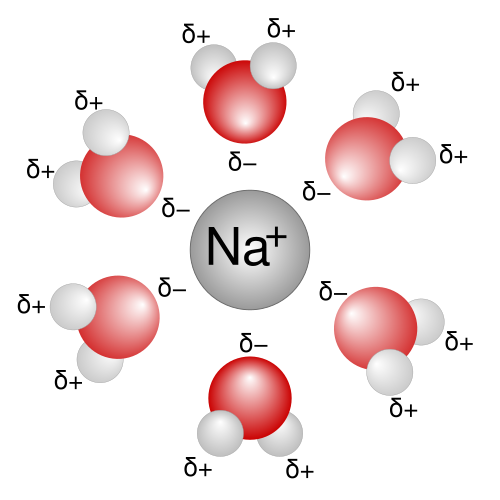
水溶液とは、溶媒が水である溶液のことです。化学式では、関連する化学式に (aq) を付加することで表されることがほとんどです。例えば、食塩(塩化ナトリウム(NaCl)とも呼ばれる)の水溶液は、 Na + (aq) + Cl − (aq)と表されます。水溶液( aquaに由来)という言葉は、水に関連する、水に似た、または水に溶けているという意味です。 [ 1 ] [ 2 ]水は優れた溶媒であり、自然界にも豊富に存在するため、化学では遍在する溶媒です。実験では水が溶媒として頻繁に使用されるため、溶媒が指定されていない限り、溶液という言葉は水溶液を指します。[ 3 ] [ 4 ]
非水溶液とは、溶媒が液体であるが水ではない溶液のことである。[ 5 ]
疎水性(「水を嫌う」)物質は水に溶けにくいのに対し、親水性(「水を好む」)物質は水に溶けやすい。親水性物質の例としては塩化ナトリウムがある。水溶液中では、水素イオン(H +)と水酸化物イオン(OH − )はアレニウス平衡状態にある([ H + ] [ OH − ] = K w = 1 × 10 −14、298 K)。 酸と塩基は、アレニウスの定義の一部として水溶液である。[ 1 ]塩化水素(HCl)は、水に溶解すると水素イオンが解離するため、アレニウス酸の例である。水酸化ナトリウム(NaOH)は、水に溶解すると水酸化物イオンが解離するため、アレニウス塩基である。[ 3 ]
水溶液は、特にアルカリ性領域や放射線分解を受けた場合、水和水素原子や水和電子を含むことがある。
Aqueous solutions that conduct electric current efficiently contain "strong" electrolytes, while those that conduct poorly are attributable to weaker electrolytes. The former substances are completely, or at least substantially, ionized in water; conversely, the weak electrolytes exhibit relatively limited ionization in water.[1] The ability of ions to move freely through a solvent is a characteristic of an aqueous strong electrolyte solution; the solutes in a weaker electrolyte solution are present as ions, but only to a small degree.[3]
Non-electrolytes, conversely, are substances that dissolve in water, yet maintain their molecular integrity: they do not dissociate into ions. Examples include sugars, urea, glycerol, and ethanol.
Reactions in aqueous solutions are usually metathesis reactions. Metathesis reactions are another term for double-displacement; that is, when a cation displaces to form an ionic bond with the other anion. The cation bonded with the latter anion will dissociate and bond with the other anion.[1]
A common metathesis reaction in aqueous solutions is a precipitation reaction. This reaction occurs when two aqueous strong electrolyte solutions mix and produce an insoluble solid, also known as a precipitate. The ability of a substance to dissolve in water is determined by whether the substance can match or exceed the strong attractive forces that water molecules generate between themselves. If the substance lacks the ability to dissolve in water, the molecules form a precipitate.[3]
When writing the equations of precipitation reactions, it is essential to determine the precipitate. To determine the precipitate, one must consult a chart of solubility. Soluble compounds are aqueous, while insoluble compounds are the precipitate. There may not always be a precipitate. Complete ionic equations and net ionic equations are used to show dissociated ions in metathesis reactions. When performing calculations regarding the reacting of one or more aqueous solutions, in general one must know the concentration, or molarity, of the aqueous solutions.