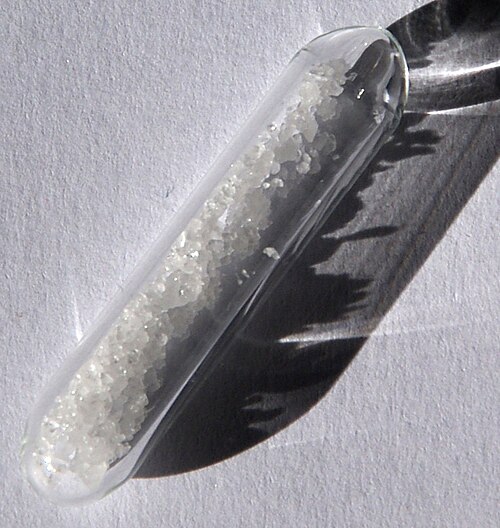
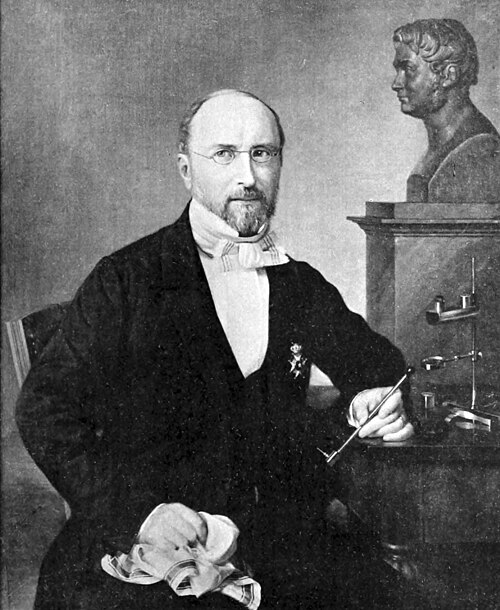
Swedish chemist Carl Gustaf Mosander discovered terbium as a chemical element in 1843. He detected it as an impurity in yttrium oxide (Y2O3). Yttrium and terbium, as well as erbium and ytterbium, are named after the village of Ytterby in Sweden. Terbium was not isolated in pure form until the advent of ion exchange techniques.
Terbium is used to dopecalcium fluoride, calcium tungstate and strontiummolybdate in solid-state devices, and as a crystal stabilizer of fuel cells that operate at elevated temperatures. As a component of Terfenol-D (an alloy that expands and contracts when exposed to magnetic fields more than any other alloy), terbium is of use in actuators, in naval sonar systems and in sensors. Terbium is considered non-hazardous, though its biological role and toxicity have not been researched in depth.
Most of the world's terbium supply is used in green phosphors. Terbium oxide is used in fluorescent lamps and television and monitor cathode-ray tubes (CRTs). Terbium green phosphors are combined with divalent europium blue phosphors and trivalent europium red phosphors to provide trichromatic lighting technology, a high-efficiency white light used in indoor lighting.
When TbF4 and caesium fluoride (CsF) is mixed in a stoichiometric ratio in a fluorine gas atmosphere, caesium pentafluoroterbate (CsTbF5) is obtained. It is an orthorhombic crystal with space groupCmca and a layered structure composed of [TbF8]4− and 11-coordinated Cs+.[35] The compound barium hexafluoroterbate (BaTbF6), an orthorhombic crystal with space group Cmma, can be prepared in a similar method. The terbium fluoride ion [TbF8]4−[36] also exists in the structure of potassium terbium fluoride crystals.[37][38]
Terbium(III) oxide or terbia is the main oxide of terbium, and appears as a dark brown water-insoluble solid. It is slightly hygroscopic[39] and is the main terbium compound found in rare earth-containing minerals and clays.[40]
Naturally occurring terbium is composed of its only stable isotope, terbium-159; the element is thus mononuclidic and monoisotopic.[1] Thirty-nine radioisotopes have been characterized from 135Tb to 174Tb.[9] The most stable synthetic radioisotopes of terbium are 158Tb, with a half-life of 180 years, and 157Tb, with a half-life of 71 years. All of the remaining radioactive isotopes have half-lives that are less than three months, and the majority of these have half-lives that are less than half a minute.[9] The primary decay mode before the most abundant stable isotope, 159Tb, is electron capture, which results in production of gadolinium isotopes, and the primary mode after is beta minus decay, resulting in dysprosium isotopes.[9]
The element also has 31 nuclear isomers, with masses of 141–154, 156, 158, 162, and 164–168 (not every mass number corresponds to only one isomer). The most stable of them are terbium-156m2, with a half-life of 24.4 hours, and terbium-154m2, with a half-life of 22.7 hours; this is more stable than ground states of terbium isotopes, except outside the mass range 155–161.[9]
Mosander first separated yttria into three fractions, all named for the ore: yttria, erbia, and terbia. "Terbia" was originally the fraction that contained the pink color, due to the element now known as erbium. "Erbia", the oxide containing what is now known as terbium, originally was the fraction that was yellow or dark orange in solution.[43][45] The insoluble oxide of this element was noted to be tinged brown,[48][49][39] and soluble oxides after combustion were noted to be colorless.[50] Until the advent of spectral analysis, arguments went back and forth as to whether erbia even existed. Spectral analysis by Marc Delafontaine allowed the separate elements and their oxides to be identified,[47] but in his publications, the names of erbium and terbium were switched,[51] following a brief period where terbium was renamed "mosandrum", after Mosander.[52] The names have remained switched ever since.[45]
In 2018, a rich terbium supply was discovered off the coast of Japan's Minamitori Island, with the stated supply being "enough to meet the global demand for 420 years".[57]
Production
Crushed terbium-containing minerals are treated with hot concentrated sulfuric acid to produce water-soluble sulfates of rare earths. The acidic filtrates are partially neutralized with caustic soda to pH 3–4. Thorium precipitates out of solution as hydroxide and is removed. The solution is treated with ammonium oxalate to convert rare earths into their insoluble oxalates. The oxalates are decomposed to oxides by heating. The oxides are dissolved in nitric acid that excludes one of the main components, cerium, whose oxide is insoluble in HNO3. Terbium is separated as a double salt with ammonium nitrate by crystallization.[31]
The most efficient separation routine for terbium salt from the rare-earth salt solution is ion exchange. In this process, rare-earth ions are sorbed onto suitable ion-exchange resin by exchange with hydrogen, ammonium or cupric ions present in the resin. The rare earth ions are then selectively washed out by suitable complexing agents. As with other rare earths, terbium metal is produced by reducing the anhydrous chloride or fluoride with calcium metal. Calcium and tantalum impurities can be removed by vacuum remelting, distillation, amalgam formation or zone melting.[31][47]
In 2020, the annual demand for terbium was estimated at 340 tonnes (750,000lb).[40] Terbium is not distinguished from other rare earths in the United States Geological Survey's Mineral Commodity Summaries, which in 2024 estimated the global reserves of rare earth minerals at 110,000,000 tonnes (2.4×10¹¹lb).[58]
Reviews of the toxicity of the rare earth elements place terbium and its compounds as "of low to moderately toxicity", remarking on the lack of detailed studies on their hazards[70] and the lack of market demand forestalling evidence of toxicity.[71]
Some studies demonstrate environmental accumulation of terbium as hazardous to fish and plants.[72][73] High exposures of terbium may enhance the toxicity of other substances causing endocytosis in plant cells.[74]
↑Prohaska, Thomas; Irrgeher, Johanna; Benefield, Jacqueline; Böhlke, John K.; Chesson, Lesley A.; Coplen, Tyler B.; Ding, Tiping; Dunn, Philip J. H.; Gröning, Manfred; Holden, Norman E.; Meijer, Harro A. J. (2022-05-04). "Standard atomic weights of the elements 2021 (IUPAC Technical Report)". Pure and Applied Chemistry. doi:10.1515/pac-2019-0603. ISSN1365-3075.
12Arblaster, John W. (2018). Selected Values of the Crystallographic Properties of Elements. Materials Park, Ohio: ASM International. ISBN978-1-62708-155-9.
↑Yttrium and all lanthanides except Ce, Pm, Tm, and Yb have been observed in the oxidation state 0 in bis(1,3,5-tri-t-butylbenzene) complexes, see Cloke, F. Geoffrey N. (1993). "Zero Oxidation State Compounds of Scandium, Yttrium, and the Lanthanides". Chem. Soc. Rev. 22: 17–24. doi:10.1039/CS9932200017. and Arnold, Polly L.; Petrukhina, Marina A.; Bochenkov, Vladimir E.; Shabatina, Tatyana I.; Zagorskii, Vyacheslav V.; Cloke (2003-12-15). "Arene complexation of Sm, Eu, Tm and Yb atoms: a variable temperature spectroscopic investigation". Journal of Organometallic Chemistry. 688 (1–2): 49–55. doi:10.1016/j.jorganchem.2003.08.028.
↑La(I), Pr(I), Tb(I), Tm(I), and Yb(I) have been observed in MB8− clusters; see Li, Wan-Lu; Chen, Teng-Teng; Chen, Wei-Jia; Li, Jun; Wang, Lai-Sheng (2021). "Monovalent lanthanide(I) in borozene complexes". Nature Communications. 12 (1): 6467. Bibcode:2021NatCo..12.6467L. doi:10.1038/s41467-021-26785-9. PMC8578558. PMID34753931.
↑All the lanthanides, except Pm, in the +2 oxidation state have been observed in organometallic molecular complexes, see Lanthanides Topple Assumptions and Meyer, G. (2014). "All the Lanthanides Do It and Even Uranium Does Oxidation State +2". Angewandte Chemie International Edition. 53 (14): 3550–51. doi:10.1002/anie.201311325. PMID24616202.. Additionally, all the lanthanides (La–Lu) form dihydrides (LnH2), dicarbides (LnC2), monosulfides (LnS), monoselenides (LnSe), and monotellurides (LnTe), but for most elements these compounds have Ln3+ ions with electrons delocalized into conduction bands, e. g. Ln3+(H−)2(e−).
↑Greenwood, Norman N.; Earnshaw, Alan (1997). Chemistry of the Elements (2nded.). Butterworth-Heinemann. p.28. doi:10.1016/C2009-0-30414-6. ISBN978-0-08-037941-8.
↑Weast, Robert (1984). CRC, Handbook of Chemistry and Physics. Boca Raton, Florida: Chemical Rubber Company Publishing. pp.E110. ISBN0-8493-0464-4.
1 2 3 4 5 Kondev, FG; Wang, M.; Huang, WJ; Naimi, S.; Audi, G. (2021). "The NUBASE2020 evaluation of nuclear properties" (PDF) . Chinese Physics C . 45 (3) 030001. doi : 10.1088/1674-1137/abddae .
↑ Gruen, DM; Koehler, WC; Katz, JJ (1951年4月)「ランタニド元素の高次酸化物:二酸化テルビウム」Journal of the American Chemical Society . 73 (4): 1475–1479 . Bibcode : 1951JAChS..73.1475G . doi : 10.1021/ja01148a020 .
↑ Hobart, DE; Samhoun, K.; Young, JP; Norvell, VE; Mamantov, G.; Peterson, JR (1980). "炭酸水溶液中におけるプラセオジム(IV)およびテルビウム(IV)の安定化". Inorganic and Nuclear Chemistry Letters . 16 (5): 321–328 . doi : 10.1016/0020-1650(80)80069-9 .
↑Zhuang, Jia-Jia; Chen, Ming-Guang; Sun, Yan-Bing; Hang, Pei; Sui, Yang; Tong, Jia-Ping (2020-03-01). "Synthesis, Structure and Magnetic Property of a Tricapped Trigonal Prismatic TbIII-Based 3d-4f Complex". IOP Conference Series: Materials Science and Engineering. 774 (1) 012042. Bibcode:2020MS&E..774a2042Z. doi:10.1088/1757-899X/774/1/012042. ISSN1757-8981.
↑Boyde, Nicholas C.; Chmely, Stephen C.; Hanusa, Timothy P.; Rheingold, Arnold L.; Brennessel, William W. (2014-09-15). "Structural Distortions in M[E(SiMe3)2]3 Complexes (M = Group 15, f-Element; E = N, CH): Is Three a Crowd?". Inorganic Chemistry. 53 (18): 9703–9714. doi:10.1021/ic501232z. ISSN0020-1669. PMID25171144.
↑Jenkins, T. F.; Woen, D. H; Mohanam, L. N.; Ziller, J. W.; Furche, F.; Evans, W. J. (2018). "Tetramethylcyclopentadienyl Ligands Allow Isolation of Ln(II) Ions across the Lanthanide Series in [K(2.2.2-cryptand)][(C5Me4H)3Ln] Complexes". Organometallics. 141 (21): 3863–3873. doi:10.1021/acs.organomet.8b00557. S2CID105379627.
↑Macdonald, M. R.; Bates, J. E.; Ziller, J. W.; Furche, F.; Evans, W. J. (2013). "Completing the Series of +2 Ions for the Lanthanide Elements: Synthesis of Molecular Complexes of Pr2+, Gd2+, Tb2+, and Lu2+". Journal of the American Chemical Society. 135 (21): 9857–9868. Bibcode:2013JAChS.135.9857M. doi:10.1021/ja403753j. PMID23697603.
↑ Gould, CA; McClain, KR; Yu, JM; Groshens, TJ; Furche, FP; Harvey, BG; Long, JR (2019-08-21). "テルビウム(II)およびジスプロシウム(II)の中性線状メタロセン錯体の合成と磁性". Journal of the American Chemical Society . 141 (33): 12967– 12973. Bibcode : 2019JAChS.14112967G . doi : 10.1021/jacs.9b05816 . ISSN 0002-7863 . PMID 31375028 . S2CID 199388151 .
↑ Palumbo, CT; Zivkovic, I.; Scopelliti, R.; Mazzanti, M. (2019). "Molecular Complex of Tb in the +4 Oxidation State" (PDF) . Journal of the American Chemical Society . 141 (25): 9827– 9831. Bibcode : 2019JAChS.141.9827P . doi : 10.1021/jacs.9b05337 . PMID 31194529 . S2CID 189814301 . 2024年4月23日にオリジナル(PDF)からアーカイブ済み。
↑ Willauer, AR; Palumbo, CT; Scopelliti, R.; Zivkovic, I.; Douair, I.; Maron, L.; Mazzanti, M. (2020). "Stabilization of the Oxidation State +IV in Siloxide-Supported Terbium Compounds" (PDF) . Angewandte Chemie International Edition . 59 (9): 3549– 3553. Bibcode : 2020ACIE...59.3549W . doi : 10.1002/anie.201914733 . PMID 31840371 . S2CID 209385870 .
12Palumbo, Chad T.; Zivkovic, Ivica; Scopelliti, Rosario; Mazzanti, Marinella (2019-06-26). "Molecular Complex of Tb in the +4 Oxidation State". Journal of the American Chemical Society. 141 (25): 9827–9831. Bibcode:2019JAChS.141.9827P. doi:10.1021/jacs.9b05337. ISSN0002-7863. PMID31194529.
↑Greenwood, Norman N.; Earnshaw, Alan (1997). Chemistry of the Elements (2nded.). Butterworth-Heinemann. doi:10.1016/C2009-0-30414-6. ISBN978-0-08-037941-8.
↑Cloke, F. Geoffrey N. (1993). "Zero Oxidation State Compounds of Scandium, Yttrium, and the Lanthanides". Chem. Soc. Rev. 22: 17–24. doi:10.1039/CS9932200017.
↑Arnold, Polly L.; Petrukhina, Marina A.; Bochenkov, Vladimir E.; Shabatina, Tatyana I.; Zagorskii, Vyacheslav V.; Cloke (2003-12-15). "Arene complexation of Sm, Eu, Tm and Yb atoms: a variable temperature spectroscopic investigation". Journal of Organometallic Chemistry. 688 (1–2): 49–55. doi:10.1016/j.jorganchem.2003.08.028.
↑ Balodhi, Ashiwini; Chang, Kelvin; Stevens, Kevin T.; Chakrapani, Sunil K.; Ennaceur, Susan M.; Migliori, Albert; Zevalkink, Alexandra (2020-10-26). "Determination of single crystal elastic moduli of KTb 3 F 10 by resonant ultrasound spectroscopy" . Journal of Applied Physics . 128 (16) 165104. Bibcode : 2020JAP...128p5104B . doi : 10.1063/5.0024723 . ISSN 0021-8979 . OSTI 1686244 .
1 2 Larrañaga, Michael D.; Lewis, Richard J.; Lewis, Robert A. (2016年9月). Hawley's Condensed Chemical Dictionary (第16版). Wiley. p. 1310. doi : 10.1002/9781119312468 . ISBN978-1-118-13515-0。
↑ Eberhard, G. (1906). "A Spectroscopic Investigation of Dr. G. Urbain's Preparations of Terbium" . Astrophysical Journal . 24 (5): 309. Bibcode : 1906ApJ....24..309E . doi : 10.1086/141398 .
↑ Stubblefield, CT; Eick, H.; Eyring, L. (1956 年 8 月). "テルビウム酸化物。II. いくつかの酸化物の生成熱 1" . Journal of the American Chemical Society . 78 (16): 3877– 3879. Bibcode : 1956JAChS..78.3877S . doi : 10.1021/ja01597a005 . ISSN 0002-7863 .
↑Kowalczyk, Ewelina; Givelet, Lucas; Amlund, Heidi; Sloth, Jens Jørgen; Hansen, Max (May 2022). "Risk assessment of rare earth elements, antimony, barium, boron, lithium, tellurium, thallium and vanadium in teas". EFSA Journal. 20 (Suppl 1) e200410. doi:10.2903/j.efsa.2022.e200410. PMC9131585. PMID35634564.
↑"Terbium Safety Data Sheet"(PDF). Ames Laboratory, U. S. Department of Energy. January 26, 2016. Retrieved August 25, 2024.
↑Rim, Kyung Taek; Koo, Kwon Ho; Park, Jung Sun (March 2013). "Toxicological Evaluations of Rare Earths and Their Health Impacts to Workers: A Literature Review". Safety and Health at Work. 4 (1): 12–26. doi:10.5491/SHAW.2013.4.1.12. PMC3601293. PMID23516020.
↑Chen, Haibin; Chen, Zhibiao; Chen, Zhiqiang; Ou, Xiaolin; Chen, Junjia (May 2020). "Calculation of Toxicity Coefficient of Potential Ecological Risk Assessment of Rare Earth Elements". Bulletin of Environmental Contamination and Toxicology. 104 (5): 582–587. Bibcode:2020BuECT.104..582C. doi:10.1007/s00128-020-02840-x. ISSN0007-4861. PMID32296855.
↑Hanana, Houda; Taranu, Zofia E.; Turcotte, Patrice; Gagnon, Christian; Kowalczyk, Joanna; Gagné, François (2021-07-10). "Sublethal effects of terbium and praseodymium in juvenile rainbow trout". Science of the Total Environment. 777 146042. Bibcode:2021ScTEn.77746042H. doi:10.1016/j.scitotenv.2021.146042. ISSN0048-9697.