
Loading article…

Mansa Musa[b] (c.1280 –c.1337) was the ninth[5]Mansa of the Mali Empire, which reached its territorial peak during his reign. Musa's reign is often regarded as the zenith of Mali's power and prestige, although he features less in Mandinkaoral traditions than his predecessors.
Musa was exceptionally wealthy, to an extent that contemporaries described him as inconceivably rich; Time magazine reported: "There's really no way to put an accurate number on his wealth." They cite Ferrum College history professor Richard Smith that Mali was likely the largest gold producer in the world at the time, but "contemporary sources describe the king's riches in terms that are impossible for the time."[6] It is known from local manuscripts and travellers' accounts that Mansa Musa's wealth came principally from the Mali Empire's control and taxing of the trade in salt from northern regions and especially from gold panned and mined in Bambuk and Bure to the south. Over a very long period Mali had amassed a large reserve of gold. Mali is also believed to have been involved in the trade in many goods such as ivory, slaves, spices, silks, and ceramics. However, presently little is known about the extent or mechanics of these trades.[7][8] It is estimated that two thirds of the gold circulating in the Medieval Mediterranean came from West Africa[9] and this accounts for almost half of the Old World's gold supply.[10] Archeological investigations near the town of Tadmekka shows Malians invented their own process of refining gold by using melted glass and removing impurities.[11] While gold was abundant, copper was incredibly scarce and prized in Sub-Saharan Africa and "was exchanged for gold at rates that would be considered unfair by present-day standards."[12] At the time of Musa's ascension to the throne, Mali consisted largely of the territory of the former Ghana Empire, which had become a vassal of Mali. The Mali Empire comprised land that is now part of Guinea, Senegal, Mauritania, the Gambia, and the modern state of Mali which would be an area of 1,300,000 km2.[13]
ムサは1324年にメッカへのハッジに出発し、大勢の随行員と大量の金を携えて旅をした。途中カイロに滞在し、そこで惜しみなく贈った贈り物がエジプトの金の価値に顕著な影響を与えたと言われている[ 14 ]。また、イスラム世界全体の注目を集めた。ムサはマリ帝国の領土を拡大し、特にガオとトンブクトゥの都市をその領土に組み入れた。彼はイスラム世界の他の国々、特にマムルーク朝とマリーン朝のスルタン国との関係強化を図った。彼はアンダルシアの詩人アブー・イスハーク・アル=サーヒリーなど、イスラム世界各地から学者をマリに招き、トンブクトゥをイスラム学の中心地として確立するのに貢献した。彼の治世は、トンブクトゥのジンゲレベール・モスクの一部を含む数多くの建設事業と関連付けられている。
マンサ・ムーサの個人名はムーサ(アラビア語: موسى 、ローマ字表記: Mūsá )で、イスラム教におけるモーセの名前である。[ 15 ]マンサはマンデ語で「支配者」[ 16 ]または「王」[ 17 ]を意味し、マリ帝国の支配者の称号であった。
口承伝承やティンブクトゥ年代記では、ムサはカンク・ムサとしても知られています。[ 18 ] [ c ]マンデ族の伝承では、名前の前に母親の名前をつけるのが一般的だったので、カンク・ムサという名前は「カンクの息子、ムサ」という意味になりますが、示唆されている系譜が文字通りのものかどうかは不明です。[ 20 ]アル・ヤフィーはムーサの名前をムーサ・イブン・アビ・バクル・イブン・アル・アスワド(アラビア語: موسى بن أبي بكر بن أبي الأسود 、ローマ字: Mōsā ibn Abī Bakr ibn Abī )と名付けた。アル・アスワド)、[ 21 ] 、そしてイブン・ハジャルはムーサの名前をムーサ・イブン・アビ・バクル・サリム・アル・タクルリ(アラビア語: موسى بن أبي بكر سالم التكروري 、ローマ字: Mōsā ibn Abī Bakr Salim )と名付けた。アル・タクルリ)。[ 22 ]
ムサはハッジを行ったことから、口承伝承ではハッジという称号を与えられることが多い。[ 23 ]ソンガイ語では、ムサのようなマリの支配者はマリ・コイとして知られており、コイは地域に対する権威を示す称号、つまり「マリの支配者」を意味する。[ 24 ]
ムサについて知られていることの多くは、彼の巡礼後に書かれたアラビア語の資料、特にアル・ウマリとイブン・ハルドゥーンの著作から来ている。巡礼中にカイロに滞在していたムサは、イブン・アミール・ハジブなどの役人と親交を結び、彼らはムサから彼と彼の国について学び、後にその知識をアル・ウマリなどの歴史家に伝えた。[ 25 ]追加の情報は、17世紀にティンブクトゥで書かれた2つの写本、タリフ・イブン・アル・ムフタール[ d ]とタリフ・アル・スーダンから来ている。[ 27 ]グリオとしても知られるジェリウ(単数形ジェリ)によって行われる口承伝承には、マリの歴史の他の部分に比べてムサに関する情報は比較的少なく、彼の前任の征服者の方がより重要視されている。[ 28 ]
ジブリル・タムシル・ニアネによれば、ムサの父はファガ・レイエ[ 23 ]という名前で、母はカンクという名前だった可能性がある[ h ] 。ファガ・レイエは、マリ帝国の最初のマンサであるスンジャタの兄弟であるアブー・バクルの息子であった[ 23 ]。イブン・ハルドゥーンはファガ・レイエについて言及しておらず、ムサをムサ・イブン・アブー・バクルと呼んでいる。これは「アブー・バクルの息子ムサ」または「アブー・バクルの子孫ムサ」のどちらとも解釈できる。スンジャタの治世とムサの治世の間には長い年月が経っているため、アブー・バクルがムサの父であったとは考えにくい[ 31 ] [ 32 ] 。
ムサの兄スレイマンの治世中にマリを訪れたイブン・バットゥータは、ムサの祖父の名前はサリク・ジャタであったと述べている。 [ 33 ]サリク・ジャタは、実際にはムサの大叔父であったスンジャタの別名である可能性がある。[ 34 ]このことと、イブン・ハルドゥーンが「ムサ・イブン・アブー・バクル」という名前を使用したことから、歴史家フランソワ=グザヴィエ・フォーヴェルは、ムサは実際にはアブー・バクル1世の息子であり、スンジャタの娘を通して孫にあたると提唱した。後に、女性によるこの非嫡出の可能性のある継承を抹消しようとする試みが、ムサの出自に関する史料の混乱につながった。[ 35 ]ムサのケイタ王朝の一族に対する敵意もまた、口承史における彼の相対的な不在や辛辣な扱いを説明するだろう。[ 36 ]
ムサの生年月日は不明だが、1324年には青年であったようだ。[ 37 ]『タリフ・アル・ファッタシュ』によれば、ムサはハッジの前にカンクを誤って殺害したとされている。[ 20 ]
ムサは1300年代初頭に不明瞭な状況下で権力を掌握した[ i ]。ムサ自身の記述によれば、マリのマンサの前任者(おそらくムハンマド・イブン・ク)[ 40 ]は、大西洋を探検するために2回の遠征を行った(最初の探検には200隻、2回目には2000隻の船)。マンサは2回目の遠征を自ら率い、ムサを代理として帝国の統治を任せ、帰還するまでその任に就かせた[ 41 ] 。マンサが帰還しなかったため、ムサ自身がマンサとして即位し、王位継承の系譜がスンジャタの子孫から弟のアブー・バクルの子孫へと移った[ 42 ] 。現代の歴史家の中には、ムサの記述に疑問を呈し、彼が前任者を廃位させ、権力を掌握した経緯を説明するために航海の物語をでっち上げたのではないかと示唆する者もいる。[ 43 ] [ 44 ]それにもかかわらず、そのような航海の可能性は、何人かの歴史家によって真剣に検討されてきた。[ 45 ] [ 46 ] [ 47 ]
ムサはマンサになったとき、おそらく20代前半の若者だった。 [ 37 ]その後の彼のハッジの壮大さを考えると、ムサは治世の初期の多くをその準備に費やした可能性が高い。[ 48 ]これらの準備の中には、ムサの随行員が数千人の奴隷を含むため、近隣の土地から人々を捕らえて奴隷にするための襲撃が含まれていた可能性が高い。歴史家のマイケル・ゴメスは、マリはこの目的のために年間6,000人以上の奴隷を捕らえた可能性があると推定している。[ 49 ]おそらくこのため、ムサの治世の初期は、近隣の非イスラム教徒社会との絶え間ない軍事衝突に費やされた。[ 49 ] 1324年、カイロ滞在中に、ムサは24の都市とその周辺地域を征服したと述べた。[ 50 ]

ムサはイスラム教徒であり、メッカへの巡礼(ハッジ)によって北アフリカと中東全域で広く知られるようになった。ムサにとってイスラム教は「東地中海の文化的な世界への入り口」であった。[ 51 ]彼は帝国内でイスラム教の発展を促進するために多くの時間を費やしたであろう。ムサがハッジのためにマリを出発したとき、彼は息子のムハンマドに不在中の統治を任せた。[ 52 ]
ムーサは1324年から1325年にかけて2700マイルの巡礼を行った。[ 53 ] [ 54 ] [ 55 ]この出来事の後に書かれたアラビアの年代記作家は、ムーサのキャラバンの規模と運ばれた金の量について大きく異なる数字を示しており、現代の歴史家はこれらの数字を統計的ではなく修辞的なものとして扱っている。[ 56 ] [ 57 ]後世のアラビアの記録に保存されている数字によると、彼の行列には12,000人以上の奴隷が含まれており、全員が錦織とイエメンの絹を身に着けており[ 58 ] 、それぞれが1.8kg (4ポンド)の金塊を運んでいたと言われ、絹の服を着て金の杖を持った伝令が馬を組織し、袋を扱っていた。
ムーサは行列に必要な物資をすべて提供し、人間と動物全員に食事を与えたと伝えられている。[ 51 ]同じ資料によると、キャラバンにはラクダが80頭含まれており、それぞれが23~136kg (50~300ポンド)の金粉を運んだとされているが、この範囲自体が当時の監査された計量がないことを反映しており、現代の歴史家はこれを測定値ではなく文学的なトポスの上限として扱っている。[ 56 ] [ 57 ]ムーサはメッカへの道中、カイロやメディナを含む通過した都市や沿道の貧しい人々に金を配り、毎週金曜日にモスクを建てたと伝えられている。[ 38 ]巡礼直後にカイロを訪れ、これらの記述のほとんどを直接的に伝えたシハブ・アルディン・アルウマリは、この行列を「権力と富の贅沢な誇示であり、その規模と華やかさは前例のないもの」と表現した。[ 59 ]
Musa and his entourage arrived at the outskirts of Cairo in July 1324. They camped for three days by the Pyramids of Giza before crossing the Nile into Cairo on 19 July.[j][60][61] While in Cairo, Musa met with the Mamluk sultanal-Nasir Muhammad, whose reign had already seen one mansa, Sakura, make the Hajj. Al-Nasir expected Musa to prostrate himself before him, which Musa initially refused to do. When Musa did finally bow he said he was doing so for God alone.[62]
Despite this initial awkwardness, the two rulers got along well and exchanged gifts. Musa and his entourage gave and spent freely while in Cairo. Musa stayed in the Qarafa district of Cairo and befriended its governor, ibn Amir Hajib, who learned much about Mali from him. Musa stayed in Cairo for three months, departing on 18 October[k] with the official caravan to Mecca.[60][63]
Musa's generosity continued as he traveled onward to Mecca, and he gave gifts to fellow pilgrims and the people of Medina and Mecca. While in Mecca, conflict broke out between a group of Malian pilgrims and a group of Turkic pilgrims in the Masjid al-Haram. Swords were drawn, but before the situation escalated further, Musa persuaded his men to back down.[64]
Musa and his entourage lingered in Mecca after the last day of the Hajj. Traveling separately from the main caravan, their return journey to Cairo was struck by catastrophe. By the time they reached Suez, many of the Malian pilgrims had died of cold, starvation, or bandit raids, and they had lost much of their supplies.[65][66] Having run out of money, Musa and his entourage were forced to borrow money and resell much of what they had purchased while in Cairo before the Hajj, and Musa went into debt to several merchants such as Siraj al-Din. However, Al-Nasir Muhammad returned Musa's earlier show of generosity with gifts of his own.[67]
On his return journey, Musa met the Andalusi poet Abu Ishaq al-Sahili, whose eloquence and knowledge of jurisprudence impressed him, and whom he convinced to travel with him to Mali.[68] Other scholars Musa brought to Mali included Maliki jurists.[69]
According to the Tarikh al-Sudan, the cities of Gao and Timbuktu submitted to Musa's rule as he traveled through on his return to Mali.[70] It is unlikely, however, that a group of pilgrims, even if armed, would have been able to conquer a wealthy and powerful city.[71] According to one account given by ibn Khaldun, Musa's general Saghmanja conquered Gao. The other account claims that Gao had been conquered during the reign of Mansa Sakura.[72] Mali's control of Gao may have been weak, requiring powerful mansas to reassert their authority periodically,[73] or it might simply be an error on the part of al-Sadi, author of the Tarikh.[71]
Musa embarked on a large building program, raising mosques and madrasas in Timbuktu and Gao. Most notably, the ancient center of learning Sankore Madrasah (or University of Sankore) was constructed during his reign.[74]
According to a long-standing tradition in nineteenth- and twentieth-century historiography, Musa brought architects from Andalusia and Cairo to build his palace in Timbuktu and the great Djinguereber Mosque that still stands, with the Granadan poet Abū Isḥāq al-Sāḥilī commonly credited as the principal designer.[75] Subsequent scholarship has substantially qualified this attribution. J. O. Hunwick has shown that the only project firmly attributable to al-Sāḥilī in the Arabic sources is a royal audience chamber at the city of Mali — for which Ibn Khaldun records a payment of 12,000 mithqals of gold (approximately 51 kg) — and that al-Sāḥilī's role there appears to have been decorative and organizational rather than that of a structural architect.[76] On the broader Sudano-Sahelian tradition, the architectural historian Labelle Prussin has argued that the earthen (banco) architecture of the Niger bend, with its projecting toron beams, represents a centuries-long synthesis of indigenous West African and Islamic design practices rather than an importation from al-Andalus or the Maghreb;[77] modern scholarship accordingly regards the image of al-Sāḥilī as the founder of West African mosque architecture as a historiographical myth rather than an established historical fact.[77][76] Excavations at Djenné-Djenno by Susan and Roderick McIntosh have established that permanent settlement, complex craft production and iron metallurgy were already present in the Inland Niger Delta by the third century BCE — with long-distance exchange networks attested in subsequent phases of the site — demonstrating that the architectural and urban infrastructure on which Musa's building program drew was an indigenous tradition of substantial antiquity rather than an importation of his reign.[78]

ティンブクトゥはすぐに貿易、文化、イスラム教の中心地となった。市場にはハウサランド、エジプト、その他のアフリカの王国から商人が集まり、市内(およびマリの都市ジェンネとセグー)に大学が設立され、市場と大学を通じてイスラム教が広まり、ティンブクトゥはイスラム学問の新たな拠点となった。[ 79 ]マリ帝国の富裕な都市のニュースは地中海を越えて南ヨーロッパにも伝わり、ヴェネツィア、グラナダ、ジェノヴァの商人はすぐにティンブクトゥを地図に加え、金と引き換えに工業製品を取引するようになった。[ 80 ]
ティンブクトゥのサンコレ大学は、ムサの治世下で法学者、天文学者、数学者によって再編成された。[ 81 ]この大学は学問と文化の中心地となり、アフリカや中東各地からイスラム教徒の学者をティンブクトゥに引き寄せた。
1330年、モシ王国がティンブクトゥ市に侵攻し、征服した。ガオはすでにムサの将軍に捕らえられていたが、ムサはすぐにティンブクトゥを取り戻し、城壁と石造りの砦を築き、将来の侵略者から都市を守るために常備軍を配置した。[ 82 ]ムサの宮殿はその後消滅したが、大学とモスクは今もティンブクトゥに残っている。

マンサ・ムサの死亡日は不明である。イブン・ハルドゥーンが報告した治世の長さを用いて、1360年のマンサ・スレイマンの死から逆算すると、ムーサは1332年に亡くなったことになる。[ 83 ]しかし、イブン・ハルドゥーンは、ムーサが1337年5月にトレムセンを征服したアブ・アル=ハサン・アリーに祝意を伝える使者を送ったと報告しているが、アブ・アル=ハサンが返答の使者を送った時にはムーサは亡くなっており、スレイマンが王位に就いていたことから、ムーサは1337年に亡くなったと考えられる。[ 84 ]一方、ムーサの巡礼から12年後の1337年頃に執筆したアル=ウマリは、[ 85 ]ムーサは退位してメッカに戻るつもりでマリに戻ったが、そうする前に亡くなったと主張しており、[ 86 ] 1332年よりもさらに早く亡くなったと考えられる。[ 87] ]実際には、ムサの息子マガンがアブ・アル=ハサンに祝意を伝えたか、ムサの死後、アブ・アル=ハサンの使者を迎えたかのどちらかである可能性がある。[ 88 ]後者の可能性は、イブン・ハルドゥーンがその箇所でスレイマンをムサの息子と呼んでいることから裏付けられており、ムサの兄弟スレイマンとムサの息子マガンを混同した可能性を示唆している。[ 89 ]あるいは、イブン・ハルドゥーンがマガンに帰している4年間の統治は、実際にはムサがハッジに出かけている間に彼がマリを統治したことを指しており、彼自身の統治は短期間であった可能性もある。[ 90 ]ネヘミア・レブツィオンは1337年を最も可能性の高い日付と考えており、[ 84 ]これは他の学者にも受け入れられている。[ 91 ] [ 92 ]
ムサの治世は一般的にマリの黄金時代と見なされているが、この認識は、彼が必ずしもマリで最も裕福で強力なマンサであったからではなく、彼の治世がアラビア語の資料に最もよく記録されているからかもしれない。[ 93 ]マリ帝国の領土は、ムサとその弟スレイマンの治世中に最盛期を迎え、西アフリカのスーダン・サヘル地域を覆っていた。[ 94 ]
ムサは、ジェリウによって演じられるマンデの口承伝承ではあまり有名ではない。[ 95 ]彼は伝統に忠実でないと批判されており、ジェリウの中にはムサがマリの富を浪費したと考える者もいる。[ 14 ] [ 96 ]しかし、ムサのいくつかの側面は、マンデの口承伝承で「希望の父」と訳されるファジギとして知られる人物に組み込まれているようだ。ファジギは、マンデの伝統宗教に登場するボリウと呼ばれる儀式用の品物を取り戻すためにメッカへ旅したと記憶されている。 [ 97 ]ファジギとして、ムサは、スンジャタの最高司令官として最もよく知られているファコリという口承伝承の人物と混同されることがある。[ 98 ]ファジギの人物は、イスラム教と伝統的な信仰の両方を組み合わせたものである。[ 97 ]
マンデ族の伝統では、「ムサ」という名前は巡礼とほぼ同義語となっており、ファコリなど、巡礼に出かけた人物として記憶されている他の人物もムサと呼ばれている。[ 99 ]
1525年、シチリアの地図製作者ヤコポ・ルッソは、マンサ・ムーサを称えてマンサ・ムーサ地図を作成した。 [ 100 ]西アフリカの裕福な君主を紹介するこの伝統は、アンジェリーノ・ドゥルセルトの1339年の地図、1375年のカタルーニャ地図帳[ 1 ]、そしてマンサ・ムーサのハッジに影響を受けた他のいくつかのヨーロッパの地図にまで遡る。[ 101 ]


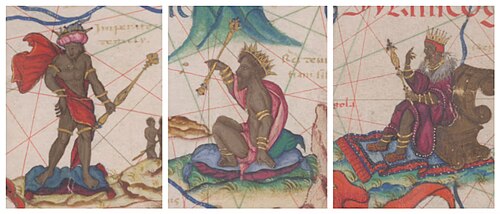
Mansa Musa is renowned for his affluence and generosity, and has become "a symbol of fabulous wealth".[7] While several online articles in the 21st century have claimed that Mansa Musa was the richest person of all time,[102][103][104] historians such as Hadrien Collet have argued that Musa's wealth is impossible to calculate accurately.[14][105] Contemporary Arabic sources may have been trying to express that Musa had more gold than they thought possible, rather than trying to give an exact number.[106] Musa himself further promoted the appearance of having vast, inexhaustible wealth by spreading rumors that gold grew like a plant in his kingdom.[107]Encyclopedia Britannica states that he is "widely considered to be the wealthiest person in history".[108][109]
The Catalan Atlas (1375 AD) describes Mansa Musa as 'the richest man in the region', but makes no mention of him being 'the richest in the world' or 'the richest in history'.[1]
アラビア語の著述家の中には、ムーサの贈り物がエジプトの金の価値を下落させたと述べている者もいる。アル・ウマリは、ムーサの到着前は金1ミスカルが銀25ディルハムの価値があったが、その後22ディルハム以下に下落し、少なくとも12年間はその水準を超えなかったと述べている。[ 110 ]これはエジプト経済を「破綻させた」と評されているが、[ 14 ]歴史家のウォーレン・シュルツは、これはマムルーク朝エジプトにおける金の価値の通常の変動の範囲内であったと主張している。[ 56 ]ムーサが巡礼に18トンもの金を持ち込んだという推定値(現代のメディアでは数十億米ドルに相当すると解釈されることもある)は、同じアル・ウマリとイブン・ハルドゥーンの報告から推測された再構築であり、独立した証言ではなく単一の伝承経路を反映している。[ 111 ] [ 56 ] [ 105 ] 14世紀のサヘル地域の金経済の論理と現代の資産評価との間のギャップ、および君主の個人資産と国家の資産を分離することの難しさの両方を考慮すると、このような数値を現代の貨幣価値に換算することは、歴史家によって方法論的に不適切であると見なされている。[ 105 ] [ 112 ]
西アフリカの君主が世界で最も裕福であるという考えは、マンサ・ムーサより300年以上も前から存在しており、イブン・ハウカル(951)は「 ガーナの王は、先代の王と自身のために昔から採掘された財宝と金の備蓄のおかげで、地球上で最も裕福な王である」と述べている。彼はさらに、同じ帝国が輸入塩をひどく必要としていたことを説明している。[ 113 ]
The wealth of the Mali Empire did not come from direct control of gold-producing regions, but rather trade and tribute.[114] These trade routes extended as south as the Akan Forest in the modern country of Ghana which was formerly known as the Gold Coast (not to be confused with the Ghana Empire). In the late 15th century the Portuguese were attaining 400-550 kilos (880-1,200 pounds) of gold per year from this region through trade.[115] The earliest city of the Akan people was Bono Manso and was an important trade connection with Djenné.[116] The gold Musa brought on his pilgrimage probably represented years of accumulated tribute that Musa would have spent much of his early reign gathering.[48] Another source of income for Mali during Musa's reign was taxation of the copper trade.[117]
According to several contemporary authors, such as Ibn Battuta, Ibn al-Dawadari and al-Umari, Mansa Musa ran out of money during his journey to Mecca and had to borrow from Egyptian merchants at a high rate of interest on his return journey. Al-Umari and Ibn Khaldun state that the moneylenders were either never repaid or only partly repaid. Other sources disagree as to whether they were eventually and fully compensated.[118][119][120]
According to Ibn Kathir, "He was a handsome young man." Ibn Habib al-Halabi, a contemporary of Ibn Kathir, described Musa as a "young man, brown-skinned, with a pleasant face and handsome appearance."[37]
Arabic writers, such as Ibn Battuta and Abdallah ibn Asad al-Yafii, praised Musa's generosity, virtue, and intelligence.[33][21] Ibn Khaldun said that he "was an upright man and a great king, and tales of his justice are still told."[121]
With his lavish spending and generosity in Cairo, (Mansa Musa) ran out of money and had to borrow at high rates of interest for the return journey. Ibn Battuta says that Mansa Musa borrowed 50,000 dinars from Siraj al-Din ibn al-Kuwayk, a rich merchant from Alexandria, after he had spent all his wealth.
[Mansa Musa] could not meet his expenses. He therefore borrowed money from the principal merchants. Among those merchants who were in his company were the Banu l-Kuwayk, who gave him a loan of 50,000 dinars. He sold to them the palace which the sultan had bestowed on him as a gift. He [the sultan] approved it. Siraj al-Din b. al-Kuwayk sent his vizier along with him to collect what he had loaned to him but the vizier died there. Siraj al-Din sent another [emissary] with his son. He [the emissary] died but the son, Fakhr al-Din Abu Jafar, got back some of it. Mansa Musa died before he [Siraj al-Din] died, so they obtained nothing more from him.
{{cite book}}: |work= ignored (help)