
Loading article…


Gold mining is the extraction of gold by mining.
Historically, mining gold from alluvial deposits used manual separation processes, such as gold panning. The expansion of gold mining to ores that are not on the surface has led to more complex extraction processes such as pit mining and gold cyanidation. In the 20th and 21st centuries, most volume of mining was done by large corporations. However, the value of gold has led to millions of small, artisanal miners in many parts of the Global South.
Like all mining, human rights and environmental issues are common in the gold mining industry, and can result in environmental conflict. In mines with less regulation, health and safety risks are much higher.
History
.jpg/500px-Miner_underground_at_Pumsaint_gold_mine_(1294028).jpg)

The exact date that humans first began to mine gold is unknown, but some of the oldest known gold artifacts were found in the Varna Necropolis in Bulgaria. The graves of the necropolis were built between 4700 and 4200 BC, indicating that gold mining could be at least 6,724 years old.[1] During a series of excavations carried out between 1878 and 1992, several graves were found with more than 6kg of gold.[2] A group of German and Georgian archaeologists claims the Sakdrisi site in southern Georgia, dating to the 3rd or 4th millennium BC, may be the world's oldest known gold mine.[3]
Ancient Times
Prehistoric Period
Gold has been prized by humans since prehistoric times. Archaeological evidence suggests that humans were mining gold as far back as 4000 BCE, with some the earliest known gold artifacts dating back to ancient Mesopotamia.[4] Particularly in the region of present-day Iraq, gold was mined extensively. The ancient Sumerians, around 2500 BCE, developed sophisticated techniques for extracting gold from alluvial deposits and underground mines.[5] These techniques included the use of sluice boxes.
Ancient Egypt
Evidence suggests that Nubia had sporadic access to gold nuggets during the Neolithic and Prehistoric Period.[6] Gold mining in Egypt involved both surface mining such as panning for gold in riverbeads and underground mining, where tunnels were dug to extract gold-bearing quartz veins.[6] During the Bronze Age, sites in the Eastern Desert became a great source of gold-mining for nomadic Nubians, who used "two-hand-mallets" and "grinding ore extraction." By the Old Kingdom, the oval mallet was introduced for mining. By the Middle Kingdom, stone mortars to process ores and a new gold-washing technique were introduced. During the New Kingdom, Nubian mining expanded under Egyptian occupation with the invention of the grinding mill.[6][7] Additionally, gold was associated with the sun god Ra and was believed to be eternal and indestructible, symbolising the pharoah's divine power and afterlife.[8] Gold has also been found in the tombs of Tutankhamun and other pharoahs.[9]
Ancient Rome and Greece
During the Bronze Age, gold objects were also plentiful; especially in Ireland and Spain.[10] Romans employed slave labour and used hydraulic mining methods, such as hushing and ground sluicing on a large scale to extract gold from extensive alluvial (loose sediment) deposits, such as those at Las Medulas.[11][12] Mining was under the control of the state but the mines may have been leased to civilian contractors some time later. The gold served as the primary medium of exchange within the empire, and was an important motive in the Roman conquest of Britain by Claudius in the first century AD; although there is only one known Roman gold mine at Dolaucothi in west Wales. Gold was a prime motivation for the campaign in Dacia when the Romans invaded Transylvania in what is now modern Romania in the second century AD. The legions were led by the emperor Trajan, and their exploits are shown on Trajan's Column in Rome and the several reproductions of the column elsewhere (such as the Victoria and Albert Museum in London).[13] Under the Eastern Roman Empire Emperor Justinian's rule, gold was mined in the Balkans, Anatolia, Armenia, Egypt, and Nubia.
Ancient Asia
In the area of the Kolar Gold Fields in Bangarpet Taluk, Kolar district of Karnataka state, India; gold was first mined prior to the 2nd and 3rd century AD by digging small pits. Golden objects found in Harappa and Mohenjo-daro have been traced to Kolar through the analysis of impurities – the impurities include 11% silver concentration, found only in KGF ore.[citation needed]The Champion reef at the Kolar gold fields was mined to a depth of 50 metres (160 ft) during the Gupta period in the fifth century AD. During the Chola period in the 9th and 10th century AD, the scale of the operation grew.[citation needed] The metal continued to be mined by the eleventh century kings of South India, the Vijayanagara Empire from 1336 to 1560, and later by Tipu Sultan, the king of Mysore state and the British. It is estimated that the total gold production in Karnataka to date is 1000 tons.[14]
.TIF/lossy-page1-1280px-De_Re_Metallica_1556_p_158_AQ23_(2).TIF.jpg)
The mining of the Hungarian deposit (present-day Slovakia) primarily around Kremnica was the largest of the Medieval period in Europe.[15]
Ancient South America
In South America, gold mining in the Andes dates back to thousands of years, with the Inca empire employing extensive gold mining operations in regions such as present-day Peru and Ecuador.[16][17] They used stone tools and simple mining techniques to extract gold from rivers, streams, and surface deposits.[16][17]
Middle Ages: European Gold Rushes
During the Middle Ages, Europe experience several gold rushes. Most notably in regions like Transylvania, Scotland, and Wales. These rushes were often small-scale and localised compared to later rushes in history.
The Transylvania gold rush took place in the Kingdom of Hungary (present-day Romania), primarily in the region of Transylvania during the medieval period. Transylvania was known for its rich mineral resources including gold, silver, and other metals.[18][19] Miners in Transylvania used both surface and underground mining techniques to extract gold from alluvial deposits and veins. These methods include panning, sluicing, and rudimentary shaft mining.[20]
The Scottish gold rush occurred in Scotland, primarily in the Highlands during the 16th and 17th century. Gold deposits were discovered in rivers and streams, leading to a surge in prospecting and mining activity.[21][22] The Scottish Crown took an interest in gold discoveries, in hopes of aiding the kingdom's economy and revenue. King James IV of Scotland established a royal mint to produce gold coins from Scottish gold. The Scottish gold rush eventually waned due to a combination of factors including the depletion of easily accessible gold deposits, harsh weather conditions, and the political instability at the time.[21]
The Welsh gold rush occurred in Wales, more so in the Dolgellau area of Gwynedd, during the 19th century.[23] Gold deposits were discovered in Welsh mountains, with reports of gold being found in rivers Mawddach and Tryweryn. By the mid-19th century, commercial mining operations had begun. Wales' gold gained popularity for its quality and rarity, leading to its use in royal jewelry for the British royal family.[23][24]
Modern Era
During the 19th century, numerous gold rushes in remote regions around the globe caused large migrations of miners, such as the California Gold Rush of 1849. This is one of the most famous gold rushes in history. The discovery of gold at Sutter's Mill in California sparked a massive migration of people from around the world to California in search of gold. The rush significantly accelerated westward expansion in the United States and had profound effects on the region's economy and society.
The gold rushes began in 1851 when Edward Hargraves, a prospector, discovered gold near Bathhurst, New South Wales.[25] The most well known gold rush in Australia was the Victorian Gold Rush. Thousands of people, known as 'diggers', came from around the world to Australia in search of gold, which ultimately contributed to the growth of cities like Melbourne and Sydney.[26]
South African Gold Rush
The discovery of gold in the Witwatersrand led to the Second Boer War and ultimately the founding of South Africa.[27] This transformed the region into one of the wealthiest gold-producing areas in the world. This rush played a crucial role in the development of South Africa's economy and lead to the establishment of Johannesburg, known as the 'city of gold'.[27][28] Gold-bearing reefs in the neighbouring Free State province were found shortly thereafter, driving significant development in the region with the establishment of the Free State goldfields.[27][28][29]
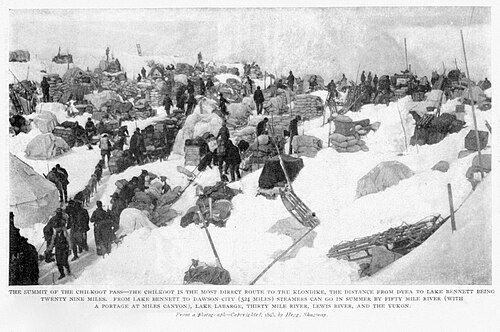
Also known as the Yukon Gold Rush, brought prospectors from around the world to the Klondike region of the Yukon territory in Canada.[30][31] The Klondike Gold Rush began in 1896, when gold was discovered in Bonanza Creek, a tributary of the Klondike River by George Carmack and his Indigenous companions, Skookum Jim Mason and Tagish Charlie.[32] As prospectors arrived in Klondike, makeshift towns and settlements sprang up along the rivers, including Dawson City, which because the largest town in Yukon at the height of the gold rush.[33] Prospectors employed various mining techniques to extract gold from the Klondike's streams and riverbeds, including placer mining, dredging, and hydraulic mining.[34]
The Carlin Trend
The Carlin Trend of Nevada, U.S., was discovered in 1961. Official estimates indicate that total world gold production since the beginning of civilization has been around 6,352,216,000 troy ounces (197,576.0 t) and total gold production in Nevada is 1.1% of that, ranking Nevada as one of the Earth's primary gold-producing regions.[35][36]
Statistics
World gold production was 3,612 tonnes in 2022.[37] As of 2020[update], the world's largest gold producer was China with 368.3 tonnes of gold mined in that year. The second-largest producer of gold was Russia where 331.1 tonnes was mined in the same year, followed by Australia with 327.8 tonnes.[38] In 2023, the annual gold demand of 4,448 tonnes was 5% below that of 2022. The total gold demand in 2023 was the highest at 4,899 tonnes.[39]
Despite its decreasing content in ores, gold production is increasing. This increase can be achieved through ever larger-scale industrial installations as well as innovations, especially in hydrometallurgy.
-
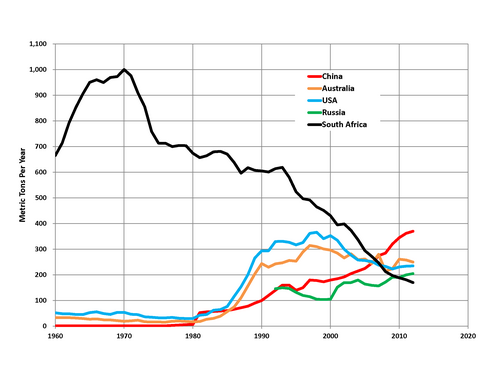 Trends in some gold-producing countries
 -
 Annual world mined gold production, 1900–2014
 -
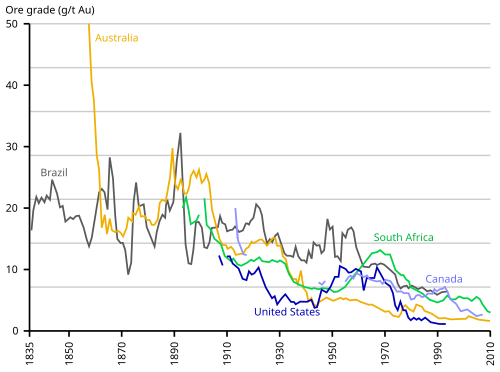 Gold ore grade evolution
Methods
Hard rock mining


Hard rock mining extracts gold encased in rock, rather than fragments in loose sediment, and produces most of the world's gold. Sometimes open-pit mining is used, such as at the Fort Knox Mine in central Alaska. Barrick Gold Corporation has one of the largest open-pit gold mines in North America located on its Goldstrike mine property in north eastern Nevada. Other gold mines use underground mining, where the ore is extracted through tunnels or shafts. South Africa has the world's deepest hard rock gold mine up to 3,900 metres (12,800 ft) underground. At such depths, the heat is unbearable for humans, and air conditioning is required for the safety of the workers. The first such mine to receive air conditioning was Robinson Deep, at that time the deepest mine in the world for any mineral.[40]
By-product gold mining
Gold is also produced by mining in which it is not the principal product. Large copper mines, such as the Bingham Canyon mine in Utah, often recover considerable amounts of gold and other metals along with copper. Sand and gravel pits, like those in Denver (Colorado), may recover small amounts of gold in their wash operations. The largest producing gold mine in the world, the Grasberg mine in Papua, Indonesia, is primarily a copper mine.[41]
Niche, recreational, or historical methods


.jpg/500px-Postcard_of_unidentified_man_panning_for_gold_in_Fair_Play,_Colorado_taken_in_the_early_1900s_-_DPLA_-_36c572e8b910b25a531ec110232def2e_(cropped).jpg)