
Loading article…
オハイオ州 | |
|---|---|
| ニックネーム: バックアイ州、 航空発祥の地、すべての中心 | |
| モットー: 「神と共にあれば、すべてのことは可能だ」[1] | |
| 国歌:「美しいオハイオ」[2] | |
 オハイオ州が強調表示された米国の地図 | |
| 国 | アメリカ合衆国 |
| 連合に加入 | 1803年3月1日[3](17番目、遡及的に1953年8月7日に宣言[4]) |
| 首都 (最大の都市) | コロンブス[5] [6] |
| 最大の郡または同等の郡 | フランクリン |
| 最大の大都市圏と都市圏 | グレーター・クリーブランド(複合都市圏) シンシナティ(メトロ) コロンバス(メトロ) (脚注参照)[a] |
| 政府 | |
| • 知事 | マイク・デワイン(右) |
| • 副知事 | ジョン・ハステッド(右) |
| 立法府 | 総会 |
| • 上院 | 上院 |
| • 下院 | 衆議院 |
| 司法 | オハイオ州最高裁判所 |
| 米国上院議員 | シェロッド・ブラウン(民主党) JD・ヴァンス(共和党) |
| 米国下院代表団 | 共和党 10 民主党 5 (リスト) |
| エリア | |
| • 合計 | 44,825平方マイル(116,096 km 2) |
| • 土地 | 40,948平方マイル(106,156 km 2) |
| • 水 | 3,877平方マイル(10,040 km 2) 8.7% |
| • ランク | 34日 |
| 寸法 | |
| • 長さ | 220マイル(355 km) |
| • 幅 | 220マイル(355 km) |
| 標高 | 850フィート(260メートル) |
| 最高標高 (キャンベル・ヒル[8] [b]) | 1,549フィート(472メートル) |
| 最低標高 | 455フィート(139メートル) |
| 人口 (2023) | |
| • 合計 | 11,785,935 [9] |
| • ランク | 7日 |
| • 密度 | 282/平方マイル(109/km 2) |
| • ランク | 10日 |
| • 世帯収入の中央値 | 54,021ドル[10] |
| • 所得順位 | 36日 |
| 異名 | オハイオ人; バックアイ[11](俗語) |
| 言語 | |
| • 公用語 | 法令: なし 事実上: 英語 |
| • 話し言葉 | 英語 93.3% スペイン語 2.2% その他 4.5% [12] |
| タイムゾーン | UTC– 05:00 (東部時間) |
| • 夏 ( DST ) | UTC– 04:00 ( EDT ) |
| USPSの略称 | ああ[13] |
| ISO 3166 コード | 米国オハイオ州 |
| 伝統的な略語 | お、ああ。 |
| 緯度 | 北緯38°24′から北緯41°59′ |
| 経度 | 西経80°31′から西経84°49′ |
| Webサイト | オハイオ州政府 |
| 州のシンボル一覧 | |
|---|---|
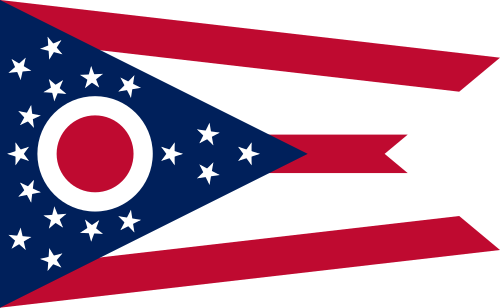 | |
.svg/500px-Seal_of_Ohio_(B&W).svg.png) | |
| スローガン | すべての中心 |
| 生きた記章 | |
| 両生類 | 斑点サンショウウオ |
| 鳥 | カーディナル(1933)[2] |
| 花 | |
| フルーツ | パパイヤ |
| 昆虫 | レディバグ(1975)[2] |
| 哺乳類 | オジロジカ(1987年)[2] |
| 爬虫類 | ブラックレーサースネーク(1995)[2] |
| 木 | バックアイ(1953)[2] |
| 無生物の記章 | |
| 飲料 | トマトジュース(1965)[2] |
| 化石 | 三葉虫イソテルス・マクシムス(1985年) [2] |
| 宝石 | オハイオ・フリント(1965年)[2] |
| 州道標識 | |
 | |
| 州25セント硬貨 | |
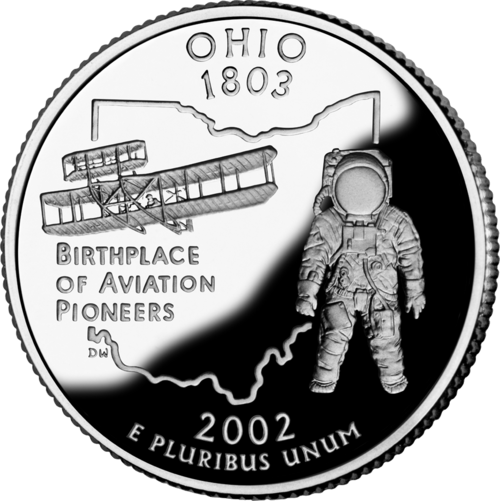 2002年にリリース | |
| アメリカ合衆国の州のシンボルのリスト | |
オハイオ州( / oʊ ˈ h aɪ . oʊ / oh-HY-oh)[14]アメリカ合衆国中西部州である。北はエリー湖東はペンシルベニアウェストバージニア、南西はケンタッキー州、西はインディアナ州、北西ミシガン州アメリカ合衆国50州の中で、面積では34番目に大きい。人口は約1180万人で、人口は7番目に多く、人口密度は10番目に高い。州都最多の都市はコロンバスで、他に人口の多い都市としてはクリーブランド、シンシナティ、デイトン、アクロン、トレドトチバミの木にちなんで「トチバミ州」というニックネームで呼ばれており、オハイオ州民は「バックアイズ」としても知られている。[11]の旗は、アメリカ合衆国の州旗の中で 唯一長方形でない旗
オハイオ州の名は、州の南の境界を形成するオハイオ川に由来しており、オハイオ川はセネカ語で「良い川」「偉大な川」「大きな入り江」を意味するohiːyo'に由来している。 [15] [16]州には古代先住民文明がいくつかあり、人類は紀元前1万年には存在していた。オハイオ州は、17世紀から18世紀後半の北西インディアン戦争まで、様々な先住民部族とヨーロッパ人入植者が争ったアパラチア山脈の西側の土地から生まれた。オハイオ州は、新アメリカ合衆国の最初の辺境である北西部準州から分割され、1803年3月1日に連邦に加盟した17番目の州となり、北西部条例の下で制定された最初の州となった。[3] [17]植民地時代後の自由国として初めて連邦に加盟し、20世紀に最も早くから影響力のある工業大国の一つとなった。21世紀には情報化・サービス化経済へと移行したが、依然として工業国であり、2019年時点でGDPは7位、[18]製造業は3位、自動車生産は2位となっている。[19][update]
オハイオ州の政府は連邦政府をモデルにしており、知事が率いる行政府、二院制のオハイオ州議会からなる立法府、州最高裁判所が率いる司法府で構成されている。オハイオ州は米国下院で15議席を占め、7番目に大きな代表団である。[20]オハイオ州からは7人の米国大統領が誕生しており、「大統領の母」というあだ名がつけられている。[21]
歴史
先住民の居住地

フォルサム型とクロービス型の両方の槍先が考古学的に発見されたことから、オハイオ渓谷には紀元前13,000年ごろから遊牧民が住んでいたことが分かる。[22] これらの初期の遊牧民は紀元前1,000年までにオハイオ州から姿を消した。[ 22 ]紀元前1,000年から800年の間に、定住型のアデナ文化が出現した。アデナ人はヒマワリなどの植物を栽培し、「カボチャやおそらくトウモロコシを栽培」したため、「半永久的な」村落を築いた。狩猟採集とともに、この耕作はより定住的で複雑な村落を支えた。[23]アデナ文化の最も注目すべき遺跡は、オハイオ州アダムズ郡にあるグレート・サーペント・マウンドである。[23]
紀元前100年頃、アデナ族はホープウェル族へと進化した。彼らもまたマウンド建設者であった。彼らの複雑で大規模、かつ技術的に洗練された土塁は、現在のマリエッタ、ニューアーク、サークルビルで見ることができる。[24]彼らはまた、交易が盛んな社会で、交易網は大陸の3分の1に及んでいた。[25]ホープウェル族は、西暦600年頃にオハイオ渓谷から姿を消した。ホープウェル文化が衰退するにつれ、ミシシッピ文化が勃興した。平原や東海岸の多くのスー語を話す人々は、彼らを祖先とし、13世紀頃までオハイオ地域全体に住んでいたと主張する。[26]
ミシシッピ文化と同時期には、フォート・エンシェント文化、ウィットルシー文化[26]、モノンガヒラ文化[27]の3つの文化が存在した。3つとも17世紀に消滅した。その起源は不明である。ショーニー族がフォート・エンシェント文化を吸収した可能性がある。[26]植民地時代にモノンガヒラ族がオハイオ州に土地を持っていなかった可能性もある。ミシシッピ文化はフォート・エンシェント文化に近く、広範囲に貿易を行っていた。
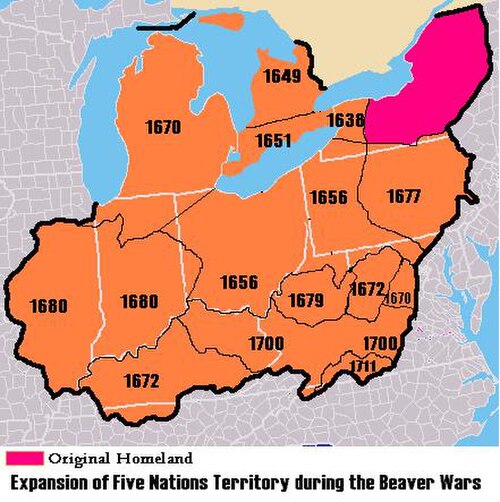
オハイオ渓谷のインディアンは、ニューヨーク州中部と西部に拠点を置いていたイロコイ連邦の攻撃的な戦術に大きく影響された。 [28] 17世紀半ばのビーバー戦争の後、イロコイ族はオハイオ地方の大半を狩猟、そしてさらに重要なことにはビーバー捕獲場として主張した。17世紀半ばの疫病と戦争による荒廃により、17世紀半ばから後半までにオハイオ地方から先住民がほぼいなくなったが[疑わしい–議論が必要] 、その土地には徐々にアルゴンキン語族が再定住した。これらオハイオ地方の民族の多くは、病気や[明確化が必要]戦争、それに続く社会的不安定によって引き起こされた以前の荒廃から生まれた多民族 (時には多言語) 社会であった。彼らは農業 (トウモロコシ、ヒマワリ、豆など) と季節的な狩猟で生計を立てていた。 18世紀までに、彼らはヨーロッパ人の毛皮貿易への参入によってもたらされたより大きな世界経済の一部となった。[29]
歴史的にオハイオ州に居住していた先住民族には、イロコイ族、[c]、アルゴンキン族、[d]、スー族などが含まれる。[ 30] [31]また、 オハイオ地方はイエロークリーク虐殺やグナデンハッテン虐殺などのインディアン虐殺の現場でもあった。[32] 1812年の戦争後、ティッペカヌーなどで先住民が深刻な被害を受けたため、ほとんどの先住民部族はオハイオ州を去るか、限られた居留地でのみ暮らすことを余儀なくされた。 1842年までに、残っていた先住民はすべて州から追い出された。[33]
植民地時代と革命時代
18世紀、フランスはこの地域の毛皮貿易を管理するために交易所のシステムを設立しました。1754年から、フランス王国とイギリス王国は、さまざまなネイティブアメリカンの部族を味方につけ、フレンチ・インディアン戦争で戦いました。パリ条約の結果、フランスは1763年にオハイオ州と旧北西部の残りの地域の支配権をイギリスに譲渡しました。 [34]
アメリカ独立戦争以前、イギリスはフランスの砦に無精な駐屯兵を配置することでオハイオ地方に対する主権をほとんど行使していなかった。[f]オハイオ地方のすぐ向こうにはマイアミの首都ケキオンガがあり、ここはオハイオ地方と将来の北西部領土全体におけるイギリスの貿易と影響力の中心地となった。1763年の英国王宣言により、アパラチア山脈の西側のイギリス領土は入植者の入植が禁止された。[35] 1768年のスタンウィックス砦条約は、オハイオ川の北と西の土地を先住民の土地として明示的に留保した。[36]この地域におけるイギリス軍の占領は、1763年のポンティアック戦争勃発の一因となった。 [37]オハイオの部族は、准将 ヘンリー・ブーケが率いる武装遠征隊がオハイオで休戦をもたらすまで戦争に参加した。 1774年にオハイオ領土に再度の植民地軍が遠征し、オハイオ州のイエロークリーク虐殺に端を発したダンモア卿戦争は終結した。1774年、イギリスはケベック法を可決し、オハイオとその他の西部の土地を正式にケベック州に併合し、民政政府を樹立し、モントリオールを拠点とする毛皮貿易のイギリスによる管理を集中化した。[38]アパラチア山脈の西側への入植禁止はそのまま残り、アメリカ独立戦争の一因となった。[39]
アメリカ独立戦争が始まるまでには、オハイオ地方と13植民地の間での原住民とアメリカ人の移動が緊張を招いていた。ペンシルバニア州のピット砦は、オハイオへの遠征隊の出発点となる主要な砦となっていた。この地域への侵入には、1778年にエドワード・ハンド将軍が500人のペンシルバニア民兵をピット砦からカイヤホガ川沿いのミンゴ族の町に向けて移動させたこと(イギリス軍はそこで軍需物資を保管し、インディアン襲撃隊に分配した)、[40]、 1780年のダニエル・ブロッドヘッド大佐の侵攻とレナペ・インディアンの首都コショクトンの破壊、[41]同年、ジョージ・ロジャース・クラークの部隊100人の分遣隊がオハイオ川付近でジョセフ・ブラント率いるインディアンに待ち伏せされたこと、[42] 1782年、ペンシルバニア州民兵がグナデンハッテン虐殺でモラヴィア・レナペ族の平和主義者96人を拘束し殺害した事件。[43] [44]
西部戦線では決定的な勝利者は出なかった。 1783年のパリ条約で、イギリスはアメリカ独立戦争での勝利後、オハイオ地方に対するすべての権利を新生アメリカ合衆国に譲渡した。[45] [46]
ノースウェスト準州

アメリカ合衆国は1787年の北西部条例に基づいて北西部領土を創設した。 [47]この新しい領土では奴隷制度は認められなかった。開拓は、アメリカ独立戦争の退役軍人らが結成したオハイオ・カンパニー・オブ・アソシエイツがマリエッタを設立したことから始まった。オハイオ・カンパニーに続いて、マイアミ・カンパニー(「シンムズ購入」とも呼ばれる)が南西部の領有権を主張し、コネチカット土地会社が現在の北東オハイオ州のコネチカット西部保留地の測量と入植を行った。フォート・スチューベンの領土測量士は、ほぼ同じ時期に オハイオ州東部のセブン・レンジと呼ばれる地域の測量を開始した。
旧北西部領土には、もともとオハイオ・カントリーとイリノイ・カントリーと呼ばれていた地域が含まれていました。オハイオ州が州昇格の準備を進める中、インディアナ準州が創設され、北西部領土は現在のオハイオ州とミシガン州のローワー半島の東半分、アッパー半島の東端、および「ザ・ゴア」と呼ばれるインディアナ南東部の細長い地域とほぼ同じ大きさに縮小されました。
西部連合として知られるアメリカ先住民部族の連合は、1795年のグリーンビル条約で、現在のオハイオ州の大部分を含む広大な領土を割譲することを余儀なくされた。
北西部条例によれば、人口が6万人に達すると、地域を定義して州として認めることができる。1801年12月のオハイオ州の人口はわずか4万5千人だったが、議会は人口が十分に急速に増加していると判断し、 1802年の権限付与法でそのプロセスを加速させた。レニ・レナペ族に関しては、議会は現在のオハイオ州のマスキンガム川沿いの1万エーカーを「分離し、その財産をモラヴィア兄弟団 またはインディアンを文明化しキリスト教を促進する同兄弟団の団体に与える」ことを決定した。[48]
「オハイオの父」ルーファス・パットナム

ルーファス・パトナムはフレンチ・インディアン戦争とアメリカ独立戦争の両方で重要な軍事的役割を果たした。彼はアメリカ合衆国の初期の時代で最も尊敬された人物の一人でした。[49]
1776年、パットナムは移動可能な要塞の建設法を考案し、大陸軍がイギリス軍をボストンから追い出すことを可能にした。ジョージ・ワシントンはこれに感銘を受け、パットナムを主任技師に任命した。戦後、パットナムとマナセ・カトラーは北西条例の制定に尽力し、北西部領土への入植を可能にさせた。この土地は独立戦争の退役軍人への債務の補償として使われた。パットナムはオハイオ・カンパニー・オブ・アソシエイツを組織して率い、オハイオ州マリエッタに入植し、キャンパス・マルティウスという大きな砦を建設した。[50] [51] [52]彼は学校用にかなりの量の土地を確保した。1798年、彼はマスキンガム・アカデミー(現在のマリエッタ・カレッジ)の建設計画を立てた。1780年、オハイオ・カンパニーの取締役は彼をオハイオ川の北の入植地に関するすべての業務の監督者に任命した。 1796年、ジョージ・ワシントン大統領は彼を合衆国土地測量総監に任命した。1788年、彼は北西部領土の最初の裁判所の判事を務めた。1802年、彼はオハイオ州の憲法を制定する会議に参加した。[53] [54] [55]
州昇格と初期
1803年2月19日、トーマス・ジェファーソン米大統領はオハイオ州の境界と憲法を承認する議会法に署名した。[56]しかし、議会はオハイオ州を17番目の州として承認する正式な決議を可決していなかった。正式な加盟決議は必要なかったが、1953年に見落としが発覚し、オハイオ州が建国150周年を祝う準備を始めたとき、オハイオ州議会議員のジョージ・H・ベンダーは、オハイオ州議会が初めて招集された1803年3月1日に遡ってオハイオ州を連邦に加盟させる法案を議会に提出した。[57]オハイオ州議会は、旧州都チリコシーでの特別会議で、新たな州昇格請願書を承認した。この請願書は馬に乗ってワシントンD.C.に届けられ、同年8月に承認された。[57] [58] [59]
オハイオ州には、チリコシー、ゼインズビル、コロンバスの 3 つの州都がありました。1803 年から 1810 年まではチリコシーが州都でした。その後、法案を可決させるための州議会の妥協策の一環として、州都は 2 年間ゼインズビルに移されました。その後、1812 年から 1816 年まで州都は再びチリコシーに移されました。最終的に、州の中心に近いコロンバスに州都が移されました。

多くのネイティブアメリカンはアメリカの侵略を避けるために西へ移住したが、他の者は州内に留まり、時には部分的に同化していた。1809年頃から、ショーニー族は再び侵略に抵抗した。テカムセ酋長の下、テカムセ戦争は1811年にオハイオ州で正式に始まった。米英戦争が始まると、イギリス軍はアッパー・カナダからオハイオ州に攻撃し、自軍をショーニー族と統合することを決定した。これは、テカムセが1813年のテムズ川の戦いで殺されるまで続いた。オハイオ州南西部のペコウィ族を除くほとんどのショーニー族は西へ強制的に移住させられた。[60]オハイオ州は西部戦線の最前線にあり、陸上とエリー湖の両方でいくつかの有名な戦いの舞台となったため、米英戦争で重要な役割を果たした。 1813年9月10日、オハイオ州プットインベイ近郊で、主要な戦闘の一つであるエリー湖の戦いが起こり、イギリス軍は最終的にオリバー・ハザード・ペリーに降伏した。
最終的に、アメリカ政府が1830年のインディアン移住法を用いて無数のアメリカ先住民部族を涙の道に追い込み、フロリダ州を除く南部の州から先住民を一掃した後、ほとんどの部族が自らの土地から追い出されることを望まなかったため、政府はパニックに陥った。アメリカ政府は先住民部族とアメリカ人入植者とのさらなる戦争を恐れ、オハイオ州に残っていた部族を含む東部に残っていたすべての先住民部族を、彼らの意志に反して西部に移住させた。[61] [62]
1835年、オハイオ州はミシガン準州とトレド戦争を繰り広げた。この戦争はトレド地帯をめぐるほぼ無血の境界戦争であった。この紛争で負傷したのは1人だけだった。議会が介入し、ミシガン州の州への加盟は紛争の終結を条件とした。トレド地帯の領有権を放棄する代わりに、ミシガン州はアッパー半島の西側3分の2と、すでに準州の一部とみなされていた東側3分の1を与えられた。
南北戦争と産業化
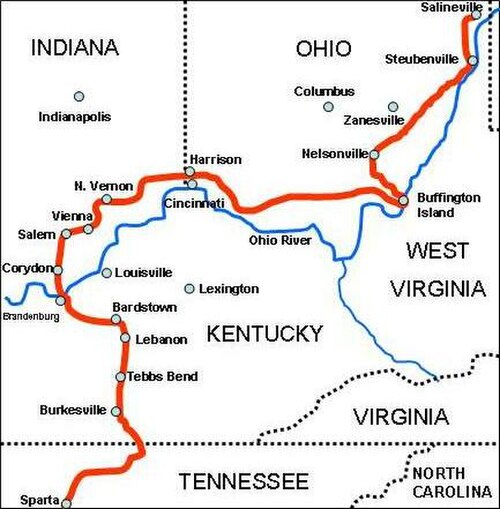
オハイオ州は、その中心的な位置と人口により、南北戦争で重要な位置を占めた。オハイオ川は、オハイオ州の鉄道と同様、軍隊と物資の移動に不可欠な動脈であった。オハイオ州の産業により、南北戦争中は同州は連邦で最も重要な州の一つとなった。人口一人当たりの兵士の数は、連邦の他のどの州よりも多かった。1862年、オハイオ州軍が2,000人の死傷者を出した、犠牲の大きい勝利となったシャイローの戦いの後、州の士気は大きく揺らいだ。 [63]その年の後半、ストーンウォール・ジャクソン率いる南軍がワシントンD.C.を脅かすと、オハイオ州知事のデイビッド・トッドは、3か月間の奉仕のために5,000人の志願兵を募集した。[64] 1863年7月13日から26日にかけて、オハイオ川沿いの町々が、西部のハリソンから始まり、最東部のウェストポイント近くのサリンビルの戦いで最高潮に達したモーガン襲撃で攻撃され略奪された。この襲撃は南軍にとって全体としては取るに足らないものであったが、戦争中南部からの部隊が最も遠くまで前進したことから、オハイオ州とインディアナ州の人々に恐怖を引き起こした。 [65]この戦闘でオハイオ州民約3万5千人が死亡し、3万人が負傷した。[66]南北戦争の終わりまでに、北軍のトップ3将軍、ユリシーズ・グラント、ウィリアム・シャーマン、フィリップ・シェリダンはいずれもオハイオ州出身であった。[67]
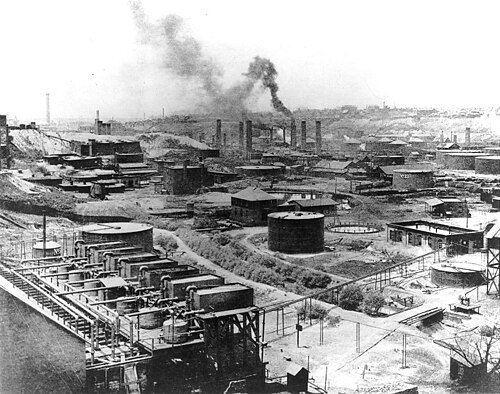
19世紀の大半の期間、既存の農業経済を補完するために産業が急速に導入された。最初の製鉄工場の一つであるホープウェル製鉄所は、 1804年にヤングスタウンの近くに開設された。19世紀半ばまでには、オハイオ州では48基の高炉が稼働しており、そのほとんどが州の南部にあった。[68]石炭鉱床の発見はオハイオ州の鉄鋼産業のさらなる発展を助け、1853年までにクリーブランドは国内第3位の鉄鋼生産者となった。最初のベッセマー転炉はクリーブランド圧延会社に購入され、同社はフェデラル・スチール社とカーネギー・スチール社の合併後、米国初の10億ドル企業となった米国鉄鋼会社の一部となった。 [68]鉄鋼生産に使用された最初の平炉はクリーブランドのオーティス・スチール社によって建設され、1892年までにオハイオ州はペンシルベニアに次ぐ第2位の鉄鋼生産州となった。[68]リパブリック・スチールは1899年にヤングスタウンで設立され、一時は国内第3位の鉄鋼メーカーだった。アームコ(現在のAKスチール)は1899年に ミドルタウンで設立された。
20世紀
州議会は1902年5月9日にオハイオ州の旗を公式に採用した。[69]デイトン出身のオービルとウィルバー・ライトは1903年12月17日にノースカロライナ州キティホークで4回の短時間飛行を行い、最初の成功した飛行機を発明した。[70]オハイオ州は1913年の大洪水という過去最大の自然災害に見舞われ、特にグレートマイアミ川流域で少なくとも428人が死亡し、数億ドルの物的損害が発生した。[71]
ナショナルフットボールリーグは、もともと1920年にオハイオ州カントンでアメリカンプロフットボールカンファレンスとして設立されました。[72]オハイオ州の5つの都市(アクロン、カントン、クリーブランド、コロンバス、デイトン)のオハイオリーグチームが含まれていましたが、現在ではいずれも存在しません。最初の公式試合は1920年10月3日に行われ、デイトントライアングルスがデイトンでコロンバスパンハンドルズを14対0で破りました。[73]カントンは1963年にプロフットボール殿堂の本拠地として祀られました。[74]

1930年代、大恐慌が州を直撃した。1933年までに、オハイオ州では工場労働者の40%以上、建設労働者の67%が失業していた。[75]クリーブランドでは工業労働者の約50%、トレドでは約80%が失業し、州の失業率は37.3%の高値に達した。[75]アメリカのユダヤ人はナチスドイツの台頭を不安に思いながら見守っていた。クリーブランド在住のジェリー・シーゲルとジョー・シュスターは、ユダヤ人のゴーレムの精神でスーパーマンという漫画のキャラクターを生み出した。彼らの漫画の多くは、スーパーマンがナチスと戦い、それを倒す様子を描いていた。[76] [77]約839,000人のオハイオ州民が第二次世界大戦中に米軍に従軍し、そのうち23,000人以上が戦闘中に死亡または行方不明となった。[78]
20世紀を通じて、芸術家、作家、音楽家、俳優がこの州で育ち、作品の中心地となる他の都市に移ることが多かった。ゼイン・グレイ、ミルトン・カニフ、ジョージ・ベローズ、アート・テイタム、ロイ・リキテンスタイン、ロイ・ロジャースなどがその例である。クリーブランドのスウィングダンス文化から登場したアラン・フリードは、1952年にクリーブランドで初のロックンロールのライブコンサートを主催した。有名な映画製作者には、スティーヴン・スピルバーグ、クリス・コロンバス、そしてカリフォルニア州に移転する前にヤングスタウンに初の映画館をオープンしたワーナー・ブラザーズがいる。この州は、ディーン・マーティン、ドリス・デイ、オージェイズ、マリリン・マンソン、デイヴ・グロール、ディーヴォ、メイシー・グレイ、アイズレー・ブラザーズなど、多くの人気ミュージシャンを輩出した。
1960年代、オハイオ州出身の2人の宇宙飛行士が宇宙開発競争において重要なマイルストーンを達成した。ジョン・グレン氏はアメリカ人として初めて地球を周回した。ニール・アームストロング氏は人類として初めて月面を歩いた。1967年、カール・ストークス氏がクリーブランド市長に選出され、国内で最も人口の多い10都市のうちの1つで初のアフリカ系アメリカ人市長となった。[79]
1970年、オハイオ州陸軍州兵部隊がケント州立大学で反戦デモを行っていた学生たちに発砲し、4名が死亡、9名が負傷した。州兵は、ケント市街地での暴動や予備役将校訓練課程の建物の放火など、キャンパス内外でのデモが激化したため、キャンパスに派遣された。デモの主な原因は、ベトナム戦争中の米国によるカンボジア侵攻であった。[80]
オハイオ州は、1970年代後半から1980年代前半にかけて、米国と中華人民共和国の関係発展において重要な州であった。 [81] : 59 両国の関係は、オハイオ州知事ジム・ローズの2期目在任中の1979年に正常化した。[81] : 112 ローズは、中国をオハイオ州の機械輸出の潜在的市場とみなし、経済関係の促進に努めた。[81] : 112 1979年7月、ローズはオハイオ州貿易使節団を率いて中国を訪問した。[81] : 112 この訪問の結果、経済関係の発展、湖北省との姉妹州関係、オハイオ州フェアでの長期にわたる中国展示会、およびオハイオ州立大学と武漢大学の間の大規模な学術交流が実現した。[81] : 113 1980年代初頭、この州は他の中西部諸州、ならびにニューヨーク、ペンシルベニア、オンタリオ、ケベックと、五大湖憲章、五大湖協定、五大湖知事協議会などの国際経済・資源協力条約や組織を締結した。
21世紀
オハイオ州の経済は21世紀に大きな変化を遂げており、産業空洞化の傾向がアメリカ中西部とラストベルトに大きな影響を与えています。中西部の製造業は21世紀初頭に著しい衰退を経験し、[82]この傾向はオハイオ州に大きな影響を与えました。1990年から2019年の間に、製造業の雇用は30万人以上減少しましたが、非製造業の雇用は100万人以上増加しました。[82]この衰退と同時に、オハイオ州では労働組合の加入者数が大幅に減少しています。2000年にはオハイオ州の労働者の17.4%が労働組合員でしたが、2022年には12.8%が労働組合員でした。[83]
こうした経済変化を受けて、オハイオ州政府は製造業の損失を補うために、太陽光発電や電気自動車の生産など、新しい産業の促進に目を向けてきた。[84]州政府が開始した主要プログラムの1つは、ボブ・タフト知事時代に創設された「サード・フロンティア」プログラムで、オハイオ州への投資を増やし、テクノロジー部門を活性化することを目指している。[85] 2010年現在、オハイオ州開発局は、このプログラムにより平均給与6万5000ドルの9,500の雇用が創出され、[86] 66億ドルの経済効果がもたらされ、投資収益率は9:1であるとしている。[86] 2010年、オハイオ州は国際経済開発評議会の経済開発優秀賞を受賞し、全国的な成功モデルとして称賛された。[要出典]
州のかつての工業中心地の多くは新しい産業に転換した。アクロンはポリマーと生物医学研究の中心地、シンシナティは州最大の商業拠点、[87] [より良い情報源が必要] コロンバスは技術研究開発、教育、保険の中心地、[87] [より良い情報源が必要] クリーブランドは再生医療の研究と製造、デイトンは航空宇宙と防衛の中心地、トレドは太陽光発電技術の国家的中心地となった。[88] [89]
オハイオ州の経済も大不況の影響を強く受け、州の失業率は2008年の最初の2か月の5.6%から2009年12月と2010年1月にはピークの11.1%まで上昇した。 [90]失業率が5.6%に戻るまでには2014年8月までかかった。[90] 2007年12月から2010年9月までの間に、オハイオ州は376,500人の雇用を失った。[91] 2009年には、オハイオ州の差し押さえ申請件数は89,053件で、当時の州記録だった。[92]世帯収入の中央値は2006~07年から2008~09年にかけて7%減少し、貧困率は2009年までに13.5%に膨れ上がった。[93]
2015年のオハイオ州の国内総生産は6,081億ドルで、50州の中で7番目に大きな経済規模でした。[94] 2015年のオハイオ州のGDP総額は米国のGDPの3.4%、世界のGDPの0.8%を占めました。[94]
政治的には、オハイオ州は長い間スイング州と見なされてきましたが、[95] 2000年代後半以降、オハイオ州で多くの共和党候補者が勝利したことで、オハイオ州が依然として選挙の激戦区であるかどうか疑問視する人が増えています。[95] [96] [97]
2020年3月9日、COVID-19パンデミックがオハイオ州に到達し、3件の症例が報告されました。[98] 2023年2月現在、オハイオ州では41,600人以上がCOVID-19で亡くなっています。[98] [99]オハイオ州の経済もパンデミックの影響を大きく受け、2020年には大規模な雇用喪失とそれに続く多額の景気刺激策支出が発生しました。[100]
地理

オハイオ州の立地は、経済成長と拡大にとって有利であることが証明されている。北東部と中西部を結んでいるため、多くの貨物やビジネス交通が、よく整備された高速道路に沿って州境を通過する。オハイオ州は全米で10番目に大きな高速道路網を持ち、北米の人口の50%と北米の製造能力の70%が1日以内のドライブ圏内にある。[101]オハイオ州の北には、エリー湖のある312マイル(502 km)の海岸線があり、[102]クリーブランドやトレドなど、多数の貨物港がある。オハイオ州の南境はオハイオ川によって定められている。オハイオ州の隣州は、東はペンシルベニア州、北西はミシガン州、北はエリー湖、西はインディアナ州、南はケンタッキー州、南東はウェストバージニア州である。オハイオ州の境界は、1802年の権限法で次のように測量図と境界によって定められた。
東はペンシルバニア州境、南はオハイオ川からグレートマイアミ川の河口まで、西は前述のグレートマイアミ川の河口から真北に引いた線、北はミシガン湖の南端を通って引いた東西線で囲まれ、前述の真北線と交差した後、グレートマイアミ川の河口から東に走り、エリー湖または領土境界線と交差し、そこからエリー湖を通って前述のペンシルバニア州境まで続きます。
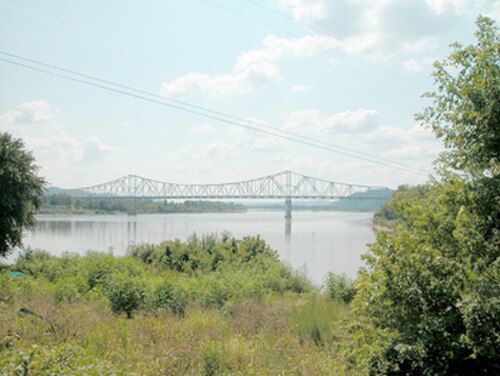
オハイオ州はオハイオ川に接しているが、川のほぼ全域はケンタッキー州とウェストバージニア州に属している。1980年、米国最高裁判所は、バージニア州(当時は現在のケンタッキー州とウェストバージニア州も含まれていた)による領土譲渡の文言に基づき、オハイオ州とケンタッキー州(そして暗にウェストバージニア州も)の境界は1792年当時のオハイオ川の北側の低水位線であるとの判決を下した。 [103]オハイオ州が所有するのは、1792年の低水位線から現在の高水位線までの部分のみである。ミシガン州との境界も、トレド戦争の結果、マウミー川河口の北岸に向かってわずかに北東に傾くように変更された。

オハイオ州の大部分は氷河に覆われた堆積平原で、北西部の非常に平坦な地域はグレート ブラック スワンプとして知られています。この北西部と中央州の氷河地域は、東と南東でまず氷河アレゲニー高原として知られる帯に接し、次に非氷河アレゲニー高原として知られる別の帯に接しています。オハイオ州の大部分は起伏が少ないですが、非氷河アレゲニー高原は険しい丘と森林が特徴です。
オハイオ州の起伏の多い南東部は、オハイオ川に沿ってウエストバージニア州のパンハンドルからシンシナティ郊外まで弓状に外側に伸び、独特の社会経済単位を形成している。この地域は、地質学的にはウエストバージニア州やペンシルベニア州南西部の一部と似ているが、炭鉱の伝統、古い製造業の小さな集落への依存、独特の方言により、州の他の地域とは一線を画している。1965年、議会は「アパラチア地域の根強い貧困と増大する経済的絶望に対処する」ためのアパラチア地域開発法を可決した。 [104]この法律では、オハイオ州の29郡がアパラチアの一部と定義されている。[105]オハイオ州の陸地の1/3は連邦政府が定義するアパラチア地域の一部であるが、オハイオ州民のわずか12.8%(147万6千人)がそこに住んでいる。[106]
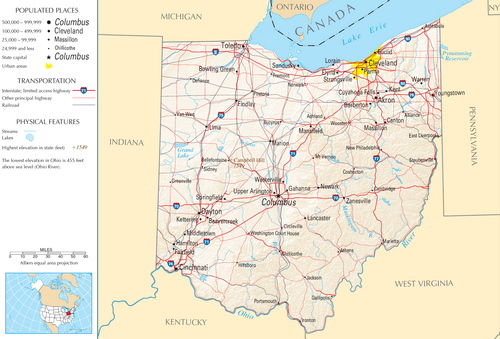
オハイオ州の重要な河川には、カイヤホガ川、グレートマイアミ川、モーミー川、マスキンガム川、およびシオト川がある。オハイオ州北部の河川はエリー湖とセントローレンス川を経由して北大西洋に流れ込み、オハイオ州南部の河川はオハイオ川とミシシッピ川を経由してメキシコ湾に流れ込む。オハイオ州にはバス諸島とケリーズ島もある。[107]州の西中央部にあるグランドレイクセントメアリーズは、1820年から1850年の運河建設時代に運河の水供給源として建設された。20平方マイル(52 km 2)を超えるこの水域は、1845年に完成した当時は世界最大の人造湖であった。[108]オハイオ州の運河建設プロジェクトは、他の州での同様の取り組みのような経済的大失敗にはならなかった。デイトンなどのいくつかの都市は、運河沿いの立地によって産業が発展し、1910 年頃まで内陸の運河が州の大量の貨物を運んでいた。
国立公園局の保護下にある地域には、カイヤホガバレー国立公園、ホープウェル文化国立歴史公園、デイトン航空遺産国立歴史公園、ファーストレディ国立歴史遺跡、ジェームズ・A・ガーフィールド国立歴史遺跡、ウィリアム・ハワード・タフト国立歴史遺跡、チャールズ・ヤング・バッファロー・ソルジャーズ国定公園、ペリーの勝利と国際平和記念碑などがある。[109]
動物相
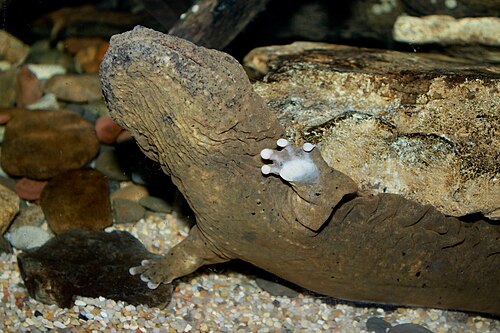
オハイオ州には、多種多様なユニークな動物種が生息しています。希少種や絶滅危惧種には、オハイオ州南東部アパラチア地方に生息し、州の絶滅危惧種に指定されているイースタンヘルベンダーが含まれます。 [110]イースタンヘルベンダーは世界で3番目に大きな両生類で、体長は最大27インチまで成長します。完全に水生で、ほぼ完全に皮膚で呼吸します。このため、清らかで冷たく、澄んだ流れの速い小川や川でのみ見られます。伐採やその他の人間の活動による生息地の喪失、水質汚染、堆積物によって大きな脅威にさらされています。 [111]
気候

オハイオ州の気候は、米国の湿潤亜熱帯気候( Cfa ) とアップランドサウス地域の北縁に位置するオハイオ州ブルーグラス地域セクションの最南部の郡を除いて、州の大部分で湿潤大陸性気候(ケッペンの気候区分 Dfa /Dfb )です。夏は州全体で一般的に高温多湿ですが、冬は一般的に涼しいから寒いです。オハイオ州の降水量は年間を通じて中程度です。州では厳しい天候が珍しくありませんが、オハイオ州での竜巻の報告は、竜巻街道として知られる地域にある州よりも一般的に少ないです。エリー湖の南東岸では、スノーベルトとして指定されている地域で、激しい湖効果吹雪も珍しくありません。
主に亜熱帯気候ではありませんが、より温暖な気候の動植物の一部はオハイオ州にまで広がっています。たとえば、ブラックジャックオーク( Quercus marilandica ) など、分布範囲がより南のいくつかの樹木は、オハイオ州の最北端、オハイオ川のすぐ北で見られます。また、亜熱帯気候から大陸性気候への気候遷移の証拠として、南部マグノリア( Magnolia grandiflora )、ミモザ ( Albizia julibrissin )、サルスベリ、さらにはニードルパームなどのいくつかの植物は、オハイオ州ブルーグラス地域では街路、庭、庭園の植栽として定期的に使用される丈夫な景観資材ですが、これらの同じ植物は州の他のほとんどの地域では育ちません。この興味深い変化は、オハイオ州をシンシナティからトレドまで州間高速道路 75 号線で旅行しているときに観察できます。この多様性に富んだ州を注意深く旅する人は、オハイオ州に生息する数少ない「亜熱帯」動物相のひとつである シンシナティの一般的な壁トカゲを垣間見ることもできるかもしれません。
オハイオ州史上最悪の気象災害は1913年にグレートマイアミ川沿いで発生した。デイトン大洪水として知られるこの洪水では、デイトンのダウンタウンのビジネス街を含むマイアミ川流域全体が浸水した。その結果、オハイオ州および米国で最初の大規模な洪水氾濫原工学プロジェクトとしてマイアミ保全地区が設立された。 [112]
記録された最高気温は 1934年7月21日のガリポリス近郊で記録された113 °F (45 °C )である。 [114]記録された最低気温は1899年2月10日のミリガンで記録された−39 °F (−39 °C)で、 [115] 1899年の大吹雪のときである。[116]
地震
一般住民が気付くような地震はほとんど記録されていないが、 1776年以降オハイオ州ではマグニチュード2.0以上の地震が200回以上発生している。[117]オハイオ州西部地震帯と五大湖南部地震帯の一部が州内にあり、地表の下には多数の断層が横たわっている。 [117] [118]
オハイオ州の歴史上最も大きな地震は、1937年3月9日に発生したアンナ(シェルビー郡)地震[119]である。この地震はオハイオ州西部を震源とし、マグニチュード5.4、震度8であった[120]。
オハイオ州で発生したその他の大きな地震としては、[121] 1884年9月19日のライマ近郊でのマグニチュード4.8の地震、 [122] 1901年5月17日のポーツマス近郊でのマグニチュード4.2の地震、 [123] 1986年1月31日のレイク郡ルロイ郡でのマグニチュード5.0の地震があり、この地震では2か月間にわたってマグニチュード0.5から2.4の余震が13回発生し続けた。[124] [125]
21世紀のオハイオ州で発生した注目すべき地震としては、2011年12月31日にヤングスタウンの北西約4キロメートル(2.5マイル)で発生した地震[126]と、2019年6月10日にエリー湖の湖底にあるイーストレイクの北北西約5キロメートル(3.1マイル)で発生した地震[127]があり、どちらもマグニチュード4.0を記録した。
都市
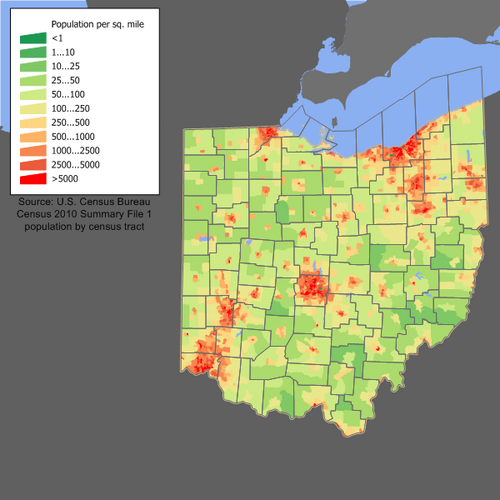
オハイオ州には、米国行政管理予算局の定義によると、16の都市を中心とする13の大都市統計地域がある。さらに、オハイオ州の30の都市は、大都市圏よりも小さな都市群である小都市統計地域の中心地として機能している。オハイオ州の3大都市は、コロンバス、クリーブランド、シンシナティである。
コロンバスは州の州都で、地理的な中心に近いほか、オハイオ州立大学でよく知られている。2019年、この都市には米国フォーチュン500リストにランクインした企業が6社あった。アライアンス・データ、ネイションワイド・ミューチュアル・インシュアランス・カンパニー、アメリカン・エレクトリック・パワー、Lブランズ、ハンティントン・バンクシェアーズ、ダブリン郊外のカーディナル・ヘルスである。[128] [129]その他の主要雇用主には、病院(ウェクスナー医療センターやネイションワイド小児病院など)、バテル記念研究所などのハイテク研究開発、 OCLCやケミカル・アブストラクツ・サービスなどの情報ベース企業、製造業者のワージントン・インダストリーズ、 JPモルガン・チェースやハンティントン・バンクシェアーズなどの金融機関がある。ファーストフードチェーンのウェンディーズとホワイトキャッスルもコロンバスに本社を置いている。
オハイオ州北東部のエリー湖岸に位置するクリーブランドは、ニューイングランドの伝統、民族移民文化、そしてアメリカの主要製造業と医療の中心地としての歴史が特徴です。クリーブランドは、アクロンとカントンの工業都市を含むクリーブランド・アクロン・カントン統合統計地域の中心地です。マンスフィールド、サンダスキー、ヤングスタウンもこの地域の主要都市です。オハイオ州北東部は、大手工業企業のグッドイヤー・タイヤ・アンド・ラバーとティムケン、トップクラスの大学であるケース・ウェスタン・リザーブ大学、オバリン大学、ケント州立大学、クリーブランド・クリニック、そしてクリーブランド美術館、ビッグ・ファイブのメンバーであるクリーブランド管弦楽団、カイヤホガ・バレー国立公園、プレイハウス・スクエア、プロフットボール殿堂、ロックの殿堂などの文化的名所で知られています。
シンシナティはオハイオ州南西部と、ケンタッキー州とインディアナ州の郡も含むシンシナティ都市圏の中心地です。この都市圏にはマイアミ大学、シンシナティ大学、シンシナティ・ユニオン・ターミナル、シンシナティ交響楽団のほか、プロクター・アンド・ギャンブル、クローガー、メイシーズ、フィフス・サード・バンクなど、フォーチュン500企業の拠点があります。デイトンとスプリングフィールドはマイアミ・バレーにあり、デイトン大学、デイトン・バレエ団、広大なライト・パターソン空軍基地があります。
トレドとリマは、ガラス製造産業で知られるオハイオ州北西部の主要都市です。ここは、フォーチュン 500企業 2 社、オーウェンス コーニングとオーウェンス イリノイの本拠地です。
スチューベンビルは、混合中生林で知られるアパラチア地方のオハイオ州で唯一の大都市である。オハイオ州の都市を含むが主に他の州にある他の大都市圏には、ウェストバージニア州ハンティントンやウェストバージニア州ウィーリング地域がある。オハイオ州は、英国の都市と同じ名前の都市の数が最も多い米国の州である。[130]
人口統計
人口
1800年には45,000人強だったオハイオ州の人口は、1970年の国勢調査では1065万人強と記録されるまで、10年ごとに10%以上の速さで増加しました(1940年の国勢調査を除く)。[133] その後40年間、成長は鈍化しました。[134] アメリカ合衆国国勢調査局は、2020年の国勢調査で11,808,848人を数え、 2010年の米国国勢調査から2.4%増加しました。[135]オハイオ州の人口増加は米国全体の増加に遅れをとっており、白人の人口密度は米国の平均よりも高いです。2000年現在、オハイオ州の人口の中心はモロー郡にあり、[136]郡庁所在地であるマウントギレアデにあります。[137]これは1990年のオハイオ州の人口中心地から南西に約6,346フィート(1,934メートル)の位置にあります。[136][update]
1800 年から 2020 年の国勢調査までのオハイオ州の人口のグラフ。

-10~-5パーセント
-5~-2パーセント
-2~0パーセント
0~2パーセント
2~5パーセント
5~10パーセント
10~20パーセント
20パーセント以上
2011年現在、オハイオ州の1歳未満の子供の27.6%は少数民族に属している。[138]オハイオ州の人口の約6.2%は5歳未満、23.7%は18歳未満、14.1%は65歳以上であり、女性は人口の約51.2%を占めていると推定されている。
HUDの2022年ホームレス評価報告書によると、オハイオ州には推定10,654人のホームレスがいる。[139] [140]
出生データ
注: 表の出生数は、ヒスパニック系は民族と人種の両方でカウントされるため合計が一致せず、全体の数が多くなります。
- 2016 年以降、白人ヒスパニック系の出生に関するデータは収集されておらず、1 つのヒスパニック系グループに含められています。ヒスパニック系の出生者は、どの人種でもかまいません。
祖先

2010年、オハイオ州には469,700人の外国生まれの居住者がおり、総人口の4.1%に相当します。このうち、229,049人(2.0%)が米国に帰化し、240,699人(2.1%)がそうではありませんでした。[12]最大のグループは以下のとおりです。[156]メキシコ(54,166)、インド(50,256)、中国(34,901)、ドイツ(19,219)、フィリピン(16,410)、イギリス(15,917)、カナダ(14,223)、ロシア(11,763)、韓国(11,307)、ウクライナ(10,681)オハイオ州は主に白人が住んでいますが、州全体のすべての主要都市圏に黒人人口が多く、トレドとコロンバスにはメキシコ人、クリーブランドとコロンバスにはプエルトリコ人からなるヒスパニック系人口が多く、コロンバスには多種多様なアジア系人口も多くいます。
州内の祖先グループ(国勢調査では人種的用語を含まないものと定義)は以下の通りである:[12] [157]ドイツ人26.5% 、アイルランド人14.1% 、イギリス人9.0% 、イタリア人6.4%、ポーランド人3.8% 、フランス人2.5%、スコットランド人1.9% 、ハンガリー人1.7% 、オランダ人1.6%、メキシコ人1.5% 、スロバキア人1.2% 、ウェールズ人1.1% 、スコットランド系アイルランド人1.1% 。人口の1%未満が祖先を主張するものには、サハラ以南のアフリカ人、プエルトリコ人、スイス人、スウェーデン人、アラブ人、ギリシャ人、ノルウェー人、ルーマニア人、オーストリア人、リトアニア人、フィンランド人、西インド諸島人、ポルトガル人、スロベニア人が含まれる。
言語
5歳以上の人口の約6.7%が英語以外の言語を話していると報告しており、人口の2.2%がスペイン語、2.6%が他のインド・ヨーロッパ言語、1.1%がアジアおよびオーストロネシア語族の言語、0.8%がその他の言語を話している。[12]数値的には、10,100,586人が英語、239,229人がスペイン語、55,970人がドイツ語、38,990人が中国語、33,125人がアラビア語、32,019人がフランス語を話していた。さらに、2010年の国勢調査によると、59,881人がスラブ語を話し、42,673人が別の西ゲルマン語族の言語を話していた。 [158]オハイオ州はスロベニア語話者の人口が全米最大で、スロバキア語話者の人口は2番目に多く、ペンシルベニア・ダッチ語(ドイツ語)話者の人口は2番目に多く、セルビア語話者の人口は3番目に多かった。[159]
宗教

公共宗教研究所の2021年アメリカ人価値観調査によると、オハイオ州民の64%がキリスト教徒であると自認している。具体的には、オハイオ州の人口の19%が主流プロテスタント、17%が福音派プロテスタント、7%が歴史的黒人プロテスタント、18%がカトリックであると自認している。人口の約30%はどの宗教団体にも所属していない。この調査によると、ユダヤ教徒(2%)、ヒンズー教徒( 1 %)、エホバの証人(<1 %) 、イスラム教徒(<1%)、仏教徒(<1%)、モルモン教徒(<1%)、およびその他の信仰の小さな少数派が存在する。[160]全体として、宗教または精神的伝統を自認する人は州の人口の70%であった。
宗教データアーカイブ協会(ARDA)の2020年の調査によると、キリスト教が依然として主要な宗教であった。無宗派のキリスト教信者は1,411,863人でプロテスタントの中では最大であったが、カトリックは1,820,233人の信者を擁し、依然として最大の宗派であった。 [161] ARDAによると、2010年に信者数で最大のキリスト教宗派はカトリック教会で1,992,567人、合同メソジスト教会で496,232人であった。アメリカ福音ルーテル教会が223,253人、南部バプテスト連盟が171,000人、キリスト教諸教会とキリスト教会が141,311人、キリスト教連合が118,000人、米国長老派教会が110,000人である。[162] 2020年の時点で約80,000人の信者を抱えるオハイオ州は、隣接するペンシルベニア州に次いで、全米で2番目に多いアーミッシュの人口を擁していた。[163]
2014年のピューフォーラムの世論調査によると、オハイオ州民の過半数、56%が宗教は「非常に重要」、25%が「やや重要」、19%が「あまり重要ではない/全く重要ではない」と感じている。そのうち、オハイオ州民の38%は少なくとも週に1回は宗教の礼拝に出席し、32%は時々、30%はめったにまたは全く出席しないと答えている。[164]
経済

米国国勢調査局によると、2016年の就業者総数は4,790,178人だった。雇用主事業所の総数は252,201で、非雇用主事業所の総数は785,833だった。[165] 2010年、オハイオ州はビジネス活動データベースに基づき、サイトセレクション誌によって国内でビジネス環境の優良州第2位にランクされた。[166]同州はまた、同誌からビジネスの成長と発展に基づき、3年連続で知事杯を受賞している。[167] 2016年現在[update]、オハイオ州の国内総生産(GDP)は6260億ドルだった。[168]これにより、オハイオ州の経済は全50州とワシントンDCの中で7番目に大きいものとなった。 [169]
中小企業・起業家協議会は、2009年事業税指数でオハイオ州を最も企業に優しい税制で第10位にランク付けした。これには、法人税とキャピタルゲイン税率がともに1.9%で第6位にランク付けされたことが含まれる。[170]協議会の2009年中小企業生存指数によると、オハイオ州は最も企業に優しい政策の州として第11位にランク付けされた。 [171]ディレクターズ・ボードルーム・ガイドは、州を最もビジネス環境の総合第13位にランク付けし、最も訴訟環境が第7位にランク付けされた。[172]フォーブスは、2009年に州を最も規制環境が優れている州として第8位にランク付けした。[173] USニューズ&ワールド・レポートの2010年のランキングによると、オハイオ州には国内トップ115の大学のうち5校があり、 [174]また、2008年には同誌の最も優れた高校として第8位にランク付けされた。[175]
オハイオ州の失業率は2018年2月時点で4.5%で、[176] 2010年5月の10.7%から低下している。 [177] [178]州では、2007年の不況前の数字と比較すると、依然として45,000件の雇用が不足している。 [179] 2015年4月現在の労働力参加率は63%で、全国平均をわずかに上回っている。[179] 2023年現在[update]、オハイオ州の一人当たり所得は60,402ドルで、米国で38位、州の世帯所得の中央値は65,720ドルである。[180] [181]また、2023年には、人口の13.4%が貧困線以下の生活を送っていた。[182]
製造業と金融活動部門はそれぞれオハイオ州のGDPの18.3%を占めており、GDPの割合で見るとオハイオ州最大の産業となっている。[169]オハイオ州はカリフォルニア州とテキサス州に次いで3番目に大きい製造業の労働力を有している。[183] [184]オハイオ州は中西部で最大のバイオサイエンス部門を有し、「グリーン」経済の全国的リーダーである。オハイオ州はプラスチック、ゴム、金属加工品、電気機器、家電製品の国内最大の生産国である。[185]現在、5,212,000人のオハイオ州民が賃金または給与制で雇用されている。[169]
雇用別に見ると、オハイオ州最大の部門は貿易・運輸・公共事業で、101万人のオハイオ州民、つまりオハイオ州の労働力の19.4%を雇用している。一方、医療・教育部門は82万5千人のオハイオ州民(15.8%)を雇用している。[169]政府は78万7千人のオハイオ州民(15.1%)、製造業は66万9千人のオハイオ州民(12.9%)、専門・技術サービスは63万8千人のオハイオ州民(12.2%)を雇用している。[169]オハイオ州の製造業は、国内総生産で全米50州中3番目に大きい部門である。[169]米国の上位1,000社の上場企業(2008年の売上高による)のうち59社がオハイオ州に本社を置いており、その中にはプロクター・アンド・ギャンブル、グッドイヤー・タイヤ・アンド・ラバー、AKスチール、ティムケン、アバクロンビー・アンド・フィッチ、ウェンディーズなどがある。[186]
オハイオ州は独自の宝くじを持つ41州のうちの1つでもあります。 [ 187 ]オハイオ宝くじ[188] 2020年現在[update]、オハイオ宝くじは1974年から260億ドル以上を教育に寄付してきました。[189]
オハイオ州の所得格差は、税引き前、税引き後ともに、1970年代以降大幅に拡大している。[190]オハイオ州の総所得は2009年から2012年にかけて増加し、全体では7.1%の所得増加となった。上位1%の所得は37.0%増加したのに対し、下位99%の所得はわずか2.3%の増加にとどまった。この期間中、上位1%が全体の所得の71.9%を占めた。[191]所得税の負担は、低所得者層に不釣り合いにかかっている。2018年には、下位20%の所得者は所得の12.3%をさまざまな税金に充てたのに対し、上位1%は6.5%しか支払っていなかった。[192]
交通機関

.jpg/500px-Ohio_welcome_sign_(2019).jpg)
道路
オハイオ州には、東西を結ぶ主要な交通回廊が数多く通っています。20 世紀初頭に「メイン マーケット ルート 3」として知られていた開拓ルートの 1 つは、1913 年に歴史的なリンカーン ハイウェイの一部となるよう選ばれました。リンカーン ハイウェイは、アメリカを横断する最初の道路で、ニューヨーク市とサンフランシスコを結びました。オハイオ州では、リンカーン ハイウェイは、カントン、マンスフィールド、ウースター、ライマ、ヴァン ワートなど、多くの町や都市を結びました。リンカーン ハイウェイがオハイオ州に到着したことは、州の発展に大きな影響を与えました。1926 年に連邦番号付き高速道路システムが導入されると、オハイオ州を通るリンカーン ハイウェイは米国国道 30 号線になりました。
オハイオ州には、現在アメリカ国道40号線となっている国道228マイル(367 km)がある。
オハイオ州には、高度に発達した道路網と州間高速道路がある。東西に走る主要道路には、北部のオハイオ・ターンパイク(I-80 / I-90 )、アクロンからペンシルベニアに至るI-76、コロンバスとデイトンを通るI-70、ウェストバージニア州からシンシナティまで走るアパラチアン・ハイウェイ(州道32号線)などがある。南北に走る主要道路には、西のトレド、デイトン、シンシナティを通るI-75 、州中央部のクリーブランドからコロンバス、シンシナティを経てケンタッキー州に至るI-71 、州東部のクリーブランドからアクロン、カントン、ニューフィラデルフィア、マリエッタを経て南にウェストバージニア州に至るI-77がある。シンシナティとデイトンの間の州間高速道路75号線は、オハイオ州で最も交通量の多い州間高速道路の1つである。
トレイル
オハイオ州には、標識付きの州立自転車ルートのネットワークが発達している。その多くは鉄道の跡地をたどっており、現在も改修が進められている。オハイオ・エリー・トレイル(ルート1)は、シンシナティ、コロンバス、クリーブランドを結んでいる。米国自転車ルート50は、オハイオ州をスチューベンビルからリッチモンド郊外のインディアナ州境まで横断している。[193]
オハイオ州には長距離ハイキング コースがいくつかあるが、最も有名なのはバックアイ トレイルで、州を一周する 1,444 マイル (2,324 km) のループ状のコースである。コースの一部は道路で、一部は森林のトレイルである。さらに、ノース カントリー トレイル(連邦議会が認可した11 の国立景観トレイルの中で最長) とアメリカン ディスカバリー トレイル(レクリエーション用のトレイルと道路のシステムで、全体として米国中部を横断する東海岸から西海岸までのルートを形成する) がオハイオ州を通っている。これら 2 つのトレイルの多くはバックアイ トレイルと一致している。
レール
オハイオ州には広範囲にわたる鉄道網がありますが、現在ではほとんどの路線が貨物輸送のみを行っています。オハイオ州では、 CSXトランスポーテーション、ノーフォーク・サザン鉄道、カナディアン・ナショナル鉄道の 3 つのクラス I貨物鉄道が運行しています。また、州内には多くの地方貨物輸送会社も存在します。
全国旅客鉄道のアムトラックは、オハイオ州を通る 3 つの長距離鉄道路線を運行しています。レイク ショア リミテッドは、クリーブランド、エリリア、トレド、サンダスキー、ブライアンに停車します。キャピトル リミテッドは、これらの都市とアライアンスに停車します。カーディナルは、シンシナティ ユニオン ターミナルに停車します。オハイオ州からは、シカゴ、ニューヨーク、ボストン、ワシントン DC、インディアナポリス、ピッツバーグ、バッファロー、およびその間の数十の目的地に直接乗車できます。
コロンバスは米国で旅客鉄道のない最大の都市です。ユニオン駅は1979 年にナショナル リミテッドによって最後に運行されました。
オハイオ州には、カイヤホガバレー国立公園を通るカイヤホガバレー観光鉄道、エイジ・オブ・スチーム・ラウンドハウス博物館、ホッキングヒルズ州立公園近くのホッキングバレー観光鉄道など、観光鉄道や博物館がいくつかあります。
交通

オハイオ州の都市には、主にバスシステムを通じて、さまざまな形態の公共交通機関が存在する。グレーター・クリーブランド地域交通局(GCRTA)は、 RTA 高速輸送システムを運営しており、これは 1 つの大型鉄道路線、3 つのライトレール路線、および 3 つのバス高速輸送路線で構成される。シンシナティには、サウスウェスト・オハイオ地域交通局(SORTA) のバス ネットワークと、3.6 マイル (5.8 km) の路面電車路線であるシンシナティ ベル コネクターが運行している。オハイオ州の他の主要な交通機関には、コロンバスにサービスを提供するセントラル オハイオ交通局(COTA) とデイトンにサービスを提供するグレーター デイトン地域交通局(GDRTA) がある。
航空旅行
オハイオ州には4つの国際空港があり、4つは商業用、2つは軍用です。4つの国際空港には、クリーブランド・ホプキンス国際空港、ジョン・グレン・コロンバス国際空港、デイトン国際空港、リッケンバッカー国際空港(2つの軍用飛行場のうちの1つ)が含まれます。もう1つの軍用飛行場はライト・パターソン空軍基地で、米国最大の空軍基地の1つです。他の主要空港はトレドとアクロンにあります。シンシナティの主要空港であるシンシナティ/ノーザンケンタッキー国際空港はケンタッキー州ヘブロンにあるため、オハイオ州の空港リストには含まれていません。
水路
法律と政府

オハイオ州政府は、行政、立法、司法の各部門から構成されている。[194] [195] [196]オハイオ州の政治文化は穏健派であると言われている。[197]
行政部門
行政府はオハイオ州知事が率いている。[194]現在の知事は2019年から共和党員のマイク・デワインである。[198]副知事は知事が解任された場合に後を継ぎ、知事から割り当てられた職務を遂行する。[199] [200]現在の副知事はジョン・ハステッドである。行政府のその他の選挙で選ばれる憲法上の役職は、国務長官(フランク・ラローズ)、監査役(キース・フェイバー)、財務長官(ロバート・スプレイグ)、司法長官(デイブ・ヨスト)である。[194]行政府には21の州行政部門がある。[201] [202]
立法府

オハイオ州議会は、上院と下院からなる二院制の議会である。[203]上院は33の選挙区で構成され、各選挙区は1人の上院議員によって代表される。各上院議員は約33万人の有権者を代表している。[204]下院は99人の議員からなる。[205] 2022年の選挙サイクル時点で、共和党は両院で多数党となっている。
法案が法律として制定されるためには、州議会の両院で採択され、知事が署名しなければならない。知事が法案を拒否した場合、州議会は両院の5分の3以上の多数決で拒否権を覆すことができる。また、法案が提出されてから10日以内に知事が署名または拒否しない場合も、法案は法律となる。会期法はオハイオ州の公式法律として公表される。[206]これらは、オハイオ州改正法典に成文化されている。[207]
オハイオ州議会は、知事の承認を得て、米国下院におけるオハイオ州の 16 議席について米国議会の選挙区の境界線を引いています。オハイオ州配分委員会は、オハイオ州の州議会の選挙区の境界線を引いています。
司法部門

There are three levels of the Ohio state judiciary. The lowest is the court of common pleas: each county maintains its own constitutionally mandated court of common pleas, which maintain jurisdiction over "all justiciable matters".[208] The intermediate-level court system is the district court system.[209] Twelve courts of appeals exist, each retaining jurisdiction over appeals from common pleas, municipal, and county courts in a set geographical area.[208] A case heard in this system is decided by a three-judge panel, and each judge is elected.[208]
The state's highest-ranking court is the Ohio Supreme Court.[210] A seven-justice panel composes the court, which, by its own discretion, hears appeals from the courts of appeals, and retains original jurisdiction over limited matters.[211]
Local government
There are also several levels of local government in Ohio: counties, municipalities (cities and villages), townships, special districts, and school districts.
Ohio is divided into 88 counties.[212] Ohio law defines a structure for county government, although they may adopt charters for home rule.[213][214] Summit County[213] and Cuyahoga County[215] have chosen an alternate form of government. The other counties have a government with a three-member board of county commissioners,[216] a sheriff,[217] coroner,[218] auditor,[219] treasurer,[220] clerk of the court of common pleas[221] prosecutor,[222] engineer,[223] and recorder.[224]
There are two kinds of incorporated municipalities, 251 cities and 681 villages.[213][225][226] If a municipality has five thousand or more residents as of the last United States Census it is a city, otherwise it is a village.[213][227] Municipalities have full home rule powers, may adopt a charter, ordinances and resolutions for self-government.[228] Each municipality chooses its own form of government, but most have elected mayors and city councils or city commissions. City governments provide much more extensive services than county governments, such as police forces and paid (as opposed to volunteer) fire departments.
The entire area of the state is encompassed by townships.[213] When the boundaries of a township are coterminous with the boundaries of a city or village, the township ceases to exist as a separate government (called a paper township).[213] Townships are governed by a three-member board of township trustees.[213] Townships may have limited home rule powers.[229]
There are more than 600 city, local, and exempted village school districts providing K-12 education in Ohio, as well as about four dozen joint vocation school districts, which are separate from the K-12 districts. Each city school district, local school district, or exempted village school district is governed by an elected board of education.[213] A school district previously under state supervision (municipal school district) may be governed by a board whose members either are elected or appointed by the mayor of the municipality containing the greatest portion of the district's area.[213]
Politics
"Mother of presidents"
Six U.S. presidents hailed from Ohio at the time of their elections, giving rise to its nickname "mother of presidents", a sobriquet it shares with Virginia. It is also termed "modern mother of presidents", in contrast to Virginia's status as the origin of presidents earlier in American history. Seven presidents were born in Ohio, making it second to Virginia's eight. Virginia-born William Henry Harrison lived most of his life in Ohio and is also buried there. Harrison conducted his political career while living on the family compound, founded by his father-in-law, John Cleves Symmes, in North Bend, Ohio. The seven presidents born in Ohio were Ulysses S. Grant (elected from Illinois), Rutherford B. Hayes, James A. Garfield, Benjamin Harrison (grandson of William Henry Harrison & elected from Indiana), William McKinley, William Howard Taft and Warren G. Harding.[231] All seven were Republicans.
Electoral history

Democratic
Republican
Ohio has been considered a swing state, being won by either the Democratic or Republican candidates reasonably each election. As such, it is usually targeted by both major-party campaigns, especially in competitive elections.[232] Pivotal in the election of 1888, Ohio has been a regular swing state since 1980 and considered a bellwether.[233][234] This status was called into question after incumbent Republican Donald Trump won the state by an eight-point margin in the 2020 presidential election despite losing nationally to Democratic challenger Joe Biden.[235]
Historian R. Douglas Hurt asserts that not since Virginia "had a state made such a mark on national political affairs".[236] The Economist notes that "This slice of the mid-west contains a bit of everything American—part north-eastern and part southern, part urban and part rural, part hardscrabble poverty and part booming suburb".[237] Since 1896, Ohio has had only three misses in the general election (Thomas E. Dewey in 1944, Richard Nixon in 1960, and Donald Trump in 2020) and had the longest perfect streak of any state, voting for the winning presidential candidate in each election from 1964 to 2016, and in 33 of the 38 held since the Civil War. No Republican has ever won the presidency without winning Ohio.
As of 2019, there are more than 7.8 million registered Ohioan voters, with 1.3 million Democrats and 1.9 million Republicans. They are disproportionate in age, with a million more over 65 than there are 18- to 24-year-olds.[238] Since the 2010 midterm elections, Ohio's voter demographic has leaned towards the Republican Party.[239] The governor, Mike DeWine, is Republican, as are all other non-judicial statewide elected officials, including Lieutenant Governor Jon A. Husted, Attorney General Dave Yost, State Auditor Keith Faber, Secretary of State Frank LaRose and State Treasurer Robert Sprague. In the Ohio State Senate the Republicans are the majority, 25–8, and in the Ohio House of Representatives the Republicans control the delegation 64–35.
Losing one seat in the U.S. House of Representatives following the 2020 census, Ohio has 15 seats for the two presidential elections of the decade in 2024 and 2028.[240] As of the 2022 cycle, ten federal representatives are Republicans while five are Democrats. Marcy Kaptur (D-09) is the most senior member of the Ohio delegation to the U.S. House of Representatives.[241] The senior U.S. senator, Sherrod Brown, is a Democrat, while the junior, JD Vance, is a Republican.[242][243]
Allegations of voter suppression
Since 1994, the state has had a policy of purging infrequent voters from its rolls. In April 2016, a lawsuit was filed, challenging this policy on the grounds that it violated the National Voter Registration Act (NVRA) of 1993[244] and the Help America Vote Act of 2002.[245] In June, the federal district court ruled for the plaintiffs and entered a preliminary injunction applicable only to the November 2016 election. The preliminary injunction was upheld in September by the Court of Appeals for the Sixth Circuit. Had it not been upheld, thousands of voters would have been purged from the rolls just a few weeks before the election.[244][246]
It was estimated in 2017 that the state has removed up to two million voters since 2011.[247][better source needed]
In a 2020 study, Ohio was ranked as the 17th hardest state for citizens to vote in.[248]
Education
Ohio's system of public education is outlined in Article VI of the state constitution, and in Title XXXIII of the Ohio Revised Code. Ohio University, the first university in the Northwest Territory, was also the first public institution in Ohio. Substantively, Ohio's system is similar to those found in other states. At the State level, the Ohio Department of Education, which is overseen by the Ohio State Board of Education, governs primary and secondary educational institutions. At the municipal level, there are approximately 700 school districts statewide. The Ohio Board of Regents coordinates and assists with Ohio's institutions of higher education which have recently been reorganized into the University System of Ohio under Governor Strickland. The system averages an annual enrollment of more than 400,000 students, making it one of the five largest state university systems in the U.S.
Colleges and universities

Ohio is home to several public and private institutions of higher learning. Prior to statehood, the Northwest Ordinance of 1787 included a provision to establish an institution of higher education in the region, which resulted in the establishment of Ohio University in 1804 as Ohio's first college.[250][251][252]
Ohio schools consistently ranking in the top 50 nationally of the U.S. News & World Report of liberal arts colleges include members of the “Five Colleges of Ohio”: Denison University, Kenyon College and Oberlin College. Ranking in the top 100 of national research universities typically includes Case Western Reserve University, Ohio State University and Miami University.[253]
- 13 state universities
- Bowling Green State University (Bowling Green)
- Central State University (Wilberforce)
- Cleveland State University (Cleveland)
- Kent State University (Kent)
- Miami University (Oxford)
- Ohio State University, (Columbus)
- Ohio University (Athens)
- Shawnee State University (Portsmouth)
- University of Akron (Akron)
- University of Cincinnati (Cincinnati)
- University of Toledo (Toledo)
- Wright State University (Dayton)
- Youngstown State University (Youngstown)
- 24 state university branch and regional campuses

- 46 private colleges and universities
- 6 free-standing state-assisted medical schools
- Boonshoft School of Medicine, Wright State University
- Heritage College of Osteopathic Medicine, Ohio University
- Northeast Ohio Medical University
- The Ohio State University College of Medicine and Public Health
- University of Cincinnati College of Medicine
- University of Toledo College of Medicine (formerly Medical University of Ohio)
- 15 community colleges
- 8 technical colleges
- 24 independent non-profit colleges
Libraries
Ohio is home to some of the nation's highest-ranked public libraries.[255] The 2008 study by Thomas J. Hennen Jr. ranked Ohio as number one in a state-by-state comparison.[256] For 2008, 31 of Ohio's library systems were all ranked in the top ten for American cities of their population category.[255]
- 500,000 books or more
- Columbus Metropolitan Library (First)
- Cuyahoga County Public Library (Second)
- Public Library of Cincinnati and Hamilton County (Tenth)
The Ohio Public Library Information Network (OPLIN) is an organization that provides Ohio residents with internet access to their 251 public libraries. OPLIN also provides Ohioans with free home access to high-quality, subscription research databases.
Ohio also offers the OhioLINK program, allowing Ohio's libraries (particularly those from colleges and universities) access to materials for the other libraries. The program is largely successful in allowing researchers for access to books and other media that might not be otherwise available.
Culture
Arts
Music

The Rock and Roll Hall of Fame and the Rhythm and Blues Music Hall of Fame are both located in Cleveland. Cleveland disc jockey Alan Freed is credited with coining the term and promoting rock and roll in the early 1950s. Cincinnati is home to the American Classical Music Hall of Fame and Museum. Six Ohio musicians are Rock and Roll Hall of Fame members, Dave Grohl (Nirvana and Foo Fighters), the Isley Brothers, Nine Inch Nails, Bobby Womack, Benjamin Orr (The Cars), and Chrissie Hynde (The Pretenders). Also inducted was disk jockey Alan Freed.
Other popular musicians from Ohio include Mamie Smith, Dean Martin, Tyler Joseph and Josh Dun of Twenty One Pilots, Frankie Yankovic, Doris Day, the McGuire Sisters, Howard Hewett, Shirley Murdock, Boz Scaggs, John Legend, Marilyn Manson, Starset, Dan Auerbach and Patrick Carney of the Black Keys, Griffin Layne, Joe Dolce, Kid Cudi, William "Bootsy" Collins, Stephanie Eulinberg of Kid Rock's Twisted Brown Trucker Band, and Devo.
Performing arts

Playhouse Square in downtown Cleveland is the nation's second-largest performing arts center, home to ten theaters.[257] The Cleveland Orchestra is one of the historic Big Five orchestras in the U.S. and considered among the best worldwide.[258]
Many other Ohio cities are home to their own orchestras, including Akron, Blue Ash, Canton, Cincinnati, Columbus, Dayton, Toledo, and Youngstown. Cincinnati is home to its own ballet, symphony orchestra, pops orchestra, and opera, all housed at the Cincinnati Music Hall. Dayton is also home to a ballet, orchestra, and opera, collectively known as the Dayton Performing Arts Alliance.
The Columbus Association for the Performing Arts manages seven historic Columbus area theaters.[259]
Within the marching arts, Winter Guard International has hosted national championships in performing arts at the University of Dayton 18 times between 1983 and 2003, and has permanently since 2005. The Bluecoats Drum and Bugle Corps are Ohio's highest fielding drum corps, competing in the Drum Corps International World Class circuit out of Canton.
Visual arts

Ohio is home to 30 art institutions, including the Columbus Museum of Art, Cincinnati Art Museum, Cleveland Museum of Art, and other entities. The full list includes:
- Akron Art Museum, Akron
- Allen Memorial Art Museum, Oberlin College
- Billy Ireland Cartoon Library & Museum, Ohio State University
- Burchfield Homestead, Salem
- Butler Institute of American Art, Youngstown
- Canton Museum of Art, Canton
- Cincinnati Art Museum, Cincinnati
- Cleveland Museum of Art, Cleveland
- Columbus Museum of Art, Columbus
- Contemporary Arts Center, Cincinnati
- Dayton Art Institute, Dayton
- Frank Museum of Art, Otterbein University
- National Imperial Glass Museum, Bellaire
- Kennedy Museum of Art, Ohio University
- Temple Museum of Religious Art, Case Western Reserve University
- Mansfield Art Center, Mansfield
- McDonough Museum of Art, Youngstown State University
- Miami University Art Museum, Miami University
- Museum of Ceramics, East Liverpool
- Museum of Contemporary Art Cleveland, Cleveland
- Ohio Glass Museum, Lancaster
- Richard Ross Museum of Art, Ohio Wesleyan University
- Springfield Center for the Arts at Wittenberg University, Wittenberg University
- Taft Museum of Art, Cincinnati
- Toledo Museum of Art, Toledo
- Toy and Plastic Brick Museum, Bellaire
- University of Findlay's Mazza Museum, University of Findlay
- Wexner Center for the Arts, Ohio State University
- Whitby Mansion, Sidney
The Cincinnati Art Museum holds over 100,000 works spanning 6,000 years of human history, being among the most comprehensive collections in the Midwest. Among its notable collections are works by Master of San Baudelio, Jorge Ingles, Sandro Botticelli (Judith with Head of Holofernes), Matteo di Giovanni, Domenico Tintoretto (Portrait of Venetian dux Marino Grimani), Mattia Preti, Bernardo Strozzi, Frans Hals, Bartolomé Esteban Murillo (St. Thomas of Villanueva), Peter Paul Rubens (Samson and Delilah) and Aert van der Neer. The collection also includes works by Jean-Baptiste-Camille Corot, Pierre-Auguste Renoir, Camille Pissarro, Claude Monet (Rocks At Belle Isle), and Pablo Picasso. The museum also has a large collection of paintings by American painter Frank Duveneck (Elizabeth B. Duveneck).
The Cleveland Museum of Art is internationally renowned for its substantial holdings of Asian and Egyptian art, and has a permanent collection of more than 61,000 works from around the world.[261] It is the fourth-wealthiest art museum in the United States.[262]
The Columbus Museum of Art holds nineteenth and early twentieth-century American and European art, including early Cubist paintings by Pablo Picasso and Juan Gris, works by François Boucher, Paul Cézanne, Mary Cassatt, Jean Auguste Dominique Ingres, Edgar Degas, Henri Matisse, Claude Monet, Edward Hopper, and Norman Rockwell, and installations by Mel Chin, Josiah McElheny, Susan Philipsz, and Allan Sekula. Also in Columbus, the Billy Ireland Cartoon Library & Museum collection includes 450,000 original cartoons, 36,000 books, 51,000 serial titles, and 3,000 feet (910 m) of manuscript materials, plus 2.5 million comic strip clippings and tear sheets, making it the largest research library for cartoon art.
Youngstown's Butler Institute of American Art was the first museum dedicated exclusively to American art.[263]
Sports
Professional sports teams
.jpg/500px-10Cincinnati_2015_(2).jpg)
Ohio is home to eight professional sports teams across the five different major leagues in the United States. Current teams include the Cincinnati Reds and Cleveland Guardians of Major League Baseball,[264][265] the Columbus Crew and FC Cincinnati of Major League Soccer,[266] the Cleveland Cavaliers of the National Basketball Association,[267] the Cincinnati Bengals and Cleveland Browns of the National Football League,[268] and the Columbus Blue Jackets of the National Hockey League.[269]
Ohio has brought home seven World Series titles (Reds 1919, 1940, 1975, 1976, 1990; Indians 1920, 1948), three MLS Cups (Crew 2008, 2020, 2023), one NBA Championship (Cavaliers 2016), and nine NFL Championships (Pros 1920; Bulldogs 1922, 1923, 1924; Rams 1945; Browns 1950, 1954, 1955, 1964). Despite this success in the NFL in the first half of the 20th century, no Ohio team has won the Super Bowl since its inception in 1967. No Ohio team has made an appearance in the Stanley Cup Finals.
.jpg/500px-Pro_Football_Hall_of_Fame_(23945852607).jpg)
Ohio played a central role in the development of both Major League Baseball and the National Football League. Baseball's first fully professional team, the Cincinnati Red Stockings of 1869, were organized in Ohio.[270] An informal early-20th-century American football association, the Ohio League, was the direct predecessor of the modern NFL, although neither of Ohio's modern NFL franchises trace their roots to an Ohio League club. The NFL itself was founded in Canton in 1920 as the American Professional Football Conference.[72] The first official game occurred on October 3, 1920, when the Dayton Triangles beat the Columbus Panhandles 14–0 in Dayton.[73] Canton was enshrined as the home of the Pro Football Hall of Fame in 1963.[74]
On a smaller scale, Ohio hosts minor league baseball, arena football, indoor football, mid-level hockey, and lower division soccer.
Individual sports
The Mid-Ohio Sports Car Course has hosted several auto racing championships, including CART World Series, IndyCar Series, NASCAR Nationwide Series, Can-Am, Formula 5000, IMSA GT Championship, American Le Mans Series and Rolex Sports Car Series. The Grand Prix of Cleveland also hosted CART races from 1982 to 2007. The Eldora Speedway is a major dirt oval that hosts NASCAR Camping World Truck Series, World of Outlaws Sprint Cars and USAC Silver Crown Series races.
Ohio hosts two PGA Tour events, the WGC-Bridgestone Invitational and Memorial Tournament. The Cincinnati Open is an ATP World Tour Masters 1000 and WTA 1000 tennis tournament.
College sports

Ohio has eight NCAA Division I Football Bowl Subdivision college football teams, divided among three different conferences. It has also experienced considerable success in the secondary and tertiary tiers of college football divisions.
There are two programs in the Power Five conferences; the Ohio State Buckeyes of the Big Ten Conference and the Cincinnati Bearcats of the Big 12 Conference. The Ohio State Buckeyes football team is second in all-time winning percentage, with a 931–327–53 overall record and a 28–29 bowl record as of 2023. The program has produced seven Heisman Trophy winners, forty conference titles, and eight undisputed national championships. The men's basketball program has appeared in the NCAA Division I men's basketball tournament 27 times.
The Cincinnati Bearcats men's basketball team has over 1,800 wins and 33 March Madness appearances, whilst the Bearcats football team became the first so-called "Group of Five" team to qualify to the College Football Playoff in 2022.[271]
In the Group of Five conferences, six teams are represented in the Mid-American Conference: the Akron Zips, Bowling Green Falcons, Kent State Golden Flashes, Miami RedHawks, Ohio Bobcats and the Toledo Rockets. The MAC headquarters are in Cleveland. The Cincinnati–Miami rivalry game has been played in southwest Ohio every year since 1888 and is the oldest current non-conference NCAA football rivalry.
Other Division I schools, either part of the NCAA Division I Football Championship Subdivision or not fielding in football include the Cleveland State Vikings, Xavier Musketeers, Wright State Raiders, and Youngstown State Penguins. Xavier's men's basketball has performed particularly well, with 27 March Madness appearances. Youngstown State's football has the third most NCAA Division I Football Championship wins, with 3.
There are 12 NCAA Division II universities and 22 NCAA Division III universities in Ohio.
See also

Notes
- ^ According to the U.S. Census,[7] Greater Columbus is the largest Metropolitan statistical area (MSA) that is entirely within Ohio, with a population of 2,078,725; and Greater Cincinnati is the largest MSA that is at least partially within Ohio, with a population of 2,179,082, approximately 25% of which is in Indiana or Kentucky. Which MSA is the largest in Ohio depends on the context.
- ^ a b Elevation adjusted to North American Vertical Datum of 1988.
- ^ Petun, Erie, Chonnonton, Wyandot, the Mingo Seneca and the Iroquois Confederacy
- ^ Miami, Mascouten Lenape Shawnee and Odawa
- ^ Mosopelea
- ^ The last French Fort in Ohio Country, Fort Sandusky, was destroyed in 1763 during Pontiac's Rebellion.
- ^ Persons of Hispanic or Latino origin are not distinguished between total and partial ancestry.
References
- ^ "Ohio's State Motto". Ohio Historical Society. July 1, 2005. Archived from the original on October 6, 2007. Retrieved March 27, 2009.
- ^ a b c d e f g h i j k "Ohio's State Symbols". Ohio Governor's Residence and State Garden. Archived from the original on April 23, 2009. Retrieved March 26, 2009.
- ^ a b Mary Stockwell (2006). Ohio Adventure. Gibbs Smith. p. 88. ISBN 978-1-4236-2382-3. Archived from the original on March 31, 2015. Retrieved June 16, 2015.
- ^ "The Admission of Ohio as a State". United States House of Representatives. Archived from the original on November 10, 2019. Retrieved November 10, 2019.
- ^ "Ohio Quick Facts". Ohio Historical Society. Archived from the original on February 8, 2009. Retrieved March 26, 2009.
- ^ "City of Columbus: Fun Facts". City of Columbus, Ohio. 2006. Archived from the original on May 1, 2009. Retrieved March 26, 2009.
- ^ July 2017 Annual Estimate Archived December 27, 1996, at the Wayback Machine
- ^ a b "Elevations and Distances in the United States". United States Geological Survey. 2001. Archived from the original on July 22, 2012. Retrieved October 24, 2011.
- ^ "Annual Estimates of the Resident Population for Counties: April 1, 2020 to July 1, 2023". United States Census Bureau. Retrieved March 24, 2024.
- ^ "Median Annual Household Income". The Henry J. Kaiser Family Foundation. Archived from the original on December 20, 2016. Retrieved December 9, 2016.
- ^ a b "Why is Ohio known as the Buckeye State and why are Ohioans known as Buckeyes?" (PDF). November 1998. Archived (PDF) from the original on April 12, 2019. Retrieved December 7, 2018.
- ^ a b c d "American FactFinder—Results". factfinder2.census.gov. U.S. Census Bureau. Archived from the original on February 12, 2020. Retrieved October 17, 2012.
- ^ "Official USPS Abbreviations". United States Postal Service. 1998. Archived from the original on March 28, 2009. Retrieved March 26, 2009.
- ^ "Ohio". Merriam-Webster.com Dictionary. Merriam-Webster.
- ^ "Quick Facts About the State of Ohio". Ohio History Central. Archived from the original on November 27, 2010. Retrieved July 2, 2010.
From Iroquois word meaning 'great river'
- ^ "Native Ohio". American Indian Studies. Ohio State University. Archived from the original on February 2, 2007. Retrieved February 25, 2007.
Ohio comes from the Seneca (Iroquoian) ohiiyo' 'good river'
- ^ William M. Davidson (1902). A History of the United States. Scott, Foresman and Company. p. 265. Retrieved June 16, 2015.
- ^ "U.S. Gross Domestic Product (GDP), by state 2019". Statista. Archived from the original on November 20, 2018. Retrieved December 28, 2020.
- ^ Girardi-Schachter, Taylor (September 3, 2019). "Top 10 States For Manufacturing 2019". Global Trade Magazine. Archived from the original on December 3, 2020. Retrieved December 31, 2019.
- ^ Berg-Andersson, Richard E. (2000). "The Math Behind the 2000 Census Apportionment of Representatives". The Green Papers. Archived from the original on January 6, 2009. Retrieved March 25, 2009.
- ^ "Ohio Presidents – Ohio Secretary of State". Ohiosos.gov. Archived from the original on January 21, 2021. Retrieved December 28, 2020.
- ^ a b Knepper (1989), p. 9.
- ^ a b Knepper (1989), p. 10.
- ^ Knepper (1989), p. 11.
- ^ Douglas T. Price; Gary M. Feinman (2008). Images of the Past, 5th edition. New York: McGraw-Hill. pp. 274–277.
- ^ a b c Knepper (1989), p. 13.
- ^ "Monongahela culture-AD 1050–1635". Fort Hill Archeology. Retrieved January 14, 2010.
- ^ Knepper (1989), p. 14.
- ^ Roseboom (1967), p. 20.
- ^ louis, franquelin, jean baptiste. "Franquelin's map of Louisiana". LOC.gov. Retrieved August 17, 2017.
- ^ Knepper (1989), pp. 14–17.
- ^ Knepper (1989), pp. 43–44.
- ^ "American Indians - Ohio History Central". ohiohistorycentral.org. Archived from the original on December 29, 2020. Retrieved February 23, 2021.
- ^ "Wars and Battles: Treaty of Paris (1763)". www.u-s-history.com. Archived from the original on December 4, 2015. Retrieved March 9, 2022.
- ^ Billington, Ray A. (1944). "The Fort Stanwix Treaty of 1768". New York History. 25 (2). University of Nebraska Press: 182–194. JSTOR 23147791.
- ^ Sosin, Jack M. (1961). Whitehall and the wilderness: the Middle West in British colonial policy, 1760–1775. Cornell University Press. p. 146. Archived from the original on January 18, 2020. Retrieved March 9, 2022.
- ^ White, Richard (1991). The Middle Ground: Indians, Empires, and Republics in the Great Lakes Region, 1650–1815. Cambridge University Press. p. 256. ISBN 0-521-42460-7.
- ^ Gerald E. Hart (1891). The Quebec Act 1774. Montreal: Gazette Printing Company. p. 12.
- ^ Gordon Wood, The American Revolution (New York: Random House, 2002).
- ^ Downes, Council Fires, 211; Nester, Frontier War, 194; Nelson, Man of Distinction, 101.
- ^ Downes, Council Fires, 266.
- ^ Keller, Christine; Boyd, Colleen; Groover, Mark; Hill, Mark (2011). "Archeology of the Battles of Fort Recovery, Mercer County, Ohio: Education and Protection" (PDF). National Park Service American Battlefield Protection Program. p. 61. Archived (PDF) from the original on June 12, 2019. Retrieved November 24, 2019 – via Ball State University.
- ^ Weslager, Delaware Indians, 316.
- ^ Sterner, Eric (February 6, 2018). "Moravians in the Middle: the Gnadenhutten Massacre". Journal of the American Revolution. Archived from the original on September 30, 2019. Retrieved September 30, 2019.
- ^ Cogliano, Francis D. (2003). Revolutionary America, 1763–1815: A Political History. Francis and Taylor. ISBN 978-1-134-67869-3. Archived from the original on February 20, 2021. Retrieved November 19, 2020.
- ^ Kaplan, Lawrence S. (September 1983). "The Treaty of Paris, 1783: A Historiographical Challenge". International History Review. 5 (3). Taylor & Francis, Ltd.: 431–442. doi:10.1080/07075332.1983.9640322. ISSN 0707-5332. JSTOR 40105317.
- ^ Cayton (2002), p. 3.
- ^ "Religion and the Congress of the Confederation, 1774–89". Library of Congress. June 4, 1998. Archived from the original on May 2, 2012. Retrieved April 11, 2012.
- ^ Hubbard, Robert Ernest. General Rufus Putnam: George Washington's Chief Military Engineer and the "Father of Ohio," pp. 1–4, McFarland & Company, Inc., Jefferson, North Carolina. ISBN 978-1-4766-7862-7.
- ^ Hubbard, Robert Ernest. General Rufus Putnam: George Washington's Chief Military Engineer and the "Father of Ohio," pp. 2–4, 45–8,105–18, McFarland & Company, Inc., Jefferson, North Carolina. ISBN 978-1-4766-7862-7.
- ^ Hildreth, Samuel Prescott. Biographical and Historical Memoirs of the Early Pioneer Settlers of Ohio, pp. 34–7, 63–74, Badgley Publishing Company, 2011. ISBN 978-0-615-50189-5.
- ^ McCullough, David. The Pioneers: The Heroic Story of the Settlers Who Brought the American Ideal West, pp. 46–7, Simon & Schuster, Inc., New York, New York, 2019. ISBN 978-1-5011-6870-3.
- ^ Hubbard, Robert Ernest. General Rufus Putnam: George Washington's Chief Military Engineer and the "Father of Ohio," pp. 127–50, McFarland & Company, Inc., Jefferson, North Carolina. ISBN 978-1-4766-7862-7.
- ^ Hildreth, Samuel Prescott. Biographical and Historical Memoirs of the Early Pioneer Settlers of Ohio, pp. 69, 71, 81, 82, Badgley Publishing Company, 2011. ISBN 978-0-615-50189-5.
- ^ McCullough, David. The Pioneers: The Heroic Story of the Settlers Who Brought the American Ideal West, pp. 143–7, Simon & Schuster, Inc., New York, New York, 2019. ISBN 978-1-5011-6870-3.
- ^ An act to provide for the due execution of the laws of the United States, within the state of Ohio, ch. 7, 2 Stat. 201 (February 19, 1803).
- ^ a b Blue, Frederick J. (Autumn 2002). "The Date of Ohio Statehood". Ohio Academy of History Newsletter. Archived from the original on September 11, 2010.
- ^ Joint Resolution for admitting the State of Ohio into the Union, (Pub. L. 83–204, 67 Stat. 407, enacted August 7, 1953).
- ^ "Clearing up the Confusion surrounding OHIO's Admission to Statehood". Archived from the original on October 17, 2009. Retrieved October 30, 2009.
- ^ "The Shawnee Tribe & War of 1812". Archived from the original on February 25, 2022. Retrieved February 25, 2022.
- ^ Stockwell, Mary (2014). The Other Trail of Tears: The Removal of the Ohio Indians.
- ^ "What happened to Indians that once inhabited Ohio? - Columns by Jim Blount". Archived from the original on February 25, 2022. Retrieved February 25, 2022.
- ^ Knepper (1989), pp. 233–234.
- ^ Roseboom and Weisenburger (1967), p. 188.
- ^ "Morgan's Raid—Ohio History Central". Ohiohistorycentral.org. Archived from the original on June 21, 2018. Retrieved April 2, 2018.
- ^ Cayton (2002), p. 129.
- ^ Cayton (2002), pp. 128–129.
- ^ a b c "History of Ohio Steelmaking". OhioSteel.org. Archived from the original on July 25, 2010. Retrieved August 17, 2017.
- ^ "Ohio's State Flag (1901)". Ohio History Central. Archived from the original on February 21, 2022. Retrieved February 21, 2022.
- ^ "The Wright Brothers - The First Successful Airplane". National Air and Space Museum. Archived from the original on February 21, 2022. Retrieved February 21, 2022.
- ^ "1913 Ohio Statewide Flood". Ohio History Central. Archived from the original on February 21, 2022. Retrieved February 21, 2022.
- ^ a b "Timeline Detail | Pro Football Hall of Fame Official Site". Archived from the original on September 15, 2018. Retrieved September 14, 2018.
- ^ a b "Triangle Park: Site of First Game In The NFL". Archived from the original on February 21, 2022. Retrieved February 21, 2022.
- ^ a b Maroon, Thomas; Maroon, Margaret; Holbert, Craig (2006). Akron-Canton Football Heritage. Arcadia Publishing. ISBN 978-0-7385-4078-8. Archived from the original on January 7, 2022. Retrieved January 5, 2022.
- ^ a b "Great Depression". Ohio History Central. Archived from the original on February 21, 2022. Retrieved February 21, 2022.
- ^ Bytwerk, Randall. "The SS and Superman". Calvin.edu. Archived from the original on June 26, 2015. Retrieved August 17, 2017.
- ^ "The religion of Superman (Clark Kent / Kal-El)". Adherents.com. Archived from the original on May 21, 2009. Retrieved August 17, 2017.
- ^ "1913 Ohio Statewide Flood". World War II. Archived from the original on February 21, 2022. Retrieved February 21, 2022.
- ^ "Carl B. Stokes". Ohio History Central. Archived from the original on February 21, 2022. Retrieved February 21, 2022.
- ^ Hildebrand, Herrington, & Keller; pp. 165–166
- ^ a b c d e Lampton, David M. (2024). Living U.S.-China relations: From Cold War to Cold War. Lanham, MD: Rowman & Littlefield. ISBN 978-1-5381-8725-8.
- ^ a b Arden, Scott; DeCarlo, Christopher (November 2021). "Exploring Midwest manufacturing employment from 1990 to 2019". www.bls.gov. Bureau of Labor Statistics. Archived from the original on February 21, 2023. Retrieved February 21, 2023.
- ^ "Union Membership Historical Table for Ohio : Midwest Information Office". www.bls.gov. Bureau of Labor Statistics. Archived from the original on February 21, 2023. Retrieved February 21, 2023.
- ^ Woody, Todd (November 23, 2009). "Solar energy industry brings a ray of hope to the Rust Belt". Archived from the original on April 17, 2017. Retrieved August 17, 2017 – via LA Times.
- ^ "Ohio Third Frontier – History". Ohio.gov. Archived from the original on October 6, 2010. Retrieved August 17, 2017.
- ^ a b "Ohio Third Frontier Continues to Create Jobs and Opportunities for Ohioans". PRNewswire (Press release). Ohio Business Development Coalition. Archived from the original on August 18, 2017. Retrieved August 17, 2017.
- ^ a b "Atlantic Eye: Brunner is the best for Ohio" Archived August 5, 2010, at the Wayback Machine, Marc S. Ellenbogen. May 3, 2010. Retrieved May 5, 2010.
- ^ ""Five cities that will rise in the New Economy", Christian Science Monitor. Retrieved November 27, 2009". Christian Science Monitor. November 20, 2009. Archived from the original on November 23, 2009. Retrieved February 14, 2021.
- ^ "Ohio gov. declares NW Ohio a solar energy hub". ABCLocal.go.com. June 30, 2010. Archived from the original on July 6, 2010. Retrieved August 17, 2017.
- ^ a b U.S. Bureau of Labor Statistics (January 1, 1976). "Unemployment Rate in Ohio". FRED, Federal Reserve Bank of St. Louis. Archived from the original on February 21, 2023. Retrieved February 21, 2023.
- ^ "Ohio has endured decade of job losses". Dispatch.com. September 12, 2010. Archived from the original on October 5, 2010. Retrieved August 17, 2017.
- ^ Grzegorek, Vince (May 20, 2010). "We're Number One: Cuyahoga Leads Ohio Foreclosures... Again". CleveScene.com. Archived from the original on August 18, 2017. Retrieved August 17, 2017.
- ^ "Ohio's poverty, uninsured rates up; median income drops sharply". Cleveland.com. September 2010. Archived from the original on August 18, 2017. Retrieved August 17, 2017.
- ^ a b Ohio Facts 2016: Ohio's Economy Ranks 7th Largest Among States Archived January 31, 2017, at the Wayback Machine, Ohio Legislative Service Commission.
- ^ a b Fahey, Kevin (September 2, 2021). "What Happened?: The 2020 election confirmed that Ohio is no longer a swing state". blogs.lse.ac.uk. Archived from the original on February 21, 2023. Retrieved February 21, 2023.
- ^ LeBlanc, Paul; Diaz, Daniella (December 4, 2022). "Sen. Sherrod Brown says Ohio is still a swing state ahead of 2024 election | CNN Politics". CNN. Archived from the original on February 21, 2023. Retrieved February 21, 2023.
- ^ Gangitano, Alex (September 9, 2022). "Ohio shows signs of becoming swing state again for Democrats". The Hill. Archived from the original on February 21, 2023. Retrieved February 21, 2023.
- ^ a b "Ohio Coronavirus Map and Case Count". The New York Times. April 1, 2020. ISSN 0362-4331. Archived from the original on February 22, 2023. Retrieved February 22, 2023.
- ^ "Coronavirus (Covid-19)". coronavirus.ohio.gov. Ohio Department of Health. Archived from the original on February 22, 2023. Retrieved February 22, 2023.
- ^ Ellerbrock, Matthew; Demko, Iryna; Lendel, Iryna; Henrichsen, Erica (March 1, 2021). "Economic Impact of the COVID-19 Pandemic on Ohio". All Maxine Goodman Levin School of Urban Affairs Publications: 1–7. Archived from the original on April 5, 2023. Retrieved February 22, 2023.
- ^ "Transportation delivers for Ohio". Ohio: Department of Transportation. February 12, 2003. Archived from the original on January 24, 2008. Retrieved December 22, 2005.
- ^ "Ohio Coastal Counties". Ohio: Department of Natural Resources. Archived from the original on August 30, 2008. Retrieved September 3, 2008.
- ^ "Ohio v. Kentucky, 444 U.S. 335". Find law. January 21, 1980. Archived from the original on August 28, 2014. Retrieved August 15, 2016.
- ^ "History of the Appalachian Regional Commission". Appalachian Regional Commission. Archived from the original on December 22, 2005. Retrieved January 3, 2006.
- ^ "Counties in Appalachia" Archived September 17, 2008, at the Wayback Machine, Appalachian Regional Commission. Retrieved January 3, 2006.
- ^ "GCT-T1 Ohio County Population Estimates—2005", The United States Census Bureau, retrieved January 3, 2006. True summation of Ohio Appalachia counties population (1,476,384) obtained by adding the 29 individual county populations together (July 1, 2005, data). Percentage obtained by dividing that number into that table's estimate of Ohio population as of July 1, 2005 (11,464,042)
- ^ Gwillim Law (May 20, 2015). Administrative Subdivisions of Countries: A Comprehensive World Reference, 1900 through 1998. McFarland. p. 396. ISBN 978-1-4766-0447-3. Retrieved October 26, 2023.
- ^ "History". St. Marys Develops. Archived from the original on March 2, 2021. Retrieved February 24, 2021.
- ^ "Ohio". National Park Service. Retrieved July 24, 2024.
- ^ "EASTERN HELLBENDER". Ohio Department of Natural Resources. Archived from the original on March 21, 2023. Retrieved November 30, 2023.
- ^ IUCN (July 15, 2021). Cryptobranchus alleganiensis: IUCN SSC Amphibian Specialist Group: The IUCN Red List of Threatened Species 2022: e.T59077A82473431 (Report). International Union for Conservation of Nature. doi:10.2305/iucn.uk.2022-2.rlts.t59077a82473431.en. Archived from the original on January 20, 2024. Retrieved November 30, 2023.
- ^ "The History of the MCD: The Conservancy Act". Miami Conservancy District. Archived from the original on March 14, 2007. Retrieved January 13, 2007.
- ^ "Ohio climate averages". Weatherbase. Archived from the original on October 9, 2015. Retrieved November 12, 2015.
- ^ "All-Time Temperature Maximums By State (2003)" (PDF). National Climatic Data Center. Archived from the original on March 3, 2013. Retrieved November 7, 2006.
- ^ "All-Time Temperature Minimums By State (2003)" (PDF). National Climatic Data Center. Archived (PDF) from the original on September 22, 2008. Retrieved November 7, 2006.
- ^ McLeod, Jaime (February 6, 2012). "The Great Blizzard of 1899: Deep South, Deep Freeze". The Farmer's Almanac. Archived from the original on February 6, 2016. Retrieved February 5, 2016.
- ^ a b Hansen, Michael C. (2015). "Earthquakes in Ohio" (PDF). Ohio Department of Natural Resources, Division of Geological Survey. Archived (PDF) from the original on December 24, 2018. Retrieved June 13, 2019.
- ^ Baranoski, Mark T. (2013). "Structure Contour Map on the Precambrian Unconformity Surface in Ohio and Related Basement Features" (PDF). Ohio Department of Natural Resources, Division of Geological Survey. Archived (PDF) from the original on February 3, 2017. Retrieved June 13, 2019.
- ^ "OhioSeis Earthquake FAQ: What was the biggest earthquake in Ohio?". Ohio Department of Natural Resources, Division of Geological Survey. Archived from the original on April 10, 2019. Retrieved June 13, 2019.
- ^ Historic Earthquakes: Western Ohio Archived December 13, 2007, at the Wayback Machine, U.S. Geological Survey.
- ^ "Historic United States Earthquakes. Ohio". US: Geological Survey. Archived from the original on October 7, 2009.
- ^ "Historic Earthquakes. Near Lima, OH, 1884-9-19". US: Geological Survey. Archived from the original on September 9, 2009.
- ^ "Historic Earthquakes. Near Portsmouth, OH, 1986-1-31". US: Geological Survey. Archived from the original on September 9, 2009.
- ^ "Historic Earthquakes. Northeast Ohio, 1986-1-31". US: Geological Survey. Archived from the original on September 9, 2009.
- ^ "Northeastern Ohio Quake, January 1986". Ohio Department of Natural Resources, Division of Geological Survey. Archived from the original on April 29, 2019. Retrieved June 13, 2019.
- ^ "Magnitude 4.0—Youngstown-Warren urban area, OH". US: Geological Survey. Archived from the original on January 7, 2012. Retrieved December 31, 2011.
- ^ "M 4.0—5km NNW of Eastlake, Ohio". US: Geological Survey. Archived from the original on June 11, 2019. Retrieved June 13, 2019.
- ^ "Top 100 U.S. metro economies" (PDF). U.S. Conference of Mayors. Archived from the original (PDF) on June 25, 2010. Retrieved April 22, 2010.
- ^ Womack, Brian (June 10, 2019). "Plano set to lose Fortune 500 HQ as Alliance Data Systems shifts to Ohio". Dallas Business Journal. Archived from the original on November 25, 2020. Retrieved August 19, 2021.
- ^ "Map of UK cities which share names with US cities". Archived from the original on August 21, 2023. Retrieved August 21, 2023.
- ^ "U.S. Census Bureau QuickFacts". Archived from the original on February 2, 2022. Retrieved February 3, 2022.
- ^ "Historical Population Change Data (1910–2020)". Census.gov. United States Census Bureau. Archived from the original on April 29, 2021. Retrieved May 1, 2021.
- ^ "Census of Population: 1970, Part 37—Ohio, Section 1" (PDF). United States Census Bureau. 1970. Archived (PDF) from the original on April 15, 2010. Retrieved March 27, 2009.
- ^ Balistreri, Kelly (February 2001). "Ohio Population News: Why did Ohio lose a seat in the U.S. House of Representatives?" (PDF). Center for Family and Demographic Research at Bowling Green State University. Archived from the original (PDF) on May 16, 2008. Retrieved March 27, 2009.
- ^ "Apportionment population and number of representatives by state: 2020 census" (PDF). US Census Bureau. April 26, 2021. Archived (PDF) from the original on April 26, 2021. Retrieved April 26, 2021.
- ^ a b "2000 Population and Geographic Centers of Ohio" (PDF). Ohio Department of Development, Office of Strategic Research. March 2001. Archived from the original (PDF) on November 24, 2005. Retrieved March 26, 2009.
- ^ "Population and Population Centers by State: 2000". United States Census Bureau. Archived from the original on May 8, 2013. Retrieved December 6, 2008.
- ^ "Americans under age 1 now mostly minorities, but not in Ohio: Statistical Snapshot Archived July 14, 2016, at the Wayback Machine". The Plain Dealer. June 3, 2012.
- ^ "2007-2022 PIT Counts by State". Archived from the original on March 14, 2023. Retrieved March 13, 2023.
- ^ "Part 1: point-in-time estimates of homelessness" (PDF). The 2022 Annual Homelessness Assessment Report (AHAR) to Congress. HUD USER. December 2022. Archived (PDF) from the original on November 15, 2023.
- ^ Hamilton, B. E.; Martin, J. A.; Osterman, M. J.K.; Curtin, S. C.; Mathews, T.J. (January 15, 2015). "National Vital Statistics Reports" (PDF). Centers for Disease Control and Prevention. Volume 64, Number 1. Archived (PDF) from the original on September 11, 2017. Retrieved June 10, 2017.
- ^ Hamilton, B. E.; Martin, J. A.; Osterman, M. J.K.; Curtin, S. C.; Mathews, T.J. (December 23, 2015). "National Vital Statistics Reports" (PDF). Centers for Disease Control and Prevention. Volume 64, Number 12. Archived (PDF) from the original on February 14, 2017. Retrieved June 10, 2017.
- ^ Hamilton, B. E.; Martin, J. A.; Osterman, M. J.K.; Driscoll, A. K.; Mathews, T.J. (January 5, 2017). "National Vital Statistics Reports" (PDF). Centers for Disease Control and Prevention. Volume 66, Number 1. Archived (PDF) from the original on August 31, 2017. Retrieved June 10, 2017.
- ^ Hamilton, B. E.; Martin, J. A.; Osterman, M. J.K.; Driscoll, A. K.; Drake, P. (January 31, 2018). "National Vital Statistics Reports" (PDF). Centers for Disease Control and Prevention. Volume 67, Number 1. Archived (PDF) from the original on June 3, 2018. Retrieved May 7, 2018.
- ^ Hamilton, B. E.; Martin, J. A.; Osterman, M. J.K.; Driscoll, A. K.; Drake, P. (November 7, 2018). "National Vital Statistics Reports" (PDF). Centers for Disease Control and Prevention. Volume 67, Number 8. Archived (PDF) from the original on February 1, 2019. Retrieved February 21, 2019.
- ^ Hamilton, B. E.; Martin, J. A.; Osterman, M. J. K.; Driscoll, A. K. (November 27, 2019). "National Vital Statistics Reports" (PDF). Centers for Disease Control and Prevention. Volume 68, Number 13. Archived (PDF) from the original on November 28, 2019. Retrieved December 21, 2019.
- ^ Hamilton, B. E.; Martin, J. A.; Osterman, M. J.K.; Driscoll, A. K. (March 23, 2021). "National Vital Statistics Reports" (PDF). Centers for Disease Control and Prevention. Volume 70, Number 2. Archived (PDF) from the original on March 24, 2021. Retrieved April 1, 2021.
- ^ Hamilton, B. E.; Martin, J. A.; Osterman, M. J.K.; Driscoll, A. K.; Valenzuela, C. P. (February 7, 2022). "National Vital Statistics Reports" (PDF). Centers for Disease Control and Prevention. Volume 70, Number 17. Archived (PDF) from the original on February 10, 2022. Retrieved February 20, 2022.
- ^ Hamilton, B. E.; Martin, J. A.; Osterman, M. J.K.; Driscoll, A. K.; Valenzuela, C. P. (January 31, 2023). "National Vital Statistics Reports" (PDF). Centers for Disease Control and Prevention. Volume 72, Number 1. Archived (PDF) from the original on February 1, 2023. Retrieved February 3, 2022.
- ^ "Data" (PDF). www.cdc.gov. Archived (PDF) from the original on April 4, 2024. Retrieved April 5, 2024.
- ^ "Race and Ethnicity in the United States: 2010 Census and 2020 Census". United States Census Bureau. August 12, 2021. Archived from the original on August 15, 2021. Retrieved September 26, 2021.
- ^ Gibson, Campbell; Jung, Kay (September 2002). "Historical Census Statistics on Population Totals By Race, 1790 to 1990, and By Hispanic Origin, 1970 to 1990, For The United States, Regions, Divisions, and States". U. S. Census Bureau. Archived from the original on July 25, 2008.
- ^ "Population of Ohio: Census 2010 and 2000 Interactive Map, Demographics, Statistics, Quick Facts". Censusviewer.com. Retrieved April 17, 2021.[permanent dead link]
- ^ "US Census Bureau 2010 Census". Census.gov. Archived from the original on May 22, 2017. Retrieved December 6, 2017.
- ^ "Profile of General Population and Housing Characteristics: 2020 Demographic Profile Data (DP-1): Ohio". United States Census Bureau. Archived from the original on April 16, 2024. Retrieved April 16, 2024.
- ^ "American FactFinder—Results". factfinder2.census.gov. Archived from the original on February 12, 2020. Retrieved September 6, 2013.
- ^ "American FactFinder—Results". factfinder2.census.gov. Archived from the original on January 18, 2015. Retrieved March 28, 2013.
- ^ "American FactFinder—Results". factfinder2.census.gov. U.S. Census Bureau. Archived from the original on February 12, 2020. Retrieved March 20, 2013.
- ^ "Data Center Language List". Archived from the original on September 30, 2015. Retrieved December 2, 2019.
- ^ a b Staff (February 24, 2023). "American Values Atlas: Religious Tradition in Ohio". Public Religion Research Institute. Archived from the original on April 4, 2017. Retrieved April 3, 2023.
- ^ "Maps and data files for 2020 | U.S. Religion Census | Religious Statistics & Demographics". www.usreligioncensus.org. Archived from the original on January 15, 2023. Retrieved April 15, 2023.
- ^ "The Association of Religion Data Archives | State Membership Report". www.thearda.com. Archived from the original on December 17, 2013. Retrieved December 16, 2013.
- ^ "Amish Population Profile, 2020". Elizabethtown College, the Young Center for Anabaptist and Pietist Studies. August 18, 2019. Archived from the original on January 11, 2021. Retrieved February 5, 2021.
- ^ "Religious Landscape Study". May 11, 2015. Archived from the original on March 17, 2018. Retrieved March 16, 2018.
- ^ "U.S. Census Bureau QuickFacts: Ohio". Archived from the original on November 11, 2019. Retrieved November 11, 2019.
- ^ "Site Selection Rankings". Greyhill Advisors. Archived from the original on November 6, 2011. Retrieved October 17, 2011.
- ^ "Columbus Chamber Announces Ohio Ranked on 'Top 10 Business Climates' List for 2009" Archived September 8, 2012, at the Wayback Machine, Earth Times. Retrieved November 19, 2009.
- ^ "Bureau of Economic Analysis". Bea.gov. US Department of Commerce, BEA, Bureau of Economic Analysis. Archived from the original on August 31, 2017. Retrieved March 10, 2018.
- ^ a b c d e f "Economic Overview" (PDF). Ohio Department of Development. February 2009. Archived from the original (PDF) on March 26, 2009. Retrieved March 31, 2009.
- ^ "Business Tax Index 2009" Archived April 19, 2009, at the Wayback Machine, SMALL BUSINESS & ENTREPRENEURSHIP COUNCIL. Retrieved December 2, 2009.
- ^ "SMALL BUSINESS SURVIVAL INDEX 2009" Archived December 28, 2009, at the Wayback Machine, SMALL BUSINESS & ENTREPRENEURSHIP COUNCIL. Retrieved December 2, 2009.
- ^ "The Best States for Business" Archived July 10, 2011, at the Wayback Machine, Directorship. Retrieved December 2, 2009.
- ^ "The Best States For Business" Archived May 10, 2018, at the Wayback Machine, Forbes. Retrieved December 2, 2009.
- ^ "Best Colleges 2010" Archived December 2, 2009, at the Wayback Machine, U.S. News & World Report. Retrieved December 2, 2009.
- ^ "Best High Schools: State by State Statistics" Archived April 30, 2009, at the Wayback Machine, U.S. News & World Report. Retrieved December 2, 2009.
- ^ Ohio unemployment rate 4.5% in February; state gained 13,400 jobs Archived March 24, 2018, at the Wayback Machine Retrieved March 24, 2018
- ^ Bls.gov Archived July 25, 2018, at the Wayback Machine; Local Area Unemployment Statistics
- ^ "Jobless rates fall again in southeastern Ohio" Archived November 1, 2013, at the Wayback Machine, Zanesville Times-Recorder. June 23, 2010. Retrieved June 25, 2010.
- ^ a b Olivera Perkins (May 22, 2015) Ohio's unemployment rate up to 5.2 percent: 5 things you need to know Archived May 25, 2015, at the Wayback Machine Cleveland.com.
- ^ Account, Economic (March 29, 2024). "Personal Income by State". U.S. Bureau of Economic Analysis (BEA). Archived from the original on May 20, 2024. Retrieved May 24, 2024.
- ^ Bureau, U.S. Census. "S1901: Income in the Past 12 Months". Explore Census Data. Archived from the original on May 20, 2024. Retrieved May 24, 2024.
{{cite web}}:|last=has generic name (help) - ^ Poverty Rate in Ohio Archived June 8, 2021, at the Wayback Machine Statista.
- ^ Manufacturing a High-Wage Ohio Archived March 24, 2018, at the Wayback Machine Accessed March 24, 2018
- ^ Ohio Remains Among The Top Three States for Manufacturing Employment and Wages Archived March 25, 2018, at the Wayback Machine Retrieved March 24, 2018
- ^ "Economic Overview" Archived March 26, 2009, at the Wayback Machine, Ohio Department of Development, p. 1. Retrieved November 19, 2009.
- ^ "Fortune 500 2008". . May 5, 2008. Archived from the original on February 26, 2009. Retrieved March 31, 2009.
- ^ "Lottery Results". Office of Citizen Services and Communications, General Services Administration. Archived from the original (SHTML) on November 27, 2011. Retrieved March 31, 2009.
- ^ "About the Ohio Lottery". Ohio Lottery Commission. 2008. Archived from the original on March 31, 2009. Retrieved March 31, 2009.
- ^ Local Circleville Lottery Winner Name Released Archived June 8, 2021, at the Wayback Machine The Scioto Press. September 25, 2020.
- ^ "The Distribution of Household Income and Federal Taxes, 2011". Congressional Budget Office. November 12, 2014. Archived from the original on February 25, 2020. Retrieved December 10, 2015.
- ^ "The Increasingly Unequal States of America: Income Inequality by State, 1917 to 2012". Economic Policy Institute. Archived from the original on December 5, 2023. Retrieved November 12, 2015.
- ^ Schladen, Marty (April 18, 2023). "Economists: Ohio flat-tax would worsen inequality". Ohio Capital Journal. Archived from the original on January 8, 2024. Retrieved September 10, 2023.
- ^ Special Committee on U.S. Route Numbering (May 29, 2014). "Report to SCOH" (Report). Washington, DC: American Association of State Highway and Transportation Officials. Archived from the original (DOCX) on February 26, 2020. Retrieved June 1, 2014.
- ^ a b c "Constitution Online". Ohio General Assembly. Archived from the original on March 4, 2016. Retrieved March 25, 2009.
- ^ "Constitution Online". Ohio General Assembly. Archived from the original on March 4, 2016. Retrieved March 25, 2009.
- ^ "Constitution Online". Ohio General Assembly. Archived from the original on April 4, 2016. Retrieved March 25, 2009.
- ^ Mayer, Jane (August 6, 2022). "State Legislatures Are Torching Democracy". The New Yorker. ISSN 0028-792X. Archived from the original on December 30, 2023. Retrieved December 30, 2023.
- ^ "The Governors of Ohio". Ohio Historical Society. January 8, 2007. Archived from the original on June 5, 2011. Retrieved March 25, 2009.
- ^ "Constitution Online". Ohio General Assembly. Archived from the original on October 1, 2018. Retrieved March 25, 2009.
- ^ "Constitution Online". Ohio General Assembly. Archived from the original on March 4, 2016. Retrieved March 25, 2009.
- ^ Gargan, John J. (1994). "The Ohio Executive Branch". In Sharkey, Mary Anne (ed.). Ohio Politics. Kent State University Press. pp. 263–264. ISBN 0-87338-509-8. LCCN 94-7637. Archived from the original on February 16, 2021. Retrieved February 10, 2021.
- ^ Ohio Revised Code § 121.01 et seq. Ohio Revised Code § 5703.01 et seq. Ohio Revised Code § 3301.13.
- ^ "Ohio General Assembly". Ohio History Central. July 1, 2005. Archived from the original on August 28, 2008. Retrieved March 25, 2009.
- ^ "Population represented by state legislators—Ballotpedia". Archived from the original on March 18, 2017. Retrieved March 6, 2017.
- ^ "Government". Congressman Michael Turner. Archived from the original on March 25, 2009. Retrieved March 25, 2009.
- ^ Putnam & Schaefgen 1997, pp. 31–32.
- ^ Putnam & Schaefgen 1997, pp. 65–66.
- ^ a b c "Constitution Online". Ohio General Assembly. Archived from the original on March 4, 2016. Retrieved March 25, 2009.
- ^ "Ohio District Courts of Appeal". Ohio Judiciary System. Archived from the original on May 14, 2009. Retrieved March 25, 2009.
- ^ "The Supreme Court of Ohio Jurisdiction & Authority". The Ohio Judicial System. Archived from the original on March 14, 2009. Retrieved March 25, 2009.
- ^ "Constitution Online". Ohio General Assembly. 2009. Archived from the original on April 4, 2016. Retrieved March 25, 2009.
- ^ Individual State Descriptions: 2007 (PDF), 2007 Census of Governments, United States Census Bureau, November 2012, p. 235, archived (PDF) from the original on November 23, 2015, retrieved February 27, 2022
- ^ a b c d e f g h i Census 2007, p. 235.
- ^ Putnam & Schaefgen 1997, pp. 106–114.
- ^ "Charter" (PDF). council.cuyahogacounty.us. 2018. Archived (PDF) from the original on January 19, 2019. Retrieved July 17, 2019.
- ^ Ohio Revised Code § 305.01 et seq.
- ^ Ohio Revised Code § 311.01
- ^ Ohio Revised Code § 313.01
- ^ Ohio Revised Code § 319.01
- ^ Ohio Revised Code § 321.01
- ^ Ohio Revised Code § 2303.01
- ^ Ohio Revised Code § 309.01
- ^ Ohio Revised Code § 315.01
- ^ Ohio Revised Code § 317.01
- ^ Ohio Secretary of State. The Ohio Municipal, Township and School Board Roster. Archived from the original on July 19, 2017. Retrieved February 27, 2022.
- ^ "American FactFinder - Results". factfinder.census.gov. U. S. Census Bureau. Archived from the original on December 3, 2017. Retrieved July 17, 2019.
- ^ "Ohio Revised Code Section 703.01(A)". Archived from the original on July 18, 2011. Retrieved September 12, 2007.
- ^ Putnam & Schaefgen 1997, pp. 106–114.
- ^ Putnam & Schaefgen 1997, pp. 110–111.
- ^ "SECRETARY OF STATE PROVIDES UPDATE ON PARTY AFFILIATION DATA". Archived from the original on May 15, 2024. Retrieved May 15, 2022.
- ^ Ann Heinrichs (January 1, 2003). Ohio. Capstone. p. 42. ISBN 978-0-7565-0316-1. Archived from the original on September 6, 2015. Retrieved June 16, 2015.
- ^ "The Odds of an Electoral College-Popular Vote Split Are Increasing". FiveThirtyEight. November 1, 2016. Archived from the original on December 21, 2016. Retrieved November 6, 2016.
- ^ Trolling the Campuses for Swing-State Votes Archived May 28, 2015, at the Wayback Machine, Julie Salamon, "The New York Times", October 2, 2004
- ^ Game Theory for Swingers Archived February 1, 2011, at the Wayback Machine, Jordan Ellenberg, "Slate.com", October 25, 2004
- ^ 'Ohio has taken a different turn' - Why Ohio no longer appears to be a swing state Archived July 24, 2022, at the Wayback Machine. NBC News, November 12, 2020
- ^ Holli (1999), p. 162.
- ^ " A grain of sand for your thoughts" Archived February 26, 2006, at the Wayback Machine, The Economist, December 20, 2005. Retrieved December 23, 2005.
- ^ "Weekly Voter Statistics For Ohio—May 4, 2019". Ohio Voter Project. May 5, 2019. Archived from the original on May 6, 2019. Retrieved May 5, 2019.
- ^ "Ohio Voters Are More Likely to be Old, White, Without Higher Education and Non-Affiliated with a Political Party". Clevescene. Archived from the original on May 6, 2019. Retrieved May 6, 2019.
- ^ Riskind, Jonathan (December 24, 2008). "Ohio likely to lose 2 seats in Congress in 2012". Columbus Dispatch. Archived from the original on May 10, 2011. Retrieved March 29, 2009.
- ^ "Rep. Marcy Kaptur (D-OH) Urges Homeowners to Stay in Foreclosed Homes". Democracy Now. February 3, 2009. Archived from the original on February 11, 2009. Retrieved March 29, 2009.
- ^ "Ohio—Election Results 2010—The New York Times". Archived from the original on February 28, 2015. Retrieved December 24, 2014.
- ^ "Senators of the 111th Congress". United States Senate. Archived from the original on March 25, 2009. Retrieved March 29, 2009.
- ^ a b Jennifer Safstrom (September 13, 2017). "The Right to Decide When to Vote: Husted v. A. Philip Randolph Institute". ACLU. Archived from the original on April 28, 2021. Retrieved May 28, 2021.
- ^ Ford, Matt (May 30, 2017). "Use It or Lose It?". The Atlantic. Archived from the original on June 29, 2019. Retrieved May 15, 2019.
- ^ Glueck, Katie (November 9, 2022). "Vance Elected Senator in Ohio; Once Anti-Trump, He Benefited From His Support". The New York Times. ISSN 0362-4331. Archived from the original on January 2, 2023. Retrieved January 3, 2023.
- ^ Clinton, Hillary Rodham, What Happened (New York: Simon & Schuster, 2017), p. 419
- ^ J. Pomante II, Michael; Li, Quan (December 15, 2020). "Cost of Voting in the American States: 2020". Election Law Journal: Rules, Politics, and Policy. 19 (4): 503–509. doi:10.1089/elj.2020.0666. S2CID 225139517.
- ^ As of fall 2021. "Preliminary Headcount, Fall Term 2021". Ohio Department of Higher Education. Retrieved February 20, 2022.
- ^ See College Lands: Ohio University Chartered, and Land Ordinance of 1785, and A compilation of laws, treaties, resolutions, and ordinances: of the general and state governments, which relate to lands in the state of Ohio; including the laws adopted by the governor and judges; the laws of the territorial legislature; and the laws of this state, to the years 1815–16. G. Nashee, State Printer. 1825. p. 17.
- ^ "Ohio Lands: A Short History". Archived from the original on May 20, 2011. Retrieved March 27, 2011.
- ^ John Kilbourne (1907). "The Public Lands of Ohio". In Henry Howe (ed.). Historical Collections of Ohio ... an Encyclopedia of the State. Vol. 1 (The Ohio Centennial ed.). The State of Ohio. p. 226. Act of February 18, 1804, v. 2, L. O. p. 193, An act establishing a University in the town of Athens.
- ^ "2019 Best Colleges in Ohio | US News Rankings". Archived from the original on February 24, 2019. Retrieved February 24, 2019.
- ^ Faustine Childress Jones-Wilson; Charles A. Asbury; D. Kamili Anderson; Sylvia M. Jacobs; Margo Okazawa-Rey (1996). Encyclopedia of African-American Education. Greenwood Publishing Group. pp. 339–. ISBN 978-0-313-28931-6. Archived from the original on December 17, 2019. Retrieved May 3, 2018.
- ^ a b "Thomas J. Hennen's American Public Library Ratings for 2006" (PDF). Archived from the original (PDF) on October 28, 2008.
- ^ "Average Statewide Scores". Archived from the original on October 29, 2008.
- ^ "About Playhouse Square". Archived from the original on May 14, 2016. Retrieved October 4, 2020.
- ^ "The World's Greatest Orchestras". Gramophone.co.uk. Archived from the original on February 24, 2013. Retrieved April 17, 2021.
- ^ "CAPA to manage Toledo theater". Business First of Columbus. June 22, 2009. Archived from the original on November 23, 2020. Retrieved October 4, 2020.
- ^ Litt, Steven (January 15, 2019). "Cleveland Museum of Art hit record attendance in 2018, thanks to Kusama, FRONT and new programs". cleveland.com. Archived from the original on January 16, 2019.
- ^ "General Museum Information". Archived from the original on October 16, 2013. Retrieved March 23, 2015.
- ^ Steven Litt (March 26, 2014). "After triumph and trauma, the Cleveland Museum of Art seeks committed, long-term leadership: CMA 2014". Archived from the original on November 4, 2016. Retrieved November 4, 2016.
- ^ "Art Institute Gets Bulk of $1,5000,000 J. G. Butler Estate". The Youngstown Daily Vindicator. December 29, 1927.
- ^ "The Official Site of the Cincinnati Reds". Major League Baseball. Archived from the original on April 4, 2008. Retrieved March 28, 2009.
- ^ "The Official Site of the Cleveland Guardians". Major League Baseball. Archived from the original on March 15, 2009. Retrieved March 28, 2009.
- ^ "Major League Soccer Teams". Major League Soccer. Archived from the original on February 21, 2009. Retrieved March 28, 2009.
- ^ "NBA.com Team Index". National Basketball Association. Archived from the original on March 18, 2009. Retrieved March 28, 2009.
- ^ "NFL Teams". National Football League. Archived from the original on February 23, 2011. Retrieved March 28, 2009.
- ^ "NHL Teams". National Hockey League. Archived from the original on March 11, 2009. Retrieved March 28, 2009.
- ^ Griffith, Grant (2007). "Legend of the Cincinnati Red Stockings". Cincinnati Vintage Base Ball Club. Archived from the original on July 24, 2008. Retrieved March 28, 2009.
- ^ Blinder, Alan (December 5, 2021). "Alabama, Michigan, Georgia and Cincinnati Make College Football Playoff". New York Times. Archived from the original on December 5, 2021. Retrieved December 5, 2021.
Bibliography
- Profiles of Ohio: history, statistics, demographics for all 1,339 populated places in Ohio, with detailed state and government histories, plus comparative statistics & rankings. (6th ed. Grey House Publishing, 2021). 828pp ISBN 1-64265-827-8; covers 88 counties, 248 cities and 689 villages.
- Cayton, Andrew R. L. (2002). Ohio: The History of a People. Columbus, OH: The Ohio State University Press. ISBN 0-8142-0899-1
- Kern, Kevin F., and Gregory S. Wilson. (2013) Ohio: A History of the Buckeye State (Wiley-Blackwell, 2013), 544pp
- Knepper, George W. (1989). Ohio and Its People. Kent, OH: Kent State University Press. ISBN 978-0-87338-791-0
- Holli, Melvin G. (1999). The American Mayor. State College, PA: Pennsylvania State University Press. ISBN 0-271-01876-3
- Roseboom, Eugene H.; Weisenburger, Francis P. (1967). A History of Ohio. Columbus: The Ohio Historical Society.
- Putnam, Melanie K; Schaefgen, Susan M (1997). Ohio Legal Research Guide. William S Hein & Co. ISBN 978-1-57588-087-7.
- Schmidlin, Thomas; Schmidlin, Jeanne Appelhans (1996). Thunder in the Heartland: A Chronicle of Outstanding Weather Events in Ohio Archived April 5, 2023, at the Wayback Machine. The Kent State university Press. Kent, Ohio. ISBN 978-0-87338-549-7.
External links
Ohio at Wikipedia's sister projects
 Definitions from Wiktionary
 Media from Commons
 News from Wikinews
 Quotations from Wikiquote
 Texts from Wikisource
 Textbooks from Wikibooks
 Resources from Wikiversity
 Travel information from Wikivoyage
- State of Ohio official website Archived May 3, 2024, at the Wayback Machine
- Ohio State Facts from USDA Archived August 24, 2016, at the Wayback Machine
- U.S. Census Bureau (Ohio Quick Facts)
- USGS real-time, geographic, and other scientific resources of Ohio
- Ohio at Curlie
 Geographic data related to Ohio at OpenStreetMap
40°N 83°W / 40°N 83°W / 40; -83 (State of Ohio)