
Loading article…
 | |
| 以前は | 大学間教員代表者会議 (公式には1896年~1987年) ウェスタンカンファレンス (1896年~1899年) ビッグナイン (1899年~1917年、1946年~1950年) |
|---|---|
| 協会 | NCAA |
| 設立 | 1896年 |
| コミッショナー | トニー・ペティッティ(2023年以降) |
| スポーツ競技 |
|
| 分割 | ディビジョン I |
| 細分化 | FBS |
| チーム数 | 18 |
| 本部 | ローズモント、イリノイ州、米国 |
| 地域 | |
| 公式サイト | ビッグテン |
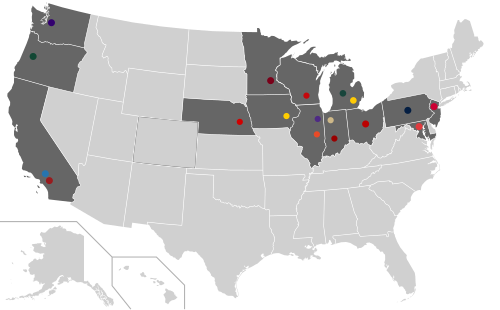
| 場所 | |
 | |
ビッグ・テン・カンファレンス(B1Gと表記、以前はウエスタン・カンファレンスやビッグ・ナイン・カンファレンスなどとも呼ばれる)は、アメリカ合衆国で最も古いNCAAディビジョンIの大学スポーツカンファレンスである。 1896年に大学教員代表者会議として設立され、統括組織であるNCAAの設立に先立つ。シカゴ地域、イリノイ州ローズモントに拠点を置いている。何十年もの間、このカンファレンスは10の著名な大学で構成されていたため、その名前が付けられている。2024年8月2日、このカンファレンスは18の加盟校と2つの提携校に拡大した。[1] [2]このカンファレンスはNCAAディビジョンIで競い合い、そのフットボールチームはフットボールボウルサブディビジョン(FBS)(以前はディビジョンIAとして知られていた)で競い合い、そのスポーツにおけるNCAAの最高レベルである。
ビッグ・テン加盟校は、大規模な財政的基金と高い学術的評判を持つ主要な研究大学である。18加盟校のうち15加盟校は3万人以上の学生が在籍しており、大規模な学生数はその大学の特徴である。ノースウェスタン大学と南カリフォルニア大学(いずれも私立大学)を除き、すべて公立大学である。ビッグ・テン加盟校は合計52万人以上の学生を教育しており、570万人の卒業生がいる。[1]加盟校は毎年93億ドルの研究資金を提供している。[2] 18のうち17はアメリカ大学協会(ネブラスカ州を除く)と大学研究協会(USCを除く)の会員である。ビッグ・テン加盟校はすべて、ビッグ・テン学術同盟(旧機関協力委員会)の会員でもある。 [3]
ビッグ・テンはほぼ1世紀にわたって主に中西部のカンファレンスであったが、2014年以降はカンファレンスの地理的範囲が中部大西洋岸からグレートプレーンズまで拡大した。2024年には、4つの元Pac-12カンファレンスの学校が加わり、カンファレンスは西海岸でも存在感を高めた。[4]
加盟大学
現在の正会員
注:
- ^ 大学全体の管理はアーバナにあり、運動部の管理はシャンペーンにあります。
- ^ 運動チームは 1900-01 学年度からこのカンファレンスで競技を始めました。
- ^ 運動チームは 1900-01 学年度からこのカンファレンスで競技を始めました。
- ^ 1907年4月、ミシガン大学はフットボールチームの試合出場を5試合まで、選手の資格を3年までに制限するというリーグ規則を遵守することを拒否したため、カンファレンスから投票で脱退した。その結果、同大学の運動チームは1907年から1917年まで独立していた。
- ^ 運動チームは1953年から1954年の学年からこのカンファレンスで競技を始めました。
- ^ ほとんどのスポーツチームは1991年から1992年の学年度にこのカンファレンスで競技を始めました。フットボールは1993年にビッグ・テンの試合を開始しました。
会員マップ



アフィリエイト会員
注記
- ^ 2014年7月1日、ジョンズ・ホプキンス大学が男子ラクロスの準会員としてこのカンファレンスに加わった。
- ^ 現在はNCAAディビジョンIIIの運動カンファレンス。
- ^ 2016年7月1日、ジョンズ・ホプキンス大学は女子ラクロスの提携会員となった。
元メンバー
シカゴ大学はビッグ・テン・カンファレンスから永久に脱退した唯一の正会員大学である。[a]
- 注記
- ^ レイクフォレスト大学は、この会議の設立につながった1895年の最初の会議には出席したが、運動競技やその他の活動には参加しなかった。
- ^ シカゴ大学はカンファレンスの共同設立者であった。同大学は1939年秋季(1939-40学年度)を最後にフットボールを中止したが、他のスポーツでは1945-46学年度末まで加盟を続けた。[7]
- ^ 現在はNCAAディビジョンIIIの運動カンファレンス。
メンバーシップのタイムライン
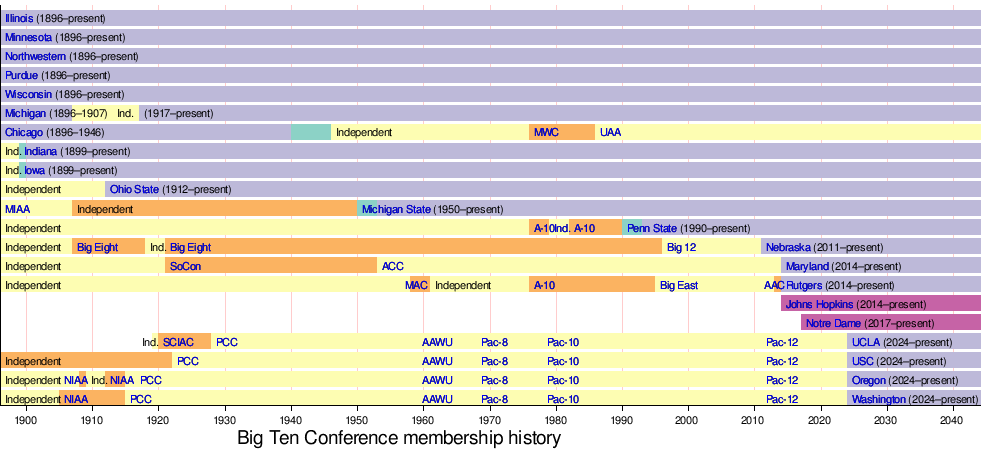
正会員 正会員(サッカー以外) スポーツ関連団体 その他のカンファレンス その他のカンファレンス
歴史
初期の歴史
1890年代に大学フットボールが急速に増加するにつれ、ゲームの残酷さも増した。感情が爆発し、喧嘩が勃発し、負傷者が急増した。1880年から1905年の間に、大学フットボール選手は325人以上が死亡し、1,149人が負傷した。[要出典] ゲームに対する高まる批判に対処するため、パデュー大学の学長ジェームズ・ヘンリー・スマート[8]は、シカゴ大学、イリノイ大学、レイクフォレスト大学、ミネソタ大学、ノースウェスタン大学、ウィスコンシン大学の学長をシカゴに招き、1895年1月11日に大学間スポーツを規制するための方針を策定した。学生アスリートの資格は、議論の主要な議題の1つであった。[9]大学間教員代表者会議は、 1896年2月8日の2回目の会議で設立されました。[10]レイクフォレスト大学は1896年の会議には出席せず、代わりにミシガン大学が参加しました。当時、この組織はウェスタンカンファレンスとしてよく知られており、イリノイ、ミシガン、ウィスコンシン、ミネソタ、シカゴ、パデュー、ノースウェスタンの7大学で構成されていました。これらの大学が最初のメンバーでした。
このカンファレンスは全米最古のカンファレンスの一つで、NCAA設立より10年も前に設立され、男子バスケットボールを後援した最初の大学カンファレンスの一つでもある。
このカンファレンスがビッグナインとして初めて言及されたのは、1899年にアイオワとインディアナが加盟した後のことである。ネブラスカは1900年に初めてリーグへの加盟を申請し、1911年に再度申請したが[11] 、 2度とも拒否された。
1905年に、この会議は正式に「大学間教員代表者会議」として設立されました。[8]
1907年4月、ミシガン大学は、フットボールチームの試合出場を5試合まで、選手の資格を3年までに制限するというリーグの規則を遵守することを拒否したため、カンファレンスから投票で脱退した。[12] オハイオ州立大学は1912年に加盟した。このカンファレンスがビッグ・テンとして初めて言及されたのは、ミシガン大学が9年間の不在の後、カンファレンスに再加盟した1916年12月であった。[13] [14]
1940年代: シカゴが離脱しミシガン州立大学が参加
シカゴ大学が第二次世界大戦直後に大学スポーツの重要性を軽視することを決定した後、カンファレンスは再びビッグナインとして知られるようになった。1939年、シカゴ大学のロバート・メイナード・ハッチンス学長は、当時の大学フットボールの行き過ぎと関連する問題に対する否定的な見解に基づき、フットボールプログラムを廃止することを決定した。[15]シカゴは、多くのカンファレンスの対戦で勝利を収めるのに苦労した後、1946年にカンファレンスから脱退した。当時は、アイオワ州立大学、マルケット大学、ミシガン州立大学、ネブラスカ大学、ノートルダム大学、ピッツバーグ大学など、いくつかの大学のいずれかがシカゴに取って代わると信じられていた。 [16] 1949年5月20日、[10]ミシガン州立大学が参加することで憶測に終止符を打ち、カンファレンスは再びビッグテンとして知られるようになった。[説明が必要] ビッグテンのメンバーシップは、その後40年間変更されなかった。この期間を通じて、この会議の正式名称は大学間教職員代表者会議のままでした。1987年に非営利法人として法人化されるまで、正式 にビッグ テンという名称が採用されることはありませんでした。
1990年の拡張: ペンシルベニア州立大学

1990年、ビッグ・テンの大学はカンファレンスを11チームに拡大することを投票で決定し、アトランティック10のメンバーでフットボールからは独立しているペンシルベニア州立大学に招待を出し、同大学はそれを受け入れた。[17]ペンシルベニア州立大学が1990年に加盟したとき、カンファレンスは引き続きビッグ・テンと呼ばれることが決定されたが、そのロゴは変更を反映して変更され、11という数字は伝統的に青い「ビッグ・テン」の文字の ネガティブスペースに隠された。
ミズーリ州は、ペンシルベニア州立大学が加盟した後、ビッグ・テンへの加盟に興味を示した。[18] 1993年頃、リーグはカンザス、ミズーリ、ラトガースなどの候補校を加えて、2つのフットボール部門を持つ14チームのリーグを作ることを検討した。[19]これらの交渉は、ビッグ・エイト・カンファレンスが旧サウスウェスト・カンファレンスのメンバーと合併してビッグ12を作ったことで終了した。
ペンシルベニア州立大学の加入に続いて、当時唯一残っていた非軍事アカデミーの独立チームであったノートルダム大学にリーグへの参加を促す努力がなされた。1999年、ノートルダム大学とビッグ・テンは、ノートルダム大学を含む可能性のある会員について非公開の交渉に入った。ノートルダム大学の教授会はほぼ全会一致でこの案を承認したが、大学の理事会はカンファレンスへの参加を見送った。[20](1926年、ノートルダム大学はビッグ・テンへの正式加盟を短期間検討したが、独立の地位を維持することを選択した。[21])ノートルダム大学はその後、フットボールを除くすべてのスポーツでアトランティック・コースト・カンファレンスに加盟した。フットボールでは、ノートルダム大学はシーズン中にACCの相手と少なくとも5試合対戦する限り、独立の地位を維持している。ノートルダム大学はNBCスポーツとの独立したホームゲーム放送契約を維持したいと考えていたが、ビッグ・テンは特別な例外のない完全な会員資格を主張していたため、これがノートルダム大学のビッグ・テン加盟の大きな障害であると考えられていた。
2010~2014年の拡張: ネブラスカ、メリーランド、ラトガース
2009年12月、ビッグ・テン・カンファレンスのコミッショナー、ジム・デラニーは、リーグが拡大を目指していることを発表した。これは後に2010~2014年のNCAAカンファレンス再編の一環として全国的な傾向となった。[ 22] 2010年6月11日、ネブラスカ大学がビッグ・テンへの加盟を申請し、満場一致でカンファレンスの12番目の学校として承認され、2011年7月1日に発効した。[23]カンファレンスは「ビッグ・テン」という名前を維持した。これにより、ビッグ・テンは12チーム、ビッグ12は10チーム(同じく元ビッグ12のメンバーであるコロラドがPac-12カンファレンスに移動)で構成されるという興味深く皮肉な結果が一時的にもたらされた。ビッグ・テンへの加盟契約の一環として、ネブラスカは加盟後6年間、2017年秋までメディア収入の全額を受け取れないことになった。[24]
レジェンドとリーダー部門

インディアナ

ミシガン州
ミシガン州立大学
オハイオ
州立大学
州立大学
ペンシルベニア
州立大学
州立大学
イリノイ州
アイオワ
ミネソタ
ネブラスカ
ノースウェスタン
パーデュー
ウィスコンシン
class=notpageimage|
ビッグ・テン(2011~2013年):レジェンド部門、リーダー部門2010年9月1日、デラニーはカンファレンスのフットボール部門分割を明らかにしたが、部門名は後で発表されると述べた。これらの部門名とカンファレンスの新しいロゴは、2010年12月13日に公表された。新しいロゴでは、カンファレンスは「隠された11」ロゴをブランドに「B1G」の文字の組み合わせを使用するものに置き換えた。デラニーはその日ロゴについてコメントしなかったが、新しいロゴは「ファンが「BIG」と「10」を1つの単語で見ることができる」ことはすぐに明らかになった。[25]
ビッグ・テンは、新しいフットボール部門の名称に、地理的な取り決めを拒否したため、地名を使うことができなかった。デラニーは、新しい部門を「レジェンド部門」と「リーダーズ部門」と呼ぶと発表した。レジェンド部門には、アイオワ、ミシガン、ミシガン州立、ミネソタ、ネブラスカ、ノースウェスタンが参加。リーダーズ部門は、イリノイ、インディアナ、オハイオ州立、ペンシルバニア州立、パデュー、ウィスコンシンで構成された。カンファレンスの役員は、地理的な場所による分割よりも、競争の公平性を生み出すことに重点を置いていると述べた。[26]しかし、新しい「レジェンド」部門と「リーダーズ」部門は、熱狂的に受け入れられなかった。オハイオ州立やミシガンなど、いくつかの伝統的なライバルは、別の部門に配置された。[27]
フットボールシーズンでは、各チームは同じディビジョン内のチームと対戦し、1回の「クロスオーバー」ライバル戦と2回のローテーションでディビジョン間の試合を行った。レギュラーシーズンの終わりには、2つのディビジョン優勝チームが新しいビッグ・テン・フットボール・チャンピオンシップ・ゲームで対戦した。[28]レジェンドとリーダーのディビジョン編成は、 2011年、2012年、2013年のフットボールシーズンに実施された。
メリーランドとラトガースが参加
2012年11月19日、メリーランド大学の理事会はACCから脱退し、 2014年7月1日付けでビッグ・テンの13番目のメンバーとして参加することを決議した。 [29]ビッグ・テンの学長評議会はその日のうちにこの動きを承認した。[30]その翌日、ラトガース大学ビッグ・イースト校もビッグ・テンからの14番目のメンバー校として加盟の申し出を受け入れた。[31]ネブラスカ大学と同様に、両校は加盟後6年までメディア収入の全額を受け取ることはなかった。しかし、両校ともカンファレンスから融資を受けていたため、全額を受け取る日付が延期された。[24]
西地区と東地区
インディアナ
メリーランド
ミシガン州
ミシガン州立大学
オハイオ
州立大学
州立大学
ペンシルベニア
州立大学
州立大学
ラトガース
イリノイ州
アイオワ
ミネソタ
ネブラスカ
ノースウェスタン
パーデュー
ウィスコンシン
class=notpageimage|
ビッグ・テン(2013~2024年):西部地区、東地区2013年4月28日、ビッグ・テンの学長と学長は、2014年にメリーランド大学とラトガース大学が加盟した際に発効したフットボール部門の再編を満場一致で承認した。 [32]新しい計画では、レジェンド部門とリーダー部門が地理的部門に置き換えられた。[32]西地区にはイリノイ大学、アイオワ大学、ミネソタ大学、ネブラスカ大学、ノースウェスタン大学、パデュー大学、ウィスコンシン大学(パデュー大学以外はすべて中部時間帯)が含まれ、東地区にはインディアナ大学、メリーランド大学、ミシガン大学、ミシガン州立大学、オハイオ州立大学、ペンシルベニア州立大学、ラトガース大学(すべて東部時間帯)が含まれた。新しい部門を決定する際の最終的な問題は、インディアナ州の2校のうちどちらを西地区に送るかであった。パデュー大学が選ばれたのは、ウェスト・ラファイエット・キャンパスがインディアナ州本拠地ブルーミントンの地理的に西にあるためである。[33]この部門別編成により、部門間のフットボールライバル関係であるインディアナ大学とパデュー大学の関係は永久に維持された。[32]これまでと同様に、2つの部門優勝チームはビッグ・テン・フットボール・チャンピオンシップ・ゲームで対戦した。西地区と東地区の部門別編成は、2014年から2023年までの10シーズンのフットボールシーズンにわたって有効であった。
アフィリエイトメンバーが参加
2013年6月3日、ビッグ・テンは男子および女子ラクロスのスポンサーシップを発表した。どのカンファレンスもNCAAトーナメントへの自動出場資格を得るには、少なくとも6校の加盟校がこのスポーツをプレーしている必要がある。女子ラクロスでは、メリーランド大学とラトガース大学がビッグ・テンに加わったことで、ミシガン大学、ノースウェスタン大学、オハイオ州立大学、ペンシルベニア州立大学のプログラムに加わり、カンファレンスの参加校数は必要な6校に達した。[34]男子ラクロスでは、オハイオ州立大学とペンシルベニア州立大学が既存の参加者であった。メリーランド大学とラトガース大学の追加と同時に、ミシガン大学は成功を収めているクラブチームを代表チームに昇格させることに同意し、ビッグ・テンのスポンサー校は5校となり、自動出場の最低要件である6校に1校足りないことになった。ジョンズ・ホプキンス大学は、 2014年から最初の関連メンバーとしてカンファレンスに参加することを選択した。[35]長年独立していた大学がカンファレンスに参加すると(例えば、シラキュース大学がアトランティック・コースト・カンファレンスに加盟)、独立校として競争する他の大学は、NCAAトーナメントへの自動出場権を獲得できないことが、スケジュールやリクルート活動においてより深刻な競争上の不利になりつつあると結論付けたケースもあった。
2016年3月23日、ビッグ・テン・カンファレンスとノートルダム大学は、ファイティング・アイリッシュが2017-18シーズンから男子アイスホッケーの傘下に入ると発表した。[36]ノートルダム大学はホッケー・イーストのメンバーだったが、この動きによって移動時間が節約され、元CCHAおよびWCHAのメンバーとのライバル関係が再燃することになる。
.jpg/500px-Big_10_HQ_(21617731102).jpg)
2013年、カンファレンスはイリノイ州パークリッジの本部を隣のローズモントに移転した。オフィスビルはローズモントのパークウェイバンクパークエンターテイメント地区(当時はMBファイナンシャルパークエンターテイメント地区と名付けられていた)にあり、州間高速道路294号線沿いにある。[37] [38] [39]
2021~2024年 太平洋拡大
2022年6月30日、UCLAとUSCは、2024年8月2日付けでビッグ・テン・カンファレンスに加盟すると発表しました。これにより、両校はPac-12の既存のメディア権利契約の期間中、Pac-12カンファレンスに留まることができます。 [40] [41]ネブラスカ、ラトガース、メリーランドとの以前の拡大とは異なり、USCとUCLAはビッグ・テンの任期開始時からメディア収入の全額を受け取る権利を持って加盟します。[24]
2022年8月、カンファレンスはCBS、Fox、NBCと総額70億ドルと推定される新たなメディア権利契約を締結した。[42] [43] [44] [45]
2023年8月4日、オレゴン大学とワシントン大学は、 UCLAとUSCとともにビッグ・テン・カンファレンスに参加すると発表した。[46] UCLAとUSCとは異なり、この2校はそれぞれ3000万ドルの減額されたメディア収益分配を受け取り、2029-30シーズンまで毎年100万ドルずつ分配額が増加する。他のカンファレンスメンバーの収益分配を減らすのではなく、フォックスは必要な資金を拠出している。[47]次のメディア契約では、両校は全額の分配を受けることになる。[48]
サッカー:部門なしの復活

イリノイ州
インディアナ
アイオワ
メリーランド
ミシガン州
ミシガン州立大学
ミネソタ
ネブラスカ
ノースウェスタン
オハイオ
州立大学
州立大学
オレゴン
ペンシルベニア
州立大学
州立大学
パーデュー
ラトガース
カリフォルニア大学ロサンゼルス校
USC
ワシントン
ウィスコンシン
class=notpageimage|
ビッグ・テン(2024年~現在):2023年6月、UCLAとUSCが加盟することが確定した後、オレゴンとワシントンが加わる前、カンファレンスは2024年からフットボールの東西部門を廃止すると発表した。各チームはこれまで通り、カンファレンス戦9試合と非カンファレンス戦3試合を行う。4年間で、各チームは他のすべてのチームと少なくとも2試合、ホームで1試合、アウェーで1試合を行う。この計画では、毎年11回の保護された対戦を行うことになっており、これにはミシガン州立大学とオハイオ州立大学の対戦や、その他の10の地域ライバル戦が含まれる。各シーズンの終わりには、カンファレンス順位の上位2チームがビッグ・テン・フットボール・チャンピオンシップ・ゲームで対戦する。[49]
オレゴンとワシントンが加わったことで、保護された対戦がさらに1つ増え、合計12の保護された対戦となった:イリノイ対ノースウェスタン、イリノイ対パデュー、インディアナ対パデュー、アイオワ対ミネソタ、アイオワ対ネブラスカ、アイオワ対ウィスコンシン、メリーランド対ラトガース、ミシガン対ミシガン州立、ミシガン対オハイオ州立、ミネソタ対ウィスコンシン、オレゴン対ワシントン、UCLA対南カリフォルニア大学。保護された対戦がないのはペンシルベニア州立だけとなった。スケジュールも更新され、チームは他のカンファレンスの相手チームと少なくとも2回(ホームで1回、アウェイで1回)対戦し、5年間で相手チームと3回以上対戦しないようローテーションで対戦することになった。[50]
学術
ビッグ・テンの現在の加盟大学はすべて博士号を授与する大学です。
元カンファレンスコミッショナーのジム・デラニーは2010年に、アメリカ大学協会の会員であることは「我々の重要な一部である」と述べた。[51]ネブラスカ大学リンカーン校を除くビッグ・テンの現在の会員はすべてAAUの会員である。ネブラスカはビッグ・テンに加盟した際にAAUの会員であったが、その後まもなくこの地位を失った。[51]
以下の表は、2023年時点のUS News & World Report[update]による国立大学ランキングを示しています。[52]
アメリカ大学協会の会員であることも示されている。[53]
委員
体育コミッショナーの事務所は1922年に「様々な加盟大学のスポーツ問題を調査し、ビッグ・テン・スポーツを統括する資格規則の施行を支援する」ために設立されました。[9]
ビッグ・テン・カンファレンスの全メンバーは、ビッグ・テン・アカデミック・アライアンス(旧称機関協力委員会)のメンバーである。[54] [55] [56]シカゴ大学は、かつてビッグ・テン・カンファレンスのメンバーであり、1958年から2016年6月29日までCICのメンバーであった。[57] [58] [59] [60]
学校別の運動部収入
総収入には、チケット販売、寄付金や寄贈品、権利やライセンス、学生の授業料、学校基金、テレビ収入、キャンプ収入、売店、ノベルティなどのその他すべての収入源が含まれます。
総費用には、コーチおよびスタッフの給与、奨学金、建物および敷地、メンテナンス、公共料金およびレンタル料、リクルート、チームの移動、用具およびユニフォーム、会議費、保険が含まれます。
以下の表は、2022~23年度の米国教育省のスポーツにおける公平性のウェブサイトに掲載されている、米国教育省への機関報告を示しています。 [61]
以下の表は、ナイト委員会が2021~22年度に報告したNCAA /カンファレンス分配金、メディア権利、ポストシーズンフットボールからの収益を示しています。 [62]
主要人物
放送権とメディア権
2007年秋~2017年春
コミッショナーのジム・デラニーは、 ESPNとの既存契約更新に際し、大幅に高額な権利料を要求したが失敗した後、2004年にビッグ・テン専門チャンネルの設立を検討し始めた。これは2006年に実現し、カンファレンスはフォックス・スポーツとの20年にわたる提携で専用ケーブルネットワークのビッグ・テン・ネットワークを設立し、2007年に正式に開始した。[63]このネットワークはビッグ・テンのスポーツ(ビッグ・テンの他のメディアパートナーが放送していないイベントを含む)やスタジオショーのほか、カンファレンスとそのメンバーを紹介するその他のオリジナルプログラムやドキュメンタリーを放送している。[64]ビッグ・テン・ネットワークの影響は2010年代のカンファレンスの拡大に影響を与え、新しいメンバーの一部はボルチモアやワシントンD.C.(メリーランド州)やニューヨーク都市圏(ラトガース大学)など、主要なメディア市場の近くに拠点を置いている。[65] [66]
新しいネットワークの発表に伴い、2007-08シーズンから2016-17シーズンまでの10年間のメディア権利契約が新たに締結され、ビッグ・テンの放送はESPNネットワーク、CBSスポーツ、ビッグ・テン・ネットワークに分割され、コムキャスト・シカゴによるカンファレンスの地域放送は終了した。[67] [68]
- ABCスポーツ:
- シーズンあたり17試合
- ESPN/ESPN2 :
- シーズンあたり24試合
- 男子バスケットボールのシーズン当たり43試合
- ビッグ・テン男子バスケットボールトーナメントの最初の3ラウンドの権利をビッグ・テン・ネットワークと共有
- シーズンごとに女子バスケットボールの試合が5試合
- ESPN その他 (U,360) :
- 男子バスケットボールの試合はシーズンごとに13試合
- CBSスポーツ:
- 男子バスケットボールのシーズン当たり
15試合
- ビッグ・テン男子バスケットボールトーナメントの準決勝と決勝戦の権利
- シーズンごとに女子バスケットボールの試合が2試合
- 男子バスケットボールのシーズン当たり
15試合
- ビッグ・テン・ネットワーク:
- シーズンあたり35試合
- シーズンあたり男子バスケットボール105試合
- ビッグ・テン男子バスケットボールトーナメントの最初の3ラウンドの権利をESPN/ESPN2と共有
- シーズンあたり55試合の女子バスケットボール
- オリンピック競技の報道
2010年、ビッグ・テンは2011年シーズンからビッグ・テン・フットボール・チャンピオンシップ・ゲームの創設を発表し、2011年から2016年までそのゲームを放送するためにフォックスと放送契約を結びました。[69]
2017年秋~2023年春
2016年、カンファレンスはFox Sports、CBS Sports、ESPNと26億4000万ドル相当の6年間の新たなメディア権利契約を締結したことを発表した。この契約は2017-18シーズンの開始時に発効し、2022-23シーズンで終了する。この契約の規模は、学校ごとのメディア収益のシェアがほぼ3倍になることを意味した。[70]
この新しい契約により、ビッグ テン フットボールのレギュラー シーズンの試合が初めて Fox とFox Sports 1で放送されることになります。契約の一環として、Fox はビッグ テン チャンピオンシップの放送を継続するとともに、各シーズン前のレギュラー シーズンのフットボールの試合のドラフトで ESPN より優先権を得ます。また、ESPN によるビッグ テン男子バスケットボール トーナメントの放送も終了します。
2023年秋~2030年春
2022年8月18日、ビッグ・テンは、2023-24年度からフォックス、CBS、そして初めてNBCスポーツと7年間の放映権契約を締結し、1980年代に遡るカンファレンスとESPNの関係を終わらせたと発表した。新しい契約の主な目標は、ビッグ・テンのフットボールの試合の特定の放送枠を3つのパートナー間で確立することであり、フォックス、CBS、NBCはそれぞれ東部標準時正午、東部標準時午後3時30分、ゴールデンタイムの試合の権利を主に保持し、[43] [44] [45] 3つの放送局が交互に試合を優先的に選ぶこととなった。[71]契約は少なくとも70億ドルの価値があると推定されているが、[43] [72]ノートルダム・ファイティング・アイリッシュがビッグ・テンに具体的に参加した場合に契約の価値を上げる「エスカレーター条項」も含まれていると報じられている。 [73]
- フォックススポーツ:
- CBSスポーツ:
- CBSとParamount+でシーズンあたり14 ~ 15 のフットボールゲームを放送:
- シーズンあたり
最大 15 回の男子バスケットボールゲーム:
- ビッグ・テン男子バスケットボールトーナメントの準決勝と決勝戦の権利
- ビッグ・テン女子バスケットボールトーナメントの決勝戦の権利
- NBCスポーツ:
- NBCとPeacockでシーズンごとに14 ~ 16 のフットボールゲームを放送:
- 試合は主にNBCのゴールデンタイムに放送される。
- カンファレンス内試合 4 試合を含む 8 試合が Peacock で独占配信されます。
- 2026年のビッグ・テン・チャンピオンシップ・ゲームの権利
- Peacock ではシーズンごとに
最大 77 試合のバスケットボールゲームを放送します。
- 男子バスケットボールの試合は最大 47 試合、うちカンファレンス内試合は 32 試合。
- カンファレンス内試合 20 試合を含む、最大 30 試合の女子バスケットボール試合。
- 男子および女子バスケットボールトーナメントの開幕戦ダブルヘッダーの権利。
- Peacock では、シーズンごとに最大 40 のオリンピック スポーツ イベントをライブで放送します。
- NBCとPeacockでシーズンごとに14 ~ 16 のフットボールゲームを放送:
- ビッグ・テン・ネットワーク:
- シーズンあたり最大50試合
- シーズンあたり少なくとも126試合の男子バスケットボール
- ビッグ・テン男子バスケットボールトーナメントの第2ラウンドと準々決勝
- シーズンごとに少なくとも40試合の女子バスケットボール
- ビッグ・テン女子バスケットボールトーナメントの報道(第 1 ラウンドと決勝戦以外)
- オリンピック競技の報道
スポーツ
ビッグ・テン・カンファレンスは、男子14種目と女子14種のNCAA公認スポーツの選手権大会を主催している。[74]
学校別男子後援スポーツ
注:
* ノートルダム大学は、2017-18年度に男子アイスホッケーの準会員としてビッグ・テンに加盟しました。[75]同大学は、フットボールを除く他のスポーツをACCで継続して実施していますが、フットボールに関しては引き続き独立して競技を行います。
ジョンズ・ホプキンス大学は2014年に男子ラクロスの準会員としてビッグ・テンに加盟し、2016年には女子ラクロスも加盟した。同大学は引き続きNCAAディビジョンIII センテニアル・カンファレンスで他のスポーツを展開している。[76]
- ^ フェンシングは公式には男女混合のチームスポーツですが、女子チームのみを擁する学校もいくつかあります。オハイオ州立大学とペンシルベニア州立大学は、ほとんどの NCAA フェンシング学校と同様に男女混合チームを擁しています。
- ^ ab 男子ボート競技は、重量級、軽量級を問わず、NCAAではなく、大学ボート協会によって統括されている。ラトガース大学男子ボート競技部は2008年にクラブに格下げされたが、EARCのメンバーであり続けている。
- ^ ライフルと異なり、ピストルは NCAA が統括するスポーツではありません。完全に男女共学です。
- ^ ライフルは厳密には男子スポーツですが、男子、女子、男女混合のチームが互いに競い合います。オハイオ州立大学は男女混合チームを編成しています。
学校別女子スポンサースポーツ
- 注記
ビッグ・テン・カンファレンスが後援していないがビッグ・テンの学校が行う女子大学スポーツ
- ^ NCAA 新興女性スポーツプログラムの一部。NCAA 公認の競技は、全米大学アクロバット & タンブリング協会によって統括されています。
- ^ フェンシングは公式には男女共学のチームスポーツですが、試合にはすべて同性の選手が参加します。ほとんどの NCAA フェンシング スクールは男子チームと女子チームの両方を編成していますが、女子チームのみを編成している学校もいくつかあります。オハイオ州立大学とペンシルベニア州立大学は男子チームと女子チームの両方を編成していますが、ノースウェスタン大学は女子チームのみを編成しています。
- ^ NCAA が統括するボート競技は、女子重量級ボート競技のみです。女子軽量級ボート競技は、男子ボート競技と同様に、全米大学ボート協会 (Intercollegiate Rowing Association)が統括しています。
- ^ ライフルと異なり、ピストルは NCAA が統括するスポーツではありません。完全に男女共学です。
- ^ ライフルは厳密には男子スポーツですが、男子、女子、男女混合のチームが互いに競い合います。ネブラスカ州は女子のみのチームを、オハイオ州は男女混合チームを編成しています。
- ^ シンクロナイズドスイミングは NCAA によって統括されていません。大学競技は、このスポーツの全国統括団体である米国シンクロナイズドスイミングによって統括されています。
- ^ 女子レスリングは、NCAA の Emerging Sports for Womenプログラムの一部です。NCAA 公認の競技は、全米レスリングコーチ協会によって統括されています。
- ^ アイオワ大学は2023-24年度に女子レスリングを追加する予定である。[77]
ライバル関係
カンファレンス内フットボールライバル関係
ビッグ・テンのメンバーは、特にフットボールのフィールドで、長年にわたって互いにライバル関係にあります。メリーランド大学とラトガース大学を除く各大学は、少なくとも 1 つのトロフィーを懸けています。以下は、 2022 年シーズン終了までの合計と記録を含む、ビッグ・テン・カンファレンスのアクティブなライバル関係のリストです。
カンファレンス外のフットボールライバル関係
[78]
Protected matchups
Beginning in 2024, the conference will eliminate divisions but will protect certain matchups. The following are the conference's 12 protected matchups.[79]
- Illinois: Northwestern, Purdue
- Indiana: Purdue
- Iowa: Minnesota, Nebraska, Wisconsin
- Maryland: Rutgers
- Michigan: Michigan State, Ohio State
- Michigan State: Michigan
- Minnesota: Iowa, Wisconsin
- Nebraska: Iowa
- Northwestern: Illinois
- Ohio State: Michigan
- Oregon: Washington
- Purdue: Illinois, Indiana
- Rutgers: Maryland
- UCLA: USC
- USC: UCLA
- Washington: Oregon
- Wisconsin: Minnesota, Iowa
From 1993 through 2010, the Big Ten football schedule was set up with each team having two permanent matches within the conference, with the other eight teams in the conference rotating out of the schedule in pairs for two-year stints. Permanent matches were as follows:[citation needed]
- Illinois: Indiana, Northwestern
- Indiana: Illinois, Purdue
- Iowa: Minnesota, Wisconsin
- Michigan: Michigan State, Ohio State
- Michigan State: Michigan, Penn State
- Minnesota: Iowa, Wisconsin
- Northwestern: Illinois, Purdue
- Ohio State: Michigan, Penn State
- Penn State: Michigan State, Ohio State
- Purdue: Indiana, Northwestern
- Wisconsin: Iowa, Minnesota
This system was discontinued after the 2010 season, as teams became grouped into two divisions, and would play all teams in their division once, with one protected cross-over game, and two games rotating against the other five opponents from the opposing division.
Most of the above permanent rivalries were maintained. By virtue of the new alignment, a handful of new permanent divisional opponents were created, as all pairs of teams within the same division would face off each season. Furthermore, three new permanent inter-divisional matches resulted from the realignment: Purdue–Iowa, Michigan State–Indiana, and Penn State–Nebraska. The following past permanent matches were maintained across divisions: Minnesota–Wisconsin, Michigan–Ohio State, and Illinois–Northwestern.
The new alignment, however, caused some of the above permanent rivalries to be discontinued. These were: Iowa–Wisconsin, Northwestern–Purdue, and Michigan State–Penn State. These matchups would continue to be played, but only twice every five years on average. More rivalries were disrupted, and some resumed on a yearly basis, when the league realigned into East and West Divisions for the 2014 season with the addition of Maryland and Rutgers. The two new schools were placed in the new East Division with Penn State, and the two Indiana schools were divided (Indiana to the East and Purdue to the West). With the move to a nine-game conference schedule in 2016, all cross-division games will be held at least once in a four-year cycle except for Indiana–Purdue, which is the only protected cross-division game.[32] The conference later announced that once the new scheduling format takes effect in 2016, members will be prohibited from playing FCS teams, and required to play at least one non-conference game against a team in the Power Five conferences (ACC, Big 12, Pac-12 and SEC; presumably, this would also allow for non-conference games against Big Ten opponents that are not on the conference schedule). Games against independents Notre Dame (an ACC member in non-football sports) also count toward the Power Five requirement, as did games against BYU before it joined the Big 12 in 2023.[80]
Intra-conference basketball rivalries
- Illinois: Indiana, Iowa, Northwestern
- Indiana: Illinois, Purdue
- Iowa: Illinois, Minnesota, Wisconsin
- Maryland: Penn State
- Michigan: Michigan State, Ohio State
- Michigan State: Michigan, Ohio State, Wisconsin
- Minnesota: Iowa, Wisconsin
- Northwestern: Illinois
- Ohio State: Michigan, Penn State, Michigan State
- Oregon: Washington
- Penn State: Maryland, Ohio State
- Purdue: Indiana
- UCLA: USC
- USC: UCLA
- Washington: Oregon
- Wisconsin: Iowa, Michigan State, Minnesota
Extra-conference basketball rivalries
- Illinois: Missouri
- Indiana: Kentucky
- Iowa: Iowa State, Iowa Big Four
- Maryland: Duke, Georgetown, Virginia
- Michigan: Duke
- Michigan State: Duke, Oakland
- Nebraska: Creighton
- Penn State: Bucknell, Pittsburgh
- Oregon: Oregon State
- Rutgers: Princeton, Seton Hall
- UCLA: Arizona, Notre Dame
- Washington: Gonzaga, Washington State
- Wisconsin: Green Bay, Marquette, Milwaukee
Other sports
Men's ice hockey
- Michigan-Michigan State
- Minnesota-Wisconsin
- Minnesota-North Dakota
- Minnesota-Minnesota Duluth
- Minnesota-St. Cloud State
- Michigan-Notre Dame
Men's lacrosse
- Maryland-Johns Hopkins
- Penn State-Bucknell
- Rutgers-Princeton
Men's soccer
- Michigan-Michigan State (Big Bear Trophy)
Wrestling
- Penn State–Lehigh
- Iowa-Penn State
- Iowa-Iowa State
- Iowa-Oklahoma State
- Rutgers-Princeton
Extra-conference rivalries
Four Big Ten teams-Purdue, Northwestern, Michigan State and Michigan-had rivalries in football with Notre Dame. After the University of Southern California with 35 wins (including a vacated 2005 win), the Michigan State Spartans have the most wins against the Irish, with 28. The Purdue Boilermakers follow with 26, and Michigan ranks fourth all-time with 24. Northwestern and Notre Dame had a yearly contest, with the winner taking home a shillelagh, much like the winner of the USC–Notre Dame and Purdue–Notre Dame contests now receive. The Northwestern–Notre Dame shillelagh was largely forgotten by the early 1960s and is now solely an element of college football's storied past.[81]
Penn State has a longstanding rivalry with Pittsburgh of the ACC, but the two schools did not meet from 2000 until renewing the rivalry with an alternating home-and-home series from 2016 to 2019. Penn State also has long histories with independent Notre Dame; Temple of The American; Syracuse, and Boston College of the ACC; and West Virginia, of the Big 12 Conference. Additionally, Penn State maintains strong intrastate rivalries with Patriot League universities Bucknell in men's basketball and men's lacrosse, and Lehigh in wrestling. Most of these rivalries were cultivated while Penn State operated independent of conference affiliation; the constraints of playing a full conference schedule, especially in football, have reduced the number of meetings between Penn State and its non-Big Ten rivals.
Iowa has an in-state rivalry with Iowa State of the Big 12, with the winner getting the Cy-Hawk Trophy in football. Iowa and Iowa State also compete annually in the Cy-Hawk Series sponsored by Hy-Vee (as of 2011 this series is now sponsored by The Iowa Corngrowers Association), the competition includes all head-to-head regular season competitions in all sports. Iowa also holds rivalries in basketball with the state's other two Division I programs, Drake and Northern Iowa.
Indiana has an out-of-conference rivalry with Kentucky of the SEC (see Indiana–Kentucky rivalry). While the two schools played in football for many years, the rivalry was rooted in their decades of national success in men's basketball. The two no longer play one another in football, but their basketball rivalry continued until a dispute about game sites ended the series after 2011. In the last season of the rivalry (2011–12), the teams played twice. During the regular season, then-unranked Indiana defeated then-#1 ranked Kentucky 73–72 at Assembly Hall. The Wildcats avenged the loss in the NCAA tournament, defeating Indiana 102–90 in the South Regional final in Atlanta on their way to a national title. The teams next played in the 2016 NCAA tournament, with Indiana winning.
Illinois has a longstanding basketball rivalry with the SEC's Missouri Tigers, with the two men's teams squaring off annually in the "Braggin' Rights" game. It has been held in St. Louis since 1980, first at the St. Louis Arena and since 1994 at the Enterprise Center. This rivalry has been carried over into football as "The Arch Rivalry" with games played at the Edward Jones Dome in St. Louis in 2002 and 2003 and four games in 2007 through 2010.[1]
Wisconsin has a long-standing in-state basketball rivalry with Marquette. The series has intensified as of late with both teams having made the Final Four in recent years. The schools also played an annual football game before Marquette abandoned its football program in 1961. The school also has minor rivalries in basketball with the two other Division I members of the University of Wisconsin System, which include the University of Wisconsin–Milwaukee and University of Wisconsin–Green Bay.
Similarly, Nebraska has an in-state rivalry with another Big East school in Creighton, mostly in basketball and baseball.
Minnesota men's ice hockey has a prolific and fierce border rivalry with the University of North Dakota. The two teams played annually between 1948 and 2013 as members of the Western Collegiate Hockey Association prior to the inception of the Big Ten Conference. The rivalry resumed in 2016 in non-conference action.
Maryland has many rivalries outside of the conference, most notably Duke, Virginia, West Virginia, and Navy. Maryland left the Duke and Virginia rivalries behind in the ACC when it joined the Big Ten.
In the early days of the Big Ten, the Chicago-Michigan game was played on Thanksgiving, usually with conference championship implications. It was considered one of the first major rivalries of the conference.
Facilities
Three Big Ten football stadiums seat over 100,000 spectators: Michigan Stadium (Michigan), Beaver Stadium (Penn State), and Ohio Stadium (Ohio State). Only five other college football stadiums have a capacity over 100,000 (as of the 2024 season, all in the Southeastern Conference (SEC)).[82] Michigan Stadium and Beaver Stadium, respectively, are the two largest American football stadiums by capacity in the United States,[82][83] and all three of the Big Ten's largest venues rank among the ten largest sports stadiums in the world. UCLA plays in the Rose Bowl as its home stadium, which is the location of the Rose Bowl Game for the Big Ten champion. USC plays in the Los Angeles Memorial Coliseum, a publicly owned stadium that is managed and operated by the university, which has hosted two summer Olympic Games in 1932 and 1984, and will again in 2028.
Big Ten schools also play in two of the 10 largest on-campus basketball arenas in the country: Ohio State's Value City Arena and Maryland's Xfinity Center. Additionally, arenas at Indiana, Wisconsin, Illinois, Iowa, and Penn State rank among the 20 largest on-campus basketball facilities in the United States. As of the upcoming 2024–25 season, the Big Ten Conference has the most on-campus basketball arenas with seating capacities of 15,000 or more of any NCAA conference, with seven. (Of the other conferences considered "power conferences" in men's basketball, the ACC has two such arenas, the Big East none, the Big 12 four, and the SEC five. Outside of these conferences, the Mountain West Conference has four such arenas.)
Football, basketball, baseball, and soccer facilities
Ice hockey arenas
Apparel
Football
When Maryland and Rutgers joined the Big Ten in 2014, the division names were changed to "East" and "West", with Purdue and the six schools in the Central Time Zone in the West and Indiana joining the remaining six Eastern Time Zone schools in the East. The only protected cross-division game is Indiana–Purdue. Beginning in 2016, the Big Ten adopted a nine-game conference schedule.[33][86] All teams have one cross-division opponent they play annually that changes every six years except for Indiana and Purdue, whose crossover is permanent. The other six opponents are played every three years during that cycle. For 2016–2021, the pairings are Maryland-Minnesota, Michigan-Wisconsin, Michigan State-Northwestern, Ohio State-Nebraska, Penn State-Iowa, and Rutgers-Illinois, and for 2022–2023 the pairings are Maryland-Northwestern, Michigan-Nebraska, Michigan State-Minnesota, Ohio State-Wisconsin, Penn State-Illinois, and Rutgers-Iowa.[87] In 2016, the Big Ten no longer allowed its members to play Football Championship Subdivision (FCS) teams and also requires at least one non-conference game against a school in the Power Five conferences (ACC, Big 12, Pac-12, SEC). Contracts for future games already scheduled against FCS teams would be honored. However, in 2017, the Big Ten started to allow teams to schedule an FCS opponent during years in which they only have four conference home games (odd-numbered years for East division teams, even-numbered years for West division teams).[88] At the time this policy was first announced, games against FBS independents Notre Dame and BYU would count toward the Power Five requirement.[80] ESPN, citing a Big Ten executive, reported in 2015 that the Big Ten would allow exceptions to the Power Five rule on a case-by-case basis, and also that the other FBS independent at that time, Army, had been added to the list of non-Power Five schools that would be counted as Power Five opponents.[89]
When the Big Ten expands to 18 teams in 2024 with the arrival of Oregon, UCLA, USC, and Washington, the football divisions will be eliminated. A schedule of nine conference games and three non-conference games will be maintained. At the end of the season, the top two teams in the conference standings will play each other in the Big Ten Football Championship Game. For at least 2024 and 2025, the conference was to adopt what it called the "Flex Protect Plus" model, which called for each conference member to play all the others at home and away at least once during a four-year cycle. Initially, the 11 "protected" matchups were to be played each season. The announcement was made before Oregon and Washington were announced as incoming members.[90][91] After the expansion to 18 teams was announced, the scheduling model was tweaked into the "Flex Protect XVIII" model, which will maintain the original 11 protected rivalries while adding Oregon–Washington. This model is planned to operate from 2024 to 2028.[92]
- Illinois–Northwestern
- Illinois–Purdue
- Indiana–Purdue
- Iowa–Minnesota
- Iowa–Nebraska
- Iowa–Wisconsin
- Maryland–Rutgers
- Michigan–Michigan State
- Michigan–Ohio State
- Minnesota–Wisconsin
- Oregon–Washington
- UCLA–USC
All-time school records
This list goes through September 9, 2024.
† Ohio State vacated 12 wins and its Big Ten title in 2010 due to NCAA sanctions.
†† Numbers of division and conference championships shown reflect Big Ten history only and do not include division and conference championships in former conferences. Washington, Oregon, USC and UCLA join the Big Ten in 2024, Maryland and Rutgers joined in 2014, and Nebraska joined in 2011.
Number of Claimed National Championships, as well as win–loss–tie records, include all seasons played, regardless of conference membership.
Big Ten Conference champions
Bowl games
Since 1946, the Big Ten champion has had a tie-in with the Rose Bowl game. Michigan appeared in the first bowl game, the 1902 Rose Bowl. After that, the Big Ten only allowed one other team to participate in the Rose Bowl (the 1920 Ohio State Buckeyes football team), until the agreement struck with the Pacific Coast Conference for the 1947 Rose Bowl. The spread of civilian air travel plus the fact that the US military had publicly encouraged college football during World War II were primary causes of the Big Ten finally allowing the Rose Bowl.[93] From 1946 through 1971, the Big Ten did not allow the same team to represent the conference in consecutive years in the Rose Bowl with an exception made after the 1961 season in which Minnesota played in the 1962 Rose Bowl after playing in the 1961 Rose Bowl due to Ohio State declining the bid because of Ohio State faculty concerns about academics.
It was not until the 1975 season that the Big Ten allowed teams to play in bowl games other than the Rose Bowl. Michigan, which had been shut out of the postseason the previous three years, was the first beneficiary of the new rule when it played in the Orange Bowl vs. Oklahoma. Due to the pre-1975 rules, Big Ten teams such as Michigan and Ohio State have lower numbers of all-time bowl appearances than powerhouse teams from the Big 12 Conference (previously Big Eight and Southwest Conferences) and Southeastern Conference, which always placed multiple teams in bowl games every year.
Since the 2020–21 season, a new slate of bowl game selections has included several new bowl games.[94]
* If the conference champion is picked for the College Football Playoff in years the Rose Bowl does not host a semifinal, the next highest-ranked team in the committee rankings, or runner-up, shall take its place at the Rose Bowl.
^ The Big Ten, along with the SEC, will be eligible to face the ACC representative in the Orange Bowl at least three out of the eight seasons that it does not host a semifinal for the Playoff over a 12-year span. Notre Dame will be chosen the other two years if eligible.
† The Big Ten will switch between the Las Vegas Bowl and Duke's Mayo Bowl on odd-numbered and even-numbered years, respectively.
Bowl selection procedures
Although the pick order usually corresponds to the conference standings, the bowls are not required to make their choices strictly according to the win–loss records; many factors influence bowl selections, especially the likely turnout of the team's fans. Picks are made after CFP selections; the bowl with the #2 pick will have the first pick of the remaining teams in the conference.
For all non-College Football Playoff partners, the bowl partner will request a Big Ten team. The Big Ten will approve or assign another team based on internal selection parameters.
When not hosting a semifinal, the Orange Bowl will select the highest-ranked team from the Big Ten, SEC or Notre Dame to face an ACC opponent. (However, in an 8-game cycle [12 years due to not counting when the Orange Bowl is a semifinal], the Big Ten must be selected at least three times and no more than four times; the SEC similarly will be selected between three and four times while Notre Dame may be selected up to two times.)[96] The Big Ten Champion cannot play in the Orange Bowl. If a Big Ten team is not selected by the Orange Bowl, the Citrus Bowl will submit a request for a Big Ten team.
Head Coach Compensation
Guaranteed compensation is due to the coaches regardless of performance. Though most of the pay is directed from the university, some also comes in the form of guaranteed endorsements and other income streams. Most coaches also have performance-based bonuses that can significantly raise their salaries.[97]
In 2024, three Big Ten member schools—Northwestern and USC, private institutions, and Penn State, exempt from most open records laws due to its status as what Pennsylvania calls a "state-related" institution—are not obligated to provide salary information for their head coaches. Both Penn State and Northwestern typically choose to provide this information, although Northwestern has not announced the salary of its current coach.
Marching bands
All Big Ten member schools have marching bands which perform regularly during the football season. Eleven of the member schools have won the Sudler Trophy,[98] generally considered the most prestigious honor a collegiate marching band can receive.[99] The first three Sudler trophies were awarded to Big Ten marching bands—Michigan (1982), Illinois (1983) and Ohio State (1984).[98] The Big Ten has more Sudler Trophy recipients than any other collegiate athletic conference.[98]
Conference individual honors
Coaches and media of the Big Ten Conference award individual honors at the end of each football season.
Men's basketball
The Big Ten has participated in basketball since 1904, and has led the nation in attendance every season since 1978.[100] Although, they have slightly higher average capacity basketball venues, the attendance edge is largely because Big Ten Conference fans fill a higher percentage of seats than other conferences.[101] It has been a national powerhouse in men's basketball, having multiple championship winners and often sending four or more teams to the NCAA men's basketball tournament. Previous NCAA champions include Indiana with five titles, Michigan State with two, and Wisconsin, Michigan, and Ohio State with one each. Maryland, which joined the Big Ten in 2014, won one NCAA championship as a member of the ACC.[102][103] Ohio State played in the first NCAA tournament national championship game in 1939, losing to Oregon. Despite this, Jimmy Hull of Ohio State was the first NCAA tournament MVP. The first three tournament MVPs came from the Big Ten (Marv Huffman of Indiana in 1940 and John Katz of Wisconsin in 1941).
Big Ten teams have also experienced success in the postseason National Invitation Tournament (NIT). Since 1974, 13 Big Ten teams have played in the championship game, winning nine championships. Michigan, Ohio State, Penn State, and Minnesota have won two NIT championships, while Indiana and Purdue have won one each. Two other members, Maryland and Nebraska, won NIT titles before they joined the Big Ten. In addition, in 1943 the defunct Helms Athletic Foundation retrospectively awarded national titles to Northwestern for 1931 and Purdue for 1932; then in 1957, it selected Illinois for 1915, Minnesota for 1902 and 1919, and Wisconsin for 1912, 1914 and 1916.[104] Former member Chicago won a post-season national championship series in 1908.
Conference Challenges
From 1999 to 2022, the Big Ten took part in the ACC–Big Ten Challenge with the Atlantic Coast Conference. The ACC held a 13–8–3 record against the Big Ten; Minnesota, Nebraska, Penn State, Purdue, and Wisconsin are the only Big Ten schools without losing records in the challenge.
From 2015 to 2023, the Big Ten took part in the Gavitt Tipoff Games with the Big East Conference. The Big Ten did well in the challenge, holding a 3–1–4 record against the Big East, only losing the challenge in 2021.
All-time school records
This list is updated through March 1, 2022 and is listed by win percentage in NCAA Division I men's college basketball.
† Minnesota vacated its 1997 Big Ten Conference regular season title, Michigan vacated its 1998 Big Ten tournament title, and Ohio State vacated its 2002 Big Ten tournament, as well as 2000 and 2002 regular season titles, due to NCAA sanctions. Minnesota was the champion for both the Premo-Porretta Power Poll and the Helms Athletic Foundation in 1902, but was only the Premo-Porretta champion in 1903 and only the Helms champion in 1919.
National championships, Final Fours, and NCAA tournament appearances
Big Ten Conference basketball programs have combined to win 10 NCAA men's basketball championships as Big Ten members, with another current member having won a national championship before joining the conference. Indiana has won five, Michigan State has won two, while Michigan, Ohio State and Wisconsin have won one national championship each as Big Ten members. Maryland won one national championship while a member of the Atlantic Coast Conference. Two future members have won at least one national championship—UCLA has won 11 championships, matching the total of all pre-2024 Big Ten members, and Oregon won the first NCAA tournament in 1939. Eleven teams have advanced to the Final Four at least once in their history, as have all four future members. Nine Big Ten schools (Indiana, Michigan State, Illinois, Purdue, Ohio State, Maryland, Iowa, Michigan, and Wisconsin) plus future member UCLA are among the national top 50 in all-time NCAA tournament appearances.
Seasons are listed by the calendar years in which they ended. Italics indicate honors earned before the school competed in the Big Ten.
Big Ten NCAA tournament champions, runners-up and locations
† denotes overtime games. Multiple †'s indicate more than one overtime.
Teams in bold represented the Big Ten at the time of their appearance. Those in bold italics made appearances before joining the conference.
- ^ The count of host cities refers to the number of times each city has hosted, not each specific venue.
- ^ a b Participation vacated due to major NCAA violations.
- ^ a b Participation vacated due to major NCAA violations.
- ^ Participation and title vacated due to major NCAA violations.
Big Ten Post-season NIT championships and runners-up
- ^ Then known athletically as Connecticut.
- ^ Participation and title vacated due to major NCAA violations.
- ^ Participation and title vacated due to major NCAA violations.
- ^ Affiliate member: Johns Hopkins
Head Coach Compensation
Guaranteed compensation is due to the coaches regardless of performance. Though most of the pay is directed from the university, some also comes in the form of guaranteed endorsements and other income streams. Most coaches also have performance-based bonuses that can significantly raise their salaries.[97]
In 2024, three Big Ten member schools—Northwestern and USC, private institutions, and Penn State, exempt from most open records laws due to its status as what Pennsylvania calls a "state-related" institution—are not obligated to provide salary information for their head coaches. Despite this, both Penn State and Northwestern typically choose to provide this information.
Women's basketball
Big Ten women's basketball teams have played a total of 17 championship games of the three most prominent national postseason tournaments—six in the NCAA Division I women's basketball tournament (since 1982), one in the Women's Basketball Invitation Tournament (since 2024), and 10 in the Women's National Invitation Tournament (since 1998). Three other championship game appearances (two in the NCAA, one in the WNIT) were made by current Big Ten members before they joined the conference, and the 2024 arrivals have combined for five championship game appearances (three in the NCAA and two in the WNIT). Purdue is the only Big Ten member to have won the NCAA women's basketball national title while a member of the conference. Both schools that joined in 2014, Maryland and Rutgers, won national titles before joining the Big Ten—Rutgers won the final AIAW championship in 1982, when it was a member of the Eastern 8, and Maryland won the NCAA title in 2006 as a member of the ACC. Big Ten women's basketball led conference attendance from 1993 to 1999.[105]
Like the men's teams, the women's basketball teams in the Big Ten participated in the Big Ten–ACC Women's Challenge, which was founded in 2007 and ended in 2022. The Big Ten's record in the challenge was 1–11–3, with Indiana, Maryland, and Michigan being the only Big Ten teams without a losing record in the challenge.
National championships, Final Fours, and NCAA tournament appearances
Seasons are listed by the calendar years in which they ended. Italics indicate seasons before the school competed in the Big Ten.
Big Ten NCAA tournament champions, runners-up and locations
Bold type indicates teams that competed as Big Ten members. Bold italics indicates teams that later became Big Ten members.
Big Ten Women's Basketball Invitation Tournament championship games
Big Ten Women's National Invitation Tournament championship games
Bold type indicates teams that competed as Big Ten members. Bold italics indicates teams that later became Big Ten members.
Field hockey
Big Ten field hockey programs have won 11 NCAA Championships, although only three of these titles were won by schools as Big Ten members. Maryland won eight national championships as a member of the ACC, second most in the sport all-time. Penn State's two AIAW championships were also won before it became a Big Ten member and before the NCAA sponsored women's sports.
Men's gymnastics
The Big Ten fields five of the remaining 13 Division I men's gymnastics teams. In 2014, Michigan edged out Oklahoma for their 6th NCAA men's gymnastics championship, the school's third in five years.[106]
NCAA championships and runners-up
†–Chicago left the Big Ten in 1946.
††–Finishes prior to Penn State and Nebraska joining the Big Ten.
†††–Michigan State no longer competes in gymnastics.
Men's ice hockey
The Big Ten began sponsoring men's ice hockey in the 2013–14 season, the only Power Five conference to do so.[107][108] The inaugural season included six schools: Michigan, Michigan State and Ohio State joined from the disbanded CCHA; Minnesota and Wisconsin joined from the WCHA; and Penn State joined after playing its first NCAA Division I season (2012–13) as an independent.[107][108] Notre Dame joined the league as an affiliate member beginning with the 2017–18 season.[109] Arizona State had a scheduling agreement with the conference for the 2020–21 season as an all-away game team, playing all seven Big Ten squads four times, but was not part of the conference and therefore was ineligible for the conference tournament or associated NCAA tournament automatic berth.[110] ASU joined the National Collegiate Hockey Conference effective in 2024–25.[111]
All-time school records
This list is updated through the 2022–23 season. Totals for conference regular-season and tournament championships include those won before the schools played Big Ten hockey.
- ^ a b c d e f g Includes all seasons of collegiate play, including those prior to the first season of NCAA-sponsored men's ice hockey in 1947–48.
Conference records
Team's records against conference opponents (as of the end of the 2018–19 season).
Note: games where one or more of the programs was not a varsity team are not included.
Conference champions
Big Ten Men's Ice Hockey Tournament champions
Big Ten NCAA tournament champions, runners-up and locations
- ^ Participation vacated due to major NCAA violations.
Awards
At the conclusion of each regular season schedule the coaches of each Big Ten team, as well as a media panel, vote which players they choose to be on the three All-Conference Teams:[112] first team, second team and rookie team. Additionally they vote to award the 5 individual trophies to an eligible player at the same time. The Big Ten also awards a Tournament Most Outstanding Player which is voted on after the conclusion of the conference tournament. Each team also names one of their players to be honored for the conference Sportsmanship Award. All of the awards were created for the inaugural season (2013–14).
Men's lacrosse
The Big Ten began sponsoring men's lacrosse in the 2015 season. The Big Ten lacrosse league includes Maryland, Michigan, Ohio State, Penn State, Rutgers, and Johns Hopkins, which joined the Big Ten conference as an affiliate member in 2014. The teams that compete in Big Ten men's lacrosse have combined to win 13 NCAA national championships.[113]
With the addition of Johns Hopkins and Maryland to the league, Big Ten men's lacrosse boasts two of the top programs and most heated rivals in the history of the sport. Johns Hopkins (29) and Maryland (29) combine for 58 NCAA men's lacrosse Final Four appearances. The media and both schools have called Johns Hopkins–Maryland rivalry the greatest and most historic rivalry in men's lacrosse. Since 1895, the two teams have matched up more than 100 times.[114][115][116]
All-time school records
This list goes through the 2022 season.
National championships, Final Fours, and NCAA tournament appearances
Big Ten Conference champions
Big Ten men's lacrosse tournament champions
Women's lacrosse
Women's lacrosse became a Big Ten-sponsored sport in the 2015 season. As of the upcoming 2025 season, the Big Ten women's lacrosse league includes Johns Hopkins, Maryland, Michigan, Oregon, Northwestern, Ohio State, Penn State, Rutgers, and USC. Big Ten women's lacrosse programs have 23 of the 38 all-time NCAA championships, including 12 of the last 15. Maryland has earned one pre-NCAA national title and has won 14 NCAA national championships, including seven straight from 1995 to 2001 and most recently in 2019. Northwestern has claimed seven NCAA titles, including five straight from 2005 to 2009. Penn State has earned three pre-NCAA national titles and two NCAA titles in 1987 and 1989. Johns Hopkins became the seventh women's lacrosse program in the Big Ten as of July 1, 2016, with the roster increasing to nine with the 2024 arrival of Oregon and USC.
All-time school records
This list goes through the 2024 season.
Men's soccer
As of the current 2024 season, the Big Ten men's soccer league includes Indiana, Maryland, Michigan, Michigan State, Northwestern, Ohio State, Penn State, Rutgers, UCLA, Washington, and Wisconsin. Big Ten men's soccer programs have combined to win 15 NCAA national championships.
All-time school records
This list goes through the 2013–14 season.
Awards and honors
Big Ten Athlete of the Year
The Big Ten Athlete of the Year award is given annually to the athletes voted as the top male and female athlete in the Big Ten Conference.
Big Ten Medal of Honor
Big Ten Medal of Honor (annual; at each school; one male scholar-athlete and one female scholar-athlete)[117]
- Big Ten Sportsmanship Award (annual; at each school; one male student-athlete and one female student-athlete)[118]
NACDA Learfield Sports Directors' Cup rankings
The NACDA Learfield Sports Directors' Cup is an annual award given by the National Association of Collegiate Directors of Athletics to the U.S. colleges and universities with the most success in collegiate athletics. Big Ten universities typically finish ranked in the top-50 of the final Directors' Cup annual rankings.
2022–23 Capital One Cup standings
The Capital One Cup is an award given annually to the best men's and women's Division I college athletics programs in the United States. Points are earned throughout the year based on final standings of NCAA Championships and final coaches' poll rankings.
Conference records
For Big Ten records, by sport (not including football), see footnote[119]
NCAA national titles
Totals are per NCAA annual list published every July[120] and NCAA-published gymnastics history,[121] with subsequent results as of March 31, 2024, obtained from NCAA.org, which provides intermittent updates throughout the year.
Excluded from this list are all national championships earned outside the scope of NCAA competition, including Division I FBS football titles, women's AIAW championships (34), men's rowing (27), and retroactive Helms Athletic Foundation titles.
Notes: † 276 National Titles from UCLA, USC, Oregon & Washington were won as members of the Pac-12 Conference
See also:
List of NCAA schools with the most NCAA Division I championships and
List of NCAA schools with the most Division I national championships
Conference titles
For Big Ten championships, by year, see footnote.[122] Totals do not include Big Ten tournament championships.
- ^ Johns Hopkins was added in 2014 as an affiliate member that competed in men's lacrosse only. Johns Hopkins also began competing as an affiliate member in women's lacrosse in the 2016–17 school year.
- ^ Maryland won 196 conference championships as a member of the Atlantic Coast Conference (ACC), second most in ACC history.
- ^ Nebraska won 80 conference championships as a member of the Big 12 Conference, second most in Big 12 history. Nebraska also won 230 conference championships as a member of the Big Eight Conference, the most in Big Eight history.
- ^ Notre Dame was added in 2017 as an affiliate member that competed in men's ice hockey only.
- ^ Penn State won or shared 70 conference championships as a member of the Atlantic 10 Conference (1982–91) and earlier when it was known as the Eastern 8 Conference (1976–79).
- ^ Rutgers won six conference championships as a member of the Middle Three Conference, the Middle Atlantic Conference, the Atlantic 10 Conference, the original Big East Conference, and both of its offshoots, the non-football Big East Conference and the American Athletic Conference.
- ^ Chicago won 73 conference championships as a member of the Big Ten from 1896 to 1946.
2023–2024 champions
‡ Denotes national champion
See also
- List of Big Ten National Championships
- Big Ten Universities
- Midwest Universities Consortium for International Activities
References
- ^ a b "University of Maryland and Rutgers University Become Official Members of Big Ten Conference". Big Ten Conference. Archived from the original on June 26, 2016. Retrieved June 21, 2016.
- ^ a b "The CIC Welcomes the University of Maryland and Rutgers University to Membership". cic.net. December 28, 2015. Archived from the original on December 28, 2015. Retrieved February 2, 2019.
- ^ "2014 Big Ten Academic Alliance University Data At-A-Glance" (PDF). Big Ten Academic Alliance. Retrieved June 30, 2016.
- ^ Pizzo, Rick (March 2016). "Pizzo: Addition of Notre Dame strengthens Big Ten hockey". BTN.com. Big Ten Network. Retrieved May 31, 2016.
- ^ As of June 30, 2023. "U.S. and Canadian 2023 NCSE Participating Institutions Listed by Fiscal Year 2023 Endowment Market Value, Change in Market Value from FY22 to FY23, and FY23 Endowment Market Values Per Full-time Equivalent Student" (XLSX). National Association of College and University Business Officers (NACUBO). February 15, 2024. Archived from the original on May 23, 2024. Retrieved May 23, 2024.
- ^ "UChicago Men's Basketball Record Book" (PDF). University of Chicago Athletics. Archived (PDF) from the original on December 2, 2013. Retrieved September 15, 2021.
- ^ a b "Big Ten History". Big Ten Conference. 2013. Archived from the original on November 14, 2013.
- ^ a b "Big Ten History". Big Ten Conference. Archived from the original on January 13, 2007. Retrieved January 14, 2007.
- ^ a b Canham, Don (1996). From The Inside: A Half Century of Michigan Athletics. Olympia Sports Press. p. 281. ISBN 0-9654263-0-0.
- ^ STEVEN M. SIPPLE / Lincoln Journal Star. "Latest Husker News". HuskerExtra.com. Retrieved November 7, 2012.
- ^ "CONFERENCE OUSTS MICHIGAN; Severs Relations with University for Non-Observance of Rules" (PDF). The New York Times. April 14, 1907.
- ^ "Alumni Working for Michigan's Return". The Oregon Daily Journal. December 11, 1916. p. 9. Retrieved December 8, 2018 – via newspapers.com.
- ^ "Live Tips and Topics". The Boston Globe. December 16, 1916. p. 7. Retrieved December 8, 2018 – via newspapers.com.
- ^ "Chicago gives up Football as major sport". Gettysburg Times. December 22, 1939. Retrieved November 25, 2013.
- ^ "Chicago U. Withdraws From Big Ten". Retrieved October 17, 2009.
- ^ "An Ingenious Inception: Penn State Joins the Big Ten Conference". Archived from the original on March 28, 2007. Retrieved February 9, 2007.
- ^ "Missouri Interested In Jumping To The Big Ten". January 16, 1993. Retrieved June 14, 2010.
- ^ Sherman, Ed (December 10, 1993). "Kansas, Big 10 a good fit?". Chicago Tribune. Retrieved November 10, 2009.
- ^ "MDO – Irish say 'no thanks' to joining Big Ten – 02/08/1999". mndaily.com. December 20, 2007. Archived from the original on December 20, 2007. Retrieved February 2, 2019.
- ^ Pamela Schaeffer (February 19, 1999). "Notre Dame shuns Big Ten, fears losing 'distinctiveness'". National Catholic Reporter. Archived from the original on August 26, 2005. Retrieved January 14, 2007.
- ^ Schlabach, Mark (June 9, 2010). "Expansion 101: What's at stake?". ESPN. Archived from the original on June 12, 2010. Retrieved June 11, 2010.
- ^ "University of Nebraska Approved to Join Big Ten Conference by Council of Presidents/Chancellors". Big Ten Conference. June 11, 2010. Archived from the original on December 22, 2010. Retrieved June 11, 2010.
- ^ a b c "USC, UCLA will receive full Big Ten revenue share before Rutgers: Here's why". July 28, 2022.
- ^ "Big Ten Conference Reveals New Logo and Honors Football History with Division Names and Trophies". Big Ten Conference. Archived from the original on April 7, 2014. Retrieved April 2, 2014.
The new Big Ten logo was developed to symbolize the conference's future, as well as its rich heritage, strong tradition of competition, academic leadership, and passionate alumni," said Gericke. "Its contemporary collegiate lettering includes an embedded numeral "10" in the word "BIG", which allows fans to see "BIG" and "10" in a single word. Memorable and distinctive, the new logo evolved from the previous logo's use of negative space and is built on the conference's iconic name, without reference to the number of member institutions. The new logo also provides the flexibility of multiple versions which can be used horizontally, vertically and within new media.
- ^ Ryan, Shannon (September 1, 2010). "Big Ten sets new divisions; splits up Illinois-NU". Chicago Tribune. Archived from the original on September 4, 2010. Retrieved December 6, 2014.
- ^ "Big Ten may rethink Legends, Leaders". ESPN.com. Associated Press. December 17, 2010. Retrieved August 6, 2023.
- ^ Garcia, Marlen (December 13, 2010). "Big Ten Unveils Logo, Names Football Divisions 'Legends' and 'Leaders'", USA Today. Retrieved November 22, 2015.
- ^ Prewitt, Alex (November 19, 2012). "Maryland moving to Big Ten". The Washington Post. Retrieved November 19, 2012.
- ^ Barker, Jeff; Korman, Chris (November 19, 2012). "Maryland's application for Big Ten admission approved". The Baltimore Sun. Retrieved November 19, 2012.
- ^ "Rutgers University To Join The Big Ten Conference". Archived from the original on November 27, 2012. Retrieved November 20, 2012.
- ^ a b c d Rittenberg, Adam (April 28, 2013). "Big Ten's divisional overhaul OK'd". ESPN.com. Retrieved April 28, 2013.
- ^ a b McMurphy, Brett; Rittenberg, Adam (April 19, 2013). "Sources: Big Ten to realign divisions". ESPN.com. Retrieved April 19, 2013.
- ^ "Big Ten Announces Institution of Men's and Women's Lacrosse and Addition of Johns Hopkins as Men's Lacrosse Sport Affiliate Member". Big Ten Conference. Archived from the original on July 10, 2013. Retrieved June 3, 2013.
- ^ "Johns Hopkins men's lacrosse team to join Big Ten Conference". hub.jhu.edu. The Hub. June 3, 2013. Retrieved June 3, 2013.
- ^ "Big Ten Announces Addition of Notre Dame Men's Ice Hockey as Sport Affiliate Member Beginning with 2017–18 Season". Big Ten Conference. March 23, 2016. Archived from the original on May 28, 2016. Retrieved June 12, 2016.
- ^ "Big Ten Conference moves into Rosemont headquarters". DailyHerald.com. October 13, 2013. Retrieved March 28, 2014.
- ^ "Big Ten relocating headquarters to Rosemont". DailyHerald.com. July 17, 2012. Retrieved March 28, 2014.
- ^ Big Ten Headquarters Archived October 29, 2013, at the Wayback Machine
- ^ Thamel, Pete; Dinich, Heather (June 30, 2022). "USC, UCLA Moving from Pac-12 to Big Ten in 2024". ESPN. Retrieved August 5, 2023.
- ^ Myerberg, Paul (June 30, 2022). "Pac-12 Powerhouses UCLA, USC Joining Big Ten Conference in 2024". USA Today. Retrieved July 9, 2022.
- ^ Rittenberg, Adam (August 18, 2022). "Big Ten completes 7-year, $7 billion media rights agreement with Fox, CBS, NBC". ESPN. Retrieved August 23, 2022.
- ^ a b c Rittenberg, Adam (August 18, 2022). "Big Ten completes 7-year, $7 billion media rights agreement with Fox, CBS, NBC". ESPN.com. Retrieved August 18, 2022.
- ^ a b Dodd, Dennis (August 18, 2022). "Big Ten reaches seven-year media rights deal with CBS, Fox and NBC for football, basketball through 2029–30". CBS Sports. Retrieved August 18, 2022.
- ^ a b Bucholtz, Andrew (August 18, 2022). "Big Ten announces deals with Fox, CBS, NBC, including championship game splits". Awful Announcing. Retrieved August 18, 2022.
- ^ Thamel, Pete (August 4, 2023). "Oregon, Washington officially leave Pac-12 for Big Ten". ESPN. Retrieved August 4, 2023.
- ^ "Ohio State AD Gene Smith says Fox paid the tab to bring Oregon, Washington to Big Ten". August 10, 2023.
- ^ "Big Ten adds Oregon, Washington as newest members in blow to Pac-12". ABC News.
- ^ Rittenberg, Adam (June 8, 2023). "Big Ten to Introduce 'Flex Protect Plus' Football Schedule Model in 2024". ESPN. Retrieved June 13, 2023.
- ^ "Big Ten Conference Announces Future Football Schedule Formats for 2024–28". January 2024.
- ^ a b "Nebraska loses AAU status". ESPN.com. April 29, 2011. Retrieved September 7, 2023.
- ^ "2023–2024 Best National University Rankings".
- ^ "American Association of University Member List" (PDF).
- ^ "Sharing Access to Courses". Cic.net. Archived from the original on April 29, 2012. Retrieved November 7, 2012.
- ^ "Reciprocal Library Borrowing – Introduction". Cic.net. Archived from the original on June 2, 2012. Retrieved November 7, 2012.
- ^ "Purchasing and Licensing". Cic.net. Archived from the original on June 2, 2012. Retrieved November 7, 2012.
- ^ "Name Change – FAQ". Big Ten Academic Alliance. Retrieved June 30, 2016.
- ^ "Big Ten's Academic Division Changes Name". Inside Higher Ed. June 30, 2016. Retrieved June 30, 2016.
- ^ "Jim Delany: Nebraska the Packers of Big Ten – ESPN". ESPN. May 5, 2011. Retrieved August 6, 2023.
- ^ "CoSIDA Academic All-Americans – Huskers.com – Nebraska Athletics Official Web Site". Huskers.com. June 21, 2012. Archived from the original on September 24, 2015. Retrieved June 30, 2014.
- ^ "Equity in Athletics Data Analysis". U.S. Department of Education.
- ^ "Knight-Newhouse College Athletics Database".
- ^ "Big Ten |".
- ^ "Big Ten and Fox Announce Official Name and Unveil Logo for Big Ten Network". Big Ten Conference. October 12, 2006. Archived from the original on July 8, 2017. Retrieved July 17, 2017.
- ^ Koo, Ben (August 30, 2022). "A look back at the Big Ten-ESPN meeting that changed sports media forever". Awful Announcing. Retrieved March 6, 2023.
- ^ "ESPN's 'lowball' offer triggered Big Ten expansion". Chicago Tribune. July 1, 2011.
- ^ "The Big Ten Conference Announces Media Agreements Increasing National Coverage of Big Ten Sports". July 15, 2023. Archived from the original on December 4, 2023.
- ^ "Television Programming Comparison" (PDF). Archived from the original (PDF) on December 4, 2023.
- ^ "Big Ten Announces Media Agreement with FOX Sports to Televise 2011–16 Big Ten Football Championship Games". January 2024. Archived from the original on December 4, 2023.
- ^ "ESPN stays in the game". June 20, 2016.
- ^ "'The power of broadcast TV cannot be underestimated': Big Ten readies for new media deal with NBC, CBS, Fox". The Indianapolis Star. Retrieved July 27, 2023.
- ^ "Big Ten lands multibillion-dollar TV deal, the richest in college sports". The Washington Post. August 18, 2022. Retrieved August 18, 2022.
- ^ Ourand, John (August 23, 2022). "New Big Ten TV deals up price if Notre Dame joins league". Sports Business Journal. Retrieved August 24, 2022.
- ^ BIG TEN CONFERENCE Official Athletic Site – Big Ten Conference . Bigten.org. Retrieved on August 17, 2013.
- ^ "Big Ten Announces Addition of Notre Dame Men's Ice Hockey as Sport Affiliate Member Beginning with 2017–18 Season" (Press release). Big Ten Conference. March 23, 2016. Archived from the original on May 28, 2016. Retrieved June 1, 2016.
- ^ Big Ten Announces Institution of Men's and Women's Lacrosse and Addition of Johns Hopkins as Men's Lacrosse Sport Affiliate Member – BIG TEN CONFERENCE Official Athletic Site Archived July 10, 2013, at the Wayback Machine. Bigten.org (June 3, 2013). Retrieved on 2013-08-17.
- ^ "Iowa to Become First Power Five Institution to Add Women's Wrestling" (Press release). Iowa Hawkeyes. September 23, 2021. Retrieved September 23, 2021.
- ^ "College Football Data Warehouse". Cfbdatawarehouse.com. Archived from the original on November 8, 2012. Retrieved November 7, 2012.
- ^ "Big Ten Conference Announces Future Football Schedule Formats for 2024–28". Big Ten Conference. November 20, 2023. Retrieved November 20, 2023.
- ^ a b McGuire, Kevin (July 31, 2015). "New Big Ten scheduling mandates Power 5 opponents, no FCS foes". NBCSports.com. College Football Talk. Archived from the original on August 3, 2015. Retrieved July 31, 2015.
- ^ "History of NU's Rivalry Trophies". HailToPurple.com. Retrieved November 7, 2012.
- ^ a b "The 25 biggest college football stadiums in the country | NCAA.com". ncaa.com. Retrieved October 17, 2019.
- ^ "Photos: The 10 biggest college football stadiums in the nation". The Columbus Dispatch. Retrieved October 17, 2019.
- ^ McKessy, Jack (August 28, 2024). "How Northwestern turned lacrosse field into unique 12,000-seat, lakeside football stadium". USA Today. Retrieved September 3, 2024.
- ^ "Camp Randall Stadium" (PDF). Wisconsin Football: 2024 Fact Book. Wisconsin Badgers. August 19, 2024. p. 245. Retrieved September 8, 2024.
- ^ "Big Ten Announces Football Division Alignments and Move to Nine-Game Conference Schedules" (Press release). Big Ten Conference. April 28, 2013. Archived from the original on August 4, 2013. Retrieved August 17, 2013.
- ^ "Michigan will continue road/road, home/home games against OSU, MSU after Big Ten announces conference football schedules through 2025". Maize n Brew. Retrieved August 29, 2018.
- ^ Kirshner, Alex (July 24, 2017). "Big Ten teams are allowed to schedule FCS opponents again. Should they?". SBNation.com.
- ^ McMurphy, Brett (September 22, 2015). "Independents BYU, Army, Notre Dame can fulfill Power 5 quota for Big Ten". ESPN.com. Retrieved August 6, 2023.
- ^ "Big Ten Conference Announces Exciting Future Football Schedule Formats for 2024 and 2025" (Press release). Big Ten Conference. June 8, 2023. Retrieved June 9, 2023.
- ^ "Here are the protected rivals for every Big Ten football team under new schedule format". June 8, 2023.
- ^ "Big Ten Conference Announces Future Football Schedule Formats for 2024–28" (Press release). Big Ten Conference. October 4, 2023. Retrieved October 30, 2023.
- ^ Madsen, Rob (Spring 2023). "The Cost of Conservatism: The University of Minnesota's Lofted Ideals and Fallen Football Teams". Journal of Sport History. 50 (1): 85–100. doi:10.5406/21558450.50.1.06.
- ^ Rittenberg, Adam (July 18, 2013). "B1G to share Gator, Music City bowl tie-ins – July 18, 2013". ESPN.com. Retrieved August 6, 2023.
- ^ a b c d e "Big Ten Announces New Postseason Slate With at Least 11 Different Bowls Across the Country". Big Ten Conference. April 6, 2019. Archived from the original on December 8, 2019. Retrieved September 15, 2021.
- ^ Teel, David (November 15, 2012). "Teel Time: ACC, Orange Bowl announce ties with SEC, Big Ten, Notre Dame, ESPN". Daily Press. Archived from the original on January 18, 2021. Retrieved September 15, 2021.
- ^ a b Andrews, Kyle (November 23, 2021). "Where does Penn State football coach James Franklin's salary rank in the Big Ten and nationally?". Centre Daily Times. Retrieved November 24, 2021.
- ^ a b c "Sudler Trophy". John Philip Sousa Foundation. 2011. Retrieved January 27, 2011.
- ^ Iati, Marisa (January 20, 2011). "Marching band wins prestigious award". The Observer. Archived from the original on January 22, 2011. Retrieved January 27, 2011.
- "Cullowhee's WCU band struts stuff in Rose Parade". Asheville Citizen-Times. January 2, 2011. Retrieved January 27, 2011.
... followed its 2009 win of the Sudler Trophy, the highest award for a university marching band.
- "Cullowhee's WCU band struts stuff in Rose Parade". Asheville Citizen-Times. January 2, 2011. Retrieved January 27, 2011.
- ^ Official 2007 NCAA Men's Basketball Records Book (PDF). Indianapolis: NCAA. 2006. p. 241. ISBN 978-1-57243-909-2. Archived from the original (PDF) on March 8, 2007. Retrieved February 3, 2007.
- ^ Boettger, Eli (March 14, 2018). "Influencing Factors In College Basketball Attendance". Athletic Director U. Retrieved April 28, 2024.
- ^ "Big Ten Men's Basketball History". Big Ten Conference. 2004. Archived from the original on March 10, 2007. Retrieved February 3, 2007.
- ^ "Maryland Men's Basketball NCAA Tournament History". UMTerps.com. 2012. Archived from the original on October 2, 2013. Retrieved September 28, 2013.
- ^ Scott, Jon (November 9, 2010). "The truth behind the Helms Committee". Retrieved December 14, 2015.
- ^ "Official 2007 NCAA Women's Basketball Records Book" (PDF). NCAA Basketball. The Official ... Women's Basketball Records Book. Indianapolis: NCAA: 199. 2006. ISSN 1089-5299. Archived from the original (PDF) on January 25, 2007. Retrieved February 3, 2007.
- ^ "Illinois wins men's gymnastics title". ESPN. April 21, 2012. Retrieved August 6, 2023.
- ^ a b "Men's Ice Hockey To Be Recommended As Official Big Ten Sport Beginning With 2013–14 Academic Year". Big Ten Conference Official Athletic Site. Big Ten Conference. March 21, 2011. Archived from the original on May 27, 2013. Retrieved April 15, 2014.
- ^ a b "Big Ten Officially Announces Hockey Conference". College Hockey News. March 21, 2011. Retrieved April 15, 2014.
- ^ Connelly, Jim (March 22, 2016). "Sources: Notre Dame leaving Hockey East for Big Ten in 2017". USCHO.com. Retrieved March 23, 2016.
- ^ Metcalfe, Jeff (October 6, 2020). "ASU hockey to play away only 2020–21 season against Big Ten teams". The Arizona Republic. Retrieved October 7, 2020.
- ^ "Arizona State to Join NCHC Starting in 2024–2025 Season" (Press release). National Collegiate Hockey Conference. July 5, 2023. Retrieved July 9, 2023.
- ^ "All-Big Ten hockey team announced". Big Ten Network. March 17, 2014. Retrieved April 20, 2014.
- ^ "Big Ten Announces Institution of Men's and Women's Lacrosse and Addition of Johns Hopkins as Men's Lacrosse Sport Affiliate Member". Big Ten Conference Official Athletic Site. Big Ten Conference. June 3, 2013. Archived from the original on July 10, 2013. Retrieved March 1, 2014.
- ^ The Rivalry, Johns Hopkins Magazine, Johns Hopkins University, retrieved March 25, 2009.
- ^ College Lacrosse's Biggest Rivalry: No. 7 Terps at No. 15 Johns Hopkins, University of Maryland, April 10, 2008. Archived March 3, 2012, at the Wayback Machine
- ^ David Ungrady, Tales from the Maryland Terrapins, p. 30, Champaign, Illinois: Sports Publishing LLC, 2003, ISBN 1-58261-688-4.
- ^ Big Ten Medal of Honor Winners Announced Archived September 23, 2011, at the Wayback Machine. June 8, 2011. Big Ten Conference official website. Retrieved September 9, 2011. "The award was established in 1914 .... In 1982, [it] was expanded to include a senior female athlete from each institution."
- ^ Michigan Big Ten Sportsmanship Recipients. GoBlue (University of Michigan Athletics official website). Retrieved September 9, 2011. "In 2003, the Big Ten ... instituted the ... Sportsmanship Awards. ... [T]wo Outstanding Sportsmanship Award winners are selected from each school."
- ^ Big Ten Records Book Archived September 3, 2011, at the Wayback Machine. Big Ten Conference official website. Retrieved September 9, 2011.
- ^ "Championships Summary" (PDF). Retrieved August 27, 2023.
- ^ "National Collegiate Men's Gymnastics Championships" (PDF). NCAA. p. 3. Retrieved May 26, 2021.
- ^ Big Ten Championships Archived October 7, 2014, at the Wayback Machine (2001–present). Big Ten Conference official website. Retrieved September 9, 2011.
- ^ Big Ten Conference Records Book 2013–14 (PDF). Park Ridge, Illinois: Big Ten Conference. 2013. pp. 26–27. Archived from the original (PDF) on October 29, 2013. Retrieved October 9, 2013.
External links
- Official website