
Loading article…
 | |
 | |
| 略語 | NCAA |
|---|---|
| 設立 | 1906年3月31日、米国ニューヨーク市[a] |
| 法的地位 | 協会 |
| 本部 | インディアナポリス、インディアナ州、米国 |
サービス提供地域 | 米国およびカナダの1機関[2] |
メンバーシップ | 約1,100校[3] |
社長 | チャーリー・ベイカー |
主な臓器 | 理事会 |
| Webサイト |
|
全米大学体育協会(NCAA)[b]は、米国の約1,100校とカナダの1校の学生スポーツを統括する非営利団体です。[3]また、大学のスポーツプログラムを組織し、毎年大学スポーツで競い合う50万人以上の大学生アスリートを支援しています。[3]この組織の本部はインディアナ州インディアナポリスにあります。
1957年まで、NCAAはすべての学校に対して単一の部門でした。その年、NCAAは大学部門とカレッジ部門に分割されました。[4] 1973年8月、特別大会において、NCAA会員は、現在のディビジョンI、ディビジョンII、ディビジョンIIIの3部門制度を採用しました。NCAAの規則では、ディビジョンIとディビジョンIIの学校は、スポーツをする選手に奨学金を提供することができます。ディビジョンIIIの学校は、スポーツ奨学金を提供することはできません。一般的に、大規模な学校はディビジョンIで競い、小規模な学校はIIとIIIで競います。ディビジョンIのフットボールは、1978年にさらにIAとI-AAに分割され、フットボールチームを持たないディビジョンIのプログラムはI-AAAとして知られていました。2006年、ディビジョンIAとI-AAは、それぞれフットボールボウルサブディビジョン(FBS)とフットボールチャンピオンシップサブディビジョン(FCS)に改名されました。 NCAAは2022~23年度に12億8000万ドルの収益を上げ、そのうち9億4500万ドル(74%)はディビジョンI男子バスケットボールトーナメントの放映権によるものだった。[5]
物議を醸しているのは、NCAAが大学のアスリートが学校から受け取ることができる利益と補償(有給を含む)の種類を大幅に制限していることである。経済学者の間では、男子バスケットボールとフットボールの選手に対するこれらの上限は、アスリートを犠牲にして(レントシーキングを通じて)選手の学校に利益をもたらしているという点がコンセンサスとなっている。 [6] [7] [8]経済学者はその後、NCAAをカルテルと特徴づけた。[9] [10] [11] 2021年、米国最高裁判所は、学生アスリートに対するこれらのNCAAの制限の一部は米国の独占禁止法に違反していると満場一致で判決を下した。[12] NCAAは2024年5月に訴訟を和解し、加盟校が2016年以降にプレーしたディビジョンIのアスリートに支払うことを許可した。
歴史
形成と初期
大学対抗スポーツは、1852年にハーバード大学とイェール大学のチームがボート競技のチャレンジレースで出会ったことに始まります。[13]ボートは1800年代後半まで国内で主要なスポーツであり続けたため、大学スポーツの参加資格と目的に関する初期の議論の多くは、全米大学ボート協会や大学対抗ボート協会などの組織を通じて解決されました。他のスポーツ、特にフットボールやバスケットボールが登場すると、これらの同じ概念と基準の多くが採用されました。特にフットボールは目玉スポーツとして登場し始めましたが、ゲームのルール自体は絶えず変化しており、試合ごとに適応させる必要がよくありました。
NCAA の設立は、20 世紀初頭にセオドア ルーズベルト大統領が招集した 2 回のホワイト ハウス会議に遡ります。この会議は、大学フットボールで度々発生する負傷や死亡事故により「多くの大学がスポーツを中止するに至った」ことを受けて開催されました。 [1]ホワイト ハウス会議とそれに伴う改革の後、ニューヨーク大学のヘンリー マクラッケン学長は、フットボールのプレー ルールの変更を開始するために 13 の大学を集めた会議を開催しました。1905 年 12 月 28 日のニューヨークでの後続会議では、62 の高等教育機関が全米大学体育協会 (IAAUS)の設立会員となりました。 [1] IAAUS は 1906 年 3 月 31 日に正式に設立され、1910 年に現在の NCAA という名称になりました。[1 ]
NCAAは数年間、議論の場とルール策定の場であったが、1921年にNCAA初の全国選手権である全米大学陸上競技選手権が開催された。徐々に、より多くのルール委員会が結成され、1939年のバスケットボール選手権を含むより多くの選手権が創設された。[14]
第二次世界大戦後、一連の危機によりNCAAは岐路に立たされた。選手の勧誘と財政援助のガイドラインを確立するために採用された「健全性規定」は不正行為を抑制できず、協会は会員数を削減するより効果的な方法を見つける必要があった。[15]ポストシーズンのフットボールの試合はほとんど制御されずに増加し、加盟校はテレビという新しいメディアがフットボールの観客動員数にどのような影響を与えるかについてますます懸念を強めた。[14]
NCAAはアマチュア・アスレチック・ユニオン(AAU)と激しい権力闘争を繰り広げた。[16] [17]こうした問題の複雑さと会員数と選手権数の増加は、フルタイムのプロの指導者の必要性を証明した。
1951年、以前はスポーツ情報部長補佐だったウォルター・バイヤーズがエグゼクティブ・ディレクターに任命された。 [14]ハーバード・クリムゾン紙はバイヤーズを「権力狂」と評し、ニューヨーク・タイムズ紙はバイヤーズを「秘密主義、専制主義、頑固で冷酷」と評し、ワシントン・ポスト紙は彼を独裁者と評し、その他は彼を「卑劣な暴君」と評した。[16] [18] [19] [20] ” [21] [22] [要検証] [23]
バイアーズは時間を無駄にすることなく協会に自分の足跡を残し、1952年にミズーリ州カンザスシティに全国本部が設立されました。 [14]フットボールの試合の生中継を管理するプログラムが承認され、年次大会で協会の評議会に執行権限が委任され、シーズン後のボウルゲームを規制する法律が採択されました。[14]
1970年代~1980年代

大学スポーツが成長するにつれ、国のスポーツプログラムの範囲は多様化し、NCAAはさまざまなレベルの重点を認める構造を作らざるを得なくなった。1973年、協会の会員は3つの立法部門と競技部門、I、II、IIIに分割された。[24] 5年後の1978年、ディビジョンIの会員はフットボールにIAとI-AAのサブディビジョン(2006年にフットボールボウルサブディビジョンとフットボールチャンピオンシップサブディビジョンに改名)を作成することに投票した。[14]
1980年代まで、協会は女子スポーツを統括していなかった。その代わりに、 1,000校近くの加盟校を擁する女子大学スポーツ協会(AIAW)が、米国の女子大学スポーツを統括していた。AIAWは脆弱な立場にあり、1980年代初頭にNCAAとの対立を引き起こした。両組織が女子選手権を開催した1年間の重複期間の後、AIAWは運営を中止し、加盟校の大半はNCAAの統括下で女子スポーツプログラムを続けた。[25] 1982年までに、NCAAのすべての部門が女子スポーツの全国選手権イベントを提供した。1年後の1983年、第75回大会は女子スポーツプログラムサービスの計画拡大を承認し、女子選手権プログラムを推進した。[14]
大統領委員会
NCAA大会での提案は、NCAAの加盟団体によって投票される。加盟団体にはそれぞれ1人の代表者がおり、代表者は学長/CEOまたは学長/CEOが指名した代表者である。[26] 学長/CEO本人の出席率は低く、30%未満であった。[26] サザンメソジスト大学の学長ケネス・パイは、「学長が責任を委譲するだけでなく、放棄するケースが多すぎる」とコメントした。[26]多くの学長が体育局長を団体代表に任命したが、パイはそれを「鶏小屋をオオカミとキツネの監視下に置こうとする」ことに例えた。[26] 1980年頃から、大学の学長グループは大学スポーツの誠実さの危機があると考え、スポーツを学術モデルに合わせて変革する方法について議論した。アメリカ教育評議会(ACE) は、NCAA 会員の行動を拒否する権限を持つ大統領委員会を提案したが、メンバーのほとんどがスポーツ関係者である NCAA 評議会は、諮問権限を持つ大統領委員会を提案した。評議会の提案は、大統領が NCAA を掌握しようとする動きを阻止することが意図されていた可能性がある。2 つの提案は、1984 年 1 月の NCAA 大会で会員による投票にかけられた。ACE の提案は、313 対 328 の投票で否決された。評議会の提案は、投票なしで口頭投票で可決された。[26] 公的には、大統領委員会 (PC) がNCAA の議題を設定する責任があったが、提案の実際の文言では、その役割は大統領のフォーラムとなり、主要な政策問題に関する大統領の立場を NCAA に提供することであると述べられていた。PC は問題を検討して行動を促し、特別会議を招集し、法案を後援することができた。彼らの唯一の実際の権限は、事務局長の選出を拒否することであった。[26] [27]委員会の構成は、ディビジョンIから22人のCEOと、ディビジョンIIとIIIからそれぞれ11人のCEOでした。[28] PCの真の意図は、大学間のスポーツのコントロールをCEOに戻すことでした。卒業率は学長や学長にとって重要な指標であり、PCの焦点となりました。[29] [30]
1985年6月、学術的誠実性、学術報告の要件、「死刑」を含む「重大」および「二次」違反の相違、運動部の年次財務監査の義務付けなどの法案を検討する特別会議が開催された。すべての提案は圧倒的多数で可決された。出席しなかった多くの学長は、運動部長ではなく副学長を派遣した。[26] フロリダ大学のマーシャル・クライザー学長は、「すべての問題を解決するにはNCAAの警官が足りないため、最終的な責任はCEOが負わなければならない」と述べた。[26]
1986 年 1 月の NCAA 定例会議では、大学入学資格、薬物検査、バスケットボール競技制限に関する提案が提出された。[31]すべて可決されたが、学業成績の許容範囲、特別入学、後援会活動に関する事項は無視された。多くの学長が出席せず、体育局長が会議をコントロールしているように見えた。138 人のディビジョン I 学長に対する調査では、体育局長が大学スポーツをコントロールしていることが示された。1985 年にあらゆるスポーツのシーズン延長が一時停止されたにもかかわらず、バスケットボールとホッケーのシーズン延長は承認された。インディアナ大学の学長で、退任する PC 委員長のジョン W. ライアンは、「一時停止が取り消されるとしても、それは委員会によってではなく、この大会によって取り消される」とコメントした。[26]投票後、ある代表は「多くの体育局長は、学長の退任をうまく待ったと考えている...学長が反撃しない限り、NCAA 改革は完全に行き詰まる」と述べた。[26]
1987年1月の会議でPCは、ディビジョンIの最低学業基準をディビジョンIIに適用するという1つの立法問題のみを提案した。これは僅差で可決された。[26]
PC は、1987 年 6 月に開催された別の特別大会で、経費削減策を議論し、大学におけるスポーツへの偏重に対処することで、大学スポーツの改革を再び推し進めようとした。メリーランド大学のジョン・スローター学長が委員長を務めた。彼は「これは、3 年前に委員会が結成されて以来、2 度目の大きな推進力となる。1 度目は学業と違反行為に関するものだった。今回も同様に重大で、より広範囲にわたるものとなるだろう。我々は、スポーツと他の組織プログラムのバランスを取りたいと考えている」と述べた。[28] 提案された経費削減策には、スポーツの財政援助、コーチ スタッフの規模、練習/試合シーズンの長さの削減が含まれていた。外部活動が通常業務の妨げになる場合、コーチが外部から金銭的報酬を受け取ることに反対する決議も提案された。[28] PC の提案はすべて否決され、1 月の会議で廃止された 2 つのバスケットボール奨学金が復活した。大学の学長間であからさまな対立があったことは明らかだった。[26]カーネギー教育振興財団 の会長アーネスト・L・ボイヤーは、この状況を次のように要約している。「大学がスポーツに深く関わっているため、大学や個人の将来が危ぶまれている学長もいる。彼らは、スポーツは自分たちよりも大きなものであるため、このような変化に抵抗しなければならないと感じている。」[26]
PCは1988年1月の年次総会で法案を提出せず、信任投票も行われなかった。[26]
しかし、1年後の年次総会で、特定のディビジョンIとIIのスポーツに対する財政援助の制限が提案されました。徹底的な議論の後、この措置は撤回され、この問題を研究するためにコスト削減特別委員会が結成されました。またしても、PCからの提案は回避されました。[26]
大統領委員会は1989年10月に会合を開き、1990年のNCAA年次総会に備えた。春季フットボールとバスケットボールのシーズンを短縮すること、学業不振の選手に必要に応じて財政援助を行うこと、卒業率を報告することなどの提案が作成された。当時、PC委員長を務めていたネブラスカ大学のマーティン・マッセンゲール学長は、トム・マクミレン下院議員とビル・ブラッドリー上院議員が提案していた「連邦法のさらなる必要性」を排除するために卒業率データが必要だと主張した。[26]この提案は、PCが大学スポーツの統制を取り戻すことに熱心であり、反対が即座に起こったことを示した。ビッグ・テン・カンファレンスのジム・デラニー委員長は、「彼らは素早い回答を求める傾向があり、大学間スポーツの複雑さは解決できません。確かに大統領は関与していますが、真実は関与する時間がないということです」と答えた。[26]ボー・シェンベヒラーは率直にこう語った。「残念ながら、あなた方は理解していない人たちと対峙している。我々はここで中立の立場を取ろうとしている。なぜならあなた方は依然として私に10万人の観客をスタジアムに呼び込むことを望んでいるが、私にそうしてほしい理由は、あなた方が私に金銭面で全く援助してくれないからだ。」[26] 1990年、ミシガン大学のフットボール部監督兼アスレチックディレクターは大学を辞職し、メジャーリーグのデトロイト・タイガースの社長に就任した。彼は辞任にあたり、「今後5年間で、大学の学長たちは大学間のアスレチックディレクターを完全に混乱させ、そしてそれをアスレチックディレクターに押し付けて『これを正せ』と言うだろう。2000年頃には軌道に戻るかもしれない。」[26]
1990 年 1 月の会議では、出席しなかった多くの大統領の出席率が高かったため、PC に投票するために出席しなかった議員が代表を派遣しました。卒業報告の提案は圧倒的多数で可決され、必要に応じた非運動支援の提案も簡単に可決されました。バスケットボールと春季フットボールを短縮するという最終提案は激しい議論を巻き起こしました。提案を延期して検討する動議は 383 対 363 で否決されましたが、多くの PC メンバーは勝利を確信し、安心していました。PC のマッセンゲール議長は他の業務のために会議を離れましたが、昼食中に、評議員は投票内容を変更しようとロビー活動や圧力をかけ始めました。セッションが再開されると、評議員は PC を批判し始め、すぐに議会策略を実行して提案を NCAA 評議会に付託しました。点呼投票が 170 対 150 で可決されたとき、多くの PC メンバーはまだ昼食中でした。テキサス大学女子体育局長のドナ・ロピアーノは、「大統領委員会は、最も得意とするマクロ管理を行う必要があります。マイクロ管理はさまざまな専門家グループに任せてください。解決策は私たちが持ち帰ります」と不満を述べた。[26] 多くの大統領がショックを受け、動揺し、怒ったが、残りの大統領委員会メンバーは独自のロビー活動と圧力をかけ始めた。1時間後、それぞれの大統領の指示に反対票を投じた代表者が考え直したという印象が生まれ、アリゾナ州立大学のラティ・F・クア学長が再考の動議を提出した。ウェストポイントのデイブ・リチャード・パーマー中将は、NCAAは「壁に印を付ける必要がある...遅延は最も致命的な否定の形だ」と述べて投票を促した。 [26]議論、妥協、および些細な問題に関する投票の後、再考動議は可決され、3番目の提案は165対156の投票で採択された。[26]
大統領委員会は1991年5月9日から、より強力な学術基準を策定するための公聴会を開催した。[32]
大統領委員会は13年間存続し、コーチスタッフの規模の制限、学生アスリートがスポーツに費やすことができる時間の制限、ディビジョンIとIIのより厳しい学業基準の設定などのイニシアチブを推進しました。[33] 1980年代までには、テレビ放映された大学フットボールはNCAAの大きな収入源となっていました。1981年9月、オクラホマ大学理事会とジョージア大学運動協会は、オクラホマ州の地方裁判所にNCAAを提訴しました。原告は、NCAAのフットボールテレビ放映計画は価格操作、出力制限、ボイコット、独占にあたり、これらはすべてシャーマン法に違反していると主張しました。 NCAAは、この計画の競争促進的かつ非商業的な正当性(ライブゲートの保護、NCAA加盟校間の競争バランスの維持、他の娯楽形態と競合するより魅力的な「製品」の創出)が組み合わさって、この計画は合理的であると主張した。1982年9月、地方裁判所は原告に有利な判決を下し、この計画は反トラスト法に違反していると判断した。同裁判所は協会に契約の執行を禁じた。NCAAは米国最高裁判所まで上訴したが、1984年に7対2の判決で敗訴した。NCAA対オクラホマ大学理事会[34]。 (NCAAがABC、CBS、ESPNと結んでいたテレビ契約が1984年シーズンも有効であった場合、協会とその会員には約7,360万ドルの収益がもたらされていたであろう。)
1990年代後半
1999年、NCAAは、大学院生の男子に大学スポーツへの参加を女性よりも多く免除する制度を組織的に与えていたとして、タイトルIXの下で女性アスリートを差別しているとして訴えられた。全米大学体育協会対スミス事件、525 US 459 (1999)において、米国最高裁判所は、差別の訴えの実質的部分を審査することなく、NCAAは同法の対象ではないとの判決を下した。[35]
過去20年間、NCAA機関の間では海外の選手の採用がますます増えています。例えば、ドイツ国外のドイツ人選手のほとんどは米国の大学に在籍しています。多くのヨーロッパの選手にとって、アメリカの大学は学業とスポーツのキャリアを同時に追求できる唯一の選択肢です。これらの学生の多くは、高い学業への期待と志を持って米国にやって来ます。[36]
2009年、カナダのブリティッシュコロンビア州バーナビーにあるサイモンフレーザー大学がNCAAの米国外初の加盟校となり、ディビジョンIIに加盟した。[37] [38] 2018年、ディビジョンIIの加盟はメキシコの学校に加盟申請を許可することを承認し、当時、バハカリフォルニア州ティファナのCETYSが加盟に強い関心を示した。 [39] [40]

2014 年、NCAA は純収益 9 億 8,900 万ドルという記録的な額を達成しました。10 億ドルにわずかに届かない額で、すべての大規模スポーツ組織の中でも最高額です。[引用が必要]
NCAAの2022年の年次総会で、会員は組織の規約の新バージョンを承認した。新しい規約は、多くの大学スポーツ指導者が肥大化していると見なしていたルールブックを大幅に簡素化するものである。
また、NCAA理事会の規模を20から9に縮小し、現役選手と元選手がNCAA理事会と各NCAA部門の統治機関の両方で投票権を持つように保証する。新しい憲法は、各部門が独自のルールを設定する権利を持ち、NCAAの他の会員からの承認を必要としない再編プロセスの第一歩であった。[41] [42]
注目すべき裁判例
- 1940年代後半、国内で全国放送のテレビ契約を結んでいた大学は、ノートルダム大学とペンシルベニア大学の2校だけだった。これはかなりの収入源だった。1951年、NCAAはシーズン中の大学フットボールの試合のテレビ生中継を禁止する決議を採択した。NCAAがテレビ禁止を決議するやいなや、世論の激しい抗議により撤回を余儀なくされた。代わりにNCAAは、観客動員数の減少を食い止めるため、各チームのテレビ放映試合数を制限する決議を採択した。ペンシルベニア大学の学長ハロルド・スタッセン氏は独占に逆らい、ABCとの契約を更新した。最終的に、NCAAは、NCAAの制限的計画の合法性に関する米国司法長官の裁定を求める同大学の要請を拒否し、[43]大学を協会から追放すると脅したため、ペンシルベニア大学は訴訟を取り下げた。ノートルダム大学は、試合を撮影して翌日の夜に放送することで禁止を回避し、1953年まで試合のテレビ放映を続けた。[44]
- 1957年、コロラド州最高裁判所は、亡くなったトリニダード大学のフットボール選手レイ・ハーバート・デニソンの遺族が起こした訴訟を棄却した。デニソンはフォート・ルイスA&M大学との試合中にフィールド上で致命的な脳震盪を起こしたにもかかわらず、契約上フットボールをプレーする義務がなかったため、補償を受ける権利がなかった。さらに、裁判所は「大学はフットボール事業を行っておらず、このレクリエーション分野から利益を得ていないため、大学は活動から直接的な利益を得ていない」と述べた。[45]
- 1977年、タルカニアン事件の影響もあり、米国議会はNCAAの調査を開始した。[46]タルカニアン事件と合わせて、NCAAの内部ファイルを公開することを余儀なくされた。[47]
- 1984年、米国最高裁判所はNCAA対オクラホマ大学理事会の訴訟で、NCAAによるテレビ放映権の完全な管理はシャーマン法およびクレイトン反トラスト法に違反するとの判決を下し、学校やカンファレンスが独自にテレビ放送局と直接契約を結ぶ道を開いた。[34] [48]
- 1998年、NCAAは元UNLVバスケットボールコーチのジェリー・ターカニアンが起こした250万ドルの訴訟を和解で解決した。ターカニアンは1973年から1992年までヘッドコーチを務めていたUNLVから辞任を余儀なくされた後、NCAAを訴えた。訴訟では、NCAAが彼を標的にし、その期間に大学のバスケットボールプログラムに3回罰則を科したと主張した。ターカニアンは「彼らが私に与えたすべての痛みと苦しみを彼らが埋め合わせることは決してできない。私が言えるのは、25年間彼らは私をひどく打ちのめしたということだけだ」と述べた。NCAAは、長い戦いを後悔しており、今ではターカニアンの立場をより理解しており、この訴訟によって執行プロセスがより良いものになったと述べた。[49]
- 1999年、NCAAは、大学院生の男子に大学スポーツへの参加を女性よりも多く免除しているとして、タイトルIXの下で女性アスリートを差別しているとして訴えられた。全米大学体育協会対スミス事件で、米国最高裁判所は、差別の訴えの実質を審査することなく、NCAAはその法律の対象ではないとの判決を下した。[35] [50]
- 2007年、元NCAA学生アスリートのジェイソン・ホワイト、ブライアン・ポラック、ジョバン・ハリス、クリス・クレイグが集団訴訟としてホワイト他対NCAA事件、No. CV 06-999-RGK (CD Cal. 2006年9月20日)を提起した。彼らは、NCAAの現在の全額奨学金または補助金の制限は連邦反トラスト法に違反していると主張した。彼らの主張は、そのような制限がなければ、NCAA加盟校は学生アスリートを募集するために望むあらゆる財政援助パッケージを自由に提供できるというものである。NCAAは、裁判所の判決を前に和解し、連邦反トラスト訴訟の原告との合意条件に基づいて、キャリア開発費用の受領および/または教育費の払い戻しを申請する資格のある候補者を支援するために元学生アスリート基金を設立することに同意した。[51]
- 2013年、ジェイ・バイラスはNCAAが店舗でのユニフォーム販売を通じて選手個人を不当に扱っていると主張した。具体的には、彼はNCAAの公式オンラインストアの検索エンジンに、タジ・ボイド、テディ・ブリッジウォーター、ジェイデビオン・クロウニー、ジョニー・マニエル、AJ・マッカロンといったトップクラスの大学フットボール選手の名前を入力した。検索結果には、該当する番号のチームユニフォームが表示された。その後、NCAAはサイトに掲載されていたチームユニフォームを削除した。[52]
- 2014年3月、4人の選手が集団訴訟(オバノン対NCAA)を起こし、 NCAAとその5つの主要カンファレンスは「違法なカルテル」であると主張した。この訴訟は、NCAAがスポーツ奨学金の上限額を定めたことで「フットボールや男子バスケットボールの選手の収入力が違法に制限され、労働で数十億ドルを稼いでいる」と訴えている。[53]チューレーン大学スポーツ法プログラムディレクターのゲイブ・フェルドマンは、この訴訟を「NCAAに対する即座に信じられる脅威」と呼んだ。2015年9月30日、米国第9巡回控訴裁判所は、補償をアスリートの大学在学費用に制限すれば十分であるとの判決を下した。同時に、連邦判事が提案した学生アスリートへの繰延補償として年間5,000ドルを支払うという提案を却下した。[54]
- 2015 年 8 月、全米労働関係委員会は、前年に決着した、ノースウェスタン大学の奨学金を受けたフットボール選手を従業員と分類し、権利を団体交渉する権利を認める決定を覆した。組合結成の取り組みは、全米鉄鋼労働者グループの支援を受けて活動していた大学アスリート選手協会とケイン・コルターが主導した直接的な取り組みだった。[55]この訴訟は、公立と私立の両方の機関に判決を適用することが困難であったため、最終的に却下された。NCAA は、ノースウェスタン大学のフットボール選手のこの運動に応えて、スポーツ奨学金の価値と医療保険の質にいくつかの改善を加えた。[55]これらの改革には、キャリアを終わらせる怪我の場合に 4 年間の奨学金全額を保証すること、「出席費用」手当の実施、「無制限」のアスリート食事プランの導入、エレクトロニック アーツなどの第三者によるアスリートの名前、イメージ、肖像の保護が含まれていた。[55]
- 2018年、元UCFのキッカー、ドナルド・デ・ラ・ヘイは、大学入学前に始めたYouTubeの収益チャンネルからの収入を理由に大学が彼のスポーツ奨学金を全額取り消したことは憲法修正第1条の権利を侵害したとして訴訟を起こした。UCFは、デ・ラ・ヘイが、学生アスリートが肖像権を使って金儲けをすることを禁じるNCAAのポリシーに違反したと主張した。 [56]デ・ラ・ヘイは最終的にUCFと和解し、大学から学位を取得することができた。
- 2021年6月、米国最高裁判所は、大学アスリートへの報酬を段階的に増額することを規定するNCAA対アルストンの判決を全会一致で支持した。ニール・ゴーサッチ判事が書いた裁判所の意見書は、学校がアスリートに提供できる教育関連の給付に制限を設けているNCAAが独占禁止法に違反しているという地方裁判所の判事の決定を支持した。この決定により、学校はアスリートに、教育に何らかの形で関連している限り無制限の報酬を提供できる。115年の歴史を持つNCAAの基本理念である、大学アスリートに報酬を支払うべきではないという考え方は、近年ますます厳しく精査されている。連邦の独占禁止法訴訟は、過去10年間で厳格なアマチュアリズムのルールを徐々に侵食してきた。 [57]
本部
NCAA の近代化は、1955 年 7 月に、ミズーリ州カンザスシティ出身のウォルター・バイヤーズ事務局長が組織の本部をシカゴのラサール ホテル (ビッグ テン カンファレンスの本部とオフィスを共有していた) からダウンタウン カンザスシティのフェアファックス ビルに移転したときに始まった。この移転は、NCAA を個々のカンファレンスの直接的な影響から切り離し、中心地に位置づけることを目的としていた。
フェアファックスは、1940年、1941年、1942年に男子バスケットボールのファイナルフォーの試合が開催されたミュニシパル・オーディトリアムから1ブロックのところにあった。バイアーズが本部をカンザスシティに移した後、1953年、1954年、1955年、1957年、1961年、1964年の選手権はミュニシパル・オーディトリアムで開催されることになった。フェアファックスの事務所はエアコンのない3つの部屋で構成されていた。バイアーズのスタッフはアシスタント1人、秘書2人、簿記係1人の計4人で構成されていた。[58]
1964年、NCAAは3ブロック離れたミッドランドシアターのオフィスに移転し、1973年にはカンザス州ミッション郊外のショーニーミッションパークウェイ沿いの3.4エーカー(14,000平方メートル)の敷地に建つ120万ドルの建物に再び移転した。1989年、同組織はさらに6マイル(9.7キロ)南のカンザス州オーバーランドパークに移転した。新しい建物は11.35エーカー(45,900平方メートル)の敷地に建ち、130,000平方フィート(12,000平方メートル)のスペースがあった。 [59]
NCAAは、カンザス州ジョンソン郡の郊外にある施設に不満を抱いており、カンザスシティ郊外の南端に位置しているため、カンザスシティ国際空港から40分以上かかると指摘した。また、郊外にあるため、新しいビジターセンターに訪問者が集まっていないとも指摘した。[60]
1997年、NCAAは新本部の入札を募集した。様々な都市が新本部をめぐって競争し、カンザスシティとインディアナポリスの2都市が最終候補に残った。カンザスシティは、NCAAをクラウンセンター複合施設近くのダウンタウンに移転し、ビジターセンターをユニオンステーションに設置することを提案した。しかし、カンザスシティの主要スポーツ会場であるケンパーアリーナは、開設から23年近く経っていた。[60]インディアナポリスは、加盟チームの3分の2がミシシッピ川の東側にあることから、実際にはカンザスシティよりもインディアナポリスの方が中心的であると主張した。[60] 5万人収容のRCAドームは、 19,500人収容のケンパーアリーナをはるかに上回った。 1999年、NCAAは300名の職員をインディアナ州インディアナポリスのダウンタウン西端にあるホワイトリバー州立公園内の4階建て、14万平方フィート(13,000平方メートル)の施設にある新しい本部に移転した。本部の隣には3万5,000平方フィート(3,300平方メートル)のNCAAチャンピオンズホールがある。[61]
構造
NCAAの理事会(以前は執行委員会と呼ばれていた)はNCAA内の主要機関であり、この機関がNCAAの会長を選出する。[62]
NCAA の立法組織は、加盟校のさまざまな代表者で構成される内閣と委員会に分かれています。[要出典]これらはさらに小委員会に細分化される場合があります。その後、法案は管理評議会に渡されます。管理評議会はすべての内閣と委員会を監督し、運動部長や教授顧問などの学校の代表者も参加します。管理評議会の法案は、学校の学長で構成される理事会に送られ、最終承認されます。NCAA の全国事務局のスタッフは、ガイド、連絡係、研究者として活動し、広報およびメディア関係を管理することでサポートを提供します。
NCAAはユタ州サンディに拠点を置く審判ソフトウェア会社ArbiterSportsを運営している。同社はNCAAの2つの子会社、Arbiter LLCとeOfficials LLCの合弁会社である。NCAAはこの事業の目的を、アマチュアスポーツの審判の公平性、品質、一貫性の向上に寄与することとしている。[63] [64]
NCAA会長
1951年にウォルター・バイヤーズが事務局長に任命されるまで、NCAAには常勤の管理者がいなかった。[1] 1998年に役職名が会長に変更された。[65]
- ウォルター・バイヤーズ1951–1988 (エグゼクティブ・ディレクター)
- ジェームズ・フランク 1981–1983 (エグゼクティブ・ディレクター)
- ディック・シュルツ1988–1993
- ジュディス・スウィート1991–1993
- セドリック・デンプシー1994–2002 [65]
- マイルズ・ブランド2003–2009 [65] [66]
- ジム・イッシュ2009–2010 (暫定) [67]
- マーク・エマート2010–2023
- チャーリー・ベイカー2023年~現在[68]
最高医療責任者
2013年、NCAAはブライアン・ヘインラインを初代最高医療責任者として採用した。[69]
部門の歴史
1957年以前は、NCAAのすべてのスポーツは単一の競技部門を使用していました。1957年にNCAAは男子バスケットボールのみ2つの部門に分割し、主要なプログラムは大学部門を構成し、より小さなプログラムは大学部門を構成しました。[4]名前に「大学」を含む学校の中には、大学部門で競技を続ける学校もあれば、大学部門で競技を続ける学校もあったため、名前が「カレッジ」を含む学校もあったため、混乱を招く可能性がありました。この分割は徐々に他のスポーツにも定着しました。分割前の記録は大学部門に引き継がれました。
1973年、カレッジ部門は、スポーツ奨学金を支給したいチーム(カレッジ部門の記録と歴史を引き継いだディビジョンIIとなる)と、支給したくないチーム(ディビジョンIIIとなる)に分かれ、大学部門はディビジョンIに改名された。ディビジョンIは、1978年にフットボールのみ2つのサブディビジョンに分かれ(両方ともディビジョンIの名前のままであったが)、ディビジョンIAは、引き続きボウルゲームで競い合い、さまざまな投票を使用してチャンピオンを決定する主要チームで構成され、ディビジョンI-AAは、新しいNCAAフットボールトーナメントで競い合い、チャンピオンを決定する小規模チームで構成されていた。[70]フットボールチームのないディビジョンIの学校は、ディビジョンI-AAAとして知られていた。2006年、ディビジョンIAはフットボールボウルサブディビジョン(FBS)になり、ディビジョンI-AAはフットボールチャンピオンシップサブディビジョン(FCS)になり、ディビジョンI-AAAはディビジョンIの非フットボールになった。
「全国大学スポーツ」
あまり人気のないスポーツについては、NCAAはチームを通常の部門に分けず、3つの部門の中から1つの全国チャンピオンを決めるトーナメントのみを開催する(ただし、女子アイスホッケーと男子室内バレーボールは除く。これらのスポーツでは、全米大学選手権にはディビジョンIとディビジョンIIのチームのみが出場し、ディビジョンIIIのみで別の選手権が争われる)。全米大学形式(単一部門形式とも呼ばれる)を使用する11のスポーツは、女子ボウリング、フェンシング、男子体操、女子体操、女子アイスホッケー、ライフル、スキー、男子室内バレーボール、女子ビーチバレー、男子水球、女子水球である。[71] NCAAは、チャンピオンが主にディビジョンIIまたはIIIのメンバーであっても、全米大学タイトルをディビジョンIのタイトルと同等とみなしている。[72]これらの選手権は、ディビジョンIのメンバーであるチームが主に支配していますが、現在ディビジョンI以外のチームは、2022年現在、大学部門/カレッジ部門が分割されて以来、40回の全米大学選手権で優勝しています(ボウリングで2回、フェンシングで20回、女子アイスホッケーで8回、ライフルで10回)。[72]ディビジョンIIIの学校は、全米大学スポーツで競技する学生にスポーツ奨学金を授与することが許可されていますが、ほとんどの学校はそうしていません。
男子アイスホッケーは、女子アイスホッケーや男子室内バレーボールと類似しているが同一ではない「全米大学」形式を採用している(ディビジョンIIIには独自の選手権があるが、ディビジョンIIIのいくつかのチームは男子アイスホッケーのディビジョンIで競う)が、そのトップレベルの選手権は「ディビジョンI」選手権としてブランド化されている。NCAAはなぜこの区別がある唯一のスポーツなのかを説明していないが、NCAAは1978年から1984年、および1993年から1999年にかけて、別のディビジョンII選手権を開催した。 2024年現在、大学部門と大学部門が分割されて以来、ディビジョンIの男子アイスホッケー選手権で12回優勝している。全米大学スポーツと同様に、ディビジョンIIIのメンバーでありながらディビジョンIで男子アイスホッケーに出場する学校は、このスポーツのスポーツ奨学金を授与することが許可されている。
1957年まで、すべてのスポーツは全米大学対抗戦の形式を使用していましたが、その年にNCAAは大学部門とカレッジ部門に分割されました(カレッジ部門自体は1973年にディビジョンIIとIIIに分割されました)。[4] 1957年の分割後すぐに変更が見られた唯一のスポーツはバスケットボールでした。他のすべてのスポーツは、少なくとも1シーズン、通常はさらに長い間、全米大学対抗戦の形式を使用し続けました。分割後に始まったいくつかのスポーツは、かつてはその形式を使用していましたが、現在は使用していません。これには、男子および女子ラクロス、女子ボート、女子サッカー、男子および女子室内陸上競技が含まれます。
男子・女子ゴルフ、男子アイスホッケー、男子ラクロス、男子・女子サッカーなど一部のスポーツでは、かつてはディビジョンIIとディビジョンIIIの合同選手権が行われていたが、これらはほとんどの場合「ディビジョンII/III選手権」と呼ばれていた。NCAAはこれらのタイトルをディビジョンIIのタイトルと同等とみなした。[72]現在この形式を採用しているスポーツはない。
プレーヤーの資格
NCAAは、すべての選手がアマチュアであることを義務付けている。すべての新入選手はアマチュアとして認定されなければならない。資格を維持するために、選手はスポーツクラブと契約を結んだり、スポーツで給料を稼いだり、プロスポーツのトライアウトを受けたり、エージェントと契約を結んだりしてはならない。[73]
大学1年生でスポーツに参加するには、NCAAは学生が3つの基準を満たすことを要求している:高校を卒業していること、最低限必要な学術コースを修了していること、そして合格点平均点(GPA)を満たしていることである。[74]
16単位は、英語4科目、数学2科目、社会科学2科目、自然科学または物理科学2科目、および英語、数学、自然科学または物理科学、または外国語などの他の学術科目からの追加科目1科目です。[75]
ディビジョンIの成績平均点の要件を満たすには、1年生でプレーできる最低高校GPAは2.30(ディビジョンIIまたはIIIの場合は2.20)であるが、2年目からはGPAが2.00でもプレーできる。[76]
2017-18学年度より、高校生は2つの期間のいずれかでディビジョンIまたはディビジョンIIの大学に入学しフットボールをプレーする意向書に署名することができる。 [c] 2017-18年に導入された最初の期間は、12月中旬の3日間で、以前からあったジュニアカレッジ選手の契約期間の最初の3日間と一致する。[78] 2017年以前は高校生選手の契約が許可されていた唯一の期間であった2番目の期間は、2月の第1水曜日に始まる。[79] 2011年8月、NCAAは、その2つの最も有名な大会であるフットボールの現在は廃止されたボウルチャンピオンシップシリーズ(2014年にカレッジフットボールプレーオフに置き換えられた)とディビジョンI男子バスケットボールトーナメントを含むポストシーズン大会の学業要件を引き上げる計画を発表した。[80]この変更により卒業率は900から930に上昇し、卒業率は50%となる。[80]
学生アスリートは、イベントの総費用を超えない限り、トーナメントや競技会からの賞金を受け取ることができます。たとえば、高校時代には、D1テニス選手は合計1万ドルの賞金を受け取ることができます。学生が暦年中に賞金の1万ドルを超えた場合、資格を失います。[81]
学生は通常、4年間競技に参加できます。選手は在学中に1年間試合に出場しないことはできますが、レッドシャツで1年間の資格を失うことはありません。つまり、学生は大学に入学してから5年間で4シーズンプレーできることになります。
NCAA主催スポーツ
NCAAは現在、フェンシング、ライフル、スキーにおいて、女子46大会、男子41大会、男女混合3大会、合計90の全国選手権を毎年授与しています。NCAAが認可するスポーツには、バスケットボール、野球(男子)、陸上競技、ソフトボール(女子)、フットボール(男子)、クロスカントリー、フィールドホッケー(女子)、ボウリング(女子)、ゴルフ、フェンシング(男女混合)、ラクロス、サッカー、体操、ボート(女子)、水泳とダイビング、ビーチバレー(女子)、バレーボール、アイスホッケー、水球、ライフル(男女混合)、テニス、スキー(男女混合)、レスリング(男子)などがあります。
最も新しく公式に認可されたスポーツはビーチバレーボールで、2016年春に最初の選手権が開催されました。 [82] NCAAは2015年6月23日に「ビーチバレーボール」という国際的に認められた名前を使用すると発表したまで、このスポーツを「サンドバレーボール」と呼んでいました。[83]
ディビジョン I のフットボール ボウル サブディビジョンは、カレッジ フットボール プレーオフを通じて NCAA とは別に独自のチャンピオンを決定します。これは公式の NCAA チャンピオンシップではありません (下記参照)。
NCAA は、以下に挙げるスポーツの選手権を授与します。男女共学の 3 つの選手権については、女子の日程は、女子が参加できる最初の選手権を反映しています。
- 上記のスポーツに加え、NCAA は1932 年から 1960 年までボクシング選手権を認可していました。NCAA は、1950 年代にボクシングが衰退し、1960 年の NCAA トーナメントでボクサーが死亡したことを受けて、ボクシングを中止しました。
- NCAAはかつてトランポリン選手権も認可していた。1969年以前は男子体操選手権の種目の1つだったが、1969年と1970年には独自の選手権が設けられ、その後完全に廃止された。[84]
2021-22年度現在、各スポーツの各部門で競技するチーム(学校プログラム)の数は次のとおりです。[85]
注記:
- ^ abcdef 男女混合選手権スポーツ
女性のための新興スポーツ
上記のスポーツに加え、NCAA は女性のための新興スポーツを認定しています。これらのスポーツには各スポーツの奨学金制限がありますが、現在公式に認可された NCAA 選手権はありません。加盟機関は、これらのスポーツを利用して、その部門のスポーツ スポンサーシップの必要レベルを満たすことができます。「新興スポーツ」は、10 年以内に選手権の地位 (チーム スポーツの場合は最低 40 の代表プログラム、ディビジョン III の場合は 28) を獲得するか、その目標に向けて着実に進歩してリストに残る必要があります。[86]それまでは、NCAA と各機関の管轄下にあります。新興スポーツの地位により、NCAA が定める競技会の最小数を満たすために、クラブ チームを競技に含めることができます。
現在、女性の新興スポーツとして指定されている 6 つのスポーツは次のとおりです。
スポーツの追加と削除
これらのスポーツプログラムの人気は時間とともに変化してきました。1988年から1989年にかけて、NCAA加盟校には男子チームが510チーム、女子チームが2,703チーム純増しました。[87]
次の表は、男子および女子のチームスポーツをそれぞれスポンサーしている NCAA の 3 つの部門全体の学校数の推移を示しています。
男子スポーツ
1988/89年から2010/11年の間に最も多くの純増を記録した男子スポーツは、屋内陸上競技、ラクロス、クロスカントリー(それぞれ100以上の純増)であった。最も多くの減少を記録した男子スポーツは、レスリング(-104チーム)、テニス、ライフルであり、最も多くの純減を記録した男子団体競技は水球であった。[87]他の報告によると、2000年以降、355の大学レスリングプログラムが廃止され、1969年以降、212の男子体操プログラムが廃止され、2013年時点で残っているのは17のプログラムのみである。[88]
さらに、8つのNCAAスポーツ(すべて男子スポーツ)は、その期間中にDI会員が60校近く増加したにもかかわらず、2020年にはディビジョンIの学校によって後援される数が1990年よりも減少しました。これらのスポーツのうち、レスリング、水泳とダイビング、体操、テニスの4つは、その期間中に20以上のネットチームを失いました。DI会員の割合として、男子テニスが最も大きな打撃を受けました。2020年にはDI会員の71.5%が男子テニスを所有していましたが、1990年には93.2%でした。[89]
次の表は、少なくとも 5,000 人の選手が参加する男子個人 DI スポーツの一覧です。スポーツは選手数によってランク付けされています。
女性スポーツ
1988-89年から2010-11年にかけて純増が最も大きかった女子スポーツは、サッカー(+599チーム)、ゴルフ、室内陸上競技であり、2桁の純減を経験した女子スポーツプログラムはありませんでした。[87]
- アクロバットとタンブリングは 1982 年当時は女子の代表スポーツではなかったため、NCAA レポートにはその年のチーム数は記載されていません。ボウリングは 2020 ~ 21 年に 27 チームとして初めて NCAA レポートに記載されており、そのシーズンのチーム数は上記の表に記載されています。
- 1982 年当時、ボウリングは女子の代表スポーツではなかったため、NCAA レポートにはその年のチーム数は記載されていません。ボウリングは 1998 ~ 1999 年に 5 チームで初めて NCAA レポートに記載されており、そのシーズンのチーム数は上記の表に記載されています。
- ビーチバレーは 1982 年当時は女子の代表スポーツではなかったため、NCAA レポートにはその年のチーム数は記載されていません。ビーチバレーは 2011 ~ 2012 年に 14 チームとして初めて NCAA レポートに記載されており、そのシーズンのチーム数は上記の表に記載されています。
- 1982 年当時、ラグビーは女子の代表スポーツではなかったため、NCAA レポートにはその年のチーム数は記載されていません。ボウリングは 2002 ~ 2003 年に 2 チームとして初めて NCAA レポートに記載されており、そのシーズンのチーム数は上記の表に記載されています。
- 1982 年当時、スタントは女子の代表スポーツではなかったため、NCAA レポートにはその年のチーム数は記載されていません。水球は 2022 ~ 23 年に 2 チームとして初めて NCAA レポートに記載されており、そのシーズンのチーム数は上記の表に記載されています。
- トライアスロンは 1982 年当時は女子の代表スポーツではなかったため、NCAA レポートにはその年のチーム数は記載されていません。ボウリングは 2015 ~ 2016 年に 4 チームで初めて NCAA レポートに記載されており、そのシーズンのチーム数は上記の表に記載されています。
- 水球は 1982 年当時は女子の代表スポーツではなかったため、NCAA レポートにはその年のチーム数は記載されていません。水球が NCAA レポートに初めて記載されたのは 2000 ~ 2001 年で、チーム数は 46 でした。そのため、そのシーズンのチーム数は上記の表に記載されています。
次の表は、少なくとも 1,000 人の選手が参加する NCAA 女子個人競技の一覧です。競技は選手数によってランク付けされています。
- 1982 年当時、馬術は女子の代表スポーツではなかったため、NCAA レポートにはその年のチーム数は記載されていません。馬術は 1988 ~ 1989 年に 41 チームとして初めて NCAA レポートに記載されており、そのシーズンのチーム数は上記の表に記載されています。
- レスリングは 1982 年当時は女子の代表スポーツではなかったため、NCAA レポートにはその年のチーム数は記載されていません。馬術は 2016 ~ 2017 年に 4 チームで初めて NCAA レポートに記載されており、そのシーズンのチーム数は上記の表に記載されています。
選手権


トロフィー
ディビジョン I FBS フットボール以外のすべての NCAA 公認スポーツでは、NCAA は 1 位、2 位、3 位のチームにそれぞれ金、銀、銅のトロフィーを授与します。[要出典] NCAA バスケットボール トーナメントの場合、決勝戦に進めなかった準決勝進出チームの両チームには、3 位の銅トロフィーが贈られます (1982 年以前は、チームは 3 位を決定するために「慰めの」試合を行っていました)。[要出典]同様のトロフィーが NCAA フットボール トーナメント (ディビジョン I FCS と両方の下位ディビジョンで実施) でも準決勝進出チームの両チームに授与されますが、3 位決定戦は一度も実施されていません。優勝チームは、重大な規則違反によって獲得されたことが判明しない限り、これらのトロフィーを永久に保持します。
2001-02年シーズンから、そして2007-08年シーズンにも、トロフィーが変更された。[要出典] 2006年のバスケットボールシーズンから、ディビジョンIトーナメントでファイナルフォーに進出したチームは、地域選手権で優勝すると、優勝した地域とファイナルフォーのロゴが記されたブロンズメッキの「地域選手権」トロフィーを受け取る。全国選手権に進出したチームには、優勝者を記念する金メッキの追加のトロフィーが贈られる。1990年代半ばから、男子および女子バスケットボールの全国チャンピオンには、標準的なNCAAチャンピオンシップトロフィーの授与に続いて、黒大理石の台座とクリスタルの「首」、取り外し可能なクリスタルのバスケットボールが付いた豪華なトロフィーが贈られる。
2022年5月30日現在、[92] スタンフォード大学、UCLA、南カリフォルニア大学(USC)がNCAA選手権の最多優勝回数を誇っている。スタンフォード大学は男子スポーツと女子スポーツで131回、UCLAは119回のNCAAチーム選手権で優勝しており、USCは111回で3位となっている。
フットボールボウルサブディビジョン
NCAA は、現在Division I FBSとして知られる最高レベルのフットボールの公式選手権を認可したことはありません。代わりに、いくつかの外部団体が独自のタイトルを授与しています。NCAA は、Division I FBS フットボールの選手権トーナメントや試合を開催していません。過去には、シーズン終了時のメディア投票、特にAP記者投票やコーチ投票で 1 位になったチームが「全国選手権」で優勝したと言われていました。
2014年から2023年まで、カレッジフットボールプレーオフ(ディビジョンI FBSと6つのボウルゲームで競うカンファレンスと独立校の連合体)は、上位4チーム(チームを選抜してシードする13人の委員会に基づく)を2回の準決勝に進出させ、勝者がカレッジフットボールプレーオフ全国選手権に出場するように手配しました。これはNCAAによって公式に認可または承認されていません。試合の勝者にはトロフィーが贈られます。NCAAはディビジョンI FBSフットボールに全国選手権を授与しないため、このトロフィーは他のNCAAカレッジスポーツ全国選手権トロフィーのようにNCAAを示すものではありません。プレーオフは2024年から12チームに拡大されます。
会議
NCAA は、プログラム規模の小さい順に編成されたディビジョン I、ディビジョン II、ディビジョン IIIの 3 つのレベルのカンファレンスと、多数のサブディビジョンに分かれています。ほとんどの学校は、ほとんどのスポーツで主要な「マルチスポーツ カンファレンス」に所属しています。学校は、スポーツごとに異なるカンファレンスに所属する場合があります。
以下に挙げるディビジョン I、ディビジョン II、ディビジョン III の「独立チーム」は、厳密にはカンファレンスではありません。特定のスポーツのカンファレンスに所属していない学校を指す名称です。これらの学校は、他のスポーツのカンファレンスに所属している場合があります。たとえば、ノートルダム大学は、ほとんどのスポーツで主にアトランティック コースト カンファレンスに所属していますが、アイス ホッケー チームはビッグ テン カンファレンスで競い、フットボール チームは独立チームです。
ディビジョン I
NCAA の規定では、「マルチスポーツ カンファレンス」と定義される各ディビジョン I カンファレンスには、少なくとも 7 つのアクティブなディビジョン I メンバー機関が必要です。これらのカンファレンスは、男子 6 スポーツ、女子 6 スポーツを含む、少なくとも 12 のスポーツをスポンサーする必要があります。マルチスポーツ カンファレンスの少なくとも 7 つのアクティブなメンバーは、男子バスケットボールと女子バスケットボールの両方をスポンサーする必要があります。ただし、カンファレンスは、ハードシップ ルールにより、アクティブ メンバーが少ない場合でも最大 2 年間運営できます。フットボール以外のカンファレンスの場合、バスケットボール以外の男子チーム スポーツを少なくとも 2 つスポンサーする必要があります。男女両方で構成されたチームは、スポーツ スポンサーシップの目的では男子チームとしてカウントされます。[93]
ディビジョンIフットボールボウルサブディビジョンのすべての機関には、追加の要件があります。その中には、フットボール、男子および女子バスケットボール、および少なくとも2つの他の女子チームスポーツを含む、少なくとも6つの男子スポーツと8つの女子スポーツでカンファレンスプレイに参加する必要があるというものがあります。[94] [95] 2023年にNCAAはFBSメンバーシップの新しい要件を追加し、2027〜28年に発効する予定です。その時点で、FBS機関はNCAAのすべてのスポーツで210の全額奨学金に相当する資金を提供し、これらの奨学金に少なくとも年間600万ドルを費やし、フットボールを含む16のスポーツ(機関が選択)で必要な全額奨学金数の少なくとも90%を提供しなければなりません。[96]
- 注記
-
- フットボールのFBSカンファレンスはアスタリスク(*)で示される。
- フットボールのFCSカンファレンスは2つのアスタリスク(**)で示されます。
- フットボールやバスケットボールをスポンサーしていないカンファレンスはイタリック体で表示されています
- アメリカン・アスレチック・カンファレンス(ザ・アメリカン)*
- アメリカ東部カンファレンス
- アトランティック10カンファレンス(A-10)
- アトランティック コースト カンファレンス(ACC) *
- アトランティック・サン・カンファレンス(ASUN) ** [h]
- ビッグ12カンファレンス(ビッグ12)*
- ビッグイーストカンファレンス
- ビッグスカイカンファレンス**
- ビッグサウスカンファレンス** [i]
- ビッグ・テン・カンファレンス(ビッグ・テンまたはB1G)*
- ビッグウェストカンファレンス
- 沿岸陸上競技協会(CAA) [j]
- 沿岸大学スポーツ協会(CCSA)
- カンファレンスUSA(CUSA)*
- ホライゾンリーグ
- アイビーリーグ**
- メトロ アトランティック アスレチック カンファレンス(MAAC)
- ミッドアメリカンカンファレンス(MAC)*
- ミッドイースタン・アスレチック・カンファレンス(MEAC) **
- ミズーリバレーカンファレンス(MVC)
- マウンテンパシフィックスポーツ連盟(MPSF)
- マウンテンウェストカンファレンス(MW) *
- ノースイーストカンファレンス(NEC) **
- オハイオバレーカンファレンス(OVC) ** [i]
- Pac-12カンファレンス(Pac-12)*
- パトリオットリーグ**
- サウスイースタンカンファレンス(SEC) *
- サザンカンファレンス(SoCon) **
- サウスランドカンファレンス**
- サウスウェスタン・アスレチック・カンファレンス(SWAC) **
- サミットリーグ(サミット)
- サンベルトカンファレンス(SBC)*
- ウェストコーストカンファレンス(WCC)
- ウェスタン・アスレチック・カンファレンス(WAC) ** [h]
- NCAA ディビジョン I 独立チーム
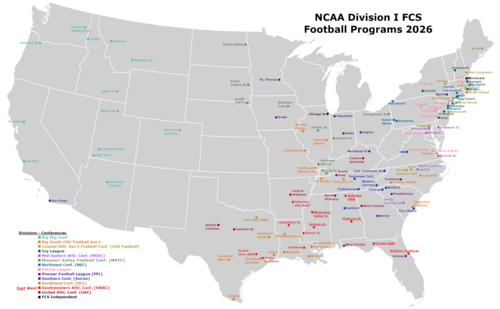
ディビジョン I FCS フットボールのみのカンファレンス
ディビジョンIホッケーのみのカンファレンス
ディビジョン I アイスホッケーは、上記のマルチスポーツ カンファレンスとは異なるカンファレンス構造を持っています。これらの学校は、他のスポーツの他のカンファレンスに所属しています。
- 男性のみ
- セントラル大学ホッケー協会(CCHA) – 2021 年に復活。以前は 1971 年から 2013 年まで運営されていました。
- 全米大学ホッケー連盟(NCHC)
- 女性のみ
- ニューイングランド女子ホッケー連盟(NEWHA)
- ウェスタン大学ホッケー協会(WCHA)
- 男女
- アトランティック・ホッケー・アメリカ(AHA) – 男子のアトランティック・ホッケー協会と女子のカレッジ・ホッケー・アメリカの合併により2024年に設立
- ECACホッケー
- ホッケー イースト(正式名称はホッケー イースト アソシエーションから HEA とも呼ばれる)
ディビジョン II
NCAAの規定では、ディビジョンIIの機関は、男子5種目、女子5種目(または男子4種目、女子6種目)以上をスポンサーしなければならず、男女それぞれ2つのチームスポーツをスポンサーし、各シーズンを男女別に代表しなければならない。男女両方で構成されたチームは、スポーツスポンサーシップの目的では男子チームとしてカウントされる。[97]
- カリフォルニア大学体育協会(CCAA)
- セントラル・アトランティック・カレッジ・カンファレンス(CACC)
- セントラル大学体育協会(CIAA)
- カンファレンス カロライナ(CC)
- イースト コースト カンファレンス(ECC)
- グレートアメリカンカンファレンス(GAC)
- グレート レイクス大学体育協会(GLIAC)
- グレート レイクス バレー カンファレンス(GLVC)
- グレート・ミッドウェスト・アスレチック・カンファレンス(G-MAC)
- グレート・ノースウェスト・アスレチック・カンファレンス(GNAC)
- ガルフサウスカンファレンス(GSC)
- ローンスターカンファレンス(LSC)
- ミッドアメリカ大学陸上競技協会(MIAA)
- マウンテン・イースト・カンファレンス(MEC)
- ノースイースト10カンファレンス(NE-10)
- ノーザンサン大学間カンファレンス(NSIC)
- パシフィック・ウェスト・カンファレンス(PacWest)
- Peach Belt Conference (PBC)
- Pennsylvania State Athletic Conference (PSAC)
- Rocky Mountain Athletic Conference (RMAC)
- South Atlantic Conference (SAC)
- Southern Intercollegiate Athletic Conference (SIAC)
- Sunshine State Conference (SSC)
- NCAA Division II Independents
Division III
Unlike the other two divisions, Division III institutions cannot offer athletic scholarships. Among the other NCAA Division III requirements, all institutions, regardless of enrollment, must sponsor at least three team sports for each sex/gender, and each playing season represented by each sex/gender.[98] Furthermore, a sports sponsorship rule unique to Division III is that the total number of sports that must be sponsored differs by a school's full-time undergraduate enrollment: schools with an enrollment of 1,000 or fewer must sponsor at least five sports for men and five for women; those with larger enrollments must sponsor six men's and six women's sports. As in the other divisions, teams that include both men and women are treated as men's sports for the purpose of these regulations.[99]
- Allegheny Mountain Collegiate Conference (AMCC)
- American Rivers Conference (ARC)
- American Southwest Conference (ASC)
- Atlantic East Conference (AEC)
- Centennial Conference (Centennial)
- City University of New York Athletic Conference (CUNYAC)
- Coast to Coast Athletic Conference (C2C)
- College Conference of Illinois and Wisconsin (CCIW)
- Collegiate Conference of the South (CCS)
- Conference of New England (CNE)
- Empire 8 (E8)
- Great Northeast Athletic Conference (GNAC)
- Heartland Collegiate Athletic Conference (HCAC)
- Landmark Conference (Landmark)
- Liberty League (Liberty)
- Little East Conference (LEC)
- Massachusetts State Collegiate Athletic Conference (MASCAC)
- Michigan Intercollegiate Athletic Association (MIAA)
- Middle Atlantic Conferences (MAC) – An umbrella organization of the following three conferences:
- MAC Commonwealth, sponsoring competition in 14 sports, but not football
- MAC Freedom, sponsoring competition in the same set of 14 sports
- Middle Atlantic Conference, sponsoring 13 sports, including football
- Midwest Conference (Midwest or MWC)
- Minnesota Intercollegiate Athletic Conference (MIAC)
- New England Small College Athletic Conference (NESCAC)
- New England Women's and Men's Athletic Conference (NEWMAC)
- New Jersey Athletic Conference (NJAC)
- North Atlantic Conference (NAC)
- North Coast Athletic Conference (NCAC)
- Northern Athletics Collegiate Conference (NACC)
- Northwest Conference (NWC)
- Ohio Athletic Conference (OAC)
- Old Dominion Athletic Conference (ODAC)
- Presidents' Athletic Conference (PAC)
- Skyline Conference (Skyline)
- Southern Athletic Association (SAA)
- Southern California Intercollegiate Athletic Conference (SCIAC)
- Southern Collegiate Athletic Conference (SCAC)
- State University of New York Athletic Conference (SUNYAC)
- St. Louis Intercollegiate Athletic Conference (SLIAC)
- United East Conference
- University Athletic Association (UAA)
- Upper Midwest Athletic Conference (UMAC)
- USA South Athletic Conference (USA South)
- Wisconsin Intercollegiate Athletic Conference (WIAC)
- NCAA Division III Independents
Division III football-only conferences
Division III ice hockey-only conferences
- ECAC East – men's and women's
- ECAC Northeast – men's only
- ECAC West – men's and women's
- Northern Collegiate Hockey Association (NCHA) – men's and women's
- United Collegiate Hockey Conference (UCHC) – men's and women's
Division III lacrosse-only conferences
- Midwest Lacrosse Conference (MLC) – men's only
- Midwest Women's Lacrosse Conference (MWLC) – women's only
Division III men's volleyball-only conferences
- Continental Volleyball Conference (CVC)
- Midwest Collegiate Volleyball League (MCVL)
- New England Collegiate Conference (NECC)[k]
- United Volleyball Conference (UVC)
Media
The NCAA has current media rights contracts with CBS Sports, CBS Sports Network, ESPN, ESPN+, TNT Sports and Golf Channel for coverage of its 88 championships. According to the official NCAA website,[100] ESPN and its associated networks have rights to 21 championships, CBS to 65, TNT Sports to one and NBC's Golf Channel to two. The following are the most prominent championships and rights holders until the 2023–24 season:
- CBS: Men's basketball (NCAA Division I men's basketball tournament, with TNT Sports, and NCAA Division II men's basketball tournament), track and field, ice hockey (women's division I), golf (Divisions II and III, both genders)
- ESPN: Women's basketball (all divisions), baseball, softball, ice hockey (men's Division I), football (all divisions including Div. I FCS), soccer (Division I for both genders)
- TNT Sports: NCAA Division I men's basketball tournament with CBS
- NBC and Golf Channel: golf (Division I, both genders)
Westwood One has exclusive radio rights to the men's and women's basketball Final Fours and the Men's College World Series (baseball).
From 1998 to 2013, Electronic Arts had a license to develop college sports video games with the NCAA's branding, which included its NCAA Football, NCAA Basketball (formerly NCAA March Madness) and MVP Baseball series. The NCAA's licensing was not required to produce the games, as rights to use teams are not licensed through the NCAA, but through entities such as individual schools and the Collegiate Licensing Company. EA only acquired the license so that it could officially incorporate the Division I men's basketball tournament into its college basketball game series. The NCAA withdrew EA's license due to uncertainties surrounding a series of lawsuits, most notably O'Bannon v. NCAA, involving the use of player likenesses in college sports video games.[101][102]
Office of Inclusion
Inclusion and Diversity Campaign
The week-long program took place October 1–5, 2018. The aim was to utilize social media platforms in order to promote diversity and inclusion within intercollegiate athletics. Throughout the NCAA's history, there has been controversy as to the levels of diversity present within intercollegiate athletics, and this campaign is the NCAA's most straightforward approach to combatting these issues.[52]
NCAA Inclusion Statement
As a core value, the NCAA believes in and is committed to diversity, inclusion and gender equity among its student-athletes, coaches and administrators. It seeks to establish and maintain an inclusive culture that fosters equitable participation for student-athletes and career opportunities for coaches and administrators from diverse backgrounds. Diversity and inclusion improve the learning environment for all student-athletes and enhance excellence within the Association.[52]
The Office of Inclusion will provide or enable programming and education, which sustains foundations of a diverse and inclusive culture across dimensions of diversity including but not limited to age, race, sex, class, national origin, creed, educational background, religion, gender identity, disability, gender expression, geographical location, income, marital status, parental status, sexual orientation and work experiences.
This statement was adopted by the NCAA Executive Committee in April 2010, and amended by the NCAA Board of Governors in April 2017.[52]
Gender equity and Title IX
While no concrete criteria are given as to a state of gender equity on campuses, an athletics program is considered gender equitable when both women's and men's sports programs reach a consensus.[103]
The basis of Title IX, when amended in 1972 to the 1964 Civil Rights Act, criminalized discrimination on the basis of sex.[104] This plays into intercollegiate athletics in that it helps to maintain gender equity and inclusion in intercollegiate athletics. The NCAA provides many resources to provide information and enforce this amendment.
The NCAA has kept these core values central to its decisions regarding the allocation of championship bids. In April 2016, the Board of Governors announced new requirements for host cities that include protection against discrimination based on sexual orientation or gender identity for all people involved in the event. This decision was prompted by several states passing laws that permit discrimination based on sexual orientation or gender identity in accordance with religious beliefs.[105]
LGBTQ
The LGBTQ community has been under scrutiny and controversy in the public eye of collegiate athletics, but the NCAA has gradually liberalised its policy on them. The NCAA provides many resources concerning the education of the college community on this topic and policies in order to foster diversity.[106] Title IX protects the transgender community within intercollegiate athletics and on college campuses.
On January 19, 2022, the NCAA approved a new policy for transgender athletes, effective immediately, and this replaced their previous policy, which was in place since 2011.[107] Now, the participation of transgender athletes in a particular sport is generally to be governed by the rules of the sport's national governing body, international federation policy, or International Olympic Committee policy criteria (though an NCAA committee may provide its own recommendation).[108] This action prompted immediate critique from LGBTQ advocates, including Athlete Ally and former NCAA LGBTQ OneTeam facilitator Rhea Debussy.[109][110]
Previously, the NCAA used testosterone levels to qualify transgender athletes for participation. A transgender male student-athlete was not allowed to compete on a male sports team unless they had undergone medical treatment of testosterone for gender transition, and a transgender female student-athlete was not allowed to compete on a women's sports team until completing one calendar year of testosterone suppression treatment. Under this policy, transgender males were ineligible to compete on a women's team, and transgender females were ineligible to compete on a men's team, without changing the team's status to be a mixed team.[111] In December 2021, John Lohn, the editor-in-chief of Swimming World, criticised NCAA policy; writing about transgender swimmer Lia Thomas, he argued that the "one-year suppressant requirement is not nearly stringent enough to create a level playing field between Thomas and the biological females against whom she is racing".[112]
In 2010, the NCAA Executive Committee announced its support and commitment to diversity, inclusion, and gender equality among its student-athletes, coaches, and administrators. The statement included the NCAA's commitment to ensuring that all students have equal opportunities to achieve their academic goals, and coaches and administrators have equal opportunities for career development in a climate of respect.[106] In 2012, the LGBTQ Subcommittee of the NCAA association-wide Committee on Women's Athletics and the Minority Opportunities and Interests Committee commissioned Champions of Respect, a document that provides resources and advocacy that promotes inclusion and equality for LGBTQ student-athletes, coaches, administrators and all others associated with intercollegiate athletics. This resource uses guides from the Women's Sports Foundation It Takes a Team! project for addressing issues related to LGBTQ equality in intercollegiate athletics.[113] The document provides information on specific issues LGBTQ sportspeople face, similarities and differences of these issues on women's and men's teams, policy recommendations and best practices, and legal resources and court cases.[114]
The NCAA expressed concern over Indiana's Religious Freedom Restoration Act that allows businesses to discriminate against people based on their sexual orientation. This bill was proposed just before Indianapolis was set to host the 2015 Men's Basketball Final Four tournament.[115] The bill clashed with the NCAA core values of inclusion and equality, and forced the NCAA to consider moving events out of Indiana. Under pressure from across the nation and fearing the economic loss of being banned from hosting NCAA events, the governor of Indiana, Mike Pence, revised the bill so that businesses could not discriminate based on sexual orientation, race, religion, or disability. The NCAA accepted the revised bill and continues to host events in Indiana.[116] The bill was enacted into law on July 1, 2015.[116]
On September 12, 2016, the NCAA announced that it would pull all seven planned championship events out of North Carolina for the 2016–2017 academic year.[117] This decision was a response to the state passing the Public Facilities Privacy and Security Act (H.B. 2) on March 23, 2016. This law requires people to use public restrooms that correspond with their sex assigned at birth and stops cities from passing laws that protect against discrimination towards gay and transgender people.[citation needed] The NCAA Board of Governors determined that this law would make ensuring an inclusive atmosphere in the host communities challenging, and relocating these championship events best reflects the association's commitment to maintaining an environment that is consistent with its core values.[117] North Carolina has lost the opportunity to host the 2018 Final Four Tournament which was scheduled to be in Charlotte, but is relocated to San Antonio. If H.B. 2 is not repealed, North Carolina could be barred from bidding for events from 2019 to 2022.[118]
Race and ethnicity
Racial/Ethnic minority groups in the NCAA are protected by inclusion and diversity policies put in place to increase sensitivity and awareness to the issues and challenges faced across intercollegiate athletics. The NCAA provides a demographics database that can be openly viewed by the public.[52]
Historically, the NCAA has used its authority in deciding on host cities to promote its core values. The Association also prohibits championship events in states that display the Confederate flag, and at member schools that have abusive or offensive nicknames or mascots based on Native American imagery. Board members wish to ensure that anyone associated with an NCAA championship event will be treated with fairness and respect.[105]
Student-athletes with disabilities
The NCAA defines a disability as a current impairment that has a substantial educational impact on a student's academic performance and requires accommodation. Student-Athletes with disabilities are given education accommodations along with an adapted sports model. The NCAA hosts adapted sports championships for both track and field and swimming and diving as of 2015.[106]
International student athletes
Over the last two decades recruiting international athletes has become a growing trend among NCAA institutions. For example, most German athletes outside of Germany are based at US universities. For many European athletes, the American universities are the only option to pursue an academic and athletic career at the same time. Some of these students go to the US with high academic expectations and aspirations.[106]
College team name changes
As of 2018, there has been a continuation of changing school mascots that are said by some to be based on racist or offensive stereotypes. Universities under NCAA policy are under scrutiny for specifically Native American-inspired mascots. While many colleges have changed their mascots, some have gotten legal permission from the tribe represented and will continue to bear the mascot. This Native American mascot controversy has not been completely settled; however, many issues have been resolved.[119]
Here is a list of notable colleges that changed Native American mascots and/or nicknames in recent history:
- Stanford – Indians to Cardinals (1972); became Cardinal in 1981
- UMass – Redmen and Redwomen to Minutemen and Minutewomen (1972)
- Dartmouth – Indians to Big Green (1974)
- Siena – Indians to Saints (1988)
- Eastern Michigan – Hurons to Eagles (1991)
- St. Bonaventure - Brown Indians to Bonnies
- St. John's (NY) – Redmen to Red Storm (1994)
- Syracuse - Orangemen to Orange
- Marquette – Warriors to Golden Eagles (1994)
- Chattanooga – Moccasins to Mocs, suggestive of mockingbirds (1996)
- Miami (OH) – Redskins to RedHawks (1997)
- Seattle – Chieftains to Redhawks (2000)
- Colgate – Red Raiders to Raiders (2001)
- Quinnipiac – Braves to Bobcats (2002)
- Southeast Missouri State – Indians (men) and Otahkians (women) to Redhawks (2005)
- Louisiana–Monroe – Indians to Warhawks (2006)
- Arkansas State – Indians to Red Wolves (2008)
- North Dakota – Formally dropped Fighting Sioux in 2012; adopted Fighting Hawks in 2015[120]
Others:
- Illinois – Removed Chief Illiniwek as official symbol in 2007. Athletics teams are still called Fighting Illini.
- Bradley, Alcorn State – Both schools stopped using Native American mascots but have retained their Braves nickname.
- William & Mary – Adjusted Tribe logo to remove feathers to comply with NCAA. Athletics teams are still called Tribe. (2007)
- Chattanooga – removed the mascot, Chief Moccanooga and the Moccasin Shoe imagery in 1996; Kept the term, "Mocs", but reassigned its representation to the official State Bird.
Of note: Utah (Utes), Central Michigan (Chippewas), Florida State (Seminoles) and Mississippi College (Choctaws) all appealed successfully to the NCAA after being deemed "hostile and offensive." Each cited positive relationships with neighboring tribes in appeal. UNC Pembroke (Braves), an institution originally created to educate Native Americans and enjoying close ties to the local Lumbee tribe, was approved to continue the use of native-derived imagery without needing an appeal.
Rules violations
Member schools pledge to follow the rules promulgated by the NCAA. Creation of a mechanism to enforce the NCAA's legislation occurred in 1952 after careful consideration by the membership.
Allegations of rules violations are referred to the NCAA's enforcement staff, who monitor information about potential violations, investigate and process violations, provide notice of alleged violations, and bring cases before the NCAA's Committees on Infractions.[121] A preliminary investigation is initiated to determine if an official inquiry is warranted and to categorize any resultant violations as secondary or major. If several violations are found, the NCAA may determine that the school as a whole has exhibited a "lack of institutional control." The institution involved is notified promptly and may appear on its own behalf before the NCAA Committee on Infractions.
Findings of the Committee on Infractions and the resultant sanctions in major cases are reported to the institution. Sanctions will generally include having the institution placed on "probation" for a period of time, in addition to other penalties. The institution may appeal the findings or sanctions to an appeals committee. After considering written reports and oral presentations by representatives of the Committee on Infractions and the institution, the committee acts on the appeal. Action may include accepting the infractions committee's findings and penalty, altering either, or making its own findings and imposing an appropriate penalty.[121]
In cases of particularly egregious misconduct, the NCAA has the power to ban a school from participating in a particular sport, a penalty known as the "Death Penalty". Since 1985, any school that commits major violations during the probationary period can be banned from the sport involved for up to two years. However, when the NCAA opts not to issue a death penalty for a repeat violation, it must explain why it did not do so. This penalty has only been imposed three times in its modern form, most notably when Southern Methodist University's (SMU) football team had its 1987 season canceled due to massive rules violations dating back more than a decade. SMU opted not to field a team in 1988 as well due to the aftershocks from the sanctions, and the program has never recovered. The Mustangs did not post a winning season until 1997, did not appear in their next bowl game until 2009, did not post consecutive winning seasons until 2011 and 2012, did not return to the national rankings until 2019, and did not win a conference title again until 2023. The devastating effect the death penalty had on SMU has reportedly made the NCAA skittish about issuing another one. Since the SMU case, there are only three instances where the NCAA has seriously considered imposing it against a Division I school; it imposed it against Division II Morehouse College's men's soccer team in 2003 and Division III MacMurray College's men's tennis team in 2005. In addition to these cases, the most recent Division I school to be considered was Penn State. This was because of the Jerry Sandusky Incident that consequently almost landed Penn State on the hook for the death penalty. They received a $60 million fine, in addition to forfeited seasons and other sanctions as well. The NCAA later reversed itself by restoring all forfeited seasons and overturning the remaining sanctions.
Additionally, in particularly egregious cases of rules violations, coaches, athletic directors, and athletic support staff can be barred from working for any NCAA member school without permission from the NCAA. This procedure is known as a "show-cause penalty" (not to be confused with an order to show cause in the legal sense).[122] Theoretically, a school can hire someone with a "show cause" on their record during the time the show cause order is in effect only with permission from the NCAA Infractions Committee. The school assumes the risks and stigma of hiring such a person. It may then end up being sanctioned by the NCAA and the Infractions Committee for their choice, possibly losing athletic scholarships, revenue from schools who would not want to compete with that other school, and the ability for their games to be televised, along with restrictions on recruitment and practicing times. As a result, a show-cause order essentially has the effect of blackballing individuals from being hired for the duration of the order.
One of the most famous scandals in NCAA history involved Heisman Trophy-winning quarterback Cam Newton of the Auburn Tigers in 2011. As a direct effect of not being compensated for his college athletics, Cam Newton's family allegedly sought upwards of $100,000 for him to instead play at Mississippi State. This was revealed days before the conference SEC championship game; however, Cam Newton was later reinstated as there was insufficient evidence against him.[123]
Sponsors
The NCAA has a two-tier sponsorship division. AT&T, Coca-Cola, and Capital One are NCAA Corporate Champions, all others are NCAA Corporate Partners.[124]
Finances
As a governing body for amateur sports the NCAA is classified as a tax-exempt not-for-profit organization.[125] As such, it is not required to pay most taxes on income that for-profit private and public corporations are subject to. The NCAA's business model of prohibiting salaries for collegial athletes has been challenged in court, but a 2015 case was struck down.[126] As of 2014 the NCAA reported that it had over $600 million in unrestricted net assets in its annual report.[127] During 2014 the NCAA also reported almost a billion dollars of revenue, contributing to a "budget surplus" – revenues in excess of disbursements for that year – of over $80 million.[127] Over $700 million of that revenue total was from licensing TV rights to its sporting events.[127] In addition, the NCAA also earns money through investment growth of its endowment fund. Established in 2004 with $45 million, the fund has grown to over $380 million in 2014.[128]
NCAA expenditures
According to the NCAA, it receives most of its annual revenue from two sources: Division I Men's Basketball television and marketing rights, and championships ticket sales. According to the NCAA, "that money is distributed in more than a dozen ways – almost all of which directly support NCAA schools, conferences and nearly half a million student-athletes."[129]
In 2017 total NCAA revenues were in excess of $1.06 billion.[130] Division I basketball television and marketing rights generated $821.4 million, and "championships ticket sales" totaled $129.4 million. Other "smaller streams of revenue, such as membership dues" contributed an unspecified amount.[129]
Expenses by category
The NCAA provided a breakdown of how those revenues were in turn spent, organizing pay-outs and expenses into some 14 basic categories. By far the largest went to Sports Scholarship and Sponsorship Funds, funding for sports and student scholarships under the Division I Basketball Performance Fund, expenses incurred in producing Division I Championships (including team food, travel, and lodging), the Student Assistance Fund, and Student Athlete Services. Together these top five recipients accounted for 65% of all NCAA expenditures. General and Administrative expenses for running the NCAA day-to-day operations totaled approximately 4% of monies paid out, and other association-wide expenses, including legal services, communications, and business insurance totaled 8%.[129]
The categories:
- $210.8M Sport Sponsorship and Scholarship Funds
- Distributed to Division I schools to help fund NCAA sports and provide scholarships for college athletes.
- $160.5M Division I Basketball Performance Fund
- Distributed to Division I conferences and independent schools based on their performance in the men's basketball tournament over a six-year rolling period. The money is used to fund NCAA sports and provide scholarships for college athletes.
- $96.7M Division I Championships
- Provides college athletes the opportunity to compete for a championship and includes support for team travel, food, and lodging.
- $82.2M Student Assistance Fund
- Distributed to Division I student-athletes for essential needs that arise during their time in college.
- $71.8M Student-Athlete Services
- Includes funding for catastrophic injury insurance, drug testing, student-athlete leadership programs, postgraduate scholarships, and additional Association-wide championships support.
- $50.3M Division I Equal Conference Fund
- Distributed equally among Division I basketball-playing conferences that meet athletic and academic standards to play in the men's basketball tournament. The money is used to fund NCAA sports and provide scholarships for college athletes.
- $46.7M Academic Enhancement Fund
- Distributed to Division I schools to assist with academic programs and services.
- $42.3M Division II Allocation
- Funds championships, grants, and other initiatives for Division II college athletes.
- $39.6M Membership Support Services
- Covers costs related to NCAA governance committees and the annual NCAA Convention.
- $28.2M Division III Allocation
- Funds championships, grants, and other initiatives for Division III college athletes.
- $9.5M Division I Conference Grants
- Distributed to Division I conferences for programs that enhance officiating, compliance, minority opportunities, and more.
- $3.3M Educational Programs
- Supports various educational services for members to help prepare student-athletes for life, including the Women Coaches Academy, the Emerging Leaders Seminars, and the Pathway Program.
- $74.3M Other Association-Wide Expenses
- Includes support for Association-wide legal services, communications, and business insurance.
- $39.7M General and Administrative Expenses
- Funds the day-to-day operations of the NCAA national office, including administrative and financial services, information technology, and facilities management.
According to the NCAA, the 2017 fiscal year was the first in which its revenues topped $1.0 billion. The increase in revenue from 2016 came from hikes in television and marketing fees, plus greater monies generated from championship events and investment income.[130]
An ESPN critique of the organization's 2017 financials indicated some $560.3 million of the total $956 million paid out went back to its roughly 1,100 member institutions in 24 sports in all three divisions, as well as $200 million for a one-time payment the NCAA made to schools to fund additional programs.[131]
The Division I basketball tournament alone generated some $761 million, with another $60 million in 2016–17 marketing rights. With increases in rights fees it is estimated the basketball tournament will generate some $869 million for the 2018 championship.[131]
Player compensation proposals
The NCAA has limited the amount of compensation that individual players can receive to scholarships equal to school tuition and related expenses. This rule has generated controversy, in light of the large amounts of revenues that schools earn from sports from TV contracts, ticket sales, and licensing and merchandise. Several commentators have discussed whether the NCAA limit on player compensation violates antitrust laws. There is a consensus among economists that the NCAA's compensation caps for men's basketball and football players benefit the athletes' schools (through rent-seeking) at the expense of the athletes.[6] Economists have subsequently characterized the NCAA as a cartel and collusive monopsony.[9][11][10][132][133]
Pro-rating payouts to Division I basketball players in proportion to the size of revenues its championship tournament generates relative to the NCAA's total annual revenues would be one possible approach, but will open the door to litigation by students and schools adversely affected by such a formula.
According to a national study by the National College Players Association (NCPA) and the Drexel University Sport Management Department, the average FBS "full" athletic scholarship falls short of the full cost of attending each school by an average of $3285 during 2011–12 school year, and leaves the vast majority of full scholarship players living below the federal poverty line. [134]
In 2020, the NCAA Board of Governors announced that they supported rule changes that would permit players to receive athletics-related endorsements from third-parties.[135] All divisions were expected to adopt new rules relating to the use of players' names, images, and likenesses before the 2021–2022 academic year begins.
On May 6, 2021, Governor Brian Kemp signed Bill 617 into law, giving collegiate athletes the ability to profit off their Name, Image and Likeness. The University of Georgia have said they will immediately compensate their student athletes, while Georgia Tech and Georgia State University have not set anything yet.[136]
On June 21, 2021, the U.S. Supreme Court held unanimously in National Collegiate Athletic Association v. Alston that the NCAA's restrictions on education-related payments were unlawfully in violation of Sherman Act's anti-trust and trade regulations.[137][138] Though this holding did not address restrictions on direct compensation payment to athletes, it also opened the door for the possibly of future court cases concerning this matter.[139][137]
The NCAA announced on July 1, 2021, that as a result of O'Bannon and numerous state laws giving college players the ability to manage their publicity, the board had agreed to new rules that removed restrictions on college athletes from entering paid endorsements and other sponsorship deals, and from using agents to manage their publicity. Students would still be required to inform the school of all such activities, with the school to make determinations if those activities violate state and local laws.[140]
On the first day of effect for the NIL rule change (July 1), athletes such as D'Eriq King (Miami (FL) quarterback), Justyn Ross (Clemson wide receiver), Bo Nix (Auburn quarterback), Antwan Owen (Jackson State defensive end), McKenzie Milton (Florida State quarterback), Malik Cunningham (Louisville quarterback), Michael Penix Jr. (Indiana quarterback), Spencer Rattler (Oklahoma quarterback), Lexi Sun (Nebraska volleyball), Paige Bueckers (UConn basketball) and twins Haley & Hanna Cavinder (Fresno State basketball), all signed deals and/or unveiled trademarks to profit off of their names, images, and likenesses. As of day one, LSU gymnast Olivia Dunne was projected to be the highest earning college athlete of 2021–22, out of both men's and women's sports.[141]
The new NIL agreement has given student athletes big time deals and opportunities to put themselves out there and gain profit using their name, image, and likeness. For example, Ga'Quincy McKinstry, a cornerback from Alabama known since childhood as "Kool-Aid", signed a deal with Kool-Aid. Not only can they partner up with companies, student athletes can get paid for other talents (i.e. singing).
Russell Steinberg in 2021 says, "In addition to his prowess on the football field, where he has a shot at tying the school record for most starts, Marshall's Will Ulmer is a talented musician who wasn't able to earn money using his own name — until now. He had been going by "Lucky Bill" to avoid running afoul of NCAA regulations, but now says he is ready to book shows using his real name" (Steinberg 2021).[142] The NIL has allowed Ulmer great opportunities to further pursue his football and musician career.
Some companies have partnered up with multiple athletes and created a team of their own. Degree, the deodorant brand, started a team of 14 student athletes to help promote their brand. Degree calls this team Breaking Limits. "The Unilever-owned antiperspirant brand has committed $5 million over the next five years to inspire people to break limits. The first group of athletes that Degree has selected represent a diverse range of backgrounds regarding race, gender, and sport, and their stories will be unveiled on Instagram. These athletes will also have the chance to participate in events to help their local communities" (Steinberg 2021).[142]
On May 23, 2024, the NCAA and its five power conferences agreed to allow schools to directly pay players for the first time in the 100-plus-year history of college sports.[143] The NCAA and its leagues announced their intention to enter into a multibillion-dollar agreement to settle three pending antitrust cases.[143] In doing so, the NCAA will pay more than $2.7 billion in damages over ten years to more than 10,000 past and current athletes.[143] It is anticipated that each player in the class will receive an annual check worth 10% of the money they are owed.[143] Additionally, the NCAA and its league are also set to enter into a revenue-sharing plan, which allows each member school to share up to roughly $20 million per year with its athletes.[143]
Individual awards
The NCAA presents a number of different individual awards,[145] including:
- NCAA Award of Valor (not given every year); selection is based on the heroic action occurring during the academic year.
- NCAA Gerald R. Ford Award, honoring an individual who has provided significant leadership as an advocate for intercollegiate athletics.
- NCAA Inspiration Award (not given every year); selection is based on inspirational action.
- NCAA Sportsmanship Award, honoring student-athletes who have demonstrated one or more of the ideals of sportsmanship.
- NCAA Theodore Roosevelt Award, the highest honor that the NCAA can confer on an individual.
- NCAA Woman of the Year Award, honoring a senior student-athlete who has distinguished herself throughout her collegiate career in academics, athletics, service, and leadership.
- Elite 90 Award, honoring the student-athlete with the highest cumulative GPA who has reached the competition at the finals site for each of the NCAA's 90 men's and women's championships (in Divisions I, II, and III, plus "National Collegiate" championships open to schools from more than one division).
- Silver Anniversary Awards, honoring six distinguished former student-athletes on the 25th anniversary of their college graduation.
- The Flying Wedge Award, one of the NCAA's highest honors exemplifying outstanding leadership and service to the NCAA.
- Today's Top 10 Award, honoring ten outstanding senior student-athletes.
- Walter Byers Scholarship, honoring the top male and female scholar-athletes.
In previous years, the NCAA has presented the following awards at its NCAA Honors event: Astronaut Salute, Business Leader Salute, Congressional Medal of Honor Salute, Governor Salute, Olympians Salute, Performing Arts Salute, Presidents Cabinet Salute, Prominent National Media Salute, Special Recognition Awards, U.S. House of Representatives Salute, and U.S. Senate Salute.[146]
Other collegiate athletic organizations
The NCAA is the dominant, but not the only, collegiate athletic organization in the United States. Several other such collegiate athletic organizations exist.
In the United States
- National Association of Intercollegiate Athletics (NAIA)
- National Junior College Athletic Association (NJCAA) – two-year colleges (does not operate in California or the Pacific Northwest)
- California Community College Athletic Association (CCCAA) – two-year colleges in California
- Northwest Athletic Conference (NWAC) – two-year colleges in Washington, Oregon and Idaho
- National Christian College Athletic Association (NCCAA)
- United States Collegiate Athletic Association (USCAA)
- Association for Intercollegiate Athletics for Women (AIAW) – disbanded in 1982, after NCAA began sponsoring championships in women's sports
Foreign equivalents
- Australia: UniSport Australia and other school affiliations such as Athletic Association of the Great Public Schools of New South Wales (GPS), and Combined Associated Schools (CAS)
- Canada: U Sports, and Canadian Collegiate Athletic Association (CCAA)
- Indonesia: Liga Mahasiswa (LIMA)
- Philippines: National Collegiate Athletic Association (Philippines) (NCAA), and University Athletic Association of the Philippines (UAAP)
- United Kingdom: British Universities & Colleges Sport
- South Africa: Varsity Sports (South Africa)
- Nigeria: Nigerian University Games Association (NUGA)
International governing body
- International University Sports Federation (FISU) (Fédération Internationale du Sport Universitaire)
See also

Notes and references
Notes
- ^ As "Intercollegiate Athletic Association of the United States" (IAAUS), renamed "National Collegiate Athletic Association" in 1910.[1]
- ^ NCAA is commonly pronounced "N C double A" by the general public and in outside media reports, but generally pronounced one letter at a time, "N C A A", in the organization's official media. In its early decades, the pronunciation "N C two A" was also used – this variation is rarely used today.
- ^ The NCAA prohibits Division III members from using the National Letter of Intent program, or requiring that prospective athletes sign any pre-enrollment document that is not executed by other prospective students at that institution. The NCAA does allow the signing of a standard, non-binding celebratory form upon the student's acceptance of enrollment, but this signing cannot take place at the institution's campus, and staff members of that school cannot be present at the signing.[77]
- ^ Men and women compete together as team members in this sport today, but men's and women's championships were separate between 1982 and 1989. All individual bouts have always involved members of the same sex.
- ^ Men and women compete together in this sport as equals, making this the only NCAA sport in which men and women directly compete against one another..
- ^ Rifle was the only NCAA sport whose championship was open to women before the 1981–82 school year.
- ^ Men and women compete together as team members in this sport, but all races involve members of only one sex.
- ^ a b Most football-playing ASUN and WAC members play that sport in the United Athletic Conference, the successor to a football-only partnership that shared one automatic berth in the FCS playoffs. Due to an NCAA moratorium on new single-sport conferences, the UAC is not recognized as an NCAA conference, but rather as a continuation of that partnership.
- ^ a b Most football-playing Big South and OVC members play that sport in the Big South–OVC Football Association, a single-sport partnership with one automatic berth in the FCS playoffs.
- ^ Although the CAA football league is administered by the all-sports CAA, the two sides of the CAA are legally separate entities.
- ^ Men's volleyball is the conference's only remaining NCAA sport after it disbanded as an all-sports league at the end of the 2022–23 school year. The conference also operates in the non-NCAA esports.
References
- ^ a b c d e "About the NCAA History". NCAA. Archived from the original on August 7, 2011. Retrieved August 17, 2011.
President Theodore Roosevelt summoned college athletics leaders to two White House conferences to encourage reforms. In early December 1905, Chancellor Henry M. MacCracken of New York University convened a meeting of 13 institutions to initiate changes in football playing rules. At a subsequent meeting on December 28 in New York City, 62 colleges and universities became charter members of the Intercollegiate Athletic Association of the United States (IAAUS). The IAAUS officially was constituted March 31, 1906, and took its present name, the NCAA, in 1910.
- ^ "Simon Fraser University approved to join NCAA D II". Tsn.ca. October 7, 2009. Archived from the original on July 14, 2009. Retrieved November 6, 2009.
- ^ a b c "Overview". National Collegiate Athletic Association. Retrieved May 23, 2022.
- ^ a b c "NCAA Group Opens Talks On Money Aid To Players". Kingsport Times. August 20, 1956. p. 7 – via Newspapers.com.
- ^ "NCAA records nearly $1.3B in revenue for '22-23". ESPN.com. February 2, 2024. Retrieved April 22, 2024.
- ^ a b "The NCAA". www.igmchicago.org. Retrieved April 3, 2018.
- ^ Sanderson, Allen R.; Siegfried, John J. (February 2015). "The Case for Paying College Athletes". Journal of Economic Perspectives. 29 (1): 115–138. doi:10.1257/jep.29.1.115.
- ^ Garthwaite, Craig; Keener, Jordan; Notowidigdo, Matthew J; Ozminkowski, Nicole F (October 2020). "Who Profits From Amateurism? Rent-Sharing in Modern College Sports". National Bureau of Economic Research. Working Paper Series. doi:10.3386/w27734.
- ^ a b Sanderson, Allen R.; Siegfried, John J. (March 1, 2018). "The National Collegiate Athletic Association Cartel: Why it Exists, How it Works, and What it Does". Review of Industrial Organization. 52 (2): 185–209. doi:10.1007/s11151-017-9590-z. ISSN 1573-7160. S2CID 86850372.
- ^ a b Blair, Roger D.; Whitman, Joseph (March 1, 2017). "The NCAA Cartel, Monopsonistic Restrictions, and Antitrust Policy". The Antitrust Bulletin. 62 (1): 3–14. doi:10.1177/0003603X16688836. ISSN 0003-603X. S2CID 157372084.
- ^ a b Humphreys, Brad R.; Ruseski, Jane E. (2009). "Monitoring Cartel Behavior and Stability: Evidence from NCAA Football". Southern Economic Journal. 75 (3): 720–735. doi:10.1002/j.2325-8012.2009.tb00928.x. ISSN 0038-4038. JSTOR 27751412. S2CID 44035483.
- ^ "High court rules against NCAA on compensation". ESPN.com. June 21, 2021. Retrieved June 21, 2021.
- ^ Michael Whitmer (June 6, 2015). "Harvard and Yale crews celebrate the 150th Boat Race". The Boston Globe. Retrieved September 25, 2015.
- ^ a b c d e f g NCAA History between 1910 and 1980 Archived December 12, 2013, at the Wayback Machine
- ^ "The Sinful Seven: Sci-fi Western Legends of the NCAA". gumroad.com. Retrieved August 3, 2020.
- ^ a b Bennett H. Beach and John L. Powers (January 17, 1970). "Soaking up the Press". The Harvard Crimson.
- ^ [1] "Protection of College Athletes. Hearings Before the Special Subcommittee on Education of the Committee on Education and Labor. House of Representatives, Ninety-Third Congress; First Session on H.R. 5623 and H.R. 5624", March and April 1973.
- ^ "Remarks of AAU President John B. Kelly, Jr.," Ford Library Museum, November 1, 1972, Philadelphia, PA.
- ^ S. I. Staff (April 20, 1970). "19TH HOLE: THE READERS TAKE OVER". Sports Illustrated.
- ^ Lipsyte, Robert (January 24, 1970). "The Plot". The New York Times.
- ^ Nocera, Joe (December 25, 2015). "Jerry Tarkanian and Walter Byers: Adversaries Who Left Mark on N.C.A.A." The New York Times.
- ^ Sally Jenkins. "NCAA lost its teeth in court in 1984, and no one's been in charge since", The Washington Post, September 23, 2011.
- ^ Brian Goff (April 26, 2020). "NCAA World Evolving But Toward What?". Sports Economist.
- ^ "National Collegiate Athletic Association (NCAA) | American organization". Encyclopædia Britannica. Retrieved July 11, 2017.
- ^ Grundy, Pamela; Shackelford, Susan (2005). Shattering the Glass. The New Press. ISBN 978-1-56584-822-1.
- ^ a b c d e f g h i j k l m n o p q r s t u v Rose, Laurence M. "College Presidents and the NCAA Presidents ' Commission: All Bark and No Bite". repository.law.miami.edu. University of Miami. Retrieved July 17, 2023.
- ^ "Origins". ncaa.org. NCAA. Retrieved July 17, 2023.
- ^ a b c MOFFIT, DAVID (January 7, 1987). "The NCAA Presidents Commission, representing top executives of the nation's leading colleges". United Press International. UPI. Retrieved July 17, 2023.
- ^ "Graduation Rates Timeline". ncaa.org. NCAA. Retrieved July 17, 2023.
- ^ "Division III Timeline". ncaa.org. NCAA. Retrieved July 17, 2023.
- ^ Asher, Mark (January 14, 1986). "NCAA Approves Testing for Drugs". The Washington Post. Retrieved May 16, 2024.
- ^ "Timeline - 1990s". ncaa.org. NCAA. Retrieved July 17, 2023.
- ^ "The More Things Change …". ncaa.org. NCAA. Retrieved July 17, 2023.
- ^ a b U.S. Supreme Court (1984). "NCAA v. BOARD OF REGENTS OF UNIV. OF OKLA., 468 U.S. 85 (1984) 468 U.S. 85 NATIONAL COLLEGIATE ATHLETIC ASSOCIATION v. BOARD OF REGENTS OF THE UNIVERSITY OF OKLAHOMA ET AL. CERTIORARI TO THE UNITED STATES COURT OF APPEALS FOR THE TENTH CIRCUIT No. 83-271". Findlaw.com. Retrieved September 6, 2010.
- ^ a b Ginsburg, Ruth Bader (February 23, 1999). "NATIONAL COLLEGIATE ATHLETIC ASSN. v. SMITH". Legal Information Institute, Cornell Law School. Retrieved July 13, 2013.
- ^ Benjamin Bendrich: Studentischer Spitzensport zwischen Resignation, Mythos und Aufbruch: eine Studie zur dualen Karriere in Deutschland und den USA.Göttingen: Optimus, 2015. ISBN 3-86376-164-2
- ^ O'Toole, Thomas (September 1, 2009). "NCAA welcomes Simon Fraser, first Canadian member school". USA Today. Retrieved November 1, 2011.
- ^ Lemire, Joe (August 5, 2009). "Canadian school's admittance to NCAA may change rules up north". Sports Illustrated. Archived from the original on October 5, 2011. Retrieved November 1, 2011.
- ^ Stark-Mason, Rachel (January 20, 2018). "Division II votes to permit membership applications from schools in Mexico". NCAA. Retrieved June 25, 2020.
- ^ Dibble, Sandra (February 19, 2020). "Tijuana's CETYS University wants to be first Mexican member of NCAA". The San Diego Union-Tribune. Retrieved June 25, 2020.
- ^ "NCAA members approve new constitution" (Press release). NCAA. January 20, 2022. Retrieved January 21, 2022.
- ^ Murphy, Dan (January 20, 2022). "NCAA member schools vote to ratify new streamlined constitution". ESPN.com. Retrieved January 21, 2022.
- ^ "Mason, John H.". Mason, John H., (13 June 1875–15 June 1951). Who's Who. 2007. doi:10.1093/ww/9780199540884.013.u240448.
- ^ Play-by-play: radio, television, and big-time college sport. July 1, 2002.
- ^ "State Compensation Ins. Fund v. Industrial Com'n". Justia Law. Retrieved February 27, 2020.
- ^ CBS News/New York Times Polls, 1977-1978. Inter-university Consortium for Political and Social Research (Report). 1984. doi:10.3886/icpsr07818.
- ^ Beiner, Ronald (1953). Political philosophy : what it is and why it matters. New York, NY: Cambridge University Press. ISBN 9781107707115. OCLC 885338105.[page needed]
- ^ Li, David K. (August 26, 2023). "Meet the man who thinks he 'screwed up' college football with a Supreme Court win". NBC News. Retrieved September 2, 2023.
- ^ "Ranbaxy agrees to pay $500 million drug safety settlement". Reactions Weekly. 1453 (1): 4. May 25, 2013. doi:10.1007/s40278-013-3239-y. S2CID 195088138.
- ^ Ginsburg, Ruth Bader (October 1, 2004). "Remarks of Ruth Bader Ginsburg, March 11, 2004, CUNY School of Law". CUNY Law Review. 7 (2): 221. doi:10.31641/clr070202.
- ^ Paskus, Thomas (2010). NCAA Division I Academic Progress Rate, 2011. Inter-university Consortium for Political and Social Research (Report). doi:10.3886/icpsr26801.v2.
- ^ a b c d e Swaim, Norman M. (1983). Factors influencing college basketball players to attend selected NCAA Division I colleges, NCAA Division II colleges or NAIA colleges or NCAA Division III colleges (MS thesis). Iowa State University. doi:10.31274/rtd-180813-7435.
- ^ "Porter, Leonard Keith". Porter, Leonard Keith, (Born 17 March 1952), Chairman, e Asset Management, since 2014. Who's Who. Oxford University Press. December 1, 2007. doi:10.1093/ww/9780199540884.013.59364.
- ^ "New York Times New York City Poll, September 2003". Inter-university Consortium for Political and Social Research. 2004. doi:10.3886/icpsr03919.
- ^ a b c Strauss, Ben (August 17, 2015). "N.L.R.B. Rejects Northwestern Football Players' Union Bid". The New York Times. ISSN 0362-4331. Retrieved February 27, 2020.
- ^ Morey, Alex (July 13, 2018). "Former University of Central Florida kicker scores courtroom win in YouTube case". FIRE. Retrieved February 28, 2021.
- ^ "High court rules against NCAA on compensation". ESPN.com. June 21, 2021. Retrieved July 28, 2021.
- ^ "Growth of NCAA Apparent; But Optimism Still Abounds" (PDF). NCAA News. June 15, 1973. Archived from the original (PDF) on September 16, 2014. Retrieved November 6, 2009.
- ^ "NCAA will move in 1989 to Overland Park, Kansas – NCAA News – May 4, 1988" (PDF). Archived from the original (PDF) on September 16, 2014.
- ^ a b c "Final Four: Indianapolis competes with Dallas, Denver and Kansas City for the NCAA's new headquarters". Indiana Business Magazine. Allbusiness.com. March 1, 1997. Retrieved November 6, 2009.
- ^ "NCAA headquarters in Indianapolis to open July 26". NCAA. July 15, 1999. Archived from the original on April 11, 2014. Retrieved April 11, 2014.
- ^ "NCAA Elects Mark Emmert as New President", April 29, 2010.
- ^ "NCAA Invests in Largest Officiating Management Organizations in Amateur Sports". NCAA.org. September 25, 2008. Archived from the original on April 13, 2014. Retrieved November 6, 2009.
- ^ NCAA invests in officiating companies Archived June 5, 2009, at the Wayback Machine
- ^ a b c Lapointe, Joe (October 11, 2002). "The N.C.A.A. Selects Brand As Its Chief". The New York Times. Retrieved August 17, 2011.
- ^ Wieberg, Steve (September 16, 2009). "NCAA president Myles Brand dies after battle with cancer". USA Today. Archived from the original on September 22, 2009. Retrieved September 16, 2009.
- ^ Senior VP Jim Isch named interim president Isch pledges to further Brand's focus Archived September 29, 2009, at the Wayback Machine, NCAA News, September 22, 2009
- ^ "NCAA Announces Governor Charlie Baker to be Next President" (Press release). NCAA. December 15, 2022. Retrieved December 15, 2022.
- ^ Christianson, Erik (October 8, 2012). "NCAA names first chief medical officer". NCAA.org – The Official Site of the NCAA. Retrieved August 17, 2020.
- ^ "Big schools win battle". St. Petersburg Independent. Associated Press. January 13, 1978. p. 5C. Archived from the original on March 7, 2016.
- ^ "Division I Championships". NCAA.org. Retrieved September 5, 2022.
- ^ a b c "NCAA Champions Summary" (PDF). Archived (PDF) from the original on March 20, 2014.
- ^ Hart, Algerian; Brooks, F. Erik (2016). The Student Athlete's Guide to College Success. ABC-CLIO. p. 2. ISBN 9781440847042. Retrieved March 2, 2023 – via Google Books.
- ^ "NCAA Eligibility Center COVID-19 Updates | Initial Eligibility". www.ncsasports.org. Retrieved November 30, 2022.
- ^ 2009–2010 Guide for the College-Bound Athletes
- ^ Hishinuma, Earl S.; Fremstad, John S. (1997). "NCAA College Freshmen Academic Requirements: Academic Standards or Unfair Roadblocks for Students with Learning Disabilities?". Journal of Learning Disabilities. 30 (6): 589–598 [589–591]. doi:10.1177/002221949703000602. PMID 9364896. S2CID 38939257.
- ^ "Bylaw 13.9.1 Letter-of-intent Prohibition". 2018–19 NCAA Division III Manual (PDF). NCAA. pp. 80–81. Archived (PDF) from the original on April 18, 2019. Retrieved January 28, 2019.
- ^ Rittenberg, Adam (May 8, 2017). "Collegiate Commissioners Association approves early signing period for football". ESPN.com. Retrieved May 9, 2017.
- ^ "Football recruiting now a 24/7/365 event". ESPN. October 22, 2010. Retrieved August 17, 2011.
- ^ a b Elkin, Ali (August 17, 2011). "NCAA's stricter academic rules: What does it mean for your team?". This Just In (blog). CNN. Archived from the original on May 13, 2012. Retrieved August 17, 2011.
- ^ "Prize Money" (PDF). fs.ncaa.org. Archived from the original (PDF) on November 12, 2020. Retrieved November 11, 2020.
- ^ "NCAA DII, DIII membership approves Sand Volleyball as 90th championship" (Press release). National Collegiate Athletic Association. January 17, 2015. Retrieved March 23, 2015.
- ^ "NCAA's newest championship will be called beach volleyball" (Press release). National Collegiate Athletic Association. June 30, 2015. Retrieved July 3, 2015.
- ^ "National Collegiate Men's Gymnastics Championships" (PDF). NCAA. p. 3. Retrieved May 26, 2021.
- ^ "2021–22 NCAA Sports Sponsorship and Participation Rates Report" (PDF). NCAA. October 27, 2022. Retrieved December 26, 2022.
- ^ "Emerging Sports for Women". www.ncaa.org. NCAA. Archived from the original on April 27, 2011. Retrieved September 1, 2011.
- ^ a b c "Student-Athlete Participation 1981-1982–2010-11: NCAA Sports Sponsorship and Participation Rates Report" (PDF). NCAA. 2011. Archived (PDF) from the original on September 30, 2017. Retrieved September 17, 2021.
- ^ Owoc, Karen. "Title IX and Its Effect on Men's Collegiate Athletics" (PDF). Archived from the original (PDF) on November 16, 2009. Retrieved February 16, 2012.
- ^ Dellenger, Ross; Forde, Pat (June 11, 2020). "A Collegiate Model in Crisis: The Crippling Impact of Schools Cutting Sports". Sports Illustrated. Retrieved June 30, 2020.
- ^ "NCAA Sports Sponsorship and Participation Rates Report • 2012-13" (PDF). Archived from the original (PDF) on September 4, 2015.
- ^ a b c d e f g h "NCAA Sports Sponsorship and Participation Rates Report • 2021-22" (PDF).
- ^ List of NCAA schools with the most NCAA Division I championships
- ^ "Bylaw 20.02.5: Multisport Conference". 2020–21 NCAA Division I Manual (PDF). August 7, 2020. pp. 394–95. Archived (PDF) from the original on October 31, 2020. Retrieved May 8, 2022.
- ^ "Bylaw 20.02.6: Football Bowl Subdivision Conference". 2020–21 NCAA Division I Manual (PDF). August 7, 2020. p. 395. Archived (PDF) from the original on October 31, 2020. Retrieved April 17, 2022.
- ^ "Who We Are: Our Three Divisions". NCAA. Retrieved May 8, 2022.
- ^ "DI Council approves changes to notification-of-transfer windows" (Press release). NCAA. October 4, 2023. Retrieved October 7, 2023.
- ^ "Bylaw 20.10.3 Sports Sponsorship". 2017–18 NCAA Division II Manual (PDF). p. 316. Archived (PDF) from the original on February 25, 2018. Retrieved May 8, 2022.
- ^ "Divisional Differences and the History of Multidivision Classification". NCAA. Archived from the original on July 14, 2015. Retrieved April 17, 2022.
- ^ "Bylaw 20.11.3: Sports Sponsorship". 2021–22 NCAA Division I Manual. NCAA. August 1, 2021. pp. 221–25. Archived from the original on November 1, 2020. Retrieved May 8, 2022.
- ^ "NCAA TELEVISION RIGHTS OVERVIEW" (PDF). NCAA.com. May 10, 2022. Archived from the original (PDF) on May 5, 2023. Retrieved January 27, 2024.
- ^ "EA Sports Didn't Need the NCAA's Logo, and Maybe It Didn't Want It". Kotaku. July 21, 2013. Retrieved July 22, 2013.
- ^ Goldfarb, Andrew (July 17, 2013). "NCAA Will Not Renew WA Sports Contract". IGN. Retrieved July 17, 2013.
- ^ Sanger, Kevin L. (1995). Athletic directors, faculty athletic representatives, and women's basketball coaches perceptions of Title IX compliance at NCAA Division III institutions (Thesis). Iowa State University. doi:10.31274/rtd-180814-233.
- ^ Busch, Elizabeth Kaufer (May 20, 2018). Title IX. doi:10.4324/9781315689760. ISBN 9781315689760.
- ^ a b Wenner, Lawrence A.; Billings, Andrew C. (2017). Sport, media and mega-events. London. ISBN 9781138930384. OCLC 962234703.
{{cite book}}: CS1 maint: location missing publisher (link) - ^ a b c d Churchill, Kevin (2015). Are Student-Athletes in the NCAA Exploited? (Thesis). Carleton University. doi:10.22215/etd/2015-10959.
- ^ "Transgender Policy Approved". NCAA News Archive. September 13, 2011. Retrieved August 5, 2022.
- ^ "NCAA Adopts Sudden New Policy For Transgender Athletes". HuffPost. January 20, 2022. Retrieved January 20, 2022.
- ^ "NCAA Facilitator Resigns in Protest Over Trans Policy". Athlete Ally. January 24, 2022. Retrieved August 5, 2022.
- ^ "Diversity Facilitator Withdraws From NCAA Program in Wake of Association's Trans Eligibility Change". Sports Illustrated. January 24, 2022. Retrieved August 5, 2022.
- ^ Fowler, Pat (2007). "Student-Athlete Gambling: The FCCG, NCAA and NFHS Team Up for Student-Athlete Programming". APA PsycNet Direct. doi:10.1037/e595762007-009.
- ^ Lohn, John (December 19, 2021). "Without NCAA Action, the Effects of Lia Thomas Situation Are Akin to Doping". Swimming World. Retrieved December 22, 2021.
- ^ Churchill, Kevin T. D. (2015). Are Student-Athletes in the NCAA Exploited?. Carleton University. OCLC 1032992240.
- ^ Fil, Walter G. (December 1, 1999). "Whither object orientation? What is object orientation, anyway?". ACM SIGAPL APL Quote Quad. 30 (2): 3–6. doi:10.1145/351301.351302. S2CID 2007443.
- ^ Katz, Robert (October 27, 2015). "Indiana's Flawed Religious Freedom Law". Indiana Law Review. 49 (1): 37. doi:10.18060/4806.0060. Archived from the original on August 25, 2023.
- ^ a b Kerrigan, Heather (July 15, 2016). Historic Documents of 2015. Los Angeles: SAGE Publications. ISBN 9781506333502. OCLC 956376398.
- ^ a b Denham, Bryan E. (2017), "The NCAA Basketball Championships", Sport, Media and Mega-Events, Routledge, pp. 232–246, doi:10.4324/9781315680521-16, ISBN 9781315680521
- ^ Reisyan, Garo D. (March 2017). "The Times of Random Leadership Capacity Are over". Leader to Leader. 2017 (84): 17–23. doi:10.1002/ltl.20286.
- ^ Kevin Bruyneel (2016). "Race, Colonialism, and the Politics of Indian Sports Names and Mascots: The Washington Football Team Case". Native American and Indigenous Studies. 3 (2): 1. doi:10.5749/natiindistudj.3.2.0001. S2CID 157543200.
- ^ Kalita, Deep; Tarnavchyk, Ihor; Sundquist, David; Samanta, Satyabrata; Bahr, James; Shafranska, Oleana; Sibi, Mukund; Chisholm, Bret (July 1, 2015). "Novel biobased poly(vinyl ether)s for coating applications". INFORM: International News on Fats, Oils, and Related Materials. 26 (7): 472–475. doi:10.21748/inform.07.2015.472.
- ^ a b "Infractions Process". NCAA. Retrieved September 17, 2021.
- ^ "Baylor University, Former Basketball Coaches Penalized for Multiple Violations of NCAA Rules" (Press release). NCAA. Archived from the original on December 25, 2008. Retrieved September 6, 2010.
- ^ "Auburn records reveal details of Newton scandal". ESPN. Associated Press. November 4, 2011. Retrieved September 17, 2021.
- ^ "NCAA Corporate Champions and Partners | NCAA.com". www.ncaa.com. Retrieved October 12, 2022.
- ^ root (May 28, 2010). "Not For Profit Definition | Investopedia". Retrieved August 3, 2016.
- ^ Tracy, Marc; Strauss, Ben (September 30, 2015). "Court Strikes Down Payments to College Athletes". The New York Times. Retrieved September 30, 2015.
- ^ a b c "NCAA has net assets of $627 million, say records". USA Today. Retrieved August 3, 2016.
- ^ Eichelberger, Curtis; Condon, Christopher (August 27, 2013). "NCAA's Investments Hit $527 Million as Gains Reach 11%". Bloomberg.com. Retrieved August 3, 2016.
- ^ a b c NCAA: Where does the money go?
- ^ a b Sports Illustrated: NCAA Reports $1.1 Billion in Revenues
- ^ a b NCAA tops $1 billion in revenue
- ^ Tollison, Robert D. (April 13, 2012). Kahane, Leo H; Shmanske, Stephen (eds.). "To Be or Not to Be". The Oxford Handbook of Sports Economics. doi:10.1093/oxfordhb/9780195387773.001.0001. ISBN 9780195387773. Retrieved August 17, 2020.
- ^ Blair, Roger D.; Wang, Wenche (March 1, 2018). "The NCAA Cartel and Antitrust Policy". Review of Industrial Organization. 52 (2): 351–368. doi:10.1007/s11151-017-9603-y. ISSN 1573-7160. S2CID 158775179.
- ^ "Study: "The $6 Billion Heist Robbing College Athletes Under the Guise of Amateurism"". National College Players Association. May 17, 2013.
- ^ Board of Governors moves toward allowing student-athlete compensation for endorsements and promotions, NCAA (April 29, 2020)([2])
- ^ Brian Kemp signs House Bill 617, allowing Georgia's NCAA athletes to profit off Name, Image and Likeness, The Signal, Andrew Freedman,(May. 6, 2021)([3])
- ^ a b Nylen, Leah (June 21, 2021). "Supreme Court rules in favor of athletes in NCAA compensation case". Politico. Retrieved June 21, 2021.
- ^ de Vogue, Ariane; Duster, Chandelis (June 21, 2021). "Supreme Court rules against NCAA, opening door to significant increase in compensation for student athlete". CNN. Retrieved June 21, 2021.
- ^ Hurley, Lawrence (June 21, 2021). "In win for athletes, U.S. Supreme Court rejects some NCAA compensation limits". Reuters. Retrieved June 21, 2021.
- ^ Dixon, Schuyler (July 1, 2021). "NCAA clears way for athlete compensation as state laws loom". Associated Press. Retrieved July 1, 2021.
- ^ "NCAA NIL tracker: Which college athletes signed endorsement deals on Day 1?". FOX Sports. Retrieved October 15, 2021.
- ^ a b "The Most Fascinating NIL Deals in College Sports So Far". Boardroom. August 23, 2021. Retrieved November 5, 2021.
- ^ a b c d e "NCAA, Power 5 agree to let schools pay players". ESPN.com. May 23, 2024. Retrieved May 24, 2024.
- ^ a b The Best Female College Basketball Player ESPY Award and Best Male College Basketball Player ESPY Award and Best College Football Player ESPY Awards – awarded from 1993 to 2001 – were absorbed in 2002 by the Best Female College Athlete ESPY Award and Best Male College Athlete ESPY Awards.
- ^ "NCAA Awards". NCAA official website. Archived from the original on November 26, 2010. Retrieved November 29, 2011.
- ^ "NCAA Honors Celebration". NCAA official website. Archived from the original on November 8, 2011. Retrieved November 29, 2011.
Further reading
- Carter, W. Burlette (2006). "The Age of Innocence: The First 25 Years of the NCAA, 1906–1931" (PDF). Vanderbilt Journal of Entertainment and Technology. 8 (2): 211–91.
- Carter, W. Burlette (2000). "Student Athlete Welfare in a Restructured NCAA" (PDF). Virginia Journal of Sports and the Law. 8 (1): 1–103.
- Carter, W. Burlette (2002). "Sounding the Death Knell for In Loco Parentis" (PDF). Indiana Law Review. 35 (3): 851–923.
External links

Wikimedia Commons has media related to National Collegiate Athletic Association.
- Official website