
Loading article…
アメリカ中西部
中西部、アメリカ中西部 | |
|---|---|
        .jpg/500px-Downtown_Detroit,_Michigan_from_Windsor,_Ontario_(21760963102).jpg) | |
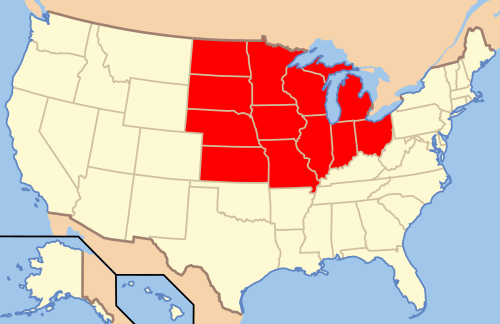 この地図は国勢調査局の定義によるアメリカ中西部を反映しています。[1] | |
| サブリージョン | |
| 国 | アメリカ合衆国 |
| 州 | 国勢調査局の定義による。[1]地域による定義は情報源によって若干異なる場合があります。 |
| 最大の大都市圏 | |
| 最大の都市 | |
| エリア | |
| • 合計 | 750,522平方マイル(1,943,840 km 2) |
| 人口 (2020年) | |
| • 合計 | 68,985,454 |
| • 密度 | 92/平方マイル(35/km 2) |
| 異名 | 中西部出身者 |
アメリカ合衆国中西部(中西部、アメリカ中西部とも呼ばれる)は、アメリカ合衆国国勢調査局によって定義された4つの国勢調査地域のうちの1つである。アメリカ合衆国の北中部を占める。[1] 1984年までは、アメリカ合衆国国勢調査局によって正式に北中部地域と命名されていた。 [2]アメリカ合衆国北東部とアメリカ合衆国西部の間に位置し、北はカナダ、南はアメリカ合衆国南部に接している。
米国国勢調査局の定義では、米国中北部の12州、すなわちイリノイ州、インディアナ州、アイオワ州、カンザス州、ミシガン州、ミネソタ州、ミズーリ州、ネブラスカ州、ノースダコタ州、オハイオ州、サウスダコタ州、ウィスコンシン州が含まれます。この地域は一般的に、アパラチア山脈の州とロッキー山脈の州の間にある広い内陸平原にあります。この地域の主な川は、東から西に、オハイオ川、ミシシッピ川上流、ミズーリ川です。[3] 2020年の米国国勢調査によると、中西部の人口は68,995,685人です。[4]米国国勢調査局は中西部を2つの地区に分けています。東北中央地区には、イリノイ州、インディアナ州、ミシガン州、オハイオ州、ウィスコンシン州が含まれ、これらはすべて五大湖地域の一部でもあります。東北中央地区には、アイオワ州、カンザス州、ミネソタ州、ミズーリ州、ノースダコタ州、ネブラスカ州、サウスダコタ州が含まれ、これらの州のいくつかは、少なくとも部分的にはグレートプレーンズ地域内に位置しています。
シカゴはアメリカ中西部で最も人口の多い都市であり、米国全体では3番目に人口の多い都市です。シカゴとその郊外は、通称シカゴランドと呼ばれ、人口1,000万人を誇る最大の都市圏を形成し、グレーター・メキシコシティ、ニューヨーク都市圏、グレーター・ロサンゼルスに次いで北米で4番目に大きな都市圏となっています。その他の中西部の大都市には、コロンバス、インディアナポリス、デトロイト、ミルウォーキー、カンザスシティ、オマハ、ミネアポリス、ウィチタ、クリーブランド、シンシナティ、セントポール、セントルイスがあります。中西部の大都市圏には、メトロデトロイト、ミネアポリス・セントポール、グレーター・セントルイス、グレーター・シンシナティ、カンザスシティ都市圏、コロンバス都市圏、グレーター・クリーブランドがあります。
語源
西部という用語は、イギリス領北アメリカと、植民地領土が大西洋岸からそれほど遠くまで広がっておらず、太平洋沿岸が一般に知られていなかったアメリカ合衆国の初期に、この地域に適用された。19世紀初頭までに、アパラチア山脈の西側はすべてアメリカのフロンティアと見なされた。時が経つにつれて、アメリカのフロンティアはミシシッピ川の西に移動した。植民地時代、ミズーリ川とイリノイ川の渓谷を含むミシシッピ川上流域は、17世紀と18世紀に開拓され、イリノイ・カントリーと呼ばれていた。[5] 1787年に北西部条例が制定され、五大湖とオハイオ川とミシシッピ川に囲まれた北西部領土が創設された。 [6]イリノイ州のノースウェスタン大学など、中西部の一部の団体は、歴史的な理由から名前に「北西部」が含まれている。[7]
19世紀後半に「中西部」という言葉が使われ始めたのは、カンザス州とネブラスカ州を指して、これらの州が西部の文明化された地域であることを示したときが最古の事例である。[8] 1920年代の文献では、中西部にはウェストバージニア州、ケンタッキー州、テネシー州、ミズーリ州、カンザス州、アーカンソー州が含まれるとされている。[9]同じ地域を指す別の用語としてハートランドがある。[10]
この地域の経済は重工業と農業が混在しており、広大な地域が米国のコーンベルトの一部を形成している。金融と医療や教育などのサービスがますます重要になっている。この地域は中心地にあるため、川船、鉄道、自動車、トラック、飛行機の交通の要衝となっている。政治的には、この地域は激戦州で構成されており、選挙では激しい争いがあり、しばしば決定的な結果となる。[11] [12]
1929年にインディアナ州マンシーを拠点とした社会学的なミドルタウン研究の後、[13]評論家たちは中西部の都市と中西部全般を米国の「典型」とみなした。それ以前には、「それはピオリアで通用するか?」という修辞的な質問が決まり文句となり、イリノイ州ピオリアが主流の米国に受け入れられるかどうかを示すために使われていた。[14] 2010年現在、中西部の就業人口比率は米国北東部、米国南部、米国西部よりも高い。[15]
先史時代
プレコロンブス期
ネイティブアメリカンの中では、パレオアメリカン文化が北米で最も古く、紀元前12,000年頃から紀元前8,000年頃までグレートプレーンズと五大湖地域に存在していました。[16]
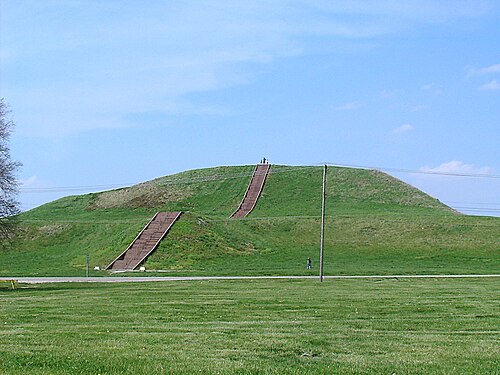
古アメリカ期に続いて、古代期(紀元前8,000年から紀元前1,000年)、ウッドランド伝統期(紀元前1,000年から紀元後100年)、ミシシッピ期(紀元後900年から紀元後1500年)が続く。考古学的証拠によると、ミシシッピ文化の特徴はおそらくミズーリ州セントルイス周辺で始まり、ミシシッピ川とイリノイ川に沿って北西に広がり、カンカキー川水系に沿って州内に入った。また、ウォバッシュ川、ティッペカヌー川、ホワイト川に沿って北にインディアナ州まで広がった。[17]
中西部のミシシッピ人は、主に中西部の川の肥沃で平坦な氾濫原で暮らす農民だった。彼らは、トウモロコシ、豆、カボチャという3大作物を基盤とした、高度に発達した農業複合体を持ち込んだ。トウモロコシはミシシッピ農民の主力作物だった。彼らは多種多様な種子、木の実、ベリー類を集め、魚釣りや狩猟で鳥を捕獲して食生活を補っていた。このような集約的な農業形態により、この文化は多くの人口を支えた。[18]
ミシシッピ時代はマウンド構築文化が特徴的であった。ミシシッピ人は1400年頃に小氷期の地球規模の気候変動と時を同じくして人口の大幅な減少に見舞われた。彼らの文化は1492年以前に事実上終焉した。[19]
五大湖のネイティブアメリカン
五大湖地域の主な部族には、ヒューロン族、オタワ族、チッペワ族またはオジブワ族、ポタワトミ族、ウィネベーゴ族(ホーチャンク族)、メノミニー族、サック族、ニュートラル族、フォックス族、マイアミ族などがあった。最も数が多かったのはヒューロン族とホーチャンク族だった。部族間ではしばしば争いや戦闘が起こり、敗者は逃亡を余儀なくされた。[20]
ほとんどはアルゴンキン語族である。ストックブリッジ・マンシー族やブラザータウン族などの一部の部族もアルゴンキン語族であり、19世紀に東海岸から五大湖地域に移住した。オナイダ族はイロコイ語族に属し、ウィスコンシン州のホーチャンク族はスー語を話す数少ない五大湖地域の部族の1つである。[21]この地域のアメリカインディアンは書き言葉を開発しなかった。[要出典]

16世紀、この地域の原住民は狩猟や農業に石、骨、木の投射物や道具を使用していました。彼らは釣りのためにカヌーを作りました。彼らのほとんどは、簡単に移動できる楕円形または円錐形のウィグワムに住んでいました。さまざまな部族がさまざまな生活様式を持っていました。オジブワ族は主に狩猟をしており、漁業もオジブワ族の経済にとって重要でした。サック、フォックス、マイアミなどの他の部族は、狩猟と農業の両方を行っていました。[22]
彼らは、広い草原に住み、共同でバッファロー(バイソン)狩りをしていた。北部の森林では、オタワ族とポタワトミ族が狩猟のために小さな家族グループに分かれていた。ウィネベーゴ族とメノミニー族は両方の狩猟方法を交互に使用し、西はロッキー山脈、北は五大湖、南はメキシコ湾、東は大西洋にまで及ぶ広範な交易ネットワークを築いた。[23] ヒューロン族は女性系を祖先とみなしたが、他の部族は父系方式を好んだ。すべての部族は首長制または複合首長制の下で統治されていた。たとえば、ヒューロン族は母系の氏族に分かれており、各氏族は町議会で首長によって代表され、町の問題について町長と会っていた。しかし、チッペワ族の社会的、政治的生活は、定住した部族よりも単純だった。[24]
宗教的信仰は部族によって様々だった。ヒューロン族はヨスカハという超自然的な存在を信じていた。ヨスカハは空に住む超自然的な存在であり、世界とヒューロン族を創造したと信じられていた。ヒューロン族は、死ぬと魂は肉体を離れ、空の村に住むと信じていた。チッペワ族は信仰心が篤く、大霊を信仰していた。彼らは季節ごとのあらゆる活動を通して大霊を崇拝し、宗教を私的な事柄とみなしていた。つまり、各自の守護霊との関係は、日々の生活の中での思考の一部だった。オタワ族とポタワトミ族はチッペワ族と非常によく似た宗教的信仰を持っていた。[17]
オハイオ川流域では、主な食糧供給は狩猟ではなく農業でした。先住民の女性によって管理されていた果樹園や農作物畑がありました。トウモロコシは彼女らにとって最も重要な作物でした。[25]
大平原インディアン


平原インディアンは、北アメリカの大平原の平原と起伏のある丘陵地帯に住む先住民族です。彼らの多彩な騎馬文化と、入植者やアメリカ軍との有名な衝突により、平原インディアンは文学や芸術において、世界中のアメリカインディアンの典型となっています。 [要出典]
平原インディアンは通常、ある程度重複しながら 2 つの大まかな分類に分けられます。最初のグループは、バッファローの大群を追って完全に遊牧民でした。一部の部族は時折農業に従事し、主にタバコとトウモロコシを栽培していました。これには、ブラックフット、アラパホ、アシニボイン、シャイアン、コマンチ、クロウ、グロスヴァントル、カイオワ、ラコタ、リパン、平原アパッチ(またはカイオワ アパッチ)、平原クリー、平原オジブウェ、サーシ、ショーショーニ、ストーニー、トンカワが含まれます。[要出典]
平原インディアンの2番目のグループ(プレーリーインディアンと呼ばれることもある)は、半定住の部族で、バッファロー狩りのほか、村に住み、作物を育てていた。これには、アリカラ族、ヒダツァ族、アイオワ族、カウ族(またはカンサ族)、キツァイ族、マンダン族、ミズーリア族、ネズ・パース族、オマハ族、オーセージ族、オトー族、ポーニー族、ポンカ族、クアポー族、サンティー族、ウィチタ族、ヤンクトン族が含まれていた。[26]
大平原の遊牧民は狩猟で生計を立てていた。彼らの主な狩猟は鹿やバッファローを狩ることだった。一部の部族は「バッファロー文化」(アメリカバイソンにちなんでバッファロー文化と呼ばれることもある)の一部とされている。平原インディアンはヘラジカやアンテロープなどの他の動物も狩ったが、バイソンが主な獲物だった。バイソン狩りで得たバイソンの肉、皮、骨は、平原インディアンが作った食べ物、カップ、装飾品、工芸道具、ナイフ、衣類などの原材料の主な供給源となった。[要出典] [27] [28]
部族はバイソンの季節的な放牧と移動に従っていた。平原インディアンはティピーに住んでいた。ティピーは簡単に解体でき、獲物を追う遊牧生活が可能だったからである。スペインから馬が手に入れられると、平原インディアンはそれを急速に日常生活に取り入れた。18世紀初頭までに、多くの部族が馬文化を完全に取り入れていた。銃を採用する前、平原インディアンは槍、弓、弓矢、そして様々な形の棍棒で狩りをしていた。平原インディアンによる馬の使用は、狩り(と戦争)をはるかに容易にした。[29]
最も強力で支配的な部族の中には、中西部の大平原で広大な領土を占領していたダコタ族またはスー族がいた。グレート・スー族の居住地域は南部と中西部に広がり、ミネソタ州から西はロッキー山脈まで広がっていた。同時に、彼らはバッファローの生息地の中心を占領し、また、銃などの商品と引き換えにフランスやアメリカの貿易商に売ることのできる毛皮の絶好の地域であった。スー族(ダコタ族)は平原部族の中で最も強力になり、アメリカの拡大にとって最大の脅威となった。[30] [31]
スー族は、スー語の方言とサブカルチャーに基づいて3つの主要な部門に分かれています。[要出典]
- IsáŋyathiまたはIsáŋathi (「ナイフ」) : ダコタ州、ミネソタ州、アイオワ州北部の最東端に居住し、サンティー族または東ダコタ族と呼ばれることが多い。
- イハンクトゥンワンとイハンクトゥンワンナ(「端の村」と「端の小さな村」):ミネソタ川流域に居住し、中部スー族とみなされており、ヤンクトンとヤンクトナイと呼ばれることが多いが、総称してウィチエナ(エンドニム)またはウェスタンダコタ(誤ってナコタに分類されていることもある[32])と呼ばれることもある。
- Thítȟuŋwaŋまたは Teton (不明): 狩猟と戦士の文化で知られる最西端のスー族は、しばしばラコタ族と呼ばれます。
現在、スー族は、米国のダコタ州、ネブラスカ州、ミネソタ州、モンタナ州、およびカナダのマニトバ州とサスカチュワン州南部のいくつかの居留地、コミュニティ、保護区に散在する多くの独立した部族政府を維持しています。[出典が必要]
歴史
ヨーロッパ人の探検と初期の入植
中間理論
中道理論は、リチャード・ホワイトの代表作『中道:1650年から1815年までの五大湖地域のインディアン、帝国、共和国』( 1991年に初版発行) で紹介されました。ホワイトは中道について次のように定義しています。
中間地帯は、文化や民族の間、そして帝国と非国家の世界である村落の間の場所です。北アメリカの臣民や帝国の同盟国の多くが住んでいた場所です。ヨーロッパの侵略と占領という歴史的前景と、インディアンの敗北と撤退という背景の間にある地域です。
— リチャード・ホワイト『中庸:五大湖地域のインディアン、帝国、共和国、1650-1815』、p. XXVI
ホワイトは、中間地帯の位置として「五大湖北部に流れ込む川に接する土地と、湖の南からオハイオ川に流れ込む土地」を具体的に指定している。[33]これには、現代の中西部のオハイオ州、インディアナ州、イリノイ州、ウィスコンシン州、ミシガン州、およびカナダの一部が含まれる。
中道はフランス人とインディアンの間で確立された相互の妥協と共通の意味に基づいて形成されたが、七年戦争とルイジアナ買収での敗北の余波でフランス人がこの地域での影響力を放棄するにつれて両者とも着実に失われ、中道は変容し劣化していった。[34]
中道政策の主な側面としては、混合文化、毛皮貿易、フランスとイギリス両国との先住民同盟、アメリカ独立戦争中および戦争後のアメリカとの紛争と条約[35] [36]、そして19世紀を通じての最終的な解消/消滅などが挙げられる。[37]
ニューフランス
この地域へのヨーロッパ人の入植は、17世紀にフランス人がこの地域を探検した後に始まり、イリノイ地方を含むヌーベルフランスとして知られるようになった。フランスの時代は、1534年にジャック・カルティエがセントローレンス川を探検したことから始まり、パリ条約(1763年)で北アメリカの領土の大部分をイギリス王国に譲渡したことで終わった。[38]
ミシシッピ川の地図

1673年、ヌーベルフランスの総督は、カトリックの司祭で宣教師のジャック・マルケットと毛皮商人のルイ・ジョリエを派遣し、太平洋への北西航路の地図を作らせた。彼らはミシガン州のアッパー半島を通ってミシガン湖の北端まで旅した。カヌーで巨大な湖を渡り、現在のウィスコンシン州グリーンベイに上陸した。彼らは1673年6月17日にミシシッピ川に入った。[39]
マルケットとジョリエは、ミシシッピ川の北部を初めて地図に描いた。彼らは、セントローレンス川から五大湖を通りメキシコ湾まで水路で簡単に移動できること、そのルート沿いに住む原住民は概して友好的であること、そしてその間の土地の天然資源が並外れていることを確認した。ラサール率いるヌーベルフランスの役人たちは、その後も調査を続け、4,000マイル (6,400 km) の毛皮交易拠点網を構築した。[40]
毛皮貿易
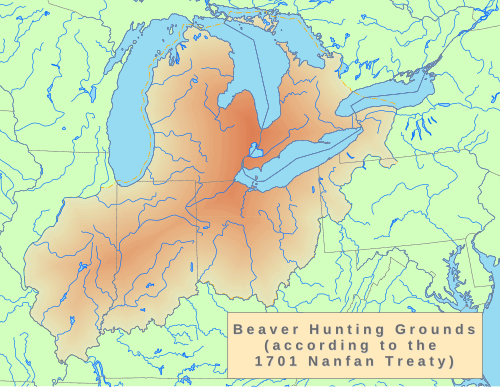
毛皮貿易は、初期のヨーロッパ人とインディアンの関係において不可欠な要素でした。毛皮貿易は、両者の交流の基盤であり、時間の経過とともに進化するシステムでした。
よく取引される品物には銃、衣類、毛布、ストロード、布、タバコ、銀、アルコールなどが含まれていました。[41] [42]
フランス
フランス人とインディアンの物品の交換は、貿易というよりは贈り物の交換と呼ばれた。これらの贈り物は、両者の関係において、単なる経済的な交換よりも大きな意味を持っていた。なぜなら、貿易自体は、それが育んだ社会的関係やそれが作り出した同盟と切り離せないものだったからだ。[43]フランス人とアルゴンキン語族の交易システムが絡み合う中で、アルゴンキン語族の父と子という家族の比喩が、この地域のフランス人とインディアンの政治的関係を形作った。比喩的な父親とみなされたフランス人は、アルゴンキン語族の必要を満たすことが期待され、その見返りとして、比喩的な子であるアルゴンキン語族は、フランス人を助け従う義務があった。インディアンの村にやって来る貿易商は、同盟や友情を確立または維持するために、この象徴的な交換システムを促進した。[44]
1690年から1716年まで、そしてそれ以降もフランスの毛皮貿易が一時的に停止されたため、オハイオ川流域とフランスの高地の両方で結婚が貿易の重要な側面となった。 [45] [46]フランスの毛皮商人はほとんどの職を放棄せざるを得なくなり、その地域に残った人々は不法な商人となり、安全を確保するためにこうした結婚を求める可能性もあった。[45] [47]フランス人商人がインディアン女性と結婚するもう1つの利点は、インディアン女性が毛皮貿易に必要な毛皮の加工を担当していたことだった。[48]女性は毛皮貿易に不可欠であり、その貢献は称賛されたため、インディアン女性の関与がなかったことが商人の失敗の原因として挙げられたこともあった。[49]毛皮の過剰在庫が台無しになったことが発覚し、1716年にフランスの毛皮貿易が再開されたとき、合法的なフランス人商人はインディアン女性と結婚し続け、村に留まった。[50]毛皮貿易における女性の影響力が増すにつれ、毛皮の需要も増加し、毛皮は急速に最も人気のある貿易品になりました。[51]
英国
1690年代頃、イギリスの貿易商が毛皮貿易でフランスの強力な競争相手としてオハイオ地方に進出した。[52]イギリス(後にイギリス)の貿易商はほぼ一貫してフランスよりも良い商品と良いレートをインディアンに提供し、インディアンはそれを有利に利用してフランスとイギリスを競争させ、自分たちの利益を上げた。[52] [53]特に特定の種類の布に対するインディアンの需要がこの競争を煽った。[54]しかし、七年戦争でイギリスがフランスに勝利し、ヌーベルフランスがイギリスに割譲されると、この状況は一変した。 [55]
イギリスは、高地のインディアンとより積極的な関係を築こうとし、贈り物をする習慣を廃止した。これは、彼らが不要とみなしていたものだった。[55]これは、ウィスキーの過剰、一般的な価格の上昇、その他の品物の不足による期待外れの貿易関係と相まって、インディアンの不安を招き、イギリス商人が長年貿易に含めてきた商品であるラム酒の取引量を大幅に削減するという決定によって、さらに悪化した。これは最終的に、1763年に勃発したポンティアック戦争に至った。 [56]この紛争の後、イギリス政府は妥協を余儀なくされ、フランスのシステムを模倣した貿易システムを緩やかに再構築した。[57]
アメリカ人の入植

フランスの支配は七年戦争での敗北により 1763 年に終了しましたが、ミシシッピ川とその支流沿いの小さな村に住んでいた数百人のフランス人入植者のほとんどはそのまま残り、新しいイギリス政権に邪魔されることはありませんでした。パリ条約の条項により、スペインはミシシッピ川の西側の地域であるルイジアナを与えられました。ミズーリ州のセントルイスとセントジェネビーブが主要な町でしたが、新しい入植者はほとんどいませんでした。フランスは1800年のサン・イルデフォンソ条約により、トスカーナと引き換えにスペインからルイジアナを取り戻した。ナポレオンはハイチ革命後、北アメリカでフランスの植民地帝国を再建することに興味を失い、さらにフランスがイギリスの攻撃からルイジアナを効果的に守れないという事実もあって、1803年のルイジアナ買収でその領土をアメリカに売却した。一方、イギリスはアメリカ領内に砦や交易所を維持し、1796年のジェイ条約までそれらを手放すことを拒否した。[58]アメリカ人の入植は、アパラチア山脈を越えるルートか、五大湖の水路を通って始まった。オハイオ川源流のピット砦(現在のピッツバーグ)は、中西部に移動する入植者の主な拠点となった。 1787年にオハイオ州マリエッタがオハイオ州で最初の入植地となったが、 1794年のフォールン・ティンバーズの戦いでネイティブ・アメリカンの部族が敗北するまで、大規模な入植は不可能だった。ケンタッキー州からも多数の人がオハイオ州南部、インディアナ州、イリノイ州に北上した。[59]
この地域の肥沃な土壌はトウモロコシや野菜を生産し、ほとんどの農民は自給自足していた。彼らは木を切り、土地を要求し、それを新参者に売り、さらに西へ移動して同じことを繰り返した。[60]
不法占拠者

1776年以前から、法的権利を持たない開拓者たちは「スクワッター」と呼ばれ、中西部に移住していた。彼らは1760年代から1770年代にかけてオハイオ川をどんどん下流に進み、時にはネイティブアメリカンと衝突した。[61] [62]イギリス当局は激怒した。これらのスクワッターは、イギリス軍のトーマス・ゲージ将軍によって「あまりに多く、あまりに無法で放縦なので、抑制することは決してできない」と評され、「ほとんど法と政府の手が届かないところにいる。政府の努力も、インディアンへの恐怖も、彼らを境界内に適切に留めてはいない」とみなされた。[63]イギリスは、アメリカの西方への拡大に抵抗するために、アメリカ中西部にネイティブアメリカンの緩衝州を設立するという長年の目標を持っていた。[64] [65]
アメリカ独立戦争での勝利により、新政府は、現在連邦政府が所有する公有地となっている地域から不法居住者を追い出すことを検討した。[66] 1785年、ジョサイア・ハーマー将軍の指揮する兵士がオハイオ地方に派遣され、そこに住んでいる不法居住者を発見した場合、作物を破壊し、家を焼き払った。しかし、全体として連邦政府の政策は、インディアンを西部の土地(現在のオクラホマ州のインディアン準州など)に移住させ、少数の狩猟者の代わりに非常に多くの農民を認めることだった。議会は、入植地を合法化する方法について繰り返し議論した。一方では、ヘンリー・クレイなどのホイッグ党員は、政府が最大限の歳入を得ることを望み、また町(および銀行家)を支えるような、中流階級の法を順守する安定した入植地を望んでいた。トーマス・ハート・ベントンなどのジャクソン派民主党員は、急速に再生産され、現金をほとんど持たず、西部で安い土地を熱心に取得する貧しい農民の支持を望んだ。民主党は大きな政府を望んでおらず、歳入を低く抑えることがその目的を助けた。民主党は「不法占拠者」のような言葉を避け、「実際の入植者」とは土地の所有権を得てそこに定住し、その後家を建て、土地を開墾し、作物を植えて土地を改良した人々であるとみなした。中西部の領土の合法的な入植を促進した手段はいくつかあった。土地投機、連邦政府の公有地オークション、退役軍人への給与に代わる報奨地の付与、そして後には不法占拠者への先買権などである。「不法占拠者」は「開拓者」となり、1810年代から1840年代にかけて可決されたさまざまな先買権法や法律のおかげで、定住した土地を最低価格で購入できるようになった。ワシントンでは、ジャクソン派民主党員が不法占拠者の権利を支持したが、銀行家志向のホイッグ党員は反対し、民主党が勝利した。[67] [68] [69] [70]
ネイティブアメリカンの戦争
1791年、アーサー・セントクレア将軍がアメリカ陸軍の司令官となり、正規軍2個連隊と民兵数名を率いて懲罰遠征を行った。現在のリカバリー砦の近くで、彼の部隊はウォバッシュ川源流近くのネイティブアメリカンの居住地まで進軍したが、11月4日、マイアミ族のリトル・タートル酋長とショーニー族のブルー・ジャケット酋長が率いる部族連合軍との戦いで敗走した。この戦いでは600人以上の兵士と多数の女性や子供が死亡し、以来「セントクレアの敗北」と呼ばれている。これはネイティブアメリカンに対するアメリカ軍の最大の敗北であり続けている。[71] [72] [73]
1812年の米英戦争を終結させたゲント条約で、イギリスはアメリカ先住民の防壁国家の設立を要求したが、アメリカの交渉担当者は、イギリスが1813年のエリー湖の戦いとテムズ川の戦いでこの地域の支配権を失っており、テカムセがアメリカ軍に殺害されていたため、この考えを拒否した。その後、イギリスは湖の南側のアメリカ先住民との同盟を見捨てた。結局、アメリカ先住民は1812年の米英戦争の主な敗者となった。1832年の短いブラック・ホーク戦争を除けば、ミシシッピ川の東側でのアメリカ先住民の戦争の時代は終わった。[74]
ルイスとクラーク

1803年、トーマス・ジェファーソン大統領はルイス・クラーク探検隊を発令し、1804年5月から1806年9月にかけて行われた。イリノイ州のキャンプ・デュボアから出発し、ルイジアナ買収地を探検し、ミズーリ川沿いの先住民族との貿易と米国の主権を確立することが目的だった。ルイス・クラーク探検隊はミズーリ川の西側で24以上の先住民族との関係を確立した。[75]探検隊は1806年春に 東のセントルイス に戻った。
政党政治
中西部は全国選挙の重要なスイング地区であり、僅差の州での激しい選挙が全国選挙の結果を左右することが多かった。1860年から1920年にかけて、両党ともこの地域から大統領候補と副大統領候補を探そうとした。[76]

アメリカの二大政党の1つである共和党は、 1850年代に中西部で誕生した。ウィスコンシン州リポンで最初の地方集会が開かれ、ミシガン州ジャクソンで新しい党の最初の州規模の集会が開かれた。党員には、ニューイングランドやニューヨークから中西部北部に移住した多くのヤンキーが含まれていた。党は奴隷制の拡大に反対し、倹約、勤勉、自立、民主的な意思決定、宗教的寛容といったプロテスタントの理想を強調した。[77]
1890年代初頭、小麦栽培地域は平原州における短命なポピュリスト運動の拠点であった。 [78]
1890年代から、中流階級の都市進歩主義運動が(他の地域と同様に)この地域で影響力を増し、ウィスコンシン州が主要な中心地となった。ラ・フォレットの指揮下で、ウィスコンシン州は共和党のボスたちと戦い、効率化、近代化、専門家の活用による社会的、経済的、政治的な問題の解決を目指した。[79]
セオドア・ルーズベルトの1912年進歩党は、ミシガン州、ミネソタ州、サウスダコタ州を制し、この地域で最も良い成績を収めた。1924年、ラフォレット・シニアの1924年進歩党は、この地域で良い成績を収めたが、彼の地盤であるウィスコンシン州のみを制した。[80] [81]
中西部、特にシカゴの西側地域は常に孤立主義の拠点であり、アメリカは外国との紛争に巻き込まれるべきではないという信念を持っていた。この立場は主に多くのドイツ系アメリカ人とスウェーデン系アメリカ人のコミュニティに基づいていた。孤立主義の指導者にはラフォレット家、オハイオ州のロバート・A・タフト、シカゴ・トリビューンの発行人ロバート・マコーミック大佐などがいた。[82] [83]
ヤンキースと民族文化政治

ニューイングランドからのヤンキー開拓者は1800年より前にオハイオ州に到着し始め、中西部の北半分に広がった。彼らのほとんどは農民として始まったが、後に大多数が起業家、ビジネスマン、都市専門家として町や都市に移住した。1830年代に始まって以来、シカゴは1世紀以上にわたって中西部の大都市圏を支配するまでに成長した。[84]
歴史家ジョン・バンカーは中西部のヤンキー入植者の世界観を調査した。
ヤンキーたちは最初に到着し、強い共同体意識と使命感を持っていたため、開拓地の生活条件によってのみ変化したニューイングランドの制度、価値観、慣習を移植することができた。彼らは、労働倫理、私有財産の神聖さ、個人の責任、居住と社会の流動性への信頼、実用性、信心深さ、公共の秩序と礼儀、公教育への敬意、活動家、正直で質素な政府、町民会議民主主義を強調する公共文化を確立し、特定の野心や党派を超えた公共の利益があると信じていた。罪、空気、腐敗が蔓延する世界で自分たちを選ばれた正義の民とみなし、彼らは共同体と個人の行動の基準を定義し、実施する強い道徳的義務を感じていた...この敬虔な世界観は、イギリス、スカンジナビア、スイス、イギリス系カナダ、オランダの改革派移民、ドイツのプロテスタント、および多くのフォーティエイターズによって実質的に共有されていた。[85]
中西部の政治では、ヤンキーとドイツのカトリック教徒やルーテル教徒が対立していたが、彼らはアイルランドのカトリック教徒に率いられていた。これらの大きなグループについて、ブエンカーは次のように論じている。
一般的に労働倫理、強い共同体意識、活動的な政府を支持していたが、経済的個人主義や私有主義にはあまり傾倒しておらず、個人の習慣に対する政府の監督に猛烈に反対していた。南ヨーロッパと東ヨーロッパからの移民は一般的にドイツ的な考え方に傾倒していたが、近代化、工業化、都市化により、ほぼすべての人の個人の経済的責任感が変化し、組織、政治参加、教育が重視されるようになった。[86] [87]
交通の発展
水路

中西部の発展には3つの水路が重要であった。まず第一に、ミシシッピ川に流れ込むオハイオ川である。この地域の発展は、スペインがミシシッピ川南部を支配し、アメリカの農作物を川を下って大西洋に輸送することを許可しなかったため、1795年まで停止していた。[88]これは、1795年のピンクニー条約の調印によって変更された。[88]
2つ目の水路は五大湖内の航路網である。 1825年にエリー運河が開通し、ミシシッピ川よりも直接的にニューヨークとニューヨーク市の港に至る全水路航路が完成した。1848年、イリノイ・ミシガン運河がシカゴ・ポーテージをまたぐ大陸分水嶺を突破し、五大湖の水域とミシシッピ渓谷およびメキシコ湾の水域を結んだ。これらの新しい航路を扱うため、湖港と河川沿いの都市が発展した。産業革命の間、湖はミネソタ州のメサビ山脈から中部大西洋岸諸州の製鉄所まで鉄鉱石を運ぶ導管となった。 1959年に完成したセントローレンス水路は、中西部と大西洋を開いた。[89]
3番目の水路であるミズーリ川は、ミシシッピ川からロッキー山脈近くまで水路を延長しました。[要出典]

1870 年代と 1880 年代には、ミシシッピ川に触発されて、ミズーリ州出身のサミュエル・クレメンス (マーク・トウェインというペンネームを使用) が書いた 2 冊の古典作品、 「ミシシッピの生活」と「ハックルベリー・フィンの冒険」が生まれました。彼の物語は中西部の伝説の定番となりました。トウェインの故郷であるミズーリ州ハンニバルは、当時の中西部を垣間見ることができる観光名所となっています。[出典が必要]
オハイオ州とインディアナ州の内陸運河は、五大湖とオハイオ川の交通を結ぶもう一つの重要な水路を構成していた。中西部からオハイオ川を下ってエリー運河に運ばれた商品は、ボストンやフィラデルフィアを追い抜くニューヨーク市の富に貢献した。[90]
鉄道と自動車
19世紀半ば、この地域に最初の鉄道が敷かれ、シカゴの鉄道ジャンクションは世界最大となった。その世紀、シカゴは米国の鉄道の中心地となった。1910年までに、20を超える鉄道会社がダウンタウンの6つの異なるターミナルから旅客サービスを運営していた。ヘンリー・フォードから1世紀が経った今日でも、6つのクラスI鉄道(ユニオン・パシフィック、BNSF、ノーフォーク・サザン、CSX、カナディアン・ナショナル、カナディアン・パシフィック)がシカゴで交わっている。[91] [92]
1890年から1930年にかけて、中西部の多くの都市は路面電車に似た電気都市間鉄道で結ばれていた。中西部は他のどの地域よりも都市間鉄道が多かった。1916年にはオハイオ州が2,798マイル(4,503 km)で全州をリードし、インディアナ州が1,825マイル(2,937 km)で続いた。この2州だけで、国内の都市間鉄道のほぼ3分の1を占めていた。[93]国内最大の都市間鉄道の結節点はインディアナポリスにあった。1900年代初頭の10年間、同市の人口が38パーセント増加したのは、主に都市間鉄道によるものだった。[94]
自動車やバスとの競争により、都市間鉄道やその他の鉄道旅客事業は衰退した。1900年までにデトロイトは自動車産業の世界的中心地となり、すぐに200マイル(320 km)以内のほぼすべての都市が自動車部品を生産し、デトロイトの巨大工場に供給するようになった。[95]
1903年、ヘンリー・フォードはフォード・モーター社を設立した。フォードの製造業、そして自動車業界の先駆者であるウィリアム・C・デュラント、ダッジ兄弟、パッカード、ウォルター・クライスラーらの製造業により、20世紀初頭にはデトロイトは世界の自動車産業の中心地としての地位を確立した。事業の急増により相乗効果が生まれ、ラピッドやグラボウスキーなどのトラック製造業者も成長した。[96]
自動車産業の成長は、中西部や国内のビジネスの変化に反映され、自動車の整備工場やガソリンスタンド、部品やタイヤの工場が発達した。今日、デトロイト大都市圏はゼネラルモーターズ、クライスラー、フォードモーターカンパニーの本拠地となっている。[97] [要出典]
アメリカ南北戦争
奴隷制の禁止と地下鉄道
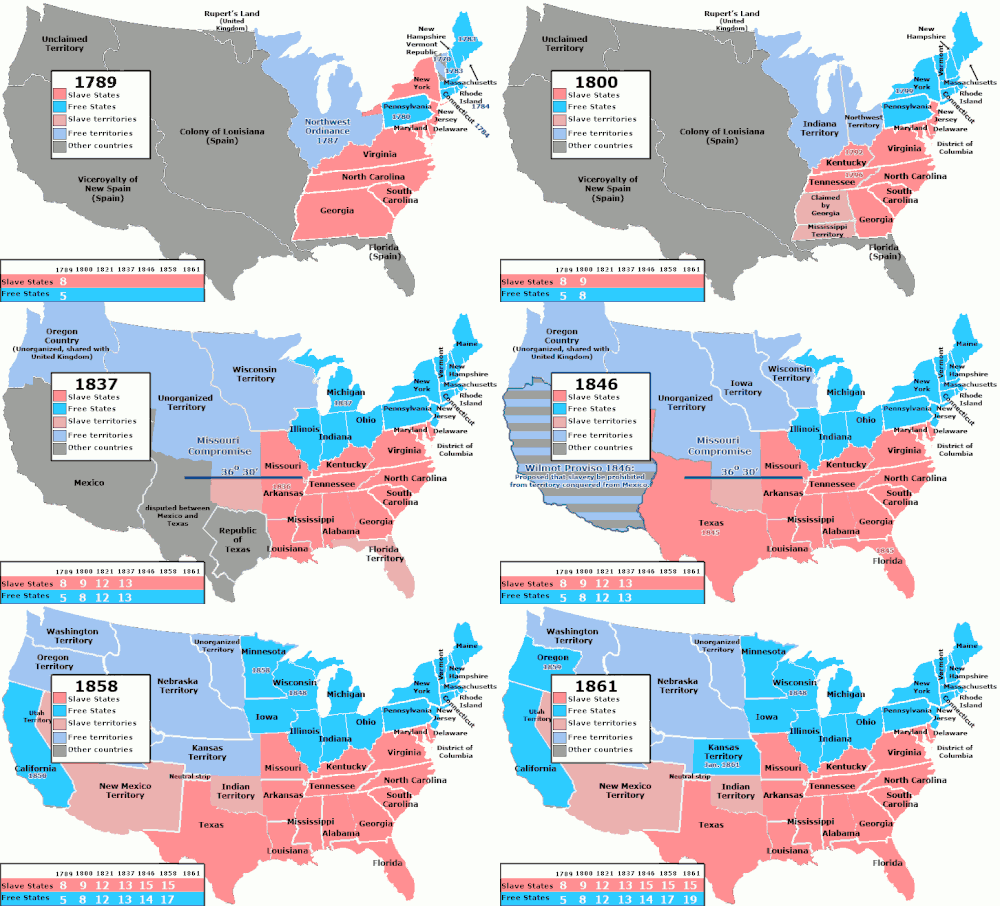
中西部の中心を占める北西部条例地域は、アメリカ合衆国で奴隷制を禁止した最初の大きな地域であった(アメリカ合衆国北東部では1830 年代まで奴隷が 解放されていた)。この地域の南の境界はオハイオ川であり、アメリカの歴史と文学において自由と奴隷制の境界となっている(ハリエット・ビーチャー・ストウの『アンクル・トムの小屋』やトニ・モリソンの『愛する者へ』を参照)。
中西部、特にオハイオ州は地下鉄道の主要ルートであり、中西部の人々はオハイオ川を渡ってエリー湖からカナダへ向かう奴隷たちの解放を支援した。19世紀初頭に創設された地下鉄道は、1850年から1860年にかけて最盛期を迎えた。ある推計によると、1850年までに10万人の奴隷が地下鉄道で逃亡したという。[98]
地下鉄道は、集合場所、秘密のルート、輸送手段、奴隷制度廃止運動の支持者が提供する隠れ家と支援で構成されていた。個人はしばしば小さな独立したグループに組織されていた。これは秘密保持に役立った。なぜなら、個人はルート上の接続「駅」のいくつかを知っていたが、自分の直近の地域についてはほとんど知らなかったからである。逃亡奴隷はルートに沿って、ある中継駅から次の中継駅へと北へ移動した。逃亡者は船や列車で移動することもあったが、通常は徒歩または荷馬車で移動した。[99]
この地域は、奴隷制度が比較的少なかったこと(ミズーリ州を除く)、開拓者の入植、一教室の無料の公立学校での教育、アメリカ独立戦争の退役軍人によってもたらされた民主主義の考え、プロテスタントの信仰と実験、そしてオハイオ川の川船、平底船、運河船、鉄道で運ばれた農業の富によって形作られました。[要出典]
流血のカンザス
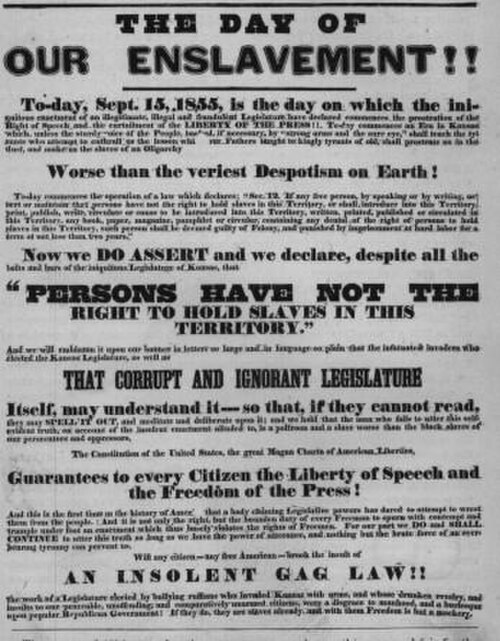
南北戦争につながる最初の暴力的な衝突は、中西部の隣り合う 2 つの州、カンザス州とミズーリ州の間で、奴隷制反対の 自由州派と奴隷制賛成の「ボーダー ラフイアン」派が関与し、およそ 1854 年から 1858 年の間にカンザス準州とミズーリ州西部の辺境の町で起こった。この衝突の中心にあったのは、カンザスが自由州として連邦に加盟するか、奴隷州として加盟するかという問題だった。したがって、 「流血のカンザス」は奴隷制の問題をめぐる北部人と南部人の代理戦争だった。「流血のカンザス」という言葉は、ニューヨーク トリビューンのホレス グリーリーによって作られたもので、この言葉に含まれる出来事は南北戦争の直接の前兆であった。[出典が必要]
事件の直接の原因は、1854年のカンザス・ネブラスカ法であった。この法律は、カンザスとネブラスカの領土を創設し、そこに入植するのに役立つ新しい土地を開拓し、ミズーリ妥協を撤回し、それらの領土の入植者が人民主権を通じてその境界内で奴隷制を認めるかどうかを決定することを可能にした。この法律によって北部と南部の関係が緩和されることが期待された。なぜなら、南部は新しい領土に奴隷制を拡大できるが、北部は依然として各州で奴隷制を廃止する権利を持っていたからである。しかし反対派は、この法律が南部の奴隷権力への譲歩であると非難した。 [要出典]

1854年にウィスコンシン州リポンで誕生し、この法律に反対して結成された新しい共和党は、奴隷制の拡大を阻止することを目的としており、すぐに北部全域で支配的な勢力として台頭した。 [100]
表面上は民主的な考えである人民主権は、各領土または州の住民が自由州にするか奴隷州にするかを決定するべきであるとしていたが、これは両陣営の活動家による大規模なカンザスへの移民をもたらした。一時期、カンザスには2つの別々の政府があり、それぞれ独自の憲法を持っていたが、連邦政府に認められたのは1つだけだった。1861年1月29日、カンザスは自由州として連邦に加盟したが、それはサムター要塞の戦いで南北戦争が正式に始まる3か月も前のことだった。 [101]
1856年5月、カンザスの平穏は、南北戦争の始まりとされる2つの事件によって打ち砕かれた。5月21日、カンザス州ローレンスの自由土地の町が、ミズーリ州の奴隷制支持派武装勢力によって略奪された。数日後、ローレンスの略奪を受けて、奴隷制度廃止論者のジョン・ブラウンと6人の支持者は報復として、カンザス州フランクリン郡のポタワトミー川沿いで5人の男を処刑した。[102]
いわゆる「国境戦争」は、奴隷制支持派と自由土地派の武装集団の間で、5月から10月までさらに4か月間続いた。アメリカ陸軍はカンザス州に2つの駐屯地、フォート・レブンワースに第1騎兵連隊、フォート・ライリーに第2竜騎兵隊と第6歩兵連隊を置いた。[103]小競り合いは、1856年後半に新知事ジョン・W・ギアリーがミズーリ州民を説得して帰国させるまで続いた。その後は不安定な平和が続いたが、暴力的な突発事件はその後も数年間断続的に続いた。[要出典]
カンザスでの事件に対する国民の反応は、国がいかに深く分裂していたかを示した。国境の悪党たちは、彼らの行動で多数の人々の命が失われたにもかかわらず、南部では広く称賛された。北部では、ブラウンとその支持者による殺人はほとんどの人から無視され、少数の人から称賛された。[104]
カンザス州の内戦は奴隷制をめぐる政治的争いの産物であった。連邦軍は政治的問題の解決に使われたわけではなかったが、歴代の準州知事は連邦軍を準州の平定に利用し、カンザス州の奴隷制という政治的問題が最終的に平和的、合法的、政治的な手段で解決できるようにした。[要出典]
1860年11月のエイブラハム・リンカーンの当選は、南部諸州の脱退の最終的な引き金となった。 [105]コーウィン修正条項やクリッテンデン妥協案などの妥協の努力は失敗した。南部の指導者たちは、リンカーンが奴隷制の拡大を止め、それを消滅へと向かわせるのではないかと恐れた。[要出典]
アメリカ合衆国連邦政府は、奴隷制度がすでに廃止されていた北部を中心とする20の自由州と、境界州として知られるようになった5つの奴隷州によって支えられていた。ミズーリ州を除く中西部の州はすべて奴隷制度を禁止していた。ほとんどの戦闘は南部で戦われたが、カンザス州とミズーリ州の間の小競り合いは、 1863年8月21日のローレンス虐殺で最高潮に達するまで続いた。クァントリル襲撃としても知られるこの虐殺は、ウィリアム・クラーク・クァントリル率いるクァントリル襲撃隊による、北軍支持派のカンザス州ローレンスに対する反乱軍ゲリラ攻撃であった。クァントリル率いるミズーリ州のゲリラ448人がローレンスを襲撃して略奪し、150人以上を殺害し、すべての商業ビルとほとんどの住居を焼き払った。連邦軍に追われたゲリラはミズーリ州に逃亡した。[106]
ローレンスが標的にされたのは、同町が長年奴隷制度廃止を支持していたことと、ミズーリ州の奴隷制度を支持する西部諸郡の家族を襲撃することで知られる自由州の民兵および自警団であるレッドレグスとジェイホーカーズの中心地としての評判のためであった。[要出典]
移民と産業化

アメリカ南北戦争の頃までに、ヨーロッパからの移民はアメリカ東海岸を迂回して内陸部に直接移住した。ドイツ人移民はオハイオ州、ウィスコンシン州、ミネソタ州、ミシガン州、インディアナ州、イリノイ州、アイオワ州、ネブラスカ州、カンザス州、ミズーリ州に、アイルランド人移民はクリーブランドやシカゴなどの五大湖沿岸の港湾都市に、デンマーク人、チェコ人、スウェーデン人、ノルウェー人はアイオワ州、ネブラスカ州、ウィスコンシン州、ミネソタ州、ダコタ州に、フィンランド人はミシガン州北部、ミネソタ州北部/中部、ウィスコンシン州に移住した。ポーランド人、ハンガリー人、ユダヤ人は中西部の都市に移住した。[要出典]
南北戦争当時、米国は主に田舎でした。中西部も例外ではなく、地域全体に小さな農場が点在していました。19 世紀後半には工業化、移民、都市化が起こり、産業革命が起こりました。産業の支配と革新の中心は中西部の五大湖州にありましたが、20 世紀後半になってようやくゆっくりと衰退し始めました。[引用が必要]
経済の繁栄により、農村地域からの住民や海外からの移民が流入した。製造業、小売業、金融業が主流となり、アメリカ経済に影響を与えた。[107]
製造業に加え、印刷、出版、食品加工も中西部最大の経済において重要な役割を果たしている。シカゴは、ジョン・クレラー、ジョン・ホイットフィールド・バン、リチャード・テラー・クレイン、マーシャル・フィールド、ジョン・ファーウェル、ジュリアス・ローゼンワルドなど、中西部および世界の産業の基礎を築いた多くの商業的先見者たちの商業活動の拠点であった。[要出典]一方、スタンダード・オイル・カンパニーの創設者であるジョン・D・ロックフェラーは、クリーブランドで巨額の富を築いた。19世紀後半のある時点では、クリーブランドには世界の億万長者の50%以上が住んでおり、その多くがユークリッド・アベニューの有名なミリオネアズ・ロウに住んでいた。
20 世紀には、アメリカ南部から中西部諸州へのアフリカ系アメリカ人の移住により、シカゴ、セントルイス、クリーブランド、ミルウォーキー、カンザスシティ、シンシナティ、デトロイト、オマハ、ミネアポリス、その他中西部の多くの都市が変化し、工場や学校が何千もの家族を新たな機会へと誘った。シカゴだけでも、大移動と第二次大移動により数十万人の黒人市民を獲得した。[要出典]
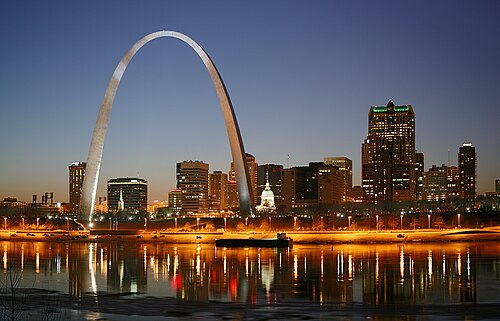
セントルイスにあるゲートウェイ・アーチ記念碑は、ステンレス鋼で覆われ、平らな懸垂線アーチの形で建てられており、[108]アメリカ合衆国で最も高い人工記念碑であり、 [109]世界で最も高いアーチです。[109]アメリカ合衆国の西方拡大の記念碑として建てられ、[108]ゲートウェイ・アーチ国立公園の中心であり、2018年までジェファーソン国立拡張記念碑として知られ、セントルイスと中西部の国際的に有名なシンボルとなっています。[要出典]
ドイツ系アメリカ人

1800年代半ばに中西部が水路と鉄道によって開拓地として開拓されると、ドイツ人が大量に移住し始めた。アメリカへのドイツ人移民の最大の流入は1820年から第一次世界大戦の間に起こり、この間に約600万人のドイツ人がアメリカに移住した。1840年から1880年まで、ドイツ人は移民の最大グループであった。[110]
中西部の都市ミルウォーキー、シンシナティ、セントルイス、シカゴはドイツ人移民の好む目的地だった。1900年までに、クリーブランド、ミルウォーキー、ホーボーケン、シンシナティの各都市の人口はいずれも40パーセント以上がドイツ系アメリカ人だった。アイオワ州のダビュークとダベンポートではその割合はさらに高く、ネブラスカ州オマハでは1910年にドイツ系アメリカ人の割合は57パーセントだった。インディアナ州フォートウェインなど中西部の他の多くの都市では、ドイツ系アメリカ人が人口の少なくとも30パーセントを占めていた。[111] [112]シンシナティの「オーバー・ザ・ライン」地区やオハイオ州コロンバスの「ジャーマン・ビレッジ」など、多くの集落にはその伝統を示唆する独特の名前が付けられた。[113]
人気の目的地は「ドイツのアテネ」として知られるミルウォーキーだった。旧国で政治教育を受けた急進派ドイツ人がこの都市の社会主義者を支配していた。熟練労働者が多くの職業を支配し、起業家が醸造業を創設した。最も有名なブランドにはパブスト、シュリッツ、ミラー、ブラッツなどがあった。[114]
ドイツ人移民の半分は都市に定住したが、残りの半分は中西部に農場を開いた。オハイオ州から平原州に至るまで、21世紀に入っても農村部にドイツ人移民が多く居住している。[115] [116] [117]
19世紀から20世紀にかけて、ドイツ系アメリカ人は農業を営み、子供や孫に土地を継がせることに強い関心を示していた。西部の鉄道会社は、農民を誘致するために広大な土地の寄付金を用意し、ハンブルクや他のドイツの都市に代理店を設立し、安価な輸送と農地の容易な条件での販売を約束した。例えば、サンタフェ鉄道は移民のために独自の委員を雇い、30万エーカー(1,200 km 2)以上の土地をドイツ語圏の農民に売却した。[118]
1860年代~1920年代の政治
中西部は南北戦争後、政治と経済の問題の戦場となり、有権者は階級ではなく民族と宗教の線で分裂した。禁酒運動、グリーンバック運動、ポピュリスト運動がこの地域で注目を集め、敬虔主義者は共和党を支持し、儀式主義者は民主党を支持した。禁酒法は中西部の大きな問題であり、婦人キリスト教禁酒同盟と酒場反対連盟はどちらもこの地域で生まれた。憲法修正第18条は中西部のほとんどの州議会で批准されたが、中西部は禁酒法に対する抵抗の中心地にもなり、民族的、都市部のカトリック教徒とドイツ系ルーテル教徒の有権者は廃止を支持したが、地元出身の田舎の敬虔なプロテスタントの中西部人は反対した。[119] [120]
女性
19世紀後半から20世紀初頭にかけて中西部の公の場に女性が登場したことは、女性の権利と禁酒を求める運動の高まりと軌を一にしていた。女性の活動は、家庭内清掃の役割の延長として表現されることが多かった。地方や州レベルの活動家は、婦人キリスト教禁酒同盟のアルコール反対運動を、参政権を求める手段として利用した。中西部の州は、19条修正条項が可決される前から女性の参政権を認め始めており、参政権修正条項運動のリーダーはアイオワ州出身のキャリー・チャップマン・キャットだった。1970年代のフェミニスト運動も中西部にルーツがあり、イリノイ州出身のベティ・フリーダンは1963年に『The Feminine Mystique』を執筆した。経済的な必要性とキャリアへの欲求も、女性を家の外で働くよう駆り立て、教師や看護師などの特定の職業が女性化していった。[121]
労働者とポピュリスト

中西部では、資本主義経済秩序に対する労働者の不安と反乱が見られ、1887年と1894年にシカゴでストライキが起きた。労働組合の指導者らは1886年にシカゴのヘイマーケット広場で抗議集会を組織し、そこで警官隊に爆弾が投げ込まれ、8人のアナキストが殺人共謀罪で有罪となった。この事件はヘイマーケット事件として知られている。1894年のプルマン・ストライキでは、中西部と西部のほとんどの鉄道輸送が停止した。ストライキは暴力的になり、連邦軍によって鎮圧された。ストライキ中のアメリカ鉄道組合の指導者ユージン・V・デブスは刑務所に入り、そこで社会主義に転向した。彼の社会主義は一部の移民グループには魅力的だったが、ほとんどの中西部人にとっては過激すぎた。[122]
農民は大企業を信用せず、 1870年代のグランジや1890年代の農民同盟が提案したような協同組合制度を採用した。農民が管理する協同組合が農産物を扱い、鉄道運賃を引き下げ、価格を上げるために銀貨を鋳造することを望んだ。同盟は1892年に人民党を結成し、政治活動に転じた。同党は小麦地帯と銀鉱山地域で地元で成功を収めた。第三政党としてのこの試みは短命に終わり、1896年に民主党と合併し、民主党のウィリアム・ジェニングス・ブライアンに投票した。左派の農村政治は20世紀もダコタ州とミネソタ州で農民労働党によって継続された[123]。
1920年代
第二次クー・クラックス・クラン( KKK)は、1920年代初めに中西部で反移民、反カトリックの恐怖に煽られ、短期間ながら勢力を伸ばした。1920年代のKKKは地方の会員組織だったが、その自治的な地方支部は連携しておらず、立法にほとんど影響力を及ぼさなかった。メンバーは風俗法、特に禁酒法の施行を求めており、多くの移民がこれに違反していた。KKKはインディアナ州で最盛期を迎え、同州では知事が秘密結社とつながりがあるとされていた。しかし、インディアナ州の何百ものKKK支部は、州のリーダーによる若い女性の誘拐、強姦、殺害というスキャンダルにより一夜にして崩壊した。KKKは順応主義的な衝動を体現していた。ミドルタウン(実際はインディアナ州マンシー市)は、ロバート・S・リンドによる先駆的な社会学的研究の拠点となった。この本は、市民の支援、愛国心、一括投票を推進する一方で、政治活動や反対意見を抑制していた強力なビジネス階級を明らかにした。[124]
進歩主義時代
産業化の悪影響は進歩主義の政治運動を引き起こし、その悪影響を社会改革と政府の規制によって解決することを目指した。ジェーン・アダムズとエレン・ゲイツ・スターは、 1889年にシカゴにハル・ハウスを設立し、新しく到着した移民に対するセツルメントハウスの支援の先駆けとなった。セツルメントハウスは社会サービスを提供し、市民生活において積極的な役割を果たし、移民が帰化の準備をするのを助け、市政府による規制とサービスを求める運動を行った。[125]中西部の市長、特にヘイゼン・S・ピングリーとトム・L・ジョンソンは、ボス支配の市政に対する初期の改革を主導し、サミュエル・M・ジョーンズは、地方公共事業の公営化を主張した。中西部の進歩主義の最も有名な指導者であるロバート・M・ラフォレットは、1900年に州共和党を破って選挙に勝利し、キャリアを開始した。この組織は一時的に敗北し、改革者たちは拡大民主主義の「ウィスコンシン・アイデア」を立ち上げることができた。この考えには、直接予備選挙、選挙資金管理、縁故主義に代わる公務員制度、ロビイスト規制、州所得税と相続税、児童労働規制、純粋食品、労働者災害補償法などの主要な改革が含まれていた。ラフォレットは鉄道、公共事業、工場、銀行に対する政府規制を推進した。ラフォレットは1912年に全国党内での影響力を失ったが、ウィスコンシン州の改革は他の州における進歩主義のモデルとなった。[126]
地理

.jpg/500px-Prairie_in_Effigy_Mounds_National_Monument,_Iowa_(2005).jpg)
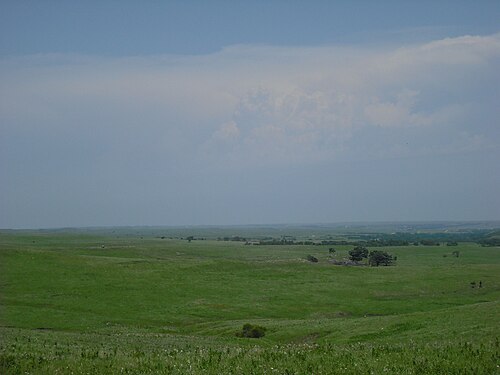
アメリカ合衆国の広大な中央部からカナダにかけての地域は、内陸平原の低地から起伏のある地形で、農業や食料の栽培に最適です。その東側の3分の2の大部分は内陸低地を形成しています。低地はカンザス州東部を通る線から西に向かって徐々に高くなり、グレートプレーンズとして知られる地域では標高5,000フィート (1,500 m) を超えます。グレートプレーンズ地域のほとんどは現在農地となっています。[127]
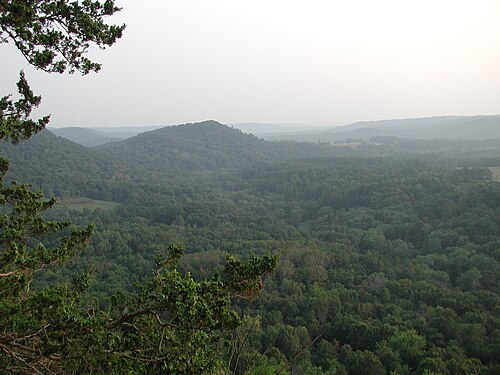
これらの州は、大部分が比較的平坦で、平野または起伏のある小高い丘陵地帯であるが、地理的な変化はある程度ある。特に、次の地域では地形的に非常に変化に富んでいる。アパラチア山脈の麓に近い中西部東部、五大湖盆地、ミネソタ州スペリオル湖北岸の氷河が密集した高地、険しい火山性のカナダ楯状地の一部、ミズーリ州南部のオザーク山脈、ウィスコンシン州南西部、ミネソタ州南東部、アイオワ州北東部、イリノイ州北西部の深く浸食されたドリフトレス地域。 [出典が必要]
西へ進むと、アパラチア高原の地形は徐々になだらかな丘陵に変わり、その後 (オハイオ州中央部) 主に農場や都市部に変わった平地になります。これが北アメリカの広大な内陸平原の始まりです。その結果、大平原州のほとんどが草原に覆われています。アイオワ州とイリノイ州の大部分は、草原半島と呼ばれる地域にあります。草原半島は、北は針葉樹林と混交林、東と南は広葉樹の 落葉樹林に接する草原の東側の延長です。 [引用が必要]
地理学者は標高に基づいて内陸平原を内陸低地と大平原に区分している。低地は主に海抜 1,500 フィート (460 m) 以下であるが、西側の大平原はより高く、コロラド州では約 5,000 フィート (1,500 m) に達する。したがって、低地はアイオワ州、イリノイ州、インディアナ州、オハイオ州、ミシガン州、テネシー州、ケンタッキー州の一部に限られる。ミズーリ州とアーカンソー州には低地の標高の地域があり、オザーク地方 (内陸高地内) とは対照的である。オハイオ州東部の丘陵はアパラチア高原の延長である。[要出典]
内陸平原は、広大なミシシッピ川流域とほぼ一致しています (他の主要な構成要素はミズーリ川とオハイオ川です)。これらの川は、数千万年にわたって、古生代、中生代、新生代のほぼ水平な堆積岩に浸食されてきました。現代のミシシッピ川流域は、新生代更新世に発達しました。[要出典]
降雨量は東から西に向かって減少し、その結果、異なるタイプの草原が形成されます。東部の湿潤地域では高草草原、中央グレートプレーンズでは混生草原、ロッキー山脈の雨陰に向かっては短草草原となります。今日、これら 3 つの草原タイプは、それぞれトウモロコシ/大豆地域、小麦地帯、西部の牧草地にほぼ相当します。 [要出典]
中西部北部の針葉樹林の多くは19 世紀後半に伐採され、それ以降は混合広葉樹林が新しい森林地帯の主要構成要素となりました。中西部の大部分は現在、都市化地域または牧畜農業地域に分類できます。[引用が必要]
定義

ミッドウェスタンという用語がアメリカ中部の地域を指して最初に記録に残ったのは1886年で、ミッドウェストは1894年、ミッドウェスターナーは1916年に登場した。 [128] [129]ミッドウェストが使われた19世紀後半の最も初期の例の1つは、カンザス州とネブラスカ州を指して、西部の文明化された地域であることを示したものだった。[8]ミッドウェスタンという用語は、1880年代からアメリカ中部の一部を指すのに使われている。異形のミドルウェストという用語が19世紀から使われており、今でも比較的一般的である。[130] [131]
中西部の伝統的な定義には、北西部条例の旧北西部諸州と、ルイジアナ買収の一部であった多くの州が含まれる。旧北西部諸州は五大湖諸州としても知られ、アメリカ合衆国の東北部に位置する。オハイオ川は南東部に沿って流れ、ミシシッピ川は中央付近を南北に流れる。アメリカ合衆国の西北中部にあるルイジアナ買収諸州の多くはグレートプレーンズ諸州としても知られ、ミズーリ川はミシシッピ川に合流する主要水路である。中西部は、1820年のミズーリ妥協により将来の奴隷州と非奴隷州の境界線として確立された緯度36度30分線の北に位置する。[132]
中西部地域は、米国国勢調査局によって以下の12州と定義されています: [1]
- イリノイ州:オールド・ノースウェスト、ミシシッピ川(ミズーリ川は州境付近で合流)、オハイオ川、五大湖の州
- インディアナ州:古い北西部、オハイオ川、五大湖の州
- アイオワ州:ルイジアナ買収、ミシシッピ川、ミズーリ川の州
- カンザス州:ルイジアナ買収、グレートプレーンズ、ミズーリ川の州
- ミシガン州:古い北西部と五大湖の州
- ミネソタ州:旧北西部、ルイジアナ買収、ミシシッピ川、 1818年以前のレッドリバー植民地の一部、五大湖州
- ミズーリ州:ルイジアナ買収、ミシシッピ川(オハイオ川が州境近くで合流)、ミズーリ川、および境界州
- ネブラスカ州:ルイジアナ買収、グレートプレーンズ、ミズーリ川の州
- ノースダコタ州:ルイジアナ買収、1818年以前のレッドリバー植民地の一部、グレートプレーンズ、ミズーリ川州
- オハイオ州:オールド・ノースウェスト(歴史あるコネチカット西部保護区)、オハイオ川、五大湖の州。州の南東部は北部アパラチアの一部です。
- サウスダコタ州:ルイジアナ買収、グレートプレーンズ、ミズーリ川の州
- ウィスコンシン州:北西部、ミシシッピ川、五大湖の州

様々な組織が中西部を少しずつ異なる州のグループで定義している。例えば、州政府間の連絡と調整を行う組織である州政府評議会は、中西部地域事務所に上記のリストから11州を含めているが、CSG南部地域にあるミズーリ州は除外している。 [133]国立公園局の中西部地域は、これら12州とアーカンソー州で構成されている。[134]数百人のアーキビスト、キュレーター、情報専門家が会員となっている専門的なアーカイブ組織である中西部アーカイブ会議は、上記12州とケンタッキー州を管轄している。[135]
主要都市圏
経済
農業と農業

Agriculture is one of the biggest drivers of local economies in the Midwest, accounting for billions of dollars worth of exports and thousands of jobs. The area consists of some of the richest farming land in the world.[137] The region's fertile soil combined with the steel plow has made it possible for farmers to produce abundant harvests of grain and cereal crops, including corn, wheat, soybeans, oats, and barley, to become known today as the nation's "breadbasket".[138] Former Vice President Henry A. Wallace, a pioneer of hybrid seeds, declared in 1956 that the Corn Belt developed the "most productive agricultural civilization the world has ever seen".[139] Today, the U.S. produces 40 percent of the world crop.[140]
The very dense soil of the Midwest plagued the first settlers who were using wooden plows, which were more suitable for loose forest soil. On the prairie, the plows bounced around and the soil stuck to them. This problem was solved in 1837 by an Illinois blacksmith named John Deere who developed a steel moldboard plow that was stronger and cut the roots, making the fertile soils of the prairie ready for farming.[citation needed] Farms spread from the colonies westward along with the settlers. In cooler regions, wheat was often the crop of choice when lands were newly settled, leading to a "wheat frontier" that moved westward over the course of years. Also very common in the antebellum Midwest was farming corn while raising hogs, complementing each other especially since it was difficult to get grain to market before the canals and railroads. After the "wheat frontier" had passed through an area, more diversified farms including dairy and beef cattle generally took its place.[citation needed] The introduction and broad adoption of scientific agriculture since the mid-19th century contributed to economic growth in the United States.
This development was facilitated by the Morrill Act and the Hatch Act of 1887 which established in each state a land-grant university (with a mission to teach and study agriculture) and a federally funded system of agricultural experiment stations and cooperative extension networks which place extension agents in each state. Iowa State University became the nation's first designated land-grant institution when the Iowa Legislature accepted the provisions of the 1862 Morrill Act on September 11, 1862, making Iowa the first state in the nation to do so.[141] Soybeans were not widely cultivated in the United States until the early 1930s, and by 1942, the U.S. became the world's largest soybean producer, partially because of World War II and the "need for domestic sources of fats, oils, and meal". Between 1930 and 1942, the United States' share of world soybean production skyrocketed from 3 percent to 46.5 percent, largely as a result of increase in the Midwest, and by 1969, it had risen to 76 percent.[142] Iowa and Illinois rank first and second in the nation in soybean production. In 2012, Iowa produced 14.5 percent, and Illinois produced 13.3 percent of the nation's soybeans.[143]
The tallgrass prairie has been converted into one of the most intensive crop producing areas in North America. Less than one tenth of one percent (<0.09%) of the original landcover of the tallgrass prairie biome remains.[144] States formerly with landcover in native tallgrass prairie such as Iowa, Illinois, Minnesota, Wisconsin, Nebraska, and Missouri have become valued for their highly productive soils.
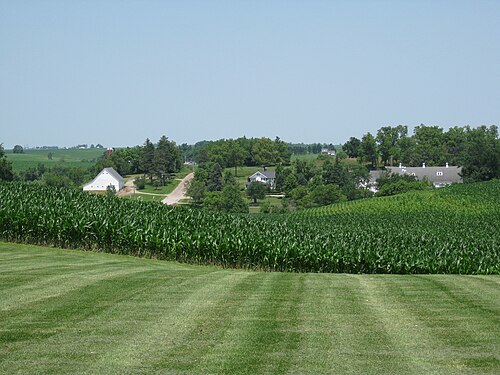
The Corn Belt is a region of the Midwest where corn has, since the 1850s, been the predominant crop, replacing the native tall grasses. The "Corn Belt" region is defined typically to include Iowa, Illinois, Indiana, southern Michigan, western Ohio, eastern Nebraska, eastern Kansas, southern Minnesota, and parts of Missouri.[145] As of 2008[update], the top four corn-producing states were Iowa, Illinois, Nebraska, and Minnesota, together accounting for more than half of the corn grown in the United States.[146] The Corn Belt also sometimes is defined to include parts of South Dakota, North Dakota, Wisconsin, and Kentucky.[147] The region is characterized by relatively level land and deep, fertile soils, high in organic matter.[148]
Iowa produces the largest corn crop of any state. In 2012, Iowa farmers produced 18.3 percent of the nation's corn, while Illinois produced 15.3 percent.[143] In 2011, there were 13.7 million harvested acres of corn for grain, producing 2.36 billion bushels, which yielded 172.0 bu/acre, with US$14.5 billion of corn value of production.[149]

Wheat is produced throughout the Midwest and is the principal cereal grain in the country. The U.S. is ranked third in production volume of wheat, with almost 58 million tons produced in the 2012–2013 growing season, behind only China and India (the combined production of all European Union nations is larger than China)[150] The U.S. ranks first in crop export volume; almost 50 percent of total wheat produced is exported.[citation needed] The U.S. Department of Agriculture defines eight official classes of wheat: durum wheat, hard red spring wheat, hard red winter wheat, soft red winter wheat, hard white wheat, soft white wheat, unclassed wheat, and mixed wheat.[151] Winter wheat accounts for 70 to 80 percent of total production in the U.S., with the largest amounts produced in Kansas (10.8 million tons) and North Dakota (9.8 million tons). Of the total wheat produced in the country, 50 percent is exported, valued at US$9 billion.[152]
Midwestern states also lead the nation in other agricultural commodities, including pork (Iowa), beef and veal (Nebraska), dairy (Wisconsin), and chicken eggs (Iowa).[143]
Financial
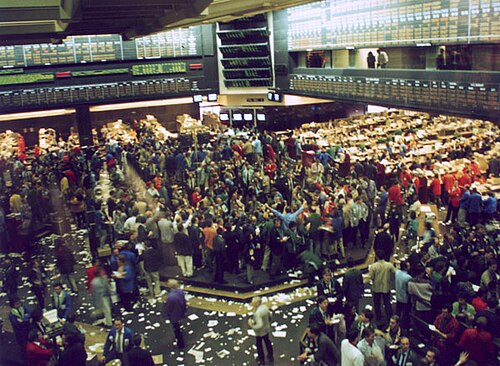
Chicago is the largest economic and financial center of the Midwest, and has the third largest gross metropolitan product in North America—approximately $689 billion, after the regions of New York City and Los Angeles. Chicago was named the fourth most important business center in the world in the MasterCard Worldwide Centers of Commerce Index.[154] The 2021 Global Financial Centres Index ranked Chicago as the fourth most competitive city in the country and eleventh in the world, directly behind Paris and Tokyo. The Chicago Board of Trade (established 1848) listed the first ever standardized "exchange traded" forward contracts, which were called futures contracts.[155] As a world financial center, Chicago is home to major financial and futures exchanges including the CME Group which owns the Chicago Mercantile Exchange ("the Merc"), Chicago Board of Trade (CBOT), the New York Mercantile Exchange (NYMEX), the Dow Jones Indexes, and the Commodities Exchange Inc. (COMEX).[156] Other major exchanges include the Chicago Board Options Exchange (CBOE), the largest options exchange in the Western Hemisphere; and the Chicago Stock Exchange. In addition, Chicago is also home to the headquarters of the Federal Reserve Bank of Chicago (the Seventh District of the Federal Reserve).
Outside of Chicago, many other Midwest cities are host to financial centers as well. Federal Reserve Bank districts are also headquartered in Cleveland, Kansas City, Minneapolis, and St. Louis. Major United States bank headquarters are located throughout Ohio including Huntington Bancshares in Columbus, Fifth Third Bank in Cincinnati, and KeyCorp in Cleveland. Insurance Companies such as Elevance Health in Indianapolis, Nationwide Insurance in Columbus, American Family Insurance in Madison, Wisconsin, Berkshire Hathaway in Omaha, State Farm Insurance in Bloomington, Illinois, Reinsurance Group of America in Chesterfield, Missouri, Cincinnati Financial Corporation and American Modern Insurance Group of Cincinnati, and Progressive Insurance and Medical Mutual of Ohio in Cleveland also spread throughout the Midwest.
Manufacturing
.jpg/500px-U.S._STEEL_PLANT_-_NARA_-_547097_(retouched).jpg)
Navigable terrain, waterways, and ports spurred an unprecedented construction of transportation infrastructure throughout the region. The region is a global leader in advanced manufacturing and research and development, with significant innovations in both production processes and business organization. John D. Rockefeller's Standard Oil set precedents for centralized pricing, uniform distribution, and controlled product standards through Standard Oil, which started as a consolidated refinery in Cleveland. Cyrus McCormick's Reaper and other manufacturers of agricultural machinery consolidated into International Harvester in Chicago. Andrew Carnegie's steel production integrated large-scale open-hearth and Bessemer processes into the world's most efficient and profitable mills. The largest, most comprehensive monopoly in the world, United States Steel, consolidated steel production throughout the region. Many of the world's largest employers began in the Great Lakes region.
Advantages of accessible waterways, highly developed transportation infrastructure, finance, and a prosperous market base makes the region the global leader in automobile production and a global business location. Henry Ford's movable assembly line and integrated production set the model and standard for major car manufactures. The Detroit area emerged as the world's automotive center, with facilities throughout the region. Akron, Ohio became the global leader in rubber production, driven by the demand for tires. Over 200 million tons of cargo are shipped annually through the Great Lakes.[158][159][160]
Demographics
Race and ethnicity
According to the 2022 American Community Survey, 22.6% of the Midwest's population report German ancestry, 10.6% report Irish ancestry, 9.4% report English ancestry, 5.9% report Mexican ancestry, 4.8% identify their ancestry as American, 4.3% report Polish ancestry, and 2.6% report Norwegian ancestry.[162][163] The Midwest is home to the largest concentration of German-Americans within the US, with this group making up over 30% of the population in North Dakota, South Dakota, Wisconsin, Iowa, and Nebraska. In addition to German-Americans, the upper Midwest is home to a large population of Scandinavian Americans. In Minnesota, 11.8% of the population identifies with Norwegian ancestry, while 6.4% report Swedish ancestry.[164] In North Dakota, 22% of the population reports Norwegian ancestry, the highest rate in the country.[165]
While the Midwest historically had a very small Black population,[166] this changed in the early 20th century as numerous African Americans left the South for major urban areas in the North and West, fleeing racial persecution and seeking new economic opportunities in a population movement known as the Great Migration.[167] This drastically changed the demographics of many Midwestern cities that had previously been almost entirely populated by White Americans, leading to segregation and discrimination against the growing Black population, racial violence, and "white flight" to suburban areas. From 1910 to 1970, Black Americans increased from 2% of Chicago's population to 33%, and became almost half of the population in Detroit.[168][169] As a result of the Great Migration, Black Americans currently make up 10% of the Midwest's population, with over 96% being concentrated in urban areas, including major cities like Chicago, Detroit, Cleveland, and Milwaukee, as well as medium sized cities like Gary and Flint.[170] At the same time, most of the rural Midwest has remained overwhelmingly White, with almost two-thirds of the 1,055 counties in the Midwest being over 95% White.
Illinois is the most populous and racially diverse state in the Midwest,[171] and out of all 50 states, it is also ranked as the most representative of the overall demographics of the United States on several metrics, including religion, race/ethnicity, and urban/rural divide.[172]
Socioeconomics
As of 2022, the median household income in the Midwest is $70,283, slightly lower than the national average of $74,755. 12.2% of the region's population lives below the poverty line, including roughly 16% of children under 18, and 10% of seniors over 65. The average household size in the Midwest is 2.4 people[173]
Age and sex
As of 2022, the median age in the Midwest is 39.2 years, with 22% of the population being under 18, and 18% being over 65. The age distribution in the Midwest broadly matches the US as a whole. In terms of sex, 50.3% of the region's population are female, and 49.7% are male. Half of the population over the age of 15 are married, while half are unmarried[173]
Culture
Religion
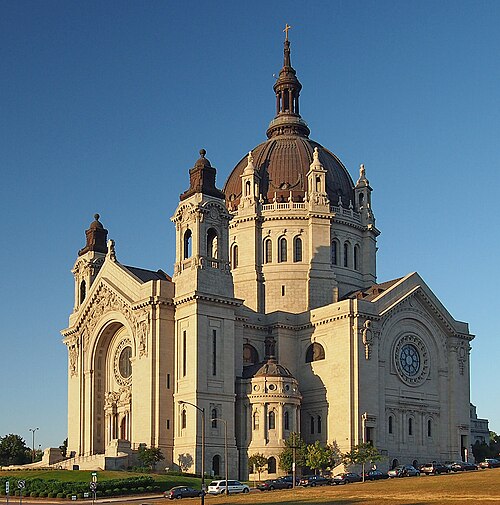
Like the rest of the United States, the Midwest is predominantly Christian.[174]
The majority of Midwesterners are Protestants, with rates from 48 percent in Illinois to 63 percent in Iowa.[175] However, the Catholic Church is the single largest denomination, varying between 18 percent and 34 percent of the state populations.[176][177] Lutherans are prevalent in the Upper Midwest, especially in Michigan, Minnesota, the Dakotas, and Wisconsin with their large German and Scandinavian populations.[178] Southern Baptists compose about 15 percent of Missouri's population,[179] but much smaller percentages in other Midwestern states.
Judaism and Islam are collectively practiced by 2 percent of the population, with higher concentrations in major urban areas. 35 percent of Midwesterners attend religious services every week, and 69 percent attend at least a few times a year. People with no religious affiliation make up 22 percent of the Midwest's population.[180]
Education

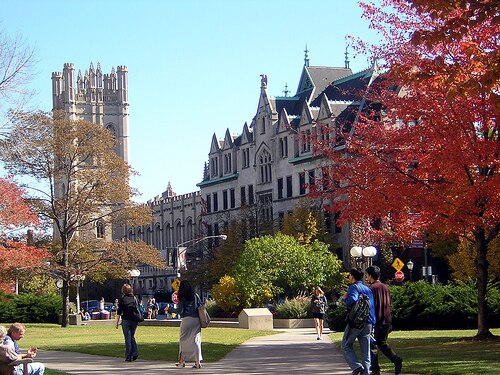
Many Midwestern universities are members of the Association of American Universities (AAU), a bi-national organization founded in Chicago of leading research universities. Of the 69 members from the U.S. and Canada, 17 are located in the Midwest. These include private schools Case Western Reserve University, the University of Chicago, Northwestern University, University of Notre Dame, and Washington University in St. Louis and public institutions, the University of Illinois Urbana–Champaign, Indiana University Bloomington, the University of Iowa, the University of Kansas, the University of Michigan, Michigan State University, the University of Minnesota, the University of Missouri, the Ohio State University, Purdue University, and the University of Wisconsin–Madison.[182]
Other notable major research-intensive public universities include the University of Cincinnati, the University of Illinois at Chicago, Iowa State University, Kansas State University, the University of Nebraska-Lincoln, Ohio University, Southern Illinois University, and Wayne State University.[183]
Numerous state university systems have established regional campuses statewide. The numerous state teachers colleges were upgraded into state universities after 1945.[184]
Other notable private institutions include Beloit College, John Carroll University, Saint Louis University, Butler University, Loyola University Chicago, DePaul University, Creighton University, Drake University, Marquette University, University of Dayton, and Xavier University. Local boosters, usually with a church affiliation, created numerous colleges in the mid-19th century.[185] In terms of national rankings, the most prominent liberal arts colleges today include Augustana College, Carleton College, Denison University, DePauw University, Earlham College, Grinnell College, Hamline University, Kalamazoo College, Kenyon College, Knox College, Macalester College, Lawrence University, Oberlin College, St. Olaf College, College of Saint Benedict and Saint John's University, Mount Union University, Wabash College, Wheaton College, and The College of Wooster.[186]
Music

The heavy German immigration played a major role in establishing musical traditions, especially choral and orchestral music.[187] Czech and German traditions combined to sponsor the polka.[188]
The Southern Diaspora of the 20th century saw more than twenty million Southerners move throughout the country, many of whom moved into major Midwestern industrial cities such as Chicago, Detroit, Cleveland, and St. Louis.[189] Along with them, they brought jazz to the Midwest, as well as blues, bluegrass, and rock and roll, with major contributions to jazz, funk, and R&B, and even new subgenres such as the Motown Sound and techno from Detroit[190] or house music from Chicago. In the 1920s, South Side Chicago was the base for Jelly Roll Morton (1890–1941). Kansas City developed its own jazz style.[191]
The electrified Chicago blues sound exemplifies the genre, as popularized by record labels Chess and Alligator and portrayed in film The Blues Brothers.[192]
Rock and roll music was first identified as a new genre in 1951 by Cleveland disc jockey Alan Freed who began playing this music style while popularizing the term "rock and roll" to describe it.[193] By the mid-1950s, rock and roll emerged as a defined musical style in the United States, deriving most directly from the rhythm and blues music of the 1940s, which itself developed from earlier blues, boogie woogie, jazz, and swing music, and was also influenced by gospel, country and western, and traditional folk music. Freed's contribution in identifying rock as a new genre helped establish the Rock and Roll Hall of Fame, located in Cleveland. Chuck Berry, a Midwesterner from St. Louis, influenced many other rock musicians.[194]

Since the founding of rock 'n' roll music, an uncountable number of rock, soul, R&B, hip-hop, dance, blues, and jazz acts have emerged from Chicago onto the global and national music scene. Detroit has greatly contributed to the international music scene as a result of being the original home of the legendary Motown Records. Notable soul and R&B musicians associated with Motown that had their origins in the area include Aretha Franklin, the Supremes, Mary Wells, Four Tops, the Jackson 5, Smokey Robinson & the Miracles, Stevie Wonder, the Marvelettes, the Temptations, and Martha and the Vandellas. These artists achieved their greatest success in the 1960s and 1970s.
Midwest music fans loved country music, heavy metal, arena rock, heartland rock, and TOP 40. In the 1970s and 1980s, native Midwestern musicians such as Bob Seger, John Mellencamp and Warren Zevon found great success with a style of rock music that came to be known as heartland rock, characterized by lyrical themes that focused on and appealed to the Midwestern working class. Other successful Midwestern rock artists emerged during this time, including REO Speedwagon(Illinois), Styx(Illinois), and Kansas.
Prince, The Time, Morris Day, Jesse Johnson, Alexander O'Neal, The Family(USA), St.Paul(Paul Peterson), Apollonia 6, Vanity 6, Sheila E., and Jimmy Jam and Terry Lewis recorded Minneapolis sound.[195]
House Music, the first form of Electronic Dance Music, had its beginning in Chicago in the early 1980s, and by the late 1980s and the early 1990s house music had become popular on an international scale. House artists such as Frankie Knuckles, Marshall Jefferson released many house music records. With the creation of house music in the city of Chicago, the first form of the globally popular electronic dance music genre was created. Techno had its start in Detroit in the late 1980s and early 1990s with techno pioneers such as Juan Atkins, Derrick May, and Kevin Saunderson. The genre, while popular in America, became much more popular overseas such as in Europe.[196]
Numerous classical composers live and have lived in midwestern states, including Easley Blackwood, Kenneth Gaburo, Salvatore Martirano, and Ralph Shapey (Illinois); Glenn Miller and Meredith Willson (Iowa); Leslie Bassett, William Bolcom, Michael Daugherty, and David Gillingham (Michigan); Donald Erb (Ohio); Dominick Argento and Stephen Paulus (Minnesota).
Sports

Professional sports leagues such as the National Football League (NFL), Major League Baseball (MLB), National Basketball Association (NBA), Women's National Basketball Association (WNBA), National Hockey League (NHL), Major League Soccer (MLS), and National Women's Soccer League (NWSL), have team franchises in following Midwestern cities:
- Chicago: Bears (NFL), Cubs, White Sox (MLB), Bulls (NBA), Sky (WNBA), Blackhawks (NHL), Fire FC (MLS), Red Stars (NWSL)
- Cincinnati: Bengals (NFL), Reds (MLB), FC Cincinnati (MLS)
- Cleveland: Browns (NFL), Guardians (MLB), Cavaliers (NBA)
- Columbus: Blue Jackets (NHL), Crew SC (MLS)
- Detroit: Lions (NFL), Tigers (MLB), Pistons (NBA), Red Wings (NHL)
- Green Bay: Packers (NFL)
- Indianapolis: Colts (NFL), Pacers (NBA), Fever (WNBA)
- Kansas City: Chiefs (NFL), Royals (MLB), Sporting (MLS), Current (NWSL)
- Milwaukee: Brewers (MLB), Bucks (NBA)
- Minneapolis–Saint Paul: Vikings (NFL), Twins (MLB), Timberwolves (NBA), Lynx (WNBA), Wild (NHL), United FC (MLS)
- St. Louis: Cardinals (MLB), Blues (NHL), City SC (MLS)
Popular teams include the St. Louis Cardinals (11 World Series titles), Cincinnati Reds (5 World Series titles), Chicago Bulls (6 NBA titles), the Detroit Pistons (3 NBA titles), Milwaukee Bucks (2 NBA titles), the Minnesota Lynx (4 WNBA titles), the Green Bay Packers (4 Super Bowl titles, 13 total NFL championships), the Chicago Bears (1 Super Bowl title, 9 total NFL championships), the Cleveland Browns (4 AAFC championships, 4 NFL championships), the Kansas City Chiefs (3 Super Bowl titles, 4 total NFL championships), Kansas City Royals (2 World Series titles), the Detroit Red Wings (11 Stanley Cup titles), the Detroit Tigers (4 World Series titles), the Chicago Blackhawks (6 Stanley Cup titles), and the Columbus Crew (3 MLS Cups).[citation needed]
In NCAA college sports, the Big Ten Conference and the Big 12 Conference feature the largest concentration of top Midwestern Division I football and men's and women's basketball teams in the region, including the Cincinnati Bearcats, Illinois Fighting Illini, Indiana Hoosiers, Iowa Hawkeyes, Iowa State Cyclones, Kansas Jayhawks, Kansas State Wildcats, Michigan Wolverines, Michigan State Spartans, Minnesota Golden Gophers, Nebraska Cornhuskers, Northwestern Wildcats, Ohio State Buckeyes, Purdue Boilermakers, and the Wisconsin Badgers.[citation needed]
Other notable Midwestern college sports teams include the Akron Zips, Ball State Cardinals, Butler Bulldogs, Creighton Bluejays, Dayton Flyers, Grand Valley State Lakers, Indiana State Sycamores, Kent State Golden Flashes, Marquette Golden Eagles, Miami RedHawks, Milwaukee Panthers, Missouri Tigers, Missouri State Bears, Northern Illinois Huskies, North Dakota State Bison, Notre Dame Fighting Irish, Ohio Bobcats, South Dakota State Jackrabbits, Toledo Rockets, Western Michigan Broncos, Wichita State Shockers, and Xavier Musketeers. Of this second group of schools, Butler, Dayton, Indiana State, Missouri State, North Dakota State, and South Dakota State do not play top-level college football (all playing in the second-tier Division I FCS), and Creighton, Marquette, Milwaukee, Wichita State and Xavier do not sponsor football at all.[197]
The Milwaukee Mile hosted its first automobile race in 1903, and is one of the oldest tracks in the world, though as of 2019 is presently inactive. The Indianapolis Motor Speedway, opened in 1909, is a prestigious auto racing track which annually hosts the internationally famous Indianapolis 500-Mile Race (part of the IndyCar series), the Brickyard 400 (NASCAR), and the IndyCar Grand Prix (IndyCar series). The Road America and Mid-Ohio road courses opened in the 1950s and 1960s respectively. Other motorsport venues in the Midwest are Indianapolis Raceway Park (home of the NHRA U.S. Nationals), Michigan International Speedway, Chicagoland Speedway, Kansas Speedway, Gateway International Raceway, and the Iowa Speedway. The Kentucky Speedway is just outside the officially defined Midwest, but is linked with the region because the track is located in the Cincinnati metropolitan area.[citation needed]
Notable professional golf tournaments in the Midwest include the Memorial Tournament, BMW Championship and John Deere Classic.[citation needed]
Cultural overlap


Differences in the definition of the Midwest mainly split between the Great Plains region on one side, and the Great Lakes region on the other. Although some point to the small towns and agricultural communities in Kansas, Iowa, the Dakotas, and Nebraska of the Great Plains as representative of traditional Midwestern lifestyles and values, others assert that the industrial cities of the Great Lakes—with their histories of 19th century and early 20th century immigration, manufacturing base, and strong Catholic influence—are more representative of the Midwestern experience. In South Dakota, for instance, West River (the region west of the Missouri River) shares cultural elements with the western United States, while East River has more in common with the rest of the Midwest.[198]
Two other regions, Appalachia and the Ozark Mountains, overlap geographically with the Midwest—Appalachia in Southern Ohio and the Ozarks in Southern Missouri. The Ohio River has long been a boundary between North and South and between the Midwest and the Upper South. All of the lower Midwestern states, especially Missouri, have major Southern components and influences, as they neighbor the Southern region. Historically, Missouri was a slave state before the American Civil War (1861–1865) due to the Missouri Compromise.
Western Pennsylvania, which contains the cities of Erie and Pittsburgh, shares history with the Midwest, and overlaps with Appalachia and the Northeast as well.[199]
Kentucky is not considered part of the Midwest; it is a northern region of the South, although certain northern parts of the state could have possibly been grouped with the Midwest in a geographical context, even though it is geographically in the Southeast overall.[200] Kentucky is categorized as Southern by the U.S. Census Bureau due to its industries and especially from a historical and cultural standpoint with the majority of the state having a thoroughly majority Southern accent, demographic, history, and culture in line with her sister states of Virginia and Tennessee and even the areas that have certain Midwestern influences tend to be mixed with the native Southern culture of the area.[201][202]
In addition to intra-American regional overlaps, the Upper Peninsula of Michigan has historically had strong cultural ties to Canada, partly as a result of early settlement by French Canadians. Moreover, the Yooper accent shares some traits with Canadian English, further demonstrating transnational cultural connections. Similar but less pronounced mutual Canadian-American cultural influence occurs throughout the Great Lakes region.[citation needed]
Linguistic characteristics
The accents of the region are generally distinct from those of the American South and of the urban areas of the American Northeast. To a lesser degree, they are also distinct from the accent of the American West.[citation needed]
The accent characteristic of most of the Midwest is popularly considered to be that of "standard" American English or General American. This accent is typically preferred by many national radio and television producers. Linguist Thomas Bonfiglio argues that, "American English pronunciation standardized as 'network standard' or, informally, 'Midwestern' in the 20th century." He identifies radio as the chief factor.[203][204]
Currently, many cities in the Great Lakes region are undergoing the Northern cities vowel shift away from the standard pronunciation of vowels.[205]
The dialect of Minnesota, western Wisconsin, much of North Dakota and Michigan's Upper Peninsula is referred to as the Upper Midwestern Dialect (or "Minnesotan"), and has Scandinavian and Canadian influences.[citation needed]
Missouri has elements of three dialects, specifically: Northern Midland, in the extreme northern part of the state, with a distinctive variation in St. Louis and the surrounding area; Southern Midland, in the majority of the state; and Southern, in the southwestern and southeastern parts of the state, with a bulge extending north in the central part, to include approximately the southern one-third.[206]
Health
The rate of potentially preventable hospital discharges in the Midwestern United States fell from 2005 to 2011 for overall conditions, acute conditions, and chronic conditions.[207]
Euchre
Euchre, a trick-taking card game, remains popular in the Midwest and parts of the Upper South, particularly in Michigan, Illinois, Indiana, Ohio, Kentucky, and Pennsylvania.[208]
Politics


The Midwestern United States is a politically divided region, with the Democratic Party being stronger in the Great Lakes Region and the Republican Party being stronger in the Great Plains regions. The Upper Midwestern states of Illinois, Michigan, Minnesota, and Wisconsin reliably voted Democratic in every presidential election from 1992 to 2012. Recently, Republicans have made serious inroads in Iowa and Ohio, two states that were previously considered swing states.
Missouri has been won by Republicans in every presidential election since 2000, despite its former bellwether status. Indiana has been won by Republicans in every presidential election since 1940, except for Lyndon Johnson in 1964 and Barack Obama in 2008.[209] The Great Plains states of North Dakota, South Dakota, Nebraska, and Kansas have voted for the Republican candidate in every presidential election since 1940, except for Democrat Lyndon B. Johnson in 1964. The unicameral Nebraska Legislature is officially nonpartisan.[210]
All Midwestern states use primary elections to select delegates for both the Democratic and Republican national conventions, except for Iowa. The Iowa caucuses in early January of leap years are the first votes in the presidential nominating process for both major parties, and attract enormous media attention.[211]
East North Central
As of 2023, the state government of Illinois currently has a Democratic Governor J.B. Pritzker and Democratic supermajorities in both houses of the Illinois General Assembly. Illinois also has 2 Democratic U.S. senators and a 14–3 Democratic majority U.S. House delegation.
As of 2023, Wisconsin has a Democratic Governor Tony Evers and a Republican-controlled Wisconsin Legislature. Wisconsin also has 1 Democratic and 1 Republican Senator and a 6-2 Republican majority U.S. House delegation. Wisconsin is considered a purple state, as Donald Trump and Joe Biden won the state by less than 1 percentage point in 2016 and 2020.
Except in 2016, Michigan has consistently voted for the Democratic presidential candidate since 1992, though their margins of victory have often been relatively narrow. Democrats won full control of Michigan's state government in the 2022 midterms for the first time since 1983, though they only hold the minimum number of seats required for a majority in each of the two chambers of the legislature. As of 2023, Michigan has 2 Democratic U.S. Senators and a 7-6 bare Democratic majority U.S. House of Representatives delegation.
Indiana is considered a Republican stronghold, having voting for that party's presidential candidate in every election since 1940, except for Johnson in 1964 and Barack Obama in 2008. As of 2023, the Republican party controls both U.S. Senate seats, has a 7–2 majority U.S. House congressional delegation, and has a state-level trifecta (the governorship and both houses of the Indiana General Assembly).
As of 2024, Ohio currently has a Republican Governor Mike DeWine and Republican majorities in the Ohio General Assembly. Ohio also has 1 Democratic and 1 Republican U.S. Senator and a 10-5 Republican majority U.S. House delegation. Ohio has been a battleground state in presidential elections, and no Republican has won the office without winning Ohio. Donald Trump won Ohio by about 8 percentage points in both the 2016 and 2020 presidential elections, signaling a shift towards the right for the state's federal electorate. The 2022 midterms resulted in strong Republican support at the state level, and moderate Republican support at the federal level, with Republican governor Mike DeWine winning reelection in a landslide and Republican author JD Vance winning election to the U.S. Senate by about 6 percentage points.
West North Central
The Great Plains states of North Dakota, South Dakota, Nebraska, and Kansas have been strongholds for the Republicans for many decades. These four states have gone for the Republican candidate in every presidential election since 1940, except for Lyndon B. Johnson's landslide over Barry Goldwater in 1964. Although North Dakota and South Dakota have often elected Democrats to Congress, after the 2012 election both states' congressional delegations are majority Republican. Nebraska has elected Democrats to the Senate and as governor in recent years, but both of its senators have been Republican since the retirement of Ben Nelson in 2012. Kansas has elected a majority of Democrats as governor since 1956, but has not elected a Democratic senator since 1932. From 1997 to 2010 and again since 2019, Kansas has had at least one Democratic House member (two in 2007 and '08).
Iowa had a Democratic governor from 1999 until Terry Branstad was re-elected in the mid-term elections in 2010, and has had both one Democratic and one Republican senator since the early 1980s until the 2014 election when Republican Joni Ernst defeated Democrat Bruce Braley in a tightly contested race.[212] Between 1988 and 2012, Iowa also voted for the Democratic presidential candidate in all elections except 2004, but in 2016 and 2020 Donald Trump won the state by about 9 and 8 percentage points, respectively. Since the 2016 elections, Republicans have held a majority in both houses of the Iowa General Assembly. Following the 2022 elections, Iowa is considered a red state as Republicans hold all but one statewide office, both U.S. Senate seats, all four U.S. House seats, and Republican governor Kim Reynolds was reelected by a margin of nearly 20 points.
Minnesota voters have not voted for a Republican candidate for president since 1972, longer than any other state. Minnesota was the only state (along with Washington, D.C.) to vote for its native son Walter Mondale over Ronald Reagan in 1984. However, recent Democratic victories have often been fairly narrow, such as the 2016 presidential election. The Democratic Party narrowly controls the Minnesota state legislature as well as the governor's office as of 2023. The Minnesota congressional delegation has 2 Democratic Senators but a 4-4 evenly split U.S. House delegation.
Missouri was historically considered a bellwether state, having voted for the winner in every presidential election from 1904 to 2004 except for 1956, when it backed losing Democrat Adlai Stevenson. Democrats generally only hold sway in the large cities at the opposite ends of the state, Kansas City and St. Louis, with the Republicans winning the rest of the state. Since the 2012 elections, Republicans have had a 6–2 majority in the state's U.S. House delegation, with African-American Democrats representing the two major cities. Missouri has had a Republican governor since the 2016 elections, as well as both U.S. Senators being Republican since the 2018 United States Senate elections. As of 2023, Republicans have supermajorities in both houses of the Missouri General Assembly.
See also
- Cuisine of the Midwestern United States
- Repopulation of wolves in Midwestern United States
- Territories of the United States on stamps
References
- ^ a b c d e "Census Regions and Divisions of the United States" (PDF). U.S. Census Bureau. Retrieved October 24, 2016.
- ^ "History: Regions and Divisions". United States Census Bureau. Retrieved November 26, 2014.
- ^ Hobbs, Joseph John (2009). World Regional Geography. Cengage Learning. p. 662. ISBN 978-0-495-38950-7. Retrieved June 13, 2017.
- ^ "Change in Resident Population of the 50 States, the District of Columbia, and Puerto Rico: 1910 to 2020" (PDF). Census.gov. United States Census Bureau. Archived (PDF) from the original on April 26, 2021. Retrieved April 27, 2021.
- ^ Ekberg, Carl (2000). French Roots in the Illinois Country: The Mississippi Frontier in Colonial Times. University of Illinois Press. pp. 32–33. ISBN 9780252069246.
- ^ Statistical Abstract of the United States 1995 (PDF) (Report). U.S. Bureau of the Census. 1995. Retrieved April 9, 2020.
- ^ Jay Pridmore (2000) "Northwestern University: Celebrating 150 Years" Evanston, IL: Northwestern University Press
- ^ a b Blaser, Kent (1990). "Of the Midwest". The Midwest Review. Wayne State College.: 69.
- ^ Online Etymology Dictionary
- ^ Merriam-Webster online
- ^ Black, Earl; Black, Merle (2008). Divided America: The Ferocious Power Struggle in American Politics. Simon and Schuster. p. 209. ISBN 9781416539056.
- ^ Jensen, Richard J. (1971). The Winning of the Midwest: Social and Political Conflict 1888–1896. University of Chicago Press. p. 15. ISBN 9780226398259.
- ^ Sisson (2006) pp. 69–73; Richard Jensen, "The Lynds Revisited", Indiana Magazine of History (December 1979) 75: 303–319
- ^ Place Names in the Midwestern United States edited by Edward Callary published by Edwin Mellen Press 2000 ISBN 0773477233
- ^ "Bureau of Labor Statistics". Stats.bls.gov. March 4, 2010. Retrieved October 3, 2010.
- ^ Silberman, N.A.; Bauer, A.A. (2012). The Oxford Companion to Archaeology. Oxford University Press. pp. 2–151. ISBN 978-0199735785. Retrieved February 26, 2015.
- ^ a b "Indian American culture in the midwest prior to the arrival of Europeans". Archived from the original on August 12, 2011. Retrieved June 17, 2011.
- ^ Pollack, David (2004). Caborn-Welborn - Constructing a New Society after the Angel Chiefdom Collapse. University of Alabama Press. pp. 27–28. ISBN 0-8173-5126-4.
- ^ Timothy R. Pauketat, Cahokia: Ancient America's Great City on the Mississippi (2009)
- ^ Native Peoples of the Region Archived June 17, 2015, at the Wayback Machine GLIN Daily News
- ^ Great Lakes History: A General View Archived December 17, 2011, at the Wayback Machine Indian Country Wisconsin.
- ^ "Fox". Encyclopædia Britannica. Retrieved June 21, 2020.
- ^ Kinietz, William Vernon, & Raudot, Antoine Denis. The Indians of the Western Great Lakes, 1615-1760. United States: University of Michigan Press, 1940. ISBN 9780472061075
- ^ Hyde, George E.; Indians of the Woodlands From Prehistoric Times to 1725; Norman, Oklahoma; University of Oklahoma Press; 1962.
- ^ Sleeper-Smith, Susan (2018). Indigenous Prosperity and American Conquest: Indian Women of the Ohio River Valley, 1690–1792. pp. 13–15, 29, 64–65.
- ^ Schneider, Fred "Prehistoric Horticulture in the Northeastern Plains." Plains Anthropologist, 47 (180), 2002, pp. 33-50
- ^ Moulton, M (1995). Wildlife issues in a changing world, 2nd edition. CRC Press.
- ^ Smits, David D. (1994). "The Frontier Army and the Destruction of the Buffalo: 1865-1883". The Western Historical Quarterly. 25 (3). Western Historical Quarterly, Utah State University on behalf of The Western History Association: 112–338. doi:10.2307/971110. JSTOR 971110. PDF: history.msu.edu Archived July 6, 2020, at the Wayback Machine
- ^ Hamalainen, Pekka (2008). The Comanche Empire. Yale University Press. pp. 37–38. ISBN 978-0-300-12654-9.
- ^ The Sioux Indians were a Great and Powerful Tribe. Native Net: Online.
- ^ Hamalainen, 20–21
- ^ For a report on the long-established blunder of misnaming as Nakota, the Yankton and the Yanktonai, see the article Nakota
- ^ White, Richard (1991). The Middle Ground: Indians, Empires, and Republics in the Great Lakes Region, 1650–1815. pp. XXVI–XXVII.
- ^ White, Richard (1991). The Middle Ground: Indians, Empires, and Republics in the Great Lakes Region, 1650–1815. pp. XXV–XXVI.
- ^ White, Richard (1991). The Middle Ground: Indians, Empires, and Republics in the Great Lakes Region, 1650–1815.
- ^ Sleeper-Smith, Susan (2018). Indigenous Prosperity and American Conquest: Indian Women of the Ohio River Valley, 1690–1792.
- ^ Buss, James (2011). Winning the West with Words, Language and Conquest in the Lower Great Lakes.
- ^ Charles J. Balesi, The Time of the French in the Heart of North America, 1673–1818 (3d ed. 2000); W. J. Eccles, The French in North America, 1500–1783 (2nd ed. 1998)
- ^ "Marquette and Joliet". mrnussbaum.com. Archived from the original on October 3, 2011. Retrieved June 17, 2011.
- ^ "Marquette & Joliet". May 2, 2006. Archived from the original on May 2, 2006. Retrieved April 17, 2021.
- ^ White, Richard (1991). The Middle Ground: Indians, Empires, and Republics in the Great Lakes Region, 1650–1815. pp. 113.
- ^ Sleeper-Smith, Susan (2018). Indigenous Prosperity and American Conquest: Indian Women of the Ohio River Valley, 1690–1792. pp. 103, 128, 194.
- ^ White, Richard (1991). The Middle Ground: Indians, Empires, and Republics in the Great Lakes Region, 1650–1815. pp. 98–99, 1112.
- ^ White, Richard (1991). The Middle Ground: Indians, Empires, and Republics in the Great Lakes Region, 1650–1815. pp. 112.
- ^ a b White, Richard (1991). The Middle Ground: Indians, Empires, and Republics in the Great Lakes Region, 1650–1815. pp. 68.
- ^ Sleeper-Smith, Susan (2018). Indigenous Prosperity and American Conquest: Indian Women of the Ohio River Valley, 1690–1792. p. 102.
- ^ Sleeper-Smith, Susan (2018). Indigenous Prosperity and American Conquest: Indian Women of the Ohio River Valley, 1690–1792. p. 100.
- ^ Sleeper-Smith, Susan (2018). Indigenous Prosperity and American Conquest: Indian Women of the Ohio River Valley, 1690–1792. pp. 96–97.
- ^ Sleeper-Smith, Susan (2018). Indigenous Prosperity and American Conquest: Indian Women of the Ohio River Valley, 1690–1792. p. 99.
- ^ Sleeper-Smith, Susan (2018). Indigenous Prosperity and American Conquest: Indian Women of the Ohio River Valley, 1690–1792. pp. 102, 108.
- ^ Sleeper-Smith, Susan (2018). Indigenous Prosperity and American Conquest: Indian Women of the Ohio River Valley, 1690–1792. p. 167.
- ^ a b White, Richard (1991). The Middle Ground: Indians, Empires, and Republics in the Great Lakes Region, 1650–1815. pp. 119.
- ^ Sleeper-Smith, Susan (2018). Indigenous Prosperity and American Conquest: Indian Women of the Ohio River Valley, 1690–1792. pp. 117, 167–168.
- ^ Sleeper-Smith, Susan (2018). Indigenous Prosperity and American Conquest: Indian Women of the Ohio River Valley, 1690–1792. pp. 167–168.
- ^ a b White, Richard (1991). The Middle Ground: Indians, Empires, and Republics in the Great Lakes Region, 1650–1815. pp. 256.
- ^ White, Richard (1991). The Middle Ground: Indians, Empires, and Republics in the Great Lakes Region, 1650–1815. pp. 264–266, 285–289.
- ^ White, Richard (1991). The Middle Ground: Indians, Empires, and Republics in the Great Lakes Region, 1650–1815. pp. 289.
- ^ Tucker, Spencer (2013). Almanac of American Military History. ABC-CLIO. p. 427. ISBN 9781598845303.
- ^ Bond, Beverley W. Jr. (1941). "10". The Foundations of Ohio. History of the State of Ohio. Vol. 1. Columbus: Ohio State Archaeological and Historical Society. OCLC 2699306.
- ^ Frederick Jackson Turner, The Frontier in American History (1921) pp 271-72.
- ^ Buss, James (2011). Winning the West with Words, Language and Conquest in the Lower Great Lakes. p. 39.
- ^ White, Richard (1991). The Middle Ground: Indians, Empires, and Republics in the Great Lakes Region, 1650–1815. pp. 340–341.
- ^ White, Richard (1991). The Middle Ground: Indians, Empires, and Republics in the Great Lakes Region, 1650–1815. pp. 340.
- ^ Dwight L. Smith, "A North American Neutral Indian Zone: Persistence of a British Idea" Northwest Ohio Quarterly 1989 61(2-4)|page=46-63
- ^ Francis M. Carroll (2001). A Good and Wise Measure: The Search for the Canadian-American Boundary, 1783–1842. U of Toronto Press. p. 24. ISBN 9780802083586.
- ^ Alan Brown, "The Role of the Army in Western Settlement Josiah Harmar's Command, 1785-1790" Pennsylvania Magazine of History and Biography 93#2 pp. 161-172. online
- ^ Richard White, "It's Your Misfortune and None of My Own": A New History of the American West (U of Oklahoma Press, 1991) pp. 137-143.
- ^ On federal policy see Benjamin Horace Hibbard, A history of the public land policies (1924).
- ^ On the settlers and squatters, see Everett Dick, The Lure of the Land: A Social History of the Public Lands from the Articles of Confederation to the New Deal (U of Nebraska Press, 1970) pp 9-69.
- ^ Matthew Hill, " 'They are not surpassed...by an equal number of citizens of any equal country in the world': squatter society in the American West", American Nineteenth Century History, (2023), doi:10.1080/14664658.2022.2167296.
- ^ Leroy V. Eid, "American Indian Military Leadership: St. Clair's 1791 Defeat". Journal of Military History (1993) 57#1 pp. 71-88.
- ^ William O. Odo, "Destined for Defeat: an Analysis of the St. Clair Expedition of 1791". Northwest Ohio Quarterly (1993) 65#2 pp. 68-93.
- ^ John F. Winkler, Wabash 1791: St Clair's Defeat (Osprey Publishing, 2011)
- ^ Clark, Blue (2012). Indian Tribes of Oklahoma: A Guide. U of Oklahoma Press. p. 317. ISBN 9780806184616.
- ^ Fritz, Harry W. (2004). The Lewis and Clark Expedition. Greenwood Publishing Group. p. 13. ISBN 978-0-313-31661-6.
- ^ Gould, Lewis L. (2012). Grand Old Party: A History of the Republicans (2nd ed.). p. 126.
- ^ Gould (2012). Grand Old Party: A History of the Republicans (2nd ed.). p. 14.
- ^ John D. Hicks, "The Birth of the Populist Party". Minnesota History 9.3 (1928): 219-247.
- ^ David Thelen, Robert M. La Follette and the insurgent spirit (Univ of Wisconsin Press, 1985).
- ^ Thelen, 1985.
- ^ Allen F. Davis, "The social workers and the progressive party, 1912-1916". American Historical Review 69.3 (1964): 671-688, JSTOR 1845783.
- ^ Smuckler, Ralph H. (1953). "The Region of Isolationism". American Political Science Review. 47 (2): 386–401. doi:10.2307/1952029. JSTOR 1952029. S2CID 144875635.
- ^ Schacht, John N. (1981). Three Faces of Midwestern Isolationism: Gerald P. Nye, Robert E. Wood, John L. Lewis. Center for the Study of the Recent History of the United States. ISBN 978-0-87414-019-4.
- ^ "Yankees" in Reiff, ed. Encyclopedia of Chicago
- ^ John Buenker, "Wisconsin" in James H. Madison, ed. (1988). Heartland: Comparative Histories of the Midwestern States. Indiana University Press. pp. 72–73. ISBN 978-0253314239.
{{cite book}}:|last=has generic name (help) - ^ John Buenker, "Wisconsin"
- ^ Richard J. Jensen, Illinois: a Bicentennial history (1977) ch 1-3
- ^ a b Cefrey, Holly (2004). The Pinckney Treaty : America wins the right to travel the Mississippi River. New York: Rosen Pub. Group. ISBN 0-8239-4041-1. OCLC 51281165.
- ^ "Saint Lawrence Seaway". Encyclopedia.com. Retrieved April 17, 2021.
- ^ "The Building of the Erie Canal". Bill of Rights Institute. Retrieved August 18, 2022.
- ^ Condit (1973), pp. 43–49, 58, 318–319.
- ^ Holland, Kevin J. (2001). Classic American Railroad Terminals. Osceola, WI: MBI. pp. 66–91. ISBN 9780760308325. OCLC 45908903.
- ^ "US History Encyclopedia: Interurban Railways". Answers.com. Retrieved October 3, 2010.
- ^ David P. Morgan (ed.): The Interurban Era, Kalmbach Publishing Co., pp. 16–17.
- ^ Hurley, Neil P. (1959). "The Automotive Industry: A Study in Industrial Location". Land Economics. 35 (1): 1–14. doi:10.2307/3144703. JSTOR 3144703.
- ^ Woodford, Arthur M. (2001). This is Detroit: 1701–2001. Wayne State University Press
- ^ "About GM | General Motors". Gm.com. Retrieved February 23, 2019.
- ^ The Fugitive Slave Law Archived January 25, 2009, at the Wayback Machine African-American History, pp. 1–2. About.com
- ^ Bordewich, Fergus, 2005, p. 236
- ^ "Springfield's 375th: From Puritans to presidents". Masslive.com. May 10, 2011. Retrieved July 16, 2017.
- ^ Robert W. Johansson, Stephen A. Douglas (Oxford UP, 1973) pp 374–400
- ^ Africans in America Resource Bank: People and Events, 1853–1861, online. Retrieved June 14, 2011.
- ^ Gale Encyclopedia of U.S. History: Pottawatomie Massacre. Answers.com. Retrieved June 14, 2011
- ^ United States History – Bleeding Kansas online. Retrieved June 14, 2011.
- ^ David Potter, The Impending Crisis, p. 485.
- ^ Sutherland, Daniel E. (March 2000). "Sideshow No Longer: A Historiographical Review of the Guerrilla War" (PDF). Civil War History. 46 (1): 5–23. doi:10.1353/cwh.2000.0048. S2CID 144554839. Archived from the original (PDF) on October 2, 2018.
- ^ Conzen, Michael. "Global Chicago". Encyclopedia of Chicago. Archived from the original on April 11, 2023.
- ^ a b "Modern Steel Construction" (PDF). Modern Steel Construction. American Institute of Steel Construction. 1963. Archived from the original (PDF) on March 18, 2014. Retrieved July 16, 2017.
- ^ a b "Gateway Arch". National Historic Landmarks Program. Archived from the original on August 4, 2009. Retrieved December 14, 2010.
- ^ Günter Moltmann, "The Pattern of German Emigration to the United States in the Nineteenth Century". in America and the Germans, Volume 1 (University of Pennsylvania Press, 2016) pp. 14-24.
- ^ Faust, Albert Bernhardt (1909), The German Element in the United States with Special Reference to Its Political, Moral, Social, and Educational Influence, Boston: Houghton-Mifflin
- ^ Census data from Bureau of the Census, Thirteenth census of the United States taken in the year 1910 (1913)
- ^ German Village Society, archived from the original on May 9, 2008, retrieved November 19, 2009
- ^ Trudy Knauss Paradis, et al. German Milwaukee (2006)
- ^ Conzen, Kathleen (1980), "Germans", in Thernstrom, Stephan (ed.), Harvard Encyclopedia of American Ethnic Groups, Belknap Press, p. 407
- ^ Richard Sisson, ed. The American Midwest (2007), p. 208; Gross (1996); Johnson (1951).
- ^ Kathleen Neils Conzen, Germans in Minnesota. (2003).
- ^ C. B. Schmidt, "Reminiscences of Foreign Immigration Work for Kansas", Kansas Historical Collections, 1905–1906 9 (1906): 485–97; J. Neale Carman, ed. and trans., "German Settlements Along the Atchison, Topeka and Santa Fe Railway", Kansas Historical Quarterly 28 (Autumn 1962): 310–16; cited in Turk, "Germans in Kansas", (2005) p 57.
- ^ Michael Kazin, ed. The concise Princeton Encyclopedia of American political history (2011) p 347.
- ^ Richard Jensen, The Winning of the Midwest: Social and Political Conflict, 1888-1896 (1971).
- ^ Michael Kazin, ed. The concise Princeton Encyclopedia of American political history (2011) pp. 347–348.
- ^ Nick Salvatore, Eugene V. Debs: citizen and socialist (U of Illinois Press, 1982).
- ^ Kazin, ed. The concise Princeton Encyclopedia of American political history (2011) pp. 348–349.
- ^ Kazin, ed. The concise Princeton Encyclopedia of American political history (2011) p. 349.
- ^ Allen F. Davis, "The social workers and the progressive party, 1912-1916." American Historical Review 69.3 (1964): 671-688 online.
- ^ Kazin, p. 348.
- ^ "Remote Sensing Tutorial, Section 6, online". Archived from the original on April 15, 2000. Retrieved June 9, 2011.
- ^ Oxford English Dictionary entries for Midwestern, Midwest, and Midwesterner, http://www.oed.com/
- ^ "Regional Song Sampler: The Midwest | Library of Congress". Loc.gov. Retrieved July 16, 2017.
- ^ Examples of the use of Middle West include Turner, Frederick Jackson (1921). The Frontier in American History. H. Holt and Company. OCLC 2127640. Shortridge, James R. (1989). Middle West: Its Meaning in American Culture. University Press of Kansas. ISBN 978-0-7006-0475-3. Bradway, Becky (2003). In the Middle of the Middle West: Literary Nonfiction from the Heartland. Indiana University Press. ISBN 978-0-253-21657-1. and Gjerde, Jon (1999). The Minds of the West: Ethnocultural Evolution in the Rural Middle West, 1830–1917. UNC Press. ISBN 978-0-8078-4807-4.; among many others.
- ^ "About this Collection – Railroad Maps, 1828–1900 | Digital Collections | Library of Congress". Memory.loc.gov. Retrieved July 16, 2017.
- ^ Hammond, John Craig (March 1, 2019). "President, Planter, Politician: James Monroe, the Missouri Crisis, and the Politics of Slavery". Journal of American History. 105 (4): 843–867. doi:10.1093/jahist/jaz002. ISSN 0021-8723.
- ^ "CSG Regional Offices". Council of State Governments. 2012. Archived from the original on February 20, 2014. Retrieved February 13, 2014.
- ^ "National Parks in the Midwest | National Park Service". Nps.gov. Retrieved July 16, 2017.
- ^ "What is MAC". Midwest Archives Conference. 2012. Retrieved January 3, 2018.
- ^ "2020 Population and Housing State Data". United States Census Bureau, Population Division. August 12, 2021. Retrieved March 10, 2023.
- ^ Greyson S. Colvin, T. Marc Schober: Investors' Guide to Farmland (2012) ISBN 978-1-4752-5845-5, p. 25
- ^ The U.S. Department of State Fact Monster. Retrieved June 2, 2011.
- ^ Edward L. Schapsmeier and Frederick H. Schapsmeier, Prophet in Politics: Henry A. Wallace and the War Years, 1940–1965 (1970) p, 234
- ^ Smith, C. Wayne., Javier Betrán, and E. C. A. Runge. Corn: Origin, History, Technology, and Production. Hoboken, NJ: John Wiley, 2004. page 4. Print
- ^ "Iowa State: 150 Points of Pride". Iowa State University. Archived from the original on June 21, 2015. Retrieved June 17, 2015.
- ^ Shurtleff, William; Aoyagi, Akiko (2004). History of World Soybean Production and Trade – Part 1. Soyfoods Center, Lafayette, California: Unpublished Manuscript, History of Soybeans and Soyfoods, 1100 B.C. to the 1980s.
- ^ a b c "Iowa State Fact Sheets". Ers.usda.gov. Retrieved June 17, 2015.
- ^ "Carl Kurtz. Iowa's Wild Places: An Exploration With Carl Kurtz (Iowa Heritage Collection) Iowa State Press; 1st edition (July 30, 1996)".
- ^ Hart (1986)
- ^ "USDA ERS – State Fact Sheets". Ers.usda.gov. Retrieved July 16, 2017.
- ^ "USDA – NASS, Census of Agriculture – 2007 Census Ag Atlas Maps". Agcensus.usda.gov. February 11, 2015. Archived from the original on October 20, 2017. Retrieved July 16, 2017.
- ^ Corn Belt, Encyclopædia Britannica Online
- ^ "Iowa Agriculture Quick Facts 2011". Iowa Department of Agriculture and Land Stewardship. Archived from the original on June 18, 2015. Retrieved June 17, 2015.
- ^ "India to Import Wheat as Stocks Remain Tight, While Exporting Ample Rice" (PDF). Apps.fas.usda.gov. Retrieved July 16, 2017.
- ^ "Subpart M -- United States Standards for Wheat" (PDF). Gipsa.usda.gov. Archived from the original (PDF) on July 19, 2021. Retrieved July 16, 2017.
- ^ "US Seeks Fast Test to Settle GM Wheat Scare". Voice of America. June 4, 2013. Retrieved June 11, 2013.
- ^ Siler, Julia Flynn (February 21, 1989). "At Chicago Boards, Styles Differ". The New York Times. ISSN 0362-4331. Retrieved February 24, 2020.
- ^ "London named world's top business center by MasterCard", CNN, June 13, 2007.
- ^ "Timeline-of-achievements". CME Group. Retrieved January 20, 2013.
- ^ "Futures & Options Trading for Risk Management". CME Group. April 13, 2010. Retrieved November 6, 2011.
- ^ "U.S. Steel - Primary Energy Cogeneration Plant at Gary Works Wins National Recognition". NiSource, Inc. October 14, 1999. Archived from the original on October 22, 2007. Retrieved June 10, 2011.
- ^ "About Our Great Lakes -Great Lakes Basin Facts-". NOAA Great Lakes Environmental Research Lab. Archived from the original on March 8, 2012. Retrieved May 7, 2016.
- ^ "Economy of the Great Lakes Region". Great Lakes Information Network. Archived from the original on May 4, 2012. Retrieved May 7, 2016.
- ^ "Great Lakes Navigation System: Economic Strength to the Nation" (PDF). U.S Army Corps of Engineers. January 2009. Archived from the original (PDF) on July 18, 2011. Retrieved July 27, 2010.
- ^ "Grid View: Table B03002 - Census Reporter". censusreporter.org. Retrieved July 10, 2024.
- ^ "Grid View: Table B04006 - Census Reporter". censusreporter.org. Retrieved July 10, 2024.
- ^ "Grid View: Table B03001 - Census Reporter". censusreporter.org. Retrieved July 10, 2024.
- ^ "Grid View: Table B04006 - Census Reporter". censusreporter.org. Retrieved July 11, 2024.
- ^ "Grid View: Table B04006 - Census Reporter". censusreporter.org. Retrieved July 11, 2024.
- ^ "Midwest (North Central) Region - Race and Hispanic Origin: 1800 to 1990" (PDF). US Census Bureau. September 13, 2002. Archived from the original (PDF) on March 27, 2010.
- ^ "The Great Migration (1910-1970)". National Archives. May 20, 2021. Retrieved July 11, 2024.
- ^ "The Great Migration – The African American Midwest". Retrieved July 11, 2024.
- ^ "Detroit Statistics". historydetroit.com. Retrieved July 11, 2024.
- ^ Sander, Logan (June 3, 2020). "The Politics of Midwestern Identity & Racial Divides". Midstory. Retrieved July 11, 2024.
- ^ Bureau, US Census. "2020 Census: Racial and Ethnic Diversity Index by State". Census.gov. Retrieved July 11, 2024.
{{cite web}}:|last=has generic name (help) - ^ "Illinois ranks as 'most normal state' in U.S. according to Washington Post". NBC Chicago. May 13, 2024. Retrieved July 11, 2024.
- ^ a b "Census profile: Midwest Region". Census Reporter. Retrieved July 10, 2024.
- ^ Sisson R., Zacher C.K., Cayton A.R.L. (2006.) The American Midwest: An Interpretic Encyclopedia, Indiana University Press, pg. 705.
- ^ Jones, Jeffrey M. (June 22, 2004). "Tracking Religious Affiliation, State by State". Gallup, Inc. Retrieved February 28, 2013.
- ^ Philip Barlow and Mark Silk, Religion and public life in the midwest: America's common denominator? (2004)
- ^ "American Religious Identification Survey 2001" (PDF). The Graduate Center of the City University of New York. Archived from the original (PDF) on May 16, 2012. Retrieved January 4, 2012.
- ^ "Ancestry in the Midwest". Statistical Atlas. Retrieved March 22, 2018.
- ^ "Southern Baptist Convention statistics". Adherents.com. Archived from the original on October 12, 1999. Retrieved October 3, 2010.
{{cite web}}: CS1 maint: unfit URL (link) - ^ "Religious Landscape Study: Adults in the Midwest". Pew Research Center. Retrieved March 22, 2018.
- ^ Henry S. Webber (August 16, 2023). David C. Perry; Wim Wiewel (eds.). The University of Chicago and its Neighbors: A Case Study in Community Delveopment. Lincoln Institute of Land Policy/M. E. Sharpe. p. 66. ISBN 9780765615411.
{{cite book}}:|work=ignored (help) - ^ "AAU Membership". Association of American Universities. Archived from the original on June 23, 2015. Retrieved June 16, 2015.
- ^ "Carnegie Classifications – Highest Research Doctoral". carnegieclassifications.iu.edu. April 14, 2018. Retrieved April 14, 2018.
- ^ Sisson, Richard; Christian, Christian; Cayton, Andrew R. L., eds. (2006). The American Midwest: An Interpretive Encyclopedia. Indiana UP. pp. 809–12. ISBN 978-0253003492.
- ^ Kenneth H. Wheeler, Cultivating Regionalism: Higher Education and the Making of the American Midwest (2011)
- ^ Edward Fiske, Fiske Guide to Colleges 2015 (2014)
- ^ Philip Vilas Bohlman (Philip Bohlman) and Otto Holzapfel, Land without nightingales: music in the making of German-America (German-American Cultural Society, 2002)
- ^ Leary, James P. (1988). "Czech- and German-American "Polka" Music". The Journal of American Folklore. 101 (401): 339–345. doi:10.2307/540477. JSTOR 540477.
- ^ James N. Gregory, The Southern Diaspora: How the Great Migration of Black and White Southerners Transformed America
- ^ Lars Björn, Before Motown: a history of jazz in Detroit, 1920–60 (2001).
- ^ Ross Russell, Jazz style in Kansas City and the Southwest (1983)
- ^ The Blues Brothers BFI Retrieved 18 January 2024
- ^ Bordowitz, Hank (2004). Turning Points in Rock and Roll. New York: Citadel Press. p. 63. ISBN 978-0-8065-2631-7.
- ^ Chuck Berry BBC Retrieved 18 January 2024
- ^ Prince and Minneapolis sound Popmatters.com Retrieved 18 January 2024
- ^ Haider, Shuja (July 13, 2017). "Letter of Recommendation: Detroit Techno". The New York Times.
- ^ "NCAA Sports Sponsorship: NCAA Sports Listing". NCAA. Retrieved June 29, 2017. To determine whether a Division I school sponsors football, and at what level, select "Football" from the "Sport" menu. In the "Division" menu, select "FBS" (for Football Bowl Subdivision) or "FCS" (for Football Championship Subdivision) as applicable. Finally, click on "Run Report".
- ^ Karolevitz, Robert F.; Hunhoff, Bernie (1988). Uniquely South Dakota. Donning Company. ISBN 978-0-89865-730-2.
- ^ "Defining the Midwest Megaregion". America 2050. December 8, 2005. Archived from the original on October 4, 2011. Retrieved July 16, 2017.
- ^ The North American Midwest: A Regional Geography. New York City: Wiley Publishers. 1955.
- ^ "Welcome to Travel South USA". Travelsouthusa.org. Archived from the original on July 20, 2010. Retrieved October 3, 2010.
- ^ "Encyclopedia – Britannica Online Encyclopedia". Britannica.com. Retrieved October 3, 2010.
- ^ Thomas Paul Bonfiglio (2010). Race and the Rise of Standard American. Walter de Gruyter. p. 6. ISBN 9783110851991.
- ^ Gewertz, Ken (December 12, 2002). "Standing on line at the bubbler with a hoagie in my hand". Harvard Gazette. Retrieved August 11, 2010.
- ^ "Northern Cities Shift". Ic.arizona.edu. Archived from the original on November 20, 2005. Retrieved October 3, 2010.
- ^ Lavov, William; et al. "A National Map of the Regional Dialects of American English". Linguistics Laboratory, Department of Linguistics, University of Pennsylvania. Retrieved September 18, 2013.
- ^ Torio CM, Andrews RM (September 2014). "Geographic Variation in Potentially Preventable Hospitalizations for Acute and Chronic Conditions, 2005–2011". HCUP Statistical Brief (178). Rockville, Maryland: Agency for Healthcare Research and Quality. PMID 25411684.
- ^ "This Old-School Card Game is the Midwest's Best Kept Secret". Pure Wow. November 15, 2021. Retrieved September 28, 2022.
- ^ "Election Statistics, 1920 to Present". History, Art & Archives: US House of Representatives. Retrieved July 30, 2018.
- ^ "Unicam Focus". Nebraska Legislature. Retrieved July 30, 2018.
- ^ David P. Redlawsk, Caroline J. Tolbert, and Todd Donovan, Why Iowa?: how caucuses and sequential elections improve the presidential nominating process (2011)
- ^ Leip, David. "Dave Leip's Atlas of U.S. Presidential Elections". uselectionatlas.org. Retrieved February 15, 2016.
Further reading
- Aley, Ginette et al. eds. Union Heartland: The Midwestern Home Front during the Civil War (2013)
- Barlow, Philip, and Mark Silk. Religion and Public Life in the Midwest: America's Common Denominator? (2004)
- Billington, Ray Allen. "The Origins of Middle Western Isolationism". Political Science Quarterly (1945): 44–64. in JSTOR
- Buley, R. Carlyle. The Old Northwest: Pioneer Period 1815–1840 2 vol (1951), Pulitzer Prize; online
- Buss, James Joseph. Winning the West with Words, Language and Conquest in the Lower Great Lakes (U of Oklahoma Press, 2011) online
- Campbell, Rex R. et al. A Revolution in the Heartland: Changes in Rural Culture, Family and Communities, 1900–2000 (University of Missouri: Department of Rural Sociology, 2004) Archived March 3, 2016, at the Wayback Machine.
- Cayton, Andrew R. L. Midwest and the Nation (1990) online
- Cayton, Andrew R. L. and Susan E. Gray, Eds. The Identity of the American Midwest: Essays on Regional History (2001)
- Condit, Carl W. (1973). The Chicago School of Architecture: A History of Commercial and Public Building in the Chicago Area, 1875–1925. Chicago: University of Chicago Press. OCLC 1112620.
- Cordier, Mary Hurlbut. Schoolwomen of the Prairies and Plains: Personal Narratives from Iowa, Kansas, and Nebraska, 1860s-1920s (1997) online
- Cronon, William. Nature's Metropolis: Chicago and the Great West (1992), 1850–1900 excerpt and text search
- Fry, John. "Good Farming – Clear Thinking – Right Living": Midwestern Farm Newspapers, Social Reform, and Rural Readers in the Early Twentieth Century". Agricultural History 78#1 ( 2004): 34–49.
- Garland, John H. The North American Midwest: A Regional Geography (1955)
- Gjerde, John. Minds of the West: Ethnocultural Evolution in the Rural Middle West, 1830–1917 (1999) excerpt and text search
- High, Stephen C. Industrial Sunset: The Making of North America's Rust Belt, 1969–1984 (Toronto, 2003)
- Hoganson, Kristin L. The Heartland: An American History (Penguin Random House, 2019) online reviews
- Jensen, Richard. The Winning of the Midwest: Social and Political Conflict, 1888–1896 (1971) online
- Jordan, Philip D.Ohio Comes of Age: 1873–1900 Volume 5 (1968) online
- Lauck, Jon K. The Good Country: A History of the American Midwest, 1800–1900 (2022) excerpt
- Lauck, Jon K. "Trump and The Midwest: The 2016 Presidential Election and The Avenues of Midwestern Historiography" Studies in Midwestern History (2017) vol 3#1 online
- Lauck, Jon K. and Catherine McNicol Stock, eds. The Conservative Heartland: A Political History of the Postwar American Midwest (UP of Kansas, 2020) online review
- Longworth, Richard C. Caught in the Middle: America's Heartland in the Age of Globalism (2008)
- Meyer, David R. "Midwestern Industrialization and the American Manufacturing Belt in the Nineteenth Century", The Journal of Economic History, Vol. 49, No. 4 (December 1989) pp. 921–937.in JSTOR
- Nelson, Daniel. Farm and Factory: Workers in the Midwest 1880–1990 (1995),
- Nordin, Dennis S., and Roy V. Scott. From Prairie Farmer to Entrepreneur: The Transformation of Midwestern Agriculture. (2005) 356pp.
- Nye, Russel B. Midwestern Progressive Politics (1959) online
- Page, Brian, and Richard Walker. "From settlement to Fordism: the agro-industrial revolution in the American Midwest". Economic Geography (1991): 281–315. in JSTOR
- Scheiber, Harry N. ed. The Old Northwest; studies in regional history, 1787–1910 (1969) 16 essays by scholars on economic and social topics
- Shannon, Fred A. "The Status of the Midwestern Farmer in 1900" The Mississippi Valley Historical Review. Vol. 37, No. 3. (December 1950), pp. 491–510. in JSTOR
- Shortridge, James R. The Middle West: Its Meaning in American Culture (1989) online
- Sisson, Richard, Christian Zacher, and Andrew Cayton, eds. The American Midwest: An Interpretive Encyclopedia (Indiana University Press, 2006), 1916 pp of articles by scholars on all topics covering the 12 states
- Slade, Joseph W. and Judith Lee. The Midwest: The Greenwood Encyclopedia of American Regional Cultures (2004)
- Sleeper-Smith, Susan. Indigenous Prosperity and American Conquest: Indian Women of the Ohio River Valley, 1690–1792 (The Omohundro Institute of Early American History and Culture; 2018)
- Teaford, Jon C. Cities of the heartland: The rise and fall of the industrial Midwest (Indiana University Press, 1993). online
- Tucker, Spencer, ed. American Civil War: A State-by-State Encyclopedia (2 vol., 2015) 1019pp excerpt
- White, Richard. The Middle Ground: Indians, Empires, and Republics in the Great Lakes Region, 1650–1815 (Cambridge University Press; 1991)
- Wuthnow, Robert. Remaking the Heartland: Middle America Since the 1950s (Princeton University Press; 2011) 358 pages
Historiography and memory
- Brown, David S. Beyond the Frontier: The Midwestern Voice in American Historical Writing (2009)
- Frederick; John T., ed. Out of the Midwest: A Collection of Present-Day Writing (1944)
- Good, David F. "American History through a Midwestern Lens". Wirtschaft und Gesellschaft 38.2 (2012): 435+ online
- Hoganson, Kristin L. The Heartland: An American History (2019)
- online reviews
- Lauck, Jon K. The Lost Region: Toward a Revival of Midwestern History (University of Iowa Press; 2013) 166 pages; criticizes the neglect of the Midwest in contemporary historiography and argues for a revival of attention
- Lauck, Jon K. "Trump and The Midwest: The 2016 Presidential Election and The Avenues of Midwestern Historiography." Studies in Midwestern History 3.1 (2017): 1-24. online
External links
Midwestern United States at Wikipedia's sister projects
 Media from Commons
 Travel information from Wikivoyage
 Data from Wikidata
- Issues of Middle West Review
- The Midwest History Association, scholarly association that published Middle West Review
- Archives of photo images, upper Midwest