Loading article…
| アメリカ合衆国最高裁判所 | |
|---|---|
 | |
 | |
| 北緯38度53分26秒 西経77度00分16秒 / 北緯38.89056度 西経77.00444度 / 38.89056; -77.00444 | |
| 設立 | 1789年3月4日[1] |
| 位置 | 1 First Street, NE、ワシントン DC、米国 |
| 座標 | 北緯38度53分26秒 西経77度00分16秒 / 北緯38.89056度 西経77.00444度 / 38.89056; -77.00444 |
| 作曲方法 | 大統領候補指名、上院 承認 |
| 承認者 | アメリカ合衆国憲法 |
| 裁判官の任期の長さ | 終身在職権 |
| ポジション数 | 9、法令により |
| Webサイト | 最高裁判所 |
| アメリカ合衆国最高裁判所長官 | |
| 現在 | ジョン・ロバーツ |
| 以来 | 2005年9月29日 |
アメリカ合衆国最高裁判所( SCOTUS )は、アメリカ合衆国の連邦司法制度における最高裁判所である。同裁判所は、すべての米国連邦裁判所の訴訟、および米国憲法または連邦法に関する州裁判所の訴訟に対する最終的な上訴管轄権を有する。また、限られた範囲の訴訟、具体的には「大使、その他の公使および領事に関わるすべての訴訟、および州が当事者となる訴訟」に対する第一審管轄権も有する。 [2]同裁判所は、司法審査権、つまり憲法の条項に違反する法令を無効にする権限を有する。また、大統領の命令が憲法または制定法に違反したとして無効にすることもできる。[3]
アメリカ合衆国憲法第3条に基づき、最高裁判所の構成と手続きは、もともと1789年司法法を通じて第1回議会によって確立された。最高裁判所は、首席裁判官と8人の陪席裁判官の計9人の判事で構成され、判事はワシントンD.C.の最高裁判所で会合を開く。判事の任期は終身であり、死亡、引退、辞任、あるいは弾劾されて罷免されるまで最高裁判所にとどまる。[3]欠員が生じた場合、大統領は上院の助言と同意を得て、新しい判事を任命する。各判事は、裁判所で審理されている事件の判決を下す際に1票を有する。多数決の場合、首席裁判官が誰が裁判所の意見を書くかを決定する。そうでない場合は、多数決で最も年長の判事が意見を書く任務を割り当てる。
平均して、最高裁判所は毎年約7,000件の控訴状請願書を受け取りますが、許可されるのは約80件のみです。 [4] [より良い情報源が必要] [更新が必要]
歴史


1787 年の憲法制定会議の代表者たちが、立法府と行政府の権力分立を議論する中で、国の司法制度の枠組みを定めた。政府の「第三部門」を創設するというアイデアは斬新だった[要出典]。英国の伝統では、司法問題は王室 (行政府) の権威の一側面として扱われていた。当初、強力な中央政府を持つことに反対する代表者たちは、国の法律は州裁判所で執行できると主張したが、ジェームズ・マディソンを含む他の代表者たちは、国の議会が選出した法廷からなる国の司法機関を主張した。司法は、行政府の拒否権や法律改正の権限をチェックする役割を持つべきだと提案された[要出典]
結局、憲法起草者たちは、合衆国憲法第3条に司法制度の概略のみを描き、連邦司法権を「1つの最高裁判所と、議会が随時定め設置する下級裁判所」に与えることで妥協した。[5] [6] [より詳しい情報源が必要]彼らは最高裁判所の正確な権限や特権、司法府全体の組織については何も定義しなかった。[要出典]
アメリカ合衆国第1議会は、1789年の司法法を通じて連邦司法の詳細な組織を規定した。国の最高裁判所は国の首都に置かれ、当初は首席判事と5人の判事で構成されることになっていた。この法律はまた、国を司法管区に分割し、さらに巡回裁判所に組織した。判事は「巡回」し、割り当てられた司法管区で年に2回巡回裁判所を開くことが義務付けられていた。 [7] [非一次情報源が必要]
ジョージ・ワシントン大統領は、この法律に署名して法律として成立させた直後に、ジョン・ジェイを最高裁判所長官に、ジョン・ラトレッジ、ウィリアム・カッシング、ロバート・H・ハリソン、ジェームズ・ウィルソン、ジョン・ブレア・ジュニアを陪席判事に指名した。6人全員は1789年9月26日に上院で承認されたが、ハリソンは就任を辞退し、ワシントンは後にジェームズ・アイアデルを代わりに指名した。[8] [一次資料以外が必要]
最高裁判所は、1790年2月2日から2月10日まで、当時の米国の首都であったニューヨーク市のロイヤル取引所で最初の会期を開催しました。 [9] 2回目の会期は1790年8月にそこで開催されました。[10]裁判所の最初の会期は組織手続きに費やされました。最初の事件が裁判所に持ち込まれたのは1791年になってからでした。[7] 1790年に国の首都がフィラデルフィアに移されると、最高裁判所もそれに従いました。最初は独立記念館で会議が行われましたが、その後、裁判所は市庁舎に法廷を設置しました。 [11]
初期の始まり
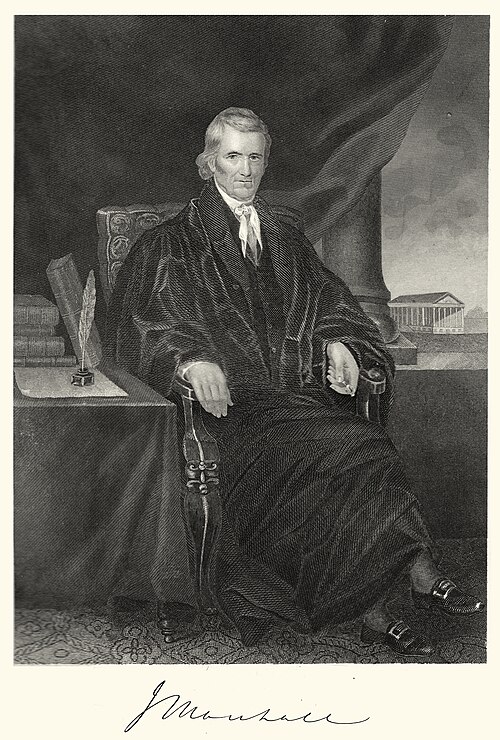
ジェイ、ラトレッジ、エルズワース首席判事(1789-1801)の治世中、最高裁は少数の事件を審理した。最初の判決は手続きに関する事件であるウェスト対バーンズ(1791年)であった。 [12]最高裁は当初6人の判事しかいなかったため、多数決で下された判決はすべて3分の2の賛成でも下された(4対2の投票)。[13]しかし、議会は常に最高裁の定足数よりも少ない判事に判決を下すことを認めており、1789年に4人の判事が定足数となったのが最初である。 [14]最高裁は独自の拠点を持たず、名声もほとんどなかった。[15]この状況は、当時最も注目を集めた事件であるチザム対ジョージア(1793年)によってさらに悪化した。この事件は、2年以内に修正第11条の採択によって覆された。[16]
最高裁判所の権力と権威はマーシャル裁判所(1801-1835年)の時代に大幅に高まりました。[17]マーシャルの下で、最高裁判所は議会の行為に対する司法審査権を確立し、 [18]憲法の最高の解説者として自らを明記し(マーベリー対マディソン事件)[19] [20] 、連邦政府と州の間の力関係に形と実質を与えたいくつかの重要な憲法上の判決、特にマーティン対ハンターズ・リース事件、マカロック対メリーランド州事件、ギボンズ対オグデン事件を下しました。[21] [22] [23] [24]
マーシャル裁判所はまた、各判事が順番に意見を述べるというイギリスの伝統の名残である慣行を終わらせ、[ 25]代わりに単一の多数意見を述べるようにした。[25]また、マーシャルの在任中、裁判所の制御外であったものの、 1804年から1805年にかけてのサミュエル・チェイス判事の弾劾と無罪判決は、司法の独立の原則を固めるのに役立った。[27] [28]
タニーからタフトへ
タニー裁判所(1836年 - 1864年)は、シェルドン対シル事件など、いくつかの重要な判決を下した。この事件では、連邦議会は最高裁が審理できる主題を制限できないが、特定の主題を扱う事件を審理できないようにするために下級連邦裁判所の管轄権を制限することができるとされた。[ 29]しかし、この裁判所は、主にドレッド・スコット対サンフォード事件の判決で記憶されており、[30]この判決は南北戦争の引き金となった。[31]レコンストラクション時代には、チェイス、ウェイト、フラー各裁判所(1864年 - 1910年)が南北戦争に関する新しい憲法修正条項を解釈し、 [24]実質的適正手続きの原則を発展させた(ロックナー対ニューヨーク州、[32]アデア対合衆国事件)。[33]最高裁の規模が最後に変更されたのは1869年で、9人に設定されていた。
ホワイト裁判所とタフト裁判所(1910-1930年)の下で、裁判所は、憲法修正第14条が州に対する権利章典のいくつかの保障を組み込んでいると判断し(ギトロー対ニューヨーク)、[34]新しい反トラスト法に取り組み(ニュージャージー州スタンダード石油会社対アメリカ合衆国)、兵役の合憲性を支持し(選択的徴兵法訴訟)、[35]実質的適正手続きの原則を最初の頂点に導きました(アダキンス対小児病院)。[36]
ニューディール時代


ヒューズ裁判所、ストーン裁判所、およびヴィンソン裁判所(1930-1953年)の間、1935年に最高裁は独自の妥協を獲得し[37]、憲法の解釈を変更し、フランクリン・D・ルーズベルト大統領のニューディール政策を促進するために連邦政府の権限をより広く解釈した(最も有名なのはウェストコーストホテル会社対パリッシュ、ウィッカード対フィルバーン、米国対ダービー、米国対バトラー)。[38] [39] [40]第二次世界大戦中、最高裁は政府の権力を支持し続け、日系アメリカ人の強制収容(コレマツ対米国)と義務的な忠誠の誓い(マイナーズビル学区対ゴビティス)を支持した。しかし、ゴビティスはすぐに否定され(ウェストバージニア州教育委員会対バーネット)、鉄鋼押収事件は政府支持の傾向を制限した。
ウォーレン裁判所(1953-1969年)は、憲法上の公民権の力を劇的に拡大した。[41]公立学校での人種隔離は、憲法修正第14条の平等保護条項に違反し(ブラウン対教育委員会、ボリング対シャープ、グリーン対郡教育委員会) 、 [42]立法区の人口はほぼ均等でなければならない(レイノルズ対シムズ)と判決した。同法は、プライバシーの一般的権利を認め(グリスウォルド対コネチカット州)、[43]公立学校における宗教の役割を制限し(最も有名なのはエンゲル対ヴィターレ事件とアビントン学区対シェンプ事件) 、[44] [45]権利章典で州に対して保障されているほとんどのものを組み入れ、有名なのはマップ対オハイオ州事件(排他的規則)とギデオン対ウェインライト事件(弁護士を選任する権利)、[46] [47]警察が犯罪容疑者にこれらすべての権利を告知することを義務付けた(ミランダ対アリゾナ州)。[48]同時に、同法は公人による名誉毀損訴訟を制限し(ニューヨーク・タイムズ社対サリバン事件)、政府に反トラスト法違反事件での連続勝利をもたらした。[49]
バーガー、レンキスト、ロバーツ

バーガー裁判所(1969-1986年)では保守的な方向転換が見られた。[50]また、グリスウォルドのプライバシーの権利を拡大し、中絶法(ロー対ウェイド)を無効とした。 [51]しかし、積極的差別是正措置(カリフォルニア大学理事会対バッケ)[52]と選挙資金規制(バックリー対ヴァレオ)については意見が大きく分かれた。[53]また、死刑についても揺れ動き、最初はほとんどの死刑執行命令に欠陥があるとの判決を下したが(ファーマン対ジョージア州)、その後、死刑自体は違憲ではないとの判決を下した(グレッグ対ジョージア州)。[54] [55] [56]
レンキスト裁判所(1986-2005年)は、司法による連邦主義の執行の復活で知られており、[57]憲法が積極的に付与する権限の限界(米国対ロペス)とそれらの権限に対する制限の効力(セミノール族対フロリダ州、ボーネ市対フローレス)を強調した。[58] [59] [60] [ 61] [62]同裁判所は、男女別公立学校を平等保護の違反として(米国対バージニア州)、ソドミーを禁止する法律を実質的適正手続きの違反として(ローレンス対テキサス州)[63]、個別項目拒否権(クリントン対ニューヨーク州)を無効としたが、学校バウチャーを支持し(ゼルマン対シモンズ=ハリス)、ロー判決による中絶法の制限を再確認した(家族計画連盟対ケーシー)。[64] 2000年のアメリカ合衆国大統領選挙の選挙人再集計を終わらせたブッシュ対ゴア裁判の判決は、正当な勝者が誰なのか、また判決が前例となるべきかどうかについて議論が続いており、特に物議を醸している。[65] [66] [67] [68]
ロバーツ裁判所(2005年~現在)は、レンキスト裁判所よりも保守的で物議を醸す裁判所とみなされている。[69] [70] [71] [72]ロバーツ裁判所の主な判決には、連邦法優先(ワイエス対レヴァイン)、民事訴訟(トゥオンブリー対イクバル)、投票権と連邦事前承認(シェルビー郡)、中絶(ゴンザレス対カーハート、ドブス対ジャクソン女性健康組織)、[73] 気候変動(マサチューセッツ州対環境保護庁)、同性婚(米国対ウィンザー、オーバーグフェル対ホッジス)、権利章典(シチズンズ・ユナイテッド対連邦選挙委員会(修正第1条)、[74] ヘラー・マクドナルド・ブルーン(修正第2条)、[75]ベイズ対リース(修正第8条)など)に関するものがある。[76] [77]
構成
指名、確認、任命

アメリカ合衆国憲法第2条第2節第2項は任命条項として知られ、大統領に公務員を指名し、アメリカ合衆国上院の確認(助言と同意)を得て、最高裁判所判事を含む公務員を任命する権限を与えている。この条項は、憲法に内在する抑制と均衡のシステムの一例である。大統領は指名の全権を持ち、上院は指名された人物を拒否または承認する全権を持つ。憲法は、年齢、市民権、居住地、過去の司法経験など、判事としての職務に就くための資格を定めていないため、大統領は誰でも任命することができ、上院は大統領が誰を選ぶかについて資格を定めたり制限したりすることはできない。[78] [79] [80]
現代では、承認手続きは報道機関や擁護団体からかなりの注目を集めており、これらの団体は上院議員に対し、候補者の実績が団体の見解と一致するかどうかに応じて、その候補者を承認または拒否するようロビー活動を行っている。上院司法委員会は公聴会を開催し、その指名が肯定的、否定的、あるいは中立的な報告書とともに上院本会議に提出されるべきかどうかについて投票を行う。委員会が候補者を直接面接する慣行は比較的最近のものである。委員会の前に初めて現れた候補者は、ウォール街とのつながりについての懸念を和らげようとしたハーラン・フィッスク・ストーンで、現代的な質問慣行は1955年のジョン・マーシャル・ハーラン2世から始まった。 [81]委員会が指名の報告書を提出すると、上院本会議で審議される。拒否されることは比較的まれである。上院は12人の最高裁判事候補を明確に拒否しており、最も最近のものは1987年に ロナルド・レーガン大統領によって指名されたロバート・ボークである。
上院の規則では、委員会での反対票や可否同数票で指名を阻止することが必ずしも認められているわけではないが、2017年以前は、上院本会議で議論が始まった後、議事妨害によって指名を阻止することがあった。1968年、リンドン・B・ジョンソン大統領が現職のエイブ・フォータス判事をアール・ウォーレン最高裁判所長官の後任として指名したのが、最高裁判事指名に対する議事妨害が成功した最初の例である。この指名には、フォータス判事の倫理観を懸念する共和党と民主党の両方の上院議員が関与していた。アントニン・スカリア判事の死去で空席となった席にニール・ゴーサッチを指名したドナルド・トランプ大統領の指名が2回目である。フォータス判事の議事妨害とは異なり、ゴーサッチの指名に対する議事妨害に反対票を投じたのは民主党の上院議員だけだった。その理由は、ゴーサッチの司法哲学が保守的であるとみなされていることと、共和党多数派が以前に空席を埋めるためにバラク・オバマ大統領が指名したメリック・ガーランドの指名を審議拒否したことである。 [82]これにより共和党多数派は規則を変更し、最高裁判事指名における議事妨害を廃止した。[83]
.jpg/500px-Ruth_Bader_Ginsburg_at_her_confirmation_hearing_(a).jpg)
最高裁判事の指名候補者全員が上院で投票を受けているわけではない。大統領は、上院が指名を否決することが明白な場合、実際の承認投票が行われる前に指名を撤回することがある。これは、ジョージ・W・ブッシュ大統領が2005年にハリエット・ミアーズを指名した際に起きた。上院は、会期末に期限が切れる指名について行動を起こさないこともある。ドワイト・アイゼンハワー大統領が1954年11月にジョン・マーシャル・ハーラン2世を初めて指名したが、上院はこれを行動に移さなかった。アイゼンハワー大統領は1955年1月にハーランを再指名し、ハーランは2か月後に承認された。最近では、上院は2016年3月のメリック・ガーランドの指名について行動を起こさなかった。指名は2017年1月に期限が切れ、その空席はトランプ大統領の任命したニール・ゴーサッチによって埋められた。[8]
上院が指名を承認すると、大統領は任命された人が就任する前に、司法省の印章を捺印した委任状を作成して署名しなければならない。 [84]判事の優先順位は任命日に基づいており、承認や宣誓の日付に基づいているわけではない。[85]任命された人は委任状を受け取った後、公務に就く前に2つの規定の宣誓を行わなければならない。[86]宣誓の重要性は、エドウィン・M・スタントンの事例によって強調されている。1869年12月20日に上院で承認され、ユリシーズ・グラント大統領によって判事として正式に任命されたスタントンは、規定の宣誓を行う前の12月24日に亡くなった。そのため、彼は最高裁判所のメンバーではなかったとみなされている。[87] [88]
1981年以前は、判事の承認プロセスは通常迅速でした。トルーマン政権からニクソン政権までは、判事の承認は通常1か月以内に行われました。レーガン政権から現在まで、プロセスははるかに長くかかっていますが、これは議会が判事を過去よりも政治的な役割を担っていると考えているためだと考える人もいます。[89]議会調査局によると、1975年以来、指名から上院での最終投票までの平均日数は67日(2.2か月)で、中央値は71日(2.3か月)です。[90] [91]
休会予定
上院が休会中の場合、大統領は空席を埋めるために臨時任命を行うことができる。休会任命された者は、次の上院会期の終了時まで(2年未満)のみ在職する。彼らが引き続き職務を続けるためには、上院が指名者を承認しなければならない。休会任命を受けた2人の最高裁判所長官と11人の判事のうち、ジョン・ラトレッジ最高裁判所長官だけがその後承認されなかった。[92]
ドワイト・D・アイゼンハワー大統領以来、最高裁判所の休会任命を行った大統領はおらず、この慣行は下級連邦裁判所でも稀で物議を醸すものとなっている。 [93] 1960年、アイゼンハワー大統領が3度の休会任命を行った後、上院は最高裁判所の休会任命は「異例の状況」でのみ行うべきとする「上院の見解」決議を可決した。[94]このような決議は法的拘束力はないが、行政措置を導くことを目的とした議会の見解の表明である。[94] [95]
最高裁判所は2014年に全米労働関係委員会対ノエル・カニング事件で大統領の休会任命(最高裁判所判事の任命を含む)権限を制限し、上院がいつ会期中または休会中かを決定すると判決を下した。裁判所の意見書でブレイヤー判事は「休会任命条項の目的上、上院は自らの規則に従って上院の業務を遂行する能力を保持している限り、上院が宣言した時に会期中であると我々は判断する」と述べた。[96]この判決により、上院は形式的な会期を利用して休会任命を阻止できるようになった。[97]
在職期間
判事の終身在職は、アメリカ合衆国最高裁判所判事とロードアイランド州最高裁判所判事にのみ見られ、他のすべての民主主義国家およびアメリカ合衆国の他のすべての州では、任期制限または定年制が設定されている。[98] ラリー・サバトは、「終身在職の閉鎖性と、比較的若い弁護士が長期間裁判官として勤務する任命とが相まって、現在の世代の見解よりも過去の世代の見解をより適切に代表する上級判事が生み出される」と書いている。 [99] サンフォード・レビンソンは、長寿を理由に健康状態が悪化したにもかかわらず職にとどまった判事に対して批判的である。[100] ジェームズ・マクレガー・バーンズは、終身在職は「重大なタイムラグを生み出し、最高裁判所は制度的に常に時代遅れになっている」と述べた。[101]これらの問題を解決するための提案には、レビンソン[102]とサバト[99] [103]が提案した判事の任期制限や、リチャード・エプスタイン[ 104]などが提案した定年制などがある。[105]アレクサンダー・ハミルトンは、連邦党員第78号で、終身在職権の利点の1つは「職務の永続性ほど、その堅固さと独立性に貢献するものはない」と主張した。[106] [非一次資料が必要]

憲法第3条第1項は、判事は「行儀よくしている限りその職にとどまる」と規定している。これは、判事が死ぬまで終身在職できるという意味だと理解されている。さらに、この文言は、判事を解任できる唯一の方法は、弾劾手続きを経て議会が行う方法だと一般的に解釈されている。憲法起草者は、判事を解任する権限を制限し、司法の独立を確保するために、行儀よくしているという任期を選択した。[107] [108] [109]病気や怪我で永久に職務遂行能力を失っているが、辞任できない(または辞任したくない)判事を解任するための憲法上の仕組みは存在しない。[110]これまでに弾劾された唯一の判事は、1804年のサミュエル・チェイスである。下院は彼に対して8つの弾劾条項を採択した。しかし、上院で無罪となり、1811年に死去するまでその職に留まった。[111]ウィリアム・O・ダグラス判事とエイブ・フォータス判事の2人が司法委員会の聴聞会にかけられ、ダグラス判事は1953年と1970年の2度聴聞会の対象となり、フォータス判事は1969年に聴聞会が組織される途中で辞任した。2024年7月10日、アレクサンドリア・オカシア・コルテス下院議員は、クラレンス・トーマス判事とサミュエル・アリト判事の「広く文書化された金銭的および個人的なもつれ」を理由に、両判事に対する弾劾条項を提出した。[112]
判事の任期は無期限であるため、欠員の時期は予測できない。時には、1971年9月にヒューゴ・ブラック判事とジョン・マーシャル・ハーラン2世判事が数日違いで辞任したように、欠員が立て続けに発生することもあるが、これは最高裁判所史上最短の欠員間隔であった。[113]時には、長い期間が空くこともあり、例えば、1994年から2005年にかけて、ハリー・ブラックマン判事が引退してからウィリアム・レンキスト判事が死去するまでの11年間は、最高裁判所史上2番目に長い欠員間隔であった。[114]平均すると、約2年ごとに新しい判事が最高裁判所に加わる。[7]
ばらつきはあるものの、4人を除くすべての大統領が少なくとも1人の判事を任命することができた。ウィリアム・ヘンリー・ハリソンは就任から1か月後に亡くなったが、後継者 (ジョン・タイラー) がその任期中に任命を行った。同様に、ザカリー・テイラーは就任から16か月後に亡くなったが、後継者 (ミラード・フィルモア) もその任期の終了前に最高裁判事の指名を行った。エイブラハム・リンカーンの暗殺後に大統領になったアンドリュー・ジョンソンは、裁判所の規模が縮小されたため、判事を任命する機会を奪われた。ジミー・カーターは、少なくとも1任期を終えて判事を任命する機会を与えられずに退任した唯一の大統領である。ジェームズ・モンロー、フランクリン・D・ルーズベルト、ジョージ・W・ブッシュの各大統領は、任期中は判事を任命する機会がなかったが、その後の任期中に任命を行った。1期以上務めた大統領で、少なくとも1回は任命の機会を得なかった人はいない。
コートの大きさ
アメリカ合衆国最高裁判所は世界最小の最高裁判所の一つであり、首席判事1名と陪席判事8名の計9名で構成されている。アメリカ合衆国憲法は最高裁判所の規模を定めておらず、また判事の役職も具体的に定めていない。憲法は、第1条第3節第6項で「最高裁判所長官」がアメリカ合衆国大統領の弾劾裁判を主宰すると述べているため、最高裁判所長官の職が存在することを前提としている。最高裁判所の規模と構成員を決定する権限は議会にあるとみなされており、議会は当初、 1789年司法制度法により、首席判事1名と陪席判事5名からなる6名構成の最高裁判所を設立した。
最高裁判所の規模は、1801年の深夜判事法によって初めて変更された。この法律では、次に裁判官が空席になったときに最高裁判所の規模を5人に減らすことになっていた(連邦判事は終身在職であるため)が、 1802年の司法法により、1801年の法律は即座に無効となり、そのような空席が生じる前に最高裁判所の規模を6人に復元した。国の境界が大陸全体に広がるにつれ、当時の最高裁判所判事は巡回裁判を行わなければならず、これは馬や馬車で厳しい地形を長距離移動する困難なプロセスであり、数か月に及ぶ長期の自宅滞在を余儀なくされた。議会は増加に対応するために判事を増やし、判事の席数と最高裁判事の席数は、1807年に7人、1837年に9人、1863年に10人になった。[115] [116]
チェイス最高裁長官の要請と、共和党の議会による民主党のアンドリュー・ジョンソンの権力を制限しようとする試みにより、議会は1866年司法巡回区法を可決し、引退する次の3人の判事は補充しないと規定した。補充しないと、裁判官席が7人に減ってしまう。その結果、1866年に1席、1867年にもう1席が削減された。ジョンソンが退任して間もなく、共和党の新大統領ユリシーズ・S・グラント[117]は1869年司法法に署名し、法律として成立させた。これにより判事の数は9人に戻り[118](以来この数を維持)、グラントはすぐにさらに2人の判事を任命することができた。
フランクリン・D・ルーズベルト大統領は1937年に最高裁判所の拡大を試みた。彼の提案は、70歳 6か 月に達して定年退職を拒否した現職判事1人につき1人の判事を任命し、最高15人の判事を任命するという内容だった。この提案は表面上は高齢判事の訴訟事件の負担を軽減するためのものだったが、実際の目的はルーズベルトのニューディール政策を支持する判事で最高裁判所を「詰め込む」ための試みであると広く理解されていた。[119]この計画は「裁判所詰め込み計画」と呼ばれ、ルーズベルト自身の民主党員が違憲であると信じたため議会で否決された。上院では70対20で否決され、上院司法委員会は、この提案が「アメリカの自由な国民の自由な代表者に二度と提示されないよう断固として拒否されることが、我々の憲法民主主義の継続に不可欠である」と報告した。[120] [121] [122] [123]
ドナルド・トランプ大統領の任期中に保守派が5対4の多数派から6対3の超多数派に拡大したことで、アナリストらは最高裁を1930年代以降で最も保守的であると呼び、また共和党がエイミー・コニー・バレット前任の判事18人のうち14人を任命したことで不均衡と見られる状況を是正するために最高裁の規模を拡大すべきだという声も上がった。[124] [125] 2021年4月、第117議会中に、下院の一部民主党議員が最高裁の席数を9席から13席に拡大する法案、2021年司法法案を提出した。この法案は党内で意見が分かれ、ナンシー・ペロシ下院議長は採決にかけなかった。[126] [127]ジョー・バイデン大統領は2021年1月に就任して間もなく、最高裁の改革の可能性を研究する大統領委員会を設置した。委員会の2021年12月の最終報告書では、裁判所の規模の拡大については議論されたが、立場は示されなかった。[128]
米国の最高裁判所は9人の判事で構成されており、世界でも最も小規模な最高裁判所の1つである。デイビッド・リットは、米国ほどの規模の国の視点を代表するには、最高裁判所は小さすぎると主張する。[129]弁護士で法学者のジョナサン・ターリーは、19人の判事で、大統領の任期ごとに2人の判事が徐々に増え、他の先進国の最高裁判所と同程度の規模になるよう提唱している。彼は、裁判所の規模が大きければ、浮動判事の権力が減り、裁判所の「見解の多様性」が確保され、新判事の承認が政治的に論争を呼ぶことも少なくなると述べている。[130] [131]
メンバーシップ
現在の判事
現在、最高裁判所にはジョン・ロバーツ首席判事と8人の判事の計9人の判事がいます。現在の最高裁判所判事の中では、クラレンス・トーマス判事が最長の在任期間で、12,029日(2024年9月28日現在、最高裁判所判事の任期は32歳341日である。最高裁判所に加わった最新の判事はケタンジ・ブラウン・ジャクソンであり、その任期は2022年4月7日に上院で承認され、6月30日に始まった。[132]
このグラフのタイムラインは、最高裁判所の各判事の在任期間(年功序列ではありません。最高裁判事長は在任期間に関係なく、すべての判事よりも年功序列です)を表しています。

裁判所の人口統計
現在、最高裁には男性判事が5人、女性判事が4人いる。9人の判事のうち、2人はアフリカ系アメリカ人(トーマス判事とジャクソン判事)で、1人はヒスパニック系(ソトマイヨール判事)である。判事のうち1人は少なくとも片方の親が移民である。アリト判事の父親はイタリア生まれである。[134] [135]
少なくとも6人の判事はローマカトリック教徒、1人はユダヤ教徒、1人はプロテスタントである。ニール・ゴーサッチが自分自身をカトリック教徒とみなしているのか、聖公会教徒とみなしているのかは不明である。[136]歴史的に、判事のほとんどはプロテスタントであり、聖公会教徒が36人、長老派教会が19人、ユニテリアンが10人、メソジストが5人、バプテストが3人であった。[137] [138]最初のカトリック判事は1836年のロジャー・タニーであり、 [139] 1916年には最初のユダヤ教徒判事であるルイス・ブランダイスが任命された。[140]近年では歴史的状況が逆転し、最近の判事のほとんどがカトリック教徒かユダヤ教徒である。
判事のうち3人はニューヨーク州出身、2人はワシントンD.C.出身、そしてニュージャージー州、ジョージア州、コロラド州、ルイジアナ州からそれぞれ1人ずつである。[141] [142] [143]現職判事のうち8人はアイビーリーグのロースクールで法学博士号を取得している。ニール・ゴーサッチ、ケタンジ・ブラウン・ジャクソン、エレナ・ケーガン、ジョン・ロバーツはハーバード大学出身、サミュエル・アリート、ブレット・カバノー、ソニア・ソトマイヨール、クラレンス・トーマスはイェール大学出身である。エイミー・コニー・バレットだけはアイビー リーグのロースクールで法学博士号を取得していない。彼女はノートルダム大学で法学博士号を取得した。
最高裁判所に入所する前の司法または連邦政府での以前の役職または職務(最高裁判所長官に続く年功序列順)は次のとおりです。

最高裁判所の歴史の大部分において、判事は全員北西ヨーロッパ系の男性であり、ほぼ常にプロテスタントであった。多様性に関する懸念は、宗教、民族、または性別の多様性ではなく、国のすべての地域を代表するという地理的な点に集中していた。 [144]最高裁判所における人種、民族、性別の多様性は、20世紀後半に増加した。サーグッド・マーシャルは1967年に初のアフリカ系アメリカ人判事となった。 [140] サンドラ・デイ・オコナーは1981年に初の女性判事となった。[140] 1986年、アントニン・スカリアは初のイタリア系アメリカ人判事となった。マーシャルの後任には1991年にアフリカ系アメリカ人のクラレンス・トーマスが就任した。[145]オコナーの後任には1993年に最高裁初のユダヤ人女性判事であるルース・ベイダー・ギンズバーグが就任した。 [146]オコナーの引退後、ギンズバーグの後任には2009年に初のヒスパニック・ラテン系判事であるソニア・ソトマイヨールが就任し、 [140] 2010年にはエレナ・ケーガンが就任した。[146] 2020年9月18日のギンズバーグの死後、2020年10月26日、エイミー・コニー・バレットが最高裁史上5人目の女性判事として承認された。ケタンジ・ブラウン・ジャクソンは最高裁の6人目の女性であり、初のアフリカ系アメリカ人女性である。
最高裁判所の歴史上、外国生まれの判事は6人いる。スコットランドのカスカルディ生まれのジェームズ・ウィルソン(1789–1798)、イングランドのルイス生まれのジェームズ・アイアデル(1790–1799)、アイルランドのアントリム州生まれのウィリアム・パターソン(1793–1806)、オスマン帝国のスミルナ(現在のトルコのイズミル)でアメリカ人宣教師の子として生まれたデイビッド・ブリューワー(1889–1910) 、イングランドのバッキンガムシャー生まれのジョージ・サザーランド(1922–1939)、オーストリア=ハンガリー帝国のウィーン(現在のオーストリア)生まれのフェリックス・フランクファーター(1939–1962)である。 [140]
1789年以来、判事の約3分の1は米国の退役軍人である。サミュエル・アリトは現在最高裁判所に勤務する唯一の退役軍人である。[147]退職した判事のスティーブン・ブレイヤーとアンソニー・ケネディも米国軍に勤務した。[148]
司法の傾向
判事は大統領によって指名され、上院で承認される。歴史的に、判事は指名した大統領の政党の見解を多く支持している。立法府や行政府で慣例となっているように、判事は政党を代表したり、政党から公式の支持を受けたりはしないが、連邦主義協会などの組織は、十分に保守的な法律観を持つ判事を公式に選別し、支持している。法学者は、メディアで保守派かリベラル派かに非公式に分類されることが多い。法学者のイデオロギーを定量化する試みには、シーガル・カバー・スコア、マーティン・クイン・スコア、司法共通空間スコアなどがある。[149] [150]
デヴィンズとバウムは、2010 年以前には最高裁に党派の線に沿った明確なイデオロギー的ブロックが存在したことはなかったと主張する。大統領は判事の任命において、イデオロギーよりも友情や政治的つながりを重視した。共和党の大統領はリベラル派を任命することがあり、民主党の大統領は保守派を任命することがあった。その結果、「1790 年から 2010 年初頭にかけて、合衆国最高裁判所の指針で重要と指定され、判事が党派の線に沿って 0.5% 程度に分かれた反対票が少なくとも 2 票あった判決は 2 件だけだった。」[151] : 316 [152]混乱した 1960 年代と 1970 年代でさえ、民主党と共和党のエリートは、特に公民権と公民の自由に関するいくつかの主要な問題で合意する傾向があり、判事たちも同様であった。しかし、1991年以降、判事を選ぶ際にイデオロギーがはるかに重要になったと彼らは主張している。共和党が任命した判事は皆、熱心な保守派であり、民主党が任命した判事は皆、リベラル派である。[151] : 331–344 より穏健な共和党の判事が引退するにつれて、最高裁はより党派的になった。最高裁は党派的な線に沿ってさらに鋭く分裂し、共和党大統領によって任命された判事はますます保守的な立場を取り、民主党によって任命された判事は穏健なリベラルな立場を取るようになった。[151] : 357

2020年にルース・ベイダー・ギンズバーグ判事が死去した後、エイミー・コニー・バレットが承認されて以来、最高裁は共和党大統領が任命する6人の判事と民主党大統領が任命する3人の判事で構成されている。共和党大統領が任命したロバーツ首席判事とトーマス、アリト、ゴーサッチ、カバノー、バレットの各判事が最高裁の保守派を構成し、民主党大統領が任命したソトマイヨール、ケーガン、ジャクソンの各判事が最高裁のリベラル派を構成することは一般に認められている。 [153] 2020年にギンズバーグ判事が死去する 前は、保守派のロバーツ首席判事は最高裁の「中間の判事」と表現されることもあった(ロバーツよりもリベラルな判事が4人、保守的な判事が4人いる)。[154] [155] [156] [更新が必要]
FiveThirtyEightは、2021年には全会一致の判決が過去20年間の平均である約50%から30%近くに減少し、党派的判決が過去60年間の平均であるゼロをわずかに上回る水準から過去最高の21%に増加したことを発見した。[157]その年、ライアン・ウィリアムズは判事の承認における党派的投票を、最高裁が上院にとって党派的重要性を持つ証拠だと指摘した。 [ 158] 2022年、ブルッキングス研究所のサイモン・ラザラスは、米国最高裁がますます党派的になっている機関であると批判した。[159] 2024年のAP-NORC世論調査では、回答者の10人中7人が最高裁は「公正かつ公平であることで政府の他の部門に対する独立したチェックとして機能する」のではなく、「自らのイデオロギーに合うように」判決を下すと考えていることが示された。[160]
退職した判事
現在、アメリカ合衆国最高裁判所には、アンソニー・ケネディ、デイビッド・スーター、スティーブン・ブレイヤーの3人の存命の引退判事がいる。引退判事はもはや最高裁判所の仕事には参加しないが、下級連邦裁判所、通常は合衆国控訴裁判所に臨時に任命されることがある。こうした任命は、下級裁判所の首席判事の要請と引退判事の同意に基づき、首席判事によって正式に行われる。近年、スーター判事は、最高裁判所に入る前に短期間所属していた第一巡回区控訴裁判所に頻繁に出廷している。 [161]引退判事の身分は、巡回裁判所や地方裁判所の判事が上級職に就いた場合の身分に似ており、最高裁判所判事が(単に辞任するのではなく)引退身分になる資格は、同じ年齢と勤務期間の基準によって左右される。
最近では、判事は個人的、組織的、イデオロギー的、党派的、政治的な要因を考慮し、退任の決定を戦略的に計画する傾向がある。[162] [163]精神の衰えや死への恐怖が、判事を退任させる動機となることが多い。裁判所が休会中や大統領選挙のない年に、一人ずつ退任させることで裁判所の力と正当性を最大限に高めたいという願望は、組織の健全性に対する懸念を示唆している。最後に、特にここ数十年、多くの判事は、哲学的に相性の良い大統領の在任期間に合わせて退任の時期を決め、同じ考えを持つ後任が任命されるようにしている。[164] [165]
給料
2024年現在、判事の年俸は298,500ドル、首席判事の年俸は312,200ドルとなっている。[166]判事が年齢と勤務要件を満たすと、連邦職員と同じ計算式に基づいて年金を受け取って退職することができる。他の連邦裁判所判事と同様に、憲法第3条の報酬条項に従い、彼らの年金は退職時の給与を下回ることはない。[要出典]
年功序列と座席

判事の日常業務は、ほとんどの場合、判事の年功序列に基づく儀礼規則によって規定されている。最高裁判所長官は、在職期間に関係なく、常に最上位の順位となる。判事は、在職期間によって順位が付けられる。最高裁判所長官は、ベンチの中央に座り、会議中はテーブルの先頭に座る。他の判事は、年功序列順に着席する。最上位の判事は最高裁判所長官のすぐ右に座り、2番目に年功序列の判事は、そのすぐ左に座る。席は年功序列順に右から左に交互に座り、最年少の判事が最後の席に座る。したがって、2022年10月の任期以降、裁判所は、裁判所に向かって左から右に、バレット、ゴーサッチ、ソトマイヨール、トーマス(最上位の判事)、ロバーツ(最高裁判所長官)、アリト、ケーガン、カバノー、ジャクソンの順で着席する。同様に、裁判所のメンバーが公式の集合写真を撮るために集まる際、判事は年功順に並べられ、最年長の5人が法廷で座るのと同じ順番で最前列に座り(現在は左から右に、ソトマイヨール、トーマス、ロバーツ、アリト、ケイガン)、最も若い4人の判事が彼らの後ろに立ち、これも法廷で座るのと同じ順番で座る(バレット、ゴーサッチ、カバノー、ジャクソン)。
判事たちの非公開会議では、現在の慣例により、首席判事から始まり、最年少の判事まで、年功序列で発言と投票が行われる。慣例により、こうした会議では最年少の判事が、会議室のドアを開けたり、飲み物を出したり、裁判所の命令を書記官に伝えたりするなど、判事が単独で会議を行う際に必要となる雑用を担当する。[167]
設備
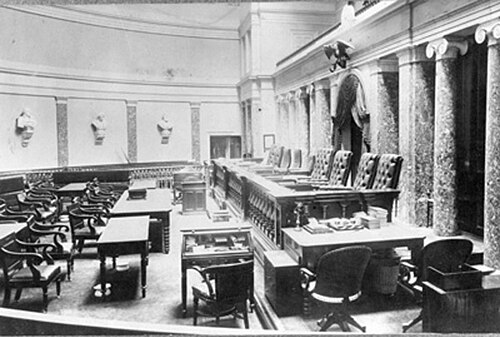
最高裁判所は1790年2月1日、ニューヨーク市のマーチャンツ取引所ビルで初めて開かれた。フィラデルフィアが首都になると、裁判所は短期間独立記念館で開かれ、その後1791年から1800年まで旧市庁舎に落ち着いた。政府がワシントンDCに移った後、裁判所は1935年に専用の建物に移るまで国会議事堂内のさまざまな場所を占めていた。4階建ての建物はキャス・ギルバートによって、国会議事堂や議会図書館などの周囲の建物と調和する古典的なスタイルで設計され、大理石で覆われている。建物には法廷、判事の部屋、大規模な法律図書館、さまざまな会議スペース、体育館などの補助施設がある。最高裁判所の建物は国会議事堂建築家の管轄下にあるが、国会議事堂警察とは別に独自の最高裁判所警察を維持している。[168]
アメリカ合衆国議会議事堂の向かいのファースト ストリート NE とメリーランド アベニューに位置し、[169] [170]平日は 午前9 時から午後 4 時半まで一般に公開されているが、週末と祝日は閉まっている。[169]訪問者は付き添いなしで法廷内を見学することはできない。カフェテリア、ギフト ショップ、展示物、30 分間の情報映画がある。[168]法廷が開かれていないときは、午前 9 時半から午後 3 時半まで1 時間ごとに法廷についての講義が行われており、予約は必要ない。[168]法廷が開かれているときは、一般の人は口頭弁論を傍聴することができる。口頭弁論は 10 月から 4 月下旬まで 2 週間間隔で月曜、火曜、水曜の午前 (場合によっては午後) に 2 回行われ、12 月と 2 月は休みである。訪問者は先着順で着席できる。[171]空席の数は事件によって異なり、重要な事件の場合、一部の訪問者は前日に到着し、夜通し待機する。裁判所は、予定されている「非弁論日」(意見日とも呼ばれる)に午前10時から意見を発表する。 [172]これらのセッションは通常15分から30分続き、一般公開されている。[172] [168] 5月中旬から6月末まで、少なくとも毎週1回の意見日が予定されている。[168]最高裁判所警察が質問に答える。[169]
管轄
連邦憲法第 3 条により、議会は最高裁判所の上訴管轄権を規制する権限を与えられています。
第一審管轄
最高裁判所は、2つ以上の州間の訴訟について第一審および排他的管轄権を有するが[173]、そのような訴訟の審理を拒否することができる。[174]また、最高裁判所は「外国の大使、その他の公使、領事、または副領事が当事者であるすべての訴訟または手続き、米国と州の間のすべての論争、および州が他の州の市民または外国人に対して起こすすべての訴訟または手続き」を審理する第一審管轄権を有するが、排他的ではない。[175]
1906年、連邦最高裁判所は、合衆国対シップ事件において、法廷侮辱罪で個人を起訴する本来の管轄権を主張した。[176]この訴訟は、連邦最高裁判所史上唯一の法廷侮辱罪訴訟であり、唯一の刑事裁判となっている。[177] [178]この法廷侮辱罪訴訟は、ジョン・マーシャル・ハーラン判事が、弁護士らが控訴できるようジョンソンの死刑執行を延期した日の夕方、テネシー州チャタヌーガでエド・ジョンソンがリンチされたことに端を発している。ジョンソンは、刑務所を事実上無警備のままにした地元保安官の支援を受けたリンチ集団によって独房から連れ出され、橋から吊るされた。その後、副保安官がジョンソンの遺体に「ハーラン判事へ。今すぐお前の黒んぼを捕まえてこい」と書かれたメモを貼り付けた。[177]地元保安官のジョン・シップは、最高裁の介入をリンチの理由として挙げた。最高裁判所は、チャタヌーガでの裁判を主宰する特別マスターとして副書記官を任命し、ワシントンで最高裁判所判事らの前で最終弁論が行われた。最高裁判所判事らは9人を侮辱罪で有罪とし、3人に90日間の禁固刑、残りに60日間の禁固刑を言い渡した。[177] [178] [179]
その他のすべての事件では、最高裁判所は上訴管轄権のみを有し、下級裁判所に命令令状や禁止令状を発行する権限も有する。最高裁判所が第一審管轄権に基づいて事件を審理することは極めて稀であり、ほぼすべての事件は最高裁判所に上訴される。実際には、最高裁判所が審理する第一審管轄権事件は、2つ以上の州間の紛争のみである。[180]
上訴管轄
最高裁判所の上訴管轄は、連邦控訴裁判所(certiorari、certiorari before judgement、certiorari questionsを通じて)からの上訴、[181]米国軍事控訴裁判所(certiorari を通じて)、[182]プエルトリコ最高裁判所(certiorari を通じて)、[183] ヴァージン諸島最高裁判所(certiorari を通じて)、[184]コロンビア特別区控訴裁判所(certiorariを通じて)、[185]「判決が下される可能性のある州の最高裁判所によって言い渡された最終判決または布告」(certiorariを通じて)からの上訴から構成される。[185]最後のケースでは、州の最高裁判所が控訴を却下した場合、または控訴を審理する管轄権がない場合、下級州裁判所から最高裁判所に控訴することができる。例えば、フロリダ州の地方控訴裁判所の判決は、(a)フロリダ州最高裁判所が上訴許可を拒否した場合、例えばFlorida Star v. BJF、または (b) 地方控訴裁判所が、事件の実質的部分を議論することなく、下級裁判所の判決を単に支持するパー・キュリアム判決を下した場合、米国最高裁判所に控訴できる。これは、フロリダ州最高裁判所にはそのような判決に対する控訴を審理する管轄権がないからである。 [186]連邦裁判所だけでなく州裁判所からの上訴も審理する最高裁判所の権限は、1789年の司法法によって創設され、裁判所の歴史の早い段階で、Martin v. Hunter's Lessee (1816) およびCohens v. Virginia (1821) の判決によって支持された。州裁判所の判決に対する直接の上訴を管轄する連邦裁判所は最高裁判所のみであるが、州の事件のいわゆる「付随的審査」を許可する仕組みはいくつかある。この「付随的審査」は、通常の司法制度ではなく、死刑囚にのみ適用されることが多いことに注意する必要がある。[187]
合衆国憲法第 3 条では、連邦裁判所は「事件」または「論争」のみを審理できると規定されているため、最高裁判所は、一部の州の最高裁判所が行うような、議論の余地のない事件について判決を下すことはできず、勧告的意見も示さない。たとえば、デフニス対オデガード(1974 年) では、法科大学院の積極的差別是正措置の合憲性に異議を唱える訴訟を裁判所が棄却した。これは、原告の学生が訴訟を起こしてから卒業しており、裁判所の判決では原告が被った損害を補償できないためである。ただし、裁判所は、一見議論の余地のない事件を審理することが適切である状況も認識している。問題が「繰り返し可能でありながら審査を逃れている」場合、裁判所は、有利な結果によって当事者が救済されない場合でも、その問題に対処する。ロー対ウェイド事件(1973年)やその他の中絶訴訟では、下級裁判所から最高裁判所に訴訟を上訴するには通常の人間の妊娠期間よりも長い時間がかかるため、たとえ妊娠が終了していても、妊娠中絶を求める妊婦の訴えの正当性について裁判所は検討する。別の例外として、違法行為の自発的な中止があり、裁判所は再発の可能性と原告の救済の必要性を考慮する。[188]
巡回裁判官としての裁判官
アメリカ合衆国は13の巡回控訴裁判所に分かれており、それぞれに最高裁判所から「巡回判事」が割り当てられている。この概念は共和国の歴史を通じて継続的に存在してきたが、その意味は時とともに変化してきた。1789年の司法法では、各判事は「巡回」、つまり割り当てられた巡回区内を移動し、地元の判事とともに事件を審理することが義務付けられていた。この慣行は、移動の困難さを理由に多くの判事から反対を受けた。さらに、判事が巡回中に以前に同じ事件を裁定したことがある場合、裁判所内で利益相反が生じる可能性もあった。巡回控訴裁判所法が可決された1901年に巡回控訴裁判所は終了し、巡回控訴裁判所は1911年に議会によって正式に廃止された。[189]
各巡回区の巡回裁判官は、法律および裁判所の規則により、1 人の裁判官が対応できる特定の種類の申請を処理する責任を負います。通常、裁判官は、申請を「許可」または「拒否」と承認するか、標準形式の命令を入力することで、そのような申請を解決します。ただし、裁判官は、法廷意見と呼ばれる意見を書くことを選択できます。連邦議会は、 [不適切な外部リンクですか? ]で、 1 人の裁判官に上訴保留の停止を発行する権限を明確に付与しています。各裁判官は、期限の延長などの通常の手続き上の要求についても決定します。
1990年以前の最高裁判所規則では、「裁判所が差止命令を発令できる場合、どの判事も差止命令を発令できる」とも規定されていた。[190]しかし、この規則の部分(および差止命令に関するその他のすべての具体的な言及)は、1989年12月の最高裁判所規則改正で削除された。[191] [192]それにもかかわらず、全令状法に基づく差止命令の要請は、巡回判事に向けられることがある。過去には[いつ? ]巡回判事は、刑事事件の保釈請求、人身保護令状、控訴許可を付与する誤審令状の申請を認めることもあった。 [192]
巡回裁判所判事は、その巡回区の控訴裁判所の判事を兼任することがあるが、過去100年間で、このようなケースはほとんどなかった。控訴裁判所に所属する巡回裁判所判事は、その巡回区の首席判事よりも先任である。[193]首席判事は、伝統的にコロンビア特別区巡回区、第4巡回区(コロンビア特別区の周辺州であるメリーランド州とバージニア州を含む)、そして設立以来は連邦巡回区に配属されている。各判事は、1つまたは2つの司法管轄区に配属される。
2022年9月28日現在、各巡回区の判事の割り当ては以下のとおりです。[194]
現在の判事のうち 5 名は、以前に巡回判事を務めていた巡回区に配属されています。ロバーツ首席判事 (DC 巡回区)、ソトマイヨール判事 (第 2 巡回区)、アリト判事 (第 3 巡回区)、バレット判事 (第 7 巡回区)、ゴーサッチ判事 (第 10 巡回区) です。
プロセス
ケース選択
ほぼすべての事件は、一般にcertiorariと呼ばれるcertiorari令状の請願を通じて裁判所に持ち込まれ、裁判所は certiorari 令状を許可する。裁判所は、この手続きを通じて、連邦控訴裁判所にあるあらゆる民事事件または刑事事件を審査することができる。[195]判決が連邦法または憲法の問題を含む場合、裁判所は certiorari によって州の最高裁判所の最終判決を審査することもできる。[196] あるいは、事件は、3人の判事からなる連邦地方裁判所からの直接控訴として裁判所に持ち込まれることもある。[197]裁判所に審査を請願する当事者は請願者であり、申し立てを行わない当事者は被請願者である。
裁判所での訴訟名は、第一審裁判所でどちらの当事者が訴訟を起こしたかに関係なく、請願者対被請願者という形式になります。たとえば、刑事訴追は、アリゾナ州対エルネスト・ミランダのように、州の名において個人に対して行われます。被告が有罪判決を受け、その後州最高裁判所で控訴されてその有罪判決が確定した場合、被告が上訴を申し立てると、訴訟名はミランダ対アリゾナになります。
裁判所はまた、認証と呼ばれる手続きを通じて控訴裁判所自身から提出された質問を審理する。[195]
最高裁判所は、事件の事実については下級裁判所が収集した記録に依拠し、提示された事実に法律がどのように適用されるかという問題のみを扱う。しかし、2つの州が互いに争っている場合や、米国と州の間に紛争がある場合など、裁判所が第1次管轄権を持つ状況もある。このような場合、事件は最高裁判所に直接提起される。そのような事件の例には、土地区画が米国に属するかテキサス州に属するかを決定する事件である米国対テキサス州、および2つの州間の誤って引かれた境界線を州裁判所が変更できるかどうか、および正しい境界線の設定に議会の承認が必要かどうかを争う事件であるバージニア州対テネシー州がある。1794年のジョージア対ブレイルズフォード事件以来行われていないが、[198]最高裁判所が第1次管轄権を持つ訴訟の当事者は、陪審に事実の問題を決定するよう要請することができる。[199] ジョージア対ブレイルスフォード事件は、裁判所が陪審員、この場合は特別陪審員を選任した唯一の事件である。[200]他の2つの第一審管轄事件は、ニュージャージー対デラウェア州における植民地時代の境界と航行水域の権利、およびカンザス対コロラド州における航行水域上流の沿岸州間の水利権に関するものである。
certiorari 請願書は、裁判所の会議と呼ばれるセッションで投票されます。会議は、9 人の判事による非公開の会議で、一般市民や判事の書記官は参加できません。4人ルールでは、 9 人の判事のうち 4 人がcertiorari令状を発行できます。これが発行されると、事件は説明段階に進みます。発行されない場合は、事件は終了します。死刑事件や、裁判所が被告に説明を命じるその他の事件を除き、被告は certiorari 請願書に対する応答を提出できますが、提出する必要はありません。裁判所は、裁判所の規則 10 に明記されている「やむを得ない理由」がある場合にのみ certiorari 請願書を発行します。このような理由には、次のものが含まれます。
- 連邦法または連邦憲法の条項の解釈における巡回裁判所間の紛争の解決
- 司法手続きの一般的な流れからの重大な逸脱を是正する
- 連邦法の重要な問題を解決するため、または裁判所の以前の判決と直接矛盾する下級裁判所の判決を明示的に審査するため。
異なる連邦巡回控訴裁判所が発行した同じ法律または憲法条項の解釈が異なるために解釈の衝突が生じた場合、弁護士はこの状況を「巡回裁判所の分裂」と呼ぶ。裁判所が、提出されるそのような請願の大部分でそうしているように、認証請願を却下する投票をした場合、通常はコメントなしでそうする。認証請願の却下は、事件の実質的判断ではなく、下級裁判所の決定が事件の最終判決となる。裁判所が毎年受け取る大量の認証請願を管理するために(裁判所が毎年受け取る 7,000 件を超える請願のうち、通常は 100 件以下で説明を求め、口頭弁論を聞く)、裁判所は「認証プール」と呼ばれる内部事件管理ツールを採用している。現在、アリト判事とゴーサッチ判事を除くすべての判事が認証プールに参加している。[201] [202] [203] [204]
書面による証拠
最高裁はまた、判決においてアミカス・ブリーフ、ロー・レビュー記事、その他の著作物に依拠し、引用している。ロー・レビュー記事の使用はわずかに増加し、判決ごとに平均1つの記事が引用されているが、[205]アミカス・ブリーフの使用は大幅に増加している。[206]アミカス・ブリーフの使用は、(下級裁判所とは異なり)著者が専門分野以外のトピックについて議論できることや、[206]書面意見における虚偽の文書化された例など、批判を受けている。これは、特定の結果を主張するグループのアミカス・ブリーフによって判事に提供されることが多い。[207]資金の透明性の欠如と、プロセスの早い段階で提出する義務がないことも、アミカス・ブリーフの事実確認と信頼性の理解を困難にしている。 [206]
口頭弁論

裁判所が認証請願を認めると、事件は口頭弁論に設定される。両当事者は、認証請願の許可または拒否の理由とは別に、事件の実質的内容に関する弁論要旨を提出する。当事者の同意または裁判所の承認があれば、法廷助言者、つまり「法廷助言者」も弁論要旨を提出できる。裁判所は、10月から4月まで毎月2週間の口頭弁論会を開く。各当事者は30分間で弁論を行う(裁判所はより長い時間を与えることもできるが、これはまれである)[208] 。その間、判事は弁護人を遮って質問することができる。2019年、裁判所は弁論の最初の2分間は弁護人が通常、中断されることなく話すことを認める規則を採用した[209]。申立人が最初の弁論を行い、被申立人が弁論を終えた後、被申立人の弁論に反論するための時間を確保することができる。法廷助言者は、一方の当事者が同意すれば、その当事者に代わって口頭弁論を行うこともできる。裁判所は弁護士に対し、判事は訴訟で提出された弁論要旨をよく理解しており、それを読んだことがあると想定するよう助言している。
決断
口頭弁論の終了時に、事件は判決のために提出される。事件は裁判官の多数決によって決定される。口頭弁論の終了後、通常は事件が提出されたのと同じ週に、裁判官は別の会議に退席し、予備投票を集計して裁判所はどちらの側が勝訴したかを確認する。多数派の裁判官の 1 人が裁判所の意見 (「多数意見」とも呼ばれる) を書くよう任命される。これは多数派の裁判官の中で最も年長の裁判官によってなされる任命であり、首席裁判官は常に最も年長とみなされる。裁判所の意見の草稿は、裁判所が特定の事件の判決を発表する準備ができるまで、裁判官の間で回覧される。[210]
裁判官は、判決が確定して公表されるまで、事件に関する投票を自由に変更できます。いかなる事件においても、裁判官は意見を表明するか、あるいは単に多数派または他の裁判官の意見に賛同するかを自由に選択できます。意見には主にいくつかの種類があります。
- 裁判所の意見: これは最高裁判所の拘束力のある決定です。裁判官の半数以上が賛同する意見 (裁判官は全部で 9 人いるので通常は少なくとも 5 人ですが、一部の裁判官が参加しない場合はそれより少ないこともあります) は「多数意見」と呼ばれ、アメリカの法律では拘束力のある判例となります。一方、裁判官の半数未満が賛同する意見は「多数意見」と呼ばれ、部分的にしか拘束力のない判例となります。
- 賛成意見: 裁判官は多数意見に同意し、これに加わりますが、追加の説明、根拠、または論評を述べるために別の賛成意見を作成します。賛成意見は拘束力のある前例を作成するものではありません。
- 判決の同意: 裁判官は裁判所が下した判決には同意するが、その理由には同意しない。この場合、裁判官は多数意見に賛同しない。通常の同意意見と同様に、これは拘束力のある判例にはならない。
- 反対意見: 裁判官は裁判所が下した判決とその理由に同意しません。判決に反対する裁判官は、独自の反対意見を述べるか、判決に反対する裁判官が複数いる場合は、別の裁判官の反対意見に賛同することができます。反対意見は拘束力のある判例にはなりません。裁判官は、特定の判決の一部にのみ賛同することも、判決の一部に賛同し、他の部分には賛同しないこともできます。
裁判所の慣例により、特定の期に審理されるすべての事件の判決は、その期の終わりまでに下される。その期においては、裁判所は口頭弁論後、定められた期間内に判決を下す義務はない。最高裁判所の法廷内では録音機器の使用が禁止されているため、メディアへの判決の伝達は、歴史的に「インターンのランニング」として知られる紙のコピーで行われてきた。[211]しかし、この慣例は時代遅れとなり、現在では裁判所は判決の発表と同時にその電子コピーをウェブサイトに掲載している。[212]
忌避や欠員により、裁判所が事件について意見が半々になる可能性もある。その場合、下級裁判所の判決は確定するが、拘束力のある判例は確立されない。事実上、以前の状態に戻ることになる。事件を審理するには、少なくとも6人の判事の定足数が必要である。[213]事件を審理するための定足数が足りず、資格のある判事の過半数が、事件を次の期に審理して決定することはできないと判断した場合、下級裁判所の判決は、裁判所が半々に分かれたかのように確定する。米国地方裁判所からの直接上訴により最高裁判所に持ち込まれた事件については、最高裁判所長官は、事件を適切な米国控訴裁判所に差し戻し、そこで最終決定を下すよう命じることができる。 [214]これは、米国史上、米国対アルコア事件(1945年)の1件のみである。 [215]
公表された意見
裁判所の意見は3段階で公表される。まず、裁判所のウェブサイトやその他の媒体で、判決文の抜粋が公開される。次に、いくつかの意見と裁判所の命令のリストがペーパーバックにまとめられ、これはUnited States Reportsの予備版と呼ばれる。これは裁判所の意見の最終版が掲載される公式の書籍シリーズである。予備版が発行されてから約1年後、Reporter of Decisionsによって最終的な製本版のUS Reportsが発行される。US Reportsの各巻には番号が付けられており、ユーザーはこの報告書セット(または他の商業法律出版社が発行しているが類似の引用を含む競合バージョン)を引用して、答弁書やその他の要約を読む人が事件を素早く簡単に見つけられるようにしている。2019年1月現在、次のものがある。 [update]
- 米国報告書の最終製本巻:2013年6月13日までの事件(2012年10月期の一部)を網羅した569巻。[216] [217]
- 意見書:全21巻(2011~2017年度は565~585巻、各2部構成の3巻)、および586巻(2018年度)第1部。[218]
2012年3月現在[update]、US Reportsは合計30,161件の最高裁判決を公表しており、1790年2月から2012年3月までに言い渡された判決をカバーしている。[要出典]この数字は最高裁が取り上げた事件の数を反映したものではなく、単一の判決で複数の事件を扱うことができる(例えば、Parents v. Seattleでは、Meredith v. Jefferson County Board of Educationも同じ判決で決定された。同様の論理で、Miranda v. Arizonaでは、実際にはMirandaだけでなく、 Vignera v. New York、Westover v. United States、California v. Stewartの3つの事件も判決された)。より珍しい例としては、The Telephone Casesがあり、これはUS Reportsの第126巻全体を占める、相互に関連する単一の判決セットである。
判決文は、ウェスト社(現在はトムソン・ロイター傘下)が発行するSupreme Court Reporterと、レクシスネクシス社が発行するUnited States Supreme Court Reports, Lawyers' Edition(単にLawyers' Editionとして知られる)という2つの非公式な並行する報道機関にも収集・掲載されている。裁判所文書、法律雑誌、その他の法律関連メディアでは、判例引用には通常、3つの報道機関からの引用が含まれている。例えば、Citizens United v. Federal Election Com'nの引用は、 Citizens United v. Federal Election Com'n、585 US 50, 130 S. Ct. 876, 175 L. Ed. 2d 753 (2010) と表記され、「S. Ct.」はSupreme Court Reporter、「L. Ed.」はLawyers' Editionを表している。[219] [220]
公表された意見の引用
弁護士は、判例を引用する際に「巻USページ, pin (年)」という省略形を使用します。ここで、巻は巻数、ページは意見書が始まるページ数、年は判例が判決された年です。オプションで、pinを使用して、判例内の特定のページ番号を「ピンポイントで示す」ことができます。たとえば、Roe v. Wadeの引用は410 US 113 (1973) です。これは、判例が 1973 年に判決され、US Reportsの巻 410 の 113 ページに掲載されていることを意味します。まだ予備印刷で公開されていない意見書または命令書については、巻数とページ数を___に置き換えることができます。
最高裁判所弁護士
裁判所で弁論するためには、弁護士はまず裁判所の弁護士会に入会する必要がある。毎年約 4,000 人の弁護士が弁護士会に入会する。弁護士会には推定 230,000 人の会員がいる。実際には、弁論できるのは数百人の弁護士に限られている。[要出典]残りの弁護士は 200 ドルの一時金で入会し、裁判所は毎年約 750,000 ドルを徴収する。弁護士は個人またはグループで入会できる。グループ入会は最高裁判所の現職判事の前で行われ、最高裁判所長官が新弁護士の入会動議を承認する。[221]弁護士は一般的に、事務所や履歴書に掲示するための証明書を申請する。また、口頭弁論に出席したい場合は、より良い席に座れる。[222]最高裁判所弁護士会のメンバーは、最高裁判所図書館のコレクションへのアクセスも許可される。[223]
学期
A term of the Supreme Court commences on the first Monday of each October, and continues until June or early July of the following year. Each term consists of alternating periods of around two weeks known as "sittings" and "recesses"; justices hear cases and deliver rulings during sittings, and discuss cases and write opinions during recesses.[224]
Institutional powers

The federal court system and the judicial authority to interpret the Constitution received little attention in the debates over the drafting and ratification of the Constitution. The power of judicial review, in fact, is nowhere mentioned in it. Over the ensuing years, the question of whether the power of judicial review was even intended by the drafters of the Constitution was quickly frustrated by the lack of evidence bearing on the question either way.[225] Nevertheless, the power of judiciary to overturn laws and executive actions it determines are unlawful or unconstitutional is a well-established precedent. Many of the Founding Fathers accepted the notion of judicial review; in Federalist No. 78, Alexander Hamilton wrote: "A Constitution is, in fact, and must be regarded by the judges, as a fundamental law. It therefore belongs to them to ascertain its meaning, and the meaning of any particular act proceeding from the legislative body. If there should happen to be an irreconcilable variance between the two, that which has the superior obligation and validity ought, of course, to be preferred; or, in other words, the Constitution ought to be preferred to the statute."
The Supreme Court established its own power to declare laws unconstitutional in Marbury v. Madison (1803), consummating the American system of checks and balances. In explaining the power of judicial review, Chief Justice John Marshall stated that the authority to interpret the law was the particular province of the courts, part of the duty of the judicial department to say what the law is. His contention was not that the court had privileged insight into constitutional requirements, but that it was the constitutional duty of the judiciary, as well as the other branches of government, to read and obey the dictates of the Constitution.[225] This decision was criticized by then-President Thomas Jefferson who said, "the Constitution, on this hypothesis, is a mere thing of wax in the hands of the judiciary, which they may twist and shape into any form they please."[226]
Since the founding of the republic, there has been a tension between the practice of judicial review and the democratic ideals of egalitarianism, self-government, self-determination and freedom of conscience. At one pole are those who view the federal judiciary and especially the Supreme Court as being "the most separated and least checked of all branches of government."[227] Indeed, federal judges and justices on the Supreme Court are not required to stand for election by virtue of their tenure "during good behavior", and their pay may "not be diminished" while they hold their position (Section 1 of Article Three). Although subject to the process of impeachment, only one justice has ever been impeached and no Supreme Court justice has been removed from office. At the other pole are those who view the judiciary as the least dangerous branch, with little ability to resist the exhortations of the other branches of government.[225]
Constraints
The Supreme Court cannot directly enforce its rulings; instead, it relies on respect for the Constitution and for the law for adherence to its judgments. One notable instance of nonacquiescence came in 1832, when the state of Georgia ignored the Supreme Court's decision in Worcester v. Georgia. President Andrew Jackson, who sided with the Georgia courts, is supposed to have remarked, "John Marshall has made his decision; now let him enforce it!"[228] Some state governments in the South also resisted the desegregation of public schools after the 1954 judgment Brown v. Board of Education. More recently, many feared that President Nixon would refuse to comply with the court's order in United States v. Nixon (1974) to surrender the Watergate tapes.[229] Nixon ultimately complied with the Supreme Court's ruling.[230]
Supreme Court decisions can be purposefully overturned by constitutional amendment, something that has happened on six occasions:[231]
- Chisholm v. Georgia (1793) – overturned by the Eleventh Amendment (1795)
- Dred Scott v. Sandford (1857) – overturned by the Thirteenth Amendment (1865) and the Fourteenth Amendment (1868)
- Pollock v. Farmers' Loan & Trust Co. (1895) – overturned by the Sixteenth Amendment (1913)
- Minor v. Happersett (1875) – overturned by the Nineteenth Amendment (1920)
- Breedlove v. Suttles (1937) – overturned by the Twenty-fourth Amendment (1964)
- Oregon v. Mitchell (1970) – overturned by the Twenty-sixth Amendment (1971)
When the court rules on matters involving the interpretation of laws rather than of the Constitution, simple legislative action can reverse the decisions (for example, in 2009 Congress passed the Lilly Ledbetter Fair Pay Act of 2009, superseding the limitations given in Ledbetter v. Goodyear Tire & Rubber Co. in 2007). Also, the Supreme Court is not immune from political and institutional consideration: lower federal courts and state courts sometimes resist doctrinal innovations, as do law enforcement officials.[232]
In addition, the other two branches can restrain the court through other mechanisms. Congress can increase the number of justices, giving the president power to influence future decisions by appointments (as in Roosevelt's court-packing plan discussed above). Congress can pass legislation that restricts the jurisdiction of the Supreme Court and other federal courts over certain topics and cases: this is suggested by language in Section 2 of Article Three, where the appellate jurisdiction is granted "with such Exceptions, and under such Regulations as the Congress shall make." The court sanctioned such congressional action in the Reconstruction Era case ex parte McCardle (1869), although it rejected Congress' power to dictate how particular cases must be decided in United States v. Klein (1871).[233]
On the other hand,[tone] through its power of judicial review, the Supreme Court has defined the scope and nature of the powers and separation between the legislative and executive branches of the federal government; for example, in United States v. Curtiss-Wright Export Corp. (1936), Dames & Moore v. Regan (1981), and notably in Goldwater v. Carter (1979), which effectively gave the presidency the power to terminate ratified treaties without the consent of Congress. The court's decisions can also impose limitations on the scope of Executive authority, as in Humphrey's Executor v. United States (1935), the Steel Seizure Case (1952), and United States v. Nixon (1974).[citation needed]
Law clerks
Each Supreme Court justice hires several law clerks to review petitions for writ of certiorari, research them, prepare bench memorandums, and draft opinions. Associate justices are allowed four clerks. The chief justice is allowed five clerks, but Chief Justice Rehnquist hired only three per year, and Chief Justice Roberts usually hires only four.[234] Generally, law clerks serve a term of one to two years.
The first law clerk was hired by Associate Justice Horace Gray in 1882.[234][235] Oliver Wendell Holmes Jr. and Louis Brandeis were the first Supreme Court justices to use recent law school graduates as clerks, rather than hiring "a stenographer-secretary."[236] Most law clerks are recent law school graduates.
The first female clerk was Lucile Lomen, hired in 1944 by Justice William O. Douglas.[234] The first African-American, William T. Coleman Jr., was hired in 1948 by Justice Felix Frankfurter.[234] A disproportionately large number of law clerks have obtained law degrees from elite law schools, especially Harvard, Yale, the University of Chicago, Columbia, and Stanford. From 1882 to 1940, 62% of law clerks were graduates of Harvard Law School.[234] Those chosen to be Supreme Court law clerks usually have graduated in the top of their law school class and were often an editor of the law review or a member of the moot court board. By the mid-1970s, clerking previously for a judge in a federal court of appeals had also become a prerequisite to clerking for a Supreme Court justice.
Ten Supreme Court justices previously clerked for other justices: Byron White for Frederick M. Vinson, John Paul Stevens for Wiley Rutledge, William Rehnquist for Robert H. Jackson, Stephen Breyer for Arthur Goldberg, John Roberts for William Rehnquist, Elena Kagan for Thurgood Marshall, Neil Gorsuch for both Byron White and Anthony Kennedy, Brett Kavanaugh also for Kennedy, Amy Coney Barrett for Antonin Scalia, and Ketanji Brown Jackson for Stephen Breyer. Justices Gorsuch and Kavanaugh served under Kennedy during the same term. Gorsuch is the first justice to clerk for and subsequently serve alongside the same justice, serving alongside Kennedy from April 2017 through Kennedy's retirement in 2018. With the confirmation of Justice Kavanaugh, for the first time a majority of the Supreme Court was composed of former Supreme Court law clerks (Roberts, Breyer, Kagan, Gorsuch and Kavanaugh, now joined by Barrett and Jackson).
Several current Supreme Court justices have also clerked in the federal courts of appeals: John Roberts for Judge Henry Friendly of the United States Court of Appeals for the Second Circuit, Justice Samuel Alito for Judge Leonard I. Garth of the United States Court of Appeals for the Third Circuit, Elena Kagan for Judge Abner J. Mikva of the United States Court of Appeals for the District of Columbia Circuit, Neil Gorsuch for Judge David B. Sentelle of the United States Court of Appeals for the District of Columbia, Brett Kavanaugh for Judge Walter Stapleton of the United States Court of Appeals for the Third Circuit and Judge Alex Kozinski of the United States Court of Appeals for the Ninth Circuit, and Amy Coney Barrett for Judge Laurence Silberman of the U.S. Court of Appeals for the D.C. Circuit.
Politicization of the court
Clerks hired by each of the justices of the Supreme Court are often given considerable leeway in the opinions they draft. "Supreme Court clerkship appeared to be a nonpartisan institution from the 1940s into the 1980s," according to a study published in 2009 by the law review of Vanderbilt University Law School.[237][238] "As law has moved closer to mere politics, political affiliations have naturally and predictably become proxies for the different political agendas that have been pressed in and through the courts," former federal court of appeals judge J. Michael Luttig said.[237] David J. Garrow, professor of history at the University of Cambridge, stated that the court had thus begun to mirror the political branches of government. "We are getting a composition of the clerk workforce that is getting to be like the House of Representatives," Professor Garrow said. "Each side is putting forward only ideological purists."[237] According to the Vanderbilt Law Review study, this politicized hiring trend reinforces the impression that the Supreme Court is "a superlegislature responding to ideological arguments rather than a legal institution responding to concerns grounded in the rule of law."[237]
Criticism and controversies
The following are some of the criticisms and controversies about the Court that are not discussed in previous sections.
Unlike in most high courts, the United States Supreme Court has lifetime tenure, an unusual amount of power over elected branches of government, and a difficult constitution to amend.[239] These, among other factors, have been attributed by some critics to the Court's diminished stature abroad[240] and lower approval ratings at home, which have dropped from the mid-60s in the late 1980s to around 40% in the early 2020s. Additional factors cited by critics include the polarization of national politics, ethics scandals, and specific controversial partisan rulings, including the relaxation of campaign finance rules,[241] increased gerrymandering,[242] weakened voting rights,[243] Dobbs v. Jackson and Bush v. Gore.[244] The continued consolidation of power by the court and, as a result of its rulings, the Republican Party, has sparked debate over when democratic backsliding becomes entrenched single-party rule.[244]
Approval ratings
Public trust in the court peaked in the late 1980s. Since the 2022 Dobbs ruling that overturned Roe v. Wade and permitted states to restrict abortion rights, Democrats and independents have increasingly lost trust in the court, seen the court as political, and expressed support for reforming the institution.[245] Historically, the court had relatively more trust than other government institutions.[246]
After recording recent high approval ratings in the late 1980s around 66% approval,[247] the court's ratings have declined to an average of around 40% between mid-2021 and February 2024.[248]
Composition and selection
The electoral college (which elects the President who nominates the justices) and the U.S. Senate which confirms the justices, have selection biases that favor rural states that tend to vote Republican, resulting in a conservative Supreme Court.[249] Ziblatt and Levitsky estimate that 3 or 4 of the seats held by conservative justices on the court would be held by justices appointed by a Democratic president if the Presidency and Senate were selected directly by the popular vote.[250] The three Trump appointees to the court were all nominated by a president who finished second in the popular vote and confirmed by Senators representing a minority of Americans.[251] In addition, Clarence Thomas' confirmation in 1991 and Merrick Garland's blocked confirmation in 2016 were both decided by senators representing a minority of Americans.[252] Greg Price also critiqued the Court as minority rule.[253]
Moreover, the Federalist Society acted as a filter for judicial nominations during the Trump administration,[254] ensuring the latest conservative justices lean even further to the right.[249] 86% of judges Trump appointed to circuit courts and the Supreme Court were Federalist Society members.[255] David Litt critiques it as "an attempt to impose rigid ideological dogma on a profession once known for intellectual freedom."[256] Kate Aronoff criticizes the donations from special interests like fossil fuel companies and other dark money groups to the Federalist Society and related organizations seeking to influence lawyers and Supreme Court Justices.[257]
The 2016 stonewalling of Merrick Garland's confirmation and subsequent filling with Neil Gorsuch has been critiqued as a 'stolen seat' citing precedent from the 20th century of confirmations during election years,[258][259] while proponents cited three blocked nominations between 1844 and 1866.[260] In recent years, Democrats have accused Republican leaders such as Mitch McConnell of hypocrisy, as they were instrumental in blocking the nomination of Merrick, but then rushing through the appointment of Amy Coney Barrett, even though both vacancies occurred close to an election.[261]
Ethics
SCOTUS justices have come under greater scrutiny since 2022,[262] following public disclosures that began with the founder of Faith and Action admissions regarding the organization's long-term influence-peddling scheme, dubbed "Operation Higher Court", designed for wealthy donors among the religious right to gain access to the justices through events held by The Supreme Court Historical Society.[263][264][265][266]
Ethical controversies have grown during the 2020s, with reports of justices (and their close family members) accepting expensive gifts, travel, business deals, and speaking fees without oversight or recusals from cases that present conflicts of interest.[267][268][269][270][271][272][273] Spousal income and connections to cases has been redacted from the Justices' ethical disclosure forms[274] while justices, such as Samuel Alito and Clarence Thomas, failed to disclose many large financial gifts including free vacations valued at as much as $500,000.[275][276] In 2024, Justices Alito and Thomas refused calls to recuse themselves from January 6th cases where their spouses have taken public stances or been involved in efforts to overturn the election.[277][278][279][280] In 2017, Neil Gorsuch sold a property he co-owned for $1.8 million to the CEO of a prominent law firm,[281] who was not listed on his ethics form when reporting a profit of between $250,000 and $500,000.[281][282][283]
The criticism intensified after the 2024 Trump v. United States decision granted broad immunity to presidents, with Representative Alexandria Ocasio-Cortez saying she would introduce impeachment articles when Congress is back in session.[284] On July 10, 2024, she filed Articles of Impeachment against Thomas and Alito, citing their "widely documented financial and personal entanglements."[285][286][112][287] As of late July, 2024, nearly 1.4 million people had signed a moveon.org petition asking Congress to remove Justice Thomas.[288][289]
President Biden proposed term limits for justices, an enforceable ethics code, and elimination of "immunity for crimes a former president committed while in office".[290][291][292]
Yale professor of constitutional law Akhil Reed Amar wrote an op-ed for The Atlantic titled Something Has Gone Deeply Wrong at the Supreme Court.[293]
Other criticisms of the Court include weakening corruption laws impacting branches beyond the judiciary[294][295] and citing falsehoods in written opinions, often supplied to the justices by amicus briefs from groups advocating a particular outcome.[207] Allison Orr Larsen, Associate Dean at William & Mary Law School, wrote in Politico that the court should address this by requiring disclosure of all funders of amicus briefs and the studies they cite, only admit briefs that stay within the expertise of the authors (as is required in lower courts), and require the briefs to be submitted much earlier in the process so the history and facts have time to be challenged and uncovered.[206]
Code of Conduct
On November 13, 2023, the court issued its first-ever Code of Conduct for Justices of the Supreme Court of the United States to set "ethics rules and principles that guide the conduct of the Members of the Court."[296][297] The Code has been received by some as a significant first step[298] but does not address the ethics concerns of many notable critics who found the Code was a significantly weakened version of the rules for other federal judges, let alone the legislature and the executive branch, while also lacking an enforcement mechanism.[296][299][300] The Code's commentary denied past wrongdoing by saying that the Justices have largely abided by these principles and are simply publishing them now.[301][302][303] This has prompted some criticism that the court hopes to legitimize past and future scandals through this Code.[304][305]
The ethics rules guiding the justices are set and enforced by the justices themselves, meaning the members of the court have no external checks on their behavior other than the impeachment of a justice by Congress.[306][264]
Chief Justice Roberts refused to testify before the Senate Judiciary Committee in April 2023, reasserting his desire for the Supreme Court to continue to monitor itself despite mounting ethics scandals.[307] Lower courts, by contrast, discipline according to the 1973 Code of Conduct for U.S. judges which is enforced by the Judicial Conduct and Disability Act of 1980.[306]
Article III, Section I of the Constitution of the United States (1776) establishes that the justices hold their office during good behavior. Thus far only one justice (Associate Justice Samuel Chase in 1804) has ever been impeached, and none has ever been removed from office.[111]
The lack of external enforcement of ethics or other conduct violations makes the Supreme Court an outlier in modern organizational best-practices.[306] 2024 reform legislation has been blocked by congressional Republicans.[280]
Democratic backsliding
Thomas Keck argues that because the Court has historically not served as a strong bulwark for democracy, the Roberts Court has the opportunity to go down in history as a defender of democracy. However, he believes that if the court shields Trump from criminal prosecution (after ensuring his access to the ballot), then the risks that come with an anti-democratic status-quo of the current court will outweigh the dangers that come from court reform (including court packing).[308] Aziz Z. Huq points to the blocking progress of democratizing institutions, increasing the disparity in wealth and power, and empowering an authoritarian white nationalist movement as evidence that the Supreme Court has created a "permanent minority" incapable of being defeated democratically.[309]
Slate published an op-ed on July 3, 2024, by Dahlia Lithwick and Mark Joseph Stern criticizing several recent decisions, stating:
The Supreme Court's conservative supermajority has, in recent weeks, restructured American democracy in the Republican Party's preferred image, fundamentally altering the balance of power between the branches and the citizens themselves.... In the course of its most recent term that conservative supermajority has created a monarchical presidency, awarding the chief executive near-insurmountable immunity from accountability for any and all crimes committed during a term in office. It has seized power from Congress, strictly limiting lawmakers' ability to write broad laws that tackle the major crises of the moment. And it has hobbled federal agencies' authority to apply existing statutes to problems on the ground, substituting the expert opinions of civil servants with the (often partisan) preferences of unelected judges. All the while, the court has placed itself at the apex of the state, agreeing to share power only with a strongman president who seeks to govern in line with the conservative justices' vision.[310]
Individual rights
Some of the most notable historical decisions that were criticized for failing to protect individual rights include the Dred Scott (1857) decision that said people of African descent could not be U.S. citizens or enjoy constitutionally protected rights and privileges,[311] Plessy v. Ferguson (1896) that upheld segregation under the doctrine of separate but equal,[312] the Civil Rights Cases (1883) and Slaughter-House Cases (1873) that all but undermined civil rights legislation enacted during the Reconstruction era.[313]
However, others argue that the court is too protective of some individual rights, particularly those of people accused of crimes or in detention. For example, Chief Justice Warren Burger criticized the exclusionary rule, and Justice Scalia criticized Boumediene v. Bush for being too protective of the rights of Guantanamo detainees, arguing habeas corpus should be limited to sovereign territory.[314]
.jpg/500px-Defend_Roe_v_Wade_0022_(52061702833).jpg)
After Dobbs v. Jackson Women's Health Organization overturned nearly 50 years of precedent set by Roe v. Wade, some experts expressed concern that this may be the beginning of a rollback of individual rights that had been previously established under the substantive due process principle, in part because Justice Clarence Thomas wrote in his concurring opinion in Dobbs that the decision should prompt the court to reconsider all of the court's past substantive due process decisions.[315] Due process rights claimed to be at risk are:[315]
- The right to privacy, including a right to contraceptives. Established in Griswold v. Connecticut (1965).
- The right to privacy with regard to private sexual acts. Established in Lawrence v. Texas (2003).
- The right to marry an individual of the same sex. Established in Obergefell v. Hodges (2015).
Some experts such as Melissa Murray, law professor at N.Y.U. School of Law, have claimed that protections for interracial marriage, established in Loving v. Virginia (1967), may also be at risk.[316] Other experts such as Josh Blackman, law professor at South Texas College of Law Houston, argued that Loving actually relied more heavily upon Equal Protection Clause grounds than substantive due process.[317]
Substantive due process has also been the primary vehicle used by the Supreme Court to incorporate the Bill of Rights against state and local governments.[318] Clarence Thomas referred to it as 'legal fiction,'[319] preferring the Privileges or Immunities Clause for incorporating the Bill of Rights.[320] However, outside of Neil Gorsuch's commentary in Timbs v. Indiana, Thomas has received little support for this viewpoint.[321][better source needed]
Judicial activism
The Supreme Court has been criticized for engaging in judicial activism. This criticism is leveled by those who believe the court should not interpret the law in any way besides through the lens of past precedent or Textualism. However, those on both sides of the political aisle often level this accusation at the court. The debate around judicial activism typically involves accusing the other side of activism, whilst denying that your own side engages in it.[322][323]
Conservatives often cite the decision in Roe v. Wade (1973) as an example of liberal judicial activism. In its decision, the court legalized abortion on the basis of a "right to privacy" that they found inherent in the Due Process Clause of the Fourteenth Amendment.[324] Roe v. Wade was overturned nearly fifty years later by Dobbs v. Jackson (2022), ending the recognition of abortion access as a constitutional right and returning the issue of abortion back to the states. David Litt criticized the decision in Dobbs as activism on the part of the court's conservative majority because the court failed to respect past precedent, eschewing the principle of Stare decisis that usually guides the court's decisions.[325]
The decision in Brown v. Board of Education, which banned racial segregation in public schools was also criticized as activist by conservatives Pat Buchanan,[326] Robert Bork[327] and Barry Goldwater.[328] More recently, Citizens United v. Federal Election Commission was criticized for expanding upon the precedent in First National Bank of Boston v. Bellotti (1978) that the First Amendment applies to corporations.[241]
Outdated and an outlier
Foreign Policy writer Colm Quinn says that a criticism leveled at the court, as well as other American institutions, is that after two centuries they are beginning to look their age. He cites four features of the United States Supreme Court that make it different from high courts in other countries, and help explain why polarization is an issue in the United States court:[329]
- It is high-profile: the high court in the United States is one of the few courts in the world that can unilaterally strike down legislation passed by other politically accountable branches.
- The United States Constitution is very difficult to amend: other countries allow for constitutional changes via referendum or with a supermajority in the legislature.
- The United States Supreme Court has a politicized nominating process.
- The United States Supreme Court lacks term limits or mandatory retirements.
Adam Liptak wrote in 2008 that the court has declined in relevance in other constitutional courts. He cites factors like American exceptionalism, the relatively few updates to the constitution or the courts, the rightward shift of the court and the diminished stature of the United States abroad.[240]
Power
Michael Waldman argued that no other country gives its Supreme Court as much power.[330] Warren E. Burger, before becoming Chief Justice, argued that since the Supreme Court has such "unreviewable power", it is likely to "self-indulge itself", and unlikely to "engage in dispassionate analysis."[331] Larry Sabato wrote that the federal courts, and especially the Supreme Court, have excessive power.[99] Suja A. Thomas argues the Supreme Court has taken most of the constitutionally-defined power from juries in the United States for itself[332] thanks in part to the influence of legal elites and companies that prefer judges over juries[333] as well as the inability of the jury to defend its power.[334]
Some members of Congress considered the results from the 2021–2022 term a shift of government power into the Supreme Court, and a "judicial coup".[335] The 2021–2022 term of the court was the first full term following the appointment of three judges by Republican president Donald Trump — Neil Gorsuch, Brett Kavanaugh, and Amy Coney Barrett — which created a six-strong conservative majority on the court. Subsequently, at the end of the term, the court issued a number of decisions that favored this conservative majority while significantly changing the landscape with respect to rights. These included Dobbs v. Jackson Women's Health Organization which overturned Roe v. Wade and Planned Parenthood v. Casey in recognizing abortion is not a constitutional right, New York State Rifle & Pistol Association, Inc. v. Bruen which made public possession of guns a protected right under the Second Amendment, Carson v. Makin and Kennedy v. Bremerton School District which both weakened the Establishment Clause separating church and state, and West Virginia v. EPA which weakened the power of executive branch agencies to interpret their congressional mandate.[336][337][338]
Federalism debate
There has been debate throughout American history about the boundary between federal and state power. While Framers such as James Madison[339] and Alexander Hamilton[340] argued in The Federalist Papers that their then-proposed Constitution would not infringe on the power of state governments,[341][342][343][344] others argue that expansive federal power is good and consistent with the Framers' wishes.[345] The Tenth Amendment to the United States Constitution explicitly states that "powers not delegated to the United States by the Constitution, nor prohibited by it to the States, are reserved to the States respectively, or to the people."
The court has been criticized for giving the federal government too much power to interfere with state authority.[citation needed] One criticism is that it has allowed the federal government to misuse the Commerce Clause by upholding regulations and legislation which have little to do with interstate commerce, but that were enacted under the guise of regulating interstate commerce; and by voiding state legislation for allegedly interfering with interstate commerce. For example, the Commerce Clause was used by the Fifth Circuit Court of Appeals to uphold the Endangered Species Act, thus protecting six endemic species of insect near Austin, Texas, despite the fact that the insects had no commercial value and did not travel across state lines; the Supreme Court let that ruling stand without comment in 2005.[346] Chief Justice John Marshall asserted Congress's power over interstate commerce was "complete in itself, may be exercised to its utmost extent, and acknowledges no limitations, other than are prescribed in the Constitution."[347] Justice Alito said congressional authority under the Commerce Clause is "quite broad";[348] modern-day theorist Robert B. Reich suggests debate over the Commerce Clause continues today.[347]
Advocates of states' rights, such as constitutional scholar Kevin Gutzman, have also criticized the court, saying it has misused the Fourteenth Amendment to undermine state authority. Justice Brandeis, in arguing for allowing the states to operate without federal interference, suggested that states should be laboratories of democracy.[349] One critic wrote "the great majority of Supreme Court rulings of unconstitutionality involve state, not federal, law."[350] Others see the Fourteenth Amendment as a positive force that extends "protection of those rights and guarantees to the state level."[351]
More recently, in Gamble v. United States, the Court examined the doctrine of "separate sovereigns", whereby a criminal defendant can be prosecuted in state court as well as federal court on separate charges for the same offense.[352][353]
Ruling on political questions
Some Court decisions have been criticized for injecting the court into the political arena, and deciding questions that are the purview of the elected branches of government. The Bush v. Gore decision, in which the Supreme Court intervened in the 2000 presidential election, awarding George W. Bush the presidency over Al Gore, received scrutiny as political based on the controversial justifications used by the five conservative justices to elevate a fellow conservative to the presidency.[354][312][355][356][357]
Secretive proceedings
The court has been criticized for keeping its deliberations hidden from public view.[358][359] For example, the increasing use of a 'shadow docket' facilitates the court making decisions in secret without knowing how each Justice came to their decision.[360][361] In 2024, after comparing the analysis of shadow-docket decisions to Kremlinology, Matt Ford called this trend of secrecy "increasingly troubling", arguing the court's power comes entirely from persuasion and explanation.[362]
A 2007 review of Jeffrey Toobin's book compared the Court to a cartel where its inner-workings are mostly unknown, arguing this lack of transparency reduces scrutiny which hurts ordinary Americans who know little about the nine extremely consequential Justices.[354] A 2010 poll found that 61% of American voters agreed that televising Court hearings would "be good for democracy", and 50% of voters stated they would watch Court proceedings if they were televised.[363][364]
Too few cases
Ian Millhiser of Vox speculates that the decades-long decline in cases heard could be due to the increasing political makeup of judges, that he says might be more interested in settling political disputes than legal ones.[365]
Too slow
British constitutional scholar Adam Tomkins sees flaws in the American system of having courts (and specifically the Supreme Court) act as checks on the Executive and Legislative branches; he argues that because the courts must wait, sometimes for years, for cases to navigate their way through the system, their ability to restrain other branches is severely weakened.[366][367] In contrast, various other countries have a dedicated constitutional court that has original jurisdiction on constitutional claims brought by persons or political institutions; for example, the Federal Constitutional Court of Germany, which can declare a law unconstitutional when challenged.
Critics have accused the Court of "slow-walking" important cases relating to former President Donald Trump in order to benefit his election chances in the face of the 2024 United States presidential election.[368] The Court is considering a Presidential immunity claim as part of the Federal prosecution of Donald Trump (election obstruction case). Critics argue that the Court has acted slowly in order to delay this case until after the election. They point out that the Court can move quickly when it wants to, as it did when it disregarded typical procedures in Bush v. Gore, granting the petition on a Saturday, receiving briefs on Sunday, holding oral arguments on Monday, and issuing the final opinion on Tuesday.[368] Author Sonja West, of Slate, argues that the Federal prosecution of Donald Trump (election obstruction case) is of similar importance to Bush v. Gore and should therefore be treated as expeditiously, but the Court seems to be taking the opposite approach.[368]
Leaks and inadvertent publications
Sometimes draft opinions are deliberately leaked or inadvertently released before they are published. Such releases are often purported to harm the court's reputation.[369] Chief Justice Roberts has previously described leaks as an "egregious breach of trust" that "undermine the integrity of our operations" in reference to the leaked draft opinion for Dobbs v. Jackson Women's Health Organization.[370]
In addition to leaks, the Court has sometimes mistakenly released opinions before they are ready to be published. On June 26, 2024, the Court inadvertently posted an opinion for Moyle v. United States to its website that seemed to indicate that the court will temporarily allow abortions in medical emergencies in Idaho.[371] The official opinion was posted the next day, which returned the case to the lower courts without a ruling on the merits.
See also
- Judicial appointment history for United States federal courts
- List of courts which publish audio or video of arguments
- List of pending United States Supreme Court cases
- List of presidents of the United States by judicial appointments
- List of supreme courts by country
- Lists of United States Supreme Court cases
- Models of judicial decision making
- Reporter of Decisions of the Supreme Court of the United States
Selected landmark Supreme Court decisions
- Marbury v. Madison (1803, judicial review)
- McCulloch v. Maryland (1819, implied powers)
- Gibbons v. Ogden (1824, interstate commerce)
- Dred Scott v. Sandford (1857, slavery)
- Civil Rights Cases (1883, civil rights law)
- Plessy v. Ferguson (1896, separate but equal treatment of races)
- Lochner v. New York (1905, labor law)
- Buck v. Bell (1927, upheld forced sterilization laws)
- Wickard v. Filburn (1942, federal regulation of economic activity)
- Korematsu v. U.S. (1942, Japanese internment)
- Brown v. Board of Education (1954, school segregation of races)
- Engel v. Vitale (1962, state-sponsored prayers in public schools)
- Abington School District v. Schempp (1963, Bible readings and recitation of the Lord's Prayer in U.S. public schools)
- Gideon v. Wainwright (1963, right to an attorney)
- Griswold v. Connecticut (1965, contraception)
- Miranda v. Arizona (1966, rights of those detained by police)
- Loving v. Virginia (1967, interracial marriage)
- Lemon v. Kurtzman (1971, religious activities in public schools)
- New York Times Co. v. United States (1971, freedom of the press)
- Eisenstadt v. Baird (1972, contraception)
- Roe v. Wade (1973, abortion)
- Miller v. California (1973, obscenity)
- United States v. Nixon (1974, executive privilege)
- Buckley v. Valeo (1976, campaign finance)
- Chevron v. N.R.D.C. (1984, most cited administrative law case, overturned in 2024 by Loper Bright Enterprises v. Raimondo)[372]
- Bush v. Gore (2000, presidential election)
- Lawrence v. Texas (2003, sodomy)
- District of Columbia v. Heller (2008, gun rights)
- Citizens United v. FEC (2010, campaign finance)
- United States v. Windsor (2013, same-sex marriage)
- Shelby County v. Holder (2013, voting rights)
- Obergefell v. Hodges (2015, same-sex marriage)
- Bostock v. Clayton County (2020, discrimination on LGBT workers)
- McGirt v. Oklahoma (2020, tribal reservation rights)
- Dobbs v. Jackson Women's Health Organization (2022, abortion)
- New York State Rifle and Pistol Association v. Bruen (2022, firearms)
- Students for Fair Admissions v. Harvard (2023, affirmative action)
- Loper Bright Enterprises v. Raimondo (2024, overruled Chevron deference)
- Trump v. United States (2024) (Presidential immunity)
References
- ^ Lawson, Gary; Seidman, Guy (2001). "When Did the Constitution Become Law?". Notre Dame Law Review. 77: 1–37. Archived from the original on October 26, 2020. Retrieved October 23, 2017.
- ^ U.S. Constitution, Article III, Section 2. This was narrowed by the Eleventh Amendment to exclude suits against states that are brought by persons who are not citizens of that state.
- ^ a b Turley, Jonathan. "Essays on Article III: Good Behavior Clause". Heritage Guide to the Constitution. Washington, D.C.: The Heritage Foundation. Archived from the original on August 22, 2020. Retrieved September 3, 2018.
- ^ WIPO International Patent Case Management Judicial Guide: United States. 2022. SSRN Electronic Journal. P.S. Menell, A.A. Schmitt. doi: 10.2139/ssrn.4106648.
- ^ Pushaw, Robert J. Jr. "Essays on Article III: Judicial Vesting Clause". Heritage Guide to the Constitution. Washington, D.C.: The Heritage Foundation. Archived from the original on August 22, 2020. Retrieved September 3, 2018.
- ^ Watson, Bradley C. S. "Essays on Article III: Supreme Court". Heritage Guide to the Constitution. Washington, D.C.: The Heritage Foundation. Archived from the original on August 22, 2020. Retrieved September 3, 2018.
- ^ a b c "The Court as an Institution". Washington, D.C.: Supreme Court of the United States. Archived from the original on December 7, 2020. Retrieved September 3, 2018.
- ^ a b "Supreme Court Nominations: present–1789". Washington, D.C.: Office of the Secretary, United States Senate. Archived from the original on December 9, 2020. Retrieved September 3, 2018.
- ^ Hodak, George (February 1, 2011). "February 2, 1790: Supreme Court Holds Inaugural Session". abajournal.com. Chicago, Illinois: American Bar Association. Archived from the original on December 3, 2020. Retrieved September 3, 2018.
- ^ Pigott, Robert (2014). New York's Legal Landmarks: A Guide to Legal Edifices, Institutions, Lore, History, and Curiosities on the City's Streets. New York: Attorney Street Editions. p. 7. ISBN 978-0-61599-283-9.
- ^ "Building History". Washington, D.C.: Supreme Court of the United States. Archived from the original on December 5, 2020. Retrieved September 3, 2018.
- ^ Ashmore, Anne (August 2006). "Dates of Supreme Court decisions and arguments, United States Reports volumes 2–107 (1791–82)" (PDF). Library, Supreme Court of the United States. Archived (PDF) from the original on July 23, 2011. Retrieved April 26, 2009.
- ^ Shugerman, Jed. "A Six-Three Rule: Reviving Consensus and Deference on the Supreme Court". Georgia Law Review. 37: 893.
- ^ Irons, Peter. A People's History of the Supreme Court, p. 101 (Penguin 2006).
- ^ Scott Douglas Gerber, ed. (1998). "Seriatim: The Supreme Court Before John Marshall". New York University Press. p. 3. ISBN 0-8147-3114-7. Archived from the original on May 11, 2011. Retrieved October 31, 2009.
Finally many scholars cite the absence of a separate Supreme Court building as evidence that the early Court lacked prestige.
- ^ Manning, John F. (2004). "The Eleventh Amendment and the Reading of Precise Constitutional Texts". Yale Law Journal. 113 (8): 1663–1750. doi:10.2307/4135780. ISSN 0044-0094. JSTOR 4135780. Archived from the original on July 16, 2019. Retrieved July 16, 2019.
- ^ Epps, Garrett (October 24, 2004). "Don't Do It, Justices". The Washington Post. Archived from the original on November 26, 2020. Retrieved October 31, 2009.
The court's prestige has been hard-won. In the early 1800s, Chief Justice John Marshall made the court respected
- ^ The Supreme Court had first used the power of judicial review in the case Ware v. Hylton, (1796), wherein it overturned a state law that conflicted with a treaty between the United States and Great Britain.
- ^ Rosen, Jeffrey (July 5, 2009). "Black Robe Politics" (book review of Packing the Court by James MacGregor Burns). The Washington Post. Archived from the original on August 14, 2020. Retrieved October 31, 2009.
From the beginning, Burns continues, the Court has established its "supremacy" over the president and Congress because of Chief Justice John Marshall's "brilliant political coup" in Marbury v. Madison (1803): asserting a power to strike down unconstitutional laws.
- ^ "The People's Vote: 100 Documents that Shaped America – Marbury v. Madison (1803)". U.S. News & World Report. 2003. Archived from the original on September 20, 2003. Retrieved October 31, 2009.
With his decision in Marbury v. Madison, Chief Justice John Marshall established the principle of judicial review, an important addition to the system of 'checks and balances' created to prevent any one branch of the Federal Government from becoming too powerful...A Law repugnant to the Constitution is void.
- ^ Sloan, Cliff; McKean, David (February 21, 2009). "Why Marbury V. Madison Still Matters". Newsweek. Archived from the original on August 2, 2009. Retrieved October 31, 2009.
More than 200 years after the high court ruled, the decision in that landmark case continues to resonate.
- ^ "The Constitution in Law: Its Phases Construed by the Federal Supreme Court" (PDF). The New York Times. February 27, 1893. Archived (PDF) from the original on December 17, 2020. Retrieved October 31, 2009.
The decision … in Martin vs. Hunter's Lessee is the authority on which lawyers and Judges have rested the doctrine that where there is in question, in the highest court of a State, and decided adversely to the validity of a State statute... such claim is reviewable by the Supreme Court ...
- ^ Ginsburg, Ruth Bader; Stevens, John P.; Souter, David; Breyer, Stephen (December 13, 2000). "Dissenting opinions in Bush v. Gore". USA Today. Archived from the original on May 25, 2010. Retrieved December 8, 2019.
Rarely has this Court rejected outright an interpretation of state law by a state high court … The Virginia court refused to obey this Court's Fairfax's Devisee mandate to enter judgment for the British subject's successor in interest. That refusal led to the Court's pathmarking decision in Martin v. Hunter's Lessee, 1 Wheat. 304 (1816).
- ^ a b "Decisions of the Supreme Court – Historic Decrees Issued in One Hundred and Eleven Years" (PDF). The New York Times. February 3, 1901. Archived (PDF) from the original on December 5, 2020. Retrieved October 31, 2009.
Very important also was the decision in Martin vs. Hunter's lessee, in which the court asserted its authority to overrule, within certain limits, the decisions of the highest State courts.
- ^ a b "The Supreme Quiz". The Washington Post. October 2, 2000. Archived from the original on April 29, 2011. Retrieved October 31, 2009.
According to the Oxford Companion to the Supreme Court of the United States, Marshall's most important innovation was to persuade the other justices to stop seriatim opinions—each issuing one—so that the court could speak in a single voice. Since the mid-1940s, however, there's been a significant increase in individual 'concurring' and 'dissenting' opinions.
- ^ Slater, Dan (April 18, 2008). "Justice Stevens on the Death Penalty: A Promise of Fairness Unfulfilled". The Wall Street Journal. Archived from the original on August 14, 2020. Retrieved October 31, 2009.
The first Chief Justice, John Marshall set out to do away with seriatim opinions–a practice originating in England in which each appellate judge writes an opinion in ruling on a single case. (You may have read old tort cases in law school with such opinions). Marshall sought to do away with this practice to help build the Court into a coequal branch.
- ^ Suddath, Claire (December 19, 2008). "A Brief History of Impeachment". Time. Archived from the original on December 19, 2008. Retrieved October 31, 2009.
Congress tried the process again in 1804, when it voted to impeach Supreme Court Justice Samuel Chase on charges of bad conduct. As a judge, Chase was overzealous and notoriously unfair … But Chase never committed a crime—he was just incredibly bad at his job. The Senate acquitted him on every count.
- ^ Greenhouse, Linda (April 10, 1996). "Rehnquist Joins Fray on Rulings, Defending Judicial Independence". The New York Times. Archived from the original on May 11, 2011. Retrieved October 31, 2009.
the 1805 Senate trial of Justice Samuel Chase, who had been impeached by the House of Representatives … This decision by the Senate was enormously important in securing the kind of judicial independence contemplated by Article III" of the Constitution, Chief Justice Rehnquist said
- ^ Edward Keynes; Randall K. Miller (1989). "The Court vs. Congress: Prayer, Busing, and Abortion". Duke University Press. ISBN 0-8223-0968-8. Archived from the original on May 11, 2011. Retrieved October 31, 2009.
(page 115)... Grier maintained that Congress has plenary power to limit the federal courts' jurisdiction.
- ^ Ifill, Sherrilyn A. (May 27, 2009). "Sotomayor's Great Legal Mind Long Ago Defeated Race, Gender Nonsense". U.S. News & World Report. Retrieved October 31, 2009.
But his decision in Dred Scott v. Sandford doomed thousands of black slaves and freedmen to a stateless existence within the United States until the passage of the 14th Amendment. Justice Taney's coldly self-fulfilling statement in Dred Scott, that blacks had "no rights which the white man [was] bound to respect," has ensured his place in history—not as a brilliant jurist, but as among the most insensitive
- ^ Irons, Peter (2006). A People's History of the Supreme Court: The Men and Women Whose Cases and Decisions Have Shaped Our Constitution. United States: Penguin Books. pp. 176–177. ISBN 978-0-14-303738-5.
The rhetorical battle that followed the Dred Scott decision, as we know, later erupted into the gunfire and bloodshed of the Civil War (p. 176)... his opinion (Taney's) touched off an explosive reaction on both sides of the slavery issue... (p. 177)
- ^ "Liberty of Contract?". Exploring Constitutional Conflicts. October 31, 2009. Archived from the original on November 22, 2009. Retrieved October 31, 2009.
The term 'substantive due process' is often used to describe the approach first used in Lochner—the finding of liberties not explicitly protected by the text of the Constitution to be impliedly protected by the liberty clause of the Fourteenth Amendment. In the 1960s, long after the Court repudiated its Lochner line of cases, substantive due process became the basis for protecting personal rights such as the right of privacy, the right to maintain intimate family relationships.
- ^ "Adair v. United States 208 U.S. 161". Cornell University Law School. 1908. Archived from the original on April 24, 2012. Retrieved October 31, 2009.
No. 293 Argued: October 29, 30, 1907 – Decided: January 27, 1908
- ^ Bodenhamer, David J.; James W. Ely (1993). The Bill of Rights in modern America. Bloomington, Indiana: Indiana University Press. p. 245. ISBN 978-0-253-35159-3. Archived from the original on November 18, 2020. Retrieved October 29, 2020.
… of what eventually became the 'incorporation doctrine,' by which various federal Bill of Rights guarantees were held to be implicit in the Fourteenth Amendment due process or equal protection.
- ^ White, Edward Douglass. "Opinion for the Court, Arver v. U.S. 245 U.S. 366". Archived from the original on May 1, 2011. Retrieved March 30, 2011.
Finally, as we are unable to conceive upon what theory the exaction by government from the citizen of the performance of his supreme and noble duty of contributing to the defense of the rights and honor of the nation, as the result of a war declared by the great representative body of the people, can be said to be the imposition of involuntary servitude in violation of the prohibitions of the Thirteenth Amendment, we are constrained to the conclusion that the contention to that effect is refuted by its mere statement.
- ^ Siegan, Bernard H. (1987). The Supreme Court's Constitution. Transaction Publishers. p. 146. ISBN 978-0-88738-671-8. Archived from the original on February 20, 2021. Retrieved October 31, 2009.
In the 1923 case of Adkins v. Children's Hospital, the court invalidated a classification based on gender as inconsistent with the substantive due process requirements of the fifth amendment. At issue was congressional legislation providing for the fixing of minimum wages for women and minors in the District of Columbia. (p. 146)
- ^ Biskupic, Joan (March 29, 2005). "Supreme Court gets makeover". USA Today. Archived from the original on June 5, 2009. Retrieved October 31, 2009.
The building is getting its first renovation since its completion in 1935.
- ^ Justice Roberts (September 21, 2005). "Responses of Judge John G. Roberts, Jr. to the Written Questions of Senator Joseph R. Biden" (PDF). The Washington Post. Archived (PDF) from the original on September 30, 2015. Retrieved October 31, 2009.
I agree that West Coast Hotel Co. v. Parrish correctly overruled Adkins. Lochner era cases—Adkins in particular—evince an expansive view of the judicial role inconsistent with what I believe to be the appropriately more limited vision of the Framers.
- ^ Lipsky, Seth (October 22, 2009). "All the News That's Fit to Subsidize". The Wall Street Journal. Archived from the original on December 19, 2013. Retrieved October 31, 2009.
He was a farmer in Ohio ... during the 1930s, when subsidies were brought in for farmers. With subsidies came restrictions on how much wheat one could grow—even, Filburn learned in a landmark Supreme Court case, Wickard v. Filburn (1942), wheat grown on his modest farm.
- ^ Cohen, Adam (December 14, 2004). "What's New in the Legal World? A Growing Campaign to Undo the New Deal". The New York Times. Archived from the original on March 7, 2013. Retrieved October 31, 2009.
Some prominent states' rights conservatives were asking the court to overturn Wickard v. Filburn, a landmark ruling that laid out an expansive view of Congress's power to legislate in the public interest. Supporters of states' rights have always blamed Wickard ... for paving the way for strong federal action...
- ^ "Justice Black Dies at 85; Served on Court 34 Years". The New York Times. United Press International (UPI). September 25, 1971. Archived from the original on October 15, 2009. Retrieved October 31, 2009.
Justice Black developed his controversial theory, first stated in a lengthy, scholarly dissent in 1947, that the due process clause applied the first eight amendments of the Bill of Rights to the states.
- ^ "100 Documents that Shaped America Brown v. Board of Education (1954)". U.S. News & World Report. May 17, 1954. Archived from the original on November 6, 2009. Retrieved October 31, 2009.
On May 17, 1954, U.S. Supreme Court Justice Earl Warren delivered the unanimous ruling in the landmark civil rights case Brown v. Board of Education of Topeka, Kansas. State-sanctioned segregation of public schools was a violation of the 14th amendment and was therefore unconstitutional. This historic decision marked the end of the "separate but equal" … and served as a catalyst for the expanding civil rights movement...
- ^ "Essay: In defense of privacy". Time. July 15, 1966. Archived from the original on October 13, 2009. Retrieved October 31, 2009.
The biggest legal milestone in this field was last year's Supreme Court decision in Griswold v. Connecticut, which overthrew the state's law against the use of contraceptives as an invasion of marital privacy, and for the first time declared the "right of privacy" to be derived from the Constitution itself.
- ^ Gibbs, Nancy (December 9, 1991). "America's Holy War". Time. Archived from the original on November 2, 2007. Retrieved October 31, 2009.
In the landmark 1962 case Engel v. Vitale, the high court threw out a brief nondenominational prayer composed by state officials that was recommended for use in New York State schools. 'It is no part of the business of government,' ruled the court, 'to compose official prayers for any group of the American people to recite.'
- ^ Mattox, William R. Jr; Trinko, Katrina (August 17, 2009). "Teach the Bible? Of course". USA Today. Archived from the original on August 20, 2009. Retrieved October 31, 2009.
Public schools need not proselytize—indeed, must not—in teaching students about the Good Book … In Abington School District v. Schempp, decided in 1963, the Supreme Court stated that "study of the Bible or of religion, when presented objectively as part of a secular program of education," was permissible under the First Amendment.
- ^ "The Law: The Retroactivity Riddle". Time. June 18, 1965. Archived from the original on April 23, 2008. Retrieved October 31, 2009.
Last week, in a 7 to 2 decision, the court refused for the first time to give retroactive effect to a great Bill of Rights decision—Mapp v. Ohio (1961).
- ^ "The Supreme Court: Now Comes the Sixth Amendment". Time. April 16, 1965. Archived from the original on May 28, 2010. Retrieved October 31, 2009.
Sixth Amendment's right to counsel (Gideon v. Wainwright in 1963). … the court said flatly in 1904: 'The Sixth Amendment does not apply to proceedings in state criminal courts.' But in the light of Gideon … ruled Black, statements 'generally declaring that the Sixth Amendment does not apply to states can no longer be regarded as law.'
- ^ "Guilt and Mr. Meese". The New York Times. January 31, 1987. Archived from the original on May 11, 2011. Retrieved October 31, 2009.
1966 Miranda v. Arizona decision. That's the famous decision that made confessions inadmissible as evidence unless an accused person has been warned by police of the right to silence and to a lawyer, and waived it.
- ^ Graglia, Lino A. (October 2008). "The Antitrust Revolution" (PDF). Engage. 9 (3). Archived from the original (PDF) on June 21, 2017. Retrieved February 6, 2016.
- ^ Earl M. Maltz, The Coming of the Nixon Court: The 1972 Term and the Transformation of Constitutional Law (University Press of Kansas; 2016)
- ^ O'Connor, Karen (January 22, 2009). "Roe v. Wade: On Anniversary, Abortion Is out of the Spotlight". U.S. News & World Report. Archived from the original on March 26, 2009. Retrieved October 31, 2009.
The shocker, however, came in 1973, when the Court, by a vote of 7 to 2, relied on Griswold's basic underpinnings to rule that a Texas law prohibiting abortions in most situations was unconstitutional, invalidating the laws of most states. Relying on a woman's right to privacy...
- ^ "Bakke Wins, Quotas Lose". Time. July 10, 1978. Archived from the original on October 14, 2010. Retrieved October 31, 2009.
Split almost exactly down the middle, the Supreme Court last week offered a Solomonic compromise. It said that rigid quotas based solely on race were forbidden, but it also said that race might legitimately be an element in judging students for admission to universities. It thus approved the principle of 'affirmative action'…
- ^ "Time to Rethink Buckley v. Valeo". The New York Times. November 12, 1998. Archived from the original on May 11, 2011. Retrieved October 31, 2009.
...Buckley v. Valeo. The nation's political system has suffered ever since from that decision, which held that mandatory limits on campaign spending unconstitutionally limit free speech. The decision did much to promote the explosive growth of campaign contributions from special interests and to enhance the advantage incumbents enjoy over underfunded challengers.
- ^ a b "Supreme Court Justice Rehnquist's Key Decisions". The Washington Post. June 29, 1972. Archived from the original on May 25, 2010. Retrieved October 31, 2009.
Furman v. Georgia … Rehnquist dissents from the Supreme Court conclusion that many state laws on capital punishment are capricious and arbitrary and therefore unconstitutional.
- ^ History of the Court, in Hall, Ely Jr., Grossman, and Wiecek (eds.) The Oxford Companion to the Supreme Court of the United States. Oxford University Press, 1992, ISBN 0-19-505835-6
- ^ "A Supreme Revelation". The Wall Street Journal. April 19, 2008. Archived from the original on August 24, 2017. Retrieved October 31, 2009.
Thirty-two years ago, Justice John Paul Stevens sided with the majority in a famous "never mind" ruling by the Supreme Court. Gregg v. Georgia, in 1976, overturned Furman v. Georgia, which had declared the death penalty unconstitutional only four years earlier.
- ^ Greenhouse, Linda (January 8, 2009). "The Chief Justice on the Spot". The New York Times. Archived from the original on May 12, 2011. Retrieved October 31, 2009.
The federalism issue at the core of the new case grows out of a series of cases from 1997 to 2003 in which the Rehnquist court applied a new level of scrutiny to Congressional action enforcing the guarantees of the Reconstruction amendments.
- ^ Greenhouse, Linda (September 4, 2005). "William H. Rehnquist, Chief Justice of Supreme Court, Is Dead at 80". The New York Times. Archived from the original on April 2, 2015. Retrieved October 31, 2009.
United States v. Lopez in 1995 raised the stakes in the debate over federal authority even higher. The decision declared unconstitutional a Federal law, the Gun Free School Zones Act of 1990, that made it a federal crime to carry a gun within 1,000 feet of a school.
- ^ Greenhouse, Linda (June 12, 2005). "The Rehnquist Court and Its Imperiled States' Rights Legacy". The New York Times. Archived from the original on May 5, 2011. Retrieved October 31, 2009.
Intrastate activity that was not essentially economic was beyond Congress's reach under the Commerce Clause, Chief Justice Rehnquist wrote for the 5-to-4 majority in United States v. Morrison.
- ^ Greenhouse, Linda (March 22, 2005). "Inmates Who Follow Satanism and Wicca Find Unlikely Ally". The New York Times. Archived from the original on March 26, 2014. Retrieved October 31, 2009.
His (Rehnquist's) reference was to a landmark 1997 decision, City of Boerne v. Flores, in which the court ruled that the predecessor to the current law, the Religious Freedom Restoration Act, exceeded Congress's authority and was unconstitutional as applied to the states.
- ^ Amar, Vikram David (July 27, 2005). "Casing John Roberts". The New York Times. Archived from the original on October 14, 2008. Retrieved October 31, 2009.
Seminole Tribe v. Florida (1996) In this seemingly technical 11th Amendment dispute about whether states can be sued in federal courts, Justice O'Connor joined four others to override Congress's will and protect state prerogatives, even though the text of the Constitution contradicts this result.
- ^ Greenhouse, Linda (April 1, 1999). "Justices Seem Ready to Tilt More Toward States in Federalism". The New York Times. Archived from the original on May 11, 2011. Retrieved October 31, 2009.
The argument in this case, Alden v. Maine, No. 98-436, proceeded on several levels simultaneously. On the surface … On a deeper level, the argument was a continuation of the Court's struggle over an even more basic issue: the Government's substantive authority over the states.
- ^ Lindenberger, Michael A. "The Court's Gay Rights Legacy". Time. Archived from the original on June 29, 2008. Retrieved October 31, 2009.
The decision in the Lawrence v. Texas case overturned convictions against two Houston men, whom police had arrested after busting into their home and finding them engaged in sex. And for the first time in their lives, thousands of gay men and women who lived in states where sodomy had been illegal were free to be gay without being criminals.
- ^ Justice Sotomayor (July 16, 2009). "Retire the 'Ginsburg rule' – The 'Roe' recital". USA Today. Archived from the original on August 22, 2009. Retrieved October 31, 2009.
The court's decision in Planned Parenthood v. Casey reaffirmed the court holding of Roe. That is the precedent of the court and settled, in terms of the holding of the court.
- ^ Kamiya, Gary (July 5, 2001). "Against the Law". Salon. Retrieved November 21, 2012.
...the remedy was far more harmful than the problem. By stopping the recount, the high court clearly denied many thousands of voters who cast legal votes, as defined by established Florida law, their constitutional right to have their votes counted. … It cannot be a legitimate use of law to disenfranchise legal voters when recourse is available. …
- ^ Krauthammer, Charles (December 18, 2000). "The Winner in Bush v. Gore?". Time. Archived from the original on November 22, 2010. Retrieved October 31, 2009.
Re-enter the Rehnquist court. Amid the chaos, somebody had to play Daddy. … the Supreme Court eschewed subtlety this time and bluntly stopped the Florida Supreme Court in its tracks—and stayed its willfulness. By, mind you, …
- ^ MacDougall, Ian (November 1, 2020). "Why Bush v. Gore Still Matters in 2020". ProPublica. Retrieved March 18, 2024.
- ^ Payson-Denney, Wade (October 31, 2015). "So, who really won? What the Bush v. Gore studies showed | CNN Politics". CNN. Retrieved March 18, 2024.
- ^ Babington, Charles; Baker, Peter (September 30, 2005). "Roberts Confirmed as 17th Chief Justice". The Washington Post. Archived from the original on January 16, 2010. Retrieved November 1, 2009.
John Glover Roberts Jr. was sworn in yesterday as the 17th chief justice of the United States, enabling President Bush to put his stamp on the Supreme Court for decades to come, even as he prepares to name a second nominee to the nine-member court.
- ^ Greenhouse, Linda (July 1, 2007). "In Steps Big and Small, Supreme Court Moved Right". The New York Times. Archived from the original on April 17, 2009. Retrieved November 1, 2009.
It was the Supreme Court that conservatives had long yearned for and that liberals feared … This was a more conservative court, sometimes muscularly so, sometimes more tentatively, its majority sometimes differing on methodology but agreeing on the outcome in cases big and small.
- ^ Liptak, Adam (July 24, 2010). "Court Under Roberts Is Most Conservative in Decades". The New York Times. Archived from the original on August 24, 2021. Retrieved February 1, 2019.
When Chief Justice John G. Roberts Jr. and his colleagues on the Supreme Court left for their summer break at the end of June, they marked a milestone: the Roberts court had just completed its fifth term. In those five years, the court not only moved to the right but also became the most conservative one in living memory, based on an analysis of four sets of political science data.
- ^ Caplan, Lincoln (October 10, 2016). "A new era for the Supreme Court: the transformative potential of a shift in even one seat". The American Prospect. Archived from the original on February 2, 2019. Retrieved February 1, 2019.
The Court has gotten increasingly more conservative with each of the Republican-appointed chief justices—Warren E. Burger (1969–1986), William H. Rehnquist (1986–2005), and John G. Roberts Jr. (2005–present). All told, Republican presidents have appointed 12 of the 16 most recent justices, including the chiefs. During Roberts's first decade as chief, the Court was the most conservative in more than a half-century and likely the most conservative since the 1930s.
- ^ Savage, Charlie (July 14, 2009). "Respecting Precedent, or Settled Law, Unless It's Not Settled". The New York Times. Archived from the original on May 11, 2011. Retrieved November 1, 2009.
Gonzales v. Carhart—in which the Supreme Court narrowly upheld a federal ban on the late-term abortion procedure opponents call "partial birth abortion"—to be settled law.
- ^ "A Bad Day for Democracy". The Christian Science Monitor. January 22, 2010. Archived from the original on January 25, 2010. Retrieved January 22, 2010.
- ^ Barnes, Robert (October 1, 2009). "Justices to Decide if State Gun Laws Violate Rights". The Washington Post. Archived from the original on April 23, 2018. Retrieved November 1, 2009.
The landmark 2008 decision to strike down the District of Columbia's ban on handgun possession was the first time the court had said the amendment grants an individual right to own a gun for self-defense. But the 5 to 4 opinion in District of Columbia v. Heller...
- ^ Greenhouse, Linda (April 18, 2008). "Justice Stevens Renounces Capital Punishment". The New York Times. Archived from the original on December 11, 2008. Retrieved November 1, 2009.
His renunciation of capital punishment in the lethal injection case, Baze v. Rees, was likewise low key and undramatic.
- ^ Greenhouse, Linda (June 26, 2008). "Supreme Court Rejects Death Penalty for Child Rape". The New York Times. Archived from the original on September 13, 2019. Retrieved November 1, 2009.
The death penalty is unconstitutional as a punishment for the rape of a child, a sharply divided Supreme Court ruled Wednesday … The 5-to-4 decision overturned death penalty laws in Louisiana and five other states.
- ^ McGinnis, John O. "Essays on Article II: Appointments Clause". The Heritage Guide To The Constitution. Heritage Foundation. Archived from the original on August 22, 2020. Retrieved June 19, 2019.
- ^ "Qualifications To Become A Supreme Court Justice". The Law Dictionary. Archived from the original on July 8, 2023. Retrieved July 8, 2023.
- ^ "Frequently Asked Questions: General Information – Supreme Court of the United States". www.supremecourt.gov. Archived from the original on July 8, 2023. Retrieved July 8, 2023.
- ^ "United States Senate. "Nominations"". Archived from the original on April 7, 2019. Retrieved February 16, 2018.
- ^ Brunner, Jim (March 24, 2017). "Sen. Patty Murray will oppose Neil Gorsuch for Supreme Court". The Seattle Times. Archived from the original on April 10, 2017. Retrieved April 9, 2017.
In a statement Friday morning, Murray cited Republicans' refusal to confirm or even seriously consider President Obama's nomination of Judge Merrick Garland, a similarly well-qualified jurist – and went on to lambaste President Trump's conduct in his first few months in office. [...] And Murray added she's 'deeply troubled' by Gorsuch's 'extreme conservative perspective on women's health', citing his 'inability' to state a clear position on Roe v. Wade, the landmark abortion-legalization decision, and his comments about the 'Hobby Lobby' decision allowing employers to refuse to provide birth-control coverage.
- ^ Flegenheimer, Matt (April 6, 2017). "Senate Republicans Deploy 'Nuclear Option' to Clear Path for Gorsuch". The New York Times. Archived from the original on October 2, 2018. Retrieved April 7, 2017.
After Democrats held together Thursday morning and filibustered President Trump's nominee, Republicans voted to lower the threshold for advancing Supreme Court nominations from 60 votes to a simple majority.
- ^ See 5 U.S.C. § 2902.
- ^ 28 U.S.C. § 4. If two justices are commissioned on the same date, then the oldest one has precedence.
- ^ Mears, Bill (August 6, 2010). "Facts about Supreme Court oath ceremonies". CNN. Archived from the original on May 17, 2022. Retrieved May 17, 2022.
- ^ Satola, James W. (December 2017). "Mr. Justice Stanton" (PDF). The Federal Lawyer. Arlington, Virginia: Federal Bar Association. pp. 5–9, 76–77. ISSN 1080-675X. Archived (PDF) from the original on June 22, 2022. Retrieved May 17, 2022.
- ^ "Justices 1789 to Present". Supreme Court of the United States. Archived from the original on April 15, 2010. Retrieved May 17, 2022.
- ^ Balkin, Jack M. "The passionate intensity of the confirmation process". Jurist. Archived from the original on December 18, 2007. Retrieved February 13, 2008.
- ^ "The Stakes of the 2016 Election Just Got Much, Much Higher". The Huffington Post. Archived from the original on February 14, 2016. Retrieved February 14, 2016.
- ^ McMillion, Barry J. (October 19, 2015). "Supreme Court Appointment Process: Senate Debate and Confirmation Vote" (PDF). Congressional Research Service. Archived (PDF) from the original on December 28, 2015. Retrieved February 14, 2016.
- ^ Hall, Kermit L., ed. (1992). "Appendix Two". Oxford Companion to the Supreme Court of the United States. Oxford University Press. pp. 965–971. ISBN 978-0-19-505835-2.
- ^ See Evans v. Stephens, 387 F.3d 1220 (11th Cir. 2004), which concerned the recess appointment of William H. Pryor Jr. Concurring in denial of certiorari, Justice Stevens observed that the case involved "the first such appointment of an Article III judge in nearly a half century." 544 U.S. 942 (2005), Stevens, J., concurring in denial of certiorari.
- ^ a b Fisher, Louis (September 5, 2001). "Recess Appointments of Federal Judges" (PDF). CRS Report for Congress. Congressional Research Service (RL31112): CRS-18. Archived from the original (PDF) on April 17, 2020. Retrieved August 6, 2010.
Resolved, That it is the sense of the Senate that the making of recess appointments to the Supreme Court of the United States may not be wholly consistent with the best interests of the Supreme Court, the nominee who may be involved, the litigants before the Court, nor indeed the people of the United States, and that such appointments, therefore, should not be made except under unusual circumstances and for the purpose of preventing or ending a demonstrable breakdown in the administration of the Court's business.
- ^ The resolution passed by a vote of 48 to 37, mainly along party lines; Democrats supported the resolution 48–4, and Republicans opposed it 33–0.
- ^ "National Relations Board v. Noel Canning et al" (PDF). pp. 34, 35. Archived (PDF) from the original on December 12, 2020. Retrieved June 27, 2017. The Court continued, "In our view, however, the pro forma sessions count as sessions, not as periods of recess. We hold that, for purposes of the Recess Appointments Clause, the Senate is in session when it says it is, provided that, under its own rules, it retains the capacity to transact Senate business. The Senate met that standard here." Later, the opinion states: "For these reasons, we conclude that we must give great weight to the Senate's own determination of when it is and when it is not in session. But our deference to the Senate cannot be absolute. When the Senate is without the capacity to act, under its own rules, it is not in session even if it so declares."
- ^ "Obama Won't Appoint Scalia Replacement While Senate Is Out This Week". NPR. Archived from the original on December 3, 2020. Retrieved January 25, 2017.
- ^ Ziblatt, Daniel; Levitsky, Steven (September 5, 2023). "How American Democracy Fell So Far Behind". The Atlantic. Archived from the original on September 20, 2023. Retrieved September 20, 2023.
- ^ a b c Sabato, Larry (September 26, 2007). "It's Time to Reshape the Constitution and Make America a Fairer Country". The Huffington Post. Archived from the original on May 31, 2010. Retrieved October 23, 2009.
- ^ Greenhouse, Linda (September 10, 2007). "New Focus on the Effects of Life Tenure". The New York Times. Archived from the original on July 26, 2010. Retrieved October 10, 2009.
- ^ Kakutani, Michiko (July 6, 2009). "Appointees Who Really Govern America". The New York Times. Archived from the original on May 12, 2011. Retrieved October 27, 2009.
- ^ Levinson, Sanford (February 9, 2009). "Supreme court prognosis – Ruth Bader Ginsburg's surgery for pancreatic cancer highlights why US supreme court justices shouldn't serve life terms". The Guardian. Manchester. Archived from the original on September 6, 2013. Retrieved October 10, 2009.
- ^ See also Arthur D. Hellman, "Reining in the Supreme Court: Are Term Limits the Answer?", in Roger C. Cramton and Paul D. Carrington, eds., Reforming the Court: Term Limits for Supreme Court Justices (Carolina Academic Press, 2006), p. 291.
- ^ Richard Epstein, "Mandatory Retirement for Supreme Court Justices", in Roger C. Cramton and Paul D. Carrington, eds., Reforming the Court: Term Limits for Supreme Court Justices (Carolina Academic Press, 2006), p. 415.
- ^ Brian Opeskin, "Models of Judicial Tenure: Reconsidering Life Limits, Age Limits and Term Limits for Judges", Oxford J Legal Studies 2015 35: 627–663.
- ^ Hamilton, Alexander (June 14, 1788). "The Federalist No. 78". Independent Journal. Archived from the original on January 11, 2010. Retrieved October 28, 2009.
and that as nothing can contribute so much to its firmness and independence as permanency in office, this quality may therefore be justly regarded as an indispensable ingredient in its constitution, and, in a great measure, as the citadel of the public justice and the public security.
- ^ Prakash, Saikrishna; Smith, Steven D. (2006). "(Mis)Understanding Good-Behavior Tenure". The Yale Law Journal. 116 (1): 159–169. doi:10.2307/20455716. JSTOR 20455716. S2CID 52212217.
- ^ Garnett, Richard W.; Strauss, David A. "Article III, Section One". Philadelphia, Pennsylvania: National Constitution Center. Archived from the original on April 29, 2022. Retrieved April 29, 2022.
- ^ "How the Federal Courts Are Organized: Can a federal judge be fired?". Federal Judicial Center. fjc.gov. Archived from the original on September 15, 2012. Retrieved March 18, 2012.
- ^ Appel, Jacob M. (August 22, 2009). "Anticipating the Incapacitated Justice". The Huffington Post. Archived from the original on August 27, 2009. Retrieved August 23, 2009.
- ^ a b "Impeachment Trial of Justice Samuel Chase, 1804–05". Washington, D.C.: Senate Historical Office. Archived from the original on May 3, 2022. Retrieved April 29, 2022.
- ^ a b "Ocasio-Cortez Introduces Articles of Impeachment Against Justice Thomas and Justice Alito". July 10, 2024. Archived from the original on July 10, 2024. Retrieved July 10, 2024.
- ^ Yarbrough, Tinsley E. (1992). John Marshall Harlan: Great Dissenter of the Warren Court. Oxford University Press. p. 334. ISBN 0-19-506090-3. Archived from the original on November 16, 2023. Retrieved April 12, 2022.
- ^ Comiskey, Michael (2008). "The Supreme Court Appointment Process: Lessons from Filling the Rehnquist and O'Connor Vacancies". PS: Political Science and Politics. 41 (2): 355–358. doi:10.1017/S1049096508080542. JSTOR 20452185. S2CID 154590128.
- ^ Federal Judiciary Act (1789) Archived November 5, 2020, at the Wayback Machine, National Archives and Records Administration, retrieved September 12, 2017
- ^ "Judges on Horseback" (PDF). U.S. Courts Library – 8th Circuit. Archived (PDF) from the original on November 3, 2020. Retrieved April 4, 2021.
- ^ "Why does the Supreme Court have nine Justices? | Constitution Center". Archived from the original on December 14, 2021. Retrieved December 14, 2021.
- ^ 16 Stat. 44
- ^ Mintz, S. (2007). "The New Deal in Decline". Digital History. University of Houston. Archived from the original on May 5, 2008. Retrieved October 27, 2009.
- ^ Hodak, George (2007). "February 5, 1937: FDR Unveils Court Packing Plan". ABAjournal.com. American Bar Association. Archived from the original on August 15, 2011. Retrieved January 29, 2009.
- ^ "TSHA | Court-Packing Plan of 1937". Archived from the original on May 6, 2021. Retrieved April 4, 2021.
- ^ "Some Democrats Want to Make the Supreme Court Bigger. Here's the History of Court Packing". October 17, 2019. Archived from the original on February 1, 2021. Retrieved April 4, 2021.
- ^ "How FDR lost his brief war on the Supreme Court – National Constitution Center". Archived from the original on March 29, 2021. Retrieved April 4, 2021.
- ^ Biskupic, Joan (September 26, 2020). "Analysis: The Supreme Court hasn't been this conservative since the 1930s | CNN Politics". CNN. Retrieved March 20, 2024.
- ^ Totenberg, Nina (July 5, 2022). "The Supreme Court is the most conservative in 90 years". PBS. Retrieved March 19, 2024.
- ^ "Pelosi has "no plans" to bring bill expanding Supreme Court to House floor". CBS News. April 15, 2021. Archived from the original on June 25, 2022. Retrieved June 25, 2022.
- ^ "Is the Supreme Court confirmation process irreparably broken? Some senators say yes". NBC News. April 2, 2022. Archived from the original on June 25, 2022. Retrieved June 25, 2022.
- ^ Kruzel, John (December 7, 2021). "Biden Supreme Court study panel unanimously approves final report". The Hill. Archived from the original on October 8, 2022. Retrieved October 8, 2022.
- ^ Litt, David (2020). Democracy in One Book or Less: How It Works, Why It Doesn't, and Why Fixing It Is Easier Than You Think. Ecco. p. 352. ISBN 978-0-06-287936-3.
- ^ Turley, Jonathan (February 1, 2017). "Op-Ed: Battling over Neil Gorsuch is beside the point: The Supreme Court needs an institutional overhaul". Los Angeles Times. Retrieved February 22, 2023.
- ^ Turley, Jonathan (April 4, 2019). "Op-Ed: Make the Supreme Court bigger, but not the Democrats' way". Los Angeles Times. Retrieved February 22, 2023.
- ^ Cathey, Libby. "Senate confirms Judge Ketanji Brown Jackson to Supreme Court in historic vote". ABC News. Archived from the original on May 15, 2022. Retrieved April 7, 2022.
- ^ a b "Current Members". www.supremecourt.gov. Washington, D.C.: Supreme Court of the United States. Archived from the original on July 21, 2011. Retrieved October 21, 2018.
- ^ Walthr, Matthew (April 21, 2014). "Sam Alito: A Civil Man". The American Spectator. Archived from the original on May 22, 2017. Retrieved June 15, 2017 – via The ANNOTICO Reports.
- ^ DeMarco, Megan (February 14, 2008). "Growing up Italian in Jersey: Alito reflects on ethnic heritage". The Times. Trenton, New Jersey. Archived from the original on July 30, 2017. Retrieved June 15, 2017.
- ^ Neil Gorsuch was raised Catholic, but attends an Episcopalian church. It is unclear if he considers himself a Catholic or a Protestant. Burke, Daniel (March 22, 2017). "What is Neil Gorsuch's religion? It's complicated". CNN. Archived from the original on June 25, 2017. Retrieved April 7, 2017.
Springer said she doesn't know whether Gorsuch considers himself a Catholic or an Episcopalian. "I have no evidence that Judge Gorsuch considers himself an Episcopalian, and likewise no evidence that he does not." Gorsuch's younger brother, J.J., said he too has "no idea how he would fill out a form. He was raised in the Catholic Church and confirmed in the Catholic Church as an adolescent, but he has been attending Episcopal services for the past 15 or so years."
- ^ "Religion of the Supreme Court". adherents.com. January 31, 2006. Archived from the original on April 5, 2001. Retrieved July 9, 2010.
{{cite web}}: CS1 maint: unfit URL (link) - ^ Segal, Jeffrey A.; Spaeth, Harold J. (2002). The Supreme Court and the Attitudinal Model Revisited. Cambridge Univ. Press. p. 183. ISBN 978-0-521-78971-4.
- ^ Schumacher, Alvin. "Roger B. Taney". Encyclopædia Britannica. Archived from the original on August 24, 2017. Retrieved May 3, 2017.
He was the first Roman Catholic to serve on the Supreme Court.
- ^ a b c d e "Frequently Asked Questions (FAQ)". Supreme Court of the United States. Archived from the original on March 20, 2017. Retrieved May 3, 2017.
- ^ "Biden's court pick Ketanji Brown Jackson has navigated a path few Black women have". The Washington Post. ISSN 0190-8286. Archived from the original on April 30, 2021. Retrieved July 8, 2022.
- ^ Mark Sherman, Is Supreme Court in need of regional diversity? Archived August 14, 2020, at the Wayback Machine (May 1, 2010).
- ^ Shane, Scott; Eder, Steve; Ruiz, Rebecca R.; Liptak, Adam; Savage, Charlie; Protess, Ben (July 15, 2018). "Influential Judge, Loyal Friend, Conservative Warrior – and D.C. Insider". The New York Times. p. A1. Archived from the original on July 16, 2018. Retrieved July 16, 2018.
- ^ O'Brien, David M. (2003). Storm Center: The Supreme Court in American Politics (6th ed.). W.W. Norton & Company. p. 46. ISBN 978-0-393-93218-8.
- ^ de Vogue, Ariane (October 22, 2016). "Clarence Thomas' Supreme Court legacy". CNN. Archived from the original on April 2, 2017. Retrieved May 3, 2017.
- ^ a b "The Four Justices". Smithsonian Institution. October 21, 2015. Archived from the original on August 20, 2016. Retrieved May 3, 2017.
- ^ Preston, Matthew (April 15, 2022). "Ketanji Brown Jackson's Historic Rise Leaves Just One Military Veteran on the Supreme Court". USA Today. Archived from the original on April 15, 2022. Retrieved October 12, 2022.
- ^ Shurtleff, Kathy (May 12, 2021). "In Celebration of Armed Forces Day". Washington, D.C.: Supreme Court Historical Society. Archived from the original on October 10, 2022. Retrieved October 12, 2022.
- ^ Hasen, Richard L. (May 11, 2019). "Polarization and the Judiciary". Annual Review of Political Science. 22 (1): 261–276. doi:10.1146/annurev-polisci-051317-125141. ISSN 1094-2939.
- ^ Harris, Allison P.; Sen, Maya (May 11, 2019). "Bias and Judging". Annual Review of Political Science. 22 (1): 241–259. doi:10.1146/annurev-polisci-051617-090650. ISSN 1094-2939.
- ^ a b c Devins, Neal; Baum, Lawrence (2017). "Split definitive: How party polarization turned the Supreme Court into a partisan court". The Supreme Court Review. 2016 (1). University of Chicago Law School: 301–365. doi:10.1086/691096. S2CID 142355294. Retrieved November 13, 2022.
- ^ Baum, Lawrence; Devins, Neal (2019). The company they keep: How partisan divisions came to the Supreme Court (PDF). Oxford University Press. ISBN 978-0190278052.
- ^ Liptak, Adam (February 25, 2022). "Judge Jackson's Rulings: Detailed, Methodical and Leaning Left". The New York Times. ISSN 0362-4331. Archived from the original on May 3, 2023. Retrieved May 3, 2023.
- ^ Betz, Bradford (March 2, 2019). "Chief Justice Roberts' recent votes raise doubts about 'conservative revolution' on Supreme Court". Fox News. Archived from the original on November 18, 2020. Retrieved April 20, 2019.
Erwin Chemerinsky, a law professor at the University of California at Berkeley, told Bloomberg that Roberts' recent voting record may indicate that he is taking his role as the median justice "very seriously" and that the recent period was "perhaps the beginning of his being the swing justice."
- ^ Roeder, Oliver (October 6, 2018). "How Kavanaugh will change the Supreme Court". FiveThirtyEight. Archived from the original on December 7, 2020. Retrieved April 20, 2019.
Based on what we know about measuring the ideology of justices and judges, the Supreme Court will soon take a hard and quick turn to the right. It's a new path that is likely to last for years. Chief Justice John Roberts, a George W. Bush appointee, will almost certainly become the new median justice, defining the court's new ideological center.
- ^ Roche, Darragh (October 5, 2021). "Brett Kavanaugh Is Supreme Court's Ideological Median as New Term Begins". Newsweek. Archived from the original on October 30, 2021. Retrieved October 30, 2021.
- ^ Thomson-DeVeaux, Amelia; Bronner, Laura (July 5, 2022). "Just How Sharp Was The Supreme Court's Rightward Turn This Term?". FiveThirtyEight. Graphics by Elena Mejía. Archived from the original on February 9, 2023. Retrieved February 8, 2023.
- ^ Williams, Ryan C. (September 19, 2021). "Opinion". NBC News. Archived from the original on February 8, 2023. Retrieved February 8, 2023.
- ^ Lazarus, Simon (March 23, 2022). "How to rein in partisan Supreme Court justices". Brookings. Archived from the original on February 8, 2023. Retrieved February 8, 2023.
- ^ Totenberg, Nina (July 6, 2024). "Supreme Court's Roberts turns court to the right as Barrett emerges as a key player". NPR.
an Associated Press-NORC poll showed that 7 out of 10 Americans think that the justices make their decisions 'to fit their own ideologies,' instead of serving as 'an independent check on other branches of government by being fair and impartial.'
- ^ "Sandra Day O'Connor, first woman on the Supreme Court, withdraws from public life". CNBC. October 22, 2018. Archived from the original on June 30, 2022. Retrieved June 30, 2022.
For more than a decade after leaving the court in 2006, O'Connor kept up an active schedule: serving as a visiting federal appeals court judge, speaking on issues she cared about and founding her own education organization. But the 88-year-old, for more than two decades often the deciding vote in important cases, is now fully retired.
- ^ David N. Atkinson, Leaving the Bench (University Press of Kansas 1999) ISBN 0-7006-0946-6
- ^ Greenhouse, Linda (September 9, 2010). "An Invisible Chief Justice". The New York Times. Archived from the original on November 25, 2020. Retrieved September 9, 2010.
Had [O'Connor] anticipated that the chief justice would not serve out the next Supreme Court term, she told me after his death, she would have delayed her own retirement for a year rather than burden the court with two simultaneous vacancies. […] Her reason for leaving was that her husband, suffering from Alzheimer's disease, needed her care at home.
- ^ Ward, Artemus (2003). Deciding to Leave: The Politics of Retirement from the United States Supreme Court (PDF). SUNY Press. p. 9. ISBN 978-0-7914-5651-4. Archived (PDF) from the original on February 17, 2021. Retrieved January 31, 2013.
One byproduct of the increased [retirement benefit] provisions [in 1954], however has been a dramatic rise in the number of justices engaging in succession politics by trying to time their departures to coincide with a compatible president. The most recent departures have been partisan, some more blatantly than others, and have bolstered arguments to reform the process. A second byproduct has been an increase in justices staying on the Court past their ability to adequately contribute.
- ^ Stolzenberg, Ross M.; Lindgren, James (May 2010). "Retirement and Death in Office of U.S. Supreme Court Justices". Demography. 47 (2): 269–298. doi:10.1353/dem.0.0100. PMC 3000028. PMID 20608097.
If the incumbent president is of the same party as the president who nominated the justice to the Court, and if the incumbent president is in the first two years of a four-year presidential term, then the justice has odds of resignation that are about 2.6 times higher than when these two conditions are not met.
- ^ "Judicial Compensation". United States Courts. Retrieved February 25, 2021.
- ^ See for example Sandra Day O'Connor: How the first woman on the Supreme Court became its most influential justice, by Joan Biskupic, Harper Collins, 2005, p. 105. Also Rookie on the Bench: The Role of the Junior Justice by Clare Cushman (2008). Journal of Supreme Court History 32 (3): 282–296.
- ^ a b c d e "Plan Your Trip". US Senator John McCain. October 24, 2009. Archived from the original on October 30, 2009. Retrieved October 24, 2009.
- ^ a b c "Visiting the Court". Supreme Court of the United States. March 18, 2010. Archived from the original on March 22, 2010. Retrieved March 19, 2010.
- ^ "Visiting-Capitol-Hill". docstoc. October 24, 2009. Archived from the original on August 21, 2016. Retrieved October 24, 2009.
- ^ "How The Court Works". The Supreme Court Historical Society. October 24, 2009. Archived from the original on February 3, 2014. Retrieved January 31, 2014.
- ^ a b "Calendar Info/Key". SupremeCourt.gov. Archived from the original on June 24, 2023. Retrieved July 6, 2023.
- ^
- ^ Liptak, Adam (March 21, 2016). "Supreme Court Declines to Hear Challenge to Colorado's Marijuana Laws". The New York Times. Archived from the original on May 31, 2017. Retrieved April 27, 2017.
- ^
- ^ United States v. Shipp, 203 U.S. 563 (Supreme Court of the United States 1906).
- ^ a b c Curriden, Mark (June 2, 2009). "A Supreme Case of Contempt". ABA Journal. American Bar Association. Archived from the original on April 27, 2017. Retrieved April 27, 2017.
On May 28, [U.S. Attorney General William] Moody did something unprecedented, then and now. He filed a petition charging Sheriff Shipp, six deputies and 19 leaders of the lynch mob with contempt of the Supreme Court. The justices unanimously approved the petition and agreed to retain original jurisdiction in the matter. ... May 24, 1909, stands out in the annals of the U.S. Supreme Court. On that day, the court announced a verdict after holding the first and only criminal trial in its history.
- ^ a b Hindley, Meredith (November 2014). "Chattanooga versus the Supreme Court: The Strange Case of Ed Johnson". Humanities. 35 (6). Archived from the original on April 27, 2017. Retrieved April 27, 2017.
United States v. Shipp stands out in the history of the Supreme Court as an anomaly. It remains the only time the Court has conducted a criminal trial.
- ^ Linder, Douglas. "United States v. Shipp (U.S. Supreme Court, 1909)". Famous Trials. Archived from the original on April 27, 2017. Retrieved April 27, 2017.
- ^ McKusick, Vincent L. (1993). "Discretionary Gatekeeping: The Supreme Court's Management of Its Original Jurisdiction Docket Since 1961". Maine Law Review. 45: 185. Archived from the original on February 17, 2022. Retrieved February 17, 2022.
- ^ 28 U.S.C. § 1254
- ^ 28 U.S.C. § 1259
- ^ 28 U.S.C. § 1258
- ^ 28 U.S.C. § 1260
- ^ a b 28 U.S.C. § 1257
- ^ Brannock, Steven; Weinzierl, Sarah (2003). "Confronting a PCA: Finding a Path Around a Brick Wall" (PDF). Stetson Law Review. XXXII: 368–369, 387–390. Archived (PDF) from the original on August 4, 2016. Retrieved April 27, 2017.
- ^ 🖉"Teague v. Lane, 489 U.S. 288 (1989)". Justia Law. Archived from the original on June 2, 2018. Retrieved October 31, 2020.
- ^ Gutman, Jeffrey. "Federal Practice Manual for Legal Aid Attorneys: 3.3 Mootness". Federal Practice Manual for Legal Aid Attorneys. Sargent Shriver National Center on Poverty Law. Archived from the original on April 27, 2017. Retrieved April 27, 2017.
- ^ Glick, Joshua (April 2003). "On the road: The Supreme Court and the history of circuit riding" (PDF). Cardozo Law Review. 24. Archived from the original (PDF) on September 25, 2018. Retrieved September 24, 2018.
Gradually, however, circuit riding lost support. The Court's increasing business in the nation's capital following the Civil War made the circuit riding seem anachronistic and impractical and a slow shift away from the practice began. The Judiciary Act of 1869 established a separate circuit court judiciary. The justices retained nominal circuit riding duties until 1891 when the Circuit Court of Appeals Act was passed. With the Judicial Code of 1911, Congress officially ended the practice. The struggle between the legislative and judicial branches over circuit riding was finally concluded.
- ^ Supreme Court Rule 44 (1980 revised) (titled "Stays"), published at 445 U.S. 985, 1038 Archived May 11, 2023, at the Wayback Machine. Also available at the Supreme Court's website at Historical Rules of the Supreme Court, 1980 revised Archived May 10, 2023, at the Wayback Machine.
- ^ Supreme Court Rule 23 (1989) (titled "Stays"; moved from Rule 44), published at 493 U.S. 1097, 1125 Archived May 11, 2023, at the Wayback Machine. Also available at the Supreme Court's website at Historical Rules of the Supreme Court, 1989 Archived May 10, 2023, at the Wayback Machine. And "Injunction, writ of" was removed from the index. Compare 445 U.S. 1064 with 493 U.S. 1172.
- ^ a b Daniel Gonen, "Judging in Chambers: The Powers of a Single Justice of the Supreme Court" Archived November 16, 2023, at the Wayback Machine, 76 U. Cinn. L. Rev. 1159, 1168–70 (2008).
- ^ ("The circuit justice, however, shall have precedence over all the circuit judges and shall preside at any session which he attends.").
- ^ "Miscellaneous Order (09/28/2022)" (PDF). Supreme Court of the United States. Archived (PDF) from the original on September 28, 2022. Retrieved September 28, 2022.
- ^ a b 28 U.S.C. § 1254
- ^ 28 U.S.C. § 1257; see also Adequate and independent state grounds
- ^ 28 U.S.C. § 1253
- ^ James, Robert A. (1998). "Instructions in Supreme Court Jury Trials" (PDF). The Green Bag. 2d. 1 (4): 378. ISSN 1095-5216. Archived (PDF) from the original on August 18, 2013. Retrieved February 5, 2013.
- ^ 28 U.S.C. § 1872 See Georgia v. Brailsford, 3 U.S. 1 (1794), in which the Court conducted a jury trial.
- ^ Shelfer, Lochlan F. (October 2013). "Special Juries in the Supreme Court". Yale Law Journal. 123 (1): 208–252. ISSN 0044-0094. Archived from the original on June 30, 2017. Retrieved October 2, 2018.
- ^ Mauro, Tony (October 21, 2005). "Roberts Dips Toe into Cert Pool". Legal Times. Archived from the original on June 2, 2009. Retrieved October 31, 2007.
- ^ Mauro, Tony (July 4, 2006). "Justice Alito Joins Cert Pool Party". Legal Times. Archived from the original on September 30, 2007. Retrieved October 31, 2007.
- ^ Liptak, Adam (September 25, 2008). "A Second Justice Opts Out of a Longtime Custom: The 'Cert. Pool'". The New York Times. Archived from the original on December 11, 2008. Retrieved October 17, 2008.
- ^ Liptak, Adam (May 1, 2017). "Gorsuch, in Sign of Independence, Is Out of Supreme Court's Clerical Pool". The New York Times. Archived from the original on May 2, 2017. Retrieved May 2, 2017.
- ^ Petherbridge, Lee; Schwartz, David L. (2012). "An empirical Assessment of the Supreme Court's use of legal scholarship". Northwestern University Law Review. 106 (3): 995–1032. ISSN 0029-3571.
- ^ a b c d Larsen, Allison Orr (July 26, 2022). "Opinion: The Supreme Court Decisions on Guns and Abortion Relied Heavily on History. But Whose History?". Politico Magazine.
- ^ a b Gabrielson, Ryan (October 17, 2017). "It's a Fact: Supreme Court Errors Aren't Hard to Find". ProPublica. Retrieved July 2, 2024.
- ^ See the arguments on the constitutionality of the Patient Protection and Affordable Care Act took place over three days and lasted over six hours, covering several issues; the arguments for Bush v. Gore were 90 minutes long; oral arguments in United States v. Nixon lasted three hours; and the Pentagon papers case was given a two-hour argument. Christy, Andrew (November 15, 2011). "'Obamacare' will rank among the longest Supreme Court arguments ever". NPR. Archived from the original on November 16, 2011. Retrieved March 31, 2011. The longest modern-day oral arguments were in the case of California v. Arizona, in which oral arguments lasted over sixteen hours over four days in 1962.Bobic, Igor (March 26, 2012). "Oral arguments on health reform longest in 45 years". Talking Points Memo. Archived from the original on February 4, 2014. Retrieved January 31, 2014.
- ^ "Supreme Court gives lawyers 2 minutes with no interruptions". CNN. October 3, 2019. Archived from the original on November 20, 2022. Retrieved November 20, 2022.
- ^ See generally, Tushnet, Mark, ed. (2008) I Dissent: Great Opposing Opinions in Landmark Supreme Court Cases, Malaysia: Beacon Press, pp. 256, ISBN 978-0-8070-0036-6
- ^ Kessler, Robert. "Why Aren't Cameras Allowed at the Supreme Court Again?". The Atlantic. Archived from the original on March 25, 2017. Retrieved March 24, 2017.
- ^ Amy Howe (December 12, 2022). "Court will resume opinion announcements from the bench, but won't provide live audio". SCOTUSblog. Retrieved April 2, 2023.
- ^ 28 U.S.C. § 1
- ^ 28 U.S.C. § 2109
- ^ Pepall, Lynne; Richards, Daniel L.; Norman, George (1999). Industrial Organization: Contemporary Theory and Practice. Cincinnati: South-Western College Publishing. pp. 11–12.
- ^ "Bound Volumes". Supreme Court of the United States. Archived from the original on January 8, 2019. Retrieved January 9, 2019.
- ^ "Cases adjudged in the Supreme Court at October Term, 2012 – March 26 through June 13, 2013" (PDF). United States Reports. 569. 2018. Archived (PDF) from the original on March 31, 2021. Retrieved January 9, 2019.
- ^ "Sliplists". Supreme Court of the United States. Archived from the original on April 6, 2017. Retrieved January 1, 2019.
- ^ "Supreme Court Research Guide". law.georgetown.edu. Georgetown Law Library. Archived from the original on August 22, 2012. Retrieved August 22, 2012.
- ^ "How to Cite Cases: U.S. Supreme Court Decisions". lib.guides.umd.edu. University of Maryland University Libraries. Archived from the original on August 22, 2012. Retrieved August 22, 2012.
- ^ Glazer, Eric M.; Zachary, Michael (February 1997). "Joining the Bar of the U.S. Supreme Court". Volume LXXI, No. 2. Florida Bar Journal. p. 63. Archived from the original on April 5, 2014. Retrieved February 3, 2014.
- ^ Gresko, Jessica (March 24, 2013). "For lawyers, the Supreme Court bar is vanity trip". Florida Today. Melbourne, Florida. pp. 2A. Archived from the original on March 23, 2013.
- ^ "How The Court Works; Library Support". The Supreme Court Historical Society. Archived from the original on February 21, 2014. Retrieved February 3, 2014.
- ^ "The Court and Its Procedures", Supreme Court of the United States, archived from the original on June 26, 2022, retrieved June 27, 2022
- ^ a b c Hall, Kermit L.; McGuire, Kevin T., eds. (2005). Institutions of American Democracy: The Judicial Branch. New York City: Oxford University Press. pp. 117–118. ISBN 978-0-19-530917-1. Archived from the original on November 17, 2020. Retrieved October 29, 2020.
- ^ Hartmann, Thom (June 27, 2024). "The Supreme Court Was Never Meant to Be Kings and Queens". The New Republic. ISSN 0028-6583. Retrieved July 2, 2024.
- ^ Mendelson, Wallace (1992). "Separation of Powers". In Hall, Kermit L. (ed.). The Oxford Companion to the Supreme Court of the United States. Oxford University Press. p. 775. ISBN 978-0-19-505835-2.
- ^ The American Conflict by Horace Greeley (1873), p. 106; also in The Life of Andrew Jackson (2001) by Robert Vincent Remini
- ^ Brokaw, Tom; Stern, Carl (July 8, 1974). "Supreme Court hears case of United States v. Nixon". NBC Universal Media LLC. Archived from the original on February 21, 2019. Retrieved February 20, 2019.
But there is no guarantee that when the decision comes, it will end the matter. It may just set the stage for the next legal wrangle over compliance with the Court's decision.
- ^ "Nixon Resigns". The Washington Post. Archived from the original on November 25, 2016. Retrieved February 17, 2022.
- ^ Orth, John V. "'Shall Not be Construed': Reversal of Supreme Court Decisions by Constitutional Amendment" (PDF). University of North Carolina School of Law. Retrieved April 20, 2024.
- ^ Vile, John R. (1992). "Court curbing". In Hall, Kermit L. (ed.). The Oxford Companion to the Supreme Court of the United States. Oxford University Press. p. 202. ISBN 978-0-19-505835-2.
- ^ "United States v. Klein, 80 U.S. 128 (1871)". Justia. Retrieved April 20, 2024.
- ^ a b c d e Peppers, Todd C. (2006). Courtiers of the Marble Palace: The Rise and Influence of the Supreme Court Law Clerk. Stanford University Press. pp. 195, 1, 20, 22, and 22–24 respectively. ISBN 978-0-8047-5382-1. Archived from the original on November 7, 2020. Retrieved October 29, 2020.
- ^ Weiden, David; Ward, Artemus (2006). Sorcerers' Apprentices: 100 Years of Law Clerks at the United States Supreme Court. NYU Press. ISBN 978-0-8147-9404-3. Archived from the original on January 1, 2016. Retrieved May 28, 2013.
- ^ Chace, James (2007). Acheson: The Secretary of State Who Created the American World. New York City: Simon & Schuster (published 1998). p. 44. ISBN 978-0-684-80843-7. Archived from the original on November 18, 2020. Retrieved October 29, 2020.
- ^ a b c d Liptak, Adam (September 7, 2010). "A Sign of the Court's Polarization: Choice of Clerks". The New York Times. Archived from the original on July 13, 2012. Retrieved September 7, 2010.
- ^ William E. Nelson; Harvey Rishikof; I. Scott Messinger; Michael Jo (November 2009). "The Liberal Tradition of the Supreme Court Clerkship: Its Rise, Fall, and Reincarnation?" (PDF). Vanderbilt Law Review. p. 1749. Archived from the original (PDF) on July 27, 2010. Retrieved September 7, 2010.
- ^ Quinn, Colm (March 8, 2024). "For a Less Politicized Supreme Court, Look Abroad". Foreign Policy. Retrieved March 2, 2024.
A criticism leveled at the Supreme Court and U.S. institutions more generally is that after more than two centuries in operation, it's beginning to look its age, with questions of legitimacy, political interference, and power all combining to undermine the court.
- ^ a b Liptak, Adam (September 17, 2008). "U.S. Court Is Now Guiding Fewer Nations". The New York Times. Retrieved June 7, 2018.
- ^ a b Stone, Geoffrey R. (March 26, 2012). "Citizens United and conservative judicial activism" (PDF). University of Illinois Law Review. 2012 (2): 485–500. Archived (PDF) from the original on February 17, 2021. Retrieved May 13, 2020.
- ^ Millhiser, Ian (May 23, 2024). "The Supreme Court's new voting rights decision is a love letter to gerrymandering". Vox. Retrieved May 29, 2024.
- ^ Beauchamp, Zack (June 27, 2019). "The Supreme Court's gerrymandering decision reveals a profound threat to democracy". Vox. Retrieved January 30, 2023.
- ^ a b Millhiser, Ian (June 10, 2024). "Justices Sotomayor and Kagan must retire now". Vox. Retrieved June 19, 2024.
- ^ Levendusky, Matthew; Patterson, Shawn; Margolis, Michele; Pasek, Josh; Winneg, Kenneth; Jamieson, Kathleen H. (2024). "Has the Supreme Court become just another political branch? Public perceptions of court approval and legitimacy in a post- Dobbs world". Science Advances. 10 (10): eadk9590. Bibcode:2024SciA...10K9590L. doi:10.1126/sciadv.adk9590. ISSN 2375-2548. PMC 10923515. PMID 38457495.
- ^ Gass, Henry (April 24, 2024). "A majority of Americans no longer trust the Supreme Court. Can it rebuild?". The Christian Science Monitor. Retrieved April 26, 2024.
- ^ Liptak, Adam; Kopicki, Allison (June 7, 2012). "Approval Rating for Supreme Court Hits Just 44% in Poll". The New York Times. Archived from the original on June 16, 2019. Retrieved June 28, 2019.
- ^ Morris, G. Elliot; Burton, Cooper; Fuong, Holly; Groskopf, Christopher; King, Ritchie; Koeze, Ella; Mehta, Dhrumil; Mithani, Jasmine; et al. (February 25, 2024). Frostenson, Sarah; Thomson-DeVeaux, Amelia (eds.). "Supreme Court : Approval Polls". FiveThirtyEight. Retrieved February 25, 2024.
- ^ a b Litt, David (2020). Democracy in One Book or Less: How It Works, Why It Doesn't, and Why Fixing It Is Easier Than You Think. Ecco. p. 345. ISBN 978-0-06-287936-3.
- ^ Levitsky, Steven; Ziblatt, Daniel (2023). "Chapter 6". Tyranny of the Minority: why American democracy reached the breaking point. New York: Crown. ISBN 978-0-593-44307-1.
- ^ Balz, Dan; Morse, Clara Ence (August 18, 2023). "American democracy is cracking. These forces help explain why". Washington Post. Retrieved September 20, 2023.
- ^ Bump, Philip (December 2, 2021). "Analysis | The minoritarian third of the Supreme Court". Washington Post. ISSN 0190-8286. Retrieved September 22, 2023.
- ^ Price, Greg (October 6, 2018). "Kavanaugh Fourth Justice Picked By Unpopular President". Newsweek. Retrieved September 21, 2023.
- ^ Green, Jamal (May 7, 2019). "Trump's Judge Whisperer Promised to Take Our Laws Back to the 1930s". Slate. Retrieved February 5, 2023.
A longtime leader within the Federalist Society, Leo has had Donald Trump's ear on judicial appointments and has been the main curator of the president's list of Supreme Court candidates.
- ^ Kroll, Andy; Bernstein, Andrea; Marritz, Ilya; Sweitzer, Nate (October 11, 2023). "We Don't Talk About Leonard: The Man Behind the Right's Supreme Court Supermajority". ProPublica. Retrieved October 20, 2023.
- ^ Litt, David (2020). Democracy in One Book or Less: How It Works, Why It Doesn't, and Why Fixing It is Easier Than You Think (First ed.). New York, NY: HarperCollins. p. 334. ISBN 978-0-06-287936-3. OCLC 1120147424.
- ^ Aronoff, Kate (October 14, 2020). "This Supreme Court Was Designed to Kill Climate Policies". The New Republic. ISSN 0028-6583. Retrieved June 19, 2024.
- ^ Stone, Geoffrey R. (February 1, 2017). "Opinion: Sorry, Neil Gorsuch. The Supreme Court Seat Was Already Filled". TIME. Retrieved March 28, 2024.
- ^ Cahill, Petra (November 11, 2016). "Empty Supreme Court seat is being 'stolen' by GOP, senator warns". NBC News. Retrieved March 28, 2024.
- ^ Trickey, Erick. "The History of 'Stolen' Supreme Court Seats". Smithsonian Magazine. Retrieved March 28, 2024.
- ^ Levine, Marianne (September 22, 2020). "McConnell fends off accusations of hypocrisy over holding Supreme Court vote". Politico. Retrieved March 27, 2024.
- ^ Quinn, Melissa "Senate Judiciary Committee to vote to authorize subpoenas to Harlan Crow, Leonard Leo in Supreme Court ethics probe" CBS News November 1, 2023. Retrieved September 24, 2024.
- ^ Becker, Jo; Tate, Julie (December 30, 2022). "A Charity Tied to the Supreme Court Offers Donors Access to the Justices". The New York Times. ISSN 0362-4331. Retrieved December 31, 2022.
- ^ a b Marimow, Ann E. (December 8, 2022). "Advocate tells lawmakers of 'stealth' efforts to influence Supreme Court". Washington Post. Archived from the original on February 9, 2023. Retrieved March 2, 2023.
- ^ Canellos, Peter S.; Gerstein, Josh (July 8, 2022). "'Operation Higher Court': Inside the religious right's efforts to wine and dine Supreme Court justices". Politico.
- ^ Aronoff, Kate (June 18, 2024). "The Oily Truth About This Supreme Court". The New Republic. ISSN 0028-6583. Retrieved June 19, 2024.
- ^ "Can America's Supreme Court police itself?". The Economist. September 7, 2023. ISSN 0013-0613. Archived from the original on September 21, 2023. Retrieved September 21, 2023.
- ^ Slodysko, Bryan; Tucker, Eric (July 11, 2023). "Supreme Court Justice Sotomayor's staff prodded colleges and libraries to buy her books". AP News. Archived from the original on November 13, 2023. Retrieved November 13, 2023.
- ^ Gerber, Scott Douglas (April 23, 2021). "Opinion: Why Supreme Court justices should not be signing $2 million book deals". The Hill. Archived from the original on March 26, 2023. Retrieved March 26, 2023.
- ^ Liptak, Adam (June 22, 2016). "Justices Disclose Privately Paid Trips and Gifts". The New York Times. ISSN 0362-4331. Archived from the original on February 13, 2020. Retrieved February 13, 2020.
- ^ Berman, Mark; Markon, Jerry (February 17, 2016). "Why Justice Scalia was staying for free at a Texas resort". The Washington Post. Archived from the original on June 24, 2017. Retrieved July 24, 2016.
- ^ Lipton, Eric (February 26, 2016). "Scalia Took Dozens of Trips Funded by Private Sponsors". The New York Times. Archived from the original on January 7, 2021. Retrieved September 15, 2017.
- ^ O'Brien, Reity (June 20, 2014). "Justice Obscured: Supreme court justices earn quarter-million in cash on the side". Center for Public Integrity. Archived from the original on July 12, 2017. Retrieved July 24, 2016.
- ^ Fuchs, Hailey; Gerstein, Josh; Canellos, Peter (September 29, 2022). "Justices shield spouses' work from potential conflict of interest disclosures". POLITICO. Archived from the original on October 5, 2022. Retrieved October 5, 2022.
- ^ Jones, Dustin (May 5, 2023). "What to know about the Supreme Court and ethical concerns". NPR. Archived from the original on May 5, 2023. Retrieved May 5, 2023.
- ^ Kaplan, Joshua. "Friends of the Court". ProPublica. Retrieved February 11, 2024.
- ^ Raskin, Jamie (May 29, 2024). "Jamie Raskin: How to Force Justices Alito and Thomas to Recuse Themselves in the Jan. 6 Cases". The New York Times. Archived from the original on May 29, 2024. Retrieved May 29, 2024.
- ^ Pilkington, Ed (May 31, 2024). "Samuel Alito's refusal to recuse himself in Trump v US is another ethics breach". The Guardian. ISSN 0261-3077. Retrieved June 6, 2024.
- ^ Millhiser, Ian (May 29, 2024). "Alito says the Supreme Court's fake ethics code allows him to be unethical". Vox. Retrieved June 6, 2024.
- ^ a b Smith, David (June 15, 2024). "How the US supreme court could be a key election issue: 'They've grown too powerful'". The Guardian. ISSN 0261-3077. Retrieved June 15, 2024.
- ^ a b Schneider, Jessica; Sneed, Tierney (April 25, 2023). "Justice Neil Gorsuch's property sale to prominent lawyer raises more ethical questions | CNN Politics". CNN. Retrieved August 23, 2024.
- ^ Stieb, Matt (April 25, 2023). "It's Neil Gorsuch's Turn for a Financial Scandal". Intelligencer. Retrieved August 23, 2024.
- ^ Wang, Amy B. (May 11, 2023). "Gorsuch property sale renews calls for Supreme Court ethics reform". Washington Post. ISSN 0190-8286. Retrieved August 23, 2024.
- ^ Levien, Simon (July 1, 2024). "Supreme Court Gives Trump Substantial Immunity From Prosecution". The New York Times. Archived from the original on July 1, 2024.
- ^ Robinson, Kimberly Strawbridge (July 11, 2024). "AOC Moves to Impeach Supreme Court Justices Thomas and Alito".
- ^ Warburton, Moira; Brice, Makini (July 10, 2024). "Ocasio-Cortez seeks US House impeachment of Supreme Court's Thomas, Alito". Reuters.
- ^ Hartmann, Thom (July 12, 2024). "AOC's Move on Thomas and Alito Has All the Right Historical Echoes". The New Republic. ISSN 0028-6583. Retrieved July 14, 2024.
- ^ "Move-On petition to impeach Justice Clarence Thomas gets 1.4 million signatures". July 26, 2024.
- ^ "Clarence Thomas must be removed from the Supreme Court!".
- ^ Biden, Joe (July 29, 2024). "Joe Biden: My plan to reform the Supreme Court and ensure no president is above the law". The Washington Post. Archived from the original on August 1, 2024.
- ^ "Biden calls for term limits, enforceable ethics rules for Supreme Court justices". NPR. July 29, 2024. Archived from the original on July 31, 2024.
- ^ "FACT SHEET: President Biden Announces Bold Plan to Reform the Supreme Court and Ensure No President Is Above the Law". Whitehouse.gov. July 29, 2024.
- ^ "Something Has Gone Deeply Wrong at the Supreme Court". The Atlantic. July 2, 2024.
- ^ Millhiser, Ian (June 26, 2024). "The Supreme Court rules that state officials can engage in a little corruption, as a treat". Vox. Retrieved July 2, 2024.
- ^ Jouvenal, Justin (June 26, 2024). "Supreme Court ruling on Indiana mayor is latest to weaken corruption laws". Washington Post. ISSN 0190-8286. Retrieved July 2, 2024.
- ^ a b Sherman, Mark (November 13, 2023). "The Supreme Court says it is adopting a code of ethics, but it has no means of enforcement". AP News. Archived from the original on November 13, 2023. Retrieved November 13, 2023.
- ^ "DocumentCloud". Archived from the original on November 13, 2023. Retrieved November 13, 2023.
- ^ "The Supreme Court's code of conduct is a good first step". The Economist. ISSN 0013-0613. Retrieved December 2, 2023.
- ^ Pilkington, Ed (November 13, 2023). "US supreme court announces ethics code amid pressure over gift scandals". The Guardian. ISSN 0261-3077. Archived from the original on November 13, 2023. Retrieved November 13, 2023.
- ^ Biskupic, Joan (November 14, 2023). "Analysis: Why the Supreme Court says ethics controversies are just a 'misunderstanding'". CNN. Retrieved November 16, 2023.
- ^ Kaplan, Joshua; Elliot, Justin; Murphy, Brett; Mierjeski, Alex (November 13, 2023). "The Supreme Court Has Adopted a Conduct Code, but Who Will Enforce It?". ProPublica. Archived from the original on November 14, 2023. Retrieved November 14, 2023.
- ^ Liptak, Adam (November 14, 2023). "Supreme Court's New Ethics Code Is Toothless, Experts Say". The New York Times. Archived from the original on November 14, 2023. Retrieved November 14, 2023.
- ^ Barnes, Robert; Marimow, Ann E. (November 13, 2023). "Supreme Court, under pressure, issues ethics code specific to justices". Washington Post. Retrieved November 14, 2023.
- ^ Gersen, Jeannie Suk (November 21, 2023). "The Supreme Court's Self-Excusing Ethics Code". The New Yorker. ISSN 0028-792X. Retrieved November 23, 2023.
- ^ Millhiser, Ian (November 14, 2023). "The Supreme Court's new ethics code is a joke". Vox. Archived from the original on November 15, 2023. Retrieved November 15, 2023.
- ^ a b c "Supreme Court Ethics Reform | Brennan Center for Justice". www.brennancenter.org. September 24, 2019. Archived from the original on December 22, 2022. Retrieved December 22, 2022.
- ^ Totenberg, Nina (April 25, 2023). "Chief Justice Roberts declines to testify before Senate panel". NPR. Archived from the original on May 6, 2023. Retrieved May 6, 2023.
- ^ Keck, Thomas M. (February 2024). "The U.S. Supreme Court and Democratic Backsliding". Law & Policy. 46 (2). Rochester, NY: 197–218. doi:10.1111/lapo.12237.
- ^ Huq, Aziz Z. (January 2022). "The Supreme Court and the Dynamics of Democratic Backsliding". The Annals of the American Academy of Political and Social Science. 699 (1): 50–65. doi:10.1177/00027162211061124. ISSN 0002-7162. S2CID 247499952. Archived from the original on January 30, 2023. Retrieved January 30, 2023.
- ^ Lithwick, Dahlia; Stern, Mark Joseph (July 3, 2024). "The Supreme Court Is Fully MAGA-Pilled. The Time for Action Is Now or Never". Slate. ISSN 1091-2339. Retrieved July 5, 2024.
- ^ Safire, William (April 24, 2005). "Dog Whistle". The New York Times Magazine. Archived from the original on May 12, 2011. Retrieved October 22, 2009.
Chief Justice Taney stating in his opinion that: '[African Americans had] no rights which the white man was bound to respect...'
- ^ a b Savage, David G. (October 23, 2008). "Roe vs. Wade? Bush vs. Gore? What are the worst Supreme Court decisions?". Los Angeles Times. Archived from the original on October 23, 2008. Retrieved October 23, 2009.
UC Berkeley law professor Goodwin Liu described the decision as 'utterly lacking in any legal principle" and added that the court was "remarkably unashamed to say so explicitly.'
- ^ "The Road to 'Separate But Equal' (U.S. National Park Service)". www.nps.gov. Retrieved March 27, 2024.
- ^ Savage, David G. (July 13, 2008). "Supreme Court finds history is a matter of opinions". Los Angeles Times. Archived from the original on April 13, 2010. Retrieved October 30, 2009.
This suggests that the right of habeas corpus was not limited to English subjects … protects people who are captured … at Guantanamo … Wrong, Justice Antonin Scalia wrote in dissent. He said English history showed that the writ of habeas corpus was limited to sovereign English territory
- ^ a b "Supreme Court decision on Roe v. Wade puts other rights at risk". PBS NewsHour. June 26, 2022. Retrieved March 20, 2024.
- ^ Stanton, Andrew (July 2, 2023). ""Everything is on the table" after Supreme Court rulings: Law professor". Newsweek. Retrieved March 27, 2024.
- ^ Blackman, Josh (June 28, 2022). "Justice Thomas and Loving v. Virginia". The Volokh Conspiracy. Retrieved March 27, 2024.
- ^ Scully, Conrad. "LibGuides: Constitutional Law: Reconstruction Era Amendments (XIII, XIV, XV)". libguides.law.illinois.edu. Retrieved March 27, 2024.
- ^ Robin, Corey (July 9, 2022). "The Self-Fulfilling Prophecies of Clarence Thomas". The New Yorker. ISSN 0028-792X. Retrieved March 27, 2024.
- ^ Thomas, Clarence (1989). "THE HIGHER LAW BACKGROUND OF THE PRIVILEGES OR IMMUNITIES CLAUSE OF THE FOURTEENTH AMENDMENT". HeinOnline. Retrieved March 27, 2024.
- ^ Aceves, William J. (September 9, 2019). "A Distinction with a Difference: Rights, Privileges, and the Fourteenth Amendment". Texas Law Review. Retrieved March 27, 2024.
- ^ "Judicial activism | Definition, Types, Examples, & Facts | Britannica". www.britannica.com. Retrieved March 20, 2024.
- ^ "The Associated Press: Justice questions way court nominees are grilled". June 5, 2010. Archived from the original on June 5, 2010. Retrieved March 25, 2024.
'An activist court is a court that makes a decision you don't like.' - Supreme Court Justice Anthony Kennedy
- ^ See for example "Judicial activism" in The Oxford Companion to the Supreme Court of the United States, edited by Kermit Hall; article written by Gary McDowell. 1992. p. 454.
- ^ Litt, David (July 24, 2022). "A Court Without Precedent". The Atlantic. Retrieved March 18, 2024.
- ^ Buchanan, Pat (July 6, 2005). "The judges war: an issue of power". Townhall.com. Archived from the original on May 13, 2011. Retrieved October 23, 2009.
The Brown decision of 1954, desegregating the schools of 17 states and the District of Columbia, awakened the nation to the court's new claim to power.
- ^ Sunstein, Carl R. (1991). "What Judge Bork Should Have Said". Connecticut Law Review. 23: 2. Archived from the original on December 4, 2020. Retrieved November 8, 2021 – via University of Chicago Law School – Chicago Unbound.
- ^ Clymer, Adam (May 29, 1998). "Barry Goldwater, Conservative and Individualist, Dies at 89". The New York Times. Archived from the original on March 7, 2013. Retrieved October 22, 2009.
- ^ Quinn, Colm (May 4, 2022). "For a Less Politicized Supreme Court, Look Abroad". Foreign Policy. Archived from the original on March 2, 2024. Retrieved March 2, 2024.
A criticism leveled at the Supreme Court and U.S. institutions more generally is that after more than two centuries in operation, it's beginning to look its age, with questions of legitimacy, political interference, and power all combining to undermine the court.
- ^ Waldman, Michael (2023). The supermajority: how the Supreme Court divided America (First Simon & Schuster hardcover ed.). New York London ; Toronto ; Sydney ; New Delhi: Simon & Schuster. ISBN 978-1-6680-0606-1.
- ^ Woodward, Bob; Scott Armstrong (1979). The Brethren: Inside the Supreme Court. United States of America: Simon & Schuster. p. 541. ISBN 978-0-7432-7402-9. Archived from the original on November 18, 2020. Retrieved October 29, 2020.
A court which is final and unreviewable needs more careful scrutiny than any other
- ^ Thomas, Suja A. (2016). The missing American jury: restoring the fundamental constitutional role of the criminal, civil, and grand juries. New York, NY: Cambridge University Press. pp. 75–77, 109. ISBN 978-1-316-61803-5.
The Supreme Court's differing treatment of the traditional actors and the jury and the deference to traditional actors has contributed to the jury's decline…The Court has failed to acknowledge any specific authority in the jury or any necessity to guard that authority...Moreover it has ultimately held constitutional almost every modern procedure before and after the a jury deliberation that has eliminated or reduced jury authority. (75-77)
- ^ Thomas, Suja A. (2016). The missing American jury: restoring the fundamental constitutional role of the criminal, civil, and grand juries. New York, NY: Cambridge University Press. p. 105. ISBN 978-1-107-05565-0.
as the jury continued to be more diverse in gender and race, the jury was less desirable to judges and corporations…this shift has occurred, particularly in the 1930s…The Supreme Court likely has been influenced by legal elites as well as by corporations to reduce jury authority over time.
- ^ Thomas, Suja A. (2016). The missing American jury: restoring the fundamental constitutional role of the criminal, civil, and grand juries. New York, NY: Cambridge University Press. pp. 92–93. ISBN 978-1-316-61803-5.
- ^ Klein, Naomi (June 30, 2022). "The Supreme Court's Shock-and-Awe Judicial Coup". The Intercept. Archived from the original on June 30, 2022. Retrieved June 30, 2022.
- ^ Gersen, Jeannie Suk (July 3, 2022). "The Supreme Court's Conservatives Have Asserted Their Power". New Yorker. Retrieved July 3, 2022.
- ^ Liptak, Adam (July 2, 2022). "Gridlock in Congress Has Amplified the Power of the Supreme Court". The New York Times. Retrieved July 3, 2022.
- ^ Gerstein, Josh; Ward, Alexander (June 30, 2022). "The conservative Supreme Court is just getting warmed up". Politico. Retrieved July 3, 2022.
- ^ Madison, James (1789). – via Wikisource.
the States will retain, under the proposed Constitution, a very extensive portion of active sovereignty
- ^ Alexander Hamilton (aka Publius) (1789). "Federalist No. 28". Independent Journal. Archived from the original on July 9, 2009. Retrieved October 24, 2009.
Power being almost always the rival of power; the General Government will at all times stand ready to check the usurpations of the state government; and these will have the same disposition toward the General Government.
- ^ Madison, James (January 25, 1788). "The Federalist". Independent Journal. No. 44 (quote: 8th para). Archived from the original on October 27, 2009. Retrieved October 27, 2009.
seems well calculated at once to secure to the States a reasonable discretion in providing for the conveniency of their imports and exports, and to the United States a reasonable check against the abuse of this discretion.
- ^ Madison, James (February 16, 1788). "The Federalist No. 56 (quote: 6th para)". Independent Journal. Archived from the original on February 15, 2009. Retrieved October 27, 2009.
In every State there have been made, and must continue to be made, regulations on this subject which will, in many cases, leave little more to be done by the federal legislature, than to review the different laws, and reduce them in one general act.
- ^ Hamilton, Alexander (December 14, 1787). "The Federalist No. 22 (quote: 4th para)". New York Packet. Archived from the original on February 3, 2010. Retrieved October 27, 2009.
The interfering and unneighborly regulations of some States, contrary to the true spirit of the Union, have, in different instances, given just cause of umbrage and complaint to others, and it is to be feared that examples of this nature, if not restrained by a national control, would be multiplied and extended till they became not less serious sources of animosity and discord than injurious impediments to the intercourse between the different parts of the Confederacy.
- ^ Madison, James (January 22, 1788). "The Federalist Papers". New York Packet. Archived from the original on July 9, 2009. Retrieved October 27, 2009.
The regulation of commerce with the Indian tribes is very properly unfettered from two limitations in the articles of Confederation, which render the provision obscure and contradictory. The power is there restrained to Indians, not members of any of the States, and is not to violate or infringe the legislative right of any State within its own limits.
- ^ Akhil Reed Amar (1998). "The Bill of Rights – Creation and Reconstruction". The New York Times: Books. Archived from the original on April 16, 2009. Retrieved October 24, 2009.
many lawyers embrace a tradition that views state governments as the quintessential threat to individual and minority rights, and federal officials—especially federal courts—as the special guardians of those rights.
- ^ Gold, Scott (June 14, 2005). "Justices Swat Down Texans' Effort to Weaken Species Protection Law". Los Angeles Times. Archived from the original on January 12, 2012. Retrieved March 24, 2012.
Purcell filed a $60-million lawsuit against the U.S. government in 1999, arguing that cave bugs could not be regulated through the commerce clause because they had no commercial value and did not cross state lines. 'I'm disappointed,' Purcell said.
- ^ a b Reich, Robert B. (September 13, 1987). "The Commerce Clause; The Expanding Economic Vista". The New York Times Magazine. Archived from the original on May 12, 2011. Retrieved October 27, 2009.
- ^ FDCH e-Media (January 10, 2006). "U.S. Senate Judiciary Committee Hearing on Judge Samuel Alito's Nomination to the Supreme Court". The Washington Post. Archived from the original on October 19, 2008. Retrieved October 30, 2009.
I don't think there's any question at this point in our history that Congress' power under the commerce clause is quite broad, and I think that reflects a number of things, including the way in which our economy and our society has developed and all of the foreign and interstate activity that takes place – Samuel Alito
- ^ Cohen, Adam (December 7, 2003). "Editorial Observer; Brandeis's Views on States' Rights, and Ice-Making, Have New Relevance". The New York Times. Archived from the original on May 11, 2011. Retrieved October 30, 2009.
But Brandeis's dissent contains one of the most famous formulations in American law: that the states should be free to serve as laboratories of democracy
- ^ Graglia, Lino (July 19, 2005). "Altering 14th Amendment would curb court's activist tendencies". University of Texas School of Law. Archived from the original on December 4, 2010. Retrieved October 23, 2009.
- ^ Hornberger, Jacob C. (November 1, 2005). "Freedom and the Fourteenth Amendment". The Future of Freedom Foundation.
Fourteenth Amendment. Some argue that it is detrimental to the cause of freedom because it expands the power of the federal government. Others contend that the amendment expands the ambit of individual liberty. I fall among those who believe that the Fourteenth Amendment has been a positive force for freedom.
- ^ "Gamble v. United States". ScotusBlog. Archived from the original on September 28, 2018. Retrieved September 28, 2018.
- ^ Vazquez, Maegan (June 28, 2018). "Supreme Court agrees to hear 'double jeopardy' case in the fall". CNN. Archived from the original on September 27, 2018. Retrieved September 28, 2018.
- ^ a b Margolick, David (September 23, 2007). "Meet the Supremes". The New York Times. Archived from the original on April 11, 2009. Retrieved October 23, 2009.
Beat reporters and academics initially denounced the court's involvement in that case, its hastiness to enter the political thicket and the half-baked and strained decision that resulted...Toobin remains white-hot about it, calling it 'one of the lowest moments in the court's history,' one that revealed the worst of just about everyone involved.
- ^ McConnell, Michael W. (June 1, 2001). "Two-and-a-Half Cheers for Bush v Gore". University of Chicago Law Review. Archived from the original on February 25, 2016. Retrieved February 16, 2016.
- ^ CQ Transcriptions (Senator Kohl) (July 14, 2009). "Key Excerpt: Sotomayor on Bush v. Gore". The Washington Post. Archived from the original on May 13, 2011. Retrieved October 23, 2009.
Many critics saw the Bush v. Gore decision as an example of the judiciary improperly injecting itself into a political dispute"
- ^ Adam Cohen (March 21, 2004). "Justice Rehnquist Writes on Hayes vs. Tilden, With His Mind on Bush v. Gore". Opinion section. The New York Times. Archived from the original on May 11, 2011. Retrieved October 23, 2009.
The Bush v. Gore majority, made up of Mr. Rehnquist and his fellow conservatives, interpreted the equal protection clause in a sweeping way they had not before, and have not since. And they stated that the interpretation was 'limited to the present circumstances,' words that suggest a raw exercise of power, not legal analysis.
- ^ Chemerinsky, Erwin (October 17, 2019). "Opinion: The Supreme Court shrouds itself in secrecy. That needs to end". Los Angeles Times. Retrieved February 21, 2023.
- ^ Biskupic, Joan (September 1, 2021). "In the shadows: Why the Supreme Court's lack of transparency may cost it in the long run | CNN Politics". CNN. Retrieved February 21, 2023.
- ^ Black, Harry Isaiah; Bannon, Alicia (July 19, 2022). "The Supreme Court 'Shadow Docket' | Brennan Center for Justice". www.brennancenter.org. Retrieved February 8, 2023.
- ^ Jacobson, Louis (October 18, 2021). "PolitiFact – The Supreme Court's 'shadow docket': What you need to know". @politifact. Retrieved February 8, 2023.
- ^ Ford, Matt (January 25, 2024). "The Supreme Court's Silent Rulings Are Increasingly Troubling". The New Republic. ISSN 0028-6583. Retrieved February 17, 2024.
- ^ "Public Says Televising Court Is Good for Democracy". PublicMind.fdu.edu. March 9, 2010. Archived from the original on May 1, 2011. Retrieved December 14, 2010.
- ^ Mauro, Tony (March 9, 2010). "Poll Shows Public Support for Cameras at the High Court". The National Law Journal. Archived from the original on July 5, 2010. Retrieved December 18, 2010.
- ^ Millhiser, Ian (May 3, 2024). "The Supreme Court: The most powerful, least busy people in Washington". Vox. Retrieved May 4, 2024.
- ^ Christopher Moore (November 1, 2008). "Our Canadian Republic – Do we display too much deference to authority … or not enough?". Literary Review of Canada. Archived from the original on November 11, 2009. Retrieved October 23, 2009.
- ^ Tomkins, Adam (2002). "In Defence of the Political Constitution". United Kingdom: 22 Oxford Journal of Legal Studies 157.
Bush v. Gore
- ^ a b c West, Sonja (March 1, 2024). "SCOTUS Is Slow-Walking for Trump". Slate. ISSN 1091-2339. Retrieved June 18, 2024.
- ^ "Explainer: The Leak of Supreme Court's Draft Roe v. Wade Reversal". Voice of America. May 4, 2022.
- ^ "Supreme Court Chief Justice John Roberts orders investigation into 'egregious' leak of draft abortion opinion". PBS News. May 3, 2022.
- ^ "SCOTUS appears to post opinion allowing Idaho to offer emergency medical abortions". npr.org. npr.
- ^ "What Overruling Chevron Could Mean for Environmental Law". Retrieved March 27, 2024.
Bibliography
- Encyclopedia of the Supreme Court of the United States, 5 vols., Detroit [etc.] Macmillan Reference USA, 2008
- The Rules of the Supreme Court of the United States Archived June 5, 2017, at the Wayback Machine (2013 ed.) (PDF).
- Biskupic, Joan and Elder Witt (1997). Congressional Quarterly's Guide to the U.S. Supreme Court. Washington, D.C.: Congressional Quarterly. ISBN 1-56802-130-5
- Hall, Kermit L., ed. (1992). The Oxford Companion to the Supreme Court of the United States. New York: Oxford University Press. ISBN 978-0-19-505835-2.
- Hall, Kermit L.; McGuire, Kevin T., eds. (2005). Institutions of American Democracy: The Judicial Branch. New York, New York: Oxford University Press. ISBN 978-0-19-530917-1.
- Harvard Law Review Assn. (2000). The Bluebook: A Uniform System of Citation, 17th ed. [18th ed., 2005. ISBN 978-600-01-4329-9]
- Irons, Peter (1999). A People's History of the Supreme Court. New York: Viking Press. ISBN 0-670-87006-4.
- Rehnquist, William (1987). The Supreme Court. New York: Alfred A. Knopf. ISBN 0-375-40943-2.
- Skifos, Catherine Hetos (1976). "The Supreme Court Gets a Home", Supreme Court Historical Society 1976 Yearbook. [in 1990, renamed The Journal of Supreme Court History (ISSN 1059-4329)]
- Supreme Court Historical Society. "The Court Building" (PDF). Retrieved February 13, 2008.
- Warren, Charles (1924). The Supreme Court in United States History (3 volumes). Boston: Little, Brown and Co.
- Woodward, Bob and Armstrong, Scott (1979). The Brethren: Inside the Supreme Court. ISBN 978-0-7432-7402-9.
Further reading
- Vladeck, Stephen I. (2023). The Shadow Docket: How the Supreme Court Uses Stealth Rulings to Amass Power and Undermine The Republic. New York, NY: Basic Books, Hachette Book Group. ISBN 978-1-5416-0263-2.
- Waldman, Michael (2023). The Supermajority: How the Supreme Court Divided America. New York ; London ; Toronto ; Sydney ; New Delhi: Simon & Schuster. ISBN 978-1-6680-0606-1. OCLC 1380786442.
- Biskupic, Joan (2023). Nine black robes: inside the Supreme Court's drive to the right and the historic consequences. New York, NY: William Morrow & Company. ISBN 978-0-06-305278-9.
- Tribe, Laurence H., "Constrain the Court – Without Crippling It", The New York Review of Books, vol. LXX, no. 13 (August 17, 2023), pp. 50–54. "[J]udicial supremacy is neither woven into the Constitution's text and structure nor discoverable in the history of its creation – a reality that today's supposedly 'textualist' or at times 'originalist' Court conveniently ignores." (p. 51.)
- Katz, Daniel Martin; Bommarito, Michael James; Blackman, Josh (January 19, 2017) [July 9, 2014]. "A General Approach for Predicting the Behavior of the Supreme Court of the United States". PLOS ONE. 12 (4). Social Science Research Network: e0174698. arXiv:1407.6333. doi:10.2139/ssrn.2463244. PMC 5389610. PMID 28403140. SSRN 2463244.
- Tribe, Laurence H.; Matz, Joshua (2014). Uncertain Justice: The Roberts Court and the Constitution. New York: Henry Holt and Company. ISBN 978-0-8050-9909-6.
- Corley, Pamela C.; Steigerwalt, Amy; Ward, Artemus (2013). The Puzzle of Unanimity: Consensus on the United States Supreme Court. Stanford University Press. ISBN 978-0-8047-8472-6.
- Toobin, Jeffrey (2013). The Oath: The Obama White House and The Supreme Court. New York: Anchor books. ISBN 978-0-307-39071-4.
- Greenburg, Jan Crawford (2007). Supreme Conflict: The Inside Story of the Struggle for Control for the United States Supreme Court. New York: Penguin Press. ISBN 978-168217-180-6.
- Toobin, Jeffrey (2007). The Nine: Inside the Secret World of the Supreme Court. New York: Doubleday. ISBN 978-0-385-51640-2.
- McCloskey, Robert G. (2005). The American Supreme Court (4th ed.). Chicago: University of Chicago Press. ISBN 0-226-55682-4