Loading article…
リンドン・B・ジョンソン | |||||||||||||||||||||||||||||||||||||||||||
|---|---|---|---|---|---|---|---|---|---|---|---|---|---|---|---|---|---|---|---|---|---|---|---|---|---|---|---|---|---|---|---|---|---|---|---|---|---|---|---|---|---|---|---|
 公式肖像画、1964年 | |||||||||||||||||||||||||||||||||||||||||||
| 第36代アメリカ合衆国大統領 | |||||||||||||||||||||||||||||||||||||||||||
| 在任期間 :1963年11月22日~1969年1月20日 | |||||||||||||||||||||||||||||||||||||||||||
| 副社長 |
| ||||||||||||||||||||||||||||||||||||||||||
| 先行 | ジョン・F・ケネディ | ||||||||||||||||||||||||||||||||||||||||||
| 後継者 | リチャード・ニクソン | ||||||||||||||||||||||||||||||||||||||||||
| 第37代アメリカ合衆国副大統領 | |||||||||||||||||||||||||||||||||||||||||||
| 在任期間 :1961年1月20日~1963年11月22日 | |||||||||||||||||||||||||||||||||||||||||||
| 社長 | ジョン・F・ケネディ | ||||||||||||||||||||||||||||||||||||||||||
| 先行 | リチャード・ニクソン | ||||||||||||||||||||||||||||||||||||||||||
| 後継者 | ヒューバート・ハンフリー | ||||||||||||||||||||||||||||||||||||||||||
| テキサス州 選出アメリカ合衆国上院議員 | |||||||||||||||||||||||||||||||||||||||||||
| 在任期間 :1949年1月3日~1961年1月3日 | |||||||||||||||||||||||||||||||||||||||||||
| 先行 | W・リー・オダニエル | ||||||||||||||||||||||||||||||||||||||||||
| 後継者 | ウィリアム・A・ブレイクリー | ||||||||||||||||||||||||||||||||||||||||||
| |||||||||||||||||||||||||||||||||||||||||||
| メンバー米国下院 テキサス州第10選挙区から | |||||||||||||||||||||||||||||||||||||||||||
| 在任期間 :1937年4月10日~1949年1月3日 | |||||||||||||||||||||||||||||||||||||||||||
| 先行 | ジェームズ・P・ブキャナン | ||||||||||||||||||||||||||||||||||||||||||
| 後継者 | ホーマー・ソーンベリー | ||||||||||||||||||||||||||||||||||||||||||
| 個人情報 | |||||||||||||||||||||||||||||||||||||||||||
| 生まれる | リンドン・ベインズ・ジョンソン 1908年8月27日 テキサス州ギレスピー郡、米国 | ||||||||||||||||||||||||||||||||||||||||||
| 死亡 | 1973年1月22日(64歳) 米国テキサス州ギレスピー郡 | ||||||||||||||||||||||||||||||||||||||||||
| 休憩所 | ジョンソン家墓地 | ||||||||||||||||||||||||||||||||||||||||||
| 政党 | 民主的 | ||||||||||||||||||||||||||||||||||||||||||
| 配偶者 | |||||||||||||||||||||||||||||||||||||||||||
| 子供たち | |||||||||||||||||||||||||||||||||||||||||||
| 親 | |||||||||||||||||||||||||||||||||||||||||||
| 親族 |
| ||||||||||||||||||||||||||||||||||||||||||
| 教育 | |||||||||||||||||||||||||||||||||||||||||||
| 職業 |
| ||||||||||||||||||||||||||||||||||||||||||
| 民間賞 | 大統領自由勲章(死後、1980年) | ||||||||||||||||||||||||||||||||||||||||||
| サイン |  | ||||||||||||||||||||||||||||||||||||||||||
| 兵役 | |||||||||||||||||||||||||||||||||||||||||||
| 忠誠 | アメリカ合衆国 | ||||||||||||||||||||||||||||||||||||||||||
| 支店/サービス | アメリカ海軍 | ||||||||||||||||||||||||||||||||||||||||||
| 勤続年数 |
| ||||||||||||||||||||||||||||||||||||||||||
| ランク |  司令官 司令官 | ||||||||||||||||||||||||||||||||||||||||||
| 戦闘/戦争 | |||||||||||||||||||||||||||||||||||||||||||
| 軍事賞 | シルバースター | ||||||||||||||||||||||||||||||||||||||||||
リンドン・ベインズ・ジョンソン(Lyndon Baines Johnson / ˈ l ɪ n d ə n ˈ b eɪ n z / ; 1908年8月27日 - 1973年1月22日)は、しばしばLBJとも呼ばれる、 1963年から1969年まで第36代アメリカ合衆国大統領を務めたアメリカの政治家である。1961年から1963年まで第37代副大統領を務めたジョン・F・ケネディの暗殺後に大統領に就任した。テキサス州出身の民主党員であるジョンソンは、アメリカ合衆国下院議員およびアメリカ合衆国上院議員も務めた。
テキサス州ストーンウォール生まれのジョンソンは、教師や議会補佐官として働き、1937年に米国下院議員に当選した。1948年、テキサス州で行われた1948年上院選挙の民主党予備選挙で物議を醸しながらも勝利を収め、総選挙でも勝利した。[1] 1951年に上院多数党院内幹事、1953年に上院民主党院内総務、1954年に多数党院内総務となった。ケネディ上院議員は、1960年の民主党大統領候補指名争いでジョンソンらライバルを破り、その後、ジョンソンを副大統領候補にすると提案して多くの人を驚かせた。ケネディ=ジョンソンの組み合わせが総選挙に勝利した。1963年、ケネディ大統領が暗殺された後、ジョンソン副大統領が大統領に就任した。翌年、ジョンソンは圧倒的な票差で大統領に選出され、民主党としては史上最大の得票率となり、1820年代に広範な一般選挙が導入されて以来、どの候補者よりも高い得票率となった。
ジョンソンの偉大なる社会は、公民権、公共放送、医療へのアクセス、教育と芸術への援助、都市と農村の開発、および公共サービスの拡大を目的としていた。彼は貧困との戦いの先頭に立つことで、低所得のアメリカ人のためにより良い生活条件を作り出すことを目指した。これらの取り組みの一環として、ジョンソンは1965年の社会保障修正条項に署名し、その結果としてメディケアとメディケイドが創設された。ジョンソンはアポロ計画を国家の最優先事項とし、連邦政府が保証する学生ローンを確立した1965年の高等教育法を制定し、今日の米国の移民政策の基礎を築いた1965年の移民国籍法に署名した。ジョンソンの公民権に対する姿勢は、他の白人の南部民主党員と対立した。彼の公民権に関する遺産は、1964年の公民権法、1965年の投票権法、および1968年の公民権法によって形作られた。ジョンソン大統領の国内政策により、彼の大統領職は20世紀における近代アメリカ自由主義の頂点を極めた。 [2]ジョンソンの外交政策は、進行中のベトナム戦争を含め、共産主義の封じ込めを優先した。
ジョンソンはほぼ全員の支持を得て大統領に就任したが、ベトナム戦争と国内の騒乱(主要都市での人種暴動や犯罪の増加など)に対する国民の不満が高まるにつれ、任期中支持率は低下していった。ジョンソンは当初再選を目指していたが、ニューハンプシャー州の予備選挙で期待外れの結果に終わったため、立候補を取り下げた。ジョンソンはテキサスの牧場に引退し、1973年に亡くなった。ジョンソンの功績に対する世論と学術的評価は大きく変動している。歴史家や学者は、国内政策に関する功績でジョンソンを上位に位置付けている。彼の政権は、公民権、医療、福祉、教育に大きな変化をもたらした多くの重要な法律を可決した。逆に、ジョンソンは外交政策、特にベトナム戦争へのアメリカの関与の拡大について激しく批判されている。[3] [4]
若いころ

リンドン・ベインズ・ジョンソンは1908年8月27日、テキサス州ストーンウォール近郊のペダナレス川沿いの小さな農家で生まれた。[5]彼はサミュエル・イーリー・ジョンソン・ジュニアとレベッカ・ベインズの5人兄弟の長男だった。 [6] [7]両親がどちらも気に入る名前に同意できなかったため、ジョンソンは生後3か月になるまで名前を与えられなかった。最終的に、父親が気に入っていた「刑事弁護士、郡弁護士」WC・リンデンにちなんで名付けられ、母親は綴りをリンドンとすることを条件に同意した。[8] [9]ジョンソンにはサム・ヒューストン・ジョンソンという兄弟が1人、レベッカ、ホセファ、ルシアという3人の姉妹がいた。[10]母親を通して、彼はバプテスト派の牧師ジョージ・ワシントン・ベインズの曾孫だった。[11]
ジョンソンの父方の祖父、サミュエル・イーリー・ジョンソン・シニアはバプテスト教徒として育てられ、一時期はキリスト教会(キリストの弟子たち)の信者だった。晩年、サミュエル・シニアはキリスト教徒となり、サミュエル・ジュニアも晩年にキリスト教徒となった。[12]ジョンソンのユダヤ人に対する肯定的な態度は、家族、特に祖父が共有していた宗教的信仰に影響を受けた。 [13]
ジョンソンは、父親が多額の財産を失ったため、貧しい家庭で育った。[14]伝記作家ロバート・カロは、ジョンソンが「電気のない土地で育ち、土壌が岩だらけで生計を立てるのが難しかった」と述べている。[14]
学校では、ジョンソンは11年生のクラスで会長に選ばれたおしゃべりな若者でした。彼は1924年にジョンソンシティ高校を卒業し、そこで演説、討論、野球に参加しました。[15] 15歳のとき、ジョンソンはクラスで最年少でした。両親から大学進学を迫られ、彼は1924年の夏にサウスウェストテキサス州立教員大学(SWTSTC) の「サブカレッジ」に入学しました。そこでは、非認可の高校の生徒が大学入学に必要な12年生のコースを受講することができました。彼は到着からわずか数週間後に学校を辞め、カリフォルニアに引っ越すことを決意しました。彼はいとこの法律事務所で働き、雑用をこなした後、テキサスに戻り、日雇い労働者として働きました。[16]
1926年、ジョンソンはSWTSTCに入学した。彼は働きながら学業に通い、ディベートやキャンパス政治に参加し、学校新聞「カレッジ・スター」を編集した。[17]大学時代は説得力と政治組織のスキルを磨いた。1928年から1929年にかけての9か月間、ジョンソンは学業を一時中断し、テキサス州コチュラの人種隔離政策が敷かれたウェルハウゼン学校でメキシコ系アメリカ人の子供たちを教えた。同校はサンアントニオの南90マイル(140キロ)に位置していた。この仕事で学費を貯め、1930年に歴史学の理学士号と高校教師資格を取得して卒業した。[18] [19]彼はテキサス州ピアソールのピアソール高校で短期間教鞭を執った後、ヒューストンのサム・ヒューストン高校でスピーチを教える職に就いた。[20]
1965年に高等教育法に署名した後、1965年にサンマルコスに戻ったジョンソンは次のように回想している。
私はあの小さなヴェルハウゼン・メキシカン・スクールの少年少女たちの顔を決して忘れないでしょう。そして、あの子たちが貧しすぎるために大学進学が事実上不可能であることを知り、それを悟ったときのつらさを今でも覚えています。そして、そのとき私は、アメリカ人の誰に対しても知識への扉が閉ざされている限り、この国は決して安住できないと決心したのだと思います。[21]
政治への参入
リチャード・M・クレバーグが1931年のテキサス州代表としてアメリカ合衆国下院議員選挙に当選すると、彼はジョンソンを立法秘書に任命した。これがジョンソンの正式な政治入門となった。ジョンソンは父と、ジョンソンが1930年に選挙運動をした州上院議員ウェリー・ホプキンスの推薦でこの地位を得た。[22]クレバーグは議員の日々の職務にはほとんど興味がなく、代わりにジョンソンに委任した。[23]フランクリン・D・ルーズベルトが1932年のアメリカ大統領選挙に当選すると、ジョンソンはルーズベルトのニューディール政策を終生支持するようになった。[24]ジョンソンは議会補佐官のグループである「小議会」の議長に選出され、議員、新聞記者、ロビイストを育成した。ジョンソンの友人にはすぐにルーズベルト大統領の補佐官や、ジョン・ナンス・ガーナー副大統領やサム・レイバーン下院議員などのテキサス人仲間も加わった。[25]
1935年、ジョンソンはテキサス国立青年局の局長に任命され、若者のための政府資金による教育と雇用機会を創出した。2年後、彼は国会議員に立候補するため辞職した。悪名高い厳しい上司だったジョンソンは、長時間労働や週末労働をしばしば要求した。[26]友人、同僚の政治家、歴史家は、ジョンソンを権力と支配への欲望に突き動かされていると評した。カロが指摘するように、「ジョンソンの野心は並外れていた。イデオロギー、哲学、原則、信念のわずかな重みさえも邪魔しなかった。」[27]
アメリカ合衆国下院議員(1937年~1949年)

1937年、13期下院議員ジェームズ・P・ブキャナンの死後、ジョンソンはオースティンと周囲のテキサス・ヒル・カントリーを含むテキサス州第10選挙区の特別選挙で選挙運動を行い、成功を収めた。彼はニューディール政策を掲げて選挙戦を戦い、妻の支援も受けた。彼は1937年4月10日から1949年1月3日まで米国下院議員を務めた。[29]ルーズベルト大統領はジョンソンを政治的な盟友[30]であり、特にテキサス州の内政やジョン・ナンス・ガーナー副大統領とサム・レイバーン下院議長の策略に関する情報の伝達者とみなした。ジョンソンは直ちに海軍委員会に任命された。[31]彼は地方の電化に尽力し、オースティン近郊のコロラド川の水力発電用マンスフィールドダムの完成を承認させた。[32]ジョンソンはまた、テキサス地区の土壌保全、公営住宅、鉄道貨物運賃の引き下げ、農家への融資の拡大などのプロジェクトを後援した。[33]彼はハーマンやジョージ・ブラウンなど、ジョンソンの将来のキャリアの多くに資金を提供した知り合いの請負業者にプロジェクトを導いた。 [34] [35]
この間、ジョンソンは他のほとんどの南部民主党議員と同様に公民権法に対して敵対的な立場を維持し、反リンチ法、反人頭税法、公正雇用慣行委員会に反対票を投じた。[36] [37]
1941年米国上院選挙
1941年4月、テキサス州の現職上院議員 モリス・シェパードが死去した。テキサス州法では、空席となった上院議席の補欠選挙は空席発生から数か月以内に実施しなければならないため、通常の11月の選挙期間中に実施されることはなく、ジョンソンは下院議席を失うことなく出馬するチャンスを得た。[38]選挙は党の予備選挙や決選投票なしで実施される予定であり、ジョンソンは民主党員全員と競わなければならない。1対1の決選投票で、最有力候補のW・リー・「パピー」・オダニエル知事と対決する機会がない。[38]選挙前の最初の世論調査では、ジョンソンの得票率はわずか5%だったが、ジョンソンは州内を駆け回り、ルーズベルト大統領との親密な関係を強調して激しい選挙戦を展開した。[38]
選挙当日、ジョンソンは一晩中開票結果で大きなリードを保ち、96パーセントの投票が集計された時点でジョンソンは5,000票のリードを保っていた。[38]将来の知事でジョンソンの選挙対策本部長であるジョン・コナリーによると、地元の選挙管理当局がコナリーの事務所に電話をかけ、投票結果を報告すべきかどうか尋ね始めた。[38]コナリーは彼らに投票を報告するように伝え、これにより、オダニエルの政治的同盟者である南部および東部テキサスの党首たちは、オダニエルがジョンソンに追いつくために必要な不正投票の正確な数を知ることができたとされている。[38]コナリーによると、
当時の野党、オダニエル知事とその支持者たちは、リードを取るために何票必要かを正確に知っていました。彼らは結果を変え続け、私たちのリードはどんどん小さくなっていきました。そしてついに水曜日の午後、私たちは1,311票差で負けてしまいました。1941年の選挙戦で負けたのは基本的に私の責任です。私たちは彼らに何票必要かを正確に知らせました。[38]
オダニエルの同盟者に加えて、弾劾され有罪判決を受けた元テキサス州知事「パ」ファーガソンと連携する州の企業利益団体は、オダニエルが知事として禁酒法を支持することに懸念を抱いていた。彼らは、オダニエルが上院で彼らの主張に与えるダメージははるかに少ないと考えていた。[38]副知事のコーク・R・スティーブンソンは禁酒法に賛成していなかったため、彼の知事昇格の可能性は、選挙結果を操作するための州の企業利益団体にとって重要なセールスポイントとなった。[38]最終的な投票結果では、ジョンソンはわずか0.23%の得票率で及ばなかった。[39]
1941年の上院選挙での敗北はジョンソンにとって痛恨の敗北であったが、下院議員の地位を手放す必要はなかったため、南テキサスのリオグランデ川下流域で政治組織を運営していたジョージ・バーハム・パーなど、多くの同盟者を維持することができた。[40] W・リー・オダニエル上院議員は上院議員在任中に人気がなくなり、1948年の再選を断念した。[41]そこでジョンソンは、パーを含む票を支配していた支持者たちに、州全体の結果が発表されるまで最終集計を保留するよう手配し、上院決選投票の接戦に備え始めた。[40]州全体の結果が報告されるまで待つことで、ジョンソンは自分が上回らなければならない数字を知ることができ、必要なだけ票を合計に加えることができた。[40]これは重大な結果をもたらし、ジョンソンは1948年の民主党予備選挙でわずか87票差で勝利した。[42]
現役軍務(1941年~1942年)

ジョンソンは1940年6月21日にアメリカ海軍予備役の少佐に任命された。アメリカ代表として勤務していた彼は、1941年12月の日本軍による真珠湾攻撃の3日後に現役に召集された。彼の最初の命令は、指導と訓練のためワシントンD.C.の海軍作戦部長室に出頭することだった。 [43]訓練後、ジョンソンは海軍次官ジェームズ・フォレスタルにワシントンD.C.での仕事を依頼したが、彼は代わりにテキサスと西海岸の造船所施設の視察に派遣された。 1942年春、ルーズベルト大統領は南西太平洋の状況についてよりよい情報が必要であり、それを得るために信頼できる政治的同盟者が必要だと判断した。フォレスタルはジョンソンを推薦した。ルーズベルトはジョンソンを南西太平洋をカバーする3人組の調査チームに配属した。[44]
ジョンソンはオーストラリアでダグラス・マッカーサー将軍に報告した。ジョンソンと2人の米陸軍士官は第22爆撃隊の基地に赴き、ニューギニアのラエにある日本軍の基地を爆撃するという危険度の高い任務を与えられた。1942年6月9日、ジョンソンはニューギニアの空爆の観測員に志願した。その任務中にジョンソンを乗せた航空機に何が起きたかについては報告が様々である。マッカーサーは戦闘中の勇敢さを称え、ジョンソンにシルバースター勲章を推薦した。 [45]表彰状によると、任務中に攻撃を受け、ジョンソンの航空機は機械的なトラブルに見舞われ、目的地に到着する前に引き返さざるを得なかった。[46]他の人は、敵機に遭遇する前に発電機のトラブルのために航空機が引き返し、砲火を浴びることはなかったと主張しており、この説明は航空機の公式飛行記録によって裏付けられている。[46] [45]ジョンソンの航空機が元の基地に着陸したと記録されたのとほぼ同時に、飛行を続けた他の航空機が目標の近くで砲火を受けた。[46]ジョンソンの伝記作家ロバート・カロは「現時点での証拠の重みは、飛行機がゼロ戦で攻撃され、彼が砲火の下で冷静だったということだと思う」と述べているが、[46]「事実、ジョンソンは日本軍の視界内に一度も入ったことがなかった。彼の戦闘経験は神話だった」とも述べている。[47]
ジョンソンは映画カメラを使って状況を記録し、[48]ルーズベルト、海軍指導者、議会に状況は悲惨で受け入れがたいと報告した。一部の歴史家は、これはマッカーサーがシルバースターを授与するよう勧告したことと引き換えだったと示唆している。[45]彼は南西太平洋には緊急に高い優先順位とより多くの軍需品が必要だと主張した。そこに送られた軍用機は日本の軍用機に比べて「はるかに劣悪」であり、米海軍の士気は低かった。ジョンソンはフォレスタルに、太平洋艦隊にはさらに 6,800 人の経験豊かな兵士が「緊急に」必要だと伝えた。ジョンソンはこの地域での取り組みを向上させる 12 項目のプログラムを作成し、「さまざまな司令部内およびさまざまな戦域間の協力と調整の強化」を強調した。議会はこれに対応して、上院のトルーマン委員会と同様の使命を持つ海軍委員会の強力な小委員会の委員長にジョンソンを任命した。 [49]彼は海軍戦争に浸透していた平時の「いつも通りの業務」の非効率性を調査し、提督たちに任務を遂行するよう要求した。ジョンソンは、造船所労働者が頻繁に欠勤した場合に徴兵免除を取り締まる法案を提案したが、これは行き過ぎであり、労働組合は法案を阻止し、彼を非難した。ジョンソンの伝記作家ロバート・ダレックは、「この任務は、ジョンソンの個人的および政治的な希望を満たすために計算された一時的な危険への曝露であったが、それはまた、いかに見当違いであったとしても、アメリカの戦闘員の運命を改善するための彼の真摯な努力を表していた」と結論付けている。[50]
ジョンソンはシルバースターに加え、アメリカ戦役勲章、アジア太平洋戦役勲章、第二次世界大戦戦勝勲章を受章した。1942年7月17日に現役を退いたが、海軍予備役には留まり、 1949年10月19日に司令官に昇進、1948年6月2日付けで昇進した。1964年1月18日付けで海軍予備役を辞任した。[51]
アメリカ合衆国上院議員(1949年~1961年)
1948年米国上院選挙

ジョンソン
- ジョンソン—>90%
- ジョンソン—80~90%
- ジョンソン—70~80%
- ジョンソン—60~70%
- ジョンソン—50~60%
スティーブンソン
- スティーブンソン—50~60%
- スティーブンソン—60~70%
- スティーブンソン—70~80%
- スティーブンソン—80~90%
- スティーブンソン - >90%
投票しない
- 投票しない
1948年、ジョンソンは再び米国上院議員選挙に出馬し、民主党の予備選挙で有名な元知事コーク・スティーブンソンに勝利し、非常に物議を醸した選挙で勝利した。[54]ジョンソンは、借りたシコルスキーS-51ヘリコプターで「ジョンソンシティの風車」と呼ばれ、見本市会場に群衆を集めた。[55]彼は資金を集めて州中に選挙チラシを撒き散らし、スティーブンソンがタフト・ハートリー法(労働組合の力を抑制する)を支持していることに疑問を投げかけることで保守派の支持を得た。[56]スティーブンソンは予備選挙で1位になったが、過半数に届かず、決選投票が行われた。[54] [57]ジョンソンは選挙運動に熱心だったが、スティーブンソンの選挙運動は資金不足で低迷した。[58]
決選投票の開票は民主党州中央委員会が担当し、1週間を要した。ジョンソンは988,295票中87票という極めて僅差で勝利したと発表された。しかし、ジョンソンの勝利は、選挙の6日後に政治ボスのジョージ・パーが支配する地域にあるジム・ウェルズ郡の13番投票箱から報告された、 200票の「明らかに不正な」 608票に基づいていた。 追加された名前は、有権者名簿の最後に、同じ筆跡でアルファベット順に書かれていた。名簿のこの部分に載っていた人の中には、その日は投票していないと主張する者もいた。[60]選挙管理官のルイス・サラスは1977年に、ジョンソンの不正投票202票を認定したと述べた。[61]ロバート・カロは1990年の著書で、ジョンソンがジム・ウェルズ郡で選挙を盗んだと主張し、サンアントニオでは1万票の不正投票を含む数千の不正投票があったと主張した。[62]民主党州中央委員会は、ジョンソンの指名を1票差(29対28)で承認した。州民主党大会はジョンソンを支持した。スティーブンソンは法廷に訴え、最終的には米国最高裁判所に訴えたが、友人で将来の米国最高裁判事エイブ・フォータスのタイムリーな支援により、ジョンソンは、指名候補者の指名に関する管轄権は連邦政府ではなく党にあるという理由で勝訴した。ジョンソンは11月の総選挙で共和党のジャック・ポーターを圧勝し、ワシントンに赴き、「圧勝リンドン」のあだ名を永久につけた。批判者を軽視したジョンソンは、喜んでそのあだ名を採用した。[63]
新人上院議員が多数党院内幹事に
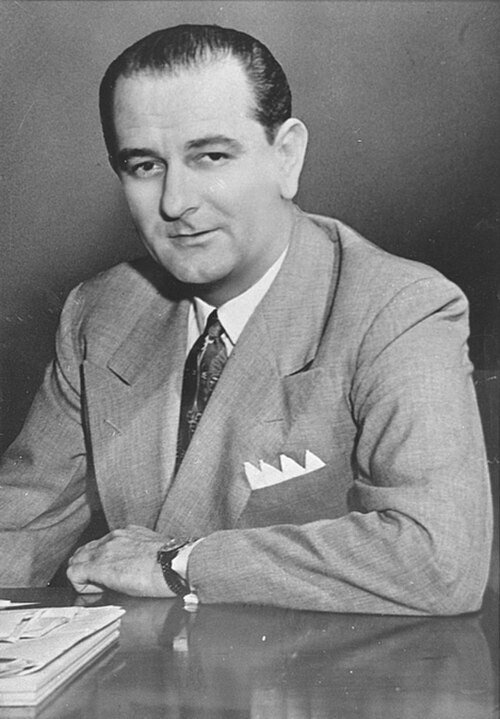
上院議員としての2期の間に、ジョンソンは右傾化した。[64]ジョンソンは、テキサス州の政治的に強力な保守派石油・ガス利権を怒らせないよう慎重に行動する必要があると感じていた。 [65]また、上院の強力な南部議長、特にジョージア州選出の民主党員で、上院を支配していた保守連合内の南部議員連盟のリーダーであるリチャード・ラッセル上院議員の機嫌を取る必要もあった。[ 66 ]ラッセルの支援を受けて、ジョンソンは1951年に民主党院内幹事に選出され、1953年までその職を務めた。[29]院内幹事を務める間、ジョンソンは人々を説得して合意に達する能力を高めていった。[68]
上院州際・外国通商委員会の委員として、彼は共産主義に共感的であるという理由で連邦電力委員会の委員長としてリーランド・オールズの再指名を拒否した上院小委員会の委員長を務めた。 [69]
ジョンソンは上院軍事委員会に任命され[70] 、ソ連との冷戦における国の軍事的備えにますます関心を寄せるようになった。彼は上院準備調査小委員会の委員長となり、防衛費と効率の調査を行った。[71] 1950年に朝鮮戦争が始まると、彼は兵士の増員と武器の改良を求めた。[72]ジョンソンはすべての報告書が委員会で満場一致で承認されるようにした。[73]彼は上院での政治的影響力を利用して、妻の名前で連邦通信委員会から放送免許を取得した。 [61] [74]
上院民主党リーダー

1952年の選挙では、共和党が下院と上院の両方で多数派を獲得した。1953年1月、ジョンソンは民主党の同僚から上院少数党院内総務に選ばれ、この役職に選出された最年少の上院議員となった。[75]彼は年功序列制度を改革し、新人を含むすべての民主党上院議員に良い委員会の割り当てが保証されるようにした。[76]
上院多数党院内総務
1954年、ジョンソンは上院議員に再選され、民主党が上院で多数派を獲得したことで、多数党院内総務となった。[54]ドワイト・D・アイゼンハワー大統領は、ジョンソンがカリフォルニア州の共和党上院議員リーダーであるウィリアム・F・ノウランドよりも協力的であると考えた。特に外交政策に関しては、ジョンソンは大統領に超党派の支援を申し出た。[77] [78]
歴史家のカロとダレックは、ジョンソンを史上最も有能な上院多数党院内総務とみなしている。[79] [80]彼は情報収集に並外れて長けていた。[81]ある伝記作家は、ジョンソンは「ワシントン史上最も優れた情報収集家」であり、各上院議員がどのような問題に対して立っているか、その哲学と偏見、長所と短所、そしてその票を得るために何が必要かを正確に把握していたと述べている。[82] ボビー・ベイカーは、ジョンソンは時々上院議員をNATOへの出張に送り、彼らが不在で反対票を投じられないようにしていたと主張している。[83]ジョンソンの支配の中心は「トリートメント」であり、[84] 2人のジャーナリストは次のように述べている。
治療は 10 分続くこともあれば、4 時間続くこともありました。治療は、ジョンソン牧場のプール、ジョンソンのオフィスの 1 つ、上院のクローク、上院自体のフロアなど、ジョンソンが手の届く範囲に同僚の上院議員を見つける場所ならどこでも、対象者を包み込むように行われました。その口調は、懇願、非難、甘言、熱狂、軽蔑、涙、不満、そしてほのめかしでした。これらすべてが混ざり合っていました。人間の感情の全範囲を網羅していました。その速度は息をのむほどで、すべて一方向でした。対象者からの介入はまれでした。ジョンソンは、介入が口にされる前にそれを予測しました。彼は対象者に近づき、顔をわずか数ミリのところまで近づけ、目を見開いたり細めたり、眉を上げたり下げたりしました。ポケットからは、切り抜き、メモ、統計があふれ出しました。物まね、ユーモア、そして類推の天才が、治療を催眠術のような体験にし、対象者を唖然とさせ、無力にしました。[85]
1956年のスエズ危機の際、ジョンソンは米国政府がイスラエルのシナイ半島侵攻を批判するのを阻止しようとした。[86]国民の多くと同様、ジョンソンはスプートニク1号(最初の人工衛星)の打ち上げによって暗示されたソ連による宇宙探査の支配の脅威に愕然とし、自身の影響力を使って1958年の国家航空宇宙法の成立を確実にし、 NASAを設立した。[52]ジョンソンは上院航空宇宙委員会の設立に尽力し、自ら初代委員長となった。[87]
ジョンソンは多数党院内総務の任期中、1956年の南部宣言に署名せず、[88] [89] 1957年と1960年の公民権法の成立を主導した。これは、再建期の1875年の執行法と公民権法以来、議会を通過した最初の公民権法案であった。[95]ジョンソンは、幅広い公民権問題で予防的救済のための民事訴訟を起こす権限を司法長官に与えたタイトルIIIなど、重要な執行条項を削除することで、北部のリベラル派上院議員とそのような法律に反対していた南部の上院議員陣営との間で中道路線を交渉した。 [ 96 ] [97]南部人であることは大統領候補にとって不可能な障壁とみなされ、 [98]上院議員としての任期の終わりに近づくと、南部宣言に署名しなかっただけでなく、1959年に民主党の西部地域会議に参加することで南部議員連盟からさらに距離を置いた。[100]
1960年のキャンペーン
1960年、ジョンソンは上院での成功により、民主党の大統領候補になる可能性が出てきた。ジェームズ・H・ロウは1959年初頭に選挙活動を開始するよう繰り返しジョンソンに勧めたが、ジョンソンはジョン・F・ケネディ上院議員の立候補によって党内に分裂が生じ、それを利用できるようになると考え、待ったほうがよいと考えた。 [101]ジョンソンの戦略は、予備選挙には参加せず、上院多数党院内総務としての立法実績、南部民主党の支持、民主党上院議員と、側近で下院議長のサム・レイバーンに対する民主党下院議員の好意に頼ることだった。[101] 1960年7月、ジョンソンはついに選挙活動に参加した。ジョンソンの遅い参加とワシントンDCを離れることへの抵抗が相まって、ライバルのジョン・F・ケネディは民主党の州党幹部からの支持を得る上で早い段階でかなりのリードを確保することができた。ジョンソンは、ケネディの愛嬌と知性を、粗野で駆け引きの多い「リンドン圧勝」スタイルと比べて過小評価していた。[102]カロは、ジョンソンが選挙戦に参加するのをためらったのは、負けることへの恐怖からだったと示唆している。[103]
ジョンソンはケネディの若さ、健康状態、マッカーシズムに対する立場の不備を利用しようとしたが、無駄だった。[104]彼はアドレー・スティーブンソン、スチュアート・サイミントン、ヒューバート・ハンフリーと「ケネディ阻止」連合を結成したが、失敗に終わった。ジョンソンは既成民主党員と党指導部の支持を得ていたが、これは国民の支持にはつながらなかった。民主党大会での唯一の投票でジョンソンは409票を獲得し、ケネディは806票だったため、大会はケネディを候補に指名した。ティップ・オニールは当時ケネディの地元マサチューセッツ州の代表で、大会でジョンソンが彼に近づいて「ティップ、最初はケネディを支持しなければならないのは分かっているが、2回目の投票では私と一緒にいてほしい」と言ったことを思い出した。オニールは「上院議員、2回目の投票は行いません」と答えた。[105]
副大統領候補指名
党首らと多くの議論を重ねた後、ケネディは指名された翌朝の7月14日、ロサンゼルスのビルトモア・ホテルでジョンソンに副大統領候補としての指名を申し出、ジョンソンはこれを受諾した。その時点からその夜の実際の指名に至るまで、大会委員長リロイ・コリンズが大会の議事開始に必要な3分の2の多数派を獲得していたかどうかなど、いくつかの事実が争点となっている。[106]ケネディがジョンソンを副大統領候補に選んだのは、南部の票を集めることが意図されていた。[107]ケネディはリベラルなボストン出身でローマカトリック教徒だった。ジョンソンはより保守的で、南部出身でキリストの弟子だった。[108] [109]それにもかかわらず、労働組合指導者らはジョンソンに反対することで一致した。AFL-CIO会長ジョージ・ミーニーはジョンソンを「労働者の大敵」と呼び、イリノイ州AFL-CIO会長ルーベン・ソーダーストロムはケネディが「アメリカ労働運動の指導者たちを馬鹿にした」と主張した。[110] [111]
米国上院議員再選
ジョンソンは副大統領選に出馬すると同時に、米国上院議員の3期目も目指した。ロバート・カロによると:
ジョンソンはケネディ=ジョンソンの連立政権で米国副大統領選挙と上院議員3期目の選挙の両方で勝利した(彼はテキサス州の法律を改正して両方の役職に立候補できるようにした)。副大統領に当選すると、彼は連邦法で義務付けられている通り、1961年1月3日に召集されるとすぐに上院を辞任する準備をした。[112]
ジョンソンは1,306,605票(58%)を獲得し、共和党のジョン・タワーの927,653票(41.1%)を破って上院議員に再選された。同じ民主党員のウィリアム・A・ブレイクリーがジョンソンの後任に任命されたが、 1961年5月の特別選挙でタワーに敗れた。
副大統領(1961年~1963年)

.tif/lossy-page1-1280px-Photograph_of_White_House_Meeting_with_Civil_Rights_Leaders._June_22,_1963_-_NARA_-_194190_(no_border).tif.jpg)
選挙後、ジョンソンは新しい職務の伝統的に非効率的な性質を懸念し、副大統領として割り当てられていない権限を求めた。彼は当初、上院多数党院内総務の権限を副大統領に移譲することを求めたが、副大統領の職務は彼を上院議長にするためであったが、彼が支持者とみなしていた議員を含む民主党議員団からの激しい反対に直面した。[113]
ジョンソンは行政府内での影響力を拡大しようとした。彼はケネディに署名を求める大統領令を起草し、国家安全保障問題に関する「全般的な監督」をジョンソンに与え、すべての政府機関に「これらの任務の遂行において副大統領に全面的に協力する」ことを義務付けた。ケネディの回答は、代わりに国家安全保障政策を「見直す」ようジョンソンに要請する拘束力のない書簡に署名することだった。[114]ケネディは同様に、大統領執務室に隣接するオフィスを与え、ホワイトハウス内に常勤スタッフを雇用するというジョンソンからの初期の要請を断った。[115] 1961年、ケネディはジョンソンの友人サラ・T・ヒューズを連邦判事に任命した。ジョンソンは副大統領就任当初にヒューズを指名しようとしたが失敗した。サム・レイバーン下院議長は、政権法案への支持と引き換えにケネディから任命を取り付けた。
ケネディ大統領の弟で司法長官の ロバート・F・ケネディを含むケネディ大統領のホワイトハウスのメンバーの多くはジョンソンを公然と軽蔑しており、彼の比較的無愛想で粗野な態度を嘲笑していた。当時下院議員のティップ・オニールは、ケネディ兄弟は「ジョンソンに対する軽蔑を隠そうともしなかった...彼らは実際に彼を冷たくあしらうことに誇りを持っていた」と回想している。[116]
ケネディはジョンソンを忙しくさせ、情報を提供し続けるよう努力し、補佐官たちに「ワシントンの記者全員を知っている副大統領に、我々はみんなめちゃくちゃだと言って回らせるわけにはいかない。だから彼を喜ばせておくつもりだ」と語った。 [117]ケネディはジョンソンを大統領雇用機会均等委員会の委員長などの役職に任命し、そこでジョンソンはアフリカ系アメリカ人や他の少数民族と働いた。ケネディはこれを名ばかりの役職にとどめるつもりだったのかもしれないが、テイラー・ブランチは著書『Pillar of Fire』の中で、ジョンソンはケネディ政権の公民権運動をケネディが当初意図していたよりもさらに速く、さらに推進したと主張している。[要出典]
ジョンソンは複数の小規模な外交任務に就き、それによって世界の問題に対する洞察力と自己宣伝の機会を得た。 1961年8月19日〜20日の西ベルリン訪問中、ジョンソンはベルリンの壁建設に憤慨していたベルリン市民をなだめようとした。[118]また、内閣会議や国家安全保障会議にも出席した。ケネディはジョンソンにテキサスに関わる大統領人事の権限を与え、大統領科学特別委員会の委員長に任命した。[119]
ケネディはジョンソンを国家航空宇宙会議の議長にも任命した。ソ連は1961年4月に初の有人宇宙飛行で米国に先んじ、ケネディはジョンソンに米国の宇宙計画を評価し、米国がソ連に追いつくか追い越すことができるようなプロジェクトを勧告する任務を与えた。[120]ジョンソンは1960年代に米国人を月に着陸させることを約束することで米国が指導的役割を担うよう勧告した。[121] [122]ケネディは宇宙計画を優先させたが、ジョンソンの任命は失敗した場合のカバーとなった。[123]
1963年8月、ジョンソンは上院のスキャンダルに巻き込まれた。上院多数党院内総務の秘書でジョンソンの弟子であるボビー・ベイカーが、上院規則委員会の賄賂と金銭的不正の疑いで調査を受けたのだ。証人の1人は、ベイカーが副大統領のために賄賂を渡せるように証人を手配したと主張した。ベイカーは10月に辞職し、調査はジョンソンにまで及ばなかった。しかし、この悪評により、ワシントンではケネディが1964年の大統領選挙で民主党の候補者からジョンソンを外すつもりだという噂が広まった。しかし、1963年10月31日、記者がジョンソンを候補者にとどめるつもりかと尋ねたところ、ケネディは「どちらの質問にもイエス」と答えた。[124]ロバート・ケネディとジョンソンがお互いを嫌っていたことはほぼ間違いないが、[125]ジョンとロバート・ケネディはジョンソンを候補者から外すと南部で大きな損失が出る可能性があるということで一致していた。[126] [127]
大統領職(1963年~1969年)
継承

ケネディ大統領は1963年11月22日、テキサス州ダラスで暗殺された。[128]その日遅く、ジョンソンはエアフォースワン内で大統領就任宣誓を行った。[129]ケネディ夫人が見守る中、セシル・ストートンのジョンソン大統領就任宣誓の象徴的な写真は、大統領専用機内で撮影された写真の中で最も有名なものである。[130] [131]ジョンソン大統領はサラ・T・ヒューズ地方裁判所判事によって宣誓され、現在まで米国史上、女性によって宣誓された唯一の大統領となった。ジョンソン大統領は、悲しみに暮れる国家に安定をもたらすために、暗殺後、権力の移行を即座に見せかける必要があると確信していた。暗殺者が単独行動なのか、より広範な陰謀の一環であるのかわからなかったジョンソン大統領とシークレットサービスは、急いでワシントンD.C.に戻る必要があると感じた。これに対し、ジョンソンは権力の座につくのを急ぎすぎていると主張する者もいた。[128]国民の回答要求と陰謀説の増加に応えて、ジョンソンは最高裁判所長官アール・ウォーレンを委員長とする委員会(ウォーレン委員会)を設立し、ケネディ暗殺事件の捜査を開始した。[132]委員会は広範囲にわたる調査と聴聞会を実施し、リー・ハーヴェイ・オズワルドが単独で暗殺を実行したと全員一致で結論付けた。[133]

ジョンソンは就任すると、現内閣に留任を要請した。[134]ロバート・F・ケネディはジョンソンとの関係が悪かったことで有名だったが、1964年9月に上院議員選挙に出馬するために辞職するまで司法長官に留まった。[135]ジョンソンが引き継いだケネディ内閣メンバーのうち4人、国務長官ディーン・ラスク、内務長官スチュワート・ユダル、農務長官オービル・L・フリーマン、労働長官W・ウィラード・ワーツはジョンソンの任期の最後まで務めた。[136]ロバート・マクナマラ国防長官などケネディの残党はジョンソンの任期中に退任した。ジョンソンには正式な首席補佐官はいなかったが、ウォルター・ジェンキンスがホワイトハウスの日常業務を統括した。ジョンソン大統領の2番目に長い側近だったジョージ・リーディは、 1964年3月にジョン・F・ケネディ大統領のピエール・サリンジャーが報道官の職を辞した後、報道官に就任した。 [137]ホレス・バスビーは主にスピーチライターおよび政治アナリストとして働いた。[138]ビル・モイヤーズはスケジュール管理とスピーチライティングをパートタイムで担当した。[139]
課税と予算
新大統領は、ケネディの主要な立法目標の一つである減税を早急に追求することが有利だと考えた。ジョンソンは、バージニア州のハリー・F・バード上院議員と緊密に協力し、1964年歳入法の圧倒的多数による承認と引き換えに、予算を1000億ドル以下に削減するよう交渉した。この法律は、個人所得税率を全面的に約20%削減し、最高限界税率を91%から70%に引き下げ、法人税率をわずかに引き下げた。[140]長らく停滞していた減税が可決されたことで、公民権法制定に向けた取り組みが促進された。[141]経済が力強く成長した時期であったにもかかわらず、ベトナム戦争と国内プログラムへの多額の支出が予算赤字の拡大を招き、 1970年代まで続くインフレの時期を招いた。 [142]これに対抗するため、ジョンソンは渋々ながら2度目の税制改革法案である1968年歳入・歳出管理法に署名した。この法案には増税と支出削減が組み合わされており、予算黒字を生み出した。[143] [144]
1964年公民権法

1963年11月27日、ジョンソンは議会で「Let Us Continue」演説を行い、「ケネディ大統領が長い間闘ってきた公民権法案の早期成立以上に、大統領の記憶を雄弁に称える追悼演説や弔辞はない」と述べた。[145]暗殺後の国民の悲しみの波は、ケネディの計画を実行するというジョンソンの約束に大きな勢いを与えた。[146]
ジョンソンはロバート・ケネディに連邦議会でこの取り組みの陣頭指揮を執るよう依頼した。これにより、この取り組みが失敗した場合にジョンソンに十分な政治的カバーがもたらされたが、成功すればジョンソンが十分な功績を得ることになる。[147]伝記作家のカロは、ケネディが提出した法案は、過去に公民権法案の通過を阻止したのと同じ戦術に直面していたと指摘している。南部の下院議員と上院議員は、議会の手続きを利用して法案の採決を阻止したのだ。 [148]特に、彼らはケネディが提案し緊急と見なされたすべての主要法案、特に税制改革法案を保留し、法案支持者に撤回を強いた。[148]ジョンソンの公民権法案が下院の議場で採決されるためには、大統領は下院規則委員会の委員長であるハワード・W・スミス下院議員を回避する方法を見つける必要があった。ジョンソンは免責請願書を利用して法案を下院の議場に押し上げた。[149]迂回される恐れが高まる中、規則委員会は法案を承認し、下院本会議に提出し、すぐに290対110の投票で可決した。[150]ジョンソンは、上院多数党院内総務のマイク・マンスフィールドを説得し、下院法案を上院司法委員会とその人種差別主義者の委員長ジェームズ・イーストランドを迂回して上院本会議で直接審議させた。[151]公民権法案を委員会で審議保留にすることはもはや選択肢ではなくなったため、反公民権派の上院議員には議事妨害しか残されていなかった。議事妨害を克服するには、少なくとも20人の共和党議員の支持が必要だったが、彼らの支持は薄れつつあった。彼らの党は、大統領選で法案に反対する候補者を指名しようとしていたからである。[152]カロによれば、ジョンソンは最終的に共和党のリーダーであるエヴェレット・ダークセンを説得して法案を支持しさせ、1964年3月の議事妨害を克服するために必要な共和党の票を集めた。この法案は上院で71対29の投票で可決された。[153] [154]
ジョンソンは7月2日、1964年公民権法に署名し、法律として成立させた。 [154]この法律は、人種、肌の色、国籍、宗教、性別に基づく差別を違法とした。 [155]公共施設での人種差別や雇用差別を禁止し、連邦政府の人種および性別による雇用差別の調査権限を強化した。[156]翌日の夜、ジョンソンは補佐官のビル・モイヤーズに「南部は、君の生涯、そして私の人生の生涯も失ったかもしれない」と語り、ジョンソンの民主党に対する南部白人の反発を予想した。[157] [158]
偉大なる社会

1964年初頭までに、ジョンソンは国内政策を説明するために「偉大なる社会」という名称を使い始めた。ジョンソンの偉大なる社会政策には、都市再開発、近代的な交通機関、クリーンな環境、貧困撲滅、医療改革、犯罪抑制、教育改革などの運動が含まれていた。[ 159]ジョンソンは、政策の成立を確実にするために、議会との関係を前例のないほど重視した。[160]
1964年大統領選挙
1964年春、ジョンソンは大統領に選出される見込みについて楽観視していなかった。[161] 4月に、彼が羽毛布団の問題をめぐる鉄道同胞団と鉄道業界との交渉を自ら指揮することになったとき、重要な変化が起こった。ジョンソンは、ストライキが経済に及ぼす潜在的な影響を両当事者に強調した。特に、権利設定の自由度の向上と国税庁からのより寛大な減価償却控除を大統領から約束された運送業者とのかなりの駆け引きの末、ジョンソンは合意を得た。これにより、彼の自信とイメージは大幅に向上した。[162]
ロバート・F・ケネディはジョンソンの副大統領候補として申し分のない選択だと広く考えられていたが、ジョンソンとケネディは互いに好意を寄せていなかったし、ジョンソンは大統領選でケネディの功績が認められることを恐れ、一貫してその考えに反対していた。[163]ケネディはジョンソンの副大統領候補としての申し出を受け入れるかどうか決めかねていた。その見通しがジョンソンをいらだたせていることを知っていたからだ。バリー・ゴールドウォーターの支持率の低さは、ジョンソンの副大統領候補選びの政治的重要性を低下させると思われていた。[164]ヒューバート・ハンフリーの副大統領選は既定路線となり、中西部と北東部の工業地帯でジョンソンの支持を強めると考えられていた。[165]副大統領職につきもののフラストレーションの度合いを知っていたジョンソンは、ハンフリーの忠誠心を保証するために、インタビューの試練にハンフリーを通した。決断を下した後、彼はメディアの憶測と報道を最大限にするため、最後の瞬間まで報道機関に発表しなかった。[166]
アトランティックシティでの民主党大会に備えて、ジョンソンはFBIに30人の捜査官を派遣して大会の活動を監視するよう要請した。この部隊の目的は、ホワイトハウスのスタッフに妨害行為があれば通報することだった。この部隊の焦点は、州内で定期的に選出される白人隔離主義者の代表団を追い出そうとするミシシッピ自由民主党(MFDP)代表団に絞られた。この部隊の活動には、マーティン・ルーサー・キングの部屋、学生非暴力調整委員会(SNCC)、人種平等会議(CORE)への盗聴が含まれていた。部隊の任務は、最初から最後まで、大統領やその他の高官を危険にさらす可能性のある妨害行為を監視するという形で慎重に表現されていた。[167]
ジョンソンは、MFDPと人種差別主義者代表団の資格審査で明らかになった人種間の緊張がメディアで報道されることで政治的なダメージを受ける可能性を非常に懸念し、ハンフリーにその問題に対処するよう指示した。[168]大会の資格審査委員会は、MFDP代表団のうち2名をオブザーバーとして代表団に迎えることを宣言し、「人種や肌の色を理由に投票権を奪われている州からの代表団の今後の派遣を禁止する」ことに同意した。[169] MFDPは委員会の裁定を拒否した。大会はジョンソンが切望していた個人的な勝利となったが、MFDPの疎外によって生じた裏切り感は、ジョンソンと民主党に対する左派の不満を誘発した。SNCC議長ジョン・ルイスはこれを「公民権運動の転換点」と呼んだ。[170]

1964年の大統領選挙運動の初期には、南部からの強力な支持を得てバリー・ゴールドウォーターが有力候補と見られ、公民権法の成立に対する反応としてジョンソンが予測していた通り、南部がジョンソンの立場を脅かした。しかし、選挙運動が進むにつれてゴールドウォーターは勢いを失った。1964年9月7日、ジョンソンの選挙運動幹部は「デイジー広告」を放送した。デイジーの花びらを摘む少女の姿に続いてカウントダウンと核爆弾の爆発が描かれた。伝えられたメッセージは、ゴールドウォーターを選出すると核戦争の危険があるというものだった。ゴールドウォーターの選挙運動メッセージは、支持者が掲げた「心の中では彼が正しいと分かっている」というバンパーステッカーに最もよく象徴されていた。反対派は「心の中では彼がそうするかもしれないと分かっている」や「根性で彼はおかしいと分かっている」と書かれたバンパーステッカーでジョンソンの選挙運動の精神をとらえた。[171] CIA長官ウィリアム・コルビーは、トレイシー・バーンズがCIAにゴールドウォーター陣営をスパイするよう指示し、共和党全国委員会にジョンソン陣営に情報を提供するよう指示したと主張した。 [172]ジョンソンは61.05%の得票率で圧勝し、史上最高の得票率となった。[173]当時、これは20世紀で最大の得票率差でもあり、1595万票以上だったが、後に現職大統領ニクソンが1972年に勝利したことで上回られた。[174]選挙人団では、ジョンソンが486対52の差でゴールドウォーターを破った。ジョンソンは44州で勝利し、ゴールドウォーターは6州だった。有権者はまた、1936年のフランクリン・ルーズベルト大統領の選挙以来最大の議会多数派をジョンソンに与えた。上院では68対32の多数派、下院では295対140の民主党の差であった。[175]
投票権法

1964年の選挙後すぐに、南部キリスト教指導者会議(SCLC)や学生非暴力調整委員会(SNCC)などの公民権団体が、人種的マイノリティの投票権を保護するための連邦政府の行動を要求し始めた。[176] 1965年3月7日、これらの団体はセルマからモンゴメリーへの行進を開始し、セルマの住民はアラバマ州の州都モンゴメリーまで行進し、投票権の問題を訴え、ジョージ・ウォレス知事に不満を訴えた。最初の行進で、デモ参加者は州警察と郡警察に阻止され、群衆に催涙ガスを発射し、抗議者を踏みつけた。この場面のテレビ映像は「血の日曜日」として知られるようになり、全国で怒りを巻き起こした。[177]急速に高まる政治的圧力に応えて、ジョンソンは直ちに議会に投票権法案を提出し、議会の合同会議でアメリカ国民に演説することを決定した。彼は次のように始めた。
今夜、私は人間の尊厳と民主主義の運命について語ります。両党のあらゆるメンバー、あらゆる宗教や肌の色のアメリカ人、この国のあらゆる地域の人々に、この大義のために私に加わるようお願いします。... いつの時代も、問題がアメリカ自身の秘密の心を露わにすることはめったにありません。成長や豊かさ、福祉や安全ではなく、愛する国家の価値、目的、意義に対する挑戦に直面することはめったにありません。アメリカ黒人の平等な権利の問題はそのような問題です。そして、もし私たちがすべての敵を打ち負かし、富を倍増し、星々を征服したとしても、この問題にまだ平等でなければ、私たちは国民として、そして国家として失敗したことになります。なぜなら、国家も個人と同じように、「人は全世界を手に入れても、自分の魂を失ったら何の得があるだろうか」からです。[177] [178]
ジョンソンとダークセンは、 1965年投票権法を支持する強力な超党派同盟を結成し、上院の議事妨害で法案が否決される可能性を排除した。1965年8月、下院は333対85の投票で法案を承認し、上院は79対18の投票で法案を可決した。 [179]この画期的な法律は投票における差別を禁止し、何百万人もの南部の黒人が初めて投票することができた。その結果は顕著で、1968年から1980年の間に、州および連邦公職に選出された南部の黒人の数はほぼ2倍になった。[178]ミシシッピ州では、アフリカ系アメリカ人の有権者登録率が1964年から1967年の間に6.7%から59.8%に上昇し、アフリカ系アメリカ人の有権者登録率がより広範に上昇したことを反映している。[180]
公民権運動家ビオラ・リウッツォの殺害後、ジョンソンはテレビに出演し、彼女の死に関与したとされるクー・クラックス・クランの4人の男の逮捕を発表した。彼は怒りを込めてクランを「偏屈者の隠れた社会」と非難し、「手遅れになる前にまともな社会に戻る」よう警告した。ジョンソンはユリシーズ・グラント以来、クランのメンバーを逮捕し起訴した最初の大統領となった。[b] [181]彼はキリスト教の救済というテーマに目を向け、公民権運動を推進し、教会からの支援を動員した。[182] 1965年6月4日のハワード大学卒業式の演説で、彼は政府と国家の両方がこれらの目標の達成に協力する必要があると述べた。「法律と公的慣行の壁だけでなく、肌の色によって多くの人の状況を制限している壁を永遠に打ち砕くこと。所有者を軽視し、偉大な民主主義を分裂させ、神の子供たちに不当な、大きな不当な行為をする古くからの心の敵意を、できる限り解消すること...」[183]
公正住宅法
1968年公民権法の一部である公正住宅法は、いくつかの形態の住宅差別を違法とし、多くのアフリカ系アメリカ人が郊外に移住することを事実上認めた。[184]ジョンソンは1966年4月に議会に法案を提出し、住宅所有者が人種を理由に契約を拒否することを禁じた。この法案は、過去2つの主要な公民権法案を支持していた北部の人々の多くから直ちに反対を集めた。[185]この法案の一部は下院を通過したものの、上院の承認を得られず、ジョンソンにとって初の大きな立法上の敗北となった。[186]この法律は、1968年4月4日のマーティン・ルーサー・キング・ジュニアの暗殺と、それに続く全国的な市民の暴動の後、新たな勢いを得た。 [187]この法案は4月10日に議会を通過し、ジョンソンによってすぐに法律として署名された。[187] [188]
「貧困との戦い」

1964年の一般教書演説でジョンソンは「今日、今ここで、この政権はアメリカの貧困に対する無条件戦争を宣言する。我々の目的は貧困の症状を和らげるだけでなく、それを治すこと、そして何よりも、貧困を防ぐことである」と述べた。 [189] 1964年4月、ジョンソンは1964年経済機会法案を提案した。これは、貧困層への援助を担う地方のコミュニティ活動機関(CAA)を監督する経済機会局(OEO)を設置するものだった。[190]各CAAは、地域住民から「可能な限り最大限の参加」を得ることを義務付けられ、住民は地域のニーズに合わせた貧困対策プログラムを設計し、運営することになった。[191]これは、CAAをOEOによって資金提供され、奨励される、自らの地域の代替権力構造と見なしていた地方政治体制にとって脅威であった。[192] [193] [194] 1967年、グリーン修正条項により、市政府にその地域の公式CAAを決定する権利が与えられました。その結果、市民参加改革運動は停止しました。[195] [196]
経済機会法により、ジョブ・コープと、平和部隊の国内版であるアメリコープVISTAが創設された。[197]民間保全部隊(CCC)をモデルにしたジョブ・コープは、低所得で危険にさらされている若者に学問的および職業的スキルを提供する、寄宿制の教育および職業訓練プログラムであった。 [198] [199] VISTAは、文盲、不適切な住宅、健康状態の悪さなどの問題に対処するために、全国のコミュニティプロジェクトにボランティアを派遣した。 [198] 1965年末までに、2,000人のボランティアが参加した。 [ 200]この法律は、政府が貧困層に経済的機会を提供することで彼らを最もよく助けることができるというジョンソンの信念を反映していた。[201]
ジョンソン政権下では、国内の貧困は大幅に減少し、貧困ライン以下の生活を送るアメリカ人の割合は 23 パーセントから 12 パーセントに減少した。[3]ジョンソンは貧困撲滅に向けたさらなる取り組みとして、都市再生計画「デモンストレーション都市計画」を実施した。この計画の対象となるには、都市は「荒廃と衰退を食い止め、都市全体の発展に多大な影響を与える」準備ができていることを示す必要があった。ジョンソンは年間 4 億ドル、合計 24 億ドルの投資を要請した。1966 年後半、議会は大幅に削減された 9 億ドルの計画を可決し、ジョンソンは後にこれをモデル都市計画と呼んだ。ニューヨーク タイムズ紙は22 年後に、この計画は大部分が失敗だったと報じた。[202]
医療改革

ジョンソンが医療改善のために最初に取り組んだのは、心臓病、がん、脳卒中に関する委員会(HDCS)の設立だった。これらの疾患は1962年に全米の死亡原因の71%を占めていた。[203]
1965年、ジョンソンは社会保障制度下の高齢者向け病院保険に焦点を移した。[204]この制度はメディケアと呼ばれ、下院歳入委員会の委員長であるウィルバー・ミルズ下院議員が中心となって開始した。共和党の反対を減らすため、ミルズはメディケアを3層構造にすることを提案した。社会保障制度下の病院保険、医師の診察のための任意保険プログラム、そして貧困者向けの医療福祉プログラムであるメディケイドである拡大版である。[205]この法案は4月8日に110票差で下院を通過した。上院での取り組みはかなり複雑であったが、メディケア法案は7月28日に議会を通過した。[206]現在、メディケアは数千万人のアメリカ人をカバーしている。[207]
移民
_-_restoration1.jpg/500px-President_Lyndon_B._Johnson_Signing_of_the_Immigration_Act_of_1965_(02)_-_restoration1.jpg)
1965年の包括的な移民国籍法は、国の移民制度を改革し、西ヨーロッパと西半球以外の国からの移民を制限していた国籍方式を廃止した。年間の移民流入率は1965年から1970年の間に2倍になり、1990年までにさらに2倍になり、アジアとメキシコを含むラテンアメリカからの移民が劇的に増加した。[61]学者たちはこの法律をジョンソンの功績とはあまり考えていない。ジョンソンは1952年のマッカレン・ウォルター法を支持していたが、この法律は改革派に不評だったからである。[208]
教育に対する連邦政府の資金援助

ジョンソン自身はテキサス州の公教育によって貧困から抜け出すことができたが、教育はアメリカンドリームの重要な要素であり、特にマイノリティにとっては不可欠であると信じていた。[209]彼は教育を偉大なる社会政策の最優先事項とし、貧しい子供たちの支援に重点を置いた。1964年の選挙での圧勝に勢いづいたジョンソンは、1965年初めに初等中等教育法(ESEA)を提案した。これは連邦政府の教育支出を40億ドルから80億ドルに倍増するものだった。[210]この法案はすぐに議会の両院で大差で可決された。[211] ESEAはすべての学区への資金を増額したが、貧困家庭の生徒の割合が高い学区により多くの資金が配分されるようにした。[212]
ESEAはK-12教員組合の間でジョンソンの支持を固めたが、高等教育法も新しい基金も、ベトナム戦争で不安を募らせていた大学教授や学生たちをなだめることはできなかった。[213] [214]ジョンソンの2番目の主要な教育プログラムは1965年の高等教育法であり、大学への連邦資金の増額、奨学金の創設、学生への低金利ローンの提供、教員団の設立を行った。 [215]ジョンソンはまた、恵まれない家庭の子供たちが公立学校で成功できるように準備するための早期教育プログラムであるヘッドスタートを設立した。[216] 1967年、ジョンソンは放送ネットワークを補完する教育テレビ番組を制作するための公共放送法に署名した。 [217]
1965年、ジョンソンは文学、歴史、法律の研究や音楽、絵画、彫刻などの芸術を支援するために、全米人文科学基金と全米芸術基金を設立した。 [218]
交通機関
1966年3月、ジョンソンは議会に運輸省の設立を含む運輸省の設置を盛り込んだ運輸省のメッセージを送った。運輸省は商務省運輸局、道路局、連邦航空局、沿岸警備隊、海事局、民間航空委員会、州際通商委員会から構成される。この法案は航行計画に関する交渉を経て上院を通過したが、下院では海事権益に関する交渉を経て可決され、1965年10月15日に署名された。[219]
環境

大統領在任中、ジョンソンは300を超える環境保護措置を法律として署名し、現代の環境保護運動の法的根拠を形成した。[220]彼は、ケネディ大統領が提案した1963年の大気浄化法に署名して法律とした。大気浄化法は、大気汚染物質の固定排出者に対する排出基準を設定し、連邦政府の資金を大気質研究に充てることを定めた。[221] 1965年、この法律は自動車大気汚染防止法に改正され、連邦政府は新しい自動車やエンジンからの汚染物質の排出を制御するための国家基準を確立し、施行するよう指示された。 [222] 1964年9月、ジョンソンは荒野法に署名し、国立荒野保護システムを設立し(910万エーカーの森林地帯を産業開発から保護する)[223] [224] 、連邦および州立公園として使用される土地の購入を支援する土地水資源保全基金を設立する法律に署名した。[225] [226]
1965年、ファーストレディのバード・ジョンソン夫人は、先頭に立って高速道路美化法の可決を訴えた。[227]この法律は、国内で拡大を続ける州間高速道路システムと既存の連邦補助幹線道路システムに沿った屋外広告の規制、特定の種類の標識の撤去を求めた。また、州間高速道路や幹線道路沿いの特定の廃品置き場の撤去または遮蔽を義務付け、景観の向上と沿道の開発を奨励した。[228]
銃規制
ジョンソンはロバート・ケネディ暗殺後の1968年6月6日にすでに銃規制法案を提出していたが、レディ・バード・ジョンソンの報道官リズ・カーペンターは大統領宛てのメモで、国が「大げさなドラマで洗脳されている」ことを懸念し、ジョンソンは「暴力の問題」に対処する「迅速な劇的な行動」を必要としていると述べた。10月、ジョンソンは1968年銃規制法に署名したが、兄のロバート・ケネディの記憶を呼び起こすことはなかった。歴史家のジェフ・シェソルは、この省略はジョンソンのロバートに対する長年の軽蔑が動機だったと主張している。[229]この法案は、有罪判決を受けた重罪犯、麻薬使用者、精神障害者が拳銃を購入することを禁止し、記録保管と免許の要件を強化した。[230]また、ライフルと散弾銃の通信販売も禁止した。 [231]
都市暴動
_(cropped).jpg/500px-Newark_Riots_1967_(305517077)_(cropped).jpg)
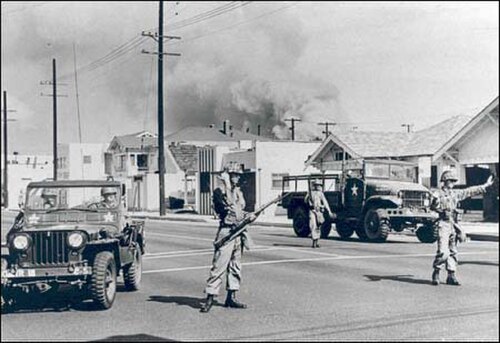
ジョンソン政権時代に、国内は「長く暑い夏」の一連の市民の不安を経験した。それは1964年のハーレム暴動、そして1965年のロサンゼルスのワッツ地区暴動から始まった。市民権向上の勢いは、ワッツ暴動で突然止まった。34人が死亡し、3500万ドル(2023年では3億3839万ドルに相当)の財産が損害を受けた後、国民は暴動が他の都市に拡大することを恐れ、ジョンソンの政策計画における追加プログラムへの意欲を失った。[232] [233]
「 1967年の長く暑い夏」として知られるこの時期に、アメリカ全土で150件以上の暴動が勃発した。[234]ボストン・グローブ紙はこれを「黒人アメリカ人の白人アメリカ人に対する革命であり、長年の不満を解消するための暴力的な請願」と呼んだ。[235]ニューアーク暴動では26人が死亡、1,500人が負傷した。[235]デトロイト暴動では43人が死亡、2,250人が負傷、4,000人が逮捕され、数百万ドル相当の物的損害が発生した。ジョージ・ロムニー知事は、放火、略奪、企業や警察への攻撃を鎮圧するために7,400人の州兵を派遣した。ジョンソンは最終的に戦車と機関銃を備えた連邦軍を派遣した。[236] 1967年8月2日の閣議で、ラムジー・クラーク司法長官は、ニューアークとデトロイトでの狙撃事件の状況からもわかるように、訓練も規律もない地方警察と州兵が「路上でのゲリラ戦」を引き起こす可能性があると警告した。[237] [238] [239] [240]
ジョンソンの人気は、白人による大規模な政治的反発が形づくられるにつれて急落し、ジョンソンが主要都市の街頭と自身の政党の統制を失ったという印象を強めた。[241]大統領は、都市部の市民暴動の頻発の原因を調査するため、イリノイ州知事オットー・カーナーを委員長とするカーナー委員会を設置した。[61]委員会の1968年の報告書は、人種統合を促進し貧困を軽減するための立法措置を提案し、国家は「黒人社会と白人社会という、分離した不平等な2つの社会に向かっている」と結論付けた。[242]ジョージ・クリスチャン報道官によると、ジョンソンは暴動に驚かず、「何を予想していたんだ?... 300年間、男の首に足を乗せて押さえつけ、その後放したら、男は何をするのか? 頭を叩きのめすだろう」と語った。[243]
ジョンソンに対する反発(1966年~1967年)
1966年、報道機関はジョンソンが記者会見で語っていることとベトナム戦争で実際に起こっていることの間に信頼性のギャップを感じ取り、ジョンソンとその政権に対する報道は不利になった。[244]
1966年末までに、ミズーリ州の民主党知事ウォーレン・E・ハーンズは、ジョンソンが1964年に50万票差で勝利したにもかかわらず、10万票差で同州を失うだろうと警告した。「ベトナム戦争に対する不満、連邦政府の支出と…課税が多すぎること、偉大なる社会計画に対する国民の支持が薄いこと、そして…公民権プログラムに対する国民の失望」が大統領の地位を蝕んでいると知事は報告した。[245]明るい兆しもあった。1967年1月、ジョンソンは賃金が史上最高、失業率が13年ぶりの低水準、企業利益と農業収入がかつてないほど高いことを自慢した。消費者物価の4.5%上昇は懸念すべきことで、金利の上昇も同様だった。ジョンソンは支出増加によって増大する赤字を補うため、一時的に所得税に6%の上乗せを求めた。ジョンソンの支持率は50%を下回った。 1967年1月までに、彼の強力な支持者の数は4か月前の25パーセントから16パーセントに急落した。
自身の人気が下がった理由を問われ、ジョンソンは「私は支配的な性格で、物事を成し遂げても必ずしも全ての人々を満足させるわけではない」と述べた。[246]ジョンソンはまた、報道機関が「完全に無責任で嘘をつき、事実を誤って伝え、誰に対しても説明責任を負わない」と述べ、彼に敵対する「説教師、リベラル派、教授」を非難した。[247]
1966年の議会選挙では、共和党が上院で3議席、下院で47議席を獲得し、保守連合が活性化したため、ジョンソンが偉大なる社会法案をさらに可決することが困難になった。しかし、議会は最終的に、政権の偉大なる社会プログラムのほぼ96パーセントを可決した。[248]
宇宙計画

ジョンソン政権下でNASAはジェミニ有人宇宙計画を実施し、サターンVロケットとその打ち上げ施設を開発し、アポロ計画初の有人飛行の準備を整えた。1967年1月27日、アポロ1号の乗組員全員が発射台での宇宙船試験中に客室火災で死亡し、アポロ計画が中止されたとき、国民は衝撃を受けた。ジョンソンはウォーレンのような委員会を新たに設置する代わりに、NASAに独自の調査を行うよう求めるジェームズ・E・ウェッブ長官の要請を受け入れた。 [249]
Johnson maintained his staunch support of Apollo through Congressional and press controversy, and the program recovered. The first two crewed missions, Apollo 7 and the first crewed flight to the Moon, Apollo 8, were completed by the end of Johnson's term. He congratulated the Apollo 8 crew, saying, "You've taken ... all of us, all over the world, into a new era."[250][251] On July 16, 1969, Johnson attended the launch of the first Moon landing mission Apollo 11, becoming the first former or incumbent U.S. president to witness a rocket launch.[252]
Vietnam War

The Vietnam War began in 1955 as Communist forces started operating in South Vietnam. By the time Johnson took office, there were 16,700 American military personnel in South Vietnam.[253] Despite some misgivings, Johnson ultimately came to support escalation of the U.S. role in Vietnam.[254] Like the vast majority of American leaders in the mid-1960s, he was determined to prevent the spread of Communism.[255] Johnson's decision to escalate was also influenced heavily by reputation. Under pressure from pro-war politicians like Barry Goldwater, Johnson feared that if he made the decision to not stand firm in Vietnam he would lose domestic political credibility as well as contribute to a decline in the international reputation of the U.S.[256] On October 11, 1963, President Kennedy had signed NSAM 263 ordering the withdrawal of 1,000 military personnel by the end of the year following recommendations of the McNamara–Taylor mission report.[257][258][259] On November 26, Johnson signed NSAM 273 which reaffirmed the Kennedy administration withdrawal approval and continued support for South Vietnam.[260][261] In August 1964, ambiguous evidence suggested two U.S. destroyers had been attacked by North Vietnamese torpedo boats in international waters in the Gulf of Tonkin. Although Johnson very much wanted to keep discussions about Vietnam out of the 1964 election campaign, he felt forced to respond to the supposed Communist aggression. He obtained from Congress the Gulf of Tonkin Resolution on August 7, 1964, giving blanket congressional approval for use of military force to repel future attacks.[262]

Johnson decided on a systematic bombing campaign, which became known as Operation Rolling Thunder, in February 1965 after an attack by Viet Cong guerrillas on Pleiku Air Base, killing eight Americans.[264] The U.S. would continue to bomb North Vietnam until late 1968.[265] In March 1965, McGeorge Bundy called for American ground operations; Johnson agreed and also quietly changed the mission from defensive to offensive operations.[266] On March 8, 1965, 3,500 troops went ashore near Da Nang, the first time U.S. combat forces had been sent to mainland Asia since the Korean War.[267] In June, South Vietnamese Ambassador Maxwell D. Taylor reported that the bombing offensive against North Vietnam had been ineffective and that the South Vietnamese army was outclassed and in danger of collapse.[268] In late July, McNamara and Johnson's top advisors recommended an increase in U.S. soldiers from 75,000 to over 200,000.[269] Johnson agreed but felt boxed in by unpalatable choices. If he sent additional troops he would be attacked as an interventionist, and if he did not, he thought he risked being impeached.[270] By October 1965, there were over 200,000 troops deployed in Vietnam.[271] Throughout 1965, few members of Congress or the administration openly criticized Johnson's handling of the war.[272]

In early 1966, Senator Robert F. Kennedy harshly criticized Johnson's bombing campaign, stating that the U.S. may be headed "on a road from which there is no turning back, a road that leads to catastrophe for all mankind."[273] Soon thereafter, the Senate Foreign Relations Committee, chaired by Senator James William Fulbright, held televised hearings examining the administration's Vietnam policy.[274] In July, polling results indicated that Americans favored the bombing campaign by a five-to-one margin; however, in August a Defense Department study indicated that the bombing campaign was having minimal impact on North Vietnam.[275] By late 1966, multiple sources began to report progress was being made against the North Vietnamese logistics and infrastructure; Johnson was urged to begin peace discussions. English philosopher Bertrand Russell initiated the International War Crimes Tribunal to condemn the American effort.[276] The gap with Hanoi, however, was an unbridgeable demand on both sides for a unilateral end to bombing and withdrawal of forces.[277] Johnson grew more and more anxious about justifying war casualties, and talked of the need for decisive victory, despite the unpopularity of the cause.[278] By the end of 1966, it was clear that the air campaign and the pacification effort had both failed, and Johnson agreed to McNamara's new recommendation to add 70,000 troops in 1967 and the CIA's recommendations to increased bombings against North Vietnam.[279] The bombing escalation ended secret talks being held with North Vietnam, but U.S. leaders did not consider North Vietnamese intentions in those talks to be genuine.[280]

By the middle of 1967 nearly 70,000 Americans had been killed or wounded in the war, which was being commonly described in the news media and elsewhere as a "stalemate."[281] In January and February, probes were made to assess North Vietnamese's willingness to discuss peace, but they fell on deaf ears. Ho Chi Minh declared that the only solution was a unilateral U.S. withdrawal.[282] A Gallup, Inc. poll in July 1967 showed that 52 percent of Americans disapproved of the president's handling of the war, and only 34 percent thought progress was being made.[283] Nonetheless, Johnson agreed to an increase of 55,000 troops, bringing the total to 525,000.[284] In August, Johnson, with the Joint Chiefs' support, decided to expand the air campaign and exempted only Hanoi, Haiphong and a buffer zone with China from the target list.[285] Later that month McNamara told a Senate subcommittee that an expanded air campaign would not bring Hanoi to the peace table. The Joint Chiefs were astounded, and threatened mass resignation; McNamara was summoned to the White House for a three-hour dressing down. Nevertheless, Johnson had received reports from the CIA confirming McNamara's analysis at least in part. In the meantime an election establishing a constitutional government in the South was concluded and provided hope for peace talks.[286]
With the war arguably in a stalemate and in light of the widespread disapproval of the conflict, Johnson convened a group of veteran government foreign policy experts, informally known as "the Wise Men": Dean Acheson, General Omar Bradley, George Ball, McGeorge Bundy, Arthur Dean, C. Douglas Dillon, Abe Fortas, Averell Harriman, Henry Cabot Lodge, Robert Daniel Murphy, and Maxwell D. Taylor.[287] They unanimously opposed leaving Vietnam, and encouraged Johnson to "stay the course."[288] Afterward, on November 17, in a nationally televised address, the president assured the American public, "We are inflicting greater losses than we're taking...We are making progress." Less than two weeks later, Robert McNamara announced his resignation as Defense Secretary. Behind closed doors, he had begun regularly expressing doubts over Johnson's war strategy, angering the president. He joined a growing list of Johnson's top aides who resigned over the war, including Bill Moyers, McGeorge Bundy, and George Ball.[273][289] In October, with ever-increasing public protests against the war, Johnson engaged the FBI and the CIA to investigate, monitor, and undermine anti-war activists.[290] In mid-October, there was a demonstration of 100,000 at the Pentagon; Johnson and Dean Rusk were convinced that foreign communist sources were behind the demonstration, but that was refuted in the CIA's findings.[291]
Tet Offensive

On January 30, 1968, the Viet Cong and the North Vietnamese Army began the Tet Offensive against South Vietnam's five largest cities, including Saigon. While the Tet Offensive failed militarily, it was a psychological victory, definitively turning American public opinion against the war effort. In February 1968, influential news anchor Walter Cronkite of CBS News expressed on the air that the conflict was deadlocked and that additional fighting would change nothing. Johnson reacted, saying "If I've lost Cronkite, I've lost middle America".[292] Indeed, demoralization about the war was everywhere; 26 percent then approved of Johnson's handling of Vietnam, while 63 percent disapproved.[293] College students and others protested, burned draft cards, and chanted, "Hey, hey, LBJ, how many kids did you kill today?"[294]
The Tet Offensive convinced senior leaders of the Johnson administration, including the "Wise Men" and new Defense Secretary Clark Clifford, that further escalation of troop levels would not help bring an end to the war.[295] Johnson was initially reluctant to follow this advice, but ultimately agreed to allow a partial bombing halt and to signal his willingness to engage in peace talks.[296] On March 31, 1968, Johnson announced that he would halt the bombing in North Vietnam, while at the same time announcing that he would not seek re-election.[297] He also escalated U.S. military operations in South Vietnam in order to consolidate control of as much of the countryside as possible before the onset of serious peace talks.[298] Talks began in Paris in May, but failed to yield any results.[299] Two of the major obstacles in negotiations were the unwillingness of the United States to allow the Viet Cong to take part in the South Vietnamese government, and the unwillingness of North Vietnam to recognize the legitimacy of South Vietnam.[300] In October 1968, when the parties came close to an agreement on a bombing halt, Republican presidential nominee Richard Nixon intervened with the South Vietnamese, promising better terms so as to delay a settlement on the issue until after the election.[301] Johnson sought a continuation of talks after the 1968 election, but the North Vietnamese argued about procedural matters until after Nixon took office.[302]
Dominican Republic
Like President Kennedy, Johnson sought to isolate Cuba, which was under the rule of the Soviet-aligned Fidel Castro.[303]
In 1965, the Dominican Civil War broke out between the government of President Donald Reid Cabral and supporters of former President Juan Bosch.[304] On the advice of Abe Fortas, Johnson dispatched over 20,000 Marines to the Dominican Republic.[305] Their role was not take sides but to evacuate American citizens and restore order. The U.S. also helped arrange an agreement providing for new elections. Johnson's use of force in ending the civil war alienated many in Latin America, and the region's importance to the administration receded as Johnson's foreign policy became increasingly dominated by the Vietnam War.[304]
Soviet Union

Though actively engaged in containment in Southeast Asia, the Middle East and Latin America, Johnson made it a priority to seek arms control deals with Moscow.[306] The Soviet Union also sought closer relations to the United States during the mid-to-late 1960s, partly due to the increasingly worse Sino-Soviet split. Johnson attempted to reduce tensions with China by easing restrictions on trade, but the beginning of China's Cultural Revolution ended hopes of a greater rapprochement.[307] Johnson was concerned with averting the possibility of nuclear war, and he sought to reduce tensions in Europe.[308] The Johnson administration pursued arms control agreements with the Soviet Union, signing the Outer Space Treaty and the Treaty on the Non-Proliferation of Nuclear Weapons, and laid the foundation for the Strategic Arms Limitation Talks.[306] Johnson held a largely amicable meeting with Soviet Premier Alexei Kosygin at the Glassboro Summit Conference in 1967, and in July 1968 the United States, Britain, and the Soviet Union signed the Non-Proliferation Treaty, in which each signatory agreed not to help other countries develop or acquire nuclear weapons. A planned nuclear disarmament summit between the United States and the Soviet Union was scuttled after Soviet forces violently suppressed the Prague Spring, an attempted democratization of Czechoslovakia.[309]
Surveillance of Martin Luther King
Johnson continued the FBI's wiretapping of Martin Luther King Jr. authorized by the Kennedy administration under Attorney General Robert F. Kennedy.[310] Johnson also authorized the tapping of phone conversations of others, including the Vietnamese friends of a Nixon associate.[311]
International trips

Johnson made eleven international trips to twenty countries during his presidency.[312] He flew five hundred twenty-three thousand miles (841,690 km) aboard Air Force One while in office. His October 1966 visit to Australia sparked demonstrations from anti-war protesters.[313] One of the most unusual international trips in presidential history occurred before Christmas 1967. The President began the trip by going to the memorial for Australian Prime Minister Harold Holt, who was presumed drowned in a swimming accident. The White House did not reveal in advance to the press that the President would make the first round-the-world presidential trip. The trip was twenty-six thousand nine hundred fifty-nine miles (43,386.3 km) completed in only 112.5 hours (4.7 days). Air Force One crossed the equator twice, stopped at Travis Air Force Base, in Honolulu, Pago Pago, Canberra, Melbourne, Vietnam, Karachi, and Rome.[citation needed]
1968 presidential election

As he had served less than two years of President Kennedy's term, Johnson was constitutionally eligible for election to a second full term in the 1968 presidential election.[314][315] Despite Johnson's growing unpopularity, conventional wisdom held that it would be impossible to deny re-nomination to a sitting president.[316] In September 1967 Johnson openly admitted he was considering dropping out of the race for re-election.[317] Johnson won a narrow victory in the New Hampshire presidential primary on March 12,[318] but in a March 31 speech, Johnson shocked the nation when he announced he would not run for re-election by concluding with the line: "I shall not seek, and I will not accept, the nomination of my party for another term as your president".[319] The next day, his approval ratings increased from 36 percent to 49 percent.[320]
Historians have debated the factors that led to Johnson's surprise decision. Shesol says Johnson wanted out of the White House but also wanted vindication; when the indicators turned negative he decided to leave.[321] Woods writes that Johnson realized he needed to leave in order for the nation to heal.[322] Dallek says that Johnson had no further domestic goals, and realized that his personality had eroded his popularity. His health was not good, and he was preoccupied with the Kennedy campaign; his wife was pressing for his retirement and his base of support continued to shrink. Leaving the race would allow him to pose as a peacemaker.[323] Bennett, however, says Johnson "had been forced out of a reelection race in 1968 by outrage over his policy in Southeast Asia."[324] Johnson may also have hoped that the convention would ultimately choose to draft him back into the race.[325]
Vice President Hubert Humphrey entered the race after Johnson's withdrawal, making the 1968 Democratic primaries a three-way contest between Humphrey, Kennedy, and McCarthy. Kennedy cut into McCarthy's liberal and anti-war base, while also winning the support of the poor and working class. He won a series of primary victories, but was assassinated in June by Sirhan Sirhan, an Arab nationalist.[326] With Johnson's support, Humphrey won the presidential nomination at the tumultuous 1968 Democratic National Convention, held in Chicago in late August. Violent police attacks against anti-war protesters in Chicago marred the convention.[327]
Humphrey's polling numbers improved after a September 30 speech in which he broke with Johnson's war policy, calling for an end to the bombing of North Vietnam.[328] In what was termed the October surprise, Johnson announced to the nation on October 31, 1968, that he had ordered a complete cessation of "all air, naval and artillery bombardment of North Vietnam", effective November 1, should the North Vietnamese government be willing to negotiate and citing progress with the Paris peace talks.
Republican nominee Richard Nixon won the election.[328]
Judicial appointments

Johnson appointed Justices Abe Fortas (1965) and Thurgood Marshall (1967) to the Supreme Court of the United States. Johnson anticipated court challenges to his legislative measures in 1965 and thought it advantageous to have a "mole" in the Supreme Court to provide him with inside information, as he was able to get from the legislative branch. Abe Fortas in particular Johnson thought could fill the bill. The opportunity arose when an opening occurred for ambassador to the UN, with Adlai Stevenson's death; Associate Justice Arthur Goldberg accepted Johnson's offer to transfer to the UN position. Johnson insisted on Fortas assuming Goldberg's seat, over Fortas's wife's objection that it was too early in his career.[329] When Earl Warren announced his retirement in 1968, Johnson nominated Fortas to succeed him as Chief Justice of the United States, and nominated Homer Thornberry to succeed Fortas as associate justice. However, Fortas's nomination was filibustered by senators, and neither nominee was voted upon by the full Senate.[citation needed]
Post-presidency (1969–1973)
On Inauguration Day (January 20, 1969), Johnson saw Nixon sworn in, then got on the plane to fly back to Texas. When the front door of the plane closed, Johnson pulled out a cigarette — his first cigarette he had smoked since his heart attack in 1955. One of his daughters pulled it out of his mouth and said, "Daddy, what are you doing? You're going to kill yourself." He took it back and said, "I've now raised you, girls. I've now been President. Now it's my time!" From that point on, he went into a very self-destructive spiral.
— Historian Michael Beschloss[330]
After leaving the presidency in January 1969, Johnson went home to his ranch in Stonewall, Texas, accompanied by former aide and speechwriter Harry J. Middleton, who would draft Johnson's first book, The Choices We Face, and work with him on his memoirs, The Vantage Point: Perspectives of the Presidency 1963–1969, published in 1971.[331] That year, the Lyndon Baines Johnson Library and Museum opened on the campus of The University of Texas at Austin. He donated his Texas ranch in his will to the public to form the Lyndon B. Johnson National Historical Park, with the provision that it "remain a working ranch and not become a sterile relic of the past".[332]

Johnson gave Nixon high grades in foreign policy, but worried that his successor was being pressured into removing U.S. forces from South Vietnam before the South Vietnamese were able to defend themselves. "If the South falls to the Communists, we can have a serious backlash here at home," he warned.[333]
During the 1972 presidential election, Johnson only reluctantly endorsed Democratic nominee George McGovern, a senator from South Dakota; McGovern had long opposed Johnson's foreign and defense policies. Johnson wanted to attend the Democratic National Convention, but was advised not to attend as he would not be welcome. The McGovern nomination and platform dismayed him. Nixon could be defeated, Johnson insisted, "if only the Democrats don't go too far left".[334] Johnson felt Edmund Muskie would be more likely to defeat Nixon; however, he declined to try to stop McGovern receiving the nomination as he felt his unpopularity within the Democratic Party was such that anything he said was more likely to help McGovern. Johnson's protégé John Connally had served as President Nixon's Secretary of the Treasury and then stepped down to head "Democrats for Nixon", a group funded by Republicans. It was the first time that Connally and Johnson were on opposite sides of a general election campaign.[335]
Personal life
Marriage and children
On November 17, 1934, Johnson married Claudia Alta "Lady Bird" Taylor from Karnack, Texas. The two first met after he attended Georgetown University Law Center in Washington, D.C. for one semester.[336] During their first date, Johnson asked her to marry him; many dates later, she finally agreed.[337] The wedding was officiated by Arthur R. McKinstry at St. Mark's Episcopal Church in San Antonio.[338] They had two daughters: Lynda Bird in 1944 and Luci Baines in 1947. Johnson gave his children names with the LBJ initials; his dog was named Little Beagle Johnson, and his home was the LBJ Ranch in the Texas Hill Country. His initials were on his cufflinks, ashtrays, and clothes.[339] During his marriage, Johnson had affairs with "numerous"[340] women, including socialite Alice Marsh, who was considered, outside his marriage, his most important relationship.[340]
Health
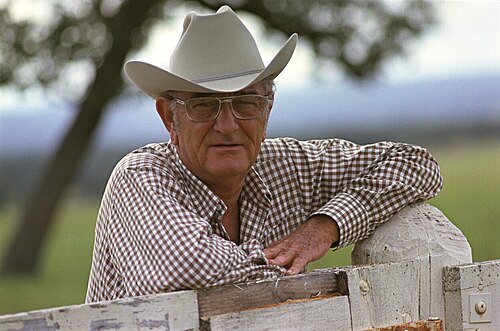
On July 2, 1955, at age 46, Johnson, a 60-cigarette-per-day smoker, suffered a near-fatal heart attack, which inspired him to discontinue smoking. Five months later, Johnson's doctors reported he had made "a most satisfactory recovery".[341][342]
Johnson likely suffered a second heart attack following President Kennedy's assassination, but the diagnosis released to the public was that he had an angina attack.[343]
On November 8, 1965, Johnson underwent surgery at Bethesda Naval Hospital to remove his gallbladder and a kidney stone. After the procedure, Johnson's doctors reported that the president had come through the surgery "beautifully as expected."[344] He was able to resume his duties the following day, and he met with reporters a couple of days later to reassure the nation that he was recovering well. Although Johnson was incapacitated during surgery, there was no transfer of presidential power to Vice President Humphrey.[345][346] In March 1970, Johnson suffered an attack of angina and was taken to Brooke Army General Hospital in San Antonio. He had gained more than 25 pounds (11 kg) since leaving the White House; he now weighed around 235 pounds (107 kg) and was urged to lose considerable weight. Johnson had also resumed smoking shortly before Christmas 1971, having not smoked since his near-fatal heart attack in July 1955.[334] The following summer, again gripped by chronic chest pains, he lost 15 pounds (6.8 kg) in less than a month on a crash diet.[citation needed]
In April 1972, Johnson had another major heart attack while visiting his daughter, Lynda, in Virginia. "I'm hurting real bad",[334] he confided to friends. The chest pains returned nearly every afternoon — jolting pains that left him frightened and breathless. A portable oxygen tank was kept by his bed, and he periodically interrupted what he was doing to lie down and don the mask. He continued to smoke heavily and, although nominally on a low-calorie, low-cholesterol diet, kept to it only intermittently. Meanwhile, he began to experience severe abdominal pains, diagnosed as diverticulosis. His heart condition rapidly worsened and surgery was recommended. Johnson flew to Houston to consult with heart specialist Michael DeBakey, where he learned his condition was terminal. DeBakey found that despite two of Johnson's coronary arteries being in urgent need of a coronary bypass, the former president's heart was in such poor condition that he likely would have died during surgery.[333]
Death and funeral


Johnson recorded an hour-long television interview with newsman Walter Cronkite at his ranch on January 12, 1973, in which he discussed his legacy, particularly about the civil rights movement. He was still smoking heavily, and told Cronkite that it was better for his heart "to smoke than to be nervous".[347]
At approximately 3:40 P.M. Central on January 22, 1973, Johnson suffered his final heart attack in his bedroom. He managed to telephone the Secret Service agents on the ranch, who found him still holding the telephone receiver, unconscious and "appear[ing] to be dead".[348] They attempted resuscitation, and Johnson was airlifted in one of his planes to San Antonio International Airport, en route to Brooke Army Medical Center. However, cardiologist and Army colonel George McGranahan pronounced him dead on arrival at the airport at 4:33 P.M. Johnson was 64.[348]
Shortly after the former president was pronounced dead, Johnson's press secretary Tom Johnson (no relation) telephoned Cronkite to tell him. Cronkite was anchoring CBS Evening News live at the moment Johnson reached him, which enabled him to report on President Johnson's death as he received direct information.[349] Nixon mentioned Johnson's death in a speech he gave the day after Johnson died, announcing the peace agreement to end the Vietnam War.[350][351]
Funeral
After lying in repose at his presidential library, Johnson was honored with a state funeral. Texas Congressman J. J. Pickle and former Secretary of State Dean Rusk eulogized him when he lay in state at the Capitol.[352][353] The funeral took place on January 25 at the National City Christian Church in Washington, D.C., where he had often worshiped as president. The service was presided over by President Nixon and attended by foreign dignitaries, led by Eisaku Satō, who had served as Japanese prime minister during Johnson's presidency.[354] Eulogies were given by George Davis, the church's pastor, and W. Marvin Watson, Johnson's last Postmaster General and a longtime advisor.[355]
Johnson was buried in his family's private cemetery at the house in which he was born. Eulogies were given by former Texas governor Connally and Billy Graham, the minister who officiated at the burial rites. The state funeral, the last for a president until Richard Nixon's in 1994, was part of an unexpectedly busy week in Washington, beginning with Richard Nixon's second inauguration following the 1972 election.[356] As Johnson died only two days after the inauguration,[353][356] the remainder of the ceremonies surrounding the inauguration were cancelled to allow for a full state funeral.[356] It also meant that Johnson's casket traveled the entire length of the Capitol, entering through the Senate wing when taken into the Rotunda to lie in state and exiting through the House wing steps due to inauguration construction on the East Front steps.[353]
Personality and public image
According to biographer Randall Woods, Johnson posed in many different roles:
"Johnson the Son of the Tenant Farmer, Johnson the Great Compromiser, Johnson the All-Knowing, Johnson the Humble, Johnson the Warrior, Johnson the Dove, Johnson the Romantic, Johnson the Hard-Headed Pragmatist, Johnson the Preserver of Traditions, Johnson the Crusader for Social Justice, Johnson the Magnanimous, Johnson the Vindictive or Johnson the Uncouth, LBJ the Hick, Lyndon the Satyr, and Johnson the Usurper".[357]
Johnson had his particular brand of persuasion, known as "The Johnson Treatment".[358] "There was no more powerful majority leader in American history," biographer Robert Dallek writes. Dallek stated that Johnson had biographies on all the senators, knew what their ambitions, hopes, and tastes were and used it to his advantage in securing votes. Another Johnson biographer noted, "He could get up every day and learn what their fears, their desires, their wishes, their wants were and he could then manipulate, dominate, persuade and cajole them." As president, Johnson vetoed 30 bills; no other president in history vetoed so many bills and never had a single one overridden by Congress. He was often seen as an ambitious, tireless, and imposing figure who was ruthlessly effective at getting legislation passed. He typically worked 18- to 20-hour days without a break and had no regular leisure activities. He stood 6 feet 3.5 inches (1.918 m) tall.[359][360][361]
Johnson's cowboy hat and boots reflected his Texas roots and love of the rural hill country. From 250 acres (100 ha) of land that he was given by an aunt in 1951, he created a 2,700-acre (1,100 ha) working ranch with 400 cattle. The National Park Service keeps a herd descended from Johnson's and maintains the ranch property.[362]
Biographer Randall Woods argues that Social Gospel themes Johnson learned from childhood allowed him to transform social problems into moral problems. This helps explain his longtime commitment to social justice, and explicitly inspired his foreign-policy approach to Christian internationalism and nation-building. For example, in a 1966 speech he quoted at length from the Social Creed of the Methodist Church, adding "It would be very hard for me to write a more perfect description of the American ideal."[363]
Legacy
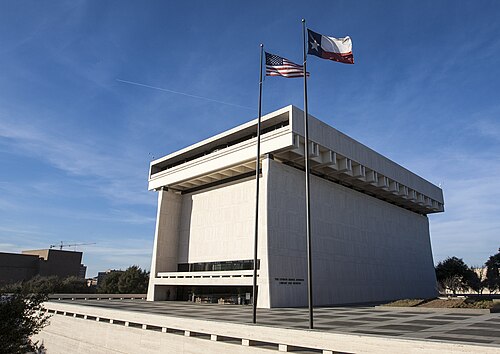
Scholars have viewed Johnson through the lens of both his legislative achievements and his lack of success in the Vietnam War. His overall rating among historians has remained relatively steady, and his average ranking is higher than any of the eight presidents who followed him, although similar to Reagan and Clinton.[364] In public polling of presidential favorability of Johnson and the presidents who succeeded him Johnson tends to appear more toward the bottom of lists, typically excepting George W. Bush and Richard Nixon, and sometimes Gerald Ford.
Historian Kent Germany explains:
The man who was elected to the White House by one of the widest margins in U.S. history and pushed through as much legislation as any other American politician now seems to be remembered best by the public for succeeding an assassinated hero, steering the country into a quagmire in Vietnam, cheating on his saintly wife, exposing his stitched-up belly, using profanity, picking up dogs by their ears, swimming naked with advisers in the White House pool, and emptying his bowels while conducting official business. Of all those issues, Johnson's reputation suffers the most from his management of the Vietnam War, something that has overshadowed his civil rights and domestic policy accomplishments and caused Johnson himself to regret his handling of "the woman I really loved — the Great Society."[365]
Memorials
The Manned Spacecraft Center in Houston was renamed the Lyndon B. Johnson Space Center in 1973,[366] and the United States Department of Education headquarters was named after Johnson in 2007.[367] The Lyndon B. Johnson School of Public Affairs at the University of Texas at Austin was named in his honor, as is the Lyndon B. Johnson National Grassland. Also named for him are schools in Austin and Laredo, Texas; Melbourne, Florida; and Jackson, Kentucky. Interstate 635 in Dallas is named the Lyndon B. Johnson Freeway. The Lyndon Baines Johnson Memorial Grove on the Potomac was dedicated in 1976.
Johnson was awarded the Presidential Medal of Freedom posthumously in 1980.[368] Texas created a state holiday on August 27 to mark Johnson's birthday, known as Lyndon Baines Johnson Day.[369]
Major legislation signed
- 1963: Clean Air Act[370]
- 1963: Higher Education Facilities Act[371][372]
- 1963: Vocational Education Act[373]
- 1964: Civil Rights Act
- 1964: Urban Mass Transportation Act
- 1964: Wilderness Act
- 1964: Nurse Training Act[374]
- 1964: Food Stamp Act
- 1964: Economic Opportunity Act
- 1964: Housing Act[375]
- 1965: Higher Education Act
- 1965: Older Americans Act
- 1965: Coinage Act
- 1965: Social Security Act
- 1965: Voting Rights Act
- 1965: Immigration and Nationality Services Act
- 1966: Animal Welfare Act
- 1966: Freedom of Information Act
- 1967: Age Discrimination in Employment Act[376]
- 1967: Public Broadcasting Act
- 1968: Architectural Barriers Act
- 1968: Bilingual Education Act
- 1968: Civil Rights Act
- 1968: Gun Control Act
Significant regulatory changes
Works
- National Aeronautics and Space Act (1962)[377]
- Choices We Face (1969)[378]
- The Vantage Point (1971)[379]
See also
- Box 13 scandal
- Family of Lyndon B. Johnson
- Electoral history of Lyndon B. Johnson
- History of the United States (1945–1964)
- History of the United States (1964–1980)
- Holocaust Museum Houston
- Johnson Doctrine
- List of presidents of the United States
- List of presidents of the United States by previous experience
- Lyndon B. Johnson School of Public Affairs
- Lyndon Baines Johnson Library and Museum on the campus of the University of Texas in Austin
- Lyndon B. Johnson in popular culture
- Presidents of the United States on U.S. postage stamps
- Zephyr Wright
Notes
- ^ Johnson was vice president under John F. Kennedy and became president upon Kennedy's assassination on November 22, 1963. As this was prior to the adoption of the Twenty-fifth Amendment in 1967, a vacancy in the office of vice president was not filled until the next ensuing election and inauguration.
- ^ President Grant, on October 17, 1871, suspended habeas corpus in nine South Carolina counties, sent in troops, and prosecuted the Klan in the federal district court.
References
- ^ "Lyndon Baines Johnson, 37th Vice President (1961–1963)". US Senate. Archived from the original on July 24, 2019. Retrieved October 5, 2019.
- ^ "Biographies of Presidents – Lyndon Johnson". The Presidents of the USA. Retrieved February 26, 2021.
- ^ a b Dallek, Robert. "Presidency: How Do Historians Evaluate the Administration of Lyndon Johnson?". History News Network. Archived from the original on January 9, 2021. Retrieved June 17, 2010.
- ^ "Survey of Presidential Leadership – Lyndon Johnson". C-SPAN. Archived from the original on February 9, 2011. Retrieved June 17, 2010.
- ^ "Lyndon B. Johnson National Historical Park: LBJ Ranch District" (PDF). National Park Service. Retrieved June 5, 2017.
- ^ "JOHNSON, REBEKAH BAINES". Texas State Historical Association. June 15, 2010. Retrieved June 5, 2017.
- ^ Johnson, Rebekah Baines (1965). A Family Album. McGraw Hill.
- ^ Beschloss, Michael (December 2001). "Lyndon Johnson on the Record". Texas Monthly. Retrieved July 29, 2024.
- ^ Beschloss, Michael (January 21, 2013). "Lyndon Johnson on the Record". Texas Monthly. Retrieved July 31, 2024.
- ^ Newlon, Clarke (1970). L. B. J., the man from Johnson City. Dodd, Mead. p. 224. ISBN 978-0-396-04983-8.
- ^ "George Washington Baines". Baylor University. Retrieved June 5, 2017.
- ^ "Religion and President Johnson". Lyndon Baines Johnson Library and Museum. Archived from the original on December 5, 2000. Retrieved December 4, 2013.
- ^ Banta, Joseph (January 1964). "President Lyndon B. Johnson". The Christadelphian. 101: 26.
- ^ a b Braver, Rita (January 22, 2023). "LBJ and his monumental presidency". CBS News. Retrieved January 22, 2023.
- ^ Greenbaum, Patty; Lewis, Lisa; Drake, Anne; Loven, Zazel, eds. (1990). Yearbook. New York, NY: Dolphin. p. 89. ISBN 978-0-385-41625-2.
- ^ Woods (2006), pp. 44–48
- ^ The Student Editorials of Lyndon Baines Johnson. LBJ Common Experience, Paper 1. 1968. Archived from the original on March 4, 2012. Retrieved October 12, 2014.
- ^ Van Oudekerke, Rodney (2011). Historic San Marcos: An Illustrated History. San Antonio, TX: Historical Publishing Network. p. 73. ISBN 978-1-9353-7740-5 – via Google Books.
- ^ Fredericks, Janet Patricia (1982). "I". The Educational Views of Lyndon Baines Johnson Prior to His Presidency (PhD). Loyola University Chicago. p. 6.
- ^ "President Lyndon B. Johnson's Biography". Lyndon Baines Johnson Library and Museum. Archived from the original on January 18, 2012. Retrieved December 4, 2013.
- ^ "Remarks at Southwest Texas State College Upon Signing the Higher Education Act of 1965". Lyndon Baines Johnson Library and Museum. Archived from the original on July 14, 2007. Retrieved April 11, 2006.
- ^ Woods (2006), pp. 69, 73–75
- ^ Woods (2006), pp. 76–80
- ^ Woods (2006), pp. 87–88
- ^ Woods (2006), pp. 89–90
- ^ Woods (2006), p. 131
- ^ Caro (1982), p. 275
- ^ Caro, Robert. The Path to Power. Location 15443 (Kindle edition).
- ^ a b "JOHNSON, Lyndon Baines – Biographical Information". Biographical Directory of the United States Congress. Retrieved October 6, 2008.
- ^ "Lyndon B. Johnson: Life in Brief". Miller Center. October 4, 2016.
- ^ "Johnson, Lyndon B. (Lyndon Baines) 1908-1973". Wilson Center.
- ^ "Biography: Lyndon B. Johnson". LBJ Presidential Library.
 This article incorporates text from this source, which is in the public domain.
- ^ Dallek (1991), pp. 170–174
- ^ Mellen, Joan (2016). Faustian Bargains Lyndon Johnson and Mac Wallace in the Robber Baron Culture of Texas. p. 7.
- ^ Currinder, Marian (February 7, 2019). "What LBJ can teach new Congress members about gaining power in the House". Vox. Retrieved August 22, 2024.
- ^ Caro (2002), Ch. 31. The Compassion of Lyndon Johnson.
- ^ Dallek (1991), p. 289.
- ^ a b c d e f g h i Sweany, Brian D. (February 2006). "Texas History 101". Texas Monthly. Retrieved May 29, 2023.
- ^ "TX US Senate - Special Election Race - Jun 28, 1941". Our Campaigns. Retrieved May 29, 2023.
- ^ a b c Dallek (1991), p. 327
- ^ "TSHA | O'Daniel, Wilbert Lee [Pappy]". www.tshaonline.org. Retrieved May 29, 2023.
- ^ Tolchin, Martin; Times, Special To the New York (February 11, 1990). "How Johnson Won Election He'd Lost". The New York Times. ISSN 0362-4331. Retrieved May 29, 2023.
- ^ LBJ Library Staff. "PRESIDENT LYNDON B. JOHNSON'S MILITARY SERVICE". University of Texas. Archived from the original on November 19, 2000. Retrieved August 7, 2015.
- ^ Dallek (1991), pp. 235–245
- ^ a b c LBJ's medal for valour 'was sham' The Guardian, July 6, 2001
- ^ a b c d "In-Depth Specials – The story behind Johnson's Silver Star". CNN. Archived from the original on June 13, 2008. Retrieved October 6, 2008.
- ^ Tillman, Barrett; Sakaida, Henry (April 2001). "Silver Star Airplane Ride". US Naval Institute. Retrieved February 14, 2024.
- ^ Weintz, Steve (December 24, 2013). "War and Forgiveness". War Is Boring. Retrieved February 8, 2016.
- ^ Dallek (1991), p. 235
- ^ Dallek (1991), p. 237
- ^ Veterans Health Administration. "List of Presidents who were Veterans". va.gov. Retrieved February 8, 2016.
- ^ a b "Biography Lyndon B. Johnson". LBJ Presidential Library.
- ^ Texas State Historical Association (1949). "Texas Almanac, 1949-1950". The Portal to Texas History. The Dallas Morning News. p. 474. Retrieved March 24, 2022.
- ^ a b c "Lyndon B. Johnson: Life Before the Presidency". Miller Center. October 4, 2016.
- ^ Caro 1990 p. 231.
- ^ Caro 1990 p. 225.
- ^ Dallek 1991, pp. 318–319, 321.
- ^ Dallek 1991, pp. 319, 321.
- ^ Dale Baum and James L. Hailey (Autumn 1994). "Lyndon Johnson's Victory in the 1948 Texas Senate Race: A Reappraisal". Political Science Quarterly. 109 (4): 595–613. doi:10.2307/2151840. JSTOR 2151840.
To the east in neighboring Jim Wells County – home of the notorious Box 13, which happened to be the only box in the county dominated by Parr's operatives – LBJ managed to acquire, according to the estimates, a four-percentage-point net gain over Stevenson, or about only 387 votes (of which at least two hundred were patently fraudulent).
- ^ Caro (1990), pp. 360–361
- ^ a b c d Frum, David (2000). How We Got Here: The '70s. New York City: Basic Books. ISBN 978-0-465-04195-4.
- ^ Woods (2006), p. 217
- ^ Dallek (1991), p. 346
- ^ Zeitz, Joshua (2019). Building the Great Society: Inside Lyndon Johnson's White House. Penguin Publishing Group. p. 13.
- ^ Patterson (1996), p. 530.
- ^ Caro (2002), Ch. 7. A Russell of the Russells of Georgia.
- ^ Mayer, Michael S. (2009). The Eisenhower Years. p. 356.
- ^ Schultz, Randy (2002). Lyndon B. Johnson. p. 22.
- ^ Caro (2002), Ch. 10-12.
- ^ "Johnson, Lyndon B. (Lyndon Baines), 1908-1973". LBJ Presidential Library.
- ^ The American Presidents. Grolier Incorporated. 1992. p. 171.
- ^ Dallek (1991), pp. 394–396.
- ^ "Bipartisan Quadrille - Concord Historical Society". January 23, 2018.
- ^ Caro, Robert A. (December 18, 1989). "The Johnson Years: Buying And Selling". The New Yorker.
- ^ Patterson (1996), p. 529.
- ^ Mayer, Michael S. (2009). The Eisenhower Years. p. 357.
- ^ "Lyndon B. Johnson Master of the Senate". United States Senate. This article incorporates text from this source, which is in the public domain.
- ^ Goldfield, David (2014). "Border Men: Truman, Eisenhower, Johnson, and Civil Rights". The Journal of Southern History. 80 (1): 7–38. JSTOR 23796842 – via JSTOR.
- ^ Dallek (1998), p. 6.
- ^ "The Years of Lyndon Johnson III: Master of the Senate". Robert A Caro - author's site. Retrieved August 27, 2024.
- ^ Shesol, Jeff. Mutual Contempt. p. 12.
- ^ Woods (2006), p. 262
- ^ "LBJ". American Experience. Archived from the original on September 30, 2011. Retrieved October 12, 2014.
- ^ "The New York Times, The Johnson Treatment: Lyndon B. Johnson and Theodore F. Green". Afterimagegallery.com. Archived from the original on October 5, 2008. Retrieved October 6, 2008.
- ^ Evans, Rowland; Novak, Robert (1966). Lyndon B. Johnson: The Exercise of Power. [New York] New American Library. p. 104.
- ^ "The Future Foretold: Lyndon Baines Johnson's Congressional Support for Israel". University of Texas at Austin.
- ^ "Senate Papers of Lyndon B. Johnson, 1949-1961". LBJ Presidential Library.
- ^ Badger, Tony (1999). "Southerners Who Refused to Sign the Southern Manifesto". The Historical Journal. 42 (2). Cambridge University Press: 517–534. doi:10.1017/S0018246X98008346. JSTOR 3020998. S2CID 145083004.
- ^ "Senate – March 12, 1956" (PDF). Congressional Record. 102 (4). U.S. Government Printing Office: 4459–4461. Retrieved April 12, 2023.
- ^ "LBJ (Parts 1–2)". American Experience. Season 4. Episode 1. September 30, 1991. PBS. WGBH. Retrieved November 14, 2022.
- ^ "JFK (Part 1)". American Experience. Season 25. Episode 7. November 11, 2013. PBS. WGBH. Retrieved September 24, 2019.
- ^ "Senate – August 7, 1957" (PDF). Congressional Record. 103 (10). U.S. Government Printing Office: 13900. Retrieved February 18, 2022.
- ^ "Senate – August 29, 1957" (PDF). Congressional Record. 103 (12). U.S. Government Printing Office: 16478. Retrieved February 18, 2022.
- ^ "Senate – April 8, 1960" (PDF). Congressional Record. 106 (6). U.S. Government Printing Office: 7810–7811. Retrieved February 18, 2022.
- ^ [90][91][92][93][94]
- ^ "Biography Lyndon B. Johnson". LBJ Presidential Library. This article incorporates text from this source, which is in the public domain.
- ^ "Lyndon B. Johnson Master of the Senate". United States Senate.
- ^ Mayer, Michael S. (2009). The Eisenhower Years. p. 359.
- ^ Caro (2002), Ch. 5. The Path Ahead.
- ^ "National Affairs: Go West, Lyndon". Time Magazine. Retrieved August 29, 2024.
- ^ a b Robert A. Caro (2014). "Chapter 1 The Prediction". The Passage of Power: The Years of Lyndon Johnson. ISBN 9780679405078.
- ^ Dallek (1991), p. 560
- ^ Caro 2012, Part I (passim).
- ^ Dallek (1991), p. 570
- ^ Farrell, John A. (2001). Tip O'Neill and the Democratic Century: A Biography. Little, Brown. ISBN 978-0-316-26049-7.
- ^ Dallek (1991), pp. 578–582
- ^ "Lyndon B. Johnson". LBJ Presidential Library.
- ^ Lawrence, WH (July 15, 1960). "Johnson is Nominated for Vice President; Kennedy Picks Him to Placate the South". New York Times. Retrieved October 6, 2015.
- ^ "LBJ". PBS American Experience.
- ^ Caro (2012), p. 406
- ^ Soderstrom, Carl; Soderstrom, Robert; Stevens, Chris; Burt, Andrew (2018). Forty Gavels: The Life of Reuben Soderstrom and the Illinois AFL-CIO. 3. Peoria, IL: CWS Publishing. pp. 175–176. ISBN 978-0-9982575-3-2.
- ^ Caro (2002), p. 1035
- ^ "Vice Presidents of the United States – Lyndon B. Johnson (1963)" (PDF). United States Senate. Retrieved December 1, 2013.
- ^ Caro (2012), pp. 170–171
- ^ Caro (2012), p. 172
- ^ O'Neill, Tip; Novak, William (1987). Man of the House: The Life and Political Memoirs of Speaker Tip O'Neill. New York: Random House. p. 182. ISBN 978-0-394-55201-9.
- ^ Caro (2012), p. 176
- ^ Andreas Daum, Kennedy in Berlin. New York: Cambridge University Press, 2008, pp. 51‒57.
- ^ Dallek (1998), p. 15
- ^ Kennedy to Johnson, "Memorandum for Vice President" Archived January 31, 2017, at the Wayback Machine, April 20, 1961.
- ^ Johnson to Kennedy, "Evaluation of Space Program" Archived November 6, 2017, at the Wayback Machine, April 28, 1961.
- ^ Ben Evans, Foothold in the Heavens: The Seventies (2010) p. 193.
- ^ Dallek (1998), p. 16
- ^ "Kennedy Denied Talk of Dropping Johnson". The New York Times, November 23, 1963, p. 9.
- ^ Jeff Shesol, Mutual Contempt: Lyndon Johnson, Robert Kennedy and the Feud that Defined a Decade (1998).
- ^ Dallek (1998), pp. 42–44
- ^ Sean J. Savage, JFK, LBJ, and the Democratic Party (2012). pp. 196–197.
- ^ a b Dallek (1998), pp. 49–51.
- ^ Morison, Samuel Eliot (1965). The Oxford History of the American People. New York: Oxford University Press. pp. 1121–1122. LCCN 65-12468.
- ^ terHorst, Jerald F.; Albertazzie, Col. Ralph (1979). The Flying White House: the story of Air Force One. Coward, McCann & Geoghegan. ISBN 978-0-698-10930-8.
- ^ Walsh (2003), pp. xv, 2, 17, 73–78
- ^ Dallek (1998), p. 51.
- ^ Max Holland, Max. "The Key to the Warren Report." American Heritage 46.7 (1995): 50–59 online.
- ^ "Lyndon B. Johnson's Cabinet". Austin, Texas: The Lyndon Baines Johnson Presidential Library. Retrieved July 6, 2017.
- ^ Dallek (1998), p. 58.
- ^ Onion, Rebecca (November 22, 2013). "'I Rely On You. I Need You.' How LBJ Begged JFK's Cabinet To Stay". Slate. New York City: The Slate Group.
- ^ Dallek (1998), p. 66
- ^ Dallek (1998), p. 67
- ^ Dallek (1998), p. 68
- ^ Bernstein (1996), pp. 37–38
- ^ Dallek (1998), pp. 73–74.
- ^ Mackenzie and Weisbrot (2008), p. 318
- ^ Zelizer (2015), pp. 300–302.
- ^ The Balance https://www.thebalance.com/us-deficit-by-year-3306306
- ^ "1963 Year in Review – Transition to Johnson". UPI. November 19, 1966. Retrieved December 21, 2011.
- ^ Walsh (2003), p. 78
- ^ Dallek (1998), p. 115
- ^ a b Caro (2012), p. 459
- ^ Caro (2012), p. 462
- ^ Dallek (1998), p. 116
- ^ Zelizer (2015), pp. 101–102.
- ^ Caro (2012), p. 463
- ^ Caro (2012), p. 465
- ^ a b Schlesinger, Arthur Jr. (2002) [1978]. Robert Kennedy And His Times. pp. 644–645.
- ^ "Evaluating the success of the Great Society". The Washington Post.
- ^ Zelizer, pp. 128–129.
- ^ Kaiser, Charles (January 23, 2023). "'We may have lost the south': what LBJ really said about Democrats in 1964". The Guardian. Retrieved February 20, 2023.
- ^ Dallek (1998), p. 120
- ^ Dallek (1998), pp. 81–82.
- ^ Patterson (1996), pp. 530–532.
- ^ Dallek (1998), p. 127
- ^ Dallek (1998), pp. 124–126
- ^ Dallek (1998), pp. 135–137
- ^ Dallek (1998), pp. 140–142
- ^ Dallek (1998), p. 157
- ^ Dallek (1998), pp. 157–159
- ^ Dallek (1998), pp. 161–163
- ^ Dallek (1998), p. 164
- ^ Dallek (1998), p. 165
- ^ Lewis, John; D'Orso, Michael (1998). Walking with the Wind: A Memoir of the Movement. Harcourt Brace. ISBN 978-0-15-600708-5.
- ^ Dallek (1998), p. 170
- ^ Usdin, Steve (May 22, 2018). "When the CIA Infiltrated a Presidential Campaign Politico". Politico.
- ^ Leip, David. Dave Leip's Atlas of U.S. Presidential Elections
- ^ Dallek (1998), p. 182
- ^ Dallek (1998), p. 184
- ^ Williams, Juan (2002). Eyes on the Prize: America's Civil Rights Years, 1954–1965. New York, NY: Penguin Books. p. 253. ISBN 0-14-009653-1.
- ^ a b May, Gary (March 6, 2015). ""The American Promise" — LBJ's Finest Hour". BillMoyers.com. Retrieved August 11, 2017.
- ^ a b Dallek (1998), p. 218.
- ^ Mackenzie and Weisbrot (2008), pp. 175–176
- ^ Zelizer (2015), p. 228.
- ^ McFeely (2002), Grant: A Biography, pp. 369–371.
- ^ Woods (2006), pp. 759–787
- ^ Public Papers of the Presidents of the United States: Lyndon B. Johnson, 1965. Volume II, entry 301, pp. 635–640. (1966)
- ^ Fletcher, Michael (May 18, 2014). "Great Society at 50: Prince George's illustrates domestic programs' impact — and limits". The Washington Post. Retrieved August 21, 2016.
- ^ Zelizer (2015), pp. 235–236.
- ^ Zelizer (2015), pp. 244–246.
- ^ a b Kotz, Nick (2005). "14. Another Martyr". Judgment days: Lyndon Baines Johnson, Martin Luther King, Jr., and the laws that changed America. Boston: Houghton Mifflin. p. 417. ISBN 0-618-08825-3.
- ^ Risen, Clay (April 2008). "The Unmaking of the President: Lyndon Johnson believed that his withdrawal from the 1968 presidential campaign would free him to solidify his legacy". Smithsonian Magazine. pp. 3, 5 and 6 in online version. Archived from the original on January 4, 2013. Retrieved July 18, 2012.
- ^ Bornet (1983), pp. 54–55
- ^ Zelizer (2015), pp. 132–134.
- ^ G. Calvin Mackenzie and Robert Weisbrot. The Liberal Hour: Washington and the Politics of Change in the 1960s. p. 102.
- ^ G. Calvin Mackenzie and Robert Weisbrot. The Liberal Hour: Washington and the Politics of Change in the 1960s. p. 103.
- ^ Mayor Daley on the Community Action Program The Miller Center
- ^ "LBJ and Senator Richard Russell on the Community Action Program Archived 2016-06-06 at the Wayback Machine," audio recording Jun 02, 1966: conversation excerpt (President Johnson and Georgia Sen. Richard Russell express dislike and distrust of Community Action Program), Conversation Number: WH6606.01 #10205, The Miller Center
- ^ Tolbert, Jovita A. "A Brief History of Community Action" (PDF). NASCSP. Archived from the original (PDF) on March 28, 2016.
- ^ Gillette, Michael L. (2010). Launching the War on Poverty: An Oral History. Oxford University Press. pp. 235–236.
- ^ Zelizer (2015), pp. 135–136.
- ^ a b "Economic Opportunity Act". Encyclopedia Britannica.
- ^ "Job Corps". USA.gov.
- ^ "Volunteers in Service to America". Encyclopedia Britannica.
- ^ Patterson (1996), pp. 535, 538–539.
- ^ Dallek (1998), pp. 320–322
- ^ Dallek (1998), p. 204
- ^ Dallek (1998), p. 205
- ^ Dallek (1998), p. 208
- ^ Dallek (1998), p. 209
- ^ "Medicare Celebrates 35 Years of Keeping Americans Healthy". Archived from the original on July 14, 2008. Retrieved January 19, 2010.
- ^ Lerner, Mitchell B. (2012). A Companion to Lyndon B. Johnson. John Wiley & Sons. pp. 211–17. ISBN 978-1-4443-3389-3. Retrieved October 25, 2015.
- ^ Bernstein (1996), pp. 183–213
- ^ Dallek (1998), pp. 195–198.
- ^ Dallek (1998), pp. 200–201.
- ^ Bernstein (1996), p. 195.
- ^ Woods (2006), pp. 563–568
- ^ Dallek (1998), pp. 196–202
- ^ "Higher Education Act". LBJ Presidential Library. This article incorporates text from this source, which is in the public domain.
- ^ Zelizer (2015), p. 184.
- ^ Clark, Charles S. (September 18, 1992). "Public Broadcasting: Will political attacks and new technologies force big changes?". No. 35. CQ Press. Retrieved August 24, 2016.
- ^ "National Foundation on the Arts and the Humanities Act of 1965, 20 US Code § 952". Cornell University Law School Legal Information Institute. Retrieved February 18, 2017.
- ^ Dallek (1998), pp. 315–316
- ^ "Lyndon B. Johnson and the Environment" (PDF). National Park Service. Retrieved March 24, 2022.
- ^ Mackenzie and Weisbrot (2008), pp. 213–214
- ^ Adelman, S. Allan (Fall 1970). "Control of Motor Vehicle Emissions: State or Federal Responsibility?". Catholic University Law Review. 20 (1). Washington, D.C.: Columbus School of Law, The Catholic University of America: 157–170. Retrieved June 18, 2017.
- ^ Mackenzie and Weisbrot (2008), pp. 204–207
- ^ "Lyndon Johnson's "Great Society"". U.S. History: From Pre-Columbian to the New Millennium. Retrieved February 2, 2024.
- ^ "Land & Water Conservation Fund". Forest Society. Retrieved February 3, 2024.
- ^ "Anniversary of the Wilderness Act and Land and Water Conservation Bill". GovInfo. Retrieved February 3, 2024.
- ^ Mackenzie and Weisbrot (2008), pp. 208–209
- ^ "How the Highway Beautification Act Became a Law". U.S. Department of Transportation. This article incorporates text from this source, which is in the public domain.
- ^ Shesol, Jeff. Mutual Contempt. pp. 459–460.
- ^ "History of gun-control legislation". The Washington Post. December 22, 2012. Retrieved August 24, 2016.
- ^ Dolak, Kevin (November 21, 2013). "Gun Debate Spurred by Kennedy Assassination Rages on Today". ABC News Internet Ventures. Retrieved July 7, 2014.
- ^ Dallek (1998), pp. 222–223
- ^ "Lyndon B. Johnson: The American Franchise". Charlottesville, Virginia: Miller Center of Public Affairs, University of Virginia. October 4, 2016. Retrieved June 22, 2017.
- ^ McLaughlin, Malcolm (2014). The Long, Hot Summer of 1967: Urban Rebellion in America. Palgrave Macmillan. ISBN 9781137269638.
- ^ a b Dallek (1998), p. 412.
- ^ McLaughlin, Malcolm (2014). The Long, Hot Summer of 1967: Urban Rebellion in America. New York City: Palgrave Macmillan. pp. 1–9, 40–41. ISBN 978-1-137-26963-8.
- ^ Hinton, Elizabeth (2016). From the War on Poverty to the War on Crime: The Making of Mass Incarceration in America. Harvard University Press. p. 108.
- ^ Flamm, Michael W. (2017). In the Heat of the Summer: The New York Riots of 1964 and the War on Crime. University of Pennsylvania Press. p. 276.
- ^ Bigart, Homer (July 16, 1967). "Newark Riot Deaths at 21 As Negro Sniping Widens; Hughes May Seek U.S. Aid". The New York Times.
- ^ Roberts, Gene (July 26, 1967). "Troops Battle Detroit Snipers, Firing Machine Guns From Tanks; Lindsay Appeals To East Harlem; Detroit Toll Is 31 Rioters Rout Police-- Guardsmen Released To Aid Other Cities". The New York Times. The New York Times.
- ^ Woods, Randall (2006), pp. 790–795.; Michael W. Flamm. Law And Order: Street Crime, Civil Unrest, and the Crisis of Liberalism in the 1960s (2005).
- ^ ""Our Nation Is Moving Toward Two Societies, One Black, One White—Separate and Unequal": Excerpts from the Kerner Report". History Matters: The U.S. Survey Course on the Web. Source: United States. Kerner Commission, Report of the National Advisory Commission on Civil Disorders (Washington, D.C.: U.S. Government Printing Office, 1968). American Social History Productions. Retrieved July 12, 2017.
{{cite web}}: CS1 maint: others (link) - ^ Kotz, Nick (2005). "14. Another Martyr". Judgment days: Lyndon Baines Johnson, Martin Luther King Jr., and the laws that changed America. Boston: Houghton Mifflin. p. 418. ISBN 978-0-618-08825-6.
- ^ Rouse, Robert (March 15, 2006). "Happy Anniversary to the first scheduled presidential press conference – 93 years young!". American Chronicle. Archived from the original on September 13, 2008.
- ^ Phillips, David (2007). On This Day. iUniverse. p. 177. ISBN 978-0-595-46288-9.
- ^ Nelson, Phillip (2014). LBJ: From Mastermind to the "colossus" : The Lies, Treachery, and Treasons Continue. New York: Skyhorse. ISBN 978-1-62873-692-2.
- ^ Dallek (1998), pp. 391–396
- ^ "The Impact of the Great Society Upon The Lives of Families and Young Children" (PDF). Infant & Toddler Coordinators Association. August 2005. Retrieved December 4, 2013.
- ^ "James E. Webb – NASA Administrator, February 14, 1961 – October 7, 1968". History.NASA.gov. NASA. Archived from the original on April 25, 2009.
- ^ "Lyndon B. Johnson". Clinton White House. 1990s. Archived from the original on May 28, 2010. Retrieved November 22, 2009.
- ^ Freidel, Frank; Sidey, Hugh (2006). "Lyndon B. Johnson". The Presidents of the United States of America. White House Historical Association. Retrieved February 19, 2017 – via The White House website.
- ^ Shribman, David (July 11, 2019). "Column One: 50 years after Apollo 11, the moon's allure still resonates". Los Angeles Times. Retrieved January 22, 2021.
- ^ Mackenzie and Weisbrot (2008), pp. 289, 293
- ^ Patterson (1996), pp. 600–601.
- ^ Patterson (1996), pp. 604–605.
- ^ Logevall, Frederick (2008). Making sense of the Vietnam wars: local, national, and transnational perspectives (1st ed.). Oxford University Press. pp. 91–108. ISBN 9786611342067.
- ^ Logevall, Frederick (1998), "Vietnam and the Question of What Might Have Been," in Mark J. White, ed. Kennedy: The New Frontier Revisited, New York: New York University Press, pp. 25, 27, 34-53
- ^ National Security Action Memoranda [NSAM]: NSAM 263, South Vietnam (Report). John F. Kennedy Presidential Library and Museum. Retrieved May 6, 2024.
- ^ MCNAMARA-TAYLOR REPORT ON VIETNAM (PDF). cia.gov (Report). Retrieved May 6, 2024.
- ^ 331. National Security Action Memorandum No. 273 — FOREIGN RELATIONS OF THE UNITED STATES, 1961–1963, VOLUME IV, VIETNAM, AUGUST–DECEMBER 1963 (Report). United States Department of State, Office of the Historian. November 26, 1963. Retrieved May 6, 2024.
- ^ Pentagon Papers, IV:B Evolution of the War, Counterinsurgency, The Kennedy Commitments, 1961–1963, 4. Phased Withdrawal of U.S. forces from Vietnam, 1962–1964, p. 30
- ^ Dallek (1998), pp. 144–155.
- ^ "Battlefield:Vietnam Timeline". Public Broadcasting Service (PBS).
- ^ "Election and the Vietnam War - Lyndon B. Johnson". Encyclopedia Britannica. Retrieved February 3, 2024.
- ^ Mackenzie and Weisbrot (2008), p. 309
- ^ Dallek (1998), p. 255.
- ^ Germany, Kent (October 4, 2016). "Lyndon B. Johnson: Foreign Affairs". The Miller Center. Retrieved February 3, 2024.
- ^ Dallek (1998), p. 270
- ^ Patterson (1996), pp. 612–613.
- ^ Dallek (1998), pp. 272–277.
- ^ Dallek (1998), p. 284.
- ^ Mackenzie and Weisbrot (2008), pp. 304–305, 308
- ^ a b "The War in Vietnam: Escalation Phase". Santa Barbara, California: The American Presidency Project. Archived from the original on August 28, 2017. Retrieved July 11, 2017.
- ^ Dallek (1998), p. 369.
- ^ Dallek (1998), p. 376
- ^ Dallek (1998), p. 380
- ^ Dallek (1998), p. 381.
- ^ Dallek (1998), p. 386.
- ^ Dallek (1998), pp. 386–388.
- ^ Dallek (1998), p. 390.
- ^ Dallek (1998), pp. 470–471.
- ^ Dallek (1998), pp. 445–447
- ^ Dallek (1998), p. 474
- ^ Dallek (1998), p. 473.
- ^ Dallek (1998), p. 477.
- ^ Dallek (1998), pp. 478–479.
- ^ Dallek (1998), p. 494.
- ^ Glass, Andrew (March 25, 2010). "Johnson meets with 'The Wise Men,' March 25, 1968". Arlington, Virginia: Politico. Retrieved July 11, 2017.
- ^ Dallek (1998), p. 495.
- ^ Dallek (1998), pp. 486–487
- ^ Dallek (1998), p. 489
- ^ Dallek (1998), pp. 505–506.
- ^ Dallek (1998), p. 509.
- ^ "The Sixties." Junior Scholastic. February 11, 1994. p. 4.
- ^ Dallek (1998), p. 511
- ^ Patterson (1996), pp. 683–684.
- ^ Dallek (1998), p. 513.
- ^ Patterson (1996), pp. 684–685.
- ^ Dallek (1998), pp. 538–541, 564.
- ^ Patterson (1996), p. 703.
- ^ Dallek (1998), pp. 584–585.
- ^ Dallek (1998), p. 597.
- ^ William O. Walker III, "The Struggle for the Americas: The Johnson Administration and Cuba," H.W. Brands, ed. The foreign policies of Lyndon Johnson : beyond Vietnam (1999) pp 61–97. online
- ^ a b Herring (2008), pp. 732–736
- ^ Alan McPherson, "Misled by himself: What the Johnson tapes reveal about the Dominican intervention of 1965." Latin American Research Review (2003) 38#2: 127–146. online
- ^ a b H. W. Brands, ed. (1999). The Foreign Policies of Lyndon Johnson: Beyond Vietnam. Texas A&M University Press. pp. 19–20. ISBN 9780890968734.
- ^ Herring (2008), pp. 730–732
- ^ Schwartz, Thomas Alan (2003). Lyndon Johnson and Europe: In the Shadow of Vietnam. Harvard University Press. pp. 19–20. ISBN 9780674010741. Retrieved August 23, 2016.
lyndon johnson prelude to detente.
- ^ Herring (2008), pp. 755–757
- ^ Garrow, David J. (July 8, 2002). "The FBI and Martin Luther King". The Atlantic.
- ^ Sanchez, Julian (March 16, 2008). "Wiretapping's true danger". Los Angeles Times. Archived from the original on April 20, 2008. Retrieved December 29, 2008.
- ^ "Travels of President Lyndon B. Johnson". U.S. Department of State Office of the Historian.
- ^ Humphries, David (November 12, 2011). "LBJ came all the way – but few followed". Sydney Morning Herald. Retrieved December 3, 2013.
- ^ "Johnson Can Seek Two Full Terms". The Washington Post. November 24, 1963. p. A2.
- ^ Moore, William (November 24, 1963). "Law Permits 2 Full Terms for Johnson". The Chicago Tribune. p. 7.
- ^ Mackenzie and Weisbrot (2008), p. 343
- ^ Langguth, A.J. Our Vietnam 1954–1975, 2000 p.458[full citation needed]
- ^ Clarke, Thurston (2008). The Last Campaign: Robert F. Kennedy and 82 Days That Inspired America. Henry Holt. p. 36.
- ^ "Remarks on Decision not to Seek Re-Election (March 31, 1968)". The Miller Center, University of Virginia. Archived from the original on December 3, 2013. Retrieved December 4, 2013.
- ^ Updegrove, Mark K. (2012). Indomitable will: LBJ in the presidency (1st ed.). New York: Crown. p. 272. ISBN 978-0-307-88771-9.
- ^ Jeff Shesol (1998). Mutual Contempt: Lyndon Johnson, Robert Kennedy, and the Feud that Defined a Decade. W W Norton. pp. 545–47. ISBN 9780393040784. Retrieved October 25, 2015.
- ^ Woods (2006), pp. 834–835
- ^ Dallek (1998), pp. 518–525.
- ^ Anthony J. Bennett (2013). The Race for the White House from Reagan to Clinton: Reforming Old Systems, Building New Coalitions. Palgrave Macmillan. p. 160. ISBN 9781137268600. Retrieved October 25, 2015.
- ^ Nelson, Justin A. (December 2000). "Drafting Lyndon Johnson: The President's Secret Role in the 1968 Democratic Convention". Presidential Studies Quarterly. 30 (4): 688–713. doi:10.1111/j.0360-4918.2000.00139.x. JSTOR 27552141.
- ^ Patterson (1996), pp. 691–693.
- ^ Patterson (1996), pp. 694–697.
- ^ a b Sabato, Larry (March 16, 2016). "The Ball of Confusion That Was 1968". Sabato's Crystal Ball. Retrieved August 22, 2016.
- ^ Dallek (1998), pp. 233–235
- ^ Decisions That Shook the World, vol. 1, 38:18–47. Dir. Gerald Rafshoon. Camera Planet/Discovery Productions, 2004.
- ^ "Harry J. Middleton Curriculum Vitae". LBJ Presidential Library Reading Room. February 25, 1971.
- ^ Harris, Marvin (December 1999). "Taming the wild pecan at Lyndon B. Johnson National Historical Park". Park Science. 19 (2).
- ^ a b Janos, Leo (July 1973). "The Last Days of the President". The Atlantic. Retrieved July 15, 2013.
- ^ a b c Janos, Leo (July 1973). "The Last Days of the President". The Atlantic.
- ^ Ashman, Charles R. (1974). Connally: The Adventures of Big Bad John. New York: Morrow. p. 271. ISBN 978-0-688-00222-0.
- ^ Tzatzev, Aleksi (September 8, 2012). "Six Law School Dropouts Who Went On To Become President". Business Insider. Retrieved October 22, 2020.
- ^ Caro, Robert A. (1982–2012). The years of Lyndon Johnson. New York: Alfred A. Knopf. ISBN 978-0-679-40507-8. OCLC 8590268.
- ^ "A. R. McKinstry, 97 – Ex-Episcopal Bishop". The New York Times. December 29, 1991. Retrieved July 25, 2017.
- ^ Steele, John (June 25, 1956). "A Kingmaker or a Dark Horse". Life. pp. 111–124. Retrieved June 23, 2015.
- ^ a b Caro, Robert A. (January 28, 2019). "The Secrets of Lyndon Johnson's Archives". The New Yorker. Retrieved January 28, 2019.
- ^ "Lyndon Johnson To Retain Post". Sarasota Herald-Tribune. January 1, 1956.
- ^ "Johnson To Continue As Demo Leader". Times Daily. January 1, 1956.
- ^ Mirkin, Gabe (February 6, 2019). "Lyndon Baines Johnson's heart attacks". Villages-News: News, photos, events in The Villages, Florida.
- ^ Gilbert, Robert E. (2010). "Presidential Disability and the Twenty-Fifth Amendment: The Difficulties Posed By Psychological Illness". Fordham Law Review. 79 (3): 843–879.
- ^ Pappas, Theodore N. (July 1, 2017). "Politics and the president's gallbladder". Bulletin of the American College of Surgeons. 102 (7): 71–72. PMID 28885794. Retrieved October 5, 2019.
- ^ Gilbert, Robert E. (December 1995). "The Political Effects of Presidential Illness: The Case of Lyndon B. Johnson". Political Psychology. 16 (4). International Society of Political Psychology: 761–776. doi:10.2307/3791892. JSTOR 3791892.
- ^ "In His Final Days, LBJ Agonized Over His Legacy". PBS NewsHour. December 4, 2012. Retrieved April 25, 2019.
- ^ a b "Lyndon Johnson, 36th President is Dead". The New York Times. Associated Press. January 23, 1973.
- ^ Death of LBJ as it broke on YouTube
- ^ Claffey, Charles (January 25, 1973). "Johnson lies in state at Capitol; burial is today at Texas ranch". The Boston Globe. p. 1.
- ^ Rusk, Dean (1990). Rusk, Richard; Papp, Daniel S. (eds.). As I Saw It. New York: W. W. Norton & Company. ISBN 0-393-02650-7.
- ^ "Lying in State or in Honor". US Architect of the Capitol (AOC). Retrieved September 1, 2018.
- ^ a b c Foley, Thomas (January 25, 1973). "Thousands in Washington Brave Cold to Say Goodbye to Johnson". Los Angeles Times. p. A1.
- ^ United Press International (January 26, 1973). "LBJ buried near his Texas birthplace". The Boston Globe. p. 1. Archived from the original on January 31, 2013. Retrieved July 6, 2017.
- ^ Johnson, Haynes; Witcover, Jules (January 26, 1973). "LBJ Buried in Beloved Texas Hills". The Washington Post. p. A1.
- ^ a b c Elsen, William A. (January 25, 1973). "Ceremonial Group Had Busy 5 Weeks". The Washington Post. p. D3.
- ^ Woods, LBJ, pp. 639, 644–645., quoted in Germany, "Historians and the Many Lyndon Johnsons." p. 1007.
- ^ Jardine, Lisa (January 21, 2009). "Lyndon B Johnson: The uncivil rights reformer". The Independent. London. Retrieved September 5, 2010.
- ^ Caro (1982), p. 146
- ^ Dallek (1998), p. 12
- ^ Dallek, Robert (2003). An Unfinished Life: John F. Kennedy. Little, Brown, and Co. p. 354. ISBN 978-0-316-17238-7.
- ^ "Ranching the LBJ Way". National Park Service. Retrieved June 18, 2013.
- ^ Woods (2006), pp. 27, 430, 465–466, 486–487
- ^ "Siena College presidential surveys". Retrieved August 30, 2016.
- ^ Kent B. Germany, "Historians and the Many Lyndon Johnsons: A Review Essay" Journal of Southern History (2009) 75#4 pp 1001–1028 at p. 1005. in JSTOR
- ^ McElheny, Victor K. (August 28, 1973). "Houston Space Center Is Rededicated to Johnson: New Stamp Issued". The New York Times. p. 24.
- ^ "President Bush Signs H.R. 584, Designates U.S. Department of Education as the Lyndon Baines Johnson Federal Building". whitehouse.gov. Retrieved October 6, 2008 – via National Archives.
- ^ Wolley, John T.; Peters, Gerhard (June 9, 1980). "Jimmy Carter, XXXIX President of the United States: 1977–1981, Presidential Medal of Freedom Remarks at the Presentation Ceremony, June 9, 1980". The American Presidency Project. www.presidency.ucsb.edu. Archived from the original on July 20, 2011. Retrieved February 11, 2011.
- ^ United Press International (May 30, 1973). "Birthday of Johnson Now Texas Holiday". The New York Times. p. 45.
- ^ "Remarks Upon Signing the Clean Air Act". John T. Woolley and Gerhard Peters, The American Presidency Project. Retrieved November 22, 2010.
- ^ "Facilities Act of December 16, 1963". Higher-Ed.org. Retrieved November 22, 2010.
- ^ "Remarks Upon Signing the Higher Education Facilities Act". John T. Woolley and Gerhard Peters, The American Presidency Project. Retrieved November 22, 2010.
- ^ "Remarks Upon Signing the Vocational Education Bill". John T. Woolley and Gerhard Peters, The American Presidency Project. Retrieved November 22, 2010.
- ^ "Remarks Upon Signing the Nurse Training Act of 1964". John T. Woolley and Gerhard Peters, The American Presidency Project. Retrieved February 25, 2011.
- ^ "Remarks Upon Signing the Housing Act". John T. Woolley and Gerhard Peters, The American Presidency Project. Retrieved November 22, 2010.
- ^ "Age Discrimination in Employment Act of 1967". Finduslaw.com. Archived from the original on December 8, 2011. Retrieved June 17, 2010.
- ^ Griffith, Allison (1962). "Lyndon B. Johnson (introduction)". National Aeronautics and Space Act: A Study of the Development of Public Policy. Public Affairs Press. LCCN 62014610. Retrieved October 18, 2020.
- ^ Johnson, Lyndon B. (1969). Choices We Face. A Bantam extra. Bantam. LCCN 68059614. Retrieved October 18, 2020.
- ^ Johnson, Lyndon B. (1971). The Vantage Point: Perspectives of the Presidency, 1963–1969. Holt, Rinehart and Winston. ISBN 978-0-03-084492-8. LCCN 74102146. Retrieved October 18, 2020.
Works cited
- Bernstein, Irving (1996). Guns or Butter: The Presidency of Lyndon Johnson. New York: Oxford University Press. ISBN 978-0195063127.
- Caro, Robert (1982). The Years of Lyndon Johnson: The Path to Power. Alfred A. Knopf. ISBN 978-0-679-72945-7.
- Caro, Robert (1990). The Years of Lyndon Johnson: Means of Ascent. Alfred A. Knopf. ISBN 978-0-394-52835-9.
- Caro, Robert (2002). The Years of Lyndon Johnson: Master Of The Senate. Alfred A. Knopf. ISBN 978-0-394-72095-1.
- Caro, Robert (2012). The Years of Lyndon Johnson: The Passage of Power. Alfred A. Knopf. ISBN 978-0-375-71325-5.
- Dallek, Robert (1991). Lone Star Rising: Lyndon Johnson and His Times, 1908–1960. Oxford University Press. ISBN 978-0195079043.
- Dallek, Robert (1998). Flawed Giant: Lyndon Johnson and His Times, 1961–1973. Oxford University Press. ISBN 978-0-19-505465-1.
- Gould, Lewis L. (2010). 1968: The Election That Changed America. Chicago: Ivan R. Dee. ISBN 978-1-56663-862-3.
- Reeves, Richard (1993). President Kennedy: Profile of Power. New York: Simon & Schuster. ISBN 978-0-671-64879-4.
- Walsh, Kenneth T. (2003). Air Force One: a history of the presidents and their planes. New York: Hyperion. ISBN 978-1-4013-0004-3.
- Woods, Randall (2006). LBJ: Architect of American Ambition. New York: Free Press. ISBN 978-0-684-83458-0.
Further reading
- Andrew, John A. (1999). Lyndon Johnson and the Great Society. Chicago: Ivan R. Dee. ISBN 978-1-56663-185-3. OCLC 37884743.
- Berman, Larry (1991). Lyndon Johnson's War: The Road to Stalemate in Vietnam.
- Bornet, Vaughn Davis (1983). The Presidency of Lyndon B. Johnson. Lawrence, KS: University Press of Kansas. ISBN 978-0-7006-0242-1.
- Brands, H.W. (1997). The Wages of Globalism: Lyndon Johnson and the Limits of American Power. New York: Oxford University Press. ISBN 978-0-19-511377-8.
- Cohen, Warren I.; Tuckerm, Nancy Bernkopf, eds. (1994). Lyndon Johnson Confronts the World: American Foreign Policy 1963–1968. Cambridge University Press.
- Colman, Jonathan (2010). The Foreign Policy of Lyndon B. Johnson: The United States and the World, 1963–1969 (PDF). Edinburgh University Press.
- Dallek, Robert (2004). Lyndon B. Johnson: Portrait of a President. New York: Oxford University Press. ISBN 978-1-280-50296-5., abridged version of his two-volume biography
- Ellis, Sylvia (2013). Freedom's Pragmatist: Lyndon Johnson and Civil Rights. Gainesville, FL: University Press of Florida.
- Gavin, Francis J.; Lawrence, Mark Atwood, eds. (2014). Beyond the Cold War: Lyndon Johnson and the New Global Challenges of the 1960s. doi:10.1093/acprof:oso/9780199790692.001.0001. ISBN 978-0-19-979069-2.
- Lichtenstein, Nelson, ed. (1976). Political Profiles: The Johnson Years. short biographies of 400+ key politicians
- Schulman, Bruce J. (1995). Lyndon B. Johnson and American Liberalism: A Brief Biography with Documents. Boston: Bedford Books of St. Martin's Press. ISBN 978-0-312-08351-9.
- Schwarz, Jordan A. (2011). The New Dealers: Power politics in the age of Roosevelt. Vintage. pp. 364–284. ISBN 9780679747819.
- Vandiver, Frank E. (1997). Shadows of Vietnam: Lyndon Johnson's Wars.
- Woods, Randall B. (2016). Prisoners of Hope: Lyndon B. Johnson, the Great Society, and the Limits of Liberalism.
- Zarefsky, David (1986). President Johnson's War on Poverty.
Historiography
- Catsam, Derek (2007). "The Civil Rights Movement and the Presidency in the Hot Years of the Cold War: A Historical and Historiographical Assessment". History Compass. 6 (1): 314–344. doi:10.1111/j.1478-0542.2007.00486.x.
- Germany, Kent B. (2009). "Historians and the Many Lyndon Johnsons: A Review Essay". Journal of Southern History. 75 (4): 1001–1028. JSTOR 27779121.
- Lerner, Mitchell B. (2012). A Companion to Lyndon B. Johnson. scholarly essays on all aspects of Johnson's career.
External links
- Lyndon B. Johnson Presidential Library & Museum
- White House biography
- United States Congress. "Lyndon B. Johnson (id: J000160)". Biographical Directory of the United States Congress.
- The Presidential Recordings of Lyndon B. Johnson Digital Edition Archived May 6, 2021, at the Wayback Machine
- Appearances on C-SPAN
- "Life Portrait of Lyndon B. Johnson", from C-SPAN's American Presidents: Life Portraits, November 12, 1999
- Works by or about Lyndon B. Johnson at the Internet Archive
- Works by Lyndon B. Johnson at LibriVox (public domain audiobooks)

- Lyndon B. Johnson collected news and commentary at The New York Times
- Lyndon Baines Johnson: A Resource Guide from the Library of Congress
- Extensive essays on Lyndon Johnson and shorter essays on each member of his cabinet and First Lady from the Miller Center of Public Affairs
- LBJ Archived December 20, 2016, at the Wayback Machine, an American Experience documentary
- Lyndon B. Johnson Personal Manuscripts
- Lyndon B. Johnson at IMDb