
Loading article…
 アヤソフィア教会は537年に建てられ、モスクとなった15~16世紀にミナレットが追加されました。 [1] | |
| 北緯41度00分30秒 東経28度58分48秒 / 北緯41.00833度 東経28.98000度 / 41.00833; 28.98000 | |
| 位置 | ファティフ、イスタンブール、トルコ |
|---|---|
| デザイナー | |
| タイプ |
|
| 材料 | 切石、ローマ時代のレンガ |
| 長さ | 82メートル(269フィート) |
| 幅 | 73メートル(240フィート) |
| 身長 | 55メートル(180フィート) |
| 開始日 | 346年頃 |
| 完了日 | 360 |
| 専用日 | 360年2月15日 |
| 復元日 |
|
| 捧げる | 聖なる知恵、三位一体の第二位 格、またはイエス・キリストを指す[2] |
| Webサイト | |
| の一部 | イスタンブールの歴史地区 |
| 基準 | 文化: i、ii、iii、iv |
| 参照 | 356 |
| 碑文 | 1985年(第9回) |
アヤソフィア(トルコ語:アヤソフィア、古代ギリシャ語: Ἁγία Σοφία、ローマ字: Hagía Sophía、ラテン語: Sancta Sapientia、文字通り「聖なる知恵」 )、正式にはアヤソフィア グランド モスク(トルコ語:アヤソフィア・ケビル・ジャーミ・シェリフィ、ギリシャ語) : Μεγάλο Τζαμί της Αγίας Σοφίας )、[3]は、トルコのイスタンブールの主要な文化的および歴史的遺跡として機能するモスクおよびかつての教会です。東ローマ帝国によってこの場所に建てられた3つの教会建築のうち最後のもので、西暦537年に完成しました。この場所は、西暦360年から1453年までギリシャ正教会の教会でしたが、1453年から1453年までの短期間はラテンカトリック教会でした。 [4] 1453年にコンスタンティノープルが陥落した後、1935年に博物館になるまでモスクとして機能しました。2020年に、この場所は再びモスクになりました。
現在の建物は、532年から537年の間にビザンチン皇帝 ユスティニアヌス1世によって、ビザンチン帝国のコンスタンティノープルのキリスト教の大聖堂として建てられ、ギリシャの幾何学者ミレトスのイシドロスとトラレスのアンテミウスによって設計されました。[5]正式には神の聖なる知恵の教会(ギリシャ語:Ναὸς τῆς Ἁγίας τοῦ Θεοῦ Σοφίας、ローマ字: Naòs tês Hagías toû Theoû Sophías)[6] [7]と呼ばれ、完成すると世界最大の内部空間となり、完全なペンデンティブドームを採用した最初の教会の1つになりました。ビザンチン建築の縮図と見なされ[8]、「建築の歴史を変えた」と言われています。[9]現在のユスティニアヌス教会は、ニカの暴動で破壊された以前の教会の跡地に建てられた3番目の同名の教会である。コンスタンティノープル総主教の司教座として、セビリア大聖堂が1520年に完成するまで、ほぼ1000年にわたって世界最大の大聖堂であり続けた。その後のビザンチン建築に始まり、アヤソフィアは正教会の典型的な教会形式となり、その建築様式は1000年後にオスマン帝国のモスクに模倣された。 [10] 「キリスト教世界で独自の地位を占めている」[10]と評され、ビザンチンおよび東方正教会の文明の建築的、文化的象徴でもある。[10] [11] [12]
ほぼ1000年にわたって東方正教会の宗教的、精神的中心地であったこの教会は、聖なる知恵に捧げられた。[13] [14] [15] 1054年に教皇レオ9世の特使であるシルヴァ・カンディダのフンベルトによってミカエル1世ケルラリウス総主教が正式に破門された場所であり、この行為が東西分裂の始まりと考えられている。1204年、第4回十字軍の際にラテン帝国の下でカトリック大聖堂に改築され、1261年のビザンチン帝国の復興時に東方正教会に返還された。第4回十字軍と1204年のコンスタンティノープル略奪を率いたヴェネツィア総督エンリコ・ダンドロは、この教会に埋葬されている。
1453年にコンスタンティノープルがオスマン帝国に陥落した後、 [16]メフメト征服王によってモスクに改築され、1616年にスルタンアフメトモスクが建設されるまでイスタンブールの主要なモスクとなった。[17] [18]改築の際に、鐘、祭壇、イコノスタス、説教壇、洗礼堂は取り除かれ、イエス、マリア、キリスト教の聖人や天使などのモザイク画などの図像は取り除かれるか塗りつぶされた。[19]イスラム建築の増築には、4つのミナレット、ミンバール、ミフラーブが含まれていた。アヤソフィアのビザンチン建築は、テッサロニキのアヤソフィア、パナギア・エカトンタピリアニ、シェフザーデ・モスク、スレイマニエ・モスク、リュステム・パシャ・モスク、クルチ・アリ・パシャ・コンプレックスなど、他の多くの宗教建築のインスピレーションとなりました。総主教区は聖使徒教会に移り、そこが市の大聖堂となりました。
この建物は1931年までモスクとして使われていたが、その後4年間一般公開されなかった。1935年にトルコ共和国の世俗主義下で博物館として再オープンし、2019年現在トルコで最も訪問者が多い観光名所となっている[update]。[20]
2020年7月、国家評議会は1934年の博物館設立決定を取り消し、アヤソフィアはモスクとして再分類された。1934年の法令は、スルタン・メフメトによって寄贈されたアヤソフィアのワクフがこの場所をモスクに指定していたため、オスマン帝国とトルコの両法の下で違法と判断された。この決定の支持者は、アヤソフィアはスルタンの私有財産であると主張した。アヤソフィアをモスクに指定する決定は非常に物議を醸した。それは意見が分かれる結果となり、トルコの野党、ユネスコ、世界教会協議会、国際ビザンチン研究協会、そして数多くの国際指導者から非難を招いたが、トルコと他の国のイスラム教指導者の中には、そのモスクへの転換を歓迎した者もいた。
歴史
コンスタンティウス2世教会

この場所に最初に建てられた教会は、マグナ・エクレシア(Μεγάλη Ἐκκλησία、Megálē Ekklēsíā、「大教会」)[21] [22]として知られていました。これは、同時代の市内の教会に比べて規模が大きかったためです。[13] 『復活年代記』によると、教会は360年2月15日、コンスタンティウス2世(在位 337年 - 361年)の治世中に、アリウス派のアンティオキアの司教エウドキシオスによって奉献されました。[23] [24]この教会は、大宮殿が建設されていたエリアの隣に建てられました。5世紀の教会史家コンスタンティノープルのソクラテスによると、コンスタンティウス皇帝は360年頃にこの教会を建設しました。 346年、「イレーネ教会の隣に大教会を建設したが、イレーネ教会は小さすぎたため、皇帝の父[コンスタンティヌス]が拡張して美化した」。[25] [23] 7世紀または8世紀より古くない伝承では、この建物はコンスタンティウスの父、コンスタンティヌス大帝(在位 306-337年)によって建てられたと伝えられている。[23]ミレトスのヘシュキオスは、コンスタンティヌスが木造の屋根を持つアヤソフィアを建設し、427体(ほとんどが異教の)彫像を敷地から撤去したと書いている。[26] 12世紀の歴史家ヨハネス・ゾナラスは、ニコメディアのエウセビオスによって奉献された建物が崩壊した後、コンスタンティウスが修復したと記し、2つの意見を調和させている。 [23]エウセビオスは339年から341年までコンスタンティノープルの司教であり、コンスタンティヌスは337年に亡くなったため、最初の教会はコンスタンティウスによって建てられたようです。[23]

近くにあるアヤ・イリネ(「聖なる平和」)教会はそれより早く完成しており、大教会が完成するまで大聖堂として機能していた。アヤ・イリネ以外には、4世紀後半以前に市内中心部に大きな教会があったという記録はない。[24]ローランド・メインストーンは、4世紀の教会はまだアヤソフィアとして知られていなかったと主張した。[27]「大教会」という名前は、他のコンスタンティノープルの教会よりも大きかったことを示唆しているが、4世紀に他に主要な教会があったのは、コンスタンティヌスの城壁の外側にあり、おそらく墓地に隣接していた聖モキウス教会と、聖使徒教会だけだった。[24]
教会自体は、木造の屋根、カーテン、柱、西向きの入口があったことが知られている。[24]ナルテックスがあった可能性があり、ローマのサーカスのような形をしていたと説明されている。[28]これは、ローマのサン・マルチェリーノ・エ・ピエトロ大聖堂やサンタニェーゼ・フオーリ・レ・ムーラ大聖堂のようなU字型の平面を持っていたことを意味するのかもしれない。[24]しかし、それはおそらくエルサレムの元の聖墳墓教会やベツレヘムの降誕教会に似た、より一般的な3、4、または5つの通路を持つ大聖堂だったかもしれない。 [ 24]この建物の前には、後にこの場所に建てられた教会と同様に、アトリウムがあった可能性が高い。 [29]
ケン・ダークとヤン・コステネックによると、ユスティニアヌス教会のすぐ西にあるレンガと石を交互に重ねた縞模様の石積みの壁にも、4世紀のバシリカの名残が残っている可能性があるという。[30]壁の上部は5世紀のレンガの刻印が押されたレンガで造られているが、下部は4世紀の典型的なレンガで造られている。[30]この壁はおそらくコンスタンティヌス大教会とテオドシウス大教会の西正面にあるプロピュライウムの一部であったと思われる。 [30]
この建物には洗礼堂とスキュオフィラキオンが併設されていた。[24] 1946年より前に、おそらくその上に殉教者室があった地下室が発見され、2004年には大理石の護岸の痕跡があるレンガの壁の残骸が確認された。 [30]この地下室は、4世紀の教会の一部であったか、コンスタンティヌス以前の都市ビザンチウムの墓であった可能性がある。[30]スキュオフィラキオンは円形の平面図を持っていたとパラディウスは述べており、ローマのU字型のバシリカには円形の霊廟が付属した葬儀教会(コンスタンティヌスの霊廟とヘレナの霊廟)があったため、405年までに用途が変わったとはいえ、もともと葬儀の機能を持っていた可能性がある。[30]後の記録では、アンナという女性が教会が建てられた土地を寄付し、その見返りとしてそこに埋葬される権利を与えたとされている。[30]
プロピュライウムの壁の下の最初の教会の西側を発掘したところ、最初の教会は幅約8メートル(26フィート)の道路の上に建てられたことが明らかになりました。[30]初期の記録によると、最初のアヤソフィアは古代異教の寺院の跡地に建てられましたが、[31] [32] [33]これを裏付ける遺物は存在しません。[34]
コンスタンティノープル総主教ヨハネス・クリュソストムスは、皇帝アルカディウス(在位 383-408 )の妻である皇后アエリア・エウドキアと対立し、404年6月20日に追放された。その後の暴動で、この最初の教会は大部分が焼失した。[23]パラディウスは、4世紀のスキュオフィラキオンが火災を生き延びたと述べている。[35]ダークとコステネックによると、火災はメインのバシリカのみに影響し、周囲の付属の建物は無傷だった可能性がある。[35]
テオドシウス2世教会

2つ目の教会はテオドシウス2世(在位 402-450年)の命によりこの場所に建てられ、415年10月10日に落成された。 [36] 5世紀の記念碑目録『コンスタンティノープルの都市史』では、アヤソフィアは「大教会」を意味するマグナ・エクレシアと名付けられているが、かつての大聖堂アヤ・イレーネは「古い教会」を意味するエクレシア・アンティクアと呼ばれている。440年頃のコンスタンティノープルのソクラテスの時代には、「両方の教会は1つの壁に囲まれ、同じ聖職者によって奉仕されていた」。[25]そのため、この複合施設は、将来のサムソン病院の敷地を含む広大な地域を囲んでいたと考えられる。[35] 404年の火災で4世紀のメインのバシリカ教会だけが破壊されたとすれば、5世紀のテオドシウス大聖堂は、主に4世紀に建設された複合施設に囲まれて建てられた可能性があります。[35]
テオドシウス2世の治世中、皇帝の姉であるアウグスタ ・プルケリア(在位 414年-453年)は、総主教ネストリウス(在位 428年4月10日-431年6月22日)の異議を唱えられた。[37] [38]総主教は、おそらく428年4月15日に、アウグスタの「大教会」の聖域への立ち入りを拒否した。 [38]匿名のコスマス宛の手紙によると、ネストリウスの前任者の聖域で習慣的に聖体拝領を行っていた聖母マリア崇拝の推進者である処女皇后は、 「神を産んだ」というテオトコス(聖母マリア)と同等の立場を理由に、立ち入りの権利を主張した。 [39] [38]彼らの神学上の相違は、神の母という称号をめぐる論争の一部であり、エフェソス公会議と、ネストリウスと同様にその称号の使用を否定する教義である単性論とネストリウス派の刺激につながった。 [37]プルケリアは、教皇ケレスティヌス1世とアレクサンドリア総主教キュリロスとともにネストリウスを失脚させ、公会議で非難し、追放した。[39] [37]
ユスティニアヌス帝の聖ソフィア大聖堂の西側の入口付近では、テオドシウス帝の聖ソフィア大聖堂の西側の遺跡と、コンスタンティヌス帝の聖ソフィア大聖堂の断片が発見された。[35]ドイツの考古学者アルフォンス・マリア・シュナイダーは1930年代半ばに考古学的発掘調査を開始し、1941年に最終報告書を発表した。 [35]かつてユスティニアヌス帝の聖ソフィア大聖堂の6世紀のアトリウムであった地域の発掘調査では、記念碑的な西側の入口とアトリウムのほか、4世紀と5世紀の教会の柱や彫刻の断片が発見された。 [35]ユスティニアヌス帝の聖ソフィア大聖堂の構造的完全性を損なう恐れがあるため、それ以上の掘削は中止されたが、発掘溝の一部は未発見のまま残っており、テオドシウス帝の聖ソフィア大聖堂の基礎部分がむき出しになっている。
大聖堂は建築家ルフィヌスによって建てられた。[40] [41]教会の正面玄関は西向きで、金箔の扉があったと思われる。東にももう一つの入口があった。 [ 42]中央に説教壇があり、おそらくはマトロネウム(女性専用区域)として使用されていたと思われる上階の回廊があった。 [42]外装はテオドシウス朝時代の豪華なデザインの精巧な彫刻で飾られており、その断片が現存している。一方、柱廊玄関のすぐ内側の床は多色のモザイクで飾られていた。[35]西側ファサードの中央にある、彫刻が施された切妻の先端が現存しており、十字形の円形装飾が施されている。[35] 12使徒を表す12頭の子羊を描いたレリーフのフリーズの断片も残っている。ユスティニアヌス帝の6世紀の教会とは異なり、テオドシウス朝のアヤソフィアには色鮮やかな床のモザイクと外部の装飾彫刻の両方があった。[35]
西端では、現存する石の破片から、少なくとも西端にはヴォールトがあったことがわかる。 [35]テオドシウスの建物には、このヴォールトの原因と思われる柱廊のある記念碑的なプロピュライウムホールがあり、1930年代の最初の発掘者たちは、このヴォールトは教会自体の西側入口の一部であると考えていた。[35]プロピュライウムは、バジリカ教会自体の正面にあるアトリウムに面していた。プロピュライウムの前には、ストラテギオン、バジリカ、金角湾の港の方向へ西に傾斜する地面の輪郭に沿った、急勾配の記念碑的な階段があった。[35]この配置は、ローマのコンスタンティヌス様式の旧サン・ピエトロ大聖堂のアトリウム外の階段に似ていたと思われる。 [35]階段の近くには貯水槽があり、おそらくアトリウムの噴水に水を供給したり、参拝者が入場前に体を清めるために使われたのだろう。[35]
4世紀のスキュオフィラキオンは5世紀に現在の構造に置き換えられ、下2層は縞模様の石積み、3層目は普通のレンガ積みで造られた円形建築となった。 [35]元々この円形建築は、おそらく典礼用品の宝物庫として使用されていたもので、外部の螺旋階段でアクセスできる2階の内部ギャラリーと、2層の保管用ニッチがあった。 [35] 3階にある大理石の窓枠の窓の列は、今もレンガで塞がれている。[35]ギャラリーは、5世紀後半のレオの柱で使用されたものと同様の、アカンサスのデザインが彫刻された記念碑的なコンソールで支えられていた。 [ 35]オスマン帝国時代にレンガで塞がれたスキュオフィラキオンの西側の入り口の大きなまぐさ石が、1979年にロタンダの基礎部分の考古学的調査の際に発見され、その際にレンガの補修も行われた。[35]スキュオフィラキオンは2014年にヴァクフラーによって再び修復された。[35]
ニカの反乱の騒乱の最中にコンスタンティノープル競馬場で火災が発生し、532年1月13日から14日にかけて第2のアヤソフィアが全焼した。宮廷歴史家プロコピオスは次のように書いている。[43]
そして、彼ら [暴徒] が武器を取ったのは皇帝だけではなく、神自身に対してもであったことを示すために、彼らは不敬虔な悪党であったにもかかわらず、ビザンチンの人々が「ソフィア」と呼ぶキリスト教徒の教会を焼き払う大胆さを持っていた。これは彼らが神に最も適切に作った称号であり、彼らはその称号で神の神殿と呼んでいる。そして神は、この神殿がどんなに美しいものに変貌する運命にあるかを予見して、彼らがこの不敬虔を成し遂げるのを許した。そのため、当時、教会全体は焼け焦げた廃墟の塊となっていた。
— プロコピウス、『De aedificiis』、I.1.21–22


ユスティニアヌス1世教会(現在の建物)


532年2月23日、2番目のバシリカが破壊されてからわずか数週間後、ユスティニアヌス1世皇帝は、以前のものよりも大きく荘厳な、3番目の全く異なるバシリカの建設を開始しました。[44]ユスティニアヌスは、建物の設計に数学者のトラレスのアンテミウスと幾何学者でエンジニアのミレトスのイシドールスの2人の建築家を任命しました。 [45] [46]
教会の建設は532年にフォカスがプラエトリアニ長官を務めていた短い期間に始まった。[47]フォカスは529年に異教の実践者として逮捕されていたが、ニカの暴動でテオドシウス教会が破壊された後、カッパドキア人ヨハネスに代わって就任した。 [47]リディア人ヨハネスによると、フォカスは建物の初期建設に4,000ローマポンドの金を投じたが、532年10月に解任された。 [48] [ 47]リディア人ヨハネスはフォカスが資金を道徳的な手段で得たと書いているが、エヴァグリウス・スコラスティクスは後にその金は不当に得られたものだと書いている。[49] [47]
アンソニー・カルデリスによると、プロコピオスが名を挙げたアヤソフィアの建築家は二人とも、異教の哲学者アレクサンドリアのアンモニオスの学派と関係があったという。[47]彼らとリュディア人ヨハネスは、アヤソフィアを光と太陽を通して顕現した新プラトン主義の最高神のための偉大な神殿とみなしていた可能性がある。リュディア人ヨハネスは教会を「偉大なる神のテメノス」(ギリシア語: τὸ τοῦ μεγάλου θεοῦ Τέμενος、ローマ字: tò toû megálou theoû Témenos)と表現している。[48] [47]
もともと教会の外装は大理石のベニヤ板で覆われていた。これは建物の西側に残っている大理石の破片と失われたパネルの付属部品からわかる。[50]教会の大部分を白い大理石で覆い、一部を金メッキすることで、アヤソフィアは近代のレンガと漆喰で作られたものとはまったく異なるきらめく外観になり、海からの視認性が大幅に向上しただろう。 [50]大聖堂の内部は、緑と白に紫の斑岩、金のモザイクなど、多色の大理石で覆われていた。外装は、フォッサティ建築家による19世紀の修復中に黄色と赤に着色されたスタッコで覆われていた。 [51]
この建築についてはプロコピオスの著書『建築論』 (ギリシア語:Περὶ κτισμάτων、ローマ字: Peri ktismatōn、ラテン語:De aedificiis)で説明されている。[43]柱やその他の大理石の要素は地中海沿岸から輸入されたが、柱はかつてはローマやエフェソスなどの都市からの略奪品であると考えられていた。 [52]これらはアヤソフィアのために特別に作られたものであるにもかかわらず、大きさは様々である。[53]建設過程では1万人以上が雇用された。この新しい教会は、同時期に主要な建築作品として認識された。教会の外には、青銅製のユスティニアヌス記念柱の周囲に精巧な記念碑が並んでおり、その頂上には皇帝の騎馬像が置かれていた。この像は、教会の外にある広場、アウグスタイオンを見下ろしており、カルカ門を介して大宮殿群とつながっていた。アウグスタイオンの端には、コンスタンティノープルの主要道路であるメセの最初の区間であるミリオンとレジアがありました。また、アウグスタイオンに面して、巨大なコンスタンティヌス浴場、ゼウクシッポス浴場、ユスティニアヌス帝の市庁舎があり、その下にはバシリカ・シスタンとして知られる巨大な貯水槽がありました。アヤソフィアの反対側には、かつての大聖堂であるアヤ・イレーネがありました。
プロコピオスは、テオドシウス帝のアヤソフィアの破壊に言及し、新しい教会と古い教会を比較して、ユスティニアヌス帝の建物を賞賛し、次のように書いている。[43]
...ユスティニアヌス皇帝はその後間もなく、非常に美しい形の教会を建てたので、もし誰かが焼失前にキリスト教徒に、この教会を破壊して、このような教会を建てるのが彼らの希望かどうか尋ね、現在私たちが目にする建物の何らかの模型を見せていたら、彼らは、建物が現在の形に改築されるために、自分たちの教会が直ちに破壊されることを祈っただろうと私は思う。
— プロコピウス、『De aedificiis』、I.1.22–23
完成した建物を見た皇帝は「ソロモンよ、私は汝を超えた」(中世ギリシャ語:Νενίκηκά σε Σολομών)と言ったと伝えられている。[54]
ユスティニアヌス帝とメナス総主教は、建設開始から5年10か月後の537年12月27日に盛大に新大聖堂の落成式を行った。[55] [56] [57]アヤソフィアはコンスタンティノープル総主教庁の所在地であり、戴冠式などのビザンチン帝国の儀式の主要な舞台であった。大聖堂は犯罪者を迫害から守る聖域であったが、ユスティニアヌス帝が殺人犯にも亡命を認める意図があったかどうかについては意見が分かれた。[58]

553年8月と557年12月14日の地震により、メインドームと東側の半ドームに亀裂が入った。ヨハネス・マララスの年代記によると、その後の558年5月7日の地震で[60]東側の半ドームが崩壊し、アンボン、祭壇、チボリウムが破壊された。崩壊の主な原因は、ドームが平坦すぎたことによる過剰な支持荷重と膨大なせん断荷重であった。 [55]これらにより、ドームを支える支柱が変形した。[55]ユスティニアヌスは直ちに修復を命じ、より軽い材料を使用するミレトスのイシドールスの甥である小イシドロスに修復を委託した。丸天井全体を解体し、以前よりも20ビザンチンフィート(6.25メートルまたは20.5フィート)高く再建しなければならず、その結果、建物の内部の高さは現在55.6メートル(182フィート)となった。[61]さらにイシドロスはドームのタイプを変え、直径32.7~33.5メートルのペンデンティブを備えたリブ付きドームを建てた。 [55]ユスティニアヌスの命令により、レバノンのバールベックから8本のコリント式の円柱が解体され、560年頃にコンスタンティノープルに輸送された。[62]この再建により教会は6世紀の現在の形になり、562年に完成した。詩人パウルス・ザ・シレンティアリは、562年12月24日に総主教エウティキウスが主宰した大聖堂の再奉納のために、エクフラシス、つまり長編の視覚詩を作曲した。パウルス・ザ・シレンティアリの詩は、ラテン語でDescriptio Sanctae Sophiaeとして知られており、彼は教会のアンボンに関する別のエクフラシス、 Descripto Ambonisの作者でもある。[63] [64]
総主教ニケフォロス1世と年代記作者テオファネス証聖王の歴史によれば、602年から628年のビザンツ・ササン朝戦争中にササン朝がアレクサンドリアとローマ領エジプトを占領した後、ヘラクレイオス皇帝(在位 610年-641年)の命令で大聖堂の様々な礼拝用器具が溶かされた。[65]テオファネスは、これらから金貨と銀貨が作られ、アヴァール人に貢物が支払われたと述べている。[65]アヴァール人は623年にコンスタンティノープルの城壁外を攻撃し、ビザンチン帝国はイエスの母マリアの「衣服」の聖遺物(ギリシャ語: ἐσθής、訳語:esthḗs )を、テオドシウスの城壁のすぐ外側にあるブラケルナエの聖母教会の通常の聖域からアヤソフィアに移しました。[66] 626年5月14日、エジプトからの穀物供給が途絶えたことでクラ・アンノナエの配給が停止された後、エリート兵士集団であるスコラエ・パラティナエがアヤソフィアで計画されていたパンの値上げに抗議しました。 [67] 626年、シャフルバラーズ率いるペルシア人とアヴァール人が共同でコンスタンティノープルを包囲しました。復活年代記によると、626年8月2日、アヤソフィアの助祭で司祭であったテオドロス・シンケルスは、アヴァール人のカガンと交渉したが失敗に終わった人々の一人であった。[68]現存する写本によればテオドロス・シンケルスの作とされ、おそらくこの出来事の記念日に行われた説教には、聖母マリアの衣服の翻訳と、脅威が去った後に総主教セルギウス1世がブラケルナエに儀式的に再翻訳したことが記されている。 [68] [69]アヴァール人とペルシャ人の包囲に関する別の目撃証言は、アヤソフィアの助祭で、ピシディアのアンティオキアから総主教区の行政官であったピシディアのゲオルギオスによって書かれた。 [ 68]セルギウスの文学サークルの一員であったと思われるゲオルギウスとテオドールは、アヴァール人の敗北は神の母の介入によるものだと考えており、この信念はその後の数世紀にわたって強められてきた。[68]
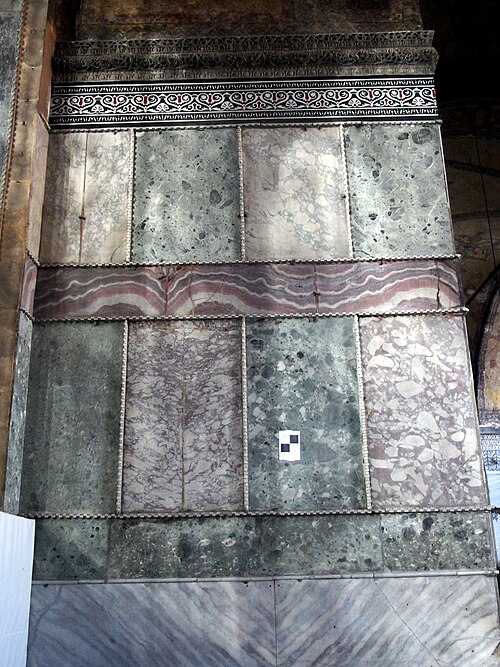
726年、イサウリアのレオ1世皇帝は、偶像崇拝を禁じる一連の勅令を出し、軍隊にすべての偶像を破壊するよう命じた。これがビザンチンの偶像破壊運動の時代の幕開けとなった。このとき、すべての宗教画と彫像がアヤソフィアから撤去された。イレーネ皇后(797-802)の治世中の短い休止期間の後、偶像破壊運動は復活した。テオフィロス皇帝(在位 829-842 )は、教会の南入口に、自身のモノグラムを刻んだ両翼の青銅扉を設置した。 [70]
大聖堂は859年の大火で被害を受け、その後869年1月8日の地震で半ドームの一つが崩壊した。[71]皇帝バシレイオス1世はティンパナ、アーチ、ヴォールトの修復を命じた。[72]
コンスタンティノス7世(在位 913年 - 959年)は著書『儀式の書』の中で、皇帝と総主教がアヤソフィアで執り行った儀式の詳細な記録を記している。
10世紀初頭、キエフ大公国の異教徒の支配者は、ユダヤ教、イスラム教、ローマ・キリスト教、正教会について学ぶために、近隣諸国に使者を派遣した。アヤソフィアを訪問した後、使者は次のように報告した。「我々は彼らが神に仕える場所に連れて行かれ、天国か地上か、どこにいるのか分からなかった。」[73]
940年代か950年代、おそらく954年か955年頃、941年のルーシ・ビザンツ戦争とキエフ大公イーゴリ1世(在位 912年-945年)の死後、イーゴリ1世の未亡人であり幼い息子スヴャトスラフ1世(在位 945年-972年)の摂政であったオルガ・ド・キエフは、コンスタンティノス7世皇帝を訪問し、コンスタンティノープルでルーシ王妃として迎えられた。[74] [75] [76]彼女はおそらくアヤソフィア洗礼堂で洗礼を受け、当時のアウグスタ(皇帝)ヘレナ・レカペナの名を名乗り、ゾーステ・パトリキア(貴族)の称号とルーシのアルコンティッサ(君主)およびヘゲモン(覇者)の称号を授かった。[75] [ 74]オルガの洗礼はキエフ・ルーシのキリスト教化に向けた重要な一歩であったが、皇帝の『皇帝の書』における彼女の訪問に関する扱いには洗礼については触れられていない。 [75] [ 74]東方正教会では、オルガは聖人であり使徒と同等(ギリシア語:ἰσαπόστολος、訳語:イザポストロス)とされている。 [77] [78] 14世紀初頭の資料によると、キエフで2番目の教会である聖ソフィア教会は、ビザンチン暦で世界紀元6460年、つまり 952年頃に設立された。[79]この将来のキエフ大聖堂の名前は、おそらくアヤソフィアでのオルガの洗礼を記念したものである。[79]
989年10月25日の大地震で西側のドームアーチが崩壊した後、皇帝バシレイオス2世は、アニ大聖堂を設計したアルメニア人建築家トルダトに修復の指揮を依頼した。[80]彼は、崩壊したドームアーチを再建して補強し、ドームの西側を15本のドームリブで再建した。[81]被害が大きかったため、修復と再建には6年を要した。教会は994年5月13日に再オープンした。再建の最後には、教会の装飾が一新され、4枚の巨大な天使の絵画、ドーム上のキリストの新しい描写、金曜日に披露されるキリストの埋葬布、後陣に使徒ペテロとパウロの間にいる聖母マリアがイエスを抱く新しい描写が追加されました。[82]大きな側面のアーチには、預言者と教会の教師が描かれました。[82]
.jpg/500px-Hagia_Sophia_(15468276434).jpg)
13世紀のギリシャの歴史家ニケタス・コニアテスによると、1133年のカスタモン包囲戦でダニシュメンド朝に勝利した後、ヨハネス2世コムネノス皇帝はローマの凱旋式を再開した。[83]十字架を担ぎ、聖母マリアのイコンを載せた銀の四輪馬車を引いて通りを進んだ皇帝は、皇居に入る前に大聖堂での式典に参加した。[84] 1168年には、マヌエル1世コムネノス皇帝によって別の凱旋式が行われた。この凱旋式では、再び聖母マリアのイコンを載せた金メッキの銀の四輪馬車が、現在は取り壊されているプロポンティスの城壁の東門(または聖バルバラ門、後のトルコ語でTop Kapısı、直訳すると「大砲の門」)からアヤソフィアまで進み感謝の儀式を行った後、皇居に向かった。[85]
1181年、皇帝マヌエル1世の娘マリア・コムネナと夫で皇帝 モンフェッラートのレニエは、息子の皇帝アレクシオス2世コムネノスの摂政であった皇后マリア・ディ・アンティオキアとの争いが頂点に達し、アヤソフィアに逃亡した。[86]マリア・コムネナとレニエは総主教の支援を得て大聖堂を占拠し、帝国の政権による平和的な退去の要求を拒否した。[86]ニケタス・コニアテスによれば、彼らは「聖なる中庭を軍事キャンプに変え」、複合施設の入り口を地元民と傭兵で守備し、総主教の強い反対にもかかわらず、「祈りの家を盗賊の巣窟、または攻撃に対して難攻不落の堅固で険しい要塞に変え」、一方で「アヤソフィアに隣接し、アウグステイオンに隣接するすべての住居は[マリアの]部下によって破壊された」。[86]アウグステイオンとミリオン周辺で戦闘が起こり、その間、防衛軍はアウグステイオンに面した「カテキメニアのギャラリー(マクロンとも呼ばれる)」から戦い、最終的にそこから撤退してアヤソフィア自体の外部通路に陣取った。 [ 86]この時点で、「総主教は、敵軍が神殿に侵入し、不浄な足で聖なる床を踏みつけ、汚れてまだ温かい血が滴る手で、神聖な奉納物を略奪するのではないかと心配していた」。[86]レニエと彼の騎士たちの出撃が成功した後、マリアは休戦を要請し、帝国の攻撃は止み、メガス・ドゥクスのアンドロニコス・コントステファノスとメガス・ヘタイリアルケスのヨハネス・ドゥーカスによって恩赦が交渉された。[86]ギリシャの歴史家ニケタス・コニアテスは、大聖堂の保存を、第一次ユダヤ戦争でのエルサレム包囲中に第二神殿の破壊を回避した1世紀の皇帝ティトゥスによる努力に例えている。[86]コニアテスは、1182年にジェス帽をかぶった白いタカが東からアヤソフィアに向かって飛んでいくのが目撃されたと報告している。そのタカは「トマイテスの建物」(アウグスタイオンの南東側に建てられたバシリカ)から、新しい皇帝の歓迎が行われる大宮殿のカティスマ宮殿まで3回飛んでいった。[87]これはアンドロニコス1世コムネノス(在位: 1183年)の治世の終わりを告げるものとされた。 1183–1185年)。[87]

ホニアテスはさらに、1203年の第4回十字軍の最中に、皇帝イサキオス2世アンジェロスとアレクシオス4世アンジェロスが、アレクシオス3世アンジェロスを追い出しイサキオスの復位を助けた十字軍に報いるために、アヤソフィアからすべての金の装飾品と銀のランプを剥ぎ取ったと書いている。 [88] 1204年のコンスタンティノープル略奪の後に、教会は十字軍によってさらに略奪され、冒涜されたとホニアテスは述べているが、彼はその出来事を直接目撃したわけではない。残存していたニカイア帝国の宮廷で書かれた彼の記述によると、アヤソフィアは残っていた金属の装飾品をすべて剥ぎ取られ、祭壇は粉々に砕かれ、「罪を背負った女性」がシントロノンで歌い踊った。[89] [90] [91]彼はまた、ラバとロバが大聖堂の聖域に連れ込まれ、ベーマ、朗誦台、扉、その他の調度品の金メッキされた銀メッキを運び去ったが、そのうちの一頭が大理石の床で滑って誤って腹を裂かれ、さらにその場所を汚したとも述べている。[89]アリー・イブン・アル=アシールによると、十字軍は彼らに降伏した聖職者を虐殺したという。アリーのコンスタンティノープル略奪の扱いはおそらくキリスト教の情報源に依存していた。[92]内部の多くは損傷し、1261年に正教会の支配下に戻るまで修復されなかった。[34]アヤソフィア、そしてコンスタンティノープル全般の略奪は、カトリックと東方正教会の関係における痛い点であり続けた。[93]
ラテン人がコンスタンティノープルを占領していた時代(1204年 - 1261年)、教会はラテンカトリックの大聖堂となった。コンスタンティノープルのボードゥアン1世(在位 1204年 - 1205年)は1204年5月16日、アヤソフィアでビザンチン帝国の慣習に忠実に従った儀式で皇帝に即位した。 1204年にラテン十字軍によるコンスタンティノープルの略奪と侵攻を指揮したヴェネツィア総督エンリコ・ダンドロは教会内のおそらく東側上部の回廊に埋葬されている。19世紀、イタリアの修復チームがおそらくその場所の近くに記念碑を設置したが、これは中世の遺物と間違われることが多く、現在でも見ることができる。元の墓は教会をモスクに改築する際にオスマン帝国によって破壊された。[94]
1261年にニカイア帝国と皇帝ミカエル8世パレオロゴス(在位1261年 - 1282年)がコンスタンティノープルを占領した時点では、教会は荒廃していた。1317年、皇帝アンドロニコス2世パレオロゴス(在位 1282年 - 1328年)は、亡き妻イレーネ・ド・モンフェッラート( 1314年没)の遺産を財源として、教会の東部と北部に4つの新しいバットレス(中世ギリシア語:Πυραμίδας、ローマ字表記: Pyramídas )を建設するよう命じた。[19] 1344年10月の地震の後、ドームに新たな亀裂が生じ、1346年5月19日に建物のいくつかの場所が崩壊した。建築家アストラスとペラルタによる修復は1354年に始まりました。[71] [95]
1452年12月12日、キエフのイシドルスは、フィレンツェ公会議で決定され、教皇勅書 ラエテントゥル・チャエリで布告された西方カトリック教会と東方正教会の待望の教会統合をアヤソフィアで宣言したが、それは短命に終わった。この統合はビザンチン帝国の間で不評だった。彼らは既に統合賛成派のコンスタンティノープル総主教グレゴリウス3世を追放していた。オスマン帝国の征服後まで新しい総主教は就任しなかった。ギリシャの歴史家ドゥーカスによると、アヤソフィアはこれらのカトリックとの関わりによって汚され、統合反対派の正教徒は大聖堂を悪魔のたまり場、ローマ異教の「ギリシャ風」神殿とみなして避けていた。[96]ドゥーカスはまた、ラエテントゥル・カエリが宣言された後、ビザンチン人は不満を抱きながら近くの会場に散り散りになり、そこでホデゲトリアのイコンに乾杯したと指摘している。後期ビザンチンの伝承によれば、このイコンはアヴァール・カガン国とウマイヤ朝によるコンスタンティノープルの包囲戦で彼らを救うためにとりなしをしてくれたという。[97]
ネストル・イスカンデルの『ツァルグラード陥落物語』によると、アヤソフィアは、コンスタンティノープル包囲戦の最終日である1453年5月21日に聖霊がコンスタンティノープルを放棄したと解釈される恐ろしい前兆の中心であった。[ 98 ]空が明るくなり、街を照らし、「多くの人々が集まり、知恵の教会の窓の上部から大きな炎が噴出するのを見た。それは長い間、教会の首全体を囲んでいた。炎は一つに集まり、その炎は変化し、言葉では言い表せない光があった。すぐにそれは空に上がった。...光そのものが天に昇り、天の門が開かれ、光が受け入れられ、そして再び閉じられた。」[98]この現象は、おそらく火薬の煙と異常気象によって引き起こされた聖エルモの火であった。 [98]著者は、この都市が「イスラム教」に陥落したことは、コンスタンティヌス大帝が見た蛇と戦う鷲の前兆で予言されていたと述べている。これはまた、「最終的にはキリスト教がイスラム教に打ち勝ち、七つの丘を獲得し、その中で即位する」ことも意味していた。[98]
コンスタンティノープルの 最終的な陥落は、黙示文学の中で長い間予言されていた。[99]ヨハネの黙示録にある7つの丘の上に築かれた都市の破壊への言及は、しばしばコンスタンティノープルのことであると理解され、偽メトディオスの黙示録は「イシュマエル人」によるローマ帝国の征服を予言していた。[99]このテキストでは、イスラム軍はフォルム・ボヴィスに到達するが、神の介入により撃退される。後の黙示文学のテキストでは、クライマックスの転換はアヤソフィアに近いテオドシウスの記念柱で起こる。他のテキストでは、クライマックスの転換は、さらに近いコンスタンティヌスの記念柱で起こる。 [99]アヤソフィアは、東方正教会の聖人アンドレア・ザ・ドゥールの生涯を詳述した、年代不明の聖人伝で言及されている。[100]このテキストは、アヤソフィアの司祭ニケフォロスの作とされており、対話形式で終末の時について記述されている。対話者は、聖人からコンスタンティノープルが洪水に沈み、「湧き出る水は抑えきれないほどにコンスタンティノープルを浸水させ、覆い、恐ろしく広大な深淵の海に引き渡す」と告げられると、「神の大教会は都市とともに沈むのではなく、目に見えない力によって空中に浮かんでいると一部の人々は言う」と述べる。[100]これに対する返答は、「都市全体が海に沈んだら、どうして大教会が残れるというのか? 誰がそれを必要とするのか? 神は手で造られた寺院に宿るとでも思っているのか?」である。 [100]しかし、コンスタンティヌスの柱は存続すると予言されている。 [100]

ユスティニアヌス帝治世のプロコピオスの時代から、アヤソフィア横のアウグスタイオンにあるユスティニアヌス記念柱の騎馬皇帝像は、右手でアジアを指しており、ペルシア戦争でササン朝のローマに対する脅威を食い止める皇帝を表していると理解されていた。一方、像の左側に持っている球、あるいは十字架の球は、ローマ皇帝の世界的権力の表現であった。[101]その後、アラブ・ビザンツ戦争では、像が食い止める脅威はウマイヤ朝カリフとなり、後には、像はトルコの侵攻を防いでいるものと考えられるようになった。[101]この皇帝の正体は、テオドシウス1世やヘラクレイオスといった他の有名な聖皇帝と混同されることが多かった。[101]外国人がローマの街について語った話では、この球体はリンゴとして頻繁に言及されており、ギリシャの民間伝承では、中央アジアにあるトルコ人の神話上の故郷「一本のリンゴの木」の象徴と解釈されていた。[101]球体は1316年に地面に落ち、1325年に交換されたが、1412年頃にはまだその場所に残っていたが、ヨハン・シルトベルガーが1427年にこの像を見たときには、「帝国のリンゴ」(ドイツ語:Reichsapfel ‹Tfd›を参照)は地面に落ちていた。[101] 1435年に再び球体を持ち上げようとする試みは失敗し、これがローマの陥落の予言を強めることになった。[101]トルコ人にとって、「赤いリンゴ」(トルコ語:kızıl elma)はコンスタンティノープルそのものを象徴し、その後キリスト教帝国に対するイスラムのカリフ制の軍事的優位を象徴するようになった。[101]ニッコロ・バルバロの1453年のコンスタンティノープル陥落に関する記述では、包囲戦の最後の日にユスティニアヌス帝の記念碑は都市の創設者コンスタンティヌス大帝を表し、「これが私の征服者が来る道である」ことを示していると解釈された。[98]
ラオニクス・カルココンディレスによれば、アヤソフィアは都市が占領された間、住民の避難所だった。[102] 1452年12月以降、アヤソフィアは評判が悪く、空っぽの状態であったが、テオドシウスの城壁が破られた後、トルコ軍が都市を進軍する中、ビザンチン帝国はそこに避難したとドゥーカスは書いている。「男女、修道士、尼僧が全員、大教会に駆けつけた。男女ともに、赤ん坊を抱いていた。何という光景だ!その通りは人でいっぱいだった。」[102]彼は彼らの心変わりを予言のせいにしている。[102]
皆が大教会に逃げ込まざるを得なかった理由は何だったのか?彼らは何年もの間、偽の予言者たちの予言を聞いていた。彼らは、この都市はトルコ人に引き渡される運命にあり、トルコ人は大挙して侵入し、コンスタンティヌス大帝の柱のところまでローマ人を虐殺するだろうと予言していた。その後、天使が剣を持って降りてくる。天使は、たまたま柱のそばに立っている取るに足らない、貧しく、卑しい男に、剣とともに王国を引き渡すだろう。天使は彼に言う。「この剣を取り、主の民の仇討ちをせよ」。するとトルコ人は追い返され、追撃してきたローマ人によって虐殺され、都市から、そして西と東のあらゆる場所から追い出され、ペルシャの国境まで追いやられ、孤独な木と呼ばれる場所まで追いやられるだろう。これが大教会への逃避の原因だった。たった一時間で、あの有名な巨大な教会は男女でいっぱいになりました。数え切れないほどの群衆が、階上、階下、中庭、考えられるあらゆる場所に集まっていました。彼らは門を閉めて、救いを願いながらそこに立っていました。
— ドゥーカス、XXXIX.18
当時の慣習に従い、スルタン・メフメト2世は、コンスタンティノープルが陥落した直後、軍隊と随行員に市内での無制限の略奪と強奪を丸3日間許可した。この期間に多くの正教会が破壊された。[103]アヤソフィア自体も略奪された。侵略者はそこに市内最大の財宝があると信じていたからである。[104]コンスタンティノープルの城壁の防御が崩れ、勝利したオスマン帝国軍が市内に入った直後、略奪者と強奪者はアヤソフィアに向かい、扉を破壊して内部に突入した。[105] 3日が経過すると、メフメトは市内の残りの物資を自分のものにすることになっていた。[106] [107]しかし、初日の終わりまでに、彼は略奪され奴隷化された都市を視察して深い悲しみを感じたため、略奪をやめるべきだと宣言した。[108] [106] [109]
コンスタンティノープル包囲戦の間、閉じ込められた人々はアヤソフィアで聖体礼儀と時課の祈りに参加し、教会は女性、子供、老人、病人、負傷者など、都市防衛に貢献できない多くの人々にとって安全な場所であり避難所でした。[110] [111] [109]教会に閉じ込められたため、内部の多くの信徒と他の避難民は、勝利した侵略者の間で分配される戦利品となりました。建物は冒涜され、略奪され、教会内に避難した人々は奴隷にされました。[104]高齢者、虚弱者、負傷者、病人のほとんどが殺された一方で、残り(主に10代の男性と少年)は鎖につながれ、奴隷として売られました。[105] [109]
モスク(1453–1935)
.jpg/500px-Turkey-3052_(2216463731).jpg)
1453年5月29日、コンスタンティノープルはオスマン帝国の攻撃により陥落した。スルタン・メフメト2世は市内に入り、アヤソフィアで金曜礼拝と説教を行い、これがアヤソフィアの公式なモスクへの改築となった。[112]教会の司祭と宗教関係者は、侵略者によって中止を強いられるまで、キリスト教の儀式、祈り、式典を続けた。[105]メフメト2世とその一行が教会に入ると、彼は教会を直ちにモスクに改築するよう命じた。その場にいたウラマー(イスラム学者)の一人が教会の説教壇に登り、シャハーダ(「アッラー以外に神はなく、ムハンマドはその使徒である」)を朗唱し、これが教会のモスクへの改築の始まりとなった。[19] [113]メフメトはプロコネシアの大理石の床の敷石の一つをこじ開けようとした兵士に剣を向けたと伝えられている。[114]
1453年以前の西洋からの訪問者、例えばコルドバの貴族ペロ・タフル[115]やフィレンツェの地理学者クリストフォロ・ブオンデルモンティ[116]が述べているように、教会は荒廃しており、いくつかの扉は蝶番から外れていました。メフメト2世は建物の改修を命じました。メフメトは1453年6月1日、モスクでの最初の金曜礼拝に参加しました。 [117]アヤソフィアはイスタンブール初の帝国モスクとなりました。[118]市内の既存の家屋のほとんどと将来のトプカプ宮殿のエリアは、対応するワクフに寄付されました。[19] 1478年以降、2,360の商店、1,300軒の家屋、4つのキャラバンサライ、30のボザ店、羊の頭と足の店23店が収入を財団に寄付しました。[119] 1520年( AH 926)と1547年(AH 954)の帝国勅許により、グランドバザールやその他の市場の店舗や一部が基礎部分に追加されました。[19]
1481年より前、建物の南西の角、階段塔の上に小さなミナレットが建てられました。 [19]メフメトの後継者バヤズィト2世(在位 1481-1512)は後に北東の角にもう一つのミナレットを建てました。 [19]ミナレットの1つは1509年の地震後に倒壊し、[19] 16世紀中頃、建物の東西の角に2つの対角線のミナレットが建てられ、両方とも置き換えられました。[19] 1498年、ベルナルド・ボンシニョーリはアヤソフィアを訪れた最後の西洋人訪問者であり、古代のユスティニアヌス様式の床を見たと報告しました。その後まもなく、床はカーペットで覆われ、19世紀まで再び見られることはありませんでした。[114]
16世紀、スレイマン大帝(在位 1520年 - 1566年)はハンガリー王国征服時に2つの巨大な燭台を持ち帰り、ミフラーブの両側に置いた。スレイマンの治世中、イエス、マリア、ビザンチン帝国の皇帝たちを描いたナルテクスと皇帝の門の上のモザイクは白塗りと漆喰で覆われていたが、1930年にトルコ共和国下で取り除かれた。[120] [より良い情報源が必要]

セリム2世(在位 1566-1574年)の治世中、建物は疲労の兆候を見せ始め、オスマン帝国の建築家で地震技術者でもあったミマール・スィナンによって外部に構造支持材が追加され、大幅に強化された。 [121]歴史的なビザンチン建築の強化に加えて、スィナンは1576-1577年(ヒジュラ暦984年)に、建物の西端にさらに2つの大きなミナレット、元々のスルタンの館、そして建物の南東にセリム2世のトゥルベ(霊廟)を建設した。そのために、前年に建物の南隅にあった総主教庁の一部が取り壊された。[19]さらに、金色の三日月がドームの頂上に設置され、[19]建物の周囲に35アルシュン(約24メートル)の幅の敬意ゾーンが設けられ、境界内のすべての家屋が破壊されました。 [19]トゥルベには43人のオスマン帝国の王子の墓が置かれました。[19] ムラト3世(在位 1574-1595)は、ペルガモン(ベルガマ)から2つの大きなアラバスター製のヘレニズム時代の壷を輸入し、身廊の両側に配置しました。[19]
1594年(ヒジュラ暦1004年)、ミマール(宮廷建築家)ダウド・アーガはムラト3世の霊廟を建て、そこにはスルタンと彼のヴァリデであるサフィエ・スルタンが埋葬された。[19]彼らの息子メフメト3世(在位 1595年-1603年)の八角形の霊廟とそのヴァリデは、1608年(ヒジュラ暦1017年)にその隣に宮廷建築家ダルギッチ・メフメト・アーガによって建てられた。 [ 122]彼の息子ムスタファ1世(在位 1617年-1618年、1622年-1623年)は洗礼堂を彼の霊廟に改築した。[122]
1717年、スルタン・アフメト3世(在位 1703-1730年)の治世下で、内部の崩れかけた漆喰が修復され、間接的に多くのモザイクの保存に貢献しました。そうでなければ、モスクの労働者によって破壊されていたでしょう。[ 122]実際、モザイクのテッセラ(お守りだと信じられていた)が訪問者に販売されることがよくありました。[122]スルタン・マフムード1世は1739年に建物の修復を命じ、メドレセ(コーラン学校、後に博物館の図書館)、イマレット(貧者への配給のためのスープキッチン)、図書館を増設し、1740年にはシャディルヴァン(儀式用の清めの噴水)を増設して、キュリイェ(社会複合施設)へと変貌させました。同時に、内部に新しいスルタンの小屋と新しいミフラーブが建設されました。[123]
1847年から1849年の改修

19世紀のアヤソフィアの修復は、スルタン・アブドゥルメジト1世(在位 1823-1861年)の命令で、スイス系イタリア人建築家の兄弟ガスパレとジュゼッペ・フォッサティの監督の下、800人の作業員によって1847年から1849年の間に完了した。兄弟は、鉄の鎖でドームを固定し、丸天井を強化し、柱をまっすぐにし、建物の外部と内部の装飾を見直した。[124]上階のギャラリーのモザイクは露出され、洗浄されたが、その多くは「さらなる損傷から保護するため」に回収された。[125]
8つの新しい巨大な円形フレームのディスクまたはメダリオンが、コーニス、4つの支柱のそれぞれ、および後陣と西側のドアの両側から吊り下げられました。これらは、書家カザスカルのムスタファ・イゼット・エフェンディ(1801-1877)によって設計され、アッラー、ムハンマド、ラシドゥーン(最初の4人のカリフ:アブー・バクル、ウマル、ウスマーン、アリー)、そしてムハンマドの2人の孫であるハサンとフサイン(アリーの息子)の名前が描かれています。[ 126] 1850年に、建築家フォッサティは、ネオビザンチン様式の柱と、モスクの後ろにある王室のパビリオンにつながるオスマンロココ様式の大理石の格子で 新しいマクスーラまたはカリフのロージェを建設しました。[124]新しいマクスーラは北側の側廊の東端、北東の柱の隣に建てられました。ミフラーブ近くの後陣にあった既存のマクスーラは取り壊されました。[124]スルタンのための新しい入口、フンカール・マフフィリが建設されました。[124]フォッサティ兄弟はミンバルとミフラーブも改修しました。
本館の外では、ミナレットが修復され、高さが同じになるように改造された。[125]フォッサティー家は、ムワキット(モスクの時計係)が使用するために時計の建物であるムヴァッキタネを建設し、新しいマドラサ(イスラム学校)を建設した。カスル・フマーユーンも彼らの指揮下で建設された。[124]修復が完了すると、モスクは1849年7月13日の式典で再開された。[127]フォッサティー家がアヤソフィアで作業していた間に描かれた図面からの石版画の版画の版画は、1852年にロンドンで「アブドゥルメジド国王の命により最近修復されたコンスタンティノープルのアヤソフィア」と題して出版された。[124]
- ガスパーレ・フォッサティのアヤソフィア(ルイ・ハーゲによるリトグラフ)
-

-

-
 インペリアルロッジ( 1850年頃)
 -
 ガスパーレ・フォサティが1852年に描いた、彼と弟による改修後のアヤソフィアの描写。ルイ・アゲによるリトグラフ。
 -
 修復前の身廊、東向き
 -
 修復後の身廊と後陣、東向き
 -
 修復後の身廊と入口、西向き
 -
 北向きのナルテックス
 -
 北向きのエクソナルテクス
 -
 入口から北側の通路、東向き
 -
 北側通路、西向き
 -
 北側廊から見た身廊と南側廊
 -
 北側のギャラリーと北西側からのマトロネウムへの入口
 -
 南西から見た南ギャラリー
 -
 大理石の扉から西を向いた南側のギャラリー
 -
 大理石の扉から東を向いた南側のギャラリー

.jpg/500px-Aya_Sofia,_Constantinople_(BM_1889,0603.107).jpg)

.jpg/500px-Aya_Sofia,_Constantinople_(BM_1889,0603.120).jpg)


.jpg/500px-Gaspare_Fossati_-_Louis_Haghe_-_Vue_g%C3%A9n%C3%A9rale_de_la_grande_nef,_en_regardant_l'occident_(Hagia_Sophia_-_Ayasofya_Mosque_nave).jpg)


イスタンブール占領(1918年~1923年)

第一次世界大戦でオスマン帝国が敗戦した後、コンスタンティノープルはイギリス、フランス、イタリア、ギリシャの軍に占領された。1919年1月19日、ギリシャ正教の軍司祭エレフテリオス・ヌフラキスがアヤソフィアで許可なく聖体礼儀を行ったが、これは1453年のコンスタンティノープル陥落以来唯一の事例であった。 [128]反占領のスルタンアフメットデモは1919年3月から5月にかけてアヤソフィアの隣で行われた。ギリシャでは1923年に発行された500ドラクマ紙幣にアヤソフィアが描かれた。[129]
博物館(1935–2020)


1935年、トルコ共和国の初代大統領で建国者のムスタファ・ケマル・アタテュルクは、この建物を博物館に改築した。第二次世界大戦中、博物館のミナレットにはMG08機関銃が備えられていた。[130]カーペットとその下のモルタルの層は取り除かれ、オンファリオンなどの大理石の床の装飾は、フォッサティスによる修復以来初めて現れた。 [131]この修復では、多くのモザイクを覆っていた白い漆喰が取り除かれた。放置されたため、構造物の状態は悪化し続け、世界記念物基金(WMF)は、アヤソフィアを1996年と1998年の監視リストに含めた。この期間中、建物の銅製の屋根にひびが入り、壊れやすいフレスコ画とモザイクの上に水が漏れる原因となった。下からも湿気が入り込んだ。地下水の上昇により、モニュメント内の湿度が上昇し、石や塗料にとって不安定な環境が作り出された。WMFは1997年から2002年にかけて、ドームの修復のために一連の助成金を獲得した。作業の第一段階は、構造的な安定化とひび割れた屋根の修復で、トルコ文化観光省の参加を得て実施された。第二段階のドーム内部の保存では、モザイクの手入れを行う若いトルコ人保存家を採用し、訓練する機会が与えられた。2006年までにWMFのプロジェクトは完了したが、アヤソフィアの多くのエリアでは、引き続き大幅な安定性の改善、修復、保存が必要である。[132]
2014年、アヤソフィアはトルコで2番目に訪問者数の多い博物館となり、年間約330万人の来場者を集めました。[133]

複合施設を礼拝の場(モスクや教会)として使用することは固く禁じられていたが、[134]トルコ政府は1991年に博物館複合施設(アヤソフィア博物館)内のパビリオンを祈祷室として使用することを許可し、2013年以来、博物館のミナレットのうち2つが定期的に祈りの呼びかけ(エザン)を声に出すために使用されている。[135] [136]

2010年代初頭から、いくつかのキャンペーンや政府高官、特に2013年11月のトルコ副首相ビュレント・アルンチュが、アヤソフィアをモスクに戻すよう要求した。[137] [138] [139] 2015年、フランシスコ教皇は、トルコでは公式に否定されているアルメニア人虐殺を公に認めた。これに対して、アンカラのムフティであるメファイル・ヒズル氏は、教皇の発言がアヤソフィアのモスクへの改築を加速させると信じていると述べた。[140]
2016年7月1日、85年ぶりにアヤソフィアでイスラム教の祈りが再び行われた。[141]その年の11月、トルコのNGOである歴史的建造物・環境保護協会は、博物館をモスクに改築するための訴訟を起こした。[142]裁判所は、博物館を「記念物博物館」のままにすべきだと決定した。[143] [より良い情報源が必要] 2016年10月、トルコの宗教局(Diyanet)は、81年ぶりに、スルタンの私的な沐浴用のパビリオンであるフンカルカスルにあるアヤソフィアモスク(アヤソフィア・ジャミイ・フンカルカスル)に指定イマーム、オンデル・ソイを任命した。それ以来、アヤソフィアの4つのミナレットすべてから1日5回、定期的にアザーンが唱えられるようになった。 [135] [136] [144]
2017年5月13日、アナトリア青年協会(AGD)が組織した大勢の人々がアヤソフィアの前に集まり、博物館をモスクに再改造するよう呼びかけながら朝の祈りを捧げた。[145] 2017年6月21日、宗教局(Diyanet )は、ライラト・アル・カドルを記念して、国営テレビ局TRTで生放送された特別番組を企画し、アヤソフィアでのコーランの朗読と祈りを収録した。[146]
モスクへの復帰(2018年~現在)


2018年以来、トルコのレジェップ ・タイイップ・エルドアンは、アヤソフィアをモスクに戻すことを話していたが、これはエルドアンが説得しようとしていた宗教的な大衆に非常に受け入れられているように見受けられた。[147] 2018年3月31日、エルドアンはアヤソフィアでコーランの最初の詩節を朗読し、「この建築を遺産として残してくれたすべての人々の魂、特にイスタンブールの征服者の魂」に祈りを捧げ、アヤソフィアを再びモスクにするという政治運動を強化し、アヤソフィアを世俗的な博物館にするというアタテュルクの策を覆すことになるだろう。[148] 2019年3月、エルドアンはアヤソフィアの地位を博物館からモスクに変更すると述べ、[149]博物館にしたのは「非常に大きな間違い」だったと付け加えた。[150]ユネスコ世界遺産であるため、この変更にはユネスコ世界遺産委員会の承認が必要になる。[151] 2019年後半、エルドアン大統領府は近くのトプカプ宮殿博物館の管理と維持を引き継ぎ、大統領令により文化観光省からその責任を移譲した。[152] [153] [154]
2020年、トルコ政府はコンスタンティノープル征服567周年をアヤソフィアでイスラム教の祈りを捧げて祝った。エルドアン大統領はテレビ放送で「征服祭の一環として、アヤソフィアでアル・ファトフスーラ が朗唱され、祈りが行われる」と述べた。[155] 5月、記念行事の最中に、アヤソフィアでコーランの一節が朗読された。ギリシャはこの行動を非難し、トルコはギリシャが「無益で効果のない発言」をしているとして非難した。[156] 6月、トルコ宗教局長(ディヤネット)は「アヤソフィアを礼拝のために開放できれば非常にうれしい」と述べ、もしそれが実現すれば「すべてのモスクで行うように宗教的なサービスを提供する」と述べた。[142] 6月25日、国際ビザンチン研究協会会長ジョン・ハルドンはエルドアン大統領に公開書簡を送り、「アヤソフィアを博物館として保存することの価値を考慮する」よう求めた。[157]
2020年7月10日、1935年に閣僚評議会がアヤソフィアを博物館に改築する決定は国家評議会によって無効とされ、アヤソフィアはモスクであること以外の「いかなる目的にも」使用できず、アヤソフィアはファーティフ・スルタン・メフメット・ハン財団の所有物であると布告された。評議会は、イスタンブールを征服したオスマン帝国のスルタン・メフメット2世は、この財産はモスクとして一般人が無料で使用できるものとみなしており、議会や内閣の管轄外であると論じた。[158] [159]世俗的および世界的な批判にもかかわらず、エルドアンはアヤソフィアの博物館としての地位を無効にし、モスクに戻す布告に署名した。[160] [161]礼拝の呼びかけは変更の発表直後にミナレットから放送され、トルコの主要ニュースネットワークによって再放送された。[161]アヤソフィア博物館のソーシャルメディアチャンネルは同日削除され、エルドアン大統領は記者会見で、礼拝自体は7月24日からそこで行われると発表した。[161]大統領報道官は、パリのサクレクール寺院やノートルダム寺院のように、誰でも利用できる実用的なモスクになると述べた。報道官はまた、この変更はアヤソフィアのユネスコ世界遺産としての地位に影響を与えず、内部の「キリスト教の象徴」は引き続き保護されると述べた。[147]同日、最終決定前に、トルコのベラト・アルバイラク財務大臣とアブドゥルハミト・ギュル法務大臣は、アヤソフィアがイスラム教徒の礼拝のために開放されることを期待していると述べた。[162] [163] トルコ大国民議会議長ムスタファ・シェントップは「国民の心の奥底にあった憧れは終わった」と述べた。[162]大統領報道官は、トルコのすべての政党がエルドアンの決定を支持していると主張した。[ 164]しかし、人民民主党は以前、この決定を非難する声明を発表し、「人類の遺産に関する決定は、政府による政治的駆け引きに基づいて行われるべきではない」と述べた。[165]イスタンブール市長のエクレム・イマモールは、「トルコに利益をもたらす限り」この改宗を支持すると述べ、アヤソフィアは1453年以来モスクであったと感じていると付け加えた。[166]アリ・ババカン ケマル・アタテュルクは、かつての同盟国であるエルドアンの政策を批判し、アヤソフィア問題は「他の問題を覆い隠すためだけに議題に上がった」と述べた。[167] トルコの小説家でノーベル賞受賞者のオルハン・パムクは、「ケマル・アタテュルクは、アヤソフィアをモスクから博物館に変え、ギリシャ正教とラテンカトリックのこれまでのすべての歴史を尊重し、トルコの現代世俗主義の象徴にした」と述べ、この動きを公に非難した。[161] [168]
7月17日、エルドアン大統領は、アヤソフィアでの最初の礼拝には1,000人から1,500人の参拝者が参加すると発表した。大統領は、トルコはアヤソフィアに対して主権を有しており、国際世論に従う義務はないと述べた。[169]
アヤソフィアは現在モスクとして再神聖なものとされているが、礼拝時間以外は訪問者に開放されている。当初は入場料は無料だったが[170] 、後にトルコ政府は2024年1月15日から外国人は入場料を支払う必要があると決定した。[171]
7月22日、礼拝者のためにモスクを準備するため、ターコイズ色のカーペットが敷かれた。敷設には、ディヤネットの責任者であるアリ・エルバシュが立ち会った。 [167]オンファリオンはむき出しのまま残された。新型コロナウイルス感染症のパンデミックのため、エルバシュは、アヤソフィアは一度に最大1,000人の礼拝者を収容できると述べ、「マスク、礼拝用の敷物、忍耐と理解」を持ってくるように求めた。[167]モスクは、現代のトルコ共和国の国境を定めたローザンヌ条約の調印97周年である7月24日に、金曜の礼拝のためにオープンした。 [167]後陣の聖母子のモザイクは白いカーテンで覆われた。[168]礼拝時間中にレーザーでモザイクを隠すという提案もあったが、このアイデアは最終的に棚上げされた。[172] [173]エルバシュは説教の中で「征服王メフメトは、復活の日までモスクとして残るよう、この壮大な建造物を信者に捧げた」と宣言した。[168]多くの信者が外で祈る中、エルドアン大統領と政府大臣数名が正午の祈りに出席した。ある時点では、警備の非常線が破られ、数十人が警察の線を突破した。[168]トルコは、フランシスコ教皇を含む外国の指導者や政府関係者を祈りに招待した。[174]これは、エルドアン政権下で博物館からモスクに改築された4番目のビザンチン教会である。[175]
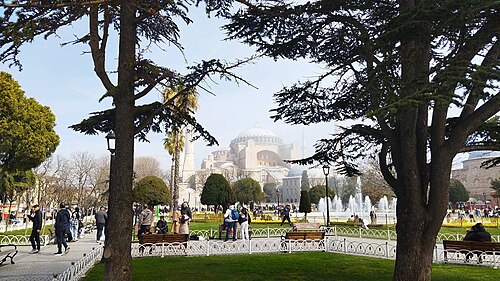
2022年4月、アヤソフィアは88年ぶりにラマダンのタラウィー礼拝を行った。 [176]
国際的な反応と議論
改宗の最終決定が下される数日前、コンスタンティノープル総主教バルトロメオス1世は説教で「アヤソフィアをモスクに改宗すれば、世界中の何百万ものキリスト教徒を失望させるだろう」と述べ、改宗すれば「東西が交わる重要な中心地」であるアヤソフィアが「2つの世界が分裂する」ことになるとも述べた。[177] [178]この改宗案は他の正教会指導者からも非難され、ロシア正教会のモスクワ総主教キリルは「アヤソフィアへの脅威はキリスト教文明全体への脅威である」と述べた。[179] [180]
トルコ政府の決定を受けて、ユネスコは「事前の協議なしに行われた」転換を「深く遺憾に思う」と発表し、交渉の欠如は「遺憾である」としてトルコに「遅滞なく対話を開始する」よう求めた。[181] [161]ユネスコはさらに、アヤソフィアの「保存状態」が世界遺産委員会の次回会合で「検討される」と発表し、トルコに「この特別な遺産の普遍的価値にいかなる悪影響も及ぼさないよう、遅滞なく対話を開始する」よう促した。[181]ユネスコ文化担当事務局長補佐 のエルネスト・オットーネは「ユネスコとの事前協議なしに、遺跡への物理的アクセス、建物の構造、遺跡の動産、または遺跡の管理に影響を与えるような実施措置を避けることが重要である」と述べた。 [ 181]ユネスコは7月10日の声明で、「これらの懸念はトルコ共和国に数通の手紙で伝えられ、昨日の夕方にはトルコ代表団の代表にも伝えられた」と述べているが、返答はなかった。[181]
350宗派の5億人のキリスト教徒を代表すると主張する世界教会協議会は、建物をモスクに改築する決定を非難し、「必然的に不確実性、疑惑、不信を生み出す」と述べた。世界教会協議会は、トルコのエルドアン大統領に対し、「相互理解、尊重、対話、協力を促進し、古い敵意や分裂を助長しないために」決定を再考し撤回するよう求めた。[182] [183] [184] 7月12日、サンピエトロ広場で日曜のアンジェラスの祈りを朗読した際、フランシスコ教皇は「私の思いはイスタンブールに向かいます。私は聖ソフィアを思い、とても心が痛みます」(イタリア語:イスタンブールの聖ソフィアを思い、私はとても心を痛めています)と述べた。[注 1] [186] [187]国際ビザンチン研究協会は、2021年にイスタンブールで開催される予定だった第21回国際会議を中止し、2022年に延期すると発表した。[157]

欧州連合(EU)の外務上級代表で欧州委員会副委員長のジョセップ・ボレル氏は声明を発表し、トルコ国家評議会とエルドアン大統領の決定を「遺憾」とし、「文明同盟の創設メンバーとして、トルコは宗教間および文化間の対話を促進し、寛容と共存を育むことに尽力してきた」と指摘した。[188]ボレル氏によると、EU加盟国の27の外相は7月13日の会合で「アヤソフィアのような象徴的な建造物を改築するというトルコの決定を非難」し、「それは必然的に不信を煽り、宗教コミュニティ間の新たな分裂を促進し、対話と協力に向けた我々の努力を損なうだろう」と述べ、「トルコ当局にこの決定を早急に再考し、撤回するよう求める幅広い支持があった」と述べた。[189] [190] ギリシャは、この変更を非難し、ユネスコの世界遺産登録に違反するものとみなした。[147]ギリシャのリナ・メンドーニ文化相は、これを「文明世界に対するあからさまな挑発」であり、エルドアンのトルコには「独立した正義が存在しないことを完全に裏付ける」ものであり、彼のトルコ民族主義は「国を6世紀も前に引き戻す」ものだと述べた。[191]ギリシャとキプロスは、トルコに対するEUの制裁を求めた。[192] 米国務省の報道官モーガン・オルタガスは、「トルコ政府がアヤソフィアの地位を変更する決定を下したことに失望している」と述べた。[191]フランスの外務大臣ジャン=イヴ・ル・ドリアンは、自国がこの動きを「遺憾」とし、「これらの決定は、現代的で世俗的なトルコの最も象徴的な行為の1つに疑問を投げかける」と述べた。[184]ロシア連邦評議会外交委員会のウラジミール・ジャバロフ副委員長は、「これはイスラム世界のために何もしない。国家を団結させるのではなく、逆に衝突させるだけだ」と述べ、この動きを「間違い」と呼んだ。[191]イタリアの元副首相マッテオ・サルヴィーニはミラノのトルコ領事館前で抗議デモを行い、トルコの欧州連合加盟計画を「永久に」中止するよう求めた。[193]東エルサレムでは 7月13日、トルコ領事館前で抗議活動が行われ、トルコ国旗が燃やされ、ギリシャ国旗とギリシャ正教会の旗が掲げられた。[194]トルコ外務省は声明で、国旗の焼却を非難し、「誰も我々の栄光ある国旗を軽視したり侵害したりすることはできない」と述べた。[195]
トルコのみが承認している北キプロス・トルコ共和国の首相エルスィン・タタール氏は、この決定を「健全」かつ「満足のいく」ものと歓迎した。[196] [191]さらにタタール氏はキプロス政府を批判し、「我々のモスクを焼き払ったギリシャ系キプロス政権が、この件で発言権を持つべきではない」と主張した。[196]イラン外務省は報道官を通じて、この決定は「トルコの国家主権の一部として考慮されるべき問題」であり「トルコの内政」であるとして、この変更を歓迎した。[197]ロシアのセルゲイ・ヴェルシニン外務次官は、この問題は「当然ながら我々も他国も干渉すべきではない内政」であると述べた。[198] [199]アラブ・マグレブ連合はこれを支持した。[200]アルアクサモスクのイマームであるエクレマ・サブリ氏とオマーンのグランドムフティーであるアハメド・ビン・ハマド・アル・ハリーリ氏は、ともにトルコの決定を祝福した。[200]ムスリム同胞団もこのニュースを支持した。[200]パレスチナのイスラム主義運動ハマスのスポークスマンは、この判決を「すべてのイスラム教徒にとって誇らしい瞬間」と呼んだ。[201]パキスタン・ムスリム連盟(Q)のパキスタン人政治家チャウドリ・ペルヴァイズ・エラヒ氏は、この判決を歓迎し、「トルコ国民だけでなく、イスラム世界全体の願いに沿ったものである」と主張した。[202]南アフリカのムスリム司法評議会グループは、この決定を称賛し、「歴史的な転換点」と呼んだ。[203]モーリタニアの首都ヌアクショットでは、ラクダの犠牲を伴う祈りと祝賀が行われた。[204]一方、エジプトの大ムフティーであるシャウキ・アラムは、アヤソフィアをモスクに改築することは「許されない」との判決を下した。[205]
エルドアン大統領は、7月24日に建物内で最初のイスラム教徒の祈りが行われると発表した際、「我が国のすべてのモスクと同様に、アヤソフィアの扉は地元住民と外国人、イスラム教徒と非イスラム教徒に広く開かれる」と付け加えた。大統領報道官のイブラヒム・カリンは、建物のイコンとモザイクは保存され、「世俗主義、宗教的寛容、共存の議論に関しては、現在トルコには400以上の教会とシナゴーグが開かれている」と述べた。[206]与党 公正発展党(AKP)の報道官オメル・チェリクは7月13日、祈りの時間以外はアヤソフィアへの入場は無料となり、すべての訪問者が入場できると発表した。祈りの時間には、建物のモザイク画のキリスト教のイメージはカーテンやレーザーで覆われる。[193]トルコ外務大臣メヴリュット・チャヴシュオールは7月13日、 TRTハーバーに対し、政府はユネスコの反応に驚いているとし、「我々は祖先の遺産を守らなければならない。その役割がこうであろうとああであろうと、それは問題ではない」と語った。[207]
7月14日、ギリシャの首相キリアコス・ミツォタキスは、トルコの「不必要でつまらない取り組み」に対して「政府はあらゆるレベルで対応を検討している」と述べ、「この後進的な行動で、トルコは西側世界とその価値観とのつながりを断つことを選択している」と述べた。[208]アヤソフィアとキプロス・トルコの海域紛争の両方に関して、ミツォタキスはトルコに対する欧州の制裁を求め、トルコを「地域のトラブルメーカーであり、南東地中海地域全体の安定に対する脅威に発展している」と述べた。[208]ギリシャの元外務大臣 ドラ・バコヤニスは、トルコの行動は「ルビコン川を渡った」、つまり西側から距離を置くものだと述べた。[209]建物が再開された日、ミツォタキスは、この改宗は力の誇示ではなく、トルコの弱さの証拠だと述べた。[168]
アルメニア外務省は、この動きに「深い懸念」を表明し、この動きは「文明の衝突ではなく人類の協力と団結」というアヤソフィアの象徴性を終わらせるものだと述べた。[210]アルメニア使徒教会の長であるカトリコス・カレキン2世は、この動きは「トルコの国内宗教的少数派の権利を侵害している」と述べた。[211]トルコ政府に忠実であるとみなされているコンスタンティノープルのアルメニア総主教 サハク2世マシャリアンは、博物館をモスクに改造する決定を支持した。彼は「好奇心旺盛な観光客が写真を撮りに走り回るよりも、信者の祈りの方が寺院の精神に合っていると私は信じている」と述べた。[212]
2021年7月、ユネスコは保全状況に関する最新報告書の提出を求め、「深刻な懸念」を表明した。世界遺産としての地位の将来についても懸念が表明された。[213]トルコは、変更はユネスコの基準に「悪影響を及ぼしていない」と回答し、批判は「偏っており政治的」であると述べた。[214]
建築

b) 1階の平面図(下半分)
アヤソフィアは、ビザンチン建築の現存する最も偉大な例の一つである。[8]内部はモザイク、大理石の柱、そして芸術的価値の高い覆いで飾られている。ユスティニアヌスは、当時最大の大聖堂の完成を監督し、スペインのセビリアの大聖堂が完成するまでの1000年間、最大の大聖堂であり続けた。[215]
アヤソフィアは石造建築を採用している。この構造にはレンガの幅の1.5倍のレンガとモルタルの目地がある。モルタル目地は砂と微細な陶片の組み合わせで構成されており、モルタル目地全体に均等に散りばめられている。この砂と陶片の組み合わせは、現代のコンクリートの前身であるローマのコンクリートでよく使用されていた。また、クランプやタイの形でかなりの量の鉄も使用されていた。[216]
ユスティニアヌス帝のバシリカは、後期古代の建築的成果の頂点であり、ビザンチン建築の最初の傑作でもありました。その建築的、典礼的影響は、東方キリスト教、西方キリスト教、イスラム教に広く及び永続的でした。[217] [218]

広大な内部は複雑な構造をしている。身廊は中央のドームで覆われており、その高さは最大で床から55.6メートル(182フィート5インチ)で、40個のアーチ型窓のアーケードの上に載っている。構造の修復によりドームは楕円形になっており、直径は31.24メートルから30.86メートル(102フィート6インチから101フィート3インチ)の間で変化する。[219]
西側の入口と東側の礼拝面には、中央のドームと同じ直径の半ドームが伸びるアーチ型の開口部があり、半ドーム型の小さな エクセドラの上に支えられています。エクセドラは、ドーム型の頭を持つ要素の階層構造で、中央のドームで覆われた広大な長方形の内部空間を作り出し、その上部には76.2メートル(250フィート)の有効スパンがあります。[8]

紀元1世紀のヘレニズム時代の数学者、アレクサンドリアのヘロンの理論は、広大な空間にこれほど巨大なドームを建てるという難題に対処するために利用された可能性がある。[220]スヴェンションとスティッフェルは、建築家がヴォールトを建設するためにヘロンの提案した値を使用したと提案した。正方形の寸法は、辺と対角線の数列を使用して計算され、12と17の数字で定義される正方形が得られる。12は正方形の辺、17は対角線を定義し、これは楔形文字のバビロニアのテキストで早くも標準値として使用されていた。[221]
アヤソフィアの大広場の4辺の長さはそれぞれ約31メートルで[222] 、これは100ビザンチンフィートに相当すると以前は考えられていました。[221]スヴェンションは、アヤソフィアの中央広場の辺の長さは100ビザンチンフィートではなく99フィートであると示唆しました。この測定は合理的であるだけでなく、辺と対角線の数値の進行システム(70/99)に組み込まれているため、古代の応用数学で使用できる値です。対角線は140となり、アヤソフィアのような巨大なドームを建設するのに扱いやすい値です。[223]
床

アヤソフィアの石造りの床は6世紀に遡る。最初の天井崩壊後、壊れたドームは元のユスティニアヌス様式の床の上にそのまま残され、558年にドームが再建された際に瓦礫の上に新しい床が敷かれた。[224]この2度目のユスティニアヌス様式の床の設置以降、床は典礼の一部となり、重要な場所や空間はさまざまな色の石や大理石を使ってさまざまな方法で区切られるようになった。[224]
床は主にプロコンネシア大理石でできており、プロポンティス(マルマラ海)のプロコネソス(マルマラ島)で採掘された。これはコンスタンティノープルの建造物に使用された主な白大理石である。床の他の部分、例えばテッサリアの緑大理石は、ローマ時代のギリシャのテッサリアで採掘された。身廊の床を横切るテッサリアの緑大理石の帯は、しばしば川に例えられた。[225]
床は多くの作家によって賞賛され、何度も海に例えられた。[114]ユスティニアヌス朝の詩人パウルス・ザ・シレンティアリウスは、アンボとそれを聖域につなぐソレアを海の中の島に例え、聖域自体を港にした。[114] 9世紀のナラティオは、それを「海や川の流れのよう」と書いている。[114] 12世紀の ミカエル・ザ・ディーコンも、アンボやその他の礼拝用家具が島のように立っている海として床を描写した。[114] 15世紀のコンスタンティノープル征服の際、オスマン帝国のカリフ、メフメトは、床を鑑賞するためにドームと回廊に登ったと言われている。トゥルスン・ベグによると、床は「嵐の中の海」または「石化した海」に似ていたという。[114]オスマン帝国時代の他の作家たちもこの床を賞賛しており、タチザーデ・カフェル・チェレビはこれを大理石の波に例えた。[114] 2020年7月22日、この床はカーペットの下に隠されていた。[167]
ナルテックスとポータル
皇帝門、あるいは皇帝の扉は、外回廊と内回廊を結ぶ正面玄関であり、もともと皇帝専用であった。[226] [227]外回廊の北側から上階の回廊へと続く長い傾斜路がある。[228]

上階ギャラリー
上階の回廊、またはマトロネウムは馬蹄形で、身廊の 3 面を囲み、後陣によって中断されています。上階の回廊にはいくつかのモザイクが保存されており、このエリアは伝統的に皇后と宮廷のために確保されています。最もよく保存されているモザイクは、回廊の南側にあります。

。
1階北側のギャラリーには、ヴァリャーグ衛兵隊が残したとされるルーン文字の落書きがある。[229] 自然災害による構造的損傷は、アヤソフィアの外面に見られる。アヤソフィアの内部が損傷を受けていないことを確認するために、アヤソフィアのギャラリー内で地中レーダーを使用した調査が行われた。地中レーダー(GPR)を使用して、チームはアヤソフィアのギャラリー内の脆弱な領域を発見し、また、丸天井の曲率が元の角度の向きと比較して不釣り合いにずれていると結論付けた。[230]
ドーム
アヤソフィアのドームは、オリジナルの建築家が革新的な方法で構想したため、多くの美術史家、建築家、エンジニアの特別な関心を呼んでいます。ドームは4つの球面三角形のペンデンティブで支えられており、アヤソフィアは、この要素を大規模に使用した最初の例の1つです。ペンデンティブはドームの正方形の底部の角であり、ドームを支えるために上向きに湾曲しており、ドームの横方向の力を抑制し、重量が下方向に流れるようにしています。[231] [232]アヤソフィアのメインドームは、サンピエトロ大聖堂が完成するまでは世界最大のペンデンティブドームであり、直径の大きい他のどのドームよりも高さが低くなっています。
アヤソフィアの大きなドームの直径は 32.6 メートル (107 フィート) で、厚さはわずか 0.61 メートル (2 フィート) です。元のアヤソフィアの主な建築材料はレンガとモルタルでした。レンガの骨材は屋根の建設を容易にするために使用されました。骨材の重量は 1 立方メートルあたり 2402.77 キログラム (1 立方フィートあたり 150 ポンド) で、当時の石造建築の平均重量でした。材料の可塑性により、骨材はより長い距離にわたって使用できるため、切り石よりも選択されました。[233]ローランド・メインストーンによると、「丸天井のシェルの厚さが通常のレンガ 1 個分を超えることはほとんどあり得ません」。[234]
ドームの重量は、建物の存在期間の大半にわたって問題となっていた。元のクーポラは558年の地震で完全に崩壊し、563年にミレトスのイシドロスの甥である小イシドロスによって新しいドームが建てられた。元のドームと異なり、このドームには40本のリブがあり、教会の壁にかかる横方向の力を軽減するために6.1メートル(20フィート)高くなっていた。2つ目のドームの大きな部分も2回にわたって崩壊したため、2021年現在、現在のドームのうち562年の再建によるものは北側と南側の2つの部分のみとなっている。ドーム全体の40本のリブのうち、残っている北側は8本のリブ、南側は6本のリブである。[235]
この設計により、ドームと周囲の壁やアーチは安定するが、アヤソフィアの壁の実際の建設は、全体の構造を弱体化させた。レンガ職人はレンガよりもモルタルを多く使用したが、モルタルが固まると建物がより柔軟になるため、より効果的であった。しかし、建設者は次の層を始める前にモルタルを固めなかった。ドームが建てられたとき、その下の湿ったモルタルのせいで、その重さで壁が外側に傾いた。小イシドロスが倒れたキューポラを再建したとき、彼はまず壁の内側を建て直して垂直に戻す必要があった。さらに、建築家は再建したドームの高さを約 6 メートル (20 フィート) 上げたので、横方向の力がそれほど強くならず、その重さがより効果的に壁まで伝わった。さらに、彼は新しいキューポラをスカラップ状の貝殻または傘の内側のような形にし、上から下までリブを延ばした。これらのリブにより、ドームの重量が窓の間を流れ、ペンデンティブを下り、最終的に基礎まで伝わるようになります。[236]
アヤソフィアは、身廊の内部のいたるところで光が反射し、ドームがまるで宙に浮いているように見えることで有名です。この効果は、元の構造の土台の周りに40個の窓を設けることで実現しました。さらに、ドーム構造に窓を設けることで重量が軽減されました。[236]
バットレス
何世紀にもわたって、数多くのバットレスが増築されてきた。建物の西側にあるフライング・バットレスは、十字軍がコンスタンティノープルを訪れた際に建設されたと考えられているが、実際にはビザンチン時代に建設されたものである。これは、ローマ人がフライング・バットレスについて以前から知っていたことを示している。フライング・バットレスは、ギリシャのテッサロニキにあるガレリウスの円形建築、ボイオティアのホシオス・ルカス修道院、イタリアのラヴェンナにあるサン・ヴィターレの八角形のバシリカでも見ることができる。[236]その他のバットレスは、オスマン帝国時代に建築家シナンの指導の下で建設された。合計24のバットレスが増築された。[237]
ミナレット
.jpg/500px-Aya_Sophia_(7144824757).jpg)
ミナレットはオスマン帝国が追加したもので、元の教会のビザンチン設計の一部ではありませんでした。これらは、祈りの招待 (アザーン) と発表を知らせるために建てられました。メフメトは、アヤソフィアが大聖堂からモスクに改築された直後に、半ドームの 1 つに木製のミナレットを建てました。このミナレットは今日存在しません。ミナレットの 1 つ (南東) は赤レンガで建てられ、メフメトまたはその後継者のバヤズィト 2 世の治世にまで遡ることができます。他の 3 つは白い石灰岩と砂岩で建てられ、そのうちの細い北東の柱はバヤズィト 2 世によって建てられ、西側にある 2 つの同一の大きなミナレットはセリム 2 世によって建てられ、有名なオスマン帝国の建築家ミマール スィナンによって設計されました。どちらも高さ 60 メートル (200 フィート) で、その厚く重厚な模様がアヤソフィアの主要構造を完成させています。これらのミナレットは15世紀、16世紀、19世紀の修復の際に多くの装飾や細部が追加され、それぞれの時代の特徴や理想を反映しています。[238] [239]
注目すべき要素と装飾
もともと、ユスティニアヌス帝の治世下、内部の装飾は壁や床の大理石板の抽象的なデザインと湾曲した丸天井のモザイクで構成されていました。これらのモザイクのうち、2人の大天使 ガブリエルとミカエルは、ベマのスパンドレル(角)に今でも見ることができます。6世紀後半のパウロ沈黙のエクフラシス、「アヤソフィアの説明」で証明されているように、すでにいくつかの具象装飾がありました。ギャラリーのスパンドレルは、黒大理石の背景に正確にカットされた白大理石の破片で花や鳥の模様と図柄を示す象嵌細工の薄い板(オプス・セクティレ)で覆われています。後の段階では、具象モザイクが追加されましたが、偶像破壊論争(726-843)で破壊されました。現在のモザイクは偶像破壊後の時代のものです。
モザイク画以外にも、9世紀後半には多くの比喩的装飾が加えられた。中央ドームにはキリスト像、下のティンパナには東方正教会の聖人、預言者、教父、総主教イグナティウスなどこの教会にゆかりのある歴史上の人物、ギャラリーには福音書の場面がいくつか描かれている。バシレイオス2世は、4つのペンデンティヴのそれぞれに、6つの翼を持つ巨大なセラフィムを描くことを芸術家に許可した。 [82]オスマン帝国は顔を金色の星で覆ったが、[82] 2009年にそのうちの1つが元の状態に修復された。[240]
-
 皇后のローゲ。柱は緑のテッサリア石でできている
 -
 皇后のロッジアにある緑の古代の柱と円盤
 -

-
 大理石のドア
 -
 願いの柱
願いの柱
皇后のロッジア
皇后のロッジアはアヤソフィアの回廊の中央、皇帝の門の上、後陣の真向かいに位置している。皇后と女官たちはこのマトロネウム(女性用回廊)から下の儀式を眺めた。皇后の玉座が置かれていた場所には、緑色の古代の石の円盤が立っている。[241] [242]
清めの壺
Two huge marble lustration (ritual purification) urns were brought from Pergamon during the reign of Sultan Murad III. They are from the Hellenistic period and carved from single blocks of marble.[19]
Marble Door
The Marble Door inside the Hagia Sophia is located in the southern upper enclosure or gallery. It was used by the participants in synods, who entered and left the meeting chamber through this door. It is said[by whom?] that each side is symbolic and that one side represents heaven while the other represents hell. Its panels are covered in fruits and fish motifs. The door opens into a space that was used as a venue for solemn meetings and important resolutions of patriarchate officials.[243]
The Nice Door
The Nice Door is the oldest architectural element found in the Hagia Sophia dating back to the 2nd century BC. The decorations are of reliefs of geometric shapes as well as plants that are believed to have come from a pagan temple in Tarsus in Cilicia, part of the Cibyrrhaeot Theme in modern-day Mersin Province in south-eastern Turkey. It was incorporated into the building by Emperor Theophilos in 838 where it is placed in the south exit in the inner narthex.[244]
Imperial Gate
The Imperial Gate is the door that was used solely by the Emperor and his personal bodyguard and retinue.[227] It is the largest door in the Hagia Sophia and has been dated to the 6th century. It is about 7 meters long and Byzantine sources say it was made with wood from Noah's Ark.[245]
In April 2022, the door was vandalised by unknown assailant(s). The incident became known after the Association of Art Historians published a photo with the destruction. The Greek Foreign Ministry condemned the incident, while Turkish officials claimed that "a citizen has taken a piece of the door" and started an investigation.[246]
Wishing column
At the northwest of the building, there is a column with a hole in the middle covered by bronze plates. This column goes by different names; the "perspiring" or "sweating column", the "crying column", or the "wishing column". Legend states that it has been moist since the appearance of Gregory the Wonderworker near the column in 1200. It is believed that touching the moisture cures many illnesses.[247][248]
The Viking Inscription
In the southern section of Hagia Sophia, a 9th-century Viking inscription has been discovered, which reads, "Halvdan was here." It is theorized that the inscription was created by a Viking soldier serving as a mercenary in the Eastern Roman Empire.[249]
Mosaics

The first mosaics which adorned the church were completed during the reign of Justin II.[250] Many of the non-figurative mosaics in the church come from this period. Most of the mosaics, however, were created in the 10th and 12th centuries,[251][better source needed] following the periods of Byzantine Iconoclasm.
During the Sack of Constantinople in 1204, the Latin Crusaders vandalized valuable items in every important Byzantine structure of the city, including the golden mosaics of the Hagia Sophia. Many of these items were shipped to Venice, whose Doge Enrico Dandolo had organized the invasion and sack of Constantinople after an agreement with Prince Alexios Angelos, the son of a deposed Byzantine emperor.
19th-century restoration
Following the building's conversion into a mosque in 1453, many of its mosaics were covered with plaster, due to Islam's ban on representational imagery. This process was not completed at once, and reports exist from the 17th century in which travellers note that they could still see Christian images in the former church. In 1847–1849, the building was restored by two Swiss-Italian Fossati brothers, Gaspare and Giuseppe, and Sultan Abdulmejid I allowed them to also document any mosaics they might discover during this process, which were later archived in Swiss libraries.[252][better source needed] This work did not include repairing the mosaics, and after recording the details about an image, the Fossatis painted it over again. The Fossatis restored the mosaics of the two hexapteryga (singular Greek: ἑξαπτέρυγον, pr. hexapterygon, six-winged angel; it is uncertain whether they are seraphim or cherubim) located on the two east pendentives, and covered their faces again before the end of the restoration.[253] The other two mosaics, placed on the west pendentives, are copies in paint created by the Fossatis since they could find no surviving remains of them.[253] As in this case, the architects reproduced in paint damaged decorative mosaic patterns, sometimes redesigning them in the process. The Fossati records are the primary sources about a number of mosaic images now believed to have been completely or partially destroyed in the 1894 Istanbul earthquake. These include a mosaic over a now-unidentified Door of the Poor, a large image of a jewel-encrusted cross, and many images of angels, saints, patriarchs, and church fathers. Most of the missing images were located in the building's two tympana.
One mosaic they documented is Christ Pantocrator in a circle, which would indicate it to be a ceiling mosaic, possibly even of the main dome, which was later covered and painted over with Islamic calligraphy that expounds God as the light of the universe. The Fossatis' drawings of the Hagia Sophia mosaics are today kept in the Archive of the Canton of Ticino.[254]
-
 Imperial gate mosaic
 -
 Southwestern entrance mosaic with Justinian the Great (left) and Constantine the Great (right) with the Virgin Mary in the center
 -
 Apse mosaic of the Virgin Mary and Christ the Child.
 -
 The Empress Zoe mosaic
 -
 The Comnenus mosaic
 -
 The Deësis mosaic
 -
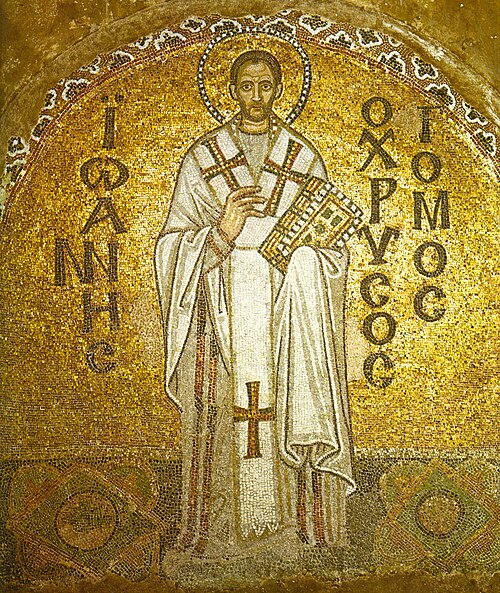 Mosaic in the northern tympanum depicting Saint John Chrysostom
 -
 Detail of the Christ Pantocrator mosaic, also known as the Deësis mosaic.
 -
 a Seraph angel. 13th century CE.

20th-century restoration
Many mosaics were uncovered in the 1930s by a team from the Byzantine Institute of America led by Thomas Whittemore. The team chose to let a number of simple cross images remain covered by plaster but uncovered all major mosaics found.
Because of its long history as both a church and a mosque, a particular challenge arises in the restoration process. Christian iconographic mosaics can be uncovered, but often at the expense of important and historic Islamic art. Restorers have attempted to maintain a balance between both Christian and Islamic cultures. In particular, much controversy rests upon whether the Islamic calligraphy on the dome of the cathedral should be removed, in order to permit the underlying Pantocrator mosaic of Christ as Master of the World to be exhibited (assuming the mosaic still exists).[255]
The Hagia Sophia has been a victim of natural disasters that have caused deterioration to the buildings structure and walls. The deterioration of the Hagia Sophia's walls can be directly attributed to salt crystallization. The crystallization of salt is due to an intrusion of rainwater that causes the Hagia Sophia's deteriorating inner and outer walls. Diverting excess rainwater is the main solution to the deteriorating walls at the Hagia Sophia.[256]
Built between 532 and 537, a subsurface structure under the Hagia Sophia has been under investigation, using LaCoste-Romberg gravimeters to determine the depth of the subsurface structure and to discover other hidden cavities beneath the Hagia Sophia. The hidden cavities have also acted as a support system against earthquakes. With these findings using the LaCoste-Romberg gravimeters, it was also discovered that the Hagia Sophia's foundation is built on a slope of natural rock.[257]
Imperial Gate mosaic
The Imperial Gate mosaic is located in the tympanum above that gate, which was used only by the emperors when entering the church. Based on style analysis, it has been dated to the late 9th or early 10th century. The emperor with a nimbus or halo could possibly represent emperor Leo VI the Wise or his son Constantine VII Porphyrogenitus bowing down before Christ Pantocrator, seated on a jewelled throne, giving his blessing and holding in his left hand an open book.[258] The text on the book reads: "Peace be with you" (John 20, John 20:19, 20:26) and "I am the light of the world" (John 8, John 8:12). On each side of Christ's shoulders is a circular medallion with busts: on his left the Archangel Gabriel, holding a staff, on his right his mother Mary.[259]
Southwestern entrance mosaic
The southwestern entrance mosaic, situated in the tympanum of the southwestern entrance, dates from the reign of Basil II.[260] It was rediscovered during the restorations of 1849 by the Fossatis. The Virgin sits on a throne without a back, her feet resting on a pedestal, embellished with precious stones. The Christ Child sits on her lap, giving his blessing and holding a scroll in his left hand. On her left side stands emperor Constantine in ceremonial attire, presenting a model of the city to Mary. The inscription next to him says: "Great emperor Constantine of the Saints". On her right side stands emperor Justinian I, offering a model of the Hagia Sophia. The medallions on both sides of the Virgin's head carry the nomina sacra MP and ΘΥ, abbreviations of the Greek: Μήτηρ του Θεοῦ, romanized: Mētēr Theou, lit. 'Mother of God'.[261] The composition of the figure of the Virgin enthroned was probably copied from the mosaic inside the semi-dome of the apse inside the liturgical space.[262]
Apse mosaics
The mosaic in the semi-dome above the apse at the east end shows Mary, mother of Jesus holding the Christ Child and seated on a jewelled thokos backless throne.[262] Since its rediscovery after a period of concealment in the Ottoman era, it "has become one of the foremost monuments of Byzantium".[262] The infant Jesus's garment is depicted with golden tesserae.
Guillaume-Joseph Grelot, who had travelled to Constantinople, in 1672 engraved and in 1680 published in Paris an image of the interior of Hagia Sophia which shows the apse mosaic indistinctly.[262] Together with a picture by Cornelius Loos drawn in 1710, these images are early attestations of the mosiac before it was covered towards the end of the 18th century.[262] The mosaic of the Virgin and Child was rediscovered during the restorations of the Fossati brothers in 1847–1848 and revealed by the restoration of Thomas Whittemore in 1935–1939.[262] It was studied again in 1964 with the aid of scaffolding.[262][263]
It is not known when this mosaic was installed.[262] According to Cyril Mango, the mosaic is "a curious reflection on how little we know about Byzantine art".[264] The work is generally believed to date from after the end of Byzantine Iconoclasm and usually dated to the patriarchate of Photius I (r. 858–867, 877–886) and the time of the emperors Michael III (r. 842–867) and Basil I (r. 867–886).[262] Most specifically, the mosaic has been connected with a surviving homily known to have been written and delivered by Photius in the cathedral on 29 March 867.[262][265][266][267][268]
Other scholars have favoured earlier or later dates for the present mosaic or its composition. Nikolaos Oikonomides pointed out that Photius's homily refers to a standing portrait of the Theotokos – a Hodegetria – while the present mosaic shows her seated.[269] Likewise, a biography of the patriarch Isidore I (r. 1347–1350) by his successor Philotheus I (r. 1353–1354, 1364–1376) composed before 1363 describes Isidore seeing a standing image of the Virgin at Epiphany in 1347.[262] Serious damage was done to the building by earthquakes in the 14th century, and it is possible that a standing image of the Virgin that existed in Photius's time was lost in the earthquake of 1346, in which the eastern end of Hagia Sophia was partly destroyed.[270][262] This interpretation supposes that the present mosaic of the Virgin and Child enthroned is of the late 14th century, a time in which, beginning with Nilus of Constantinople (r. 1380–1388), the patriarchs of Constantinople began to have official seals depicting the Theotokos enthroned on a thokos.[271][262]
Still other scholars have proposed an earlier date than the later 9th century. According to George Galavaris, the mosaic seen by Photius was a Hodegetria portrait which after the earthquake of 989 was replaced by the present image not later than the early 11th century.[271][270] According to Oikonomides however, the image in fact dates to before the Triumph of Orthodoxy, having been completed c. 787–797, during the iconodule interlude between the First Iconoclast (726–787) and the Second Iconoclast (814–842) periods.[269] Having been plastered over in the Second Iconoclasm, Oikonomides argues a new, standing image of the Virgin Hodegetria was created above the older mosaic in 867, which then fell off in the earthquakes of the 1340s and revealed again the late 8th-century image of the Virgin enthroned.[269]
More recently, analysis of a hexaptych menologion icon panel from Saint Catherine's Monastery at Mount Sinai has determined that the panel, showing numerous scenes from the life of the Virgin and other theologically significant iconic representations, contains an image at the centre very similar to that in Hagia Sophia.[262] The image is labelled in Greek merely as: Μήτηρ Θεοῦ, romanized: Mētēr Theou, lit. 'Mother of God', but in the Georgian language the inscription reveals the image is labelled "of the semi-dome of Hagia Sophia".[262] This image is therefore the oldest depiction of the apse mosaic known and demonstrates that the apse mosaic's appearance was similar to the present day mosaic in the late 11th or early 12th centuries, when the hexaptych was inscribed in Georgian by a Georgian monk, which rules out a 14th-century date for the mosaic.[262]
The portraits of the archangels Gabriel and Michael (largely destroyed) in the bema of the arch also date from the 9th century. The mosaics are set against the original golden background of the 6th century. These mosaics were believed to be a reconstruction of the mosaics of the 6th century that were previously destroyed during the iconoclastic era by the Byzantines of that time, as represented in the inaugural sermon by the patriarch Photios. However, no record of figurative decoration of Hagia Sophia exists before this time.[272]
Emperor Alexander mosaic
The Emperor Alexander mosaic is not easy to find for the first-time visitor, located on the second floor in a dark corner of the ceiling. It depicts the emperor Alexander in full regalia, holding a scroll in his right hand and a globus cruciger in his left. A drawing by the Fossatis showed that the mosaic survived until 1849 and that Thomas Whittemore, founder of the Byzantine Institute of America who was granted permission to preserve the mosaics, assumed that it had been destroyed in the earthquake of 1894. Eight years after his death, the mosaic was discovered in 1958 largely through the researches of Robert Van Nice. Unlike most of the other mosaics in Hagia Sophia, which had been covered over by ordinary plaster, the Alexander mosaic was simply painted over and reflected the surrounding mosaic patterns and thus was well hidden. It was duly cleaned by the Byzantine Institute's successor to Whittemore, Paul A. Underwood.[273][274]
Empress Zoe mosaic
The Empress Zoe mosaic on the eastern wall of the southern gallery dates from the 11th century. Christ Pantocrator, clad in the dark blue robe (as is the custom in Byzantine art), is seated in the middle against a golden background, giving his blessing with the right hand and holding the Bible in his left hand. On either side of his head are the nomina sacra IC and XC, meaning Iēsous Christos. He is flanked by Constantine IX Monomachus and Empress Zoe, both in ceremonial costumes. He is offering a purse, as a symbol of donation, he made to the church, while she is holding a scroll, symbol of the donations she made. The inscription over the head of the emperor says: "Constantine, pious emperor in Christ the God, king of the Romans, Monomachus". The inscription over the head of the empress reads as follows: "Zoë, the very pious Augusta". The previous heads have been scraped off and replaced by the three present ones. Perhaps the earlier mosaic showed her first husband Romanus III Argyrus or her second husband Michael IV. Another theory is that this mosaic was made for an earlier emperor and empress, with their heads changed into the present ones.[275]
Comnenus mosaic
The Comnenus mosaic, also located on the eastern wall of the southern gallery, dates from 1122. The Virgin Mary is standing in the middle, depicted, as usual in Byzantine art, in a dark blue gown. She holds the Christ Child on her lap. He gives his blessing with his right hand while holding a scroll in his left hand. On her right side stands emperor John II Comnenus, represented in a garb embellished with precious stones. He holds a purse, symbol of an imperial donation to the church. His wife, the empress Irene of Hungary stands on the left side of the Virgin, wearing ceremonial garments and offering a document. Their eldest son Alexius Comnenus is represented on an adjacent pilaster. He is shown as a beardless youth, probably representing his appearance at his coronation aged seventeen. In this panel, one can already see a difference with the Empress Zoe mosaic that is one century older. There is a more realistic expression in the portraits instead of an idealized representation. The Empress Irene (born Piroska), daughter of Ladislaus I of Hungary, is shown with plaited blond hair, rosy cheeks, and grey eyes, revealing her Hungarian descent. The emperor is depicted in a dignified manner.[276]
Deësis mosaic
The Deësis mosaic (Δέησις, "Entreaty") probably dates from 1261. It was commissioned to mark the end of 57 years of Latin Catholic use and the return to the Eastern Orthodox faith. It is the third panel situated in the imperial enclosure of the upper galleries. It is widely considered the finest in Hagia Sophia, because of the softness of the features, the humane expressions and the tones of the mosaic. The style is close to that of the Italian painters of the late 13th or early 14th century, such as Duccio. In this panel the Virgin Mary and John the Baptist (Ioannes Prodromos), both shown in three-quarters profile, are imploring the intercession of Christ Pantocrator for humanity on Judgment Day. The bottom part of this mosaic is badly deteriorated.[277] This mosaic is considered as the beginning of a renaissance in Byzantine pictorial art.[278]
Northern tympanum mosaics
The northern tympanum mosaics feature various saints. They have been able to survive due to their high and inaccessible location. They depict Patriarchs of Constantinople John Chrysostom and Ignatios of Constantinople standing, clothed in white robes with crosses, and holding richly jewelled Bibles. The figures of each patriarch, revered as saints, are identifiable by labels in Greek. The other mosaics in the other tympana have not survived probably due to the frequent earthquakes, as opposed to any deliberate destruction by the Ottoman conquerors.[279]
Dome mosaic
The dome was decorated with four non-identical figures of the six-winged angels which protect the Throne of God; it is uncertain whether they are seraphim or cherubim. The mosaics survive in the eastern part of the dome, but since the ones on the western side were damaged during the Byzantine period, they have been renewed as frescoes. During the Ottoman period each seraph's (or cherub's) face was covered with metallic lids in the shape of stars, but these were removed to reveal the faces during renovations in 2009.[280]
Other burials
- Selim II (1524–15 December 1574)
- Murad III 1546–1595
- Mustafa I (c. 1600–20 January 1639), in the courtyard.
- Enrico Dandolo (c. 1107–June 1205), in the east gallery.
- Gli (c. 2004–7 November 2020), in the garden.
Works influenced by the Hagia Sophia


Many buildings have been modeled on the Hagia Sophia's core structure of a large central dome resting on pendentives and buttressed by two semi-domes.
Byzantine churches influenced by the Hagia Sophia include the Hagia Sophia in Thessaloniki, and the Hagia Irene. The latter was remodeled to have a dome similar to the Hagia Sophia's during the reign of Justinian.
Several mosques commissioned by the Ottoman dynasty have plans based on the Hagia Sophia, including the Süleymaniye Mosque and the Bayezid II Mosque.[281][282] Ottoman architects preferred to surround the central dome with four semi-domes rather than two.[283] There are four semi-domes on the Sultan Ahmed Mosque, the Fatih Mosque,[284] and the New Mosque (Istanbul). As with the original plan of the Hagia Sophia, these mosques are entered through colonnaded courtyards. However, the courtyard of the Hagia Sophia no longer exists.
Neo-Byzantine churches modeled on the Hagia Sophia include the Kronstadt Naval Cathedral, Holy Trinity Cathedral, Sibiu[285] and Poti Cathedral. Each closely replicates the internal geometry of the Hagia Sophia. The layout of the Kronstadt Naval Cathedral is nearly identical to the Hagia Sophia in size and geometry. Its marble revetment also mimics the style of the Hagia Sophia.
As with Ottoman mosques, several churches based on the Hagia Sophia include four semi-domes rather than two, such as the Church of Saint Sava in Belgrade.[286][287] The Catedral Metropolitana Ortodoxa in São Paulo and the Église du Saint-Esprit (Paris) both replace the two large tympanums beneath the main dome with two shallow semi-domes. The Église du Saint-Esprit is two thirds the size of the Hagia Sophia.
Several churches combine elements of the Hagia Sophia with a Latin cross plan. For instance, the transept of the Cathedral Basilica of Saint Louis (St. Louis) is formed by two semi-domes surrounding the main dome. The church's column capitals and mosaics also emulate the style of the Hagia Sophia. Other examples include the Alexander Nevsky Cathedral, Sofia, St Sophia's Cathedral, London, Saint Clement Catholic Church, Chicago, and the Basilica of the National Shrine of the Immaculate Conception.
Synagogues based on the Hagia Sophia include the Congregation Emanu-El (San Francisco),[288] Great Synagogue of Florence, and Hurva Synagogue.
Gallery
-
 Detail of the columns
 -
 Detail of the columns
 -
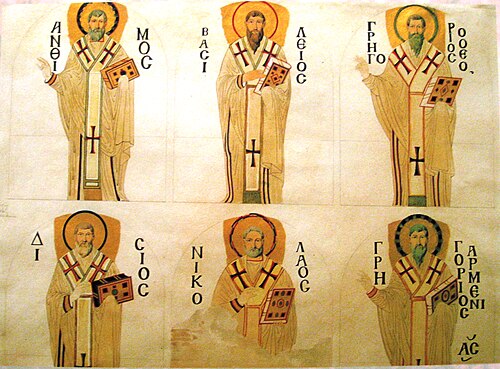 Six patriarchs mosaic in the southern tympanum as drawn by the Fossati brothers
 -
 Moasics as drawn by the Fossati brothers
 -
 Guillaume-Joseph Grelot's engraving 1672, looking east and showing the apse mosaic
 -
 Guillaume-Joseph Grelot's engraving 1672, looking west
 -
 Interior of the Hagia Sophia by John Singer Sargent, 1891
 -
 Photograph by Sébah & Joaillier, c. 1900–1910
 -
 Watercolour of the interior by Philippe Chaperon, 1893
 -
 Detail of relief on the Marble Door.
 -
 Imperial Gate from the nave
 -
 19th-century cenotaph of Enrico Dandolo, Doge of Venice, and commander of the 1204 Sack of Constantinople
 -
 Gate of the külliye, by John Frederick Lewis, 1838
 -
 Fountain of Ahmed III from the gate of the külliye, by John Frederick Lewis, 1838
 -
 Southern side of Hagia Sophia, looking east, by John Frederick Lewis, 1838
 -
 From Verhandeling van de godsdienst der Mahometaanen, by Adriaan Reland, 1719
 -
 Interior of Haghia Sophia
 -
 Hagia Sophia from the south-west, 1914
 -
 Hagia Sophia in the snow, December 2015
 -
Maschinengewehr 08 mounted on a minaret during World War II
_(14773026492).jpg/500px-thumbnail.jpg)
_(14586659270).jpg/500px-thumbnail.jpg)
.jpg/500px-Philippe_Chaperon_Sainte-Sophie,_1893_(collection_particuli%C3%A8re).jpg)

.jpg/500px-Hagia_Sophia_(16064799696).jpg)
_Serai_-_Lewis_John_F_-_1838.jpg/500px-Fountain_of_the_gate_of_Eski_(Old)_Serai_-_Lewis_John_F_-_1838.jpg)
_-_Lewis_John_F_-_1838.jpg/500px-Saint_Sophia_and_distant_view_of_Sultan_Achmet_(Mosques)_-_Lewis_John_F_-_1838.jpg)

.jpg/500px-Voyage_en_Orient_(bgw20_0447).jpg)
.jpg/500px-Hagia_Sophia_and_its_faithful_tourists_(24238189635).jpg)
See also


- Runic inscriptions in Hagia Sophia
- List of Byzantine inventions
- List of tallest domes
- List of largest monoliths
- List of oldest church buildings
- List of tallest structures built before the 20th century
- List of Turkish Grand Mosques
- Conversion of non-Islamic places of worship into mosques
References
Notes
- ^ Also translated: "I think of Hagia Sophia and I am very saddened."[185]
Citations
- ^ Emerson, William; van Nice, Robert L. (1950). "Hagia Sophia and the First Minaret Erected after the Conquest of Constantinople". American Journal of Archaeology. 54 (1): 28–40. doi:10.2307/500639. ISSN 0002-9114. JSTOR 500639. S2CID 193099976.
- ^ Curta, Florin; Holt, Andrew (2016). Great Events in Religion: An Encyclopedia of Pivotal Events in Religious History [3 volumes]. ABC-CLIO. p. 299. ISBN 978-1-61069-566-4.
Hagia Sophia was consecrated on December 27, 537, five years after construction had begun. The church was dedicated to the Wisdom of God, referring to the Logos (the second entity of the Trinity) or, alternatively, Christ as the Logos incarnate.
- ^ Eyice, Semavi (1991). "Ayasofya" [Hagia Sophia]. İslâm Ansiklopedisi (in Turkish). Vol. 4. Istanbul: Turkish Diyanet Foundation. pp. 206–210.
- ^ Phillips, Jonathan (2005). The Fourth Crusade and the sack of Constantinople. Penguin Books. ISBN 978-1-101-12188-7. OCLC 607531385.
- ^ Kleiner, Fred S.; Christin J. Mamiya (2008). Gardner's Art Through the Ages: Volume I, Chapters 1–18 (12th ed.). Mason, OH: Wadsworth. p. 329. ISBN 978-0-495-46740-3.
- ^ Downey, Glanville (January 1959). "The Name of the Church of St. Sophia in Constantinople". Harvard Theological Review. 52 (1): 37–41. doi:10.1017/s001781600002664x. ISSN 0017-8160. S2CID 163442071.
- ^ Hamm, Jean S. (2010). Term Paper Resource Guide to Medieval History. ABC-CLIO. p. 39. ISBN 978-0-313-35967-5.
Hagia Sophia, or the Church of Holy Wisdom, is one of the world's most spectacular churches, representing not only great beauty, but also masterful engineering.
- ^ a b c Fazio, Michael; Moffett, Marian; Wodehouse, Lawrence (2009). Buildings Across Time (3rd ed.). McGraw-Hill Higher Education. ISBN 978-0-07-305304-2.
- ^ Simons, Marlise (22 August 1993). "Center of Ottoman Power". The New York Times. Retrieved 4 June 2009.
- ^ a b c Heinle & Schlaich 1996
- ^ Cameron 2009.
- ^ Meyendorff 1982.
- ^ a b Janin (1953), p. 471.
- ^ Binns, John (2002). An Introduction to the Christian Orthodox Churches. Cambridge University Press. p. 57. ISBN 978-0-521-66738-8.
- ^ McKenzie, Steven L.; Graham, Matt Patrick (1998). The Hebrew Bible Today: An Introduction to Critical Issues. Westminster John Knox Press. p. 149. ISBN 978-0-664-25652-4.
- ^ Müller-Wiener (1977), p. 112.
- ^ Jarus, Owen (1 March 2013). "Hagia Sophia: Facts, History & Architecture". livescience.com. Retrieved 15 July 2020.
- ^ "Hagia Sophia". ArchNet. Archived from the original on 5 January 2009.
- ^ a b c d e f g h i j k l m n o p Müller-Wiener (1977), p. 91.
- ^ "Hagia Sophia still Istanbul's top tourist attraction". hurriyet.
- ^ Müller-Wiener (1977), p. 84.
- ^ Alessandro E. Foni; George Papagiannakis; Nadia Magnentat-Thalmann. "Virtual Hagia Sophia: Restitution, Visualization and Virtual Life Simulation" (PDF). Archived from the original (PDF) on 9 July 2007. Retrieved 3 July 2007.
- ^ a b c d e f Janin (1953), p. 472.
- ^ a b c d e f g Dark, Ken R.; Kostenec, Jan (2019). Hagia Sophia in Context: An Archaeological Re-examination of the Cathedral of Byzantine Constantinople. Oxford: Oxbow Books. pp. 11–12. ISBN 978-1-78925-030-5.
- ^ a b Mainstone, Rowland J. (1997) [1988]. Hagia Sophia: Architecture, Structure and Liturgy of Justinian's Great Church. London: Thames and Hudson. p. 131. ISBN 978-0-500-27945-8.
- ^ Patria of Constantinople
- ^ Mainstone, Rowland J. (1997) [1988]. Hagia Sophia: Architecture, Structure and Liturgy of Justinian's Great Church. London: Thames and Hudson. p. 132. ISBN 978-0-500-27945-8.
- ^ Mainstone, Rowland J. (1997) [1988]. Hagia Sophia: Architecture, Structure and Liturgy of Justinian's Great Church. London: Thames and Hudson. p. 137. ISBN 978-0-500-27945-8.
- ^ Ahmad, Tufail. "Hagia Sophia History | Explore and Learn About This Monument". Hagia Sophia Tickets. Retrieved 19 July 2023.
- ^ a b c d e f g h Dark, Ken R.; Kostenec, Jan (2019). Hagia Sophia in Context: An Archaeological Re-examination of the Cathedral of Byzantine Constantinople. Oxford: Oxbow Books. pp. 12–15. ISBN 978-1-78925-030-5.
- ^ "Hagia Sophia". Hagia Sophia | History, Facts, & Significance. Encyclopædia Britannica. 14 August 2023.
The original church on the site of the Hagia Sophia is said to have been ordered to be built by Constantine I in 325 on the foundations of a pagan temple.
- ^ Ljudmila Djukic (9 September 2019). "Hagia Sophia (Constantinople)". The Byzantine Empire: A Historical Encyclopedia. Vol. 2. ABC-CLIO. p. 195. ISBN 978-1-4408-5147-6.
- ^ Sharon La Boda (1994). International Dictionary of Historic Places: Southern Europe. Taylor & Francis. p. 343. ISBN 978-1-884964-02-2.
- ^ a b Lucien Ellington (2005). Eastern Europe: An Introduction to the People, Lands, and Culture, Volume 1. Abc-Clio. p. 853. ISBN 978-1-57607-800-6.
- ^ a b c d e f g h i j k l m n o p q r s t u Dark, Ken R.; Kostenec, Jan (2019). Hagia Sophia in Context: An Archaeological Re-examination of the Cathedral of Byzantine Constantinople. Oxford: Oxbow Books. pp. 15–20. ISBN 978-1-78925-030-5.
- ^ Crawford, Peter (2019). Roman Emperor Zeno: The Perils of Power Politics in Fifth-Century Constantinople. Newburyport: Pen & Sword Books. p. 14. ISBN 978-1-4738-5927-2. OCLC 1206400173.
- ^ a b c Gregory, Timothy E. (2005) [1991], Kazhdan, Alexander P. (ed.), "Nestorios", The Oxford Dictionary of Byzantium (online ed.), Oxford University Press, doi:10.1093/acref/9780195046526.001.0001, ISBN 978-0-19-504652-6, retrieved 1 October 2020
- ^ a b c Gregory, Timothy E.; Culter, Anthony (2005) [1991], Kazhdan, Alexander P. (ed.), "Pulcheria", The Oxford Dictionary of Byzantium (online ed.), Oxford University Press, doi:10.1093/acref/9780195046526.001.0001, ISBN 978-0-19-504652-6, retrieved 1 October 2020
- ^ a b Krawiec, Rebecca (2008), "Pulcheria", in Smith, Bonnie G. (ed.), The Oxford Encyclopedia of Women in World History (online ed.), Oxford University Press, doi:10.1093/acref/9780195148909.001.0001, ISBN 978-0-19-514890-9, retrieved 1 October 2020
- ^ Δετοράκης, Θεοχάρης Ε (2004). Αγια Σοφια: ο ναος της Αγιας του Θεου Σοφιας (in Greek). Εκδόσεις Έφεσος. p. 20. ISBN 978-960-8326-14-9.
- ^ Theodosius, Earlier Second Church Ordered by I. I.; Rufinus, Built by Architect; Justinian, Current Church was Ordered by Emperor; Tralles, Designed by Greek Scientists Isidore of Miletus Anthemius of. "Exterior, Walls and Architectural Elements".
Earlier second church ordered by Theodosius II, built by architect Rufinus, current Church was ordered by Emperor Justinian and designed by Greek scientists Isidore of Miletus and Anthemius of Tralles
- ^ a b Mainstone, Rowland J. (1997) [1988]. Hagia Sophia: Architecture, Structure and Liturgy of Justinian's Great Church. London: Thames and Hudson. p. 135. ISBN 978-0-500-27945-8.
- ^ a b c "Book I (beginning)". The Buildings of Procopius. Loeb Classical Library. 1940. Retrieved 15 July 2020.
- ^ Kaldellis, Anthony (2013). "The Making of Hagia Sophia and the Last Pagans of New Rome". Journal of Late Antiquity. 6 (2): 347–366. doi:10.1353/jla.2013.0019. ISSN 1942-1273. S2CID 162336421.
- ^ Mango, Cyril A. (1986). The Art of the Byzantine Empire 312-1453: Sources and documents. Internet Archive. Toronto; London: University of Toronto Press/Medieval Academy of America. ISBN 978-0-8020-6627-5.
- ^ Heath, Thomas Little (1911). . Encyclopædia Britannica. Vol. 02 (11th ed.). p. 93.
- ^ a b c d e f Kaldellis, Anthony (2013). "The Making of Hagia Sophia and the Last Pagans of New Rome". Journal of Late Antiquity. 6 (2): 347–366. doi:10.1353/jla.2013.0019. ISSN 1942-1273. S2CID 162336421.
- ^ a b John Lydus, De Magistratibus reipublicae Romanae III.76
- ^ Evagrius Scholasticus, Historia Ecclesiastica IV.30
- ^ a b Dark, Ken R.; Kostenec, Jan (2019). Hagia Sophia in Context: An Archaeological Re-examination of the Cathedral of Byzantine Constantinople. Oxford: Oxbow Books. p. 46. ISBN 978-1-78925-030-5.
- ^ Teteriatnikov, Natalia (1998). Mosaics of Hagia Sophia, Istanbul: The Fossati restoration and the work of the Byzantine Institute. Dumbarton Oaks. Washington, DC: Dumbarton Oaks, Trustees for Harvard University. p. 17.
- ^ Krautheimer, Richard (1986). Early Christian and Byzantine Architecture (4th ed.). New Haven and London: Yale University Press/Pelican History of Art. p. 205. ISBN 978-0-300-05296-1.
- ^ Mango, Cyril (1985). Byzantine Architecture (1st ed.). New York: Electa/Rizzoli. p. 65. ISBN 978-0-8478-0615-7.
- ^ Herrin, Judith (2007). The Surprising Life of a Medieval Empire. Penguin. pp. 86–87. ISBN 978-0-7139-9997-6.
- ^ a b c d Müller-Wiener (1977), p. 86.
- ^ "The Chronicle of John Malalas," Bk 18.86 Translated by E. Jeffreys, M. Jeffreys, and R. Scott. Australian Association of Byzantine Studies, 1986 vol 4.
- ^ "The Chronicle of Theophones Confessor: Byzantine and Near Eastern History AD 284–813." Translated with commentary by Cyril Mango and Roger Scott. AM 6030 p. 316, with this note: Theophanes' precise date should be accepted.
- ^ Macrides, R. J. (1988). "Killing, Asylum, and the Law in Byzantium". Speculum. 63 (3): 509–538. doi:10.2307/2852633. ISSN 0038-7134. JSTOR 2852633. S2CID 159951797.
- ^ Stroth (2021), esp. pp. 19–53.
- ^ Janin, Raymond (1950). Constantinople Byzantine (in French) (1 ed.). Paris: Institut Français d'Études Byzantines. p. 41.
- ^ "Haghia Sophia". Istanbul /: Emporis. Archived from the original on 22 April 2007. Retrieved 4 December 2011.
{{cite web}}: CS1 maint: unfit URL (link) - ^ "Baalbek keeps its secrets". stoneworld.
- ^ Silentiarius, Paulus (2011). Descriptio Sanctae Sophiae. Descriptio Ambonis. Berlin: De Gruyter. doi:10.1515/9783110239072. ISBN 978-3-11-023907-2.
- ^ Bell, Peter Neville, ed. (2009). Three political voices from the age of Justinian: Agapetus, 'Advice to the Emperor'; Dialogue on political science; Paul the Silentiary: 'Description of Hagia Sophia'. Liverpool: Liverpool University Press. ISBN 978-1-84631-209-0. OCLC 318874086.
- ^ a b Hurbanič, Martin (2019), Hurbanič, Martin (ed.), "The Last War of Antiquity", The Avar Siege of Constantinople in 626: History and Legend, New Approaches to Byzantine History and Culture, Cham: Springer International Publishing, pp. 81–102, doi:10.1007/978-3-030-16684-7_4, ISBN 978-3-030-16684-7, S2CID 200105105, retrieved 20 October 2020
- ^ Hurbanič, Martin (2019), Hurbanič, Martin (ed.), "The Spiritual Arsenal of the Siege", The Avar Siege of Constantinople in 626: History and Legend, New Approaches to Byzantine History and Culture, Cham: Springer International Publishing, pp. 315–338, doi:10.1007/978-3-030-16684-7_14, ISBN 978-3-030-16684-7, S2CID 201011125, retrieved 20 October 2020
- ^ Hurbanič, Martin (2019), Hurbanič, Martin (ed.), "The Avars at the Gates", The Avar Siege of Constantinople in 626: History and Legend, New Approaches to Byzantine History and Culture, Cham: Springer International Publishing, pp. 181–201, doi:10.1007/978-3-030-16684-7_8, ISBN 978-3-030-16684-7, S2CID 199934427, retrieved 20 October 2020
- ^ a b c d Hurbanič, Martin (2019), Hurbanič, Martin (ed.), "The Memory of the Siege", The Avar Siege of Constantinople in 626: History and Legend, New Approaches to Byzantine History and Culture, Cham: Springer International Publishing, pp. 7–54, doi:10.1007/978-3-030-16684-7_2, ISBN 978-3-030-16684-7, S2CID 199944450, retrieved 20 October 2020
- ^ Hurbanič, Martin (2019), Hurbanič, Martin (ed.), "From History to Legend", The Avar Siege of Constantinople in 626: History and Legend, New Approaches to Byzantine History and Culture, Cham: Springer International Publishing, pp. 247–268, doi:10.1007/978-3-030-16684-7_11, ISBN 978-3-030-16684-7, S2CID 200995315, retrieved 20 October 2020
- ^ Dikigoropoulos, Andreas (1964). "The Constantinopolitan Solidi of Theophilus". Dumbarton Oaks Papers. 18: 353–361. doi:10.2307/1291219. ISSN 0070-7546. JSTOR 1291219.
- ^ a b Sakar, Sonay; Yuksel, Fethi Ahmet; Hoskan, Nihan; Avci, Emine; Avci, Kerim; Erguven, Kubra (20 March 2014), "The gpr measurements on hagia sophia's surfaces facing the naos", Symposium on the Application of Geophysics to Engineering and Environmental Problems 2014, Symposium on the Application of Geophysics to Engineering and Environmental Problems Proceedings, Society of Exploration Geophysicists and Environment and Engineering Geophysical Society, p. 558, doi:10.4133/sageep.27-200, retrieved 19 June 2021
- ^ Teteriatnikov, Natalia (2004–2005). "Hagia Sophia, Constantinople: Religious images and their functional context after iconoclasm". Zograf (30): 9–19. doi:10.2298/zog0530009t.
- ^ Witold Rybczynski, The Story of Architecture. 2022, Yale University Press. ISBN 9780300246063
- ^ a b c Poppe, Andrzej (1992). "Once Again concerning the Baptism of Olga, Archontissa of Rus'". Dumbarton Oaks Papers. 46: 271–277. doi:10.2307/1291660. ISSN 0070-7546. JSTOR 1291660.
- ^ a b c Kazhdan, Alexander P. (2005) [1991], Kazhdan, Alexander P. (ed.), "Ol'ga", The Oxford Dictionary of Byzantium (online ed.), Oxford University Press, doi:10.1093/acref/9780195046526.001.0001, ISBN 978-0-19-504652-6, retrieved 17 October 2020
- ^ Pritsak, Omeljan (1985). "When and Where was Ol'ga Baptized?". Harvard Ukrainian Studies. 9 (1/2): 5–24. ISSN 0363-5570. JSTOR 41036130.
- ^ Flier, Michael S. (2010), Bjork, Robert E. (ed.), "Olga, St", The Oxford Dictionary of the Middle Ages (online ed.), Oxford University Press, doi:10.1093/acref/9780198662624.001.0001, ISBN 978-0-19-866262-4, retrieved 17 October 2020
- ^ Farmer, David (2011), "Olga", The Oxford Dictionary of Saints (5th ed.), Oxford University Press, doi:10.1093/acref/9780199596607.001.0001, ISBN 978-0-19-959660-7, retrieved 17 October 2020
- ^ a b Fennell, John L. (2013) [1995]. A History of the Russian Church to 1488. Routledge. p. 29. ISBN 978-1-317-89720-0.
- ^ Maranci, Christina (September 2003). "The Architect Trdat: Building Practices and Cross-Cultural Exchange in Byzantium and Armenia". Journal of the Society of Architectural Historians. 62 (3): 294–305. doi:10.2307/3592516. JSTOR 3592516.
- ^ Müller-Wiener (1977), p. 87.
- ^ a b c d Mamboury (1953) p. 287
- ^ Magdalino, Paul (2016). "The triumph of 1133". In Bucossi, Alessandra; Suarez, Alex Rodriguez (eds.). John II Komnenos, Emperor of Byzantium: In the Shadow of Father and Son. Centre for Hellenic Studies, King's College London Publications 17. Oxford: Routledge. pp. 53–70. doi:10.4324/9781315590547. ISBN 978-1-315-59054-7.
- ^ Niketas Choniates, Annals, XIX. O City of Byzantium: Annals of Niketas Choniatēs. Translated by Magoulias, Harry J. Wayne State University Press. 1984. p. 12. ISBN 978-0-8143-1764-8.
- ^ Niketas Choniates, Annals, CLVII–CLVIII. O City of Byzantium: Annals of Niketas Choniatēs. Translated by Magoulias, Harry J. Wayne State University Press. 1984. pp. 89–90 & 382, notes 434–435. ISBN 978-0-8143-1764-8.
- ^ a b c d e f g Niketas Choniates, Annals, CCXXX–CCXLII. O City of Byzantium: Annals of Niketas Choniatēs. Translated by Magoulias, Harry J. Wayne State University Press. 1984. pp. 129–136. ISBN 978-0-8143-1764-8.
- ^ a b Niketas Choniates, Annals, CCLI–CCLII. O City of Byzantium: Annals of Niketas Choniatēs. Translated by Magoulias, Harry J. Wayne State University Press. 1984. pp. xx–xxi, 141. ISBN 978-0-8143-1764-8.
- ^ O City of Byzantium: Annals of Niketas Choniatēs. Translated by Magoulias, Harry J. Wayne State University Press. 1984. p. 315. ISBN 978-0-8143-1764-8.
- ^ a b O City of Byzantium: Annals of Niketas Choniatēs. Translated by Magoulias, Harry J. Wayne State University Press. 1984. p. 306. ISBN 978-0-8143-1764-8.
- ^ Victor Roudometof (15 October 2013). Globalization and Orthodox Christianity: The Transformations of a Religious Tradition. Routledge. p. 47. ISBN 978-1-135-01469-8.
- ^ Avner Falk (8 May 2018). Franks and Saracens: Reality and Fantasy in the Crusades. Routledge. p. 164. ISBN 978-0-429-89969-0.
- ^ Hamblin, William J. (2008). "Arab perspectives on the Fourth Crusade". In Madden, Thomas F. (ed.). The Fourth Crusade: Event, Aftermath, and Perceptions: Papers from the Sixth Conference of the Society for the Study of the Crusades and the Latin East, Istanbul, Turkey, 25-29 August 2004. Society for the Study of the Crusades and the Latin East. Aldershot: Ashgate Publishing, Ltd. p. 175. ISBN 978-0-7546-6319-5.
- ^ A. Edward Siecienski (3 June 2019). Orthodox Christianity: A Very Short Introduction. Oxford University Press. p. 24. ISBN 978-0-19-088329-4.
- ^ Gallo, Rudolfo (1927). "La tomba di Enrico Dandolo in Santa Sofia a Constantinople". Rivista Mensile della Citta di Venezia. 6: 270–83.
- ^ Guilland, R. (1953). "ÉTUDES SUR L'HISTOIRE ADMINISTRATIVE DE L'EMPIRE BYZANTIN. LE STRATOPÉDARQUE ET LE GRAND STRATOPÉDARQUE". Byzantinische Zeitschrift. 46 (1). doi:10.1515/byzs.1953.46.1.63. ISSN 0007-7704. S2CID 191369605.
- ^ Philippides, Marios; Hanak, Walter K. (2001). The Siege and the Fall of Constantinople in 1453: Historiography, Topography, and Military Studies. Farnham: Ashgate Publishing, Ltd. p. 228. ISBN 978-1-4094-1064-5.
- ^ Hurbanič, Martin (2019), Hurbanič, Martin (ed.), "Conclusion", The Avar Siege of Constantinople in 626: History and Legend, New Approaches to Byzantine History and Culture, Cham: Springer International Publishing, pp. 339–349, doi:10.1007/978-3-030-16684-7_15, ISBN 978-3-030-16684-7, retrieved 20 October 2020
- ^ a b c d e Philippides, Marios; Hanak, Walter K. (2011). The Siege and the Fall of Constantinople in 1453: Historiography, Topography, and Military Studies. Farnham: Ashgate Publishing, Ltd. pp. 221–223. ISBN 978-1-4094-1064-5.
- ^ a b c Kraft, András (2012). "Constantinople in Byzantine Apocalyptic Thought" (PDF). Annual of Medieval Studies at CEU. 18: 25–36. Archived (PDF) from the original on 9 October 2022.
- ^ a b c d Rydén, Lennart (1974). "The Andreas Salos Apocalypse. Greek Text, Translation, and Commentary". Dumbarton Oaks Papers. 28: 197–261. doi:10.2307/1291359. ISSN 0070-7546. JSTOR 1291359.
- ^ a b c d e f g Philippides, Marios; Hanak, Walter K. (2011). The Siege and the Fall of Constantinople in 1453: Historiography, Topography, and Military Studies. Farnham: Ashgate Publishing, Ltd. pp. 214–217. ISBN 978-1-4094-1064-5.
- ^ a b c Philippides, Marios; Hanak, Walter K. (2011). The Siege and the Fall of Constantinople in 1453: Historiography, Topography, and Military Studies. Farnham: Ashgate Publishing, Ltd. pp. 229–230. ISBN 978-1-4094-1064-5.
- ^ "Fall of Constantinople". Encyclopædia Britannica.
- ^ a b Nicol. The End of the Byzantine Empire, p. 90.
- ^ a b c Runciman, Steven (1965). The Fall of Constantinople 1453. Cambridge University Press. p. 147. ISBN 978-0-521-39832-9.
- ^ a b Runciman, Steven (1965). The Fall of Constantinople 1453. Cambridge University Press. pp. 145–148. ISBN 978-0-521-39832-9.
- ^ Nicol, Donald MacGillivray (1979). The End of the Byzantine Empire. London: Edward Arnold. p. 88. ISBN 978-0-7131-6250-9.
- ^ Inalcik, Halil (1969). "The Policy of Mehmed II toward the Greek Population of Istanbul and the Byzantine Buildings of the City". Dumbarton Oaks Papers. 23/24: 229–249. doi:10.2307/1291293. ISSN 0070-7546. JSTOR 1291293.
- ^ a b c Calian, Florin George (25 March 2021). "The Hagia Sophia and Turkey's Neo-Ottomanism". The Armenian Weekly. Retrieved 14 April 2021.
- ^ Runciman. The Fall of Constantinople, pp. 133–34.
- ^ Nicol, Donald M. The Last Centuries of Byzantium 1261–1453. Cambridge: Cambridge University Press, 1972, p. 389.
- ^ Contested Spaces, Common Ground: Space and Power Structures in Contemporary Multireligious Societies. BRILL. 27 October 2016. ISBN 978-90-04-32580-7.
- ^ Runciman, Steven (1965). The Fall of Constantinople 1453. Cambridge University Press. p. 149. ISBN 978-0-521-39832-9.
- ^ a b c d e f g h Barry, Fabio (2007). "Walking on Water: Cosmic Floors in Antiquity and the Middle Ages". The Art Bulletin. 89 (4): 627–656. doi:10.1080/00043079.2007.10786367. ISSN 0004-3079. JSTOR 25067354. S2CID 194078403.
- ^ Tafur, Pero (1926). Travels and Adventures, 1435–1439. Trans. M. Letts. London: G. Routledge. pp. 138–48.
- ^ G. Gerola, "Le vedute di Costantinopoli di Cristoforo Buondemonti," SBN 3 (1931): 247–79.
- ^ Mamboury (1953), p. 288.
- ^ Necipoĝlu (2005), p. 13
- ^ Boyar & Fleet (2010), p. 145
- ^ Gökovali, Şadan. Istanbul. Istanbul: Ticaret Matbaacilik T.A.Ş. pp. 22–23.
- ^ Mungan, I. (2004). Hagia Sophia and Mimar Sinan. Mungan & Wittek (eds); Taylor & Francis Group, London. pp. 383–84. ISBN 978-90-5809-642-5.
- ^ a b c d Müller-Wiener (1977), p. 93.
- ^ "Facts About Hagia Sophia | Discover A Historic Masterpiece!". hagiasophiatickets.com. Retrieved 19 July 2023.
- ^ a b c d e f "The Fossati brothers". Turkish Cultural Foundation. Retrieved 26 July 2020.
- ^ a b Bloom, Jonathan; Blair, Sheila (2009). "Istanbul". Grove Encyclopedia of Islamic Art & Architecture. Oxford University Press USA. p. 324. ISBN 978-0-19-530991-1.
- ^ "Hagia Sophia - Meaning, Mosque & Istanbul". HISTORY. 29 September 2020. Retrieved 1 July 2024.
- ^ Admin (11 September 2020). "Architectural Adventure of Hagia Sophia". Architecture News. Archived from the original on 29 July 2021. Retrieved 29 July 2021.
- ^ Stivaktakis, Anthony E. (27 February 2004). "The Last Divine Liturgy in Hagia Sophia of 1919". www.johnsanidopoulos.com. Retrieved 8 August 2022.
- ^ "500 Drachmai". Numista. Retrieved 22 February 2023.
- ^ "Tarihin aktığı takvim..." www.ntv.com.tr (in Turkish). Retrieved 22 February 2023.
- ^ Pedone, Silvia (2011). "The Marble Omphalos of Saint Sophia in Constantinople. An Analysis of an Opus Sectile Pavement of Middle Byzantine Age". In Şahin, Mustafa (ed.). 11th International Colloquium on Ancient Mosaics, October 16th-20th, 2009, Bursa, Turkey: Mosaics of Turkey and parallel developments in the rest of the ancient and medieval world: questions of iconography, style and technique from the beginnings of mosaic until the late Byzantine era. İstanbul: Uludağ Üniversitesi, Mozaik Araştırmaları Uygulama ve Araştırma Merkezi. pp. 749–768. ISBN 978-605-5607-81-4. OCLC 801099151.
- ^ "Hagia Sophia". World Monuments Fund. Retrieved 4 December 2011.
- ^ "Top 10: Turkey's most visited museums". Hürriyet Daily News. 10 November 2014.
- ^ "İstanbul Tanıtımı – Ayasofya Müzesi". Istanbul. Archived from the original on 24 January 2012. Retrieved 4 December 2011.
- ^ a b "Ayasofya'nın 4 minaresinden 5 vakit ezan sesi yükseliyor: Ayasofya Müzesi'nin ibadete açık olan bölümü Hünkar Kasrı'na, Diyanet İşleri Başkanlığı tarafından uzun yıllardan sonra ilk kez asaleten imam atandı" (in Turkish). Anadolu Agency. 20 October 2016.
- ^ a b "Ayasofya'da her ezan okuduğunda ilk günkü heyecanı yaşıyor: Büyük Ayasofya Camisi İmam Hatibi Kurra Hafız Önder Soy, Ayasofya'da 4 yıldır ilk günkü heyecanıyla görevini yapıyor" (in Turkish). Anadolu Agency. 11 June 2020.
- ^ "Call to reinstate Hagia Sophia as mosque". Financial Times. 15 November 2013. Archived from the original on 10 December 2022. Retrieved 24 December 2013.
- ^ "Greece angered over Turkish Deputy PM's Hagia Sophia remarks". Hürriyet. 19 November 2013. Retrieved 20 November 2013.
- ^ "Turkey: Pressure mounts for Hagia Sophia to be converted into mosque". Christian Today. 13 December 2013. Retrieved 24 December 2013.
- ^ "Pope's remarks 'to accelerate Hagia Sophia's conversion into mosque'". Hürriyet Daily News. 16 April 2015.
- ^ "First call to prayer inside Istanbul's Hagia Sophia in 85 years". Hürriyet.
- ^ a b "Turkish politics heats up over Hagia Sophia". hurriyetdailynews. 12 June 2020.
- ^ "Court declares Hagia Sophia a 'monument museum'". hurriyetdailynews. 22 November 2016.
- ^ "Hagia Sophia imam: part of Erdogan's Islamization drive?". Deutsche Welle. 7 November 2016.
- ^ "Muslim group prays in front of Hagia Sophia to demand re-conversion into mosque". Hürriyet.
- ^ "Turkey rejects Greek criticism of Hagia Sophia prayers". Hürriyet.
- ^ a b c Gall, Carlotta (10 July 2020). "Turkish Court Clears Way for Hagia Sophia to Be Used as a Mosque Again". The New York Times. Retrieved 10 July 2020.
- ^ "Turkish President Erdoğan recites Islamic prayer at the Hagia Sophia". Hürriyet. April 2018. Archived from the original on 24 January 2020.
- ^ "Hagia Sophia's status to be changed to mosque: Erdoğan". Hürriyet.
- ^ "Hagia Sophia: Controversy as Erdogan says museum and former cathedral will become a mosque". Euronews.
- ^ "UNESCO "halts" Erdogan's plans to turn the Hagia Sophia into Mosque". Daily Hellas. 27 March 2019. Archived from the original on 6 April 2020. Retrieved 10 April 2019.
- ^ "Milli Gazete | Erdoğan Administration Takes Control Of Istanbul's Historic Topkapı Palace". en.milligazete.com.tr. Retrieved 2 August 2020.
- ^ "Erdoğan administration takes control of Istanbul's historic Topkapı Palace". Ahval. Retrieved 2 August 2020.
- ^ Erdoğan, Recep Tayyip (6 September 2019). "Presidential Decree" (PDF). Resmî Gazete (in Turkish). Archived (PDF) from the original on 9 October 2022.
- ^ "Turkey goes back to the future as Hagia Sophia set for Islamic prayers". Middle East Eye. Retrieved 11 July 2020.
- ^ "Turkey refutes Greece on Quran session in Hagia Sophia – Turkey News". Hürriyet Daily News. Retrieved 11 July 2020.
- ^ a b "Byzantine News, Issue 33, July 2020". us17.campaign-archive.com. Retrieved 25 July 2020.
- ^ "Making the Hagia Sophia a mosque is a political slap in the face for the West". The Telegraph. Archived from the original on 10 January 2022. Retrieved 7 July 2020.
- ^ "Turkish court rules 1934 conversion of Hagia Sophia into museum illegal". Turkish court rules 1934 conversion of Hagia Sophia into museum illegal. Retrieved 25 July 2021.
- ^ "Ayasofya'yı camiden müzeye dönüştüren Bakanlar Kurulu kararı iptal edildi". www.aa.com.tr.
- ^ a b c d e "Turkey turns iconic Istanbul museum into mosque". BBC News. 10 July 2020. Retrieved 11 July 2020.
- ^ a b Avundukluoğlu, Muhammet Emin (11 July 2020). "'Hagia Sophia decision ends our nation's longing'". Anadolu Agency. Retrieved 17 July 2020.
- ^ "Hagia Sophia converted into mosque as Erdoğan signs decree". hurriyetdailynews. 10 July 2020. Retrieved 10 July 2020.
- ^ "Hagia Sophia icons to be preserved: Presidential spokesperson". hurriyetdailynews. 12 July 2020. Retrieved 12 July 2020.
- ^ "İnsanlık mirasına dair kararlar iktidarın politik oyunlarına göre alınamaz" [Decisions on human heritage cannot be made on the basis of political games played by the government]. www.hdp.org.tr (in Turkish). Retrieved 12 July 2020.
- ^ "Istanbul mayor supports Hagia Sophia conversion move, 'as long as it benefits Turkey'". hurriyetdailynews. 13 July 2020. Retrieved 13 July 2020.
- ^ a b c d e "Hagia Sophia opens to Muslims for Friday prayers". BBC News. 24 July 2020. Retrieved 24 July 2020.
- ^ a b c d e "First Friday prayers at Hagia Sophia for 86 years". BBC News. 24 July 2020. Retrieved 25 July 2020.
- ^ Cagatay Zontur, Erdogan (17 July 2020). "Hagia Sophia a matter of Turkey's sovereignty: Erdogan". Anadolu Agency.
- ^ "Russian tourists to benefit from Hagia Sophia status change". Russian tourists to benefit from Hagia Sophia status change. Retrieved 25 July 2021.
- ^ "Foreign visitors to pay entrance fee at Hagia Sophia". hurriyetdailynews. November 2023. Archived from the original on 1 November 2023. Retrieved 1 November 2023.
- ^ "Turkey will cover Hagia Sophia mosaics during prayers - ruling party spokesman". Reuters. 13 July 2020. Retrieved 6 June 2023.
- ^ "The mosaics of the Virgin Mary in Hagia Sophia are hidden with white curtains – How Erdogan set up the fiesta". Orthodox Times. 24 July 2020. Retrieved 6 June 2023.
- ^ "Erdoğan invites Pope Francis to the inauguration of Hagia Sophia Mosque". romereports. 22 July 2020. Retrieved 22 July 2020.
- ^ Gall, Carlotta (15 July 2020). "Erdogan Signs Decree Allowing Hagia Sophia to Be Used as a Mosque Again". The New York Times. Archived from the original on 11 July 2020. Retrieved 17 July 2020.
- ^ "Turkiye's Hagia Sophia Grand Mosque to hold 1st tarawih prayer in 88 years". www.aa.com.tr. Retrieved 4 April 2022.
- ^ "Ecumenical Patriarch Bartholomew about Hagia Sophia". www.ecupatria.org/. 30 June 2020.
- ^ "Orthodox Patriarch says turning Istanbul's Hagia Sophia into mosque would be divisive". Reuters. 30 June 2020.
- ^ "Заявление Патриарха Московского и всея Руси Кирилла в связи с ситуацией относительно Святой Софии". www.patriarchia.ru (in Russian). 6 July 2020.
- ^ "Russian church leader says calls to turn Hagia Sophia into mosque threaten Christianity". Reuters. 6 July 2020.
- ^ a b c d "UNESCO statement on Hagia Sophia, Istanbul". UNESCO. 10 July 2020. Retrieved 11 July 2020.
- ^ "WCC letter to President Erdogan to keep Hagia Sophia as the shared heritage of humanity". www.oikoumene.org. 11 July 2020. Archived from the original on 24 July 2020. Retrieved 25 July 2020.
- ^ "Church body wants Hagia Sophia decision reversed". BBC News. 11 July 2020. Retrieved 13 July 2020.
- ^ a b "World Council of Churches "dismayed" at Hagia Sophia shift". AP News. 11 July 2020. Retrieved 17 July 2020.
- ^ "Pope Francis: 'I think of Hagia Sophia, and I am very saddened'". www.vaticannews.va. 12 July 2020. Retrieved 25 July 2020.
- ^ "Papa: "Penso a Santa Sofia e sono molto addolorato"" (in Italian). LaPresse. Retrieved 26 July 2020.
- ^ "Pope 'pained' by Hagia Sophia mosque decision". BBC News. 12 July 2020. Retrieved 13 July 2020.
- ^ "Turkey: Statement by the High Representative/Vice-President Josep Borrell on the decision regarding Hagia Sophia". EEAS – European External Action Service – European Commission. Retrieved 17 July 2020.
- ^ Stearns, Jonathan (13 July 2020). "EU Urges Turkey to 'Reverse' Hagia Sophia Reconversion Plan". Bloomberg. Retrieved 17 July 2020.
- ^ Casert, Raf; Fraser, Suzan; Gatopoulos, Derek (13 July 2020). "EU, Turkey clash over Hagia Sophia, Mediterranean drilling". AP NEWS. Retrieved 17 July 2020.
- ^ a b c d "World reacts to Turkey reconverting Hagia Sophia into a mosque". Al Jazeera. 10 July 2020. Retrieved 10 July 2020.
- ^ "Greece pushes for sanctions against Turkey, but EU insists on dialogue". EURACTIV. 13 July 2020. Retrieved 17 July 2020.
- ^ a b Kucukgocmen, Ali; Butler, Daren (13 July 2020). "Turkey will cover Hagia Sophia mosaics during prayers – ruling party spokesman". Reuters. Retrieved 17 July 2020.
- ^ Firat, Esat (13 July 2020). "Israeli group burns Turkish flag over Hagia Sophia move". Anadolu Agency. Retrieved 17 July 2020.
- ^ Cagatay Zontur, Erdogan (14 July 2020). "Turkey condemns burning of Turkish flag in E.Jerusalem". Anadolu Agency. Retrieved 17 July 2020.
- ^ a b Aytekin, Emre (11 July 2020). "Northern Cyprus content with Hagia Sophia decision". Anadolu Agency. Retrieved 17 July 2020.
- ^ Kursun, Muhammet; Salari, Elaheh (13 July 2020). "Iran praises Turkey's reopening of Hagia Sophia mosque". Anadolu Agency. Retrieved 17 July 2020.
- ^ Teslova, Elena (13 July 2020). "Russia: Hagia Sophia status 'Turkey's internal affair'". Anadolu Agency.
- ^ "Why did Moscow call Ankara's Hagia Sophia decision "Turkey's internal affair"?". Middle East Institute. Retrieved 14 April 2021.
- ^ a b c Yusuf, Ahmed; Asmar, Ahmed (13 July 2020). "Arabs hail Turkey's reopening of Hagia Sophia mosque". Anadolu Agency. Retrieved 17 July 2020.
- ^ Yildiz, Hamdi (11 July 2020). "Hamas movement supports Hagia Sophia decision". Anadolu Agency. Retrieved 17 July 2020.
- ^ Latif, Aamir (11 July 2020). "Pakistani lawmaker hails Turkey's Hagia Sophia move". Anadolu Agency. Retrieved 17 July 2020.
- ^ Kavak, Gokhan (13 July 2020). "South African Muslims hail Turkey's Hagia Sophia move". Anadolu Agency. Retrieved 17 July 2020.
- ^ Erdem, Omer (11 July 2020). "Mauritania rejoices opening of Hagia Sophia as mosque". Anadolu Agency. Retrieved 17 July 2020.
- ^ "Mufti of Egypt says Turkey's Hagia Sophia mosque conversion is 'forbidden'". 18 July 2020.
- ^ Kara Aydin, Havva (11 July 2020). "Turkish spokesman: Hagia Sophia icons to be preserved". Anadolu Agency. Retrieved 17 July 2020.
- ^ Kucukgocmen, Ali; Butler, Daren (13 July 2020). "Turkey will inform UNESCO about Hagia Sophia moves – minister". Reuters. Archived from the original on 17 July 2020. Retrieved 17 July 2020.
- ^ a b Kambas, Michele (14 July 2020). "Greece says Turkey is being 'petty' over Hagia Sophia". Reuters. Retrieved 17 July 2020.
- ^ Koutantou, Angeliki; Maltezou, Renee; Kambas, Michele (10 July 2020). "Greece condemns Turkey's decision to convert Hagia Sophia into mosque". Reuters. Archived from the original on 17 July 2020. Retrieved 17 July 2020.
- ^ "Comment by the Spokesperson of the Foreign Ministry of Armenia on changing the status of Hagia Sophia by the decision of the Turkish authorities". mfa.am. Ministry of Foreign Affairs of the Republic of Armenia. 11 July 2020. Archived from the original on 24 July 2021.
- ^ "The Reflections of His Holiness Karekin II, Catholicos of All Armenians; on the Decision of the Turkish Authorities to turn the Hagia Sophia Cathedral-Museum into a Mosque". armenianchurch.org. Mother See of Holy Etchmiadzin. 14 July 2020. Archived from the original on 25 February 2021.
- ^ "Armenian Patriarch backs opening Hagia Sophia to worship". Hürriyet Daily News. 14 June 2020. Archived from the original on 24 July 2021.
- ^ Romey, Kristin (13 July 2020). "Hagia Sophia stripped of museum status, paving its return to a mosque". National Geographic.
- ^ "Turkey hits back at UNESCO concern over Hagia Sophia". dw.com. 24 July 2021.
- ^ Melton, J. Gordon; Baumann, Martin (2010). Religions of the World: A Comprehensive Encyclopedia of Beliefs and Practices. ABC-CLIO. p. 513.
- ^ Syrmakezis, K.; Mavrouli, O.; Papaevaggeliou, P.; Aggelakopolulou, E.; Bakolas, A.; Moropoulou, A. (November 2013). "Finite element analysis and fragility curves for the evaluation of restoration mortars behavior regarding the earthquake protection of historic structures". Soil Dynamics and Earthquake Engineering. 54: 61–65. Bibcode:2013SDEE...54...61S. doi:10.1016/j.soildyn.2013.07.002. ISSN 0267-7261.
- ^ Sqour, Saqer (5–6 May 2016). Influence of Hagia Sophia on the Construction of Dome in Mosque Architecture (PDF). 8th International Conference on Latest Trends in Engineering and Technology (ICLTET'2016). Archived (PDF) from the original on 9 October 2022.
- ^ Ousterhout, Robert (1 January 1996). "An Apologia for Byzantine Architecture". Gesta. 35 (1): 21–33. doi:10.2307/767224. ISSN 0016-920X. JSTOR 767224. S2CID 193354724.
- ^ Plachý, Jan; Musílek, Josef; Podolka, Luboš; Karková, Monika (2016). "Disorders of the Building and its Remediation – Hagia Sophia, Turkey the Most the Byzantine Building". Procedia Engineering. 161: 2259–2264. doi:10.1016/j.proeng.2016.08.825.
- ^ "Helge Svenshon 2010: Das Bauwerk als "Aistheton Soma" – Eine Neuinterpretation der Hagia Sophia im Spiegel antiker Vermessungslehre und angewandter Mathematik. In: Falko Daim · Jörg Drauschke (Hrsg.) Byzanz – das Römerreich im Mittelalter Teil 2, 1 Schauplätze, Römisch-Germanisches Zentralmuseum Forschungsinstitut für Vor- und Frühgeschichte" (PDF). Archived (PDF) from the original on 9 October 2022. Retrieved 15 July 2020.
- ^ a b Svenshon, Helge Olaf: Heron of Alexandria and the Dome of Hagia Sophia in Istanbul. In: Proceedings of the Third Congress on Construction History. Brandenburg University of Technology Cottbus, 20th – 24th May 2009. NEUNPLUS1, Berlin, S. 1387–1394. ISBN 978-3-936033-31-1
- ^ Schibille, Nadine (22 April 2016). Hagia Sophia and the Byzantine Aesthetic Experience. Routledge. ISBN 978-1-317-12415-3.
- ^ Stiftung, Gerda Henkel. "Die Hagia Sophia Justinians – Mathematischer Raum als Bühne des Kaisers". L.I.S.A. WISSENSCHAFTSPORTAL GERDA HENKEL STIFTUNG.
- ^ a b Dark, Ken R.; Kostenec, Jan (2019). Hagia Sophia in Context: An Archaeological Re-examination of the Cathedral of Byzantine Constantinople. Oxford: Oxbow Books. pp. 69–72. ISBN 978-1-78925-030-5.
- ^ Majeska, George P. (1978). "Notes on the Archeology of St. Sophia at Constantinople: The Green Marble Bands on the Floor". Dumbarton Oaks Papers. 32: 299–308. doi:10.2307/1291426. ISSN 0070-7546. JSTOR 1291426.
- ^ Teteriatnikov, Natalia (1998). "Devotional Crosses in the Columns and Walls of Hagia Sophia". Byzantion. 68 (2): 419–445. ISSN 0378-2506. JSTOR 44172340.
- ^ a b Opstall, Emilie M. van (28 June 2018). "On the Threshold: Paul the Silentiary's Ekphrasis of Hagia Sophia". Sacred Thresholds: The Door to the Sanctuary in Late Antiquity. pp. 31–65. doi:10.1163/9789004369009_003. ISBN 9789004369009. OCLC 1037899166. S2CID 201516637.
- ^ "Hagia Sophia Imperial Gate | Visit & Explore The Iconic Landmark". Hagia Sophia Tickets. 10 April 2023. Retrieved 18 July 2023.
- ^ A., Mel'nikova, Elena (2016). A New Runic Inscription from Hagia Sophia Cathedral in Istanbul. Institute of World History, Russian Academy of Sciences, Moscow. OCLC 1233690226.
{{cite book}}: CS1 maint: multiple names: authors list (link) - ^ Yalçıner, Cahit Çağlar; Kurban, Yunus Can; Altunel, Erhan (May 2017). "Research using GPR into the cause of cracks and depressions in the floor of the gallery of Hagia Sophia Museum". Construction and Building Materials. 139: 458–66. doi:10.1016/j.conbuildmat.2017.02.036. ISSN 0950-0618.
- ^ Kleiner and Mamiya. Gardner's Art Through the Ages, p. 331.
- ^ "pendentive (architecture) – Britannica Online Encyclopedia". Britannica.com. Retrieved 4 December 2011.
- ^ MacDonald, William (1957). "Design and Technology in Hagia Sophia". Perspecta. 4: 20–27. doi:10.2307/1566853. ISSN 0079-0958. JSTOR 1566853.
- ^ Mainstone, Rowland J. (1997). Hagia Sophia: Architecture, Structure, and Liturgy of Justinian's Great Church. Thames and Hudson. p. 81. ISBN 978-0-500-27945-8.
- ^ Mainstone, Rowland J. (2001). Hagia Sophia. London: Thames & Hudson. pp. 90–93. ISBN 978-0-500-27945-8.
- ^ a b c Mainstone, R.J. (Rowland J.) (1988). Hagia Sophia: Architecture, structure, and liturgy of Justinian's great church. New York: Thames and Hudson. ISBN 978-0-500-34098-1. OCLC 15378795.
- ^ "Buttresses | Hagia Sophia Museum". ayasofyamuzesi.gov.tr. Directorate of Hagia Sophia Museum. Archived from the original on 28 August 2019. Retrieved 18 April 2017.
- ^ Hagia Sophia. "Mosque". Archived from the original on 28 January 2013. Retrieved 26 February 2013.
- ^ "Minarets | Hagia Sophia Museum". Archived from the original on 30 March 2019. Retrieved 20 November 2017.
- ^ Ronchey (2010), p. 157
- ^ "Hagia Sophia: Facts, History & Architecture". Live Science. Retrieved 12 June 2017.
- ^ Istanbul City Guide (English). ASBOOK. 2009.
- ^ "The Marble Door." The Marble Door |Hagia Sophia Museum, ayasofyamuzesi.gov.tr/en/door-marble-door.
- ^ ""The Nice Door." The nice door, Hagia Sophia Museum". Archived from the original on 29 December 2018. Retrieved 19 November 2017.
- ^ ""The Emperor Door." The Emperor Door, Hagia Sophia Museum". Archived from the original on 30 December 2018. Retrieved 15 July 2020.
- ^ "'Imperial Gate' in Hagia Sophia Mosque vandalized". 21 April 2022. Archived from the original on 21 April 2022. Retrieved 21 April 2022.
- ^ "Aya Sofya or Hagia Sophia Mosque-Church and Museum". Very Turkey. Archived from the original on 17 February 2020. Retrieved 26 March 2014.
- ^ "The Architectural Review". Architectural Press Limited. 15 July 1905. Retrieved 15 July 2020 – via Google Books.
- ^ "Discover the Beautiful Inside Hagia Sophia in Istanbul". istanbul-pulse.com. 4 April 2023. Retrieved 21 April 2023.
- ^ Patricios, Nicholas N. (27 March 2014). The sacred architecture of Byzantium: Art, liturgy and symbolism in early Christian churches. London. ISBN 978-1-78076-291-3. OCLC 879616183.
{{cite book}}: CS1 maint: location missing publisher (link) - ^ Gökovali, Şadan. Istanbul. Istanbul: Ticaret Matbaacilik T.A.Ş. p. 27.
- ^ "Hagia Sophia. Nova PBS program; originally aired 2/25/2015". YouTube. Archived from the original on 18 May 2016. Retrieved 15 July 2020.
- ^ a b Hoffman (1999), p. 207
- ^ "Monuments éternels". Programmes ARTE. 21 September 2014. Archived from the original on 5 May 2015.
- ^ "The Hagia Sophia". Mount Holyoke College. Archived from the original on 4 October 2018.
- ^ Mizutani, Etsuko; Ogura, Daisuke; Ishizaki, Takeshi; Abuku, Masaru; Sasaki, Juni (1 November 2015). "Influence of the Infiltrated Rainwater on the Degradation of the Inner Wall in Hagia Sophia, Istanbul". Energy Procedia. 78: 1353–58. doi:10.1016/j.egypro.2015.11.153. hdl:2433/215879. ISSN 1876-6102.
- ^ Friedrich, Jürgen; Gerstenecker, Carl; Gürkan, Onur (October 1996). "Gravimetric examination of Hagia Sophia's subsurface structure". Journal of Geodesy. 70 (10): 645–51. Bibcode:1996JGeod..70..645F. doi:10.1007/bf00868226. ISSN 0949-7714. S2CID 129375039.
- ^ "The Hagia Sophia Church". Guideistanbul.net. Archived from the original on 9 January 2020. Retrieved 4 December 2011.
- ^ Hagia Sophia. "Imperial Door Mosaic". hagiasophia.com. Archived from the original on 7 January 2019. Retrieved 27 January 2019.
- ^ Lorenzo Riccardi, Observations on Basil II as Patron of the Arts, in Actual Problems of Theory and History of Art, I, Collection of articles. Materials of the Conference of Young Specialists (St. Petersburg State University, 1–5 December 2010), St. Petersburg 2011 (ISBN 978-5-288-05174-6), pp. 39–45; Lorenzo Riccardi, Alcune riflessioni sul mosaico del vestibolo sud-ovest della Santa Sofia di Costantinopoli, in Vie per Bisanzio. VIII Congresso Nazionale dell'Associazione Italiana di Studi Bizantini (Venezia 25–28 novembre 2009), a cura di Antonio Rigo, Andrea Babuin e Michele Trizio, Bari, Edizioni di Pagina 2012 (ISBN 978-88-7470-229-9), pp. 357–71.
- ^ Hagia Sophia. "Southwestern Vestibule". hagiasophia.com. Archived from the original on 20 December 2018. Retrieved 27 January 2019.
- ^ a b c d e f g h i j k l m n o p Skhirtladze, Zaza (2014). "The Image of the Virgin on the Sinai Hexaptych and the Apse Mosaic of Hagia Sophia, Constantinople". Dumbarton Oaks Papers. 68: 369–386. ISSN 0070-7546. JSTOR 24643764.
- ^ Mango, Cyril; Hawkins, Ernest J. W. (1965). "The Apse Mosaics of St. Sophia at Istanbul. Report on Work Carried out in 1964". Dumbarton Oaks Papers. 19: 113–151. doi:10.2307/1291228. ISSN 0070-7546. JSTOR 1291228.
- ^ Mango, Cyril (1954). "Documentary Evidence on the Apse Mosaics of St. Sophia". Byzantinische Zeitschrift. 47 (2): 395–402. doi:10.1515/byzs.1954.47.2.395. ISSN 0007-7704. S2CID 191481936.
- ^ Natalia, Teteriatnikov (2005). "Hagia Sophia, Constantinople: Religious images and their functional context after iconoclasm". Zograf. 30 (30): 9–13. doi:10.2298/ZOG0530009T. ISSN 0350-1361.
- ^ Cormack, Robin (June 1981). "Interpreting the Mosaics of S. Sophia at Istanbul". Art History. 4 (2): 131–149. doi:10.1111/j.1467-8365.1981.tb00707.x. ISSN 0141-6790.
- ^ Kalavrezou, Ioli (1990). "Images of the Mother: When the Virgin Mary Became "Meter Theou"". Dumbarton Oaks Papers. 44: 165–172. doi:10.2307/1291625. ISSN 0070-7546. JSTOR 1291625.
- ^ Nelson, Robert S. (2004). Hagia Sophia, 1850–1950: Holy Wisdom Modern Monument. University of Chicago Press. p. 10. ISBN 978-0-226-57171-3.
- ^ a b c Oikonomidès, Nicolas (1985). "Some Remarks on the Apse Mosaic of St. Sophia". Dumbarton Oaks Papers. 39: 111–115. doi:10.2307/1291518. ISSN 0070-7546. JSTOR 1291518.
- ^ a b Galavaris, George P. (1964). "Observations on the date of the apse mosaic of the church of Hagia Sophia in Constantinople". Actes du XIIe Congrès International des Études Byzantines. 3: 107–110.
- ^ a b Galavaris, George (11 January 1962). "The Representation of Virgin and Child on a "Thokos" on Seals of the Constantinopolitan Patriarchs (pl. 54-61)". Δελτίον Χριστιανικής Αρχαιολογικής Εταιρείας. 20: 153. doi:10.12681/dchae.729. ISSN 2241-2190.
- ^ Hagia Sophia. "Apse Mosaic". hagiasophia.com. Archived from the original on 20 December 2018. Retrieved 27 January 2019.
- ^ Lord Kinross. "Hagia Sophia: A History of Constantinople." Newsweek, 1972, pp. 132–33.
- ^ Hagia Sophia. "Emperor Alexander". hagiasophia.com. Archived from the original on 20 December 2018. Retrieved 27 January 2019.
- ^ Hagia Sophia. "Empress Zoe". hagiasophia.com. Archived from the original on 20 December 2018. Retrieved 27 January 2019.
- ^ Hagia Sophia. "Comnenus". hagiasophia.com. Archived from the original on 20 December 2018. Retrieved 27 January 2019.
- ^ Parry, Ken (10 May 2010). The Blackwell Companion to Eastern Christianity. John Wiley & Sons. p. 379. ISBN 978-1-4443-3361-9.
- ^ Hagia Sophia. "Deesis". hagiasophia.com. Archived from the original on 20 December 2018. Retrieved 27 January 2019.
- ^ Hagia Sophia. "North Tympanum". hagiasophia.com. Archived from the original on 20 December 2018. Retrieved 27 January 2019.
- ^ "Dome Angel Figures". Hagia Sophia Museum. Archived from the original on 11 January 2019. (archived).
- ^ Almughrabi, Naser; Prijotomo, Josef; Faqih, Mohammad (6 June 2015). "SULEYMANIYE MOSQUE: SPACE CONSTRUCTION AND TECHNICAL CHALLENGES". International Journal of Education and Research. 3.
- ^ Piltz, Elisabeth (2014). "Hagia Sophia and Ottoman architecture". Byzantinoslavica - Revue internationale des Études Byzantines. 1–2: 293–309.
- ^ Martin, Charles (1930). "Hagia Sophia and the Great Imperial Mosques". The Art Bulletin. 12 (4): 321–345. doi:10.1080/00043079.1930.11409287. JSTOR 3050788.
- ^ Sqour, Saqer (6 May 2016). "Influence of Hagia Sophia on Construction of Dome in Mosque Architecture" (PDF). 8th International Conference on Latest Trends in Engineering and Technology (ICLTET-2016) May 5-6 2016 Dubai (UAE). International Institute of Engineers. doi:10.15242/IIE.E0516006. ISBN 978-93-84422-65-3.
- ^ "Catedrala Ortodoxă: Strada Mitropoliei". sibiul.ro (in Romanian). Retrieved 5 September 2022.
- ^ Ljubomir Milanović 2001: Materializing Authority: The Church of Saint Sava in Belgrade and its Architectural Significance. Serbian Studies: Journal of the North American Society for Serbian Studies, Volume 24, Numbers 1-2: 63-81 (PDF) Archived 29 September 2020 at the Wayback Machine
- ^ Tanja Damnjanović 2005: "Fighting" the St. Sava: Public Reaction to the Competition for the Largest Cathedral in Belgrade. Centropa, 5 (2), 125–135.
- ^ Kleinbauer, W. Eugene (2007). "Hagia Sophia, 1850-1950: Holy Wisdom Modern Monument (review)". The Catholic Historical Review. 93 (2): 367–370. doi:10.1353/cat.2007.0181. ISSN 1534-0708. S2CID 159508818.
Sources
- Boyran, Ebru; Fleet, Kate (2010). A social History of Ottoman Istanbul. Cambridge: Cambridge University Press. ISBN 978-0-521-19955-1.
- Brubaker, Leslie; Haldon, John (2011). Byzantium in the Iconoclast era (ca 680–850). Cambridge: Cambridge University Press. ISBN 978-0-521-43093-7.
- Cameron, Averil (2009). Οι Βυζαντινοί (in Greek). Athens: Psychogios. ISBN 978-960-453-529-3.
- Hagia Sophia. Hagia Sophia Archived 19 January 2012 at the Wayback Machine. Accessed 23 September 2014.
- Heinle, Erwin; Schlaich, Jörg (1996), Kuppeln aller Zeiten, aller Kulturen, Stuttgart, ISBN 3-421-03062-6
{{citation}}: CS1 maint: location missing publisher (link) - Hoffman, Volker (1999). Die Hagia Sophia in Istanbul (in German). Bern: Lang. ISBN 978-3-906762-81-4.
- Janin, Raymond (1953). La Géographie Ecclésiastique de l'Empire Byzantin. 1. Part: Le Siège de Constantinople et le Patriarcat Oecuménique. 3rd Vol. : Les Églises et les Monastères. Paris: Institut Français d'Études Byzantines.
- Mainstone, Rowland J. (1997). Hagia Sophia: Architecture, Structure, and Liturgy of Justinian's Great Church (reprint ed.). W.W. Norton & Co. ISBN 978-0-500-27945-8..
- Mamboury, Ernest (1953). The Tourists' Istanbul. Istanbul: Çituri Biraderler Basımevi.
- Meyendorff, John (1982). The Byzantine Legacy in the Orthodox Church. Yonkers: St Vladimir's Seminary Press. ISBN 978-0-913836-90-3.
- Müller-Wiener, Wolfgang (1977). Bildlexikon zur Topographie Istanbuls: Byzantion, Konstantinupolis, Istanbul bis zum Beginn d. 17 Jh (in German). Tübingen: Wasmuth. ISBN 978-3-8030-1022-3.
- Necipoĝlu, Gulru (2005). The Age of Sinan: Architectural Culture in the Ottoman Empire. London: Reaktion Books. ISBN 978-1-86189-244-7.
- Ronchey, Silvia; Braccini, Tommaso (2010). Il romanzo di Costantinopoli. Guida letteraria alla Roma d'Oriente (in Italian). Torino: Einaudi. ISBN 978-88-06-18921-1.
- Runciman, Steven (1965). The Fall of Constantinople Archived 27 December 2022 at the Wayback Machine, 1453. Cambridge: Cambridge University Press. p. 145. ISBN 0-521-39832-0.
- Savignac, David (2020). "The Medieval Russian Account of the Fourth Crusade – A New Annotated Translation" – via Academia.edu.
- Stroth, Fabian (2021). Monogrammkapitelle. Die justinianische Bauskulptur Konstantinopels als Textträger (in German). Wiesbaden: Reichert. ISBN 978-3-95490-272-9.
- Turner, J. (1996). Grove Dictionary of Art. Oxford, England: Oxford University Press. ISBN 978-0-19-517068-9.
Further reading
See also the thematically organised full bibliography in Stroth 2021.[1]
- Balfour, John Patrick Douglas (1972). Hagia Sophia. W.W. Norton & Company. ISBN 978-0-88225-014-4.
- Cimok, Fatih (2004). Hagia Sophia. Milet Publishing Ltd. ISBN 978-975-7199-61-8.
- Doumato, Lamia (1980). The Byzantine church of Hagia Sophia: Selected references. Vance Bibliographies. ASIN B0006E2O2M.
- Goriansky, Lev Vladimir (1933). Haghia Sophia: analysis of the architecture, art and spirit behind the shrine in Constantinople dedicated to Hagia Sophia. American School of Philosophy. ASIN B0008C47EA.
- Glinavos, I. (2021). "Hagia Sophia at ICSID? The Limits of Sovereign Discretion". European Yearbook of International Economic Law. Vol. 12. Berlin, Heidelberg: Springer. pp. 253–273. doi:10.1007/8165_2021_78. ISBN 978-3-031-05082-4.
- Harris, Jonathan, Constantinople: Capital of Byzantium. Hambledon/Continuum (2007). ISBN 978-1-84725-179-4
- Howland Swift, Emerson (1937). The bronze doors of the gate of the horologium at Hagia Sophia. University of Chicago. ASIN B000889GIG.
- Kahler, Heinz (1967). Haghia Sophia. Praeger. ASIN B0008C47EA.
- Kinross, Lord (1972). "Hagia Sophia, Wonders of Man". Newsweek. ASIN B000K5QN9W.
- Kleinbauer, W. Eugene; Anthony White (2007). Hagia Sophia. London: Scala Publishers. ISBN 978-1-85759-308-2.
- Kleinbauer, W. Eugene (2000). Saint Sophia at Constantinople: Singulariter in Mundo (Monograph (Frederic Lindley Morgan Chair of Architectural Design), No. 5.). William L. Bauhan. ISBN 978-0-87233-123-5.
- Krautheimer, Richard (1984). Early Christian and Byzantine Architecture. New Haven, CT: Yale University Press. ISBN 978-0-300-05294-7.
- Mainstone, R.J. (1997). Hagia Sophia: Architecture, Structure, and Liturgy of Justinian's Great Church. London: Thames & Hudson. ISBN 978-0-500-27945-8.
- Mainstone, Rowland J. (1988). Hagia Sophia. Architecture, structure and liturgy of Justinian's great church. London: Thames & Hudson. ISBN 978-0-500-34098-1.
- Mango, Cyril; Ahmed Ertuğ (1997). Hagia Sophia. A vision for empires. Istanbul.
{{cite book}}: CS1 maint: location missing publisher (link) - Mark, R.; Çakmaktitle, AS. (1992). Hagia Sophia from the Age of Justinian to the Present. Princeton Architectural. ISBN 978-1-878271-11-2.
- Nelson, Robert S. (2004). Hagia Sophia, 1850–1950: Holy Wisdom Modern Monument. Chicago: University of Chicago Press. ISBN 978-0-226-57171-3.
- Özkul, T.A. (2007). Structural characteristics of Hagia Sophia: I-A finite element formulation for static analysis. Elsevier.
- Scharf, Joachim: Der Kaiser in Proskynese. Bemerkungen zur Deutung des Kaisermosaiks im Narthex der Hagia Sophia von Konstantinopel. In: Festschrift Percy Ernst Schramm zu seinem siebzigsten Geburtstag von Schülern und Freunden zugeeignet, Wiesbaden 1964, S. 27–35.
- Strube, Christine (1973). Polyeuktoskirche und Hagia Sophia. Umbildung und Auflösung antiker Formen, Entstehen des Kämpferkapitells. Verlag der Bayerischen Akademie der Wissenschaften. ISBN 3-7696-0087-8.
- Swainson, Harold (2005). The Church of Sancta Sophia Constantinople: A Study of Byzantine Building. Boston, MA: Adamant Media Corporation. ISBN 978-1-4021-8345-4.
- Weitzmann, Kurt, ed., Age of spirituality: late antique and early Christian art, third to seventh century Archived 26 April 2015 at the Wayback Machine, no. 592, 1979, Metropolitan Museum of Art, New York, ISBN 978-0-87099-179-0
- Xydis, Stephen G. (1947). "The Chancel Barrier, Solea, and Ambo of Hagia Sophia". The Art Bulletin. 29 (1): 1–24. doi:10.2307/3047098. ISSN 0004-3079. JSTOR 3047098.
- Yucel, Erdem (2005). Hagia Sophia. Scala Publishers. ISBN 978-1-85759-250-4.
Articles
- Alchermes, Joseph D. (2005). "Art and Architecture in the Age of Justinian". In Maas, Michael (ed.). The Cambridge Companion to the Age of Justinian. Cambridge: Cambridge U.P. pp. 343–75. ISBN 978-0-521-52071-3.
- Atchison, Bob (2020). "History of Hagia Sophia – the Church of Holy Wisdom". My World of Byzantium.
- Bordewich, Fergus M., "A Monumental Struggle to Preserve Hagia Sophia", Smithsonian magazine, December 2008
- Calian, Florian, The Hagia Sophia and Turkey's Neo-Ottomanism Archived 20 May 2022 at the Wayback Machine, Armenian Weekly.
- Osseman, Dick. "Aya Sofya Photo Gallery". Pbase.com.
- Ousterhout, Robert G. "Museum or Mosque? Istanbul's Hagia Sophia has been a monument to selective readings of history Archived 14 April 2021 at the Wayback Machine." History Today (Sept 2020).
- Suchkov, Maxim, Why did Moscow call Ankara's Hagia Sophia decision "Turkey's internal affair"? Archived 14 April 2021 at the Wayback Machine, Middle East Institute.
Mosaics
- Hagia Sophia, hagiasophia.com: Mosaics.
- MacDonald, William Lloyd (1951). The uncovering of Byzantine mosaics in Hagia Sophia. Archaeological Institute of America. ASIN B0007GZTKS.
- Mango, Cyril (1972). The mosaics of St. Sophia at Istanbul: The church fathers in the north Tympanum. Dumbarton Oaks Center for Byzantine Studies. ASIN B0007CAVA0.
- Mango, Cyril (1968). The Apse mosaics of St. Sophia at Istanbul: Report on work carried out in 1964. Johnson Reprints. ASIN B0007G5RBY.
- Mango, Cyril; Heinz Kahler (1967). Hagia Sophia: With a Chapter on the Mosaics. Praeger. ASIN B0000CO5IL.
- Teteriatnikov, Natalia B. (1998). Mosaics of Hagia Sophia, Istanbul: The Fossati Restoration and the Work of the Byzantine Institute. Dumbarton Oaks Research Library and Collection. ISBN 978-0-88402-264-0.
- Riccardi, Lorenzo (2012). Alcune riflessioni sul mosaico del vestibolo sud-ovest della Santa Sofia di Costantinopoli, in Vie per Bisanzio. VIII Congresso Nazionale dell'Associazione Italiana di Studi Bizantini (Venezia 25–28 novembre 2009), a cura di Antonio Rigo, Andrea Babuin e Michele Trizio. Bari. pp. 357–71. ISBN 978-88-7470-229-9.
{{cite book}}: CS1 maint: location missing publisher (link) - Yücel, Erdem (1988). The mosaics of Hagia Sophia. Efe Turizm. ASIN B0007CBGYA.
External links
| External image | |
|---|---|
 360° panoraITS A BISHic view (virtual tour) 360° panoraITS A BISHic view (virtual tour) |
Wikimedia Commons has media related to:
Ayasofya (category)
Ayasofya (category)

Wikiquote has quotations related to Hagia Sophia.

Wikisource has the text of a 1905 New International Encyclopedia article about "Hagia Sophia".
- Official website (in Turkish)
- 360 Degree Virtual Tour of Hagia Sophia Mosque Museum
- Gigapixel of Hagia Sophia Dome (214 Billion Pixel)
- Hagia Sophia Museum, Republic of Turkey, Ministry of Culture & Tourism
- The Most Visited Museums of Turkey: Hagia Sophia Museum, Governorship of Istanbul
- ^ ストロス(2021)、137–183頁。