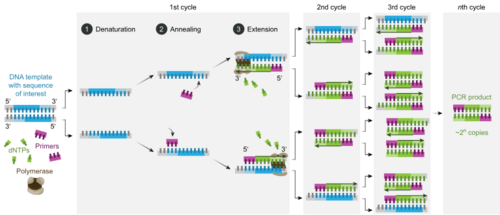
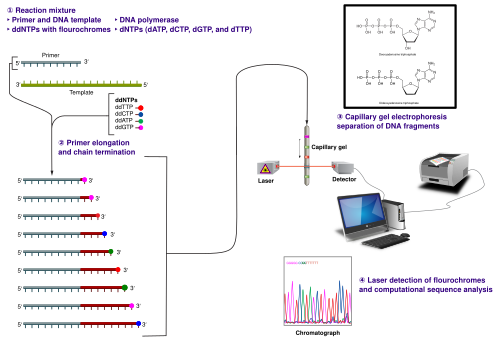
短い一本鎖オリゴヌクレオチドで、通常は5~100塩基長であり、鋳型鎖上の相補配列にハイブリダイズすることで核酸合成を「開始」し、ポリメラーゼが新しい鎖を伸長できる既存の3'末端を提供する。自然界では、DNA複製と一部の原核生物転写の開始にRNAプライマーが専ら使用されるが、 PCRなどの多くの実験室技術で行われるin vitro合成では、DNAプライマーが使用されることが多い。現代の実験室では、プライマーは、融解温度とアニーリング温度を考慮して、標的DNA分子の特定の固有の配列を補完するように、「順方向」と「逆方向」のペアで慎重に設計され、その後、 de novo合成によってオンデマンドでオリゴヌクレオチドを作成する市販業者から購入される。
浸透圧浸透圧平衡を回復するための圧力を表す細胞膜を介して水を移動させることで、細胞の内部と外部の間で水分が循環します。赤血球は、極度に高張な環境では水分を失って縮む傾向があります。 environment (left) or gain water and swell to bursting in a severely hypotonic environment (right), but the water potential is balanced in an isotonic environment (center).
Any of a class of DNA-binding enzymes which catalyze changes in the topological state of a double-stranded DNA molecule by nicking or cutting the sugar-phosphate backbone of one or both strands, relaxing the torsional stress inherent in the double helix and unwinding or untangling the paired strands before re-ligating the nicks. This process is usually necessary prior to replication and transcription. Topoisomerases thereby convert DNA between its relaxed and supercoiled, linked and unlinked, and knotted and unknotted forms without changing the sequence or overall chemical composition, such that the substrate and product molecules are structural isomers, differing only in their shape and their twisting, linking, and/or writhing numbers.
A state of cell potency in which a cell or nucleus fully retains the ability to differentiate into all of the cell types represented in the adult organism, or to give rise to all of these cell types upon transplantation into an appropriate cytoplasm (as in nuclear transfer). Such cells or nuclei are said to be totipotent. The zygote that serves as the progenitor cell for sexually reproducing multicellular organisms is the archetypal totipotent cell; almost all of the cells into which it ultimately differentiates are not totipotent, though some cells such as stem cells remain totipotent or pluripotent throughout the organism's life.[2]
tracer
A molecule or a specific atom within a molecule that has been chemically or radioactively labelled so that it can be easily tracked or followed through a biochemical process or located in a cell or tissue.[4]
Affecting a gene or sequence on a different nucleic acid molecule or strand. A locus or sequence within a particular DNA molecule such as a chromosome is said to be trans-acting if it or its products influence or act upon other sequences located relatively far away or on an entirely different molecule or chromosome. For example, a DNA-binding protein acts "in trans" if it binds to or interacts with a sequence located on any strand or molecule different from the one on which it is encoded. Contrast cis-acting.
A form of RNA splicing in which different RNA transcripts, synthesized in separate transcription events, are spliced together into a single, continuous transcript. This contrasts with the more conventional "cis-splicing", where segments of the same transcript are excised or re-arranged.[3]
An experimental approach to artificially control gene expression by introducing a transactivator gene under the control of an inducible promoter into a genome. The transactivator encodes a transcription factor capable of acting in trans upon one or more other genes by recognizing and specifically binding their promoters; thus by inducing the transactivator gene, the expression of many other genes can be experimentally manipulated.[3]
A product of transcription; that is, any RNA molecule which has been synthesized by RNA polymerase using a complementary DNA molecule as a template. When transcription is completed, transcripts separate from the DNA and become independent primary transcripts. Particularly in eukaryotes, multiple post-transcriptional modifications are usually necessary for raw transcripts to be converted into stable and persistent molecules, which are then described as mature, though not all transcribed RNAs undergo maturation. Many transcripts are accidental, spurious, incomplete, or defective; others are able to perform their functions immediately and without modification, such as certain non-coding RNAs.
Any RNA transcript whose function is unclear. Such transcripts may include functional non-coding RNAs which have not yet been studied in detail as well as spurious transcripts without any definite function. The DNA sequences from which TUFs are transcribed are generally located in intergenic or intronic regions of the genome. See also junk RNA.
The first step in the process of gene expression, in which an RNA molecule, known as a transcript, is synthesized by enzymes called RNA polymerases using a gene or other DNA sequence as a template. Transcription is a critical and fundamental process in all living organisms and is necessary in order to make use of the information encoded within a genome. All classes of RNA must be transcribed before they can exert their effects upon a cell, though only messenger RNA (mRNA) proceeds to translation to produce a functional protein, whereas the many types of non-coding RNA fulfill their duties without being translated. Transcription is also not always beneficial for a cell: when it occurs at the wrong time or at a functionless locus, or when mobile elements or infectious pathogens utilize the host's transcription machinery, the resulting transcripts (not to mention the waste of valuable energy and resources) are often harmful to the host cell or genome.
A simplified diagram of transcription. RNA polymerase (RNAP) synthesizes an RNA transcript (blue) in the 5'-to-3' direction, using one of the DNA strands as a template, while a complex of multiple transcription factors binds to a promoter upstream of the gene.
Any protein that controls the rate of transcription of genetic information from DNA to RNA by binding to a specific DNA sequence and promoting or blocking the recruitment of RNA polymerase to nearby genes. Transcription factors can effectively turn "on" and "off" specific genes in order to make sure they are expressed at the right times and in the right places; for this reason, they are a fundamental and ubiquitous mechanism of gene regulation.
The specific location within a gene at which RNA polymerase begins transcription, defined by the specific nucleotide or codon corresponding to the first ribonucleotide(s) to be assembled in the nascent transcript (which is not necessarily the same as the first codon to be translated). This site is usually considered the beginning of the coding sequence and is the reference point for numbering the individual nucleotides within a gene. Nucleotides upstream of the start site are assigned negative numbers and those downstream are assigned positive numbers, which are used to indicate the positions of nearby sequences or structures relative to the TSS. For example, the binding site for RNA polymerase might be a short sequence immediately upstream of the TSS, from approximately -80 to -5, whereas an intron within the coding region might be defined as the sequence starting at nucleotide +207 and ending at nucleotide +793.
transcription unit
The segment of DNA between the initiation site and the termination site of transcription, containing the coding sequences for one or more genes. All genes within a transcription unit are transcribed together into a single transcript during a single transcription event; the resulting polycistronic RNA may subsequently be cleaved into separate RNAs, or may be translated as a unit and then cleaved into separate polypeptides.[13]
The intermittent nature of transcription and translation mechanisms. Both processes occur in "bursts" or "pulses", with periods of gene activity separated by irregular intervals.
The entire set of RNA molecules (often referring to all types of RNA but sometimes exclusively to messenger RNA) that is or can be expressed by a particular genome, cell, population of cells, or species at a particular time or under particular conditions. The transcriptome is distinct from the exome and the translatome.
The study of the transcriptome of a particular genome, cell, or organism, i.e. the sum total of all of the RNA transcripts produced from it by transcription. Transcriptomics technologies allow scientists to isolate and sequence transcriptomes, which can then be mapped to the genome to determine which genes are being expressed or which cellular processes are active and which are dormant at a given time.
The transport of molecules across the interior of a cell, i.e. through the cytoplasm, especially a polarized cell such as an epithelial cell with contrasting apical and basal surfaces, thereby providing a spatially oriented transport system. Molecules undergoing transcytosis are usually contained within vesicles.[5]
transductant
A cell which has undergone transduction and been successfully transduced.
The deliberate experimental introduction of exogenous nucleic acids into a cell or embryo. In the broadest sense the term may refer to any such transfer and is sometimes used interchangeably with transformation, though some applications restrict the usage of transfection to the introduction of naked or purified non-viral DNA or RNA into cultured eukaryotic cells (especially animal cells) resulting in the subsequent incorporation of the foreign DNA into the host genome or the non-hereditary modification of gene expression by the foreign RNA. As a contrast to both standard non-viral transformation and transduction, transfection has also occasionally been used to refer to the uptake of purified viral nucleic acids by bacteria or plant cells without the aid of a viral vector.[13]
A special class of RNA molecule, typically 76 to 90 nucleotides in length, that serves as a physical adapter allowing mRNA transcripts to be translated into sequences of amino acids during protein synthesis. Each tRNA contains a specific anticodon triplet corresponding to an amino acid that is covalently attached to the tRNA's opposite end; as translation proceeds, tRNAs are recruited to the ribosome, where each mRNA codon is paired with a tRNA containing the complementary anticodon. Depending on the organism, cells may employ as many as 41 distinct tRNAs with unique anticodons; because of codon degeneracy within the genetic code, several tRNAs containing different anticodons carry the same amino acid.
A type of RNA molecule in some bacteria which has dual tRNA-like and mRNA-like properties, allowing it to simultaneously perform a number of different functions during translation.
Any gene or other segment of genetic material that has been isolated from one organism and then transferred either naturally or by any of a variety of genetic engineering techniques into another organism, especially one of a different species. Transgenes are usually introduced into the second organism's germ line. They are commonly used to study gene function or to confer an advantage not otherwise available in the unaltered organism.
A point mutation in which a purine nucleotide is substituted for another purine (A ↔ G) or a pyrimidine nucleotide is substituted for another pyrimidine (C ↔ T). Contrast transversion.
The entire set of messenger RNA molecules that are translated by a particular genome, cell, tissue, or species at a particular time or under particular conditions. Like the transcriptome, it is often used as a proxy for quantifying levels of gene expression, though the transcriptome also includes many RNA molecules that are never translated.
Any of a diverse variety of selfishmobile genetic elements consisting of self-acting DNA sequences capable of replicating themselves semi-autonomously and inserting into random or specific sites within a host genome, a process known as transposition. Transposons contain one or more genes which encode enzymes known as transposases capable of recognizing sequences within a flanking pair of inverted repeats, such that the enzymes effectively catalyze their own replication, excision, and/or re-insertion into other DNA molecules by any of various mechanisms.[3]
Any of a class of self-acting enzymes capable of binding to the flanking sequences of the transposable element which encodes them and catalyzing its movement to another part of the genome, typically by an excision/insertion mechanism or a replicative mechanism, in a process known as transposition.
The process by which a nucleic acid sequence known as a transposable element changes its position within a genome, either by excising and re-inserting itself at a different locus (cut-and-paste) or by duplicating itself and inserting into another locus without moving the original element from its original locus (copy-paste). These reactions are catalyzed by an enzyme known as a transposase which is encoded by a gene within the transposable element itself; thus the element's products are self-acting and can autonomously direct their own replication. Transposed sequences may re-insert at random loci or at sequence-specific targets, either on the same DNA molecule or on different molecules.
Any of a class of chemical compounds which are ester derivatives of glycerol, consisting of a glycerol backbone connected to any three fatty acid substituents via ester bonds. Triglycerides are one of three major classes of esters formed by fatty acids in biological systems, along with phospholipids and cholesteryl esters. They are the primary constituent of adipose tissue in vertebrates.
Any sequence in which an individual nucleotide triplet is repeated many times in tandem, whether in a gene or non-coding sequence. At most loci some degree of repetition is normal and harmless, but mutations which cause specific triplets (especially those of the form CnG) to increase in copy number above the normal range are highly unstable and responsible for a variety of genetic disorders.
triplet
A unit of three successive nucleotides in a DNA or RNA molecule.[13] A triplet within a coding sequence that codes for a specific amino acid is known as a codon.
The directional growth or movement of a cell or organism in response to a stimulus, e.g. light, heat, the pull of gravity, or the presence of a particular chemical, such that the response is dependent on the direction of the stimulus (as opposed to a non-directional nastic response). Positive tropism is growth or movement toward the stimulus; negative tropism is away from the stimulus.[2] See also taxis and kinesis.
The force within a cell which pushes the plasma membrane against the cell wall,[32] a type of hydrostatic pressure influenced by the osmotic flow of water into and out of the cell. Turgidity is observed in plants, fungi, bacteria, and some protists with cell walls, but generally not in animal cells.
In enzymology, a measure of the rate at which a particular enzymecatalyzes a particular biochemical reaction, usually expressed as the average number of substrate molecules it is capable of converting into reaction products per unit time at a given concentration of enzyme.[33]
The labelling of a biomolecule (often another protein) by covalently attaching a ubiquitin protein to it—generally via the formation of an amide bond between the ubiquitin's C-terminal glycine and positively charged side chains (often lysine or arginine residues) of the labelled molecule, an ATP-dependent reaction catalyzed by ubiquitin-conjugating enzymes[3]—thus making it identifiable to molecules capable of recognizing ubiquitin epitopes. Ubiquitination is a widely used post-translational modification by which proteins are tagged; the attachment of a single ubiquitin molecule (monoubiquitination) can variously activate or inhibit a protein's activity, while the attachment of a chain of multiple consecutively linked ubiquitin molecules (polyubiquitination) commonly targets the protein for degradation by proteasomes.
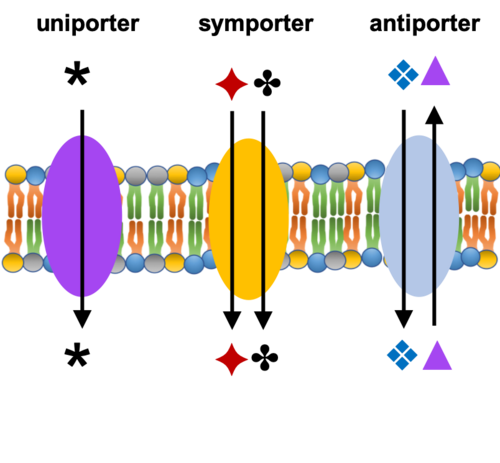
A type of transport protein which catalyzes the movement of a single, specific solute or chemical species across a lipid membrane in either direction.[4] Contrast antiporter and symporter.
A class of DNA sequences determined by C0t analysis to be present only once in the analyzed genome, as opposed to repetitive sequences. Most structural genes and their introns are unique.[13]
Any non-coding sequence which is transcribed along with a protein-coding sequence, and thus included within a messenger RNA, but which is not ultimately translated during protein synthesis. A typical mRNA transcript includes two such regions: one immediately upstream of the coding sequence, known as the 5' untranslated region (5'-UTR), and one downstream of the coding sequence, known as the 3' untranslated region (3'-UTR). These regions are not removed during post-transcriptional processing (unlike introns) and are usually considered distinct from the 5' cap and the 3' polyadenylated tail (both of which are later additions to a primary transcript and not themselves products of transcription). UTRs are a consequence of the fact that transcription usually begins considerably upstream of the start codon of the coding sequence and terminates long after the stop codon has been transcribed, whereas translation is more precise. They often include motifs with regulatory functions.
upregulation
Any process, natural or artificial, which increases the level of gene expression of a certain gene. A gene which is observed to be expressed at relatively high levels (such as by detecting higher levels of its mRNA transcripts) in one sample compared to another sample is said to be upregulated. Contrast downregulation.
A pyrimidinenucleobase used as one of the four standard nucleobases in RNA molecules. Uracil forms a base pair with adenine. In DNA, uracil is not used at all, and is instead replaced with thymine.
One of the four standard nucleosides used in RNA molecules, consisting of a uracilbase with its N9 nitrogen bonded to the C1 carbon of a ribose sugar. In DNA, uridine is replaced with thymidine.
Any of a class of enclosed, fluid-filled compartments present in many eukaryotic cells as well as bacteria, often large and conspicuous under the microscope and serving any of a huge variety of functions, including acting as a resizable reservoir for the storage of water, metabolic waste, toxins, or foreign material; maintaining cellular homeostasis and hydrostatic pressure; supporting immune functions; housing symbiotic bacteria; and assisting in the degradation and recycling of old cellular components.[2]
Any of a class of tandem repeats for which the copy number of the repeated sequence at a particular locus tends to vary between individuals of the same species. VNTRs may occur throughout the genome, both within and outside of coding DNA, and if the copy number is stably inherited may be used in DNA fingerprinting to uniquely identify individuals or to determine their genealogical relatedness to other individuals.
Variation or irregularity in a particular phenotype, especially a conspicuous visible trait such as color or pigmentation, occurring simultaneously in different parts of the same individual organism due to any of a variety of causes, such as X-inactivation, mitotic recombination, transposable element activity, position effects, or infection by pathogens.
Any membrane-bound space completely enclosed by its own membrane, which is separate though usually derived from other membranes (often the cell membrane) either by budding or by mechanical disruption such as sonication.[3] The term is applied to many different structures but especially to the small, roughly spherical compartments created during endocytosis and exocytosis, as well as to lysosomes and various other small intracellular or extracellular organelles.[2]
The process of determining the entirety or near-entirety of the DNA sequences comprising an organism's genome with a single procedure or experiment, generally inclusive of all chromosomal and extrachromosomal (e.g. mitochondrial) DNA.
The phenotype of the typical form of a species as it occurs in nature; a product of the standard "normal" allele at a given locus, as opposed to that produced by a non-standard mutant allele.
An index of the superhelical coiling of a DNA molecule. The writhing number does not have a precise quantitative definition but instead represents the degree of supercoiling. Together, the writhing number and the twisting number determine the linking number.[5]
One of two sex chromosomes present in organisms which use the XY sex-determination system, and the only sex chromosome in the X0 system. The X chromosome is found in both males and females and typically contains much more gene content than its counterpart, the Y chromosome.
The process by which one of the two copies of the X chromosome is silenced by being irreversibly condensed into transcriptionally inactive heterochromatin in the cells of female therian mammals. A form of dosage compensation, X-inactivation prevents females from producing twice as many gene products from genes on the X chromosome as males, who only have one copy of the X chromosome. Which X chromosome is inactivated is randomly determined in the early embryo, making it possible for cell lineages with different inactive Xs to exist in the same organism.
A supersecondarypolypeptide structural motif and DNA-binding domain occurring in many DNA-binding proteins, characterized by a series of non-adjacent amino acid residues which fold into a three-dimensional arrangement capable of coordinating one or more zinc ions (Zn2+) between them, thus stabilizing the fold into a definite structure that can interact specifically with other biomolecules such as nucleic acids or other polypeptides. There are many distinct classes of zinc fingers using different ligands and spatial arrangements to achieve coordination; in perhaps the most common variant, a short alpha helix is oriented antiparallel to a β sheet, with two histidine residues in the former and two cysteines in the latter forming the coordination complex. Zinc fingers bind DNA as the primary functional domain of many transcription factors.
The degree to which multiple copies of a gene, chromosome, or genome have the same genetic sequence; e.g. in a diploid organism with two complete copies of its genome (one maternal and one paternal), the degree of similarity of the alleles present in each copy. Individuals carrying two different alleles for a particular gene are said to be heterozygous for that gene; individuals carrying two identical alleles are said to be homozygous for that gene. Zygosity may also be considered collectively for a group of genes, or for the entire set of genes and genetic loci comprising the genome.
A type of eukaryotic cell formed as the direct result of a fertilization event between two gametes. In multicellular organisms, the zygote is the earliest developmental stage.
12345678910111213141516Alberts, Bruce; Johnson, Alexander; Lewis, Julian; Raff, Martin; Roberts, Keith; Walter, Peter (2002). "Glossary". Molecular Biology of the Cell(Available from the National Center for Biotechnology Information) (4thed.). New York: Garland Science.
123Klug, William S.; Cummings, Michael R. (1986). Concepts of Genetics (2nded.). Glenview, Ill.: Scott, Foresman and Company. ISBN0-673-18680-6.
↑Rayner TF; Rocca-Serra P; Spellman PT; Causton HC; etal. (2006). "A simple spreadsheet-based, MIAME-supportive format for microarray data: MAGE-TAB". BMC Bioinformatics. 7 489. doi:10.1186/1471-2105-7-489. PMC1687205. PMID17087822.
↑Yáñez-Mó M, Siljander PR, Andreu Z, Zavec AB, Borràs FE, Buzas EI, Buzas K, Casal E, Cappello F, Carvalho J, Colás E, Cordeiro-da Silva A, Fais S, Falcon-Perez JM, Ghobrial IM, Giebel B, Gimona M, Graner M, Gursel I, Gursel M, Heegaard NH, Hendrix A, Kierulf P, Kokubun K, Kosanovic M, Kralj-Iglic V, Krämer-Albers EM, Laitinen S, Lässer C, Lener T, Ligeti E, Linē A, Lipps G, Llorente A, Lötvall J, Manček-Keber M, Marcilla A, Mittelbrunn M, Nazarenko I, Nolte-'t Hoen EN, Nyman TA, O'Driscoll L, Olivan M, Oliveira C, Pállinger É, Del Portillo HA, Reventós J, Rigau M, Rohde E, Sammar M, Sánchez-Madrid F, Santarém N, Schallmoser K, Ostenfeld MS, Stoorvogel W, Stukelj R, Van der Grein SG, Vasconcelos MH, Wauben MH, De Wever O (2015). "Biological properties of extracellular vesicles and their physiological functions". J Extracell Vesicles. 4 27066. doi:10.3402/jev.v4.27066. PMC4433489. PMID25979354.
1234567891011Rieger, Rigomar (1991). Glossary of Genetics: Classical and Molecular (5thed.). Berlin: Springer-Verlag. ISBN3-540-52054-6.
↑Functional Genomics Data Society (June 2012). "Minimum Information about a high-throughput SEQuencing Experiment". Archived from the original on 2022-12-06. Retrieved 2022-11-13.
↑Oliver S (2003). "On the MIAME Standards and Central Repositories of Microarray Data". Comparative and Functional Genomics. 4 (1): 1. doi:10.1002/cfg.238. PMC2447402. PMID18629115.
↑Brazma A (2009). "Minimum Information About a Microarray Experiment (MIAME)--successes, failures, challenges". ScientificWorldJournal. 9: 420–3. doi:10.1100/tsw.2009.57. PMC5823224. PMID19484163.
↑Astbury, W. T. (June 1961). "Molecular Biology or Ultrastructural Biology?". Nature. 190 (4781): 1124. Bibcode:1961Natur.190.1124A. doi:10.1038/1901124a0. ISSN1476-4687. PMID13684868. S2CID4172248.
↑Klermund, Julia; Rhiel, Manuel; Kocher, Thomas; Chmielewski, Kay Ole; Bischof, Johannes; Andrieux, Geoffroy; el Gaz, Melina; Hainzl, Stefan; Boerries, Melanie; Cornu, Tatjana I.; Koller, Ulrich; Cathomen, Toni (May 2024). "On- and off-target effects of paired CRISPR-Cas nickase in primary human cells". Molecular Therapy. 32 (5): 1298–1310. doi:10.1016/j.ymthe.2024.03.006. PMC11081867. PMID38459694.
↑"7.6D: The Incorporation of Nonstandard Amino Acids". LibreTexts Biology.
↑Hartwell, Leland; Hood, L.; Goldberg, M.; Reynolds, A.; Silver, L.; Veres, R. (2004). Genetics: From Genes to Genomes. McGraw-Hill. p.267. ISBN978-0-07-246248-7. OCLC50417228.
12Lewin, Benjamin (2003). Genes VIII. Upper Saddle River, NJ: Pearson Prentice Hall. ISBN0-13-143981-2.
↑"overexpression". Oxford Living Dictionary. Oxford University Press. 2017. Archived from the original on February 10, 2018. Retrieved 18 May 2017. The production of abnormally large amounts of a substance which is coded for by a particular gene or group of genes; the appearance in the phenotype to an abnormally high degree of a character or effect attributed to a particular gene.
↑"overexpress". NCI Dictionary of Cancer Terms. National Cancer Institute at the National Institutes of Health. 2011-02-02. Retrieved 18 May 2017. overexpressIn biology, to make too many copies of a protein or other substance. Overexpression of certain proteins or other substances may play a role in cancer development.
↑Lefranc MP (2013). "Paratope". In Dubitzky W, Wolkenhauer O, Cho KH, Yokota H (eds.). Encyclopedia of Systems Biology. New York, NY: Springer. pp.1632–1633. doi:10.1007/978-1-4419-9863-7_673. ISBN978-1-4419-9863-7.
↑Punt J, Stranford SA, Jones PP, Owen JA (2019). Kuby immunology (Eighthed.). New York. ISBN978-1-4641-8978-4. OCLC1002672752.{{cite book}}: CS1 maint: location missing publisher (link)
↑Lagunas R (1981-01-01). "Is Saccharomyces cerevisiae a typical facultative anaerobe?". Trends in Biochemical Sciences. 6: 201–203. doi:10.1016/0968-0004(81)90073-6. ISSN0968-0004.
↑Goñi FM (2002). "Non-permanent proteins in membranes: when proteins come as visitors (Review)". Molecular Membrane Biology. 19 (4): 237–245. doi:10.1080/0968768021000035078. PMID12512770. S2CID20892603.