
Loading article…
University of Notre Dame du Lac | |
.svg/500px-University_of_Notre_Dame_seal_(2).svg.png) | |
| Latin: Universitas Dominae Nostrae a Lacu | |
| Motto | Vita Dulcedo Spes (Latin)[1] |
|---|---|
Motto in English | "Life, Sweetness, Hope"[2] |
| Type | Private research university |
| Established | November 26, 1842 |
| Founder | Edward Sorin |
| Accreditation | HLC |
Religious affiliation | Catholic (Congregation of Holy Cross) |
Academic affiliations | |
| Endowment | $16.62 billion (2023)[3][4] |
| Budget | $1.8 billion (2023–2024) |
| President | Robert A. Dowd |
| Provost | John McGreevy |
Academic staff | 1,526 (fall 2023)[5] |
| Students | 13,174 (fall 2023)[5] |
| Undergraduates | 8,968 (fall 2023)[5] |
| Postgraduates | 4,206 (fall 2023)[5] |
| Location | , , United States 41°42′00″N 86°14′20″W / 41.70000°N 86.23889°W / 41.70000; -86.23889 |
| Campus | Large suburb, 1,261 acres (5.10 km2) |
| Newspapers | |
| Colors | Blue and gold[6] |
| Nickname | Fighting Irish |
Sporting affiliations | |
| Mascot | Leprechaun |
| Website | nd.edu |
 | |
| [7] | |
The University of Notre Dame du Lac, known simply as Notre Dame (/ˌnoʊtərˈdeɪm/ NOH-tər-DAYM; ND), is a private Catholic research university in Notre Dame, Indiana.[8] Founded in 1842 by members of the clerical Congregation of Holy Cross, the main campus of 1,261 acres (510 ha) has a suburban setting and contains landmarks such as the Golden Dome, the Word of Life mural, Notre Dame Stadium, and the basilica.
Notre Dame is classified among "R1: Doctoral Universities – Very High Research Activity" and its undergraduate admissions are among the most selective in the United States.[9][10] The university is organized into seven schools and colleges, including College of Arts and Letters, College of Science, Notre Dame Law School, School of Architecture, College of Engineering, Mendoza College of Business, and Keough School of Global Affairs. Notre Dame's graduate program includes more than 50 master, doctoral and professional degrees offered by the seven schools.[11] Most of the university's 8,000 undergraduates live on campus in one of 33 residence halls.
The university's athletic teams are members of the NCAA Division I and are known collectively as the Fighting Irish. Notre Dame is noted for its football team, which contributed to its rise to prominence on the national stage in the early 20th century.[12] Notre Dame teams in other sports, chiefly in the Atlantic Coast Conference, have won 17 national championships.[13]
Major improvements to the university occurred during Theodore Hesburgh's administration between 1952 and 1987. Hesburgh's administration increased the university's resources, academic programs, and its reputation. At the end of the fiscal year 2022, Notre Dame's endowment was valued at $20.3 billion.[14] Its network of alumni consist of 151,000 members.[15]
History
Foundations
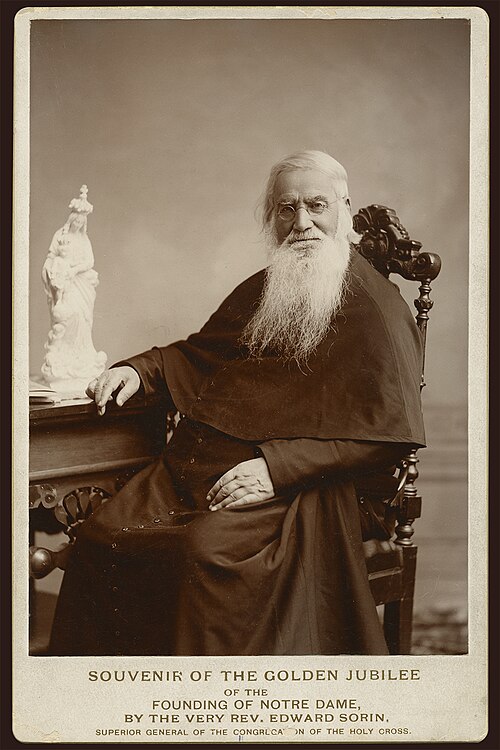
In 1842, the bishop of Vincennes, Célestin Guynemer de la Hailandière, offered land to Edward Sorin of the Congregation of Holy Cross, on the condition that he build a college in two years.[16] Stephen Badin, the first priest ordained in the United States, who had come to the area invited by Potawatomi chief Leopold Pokagon to minister to his tribe, had bought these 524 acres (212 ha) of land in 1830. Sorin arrived on the site with eight Holy Cross brothers from France and Ireland on November 26, 1842, and began the school using Badin's old log chapel. After enrolling two students, Sorin soon erected more buildings, including the Old College, the first church, and the first main building.[17] Notre Dame began as a primary and secondary school; in 1844 it received its official college charter from the Indiana General Assembly,[18] under the name the University of Notre Dame du Lac (University of Our Lady of the Lake).[a] Because the university was originally all-male, the Sisters of the Holy Cross founded the female-only Saint Mary's College near Notre Dame in 1844.[20]
Early history
The college awarded its first degrees in 1849.[21] As it grew under the presidency of Sorin and his successors, new academic programs were offered and new buildings built to accommodate the growing student and faculty population.[22][18] The brief presidency of Patrick Dillon (1865–1866) saw the original main building replaced with a larger one, which housed the university's administration, classrooms, and dormitories. Under William Corby's first administration, enrollment at Notre Dame increased to over 500 students. In 1869, he opened the law school, which offered a two-year course of study, and in 1871 he began construction of Sacred Heart Church, today the Basilica of the Sacred Heart. Two years later, Auguste Lemonnier started a library in the Main Building, which had 10,000 volumes by 1879.[23]

Fire destroyed the Main Building and the library collection in April 1879; the school closed immediately and students were sent home.[24] Sorin (then provincial Superior) and President Corby immediately planned for the rebuilding of the structure that had housed virtually the entire university. Construction began on May 17, and by the zeal of administrators and workers, the third and current Main Building was completed before the fall semester of 1879. The library collection was rebuilt and housed in the new Main Building.[25]
The presidency of Thomas E. Walsh (1881–1893) focused on improving Notre Dame's scholastic reputation and standards. At the time, many students came to Notre Dame only for its business courses and did not graduate.[26] Walsh started a "Belles Lettres" program and invited many notable lay intellectuals like writer Maurice Francis Egan to campus.[27] Washington Hall was built in 1881 as a theater,[28] and the Science Hall (today the LaFortune Student Center) was built in 1883 to house the science program (established in 1880) and multiple classrooms and science labs.[29] The construction of Sorin Hall saw the first freestanding residence hall on campus and one of the first in the country to have private rooms for students, a project championed by Sorin and John Zahm.[30][31] During Walsh's tenure, Notre Dame started its football program and was awarded the first Laetare Medal.[32] The Law School was reorganized under the leadership of William J. Hoynes (dean from 1883 to 1919), and when its new building was opened shortly after his death, it was renamed in his honor.[33]
Growth
John Zahm was the Holy Cross Provincial for the United States from 1898 to 1906, with overall supervision of the university. He sought to modernize and expand Notre Dame by erecting buildings and adding to the campus art gallery and library, amassing what became a famous Dante collection, and pushing Notre Dame towards becoming a research university dedicated to scholarship. The congregation did not renew Zahm's term fearing he had expanded Notre Dame too quickly and had run the order into serious debt.[33] In particular, his vision to make Notre Dame a research university was at odds with that of Andrew Morrissey (president from 1893 to 1905), who hoped to keep the institution a smaller boarding school.[34] Morrissey's presidency remained largely focused on younger students and saw the construction of the Grotto, the addition of wings to Sorin Hall, and the erection of the first gymnasium. By 1900, student enrollment had increased to over 700, with most students still following the Commercial Course.[35]

The movement towards a research university was championed subsequently by John W. Cavanaugh, who modernized educational standards. An intellectual figure known for his literary gifts and his eloquent speeches, he dedicated himself to the school's academic reputation and to increasing the number of students awarded bachelor's and master's degrees. As part of his efforts, he attracted many eminent scholars, established a chair in journalism, and introduced courses in chemical engineering. During his time as president, Notre Dame rapidly became a significant force on the football field.[36] In 1917, Notre Dame awarded its first degree to a woman, and its first bachelor's degree in 1922. However, female undergraduates were uncommon until 1972.[37] James A. Burns became president in 1919 and, following in the footsteps of Cavanaugh, he oversaw an academic revolution that brought the school up to national standards by adopting the elective system and moving away from the traditional scholastic and classical emphasis in three years.[38][39] By contrast, Jesuit colleges, bastions of academic conservatism, were reluctant to move to a system of electives; for this reason, Harvard Law School shut out their graduates.[40] Notre Dame continued to grow, adding more colleges, programs, residence halls, and sports teams.[41][42] By 1921, with the addition of the College of Commerce,[41] Notre Dame had grown from a small college to a university with five colleges and a law school.[43]
_(14782351722).jpg/500px-Catalogue_of_the_University_of_Notre_Dame_(1903)_(14782351722).jpg)
President Matthew Walsh (1922–1928) addressed the material needs of the university, particularly the $10,000 debt and the lack of space for new students. When he assumed the presidency, more than 1,100 students lived off campus while only 135 students paid for room and board. With fund-raising money, Walsh concentrated on the construction of a dormitory system. He built Freshman Hall in 1922 and Sophomore Hall in 1923, and began construction of Morrissey, Howard and Lyons Halls between 1924 and 1925.[44] By 1925, enrollment had increased to 2,500 students, of which 1,471 lived on campus; faculty members increased from 90 to 175. On the academic side, credit hours were reduced to encourage in-depth study, and Latin and Greek were no longer required for a degree. In 1928, three years of college were made a prerequisite for the study of law.[45] Walsh expanded the College of Commerce, enlarged the stadium, completed South Dining Hall, and built the memorial and entrance transept of the Basilica.[46][47]
One of the main driving forces in the university's growth was its football team, the Notre Dame Fighting Irish.[48] Knute Rockne became head coach in 1918. Under him, the Irish would post a record of 105 wins, 12 losses, and five ties.[49] During his 13 years, the Irish won three national championships, had five undefeated seasons, won the Rose Bowl Game in 1925, and produced players such as George Gipp and the "Four Horsemen". Knute Rockne has the highest winning percentage (.881) in NCAA Division I/FBS football history. Rockne's offenses employed the Notre Dame Box and his defenses ran a 7–2–2 scheme.[50] The last game Rockne coached was on December 14, 1930, when he led a group of Notre Dame all-stars against the New York Giants in New York City.[51]
The success of Notre Dame reflected the rising status of Irish Americans and Catholics in the 1920s. Catholics rallied around the team and listened to the games on the radio, especially when it defeated teams from schools that symbolized the Protestant establishment in America—Harvard, Yale, Princeton, and Army.[48] Its role as a high-profile flagship institution of Catholicism made it an easy target of anti-Catholicism. The most remarkable episode of violence was a clash in 1924 between Notre Dame students and the Ku Klux Klan (KKK), a white supremacist and anti-Catholic movement. The Klan decided to hold a week-long Klavern in South Bend. Clashes with the student body started on May 17, when students blocked the Klansmen from descending from their trains in the South Bend station and ripped KKK clothes and regalia. Two days later, thousands of students massed downtown protesting the Klavern, and only the arrival of college president Walsh prevented any further clashes. The next day, Rockne spoke at a campus rally and implored the students to obey Walsh and refrain from further violence. A few days later, the Klavern broke up, but the hostility shown by the students contributed to the downfall of the KKK in Indiana.[52][53]