
Loading article…
アパラチア | |
|---|---|
地域 | |
上から左、右:
| |
![赤と暗赤色の郡はアパラチア地域委員会を構成し、暗赤色と暗赤色の縞模様の郡は伝統的なアパラチアを構成します。[2]](https://img-server.japedia.wiki/wikipedia/commons/thumb/3/3b/Map_of_Appalachia_without_county_borders.svg/500px-Map_of_Appalachia_without_county_borders.svg.png) 赤と暗赤色の郡はアパラチア地域委員会を構成し、暗赤色と暗赤色の縞模様の郡は伝統的なアパラチアを構成します。[2] | |
| 座標: 38°48′N 81°00′W / 38.80°N 81.00°W / 38.80; -81.00 | |
| 国 | アメリカ合衆国 |
| 郡または郡に相当するもの | 420 [1] |
| 州 | 13 |
| 最大の都市 | ピッツバーグ |
| エリア [3] | |
| • 合計 | 206,000平方マイル(530,000 km 2) |
| 人口 (2021) | |
| • 合計 | 2,630万人[1] (アパラチア地域委員会推定) |
| • 密度 | 127.7/平方マイル (49.3/km 2 ) |
| 異名 | アパラチア |
| 方言 | アパラチア英語 |


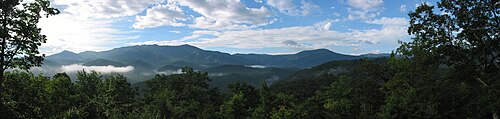
_from_Mill_Mountain_Star_at_Dusk.jpg/500px-Roanoke_City_(Virginia)_from_Mill_Mountain_Star_at_Dusk.jpg)


アパラチア(/ ˌ æ p ə ˈ l æ tʃ ə , - l eɪ tʃ ə , - l eɪ ʃ ə /) [ 4]は、アメリカ合衆国東部のアパラチア山脈の中央部と南部に位置する地理的地域である。その境界はニューヨーク州のキャッツキル山脈西部からペンシルベニア州に広がり、ブルーリッジ山脈とグレートスモーキー山脈を経てジョージア州北部、アラバマ州、ミシシッピ州にまで広がっており、ウェストバージニア州は州全体がアパラチアの境界内にある唯一の州である。[5] 2021年、この地域には推定2,630万人が住んでおり、そのうち約80%が白人であった。[1]
19世紀後半に文化地域として認められて以来、アパラチアは、その住民の孤立、気質、行動に関する神話や歪曲の根源となってきた。20世紀初頭の作家たちは、密造酒や氏族間の争いなど、この地域の文化のセンセーショナルな側面に焦点を当てたイエロージャーナリズムに従事し、この地域の住民を無学で洗練されていない人々として描写した。これらのステレオタイプは今日でもそれほど多くはないが、社会学の研究によって払拭され始めている。[6] [7]
アパラチア地方は豊富な天然資源に恵まれている一方で、長い間経済的に苦戦し、貧困と結び付けられてきました。20世紀初頭、大規模な伐採および炭鉱会社がアパラチア地方に雇用と近代的な設備をもたらしましたが、1960年代までにこの地域はこれら2つの産業から長期的な利益を得ることができませんでした[8]。1930年代から、連邦政府は一連のニューディール政策、具体的にはテネシー川流域開発公社(TVA)によってアパラチア地方の貧困を軽減しようとしました。TVAは、大量の電力を供給し、より良い農業慣行、地域計画、および経済開発のためのプログラムを支援する水力発電ダムの建設を担当しました。
1965年、アパラチア地域委員会[9]が設立され、主に地域経済の多様化と地域住民へのより良い医療と教育機会の提供を通じて、地域の貧困をさらに軽減しました。1990年までにアパラチアは経済の主流にほぼ加わりましたが、ほとんどの経済指標で依然として国内の他地域に遅れをとっていました。[6]
定義

アパラチア地方には明確な自然地理学的または地形学的境界がないため、その範囲については意見の相違がある。アパラチア地方の最も一般的に使われている現代の定義は、1965年にアパラチア地域委員会(ARC)によって最初に定義され、その後数十年にわたって拡張されたものである。 [6]委員会によって定義された地域には現在、13州の420の郡と8つの独立市が含まれており、ウェストバージニア州の55郡すべて、ニューヨーク州の14郡、ペンシルベニア州の52郡、オハイオ州の32郡、メリーランド州の3郡、ケンタッキー州54郡、バージニア州の25郡と8市、[11]ノースカロライナ州の29郡、テネシー州の52郡、サウスカロライナ州の6市、ジョージア州[5]委員会が設立されたとき、郡は文化的な基準ではなく、経済的必要性に基づいて追加されました。[6]

アパラチアに常に含まれる
通常アパラチア地方に含まれる
アパラチア地方に含まれることもある
アパラチア地方にはほとんど含まれない
物理的にはアパラチア山脈または関連する地形を含むが、文化的にはアパラチア山脈ではない
青い点線はARCの定義に含まれる郡を囲んでいる。アパラチアを独特の文化的地域として地図に表す最初の大きな試みは、1890年代にベレア大学学長ウィリアム・グッデル・フロストの努力によって始まりました。フロストの「アパラチア・アメリカ」には、8つの州にある194の郡が含まれていました。[12] : 11–14 1921年、ジョン・C・キャンベルは『南部高地人とその故郷』を出版し、その中でフロストの地図を修正して、9つの州にある254の郡を含めました。その後の10年間に米国農務省が行ったこの地域の画期的な調査では、この地域は6つの州にある206の郡で構成されると定義されました。1984年、カール・レイツとリチャード・ユーラックはARCの定義を拡張して、ミシシッピ州の郡をすべて削除し、ニュージャージー州の郡を2つ追加しました。歴史家ジョン・アレクサンダー・ウィリアムズは、2002年の著書『アパラチア:歴史』の中で、ウェストバージニア州、ケンタッキー州、バージニア州、テネシー州、ノースカロライナ州、ジョージア州の164の郡からなる「中核」アパラチア地域と、ARCによって定義されたより広い地域を区別しました。[6]
アパラチア州立大学の歴史家ハワード・ドーガンは『アパラチア百科事典』(2006年)の中で、この地域の文化的境界を「オールド・アパラチア」と名付け、ARCの実際的な定義における南西部と北東部の両極端を無視する学術的傾向を指摘している。[13] 「グレーター・アパラチア」という用語は、アメリカ人ジャーナリストのコリン・ウッダードが2011年に出版した著書『アメリカ諸国:北米の11の競合する地域文化の歴史』で導入された。RealClearPoliticsの上級選挙アナリスト、ショーン・トレンデは、2012年に出版した著書『失われた多数派』の中で、「グレーター・アパラチア」を、 18世紀と19世紀にプロテスタントのスコットランド系アイルランド人がアメリカ南部と中西部に移住した後のアパラチア山脈地域とアップランド・サウスの両方を含むものと定義している。 [14]アップランドサウス地域には、ミズーリ州、アーカンソー州、オクラホマ州のオザーク高原が含まれますが、この地域はARCの定義には含まれていません。
地名と発音

1528年にフロリダ北岸に沿って内陸を探検していたとき、アルバル・ヌニェス・カベサ・デ・バカを含むナルバエス遠征隊のメンバーは、現在のフロリダ州タラハシーの近くに先住民の村を発見し、その名前をアパルチェンまたはアパラチェン(IPA: [aˈpal(a)tʃen] )と書き写した。この名前はスペイン人によってアパラチェ(アパラチー)に変更され、北の内陸部に広がる部族と地域の名前として使用された。パンフィロ・デ・ナルバエスの遠征隊は1528年6月15日に初めてアパラチーの領土に入り、その名前を適用した。現在「アパラチアン」と綴られるこの地名は、アメリカで4番目に古いヨーロッパの地名である[15] 1540年のデ・ソトの遠征の後、スペインの地図製作者は部族の名前をアパラチア山脈に当てはめ始めた。アパルチェンが地図に初めて登場したのはディエゴ・グティエレスの1562年の地図であり、山脈として初めて使われたのはジャック・ル・モワーヌ・ド・モルグの1565年の地図である[16]。ル・モワーヌは、村や先住民族、北アメリカ南東部ではなく、山脈に「アパラチェン」を具体的に使った最初のヨーロッパ人でもある[17]
この名前は19世紀後半まで山脈全体を指すのに一般的には使われていなかった。競合し、より人気があった名前は「アレゲニー山脈」、「アレゲニーズ」、さらには「アレガニア」であった。[18]
アメリカ南部の方言では、この山脈は/ æ p ə ˈ l æ tʃ ən z /と呼ばれ、アパラチア文化圏は/ˈæpəˈlætʃ(i)ə/ と発音される。どちらも「latch」の「la」のように3番目の音節がある。[19] [20]この発音は、アパラチア山脈の中央部と南部の「中核」地域で好まれる。アメリカ北部の方言では、この山脈は/ æ p ə ˈ l eɪ tʃ ən z /または/ æ p ə ˈ l eɪ ʃ ən z /と発音される。アパラチア文化圏は/æpəˈleɪtʃ(i)ə/とも/æpəˈleɪʃ(i)ə/と発音され、いずれも「lay」のように3番目の音節を持つ。北部の発音の使用は、南部の一部の人々の間で物議を醸している。[21]アパラチア地方ではないにもかかわらず、ニューイングランドのアパラチアン・トレイル組織は、20世紀初頭に北部方言の「ch」の代わりに「sh」の音を時々使用することを普及させた。[12] : 11–14
歴史
初期の歴史
ネイティブアメリカンの狩猟採集民が現在のアパラチア地方に初めて到着したのは、16,000年以上前である。発見された最も古い遺跡は、ペンシルベニア州ワシントン郡のメドウクロフト ロックシェルターで、一部の科学者は、クローヴィス文化以前のものだと主張している。この地域では、ウェストバージニア州のセントオールバンズ遺跡やテネシー州のアイスハウスボトム遺跡など、他にもアルカイック期(紀元前8000~ 1000年)の考古学的遺跡がいくつか特定されている。アパラチア山脈にアフリカ人が存在したのは、ヨーロッパからの入植者が到着した16世紀に遡る。奴隷にされたアフリカ人が初めてアメリカに連れてこられたのは、16世紀のスペイン人による南部の山岳地帯への遠征の際であった。1526年、奴隷にされたアフリカ人は、スペインの探検家ルーカス バスケス デ アイロンによってノースカロライナ州西部のピーディー川地域に連れてこられた。奴隷化されたアフリカ人は、1540年のフェルナンド・デ・ソトと1566年のフアン・パルドの遠征にも同行し、アパラチア地方を旅した。[22]
デ・ソトとパルドの探検隊はサウスカロライナ州、ノースカロライナ州、テネシー州、ジョージア州の山岳地帯を探検し、マスコギ語を話す住民からなる複雑な農業社会に遭遇した。デ・ソトは、山脈の西側の地域の大部分がジョージア州北部の集落群を中心とする最高首長国であるクーサの領土の一部であると指摘した。 [23] 17世紀後半にイギリスの探検家がアパラチアに到着した頃には、この地域の中央部はアルゴンキン語族(特にショーニー族)が支配し、南部はチェロキー族が支配していた。現在のケベック州に拠点を置いていたフランス人も、現在のニューヨーク州とペンシルベニア州の北部地域に進出した。 18世紀半ばまでに、フランスはセレロン・ド・ビエンヴィルの探検の後、デュケーヌ砦やル・ブッフ砦などの前哨基地を築き、アレゲニー川とオハイオ川上流域のアクセスポイントを支配した。

ヨーロッパ人のアパラチアへの移住は18世紀に始まった。ペンシルベニア東部、バージニアのタイドウォーター地域、カロライナの土地が埋まると、移民はアパラチア山脈のさらに西へと押し寄せ始めた。初期の奥地移民の比較的大きな割合を占めていたのは、後に「スコッチ・アイリッシュ」として知られるようになったアルスター・スコッチ人で、主に南スコットランドと北イングランド出身で、その多くはアメリカに移住する前にアルスター・アイルランドに定住していた[24] [25] [26] [27]。彼らはより安い土地と、社会のより有力な層からスコッチ・アイリッシュが軽蔑されていたため偏見からの解放を求めていた。[28]その他には、プファルツ地方のドイツ人や、アングロ・スコットランド国境地帯のイギリス人入植者もいた。1730年から1763年の間に、移民はペンシルベニア西部、バージニアのシェナンドー渓谷、メリーランド西部に少しずつ流入した。 1750年にトーマス・ウォーカーがカンバーランド・ギャップを発見し、1763年にフレンチ・インディアン戦争が終結したことで、開拓者たちは山岳地帯のさらに奥地、すなわちテネシー州東部北部、ノースカロライナ州北西部、サウスカロライナ州北部、ケンタッキー州中部へと移り住んだ。
18世紀、アパラチア山脈の向こう側のケンタッキー州とブルーリッジ渓谷上流から来たヨーロッパ人入植者によって、アフリカ人が奴隷としてアパラチアに連れてこられた。1790年の最初の国勢調査によると、3,000人以上のアフリカ人が山脈を越えて東テネシー州に移送され、12,000人以上がケンタッキー山脈に移送された。[29] 1790年から1840年の間に、チェロキー族や他のアメリカ先住民族との一連の条約により、ジョージア州北部、アラバマ州北部、テネシー渓谷、カンバーランド高原、グレートスモーキー山脈の土地が開拓された。[12] : 30–44 これらの条約の最後のものは、1830年代に 涙の道を通ってチェロキー族(およびチョクトー族、チカソー族など)の大半をこの地域から追放することで最高潮に達した。
アパラチアの辺境

アパラチアの開拓民は、その頑強さと自給自足の精神で長い間ロマンチックに描かれてきた。アパラチアの開拓者の典型的な描写は、アライグマの皮の帽子と鹿皮の衣服を身に着け、長いライフルと肩に担いだ火薬入れを持ったハンターである。おそらく、ケンタッキー州とテネシー州の初期の開拓に尽力した長身のハンターで測量士のダニエル・ブーン以上にアパラチアの開拓者を象徴する人物はいないだろう。ブーンのように、アパラチアの開拓者は高い山の尾根によって「文明」から大きく隔てられた地域に移り住み、自然に対して自力で生き延びなければならなかった。これらの初期の開拓者の多くはネイティブアメリカンの土地に住んでいたため、ネイティブアメリカンの部族からの攻撃は19世紀まで絶え間ない脅威であった。[30] : 7–13, 19
18世紀初頭、アパラチア地方(当時は単に「バックカントリー」と呼ばれていた)は、東のより豊かな低地や沿岸部の近隣地域との差別化を図り始めた。開拓民は、税金をめぐって低地や沿岸地域のエリート層としばしば論争し、ノースカロライナ州のレギュレーター運動(1767-1771年)のような武装反乱にまで至ることもあった。 [31] : 59–69 1778年、アメリカ独立戦争の真っ最中、ペンシルベニア、バージニア、現在のケンタッキー州の奥地の住民が、ジョージ・ロジャース・クラークのイリノイ作戦に参加した。2年後、オーバーマウンテン・メンとして知られるアパラチアの開拓民の集団が、イギリス軍の武装解除の呼びかけを拒否し、キングスマウンテンの戦いでイギリス軍を敗走させた。 [12] : 64–68 戦後、アパラチア奥地の住民、特にペンシルベニア州西部のモノンガヒラ地域と南北戦争前のバージニア州北西部(現在のウェストバージニア州北中部)の住民は、新しいアメリカ政府が課したウイスキー税の支払いを拒否し、いわゆる「ウイスキー反乱」を引き起こした。[ 12 ] : 118–19 その結果、モノンガヒラ渓谷での連邦政府の統制が強化され、多くのウイスキー/バーボン製造者がオハイオ川を経由してケンタッキー州やテネシー州に移住し、そこで産業が繁栄することになった。
19世紀初頭
19世紀初頭、アパラチアの自作農と裕福な低地の自作農との間の亀裂は、特に後者がほとんどの州議会を支配していたこともあり、拡大し続けた。アパラチアの人々は、不公平な課税方法と、改善(特に道路)のための州の資金不足について、軽視されていると感じ始めた。この地域の北半分では、低地のエリートは主に産業とビジネスの利益から成り、一方、メイソン・ディクソン線の南側の地域では、低地のエリートは大規模な土地を所有するプランターから成り立っていた。[31] : 59–69 1830年代に結成されたホイッグ党は、不満を抱くアパラチアの住民から幅広い支持を集めた。
山岳郡と州政府の間の緊張は、時には山岳郡が分離して別の州を形成すると脅すところまで達した。1832年、バージニア州憲法をめぐって西バージニア州と東バージニア州の間で口論が起こり、双方から州を2つの州に分離すべきという声が上がった。[12] : 141 1841年、テネシー州上院議員(後に米国大統領)アンドリュー・ジョンソンは、東テネシーに別の州を作ることを求める法案をテネシー州上院に提出した。提案された州は「フランクランド」と呼ばれ、ケンタッキー州、バージニア州、ノースカロライナ州、ジョージア州、アラバマ州の志を同じくする山岳郡に加わるよう呼びかける予定だった。[32]
アメリカ合衆国の国名変更の提案
1839年、ワシントン・アーヴィングは、アメリカ合衆国を「アメリカ」ではなく「アレガニア」または「アパラチア」と改名することを提案した。後者はラテンアメリカにも属していたためである。[12] エドガー・アラン・ポーは後にこの案を採用し、アパラチアはアメリカやアレガニアよりもずっと良い名前だと考えた。彼は、アパラチアはアメリカを他のアメリカ大陸とは別の明確な地理的実体として定義するのに良いと考え、また、アーヴィングとアパラチア山脈の名付け親である原住民の両方に敬意を表するものだと思った。[33]しかし、当時、アメリカ合衆国は既にアパラチア地方をはるかに超えて広がっていたが、アパラチアの「壮大さ」は、その国をその特徴にふさわしい名前で改名するのに十分だとポーは考えた。しかし、ポーの一般大衆への影響力が高まったのは彼の死後数十年経ってからであり、この名前が真剣に検討されることはなかった。
アメリカ南北戦争

1860年までに、ホイッグ党は崩壊した。北部アパラチアの感情は奴隷制度廃止を支持する 共和党に移っていた。南部アパラチアでは奴隷制度廃止論者は依然として急進的な少数派であったが、農園主が支配する南部民主党に対抗するため、いくつかの小規模な野党政党(そのほとんどは連邦支持と奴隷制度支持の両方)が結成された。米国南部の州が脱退に向かう中、南部アパラチアの大半は依然として連邦を支持していた。南部の連邦主義者の反対があったものの、中部および南部アパラチアは南部連合の構成国となった。 [ 34] 1861年、ミネソタ州の新聞は南部アパラチア(新聞では「アレゲニア」と呼んだ)の161郡で連邦支持が依然として強く、南部連合打倒に決定的な支援を提供する可能性があると指摘した。[12] : 11–14 しかし、これらの連邦主義者の多くは、特にノースカロライナ、テネシー、ジョージア、アラバマの山岳地帯では、脱退に反対するが脱退を阻止するための暴力にも反対するという点で「条件付き」連邦主義者であり、そのため各州議会が脱退に投票すると、一部は南部連合への支持に転じるか、州から逃亡した。[12] : 160–65 ケンタッキーは紛争の当初は中立を保とうとし、どちらの側にも軍隊を供給しないことを選択した。バージニア州が脱退に投票した後、バージニア州北西部のいくつかの山岳郡は条例を拒否し、北軍の助けを借りて別の州を設立し、1863年にウェストバージニア州として連邦に加盟した。しかし、新しい州に含まれた郡の半分、つまりその領土の3分の2を占める郡は、脱退派で南部連合支持者だった。[35]
これは、戦争中も戦後も、ウィーリングの連邦派州政府にとって大きな困難をもたらした。 [36] 同様の取り組みが東テネシーでも行われた。しかし、テネシー州知事が南軍にその地域を占領するよう命じたため、この取り組みは失敗に終わり、東テネシーの連邦派は北へ逃げるか、隠れることを余儀なくされた。[12] : 160–65 唯一の例外は、いわゆる自由独立スコット州であったが、北軍からも南軍からも承認されず、後に南軍に侵略されることになった。[37]
南北戦争中、アパラチア地方の中央部と南部はともに、甚大な暴力と混乱に見舞われた。この地域にはシェナンドー渓谷とチャタヌーガ地域という2つの主要な戦場があったが、暴力の多くは山賊やゲリラ戦によって引き起こされた。戦争の最北端の戦闘はアパラチア地方で行われ、バフィントン島の戦いとモーガンの襲撃によるサリンビルの戦いが起きた。多数の家畜が殺され(放牧はアパラチア地方の経済の重要な部分であった)、多数の農場が破壊、略奪、放置された。[34]北軍と南軍の両軍の行動により、この地域の多くの住民は戦後数十年にわたって政府当局に憤り、部外者を疑うようになった。[31] : 109–23 [30] : 39–45
19世紀後半から20世紀初頭
経済成長

南北戦争後、アパラチア北部は好景気に沸いた。同時に、南部の経済は停滞し、特にレコンストラクションの終わりに南部民主党がそれぞれの州議会の支配権を取り戻したため、停滞した。[34]ピッツバーグとノックスビルは、特に鉄鋼生産に関して主要な工業中心地へと成長した。1900年までに、ジョージア州北部のチャタヌーガ地域とアラバマ州北部も同様の変化を経験し、アパラチア地方の端にあるアトランタとバーミンガムでは製造業が好景気に沸いた。鉄道建設により、国全体がアパラチア中央部の広大な炭田にアクセスできるようになり、経済は石炭採掘に大きく依存するようになった。全国的に木材の需要が急増したため、製材会社は製材所と伐採鉄道の革新を利用して、遠く離れた木材林に到達し、アパラチア南部の原生林に目を向けた。テネシー州とバージニア州のトライシティーズ地域とウェストバージニア州のカナワバレーは主要な石油化学製品の生産拠点となった。[31] : 131–141
ステレオタイプ
19世紀後半から20世紀初頭にかけては、さまざまな地域的ステレオタイプも生まれた。1870年代後半にラザフォード・B・ヘイズ大統領がウィスキー税を施行しようとした試みは、アパラチア地方の「密造酒製造者」と連邦政府の「税務官」の間で暴力が爆発的に増加し、1920年代の禁酒法時代まで続いた。[12] : 187–193 南北戦争中の権威と法執行の崩壊は、氏族間の争いの増加につながった可能性がある。1880年代までには、ケンタッキー州カンバーランド地方のほとんど、テネシー州カーター郡、バージニア州キャロル郡、ウェストバージニア州ミンゴ郡とローガン郡で問題になっていたと報告されている。[31] : 109–23 [12] : 187–93 この時期の地域作家、メアリー・ノアイユ・マーフリーやホレス・ケファートは、山岳文化のセンセーショナルな側面に焦点を当てることを好み、地域外の読者に、山岳文化が実際よりも広く普及していると信じ込ませた。1899年のアトランティック誌の記事で、ベリア大学の学長ウィリアム・G・フロストは、アパラチアの住民を「高貴な山岳民」と再定義しようとした。彼らは孤立していたため、現代の影響を受けなかった開拓時代の遺物である。[31] : 109–23
21世紀に入り、アパラチアの住民は多くのアメリカ人から教育を受けていない、洗練されていない人々とみなされ、雇用や住宅を含む多くの分野で文化に基づく固定観念や差別が生じています。このような差別により、一部の人々は現行の連邦および州の公民権法に基づいて救済を求めています。[38]
確執

アパラチア、特にケンタッキーは、辺鄙な山岳地帯での暴力的な抗争で全国的に知られるようになった。 [39]数十年にわたって、拡大した氏族の男たちが互いに対立し、暗殺や放火、待ち伏せ、銃撃戦、事前に計画された銃撃戦などが武器として使われることが多かった。悪名高いハットフィールド・マッコイ抗争は、こうした家族間の抗争の中で最もよく知られたものだ。抗争の中には、南北戦争の暴力的な地元のエピソードの延長だったものもあった。[40]ジャーナリストは、しばしば「都会の人」がアパラチアについて作り上げたステレオタイプを使って、この暴力について書いた。彼らは、この抗争を、深い無知、貧困、孤立、そしておそらくは近親交配の自然な産物と解釈した。実際には、主導的な参加者は、通常、北東部やシカゴの政治組織のように、地元や地域の政治に対する権力を求めて戦うクライアントのネットワークを持つ裕福な地元のエリートたちだった。[41]
現代のアパラチア
伐採業者によるアパラチア山脈の森林の急速な破壊は、残った森林を保存し土地を「癒やす」ための運動を自然保護論者の間で引き起こした。1911年、議会はウィークス法を可決し、連邦政府にミシシッピ川東側の国有林の創設と木材伐採の規制の権限を与えた。地域の作家や財界人は、西部のヨセミテやイエローストーンと同様の国立公園を米国東部に創設する運動を主導し、 1930年代にはグレート・スモーキー山脈国立公園、シェナンドー国立公園、カンバーランド・ギャップ国立歴史公園、ブルーリッジ・パークウェイが創設された。 [31] : 200–210 同じ時期に、ニューイングランドの森林官ベントン・マッケイは、ジョージア州からメイン州まで伸びる2,175マイル (3,500 km) のアパラチア山脈トレイルを建設する運動を主導した。
20世紀半ばには、米国政府による科学技術分野への投資がいくつか行われたが、特にアラバマ州ハンツビルにあるNASAのマーシャル宇宙飛行センターは、アポロ計画の打ち上げロケットの設計やスペースシャトル計画の推進に重要な役割を果たした。[42]また、隣接する施設であるテネシー州オークリッジのオークリッジ国立研究所とY-12国家安全保障複合施設では、マンハッタン計画やスーパーコンピューターや原子力の進歩に貢献した。[43]

1950年代までには、貧弱な農業技術と、鉱山産業の機械化による雇用の喪失により、アパラチア中央部と南部の大半が貧困に陥っていた。雇用の不足はまた、広範囲にわたる移住の問題にもつながった。1930年代初頭、テネシー川流域開発公社などの連邦政府機関がアパラチア地域への投資を開始した。[12] : 310–12 ジェームズ・ブラウンやクラティス・ウィリアムズなどの社会学者や、ハリー・コーディルやマイケル・ハリントンなどの作家は、1960年代にこの地域の窮状に注目を集め、議会は1965年にアパラチア地域委員会を設立した。委員会の努力は、移住の波を食い止め、地域経済の多様化に貢献した。[31] : 200–210 委員会の設立以来、この地域の経済状況は劇的に改善しているものの、ARCは2020年に80の郡を「困窮」郡としてリストアップしており、そのうちのほぼ半数(38)がケンタッキー州にあります。[44]
1980年代以降、アパラチア南部の人口増加は農地の喪失と地域環境への危険の懸念を引き起こした。住宅開発に関しては、低密度住宅を特徴とする郊外開発が在来種の生息地を侵害し、アパラチア地方全体の農地利用の減少に大きく貢献した。[45]
この地域の多くの場所でIT部門が成長している。 [46] [47] 世界最速のスーパーコンピューターであるフロンティアは、オークリッジ国立研究所に設置されている。 [48] 21世紀、アパラチアは共和党に大きく傾いている。[49]
都市
.jpg/500px-Asheville_at_dusk_(cropped).jpg)

.jpg/500px-Huntington,_West_Virginia_(2023).jpg)
地形上の理由により、アパラチア地方の近くにはあるもののアパラチア地方には含まれていない大都市がいくつかあります。これらには、オハイオ州シンシナティ、オハイオ州クリーブランド、テネシー州ナッシュビル、ジョージア州アトランタなどがあります。ピッツバーグは、人口でアパラチア地方内で最も大きい都市と見なされることもあります。
2020年の国勢調査で定義されているように、次の大都市統計地域と小都市統計地域(MSA)がアパラチア地方の一部として含まれることがあります。[引用が必要]
アパラチアのすべての定義に含まれない都市[引用が必要]
文化
民族グループ
アパラチア地方に最初に移住したヨーロッパ人のおよそ90% [50]は、イングランドとスコットランドの国境地帯、すなわちイングランドのカンバーランド、ウェストモーランド、ノーサンバーランド、カウンティ・ダラム、ランカシャー、ヨークシャー、およびスコットランドの低地のエアシャー、ダンフリーズシャー、ロックスバラシャー、ベリックシャー、ウィグタウンシャーの諸州から来たと推定される。そのほとんどは、17世紀に北アイルランドのアルスター植民地に移住した家族の出身だが[51] [52]、イングランドとスコットランドの国境地帯から直接来た者もいる。[53]アメリカでは、これらの人々はしばしば「スコッチ・アイリッシュ」または「スコッツ・アイリッシュ」という単一の名前でまとめられる。これらのスコッツ・アイリッシュの多くは、ノースカロライナ州とテネシー州のブルー・マウンテンズに移住した。[54]
スウェーデン人とフィンランド人はアパラチアの開拓者のごく一部を占めるに過ぎなかったが、ニュースウェーデンのスウェーデン人とフィンランド人開拓者が、丸太小屋の建設など北欧の森林技術をもたらし、それがアパラチアの奥地の物質文化の基礎を形成した。[55]
ドイツ人はアパラチアへの主要な開拓移民グループであり、主にペンシルベニア州西部とバージニア州南西部に定住した。少数のドイツ人も南部の山岳地帯への最初の移民の波の中にいた。[12] : 30–44 20世紀前半のアパラチア民族学と人類学の最初の波では、このドイツ文化は無視され、代わりにアパラチア文化のスコットランド・アイルランドの要素にほぼ専念することを選択した。これはおそらく2つの世界大戦によって引き起こされたドイツ嫌悪によるものであり、その後修正され始めた。[56]
19世紀には、鉱山業と冶金の専門知識を持つウェールズ人移民がこの地域に連れてこられ、1900年までにペンシルベニア州西部だけで10万人以上のウェールズ人移民が住んでいた。[57] 19世紀後半には、ドイツ語を話すスイス人が何千人もアパラチアに移住し、その子孫はケンタッキー州イーストバーンシュタットやテネシー州グルトリラガーなどの場所に残っている。[58] 19世紀後半から20世紀初頭の石炭採掘と製造業のブームで、多くのイタリア人と東ヨーロッパ人がアパラチアにやって来たが、 1930年代に大恐慌で経済が崩壊すると、これらの家族のほとんどはこの地域を去った。アフリカ系アメリカ人は18世紀からこの地域に住んでおり、現在はARC指定地域の8%を占め、そのほとんどは都市部とかつての鉱山・製造業の町に集中している。[59]アパラチアのアフリカ系アメリカ人の居住地域は、アフリラチアと呼ばれることもある。[60]
この地域の元々の住民であるネイティブアメリカンは、現在ではこの地域の人口のわずかな割合を占めるに過ぎず、最も顕著な集中地はノースカロライナ州のチェロキー・インディアン東部の居留地である。アフリカ、ヨーロッパ、ネイティブアメリカンの混血の集団であるメランジョン族は、テネシー州北東部、ケンタッキー州東部、バージニア州南西部に散在している。[61]
アメリカン・ファクトファインダーの2013年のデータによると、南部アパラチアでは白人が多数派を占め、人口の84%を占めている。アフリカ系アメリカ人は7%、ヒスパニックまたはラテン系は6%である。アジア人と太平洋諸島系は人口の1.5%である。人種的および民族的多様性の点で、郡間で大きな違いがある。[62]
宗教

アパラチア地方の主な宗教はキリスト教で、独立心と宗教階層への不信感が特徴である。どちらもこの地域の開拓者たちの福音主義的傾向に根ざしており、開拓者の多くはイギリスのホーリネス運動や「ニューライト」運動の影響を受けていた。ヨーロッパからもたらされた宗派の多くは、19世紀初頭の第二次大覚醒(特にホーリネス運動)の間に修正や分派を経験した。18世紀と19世紀の宗教的伝統のいくつかは、アパラチア地方の一部で今も実践されており、自然水(または「クリーク」)による洗礼、リズミカルに詠唱される説教、会衆の叫び、蛇使い、足洗いなどがある。アパラチア地方の教会に通う人のほとんどは、地域または全国的な団体に所属するかなりよく組織された教会に通っているが、山間の田舎では小規模で無所属の会衆も珍しくない。[63] [64]
アパラチア地方ではプロテスタントが最も支配的な宗派であるが、ピッツバーグやスクラントンなどの地域の北半分と都市部にはローマカトリックの存在がかなりある。この地域の初期のローランドおよびアルスター・スコットランド移民は長老派教会をアパラチア地方に持ち込み、最終的にカンバーランド長老派教会などの団体に組織された。[65]イングランドのバプテスト派(そのほとんどはセパレート・バプテスト派とレギュラー・バプテスト派の運動の影響を受けていた)もアパラチアの辺境で一般的であり、今日ではフリー・ウィル・バプテスト派、南部バプテスト派、宣教バプテスト派、およびユナイテッド・バプテスト派や原始バプテスト派などの「昔ながらの」グループなどのグループがこの地域で代表されている。[64] フランシス・アズベリーなどの巡回伝道師は19世紀初頭にアパラチア地方にメソジスト教を広めるのを助け、今日ではこの地域の人口の9.2%がメソジストであり、合同メソジスト教会、自由メソジスト教会、アフリカン・メソジスト監督ザイオン教会などの団体が代表している。[66]この地域内のペンテコステ派の運動には、チャーチ・オブ・ゴッド(テネシー州クリーブランドに拠点を置く)とアッセンブリーズ・オブ・ゴッドがある。[67]メノナイト派の植民地が地域全体に散在している。[68]
方言
アパラチア方言は、ミッドランドアメリカ英語の方言で、南部ミッドランド方言として知られ、主にアパラチア中央部と南部で話されています。北部ミッドランド方言は、この地域の北部で話されていますが、ピッツバーグ英語(より一般的には「ピッツバーグ語」として知られています)は、アパラチア方言の影響を強く受けています。[69]南部アパラチア方言は、南アメリカ方言の一部であると考えられていますが、[70] [71]両者は、アパラチア方言のロート語の性質によって区別されています。 20世紀初頭の作家は、アパラチア方言は旧世界のスコットランド方言またはエリザベス朝方言の生き残りであると信じていました。しかし、最近の研究では、この方言は他のアメリカの方言よりも強いスコットランドの影響を受けているものの、その特徴のほとんどは米国で発達したことが示唆されています。[72]
教育
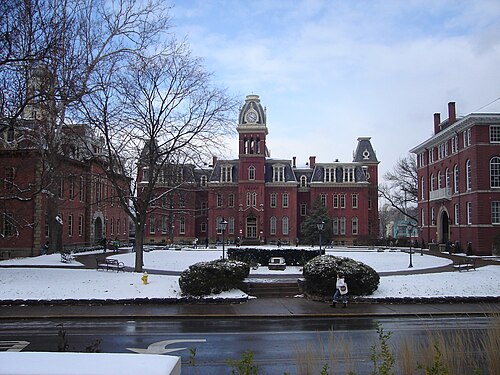
この地域の歴史の大部分において、アパラチア地方の教育は、各州政府からの資金援助をめぐる争いや、正式な教育の実際的な必要性を感じない農業志向の住民のせいで、国内の他地域に比べて遅れをとってきた。この地域の初期の教育は、農作業の手伝いを子供たちに求めない月に開かれる小さな一教室の校舎でキリスト教の道徳を教え、聖書の読み方を学ぶことから始まった。南北戦争後、義務教育法と州の援助により、より大きなコミュニティが小学校や高校を設立し始めた。同じ時期に、この地域の高等教育機関の多くが設立されたり、大幅に拡張されたりした。[73] 19世紀後半から20世紀初頭にかけて、パイ・ベータ・ファイなどの奉仕団体やさまざまな宗教団体が、この地域のより田舎の地域に入植地学校やミッションスクールを設立した。[74]
20世紀には、国の動向がアパラチアの教育にさらに影響を及ぼし始め、時には地域の伝統的な価値観と衝突することもあった。進化論の教えをめぐる国内で最も注目を集めたスコープス裁判は、1925年にアパラチア南部のテネシー州デイトンで行われた。統合と中央集権化にもかかわらず、アパラチアの学校は21世紀に入っても連邦および州の要求に追いつくのに苦労した。2001年以来、この地域の公立学校の多くは、「落ちこぼれゼロ法」の要求を満たすのが困難であるため、資金援助を失う危機にさらされていた。[73]
音楽
.jpg/500px-Tyler_Childers-9_(46484186252).jpg)
アパラチア音楽は、アパラチア文化の最もよく知られた表現の 1 つです。伝統的なアパラチア音楽 (オールドタイム ミュージックと呼ばれる) は、主にイギリス、アイルランド、スコットランドのバラードとフィドルの伝統に由来しています。アフリカ系アメリカ人のブルースミュージシャンは、アパラチア音楽の楽器的側面の発展に重要な役割を果たしました。最も顕著なのは、18 世紀後半にこの地域の象徴の 1 つである5 弦バンジョーが導入されたことです。アパラチア文化で知られているもう 1 つの楽器は、アパラチア ダルシマーです。これは、実質的にはギターの形をした楽器で、底が平らで横になっていて、交互に音を出すように弦をはじきます。
第一次世界大戦後の数年間、イギリスの民俗学者セシル・シャープは、南部アパラチア地方の住民が祖先から受け継いだ何百ものイギリスやスコットランドのバラードを今でも歌っていると指摘し、この地域に注目を集めた。1920年代のアパラチアのミュージシャンの商業録音(有名な1927年のブリストルセッションなど)は、カントリーミュージックとブルーグラスの発展に大きな影響を与えた。伝統的なアパラチア音楽は、1960年代のアメリカのフォークミュージック復興の時期に全国で人気が再燃し、マイク・シーガー、ジョン・コーエン、ラルフ・リンツラーなどの音楽学者が、現代音楽の影響を受けていないと思われるミュージシャンを探してこの地域の辺境地を訪れた。今日、この地域では毎年数十の音楽祭が開催され、アパラチア音楽の伝統が守られている。[76]
料理
文学

初期のアパラチア文学は、ヘンリー・ティンバーレイクの『回想録』(1765年)やトーマス・ジェファーソンの『ヴァージニア州覚書』 (1784年)など、地域外の人々の観察を中心にしたものが一般的であったが、デイビー・クロケットの『デイビー・クロケット伝』 (1834年)など、注目すべき例外もある。19世紀の雑誌に掲載された旅行者の記述は、アパラチアの地域色を生み、1860年代のジョージ・ワシントン・ハリスのサト・ラヴィングッドの登場人物や、メアリー・ノアイユ・マーフリーなどの地元出身の小説家によって最高潮に達した。レベッカ・ハーディング・デイヴィスの『鉄工所の生活』(1861年)、エマ・ベル・マイルズの『山の精』(1905年)、キャサリン・マーシャルの『クリスティ』(1912年)、ホレス・ケファートの『南部の高地人』(1913年)などの作品は、この地域の文学が地方色からリアリズムへと移行したことを示しています。農業社会から工業社会への移行とそれがアパラチア地方に与えた影響は、オリーブ・ティルフォード・ダーガンの『心の故郷に呼び戻す』(1932年)、アグネス・スライ・ターンブルの『転がる年月』(1936年)、ジェイムズ・スティルの『地球の河』(1940年)、ハリエット・シンプソン・アーノウの『人形職人』(1954年)、ハリー・コーディルの『カンバーランドの夜』(1962年)などの作品に描かれています。 1970年代から1980年代にかけて、ブリース・D・J・パンケーキ、ドロシー・アリソン、リサ・アルサーなどの作家の台頭により、この地域の文学的多様性が高まりました。[77]
上記のほか、アパラチア地方の著名な作家には、ジェームズ・エイジー(『A Death in the Family』)、アン・W・アームストロング(『This Day and Time』)、ウェンデル・ベリー(『Hannah Coulter 』 、『The Unforeseen Wilderness: An Essay on Kentucky's Red River Gorge』、『Selected Poems of Wendell Berry』)、ジェシー・スチュアート(『Taps for Private Tussie』、『The Thread That Runs So True』)、デニス・ジャルディーナ(『The Unquiet Earth』、『Storming Heaven』)、リー・スミス(『Fair and Tender Ladies』、『On Agate Hill』)、サイラス・ハウス(『Clay's Quilt』、『A Parchment of Leaves』)、ウィルマ・ダイクマン(『The Far Family』、『The Tall Woman』 )、キース・マイラード( 『Alex Driving South』 、『Light in the Company of Women』、『Hazard Zones』、『Gloria』、『Running』 、『 Morgantown』、『Lyndon Johnson and the Majorettes』、『Looking Good』)などがいます。 ) モーリス・マニング( Bucolics、A Companion for Owls )、アン・シェルビー( Appalachian Studies、We Keep a Store )、ジョージ・エラ・ライオン( Borrowed Children、Don't You Remember? )、パメラ・ダンカン( Moon Women、The Big Beautiful )、デイビッド・ジョイ( Where All Light Tends to Go、The Weight of This World )、クリス・オファット( No Heroes、The Good Brother )、チャールズ・フレイザー( Cold Mountain、Thirteen Moons )、シャリン・マククラム( The Hangman's Beautiful Daughter )、ロバート・モーガン( Gap Creek )、ジム・ウェイン・ミラー( The Brier Poems )、ガーニー・ノーマン( Divine Right's Trip、Kinfolks )、ロン・ラッシュ( Serena )、エリザベス・マドックス・ロバーツ(作家のロバート・E・ケネディ( 『偉大なる牧草地』、『人間の時間』)、トーマス・ウルフ(『天使よ故郷を見つめて』、『故郷に帰ることはできない』)、レイチェル・カーソン(『われらをめぐる海』、『沈黙の春』、『大統領自由勲章』)、ジャネット・ウォールズ(『ガラスの城』)。
アパラチア文学は、より広いジャンルである南部文学と交わるところがある。ウィリアム・フォークナーやコーマック・マッカーシーなど、世界的に有名な作家たちは、アパラチア地方を舞台にした物語でアメリカの古典文学に大きな貢献を果たした。マッカーシーの『サットリー』(1979年)は、アパラチア地方の中心、テネシー川沿いの生活の荒々しさと残酷さを強烈に描いた作品である。アパラチア地方を舞台にしたマッカーシーのその他の小説には、 『果樹園の番人』(1965年)、 『アウター・ダーク』( 1968年)、『チャイルド・オブ・ゴッド』(1973年)などがある。アパラチア地方は、マッカーシーの西部劇の傑作『ブラッド・メリディアン』の主人公キッドの出身地でもある。フォークナーの故郷であるミシシッピ州オックスフォードは、アパラチア地方とされる地域の境界上にあるが、彼の架空のヨクナパトーファは、この地域の一部とみなされるべきである。[要出典] 『八月の光』や『アブサロム、アブサロム』など、彼にノーベル賞をもたらしたフィクション作品のほとんどすべてが、この地を舞台としている。
民間伝承と伝説

アパラチア地方の民間伝承には、ヨーロッパ、アメリカ先住民(特にチェロキー族)、聖書の影響が強く混ざり合っている。チェロキー族は、この地域の初期のヨーロッパ人開拓者に、トウモロコシやカボチャなどの作物の植え方や栽培方法、ランプなどの食用植物の見つけ方を教えた。[78]チェロキー族はまた、何百種類もの在来のハーブや根の薬効に関する知識や、そのような植物から強壮剤を作る方法も伝えた。 [78] 1930年代から1940年代にこの地域に近代的な農業技術が導入される前は、多くのアパラチアの農民が、月の満ち欠けや特定の気象条件の発生などの「兆候」に従って植え付けるという聖書の伝統に従っていた。[78]
チェロキー族の民間伝承は、アパラチア山脈のストーリーテリングに影響を与え続けており、地域の動物の描写や特徴もそのひとつである。東部チェロキー族とノースカロライナ州西部の語り部ジェリー・ウルフによると、これらの動物には、怒ったクマに背中をひっかかれたことから「7本の縞」とも呼ばれるシマリス(爪痕が4本で、その間の線が7本)や、こっそりと盗みを働いて毒を持つようになるアメリカマムシなどが含まれる。 [79]
アパラチア地方の民話は、イングランド、スコットランド、アイルランドのおとぎ話や、地域の英雄や出来事に根ざしている。ジャックの物語は、素朴だが献身的な「ジャック」という人物の偉業を中心に展開する傾向があり、物語を語る祭りで人気がある。狩猟物語など、野生動物が登場する物語もある。ペンシルベニア州西部とウェストバージニア州北部の工業地帯では、ジョー・マガラックの鉄鋼労働者の物語が伝えられている。鉄道員のジョン・ヘンリーや開拓者のデイビー・クロケット、マイク・フィンク、ジョニー・アップルシードなどの地域の民話の英雄は、実在の人物が民話の人気題材になった例である。オミー・ワイズやジョン・ハーディなどの殺人物語は、アパラチア地方のバラッドの人気題材である。幽霊物語、または地方英語で「ハインツ物語」[80]は、南部の口承および文学の伝統に共通する特徴である。[81]この地域に伝わる幽霊話には、ウェストバージニア州グリーンブライア郡で起きた殺人事件に由来するグリーンブライアの幽霊の話がある。[78]
アパラチア地方には、いくつかの都市伝説や怪談が根付いている。1960年代からウェストバージニア州ポイントプレザントのモスマン伝説が生まれ、2002年の映画『モスマンの予言』で元の物語を大まかに語り直すなど、大衆文化の中で探求されてきた。[82] 1910年代から、ノースカロライナ州のブラウンマウンテンの尾根の周辺で光る球体が目撃されたという報告は、奴隷やチェロキー族の戦士の幽霊など、超常現象の理論の対象となってきた。ブラウンマウンテンの光として知られるこの話は、1990年代のSFドラマ『X-ファイル』のエピソードなど、大衆文化に取り入れられてきた。[83]テネシー州のベルウィッチの悪名高い幽霊物語は、 『ポルターガイスト』、『ブレアウィッチプロジェクト』、『パラノーマル・アクティビティ』シリーズなど、ホラー映画のいくつかの主要な作品に影響を与えた。[83] [84]
美術
都市アパラチア山脈
都市アパラチア人とは、アパラチア地方出身でアパラチア地方外の大都市圏に住んでいる人々である。大恐慌と第二次世界大戦後の数十年間、多くのアパラチア住民が北部と西部の工業都市に移住し、この移住は「ヒルビリー・ハイウェイ」として知られるようになった。1950年代から1960年代にかけての石炭採掘の機械化は、中央アパラチア地方の失業の主な原因であった。移住の流れの多くは比較的短い距離を移動し、ウェストバージニア州の住民はクリーブランドやオハイオ州東部と中部の他の都市に、ケンタッキー州東部の住民は仕事を求めてシンシナティやオハイオ州南西部に移住した。デトロイトやシカゴのようなもっと遠方の都市には、多くの州から移住者が集まった。これらのコミュニティの中には、今でもアパラチア文化の集落が見られる。[85]
コミュニケーション
1940年代から1960年代にかけて、ウェストバージニア州ホイーリングは、夜間に米国東部全域で聞くことができるクリアチャンネル AMラジオ局WWVAがあったため、この地域の文化の中心地となった。ピッツバーグのKDKAは1920年代初頭にさかのぼる50キロワットのクリアチャンネル局であったが(信号強度は東海岸全域に及んでいた)、WWVAは農村地域のより幅広い聴衆にアピールする農村および農場向け番組を誇りとしていた。シンシナティのWLWも、アパラチア山脈の中央部および北部の多くの人々に頼られていた。
この地域の南部では、グランド・オール・オプリーの旗艦局であるWSB-AMアトランタとWSM-AMナッシュビルが 20 世紀にこの地域の住民にとって主要な放送局であり、現在でもこの地域で強い支持を得ています。
アパラチア研究
学術的関心としてのアパラチアは、1960 年代から 1970 年代にかけてさまざまな分野に出現した批判的な学問の産物でした。権力の問題に対する関心が新たに高まり、学者たちは、アメリカのいわゆる「田舎者」が直面している社会的不平等、階級闘争、環境破壊を無視することができませんでした。アパラチアが学術界に登場したのは、社会状況と批判的な学術的関心が交わった結果であり、この地域の大学やアパラチア研究協会で多くのアパラチア研究プログラムが開発される結果となりました。
経済
アパラチア地方の経済は伝統的に農業、鉱業、木材産業、そして都市部では製造業に依存していました。20 世紀後半以降、観光業と別荘開発がますます大きな役割を果たすようになりました。
農業

アパラチア地域の気候は農業に適しているが、丘陵地帯のため平均的な農場の規模は大きく制限され、19 世紀後半の人口増加によってこの問題は悪化した。19 世紀の大半を通じて自給農業がアパラチア経済の屋台骨をなし、ペンシルベニア州西部、バージニア州グレート バレー、テネシー州東部のテネシー渓谷上部などの地域の経済は南北戦争の頃に大規模農業や製造業の拠点へと移行したが、自給農業は 1950 年代までこの地域の経済の重要な部分であり続けた。20 世紀初頭、アパラチアの農家は機械化に苦戦し、長年にわたる過酷な農業慣行により、すでに限られていた農地の多くがひどく侵食された。1930 年代にはさまざまな連邦政府機関が介入し、被害を受けた地域を修復し、害の少ない農業技術を導入した。近年、持続可能な農業の概念がこの地域の小規模農場に適用され、ある程度の成功を収めている。しかし、アパラチア地域の農場数は減少し続けており、1969年には4,700万エーカー(19万km 2 )の土地に354,748軒あった農場数は、1997年には3,500万エーカー(14万km 2)の土地に230,050軒にまで激減した。 [86]
初期のアパラチア農民は、原産地のヨーロッパから導入された作物と、北米原産の作物(トウモロコシやカボチャなど)の両方を栽培していた。タバコは、特に土地が綿花などの換金作物に適していないため、南部アパラチアでは長い間重要な換金作物であった。リンゴは18世紀後半からこの地域で栽培されており、その栽培は、この地域の山間の谷にある温帯地帯の存在に助けられている。豚は、この地域の豊かな森林で、しばしばクリを食べて放し飼いにすることができ、初期のアパラチア農民の間で最も人気のある家畜であった。アメリカンクリは、 20世紀にクリ疫病が発生するまで、人間の重要な食料源でもあった。初期の入植者は、この地域に牛や羊も連れてきており、作物のために低地が必要になる生育期には、通常、バルドと呼ばれる高地の牧草地でそれらを放牧した。牛、主にヘレフォード種、アンガス種、シャロレー種が現在この地域の主な家畜となっている。[86]
ログ記録

アパラチアの山々と渓谷には、かつては無尽蔵と思われる木材が豊富にあった。しかし、劣悪な道路、鉄道の欠如、そしてこの地域への全般的なアクセスの悪さから、19世紀の大半を通じて、この地域の大半での大規模な伐採は妨げられた。南北戦争前にはカロライナとケンタッキー川流域に伐採会社が設立されたが、ほとんどの大手会社は、よりアクセスしやすい中西部と北東部の森林を伐採することを好んだ。1880年代までに、これらの森林は枯渇し、木材需要の急増により、伐採会社はアパラチアの原生林を探し求めざるを得なくなった。[87]アパラチアでの最初の大規模な伐採事業では、ラバのチームまたは川を使って丸太を輸送し、後者の方法ではスプラッシュダムを使用することもあった。[88] 1890年代には、シェイ機関車、蒸気駆動ローダー、蒸気駆動スキダーなどの技術革新により、最も遠隔地の森林の大規模な伐採が可能になりました。[87]
アパラチア地方での伐採は、20 世紀初頭にピークを迎えました。このとき、リッター製材会社などの企業が原生林を驚くべき規模で伐採し、 1911 年に国有林が設立され、地域の木材資源をより適切に管理するための同様の州機関も設立されました。アパラチア地方で最も成功した伐採会社は、ジョージア ハードウッド製材会社でしょう。同社は 1927 年に設立され、 1948 年にジョージア パシフィックと改名されて全国展開しました。1950 年代に業界の焦点が太平洋岸北西部に移ったため、アパラチア地方での伐採は衰退しましたが、1980 年代に海外からの需要が高まり、アパラチア地方での伐採が再び活発化しました。1987 年には、4,810 社の製材会社がこの地域で操業していました。 1990年代後半、アパラチアの木材産業は数十億ドル規模の産業であり、テネシー州で5万人、ケンタッキー州で2万6000人、ウェストバージニア州だけで1万2000人を雇用していた。[87] 1999年までに、天然資源産業による森林伐採の結果、140万エーカーの森林が消滅した。 [説明が必要]採掘プロセスによる汚染と土地の混乱により、多くの環境問題が発生した。植生の除去や土地のその他の改変により、周辺地域の浸食と洪水が増加した。水質と水生生物も影響を受けた。[89]
石炭採掘

石炭鉱業は、外部の人がこの地域と最も頻繁に関連付ける産業である。[90] [91] これは、この地域がかつて米国の石炭の3分の2を生産していたという事実によるところが大きい。しかしながら、現在、鉱業に従事するアパラチア労働力はわずか2%である。この地域の広大な炭田は、ペンシルベニア州北部からアラバマ州中央部までの63,000平方マイル (160,000 km 2 ) に及び、そのほとんどはカンバーランド高原とアレゲニー高原地域に沿っている。鉱業活動のほとんどはケンタッキー州東部、バージニア州南西部、ウェストバージニア州、ペンシルベニア州西部に集中しており、メリーランド州西部、テネシー州、アラバマ州でも小規模な採掘が行われている。19世紀初頭以来130億トンの石炭を生産してきたピッツバーグ炭層は、世界で最も価値のある鉱床と呼ばれている。ウェストバージニア州には60以上の主要な炭層があり、ケンタッキー州東部には80以上の炭層がある。採掘される石炭のほとんどは瀝青炭だが、ペンシルベニア州中部の周辺には無煙炭の鉱床がかなりある。 [92]アパラチアの石炭の約3分の2は地下採掘で生産され、残りは露天採掘で生産されている。[93]露天採掘の一種である 山頂採掘は、環境と住民の健康に悪影響を及ぼすため、アパラチア中部では非常に物議を醸している採掘方法である。[92]
19 世紀後半、南北戦争後の産業革命と国内鉄道の拡張により石炭の需要が急増し、アパラチア全域で鉱山事業が急速に拡大した。米国全土および海外から数十万人の労働者がこの地域に流入し、ケンタッキー州東部、ウェストバージニア州、ペンシルベニア州西部の文化的構成が根本的に変化した。鉱山会社は、鉱山労働者が住む町全体を所有することが多かったため、州政府や市町村政府に大きな影響力を持つようになった。しかし、鉱業は景気低迷の影響を受けやすく、好況と不況が頻繁に繰り返され、第一次および第二次世界大戦中には大規模な好況が、世界恐慌中には最悪の不況が起きた。アパラチア鉱山業界では、1890 年代から 1930 年代にかけて、国内で最も血なまぐさい労働争議もいくつか発生した。鉱山関連の負傷や死亡は珍しくなく、黒色肺病などの病気は20世紀を通じて鉱山労働者を苦しめました。第二次世界大戦後、機械化の革新(長壁採掘など)と石油や天然ガスとの競争により、この地域の鉱山事業は衰退しました。[92] 1980年代に硫黄分の多い石炭に課されたような環境規制により、さらに鉱山が閉鎖されました。アパラチアの鉱山労働者の年間収入は55,000ドルで、他のほとんどの地元の労働者よりも高いですが、2004年のアパラチアの石炭採掘の雇用者は50,000人弱でした。[94] [95]
21 世紀初頭、ピッツバーグに拠点を置くコンソル エナジーの台頭により、一部の地域では石炭採掘が復活した。2002年のクイークリーク炭鉱の救済、ペンシルベニア州西部の廃炭鉱で続く炭鉱陥没問題、ウェストバージニア州やその他の地域でのサゴ炭鉱災害やアッパー ビッグ ブランチ炭鉱災害も、最近では注目されている。[引用が必要]
製造業

アパラチア地方の製造業は、主に初期のピッツバーグとバーミングハムの製鉄所と製鋼所、および19世紀半ばにノースカロライナ州のピエモンテ地方に出現した繊維工場に根ざしています。南北戦争後に工場建設が大幅に増加し、この地域は1890年から1930年の間に製造業ブームを経験しました。この経済の変化により、小規模農場や田舎から大都市への大規模な移住が起こり、バーミングハム、テネシー州ノックスビル、ノースカロライナ州アッシュビルなどの都市の人口が飛躍的に増加しました。この地域の製造業は大恐慌中に後退しましたが、第二次世界大戦中に回復し、1950年代と1960年代にピークを迎えました。しかし、退職金の支払い困難、環境問題、および1994年の北米自由貿易協定(NAFTA)の調印により、この地域の製造業は衰退しました。ピッツバーグでは1980年代に工場の雇用が44%減少し、1970年から2001年の間にアパラチア地域のアパレル労働者の数は25万人から8万3千人に減少し、繊維労働者の数は27万5千人から19万3千人に減少した。[96]
1901年にピッツバーグで設立されたUSスチールは、資本金が10億ドルを超えた世界初の企業でした。[96]ピッツバーグの別の企業であるアルコアは、20世紀初頭に米国のアルミニウム産業の確立に貢献し、ペンシルベニア州西部とテネシー州東部の経済に大きな影響を与えました。[97] ユニオンカーバイドは1920年にウェストバージニア州クレンデニンに世界初の石油化学工場を建設し、その後数年間、カナワバレーは「世界の化学首都」として知られるようになりました。[98]イーストマンケミカルも1920年に設立され、テネシー州最大の雇用主です。チャンピオンファイバーやボーウォーターなどの企業は、それぞれノースカロライナ州カントンとサウスカロライナ州グリーンビルに大規模なパルプ工場を設立しましたが、前者は20世紀を通じて環境保護主義者との戦いに悩まされました。[99]
観光

観光業は、この地域で最も古い産業の1つであり、鉱業と製造業が着実に衰退するにつれて、20世紀後半にアパラチア経済のより重要な部分を占めるようになった。[100] 2000年から2001年にかけて、アパラチアの観光業は300億ドル近くの収益と60万人以上の雇用を生み出した。[101]山岳地帯は、それに伴う風景と野外レクリエーションの機会とともに、この地域の主な魅力となっている。[100]この地域には、世界で最も有名なハイキングコースの1つ(アパラチアントレイル)、国内で最も訪問者が多い国立公園(グレートスモーキーマウンテンズ国立公園)、[102]国内で最も訪問者が多い国立公園道路(ブルーリッジパークウェイ)がある。[103]工芸産業は、地域の工芸品の指導、販売、展示または実演を含め、アパラチア経済の重要な部分を占めており、例えば、ノースカロライナ州西部の経済に年間1億ドル以上、ウェストバージニア州の経済に8千万ドル以上をもたらしています。[104]この地域の重要な遺産観光の名所には、ノースカロライナ州のビルトモアエステートとチェロキー東部バンド保留地、テネシー州のケイズコーブ、ウェストバージニア州のハーパーズフェリーがあります。重要なテーマパークには、グレートスモーキー山脈の周辺にあるドリーウッドとゴーストタウンビレッジがあります。
アパラチア山脈のミネラル豊富な温泉は、長年健康を回復させる効能があると考えられており、18世紀初頭には、バージニア州ホットスプリングス、ウェストバージニア州ホワイトサルファースプリングス、現在のノースカロライナ州ホットスプリングスにリゾートが設立され、この地域に観光客を引き寄せていた。ミネラル温泉とともに、山脈の高地の涼しく澄んだ空気は、低地のエリートたちの逃避先となり、ウェストバージニア州のグリーンブライアーやノースカロライナ州のバルサムマウンテンインなどの豪華なホテルが、この地域の人里離れた谷や山腹に建てられた。第一次世界大戦の終結(ヨーロッパへの旅行の機会が開かれた)と自動車の到来(国の休暇習慣を変えた)により、この地域のスパリゾートはごく一部を除いて消滅した。 1930年代に国立公園が設立されたことで、この地域への観光客が急増したが、さまざまなホストコミュニティで都市の無秩序な拡大という問題も生じた。20世紀後半から21世紀初頭にかけて、各国はホストコミュニティを保護しながら観光業の維持に重点を置くようになった。[100]
貧困

貧困は長年アパラチア地方を悩ませてきたが、1940年にジェームズ・エイジーとウォーカー・エバンスが『Let Us Now Praise Famous Men』を出版するまで、米国の他の地域では注目されることはなかった。この本は、大恐慌時代のアパラチア地方の家族を言葉と写真で記録したものである。1963年、ジョン・F・ケネディは大統領アパラチア地域委員会を設立した。後継者のリンドン・B・ジョンソンは、ケネディの努力をアパラチア地域委員会の形で具体化し、1965年に法律として可決した。[105]
In Appalachia, severe poverty and desolation were paired with the necessity for careful cultural sensitivity. Many Appalachian people feared that the birth of a new modernized Appalachia would lead to the death of their traditional values and heritage. Because of the isolation of the region, Appalachian people had been unable to catch up to the modernization that lowlanders had achieved. In the 1960s, many people in Appalachia had a standard of living comparable to Third World countries. Lyndon B. Johnson declared a "War on Poverty" while standing on the front porch of an Inez, Kentucky, home whose residents had been suffering from a long-ignored problem.[106] The Appalachian Regional Development Act of 1965 stated:
The Appalachian region of the United States, while abundant in natural resources and rich in potential, lags behind the rest of the Nation... its people have not shared properly in the Nation's prosperity.[107]
Since the creation of the Appalachian Regional Commission (ARC) in 1965, the region has seen dramatic progress. New roads, schools, health care facilities, water and sewer systems, and other improvements have brought a better life to many Appalachian residents. In the 1960s, 219 counties in the 13-state Appalachian Region were considered economically distressed. Now that list has been cut by more than half, to 82 counties, but these are "hard-core" pockets of poverty, seemingly impervious to all efforts at improving their lot.[108] Martin County, Kentucky, the site of Johnson's 1964 speech, is one such county still ranked as "distressed" by the ARC. As of 2000, the per capita income in Martin County was $10,650, and 37% of its residents lived below the poverty line.
Like Johnson, President Bill Clinton brought attention to the remaining areas of poverty in Appalachia. On July 5, 1999, he made a public statement concerning the situation in Tyner, Kentucky. Clinton told the crowd:
I'm here to make a simple point. This is the time to bring more jobs and investment to parts of the country that have not participated in this time of prosperity. Any work that can be done by anybody in America can be done in Appalachia.[108]
The region's poverty has been documented often since the early 1960s. John Cohen documents rural lifestyle and culture in The High Lonesome Sound, while photojournalist Earl Dotter has been visiting and documenting poverty, healthcare and mining in Appalachia for nearly forty years.[109] Another photojournalist, Shelby Lee Adams, has been photographing Appalachian families and lifestyle for decades.
Poverty has caused health problems in the region. The diseases of despair, including the opioid epidemic in the United States, and some diseases of poverty are prevalent in Appalachia.[citation needed]
Tax revenue and absentee land ownership
In 1982 a seven-volume study conducted by the Appalachian Land Ownership Task Force was issued by the Appalachian Regional Commission which investigated the issue of absentee land ownership. The study covered 80 counties in six states approximating the area designated "Southern Appalachia" as defined by Thomas R. Ford's 1962 work. The states selected were Alabama (15 counties), Kentucky (12 counties), North Carolina (12 counties), Tennessee (14 counties), Virginia (12 counties), and West Virginia (15 counties).

In its summary the report stated that "over 55,000 parcels of property in 80 counties were studied, representing some 20,000,000 acres of land and mineral rights..." It found that "41% of the 20 million acres of land and minerals...are held by only 50 private owners and 10 government agencies. The federal government is the single largest owner in Appalachia, holding over 2,000,000 acres." The study found that the extractive industries, i.e., timber, coal, etc., were "greatly under-assessed for property tax purposes. Over 75% of the mineral owners in this survey pay under 25 cents per acre in property taxes." In the major coal counties surveyed the average tax per ton of known coal reserves is only $.0002 (1/50th of a cent). The government-held lands are tax-exempt, but the government makes a payment in lieu of taxes, which is usually less than the normal tax rates.
"Taken together, the failure to tax minerals adequately, the underassessment of surface lands, and the revenue loss from concentrated federal holdings has a marked impact on local governments in Appalachia. The effect, essentially, is to produce a situation in which a) the small owners carry a disproportionate share of the tax burden; b) counties depend upon federal and state funds to provide revenues, while the large, corporate and absentee owners of the region's resources go relatively tax-free; and c) citizens face a poverty of needed services despite the presence in their counties of taxable property wealth, especially in the form of coal and other natural resources."[110]
In 2013, a similar study that concentrated solely on West Virginia found that 25 private owners hold 17.6% of the state's private land of 13 million acres. The federal government owns 1,133,587 acres in West Virginia, 7.4% of the total state acreage of 15,410,560 acres.[111] In 11 counties the top ten absentee landowners own 41% to almost 72% of the private land in each county.[112]
Appalachian Regional Commission
The Appalachian Regional Commission (ARC) was created by the U.S. Congress in 1965 to bring poor areas of the 13 U.S. states of the main (southern) range of the Appalachians into the mainstream of the American economy. The commission is a partnership of federal, state, and local governments, and was created to promote economic growth and improve the quality of life in the region. The region as defined by the ARC[113] includes 420 counties, including all of West Virginia; counties in 12 other states: Alabama, Georgia, Kentucky, Maryland, Mississippi, New York, North Carolina, Ohio, Pennsylvania, South Carolina, Tennessee, and Virginia; and also eight cities in Virginia, where state law makes cities administratively separate from counties. The ARC is a planning, research, advocacy and funding organization; it does not have any governing powers.
The ARC's geographic range of coverage was defined broadly to cover as many economically underdeveloped areas as possible; it extends well beyond the area usually thought of as "Appalachia". For instance, parts of Alabama and Mississippi were included in the commission because of problems with unemployment and poverty similar to those in Appalachia proper, and the ARC region extends into the Northeastern states, which are not traditionally considered part of Appalachia culturally (though a "northern Appalachia" identity has emerged in recent times in parts of both NY and PA, particularly in rural areas). More recently, the Youngstown, Ohio, region was declared part of Appalachia by the ARC due to the collapse of the steel industry in the region in the early 1980s and the continuing unemployment problems in the region since, though aside from Columbiana County, Ohio, the Youngstown DMA is not traditionally or culturally considered part of the region.[114] The ARC's wide scope also grew out of the "pork barrel" phenomenon, as politicians from outside the traditional Appalachia area saw a new way to bring home federal money to their areas. However, former Ohio governor Bob Taft has stated, "What is good for Appalachia is good for all of Ohio."[115]
Transportation
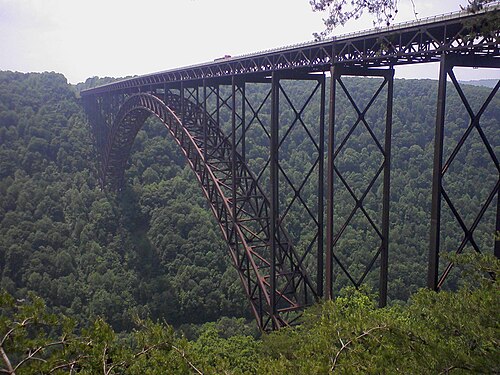
Transportation has been the most challenging and expensive issue in Appalachia since the arrival of the first European settlers in the 18th century. Except the October 1, 1940, opening of the Pennsylvania Turnpike, the region's mountainous terrain continuously thwarted major federal intervention attempts at major road construction until the 1970s. This left large parts of the region virtually isolated and slowing economic growth. Before the Civil War, major cities in the region were connected via wagon roads to lowland areas, and flatboats provided an important means for transporting goods out of the region. By 1900, railroads connected most of the region with the rest of the nation, although the poor roads made travel beyond railroad hubs difficult. When the Appalachian Regional Commission was created in 1965, road construction was considered its most important initiative, and in subsequent decades the commission spent more on road construction than all other projects combined.[116]
The effort to connect Appalachia with the outside world has required numerous civil engineering feats. Millions of tons of rock were removed to build road segments such as Interstate 40 through the Pigeon River Gorge at the Tennessee-North Carolina state line and U.S. Route 23 in Letcher County, Kentucky. Large tunnels were built through mountain slopes at Cumberland Gap in 1996 to speed up travel along U.S. Route 25E, which acts as a regional arterial connecting Appalachia to the East Coast and the Great Lakes regions. The New River Gorge Bridge in West Virginia, completed in 1977, was the longest and is now the fourth-longest single-arch bridge in the world. The Blue Ridge Parkway's Linn Cove Viaduct, the construction of which required the assembly of 153 pre-cast segments 4,000 feet (1,200 m) up the slopes of Grandfather Mountain,[116] has been designated a historic civil engineering landmark.[117]
Physiographic provinces
The six physiographic provinces that in whole or in part are commonly treated as components of Appalachia are:
- Appalachian Plateau
- Allegheny Mountains
- Ridge-and-Valley Appalachians
- Great Appalachian Valley
- Blue Ridge Mountains
- Piedmont
In popular culture
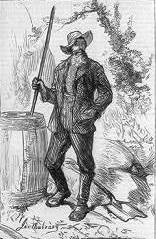
Depictions of Appalachia and its inhabitants in popular media are typically negative, making the region an object of humor, derision, and social concern.[118] Ledford writes, "Always part of the mythical South, Appalachia continues to languish backstage in the American drama, still dressed, in the popular mind at least, in the garments of backwardness, violence, poverty, and hopelessness."[119] Otto argues that comic strips Li'l Abner by Al Capp and Barney Google by Billy DeBeck, which both began in 1934, caricatured the laziness and weakness for "corn squeezin's" (moonshine) of these "hillbillies". The popular 1960s Andy Griffith Show and The Beverly Hillbillies on television and James Dickey's 1970 novel Deliverance perpetuated the stereotype, although the region itself underwent so many changes after 1945 that it scarcely resembles the comic images.[120]
- English composer Frederick Delius wrote a theme and variations entitled Appalachia; he first composed this music, subtitled "Variations on an Old Slave Song with final chorus", in 1896.[121]
- The Little Shepherd of Kingdom Come (1903), The Trail of the Lonesome Pine (1908), and other early 20th-century novels of John Fox Jr., set in the Appalachian town of Big Stone Gap, Virginia, and surrounding areas, gave readers an image of frontier life in Appalachia and were made into popular films. Fox himself graduated from Harvard and was a bon vivant newspaperman in New York City. He returned home to the Cumberland Mountains of Tennessee to write his stories because of poor health.[122]
- Some comic strips often featured Appalachia, especially "Li'l Abner" by Al Capp. Inge notes that this comic strip, which ran 1934–77, largely ignored religion, politics, blacks and the Civil War, but instead focused its humor on the morality of Dogpatch, examining its memorable and often eccentric people who typically relied on violence to control the social order, and held deep to their faith in land, home, self-sufficiency, and antipathy to outsiders.[123] Arnold finds that starting with World War II Capp increasingly emphasized sex and violence.[124]
- Appalachian Spring (1944) is the name of a musical composition by Aaron Copland and a ballet of the same name by Martha Graham. Copland did not intend for his music, which he composed for Graham and which incorporates Shaker melodies, to have an Appalachian theme. Graham gave the work its name; her ballet told the story of a young couple living on the frontier in western Pennsylvania.[125]
- Author Catherine Marshall wrote Christy (1967), loosely based on her mother's years as a teacher in the Appalachian region. The novel was highly popular and became the basis of a short-lived television series of the same name in 1994.[126]
- The 1972 film Deliverance takes place in southern Appalachia. The film perpetuated extremely negative stereotypes.[127]
- The Waltons was a 1972–1981 television show that depicted a rural Virginia family during the Great Depression through World War II.[128]
- "Face of Appalachia" is a song that appeared first on the album Tarzana Kid by John Sebastian in 1974. The song, co-written by Sebastian and Lowell George, was described by Joel Canfield as follows: "Sebastian's lyrics weave a heart-rending picture of an old man's struggle to impart his childhood memories to his grandson; memories of places and people who no longer exist; of an era long gone."[129] Cover versions of the song have been recorded by Valerie Carter (1977), Wendy Matthews (1992) and Julie Miller (1997).[130]
- The motion pictures Where the Lilies Bloom (1974) and Coal Miner's Daughter (1980) attempt an accurate portrayal of life in Appalachia which stresses the tensions between Appalachian traditions and the values of urbanized America.[131]
- Alan Hovhaness in 1985 composed a tone poem named To the Appalachian Mountains (Symphony no. 60).[132]
- Large-format photographer Shelby Lee Adams, himself a son of Appalachian emigrants, has portrayed the Appalachian family life sympathetically in several books (1993–2003).[133]
- The 1999 drama film October Sky focuses on the true story of NASA engineer Homer Hickam and his peers known as the Rocket Boys, who constructed a jet-propulsed rocket in the declining Appalachian coal town of Coalwood, West Virginia as a result of the Space Race.[134]
- The novel Prodigal Summer (2000) by Barbara Kingsolver explores the ecology of the region and how the removal of the predators, wolves and coyotes, affected the environment.[135]
- Songcatcher (2000) takes place in rural Appalachia in 1907 and features the "lost" ballads of the Scots-Irish brought over in the 19th century and a musicologist's quest to preserve them.[136]
- Stranger with a Camera (2000) is a documentary film from Appalshop about the representation of Appalachian communities by outsiders in film and video.[137]
- Much of the popular book series The Hunger Games (2008) is set in "an area that used to be called Appalachia" which is referred to in the book as District 12. Much of the surroundings and culture reflect present-day Appalachia, such as reliance on coal mining as an industry.[138]
- The 2013 film Out of the Furnace is the story of two brothers living in a dying Appalachian Pennsylvania town, struggling for jobs, who get wrapped up in the world of meth-dealing in the mountains.[139]
- Hillbilly Elegy: A Memoir of a Family and Culture in Crisis is a 2016 memoir by JD Vance that opines on the Appalachian region and people, drawing from the Ohio-born author's view of his extended family in Kentucky. While the book's portrayal of Appalachia was met with controversy and derision from many Appalachians,[140] it was made into a 2020 film directed by Ron Howard.[141]
- Fallout 76 (2018) is set in a retrofuturistic, post-nuclear Appalachia, with some of its story arcs exploring the social and economic impact of widespread automation, labor struggles, and anti-government activism, drawing on the region's real history, such as the Battle of Blair Mountain.[142]
- Author Barbara Kingsolver seeks to redress Appalachian stereotypes in her novel Demon Copperhead (2022), a retelling of Charles Dickens' David Copperfield that explores the opioid crisis in the region.[143]
See also

- Appalachian Center for Wilderness Medicine
- Appalachian Ohio
- Childbirth in rural Appalachia
- Environmental justice and coal mining in Appalachia
- Museum of Appalachia
- Ozark culture
- Subranges of the Appalachian Mountains
- Upland South
References
- ^ a b c "Population and Age in Appalachia". Appalachian Regional Commission. Retrieved December 4, 2022.
- ^ a b Stewart Scales; Emily Satterwhite; Abigail August (1986). "Mapping Appalachia's Boundaries: Historiographic Overview and Digital Collection" (PDF). Journal of Appalachian Studies. 24 (1). Appalachian Studies Association: 89–100.
- ^ "About the Appalachian Region". Appalachian Regional Commission. Retrieved February 24, 2023.
- ^ "Definition of APPALACHIA". www.merriam-webster.com.
- ^ a b "Appalachian Region". Appalachian Regional Commission. Archived from the original on December 2, 2008. Retrieved November 27, 2008.
- ^ a b c d e Abramson, Rudy. Introduction to Encyclopedia of Appalachia (Knoxville: University of Tennessee Press, 2006), pp. xix–xxv.
- ^ Banker, Mark (February 16, 2022). "When grappling with Appalachian identity, don't resort to stereotypes". Knoxville News Sentinel. Retrieved March 13, 2022.
- ^ Sokol, Anna. "Economic Redevelopment in Appalachia: The Appalachian Regional Commission". University of Michigan. Retrieved August 9, 2013.
- ^ Ziliak, James P. (September 16, 2010). "The Appalachian Regional Development Act and Economic Change" (PDF).
- ^ Wilson, Shannon. "Library Homepage: William Goodell Frost: Race and Region: Essay". libraryguides.berea.edu.
- ^ In Virginia, all municipalities incorporated as "cities" are legally separate from counties.
- ^ a b c d e f g h i j k l m n John Alexander Williams, Appalachia: A History (Chapel Hill: the University of North Carolina Press, 2002)
- ^ Abramson, Rudy, and Jean Haskell, eds., Encyclopedia of Appalachia (Knoxville: University of Tennessee Press, 2006), pp. 1287–88.
- ^ Trende, Sean (2012). The Lost Majority: Why the Future of Government Is Up for Grabs–and Who Will Take It. St. Martin's Press. pp. xxii–xxviii. ISBN 978-0230116467.
- ^ After Florida, Dry Tortugas and Cape Canaveral: Stewart, George (1945). Names on the Land: A Historical Account of Place-Naming in the United States. New York: Random House. pp. 11–13, 17–18.
- ^ Walls, David (1977), "On the Naming of Appalachia", in An Appalachian Symposium, pp. 56–76.
- ^ Blaustein, Richard (2003), The Thistle and the Brier: Historical Links and Cultural Parallels Between Scotland and Appalachia, p. 21.
- ^ Stewart, George R. (1967). Names on the Land. Boston: Houghton Mifflin Company.
- ^ Walls, David (2006). "Appalachia". The Encyclopedia of Appalachia (Knoxville: University of Tennessee Press), pp. 1006–07.
- ^ Webster's Third New International Dictionary of the English Language Unabridged (Springfield, Mass.: Merriam-Webster, 1993), p. 102.
- ^ Ivey, Mike (1986). "A rose by another name is a damned brier". Appalachian Heritage. 14 (3). The University of North Carolina Press: 53–54. doi:10.1353/aph.1986.0112. S2CID 144901184.
- ^ Turner, William Hobart. Cabbell, Edward J., 1946– (1985). Blacks in Appalachia. University Press of Kentucky. ISBN 0-8131-1518-3. OCLC 11532916.
{{cite book}}: CS1 maint: multiple names: authors list (link) CS1 maint: numeric names: authors list (link) - ^ Hudson, Charles. The Juan Pardo Expeditions: Explorations of the Carolinas and Tennessee, 1566–1568 (Tuscaloosa: University of Alabama Press, 2005), p. 17.
- ^ Rouse, Parke Jr. (1992). The Great Wagon Road: From Philadelphia to the South (1st ed.). Dietz Press. ISBN 978-0875170657.
- ^ Leyburn, James G. (1989) [1962]. The Scotch-Irish: A Social History (Reprint ed.). University of North Carolina Press. pp. 317–319. ISBN 978-0807842591.
- ^ Jones, Maldwyn A. (1980). "Scotch-Irish". In Thernstrom, Stephan; Orlov, Ann; Handlin, Oscar (eds.). Harvard Encyclopedia of American Ethnic Groups. Cambridge, MA: Harvard University Press. pp. 895–908. ISBN 978-0674375123. OCLC 1038430174.
- ^ David Hackett Fischer, Albion's Seed (Oxford University Press, 1989), p. 605-782
- ^ Webb, Emily. "In the Mountains: The Scots-Irish heritage in Appalachia". Retrieved November 3, 2023.
- ^ Straw, Richard Alan. Blethen, Tyler. (2004). High mountains rising : Appalachia in time and place. University of Illinois Press. ISBN 0-252-02916-X. OCLC 53020340.
{{cite book}}: CS1 maint: multiple names: authors list (link) - ^ a b Caudill, Harry. Night Comes to the Cumberlands
- ^ a b c d e f g h Drake, Richard. A History of Appalachia (Lexington: University Press of Kentucky, 2001)
- ^ Lacy, Eric. Vanquished Volunteers: East Tennessee Sectionalism from Statehood to Secession (Johnson City: East Tennessee State University Press, 1965), pp. 122–26.
- ^ Poe, Edgar Allan (2006). "The Name of the Nation". In Kennedy, Gerald (ed.). The Portable Edgar Allan Poe. Penguin Books. p. 600.
- ^ a b c Gordon McKinney, "The Civil War". Encyclopedia of Appalachia (Knoxville: University of Tennessee Press, 2006), pp. 1579–81.
- ^ Curry, Richard O. A House Divided, Statehood Politics & the Copperhead Movement in West Virginia, Univ. of Pittsburgh Press, 1964, pgs. 141–147. Twenty-four of the most mountainous counties of West Virginia had voted for the Secession Ordinance on May 23, 1861.
- ^ "Most of West Virginia went through the Civil War not as an asset to the Union but as a troublesome battleground, while the Unionist Ohio River counties struggled to cope with the tide of refugees fleeing to their sanctuary from the interior." Weigley, Russell F. A Great Civil War, W.W. Norton, 2003, p. 55
- ^ Binnicker, Margaret D., "Scott County", Tennessee Encyclopedia of History and Culture Encyclopedia, Tennesseeencyclopedia.net, retrieved February 8, 2011
- ^ E.g. see Walker, Matthew H. "Discrimination Based on National Origin and Ancestry: How the Goals of Equality Have Failed to Address the Pervasive Stereotyping of the Appalachian Tradition", 38 U. Dayton L. Rev. 335 (2013).
- ^ Drake, R.B. (2003). A History of Appalachia. University Press of Kentucky. p. 105. ISBN 978-0-8131-3793-3. Retrieved July 8, 2024.
- ^ Otterbein, Keith F. "Five Feuds: An Analysis of Homicides in Eastern Kentucky in the Late Nineteenth Century", American Anthropologist, June 2000, Vol. 102 Issue 2, pp 231–43, provides a theoretical analysis.
- ^ Billings, Dwight B., and Kathleen M. Blee, "'Where the Sun Set Crimson and the Moon Rose Red': Writing Appalachia and the Kentucky Mountain Feuds", Southern Cultures, Summer 1996, Vol. 2 Issue 3/4, pp 329–352
- ^ Staff (April 16, 2006). "Appalachia: Hillbillies and Haute Cuisine. (Seriously.)". Newsweek. Retrieved April 20, 2022.
- ^ Freeman, Lindsey (March 2019). "Memories of an Atomic Childhood in Appalachia: Summertime in a Nuclear Town". Literary Hub. Retrieved April 20, 2022.
- ^ "ARC-Designated Distressed Counties, Fiscal Year 2010". Appalachian Regional Commission. Archived from the original on April 23, 2020. Retrieved June 16, 2020.
- ^ Weaver, Nathaniel. "INFLUENCE OF EXURBAN NEIGHBORHOODS ON RIPARIAN VEGETATION AND STREAM SALAMANDERS IN THE SOUTHERN APPALACHIAN MOUNTAINS". Clemson University. Clemson University Press. Retrieved April 12, 2021.
- ^ Bryant, Linda (August 12, 2016). "Tennessee's a hot job market (If you're in the right field)". Nashville Ledger. Retrieved November 6, 2016.
Most importantly, this Brookings report indicates that our state is getting higher-paying jobs that will have a meaningful impact on Tennessee residents, with big gains among engineering, computer science and automotive-related jobs since 2013.
- ^ Smith, Rick (March 23, 2016). "Is Red Hat at its peak? Earnings beat generates little heat". WRAL TechWire. Retrieved November 6, 2016.
- ^ "Top500 List". TOP500. June 2023.
- ^ Coleman, J. Miles (May 2, 2024). "Districts of Change, Part One: How All 435 Congressional Districts Voted from 2008–2020". Sabato's Crystal Ball.
- ^ Newhall, David, "English". Encyclopedia of Appalachia (Knoxville: University of Tennessee Press, 2006), pp. 253–55.
- ^ Rouse, Parke Jr., The Great Wagon Road, Dietz Press, 2004, p. 32
- ^ Leyburn, James G., The Scotch-Irish: A Social History, Univ. of NC Press, 1962, p. 180
- ^ Fischer, David Hackett, Albion's Seed: Four British Folkways in America (New York: Oxford University Press, 1989), pp. 620–30.
- ^ "The Scots-Irish in the Southern United States: An Overview". www.archives.com. Retrieved May 15, 2023.
- ^ "DANIEL BOONE’S CULTURAL ANCESTORS, if not actually his genetic ones,..." Stoll, Steven. Ramp Hollow: The Ordeal of Appalachia (pp. 86–88). Farrar, Straus and Giroux. Kindle Edition.
- ^ Milnes, Gerald (2007). Signs, Cures, & Witchery: German Appalachian Folklore. University of Tennessee Press. ISBN 9781572338784.
- ^ Ellis, John, "Welsh". Encyclopedia of Appalachia (Knoxville: University of Tennessee Press, 2006), p. 282.
- ^ Betler, Bruce, "Swiss". Encyclopedia of Appalachia (Knoxville: University of Tennessee Press, 2006), pp. 281–82.
- ^ Billings, Dwight, and Kathleen Blee, "African-American Families and Communities". Encyclopedia of Appalachia (Knoxville: University of Tennessee Press, 2006), pp. 155–56.
- ^ Barbour-Payne, Yunina, "Carolina Chocolate Drops: Performative Expressions and Reception of Affrilachian Identity", Appalachia Revisited (2016), ed. by William Schumann, Rebecca Adkins Fletcher, pp. 43–49.
- ^ Stephens, Ima, "Black Dutch". Encyclopedia of Appalachia (Knoxville: University of Tennessee Press, 2006), p. 248.
- ^ "Racial Composition | Southern Appalachian Vitality Index". southernappalachianvitalityindex.org. Retrieved December 4, 2022.
- ^ Dorgan, Howard, Introduction to the "Religion" section, Encyclopedia of Appalachia (Knoxville: University of Tennessee Press, 2006), pp. 1281–89.
- ^ a b Grammich, Clifford, "Baptists, the Old-Time Groups". Encyclopedia of Appalachia (Knoxville: University of Tennessee Press, 2006), pp. 1298–300.
- ^ Ostwalt, Conrad, "Presbyterian, Denominational Family". Encyclopedia of Appalachia (Knoxville: University of Tennessee Press, 2006), pp. 1342–44.
- ^ Bean, Heather Ann Ackley, "Methodists". Encyclopedia of Appalachia (Knoxville: University of Tennessee Press, 2006), pp. 1330–32.
- ^ Burgess, Stanley, Patrick Alexander, and Gary McGee, "Pentecostals". Encyclopedia of Appalachia (Knoxville: University of Tennessee Press, 2006), pp. 1336–39.
- ^ Neufeldt, Harvey, "Mennonites". Encyclopedia of Appalachia (Knoxville: University of Tennessee Press, 2006), pp. 1327–29.
- ^ Johnstone, Barbara. "Steel Town Speak". Language Magazine. Retrieved September 1, 2011.
- ^ Labov, William, Sharon Ash & Charles Boberg, Atlas of North American English, Mouton de Gruyter, 2005
- ^ "South Regional Map". www.ling.upenn.edu.
- ^ Montgomery, Montgomery, "Language – Introduction", The Encyclopedia of Appalachia (Knoxville: University of Tennessee Press, 2006), pp. 999–1004.
- ^ a b DeYoung, Alan, Introduction to Education section, Encyclopedia of Appalachia (Knoxville: University of Tennessee Press, 2006), pp. 1517–21.
- ^ Alvic, Philis, "Settlement, Mission, and Sponsored Schools", Encyclopedia of Appalachia (Knoxville: University of Tennessee Press, 2006), p. 1551.
- ^ Moss, Marissa R. (August 24, 2018). "How Songwriter Tyler Childers Became the 21st Century Voice of Appalachia". Rolling Stone.
- ^ Olson, Ted, "Music – Introduction". Encyclopedia of Appalachia (Knoxville: University of Tennessee Press, 2006), pp. 1109–20.
- ^ Edwards, Grace Toney, "Literature – Introduction", Encyclopedia of Appalachia (Knoxville: University of Tennessee Press, 2006), pp. 1035–39.
- ^ a b c d Deborah Thompson and Irene Moser, "Appalachian Folklife". A Handbook to Appalachia: An Introduction to the Region (Knoxville: University of Tennessee Press, 2006), pp. 143–56.
- ^ Kelley, Saundra Gerrell (2011). Southern Appalachian Storytellers: Interviews with Sixteen Keepers of the Oral Tradition. Jefferson: McFarland Publishing. p. 205–07.
- ^ Dictionary of American Regional English, Belknap Press, 1985
- ^ Flora, Joseph M., Lucinda Hardwick MacKethan, Todd W. Taylor, The Companion to Southern Literature, Louisiana State University Press, 2001, p. 304.
- ^ Brunvand, Jan Harold (1994). The Baby Train and Other Lusty Urban Legends. W. W. Norton & Company. pp. 98–. ISBN 978-0-393-31208-9.
- ^ a b Dinan, Kim (July 25, 2018). "Appalachian Legends". Blue Ridge Outdoors. Retrieved April 20, 2022.
- ^ Rose, Lloyd (August 1, 1999). "NIGHT OF THE HAUNTER". The Washington Post. Retrieved May 22, 2018.
- ^ Appalachian Odyssey, ed. Phillip J. Obermiller et al. (Westport, CT: Praeger, 2000).
- ^ a b Best, Michael, and Curtis Wood, Introduction to the Agriculture section in the Encyclopedia of Appalachia (Knoxville: University of Tennessee Press, 2006), pp. 395–402.
- ^ a b c Paulson, Linda Daily, "Lumber Industry". Encyclopedia of Appalachia (Knoxville: University of Tennessee Press, 2006), pp. 501–04.
- ^ Weals, Vic. The Last Train to Elkmont (Knoxville, Tennessee: Olden Press, 1993), pp. 1–8.
- ^ Jones, E. B. Dale III; Helfman, Gene S.; Harper, Joshua O.; Bolstad, Paul V. (January 1, 1999). "Effects of Riparian Forest Removal on Fish Assemblages in Southern Appalachian Streams". Conservation Biology. 13 (6): 1454–1465. Bibcode:1999ConBi..13.1454J. doi:10.1046/j.1523-1739.1999.98172.x. JSTOR 2641969. S2CID 73656170.
- ^ "Coal-Bearing Areas of the United States" (PDF). Archived from the original (PDF) on February 22, 2004.
- ^ "Coal mines and facilities" (PDF). Archived from the original (PDF) on June 15, 2007.
- ^ a b c Abramson, Rudy, "Bituminous Coal Industry". Encyclopedia of Appalachia (Knoxville: University of Tennessee Press, 2006), pp. 457–60.
- ^ "U.S. Coal Production by State, Region and Method of Mining – 2007" (PDF). National Mining Association.
- ^ "Profile of the U.S. Coal Miner – 2007" (PDF). National Mining Association.
- ^ "U.S. Coal Mine Employment by State, Region and Method of Mining – 2007" (PDF). National Mining Association.
- ^ a b Hurst, Jack, Introduction to Business, Technology, and Industry section, Encyclopedia of Appalachia (Knoxville: University of Tennessee, 2006), pp. 441–47.
- ^ Barnett, Janice Willis, "Aluminum Industry", Encyclopedia of Appalachia (Knoxville: University of Tennessee Press, 2006), pp. 449–51.
- ^ Egan, Martha Avaleen, "Chemical Industry", Encyclopedia of Appalachia (Knoxville: University of Tennessee, 2006), pp. 468–71.
- ^ Varat, Daniel, "Champion Fibre", Encyclopedia of Appalachia (Knoxville: University of Tennessee Press, 2006), pp. 466–67.
- ^ a b c Howell, Benita, "Tourism". Encyclopedia of Appalachia (Knoxville: University of Tennessee Press, 2006), pp. 611–16.
- ^ "Economic Effects of Tourism in Appalachia" Archived August 14, 2009, at the Wayback Machine. Appalachian Regional Commission Online Resource Center. Retrieved August 7, 2009.
- ^ "Great Smoky Mountains National Park (U.S. National Park Service)". www.nps.gov. Retrieved December 4, 2022.
- ^ Blue Ridge Parkway. Official site. Retrieved August 7, 2009.
- ^ Appalachian Regional Commission Tourism Council, Roadmap for Tourism & Craft Archived August 27, 2009, at the Wayback Machine. July 2003. Retrieved August 7, 2009.
- ^ "ARC History". Archived from the original on December 22, 2005.
- ^ Jackson, David (April 23, 2008). "McCain's economics talk follows LBJ path". USA Today.
- ^ "United States Code Title 40 Subtitle IV – Appalachian Regional Development". Appalachian Regional Commission. Archived from the original on October 5, 2010. Retrieved September 23, 2010.
- ^ a b Appalachian Regional Commission Arc.gov Archived April 7, 2009, at the Wayback Machine
- ^ "Coalfield Generations: Health, Mining, and the Environment". Southern Spaces. Retrieved December 4, 2022.
- ^ Land Ownership Patterns and Their Impacts on Appalachian Communities. A Survey of 80 Counties, pgs. 27–29
- ^ "Federal Land Ownership: Overview and Data" (PDF).
- ^ "Who Owns West Virginia in the 21st Century?". November 20, 2017.
- ^ "Counties in Appalachia". Appalachian Regional Commission. Archived from the original on September 17, 2008. Retrieved August 22, 2008.
- ^ Monthly, Metro (September 1, 2007). "Youngstown, Appalachia?". Metro Monthly. Retrieved December 4, 2022.
- ^ "Progress through Partnership: Reflections on ARC's 40th Anniversary – Appalachian Regional Commission". www.arc.gov. Archived from the original on May 17, 2013.
- ^ a b Burton, Mark, and Richard Hatcher, Introduction to Transportation section, Encyclopedia of Appalachia (Knoxville: University of Tennessee Press, 2006), pp. 685–90.
- ^ "Designated Historic Civil Engineering Landmarks". American Society of Civil Engineers. Archived from the original on October 25, 2009. Retrieved September 14, 2009.
- ^ Crane, D. Russell; Heaton, Tim B. (2008). Handbook of Families and Poverty. SAGE. p. 111. ISBN 978-1-4129-5042-8.
- ^ Ledford, Katherine (2000). Back Talk from Appalachia: Confronting Stereotypes. Univ. Press of Kentucky. pp. 9–10. ISBN 978-0-8131-9001-3.
- ^ Otto, John Solomon (1986). "'Hillbilly Culture': The Appalachian Mountain Folk in History and Popular Culture". Southern Quarterly. 24 (3): 25–34.
- ^ Woodstra, Chris; Brennan, Gerald; Schrott, Allen (2005). All Music Guide to Classical Music: The Definitive Guide to Classical Music. Hal Leonard Corporation. p. 364. ISBN 978-0-87930-865-0.
- ^ Tucker, Edward L (1972). "John Fox, Jr., Bon Vivant and Mountain Chronicler". Virginia Cavalcade. 21 (4): 18–29.
- ^ Inge, M. Thomas (2001). "Al Capp's South: Appalachian Humor in Li'l Abner". Studies in American Humor. 3 (8): 4–20.
- ^ Arnold, Edwin T (1997). "Abner Unpinned: Al Capp's 'Li'l Abner,' 1940–1955". Appalachian Journal. 24 (4): 420–436.
- ^ Kapilow, Robert; Adams, John (1999), "Milestones of the Millennium: "Appalachian Spring" by Aaron Copland", NPR's Performance Day, National Public Radio
- ^ Satterwhite, Emily. Dear Appalachia: Readers, Identity, and Popular Fiction Since 1878 (2011) Chapter 4, Part I
- ^ O'Brien, John. At Home in the Heart of Appalachia (2002), p. 15
- ^ "'The Waltons' fans have plenty to celebrate in this corner of the Blue Ridge Mountains". Chicago Tribune. August 7, 2019.
- ^ Canfield, Joel. "Ride of the Tarzana Kid". Know your music. Retrieved November 26, 2016.
- ^ "Face of Appalachia". SecondHandSongs. Retrieved November 27, 2016.
- ^ Banes, Ruth A (1985). "Mythology in Music: The Ballad of Loretta Lynn". Canadian Review of American Studies. 16 (3): 283–300. doi:10.3138/cras-016-03-03. S2CID 159960792.
- ^ March, Ivan; Greenfield, Edward; Layton, Robert; Czajkowski, Paul (2008). The Penguin Guide to Recorded Music. Penguin. p. 588. ISBN 978-0-14-103335-8.
- ^ Drake, Richard B. (2003). A History of Appalachia. University Press of Kentucky. p. 263. ISBN 978-0-8131-9060-0.
- ^ Ebert, Roger (February 19, 1999). "October Sky". RogerEbert.com. Retrieved December 27, 2022.
- ^ Kingsolver, Barbara; Mendes, Guy (2001). "Messing with the Sacred: An Interview with Barbara Kingsolver". Appalachian Journal. 28 (3): 304–324.
- ^ Holloway, Kimberley M. (2003). From a race of storytellers: Essays on the ballad novels of Sharyn McCrumb. Mercer University Press. p. 175. ISBN 978-0-86554-893-0.
- ^ "Appalshop | Making Media in the Mountains Since 1969". Appalshop.
- ^ Gresh, Lois H. The Hunger Games Companion: The Unauthorized Guide to the Series (2011) p. 188
- ^ Truitt, Brian. "'Out of the Furnace' town a key character". USA TODAY. Retrieved December 27, 2022.
- ^ Garner, Dwight (February 25, 2019). "'Hillbilly Elegy' Had Strong Opinions About Appalachians. Now, Appalachians Return the Favor". The New York Times. ISSN 0362-4331. Retrieved December 27, 2022.
- ^ Fleming, Mike Jr. (April 10, 2017). "Imagine Lands J.D. Vance's Rust Belt Memoir 'Hillbilly Elegy;' Ron Howard To Direct Film". Deadline. Retrieved December 27, 2022.
- ^ Horti, Samuel (September 22, 2018). "Fallout 76's map is called Appalachia, Bethesda confirms". PC Gamer. Archived from the original on September 23, 2018. Retrieved September 22, 2018.
- ^ "How a bestselling US author used a Dickens classic to tell hellish story of US opioid crisis". ABC News. December 26, 2022. Retrieved December 27, 2022.
Sources
- Abramson, Rudy, and Haskell, Jean, editors (2006). Encyclopedia of Appalachia, University of Tennessee Press. ISBN 1-57233-456-8
- Becker, Jane S. Inventing Tradition: Appalachia and the Construction of an American Folk, 1930–1940 (1998).
- Biggers, Jeff (2006). The United States of Appalachia: How Southern Mountaineers Brought Independence, Culture and Enlightenment to America (New ed.). Shoemaker and Hoard. ISBN 1-59376-031-0.
- Caudill, Harry M. (1962). Night Comes to the Cumberlands. Little, Brown and Company. ISBN 0-316-13212-8.
- Davis, Donald Edward. Where There Are Mountains: An Environmental History of the Southern Appalachians, 2000.
- Dawley, Thomas R. Jr. (March 1910). "Our Southern Mountaineers: Removal the Remedy for the Evils That Isolation and Poverty Have Brought". The World's Work: A History of Our Time. XIX: 12704–14. Retrieved July 10, 2009.
- Dotter, Earl. "Coalfield Generations: Health, Mining and the Environment" Southern Spaces, July 16, 2008.
- Drake, Richard B. A History of Appalachia (2001)
- Eller, Ronald D. (2008). Uneven Ground: Appalachia Since 1945. The University Press of Kentucky. ISBN 978-0-8131-2523-7.
- Eller, Ronald D. Miners, Millhands, and Mountaineers: Industrialization of the Appalachian South, 1880–1930 1982.
- Ford, Thomas R. ed. The Southern Appalachian Region: A Survey. (1967), includes highly detailed statistics.
- Kephart, Horace (1922). Our Southern Highlanders (New and revised ed.). Macmillan. ISBN 0-87049-203-9. text online
- Inscoe, John C. Movie-Made Appalachia: History, Hollywood, and the Highland South (U of North Carolina Press, 2020_ online review
- Lee, Tom, "Southern Appalachia's Nineteenth-Century Bright Tobacco Boom: Industrialization, Urbanization, and the Culture of Tobacco", Agricultural History 88 (Spring 2014), 175–206. online
- Lewis, Ronald L. Transforming the Appalachian Countryside: Railroads, Deforestation, and Social Change in West Virginia, 1880–1920 (1998) online edition
- Light, Melanie and Ken Light (2006). Coal Hollow. Berkeley: University of California Press. ISBN 978-0-520-24654-6
- Noe, Kenneth W. and Shannon H. Wilson, Civil War in Appalachia (1997)
- Obermiller, Phillip J., Thomas E. Wagner, and E. Bruce Tucker, editors (2000). Appalachian Odyssey: Historical Perspectives on the Great Migration. Westport, CT: Praeger. ISBN 0-275-96851-0
- Olson, Ted (1998). Blue Ridge Folklife. University Press of Mississippi. ISBN 1-57806-023-0
- Pudup, Mary Beth, Dwight B. Billings, and Altina L. Waller, eds. Appalachia in the Making: The Mountain South in the Nineteenth Century. (1995).
- Sarnoff, Susan; Yoon, Hong-Sik (2003). "Central Appalachia – Still the Other America". Journal of Poverty. 7 (1 & 2). The Haworth Press: 123–39. doi:10.1300/J134v07n01_06. S2CID 145175350. Archived from the original on February 22, 2007.
- Slap, Andrew L., (ed.) (2010). Reconstructing Appalachia: The Civil War's Aftermath Lexington, KY: University Press of Kentucky.
- Stewart, Bruce E. (ed.) (2012). Blood in the Hills: A History of Violence in Appalachia. Lexington, KY: University Press of Kentucky.
- Walls, David (1977). "On the Naming of Appalachia" Archived May 28, 2010, at the Wayback Machine An Appalachian Symposium. Edited by J. W. Williamson. Boone, NC: Appalachian State University Press.
- Williams, John Alexander. Appalachia: A History (2002) online edition
- Woodard, Colin American Nations: A History of the Eleven Rival Regional Cultures of North America (2011)
Notes
- ^ Counties were compared across ten maps of cultural Appalachia. If a county appears in all 10 definitions, it is marked "Always included", if it appears in at least 6, it is marked "Usually included", if it appears in at least 2, it is marked "Sometimes included", and if it appears in only 1, it is marked "Rarely included". The ten maps used are cultural definitions from the Mapping Appalachia interactive map viewer :[2]
- 1896 Berea by William G. Frost and C. Willard Hayes
- 1918 Berea Catalog
- 1921 Campbell Region
- 1935 USDA Small Region
- 1935 USDA Full Region
- 1962 Ford Region
- 1994 Salstrom
- 1996 Consensus Appalachia from Williams
- 1996 Loose Appalachia from Williams
- 2002 Core Appalachia from Williams
Further reading
- Dispatch Staff Reporters (September 26–30, 1999). "Appalachia: Hollow Promises". The Columbus Dispatch. Archived from the original on February 3, 2006. A comprehensive series of articles on the region and the ARC.
- Obermiller, Phillip J.; Maloney, Michael E. (May 2011). "The Uses and Misuses of Appalachian Culture" (PDF). Archived from the original (PDF) on September 4, 2012.
- Palumbo, Jacqui (January 20, 2021). "Challenging reductive stereotypes of rural Appalachian life – in photos". CNN. Retrieved December 4, 2022.
- West Virginia University Libraries. "Appalachian Studies Bibliography". Archived from the original on September 6, 2015.
- Whisnant, D. E. (1980). "Developments in the Appalachian Identity Movement: All Is Process". Appalachian Journal. 8 (1): 41–47. JSTOR 40932361.
Journals
- Appalachian Journal Scholarly articles from 1972–present.
- Space, Place, and Appalachia. A series about real and imagined spaces and places of Appalachia and their global connections in Southern Spaces.
External links

Wikivoyage has a travel guide for Appalachia.

Wikimedia Commons has media related to Appalachia.

Wikisource has the text of a 1920 Encyclopedia Americana article about Appalachia.
- 1965 Original Congressional definition
- Appalachian Center for Civic Life at Emory and Henry College
- Appalachian Center for Craft at Tennessee Tech
- Appalachian Center for the Arts
- Appalachian Studies at the University of North Carolina
- Digital Library of Appalachia
- Loyal Jones Appalachian Center at Berea College
- University of Kentucky Appalachian Center
- Appalachia at Curlie