
Loading article…
シンシナティ | |
|---|---|
 ロゴ | |
| ニックネーム: プロ野球発祥の地、西の女王、西のアテネ、[1]シンシナティ、リトルパリ、[1]アメリカのパリ、ポークポリス、クイーンシティ、ナティ | |
| モットー: Juncta Juvant (ラテン語) 「団結の強さ」 | |
 シンシナティのインタラクティブマップ | |
  シンシナティ  シンシナティ  シンシナティ | |
| 座標: 39°06′00″N 84°30′45″W / 39.10000°N 84.51250°W / 39.10000; -84.51250 | |
| 国 |  アメリカ合衆国 アメリカ合衆国 |
| 州 |  オハイオ州 オハイオ州 |
| 郡 | ハミルトン |
| 解決した | 1788年 |
| 法人化(町) | 1802年1月1日[2] |
| 法人化(市) | 1820年3月1日[3] |
| 名前の由来 | シンシナティとシンシナタス協会 |
| 政府 | |
| • タイプ | 市長・議会 |
| • 体 | シンシナティ市議会 |
| • 市長 | アフタブ・ピュアヴァル( D ) |
| • シティマネージャー | シェリル・ロング |
| エリア [4] | |
| • 市 | 79.64平方マイル(206.26 km 2) |
| • 土地 | 77.91平方マイル(201.80 km 2) |
| • 水 | 1.72平方マイル(4.46 km 2) |
| • メトロ | 4,808平方マイル(12,450 km 2) |
| 標高 [5] | 742 フィート (226 メートル) |
| 人口 (2020年) | |
| • 市 | 309,317 |
| • 見積もり (2023年)[6] | 311,097 |
| • ランク | 米国: 64位 |
| • 密度 | 3,969.98/平方マイル (1,532.81/km 2 ) |
| • 都会的な | 1,686,744 (米国: 33位) |
| • 都市の密度 | 2,242.2/平方マイル (865.7/km 2 ) |
| • メトロ | 2,265,051 (米国: 30位) |
| • 異名 | シンシナティアン |
| 国内総生産 [7] | |
| • シンシナティ(MSA) | 1,570億ドル(2022年) |
| タイムゾーン | UTC−5(東部標準時) |
| • 夏 ( DST ) | UTC−4 ( EDT ) |
| 郵便番号 | 452XX、45999 [8] |
| 市外局番 | 513と283 |
| FIPS コード | 39-15000 [9] |
| GNISフィーチャ ID | 1086201 [5] |
| Webサイト | シンシナティ-オハイオ |
.jpg/500px-Downtown_Cincinnati_viewed_from_Mt._Adams_(cropped).jpg)


.jpg/500px-Great_American_Ball_Park_(15550307823).jpg)

.jpg/500px-The_Genius_of_Water_-_panoramio_(cropped).jpg)


シンシナティ(/ ˌ s ɪ n s ɪ ˈ n æ t i / SIN -sin- AT -ee、愛称はCincy )は、アメリカ合衆国オハイオ州ハミルトン郡の都市であり、同郡の郡庁所在地である。 [10] 1788年に開拓されたこの都市は、リッキング川とオハイオ川の合流点の北側に位置し、後者はケンタッキー州との州境となっている。シンシナティの人口は2020年の時点で309,317人で、オハイオ州ではコロンバス、クリーブランドに次いで3番目に人口の多い都市であり、米国では64番目に人口の多い都市となっている。この都市は、オハイオ州で最も人口の多い都市圏であり、 226万5000人以上の住民を抱える国内で30番目に大きい都市圏であるシンシナティ大都市圏の経済と文化の中心地である。[11]
19世紀の大半を通じて、シンシナティは人口で米国のトップ10都市に入っていた。この都市は、蒸気船による貨物輸送のための川沿いの町として発展し、米国北部と南部の交差点に位置していたため、同時期の東海岸の都市に比べると移民が少なく、ヨーロッパの影響も少なかった。しかし、かなりの数のドイツ語圏の移民を受け入れ、市内の多くの文化施設を設立した。後に、製造業で工業化経済が発展した。市街地の中心部の多くの構造物は200年間そのまま残っており、1800年代後半には、ミュージックホール、シンシナティアンホテル、ローブリング橋などの野心的な建築プロジェクトにより、シンシナティは「アメリカのパリ」と呼ばれていた。[12]
シンシナティはアメリカで28番目、中西部では5番目に大きい経済を誇り、クローガー、プロクター・アンド・ギャンブル、フィフス・サード・バンクなど、フォーチュン500企業が数多く拠点を置いている。[13]シンシナティは、メジャーリーグベースボールのシンシナティ・レッズ、ナショナル・フットボール・リーグのシンシナティ・ベンガルズ、メジャーリーグサッカーのFCシンシナティという3つのプロスポーツチームの本拠地であり、マイナーリーグのアイスホッケーチーム、シンシナティ・サイクロンズの本拠地でもある。市内最大の高等教育機関であるシンシナティ大学は、1819年に市立大学として設立され、現在ではアメリカでも50番目に大きな大学としてランクされている。[14]第6巡回控訴裁判所は市内に置かれている。
シンシナティは、アメリカ合衆国第27代大統領および第10代最高裁判所長官であるウィリアム・ハワード・タフトの出身地です。最近、シンシナティは世界で最も住みやすい都市トップ100に選ばれ、第88位にランクインしました。また、 Livability.comやUS News & World Reportなど、多くの「住みやすい都市」リストにも載っています。フォーブスは、 2023年にシンシナティを若手プロフェッショナルにとって5番目に住みやすい都市にランク付けしました。[15]
歴史
語源
当時「ロザンティヴィル」と呼ばれていた入植地の設立から2年後、北西部領土の知事アーサー・セントクレアは、おそらく測量士のイスラエル・ラドローの提案により、その名前を「シンシナティ」に変更しました。[16]シンシナティ協会に敬意を表して。[17]セントクレアは当時、独立戦争の大陸軍将校で構成された協会の会長でした。 [18]クラブは、共和政ローマ初期の独裁者ルキウス・クィンクティウス・キンキナトゥスにちなんで名付けられました。キンキナトゥスはローマを危機から救い、その後権力に留まることを望まなかったため農業に引退し、ローマの市民的美徳の象徴となりました。[19] [20] [a]
初期の歴史
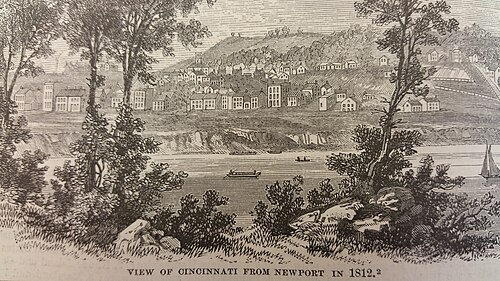
シンシナティは、1788年にマティアス・デンマン、ロバート・パターソン大佐、イスラエル・ラドローがオハイオ川の北岸、リッキング川の河口の反対側の地点に上陸し、そこに定住することを決めたときに始まりました。最初の測量士ジョン・フィルソンは、フランス語とラテン語の音節を組み合わせた「ロザンティビル」と名付けました。これは「リッキング川の河口の反対側の町」を意味するものでした。[23] [24] 1790年1月4日、セントクレアはシンシナティ協会に敬意を表して入植地の名前を変更しました。[25]
1811年、オハイオ川に蒸気船が導入されたことで、市の貿易はより迅速な輸送が可能になり、市はセントルイス、ミズーリ、下流のニューオーリンズとの商業関係を確立しました。シンシナティは1819年3月1日に市として法人化されました。[26]豚肉製品と干し草を輸出し、この地域の豚肉加工の中心地になりました。1810年から1830年にかけて、市の人口は9,642人から24,831人にほぼ3倍になりました。[27]
マイアミ・エリー運河の建設は1825年7月21日に始まり、当時はグレートマイアミ川に起源を持つことからマイアミ運河と呼ばれていました。運河の最初の区間は1827年に開業しました。[28] 1827年、運河はシンシナティと近隣のミドルタウンを結び、1840年までにはトレドまで到達しました。
鉄道はシンシナティに到来した次の主要な商業輸送手段であった。1836年、リトルマイアミ鉄道が認可された。[29] [要ページ]その後すぐに、シンシナティとマッド・リバー・アンド・レイク・エリー鉄道を結び、エリー湖のサンダスキー湾の港へのアクセスを提供するための建設が始まった。[28] [要ページ]
当時、雇用主は十分な人材を雇うのに苦労していました。1840年代後半にアイルランド人とドイツ人の移民の大きな波が起こるまで、街は労働力不足に陥っていました。その後20年間で街は急速に成長し、1850年には人口115,000人に達しました。[18]
この急速な拡大と隆盛の時期に、シンシナティの住民はこの都市を「クイーン・シティ」と呼ぶようになった。[30]
産業の発展と金ぴか時代

シンシナティは自由州オハイオと奴隷州ケンタッキーの境に位置していたため、奴隷が奴隷所有の南部から逃れるための重要な場所となっていた。この時期、多くの著名な奴隷制度廃止論者もシンシナティを故郷と呼び、地下鉄道の人気停車地となった。[31] 2004年、ダウンタウンのフリーダムウェイ沿いに国立地下鉄道フリーダムセンターが完成し、この都市の地下鉄道への関与を称えた。[32]
1859年、シンシナティは6本の路面電車の路線を敷設した。車両は馬に引かれ、路線のおかげで人々は市内を移動しやすくなった。[29] 1872年までに、シンシナティの住民は市内を路面電車で移動し、丘陵地帯への移動には鉄道車両に乗り換えることができるようになった。シンシナティ・インクライン・プレーン社はその年、オーバーン山の頂上まで人々を輸送し始めた。[28] 1889年、シンシナティの路面電車システムは馬車を電気路面電車に改造し始めた。[33]
婦人キリスト教禁酒同盟の第2回年次総会は1875年11月にシンシナティで開催された。[34]
1880年、市政府はテネシー州チャタヌーガまでのシンシナティ・サザン鉄道を完成させた。この鉄道は2024年3月にノーフォーク・サザン鉄道に売却されるまで、米国で唯一の市営州間鉄道であった。[35] [36]
1884年、多くの観察者が明らかに殺人事件だと思っていた事件で過失致死の判決が下されたことに対する怒りが、アメリカ史上最も破壊的な暴動の一つである裁判所暴動を引き起こした。3日間で56人が死亡し、300人以上が負傷した。[37]この暴動により共和党のリーダーであるトーマス・C・キャンベルの政権は終焉を迎えた。
20世紀
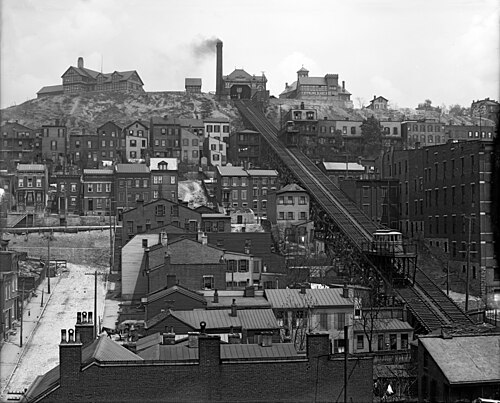
20世紀初頭、シンシナティの人口は325,902人だった。同市は20世紀に、1903年に完成したインガルス・ビルを皮切りに、多くの野心的なプロジェクトを完成させた。ダウンタウンの早期再開発は1920年代に始まり、次の10年間にはシンシナティ・ユニオン・ターミナル、米国裁判所兼郵便局、シンシナティ地下鉄、そして完成時には市内で最も高いビルであった49階建ての カルー・タワーの建設で続いた。シンシナティは、鉄道で商品を輸送するよりも安価だった河川貿易の復活により、同規模のアメリカの都市のほとんどよりも大恐慌をうまく乗り切った。 1937年のオハイオ川の洪水は、米国史上最悪の洪水の1つであり、オハイオ渓谷沿いの多くの地域を破壊した。[38]その後、市は防潮堤を建設した。第二次世界大戦後、シンシナティは都心の近代化につながる都市再開発のマスタープランを発表した。1950年代、シンシナティの人口は509,998人でピークに達した。1950年代以降、2億5000万ドルが地域の改善、清潔で安全な低・中所得者向け住宅の建設、雇用の創出、経済成長の促進に費やされた。[39]
21世紀から現在まで
2000年代初頭、シンシナティの人口は331,285人でした。2000年のポール・ブラウン・スタジアム(現在はペイコー・スタジアムとして知られています)の建設は、ハミルトン郡での売上税の引き上げに起因しており、グレート・アメリカン・ボール・パークの建設開始も同様に、2003年にオープンしました。
2001年、シンシナティ暴動が発生し、企業に推定360万ドル、市自体に150万~200万ドルの損害が発生しました。その後、特にオーバーザライン地区の高級化の過程で、大きな変化が起こりました。
2018年、MLSはFCシンシナティの加入を発表し、同市で3番目のプロスポーツチームとなった。その後、シンシナティの西端に位置するTQLスタジアムが建設され、2021年にオープンした。特筆すべきことに、2020年の国勢調査ではシンシナティの人口が増加したことが明らかになっており、1950年の国勢調査以来初めての増加となった。
2022年1月4日、アフタブ・ピュアヴァルがシンシナティの第70代市長に就任しました。
ニックネーム
シンシナティには多くのニックネームがあり、シンシー、クイーン・シティ[40] 、西部の女王[41]、ブルーチップ・シティ[42] 、 [43]、[44]、セブン・ヒルズのシティ[45]などがある。これらはブルーチップ・クッキーズのようなレストラン名を含め、職業上、学術上、広報上の都市への言及とより典型的に関連付けられており、地元の人々が日常会話ではあまり使用しないが、シンシーは不在時に都市を指すためによく使用される。[要出典]
「七つの丘の街」という呼称は、1853年6月発行のウェスト・アメリカン・レビュー誌の「第3条 シンシナティ:西部および南部との関係」に由来しており、7つの丘が具体的に描写され、名前が付けられている。その丘は、市の周囲を三日月形に形作っており、マウント・アダムス、ウォルナット・ヒルズ、マウント・オーバーン、ヴァイン・ストリート・ヒル、カレッジ・ヒル、フェアモント(現在はフェアマウント)、マウント・ハリソン(現在はプライス・ヒルとして知られている)である。この名前は、7つの丘の上に築かれたとされる古代ローマに由来している。[要出典]
「クイーンシティ」は1819年の新聞記事[46]から引用され、1854年の詩「カトーバワイン」によってさらに不滅のものとなった。その中でヘンリー・ワズワース・ロングフェローはこの都市について次のように書いている。
そしてこのブドウの木の歌、
私のこの挨拶を、
風と鳥が、 花輪を飾った
西の女王に、 美しい川のほとりで届けるでしょう。[47]
長年、シンシナティは「ポークポリス」としても知られていました。このニックネームは、市内の大規模な豚肉産業に由来しています。[48]
「The 'Nati」のような新しいニックネームも登場し、さまざまな文化的文脈で使用されようとしています。たとえば、地元のKeep America Beautifulの関連団体であるKeep Cincinnati Beautifulは、 1998年にゴミ防止キャンペーンの一環として「Don't Trash the 'Nati」というキャッチフレーズを導入しました。[49] [50] [51]
地理
市は新たな開発と民間投資により大きな変化を遂げている。これには、グレートアメリカンボールパークからペイコルスタジアムまで広がるアパート、小売店、レストラン、オフィスを含む、長らく停滞しているバンクスプロジェクトの建物が含まれる。フェーズ1Aはすでに完了しており、2013年初頭の時点で100%が入居している。スメールリバーフロントパークはバンクスとともに開発されており、シンシナティで最も新しい公園である。シンシナティ(北ケンタッキー州を含む)の都心部に約35億ドルが投資されている。この開発の多くは3CDCによって行われている。シンシナティベルコネクターは2016年9月に開始された。 [52] [53]
シンシナティは、川を挟んでペンシルベニア州ピッツバーグ市とイリノイ州カイロ市の中間に位置している。ダウンタウンはリッキング川の河口近くにあり、合流地点に最初の入植地が形成された。[54] シンシナティ都市圏はオハイオ州南部、インディアナ州南東部、ケンタッキー州北部にまたがっており、国勢調査局の測定によると市域は79.54平方マイル(206.01 km 2)で、そのうち77.94平方マイル(201.86 km 2)が陸地、1.60平方マイル(4.14 km 2)が水域である。[55]市は、ブルーグラス地域のオハイオ川を見下ろす数多くの丘陵、断崖、低い尾根に広がっている。[56]この3州は地理的には中西部のアップランド・サウスの最北端に位置している。
市域にはノーウッド、エルムウッド プレイス、セントバーナードの3 つの自治体が広がっています。ノーウッドは商業と工業の街で、エルムウッド プレイスとセントバーナードは主に住宅地である小さな村です。シンシナティには飛び地はありませんが、市政府は市域外にいくつかの土地を所有しています。アンバーリービレッジのフレンチ パークとブルー アッシュの旧ブルー アッシュ空港の使われていない滑走路です。
都市景観
.jpg/500px-Downtown_Cincinnati,_Ohio,_USA_Panorama_Taken_from_Covington_(cropped).jpg)

シンシナティには、その地域全体に多くのランドマークがあります。これらのランドマークのいくつかは全国的に知られていますが、他のランドマークは地元の人々によく知られています。これらのランドマークには、ユニオンターミナル、カルータワー、グレートアメリカンタワー、ファウンテンスクエア、ワシントンパーク、グレートアメリカンボールパークなどがあります。
シンシナティには、前述のカリュータワー、スクリップスセンター、インガルスビル、シンシナティユニオンターミナル、アイザックM.ワイズ寺院など、その建築的特徴や歴史的関連性で注目に値する建造物が数多くあります。[57] クイーンシティスクエアは2011年1月にオープンしました。この建物はシンシナティで最も高く、オハイオ州で3番目に高い建物で、高さは665フィート(203メートル)に達します。[58]
1922年4月1日以来、シンシナティのオハイオ川の洪水位は、ジョン・A・ローブリング吊り橋から測って52フィート(16メートル)と公式に設定されています。この深さで、ミルクリークの河口にあるポンプ場が稼働します。 [59] [60] 1873年から1898年まで、洪水位は45フィート(14メートル)でした。1899年から1922年3月31日までは、50フィート(15メートル)でした。[60]オハイオ川は1881年に最低水位である2フィート(0.61メートル)未満に達しました。逆に、史上最高水位は79フィート11です。+シンシナティでは、洪水の規模によって洪水の危険度が異なります。洪水の規模は、洪水の規模によっても異なります。洪水の規模は、洪水の規模によって異なります。洪水の規模は、洪水の規模によって異なります。洪水の規模は、洪水の規模によって異なります。洪水の規模は、洪水の規模によって異なります。洪水の規模は、洪水の規模によって異なります。洪水の規模は、洪水の規模によって異なります。洪水の規模は、 洪水の規模によって異なります。洪水の規模は、洪水の規模によって異なります。洪水の規模は、洪水の規模 によって異なります。洪水の規模は、洪水の規模によって異なります。
近隣地域

シンシナティは52の地区から成ります。これらの地区の多くはかつては村でしたが、市に併合され、ウォルナットヒルズやマウントオーバーンなど、多くは以前の名前を保持しています。[64] ウエストウッドは市内で最も人口の多い地区で、CUF (シンシナティ大学がある)やプライスヒルなどの他の重要な地区があります。[65]
シンシナティのダウンタウンは市の中心ビジネス地区で、オハイオ川とアップタウンの間の平地に多くの地区がある。これらの地区には、オーバーザライン、ペンドルトン、クイーンズゲート、ウェストエンドなどがある。オーバーザラインは、米国で最大かつ最も保存状態の良い都市歴史地区の1つである。 [66]オーバーザラインの華麗なレンガ造りの建物のほとんどは、1865年から1880年代にかけてドイツ人移民によって建てられたものである。[67]この地区は21世紀に大規模な再開発が行われ、中小企業の育成に重点が置かれている。[68]
気候
| オハイオ州シンシナティ | ||||||||||||||||||||||||||||||||||||||||||||||||||||||||||||
|---|---|---|---|---|---|---|---|---|---|---|---|---|---|---|---|---|---|---|---|---|---|---|---|---|---|---|---|---|---|---|---|---|---|---|---|---|---|---|---|---|---|---|---|---|---|---|---|---|---|---|---|---|---|---|---|---|---|---|---|---|
| 気候図(説明) | ||||||||||||||||||||||||||||||||||||||||||||||||||||||||||||
| ||||||||||||||||||||||||||||||||||||||||||||||||||||||||||||
| ||||||||||||||||||||||||||||||||||||||||||||||||||||||||||||
冬と夏の紅葉のピアット公園
シンシナティは、湿潤大陸性気候帯 (ケッペンの区分: Dfa )の南限 (0 °C または 32 °F の等温線を考慮) にあり、湿潤亜熱帯気候帯 ( Cfa ) に接しています。
夏は暑くて湿度が高く、毎月かなりの雨が降り、年間21日間は最高気温が90°F(32°C)以上になり、露点と湿度が高くなることが多い。7月は最も暖かい月で、1日の平均気温は75.9°F(24.4°C)である。[69]
冬は寒く、雪が適度に降る傾向があり、最も寒い1月の平均気温は30.8 °F (−0.7 °C) です。[69]最低気温が0 °F (−18 °C) に達するのは、年間平均2.6夜です。[69]平均的な冬には約22.1インチ (56 cm) の降雪があり、年間降水量は42.5インチ (1,080 mm) で、降雨量は春にピークを迎えます。[70]極端な場合は、1977年1月18日の−25 °F (−32 °C) から、1934年7月21日と22日の108 °F (42 °C) まであります。[71]
シンシナティの降雪は五大湖に近い他の多くの都市ほど激しくはありませんが、1978年の大吹雪や、1994年、 1999年、2007年、2021年のさらに顕著な暴風雪など、激しい降雪が記録されたことがあります。
暖かい時期には激しい雷雨がよく発生し、竜巻もまれではあるものの、全くないわけではなく、最近では1974年、1999年、2012年、2017年にメトロシンシナティ地域で竜巻が発生しています。[72]
生のグラフ データを表示または編集します。
人口統計
.png/500px-Race_and_ethnicity_2010-_Cincinnati_(5560448832).png)
1950年、シンシナティの人口は503,998人に達し、ピークを迎えました。その後、1960年から2010年までのすべての国勢調査で人口が減少しました。20世紀後半には、産業再編により雇用が失われました。最近では、人口は回復し始めています。2020年の国勢調査では、人口は309,317人で、2010年の296,945人から4.2%増加しています。[83]これは、1950年の国勢調査以来初めての人口増加であり、60年間の人口減少傾向を逆転させました。
2020年の国勢調査では、[84] 309,317人、138,696世帯、62,319家族が市内に居住していた。人口密度は1平方マイルあたり3,809.9人(1,471.0/km 2 )であった。平均密度は1平方マイルあたり2,066.9(798.0/km 2 )で、161,095の住宅があった。市の人種構成は、白人50.3% 、アフリカ系アメリカ人41.4% 、ネイティブアメリカン0.1% 、アジア人2.2% 、太平洋諸島系0.1%、その他の人種1.2% 、2つ以上の人種が混在4.6%であった。ヒスパニックまたはラテン系の人種は、人口の4.2%であった。
世帯数は138,696世帯で、18歳未満の子供が同居している世帯は25.4%、夫婦同居は23.2%、女性世帯主で夫がいない世帯は19.1%、男性世帯主で妻がいない世帯は4.4%、非家族世帯は53.3%であった。全世帯の43.4%は単身世帯であり、9.9%は65歳以上の単身世帯であった。平均世帯人数は2.09人、平均家族人数は3.00人であった。
市の平均年齢は32.5歳。住民の21.6%は18歳未満、14.6%は18歳から24歳、28.4%は25歳から44歳、24.1%は45歳から64歳、10.8%は65歳以上であった。市の性別構成は男性が48.4%、女性が51.6%であった。[85]
2022年の国勢調査の推計によると、シンシナティ都市圏の人口は2,265,051人で、国内で30番目に大きな都市統計地域となっている。この都市圏には、オハイオ州のハミルトン、バトラー、ウォーレン、クレルモン、クリントン、ブラウンの各郡、ケンタッキー州のブーン、ブラッケン、キャンベル、ガラティン、グラント、ケントン、ペンドルトンの各郡、インディアナ州のディアボーン、フランクリン、ユニオン、オハイオの各郡が含まれる。
経済
シンシナティ大都市圏は、米国で28番目に大きい経済規模を誇り、シカゴ、ミネアポリス・セントポール、デトロイト、セントルイスに次いで中西部で5番目に大きい経済規模を誇ります。2016年には、中西部で最も急速に成長した経済首都となりました。[13] 2015年のこの地域の国内総生産は1270億ドル(2023年には約1600億ドル)でした。[86]住宅価格の中央値は158,200ドルで、シンシナティの生活費は全国平均より8%低いです。2022年9月現在、失業率は3.3%で、全国平均を下回っています。[87] [88]
クローガー、プロクター・アンド・ギャンブル、ウェスタン・アンド・サザン・ファイナンシャル・グループ、フィフス・サード・バンク、アメリカン・ファイナンシャル・グループ、シンタスなど、フォーチュン500企業の本社がシンシナティにある。ゼネラル・エレクトリックはグローバル・オペレーション・センターの本社をシンシナティに置いており、GEエアロスペースはエベンデールに拠点を置いている。[89]クローガー社は地元で2万人以上を雇用しており、市内最大の雇用主となっている。他の4つの大雇用主は、シンシナティ小児病院、トライヘルス、シンシナティ大学、セント・エリザベス・ヘルスケアである。[90]シンシナティにはクリーブランド連邦準備銀行の支店がある。[91]
芸術と文化
社会

シンシナティは、スコットランド系アイルランド人、開拓者、キールボート乗りなどのアメリカ人開拓者によって区画分けされ、増加した。1世紀半以上もの間、シンシナティはオハイオ州で最も重要な都市として誰にも負けず、1879年のニューアメリカン百科事典では「オハイオ州の主要都市」というあだ名がつけられた。この本に加えて、数え切れないほどの他の本が、都市と開拓者の社会史を記録している。[92] [93] [94] [95]著名なアングロアメリカ人一家の市の創始者は、米国聖公会信者であった。初期の巡回馬上説教師に触発された初期のメソジスト派も重要であった。北西部領土で最初に確立されたメソジスト階級は、1797年に近くのミルフォードにやって来た。1879年までに、市内には162の教会建築物が記録されていた。このため、最初からプロテスタントはシンシナティの精神を形成する上で重要な役割を果たしてきた。クライストチャーチ大聖堂は、歴史協会によって市民史の要石として注目されているシンシナティの初期の英国国教会指導者の遺産を引き継いでいる。メソジスト機関の中には、クライスト病院やドイツメソジスト教会のプロジェクトなどがある。[96]シンシナティのメソジストの最大の支持者の一人は、ウィリアム・プロクターとともにプロクター・アンド・ギャンブルを設立したアイルランド移民のジェームズ・ギャンブルである。敬虔なメソジストであったことに加え、ギャンブルと彼の遺産は、シンシナティ大都市圏全体にメソジスト教会を建設するために資金を寄付した。[97]

シンシナティは川沿いの交差点であり、オハイオ川以南の奴隷州との貿易に依存していた。当時、何千人もの黒人が自由州オハイオに移住していた。その多くは南北戦争後に移住し、ケンタッキー州やバージニア州出身で、その多くは自由と仕事を求めて北部に逃れてきた逃亡者だった。南北戦争前の時代には、市内の白人の大半は北部州、主にペンシルベニア州出身だった。[98]白人の57%は自由州から移住したが、26%は南部州出身で、奴隷制度に対する文化的支持を維持していた。このため、奴隷制度支持派の住民と、1804年の「黒人法典」で成文化された自由黒人に対する制限の撤廃を求める奴隷制度廃止論者との間ですぐに緊張が生じた。 [99]南北戦争前の時代、シンシナティは「自由の土地にある南部の都市」と呼ばれていた。[100] : 44 不安定な社会情勢により、1829年に暴動が起こり、多くの黒人が家や財産を失った。1840年代後半にアイルランド人が市内に進出すると、彼らは経済の下層階級で黒人と競争した。白人主導による黒人に対する暴動は、奴隷制度廃止運動の印刷所が2度破壊された1836年と1842年に発生した。 [99] 1829年の暴動の後、1,000人以上の黒人が市を去った。フィラデルフィアや他の大都市の黒人は、破壊から立ち直る難民を助けるために資金を集めた。1842年までに、黒人は市内でより定着し、暴動で自分自身と財産を守り、政治的にも活動した。[101]

ドイツ人はペンシルベニア、バージニア、テネシーから移住してきた最初期の新参者の中にいた。デイビッド・ツィーグラーはアーサー・セントクレアの後を継いでフォート・ワシントンの指揮官となった。北西インディアン戦争が終結し、アメリカ先住民が西へ追放された後、ツィーグラーは1802年にシンシナティの初代町長に選出された。[102] [103]シンシナティは、混雑と争いからの移住を模索していたアイルランド人、プロイセン人、サクソン人(北ドイツ人)の影響を受けていた。1830年には、ドイツ系住民は人口の5%を占めていたが、その多くはペンシルベニアから移住してきた人々であった。10年後にはこの割合は30%に増加した。[104] 1848~49年のドイツ革命後、何千人ものドイツ人がシンシナティに流入し、1900年までには人口の60%以上がプロイセン系となった。[105]卑しい仕事を強いられ、怒り狂ったアイルランド人はしばしば暴徒を組織し、ペンシルベニア・ダッチとのつながりから遠く離れたドイツ人も同じようなことをした。市内の移民コミュニティの伝統や祝祭は維持されており、近くのウェインズビルでは毎年オハイオ・ザワークラウト・フェスティバルが開催され、[106]シンシナティでは旧世界とのつながりを記念する大きなイベントがいくつか毎年開催されている。オクトーバーフェスト・ジンジンナティ、[107] ボックフェスト、[108]やテイスト・オブ・シンシナティでは地元のレストラン経営者が参加する。
シンシナティのユダヤ人コミュニティは、イギリスとドイツから来た人々によって発展しました。アイザック・M・ワイズが率いるコミュニティの大部分は、啓蒙主義の影響と米国での新しい生活に応えて改革派ユダヤ教を発展させました。改革運動の創始者として知られるワイズ師とその同時代人は、シンシナティ、米国、そして世界中のユダヤ教に大きな影響を与えました。[109]
NRHPに登録されているポッター・スチュワート合衆国裁判所は、連邦裁判所であり、合衆国第 6 巡回控訴裁判所であり、13 の合衆国控訴裁判所の 1 つです。クリーブランド連邦準備銀行シンシナティ支店は、イースト フォース ストリート歴史地区の向かい側にあります。

博物館
シンシナティ美術館は、エデンパーク地区にある美術館です。1881年に設立され、アレゲニー山脈の西側で最初に建てられた美術館です。6,000年にわたる人類の歴史を網羅する67,000点以上の作品を収蔵しており、中西部で最も包括的なコレクションの1つとなっています。[110]現代美術センターは、米国で最初の現代美術機関の1つとして1939年に設立されました。シンシナティアートアカデミーには、タフト美術館のコレクションに加えて、3つの公共ギャラリーもあります。[111]

市内のシンシナティ博物館センター複合施設は、クイーンズゲート地区のシンシナティ・ユニオン・ターミナルから運営されている。複合施設内には、シンシナティ歴史博物館、自然史科学博物館、ロバート・D・リンドナー・ファミリー・オムニマックス・シアター、シンシナティ歴史図書館・アーカイブ、デューク・エナジー子供博物館がある。[112]国立地下鉄道自由センターは、地下鉄道の歴史に基づいて2004年に川沿いにオープンし、何千人もの奴隷が南部の奴隷州からオハイオ川を渡って自由を求めて逃亡した歴史において、この都市が果たした役割を認識している。 [111]米国大統領で最高裁判所長官のウィリアム・ハワード・タフトの幼少期の家は現在、マウントオーバーンのウィリアム・ハワード・タフト国定史跡となっており、タフトの生涯と業績に関する展示を行っている。[113]
アメリカンサインミュージアムには、 19世紀後半から1970年代にかけての200点以上の標識やその他の物品が展示されています。[114]
音楽

音楽関連のイベントには、シンシナティ メイ フェスティバル、バンバリー ミュージック フェスティバル、シンシナティ ベル/WEBN リバーフェストなどがあります。シンシナティは、「シンシナティ、歌う街!」というスローガンを掲げ、2012 年に 世界合唱ゲームズを開催しました。
シンシナティは、ロニー・マック、ドリス・デイ、オッド・ノスダム、ダイナ・ショア、ファッツ・ウォーラー、ローズマリー・クルーニー、ブーツィー・コリンズ、アイズレー・ブラザーズ、マール・トラヴィス、ハンク・バラード、オーティス・ウィリアムズ、ムード、ミッドナイト・スター、キャロウェイ、アフガン・ホイッグス、オーバー・ザ・ライン、ブレシッド・ユニオン・オブ・ソウルズ、フレディ・メイヤー、98ディグリーズ、ザ・グリーンホーンズ、ザ・ディール、エンドユーザー、ハートレス・バスターズ、ザ・ドーパミンズ、エイドリアン・ブリュー、ザ・ナショナル、フォクシー・シャザム、ホワイ?、ウッシー、H-ボム・ファーガソン、スーダン・アーカイブス、ウォーク・ザ・ムーンなど、人気ミュージシャンや歌手を輩出、または出身地としてきました。また、オルタナティブ・ヒップホップ・プロデューサーのハイテックも、メトロシンシナティ地域を本拠地としています。ロックバンド「ブラック・ベール・ブライズ」のリードボーカル、アンディ・ビアサックはシンシナティ生まれ。
シンシナティメイ フェスティバルコーラスは、1880 年から存在するアマチュア合唱団です。シンシナティには、シンシナティ交響楽団、シンシナティ オペラ、シンシナティ少年合唱団、シンシナティ バレエ団があります。また、シンシナティ都市圏には、スターリング室内管弦楽団やシンシナティ交響楽団ユース オーケストラなど、いくつかの地域オーケストラやユース オーケストラもあります。音楽監督のジェームズ コンロンと合唱団監督のロバート ポルコが、クラシック音楽の幅広いレパートリーで合唱団を率いています。メイ フェスティバル コーラスは、西半球で最も古くから継続されている合唱祭の主力です。シンシナティ ミュージック ホールは、メイ フェスティバルの会場として建設されました。
シンシナティは、ビル・アンダーソンが書いたコニー・スミスの曲「シンシナティ、オハイオ」の主題である。シンシナティは、イタリアのアーティスト兼ソングライター、ヴェロニカ・ヴィターレの国際的な音楽作品「インサイド・ジ・アウトサイダー」の主な舞台である。彼女はボルチモア・アンド・オハイオ鉄道のダウンタウン・シンシナティに列車の音を埋め込み、アメリカン・サイン・ミュージアムでシングル「ミ・ソノ・インナモラート・ディ・テ」を撮影し、ライアン・シークレストのスタジオで放送中にシンシナティ小児病院で自分の心音を録音し、彼女の曲「ザ・パルス・オブ・ライト」のドラム音に置き換えた。さらに、彼女はシンシナティの伝説的なベーシスト、ブーツィー・コリンズをフィーチャーしたシングル「ノーバディ・イズ・パーフェクト」をリリースした。[115]
シンシナティは初期の音楽の録音の中心地で、キング・レコードの本拠地であった。キング・レコードはジェームス・ブラウンのキャリアをスタートさせるのに役立ち、ブラウンはここで頻繁に録音していた。また、ジュエル・レコードはロニー・マックのキャリアをスタートさせるのに役立ち、フラタニティ・レコードもあった。シンシナティには 1920 年代から今日まで活気のあるジャズ界があった。ルイ・アームストロングの最初の録音はシンシナティ地域のジェネット・レコードで行われたが、ジェリー・ロール・モートン、ホーギー・カーマイケル、そして一時期シンシナティに住んでいたビックス・バイダーベックもここで録音された。ファッツ・ウォーラーは1930 年代に WLWのスタッフだった。
劇場
.jpg/500px-Trevor_Noah_2019-02-01_-_Aronoff_Center_crowd_(46151350875).jpg)
シンシナティでは、少なくとも 1800 年代初頭からプロの劇場が運営されています。[要出典]市内に拠点を置くプロの劇団には、アンサンブル シアター シンシナティ、シンシナティ シェイクスピア カンパニー、ノウシアター オブ シンシナティ、ステージ ファースト シンシナティ、シンシナティ パブリック シアター、シンシナティ オペラ、ザ パフォーマンス ギャラリー、クリア ステージ シンシナティなどがあります。また、市内には、地方初演が行われるシンシナティ プレイハウス イン ザ パークや、ブロードウェイ アクロス アメリカ経由で毎年ブロードウェイの巡回公演が行われるアロノフ センターもあります。市内には、シンシナティ ヤング ピープルズ シアター、ショーボート マジェスティック(米国で最後に現存するショーボートであり、おそらく世界で最後に現存するショーボート)、マリーモントプレイヤーズなどのコミュニティ シアターもあります。
2011 年以来、シンシナティ オペラとシンシナティ大学音楽院は、オペラ フュージョン: ニューワークスプロジェクトを後援するために提携しています。オペラ フュージョン: ニューワークスプロジェクトは、作曲家や台本作家が 10 日間の滞在でオペラのワークショップを行うプログラムです。このプログラムは、シンシナティ オペラの芸術運営ディレクターのマーカス キュッヒレとCCMのオペラ部門責任者のロビン グアリノが主導しています。
2015年、シンシナティはデューク・エナジー・コンベンション・センターでUSITT 2015カンファレンスおよびステージ・エキスポを開催し、5,000人以上の学生、大学教育者、舞台デザイナーやパフォーマー、その他の関係者を市内に集めました。[116] USITTカンファレンスは、米国における演劇、オペラ、ダンスの主要なカンファレンスと考えられています。[要出典]
映画と文学
『ア・レイジ・イン・ハーレム』は、 1950年代のハーレムとの類似性から、シンシナティのオーバー・ザ・ライン地区で全編撮影された。シンシナティで一部撮影された映画には、『われらの生涯』(映画の冒頭に空撮映像あり)、『アイデス・オブ・マーチ』、『フレッシュ・ホーセズ』、『アスファルト・ジャングル』 (冒頭はパブリック・ランディングから撮影され、舞台はシンシナティだが、ケンタッキー州ブーン郡しか言及されていない)、『レインマン』、『マイルズ・アヘッド』、『エアボーン』、『グリム・リアリティ』、『リトルマン・テイト』 、『シティ・オブ・ホープ』 、『無邪気な男』 、『タンゴ&キャッシュ』、『ママはクリスマスに』、『ロスト・イン・ヨンカーズ』 、 『サマー・キャッチ』、『アートワークス』、 『ドリーマー』 、 『エリザベスタウン』 、『ジミーとジュディ』、『エイトメン・アウト』 、『ミルク・マネー』 、『トラフィック』、『プライド・オブ・ジェシー・ハラム』、『グレート・バック・ハワード』、『イン・トゥー・ディープ』、『セブン・、 『キャロル』、『パブリック・アイ』、『ラスト・レイト・ナイト』、 [117] 、 『マイティ』など。 [要出典]さらに、『ワイルド・ホッグス』はシンシナティを舞台としているが、撮影は行われていない。 [118]
シンシナティのスカイラインは、 1956年のCBS /ABCの昼ドラ『エッジ・オブ・ナイト』のオープニングとエンディングのシーンで大きく取り上げられ、1980年にロサンゼルスのスカイラインに置き換えられるまで、頻繁に登場した。この都市の景観は、番組の舞台であるモンティセロの代わりとなった。この番組のプロデューサーであるプロクター・アンド・ギャンブルはシンシナティを拠点としている。シットコム『WKRP in Cincinnati』とその続編/スピンオフ『The New WKRP in Cincinnati』では、クレジットにこの都市のスカイラインやその他の外観のショットが使われたが、撮影はシンシナティで行われたものではない。この都市のスカイラインは、ドリュー・キャリーの故郷であるクリーブランドを舞台にした『The Drew Carey Show』のエイプリルフールのエピソードにも登場した。3 Doors Downのミュージックビデオ「It's Not My Time」はシンシナティで撮影され、このスカイラインとファウンテンスクエアがフィーチャーされている。また、デイヴィッド・E・ケリーが制作し、キャシー・ベイツが主演したNBCの法廷ドラマ『ハリーズ・ロー』もシンシナティを舞台としていた。[119]
キム・ハリソンの『ホロウズ』シリーズは、シンシナティを舞台にした都市ファンタジーです。アメリカン・ガールの『キット・キットリッジ』サブシリーズもこの都市を舞台としていますが、それを基にした映画はトロントで撮影されました。
シンシナティには砂漠の息子たち(ローレル・アンド・ハーディ愛好会)の独自の支部(または「テント」)もあり、年に数回会合を開いています。[120]
料理

アメリカ料理とともに、シンシナティは世界中の料理から取り入れられた数多くの味覚の宝庫です。フリッシュ・ビッグボーイ、グレーターズ・アイスクリーム、クローガー、ラローザズ・ピッツェリア、モンゴメリー・イン、スカイライン・チリ、ゴールド・スター・チリ、アグラメシス・ブラザーズ、ユナイテッド・デイリー・ファーマーズは、食料品店やガソリンスタンドで自社ブランド商品を販売しているシンシナティの飲食店です。グリアーズ・ゲッタはシンシナティ地域で生産されており、地元の人気料理です。シンシナティのメゾネットは、モービル・トラベル・ガイドの米国で最も長く続いている五つ星レストランであり、2005年に閉店するまで41年間連続でその栄誉を保持していました。元ヘッドシェフのジャン・ロバート・ドゥ・カヴェルは、2001年以来、この地域に4軒の新しいレストランをオープンしています。
アメリカで最も古く[122]、最も称賛されている[123]バーの一つであるシンシナティのダウンタウンにあるアーノルド・バー&グリルは、エスクァイア誌の「アメリカのベストバー」[124] 、 スリリストの「オハイオ州で最も象徴的なバー」[125]、 デイリーミールの「アメリカのベストバー150」[126]、Seriouseats.comの「シンシナティ10」[127]で賞を獲得している。 「アーノルドがニューヨーク、サンフランシスコ、シカゴ、ボストン、つまり人々が実際に訪れる場所にあったら、世界的に有名になっていただろう」とデイビッド・ウォンドリッチは書いている。[128]
フィレオフィッシュは、 1962年にシンシナティ地域で最初のマクドナルドフランチャイズのオーナーであるルー・グローエンによって、金曜日に肉を食べないカトリックの常連客のために作られました。[129]
伝統的な地元の名物料理には、オペラクリーム[130]やネクターソーダ[131]があり、どちらもグレーターズとアグラメシスブラザーズのアイスクリームパーラーで提供されています。グリッポとプリングルズのポテトチップスもこの地域発祥で、後者は地元企業のプロクター・アンド・ギャンブルが製造しています。その他の地元産の食品には、フランクのレッドホットソース[132]やスラッシュパピーなどがあります。
シンシナティチリ

シンシナティ・チリは、麺の上にスパイシーなソースをかけ、通常はチーズをトッピングし、さいの目切りにした玉ねぎや豆を添えた料理で、この地域の「最も有名な郷土料理」である。[133] [134]スカイライン・チリ、ゴールド・スター・チリ、ディキシー・チリ・アンド・デリなどの各店のほか、キャンプ・ワシントン・チリ、エンプレス・チリ[135]、ムーンライト・チリなどの独立系チリパーラーで、さまざまなレシピが提供されている。 [136] 1920年代にマケドニア移民のレストラン経営者によって最初に開発された。シンシナティは、人口1人当たりのチリレストランの数が米国および世界のどの都市よりも多いため、「アメリカのチリの首都」および「世界のチリの首都」と呼ばれている。[137]
ゴエッタ
ゲッタはドイツ風の肉と穀物のソーセージまたはマッシュ[138]です。主にひき肉(豚肉、または豚肉と牛肉)、オート麦、スパイスからできています。[139]
ニセウミガメスープ
ゲッタの起源と同様に、擬似タートルスープは19世紀後半のドイツ人移民の流入によって普及した料理である。もともとは内臓で作られていたが、今日のシンシナティ風擬似タートルスープは牛ひき肉、固ゆで卵、ケチャップが特徴である。このスープを商業的に缶詰にしている唯一の会社であるワースモアは、1918年以来シンシナティでこのスープを生産している。[140] [141]
方言
シンシナティに関連する単語のリストについては、無料辞書『ウィクショナリー』の「シンシナティ英語」のカテゴリを参照してください。
シンシナティの住民は一般アメリカ方言を話す。中西部の他の地域とは異なり、オハイオ州南西部はニュージャージー州北部の英語と母音体系の一部を共有している。[142] [143]話者間の独特の地域的特徴のほとんどは、ミッドランド・アメリカンとして浮かび上がっている。[144]ケンタッキー州で見られる南部アメリカ方言の影響もいくらか見られる。 [145]地元の方言には北ドイツ語の雰囲気が少し感じられる。住民の中には、話者に発言を繰り返すよう頼むときにpleaseという単語を使う人もいる。この用法は、ドイツ語の慣習から取り入れたもので、 bitte (正式な「Wie bitte?」または「How please?」をドイツ語から英語に逐語的に翻訳したもの) は、誰かに繰り返すよう頼むときの省略形として使われていた。[146] [147]
スポーツ
シンシナティには、3つのメジャーリーグチーム、3つのマイナーリーグチーム、スポーツチームを持つ5つの大学機関、7つの主要なスポーツ会場があります。シンシナティの3つのメジャーリーグチームは、アメリカ初のプロ野球チームであるシンシナティ・レッドストッキングスにちなんで名付けられたメジャーリーグベースボールのレッズ、[148] [149] [150]、ナショナルフットボールリーグのベンガルズ、そして2019年にメジャーリーグサッカーのフランチャイズとなったFCシンシナティです。WalletHubはシンシナティを第12位のベストスポーツシティにランク付けしました。
メジャーリーグ開幕日に、シンシナティは野球の歴史により、毎年野球の「伝統的な開幕戦」を開催するという名誉を持っています。子供たちは開幕日に学校を休むことで知られており、一般的に休日と考えられています。[151]シンシナティレッズは、1919年、1940年、1975年、1976年、1990年の5回ワールドシリーズで優勝しています。レッズは1970年代半ばにビッグレッドマシーンとして知られる史上最も成功した野球クラブの1つを持っていました。
ベンガルズはフランチャイズ創設以来1982年、1989年、2022年の3回スーパーボウルに出場しているが、まだ優勝していない。ベンガルズは、AFC北地区に所属するクリーブランド・ブラウンズやピッツバーグ・スティーラーズと激しいライバル関係にある。ベンガルズとカロライナ・パンサーズが4年ごとに行われるカンファレンス間対戦で対戦するときはいつでも、その試合は「クイーン・シティ・ボウル」と呼ばれている。これは、パンサーズの本拠地であるノースカロライナ州シャーロットがクイーン・シティとしても知られているためである。[152]
FCシンシナティはメジャーリーグサッカーに所属するサッカーチームである。FCシンシナティは2016年4月9日、14,000人を超える観客の前でUSLのホームデビューを果たした。 [153]次のホームゲーム、ルイビル・シティFC戦では、FCシンシナティは20,497人の観客を集め、USLの観客動員数史上最高記録を更新した。2016年5月14日、ピッツバーグ・リバーハウンズ戦では1-0で勝利し、23,375人の観客を集め、自身の記録を更新した。[154] USLの観客動員数記録をさらに数回更新した後、クラブは2019年シーズンにメジャーリーグサッカー(MLS)に移籍した。[155] FCシンシナティは2018年5月29日にMLSへの入札を勝ち取り、2021年にダウンタウンの北西にあるウエストエンド地区のTQLスタジアムに移転しました。[156]
シンシナティには、シンシナティ・ベアキャッツとザビエル・マスケティアーズという2つの男子大学バスケットボールチームもあります。この2つのチームは、クロスタウン・シュートアウトとして知られる大学バスケットボールのライバル関係の一つとして対戦しています。 2011年、このライバル関係の試合は試合終了時にコート上での乱闘に発展し、複数の出場停止処分が続きました。マスケティアーズは過去11回のNCAAトーナメントのうち10回に出場し、ベアキャッツはディビジョンIの全国選手権で2回優勝しています。[157]以前は、シンシナティ・ロイヤルズが1957年から1972年まで全米バスケットボール協会で競っていましたが、現在はサクラメント・キングスとして知られています。
フライングピッグマラソンは毎年多くのランナーが集まるイベントで、ボストンマラソンの予選会としても機能します。
シンシナティ・オープンは、 ATPツアー・マスターズ1000シリーズとWTA1000シリーズの一部である歴史ある国際男子・女子テニストーナメントで、1899年にこの都市で創設され、 1979年以来、郊外メイソンのリンドナー・ファミリー・テニスセンターで開催されている。
シンシナティサイクロンズは、 ECHLでプレーするマイナーリーグ AA レベルのプロ ホッケー チームです。1990 年に設立され、ヘリテージ バンク センターでプレーしています。2010 年のケリー カップファイナルで優勝し、3 シーズンで 2 度目の優勝を果たしました。
シンシナティ・シズルは、女子フットボール・アライアンスに所属する女子のマイナープロタックルフットボールチームです。このチームは、元シンシナティ・ベンガルズのランニングバック、イッキー・ウッズによって 2003 年に設立されました。2016 年に、チームは米国女子フットボールリーグで初の全国選手権タイトルを獲得しました。
クローガー・クイーン・シティ選手権は、 2022年にケンウッド・カントリークラブでLPGAツアーに初登場した。女子プロゴルフがシンシナティに戻ってくるのは1963年以来初めてのことだ。
以下の表は、1 試合あたり平均 5,000 人以上のファンが集まるシンシナティ地域のスポーツ チームを示しています。
公園とレクリエーション

シンシナティ公園委員会はシンシナティのすべての市立公園の維持管理を行っている。1911年に168エーカー(0.68 km 2 )の土地を購入して設立され、現在では5,000エーカー(20 km 2 )以上の市立公園を管理している。歴史ある公共公園や景観として有名なのは、19世紀のスプリンググローブ墓地と樹木園、エデンパーク、マウントストームパークで、いずれもプロイセン移民の造園家アドルフ・ストラウチが設計した。[164]市内には歴史あるエイボンフィールズゴルフコースなど、公共のゴルフコースもいくつかある。
シンシナティのダウンタウンは、公共広場でありイベント会場でもあるファウンテンスクエアの周りにそびえ立っています。ファウンテンスクエアは2006年に改装されました。 [165]シンシナティは、カリフォルニアからセイラーパークまで広がるオハイオ川の北岸22マイル(35 km)の川岸沿いに位置しており、オハイオ川を都市生活の中で重要な位置付けています。[166]
シンシナティ動物園と植物園はアボンデールにあり、アメリカで2番目に古い動物園です。[167] 1987年に国定歴史建造物に指定されました。動物園には500種以上の動物、1,800種の動物、3,000種の植物が飼育されています。さらに、動物園は歴史上いくつかの繁殖プログラムも実施しています。この動物園は国内でも最高の動物園として頻繁に挙げられています。[168] [169]
政府と政治

市当局は9 人の議員からなる市議会で運営されており、議員は市全域から選出される。1924 年以前は、市議会議員は区制で選出されていた。区制は党派支配による汚職に悩まされていた。1880 年代から 1920 年代にかけて、共和党が市政を支配し、ジョージ B.「ボス」コックスの政治組織が権力を握っていた。
1923年に改革運動が起こり、機械による統治が終焉した。これを率いたのは、共和党員のマレー・シーズングッドだった。シーズングッドは憲章委員会を設立し、1924年に投票により区制を現在の全市制に置き換えた。彼らは、小規模な議会が専門の管理者を雇って市の日常業務を運営する、議会・管理者制の政府形態を有権者から承認された。1924年から1957年まで、議会は比例代表制と単記移譲式投票によって選出された。1915年のアシュタビューラを皮切りに、オハイオ州のいくつかの主要都市がこの選挙制度を採用したが、これは実質的に区長と政党の権力を弱める効果があった。そのため、そのようなグループはこれに反対した。
比例代表制を規定した憲章を覆すため、反対派は1957年に、公民権運動が高まっていた時期に、黒人の政治権力に対する恐怖をあおった。[170] PR/STV制度により、少数派は地方政治に参加し、人口に占める割合に応じて、以前よりも多くの市議会の議席を獲得することが可能になった。これにより、政府は市の住民をより代表するものとなった。[171]その憲章を覆し、1957年にすべての候補者は市議会の9つのポストを1つの選挙で争わなければならなくなった。得票数上位9人が選出され(「9-X制度」)、市の全地域にアピールでき、選挙資料を住民に届けられる候補者が有利になった。市長は市議会によって選出された。1977年、後に有名なテレビトークショーの司会者となる33歳のジェリー・スプリンガーが、1年間市長を務めることに選ばれた。
1987年以降、投票数を増やすため、市議会選挙で最多得票した人が市長に自動的に選出されるようになった。1999年以降、市長は初めて一般選挙で別途選出されるようになった。市政における市長の役割は縮小された。[要出典]これらの改革は「強い市長」改革と呼ばれ、[誰が? ]有権者に対して説明責任を果たすようにするものである。シンシナティの政治には、地方選挙で3番目に長い勝利の歴史を持つ政党である憲章党の参加が含まれる。 [要出典] 2011年10月5日、議会は、家庭内暴力からの自由を基本的人権として認める決議を採択した米国初の地方自治体となった。[172] 2017年1月30日、シンシナティ市長は市を聖域都市と宣言した。[173]
シンシナティには、ポッター・スチュワート合衆国裁判所を拠点とする第6巡回区連邦控訴裁判所があり、ケンタッキー州、ミシガン州、オハイオ州、テネシー州の 控訴管轄権を有しています。
警察と消防
.png/500px-Cincinnati_Serious_Crime_(2000-2019).png)
シンシナティ市の消防、救助、EMS、危険物および爆発物処理の緊急サービスは、シンシナティ消防局が担当しています。1853年4月1日、シンシナティ消防局は米国で最初の有給専門消防局となりました。[175]シンシナティ消防局は、市内の4つの地区にある26の消防署で活動しており、各地区の指揮官は地区長です。[176] [177] [178]
.jpg/500px-Cincinnati_Ohio_Police_Ford_Explorer_Utility_(34494183035).jpg)
シンシナティ消防署は4つの部署に分かれており、業務部、[177]人事・訓練部、[179]管理サービス部、[180]火災予防部[181]となっている。各部署は副署長が指揮し、副署長は署長に報告する。
シンシナティ警察には1,000人以上の警察官がいる。2001年の暴動以前、シンシナティの全体的な犯罪率は着実に減少しており、1995年には1992年以来最低の水準に達したが、殺人や強姦は増加した。[182]暴動後、暴力犯罪は増加したが、それ以降は犯罪は減少傾向にある。[183] シンシナティ警察はTLCのPolice Women of CincinnatiやA&Eのリアリティ番組The First 48で取り上げられた。シンシナティでは2023年に71件の殺人事件が発生し、2022年の78件から減少した。[184]
人種関係

オハイオ川沿いに位置していたため、シンシナティは自由州の境界の町であり、ケンタッキー州は奴隷州であった。シンシナティの住民は奴隷制度廃止運動に大きな役割を果たした。多くの逃亡奴隷がシンシナティのオハイオ川を利用して北部へ逃亡した。シンシナティには地下鉄道の駅が数多くあったが、逃亡奴隷捕獲者も市内で活動しており、逃亡奴隷は再び捕まる危険にさらされていた。
オハイオ州南部に位置するシンシナティは、オハイオ川に沿ってこの地域に移住してきた南部北部からの入植者も惹きつけていた。奴隷制度廃止論者と奴隷制度支持者の間の緊張が繰り返し暴力に発展し、1829年には白人が黒人を襲撃した。奴隷制度廃止反対派は市内の黒人を襲撃し、破壊の波が押し寄せ、1,200人の黒人がシンシナティと国を離れ、カナダに移住した。[185]暴動と避難民は国中で議論の的となり、黒人は1830年にフィラデルフィアで最初の黒人会議を開催してこれらの出来事について議論した。
1836年と1842年に、シンシナティで再び黒人に対する白人暴動が起こった。[185] 1836年には、奴隷制度支持派の暴徒700人が黒人居住地区を襲撃し、奴隷制度反対の週刊誌『ザ・フィランソロピスト』の発行人ジェームズ・M・バーニーが経営する印刷所も襲撃した。[186] 1850年に逃亡奴隷法が議会で可決され、自由州の市民に協力を義務付け、逃亡奴隷の再逮捕に失敗した場合には罰則を強化すると、緊張が高まった。
リーバイ・コフィンは1847年にシンシナティ地域を奴隷制度廃止運動の中心地にした。[187] ハリエット・ビーチャー・ストウは一時期シンシナティに住み、逃亡奴隷たちと会い、彼らの話を小説『アンクル・トムの小屋』(1852年)の題材にした。 2004年にシンシナティ川沿いの「ザ・バンクス」地区の真ん中、グレート・アメリカン・ボールパークとポール・ブラウン・スタジアムの間にオープンした国立地下鉄道自由センターは、逃亡奴隷を支援したボランティアや彼らの自由への欲求、そして社会正義のリーダーとなった人々を記念している。
自由州に位置し、多くのヨーロッパからの移民を惹きつけているシンシナティは、歴史的に主に白人の人口を抱えてきた。[81] 1940年までに国勢調査局は、市の人口の87.8パーセントが白人で、12.2パーセントが黒人であると報告した。[81]
20世紀後半、シンシナティは他のラストベルトの都市と同様、人口構成の大きな変化を経験した。21世紀初頭までに、市の人口の40%が黒人であった。19世紀から20世紀初頭のヨーロッパからの移民ブームの時期に都市中核を構成していた主に白人の労働者階級の家族は、第二次世界大戦の前後に新しく建設された郊外に移住した。黒人は、より良い社会経済的機会を求めてジム・クロウ法の南部の抑圧から逃れ、産業化の進んだ北部への大移動の中で、これらの都市の古い地区に移り住んでいた。20世紀後半の産業の低迷により多くの雇用が失われ、多くの人々が貧困とホームレスに陥った。1968年に国家公民権法が可決され、前向きな変化への期待が高まったが、国家指導者マーティン・ルーサー・キング・ジュニアの暗殺がシンシナティの多くの黒人地区で暴動を引き起こした。キング牧師の暗殺後、米国のほぼすべての主要都市の黒人コミュニティで騒乱が起こった。
それから30年以上経った2001年4月、警察が主に未決の交通違反逮捕状を理由に、若い非武装の黒人男性ティモシー・トーマスを徒歩で追跡中に射殺したことを受けて、人種差別を背景とした暴動が発生した。[ 188] 2001年の暴動の後、ACLU、シンシナティ黒人連合戦線、市、警察組合は、地域密着型の警察戦略に合意した。この合意は、警察と地域社会の関係構築のモデルとして全国で活用されている。[189]
2015年7月19日、非武装の黒人ドライバー、サミュエル・デュボーズが、車のフロントナンバープレートがないという通常の交通違反で車を停止させられた後、シンシナティ大学警察官のレイ・テンシングに射殺された。2016年後半のこの事件による法的手続きは、全国ニュースメディアで繰り返し取り上げられている。 [ 190 ]ブラック・ライブズ・マター運動に関わる抗議活動がいくつか行われた。[192] [193]テンシングは殺人と故意の過失致死の罪で起訴されたが、2016年11月の裁判は陪審員が意見の相違で無効に終わった[194]。2017年5月に再審が開始されたが、これも意見の相違の後に無効に終わった。その後、検察はテンシングを3度目に裁判にかける予定はないと発表した。[195]シンシナティ大学はデュボーズ家と480万ドル[196]の支払いと12人の子供全員の授業料無料化で 和解した。
教育
初等・中等教育

Cincinnati Public Schools (CPS) include sixteen high schools all with citywide acceptance. CPS, the third-largest school cluster by student population in Ohio, was the largest to have an overall 'effective' rating from the State.[197][failed verification] The district currently includes public Montessori schools, including the first public Montessori high school established in the United States, Clark Montessori.[198] Cincinnati Public Schools' top-rated school is Walnut Hills High School, ranked 34th on the national list of best public schools by Newsweek. Walnut Hills offers 28 Advanced Placement courses. Cincinnati is also home to the first Kindergarten – 12th grade Arts School in the country, the School for Creative and Performing Arts.
The Jewish community has several schools, including the all-girl RITSS (Regional Institute for Torah and Secular Studies) high school,[199] and the all-boy Yeshivas Lubavitch High School.[200]
The Roman Catholic Archdiocese of Cincinnati operates sixteen high schools in Cincinnati, ten of which are single-sex. There are six all-female high schools[201] and four all-male high schools in the city, with additional schools in the metro area.[202]
Higher education

The Greater Cincinnati Collegiate Connection is a consortium consisting of all of the accredited colleges and universities in the Cincinnati area.
The University of Cincinnati is a public research university founded in 1819. It is the oldest institution of higher education in Cincinnati and has an annual enrollment of over 50,000 students, making it the second largest university in Ohio.[203] It is part of the University System of Ohio. The university's primary uptown campus and medical campus are located in the Heights and Corryville neighborhoods. The university is renowned in architecture and engineering, liberal arts, music, nursing, and social science. Notable divisions include the University of Cincinnati Medical Center and the College-Conservatory of Music.
Xavier University, a Roman Catholic college along with Mount St. Joseph University, was at one time affiliated with the Athenaeum of Ohio, the seminary of the Roman Catholic Archdiocese of Cincinnati. Xavier is primarily an undergraduate, liberal arts institution based in the Jesuit tradition. Antonelli College, a career training school, is based in Cincinnati with several satellite campuses in Ohio and Mississippi. Hebrew Union College – Jewish Institute of Religion (HUC-JIR), founded by Isaac Mayer Wise, is a seminary for training of Reform rabbis and others religious.
Cincinnati State Technical and Community College is a small technical and community college that includes the Midwest Culinary School. The Art Academy of Cincinnati, nicknamed AAC was founded as the 'McMicken School of Design in 1869. Also located in Cincinnati were Cincinnati Christian University and Chatfield College before they permanently closed in 2019 and 2023, respectively. Five hundred years since the Reformation Cincinnati provided a global distinguished lecture marking the layout of books and research for stirred city goers[204] and the Cincinnati Art Museum staff built Albrecht Durer: The Age of Reformation and Renaissance,[205] with more crafting by the university design, art, and architecture program given for the city.[206]
Libraries
The city has an extensive library system, both the city's public libraries and university facilities. The Cincinnati and Hamilton County Public Library system was the second largest in the nation by number of holdings in 2016.[207]
Healthcare
Media

Newspapers
Cincinnati's daily newspaper is The Cincinnati Enquirer, which was established in 1841. The city is home to several alternative, weekly, and monthly publications, among which are free weekly print magazine publications including CityBeat[208] and La Jornada Latina. The city's weekly African American newspaper, The Cincinnati Herald, was founded by Gerald Porter in 1955 and purchased by Sesh Communications in 1996.
Television

According to Nielsen Media Research, Cincinnati is the 36th largest television market in the United States as of the 2021 television season[update].[209] Twelve television stations broadcast from Cincinnati. Major commercial stations in the area include WLWT 5 (NBC), WCPO-TV 9 (ABC), WKRC-TV 12 (CBS, with CW on DT2), WXIX-TV 19 (Fox), WSTR-TV 64 (MyNetworkTV), and WBQC-LD 25 (Telemundo), which is a sister station to WXIX-TV through owner Gray Television's purchase of the station. WCET channel 48, now known as CET, is the United States' oldest licensed public television station (License #1, issued in 1951).[210] It is now co-owned with WPTO 14, a satellite of WPTD in nearby Dayton.
Radio
As of September 2022[update], Cincinnati is the 33rd largest radio market in the United States, with an estimated 1.8 million listeners aged 12 and above.[211] Major radio station operators include iHeartMedia and Cumulus Media. WLW and WCKY, both owned by iHeartMedia, are both clear-channel stations that broadcast at 50,000 watts, covering most of the eastern United States at night. Cincinnati Public Radio includes WVXU for news (an NPR member station) and WGUC for classical music.
Online
Soul Serum is a Cincinnati-based promotion and production company that provides the local music scene with live shows, music videos, podcasts, and more.[212]
Transportation
Cincinnati has several standard modes of transportation including sidewalks, roads, public transit, bicycle paths and airports. The city's hills preclude the regular street grid common to many cities built up in the 19th century, and outside of the downtown basin, regular street grids are rare except for in patches of flat land where they are small and oriented according to topography.
Most trips are made by car, with transit and bicycles having a relatively low share of total trips; in a region of just over 2 million people, less than 80,000 trips were made with transit on an average day in 2012.[213] Like many other Midwestern cities, however, bicycle use grew rapidly in the 2000s and 2010s.[214] The city of Cincinnati has a higher than average percentage of households without a car. In 2015, 19.3 percent of Cincinnati households lacked a car and the figure increased slightly, to 21.2 percent, in 2016. The national average was 8.7 percent in 2016. Cincinnati averaged 1.3 cars per household in 2016, compared to a national average of 1.8.[215]
The development of a light rail system had long been a goal for Cincinnati, with several proposals emerging over many decades. The city grew rapidly during its streetcar era of the late 19th and early 20th centuries, and is today served by the Connector. In 1917, citizens voted to spend $6 million (~$116 million in 2023) to build the Cincinnati Subway. The subway was planned to be a 16-mile (26 km) loop around the city hitting the suburbs of St. Bernard, Norwood, Oakley and Hyde Park before returning Downtown.[216] World War I delayed commencement of construction until 1920 and inflation raised the cost to over $13 million (~$150 million in 2023), causing the Oakley portion never to be built. Mayor Murray Seasongood, who took office later in the decade, argued it would cost too much money to finish the system, and construction stalled after the Wall Street Crash of 1929.
Public transportation
.jpg/500px-Cincinnati_Bell_Connector_on_Race_St_at_Glass_Alley_(2017).jpg)
The Connector streetcar line in Downtown and Over-the-Rhine opened for service on September 9, 2016, crossing directly above the unfinished subway on Central Parkway downtown.[52][53][217][218][219][220][221] Today the streetcar boasts over 3.5 miles of track and 16 hours of service per day on weekdays.[222] It had an annual ridership of over 846,000 in 2022.[223]
Cincinnati is served by the Southwest Ohio Regional Transit Authority (SORTA), the Transit Authority of Northern Kentucky (TANK) and the Clermont Transportation Connection. SORTA and TANK primarily operate 40-foot (12 m) diesel buses, though some lines are served by longer articulated or hybrid-engine buses. SORTA buses operate under the "Metro" name and are referred to by locals as such.
A system of public staircases known as the Steps of Cincinnati guides pedestrians up and down the city's many hills. In addition to practical use linking hillside neighborhoods, the 400 stairways provide visitors with scenic views of the Cincinnati area.[224]
Cincinnati is served by Amtrak's Cardinal, an intercity passenger train which makes three weekly trips in each direction between Chicago and New York City through Cincinnati Union Terminal.
Roadways

Bus traffic is heavy in Cincinnati. Several motor coach companies operate out of Cincinnati, making trips within the Midwest and beyond. The city has a beltway, Interstate 275 (which is the third-longest beltway overall in the United States at 85 miles or 137 kilometers) and a spur, Interstate 471, to Kentucky. It is also served by Interstate 71, Interstate 74, Interstate 75 and numerous U.S. highways: US 22, US 25, US 27, US 42, US 50, US 52, and US 127. The Riverfront Transit Center, built underneath 2nd Street, is about the size of eight football fields. It is only used for sporting events and school field trips. At its construction, it was designed for public transit buses, charter buses, school buses, city coach buses, light rail, and possibly commuter rail. When not in use for sporting events, it is closed off and rented to a private parking vendor.[225][226][227]
Air
The city is served by Cincinnati/Northern Kentucky International Airport (IATA: CVG) which is located in Hebron, Kentucky. The airport is a focus city for Allegiant Air and a global cargo hub for both Amazon Air and DHL Aviation.[228] The airport offers non-stop passenger service to over 50 destinations in North America and to European cities including Paris and London.[229] CVG is the 6th busiest airport in the United States by cargo traffic and is additionally the fastest-growing cargo airport in North America.
Other airports include Cincinnati Municipal Lunken Airport (IATA: LUK) which has daily service on commercial charter flights. The airport serves as a hub for Ultimate Air Shuttle and Flamingo Air.
Notable people
Sister cities
Cincinnati's sister cities are:[230][231]






See also
- City Plan for Cincinnati
- National Register of Historic Places listings in Cincinnati
- USS Cincinnati, 5 ships
- Vine Street, Cincinnati
Explanatory notes
- ^ Cincinnati's connection with Rome still exists today through its nickname of "The City of Seven Hills"[21] (a phrase commonly associated with Rome) and the town twinning program of Sister Cities International.
- ^ Mean monthly maxima and minima (i.e. the expected highest and lowest temperature readings at any point during the year or given month) calculated based on data at said location from 1991 to 2020.
- ^ Official records for Cincinnati kept at downtown from January 1871 to March 1915, at the Cincinnati Abbe Observatory just north of downtown from April 1915 to March 1947, and at KCVG near Hebron, Kentucky since April 1947. For more information, see Threadex and History of Weather Observations Cincinnati, Ohio 1789–1947.
References
- ^ a b Luten, Winifred (January 11, 1970). "How Losantiville Became The Athens of the West". The New York Times. p. 411. Archived from the original on June 19, 2020. Retrieved June 18, 2020 – via The New York Times Archive.
- ^ Greve 1904, p. 27: "The act to incorporate the town of Cincinnati was passed at the first session of the second General Assembly held at Chillicothe and approved by Governor St. Clair on January 1, 1802."
- ^ Greve 1904, pp. 507–508: "This act was passed February 5, 2851, and by virtue of a curative act passed three days later took effect on March 1, of the same year."
- ^ "ArcGIS REST Services Directory". United States Census Bureau. Archived from the original on January 19, 2022. Retrieved September 20, 2022.
- ^ a b U.S. Geological Survey Geographic Names Information System: Cincinnati
- ^ a b c "QuickFacts Cincinnati city, Ohio". United States Census Bureau. Retrieved May 16, 2024.
- ^ "Total Real Gross Domestic Product for Cincinnati, OH-KY-IN (MSA)". fred.stlouisfed.org. Archived from the original on October 21, 2019. Retrieved October 21, 2019.
- ^ "Zip Code Lookup". USPS. Archived from the original on February 11, 2012. Retrieved May 14, 2021.
- ^ "U.S. Census website". United States Census Bureau. Archived from the original on May 12, 2015. Retrieved January 31, 2008.
- ^ "Find a County". National Association of Counties. Archived from the original on June 8, 2011. Retrieved June 7, 2011.
- ^ "2020 Population and Housing State Data". United States Census Bureau, Population Division. August 12, 2021. Archived from the original on August 24, 2021. Retrieved August 14, 2021.
- ^ "When Cincinnati was 'the Paris of America'". Building Cincinnati. April 19, 2010. Archived from the original on April 19, 2012.
- Picturesque Cincinnati. Cincinnati, Ohio: John Shillito Company. 1883. p. 154. OCLC 3402849.
- Peterson, Lucas (July 13, 2016). "From Chili to the Underground Railroad, Cincinnati on a Budget". The New York Times. Archived from the original on February 16, 2018.
- Morgan, Michael D. (2010). "Side-Door Sundays in the Paris of America". Over-the-Rhine: When Beer Was King. Arcadia Publishing. ISBN 9781614231981. Archived from the original on March 27, 2024. Retrieved May 23, 2019.
- ^ a b "Cincinnati economy fastest-growing in the Midwest". Cincinnati.com. Archived from the original on October 22, 2020. Retrieved December 1, 2016.
- ^ Rieselman, Deborah. "Brief history of University of Cincinnati". UC Magazine. University of Cincinnati University Relations. Archived from the original on February 19, 2017. Retrieved February 12, 2014.
- ^ "Top 10 Places For Young Professionals To Live – Forbes Advisor". www.forbes.com. Archived from the original on August 3, 2023. Retrieved August 3, 2023.
- ^ Teetor, Henry Benton (May–October 1885). "Israel Ludlow and the naming of Cincinnati". Magazine of Western History. 2. Cleveland: 251–257.
The fair and reasonable presumption is that after consultation (certainly with Ludlow, the surveyor of the town, the proprietor of a two-thirds' interest in his own right, and as agent of Denman), St. Clair adopted the name suggested by Ludlow—a name which, as may seen from the following testimony, was not only mentioned for more than a year prior to the coming of St. Clair, but was selected and adopted by Denman, Patterson and Ludlow in the winter of 1788–9, and was inscribed upon the plat made by Ludlow to take the place of the one first made by Filson, which was destroyed in a personal altercation between Colonel Ludlow and Joel Williams.
- ^ Suess, Jeff (December 28, 2013). "Cincinnati's beginning: The origin of the settlement that became this city". The Cincinnati Enquirer. Archived from the original on March 17, 2019. Retrieved August 11, 2018.
On Jan. 2, 1790, Gen. Arthur St. Clair, governor of the Northwest Territory, came to inspect Fort Washington. He was pleased with the fort but disliked the name Losantiville. Two days later, he changed it to Cincinnati, after the Society of the Cincinnati, a military society for officers in the Continental Army during the Revolutionary War.
- ^ a b "How Cincinnati Became A City". Archived from the original on September 28, 2006. Retrieved December 11, 2006.
- ^ "46 Interesting Facts about Ancient Rome – Page 15 of 44". April 6, 2017. Archived from the original on June 23, 2018. Retrieved November 29, 2017.
- ^ Suess, Jeff (December 28, 2013). "Cincinnati's beginning: The origin of the settlement that became this city". Cincinnati.com. Archived from the original on March 17, 2019. Retrieved January 24, 2020.
- ^ "Cincinnati.com". Cincinnati.com. Archived from the original on June 29, 2006. Retrieved March 31, 2018.
- ^ Lossing, Benson (1868). The Pictorial Field-Book of the War of 1812. Harper & Brothers, Publishers. p. 476.
- ^ History of Cincinnati, Ohio. Cleveland, O., L.A. Williams & Co. 1881. Archived from the original on May 22, 2017. Retrieved February 24, 2017.
- ^ Cincinnati: The Queen City Bicentennial Edition ISBN 0-911497-11-0, Cincinnati Historical Society, 1988, p. 15.
- ^ Suess, Jeff. "Our history: Who was Cincinnatus, inspiration for city's name?". The Enquirer. Archived from the original on May 5, 2021. Retrieved March 5, 2021.
- ^ Greve 1904, pp. 507–508.
- ^ a b "Population of the 100 largest cities 1790–1990". The United States Census Bureau. Archived from the original on July 14, 2007. Retrieved July 29, 2007.
- ^ a b c Condit, Carl W. (1977). The Railroad and the City: A Technological and Urbanistic History of Cincinnati. Ohio State University Press. ISBN 9780814202654.
- ^ a b Vexler, Robert. Cincinnati: A Chronological & Documentary History.
- ^ Suess, Jeff. "Why is Cincinnati called the Queen City?". The Enquirer. Archived from the original on January 25, 2021. Retrieved March 5, 2021.
- ^ "Lost City: Underground Railroad Sites - Cincinnati Magazine". Cincinnati Magazine. May 18, 2017. Archived from the original on November 18, 2018. Retrieved November 14, 2018.
- ^ Wessels, Joe (February 16, 2012). "National Underground Railroad Freedom Center plans to merge". Reuters. Archived from the original on May 2, 2021. Retrieved March 5, 2021.
- ^ O'Neill, Tom (August 18, 2001). "Exhibit commemorates the streetcar era". The Cincinnati Enquirer. Archived from the original on March 27, 2024. Retrieved January 3, 2014.
- ^ Stevenson, Katharine Lent (1907). "1875-Cincinnati". A Brief History of the Woman's Christian Temperance Union: Outline Course of Study for Local Unions (Third ed.). Evanston, Illinois: Union Signal. pp. 11–13. Archived from the original on October 3, 2023. Retrieved October 1, 2023.
 This article incorporates text from this source, which is in the public domain.
- ^ Wetterich, Chris (February 8, 2019). "City-owned railroad (no, not that one) will fund more housing". Cincinnati Business Courier. Archived from the original on June 18, 2021. Retrieved March 5, 2021.
- ^ "NS, City close sale of Cincinnati Southern Railway". Progressive Railroading. March 19, 2024. Retrieved September 20, 2024.
- ^ Stradling 2003, p. 67.
- ^ "WATCH: Flood of 1937 in one-of-a-kind video". WCPO. January 21, 2016. Archived from the original on May 2, 2021. Retrieved March 5, 2021.
- ^ United States Congress Senate Committee on Banking, Housing, and Urban Affairs Subcommittee on Housing and Urban Affairs (1973). Oversight on Housing and Urban Development Programs, Washington, D.C.: Hearings Before the Subcommittee on Housing and Urban Affairs of the Committee on Banking, Housing and Urban Affairs, United States Senate, Ninety-third Congress, First Session. U.S. Government Printing Office. p. 35. Archived from the original on March 27, 2024. Retrieved September 9, 2023.
{{cite book}}: CS1 maint: multiple names: authors list (link) - ^ Close to home: Across the region, dozens of sites have historic ties to the Underground Railroad, The Cincinnati Enquirer, Sunday, August 15, 2004, "The poet Longfellow, recognizing the town's rising stature, immortalized Cincinnati as the "Queen City of the West". [1] Archived April 25, 2016, at the Wayback Machine accessed May 3, 2008
- ^ "Frequently Asked Questions about Cincinnati, Ohio". Archived from the original on November 1, 2013. Retrieved September 4, 2018.
- ^ "Cincinnati: many discounters say it's a 'blue chip' investment". Discount Store News. 1988. Archived from the original on May 27, 2009. Retrieved September 4, 2018.
- ^ Lawley, Lauren (July 17, 1998). "Cookie firm swallows parent: The local Blue Chip Cookies franchisee is buying the company's San Francisco franchiser". Cincinnati Business Courier. American City Business Journals. Archived from the original on January 18, 2013. Retrieved May 3, 2008.
In 1984, the Greater Cincinnati Chamber of Commerce began its 'Blue Chip City' campaign, a marketing strategy it continued through last year.
- ^ "Great cities test: How does Cincinnati stack up to its regional rivals?". The Cincinnati Enquirer. March 11, 2001. Archived from the original on July 29, 2012. Retrieved February 23, 2019.
Cincinnati's dated 'Blue Chip City' nickname is being replaced with 'Let the spirit move you.' To where?
- ^ "Ups and downs: The hills are alive, but don't try counting". The Cincinnati Enquirer. Archived from the original on June 29, 2006. Retrieved February 23, 2019.
- ^ "Letter from Alfred Kleinne-Krautzmann to Robert M. Evanson" (PDF). May 7, 1990. Archived from the original (PDF) on March 24, 2016. Retrieved February 23, 2019.
- ^ "Cincinnati FAQs | Cincinnati History Library and Archives". Archived from the original on November 1, 2013. Retrieved September 4, 2018.
- ^ Clark, S. J. (1912). Cincinnati, the Queen City, 1788–1912, Volume 2. The S. J. Clarke Publishing Company. p. 334. Archived from the original on March 27, 2024. Retrieved May 20, 2013.
- ^ "Don't Trash the 'Nati". Archived from the original on September 26, 2008. Retrieved September 4, 2018., Keep Cincinnati Beautiful website, accessed May 3, 2008
- ^ Rosen, Jill (March 13, 2007). "Getting city to pick it up". The Baltimore Sun. pp. 1A, 4A. Archived from the original on March 27, 2024. Retrieved January 1, 2022 – via Newspapers.com. [2] Archived March 27, 2024, at the Wayback Machine
- ^ Howard, Allen (July 21, 2005). "Initial caddy scholarship sending New Richmond woman to Miami". The Cincinnati Enquirer. p. C3. Archived from the original on March 27, 2024. Retrieved January 1, 2022 – via Newspapers.com.
- ^ a b Rinehart, Bill (September 9, 2016). "Cincinnati's Streetcar Is Open For Business". WVXU. Archived from the original on September 10, 2016. Retrieved September 10, 2016.
- ^ a b Coolidge, Sharon; Tweh, Bowdeya; Williams, Jason (September 9, 2016). "It's a go: Streetcar finally opens". The Cincinnati Enquirer. Archived from the original on February 2, 2019. Retrieved September 10, 2016.
- ^ Charles Theodore Greve (1904). Centennial History of Cincinnati and Representative Citizens, Volume 1. Biographical Publishing Company. p. 13. Retrieved May 22, 2013.
- ^ "US Gazetteer files 2010". United States Census Bureau. Archived from the original on January 25, 2012. Retrieved January 6, 2013.
- ^ Ohio Division of Geological Survey (1998). "Physiographic Regions of Ohio" (PDF). Ohio Department of Natural Resources, Division of Geological Survey. Archived from the original (PDF) on May 28, 2012. Retrieved February 13, 2014.
- ^ wisetemple.org
- ^ "Sights in Cincinnati, Ohio". Archived from the original on December 30, 2007.
- ^ a b c Van Sant, Rick (January 23, 1996). "Flooding by the Numbers". The Cincinnati Post. Archived from the original on January 24, 2016. Retrieved October 20, 2015.
- ^ a b "History of Riverfront Development". The Banks Public Partnership. Archived from the original on January 24, 2016. Retrieved October 20, 2015.
- ^ Singer, Allen J. (October 20, 2004). Cincinnati on the Go: History of Mass Transit. Images of America. Charleston, South Carolina: Arcadia Publishing. p. 24. ISBN 9781439615119. Archived from the original on December 3, 2016. Retrieved November 13, 2019 – via Google Books.
- ^ "History". Coney Island. Archived from the original on October 9, 2015. Retrieved October 20, 2015.
- ^ Pilcher, James (March 14, 2015). "Flood expands, but impact not yet as bad as in past". The Cincinnati Enquirer. Archived from the original on January 24, 2016. Retrieved October 20, 2015.
- ^ Kenny, Daniel J. (1895). "Illustrated Guide to Cincinnati and the World's Columbian Exposition". R. Clarke. p. 52. Archived from the original on October 3, 2023. Retrieved May 22, 2013.
- ^ "A neighborhood comparison: Population". The Cincinnati Enquirer. February 24, 2022. Archived from the original on September 9, 2023. Retrieved September 9, 2023.
- ^ Over-the-Rhine Foundation. Guide to OTR Architecture Archived May 21, 2023, at the Wayback Machine. Accessed on 2009-08-13.
- ^ MAAG, CHRISTOPHER (November 25, 2006). "In Cincinnati, Life Breathes Anew in Riot-Scarred Area". New York Times.
- ^ Woodard, Colin (June 16, 2016). "How Cincinnati Salvaged the Nation's Most Dangerous Neighborhood". Politico. Archived from the original on August 26, 2023. Retrieved June 14, 2018.
- ^ a b c d "Station: Cincinnati Northern KY AP, KY". U.S. Climate Normals 2020: U.S. Monthly Climate Normals (1991–2020). National Oceanic and Atmospheric Administration. Archived from the original on February 6, 2024. Retrieved May 9, 2021.
- ^ a b "NowData—NOAA Online Weather Data". National Oceanic and Atmospheric Administration. Retrieved May 9, 2021.
- ^ a b "Records for Cincinnati". National Weather Service. Retrieved April 13, 2012.
- ^ "National Weather Service: 5 tornadoes hit Tri-State on Wednesday". WCPO. March 3, 2017. Archived from the original on September 29, 2017. Retrieved September 29, 2017.
- ^ "WMO Climate Normals for CINCINNATI/GREATER CINCINNATI,KY 1961–1990". National Oceanic and Atmospheric Administration. Archived from the original on February 6, 2024. Retrieved July 25, 2020.
- ^ "Cincinnati, Ohio, USA - Monthly weather forecast and Climate data". Weather Atlas. Retrieved July 4, 2019.
- ^ "Decennial Census of Population and Housing". Census.gov. Archived from the original on April 26, 2015. Retrieved October 19, 2022.
- ^ "1980–1990 Population of Places With 100,000 or More Inhabitants". The United States Census Bureau. Archived from the original on August 8, 2007. Retrieved July 29, 2007.
- ^ "2009 Estimates for Ohio Cities". citypopulation.de. Archived from the original on June 5, 2019. Retrieved February 26, 2010.
- ^ "U.S. Census Bureau QuickFacts". United States Census Bureau. April 1, 2020. Archived from the original on February 17, 2021. Retrieved December 5, 2022.
- ^ "Cincinnati (city), Ohio". State & County QuickFacts. U.S. Census Bureau. Archived from the original on May 24, 2015. Retrieved May 17, 2015.
- ^ "Cincinnati Population: Race, Age by Statistical Neighborhoods Census 2000". www.cincinnati-oh.gov. Archived from the original on October 18, 2017.
- ^ a b c d e "Ohio – Race and Hispanic Origin for Selected Cities and Other Places: Earliest Census to 1990". U.S. Census Bureau. Archived from the original on August 12, 2012. Retrieved April 16, 2012.
- ^ From 15% sample
- ^ "Census.gov". Census.gov. Archived from the original on December 27, 1996. Retrieved November 5, 2021.
- ^ "U.S. Census website". United States Census Bureau. Archived from the original on February 17, 2021. Retrieved December 5, 2022.
- ^ "Cincinnati (city) QuickFacts from the US Census Bureau". census.gov. Archived from the original on May 24, 2015. Retrieved May 17, 2015.
- ^ "U.S. Census Bureau QuickFacts: Cincinnati city, Ohio". www.census.gov. Retrieved November 16, 2017.
- ^ "Midwest Economy - Labor Force Statistics : Midwest Information Office : U.S. Bureau of Labor Statistics". www.bls.gov. Archived from the original on November 7, 2022. Retrieved November 7, 2022.
- ^ "U.S. Bureau of Labor Statistics". Retrieved November 7, 2022.
- ^ "GE's big addition to the Cincinnati riverfront". Cincinnati.com. Archived from the original on December 13, 2017. Retrieved December 1, 2016.
- ^ Drilling, Joanne (July 7, 2023). "Greater Cincinnati's Largest Employers, 2023". Cincinnati Business Courier. Archived from the original on March 27, 2024. Retrieved October 12, 2023.
- ^ "About Us". Federal Reserve Bank of Cleveland. June 29, 2023. Archived from the original on August 17, 2023. Retrieved September 24, 2023.
- ^ Aaron, Daniel (1992). Cincinnati: Queen City of the West, 1819-1838. Ohio State University Press. ISBN 0814205704.
- ^ Cayton, Andrew R. L. (2002). Ohio: The History of a People. Ohio State University Press. ISBN 0814208991.
- ^ Hurley, Daniel (1982). Cincinnati: The Queen City. Cincinnati Historical Society. ISBN 978-0911497007.
- ^ McCullough, David (2019). The Pioneers. Simon & Schuster. ISBN 978-1501168680.
- ^ Dixon, Barbara (2011). A Forgotten Heritage: The German Methodist Church. Little Miami Publishing Company. ISBN 978-1932250961.
- ^ "Shiloh Methodist Church". www.delhihistoricalsociety.org. March 27, 2018. Archived from the original on November 16, 2022. Retrieved April 30, 2022.
- ^ Taylor (2005), Frontiers of Freedom, pp. 20–21
- ^ a b Aaron, Daniel (1992). Cincinnati, Queen City of the West: 1819–1838. Ohio State University Press. p. 300ff. ISBN 978-0-8142-0570-9. Archived from the original on January 13, 2016. Retrieved October 24, 2010.
- ^ Thomas, Benjamin Platt (1950). Theodore Weld, crusader for freedom. New Brunswick, New Jersey: Rutgers University Press. OCLC 6655058.
- ^ Nikki Marie Taylor (2005). Frontiers of Freedom: Cincinnati's Black Community, 1802–1868. Ohio University Press. ISBN 978-0-8214-1579-5. Archived from the original on March 27, 2024. Retrieved October 16, 2015.
- ^ Greve 1904, p. 440: "This explains a common confusion of ideas as to the first mayor of Cincinnati. David Ziegler was the first president of the town, William Corry the first mayor of the town, and Isaac G. Burnet the first mayor of the city."
- ^ Clark, S. J. (1912). Cincinnati, the Queen City, 1788–1912, Volume 2. The S. J. Clarke Publishing Company. p. 9. Archived from the original on March 27, 2024. Retrieved May 20, 2013.
- ^ ":: Cincinnati, A City of Immigrants". Cincinnati-cityofimmigrants.com. Archived from the original on July 24, 2013. Retrieved July 10, 2013.
- ^ Hetzer, Laura. "Cincinnati: Our German History". Yahoo!. Archived from the original on November 2, 2012.[unreliable source?]
- ^ "Ohio Sauerkraut Festival". SauerkrautFestival.Com. December 16, 2017. Archived from the original on January 17, 2018. Retrieved December 6, 2019.
- ^ "Oktoberfest Zinzinnati: Hey, Fonzie: Welcome to town!". Cincinnati.com. September 16, 2014. Archived from the original on January 24, 2016. Retrieved January 22, 2015.
- ^ [3] Archived January 22, 2015, at the Wayback Machine, Cincy USA website
- ^ One or more of the preceding sentences incorporates text from a publication now in the public domain: Adler, Cyrus; Philipson, David (1901–1906). "WISE, ISAAC MAYER". In Singer, Isidore; et al. (eds.). The Jewish Encyclopedia. New York: Funk & Wagnalls. Retrieved December 3, 2015.
Jewish Encyclopedia bibliography:- I. M. Wise, Reminiscences, transl. from the German and ed. by David Philipson, Cincinnati, 1901;
- Skolnik, Fred; Berenbaum, Michael. Encyclopaedia Judaica. Vol. XXI. New York: Macmillan. p. 100.
...Wise's foresightedness and tenacity in laying its three institutional cornerstones earned him the title 'founding father' of the indigenous Reform movement in America
- The American Israelite, 1854–1900, passim, and the Jubilee number, June 30, 1904.
- ^ "Art, Exhibitions, Online Collections & Resources". Cincinnati Art Museum. Archived from the original on October 3, 2023. Retrieved October 3, 2023.
- ^ a b Felix Winternitz & Sacha DeVroomen Bellman (2007). Insiders' Guide to Cincinnati. Globe Pequot. p. 13. ISBN 9780762741809. Retrieved October 3, 2023.[permanent dead link]
- ^ "Union Terminal: Cincinnati's Art Deco gem shines again". October 31, 2018. Archived from the original on October 13, 2023. Retrieved October 3, 2023.
- ^ "William Howard Taft National Historic Site - Things To Do". U.S. National Park Service. Archived from the original on October 13, 2023. Retrieved October 3, 2023.
- ^ Edward Rothstein. "Bright Lights, Wide Eyes: Nostalgic Collections That Speak Volumes Archived October 13, 2023, at the Wayback Machine". New York Times. June 21, 2009. Retrieved on February 5, 2010.
- ^ "Fox News presents Veronica Vitale working in Cincinnati". YouTube. Retrieved October 10, 2017.[dead YouTube link]
- ^ Garrett, Ian (March 29, 2015). "USITT 2015 Smashes Attendance Records in Cincinnati". USITT at PQ 2015. Archived from the original on March 19, 2024. Retrieved March 19, 2024.
- ^ "Shot Here". Greater Cincinnati & Northern Kentucky Film Commission. Archived from the original on February 20, 2014. Retrieved February 13, 2014.
- ^ "Wild About Moves". Archived from the original on October 18, 2007. Retrieved October 21, 2007.
- ^ Campbell, Polly. "Cincinnati will get more airtime on 'Harry's Law'". The Cincinnati Enquirer. Archived from the original on July 22, 2011. Retrieved July 18, 2011.
- ^ "The Laurel and Hardy Appreciation Society of Cincinnati, Ohio". Archived from the original on October 18, 2017. Retrieved November 29, 2011.
- ^ Taste of Cincinnati, About Taste Archived June 1, 2010, at the Wayback Machine. Accessed on December 27, 2009.
- ^ Wondrich, David (June 2013). "The Best Bars in America". Esquire. Archived from the original on January 24, 2016. Retrieved January 13, 2016.
- ^ "Arnold's Website Awards Section". Arnold's. Archived from the original on April 10, 2016. Retrieved April 29, 2016.
- ^ Weldon, Casey (May 27, 2013). "Downtown fixture Arnold's Bar and Grill voted among '16 Best Bars in America' by Esquire Magazine". WCPO. Archived from the original on June 2, 2016. Retrieved January 13, 2016.
- ^ Breslour, Lee (April 8, 2015). "The most iconic bar in every state (and DC)". Thrillist. Archived from the original on January 24, 2016. Retrieved January 13, 2016.
- ^ Steigerwald, Shauna (April 23, 2015). "Daily Meal puts Arnold's in '150 Best Bars in America'". The Daily Meal. Archived from the original on July 14, 2018. Retrieved April 29, 2016.
- ^ Pandolfi, Keith (February 29, 2016). "The Cincinnati 10". Serious Eats. Archived from the original on May 9, 2016. Retrieved April 29, 2016.
- ^ "Arnold's Way". Cincy Magazine. Archived from the original on April 8, 2016. Retrieved February 10, 2019.
- ^ "How a Catholic Businessman Put the Filet-O-Fish on the McDonald's Menu". NCR. March 7, 2019. Retrieved August 21, 2024.
- ^ Covrett, Donna (April 21, 2011). "Local Flavor: Opera Creams". Cincinnati Magazine. Retrieved August 21, 2024.
- ^ Woellert, Dann (2017). Cincinnati Candy: A Sweet History. Arcadia Publishing. ISBN 978-1-4671-3795-9.
- ^ Suess, Jeff. "Who knew? Frank's RedHot Hot Sauce was founded in Cincinnati more than 100 years ago". The Enquirer. Retrieved August 21, 2024.
- ^ Coleman, Brent (August 27, 2015). "How Skyline Chili became a Cincinnati icon". WCPO-TV. Archived from the original on August 29, 2015. Retrieved August 29, 2015.
- ^ Stern, Jane and Michael (2009). 500 Things to Eat Before it's Too Late:and the Very Best Places to Eat Them. p. 244.
- ^ Clint (November 21, 2010). "Cincinnati Coney Quest: History of Empress Chili". Cincinnati Coney Quest. Archived from the original on May 2, 2021. Retrieved March 27, 2021.
- ^ Woellert, Dann (2013). The Authentic History of Cincinnati Chili. The History Press. ISBN 978-1-60949-992-1. Archived from the original on January 14, 2016. Retrieved October 16, 2015.
- ^ Gilewicz, Nicholas. "Food Capitals of America". MSN City Guides. Archived from the original on October 9, 2009. Retrieved July 23, 2009.
- ^ "Seven Innovative Takes on Cincinnati Goetta to Change Your Mind About the Meat". City Beat. August 7, 2018. Archived from the original on October 27, 2018. Retrieved October 27, 2018.
- ^ Smith, Steve; et al. (2007). "Are You Ready For Cincinnati?". Cincinnati Magazine. Cincinnati USA City Guide. p. 144. Archived from the original on March 27, 2024. Retrieved May 6, 2013.
- ^ Pandolfi, Keith (July 18, 2021). "Why Cincinnati is the world capital of mock turtle soup". Cincinnati Enquirer. Archived from the original on March 27, 2024. Retrieved December 7, 2021.
- ^ Woellert, Dann (2015). Historic Restaurants of Cincinnati. American Palate. p. 171. ISBN 9781625855398. Archived from the original on April 8, 2023. Retrieved March 19, 2023.
- ^ Labov, William; Ash, Sharon; Boberg, Charles (2006). The Atlas of North American English: Phonetics, Phonology, and Sound Change. Vol. 1. Walter de Gruyter. p. 276. ISBN 978-3110167467. Archived from the original on December 4, 2016. Retrieved November 13, 2019.
- ^ Labov, William (July 5, 2011). Principles of Linguistic Change: Cognitive and Cultural Factors. New York City: John Wiley & Sons. 15.6.3. ISBN 978-1444351460. Archived from the original on December 4, 2016. Retrieved November 13, 2019.
- ^ Boberg, Charles; Strassel, Stephanie M. (June 2000). "Short-a in Cincinnati: A Change in Progress". Journal of English Linguistics. 28 (2): 108–126. doi:10.1177/00754240022004929. ISSN 0075-4242. S2CID 144201079.
- ^ Ash, Sharon (January 1, 2006). "The North American Midland as a dialect area". In Murray, Thomas Edward; Simon, Beth Lee (eds.). Language Variation and Change in the American Midland: A New Look at 'Heartland' English. Amsterdam: John Benjamins Publishing Company. p. 55. ISBN 978-90-272-4896-1. Archived from the original on March 27, 2024. Retrieved November 13, 2019.
- ^ "UC Idioms and Jargon". University of Cincinnati. Archived from the original on February 21, 2014. Retrieved February 13, 2014.
- ^ Vaccariello, Linda (January 21, 2014). "How To: Speak Cincinnatiese". Cincinnati. Archived from the original on December 19, 2014. Retrieved December 19, 2014.
- ^ "1866 to 1875". Archived from the original on February 17, 2008.
- ^ "1876 to 1881". Archived from the original on April 20, 2008.
- ^ "1882 to 1889". Archived from the original on April 19, 2008.
- ^ "Today, dads let kids skip school". Sarasota Herald-Tribune. Sarasota, Florida. April 3, 2000. p. 5C. Archived from the original on December 8, 2013. Retrieved May 30, 2010.
'We'd skip school,' Ken Griffey Jr. said Sunday, when asked for his favorite opening day memory. 'My son's skipping school on opening day. It's a tradition. Cincinnati expects that a lot of kids are not going to be there.'
- ^ "Mayors want 'Queen City' debate settled in Carolina-Cincy game". Sports Illustrated. October 7, 2014. Archived from the original on December 10, 2019. Retrieved December 10, 2019.
- ^ "Monday kickaround: Andy Najar ACL injury, MLS refs, NWSL and USL crowds". The Washington Post. Archived from the original on May 8, 2016. Retrieved April 21, 2016.
- ^ Brennan, Patrick (May 14, 2016). "Another record crowd turns out to watch FC Cincy win". The Cincinnati Enquirer. Archived from the original on March 27, 2019. Retrieved October 7, 2016.
- ^ "Cincinnati awarded MLS expansion club, will start play in 2019" (Press release). Major League Soccer. May 29, 2018. Archived from the original on June 12, 2018. Retrieved May 31, 2018.
- ^ Creditor, Avi. "Cincinnati Follows Nashville With Winning MLS Expansion Bid in Growth to 28 Teams". Sports Illustrated. Archived from the original on March 29, 2019. Retrieved December 10, 2019.
- ^ "DI Men's National Championship History". ncaa.com. Archived from the original on June 26, 2015. Retrieved March 5, 2024.
- ^ "2023 Major League Baseball Attendance". ESPN. 2023. Archived from the original on November 13, 2023. Retrieved November 13, 2023.
- ^ "2016 National College Football Attendance" (PDF). National Collegiate Athletic Association. April 19, 2017. Archived (PDF) from the original on June 5, 2017. Retrieved June 28, 2017.
- ^ a b "2016 NCAA Men's Basketball Attendance" (PDF). National Collegiate Athletic Association. April 19, 2017. Archived (PDF) from the original on May 17, 2017. Retrieved June 28, 2017.
- ^ "2022 NFL Football Attendance". ESPN. 2023. Archived from the original on September 23, 2023.
- ^ "ECHL 2019-20 Attendance Graph". hockeyDB.com. Archived from the original on April 25, 2021. Retrieved April 25, 2021.
- ^ "USL Total Attendance Soars by 33 Percent in 2016". United Soccer League. September 28, 2016. Archived from the original on July 8, 2017. Retrieved June 28, 2017.
- ^ Linden-Ward, Blanche (Spring 1993). "The Greening of Cincinnati: Adolph Strauch's Legacy in Park Design" (PDF). Queen City Heritage: 20–39. Archived from the original (PDF) on July 26, 2019. Retrieved April 28, 2020.
- ^ The Fountain. 2016. "Fountain Square". Archived from the original on May 13, 2020. Retrieved February 14, 2020.
- ^ "Odds & Ends: Riverfront plan, food and disease, easy governing". Editorial. The Cincinnati Enquirer. November 4, 1981. p. A6. Archived from the original on March 9, 2024. Retrieved October 20, 2015 – via Newspapers.com.
- ^ "History, Mission and Vision – The Cincinnati Zoo & Botanical Garden". Archived from the original on May 2, 2011. Retrieved July 1, 2016.
- ^ "Best US Zoos: 10Best Readers' Choice Travel Awards". 10best.com. May 21, 2014. Archived from the original on March 5, 2018. Retrieved September 24, 2018.
- ^ "Best zoo in North America? Readers choose Cincinnati Zoo & Botanical Garden". USA Today 10 Best. USA Today. May 3, 2019. Archived from the original on June 10, 2023. Retrieved October 18, 2023.
- ^ Douglas J. Amy, "A Brief History of Proportional Representation in the United States" Archived September 16, 2014, at the Wayback Machine, revised version of "The Forgotten History of the Single Transferable Vote in the United States", in Representation 34, number 1 (Winter 1996/7), accessed March 30, 2015
- ^ Kathleen L. Barber, PROPORTIONAL REPRESENTATION AND ELECTION REFORM IN OHIO (excerpt) Archived May 2, 2015, at the Wayback Machine, Columbus: Ohio State University Press, 1995, pp. Introduction
- ^ "City of Cincinnati Council, Resolution No. 47-2011" (PDF). October 5, 2011.[permanent dead link]
- ^ "Cincinnati now a 'sanctuary city.' What's that mean?". Cincinnati.com. January 30, 2017. Archived from the original on August 31, 2019. Retrieved September 4, 2019.
- ^ "Dave's Redistricting". Archived from the original on November 14, 2023. Retrieved November 16, 2023.
- ^ "Home – Fire". Archived from the original on November 29, 2014. Retrieved September 25, 2014.
- ^ "About The Cincinnati Fire Department – Fire". Archived from the original on October 25, 2014. Retrieved September 25, 2014.
- ^ a b "Operations Bureau – Fire". cincinnati-oh.gov. Archived from the original on December 3, 2013. Retrieved November 24, 2013.
- ^ "Cincinnati Fire Department History and Photos". Archived from the original on November 29, 2014. Retrieved September 25, 2014.
- ^ "Personnel & Training – Fire". Archived from the original on November 29, 2014. Retrieved September 25, 2014.
- ^ "Administrative Services Bureau – Fire". Archived from the original on November 29, 2014. Retrieved September 25, 2014.
- ^ "Fire Prevention Bureau – Fire". Archived from the original on October 30, 2014. Retrieved September 25, 2014.
- ^ "Crime Rate Dropping Slightly Murders, Rapes Up, Says New FBI Study". Archived from the original on August 27, 2011. Retrieved December 11, 2006.
- ^ Semuels, Alana (May 29, 2015). "How to Fix a Broken Police Department". Route Fifty. Atlantic Media. Archived from the original on September 5, 2015. Retrieved June 1, 2015.
- ^ Wetterich, Chris (January 2, 2024). "Nearly every Cincinnati council member mentioned gun violence as they took office". Cincinnati Business Courier. Archived from the original on March 27, 2024. Retrieved January 3, 2024.
- ^ a b Woodson, Carter G.; Wesley, Charles Harris (1922). The Negro in Our History. Associated Publishers (digitized from original at University of Michigan Library). p. 140. Retrieved October 1, 2013.
- ^ "The Pro-Slavery Riot in Cincinnati" Archived September 18, 2008, at the Wayback Machine, Abolitionism 1830–1850, Uncle Tom's Cabin and American Culture, University of Virginia, 1998–2007, accessed January 14, 2009
- ^ Levi Coffin, Reminiscences of Levi Coffin, the reputed president of the underground railroad: being a brief history of the labors of a lifetime in behalf of the slave, with the stories of numerous fugitives, who gained their freedom through his instrumentality, and many other incidents, Cincinnati: Western Tract Society, University of Michigan Library
- ^ "Cincinnati.Com – Your Key to the City". cincinnati.com. Archived from the original on July 6, 2010. Retrieved June 27, 2010.
- ^ "Ohio – 2001 riots led to top-down change for Cincinnati police". USA Today. Archived from the original on March 6, 2015. Retrieved January 29, 2015.
- ^ Ferrell, Nikki (November 28, 2016). "Everything you should know about the Ray Tensing murder mistrial". WLWT. Archived from the original on December 2, 2016. Retrieved December 1, 2016.
- ^ Blau, Max. "Ray Tensing trial explained: What to know". CNN. Archived from the original on December 2, 2016. Retrieved December 1, 2016.
- ^ "Black Lives Matter finds allies to protest Tensing decision". Cincinnati.com. Archived from the original on December 2, 2020. Retrieved December 1, 2016.
- ^ Hamrick, Brian (July 27, 2015). "Black Lives Matter holds rally on UC campus for Sam Dubose". WLWT. Archived from the original on December 2, 2016. Retrieved December 1, 2016.
- ^ Sanchez, Ray. "Mistrial in murder trial of Ex-University of Cincinnati cop". CNN. Archived from the original on December 2, 2016. Retrieved December 1, 2016.
- ^ Noble, Greg (July 18, 2017). "Prosecutor Joe Deters decides not to try Ray Tensing third time in killing of Sam DuBose". WCPO. Archived from the original on July 21, 2017. Retrieved July 24, 2017.
- ^ McKee, Marais Jacon-Duffy, Pat LaFleur, Tom (October 25, 2016). "Family of Sam DuBose settles with UC for $4.8M plus free tuition for 12 children". WCPO. Archived from the original on December 2, 2016. Retrieved December 1, 2016.
{{cite news}}: CS1 maint: multiple names: authors list (link) - ^ "Ohio school district rankings". The Columbus Dispatch. Archived from the original on February 11, 2015.
- ^ "Clark Montessori". Clark.cps-k12.org. Archived from the original on October 5, 2013. Retrieved October 1, 2013.
- ^ "RabbiHorowitz.com". Archived from the original on April 2, 2015. Retrieved January 20, 2015.
- ^ "Brochure" (PDF). ylcincinnati.com. Archived (PDF) from the original on January 21, 2015. Retrieved January 20, 2015.
- ^ Aiesha D Little (August 2007). "A League of Their Own". Cincinnati Magazine. Archived from the original on March 27, 2024. Retrieved June 23, 2015.
...girls get the extra leadership and academic push they need to get on to the path to success in college and in life... Mother of Mercy High School... Mt Notre Dame High School... Notre Dame Academy... St Ursula Academy... McAuley High School... Ursuline Academy of Cincinnati...
- ^ Katherine L Sontag (August 2007). "No Girls Allowed". Cincinnati Magazine. Archived from the original on March 27, 2024. Retrieved June 23, 2015.
The all-male prep schools in the share similar traits-- faith-based service opportunities, strong sports programs, tradition, and lots of testosterone...Covington Catholic High School...Elder High School... La Salle High School... Archbishop Moeller High School...Stephen T Badin High School... St Xavier High School
- ^ "UC growth continues as Big 12 newbie admits largest class". University of Cincinnati. September 15, 2023. Archived from the original on November 7, 2023. Retrieved November 6, 2023.
- ^ "Langsam Library Exhibit Marks the 500th Anniversary of the Reformation". The University of Cincinnati. September 11, 2017. Archived from the original on December 25, 2017. Retrieved December 26, 2017.
- ^ "Albrecht Dürer: The Age of Reformation and Renaissance". The Cincinnati Art Museum. Archived from the original on December 27, 2017. Retrieved December 26, 2017.
- ^ "Albrecht Dürer: A Reformation-Era Artist @ DAAP Library". The University of Cincinnati. November 15, 2017. Archived from the original on December 27, 2017. Retrieved December 26, 2017.
- ^ "The Nation's Largest Public Libraries: Top 25 Rankings". American Library Association. Archived from the original on December 1, 2023. Retrieved October 9, 2023.
- ^ "City Beat". City Beat. Archived from the original on May 13, 2007. Retrieved October 1, 2013.
- ^ "2017 Nielsen DMA Rankings – Full List – Lyons Broadcast PR" (PDF). Out of Home Advertising Association of America. January 19, 2017. Archived from the original (PDF) on February 24, 2022. Retrieved September 21, 2022.
- ^ Watson-Rouslin, Virginia (February 1978). "Channel 48: A Muttering Voice in the T.V. Wilderness". Cincinnati Magazine: 53. Archived from the original on June 3, 2013. Retrieved November 17, 2009.
- ^ "#30 Cincinnati". Radio Online. December 2017. Archived from the original on January 11, 2018. Retrieved January 10, 2018.
- ^ "Soul Serum Brings Back Live Hip-Hop". November 2, 2022. Archived from the original on January 19, 2023. Retrieved January 19, 2023.
- ^ "Transit Ridership in Selected Urbanized Areas - US Census Bureau" (PDF). Archived from the original (PDF) on October 20, 2011.
- ^ "Is Bicycle Commuting Really Catching On? And if So, Where?". Bloomberg.com. September 21, 2011. Archived from the original on January 31, 2017. Retrieved February 2, 2017.
- ^ "Car Ownership in U.S. Cities Data and Map". Governing. December 9, 2014. Archived from the original on May 11, 2018. Retrieved May 4, 2018.
- ^ Singer, Allen J. (May 26, 2003). The Cincinnati Subway: History of Rapid Transit. Images of America Series. Mount Pleasant, SC: Arcadia Publishing. p. 36. ISBN 978-0-7385-2314-9. Archived from the original on March 27, 2024. Retrieved July 23, 2011.
- ^ "Cincinnati's Abandoned Subway". Archived from the original on July 27, 2019. Retrieved December 6, 2019.
- ^ "CINCINNATI SUBWAY". Archived from the original on February 17, 2016. Retrieved February 16, 2016.
- ^ "Report: Supplier issues may delay Cincinnati streetcar delivery". August 4, 2015. Archived from the original on February 23, 2016. Retrieved February 16, 2016.
- ^ "Top 10 Misrepresentations of the Cincinnati Streetcar Project". Archived from the original on July 16, 2013. Retrieved February 16, 2016.
- ^ "It's official: Cincinnati Streetcar is under budget – Cincinnati Business Courier". Archived from the original on September 11, 2016. Retrieved August 30, 2016.
- ^ "Hours, Route and Station Stops". www.cincinnati-oh.gov. Archived from the original on September 23, 2022. Retrieved August 24, 2022.
- ^ "Cincinnati Bell Connector | Ridership data - Streetcar". Archived from the original on March 27, 2024. Retrieved September 8, 2023.
- ^ "Hillside Steps – Transportation & Engineering". Cincinnati-oh.gov. Archived from the original on May 24, 2013. Retrieved July 10, 2013.
- ^ "Riverfront Transit Center". Archived from the original on July 28, 2020. Retrieved February 14, 2020.
- ^ Keefe, Brendan (October 31, 2011). "I-Team: $48 million transit station sits empty". Archived from the original on February 16, 2016. Retrieved February 16, 2016.
- ^ "Cincinnati's Riverfront Transit Center Attracts Criticism". July 7, 2009. Archived from the original on November 12, 2016. Retrieved February 16, 2016.
- ^ Wetterich, Chris (June 13, 2013). "DHL opens super-hub at CVG". Cincinnati Business Courier. Archived from the original on December 5, 2014. Retrieved January 25, 2015.
- ^ "CVG Airport - Nonstop Destinations". CVG Airport. Archived from the original on October 1, 2023. Retrieved September 26, 2023.
- ^ "Sister Cities". Cincinnati Sister City Association. Archived from the original on January 5, 2022. Retrieved January 5, 2022.
- ^ "Mayor Cranley welcomes Mayor Akel Biltaji to Cincinnati". City of Cincinnati. June 10, 2015. Archived from the original on September 5, 2015. Retrieved January 5, 2022.
Further reading
- George W. Engelhardt, Cincinnati: The Queen City. Cincinnati, Ohio: George W. Engelhardt Co., 1901.
- Charles Frederic Goss, Cincinnati: The Queen City, 1788–1912. In Four Volumes. Chicago: S.J. Clarke Publishing Co., 1912.
- Volume 1 | Volume 2 | Volume 3 | Volume 4
- Greve, Charles Theodore (1904). Centennial History of Cincinnati and Representative Citizens. Vol. 1. Chicago: Biographical Publishing Company – via Google Books.
- Holli, Melvin G., and Jones, Peter d'A., eds. Biographical Dictionary of American Mayors, 1820-1980 (Greenwood Press, 1981) short scholarly biographies each of the city's mayors 1820 to 1980. online; see index at pp. 406–411 for list.
- William C. Smith, Queen City Yesterdays: Sketches of Cincinnati in the Eighties. Crawfordsville, Indiana: R. E. Banta, 1959.
- Stradling, David (2003). Cincinnati: From River City to Highway Metropolis. Mount Pleasant, South Carolina: Arcadia Publishing. p. 67ff. ISBN 978-0-7385-2440-5.
External links
Cincinnati at Wikipedia's sister projects
 Definitions from Wiktionary
 Media from Commons
 News from Wikinews
 Quotations from Wikiquote
 Texts from Wikisource
 Textbooks from Wikibooks
 Resources from Wikiversity
 Travel information from Wikivoyage
- Official website
- Cincinnati Parks – Official City of Cincinnati Public Parks website
- Greater Cincinnati Convention & Visitors Bureau
- Cincinnati USA: Official Visitors and Tourist Site
- Adelina Patti and Oscar Wilde in Cincinnati 1882
- Cincinnati at Curlie

.svg/500px-North_America_(orthographic_projection).svg.png)