Loading article…
カール・マルクス FRSA [1] | |
|---|---|
.jpg/500px-Karl_Marx_001_(rotated).jpg) 1875年のマルクス | |
| 生まれる | カール・マルクス[a] 1818年5月5日 トリーア、プロイセン王国、ドイツ連邦 |
| 死亡 | 1883年3月14日(64歳) ロンドン、イギリス |
| 埋葬地 | カール・マルクスの墓 |
| 国籍 | |
| 教育 | |
| 配偶者 | |
| 子供たち | 少なくとも7人[3] 、ジェニー、ローラ、エレノアを含む |
| 両親 |
|
| 親族 |
|
哲学のキャリア | |
| 時代 | 19世紀の哲学 |
| 地域 | 西洋哲学 |
| 学校 | |
| 論文 | デモクリトスとエピクロスの自然哲学の違い (1841) |
| 博士課程の指導教員 | ブルーノ・バウアー |
主な関心事 |
|
注目すべきアイデア | |
| サイン | |
 | |
カール・マルクス(ドイツ語: [maʁks] ; 1818年5月5日 - 1883年3月14日)は、ドイツ生まれの哲学者、政治理論家、経済学者、歴史家、社会学者、ジャーナリスト、革命的社会主義者である。彼の最も有名な著作は、1848年のパンフレット『共産党宣言』(フリードリヒ・エンゲルスと共著)と、全3巻からなる『資本論』 (1867年 - 1894年)である。『資本論』は、彼の知的努力の集大成として、資本主義の分析において歴史的唯物論の批判的アプローチを採用している。マルクスの思想とその後の展開は、総称してマルクス主義と呼ばれ、現代の知的、経済的、政治的歴史に多大な影響を及ぼしてきた。
プロイセン王国のトリーアに生まれたマルクスは、ボン大学、ベルリン大学、イエナ大学で学び、1841年にイエナ大学で哲学の博士号を取得した。若きヘーゲル主義者であったマルクスは、ゲオルク・ヴィルヘルム・フリードリヒ・ヘーゲルの哲学に影響を受け、 『ドイツ・イデオロギー』(1846年執筆)や『哲学草稿』 (1857年 - 1858年執筆)などの著作でヘーゲルの思想を批判、発展させた。1844年にパリ滞在中にマルクスは『経済学・哲学草稿』を書き、最も親しい友人かつ協力者となるエンゲルスと出会った。1845年にブリュッセルに移った後、二人は共産主義者同盟で活動し、1848年にマルクスの思想を表明し革命の綱領を示した『共産党宣言』を執筆した。マルクスはベルギーとドイツから追放され、1849年にロンドンに移り、そこで『ルイ・ボナパルトのブリュメール18日』(1852年)と『資本論』を執筆した。1864年からは国際労働者協会(第一インターナショナル)に参加し、ミハイル・バクーニン率いる無政府主義者の影響と戦った。『ゴータ綱領批判』 (1875年)では、革命、国家、共産主義への移行について書いた。1883年に無国籍のまま亡くなり、ハイゲート墓地に埋葬された。
マルクスの歴史、社会、政治経済に対する批判では、人間社会は階級闘争を通じて発展するとしている。資本主義的生産様式では、これは生産手段を管理する支配階級(ブルジョアジーとして知られる)と、労働力を賃金と引き換えに販売することでこれらの手段を可能にする労働者階級(プロレタリアとして知られる)との間の対立として現れる。 [4]マルクスは史的唯物論的アプローチを用いて、資本主義は以前の社会経済システムと同様に内部の緊張を生み出し、これらの緊張は資本主義の自己破壊と社会主義的生産様式として知られる新しいシステムへの置き換えにつながると予測した。マルクスにとって、資本主義下での階級対立は、その不安定性と危機を起こしやすい性質もあって、労働者階級の階級意識の発達をもたらし、それが政治権力の獲得につながり、最終的には生産者の自由な連合によって構成される無階級の共産主義社会の樹立につながるとされた。[5]マルクスは労働者階級が組織的なプロレタリア革命行動を実行して資本主義を打倒し、社会経済的解放をもたらすべきだと主張し、その実施を積極的に推し進めた。[6]
マルクスは近代で最も影響力のある人物の一人と言われており、彼の作品は賞賛と批判の両方を受けてきた。[7]マルクス主義は社会主義思想と政治運動に大きな影響を与え、20世紀にはマルクス主義者を自認する革命政府が多くの国で権力を握り、ソ連や中華人民共和国などの社会主義国家を樹立した。レーニン主義、マルクス・レーニン主義、トロツキズム、毛沢東主義などの理論的変種が開発された。マルクスの経済学における作品は、現代の労働と資本に関する異端の理論に強い影響を与えており、[8] [9] [10]彼はしばしば近代社会科学の主要な設計者の一人として引用されている。[11] [12]
バイオグラフィー
幼少期と初期教育: 1818-1836

カール・マルクスは1818年5月5日、ハインリヒ・マルクスとヘンリエッテ・プレスブルクの子として生まれた。彼はトリーアのブリュッケンガッセ664番地に生まれた。トリーアは当時プロイセン王国下ライン州の一部であった古都である。[15]マルクスの家族はもともと無宗教のユダヤ人だったが、彼が生まれる前に正式にキリスト教に改宗していた。母方の祖父はオランダ人のラビであり、父方の家系は1723年以来トリーアのラビを輩出しており、その役割は祖父のマイヤー・ハレヴィ・マルクスが引き継いだ。[16]子供の頃ヘルシェルと呼ばれていた彼の父は、一族で初めて世俗的な教育を受けた。彼は弁護士になり、十分に上流中流階級の収入を得ていた。息子が生まれる前、そしてラインラントにおけるユダヤ人解放が廃止された後、[17]ヘルシェルはユダヤ教から改宗してプロイセン福音教会に入信し、イディッシュ語のヘルシェルではなくドイツ語のハインリヒという名を名乗った。[18]
ほとんど無宗教だったハインリヒは啓蒙主義者で、哲学者のイマヌエル・カントやヴォルテールの思想に関心があった。古典的自由主義者だった彼は、当時絶対君主制だったプロイセンで憲法制定と改革運動に参加した。[19] 1815年、ハインリヒ・マルクスは弁護士として働き始め、1819年に家族でポルタ・ニグラ近くの10部屋の邸宅に引っ越した。[20]妻のヘンリエッテ・プレスバーグはオランダ系ユダヤ人で、後にフィリップス・エレクトロニクス社を設立する裕福な実業家一家の出身だった。彼女の妹ゾフィー・プレスバーグ(1797–1854)はライオン・フィリップス(1794–1866)と結婚し、ジェラルドとアントン・フィリップスの祖母、フリッツ・フィリップスの曽祖母にあたる。ライオン・フィリップスは裕福なオランダのタバコ製造業者であり実業家であり、カールとジェニー・マルクスは後にロンドンに亡命していたときに融資を頻繁に頼るようになった。[21]
マルクスの幼少期についてはほとんど知られていない。[22] 9人兄弟の3番目で、1819年に兄のモーリッツが亡くなり、長男となった。[23]マルクスと生き残った兄弟のゾフィー、ヘルマン、アンリエット、ルイーズ、エミリー、カロリーヌは1824年8月28日にルーテル教会の洗礼を受け、 [24]母親は1825年11月に洗礼を受けた。[25]マルクスは1830年に父の友人であったトリーア高等学校 (Gymnasium zu Trier ヴィッテンバッハ校長はリベラルな人文主義者を多く教師として雇ったため、地元の保守派政府の怒りを買った。その後、1832年に警察が学校を捜索し、政治的自由主義を標榜する文献が生徒に配布されていることを発見した。当局はそのような資料の配布を扇動行為とみなし、改革を実施し、マルクスの在籍中に数人の職員を交代させた。[26]
1835年10月、16歳のマルクスはボン大学に入学し、哲学と文学を学びたいと希望したが、父親はより実用的な分野として法律を志望した。[27]いわゆる「胸が弱い」という症状のため、[28]マルクスは18歳になると兵役を免除された。ボン大学在学中、マルクスは警察に監視される政治的急進派の集まりである詩人クラブに参加した。[29]マルクスはまた、トリーア酒場クラブ ( ‹Tfd›ドイツ語: Landsmannschaft der Treveraner ) の飲み会にも参加し、そこで多くのアイデアが議論され、一時期はクラブの共同会長を務めた。[30] [31]さらに、マルクスはいくつかの論争に巻き込まれ、そのうちのいくつかは深刻化した。1836年8月、マルクスは大学のボルシア軍団のメンバーとの決闘に参加した。[32]最初の学期の成績は良かったものの、すぐに成績が悪くなり、父親は彼をより真面目で学術的なベルリン大学に転校させました。[33]
ヘーゲル主義と初期のジャーナリズム:1836-1843

ダヴィド・レヴィ・エルカンによる有名なリトグラフ、通称「ディ・トリーラー」には、1836年に白馬の前に立つカール・マルクスを含む数人の学生が描かれている。
2017年まで、これはマルクスを描いた最古のものとされていたが、マルクスが特定されたのは1890年になってケルンの司法評議会および上院議長であったシュナイダーによってであった。しかし、この描写はマルクスの描写に合致するため、それ以来マルクスであると認められていた。[34]
ヘルムート・バッハによる若きマルクスの描写(1953年)と、I・グリンシュタインによるより理想主義的な別の絵(1961年)はこのリトグラフに基づいていたが、オリジナルの描写よりも有名になった。
トリーア市立博物館シメオンシュティフトに保存されている複製は、経年劣化のため上部の一部(1836 年の記載、同胞団の活動の描写など)が失われていますが、これは画像の以前の出版物から確認できます。
2017年まで、これはマルクスを描いた最古のものとされていたが、マルクスが特定されたのは1890年になってケルンの司法評議会および上院議長であったシュナイダーによってであった。しかし、この描写はマルクスの描写に合致するため、それ以来マルクスであると認められていた。[34]
ヘルムート・バッハによる若きマルクスの描写(1953年)と、I・グリンシュタインによるより理想主義的な別の絵(1961年)はこのリトグラフに基づいていたが、オリジナルの描写よりも有名になった。
トリーア市立博物館シメオンシュティフトに保存されている複製は、経年劣化のため上部の一部(1836 年の記載、同胞団の活動の描写など)が失われていますが、これは画像の以前の出版物から確認できます。
1836年の夏から秋にかけてトリーアで過ごしたマルクスは、学問と人生にもっと真剣に取り組むようになった。マルクスは、幼いころからマルクスを知っている小貴族の教養ある女性、イェニー・フォン・ヴェストファーレンと婚約した。イェニーはマルクスと付き合うために若い貴族との婚約を破棄したため、宗教や階級の違いから彼らの関係は社会的に物議を醸したが、マルクスはイェニーの父ルートヴィヒ・フォン・ヴェストファーレン(自由主義貴族)と親しくなり、後に博士論文を彼に捧げた。[35]婚約から7年後の1843年6月19日、彼らはクロイツナッハのプロテスタント教会で結婚した。[36]
1836年10月、マルクスはベルリンに到着し、大学の法学部に入学し、ミッテル通りに部屋を借りた。[37]最初の学期、マルクスはエドゥアルト・ガンス(進歩主義ヘーゲルの立場を代表し、歴史の合理的発展について、特にその自由意志主義的側面と社会的問題の重要性を強調して詳述した)とカール・フォン・サヴィニー(歴史法学派を代表)の講義に出席した。[38]法律を学んでいたが、マルクスは哲学に魅了され、「哲学なしでは何も成し遂げられない」と信じ、この2つを組み合わせる方法を模索した。[39]マルクスは、当時ヨーロッパの哲学界で広く議論されていた、亡くなったばかりのドイツの哲学者ゲオルク・ヴィルヘルム・フリードリヒ・ヘーゲルに興味を持つようになった。 [40]シュトララウで療養中、マルクスはヘーゲルの思想を議論する学生団体であるドクタークラブ( Doktorklub )に参加し、 1837年にその団体を通じて若きヘーゲル主義者として知られる急進的な思想家の集団と関わるようになった。彼らはルートヴィヒ・フォイエルバッハとブルーノ・バウアーの周りに集まり、マルクスは特にアドルフ・ルーテンベルクと親しい友人関係を築いた。マルクス同様、若きヘーゲル主義者もヘーゲルの形而上学的前提に批判的であったが、左翼の観点から既存の社会、政治、宗教を批判するために彼の弁証法的方法を採用した。 [41]マルクスの父は1838年5月に死去し、その結果家族の収入が減少することになった。[42]マルクスは父と感情的に親密であり、父の死後も父の思い出を大切にしていた。[43]
.jpg/500px-Gedenktafel_Karl_Marx_im_Foyer_des_Hauptgeb%C3%A4udes_der_Uni_Jena_4_(cropped).jpg)
1837年までに、マルクスはフィクションとノンフィクションの両方を書き、短編小説『蠍座とフェリックス』、劇作『ウラネム』、そして妻に捧げた数多くの愛の詩を完成させた。これらの初期の作品はどれも彼の生前には出版されなかった。[44]愛の詩は彼の死後、『カール・マルクス・フリードリヒ・エンゲルス全集第1巻』として出版された。[45]マルクスはすぐにフィクションを放棄し、英語とイタリア語の研究、美術史、ラテン語の古典の翻訳など、他の追求に転向した。[46] 1840年に彼はブルーノ・バウアーと協力してヘーゲルの『宗教哲学』の編集を始めた。マルクスは博士論文『デモクリトス派とエピクロス派の自然哲学の相違』 [47]の執筆にも取り組み、1841年に完成させた。それは「マルクスが神学は哲学の優れた知恵に屈しなければならないことを示そうとした大胆で独創的な作品」と評された。[48]この論文は、特にベルリン大学の保守的な教授たちの間で物議を醸した。マルクスは代わりに、よりリベラルなイエナ大学に論文を提出することに決め、同大学の教授陣は1841年4月に彼に博士号を授与した。 [49]マルクスとバウアーは二人とも無神論者だったため、1841年3月にArchiv des Atheismus (無神論的文書館)という雑誌の企画を始めたが、実現することはなかった。 7月、マルクスとバウアーはベルリンからボンへ旅行した。そこで彼らは酒に酔ったり、教会で笑ったり、ロバに乗って通りを駆け回ったりして、階級社会に衝撃を与えた。[50]
マルクスは学者になることを考えていたが、古典的自由主義と青年ヘーゲル主義者に対する政府の反対が強まり、この道は閉ざされた。[ 51]マルクスは1842年にケルンに移り、そこでジャーナリストとなり、急進的な新聞「ラインラント・ニュース」に寄稿して、社会主義に関する初期の見解と、経済に対する関心の高まりを表明した。マルクスは、ヨーロッパの右派政府や自由主義運動および社会主義運動の人物たちを批判し、彼らは無力または逆効果であると考えていた。[52]この新聞はプロイセン政府の検閲官の注目を集め、彼らは印刷前にすべての号に扇動的な内容が含まれていないかチェックした。マルクスは「我々の新聞は警察に提出されて嗅ぎつけられなければならない。そして警察の鼻が非キリスト教的または非プロイセン的であると嗅ぎつけたら、新聞は掲載を許されない」と嘆いた。[53]ライン新聞がロシアの君主制を強く批判する記事を掲載した後、ニコライ1世はそれを禁止するよう要請し、プロイセン政府は1843年に従った。[54]
パリ: 1843–1845
1843年、マルクスはパリの新しい急進左派新聞「ドイツ・フランス年鑑」の共同編集者となった。これは当時、ドイツ人活動家アルノルト・ルーゲがドイツとフランスの急進派を団結させるために創刊したものであった。 [55]そのため、マルクスと妻は1843年10月にパリに移住した。当初はルーゲ夫妻とヴァノー通り23番地で共同生活を送っていたが、生活環境が厳しく、1844年に娘のイェニーが生まれると引っ越した。[56] 「年鑑」はフランスとドイツ両国の作家を集めることを目的としていたが、後者の作家が大半を占め、唯一の非ドイツ人作家は亡命中のロシアの無政府集産主義者 ミハイル・バクーニンであった。[57]マルクスは同紙に「ヘーゲル法哲学批判への序論」[58]と「ユダヤ人問題について」[59]の2つの論文を寄稿した。後者では、プロレタリア階級は革命的な力であるというマルクスの信念を紹介し、共産主義を支持していることを示した。[60]発行されたのは1号だけだったが、バイエルン王ルートヴィヒに対するハインリヒ・ハイネの風刺的な頌歌が掲載されていたこともあり、比較的成功した。このためドイツ諸国は同紙を禁止し、輸入版を押収した(しかし、ルーゲはさらなる号の発行に資金を提供することを拒否し、マルクスとの友情は決裂した)。[61]同紙の廃刊後、マルクスは唯一残っていた検閲を受けないドイツ語の急進派新聞「前進!」に寄稿し始めた。パリに拠点を置く同紙は、労働者と職人の秘密結社であるユートピア社会主義の正義の同盟とつながっていた。マルクスは彼らの会合に何度か出席したが、参加はしなかった。[62] 『フォアヴェルツ!』でマルクスは、ヘーゲルとフォイエルバッハの弁証法的唯物論の考えに基づいて社会主義に関する見解を洗練させ、同時にヨーロッパで活動する自由主義者や他の社会主義者を批判した。[63]

1844年8月28日、マルクスはカフェ・ド・ラ・レジャンスでドイツの社会主義者フリードリヒ・エンゲルスと出会い、生涯の友情が始まった。[64]エンゲルスは1844年に出版したばかりの『イギリス労働者階級の状態』をマルクスに見せ、[65] [66]労働者階級こそが歴史上最後の革命の主体であり道具となるだろうとマルクスを説得した。[67] [68]間もなく、マルクスとエンゲルスはマルクスのかつての友人ブルーノ・バウアーの哲学的思想に対する批判で協力するようになった。この作品は1845年に『聖家族』として出版された。[69] [70]バウアーに批判的であったが、マルクスは若きヘーゲル主義者マックス・シュティルナーやルートヴィヒ・フォイエルバッハの思想に次第に影響されていったが、最終的にマルクスとエンゲルスはフォイエルバッハの唯物論も放棄した。[71]
マルクスはパリのヴァノー通り38番地に住んでいた時期(1843年10月から1845年1月まで)、[72]政治経済学(アダム・スミス、デヴィッド・リカード、ジェームズ・ミルなど)、[73]フランスの社会主義者(特にクロード・アンリ・サンシモンとシャルル・フーリエ)[74] 、そしてフランスの歴史 [75] について集中的に研究した。[76]政治経済学の研究と批判はマルクスが生涯にわたって追求するプロジェクトであり[77]、彼の主要な経済学の著作である全3巻の『資本論』につながる。[77] マルクス主義は、ヘーゲルの弁証法、フランスの空想的社会主義、イギリスの政治経済学という3つの影響に大きく基づいている。マルクスがパリでこの時期に行なった研究は、それ以前にヘーゲルの弁証法を研究したことと合わせて、1844年秋までに「マルクス主義」の主要な構成要素がすべて整ったことを意味した。[78]マルクスは、当時の日常的な要求だけでなく、急進的な新聞の編集や、後には革命的な市民蜂起の可能性がある数年間に政党の活動を組織し指導したことなどにより、政治経済学の批判から絶えず引き離されていた。それでも、マルクスは常に「資本主義の内部構造を理解する」ために研究に引き戻されていた。[75]
1844 年後半までに、カール・マルクスの頭の中には「マルクス主義」の輪郭がはっきりと形作られていた。確かに、マルクス主義の世界観の多くの特徴は詳細に練り上げられていたが、マルクスは自身の頭の中で新しい経済学批判をさらに明確にするために、世界観の詳細をすべて書き留める必要があった。[79]そこで、マルクスは『経済学と哲学の草稿』を書いた。[80]これらの草稿は、マルクスの疎外された労働の概念を詳細に述べた、数多くのトピックを扱っていた。[81] 1845 年の春までに、マルクスは経済学、資本、資本主義の継続的な研究によって、彼が支持する新しい経済学批判、つまり科学的社会主義批判は、徹底的に発達した唯物論的世界観を基礎として構築する必要があるという確信に至った。[82]
1844年の経済学と哲学の草稿は1844年4月から8月にかけて書かれていたが、マルクスはすぐに草稿がルートヴィヒ・フォイエルバッハの矛盾した考えに影響されていることを認識した。したがって、マルクスはフォイエルバッハの哲学を捨てて史的唯物論を支持する必要があると認識し、1年後(1845年4月)、パリからブリュッセルに移った後、11の「フォイエルバッハに関するテーゼ」を書いた。[83]「フォイエルバッハに関するテーゼ」は、テーゼ11で最もよく知られており、「哲学者は世界をさまざまな方法で解釈しただけであり、重要なのは世界を変えることである」と述べている。[81] [84]この作品には、唯物論(観想的であること)、観念論(実践を理論に還元すること)、そして全体的に哲学(抽象的な現実を物理的世界よりも優先すること)に対するマルクスの批判が含まれている。[81]こうして、マルクスの唯物史観、すなわち世界は思想によってではなく、実際の物理的、物質的な活動と実践によって変化するという議論が初めて紹介された。[81] [85] 1845年、プロイセン王の要請を受けてフランス政府は『フォアヴェルツ!』を廃刊にし、内務大臣フランソワ・ギゾーはマルクスをフランスから追放した。[86]
ブリュッセル: 1845–1848
フランスに留まることもドイツに移住することもできなかったため、マルクスは1845年2月にベルギーのブリュッセルに移住することを決意した。しかし、ベルギーに留まるためには、現代政治に関するものを一切出版しないと誓約しなければならなかった。[86]ブリュッセルでマルクスは、モーゼス・ヘス、カール・ハインツェン、ジョセフ・ヴァイデマイヤーなど、ヨーロッパ各地から亡命してきた社会主義者たちと交流した。1845年4月、エンゲルスはドイツのバルメンからブリュッセルに移り、マルクスや、ブリュッセルに帰郷しようとしていた正義の同盟のメンバーたちと合流した。[86] [87]その後、エンゲルスの長年の仲間であるメアリー・バーンズが、イングランドのマンチェスターを離れ、ブリュッセルでエンゲルスと合流した。 [88]
1845年7月中旬、マルクスとエンゲルスはブリュッセルを出発し、イギリスの労働者階級運動であるチャーティストの指導者を訪ねてイギリスに向かった。これはマルクスにとって初めてのイギリス旅行であり、エンゲルスはこの旅行の理想的なガイドだった。エンゲルスは1842年11月[89]から1844年8月まで2年間マンチェスターに住んでいた。[90]エンゲルスは英語が話せただけでなく[91]、多くのチャーティスト指導者と親密な関係を築いていた。[91]実際、エンゲルスは多くのチャーティストや社会主義のイギリスの新聞の記者を務めていた。[91]マルクスはこの旅行を、ロンドンとマンチェスターのさまざまな図書館で研究に利用できる経済資源を調べる機会とした。[92]
マルクスはエンゲルスと共同で、歴史的唯物論の概念を最もよく扱った本とされる『ドイツ・イデオロギー』の執筆にも着手した。[ 93 ]マルクスは、この著作でルートヴィヒ・フォイエルバッハ、ブルーノ・バウアー、マックス・シュティルナー、その他の若手ヘーゲル主義者たちと決別し、また、哲学がまだ部分的に「観念論」に基づいていたカール・グリュンやその他の「真の社会主義者」とも決別した。 『ドイツ・イデオロギー』で、マルクスとエンゲルスはついに、唯物論が歴史の唯一の原動力であるという哲学を完成させた。[94] 『ドイツ・イデオロギー』はユーモラスな風刺形式で書かれているが、この風刺形式でさえ、この作品を検閲から救うことはできなかった。彼の初期の著作の多くと同様に、『ドイツ・イデオロギー』はマルクスの存命中には出版されず、1932年にようやく出版された。[81] [95] [96]
ドイツ・イデオロギーを完成した後、マルクスは、真に「科学的唯物論」哲学の立場から活動する真に「革命的なプロレタリア運動」の「理論と戦術」に関する自身の立場を明らかにすることを目的とした著作に取り掛かった。[97]この著作は、空想的社会主義者とマルクス自身の科学的社会主義哲学とを区別することを意図していた。空想主義者は、社会主義運動に参加するには、異なる信念を受け入れるように説得しなければならないのと同じように、一度に一人ずつ説得しなければならないと信じていたが、マルクスは、ほとんどの場合、人々は自分の経済的利益に従って行動する傾向があることを知っていた。したがって、階級全体(この場合は労働者階級)に、その階級の最大の物質的利益を広く訴えることが、その階級の広範な大衆を動員して革命を起こし、社会を変えるための最善の方法である。これはマルクスが計画していた新しい本の意図であったが、原稿が政府の検閲を通過するために、彼はその本を『哲学の貧困』 (1847年)[98]と名付け、フランスの無政府主義社会主義者ピエール=ジョゼフ・プルードンの『貧困の哲学』(1840年) [99]で表現された「小ブルジョア哲学」への応答として提示した。

これらの本は、マルクスとエンゲルスの最も有名な作品、すなわち、その後一般に『共産党宣言』として知られるようになった政治パンフレットの基礎となった。1846年にブリュッセルに住んでいた間、マルクスは秘密の急進的組織である正義の同盟との関わりを続けた。[100]前述のように、マルクスは同盟こそが、ヨーロッパの労働者階級を労働者階級の革命をもたらす大衆運動へと駆り立てるために必要な急進的組織であると考えていた。[101]しかし、労働者階級を大衆運動へと組織化するために、同盟は「秘密」または「地下」の方向性をやめ、政党として公然と活動しなければならなかった。[102]同盟のメンバーは、最終的にこの点について納得した。したがって、1847年6月、同盟はメンバーによって再編成され、労働者階級に直接訴えかける新しい「地上」の政治団体となった。[103]この新しい公然とした政治団体は共産主義者同盟と呼ばれた。[104]マルクスとエンゲルスはともに、新しい共産主義者同盟の綱領と組織原則の策定に参加した。[105]

1847年後半、マルクスとエンゲルスは、後に彼らの最も有名な作品となる共産主義者同盟の行動綱領を書き始めた。1847年12月から1848年1月にかけてマルクスとエンゲルスが共同で執筆した『共産党宣言』は、 1848年2月21日に初めて出版された。 [106] 『共産党宣言』は、新しい共産主義者同盟の信念を述べたものである。もはや秘密結社ではなかった共産主義者同盟は、正義の同盟が行っていたように信念を隠すのではなく、目的と意図を一般大衆に明らかにすることを望んだ。[107]このパンフレットの冒頭では、マルクス主義の主要な基盤が述べられている。「これまで存在したすべての社会の歴史は、階級闘争の歴史である」。[108]続いて、マルクスがブルジョアジー(裕福な資本家階級)とプロレタリア(工業労働者階級)の利害の衝突から生じていると主張した対立について検討する。さらに、共産党宣言では、共産主義者同盟が当時の他の社会主義政党や自由主義政党やグループとは対照的に、資本主義社会を打倒し社会主義に置き換えるというプロレタリア階級の利益のために行動していた理由について論じている。[109]
その年の後半、ヨーロッパでは一連の抗議活動、反乱、そしてしばしば暴力的な激動が起こり、1848年革命として知られるようになった。[110]フランスでは革命によって王政が打倒され、フランス第二共和政が樹立された。[110]マルクスはそのような活動を支持し、父親から6,000フラン[111]あるいは5,000フラン[112] [113]という多額の遺産(父親が1838年に亡くなって以来、叔父のライオネル・フィリップスが差し控えていたもの)を受け取っていたため、その3分の1を革命行動を計画していたベルギーの労働者に武器を与えるために使ったとされている。[113]これらの申し立ての真偽は議論の余地があるが、[111] [114]ベルギー法務省はマルクスを告発し、その後彼を逮捕し、彼はフランスへの逃亡を余儀なくされた。フランスでは新しい共和制政府が権力を握っていたため、彼は安全だと信じていた。[113] [115]
ケルン: 1848–1849

一時的にパリに定住したマルクスは、共産主義者同盟の執行部をパリに移し、また、そこに住む様々なドイツ社会主義者とともにドイツ労働者クラブを設立した。 [116]革命がドイツに広がることを期待して、マルクスは1848年にケルンに戻り、 「ドイツ共産党の要求」と題するビラを発行し始めた。[117]その中でマルクスは、当時のドイツではプロレタリアがブルジョアジーを打倒する前に、ブルジョアジーが封建的な君主制と貴族制を打倒しなければならないと信じ、共産党宣言の10項目のうち4項目だけを主張した。 [118] 6月1日、マルクスは日刊紙「新ライン新聞」の発行を開始した。これは、彼が父親から相続した財産を使って資金援助したものであった。この新聞は、マルクス独自のマルクス主義的解釈を交えてヨーロッパ各地のニュースを伝えることを目的に作られ、マルクスを主要執筆者および支配的な編集方針の持ち主として取り上げた。共産主義者同盟の仲間の寄稿があったにもかかわらず、フリードリヒ・エンゲルスによれば、この新聞は「マルクスによる単純な独裁」のままであった。[119] [120] [121]
同紙編集長を務めていた間、マルクスと他の革命的社会主義者たちは警察から頻繁に嫌がらせを受け、マルクスは検事総長への侮辱、報道違反、税金ボイコットによる武装蜂起扇動など、様々な容疑で何度も裁判にかけられたが、 [122] [123] [124]そのたびに無罪となった。 [125] [124] [126]一方、プロイセンの民主議会は崩壊し、国王フリードリヒ・ヴィルヘルム4世は反動的な支持者からなる新内閣を導入し、左翼やその他の革命的分子を国から排除する反革命的措置を実施した。[127]その結果、新ライン新聞はすぐに弾圧され、マルクスは5月16日に国外退去を命じられた。[121] [128] [要説明]マルクスは反動的な反革命とコレラの流行に見舞われていたパリに戻り、すぐに彼を政治的脅威とみなした市当局から追放された。妻ジェニーが4人目の子供を妊娠しており、マルクスはドイツやベルギーに戻ることができなかったため、1849年8月にロンドンに避難した。[129] [130]
ロンドンへ移り、さらに執筆活動を始める: 1850-1860
マルクスは1849年6月初旬にロンドンに移り、その後の生涯をロンドンで過ごした。共産主義者同盟の本部もロンドンに移った。しかし、1849年から1850年の冬、共産主義者同盟内のアウグスト・ヴィリッヒとカール・シャッパーが率いる一派が即時蜂起を煽動し始めたため、同盟内で分裂が起きた。ヴィリッヒとシャッパーは、共産主義者同盟が蜂起を開始すれば、ヨーロッパ中の労働者階級全体が「自発的に」蜂起して参加し、ヨーロッパ中に革命が起こると信じていた。マルクスとエンゲルスは、共産主義者同盟によるこのような計画外の蜂起は「冒険的」であり、共産主義者同盟にとって自殺行為であると抗議した。[131]シャッパー/ヴィリッヒグループが推奨するような蜂起は、ヨーロッパの反動政府の警察と軍隊によって簡単に鎮圧されるだろう。マルクスは、これは共産主義者同盟自体の破滅を意味すると主張し、社会の変化は一握りの人々の努力と意志の力によって一夜にして達成されるものではないと主張した。[131]むしろ、社会の経済状況を科学的に分析し、社会の発展のさまざまな段階を経て革命に向かうことによってもたらされる。1848 年にヨーロッパ中で蜂起が敗北した後の現在の発展段階 ( 1850年頃) において、共産主義者同盟は労働者階級が台頭するブルジョアジーの進歩的な要素と団結して封建貴族を倒し、自由に選出された議会と普通選挙 (男子) を伴う立憲共和国などの政府改革の要求を含む問題に取り組むよう奨励すべきだと彼は感じた。言い換えれば、労働者階級はブルジョア革命を成功裏に終わらせるためにブルジョアおよび民主主義勢力と団結し、労働者階級の課題と労働者階級革命を強調する前にそうしなければならない。[要出典]
共産主義者同盟を崩壊させかねない長い闘争の後、マルクスの意見が勝ち、最終的にヴィリッヒ/シャッパー派は共産主義者同盟を脱退した。一方、マルクスは社会主義のドイツ労働者教育協会にも深く関わるようになった。[132]協会はロンドン中心部の歓楽街ソーホーのグレート・ウィンドミル・ストリートで会合を開いていた。 [133] [134]この組織も会員間の内部闘争に悩まされており、会員の中にはマルクスを支持する者もいれば、シャッパー/ヴィリッヒ派を支持する者もいた。この内部分裂の問題は共産主義者同盟内部の分裂で提起された問題と同じであったが、マルクスはドイツ労働者教育協会内のシャッパー/ヴィリッヒ派との戦いに敗れ、1850年9月17日に協会を脱退した。[135]
ニューヨーク・デイリー・トリビューンジャーナリズム
ロンドンでの初期、マルクスは研究にほとんど専念したため、家族は極貧に耐えた。[136] [137]彼の主な収入源はエンゲルスで、エンゲルスもまた裕福な実業家の父親から収入を得ていた。[137]プロイセンでは、マルクスは自身の新聞の編集者として、また思想的に同調する他の新聞に寄稿者として、労働者階級の聴衆に訴えることができた。ロンドンでは、新聞を運営する資金がなかったため、彼とエンゲルスは国際ジャーナリズムに目を向けた。一時期、マルクスの新聞は、イギリス、アメリカ、プロイセン、オーストリア、南アフリカの6つの新聞で発行されていた。[138]マルクスの主な収入源は、1852年から1862年までニューヨーク・デイリー・トリビューン紙のヨーロッパ特派員として働いたことと、[139] : 17 より「ブルジョア」な新聞に記事を寄稿したことであった。マルクスは英語力が十分になるまで、ヴィルヘルム・ピーパーにドイツ語から論文を翻訳してもらいました。 [140]
ニューヨーク・デイリー・トリビューンは、1841年4月にホレス・グリーリーによって創刊された。[141]編集委員会には、ジョージ・リプリーや編集長のジャーナリスト、チャールズ・ダナなど、進歩的なブルジョアジャーナリストや出版者が参加していた。フーリエ主義者で奴隷制度廃止論者のダナは、マルクスの連絡係だった。トリビューンは、ヘンリー・チャールズ・ケアリーに対する「隠れた戦い」など、マルクスが大西洋を越えた大衆に訴えかける手段だった。[142]この雑誌は創刊当初から労働者階級に広く受け入れられていた。2セントという低価格だった。[143]また、1号あたり約5万部発行され、米国で最も多く発行されていた。[139] : 14 その編集理念は進歩的であり、奴隷制度反対の姿勢はグリーリーの理念を反映していた。[139] : 82 マルクスが同紙に寄稿した最初の論文は、イギリス議会選挙に関するもので、1852年8月21日に掲載された。[144]
1857年3月21日、ダナはマルクスに、経済不況のため、掲載の有無にかかわらず週に1本の記事のみ報酬が支払われ、残りは掲載された場合のみ報酬が支払われると通知した。マルクスは火曜日と金曜日に記事を送っていたが、その年の10月、トリビューンはマルクスとB・テイラーを除くヨーロッパの特派員全員を解雇し、マルクスの記事を毎週1本だけ掲載するように減らした。1860年9月から11月の間に、掲載されたのは5本だけだった。6ヶ月の中断の後、マルクスは1861年9月から1862年3月まで寄稿を再開したが、その時にダナはアメリカ国内の問題により、トリビューンにはロンドンからの記事を掲載するスペースがなくなったと彼に知らせる手紙を書いた。 [145] 1868年、ダナはライバル紙であるニューヨーク・サンを設立し、編集長を務めた。[146] 1857年4月、デイナはマルクスに、主に軍事史に関する記事をニュー・アメリカン・サイクロペディアに寄稿するよう依頼した。これはデイナの友人でトリビューンの文芸編集者だったジョージ・リプリーのアイデアだった。マルクスとエンゲルスによる記事は全部で67本出版され、そのうち51本はエンゲルスが執筆したものだったが、マルクスは大英博物館でそれらのためにいくらか調査を行った。[147] 1850年代後半までに、ヨーロッパ情勢に対するアメリカ人の関心は薄れ、マルクスの記事は「奴隷制度の危機」や1861年のアメリカ南北戦争の勃発といった「南北戦争」の話題に移った。[148] 1851年12月から1852年3月にかけて、マルクスは1848年のフランス革命に関する理論的著作『ルイ・ナポレオンのブリュメール18日』に取り組んだ。[149]ここで彼は、史的唯物論、階級闘争、プロレタリア独裁、そしてブルジョア国家に対するプロレタリアの勝利といった概念を探求した。[150]
1850年代と1860年代は、若きマルクスのヘーゲル的 観念論と、より成熟したマルクスの[151] [152] [153] [154]構造マルクス主義に関連する科学的イデオロギーを区別する哲学的境界を示す時期であると言える。[154]しかし、すべての学者がこの区別を受け入れているわけではない。[153] [155]マルクスとエンゲルスにとって、 1848年から1849年の革命の経験は、彼らの経済理論と歴史の進歩の発展において形成的であった。1848年の「失敗」の後、革命の勢いは衰え、経済不況がなければ回復しないように見えた。マルクスと共産主義者仲間の間で争いが起こり、マルクスは彼らを「冒険主義者」と非難した。マルクスは、革命的条件を作り出すのに「意志の力」だけで十分であると主張するのは空想的だと考えたが、実際には経済的な要素が必須条件だった。1852年の米国経済の不況は、マルクスとエンゲルスに革命活動に対する楽観的な根拠を与えたが、この経済は資本主義革命には未熟すぎるとみなされた。米国西部の開拓地の開放は社会不安の力を消散させた。さらに、米国で経済危機が起こっても、国境で区切られた閉鎖システムである個々のヨーロッパ諸国の古い経済に革命的な伝染を引き起こすことはないだろう。米国でいわゆる1857年の恐慌が世界中に広がったとき、それはすべての経済理論モデルを破壊し、最初の真に世界的な経済危機となった。[156]
ファーストインターナショナルと資本論

マルクスは、ニューヨーク・デイリー・トリビューンの編集方針が依然として進歩的であると確信している限り、同紙に記事を書き続けた。しかし、1861年後半にチャールズ・ダナが同紙を去り、その結果編集委員会が交代したことで、新しい編集方針が生まれた。[157]トリビューンはもはや、北軍の完全な勝利を主張する強力な奴隷制度廃止論者の新聞ではなくなった。新しい編集委員会は、南北戦争において、北軍と南軍の間で即時和平が成立し、南軍には奴隷制度がそのまま残ることを支持した。マルクスはこの新しい政治的立場に強く反対し、1863年にトリビューンの記者を辞めざるを得なくなった。[158]
1864年、マルクスは国際労働者協会(第一インターナショナルとも呼ばれる)に加わり、 [125] 1864年の設立時に総会に選出された。[159]この組織で、マルクスはミハイル・バクーニン(1814-1876)を中心とする無政府主義派との闘争に関わった。 [137]この闘争にマルクスは勝利したが、1872年にマルクスが支持した総会の所在地がロンドンからニューヨークに移ったことで、インターナショナルは衰退した。[160]インターナショナルの存続期間中の最も重要な政治的出来事は、 1871年のパリ・コミューンであり、パリ市民が政府に反抗し、2か月間パリを占拠した。この反乱の血なまぐさい鎮圧に応えて、マルクスは最も有名なパンフレットの一つである「フランス内戦」を執筆し、コミューンを擁護した。[161] [162]
労働者革命や労働者運動が度重なる失敗と挫折を経験し、マルクスは資本主義的生産様式を理解し、それに適した批判をしようと努め、大英博物館の閲覧室で多くの時間を研究に費やした。[163] 1857年までにマルクスは資本、土地所有、賃労働、国家、外国貿易、世界市場に関する800ページを超えるメモと短いエッセイを蓄積したが、この作品は1939年に『経済学批判要綱』という題名で出版されるまで出版されなかった。[164] [165] [166]
1859年、マルクスは経済学に対する最初の本格的な批判となる『経済学批判への貢献』[167]を出版した。この作品は、後に出版する予定だった全3巻の『資本論』(英題:資本論:経済学批判)の予告編に過ぎなかった。 『経済学批判への貢献』で、マルクスは経済的思考の公理とカテゴリーを批判的に検討し始めた。[168] [169] [170]この作品は熱狂的に受け入れられ、すぐに売り切れた。[171]
『経済学批判への貢献』の売れ行きが好調だったため、1860年代初めにはマルクスは生涯をかけて取り組むことになる大著『資本論』と『剰余価値論』の執筆を終えた。この2冊は、アダム・スミスとデイヴィッド・リカードといった経済学の理論家を論じ、批判したものだ。[137] 『剰余価値論』は『資本論』の第4巻と呼ばれることが多く、経済思想史に関する最初の総合論文の一つとなっている。[172] 1867年、資本を批判的に分析した『資本論』第1巻が出版された。[173] [170] 『資本論』は、賃労働の増加、職場の変容、資本蓄積、競争、銀行システム、利潤率の低下傾向、地代、そして賃労働が資本の支配を継続的に再生産する方法などのトピックを取り上げ、資本蓄積のダイナミクスを記述することにより、生産様式の「運動法則」をその起源から未来まで説明することを提案している。 [174] [175] [176]マルクスは、資本の原動力は労働者の搾取にあり、その無償労働が剰余価値の究極の源泉であると提唱している。
ロシア語版『資本論』の需要はすぐに高まり、ロシア語版は3,000部印刷され、1872年3月27日に出版されました。1871年秋までに、ドイツ語版『資本論』の初版はすべて完売し、第2版が出版されました。
『資本論』第2巻と第3巻は、マルクスが生涯にわたって執筆を続けた単なる原稿のままだった。両巻とも、マルクスの死後、エンゲルスによって出版された。[137] 『資本論』第2巻は、 1893年7月にエンゲルスによって『資本論II 資本の循環過程』の題で準備・出版された。[177] 『資本論』第3巻は、1年後の1894年10月に『資本論III 資本主義的生産過程全体』の題で出版された。[178] 『 剰余価値論』は、マルクス・エンゲルス全集の第30巻から第34巻に及ぶ『資本論』の第2稿である、膨大な『経済学草稿1861-1863年』から派生したものである。具体的には、『剰余価値論』は、全集の第30巻後半から第32巻の終わりまでをカバーしている。[179] [180] [181]一方、1861年から1863年にかけてのより大きな経済学原稿は、全集の第30巻の冒頭から第34巻の前半までをカバーしています。全集第34巻の後半は、1863年から1864年の経済学草稿の現存する断片から構成されており、これは『資本論』の第三稿にあたり、その大部分はペンギン版『資本論』第1巻の付録として収録されている。[182]ドイツ語の『剰余価値論』の要約版は1905年と1910年に出版された。この要約版は英語に翻訳され、1951年にロンドンで出版されたが、完全な『剰余価値論』の完全版は1963年と1971年にモスクワで『資本論』の「第4巻」として出版された。 [183]
マルクスの生涯の最後の10年間は健康が衰え、以前の著作の特徴であった継続的な努力が不可能になった。[137]彼は、特にドイツとロシアの現代政治についてかなりのコメントを残した。ゴータ綱領批判では、彼の追随者であるヴィルヘルム・リープクネヒトとアウグスト・ベーベルが、統一社会主義政党の利益のためにフェルディナント・ラッサールの国家社会主義思想と妥協する傾向に反対した。 [137]この作品は、マルクスの別の有名な引用「各人は能力に応じて、各人は必要に応じて」でも有名である。[184]
1881年3月8日付けのヴェラ・ザスーリッチ宛の手紙で、マルクスはロシアが資本主義の発展段階を回避し、村のミールに特徴的な土地の共同所有に基づいて共産主義を築く可能性について考察した。[137] [185]マルクスは、ロシアの農村「コミューンがロシアの社会再生の支点である」ことを認めながらも、ミールが資本主義段階を経ずに社会主義段階に直接移行する手段として機能するためには、「まず、あらゆる側面から[農村コミューン]を攻撃している有害な影響を排除する必要がある」と警告した。[186]これらの有害な影響が排除されれば、マルクスは農村コミューンの「自発的発展の正常な条件」が存在する可能性があると認めた。[186]しかし、ヴェラ・ザスーリッチへの同じ手紙の中で、彼は「資本主義システムの核心には、生産者と生産手段の完全な分離がある」と指摘している。[186]この手紙の草稿の1つで、マルクスは、将来の共産主義は先史時代の共産主義へのより高いレベルの回帰になるだろうという信念に動機づけられた、人類学への情熱の高まりを明らかにしている。彼は、「私たちの時代の歴史的傾向は、資本主義的生産がヨーロッパとアメリカの国々で経験した致命的な危機であり、そこでは資本主義的生産は最高潮に達し、その破滅に終わり、近代社会は最も古風なタイプのより高度な形態、つまり集団的生産と占有に回帰するだろう」と書いている。彼はさらに、「原始的なコミュニティの活力は、セム、ギリシャ、ローマなどの社会、そしてましてや現代の資本主義社会の活力とは比べものにならないほど大きかった」と付け加えた。[187]マルクスは死ぬ前にエンゲルスにこれらの考えをまとめるよう依頼し、1884年に『家族、私有財産および国家の起源』というタイトルで出版された。
私生活
家族

マルクスとヴェストファーレンには7人の子供がいたが、ロンドンでの劣悪な生活環境のせいもあり、成人まで生き残ったのは3人だけだった。[188]彼らの子供は、ジェニー・キャロライン(ロンゲと結婚、1844年 - 1883年)、ジェニー・ローラ(ラファルグと結婚、1845年 - 1911年)、エドガー(1847年 - 1855年)、ヘンリー・エドワード・ガイ(「グイド」と呼称、1849年 - 1850年)、ジェニー・エヴェリン・フランシス(「フランツィスカ」と呼称、1851年 - 1852年)、ジェニー・ジュリア・エレノア(1855年 - 1898年)、そしてもう1人(1857年7月)が名前が明かされる前に亡くなった。義理の息子ポール・ラファルグによると、マルクスは愛情深い父親だったという。[189] 1962年、マルクスが家政婦のヘレン・デムスとの間に婚外子フレディ[190]をもうけたという疑惑があったが、[191]この主張は証拠文書がないため争われている。[192]
ヘレネ・デムートも、マルクスの腹心として大いに信頼されていた。フリードリヒ・エンゲルスが書いた彼女の死亡記事では、彼女の役割が次のように明らかにされている。「マルクスは、党内の困難で入り組んだ問題だけでなく、経済学の著作に関しても、ヘレネ・デムートの助言を受けていた。」[193]
マルクスは、家やアパートを借りるときによく偽名を使ったが、これは当局が彼を追跡するのを困難にするためだったようだ。パリにいるときは「ムッシュー・ランボーズ」という偽名を使い、ロンドンにいるときは「A. ウィリアムズ」と手紙に署名した。彼の友人たちは、彼の黒い肌と黒い巻き毛から彼を「ムーア人」と呼び、彼は子供たちに彼を「オールド・ニック」や「チャーリー」と呼ぶように勧めた。[194]また、彼は友人や家族にニックネームや偽名を与え、フリードリヒ・エンゲルスを「将軍」、家政婦のヘレーネを「レンチェン」または「ニム」と呼び、娘の一人であるイェニチェンは「中国の皇帝キキ」、もう一人の娘ローラは「カカドゥ」または「ホッテントット」と呼ばれた。[194]
健康
マルクスは1830年代にトリーア・タバーン・クラブの酒場に入会して以来、大量に飲酒するようになり、死ぬまでそれを続けた。[31]
マルクスは健康を害し、彼自身はそれを「存在の惨めさ」と表現した[195]。そして、様々な著者がそれを描写し、説明しようとした。伝記作家のヴェルナー・ブルーメンベルクは、マルクスが1849年に患い、その後も不健康な生活習慣によって悪化した肝臓と胆のうの病気が原因であるとしている。発作は、頭痛、目の炎症、頭の神経痛、リウマチの痛みを伴うことが多かった。1877年には深刻な神経障害が発症し、その結果、長期にわたる不眠症に悩まされたが、マルクスは麻薬でそれを克服した[196] 。
病気は過度の夜勤と不健康な食事によって悪化した。マルクスは、燻製魚、キャビア、キュウリのピクルスなど、味付けの濃い料理を好んだが、「どれも肝臓病患者にはよくない」。しかし、彼はワインやリキュールも好み、大量のタバコを吸っていた。「お金がなかったので、たいてい質の悪い葉巻を吸っていた」。1863年以降、マルクスは腫れ物について頻繁に訴えていた。「肝臓病患者にはよく見られるもので、原因は同じかもしれない」。[196]膿瘍がひどく、マルクスは座ることも、まっすぐに仕事をすることもできなかった。ブルーメンベルクによれば、マルクスのイライラは肝臓病患者によく見られる。
病気は彼の性格のいくつかの特質を際立たせた。彼は辛辣な議論をし、痛烈な風刺は侮辱にもひるまず、彼の表現は無礼で残酷なこともあった。一般的にマルクスは親しい友人を盲目的に信頼していたが、それでも彼自身は、彼らに対してさえも時には不信感や不公平さを抱きすぎると不満を漏らしていた。彼の評決は、敵に対してだけでなく友人に対しても、時にはあまりにも辛辣で、あまり敏感でない人々でさえも腹を立てた...彼がこのように批判しなかった人はほとんどいなかったに違いない...エンゲルスでさえ例外ではなかった。[197]
プリンストン大学の歴史学者ジェロルド・シーゲルによると、マルクスは10代後半に肺炎か胸膜炎を患っていた可能性があり、その影響でプロイセンの兵役を免除された。後年、資本論(未完)の執筆中、[195] [198]マルクスは3つの病気に悩まされた。おそらく遺伝性の肝臓病は、過労、不健康な食事、睡眠不足で悪化した。眼炎は夜間の過度な労働が原因だった。3つ目の病気である癰癇または腫れ物の発疹は、「おそらく、マルクスの生活様式のさまざまな特徴、つまりアルコール、タバコ、不健康な食事、睡眠不足が一因となって、全身の衰弱が引き起こされた。エンゲルスはマルクスにこの危険な体制を変えるよう何度も勧めた」。シーゲルの論文によれば、彼の健康を犠牲にするという罰の背後には、もともと父親によってカール・マルクスに植え付けられた自己関与と利己主義に対する罪悪感があった可能性がある。[199]
2007年、ニューカッスル大学の皮膚科医サム・シュスターがマルクスの皮膚病の遡及診断を行ったが、シュスターにとって最も可能性の高い説明は、マルクスが患っていたのは肝臓の問題ではなく、毛包に通じるアポクリン腺の閉塞から生じる再発性感染症である化膿性汗腺炎であったというものだった。この疾患は1933年まで英国の医学文献に記載されておらず(したがってマルクスの医師には知られていなかった)、関節痛(リウマチ性疾患と誤診される可能性がある)や痛みを伴う眼疾患を引き起こす可能性がある。[200]
シュスター教授は、遡及診断に至った主な資料、すなわちマルクス・エンゲルス全集50 巻に収録されているマルクスの書簡を検討した。そこでは、「皮膚病変はマルクス、その妻、医師らによって『癤』、『腫れ物』、『癤』と呼ばれていたが、その診断にはあまりにも持続性、再発性、破壊性、部位特異的であった」とされている。持続性の『癤』の部位は、腋の下、股間、肛門周囲、性器(陰茎と陰嚢)、恥骨上部、内腿に繰り返し見られ、「化膿性汗腺炎の好発部位」であった。シュスター教授は、「今や診断は確定的である」と主張した。[200]
シュスター教授はさらに、皮膚はコミュニケーションの器官であり、化膿性汗腺炎は嫌悪感や嫌悪感、自己イメージ、気分、幸福感の落ち込みなど、多くの心理的苦痛を引き起こすと指摘し、この病気の潜在的な心理社会的影響について考察した。シュスター教授は、マルクスとの書簡の中に、これらの感情の「多くの証拠」を見つけた。シュスター教授はさらに、この病気の精神的影響がマルクスの著作に影響を与え、疎外理論の発展に役立ったかどうか自問した。[201]
死
.jpg/500px-Grave_of_Karl_Marx_Highgate_Cemetery_in_London_2016_(10).jpg)
1881年12月に妻ジェニーが亡くなった後、マルクスはカタルを患い、人生の最後の15ヶ月間は体調を崩した。それが最終的に気管支炎と胸膜炎を引き起こし、1883年3月14日にロンドンで死去した。マルクスは64歳で無国籍者となった。 [202]ロンドンの家族と友人は1883年3月17日にロンドンのハイゲート墓地(東)の不可知論者と無神論者のために確保された区域に彼の遺体を埋葬した。例えば、ジョージ・エリオットの墓は近くにある。フランシス・ウィーンによると、彼の葬儀には9人から11人の会葬者がいた。[203] [204]当時の資料からの調査により、葬儀に出席した13人の個人が特定されています:フリードリヒ・エンゲルス、エレノア・マルクス、エドワード・エイヴリング、ポール・ラファルグ、シャルル・ロンゲ、ヘレーネ・デムート、ヴィルヘルム・リープクネヒト、ゴットリープ・レムケ、フレデリック・レスナー、G・ロッホナー、サー・レイ・ランケスター、カール・ショルレマー、アーネスト・ラドフォード。[205]当時の新聞記事によると、25人から30人の親族や友人が葬儀に出席したとのことです。[206]
ザ・グラフィック紙の記者はこう記している。「奇妙な失策により、彼の死は2日間発表されず、パリで起きたと発表された。翌日パリから訂正が届き、友人や信者が埋葬の日時と場所を知るためにヘバーストック・ヒルの自宅に急いだところ、彼はすでに冷たい土の中に埋葬されていたことが分かった。この秘密主義と急ぎがなければ、彼の墓をめぐって大規模な民衆デモが間違いなく行われていただろう。」[207]
彼の葬儀では、ヴィルヘルム・リープクネヒトやフリードリヒ・エンゲルス など、彼の親しい友人数名がスピーチを行った。エンゲルスのスピーチには次のような一節が含まれていた。
3月14日午後3時15分、この偉大な思想家は考えるのをやめた。彼が一人にされたのはわずか2分で、私たちが戻ったときには彼は肘掛け椅子に座り、安らかに眠りに落ちていた。しかしそれは永遠の眠りだった。[208]
マルクスの存命の娘エレノアとローラ、そしてマルクスの二人のフランス人社会主義者の義理の息子シャルル・ロンゲとポール・ラファルグも参列した。 [204]マルクスは妻と長女に先立たれており、長女はその数か月前の1883年1月に亡くなっていた。ドイツ社会民主党の創設者で指導者のリープクネヒトはドイツ語で演説し、フランス労働者階級運動の主要人物ロンゲはフランス語で短い声明を述べた。[204]フランスとスペインの労働者党からの電報2通[どれか? ]も読み上げられた。[204]エンゲルスの演説とともにこれが葬儀の全プログラムを構成した。[204]葬儀に参列した親族以外の人物には、マルクスの共産主義者仲間3人が含まれていた。 1852年のケルン共産主義者裁判の後3年間投獄されたフリードリヒ・レスナー、エンゲルスが「共産主義者同盟の古いメンバー」と評したG・ロッホナー、マンチェスターの化学教授で王立協会会員であり、1848年のバーデン革命に関わった共産主義活動家カール・ショルレマーである。[204]葬儀には、後に著名な学者となるイギリスの動物学者レイ・ランケスターも参列した。 [204]
マルクスは遺言検認で250ポンドと評価される個人財産を残したが、[209]これは2024年には38,095ポンドに相当する。 [210] 1895年にエンゲルス自身が亡くなった際、マルクスの生き残った2人の娘に、2024年には680万米ドルと評価される彼の莫大な財産の「かなりの部分」を残した。[190]
マルクスとその家族は1954年11月に近くの新しい場所に再埋葬された。1956年3月14日に除幕された新しい場所の墓には[211] 、共産党宣言の最後の一節「万国の労働者よ団結せよ」と、エンゲルス編『フォイエルバッハ論』第11節「哲学者たちは世界をさまざまに解釈しただけだ、しかし肝心なのは世界を変えることだ」というメッセージが刻まれている。 [212]イギリス共産党(CPGB)はローレンス・ブラッドショー作の胸像を添えた記念碑を建てさせ、マルクスの元々の墓には質素な装飾しか施されていなかった。[212]黒人公民権運動指導者でCPGB活動家のクラウディア・ジョーンズは後にカール・マルクスの墓の隣に埋葬された。
マルクス主義の歴史家エリック・ホブズボームは「マルクスが失敗して死んだとは言えない」と述べた。マルクスは英国で多くの信奉者を獲得していなかったが、彼の著作はすでにドイツとロシアの左翼運動に影響を与え始めていた。マルクスの死後25年以内に、マルクスの政治への影響を認めた大陸ヨーロッパの社会主義政党は、代表制民主主義選挙で大きな進歩を遂げた。[213]
考え
影響
マルクスの思想は、以下を含むがこれに限定されない多くの情報源から影響を受けています。
- ゲオルク・ヴィルヘルム・フリードリヒ・ヘーゲルの哲学[214]
- アダム・スミスとデイヴィッド・リカードの古典派政治経済学(経済学)[215]、ジャン・シャルル・レオナール・ド・シスモンディの自由放任主義経済批判とプロレタリア階級の不安定な状態の分析[216]
- フランスの社会主義思想[215]、特にジャン=ジャック・ルソー、アンリ・ド・サン=シモン、ピエール=ジョゼフ・プルードン、シャルル・フーリエの思想[217] [218]
- 初期のドイツ哲学的唯物論、特にルートヴィヒ・フォイエルバッハとブルーノ・バウアーの若きヘーゲル主義者たち[71]、および18世紀後半のフランス唯物論、ディドロ、クロード・アドリアン・エルヴェティウス、ドルバッハ
- フリードリヒ・エンゲルスの労働者階級の分析[67]や、フランソワ・ギゾーやオーギュスタン・ティエリーなどのフランスの自由主義者やサン=シモン主義者による初期の階級の記述も参照のこと。
- マルクスのユダヤ教の遺産は、彼の道徳観[219]と唯物論哲学[220]の両方に影響を与えたとされている。
マルクスの歴史観は、後に史的唯物論と呼ばれるようになった(エンゲルスとレーニンによって弁証法的唯物論の哲学として議論の余地を伴い採用された)が、現実(および歴史)を弁証法的に見るべきだというヘーゲルの主張の影響を確かに示している。[214]しかし、ヘーゲルが観念論的に考え、観念を前面に出したのに対し、マルクスは唯物論的に弁証法を概念化しようとし、観念よりも物質の優位性を主張した。[81] [214]
ヘーゲルが「精神」が歴史を動かしていると見ていたのに対し、マルクスはこれを不必要な神秘化と見なし、人類の現実と世界を形作るその物理的行為を曖昧にしていると考えた。[214]マルクスは、ヘーゲル主義は現実の動きを逆転させ、それを立て直す必要があると書いた。[214]マルクスは神秘的な用語を嫌っていたにもかかわらず、いくつかの作品でゴシック語を使用した。 『共産党宣言』では「ヨーロッパには幽霊がうろついている。共産主義の幽霊だ。旧ヨーロッパのすべての勢力は、この幽霊を追い払うために聖なる同盟を結んだ」と宣言し、『資本論』では資本を「労働の産物を取り巻く降霊術」と呼んでいる。 [221]
マルクスはフランスの社会主義と社会学の思想に触発されながらも、[215]空想社会主義者を批判し、彼らが好む小規模な社会主義共同体は疎外と貧困に陥り、経済システムの大規模な変化だけが真の変化をもたらすことができると主張した。[218] [222]
マルクスのヘーゲル主義修正に重要な貢献をした他の著作としては、1844年のエンゲルスの著書『イギリス労働者階級の状態』が挙げられる。この本によってマルクスは歴史的弁証法を階級闘争の観点から捉え、近代労働者階級こそ革命の最も進歩的な勢力であると認識するに至った。[67]また社会民主主義者のフリードリヒ・ヴィルヘルム・シュルツも『生産運動』の中で社会運動を「生産力と生産様式の矛盾から生じる」と表現した。[223] [224]
マルクスは、歴史と社会を科学的に研究し、歴史の傾向を見極め、それによって社会紛争の結果を予測できると信じていた。そのため、マルクスの信奉者の中には、共産主義革命は必然的に起こると結論づけた者もいた。しかし、マルクスは「フォイエルバッハ論」の第11節で「哲学者は世界をさまざまな方法で解釈しただけである。しかし、重要なのは世界を変えることである」とよく主張しており、世界を変えることに自らを捧げていることは明らかである。[6] [212]
マルクスの理論は、次のような未来に関するさまざまな理論や分野に影響を与えました。
哲学と社会思想
マルクスと他の思想家との論争は、しばしば批判を通じて行われ、そのため彼は「社会科学における批判的方法の最初の偉大な使用者」と呼ばれています。 [214] [215]彼は思索的な哲学を批判し、形而上学をイデオロギーと同一視しました。[225] [226]このアプローチを採用することで、マルクスは重要な発見をイデオロギー的偏見から切り離そうとしました。[215]これによって彼は同時代の多くの哲学者とは一線を画しました。[6]
人間の本質
哲学者のGWFヘーゲル(左)とルートヴィヒ・フォイエルバッハ。彼らの弁証法の考えはマルクスに大きな影響を与えた。
トクヴィルが、特定可能な独裁者のいない、顔のない官僚的な専制政治を描写したのと同様に、 [227 ]マルクスもまた、単独の暴君について語った古典的思想家や、単独の独裁者の本質について論じたモンテスキューとは決別した。その代わりに、マルクスは「資本の専制政治」の分析に乗り出した。 [228]基本的に、マルクスは、人類の歴史は、人間と物質の両方を包含する人間性の変容を伴うと想定した。 [229]人間は、現実の自己と潜在的な自己の両方を持っていることを認識している。[230] [231]
マルクスとヘーゲルの両者にとって、自己発達は、この認識から生じる内的疎外の経験から始まり、続いて、主体としての現実の自己が、その潜在的な相手を把握されるべき対象にするという認識に至る。 [231]マルクスはさらに、自然を望ましい方法[232]で形作ることによって[233]、主体は対象を自分のものとし、それによって個人が完全に人間として実現されることを可能にすると主張する。マルクスにとって、人間の本性 、すなわち種的存在は、 人間の労働の機能として存在する。[230] [231] [233]
マルクスの意義ある労働の考え方の根本にあるのは、主体が疎外された対象と折り合いをつけるためには、まず主体の世界にある文字通りの物質的対象に影響を及ぼさなければならないという命題である。 [234]マルクスはヘーゲルが「労働の本質を把握し、客観的な人間を、実際的であるがゆえに本物である人間を、自らの労働の結果として理解している」ことを認めているが、[235]ヘーゲルの自己発展は過度に「精神的」で抽象的なものだとしている。[236]
マルクスはヘーゲルから離れて、「人間が肉体を持ち、現実的で、感覚を持ち、自然能力を備えた客観的な存在であるという事実は、人間が自分の人生表現の対象として、その本性のために現実的で感覚的な対象を持っているか、あるいは、人間は実際の感覚的な対象においてのみ自分の人生を表現できるということを意味する」と主張した。[234]その結果、マルクスはヘーゲルの「仕事」を物質的な「労働」に、そして自然を変える人間の能力の文脈では「労働力」という用語に改訂した。[81]
労働、階級闘争、そして誤った意識
これまで存在したすべての社会の歴史は階級闘争の歴史である。
— カール・マルクス『共産党宣言』 [237]

マルクスは、人々が自らの労働力とどのように関係するかについて特別な関心を抱いていた。[238]彼は疎外の問題という観点からこれについて広範囲に書いた。[239]弁証法と同様に、マルクスは疎外のヘーゲル的な概念から出発したが、より唯物論的な概念を展開した。[238] 資本主義は、市場で売買される労働を含む商品を通じて、社会的生産関係(労働者間、労働者と資本家間など)を仲介する。[238]マルクスにとって、自分の労働の所有権、つまり世界を変革する能力を放棄する可能性は、自分の本性から疎外されることに等しく、精神的な損失である。[238]マルクスはこの損失を商品フェティシズムと表現した。これは、人々が生産する物、つまり商品が、人間とその行動が単にそれに適応するだけの、独自の生命と動きを持っているように見えるというものである。[240]
商品フェティシズムは、エンゲルスが「偽りの意識」と呼んだものの一例である。 [241]これはイデオロギーの理解と密接に関係している。マルクスとエンゲルスが「イデオロギー」と呼んだのは、特定の時代における特定の階級の利益を反映しているが、同時代の人々が普遍的かつ永遠であるとみなす考えである。[242]マルクスとエンゲルスの論点は、そのような信念は重要な政治的機能を果たすため、せいぜい半分の真実であるということだけではない。言い換えれば、ある階級が生産手段に対して行使する支配には、食料や工業製品の生産だけでなく、考えの生産も含まれる(これは、従属階級のメンバーが自分たちの利益に反する考えを持つ可能性がある理由の1つの説明となる)。[81] [243]この種の分析の例は、マルクスの宗教に対する理解であり、 1843年の『ヘーゲルの法哲学批判への貢献』の序文[244]の一節に要約されている。
宗教的苦悩は、同時に、本当の苦悩の表現であると同時に、本当の苦悩に対する抗議でもある。宗教は抑圧された生き物のため息であり、無情な世界の心であり、無情な状況の魂である。それは人々のアヘンである。人々の幻想的な幸福としての宗教を廃止することは、彼らの本当の幸福を求めることである。人々に自分たちの状況についての幻想を捨てるように求めることは、幻想を必要とする状況を捨てるように求めることである。[245]
トリーアのギムナジウム[での卒業論文では、宗教の主な社会的目的は連帯の促進であると主張したが、ここでマルクスは、宗教の社会的機能を政治的・経済的現状と不平等を強調/維持するという観点から見ている。[246]
マルクスは児童労働に公然と反対し、[247]イギリスの産業は「血を吸うことでしか生きられない、それも子供の血を吸うことで」、そしてアメリカの資本は「資本化された子供の血」によって賄われていると述べた。[221] [248]
政治経済、歴史、社会の批評
しかし、あなた方共産主義者は女性の共同体を導入するだろう、とブルジョワジー全体が一斉に叫ぶ。ブルジョワジーは妻を単なる生産手段としか見ていない。生産手段は共同で利用されるべきだと聞けば、当然、全員の共有物という運命は女性にも同じように降りかかるだろうという結論にしか達しない。真の狙いは、単なる生産手段としての女性の地位をなくすことにあると、ブルジョワジーは疑うことさえしない。
—カール・マルクス『共産党宣言』[249]
マルクスの労働と資本の再生産におけるその機能に関する考えは、社会の過去、現在、未来を決定する上で社会関係に彼が与えた優先性と関係していた。[214] [250] [251]批評家はこれを経済決定論と呼んでいる。労働は資本の存在と蓄積の前提条件であり、その両方が社会システムを形作る。[251]マルクスにとって、社会の変化は、生産様式の歴史的状況に置かれた当事者による対立する利害関係間の対立によって引き起こされた。[175]これは、対立理論として知られる一連の作品のインスピレーションとなった。[250]
マルクスは進化論的歴史モデルにおいて、人類の歴史は自由で生産的かつ創造的な活動から始まったが、時が経つにつれてそれが強制され非人間化され、その傾向は資本主義下で最も顕著になったと主張した。[214]マルクスは、これは意図的なプロセスではなく、資本の社会的関係を再生産するためにより多くの人間労働(抽象的労働)を要求する現在の生産様式の内在的論理によるものだと指摘した。[174] [176]
社会の組織は生産手段に依存している。生産手段とは、土地、天然資源、技術など、物質的な財を生産するために必要なすべてのものであり、人間の労働は含まれない。生産関係とは、人々が生産手段を獲得し使用するにつれて生じる社会的関係である。[250]これらが一緒になって生産様式を構成し、マルクスは生産様式の観点から歴史的時代を区別した。マルクスは基盤と上部構造を区別し、基盤(または下部構造)は経済システムであり、上部構造は文化的および政治的システムである。[250]マルクスは、経済的基盤と社会的上部構造のこの不一致が社会的混乱と紛争の主な原因であるとみなした。[250]
マルクスは資本主義批判とそれに代わるべき新しい共産主義社会の議論に重点を置いているが、過去の社会(奴隷制と封建制)に比べて共産主義社会は改善されていると見ていたため、その批判は慎重なものとなっている。[81]マルクスは道徳や正義の問題について明確に議論したことはないが、学者たちは彼の著作にはそれらの概念についての暗黙の議論が含まれていたことに同意している。[81]
マルクスの資本主義に対する見方は二面的であった。[81] [152]一方で、彼はこのシステムの非人間的な側面に対する19世紀の最も深い批判において、資本主義の特徴として、疎外、搾取、そして大量失業につながる繰り返される周期的な不況が挙げられると指摘した。他方で、彼は資本主義を「革命的、工業的、普遍的な発展、成長、進歩性の特性」(マルクスは工業化、都市化、技術的進歩、生産性と成長の向上、合理性、科学革命を意味していた)と特徴づけ、それが以前の社会形態とは対照的に進歩の原因であるとした。[81] [152] [214]
マルクスは、資本家階級は歴史上他のどの階級よりも生産手段を絶えず改良し、封建制打倒の責任を負っていたため、歴史上最も革命的な階級の一つであるとみなした。[218] [252]資本家には利益を新しい技術や資本設備に再投資するインセンティブがあるため、資本主義はかなりの成長を刺激することができる。[238]
マルクスによれば、資本家は労働市場と資本家が生産できる商品の市場との差を利用する。マルクスは、ほとんどすべての成功した産業において、投入単位コストが産出単位価格よりも低いことに気づいた。マルクスはその差を「剰余価値」と呼び、それは剰余労働、つまり労働者の生存にかかるコストと彼らが生産できるものの差に基づいていると主張した。 [81]マルクスは資本家を労働者の血を吸う吸血鬼と表現しているが、 [214]マルクスは、利潤を得ることは「決して不当なことではない」と指摘している。なぜなら、アレン・W・ウッドによれば、マルクスは「そのような特定の取り決めの道徳についてコメントできるような、時代を超えた観点を排除している」からである。[81]マルクスはまた、資本家自身でさえもシステムに逆らうことはできないと指摘した。[218]問題は資本の「癌細胞」であり、財産や設備としてではなく、労働者と所有者の間の社会的関係(労働力の売買)として理解され、社会システム、あるいはむしろ生産様式一般として理解される。[218]
同時に、マルクスは資本主義は不安定で周期的な危機に陥りやすいと強調した。[95]彼は、資本家は時間の経過とともに新技術への投資を増やし、労働への投資を減らすだろうと示唆した。[81]マルクスは、利潤は労働から得た剰余価値から得られると信じていたため、経済が成長するにつれて利潤率が低下すると結論付けた。[253]マルクスは、ますます深刻な危機がこの成長と崩壊のサイクルを中断させると信じていた。 [253]さらに、彼は長期的にはこのプロセスが資本家階級を豊かにし、力を与え、プロレタリア階級を貧困化すると信じていた。[253] [218] 『共産党宣言』の第1節で、マルクスは封建制、資本主義、そして歴史的プロセスにおける内部の社会的矛盾の役割について述べている。
すると、ブルジョアジーが自らを築き上げた生産手段と交換手段は、封建社会で生み出されたことがわかる。これらの生産手段と交換手段の発展のある段階で、封建社会が生産し交換する条件は…封建的所有関係は、すでに発達した生産力ともはや両立しなくなり、多くの足かせとなった。それらは打ち砕かれなければならなかったし、実際に打ち砕かれた。その代わりに、自由競争が、それに適応した社会的および政治的構成と、ブルジョア階級の経済的および政治的支配を伴って登場した。同様の動きが私たちの目の前で進行している…社会が自由に使える生産力は、もはやブルジョア所有条件の発展を促進する傾向はなく、逆に、それらは、それらを束縛するこれらの条件に対して強力になりすぎ、これらの足かせを克服するとすぐに、ブルジョア社会全体に秩序をもたらし、ブルジョア所有の存在を危険にさらす。[4]

マルクスは、資本主義内のこれらの構造的矛盾は資本主義の終焉を必然的に招き、社会主義、つまり資本主義後の共産主義社会をもたらすと信じていました。
したがって、近代産業の発展は、ブルジョアジーが製品を生産し、占有する基盤そのものをその足元から切り離す。したがって、ブルジョアジーが生産するものは、何よりもまず、自らの墓掘り人である。ブルジョアジーの没落とプロレタリア階級の勝利は、どちらも必然である。[4]
都市化など、資本主義が監督するさまざまなプロセスのおかげで、労働者階級、プロレタリアートは数が増え、階級意識を発達させ、やがて自分たちがシステムを変えることができるし、変えなければならないことに気づくはずです。[214]マルクスは、プロレタリアートが生産手段を掌握すれば、誰もが平等に利益を得る社会関係が促進され、搾取階級が廃止され、周期的な危機の影響を受けにくい生産システムが導入されると信じていました。[214]マルクスは『ドイツ・イデオロギー』で、資本主義は国際的な労働者階級の組織化された行動によって終焉すると主張しました。
共産主義は私たちにとって、確立されるべき事態ではなく、現実がそれに適応しなければならない理想でもない。私たちは共産主義を、現状を廃止する現実の運動と呼んでいる。この運動の条件は、現在存在する前提から生じる。[254]
In this new society, the alienation would end and humans would be free to act without being bound by selling their labour.[253] It would be a democratic society, enfranchising the entire population.[218] In such a utopian world, there would also be little need for a state, whose goal was previously to enforce the alienation.[253] Marx theorised that between capitalism and the establishment of a socialist/communist system, would exist a period of dictatorship of the proletariat – where the working class holds political power and forcibly socialises the means of production.[218] As he wrote in his Critique of the Gotha Program, "between capitalist and communist society there lies the period of the revolutionary transformation of the one into the other. Corresponding to this is also a political transition period in which the state can be nothing but the revolutionary dictatorship of the proletariat".[255] While he allowed for the possibility of peaceful transition in some countries with strong democratic institutional structures (such as Britain, the United States, and the Netherlands), he suggested that in other countries in which workers cannot "attain their goal by peaceful means" the "lever of our revolution must be force".[256]
International relations

Marx viewed Russia as the main counter-revolutionary threat to European revolutions.[257] During the Crimean War, Marx backed the Ottoman Empire and its allies Britain and France against Russia.[257] He was absolutely opposed to Pan-Slavism, viewing it as an instrument of Russian foreign policy.[257] Marx had considered the Slavic nations except Poles as 'counter-revolutionary'. Marx and Engels published in the Neue Rheinische Zeitung in February 1849:
To the sentimental phrases about brotherhood which we are being offered here on behalf of the most counter-revolutionary nations of Europe, we reply that hatred of Russians was and still is the primary revolutionary passion among Germans; that since the revolution [of 1848] hatred of Czechs and Croats has been added, and that only by the most determined use of terror against these Slav peoples can we, jointly with the Poles and Magyars, safeguard the revolution. We know where the enemies of the revolution are concentrated, viz. in Russia and the Slav regions of Austria, and no fine phrases, no allusions to an undefined democratic future for these countries can deter us from treating our enemies as enemies. Then there will be a struggle, an "inexorable life-and-death struggle", against those Slavs who betray the revolution; an annihilating fight and ruthless terror – not in the interests of Germany, but in the interests of the revolution!"[258]
Marx and Engels sympathised with the Narodnik revolutionaries of the 1860s and 1870s. When the Russian revolutionaries assassinated Tsar Alexander II of Russia, Marx expressed the hope that the assassination foreshadowed 'the formation of a Russian commune'.[259] Marx supported the Polish uprisings against tsarist Russia.[257] He said in a speech in London in 1867:
In the first place the policy of Russia is changeless... Its methods, its tactics, its manoeuvres may change, but the polar star of its policy – world domination – is a fixed star. In our times only a civilised government ruling over barbarian masses can hatch out such a plan and execute it. ... There is but one alternative for Europe. Either Asiatic barbarism, under Muscovite direction, will burst around its head like an avalanche, or else it must re-establish Poland, thus putting twenty million heroes between itself and Asia and gaining a breathing spell for the accomplishment of its social regeneration.[260]
.jpg/500px-India-7669_-_Flickr_-_archer10_(Dennis).jpg)
Marx supported the cause of Irish independence. In 1867, he wrote Engels: "I used to think the separation of Ireland from England impossible. I now think it inevitable. The English working class will never accomplish anything until it has got rid of Ireland. ... English reaction in England had its roots ... in the subjugation of Ireland."[261]
Marx spent some time in French Algeria, which had been invaded and made a French colony in 1830, and had the opportunity to observe life in colonial North Africa. He wrote about the colonial justice system, in which "a form of torture has been used (and this happens 'regularly') to extract confessions from the Arabs; naturally it is done (like the English in India) by the 'police'; the judge is supposed to know nothing at all about it."[262] Marx was surprised by the arrogance of many European settlers in Algiers and wrote in a letter: "when a European colonist dwells among the 'lesser breeds,' either as a settler or even on business, he generally regards himself as even more inviolable than handsome William I [a Prussian king]. Still, when it comes to bare-faced arrogance and presumptuousness vis-à-vis the 'lesser breeds,' the British and Dutch outdo the French."[262]
According to the Stanford Encyclopedia of Philosophy: "Marx's analysis of colonialism as a progressive force bringing modernization to a backward feudal society sounds like a transparent rationalization for foreign domination. His account of British domination, however, reflects the same ambivalence that he shows towards capitalism in Europe. In both cases, Marx recognizes the immense suffering brought about during the transition from feudal to bourgeois society while insisting that the transition is both necessary and ultimately progressive. He argues that the penetration of foreign commerce will cause a social revolution in India."[263]
Marx discussed British colonial rule in India in the New York Herald Tribune in June 1853:
There cannot remain any doubt but that the misery inflicted by the British on Hindostan [India] is of an essentially different and infinitely more intensive kind than all Hindostan had to suffer before. England has broken down the entire framework of Indian society, without any symptoms of reconstitution yet appearing... [however], we must not forget that these idyllic village communities, inoffensive though they may appear, had always been the solid foundation of Oriental despotism, that they restrained the human mind within the smallest possible compass, making it the unresisting tool of superstition.[262][264]
Legacy


Marx's ideas have had a profound impact on world politics and intellectual thought,[6][7][265][266] in particular in the aftermath of the 1917 Russian Revolution.[267] Followers of Marx have often debated among themselves over how to interpret Marx's writings and apply his concepts to the modern world.[268] The legacy of Marx's thought has become contested between numerous tendencies, each of which sees itself as Marx's most accurate interpreter. In the political realm, these tendencies include political theories such as Leninism, Marxism–Leninism, Trotskyism, Maoism, Luxemburgism, libertarian Marxism,[268] and Open Marxism. Various currents have also developed in academic Marxism, often under influence of other views, resulting in structuralist Marxism, historical materialism, phenomenological Marxism, analytical Marxism, and Hegelian Marxism.[268]
From an academic perspective, Marx's work contributed to the birth of modern sociology. He has been cited as one of the 19th century's three masters of the "school of suspicion", alongside Friedrich Nietzsche and Sigmund Freud,[269] and as one of the three principal architects of modern social science along with Émile Durkheim and Max Weber.[270] In contrast to other philosophers, Marx offered theories that could often be tested with the scientific method.[6]
Both Marx and Auguste Comte set out to develop scientifically justified ideologies in the wake of European secularisation and new developments in the philosophies of history and science. Working in the Hegelian tradition, Marx rejected Comtean sociological positivism in an attempt to develop a science of society.[271] Karl Löwith considered Marx and Søren Kierkegaard to be the two greatest philosophical successors of Hegel.[272]
In modern sociological theory, Marxist sociology is recognised as one of the main classical perspectives. Isaiah Berlin considers Marx the true founder of modern sociology "in so far as anyone can claim the title".[273] Beyond social science, he has also had a lasting legacy in philosophy, literature, the arts, and the humanities.[274][275][276][277]

Social theorists of the 20th and 21st centuries have pursued two main strategies in response to Marx. One move has been to reduce it to its analytical core, known as analytical Marxism. Another, more common move has been to dilute the explanatory claims of Marx's social theory and emphasise the "relative autonomyworking-class agenda" of aspects of social and economic life not directly related to Marx's central narrative of interaction between the development of the "forces of production" and the succession of "modes of production". This has been the neo-Marxist theorising adopted by historians inspired by Marx's social theory such as E. P. Thompson and Eric Hobsbawm. It has also been a line of thinking pursued by thinkers and activists such as Antonio Gramsci who have sought to understand the opportunities and the difficulties of transformative political practice, seen in the light of Marxist social theory.[278][279][280][281] Marx's ideas had a profound influence on subsequent artists and art history, with avant-garde movements across literature, visual art, music, film, and theatre.[282]
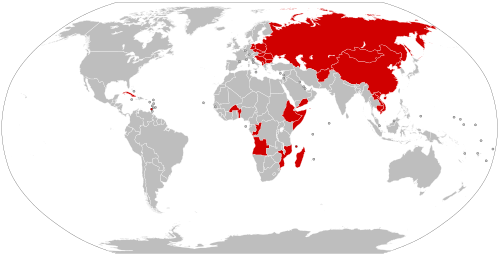
Politically, Marx's legacy is more complex. Throughout the 20th century, revolutions in dozens of countries labelled themselves "Marxist"—most notably the Russian Revolution, which led to the founding of the Soviet Union.[283] Major world leaders including Vladimir Lenin,[283] Mao Zedong,[284] Fidel Castro,[285] Salvador Allende,[286] Josip Broz Tito,[287] Kwame Nkrumah,[288] Jawaharlal Nehru,[289] Nelson Mandela,[290] Xi Jinping[291] and Thomas Sankara[292] have all cited Marx as an influence. Beyond where Marxist revolutions took place, Marx's ideas have informed political parties worldwide.[293]
In countries associated with Marxism, some events have led political opponents to blame Marx for millions of deaths,[294] while others argue for a distinction between the legacy and influence of Marx specifically, and the legacy and influence of those who have shaped his ideas for political purposes.[295] Arthur Lipow describes Marx and his collaborator Friedrich Engels as "the founders of modern revolutionary democratic socialism."[296]
The cities of Marks, Russia and Karl-Marx-Stadt, Germany, now known as Chemnitz, were named after Marx.[297][298] In May 2018, to mark the bicentenary of his birth, a 4.5m statue of him by leading Chinese sculptor Wu Weishan and donated by the Chinese government was unveiled in his birthplace of Trier, Germany. The then-European Commission president Jean-Claude Juncker defended Marx's memory, saying that today Marx "stands for things which he is not responsible for and which he didn't cause because many of the things he wrote down were redrafted into the opposite".[299][300]
In 2017, a feature film, titled The Young Karl Marx, featuring Marx, his wife Jenny Marx, and Engels, among other revolutionaries and intellectuals prior to the Revolutions of 1848, received good reviews for both its historical accuracy and its brio in dealing with intellectual life.[301]
Selected bibliography
- The Difference Between the Democritean and Epicurean Philosophy of Nature (doctoral thesis),[302] 1841
- The Philosophical Manifesto of the Historical School of Law, 1842
- Critique of Hegel's Philosophy of Right, 1843
- On the Jewish Question, 1843
- Notes on James Mill, 1844
- Economic and Philosophic Manuscripts of 1844, 1844
- The Holy Family, 1845
- Theses on Feuerbach, written 1845, first published posthumously 1888 by Engels.
- The German Ideology, 1845
- The Poverty of Philosophy, 1847
- Wage Labour and Capital, 1847
- Manifesto of the Communist Party, 1848
- The Class Struggles in France, 1850
- The Eighteenth Brumaire of Louis Napoleon, 1852
- Grundrisse (Foundations of a Critique of Political Economy), 1857
- A Contribution to the Critique of Political Economy, 1859
- Writings on the U.S. Civil War, 1861
- Theories of Surplus Value, (posthumously published by Kautsky) 3 volumes, 1862
- Address of the International Working Men's Association to Abraham Lincoln, 1864
- Value, Price and Profit, 1865
- Capital. Volume I: A Critique of Political Economy The Process of Production of Capital (Das Kapital), 1867
- The Civil War in France, 1871
- Critique of the Gotha Program, 1875
- Notes on Adolph Wagner, 1883
- Das Kapital, Volume II (posthumously published by Engels), 1885
- Das Kapital, Volume III (posthumously published by Engels), 1894
See also
- 2807 Karl Marx
- Criticisms of Marxism
- Giovanni Gentile
- Karl Marx in film
- Marxian class theory
- Marx Memorial Library
- Marx's method
- Marx Reloaded
- Mathematical manuscripts of Karl Marx
- Pre-Marx socialists
- Scientific socialism
- Timeline of Karl Marx
- Why Socialism?, an article written by Albert Einstein which presented a critique of modern capitalism and advocated for a planned economy.
Notes
- ^ His name was spelled Carl Marx in the birth register of Trier and he occasionally used this spelling in official contexts up to the 1840s. His full name is sometimes given as Karl Heinrich Marx, but he never officially had a middle name, using the forms Karl Heinrich or Carl Heinrich (with his father's first name added after his own) only several times as a student.[2]
References
- ^ "Letter from Karl Marx accepting membership of the Society 1862". Royal Society of Arts. Archived from the original on 16 April 2018. Retrieved 19 August 2022.
- ^ Heinrich 2019, pp. 34–35.
- ^ Padover, Saul, ed. (1975). "Introduction: Marx, the Human Side". Karl Marx on Education, Women, and Children. New York: McGraw Hill. p. xxv.
- ^ a b c Marx, K. and Engels, F. (1848).The Communist Manifesto Archived 2 September 2009 at the Wayback Machine
- ^ Marx, Karl. "Index". Critique of the Gotha Program. Archived from the original on 27 October 2007 – via Marxists Internet Archive.
- ^ a b c d e Calhoun 2002, pp. 23–24.
- ^ a b "Marx the millennium's 'greatest thinker'". BBC News World Online. 1 October 1999. Archived from the original on 2 September 2017. Retrieved 23 November 2010.
- ^ Unger, Roberto Mangabeira (2007). Free Trade Reimagined: The World Division of Labor and the Method of Economics. Princeton: Princeton University Press.
- ^ Hicks, John (May 1974). "Capital Controversies: Ancient and Modern". The American Economic Review. 64 (2): 307.
The greatest economists, Smith or Marx or Keynes, have changed the course of history ...
- ^ Schumpeter, Joseph (1952). Ten Great Economists: From Marx to Keynes. Unwin University books. Vol. 26 (4th ed.). Taylor & Francis. ISBN 978-0-415-11078-5.
- ^ Little, Daniel. "Marxism and Method". Archived from the original on 10 December 2017. Retrieved 10 December 2017.
- ^ Kim, Sung Ho (2017). "Max Weber". In Zalta, Edward N. (ed.). Stanford Encyclopaedia of Philosophy. Metaphysics Research Lab, Stanford University. Archived from the original on 18 March 2019. Retrieved 10 December 2017.
Max Weber is known as a principal architect of modern social science along with Karl Marx and Emil Durkheim.
- ^ McLellan 2006, p. 178, Plate 1.
- ^ Wheen 2001, pp. 12–13.
- ^ Nicolaievsky & Maenchen-Helfen 1976, p. 7; Wheen 2001, pp. 8, 12; McLellan 2006, p. 1.
- ^ Nicolaievsky & Maenchen-Helfen 1976, pp. 4–5; Wheen 2001, pp. 7–9, 12; McLellan 2006, pp. 2–3.
- ^ Carroll, James (2002). Constantine's Sword: The Church and the Jews – A History. Houghton Mifflin Harcourt. p. 419. ISBN 978-0-547-34888-9. Archived from the original on 24 September 2020. Retrieved 2 April 2018 – via Google Books.
- ^ Nicolaievsky & Maenchen-Helfen 1976, pp. 4–6; McLellan 2006, pp. 2–4.
- ^ Nicolaievsky & Maenchen-Helfen 1976, pp. 5, 8–12; Wheen 2001, p. 11; McLellan 2006, pp. 5–6.
- ^ Nicolaievsky & Maenchen-Helfen 1976, p. 7; Wheen 2001, p. 10; McLellan 2006, p. 7.
- ^ Wheen 2001, chpt. 6
- ^ Nicolaievsky & Maenchen-Helfen 1976, p. 12; Wheen 2001, p. 13.
- ^ McLellan 2006, p. 7.
- ^ Turley, Justin (24 August 2020). "The Baptism of Karl Marx, 1824". Landmark Events. Retrieved 28 August 2024.
- ^ Karl Marx: Dictionary of National Biography. Vol. 37. Oxford University Press. 2004. pp. 57–58. ISBN 978-0-19-861387-9.
- ^ Nicolaievsky & Maenchen-Helfen 1976, pp. 12–15; Wheen 2001, p. 13; McLellan 2006, pp. 7–11.
- ^ Nicolaievsky & Maenchen-Helfen 1976, pp. 15–16; Wheen 2001, p. 14; McLellan 2006, p. 13.
- ^ Wheen 2001, p. 15.
- ^ Nicolaievsky & Maenchen-Helfen 1976, p. 20; McLellan 2006, p. 14.
- ^ Wheen 2001, p. 16; McLellan 2006, p. 14
- ^ a b Holmes, Rachel (14 October 2017). "Karl Marx: the drinking years". The Daily Telegraph. Archived from the original on 10 January 2022. Retrieved 14 October 2017.(subscription required)
- ^ Nicolaievsky & Maenchen-Helfen 1976, pp. 21–22; McLellan 2006, p. 14.
- ^ Nicolaievsky & Maenchen-Helfen 1976, p. 22; Wheen 2001, pp. 16–17; McLellan 2006, p. 14.
- ^ Heinrich 2019, pp. 131–132.
- ^ Fedoseyev 1973, p. 23; Nicolaievsky & Maenchen-Helfen 1976, pp. 23–30; Wheen 2001, pp. 16–21, 33; McLellan 2006, pp. 15, 20.
- ^ Nicolaievsky & Maenchen-Helfen 1976, pp. 70–71; Wheen 2001, pp. 52–53; McLellan 2006, pp. 61–62.
- ^ Nicolaievsky & Maenchen-Helfen 1976, p. 31; McLellan 2006, p. 15.
- ^ McLellan 2006, p. 21
- ^ Nicolaievsky & Maenchen-Helfen 1976, p. 33; McLellan 2006, p. 21.
- ^ Nicolaievsky & Maenchen-Helfen 1976, pp. 32–34; Wheen 2001, pp. 21–22; McLellan 2006, pp. 21–22.
- ^ Nicolaievsky & Maenchen-Helfen 1976, pp. 34–38; Wheen 2001, p. 34; McLellan 2006, pp. 25–27.
- ^ Nicolaievsky & Maenchen-Helfen 1976, pp. 44, 69–70; McLellan 2006, pp. 17–18.
- ^ Sperber 2013, pp. 55–56.
- ^ Nicolaievsky & Maenchen-Helfen 1976, p. 33; McLellan 2006, pp. 18–19
- ^ Marx, Karl; Engels, Friedrich (1975). Collected Works of Karl Marx and Frederick Engels. Vol. 1. New York: International Publishers. pp. 531–632.
- ^ Nicolaievsky & Maenchen-Helfen 1976, p. 33; Wheen 2001, pp. 25–26.
- ^ Marx's thesis was posthumously published in Marx, Karl; Engels, Friedrich (1975). Collected Works of Karl Marx and Frederick Engels. Vol. 1. New York: International Publishers. pp. 25–107..
- ^ Wheen 2001, p. 32.
- ^ Nicolaievsky & Maenchen-Helfen 1976, p. 45; Wheen 2001, p. 33; McLellan 2006, pp. 28–29, 33.
- ^ Nicolaievsky & Maenchen-Helfen 1976, pp. 38–45; Wheen 2001, p. 34; McLellan 2006, pp. 32–33, 37.
- ^ Nicolaievsky & Maenchen-Helfen 1976, p. 49; McLellan 2006, p. 33.
- ^ Nicolaievsky & Maenchen-Helfen 1976, pp. 50–51; Wheen 2001, pp. 34–36, 42–44; McLellan 2006, pp. 35–47.
- ^ Nicolaievsky & Maenchen-Helfen 1976, p. 57; Wheen 2001, p. 47; McLellan 2006, pp. 48–50.
- ^ Nicolaievsky & Maenchen-Helfen 1976, pp. 60–61; Wheen 2001, pp. 47–48; McLellan 2006, pp. 50–51.
- ^ Nicolaievsky & Maenchen-Helfen 1976, pp. 68–69, 72; Wheen 2001, p. 48; McLellan 2006, pp. 59–61
- ^ Nicolaievsky & Maenchen-Helfen 1976, pp. 77–79; Wheen 2001, pp. 62–66; McLellan 2006, pp. 73–74, 94.
- ^ Nicolaievsky & Maenchen-Helfen 1976, p. 72; Wheen 2001, pp. 64–65; McLellan 2006, pp. 71–72.
- ^ Marx, Karl (1975). "Contribution to the Critique of Hegel's Philosophy of Law". Collected Works of Karl Marx and Frederick Engels. Vol. 3. New York: International Publishers. p. 3.
- ^ Marx, Karl (1975). "On the Jewish Question". Collected Works of Karl Marx and Frederick Engels. Vol. 3. New York: International Publishers. p. 146.
- ^ McLellan 2006, pp. 65–70, 74–80.
- ^ Nicolaievsky & Maenchen-Helfen 1976, pp. 72, 75–76; Wheen 2001, p. 65; McLellan 2006, pp. 88–90.
- ^ Wheen 2001, pp. 66–67, 112; McLellan 2006, pp. 79–80.
- ^ Wheen 2001, p. 90.
- ^ Wheen 2001, p. 75.
- ^ Mansel, Philip (2001). Paris Between Empires. New York: St. Martins Press. p. 390.
- ^ Engels, Friedrich (1975). "The Condition of the Working Class in England". Collected Works of Karl Marx and Frederick Engels. Vol. 4. New York: International Publishers. pp. 295–596.
- ^ a b c Bottomore, T. B. (1991). A Dictionary of Marxist thought. Wiley-Blackwell. pp. 108–. ISBN 978-0-631-18082-1. Archived from the original on 22 June 2013. Retrieved 5 March 2011 – via Google Books.
- ^ Fedoseyev 1973, p. 82.
- ^ Wheen 2001, pp. 85–86.
- ^ Marx, Karl (1975). "The Holy Family". Collected Works of Karl Marx and Frederick Engels. Vol. 4. New York: International Publishers. pp. 3–211.
- ^ a b Several authors elucidated this long neglected crucial turn in Marx's theoretical development, such as Ernie Thomson in The Discovery of the Materialist Conception of History in the Writings of the Young Karl Marx, Lewiston, New York: Edwin Mellen Press, 2004; for a short account see Max Stirner, a durable dissident Archived 18 May 2006 at the Wayback Machine
- ^ Taken from the caption of a picture of the house in a group of pictures located between pages 160 and 161 of Fedoseyev 1973.
- ^ Fedoseyev 1973, p. 63.
- ^ Berlin 1963, pp. 90–94.
- ^ a b Fedoseyev 1973, p. 62.
- ^ Larisa Miskievich, "Preface" to Volume 28 of the Collected Works of Karl Marx and Frederick Engels (International Publishers: New York, 1986) p. xii
- ^ Karl Marx, Collected Works of Karl Marx and Frederick Engels: Volume 35, Volume 36 and Volume 37 (International Publishers: New York, 1996, 1997 and 1987).
- ^ Berlin 1963, pp. 35–61.
- ^ Note 54 contained on p. 598 in the Collected Works of Karl Marx and Frederick Engels: Volume 3.
- ^ Karl Marx, "Economic and Philosophical Manuscripts of 1844" Collected Works of Karl Marx and Frederick Engels: Volume 3 (International Publishers: New York, 1975) pp. 229–346.
- ^ a b c d e f g h i j k l m n o "Karl Marx". Stanford Encyclopaedia of Philosophy. Metaphysics Research Lab, Stanford University. 2017. Archived from the original on 8 February 2012. Retrieved 28 May 2005.. First published Tue 26 August 2003; substantive revision Mon 14 June 2010. Retrieved 4 March 2011.
- ^ Fedoseyev 1973, p. 83.
- ^ Karl Marx, "Theses on Feuerbach", contained in the Collected Works of Karl Marx and Frederick Engels: Volume 5 (International Publishers: New York, 1976) pp. 3–14.
- ^ Karl Marx, "Theses on Feuerbach," contained in the Collected Works of Karl Marx and Frederick Engels: Volume 5, p. 8.
- ^ Doug Lorimer, in Friedrich Engels (1999). Socialism: utopian and scientific. Resistance Books. pp. 34–36. ISBN 978-0-909196-86-8. Archived from the original on 17 June 2013. Retrieved 7 March 2011 – via Google Books.
- ^ a b c Wheen 2001, p. 90.
- ^ Heinrich Gemkow et al., Frederick Engels: A Biography (Verlag Zeit im Bild ["New Book Publishing House"]: Dresden, 1972) p. 101
- ^ Heinrich Gemkow, et al., Frederick Engels: A Biography, p. 102.
- ^ Heinrich Gemkow, et al., Frederick Engels: A Biography (Verlag Zeit im Bild [New Book Publishing House]: Dresden, 1972) p. 53
- ^ Heinrich Gemkow, et al., Frederick Engels: A Biography, p. 78.
- ^ a b c Fedoseyev 1973, p. 89.
- ^ Wheen 2001, p. 92.
- ^ Karl Marx and Frederick Engels, "German Ideology" contained in the Collected Works of Karl Marx and Frederick Engels: Volume 5 (International Publishers: New York, 1976) pp. 19–539.
- ^ Fedoseyev 1973, pp. 96–97.
- ^ a b Baird, Forrest E.; Kaufmann, Walter (2008). From Plato to Derrida. Upper Saddle River, New Jersey: Pearson Prentice Hall. ISBN 978-0-13-158591-1.
- ^ Wheen 2001, p. 93.
- ^ See Note 71 on p. 672 of the Collected Works of Karl Marx and Frederick Engels: Volume 6 (International Publishers: New York, 1976).
- ^ Karl Marx, The Poverty of Philosophy contained in the Collected Works of Karl Marx and Frederick Engels: Volume 6 (International Publishers: New York, 1976) pp. 105–212.
- ^ Wheen 2001, p. 107.
- ^ Fedoseyev 1973, p. 124.
- ^ Note 260 contained in the Collected Works of Karl Marx and Frederick Engels: Volume 11 (International Publishers: New York, 1979) pp. 671–72.
- ^ Note 260 contained in the Collected Works of Karl Marx and Frederick Engels: Volume 11, p. 672.
- ^ Fedoseyev 1973, pp. 123–125.
- ^ Fedoseyev 1973, p. 125.
- ^ Frederick Engels, "Principles of Communism" contained in the Collected Works of Karl Marx and Frederick Engels: Volume 6 (International Publishers, New York, 1976) pp. 341–57.
- ^ Karl Marx and Frederick Engels, "The Communist Manifesto" contained in the Collected Works of Karl Marx and Frederick Engels: Volume 6, pp. 477–519.
- ^ Wheen 2001, p. 115.
- ^ Shilling, Chris; Mellor, Philip A. (2001). The Sociological Ambition: Elementary Forms of Social and Moral Life. SAGE Publications. p. 114. ISBN 978-0-7619-6549-7. Archived from the original on 15 September 2015. Retrieved 27 June 2015 – via Google Books.
- ^ Marx and Engels 1848.
- ^ a b Wheen 2001, p. 125.
- ^ a b Maltsev; Yuri N. (1993). Requiem for Marx. Ludwig von Mises Institute. pp. 93–94. ISBN 978-1-61016-116-9. Archived from the original on 22 July 2011. Retrieved 9 March 2011.
- ^ Padover, Saul Kussiel (1978). Karl Marx, an intimate biography. McGraw-Hill. p. 205.
- ^ a b c Wheen 2001, pp. 126–27.
- ^ David McLellan 1973 Karl Marx: His life and Thought. New York: Harper and Row. pp. 189–90
- ^ Felix, David (1982). "Heute Deutschland! Marx as Provincial Politician". Central European History. 15 (4): 332–350. doi:10.1017/S0008938900010621. ISSN 0008-9389. JSTOR 4545968. S2CID 145405027.
- ^ Wheen 2001, p. 128.
- ^ Karl Marx and Frederick Engels, "Demands of the Communist Party" contained in the Collected Works of Karl Marx and Frederick Engels: Volume 7 (International Publishers: New York, 1977) pp. 3–6.
- ^ Wheen 2001, p. 129.
- ^ Wheen 2001, pp. 130–132.
- ^ Seigel 1978, p. 50.
- ^ a b Doug Lorimer. Introduction. In Marx, Karl. The Class Struggles in France: From the February Revolution to the Paris Commune. Resistance Books. p. 6. ISBN 978-1-876646-19-6. Archived from the original on 17 June 2013. Retrieved 9 March 2011 – via Google Books.
- ^ "Neue Rheinsiche Zeitung No. 145 November 1848". www.marxists.org. Archived from the original on 29 November 2021. Retrieved 5 April 2022.
- ^ Wheen 2001, pp. 136–137; Nicolaievsky & Maenchen-Helfen 2007, p. 192; Splichal 2002, p. 115;
- ^ a b Franz Mehring (2003). Karl Marx: The Story of His Life. Psychology Press. pp. 19–20. ISBN 978-0-415-31333-9. Archived from the original on 16 June 2013. Retrieved 9 March 2011 – via Google Books.
- ^ a b Nicolaievsky & Maenchen-Helfen 2007, p. 192.
- ^ Gross, David M. (2014). 99 Tactics of Successful Tax Resistance Campaigns. Picket Line Press. pp. 76–77. ISBN 978-1-4905-7274-1.
- ^ Wheen 2001, pp. 136–37.
- ^ Wheen 2001, pp. 137–146.
- ^ Wheen 2001, pp. 147–148.
- ^ Watson, Peter (2010). The German Genius: Europe's Third Renaissance, the Second Scientific Revolution, and the Twentieth Century. HarperCollins. pp. 250–. ISBN 978-0-06-076022-9. Archived from the original on 17 June 2013. Retrieved 9 March 2011 – via Google Books.
- ^ a b Fedoseyev 1973, p. 233.
- ^ Note 269 contained on p. 674 in the Collected Works of Karl Marx and Frederick Engels: Volume 11.
- ^ Wheen 2001, pp. 151–155.
- ^ Harriss, Phil (2006). London Markets (4th ed.). New Holland Publishers. p. 20. ISBN 978-1-86011-306-2. Archived from the original on 20 June 2013. Retrieved 23 April 2011 – via Google Books.
- ^ Note 269 on p. 674 of the Collected Works of Karl Marx and Frederick Engels: Volume 11.
- ^ Dussel, Enrique D. (2001). Moseley, Fred Baker (ed.). Towards an Unknown Marx: A Commentary on the Manuscripts of 1861–63. Translated by Angulo, Yolanda. London; New York: Routledge. p. xxxiii. ISBN 0-415-21545-5.
- ^ a b c d e f g h "Karl Heinrich Marx – Biography". The European Graduate School. Archived from the original on 1 September 2010. Retrieved 9 March 2011.
- ^ Jonathan Sperber, Karl Marx: A Nineteenth-Century Life, p. 295.
- ^ a b c Kluger, Richard (1986). The Paper: The Life and Death of the New York Herald Tribune. New York: Alfred A. Knopf. ISBN 978-0-394-50877-1.
- ^ Marx, Karl (2007). Ledbetter, James (ed.). Dispatches for the New York Tribune: Selected Journalism of Karl Marx. Penguin Books. ISBN 978-0-14-144192-4.
- ^ Fedoseyev 1973, p. 274.
- ^ Marx, Karl; Engels, Friedrich (1965). "Marx to Engels, June 14, 1853". In Ryazanskaya, S. W. (ed.). Selected Correspondence. Translated by Lasker, I. (2nd ed.). Moscow: Progress Publishers. pp. 83–86.
- ^ Taken from a picture on p. 327 of the Collected Works of Karl Marx and Frederick Engels: Volume 11 (International Publishers: New York, 1979).
- ^ Karl Marx, "The Elections in England – Tories and Whigs" contained in the Collected Works of Karl Marx and Frederick Engels: Volume 11 (International Publishers: New York, 1979) pp. 327–32.
- ^ "Marx & Engels Collected Works, vol.41". 15 March 2017.
- ^ Richard Kluger, The Paper: The Life and Death of the New York Herald Tribune (Alfred A. Knopf Publishing, New York, 1986) p. 121.
- ^ McLellan 2006, p. 262
- ^ Note 1 at p. 367 contained in the Collected Works of Karl Marx and Frederick Engels: Volume 19 (International Publishers: New York, 1984).
- ^ Karl Marx, "The Eighteenth Brumaire of Louis Napoleon" contained in the Collected Works of Karl Marx and Frederick Engels: Volume 11 (International Publishers: New York, 1979) pp. 99–197.
- ^ Marx, Karl (2008). The 18th Brumaire of Louis Bonaparte. Wildside Press LLC. p. 141. ISBN 978-1-4344-6374-6. Archived from the original on 22 July 2011. Retrieved 9 March 2011 – via Google Books.
- ^ Wood, John Cunningham (1987). Karl Marx's economics: critical assessments. Psychology Press. p. 346. ISBN 978-0-415-06558-0. Archived from the original on 20 June 2013. Retrieved 16 March 2011 – via Google Books.
- ^ a b c Wood, John Cunningham (1993). Karl Marx's economics: critical assessments: second series. Taylor & Francis. p. 232. ISBN 978-0-415-08711-7. Archived from the original on 17 June 2013. Retrieved 16 March 2011 – via Google Books.
- ^ a b Sidney Hook (1994). From Hegel to Marx: studies in the intellectual development of Karl Marx. Columbia University Press. pp. 24–25. ISBN 978-0-231-09665-2. Archived from the original on 23 September 2011. Retrieved 16 March 2011 – via Google Books.
- ^ a b Derek Gregory (2000). "structural Marxism". In Ronald John Johnston; Derek Gregory; Geraldine Pratt; Michael Watts (eds.). The Dictionary of Human Geography (4th ed.). Wiley-Blackwell. pp. 795–797. ISBN 978-0-631-20561-6 – via Internet Archive.
- ^ Richard T. De George; James Patrick Scanlan (1975). Marxism and religion in Eastern Europe: papers presented at the Banff International Slavic Conference, September 4–7, 1974. Springer. p. 20. ISBN 978-90-277-0636-2. Archived from the original on 17 June 2013. Retrieved 16 March 2011 – via Google Books.
- ^ Jonathan Sperber, Karl Marx: A Nineteenth-Century Life, p. 320.
- ^ Jonathan Sperber, Karl Marx: A Nineteenth-Century Life, p. 347.
- ^ Fedoseyev 1973, p. 345.
- ^ Nicolaievsky & Maenchen-Helfen 2007, p. 267.
- ^ Bob Jessop; Russell Wheatley (1999). Karl Marx's social and political thought. Taylor & Francis US. p. 526. ISBN 978-0-415-19327-6. Archived from the original on 17 June 2013. Retrieved 9 March 2011 – via Google Books.
- ^ Curtis, Michael (1997). Marxism: the inner dialogues. Transaction Publishers. p. 291. ISBN 978-1-56000-945-0. Archived from the original on 16 June 2013. Retrieved 9 March 2011 – via Google Books.
- ^ Karl Marx, "The Civil War in France" contained in the Collected Works of Karl Marx and Frederick Engels: Volume 22 (International Publishers: New York, 1986) pp. 307–59.
- ^ Calhoun 2002, p. 20.
- ^ Mab Segrest (2002). Born to belonging: writings on spirit and justice. Rutgers University Press. p. 232. ISBN 978-0-8135-3101-4. Archived from the original on 16 June 2013. Retrieved 9 March 2011 – via Google Books.
- ^ Karl Marx, "Economic Manuscripts of 1857–1858" contained in the Collected Works of Karl Marx and Frederick Engels: Volume 28 (International Publishers: New York, 1986) pp. 5–537.
- ^ Karl Marx, "Economic Manuscripts of 1857–1858" contained in the Preparatory Materials section of the Collected Works of Karl Marx and Frederick Engels: Volume 29 (International Publishers: New York, 1987) pp. 421–507.
- ^ Karl Marx, "A Contribution to the Critique of Political Economy" contained in the Collected Works of Karl Marx and Frederick Engels: Volume 29, pp. 257–417.
- ^ Postone 1993, pp. 54–55, 173, 192.
- ^ Marx. "Economic Manuscripts: Appendix I: Production, Consumption, Distribution, Exchange". www.marxists.org. Archived from the original on 8 February 2002. Retrieved 28 March 2022.
[...] The solitary and isolated hunter or fisherman, who serves Adam Smith and Ricardo as a starting point, is one of the unimaginative fantasies of eighteenth-century romances a la Robinson Crusoe; and despite the assertions of social historians, these by no means signify simply a reaction against over-refinement and reversion to a misconceived natural life. [...] This is an illusion and nothing but the aesthetic illusion of the small and big Robinsonades. It is, on the contrary, the anticipation of "bourgeois society," which began to evolve in the sixteenth century and in the eighteenth century made giant strides towards maturity. The individual in this society of free competition seems to be rid of natural ties, etc., which made him an appurtenance of a particular, limited aggregation of human beings in previous historical epochs. The prophets of the eighteenth century, on whose shoulders Adam Smith and Ricardo were still wholly standing, envisaged this 18th-century individual – a product of the dissolution of feudal society on the one hand and of the new productive forces evolved since the sixteenth century on the other – as an ideal whose existence belonged to the past. They saw this individual not as an historical result, but as the starting point of history
[...]
Labour seems to be a very simple category. The notion of labour in this universal form, as labour in general, is also extremely old. Nevertheless "labour" in this simplicity is economically considered just as modern a category as the relations which give rise to this simple abstraction. - ^ a b Classical sociological theory. Craig J. Calhoun (3rd ed.). Chichester, West Sussex: John Wiley & Sons. 2012. p. 138. ISBN 978-0-470-65567-2. OCLC 794037359. Archived from the original on 5 October 2021. Retrieved 5 October 2021.
Marx used social criticism as his standard form of social analysis. Marx defined criticism as the "radical negation of social reality."
{{cite book}}: CS1 maint: others (link) - ^ Fedoseyev 1973, p. 318.
- ^ Tom Rockmore (2002). Marx after Marxism: the philosophy of Karl Marx. John Wiley & Sons. p. 128. ISBN 978-0-631-23189-9. Archived from the original on 16 June 2013. Retrieved 9 March 2011 – via Google Books.
- ^ Brewer, Anthony; Marx, Karl (1984). A guide to Marx's Capital. CUP Archive. p. 15. ISBN 978-0-521-25730-5. Archived from the original on 22 July 2011. Retrieved 9 March 2011 – via Google Books.
- ^ a b Postone 2006, pp. 190, 26–27. 135, 374–75.
- ^ a b Calhoun 2012.
- ^ a b Pepperell 2010, pp. 104–105.
- ^ Karl Marx, "Capital II: The Process of Circulation of Capital" embodying the whole volume of the Collected Works of Karl Marx and Frederick Engels: Volume 36 (International Publishers: New York, 1997).
- ^ Karl Marx, "Capital III: The Process of Capitalist Production as a Whole" embodying the whole volume of the Collected Works of Karl Marx and Frederick Engels: Volume 37 (International Publishers: New York, 1998).
- ^ Karl Marx, "Theories of Surplus Value" contained in the Collected Works of Karl Marx and Frederick Engels: Volume 30 (International Publishers: New York, 1988) pp. 318–451.
- ^ Karl Marx, "Theories of Surplus Value" contained in the Collected Works of Karl Marx and Frederick Engels: Volume 31 (International Publishers: New York, 1989) pp. 5–580.
- ^ Karl Marx, "Theories of Surplus Value" contained in the Collected Works of Karl Marx and Frederick Engels: Volume 32 (International Publishers: New York, 1989) pp. 5–543.
- ^ "Economic Works of Karl Marx 1861–1864". Marxists Internet Archive. Archived from the original on 16 July 2018. Retrieved 14 July 2018.
- ^ See note 228 on p. 475 of the Collected Works of Karl Marx and Frederick Engels: Volume 30.
- ^ Marx, Karl (1875). "Part I". Critique of the Gotha Program. Archived from the original on 26 December 2017. Retrieved 9 March 2011.
- ^ Karl Marx and Frederick Engels, Collected Works Volume 46 (International Publishers: New York, 1992) p. 71.
- ^ a b c Karl Marx and Frederick Engels, Collected Works Volume 46 (International Publishers: New York, 1992) p. 72.
- ^ K. Marx, First draft of the letter to Vera Zasulich [1881]. In Marx-Engels 'Collected Works', Volume 24, p. 346.
- ^ Singer, Peter (2000). Marx: A very short introduction. Oxford: Oxford University Press. p. 5. ISBN 0-19-285405-4.
- ^ Lafargue, Paul (1972). Marx–Engels–Lenin Institute (ed.). Reminiscences of Marx (September 1890). Progress Publishers. Archived from the original on 16 August 2021. Retrieved 30 December 2020.
He was a loving, gentle and indulgent father. [...] There was never even a trace of the bossy parent in his relations with his daughters, whose love for him was extraordinary. He never gave them an order, but asked them to do what he wished as a favour or made them feel that they should not do what he wanted to forbid them. And yet a father could seldom have had more docile children than he.
- ^ a b Montefiore, Simon Sebag (23 September 2011). "The Means of Reproduction". The New York Times. Archived from the original on 26 September 2011. Retrieved 25 September 2011.
- ^ Wheen 2001, p. 173.
- ^ Carver, Terrell (1991). "Reading Marx: Life and Works". In Carver, Terrell (ed.). The Cambridge Companion to Marx. Cambridge: Cambridge University Press. p. 11. ISBN 978-0-521-36694-6. Archived from the original on 8 June 2018. Retrieved 30 December 2020.
this [claim] is not well founded on the documentary materials available
- ^ "Helene Demuth Obituary". www.marxists.org. Retrieved 8 July 2024.
- ^ a b Wheen 2001, p. 152.
- ^ a b Blumenberg 2000, p. 98.
- ^ a b Blumenberg 2000, p. 100.
- ^ Blumenberg 2000, pp. 99–100.
- ^ Seigel 1978, p. 494.
- ^ Seigel 1978, pp. 495–496.
- ^ a b Shuster 2008, pp. 1–2.
- ^ Shuster 2008, p. 3.
- ^ McLellan 1973, p. 541
- ^ Wheen 2001, p. 382.
- ^ a b c d e f g Stephen Jay Gould; Paul McGarr; Steven Peter Russell Rose (2007). The richness of life: the essential Stephen Jay Gould. W.W. Norton & Company. pp. 167–168. ISBN 978-0-393-06498-8. Retrieved 9 March 2011.[dead link]
- ^ John Shepperd, 'Who was really at Marx's funeral?', in "Friends of Highgate Cemetery Newsletter ", April (2018), pp. 10–11. https://highgatecemetery.org/uploads/2018-04_Newsletter_final_web.pdf Archived 4 February 2020 at the Wayback Machine
- ^ 'Dr Karl Marx', in The People, 25 March 1883, p.3.
- ^ 'Dr Karl Marx' in The Graphic, 31 March 1883, pp. 319, 322
- ^ "1883: The death of Karl Marx". Marxists Internet Archive. Archived from the original on 4 January 2010. Retrieved 21 December 2009.
- ^ "Marx, Karl". probatesearchservice.gov. UK Government. 1883. Archived from the original on 7 August 2015. Retrieved 14 June 2020.
- ^ "£250 in 1883 → 2024 | UK Inflation Calculator". www.in2013dollars.com. Archived from the original on 28 November 2023. Retrieved 11 April 2024.
- ^ "Marx monument unveiled in Highgate cemetery – archive, 15 March 1956". The Guardian. 15 March 2016. Archived from the original on 27 December 2022. Retrieved 7 January 2018.
- ^ a b c Wheen, Francis (2002). Karl Marx: A Life. New York: Norton. Introduction.
- ^ Hobsbawm 2011. pp. 3–4.
- ^ a b c d e f g h i j k l Calhoun 2002, pp. 20–23.
- ^ a b c d e Sherman, Howard J. (1995). Reinventing marxism. Johns Hopkins University Press. p. 5. ISBN 978-0-8018-5077-6. Retrieved 7 March 2011.
- ^ Chattopadhyay, Paresh (2016). Marx's Associated Mode of Production: A Critique of Marxism. Springer. pp. 39–41.
- ^ Beilharz, Peter (1992). Labour's Utopias: Bolshevism, Fabianism and Social Democracy. CUP Archive. p. 4. ISBN 978-0-415-09680-5. Archived from the original on 20 June 2013. Retrieved 7 March 2011 – via Google Books.
- ^ a b c d e f g h Clark 1998, pp. 57–59.
- ^ Eagleton, Terry. Why Marx Was Right. Yale University Press, 2011, p. 158
- ^ Seigel 1978, pp. 112–119.
- ^ a b Neocleous, Mark. "The Political Economy of the Dead: Marx's Vampires" (PDF). Archived (PDF) from the original on 12 April 2015. Retrieved 1 November 2013.
- ^ Leopold, David. "Marx, Engels, and Some (Non-Foundational) Arguments against Utopian Socialism". ORA - Oxford University Research Archive. Retrieved 22 August 2024.
- ^ Levine, Norman (2006). Divergent Paths: The Hegelian foundations of Marx's method. Lexington Books. p. 223.
- ^ Sperber, Jonathan. Karl Marx: A Nineteenth-Century Life. p. 144.
- ^ Bannerji 2001, p. 27.
- ^ Paolucci, Paul (2015). "Marx's scientific and political criticism: The internal relation". Capital & Class. 39: 65–78. doi:10.1177/0309816814564657. Retrieved 22 August 2024.
- ^ Annelien de Dijn, French Political Thought from Montesquieu to Tocqueville Archived 15 September 2015 at the Wayback Machine, Cambridge University Press, 2008, p. 152.
- ^ Karl Marx. Capital: A Critique of Political Economy, vol. 1, trans. Samuel Moore and Edward Aveling (New York: Modem Library, 1906), 440.
- ^ Bertell Ollman (1973). Alienation: Marx's conception of man in capitalist society. CUP Archive. p. 81. ISBN 978-1-001-33135-5. Archived from the original on 22 June 2013. Retrieved 8 March 2011 – via Google Books.
- ^ a b Marx K (1999). "The labour-process and the process of producing surplus-value". Archived 18 October 2010 at the Wayback Machine In K Marx, Das Kapital (Vol. 1, Ch. 7). Marxists.org. Retrieved 20 October 2010. Original work published 1867.
- ^ a b c See Marx K (1997). "Critique of Hegel's dialectic and philosophy in general". In K Marx, Writings of the Young Marx on Philosophy and Society (LD Easton & KH Guddat, Trans.), pp. 314–47. Indianapolis: Hackett Publishing Company, Inc. Original work published 1844.
- ^ See also Lefever DM; Lefever JT (1977). "Marxian alienation and economic organisation: An alternate view". The American Economist (21) 2, pp. 40–48.
- ^ a b See also Holland EW (2005). "Desire". In CJ Stivale (Ed.), Gilles Deleuze: Key Concepts, pp. 53–62. Montreal & Kingston: McGill-Queens University Press.
- ^ a b Marx (1997), p. 325, emphasis in original.
- ^ Marx (1997), p. 321, emphasis in original.
- ^ Marx (1997), p. 324.
- ^ Marx, Karl; Engels, Friedrich (2009). The Communist Manifesto. Echo Library. p. 5. ISBN 978-1-4068-5174-8. Archived from the original on 12 September 2015. Retrieved 27 June 2015 – via Google Books.
- ^ a b c d e Calhoun 2002, p. 22.
- ^ Mészáros 2006, p. 96.
- ^ Balibar, Étienne (1995). The philosophy of Marx. Verso Books. p. 56. ISBN 978-1-85984-951-4. Archived from the original on 17 June 2013. Retrieved 8 March 2011 – via Google Books.
- ^ Kołakowski, Leszek; Falla, Paul Stephen (2005). Main currents of Marxism: the founders, the golden age, the breakdown. W.W. Norton & Company. p. 226. ISBN 978-0-393-06054-6. Archived from the original on 16 June 2013. Retrieved 8 March 2011 – via Google Books.
- ^ Paul Hernadi (1989). The Rhetoric of interpretation and the interpretation of rhetoric. Duke University Press. p. 137. ISBN 978-0-8223-0934-5. Archived from the original on 16 June 2013. Retrieved 8 March 2011 – via Google Books.
- ^ John B. Thompson (1990). Ideology and modern culture: critical social theory in the era of mass communication. Stanford University Press. pp. 37–38. ISBN 978-0-8047-1846-2. Archived from the original on 20 June 2013. Retrieved 8 March 2011 – via Google Books.
- ^ Karl Marx: Introduction Archived 12 May 2019 at the Wayback Machine to A Contribution to the Critique of Hegel's Philosophy of Right, in: Deutsch-Französische Jahrbücher, February 1844
- ^ Marx, Karl; O'Malley, Joseph (1977). Critique of Hegel's 'Philosophy of right'. CUP Archive. p. 131. ISBN 978-0-521-29211-5. Archived from the original on 17 June 2013. Retrieved 23 April 2011 – via Google Books.
- ^ William H. Swatos; Peter Kivisto (1998). Encyclopedia of religion and society. Rowman Altamira. pp. 499–. ISBN 978-0-7619-8956-1. Archived from the original on 20 June 2013. Retrieved 8 March 2011 – via Google Books.
- ^ In The Communist Manifesto, Part II:Proletariats and Communist and Capital, Volume I, Part III
- ^ Karl Marx (1864). Inaugural Address of the International Working Men's Association (Speech).
- ^ Karl Marx and Frederick Engels, "The Communist Manifesto", page 55, translation made by Samuel Moore in 1888
- ^ a b c d e Jonathan H. Turner (2005). Sociology. Pearson Prentice Hall. pp. 17–18. ISBN 978-0-13-113496-6. Archived from the original on 20 June 2013. Retrieved 9 March 2011 – via Google Books.
- ^ a b Marx, Karl. "Grundrisse 06". Marxists Internet Archive. Archived from the original on 21 November 2021. Retrieved 21 November 2021.
the demand that wage labour be continued but capital suspended is self-contradictory, self-dissolving.
- ^ Dennis Gilbert (2010). The American Class Structure in an Age of Growing Inequality. Pine Forge Press. pp. 6–. ISBN 978-1-4129-7965-8. Archived from the original on 16 June 2013. Retrieved 8 March 2011 – via Google Books.
- ^ a b c d e Calhoun 2002, p. 23.
- ^ Jon Elster (1985). Making sense of Marx. Cambridge University Press. p. 217. ISBN 978-0-521-29705-9. Archived from the original on 17 June 2013. Retrieved 23 April 2011 – via Google Books.
- ^ Karl Marx (1970) [1875]. "Critique of the Gotha Programme, Part IV". Marx/Engels Selected Works. Vol. 3. Moscow: Progress Publishers. pp. 13–30. Archived from the original on 2 July 2019 – via marxists.org.
- ^ La Liberté Speech Archived 16 July 2018 at the Wayback Machine delivered by Karl Marx on 8 September 1872, in Amsterdam. "You know that the institutions, mores, and traditions of various countries must be taken into consideration, and we do not deny that there are countries – such as America, England, and if I were more familiar with your institutions, I would perhaps also add Holland – where the workers can attain their goal by peaceful means. This being the case, we must also recognise the fact that in most countries on the Continent the lever of our revolution must be force; it is force to which we must some day appeal to erect the rule of labour."
- ^ a b c d Anderson 2016, pp. 49–239.
- ^ Cited in: B. Hepner, "Marx et la puissance russe," in: K. Marx, La Russie et l'Europe, Paris, 1954, p. 20. Originally published in Neue Rheinische Zeitung, no. 223, 16 February 1849.
- ^ Karl Marx and Friedrich Engels to the Chairman of the Slavonic Meeting, 21 March 1881. Source: Karl Marx and Frederick Engels, Selected Correspondence (Progress Publishers, Moscow, 1975).
- ^ Speech delivered in London, probably to a meeting of the International's General Council and the Polish Workers Society on 22 January 1867, text published in Le Socialisme, 15 March 1908; Odbudowa Polski (Warsaw, 1910), pp. 119–23; Mysl Socjalistyczna, May 1908. From Karl Marx and Frederick Engels, The Russian Menace to Europe, edited by Paul Blackstock and Bert Hoselitz, and published by George Allen and Unwin, London, 1953, pp. 104–08.
- ^ "Karl Marx and the Irish Archived 9 May 2018 at the Wayback Machine". The New York Times. December 1971.
- ^ a b c "Marx in Algiers". Al-Ahram. Archived from the original on 10 August 2018. Retrieved 10 August 2018.
- ^ "Colonialism". The Stanford Encyclopedia of Philosophy. 2017. Archived from the original on 11 June 2018. Retrieved 10 August 2018.
- ^ "Marx on India under the British". The Hindu. 13 June 2006. Archived from the original on 30 June 2018. Retrieved 10 August 2018.
- ^ Wheen, Francis (17 July 2005). "Why Marx is man of the moment". The Observer. Archived from the original on 18 July 2005.
- ^ Allan, Kenneth (2010). The Social Lens: An Invitation to Social and Sociological Theory. Pine Forge Press. p. 68. ISBN 978-1-4129-7834-7. Archived from the original on 22 June 2013. Retrieved 25 March 2011 – via Google Books.
- ^ Magness, Phil; Makovi, Michael (2022). "The Mainstreaming of Marx: Measuring the Effect of the Russian Revolution on Karl Marx's Influence". Journal of Political Economy. 131 (6): 1507–1545. doi:10.1086/722933. ISSN 0022-3808. Archived from the original on 30 December 2022. Retrieved 12 November 2022.
- ^ a b c Andersen & Kaspersen 2000, p. 123–.
- ^ Ricoeur, Paul (1970). Freud and Philosophy: An Essay on Interpretation. New Haven and London: Yale University Press. p. 32.
- ^ "Max Weber". Stanford Encyclopaedia of Philosophy. Metaphysics Research Lab, Stanford University. 2017. Archived from the original on 26 May 2024. Retrieved 29 November 2009.
- ^ Calhoun 2002, p. 19.
- ^ Löwith, Karl (1991). From Hegel to Nietzsche. New York: Columbia University Press. p. 49.
- ^ Berlin 1963, p. 130.
- ^ Singer 1980, p. 1.
- ^ O'Laughlin, Bridget (October 1975). "Marxist Approaches in Anthropology". Annual Review of Anthropology. 4: 341–370. doi:10.1146/annurev.an.04.100175.002013.
William Roseberry (1997) Marx and Anthropology Annual Review of Anthropology, Vol. 26: pp. 25–46 (October 1997) doi:10.1146/annurev.anthro.26.1.25 - ^ Becker, S.L. (1984). "Marxist Approaches to Media Studies: The British Experience". Critical Studies in Mass Communication. 1 (1): 66–80. doi:10.1080/15295038409360014.
- ^ Alvarado, Manuel; Gutch, Robin; Wollen, Tana (1987). Learning the Media: Introduction to Media Teaching. Palgrave Macmillan.
- ^ Kołakowski, Leszek. Main Currents of Marxism: the Founders, the Golden Age, the Breakdown. Translated by P.S. Falla. New York: W.W. Norton & Company, 2005.
- ^ Aron, Raymond. Main Currents in Sociological Thought. Garden City, NY: Anchor Books, 1965.
- ^ Anderson, Perry. Considerations on Western Marxism. London: NLB, 1976.
- ^ Hobsbawm, E. J. How to Change the World: Marx and Marxism, 1840–2011 (London: Little, Brown, 2011), 314–44.
- ^ Hemingway, Andrew (2006). Marxism and the History of Art: From William Morris to the New Left. Pluto Press.
- ^ a b Lenin, V.I. (1917). "The Tasks of the Proletariat in the Present Revolution". Marxists Internet Archive. Archived from the original on 9 January 2015. Retrieved 8 January 2015.
- ^ "Glossary of People – Ma". Marxists Internet Archive. Archived from the original on 4 April 2015. Retrieved 8 January 2015.
- ^ Savioli, Arminio (1961). "L'Unita Interview with Fidel Castro: The Nature of Cuban Socialism". Marxists Internet Archive. Archived from the original on 7 September 2015. Retrieved 8 January 2015.
- ^ Allende, Salvador (1970). "First speech to the Chilean parliament after his election". Marxists Internet Archive. Archived from the original on 24 September 2014. Retrieved 8 January 2015.
- ^ Broz Tito, Josip (1959). "Historical Development in the World Will Move Towards the Strengthening of Socialism". Marxists Internet Archive. Archived from the original on 26 April 2015. Retrieved 8 January 2015.
- ^ Nkrumah, Kwame (1967). "African Socialism Revisited". Marxists Internet Archive. Archived from the original on 8 May 2015. Retrieved 8 January 2015.
- ^ "Nehru's economic philosophy". The Hindu. 27 May 2017. Archived from the original on 26 December 2019.
- ^ "Nelson Mandela's Living Legacy | Preparing for Defiance 1949–1952 Archived 9 May 2018 at the Wayback Machine". The South African. 6 November 2013.
- ^ Churm, Philip Andrew (4 May 2018). "Juncker opens exhibition to Karl Marx". Euronews. Archived from the original on 3 April 2019. Retrieved 16 May 2019.
- ^ Harsch, Ernest (20 May 2015). "Resurrecting Thomas Sankara". Jacobin. Archived from the original on 23 October 2021. Retrieved 6 October 2021.
- ^ Jeffries, Stuart (4 July 2012). "Why Marxism is on the rise again". The Guardian. Archived from the original on 8 January 2015. Retrieved 8 January 2015.
- ^ Stanley, Tim (1 November 2013). "The Left is trying to rehabilitate Karl Marx. Let's remind them of the millions who died in his name". The Daily Telegraph. Archived from the original on 7 April 2016. Retrieved 8 January 2015.
- ^ Elbe, Indigo (21 October 2013). "Between Marx, Marxism, and Marxisms – Ways of Reading Marx's Theory". Viewpoint Magazine. Archived from the original on 8 January 2015. Retrieved 8 January 2015.
- ^ Lipow, Arthur (1991). Authoritarian Socialism in America: Edward Bellamy and the Nationalist Movement. University of California Press. p. 1. ISBN 978-0-520-07543-6.
'We are not among those communists who are out to destroy personal liberty, who wish to turn the world into one huge barrack or into a gigantic workhouse. There certainly are some communists who, with an easy conscience, refuse to countenance personal liberty and would like to shuffle it out of the world because they consider that it is a hindrance to complete harmony. But we have no desire to exchange freedom for equality. We are convinced ... that in no social order will freedom be assured as in a society based upon communal ownership.' Thus wrote the editors of the Journal of the Communist League in 1847, under the direct influence of the founders of modern revolutionary democratic socialism, Karl Marx and Frederick Engels.
- ^ "Где находится Екатериненштадт? Города России". Ижевский новостной сайт (in Russian). 29 April 2010. Archived from the original on 12 June 2018. Retrieved 1 September 2023.
- ^ Chemnitzer Tourismus-Broschüre, Herausgeber: City-Management und Tourismus Chemnitz GmbH, 4. Jahrgang • Ausgabe 12 • Sommer 2010 Archived 26 August 2010 at the Wayback Machine; O-Ton-Nachweis im Chemnitzer Stadtarchiv[dead link]
- ^ Stone, Jon (4 May 2018). "'Today he stands for things which is he not responsible for': EU president Juncker defends Karl Marx's legacy". The Independent. Archived from the original on 24 April 2019. Retrieved 16 May 2019.
- ^ "Karl Marx statue from China adds to German angst". BBC News. 5 May 2018. Archived from the original on 22 June 2019. Retrieved 16 May 2019.
- ^ Scott, A. O. (22 February 2018). "Review: In 'The Young Karl Marx,' a Scruffy Specter Haunts Europe". The New York Times. Archived from the original on 7 May 2018. Retrieved 6 May 2018.
- ^ "English translation online". Archived from the original on 20 April 2018.
Sources
- Andersen, Heine; Kaspersen, Lars Bo (2000). Classical and modern social theory. Wiley-Blackwell. ISBN 978-0-631-21288-1. Archived from the original on 17 June 2013. Retrieved 9 March 2011 – via Google Books.
- Anderson, Kevin B. (2016). Marx at the Margins: On Nationalism, Ethnicity, and Non-Western Societies. University of Chicago Press. ISBN 978-0-226-34570-3 – via Google Books.
- Bannerji, Himani (2001). Inventing subjects: studies in hegemony, patriarchy and colonialism. Anthem Press. ISBN 978-1-84331-072-3. Archived from the original on 17 June 2013. Retrieved 2 May 2011 – via Google Books.
- Berlin, Isaiah (1963). Karl Marx: His Life and Environment. London: Oxford University Press.
- Blumenberg, Werner (2000). Karl Marx: An Illustrated Biography. Translated by Scott, Douglas. London; New York: Verso Books. ISBN 978-1-85984-254-6.
- Calhoun, Craig J. (2002). Classical Sociological Theory. Oxford: Wiley-Blackwell. ISBN 978-0-631-21348-2. Archived from the original on 12 September 2015. Retrieved 27 June 2015 – via Google Books.
- Calhoun, Craig J. (2012). Classical sociological theory (3rd ed.). Chichester, West Sussex: John Wiley & Sons. ISBN 978-0-470-65567-2. OCLC 794037359. Archived from the original on 5 October 2021. Retrieved 5 October 2021.
- Clark, Barry Stewart (1998). Political economy: a comparative approach. ABC-CLIO. ISBN 978-0-275-96370-5. Archived from the original on 20 June 2013. Retrieved 7 March 2011 – via Google Books.
- Fedoseyev, Petr Nikolaevich (1973). Karl Marx: A Biography. Moscow: Progress Publishers. OCLC 1365346.
- Heinrich, Michael (2019). Karl Marx and the Birth of Modern Society: The Life of Marx and the Development of His Work. Volume I: 1818–1841. New York: Monthly Review P. ISBN 978-1-58367-735-3.
- Hobsbawm, Eric (2011). How to Change the World: Tales of Marx and Marxism. London: Little, Brown. ISBN 978-1-4087-0287-1.
- McLellan, David (2006). Karl Marx: A Biography (4th ed.). Hampshire: Palgrave MacMillan. ISBN 978-1-4039-9730-2.
- Mészáros, István (2006) [1970]. Marx's Theory of Alienation. Merlin Press. ISBN 978-0-85036-554-2. Archived from the original on 16 June 2013. Retrieved 8 March 2011 – via Google Books.
- Nicolaievsky, Boris; Maenchen-Helfen, Otto (1976) [1936]. Karl Marx: Man and Fighter. Translated by David, Gwenda; Mosbacher, Eric. Harmondsworth and New York: Pelican. ISBN 978-1-4067-2703-6.
- Nicolaievsky, Boris; Maenchen-Helfen, Otto (2007). Karl Marx: Man and Fighter. Read Books. ISBN 978-1-4067-2703-6. Archived from the original on 22 June 2013. Retrieved 9 March 2011 – via Google Books.
- Pepperell, Nicole (April 2010). Disassembling Capital (PDF) (PhD). RMIT University. Archived (PDF) from the original on 31 March 2024. Retrieved 9 March 2023.
- Pilling, Geoff (1980). Marx's Capital, Philosophy and Political Economy. Routledge & Keagan Paul. ISBN 978-1-138-87410-7. Archived from the original on 10 January 2023. Retrieved 2 October 2021 – via Marxists Internet Archive.
- Postone, Moishe (1993). Time labour and social domination. Cambridge University Press. doi:10.1017/CBO9780511570926. ISBN 978-0-511-57092-6. Archived from the original on 6 February 2023. Retrieved 2 October 2021.
- Postone, Moishe (2006). Time, labor, and social domination: a reinterpretation of Marx's critical theory. Cambridge University Press. ISBN 978-0-521-56540-0. OCLC 475188205. Archived from the original on 5 October 2021. Retrieved 5 October 2021.
- Schwarzschild, Leopold (1986) [1948]. The Red Prussian: Life and Legend of Karl Marx. Pickwick Books Ltd. ISBN 978-0-948859-00-7.
- Seigel, Jerrold (1978). Marx's fate: the shape of a life. Princeton University Press. ISBN 0-271-00935-7.
- Shuster, Sam (January 2008). "The nature and consequence of Karl Marx's skin disease". British Journal of Dermatology. 158 (1): 071106220718011––. doi:10.1111/j.1365-2133.2007.08282.x. PMID 17986303. S2CID 40843002.
- Singer, Peter (1980). Marx. Oxford: Oxford University Press. ISBN 978-0-19-287510-5.
- Sperber, Jonathan (2013). Karl Marx: A Nineteenth-Century Life. W. W. Norton & Company. ISBN 978-0-87140-467-1.
- Splichal, Slavko (2002). Principles of publicity and press freedom. Rowman & Littlefield. p. 115. ISBN 978-0-7425-1615-1. Archived from the original on 17 June 2013. Retrieved 9 March 2011 – via Google Books.
- Stedman Jones, Gareth (2016). Karl Marx: Greatness and Illusion. London: Allen Lane. ISBN 978-0-7139-9904-4.
- Stokes, Philip (2004). Philosophy: 100 Essential Thinkers. Kettering: Index Books. ISBN 978-0-572-02935-7.
- Vygodsky, Vitaly (1973). The Story of a Great Discovery: How Karl Marx wrote "Capital". Verlag Die Wirtschaft. Archived from the original on 21 August 2018. Retrieved 5 March 2011.
- Wheen, Francis (2001). Karl Marx. London: Fourth Estate. ISBN 978-1-85702-637-5.
Further reading
Biographies
- Barnett, Vincent. Marx (Routledge, 2009)
- Berlin, Isaiah. Karl Marx: His Life and Environment (Oxford University Press, 1963) ISBN 0-19-520052-7
- Gemkow, Heinrich. Karl Marx: A Biography. Dresden: Verlag Zeit im Bild. 1968.
- Hobsbawm, E.J. (2004). "Marx, Karl Heinrich". Oxford Dictionary of National Biography (online ed.). Oxford University Press. doi:10.1093/ref:odnb/39021. (Subscription or UK public library membership required.)
- Lenin, Vladimir (1967) [1913]. Karl Marx: A Brief Biographical Sketch with an Exposition of Marxism. Peking: Foreign Languages Press. Archived from the original on 2 July 2019. Retrieved 19 February 2011 – via Marxists Internet Archive.
- Liedman, Sven-Eric. A World to Win: The Life and Works of Karl Marx. [2015] Jeffrey N. Skinner, trans. London: Verso Books, 2018.
- McLellan, David. Karl Marx: his Life and Thought Harper & Row, 1973 ISBN 978-0-06-012829-6
- Mehring, Franz. Karl Marx: The Story of His Life (Routledge, 2003)
- McLellan, David. Marx before Marxism (1980), Macmillan, ISBN 978-0-333-27882-6
- Nomad, Max (1961) [1939]. "The Teacher: Karl Marx, Who Sowed Dragon's Teeth". Apostles of Revolution. New York: Collier Books. pp. 83–150. LCCN 61018566. OCLC 984463383.
- Rubel, Maximilien. Marx Without Myth: A Chronological Study of his Life and Work (Blackwell, 1975) ISBN 0-631-15780-8
- Segrillo, Angelo. Two Centuries of Karl Marx Biographies: An Overview (LEA Working Paper Series, nº 4, March 2019).
- Sperber, Jonathan. Karl Marx: A Nineteenth-Century Life. New York: W.W. Norton & Company, 2013.
- Stedman Jones, Gareth. Karl Marx: Greatness and Illusion (Allen Lane, 2016). ISBN 978-0-7139-9904-4.
- Walker, Frank Thomas. Karl Marx: a Bibliographic and Political Biography. (bj.publications), 2009.
- Wheen, Francis. Karl Marx: A Life, (Fourth Estate, 1999), ISBN 1-85702-637-3
Commentaries on Marx
- Althusser, Louis. For Marx. London: Verso, 2005.
- Althusser, Louis and Balibar, Étienne. Reading Capital. London: Verso, 2009.
- Attali, Jacques. Karl Marx or the thought of the world. 2005
- Avineri, Shlomo. The Social and Political Thought of Karl Marx (Cambridge University Press, 1968) ISBN 0-521-09619-7
- Avineri, Shlomo. Karl Marx: Philosophy and Revolution (Yale University Press, 2019) ISBN 978-0-300-21170-2
- Axelos, Kostas. Alienation, Praxis, and Techne in the Thought of Karl Marx (translated by Ronald Bruzina, University of Texas Press, 1976).
- Blackledge, Paul. Reflections on the Marxist Theory of History (Manchester University Press, 2006)
- Blackledge, Paul. Marxism and Ethics (SUNY Press, 2012)
- Bottomore, Tom, ed. A Dictionary of Marxist Thought. Oxford: Blackwell, 1998.
- Callinicos, Alex (2010) [1983]. The Revolutionary Ideas of Karl Marx. Bloomsbury; London: Bookmarks. ISBN 978-1-905192-68-7.
- Cleaver, Harry. Reading Capital Politically (AK Press, 2000)
- G.A. Cohen. Karl Marx's Theory of History: A Defence (Princeton University Press, 1978) ISBN 0-691-07068-7
- Collier, Andrew. Marx (Oneworld, 2004)
- Draper, Hal, Karl Marx's Theory of Revolution (4 volumes) Monthly Review Press
- Duncan, Ronald and Wilson, Colin. (editors) Marx Refuted, (Bath, UK, 1987) ISBN 0-906798-71-X
- Eagleton, Terry. Why Marx Was Right (New Haven & London: Yale University Press, 2011).
- Fine, Ben. Marx's Capital. 5th ed. London: Pluto Press, 2010.
- Foster, John Bellamy. Marx's Ecology: Materialism and Nature. New York: Monthly Review Press, 2000.
- Gould, Stephen Jay. A Darwinian Gentleman at Marx's Funeral – E. Ray Lankester, p. 1, Find Articles.com (1999)
- Harvey, David. A Companion to Marx's Capital. London: Verso Books, 2010.
- Harvey, David. The Limits of Capital. London: Verso, 2006.
- Henry, Michel. Marx I and Marx II. 1976
- Holt, Justin P. The Social Thought of Karl Marx. Sage, 2015.
- Iggers, Georg G. "Historiography: From Scientific Objectivity to the Postmodern Challenge."(Wesleyan University Press, 1997, 2005)
- Kołakowski, Leszek. Main Currents of Marxism Oxford: Clarendon Press, OUP, 1978
- Kurz, Robert. Read Marx: The most important texts of Karl Marx for the 21st Century (2000) ISBN 3-8218-1644-9
- Little, Daniel. The Scientific Marx, (University of Minnesota Press, 1986) ISBN 0-8166-1505-5
- Mandel, Ernest. Marxist Economic Theory. New York: Monthly Review Press, 1970.
- Mandel, Ernest. The Formation of the Economic Thought of Karl Marx. New York: Monthly Review Press, 1977.
- Miller, Richard W. Analyzing Marx: Morality, Power, and History. Princeton, N.J: Princeton University Press, 1984.
- Rothbard, Murray. An Austrian Perspective on the History of Economic Thought Volume II: Classical Economics (Edward Elgar Publishing Ltd., 1995) ISBN 0-945466-48-X
- Saad-Filho, Alfredo. The Value of Marx: Political Economy for Contemporary Capitalism. London: Routledge, 2002.
- Saito, Kohei. Karl Marx's Ecosocialism: Capital, Nature, and the Unfinished Critique of Political Economy, Monthly Review Press 2017.
- Schmidt, Alfred. The Concept of Nature in Marx. London: NLB, 1971.
- Seigel, J.E. (1973). "Marx's Early Development: Vocation, Rebellion and Realism". The Journal of Interdisciplinary History. 3 (3): 475–508. doi:10.2307/202551. JSTOR 202551.
- Strathern, Paul. "Marx in 90 Minutes", (Ivan R. Dee, 2001)
- Thomas, Paul. Karl Marx and the Anarchists. London: Routledge & Kegan Paul, 1980.
- Uno, Kozo. Principles of Political Economy. Theory of a Purely Capitalist Society, Brighton, Sussex: Harvester; Atlantic Highlands, N.J.: Humanities, 1980.
- Vianello, F. [1989], "Effective Demand and the Rate of Profits: Some Thoughts on Marx, Kalecki and Sraffa", in: Sebastiani, M. (ed.), Kalecki's Relevance Today, London, Macmillan, ISBN 978-0-312-02411-6.
- Wendling, Amy. Karl Marx on Technology and Alienation (Palgrave Macmillan, 2009)
- Wheen, Francis. Marx's Das Kapital, (Atlantic Books, 2006) ISBN 1-84354-400-8
- Wilson, Edmund. To the Finland Station: A Study in the Writing and Acting of History, Garden City, NY: Doubleday, 1940
Fiction works
- Barker, Jason (2018). Marx Returns. Winchester, UK: Zero Books. ISBN 978-1-78535-660-5.
External links
- Works by Karl Marx at Project Gutenberg
- Works by or about Karl Marx at the Internet Archive
- Works by Karl Marx at LibriVox (public domain audiobooks)

- Zalta, Edward N. (ed.). "Karl Marx". Stanford Encyclopedia of Philosophy.
- Karl Marx at the Marxists Internet Archive.
- Marx and Engels (1973). Selected Works. Vol. 1. Moscow: Progress Publishers.
- Marx and Engels (1973). Selected Works. Vol. 2. Moscow: Progress Publishers.
- Marx and Engels (1973). Selected Works. Vol. 3. Moscow: Progress Publishers.
- Marx and Engels (1982). Selected Correspondence (3rd rev. ed.). Moscow: Progress Publishers.
- Institute of Marxism-Leninism of the Communist Party of the Soviet Union (1989). Karl Marx: a Biography (4th ed.). Moscow: Progress Publishers.
- Krader, Lawrence, ed. (1974). The Ethnological Notebooks of Karl Marx (PDF) (2nd ed.). Assen: Van Gorcum. Archived (PDF) from the original on 20 October 2017. Retrieved 3 March 2018.
- Archive of Karl Marx / Friedrich Engels Papers Archived 8 June 2018 at the Wayback Machine at the International Institute of Social History
- The Collected Works of Marx and Engels, in English translation and in 50 volumes, are published in London by Lawrence & Wishart and in New York by International Publishers. (These volumes were at one time put online by the Marxists Internet Archive, until the original publishers objected on copyright grounds: "Marx/Engels Collected Works". Marxists Internet Archive. Archived from the original on 17 August 2021. Retrieved 3 March 2018.) They are available online and searchable, for purchase or through subscribing libraries, in the Social Theory (Archived 3 March 2018 at the Wayback Machine) collection published by Alexander Street Press in collaboration with the University of Chicago.
- "Marx" Archived 5 April 2018 at the Wayback Machine, BBC Radio 4 discussion with Anthony Grayling, Francis Wheen & Gareth Stedman Jones (In Our Time, 14 July 2005)
- The 1887 NY Times review of Das Kapital Archived 6 May 2020 at the Wayback Machine
- Newspaper clippings about Karl Marx in the 20th Century Press Archives of the ZBW