
Loading article…
電信とは、メッセージを運ぶ物体を物理的に交換するのではなく、送信者が受信者に知られている記号コードを使用してメッセージを長距離伝送することです。したがって、旗信号機は電信の 1 つですが、鳩の信号機は電信の 1 つではありません。古代の信号システムは、中国のように非常に大規模で高度なものもありましたが、一般に任意のテキスト メッセージを送信することはできませんでした。考えられるメッセージは固定されており、事前に決定されていたため、このようなシステムは真の電信ではありません。
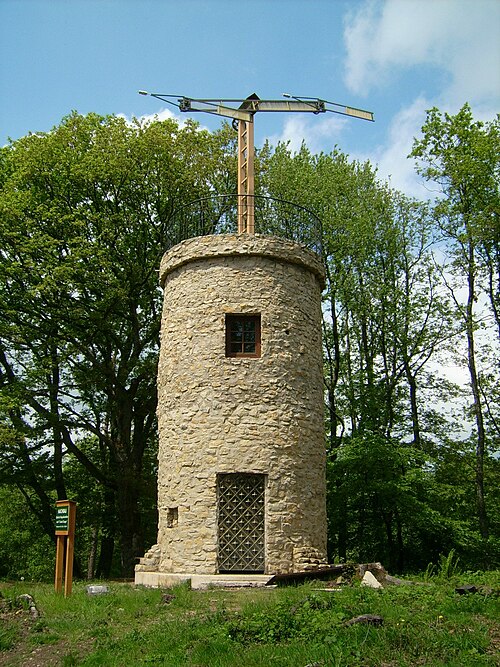
最も古く広く使われた真の電信は、18世紀後半にクロード・シャップが発明した光電信であるシャップ電信である。このシステムは、ナポレオン時代にフランスとフランスに占領されたヨーロッパ諸国で広く使われた。19世紀半ばには、光電信に代わって電気電信が使われるようになった。最初にイギリスで採用されたのはクックとホイートストンの電信で、当初は主に鉄道信号の補助として使われた。その後すぐに、アメリカでサミュエル・モールスが開発した別のシステムが続いた。フランスでは光電信システムが確立されていたため、電気電信の開発は遅かったが、シャップ光電信と互換性のあるコードを使用した電気電信が使用されるようになった。 1848年にドイツで開発された改良モールス信号を使用して、モールスシステムが1865年に国際標準として採用された。[1]
ヘリオグラフは、反射した太陽光を信号として利用する電信システムです。主に電信が確立されていない地域で使用され、一般的に同じコードが使用されていました。最も広範囲に及ぶヘリオグラフ ネットワークは、アパッチ戦争中にアリゾナ州とニュー メキシコ州で確立されました。ヘリオグラフは、第二次世界大戦後期まで軍の標準装備でした。20世紀初頭に開発された無線電信は、海上での使用に重要となり、国際通信において海底電信ケーブルを使用する電気電信の競合となりました。
電信料金が十分に下がると、電報はメッセージを送る一般的な手段となった。通信量が増えたため、テレプリンタやパンチテープ送信などの自動化システムが開発された。これらのシステムにより、ボードットコードに始まる新しい電信コードが生まれた。しかし、電信は料金面で郵便物と競争することはできず、電話との競争で速度の優位性が失われたため、1920年以降は電信は衰退した。20世紀末には、残っていた数少ない電信アプリケーションも、インターネット上の代替手段に大きく取って代わられた。
用語
テレグラフ(古代ギリシャ語のτῆλε(têle)「遠くに」とγράφειν(gráphein )「書く」に由来)という言葉は、セマフォ電信を発明したフランスのクロード・シャップによって造られ、彼はセマフォという言葉も造った。[2]
電信は、長距離にわたってメッセージを送受信するための装置、つまり電信のための装置です。電信という単語だけは通常、電気電信を指します。無線電信は、電信コードを使用して無線でメッセージを送信することです。
シャッペの広範な定義とは対照的に、モールスは、電信という用語は厳密には、離れた場所にメッセージを送信して記録するシステムにのみ適用できると主張した。これは、単にメッセージを送信するセマフォとは区別される。たとえば、煙信号はセマフォであり、電信ではない。モールスによると、電信の歴史は、パベル・シリングが最古の電気電信機の1つを発明した1832年にまで遡る。[3]
電気電信技師または電信技師がモールス信号を使用して(または印刷電信技師がプレーンテキストを使用して)送信した電信メッセージは、テレグラムとして知られていました。ケーブルグラムは海底電信ケーブルによって送信されたメッセージであり、[4]しばしば「ケーブル」または「ワイヤー」と短縮されます。接尾辞 -gram は古代ギリシャ語のγραμμα ( gramma ) に由来し、書かれたものを意味します。つまり、テレグラムは遠くに書かれたものを意味し、ケーブルグラムはケーブルを介して書かれたものを意味しますが、テレグラフは遠くに書くプロセスを意味します。
その後、テレックスは、電話ネットワークに似た テレプリンターの交換ネットワークであるテレックスネットワークによって送信されるメッセージになりました。
電信写真または電信写真は、ファクシミリ電信によって遠隔地から送信された新聞写真である。外交電報は外交ケーブルとも呼ばれ、外交使節団と本国の外務省との間の機密通信である。 [5] [6]これらは、送信に使用された方法に関係なく、電報またはケーブルと呼ばれ続けている。
歴史
早期シグナル

信号を発信して遠くまでメッセージを渡すことは、古くから行われている。最も古い例の1つは、万里の長城の狼煙塔である。紀元前400年には、狼煙や太鼓の音で信号を送ることができた。紀元前200年までには複雑な旗信号が開発され、漢の時代(紀元前200年-紀元後220年)には、信号手は信号を送るために光、旗、または銃声を選択できるようになった。唐の時代(618年-907年)には、24時間で1,100キロメートル(700マイル)にメッセージを送ることができた。明の時代(1368年-1644年)には、信号に大砲が加わった。信号は複雑であったが(たとえば、異なる色の旗を使用して敵の強さを示すことができた)、送信できたのは事前に決められたメッセージのみであった。[7]中国の信号システムは万里の長城をはるかに超えて広がっていた。城壁から離れた場所にある信号塔は、攻撃の早期警告を発するために使われました。また、交易路、特にシルクロードを守るため、さらに離れた場所に信号塔が建てられました。[8]
狼煙はヨーロッパやその他の地域で軍事目的で広く使用されていた。ローマ軍は敵軍同様、狼煙を頻繁に使用し、現在でもいくつかの信号所の跡が残っている。ヨーロッパ/地中海の信号システムとそのメッセージについては、詳細はほとんど記録されていない。詳細が知られている数少ないものの 1 つは、アイネイアス・タクティクス(紀元前 4 世紀) が発明したシステムである。タクティクスのシステムでは、2 つの信号所に水を入れた壺があり、同期して排水された。浮き目盛りに書かれた目盛りは、どのメッセージが送信または受信されているかを示した。松明で送られる信号は、同期を保つために排水を開始および停止するタイミングを示した。[9]
上で説明した信号システムはいずれも、任意のメッセージを任意の距離に送信できるシステムという意味での真の電信ではありません。信号中継局のラインは、必要な距離にメッセージを送信できますが、これらすべてのシステムは、送信できるメッセージの範囲がある程度制限されています。アルファベットコードを使用する旗式セマフォのようなシステムは、確かに任意のメッセージを送信できますが、このシステムは 2 人の間の短距離通信用に設計されています。船のブリッジから機関室に指示を送信するために使用される機関命令電信は、距離が制限され、メッセージ セットが非常に単純であるため、両方の基準を満たしていません。これらの基準を満たす古代の信号システムは 1 つしか説明されていません。それは、アルファベットをエンコードするためにポリビウス方陣を使用するシステムでした。ポリビウス(紀元前 2 世紀) は、送信されるアルファベットの文字の座標を識別するために、2 つの連続した松明のグループを使用することを提案しました。掲げられた松明の数によって、文字を含むグリッド方陣が示されました。このシステムが実際に使用されたという明確な記録はないが、古代の文献にはそれを示唆すると思われる箇所がいくつかある。例えばホルツマンとペルソンは、リウィウスが紀元前207年の第一次マケドニア戦争中にマケドニア王フィリップ5世がこのシステムを使用したことを記述していると示唆している。真の電信と言えるものは17世紀まで存在しなかった。[9] [10] : 26–29 おそらく近代最初のアルファベット電信コードは、1616年に著作を発表したフランツ・ケスラーによるものである。ケスラーはバレルの中にランプを入れ、信号手がシャッターを操作した。信号は新しく発明された望遠鏡で遠くから観測された。[10] : 32–34
光電信

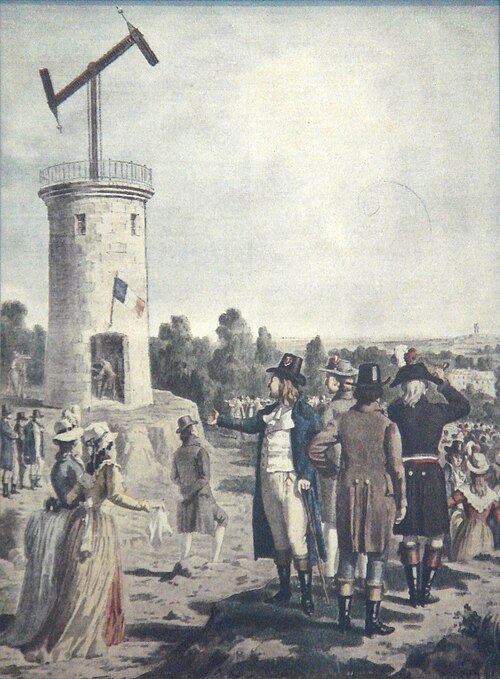
光電信は、塔や自然の高所に設置された一列の局から成り、シャッターやパドルで互いに信号を送る電信である。指示ポインターによる信号はセマフォと呼ばれた。光電信システムの初期提案は、1684年にロバート・フックによって王立協会に提出され[11] 、 1767年にリチャード・ラヴェル・エッジワース卿によって初めて実験レベルで実施された。[12]最初に成功した光電信ネットワークはクロード・シャップによって発明され、1793年からフランスで運用された。[13]最も大規模な2つのシステムは、近隣諸国に支線を持つフランスのシャップのシステムと、スウェーデンのアブラハム・ニクラス・エーデルクランツのシステムであった。[10] : ix–x, 47
1790年から1795年にかけてのフランス革命の真っただ中、フランスは敵の戦争活動を阻止するために迅速で信頼性の高い通信システムを必要としていました。1790年、シャップ兄弟は、中央政府が情報を受け取り、命令を可能な限り短時間で伝達できる通信システムの考案に着手しました。1791年3月2日午前11時、彼らは「si vous réussissez, vous serez bientôt couverts de gloire」(成功すれば、すぐに栄光に浸れるだろう)というメッセージを、16キロメートル(10マイル)離れたブリュロンとパルセの間で送信しました。最初の手段では、白黒のパネル、時計、望遠鏡、暗号帳を組み合わせてメッセージを送信しました。
1792年、クロードは電信技師に任命され、パリとリールの間の230キロメートル (140 マイル) の距離に電信局を設置する任務を負った。この電信局はフランスとオーストリアの戦争の通信を運ぶために使用された。1794年には、フランス軍がコンデ=シュル=レスコーを占領したという知らせをオーストリア軍から1時間も経たないうちに電信局から受け取った。[14]このシステムを電信局に置き換える決定は1846年に下されたが、完全に廃止されるまでには10年を要した。セヴァストポリの陥落は1855年にシャップ電信局によって報じられた。[10] : 92–94
プロイセンのシステムは1830年代に導入されました。しかし、このシステムは天候と日光に大きく依存しており、それでも1分間に2語程度しか通信できませんでした。最後の商用セマフォリンクは1880年にスウェーデンで運用が停止されました。1895年時点で、フランスは船舶と陸上の通信のために沿岸商用セマフォ電信局をまだ運用していました。[15]
電気電信

電信の初期のアイデアには、1753年のピスボールの静電偏向の使用、[16]、1804年のカンピロと1809年のゾンメリングによる酸の電気化学泡の提案などがあった。[ 17 ] [ 18 ]かなりの距離を伝送する最初の実験システムは、1816年にロナルズが静電発電機を使用して行ったものである。ロナルズはこの発明を英国海軍本部に提案したが、不要として却下され、[19]ロンドンの海軍本部とポーツマスの主要艦隊基地を結ぶ既存の光電信で十分であると判断された。1844年に電気電信が使用されるようになった後も、海軍本部の光電信は依然として使用されていたが、年間を通じて天候不良で使用できない日が多いことは認められていた。[20] : 16, 37 フランスにはナポレオンの時代から続く大規模な光電信システムがあり、電気システムの導入はさらに遅かった。[21] : 217–218
最終的に静電電信は放棄され、電磁システムが採用された。初期の実験システム(シリング、1832年)はサンクトペテルブルクとクロンシュタットの間に電信を設置する提案につながったが、完成することはなかった。[22]最初に機能した電信(ガウスとウェーバー、1833年)は、地磁気の実験調査中にゲッティンゲン天文台と約1km離れた物理学研究所を結んだ。[23]
最初の商用電信は、1837年6月10日の英国特許取得後のクックとウィートストンによるもので、同年7月にロンドン・バーミンガム鉄道で実演された。 [24] 1839年7月、5本針5線式システムが設置され、グレート・ウェスタン鉄道のロンドン・パディントン駅からウェスト・ドレイトン駅の間の区間に、記録的な21kmの距離に信号が送られた。[25] [26]しかし、鉄道会社に彼の電信を鉄道信号に広く採用してもらおうとしたが、クックはより馴染み深いがより距離の短い蒸気動力の空気圧信号方式を優先し、何度も拒否された。彼の電信が採用されたときでさえ、それは実験的なものとみなされ、会社はスラウまで電信線を延長する資金を提供する計画を撤回した。しかし、このことが電信の躍進につながった。この時点ではグレート・ウェスタン鉄道が独占使用を主張し、クックに公衆電信局を開設する許可を与えていなかったからである。クックは自費で路線を延長し、鉄道会社が路線を自由に使用できる代わりに、それを一般に公開する権利を与えることに同意した。[20] : 19–20
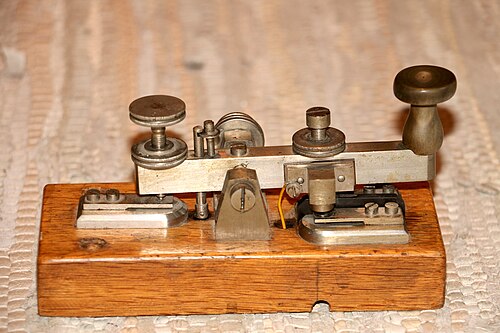
初期の電気システムのほとんどは複数の配線を必要としたが(ロナルズのシステムは例外)、米国でモールスとベイルが開発したシステムは単線システムだった。これは、すぐに普及するモールス信号を初めて使用したシステムだった。[24] 1844年までに、モールス信号システムはボルチモアとワシントンを接続し、1861年までに大陸の西海岸は東海岸に接続されました。[27] [28]クックとホイートストンの電信も、一連の改良の末、最終的に単線システムになりましたが、独自のコードと針表示を使用していました。[25]
電信はすぐに、より一般的な通信手段となった。モールス信号は1851年に改訂されたコードとともにヨーロッパ大陸の電信の標準として正式に採用され、これが後に国際モールス信号の基礎となった。[29]しかし、イギリスと大英帝国は、1930年代まで、一部の地域ではクックとホイートストンの信号を使い続けた。[25]同様に、アメリカ合衆国も国内ではアメリカモールス信号を使い続け、国際的なメッセージには両方のコードに精通した翻訳者が必要であった。[29]
鉄道電信

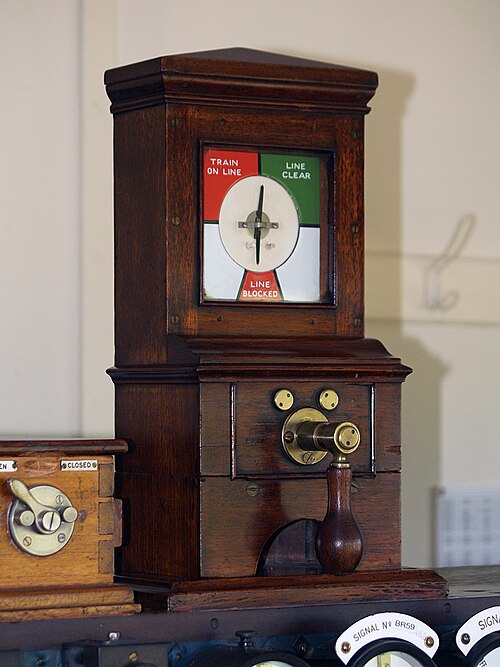
鉄道信号電信は1840年代以降イギリスで開発された。鉄道信号システムの一部として、鉄道の交通管理や事故防止に使用された。1837年6月12日、クックとホイートストンは電信の特許を取得した。[30]これはホイートストンがいたユーストン駅と、クックがロンドン・アンド・バーミンガム鉄道の主任技師ロバート・スティーブンソンとともに勤務していたカムデン・タウンの機関庫の間で実証された。メッセージは、77分の1の斜面を列車を引き上げるためのロープ牽引システムの操作に関するものだった。世界初の常設鉄道電信は、1839年7月にグレート・ウェスタン鉄道のロンドン・パディントンとウェスト・ドレイトンの間で、4針システムを使用した電信によって完成した。
信号「ブロック」システムの概念は、1842 年にクックによって提案されました。鉄道信号電信は、1 世紀以上にわたってクックの最初の概念から本質的に変化しませんでした。このシステムでは、各鉄道線路がさまざまな長さのセクションまたはブロックに分割されていました。ブロックへの出入りは電信によって許可され、線路脇の腕木信号によって信号が送られるため、線路を占有できるのは 1 本の列車のみでした。クックの元のシステムでは、1 本の針の電信が「線路クリア」と「線路ブロック」の 2 つのメッセージのみを示すように調整されていました。信号手は、それに応じて線路脇の信号を調整しました。1844 年に最初に実装されたとき、各駅には線路上の駅と同じ数の針があり、交通状況を完全に把握できました。線路が拡張されるにつれて、1 本の針の計器のペアが採用され、各方向の各ブロックに 1 組ずつ配置されました。[31]
ウィグワグ
ウィグワグは、旗信号の一種で、単一の旗を使用する。比較的短い距離で使用されるほとんどの旗信号とは異なり、ウィグワグはカバーする距離を最大化するように設計されており、場合によっては最大32 km (20 mi)に達する。ウィグワグは、大きな旗を使用することでこれを実現した。旗手信号機では両手に旗を1つずつ持つのに対し、ウィグワグでは両手で1つの旗を持つことができる。また、位置ではなく動きをシンボルとして使用しており、動きの方が見やすいためである。これは、1850年代に米国陸軍の軍医で、後に通信部隊の初代指揮官となったアルバート・J・マイヤーによって発明された。ウィグワグは、南北戦争中に電信が残した空白を埋めるために広く使用された。電信は10年以上使用されていたが、ネットワークはまだどこにでも届いておらず、軍事用に適切な持ち運び可能な耐久性の高い機器はすぐには利用できなかった。戦時中は恒久的または半恒久的な通信局が設立され、その中には巨大な塔もあり、通信システムは通信ネットワークと呼べるほど広範囲に及んでいた。[32] [33]
ヘリオグラフ

.jpg/500px-11903A_LO_with_Heliograph_CA_1912_(22762702845).jpg)
ヘリオグラフは、鏡で太陽光をフラッシュしてメッセージを送信する電信機で、通常はモールス信号を使用します。このタイプの電信機のアイデアは、測量機器の改良として最初に提案されました ( Gauss、1821)。その後、主に軍事目的で通信に鏡がさまざまな用途で使用されましたが、広く使用されるようになった最初の装置は可動式の鏡を備えたヘリオグラフでした ( Mance 、1869)。このシステムは、1870年から71年のパリ包囲戦でフランスによって使用され、夜間の信号には灯油ランプが光源として使用されました。改良版 ( Begbie 、1870) は、アングロ・ズールー戦争(1879) を含む多くの植民地戦争でイギリス軍によって使用されました。ある時点で、モールスキーが装置に追加され、オペレーターは電信と同じ程度の制御が可能になりました。[34]
ヘリオグラフの別のタイプは、コロンブシャッターを備えたヘリオスタットまたはヘリオトロープである。ヘリオスタットは本質的には固定された鏡を備えた測量機器であるため、それ自体ではコードを送信できなかった。この由来のため、ヘリオスタットという用語はヘリオグラフの同義語として使用されることがある。コロンブシャッター(ボルトンとコロンブ、1862年)は、もともと海上でイギリス海軍の艦船間で信号灯によるモールス信号の送信を可能にするために発明された。[34]
ヘリオグラフは、アパッチ戦争でジェロニモや他のアパッチ族との戦いの指揮を引き継いだ後(1886年) 、アリゾナ州とニューメキシコ州でネルソン・A・マイルズによって頻繁に使用された。マイルズはそれ以前に、モンタナ州のフォート・キーオとフォート・カスターの間に米国初のヘリオグラフ回線を設置していた。マイルズはヘリオグラフを使用して、電信がカバーしていなかった広大で人口の少ない地域を埋めた。26の局が320×480 km(200×300マイル)の地域をカバーした。このシステムのテストでは、メッセージは4時間で640 km(400マイル)中継された。マイルズの敵は煙信号と金属からの太陽光の閃光を使用していたが、高度な電信コードを持っていなかった。[35]ヘリオグラフは、局を設置できる山岳地帯と澄んだ空気のため、アメリカ南西部での使用に最適であった。モールス符号のダッシュ(アメリカのモールス符号では現代の国際モールス符号よりもはるかに短い)を長くして、モールス符号のドットと区別しやすくする必要があることがわかった。[34]
ヘリオグラフの使用は1915年以降減少したが、イギリスとイギリス連邦諸国ではしばらく使われ続けた。オーストラリア軍は1942年まで第二次世界大戦の西部砂漠作戦でヘリオグラフを使用していた。ソ連・アフガニスタン戦争(1979年~1989年)ではムジャヒディーンが何らかの形のヘリオグラフを使用した。 [34]
テレプリンター
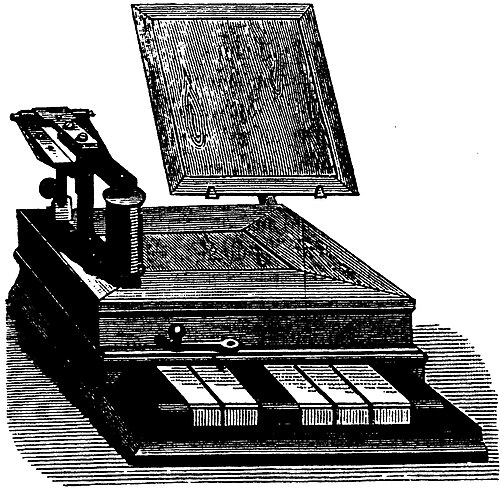

テレプリンターは、タイプライターのようなキーボードからメッセージを送信し、受信したメッセージを判読可能なテキストで印刷できる電信機です。オペレーターは、回線で使用される電信コードの訓練を受ける必要はありません。これは、以前のさまざまな印刷電信から発展したもので、伝送速度が向上しました。[36]モールス電信(1837) は、もともと紙テープにくぼみを付けるシステムとして考案されました。青いマークを付ける化学電信により記録速度が向上しましたが ( Bain、1846)、モールスの特許異議申し立てにより遅れました。最初の真の印刷電信 (つまり、プレーンテキストでの印刷) は、デイジーホイールプリンターのように回転する活字ホイールを使用しました( House、1846、Hughes 、1855 により改良)。このシステムはWestern Unionによって採用されました。[37]
初期のテレタイプライターは、5ビットの連続バイナリコードであるBaudotコードを使用していました。これは、5キーキーボードを使用するフランスの電信で使用するために開発された電信コードでした( Baudot、1874年)。テレタイプライターは、完全な英数字キーボードから同じコードを生成しました。Baudotコードとその後の電信コードの特徴は、モールス信号とは異なり、すべての文字が同じ長さのコードであるため、機械にとって使いやすいことです。[38] Baudotコードは、上場企業の現在の株価に関する情報を大量に配信するシステムである、最も初期のティッカーテープマシン(Calahan 、1867年)で使用されました。[39]
自動パンチテープ伝送

パンチテープシステムでは、まず電信システムのコード(モールス信号など)を使用して、パンチテープにメッセージがタイプされます。その後、すぐにまたはしばらくしてから、送信機に送られ、電信ネットワークにメッセージが送信されます。同じテープに複数のメッセージを連続して記録できます。これを行う利点は、利用可能な電信回線を最大限に活用して、メッセージを一定かつ高速で送信できることです。これを行うことによる経済的な利点は、テープを準備する余分な手順のコストが、より多くの電信回線を提供するコストを上回る、長くて混雑したルートで最も大きくなります。パンチテープを使用した最初のマシンは、Bain のテレプリンター(Bain、1843 年)でしたが、このシステムは限られた用途しか使用されませんでした。Bain のシステムの後のバージョンでは、人間のオペレーターが達成できる速度をはるかに上回る、1 分あたり 1,000 語の速度が達成されました。[40]
最初に広く使われたシステム(ホイートストン、1858年)は、1867年にイギリス郵便局で初めて運用されました。ホイートストンシステムの新しい特徴は、バイポーラエンコーディングの使用でした。つまり、正極性と負極性の両方の電圧が使用されました。[41]バイポーラエンコーディングにはいくつかの利点がありますが、その1つは、二重通信を可能にすることです。 [42]ホイートストンテープリーダーは、毎分400ワードの速度が可能でした。[43] : 190
海洋電信ケーブル


世界的な通信網を構築するには、海をまたいで電信ケーブルを敷設する必要がある。陸上では、ケーブルを絶縁せずに柱から吊るすことができる。水中では、柔軟で海水の浸入に耐えられる優れた絶縁体が必要だった。 1843年にウィリアム・モンゴメリーがシンガポールからロンドンにサンプルを送った後、パラキウム・ガッタの木から採れる天然ゴム、ガッタパーチャが解決策として浮かび上がった。この新素材はマイケル・ファラデーによってテストされ、1845年にホイートストンは、ジョン・ワトキンス・ブレットが計画していたドーバーとカレー間のケーブルに使用すべきだと提案した。サウス・イースタン鉄道会社がフォークストン沖の船への電信メッセージを載せた3キロメートル(2マイル)のガッタパーチャ絶縁ケーブルのテストに成功したことで、このアイデアは実現可能であることが証明された。[44]フランスへのケーブルは1850年に敷設されたが、すぐにフランスの漁船によって切断された。[45]翌年再敷設され[45] 、アイルランドと低地諸国への接続もすぐに続きました。
大西洋を横断するケーブルの敷設は、はるかに困難であることが判明した。1856年にロンドンで設立されたアトランティック・テレグラフ・カンパニーは、数回の失敗を経験している。1858年に敷設されたケーブルは、ウィリアム・トムソン(後のケルビン卿)が開発した高感度ミラー検流計を使用していたにもかかわらず、メッセージを送信するのに丸一日かかることがあり、高電圧をかけすぎたために破損した。ケーブルの故障と伝送速度の遅さから、トムソンとオリバー・ヘヴィサイドは、長距離伝送線路のより優れた数学的記述を見つけることになった。[46]同社は最終的に1866年に、当時最大の船でイザムバード・キングダム・ブルネルが設計したSSグレート・イースタンで敷設された改良ケーブルで成功した。[47] [46]
イギリスからインドへの陸上電信は1866年に初めて接続されましたが、信頼性が低かったため、1870年に海底電信ケーブルが接続されました。[48] 1872年にいくつかの電信会社が統合され、イースタン・テレグラフ・カンパニーが設立されました。オーストラリアは1872年10月にダーウィンで海底電信ケーブルによって初めて世界と接続されました。[49]
1850年代から20世紀に入っても、イギリスの海底ケーブルシステムは世界のシステムを支配していた。これは正式な戦略目標として設定され、オールレッドラインとして知られるようになった。[50] 1896年には、世界には30隻のケーブル敷設船があり、そのうち24隻はイギリスの会社が所有していた。1892年には、イギリスの会社が世界のケーブルの3分の2を所有し、運営しており、1923年までにそのシェアは42.7パーセントであった。[51]第一次世界大戦中、イギリスの電信通信はほぼ完全に中断されず、ドイツの世界中のケーブルを迅速に切断することができた。[50]
ファクシミリ
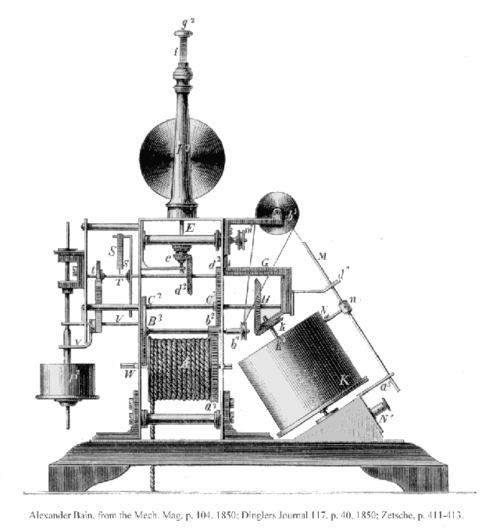
1843年、スコットランドの発明家アレクサンダー・ベインは、世界初のファクシミリ機とも言える装置を発明した。彼はこの発明を「記録電信機」と呼んだ。ベインの電信機は電線で画像を送信できた。フレデリック・ベイクウェルはベインの設計にいくつかの改良を加え、テレファックス機を実演した。1855年、イタリアの司祭ジョヴァンニ・カゼッリも画像を送信できる電信機を開発した。カゼッリは発明を「パンテレグラフ」と呼んだ。パンテレグラフは試験に成功し、パリとリヨンを結ぶ電信線に採用された。[52] [53]
1881年、イギリスの発明家シェルフォード・ビッドウェルは、手動のプロットや描画を必要とせず、あらゆる2次元原稿をスキャンする最初のテレファックス機である走査型写真電信機を製作しました。1900年頃、ドイツの物理学者アーサー・コーンは、 1908年にパリからロンドンへの指名手配犯の写真の送信が広く注目されて以来、特に大陸ヨーロッパで広く普及したビルトテレグラフを発明し、無線ファックスが広く普及するまで使用されました。その主な競合製品は、最初はエドゥアール・ベリンによるベリノグラフであり、その後1930年代以降は、機械的な画像スキャンと送信の先駆者であるドイツの発明家ルドルフ・ヘルが1929年に発明したヘルシュライバーでした。
無線通信

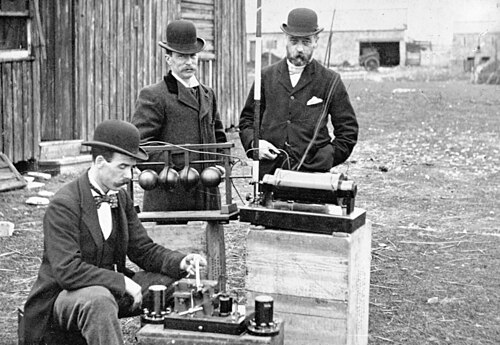
1880年代後半から1890年代にかけて、新たに発見された現象が無線電信の形態に発展した。この現象はヘルツ波無線電信、無線電信、または(後に)単に「ラジオ」と呼ばれるようになった。1886年から1888年にかけて、ハインリッヒ・ルドルフ・ヘルツは、電磁波(電波)を空気中に送信する実験の結果を発表し、ジェームズ・クラーク・マクスウェルの1873年の電磁放射理論を証明した。多くの科学者や発明家がこの新しい現象の実験を行ったが、これらの新しい波(光に似ている)は光と同じくらい短距離であり、したがって長距離通信には役に立たないというのがコンセンサスだった。[55]
1894年の終わりに、イタリアの若き発明家グリエルモ・マルコーニは、ヘルツ波(電波)を利用した商用無線電信システムの構築に着手した。マルコーニは、他の発明家がこの研究を進めていないことに気づいた。[56]マルコーニは、以前の科学者や発明家のアイデアを基に、試行錯誤を繰り返して装置を再設計し、有線電信と同じように機能する無線ベースの無線電信システムの構築を試みた。1895年を通して研究室で、その後はフィールドテストで改良を重ね、範囲を拡張した。送信機と受信機を接地するという有線電信のコンセプトを適用するなど、多くのブレークスルーを経て、マルコーニは1896年初頭までに、予測されていた短距離をはるかに超えて無線を送信できるようになった。[57]イタリア政府の関心を引かなかった22歳の発明家は、1896年に電信システムをイギリスに持ち込み、この分野の重要人物であり、郵政省の主任技師であったウェールズ人のウィリアム・プリースと出会った。その後、イギリス政府のために一連のデモンストレーションが行われ、1897年3月までにマルコーニは約6km(3マイル)の距離にモールス信号を送信した。+ソールズベリー平原を横切る全長1 ⁄ 2 マイル。
1897年5月13日、マルコーニはカーディフ郵便局の技師ジョージ・ケンプの協力を得て、フラットホルムからラバノック(ウェールズのペナース近郊)へ水上無線信号を送信した。[58]マルコーニはスターとなり、すぐにイギリス海峡(1899年)、陸から船(1899年)、そしてついに大西洋(1901年)を越えて信号を送信した。[59]科学者たちは、短距離と予測された現象がどのようにして「地平線を越えて」送信できるのかを解明しようとし、これらの無線のデモンストレーションの研究は、1902年に地球の大気圏に電波を反射する層を発見することにつながった。これは後に電離層と呼ばれるようになった。[60]
無線電信は、船舶間および船舶から陸地への効率的な通信を可能にし、海難事故の救助活動に効果的であることが証明された。1904年、マルコーニは、購読している船舶に夜間のニュース要約を送信する最初の商用サービスを開始し、船舶はそれを船内の新聞に組み込むことができた。定期的な大西洋横断無線電信サービスは、1907年10月17日にようやく開始された。 [61] [62]特筆すべきことに、マルコーニの装置は、 RMS タイタニック号の沈没後の救助活動に使用された。イギリスの郵政長官は、タイタニック号の惨事について、「救われた人々は、マルコーニ氏という一人の人物と彼の素晴らしい発明によって救われた」と総括した。
非無線無線通信
無線電信の成功した開発に先立って、発明家たちが他の手段で無線電信を実現しようと独創的だが結局は失敗に終わった実験を50年にわたって繰り返してきました。
地面、水、空気の伝導
実用的な無線システムが利用可能になる前に、電流は水、地面、空気を通して長距離伝導できるという(時には誤った)考えに基づいたいくつかの無線電気信号方式が電信用に研究されました。
元々の電信線は、2 つの局の間に 2 本の電線を使用して完全な電気回路、つまり「ループ」を形成していました。しかし、1837 年にドイツのミュンヘンのカール アウグスト フォン シュタインハイルは、各局の装置の 1 つの脚を地中に埋めた金属板に接続することで、1 本の電線をなくし、電信通信に 1 本の電線を使用できることを発見しました。これにより、両方の電線をなくして、局間を接続する電線なしで地中から電信信号を送信できる可能性があるという推測が生まれました。他にも、たとえば川を渡るために水域に電流を送る試みが行われました。この分野で著名な実験者には、米国のサミュエル FB モースと英国のジェームズ ボーマン リンゼイがいます。リンゼイは 1854 年 8 月に、500 ヤード (457 メートル) の距離にある工場のダムを越えた送信を実証しました。[63]
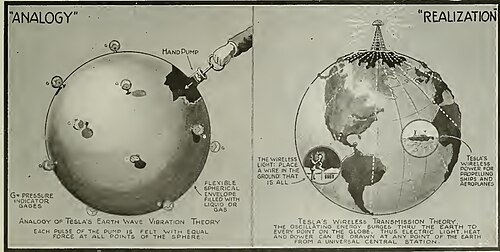
米国の発明家ウィリアム・ヘンリー・ウォード(1871年)とマロン・ルーミス(1872年)は、低高度でアクセスできる帯電した大気層があるという誤った考えに基づいて、電気伝導システムを開発した。[64] [ 65]彼らは、大気電流を「地電流」を使用した戻り経路に接続することで、無線電信が可能になり、人工電池を使わずに電信機に電力を供給できると考えた。[66] [67]伝導による無線送信のより実用的なデモンストレーションは、エイモス・ドルベアの1879年の磁気電気電話で行われ、地面伝導を使用して4分の1マイルの距離を送信した。[68]
1890年代、発明家のニコラ・テスラはルーミスのシステムと同様の空中および地面伝導無線電力伝送システムに取り組み、[69] [70] [71]これに無線電信を含めることを計画していた。テスラの実験により、彼は地球全体を電気エネルギーの伝導に使用できるという誤った結論に至り、[72] [68]彼のアイデアを1901年に大規模に応用した高電圧無線発電所(現在はウォーデンクリフタワーと呼ばれる)は資金を失い、数年後に放棄された。
結局、大地の導電性を利用した電信通信は、水を介して行われた通信や第一次世界大戦中の塹壕間で行われた通信と同様に、非現実的なほど短い距離に制限されることが判明しました。
静電誘導と電磁誘導
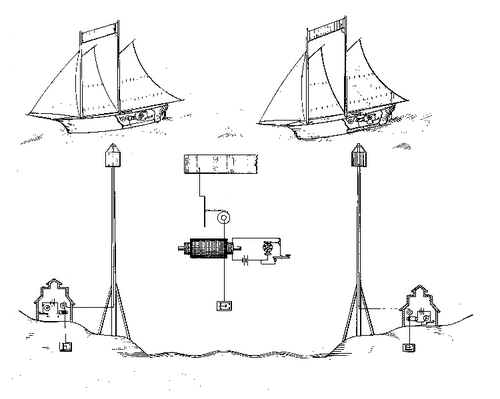
静電誘導と電磁誘導はどちらも、限られた商業的応用しか見られない無線電信システムの開発に使われた。米国では、トーマス・エジソンが1880年代半ばに「グラスホッパー電信」と名付けた電磁誘導システムの特許を取得した。このシステムでは、走行中の列車と線路に平行に走る電信線の間の短い距離を電信信号が飛び越えることが可能だった。[73]このシステムは技術的には成功したが、経済的には成功しなかった。列車の乗客は車内電信サービスの利用にほとんど関心を示さなかったためである。1888年の大吹雪の際、このシステムは雪の吹き溜まりに埋もれた列車から無線メッセージを送受信するために使用された。故障した列車はエジソン誘導無線電信システムを介して通信を維持することができた。 [74]これはおそらく、遭難信号を送るための無線電信の初めての成功した使用法である。エジソンは、静電誘導に基づく船舶と陸上の通信システムの特許取得にも協力した。[75]
The most successful creator of an electromagnetic induction telegraph system was William Preece, chief engineer of Post Office Telegraphs of the General Post Office (GPO) in the United Kingdom. Preece first noticed the effect in 1884 when overhead telegraph wires in Grays Inn Road were accidentally carrying messages sent on buried cables. Tests in Newcastle succeeded in sending a quarter of a mile using parallel rectangles of wire.[20]: 243 In tests across the Bristol Channel in 1892, Preece was able to telegraph across gaps of about 5 kilometres (3.1 miles). However, his induction system required extensive lengths of antenna wires, many kilometers long, at both the sending and receiving ends. The length of those sending and receiving wires needed to be about the same length as the width of the water or land to be spanned. For example, for Preece's station to span the English Channel from Dover, England, to the coast of France would require sending and receiving wires of about 30 miles (48 kilometres) along the two coasts. These facts made the system impractical on ships, boats, and ordinary islands, which are much smaller than Great Britain or Greenland. Also, the relatively short distances that a practical Preece system could span meant that it had few advantages over underwater telegraph cables.
Telegram services


A telegram service is a company or public entity that delivers telegraphed messages directly to the recipient. Telegram services were not inaugurated until electric telegraphy became available. Earlier optical systems were largely limited to official government and military purposes.
Historically, telegrams were sent between a network of interconnected telegraph offices. A person visiting a local telegraph office paid by the word to have a message telegraphed to another office and delivered to the addressee on a paper form.[76]: 276 Messages (i.e. telegrams) sent by telegraph could be delivered by telegram messenger faster than mail,[39] and even in the telephone age, the telegram remained popular for social and business correspondence. At their peak in 1929, an estimated 200 million telegrams were sent.[76]: 274
In 1919, the Central Bureau for Registered Addresses was established in the financial district of New York City. The bureau was created to ease the growing problem of messages being delivered to the wrong recipients. To combat this issue, the bureau offered telegraph customers the option to register unique code names for their telegraph addresses. Customers were charged $2.50 per year per code. By 1934, 28,000 codes had been registered.[77]
Telegram services still operate in much of the world (see worldwide use of telegrams by country), but e-mail and text messaging have rendered telegrams obsolete in many countries, and the number of telegrams sent annually has been declining rapidly since the 1980s.[78] Where telegram services still exist, the transmission method between offices is no longer by telegraph, but by telex or IP link.[79]
Telegram length
As telegrams have been traditionally charged by the word, messages were often abbreviated to pack information into the smallest possible number of words, in what came to be called "telegram style".
The average length of a telegram in the 1900s in the US was 11.93 words; more than half of the messages were 10 words or fewer.[80] According to another study, the mean length of the telegrams sent in the UK before 1950 was 14.6 words or 78.8 characters.[81] For German telegrams, the mean length is 11.5 words or 72.4 characters.[81] At the end of the 19th century, the average length of a German telegram was calculated as 14.2 words.[81]
Telex
.jpg/500px-ITT_Creed_Model_23B_teleprinter_(46479610772).jpg)
Telex (telegraph exchange) was a public switched network of teleprinters. It used rotary-telephone-style pulse dialling for automatic routing through the network. It initially used the Baudot code for messages. Telex development began in Germany in 1926, becoming an operational service in 1933 run by the Reichspost (the German imperial postal service). It had a speed of 50 baud—approximately 66 words per minute. Up to 25 telex channels could share a single long-distance telephone channel by using voice frequency telegraphy multiplexing, making telex the least expensive method of reliable long-distance communication.[82] Telex was introduced into Canada in July 1957, and the United States in 1958.[83] A new code, ASCII, was introduced in 1963 by the American Standards Association. ASCII was a seven-bit code and could thus support a larger number of characters than Baudot. In particular, ASCII supported upper and lower case whereas Baudot was upper case only.
Decline
Telegraph use began to permanently decline around 1920.[20]: 248 The decline began with the growth of the use of the telephone.[20]: 253 Ironically, the invention of the telephone grew out of the development of the harmonic telegraph, a device which was supposed to increase the efficiency of telegraph transmission and improve the profits of telegraph companies. Western Union gave up its patent battle with Alexander Graham Bell because it believed the telephone was not a threat to its telegraph business. The Bell Telephone Company was formed in 1877 and had 230 subscribers which grew to 30,000 by 1880. By 1886 there were a quarter of a million phones worldwide,[76]: 276–277 and nearly 2 million by 1900.[43]: 204 The decline was briefly postponed by the rise of special occasion congratulatory telegrams. Traffic continued to grow between 1867 and 1893 despite the introduction of the telephone in this period,[76]: 274 but by 1900 the telegraph was definitely in decline.[76]: 277
There was a brief resurgence in telegraphy during World War I but the decline continued as the world entered the Great Depression years of the 1930s.[76]: 277 After the Second World War new technology improved communication in the telegraph industry.[84] Telegraph lines continued to be an important means of distributing news feeds from news agencies by teleprinter machine until the rise of the internet in the 1990s. For Western Union, one service remained highly profitable—the wire transfer of money. This service kept Western Union in business long after the telegraph had ceased to be important.[76]: 277 In the modern era, the telegraph that began in 1837 has been gradually replaced by digital data transmission based on computer information systems.[84]
Social implications
Optical telegraph lines were installed by governments, often for a military purpose, and reserved for official use only. In many countries, this situation continued after the introduction of the electric telegraph. Starting in Germany and the UK, electric telegraph lines were installed by railway companies. Railway use quickly led to private telegraph companies in the UK and the US offering a telegraph service to the public using telegraph along railway lines. The availability of this new form of communication brought on widespread social and economic changes.
The electric telegraph freed communication from the time constraints of postal mail and revolutionized the global economy and society.[85][86] By the end of the 19th century, the telegraph was becoming an increasingly common medium of communication for ordinary people. The telegraph isolated the message (information) from the physical movement of objects or the process.[87]
There was some fear of the new technology. According to author Allan J. Kimmel, some people "feared that the telegraph would erode the quality of public discourse through the transmission of irrelevant, context-free information." Henry David Thoreau thought of the Transatlantic cable "...perchance the first news that will leak through into the broad flapping American ear will be that Princess Adelaide has the whooping cough." Kimmel says these fears anticipate many of the characteristics of the modern internet age.[88]
Initially, the telegraph was expensive, but it had an enormous effect on three industries: finance, newspapers, and railways. Telegraphy facilitated the growth of organizations "in the railroads, consolidated financial and commodity markets, and reduced information costs within and between firms".[86] In the US, there were 200 to 300 stock exchanges before the telegraph, but most of these were unnecessary and unprofitable once the telegraph made financial transactions at a distance easy and drove down transaction costs.[76]: 274–75 This immense growth in the business sectors influenced society to embrace the use of telegrams once the cost had fallen.
Worldwide telegraphy changed the gathering of information for news reporting. Journalists were using the telegraph for war reporting as early as 1846 when the Mexican–American War broke out. News agencies were formed, such as the Associated Press, for the purpose of reporting news by telegraph.[76]: 274–75 Messages and information would now travel far and wide, and the telegraph demanded a language "stripped of the local, the regional; and colloquial", to better facilitate a worldwide media language.[87] Media language had to be standardized, which led to the gradual disappearance of different forms of speech and styles of journalism and storytelling.
The spread of the railways created a need for an accurate standard time to replace local standards based on local noon. The means of achieving this synchronisation was the telegraph. This emphasis on precise time has led to major societal changes such as the concept of the time value of money.[76]: 273–74
During the telegraph era there was widespread employment of women in telegraphy. The shortage of men to work as telegraph operators in the American Civil War opened up the opportunity for women of a well-paid skilled job.[76]: 274 In the UK, there was widespread employment of women as telegraph operators even earlier – from the 1850s by all the major companies. The attraction of women for the telegraph companies was that they could pay them less than men. Nevertheless, the jobs were popular with women for the same reason as in the US; most other work available for women was very poorly paid.[38]: 77 [20]: 85
The economic impact of the telegraph was not much studied by economic historians until parallels started to be drawn with the rise of the internet. In fact, the electric telegraph was as important as the invention of printing in this respect. According to economist Ronnie J. Phillips, the reason for this may be that institutional economists paid more attention to advances that required greater capital investment. The investment required to build railways, for instance, is orders of magnitude greater than that for the telegraph.[76]: 269–70
Popular culture
The optical telegraph was quickly forgotten once it went out of service. While it was in operation, it was very familiar to the public across Europe. Examples appear in many paintings of the period. Poems include "Le Telégraphe" by Victor Hugo, and the collection Telegrafen: Optisk kalender för 1858 by Elias Sehlstedt[89] is dedicated to the telegraph. In novels, the telegraph is a major component in Lucien Leuwen by Stendhal, and it features in The Count of Monte Cristo, by Alexandre Dumas.[10]: vii–ix Joseph Chudy's 1796 opera, Der Telegraph oder die Fernschreibmaschine, was written to publicise Chudy's telegraph (a binary code with five lamps) when it became clear that Chappe's design was being taken up.[10]: 42–43

Rudyard Kipling wrote a poem in praise of submarine telegraph cables; "And a new Word runs between: whispering, 'Let us be one!'"[90][91] Kipling's poem represented a widespread idea in the late nineteenth century that international telegraphy (and new technology in general)[92] would bring peace and mutual understanding to the world.[93] When a submarine telegraph cable first connected America and Britain, the Post[clarification needed] declared
It is the harbinger of an age when international difficulties will not have time to ripen into bloody results, and when, in spite of the fatuity and perveseness of rulers, war will be impossible.[94]
Newspaper names
Numerous newspapers and news outlets in various countries, such as The Daily Telegraph in Britain, The Telegraph in India, De Telegraaf in the Netherlands, and the Jewish Telegraphic Agency in the US, were given names which include the word "telegraph" due to their having received news by means of electric telegraphy. Some of these names are retained even though different means of news acquisition are now used.
See also
References
- ^ "History and technology of Morse Code". EDinformatics.
- ^ Shectman, Jonathan (2003). Groundbreaking Scientific Experiments, Inventions, and Discoveries of the 18th Century. Bloomsbury Academic. p. 172. ISBN 9780313320156.
- ^ Samuel F. B. Morse, Examination of the Telegraphic Apparatus and the Processes in Telegraphy Archived 27 October 2022 at the Wayback Machine, pp. 7–8, Philp & Solomons 1869 OCLC 769828711.
- ^ "Cablegram – Definition of cablegram by Merriam-Webster". merriam-webster.com. 27 July 2023.
- ^ "1,796 memos from US embassy in Manila in WikiLeaks 'Cablegate'". ABS–CBN Corporation. 29 November 2010. Retrieved 29 November 2010.
- ^ Definition of "cable", The Macquarie Dictionary (3rd ed.). Australia: Macquarie Library. 1997. ISBN 978-0-949757-89-0.
(n.) 4. a telegram sent abroad, especially by submarine cable. (v.) 9. to send a message by submarine cable.
- ^ Christopher H. Sterling, "Great Wall of China", pp. 197–198 in, Christopher H. Sterling (ed), Military Communications: From Ancient Times to the 21st Century, ABC-CLIO, 2008 ISBN 1851097325.
- ^ Morris Rossabi, From Yuan to Modern China and Mongolia, p. 203, Brill, 2014 ISBN 9004285296.
- ^ a b David L. Woods, "Ancient signals", pp. 24–25 in, Christopher H. Sterling (ed), Military Communications: From Ancient Times to the 21st Century, ABC-CLIO, 2008 ISBN 1851097325.
- ^ a b c d e f Gerard J. Holzmann; Björn Pehrson, The Early History of Data Networks, IEEE Computer Society Press, 1995 ISBN 0818667826.
- ^ "The Origin of the Railway Semaphore". Mysite.du.edu. Retrieved 17 June 2013.
- ^ Burns, Francis W. (2004). Communications: An International History of the Formative Years. IET. ISBN 978-0-86341-330-8.
- ^ "Semaphore | communications". Encyclopedia Britannica.
- ^ How Napoleon's semaphore telegraph changed the world Archived 24 August 2019 at the Wayback Machine, BBC News, Hugh Schofield, 16 June 2013
- ^ "A Semaphore Telegraph Station", Scientific American Supplement, 20 April 1895, page 16087.
- ^ E. A. Marland, Early Electrical Communication, Abelard-Schuman Ltd, London 1964, no ISBN, Library of Congress 64-20875, pages 17–19;
- ^ Jones, R. Victor Samuel Thomas von Sömmering's "Space Multiplexed" Electrochemical Telegraph (1808–10) Archived 11 October 2012 at the Wayback Machine, Harvard University website. Attributed to "Semaphore to Satellite", International Telecommunication Union, Geneva 1965.
- ^ Fahie, J. J. (1884), A History of Electric Telegraphy to the year 1837 (PDF), London: E. & F. N. Spon
- ^ Ronalds, B.F. (2016). "Sir Francis Ronalds and the Electric Telegraph". International Journal for the History of Engineering & Technology. 86: 42–55. doi:10.1080/17581206.2015.1119481. S2CID 113256632.
- ^ a b c d e f Kieve, Jeffrey L. (1973). The Electric Telegraph: A Social and Economic History. David and Charles. OCLC 655205099.
- ^ Jay Clayton, "The voice in the machine", ch. 8 in, Jeffrey Masten, Peter Stallybrass, Nancy J. Vickers (eds), Language Machines: Technologies of Literary and Cultural Production, Routledge, 2016 ISBN 9781317721826.
- ^ "Milestones:Shilling's Pioneering Contribution to Practical Telegraphy, 1828–1837". IEEE Global History Network. IEEE. Retrieved 26 July 2011.
- ^ R. W. Pohl, Einführung in die Physik, Vol. 3, Göttingen (Springer) 1924
- ^ a b Guarnieri, M. (2019). "Messaging Before the Internet—Early Electrical Telegraphs". IEEE Industrial Electronics Magazine. 13 (1): 38–41+53. doi:10.1109/MIE.2019.2893466. hdl:11577/3301045. S2CID 85499543.
- ^ a b c Anton A. Huurdeman, The Worldwide History of Telecommunications (2003) pp. 67–69
- ^ Roberts, Steven, Distant Writing
- ^ Watson, J.; Hill, A. (2015). Dictionary of Media and Communication Studies (9th ed.). London, UK: Bloomsbury – via Credo Reference.
- ^ "The First Transcontinental Telegraph System Was Completed October 24, 1861". America's Library. Retrieved 29 April 2019.
- ^ a b Lewis Coe, The Telegraph: A History of Morse's Invention and Its Predecessors in the United States, McFarland, p. 69, 2003 ISBN 0-78641808-7.
- ^ How the UK's railways shaped the development of the telegraph, British Telecom
- ^ Roberts, Steven, Distant Writing: 15. Railway Signal Telegraphy 1838 – 1868
- ^ Rebecca Raines, Getting the Message Through Archived 26 October 2019 at the Wayback Machine, US Government Printing Office, 1996 ISBN 0160872812.
- ^ Albert J. Myer, A Manual of Signals, D. Van Nostrand, 1866, OCLC 680380148.
- ^ a b c d David L. Woods, "Heliograph and mirrors", pp. 208–211 in, Christopher H. Sterling (ed), Military Communications: From Ancient Times to the 21st Century, ABC-CLIO, 2008 ISBN 1851097325.
- ^ Nelson A. Miles, Personal Recollections and Observations of General Nelson A. Miles, vol. 2, pp. 481–484, University of Nebraska Press, 1992 ISBN 0803281811.
- ^ "Typewriter May Soon Be Transmitter of Telegrams" (PDF), The New York Times, 25 January 1914
- ^ "David Edward Hughes". Clarkson University. 14 April 2007. Archived from the original on 22 April 2008.
- ^ a b Beauchamp, K.G. (2001). History of Telegraphy: Its Technology and Application. IET. pp. 394–395. ISBN 978-0-85296-792-8.
- ^ a b Richard E. Smith, Elementary Information Security, p. 433, Jones & Bartlett Publishers, 2015 ISBN 1284055949.
- ^ Anton A. Huurdeman, The Worldwide History of Telecommunications, p. 72, Wiley, 2003 ISBN 0471205052.
- ^ Ken Beauchamp, History of Technology, p. 87, Institution of Engineering and Technology, 2001 ISBN 0852967926.
- ^ Lewis Coe, The Telegraph: A History of Morse's Invention and Its Predecessors in the United States, pp. 16–17, McFarland, 2003 ISBN 0786418087.
- ^ a b Tom Standage, The Victorian Internet, Berkley, 1999 ISBN 0-425-17169-8.
- ^ Haigh, K R (1968). Cable Ships and Submarine Cables. London: Adlard Coles Ltd. pp. 26–27.
- ^ a b Solymar, Laszlo. The Effect of the Telegraph on Law and Order, War, Diplomacy, and Power Politics Archived 16 October 2015 at the Wayback Machine in Interdisciplinary Science Reviews, Vol. 25, No. 3, pp. 204 f. 2000. Accessed 1 August 2014.
- ^ a b Guarnieri, M. (2014). "The Conquest of the Atlantic". IEEE Industrial Electronics Magazine. 8 (1): 53–56/67. doi:10.1109/MIE.2014.2299492. S2CID 41662509.
- ^ Wilson, Arthur (1994). The Living Rock: The Story of Metals Since Earliest Times and Their Impact on Civilization. p. 203. Woodhead Publishing. ISBN 978-1-85573-301-5.
- ^ G.C. Mendis (1952). Ceylon Under the British. Asian Educational Services. p. 96. ISBN 978-81-206-1930-2.
- ^ Briggs, Asa and Burke, Peter: "A Social History of the Media: From Gutenberg to the Internet", p110. Polity, Cambridge, 2005.
- ^ a b Kennedy, P. M. (October 1971). "Imperial Cable Communications and Strategy, 1870–1914". The English Historical Review. 86 (341): 728–752. doi:10.1093/ehr/lxxxvi.cccxli.728. JSTOR 563928.
- ^ Headrick, D.R., & Griset, P. (2001). Submarine telegraph cables: business and politics, 1838–1939. The Business History Review, 75(3), 543–578.
- ^ "CASELLI". www.itisgalileiroma.it. Archived from the original on 17 August 2020. Retrieved 25 November 2013.
- ^ "The Institute of Chemistry - The Hebrew University of Jerusalem". huji.ac.il. Archived from the original on 6 May 2008.
- ^ "First Atlantic Ocean crossing by a wireless signal" Archived 26 March 2022 at the Wayback Machine. aerohistory.org. Retrieved 12 July 2012.
- ^ view was held by Nikola Tesla, Oliver Lodge, Alexander Stepanovich Popov, amongst others (also Brian Regal, Radio: The Life Story of a Technology, page 22)
- ^ John W. Klooster (2009). Icons of Invention: The Makers of the Modern World from Gutenberg to Gates. ABC-CLIO. p. 161. ISBN 978-0-313-34743-6.
- ^ Sungook Hong. Wireless: From Marconi's Black-box to the Audion. MIT Press - 2001, page 21.
- ^ "Marconi: Radio Pioneer". BBC South East Wales. Retrieved 12 April 2008.
- ^ "Letters to the Editor: Marconi and the History of Radio". IEEE Antennas and Propagation Magazine. 46 (2): 130. 2004. doi:10.1109/MAP.2004.1305565.
- ^ Victor L. Granatstein (2012). Physical Principles of Wireless Communications, Second Edition. CRC Press. p. 8. ISBN 978-1-4398-7897-2.
- ^ "The Clifden Station of the Marconi Wireless Telegraph System". Scientific American. 23 November 1907.
- ^ Second Test of the Marconi Over-Ocean Wireless System Proved Entirely Successful Archived 19 October 2013 at the Wayback Machine. Sydney Daily Post. 24 October 1907.
- ^ Fahie, J. J., A History of Wireless Telegraphy, 1838–1899, 1899, p. 29.
- ^ Christopher Cooper, The Truth About Tesla: The Myth of the Lone Genius in the History of Innovation, Race Point Publishing, 2015, pp. 154, 165
- ^ Theodore S. Rappaport, Brian D. Woerner, Jeffrey H. Reed, Wireless Personal Communications: Trends and Challenges, Springer Science & Business Media, 2012, pp. 211–215
- ^ Christopher Cooper, The Truth About Tesla: The Myth of the Lone Genius in the History of Innovation, Race Point Publishing, 2015, p. 154
- ^ Thomas H. White, section 21, MAHLON LOOMIS
- ^ a b Christopher Cooper, The Truth About Tesla: The Myth of the Lone Genius in the History of Innovation, Race Point Publishing, 2015, p. 165 [ISBN missing]
- ^ Proceedings of the United States Naval Institute – Volume 78 – p. 87
- ^ W. Bernard Carlson, Tesla: Inventor of the Electrical Age, Princeton University Press – 2013, p. H-45
- ^ Marc J. Seifer, Wizard: The Life and Times of Nikola Tesla: Biography of a Genius, Citadel Press – 1996, p. 107
- ^ Carlson, W. Bernard (2013). Tesla: Inventor of the Electrical Age. Princeton University Press. p. 301. ISBN 1400846552
- ^ (U.S. patent 465,971, Means for Transmitting Signals Electrically, US 465971 A, 1891
- ^ "Defied the storm's worst-communication always kept up by 'train telegraphy,'" New York Times, March 17, 1888, p. 8. Proquest Historical Newspapers (subscription). Retrieved February 6, 2008.
- ^ Christopher H. Sterling, Encyclopedia of Radio 3-Volume Set, Routledge – 2004, p. 833
- ^ a b c d e f g h i j k l Ronnie J. Phillips, "Digital technology and institutional change from the gilded age to modern times: The impact of the telegraph and the internet" Archived 8 August 2020 at the Wayback Machine, Journal of Economic Issues, vol. 34, iss. 2, pp. 267–89, June 2000.
- ^ James, Gleick (2011), The information : a history, a theory, a flood, Books on Tape, ISBN 978-0-307-91498-9, OCLC 689998325, retrieved 12 April 2021
- ^ Tom Standage, The Victorian Internet, Afterword, Walker & Co, 2007 ISBN 978-0-802-71879-2.
- ^ "TELEGRAM NOT DEAD. STOP". Ars Technica. 19 June 2013. Retrieved 14 May 2019.
- ^ Hochfelder, David (2012). The Telegraph in America, 1832–1920. The Johns Hopkins University Press. p. 79. ISBN 978-1-42140747-0.
- ^ a b c Frehner, Carmen (2008). Email, SMS, MMS: The Linguistic Creativity of Asynchronous Discourse in the New Media Age. Bern: Peter Lang AG. pp. 187, 191. ISBN 978-303911451-1.
- ^ "Telegraphy and Telex". siemens.com Global Website. Retrieved 14 October 2022.
- ^ Phillip R. Easterlin, "Telex in New York", Western Union Technical Review, April 1959: 45
- ^ a b "The End of The Telegraph Era". Britannica. 22 July 2024.
- ^ Downey, Gregory J. (2002) Telegraph Messenger Boys: Labor, Technology, and Geography, 1850–1950, Routledge, New York and London, p. 7
- ^ a b Economic History Encyclopedia (2010) "History of the U.S. Telegraph Industry", "EH.Net Encyclopedia: History of the U.S. Telegraph Industry". Archived from the original on 2 May 2006. Retrieved 14 December 2005.
- ^ a b Carey, James (1989). Communication as Culture, Routledge, New York and London, p. 210
- ^ Allan J. Kimmel, People and Products: Consumer Behavior and Product Design, pp. 53–54, Routledge, 2015 ISBN 1317607503.
- ^ Sehlstedt, Elias, Telegrafen: Optisk Kalender för 1858 ([1]), Tryckt Hos Joh Beckman, 1857. ISBN 9171201823.
- ^ Kipling, Rudyard. "The Seven Seas". Retrieved 8 August 2022 – via Wikisource.
- ^ Jonathan Reed Winkler, Nexus: Strategic Communications and American Security in World War I, p. 1, Harvard University Press, 2009. ISBN 0674033906.
- ^ Armand Mattelart, Networking the World, 1794–2000, p. 19. University of Minnesota Press, 2000. ISBN 0816632871.
- ^ John A. Britton, Cables, Crises, and the Press: The Geopolitics of the New Information System in the Americas, 1866–1903, p. xi, University of New Mexico Press, 2013. ISBN 0826353983.
- ^ David Lindley, Degrees Kelvin: A Tale of Genius, Invention, and Tragedy, p. 138, Joseph Henry Press, 2004. ISBN 0309167825.
Further reading
- Britton, John A. Cables, Crises, and the Press: The Geopolitics of the New International Information System in the Americas, 1866–1903. (University of New Mexico Press, 2013).
- Fari, Simone. Formative Years of the Telegraph Union (Cambridge Scholars Publishing, 2015).
- Fari, Simone. Victorian Telegraphy Before Nationalization (2014).
- Gorman, Mel. "Sir William O'Shaughnessy, Lord Dalhousie, and the establishment of the telegraph system in India." Technology and Culture 12.4 (1971): 581–601 online Archived 21 April 2021 at the Wayback Machine.
- Hindmarch-Watson, Katie. "Embodying Telegraphy in Late Victorian London." Information & Culture 55, no. 1 (2020): 10-29.
- Hochfelder, David, The Telegraph in America, 1832–1920 (Johns Hopkins University Press, 2012).
- Huurdeman, Anton A. The Worldwide History of Telecommunications (John Wiley & Sons, 2003)
- John, Richard R. Network Nation: Inventing American Telecommunications (Harvard University Press; 2010) 520 pages; the evolution of American telegraph and telephone networks.
- Kieve, Jeffrey L. (1973). The Electric Telegraph: a Social and Economic History. David and Charles. ISBN 0-7153-5883-9.
- Lew, B., and Cater, B. "The Telegraph, Co-ordination of Tramp Shipping, and Growth in World Trade, 1870–1910", European Review of Economic History 10 (2006): 147–73.
- Müller, Simone M., and Heidi JS Tworek. "'The telegraph and the bank': on the interdependence of global communications and capitalism, 1866–1914." Journal of Global History 10#2 (2015): 259–283.
- O'Hara, Glen. "New Histories of British Imperial Communication and the 'Networked World' of the 19th and Early 20th Centuries" History Compass (2010) 8#7pp 609–625, Historiography,
- Richardson, Alan J. "The cost of a telegram: Accounting and the evolution of international regulation of the telegraph." Accounting History 20#4 (2015): 405–429.
- Standage, Tom (1998). The Victorian Internet. Berkley Trade. ISBN 0-425-17169-8.
- Thompson, Robert Luther. Wiring a continent: The history of the telegraph industry in the United States, 1832–1866 (Princeton UP, 1947).
- Wenzlhuemer, Roland. "The Development of Telegraphy, 1870–1900: A European Perspective on a World History Challenge." History Compass 5#5 (2007): 1720–1742.
- Wenzlhuemer, Roland. Connecting the nineteenth-century world: The telegraph and globalization (Cambridge UP, 2013). online review
- Winseck, Dwayne R., and Robert M. Pike. Communication & Empire: Media, Markets & Globalization, 1860–1930 (2007), 429pp.
- The Victorian Internet: The Remarkable Story of the Telegraph and the Nineteenth Century's On-Line Pioneers, a book about the telegraph
Technology
- Armagnay, Henri (1908). "Phototelegraphy". Annual Report of the Board of Regents of the Smithsonian Institution: 197–207. Retrieved 7 August 2009.
- Dargan, J. "The Railway Telegraph", Australian Railway Historical Society Bulletin, March 1985 pp. 49–71
- Gray, Thomas (1892). "The Inventors Of The Telegraph And Telephone". Annual Report of the Board of Regents of the Smithsonian Institution: 639–659. Retrieved 7 August 2009.
- Pichler, Franz, Magneto-Electric Dial Telegraphs: Contributions of Wheatstone, Stoehrer and Siemens, The AWA Review vol. 26, (2013).
- Ross, Nelson E. HOW TO WRITE TELEGRAMS PROPERLY Archived 31 January 2013 at the Wayback Machine The Telegraph Office (1928)
- Wheen, Andrew;— DOT-DASH TO DOT.COM: How Modern Telecommunications Evolved from the Telegraph to the Internet (Springer, 2011) ISBN 978-1-4419-6759-6.
- Wilson, Geoffrey, The Old Telegraphs, Phillimore & Co Ltd 1976 ISBN 0-900592-79-6; a comprehensive history of the shutter, semaphore and other kinds of visual mechanical telegraphs.
External links

Wikisource has original text related to this article:
"The Magnetic Telegraph" (1845) predicts the impact of the telegraph on the consolidation of American identity

Wikimedia Commons has media related to Telegraphy.
- . Encyclopædia Britannica (11th ed.). 1911.
- Telegraph at the Encyclopædia Britannica
- The Porthcurno Telegraph Museum (Archived 27 September 2013 at the Wayback Machine)—The biggest telegraph station in the world, now a museum
- Distant Writing—The History of the Telegraph Companies in Britain between 1838 and 1868
- Western Union Telegraph Company Records, 1820–1995—Archives Center, National Museum of American History, Smithsonian Institution.
- Early telegraphy and fax engineering, still operable in a German computer museum (Archived 20 April 2012 at the Wayback Machine)
- "Telegram Falls Silent Stop Era Ends Stop", The New York Times, 6 February 2006
- International Facilities of the American Carriers—an overview of the U.S. international cable network in 1950
- Elizabeth Bruton: "Communication Technology", in the 1914-1918-online. International Encyclopedia of the First World War