
Loading article…
共和党 | |
|---|---|
.svg/500px-Republican_Party_Disc_(alternate).svg.png) | |
| 略語 | 共和党 |
| 議長 | マイケル・ワットリー |
| 統治機関 | 共和党全国委員会 |
| 米国次期大統領 | ドナルド・トランプ |
| 米国次期副大統領 | JD ヴァンス |
| 上院多数党院内総務 | ジョン・トゥーン |
| 下院議長 | マイク・ジョンソン |
| 下院多数党院内総務 | スティーブ・スカリス |
| 創設者 | アルバン・E・ボベイ[1] ヘンリー・J・レイモンド[2] |
| 設立 | 1854年3月20日、米国ウィスコンシン州リポン |
| 合併 | ホイッグ党[3] [4] [5] [6] 自由土地党[7] 反ネブラスカ運動[8] |
| 本部 | 310 First Street SE、 ワシントン DC、米国 |
| 学生棟 | 大学共和党員 高校共和党全国連盟 |
| ユースウィング | |
| 女性部門 | 全米共和党女性連盟 |
| 海外ウィング | 海外の共和党員 |
| イデオロギー | 派閥: |
| 政治的立場 | 中道右派[14]から右派[15] |
| 国際提携 |
|
| 党員集会 | 共和党統治グループ 共和党メインストリート議員連盟 共和党研究委員会 自由議員連盟 |
| 色 | 赤 |
| 上院 | 52 / 100 |
| 衆議院 | 219 / 435 |
| 州知事 | 27 / 50 |
| 州上院 | 1,132 / 1,973 |
| 州下院 | 2,992 / 5,413 |
| 領土知事 | 3 / 5 |
| 地方上院 | 15 / 97 |
| 地方下院 | 9 / 91 |
| Webサイト | |
| 翻訳: | |
共和党は、グランド・オールド・パーティー(GOP )としても知られ、アメリカ合衆国の現代二 大政党の1つです。1850年代に当時の支配政党であった民主党の主な政治的ライバルとして登場し、それ以来 、この2つの政党がアメリカの政治を支配してきました。
共和党は1854年に、西部領土への奴隷制度の潜在的拡大を許したカンザス・ネブラスカ法に反対する奴隷制度反対活動家によって設立された。 [19]同党は産業に重点を置いた古典的自由主義と経済改革[20]を支持し、製造業、鉄道、銀行への投資を支援した。同党は北部で成功を収め、1858年までには元ホイッグ党員と元自由土地党員の大半を動員してほぼすべての北部州で多数派を形成した。南部の白人農園主階級は、米国における奴隷制度の将来への脅威に警戒感を抱くようになった。1860年に共和党初の大統領エイブラハム・リンカーンが選出されると、南部諸州は米国から脱退した。リンカーンと共和党の議会の指導の下、共和党は南北戦争で南部連合を倒す戦いを主導し、それによって連邦を維持し、奴隷制度を廃止した。
戦後、共和党は1930年代の大恐慌まで国政をほぼ支配していたが、大恐慌で議会での多数派を失い、民主党のニューディール政策が人気を博した。 1952年のドワイト・D・アイゼンハワーの当選は民主党大統領間のまれな転換であり、アイゼンハワーは第二次世界大戦後の経済的繁栄の増大期を主導した。1960年代に民主党が公民権法を制定した後、南部はより確実に共和党優勢となり、リチャード・ニクソンは1972年の選挙で「沈黙する多数派」と自称した勢力を擁して49州で勝利した。 1980年のロナルド・レーガンの当選は国政の再編となり、自由市場経済の支持者、社会保守主義者、冷戦外交政策のタカ派が共和党の旗印の下に結集した。 [21] 2009年以降、党内で派閥争いが激化し、右派ポピュリズムへと傾き、[a]最終的に党の主要派閥となった。[b]ドナルド・トランプ大統領の2016年の大統領選挙後、党はトランプ主義へと方向転換した。[33]
21世紀において、共和党は地方の有権者、福音派キリスト教徒、男性、高齢者、大学を卒業していない有権者から最も強い支持を得ている。[34] [35] [36]経済問題に関しては、党は創設以来企業寄りの姿勢を維持している。低税と規制緩和を支持する一方で、社会主義、労働組合、単一支払者医療には反対している。[37] [29]ポピュリスト派は関税を含む経済保護主義を支持している。[38] [39]社会問題に関しては、中絶の制限、娯楽目的の薬物使用の抑制と多くの場合禁止、銃の所有の促進と銃規制の緩和、トランスジェンダーの権利への反対を主張している。外交政策では、党の体制側は介入主義であるのに対し、ポピュリスト派は孤立主義、場合によっては非介入主義を支持している。
歴史
19世紀
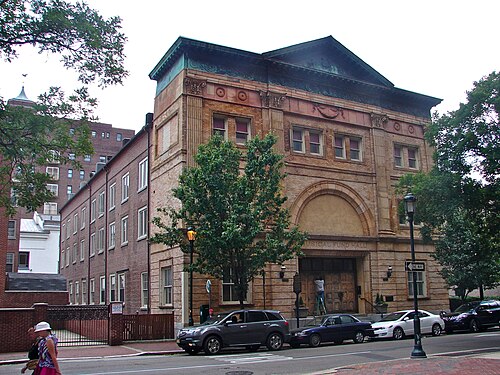

1854年、奴隷制度の拡大に反対する勢力、元ホイッグ党員、元自由土地党員らによって共和党がアメリカ北部で設立された。共和党はすぐに、支配的な民主党と一時的に人気を博したノウ・ナッシング党に対する主要な反対勢力となった。同党は、ミズーリ妥協を撤廃し、カンザス州とネブラスカ州を奴隷制度に開放し、将来的には奴隷州として加盟させるカンザス・ネブラスカ法に反対するところから生まれた。 [40] [41]彼らは奴隷制度の拡大を大悪として非難したが、南部諸州を含めて完全な廃止は求めなかった。奴隷制度の拡大に反対することが同党の最も重要な設立理念であったが、共和党はそれが取って代わったホイッグ党と同様に、経済的、社会的近代化も求めた。[42]
1854年3月20日、ウィスコンシン州リポンのリトルホワイトスクールハウスで行われた反ネブラスカ運動の最初の公開集会で、党名として「共和党」という名前が提案された。[43]この名前は、トーマス・ジェファーソンの民主共和党に敬意を表すために選ばれた部分もあった。[44]最初の公式党大会は、1854年7月6日にミシガン州ジャクソンで開催された。[45]
この党は1850年代半ばの大規模な政界再編から生まれたもので、メンバーの多くは急進主義を重視する親資本主義の立場で団結していた。[46]この再編は、ノウ・ナッシング党の盛衰、共和党の台頭、民主党の分裂に代表されるように、有権者に政党の変更を強いたため、強力であった。 [47] [48]
1856年の共和党第1回全国大会で、同党は自由領土への奴隷制度の拡大に反対することを強調した全国綱領を採択した。[49]共和党候補のジョン・C・フレモントは同年の大統領選挙で民主党のジェームズ・ブキャナンに敗れたが、ブキャナンは北部14州のうち4州しか勝利できなかった。[50] [51]大統領職を失い、米国議会で過半数に達しなかったにもかかわらず、共和党は共和党員を下院議長に据えることができ、ナサニエル・P・バンクスが議長に就任した。歴史家ジェームズ・M・マクファーソンはバンクスの議長就任について「共和党の誕生を示す瞬間があるとすれば、それはこのときだ」と書いている。[52]

共和党は1860年の選挙を熱望していた。[53]元イリノイ州下院議員エイブラハム・リンカーンは党内での支持構築に数年を費やし、1856年にはフレモントのために熱心に選挙運動を行い、1858年には上院議員選挙に出馬して民主党のスティーブン・A・ダグラスに敗れたものの、リンカーン対ダグラスの討論会で全国的な注目を集めた。[51] [54] 1860年の共和党全国大会で、リンカーンはニューヨーク州上院議員ウィリアム・H・スワードの反対派の支持を固めた。スワードは熱心な奴隷制度廃止論者であり、一部の共和党員はスワードがペンシルベニアやインディアナなどの重要な州にとっては過激すぎるのではないかと懸念していた。また、アイルランド移民に対する彼の支援に反対する人々も支持した。[53]リンカーンは総選挙で大統領に選出された。[53]この選挙結果がきっかけで南北戦争が勃発し、南北戦争は1861年から1865年まで続いた。[55]
1864年の大統領選挙では、リンカーンとテネシー州民主党上院議員アンドリュー・ジョンソンを支持する共和党と戦争民主党が団結し、ジョンソンは国民連合党から大統領と副大統領に立候補した。[50]リンカーンは再選された。[56]共和党の議会指導の下、犯罪に対する罰則を除き奴隷制を禁止する合衆国憲法修正第13条が1865年に批准された。[57]
復興、金本位制、そして金ぴか時代

リンカーンの暗殺後、ジョンソンが大統領に就任した。ジョンソンは1866年の選挙に先立つ全国ツアーで急進派共和党員を激しく批判した。[58]選挙後、反ジョンソン派共和党員は議会の両院で3分の2の多数派を獲得し、それが1868年のジョンソンの弾劾と職追放につながる一因となった。 [58]その同じ年、ユリシーズ・グラントが次期共和党大統領に選出された。
グラントは急進派共和党員であったため、党内に分裂が生じた。マサチューセッツ州選出の上院議員チャールズ・サムナーとイリノイ州選出の上院議員ライマン・トランブルは、グラントの再建主義政策のほとんどに反対した。[59]グラント政権の大規模な汚職を問題視する者もおり、台頭してきたスタールワート派はグラントとスポイルズシステムを擁護し、混血派は公務員制度の改革を主張した。[60]グラントに反対した共和党員は分派して自由共和党を結成し、1872年の大統領選挙でホレス・グリーリーを候補に指名した。民主党は党旗の下にグリーリーを共同候補に指名することで、共和党内のこの分裂を利用しようとした。グリーリーの立場は彼を指名した自由共和党と矛盾し、党の反対にもかかわらずグリーリーは高関税を支持した。 [61]グラントは簡単に再選された。[62] [63]
1876年の大統領選挙は、南部の3州が選挙日の終わりに公式に勝者を宣言しなかったにもかかわらず、両党が勝利を主張し、論争の的となった。南部での投票抑圧は、共和党が支配する選挙管理委員会が、不正、脅迫、暴力が州の選挙結果を汚したと宣言するのに十分な理由を与えた。彼らは、共和党のラザフォード・B・ヘイズが勝者と宣言されるのに十分な数の民主党票を破棄した。[64]民主党は結果を受け入れることを拒否し、州の選挙人を誰に与えるかを決定するために、議会議員で構成される選挙管理委員会が設立された。委員会が党の方針に沿ってヘイズに有利な投票を行った後、民主党は、3月4日に大統領が就任しないように、選挙人投票の集計を無期限に延期すると脅した。これが1877年の妥協につながり、ヘイズが最終的に大統領になった。[65]

ヘイズは、その年の恐慌の余波で落ち込んだアメリカ経済の解決策として、1873年の貨幣法でグラントが署名して法律化した金本位制をさらに強化した。[66] 1880年の大統領選挙を前に、ジェームズ・G・ブレインと対立候補のジョン・シャーマンはともに共和党の指名を勝ち取れなかった。その後、両者はジェームズ・A・ガーフィールドを大統領に支持した。[67] [68]ガーフィールドは1880年の大統領選挙で勝利したが、任期の初めに暗殺された。彼の死は、1883年に可決されたペンドルトン公務員改革法への支持を生み出すのに貢献した。 [69]この法案は、ガーフィールドの後を継いだ共和党の大統領チェスター・A・アーサーによって法律として署名された。
1884年、ブレインは共和党の大統領候補指名を獲得したが、総選挙で民主党のグロバー・クリーブランドに敗れた。クリーブランドはジェームズ・ブキャナン以来初めて民主党員が大統領に選出された人物だった。マグワンプとして知られる共和党の反体制派は、ブレインの政治キャリアを悩ませてきた汚職のために離反していた。[70] [71]

共和党のベンジャミン・ハリソンは1888年の選挙でクリーブランドを破った。ハリソンは大統領在任中に扶養家族および障害年金法に署名し、90日以上勤務し肉体労働ができない北軍の退役軍人全員に年金を支給することを定めた。[72] 1892年の大統領選挙でクリーブランドに敗れた後、ハリソンはクリーブランドの就任前にハワイ併合条約を可決しようとしたが失敗した。共和党員の大半は併合案を支持したが[73]、クリーブランドは反対した。[74]
1896年の大統領選挙では、共和党のウィリアム・マッキンリーの政策は金本位制と高関税を支持し、 1890年のマッキンリー関税の考案者でその名もマッキンリーだった。その年の全国大会以前にはこの問題で意見が分かれていたが、マッキンリーは選挙運動のメッセージでは自由銀よりも金本位制を強く支持することに決めたが、 1893年恐慌以来根強く残っていた金本位制への懐疑論を払拭するために複本位制を継続することを約束した。[75] [76]民主党のウィリアム・ジェニングス・ブライアンは自由銀運動の熱心な支持者であることが判明し、そのためブライアンはタマニー・ホール、ニューヨーク・ワールドなどの民主党機関や、民主党の上流階級と中流階級の大半の支持を失った。[77]マッキンリーはブライアンを破り[78] 、 1912年の大統領選挙まで大統領職を共和党に返した。[79]
20世紀前半
進歩派対保守派

1896年の再編により、共和党は大企業の政党としての地位を固め、一方でセオドア・ルーズベルト大統領はトラスト破壊を掲げて中小企業の支持を拡大した。彼は1908年の選挙で後継者のウィリアム・ハワード・タフトを自ら選んだが、党が真っ二つに分裂したため両者は敵対関係になった。タフトは1912年の大統領候補指名でルーズベルトを破った。ルーズベルトは新しい進歩党の公認で選挙戦を戦った。彼は社会改革を訴え、その多くは1930年代にニューディール民主党によって推進された。彼は敗北し、彼の支持者の大半が共和党に戻ったが、彼らは新しい保守的な経済思想に同意できないことに気づき、共和党のイデオロギーは右傾化した。[80]
共和党は1920年代に大統領職に復帰し、正常化、ビジネス重視の効率化、高関税を掲げて勝利した。[81]党の全国綱領では禁酒法への言及を避け、法と秩序への漠然とした公約を発表した。[82] ウォーレン・G・ハーディングは1923年に死去し、カルビン・クーリッジは1924年に分裂した野党を楽々と破った。 [83]この10年間のビジネス寄りの政策は、1929年のウォール街大暴落が世界恐慌の先駆けとなるまで、前例のない繁栄をもたらした。[84]
ルーズベルトとニューディール時代
民主党のフランクリン・D・ルーズベルト大統領が結成したニューディール連合は、1950年代の共和党のドワイト・D・アイゼンハワー大統領の任期を除き、その後の30年間の大半にわたってアメリカ政治を支配した。ルーズベルトが1933年に大統領に就任すると、ニューディール法案は議会を通過し、経済は1933年初頭のどん底から急激に回復した。1934年の選挙では、共和党は上院議員25名に対して民主党は71名となった。下院も民主党が圧倒的多数を占めた。[85]
共和党は、主に中西部を基盤とする多数派の旧右派と、ニューディール政策の多くを支持する北東部を基盤とするリベラル派に分裂した。旧右派は第二次ニューディール政策を、階級闘争と社会主義を象徴するものだとして激しく攻撃した。ルーズベルトは1936年に楽々と大統領に再選されたが、2期目が始まると経済が衰退し、ストライキが急増し、最高裁判所の権限を掌握して民主党から南部保守派を追放することに失敗した。共和党は1938年の下院選挙で大復活を遂げた。[86]南部保守派は大半の共和党員と合流して保守連合を形成し、1964年まで議会の国内問題を支配した。第二次世界大戦の頃までに両党は外交政策の問題で分裂し、共和党では反戦孤立主義者が、民主党では介入主義者が優勢となった。ルーズベルトは1940年に3期目、1944年に4期目を勝ち取った。保守党は戦争中にニューディール政策の大半を廃止したが、社会保障や企業を規制する機関を廃止しようとはしなかった。[87]
歴史家ジョージ・H・ナッシュは次のように主張している。
「ルーズベルト革命」の一部とハリー・S・トルーマン大統領の外交政策の基本的な前提を受け入れた(または少なくとも黙認した)「穏健派」で国際主義的な、主に東側陣営の共和党員とは異なり、共和党右派は根っからの反革命派だった。反集産主義、反共産主義、反ニューディールで、限定的な政府、自由市場経済、議会(行政ではなく)の特権に熱心に取り組んでいた共和党保守派は、最初から常に二正面戦争を繰り広げる義務があった。外部からはリベラルな民主党員、内部からは「私も」共和党員と戦ったのである。[88]
1945年以降、共和党の国際主義派は、旧右派の孤立主義が続いたにもかかわらず、トルーマンの冷戦外交政策に協力し、マーシャル・プランに資金を提供し、NATOを支持した。 [89]
20世紀後半
ルーズベルト以後の時代
(2).jpg/500px-Dwight_D._Eisenhower,_official_photo_portrait,_May_29,_1959_(cropped)(2).jpg)
アイゼンハワーは1952年の共和党大統領候補指名選挙で保守派のリーダーであるロバート・A・タフト上院議員を破ったが、アイゼンハワー政権の国内政策は保守派が主導していた。有権者は共和党よりもアイゼンハワーを好んでおり、彼は党をより穏健な立場に転換させることができなかった。[90]
ゴールドウォーターからレーガンまで
歴史家たちは、1964年の大統領選挙と全国大会を重要な転換点として挙げている。この選挙では、アリゾナ州選出の上院議員バリー・ゴールドウォーター率いる保守派が、ニューヨーク州知事ネルソン・ロックフェラーと彼の名を冠した共和党ロックフェラー派と指名争いをした。ゴールドウォーターが勝利しそうになると、リベラル派を動員するよう促されたロックフェラーは、「お前は見ているだろう。残っているのは私だけだ」と言い返した。[91] [92]
1964年の公民権法と1965年の投票権法の成立に伴い、南部諸州では大統領選挙において共和党がより確実に優勢となり、一方北東部諸州では民主党がより確実に優勢となった。
共和党は1969年から1977年まで第37代大統領リチャード・ニクソンの下でホワイトハウスを支配し、1974年にウォーターゲート事件によりニクソンが辞任すると、ジェラルド・フォードが第38代大統領となり、1977年までその職を務めた 。ロナルド・レーガンは1980年のアメリカ大統領選挙で現職の民主党大統領ジミー・カーターを破った。[93]
レーガン時代
1981年から1989年まで続いたレーガン大統領の任期は、「レーガン革命」として知られるものであった。 [94]これは、減税、政府の規制緩和の優先、抑止理論を利用してソ連を牽制するために国内の資金を軍事にシフトすることを意図したレーガンの経済政策の導入により、1970年代のスタグフレーションからの根本的な転換と見なされた。1987年6月に当時の西ベルリンを訪問した際、彼はベルリンの壁での演説でソ連の指導者ミハイル・ゴルバチョフに「この壁を壊せ! 」と要求した。この発言は後に1989年の壁崩壊に影響を与えたと見なされ、遡及的に決定的な業績と見なされた。[95]ソ連は1991年に解体した。[96] [97] [98]レーガン大統領の任期後、共和党の大統領候補者は頻繁にレーガンの見解を共有していると主張し、自分自身と自分たちの政策を彼の遺産の継承者として描くことを目指した。[99]
レーガンの副大統領ジョージ・H・W・ブッシュは、 1988年の選挙で圧倒的な勝利を収めた。しかし、彼の任期は共和党内の分裂が特徴的だった。ブッシュの経済自由化と諸外国との国際協力のビジョンは、1990年代の民主党ビル・クリントン大統領時代に、北米自由貿易協定(NAFTA)の交渉と調印、そして世界貿易機関の概念的始まりにつながった。[100]
ブッシュは1992年に再選に失敗した。ペローの立候補がブッシュの再選を妨げたかどうかについては議論があるが、チャーリー・クックはペローのメッセージは共和党員と保守派の有権者に影響力があったと主張した。[101]
ギングリッチ革命
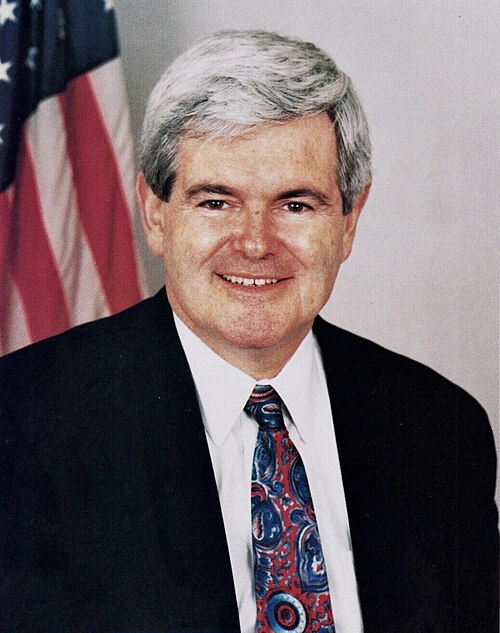
1994年の選挙では、 「アメリカとの契約」を掲げて選挙運動を行った下院少数党院内幹事ニュート・ギングリッチ率いる共和党が両院で多数派を獲得し、12の州知事職を獲得し、20の州議会で支配権を取り戻した。共和党は40年ぶりに下院の支配権を獲得し、南北戦争以降初めて南部で下院議席の過半数を獲得した。[102] [103]
しかし、ほとんどの有権者は契約について聞いたことがなく、共和党の勝利は伝統的な中間選挙での反現職投票と、共和党が南部で再建以来初めて多数派政党となり、多くの元南部民主党員を獲得したことによるものとされた。[104]ギングリッチは議長となり、共和党が多数派となってから最初の100日以内に、議員の任期制限を除いて契約に盛り込まれたすべての提案が可決された。[104] [105]ギングリッチの1994年の成功の鍵の1つは選挙の全国的実施であり、[103]その結果、1996年の下院選挙ではギングリッチは全国的な人物となり、多くの民主党指導者がギングリッチは熱狂的な急進派であると宣言した。[106] [107]ギングリッチの「憲法上の強硬策」戦略は、主に共和党によって推進された政治的二極化の増大をもたらした。 [108] [109] [110] [111] [112]共和党は、ボブ・ドールが大統領選挙でクリントンに大敗したにもかかわらず、 1928年以来初めて多数派を維持した。しかし、ギングリッチの全国的な知名度は共和党議会にとってマイナスとなり、ギングリッチの比較的不人気にもかかわらず、共和党議会は有権者の過半数の支持を得た。[106]
ギングリッチと共和党が1997年の均衡予算法でクリントンと合意した後、共和党の下院多数派は1998年の選挙を前に新しい議題を話し合うのに苦労した。[113] 1998年にビル・クリントンの弾劾が進行中だったとき、ギングリッチはクリントンの不正行為を選挙に向けて党のメッセージにすることを決定し、それが多数派に加わると信じていた。この戦略は誤りであることが判明し、共和党は5議席を失ったが、それがメッセージの悪さによるものなのか、クリントンの人気による追随効果によるものなのかは議論の余地がある。[114]ギングリッチはそのパフォーマンスにより党の権力から追放され、最終的には議会を完全に辞任することを決意した。その後しばらくの間、ルイジアナ州選出のボブ・リビングストン下院議員が後任になると思われた。しかし、リビングストンは、もし議長を務めた場合、共和党下院の立法議題が不利になるという不倫に関する有害な報告があったため、候補から退き、議会を辞任した。[115]イリノイ州代表のデニス・ハスタートがリビングストンに代わって議長に昇格し、2007年までその職を務めた。[116]
21世紀
ジョージ・W・ブッシュ
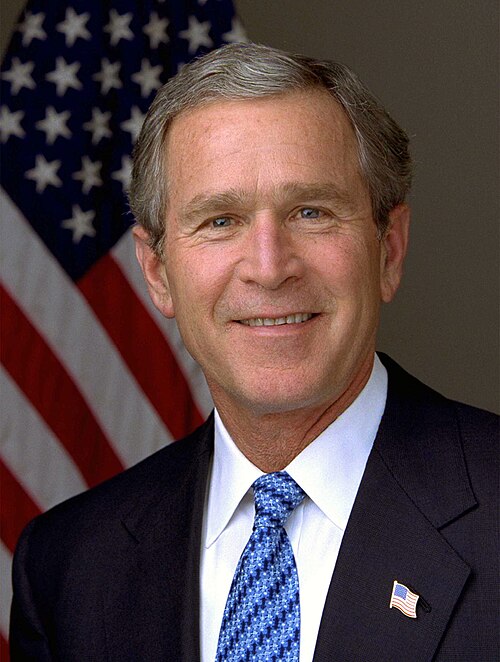
共和党のジョージ・W・ブッシュは2000年と2004年の大統領選挙で勝利した。[117]彼は2000年に「思いやりのある保守派」として選挙運動を行い、移民や少数派の有権者にもっとアピールしたいと考えていた。 [118]その目標は薬物リハビリテーションプログラムと囚人の社会復帰支援を優先することであり、これはクリントン大統領の1994年の犯罪法などのより厳しい犯罪対策を活用することを意図した動きだった。彼の大統領在任中、この政策は党員の間であまり支持されなかった。[119]
共和党は2000年代の大半、かなりまとまった結束を保っていた。なぜなら、強硬な経済的自由主義者と社会的保守主義者の両方が、肥大化した世俗的で自由主義的な政府の党とみなしていた民主党に反対していたからである。[120]この時期には、ブッシュ支持層の中核をなす「親政府保守派」が台頭した。共和党員のかなりのグループは、政府支出の増加と経済と人々の私生活の両方をカバーする規制の強化、および活動的で介入主義的な外交政策を主張していた。[121]ピュー研究所などの調査グループによると、社会保守派と自由市場支持者は、共和党の支持連合内の他の2つの主要グループであり、3つはほぼ同数であった。[122] [123]しかし、自由主義者と自由主義寄りの保守主義者は、共和党が重要な市民の自由を制限し、ブッシュ政権下で企業福祉と国家債務が大幅に増加したと見なしたことにますます不満を抱くようになった。[124]対照的に、社会保守派の中には、党が自分たちの道徳的価値観と相反する経済政策を支持していることに不満を表明した者もいた。[125]
2001年、共和党は上院の多数派を失い、上院の票数が半々になった。しかし、共和党は、ブッシュ政権の副大統領ディック・チェイニーの決選投票により、上院の支配権を維持した。2001年6月6日、バーモント州の共和党上院議員ジム・ジェフォーズが民主党に所属を変えたことで、民主党が上院の支配権を獲得した。共和党は、 2001年9月11日の同時多発テロ後のブッシュの人気の急上昇に後押しされて、2002年の選挙で上院の多数派を奪還し、 2006年の選挙で民主党が両院の支配権を奪還するまで、下院と上院で共和党の多数派を維持した。これは主にイラク戦争への反対が高まったためである。[126] [127] [128]
2008年の大統領選挙では、アリゾナ州の共和党上院議員ジョン・マケインはイリノイ州の民主党上院議員バラク・オバマに敗れた。[129]
ティーパーティー運動
共和党は2010年の選挙で選挙での勝利を収めた。2010年の選挙は、財政保守派による反オバマ抗議運動であるティーパーティー運動[130] [131] [132] [133]の台頭と時を同じくした。[134]この運動のメンバーは、減税と、政府支出の削減による国家債務と連邦予算赤字の削減を求めた。[135] [136]ティーパーティー運動は、リバタリアン、[138]右翼ポピュリスト、[139]および保守派の活動家が混在する大衆的な憲法運動[137]とも評された。[140]
ティーパーティー運動の選挙での成功は、1月にマサチューセッツ州の上院特別選挙でスコット・ブラウンが予想外の勝利を収めたことから始まった。この議席は、何十年も民主党のテッド・ケネディが保持していた。[141] 11月には、共和党が下院の支配権を奪還し、上院での議席数を増やし、州知事の過半数を獲得した。[142]ティーパーティーは、共和党の体制派がティーパーティー風の共和党員に取って代わられたこともあり、共和党に強い影響を与え続けた。[134]
2012年にオバマ氏が共和党のミット・ロムニー氏を破って大統領に再選されたとき、[143]共和党は下院で7議席を失ったものの、依然としてその議席を維持した。[144]しかし、共和党は上院の支配権を獲得することができず、2議席の純減で少数派の地位を維持した。[145]敗北の余波で、一部の著名な共和党員は自党に反対を表明した。[146] [147] [148]共和党による2012年の選挙事後検証では、党は少数派や若い有権者の票を集めるために全国レベルでもっと努力する必要があるとの結論に達した。[149] 2013年3月、共和党全国委員会のラインス・プリーバス委員長は、2012年の党の選挙の失敗に関する報告書を発表し、共和党員に自らを改革し、移民改革を公式に支持するよう求めた。彼は、女性、少数民族、同性愛者への1000万ドルのマーケティングキャンペーン、より短く、より管理された予備選挙期間の設定、より優れたデータ収集施設の創設など、219の改革を提案した。[150]
2014年の選挙後、共和党は9議席を獲得して上院を掌握した。[151]下院で247議席、上院で54議席を獲得した共和党は、最終的に1929年の第71回議会以来最大の多数派を獲得した。[152]
トランプ時代

2016年の大統領選挙では、共和党候補のドナルド・トランプが民主党候補のヒラリー・クリントンを破った。選挙前の世論調査ではクリントンがリードしていたため、結果は予想外だった。[153]トランプの勝利は、何十年も民主党の青い壁の一部であったミシガン州、ペンシルベニア州、ウィスコンシン州の3州での僅差の勝利によって推進された。 [154]これは、政治体制から無視され、軽視されていると感じていた労働者階級の白人有権者からの強い支持によるものだった。[155] [156]トランプは、共和党体制の正統性を捨て、より広範な国家主義的なメッセージを支持することで、彼らに人気を得た。[154]彼の選出は、共和党の右翼ポピュリズムへの転換を加速させ、その保守派閥の影響力の低下をもたらした。[a]
2016年の選挙後、共和党は上院、下院、州知事の多数派を維持し、トランプ大統領の当選で新たに獲得した行政権を行使した。共和党は2017年に99州議会のうち69州を掌握し、史上最多の議席数となった。[157]同党は33州知事のポストも獲得し、[158] 1922年以来最多の議席数となった。[159]同党は25州で政府を完全に掌握した。[160] [161]同党がこれほど多くの州を完全に掌握したのは1952年以来のことであった。[162]対立する民主党が2017年に完全に掌握していた州はわずか5州であった。[163] 2018年の選挙では、共和党は下院の支配権を失ったが、上院での支配力を強化した。[164]
トランプ大統領は大統領在任中、ニール・ゴーサッチ、ブレット・カバノー、エイミー・コニー・バレットの3人の最高裁判事を任命した。これはリチャード・ニクソン以来、大統領による最高裁判事の1期あたりの最多任命数である。[165]トランプ大統領は合計260人の判事を任命し、退任時には国際貿易裁判所を除く連邦司法府のすべての部門で共和党任命の多数派を形成し、司法制度を右傾化させた。彼の大統領在任中のその他の注目すべき業績には、 2017年の減税・雇用法の可決、 1947年以来初の新しい独立した軍隊である米国宇宙軍の創設、イスラエルとさまざまなアラブ諸国間の一連の正常化協定であるアブラハム合意の仲介などがある。[166] [167] [168]任期後半は、移民の家族分離政策を実施したり、人種差別抗議活動に対応して連邦法執行機関を配備したり、 COVID-19パンデミックへの対応が遅れたり、検査と治療をめぐって保健当局と衝突したりするなど、ますます物議を醸した。[169] [170] [171]トランプ氏は2019年に下院で権力乱用と議会妨害の罪で弾劾された。2020年2月5日、上院は無罪を可決した。[172]
トランプ大統領は2020年の大統領選挙で民主党のジョー・バイデン候補に敗れた。彼は選挙結果を認めることを拒否し、広範囲にわたる選挙不正を主張して選挙結果を覆そうとした。2021年1月6日、トランプ氏が演説した集会の後、米国議会議事堂がトランプ氏の支持者らに襲撃された。襲撃後、下院は反乱扇動の罪でトランプ大統領を2度目の弾劾調査し、トランプ大統領は2度弾劾された唯一の連邦公職者となった。[173] [174]トランプ大統領は2021年1月20日に退任した。彼の弾劾裁判はバイデン政権の初期まで続き、2021年2月13日に無罪となった。[175] 2020年の選挙以来、党内で選挙否定論がますます主流となり、 [176] 2022年の共和党候補者の大半は選挙否定論者である。[177]同党はまた、不正の虚偽の主張に基づいて投票を制限する努力をした。 [178] [179] 2020年までに、共和党はトランプ大統領の選出を受けて非自由主義へと大きくシフトし、 [c] V-Dem研究所が実施した調査では、共和党はポーランドの法と正義党やハンガリーのフィデス党など、ヨーロッパの最右翼政党に似ているという結論に達した。[32] [187]
2022年と2023年には、トランプ大統領が任命した最高裁判事が、銃の権利、中絶、積極的差別是正措置に関する画期的な判決を下した。[188] [189] 2022年の選挙に共和党は自信を持って臨み、アナリストらは共和党支持の波を予想していたが、最終的には期待を下回る結果となり、激戦州や激戦区の有権者は民主党に加わり、トランプ大統領が支持した候補者や2020年の選挙結果を否定した候補者を拒否した。[190] [191] [192]同党は下院で僅差で多数派を獲得したが、[193]上院といくつかの州議会の多数派と知事職を失った。[194] [195] [196]この結果を受けて、多くの共和党員や保守派思想リーダーが、トランプ大統領が引き続き党の代表および指導者であるべきかどうか疑問視するようになった。[197] [198]
2022年の中間選挙での失望にもかかわらず、トランプ氏は2024年の党候補 指名を難なく勝ち取り、3回連続で共和党候補となった。[199]選挙運動中に2度の暗殺未遂事件を生き延びたトランプ氏は、7月に撤退したバイデン大統領に代わって民主党候補となったカマラ・ハリス副大統領を相手に勝利を収め、選挙人団を312対226で獲得し、2004年のジョージ・W・ブッシュ氏以来初めて一般投票で勝利した共和党員となり、(2020年の選挙と比較して)労働者階級の有権者、特に若い男性、大学を卒業していない人、ヒスパニック系有権者の間での得票率を向上させた。[200]共和党は下院も維持し(わずかながら過半数)、上院も奪還し、2017年のトランプ大統領初代大統領以来初めて共和党が連邦議会の3議席を独占した。
現在の状況
2025年現在、共和党は米国下院で多数派を占めている。また、27の州知事、28の州議会、23の州政府の三権分立も共和党が握っている。現在の米国最高裁判所判事9人のうち6人は共和党の大統領によって任命された。共和党の大統領は19人で、単一政党からの大統領としては最多であり、直近ではドナルド・トランプが2017年から2021年まで第45代大統領を務めた。
トランプ氏は2024年の大統領選挙に勝利した後、2025年1月20日に第47代大統領として復帰し、連続しない2期(2つの別々の大統領としてカウント)を務める初の共和党員となる。[201]
名前とシンボル
共和党の創立メンバーは、創立者トーマス・ジェファーソンが「共和党」と呼んだ民主共和党が推進した共和主義の価値観に敬意を表してその名前を選んだ。 [202]この名前のアイデアは、党の指導的広報担当者であるホレス・グリーリーの社説から生まれたもので、グリーリーは「奴隷制の宣伝者ではなく、自由の擁護者および普及者という本来の使命に連邦を回復するために団結した人々をより適切に示すために、『共和党員』のような単純な名前」を求めた。[203]この名前は、1776年の共和主義の価値観である公民的美徳と貴族主義および腐敗への反対を反映している。[204]「共和党員」は世界中でさまざまな意味を持ち、共和党はもはや意味が必ずしも一致しないほど進化してきた。[126] [205]
「グランド オールド パーティー」という用語は共和党の伝統的な愛称であり、略称「GOP」はよく使われる呼称である。この用語は 1875 年の議会記録で、連邦の軍事防衛の成功に関わった党を「この勇敢な古い党」と呼んだときに始まった。翌年、シンシナティコマーシャルの記事で、この用語は「グランド オールド パーティー」に修正された。この略称が初めて使用されたのは 1884 年のことである。[206]
党の伝統的なマスコットは象である。1874年11月7日にハーパーズ・ウィークリー誌に掲載されたトーマス・ナストの政治漫画が、このシンボルの最初の重要な使用例であると考えられている。 [207]インディアナ州、ニューヨーク州、オハイオ州などの州では、共和党の代替シンボルは民主党の雄鶏や民主党の五芒星ではなく白頭鷲である。[208] [209]ケンタッキー州では、丸太小屋が共和党のシンボルである。[210]
伝統的に、この党には一貫した色のアイデンティティがなかった。[211] [212] [213] 2000年の大統領選挙後、赤色は共和党と結びつくようになった。選挙中および選挙後、主要放送ネットワークは選挙地図に同じ配色を使用した。共和党候補のジョージ・W・ブッシュが勝利した州は赤に、民主党候補のアル・ゴアが勝利した州は青に塗られた。選挙結果をめぐる数週間に及ぶ論争により、これらの色の連想はしっかりと根付き、その後も続いた。政党への色の割り当ては非公式かつ非公式であるが、メディアはこれらの色を使用してそれぞれの政党を代表するようになった。政党とその候補者もまた赤色を受け入れるようになった。[214]
-
![1874年にトーマス・ナストが描いた漫画。共和党の象が初めて登場した。[215]](https://img-server.japedia.wiki/wikipedia/commons/thumb/2/27/NastRepublicanElephant.jpg/500px-NastRepublicanElephant.jpg) 1874年にトーマス・ナストが描いた漫画。共和党の象が初めて登場した作品である[215]
1874年にトーマス・ナストが描いた漫画。共和党の象が初めて登場した作品である[215] -
 赤、白、青の象
 -
 共和党の旗のロゴ、 2013年頃
 -
 共和党のバナーロゴ、 2017年頃
派閥
南北戦争と復興期

19世紀の共和党の分派には急進派共和党員が含まれていた。彼らは1854年の党創設から1877年の復興期の終わりまで党の主要な要因であった。彼らは奴隷制度に強く反対し、強硬な奴隷制度廃止論者であり、後に解放奴隷の男女平等を主張した。彼らは宗教的理想と福音派キリスト教に強く影響されており、その多くは奴隷制度を悪とし、南北戦争をそれに対する神の罰とみなすキリスト教改革者であった。 [216]急進派共和党員は奴隷制度廃止を主要な戦争目的として主張し、エイブラハム・リンカーンの穏健な復興計画には、南軍に対して甘すぎること、および南北戦争中または後に奴隷解放宣言と憲法修正第13条によって解放された元奴隷の救済が不十分であるとして反対した。戦争が終わり、リンカーンが暗殺された後、急進派は復興政策をめぐってアンドリュー・ジョンソンと衝突した。急進派は戦後、元奴隷の公民権を確立し、奴隷解放を完全に実施するための取り組みを主導した。1866年に失敗した措置が反乱州での元奴隷に対する暴力に終わった後、急進派は法定保護のための憲法修正第14条を議会で可決させた。彼らは、南部アメリカで元南軍将校が政治権力を再び握ることに反対し、自由、平等、および解放奴隷に投票権を与えた憲法修正第15条を強調した。彼らの多くは後に、マシン政治を支持するスターワートになった。
穏健派共和党員は、エイブラハム・リンカーン大統領の戦争政策を忠実に支持することで知られ、急進派共和党員が主張するより好戦的な姿勢に反感を示した。歴史家エリック・フォナーによると、この派閥の議会指導者は、ジェームズ・G・ブレイン、ジョン・A・ビンガム、ウィリアム・P・フェッセンデン、ライマン・トランブル、ジョン・シャーマンであった。急進派とは対照的に、穏健派共和党員は、市民の平等と南北戦争を通じて見られた連邦政府の権限の拡大を受け入れながらも、黒人の参政権の問題にそれほど熱心ではなかった。彼らはまた、アンドリュー・ジョンソン大統領の寛大で融和的な復興政策にも懐疑的だった。穏健派共和党員の一部は、後者の派閥の腐敗の疑いに幻滅した元急進派共和党員で構成されていた。 1860年代に急進派共和党を率いたマサチューセッツ州上院議員チャールズ・サムナーは、後にグラント政権に関連する腐敗に反対したため、改革志向の穏健派に加わった。彼らは一般的に、経済的に流動性のある自由市場システムの下で米国南部を再建しようとする急進派共和党の取り組みに反対した。[217]
20世紀

20世紀の幕開けとともに、共和党は北東部で旧右派と穏健リベラル派に分裂し、最終的にはロックフェラー共和党として知られるようになった。ルーズベルトのニューディール政策に反対して保守連合が形成された。[86] 1950年代には伝統主義と社会保守主義、右派リバタリアニズムの融合主義が見られ、 [218] 1964年にはよりポピュリスト的な第2新右派が台頭した第1新右派も登場した。[219]
1980年代の「レーガン革命」によるレーガン連合の台頭は、いわゆるレーガン時代の幕開けとなった。レーガンの台頭は共和党のリベラル中道派に取って代わり、右翼ポピュリスト派が台頭するまでの30年間、レーガン流の保守主義が党の支配的なイデオロギー派閥として確立された。 [ 9] [24]レーガン保守派は一般に、限定的な政府、個人主義、伝統主義、共和主義、および州に対する連邦政府の限定的な権限を支持する政策を支持した。[220]
21世紀
共和党は、 2000年の米国大統領選挙でジョージ・W・ブッシュが当選したことで21世紀を迎え、9月11日の攻撃に対するアメリカの初期の対応から対テロ戦争まで大きな影響力を持ったネオコンの頂点を迎えた。[221]バラク・オバマの当選により、2009年にティーパーティー運動が形成され、 2010年代から2020年代にかけて右翼ポピュリスト運動が世界的に台頭した。 [222]
右翼ポピュリズムは2010年代を通じて共和党内でますます支配的なイデオロギー派閥となり、2016年のドナルド・トランプ大統領当選につながった。 [155] 1970年代に始まり2000年代に加速したアメリカの右翼利益団体は、共和党体制の組織的弱体化につながる外部動員手段に多額の投資をした。保守系メディア、特にフォックス・ニュースの並外れた役割は、共和党支持層が伝統的な党エリートよりもフォックス・ニュースをフォローし、信頼することにつながった。組織能力の枯渇は、非常に弱い党体制と伝統的な権力者の意向に反して、共和党予備選でトランプが勝利したことに部分的につながった。[223] : 27–28 トランプ氏の当選は共和党内の分裂を悪化させ、[223] : 18 共和党は穏健派と保守派の中道連合から、リベラルな見解や党の方針からの逸脱に敵対する確固たる右派政党へと移行した。[224]
それ以来、党は激しい派閥争いに直面している。[225] [226]これらの派閥争いは特に米国下院で顕著で、2009年以降、共和党の下院議長3人が失脚している。[26]下院多数党院内総務のエリック・カンターは、 2014年の予備選挙で、移民改革を支持したとしてティーパーティー支持者のデイブ・ブラットに敗れた。[227] 2011年から2015年まで下院議長を務めたジョン・ベイナーは、 2015年に退任動議に直面して辞任した。[228] [229] 2023年1月7日、15回の投票の後、ケビン・マッカーシーが議長に選出された。これは1923年以来初の複数投票による議長選挙であった。[230]その後、トランプ派の8名と下院民主党議員208名が主導した投票により、2023年10月3日に彼はその地位から解任された。 [231]
保守派

45%以上
40~44%
35~39%
30~34%
25~29%
24%以下
1980年のロナルド・レーガン大統領選挙により、レーガン流のアメリカ保守主義が共和党の支配的なイデオロギー派閥として確立され、2016年にドナルド・トランプが当選した。[10] [9] [23] [24] [25] [27] [28] [29]トランプの2016年の選挙は、共和党とより大きな保守運動の両方をトランプ派と反トランプ派に分裂させた。[233] [234]人口統計的には、党は大学卒の白人有権者からの支持を多数失ったが、大学卒でない有権者の間では支持を拡大し続けている。[34] [35]
それ以来、党内の主流保守派は影響力を失っている。[23] [10] [25] トランプ派に批判的な多くの保守派も党内で影響力を失っている。[31] [30]リズ・チェイニー元下院議員は、2021年にトランプを批判したことへの報復として下院共和党大会議長の地位から解任され、[ 235 ] 2022年にはトランプ支持派の予備選挙候補者に敗れた。 [236] 2012年の共和党大統領候補ミット・ロムニーは、 2024年の米国上院選挙でユタ州から再選されないことを選択した。[237] [238]トランプ大統領の第一副大統領マイク・ペンスはそれ以来トランプと距離を置き、2024年の大統領選挙でトランプを支持しないことを選択した。同様に、トランプはペンスを再び副大統領にしないことを決定し、代わりにJ・D・ヴァンスを選んだ。[239] [240]
同党は、多くの問題において長年にわたりイデオロギー的に保守的な立場を維持している。[241]伝統的な現代保守派は、自由市場経済政策への支持と社会保守主義、外交政策に対するタカ派的アプローチを組み合わせている。[21]保守運動の他の部分は、財政保守派と財政タカ派で構成されている。[242]
外交政策において、ネオコンは介入主義的な外交政策と軍事費の増大を支持する共和党の小派閥である。彼らは2000年代初頭、9/11攻撃への初期対応から対テロ戦争までの計画において大きな影響力を持っていた。[221] 2016年のトランプ大統領の当選以来、ネオコンは衰退し、連邦共和党の公職者の間では非介入主義と孤立主義が高まっている。[37] [243] [244]
トランプ大統領の選挙後の保守派の考え方の長期的な変化は、伝統的な保守主義のイデオロギーと右翼ポピュリストのテーマの「新しい融合主義」と表現されている。[37]その結果、国家保守主義、[245] 保護主義、[246] 文化保守主義、より現実的な外交政策、新保守主義の否定、給付プログラムの縮小に向けた取り組みの減少、伝統的な抑制と均衡に対する軽蔑への支持が高まった。[37] [247]中絶と同性結婚の問題に関しては、党内に大きな分裂がある。[248] [249]
保守派の議員連盟には共和党研究委員会や自由議員連盟などがある。[250] [251]
右翼ポピュリスト
.jpg/500px-J._D._Vance_(53808261332).jpg)
右翼ポピュリズムは共和党の支配的な政治派閥である。[b] MAGAまたは「アメリカ第一主義」運動と呼ばれることもある。 [261] [262]共和党のポピュリストは、右翼ポピュリズム、[155] [263] [264] 国家保守主義、[265] ネオナショナリズム、[266]トランプ主義など、さまざまな右翼イデオロギーで構成されていると説明されている。[254] [267] [268]彼らは極右のアメリカ政治版と言われている。[d] 2016年のトランプの選挙で、党は親トランプ派と反トランプ派に分裂した。[233] [234]
共和党のポピュリスト運動と極右運動は、2010年代と2020年代の世界的なポピュリスト運動の増加と並行して出現し、[222] [272] 2010年以降、党内の定着と党派心の高まりと相まって現れた。 [273]これには、極右とも言われるティーパーティー運動の台頭も含まれている。 [274] 2024年のトランプ大統領の選挙は、現職政党に対する世界的な反発の一部であり、[275] [276] 2021年から2023年のインフレの急増も一因となっている。[253] [277]
政治学者のマット・グロスマンとデイビッド・A・ホプキンスによると、共和党が大学卒業でない白人有権者の間で支持を伸ばし、大学卒業の白人有権者の間で支持を失ったことが、右翼ポピュリズムの台頭につながったという。[35] 2016年までは、大学卒業の白人有権者は共和党寄りのグループだったが、その後民主党寄りのグループになった。[278] [279] 2020年の大統領選挙では、ジョー・バイデンが1964年以来初めて大学卒業の白人有権者の過半数(51〜48%)を獲得した民主党大統領となり、一方トランプは大学卒業でない白人有権者の67〜32%を獲得した。[280] [281] [34]
2024年の大統領選挙では、トランプ氏は再び大学卒業資格のない白人有権者の66対32%を獲得したが、大学卒業資格のある白人有権者の45対52%を失った。トランプ氏はヒスパニック系有権者の46対52%をほぼ獲得したが、アジア系有権者の39対54%を失った。[282] [22]教育別では、トランプ氏は高校卒業以下の有権者で 62対36%、大学中退者で51対47%、準学士号取得者で57対41%の支持を得た。トランプ氏は学士号取得者で45対53%、大学院卒者で38対59%の支持を失った。[282]トランプ氏はヒスパニック系、特にメキシコとアメリカの国境付近や最近の移民の影響を受けた地域で支持を伸ばした。[283] [284]
歴史家ゲイリー・ガースルによると、トランプ主義は、自由貿易、移民、グローバリゼーション、国際主義への反対など、新自由主義への反対で支持を集めた。[29] [272]トランプは、人口減少と産業空洞化に苦しんでいたラストベルトの州、具体的にはウィスコンシン州、ミシガン州、ペンシルベニア州で勝利し、2016年と2024年の大統領選挙に勝利した。[285] [286]他の共和党員と比較して、ポピュリスト派は合法的な移民、[287]自由貿易、[288]新保守主義、[289]環境保護法に反対する可能性が高い。[290]
社会学者アーリー・ラッセル・ホックシルドによると、トランプは「取り残されたエリート」、つまり「うまくいっていない地域でうまくやっている人々」にうまくアピールしたという。トランプの投票者の多くは裕福な地域に住んでいなかったが、それでも生活費の安い地域の隣人よりも裕福だった。[286] [291] [292]トランプは経済を立て直し、国境で移民の流入を阻止するという約束で有権者を説得し、2024年の大統領選挙に勝利した。 [293] [294]
国際関係においては、ポピュリストはイスラエルに対する米国の援助を支持するがウクライナに対する援助は支持せず、[295] [296]一般的にロシアとの関係改善を支持し、[297] [298] [299]孤立主義的な「アメリカ第一」外交政策アジェンダを支持している。[300] [301] [302] [248]
党の極右派には自由議員連盟のメンバーが含まれる。[303] [304] [305] [306]ポピュリスト派に所属するマット・ゲーツ元下院議員は、当時の下院議長ケビン・ マッカーシーに対する2023年の反乱を主導した。[307] [308] [309] 2024年に共和党に入党した民主党の元下院議員トゥルシ・ギャバードも、ポピュリスト政策を採用していると評されている。[310] [311]彼らは一般的に党内および民主党との妥協を拒否し、[312] [313]穏健派すぎるとみなした共和党の同僚役職者を排除することもいとわない。[314] [315]社会学者ジョー・フィーギンによると、人種的過激主義共和党員による政治的二極化と保守系メディアの注目の高まりにより、穏健派共和党員はほぼ絶滅し、過去数十年間に多くの政府レベルで立法が麻痺した。[316] [317]
マルケット大学の政治学准教授ジュリア・アザリは、すべてのポピュリスト共和党員がドナルド・トランプを公に支持しているわけではなく、バージニア州知事グレン ・ヤングキンなど一部の共和党員はトランプの政策を支持しながらも、トランプ個人からは距離を置いていると指摘した。[318] [319]共和党内でトランプが引き続き優位に立っているため、この戦略の成功は限られている。[320] [321] [322] 2024年、トランプは共和党全国委員会の乗っ取りを主導し、ララ・トランプを新しい共同委員長に任命した。[323]
キリスト教右派

1970年代にキリスト教右派が台頭して以来、共和党は福音派、モルモン教徒、[324]および伝統主義 カトリック教徒から多大な支持を集めてきたが、これはロー対ウェイド事件後の中絶反対によるところが大きい。[325]キリスト教右派は、社会的に保守的でキリスト教国家主義的な政策を強く支持していることが特徴である。[e]キリスト教保守派は、キリスト教の教えを利用して法律や公共政策に影響を与えようとしている。[338]他の共和党員と比較すると、党内の社会的に保守的なキリスト教右派は、 LGBTの権利やマリファナの合法化に反対し、中絶の合法性を大幅に制限することを支持する傾向がある。[339]
キリスト教右派は、アメリカ南部の大部分を占めるバイブル・ベルトで最も勢力が強い。[340] 2017年から2021年までドナルド・トランプ大統領の副大統領を務めたマイク・ペンスもキリスト教右派の一員だった。 [341] 2023年10月、キリスト教右派の一員であるルイジアナ州選出のマイク・ジョンソン議員が第56代アメリカ合衆国下院議長に選出された。[342] [343]
リバタリアン
共和党には著名なリバタリアン派閥がある。[13] [248]党内のこの派閥は、米国中西部と西部で優勢な傾向がある。[248]リバタリアニズムは、1950年代から60年代に融合主義から生まれた。 [344]バリー・ゴールドウォーターは、1960年代の保守リバタリアン運動に大きな影響を与えた。[345]他の共和党員と比較して、彼らはマリファナの合法化、同性結婚などのLGBTの権利、銃の権利を支持し、大量監視に反対し、民事資産没収を取り巻く現行法の改革を支持する傾向がある。右派リバタリアンは、中絶の問題で大きく分裂している。[346]共和党内の著名なリバタリアン保守派には、ケンタッキー州選出の上院議員ランド・ポール、[347] [348]ケンタッキー州第4選挙区選出の下院議員トーマス・マッシー、[349]ユタ州選出の上院議員マイク・リー[347] [350]ワイオミング州選出の上院議員シンシア・ラミス[351]などがいます。
2024年の米国選挙では、共和党はもともと党のリバタリアン派が主張していた仮想通貨支持政策を採用した。 [352]共和党大統領候補のドナルド・トランプは、 2024年リバタリアン全国大会で演説し、仮想通貨への支持を誓い、中央銀行のデジタル通貨に反対し、ロス・ウルブリヒトの減刑を支持すると表明した。[353]トランプの2024年選挙運動では、テクノリバタリアン派、特に後に政府効率化省(DOGE)のリーダーに指名されたイーロン・マスクの影響が強かった。[354] [355] [356]マスクとともにDOGEのリーダーに選ばれた2024年共和党大統領候補のヴィヴェック・ラマスワミは、共和党内でナショナリズムとリバタリアニズムの統合を訴え、保護主義派に反対している。[357] [358]
穏健派
共和党穏健派はイデオロギー的には中道派のグループで、主に米国北東部の出身で、[359]通常は激戦州または青い州に居住している。共和党穏健派の有権者は通常、高学歴で、[279]裕福で、財政的には保守的、社会的には穏健派またはリベラルで、トランプを支持しないことが多い。[248] [359]時には他の共和党員と経済観(減税、規制緩和、福祉改革など)を共有することもあるが、共和党穏健派は、積極的差別是正措置を支持する者もいる点が異なり、[360] LGBTの権利や同性結婚、中絶の合法的アクセスや中絶への公的資金提供、銃規制法、環境規制の強化や気候変動対策、移民制限の緩和、不法移民の市民権取得への道などを支持する者もいる。[361] 21世紀には、元共和党穏健派の一部が民主党に鞍替えした。[362] [363] [364]
著名な穏健派共和党員には、アラスカ州のリサ・マーコウスキー上院議員、メイン州のスーザン・コリンズ上院議員、 [365] [366] [367] [368]ネバダ州知事のジョー・ロンバード、バーモント州知事のフィル・スコット、[369]ニューハンプシャー州知事のケリー・アヨット、元メリーランド州知事のラリー・ホーガンがいる。[370] [371]
政治的立場
経済政策
共和党は、自由市場と個人の業績が経済的繁栄の主要因であると信じている。 [372]所得税の引き下げは共和党の財政政策の中核をなすものである。[373]
インフレーション

2024年のドナルド・トランプ氏の勝利は、 2021年から2023年にかけてのインフレの急上昇に一部起因している。経済、特に生活費は、2024年の選挙で最も重要な問題として位置づけられた。 [375] 2024年の出口調査によると、有権者の68%が経済を否定的に評価し、75%がインフレが苦難をもたらしたと答えた。[376]
税金
減税は1980年以来、共和党の経済政策の中核となっている。[377]国レベルでも州レベルでも、共和党は減税と規制緩和の政策を追求する傾向がある。[378]現代の共和党員は、税率が低いほど経済成長が促進されるというサプライサイド経済学の理論を主張している。 [379]多くの共和党員は、高所得者への高税率に反対しており、雇用と富を生み出す人々を不当にターゲットにしていると考えている。彼らは、民間支出の方が政府支出よりも効率的だと考えている。共和党議員はまた、税の執行と徴税への資金提供を制限しようとしている。[380]
共和党議員の議会投票を測定した2021年の調査によると、現代の共和党の経済政策の立場は、企業の利益と富裕層の利益と一致する傾向がある。[381] [382] [383] [384] [385]
支出
共和党は財政保守主義を支持している。共和党政権は1960年代後半から、国防、退役軍人問題、インフラなどの資金不足の分野を支援してきた。[386] [387] [388]
権利
共和党は、個人が自分の状況に責任を持つべきだと信じている。また、政府が福祉プログラムを通じて貧困層を支援するよりも、民間部門が慈善事業を通じて貧困層を支援する方が効果的であり、社会扶助プログラムは政府への依存を引き起こすことが多いと信じている。 [389] 2022年11月現在、メディケイドを拡大していない11州はすべて共和党が州議会を支配している。[390]
労働組合と最低賃金
共和党は一般的に労働組合に反対している。[391] [392]共和党は、企業が福利厚生や賃金を含む独自の雇用慣行を確立でき、労働価格は自由市場で決定されるべきだと考えている。 1920年代以来、共和党は一般的に労働組合組織と組合員から反対されてきた。 国家レベルでは、共和党は労働者に労働組合に参加しない権利を与える1947年のタフト・ハートリー法を支持した。 現代の州レベルの共和党員は一般的にさまざまな労働権法を支持している。[f] [出典が必要]
共和党員の大半も最低賃金の引き上げに反対している。
貿易
.jpg/500px-Justin_Smith_Morrill_-_Brady-Handy_(1).jpg)
共和党は、その歴史を通じて国際貿易に関して多種多様な見解をとってきた。2024年に採択された共和党の公式綱領は、自由貿易に反対し、輸入品に対する関税の制定を支持する一方で、既存の自由貿易協定の維持も支持している。[395]共和党は創設当初、保護関税を支持し、エイブラハム・リンカーン大統領時代にはモリル関税が実施された。[394] [396] 1896年の大統領選挙では、共和党の大統領候補ウィリアム・マッキンリーが高関税を強く訴えて選挙運動を行った。マッキンリー関税は1890年の考案者であり、その名もマッキンリー関税である。[75]
20世紀初頭、共和党は関税をめぐって分裂し始め、 1910年のペイン・アルドリッチ関税法をめぐる大論争で党が分裂し、再編が起きた。[397]民主党のウッドロウ・ウィルソン大統領は1913年のアンダーウッド関税法で税率を引き下げ、1914年の第一次世界大戦の勃発により貿易の減少により貿易パターンが根本的に変わった。また、第16次修正条項により連邦所得税から新たに収入が生まれたことで、関税は経済的な影響と政治的レトリックの面で重要性を失っていた。[398]共和党は1921年に政権に復帰すると、再び保護関税を課した。彼らは1930年のスムート・ホーリー関税法で再び関税を引き上げ、米国の大恐慌に対処したが、恐慌は悪化するばかりで、民主党のフランクリン・D・ルーズベルトが1932年から1945年まで大統領を務めた。[399]
1934年の相互関税法は、米国における保護主義の時代からの明確な転換点となった。外国製品に対する米国の関税は、1934年の平均46%から、共和党の大統領ドワイト・D・アイゼンハワーの時代を含む1962年までに12%に低下した。[400]第二次世界大戦後、米国は1947年に設立された関税および貿易に関する一般協定(GATT)を推進し、関税やその他の制限を最小限に抑え、すべての資本主義国間の貿易を自由化しました。[401] [402]
レーガン政権とジョージ・H・W・ブッシュ政権の間、共和党は保護主義政策を放棄し[403]、割当制に反対し、世界貿易に対する経済障壁を最小限にするGATTと世界貿易機関の政策を支持した。カナダとの自由貿易は1987年のカナダ・米国自由貿易協定の結果として実現し、1994年にはレーガンの計画に基づいて米国企業の市場範囲をカナダとメキシコに拡大し、北米自由貿易協定(NAFTA)につながった。1993年、共和党の強力な支持を得たビル・クリントン大統領は、労働組合の猛烈な反対を押し切ってNAFTAを議会で可決させた。[404] [405]
2016年の選挙では、ドナルド・トランプ大統領の就任に始まり、保護主義支持への回帰が見られました。[406] [407] 2017年には、自由貿易協定が米国にとって良いことに同意した共和党員はわずか36%で、民主党員は67%でした。自由貿易が回答者に特に役立ったかどうかを尋ねられたとき、民主党員の支持率は54%に低下しましたが、共和党員の支持率は34%で比較的変化がありませんでした。[408]トランプ大統領は大統領在任中、米国を環太平洋パートナーシップ協定から離脱させ、中国との貿易戦争を開始し、NAFTAの後継としてUSMCAを交渉しました。 [407] [409]
トランプ大統領はまた、世界貿易機関( WTO)の上級委員会への任命を阻止し、WTOルール違反者を執行・処罰することができないようにした。[410] [38]その後、貿易ルールの無視が増加し、より保護貿易的な措置につながった。[411]バイデン政権はトランプ大統領の新規任命凍結を維持している。[38]提案された2024年の共和党の綱領はさらに保護主義的なものとなり、ほとんどの輸入品に関税を課すことを求めている。[39]
環境政策
歴史的に、共和党の進歩的な指導者たちは環境保護を支持してきた。共和党の大統領セオドア・ルーズベルトは著名な自然保護論者であり、彼の政策は最終的に国立公園局の創設につながった。[414]共和党の大統領リチャード・ニクソンは環境保護論者ではなかったが、1970年に環境保護庁を設立する法律に署名し、包括的な環境プログラムを持っていた。[415]しかし、この立場は1980年代のロナルド・レーガン大統領の政権以降変化し、レーガン大統領は環境規制を経済の重荷と位置付けた。[416]それ以来、共和党員は環境規制に反対する立場をとることが増え、[417] [418] [419]多くの共和党員は気候変動に関する科学的コンセンサスを拒否している。[416] [420] [421] [422]共和党の有権者は、気候変動と地球温暖化の人為的原因について意見が分かれている。[423] 2008年以来、[424]共和党の多くの議員は、反環境保護主義者である[425] [426] [427]や、一般的な科学的コンセンサスに反して気候変動否定論を推進している[428] [429] [430]として批判されており、世界中の他の保守政党の中でも特異な存在となっている。[430]
2006年、当時のカリフォルニア州知事 アーノルド・シュワルツェネッガーは共和党の正統派を破り、カリフォルニア州の炭素排出量に上限を課す法案に署名した。当時の大統領ジョージ・W・ブッシュは国家レベルでの強制的な上限に反対した。汚染物質としての二酸化炭素を規制しないというブッシュの決定は、 12の州によって最高裁判所に異議を唱えられ、[431] 2007年にブッシュ政権に不利な判決が下された。 [432]ブッシュはまた、温室効果ガスの排出を制限し、それによって気候変動と闘うことを目指した京都議定書の批准に公然と反対した。[ 416] [433]彼の立場は気候科学者から激しく批判された。[434]
共和党は、炭素排出量を制限するキャップ・アンド・トレード政策を拒否している。[435] 2000年代には、ジョン・マケイン上院議員が炭素排出量を規制する法案(マケイン・リーバーマン気候管理法など)を提案したが、気候変動に対する彼の立場は党幹部の中では異例だった。[416]共和党候補者の中には、米国のエネルギー自立を達成するために代替燃料の開発を支持する者もいる。共和党員の中には、北極国立野生生物保護区などの保護地域での石油掘削の増加を支持する者もいるが、この立場は活動家から批判を集めている。[436]
バラク・オバマ政権下では、多くの共和党員が、石炭からの炭素排出に関する規制など、オバマ政権の新しい環境規制に反対した。特に、多くの共和党員がキーストーン・パイプラインの建設を支持した。この立場は企業には支持されたが、先住民族団体や環境活動家からは反対された。[437] [438] [439]
非営利のリベラル擁護団体であるアメリカ進歩センターによると、 2014年には共和党議員の55%以上が気候変動否定論者だった。 [440] [441] 2014年5月の ポリティファクトは、「地球温暖化は現実であり人為的であるという一般的な科学的結論を受け入れている共和党議員は比較的少ない」と報告した。同団体は、これを認めた議員は8人いると報告したが、もっと多い可能性があり、すべての議員がこの問題について立場を表明しているわけではないことも認めた。[442] [443]
ニューヨークタイムズによると、2008年から2017年にかけて、共和党は「人為的な気候変動とどう戦うかを議論するところから、それが存在しないと主張するところまで転じた」という。[444] 2015年1月、共和党主導の米国上院は98対1で「気候変動は現実であり、でっちあげではない」と認める決議を可決したが、「人間の活動が気候変動に大きく寄与している」とする修正案を支持したのは共和党上院議員5人だけだった。[445]
健康管理
同党は単一支払者医療制度に反対しており、[446] [447]これを社会主義医療と呼んでいる。また、医療費負担適正化法[448]やメディケイドの拡大にも反対している。[449]歴史的に、共和党と民主党の両党には医療における政府の役割について多様で重複した見解があったが、2008年から2009年以降、両党はこの問題に関して非常に二極化した。[450]
共和党と民主党の両党は、 1965年に超党派でメディケアとメディケイドを設立する取り組みを始める前に、連邦政府が資金を提供する高齢者向け医療保険を設立するためのさまざまな提案を行った。 [451] [452] [453] 2009年に共和党議員は医療費負担適正化法に賛成票を投じなかったが、法案が可決された後、同党は頻繁に廃止を試みた。[450] [454]州レベルでは、同党はメディケイドの拡大に反対する立場をとる傾向がある。[378] [453]
2020年までに、共和党の役人は反ワクチンの活動と政策をますます採用するようになった。[455] 2023年のYouGovの世論調査によると、共和党員は民主党員よりもインターセックスの医療変更に反対する傾向がわずかに高い。[456] [457]
外交政策
共和党は、アメリカの外交政策における多国間主義に懐疑的であり、反対してきた歴史がある。 [458]アメリカの外交政策において 単独行動主義を支持し、武力行使とタカ派的姿勢を強調する新保守主義は、ロナルド・レーガン大統領の時代以来、すべての共和党大統領政権に一定の影響力を持ってきた。[459]古典的保守主義者を含む一部の人々は、[460]非介入主義と孤立主義的な「アメリカ第一」外交政策アジェンダを主張している。 [37] [243] [244]この派閥は、ドナルド・トランプの台頭とともに2016年に勢いを増し、アメリカが以前の介入主義的な外交政策をリセットし、同盟国とパートナーが自国の防衛にもっと責任を持つよう促すことを要求している。[461]
イスラエル
1940年代、共和党は旧右派保守派の影響により、主にユダヤ人の独立国家設立に反対していた。[ 462 ] 1948年、民主党のハリー・トルーマン大統領はイスラエルの独立国家を承認した最初の世界の指導者となったが、[463]トルーマンの親イスラエルの姿勢は、有力な上院共和党員であり、イスラエルへの軍事支援を早くから主張していたロバート・A・タフトの顕著な支持を得ていた。[464]
新保守主義の台頭により、1990年代から2000年代にかけて共和党は主に親イスラエル派となったが、[465]パット・ブキャナンなどの旧保守主義者を通して顕著な反イスラエル感情が持続した。[466]ドナルド・トランプ大統領は大統領として、任期の大半でイスラエルを支持していたが、任期の終わりに向けてイスラエルのベンヤミン・ネタニヤフ首相に対してますます批判的になった。 [467] 10月7日のハマス主導のイスラエル攻撃の後、トランプ氏は攻撃を阻止できなかったとしてネタニヤフ氏を非難した。[ 468]トランプ氏は以前、ヨルダン川西岸のイスラエル入植地を批判し、ネタニヤフ氏が本当にパレスチナとの和平を望んでいるのかどうか疑問視していた。[469] i24NEWSによると、2020年代にはタッカー・カールソンなどの人物に率いられた民族主義的な共和党員の間でイスラエルへの支持が低下している。[462] [470]それにもかかわらず、2024年の共和党の綱領は、党が「イスラエルと共に立つ」ことを再確認し、「親ハマス過激派」の国外追放を求め、中東の平和への願いを表明した。[471]
台湾
同党の2016年の綱領[472]では、台湾に対する立場は「台湾の将来に関するすべての問題は平和的に、対話を通じて解決され、台湾の人々が同意できるものでなければならないという原則に基づき、台湾海峡の現状を変更するいかなる一方的な措置にも反対する」としている。さらに、「中国がこれらの原則に違反した場合、米国は台湾関係法に基づき、台湾の自衛を支援する」としている。
テロとの戦い
2001年9月11日の同時多発テロ以来、共和党内のネオコンはアフガニスタン戦争やイラク戦争を含む対テロ戦争を支持してきた。ジョージ・W・ブッシュ政権は、ジュネーブ条約は違法な戦闘員には適用されないという立場をとったが、テッド・クルーズなど他の著名な共和党員は、強化尋問技術の使用を拷問とみなし、強く反対している。[473] 2020年代には、マット・ゲーツなどのトランプ支持共和党員が、海外での米軍プレゼンスの削減やソマリアなどの国への介入の終了を支持した。[474]
ヨーロッパ、ロシア、ウクライナ
2016年の共和党綱領では、ロシアや反政府勢力との戦いにおけるウクライナへの武器供与に関する記述が削除された。この文言の削除は、共和党の大統領候補と目されるドナルド・トランプ氏のスタッフによる介入の結果と報じられている。[475]しかし、トランプ政権は2017年にウクライナへの対戦車兵器の新規販売を承認した。 [476]共和党員は一般的に、NATO加盟国による防衛費投資の不十分さに疑問を抱いており、米国のウクライナ支援に不満を持つ者もいる。[477] [478]米国議会の共和党員の中には、イスラエルへの外国援助は支持するがウクライナへの援助は支持しない者もおり[295] [296] 、米国メディアからは親ロシア派であると非難されている。[248] [297] [298] [299] [300] [301] [302]
ロシアのウクライナ侵攻のさなか、共和党の有力議員数名が、ロシアのプロパガンダを繰り返す一部の同僚議員や保守系メディアを批判した。下院共和党議員で元第3位だったリズ・チェイニー氏は、「共和党内にプーチン派」が出現したと述べた。共和党のミット・ロムニー上院議員は、一部の共和党議員が表明した親プーチン派の感情を「ほとんど反逆的」と評した。マイク・ペンス元副大統領は、「共和党にプーチン擁護者の余地はない」と述べた。下院外交委員会のマイケル・マコール委員長は、ロシアのプロパガンダが「我が党の支持基盤のかなりの部分に影響を及ぼしている」と断言し、その原因を「夜の娯楽番組」と「まったく正確ではなく、実際にロシアのプロパガンダを模倣している陰謀論メディア」に帰した。下院情報委員会のマイク・ターナー委員長もマコールの評価を認め、下院議場ではロシアから直接発信されたプロパガンダが聞かれることがあると主張した。共和党上院議員トム・ティリスは、頻繁に親ロシア感情を表明している有力な保守派評論家タッカー・カールソンをロシアの「有用な馬鹿」と評した。[479] [480] [481] [482]
2024年4月、米国下院の共和党議員の過半数がウクライナへの軍事援助パッケージに反対票を投じた。[483] 2024年共和党大統領候補と副大統領候補のトランプ氏とJDヴァンス上院議員はともに、ウクライナへの軍事援助を声高に批判し、ロシアとウクライナの和平協定を主張してきた。[484] [485] [486] [487] 2024年共和党の綱領ではロシアやウクライナについては触れられていないが、党の目標は「第三次世界大戦を防ぐ」ことと「ヨーロッパに平和を取り戻す」ことであると述べられている。[488]
外交関係と援助
2014年の世論調査では、共和党員の59%が海外での活動を減らし、代わりに国内の問題に焦点を当てることを支持していた。[489]
共和党は、米国の国家安全保障と移民の利益を主張する手段として、外国援助を制限することを頻繁に主張してきた。 [490] [491] [492]
シカゴ国際問題評議会の調査によると、「トランプ共和党員は、最も差し迫った脅威に対処するために、より独立的で、非協力的で、軍事力を使用する傾向が強い米国の役割を好むようだ」という。[493]
社会問題
共和党は一般的に社会保守主義の政策を掲げているが、反対派の中道派やリバタリアン派も存在する。社会保守派は同性婚、中絶、マリファナ反対など、彼らの伝統的価値観を支持する法律を支持している。 [494]社会・文化問題に関する共和党の立場は、 1970年代以降、キリスト教右派が党内で果たしてきた影響力の反映でもある。[495] [496] [497]保守派共和党員の多くは銃規制、積極的差別是正措置、不法移民にも反対している。[494] [498]
中絶と胚性幹細胞研究
共和党の妊娠中絶に対する立場は、時とともに大きく変化した。[325] [499] 1960年代から1970年代初頭にかけて、妊娠中絶に対する反対は政治的左派と民主党員の間で集中していた。民主党に投票する傾向があったリベラルなカトリック教徒の大半は妊娠中絶へのアクセス拡大に反対したが、保守的な福音派プロテスタントの多くはそれを支持した。[499]
この期間中、共和党は一般的に民主党よりも合法的な中絶を支持していたが[500] [501]、両党内でもかなりの異質性が見られた。[502]リチャード・ニクソン、ジェラルド・フォード、ロナルド・レーガン、ジョージ・H・W・ブッシュなど共和党の主要政治家は、1980年代初頭まで中絶賛成の立場を取っていた。[500]しかし、この時点から、ジョージ・H・W・ブッシュとロナルド・レーガンの両名は、大統領在任中、自らをプロライフ派と称した。
21世紀には、ジョージ・W・ブッシュ[503]とドナルド・トランプの両名が、任期中は自らを「プロライフ派」と称していた。しかし、トランプは2015年の大統領選挙に立候補する前から、中絶の合法性と倫理性を支持していると述べていた。[504]
スー・ハルパーンは、共和党と民主党の妊娠中絶に対する立場の急速な変化を要約して次のように書いている。[325]
...1960 年代後半から 1970 年代前半にかけて、多くの共和党員が中絶を自由化し、さらには非犯罪化する取り組みを支持していた。共和党は生殖に関する選択を支持する党であり、カトリック教徒の多い民主党は反対派だった。共和党のロナルド レーガン知事は 1967 年に、国内で最も自由な中絶法の 1 つであるカリフォルニア州治療的中絶法に署名し、妊娠によって精神的または身体的健康が損なわれる女性、またはレイプや近親相姦の結果妊娠した女性の中絶を合法化した。同年、共和党の牙城であるノースカロライナ州とコロラド州は、女性が中絶を受けやすくした。ニューヨーク州は、共和党のネルソン・ロックフェラー知事の下、妊娠24週までの妊娠中絶を求める女性に対するすべての制限を撤廃した。...リチャード・ニクソン、バリー・ゴールドウォーター、ジェラルド・フォード、ジョージ・H・W・ブッシュはいずれも中絶賛成派であり、党派の異端者ではなかった。1972年のギャラップ世論調査では、共和党員の68%が中絶は女性と医師の間の私的な問題であると考えていることがわかった。政府は関与すべきではないと彼らは主張した...
1980年代以降、中絶に対する反対は、伝統的なカトリック教徒と保守的なプロテスタントの福音主義者の間で党内で最も強くなった。 [325] [502] [505]当初、福音主義者は中絶の原因に比較的無関心であり、圧倒的に宗派的かつカトリックの問題であると見なしていた。[505]歴史家ランドール・バルマーは、ビリー・グラハムのクリスチャニティー・トゥデイが1968年に神学者ブルース・ウォルケの次の声明を掲載したと指摘している。[506]「妊娠がどれだけ進んでいても、神は胎児を魂とはみなさない。律法は明確に『人が人の命を殺した場合は死刑に処せられる』と定めている(レビ記24:17)。しかし出エジプト記21:22-24によれば、胎児の殺害は死刑に値する罪ではない。…明らかに、母親とは対照的に、胎児は魂とはみなされない。」 当時の典型として、クリスチャニティー・トゥデイは「中絶を罪深いものとみなすことを拒否」し、「個人の健康、家族の幸福、社会的責任」を「妊娠を終わらせる正当化」として挙げた。[507]同様の考えは、南部バプテスト連盟の保守派の間でも持たれており、その中には組織内で「保守派の復活」のきっかけを作ったとされるWAクリスウェルも含まれている。クリスウェルは次のように述べている。「私は、子どもは生まれて母親と離れて生活して初めて一人の人間になると考えてきた。したがって、母親と将来にとって最善のことは許されるべきだと常に思ってきた。」バルマーは、アメリカの福音派キリスト教が本質的に中絶反対と結びついているのは比較的新しいことだと主張する。[507] [508] 1970年代後半以降、福音派の間で中絶反対の意見が急速に中絶禁止に賛成する方向に変わったと彼は書いている。[505]
今日、世論調査によると、共和党の有権者は中絶の合法性について大きく分かれていることが示されている[249]が、同党の全国および州の候補者の大多数は中絶反対派であり、宗教的または道徳的理由から選択的中絶に反対している。近親相姦、強姦、または母親の生命が危険にさらされている場合には例外を認める人が多い一方で、2012年に同党は例外なく中絶を禁止することを主張する綱領を承認した。[509] 1973年のロー対ウェイド事件の最高裁判決(中絶の権利の禁止を違憲とした)以前は、民主党と共和党の間には極端に二極化した意見の相違はなかったが、最高裁判決の後、中絶反対は共和党にとってますます重要な全国的な綱領となっていった。[510] [511] [512]その結果、福音派は共和党に引き寄せられた。[510] [511]共和党員の多くは、中絶提供者、特に家族計画連盟への政府資金提供に反対している。[513]これにはハイド修正条項への支持も含まれる。
中絶の権利を主張するPACである共和党多数派選択党は、2018年に解散するまで、共和党の綱領を修正して中絶の権利を支持するメンバーを含めることを主張していた。[514]
共和党は、ヒト胚の破壊を伴うため、当初の枠を超えて胚性幹細胞研究を制限する政策を国レベルおよび州レベルで推進してきた。[515] [516]
2022年にロー対ウェイド判決が覆された後、共和党が多数を占める州の大多数が中絶をほぼ全面的に禁止する法案を可決し、米国の大部分で中絶がほぼ違法となった。[517] [518]
アファーマティブアクション
共和党員は一般的にアファーマティブ・アクションに反対しており、しばしばそれを「割り当て制度」と表現し、それが実力主義ではなく、差別をさらに助長するだけで社会的に逆効果であると考えている。2023年のABC世論調査によると、アメリカ人の過半数(52%)と共和党員の75%が、大学入学における人種を要因として禁止した学生対ハーバード大学の最高裁判所の判決を支持したが、民主党員ではわずか26%であった。[519]
2012年の共和党全国綱領では、「我々は低所得者が潜在能力と個人の能力に基づいて公平な機会を得られるよう支援する取り組みを支持する。しかし、政府、教育、企業の役員会のいずれにおいても、優遇措置、割り当て、割り当てを、公平性を達成するための最良または唯一の方法として拒否する。能力、適性、成果こそが、我々の社会における進歩を決定する要素であるべきだ」と述べられている。[520] [521] [522] [523]
銃の所有

共和党員は一般的に銃の所有権を支持し、銃を規制する法律に反対している。2023年のピュー研究所の世論調査によると、共和党員と共和党寄りの無党派層の45%が個人的に銃を所有しているのに対し、一般市民では32%、民主党員と民主党寄りの無党派層では20%である。[525]
銃の所有を支持する特別利益団体である全米ライフル協会は、一貫して共和党と連携している。[526]クリントン政権下での1994年暴力犯罪対策および法執行法などの銃規制措置を受けて、共和党は1994年の共和革命中にNRAと同盟を結んだ。[527]それ以来、NRAは一貫して共和党候補を支援し、資金援助を行っており、[528]例えば2013年のコロラド州のリコール選挙では、銃規制賛成派の民主党員2人が銃規制反対派の共和党員2人に追いやられた。[529]
対照的に、かつては生涯NRA会員だったジョージ・H・W・ブッシュは、CEOのウェイン・ラピエールが書いたオクラホマシティ爆破事件に対するNRAの対応に非常に批判的になり、抗議して公に辞任した。[530]
麻薬合法化
共和党の選出議員は歴史的に麻薬戦争を支持してきた。彼らは一般的にマリファナなどの麻薬の合法化や非犯罪化に反対している。[531] [532] [533]
マリファナの合法化に対する反対は、共和党支持者の間では時間の経過とともに大幅に和らいだ。[534] [535] 2021年のクイニピアック大学の世論調査によると、共和党員の62%が娯楽目的のマリファナ使用の合法化を支持し、その立場に対する純支持は+30ポイントだった。[531 ]近年、共和党が支配する州のいくつかは、医療用および娯楽用のマリファナを合法化した。[536]
移民
共和党は、その歴史を通じて移民について多種多様な見解をとってきた。[9] 1850年から1870年の間、共和党は民主党よりも移民に反対していた。共和党の反対は、ノウ・ナッシング党などの反カトリック、反移民政党の支持に依存していたことが一因だった。南北戦争後の数十年間、共和党は北東部の製造業者(追加の労働力を求めていた)を代表していたため、移民をより支持するようになった。この時期に、民主党は労働者の党(競争相手となる労働者を減らしたいと考えていた)と見なされるようになった。1970年代から、両党は再び入れ替わり、民主党が共和党よりも移民を支持するようになった。[537]
2006年、共和党主導の上院は、最終的に何百万人もの不法移民が市民権を取得できるようにする包括的な移民改革法案を可決した。共和党のジョージ・W・ブッシュ大統領の支持にもかかわらず、下院(これも共和党主導)は法案を前進させなかった。 [538]共和党のミット・ロムニーが2012年の大統領選挙で、特にラテン系からの支持不足により敗北した後、[539] [540]共和党員数名は、移民労働者の受け入れを増やし、不法移民に市民権取得の道を開く、移民に対するより友好的なアプローチを主張した。2013年の国境警備、経済機会、移民近代化法は、上院で68対32で可決されたが、下院では投票にかけられず、第113議会で廃案となった。[541] 2013年の世論調査では、共和党員の60%が市民権取得の道の概念を支持した。[542]
2016年、ドナルド・トランプはアメリカ南部の国境に壁を建設することを提案した。トランプ政権下の移民政策には、イスラム教徒が多数派を占める複数の国からの渡航禁止、亡命希望者に対するメキシコ滞在政策、物議を醸した家族引き離し政策、DACAの廃止の試みなどがあった。[287] [543]民主党のジョー・バイデン大統領の任期中、共和党は不法移民に対して強硬な姿勢を取り続けている。同党は移民改革に大きく反対しているが[544] 、党内でも移民問題をめぐる意見は大きく分かれている。[541]同党が提案した2024年の政策綱領は移民に反対し、アメリカ国内のすべての不法移民の大量送還を求めている。[39] 2024年のピュー研究所の世論調査によると、ドナルド・トランプ支持者の88%がすべての不法移民の大量送還に賛成しているのに対し、カマラ・ハリス支持者では27%だった。[545]
LGBT問題
民主党と同様に、共和党のLGBTの権利に関する立場は時間の経過とともに大きく変化しており、この問題に関して両党内で支持が継続的に高まっている。[546] [547]ログキャビン・リパブリカンズは共和党内のLGBT保守派とその支持者を代表し、LGBTの権利を擁護するグループである。[548] [549]
2000年代初頭から2010年代半ばまで、共和党は同性婚に反対し、同性カップルのシビル・ユニオンやドメスティック・パートナーシップの問題では意見が分かれていた。 [550] 2004年の選挙では、ジョージ・W・ブッシュが同性婚を禁じる憲法修正案を大々的に訴え、それがブッシュの再選を後押ししたと多くの人が考えている。[551] [552] 2004年[553]と2006年[554]の両方で、ブッシュ大統領、上院多数党院内総務のビル・フリスト、下院多数党院内総務のジョン・ベイナーは、結婚の定義を法的に異性カップルに限定する憲法修正案である連邦結婚修正案を推進した。 [555] [556] [557]両方の試みにおいて、修正案は議事閉鎖を発動するのに十分な票数を確保できず、結局可決されなかった。 2010年代に同性婚を合法化する州が増えるにつれ、共和党は各州が独自の結婚政策を決定することを認めることを支持するようになった。[558] 2014年の時点で、ほとんどの州の共和党綱領は同性婚に反対を表明した。[559] 2016年の共和党綱領は結婚を「自然な結婚、一人の男性と一人の女性の結合」と定義し、同性婚を合法化する最高裁の判決を非難した。 [560] [561] 2016年の綱領を再利用した2020年の綱領は、同性婚に反対する声明を維持した。[562] [563] [564]
ドナルド・トランプは2016年の大統領選挙後、同性婚や最高裁判事のオーバーグフェル対ホッジス判決に異論はないと述べたが、憲法上の権利を撤回するために最高裁判事を任命することを検討すると以前に約束していた。[551] [565]トランプは在任中、LGBTプライド月間を認めた初の現職共和党大統領となった。[566]逆に、トランプ政権はトランスジェンダーの米軍入隊を禁止し、前民主党政権時に制定されたトランスジェンダーの人々に対するその他の保護を撤回した。[567]しかし、ヴィヴェック・ラマスワミなど他の共和党員はそのような禁止を支持しておらず、[568]ドナルド・トランプは2期目にそのような政策を再実施するつもりはないと示唆している。
共和党の綱領は以前、同性愛者の軍隊への編入に反対し、1992年以来、保護対象リストに性的指向を追加することにも反対していた。[569] [570] [571]共和党は1992年から2004年まで、差別禁止法に性的嗜好を含めることに反対していた。[572] 2008年と2012年の共和党の綱領は、性別、人種、年齢、宗教、信条、障害、または国籍に基づく差別禁止法を支持したが、両方の綱領は性的指向と性自認については言及していなかった。[573] [574] 2016年の綱領は、「性的指向」という語句を含む性差別法に反対した。[575] [576]同じ2016年の綱領はオーバーグフェル対ホッジス事件を却下し、党の2020年の綱領にも使用された。[577] 2020年代初頭、共和党主導の多くの州が、批評家から反トランスジェンダーと評される法律を提案または可決した。 [578] [579] [580] [581] [582] [ 583] [584]また、ドラッグショーの公開パフォーマンスを制限または禁止する法律や、LGBTの話題について小学生に教える法律も提案または可決した。[585]
2021年11月6日、共和党全国委員会のロナ・マクダニエル委員長は、ログキャビン・リパブリカンズと提携してLGBTQ有権者への啓蒙活動を促進する「RNCプライド連合」を設立すると発表した。 [586]しかし、発表後、マクダニエル委員長は事前に発表を伝えていなかったことを謝罪し、新しい啓蒙活動プログラムは2016年の共和党綱領を変更するものではないと強調した。[587]
2023年現在、共和党支持者の大多数が同性婚を支持している。[546] [588] [589] FiveThirtyEightによると、2022年現在、共和党支持者は一貫して議員よりも同性婚にオープンである。[590] [591] 2024年共和党全国大会で承認された党綱領では、結婚は「一人の男性と一人の女性」の間で行われるべきであるとは述べられていないが、女子スポーツへのトランスジェンダー女性の参加や学校でのLGBT教育には反対している。[39]
投票権
近年の投票に関するほぼすべての制限は共和党によって実施されている。共和党は、主に州レベルで、投票者名簿の削除、投票場所の制限、期日前投票や郵送投票の制限などの制限は不正投票を防ぐために不可欠であり、不正投票は選挙において過小評価されている問題であると主張している。世論調査では、一般国民の間では、期日前投票、自動投票者登録、および投票者ID法に対する支持が過半数であることがわかった。 [592] [593] [594]
共和党は投票権制限を擁護する中で、米国における投票詐欺の程度について虚偽かつ誇張した主張を行っている。既存の研究はすべて、それが極めてまれであることを示している。[595] [ 596] [597] [598]また、市民団体や投票権団体は、共和党が党に有利な選挙を行うために制限を設けていると非難することが多い。共和党が制定した投票を制限する多くの法律や規制は、法廷で異議を申し立てられ、裁判所の判決でそのような規制は無効とされ、共和党は党利党略で規制を設けたと非難されている。[597] [598]
シェルビー郡対ホルダー事件における最高裁判決により1965年投票権法の一部が撤回された後、共和党は期日前投票の削減、有権者名簿の削除、厳格な有権者ID法の施行を導入した。[599] 2016年の共和党綱領では、市民権の証明を投票登録の前提条件とし、写真付き身分証明書の提示を投票の前提条件とすることを提唱した。[600]
ドナルド・トランプと共和党の同盟者が2020年の大統領選挙で不正があったという虚偽の主張をした後、共和党は州レベルでより厳しい選挙法を課す全国的な取り組みを開始した。[601] [602] [603]このような法案は、郵送投票の制限、有権者ID法の強化、期日前投票の短縮、自動および当日の有権者登録の廃止、投票用紙ドロップボックスの使用の抑制、有権者名簿の消去の増加の許可を中心にしています。[604] [605]少なくとも8つの州の共和党はまた、バイデンが勝利した激戦州で選挙結果を覆そうとした試みが失敗した後、議員に選挙管理に対するより大きな権限を与える法案を提出しました。[606] [607] [608] [609]
この法案の支持者は、法案が選挙の安全性を高め、COVID-19パンデミック中に制定された一時的な変更を覆すと主張している。彼らは、重大な選挙詐欺の虚偽の主張と、それらの主張が助長した2020年選挙の公正性に対する国民の大きな不信を指摘している。 [ g] [612] [613] [614]政治アナリストは、この取り組みは有権者の抑圧に相当し、投票者数を減らすことで共和党に有利になるように意図されており、少数派の有権者に不釣り合いな影響を与えると述べている。[615] [616] [617] [618]
構成
2015年のギャラップ世論調査によると、アメリカ人の25%が共和党支持者、16%が共和党寄りだと自認している。対照的に、30%が民主党支持者、16%が民主党寄りだと自認している。ギャラップが1991年にこの問題に関する世論調査を開始して以来、民主党は政党支持において全体的に優位に立っている。[619] 2016年、ニューヨークタイムズは、同党が南部、中西部と山岳部のほとんどの州、およびアラスカで最も強いと述べた。[620]
2024年現在、共和党はアラブ系[621] 、先住民[622] 、[622]、白人[622]の有権者の大多数からの支持を得ており、ヒスパニック系[623]やアジア系[624]からの支持も高まっている。
労働者階級、[ 623] 、 [ 272] 、 [622] 、[622] 、[622 ]、 [622] 、[622] 、[625] 、 [ 626 ]福音派 [622] 、イスラム教徒[621]、カトリック[622] の有権者を含む伝統主義的な宗教的有権者は共和党に傾いている。[ 34 ] [35]党は、白人労働者階級、[623] 、[ 624] 、[624] 、 [621] 、[622] 、[622] 、 [ 622] 、[627] 、 [628] 、[629] 、[630] 、[631] 、[632 ] 、[633] 、[634 ] 、[635] 、[636] 、[637] 、[638] 、[639] 、[640] 、[641] 、[642] 、[643] 、 [644] 、[645] 、[646] 、[647] 、[648] 、 [649] 、[650] 、[651] 、[652] 、[653] 、[654] 、[655] 、[656] 、[657] 、[658] 、[659] 、[659] 、[660] 、[661] 、[662] 、[663] 、 [ 664 ] 、 [ 665 ]、 [ 666 ] 、[ 667]、[668] 、[669] 、 [660] 、[660] 、[661] 、[662] 、[662] 、[663] 、[ 663 ] 、[664] 、[665] 、[ 665] 、[666] 、 [667] 、[668] 、[669] 、 [660]、[ 6
人口統計
性別

1980年以降、「男女格差」により、共和党への支持は女性よりも男性の方が多かった。2004年の大統領選挙では、未婚および離婚歴のある女性は、共和党のジョージ・W・ブッシュよりも民主党のジョン・ケリーに投票する可能性がはるかに高かった。 [631] 2006年の下院選挙では、女性の43%が共和党に投票したのに対し、男性は47%だった。[632] 2010年の中間選挙では、「男女格差」は縮小し、女性は共和党と民主党の候補者を同数支持した(49%対49%)。[633] [634] 2012年の選挙の出口調査では、未婚女性の間で共和党が引き続き弱いことが明らかになった。共和党は有権者の大きな割合を占め、その割合は増加している。[635] 2012年には、オバマがミット・ロムニーより55%対44%の女性支持率で上回ったが、既婚女性の間ではロムニーが53%対46%で勝利した。[636]オバマ氏は未婚女性の支持率で67%対31%で勝利した。[637]
しかし、2019年12月の調査によると、「白人女性は大統領選挙で共和党候補を支持する唯一の女性有権者グループである。過去18回の選挙のうち2回を除いて、過半数で支持してきた」とのことだ。[638] [639]
教育


共和党は1970年代以降、大学を卒業していない白人有権者からの票の割合を着実に増やしており、一方で米国の教育水準は着実に向上している。 [35] [278] [279]大学を卒業していない白人有権者は社会的に保守的である傾向があり、農村部に住んでいる可能性が高い。[641] [642] 2023年のギャラップ世論調査によると、共和党員の高等教育への信頼は2015年の56%から2023年には19%に急落した。民主党員の間では、高等教育への信頼は2015年の68%から2023年には59%に減少した。[36]
大学卒の有権者は、1990年代までは全体として共和党支持者だった。共和党候補のバリー・ゴールドウォーターは、 1964年に大差で敗れたにもかかわらず、大学卒の有権者の過半数(48対52%)に迫った。[643]共和党のジェラルド・フォード大統領は、 1976年に大学卒の有権者の55対43%の支持を得たが、ジミー・カーターに僅差で敗れた。[644] 1990年代以降、大学院卒の有権者の過半数は一貫して民主党に投票している。例えば、ジョージ・W・ブッシュは、学士号のみの有権者の52対46%の支持を得たが、大学院卒の有権者の44対55%の支持を失い、 2004年に再選された。[645]
2016年まで、大学卒の白人有権者は共和党寄りのグループだった。[34]オバマ氏の2008年の決定的な勝利にもかかわらず、共和党候補のジョン・マケインは大学卒の白人有権者の過半数(51対47%)を獲得し、大学卒でない白人有権者の過半数(58対40%)を獲得した。[646] 2012年には、共和党候補のミット・ロムニー氏が大学卒の白人有権者の56対42%を獲得したが、オバマ氏は大学卒の有権者全体では50対48%の支持を得て再選を果たした。[647] 2010年代以降、[34]大学卒の白人有権者は民主党に投票する傾向が強まっている。[648] [649] 2016年の大統領選挙後、出口調査では「ドナルド・トランプは大学を卒業していない白人から多くの票を集め、大学を卒業していない白人男性の投票の72%と大学を卒業していない白人女性の投票の62%を獲得した」ことが示された。全体として、2016年には大学を卒業した有権者の52%がヒラリー・クリントンに投票し、大学を卒業していない有権者の52%がトランプに投票した。[650]
2020年のアメリカ合衆国大統領選挙では、ドナルド・トランプは大学卒業資格のない白人有権者の67対32%を獲得したが、大学卒業資格のある白人有権者からは48対51%を失った。[648] [649] [651] 2024年のアメリカ合衆国大統領選挙では、トランプは大学卒業資格のない白人有権者の間で66対32%の差を維持したが、大学卒業資格のある白人有権者からは45対52%を失った。2024年、トランプは大学卒業資格のない有権者の56%を獲得したが、大学卒業資格のある有権者では42%を獲得した。[652]
民族

共和党は南部の白人、特にアメリカ南部の大部分を占めるバイブル・ベルトの白人福音派キリスト教徒の間で最も支持が強い。[654]共和党は1964年の大統領選挙以降、すべての大統領選挙で一貫して白人票を獲得してきた。[655]
共和党は1980年以降、国政選挙でアフリカ系アメリカ人の得票率が15%未満となっている。同党はエイブラハム・リンカーン政権下で動産奴隷制を廃止し、奴隷権力を打倒し、1860年代後半の復興期には黒人に法的投票権を与えた。1930年代のニューディール政策まで、黒人は共和党を大差で支持していた。[656]復興期から20世紀初頭まで、共和党全国大会の南部代議員のうち黒人代議員がかなりの割合を占めていたが、その割合は低下し始めた。[657] 1930年代には、アーサー・ミッチェルやウィリアム・ドーソンなどの黒人政治家がニューディール政策を支持したため、黒人は大差で民主党に移った。[658]黒人有権者はニューディール連合の中核的構成要素の1つとなった。南部では、 1965年に超党派連合により選挙における人種差別を禁止する投票権法が可決された後、黒人は再び投票できるようになり、それ以来、その地域の民主党投票のかなりの部分(20~50%)を占めてきました。[659]
2010年の選挙では、ティム・スコットとアレン・ウェストという2人のアフリカ系アメリカ人共和党員が下院議員に選出された。2023年1月現在、下院には4人のアフリカ系アメリカ人共和党員、アメリカ合衆国上院には1人のアフリカ系アメリカ人共和党員がいる。[660]近年、共和党はヒスパニック系およびアジア系アメリカ人の有権者からの支持を得ることにそれなりに成功している。ヒスパニック系の票獲得のために精力的に選挙運動を行ったジョージ・W・ブッシュは、2000年に35%、2004年には44%の票を獲得した。[661] [662] [663]共和党の強力な反共産主義の姿勢により、現共産主義国および旧共産主義国の少数派グループ、特にキューバ系アメリカ人、韓国系アメリカ人、中国系アメリカ人、ベトナム系アメリカ人の間で人気がある。2007年にボビー・ジンダルがルイジアナ州知事に選出されたことは画期的だと歓迎された。[664]ジンダルはルイジアナ州で初めて選出された少数派知事となり、またインド系の最初の州知事となった。[665]
共和党は2010年代以降、労働者階級、ヒスパニックやラテン系、アジア系アメリカ人を中心に、人種的・民族的マイノリティの支持を集めている。[666] [667] [668] [669] [670] [671]ジョン・アヴロンによると、2013年には共和党は民主党よりも州選出の公職者レベルで民族的に多様であり、共和党の州選出公職者にはラテン系のネバダ州知事ブライアン・サンドバルや、サウスカロライナ州のアフリカ系アメリカ人上院議員ティム・スコットが含まれていた。 [672]
2008年の大統領選挙では、共和党の大統領候補ジョン・マケインは白人票の55%、アジア系票の35%、ヒスパニック系票の31%、アフリカ系アメリカ人票の4%を獲得した。[673] 2012年には、ロムニー投票者の88%が白人であり、オバマ投票者の56%が白人だった。[674] 2024年の大統領選挙では、トランプは白人有権者の57%、ヒスパニック系有権者の46%、アジア系有権者の39%、アフリカ系アメリカ人有権者の13%を獲得した。[675]
ドナルド・トランプは、2020年の米国大統領選挙と比較してアジア系およびラテン系有権者の支持が拡大したことに加え、大学を卒業していない白人有権者が依然として彼を強く支持したため、 2024年の米国大統領選挙で一般投票で勝利した。全体として、トランプ投票者の84%は白人だった。[676]
宗教団体
宗教は常に両党にとって大きな役割を果たしてきたが、1世紀の間に両党の宗教的構成は変化してきた。1960年以前は、カトリック教徒、ユダヤ教徒、南部プロテスタントは民主党支持が強く、北東部プロテスタントは共和党支持が強く、宗教が両党の主な分水嶺となっていた。ニューディール連合を弱体化させた1970年代と1980年代の再編後、古い相違点のほとんどは消えていった。[677]毎週教会に通う有権者は2004年に61%の票をブッシュに投じた。ときどき教会に通う有権者は47%、一度も通ったことのない有権者は36%だった。プロテスタントの59%がブッシュに投票し、カトリック教徒の52%も投票した(ジョン・ケリーはカトリック教徒だったが)。1980年以降、福音派の大多数は共和党に投票している。 2000年と2004年には70~80%がブッシュに投票し、 2006年には70%が共和党下院候補に投票した。
モルモン教徒は、ドナルド・トランプの在任中、複雑な関係にあった。2016年には67%が彼に投票し、 2018年には56%が彼の大統領職を支持したが、アクセス・ハリウッド論争で示されたような彼の個人的な行動に反対していた。[678] 2020年のユタ州での米国大統領選挙では、トランプ氏は約21.5%の得票率で州を制したが、これは2012年のミット・ロムニー(モルモン教徒)や2004年のジョージ・W・ブッシュ氏と比べて20%以上低い得票率だった。しかし、トランプ氏に対する意見は政党支持には影響せず、2018年にはモルモン教徒の76%が一般的な共和党の議会候補者を支持すると表明した。[679]同様に、トランプ氏は2024年の選挙でもモルモン教徒が多数を占めるユタ州で再び勝利したが、同州は右傾化が最も小さかった州の一つであり、トランプ氏の得票率22%はこれまでの共和党大統領候補の得票率を大きく下回った。[680]
ユダヤ人は引き続き70~80%が民主党に投票しているが、社会保守主義とますます親イスラエル的な外交政策姿勢を理由に共和党への正統派ユダヤ教徒の支持が何年も高まった後、2016年には共和党に投票した正統派ユダヤ教徒の過半数がわずかに減少した。 [681] 2021年現在、正統派ユダヤ教徒の70%以上が共和党支持または共和党寄りであると自認している。 [682] 2020年にAP通信が実施した出口調査によると、イスラム教徒の35%がドナルド・トランプに投票した。[683]主流の伝統的プロテスタント(メソジスト、ルーテル派、長老派、聖公会、弟子派)は、共和党支持が約55%に低下している(1968年以前の75%とは対照的)。民主党はアフリカ系アメリカ人の教会、特にナショナル・バプテスト教会と密接な関係を持っているが、カトリックの有権者の間での民主党の歴史的な優位性は2010年の中間選挙で54対46にまで低下した。[684]
かつては民主党支持が強かったアメリカのカトリック有権者も、21世紀には政治的に分裂しており、2016年には52%のカトリック有権者がトランプ氏に投票し、 2020年には52%がバイデン氏に投票した。カトリック共和党の指導者たちは、中絶、避妊、安楽死、胚性幹細胞研究などの問題ではカトリック教会の教えに従おうとしているが、死刑や同性婚については意見が異なる傾向がある。[685] フランシスコ教皇の2015年の回勅『ラウダート・シ』は、教会の立場との関係におけるカトリック共和党の立場についての議論を引き起こした。カトリック教会を代表して教皇が出した回勅は、化石燃料の燃焼によって引き起こされる人為的な気候変動を公式に認めている。[686]教皇は、地球温暖化の原因は使い捨て文化と、短期的な経済的利益を追求する地球破壊に対する先進国の無関心にあると述べている。ニューヨーク・タイムズによると、ラウダート・シは2016年の選挙でカトリックの候補者であるジェブ・ブッシュ、ボビー・ジンダル、マルコ・ルビオ、リック・サントラムに圧力をかけたという。[687]
民主党の指導者らが回勅を賞賛する中、ボストン大学の道徳神学教授ジェームズ・ブレツケは両陣営とも不誠実だと述べている。「共和党も民主党も…宗教的権威、この場合は教皇を利用して、自分たちが独自にたどり着いた立場を支持するのが好きだということが、この回勅からわかると思います…両陣営にはある種の不誠実さ、偽善があると思います」。[688]ピュー研究所の世論調査によると、地球温暖化を信じる傾向はカトリック教徒の方が非カトリック教徒より強いが、カトリック教徒の共和党員の51%は地球温暖化を信じており(一般人口より低い)、地球温暖化が人間の活動によって引き起こされていると考えるカトリック教徒は共和党員のわずか24%である。[689]
ビジネスコミュニティのメンバー
共和党は伝統的に企業寄りの政党である。金融セクターから中小企業まで、幅広い業界から大きな支持を集めている。共和党員が企業経営者である可能性は民主党員より24%高い。[690]米国商工会議所や全米製造業協会などの著名な企業ロビー団体は伝統的に共和党の候補者や経済政策を支持してきた。[691] [692]両大政党とも資本主義を支持しているが、環境保護や医薬品コストの引き下げといった競合する利益よりも、共和党の方が民主党よりも私有財産権(知的財産権を含む)を優先する傾向がある。[693] [694] [695]
2012年にワシントンポスト紙が引用した調査によると、中小企業経営者の61%が2012年の大統領選挙で共和党の大統領候補ミット・ロムニーに投票する予定だった。中小企業は2012年の共和党全国大会の主要テーマとなった。[696]
共和党大統領
2021年現在、共和党の大統領は合計19人いる。
最近の選挙の歴史
議会選挙: 1950年~現在
大統領選挙: 1856年~現在
参照



注記
- ^ ab 複数の情報源に帰属: [22] [9] [10] [23] [24] [25] [26] [27] [28] [29] [30] [31] [32]
- ^ ab 複数の情報源に帰属。[253] [9] [10] [23] [24] [25] [27] [254 ] [255] [ 256 ] [ 257] [258] [259] [260]
- ^ 複数の情報源に帰属: [32] [180] [181] [182] [183] [184] [185] [186]
- ^ 以下の情報源に帰属。[269] [270] [271] [257] [258] [259] [260]
- ^ 複数の文献に帰属。[326] [327] [328] [329] [330] [331] [332] [333] [334] [335] [336] [337]
- ^ 労働権法は、労働組合の組合員であるかどうかに関わらず、労働組合のある職場のすべての労働者に組合費または公平な負担金を支払うことを義務付ける労働組合保障協定を禁止している。[393]
- ^ NPR/PBS NewsHour/Maristの世論調査によると、アメリカ人の60%以上が2020年の選挙は安全だったと考えている一方で、共和党支持者の大多数は2020年の選挙結果を信頼していないと述べている。[610]クイニピアック大学の世論調査によると、共和党支持者の77%が広範囲にわたる不正投票があったと考えている。[611]
- ^ abcd 在任中に死去。
- ^ 辞任した。
- ^ 総選挙直前と直後の議席を比較する。
- ^共和党の ディック・チェイニー副大統領が同票を投じ、就任式の日からジム・ジェフォーズが共和党を離れ、2001年6月6日に民主党との会合を開くまで、共和党が当初は多数派を占めていた。
- ^民主党の カマラ・ハリス副大統領が同票となったため、就任日から第117回議会の終わりまで民主党が多数派を占めることになった。
- ^ 現職副大統領ジェームズ・S・シャーマンはタフトの副大統領候補として再指名されたが、選挙の6日前に亡くなった。選挙後、バトラーが共和党副大統領候補の票を集めるために選ばれた。
- ^ ヘイズは選挙人投票では過半数を獲得したが、一般投票では民主党のサミュエル・J・ティルデンが過半数を獲得した。
- ^ ハリソンは選挙人投票で過半数を獲得したが、一般投票では民主党のグロバー・クリーブランドが最多票を獲得した。
- ^ タフトは選挙人投票と一般投票の両方で進歩派の セオドア・ルーズベルトに次いで3位となった。
- ^ ブッシュは選挙人投票では過半数を獲得したが、一般投票では民主党のアル・ゴアが最多票を獲得した。
- ^ トランプ氏は選挙人投票では過半数を獲得したが、一般投票では民主党のヒラリー・クリントン氏が最多票を獲得した。
参考文献
- ^ 共和党の起源、2012年3月22日アーカイブ、Wayback Machineにて、 AFギルマン教授、リポン大学、ウィスコンシン州、1914年。
- ^ ウィドマー、テッド(2011年3月19日)。「A Very Mad-Man」。オピニオンエーター。ニューヨークタイムズ。 2017年3月12日閲覧。
- ^ “Political Parties | Northern Illinois University Digital Library”. digital.lib.niu.edu . 2024年5月17日時点のオリジナルよりアーカイブ。2024年5月27日閲覧。
- ^ハウ、ダニエル・ウォーカー(1995年冬)。「なぜエイブラハム・ リンカーンはホイッグ党員だったのか」エイブラハム・リンカーン協会誌。16 (1)。hdl:2027/spo.2629860.0016.105。ISSN 1945-7987 。
- ^ 「歴史的背景:政党制度の崩壊 | ギルダー・レーマンアメリカ歴史研究所」www.gilderlehrman.org。 2024年5月18日時点のオリジナルよりアーカイブ。2024年5月27日閲覧。
- ^ 「19世紀のアメリカの主要政党」ノーウィッチ大学リソースライブラリ。 2024年5月28日閲覧。
- ^ マクファーソン、ジェームズ (2003) [1988]。『イラスト入り自由の戦いの叫び:南北戦争時代』オックスフォード大学出版局。129ページ。ISBN 978-0-19-974390-2。
- ^ ジェームズ・M・マクファーソン『Ordeal by Fire: Volume I. The Coming of War』第2版(ISBN 0-07045837-5)94ページ。
- ^ abcdef スミス、ロバートC.(2021年)。「ロナルド・レーガン、ドナルド・トランプ、そしてアメリカ共和党と保守主義の未来」アメリカ政治思想。10 (2):283-289。doi:10.1086/713662。S2CID 233401184。2022年9 月21日閲覧。
- ^ abcde Arhin, Kofi; Stockemer, Daniel; Normandin, Marie-Soleil (2023年5月29日). 「共和党のトランプ支持者:他の有権者と同じようなポピュリスト急進右派の有権者?」World Affairs . 186 (3). doi : 10.1177/00438200231176818 . ISSN 1940-1582.
この記事ではまず、ドナルド・トランプと彼の「アメリカを再び偉大に(MAGA)」政策を支持または容認している共和党、または少なくとも支配的な派閥が、典型的なポピュリスト急進右派政党(PRRP)になっていることを説明します。
- ^ モーガン、デイビッド(2023年8月21日)。「共和党の『根管治療』支出削減をめぐる争い、米政府閉鎖リスク高まる」ロイター。2023年10月1日時点のオリジナルよりアーカイブ。 2024年5月13日閲覧。
- ^
- ベイカー、ポーラ、クリッチロー、ドナルド T. 編 (2020)。「第 15 章:宗教とアメリカ政治」。オックスフォード アメリカ政治史ハンドブック。ニューヨーク、ニューヨーク: オックスフォード大学出版局。pp. 278– 294。ISBN 9780199341788。
- ルイス、アンドリュー・R.(2019年8月28日)。「包摂・穏健主義のテーゼ:米国共和党とキリスト教右派」オックスフォード政治研究百科事典。オックスフォード大学出版局。doi : 10.1093/acrefore/ 9780190228637.013.665。ISBN 978-0-19-022863-7すべての証拠を考慮すると、
保守的なキリスト教が共和党を変え、共和党が保守的なキリスト教を変えたというのが最も適切な説明です...共和党に加わったことで、キリスト教右派はいくつかの面で穏健化しました...同時に、キリスト教右派は共和党の政治を変えました。
- ペリー、サミュエル L. (2022)。「分極化が進む時代のアメリカの宗教」。Annual Review of Sociology。48 (1)。カリフォルニア州サンマテオ:Annual Reviews:87– 107。doi :10.1146 /annurev-soc-031021-114239。ISSN 0360-0572。p . 91:無宗教のアメリカ人が正統派の信仰
を放棄したわけではなく、「無宗教」の増加は、キリスト教のアイデンティティが宗教右派や共和党とますます結びついていることに反応したと思われる政治的穏健派やリベラル派に限られていた。
3 - バーレット、チップ、ハーディスティー、バーレット編 (2019)。「右派の流れと間違った方向: 米国政治右派の概要」。トランプの民主主義: レーガンからオルタナ右派へ (第 1 版)。ロンドン: ラウトレッジ。p. 91。doi : 10.4324 /9781315438412-9。ISBN 9781315438412
共和党内では、キリスト教右派が、より世俗的で新興の自由市場リバタリアニズムや堅苦しいビジネス保守主義と覇権を争っている
。 - ギャノン、トーマス・M. (1981年7月~ 9月)。「アメリカにおける社会的、政治的勢力としてのキリスト教新右派」。宗教社会科学アーカイブ。26 ( 52~ 1)。パリ:Éditions de l'EHESS:69~ 83。doi :10.3406 / assr.1981.2226。ISSN 0335-5985。JSTOR 30125411 。
- ベン・バルカ、モクタール(2012年12月)。「新キリスト教右派とイスラエルおよびアメリカのユダヤ人との関係:1970年代半ば以降」。E - Rea。10(1)。エクス・アン・プロヴァンスおよびマルセイユ:エクス・マルセイユ大学 を代表して電子出版センター。doi :10.4000/ erea.2753。ISSN 1638-1718。S2CID 191364375 。
- パーマー、ランドール、ウィナー、ローレン F. (2005) [2002]。「プロテスタントと同性愛」。アメリカのプロテスタント。コロンビア現代アメリカ宗教シリーズ。ニューヨーク:コロンビア大学出版局。pp. 149– 178。ISBN 9780231111317LCCN 2002023859 。
- 「宗教と社会科学百科事典のコンテンツページ」。2016年3月3日時点のオリジナルよりアーカイブ。
- トロリンガー、ウィリアム(2019年10月8日)。「ファンダメンタリズム100周年、キリスト教右派にとっての画期的出来事」。ザ・カンバセーション。ISSN 2201-5639 。2022年5月7日時点のオリジナルよりアーカイブ。 2022年7月3日閲覧。
新興キリスト教右派は共和党に所属し、共和党は民主党よりも党員の中心的な公約に沿っていた...ファルウェルが2007年に死去するまでに、キリスト教右派は共和党で最も重要な支持基盤となっていた。2016年のドナルド・トランプ当選に重要な役割を果たした。
- トムソン・デヴォー、アメリア(2022年10月27日)。「キリスト教徒は実際どのくらいの権力を持っているのか?」。FiveThirtyEight。2024年4月10日時点のオリジナルよりアーカイブ。 2024年6月16日閲覧。
1980年代から1990年代にかけて、白人キリスト教保守派が共和党と同盟を結ぶと、キリスト教自体が党派的なシンボルになり始めた。キリスト教徒であると自認することは、もはや神学、コミュニティ、家族の歴史だけの問題ではなくなった。多くのアメリカ人にとって、そのレッテルはキリスト教右派の政治課題と不快なほどに絡み合うようになり、キリスト教右派自体も共和党の政治課題から切り離すことがますます難しくなっていった。
- ^ウィルバー、ミラー (2012)。「リバタリアニズム」。アメリカ における犯罪と刑罰の社会史。第3巻。カリフォルニア州サウザンドオークス:SAGE出版。pp. 1006– 1007。ISBN 978-1-4129-8876-6米国では右派リバタリアニズムは一般的にリバタリアニズムと同一視されてきたが
、過去30年間で西欧民主主義国では左派リバタリアニズムが政治のより支配的な側面となってきた。... 1950年代以降、米国におけるリバタリアニズムは、ほぼ排他的に右派リバタリアニズムと関連付けられてきた... そのため、米国における右派リバタリアニズムは、独立したイデオロギーとしての政治的効力に欠けるとしても、保守派の主張を明確に表現するための有益な議論であり続けている。しかし、独自の運動がなくても、リバタリアンの感性は、米国愛国者運動、銃の権利運動、初期のティーパーティー運動など、米国の数多くの社会運動に影響を与えている。
- ^ 中道右派の情報源:
- Gidron, Norm; Zilbatt, Daniel (2019). 「先進民主主義国における中道右派政党」(PDF) . Annual Review of Political Science . 22 : 18– 19, 27– 28. doi :10.1146/annurev-polisci-090717-092750. ISSN 1094-2939. 2023年1月23日時点のオリジナルより アーカイブ(PDF) . 2024年6月17日閲覧。
- ケックラー、チャールズ、ロゼル、マーク J. (2015 年 4 月 3 日)。「リバタリアン右派と宗教右派」。政治科学の展望。44 (2): 92– 99。doi : 10.1080 /10457097.2015.1011476。これらのグループ間の協力と競争の構造をよりよく理解するために、私たちはアメリカの
中道右派の解剖図を作成し、保守運動とその政治的手段である共和党内の初期の派閥として特定します。
- ドノヴァン、トッド(2019年10月2日)。「権威主義的態度と極右ポピュリストへの支持」。選挙、世論、政党ジャーナル。29(4):448-464。doi :10.1080 / 17457289.2019.1666270。米国のような厳格な二大政党制は、三極論理には当てはまらない。事実上、中道左派と中道右派のどちらかの政党を選択
する以外に選択肢がない有権者の中に権威主義的態度が存在する場合、そのような態度の人々は、2大政党のいずれかに居場所を見つける可能性がある。
- カーター、ニール; キース、ダニエル; ヴァシロプロウ、ソフィア; シンドレ、ギダ M. (2023 年 3月8 日)。Routledge Handbook of Political Parties (PDF)。p. 140。doi : 10.4324 /9780429263859。ISBN 978-0-429-26385-9それ
に比べて、米国共和党(Gould 2014)は、ある意味例外である。これは主に、米国の政党制度の独自性から生まれたものである。実際、同党のイデオロギー的焦点の大きな変化は、その歴史の長さ(1854年創設)によってのみ部分的に説明できる。アングロ圏やヨーロッパのリベラル/保守党とは異なり、共和党の政党機構は他のどの政党よりもかなり弱く、選挙の頻度が政治エリートの政党との関わり方や政策構想の展開に大きな影響を与えてきた。歴史的に、選挙制度は真の二大政党制を支えており、それは幅広い連合を築くことを意味していた。今日、その本能は、選挙区操作の増加によって抑制されており、党はイデオロギー的敵対者の権利を剥奪し、自らのイデオロギー的支持基盤に焦点を絞ろうとしている。これらの特徴は、ここで取り上げる他の中道右派政党と比較して、独特であるか、あるいは極端である。これを踏まえると、政党間の比較が行われた場合、イデオロギー的側面、政策アイデア、選挙活動手法の交換に焦点が当てられたのは驚くことではない(Wininger and Nugent 2020を参照)。米国と他のアングロ圏中道右派政党の比較の主な原動力は、文化と言語の親和性であるように思われ、むしろ、制度上の類似性が高いアングロ圏(オーストラリア、英国、ニュージーランド、カナダ、アイルランドなど)の中道右派政党間の比較が相対的に不足していることを浮き彫りにしている。
[検証に失敗しました]
- ^ 右翼の情報源:
- マッケイ、デイビッド(2020)、クルー、アイヴァー、サンダース、デイビッド(編)、「ドナルド・トランプの促進:ポピュリズム、共和党、メディア操作」、権威主義的ポピュリズムと自由民主主義、チャム:シュプリンガー・インターナショナル・パブリッシング、pp. 107– 121、doi:10.1007/978-3-030-17997-7_7、ISBN 978-3-030-17997-7、 2024年6月13日取得、
共和党は中道派と保守派の中道右派連合から、リベラルな見解だけでなく、党の忠実なイデオロギー的にまとまった保守派幹部の核心的な見解と衝突するあらゆる見解に敵対する、明白な右派政党に変化した。
- デイビッド・グリーンバーグ(2021年1月27日)。「トランプ主義の知的歴史」。ポリティコ・マガジン。2024年4月11日時点のオリジナルよりアーカイブ。 2024年6月13日閲覧。
大統領選に当選したトランプ氏が代表するより大きなイデオロギーは、かつてはパレオ保守主義と呼ばれていたものの、イラク戦争後、金融危機後、バラク・オバマ後のアップデート版である。オルタナ右翼との親和性が最も顕著な人種と移民問題では、そのポピュリスト的思想が、もともと右翼政党をさらに右に押し進めている。
- ワイニンガー、キャサリン; ニュージェント、メアリー・K. (2020年1月2日)。「アイデンティティ政治の枠組み: 英国と米国における右翼女性の戦略的政党アクター」。女性、政治、政策ジャーナル。41 (1): 5. doi : 10.1080/1554477X.2020.1698214。ISSN 1554-477X 。
- ジェッソウラ、マッテオ。ナティリ、マルチェロ。パヴォリーニ、エマヌエーレ(2022年8月8日)。 」「『排他的福祉主義』:ポピュリスト右翼政党の新たな綱領的課題?」現代政治. 28 (4): 447– 449. doi :10.1080/13569775.2021.2011644. ISSN 1356-9775.
- マッケイ、デイビッド(2020)、クルー、アイヴァー、サンダース、デイビッド(編)、「ドナルド・トランプの促進:ポピュリズム、共和党、メディア操作」、権威主義的ポピュリズムと自由民主主義、チャム:シュプリンガー・インターナショナル・パブリッシング、pp. 107– 121、doi:10.1007/978-3-030-17997-7_7、ISBN 978-3-030-17997-7、 2024年6月13日取得、
- ^ “Members”. IDU. 2015年7月16日時点のオリジナルよりアーカイブ。
- ^ 「地域連合」。国際民主主義連合。2010年6月17日時点のオリジナルよりアーカイブ。2024年8月19日閲覧。
- ^ “About – ECR Party”.欧州保守改革党. 2022年8月4日. 2023年7月1日時点のオリジナルよりアーカイブ。 2024年8月19日閲覧。
- ^ ブラウンスタイン、ロナルド(2017年11月22日)。「共和党の始まり」。アメリカンプロスペクト。2021年12月29日時点のオリジナルよりアーカイブ。
- ^ フォルニエリ、ジョセフ R.;ギャバード、サラ・ヴォーン (2008)。リンカーンのアメリカ: 1809 ~ 1865 年。シウプレス。 p. 19.ISBN 978-0809387137. 2019年7月24日時点のオリジナルよりアーカイブ。2018年2月4日閲覧。
- ^ ab Devine, Donald (2014年4月4日). 「レーガンの哲学的融合主義」. The American Conservative . 2023年4月4日時点のオリジナルよりアーカイブ。2023年1月18日閲覧。
- ^ ab ネイト・コーン(2024年11月25日)。「民主党はいかにして支持基盤とメッセージを失ったか」ニューヨーク・タイムズ。 2024年11月25日閲覧。
ドナルド・トランプのポピュリスト的な売り込みは、アメリカ政治における民主党の伝統的な地位を奪った。
- ^ abcd ビーブリヒャー、トーマス (2023 年 10 月 25 日)。 「歴史的・比較的観点からみたアメリカ保守主義の危機」。政治活動。65 (2): 233–259。土井: 10.1007/s11615-023-00501-2。ISSN 2075-4698。
- ^ abcd Ward, Ian (2022年8月26日). 「トランプはレーガン主義を殺したのではなく、この連中が殺したのだ」. Politico . 2024年2月8日閲覧。
- ^ abcd Desiderio, Andrew; Sherman, Jake; Bresnahan, John (2024年2月7日). 「The end of the Old GOP」. Punchbowl News . 2024年2月7日時点のオリジナルよりアーカイブ。 2024年2月8日閲覧。
- ^ ab ケイン、ポール(2023年10月5日)。「マッカーシーは混乱の勢力を制御できると考えていた。しかし、彼らは彼を食い尽くした」。ワシントンポスト。
2009年にさかのぼると、将来の下院議長は反政治家のティーパーティーの波を政治勢力に導こうとしたが、運動によって打ちのめされた。
- ^ abc Kight, Stef W. (2023年2月13日). “GOP's old guard on verge of extinction as Trump alliescircle Senate”. Axios . 2024年2月15日時点のオリジナルよりアーカイブ。 2024年2月14日閲覧。
- ^ ab ボール、モリー(2024年7月19日)。「トランプは変わっていないが、共和党は変わった」ウォールストリートジャーナル。
- ^ abcd ガースル、ゲイリー(2022)。新自由主義秩序の興亡:自由市場時代のアメリカと世界。オックスフォード大学出版局。ISBN 978-0197519646. 2022年6月26日時点のオリジナルよりアーカイブ。 2024年8月1日閲覧。
右派のトランプ主義と左派の新進歩主義の勢力と衝突するまで、新自由主義がどのようにして半世紀近くにわたってアメリカ政治を支配するようになったかを最も包括的に記述しています。
- ^ ab Dawsey, Josh; Arnsdorf, Isaac; Vozzella, Laura (2024年7月19日). 「トランプによる共和党の改革は彼の影響力を示しているが、一部は傍観者のまま」ワシントンポスト。2024年7月21日時点のオリジナルよりアーカイブ。 2024年8月4日閲覧。
- ^ ab アダム・ナゴーニー(2024年7月16日)「ミルウォーキーに来ないのは誰だ?ブッシュ、クエール、ペンス、チェイニー、それともロムニー?」ニューヨーク・タイムズ。2024年9月16日時点のオリジナルよりアーカイブ。 2024年9月17日閲覧。
- ^ abc 「共和党はポピュリズムと非自由主義へと傾きつつある」エコノミスト。2020年10月31日。ISSN 0013-0613。2024年6月2日時点のオリジナルよりアーカイブ。2024年11月9日閲覧。20
世紀後半、共和党はすでにヨーロッパの主流政党のほとんどよりもリベラルさがやや欠け、ポピュリスト的だった。しかし、V-Dem Instituteの分析によると、共和党が「非自由主義」へと本格的に逸脱し始めたのは、2000年の大統領選後にブッシュ氏の下で宗教的価値観を受け入れたときだけだった。その後、2010年にティーパーティー運動の台頭とともに、共和党はポピュリズムへと方向転換し、バラク・オバマ政権下での連邦政府の不当な拡大を抑制すると誓った。しかし、最も大きな変化、特に非自由主義への変化は、トランプ大統領の当選によってもたらされた。
- ^ コーン、ネイト(2024年12月25日)。「トランプの再選はアメリカ政治の新時代を定義する」ニューヨークタイムズ。 2024年12月25日閲覧。
- ^ abcdef 「教育による二極化がアメリカ政治を作り変えている」。エコノミスト。2024年10月13日。
1952年から2000年まで、大学卒の白人有権者の過半数は共和党支持者と自認していた。2012年の選挙から、この傾向は弱まり始めた。2016年に[ドナルド]トランプが共和党の旗手になると、さらに弱まった。2020年までに、大学卒は2対1の差で民主党員と自称した。そして、彼らの数はさらに増え、有権者に占める彼らの割合は1952年の8%から2020年には40%に上昇した。党が残りの支持を維持していたら、永続的な多数派を確保できただろう。しかし同時に、民主党は大学卒でない白人の支持を失った。彼らは現在、2対1の差で共和党を支持している。
- ^ abcde マット・グロスマン、デビッド・A・ホプキンス「学位による分極化:学位格差と文化戦争がアメリカ政治をどう変えたか」ケンブリッジ大学出版局。2024年5月23日閲覧。
民主党は進歩的な社会観を持ち、資格を持った専門家に政策決定を任せることを好む高学歴の市民の拠点となり、一方共和党は教師、科学者、ジャーナリスト、大学、非営利団体、さらには企業にさえ不信感を募らせている大学の学位を持たない白人有権者のポピュリスト擁護者となった。
- ^ ab ブレナン、ミーガン(2023年7月11日)。「アメリカ人の高等教育に対する信頼は急激に低下」。ギャラップ。 2023年7月12日閲覧。
共和党が率いるすべての主要サブグループが高等教育に対する信頼感を低下
- ^ abcdeアシュビー、 エドワード; ワッダン、アレックス(2023年12月13日)。「米国共和党と新しい融合主義」。 政治季刊誌。95 :148–156。doi : 10.1111 /1467-923X.13341。ISSN 1467-923X。S2CID 266282896 。
- ^ abc 「トランプ大統領はすでに足手まといのWTOにさらなる打撃を与える可能性がある」ブルームバーグニュース、2023年9月4日。
- ^ abcd ハーバーマン、マギー; ゴールドマッチャー、シェーン; スワン、ジョナサン (2024年7月8日). “トランプ氏、中絶に対する姿勢を和らげる新政策を共和党に要求”.ニューヨーク・タイムズ. 2024年7月18日時点のオリジナルよりアーカイブ。 2024年7月9日閲覧。
この政策は、2020年の選挙で複製された2016年の共和党の政策よりもさらに国家主義的で、保護主義的で、社会的に保守的ではない。
- ^ 「米国上院:カンザス・ネブラスカ法」www.senate.gov。2019年3月29日時点のオリジナルよりアーカイブ。2019年3月28日閲覧。
- ^ 「『流血のカンザス』を解放するのに貢献した裕福な活動家」スミソニアン。2019年3月27日時点のオリジナルよりアーカイブ。2019年3月28日閲覧。
- ^ ジョージ・H・メイヤー『共和党 1854-1964』(1965年)23-30頁。
- ^ 「共和党の起源、AFギルマン、リポン大学、1914年」。Content.wisconsinhistory.org。2012年3月22日時点のオリジナルよりアーカイブ。2012年1月17日閲覧。
- ^ “History of the GOP”. GOP. 2018年1月29日時点のオリジナルよりアーカイブ。2017年5月9日閲覧。
- ^ “Birth of Republicanism”. The New York Times . 1879年. 2022年5月13日時点のオリジナルよりアーカイブ。 2021年4月25日閲覧。
- ^ シュペルバー、ジョナサン(2013年)。カール・マルクス:19世紀の生涯。ニューヨーク:リヴライト・パブリッシング・コーポレーション。pp. 214, 258。ISBN 978-0-87140-467-1。
- ^ ウィリアム・ギナップ『共和党の起源 1852-1856』(オックスフォード大学出版、1987年)
- ^ ウィリアム・ギナップ、「南北戦争前の北部におけるナショナリズムと共和党多数派の誕生」アメリカ史ジャーナル72.3(1985):529-59オンラインアーカイブ2020年11月24日、ウェイバックマシンにて
- ^ 「共和党全国政治大会 1856–2008 (議会図書館)」www.loc.gov。2019年2月20日時点のオリジナルよりアーカイブ。2019年3月12日閲覧。
- ^ ab “First Republican national conference ends”. History . 2010年2月9日. 2019年3月22日時点のオリジナルよりアーカイブ。 2019年3月22日閲覧。
- ^ ab ウィリアム・クーパー(2016年10月4日)。「ジェームズ・ブキャナン:選挙運動と選挙」。ミラー公共政策センター。2021年5月21日時点のオリジナルよりアーカイブ。 2021年5月31日閲覧。
- ^ マクファーソン 1988年、144ページ。
- ^ abc Burlingame, Michael (2016年10月4日). 「エイブラハム・リンカーン:選挙運動と選挙」.ミラー公共政策センター. 2017年4月2日時点のオリジナルよりアーカイブ。 2021年5月31日閲覧。
- ^ グエルゾ、アレン C. (2008)。リンカーンとダグラス:アメリカを定義した議論。ニューヨーク:サイモン&シュスター。p. 285。ISBN 978-0743273206。
- ^ キム、マリー・ジェーン(2010年12月2日)。「南北戦争につながった選挙」USニューズ&ワールド・レポート。2020年11月8日時点のオリジナルよりアーカイブ。 2021年5月31日閲覧。
- ^ “リンカーン再選”.歴史. 2009年11月13日. 2019年3月22日時点のオリジナルよりアーカイブ。 2019年3月22日閲覧。
- ^ クライン、クリストファー(2018年9月)。「議会が150年前に第13次修正条項を可決」。歴史。2019年3月30日時点のオリジナルよりアーカイブ。2019年3月12日閲覧。
- ^ ab Varon, Elizabeth R. (2016年10月4日). 「アンドリュー・ジョンソン:選挙運動と選挙」.ミラー公共政策センター. 2020年9月3日時点のオリジナルよりアーカイブ。 2021年5月31日閲覧。
- ^ McPherson, James M. (1965年10月). 「グラントかグリーリーか? 1872年の選挙における奴隷制度廃止論者のジレンマ」.アメリカ歴史評論. 71 (1). Oxford University Press : 42– 61. doi :10.2307/1863035. JSTOR 1863035. 2021年1月29日時点のオリジナルよりアーカイブ。 2021年5月31日閲覧。
- ^ マシューズ、ディラン(2016年7月20日)。「ドナルド・トランプとクリス・クリスティは、公務員の粛清を計画していると報じられている」Vox。2019年3月22日時点のオリジナルよりアーカイブ。2019年3月22日閲覧。
- ^ Waugh, Joan (2016年10月4日). 「Ulysses S. Grant: Campaigns and Elections」.ミラー公共問題センター. 2018年8月4日時点のオリジナルよりアーカイブ。 2021年5月31日閲覧。
- ^ Frommer, Frederic (2022年10月22日). 「民主党は150年前に大統領候補を立てなかった。それは裏目に出た」ワシントンポスト。2023年4月28日時点のオリジナルよりアーカイブ。 2023年12月30日閲覧。
- ^ “Ulysses S. Grant – Civil War, Facts & Quotes”. HISTORY . 2020年3月30日. 2023年12月30日時点のオリジナルよりアーカイブ。 2023年12月30日閲覧。
- ^ Blackford, Shelia (2020年9月30日). 「Disputed Election of 1876」.ミラー公共問題センター. 2021年4月17日時点のオリジナルよりアーカイブ。 2021年5月31日閲覧。
- ^ Johnston, Robert D. (2016年10月4日). 「Rutherford B. Hayes: Campaigns and Elections」.ミラー公共政策センター. 2021年5月12日時点のオリジナルよりアーカイブ。 2021年5月31日閲覧。
- ^ Johnston, Robert D. (2016年10月4日). 「Rutherford B. Hayes: Domestic Affairs」.ミラー公共問題センター. 2021年5月10日時点のオリジナルよりアーカイブ。 2021年5月31日閲覧。
- ^ ガーフィールド、ジェームズ・A.(1876年2月)。「通貨紛争」。アトランティック。2020年11月17日時点のオリジナルよりアーカイブ。 2021年5月31日閲覧。
- ^ ペスキン、アラン(1980年春)。「1880年の選挙」。ウィルソン季刊誌。4 (2):172-181。JSTOR 40255831。
- ^ Andrew Glass (2018年1月16日). 「ペンドルトン法、1883年1月16日に米国の公務員制度を発足」. Politico . 2020年11月23日時点のオリジナルよりアーカイブ。 2021年2月22日閲覧。
- ^ バトラー、レスリー(2009年)。「批判的アメリカ人:ビクトリア朝知識人と大西洋横断自由主義改革」ノースカロライナ大学出版局。
- ^ Blodgett, Geoffrey T. (1962). "The Mind of the Boston Mugwump". The Mississippi Valley Historical Review. 48 (4): 614–634. doi:10.2307/1893145. JSTOR 1893145. Archived from the original on November 8, 2020. Retrieved May 31, 2021.
- ^ Skocpol, Theda (1993). "America's First Social Security System: The Expansion of Benefits for Civil War Veterans". Political Science Quarterly. 108 (1): 85–116. doi:10.2307/2152487. JSTOR 2152487.
- ^ W. Baker Jr., George (August 1964). "Benjamin Harrison and Hawaiian Annexation: A Reinterpretation". Pacific Historical Review. 33 (3): 295–309. doi:10.2307/3636837. JSTOR 3636837. Archived from the original on August 20, 2020. Retrieved May 31, 2021.
- ^ Bacon, Harold (Summer 1957). "Anti-Imperialism and the Democrats". Science & Society. 21 (3): 222–239. JSTOR 40400511. Archived from the original on June 1, 2021. Retrieved May 31, 2021.
- ^ a b Phillips, Kevin (2003). William McKinley. New York: Times Books. p. 53. ISBN 978-0805069532.
- ^ Walter Dean Burnham, "Periodization schemes and 'party systems': the 'system of 1896' as a case in point." Social Science History 10.3 (1986): 263–314.
- ^ Williams, R. Hal (2010). Realigning America: McKinley, Bryan and the Remarkable Election of 1896. Lawrence: University Press of Kansas. pp. 56, 121. ISBN 978-0700617210.
- ^ "The Contentious 1896 Election That Started the Rural-Urban Voter Divide". HISTORY. August 5, 2020.
- ^ George H. Mayer, The Republican Party, 1854–1964 (1965) p. 256.
- ^ "The Ol' Switcheroo. Theodore Roosevelt, 1912". Time. April 29, 2009. Archived from the original on October 5, 2018. Retrieved February 3, 2018.
- ^ George H. Mayer, The Republican Party, 1854–1964 (1965) pp. 328–427, online
- ^ David E. Kyvig, Repealing National Prohibition (2000) pp. 63–65.
- ^ Garland S. Tucker, III, The high tide of American conservatism: Davis, Coolidge, and the 1924 election (2010) online
- ^ Robert K. Murray, The politics of normalcy: governmental theory and practice in the Harding-Coolidge era (1973) online
- ^ Lewis Gould, Grand Old Party: A History of the Republicans (2003) pp. 271–308.
- ^ a b "The Roots of Modern Conservatism | Michael Bowen". University of North Carolina Press. Archived from the original on May 22, 2017. Retrieved May 20, 2019.
- ^ Gould, pp. 271–308.
- ^ Quote on p. 261 Nash, George H.; Reinhard, David W. (1984). "The Republican Right from Taft to Reagan". Reviews in American History. 12 (2): 261–265. doi:10.2307/2702450. JSTOR 2702450. Nash references David W. Reinhard, The Republican Right since 1945, (University Press of Kentucky, 1983).
- ^ Rothbard, Murray (2007). The Betrayal of the American Right (PDF). Mises Institute. p. 85. Archived (PDF) from the original on February 22, 2021. Retrieved July 21, 2019.
- ^ Nicol C. Rae, The Decline and Fall of the Liberal Republicans: From 1952 to the Present (1989)
- ^ Perlstein, Rick (August 2008). "How the 1964 Republican Convention Sparked a Revolution From the Right". Smithsonian Magazine. Archived from the original on February 20, 2021. Retrieved February 15, 2021.
- ^ F. Will, George (November 21, 2014). "George F. Will: Recalling Rockefeller". The Washington Post. Archived from the original on October 27, 2020. Retrieved February 15, 2021.
- ^ Hayward, Steven F. (October 23, 2014). "Why Ronald Reagan's 'A Time for Choosing' endures after all this time". The Washington Post. Archived from the original on December 20, 2020. Retrieved February 15, 2021.
- ^ Troy, Gil (2009). The Reagan Revolution: A Very Short Introduction (1st ed.). Oxford University Press. ISBN 978-0195317107.
- ^ Fisher, Marc (June 2017). "'Tear down this wall': How Reagan's forgotten line became a defining moment". The Washington Post. Archived from the original on November 8, 2022. Retrieved November 7, 2022.
- ^ "Looking back at the breakup of the Soviet Union 30 years ago". www.wbur.org. December 24, 2021. Archived from the original on November 4, 2023. Retrieved November 4, 2023.
- ^ Foltynova, Kristyna (October 1, 2021). "The Undoing Of The U.S.S.R.: How It Happened". rferl.org. Archived from the original on April 13, 2022. Retrieved November 4, 2023.
- ^ "It's 30 years since the collapse of the Soviet Union". euronews. December 24, 2021. Archived from the original on January 9, 2022. Retrieved November 4, 2023.
- ^ American Culture Transformed: Dialing 9/11. Palgrave Macmillan. 2012. ISBN 978-1137033499. Archived from the original on April 6, 2015. Retrieved June 17, 2015.
- ^ Erickson, Amanda (December 2, 2018). "How George H.W. Bush pushed the United States to embrace free trade". The Washington Post. Archived from the original on May 16, 2021. Retrieved May 30, 2021.
- ^ Collins, Eliza (July 10, 2019). "Did Perot Spoil 1992 Election for Bush? It's Complicated". The Wall Street Journal. Archived from the original on June 9, 2021. Retrieved May 30, 2021.
- ^ Applebome, Peter (November 11, 1994). "THE 1994 ELECTIONS: THE SOUTH; The Rising G.O.P. Tide Overwhelms the Democratic Levees in the South". The New York Times. Archived from the original on October 6, 2014. Retrieved September 22, 2014.
- ^ a b Kennedy, Lesley (October 9, 2018). "The 1994 Midterms: When Newt Gingrich Helped Republicans Win Big". History. Archived from the original on April 28, 2021. Retrieved May 29, 2021.
- ^ a b Elving, Ron (September 23, 2010). "GOP's 'Pledge' Echoes 'Contract'; But Much Myth Surrounds '94 Plan". NPR. Archived from the original on June 1, 2021. Retrieved May 29, 2021.
- ^ Glass, Andrew (November 8, 2007). "Congress runs into 'Republican Revolution' Nov. 8, 1994". Politico. Archived from the original on March 9, 2021. Retrieved May 29, 2021.
- ^ a b Baer, Susan (November 7, 1996). "Revolutionary Gingrich suddenly is a centrist offering to help Clinton Election showed speaker to be 'slightly more popular than Unabomber'; ELECTION 1996". The Baltimore Sun. Archived from the original on June 1, 2021. Retrieved May 29, 2021.
- ^ Cogan, John F.; Brady, David (March 1, 1997). "The 1996 House Elections: Reaffirming the Conservative Trend". Hoover Institute. Archived from the original on October 19, 2020. Retrieved May 29, 2021.
- ^ McCoy, Jennifer L.; Somer, Murat (November 29, 2021). "Political Parties, Elections, and Pernicious Polarization in the Rise of Illiberalism". In Sajó, András; Uitz, Renáta; Holmes, Stephen (eds.). Routledge Handbook of Illiberalism (1 ed.). New York: Routledge. pp. 486–499. doi:10.4324/9780367260569. ISBN 9781000479454. Retrieved November 11, 2024. p. 497:
However, during the 1980s the rise of powerful and entrepreneurial politicians such as Newt Gingrich within the Republican Party, who promised to strengthen the party, were instrumental in the radicalization of this party's strategies in the US. These strategies helped the party win control of the House in 1994 after being in the minority in 58 of the prior 62 years (Mettler and Lieberman 2020), but also contributed to the growing polarization of US politics.
- ^ Lovett, Adam (November 7, 2022). "The ethics of asymmetric politics". Politics, Philosophy & Economics. 22 (1): 3–30. doi:10.1177/1470594X221133445. ISSN 1470-594X. Archived from the original on November 11, 2024. Retrieved November 11, 2024.
In the 1990s, the Republican Party went off the deep end. At a first and very rough approximation, we can pin the blame on Newt Gingrich. Gingrich had been elected to the House of Representatives in 1978. The problem with the Republican Party at the time, he said, was 'that we don't encourage you to be nasty'.
- ^ Fishkin, Joseph; Pozen, David E. (April 2018). "Asymmetric Constitutional Hardball". Columbia Law Review. 118 (3): 915–982. ISSN 0010-1958. JSTOR 26397699. Retrieved November 10, 2024.
The Republican Party has moved significantly further to the right than the Democratic Party has moved to the left.
- ^ Moskowitz, Daniel J.; Rogowski, Jon C.; Jr, James M. Snyder (2024). "Parsing Party Polarization in Congress". Quarterly Journal of Political Science. 19 (4): 357–385. doi:10.1561/100.00022039. ISSN 1554-0626.
- ^ DeSilver, Drew (March 10, 2022). "The polarization in today's Congress has roots that go back decades". Pew Research Center. Archived from the original on November 9, 2024. Retrieved November 10, 2024.
- ^ Mitchell, Alison (November 7, 1998). "The Speaker Steps Down: The Career; the Fall of Gingrich, an Irony in an Odd Year". The New York Times. Archived from the original on December 19, 2020. Retrieved October 13, 2019.
- ^ Kilgore, Ed (June 6, 2019). "Did Impeachment Plans Damage Republicans in 1998?". New York. Archived from the original on March 16, 2021. Retrieved May 29, 2021.
- ^ Graham, David A.; Murphy, Cullen (December 2018). "The Clinton Impeachment, As Told By The People Who Lived It". The Atlantic. Archived from the original on April 29, 2021. Retrieved May 29, 2021.
- ^ Rothman, Lily (May 28, 2015). "How a Scandal Made Dennis Hastert the Speaker of the House". Time. Archived from the original on October 25, 2020. Retrieved May 29, 2021.
- ^ Judis, John (December 20, 2004). "Movement Interruptus". The American Prospect. Archived from the original on February 22, 2021. Retrieved December 8, 2019.
- ^ Vyse, Graham (March 30, 2018). "'Compassionate Conservatism' Won't Be Back Anytime Soon". New Republic. Archived from the original on January 16, 2021. Retrieved June 15, 2020.
- ^ Alberta, Tim (June 8, 2020). "Is This the Last Stand of the 'Law and Order' Republicans?". Politico. Archived from the original on February 12, 2021. Retrieved June 13, 2020.
- ^ Wooldridge, Adrian and John Micklethwait. The Right Nation (2004).
- ^ Wilentz, Sean (September 4, 2008). "How Bush Destroyed the Republican Party". Rolling Stone. Archived from the original on November 1, 2020. Retrieved February 15, 2021.
- ^ Kazin, Michael, ed. (2013). In Search of Progressive America. University of Pennsylvania Press. p. 97. ISBN 978-0812209099.
- ^ "Profiles of the Typology Groups". People-press.org. May 10, 2005. Archived from the original on January 11, 2017. Retrieved December 27, 2016.
- ^ "Righteous Anger: The Conservative Case Against George W. Bush". The American Conservative (Cato Institute Re-printing). December 11, 2003. Archived from the original on July 5, 2015. Retrieved May 2, 2015.
- ^ "How Huckabee Scares the GOP" Archived September 18, 2008, at the Wayback Machine. By E. J. Dionne. Real Clear Politics. Published December 21, 2007. Retrieved August 22, 2008.
- ^ a b "Republican Party | political party, United States [1854–present]". Encyclopædia Britannica. Archived from the original on May 5, 2017. Retrieved May 9, 2017.
- ^ Dick, Jason (January 19, 2016). "Today's Senate Roadblock Is Tomorrow's Safeguard". Roll Call. Archived from the original on December 10, 2020. Retrieved December 8, 2019.
- ^ Winston, David (January 4, 2019). "House Republicans came back from being written off before. They can again". Roll Call. Archived from the original on December 8, 2019. Retrieved December 8, 2019.
- ^ Niemietz, Brian (August 29, 2018). "Sarah Palin was not invited to John McCain's funeral". New York Daily News. Archived from the original on November 9, 2020. Retrieved December 8, 2019.
- ^ Kilgore, Ed (November 3, 2010). "How the Republicans Did It". The New Republic. Archived from the original on December 20, 2020. Retrieved October 13, 2019.
- ^ "US midterm election results herald new political era as Republicans take House". The Guardian. November 3, 2010. Archived from the original on December 14, 2010. Retrieved October 13, 2019.
- ^ Connolly, Katie (September 16, 2010). "What exactly is the Tea Party?". BBC News. Archived from the original on January 27, 2021. Retrieved October 13, 2019.
- ^ "Strong in 2010, Where is the Tea Party Now?". NPR.org. Archived from the original on August 6, 2020. Retrieved October 13, 2019.
- ^ a b Blum, Rachel M. (2020). How the Tea Party Captured the GOP: Insurgent Factions in American Politics. University of Chicago Press. ISBN 978-0226687520. Archived from the original on December 15, 2023. Retrieved May 21, 2021.
- ^ Gallup: Tea Party's top concerns are debt, size of government The Hill, July 5, 2010
- ^ Somashekhar, Sandhya (September 12, 2010). Tea Party DC March: "Tea party activists march on Capitol Hill" Archived December 14, 2022, at the Wayback Machine. The Washington Post. Retrieved November 5, 2011.
- ^ Somin, Ilya (May 26, 2011). "The Tea Party Movement and Popular Constitutionalism". Northwestern University Law Review Colloquy. Rochester, NY. SSRN 1853645.
- ^ Ekins, Emily (September 26, 2011). "Is Half the Tea Party Libertarian?". Reason. Archived from the original on May 11, 2012. Retrieved July 16, 2012.Kirby, David; Ekins, Emily McClintock (August 6, 2012). "Libertarian Roots of the Tea Party". Policy Analysis (705). Cato Institute. Archived from the original on December 4, 2018. Retrieved June 9, 2019.
- ^ Halloran, Liz (February 5, 2010). "What's Behind The New Populism?". NPR. Archived from the original on July 29, 2018. Retrieved June 9, 2019.Barstow, David (February 16, 2010). "Tea Party Lights Fuse for Rebellion on Right". The New York Times. Archived from the original on March 2, 2017. Retrieved June 9, 2019.Fineman, Howard (April 6, 2010). "Party Time". Newsweek. Archived from the original on July 13, 2011. Retrieved June 9, 2019.
- ^ Arrillaga, Pauline (April 14, 2014). "Tea Party 2012: A Look At The Conservative Movement's Last Three Years". HuffPost. Archived from the original on April 17, 2012. Retrieved June 9, 2019.Boorstein, Michelle (October 5, 2010). "Tea party, religious right often overlap, poll shows". The Washington Post. Archived from the original on April 7, 2019. Retrieved June 9, 2019.Wallsten, Peter; Yadron, Danny (September 29, 2010). "Tea-Party Movement Gathers Strength". The Wall Street Journal. Archived from the original on September 13, 2018. Retrieved June 9, 2019.
- ^ "Scott Brown: the tea party's first electoral victory". Christian Science Monitor. January 19, 2010. Archived from the original on February 14, 2021. Retrieved December 8, 2019.
- ^ "Will Redistricting Be a Bloodbath for Democrats?". ABC News. Archived from the original on April 12, 2012. Retrieved April 13, 2012.
- ^ "It's official: Obama, Biden win second term". Los Angeles Times. January 4, 2013. Archived from the original on January 3, 2021. Retrieved December 8, 2019.
- ^ "Under Obama, Democrats suffer largest loss in power since Eisenhower". Quorum. Archived from the original on May 26, 2020. Retrieved December 8, 2019.
- ^ "Democrats Retain Senate Control On Election Night". HuffPost. November 7, 2012. Archived from the original on January 8, 2017. Retrieved December 8, 2019.
- ^ "Olympia Snowe: Bob Dole is right about GOP" – Kevin Robillard Archived June 5, 2013, at the Wayback Machine. Politico.Com (May 29, 2013). Retrieved on August 17, 2013.
- ^ Powell: GOP has 'a dark vein of intolerance' Archived May 20, 2013, at the Wayback Machine. Politico.Com. Retrieved on August 17, 2013.
- ^ "Grand Old Party for a Brand New Generation" (PDF). June 10, 2013. Archived from the original (PDF) on June 10, 2013.
- ^ Franke-Ruta, Garance (March 18, 2013). "What You Need to Read in the RNC Election-Autopsy Report". The Atlantic. Archived from the original on July 7, 2019. Retrieved July 5, 2019.
- ^ Rachel Weiner, "Reince Priebus gives GOP prescription for future", The Washington Post March 18, 2013 Archived July 23, 2015, at the Wayback Machine
- ^ "Republicans keep edge in latest Senate midterm estimate". CBS News. Archived from the original on September 7, 2014. Retrieved September 7, 2014.
- ^ "It's all but official: This will be the most dominant Republican Congress since 1929". The Washington Post. Archived from the original on December 13, 2017. Retrieved December 6, 2017.
- ^ "12 days that stunned a nation: How Hillary Clinton lost". NBC News. August 23, 2017. Archived from the original on January 28, 2021. Retrieved December 8, 2019.
- ^ a b "How Trump won and proved everyone wrong with his populist message". NBC News Specials. December 14, 2016. Archived from the original on November 8, 2020. Retrieved December 8, 2019.
- ^ a b c Campani, Giovanna; Fabelo Concepción, Sunamis; Rodriguez Soler, Angel; Sánchez Savín, Claudia (December 2022). "The Rise of Donald Trump Right-Wing Populism in the United States: Middle American Radicalism and Anti-Immigration Discourse". Societies. 12 (6): 154. doi:10.3390/soc12060154. ISSN 2075-4698.
- ^ Cohn, Nate (November 9, 2016). "Why Trump Won: Working-Class Whites". The New York Times. Archived from the original on November 9, 2016. Retrieved February 15, 2021.
- ^ Bosman, Julie; Davey, Monica (November 11, 2016). "Republicans Expand Control in a Deeply Divided Nation". The New York Times. Archived from the original on November 19, 2016. Retrieved February 18, 2017.
- ^ "2017–2018 Governors' Races: Where Power Is Most and Least Likely to Flip". Governing. January 3, 2017. Archived from the original on January 28, 2024. Retrieved January 28, 2024.
- ^ "Republicans Governorships Rise to Highest Mark Since 1922". U.S. News & World Report. Archived from the original on September 15, 2017. Retrieved September 10, 2017.
- ^ Lieb, David A. (November 6, 2016). "Republican governorships rise to highest mark since 1922". U.S. News & World Report. Associated Press.
- ^ Phillips, Amber (November 12, 2016). "These 3 maps show just how dominant Republicans are in America after Tuesday". The Washington Post. Archived from the original on November 13, 2016. Retrieved November 14, 2016.
- ^ Lieb, David A. (December 29, 2016). "GOP-Controlled States Aim to Reshape Laws". Associated Press. Archived from the original on December 31, 2016. Retrieved December 30, 2016.
- ^ Greenblatt, Alan (November 9, 2016). "Republicans Add to Their Dominance of State Legislatures". Governing. Archived from the original on November 16, 2016. Retrieved November 17, 2016.
- ^ Graham, David A. (November 7, 2018). "The Democrats Are Back, and Ready to Take On Trump". The Atlantic. Archived from the original on December 9, 2019. Retrieved November 17, 2020.
- ^ Kumar, Anita (September 26, 2020). "Trump's legacy is now the Supreme Court". Politico. Archived from the original on February 16, 2021. Retrieved November 17, 2020.
- ^ "Trump signs tax cut bill, first big legislative win". NBC News. December 22, 2017. Archived from the original on February 8, 2021. Retrieved April 1, 2021.
- ^ Leonard, David (December 21, 2019). "Trump Officially Establishes US Space Force with 2020 Defense Bill Signing". Space.com. Archived from the original on June 3, 2023.
- ^ Forgey, Quint (September 15, 2020). "'The dawn of a new Middle East': Trump celebrates Abraham Accords with White House signing ceremony". Politico. Archived from the original on February 26, 2021. Retrieved April 1, 2021.
- ^ Horwitz, Sari; Sacchetti, Maria (May 7, 2018). "Sessions vows to prosecute all illegal border crossers and separate children from their parents". The Washington Post. Retrieved November 4, 2024.
- ^ Golden, Hallie (July 25, 2020). "'That's an illegal order': veterans challenge Trump's officers in Portland". The Guardian. ISSN 0261-3077. Retrieved July 26, 2020.
- ^ Achenbach, Joel (October 13, 2020). "Proposal to hasten herd immunity grabs White House attention, appalls top scientists". Anchorage Daily News. Retrieved October 19, 2020.
- ^ Wilkie, Christina; Breuninger, Kevin (February 5, 2020). "Trump acquitted of both charges in Senate impeachment trial". CNBC. Archived from the original on December 30, 2020. Retrieved February 26, 2020.
- ^ Chappell, Bill (January 13, 2021). "House Impeaches Trump A 2nd Time, Citing Insurrection At U.S. Capitol". NPR. Archived from the original on February 20, 2021. Retrieved February 14, 2021.
- ^ Fandos, Nicholas (January 13, 2021). "Trump Impeached for Inciting Insurrection". The New York Times. Archived from the original on December 28, 2021. Retrieved February 14, 2021.
- ^ Gregorian, Dareh (February 13, 2021). "Trump acquitted in impeachment trial; 7 GOP Senators vote with Democrats to convict". NBC News. Archived from the original on February 13, 2021. Retrieved February 14, 2021.
- ^ Riccardi, Nicholas; Mascaro, Lisa (May 21, 2024). "Election deniers moving closer to GOP mainstream, report shows, as Trump allies fill Congress". AP. Archived from the original on May 21, 2024. Retrieved August 15, 2024.
- ^ Blanco, Adrián; Wolfe, Daniel; Gardner, Amy (November 7, 2022). "Tracking which 2020 election deniers are winning, losing in the midterms". Washington Post. Retrieved August 15, 2024.
- ^ Izaguirre, Anthony; Coronado, Acacia (January 31, 2021). "GOP lawmakers seek tougher voting rules after record turnout". Associated Press. Archived from the original on January 31, 2021. Retrieved January 17, 2023.
- ^ McCaskill, Nolan D. (March 15, 2021). "After Trump's loss and false fraud claims, GOP eyes voter restrictions across nation". Politico. Archived from the original on March 15, 2021. Retrieved January 17, 2023.
- ^ Encarnación, Omar G. (June 12, 2023). "Democratic Backsliding: Comparative Reflections on the American Experience". Political Science Quarterly. 138 (3): 407–424. doi:10.1093/psquar/qqad036. ISSN 0032-3195. Archived from the original on November 12, 2024. Retrieved November 12, 2024. pp. 410–423:
Despite the appearance of being consolidated, the American political system is institutionally vulnerable to backsliding—from an electoral system fraught with so many deficiencies that election experts deem it archaic and undemocratic; to an imperial presidency that sits at the center of federal power and towers over the legislature and the judiciary; to the recent transformation of the Republican Party into an illiberal force more interested in acquiring power than in governing. ... The Republican Party's pivotal role in enabling backsliding in the Trump era mirrors the post-Communist experience. In recent years, the Republican party has fashioned itself after the Fidesz Party in Hungary (Europe's most sobering example of backsliding), from embracing the ideology of Christian Nationalism to using the state to fight culture wars to cynically rejecting the idea of democracy. In connection to the last point, a popular argument among Republican election deniers is that the United States is not a democracy but a republic. As noted by the New York Times, "There is more at stake than the health of the Republican Party when its core activists, as well as a growing number of officials and those campaigning for governmental positions, openly espouse hostility not just to democratic principles, but, increasingly, to the word 'democracy' itself." Indeed, this illiberal behavior puts American democracy in peril.
- ^ Main, Thomas J. (January 4, 2022). The Rise of Illiberalism. Washington, D.C.: Brookings Institution Press. p. 188. ISBN 9780815738503.
A sharp repudiation at the polls would have checked the vogue for illiberal and identitarian ideologies and driven the Republican party back within the bounds of the liberal democratic political spectrum.
- ^ Laruelle, Marlene (March 1, 2022). "Illiberalism: a conceptual introduction". East European Politics. 38 (2): 303–327. doi:10.1080/21599165.2022.2037079. ISSN 2159-9165. pp. 315–316:
Classical conservatives—such as the Christian Democrats in Europe or the Republican Party in the US before Donald Trump—are/were fervent supporters of political rights and constitutionalism, while illiberalism challenges them ... The struggle of the European People's Party to win concessions from Orbán's Fidesz or the Polish PiS, as well as the subjugation of the Republican Party by Donald Trump, have revealed how attractive illiberal leaders may be to the more mainstream right. As Marc Plattner has stated, the future of liberal democracy will largely depend on how successful or unsuccessful the classical conservative right is at resisting illiberalism.
- ^ Cooley, Alexander; Nexon, Daniel H. (January–February 2022). "The Real Crisis of Global Order: Illiberalism on the Rise". Foreign Affairs. Vol. 101, no. 1. New York City, New York: Council on Foreign Relations. ISSN 0015-7120. Retrieved November 12, 2024.
The election of Donald Trump in 2016 sparked a major debate over the nature and fate of the liberal international order, suddenly caught, it seemed, between the Charybdis of illiberal great-power challengers and the Scylla of a hostile U.S. president. Trump may have lost the presidency in 2020, but the liberal order remains under threat. ... In the United States, one of the two major political parties remains beholden to an authoritarian demagogue. Motivated by the "Big Lie" (the objectively false claim that Democrats stole the election from Trump through systematic voter fraud), the Republican Party is purging officials who stood in the way of efforts to overturn the 2020 presidential election. Republican voter-suppression efforts are accelerating.
- ^ Dunwoody, Phillip T.; Gershtenson, Joseph; Plane, Dennis L.; Upchurch-Poole, Territa (August 9, 2022). "The fascist authoritarian model of illiberal democracy". Frontiers in Political Science. 4. doi:10.3389/fpos.2022.907681. ISSN 2673-3145. p. 12:
All the components of the fascist authoritarian model of illiberal democracy were evidenced in the recent 2020 U.S. presidential election. … In classic authoritarian fashion, Trump sought to remain in power by asserting his preferred fiction over more objective realities promoted by those in traditional, truth-based professions. Trump engaged in threat othering to work up his base so that they would support the use of force to "save" their country. The result of these combined mechanisms was the support of blatantly illiberal antidemocratic behavior at the U.S. Capitol on January 6, 2021.
- ^ Hopkin, Jonathan; Blyth, Mark (2020). "Global Trumpism: Understanding Anti-System Politics in Western Democracies". In Vormann, Boris; Weinman, Michael D. (eds.). The Emergence of Illiberalism. Routledge. ISBN 978-0367366247. Archived from the original on February 15, 2021. Retrieved October 11, 2020.
- ^ Norris, Pippa (2017). "Online Exchange on "Democratic Deconsolidation" (PDF). Journal of Democracy. 12. Retrieved November 9, 2024. pp. 14–15–18:
The rise of populist authoritarianism in the United States, especially by the risks that President Trump poses to core democratic values, practices and institutions, pose major threats to liberal democracy. ... When the populist style of governance is coupled with authoritarian values, however, this potent combination presents most dangerous risk to the principles and practices at the heart of liberal democracy. Trump falls into this category. ... populist-authoritarian forces threatening to dismantle core values in liberal democracy pose the gravest risk, especially in America, given the vast powers of the U.S. presidency and its hegemonic role in the world. The mainstream news media, the courts, and a reenergized civil society are actively pushing back to resist the threats to democracy arising from the Trump administration. In Congress and State Houses, however, the Democrats are decimated, and the Republican party and conservative activists seem willing to be seduced by dreams of power.
- ^ Lührmann, Anna; Medzihorsky, Juraj; Hindle, Garry; Lindberg, Staffan I. (October 2020). "New Global Data on Political Parties: V-Party" (PDF). Briefing Paper (9). V-Dem Institute.
{{cite journal}}: Cite journal requires|journal=(help) - ^ "Supreme Court strikes down century-old New York law, dramatically expanding Second Amendment rights to carry guns outside the home". Business Insider. Archived from the original on June 26, 2022. Retrieved November 21, 2022.
- ^ "Supreme Court overturns Roe v. Wade, ending 50 years of federal abortion rights". CNBC. June 24, 2022. Archived from the original on June 24, 2022. Retrieved November 21, 2022.
- ^ "How Election Week 2022 Went Down". FiveThirtyEight. November 8, 2022. Archived from the original on November 16, 2022. Retrieved November 17, 2022.
- ^ Hounshell, Blake (November 9, 2022). "Five Takeaways From a Red Wave That Didn't Reach the Shore". The New York Times. ISSN 0362-4331. Archived from the original on November 18, 2022. Retrieved November 9, 2022.
- ^ Tumulty, Karen (November 9, 2022). "The expected red wave looks more like a puddle". The Washington Post. ISSN 0190-8286. Archived from the original on November 12, 2022. Retrieved November 10, 2022.
- ^ Cowan, Richard (November 17, 2022). "Republicans win U.S. House majority, setting stage for divided government". Reuters. Archived from the original on November 25, 2022. Retrieved November 17, 2022.
- ^ "State Partisan Composition", May 23, 2023, National Conference of State Legislatures, retrieved July 4, 2023. Archived July 4, 2023, at the Wayback Machine.
- ^ Cronin, Tom and Bob Loevy: "American federalism: States veer far left or far right", Archived July 4, 2023, at the Wayback Machine, July 1, 2023, updated July 2, 2023, Colorado Springs Gazette, retrieved July 4, 2023
- ^ "In the States, Democrats All but Ran the Table", Archived July 4, 2023, at the Wayback Machine November 11, 2022, The New York Times, retrieved July 4, 2023
- ^ Bender, Michael C.; Haberman, Maggie (November 10, 2022). "Trump Under Fire From Within G.O.P. After Midterms". The New York Times. ISSN 0362-4331. Archived from the original on November 22, 2022. Retrieved November 23, 2022.
- ^ Gomez, Henry (November 15, 2022). "Battleground Republicans unload on Trump ahead of expected 2024 announcement". NBC News. Archived from the original on November 23, 2022. Retrieved November 23, 2022.
- ^ Pfannenstiel, Brianne (July 15, 2024). ""Make America great again!": Iowa Republican chair gives fiery Trump nominating speech at RNC". The Des Moines Register. Retrieved July 18, 2024.
- ^ Lange, Jason; Erickson, Bo; Heath, Brad (November 6, 2024). "Trump's return to power fueled by Hispanic, working-class voter support". Reuters. Retrieved November 11, 2024.
- ^ "Trump clinches 2024 Republican nomination". PBS NewsHour. Associated Press. March 12, 2024. Archived from the original on April 29, 2024. Retrieved June 11, 2024.
- ^ Rutland, RA (1996). The Republicans: From Lincoln to Bush. University of Missouri Press. p. 2. ISBN 0826210902.
- ^ "The Origins of the Republican Party". UShistory.org. July 4, 1995. Archived from the original on September 30, 2012. Retrieved October 25, 2012.
- ^ Gould, pp. 14–15
- ^ Joyner, James. "The Changing Definition of 'Conservative'". The Atlantic. Archived from the original on May 25, 2017. Retrieved May 9, 2017.
- ^ "Grand Old Party", Oxford English Dictionary.
- ^ "Cartoon of the Day". HarpWeek.com. Archived from the original on September 21, 2011. Retrieved December 27, 2016.
- ^ "Ballots of United States: Indiana". University of North Carolina. Archived from the original on May 25, 2017. Retrieved February 6, 2017.
- ^ Lopez, Tomas (October 23, 2014). "Poor Ballot Design Hurts New York's Minor Parties ... Again". Brennan Center for Justice. Archived from the original on February 7, 2017. Retrieved February 6, 2017.
- ^ "See Sample Ballots for Today's Primary Elections". West Kentucky Star. May 19, 2015. Archived from the original on February 7, 2017. Retrieved February 6, 2017.
- ^ Bump, Philip (November 8, 2016). "Red vs. Blue: A history of how we use political colors". The Washington Post. Archived from the original on November 7, 2017. Retrieved October 30, 2017.
- ^ Drum, Kevin (November 13, 2004). "Red State, Blue State". Washington Monthly. Archived from the original on November 7, 2017. Retrieved October 30, 2017.
- ^ Drum, Kevin (November 14, 2004). "Red States and Blue States ... Explained!". Washington Monthly. Archived from the original on November 7, 2017. Retrieved October 30, 2017.
- ^ Bump, Philip. "Red vs. Blue: A history of how we use political colors". The Washington Post. Archived from the original on February 22, 2021. Retrieved November 8, 2018.
- ^ "The Third-Term Panic". Cartoon of the Day. November 7, 2003. Archived from the original on September 21, 2011. Retrieved September 5, 2011.
- ^ Howard, Victor B. (2015). Religion and the Radical Republican Movement, 1860–1870. University Press of Kentucky. ISBN 978-0-8131-6144-0. Archived from the original on December 15, 2023. Retrieved March 24, 2023.
- ^ Foner, Eric (1988). Reconstruction: America's Unfinished Revolution, 1863–1877 (1st ed.). pp. 236–37.
- ^ Ashbee, Edward; Waddan, Alex (December 13, 2023). "US Republicans and the New Fusionism". The Political Quarterly. 95: 148–156. doi:10.1111/1467-923X.13341. ISSN 1467-923X. S2CID 266282896.
- ^ Gottfried, Paul; Fleming, Thomas (1988). The Conservative Movement. Boston: Twayne Publishers. pp. 77–95. ISBN 0805797238.
- ^ Adams, Ian (2001). Political Ideology Today (reprinted, revised ed.). Manchester: Manchester University Press. pp. 32–33. ISBN 978-0719060205. Archived from the original on January 20, 2023. Retrieved February 2, 2023.
Ideologically, all US parties are liberal and always have been. Essentially they espouse classical liberalism, that is a form of democratised Whig constitutionalism plus the free market. The point of difference comes with the influence of social liberalism" and the proper role of government... ...the American right has nothing to do with maintaining the traditional social order, as in Europe. What it believes in is... individualism... The American right has tended towards... classical liberalism...
- ^ a b Rathburn, Brian C. (Summer 2008). "Does One Right Make a Realist? Conservatism, Neoconservatism, and Isolationism in the Foreign Policy Ideology of American Elites". Political Science Quarterly. 123 (2): 271–299. doi:10.1002/j.1538-165X.2008.tb00625.x. ISSN 1538-165X.
- ^ a b Isaac, Jeffrey (November 2017). "Making America Great Again?". Perspectives on Politics. 15 (3). Cambridge University Press: 625–631. doi:10.1017/S1537592717000871.
- ^ a b Gidron, Noam; Ziblatt, Daniel (2019). "Center-Right Political Parties in Advanced Democracies". Annual Review of Political Science. 12. Annual Reviews: 17–35. doi:10.1146/annurev-polisci-090717-092750. ISSN 1094-2939.
- ^ McKay, David (2020), Crewe, Ivor; Sanders, David (eds.), "Facilitating Donald Trump: Populism, the Republican Party and Media Manipulation", Authoritarian Populism and Liberal Democracy, Cham: Springer International Publishing, pp. 107–121, doi:10.1007/978-3-030-17997-7_7, ISBN 978-3-030-17997-7, retrieved June 13, 2024,
the Republicans changed from being a right of centre coalition of moderates and conservatives to an unambiguously right-wing party that was hostile not only to liberal views but also to any perspective that clashed with the core views of an ideologically cohesive conservative cadre of party faithfuls
- ^ Broadwater, Luke (October 23, 2023). "'5 Families' and Factions Within Factions: Why the House G.O.P. Can't Unite". The New York Times. ISSN 0362-4331. Archived from the original on October 27, 2023. Retrieved October 27, 2023.
- ^ "The 8 Types Of Democrats And Republicans In The House". FiveThirtyEight. May 4, 2024. Archived from the original on May 3, 2024. Retrieved May 4, 2024.
- ^ Martin, Jonathan (June 10, 2014). "Eric Cantor Defeated by David Brat, Tea Party Challenger, in G.O.P. Primary Upset". The New York Times. Archived from the original on June 11, 2014. Retrieved August 4, 2024.
- ^ Lizza, Ryan (December 14, 2015). "A House Divided: How a radical group of Republicans pushed Congress to the right". The New Yorker. Archived from the original on February 7, 2021. Retrieved January 8, 2016.
- ^ Steinhauer, Jennifer (September 25, 2015). "John Boehner Will Resign From Congress". The New York Times. Archived from the original on March 27, 2021. Retrieved October 8, 2015.
- ^ "McCarthy elected House speaker in rowdy post-midnight vote". AP News. January 7, 2023. Archived from the original on January 7, 2023. Retrieved April 22, 2024.
- ^ "Speaker McCarthy ousted in historic House vote, as scramble begins for a Republican leader". AP News. October 3, 2023. Archived from the original on October 3, 2023. Retrieved April 22, 2024.
- ^ Jones, Jeffrey M. (February 22, 2019). "Conservatives Greatly Outnumber Liberals in 19 U.S. States". Gallup. Archived from the original on February 22, 2019. Retrieved December 27, 2021.
- ^ a b Johnson, Lauren R.; McCray, Deon; Ragusa, Jordan M. (January 11, 2018). "#NeverTrump: Why Republican members of Congress refused to support their party's nominee in the 2016 presidential election". Research & Politics. 5 (1). doi:10.1177/2053168017749383.
- ^ a b Swartz, David L. (May 27, 2022). "Trump divide among American conservative professors". Theory & Society. 52 (5): 739–769. doi:10.1007/s11186-023-09517-4. ISSN 1573-7853. PMC 10224651. PMID 37362148.
- ^ "Republicans oust Rep. Liz Cheney from leadership over her opposition to Trump and GOP election lies". Business Insider. May 12, 2021.
- ^ Enten, Harry (August 24, 2022). "Analysis: Cheney's loss may be the second worst for a House incumbent in 60 years". CNN. Retrieved August 24, 2022.
- ^ Riley Roche, Lisa (May 16, 2024). "Sen. Mitt Romney says his views are tiny 'chicken wing' of GOP". Deseret News. p. 1. Retrieved May 16, 2024.
- ^ "Jason Chaffetz says he's open to challenging Mitt Romney in Utah Senate primary". Washington Examiner. February 16, 2021.
- ^ "Mike Pence Tears into Donald Trump at 2024 Campaign Launch". BBC News. June 7, 2023. Retrieved June 13, 2023.
[Pence] added that Mr. Trump's actions on 6 January should disqualify him from returning to power. 'I believe that anyone who puts themselves over the constitution should never be president of the United States,' he said. 'And anyone who asked someone else to put them over the constitution should never be president of the United States again.'
- ^ "Pence says he won't endorse Trump in 2024 race". The Hill. June 7, 2023. Retrieved March 15, 2024.
'In each of these cases Donald Trump is pursuing and articulating an agenda that is at odds with the conservative agenda that we governed on during our four years,' Pence said. 'And that's why I cannot in good conscience endorse Donald Trump in this campaign.'
- ^ Aratani, Lauren (February 26, 2021). "Republicans unveil two minimum wage bills in response to Democrats' push". The Guardian. Archived from the original on August 14, 2021. Retrieved February 8, 2024.
In keeping with the party's deep division between its dominant Trumpist faction and its more traditionalist party elites, the twin responses seem aimed at appealing on one hand to its corporate-friendly allies and on the other hand to its populist rightwing base. Both have an anti-immigrant element.
- ^ Coates, David (2012). The Oxford Companion to American Politics. Vol. 2. Oxford University Press. p. 393. ISBN 978-0-19-976431-0.
- ^ a b Rucker, Philip; Costa, Robert (March 21, 2016). "Trump questions need for NATO, outlines noninterventionist foreign policy". The Washington Post. Archived from the original on May 14, 2020. Retrieved February 23, 2024.
- ^ a b Dodson, Kyle; Brooks, Clem (September 20, 2021). "All by Himself? Trump, Isolationism, and the American Electorate". The Sociological Quarterly. 63 (4): 780–803. doi:10.1080/00380253.2021.1966348. ISSN 0038-0253. S2CID 240577549.
- ^ "The growing peril of national conservatism". The Economist. February 15, 2024. Archived from the original on February 15, 2024. Retrieved February 15, 2024.
- ^ "The Republican Party no longer believes America is the essential nation". The Economist. October 26, 2023. Archived from the original on February 13, 2024. Retrieved February 14, 2024.
- ^ Mullins, Luke (May 8, 2024). "FreedomWorks Is Closing — And Blaming Trump". Politico. Retrieved May 8, 2024.
- ^ a b c d e f Cohn, Nate (August 17, 2023). "The 6 Kinds of Republican Voters". The New York Times. ISSN 0362-4331. Archived from the original on October 12, 2023. Retrieved October 9, 2023.
- ^ a b Doherty, Carroll (January 19, 2023). "How Republicans view their party and key issues facing the country as the 118th Congress begins". Pew Research Center. Archived from the original on January 21, 2023. Retrieved January 21, 2023.
There are fissures in the GOP coalition. The same typology study found fissures in the GOP coalition, including over economic fairness, tax policy, and in views of abortion and same-sex marriage.
- ^ "About". Republican Study Committee. December 19, 2013. Archived from the original on January 11, 2024. Retrieved February 14, 2024.
- ^ Desilver, Drew (January 23, 2023). "Freedom Caucus likely to play a bigger role in new GOP-led House. So who are they?". Pew Research Center. Archived from the original on January 8, 2024. Retrieved February 14, 2024.
- ^ Orr, James (July 16, 2024). "JD Vance's nomination proves Trumpism is here to stay". The Daily Telegraph. ISSN 0307-1235. Archived from the original on July 18, 2024. Retrieved July 17, 2024.
- ^ a b Benoit, Bertrand; Luhnow, David; Monga, Vipal (December 27, 2024). "The Progressive Moment in Global Politics is Over". The Wall Street Journal. Retrieved December 27, 2024.
Weak economic growth and record immigration are driving gains by the right, especially populists.
- ^ a b Ball, Molly (January 23, 2024). "The GOP Wants Pure, Uncut Trumpism". The Wall Street Journal. Archived from the original on January 24, 2024. Retrieved February 22, 2024.
- ^ Aratani, Lauren (February 26, 2021). "Republicans unveil two minimum wage bills in response to Democrats' push". The Guardian. Archived from the original on August 14, 2021. Retrieved September 7, 2021.
In keeping with the party's deep division between its dominant Trumpist faction and its more traditionalist party elites, the twin responses seem aimed at appealing on one hand to its corporate-friendly allies and on the other hand to its populist rightwing base. Both have an anti-immigrant element.
- ^ Wren, Adam; Montellaro, Zach; Kashinsky, Lisa; Shepard, Steven; Allison, Natalie; Piper, Jessica (February 25, 2024). "Hidden in Trump's big South Carolina win: A not-so-small problem for him in November". Politico. Archived from the original on February 25, 2024. Retrieved February 25, 2024.
From top to bottom, the Republican Party is Trump's party. There are no reliable pockets of dissent.
- ^ a b Klein, Rick; Parks, MaryAlice (June 13, 2018). "Trumpism again dominates Republican Party". ABC News. Archived from the original on June 12, 2024. Retrieved June 12, 2024.
- ^ a b "Trump remains dominant force in GOP following acquittal". AP News. February 14, 2021. Archived from the original on June 12, 2024. Retrieved June 12, 2024.
- ^ a b Martin, Jonathan (March 1, 2021). "Trumpism Grips a Post-Policy G.O.P. as Traditional Conservatism Fades". The New York Times. Retrieved June 12, 2024.
- ^ a b The Christian Science Monitor (November 5, 2020). "Why Trumpism is here to stay". The Christian Science Monitor. Archived from the original on June 12, 2024. Retrieved June 12, 2024.
- ^ "Panel Study of the MAGA Movement". University of Washington. January 6, 2021. Archived from the original on March 24, 2024. Retrieved March 24, 2024.
- ^ Gabbatt, Adam; Smith, David (August 19, 2023). "'America First 2.0': Vivek Ramaswamy pitches to be Republicans' next Trump". the Guardian. Retrieved March 24, 2024.
- ^ Norris, Pippa (November 2020). "Measuring populism worldwide". Party Politics. 26 (6): 697–717. doi:10.1177/1354068820927686. ISSN 1354-0688. S2CID 216298689.
- ^ Cassidy, John (February 29, 2016). "Donald Trump is Transforming the G.O.P. Into a Populist, Nativist Party". The New Yorker. Archived from the original on March 4, 2016. Retrieved July 22, 2016.
- ^ ""National conservatives" are forging a global front against liberalism". The Economist. London. February 15, 2024. Archived from the original on February 20, 2024.
- ^ Zhou, Shaoqing (December 8, 2022). "The origins, characteristics and trends of neo-nationalism in the 21st century". International Journal of Anthropology and Ethnology. 6 (1): 18. doi:10.1186/s41257-022-00079-4. PMC 9735003. PMID 36532330.
On a practical level, the United Kingdom's withdrawal from the European Union and Trump's election as the United States president are regarded as typical events of neo-nationalism.
- ^ Katzenstein, Peter J. (March 20, 2019). "Trumpism is US". WZB | Berlin Social Science Center. Archived from the original on February 15, 2021. Retrieved September 11, 2021.
- ^ DiSalvo, Daniel (Fall 2022). "Party Factions and American Politics". National Affairs. Archived from the original on March 23, 2023. Retrieved April 11, 2023.
- ^ Lowndes, Joseph (2019). "Populism and race in the United States from George Wallace to Donald Trump". In de la Torre, Carlos (ed.). Routledge Handbook of Global Populism. London & New York: Routledge. "Trumpism" section, pp. 197–200. ISBN 978-1315226446.
Trump unabashedly employed the language of white supremacy and misogyny, rage and even violence at Trump rallies was like nothing seen in decades.
- ^ Bennhold, Katrin (September 7, 2020). "Trump Emerges as Inspiration for Germany's Far Right". The New York Times. Archived from the original on November 20, 2020. Retrieved November 20, 2020.
- ^ Gardner, J.A.; Charles, G.U. (2023). Election Law in the American Political System. Aspen Casebook Series. Aspen Publishing. p. 31. ISBN 978-1-5438-2683-8. Retrieved December 31, 2023.
- ^ a b c Maxwell, Rahsaan (March 5, 2019). "Analysis | Why are urban and rural areas so politically divided?". The Washington Post. ISSN 0190-8286. Archived from the original on October 30, 2020. Retrieved May 6, 2024.
In general, the core supporters of right-wing populist political parties across Europe are in more rural areas, where they feel left behind by the globalized economy and alienated from the multiculturalism of European capitals.
- ^ Lowndes, Joseph (November 8, 2021). "Far-right extremism dominates the GOP. It didn't start — and won't end — with Trump". Washington Post. Retrieved December 31, 2023.
- ^ Blum, Rachel M.; Cowburn, Mike (2024). "How Local Factions Pressure Parties: Activist Groups and Primary Contests in the Tea Party Era". British Journal of Political Science. 54 (1). Cambridge University Press: 88–109. doi:10.1017/S0007123423000224. Retrieved December 31, 2023.
- ^ Burn-Murdoch, John (November 7, 2024). "Democrats join 2024's graveyard of incumbents". Financial Times. Retrieved December 5, 2024.
- ^ Beauchamp, Zack (November 6, 2024). "The global trend that pushed Donald Trump to victory". Vox.
Incumbents everywhere are doing poorly. America just proved it's not exceptional.
- ^ Burn-Murdoch, John (December 29, 2024). "What the 'year of democracy' taught us, in 6 charts". Financial Times. Retrieved December 30, 2024.
The billions who voted in 2024 sent an angry message to incumbents, and warmed to populists on left and right
- ^ a b c Silver, Nate (November 22, 2016). "Education, Not Income, Predicted Who Would Vote For Trump". FiveThirtyEight.
- ^ a b c d Enten, Harry (November 29, 2016). "Even Among The Wealthy, Education Predicts Trump Support". FiveThirtyEight.
First, it's clear from the exit polls that for white voters, every bit of extra education meant less support for Trump. ... Second, education matters a lot even when separating out income levels. ... Third, Trump saw little difference in his support between income levels within each education group.
- ^ "National Results 2020 President exit polls". CNN. Retrieved December 4, 2020.
- ^ "Election Polls – Vote by Groups, 1960–1964". Gallup. Archived from the original on July 26, 2011. Retrieved June 30, 2021.
- ^ a b "Exit poll results 2024". CNN. November 6, 2024. Retrieved November 6, 2024.
- ^ "What went wrong for Kamala Harris?". The Economic Times. November 6, 2024. ISSN 0013-0389. Retrieved November 7, 2024.
- ^ Karma, Rogé (December 10, 2024). "Why Democrats Got the Politics of Immigration So Wrong for So Long". The Atlantic. Retrieved December 30, 2024.
- ^ McQuarrie, Michael (November 8, 2017). "The revolt of the Rust Belt: place and politics in the age of anger". The British Journal of Sociology. 68 (S1): S120 – S152. doi:10.1111/1468-4446.12328. PMID 29114874. S2CID 26010609.
- ^ a b Badger, Emily; Gebeloff, Robert; Bhatia, Aatish (October 26, 2024). "They Used to Be Ahead in the American Economy. Now They've Fallen Behind". The New York Times. Retrieved October 26, 2024.
- ^ a b Baker, Paula; Critchlow, Donald T. (2020). The Oxford Handbook of American Political History. Oxford University Press. p. 387. ISBN 978-0190628697. Archived from the original on December 15, 2023. Retrieved April 23, 2021 – via Google Books.
Contemporary debate is fueled on one side by immigration restrictionists, led by President Donald Trump and other elected republicans, whose rhetorical and policy assaults on undocumented Latin American immigrants, Muslim refugees, and family-based immigration energized their conservative base.
- ^ Jones, Kent (2021). "Populism, Trade, and Trump's Path to Victory". Populism and Trade: The Challenge to the Global Trading System. Oxford University Press. ISBN 978-0190086350.
- ^ Smith, Jordan Michael; Logis, Rich; Logis, Rich; Shephard, Alex; Shephard, Alex; Kipnis, Laura; Kipnis, Laura; Haas, Lidija; Haas, Lidija (October 17, 2022). "The Neocons Are Losing. Why Aren't We Happy?". The New Republic. ISSN 0028-6583. Archived from the original on May 5, 2023. Retrieved May 5, 2023.
- ^ Arias-Maldonado, Manuel (January 2020). "Sustainability in the Anthropocene: Between Extinction and Populism". Sustainability. 12 (6): 2538. doi:10.3390/su12062538. ISSN 2071-1050.
- ^ Beauchamp, Zack (September 4, 2024). "Trump's biggest fans aren't who you think". Vox. Retrieved December 9, 2024.
But when you factored in local conditions — the fact that your dollar can buy more in Biloxi than Boston — the relationship reverses. "Locally rich" white people, those who had higher incomes than others in their zip codes, were much more likely to support Trump than those who were locally poor. These people might make less money than a wealthy person in a big city, but were doing relatively well when compared to their neighbors. Put those two results together, and you get a picture that aligns precisely with Hochschild's observations. Trump's strongest support comes from people who live in poorer parts of the country, like KY-5, but are still able to live a relatively comfortable life there.
- ^ Ogorzalek, Thomas; Piston, Spencer; Puig, Luisa Godinez (October 2020). "Nationally poor, locally rich: Income and local context in the 2016 presidential election". Electoral Studies. 67. doi:10.1016/j.electstud.2019.102068. Retrieved December 9, 2024.
When social scientists examine relationships between income and voting decisions, their measures implicitly compare people to others in the national economic distribution. Yet an absolute income level (e.g., $57,617 per year, the 2016 national median) does not have the same meaning in Clay County, Georgia, where the 2016 median income was $22,100, as it does in Old Greenwich, Connecticut, where the median income was $224,000. ... The results show that Trump's support was concentrated among nationally poor whites but also among locally affluent whites, complicating claims about the role of income in that election. This pattern suggests that social scientists would do well to conceive of income in relative terms: relative to one's neighbors.
- ^ Peoples, Steve; Barrow, Bill (November 6, 2024). "Election takeaways: Trump's decisive victory in a deeply divided nation". AP News. Retrieved November 11, 2024.
- ^ Goldmacher, Shane; Haberman, Maggie; Swan, Jonathan (November 7, 2024). "How Trump Won, and How Harris Lost". The New York Times. ISSN 1553-8095. Retrieved November 8, 2024.
- ^ a b Falk, Thomas O (November 8, 2023). "Why are US Republicans pushing for aid to Israel but not Ukraine?". Al Jazeera. Archived from the original on December 31, 2023. Retrieved December 31, 2023.
- ^ a b Riccardi, Nicholas (February 19, 2024). "Stalled US aid for Ukraine underscores GOP's shift away from confronting Russia". Associated Press. Archived from the original on February 28, 2024. Retrieved February 28, 2024.
- ^ a b Lillis, Mike (February 28, 2024). "GOP strained by Trump-influenced shift from Reagan on Russia". The Hill. Archived from the original on February 28, 2024. Retrieved February 28, 2024.
Experts say a variety of factors have led to the GOP's more lenient approach to Moscow, some of which preceded Trump's arrival on the political scene ... Trump's popularity has only encouraged other Republicans to adopt a soft-gloves approach to Russia.
- ^ a b Ball, Molly (February 23, 2024). "How Trump Turned Conservatives Against Helping Ukraine". The Wall Street Journal. Retrieved February 28, 2024.
- ^ a b Jonathan, Chait (February 23, 2024). "Russian Dolls Trump has finally remade Republicans into Putin's playthings". Intelligencer. Archived from the original on February 29, 2024. Retrieved February 28, 2024.
But during his time in office and after, Trump managed to create, from the grassroots up, a Republican constituency for Russia-friendly policy ... Conservatives vying to be the Trumpiest of them all have realized that supporting Russia translates in the Republican mind as a proxy for supporting Trump. Hence the politicians most willing to defend his offenses against democratic norms — Marjorie Taylor Greene, Jim Jordan, Tommy Tuberville, Mike Lee, J. D. Vance — hold the most anti-Ukraine or pro-Russia views. Conversely, the least-Trumpy Republicans, such as Mitch McConnell and Mitt Romney, have the most hawkish views on Russia. The rapid growth of Trump's once-unique pro-Russia stance is a gravitational function of his personality cult.
- ^ a b Lange, Jason (January 17, 2024). "Trump's rise sparks isolationist worries abroad, but voters unfazed". Reuters. Retrieved January 17, 2024.
- ^ a b Swan, Jonathan; Savage, Charlie; Haberman, Maggie (December 9, 2023). "Fears of a NATO Withdrawal Rise as Trump Seeks a Return to Power". New York Times. Retrieved December 10, 2023.
- ^ a b Baker, Peter (February 11, 2024). "Favoring Foes Over Friends, Trump Threatens to Upend International Order". The New York Times. ISSN 1553-8095. Retrieved February 21, 2024.
- ^ Chatelain, Ryan (March 10, 2023). "Freedom Caucus issues demands for raising debt limit". Spectrum News NY1. Retrieved December 31, 2023.
- ^ "Far-right Republicans drafted a short-term funding bill with GOP centrists. It's now at risk of collapse". NBC4 Washington. September 19, 2023. Retrieved December 31, 2023.
- ^ Hulse, Carl (October 25, 2023). "In Mike Johnson, Far-Right Republicans Find a Speaker They Can Embrace". The New York Times. Retrieved December 31, 2023.
- ^ Mascaro, Lisa; Freking, Kevin; Amiri, Farnoush (October 13, 2023). "Republicans pick Jim Jordan as nominee for House speaker, putting job within the Trump ally's reach". AP News. Retrieved December 31, 2023.
- ^ "Kevin McCarthy removed as US House speaker in unprecedented vote". Al Jazeera. October 3, 2023. Retrieved December 31, 2023.
- ^ Vargas, Ramon Antonio (October 9, 2023). "Matt Gaetz says ousting of Kevin McCarthy was worth risk of losing seat". The Guardian. Retrieved December 31, 2023.
- ^ "Matt Gaetz's Chaos Agenda". New Yorker. February 19, 2024.
Gaetz has also emerged as the embodiment of the populist wing of the G.O.P.
- ^ "Tulsi Gabbard endorses Donald Trump: From devout democrat to MAGA republican". India Today. August 28, 2024.
- ^ "A Brief History of Tulsi Gabbard's Evolution—From Democratic 'Star' to MAGA Republican". Time. October 23, 2024.
- ^ Collinson, Stephen (October 4, 2023). "McCarthy became the latest victim of Trump's extreme GOP revolution". CNN. Archived from the original on December 31, 2023. Retrieved December 31, 2023.
- ^ Rocha, Alander (September 7, 2023). "Mike Rogers says of 'far-right wing' of GOP: 'You can't get rid of them'". AL. Retrieved December 31, 2023.
- ^ Macpherson, James (July 24, 2021). "Far right tugs at North Dakota Republican Party". AP News. Retrieved December 31, 2023.
- ^ "Fringe activists threaten Georgia GOP's political future". The Times Herald. May 15, 2023. Retrieved December 31, 2023.
- ^ Feagin, Joe R. (April 25, 2023). White Minority Nation: Past, Present and Future. Taylor & Francis. ISBN 978-1-000-86223-2.
- ^ Homans, Charles (March 17, 2022). "Where Does American Democracy Go From Here? - The New York Times". The New York Times. Archived from the original on March 17, 2022. Retrieved November 27, 2024.
- ^ Azari, Julia (March 15, 2022). "How Republicans Are Thinking About Trumpism Without Trump". FiveThirtyEight. Retrieved September 4, 2024.
- ^ 「ヤングキンの二つの側面:バージニア州の新知事は団結を呼びかけながらも不安定な問題を煽り続ける」ワシントンポスト。ISSN 0190-8286 。2022年2月26日時点のオリジナルよりアーカイブ。 2022年3月26日閲覧。
- ^ シェパード、アレックス(2023年8月1日)。「トランプなしのトランプ主義の終焉」。ニューリパブリック。 2024年9月4日閲覧。
元大統領の予備選のライバルたちは、自分たちが本物よりも優れたバージョンだと偽ることができると考えていた。彼らの考えは間違っていた。
- ^ Shepard, Steven (2023年6月17日). “Trump cruises, DeSantis flatlines in polling even after bombshell indictment”. Politico . 2023年6月17日時点のオリジナルよりアーカイブ。 2023年6月17日閲覧。
- ^ 「JD・ヴァンスが不人気でプロジェクト2025が地下に潜った理由」ザ・ネイション。2024年8月9日。 2024年9月4日閲覧。
- ^ 「共和党全国委員会:トランプのクーデターは忠実な支持者を議長に、義理の娘を共同議長に据えて完了」ガーディアン。2024年3月8日。
- ^ 「モルモン教の政治について知っておくべき5つのこと」Religion News Service 2015年4月27日。2020年7月16日時点のオリジナルよりアーカイブ。 2020年7月16日閲覧。
- ^ abcd Williams, Daniel K. (2022年5月9日). 「これは本当に違うプロライフ運動だ」.アトランティック. 2022年5月10日時点のオリジナルよりアーカイブ。2023年2月2日閲覧。
これは単なる地理的な変化ではなく、ある地域を別の地域と交換したのではなく、中絶反対運動の政治的イデオロギーのより根本的な変革でした。 1973年、中絶に最も声高に反対していた人々の多くは、社会福祉国家の拡大を信じ、出生前保険や連邦政府が資金を提供するデイケアを通じて中絶率を下げたいと考えていた北部の民主党員でした。 2022年、中絶反対の政治家のほとんどは、そのような措置に懐疑的な保守的な共和党員です。 起こったことは、他の西側諸国では起こっていない、中絶に反対する劇的な宗教的、政治的変化でした。
- ^マクダニエル、 エリック・L.、ヌールディン、イルファン、ショートル、アリソン(2022)。『日常の十字軍:アメリカ政治におけるキリスト教ナショナリズム』ケンブリッジ、イギリス:ケンブリッジ大学出版局。doi :10.1017/ 9781009029445。ISBN 9781316516263白人キリスト教民族主義者は
現在共和党の基盤であり、米国議会議事堂を襲撃した者たちも彼らの仲間である。
- ^ 「初の調査で全50州におけるキリスト教ナショナリズムの支持を明らかに」。公共宗教研究所。2024年2月7日。2024年6月16日時点のオリジナルよりアーカイブ。 2024年6月15日閲覧。
国家レベルでは、キリスト教ナショナリズムは共和党支持、白人福音派プロテスタント支持、教会への出席率の高さと強く結びついている。
- ^ ホワイトヘッド、アンドリュー L.、ペリー、サミュエル L. (2020)。『アメリカを神のために取り戻す:米国におけるキリスト教ナショナリズム』ニューヨーク、ニューヨーク:オックスフォード大学出版局。ISBN 9780190057909。
- ^ 「キリスト教国家?キリスト教ナショナリズムがアメリカの民主主義と文化に及ぼす脅威を理解する」。公共宗教研究所。2023年2月8日。2024年6月15日時点のオリジナルよりアーカイブ。 2024年6月16日閲覧。
党派心はキリスト教ナショナリストの見解と密接に関連している。共和党員のほとんどはキリスト教ナショナリズムの共感者(33%)または支持者(21%)のいずれかであるが、無党派層(懐疑派46%、拒否派29%)と民主党員(懐疑派36%、拒否派47%)の少なくとも4分の3はキリスト教ナショナリズムを拒否する傾向がある。共和党員(21%)がキリスト教ナショナリズムの支持者である可能性は、民主党員(5%)または無党派層(6%)の約4倍である。
- ^ Baker, Joseph O.; Perry, Samuel L.; Whitehead, Andrew L. (2020年8月6日). 「道徳的権威を求める闘い: キリスト教ナショナリズムと科学への反対」. Sociological Forum . 35 (3): 587– 607. doi :10.1111/socf.12619. hdl : 1805/26816 .
キリスト教ナショナリズムは、保守的な政策や政治候補者を支持する強力な予測因子となっている。これは主に、共和党の綱領が、アメリカの神話的な過去の神聖な価値、道徳的優位性、団結、誇り、繁栄を「回復する」ことと同義になっているためである。
- ^ Whitehead, Andrew L.; Perry, Samuel L.; Baker, Joseph O. (2018年1月25日). 「アメリカを再びキリスト教国に: キリスト教ナショナリズムと2016年大統領選挙でのドナルド・トランプへの投票」.宗教社会学. 79 (2): 147– 171. doi :10.1093/socrel/srx070.
現在の研究では、これらの影響とは関係なく、トランプへの投票は、少なくとも多くのアメリカ人にとって、米国のキリスト教的伝統に対する象徴的な防衛であったことが立証されています。2016年の選挙直後に調査されたアメリカ人の全国確率サンプルのデータによると、キリスト教ナショナリストの思想へのより強い忠誠心が、トランプへの投票の強力な予測因子であることが示されています...
- ^ Lauter, David (2024年2月17日). 「共和党はキリスト教国家主義政党になるのか?そうなったら勝てるか?」ロサンゼルス・タイムズ。カリフォルニア州ロサンゼルス。ISSN 0458-3035 。2024年4月5日時点のオリジナルよりアーカイブ。 2024年6月16日閲覧。
キリスト教国家主義感情の強さは、共和党の選出公職者が強調してきた幅広い問題に明確に見ることができる。これにはトランスジェンダーの人々の権利と可視性を制限する取り組みだけでなく、移民などあまり目立たないトピックも含まれる。
- ^ Whitehead, Andrew L.; Perry, Samuel L. (2024年2月17日). 「キリスト教ナショナリズムは成長しているのか、それとも衰退しているのか? 両方」。ワシントンポスト。ISSN 0190-8286 。2024年6月16日時点のオリジナルよりアーカイブ。2024年6月16日閲覧。政治学者
のステラ・ラウスとシブリー・テルハミによると、共和党員の大半は、米国をキリスト教国家と宣言することを支持している。そして、キリスト教ナショナリストは、地方教育委員会から大統領候補まで、あらゆるレベルの政府で公職に立候補している。キリスト教ナショナリストの信仰を主張する人の数は減少するかもしれないが、公共生活におけるキリスト教ナショナリズムの影響力はますます増大している。
- ^ Perry, Samuel (2022年8月5日). 「トランプ政権後、キリスト教国家主義思想は主流になりつつある ― 暴力の歴史にもかかわらず」The Conversation . ISSN 2201-5639. 2024年6月1日時点のオリジナルよりアーカイブ。2024年6月16日閲覧。
最近の政治キャンペーンにおけるキリスト教国家主義思想の存在は、暴力や白人至上主義とのつながりを考えると懸念される。トランプ氏とその顧問たちは、抗議者を暴力的に解散させた後にワシントンのラファイエット広場で聖書を持って記念撮影したり、牧師たちがトランプ氏に手を置く様子を見せたりといったイベントを通じて、こうしたレトリックを主流化するのに一役買った。しかし、その遺産は政権を超えて続く。
- ^ カミングス、マイク(2022年3月15日)。「イェール大学の社会学者フィル・ゴースキーが語る、白人キリスト教ナショナリズムの脅威」イェールニュース。2024年6月12日時点のオリジナルよりアーカイブ。 2024年6月16日閲覧。
白人キリスト教ナショナリズムは、信じられないほどよく組織化され、強力であるため、危険な脅威です。左翼には絶対にこれと同じようなものはありません。
- ^ スミス、ピーター(2024年2月17日)。「建国の父たちはキリスト教国家のアメリカを望んでいたと信じている者が多い。政府が今すぐにそれを宣言することを望む者もいる」。AP通信。ニューヨーク。2024年2月19日時点のオリジナルよりアーカイブ。 2024年2月22日閲覧。
- ^ ステラ・ラウズ、シブリー・テルハミ(2022年9月21日)。「共和党員の大半が米国をキリスト教国家と宣言することを支持」。ポリティコ。2022年9月27日時点のオリジナルよりアーカイブ。2024年2月22日閲覧。
キリスト教ナショナリズム、つまり米国は白人のキリスト教国家として建国され、政教分離はないとする信念が右派の間で勢いを増している。共和党の有力政治家らは、2022年の中間選挙を前に、有権者へのメッセージにおいてこのテーマを重要なものとしている。
- ^ アンダーソン、マーガレット L.、テイラー、ハワード フランシス (2006)。社会学: 多様な社会を理解する。ベルモント、カリフォルニア州: トムソン ワズワース。ISBN 978-0-534-61716-5。
- ^ スミス、ロバート B. (2014)。「社会保守主義、妨害者、権威主義: 価値的合理性と道具的合理性」。ハリー F. ダムス (編) 。21 世紀の社会生活の仲介。エメラルド グループ パブリッシング。101 ページ。ISBN 9781784412227。
- ^ Brunn, Stanley D.、Gerald R. Webster、J. Clark Archer。「変化する南部のバイブル・ベルト:縮小、移転、そして複数の屈曲」Southeastern Geographer 51.4(2011):513–549。オンラインアーカイブ2023年1月29日、Wayback Machineで
- ^ マーラー、ジョナサン、ジョンソン、ダーク(2016年7月20日)。「マイク・ペンスの旅:カトリック民主党から福音派共和党へ」ニューヨーク・タイムズ。ISSN 0362-4331 。2016年11月14日時点のオリジナルよりアーカイブ。 2017年3月22日閲覧。
- ^ カルニ、アニー、グラハム、ルース、エダー、スティーブ(2023年10月28日)。「マイク・ジョンソンにとって、宗教は政治と政策の最前線にある」ニューヨーク・タイムズ。
- ^ 「マイク・ジョンソン氏が議会で最も権力のある議席に就く中、キリスト教保守派は仲間の一人を応援」APニュース2023年10月27日。2024年2月24日時点のオリジナルよりアーカイブ。 2024年2月8日閲覧。
- ^ ディオンヌ・ジュニア、EJ(1991年)。『なぜアメリカ人は政治を嫌うのか』ニューヨーク:サイモン&シュスター、161ページ。
- ^ プール、ロバート(1998年8月~9月)、「In memoriam: Barry Goldwater」、Reason(死亡記事)、2009年6月28日時点のオリジナルよりアーカイブ
- ^ ゴードン、ドリス。「中絶と権利:リバタリアンの原則を正しく適用する」。リバタリアンズ・フォー・ライフ。2016年5月26日時点のオリジナルよりアーカイブ。2023年3月8日閲覧。参照:McElroy, Wendy (2002). Liberty for Women . Chicago: Ivan R. Dee. p. 156. ISBN 978-1566634359OCLC 260069067。リバタリアン・
フォー・ライフは、中絶は権利ではなく「正義に反する行為」であると宣言する。
- ^ ab 「ホワイトハウスのイランに関するブリーフィングを非難する上院議員、マイク・リーとランド・ポールとは誰なのか?」。クーリエ・ジャーナル。2023年12月15日時点のオリジナルよりアーカイブ。 2023年5月26日閲覧。
- ^ 「ランド・ポール上院議員、CPAC予備選挙での勝利について語り、2016年を見据える」。Hannity with Sean Hannity(Fox News Network)。2013年3月18日。2013年4月1日時点のオリジナルよりアーカイブ。
- ^ ミラー、ジョシュア(2012年12月22日)。「科学者と農民がティーパーティーの感受性を議会に持ち込む」。ロールコール。2020年9月1日時点のオリジナルよりアーカイブ。 2020年9月1日閲覧。
- ^ Glueck, Katie (2013年7月31日). 「Paul, Cruz and Lee in rare form」. Politico . 2023年5月26日時点のオリジナルよりアーカイブ。 2023年5月26日閲覧。
- ^ “ワイオミング州の下院議員によると、トランプ大統領後の共和党の立場は?” Politico . 2021年4月26日。2023年3月8日時点のオリジナルよりアーカイブ。 2023年3月8日閲覧。
- ^ 「共和党は暗号通貨を採用している」。マーケットプレイス。2024年7月17日。
- ^ 「ドナルド・トランプ氏、リバタリアン大会での演説でロス・ウルブリヒト氏の釈放、CBDCの停止、自己管理の支持を約束」ザ・ブロック、2024年5月26日。
- ^ 「トランプのテクノ・リバタリアン・ドリームチームがワシントンへ」Vox 2024年11月11日。
- ^ 「イーロン・マスクのテック・リバタリアニズムに対する解釈がツイッターで爆発的に広まる」。ポリティコ。2024年11月23日。
- ^ 「『テクノ・リバタリアン』:イーロン・マスクが米国選挙でドナルド・トランプを支持する理由」Euronews 2024年10月30日。
- ^ 「ヴィヴェック・ラマスワミがNatCon 4で『ナショナル・リバタリアニズム』を発表」Reason 2024年7月12日。
- ^ 「共和党全国大会における新右派の台頭」。ニューヨーカー。2024年7月18日。
- ^ ab Kashinsky, Lisa (2023年7月19日). 「Sununu's exit spels the end of a whole variety of Republican Governor」. POLITICO . 2023年11月8日時点のオリジナルよりアーカイブ。 2023年11月8日閲覧。
- ^ 「優遇措置の喪失:積極的差別是正措置は課題として消える」ワシントンポスト。1996年。2017年2月23日時点のオリジナルよりアーカイブ。
- ^ Silverleib, Alan (2009年5月6日). 「分析: リベラル共和党員の剖検」. cnn.com . 2018年6月25日時点のオリジナルよりアーカイブ。 2018年10月14日閲覧。
- ^ Tatum, Sophie (2018年12月20日). 「カンザス州の議員3人が共和党から民主党に転向」CNN . 2020年10月30日時点のオリジナルよりアーカイブ。 2021年1月8日閲覧。
- ^ レイチェル・ワイナー。「チャーリー・クリストが党派変更を擁護」ワシントン・ポスト。2021年2月25日時点のオリジナルよりアーカイブ。 2021年1月8日閲覧。
- ^ Davis, Susan (2019年8月23日). 「Meltdown On Main Street: Inside The Breakdown Of The GOP's Moderate Wing」. NPR . 2022年6月17日時点のオリジナルよりアーカイブ。 2022年6月17日閲覧。
- ^ Plott, Elaina (2018年10月6日). 「2人の穏健派上院議員、2つの非常に異なる道」.アトランティック. 2019年2月23日閲覧。
- ^ Faludi, Susan (2018年7月5日). 「オピニオン – コリンズ上院議員とマーコウスキー上院議員、共和党を離脱する時が来た」ニューヨーク・タイムズ。2019年2月21日時点のオリジナルよりアーカイブ。2019年2月23日閲覧– NYTimes.com経由。
- ^ Petre, Linda (2018年9月25日). 「Kavanaugh's fate rests with Sen. Collins」TheHill . 2019年2月21日時点のオリジナルよりアーカイブ。 2019年2月23日閲覧。
- ^ Connolly, Griffin (2018年10月9日). 「Sen. Lisa Murkowski Could Face Reprisal from Alaska GOP」. rollcall.com . 2018年10月11日時点のオリジナルよりアーカイブ。2019年2月23日閲覧。
- ^ リチャーズ、パーカー(2018年11月3日)。「最後のリベラル共和党員は持ちこたえる」。アトランティック。2018年11月9日時点のオリジナルよりアーカイブ。 2019年2月23日閲覧。
- ^ Reich, Greta (2024年9月29日). 「ラリー・ホーガン氏、元大統領の支持にもかかわらずトランプ氏に投票しないことを認める」. Politico . 2024年9月29日閲覧。
- ^ 「ラリー・ホーガン知事、2度目の就任式で国内の舞台で穏健派の立場を表明」WUSA 2019年1月16日。2019年2月21日時点のオリジナルよりアーカイブ。 2019年2月23日閲覧。
- ^ Mair, Patrick; Rusch, Thomas; Hornik, Kurt (2014年11月27日). 「The grand old party – a party of values?」SpringerPlus . 3 : 697. doi : 10.1186/2193-1801-3-697 . PMC 4256162 . PMID 25512889.
- ^ 「減税がいかにして共和党の中心課題となったか」www.russellsage.org。
- ^ 「消費者物価指数:ユーロ圏(19カ国)の全項目 | FRED | セントルイス連銀」fred.stlouisfed.org . 2024年10月10日閲覧。
- ^ 「2024年選挙の課題」ピュー・リサーチ・センター。2024年9月9日。 2024年11月10日閲覧。
- ^ Parikh, Tej (2024年11月8日). 「これは米国経済に関する選挙だった。そして多くの米国人にとって、経済は最悪だ」.フィナンシャル・タイムズ. 2024年11月8日閲覧。
- ^ フォックス、ジャスティン(2019年1月18日)。「共和党が減税に夢中になった理由」www.bloomberg.com。
- ^ ab グルムバッハ、ジェイコブ・M.; ハッカー、ジェイコブ・S.; ピアソン、ポール(2021)、ヘルテル・フェルナンデス、アレクサンダー; ハッカー、ジェイコブ・S.; セレン、キャサリン; ピアソン、ポール(編)、「レッド州の政治経済」、アメリカの政治経済:政治、市場、権力、ケンブリッジ大学出版局、pp. 209– 244、ISBN 978-1316516362、2021年11月23日時点のオリジナルよりアーカイブ。2021年11月10日閲覧。
- ^ 「富裕層のプールに飛び込む」。エコノミスト。2011年9月24日。2012年1月12日時点のオリジナルよりアーカイブ。 2012年1月13日閲覧。
- ^ ポール・キール、ジェシー・アイシンガー(2018年12月11日)。 「国税庁はいかにして解体されたか」。プロパブリカ。 2018年12月11日のオリジナルからアーカイブ。2018 年12 月 11 日に取得。
- ^ グロスマン、マット; マフムード、ズハイブ; アイザック、ウィリアム (2021). 「アメリカの政策における政党、利益団体、不平等な階級の影響」.政治ジャーナル. 83 (4): 1706– 1720. doi :10.1086/711900. ISSN 0022-3816. S2CID 224851520. 2021年10月29日時点のオリジナルよりアーカイブ。 2022年1月13日閲覧。
- ^ バーテルズ、ラリー・M. (2016)。不平等な民主主義:新金ぴか時代の政治経済学(第2版)。プリンストン大学出版局。ISBN 978-1400883363. 2021年11月5日時点のオリジナルよりアーカイブ。2022年1月13日閲覧。
- ^ Rhodes, Jesse H.; Schaffner, Brian F. (2017). 「不平等な代表性のモデルのテスト:民主ポピュリストと共和党寡頭政治家?」Quarterly Journal of Political Science . 12 (2): 185– 204. doi :10.1561/100.00016077. 2021年10月29日時点のオリジナルよりアーカイブ。 2022年1月13日閲覧。
- ^ Lax, Jeffrey R.; Phillips, Justin H.; Zelizer, Adam (2019). 「The Party or the Purse? Unequal Representation in the US Senate」. American Political Science Review . 113 (4): 917– 940. doi :10.1017/S0003055419000315. ISSN 0003-0554. S2CID 21669533. 2021年10月29日時点のオリジナルよりアーカイブ。 2022年1月13日閲覧。
- ^ Hacker, Jacob S.; Pierson, Paul (2020). Let them Eat Tweets: How the Right Rules in an Age of Extreme Inequality. Liveright Publishing. ISBN 978-1631496851。
- ^ Milkis, Sidney M.; King, Desmond; Jacobs, Nicholas F. (2019). 「保守国家の構築:党派的二極化と行政権の再展開」. Perspectives on Politics . 17 (2): 453– 469. doi : 10.1017/S1537592718003511 . ISSN 1537-5927.
- ^ 「一人当たりの連邦支出の増加」。Mercatus Center。2014年11月12日。2021年12月14日時点のオリジナルよりアーカイブ。2020年8月30日閲覧。
- ^ Atske, Sara (2019年4月11日). 「連邦支出削減に対する国民の支持は薄い」. Pew Research Center . 2024年12月25日閲覧。
- ^ Konczal, Mike (2014年3月24日). 「慈善事業に基づく社会セーフティネットという保守派の神話」.アトランティック誌. 2022年5月3日時点のオリジナルよりアーカイブ。 2021年12月30日閲覧。
- ^ “Status of State Medicaid Expansion Decisions: Interactive Map”. Kaiser Family Foundation . 2022年11月9日. 2022年6月24日時点のオリジナルよりアーカイブ。2023年2月26日閲覧。各州の詳細については下にスクロールしてください。
- ^ 「共和党候補者がストライキと労働組合について語ったこと」インディペンデント、2024年1月9日。
- ^ グリーンハウス、スティーブン(2022年10月25日)。「共和党は労働者階級の有権者を求めているが、実際には労働者を支援していない」ガーディアン。
- ^ 「雇用主/組合の権利と義務」。全米労働関係委員会。2017年7月11日時点のオリジナルよりアーカイブ。2017年7月7日閲覧。
- ^ ab Coy F. Cross II (2012). ジャスティン・スミス・モリル: ランドグラント・カレッジの父。 MSU プレス。p. 45。ISBN 9780870139055。
- ^ ワイズマン、ポール(2024年5月21日)。「トランプかバイデンか?どちらにしても、米国は輸入品に対する重い関税を維持する準備ができているようだ」AP通信。
- ^ 共和党全国綱領、1860年 アーカイブ済み 2023年8月13日、Wayback Machineペンシルベニア州のジェサップ判事によって綱領委員会から報告され、1860年5月17日にシカゴで開催された共和党全国大会で全会一致で採択された。シカゴ・プレス&トリビューンによるブロードサイド印刷、1860年5月
- ^ スタンレー・D・ソルヴィック、「ウィリアム・ハワード・タフトとペイン・アルドリッチ関税」ミシシッピバレー歴史評論50.3(1963):424-442オンラインアーカイブ2021年3月7日、ウェイバックマシン
- ^ Broz, JL (1999). 「連邦準備制度の起源: 国際的なインセンティブと国内のフリーライダー問題」.国際機関. 5353 (1): 39– 46. doi :10.1162/002081899550805. S2CID 155001158.
- ^ アンソニー・オブライエン、「スムート・ホーリー関税」。EH. Net Encyclopedia (2001) online Archived August 16, 2023, at the Wayback Machine。
- ^ ベイリー、マイケル A.、ゴールドスタイン、ウェインガスト(1997 年 4 月)。「アメリカの貿易政策の制度的ルーツ」。世界政治。49 ( 3): 309– 38。doi :10.1353/wp.1997.0007。S2CID 154711958 。
- ^ ジョン・H・バートン、ジュディス・L・ゴールドスタイン、ティモシー・E・ジョスリング、リチャード・H・スタインバーグ『貿易体制の進化:GATTとWTOの政治、法律、経済』(2008年)
- ^ McClenahan, William (1991). 「自主輸出規制の拡大とアメリカの対外経済政策、1956-1969年」ビジネスと経済史. 20 : 180-190 . JSTOR 23702815.
- ^カラギアニス、ニコラオス、マジド・サジャディ、 ザグロス、セン、スワパン編(2013年)。『米国経済と新自由主義:代替戦略と政策』ラウトレッジ、p.58。ISBN 978-1138904910. 2021年8月13日時点のオリジナルよりアーカイブ。2023年8月14日閲覧。
- ^ ウォーレン、ケネス F. (2008)。米国の選挙運動、選挙、選挙行動百科事典。セージ出版。p. 358。ISBN 978-1412954891. 2023年12月15日時点のオリジナルよりアーカイブ。2023年8月14日閲覧。
- ^ ゲイリー・チェイソン (2005).アメリカの労働組合。セージ。 p. 151.ISBN 978-1452239477. 2023年12月15日時点のオリジナルよりアーカイブ。2023年8月14日閲覧。
- ^スウェドバーグ 、リチャード(2018)。「フォーク経済学とトランプ大統領選挙運動におけるその役割:探索的研究」。理論と社会。47 :1-36。doi : 10.1007 /s11186-018-9308-8。S2CID 149378537 。
- ^ ab スワンソン、アナ(2018年7月5日)。「トランプの中国との貿易戦争は正式に進行中」ニューヨークタイムズ。 2019年5月26日閲覧。
- ^ 「自由貿易協定への支持は緩やかに回復したが、党派間の大きな相違は残る」ピュー研究所。2017年4月25日。2023年4月11日時点のオリジナルよりアーカイブ。 2023年8月14日閲覧。
- ^ カナダ、Global Affairs(2022年4月21日)。「カナダ・米国・メキシコ協定」GAC 。 2022年10月13日閲覧。
- ^ ホープウェル、クリステン(2024)。「多国間貿易システムにおける開発政策の余地の(意外な)復活:WTO上級委員会の阻止が開発国家にとって何を意味するか」。国際政治経済評論。31 (4):1245-1270。doi:10.1080/ 09692290.2024.2303681。ISSN 0969-2290 。
- ^ 「WTOで貿易ルールの無視が拡大、世界が分断していること示す」ロイター2023年。
- ^ ● 「アメリカ人の54%が気候変動を大きな脅威と見ているが、党派間の溝は拡大している」ピュー研究所。2023年4月18日。2023年4月22日時点のオリジナルよりアーカイブ。● Tyson, Alec、Funk, Cary、Kennedy, Brianによるより広範な議論(2023年4月18日)。「データが示すアメリカ人の気候変動に対する見解」。Pew Research Center。2023年5月12日時点のオリジナルよりアーカイブ。
- ^ ab Tyson, Alec; Funk, Cary; Kennedy, Brian (2022年3月1日). 「アメリカ人は米国が2050年までにカーボンニュートラルになるための措置を講じることに大賛成 / 付録(詳細なグラフと表)」. Pew Research . 2022年4月18日時点のオリジナルよりアーカイブ。
- ^ フィラー、ダニエル。「セオドア・ルーズベルト:民主主義の守護者としての自然保護」。2003年8月2日時点のオリジナルよりアーカイブ。2007年11月9日閲覧。
- ^ Ewert, Sara Dant (2003年7月3日). 「ニクソン時代の環境政治」. Journal of Policy History . 15 (3): 345– 348. doi :10.1353/jph.2003.0019. ISSN 1528-4190. S2CID 153711962. 2017年8月9日時点のオリジナルよりアーカイブ。 2017年6月3日閲覧。
- ^ abcd Dunlap, Riley E.; McCright, Araon M. (2010年8月7日). 「広がる格差:気候変動に関する共和党と民主党の見解」.環境:持続可能な開発のための科学と政策. 50 (5): 26– 35. doi :10.3200/ENVT.50.5.26-35. S2CID 154964336.
- ^ Bergquist, Parrish; Warshaw, Christopher ( 2020 ). 「環境政治における選挙と政党」。米国環境政策ハンドブック:126–141。doi : 10.4337 /9781788972840.00017。ISBN 978-1788972840. S2CID 219077951. 2021年11月7日時点のオリジナルよりアーカイブ。2021年11月7日閲覧。
- ^ Fredrickson, Leif; Sellers, Christopher; Dillon, Lindsey; Ohayon, Jennifer Liss; Shapiro, Nicholas; Sullivan, Marianne; Bocking, Stephen; Brown, Phil; de la Rosa, Vanessa; Harrison, Jill; Johns, Sara (2018年4月1日). 「現代の環境保健保護に対する米国大統領の攻撃の歴史」. American Journal of Public Health . 108 (S2): S95 – S103 . doi :10.2105/AJPH.2018.304396. ISSN 0090-0036. PMC 5922215. PMID 29698097 .
- ^ Coley, Jonathan S.; Hess, David J. (2012). 「米国のグリーンエネルギー法と共和党議員」.エネルギー政策. 48 : 576–583 . Bibcode :2012EnPol..48..576C. doi :10.1016/j.enpol.2012.05.062. ISSN 0301-4215. 2019年6月18日時点のオリジナルよりアーカイブ。2021年11月7日閲覧。
- ^ ターナー、ジェームズ・モートン、アイゼンバーグ、アンドリュー・C.(2018)。共和党の逆転:ニクソンからトランプまでの保守派と環境。ハーバード大学出版局。ISBN 978-06749799702019年1月8日時点のオリジナルよりアーカイブ。
- ^ Ringquist, Evan J.; Neshkova, Milena I.; Aamidor, Joseph (2013). "Campaign Promises, Democratic Governance, and Environmental Policy in the U.S. Congress". The Policy Studies Journal. 41 (2): 365–387. doi:10.1111/psj.12021.
- ^ Shipan, Charles R.; Lowry, William R. (June 2001). "Environmental Policy and Party Divergence in Congress". Political Research Quarterly. 54 (2): 245–263. doi:10.1177/106591290105400201. JSTOR 449156. S2CID 153575261.
- ^ "GOP Deeply Divided Over Climate Change". Pew Research Center. November 1, 2013. Retrieved December 11, 2014.
- ^ Davenport, Coral; Lipton, Eric (June 3, 2017). "How G.O.P. Leaders Came to View Climate Change as Fake Science". The New York Times. ISSN 0362-4331. Retrieved September 22, 2017.
The Republican Party's fast journey from debating how to combat human-caused climate change to arguing that it does not exist is a story of big political money, Democratic hubris in the Obama years and a partisan chasm that grew over nine years like a crack in the Antarctic shelf, favoring extreme positions and uncompromising rhetoric over cooperation and conciliation.
- ^ Shabecoff, Philip (2000). Earth Rising: American Environmentalism in the 21st Century. Island Press. p. 125. ISBN 978-1-59726-335-1. Retrieved November 9, 2017.
republican party anti-environmental.
- ^ Hayes, Samuel P. (2000). A History of Environmental Politics Since 1945. University of Pittsburgh Press. p. 119. ISBN 978-0-8229-7224-2. Retrieved November 9, 2017.
- ^ Sellers, Christopher (June 7, 2017). "How Republicans came to embrace anti-environmentalism". Vox. Retrieved November 9, 2017.
- ^ Dunlap, Riley E.; McCright, Araon M. (August 7, 2010). "A Widening Gap: Republican and Democratic Views on Climate Change". Environment: Science and Policy for Sustainable Development. 50 (5): 26–35. doi:10.3200/ENVT.50.5.26-35. S2CID 154964336.
- ^ Båtstrand, Sondre (2015). "More than Markets: A Comparative Study of Nine Conservative Parties on Climate Change". Politics and Policy. 43 (4): 538–561. doi:10.1111/polp.12122. ISSN 1747-1346. S2CID 143331308.
The U.S. Republican Party is an anomaly in denying anthropogenic climate change.
- ^ a b Chait, Jonathan (September 27, 2015). "Why Are Republicans the Only Climate-Science-Denying Party in the World?". New York. Retrieved September 20, 2017.
Of all the major conservative parties in the democratic world, the Republican Party stands alone in its denial of the legitimacy of climate science. Indeed, the Republican Party stands alone in its conviction that no national or international response to climate change is needed. To the extent that the party is divided on the issue, the gap separates candidates who openly dismiss climate science as a hoax, and those who, shying away from the political risks of blatant ignorance, instead couch their stance in the alleged impossibility of international action.
- ^ "Schwarzenegger takes center stage on warming". NBC News. MSNBC News. September 27, 2006. Archived from the original on July 14, 2014. Retrieved July 3, 2014.
- ^ Text of Opinion
- ^ Bush, George W. (March 13, 2001). "Text of a Letter from the President". Archived from the original on July 22, 2009. Retrieved November 9, 2007.
- ^ Schrope, Mark (April 5, 2001). "Criticism mounts as Bush backs out of Kyoto accord". Nature. 410 (6829): 616. Bibcode:2001Natur.410..616S. doi:10.1038/35070738. PMID 11287908.
- ^ "Our GOP: The Party of Opportunity". Archived from the original on August 21, 2014. Retrieved December 11, 2014.
- ^ John Collins Rudolf (December 6, 2010). "On Our Radar: Republicans Urge Opening of Arctic Refuge to Drilling". The New York Times. Archived from the original on July 14, 2014. Retrieved December 11, 2014.
- ^ Davenport, Coral (November 10, 2014). "Republicans Vow to Fight E.P.A. and Approve Keystone Pipeline". The New York Times. Archived from the original on January 13, 2016. Retrieved January 25, 2016.
- ^ Levy, Gabrielle (February 24, 2015). "Obama Vetoes Keystone XL, Republicans Vow to Continue Fight". U.S. News & World Report. Archived from the original on February 1, 2016. Retrieved January 25, 2016.
- ^ "Keystone XL pipeline: Why is it so disputed?". BBC News. November 6, 2015. Archived from the original on February 9, 2016. Retrieved January 25, 2016.
- ^ Matthews, Chris (May 12, 2014). "Hardball With Chris Matthews for May 12, 2014". Hardball With Chris Matthews. MSNBC. NBC news.
According to a survey by the Center for American Progress' Action Fund, more than 55 percent of congressional Republicans are climate change deniers. And it gets worse from there. They found that 77 percent of Republicans on the House Science Committee say they don't believe it in either. And that number balloons to an astounding 90 percent for all the party's leadership in Congress.
- ^ "Earth Talk: Still in denial about climate change". The Charleston Gazette. Charleston, West Virginia. December 22, 2014. p. 10.
... a recent survey by the non-profit Center for American Progress found that some 58 percent of Republicans in the U.S. Congress still "refuse to accept climate change. Meanwhile, still others acknowledge the existence of global warming but cling to the scientifically debunked notion that the cause is natural forces, not greenhouse gas pollution by humans.
- ^ Kliegman, Julie (May 18, 2014). "Jerry Brown says 'virtually no Republican' in Washington accepts climate change science". Tampa Bay Times. PolitiFact. Archived from the original on August 13, 2017. Retrieved September 18, 2017.
- ^ McCarthy, Tom (November 17, 2014). "Meet the Republicans in Congress who don't believe climate change is real". The Guardian. Archived from the original on September 19, 2017. Retrieved September 18, 2017.
- ^ Davenport, Coral; Lipton, Eric (June 3, 2017). "How G.O.P. Leaders Came to View Climate Change as Fake Science". The New York Times. ISSN 0362-4331. Archived from the original on September 14, 2017. Retrieved September 22, 2017.
The Republican Party's fast journey from debating how to combat human-caused climate change to arguing that it does not exist is a story of big political money, Democratic hubris in the Obama years and a partisan chasm that grew over nine years like a crack in the Antarctic shelf, favoring extreme positions and uncompromising rhetoric over cooperation and conciliation.
- ^ Weaver, Dustin (January 21, 2015). "Senate votes that climate change is real". The Hill. Archived from the original on March 27, 2019. Retrieved March 26, 2019.
- ^ "Beyond Obamacare: Democrats have plans, GOP is out to destroy them". NBC News. September 11, 2018.
- ^ Klein, Ezra (June 30, 2012). "The Republican Turn Against Universal Health Insurance". Washington Post.
- ^ Oberlander, Jonathan (March 1, 2020). "The Ten Years' War: Politics, Partisanship, And The ACA". Health Affairs. 39 (3): 471–478. doi:10.1377/hlthaff.2019.01444. ISSN 0278-2715. PMID 32119603. S2CID 211834684.[permanent dead link]
- ^ Hertel-Fernandez, Alexander; Skocpol, Theda; Lynch, Daniel (April 2016). "Business Associations, Conservative Networks, and the Ongoing Republican War over Medicaid Expansion". Journal of Health Politics, Policy and Law. 41 (2): 239–286. doi:10.1215/03616878-3476141. ISSN 0361-6878. PMID 26732316. Archived from the original on June 2, 2018. Retrieved April 23, 2021.
- ^ a b Hacker, Jacob S. (2010). "The Road to Somewhere: Why Health Reform Happened: Or Why Political Scientists Who Write about Public Policy Shouldn't Assume They Know How to Shape It". Perspectives on Politics. 8 (3): 861–876. doi:10.1017/S1537592710002021. ISSN 1541-0986. S2CID 144440604. Archived from the original on February 25, 2021. Retrieved November 10, 2021.
- ^ Chapin, Christy Ford, ed. (2015), "The Politics of Medicare, 1957–1965", Ensuring America's Health: The Public Creation of the Corporate Health Care System, Cambridge University Press, pp. 194–232, doi:10.1017/CBO9781107045347.008, ISBN 978-1107044883, archived from the original on April 24, 2020, retrieved November 10, 2021
- ^ Jacobson, Louis; Kennedy, Patrick (April 15, 2011). "Peter DeFazio says "Medicare passed with virtually no Republican support"". Politifact. Archived from the original on April 19, 2022. Retrieved November 10, 2021.
- ^ a b Zeitz, Joshua (June 27, 2017). "How the GOP Turned Against Medicaid". Politico. Archived from the original on February 13, 2021. Retrieved November 10, 2021.
- ^ Cohn, Jonathan (2021). The Ten Year War: Obamacare and the Unfinished Crusade for Universal Coverage. St. Martin's Publishing Group. ISBN 978-1250270948.
- ^ Tahir, Darius (September 30, 2024). "Trump leads, and his party follows, on vaccine skepticism". CNN. Archived from the original on December 1, 2024. Retrieved December 19, 2024.
- ^ Orth, Taylor (February 14, 2023). "Which childhood body modification procedures do Americans think are unacceptable?". YouGov. Archived from the original on March 6, 2023. Retrieved March 6, 2023.
- ^ "YouGov Survey: Childhood Medical Procedures" (PDF). Archived (PDF) from the original on April 21, 2023. Retrieved April 21, 2023.
- ^ Fordham, Benjamin O.; Flynn, Michael (2022). "Everything Old Is New Again: The Persistence of Republican Opposition to Multilateralism in American Foreign Policy". Studies in American Political Development. 37: 56–73. doi:10.1017/S0898588X22000165. ISSN 0898-588X. S2CID 252292479. Archived from the original on September 21, 2022. Retrieved September 15, 2022.
- ^ "neoconservatism". Oxford Reference. Archived from the original on September 22, 2022. Retrieved September 15, 2022.
- ^ Matthews, Dylan (May 6, 2016). "Paleoconservatism, the movement that explains Donald Trump, explained". Vox. Archived from the original on June 23, 2022.
- ^ "The Case for a Restrained Republican Foreign Policy". Foreign Affairs. March 22, 2023. Archived from the original on March 24, 2023. Retrieved March 25, 2023.
- ^ a b Cavari, Amnon; Freedman, Guy (2020). American Public Opinion Toward Israel: From Consensus to Divide. Taylor & Francis. p. 145.
- ^ Tenorio, Rich (November 3, 2020). "How a nascent Israel was a key issue in Truman's stunning 1948 election upset". Times of Israel. Archived from the original on November 18, 2023. Retrieved November 1, 2023.
- ^ Kennedy, Brian (2011). "The surprising Zionist: Senator Robert A. Taft and the creation of Israel". The Historian. 73 (4): 747–767. doi:10.1111/j.1540-6563.2011.00305.x. JSTOR 24455694.
- ^ Beauchamp, Zack (November 11, 2015). "How Republicans fell in love with Israel". Vox. Archived from the original on November 9, 2023. Retrieved November 9, 2023.
- ^ Ponnuru, Ramesh (May 15, 2018). "The GOP and the Israeli Exception". National Review. Archived from the original on November 9, 2023. Retrieved November 9, 2023.
- ^ Collinson, Stephen (October 13, 2023). "Trump's turn against Israel". CNN. Retrieved November 9, 2023.
- ^ David, Jackson (October 12, 2023). "Trump blames Netanyahu for Hamas attacks, calls Hezbollah leaders 'very smart'". USA TODAY.
- ^ Choi, Joseph (December 13, 2021). "Trump: Netanyahu 'never wanted peace' with Palestinians". The Hill. Archived from the original on November 9, 2023. Retrieved November 9, 2023.
- ^ Naftali, India (February 6, 2024). "Hey Israel, don't be so sure about your support among Republicans". I24news. Retrieved February 9, 2024.
- ^ "GOP platform pledges to stand with Israel, deport 'pro-Hamas radicals' from US". Times of Israel. July 9, 2024.
- ^ "Republican Platform 2016" (PDF). Archived (PDF) from the original on July 19, 2016. Retrieved July 20, 2016.
- ^ "Cruz: 'America Does Not Need Torture to Protect Ourselves'". December 3, 2015. Archived from the original on January 1, 2016. Retrieved December 27, 2015.
- ^ Nick, Turse (April 27, 2023). "REP. MATT GAETZ, PROGRESSIVES JOINTLY CALL FOR U.S. MILITARY TO LEAVE SOMALIA". The Intercept. Retrieved April 27, 2023.
- ^ Wilkinson, Tracy (July 21, 2016). "In a shift, Republican platform doesn't call for arming Ukraine against Russia, spurring outrage". Los Angeles Times. Retrieved July 25, 2016.
- ^ "Trump admin approves new sale of anti-tank weapons to Ukraine". ABC News. Retrieved October 1, 2019.
The Trump administration first approved the sale of Javelins to Ukraine in December 2017 – a step that former President Barack Obama never took and that Trump allies have pointed to as a sign of Trump's toughness on Russia.
- ^ Erik, Piccoli. "Republicans are no friends of Europe". ISPI. Retrieved January 31, 2024.
- ^ "Trump's threat to NATO allies draws little condemnation from GOP, reflecting his grip on the party". AP. February 12, 2024. Retrieved February 12, 2024.
- ^ Lotz, Avery (April 7, 2024). "House Intelligence Committee chair says Russian propaganda has spread through parts of GOP". CNN. Archived from the original on April 11, 2024.
- ^ Blake, Aaron (February 16, 2024). "Republicans begin to target Putin 'apologists' in their midst". The Washington Post.
- ^ Miranda, Shauneen (April 7, 2024). "Turner: Russian propaganda "being uttered on the House floor"". Axios.
- ^ Blake, Aaron (April 8, 2024). "Top GOPers' extraordinary comments on their party and Russian propaganda". The Washington Post.
- ^ "US House approves $61bn in military aid for Ukraine after months of stalling". The Guardian. April 20, 2024.
210 Democrats and 101 Republicans joined to support Ukraine, with 112 Republicans – a majority of the GOP members – voting against
- ^ Stanton, Andrew (July 15, 2024). "JD Vance eyes shift in Republican Party". Newsweek. Archived from the original on July 16, 2024. Retrieved July 16, 2024.
- ^ "Trump threatens to cut US aid to Ukraine quickly if reelected". Politico. June 16, 2024.
- ^ "Trump's choice of Vance 'terrible news' for Ukraine, Europe experts warn". The Guardian. July 17, 2024.
- ^ "Exclusive: Trump handed plan to halt US military aid to Kyiv unless it talks peace with Moscow". Reuters. June 25, 2024.
- ^ "Republican Party committee approves 2024 platform, makes no mention of Ukraine, Russia". Kyiv Independent. July 9, 2024.
- ^ See "July 3, 2014 – Iraq – Getting In Was Wrong; Getting Out Was Right, U.S. Voters Tell Quinnipiac University National Poll" Quinnipiac University Poll Archived April 2, 2016, at the Wayback Machine item #51
- ^ Wasson, Erik (July 18, 2013). "House GOP unveils spending bill with $5.8B cut to foreign aid". The Hill. Archived from the original on December 15, 2014. Retrieved December 11, 2014.
- ^ Rogers, David (February 1, 2011). "GOP seeks to slash foreign aid". Politico. Archived from the original on February 22, 2015. Retrieved December 11, 2014.
- ^ Trujillo, Mario (July 1, 2014). "Republicans propose halting foreign aid until border surge stops". The Hill. Archived from the original on December 15, 2014. Retrieved December 11, 2014.
- ^ Dina Smeltz and Craig Kafura (February 16, 2024). "Majority of Trump Republicans Prefer the United States Stay out of World Affairs". Chicago Council on Global Affairs. Retrieved February 16, 2024.
- ^ a b Zelizer, Julian E. (2004). The American Congress: The Building of Democracy. Houghton Mifflin Harcourt. pp. 704–705. ISBN 978-0547345505. Retrieved June 17, 2015.
- ^ Williams, Daniel K. (2012). God's Own Party: The Making of the Christian Right. Oxford University Press. ISBN 978-0199929061. Archived from the original on December 15, 2023. Retrieved November 13, 2021.
- ^ Schnabel, Landon Paul (2013). "When Fringe Goes Mainstream: A Sociohistorical Content Analysis of the Christian Coalition's Contract With The American Family and the Republican Party Platform". Politics, Religion & Ideology. 14 (1): 94–113. doi:10.1080/21567689.2012.752361. ISSN 2156-7689. S2CID 144532011. Archived from the original on November 13, 2021. Retrieved November 13, 2021.
- ^ R. Lewis, Andrew (2019). "The Inclusion-Moderation Thesis: The U.S. Republican Party and the Christian Right". Oxford Research Encyclopedia of Politics. doi:10.1093/acrefore/9780190228637.013.665. ISBN 978-0190228637. Archived from the original on April 18, 2021. Retrieved November 13, 2021.
- ^ Chapman, Roger (2010). Culture Wars: An Encyclopedia of Issues, Viewpoints, and Voices. M.E. Sharpe. p. passim. ISBN 978-0765622501. Archived from the original on April 7, 2015. Retrieved June 17, 2015.
- ^ a b Williams, Daniel K. (June 2015). "The Partisan Trajectory of the American Pro-Life Movement: How a Liberal Catholic Campaign Became a Conservative Evangelical Cause". Religions. 6 (2): 451–475. doi:10.3390/rel6020451. ISSN 2077-1444.
- ^ a b Halpern, Sue (November 8, 2018). "How Republicans Became Anti-Choice". The New York Review of Books. ISSN 0028-7504. Archived from the original on February 4, 2023. Retrieved February 4, 2023.
- ^ Williams, Daniel K. (2011). "The GOP's Abortion Strategy: Why Pro-Choice Republicans Became Pro-Life in the 1970s". Journal of Policy History. 23 (4): 513–539. doi:10.1017/S0898030611000285. ISSN 1528-4190. S2CID 154353515. Archived from the original on July 4, 2023. Retrieved July 4, 2023.
- ^ a b Taylor, Justin (May 9, 2018). "How the Christian Right Became Prolife on Abortion and Transformed the Culture Wars". The Gospel Coalition. Archived from the original on February 4, 2023. Retrieved February 4, 2023.
- ^ Bruni, Frank (January 23, 2000). "Bush Says He Supports the Party's Strong Anti-Abortion Stand". The New York Times. Archived from the original on February 4, 2023. Retrieved February 4, 2023.
- ^ Smith, David (May 5, 2022). "Trump the hero for anti-abortion movement after bending supreme court his way". The Guardian. ISSN 0261-3077. Archived from the original on February 4, 2023. Retrieved February 4, 2023.
- ^ a b c Abdelfatah, Rund (June 22, 2022). "Evangelicals didn't always play such a big role in the fight to limit abortion access". National Public Radio. Archived from the original on February 24, 2023. Retrieved February 24, 2023.
- ^ Waltke, Bruce K. (November 8, 1968). "The Old Testament and Birth Control". Christianity Today. Archived from the original on February 24, 2023. Retrieved February 24, 2023.
- ^ a b Balmer, Randall (May 10, 2022). "The Religious Right and the Abortion Myth". Politico. Archived from the original on February 24, 2023. Retrieved February 24, 2023.
- ^ Allen, Bob (November 6, 2012). "Evangelicals and abortion: chicken or egg?". Baptist News Global. Archived from the original on February 24, 2023. Retrieved February 24, 2023.
- ^ Fram, Alan; Elliot, Philip (August 29, 2012). "GOP OKs platform barring abortions, gay marriage". Finance.yahoo.com. Archived from the original on February 26, 2017. Retrieved December 27, 2016.
- ^ a b Layman, Geoffrey (2001). The Great Divide: Religious and Cultural Conflict in American Party Politics. Columbia University Press. pp. 115, 119–120. ISBN 978-0231120586. Archived from the original on June 25, 2015. Retrieved July 15, 2018.
- ^ a b "How race and religion have polarized American voters". The Washington Post. Archived from the original on July 16, 2018. Retrieved July 15, 2018.
- ^ Gould, Eric D.; Klor, Esteban F. (2019). "Party hacks and true believers: The effect of party affiliation on political preferences". Journal of Comparative Economics. 47 (3): 504–524. doi:10.1016/j.jce.2019.03.004. S2CID 241140587.
- ^ "Bobby Jindal on the Issues". Ontheissues.org. Archived from the original on June 13, 2012. Retrieved May 16, 2010.
- ^ Kilgore, Ed. "The Near-Extinction of Pro-Choice Republicans in Congress". New York Intelligencer. Archived from the original on September 20, 2018. Retrieved October 10, 2018.
- ^ Levine, A. D.; Lacy, T. A.; Hearn, J. C. (February 18, 2013). "The origins of human embryonic stem cell research policies in the US states". Science and Public Policy. 40 (4): 544–558. doi:10.1093/scipol/sct005. ISSN 0302-3427. Archived from the original on November 8, 2021. Retrieved November 7, 2021.
- ^ Blendon, Robert J.; Kim, Minah Kang; Benson, John M. (November 17, 2011). "The Public, Political Parties, and Stem-Cell Research". New England Journal of Medicine. 365 (20): 1853–1856. doi:10.1056/NEJMp1110340. ISSN 0028-4793. PMID 22087677. Archived from the original on November 8, 2021. Retrieved November 7, 2021.
- ^ Leonhardt, David (April 6, 2023). "The Power and Limits of Abortion Politics". The New York Times. ISSN 0362-4331. Archived from the original on April 6, 2023. Retrieved April 7, 2023.
After the Supreme Court overturned Roe last June and allowed states to ban abortion, more than a dozen quickly imposed tight restrictions. Today, abortion is largely illegal in most of red America, even though polls suggest many voters in these states support at least some access.
- ^ Siders, David (April 6, 2023). "No Wisconsin wake-up call: Republicans go full steam ahead on abortion restrictions". Politico. Archived from the original on April 6, 2023. Retrieved April 7, 2023.
- ^ "Most Americans approve of Supreme Court decision restricting use of race in college admissions". ABC News. Retrieved March 15, 2024.
- ^ See Republican 2012 Platform
- ^ "Bush criticizes university 'quota system'". CNN. January 15, 2003. Archived from the original on June 4, 2010. Retrieved May 22, 2010.
- ^ Eilperin, Juliet (May 12, 1998). "Watts Walks a Tightrope on Affirmative Action". The Washington Post. Archived from the original on May 24, 2010. Retrieved January 22, 2007.
- ^ Republican National Committee (July 30, 2015). "Republican Views On Affirmative Action". Archived from the original on April 19, 2022.
- ^ "Amid a Series of Mass Shootings in the U.S., Gun Policy Remains Deeply Divisive". PewResearch.org. April 20, 2021. Archived from the original on May 30, 2022.
- ^ "Key facts about Americans and guns". Pew Research Center. September 13, 2023. Retrieved May 27, 2024.
- ^ Nass, Daniel (September 9, 2020). "A Democrat with an 'A' Grade from the NRA? There's One Left". The Trace. Archived from the original on September 9, 2020. Retrieved September 11, 2023.
- ^ Siegel, Reva B. "Dead or Alive: Originalism as Popular Constitutionalism in Heller." The Second Amendment on Trial: Critical Essays on District of Columbia v. Heller, edited by Saul Cornell and Nathan Kozuskanich, University of Massachusetts Press, 2013, p. 104.
- ^ Astor, Maggie (September 22, 2022). "For First Time in at Least 25 Years, No Democrat Has Top Grade From N.R.A." The New York Times. Archived from the original on September 22, 2022. Retrieved September 11, 2023.
The Democratic break from the National Rifle Association is complete: For the first time in at least 25 years, not a single Democrat running for Congress anywhere in the country received an A in the group's candidate ratings, which were once a powerful influence in U.S. elections.
- ^ Siddiqui, Sabrina (September 10, 2013). "Colorado Recall Results: Democratic State Senators Defeated In Major Victory For NRA". HuffPost. Archived from the original on September 11, 2013.
- ^ "Letter of Resignation Sent By Bush to Rifle Association". The New York Times. May 11, 1995. Archived from the original on December 22, 2012.
- ^ a b Tesler, Michael (April 20, 2022). "Why Do GOP Lawmakers Still Oppose Legalizing Weed?". FiveThirtyEight. Archived from the original on August 24, 2022. Retrieved August 13, 2022.
- ^ "Republican Views on Drugs | Republican Views". www.republicanviews.org. Archived from the original on May 2, 2017. Retrieved May 1, 2017.
- ^ "House votes to decriminalize marijuana as GOP resists national shift". The Washington Post. 2020. Archived from the original on December 21, 2020. Retrieved December 18, 2020.
- ^ Kneeland, Timothy W. (2016). Today's Social Issues: Democrats and Republicans: Democrats and Republicans. ABC-CLIO. p. 206. ISBN 978-1610698368. Archived from the original on December 15, 2023. Retrieved December 16, 2020.
- ^ Newburn, Greg (July 18, 2014). "Top GOP Presidential Contenders Support Mandatory Minimum Reform". Families Against Mandatory Minimums. Archived from the original on November 29, 2014. Retrieved December 11, 2014.
- ^ "State Medical Cannabis Laws". National Conference of State Legislatures. June 22, 2023. Archived from the original on February 6, 2021. Retrieved April 26, 2024.
- ^ Peters, Margaret (2017). Trading Barriers. Princeton University Press. pp. 154–155. ISBN 978-0691174471. Archived from the original on March 3, 2018.
- ^ Blanton, Dana (November 8, 2006). "National Exit Poll: Midterms Come Down to Iraq, Bush". Fox News. Archived from the original on March 6, 2007. Retrieved January 6, 2007.
- ^ Thrush, Glenn (March 12, 2012). "How Romney lost Latinos". Politico. Retrieved April 5, 2024.
- ^ Murray, NBC's Mark (December 4, 2012). "One month later, Republicans find plenty of blame for election loss". NBC News. Retrieved April 5, 2024.
- ^ a b "Immigration reform stalled decade after Gang of 8′s big push". AP News. April 3, 2023. Archived from the original on April 3, 2023. Retrieved April 3, 2023.
- ^ Frumin, Aliyah (November 25, 2013). "Obama: 'Long past time' for immigration reform". MSNBC. Archived from the original on January 21, 2014. Retrieved January 26, 2014.
- ^ Hajnal, Zoltan (January 4, 2021). "Immigration & the Origins of White Backlash". Daedalus. 150 (2): 23–39. doi:10.1162/daed_a_01844. ISSN 0011-5266.
- ^ Hackman, Michelle; Zitner, Aaron (February 2, 2024). "Why Both Parties Have Shifted Right on Immigration—and Still Can't Agree". The Wall Street Journal.
- ^ Mukherjee, Sahana; Krogstad, Jens Manuel (September 29, 2024). "Trump and Harris Supporters Differ on Mass Deportations but Favor Border Security, High-Skilled Immigration". Pew Research Center.
- ^ a b Lindberg, Tim (August 2, 2022). "Congress is considering making same-sex marriage federal law – a political scientist explains how this issue became less polarized over time". Kansas Reflector. Archived from the original on August 23, 2022. Retrieved August 14, 2022.
- ^ Igielnik, Ruth (November 16, 2022). "Backdrop for Vote on Same-Sex Marriage Rights: A Big Shift in Public Opinion". The New York Times. Archived from the original on November 16, 2022. Retrieved November 17, 2022.
- ^ Cullen, Margie (June 21, 2024). "Who are the Log Cabin Republicans? What LGBTQ+ group thinks of Trump". USA Today. Retrieved September 6, 2024.
- ^ Kane, Christopher (July 19, 2024). "Log Cabin Republicans president, Ric Grenell outline conservative LGBTQ positions". Washington Blade: LGBTQ News, Politics, LGBTQ Rights, Gay News. Retrieved September 6, 2024.
- ^ Li, Anne (March 9, 2016). "'Religious Liberty' Has Replaced 'Gay Marriage' In GOP Talking Points". FiveThirtyEight. Archived from the original on August 14, 2022. Retrieved August 13, 2022.
- ^ a b Lerer, Lisa; Russonello, Giovanni; Paz, Isabella Grullón (June 17, 2020). "On L.G.B.T.Q. Rights, a Gulf Between Trump and Many Republican Voters". The New York Times. ISSN 0362-4331. Archived from the original on June 17, 2020. Retrieved June 8, 2021.
- ^ Dao, James (November 4, 2004). "Same-Sex Marriage Issue Key to Some G.O.P. Races". The New York Times. ISSN 0362-4331. Archived from the original on August 12, 2019. Retrieved August 25, 2019.
- ^ "Bush calls for ban on same-sex marriages". CNN. February 25, 2004. Archived from the original on May 15, 2009. Retrieved February 3, 2016.
- ^ "Bush urges federal marriage amendment". NBC News. June 6, 2006. Archived from the original on April 8, 2016. Retrieved February 3, 2016.
- ^ Stout, David (February 24, 2004). "Bush Backs Ban in Constitution on Gay Marriage". The New York Times. ISSN 0362-4331. Archived from the original on December 17, 2018. Retrieved December 17, 2018.
- ^ Murray, Shailagh (June 8, 2006). "Gay Marriage Amendment Fails in Senate". The Washington Post and Times-Herald. ISSN 0190-8286. Archived from the original on March 8, 2019. Retrieved December 17, 2018.
- ^ "Constitutional Amendment on Marriage Fails". Fox News. March 25, 2015. Archived from the original on December 17, 2018. Retrieved December 17, 2018.
- ^ Jones, Robert P.; Cox, Daniel; Navarro-Rivera, Juhem (February 26, 2014). "A Shifting Landscape" (PDF). Public Religion Research Institute. Archived from the original (PDF) on April 17, 2016. Retrieved December 27, 2016.
- ^ Terkel, Amanda (May 5, 2014). "Anti-Gay Stance Still Enshrined In Majority Of State GOP Platforms". HuffPost. Archived from the original on August 24, 2019. Retrieved August 24, 2019.
- ^ Drabold, Will (July 18, 2016). "Read the Republican Platform on Same-Sex Marriage, Guns and Wall Street". Time. Archived from the original on August 4, 2019. Retrieved August 24, 2019.
- ^ "The 2016 Republican Party Platform". GOP. July 18, 2016. Archived from the original on February 11, 2021. Retrieved February 1, 2020.
- ^ Orr, Gabby (June 11, 2020). "Republicans across the spectrum slam RNC's decision to keep 2016 platform". Politico. Archived from the original on August 2, 2020. Retrieved June 12, 2020.
- ^ Kilgore, Ed (June 11, 2020). "Republicans Will Just Recycle Their 2016 Party Platform". New York Intelligencer. Archived from the original on July 30, 2020. Retrieved June 12, 2020.
- ^ Epstein, Reid J.; Karni, Annie (June 11, 2020). "G.O.P. Platform, Rolled Over From 2016, Condemns the 'Current President'". The New York Times. ISSN 0362-4331. Archived from the original on June 11, 2020. Retrieved June 12, 2020.
- ^ de Vogue, Ariane (November 14, 2016). "Trump: Same-sex marriage is 'settled,' but Roe v Wade can be changed". CNN. Archived from the original on May 11, 2019. Retrieved May 11, 2019.
- ^ "Trump recognizes LGBTQ pride month in tweets". NBC News. May 31, 2019. Archived from the original on August 3, 2019. Retrieved August 25, 2019.
- ^ Fadulu, Lola; Flanagan, Annie (December 6, 2019). "Trump's Rollback of Transgender Rights Extends Through Entire Government". The New York Times. Archived from the original on December 6, 2019. Retrieved June 9, 2020.
- ^ Lee, Michael (June 4, 2023). "'Anti-woke' GOP presidential candidate says he wouldn't ban transgender service in military". Fox News. Retrieved November 13, 2024.
- ^ Schmalz, Jeffrey (August 20, 1992). "A Delicate Balance: The Gay Vote; Gay Rights and AIDS Emerging As Divisive Issues in Campaign". The New York Times. ISSN 0362-4331. Archived from the original on August 24, 2019. Retrieved August 24, 2019.
- ^ Fisher, Marc (August 28, 2012). "GOP platform through the years shows party's shift from moderate to conservative". The Washington Post. Archived from the original on August 24, 2019.
- ^ Mellnik, Ted; Alcantara, Chris; Uhrmacher, Kevin (July 15, 2016). "What Republicans and Democrats have disagreed on, from 1856 to today". The Washington Post. Archived from the original on November 14, 2017.
- ^ "Republican Party Platforms: Republican Party Platform of 1992". Presidency.ucsb.edu. August 17, 1992. Archived from the original on February 4, 2017. Retrieved December 27, 2016.
- ^ "Layout 1" (PDF). Gop.com. Archived (PDF) from the original on July 30, 2014. Retrieved December 27, 2016.
- ^ "Republican Party Platforms: 2008 Republican Party Platform". Presidency.ucsb.edu. Archived from the original on January 28, 2017. Retrieved December 27, 2016.
- ^ "Republican Party Platform". GOP. Archived from the original on November 23, 2019. Retrieved December 29, 2019.
- ^ "Republican Platform 2016" (PDF). GOP.com. 2016. Archived (PDF) from the original on May 3, 2017. Retrieved December 29, 2019.
- ^ Zezima, Katie; Weigel, David (July 13, 2016). "While Trump stays out of it, GOP platform tacks to the right on gay rights". Washington Post. Retrieved January 23, 2024.
- ^ Gabriel, Trip (July 22, 2022). "After Roe, Republicans Sharpen Attacks on Gay and Transgender Rights". The New York Times. Retrieved September 30, 2024.
- ^ Astor, Maggie (January 25, 2023). "G.O.P. State Lawmakers Push a Growing Wave of Anti-Transgender Bills". The New York Times. Retrieved September 30, 2024.
- ^ Funakoshi, Minami (August 19, 2023). "The rise of anti-trans bills in the US". Reuters. Retrieved September 30, 2024.
- ^ Clare Foran, Shawna Mizelle (April 20, 2023). "CNN". CNN. Retrieved September 30, 2024.
- ^ "1A Remaking America: Why The GOP Has Rallied Behind Anti-Trans Legislation : 1A". NPR. June 2, 2022. Retrieved September 30, 2024.
- ^ "From drag bans to sports restrictions, 75 anti-LGBTQ bills have become law in 2023". NBC News. December 17, 2023. Retrieved September 30, 2024.
- ^ Schoenbaum, Hannah (January 7, 2023). "Republican states aim to restrict transgender health care in first bills of 2023". PBS News. Retrieved September 30, 2024.
- ^ Astor, Maggie (January 25, 2023). "G.O.P. State Lawmakers Push a Growing Wave of Anti-Transgender Bills". The New York Times. Archived from the original on June 15, 2023. Retrieved June 12, 2023.
- ^ Singman, Brooke (November 8, 2021). "RNC announces 'Pride Coalition,' partnership with Log Cabin Republicans ahead of midterms". Fox News. Archived from the original on November 15, 2021. Retrieved November 18, 2021.
- ^ "GOP Chairwoman Ronna McDaniel apologizes for poor communication regarding gay outreach". Metro Weekly. November 17, 2021. Archived from the original on November 18, 2021. Retrieved November 18, 2021.
- ^ Staff (September 28, 2022). "Majority of Americans Believe Abortion and Same-Sex Marriage Should be Guaranteed Rights | Grinnell College". Grinnell College. Archived from the original on March 5, 2023. Retrieved November 17, 2022.
Solid majorities across both parties agree that... marrying someone of the same sex...are rights that should be guaranteed to all citizens...
- ^ Cohn, Nate (August 10, 2023). "It's Not Reagan's Party Anymore". The New York Times. Archived from the original on December 2, 2023. Retrieved August 23, 2023.
It's not Mr. Reagan's party anymore. Today, a majority of Republicans oppose many of the positions that defined the party as recently as a decade ago, according to a New York Times/Siena College poll released last week. Only around one-third of Republican voters... [oppose]... same-sex marriage...
- ^ Potts, Monica (August 3, 2022). "What's Behind Senate Republicans' Hesitancy Toward Same-Sex Marriage?". FiveThirtyEight. Archived from the original on August 24, 2022. Retrieved August 24, 2022.
- ^ Camera, Lauren (July 28, 2022). "The GOP's Same-Sex Marriage Divide". U.S. News & World Report. Archived from the original on August 8, 2022. Retrieved August 24, 2022.
- ^ "Four in Five Americans Support Voter ID Laws, Early Voting". Gallup.com. August 22, 2016. Archived from the original on April 6, 2021. Retrieved April 7, 2021.
- ^ Rakich, Nathaniel (April 2, 2021). "Americans Oppose Many Voting Restrictions — But Not Voter ID Laws". FiveThirtyEight. Archived from the original on April 6, 2021. Retrieved April 7, 2021.
- ^ Vasilogambros, Matt (February 5, 2021). "Republicans Target Ballot Access After Record Turnout". Stateline. Pew Trusts. Archived from the original on April 25, 2021. Retrieved April 25, 2021.
- ^ Bump, Philip (October 13, 2014). "The disconnect between voter ID laws and voter fraud". The Fix. The Washington Post. Retrieved July 26, 2016.
- ^ Levitt, Justin (August 6, 2014). "A comprehensive investigation of voter impersonation finds 31 credible incidents out of one billion ballots cast". The Washington Post. Archived from the original on October 28, 2019.
- ^ a b Hakim, Danny; Wines, Michael (November 3, 2018). "'They Don't Really Want Us to Vote': How Republicans Made it Harder". The New York Times. Archived from the original on November 4, 2018. Retrieved November 4, 2018.
- ^ a b "The big conservative lie on 'voter fraud'". The Week. October 23, 2018. Archived from the original on December 28, 2018. Retrieved December 27, 2018.
- ^ Hakim, Danny; Wines, Michael (November 3, 2018). "'They Don't Really Want Us to Vote': How Republicans Made It Harder". The New York Times. ISSN 0362-4331. Archived from the original on November 4, 2018. Retrieved April 7, 2021.
- ^ Mali, Meghashyam (July 19, 2016). "GOP platform calls for tough voter ID laws". The Hill. Archived from the original on April 18, 2021. Retrieved April 7, 2021.
- ^ Wines, Michael (February 27, 2021). "In Statehouses, Stolen-Election Myth Fuels a G.O.P. Drive to Rewrite Rules". The New York Times. Archived from the original on December 28, 2021.
- ^ Mena, Kelly (February 2, 2021). "More than 100 bills that would restrict voting are moving through state legislatures". CNN. Archived from the original on February 3, 2021. Retrieved February 3, 2021.
- ^ Gardner, Amy (March 26, 2021). "After Trump tried to intervene in the 2020 vote, state Republicans are moving to take more control of elections". The Washington Post. Archived from the original on June 14, 2022. Retrieved April 7, 2021.
- ^ "State Voting Bills Tracker 2021". Brennan Center for Justice. February 24, 2021. Archived from the original on June 11, 2022.
- ^ Corisaniti, Nick; Epstein, Reid J. (March 23, 2021). "G.O.P. and Allies Draft 'Best Practices' for Restricting Voting". The New York Times. Archived from the original on June 11, 2022.
- ^ Corasaniti, Nick (March 24, 2021). "Republicans Aim to Seize More Power Over How Elections Are Run". The New York Times. Archived from the original on June 11, 2022.
- ^ Gardner, Amy (March 26, 2021). "After Trump tried to intervene in the 2020 vote, state Republicans are moving to take more control of elections". The Washington Post. Archived from the original on June 14, 2022.
- ^ Kalmbacher, Colin (May 26, 2021). "Arizona GOP Bill Would Allow GOP-Controlled State Legislature to Strip Key Election Powers from Democratic Secretary of State". Law & Crime. Archived from the original on May 31, 2021. Retrieved October 20, 2022.
- ^ Gardner, Amy (May 29, 2021). "Texas Republicans finalize bill that would enact stiff new voting restrictions and make it easier to overturn election results". The Washington Post. Archived from the original on July 14, 2021. Retrieved October 20, 2022.
- ^ Montanaro, Domenico (December 9, 2020). "Poll: Just A Quarter Of Republicans Accept Election Outcome". NPR. Archived from the original on June 11, 2022. Retrieved June 14, 2022.
- ^ "December 10, 2020 – 60% View Joe Biden's 2020 Presidential Victory As Legitimate, Quinnipiac University National Poll Finds; 77% Of Republicans Believe There Was Widespread Voter Fraud". Quinnipiac University. December 10, 2020. Archived from the original on March 21, 2021. Retrieved October 20, 2022.
- ^ Inskeep, Steve (February 28, 2021). "Why Republicans Are Moving To Fix Elections That Weren't Broken". NPR. Archived from the original on March 28, 2021. Retrieved October 20, 2022.
- ^ Steinhauser, Paul (February 17, 2021). "Republican Party launching new election integrity committee". Fox News. Archived from the original on March 15, 2021. Retrieved October 20, 2022.
- ^ Montellaro, Zach (January 24, 2021). "State Republicans push new voting restrictions after Trump's loss". Politico. Archived from the original on March 29, 2021. Retrieved October 20, 2022.
- ^ Glasberg, Davita; Armaline, William; Purkayastha, Bandana (January 1, 2022). "I Exist, Therefore I Should Vote: Political Human Rights, Voter Suppression and Undermining Democracy in the U.S." Societies Without Borders. 16 (1): 20–47. ISSN 1872-1915. Archived from the original on October 28, 2022. Retrieved October 28, 2022.
- ^ Hardy, Lydia (May 1, 2020). "Voter Suppression Post-Shelby: Impacts and Issues of Voter Purge and Voter ID Laws". Mercer Law Review. 71 (3). ISSN 0025-987X. Archived from the original on October 28, 2022. Retrieved October 28, 2022.
- ^ Brewster, Adam; Huey-Burns, Caitlin (February 25, 2021). "Proposals to restrict voting gain traction in Republican states". CBS News. Archived from the original on March 30, 2021. Retrieved October 20, 2022.
- ^ Skelley, Geoffrey (May 17, 2021). "How The Republican Push To Restrict Voting Could Affect Our Elections". FiveThirtyEight. Archived from the original on October 21, 2023. Retrieved November 28, 2022.
- ^ Gallup, Inc. (July 2, 2015). "Democrats Regain Edge in Party Affiliation". Gallup.com. Archived from the original on July 4, 2015. Retrieved July 3, 2015.
- ^ Drutman, Lee (September 22, 2016). "Opinion – The Divided States of America". The New York Times. Archived from the original on March 8, 2019. Retrieved March 7, 2019.
- ^ a b c Aleaziz, Hamed (November 6, 2024). "For Many Arab Americans in Dearborn, Trump Made the Case for Their Votes". The New York Times. Retrieved November 13, 2024.
- ^ a b c d e f g h Staff (November 6, 2024). "National Exit Polls: Election 2024 Results". NBC News. Retrieved November 13, 2024.
- ^ a b c Lange, Jason; Erickson, Bo; Heath, Brad (November 7, 2024). "Trump's return to power fueled by Hispanic, working-class voter support". Reuters. Retrieved November 13, 2024.
- ^ a b Yam, Kimmy (November 6, 2024). "Asian Americans favored Harris but shifted right by 5 points". NBC News. Retrieved November 13, 2024.
- ^ a b Suss, Joel; Xiao, Eva; Burn-Murdoch, John; Murray, Clara; Vincent, Jonathan (November 9, 2024). "Poorer voters flocked to Trump — and other data points from the election". Financial Times. Retrieved November 12, 2024.
In contrast to 2020, the majority of lower-income households or those earning less than $50,000 a year voted for Trump this election. Conversely, those making more than $100,000 voted for Harris, according to exit polls.
- ^ Dallas, Kelsey (November 6, 2024). "The faith vote in 2024". Deseret News. Retrieved November 13, 2024.
- ^ "The great realignment". Axios. July 14, 2022. Archived from the original on July 20, 2022. Retrieved August 2, 2022.
- ^ "The Democratic electorate's seismic shift". Axios. July 13, 2022. Archived from the original on July 20, 2022. Retrieved August 2, 2022.
- ^ Levitz, Eric (October 19, 2022). "How the Diploma Divide Is Remaking American Politics". New York. Archived from the original on October 20, 2022. Retrieved October 21, 2022.
Blue America is an increasingly wealthy and well-educated place. Throughout the second half of the 20th century, Americans without college degrees were more likely than university graduates to vote Democratic. But that gap began narrowing in the late 1960s before finally flipping in 2004... A more educated Democratic coalition is, naturally, a more affluent one... In every presidential election from 1948 to 2012, white voters in the top 5 percent of America's income distribution were more Republican than those in the bottom 95 percent. Now, the opposite is true: Among America's white majority, the rich voted to the left of the middle class and the poor in 2016 and 2020, while the poor voted to the right of the middle class and the rich.
- ^ Sullivan, Brianna; Hays, Donald; Bennett, Neil (June 2023). "The Wealth of Households: 2021 / Current Population Reports / P70BR-183" (PDF). United States Census Bureau. p. 5 (Figure 2). Archived (PDF) from the original on May 24, 2024.
- ^ "Unmarried Women in the 2004 Presidential Election" Archived January 1, 2016, at the Wayback Machine (PDF). Report by Greenberg Quinlan Rosner Research, January 2005. p. 3: "The marriage gap is one of the most important cleavages in electoral politics. Unmarried women voted for Kerry by a 25-point margin (62 to 37 percent), while married women voted for President Bush by an 11-point margin (55 percent to 44 percent). Indeed, the 25-point margin Kerry posted among unmarried women represented one of the high water marks for the Senator among all demographic groups."
- ^ "Exit Polls". CNN. November 7, 2006. Archived from the original on June 29, 2007. Retrieved November 18, 2006.
- ^ "Exit Poll Analysis: Vote 2010 Elections Results". ABC News. November 2, 2010. Archived from the original on January 25, 2011. Retrieved January 30, 2011.
- ^ Weeks, Linton (November 3, 2010). "10 Takeaways From The 2010 Midterms". NPR. Archived from the original on February 3, 2011. Retrieved January 30, 2011.
- ^ "Republicans should worry that unmarried women shun them". The Economist. December 14, 2013. Archived from the original on January 15, 2018. Retrieved September 18, 2019.
- ^ McDonnell, Meg T. (December 3, 2012). "The Marriage Gap in the Women's Vote". Crisis Magazine. Archived from the original on October 31, 2014. Retrieved December 11, 2014.
- ^ Goldenberg, Suzanne (November 9, 2012). "Single women voted overwhelmingly in favour of Obama, researchers find". The Guardian. Archived from the original on December 31, 2014. Retrieved December 11, 2014.
- ^ Junn, Jane; Masuoka, Natalie (2020). "The Gender Gap Is a Race Gap: Women Voters in US Presidential Elections". Perspectives on Politics. 18 (4): 1135–1145. doi:10.1017/S1537592719003876. ISSN 1537-5927.
- ^ "White Female Voters Continue to Support the Republican Party". The Atlantic. November 14, 2016. Archived from the original on December 15, 2023. Retrieved January 30, 2021.
Hard-core partisans don't switch teams over the personal shortcomings of their champion.
- ^ a b Jain, Lakshya (January 3, 2022). "The White Vote and Educational Polarization". Split Ticket. Retrieved January 4, 2025.
- ^ Brownstein, Ronald. "Republicans and Democrats increasingly really do occupy different worlds". CNN. Archived from the original on October 24, 2018. Retrieved October 24, 2018.
- ^ Kurtzleben, Danielle (September 24, 2014). "White high school dropouts are wealthier than Black or Latino college graduates". Vox.
- ^ "Election Polls – Vote by Groups, 1960–1964". Gallup. Archived from the original on July 26, 2011. Retrieved June 30, 2021.
- ^ "1976 Presidential General Election Data – National". Archived from the original on August 14, 2020. Retrieved March 18, 2013.
- ^ "CNN.com Election 2004". CNN. Archived from the original on May 14, 2007. Retrieved January 2, 2018.
- ^ "National Exit Poll". CNN. Archived from the original on June 5, 2010. Retrieved January 28, 2013.
- ^ Suls, Rob (September 15, 2016). "Educational divide in vote preferences on track to be wider than in recent elections". Pew Research Center.
- ^ a b Levitz, Eric (October 19, 2022). "How the Diploma Divide Is Remaking American Politics". New York Intelligencer. Archived from the original on October 20, 2022. Retrieved April 24, 2023.
- ^ a b Sosnik, Doug (April 17, 2023). "The 'Diploma Divide' Is the New Fault Line in American Politics". The New York Times. Archived from the original on April 24, 2023. Retrieved April 24, 2023.
- ^ Hendrickson, William A. Galston and Clara (November 18, 2016). "The educational rift in the 2016 election". Archived from the original on March 8, 2019. Retrieved March 7, 2019.
- ^ "National Results 2020 President exit polls". CNN. Retrieved December 4, 2020.
- ^ "Exit poll results 2024". CNN. November 6, 2024. Retrieved November 6, 2024.
- ^ Jain, Lakshya; Lavelle, Harrison; Thomas, Armin (March 24, 2023). "Where Do Democrats Win White Voters?". Split Ticket. Retrieved December 20, 2024.
- ^ a b Cohn, Nate (April 23, 2014). "Southern Whites' Loyalty to GOP Nearing that of Blacks to Democrats". The New York Times.
- ^ Miller, Gary; Schofield, Norman (2008). "The Transformation of the Republican and Democratic Party Coalitions in the U.S.". Perspectives on Politics. 6 (3): 433–450. doi:10.1017/S1537592708081218. ISSN 1541-0986. S2CID 145321253.
1964 was the last presidential election in which the Democrats earned more than 50 percent of the white vote in the United States.
- ^ In the South, they were often not allowed to vote, but still received some Federal patronage appointments from the Republicans
- ^ Heersink, Boris; Jenkins, Jeffery A. (2020). "Whiteness and the Emergence of the Republican Party in the Early Twentieth-Century South". Studies in American Political Development. 34: 71–90. doi:10.1017/S0898588X19000208. ISSN 0898-588X. S2CID 213551748. Archived from the original on February 22, 2021. Retrieved January 11, 2020.
- ^ "Party Realignment – US House of Representatives: History, Art & Archives". history.house.gov. Archived from the original on December 21, 2020. Retrieved June 24, 2020.
- ^ Harvard Sitkoff, A New Deal for Blacks (1978).
- ^ L. A. Holmes (April 7, 2010). "Black Republicans Win First Congress Seats Since 2003". Fox News. Archived from the original on November 4, 2010. Retrieved January 30, 2011.
- ^ "CNN.com Election 2004". www.cnn.com. Archived from the original on January 4, 2023. Retrieved January 12, 2023.
- ^ Leal, David (2004). "The Latino Vote in the 2004 Election" (PDF). mattbarreto.com/. Archived (PDF) from the original on January 28, 2017. Retrieved January 12, 2023.
- ^ "Exit Polls". CNN. November 2, 2004. Archived from the original on April 21, 2006. Retrieved November 18, 2006.
- ^ "Americas Profile: Bobby Jindal". BBC News. February 25, 2009. Archived from the original on November 2, 2010. Retrieved May 16, 2010.
- ^ "Bobby Jindal may become first Indian-American to be US prez". Deccan Herald. October 23, 2009. Archived from the original on April 20, 2010. Retrieved May 16, 2010.
- ^ "Vietnamese Americans and Donald Trump – DW – 11/23/2020". dw.com. Archived from the original on January 14, 2023. Retrieved January 18, 2023.
- ^ Teixeira, Ruy (November 6, 2022). "Democrats' Long Goodbye to the Working Class". The Atlantic. Archived from the original on January 7, 2023. Retrieved November 8, 2022.
As we move into the endgame of the 2022 election, the Democrats face a familiar problem. America's historical party of the working class keeps losing working-class support. And not just among White voters. Not only has the emerging Democratic majority I once predicted failed to materialize, but many of the non-White voters who were supposed to deliver it are instead voting for Republicans... From 2012 to 2020, the Democrats not only saw their support among White working-class voters — those without college degrees — crater, they also saw their advantage among non-White working-class voters fall by 18 points. And between 2016 and 2020 alone, the Democratic advantage among Hispanic voters declined by 16 points, overwhelmingly driven by the defection of working-class voters. In contrast, Democrats' advantage among White college-educated voters improved by 16 points from 2012 to 2020, an edge that delivered Joe Biden the White House.
- ^ Cohn, Nate (July 13, 2022). "Poll Shows Tight Race for Control of Congress as Class Divide Widens". The New York Times. ISSN 0362-4331. Archived from the original on July 20, 2022. Retrieved August 27, 2022.
But the cofluence of economic problems and resurgent cultural issues has helped turn the emerging class divide in the Democratic coalition into a chasm, as Republicans appear to be making new inroads among non-White and working class voters... For the first time in a Times/Siena national survey, Democrats had a larger share of support among White college graduates than among non-White voters – a striking indication of the shifting balance of political energy...
- ^ Zitner, Aaron; Mena, Bryan (October 2, 2022). "Working-Class Latino Voters, Once Solidly Democratic, Are Shifting Toward Republicans". Wall Street Journal. Archived from the original on October 8, 2022. Retrieved October 3, 2022.
Latinos across America are splitting among economic lines, with a pronounced shift among working-class voters toward the Republican party.
- ^ Kraushaar, Josh (July 14, 2022). "The Great American Realignment". Axios. Archived from the original on July 20, 2022. Retrieved August 2, 2022.
Shifts in the demographics of the two parties' supporters — taking place before our eyes — are arguably the biggest political story of our time. Republicans are becoming more working class and a little more multiracial. Democrats are becoming more elite and a little more White...
- ^ Kraushaar, Josh (July 13, 2022). "The Democratic electorate's seismic shift". Axios. Archived from the original on July 20, 2022. Retrieved August 2, 2022.
Democrats are becoming the party of upscale voters concerned more about issues like gun control and abortion rights. Republicans are quietly building a multiracial coalition of working-class voters, with inflation as an accelerant... In the Times/Siena poll, Ds hold a 20-point advantage over Rs among White college-educated voters — but are statistically tied among Hispanics.
- ^ Avlon, John (January 18, 2013). "GOP's surprising edge on diversity". CNN. Archived from the original on January 31, 2013. Retrieved January 22, 2013.
- ^ "Dissecting the 2008 Electorate: Most Diverse in U.S. History" Archived June 18, 2012, at the Wayback Machine. Pew Research Center. April 30, 2009.
- ^ Tom Scocca, "Eighty-Eight Percent of Romney Voters Were White", Slate November 7, 2012 Archived July 6, 2015, at the Wayback Machine
- ^ "Exit poll results 2024". CNN. November 6, 2024. Retrieved November 6, 2024.
- ^ "Trump gained some minority voters, but the GOP is hardly a multiracial coalition". Brookings. Retrieved November 28, 2024.
- ^ To some extent the United States Supreme Court decision Roe v. Wade (1973) caused American Christians to blur their historical division along the line between Catholics and Protestants and instead to realign as conservatives or liberals, irrespective of the Reformation Era distinction.
- ^ Conroy, J. Oliver (February 15, 2018). "Mormons want to save the Republican party's soul. But is it too late?". The Guardian. Archived from the original on November 9, 2020. Retrieved May 7, 2020.
- ^ Fingerhut, Hannah; McCombs, Brady (November 29, 2018). "Most Mormons voted Republican in the midterms—but their Trump approval rating continues to decline, study finds". The Salt Lake Tribune. Archived from the original on January 11, 2021. Retrieved May 7, 2020.
- ^ "A 'blue trickle' against the red wave? Utah may skew slightly to the left". FOX 13 News Utah (KSTU). November 8, 2024. Retrieved November 20, 2024.
- ^ "'I think it's Israel': How Orthodox Jews became Republicans". Jewish Telegraphic Agency. February 3, 2020. Archived from the original on January 15, 2021. Retrieved June 12, 2020.
- ^ Hanau, Shira (May 11, 2021). "New Pew study shows 75% of Orthodox Jews identify as Republicans, up from 57% in 2013". Jewish Telegraphic Agency. Archived from the original on November 8, 2022. Retrieved November 23, 2022.
- ^ "Understanding The 2020 Electorate: AP VoteCast Survey". NPR. November 3, 2020. Archived from the original on February 19, 2021. Retrieved November 17, 2020.
- ^ "Religion in the 2010 Elections". Pew Research Center. November 3, 2010. Archived from the original on February 6, 2011. Retrieved January 30, 2011.
- ^ Lee (June 18, 2015). "Pope hands GOP climate change dilemma". CNN. Archived from the original on July 5, 2015. Retrieved July 3, 2015.
- ^ Thomas Reese, "A readers' guide to 'Laudato Si'" Archived June 30, 2015, at the Wayback Machine, National Catholic Register, June 26, 2015.
- ^ Davenport, Caral (June 16, 2015). "Pope's Views on Climate Change Add Pressure to Catholic Candidates". The New York Times. Archived from the original on May 19, 2017. Retrieved February 18, 2017.
- ^ Fraga, Brian (June 26, 2015). "Political Role Reversal: Democrats Praise Encyclical, While GOP Remains Cautious". National Catholic Register. Archived from the original on February 27, 2017. Retrieved December 27, 2016.
- ^ "Catholics Divided Over Global Warming". Pew Research. June 16, 2015. Archived from the original on July 8, 2015. Retrieved July 6, 2015.
- ^ "Study: Republicans are 24 percent more likely than Democrats to be business owners". The Washington Post. Retrieved October 12, 2018.
- ^ McKibben, Bill (March 22, 2011). "The Gang That Couldn't Lobby Straight". HuffPost. Archived from the original on February 26, 2023. Retrieved February 26, 2023.
- ^ "Chairman Brady Marks Six Months of Tax Reform Wins – Ways and Means". Archived from the original on December 22, 2018. Retrieved August 18, 2018.
- ^ "House Republicans urge opposition to vaccine patent waiver". The Hill. May 4, 2021. Archived from the original on May 12, 2021. Retrieved June 4, 2021.
- ^ "House Republicans vote to overturn Biden rule on water protections". NBC News. March 10, 2023. Archived from the original on March 10, 2023. Retrieved March 10, 2023.
- ^ "Republican Party Platform 2016" (PDF). Archived (PDF) from the original on February 5, 2022. Retrieved October 12, 2018.
- ^ Harrison, J. D. (August 30, 2012). "Small business a common theme at Republican Convention". The Washington Post. Archived from the original on March 28, 2013. Retrieved April 17, 2013.
Further reading
- The Almanac of American Politics 2022 (2022) details on members of Congress, and the governors: their records and election results; also state and district politics; revised every two years since 1975. details Archived January 7, 2022, at the Wayback Machine; see The Almanac of American Politics
- American National Biography (20 volumes, 1999) covers all politicians no longer alive; online at many academic libraries and at Wikipedia Library Archived October 30, 2020, at the Wayback Machine.
- Aberbach, Joel D., ed. and Peele, Gillian, ed. Crisis of Conservatism?: The Republican Party, the Conservative Movement, and American Politics after Bush (Oxford UP, 2011). 403pp
- Aistrup, Joseph A. The Southern Strategy Revisited: Republican Top-Down Advancement in the South (1996).
- Black, Earl and Merle Black. The Rise of Southern Republicans (2002).
- Bowen, Michael, The Roots of Modern Conservatism: Dewey, Taft, and the Battle for the Soul of the Republican Party. (U of North Carolina Press, 2011). xii, 254pp.
- Brennan, Mary C. Turning Right in the Sixties: The Conservative Capture of the GOP (1995).
- Conger, Kimberly H. The Christian Right in Republican State Politics (2010) 202 pages; focuses on Arizona, Indiana, and Missouri.
- Crane, Michael. The Political Junkie Handbook: The Definitive Reference Books on Politics (2004) covers all the major issues explaining the parties' positions.
- Critchlow, Donald T. The Conservative Ascendancy: How the Republican Right Rose to Power in Modern America (2nd ed. 2011).
- Ehrman, John, The Eighties: America in the Age of Reagan (2005).
- Fauntroy, Michael K. Republicans and the Black vote (2007).
- Fried, J (2008). Democrats and Republicans – Rhetoric and Reality. New York: Algora Publishing.
- Frank, Thomas. What's the Matter with Kansas? How Conservatives Won the Heart of America (2005).
- Frum, David. What's Right: The New Conservative Majority and the Remaking of America (1996).
- Gould, Lewis L. The Republicans : A History of the Grand Old Party (2nd ed, 2014); First edition 2003 was entitled: Grand Old Party: A History of the Republicans online 2nd edition' th standard scholarly history
- Hemmer, Nicole. Partisans: The Conservative Revolutionaries Who Remade American Politics in the 1990s (2022)
- Jensen, Richard (1983). Grass Roots Politics: Parties, Issues, and Voters, 1854–1983. Westport, CT: Greenwood Press. ISBN 083716382X. Archived from the original on May 19, 2020. Retrieved September 10, 2017.
- Judis, John B. and Ruy Teixeira. The Emerging Democratic Majority (2004), two Democrats project social trends.
- Kabaservice, Geoffrey. Rule and Ruin: The Downfall of Moderation and the Destruction of the Republican Party, From Eisenhower to the Tea Party (2012) scholarly history ISBN 978-0199768400.
- Kleppner, Paul, et al. The Evolution of American Electoral Systems (1983), applies party systems model.
- Kurian, George Thomas ed. The Encyclopedia of the Republican Party (4 vol., 2002).
- Lamis, Alexander P. ed. Southern Politics in the 1990s (1999).
- Levendusky, Matthew. The Partisan Sort: How Liberals Became Democrats and Conservatives Became Republicans (2009). Chicago Studies in American Politics.
- Mason, Robert. The Republican Party and American Politics from Hoover to Reagan (2011).
- Mason, Robert and Morgan, Iwan (eds.) Seeking a New Majority: The Republican Party and American Politics, 1960–1980. (2013) Nashville, TN. Vanderbilt University Press. 2013.
- Mayer, George H. The Republican Party, 1854–1966. 2d ed. (1967); a standard scholarly history; online
- McPherson, James M. (1988). Battle Cry of Freedom: The Civil War Era. Oxford; New York: Oxford University Press. ISBN 978-0195038637.
- Oakes, James. The Crooked Path to Abolition: Abraham Lincoln and the Antislavery Constitution (W.W. Norton, 2021).
- Oakes, James. Freedom National: The Destruction of Slavery in the United States, 1861–1865 (W. W. Norton, 2012)
- Perlstein, Rick. Before the Storm: Barry Goldwater and the Unmaking of the American Consensus (2002), broad account of 1964.
- Perlstein, Rick. Nixonland: The Rise of a President and the Fracturing of America (2009).
- Reinhard, David W. The Republican Right since 1945 (1983).
- Rutland, Robert Allen. The Republicans: From Lincoln to Bush (1996).
- Sabato, Larry J. Divided States of America: The Slash and Burn Politics of the 2004 Presidential Election (2005).
- Sabato, Larry J. and Bruce Larson. The Party's Just Begun: Shaping Political Parties for America's Future (2001), textbook.
- Schlesinger, Arthur Meier Jr. ed. History of American Presidential Elections, 1789–2000 (various multivolume editions, latest is 2001). Essays on the most important election are reprinted in Schlesinger, The Coming to Power: Critical presidential elections in American history (1972). online editions
- Shafer, Byron E. and Anthony J. Badger, eds. Contesting Democracy: Substance and Structure in American Political History, 1775–2000 (2001), essays by specialists on each time period:
- includes: "To One or Another of These Parties Every Man Belongs": 1820–1865 by Joel H. Silbey; "Change and Continuity in the Party Period: 1835–1885" by Michael F. Holt; "The Transformation of American Politics: 1865–1910" by Peter H. Argersinger; "Democracy, Republicanism, and Efficiency: 1885–1930" by Richard Jensen; "The Limits of Federal Power and Social Policy: 1910–1955" by Anthony J. Badger; "The Rise of Rights and Rights Consciousness: 1930–1980" by James T. Patterson; and "Economic Growth, Issue Evolution, and Divided Government: 1955–2000" by Byron E. Shafer.
- Shafer, Byron and Richard Johnston. The End of Southern Exceptionalism (2006), uses statistical election data and polls to argue GOP growth was primarily a response to economic change.
- Steely, Mel. The Gentleman from Georgia: The Biography of Newt Gingrich Mercer University Press, 2000. ISBN 0865546711.
- Sundquist, James L. Dynamics of the Party System: Alignment and Realignment of Political Parties in the United States (1983).
- Wooldridge, Adrian and John Micklethwait. The Right Nation: Conservative Power in America (2004).
External links
Republican Party at Wikipedia's sister projects
 Definitions from Wiktionary
 Media from Commons
 News from Wikinews
 Quotations from Wikiquote
 Texts from Wikisource
 Textbooks from Wikibooks
 Data from Wikidata
- Official website
- Republican Party (United States) at the Encyclopædia Britannica