Loading article…
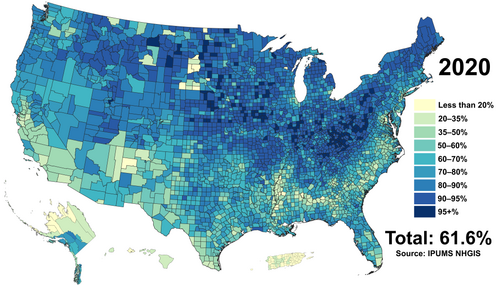 2020年米国国勢調査における各郡の白人アメリカ人の割合 | |
| 総人口 | |
|---|---|
単独(単一人種)204,277,273人(2020年国勢調査) [ 1]米国総人口の61.63%混合(多民族)31,134,234人(2020年国勢調査)[1]米国総人口の9.39%単独または混合235,411,507人(2020年国勢調査)[1]米国総人口の71.02%  | |
| 人口の多い地域 | |
| 米国全土 | |
 カリフォルニア カリフォルニア | 16,296,122 [1] |
 テキサス テキサス | 14,609,365 [1] |
 フロリダ フロリダ | 12,422,961 [1] |
 ニューヨーク ニューヨーク | 11,143,349 [1] |
 ペンシルバニア ペンシルバニア | 9,750,687 [1] |
| 言語 | |
| 多数派:英語 少数派:ドイツ語 · スペイン語 · アイルランド語 · イタリア語 · ポーランド語 · フランス語 · スコットランド語 · アラビア語 · ノルウェー語 | |
| 宗教 | |
| [2](非ヒスパニック系白人のみ) | |
| 関連民族 | |
| ヨーロッパ系アメリカ人 北アフリカ系アメリカ人 中東系アメリカ人 | |
白人アメリカ人は、コーカサス系アメリカ人とも呼ばれ、白人を自認するアメリカ人である。より公式な意味では、アメリカ人の人口統計データを収集する米国国勢調査局は、「白人」を「ヨーロッパ、中東、または北アフリカの先住民族のいずれかに起源を持つ人」と定義している。このグループは、米国の人口の大半を占めている。2020年の国勢調査によると、71%にあたる2億3541万1507人が白人単独または白人と白人の混合であり、61.6%にあたる2億427万7273人が白人単独であった。これは、2010年の米国人口の72.4%の白人単独の割合から の全国的な白人人口の減少を表している。
2022年の最新のアメリカコミュニティ調査によると、米国国勢調査局は、米国の人口の60.9%が白人のみであり、非ヒスパニック系白人は人口の57.7%であると推定しています。全体として、アメリカ人の72.5%が白人のみ、または白人と白人の両方であると認識しています。[3] [4]ヨーロッパ系アメリカ人は、これまでのところ最大の汎民族系白人アメリカ人グループであり、建国以来、米国の人口の多数派を構成しています。
米国国勢調査局は「白人」について、口語的な用法とは異なる特別な定義を使用している。[5] [6]国勢調査局は「白人」を「ヨーロッパ、中東、北アフリカの先住民のいずれかに起源を持つ人々」と定義している。[7]国勢調査の公式定義では、すべての人種カテゴリーの人々は、「ヒスパニックまたはラテン系ではない」と自認する人々と、「ヒスパニックまたはラテン系」と自認する人々にさらに分類される可能性がある。[8] [5]「非ヒスパニック系白人」という用語は、単に「白人」ではなく、一般的に白人であると自認し、白人であると認識されている人々に最も近い国勢調査グループである可能性がある。同様に、すべてのヒスパニック/ラテン系の人々が「白人」、「黒人」、または記載されている他の人種カテゴリーであると自認しているわけではない。[5] [6] 2015年、国勢調査局は、ヒスパニック/ラテン系および中東/北アフリカ系の人種区分を「白人」や「黒人」と同様のものにし、回答者が1つ、2つ、あるいはそれ以上の人種区分を選択できるようにする意向を発表したが、この変更はトランプ政権下で取り消された。[6] [9]米国国勢調査で「白人」に分類されているが、白人であると自認したり白人と認識されたりする可能性のないその他の人物には、アラブ系アメリカ人や、ヨーロッパ系またはMENA系のユダヤ系アメリカ人が含まれる。 [10] [11] [12] [13] [14]米国では、白人という用語は一般的にヨーロッパ系の人を指すが、法的には西アジア系および北アフリカ系(中東、西アジア、北アフリカ)の人々にまで範囲が拡大されている。[15] [16] [17]しかし、2024年に行政管理予算局は連邦政府が使用する人種カテゴリーを更新し、2030年の国勢調査では中東系および北アフリカ系アメリカ人は白人として分類されなくなると発表した。[18]
自己申告による祖先
最も一般的に報告されている白人アメリカ人の祖先は、イギリス人(12.5%)、ドイツ人(7.6%)、アイルランド人(5.3%)、イタリア人(3.2%)、ポーランド人(1.3%)です。[19]スペイン系の直系の人々もヒスパニックとして分類されており、国勢調査ではヒスパニックの国籍は追跡していますが、人種による分類はしていないため、白人ヒスパニックまたはメスティーソのスペインからの完全または部分的な祖先を追跡することは困難です。2021年には、あらゆる人種の995,583人がスペインを祖先としており、総人口の0.3%でした。[20]しかし、遺伝子研究によると、米国のヒスパニックの大多数は、スペインまたはイベリア人が最大の要素であるなど、さまざまな量のヨーロッパの祖先を持っていることがわかりました。[21] [22] [23]イギリス系アメリカ人の人口統計も深刻な過小評価であると考えられており、特にアメリカ独立戦争以前に家族が到着した場合、彼らは米国に居住している期間が長いため、単に「アメリカ人」(7%)と自己申告する傾向がある。[12] [24] [14]
遺伝学
2015年にアメリカ人類遺伝学ジャーナルに掲載された遺伝子研究では、148,789人のヨーロッパ系アメリカ人の遺伝的祖先を分析した。この研究では、白人アメリカ人の間で最も一般的なヨーロッパ系祖先はイギリス系であり、この要素は全50州の全人口の20%(ウィスコンシン州、ミネソタ州、ノースダコタ州)から55%(ミシシッピ州、テネシー州、アーカンソー州)に及ぶと結論付けられた。これらの州は、国勢調査で「アメリカ人」の祖先を持つ人の数が最も多い州と強く相関していた。[25]また、多くの白人アメリカ人は複数の国に祖先を持つ。2022年のアメリカ人コミュニティ調査によると、76,678,228人のアメリカ人が複数のヨーロッパ、中東、または北アフリカの祖先グループに属しており、その大部分がさまざまなヨーロッパのグループに属している。[26]
歴史的および現在の定義
「白人」の定義は、米国の歴史を通じて変化してきました。
米国国勢調査の定義
「白人アメリカ人」という用語は、多くの異なる民族グループを包含する可能性がある。米国国勢調査は人種の社会的定義を反映していると主張しているが、人種の社会的側面は国勢調査の基準よりも複雑である。2000年の米国国勢調査では、人種の分類は「一般的にこの国で認められている人種の社会的定義を反映している。生物学的、人類学的、遺伝学的基準には従っていない」とされている。[27]
国勢調査の人種に関する質問には、白人またはヨーロッパ系アメリカ人、黒人またはアフリカ系アメリカ人、アメリカインディアンおよびアラスカ先住民、ハワイ先住民またはその他の太平洋諸島民、アジア人、および「その他の人種」のカテゴリがリストされており、回答者は複数の人種または民族カテゴリを選択できます。国勢調査局は白人を次のように定義しています。
.jpg/500px-Tony_Shalhoub_(1).jpg)
「白人」とは、ヨーロッパ、中東、北アフリカの先住民族のいずれかに起源を持つ人を指します。人種を「白人」と申告した人や、ドイツ人、イタリア人、レバノン人、アラブ人、モロッコ人、コーカサス人などの項目を報告した人も含まれます。[7]
米国の国勢調査文書では、白人という呼称は、他のすべての公式人種カテゴリーと同様に、 1980年の国勢調査で人種とは別個の独立した民族カテゴリーとして導入されたヒスパニックまたはラテン系という用語と重複している。[28] [29]ヒスパニック系およびラテン系アメリカ人は全体として人種的に多様なグループを構成しており、国内最大の少数民族である。[30] [31]
1930年から、メキシコ人は「実質的にすべてのメキシコ人労働者は分類が難しい人種の混合体である」という説明とともに、米国国勢調査で独自の人種として追加された。[32] [33]メキシコ人の人種カテゴリーは1940年に削除され、「メキシコ人は、明らかにインド人または他の非白人人種でない限り、白人とみなされる」という新しい指示が出された。これは1950年にも継続された。[34] 1970年にはスペイン起源のカテゴリーが創設され、これはラテンアメリカ人の以前の分類に取って代わり、現在はヒスパニックまたはラテン系の民族カテゴリーで表されている。ヒスパニックまたはラテン系は、2020年の国勢調査で(中東および北アフリカとともに)再び人種ステータスに引き上げられる予定だったが、これはドナルド・J・トランプ大統領によってキャンセルされた。[35]
中東および北アフリカ系アメリカ人を白人とみなすことは議論の的となっている。20世紀初頭には、アラブ系の人々が非白人とみなされたために米国への入国を拒否されたり、国外追放されたりしたケースが数多くあった。[36] 21世紀初頭、MENA系アメリカ人は独自の人種グループの創設を求めてロビー活動を開始し、成功した。2015年、米国国勢調査局は彼らの要請に応えて、2020年の国勢調査に「中東および北アフリカ」の人種カテゴリーを追加すると発表した。[37] [38]トランプ政権は2016年に政権を握った後、この変更を無効にした。
しかし、2024年にバイデン政権 下の行政管理予算局は提案された変更を復活させ、連邦政府が使用する人種カテゴリーが更新され、中東系および北アフリカ系アメリカ人は2030年の国勢調査では白人として分類されなくなり、ヒスパニック系およびラテン系も民族カテゴリーではなく人種カテゴリーと同様に扱われると発表した。[18]国勢調査局は、白人の計画された定義を次のように定義している。
「例えば、イギリス人、ドイツ人、アイルランド人、イタリア人、ポーランド人、スウェーデン人、フランス人、スペイン人、ウクライナ人、ロシア人など、ヨーロッパの先住民族のいずれかに起源を持つ個人。」[39]
個人が自己認識しない場合、米国国勢調査の人種パラメータでは、それぞれの国籍に人種的価値が与えられます。
2007年のSEERプログラムのコーディングおよびステージングマニュアルなど、一部の政府文書では、「その他の人種」の欄にイスラム教徒(またはシーア派やスンニ派などのイスラム教の一派)、ユダヤ教徒、ゾロアスター教徒、コーカサス人、またはMENAまたはラテンアメリカの民族を記載し、出身国やネイティブアメリカンの部族所属を記載していない人は、自動的に白人として集計された。[40] 1990年の米国国勢調査の公的利用マイクロデータサンプル(PUMS)では、祖先コード一覧に「白人」のサブグループとして「コーカサス人」や「アーリア人」などの用語が記載されていたが、[41] 2005年以降のPUMSコードでは記載されていない。[42]
社会的定義
現代のアメリカ合衆国では、基本的にヨーロッパ系の人は誰でも白人とみなされることが多い。中東および北アフリカ(MENA)系の人も白人とみなされることがある。しかし、アラブ系アメリカ人、ベルベル系アメリカ人、ヨーロッパ系またはMENA系のユダヤ系アメリカ人、ヨーロッパ系またはMENA系のヒスパニック系およびラテン系など、米国国勢調査で白人に分類されている民族グループの多くは、必ずしも白人であると認識されているわけではなく、必ずしも白人であると認識されているわけでもない。[43] [44] [45] [46] [47] [48] [49] [50]
白人に対する社会的な認識は、アメリカの歴史を通じて進化してきた。例えば、ベンジャミン・フランクリンは、ドイツのザクセン人とイギリス人が「地球上の白人の主要集団を構成している」と述べた。[51]歴史的に、ヨーロッパ系の多くの人々は、アイルランド人、イタリア人、ギリシャ人、スラブ人など、主流のアメリカ社会に容易に統合されず、白人/黒人の二元性の「暗い」側に捕らわれていた。[52]ミネソタ州では、フィンランドからの移民数の増加により、フィンランド人の白人性、およびフィンランド人をモンゴロイド民族として分類すべきかどうかをめぐる議論が[いつ? ]起こった。[50]
デイヴィッド・ローディガーは、アメリカ合衆国における白人種の構築は、奴隷所有者と奴隷を精神的に遠ざけるための努力であったと主張している。 [53]法律によって正式に白人と定義されるプロセスは、市民権の取得をめぐる法廷闘争の中でしばしば生じた。[54]
人口統計情報
2020年米国国勢調査時点の50州、コロンビア特別区、プエルトリコ
2020年の米国国勢調査では、米国に住む3億3200万人のうち71%が白人アメリカ人で占められており、そのうち61.6%が「白人のみ」であると自認している。これは、 2010年の米国の白人のみと自認する人口の72.4%から全国的に白人人口が減少したことを示している。 [7] [59] [注 1]
白人アメリカ人の中で最大の民族グループ(祖先別)はイギリス人または英国人で、ドイツ人とアイルランド人がそれに続いた。[61] [62] 1980年の国勢調査では、49,598,035人のアメリカ人がイギリス人の祖先であると回答し、これは当時の全人口の26%を占め、最大のグループであり、実際、イングランドの人口よりも多かった。[63]これらの人々の半分強が、その後の国勢調査で「アメリカ人」の祖先であると回答しており、2000年の国勢調査で「アメリカ人」の祖先が優勢となっている事実上すべての地域は、1980年の国勢調査で「イギリス人」が優勢であった場所と一致している。[14] [64]
地理的分布


_from_1960_to_2020.gif/500px-White_America_(of_one_race)_from_1960_to_2020.gif)
アメリカのほとんどの地域では、白人アメリカ人(白人ヒスパニックを含む)だけが多数派の人種グループである。2022年現在、ハワイ州[65]、カリフォルニア州[66]、テキサス州[67]、ニューメキシコ州[68]、ネバダ州[69]、メリーランド州[70]では白人ヒスパニックが多数派ではなく、 最後の4 州では 人口の半分弱を占めている。白人ヒスパニックを除けば、ジョージア州でも少数派である。[71]また、多くのアメリカインディアン居留地、南部の一部、特に「ブラックベルト」の一部の地域、コロンビア特別区、すべての米国領土、そして全国の多くの都市部でも少数派である。
しかし、多民族アメリカ人を含めると、一部または完全に白人であると自認する人々が、ハワイ州とプエルトリコを除くすべての州で人口の過半数を占める。[ 72 ]
国勢調査局が「非ヒスパニック系白人」と呼ぶ人々の最も高い集中度は、中西部、ニューイングランド、北部ロッキー山脈諸州、ケンタッキー州、ウェストバージニア州、東テネシー州で確認されている。[74]白人の集中度が最も低いのは、南部諸州と中部大西洋岸諸州である。[8] [75] [76]
広大な地理的地域はすべて白人アメリカ人が占めていますが、大都市の特定の地域でははるかに大きな違いが見られます。
2020年現在、白人単独または他の人種と混合した白人アメリカ人の割合が最も高い州: [80] [検証失敗]
- バーモント州95.6%
- メイン州95.4%
- ウェストバージニア州94.4%
- ニューハンプシャー93.7%
- ワイオミング州92.0%
- モンタナ90.9%
- アイダホ州90.2%
- アイオワ89.8%
- ノースダコタ州88.0%
- ケンタッキー87.5%
2020年現在、非ラテン系/ヒスパニック系白人の割合が最も高い州: [81] [検証失敗]
- メイン州92.0%
- バーモント州91.3%
- ニューハンプシャー州91.3%
- ウェストバージニア州90.4%
- ワイオミング州90.7%
- アイダホ州90.7%
- ユタ州88.7%
- アイオワ88.7%
- モンタナ86.7%
- ネブラスカ86.0%
収入と学歴
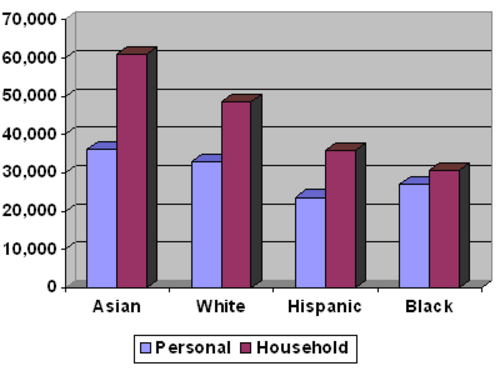
文化的背景別に見ると、白人アメリカ人は全米で2番目に高い世帯収入と個人収入の中央値を持っている。白人アメリカ人は国内のどの人種よりも世帯規模が小さいため、世帯員1人当たりの収入の中央値も最も高かった。2006年、25歳以上の白人アメリカ人の個人収入の中央値は33,030ドルで、フルタイムで働いている25歳から64歳までの人の収入は34,432ドルだった。全世帯の42%に2人の稼ぎ手がいたため、世帯収入の中央値は2005年の個人収入の中央値48,554ドルよりもかなり高かった。ユダヤ系アメリカ人は、白人アメリカ人の中で世帯収入、個人収入、教育水準の第1位である。[82] 2005年の白人世帯の世帯収入の中央値は48,977ドルで、全国平均の44,389ドルを10%上回っている。キューバ系アメリカ人の86%は白人に分類され、米国生まれの人は他のほとんどの白人よりも平均所得と教育水準が高い。[83]
白人アメリカ人の貧困率はどの人種グループよりも2番目に低く、白人の11%が貧困線以下の生活を送っており、全国平均より3%低い。[84]しかし、白人が多数派であるため、貧困生活を送っているアメリカ人の48%は白人である。[85]
白人アメリカ人の学歴は、アジア系アメリカ人に次いで国内で2番目に高い。全体的に、白人アメリカ人のほぼ3分の1が学士号を取得しており、米国外で生まれた白人の学歴はより高く、外国生まれの白人の38%、米国生まれの白人の30%が大学の学位を取得している。どちらの数字も全国平均の27%を上回っている。[86]
男女間の所得格差は白人の間で最も大きく、白人男性の所得は白人女性の所得を48%上回っている。2005年の国勢調査局のデータによると、白人女性の平均所得はすべての人種の男性よりも低い。2005年、白人アメリカ人女性の平均所得はアフリカ系アメリカ人女性のそれよりわずかに高いだけだった。[87]
白人アメリカ人は黒人アメリカ人よりも郊外や小都市に住む可能性が高い。[88]
各郡の割合
- 白人アメリカ人(単独)の人口分布の推移
-
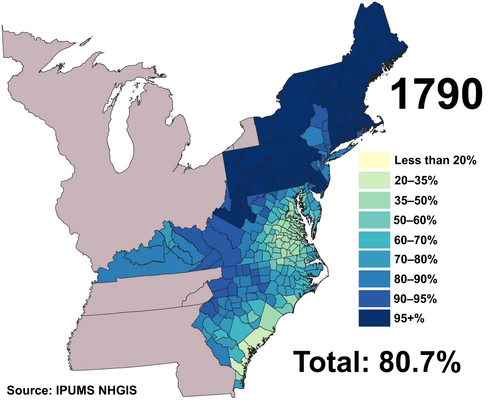 1790
1790 -
 1800
1800 -
 1810
1810 -
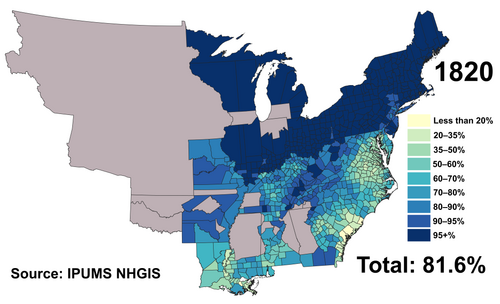 1820
1820 -
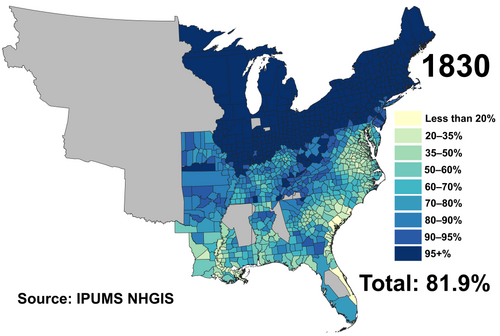 1830
1830 -
 1840
1840 -
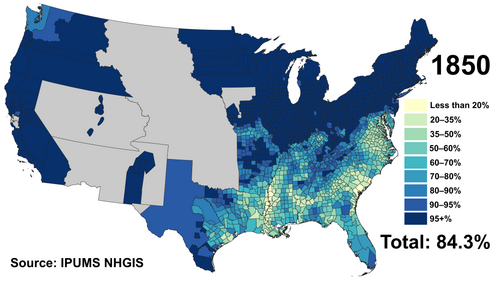 1850
1850 -
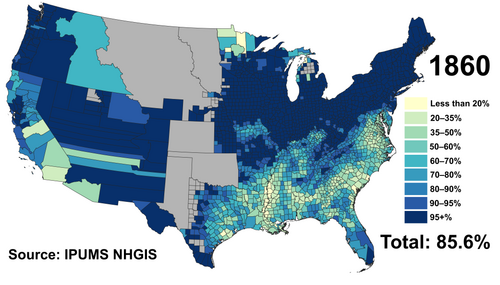 1860
1860 -
 1870
1870 -
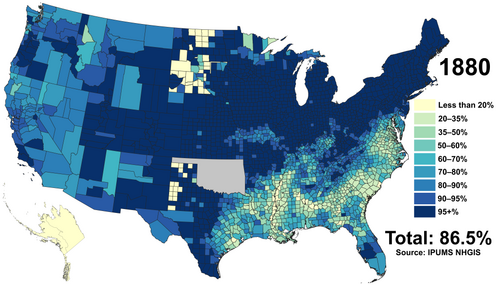 1880
1880 -
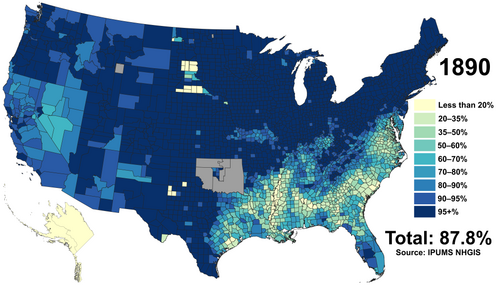 1890
1890 -
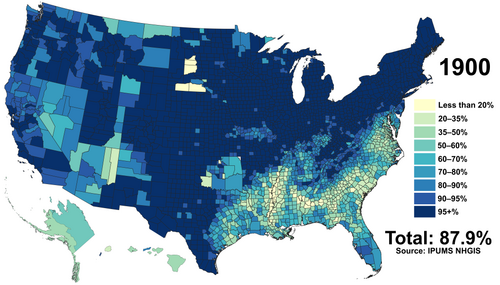 1900
1900 -
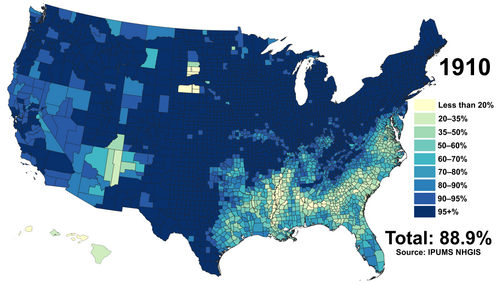 1910
1910 -
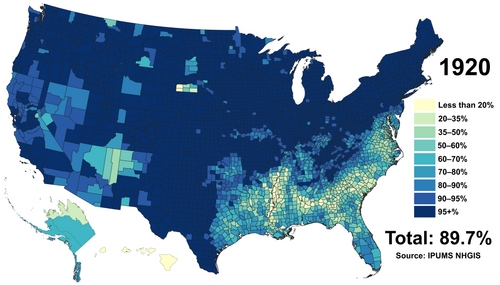 1920
1920 -
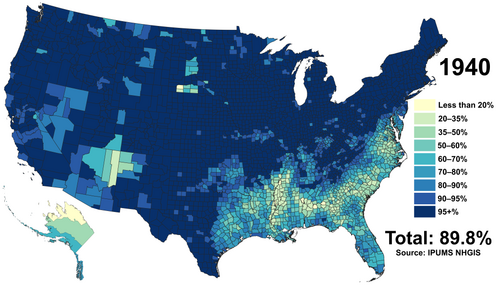 1940
1940 -
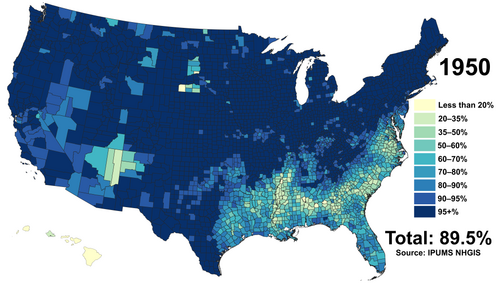 1950
1950 -
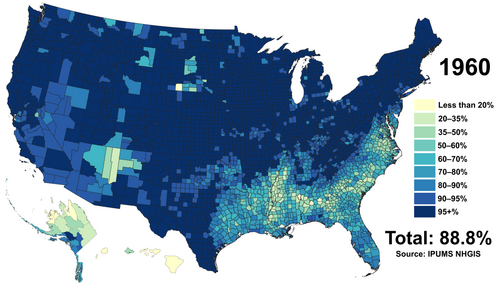 1960
1960 -
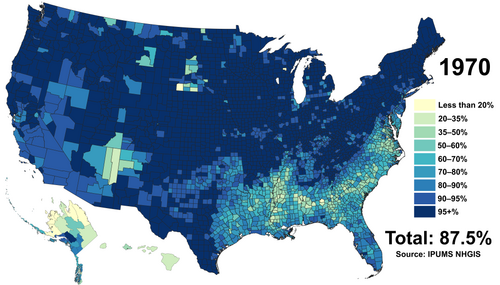 1970
1970 -
 1980
1980 -
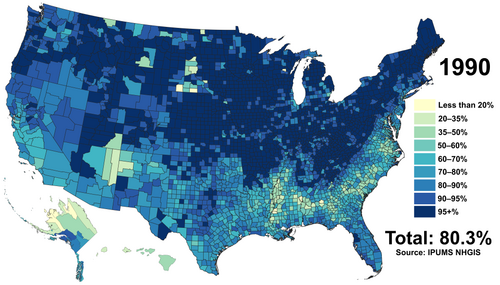 1990
1990 -
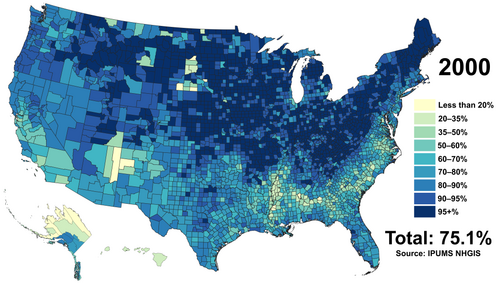 2000
2000 -
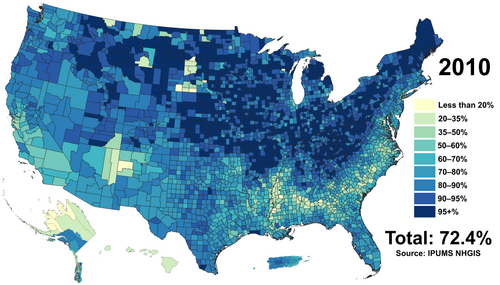 2010
2010 -
2020
2000年から2020年までの単一人種または単独の白人アメリカ人
非ヒスパニック系人口
祖先グループ
以下の表は、2022年のアメリカコミュニティ調査の推定によると、5万人以上のヨーロッパ系および中東系の自己申告者全員をリストしたものです。[92] [93]
政治
1968年の米国大統領選挙以来、白人アメリカ人の大多数は共和党に投票しており、1964年の米国大統領選挙は民主党が白人有権者の過半数を獲得した最後の選挙であった。 [要出典]
2012年、ロムニー投票者の88%は非ヒスパニック系白人であり、オバマ投票者の56%は非ヒスパニック系白人であった。[94] 2008年の大統領選挙では、ジョン・マケインは非ヒスパニック系白人の票の55%を獲得した。[95] 2010年の下院選挙では、共和党が非ヒスパニック系白人の票の60%を獲得した。[96]
一部の学者や評論家は、2016年のドナルド・トランプの大統領選挙勝利は「白人の反発」の一例であると主張している。[97] [98] [99]
健康
文化
From their earliest presence in North America, White Americans have contributed literature, art, cinema, religion, agricultural skills, foods, science and technology, fashion and clothing styles, music, language, legal system, political system, and social and technological innovation to American culture. White American culture derived its earliest influences from English, Scottish, Welsh, and Irish settlers and is quantitatively the largest proportion of American culture.[100] The overall American culture reflects White American culture. The culture has been developing since long before the United States formed a separate country. Much of White American culture shows influences from British culture. Colonial ties to Great Britain spread the English language, legal system and other cultural attributes.[101]
Albion's Seed: Four British Folkways in America

In his 1989 book Albion's Seed: Four British Folkways in America, David Hackett Fischer explores the details of the folkways of four groups of settlers from the British Isles that moved to the American colonies during the 17th and 18th centuries from distinct regions of Britain and Ireland. His thesis is that the culture of each group persisted (albeit in modified form), providing the basis for the modern United States.[102]
According to Fischer, the foundation of America's four regional cultures was formed from four mass migrations from four regions of the British Isles by four distinct ethno-cultural groups. New England's formative period occurred between 1629 and 1640 when Puritans, mostly from East Anglia, settled there, thus forming the basis for the New England regional culture.[103] The next mass migration was of southern English Cavaliers and their working class British Isles servants to the Chesapeake Bay region between 1640 and 1675. This spawned the creation of the American Southern culture.[104]
Then, between 1675 and 1725, thousands of Irish, Cornish, English and Welsh Quakers plus many Germans sympathetic to Quaker ideas, led by William Penn, settled the Delaware Valley. This resulted in the formation of the General American culture, although, according to Fischer, this is really a "regional culture", even if it does today encompass most of the US from the mid-Atlantic states to the Pacific Coast.[105] Finally, a huge number of settlers from the borderlands between England and Scotland, sometimes by way of northern Ireland, migrated to Appalachia between 1717 and 1775. This resulted in the formation of the Upland South regional culture, which has since expanded to the west to West Texas and parts of the American Southwest.[106]
In his book, Fischer brings up several points. He states that the US is not a country with one "general" culture and several "regional" cultures, as is commonly thought. Rather, there are only four regional cultures as described above, and understanding this helps one to more clearly understand American history as well as contemporary American life. Fischer asserts that it is not only important to understand where different groups came from, but when. All population groups have, at different times, their own unique set of beliefs, fears, hopes and prejudices. When different groups moved to America and brought certain beliefs and values with them, these ideas became, according to Fischer, more or less frozen in time, even if they eventually changed in their original place of origin.[107]
Admixture
Admixture in non-Hispanic whites
White Americans have a mean of 98.6% European, 0.19% sub-Saharan African, and 0.18% Native American ancestry according to a study specifically focusing on customers who took a 23andMe DNA test.[108] However, non-European ancestry in White Americans is highly variable; for example, Black ancestry (2% or greater) is found in over five percent of European Americans in Louisiana and South Carolina, and Native American ancestry (2% or greater) is found in over three percent of European Americans in Louisiana and North Dakota. African ancestry is most common in the South and least common in the Midwest; Native American ancestry is more common in Western states than Eastern states.[109]
Older studies have also been performed. DNA analysis on White Americans by geneticist Mark D. Shriver showed an average of 0.7% sub-Saharan African admixture and 3.2% Native American admixture.[110] The same author, in another study, claimed that about 30% of all White Americans, approximately 66 million people, have a median of 2.3% of Black African admixture.[111] Shriver discovered his ancestry is 10 percent African, and Shriver's partner in DNA Print Genomics, J.T. Frudacas, contradicted him two years later stating "Five percent of European Americans exhibit some detectable level of African ancestry."[112]
In a 2007 study, Gonçalves et al. reported sub-Saharan and Amerindian mtDNA lineages at a frequency of 3.1% (respectively 0.9% and 2.2%) in a sample of 1387 American Caucasians as compared to 62% in white Brazilians (respectively 29% and 33%), 98% for white Colombians (respectively 8% and 90%) and 96% for white Costa Ricans (respectively 7% and 89%).[113] A 2003 study on Y-chromosomes and mtDNA found African admixture in European Americans to be "below the limits of detection".[114]
Admixture in Hispanic whites
In contrast to non-Hispanic or Latino whites, whose average European ancestry is 98.6%,[115][116] genetic research has found that the average European admixture among White Hispanic and Latino Americans is 73%, while the average European admixture for Hispanic Americans overall (regardless of their self-identified race) is 65.1%. However, this study only obtained its genetic data from people who took a paid ancestry test from 23andMe, and as such may not be fully representative of the general Hispanic population in the US.[117]
See also

- Health status of White Americans
- White demographic decline#United States
- American ancestry
- Anglo
- Emigration from Europe
- European Americans
- Hyphenated American
- List of United States cities by percentage of white population
- Middle Eastern Americans
- Non-Hispanic or Latino whites
- Race and ethnicity in the United States
- Racism in the United States
- Stereotypes of white Americans
- White Anglo-Saxon Protestant
- White ethnic
- White Latino Americans
- White Puerto Ricans
- White Southerners
- White Americans in California
- White Americans in Maryland
- White Americans in Texas
- White supremacy
- White nationalism
- White people in Hawaii
- White trash
- Poor White
- Mountain white
Notes
- ^ Of the foreign-born population from Europe (4,817 thousand), in 2010, 62% were naturalized.[60]
References
- ^ a b c d e f g h "Race and Ethnicity in the United States". United States Census Bureau. August 12, 2021. Retrieved August 17, 2021.
- ^ "Religious tradition by race/ethnicity (2014)". The Pew Forum on Religion & Public Life. Retrieved April 5, 2019.
- ^ "Grid View: Table B02001 - Census Reporter". censusreporter.org. Retrieved June 29, 2024.
- ^ "Grid View: Table B03002 - Census Reporter". censusreporter.org. Retrieved June 29, 2024.
- ^ a b c "Analysis | There's a big problem with how the census measures race". The Washington Post. February 6, 2018. Retrieved July 23, 2021.
- ^ a b c Demby, Gene (June 16, 2014). "On The Census, Who Checks 'Hispanic,' Who Checks 'White,' And Why". NPR.org. Retrieved July 23, 2021.
- ^ a b c Karen R. Humes; Nicholas A. Jones; Roberto R. Ramirez, eds. (March 2011). "Definition of Race Categories Used in the 2010 Census" (PDF). United States Census Bureau. p. 3. Retrieved September 8, 2013.
- ^ a b "The White Population: 2000" (PDF). United States Census Bureau. August 2001. Retrieved March 10, 2011.
- ^ "Public Comments Received on Federal Register notice 79 FR 71377: Proposed Information Collection; Comment Request; 2015 National Content Test" (PDF). Census.gov. December 2, 2014 – February 2, 2015. Retrieved October 29, 2019.
- ^ "Census Bureau explores new Middle East/North Africa ethnic category". Pewresearch.org. March 24, 2014. Retrieved November 6, 2017.
- ^ Sources:
- Korelitz 1997
- Novick 1999
- Siporin 1990
- Lerner 1993
- ^ a b Sources:
- Reynolds Farley, "The New Census Question about Ancestry: What Did It Tell Us?", Demography, Vol. 28, No. 3 (August 1991), pp. 414, 421.
- Stanley Lieberson and Lawrence Santi, "The Use of Nativity Data to Estimate Ethnic Characteristics and Patterns", Social Science Research, Vol. 14, No. 1 (1985), pp. 44–46.
- ^ Sources:
- Thompson, Derek (August 19, 2008). "Do white people really come from the Caucasus?". Slate. Retrieved March 10, 2011.
Caucasians included most Europeans, Northern Africans, and Asians as far east as the Ganges Delta in modern India.
- Lee, Sandra Soo-Jin; Mountain, Joanna; Koenig, Barbara A. (2001). "The meanings of "race" in the new genomics: Implications for health disparities research" (PDF). Yale Journal of Health Policy, Law, and Ethics. 1: 33–75. PMID 12669320. Archived from the original (PDF) on March 3, 2016.
- Thompson, Derek (August 19, 2008). "Do white people really come from the Caucasus?". Slate. Retrieved March 10, 2011.
- ^ a b c Lieberson, Stanley; Waters, Mary C. (September 1986). "Ethnic Groups in Flux: The Changing Ethnic Responses of American Whites". Annals of the American Academy of Political and Social Science. 487 (79, Immigration and American Public Policy): 82–86. doi:10.1177/0002716286487001004. ISSN 0002-7162. JSTOR 1046054. OCLC 4649763967. S2CID 60711423.
- ^ "Race". QuickFacts. United States Census Bureau.
- ^ Bhopal, R.; Donaldson, L. (1998). "White, European, Western, Caucasian, or what? Inappropriate labeling in research on race, ethnicity, and health". American Journal of Public Health. 88 (9): 1303–1307. doi:10.2105/ajph.88.9.1303. PMC 1509085. PMID 9736867.
- ^ Baum 2006, p. 3, 18.
- ^ a b Bureau, US Census. "What Updates to OMB's Race/Ethnicity Standards Mean for the Census Bureau". Census.gov. Retrieved June 29, 2024.
{{cite web}}:|last=has generic name (help) - ^ "Detailed Races and Ethnicities in the United States and Puerto Rico: 2020 Census". United States Census Bureau.
- ^ 2021 Community Survey, Table B03001: Hispanic or Latino Origin by Specific Origin
- ^ Wade, Lizzie (December 18, 2014). "Genetic study reveals surprising ancestry of many Americans".
- ^ Conomos, Matthew P.; Laurie, Cecelia A.; Stilp, Adrienne M.; Gogarten, Stephanie M.; McHugh, Caitlin P.; Nelson, Sarah C.; Sofer, Tamar; Fernández-Rhodes, Lindsay; Justice, Anne E.; Graff, Mariaelisa; Young, Kristin L.; Seyerle, Amanda A.; Avery, Christy L.; Taylor, Kent D.; Rotter, Jerome I. (January 7, 2016). "Genetic Diversity and Association Studies in US Hispanic/Latino Populations: Applications in the Hispanic Community Health Study/Study of Latinos". The American Journal of Human Genetics. 98 (1): 165–184. doi:10.1016/j.ajhg.2015.12.001. ISSN 0002-9297. PMC 4716704. PMID 26748518.
- ^ Jordan, I. King; Rishishwar, Lavanya; Conley, Andrew B. (September 23, 2019). "Native American admixture recapitulates population-specific migration and settlement of the continental United States". PLOS Genetics. 15 (9): e1008225. doi:10.1371/journal.pgen.1008225. ISSN 1553-7404. PMC 6756731. PMID 31545791.
- ^ Sources:
- Pulera, Dominic (October 20, 2004). Sharing the Dream: White Males in Multicultural America. A&C Black. p. 57. ISBN 978-0-8264-1643-8. Retrieved October 22, 2016.
- ^ Bryc, Katarzyna; Durand, Eric Y.; Macpherson, J. Michael; Reich, David; Mountain, Joanna L. (January 8, 2015). "The Genetic Ancestry of African Americans, Latinos, and European Americans across the United States". American Journal of Human Genetics. 96 (1): 37–53. doi:10.1016/j.ajhg.2014.11.010. ISSN 0002-9297. PMC 4289685. PMID 25529636.
- ^ "Explore Census Data". data.census.gov. Retrieved June 29, 2024.
- ^ "Questions and Answers for Census 2000 Data on Race". Archived from the original on March 4, 2010. Retrieved April 25, 2010.
- ^ "American FactFinder Help". United States Census Bureau. Archived from the original on March 5, 2001. Retrieved November 11, 2008.
Origin can be viewed as the heritage, nationality group, lineage, or country of birth of the person or the person's parents or ancestors before their arrival in the United States. People who identify their origin as Spanish, Hispanic, or Latino may be of any race.
- ^ "Overview of Race and Hispanic Origin: 2000" (PDF). Census.gov. Retrieved October 22, 2016.
- ^ "T4-2008. Hispanic or Latino By Race". 2008 Population Estimates. United States Census Bureau. Retrieved March 15, 2010.
- ^ "B03002. HISPANIC OR LATINO ORIGIN BY RACE". 2008 American Community Survey 1-Year Estimates. United States Census Bureau. Retrieved March 16, 2010.
- ^ United States Bureau of the Census (1933). Population, Volume II: General Report, Statistics by Subjects (Report). Washington, DC: Government Printing Office. p. 27.
- ^ "Measuring Race and Ethnicity Across the Decades: 1790-2010, Mapped to 1997 U.S. Office of Management and Budget Classification Standards". The United States Census Bureau.
- ^ Bashi Treitler, Vilna Francine. "The Race Question". Rutgers University Faculty Webpages. Archived from the original on October 7, 2008.
- ^ "Public Comments Received on Federal Register notice 79 FR 71377: Proposed Information Collection; Comment Request; 2015 National Content Test" (PDF). Census.gov. December 2, 2014 – February 2, 2015. Retrieved October 29, 2019.
- ^ "Not Quite White: Race Classification and the Arab American Experience – Arab American Institute". Aaiusa.org. Archived from the original on May 27, 2020. Retrieved December 14, 2017.
- ^ "Lobbying for a 'MENA' category on U.S. Census". USA Today. August 13, 2014.
- ^ "Why Arab Americans are pushing for a 'Middle East or North African' category on the census". PBS. April 28, 2023.
- ^ Isaksen, Lise Widding (2011), "Gendering the Stranger: Nomadic Care Workers in Europe — a Polish-Italian Example", Europeanization, Care and Gender, London: Palgrave Macmillan UK, pp. 141–151, doi:10.1057/9780230321021_9, ISBN 978-1-349-33526-8, retrieved June 29, 2024
- ^ "Surveillance Epidemiology and End Results. Race and Nationality Descriptions from the 2000 Census and Bureau of Vital Statistics" (PDF). Seer.cancer.gov. May 21, 2007. Retrieved October 22, 2016.
- ^ "Clark Library | U-M Library". Lib.umich.edu. Archived from the original on March 13, 2005. Retrieved June 5, 2023.
- ^ "Access Data: Public Use Microdata (PUMS): 2005 PUMS Code Lists: Ancestry Codes". Archived from the original on September 16, 2008. Retrieved August 22, 2008.
- ^ Ajrouch, Kristine J. (2016). "Gender, Race, and Symbolic Boundaries: Contested Spaces of Identity among Arab American Adolescents". Sociological Perspectives. 47 (4): 371–391. doi:10.1525/sop.2004.47.4.371. S2CID 143001730.
- ^ Korelitz, Seth (March 1997). "The Menorah Idea: From Religion to Culture, from Race to Ethnicity". American Jewish History. 85 (1). The Johns Hopkins University Press: 75–100. ISSN 0164-0178. JSTOR 23885597.
- ^ Novick, Peter (1999). The Holocaust in American Life. Houghton Mifflin Harcourt. pp. 127–132. ISBN 978-0-618-08232-2.
- ^ Siporin, Steve (November 1990). "Immigrant and Ethnic Family Folklore". Western States Jewish History. 22 (3): 230–242.
- ^ Lerner, Michael (May 18, 1993). "Jews Are Not White". The Village Voice.
In America, to be 'white' means to be the beneficiary of the past 500 years of European exploration and exploitation of the rest of the world
- ^ Hilene Flanzbaum, ed. The Americanization of the Holocaust (1999)
- ^ Monty Noam Penkower, "Shaping Holocaust Memory," American Jewish History 2000 88(1): 127–132. 0164–0178
- ^ a b Armas Kustaa Ensio Holmio, "History of the Finns in Michigan", p. 17.
- ^ Franklin, Benjamin (1751). Observations concerning the increase of mankind, peopling of countries, &c. Tarrytown, N.Y., Reprinted, W. Abbatt. p. 224.
- ^ Tehranian, John (January 2000). "Performing Whiteness: Naturalization Litigation and the Construction of Racial Identity in America". Yale Law Journal. 109 (4). New Haven, Connecticut: The Yale Law Journal Company, Inc.: 825. doi:10.2307/797505. ISSN 0044-0094. JSTOR 797505. OCLC 5544418733. Archived from the original on September 4, 2020. HeinOnline link.
- ^ Roediger, Wages of Whiteness, 186; Tony Horwitz, Confederates in the Attic: Dispatches from the Unfinished Civil War (New York, 1998).
- ^ Sweet, Frank W. Legal History of the Color Line: The Notion of Invisible Blackness. Backintyme Publishers (2005), ISBN 0-939479-23-0.
- ^ "Official census statistics of the United States race and Hispanic origin population" (PDF). Census.gov. Archived from the original (PDF) on November 14, 2014.
- ^ "Census 2000 Summary File 1 (SF 1) 100-Percent Data Geographic Area: United States". Census.gov. Archived from the original on February 12, 2020. Retrieved April 5, 2009.
- ^ a b "The White Population: 2000" (PDF). Census.gov. Archived from the original (PDF) on June 25, 2005.
- ^ "Overview of Race and Hispanic Origin: 2010" (PDF). Census.gov. Archived from the original (PDF) on May 5, 2011.
- ^ Hixson, Lindsay; Bradford B. Hepler; Myoung Ouk Kim (September 2011). "The White Population: 2010" (PDF). United States Census Bureau. United States Department of Commerce. Retrieved November 20, 2012.
- ^ Grieco, Elizabeth M.; Acosta, Yesenia D.; de la Cruz, G. Patricia; Gambino, Christine; Gryn, Thomas; Larsen, Luke J.; Trevelyan, Edward N.; Walters, Nathan P. (May 2012). "The Foreign-Born Population in the United States: 2010" (PDF). Census.gov. United States Census Bureau. Archived from the original (PDF) on May 11, 2012.
- ^ "Over Half of White Population Reported Being English, German or Irish".
- ^ "United States Population Projections By Race and Hispanic Origin: 2000 TO 2050" (PDF). United States Census Bureau. Archived from the original (Excel) on March 6, 2008. Retrieved May 5, 2008.
- ^ "Ancestry of the Population by State: 1980 – Table 3" (PDF). Census.gov. Retrieved October 22, 2016.
- ^ Fischer, David Hackett (1989). Albion's Seed: Four British Folkways in America. New York: Oxford University Press. pp. 633–39. ISBN 978-0-19-503794-4.
- ^ "Grid View: Table B02001 - Census Reporter". censusreporter.org. Retrieved July 3, 2024.
- ^ "Grid View: Table B02001 - Census Reporter". censusreporter.org. Retrieved July 3, 2024.
- ^ "Grid View: Table B02001 - Census Reporter". censusreporter.org. Retrieved July 3, 2024.
- ^ "Grid View: Table B02001 - Census Reporter". censusreporter.org. Retrieved July 3, 2024.
- ^ "Grid View: Table B03002 - Census Reporter". censusreporter.org. Retrieved July 3, 2024.
- ^ "Grid View: Table B02001 - Census Reporter". censusreporter.org. Retrieved July 3, 2024.
- ^ "Grid View: Table B03002 - Census Reporter". censusreporter.org. Retrieved July 3, 2024.
- ^ "Grid View: Table B02008 - Census Reporter". censusreporter.org. Retrieved July 3, 2024.
- ^ "Grid View: Table B02008 - Census Reporter". censusreporter.org. Retrieved July 3, 2024.
- ^ Chokshi, Niraj (June 30, 2014). "Diversity in America's counties, in 5 maps". The Washington Post. Washington, D.C. Retrieved October 26, 2019.
- ^ Brewer, Cynthia; Suchan, Trudy (2001). Census 2000, The Geography of US Diversity. Redlands, California: ESRI Press.
- ^ "Distribution of those identifying as White alone, by state, US Census Bureau". Archived from the original on May 5, 2007. Retrieved October 5, 2006.
- ^ "Grid View: Table B03002 - Census Reporter". censusreporter.org. Retrieved July 3, 2024.
- ^ "Grid View: Table B02001 - Census Reporter". censusreporter.org. Retrieved July 3, 2024.
- ^ "Grid View: Table B02008 - Census Reporter". censusreporter.org. Retrieved July 3, 2024.
- ^ "United States – States; and Puerto Rico: Percent of the Total Population Who Are White Alone 2007". Census.gov. Archived from the original on July 17, 2009. Retrieved January 5, 2009.
- ^ "GCT0209. Percent of the Total Population Who Are White Alone, Not Hispanic or Latino". American FactFinder. United States Census Bureau. Archived from the original on November 20, 2011. Retrieved January 16, 2011.
- ^ "New Study Claims US Jews Have Reasons to Be Proud". Israelnationalnews.com. June 25, 2008. Retrieved October 22, 2016.
- ^ "Cuba Fact Sheet Final Draft 08252006 _3_.doc" (PDF). Pewhispanic.org. Archived from the original (PDF) on May 30, 2009. Retrieved October 22, 2016.
- ^ "Income, Poverty, and Health Insurance Coverage in the United States: 2004" (PDF). Census.gov. Retrieved October 22, 2016.
- ^ "Rural Poverty: Myths and Realities". Archived from the original on July 4, 2007. Retrieved June 5, 2007.
- ^ "US Census Bureau report on educational attainment in the United States, 2003" (PDF). Retrieved December 23, 2006.
- ^ "US Census Bureau, Personal income forum, Age 25+, 2005". Archived from the original on January 4, 2007. Retrieved January 20, 2007.
- ^ Kahn, Matthew E.; Bajari, Patrick (2001). "Why Do Blacks Live in the Cities and Whites Live in the Suburbs?". SSRN Electronic Journal. doi:10.2139/ssrn.263049. S2CID 55740758.
- ^ "American FactFinder". August 31, 2004. Archived from the original on August 31, 2004. Retrieved June 28, 2022.
- ^ "Race and Ethnicity in the United States: 2010 Census and 2020 Census". Census.gov. Retrieved June 28, 2022.
- ^ a b "Annual Estimates of the Resident Population by Sex, Race, and Hispanic Origin for the United States, States, and Counties: April 1, 2010 to July 1, 2017: 2017 Population Estimates". American FactFinder. Archived from the original on August 19, 2018. Retrieved August 29, 2017.
- ^ "Grid View: Table B04006 - Census Reporter". censusreporter.org. Retrieved July 2, 2024.
- ^ "Grid View: Table B04004 - Census Reporter". censusreporter.org. Retrieved July 2, 2024.
- ^ Tom Scocca, "Eighty-Eight Percent of Romney Voters Were White", Slate November 7, 2012 Archived July 6, 2015, at the Wayback Machine
- ^ "Dissecting the 2008 Electorate: Most Diverse in U.S. History" Archived June 18, 2012, at the Wayback Machine. Pew Research Center. April 30, 2009.
- ^ "The Latino Vote in the 2010 Elections". Pew Research Center. November 3, 2010. Archived from the original on February 5, 2011. Retrieved January 30, 2011.
- ^ II, Vann R. Newkirk (January 15, 2018). "Five Decades of White Backlash". The Atlantic. Retrieved February 16, 2018.
- ^ Blake, John (January 8, 2018). "How Trump became 'the white affirmative action president'". CNN. Video by Tawanda Scott Sambou. Retrieved February 16, 2018.
- ^ Baccini, Leonardo; Weymouth, Stephen (2021). "Gone For Good: Deindustrialization, White Voter Backlash, and US Presidential Voting". American Political Science Review. 115 (2): 550–567. doi:10.1017/S0003055421000022. S2CID 204870213.
Deindustrialization in the US, and the associated localized deterioration in employment, wages, and communities, appear central to the white voter backlash that culminated in the election of Donald Trump.
- ^ "European Influences on Colonial American Culture". pbslearningmedia.org.
- ^ James B. Minahan (March 14, 2013). Ethnic Groups of the Americas: An Encyclopedia: An Encyclopedia. Abc-Clio. p. 9. ISBN 978-1-61069-164-2. Retrieved October 22, 2016.
- ^ David Hackett Fischer, Albion's Seed (Oxford University Press, 1989), p. 6
- ^ Fischer, Albion's Seed, pp. 13–206
- ^ Fischer, Albion's Seed pp. 207–418
- ^ Fischer, Albion's Seed, pp. 419–604
- ^ Fischer, Albion's Seed, pp. 605–782
- ^ Hackett Fischer, David. Albion's Seed Oxford University Press, 1989.
- ^ Bryc, K. (2015). "The Genetic Ancestry of African Americans, Latinos, and European Americans across the United States". The American Journal of Human Genetics. 96 (1). Elsevier BV: 42. doi:10.1016/j.ajhg.2014.11.010. ISSN 0002-9297. PMC 4289685. PMID 25529636.
- ^ Bryc 2015: Figure 3
- ^ Shriver, Mark D.; Parra, Esteban J.; Dios, Sonia; Bonilla, Carolina; Norton, Heather; Jovel, Celina; Pfaff, Carrie; Jones, Cecily; Massac, Aisha; Cameron, Neil; Baron, Archie; Jackson, Tabitha; Argyropoulos, George; Jin, Li; Hoggart, Clive J.; McKeigue, Paul M.; Kittles, Rick A. (2003). "Skin pigmentation, biogeographical ancestry and admixture mapping". Human Genetics. 112 (4): 387–399. doi:10.1007/s00439-002-0896-y. PMID 12579416. S2CID 7877572.
- ^ Sailer, Steve (May 8, 2002). "Analysis: White prof finds he's not". UPI.
- ^ Jim Wooten, "Race Reversal Man Lives as 'Black' for 50 Years — Then Finds Out He's Probably Not, ABC News (2004).
- ^ Sample of 1387 American Caucasian individuals catalogued in the FBI mtDNA population database, Gonçalves, V. F.; Prosdocimi, F.; Santos, L. S.; Ortega, J. M.; Pena, S. D. (2007). "Sex-biased gene flow in African Americans but not in American Caucasians". Genetics and Molecular Research. 6 (2): 256–261. PMID 17573655.
- ^ Kayser, M.; Brauer, S.; Schädlich, H.; Prinz, M.; Batzer, M. A.; Zimmerman, P. A.; Boatin, B. A.; Stoneking, M. (2003). "Y Chromosome STR Haplotypes and the Genetic Structure of U.S. Populations of African, European, and Hispanic Ancestry". Genome Research. 13 (4): 624–634. doi:10.1101/gr.463003. PMC 430174. PMID 12671003.
- ^ Bryc, Katarzyna; Durand, Eric Y.; Macpherson, J. Michael; Reich, David; Mountain, Joanna L. (September 18, 2014). "The genetic ancestry of African, Latino, and European Americans across the United States". bioRxiv 10.1101/009340.. "Supplemental Tables and Figures". p. 42. September 18, 2014. Retrieved July 16, 2015.
- ^ Zimmer, Carl (December 24, 2014). "White? Black? A Murky Distinction Grows Still Murkie". The New York Times. Retrieved October 24, 2015.
- ^ Bryc, Katarzyna; Durand, Eric Y.; Macpherson, J. Michael; Reich, David; Mountain, Joanna L. (January 8, 2015). "The Genetic Ancestry of African Americans, Latinos, and European Americans across the United States". American Journal of Human Genetics. 96 (1): 37–53. doi:10.1016/j.ajhg.2014.11.010. ISSN 0002-9297. PMC 4289685. PMID 25529636.
External links
- White Population 2000 from the US census