
Loading article…
| フィリピン総督 | |||||
|---|---|---|---|---|---|
| Gobernador y Capitán General de Filipinas Gobernador-Heneral ng Pilipinas フィリピン総督 | |||||
| |||||
| 住居 | サンペドロ要塞(1565–1572) ゴベルナドール宮殿(1572–1863) マラカニアン宮殿(1863–1945) 邸宅(1942–1945) | ||||
| 任命者 |  ニュースペイン総督、スペイン国王、イギリス国王、アメリカ合衆国大統領、日本国天皇 ニュースペイン総督、スペイン国王、イギリス国王、アメリカ合衆国大統領、日本国天皇.svg/500px-Estandarte_real_de_Espa%C3%B1a,_Casa_de_Borb%C3%B3n_(1761-1931).svg.png) .svg/500px-Royal_standard_of_Great_Britain_(1714%E2%80%931801).svg.png) .svg/500px-Flag_of_the_President_of_the_United_States_(1916%E2%80%931945).svg.png)  | ||||
| 前駆 | さまざまな、 バランガイシステム | ||||
| 形成 | 1565年4月27日 | ||||
| 最初の所有者 | ミゲル・ロペス・デ・レガスピ (スペイン) ドーソン・ドレイク (イギリス) ウェズリー・メリット (アメリカ)本間 正治 (日本) | ||||
| 最終保持者 | ディエゴ・デ・ロス・リオス (スペイン統治下) ドーソン・ドレイク (イギリス統治下) フランク・マーフィー (アメリカ統治下) 山下奉文 (日本統治下) | ||||
| 廃止 | 1945年10月6日 | ||||
_Pillars_of_Hercules_Variant.svg/500px-Lesser_Royal_Coat_of_Arms_of_Spain_(1700-1868_and_1834-1930)_Pillars_of_Hercules_Variant.svg.png)
.svg/500px-Coat_of_arms_of_Great_Britain_(1714%E2%80%931801).svg.png)
.svg/500px-Great_Seal_of_the_United_States_(obverse).svg.png)

フィリピン総督(フィリピナス、フィリピン語:Gobernador-Heneral ng Pilipinas/Kapitan Heneral ng Pilipinas)は、メキシコシティおよびマドリード(1565年 - 1898年)、アメリカ合衆国(1898年 - 1946年)、短期間イギリス(1762年 - 1764年)、日本(1942年 - 1945年)によって統治されたフィリピンの植民地時代の政府行政府の役職である。総督は統治権力の 行政府の代表でもあった。
1935年11月15日、アメリカの支配からの独立に備える暫定政府としてフィリピン連邦が設立された。総督に代わってフィリピン連邦の選出されたフィリピン人大統領がフィリピンの 最高行政官となり、総督の職務の多くを引き継いだ。元アメリカ総督はその後、フィリピン高等弁務官として知られるようになった。
1565年から1898年まで、フィリピンはスペインの支配下にあった。1565年から1821年まで、総督と総督はスペイン議会の推薦に基づいてヌエバ・エスパーニャ副王によって任命され、スペイン国王に代わってフィリピン総督を統治した。欠員が生じた場合(死亡、または総督の交代期間など)、マニラの王立議会が構成員の中から臨時総督を任命した。
1821年にメキシコが独立を勝ち取った後、同国はもはやヌエバ・エスパーニャ(現在のメキシコ)副王領の支配下ではなく、ヌエバ・エスパーニャがこれまで担当していた行政事務はマドリードに移管され、スペイン王室の直接の管理下に置かれました。
ヌエバ・スペイン統治下(1565年~1764年)
イギリスによるマニラ占領(1761-1764)
1762年のマニラの戦いでスペインが敗北した後、フィリピンはスペイン帝国とイギリス帝国の2人の総督によって同時に統治されることが短期間ありました。
イギリスは七年戦争の一環としてマニラとカビテの軍港をすぐに占領し、一方スペイン総督はパンパンガ州バコロールに臨時政府を設立して群島の残りの部分の統治を継続した。
イギリス総督
スペイン総督
ヌエバ・スペイン統治下(1764年 - 1821年)
1764年にイギリスがマニラをスペインに返還した後、スペイン総督フランシスコ・ハビエル・デ・ラ・トーレは、スペイン帝国の一部として、現在のメキシコ(ヌエバ・エスパーニャ)のヌエバ・エスパーニャ総督の権威のもとでフィリピンの統治を再開しました。
ナポレオンがフェルナンド7世を倒し、ジョゼフ・ボナパルトを国王に据えた後、フィリピンはスペイン帝国の他の地域とともに1808年にフランス第一帝政の一部となり、 1812年のロシア遠征、半島戦争、特にビトリアの戦い、および第六次対仏大同盟の結成による悲惨な結果の一部として、1813年に退位した。
スペインの直接統治(1821年~1898年)
1821年のメキシコ独立戦争後、メキシコは独立し、スペイン帝国の一部ではなくなった。ヌエバ・エスパーニャ副王領は消滅した。その結果、フィリピンはスペイン王室のもと、マドリードから直接統治されるようになった。
アメリカ軍政府(1898年~1902年)
マニラ市は1898年8月13日にアメリカ遠征軍によって占領された。 [2] 1898年8月14日、スペイン降伏条項が調印された。この日、フィリピンにおけるアメリカ政府が発足した。[2]ウェズリー・メリット将軍は、アメリカ大統領の指示に従い、アメリカ軍による統治の確立を宣言する布告を出した。[2]
移行期間中、フィリピン政府のすべての民事に関する行政権は軍事総督によって行使された。
Insular Government (1901–1935)
On July 4, 1901, executive authority over the islands was transferred to the president of the Second Philippine Commission who had the title of Civil Governor, a position appointed by the President of the United States and approved by the United States Senate. For the first year, a Military Governor, Adna Chaffee, ruled parts of the country still resisting the American rule, concurrent with Civil Governor, William Howard Taft.[7] Disagreements between the two were not uncommon.[8] The following year, on July 4, 1902, Taft became the sole executive authority.[6] Chaffee remained commander of the Philippine Division until September 30, 1902.[9]
After his retirement as Civil Governor, Governor Taft was appointed Secretary of War and he secured for his successor the adoption by Congress[10] of the title Governor-General of the Philippine Islands thereby "reviving the high designation used during the last period of Spanish rule and placing the office on a parity of dignity with that of other colonial empires of first importance".[2] The term "insular" (from insula, the Latin word for island)[11] refers to U.S. island territories that are not incorporated into either a state or a federal district. All insular areas were under the authority of the U.S. Bureau of Insular Affairs, a division of the US War Department.[12][13]
High Commissioner to the Philippines (1935–42 and 1945–46)
On November 15, 1935, the Commonwealth of the Philippines was inaugurated as a transitional government to prepare the country for independence. The office of President of the Philippine Commonwealth replaced the Governor-General as the country's chief executive. The Governor-General became the High Commissioner of the Philippines with Frank Murphy, the last governor-general, as the first high commissioner. The High Commissioner exercised no executive power but rather represented the colonial power, the United States Government, in the Philippines. The high commissioner moved from Malacañang Palace to the newly built High Commissioner's Residence, now the Embassy of the United States in Manila.
After the Philippine independence on July 4, 1946, the last High Commissioner, Paul McNutt, became the first United States Ambassador to the Philippines.
Japanese military governors (1942–1945)
In December 1941, the Commonwealth of the Philippines was invaded by Imperial Japan as part of World War II. The next year, the Japanese sent a military governor to control the country during the wartime period, followed by the formal establishment of the puppet Second Philippine Republic under Jose P. Laurel.[14]
On September 2, 1945, the position of Governor-General of the Philippines was abolished. The Philippines' independence from the United States was proclaimed by the Treaty of Manila on July 4, 1946, installing Manuel Roxas as the fifth President of the Philippines and ushering in the Third Philippine Republic.
Vice-governors of the Philippines
On October 29, 1901, the position of Vice-Governor was created. The Vice-Governor was appointed by the President of the United States to act as the Governor-General (known at that time as the Civil Governor) in case of illness or temporary absence.[15]
Timelines
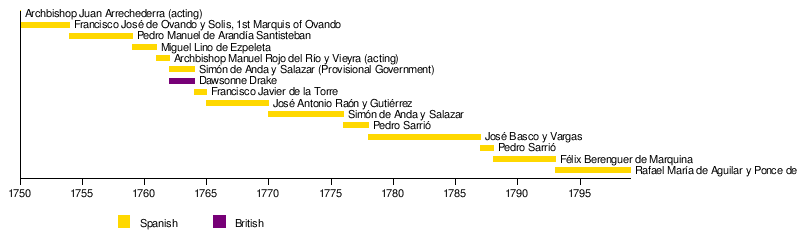
1750–1800
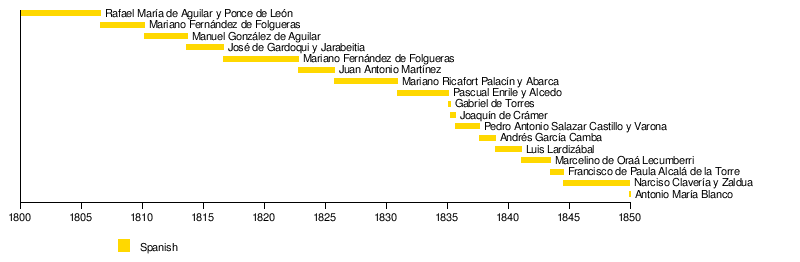
1800–1850
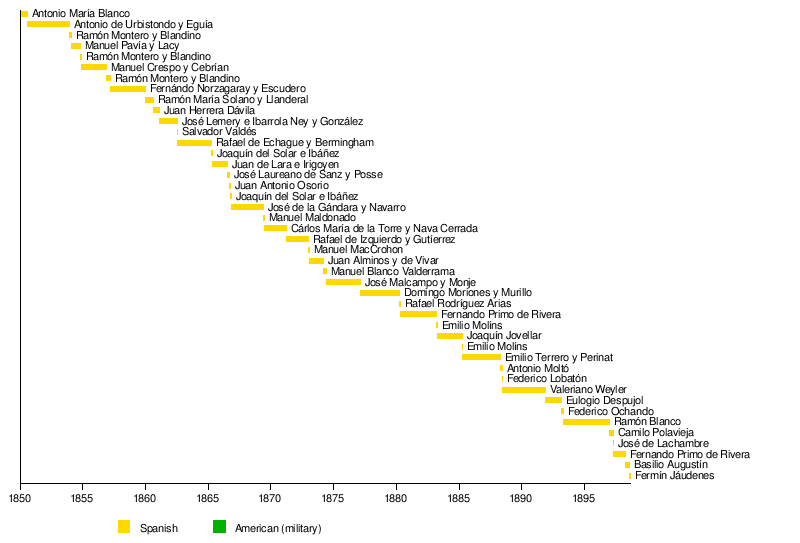
1850–1898
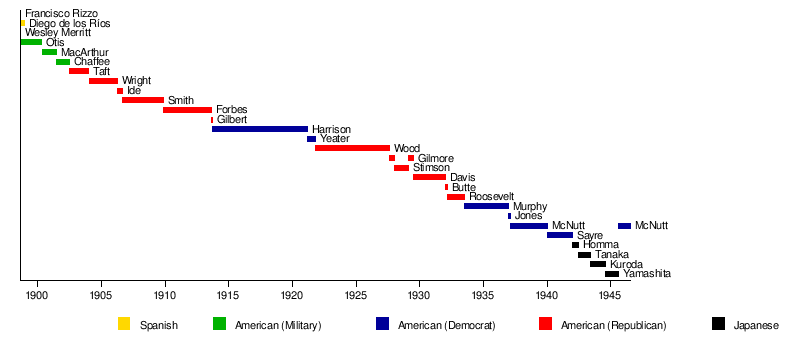
1898–1946
See also


- Filipino styles and honorifics
- List of sovereign state leaders in the Philippines
- List of recorded datu in the Philippines
- President of the Philippines
- List of presidents of the Philippines
- Audiencia
- List of Viceroys of New Spain
- Spanish Empire
- History of the Philippines
- Military History of the Philippines
- United States Territory
- Governor-General
- Lists of office-holders
- Gobernadorcillo
Notes
- ^ a b c d Peterson 2007, p. 11.
- ^ a b c d David P. Barrows; The Governor-General of the Philippines under Spain and the United States; The American Historical Review Vol. 21, No. 2 (Jan. 1916), pp. 288-311 (PDF)
- ^ Halstead, Murat (1898). The Story of the Philippines and Our New Possessions, Including the Ladrones, Hawaii, Cuba and Porto Rico. p. 116.
- ^ Tucker, Spencer (2009). The Encyclopedia of the Spanish–American and Philippine–American Wars: A Political, Social, and Military History. ABC-CLIO. p. 457. ISBN 978-1-85109-951-1.
- ^ Pershing, John J. (2013). My Life Before the World War, 1860--1917: A Memoir. University Press of Kentucky. p. 547. ISBN 978-0-8131-4199-2.
- ^ a b Elliott (1917), p. 509
- ^ Elliott (1917), p. 4
- ^ Tanner (1901), p. 383
- ^ Philippine Academy of Social Sciences (1967). Philippine social sciences and humanities review. pp. 40.
- ^ Act of Congress of February 6, 1905, entitled: "An Act To amend an Act approved July first, nineteen hundred and two, entitled "An Act temporarily to provide for the administration of the affairs of civil government in the Philippine Islands, and for other purposes," and to amend an Act approved March eighth, nineteen hundred and two, entitled "An Act temporarily to provide revenue for the Philippine Islands, and for other purposes" and to amend an Act March second, nineteen hundred and three, entitled "An Act to establish a standard of value and to provide for a coinage system in the Philippine Islands," and to provide for the more efficient administration of civil government in the Philippine Islands, and for other purposes." Section 8 thereof provided that "the civil governor of the Philippine Islands shall hereafter be known as the governor-general of the Philippine Islands.
- ^ "Island – from English to Latin". Google Translate. Retrieved on August 7, 2013.
- ^ "Definitions of Insular Area Political Organizations" Archived September 25, 2012, at the Wayback Machine. U.S. Department of the Interior.
- ^ "Insular". Merriam-Webster Dictionary. Retrieved on August 7, 2013.
- ^ Cahoon (2000)
- ^ Annual Report of the War Department for the Fiscal Year Ended June 30, 1901. Washington: Government Printing Office. 1901. p. 64.
- ^ a b c d e Elliot, Charles Burke (1917). The Philippines to the End of the Commission Government: A Study in Tropical Democracy. Indianapolis: The Bobbs-Merrill Company. p. 509.
- ^ Order of Battle of the United States Land Forces in the World War (1917-1919): Zone of the Interior, Volume 3, Part 1. Washington: Government Printing Office. 1949. p. 229.
- ^ Report of the Chief of the Bureau of Insular Affairs, War Department, 1922. Washington: Government Printing Office. 1922. p. 2.
- ^ Public Papers of the Presidents of the United States: Herbert Hoover: 1930. Government Printing Office. 1976.
- ^ Annual Report of the Governor General of the Philippine Islands, 1930. Washington: Government Printing Office. 1932. p. 65.
- ^ The Michigan Alumnus, Volume XI, No. 8. 1933.

Wikimedia Commons has media related to Governors-General of the Philippines.
References
- Governors of the Philippines
- Cahoon, Ben (2000). "Philippines". World's Statesmen.
- Don Peterson (2007-2nd Qtr), 1898: Five Philippine Governors-General Serve Rapid Fire Terms, Philippine Philatelic Journal.
- Tanner, Dr. J.M. (1901-11). Improvement Era Vol.5 No. 1. Church of Jesus Christ of Latter-Day Saints.
- Elliott, Charles Burke (1917). The Philippines: To the End of the Commission Government, a Study in Tropical Democracy. The Bobbs-Merrill Company.
Further reading
- Barrows, David P. (1916). "The Governor General of the Philippines Under Spain and the United States". The American Historical Review. 21 (2). Oxford University Press on behalf of the American Historical Association: 288–311. doi:10.2307/1835051. JSTOR 1835051 – via Jstor.
- Barrows, D.P. (2022). A History of the Philippines. DigiCat. ISBN 978-93-5462-590-9.