
Loading article…
ジョン・フォン・ノイマン | |
|---|---|
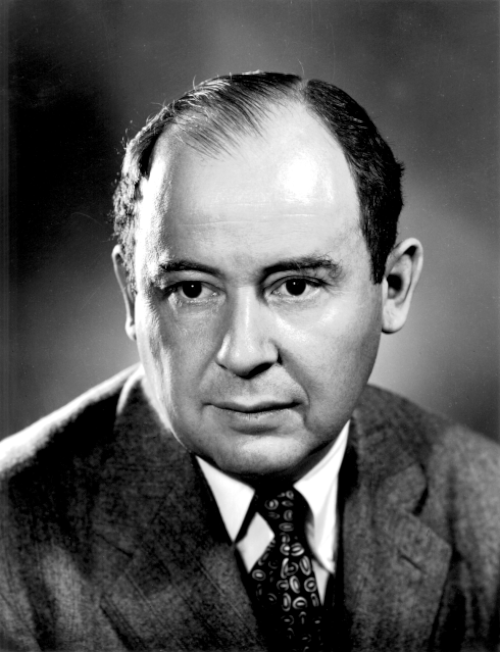 1940年代のフォン・ノイマン | |
| 米国原子力委員会委員 | |
| 在任期間 :1955年3月15日~1957年2月8日 | |
| 社長 | ドワイト・D・アイゼンハワー |
| 先行 | ユージン・M・ザッカート |
| 後継者 | ジョン・S・グラハム |
| 個人情報 | |
| 生まれる | ノイマン・ヤーノシュ・ラヨシュ 1903年12月28日ハンガリー王国 ブダペスト |
| 死亡 | 1957年2月8日(53歳) ワシントンD.C.、米国 |
| 休憩所 | プリンストン墓地 |
| 市民権 |
|
| 母校 | |
| 知られている | 量子力学の数学的定式化、ゲーム理論、スペクトル理論、エルゴード理論、フォン・ノイマン代数、ジョン・フォン・ノイマンにちなんで名付けられたものの一覧 |
| 配偶者たち |
|
| 子供たち | マリーナ・フォン・ノイマン・ホイットマン |
| 受賞歴 |
|
| 科学者としてのキャリア | |
| フィールド | 論理学、数学、数理物理学、理論物理学、統計学、経済学、コンピュータサイエンス、理論生物学、化学、コンピューティング |
| 機関 | |
| 論文 | Az általános halmazelmélet axiomatikus felepítése (一般集合論の公理的構築) (1925) |
| 博士課程の指導教員 | |
| その他の学術アドバイザー | |
| 博士課程の学生 | |
| その他の著名な学生 | |
| サイン | |
 | |
ジョン・フォン・ノイマン(/ v ɒ n ˈ n ɔɪ m ən / von NOY -mən ;ハンガリー語:ノイマン・ヤーノシュ・ラヨシュ [ˈnɒjmɒn ˈjaːnoʃ ˈlɒjoʃ] ; 1903年12月28日 - 1957年2月8日)は、ハンガリーおよびアメリカの数学者、物理学者、コンピューター科学者、エンジニアである。彼はおそらく同時代のどの数学者よりも広範囲にわたる研究対象を持ち、[9]純粋科学と応用科学 を統合し、数学、物理学、経済学、コンピューター科学、統計学を含む多くの分野に多大な貢献をした。彼は量子物理学の数学的枠組みの構築、関数解析の開発、ゲーム理論の先駆者であり、セルオートマトン、万能構築子、デジタルコンピューターなどの概念を導入または体系化した。自己複製の構造に関する彼の分析は、DNAの構造の発見に先行するものでした。
第二次世界大戦中、フォン・ノイマンはマンハッタン計画に参加した。彼は爆縮型核兵器に使われる爆発レンズの数学的モデルを開発した。[10]戦前と戦後、彼は科学研究開発局、陸軍弾道研究所、軍事特殊兵器プロジェクト、オークリッジ国立研究所など多くの組織の顧問を務めた。[11] 1950年代に彼の影響力はピークに達し、戦略ミサイル評価委員会やICBM科学諮問委員会など国防総省の多くの委員会の議長を務めた。彼はまた、国内の原子力開発のすべてを担当する影響力のある原子力委員会のメンバーでもあった。彼はバーナード・シュリーバーやトレバー・ガードナーとともに、米国初のICBM計画の設計と開発において重要な役割を果たした。[12]当時、彼は核兵器に関する国内有数の専門家であり、米国防総省を代表する防衛科学者であると考えられていた。
フォン・ノイマンの貢献と知的能力は、物理学、数学、その他さまざまな分野の同僚から賞賛された。彼が受けた賞賛は、自由勲章から、彼にちなんで名付けられた月のクレーターまで多岐にわたる。
人生と教育
家族背景
フォン・ノイマンは1903年12月28日、ハンガリー王国(当時はオーストリア=ハンガリー帝国の一部)のブダペストで裕福で非宗教的なユダヤ人家庭に生まれた。 [13] [14] [15]彼の出生名はノイマン・ヤーノシュ・ラヨシュであった。ハンガリー語では姓が先に来るため、彼の名は英語のジョン・ルイスに相当する。[16]
彼は3人兄弟の長男で、2人の弟妹はミハイ(ミヒャエル)とミクローシュ(ニコラス)だった。[17]父ノイマン・ミクサ(マックス・フォン・ノイマン)は銀行家で、法学の博士号を持っていた。 1880年代末にペーチからブダペストに移住した。 [18]ミクサの父と祖父はハンガリー北部ゼンプレーン県オンド(現在はシェレンツの一部)で生まれた。ジョンの母はカン・マルギット(マーガレット・カン)[19]であり、彼女の両親はマイゼルス家のカン・ヤカブとマイゼルス・カタリンだった。[20]カン家3世代はブダペストのカン・ヘラー事務所の上の広々としたアパートに住んでいた。フォン・ノイマンの家族は最上階の18部屋のアパートに住んでいた。[21]
1913年2月20日、フランツ・ヨーゼフ皇帝はオーストリア=ハンガリー帝国への貢献を称え、ヨハンの父をハンガリー貴族に昇格させた。[ 22]こうしてノイマン家は「マルギッタの」(現在のルーマニア、マルギタ)を意味するマルギタイという世襲称を得た。この家系は町とは何の関係もなかった。この称号はマルガレーテにちなんで付けられたものであり、3人のマルグリットを描いた紋章もこの由来である。ノイマン・ヤーノシュはマルギッタイ・ノイマン・ヤーノシュ(マルギッタのヨハン・ノイマン)となり、後にドイツ人のヨハン・フォン・ノイマンに改名した。[23]
天才児
フォン・ノイマンは神童で、6歳にして8桁の数字2つを暗算し[24] [25]、古代ギリシャ語で会話することができた。[26]彼と彼の兄弟、そして彼のいとこたちは家庭教師から教育を受けた。フォン・ノイマンの父は母国語であるハンガリー語以外の言語の知識が不可欠であると信じていたので、子供たちは英語、フランス語、ドイツ語、イタリア語の家庭教師を受けた。[27]フォン・ノイマンは8歳までに微分積分に精通し、12歳までにボレルの『関数の理論』を読んでいた。[28]彼は歴史にも興味があり、ヴィルヘルム・オンケンの46巻からなる世界史シリーズ『Allgemeine Geschichte in Einzeldarstellungen 』 (モノグラフによる一般史)を読んだ。[29]アパートの部屋の一つは図書室と読書室に改装された。[30]
フォン・ノイマンは1914年にルーテル派のファソーリ・エヴァンゲリクス・ギムナジウムに入学した。[31] ユージン・ヴィグナーはフォン・ノイマンより1年先輩で、すぐに友人になった。[32]
フォン・ノイマンの父は、年齢相応の学年レベルの学校に通うよう主張したが、フォン・ノイマンに高度な指導をするために家庭教師を雇うことに同意した。15歳で、彼は分析学者のガーボル・シェゲーのもとで高度な微積分を学び始めた。[32] 19歳までに、フォン・ノイマンは2つの主要な数学論文を発表し、そのうちの2番目の論文では、ゲオルク・カントールの定義に取って代わる現代的な序数の定義を示した。 [33]ギムナジウムでの教育を終える際、彼は数学の国家賞であるエトヴェシュ賞に応募し、受賞した。[34]
大学での勉強
友人のセオドア・フォン・カルマンによると、フォン・ノイマンの父はジョンにも産業界に進んでほしいと考え、カルマンに息子に数学を取らないよう説得するよう頼んだという。[35]フォン・ノイマンと父は、最良の進路は化学工学だと決めた。これはフォン・ノイマンにはあまり知識がなかったため、ベルリン大学で2年間の非学位課程の化学を履修するように手配され、その後 チューリッヒ工科大学の入学試験を受け、[36] 1923年9月に合格した。[37]同時にフォン・ノイマンはブダペストのパズマーニ・ペーテル大学に入学し、 [38]数学の博士課程に在籍した。論文では、カントルの集合論の公理化を示した。[39] [40]彼は1926年にチューリッヒ工科大学で化学工学の学位を取得し、同時に数学の博士号(実験物理学と化学を副専攻)の最終試験に首席で合格した。[41] [42] しかし、シルビア・ナサールの「ビューティフル・マインド」では、フォン・ノイマンはベルリンで数学を学びながら、ブダペスト大学で化学工学を学んでいたと述べられている。 [33]
その後、ロックフェラー財団の助成金を得てゲッティンゲン大学に入学し、デイヴィッド・ヒルベルトの下で数学を学んだ。[43]ヘルマン・ワイルは、1926年から1927年の冬、フォン・ノイマン、エミー・ネーター、そして彼が授業の後に「ゲッティンゲンの寒くて雨に濡れた通り」を歩きながら、超複素数系とその表現について議論していたことを覚えている。[44]
キャリアと私生活

フォン・ノイマンの資格取得は1927年12月13日に完了し、1928年にベルリン大学で私講師として講義を始めた。 [45]彼は大学史上最年少で私講師に選ばれた人物であった。 [46]彼はほぼ毎月1本の数学の主要な論文を書き始めた。[47] 1929年に彼はハンブルク大学の私講師となり、そこでは終身教授になる見込みがより高かった。[48]その後、同年10月にプリンストン大学に数理物理学の客員講師として移った。[49]
フォン・ノイマンは1930年にカトリックの洗礼を受けた。 [50]その後まもなく、ブダペスト大学で経済学を学んでいたマリエッタ・コヴェシと結婚した。[49]フォン・ノイマンとマリエッタの間には1935年に生まれた娘マリーナがおり、彼女は教授となった。[51]夫婦は1937年11月2日に離婚した。 [52] 1938年11月17日、フォン・ノイマンはクララ・ダーンと結婚した。[53] [54]
1933年、フォン・ノイマンはニュージャージー州の高等研究所の終身教授職に就いたが、その研究所はヘルマン・ワイルを教授に任命する計画が失敗したように見えた。[55]彼の母、兄弟、義理の家族は1939年にフォン・ノイマンを追ってアメリカに渡った。 [56]フォン・ノイマンはドイツ貴族の姓であるフォン・ノイマンのまま、名前をジョンと英語化した。[23]フォン・ノイマンは1937年に帰化してアメリカ市民となり、すぐにアメリカ陸軍の将校予備隊の中尉になろうとした。彼は試験に合格したが、年齢を理由に拒否された。[57]
クララとジョン・フォン・ノイマンは地元の学界で社交的だった。[58]ウェストコット通りにある彼の白い下見板張りの家はプリンストンでも最大級の私邸だった。[59]彼はいつもフォーマルなスーツを着ていた。[60]彼はイディッシュ語と「下品な」ユーモアを楽しんだ。[28]プリンストンでは、ドイツ行進曲を非常に大きな音で演奏していると苦情を受けた。[61]フォン・ノイマンは騒々しく混沌とした環境で最高の仕事をした。[62]チャーチル・アイゼンハートによると、フォン・ノイマンは朝方までパーティーに出席し、8時半に講義をすることができた。[63]
彼は、あらゆる能力レベルの人々に科学的、数学的なアドバイスを喜んで提供することで知られていました。[4] [64] [65]ウィグナーは、彼が他のどの現代の数学者よりも多くの仕事を(カジュアルな意味で)指導したかもしれないと書いています。[66]彼の娘は、彼が自分の遺産について、彼女の人生と世界への彼の知的貢献の永続性という2つの側面で非常に心配していたと書いています。[67]
多くの人は彼を、個人的または組織的な問題には比較的簡単に譲歩するが、技術的な問題には強く主張する、優れた委員長だとみなした。ハーバート・ヨークは、彼が参加した多くの「フォン・ノイマン委員会」を「スタイルと成果の両面で注目に値する」と評した。フォン・ノイマンが委員長を務めた委員会が、必要な軍や企業と直接かつ密接に連携した方法は、空軍のすべての長距離ミサイル計画の青写真となった。[68]フォン・ノイマンを知る多くの人は、軍や権力構造全般に対する彼の関係に困惑した。 [69]スタニスワフ・ウラムは、他人の考えや意思決定に影響を与える可能性のある人々や組織に対して、彼がひそかに尊敬の念を抱いているのではないかと疑った。[ 70]
彼はまた、若い頃に学んだ言語の知識を維持していた。ハンガリー語、フランス語、ドイツ語、英語を流暢に話し、イタリア語、イディッシュ語、ラテン語、古代ギリシャ語も会話レベルで話せた。スペイン語はそれほど完璧ではなかった。[71]彼は古代史に情熱を持ち、百科事典のような知識を持っていた。 [72] [73]また、古代ギリシャの歴史家が書いた原文のギリシャ語を読むのが好きだった。ウラムは、これらの知識が、将来の出来事がどのように展開するか、そして人間の性質や社会が一般的にどのように機能するかについての彼の見解を形成したのではないかと考えていた。[74]
フォン・ノイマンのアメリカにおける最も親しい友人は数学者スタニスワフ・ウラムであった。[75]フォン・ノイマンは、自分の数学的思考の多くは直感的に生じたものだと信じていた。問題を解かないまま眠りにつき、目覚めると答えを知っていることがよくあった。 [62]ウラムは、フォン・ノイマンの思考方法は視覚的ではなく、むしろ聴覚的かもしれないと指摘した。[76]ウラムは、「抽象的なウィットを好むこととはまったく関係なく、彼はより現実的なタイプのコメディやユーモアを強く評価していた(ほとんど渇望と言ってもいいかもしれない)。」と回想している。[77]
病気と死

1955年、フォン・ノイマンの鎖骨の近くに腫瘤が見つかり、骨格、膵臓、または前立腺に由来する癌であることが判明した。(腫瘍が転移していたという一般的な見解では一致しているが、原発癌の位置については情報源が異なっている。)[78] [79]悪性腫瘍は、ロスアラモス国立研究所での放射線被曝によって発生した可能性がある。[80]ストリットマター神父は、フォン・ノイマンは最後の儀式を受けた後も、死への恐怖と自分の状況を受け入れることができなかったため、それほど平安や慰めは得られなかったと回想している。[81] [82] [83] [84]フォン・ノイマンは自身の宗教観について、「非信者が永遠の罰を受ける可能性がある限り、最後には信者でいる方が論理的だ」とパスカルの賭けに言及して語ったと伝えられている。彼は母親に「神はいるはずだ。もし神がいるなら、多くのことは説明しやすい」と打ち明けた。[85] [86]
彼は1957年2月8日にウォルター・リード陸軍医療病院で亡くなり、プリンストン墓地に埋葬された。[87] [88]
数学
集合論
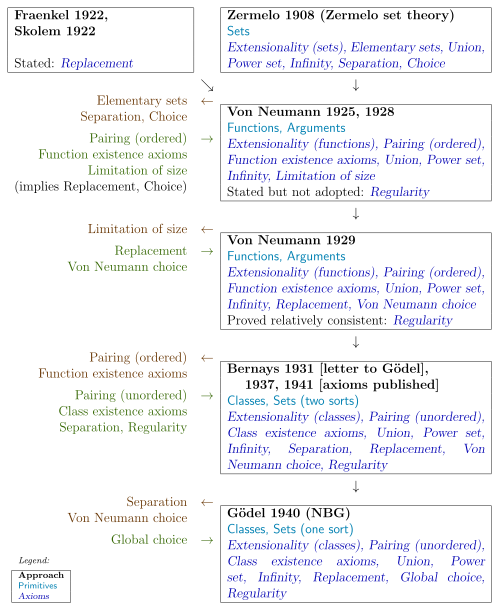
20世紀初頭、素朴集合論に数学の基礎を置く取り組みは、ラッセルのパラドックス(自分自身に属さないすべての集合の集合に関するもの)のために挫折した。 [89]集合論の適切な公理化の問題は、約20年後にエルンスト・ツェルメロとアブラハム・フランケルによって暗黙的に解決された。ツェルメロ-フランケル集合論は、数学の日常的な実践で使用される集合の構築を可能にする一連の原理を提供したが、自分自身に属する集合の存在の可能性を明示的に排除しなかった。1925年の博士論文で、フォン・ノイマンはそのような集合を排除する2つの手法、基礎公理とクラスの概念を示した。[90]
基礎公理は、ツェルメロ=フランケル原理によって、あらゆる集合は下から上へと順序立てて構築できると提唱した。ある集合が他の集合に属する場合、最初の集合は必然的に2番目の集合より先に来なければならない。これにより、集合がそれ自身に属する可能性は排除される。この新しい公理を他の公理に加えても矛盾が生じないことを示すために、フォン・ノイマンは内部モデル法を導入した。これは集合論において不可欠な証明手段となった。[90]
集合が自分自身に属する問題に対する2番目のアプローチは、クラスの概念を基礎とし、集合を他のクラスに属するクラスとして定義し、一方、真クラスは他のクラスに属さないクラスとして定義される。ツェルメロ-フランケルのアプローチでは、公理が、自分自身に属さないすべての集合の集合の構築を妨げる。対照的に、フォン・ノイマンのアプローチでは、自分自身に属さないすべての集合のクラスは構築できるが、それは集合ではなく真クラスである。[90]
全体として、集合論におけるフォン・ノイマンの主な業績は、「集合論の公理化と(それに関連して)序数と基数のエレガントな理論、および超限帰納法による定義の原理の最初の厳密な定式化」であった。[91]
フォン・ノイマンのパラドックス
フェリックス・ハウスドルフ(1914)のハウスドルフのパラドックスを基に、ステファン・バナッハとアルフレッド・タルスキは1924年に、3次元の球を互いに素な集合に分割し、これらの集合を平行移動および回転させて同じ球の2つの同一コピーを形成する方法を示した。これがバナッハ・タルスキのパラドックスである。彼らはまた、2次元の円板にはそのような逆説的な分解がないことも証明した。しかし1929年に[92]フォン・ノイマンは円板を有限個の部分に分割し、平行移動や回転の代わりに面積保存アフィン変換を使用してそれらを2つの円板に再配置した。その結果は、アフィン変換の自由群を見つけることに依存しており、これは後にフォン・ノイマンが測度論の研究で拡張した重要な手法であった。[93]
証明理論
集合論におけるフォン・ノイマンの貢献により、集合論の公理系は、一貫性の証明がないにもかかわらず、以前の体系の矛盾を回避し、数学の基礎として使えるようになった。次の疑問は、それが提起できるすべての数学的な質問に決定的な答えを提供しているかどうか、またはより広範な定理を証明するために使用できるより強力な公理を追加することで改善できるかどうかであった。 [94]
1927年までに、フォン・ノイマンはゲッティンゲンで、初等算術がペアノの公理に従うかどうかについての議論に参加していた。[95]アッカーマンの研究を基に、彼は(ヒルベルト学派の有限主義的方法を用いて)一階算術の無矛盾性を証明しようと試み始めた。彼は(帰納法の制限を用いて)自然数の算術の断片の無矛盾性を証明することに成功した。[96]彼は証明論の方法を用いて古典数学の無矛盾性のより一般的な証明を探し続けた。[97]
それが決定的かどうかという強い否定的な答えは、1930年9月の「正確科学の認識論に関する第二回会議」で出され、その会議でクルト・ゲーデルは不完全性に関する第一定理を発表した。それは、通常の公理体系は、その言語で表現できるすべての真理を証明できないという意味で不完全である、というものである。さらに、これらの体系の一貫した拡張はすべて、必然的に不完全のままである、というものである。[98]会議でフォン・ノイマンはゲーデルに、整数に関する決定不可能な命題に対する彼の結果を変換してみるよう提案した。[99]
それから1ヶ月も経たないうちに、フォン・ノイマンはゲーデルに彼の定理の興味深い帰結を伝えた。それは、通常の公理体系はそれ自身の一貫性を証明することができないということである。[98]ゲーデルは、現在第二不完全性定理として知られるこの帰結をすでに発見しており、両方の結果を含む論文のプレプリントを送ると返事したが、それは出版されなかった。[100] [101] [102]フォン・ノイマンは次の手紙でゲーデルの優先性を認めた。[103]しかし、フォン・ノイマンの証明方法はゲーデルのものと異なり、また第二不完全性定理はゲーデルが考えていたよりもずっと大きな打撃をヒルベルトのプログラムに与えたという意見であった。[104] [105]この発見により、フォン・ノイマンは数学の厳密さに関する考え方が劇的に変わり、数学とメタ数学の基礎研究をやめ、代わりに応用に関連した問題に時間を費やした。[106]
エルゴード理論
1932年に発表された一連の論文で、フォン・ノイマンはエルゴード理論に基礎的な貢献をした。エルゴード理論は不変測度を持つ力学系の状態を扱う数学の一分野である。[107] 1932年のエルゴード理論に関する論文について、ポール・ハルモスは「フォン・ノイマンが他に何もしていなかったとしても、それらの論文は彼の数学的不滅を保証するのに十分だっただろう」と書いている。[108]その時までにフォン・ノイマンは既に作用素理論に関する論文を書いており、この研究の応用は平均エルゴード定理に役立った。[109]
この定理は任意の1パラメータ ユニタリ群に関するもので、 ヒルベルト空間内の任意のベクトルに対して、ヒルベルトノルムによって定義される計量の意味で存在し、すべての に対してとなるようなベクトルであることを述べている。これは最初の論文で証明された。2番目の論文でフォン・ノイマンは、ここでの結果がボルツマンのエルゴード仮説に関連する物理的応用には十分であると主張した。彼はまた、エルゴード性はまだ達成されていないことを指摘し、これを将来の研究のために切り離した。[110]





その年の後半に彼は、エルゴード性の体系的な研究の始まりとなるもう一つの影響力のある論文を発表した。彼は、実数直線のエルゴード測度保存作用が、すべての測度保存作用を構築できる基本的な構成要素であることを示す分解定理を提示し、証明した。他のいくつかの重要な定理も提示され、証明されている。この論文とポール・ハルモスとの共著による他の論文の結果は、数学の他の分野に重要な応用がある。[110] [111]
測度論
測度論では、 n次元ユークリッド空間 R nの「測度の問題」は、「 R nのすべての部分集合のクラス上に、正で正規化された不変の加法集合関数が存在するか?」と述べられることがある。 [112]フェリックス・ハウスドルフとステファン・バナッハの研究は、測度の問題は、n = 1またはn = 2の場合に正の解を持ち、それ以外の場合は負の解(バナッハ=タルスキーのパラドックスのため)を持つことを示唆していた。フォン・ノイマンの研究は、「問題は本質的に群論的な性質である」と主張した。測度の存在は、与えられた空間の変換群の特性を見ることで決定できる。最大 2 次元の空間に対する正の解と、それより高い次元に対する負の解は、ユークリッド群が最大 2 次元に対しては解ける群であり、それより高い次元に対しては解けないという事実に由来する。 「したがって、フォン・ノイマンによれば、違いを生むのは群の変化であり、空間の変化ではない。」[113] 1942年頃、彼はドロシー・マハラムに、すべての完全な σ有限 測度空間には乗法的な持ち上げがあることを証明する方法を授けた。彼はこの証明を公表せず、彼女は後に新しい証明を思いついた。[114]
フォン・ノイマンの多くの論文では、彼が用いた議論の方法が結果よりもさらに重要であると考えられている。フォン・ノイマンは、後の作用素の代数における次元理論の研究を見越して、有限分解による同値性の結果を使用し、測度の問題を関数の観点から再定式化した。[115]フォン・ノイマンが測度理論に果たした大きな貢献は、ハールの問いに答えるために書かれた論文の結果であった。その問いとは、実数直線上のすべての有界関数の代数が存在し、それらが「ほぼどこでも等しい測定可能な有界関数のクラスの代表の完全なシステム」を形成するかどうかであった。 [116]彼はこれを肯定的に証明し、後の論文ではストーンとこの問題のさまざまな一般化と代数的側面について議論した。[117]彼はまた、さまざまな一般的なタイプの測度の崩壊の存在を新しい方法で証明した。フォン・ノイマンはまた、関数の平均値を用いたハール測度の一意性に関する新たな証明も行ったが、この方法はコンパクト群に対してのみ有効であった。[116]これを局所コンパクト群に適用するには、まったく新しい手法を考案する必要があった。[118]彼はまた、ラドン・ニコディムの定理に対する新しい独創的な証明も行った。[119]高等研究所での測度論に関する彼の講義ノートはその当時アメリカでこのテーマに関する重要な知識源となり、後に出版された。[120] [121] [122]
位相群
フォン・ノイマンは測度論に関する以前の研究を利用して、位相群の理論にいくつかの貢献をした。その最初の貢献は群上の概周期関数に関する論文であり、フォン・ノイマンはボーアの概周期関数の理論を任意の群に拡張した。 [123]彼はボッホナーと共同で別の論文を発表し、概周期理論を改良して、線形空間の要素を数ではなく値として取る関数を含めた。 [124] 1938年、これらの論文に関連した解析学の研究でボッホナー記念賞を受賞した。 [125] [126]
1933年の論文で、彼はコンパクト群の場合のヒルベルトの第5問題の解決に、新たに発見されたハール測度を使用した。[127]この背後にある基本的な考え方は、数年前にフォン・ノイマンが線型変換の群の解析的性質に関する論文を発表し、一般線型群の閉部分群がリー群であることを発見したときに発見された。[128]これは後にカルタンによって閉部分群定理の形で任意のリー群に拡張された。[129] [116]
機能分析
フォン・ノイマンは抽象ヒルベルト空間を公理的に定義した最初の人物である。彼はそれをエルミート・スカラー積を持つ複素ベクトル空間として定義し、対応するノルムは可分かつ完全であるとした。同じ論文で彼はまた、それまで特定の例でしか知られていなかったコーシー・シュワルツの不等式の一般形を証明した。 [130]彼は1929年から1932年にかけて3つの独創的な論文でヒルベルト空間の作用素のスペクトル理論の発展を続けた。 [131]この研究は彼の『量子力学の数学的基礎』にまとめられ、これは同じ年のストーンとバナッハの他の2冊の本と並んでヒルベルト空間理論に関する最初のモノグラフとなった。[132]他の人によるそれ以前の研究では、弱い位相の理論はシーケンスを使用しても得られないことが示されていた。フォン・ノイマンは、困難を克服する方法のプログラムを初めて概説し、その結果、局所凸空間と位相ベクトル空間を初めて定義しました。さらに、当時彼が定義した他のいくつかの位相的性質(彼はハウスドルフの新しい位相的アイデアをユークリッド空間からヒルベルト空間に適用した最初の数学者の一人でした)[133]、例えば境界性や全境界性などは現在でも使用されています。[134] 20年間、フォン・ノイマンはこの分野の「誰もが認める巨匠」と見なされていました。[116]これらの発展は主に量子力学の必要性によって促され、フォン・ノイマンはエルミート作用素のスペクトル理論を境界付きの場合から境界なしの場合に拡張する必要性を認識しました。[135]これらの論文における他の主要な業績としては、正規作用素のスペクトル理論の完全な解明、正作用素のトレースの最初の抽象的な提示、[136] [137]当時のリースのヒルベルトのスペクトル定理の提示の一般化、および自己随伴作用素とは異なるヒルベルト空間におけるエルミート作用素の発見があり、これにより、与えられたエルミート作用素を拡張するすべてのエルミート作用素の記述が可能になった。彼は、当時スペクトル理論で一般的だった無限行列は、エルミート作用素の表現としては不十分であった。彼の作用素論に関する研究は、純粋数学における最も深遠な発明、フォン・ノイマン代数、そして一般に作用素代数の研究につながった。[138]
後の作用素環に関する研究は、スペクトル理論に関する研究を再検討し、ヒルベルト空間の直接積分を用いて幾何学的内容を扱う新しい方法を提供することにつながった。[135]測度論に関する研究と同様に、彼はいくつかの定理を証明したが、それらは公表する時間がなかった。彼はナフマン・アロンザインとKT・スミスに、1930年代初頭に不変部分空間問題に取り組んでいるときに、ヒルベルト空間内の完全連続作用素に対する適切な不変部分空間の存在を証明したと語った。[139]
彼はIJシェーンベルクとともに、実数直線上の変換不変ヒルベルト計量に関するいくつかの論文を書き、その結果、計量の完全な分類に至った。その動機は、計量空間をヒルベルト空間に埋め込むことに関するさまざまな疑問にある。[140] [141]
彼はパスクアル・ジョルダンとともに、平行四辺形の恒等式を用いて内積から与えられたノルムを初めて導出する短い論文を書いた。[142]彼のトレース不等式は、行列近似問題で使用される行列理論の重要な結果である。[143]彼はまた、ユニタリ不変ノルムと対称ゲージ関数(現在は対称絶対ノルムとして知られている)の理論を議論した最初の主要論文で、プレノルムの双対がノルムであるというアイデアを初めて提示した。[144] [145] [146]この論文は自然に対称作用素イデアルの研究につながり、対称作用素空間の現代的な研究の出発点となっている。[147]
後にロベルト・シャッテンとともにヒルベルト空間上の核作用素の研究を開始し、[148] [149] バナッハ空間のテンソル積[150]、トレース類作用素[151]のイデアル、コンパクト作用素との双対性、有界作用素とのプレデュアリティ[152]を導入して研究した。このテーマをバナッハ空間上の核作用素の研究に一般化したことは、アレクサンダー・グロタンディークの最初の業績の一つであった。[153] [154]フォン・ノイマンは1937年にこの分野でいくつかの結果を発表しており、例えば、 の異なるクロスノルムの1パラメータスケールを与え、現在シャッテン–フォン・ノイマン・イデアルとして知られているものに関するいくつかの他の結果を証明している。[155]

作用素代数
フォン・ノイマンは、フォン・ノイマン代数(当初は W*-代数と呼ばれていた)を通じて、作用素環の研究を確立した。作用素環に関する彼の独自のアイデアは1930 年にはすでに存在していたが、彼がその研究を深く始めたのは、数年後にFJ マレーと出会うまでなかった。 [156] [157]フォン・ノイマン代数は、弱作用素位相で閉じられ、恒等作用素を含むヒルベルト空間上の有界作用素の*-代数である。[158]フォン・ノイマンの二可換定理は、解析的定義が二可換 と等しい純粋に代数的な定義と同値であることを示している。[159]可換代数の場合の研究を解明した後、フォン・ノイマンは1936年にマレーと部分的に協力して、非可換の場合、つまりフォン・ノイマン代数の因数分類の一般的な研究に着手した。1936年から1940年の間に彼がその理論を展開した6つの主要な論文は「20世紀の解析学の傑作に数えられる」。[160]これらの論文は多くの基礎的な結果を集め、その後数十年にわたって数学者が取り組んだ作用素代数理論のいくつかのプログラムを開始した。一例は因数の分類である。[161]さらに1938年に彼は可分ヒルベルト空間上のすべてのフォン・ノイマン代数は因数の直接積分であることを証明した。彼は1949年までこの結果を発表する時間がなかった。[162] [163]フォン・ノイマン代数は非可換積分の理論と密接に関係しており、フォン・ノイマンは研究の中でそれをほのめかしていたが、明示的には書き記していなかった。[164] [165]極分解に関するもう一つの重要な結果は1932年に発表された。[166]
格子理論
1935年から1937年にかけて、フォン・ノイマンは格子理論、すなわち2つの要素ごとに最大下限と最小上限を持つ半順序集合の理論に取り組んだ。ギャレット・バーコフは「ジョン・フォン・ノイマンの優れた頭脳は格子理論を流星のように輝かせた」と記している。[167]フォン・ノイマンは伝統的な射影幾何学と現代代数学(線型代数、環理論、格子理論)を融合させた。それまで幾何学的であった多くの結果が、環上の一般加群の場合に解釈できるようになった。彼の研究は、射影幾何学における現代の研究の一部に基礎を置いた。[168]
彼の最大の貢献は連続幾何学の分野を創設したことである。[169]これは作用素環に関する画期的な研究に続くものである。数学において連続幾何学は複素射影幾何学の代替物であり、離散集合内の部分空間の次元の代わりに単位区間の要素とすることができる。それより前にメンガーとバーコフは複素射影幾何学をその線型部分空間の格子の性質の観点から公理化した。フォン・ノイマンは作用素環に関する研究に続いてそれらの公理を弱め、より広い格子のクラスである連続幾何学を記述した。

![{\displaystyle [0,1]}](https://wikimedia.org/api/rest_v1/media/math/render/svg/738f7d23bb2d9642bab520020873cccbef49768d)
射影幾何学の部分空間の次元は離散集合(非負の整数)であるが、連続幾何学の要素の次元は単位区間 にわたって連続的に変化する。フォン・ノイマンは、次元関数が連続的な次元範囲を取るフォン・ノイマン代数の発見に動機づけられ、射影空間以外の連続幾何学の最初の例は、超有限タイプII因子の射影であった。[170] [171]
より純粋な格子理論の研究において、彼は(任意の分割環上の連続次元射影幾何学)の類を格子理論の抽象言語で特徴付けるという困難な問題を解決した。[172]フォン・ノイマンは、完備補完モジュラー位相格子(内積空間の部分空間の格子に生じる性質)における次元の抽象的な探求を提供した。


次元は、正の線形変換を除き、次の 2 つの特性によって決定されます。次元は、透視写像 (「パースペクティビティ」) によって保存され、包含によって順序付けられます。証明の最も深い部分は、パースペクティビティと「分解による射影性」の等価性に関するもので、その帰結としてパースペクティビティの推移性が求められます。
任意の整数に対して、次元抽象射影幾何学はすべて、(唯一の)対応する分割環上の次元ベクトル空間の部分空間格子に同型である。これはヴェブレン・ヤングの定理として知られている。フォン・ノイマンは、射影幾何学におけるこの基本的な結果を連続次元の場合に拡張した。[173]この座標定理は、抽象射影幾何学と格子理論におけるかなりの研究を刺激し、その多くはフォン・ノイマンの手法を使用して継続された。[168] [174]バーコフはこの定理を次のように説明した。


n ≥ 4の対の視点要素の「基底」を持つ任意の補完モジュラー格子L は、適切な正則環Rのすべての主右イデアルの格子ℛ( R )と同型です。この結論は、まったく新しい公理を含む 140 ページに及ぶ鮮やかで鋭い代数の集大成です。フォン・ノイマンの頭脳の鋭さについて忘れられない印象を得たい人は、この正確な推論の連鎖を自分で追ってみるだけで十分です。その 5 ページは、しばしば、リビングルームの書き物机に座り、朝食前に書き留められたものであることに気付くでしょう。[175]
この研究には正則環の作成が必要だった。[176]フォン・ノイマン正則環とは、任意の に対してとなる元が存在する環である。[175]これらの環はフォン・ノイマン代数、 AW*-代数、さまざまな種類のC*-代数に関する研究に由来し、それらと関連している。[177]


上記の定理の創造と証明の過程で、特に分配法則(無限分配法則など)に関する多くの小さな技術的成果が証明され、フォン・ノイマンは必要に応じてそれらを発展させた。彼はまた、格子における付値の理論を開発し、計量格子の一般理論の開発に協力した。[178]
バーコフはフォン・ノイマンに関する死後の論文で、これらの結果のほとんどは2年間の集中的な研究期間で開発されたものであり、1937年以降も格子理論への関心は続いたが、それらは周辺的なものとなり、主に他の数学者への手紙の中で生じたと述べている。1940年の最後の貢献は、高等研究所でバーコフと共同で行ったこのテーマに関するセミナーで、σ完全格子整列環の理論を展開した。彼はこの研究を出版するために書き上げることはなかった。[179]
数理統計学
フォン・ノイマンは数理統計学に根本的な貢献をした。1941年、彼は独立かつ同一に正規分布する変数の連続差の平均二乗と標本分散の比の正確な分布を導いた。[180]この比は回帰モデルの残差に適用され、誤差が連続的に独立しているという帰無仮説と、誤差が定常な一次自己回帰に従うという対立仮説を検定するためのダービン・ワトソン統計量[181]としてよく知られている。[181]
その後、デニス・サーガンとアロック・バーガヴァは、回帰モデルの誤差がガウスランダムウォーク(つまり単位根を持つ)に従うかどうかと、それが定常一次自己回帰であるという代替案をテストするために結果を拡張した。[182]
その他の仕事
フォン・ノイマンは、若い頃に集合論的実解析と数論に関する論文をいくつか発表した。[183] 1925年の論文で、彼は 内の任意の稠密な点列に対して、それらの点が に一様分布する並び替えが存在することを証明した。[184] [185] [186] 1926年に彼が発表した唯一の論文は、プリューファーのイデアル代数的数の理論に関するもので、そこで彼はイデアル代数的数を構成する新しい方法を発見し、それによってプリューファーの理論をすべての代数的数体に拡張し、それらのp 進数との関係を明らかにした。[187] [188] [189] [190] [191] 1928年に彼はこれらのテーマを継続する2つの論文を発表した。最初の論文は、区間を可算な数の合同な部分集合に分割することを扱ったものである。フォン・ノイマンは、確かに、半開区間、開区間、閉区間のいずれであっても、すべての区間は平行移動で - 割り切れる(つまり、これらの区間は平行移動によって合同な部分集合に分解できる)ことを証明した。[192] [193] [194] [195]彼の次の論文は、選択公理によらずに代数的に独立した実数が存在するという構成的証明を与えることについて扱った。彼は、 が に対して代数的に独立であることを証明した。したがって、連続体の大きさの完全な代数的に独立した実数集合が存在する。[196] [197] [198] [199]彼の初期のキャリアからのその他の小さな結果には、変分法の分野における最小化関数の勾配に対する最大原理の証明、[200] [201] [202] [203]および幾何整数論におけるヘルマン・ミンコフスキーの定理の線型形式の小さな簡略化がある。[204] [205] [206]その後、パスクアル・ジョーダンとユージン・ウィグナー とともに、有限次元の形式的に実なジョーダン代数を分類し、アルバート代数を発見する基礎論文を書き、より良い代数を求める試みを行った。 量子論のための数学的形式主義。[207] [208] 1936年に彼は、無限次元の場合を研究する論文の中で、以前のヒルベルト空間計画の公理をジョルダン代数の公理に置き換えるプログラムをさらに進めようとした。[ 209 ] 彼はこのテーマについて少なくとももう1本の論文を書くつもりだったが、結局書かなかった。[210]それにもかかわらず、これらの公理は、アーヴィング・シーガルによって始められた代数量子力学のさらなる研究の基礎となった。[211] [212]


![{\displaystyle A_{r}=\textstyle \sum _{n=0}^{\infty }2^{2^{[nr]}}\!{\big }}\,2^{2^{n^{2}}}}](https://wikimedia.org/api/rest_v1/media/math/render/svg/1e99e6add4d4be03981b69521acdd64d88301d75)

物理
量子力学
フォン・ノイマンは、1932年に発表された影響力の大きい著書『量子力学の数学的基礎』において、量子力学の厳密な数学的枠組み、いわゆるディラック・フォン・ノイマン公理を確立した最初の人物である。[213]集合論の公理化を終えた後、彼は量子力学の公理化に取り組み始めた。1926年に彼は、量子系の状態は(複素)ヒルベルト空間内の点として表すことができ、その空間は一般に単一の粒子に対しても無限次元になり得ることに気づいた。量子力学のこの形式主義では、位置や運動量などの観測可能な量は、量子系に関連付けられたヒルベルト空間に作用する線形演算子として表される。[214]
量子力学の物理学は、それによってヒルベルト空間とそこに作用する線型作用素の数学に還元された。例えば、粒子の位置の決定は運動量の決定を妨げるという不確定性原理は、2つの対応する作用素の非可換性に変換される。この新しい数学的定式化には、ハイゼンベルクとシュレーディンガーの両方の定式化が特別なケースとして含まれていた。[214]
フォン・ノイマンの抽象的な扱いにより、彼は決定論と非決定論という根本的な問題に立ち向かうことができ、その本の中で、量子力学の統計的結果は、古典的な統計力学のように、決定された「隠れた変数」の基礎となる集合の平均ではあり得ないという証明を提示した。1935年、グレーテ・ヘルマンは、その証明には概念的な誤りがあり、したがって無効であると主張する論文を発表した。[215]ヘルマンの研究は、1966年にジョン・S・ベルが本質的に同じ主張をするまで、ほとんど無視されていた。 [216] 2010年、ジェフリー・バブは、ベルがフォン・ノイマンの証明を誤解していると主張し、その証明はすべての隠れた変数理論に有効ではないものの、明確に定義された重要なサブセットを排除していると指摘した。バブはまた、フォン・ノイマンはこの限界を認識しており、彼の証明が隠れた変数理論を完全に排除したとは主張していなかったことを示唆している。[217]バブの議論の妥当性は、今度は議論の的となっている。 1957年のグリーソンの定理は、フォン・ノイマンの定理に沿った隠れた変数に対する反論を提示したが、より根拠があり、物理的に意味があると考えられる仮定に基づいていた。[218] [219]
フォン・ノイマンの証明は、ベルの定理と1982年のアラン・アスペクトの実験を通じて、量子物理学は古典物理学とは本質的に異なる現実の概念を必要とするか、特殊相対性理論に明らかに違反する非局所性を含まなければならないという実証につながる一連の研究の幕開けとなった。[220]
量子力学の数学的基礎の章で、フォン・ノイマンはいわゆる測定問題を深く分析した。彼は、物理的宇宙全体を普遍的な波動関数に従わせることができると結論付けた。波動関数を崩壊させるには「計算外」の何かが必要であるため、フォン・ノイマンは崩壊は実験者の意識によって引き起こされると結論付けた。彼は、量子力学の数学では、波動関数の崩壊は、測定装置から人間の観察者の「主観的意識」までの因果連鎖のどの位置でも起こる可能性があると主張した。言い換えれば、観察者と観察対象の間の線はさまざまな場所に引くことができるが、理論は観察者がどこかに存在する場合にのみ意味をなす。[221]意識が崩壊を引き起こすという考えはユージン・ウィグナーによって受け入れられたが、[222]フォン・ノイマン・ウィグナー解釈は大多数の物理学者の間で受け入れられることはなかった。[223]
量子力学の理論は進化し続けていますが、ほとんどのアプローチの根底にある量子力学の問題の数学的形式論の基本的な枠組みは、フォン・ノイマンが最初に使用した数学的形式論と手法にまで遡ることができます。理論の解釈とその拡張に関する議論は現在、主に数学的基礎に関する共通の仮定に基づいて行われています。[213]
数理物理学者アーサー・ワイトマンは、量子力学に関するフォン・ノイマンの研究をヒルベルトの第六問題の解決の一部とみなし、 1974年に彼の量子論の公理化はおそらく今日までの物理理論の公理化で最も重要なものであると述べた。1932年の著書によって、量子力学は概念上の問題に明確な答えを与える正確な数学的形式を持つという意味で成熟した理論となった。[224]しかし、フォン・ノイマンは晩年、彼が開発したすべての数学にもかかわらず、量子論全体に対する満足のいく数学的枠組みを見つけられなかったため、科学的研究のこの側面で失敗したと感じていた。[225] [226]
フォン・ノイマン・エントロピー
フォン・ノイマン・エントロピーは、量子情報理論の枠組みの中で、さまざまな形(条件付きエントロピー、相対エントロピーなど)で広く使用されています。[227]エンタングルメントの尺度は、フォン・ノイマン・エントロピーに直接関連する何らかの量に基づいています。密度行列を持つ量子力学システムの統計的集団を考えると、それは次のように与えられます。古典情報理論の同じエントロピー尺度の多くは、ホレボ・エントロピー[228]や条件付き量子エントロピーなど、量子の場合にも一般化できます。量子情報理論は、主にフォン・ノイマン・エントロピーの解釈と使用に関係しており、これは前者の発展の基礎となっています。一方、シャノン・エントロピーは古典情報理論に適用されます。[229]


密度行列
密度演算子と密度行列の形式主義は、フォン・ノイマン[230]によって1927年に導入され、レフ・ランダウ[231]とフェリックス・ブロッホ[232]によってそれぞれ1927年と1946年に独立して、しかしそれほど体系的ではない形で導入されました。密度行列は、純粋状態しか表現できない波動関数とは対照的に、量子状態の確率的混合(混合状態)を表現することを可能にします。[233]
フォン・ノイマン測定方式
量子デコヒーレンス理論の祖先であるフォン・ノイマン測定方式は、量子物体として扱われる測定装置を考慮して測定を射影的に表現する。フォン・ノイマンによって導入された「射影測定」方式は、量子デコヒーレンス理論の発展につながった。[234] [235]
量子論理
フォン・ノイマンは1932年の論文『量子力学の数学的基礎』で初めて量子論理を提案し、ヒルベルト空間への射影は物理的観測量に関する命題として見ることができると指摘した。量子論理の分野はその後、量子論理を初めて紹介したフォン・ノイマンとギャレット・バーコフによる1936年の論文で幕を開けた。[236]この論文でフォン・ノイマンとバーコフは、量子力学にはすべての古典的論理とは実質的に異なる命題計算が必要であることを初めて証明し、量子論理の新しい代数構造を厳密に分離した。量子論理のための命題計算を作成するという概念は、フォン・ノイマンの1932年の論文の短いセクションで初めて概説されたが、1936年には、新しい命題計算の必要性がいくつかの証明を通じて実証された。例えば、光子は垂直に偏光した(例えば、水平と垂直に)2つの連続するフィルターを通過することはできない。したがって、斜めに偏光した3つ目のフィルターが連続する他の2つのフィルターの前または後ろに追加された場合は、光子は通過できない。しかし、3つ目のフィルターが他の2つのフィルターの間に追加された場合は、光子は確かに通過する。この実験的事実は、連言の非可換性として論理に翻訳できる。古典論理の分布法則、およびは、量子論では有効ではないことも実証された。 [237]





その理由は、量子的選言は古典的選言の場合とは異なり、両方の選言が偽であっても真となる可能性があり、これは量子力学では選択肢のペアが意味的に決定的であるのに対し、その各要素は必然的に不確定であることが多いという事実に起因する。したがって、古典的論理の分配法則はより弱い条件に置き換えられなければならない。[237]分配格子の代わりに、量子システムに関する命題は、そのシステムに関連付けられたヒルベルト空間の部分空間の格子に同型なオルトモジュラー格子を形成する。[238]
しかし、彼は量子論理の研究に決して満足しなかった。彼は量子論理を形式論理と確率論の統合とすることを意図していたが、 1945年にワシントン哲学協会で行ったヘンリー・ジョセフ講演の論文を書こうとしたとき、当時は戦争で忙しかったこともあり、それができなかった。1954年の国際数学者会議での演説で、彼はこの問題を将来の数学者が取り組むべき未解決の問題の1つとして挙げた。[239] [240]
流体力学
フォン・ノイマンは、爆風に対する古典的な流れの解[241]や、爆発物のZND爆発モデルの共同発見(ヤコフ・ボリソヴィッチ・ゼルドヴィッチとヴェルナー・デーリングがそれぞれ独立して)など、流体力学の分野で基本的な貢献をした。 [242] 1930年代に、フォン・ノイマンは成形炸薬の数学の権威となった。[243]
その後、ロバート・D・リヒトマイヤーとともに、フォン・ノイマンは人工粘性を定義するアルゴリズムを開発し、衝撃波の理解を深めました。コンピュータが流体力学や空気力学の問題を解くとき、急激な不連続(衝撃波)の領域に計算グリッドポイントを多く配置しすぎていました。人工粘性の数学は、基本的な物理学を犠牲にすることなく、衝撃波の遷移を滑らかにしました。[244]
フォン・ノイマンはすぐにコンピュータモデリングをこの分野に応用し、弾道学研究用のソフトウェアを開発した。第二次世界大戦中、彼は衝撃波をシミュレートするために100分子の1次元モデルを計算するコンピュータプログラムを持って、米陸軍の弾道研究所所長であるRHケントに近づいた。フォン・ノイマンは友人のセオドア・フォン・カルマンを含む聴衆に彼のプログラムに関するセミナーを行った。フォン・ノイマンが終わった後、カルマンは「もちろん、ラグランジュも連続体力学をシミュレートするためにデジタルモデルを使用していたことはご存じでしょう」と言った。フォン・ノイマンはラグランジュの解析力学を知らなかった。[245]
その他の仕事
.jpg/500px-Neumann_J%C3%A1nos_eml%C3%A9kt%C3%A1bl%C3%A1ja_sz%C3%BCl%C5%91h%C3%A1za_fal%C3%A1n_(Budapest_V._ker%C3%BClet,_B%C3%A1thory_u_26.).jpg)
物理学では数学ほど多作ではなかったが、それでも彼は他の注目すべき貢献をいくつかした。ランダムに分布する恒星によって生成される変動する重力場の統計に関する、スブラマニアン・チャンドラセカールとの先駆的な論文は傑作とみなされた。[246]この論文で彼らは二体緩和理論を展開し[247]、ホルツマーク分布を使用して恒星系のダイナミクスをモデル化した[248]。[249]彼は恒星構造に関する他の未発表の原稿をいくつか執筆し、そのいくつかはチャンドラセカールの他の研究に含まれた。[250] [251]オスワルド・ヴェブレンが主導した初期の研究で、フォン・ノイマンはロジャー・ペンローズのツイスター理論につながるスピノルに関する基本的なアイデアの開発に貢献した。[252] [253]これらの多くは1930年代にIASで開催されたセミナーで行われた。 [254]この研究から、彼はAHタウブ、ヴェブレンとともに、座標、スピン、ゲージ変換に関する不変性の維持に重点を置いたディラック方程式を射影相対論に拡張した論文を執筆した。これは1930年代の量子重力の潜在的理論に関する初期の研究の一環であった。 [255]同じ時期に、彼は同僚に対して、新しく作られた量子場の理論の問題に対処し、時空の量子化を行うための提案をいくつか行ったが、同僚も彼もそのアイデアを有益とは考えず、追求しなかった。[256] [257] [258]それでも、彼は少なくともいくらかの関心を持ち続け、1940年にド・ジッター空間におけるディラック方程式に関する原稿を執筆した。[259]
経済
ゲーム理論
フォン・ノイマンはゲーム理論という分野を数学の分野として創始した。[260]彼は1928年にミニマックス定理を証明した。これは、完全情報を伴うゼロサムゲーム(すなわち、プレイヤーが毎回、それまでに行われたすべての動きを知っているゲーム)において、両方のプレイヤーがそれぞれ最大損失を最小化できる一対の戦略が存在することを証明するものである。 [261]このような戦略は最適と呼ばれる。フォン・ノイマンは、それらのミニマックスが(絶対値で)等しく、(符号で)逆であることを示した。彼はミニマックス定理を改良し、不完全情報を伴うゲームや2人以上のプレイヤーがいるゲームを含むように拡張し、この結果をオスカー・モルゲンシュテルンと共著した1944年の著書「ゲームと経済行動の理論」で発表した。この研究に対する一般の関心は高く、ニューヨーク・タイムズ紙は一面で記事を掲載した。[262]この本の中で、フォン・ノイマンは、最大作用素が微分可能関数を保存しないため、経済理論では伝統的な微分計算ではなく、関数解析、特に凸集合と位相不動点定理を使用する必要があると主張した。[260]
フォン・ノイマンの機能解析的手法、すなわち価格と数量を表すための実ベクトル空間の双対性ペアの使用、支持超平面と分離超平面および凸集合の使用、および不動点理論は、それ以来数理経済学の主要なツールとなっている。[263]
数理経済学
フォン・ノイマンは、いくつかの影響力のある出版物で経済学の数学的レベルを高めた。拡大経済のモデルでは、ブローワー不動点定理の一般化を使用して均衡の存在と一意性を証明した。[260]フォン・ノイマンの拡大経済モデルは、非負行列 AとBを持つ行列ペンシル A − λ Bを考慮した。フォン・ノイマンは、経済効率を表す 2 つの不等式とともに相補方程式を解く確率ベクトルpと qおよび正の数 λを求めた。このモデルでは、(転置された)確率ベクトルp は商品の価格を表し、確率ベクトル q は生産プロセスが実行される「強度」を表す。唯一の解λ は、経済成長率に 1 を加えた成長係数を表す。成長率は金利に等しい。[264] [265]

フォン・ノイマンの結果は、彼のモデルが非負行列のみを使用する線型計画法の特殊なケースと見なされてきた。拡大経済の彼のモデルの研究は、数理経済学者の関心を引き続けている。 [266] [267]この論文は、不動点定理、線型不等式、相補的緩み、鞍点双対性の導入を認めた数人の著者によって、数理経済学における最も偉大な論文と呼ばれている。[268]フォン・ノイマンの成長モデルに関する会議の議事録で、ポール・サミュエルソンは、多くの数学者が経済学者に役立つ手法を開発してきたが、フォン・ノイマンは経済理論自体に大きな貢献をした点で独特であると述べた。[269]一般均衡と不動点定理の方法論に関する研究の永続的な重要性は、1972年にケネス・アロー、1983年にジェラール・ドブリュー、そして1994年に博士論文で不動点定理を用いて非協力ゲームと交渉問題の均衡を確立したジョン・ナッシュにノーベル賞が授与されたことで強調されている。アローとドブリューも線形計画法を使用していたが、ノーベル賞受賞者のチャリング・クープマンス、レオニード・カントロヴィッチ、ワシリー・レオンチェフ、ポール・サミュエルソン、ロバート・ドーフマン、ロバート・ソロー、レオニード・ハーヴィッツも同様であった。[270]
フォン・ノイマンがこのテーマに興味を持ったのは、1928年と1929年にベルリンで講義をしていたときだった。彼は経済学者ニコラス・カルドアと同様にブダペストで夏を過ごした。カルドアはフォン・ノイマンに数理経済学者レオン・ワルラスの本を読むよう勧めた。フォン・ノイマンは、ワルラスの一般均衡理論とワルラスの法則が連立一次方程式を導き、負の量の製品を生産して販売することで利益を最大化できるという不合理な結果を生み出す可能性があることに気づいた。彼は方程式を不等式に置き換え、動的均衡などを導入し、最終的に論文を作成した。[271]
線形計画法
フォン・ノイマンは、行列ゲームに関する成果と拡大経済モデルを基に、線形計画法における双対性の理論を考案した。ジョージ・ダンツィグが数分で彼の研究を説明したため、せっかちなフォン・ノイマンは要点を述べるよう要求した。ダンツィグは、フォン・ノイマンが凸集合、不動点理論、双対性について1時間講義し、行列ゲームと線形計画法の同等性を推測するのを呆然と聞いていた。[272]
その後、フォン・ノイマンはポール・ゴーダン(1873)の同次線型システムを使った新しい線型計画法を提案し、これは後にカルマルカーのアルゴリズムによって普及した。フォン・ノイマンの方法は単体間のピボットアルゴリズムを使用し、ピボットの決定は凸性制約(アクティブ単体の凸包にゼロベクトルを投影する)を伴う非負最小二乗サブ問題によって決定された。フォン・ノイマンのアルゴリズムは線型計画法の最初の内点法であった。[273]
コンピュータサイエンス
フォン・ノイマンはコンピューティングの創始者の一人であり、[274]コンピューティングハードウェアの設計、理論計算機科学、科学計算、そして計算機科学の哲学に多大な貢献をしました。
ハードウェア
.jpg/500px-Living_Large_--_Argonne's_First_Computer_(8056998342).jpg)
フォン・ノイマンは陸軍の弾道研究所の顧問を務め、最も有名なのはENIACプロジェクト[275]で、科学諮問委員会のメンバーとして活動した。[276]単一メモリのプログラム内蔵アーキテクチャは一般にフォン・ノイマン・アーキテクチャと呼ばれているが、このアーキテクチャはENIAC とその後継であるEDVACの発明者であるJ. プレスパー・エッカートとジョン・モークリーの研究に基づいている。ペンシルバニア大学で EDVAC プロジェクトの顧問を務めていたとき、フォン・ノイマンはEDVAC に関する報告書の未完成の第一草稿を書いた。この論文は時期尚早に配布されたためエッカートとモークリーの特許請求が無効となったが、紙テープやプラグボードにプログラムを別々に保存していた初期のコンピュータとは異なり、データとプログラムの両方を同じアドレス空間に保存するコンピュータについて記述していた。このアーキテクチャは、ほとんどの現代のコンピュータ設計の基礎となった。[277]
次に、フォン・ノイマンはニュージャージー州プリンストンの高等研究所でIASマシンを設計した。彼は資金調達を手配し、コンポーネントは近くのRCA研究所で設計および製造された。フォン・ノイマンは、防衛コンピュータの愛称で呼ばれるIBM 701に磁気ドラムを組み込むことを推奨した。これはIASマシンの高速バージョンであり、商業的に成功したIBM 704の基礎となった。[278] [279]
アルゴリズム

フォン・ノイマンは1945年にマージソートアルゴリズムを発明した。このアルゴリズムでは、配列の前半と後半をそれぞれ再帰的にソートしてからマージする。[280] [281]
フォン・ノイマンの水素爆弾研究の一環として、彼とスタニスワフ・ウラムは流体力学計算のシミュレーションを開発した。また、複雑な問題の解を近似するために乱数を使用するモンテカルロ法の開発にも貢献した。[282]
フォン・ノイマンのアルゴリズムは、偏ったコインで公平なコインをシミュレートするものであり、一部のハードウェア乱数生成器の「ソフトウェアホワイトニング」段階で使用されている。[283]「真の」乱数を得るのは非現実的であったため、フォン・ノイマンは中二乗法を使用した疑似乱数の一種を開発した。彼は、この粗雑な方法が他のどの方法よりも高速であると正当化し、「乱数を生成する算術的方法を検討する人は、もちろん罪を犯している」と書いている。[283]また、この方法がうまくいかなかったときは、他の方法が微妙に間違っている場合とは異なり、明らかにうまくいかなかったと指摘した。[283]
確率的計算は1953年にフォン・ノイマンによって導入されたが[284] 、 1960年代の計算技術の進歩まで実装されることはなかった。[285] [286] 1950年頃、彼は計算の時間計算量について最初に語った一人でもあり、これは最終的に計算複雑性理論の分野に発展した。[287]
セルオートマトン、DNA、ユニバーサルコンストラクタ

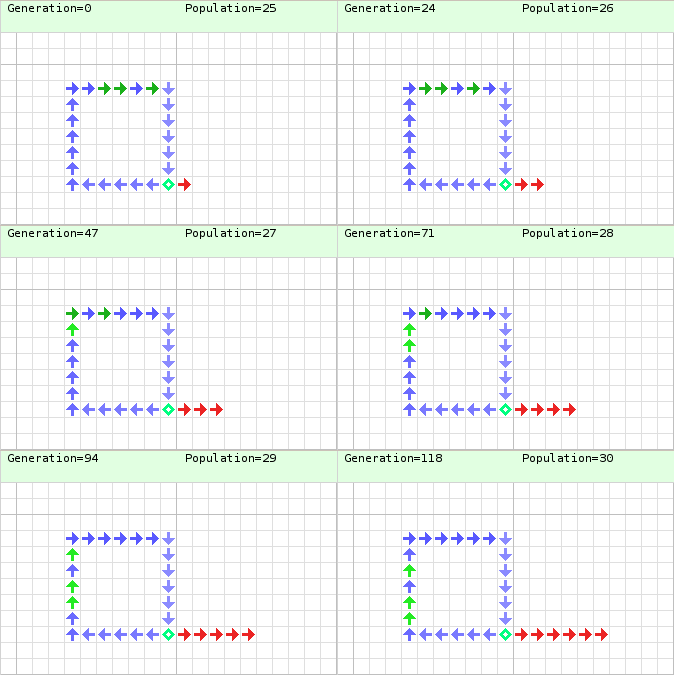
フォン・ノイマンによる自己複製構造の数学的分析は、DNAの構造の発見に先立って行われた。[289]ウラムとフォン・ノイマンは、1940年代に生物システムの簡略化された数学モデルとしてセルオートマトンという分野を創始したことでも広く知られている。[290]
1948年と1949年の講義で、フォン・ノイマンは運動学的自己増殖オートマトンを提案した。[291] [292] 1952年までに、彼はこの問題をより抽象的に扱うようになった。彼は、セルの初期構成を自動的にコピーする精巧な2Dセルオートマトンを設計した。 [293] フォン・ノイマン・セルオートマトンに基づくフォン・ノイマン万能構築子は、彼の死後に発表された『自己増殖オートマトン理論』で具体化された。[294] 2次元グリッド内の各セルが4つの直交するグリッドセルを隣人として持つフォン・ノイマン近傍は 、他のセルオートマトンにも引き続き使用されている。[295]
科学計算と数値解析
おそらく「科学計算史上最も影響力のある研究者」とみなされている[296]フォン・ノイマンは、技術的にも管理的にもこの分野に多くの貢献をした。彼はフォン・ノイマン安定性解析手順を開発した。[ 297]これは今でも線形偏微分方程式の数値計算法で誤差が蓄積するのを避けるために広く使われている。[298] 1947 年にハーマン・ゴールドスタインと共著した論文は、暗黙的ではあるが、逆誤差解析を初めて説明した。 [299]彼はまた、ヤコビ法について最初に書いた人の 1 人でもある。[300]ロスアラモスでは、ガス力学の問題を数値的に解くことに関する機密レポートをいくつか書いた。しかし、これらの非線形問題に対する解析的手法の進歩がないことには不満を感じていた。その結果、彼は計算手法に目を向けた。[301]彼の影響下で、ロスアラモスは 1950 年代から 1960 年代初頭にかけて計算科学のリーダーとなった。[302]
この研究から、フォン・ノイマンは、計算が単に数値的に問題を解くためのツールではなく、問題を解析的に解くための洞察も提供できることに気づいた。 [303]また、コンピュータが役立つ科学的および工学的問題は非常に多様であり、その中で最も重要なのは非線形問題であることに気づいた。[304] 1945年6月、第1回カナダ数学会議で、特に流体力学の問題を数値的に解く一般的なアイデアについて初めて講演した。[245]また、風洞が実際にはアナログコンピュータであること、デジタルコンピュータがそれらに取って代わり、流体力学の新しい時代をもたらすことを説明した。ギャレット・バーコフはそれを「忘れられないセールストーク」と評した。彼はゴールドスタインとのこの講演を原稿「大規模計算機の原理について」にまで拡大し、科学計算のサポートを促進するために使用した。彼の論文では、逆行列、ランダム行列、楕円境界値問題を解くための自動緩和法の概念も発展させた。[305]
気象システムと地球温暖化
コンピュータの応用可能性に関する研究の一環として、フォン・ノイマンは天気予報に興味を持ち、この分野の問題とマンハッタン計画で取り組んだ問題との類似点に気づいた。[306] 1946年、フォン・ノイマンは高等研究所に「気象プロジェクト」を設立し、気象局、アメリカ空軍、アメリカ海軍の気象局からプロジェクトの資金を確保した。[307]当時、理論気象学者の第一人者と考えられていたカール・グスタフ・ロスビーとともに、フォン・ノイマンは20人の気象学者を集め、この分野のさまざまな問題に取り組んだ。しかし、戦後の他の仕事を考えると、プロジェクトの適切な指導に十分な時間を割くことができず、成果はほとんどなかった。
しかし、若きジュール・グレゴリー・チャーニーがロスビーからプロジェクトの共同リーダーを引き継いだことで状況は一変した。[308] 1950年までにフォン・ノイマンとチャーニーは世界初の気候モデリングソフトウェアを書き、それを使ってフォン・ノイマンが用意したENIACコンピュータで世界初の数値天気予報を行った。 [307]フォン・ノイマンと彼のチームはその結果を「順圧渦度方程式の数値積分」として発表した。[309]彼らは協力して、海と空気のエネルギーと水分の交換を気候研究に統合する取り組みで主導的な役割を果たした。[310]原始的ではあったが、ENIACの予報のニュースはすぐに世界中に広まり、他の場所でもいくつかの並行プロジェクトが開始された。[311]
1955年、フォン・ノイマン、チャーニーとその協力者は資金提供者を説得し、メリーランド州スーツランドに共同数値気象予報ユニット(JNWPU)を開設し、日常的なリアルタイムの天気予報を開始しました。[312]次に、フォン・ノイマンは気候モデルの研究プログラムを提案しました。
このアプローチは、まず短期予測を試み、次に任意の長期間にわたって持続する可能性のある循環の特性の長期予測を試み、最後に、単純な流体力学理論では扱うには長すぎ、平衡理論の一般原則では扱うには短すぎる中長期の予測を試みるというものである。[313]
1955年のノーマン・A・フィリップスの肯定的な結果は即座に反応を引き起こし、フォン・ノイマンはプリンストンで「大循環の問題への数値積分技術の応用」に関する会議を開催した。彼は再び、気象局と軍からの継続的な支援を確実にするために、このプログラムを予測的なものとして戦略的に組織し、JNWPUの隣に大循環研究セクション(現在の地球物理流体力学研究所)を設立した。 [314]彼はモデリングの技術的な問題とこれらのプロジェクトへの継続的な資金提供の確保の両方について研究を続けた。[315] 19世紀後半、スヴァンテ・アレニウスは、人間の活動が大気中に二酸化炭素を放出することで地球温暖化を引き起こす可能性があると示唆した。 [316] 1955年、フォン・ノイマンは、これがすでに始まっているかもしれないと観察した。「石炭や石油の燃焼によって大気中に放出された二酸化炭素は、その半分以上が前世代で、大気の組成を十分に変え、世界全体の気温を華氏約1度上昇させた可能性がある。」[317] [318]気象システムと気象予測に関する研究から、彼は極地の氷冠に着色剤を散布して太陽放射の吸収を高める(アルベドを減らす)ことで環境を操作することを提案した。[319] [320] [319] [320] しかし、彼は大気改変のいかなるプログラムにも注意を促した。
もちろん、何ができるかは、何をすべきかの指標にはなりません...実際、全体的な寒冷化または全体的な温暖化の最終的な結果を評価することは複雑な問題です。変化は海面レベルに影響し、したがって大陸棚の居住可能性に影響します。海の蒸発は、したがって一般的な降水量と氷河レベルに影響します。...しかし、結果を予測するために必要な分析を実行し、任意の規模で介入し、最終的にかなり素晴らしい結果を達成できることにはほとんど疑いがありません。[318]
彼はまた、気象と気候制御が軍事的に利用される可能性があると警告し、 1956年に議会で、それらはICBMよりもさらに大きなリスクをもたらす可能性があると述べた。[321]
技術的特異点仮説
「現在開発中で、今後数十年にわたって主流となる技術は、伝統的で、概して現時点ではまだ有効な地理的、政治的な単位や概念と衝突しています。これは成熟しつつある技術の危機です...最も希望が持てる答えは、人類は以前にも同様の試練にさらされており、程度の差はあれ、それを乗り越える生来の能力を備えているように思われるということです。」
—フォン・ノイマン、1955年[318]
技術的文脈における特異点の概念の最初の使用はフォン・ノイマンによるものとされ、[322]ウラムによれば、ノイマンは「技術の進歩と人間の生活様式の変化が加速し続けており、人類の歴史において、それを超えると我々が知っているような人間の営みは継続できなくなる本質的な特異点に近づいているように見える」と論じた。[323]この概念は後にアルビン・トフラーの著書『未来の衝撃』で具体化された。
防衛活動

マンハッタン計画
1930年代後半から、フォン・ノイマンは爆発という数学的にモデル化するのが困難な現象に関する専門知識を培った。この時期、彼は成形炸薬の数学の第一人者であり、多数の軍事コンサルタント会社に所属し、その結果としてマンハッタン計画に関与するようになった。この関与には、ニューメキシコ州ロスアラモス研究所にある計画の秘密研究施設への頻繁な訪問も含まれていた。 [38]
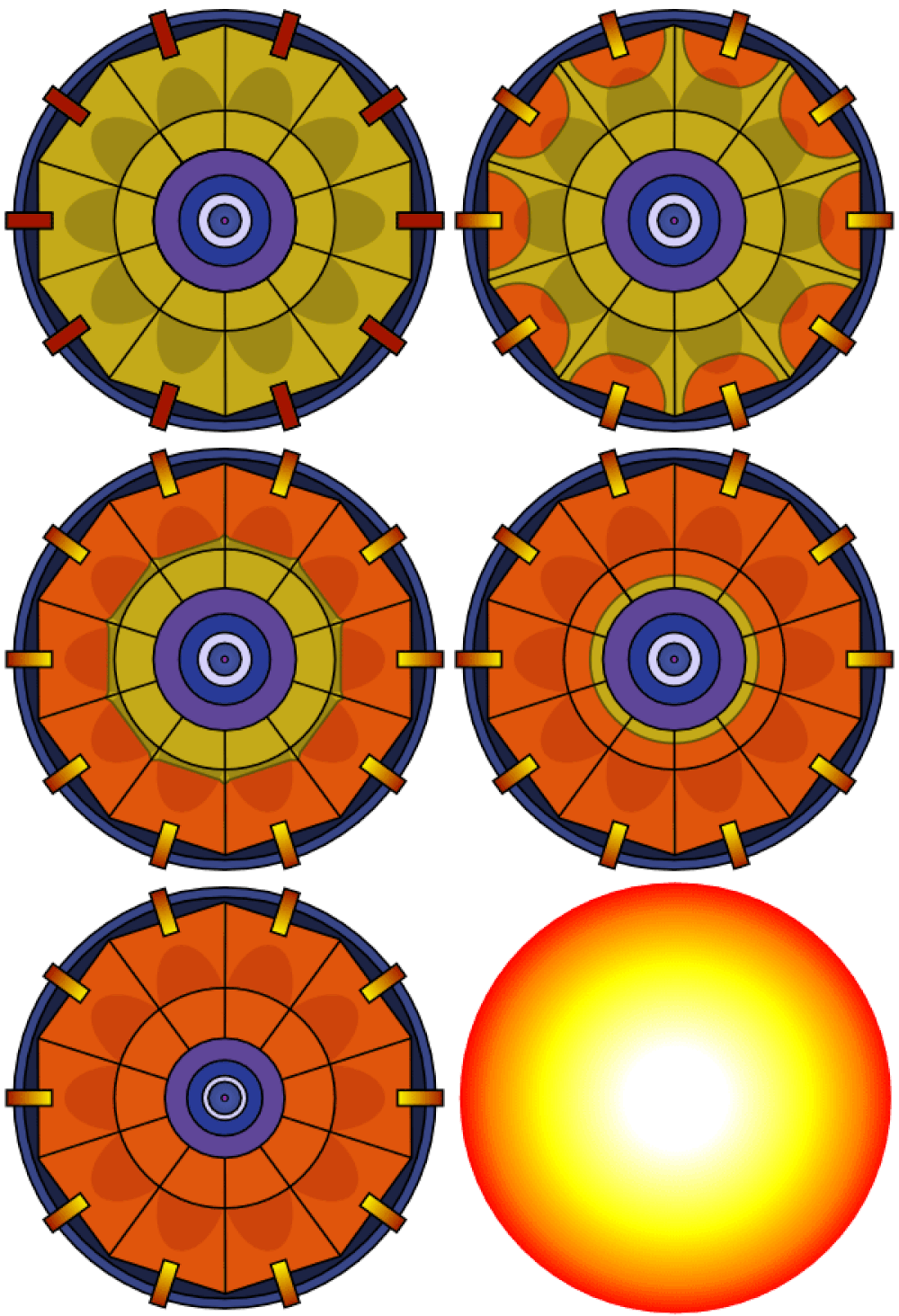
フォン・ノイマンは、後に長崎に投下されたファットマン兵器のプルトニウム核を圧縮するのに必要な爆発レンズの構想と設計において、原爆に大きく貢献した。[324]フォン・ノイマンは「爆縮」の構想を考案したわけではないが、その最も粘り強い支持者の一人であり、そのような設計は実行不可能だと感じていた多くの同僚の本能に反して、その開発を奨励した。彼はまた、最終的に、より強力な成形爆薬と核分裂しにくい物質を使用して「組み立て」の速度を大幅に上げるというアイデアを思いついた。[325]
When it turned out that there would not be enough uranium-235 to make more than one bomb, the implosive lens project was greatly expanded and von Neumann's idea was implemented. Implosion was the only method that could be used with the plutonium-239 that was available from the Hanford Site.[326] He established the design of the explosive lenses required, but there remained concerns about "edge effects" and imperfections in the explosives.[327] His calculations showed that implosion would work if it did not depart by more than 5% from spherical symmetry.[328] After a series of failed attempts with models, this was achieved by George Kistiakowsky, and the construction of the Trinity bomb was completed in July 1945.[329]
In a visit to Los Alamos in September 1944, von Neumann showed that the pressure increase from explosion shock wave reflection from solid objects was greater than previously believed if the angle of incidence of the shock wave was between 90° and some limiting angle. As a result, it was determined that the effectiveness of an atomic bomb would be enhanced with detonation some kilometers above the target, rather than at ground level.[330][331]
Von Neumann was included in the target selection committee that was responsible for choosing the Japanese cities of Hiroshima and Nagasaki as the first targets of the atomic bomb. Von Neumann oversaw computations related to the expected size of the bomb blasts, estimated death tolls, and the distance above the ground at which the bombs should be detonated for optimum shock wave propagation. The cultural capital Kyoto was von Neumann's first choice,[332] a selection seconded by Manhattan Project leader General Leslie Groves. However, this target was dismissed by Secretary of War Henry L. Stimson.[333]
On July 16, 1945, von Neumann and numerous other Manhattan Project personnel were eyewitnesses to the first test of an atomic bomb detonation, which was code-named Trinity. The event was conducted as a test of the implosion method device, at the Alamogordo Bombing Range in New Mexico. Based on his observation alone, von Neumann estimated the test had resulted in a blast equivalent to 5 kilotons of TNT (21 TJ) but Enrico Fermi produced a more accurate estimate of 10 kilotons by dropping scraps of torn-up paper as the shock wave passed his location and watching how far they scattered. The actual power of the explosion had been between 20 and 22 kilotons.[334] It was in von Neumann's 1944 papers that the expression "kilotons" appeared for the first time.[335]
Von Neumann continued unperturbed in his work and became, along with Edward Teller, one of those who sustained the hydrogen bomb project. He collaborated with Klaus Fuchs on further development of the bomb, and in 1946 the two filed a secret patent outlining a scheme for using a fission bomb to compress fusion fuel to initiate nuclear fusion.[336] The Fuchs–von Neumann patent used radiation implosion, but not in the same way as is used in what became the final hydrogen bomb design, the Teller–Ulam design. Their work was, however, incorporated into the "George" shot of Operation Greenhouse, which was instructive in testing out concepts that went into the final design.[337] The Fuchs–von Neumann work was passed on to the Soviet Union by Fuchs as part of his nuclear espionage, but it was not used in the Soviets' own, independent development of the Teller–Ulam design. The historian Jeremy Bernstein has pointed out that ironically, "John von Neumann and Klaus Fuchs, produced a brilliant invention in 1946 that could have changed the whole course of the development of the hydrogen bomb, but was not fully understood until after the bomb had been successfully made."[337]
For his wartime services, von Neumann was awarded the Navy Distinguished Civilian Service Award in July 1946, and the Medal for Merit in October 1946.[338]
Post-war work
In 1950, von Neumann became a consultant to the Weapons Systems Evaluation Group,[339] whose function was to advise the Joint Chiefs of Staff and the United States Secretary of Defense on the development and use of new technologies.[340] He also became an adviser to the Armed Forces Special Weapons Project, which was responsible for the military aspects on nuclear weapons.[339] Over the following two years, he became a consultant across the US government.[341] This included the Central Intelligence Agency (CIA), a member of the influential General Advisory Committee of the Atomic Energy Commission, a consultant to the newly established Lawrence Livermore National Laboratory, and a member of the Scientific Advisory Group of the United States Air Force[339] During this time he became a "superstar" defense scientist at the Pentagon. His authority was considered infallible at the highest levels of the US government and military.[342]
During several meetings of the advisory board of the US Air Force, von Neumann and Edward Teller predicted that by 1960 the US would be able to build a hydrogen bomb light enough to fit on top of a rocket. In 1953 Bernard Schriever, who was present at the meeting, paid a personal visit to von Neumann at Princeton to confirm this possibility.[343] Schriever enlisted Trevor Gardner, who in turn visited von Neumann several weeks later to fully understand the future possibilities before beginning his campaign for such a weapon in Washington.[344] Now either chairing or serving on several boards dealing with strategic missiles and nuclear weaponry, von Neumann was able to inject several crucial arguments regarding potential Soviet advancements in both these areas and in strategic defenses against American bombers into government reports to argue for the creation of ICBMs.[345] Gardner on several occasions brought von Neumann to meetings with the US Department of Defense to discuss with various senior officials his reports.[346] Several design decisions in these reports such as inertial guidance mechanisms would form the basis for all ICBMs thereafter.[347] By 1954, von Neumann was also regularly testifying to various Congressional military subcommittees to ensure continued support for the ICBM program.[348]
However, this was not enough. To have the ICBM program run at full throttle they needed direct action by the President of the United States.[349] They convinced President Eisenhower in a direct meeting in July 1955, which resulted in a presidential directive on September 13, 1955. It stated that "there would be the gravest repercussions on the national security and on the cohesion of the free world" if the Soviet Union developed the ICBM before the US and therefore designated the ICBM project "a research and development program of the highest priority above all others." The Secretary of Defense was ordered to commence the project with "maximum urgency".[350] Evidence would later show that the Soviets indeed were already testing their own intermediate-range ballistic missiles at the time.[351] Von Neumann would continue to meet the President, including at his home in Gettysburg, Pennsylvania, and other high-level government officials as a key advisor on ICBMs until his death.[352]
Atomic Energy Commission
In 1955, von Neumann became a commissioner of the Atomic Energy Commission (AEC), which at the time was the highest official position available to scientists in the government.[353] (While his appointment formally required that he sever all his other consulting contracts,[354] an exemption was made for von Neumann to continue working with several critical military committees after the Air Force and several key senators raised concerns.[352]) He used this position to further the production of compact hydrogen bombs suitable for intercontinental ballistic missile (ICBM) delivery. He involved himself in correcting the severe shortage of tritium and lithium 6 needed for these weapons, and he argued against settling for the intermediate-range missiles that the Army wanted. He was adamant that H-bombs delivered deep into enemy territory by an ICBM would be the most effective weapon possible, and that the relative inaccuracy of the missile would not be a problem with an H-bomb. He said the Russians would probably be building a similar weapon system, which turned out to be the case.[355][356] While Lewis Strauss was away in the second half of 1955 von Neumann took over as acting chairman of the commission.[357]
In his final years before his death from cancer, von Neumann headed the United States government's top-secret ICBM committee, which would sometimes meet in his home. Its purpose was to decide on the feasibility of building an ICBM large enough to carry a thermonuclear weapon. Von Neumann had long argued that while the technical obstacles were sizable, they could be overcome. The SM-65 Atlas passed its first fully functional test in 1959, two years after his death.[358] The more advanced Titan rockets were deployed in 1962. Both had been proposed in the ICBM committees von Neumann chaired.[352] The feasibility of the ICBMs owed as much to improved, smaller warheads that did not have guidance or heat resistance issues as it did to developments in rocketry, and his understanding of the former made his advice invaluable.[358][352]
Von Neumann entered government service primarily because he felt that, if freedom and civilization were to survive, it would have to be because the United States would triumph over totalitarianism from Nazism, Fascism and Soviet Communism.[60] During a Senate committee hearing he described his political ideology as "violently anti-communist, and much more militaristic than the norm".[359][360]
Personality
Work habits
Herman Goldstine commented on von Neumann's ability to intuit hidden errors and remember old material perfectly.[361][362] When he had difficulties he would not labor on; instead, he would go home and sleep on it and come back later with a solution.[363] This style, 'taking the path of least resistance', sometimes meant that he could go off on tangents. It also meant that if the difficulty was great from the very beginning, he would simply switch to another problem, not trying to find weak spots from which he could break through.[364] At times he could be ignorant of the standard mathematical literature, finding it easier to rederive basic information he needed rather than chase references.[365]
After World War II began, he became extremely busy with both academic and military commitments. His habit of not writing up talks or publishing results worsened.[366] He did not find it easy to discuss a topic formally in writing unless it was already mature in his mind; if it was not, he would, in his own words, "develop the worst traits of pedantism and inefficiency".[367]
Mathematical range
The mathematician Jean Dieudonné said that von Neumann "may have been the last representative of a once-flourishing and numerous group, the great mathematicians who were equally at home in pure and applied mathematics and who throughout their careers maintained a steady production in both directions".[160] According to Dieudonné, his specific genius was in analysis and "combinatorics", with combinatorics being understood in a very wide sense that described his ability to organize and axiomize complex works that previously seemed to have little connection with mathematics. His style in analysis followed the German school, based on foundations in linear algebra and general topology. While von Neumann had an encyclopedic background, his range in pure mathematics was not as wide as Poincaré, Hilbert or even Weyl: von Neumann never did significant work in number theory, algebraic topology, algebraic geometry or differential geometry. However, in applied mathematics his work equalled that of Gauss, Cauchy or Poincaré.[116]
According to Wigner, "Nobody knows all science, not even von Neumann did. But as for mathematics, he contributed to every part of it except number theory and topology. That is, I think, something unique."[368] Halmos noted that while von Neumann knew lots of mathematics, the most notable gaps were in algebraic topology and number theory; he recalled an incident where von Neumann failed to recognize the topological definition of a torus.[369] Von Neumann admitted to Herman Goldstine that he had no facility at all in topology and he was never comfortable with it, with Goldstine later bringing this up when comparing him to Hermann Weyl, who he thought was deeper and broader.[363]
In his biography of von Neumann, Salomon Bochner wrote that much of von Neumann's works in pure mathematics involved finite and infinite dimensional vector spaces, which at the time, covered much of the total area of mathematics. However he pointed out this still did not cover an important part of the mathematical landscape, in particular, anything that involved geometry "in the global sense", topics such as topology, differential geometry and harmonic integrals, algebraic geometry and other such fields. Von Neumann rarely worked in these fields and, as Bochner saw it, had little affinity for them.[129]
In one of von Neumann's last articles, he lamented that pure mathematicians could no longer attain deep knowledge of even a fraction of the field.[370] In the early 1940s, Ulam had concocted for him a doctoral-style examination to find weaknesses in his knowledge; von Neumann was unable to answer satisfactorily a question each in differential geometry, number theory, and algebra. They concluded that doctoral exams might have "little permanent meaning". However, when Weyl turned down an offer to write a history of mathematics of the 20th century, arguing that no one person could do it, Ulam thought von Neumann could have aspired to do so.[371]
Preferred problem-solving techniques
Ulam remarked that most mathematicians could master one technique that they then used repeatedly, whereas von Neumann had mastered three:
- A facility with the symbolic manipulation of linear operators;
- An intuitive feeling for the logical structure of any new mathematical theory;
- An intuitive feeling for the combinatorial superstructure of new theories.[372]
Although he was commonly described as an analyst, he once classified himself an algebraist,[373] and his style often displayed a mix of algebraic technique and set-theoretical intuition.[374] He loved obsessive detail and had no issues with excess repetition or overly explicit notation. An example of this was a paper of his on rings of operators, where he extended the normal functional notation, to . However, this process ended up being repeated several times, where the final result were equations such as . The 1936 paper became known to students as "von Neumann's onion"[375] because the equations "needed to be peeled before they could be digested". Overall, although his writings were clear and powerful, they were not clean or elegant.[376] Although powerful technically, his primary concern was more with the clear and viable formation of fundamental issues and questions of science rather than just the solution of mathematical puzzles.[375]



According to Ulam, von Neumann surprised physicists by doing dimensional estimates and algebraic computations in his head with fluency Ulam likened to blindfold chess. His impression was that von Neumann analyzed physical situations by abstract logical deduction rather than concrete visualization.[377]
Lecture style
Goldstine compared his lectures to being on glass, smooth and lucid. By comparison, Goldstine thought his scientific articles were written in a much harsher manner, and with much less insight.[64] Halmos described his lectures as "dazzling", with his speech clear, rapid, precise and all encompassing. Like Goldstine, he also described how everything seemed "so easy and natural" in lectures but puzzling on later reflection.[365] He was a quick speaker: Banesh Hoffmann found it very difficult to take notes, even in shorthand,[378] and Albert Tucker said that people often had to ask von Neumann questions to slow him down so they could think through the ideas he was presenting. Von Neumann knew about this and was grateful for his audience telling him when he was going too quickly.[379] Although he did spend time preparing for lectures, he rarely used notes, instead jotting down points of what he would discuss and for how long.[365]
Eidetic memory
Von Neumann was also noted for his eidetic memory, particularly of the symbolic kind. Herman Goldstine writes:
One of his remarkable abilities was his power of absolute recall. As far as I could tell, von Neumann was able on once reading a book or article to quote it back verbatim; moreover, he could do it years later without hesitation. He could also translate it at no diminution in speed from its original language into English. On one occasion I tested his ability by asking him to tell me how A Tale of Two Cities started. Whereupon, without any pause, he immediately began to recite the first chapter and continued until asked to stop after about ten or fifteen minutes.[380]
Von Neumann was reportedly able to memorize the pages of telephone directories. He entertained friends by asking them to randomly call out page numbers; he then recited the names, addresses and numbers therein.[29][381] Stanisław Ulam believed that von Neumann's memory was auditory rather than visual.[382]
Mathematical quickness
Von Neumann's mathematical fluency, calculation speed, and general problem-solving ability were widely noted by his peers. Paul Halmos called his speed "awe-inspiring."[383] Lothar Wolfgang Nordheim described him as the "fastest mind I ever met".[384] Enrico Fermi told physicist Herbert L. Anderson: "You know, Herb, Johnny can do calculations in his head ten times as fast as I can! And I can do them ten times as fast as you can, Herb, so you can see how impressive Johnny is!"[385] Edward Teller admitted that he "never could keep up with him",[386] and Israel Halperin described trying to keep up as like riding a "tricycle chasing a racing car."[387]
He had an unusual ability to solve novel problems quickly. George Pólya, whose lectures at ETH Zürich von Neumann attended as a student, said, "Johnny was the only student I was ever afraid of. If in the course of a lecture I stated an unsolved problem, the chances were he'd come to me at the end of the lecture with the complete solution scribbled on a slip of paper."[388] When George Dantzig brought von Neumann an unsolved problem in linear programming "as I would to an ordinary mortal", on which there had been no published literature, he was astonished when von Neumann said "Oh, that!", before offhandedly giving a lecture of over an hour, explaining how to solve the problem using the hitherto unconceived theory of duality.[389]
A story about von Neumann's encounter with the famous fly puzzle[390] has entered mathematical folklore. In this puzzle, two bicycles begin 20 miles apart, and each travels toward the other at 10 miles per hour until they collide; meanwhile, a fly travels continuously back and forth between the bicycles at 15 miles per hour until it is squashed in the collision. The questioner asks how far the fly traveled in total; the "trick" for a quick answer is to realize that the fly's individual transits do not matter, only that it has been traveling at 15 miles per hour for one hour. As Eugene Wigner tells it,[391] Max Born posed the riddle to von Neumann. The other scientists to whom he had posed it had laboriously computed the distance, so when von Neumann was immediately ready with the correct answer of 15 miles, Born observed that he must have guessed the trick. "What trick?" von Neumann replied. "All I did was sum the geometric series."[392]
Self-doubts
Rota wrote that von Neumann had "deep-seated and recurring self-doubts".[393] John L. Kelley reminisced in 1989 that "Johnny von Neumann has said that he will be forgotten while Kurt Gödel is remembered with Pythagoras, but the rest of us viewed Johnny with awe."[394] Ulam suggests that some of his self-doubts with regard for his own creativity may have come from the fact he had not discovered several important ideas that others had, even though he was more than capable of doing so, giving the incompleteness theorems and Birkhoff's pointwise ergodic theorem as examples. Von Neumann had a virtuosity in following complicated reasoning and had supreme insights, yet he perhaps felt he did not have the gift for seemingly irrational proofs and theorems or intuitive insights. Ulam describes how during one of his stays at Princeton while von Neumann was working on rings of operators, continuous geometries and quantum logic he felt that von Neumann was not convinced of the importance of his work, and only when finding some ingenious technical trick or new approach that he took some pleasure in it.[395] However, according to Rota, von Neumann still had an "incomparably stronger technique" compared to his friend, despite describing Ulam as the more creative mathematician.[393]
Legacy
Accolades
Nobel Laureate Hans Bethe said "I have sometimes wondered whether a brain like von Neumann's does not indicate a species superior to that of man".[29] Edward Teller observed "von Neumann would carry on a conversation with my 3-year-old son, and the two of them would talk as equals, and I sometimes wondered if he used the same principle when he talked to the rest of us."[396] Peter Lax wrote "Von Neumann was addicted to thinking, and in particular to thinking about mathematics".[366] Eugene Wigner said, "He understood mathematical problems not only in their initial aspect, but in their full complexity."[397] Claude Shannon called him "the smartest person I've ever met", a common opinion.[398] Jacob Bronowski wrote "He was the cleverest man I ever knew, without exception. He was a genius."[399]
"It seems fair to say that if the influence of a scientist is interpreted broadly enough to include impact on fields beyond science proper, then John von Neumann was probably the most influential mathematician who ever lived," wrote Miklós Rédei.[400] Peter Lax commented that von Neumann would have won a Nobel Prize in Economics had he lived longer, and that "if there were Nobel Prizes in computer science and mathematics, he would have been honored by these, too."[401] Rota writes that "he was the first to have a vision of the boundless possibilities of computing, and he had the resolve to gather the considerable intellectual and engineering resources that led to the construction of the first large computer" and consequently that "No other mathematician in this century has had as deep and lasting an influence on the course of civilization."[402] He is widely regarded as one of the greatest and most influential mathematicians and scientists of the 20th century.[403]
Neurophysiologist Leon Harmon described him in a similar manner, calling him the only "true genius" he had ever met: "von Neumann's mind was all-encompassing. He could solve problems in any domain. ... And his mind was always working, always restless."[404] While consulting for non-academic projects von Neumann's combination of outstanding scientific ability and practicality gave him a high credibility with military officers, engineers, and industrialists that no other scientist could match. In nuclear missilery he was considered "the clearly dominant advisory figure" according to Herbert York.[405] Economist Nicholas Kaldor said he was "unquestionably the nearest thing to a genius I have ever encountered."[268] Likewise, Paul Samuelson wrote, "We economists are grateful for von Neumann's genius. It is not for us to calculate whether he was a Gauss, or a Poincaré, or a Hilbert. He was the incomparable Johnny von Neumann. He darted briefly into our domain and it has never been the same since."[406]
Honors and awards

Events and awards named in recognition of von Neumann include the annual John von Neumann Theory Prize of the Institute for Operations Research and the Management Sciences,[407] IEEE John von Neumann Medal,[408] and the John von Neumann Prize of the Society for Industrial and Applied Mathematics.[409] Both the crater von Neumann on the Moon[410] and the asteroid 22824 von Neumann are named in his honor.[411][412]
Von Neumann received awards including the Medal for Merit in 1947, the Medal of Freedom in 1956,[413] and the Enrico Fermi Award also in 1956. He was elected a member of multiple honorary societies, including the American Academy of Arts and Sciences and the National Academy of Sciences, and he held eight honorary doctorates.[414][415][416] On May 4, 2005, the United States Postal Service issued the American Scientists commemorative postage stamp series, designed by artist Victor Stabin. The scientists depicted were von Neumann, Barbara McClintock, Josiah Willard Gibbs, and Richard Feynman.[417]
John von Neumann University was established in Kecskemét, Hungary in 2016, as a successor to Kecskemét College.[418]
Selected works
Von Neumann's first published paper was On the position of zeroes of certain minimum polynomials, co-authored with Michael Fekete and published when von Neumann was 18. At 19, his solo paper On the introduction of transfinite numbers was published.[419] He expanded his second solo paper, An axiomatization of set theory, to create his PhD thesis.[420] His first book, Mathematical Foundations of Quantum Mechanics, was published in 1932.[421] Following this, von Neumann switched from publishing in German to publishing in English, and his publications became more selective and expanded beyond pure mathematics. His 1942 Theory of Detonation Waves contributed to military research,[422] his work on computing began with the unpublished 1946 On the principles of large scale computing machines, and his publications on weather prediction began with the 1950 Numerical integration of the barotropic vorticity equation.[423] Alongside his later papers were informal essays targeted at colleagues and the general public, such as his 1947 The Mathematician,[424] described as a "farewell to pure mathematics", and his 1955 Can we survive technology?, which considered a bleak future including nuclear warfare and deliberate climate change.[425] His complete works have been compiled into a six-volume set.[419]
See also
- List of pioneers in computer science
- Teapot Committee
- The MANIAC, 2023 book about von Neumann
Notes
- ^ Dyson 2012, p. 48.
- ^ Israel, Giorgio [in Italian]; Gasca, Ana Millan (2009). The World as a Mathematical Game: John von Neumann and Twentieth Century Science. Science Networks. Historical Studies. Vol. 38. Basel: Birkhäuser. p. 14. doi:10.1007/978-3-7643-9896-5. ISBN 978-3-7643-9896-5. OCLC 318641638.
- ^ Goldstine 1980, p. 169.
- ^ a b Halperin, Israel. "The Extraordinary Inspiration of John von Neumann". In Glimm, Impagliazzo & Singer (1990), p. 16.
- ^ While Israel Halperin's thesis advisor is often listed as Salomon Bochner, this may be because "Professors at the university direct doctoral theses but those at the Institute do not. Unaware of this, in 1934 I asked von Neumann if he would direct my doctoral thesis. He replied Yes."[4]
- ^ John von Neumann at the Mathematics Genealogy Project. Retrieved 2015-03-17.
- ^ Szanton 1992, p. 130.
- ^ Dempster, M. A. H. (February 2011). "Benoit B. Mandelbrot (1924–2010): a father of Quantitative Finance" (PDF). Quantitative Finance. 11 (2): 155–156. doi:10.1080/14697688.2011.552332. S2CID 154802171.
- ^ Rédei 1999, p. 7.
- ^ Macrae 1992.
- ^ Aspray 1990, p. 246.
- ^ Sheehan 2010.
- ^ Doran, Robert S.; Kadison, Richard V., eds. (2004). Operator Algebras, Quantization, and Noncommutative Geometry: A Centennial Celebration Honoring John von Neumann and Marshall H. Stone. Washington, D.C.: American Mathematical Society. p. 1. ISBN 978-0-8218-3402-2.
- ^ Myhrvold, Nathan (March 21, 1999). "John von Neumann". Time. Archived from the original on 2001-02-11.
- ^ Blair 1957, p. 104.
- ^ Bhattacharya 2022, p. 4.
- ^ Dyson 1998, p. xxi.
- ^ Macrae 1992, pp. 38–42.
- ^ Macrae 1992, pp. 37–38.
- ^ Macrae 1992, p. 39.
- ^ Macrae 1992, pp. 44–45.
- ^ "Neumann de Margitta Miksa a Magyar Jelzálog-Hitelbank igazgatója n:Kann Margit gy:János-Lajos, Mihály-József, Miklós-Ágost | Libri Regii | Hungaricana". archives.hungaricana.hu (in Hungarian). Retrieved 2022-08-08.
- ^ a b Macrae 1992, pp. 57–58.
- ^ Henderson, Harry (2007). Mathematics: Powerful Patterns Into Nature and Society. New York: Chelsea House. p. 30. ISBN 978-0-8160-5750-4. OCLC 840438801.
- ^ Schneider, Gersting & Brinkman 2015, p. 28.
- ^ Mitchell, Melanie (2009). Complexity: A Guided Tour. Oxford University Press. p. 124. ISBN 978-0-19-512441-5. OCLC 216938473.
- ^ Macrae 1992, pp. 46–47.
- ^ a b Halmos 1973, p. 383.
- ^ a b c Blair 1957, p. 90.
- ^ Macrae 1992, p. 52.
- ^ Aspray 1990.
- ^ a b Macrae 1992, pp. 70–71.
- ^ a b Nasar, Sylvia (2001). A Beautiful Mind : a Biography of John Forbes Nash, Jr., Winner of the Nobel Prize in Economics, 1994. London: Simon & Schuster. p. 81. ISBN 978-0-7432-2457-4.
- ^ Macrae 1992, p. 84.
- ^ von Kármán, T., & Edson, L. (1967). The wind and beyond. Little, Brown & Company.
- ^ Macrae 1992, pp. 85–87.
- ^ Macrae 1992, p. 97.
- ^ a b Regis, Ed (November 8, 1992). "Johnny Jiggles the Planet". The New York Times. Retrieved 2008-02-04.
- ^ von Neumann, J. (1928). "Die Axiomatisierung der Mengenlehre". Mathematische Zeitschrift (in German). 27 (1): 669–752. doi:10.1007/BF01171122. ISSN 0025-5874. S2CID 123492324.
- ^ Macrae 1992, pp. 86–87.
- ^ Wigner, Eugene (2001). "John von Neumann (1903–1957)". In Mehra, Jagdish (ed.). The Collected Works of Eugene Paul Wigner: Historical, Philosophical, and Socio-Political Papers. Historical and Biographical Reflections and Syntheses. Berlin: Springer. p. 128. doi:10.1007/978-3-662-07791-7. ISBN 978-3-662-07791-7.
- ^ Pais 2000, p. 187.
- ^ Macrae 1992, pp. 98–99.
- ^ Weyl, Hermann (2012). Pesic, Peter (ed.). Levels of Infinity: Selected Writings on Mathematics and Philosophy (1 ed.). Dover Publications. p. 55. ISBN 978-0-486-48903-2.
- ^ Hashagen, Ulf [in German] (2010). "Die Habilitation von John von Neumann an der Friedrich-Wilhelms-Universität in Berlin: Urteile über einen ungarisch-jüdischen Mathematiker in Deutschland im Jahr 1927". Historia Mathematica. 37 (2): 242–280. doi:10.1016/j.hm.2009.04.002.
- ^ Dimand, Mary Ann; Dimand, Robert (2002). A History of Game Theory: From the Beginnings to 1945. London: Routledge. p. 129. ISBN 9781138006607.
- ^ Macrae 1992, p. 145.
- ^ Macrae 1992, pp. 143–144.
- ^ a b Macrae 1992, pp. 155–157.
- ^ Bochner 1958, p. 446.
- ^ "Marina Whitman". The Gerald R. Ford School of Public Policy at the University of Michigan. July 18, 2014. Retrieved 2015-01-05.
- ^ "Princeton Professor Divorced by Wife Here". Nevada State Journal. November 3, 1937.
- ^ Heims 1980, p. 178.
- ^ Macrae 1992, pp. 170–174.
- ^ Macrae 1992, pp. 167–168.
- ^ Macrae 1992, pp. 195–196.
- ^ Macrae 1992, pp. 190–195.
- ^ Macrae 1992, pp. 170–171.
- ^ Regis, Ed (1987). Who Got Einstein's Office?: Eccentricity and Genius at the Institute for Advanced Study. Reading, Massachusetts: Addison-Wesley. p. 103. ISBN 978-0-201-12065-3. OCLC 15548856.
- ^ a b "Conversation with Marina Whitman". Gray Watson (256.com). Archived from the original on 2011-04-28. Retrieved 2011-01-30.
- ^ Macrae 1992, p. 48.
- ^ a b Blair 1957, p. 94.
- ^ Eisenhart, Churchill (1984). "Interview Transcript #9 - Oral History Project" (PDF) (Interview). Interviewed by William Apsray. New Jersey: Princeton Mathematics Department. p. 7. Retrieved 2022-04-03.
- ^ a b Goldstine 1985, p. 7.
- ^ DeGroot, Morris H. (1989). "A Conversation with David Blackwell". In Duren, Peter (ed.). A Century of Mathematics in America: Part III. American Mathematical Society. p. 592. ISBN 0-8218-0136-8.
- ^ Szanton 1992, p. 227.
- ^ von Neumann Whitman, Marina. "John von Neumann: A Personal View". In Glimm, Impagliazzo & Singer (1990), p. 2.
- ^ York 1971, p. 18.
- ^ Pais 2006, p. 108.
- ^ Ulam 1976, pp. 231–232.
- ^ Ulam 1958, pp. 5–6.
- ^ Szanton 1992, p. 277.
- ^ Blair 1957, p. 93.
- ^ Ulam 1976, pp. 97, 102, 244–245.
- ^ Rota, Gian-Carlo (1989). "The Lost Cafe". In Cooper, Necia Grant; Eckhardt, Roger; Shera, Nancy (eds.). From Cardinals To Chaos: Reflections On The Life And Legacy Of Stanisław Ulam. Cambridge University Press. pp. 23–32. ISBN 978-0-521-36734-9. OCLC 18290810.
- ^ Macrae 1992, p. 75.
- ^ Ulam 1958, pp. 4–6.
- ^ While Macrae gives the origin as pancreatic, the Life magazine article says it was the prostate. Sheehan's book gives it as testicular.
- ^ Veisdal, Jørgen (November 11, 2019). "The Unparalleled Genius of John von Neumann". Medium. Retrieved 2019-11-19.
- ^ Jacobsen 2015, p. 62.
- ^ Poundstone, William (1993). Prisoner's Dilemma: John Von Neumann, Game Theory, and the Puzzle of the Bomb. Random House Digital. p. 194. ISBN 978-0-385-41580-4.
- ^ Halmos 1973, pp. 383, 394.
- ^ Jacobsen 2015, p. 63.
- ^ Read, Colin (2012). The Portfolio Theorists: von Neumann, Savage, Arrow and Markowitz. Great Minds in Finance. Palgrave Macmillan. p. 65. ISBN 978-0230274143. Retrieved 2017-09-29.
When von Neumann realised he was incurably ill his logic forced him to realise that he would cease to exist... [a] fate which appeared to him unavoidable but unacceptable.
- ^ Macrae 1992, p. 379"
- ^ Ayoub, Raymond George (2004). Musings Of The Masters: An Anthology Of Mathematical Reflections. Washington, D.C.: MAA. p. 170. ISBN 978-0-88385-549-2. OCLC 56537093.
- ^ Macrae 1992, p. 380.
- ^ "Nassau Presbyterian Church".
- ^ Macrae 1992, pp. 104–105.
- ^ a b c Van Heijenoort, Jean (1967). From Frege to Gödel: a Source Book in Mathematical Logic, 1879–1931. Cambridge, Massachusetts: Harvard University Press. ISBN 978-0-674-32450-3. OCLC 523838.
- ^ Murawski 2010, p. 196.
- ^ von Neumann, J. (1929), "Zur allgemeinen Theorie des Masses" [On the general theory of mass] (PDF), Fundamenta Mathematicae (in German), 13: 73–116, doi:10.4064/fm-13-1-73-116
- ^ Ulam 1958, pp. 14–15.
- ^ Von Plato, Jan (2018). "The Development of Proof Theory". In Zalta, Edward N. (ed.). The Stanford Encyclopedia of Philosophy (Winter 2018 ed.). Stanford University. Retrieved 2023-09-25.
- ^ van der Waerden, B. L. (1975). "On the sources of my book Moderne algebra". Historia Mathematica. 2 (1): 31–40. doi:10.1016/0315-0860(75)90034-8.
- ^ Neumann, J. v. (1927). "Zur Hilbertschen Beweistheorie". Mathematische Zeitschrift (in German). 24: 1–46. doi:10.1007/BF01475439. S2CID 122617390.
- ^ Murawski 2010, pp. 204–206.
- ^ a b Rédei 2005, p. 123.
- ^ von Plato 2018, p. 4080.
- ^ Dawson, John W. Jr. (1997). Logical Dilemmas: The Life and Work of Kurt Gödel. Wellesley, Massachusetts: A. K. Peters. p. 70. ISBN 978-1-56881-256-4.
- ^ von Plato 2018, pp. 4083–4088.
- ^ von Plato 2020, pp. 24–28.
- ^ Rédei 2005, p. 124.
- ^ von Plato 2020, p. 22.
- ^ Sieg, Wilfried (2013). Hilbert's Programs and Beyond. Oxford University Press. p. 149. ISBN 978-0195372229.
- ^ Murawski 2010, p. 209.
- ^ Hopf, Eberhard (1939). "Statistik der geodätischen Linien in Mannigfaltigkeiten negativer Krümmung". Leipzig Ber. Verhandl. Sächs. Akad. Wiss. (in German). 91: 261–304.
Two of the papers are:
von Neumann, John (1932). "Proof of the Quasi-ergodic Hypothesis". Proc Natl Acad Sci USA. 18 (1): 70–82. Bibcode:1932PNAS...18...70N. doi:10.1073/pnas.18.1.70. PMC 1076162. PMID 16577432.
von Neumann, John (1932). "Physical Applications of the Ergodic Hypothesis". Proc Natl Acad Sci USA. 18 (3): 263–266. Bibcode:1932PNAS...18..263N. doi:10.1073/pnas.18.3.263. JSTOR 86260. PMC 1076204. PMID 16587674..
- ^ Halmos 1958, p. 93.
- ^ Halmos 1958, p. 91.
- ^ a b Mackey, George W. "Von Neumann and the Early Days of Ergodic Theory". In Glimm, Impagliazzo & Singer (1990), pp. 27–30.
- ^ Ornstein, Donald S. "Von Neumann and Ergodic Theory". In Glimm, Impagliazzo & Singer (1990), p. 39.
- ^ Halmos 1958, p. 86.
- ^ Halmos 1958, p. 87.
- ^ Pietsch 2007, p. 168.
- ^ Halmos 1958, p. 88.
- ^ a b c d e Dieudonné 2008.
- ^ Ionescu-Tulcea, Alexandra; Ionescu-Tulcea, Cassius (1969). Topics in the Theory of Lifting. Springer-Verlag Berlin Heidelberg. p. V. ISBN 978-3-642-88509-9.
- ^ Halmos 1958, p. 89.
- ^ Neumann, J. v. (1940). "On Rings of Operators. III". Annals of Mathematics. 41 (1): 94–161. doi:10.2307/1968823. JSTOR 1968823.
- ^ Halmos 1958, p. 90.
- ^ Neumann, John von (1950). Functional Operators, Volume 1: Measures and Integrals. Princeton University Press. ISBN 9780691079660.
- ^ von Neumann, John (1999). Invariant Measures. American Mathematical Society. ISBN 978-0-8218-0912-9.
- ^ von Neumann, John (1934). "Almost Periodic Functions in a Group. I." Transactions of the American Mathematical Society. 36 (3): 445–492. doi:10.2307/1989792. JSTOR 1989792.
- ^ von Neumann, John; Bochner, Salomon (1935). "Almost Periodic Functions in Groups, II". Transactions of the American Mathematical Society. 37 (1): 21–50. doi:10.2307/1989694. JSTOR 1989694.
- ^ "AMS Bôcher Prize". AMS. January 5, 2016. Retrieved 2018-01-12.
- ^ Bochner 1958, p. 440.
- ^ von Neumann, J. (1933). "Die Einfuhrung Analytischer Parameter in Topologischen Gruppen". Annals of Mathematics. 2 (in German). 34 (1): 170–190. doi:10.2307/1968347. JSTOR 1968347.
- ^ v. Neumann, J. (1929). "Über die analytischen Eigenschaften von Gruppen linearer Transformationen und ihrer Darstellungen". Mathematische Zeitschrift (in German). 30 (1): 3–42. doi:10.1007/BF01187749. S2CID 122565679.
- ^ a b Bochner 1958, p. 441.
- ^ Pietsch 2007, p. 11.
- ^ Dieudonné 1981, p. 172.
- ^ Pietsch 2007, p. 14.
- ^ Dieudonné 1981, pp. 211, 218.
- ^ Pietsch 2007, pp. 58, 65–66.
- ^ a b Steen, L. A. (April 1973). "Highlights in the History of Spectral Theory". The American Mathematical Monthly. 80 (4): 359–381, esp. 370–373. doi:10.1080/00029890.1973.11993292. JSTOR 2319079.
- ^ Pietsch, Albrecht [in German] (2014). "Traces of operators and their history". Acta et Commentationes Universitatis Tartuensis de Mathematica. 18 (1): 51–64. doi:10.12697/ACUTM.2014.18.06.
- ^ Lord, Sukochev & Zanin 2012, p. 1.
- ^ Dieudonné 1981, pp. 175–176, 178–179, 181, 183.
- ^ Pietsch 2007, p. 202.
- ^ Kar, Purushottam; Karnick, Harish (2013). "On Translation Invariant Kernels and Screw Functions". p. 2. arXiv:1302.4343 [math.FA].
- ^ Alpay, Daniel; Levanony, David (2008). "On the Reproducing Kernel Hilbert Spaces Associated with the Fractional and Bi-Fractional Brownian Motions". Potential Analysis. 28 (2): 163–184. arXiv:0705.2863. doi:10.1007/s11118-007-9070-4. S2CID 15895847.
- ^ Horn & Johnson 2013, p. 320.
- ^ Horn & Johnson 2013, p. 458.
- ^ Horn, Roger A.; Johnson, Charles R. (1991). Topics in Matrix Analysis. Cambridge University Press. p. 139. ISBN 0-521-30587-X.
- ^ Horn & Johnson 2013, p. 335.
- ^ Bhatia, Rajendra (1997). Matrix Analysis. Graduate Texts in Mathematics. Vol. 169. New York: Springer. p. 109. doi:10.1007/978-1-4612-0653-8. ISBN 978-1-4612-0653-8.
- ^ Lord, Sukochev & Zanin 2021, p. 73.
- ^ Prochnoa, Joscha; Strzelecki, Michał (2022). "Approximation, Gelfand, and Kolmogorov numbers of Schatten class embeddings". Journal of Approximation Theory. 277: 105736. arXiv:2103.13050. doi:10.1016/j.jat.2022.105736. S2CID 232335769.
- ^ "Nuclear operator". Encyclopedia of Mathematics. Archived from the original on 2021-06-23. Retrieved 2022-08-07.
- ^ Pietsch 2007, p. 372.
- ^ Pietsch 2014, p. 54.
- ^ Lord, Sukochev & Zanin 2012, p. 73.
- ^ Lord, Sukochev & Zanin 2021, p. 26.
- ^ Pietsch 2007, p. 272.
- ^ Pietsch 2007, pp. 272, 338.
- ^ Pietsch 2007, p. 140.
- ^ Murray, Francis J. "The Rings of Operators Papers". In Glimm, Impagliazzo & Singer (1990), pp. 57–59.
- ^ Petz, D.; Rédei, M. R. "John von Neumann And The Theory Of Operator Algebras". In Bródy & Vámos (1995), pp. 163–181.
- ^ "Von Neumann Algebras" (PDF). Princeton University. Retrieved 2016-01-06.
- ^ a b Dieudonné 2008, p. 90.
- ^ Pietsch 2007, pp. 151.
- ^ Pietsch 2007, p. 146.
- ^ "Direct Integrals of Hilbert Spaces and von Neumann Algebras" (PDF). University of California at Los Angeles. Archived from the original (PDF) on 2015-07-02. Retrieved 2016-01-06.
- ^ Segal 1965.
- ^ Kadison, Richard V. "Operator Algebras - An Overview". In Glimm, Impagliazzo & Singer (1990), pp. 65,71,74.
- ^ Pietsch 2007, p. 148.
- ^ Birkhoff 1958, p. 50.
- ^ a b Lashkhi, A. A. (1995). "General geometric lattices and projective geometry of modules". Journal of Mathematical Sciences. 74 (3): 1044–1077. doi:10.1007/BF02362832. S2CID 120897087.
- ^ von Neumann, John (1936). "Examples of continuous geometries". Proc. Natl. Acad. Sci. USA. 22 (2): 101–108. Bibcode:1936PNAS...22..101N. doi:10.1073/pnas.22.2.101. JFM 62.0648.03. JSTOR 86391. PMC 1076713. PMID 16588050.
von Neumann, John (1998) [1960]. "Continuous geometry". Proceedings of the National Academy of Sciences of the United States of America. Princeton Landmarks in Mathematics. 22 (2). Princeton University Press: 92–100. doi:10.1073/pnas.22.2.92. ISBN 978-0-691-05893-1. MR 0120174. PMC 1076712. PMID 16588062.
von Neumann, John (1962). Taub, A. H. (ed.). Collected works. Vol. IV: Continuous geometry and other topics. Oxford: Pergamon Press. MR 0157874.
von Neumann, John (1981) [1937]. Halperin, Israel (ed.). "Continuous geometries with a transition probability". Memoirs of the American Mathematical Society. 34 (252). doi:10.1090/memo/0252. ISBN 978-0-8218-2252-4. ISSN 0065-9266. MR 0634656.
- ^ Macrae 1992, p. 140.
- ^ von Neumann, John (1930). "Zur Algebra der Funktionaloperationen und Theorie der normalen Operatoren". Mathematische Annalen (in German). 102 (1): 370–427. Bibcode:1930MatAn.102..685E. doi:10.1007/BF01782352. S2CID 121141866.. The original paper on von Neumann algebras.
- ^ Birkhoff 1958, pp. 50–51.
- ^ Birkhoff 1958, p. 51.
- ^ Wehrung, Friedrich (2006). "Von Neumann coordinatization is not first-order". Journal of Mathematical Logic. 6 (1): 1–24. arXiv:math/0409250. doi:10.1142/S0219061306000499. S2CID 39438451.
- ^ a b Birkhoff 1958, p. 52.
- ^ Goodearl, Ken R. (1979). Von Neumann Regular Rings. Pitman Publishing. p. ix. ISBN 0-273-08400-3.
- ^ Goodearl, Ken R. (1981). "Von Neumann regular rings: connections with functional analysis". Bulletin of the American Mathematical Society. 4 (2): 125–134. doi:10.1090/S0273-0979-1981-14865-5.
- ^ Birkhoff 1958, pp. 52–53.
- ^ Birkhoff 1958, pp. 55–56.
- ^ von Neumann, John (1941). "Distribution of the ratio of the mean square successive difference to the variance". Annals of Mathematical Statistics. 12 (4): 367–395. doi:10.1214/aoms/1177731677. JSTOR 2235951.
- ^ a b Durbin, J.; Watson, G. S. (1950). "Testing for Serial Correlation in Least Squares Regression, I". Biometrika. 37 (3–4): 409–428. doi:10.2307/2332391. JSTOR 2332391. PMID 14801065.
- ^ Sargan, J.D.; Bhargava, Alok (1983). "Testing residuals from least squares regression for being generated by the Gaussian random walk". Econometrica. 51 (1): 153–174. doi:10.2307/1912252. JSTOR 1912252.
- ^ Rédei, László (1959). "Neumann János munkássága az algebrában és számelméletben". Matematikai Lapok (in Hungarian). 10: 226–230.
- ^ von Neumann, J. (1925). "Egyenletesen sürü szämsorozatok (Gleichmässig dichte Zahlenfolgen)". Mat. Fiz. Lapok. 32: 32–40.
- ^ Carbone, Ingrid; Volcic, Aljosa (2011). "A von Neumann theorem for uniformly distributed sequences of partitions". Rend. Circ. Mat. Palermo. 60 (1–2): 83–88. arXiv:0901.2531. doi:10.1007/s12215-011-0030-x. S2CID 7270857.
- ^ Niederreiter, Harald (1975). "Rearrangement theorems for sequences". Astérisque. 24–25: 243–261.
- ^ von Neumann, J. (1926). "Zur Prüferschen Theorie der idealen Zahlen". Acta Szeged. 2: 193–227. JFM 52.0151.02.
- ^ Ulam 1958, pp. 9–10.
- ^ Narkiewicz, Wladyslaw (2004). Elementary and Analytic Theory of Algebraic Numbers. Springer Monographs in Mathematics (3rd ed.). Springer. p. 120. doi:10.1007/978-3-662-07001-7. ISBN 978-3-662-07001-7. Narkiewicz, Władysław (2018). The Story of Algebraic Numbers in the First Half of the 20th Century: From Hilbert to Tate. Springer Monographs in Mathematics. Springer. p. 144. doi:10.1007/978-3-030-03754-3. ISBN 978-3-030-03754-3.
- ^ van Dantzig, D. (1936). "Nombres universels ou p-adiques avec une introduction sur l'algèbre topologique". Annales scientifiques de l'École Normale Supérieure (in French). 53: 282–283. doi:10.24033/asens.858.
- ^ Warner, Seth (1993). Topological Rings. North-Hollywood. p. 428. ISBN 9780080872896.
- ^ von Neumann, J. (1928). "Die Zerlegung eines Intervalles in abzählbar viele kongruente Teilmengen". Fundamenta Mathematicae. 11 (1): 230–238. doi:10.4064/fm-11-1-230-238. JFM 54.0096.03.
- ^ Wagon & Tomkowicz 2016, p. 73.
- ^ Dyson 2013, p. 156.
- ^ Harzheim, Egbert (2008). "A Construction of Subsets of the Reals which have a Similarity Decomposition". Order. 25 (2): 79–83. doi:10.1007/s11083-008-9079-3. S2CID 45005704.
- ^ von Neumann, J. (1928). "Ein System algebraisch unabhängiger Zahlen". Mathematische Annalen. 99: 134–141. doi:10.1007/BF01459089. JFM 54.0096.02. S2CID 119788605.
- ^ Kuiper, F.; Popken, Jan (1962). "On the So-Called von Neumann-Numbers". Indagationes Mathematicae (Proceedings). 65: 385–390. doi:10.1016/S1385-7258(62)50037-1.
- ^ Mycielski, Jan (1964). "Independent sets in topological algebras". Fundamenta Mathematicae. 55 (2): 139–147. doi:10.4064/fm-55-2-139-147.
- ^ Wagon & Tomkowicz 2016, p. 114.
- ^ von Neumann, J. (1930). "Über einen Hilfssatz der Variationsrechnung". Abhandlungen Hamburg. 8: 28–31. JFM 56.0440.04.
- ^ Miranda, Mario (1997). "Maximum principles and minimal surfaces". Annali della Scuola Normale Superiore di Pisa - Classe di Scienze. 4, 25 (3–4): 667–681.
- ^ Gilbarg, David; Trudinger, Neil S. (2001). Elliptic Partial Differential Equations of Second Order (2 ed.). Springer. p. 316. doi:10.1007/978-3-642-61798-0. ISBN 978-3-642-61798-0.
- ^ Ladyzhenskaya, Olga A.; Ural'tseva, Nina N. (1968). Linear and Quasilinear Elliptic Equations. Academic Press. pp. 14, 243. ISBN 978-1483253329.
- ^ von Neumann, J. (1929). "Zum Beweise des Minkowskischen Stazes über Linearformen". Mathematische Zeitschrift. 30: 1–2. doi:10.1007/BF01187748. JFM 55.0065.04. S2CID 123066944.
- ^ Koksma, J. F. (1936). Diophantische Approximationen (in German). Springer. p. 15. doi:10.1007/978-3-642-65618-7. ISBN 978-3-642-65618-7.
- ^ Ulam 1958, pp. 10, 23.
- ^ Baez, John. "State-Observable Duality (Part 2)". The n-Category Café. Retrieved 2022-08-20.
- ^ McCrimmon, Kevin (2004). A Taste of Jordan Algebras. Universitext. New York: Springer. p. 68. doi:10.1007/b97489. ISBN 978-0-387-21796-3.
- ^ Rédei, Miklós (1996). "Why John von Neumann did not Like the Hilbert Space formalism of quantum mechanics (and what he liked instead)". Studies in History and Philosophy of Science Part B: Studies in History and Philosophy of Modern Physics. 27 (4): 493–510. Bibcode:1996SHPMP..27..493R. doi:10.1016/S1355-2198(96)00017-2.
- ^ Wang, Shuzhou; Wang, Zhenhua (2021). "Operator means in JB-algebras". Reports on Mathematical Physics. 88 (3): 383. arXiv:2012.13127. Bibcode:2021RpMP...88..383W. doi:10.1016/S0034-4877(21)00087-2. S2CID 229371549.
- ^ Landsman, Nicolaas P. (2009). "Algebraic Quantum Mechanics". In Greenberger, Daniel; Hentschel, Klaus; Weinert, Friedel (eds.). Compendium of Quantum Physics: Concepts, Experiments, History and Philosophy. Springer. pp. 6–7. doi:10.1007/978-3-540-70626-7. ISBN 978-3-540-70626-7.
- ^ Kronz, Fred; Lupher, Tracy (2021). "Quantum Theory and Mathematical Rigor". In Zalta, Edward N. (ed.). Stanford Encyclopedia of Philosophy (Winter 2021 ed.). Stanford University. Retrieved 2022-12-21.
- ^ a b Van Hove, Léon (1958). "Von Neumann's Contributions to Quantum Theory". Bulletin of the American Mathematical Society. 64 (3): 95–99. doi:10.1090/s0002-9904-1958-10206-2.
- ^ a b Macrae 1992, pp. 139–141.
- ^ Hermann, Grete (1935). "Die naturphilosophischen Grundlagen der Quantenmechanik". Naturwissenschaften. 23 (42): 718–721. Bibcode:1935NW.....23..718H. doi:10.1007/BF01491142. S2CID 40898258. English translation in Hermann, Grete (2016). Crull, Elise; Bacciagaluppi, Guido (eds.). Grete Hermann — Between physics and philosophy. Springer. pp. 239–278.
- ^ Bell, John S. (1966). "On the problem of hidden variables in quantum mechanics". Reviews of Modern Physics. 38 (3): 447–452. Bibcode:1966RvMP...38..447B. doi:10.1103/RevModPhys.38.447. OSTI 1444158.
- ^ Bub, Jeffrey (2010). "Von Neumann's 'No Hidden Variables' Proof: A Re-Appraisal". Foundations of Physics. 40 (9–10): 1333–1340. arXiv:1006.0499. Bibcode:2010FoPh...40.1333B. doi:10.1007/s10701-010-9480-9. S2CID 118595119.
- ^ Mermin, N. David; Schack, Rüdiger (2018). "Homer nodded: von Neumann's surprising oversight". Foundations of Physics. 48 (9): 1007–1020. arXiv:1805.10311. Bibcode:2018FoPh...48.1007M. doi:10.1007/s10701-018-0197-5. S2CID 118951033.
- ^ Peres, Asher (1992). "An experimental test for Gleason's theorem". Physics Letters A. 163 (4): 243–245. Bibcode:1992PhLA..163..243P. doi:10.1016/0375-9601(92)91005-C.
- ^ Freire, Olival Jr. (2006). "Philosophy enters the optics laboratory: Bell's theorem and its first experimental tests (1965–1982)". Studies in History and Philosophy of Modern Physics. 37 (4): 577–616. arXiv:physics/0508180. Bibcode:2006SHPMP..37..577F. doi:10.1016/j.shpsb.2005.12.003. S2CID 13503517.
- ^ Stacey, B. C. (2016). "Von Neumann was not a Quantum Bayesian". Philosophical Transactions of the Royal Society A. 374 (2068): 20150235. arXiv:1412.2409. Bibcode:2016RSPTA.37450235S. doi:10.1098/rsta.2015.0235. PMID 27091166. S2CID 16829387.
- ^ Wigner, Eugene; Margenau, Henry (December 1967). "Remarks on the Mind Body Question, in Symmetries and Reflections, Scientific Essays". American Journal of Physics. 35 (12): 1169–1170. Bibcode:1967AmJPh..35.1169W. doi:10.1119/1.1973829.
- ^ Schlosshauer, M.; Koer, J.; Zeilinger, A. (2013). "A Snapshot of Foundational Attitudes Toward Quantum Mechanics". Studies in History and Philosophy of Science Part B: Studies in History and Philosophy of Modern Physics. 44 (3): 222–230. arXiv:1301.1069. Bibcode:2013SHPMP..44..222S. doi:10.1016/j.shpsb.2013.04.004. S2CID 55537196.
- ^ Wightman, A. S. (1976). "Hilbert's Sixth Problem: Mathematical Treatment of the Axioms of Physics". In Browder, Felix E. (ed.). Mathematical Developments Arising from Hilbert Problems. American Mathematical Society. pp. 157–158. ISBN 978-0821814284.
- ^ Kac, Rota & Schwartz 2008, p. 168.
- ^ Rédei 2005, pp. 21, 151–152, 194.
- ^ Nielsen, Michael A.; Chuang, Isaac (2001). Quantum computation and quantum information (reprinted ed.). Cambridge University Press. p. 700. ISBN 978-0-521-63503-5.
- ^ "Alexandr S. Holevo".
- ^ Wilde, Mark M. (2013). Quantum Information Theory. Cambridge University Press. p. 252.
- ^ von Neumann, John (1927). "Wahrscheinlichkeitstheoretischer Aufbau der Quantenmechanik". Göttinger Nachrichten (in German). 1: 245–272.
- ^ Schlüter, Michael; Sham, Lu Jeu (1982), "Density functional theory", Physics Today, 35 (2): 36–43, Bibcode:1982PhT....35b..36S, doi:10.1063/1.2914933, S2CID 126232754
- ^ Fano, Ugo (June 1995), "Density matrices as polarization vectors", Rendiconti Lincei, 6 (2): 123–130, doi:10.1007/BF03001661, S2CID 128081459
- ^ Hall, Brian C. (2013). "Systems and Subsystems, Multiple Particles". Quantum Theory for Mathematicians. Graduate Texts in Mathematics. Vol. 267. pp. 419–440. doi:10.1007/978-1-4614-7116-5_19. ISBN 978-1-4614-7115-8.
- ^ Giulini, Domenico; Joos, Erich; Kiefer, Claus; Kupsch, Joachim; Stamatescu, Ion-Olimpiu; Zeh, H. Dieter (1996). Decoherence and the Appearance of a Classical World in Quantum Theory. Berlin, Heidelberg: Springer Berlin Heidelberg. ISBN 978-3-662-03263-3. OCLC 851393174.
- ^ Bacciagaluppi, Guido (2020). "The Role of Decoherence in Quantum Mechanics". In Zalta, Edward N. (ed.). The Stanford Encyclopedia of Philosophy (Fall 2020 ed.). Stanford University. Retrieved 2023-09-25.
- ^ Gabbay, Dov M.; Woods, John (2007). "The History of Quantum Logic". The Many Valued and Nonmonotonic Turn in Logic. Elsevier. pp. 205–2017. ISBN 978-0-08-054939-2.
- ^ a b Birkhoff, Garrett; von Neumann, John (October 1936). "The Logic of Quantum Mechanics". Annals of Mathematics. 37 (4): 823–843. doi:10.2307/1968621. JSTOR 1968621.
- ^ Putnam, Hilary (1985). Philosophical Papers. Vol. 3: Realism and Reason. Cambridge University Press. p. 263. ISBN 978-0-521-31394-0.
- ^ Rédei 2005, pp. 30–32.
- ^ Rédei & Stöltzner 2001, pp. 53, 153–154, 168–169.
- ^ von Neumann, John. "The Point Source Solution". In Taub (1963), pp. 219–237.
- ^ von Neumann, John. "Theory of Detonation Waves. Progress Report to the National Defense Research Committee Div. B, OSRD-549". In Taub (1963), pp. 205–218.
- ^ Carlucci, Donald E.; Jacobson, Sidney S. (August 26, 2013). Ballistics: Theory and Design of Guns and Ammunition (2nd ed.). CRC Press. p. 523.
- ^ von Neumann, J.; Richtmyer, R. D. (March 1950). "A Method for the Numerical Calculation of Hydrodynamic Shocks". Journal of Applied Physics. 21 (3): 232–237. Bibcode:1950JAP....21..232V. doi:10.1063/1.1699639.
- ^ a b Metropolis, Nicholas; Howlett, J.; Rota, Gian-Carlo, eds. (1980). A History of Computing in the Twentieth Century. Elsevier. pp. 24–25. doi:10.1016/C2009-0-22029-0. ISBN 978-1-4832-9668-5.
- ^ Binney, James (1996). "The stellar-dynamical oeuvre". Journal of Astrophysics and Astronomy. 17 (3–4): 81–93. Bibcode:1996JApA...17...81B. doi:10.1007/BF02702298. S2CID 56126751.
- ^ Benacquista, Matthew J.; Downing, Jonathan M. B. (2013). "Relativistic Binaries in Globular Clusters". Living Reviews in Relativity. 16 (1): 4. arXiv:1110.4423. Bibcode:2013LRR....16....4B. doi:10.12942/lrr-2013-4. PMC 5255893. PMID 28179843.
- ^ Uchaikin, Vladimir V.; Zolotarev, Vladimir M. (1999). Chance and Stability: Stable Distributions and their Applications. De Gruyter. pp. xviii, 281, 424. doi:10.1515/9783110935974. ISBN 9783110631159.
- ^ Silva, J. M.; Lima, J. A. S.; de Souza, R. E.; Del Popolo, A.; Le Delliou, Morgan; Lee, Xi-Guo (2016). "Chandrasekhar's dynamical friction and non-extensive statistics". Journal of Cosmology and Astroparticle Physics. 2016 (5): 21. arXiv:1604.02034. Bibcode:2016JCAP...05..021S. doi:10.1088/1475-7516/2016/05/021. hdl:11449/173002. S2CID 118462043.
- ^ Taub 1963, pp. 172–176.
- ^ Bonolis, Luisa (2017). "Stellar structure and compact objects before 1940: Towards relativistic astrophysics". The European Physical Journal H. 42 (2): 311–393, esp. pp. 351, 361. arXiv:1703.09991. Bibcode:2017EPJH...42..311B. doi:10.1140/epjh/e2017-80014-4.
- ^ Trautman, Andrzej; Trautman, Krzysztof (1994). "Generalized pure spinors". Journal of Geometry and Physics. 15 (1): 1–22. Bibcode:1994JGP....15....1T. doi:10.1016/0393-0440(94)90045-0.
- ^ Forstnerič, Franc (2021). "The Calabi–Yau Property of Superminimal Surfaces in Self-Dual Einstein Four-Manifolds". The Journal of Geometric Analysis. 31 (5): 4754–4780. arXiv:2004.03536. doi:10.1007/s12220-020-00455-6. S2CID 215238355.
- ^ Segal, Irving E. "The Mathematical Implications of Fundamental Physical Principles". In Glimm, Impagliazzo & Singer (1990), pp. 162–163.
- ^ Rickles 2020, p. 89.
- ^ Rédei 2005, pp. 21–22.
- ^ Rédei & Stöltzner 2001, pp. 222–224.
- ^ Rickles 2020, pp. 202–203.
- ^ Taub 1963, p. 177.
- ^ a b c Kuhn, H. W.; Tucker, A. W. (1958). "John von Neumann's work in the theory of games and mathematical economics". Bull. Amer. Math. Soc. 64 (Part 2) (3): 100–122. CiteSeerX 10.1.1.320.2987. doi:10.1090/s0002-9904-1958-10209-8. MR 0096572.
- ^ von Neumann, J (1928). "Zur Theorie der Gesellschaftsspiele". Mathematische Annalen (in German). 100: 295–320. doi:10.1007/bf01448847. S2CID 122961988.
- ^ Lissner, Will (March 10, 1946). "Mathematical Theory of Poker Is Applied to Business Problems; GAMING STRATEGY USED IN ECONOMICS Big Potentialities Seen Strategies Analyzed Practical Use in Games". The New York Times. ISSN 0362-4331. Retrieved 2020-07-25.
- ^ Blume, Lawrence E. (2008). "Convexity". In Durlauf, Steven N.; Blume, Lawrence E. (eds.). The New Palgrave Dictionary of Economics (2nd ed.). New York: Palgrave Macmillan. pp. 225–226. doi:10.1057/9780230226203.0315. ISBN 978-0-333-78676-5.
- ^ For this problem to have a unique solution, it suffices that the nonnegative matrices A and B satisfy an irreducibility condition, generalizing that of the Perron–Frobenius theorem of nonnegative matrices, which considers the (simplified) eigenvalue problem
- A − λ I q = 0,
- ^ Morgenstern, Oskar; Thompson, Gerald L. (1976). Mathematical Theory of Expanding and Contracting Economies. Lexington Books. Lexington, Massachusetts: D. C. Heath and Company. pp. xviii, 277. ISBN 978-0-669-00089-4.
- ^ Rockafellar, R. T. (1970). Convex analysis. Princeton University Press. pp. i, 74. ISBN 978-0-691-08069-7. OCLC 64619. Rockafellar, R. T. (1974). "Convex Algebra and Duality in Dynamic Models of production". In Loz, Josef; Loz, Maria (eds.). Mathematical Models in Economics. Proc. Sympos. and Conf. von Neumann Models, Warsaw, 1972. Amsterdam: Elsevier North-Holland Publishing and Polish Academy of Sciences. pp. 351–378. OCLC 839117596.
- ^ Ye, Yinyu (1997). "The von Neumann growth model". Interior point algorithms: Theory and analysis. New York: Wiley. pp. 277–299. ISBN 978-0-471-17420-2. OCLC 36746523.
- ^ a b Dore, Chakravarty & Goodwin 1989, p. xi.
- ^ Bruckmann, Gerhart; Weber, Wilhelm, eds. (September 21, 1971). Contributions to von Neumann's Growth Model. Proceedings of a Conference Organized by the Institute for Advanced Studies Vienna, Austria, July 6 and 7, 1970. Springer–Verlag. doi:10.1007/978-3-662-24667-2. ISBN 978-3-662-22738-1.
- ^ Dore, Chakravarty & Goodwin 1989, p. 234.
- ^ Macrae 1992, pp. 250–253.
- ^ Dantzig, G. B. (1983). "Reminiscences about the origins of linear programming.". In Bachem, A.; Grötschel, M.; Korte, B. (eds.). Mathematical Programming The State of the Art: Bonn 1982. Berlin, New York: Springer-Verlag. pp. 78–86. ISBN 0387120823. OCLC 9556834.
- ^ Dantzig, George; Thapa, Mukund N. (2003). Linear Programming : 2: Theory and Extensions. New York, NY: Springer-Verlag. ISBN 978-1-4419-3140-5.
- ^ Goldstine 1980, pp. 167–178.
- ^ Macrae 1992, pp. 279–283.
- ^ "BRL's Scientific Advisory Committee, 1940". U.S. Army Research Laboratory. Retrieved 2018-01-12.
- ^ "John W. Mauchly and the Development of the ENIAC Computer". University of Pennsylvania. Archived from the original on 2007-04-16. Retrieved 2017-01-27.
- ^ Rédei 2005, p. 73.
- ^ Dyson 2012, pp. 267–268, 287.
- ^ Knuth, Donald (1998). The Art of Computer Programming: Volume 3 Sorting and Searching. Boston: Addison-Wesley. p. 159. ISBN 978-0-201-89685-5.
- ^ Knuth, Donald E. (1987). "Von Neumann's First Computer Program". In Aspray, W.; Burks, A. (eds.). Papers of John von Neumann on computing and computer theory. Cambridge: MIT Press. pp. 89–95. ISBN 978-0-262-22030-9.
- ^ Macrae 1992, pp. 334–335.
- ^ a b c Von Neumann, John (1951). "Various techniques used in connection with random digits". National Bureau of Standards Applied Mathematics Series. 12: 36–38.
- ^ von Neumann, J. "Probabilistic Logics and the Synthesis of Reliable Organisms from Unreliable Components". In Bródy & Vámos (1995), pp. 567–616.
- ^ Petrovic, R.; Siljak, D. (1962). "Multiplication by means of coincidence". ACTES Proc. of 3rd Int. Analog Comp. Meeting.
- ^ Afuso, C. (1964), Quart. Tech. Prog. Rept, Illinois: Department of Computer Science, University of Illinois at Urbana-Champaign
- ^ Chaitin, Gregory J. (2002). Conversations with a Mathematician: Math, Art, Science and the Limits of Reason. London: Springer. p. 28. doi:10.1007/978-1-4471-0185-7. ISBN 978-1-4471-0185-7.
- ^ Pesavento, Umberto (1995). "An implementation of von Neumann's self-reproducing machine" (PDF). Artificial Life. 2 (4): 337–354. doi:10.1162/artl.1995.2.337. PMID 8942052. Archived from the original (PDF) on 2007-06-21.
- ^ Rocha, L.M. (2015). "Von Neumann and Natural Selection". Lecture Notes of I-585-Biologically Inspired Computing Course, Indiana University (PDF). pp. 25–27. Archived from the original (PDF) on 2015-09-07. Retrieved 2016-02-06.
- ^ Damerow, Julia, ed. (June 14, 2010). "John von Neumann's Cellular Automata". Embryo Project Encyclopedia. Arizona State University. School of Life Sciences. Center for Biology and Society. Retrieved 2024-01-14.
- ^ von Neumann, John (1966). A. Burks (ed.). The Theory of Self-reproducing Automata. Urbana, IL: Univ. of Illinois Press. ISBN 978-0-598-37798-2.
- ^ "2.1 Von Neumann's Contributions". Molecularassembler.com. Retrieved 2009-09-16.
- ^ "2.1.3 The Cellular Automaton (CA) Model of Machine Replication". Molecularassembler.com. Retrieved 2009-09-16.
- ^ von Neumann, John (1966). Arthur W. Burks (ed.). Theory of Self-Reproducing Automata (PDF). Urbana and London: University of Illinois Press. ISBN 978-0-598-37798-2.
- ^ Toffoli, Tommaso; Margolus, Norman (1987). Cellular Automata Machines: A New Environment for Modeling. MIT Press. p. 60..
- ^ Gustafsson 2018, p. 91.
- ^ Gustafsson 2018, pp. 101–102.
- ^ Gustafsson 2018, p. 235.
- ^ Brezinski & Wuytack 2001, p. 27.
- ^ Brezinski & Wuytack 2001, p. 216.
- ^ Gustafsson 2018, pp. 112–113.
- ^ Lax, Peter D. (2005). "Interview with Peter D. Lax" (PDF) (Interview). Interviewed by Martin Raussen; Christian Skau. Oslo: Notices of the American Mathematical Society. p. 223.
- ^ Ulam, Stanisław M. (1986). Reynolds, Mark C.; Rota, Gian-Carlo (eds.). Science, Computers, and People: From the Tree of Mathematics. Boston: Birkhäuser. p. 224. doi:10.1007/978-1-4615-9819-0. ISBN 978-1-4615-9819-0.
- ^ Hersh, Reuben (2015). Peter Lax, Mathematician: An Illustrated Memoir. American Mathematical Society. p. 170. ISBN 978-1-4704-2043-7.
- ^ Birkhoff, Garrett (1990). "Fluid dynamics, reactor computations, and surface representation". In Nash, Stephen G. (ed.). A history of scientific computing. Association for Computing Machinery. pp. 64–69. doi:10.1145/87252.88072. ISBN 978-0-201-50814-7.
- ^ Edwards 2010, p. 115.
- ^ a b Weather Architecture By Jonathan Hill (Routledge, 2013), page 216
- ^ Edwards 2010, pp. 117–118.
- ^ Charney, J. G.; Fjörtoft, R.; Neumann, J. (1950). "Numerical Integration of the Barotropic Vorticity Equation". Tellus. 2 (4): 237–254. Bibcode:1950Tell....2..237C. doi:10.3402/TELLUSA.V2I4.8607.
- ^ Gilchrist, Bruce, "Remembering Some Early Computers, 1948–1960" (PDF). Archived from the original (PDF) on 2006-12-12. Retrieved 2006-12-12., Columbia University EPIC, 2006, pp.7-9. (archived 2006) Contains some autobiographical material on Gilchrist's use of the IAS computer beginning in 1952.
- ^ Edwards 2010, p. 126.
- ^ Edwards 2010, p. 130.
- ^ Intraseasonal Variability in the Atmosphere-Ocean Climate System, By William K.-M. Lau, Duane E. Waliser (Springer 2011), page V
- ^ Edwards 2010, pp. 152–153.
- ^ Edwards 2010, pp. 153, 161, 189–190.
- ^ "The Carbon Dioxide Greenhouse Effect". The Discovery of Global Warming. American Institute of Physics. May 2023. Retrieved 2023-10-09.
- ^ Macrae 1992, p. 16.
- ^ a b c Engineering: Its Role and Function in Human Society edited by William H. Davenport, Daniel I. Rosenthal (Elsevier 2016), page 266
- ^ a b Macrae 1992, p. 332.
- ^ a b Heims 1980, pp. 236–247.
- ^ Edwards 2010, pp. 189–191.
- ^ The Technological Singularity by Murray Shanahan, (MIT Press, 2015), page 233
- ^ Chalmers, David (2010). "The singularity: a philosophical analysis". Journal of Consciousness Studies. 17 (9–10): 7–65.
- ^ Jacobsen 2015, Ch. 3.
- ^ Hoddeson et al. 1993, pp. 130–133, 157–159.
- ^ Hoddeson et al. 1993, pp. 239–245.
- ^ Hoddeson et al. 1993, p. 295.
- ^ Sublette, Carey. "Section 8.0 The First Nuclear Weapons". Nuclear Weapons Frequently Asked Questions. Retrieved 2016-01-08.
- ^ Hoddeson et al. 1993, pp. 320–327.
- ^ Macrae 1992, p. 209.
- ^ Hoddeson et al. 1993, p. 184.
- ^ Macrae 1992, pp. 242–245.
- ^ Groves, Leslie (1962). Now it Can be Told: The Story of the Manhattan Project. New York: Harper & Row. pp. 268–276. ISBN 978-0-306-70738-4. OCLC 537684.
- ^ Hoddeson et al. 1993, pp. 371–372.
- ^ Macrae 1992, p. 205.
- ^ Herken, Gregg (2002). Brotherhood of the Bomb: The Tangled Lives and Loyalties of Robert Oppenheimer, Ernest Lawrence, and Edward Teller. New York: Holt. pp. 171, 374. ISBN 978-0-8050-6589-3. OCLC 48941348.
- ^ a b Bernstein, Jeremy (2010). "John von Neumann and Klaus Fuchs: an Unlikely Collaboration". Physics in Perspective. 12 (1): 36–50. Bibcode:2010PhP....12...36B. doi:10.1007/s00016-009-0001-1. S2CID 121790196.
- ^ Macrae 1992, p. 208.
- ^ a b c Macrae 1992, pp. 350–351.
- ^ "Weapons' Values to be Appraised". Spokane Daily Chronicle. December 15, 1948. Retrieved 2015-01-08.
- ^ Sheehan 2010, p. 182.
- ^ Jacobsen 2015, p. 40.
- ^ Sheehan 2010, pp. 178–179.
- ^ Sheehan 2010, p. 199.
- ^ Sheehan 2010, pp. 217, 219–220.
- ^ Sheehan 2010, p. 221.
- ^ Sheehan 2010, p. 259.
- ^ Sheehan 2010, pp. 273, 276–278.
- ^ Sheehan 2010, pp. 275, 278.
- ^ Sheehan 2010, pp. 287–299.
- ^ Sheehan 2010, p. 311.
- ^ a b c d Aspray 1990, p. 250.
- ^ Heims 1980, p. 275.
- ^ Aspray 1990, pp. 244–245.
- ^ Heims 1980, p. 276.
- ^ Macrae 1992, pp. 367–369.
- ^ Heims 1980, p. 282.
- ^ a b Macrae 1992, pp. 359–365.
- ^ Blair 1957, p. 96.
- ^ Pais 2006, p. 109.
- ^ Goldstine 1985, pp. 9–10.
- ^ Albers & Alexanderson 2008, p. 81.
- ^ a b Goldstine 1985, p. 16.
- ^ Ulam 1976, p. 78.
- ^ a b c Halmos 1973, pp. 387–388.
- ^ a b Lax, Peter D. "Remembering John von Neumann". In Glimm, Impagliazzo & Singer (1990), p. 6.
- ^ Rédei & Stöltzner 2001, p. 168.
- ^ Dyson 1998, p. 77.
- ^ Halmos 1973, p. 389.
- ^ Ulam 1958, p. 8.
- ^ Ulam 1976, p. 291.
- ^ Ulam 1976, p. 96.
- ^ Halperin, Israel (1984). "Interview Transcript #18 - Oral History Project" (PDF) (Interview). Interviewed by Albert Tucker. Princeton Mathematics Department. p. 12. Retrieved 2022-04-04.
- ^ Ulam 1958, p. 9.
- ^ a b Segal, Irving E. "The Mathematical Implications of Fundamental Physical Principles". In Glimm, Impagliazzo & Singer (1990), pp. 154–156.
- ^ Halmos 1973, p. 388.
- ^ Ulam 1958, p. 38.
- ^ Hoffmann, Banesh (1984). "Interview Transcript #20 - Oral History Project" (PDF) (Interview). Interviewed by Albert Tucker. Princeton Mathematics Department. p. 4. Retrieved 2022-04-04.
- ^ Tucker 1984, p. 4.
- ^ Goldstine 1980, pp. 167.
- ^ John von Neumann: Life, Work, and Legacy Institute of Advanced Study, Princeton
- ^ Ulam 1976, pp. 147–148.
- ^ Halmos 1973, p. 386.
- ^ Goldstine 1980, pp. 171.
- ^ Fermi Remembered, James W. Cronin, University of Chicago Press (2004), page 236
- ^ Teller, Edward (April 1957). "John von Neumann". Bulletin of the Atomic Scientists. 13 (4): 150–151. Bibcode:1957BuAtS..13d.150T. doi:10.1080/00963402.1957.11457538.
- ^ Kaplan, Michael and Kaplan, Ellen (2006) Chances are–: adventures in probability. Viking.
- ^ Petković, Miodrag (2009). Famous puzzles of great mathematicians. American Mathematical Society. p. 157. ISBN 978-0-8218-4814-2.
- ^ Mirowski, Philip (2002). Machine Dreams: Economics Becomes a Cyborg Science. Cambridge University Press. p. 258. ISBN 978-0-521-77283-9. OCLC 45636899.
- ^ "Fly Puzzle (Two Trains Puzzle)". Wolfram MathWorld. February 15, 2014. Retrieved 2014-02-25.
- ^ "John von Neumann – A Documentary". The Mathematical Association of America. 1966. 17m00s – 19m11s. Retrieved 2022-08-26.
- ^ Halmos 1973, pp. 386–387.
- ^ a b Rota 1997, p. 71.
- ^ Kelley, J. L. (1989). "Once Over Lightly". In Duren, Peter (ed.). A Century of Mathematics in America: Part III. American Mathematical Society. p. 478. ISBN 0-8218-0136-8.
- ^ Ulam 1976, pp. 76–77.
- ^ Nowak, Amram (January 1, 1966). "John Von Neumann a documentary". Mathematical Association of America, Committee on Educational Media. OCLC 177660043., DVD version (2013) OCLC 897933992.
- ^ Szanton 1992, p. 58.
- ^ Soni, Jimmy; Goodman, Rob (2017). A Mind at Play: How Claude Shannon Invented the Information Age. Simon & Schuster. p. 76. ISBN 978-1476766683.
- ^ Bronowski, Jacob (1974). The Ascent of Man. Boston: Little, Brown. p. 433.
- ^ Rédei 2005, p. 7.
- ^ Rédei 2005, p. xiii.
- ^ Rota 1997, p. 70.
- ^ Ulam 1976, p. 4; Kac, Rota & Schwartz 2008, p. 206; Albers & Alexanderson 2008, p. 168; Szanton 1992, p. 51 Rhodes, Richard (1995). Dark Sun: The Making of the Hydrogen Bomb. New York: Simon & Schuster. p. 250. ISBN 0-684-80400-X. Doedel, Eusebius J.; Domokos, Gábor; Kevrekidis, Ioannis G. (March 2006). "Modeling and Computations in Dynamical Systems". World Scientific Series on Nonlinear Science Series B. 13. doi:10.1142/5982. ISBN 978-981-256-596-9.
- ^ McCorduck, Pamela (2004). Machines Who Think: A Personal Inquiry into the History and Prospects of Artificial Intelligence (2nd ed.). Routledge. p. 81. ISBN 978-1568812052.
- ^ York 1971, p. 85.
- ^ Dore, Chakravarty & Goodwin 1989, p. 121.
- ^ "John von Neumann Theory Prize". Institute for Operations Research and the Management Sciences. Archived from the original on 2016-05-13. Retrieved 2016-05-17.
- ^ "IEEE John von Neumann Medal". IEEE Awards. Institute of Electrical and Electronics Engineers. Retrieved 2024-07-30.
- ^ "The John von Neumann Lecture". Society for Industrial and Applied Mathematics. Retrieved 2016-05-17.
- ^ "Von Neumann". United States Geological Survey. Retrieved 2016-05-17.
- ^ "22824 von Neumann (1999 RP38)". Jet Propulsion Laboratory. Retrieved 2018-02-13.
- ^ "(22824) von Neumann = 1999 RP38 = 1998 HR2". Minor Planet Center. Retrieved 2018-02-13.
- ^ "Dwight D. Eisenhower: Citation Accompanying Medal of Freedom Presented to Dr. John von Neumann". The American Presidency Project.
- ^ Aspray 1990, pp. 246–247.
- ^ Ulam 1958, pp. 41–42.
- ^ "Von Neumann, John, 1903–1957". Physics History Network. American Institute of Physics. Retrieved 2023-10-12.
- ^ "American Scientists Issue". Arago: People, Postage & the Post. National Postal Museum. Archived from the original on 2016-02-02. Retrieved 2022-08-02.
- ^ "Neumann János Egyetem". Neumann János Egyetem.
- ^ a b Dyson 2013, p. 154.
- ^ Dyson 2013, p. 155.
- ^ Dyson 2013, p. 157.
- ^ Dyson 2013, p. 158.
- ^ Dyson 2013, p. 159.
- ^ von Neumann, John (1947). "The Mathematician". In Heywood, Robert B. (ed.). The Works of the Mind. University of Chicago Press. OCLC 752682744.
- ^ Dyson 2013, pp. 159–160.
References
- Albers, Donald J.; Alexanderson, Gerald L., eds. (2008). Mathematical People: Profiles and Interviews (2 ed.). CRC Press. doi:10.1201/b10585. ISBN 978-1568813400.
- Aspray, William (1990). John von Neumann and the Origins of Modern Computing. Cambridge, Massachusetts: MIT Press. Bibcode:1990jvno.book.....A. ISBN 978-0262518857. OCLC 21524368.
- Bhattacharya, Ananyo (2022). The Man from the Future: The Visionary Life of John von Neumann. W. W. Norton & Company. ISBN 978-1324003991.
- Birkhoff, Garret (1958). "Von Neumann and lattice theory". Bulletin of the American Mathematical Society. 64 (3, Part 2): 50–56. doi:10.1090/S0002-9904-1958-10192-5.
- Blair, Clay Jr. (February 25, 1957). "Passing of a Great Mind". Life. pp. 89–104.
- Bochner, S. (1958). "John von Neumann 1903–1957: A Biographical Memoir" (PDF). National Academy of Sciences. Retrieved 2015-08-16.
- Brezinski, C.; Wuytack, L. (2001). Numerical Analysis: Historical Developments in the 20th Century. Elsevier. doi:10.1016/C2009-0-10776-6. ISBN 9780444598585.
- Bródy, F.; Vámos, Tibor, eds. (1995). The Neumann Compendium. World Scientific Series in 20th Century Mathematics. Vol. 1. Singapore: World Scientific Publishing Company. doi:10.1142/2692. ISBN 978-981-02-2201-7. OCLC 32013468.
- Dieudonné, Jean (1981). History of Functional Analysis. North-Hollywood Publishing Company. ISBN 978-0444861481.
- Dieudonné, J. (2008). "Von Neumann, Johann (or John)". In Gillispie, C. C. (ed.). Complete Dictionary of Scientific Biography. Vol. 14 (7th ed.). Detroit: Charles Scribner's Sons. pp. 88–92 Gale Virtual Reference Library. ISBN 978-0-684-31559-1. OCLC 187313311.
- Dore, Mohammed; Chakravarty, Sukhamoy; Goodwin, Richard, eds. (1989). John von Neumann and Modern Economics. Oxford: Clarendon. ISBN 978-0-19-828554-0. OCLC 18520691.
- Dyson, George (1998). Darwin among the machines the evolution of global intelligence. Cambridge, Massachusetts: Perseus Books. ISBN 978-0-7382-0030-9. OCLC 757400572.
- Dyson, George (2012). Turing's Cathedral: the Origins of the Digital Universe. New York: Pantheon Books. ISBN 978-0-375-42277-5. OCLC 745979775.
"I am thinking of something much more important than bombs. I am thinking about computers"
- Dyson, Freeman (2013). "A Walk through Johnny von Neumann's Garden". Notices of the AMS. 60 (2): 154–161. doi:10.1090/noti942.
- Edwards, Paul N. (2010). A Vast Machine: Computer Models, Climate Data, and the Politics of Global Warming. The MIT Press. ISBN 978-0-262-01392-5.
- Glimm, James; Impagliazzo, John; Singer, Isadore Manuel, eds. (1990). The Legacy of John von Neumann. American Mathematical Society. ISBN 978-0-8218-4219-5.
- Goldstine, Herman (1980). The Computer from Pascal to von Neumann. Princeton University Press. ISBN 978-0-691-02367-0.
- Goldstine, Herman (1985). "Interview Transcript #15 - Oral History Project" (PDF) (Interview). Interviewed by Albert Tucker; Frederik Nebeker. Maryland: Princeton Mathematics Department. Retrieved 2022-04-03.
- Gustafsson, Bertil (2018). Scientific Computing: A Historical Perspective. Texts in Computational Science and Engineering. Vol. 17. Springer. doi:10.1007/978-3-319-69847-2. ISBN 978-3-319-69847-2.
- Halmos, Paul R. (1958). "Von Neumann on measure and ergodic theory". Bulletin of the American Mathematical Society. 64 (3, Part 2): 86–94. doi:10.1090/S0002-9904-1958-10203-7.
- Halmos, Paul (1973). "The Legend of John Von Neumann". The American Mathematical Monthly. 80 (4): 382–394. doi:10.1080/00029890.1973.11993293.
- Heims, Steve J. (1980). John von Neumann and Norbert Wiener, from Mathematics to the Technologies of Life and Death. Cambridge, Massachusetts: MIT Press. ISBN 978-0-262-08105-4.
- Hoddeson, Lillian; Henriksen, Paul W.; Meade, Roger A.; Westfall, Catherine L. (1993). Critical Assembly: A Technical History of Los Alamos During the Oppenheimer Years, 1943–1945. New York: Cambridge University Press. ISBN 978-0-521-44132-2. OCLC 26764320.
- Horn, Roger A.; Johnson, Charles R. (2013). Matrix Analysis (2 ed.). Cambridge University Press. ISBN 978-0-521-83940-2.
- Jacobsen, Annie (2015). The Pentagon's Brain: An Uncensored History Of DARPA, America's Top Secret Military Research Agency. Little, Brown and Company. ISBN 978-0316371667. OCLC 1037806913.
- Kac, Mark; Rota, Gian-Carlo; Schwartz, Jacob T. (2008). Discrete Thoughts: Essays on Mathematics, Science and Philosophy (2 ed.). Boston: Birkhäuser. doi:10.1007/978-0-8176-4775-9. ISBN 978-0-8176-4775-9.
- Lord, Steven; Sukochev, Fedor; Zanin, Dmitriy (2012). Singular Traces: Theory and Applications (1 ed.). De Gruyter. doi:10.1515/9783110262551. ISBN 9783110262551.
- Lord, Steven; Sukochev, Fedor; Zanin, Dmitriy (2021). Singular Traces Volume 1: Theory (2 ed.). De Gruyter. doi:10.1515/9783110378054. ISBN 9783110378054. S2CID 242485577.
- Macrae, Norman (1992). John von Neumann: The Scientific Genius Who Pioneered the Modern Computer, Game Theory, Nuclear Deterrence, and Much More. Pantheon Press. ISBN 978-0-679-41308-0. Description, contents, incl. arrow-scrollable preview, & review.
- Murawski, Roman (2010). "John Von Neumann and Hilbert's School". Essays in the Philosophy and History of Logic and Mathematics. Amsterdam: Rodopi. pp. 195–209. doi:10.1163/9789042030916_015. ISBN 978-90-420-3091-6.
- Pais, Abraham (2000). The Genius of Science: A Portrait Gallery: A Portrait Gallery of Twentieth-Century Physicists. Oxford University Press. ISBN 978-0198506140.
- Pais, Abraham (2006). J. Robert Oppenheimer: A Life. Oxford: Oxford University Press. ISBN 978-0-19-516673-6. OCLC 475574884.
- Pietsch, Albrecht [in German] (2007). History of Banach Spaces and Linear Operators. Boston: Birkhäuser. doi:10.1007/978-0-8176-4596-0. ISBN 978-0-8176-4596-0.
- Rédei, Miklós (1999). "Unsolved Problems in Mathematics" (PDF). The Mathematical Intelligencer. 21: 7–12. doi:10.1007/BF03025331. S2CID 117002529.
- Rédei, Miklós; Stöltzner, Michael, eds. (2001). John von Neumann and the Foundations of Quantum Physics. Springer. doi:10.1007/978-94-017-2012-0. ISBN 978-0792368120.
- Rédei, Miklós, ed. (2005). John von Neumann: Selected Letters. History of Mathematics. Vol. 27. Providence, Rhode Island: American Mathematical Society. ISBN 978-0-8218-3776-4. OCLC 60651134.
- Rickles, Dean (2020). Covered with Deep Mist: The Development of Quantum Gravity 1916–1956. Oxford University Press. doi:10.1093/oso/9780199602957.001.0001. ISBN 9780199602957.
- Rota, Gian-Carlo (1997). Palombi, Fabrizio (ed.). Indiscrete Thoughts. Boston, MA: Birkhäuser. doi:10.1007/978-0-8176-4781-0. ISBN 978-0-8176-4781-0.
- Schneider, G. Michael; Gersting, Judith; Brinkman, Bo (2015). Invitation to Computer Science. Boston: Cengage Learning. ISBN 978-1-305-07577-1. OCLC 889643614.
- Segal, Irving (1965). "Algebraic Integration Theory". Bulletin of the American Mathematical Society. 71 (3): 419–489. doi:10.1090/S0002-9904-1965-11284-8.
- Sheehan, Neil (2010). A Fiery Peace in a Cold War: Bernard Schriever and the Ultimate Weapon. Vintage. ISBN 978-0679745495.
- Szanton, Andrew (1992). The Recollections of Eugene P. Wigner: as told to Andrew Szanton (1 ed.). Springer. doi:10.1007/978-1-4899-6313-0. ISBN 978-1-4899-6313-0.
- Taub, A. H., ed. (1963). John von Neumann Collected Works Volume VI: Theory of Games, Astrophysics, Hydrodynamics and Meteorology. New York: Pergamon Press. ISBN 978-0-08-009566-0. OCLC 493423386.
- Tucker, Albert (1984). "Interview Transcript #34 - Oral History Project" (PDF) (Interview). Interviewed by William Aspray. Princeton: Princeton Mathematics Department. Retrieved 2022-04-04.
- Ulam, Stanisław (1958). "John von Neumann 1903–1957" (PDF). Bull. Amer. Math. Soc. 64 (3): 1–49. doi:10.1090/S0002-9904-1958-10189-5.
- Ulam, Stanisław (1976). Adventures of a Mathematician. New York: Charles Scribner's Sons. ISBN 0-684-14391-7.
- von Plato, Jan (2018). "In search of the sources of incompleteness" (PDF). Proceedings of the International Congress of Mathematicians 2018. 3: 4075–4092. doi:10.1142/9789813272880_0212. ISBN 978-981-327-287-3. S2CID 203463751.
- von Plato, Jan (2020). Can Mathematics Be Proved Consistent?. Sources and Studies in the History of Mathematics and Physical Sciences. Springer International Publishing. doi:10.1007/978-3-030-50876-0. ISBN 978-3-030-50876-0. S2CID 226522427.
- Wagon, Stan; Tomkowicz, Grzegorz (2016). The Banach–Tarski Paradox (2 ed.). Cambridge University Press. ISBN 9781316572870.
- York, Herbert (1971). Race to Oblivion: A Participant's View of the Arms Race. New York: Simon and Schuster. ISBN 978-0671209315.
Further reading
Books
- Erickson, Paul (2015). The World the Game Theorists Made. University of Chicago Press. ISBN 9780226097176.
- Halmos, Paul R. (1985). I Want To Be A Mathematician: an Automathography. New York: Springer-Verlag. doi:10.1007/978-1-4612-1084-9. ISBN 978-0-387-96078-4. OCLC 11497873.
- Hargittai, Balazs; Hargittai, Istvan (2015). Wisdom of the Martians of Science: In Their Own Words with Commentaries. World Scientific. doi:10.1142/9809. ISBN 978-9814723817.
- Hargittai, Istvan (2008). Martians of Science: Five Physicists Who Changed the Twentieth Century. Oxford University Press. doi:10.1093/acprof:oso/9780195178456.001.0001. ISBN 978-0195365566.
- Horvath, Janos, ed. (2006). A Panorama of Hungarian Mathematics in the Twentieth Century I. Bolyai Society Mathematical Studies. Vol. 14. Springer. doi:10.1007/978-3-540-30721-1. ISBN 978-3540289456.
- Krehl, Peter O. K. (2009). History of Shock Waves, Explosions and Impact: A Chronological and Biographical Reference. Springer. doi:10.1007/978-3-540-30421-0. ISBN 978-3-540-30421-0.
- Leonard, Robert (2010). Von Neumann, Morgenstern, and the Creation of Game Theory: From Chess to Social Science, 1900–1960. Cambridge University Press. doi:10.1017/CBO9780511778278. ISBN 978-1107609266.
- Poundstone, William (1993). Prisoner's Dilemma: John Von Neumann, Game Theory, and the Puzzle of the Bomb. Random House Digital. ISBN 978-0-385-41580-4.
- Purrington, Robert D. (2018). The Heroic Age: The Creation of Quantum Mechanics, 1925–1940. Oxford University Press. ISBN 978-0190655174.
- Slater, Robert (1989). Portraits in Silicon. Cambridge, Massachusetts: MIT Press. ISBN 978-0-262-19262-0. OCLC 15630421.
- von Neumann Whitman, Marina (2012). The Martian's Daughter—A Memoir. Anne Arbor: University of Michigan Press. ISBN 978-0-472-03564-9. OCLC 844308382.
- Vonneuman, Nicholas A. (1987). John von Neumann as Seen by His Brother (PDF). Meadowbrook, Pennsylvania: N.A. Vonneuman. ISBN 978-0-9619681-0-6. OCLC 17547196.
- Weintraub, E. Roy, ed. (1992). Towards a History of Game Theory. History of Political Economy. Vol. 24 (Supplement). ISSN 0018-2702.
Popular periodicals
- Grafton, Samuel (September 1956). "Married to a Man Who Believes the Mind Can Move the World". Good Housekeeping Magazine (Interview with Klari von Neumann). pp. 80–81, 282–292.
Journals
- Formica, Giambattista (2022). "John von Neumann's Discovery of the 2nd Incompleteness Theorem". History and Philosophy of Logic. 44: 66–90. doi:10.1080/01445340.2022.2137324. S2CID 256699234.
- Smithies, F. (1959). "John von Neumann". Journal of the London Mathematical Society. s1-34 (3): 373–384. doi:10.1112/jlms/s1-34.3.373.
External links
John von Neumann at Wikipedia's sister projects
 Media from Commons
 Quotations from Wikiquote
- A more or less complete bibliography of publications of John von Neumann by Nelson H. F. Beebe
- O'Connor, John J.; Robertson, Edmund F., "John von Neumann", MacTutor History of Mathematics Archive, University of St Andrews
- von Neumann's profile at Google Scholar
- Oral History Project - The Princeton Mathematics Community in the 1930s, contains many interviews that describe contact and anecdotes of von Neumann and others at the Princeton University and Institute for Advanced Study community.
- Oral history interviews (from the Charles Babbage Institute, University of Minnesota) with: Alice R. Burks and Arthur W. Burks; Eugene P. Wigner; and Nicholas C. Metropolis.
- zbMATH profile
- Query for "von neumann" on the digital repository of the Institute for Advanced Study.
- Von Neumann vs. Dirac on Quantum Theory and Mathematical Rigor – from Stanford Encyclopedia of Philosophy
- Quantum Logic and Probability Theory - from Stanford Encyclopedia of Philosophy
- FBI files on John von Neumann released via FOI
- Biographical video by David Brailsford (John Dunford Professor Emeritus of computer science at the University of Nottingham)
- John von Neumann: Prophet of the 21st Century 2013 Arte documentary on John von Neumann and his influence in the modern world (in German and French with English subtitles).
- John von Neumann - A Documentary 1966 detailed documentary by the Mathematical Association of America containing remarks by several of his colleagues including Ulam, Wigner, Halmos, Morgenstern, Bethe, Goldstine, Strauss and Teller.