
Loading article…

数学において、ヒルベルト空間(ダヴィド・ヒルベルトにちなんで名付けられた)は、線型代数と微積分の方法を(有限次元の)ユークリッドベクトル空間から無限次元の可能性のある空間に一般化することを可能にする。ヒルベルト空間は、典型的には関数空間として、数学と物理学において自然に頻繁に現れる。正式には、ヒルベルト空間は、空間が完全な計量空間となる距離関数を誘導する内積を備えたベクトル空間である。ヒルベルト空間はバナッハ空間の特殊なケースである。
最も初期のヒルベルト空間は、20 世紀の最初の 10 年間に、デイヴィッド・ヒルベルト、エアハルト・シュミット、フリジェシュ・リースによってこの観点から研究されました。これらは、偏微分方程式、量子力学、フーリエ解析(信号処理や熱伝達への応用を含む)、エルゴード理論(熱力学の数学的基礎を形成) の理論において不可欠なツールです。ジョン・フォン・ノイマンは、これらの多様な応用の多くに基礎となる抽象概念に対して、ヒルベルト空間という用語を造り出しました。ヒルベルト空間法の成功は、関数解析にとって非常に実り多い時代の到来を告げました。古典的なユークリッドベクトル空間の他に、ヒルベルト空間の例には、平方積分可能関数の空間、数列の空間、一般関数からなるソボレフ空間、正則関数のハーディ空間などがあります。
幾何学的直観は、ヒルベルト空間理論の多くの側面で重要な役割を果たします。ピタゴラスの定理と平行四辺形の法則の正確な類似は、ヒルベルト空間で成り立ちます。より深いレベルでは、線形部分空間への垂直 射影は、最適化問題や理論のその他の側面で重要な役割を果たします。ヒルベルト空間の要素は、古典幾何学の直交座標と同様に、正規直交基底に対する座標によって一意に指定できます。この基底が可算無限 である場合、ヒルベルト空間を、平方和可能な無限列の空間と同一視できます。後者の空間は、古い文献ではしばしばヒルベルト空間と呼ばれています。
定義と説明
動機付けの例: ユークリッドベクトル空間
ヒルベルト空間の最もよく知られた例の1つは、R 3で表され、ドット積を備えた3次元ベクトルで構成されるユークリッドベクトル空間です。ドット積は、2つのベクトルxとyを取り、実数x ⋅ yを生成します。xとy が直交座標で表されている場合、ドット積は次のように定義されます。
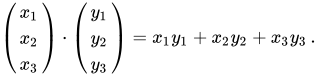
ドット積は[1]の性質を満たす。
- xとyに関して対称です: x ⋅ y = y ⋅ x。
- 最初の引数では線形です: 任意のスカラーa、b、およびベクトルx 1、x 2、yに対して、 ( a x 1 + b x 2 ) ⋅ y = a ( x 1 ⋅ y ) + b ( x 2 ⋅ y )です。
- これは正定値です。つまり、すべてのベクトルxに対して、x ⋅ x ≥ 0であり、 x = 0の場合にのみ 等式となります。
ドット積のようにこれら3つの性質を満たすベクトルのペアに対する演算は、(実)内積として知られている。このような内積を備えたベクトル空間は、(実)内積空間として知られている。すべての有限次元内積空間はヒルベルト空間でもある。[2]ドット積とユークリッド幾何学を結びつける基本的な特徴は、ドット積が、ベクトル‖ x ‖の長さ(またはノルム)と、2つのベクトルxとy の間の角度θの両方に、次の式によって 関連していることである。

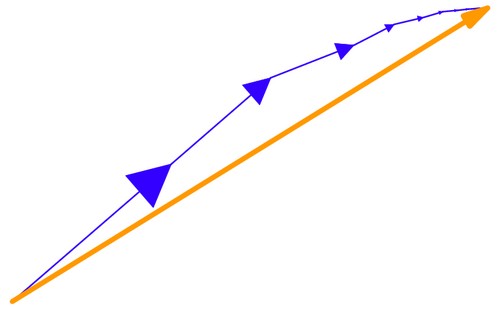
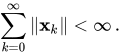
ユークリッド空間における多変数微積分は、極限を計算する能力と、極限が存在すると結論付けるための有用な基準を持つことに依存している。R 3の ベクトルからなる数学的級数は 、長さの合計が実数の通常の級数として収束する場合、絶対収束する: [3]

スカラーの系列と同様に、絶対収束するベクトルの系列も、ユークリッド空間内の 極限ベクトルLに収束する。
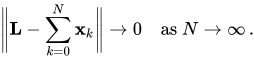
この性質は、ユークリッド空間の完全性、つまり絶対収束する級数は通常の意味でも収束するということを表現します。
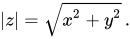
ヒルベルト空間は、しばしば複素数上をとられます。Cで表される複素平面には、大きさの概念、複素係数 | z |が備わっており、これはzとその複素共役の積の平方根として定義されます。

z = x + iyがzを実部と虚部に分解したものであれば、係数は通常のユークリッドの 2 次元長さになります。
複素数zとwの内積は、 zとwの複素共役との積です。
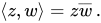
これは複素数値です。⟨ z , w ⟩の実部は通常の2次元ユークリッド内積を与えます。
2番目の例は、複素数z = ( z 1 , z 2 )のペアを要素とする空間C 2です。この場合、 zと別のそのようなベクトルw = ( w 1 , w 2 )の内積は次のように表されます。

⟨ z , w ⟩の実部は2次元ユークリッド内積です。この内積はエルミート対称であり、つまりzとw を入れ替えた結果は複素共役になります。

意味
ヒルベルト空間は実数または複素数の 内積空間であり、内積によって誘導される距離関数に関して完全な距離空間でもある。 [4]
複素ベクトル空間Hが複素内積空間であるということは、 Hの各要素のペアに複素数を関連付ける内積が存在し、それが次の特性を満たすことを意味します。


- 内積は共役対称です。つまり、一対の要素の内積は、交換された要素の内積の複素共役に等しくなります。重要なのは、これが が実数であることを意味することです。
- 内積は最初の引数において線形である。すべての複素数と
- 要素とそれ自身の内積は正定値である:
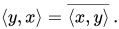



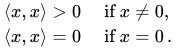
性質1と2から、複素内積は第2引数において 反線型、つまり共役線型であることがわかる。つまり、

実内積空間も同様に定義されるが、Hは実ベクトル空間であり、内積は実数値をとる。このような内積は双線型写像となり、双対系を形成する。[5]

ノルムは実数値関数であり 、 H内の2点間の 距離はノルムによって次のように定義される。
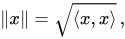


この関数が距離関数であるということは、第一に、それが で対称であること、第二に、 と 自体の距離が 0 であること、そうでない場合はとの間の距離が正でなければならないこと、そして最後に、三角形の不等式が成り立つこと、つまり三角形xyzの 1 辺の長さが他の 2 辺の長さの合計を超えることができないことを意味します。




この最後の特性は、最終的には、 と が線型従属で ある場合に限り が等しいことを主張する、 より基本的なコーシー・シュワルツの不等式の結果です。

このように距離関数が定義されると、任意の内積空間は距離空間となり、ハウスドルフ前ヒルベルト空間と呼ばれることもある。[6]前ヒルベルト空間であって、さらに完全空間でもあるものはヒルベルト空間である。[7]
Hの完全性は、 H内の数列に対するコーシー基準の形式を使用して表現されます。プレヒルベルト空間Hが完全であるとは、すべてのコーシー数列がこのノルムに関して空間内の要素に 収束する場合です。完全性は、次の同値な条件によって特徴付けることができます。ベクトルの系列がの意味で 絶対収束する場合、 その系列はHで収束し、部分和がHの要素に収束するという意味になります。[8]

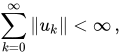
完全なノルム空間であるヒルベルト空間は、定義によりバナッハ空間でもあります。したがって、それらは位相ベクトル空間であり、部分集合の開性や閉性などの位相概念が明確に定義されています。特に重要なのは、制限によって誘導される内積により、ヒルベルト空間の閉じた線型部分空間の概念であり、これは完全なもの(完全な距離空間内の閉集合)であり、したがってそれ自体がヒルベルト空間です。
2番目の例: シーケンス空間
数列空間 l2は、次の数列が収束するような複素数の無限数列 z = ( z1 , z2 ,…)から構成される: [9]

l 2上の内積は次のように定義されます。
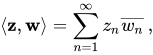
この 2 番目の級数は、コーシー・シュワルツの不等式と前の級数の 収束の結果として収束します。
空間の完全性は、l 2の要素の系列が絶対収束(ノルム収束)するときはいつでも、l 2の要素に収束するという条件で成立する。この証明は数学的解析の基本であり、空間の要素の数学的系列を複素数(または有限次元ユークリッド空間のベクトル)の系列と同じ容易さで操作できるようにする。[10]
歴史
ヒルベルト空間が開発される以前、ユークリッド空間の他の一般化は数学者や物理学者に知られていた。特に、抽象線型空間(ベクトル空間)の考え方は、19世紀末に向けて注目を集めていた。[11]これは、要素を加算したり、スカラー(実数や複素数など)で乗算したりできる空間であり、これらの要素を必ずしも「幾何学的」ベクトル(物理システムの位置ベクトルや運動量ベクトルなど)と同一視する必要はない。20世紀初頭に数学者が研究した他の対象、特に数列の空間(級数を含む)や関数の空間[12]は、当然線型空間と考えることができる。たとえば、関数は定数スカラーで加算したり乗算したりすることができ、これらの演算は空間ベクトルの加算とスカラー乗算が満たす代数法則に従う。
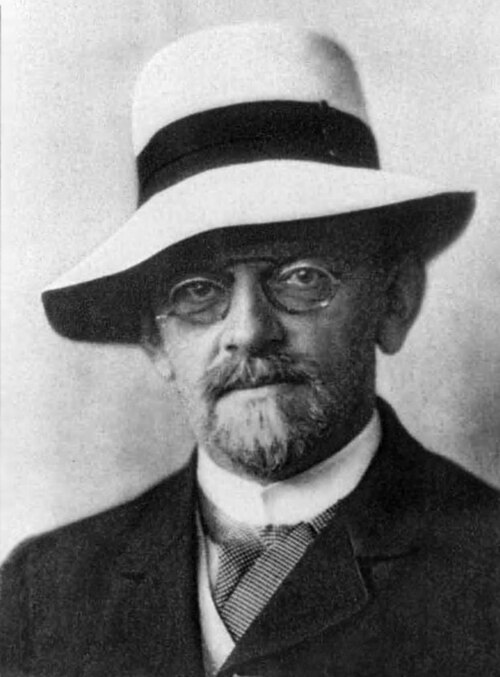
20世紀の最初の10年間に、並行した発展によりヒルベルト空間が導入された。その最初のものは、デイヴィッド・ヒルベルトとエアハルト・シュミットの積分方程式の研究中に生じた観察であり[13]、区間[ a , b ]上の2つの平方積分可能な実数値関数fとgは内積
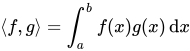
これはユークリッド内積のよく知られた性質の多くを持っている。特に、関数の直交族という概念は意味がある。シュミットは、この内積と通常の内積の類似性を利用して、次の形式の演算子の スペクトル分解の類似性を証明した。
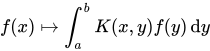
ここで、Kはxとyに関して対称な連続関数である。結果として得られる固有関数展開は、関数Kを次の形式の級数として 表す。

ここで関数φ n は、すべてのn ≠ mに対して⟨ φ n , φ m ⟩ = 0となる意味で直交する。この級数の個々の項は、基本積分解と呼ばれることもある。しかし、適切な意味で二乗積分可能な関数に収束しない固有関数展開が存在する。収束を保証する欠けている要素は完全性である。[14]
2 つ目の発展は、 1904 年にアンリ・ルベーグによって導入されたリーマン積分の代替となるルベーグ積分でした。 [15]ルベーグ積分により、はるかに幅広いクラスの関数を積分できるようになりました。1907 年、フリジェス・リースとエルンスト・ジギスムント・フィッシャーはそれぞれ独立に、平方ルベーグ積分可能関数の空間L 2 が完全な計量空間であることを証明しました。[16]幾何学と完全性の相互作用の結果として、19 世紀のジョセフ・フーリエ、フリードリヒ・ベッセル、マルク・アントワーヌ・パーセヴァルの三角級数に関する結果は、これらのより一般的な空間に簡単に適用でき、現在ではリース・フィッシャーの定理としてよく知られている幾何学的および解析的な装置が生まれました。[17]
20世紀初頭には、さらに基本的な結果が証明された。例えば、リースの表現定理は、 1907年にモーリス・フレシェとフリジェス・リースによって独立に確立された。 [18] ジョン・フォン・ノイマンは、非有界エルミート作用素に関する研究で、抽象ヒルベルト空間という用語を作った。 [19 ]ヘルマン・ワイルやノルベルト・ウィーナーなどの他の数学者は、多くの場合、物理的に動機付けられた観点から、特定のヒルベルト空間を詳細に研究していたが、フォン・ノイマンは、それらの完全かつ公理的な扱いを初めて行った。[20]フォン・ノイマンは、後に量子力学の基礎に関する独創的な研究でそれらを使用し、[21]ユージン・ウィグナーとの継続的な研究でも使用した。「ヒルベルト空間」という名前は、すぐに他の人にも採用され、例えば、ヘルマン・ワイルは、量子力学と群論に関する著書で使用しました。[22]
ヒルベルト空間の概念の重要性は、それが量子力学の最も優れた数学的定式化の1 つを提供するという認識によって強調されました。[23]簡単に言えば、量子力学システムの状態は特定のヒルベルト空間内のベクトルであり、観測量はその空間上のエルミート演算子であり、システムの対称性はユニタリ演算子であり、測定値は直交射影です。量子力学的対称性とユニタリ演算子の関係は、ヘルマン・ワイルの 1928 年の研究で始まった群のユニタリ 表現理論の発展の原動力となりました。 [22]一方、1930 年代初頭には、古典力学はヒルベルト空間 (クープマン - フォン・ノイマン古典力学) で記述できること、および古典的な動的システムの特定の特性はエルゴード理論の枠組みでヒルベルト空間技術を使用して分析できることが明らかになりました。[24]
量子力学における観測量の代数は、量子論のヴェルナー・ハイゼンベルクの行列力学による定式化によれば、当然ヒルベルト空間上で定義された作用素の代数である。 [25]フォン・ノイマンは、1930年代にヒルベルト空間上の作用素の環として作用素代数の研究を始めた。フォン・ノイマンと彼の同時代人が研究した種類の代数は現在フォン・ノイマン代数として知られている。[26] 1940年代に、イスラエル・ゲルファンド、マーク・ナイマーク、アーヴィング・シーガルは、一方では基礎となるヒルベルト空間を参照せず、他方では以前に研究されていた作用素代数の有用な特徴の多くを外挿する、C *-代数と呼ばれる作用素代数の一種の定義を与えた。特に、既存のヒルベルト空間理論の多くを基礎づける自己随伴作用素のスペクトル定理は、C*-代数に一般化されました。[27]これらの手法は現在、抽象調和解析と表現論の基礎となっています。
例
ルベーグ空間
ルベーグ空間は測度空間( X , M , μ )に関連付けられた関数空間です。ここで、Xは集合、MはXの部分集合のσ 代数、μはM上の可算加法測度です。L 2 ( X , μ ) を、関数の絶対値の二乗のルベーグ積分が有限である、つまりL 2 ( X , μ )内の関数fに対する、 X上の複素数値の測定可能な関数の空間とし、関数は測度ゼロの集合 上でのみ異なる場合のみ同一視されます。
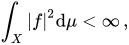
L 2 ( X , μ )における関数fとgの内積は次のように定義されます 。
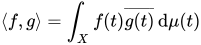
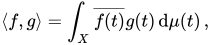
ここで、2番目の形式(最初の要素の共役)は理論物理学の文献でよく見られる。L 2のfとgに対して、コーシー・シュワルツ不等式により積分は存在し、空間上の内積を定義する。この内積があれば、L 2 は実際完全である。[28]ルベーグ積分は完全性を保証するために不可欠である。例えば、実数の領域では、リーマン積分可能な関数は十分ではない。[29]
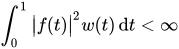
ルベーグ空間は多くの自然な状況で現れる。実数直線上および単位区間上のルベーグ測度に関する平方積分可能関数の空間L 2 ( R )およびL 2 ([0,1])は、それぞれフーリエ変換およびフーリエ級数を定義するための自然な領域である。他の状況では、測度は実数直線上の通常のルベーグ測度以外のものである可能性がある。たとえば、w が任意の正の測定可能関数である場合、次を満たす
区間[0, 1]上のすべての測定可能関数fの空間は、重み付きL 2空間L
と呼ばれる。 2
週間([0, 1]) であり、w は重み関数と呼ばれる。内積は次のように定義される。
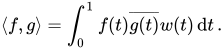
重み付き空間L2
週間([0, 1])はヒルベルト空間L 2 ([0, 1], μ )と同一であり、ルベーグ可測集合Aの測度μは次のように定義される。
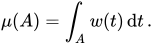
このような重み付きL2空間は、異なる重み関数に対して異なる直交多項式族が直交するため、直交多項式の研究によく使用されます。 [30]
ソボレフ空間
ソボレフ空間はH sまたはW s , 2で表され、ヒルベルト空間である。これらは微分が実行できる特殊な関数空間であるが、(ヘルダー空間などの他のバナッハ空間とは異なり)内積の構造をサポートする。微分が許可されているため、ソボレフ空間は偏微分方程式の理論の便利な設定である。[31]また、変分法における直接法の理論の基礎を形成している。[32]
s が非負の整数でΩ ⊂ R nの場合、ソボレフ空間H s (Ω)には、 sまでの弱導関数もL 2であるL 2関数が含まれます。H s (Ω)の内積は、 各次数の偏導関数のユークリッド空間におけるドット積を表します。ソボレフ空間は、 sが整数でない 場合にも定義できます。

ソボレフ空間はスペクトル理論の観点からも研究されており、より具体的にはヒルベルト空間構造に依存している。Ωが適切な領域である場合、ソボレフ空間H s (Ω)をベッセルポテンシャルの空間として定義することができる。[33]大まかに言えば、

ここでΔはラプラシアンであり、(1 − Δ) − s / 2 はスペクトル写像定理の観点から理解される。非整数sに対するソボレフ空間の実用的な定義を提供することとは別に、この定義はフーリエ変換の下で特に望ましい特性を持ち、擬微分作用素の研究に理想的である。これらの方法をコンパクトな リーマン多様体に使用すると、例えばホッジ理論の基礎となるホッジ分解を得ることができる。[34]
正則関数の空間
丈夫なスペース
ハーディ空間は、複素解析と調和解析で生じる関数空間であり、その要素は複素領域内の特定の正則関数である。 [35] Uを複素平面上の単位円とする。すると、ハーディ空間H 2 ( U )は、 U上の正則関数fの空間として定義され、平均は
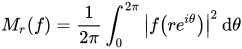
r < 1のとき、有界となる。このハーディ空間のノルムは次のように定義される。
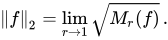
円板上のハーディ空間はフーリエ級数と関連している。関数fがH 2 ( U )に属するの は 、
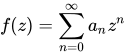
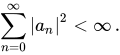
したがって、H 2 ( U ) は円上のL 2であり、負の周波数フーリエ係数がゼロになる 関数で構成されます。
ベルイマン空間
ベルクマン空間は、正則関数のヒルベルト空間の別の族である。[36] Dを複素平面(または高次元複素空間)上の有界開集合とし、L 2, h ( D )を、 D内の正則関数fの空間で、 L 2 ( D )に含まれるものとし、

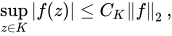
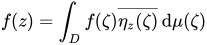
ここで、積分はDのルベーグ測度に関して取られる。明らかにL 2, h ( D )はL 2 ( D )の部分空間である。実際、それは閉じた部分空間であり、したがってそれ自体がヒルベルト空間である。これは、Dのコンパクト部分集合Kに有効な推定値の結果であり、これ は今度はコーシーの積分公式から導かれる。したがって、 L 2 ( D )の正則関数の列が収束することはコンパクト収束も意味し、したがって極限関数も正則である。この不等式のもう 1 つの結果は、Dの点で関数f を評価する線型関数が実際にはL 2, h ( D )上で連続であることだ。リースの表現定理は、評価関数がL 2, h ( D )の要素として表されることを意味する。したがって、すべてのz ∈ Dに対して、関数η z ∈ L 2, h ( D )が存在し、 すべてのf ∈ L 2, h ( D )に対して成り立つ。この積分関数は Dのベルグマン核 として知られている。この積分核は再生特性を満たす。
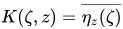

ベルクマン空間は再生核ヒルベルト空間の一例であり、これは関数のヒルベルト空間であり、これに類似した再生特性を証明する核K ( ζ , z )を伴う。ハーディ空間H 2 ( D )も、セゲー核として知られる再生核を許容する。[37]再生核は数学の他の分野でも一般的である。例えば、調和解析では、ポアソン核は単位球内の平方積分可能な調和関数のヒルベルト空間の再生核である。後者がヒルベルト空間であるということは、調和関数の平均値定理の結果である。
アプリケーション
ヒルベルト空間の応用の多くは、ヒルベルト空間が、通常の有限次元の設定からの射影や基底変換などの単純な幾何学的概念の一般化をサポートしているという事実を利用しています。特に、ヒルベルト空間上の連続自己随伴線型作用素のスペクトル理論は、行列の通常のスペクトル分解を一般化し、これが数学や物理学の他の分野への理論の応用で重要な役割を果たすことがよくあります。
シュトゥルム・リウヴィル理論
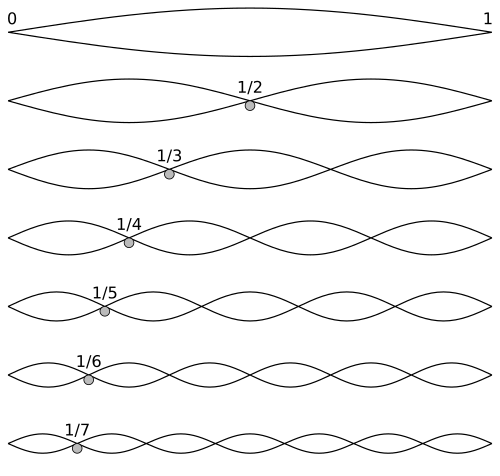
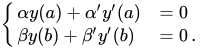
常微分方程式の理論では、適切なヒルベルト空間上のスペクトル法を用いて、微分方程式の固有値と固有関数の挙動を調べる。例えば、シュトゥルム・リウヴィル問題は、バイオリンの弦や太鼓の波の倍音を調べる際に生じる問題で、常微分方程式の中心的な問題である。[38]この問題は、一般同次ロビン境界条件を満たす区間[ a , b ]上の 未知の関数yに対する微分方程式の形で 、 関数p、q、w はあらかじめ与えられており、方程式が解を持つ関数yと定数λを求める問題である。この問題は、系の固有値と呼ばれる特定のλの値に対してのみ解を持ち、これは、系のグリーン関数によって定義される積分演算子にコンパクト演算子のスペクトル定理を適用した結果である。さらに、この一般的な結果のもう一つの帰結は、系の固有値λが無限大に向かう増加系列に並べられるということである。[39] [注2]
![{\displaystyle -{\frac {\mathrm {d} }{\mathrm {d} x}}\left[p(x){\frac {\mathrm {d} y}{\mathrm {d} x}}\right]+q(x)y=\lambda w(x)y}](https://wikimedia.org/api/rest_v1/media/math/render/svg/8d4e93c4082311667644e8554f78774b963ffb0e)
偏微分方程式
ヒルベルト空間は偏微分方程式の研究における基本的なツールです。[31]線形楕円方程式などの多くの偏微分方程式のクラスでは、関数のクラスを拡大することで一般化された解(弱解と呼ばれる)を考えることができます。多くの弱定式化には、ヒルベルト空間であるソボレフ関数のクラスが含まれます。適切な弱定式化は、解を見つける解析的な問題、または多くの場合より重要な、与えられた境界データに対して解が存在し一意であることを示すという幾何学的な問題に帰着します。線形楕円方程式の場合、多くのクラスの問題に対して一意に解けることを保証する1つの幾何学的結果は、ラックス-ミルグラム定理です。この戦略は、偏微分方程式の数値解法に対するガラーキン法(有限要素法)の基礎を形成します。 [40]
典型的な例は、R 2の有界領域Ωにおけるディリクレ境界条件を伴うポアソン方程式 −Δ u = gである。弱定式化は、境界上でゼロとなる Ω内のすべての連続微分可能関数vに対して、次の関数u を見つけることから構成される。
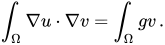
これをヒルベルト空間Hで表現すると、1
0(Ω) は関数uから成り、uとその弱偏導関数はΩ上で二乗積分可能であり、境界上ではゼロである。問題は、この空間でu を見つけ、この空間の
すべてのvに対して
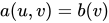
ここで、aは連続双線形形式、bは連続線形関数であり、それぞれ次のように表される。

ポアソン方程式は楕円型なので、ポアンカレの不等式から双線型形式aは強制型であることがわかる。ラックス・ミルグラム定理は、この方程式の解の存在と一意性を保証する。[41]
ヒルベルト空間では多くの楕円型偏微分方程式を同様の方法で定式化することができ、ラックス=ミルグラム定理はそれらの解析における基本的なツールとなる。適切な修正を加えることで、同様の手法を放物型偏微分方程式や特定の双曲型偏微分方程式に適用することができる。[42]
エルゴード理論

エルゴード理論の分野は、カオス的 力学系の長期的挙動を研究する分野である。エルゴード理論が適用される分野の典型的な例は熱力学であり、系の微視的状態は極めて複雑であるが(物質粒子間の個々の衝突の集合を理解することは不可能である)、十分に長い時間間隔での平均的な挙動は扱いやすい。熱力学の法則は、そのような平均的な挙動についての主張である。特に、熱力学の第 0 法則の 1 つの定式化では、十分に長い時間スケールでは、平衡状態にある熱力学系について実行できる唯一の機能的に独立した測定は、温度という形での全エネルギーであると主張している。[43]
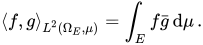
エルゴード的力学系とは、ハミルトニアンで測定されるエネルギー以外に、位相空間上に機能的に独立した保存量が存在しない力学系である。より明確には、エネルギーEが固定されており、Ω E がエネルギーEのすべての状態(エネルギー面)からなる位相空間の部分集合であり、 T t が位相空間上の発展演算子を表すものとする。力学系がエルゴード的であるのは、Ω E上のすべての不変測定可能関数がほぼすべての場所で一定である場合である。[44] 不変関数fは、 Ω E上の すべてのwとすべての時間tに対してとなる関数で ある。リウヴィルの定理は、時間変換に対して不変であるエネルギー面上の測度μ が存在することを意味している。結果として、時間変換は、内積に関して エネルギー面Ω E上の二乗積分可能関数からなるヒルベルト空間L 2 (Ω E , μ )のユニタリ変換である。

フォン・ノイマンの平均エルゴード定理[24]は次のように述べている。
- U t がヒルベルト空間H上のユニタリ作用素の(強連続)1パラメータ半群であり、P がU tの共通不動点の空間への直交射影である場合、{ x ∈ H | U t x = x、 ∀ t > 0}、
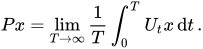
エルゴード系では、時間発展の固定集合は定数関数のみで構成されるため、エルゴード定理は以下を意味する:[45]任意の関数f∈L2(ΩE、μ)に対して、

つまり、観測可能なfの長時間平均は、エネルギー面上の期待値に等しくなります。
フーリエ解析
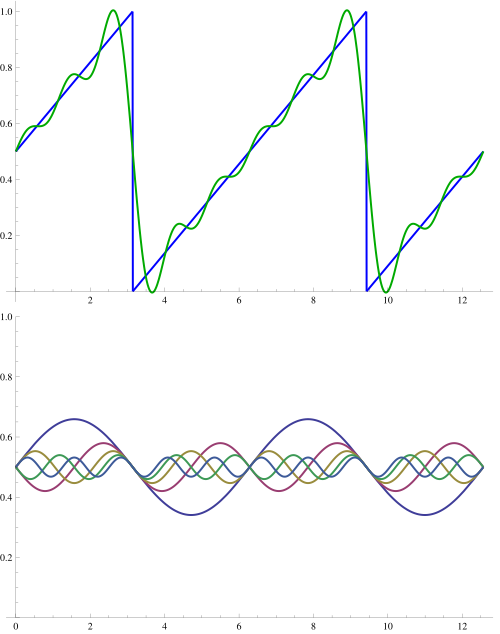
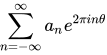
フーリエ解析の基本的な目標の1つは、関数を与えられた基底関数の(おそらく無限の)線形結合、すなわち関連するフーリエ級数に分解することです。区間[0, 1]で定義された関数fに関連する古典的なフーリエ級数は 、次の 形式の級数です 。
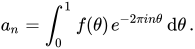
鋸歯状関数のフーリエ級数の最初の数項を加算する例を図に示す。基底関数は波長を持つ正弦波であるλ/ん (整数nの場合) のこぎり波自体の波長λよりも短い (基本波であるn = 1を除く)。
古典的なフーリエ級数における重要な問題は、フーリエ級数が関数fに収束するかどうかという点である。ヒルベルト空間法は、この問題に対する1つの可能な答えを提供している。[46]関数e n ( θ ) = e 2π inθ はヒルベルト空間L 2 ([0, 1])の直交基底を形成する。したがって、任意の2乗積分可能な関数は級数として表すことができる。

さらに、この級数はヒルベルト空間の意味で収束します(つまり、L 2平均で収束します)。
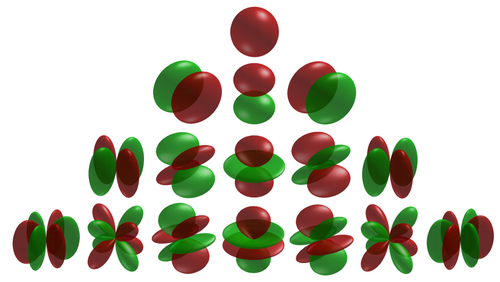
この問題は抽象的な観点からも研究できる。すなわち、すべてのヒルベルト空間は正規直交基底を持ち、ヒルベルト空間のすべての要素はこれらの基底要素の倍数の和として一意に表すことができる。これらの基底要素に現れる係数は、抽象的には空間の要素のフーリエ係数と呼ばれることがある。[47]この抽象化は、 L 2 ([0, 1])などの空間に異なる基底関数を使用する方が自然な場合に特に有用である。多くの場合、関数を三角関数に分解するのではなく、たとえば直交多項式やウェーブレットに分解し[48]、高次元では球面調和関数に分解することが望ましい。[49]
例えば、e n がL 2 [0, 1]の任意の正規直交基底関数である場合、 L 2 [0, 1]の与えられた関数は有限線形結合として近似できる[50]

係数{ a j }は、差‖f−fn‖2の大きさが可能な限り小さくなるように選択される。幾何学的には、最良の近似は、 { e j }のすべての線形結合からなる部分空間へのfの直交射影であり、[51]で計算できる。
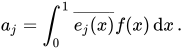
この式が差‖ f − f n ‖ 2を最小化することは、ベッセルの不等式とパーセバルの公式の結果です。
物理的な問題への様々な応用において、関数は微分演算子(典型的にはラプラス演算子)の物理的に意味のある固有関数に分解することができる。これは、微分演算子のスペクトルを参照して、関数のスペクトル研究の基礎を形成する。[52]具体的な物理的応用には、ドラムの形状を聞き分ける問題が含まれる。ドラムヘッドが生成できる基本的な振動モードが与えられている場合、ドラム自体の形状を推測できるだろうか?[53]この問題の数学的定式化には、平面におけるラプラス方程式のディリクレ固有値が含まれる。これは、バイオリンの弦の基本的な振動モードを表す整数と直接類似して、基本的な振動モードを表す。
スペクトル理論は、関数のフーリエ変換の特定の側面にも基礎を置いています。フーリエ解析は、コンパクト セット上で定義された関数をラプラシアンの離散スペクトル (バイオリンの弦やドラムの振動に対応) に分解しますが、関数のフーリエ変換は、ユークリッド空間全体で定義された関数をラプラシアンの連続スペクトルの成分に分解します。フーリエ変換は、プランシュレルの定理によって明確にされた意味では幾何学的でもあります。プランシュレルの定理は、フーリエ変換が 1 つのヒルベルト空間 (「時間領域」) と別のヒルベルト空間 (「周波数領域」) の等長変換であると主張しています。フーリエ変換のこの等長変換特性は、抽象調和解析で繰り返し登場するテーマです(連続フーリエ変換のエネルギー保存を反映しているため)。これは、たとえば、非可換調和解析で発生する球面関数のプランシュレルの定理によって証明されています。
量子力学
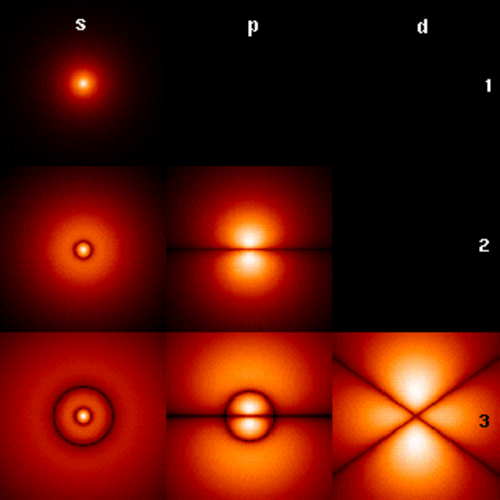
ジョン・フォン・ノイマン[ 54]によって開発された量子力学の厳密な数学的定式化では、量子力学システムの可能な状態(より正確には、純粋状態)は、ノルム1(位相因子)の複素数まで明確に定義された、状態空間として知られる複素可分ヒルベルト空間に存在する単位ベクトル(状態ベクトルと呼ばれる)によって表される。言い換えれば、可能な状態は、通常複素射影空間と呼ばれるヒルベルト空間の射影化における点である。このヒルベルト空間の正確な性質はシステムに依存する。たとえば、単一の非相対論的スピンゼロ粒子の位置と運動量の状態は、すべての二乗可積分関数の空間であるが、単一の陽子のスピンの状態は、スピノルの2次元複素ヒルベルト空間の単位要素である。各観測量は、状態空間に作用する自己随伴線型演算子によって表される。観測可能な各固有状態は演算子の固有ベクトルに対応し、関連する固有値はその固有状態における観測可能な値に対応する。[55]
2 つの状態ベクトルの内積は、確率振幅と呼ばれる複素数です。量子力学システムの理想的な測定中、システムが特定の初期状態から特定の固有状態に崩壊する確率は、初期状態と最終状態の間の確率振幅の絶対値の 2 乗で与えられます。 [56]測定の可能な結果は演算子の固有値です。これは、すべての固有値が実数でなければならないため、自己随伴演算子の選択を説明しています。特定の状態における観測可能なものの確率分布は、対応する演算子のスペクトル分解を計算することによって見つけることができます。[57]
一般のシステムでは、状態は通常純粋ではなく、密度行列:ヒルベルト空間上のトレース1の自己随伴演算子によって与えられる純粋状態の統計的混合、または混合状態として表されます。[58] さらに、一般的な量子力学システムでは、単一の測定の影響が、代わりに正の演算子値の測度によって記述される方法でシステムの他の部分に影響を与える可能性があります。したがって、一般理論における状態と観測可能なものの両方の構造は、純粋状態の理想化よりもかなり複雑です。[59]
確率論
確率論では、ヒルベルト空間にも多様な応用があります。ここで、基本ヒルベルト空間は、クラス(有限の第 1 モーメントと第 2モーメント)を持つ、与えられた確率空間上のランダム変数の空間です。統計学における一般的な操作は、ランダム変数の期待値を減算してその中心化を行うことです。したがって、がランダム変数である場合、その中心化は行われます。ヒルベルト空間の観点では、これは期待値演算子の核への の直交射影であり、期待値演算子はヒルベルト空間上の連続線型関数(実際には、定数ランダム変数 1 との内積)であり、したがってこの核は閉じた部分空間です。


条件付き期待値はヒルベルト空間で自然な解釈ができる。[60]確率空間が与えられており、 は集合上のシグマ代数、 は測度空間 上の確率測度であるとする。が のシグマ部分代数である場合、条件付き期待値は の-測定可能な関数からなるの部分空間への直交射影である。 の確率変数がシグマ代数から独立している場合、条件付き期待値、つまりその -測定可能な関数への射影は定数である。同様に、その中心化の射影はゼロである。


![{\displaystyle E[X|{\mathcal {F}}]}](https://wikimedia.org/api/rest_v1/media/math/render/svg/bda70bf9ef6fa0e4a2acbc19572fc775644a4225)



特に、2 つのランダム変数と( ) が独立している場合、中心ランダム変数と は直交します。 (これは、2 つの変数の共分散がゼロであることを意味します。つまり、2 つの変数は相関していません。) その場合、期待値演算子のカーネルのピタゴラスの定理は、およびの分散が恒等式を満たすことを意味します。 これは統計のピタゴラスの定理と呼ばれることもあり、線形回帰で重要です。[61] Stapleton (1995) が述べているように、「分散分析は、ピタゴラスの定理を使用して、ベクトルの長さの 2 乗をいくつかのベクトルの長さの 2 乗の和に分解するものと見なすことができます。」



マルチンゲールの理論はヒルベルト空間で定式化できる。ヒルベルト空間のマルチンゲールは、各nに対してがの線型包への直交射影となるようなヒルベルト空間の要素の列である。[62]がランダム変数である場合、これは(離散)マルチンゲールの通常の定義を再現する。 の期待値はを条件として に等しい。


ヒルベルト空間は伊藤計算の基礎にも使われている。[63]任意の二乗積分可能なマルチンゲールには、マルチンゲールに関する漸進的測定可能過程の同値類の空間にヒルベルトノルムを関連付けることが可能である(測度としてマルチンゲールの二次変分を用いる)。伊藤積分は、まず単純な過程に対して定義し、次にヒルベルト空間におけるそれらの密度を利用することで構築できる。注目すべき結果は伊藤等長変換であり、これは、二次変分測度を持つ任意のマルチンゲールMと任意の漸進的測定可能過程Hに対して、 右辺の期待値が有限であるときはいつでも次のことを証明する。

![{\displaystyle E\left[\left(\int _{0}^{t}H_{s}dM_{s}\right)^{2}\right]=E\left[\int _{0}^{t}H_{s}^{2}d\langle M\rangle _{s}\right]}](https://wikimedia.org/api/rest_v1/media/math/render/svg/8ddc67bd90763bdda507f2bfd375f0106f921894)
ヒルベルト空間のより深い応用で、ガウス過程の理論で特に重要なのが、レナード・グロスらによる、量子場の理論からのファインマン経路積分のような、無限次元空間上の特定の形式的積分の意味を理解しようとする試みである。このような積分の問題は、無限次元のルベーグ測度が存在しないことである。抽象的なウィーナー空間の概念により、バナッハ空間B上の測度を構成することができる。この測度には、キャメロン・マーティン空間と呼ばれるヒルベルト空間H を稠密な部分集合として、H上の有限加法円筒集合測度から構成することができる。結果として得られるB上の測度は可算加法であり、Hの元による平行移動に対して不変であり、これにより、ウィーナー測度をソボレフ空間上のガウス測度として数学的に厳密に考える方法が得られる。[64]

色覚
真の物理的な色は、純粋なスペクトル色の組み合わせで表現できます。物理的な色は任意の数のスペクトル色で構成できるため、物理的な色の空間はスペクトル色上のヒルベルト空間で適切に表現できます。人間は色を知覚するために3種類の錐体細胞を持っているため、知覚できる色は3次元ユークリッド空間で表現できます。物理的な色のヒルベルト空間から人間の知覚できる色のユークリッド空間への多対1の線形マッピングにより、多くの異なる物理的な色が人間によって同一であると知覚される理由が説明されます(たとえば、純粋な黄色の光と赤と緑の光の混合、メタメリズムを参照)。[65] [66]
プロパティ
ピタゴラスの定理
ヒルベルト空間Hの2 つのベクトルuとv は、 ⟨ u , v ⟩ = 0のとき直交します。この表記はu ⊥ vです。より一般的には、S がHのサブセットである場合、表記u ⊥ S はuがSのすべての要素と直交することを意味します。
uとvが直交する 場合、

n上の帰納法により、これはn直交ベクトル の任意の族u 1 , ..., u nに拡張され、

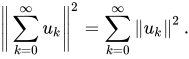
前述のピタゴラスの等式は任意の内積空間で有効であるが、ピタゴラスの等式を級数に拡張するには完全性が必要である。[ 67]直交ベクトルの級数ΣukがHで収束するのは、ノルムの2乗の級数が収束する場合のみであり、 さらに、直交ベクトルの級数の和は、それが取られる順序に依存しない。
平行四辺形の同一性と分極

定義により、任意のヒルベルト空間はバナッハ空間でもある。さらに、任意のヒルベルト空間では次の平行四辺形の恒等式が成り立つ: [68]

逆に、平行四辺形恒等式が成り立つすべてのバナッハ空間はヒルベルト空間であり、その内積はノルムと分極恒等式によって一意に決定される。[69]実ヒルベルト空間の場合、分極恒等式は

複素ヒルベルト空間の場合、

平行四辺形法則は、任意のヒルベルト空間が一様凸バナッハ空間であることを意味する。[70]
最良の近似値
この節ではヒルベルト射影定理を用いる。Cがヒルベルト空間Hの空でない閉凸集合であり、x がH内の点である場合、 xとC内の点の間の距離を最小化する唯一の点y ∈ Cが存在する。[71]

これは、平行移動した凸集合D = C − xに最小ノルムを持つ点が存在するということと同等である。証明は、すべての最小化シーケンス( d n ) ⊂ Dがコーシーである(平行四辺形恒等式を使用)ため、(完全性を使用して)D内の最小ノルムを持つ点に収束することを示すことである。より一般的には、これは任意の一様凸バナッハ空間で成り立つ。[72]
この結果をHの閉部分空間Fに適用すると、 xに最も近い点y∈Fは[73]によって特徴付けられることが示される。

この点y はxからFへの直交射影であり、写像P F : x → y は線形である(直交補写像と射影を参照)。この結果は応用数学、特に数値解析において特に重要であり、最小二乗法の基礎となっている。[74]
特に、F がHと等しくない場合、 Fに直交する非ゼロベクトルv を見つけることができます(x ∉ Fおよびv = x − yを選択)。この観察をHのサブセットSによって生成される閉部分空間Fに適用すると、非常に有用な基準が得られます。
- Hの部分集合Sが稠密なベクトル部分空間を張るのは、ベクトル 0 がSに直交する唯一のベクトルv ∈ Hである場合のみです。
二重性
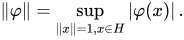
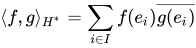
双対空間 H *は、空間Hから基底体への すべての連続線形関数の空間です。これは、 で定義される自然ノルムを持ちます。 このノルムは平行四辺形法則を満たすため、双対空間は内積空間でもあり、この内積は、分極恒等式を使用することで、この双対ノルムに関して定義できます。双対空間は完全でもあるため、それ自体がヒルベルト空間です。e • = ( e i ) i ∈ I が H の完全な正規直交基底である場合、任意の2つの双対空間上の内積は となり、 この級数の項のうち可算数個を除くすべての項が 0 になります。

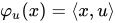
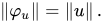
リースの表現定理は、双対空間の便利な記述法である。H のあらゆる元 u に対して、 H *の一意の元φ uが存在し、 これは 次のように定義される。さらに、
リースの表現定理によれば、HからH *への写像はu ↦ φ uによって定義され、射影的であるため、この写像は等長 反線型同型となる。[75]したがって、双対H *のあらゆる元φに対して、 Hにはu φ が1 つだけ存在し、すべてのx ∈ H に対して次のようになる 。双対空間H *上の内積は次を満たす。
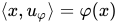

右辺の順序の逆転により、u φの反線型性からφの線型性が復元されます。実際のケースでは、Hからその双対への反線型同型は実際には同型であり、そのため実ヒルベルト空間は自然にそれ自身の双対と同型になります。
表現ベクトルu φは次のようにして得られる。φ ≠ 0のとき、核 F = Ker( φ )はHの閉ベクトル部分空間であり、 Hと等しくないため、 Fに直交する非ゼロベクトルvが存在する。ベクトルuはvの適切なスカラー倍λvである。 φ ( v ) = ⟨ v , u ⟩という要件は次式をもたらす。

この対応φ ↔ u は物理学でよく使われるブラ・ケット表記法で利用されています。[76]物理学では、 ⟨ x | y ⟩で表される内積が右側で線形であると仮定するのが一般的です。 結果⟨ x | y ⟩は、線形関数⟨ x | (ブラ) がベクトル| y ⟩ (ケット) に作用したものと見ることができます。
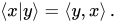
リースの表現定理は、基本的に内積の存在だけでなく、空間の完備性にも依存している。実際、この定理は、任意の内積空間の位相的双対はその完備性と同一視できることを意味する。 [77]リースの表現定理の直接的な帰結は、ヒルベルト空間Hが反射的であることであり、これはHからその二重双対空間への自然な写像が同型であることを意味する。
弱収束列
ヒルベルト空間Hにおいて、任意の v ∈ H に対して、数列{ x n }はベクトルx ∈ Hに弱収束します。
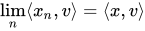
たとえば、任意の正規直交列{ f n }は、ベッセル不等式の結果として、0 に弱収束します。すべての弱収束列{ x n }は、一様有界性原理によって有界になります。
逆に、ヒルベルト空間内の任意の有界列は弱収束する部分列を許容する(アラオグルの定理)。[78]この事実は、ボルツァーノ・ワイエルシュトラスの定理がR d上の連続関数に用いられるのと同じように、連続凸関数の最小化結果を証明するのに用いられる。いくつかのバリエーションがあるが、1つの単純なステートメントは次の通りである:[79]
- f : H → Rが凸連続関数で、 ‖ x ‖ が ∞ に向かうときにf ( x )が+ ∞に向かう場合、 fはある点x 0 ∈ Hで最小値を持ちます。
この事実(およびそのさまざまな一般化)は、変分法における直接法の基礎となります。凸関数の最小化の結果は、ヒルベルト空間 H が反射的であるため、閉有界凸部分集合は弱コンパクトであるという、やや抽象的な事実の直接的な帰結でもあります。弱収束部分列の存在は、エーベルライン・シュムリアンの定理の特殊なケースです。
バナッハ空間の性質
バナッハ空間の一般的な性質は、ヒルベルト空間でも成り立つ。開写像定理は、あるバナッハ空間から別のバナッハ空間への連続的な全 射線型変換は開写像であり、開集合を開集合に写すことを意味すると述べている。系として有界逆定理があり、これは、あるバナッハ空間から別のバナッハ空間への連続かつ全単射な線型関数は同型(つまり、逆も連続である連続線型写像)であることを示す。この定理は、ヒルベルト空間の場合の方が一般のバナッハ空間の場合よりもかなり簡単に証明できる。[80]開写像定理は閉グラフ定理と同値であり、これは、あるバナッハ空間から別のバナッハ空間への線型関数が連続であるための必要十分条件である。[81]ヒルベルト空間の場合、これは非有界演算子の研究の基本である(閉演算子を参照)。
(幾何学的)ハーン・バナッハの定理は、閉凸集合はヒルベルト空間の超平面によってその外部の任意の点から分離できることを主張する。これは最良近似特性から直接導かれる結果である。すなわち、 yが閉凸集合Fのxに最も近い要素である場合、分離超平面はその中点を通る線分xyに垂直な平面である。[82]
ヒルベルト空間上の作用素
有界演算子
ヒルベルト空間H 1から別のヒルベルト空間H 2への連続 線型作用素 A : H 1 → H 2は、有界集合を有界集合に写すという意味で有界である。 [83]逆に、作用素が有界であれば、それは連続である。このような有界線型作用素の空間はノルムを持ち、作用素ノルムは次のように与えられる。

2 つの有界線型作用素の和と合成は、やはり有界かつ線型である。H 2 の y に対して、 x ∈ H 1を⟨ Ax , y ⟩に写す写像は線型かつ連続であり、リースの表現定理によれば、 H 1の あるベクトルA * yに対しての形で表現できる 。これは、別の有界線型作用素A * : H 2 → H 1、つまりAの随伴作用素を定義する。随伴作用素はA ** = Aを満たす。リースの表現定理を用いて各ヒルベルト空間をその連続双対空間と同一視すると、Aの随伴作用素は Aの転置t A : H 2 * → H 1 *と同一であることが示され、定義により関数



H上のすべての有界線型作用素(つまり、作用素H → H )の集合B( H )は、加算演算と合成演算、ノルム演算と随伴演算とともに、作用素代数の一種であるC* 代数である。
B( H )の元A は、 A * = Aのとき「自己随伴」または「エルミート」と呼ばれます。A がエルミートで、任意のxに対して⟨ Ax , x ⟩ ≥ 0 である場合、Aは「非負」と呼ばれ、A ≥ 0と書きます。 x = 0のときのみ等式が成り立つ場合、 A は「正」と呼ばれます。自己随伴演算子の集合は、 A − B ≥ 0 のとき A ≥ B となるような部分順序を許容します。 Aが何らかのBに対してB * Bの形をとる場合、 Aは非負です。 Bが可逆である場合、 Aは正です。逆もまた真であり、非負演算子Aに対して、次の式で表される唯一の非負平方根Bが存在するという意味で真です。

スペクトル定理によって明確にされた意味では、自己随伴演算子は「実数」の演算子として考えることができます。B ( H )の元A は、 A * A = AA *の場合に正規と呼ばれます。正規演算子は、互いに交換可能な自己随伴演算子と自己随伴演算子の虚数倍の和に分解されます 。正規演算子は、実部と虚部の観点から考えることもできます。
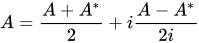
B( H )の元Uがユニタリであるとは、Uが可逆であり、その逆がU *で与えられる場合をいう。これは、 U が全射であり、すべてのx、y ∈ Hに対して⟨ Ux、Uy ⟩ = ⟨ x、y ⟩であることを要求することによっても表現できる。ユニタリ演算子は合成に関して群を形成し、これがHの等長変換群となる。
B( H )の元がコンパクトであるとは、有界集合を比較的コンパクトな集合に送る場合です。同様に、有界演算子Tがコンパクトであるとは、任意の有界シーケンス{ x k }に対して、シーケンス{ Tx k }が収束する部分シーケンスを持つ場合です。多くの積分演算子はコンパクトであり、実際に、積分方程式の研究で特に重要なヒルベルト-シュミット演算子と呼ばれる演算子の特別なクラスを定義します。フレドホルム演算子は、コンパクト演算子とは単位元の倍数だけ異なり、有限次元の核と余核を持つ演算子として同等に特徴付けられます。フレドホルム演算子Tのインデックスは次のように定義されます 。

指数はホモトピー不変であり、アティヤ・シンガー指数定理を通じて微分幾何学において重要な役割を果たします。
無制限演算子
非有界作用素はヒルベルト空間でも扱いやすく、量子力学への重要な応用がある。[84]ヒルベルト空間H上の非有界作用素Tは、その定義域D ( T )がHの線型部分空間であるような線型作用素として定義される。多くの場合、定義域D ( T )はHの稠密な部分空間であり、その場合T は稠密に定義された作用素として知られている。
稠密に定義された非有界作用素の随伴作用素は、有界作用素の場合と本質的に同じ方法で定義される。自己随伴非有界作用素は、量子力学の数学的定式化における観測量の役割を果たす。ヒルベルト空間L 2 ( R )上の自己随伴非有界作用素の例は以下の通りである: [85]
- 微分演算子の適切な拡張。ここで、iは虚数単位、f はコンパクトなサポートの微分可能関数です。
- xによる乗算演算子:
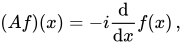

これらは、それぞれ運動量と位置観測量に対応します。Aの場合は導関数が存在する必要がなく、Bの場合は積分関数が二乗積分可能である必要がないため、 AもBもH全体に対して定義されません。 どちらの場合も、可能な引数の集合はL 2 ( R )の稠密な部分空間を形成します。
建設
直和
2つのヒルベルト空間H 1とH 2は、別のヒルベルト空間に結合することができ、これは(直交)直和と呼ばれ、[86]と表記される。

すべての順序付きペア ( x 1 , x 2 )の集合から成り、ここでx i ∈ H i、i = 1, 2であり、内積は次のように定義される。

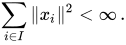
より一般的には、H i がi ∈ Iで添字付けされたヒルベルト空間の族である場合、H iの直和は、 H iの直積の すべての添字付き族の集合から 成り、


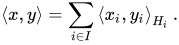
内積は次のように定義される。
H iのそれぞれは、 H i全体の直和に閉じた部分空間として含まれる。さらに、H i は対直交している。逆に、ヒルベルト空間Hに、対直交し、その和がHに稠密である閉部分空間V i、i ∈ Iのシステムがある場合、H はV iの直和に正準同型である。この場合、H はV iの内部直和と呼ばれる。直和(内部または外部)には、 i番目の直和項H iへの直交射影E iの族も備わっている。これらの射影は、直交条件を満たす 有界、自己随伴、冪等な演算子である。

ヒルベルト空間H上のコンパクト自己随伴作用素のスペクトル定理は、 H が作用素の固有空間の直交直和に分割されることを述べ、また、作用素を固有空間への射影の和として明示的に分解することを規定する。ヒルベルト空間の直和は、量子力学において、可変数の粒子を含む系のフォック空間としても現れ、直和内の各ヒルベルト空間は、量子力学系の追加の自由度に対応する。表現論では、ピーター・ワイルの定理により、ヒルベルト空間上のコンパクト群の任意のユニタリ表現は、有限次元表現の直和として分割されることが 保証される。
テンソル積
x 1 , y 1 ∊ H 1かつx 2 , y 2 ∊ H 2のとき、(通常の)テンソル積の内積を次のように定義する。単純テンソルでは、

この式は、セクリニアリティによってH 1 ⊗ H 2上の内積に拡張される。H 1とH 2のヒルベルトテンソル積は、 H 1 H 2 と表記されることもあり、この内積に関連付けられた計量についてH 1 ⊗ H 2を完成させることで得られるヒルベルト空間である。[87]

一例として、ヒルベルト空間L 2 ([0, 1])が挙げられます。L 2 ( [0, 1])の 2 つのコピーのヒルベルトテンソル積は、正方形 [0, 1] 2上の平方可積分関数の空間L 2 ( [0, 1 ] 2 )に等長的かつ線形同型です。 この同型性により、単純なテンソルf 1 ⊗ f 2 が 正方形上の 関数に 渡されます。

この例は次のような意味で典型的である。[88]すべての単純テンソル積x 1 ⊗ x 2にはHからのランク1の演算子が付随する。∗
1与えられたx * ∈ Hを写像するH 2∗
1として

単純テンソル上に定義されたこの写像は、 H 1 ⊗ H 2とHからの有限ランク演算子の空間との間の線形同一視に拡張される。∗
1これはヒルベルトテンソル積H 1 H 2とヒルベルト空間HS ( H ∗
1, H 2 )のヒルベルト・シュミット作用素H∗
1H 2へ。
正規直交基底
線型代数の正規直交基底の概念はヒルベルト空間の場合にも一般化される。[89]ヒルベルト空間Hにおいて、正規直交基底とは、以下の条件を満たすHの元の族{ e k } k ∈ Bである。
- 直交性: Bの異なる2つの要素はすべて直交します。つまり、k ≠ jであるすべてのk、j ∈ Bに対して⟨ e k、e j ⟩ = 0 です。
- 正規化: 族の全ての要素はノルム1を持ちます:すべてのk∈Bに対して‖ek‖ = 1です。
- 完全性:族e k、k ∈ Bの線形スパンはHにおいて稠密です。
最初の 2 つの条件基底を満たすベクトルのシステムは、正規直交システムまたは正規直交セット (または、 Bが可算な場合は正規直交シーケンス) と呼ばれます。このようなシステムは常に線形独立です。
名前にもかかわらず、正規直交基底は一般に線型代数の意味での基底(ハメル基底)ではない。より正確には、正規直交基底がハメル基底であるためには、ヒルベルト空間が有限次元ベクトル空間でなければならない。[90]
ヒルベルト空間のベクトルの正規直交系の完全性は、次のように言い換えることができます。
- 任意のv ∈ Hに対して、すべてのk ∈ Bに対して⟨ v , e k ⟩ = 0であれば、v = 0です。
This is related to the fact that the only vector orthogonal to a dense linear subspace is the zero vector, for if S is any orthonormal set and v is orthogonal to S, then v is orthogonal to the closure of the linear span of S, which is the whole space.
Examples of orthonormal bases include:
- the set {(1, 0, 0), (0, 1, 0), (0, 0, 1)} forms an orthonormal basis of R3 with the dot product;
- the sequence { fn | n ∈ Z} with fn(x) = exp(2πinx) forms an orthonormal basis of the complex space L2([0, 1]);
In the infinite-dimensional case, an orthonormal basis will not be a basis in the sense of linear algebra; to distinguish the two, the latter basis is also called a Hamel basis. That the span of the basis vectors is dense implies that every vector in the space can be written as the sum of an infinite series, and the orthogonality implies that this decomposition is unique.
Sequence spaces
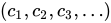
The space of square-summable sequences of complex numbers is the set of infinite sequences[9] of real or complex numbers such that


This space has an orthonormal basis:
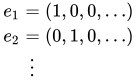
This space is the infinite-dimensional generalization of the space of finite-dimensional vectors. It is usually the first example used to show that in infinite-dimensional spaces, a set that is closed and bounded is not necessarily (sequentially) compact (as is the case in all finite dimensional spaces). Indeed, the set of orthonormal vectors above shows this: It is an infinite sequence of vectors in the unit ball (i.e., the ball of points with norm less than or equal one). This set is clearly bounded and closed; yet, no subsequence of these vectors converges to anything and consequently the unit ball in is not compact. Intuitively, this is because "there is always another coordinate direction" into which the next elements of the sequence can evade.

One can generalize the space in many ways. For example, if B is any set, then one can form a Hilbert space of sequences with index set B, defined by[91]

The summation over B is here defined by the supremum being taken over all finite subsets of B. It follows that, for this sum to be finite, every element of l2(B) has only countably many nonzero terms. This space becomes a Hilbert space with the inner product

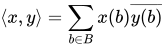
for all x, y ∈ l2(B). Here the sum also has only countably many nonzero terms, and is unconditionally convergent by the Cauchy–Schwarz inequality.
An orthonormal basis of l2(B) is indexed by the set B, given by
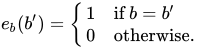
Bessel's inequality and Parseval's formula
Let f1, …, fn be a finite orthonormal system in H. For an arbitrary vector x ∈ H, let
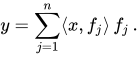
Then ⟨x, fk⟩ = ⟨y, fk⟩ for every k = 1, …, n. It follows that x − y is orthogonal to each fk, hence x − y is orthogonal to y. Using the Pythagorean identity twice, it follows that

Let {fi}, i ∈ I, be an arbitrary orthonormal system in H. Applying the preceding inequality to every finite subset J of I gives Bessel's inequality:[92] (according to the definition of the sum of an arbitrary family of non-negative real numbers).

Geometrically, Bessel's inequality implies that the orthogonal projection of x onto the linear subspace spanned by the fi has norm that does not exceed that of x. In two dimensions, this is the assertion that the length of the leg of a right triangle may not exceed the length of the hypotenuse.
Bessel's inequality is a stepping stone to the stronger result called Parseval's identity, which governs the case when Bessel's inequality is actually an equality. By definition, if {ek}k ∈ B is an orthonormal basis of H, then every element x of H may be written as
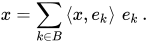
Even if B is uncountable, Bessel's inequality guarantees that the expression is well-defined and consists only of countably many nonzero terms. This sum is called the Fourier expansion of x, and the individual coefficients ⟨x, ek⟩ are the Fourier coefficients of x. Parseval's identity then asserts that[93]
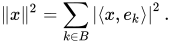
Conversely,[93] if {ek} is an orthonormal set such that Parseval's identity holds for every x, then {ek} is an orthonormal basis.
Hilbert dimension
As a consequence of Zorn's lemma, every Hilbert space admits an orthonormal basis; furthermore, any two orthonormal bases of the same space have the same cardinality, called the Hilbert dimension of the space.[94] For instance, since l2(B) has an orthonormal basis indexed by B, its Hilbert dimension is the cardinality of B (which may be a finite integer, or a countable or uncountable cardinal number).
The Hilbert dimension is not greater than the Hamel dimension (the usual dimension of a vector space). The two dimensions are equal if and only if one of them is finite.
As a consequence of Parseval's identity,[95] if {ek}k ∈ B is an orthonormal basis of H, then the map Φ : H → l2(B) defined by Φ(x) = ⟨x, ek⟩k∈B is an isometric isomorphism of Hilbert spaces: it is a bijective linear mapping such that for all x, y ∈ H. The cardinal number of B is the Hilbert dimension of H. Thus every Hilbert space is isometrically isomorphic to a sequence space l2(B) for some set B.

Separable spaces
By definition, a Hilbert space is separable provided it contains a dense countable subset. Along with Zorn's lemma, this means a Hilbert space is separable if and only if it admits a countable orthonormal basis. All infinite-dimensional separable Hilbert spaces are therefore isometrically isomorphic to the square-summable sequence space

In the past, Hilbert spaces were often required to be separable as part of the definition.[96]
In quantum field theory
Most spaces used in physics are separable, and since these are all isomorphic to each other, one often refers to any infinite-dimensional separable Hilbert space as "the Hilbert space" or just "Hilbert space".[97] Even in quantum field theory, most of the Hilbert spaces are in fact separable, as stipulated by the Wightman axioms. However, it is sometimes argued that non-separable Hilbert spaces are also important in quantum field theory, roughly because the systems in the theory possess an infinite number of degrees of freedom and any infinite Hilbert tensor product (of spaces of dimension greater than one) is non-separable.[98] For instance, a bosonic field can be naturally thought of as an element of a tensor product whose factors represent harmonic oscillators at each point of space. From this perspective, the natural state space of a boson might seem to be a non-separable space.[98] However, it is only a small separable subspace of the full tensor product that can contain physically meaningful fields (on which the observables can be defined). Another non-separable Hilbert space models the state of an infinite collection of particles in an unbounded region of space. An orthonormal basis of the space is indexed by the density of the particles, a continuous parameter, and since the set of possible densities is uncountable, the basis is not countable.[98]
Orthogonal complements and projections
If S is a subset of a Hilbert space H, the set of vectors orthogonal to S is defined by

The set S⊥ is a closed subspace of H (can be proved easily using the linearity and continuity of the inner product) and so forms itself a Hilbert space. If V is a closed subspace of H, then V⊥ is called the orthogonal complement of V. In fact, every x ∈ H can then be written uniquely as x = v + w, with v ∈ V and w ∈ V⊥. Therefore, H is the internal Hilbert direct sum of V and V⊥.
The linear operator PV : H → H that maps x to v is called the orthogonal projection onto V. There is a natural one-to-one correspondence between the set of all closed subspaces of H and the set of all bounded self-adjoint operators P such that P2 = P. Specifically,
Theorem — The orthogonal projection PV is a self-adjoint linear operator on H of norm ≤ 1 with the property P2
V = PV. Moreover, any self-adjoint linear operator E such that E2 = E is of the form PV, where V is the range of E. For every x in H, PV(x) is the unique element v of V that minimizes the distance ‖x − v‖.
This provides the geometrical interpretation of PV(x): it is the best approximation to x by elements of V.[99]
Projections PU and PV are called mutually orthogonal if PUPV = 0. This is equivalent to U and V being orthogonal as subspaces of H. The sum of the two projections PU and PV is a projection only if U and V are orthogonal to each other, and in that case PU + PV = PU+V.[100] The composite PUPV is generally not a projection; in fact, the composite is a projection if and only if the two projections commute, and in that case PUPV = PU∩V.[101]
By restricting the codomain to the Hilbert space V, the orthogonal projection PV gives rise to a projection mapping π : H → V; it is the adjoint of the inclusion mapping meaning that for all x ∈ V and y ∈ H.


The operator norm of the orthogonal projection PV onto a nonzero closed subspace V is equal to 1:
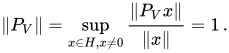
Every closed subspace V of a Hilbert space is therefore the image of an operator P of norm one such that P2 = P. The property of possessing appropriate projection operators characterizes Hilbert spaces:[102]
- A Banach space of dimension higher than 2 is (isometrically) a Hilbert space if and only if, for every closed subspace V, there is an operator PV of norm one whose image is V such that P2
V = PV.
While this result characterizes the metric structure of a Hilbert space, the structure of a Hilbert space as a topological vector space can itself be characterized in terms of the presence of complementary subspaces:[103]
- A Banach space X is topologically and linearly isomorphic to a Hilbert space if and only if, to every closed subspace V, there is a closed subspace W such that X is equal to the internal direct sum V ⊕ W.
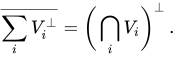
The orthogonal complement satisfies some more elementary results. It is a monotone function in the sense that if U ⊂ V, then V⊥ ⊆ U⊥ with equality holding if and only if V is contained in the closure of U. This result is a special case of the Hahn–Banach theorem. The closure of a subspace can be completely characterized in terms of the orthogonal complement: if V is a subspace of H, then the closure of V is equal to V⊥⊥. The orthogonal complement is thus a Galois connection on the partial order of subspaces of a Hilbert space. In general, the orthogonal complement of a sum of subspaces is the intersection of the orthogonal complements:[104]
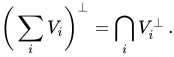
If the Vi are in addition closed, then
Spectral theory
There is a well-developed spectral theory for self-adjoint operators in a Hilbert space, that is roughly analogous to the study of symmetric matrices over the reals or self-adjoint matrices over the complex numbers.[105] In the same sense, one can obtain a "diagonalization" of a self-adjoint operator as a suitable sum (actually an integral) of orthogonal projection operators.
The spectrum of an operator T, denoted σ(T), is the set of complex numbers λ such that T − λ lacks a continuous inverse. If T is bounded, then the spectrum is always a compact set in the complex plane, and lies inside the disc |z| ≤ ‖T‖. If T is self-adjoint, then the spectrum is real. In fact, it is contained in the interval [m, M] where

Moreover, m and M are both actually contained within the spectrum.
The eigenspaces of an operator T are given by

Unlike with finite matrices, not every element of the spectrum of T must be an eigenvalue: the linear operator T − λ may only lack an inverse because it is not surjective. Elements of the spectrum of an operator in the general sense are known as spectral values. Since spectral values need not be eigenvalues, the spectral decomposition is often more subtle than in finite dimensions.
However, the spectral theorem of a self-adjoint operator T takes a particularly simple form if, in addition, T is assumed to be a compact operator. The spectral theorem for compact self-adjoint operators states:[106]
- A compact self-adjoint operator T has only countably (or finitely) many spectral values. The spectrum of T has no limit point in the complex plane except possibly zero. The eigenspaces of T decompose H into an orthogonal direct sum: Moreover, if Eλ denotes the orthogonal projection onto the eigenspace Hλ, then where the sum converges with respect to the norm on B(H).

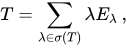
This theorem plays a fundamental role in the theory of integral equations, as many integral operators are compact, in particular those that arise from Hilbert–Schmidt operators.
The general spectral theorem for self-adjoint operators involves a kind of operator-valued Riemann–Stieltjes integral, rather than an infinite summation.[107] The spectral family associated to T associates to each real number λ an operator Eλ, which is the projection onto the nullspace of the operator (T − λ)+, where the positive part of a self-adjoint operator is defined by

The operators Eλ are monotone increasing relative to the partial order defined on self-adjoint operators; the eigenvalues correspond precisely to the jump discontinuities. One has the spectral theorem, which asserts
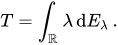
The integral is understood as a Riemann–Stieltjes integral, convergent with respect to the norm on B(H). In particular, one has the ordinary scalar-valued integral representation
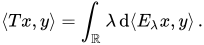
A somewhat similar spectral decomposition holds for normal operators, although because the spectrum may now contain non-real complex numbers, the operator-valued Stieltjes measure dEλ must instead be replaced by a resolution of the identity.
A major application of spectral methods is the spectral mapping theorem, which allows one to apply to a self-adjoint operator T any continuous complex function f defined on the spectrum of T by forming the integral
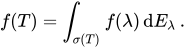
The resulting continuous functional calculus has applications in particular to pseudodifferential operators.[108]
The spectral theory of unbounded self-adjoint operators is only marginally more difficult than for bounded operators. The spectrum of an unbounded operator is defined in precisely the same way as for bounded operators: λ is a spectral value if the resolvent operator

fails to be a well-defined continuous operator. The self-adjointness of T still guarantees that the spectrum is real. Thus the essential idea of working with unbounded operators is to look instead at the resolvent Rλ where λ is nonreal. This is a bounded normal operator, which admits a spectral representation that can then be transferred to a spectral representation of T itself. A similar strategy is used, for instance, to study the spectrum of the Laplace operator: rather than address the operator directly, one instead looks as an associated resolvent such as a Riesz potential or Bessel potential.
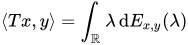
A precise version of the spectral theorem in this case is:[109]
Theorem — Given a densely defined self-adjoint operator T on a Hilbert space H, there corresponds a unique resolution of the identity E on the Borel sets of R, such that for all x ∈ D(T) and y ∈ H. The spectral measure E is concentrated on the spectrum of T.
There is also a version of the spectral theorem that applies to unbounded normal operators.
In popular culture
In Gravity's Rainbow (1973), a novel by Thomas Pynchon, one of the characters is called "Sammy Hilbert-Spaess", a pun on "Hilbert Space". The novel refers also to Gödel's incompleteness theorems.[110]
See also

- Banach space – Normed vector space that is complete
- Fock space – Multi particle state space
- Fundamental theorem of Hilbert spaces
- Hadamard space – geodesically complete metric space of non-positive curvature
- Hausdorff space – Type of topological space
- Hilbert algebra
- Hilbert C*-module – Mathematical objects that generalise the notion of Hilbert spaces
- Hilbert manifold – Manifold modelled on Hilbert spaces
- L-semi-inner product – Generalization of inner products that applies to all normed spaces
- Locally convex topological vector space – A vector space with a topology defined by convex open sets
- Operator theory – Mathematical field of study
- Operator topologies – Topologies on the set of operators on a Hilbert space
- Quantum state space – Mathematical space representing physical quantum systems
- Rigged Hilbert space – Construction linking the study of "bound" and continuous eigenvalues in functional analysis
- Topological vector space – Vector space with a notion of nearness
Remarks
- ^ In some conventions, inner products are linear in their second arguments instead.
- ^ The eigenvalues of the Fredholm kernel are 1/λ, which tend to zero.
Notes
- ^ Axler 2014, p. 164 §6.2
- ^ However, some sources call finite-dimensional spaces with these properties pre-Hilbert spaces, reserving the term "Hilbert space" for infinite-dimensional spaces; see, e.g., Levitan 2001.
- ^ Marsden 1974, §2.8
- ^ The mathematical material in this section can be found in any good textbook on functional analysis, such as Dieudonné (1960), Hewitt & Stromberg (1965), Reed & Simon (1980) or Rudin (1987).
- ^ Schaefer & Wolff 1999, pp. 122–202.
- ^ Dieudonné 1960, §6.2
- ^ Roman 2008, p. 327
- ^ Roman 2008, p. 330 Theorem 13.8
- ^ a b Stein & Shakarchi 2005, p. 163
- ^ Dieudonné 1960
- ^ Largely from the work of Hermann Grassmann, at the urging of August Ferdinand Möbius (Boyer & Merzbach 1991, pp. 584–586). The first modern axiomatic account of abstract vector spaces ultimately appeared in Giuseppe Peano's 1888 account (Grattan-Guinness 2000, §5.2.2; O'Connor & Robertson 1996).
- ^ A detailed account of the history of Hilbert spaces can be found in Bourbaki 1987.
- ^ Schmidt 1908
- ^ Titchmarsh 1946, §IX.1
- ^ Lebesgue 1904. Further details on the history of integration theory can be found in Bourbaki (1987) and Saks (2005).
- ^ Bourbaki 1987.
- ^ Dunford & Schwartz 1958, §IV.16
- ^ In Dunford & Schwartz (1958, §IV.16), the result that every linear functional on L2[0,1] is represented by integration is jointly attributed to Fréchet (1907) and Riesz (1907). The general result, that the dual of a Hilbert space is identified with the Hilbert space itself, can be found in Riesz (1934).
- ^ von Neumann 1929.
- ^ Kline 1972, p. 1092
- ^ Hilbert, Nordheim & von Neumann 1927
- ^ a b Weyl 1931.
- ^ Prugovečki 1981, pp. 1–10.
- ^ a b von Neumann 1932
- ^ Peres 1993, pp. 79–99.
- ^ Murphy 1990, p. 112
- ^ Murphy 1990, p. 72
- ^ Halmos 1957, Section 42.
- ^ Hewitt & Stromberg 1965.
- ^ Abramowitz, Milton; Stegun, Irene Ann, eds. (1983) [June 1964]. "Chapter 22". Handbook of Mathematical Functions with Formulas, Graphs, and Mathematical Tables. Applied Mathematics Series. Vol. 55 (Ninth reprint with additional corrections of tenth original printing with corrections (December 1972); first ed.). Washington D.C.; New York: United States Department of Commerce, National Bureau of Standards; Dover Publications. p. 773. ISBN 978-0-486-61272-0. LCCN 64-60036. MR 0167642. LCCN 65-12253.
- ^ a b Bers, John & Schechter 1981.
- ^ Giusti 2003.
- ^ Stein 1970
- ^ Details can be found in Warner (1983).
- ^ A general reference on Hardy spaces is the book Duren (1970).
- ^ Krantz 2002, §1.4
- ^ Krantz 2002, §1.5
- ^ Young 1988, Chapter 9.
- ^ Pedersen 1995, §4.4
- ^ More detail on finite element methods from this point of view can be found in Brenner & Scott (2005).
- ^ Brezis 2010, section 9.5
- ^ Evans 1998
- ^ Pathria (1996), Chapters 2 and 3
- ^ Einsiedler & Ward (2011), Proposition 2.14.
- ^ Reed & Simon 1980
- ^ A treatment of Fourier series from this point of view is available, for instance, in Rudin (1987) or Folland (2009).
- ^ Halmos 1957, §5
- ^ Bachman, Narici & Beckenstein 2000
- ^ Stein & Weiss 1971, §IV.2.
- ^ Lanczos 1988, pp. 212–213
- ^ Lanczos 1988, Equation 4-3.10
- ^ The classic reference for spectral methods is Courant & Hilbert 1953. A more up-to-date account is Reed & Simon 1975.
- ^ Kac 1966
- ^ von Neumann 1955
- ^ Holevo 2001, p. 17
- ^ Rieffel & Polak 2011, p. 55
- ^ Peres 1993, p. 101
- ^ Peres 1993, pp. 73
- ^ Nielsen & Chuang 2000, p. 90
- ^ Billingsley (1986), p. 477, ex. 34.13}}
- ^ Stapleton 1995
- ^ Hewitt & Stromberg (1965), Exercise 16.45.
- ^ Karatzas & Shreve 2019, Chapter 3
- ^ Stroock (2011), Chapter 8.
- ^ Hermann Weyl (2009), "Mind and nature", Mind and nature: selected writings on philosophy, mathematics, and physics, Princeton University Press.
- ^ Berthier, M. (2020), "Geometry of color perception. Part 2: perceived colors from real quantum states and Hering's rebit", The Journal of Mathematical Neuroscience, 10 (1): 14, doi:10.1186/s13408-020-00092-x, PMC 7481323, PMID 32902776.
- ^ Reed & Simon 1980, Theorem 12.6
- ^ Reed & Simon 1980, p. 38
- ^ Young 1988, p. 23.
- ^ Clarkson 1936.
- ^ Rudin 1987, Theorem 4.10
- ^ Dunford & Schwartz 1958, II.4.29
- ^ Rudin 1987, Theorem 4.11
- ^ Blanchet, Gérard; Charbit, Maurice (2014). Digital Signal and Image Processing Using MATLAB. Vol. 1 (Second ed.). New Jersey: Wiley. pp. 349–360. ISBN 978-1848216402.
- ^ Weidmann 1980, Theorem 4.8
- ^ Peres 1993, pp. 77–78.
- ^ Weidmann (1980), Exercise 4.11.
- ^ Weidmann 1980, §4.5
- ^ Buttazzo, Giaquinta & Hildebrandt 1998, Theorem 5.17
- ^ Halmos 1982, Problem 52, 58
- ^ Rudin 1973
- ^ Trèves 1967, Chapter 18
- ^ A general reference for this section is Rudin (1973), chapter 12.
- ^ See Prugovečki (1981), Reed & Simon (1980, Chapter VIII) and Folland (1989).
- ^ Prugovečki 1981, III, §1.4
- ^ Dunford & Schwartz 1958, IV.4.17-18
- ^ Weidmann 1980, §3.4
- ^ Kadison & Ringrose 1983, Theorem 2.6.4
- ^ Dunford & Schwartz 1958, §IV.4.
- ^ Roman 2008, p. 218
- ^ Rudin 1987, Definition 3.7
- ^ For the case of finite index sets, see, for instance, Halmos 1957, §5. For infinite index sets, see Weidmann 1980, Theorem 3.6.
- ^ a b Hewitt & Stromberg (1965), Theorem 16.26.
- ^ Levitan 2001. Many authors, such as Dunford & Schwartz (1958, §IV.4), refer to this just as the dimension. Unless the Hilbert space is finite dimensional, this is not the same thing as its dimension as a linear space (the cardinality of a Hamel basis).
- ^ Hewitt & Stromberg (1965), Theorem 16.29.
- ^ Prugovečki 1981, I, §4.2
- ^ von Neumann (1955) defines a Hilbert space via a countable Hilbert basis, which amounts to an isometric isomorphism with l2. The convention still persists in most rigorous treatments of quantum mechanics; see for instance Sobrino 1996, Appendix B.
- ^ a b c Streater & Wightman 1964, pp. 86–87
- ^ Young 1988, Theorem 15.3
- ^ von Neumann 1955, Theorem 16
- ^ von Neumann 1955, Theorem 14
- ^ Kakutani 1939
- ^ Lindenstrauss & Tzafriri 1971
- ^ Halmos 1957, §12
- ^ A general account of spectral theory in Hilbert spaces can be found in Riesz & Sz.-Nagy (1990). A more sophisticated account in the language of C*-algebras is in Rudin (1973) or Kadison & Ringrose (1997)
- ^ See, for instance, Riesz & Sz.-Nagy (1990, Chapter VI) or Weidmann 1980, Chapter 7. This result was already known to Schmidt (1908) in the case of operators arising from integral kernels.
- ^ Riesz & Sz.-Nagy 1990, §§107–108
- ^ Shubin 1987
- ^ Rudin 1973, Theorem 13.30.
- ^ Pynchon, Thomas (1973). Gravity's Rainbow. Viking Press. pp. 217, 275. ISBN 978-0143039945.
References
- Axler, Sheldon (18 December 2014), Linear Algebra Done Right, Undergraduate Texts in Mathematics (3rd ed.), Springer Publishing (published 2015), p. 296, ISBN 978-3-319-11079-0
- Bachman, George; Narici, Lawrence; Beckenstein, Edward (2000), Fourier and wavelet analysis, Universitext, Berlin, New York: Springer-Verlag, ISBN 978-0-387-98899-3, MR 1729490.
- Bers, Lipman; John, Fritz; Schechter, Martin (1981), Partial differential equations, American Mathematical Society, ISBN 978-0-8218-0049-2.
- Billingsley, Patrick (1986), Probability and measure, Wiley.
- Bourbaki, Nicolas (1986), Spectral theories, Elements of mathematics, Berlin: Springer-Verlag, ISBN 978-0-201-00767-1.
- Bourbaki, Nicolas (1987), Topological vector spaces, Elements of mathematics, Berlin: Springer-Verlag, ISBN 978-3-540-13627-9.
- Boyer, Carl Benjamin; Merzbach, Uta C (1991), A History of Mathematics (2nd ed.), John Wiley & Sons, Inc., ISBN 978-0-471-54397-8.
- Brenner, S.; Scott, R. L. (2005), The Mathematical Theory of Finite Element Methods (2nd ed.), Springer, ISBN 978-0-387-95451-6.
- Brezis, Haim (2010), Functional analysis, Sobolev spaces, and partial differential equations, Springer.
- Buttazzo, Giuseppe; Giaquinta, Mariano; Hildebrandt, Stefan (1998), One-dimensional variational problems, Oxford Lecture Series in Mathematics and its Applications, vol. 15, The Clarendon Press Oxford University Press, ISBN 978-0-19-850465-8, MR 1694383.
- Clarkson, J. A. (1936), "Uniformly convex spaces", Trans. Amer. Math. Soc., 40 (3): 396–414, doi:10.2307/1989630, JSTOR 1989630.
- Courant, Richard; Hilbert, David (1953), Methods of Mathematical Physics, Vol. I, Interscience.
- Dieudonné, Jean (1960), Foundations of Modern Analysis, Academic Press.
- Dirac, P.A.M. (1930), The Principles of Quantum Mechanics, Oxford: Clarendon Press.
- Dunford, N.; Schwartz, J.T. (1958), Linear operators, Parts I and II, Wiley-Interscience.
- Duren, P. (1970), Theory of Hp-Spaces, New York: Academic Press.
- Einsiedler, Manfred; Ward, Thomas (2011), Ergodic theory with a view towards number theory, Springer.
- Evans, L. C. (1998), Partial Differential Equations, Providence: American Mathematical Society, ISBN 0-8218-0772-2.
- Folland, Gerald B. (2009), Fourier analysis and its application (Reprint of Wadsworth and Brooks/Cole 1992 ed.), American Mathematical Society Bookstore, ISBN 978-0-8218-4790-9.
- Folland, Gerald B. (1989), Harmonic analysis in phase space, Annals of Mathematics Studies, vol. 122, Princeton University Press, ISBN 978-0-691-08527-2.
- Fréchet, Maurice (1907), "Sur les ensembles de fonctions et les opérations linéaires", C. R. Acad. Sci. Paris, 144: 1414–1416.
- Fréchet, Maurice (1904), "Sur les opérations linéaires", Transactions of the American Mathematical Society, 5 (4): 493–499, doi:10.2307/1986278, JSTOR 1986278.
- Giusti, Enrico (2003), Direct Methods in the Calculus of Variations, World Scientific, ISBN 978-981-238-043-2.
- Grattan-Guinness, Ivor (2000), The search for mathematical roots, 1870–1940, Princeton Paperbacks, Princeton University Press, ISBN 978-0-691-05858-0, MR 1807717.
- Halmos, Paul (1957), Introduction to Hilbert Space and the Theory of Spectral Multiplicity, Chelsea Pub. Co
- Halmos, Paul (1982), A Hilbert Space Problem Book, Springer-Verlag, ISBN 978-0-387-90685-0.
- Hewitt, Edwin; Stromberg, Karl (1965), Real and Abstract Analysis, New York: Springer-Verlag.
- Hilbert, David; Nordheim, Lothar Wolfgang; von Neumann, John (1927), "Über die Grundlagen der Quantenmechanik", Mathematische Annalen, 98: 1–30, doi:10.1007/BF01451579, S2CID 120986758.
- Holevo, Alexander S. (2001), Statistical Structure of Quantum Theory, Lecture Notes in Physics, Springer, ISBN 3-540-42082-7, OCLC 318268606.
- Kac, Mark (1966), "Can one hear the shape of a drum?", American Mathematical Monthly, 73 (4, part 2): 1–23, doi:10.2307/2313748, JSTOR 2313748.
- Kadison, Richard V.; Ringrose, John R. (1997), Fundamentals of the theory of operator algebras. Vol. I, Graduate Studies in Mathematics, vol. 15, Providence, R.I.: American Mathematical Society, ISBN 978-0-8218-0819-1, MR 1468229.
- Kadison, Richard V.; Ringrose, John R. (1983), Fundamentals of the Theory of Operator Algebras, Vol. I: Elementary Theory, New York: Academic Press, Inc.
- Karatzas, Ioannis; Shreve, Steven (2019), Brownian Motion and Stochastic Calculus (2nd ed.), Springer, ISBN 978-0-387-97655-6
- Kakutani, Shizuo (1939), "Some characterizations of Euclidean space", Japanese Journal of Mathematics, 16: 93–97, doi:10.4099/jjm1924.16.0_93, MR 0000895.
- Kline, Morris (1972), Mathematical thought from ancient to modern times, Volume 3 (3rd ed.), Oxford University Press (published 1990), ISBN 978-0-19-506137-6.
- Kolmogorov, Andrey; Fomin, Sergei V. (1970), Introductory Real Analysis (Revised English edition, trans. by Richard A. Silverman (1975) ed.), Dover Press, ISBN 978-0-486-61226-3.
- Krantz, Steven G. (2002), Function Theory of Several Complex Variables, Providence, R.I.: American Mathematical Society, ISBN 978-0-8218-2724-6.
- Lanczos, Cornelius (1988), Applied analysis (Reprint of 1956 Prentice-Hall ed.), Dover Publications, ISBN 978-0-486-65656-4.
- Lebesgue, Henri (1904), Leçons sur l'intégration et la recherche des fonctions primitives, Gauthier-Villars.
- Levitan, B.M. (2001) [1994], "Hilbert space", Encyclopedia of Mathematics, EMS Press.
- Lindenstrauss, J.; Tzafriri, L. (1971), "On the complemented subspaces problem", Israel Journal of Mathematics, 9 (2): 263–269, doi:10.1007/BF02771592, ISSN 0021-2172, MR 0276734, S2CID 119575718.
- Marsden, Jerrold E. (1974), Elementary classical analysis, W. H. Freeman and Co., MR 0357693.
- Murphy, Gerald J. (1990), C*-algebras and Operator Theory, Academic Press, ISBN 0-12-511360-9.
- von Neumann, John (1929), "Allgemeine Eigenwerttheorie Hermitescher Funktionaloperatoren", Mathematische Annalen, 102: 49–131, doi:10.1007/BF01782338, S2CID 121249803.
- von Neumann, John (1932), "Physical Applications of the Ergodic Hypothesis", Proc Natl Acad Sci USA, 18 (3): 263–266, Bibcode:1932PNAS...18..263N, doi:10.1073/pnas.18.3.263, JSTOR 86260, PMC 1076204, PMID 16587674.
- von Neumann, John (1955), Mathematical Foundations of Quantum Mechanics, Princeton Landmarks in Mathematics, translated by Beyer, Robert T., Princeton University Press (published 1996), ISBN 978-0-691-02893-4, MR 1435976.
- Nielsen, Michael A.; Chuang, Isaac L. (2000), Quantum Computation and Quantum Information (1st ed.), Cambridge: Cambridge University Press, ISBN 978-0-521-63503-5, OCLC 634735192.
- O'Connor, John J.; Robertson, Edmund F. (1996), "Abstract linear spaces", MacTutor History of Mathematics Archive, University of St Andrews
- Pathria, RK (1996), Statistical mechanics (2 ed.), Academic Press.
- Pedersen, Gert (1995), Analysis Now, Graduate Texts in Mathematics, vol. 118, Berlin, New York: Springer-Verlag, ISBN 978-1-4612-6981-6, MR 0971256
- Peres, Asher (1993), Quantum Theory: Concepts and Methods, Kluwer, ISBN 0-7923-2549-4, OCLC 28854083
- Prugovečki, Eduard (1981), Quantum mechanics in Hilbert space (2nd ed.), Dover (published 2006), ISBN 978-0-486-45327-9.
- Reed, Michael; Simon, Barry (1980), Functional Analysis (vol I of 4 vols), Methods of Modern Mathematical Physics, Academic Press, ISBN 978-0-12-585050-6.
- Reed, Michael; Simon, Barry (1975), Fourier Analysis, Self-Adjointness (vol II of 4 vols), Methods of Modern Mathematical Physics, Academic Press, ISBN 9780125850025.
- Rieffel, Eleanor G.; Polak, Wolfgang H. (2011-03-04), Quantum Computing: A Gentle Introduction, MIT Press, ISBN 978-0-262-01506-6.
- Riesz, Frigyes (1907), "Sur une espèce de Géométrie analytique des systèmes de fonctions sommables", C. R. Acad. Sci. Paris, 144: 1409–1411.
- Riesz, Frigyes (1934), "Zur Theorie des Hilbertschen Raumes", Acta Sci. Math. Szeged, 7: 34–38.
- Riesz, Frigyes; Sz.-Nagy, Béla (1990), Functional analysis, Dover, ISBN 978-0-486-66289-3.
- Roman, Stephen (2008), Advanced Linear Algebra, Graduate Texts in Mathematics (Third ed.), Springer, ISBN 978-0-387-72828-5
- Rudin, Walter (1973). Functional Analysis. International Series in Pure and Applied Mathematics. Vol. 25 (First ed.). New York, NY: McGraw-Hill Science/Engineering/Math. ISBN 9780070542259.
- Rudin, Walter (1987), Real and Complex Analysis, McGraw-Hill, ISBN 978-0-07-100276-9.
- Saks, Stanisław (2005), Theory of the integral (2nd Dover ed.), Dover, ISBN 978-0-486-44648-6; originally published Monografje Matematyczne, vol. 7, Warszawa, 1937.
- Schaefer, Helmut H.; Wolff, Manfred P. (1999). Topological Vector Spaces. GTM. Vol. 8 (Second ed.). New York, NY: Springer New York Imprint Springer. ISBN 978-1-4612-7155-0. OCLC 840278135.
- Schmidt, Erhard (1908), "Über die Auflösung linearer Gleichungen mit unendlich vielen Unbekannten", Rend. Circ. Mat. Palermo, 25: 63–77, doi:10.1007/BF03029116, S2CID 120666844.
- Shubin, M. A. (1987), Pseudodifferential operators and spectral theory, Springer Series in Soviet Mathematics, Berlin, New York: Springer-Verlag, ISBN 978-3-540-13621-7, MR 0883081.
- Sobrino, Luis (1996), Elements of non-relativistic quantum mechanics, River Edge, New Jersey: World Scientific Publishing Co. Inc., Bibcode:1996lnrq.book.....S, doi:10.1142/2865, ISBN 978-981-02-2386-1, MR 1626401.
- Stapleton, James (1995), Linear statistical models, John Wiley and Sons.
- Stewart, James (2006), Calculus: Concepts and Contexts (3rd ed.), Thomson/Brooks/Cole.
- Stein, E (1970), Singular Integrals and Differentiability Properties of Functions, Princeton Univ. Press, ISBN 978-0-691-08079-6.
- Stein, Elias; Weiss, Guido (1971), Introduction to Fourier Analysis on Euclidean Spaces, Princeton, N.J.: Princeton University Press, ISBN 978-0-691-08078-9.
- Stein, E; Shakarchi, R (2005), Real analysis, measure theory, integration, and Hilbert spaces, Princeton University Press.
- Streater, Ray; Wightman, Arthur (1964), PCT, Spin and Statistics and All That, W. A. Benjamin, Inc.
- Stroock, Daniel (2011), Probability theory: an analytic view (2 ed.), Cambridge University Press.
- Teschl, Gerald (2009). Mathematical Methods in Quantum Mechanics; With Applications to Schrödinger Operators. Providence: American Mathematical Society. ISBN 978-0-8218-4660-5..
- Titchmarsh, Edward Charles (1946), Eigenfunction expansions, part 1, Oxford University: Clarendon Press.
- Trèves, François (1967), Topological Vector Spaces, Distributions and Kernels, Academic Press.
- Warner, Frank (1983), Foundations of Differentiable Manifolds and Lie Groups, Berlin, New York: Springer-Verlag, ISBN 978-0-387-90894-6.
- Weidmann, Joachim (1980), Linear operators in Hilbert spaces, Graduate Texts in Mathematics, vol. 68, Berlin, New York: Springer-Verlag, ISBN 978-0-387-90427-6, MR 0566954.
- Weyl, Hermann (1931), The Theory of Groups and Quantum Mechanics (English 1950 ed.), Dover Press, ISBN 978-0-486-60269-1.
- Young, Nicholas (1988), An introduction to Hilbert space, Cambridge University Press, ISBN 978-0-521-33071-8, Zbl 0645.46024.
External links

Wikibooks has a book on the topic of: Functional Analysis/Hilbert spaces

Wikimedia Commons has media related to Hilbert space.
- "Hilbert space", Encyclopedia of Mathematics, EMS Press, 2001 [1994]
- Hilbert space at Mathworld
- 245B, notes 5: Hilbert spaces by Terence Tao