
Loading article…
IASマシンは、ニュージャージー州プリンストンにある高等研究所(IAS)で構築された最初の電子計算機です。その設計を記述した論文は、プリンストン大学とIASの両方で数学教授を務めていたジョン・フォン・ノイマンによって編集されたため、フォン・ノイマンマシンと呼ばれることもあります。このコンピュータは、1946年に開始され、1951年に完成した彼の指導の下で構築されました。[ 1 ] 全体的な構成は、構想と実装の両方が他の人によって行われたにもかかわらず、フォン・ノイマン・アーキテクチャと呼ばれています。 [ 2 ]このコンピュータはスミソニアン国立アメリカ歴史博物館 のコレクションにありますが、現在は展示されていません。[ 3 ]

1944年の夏、ジョン・フォン・ノイマンは、コンピュータ設計者でありENIACマシンの主任研究員であったハーマン・ゴールドスタインと会った。この会合で、ゴールドスタインはフォン・ノイマンにENIACプロジェクトを紹介した。この会合の結果、フォン・ノイマンは、提案されたIASコンピュータプロジェクトとしてEDVACに関する報告書の第一草稿というメモを書いた。ゴールドスタインは報告書をタイプし、1945年6月25日に配布した。フォン・ノイマンは、1946年初頭にゴールドスタインをIASプロジェクトに招き、アシスタントディレクター、後にディレクターとして参加させた。ENIACプロジェクトの上級エンジニアであったアーサー・バークスは、ゴールドスタインと共にIASプロジェクトで働き始めた。1946年の初夏には、ジュリアン・ビゲローが主任エンジニアとして採用され[ 4 ] 、それ以前のエンジニアにはジェームズ・H・ポメレン、ラルフ・J・スルツ、ウィリス・ウェアの3人がいた。[ 5 ]その後、ジョージ・W・ブラウン、ヒューイット・クレーン、ジェラルド・エストリンなど、さらに多くのエンジニアがIASコンピュータプロジェクトに携わった。このマシンは1951年の夏に限定的に稼働し、1952年6月10日に完全に稼働した。[ 6 ] [ 7 ] [ 8 ] 1958年7月15日まで稼働していた。[ 9 ]
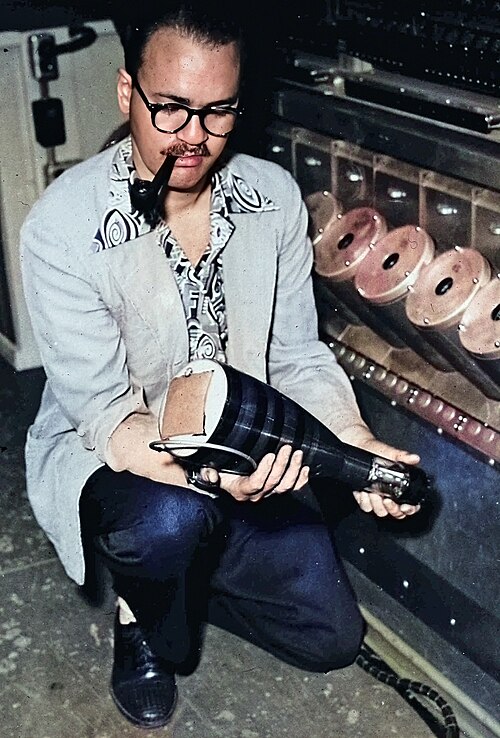
The IAS machine was a binary computer with a 40-bit word, storing two 20-bit instructions in each word. The memory was 1,024 words (5 kilobytes in modern terminology). Negative numbers were represented in two's complement format. It had two general-purpose registers available: the Accumulator (AC) and Multiplier/Quotient (MQ). It used 1,700 vacuum tubes (triode types: 6J6, 5670, 5687, a few diodes: type 6AL5, 150 pentodes to drive the memory CRTs, and 41 CRTs (type: 5CP1A): 40 used as Williams tubes for memory plus one more to monitor the state of a memory tube).[10] The memory was originally designed to use 40 RCASelectronvacuum tubes, each of which was to have a capacity of 4,096 bits.[11]:9 Problems with the development of these complex tubes forced the switch to Williams tubes.
It weighed about 1,000 pounds (450 kg).[12]
It was an asynchronous machine, meaning that there was no central clock regulating the timing of the instructions. One instruction started executing when the previous one finished. The addition time was 62 microseconds and the multiplication time was 713 microseconds.
Although some claim the IAS machine was the first design to mix programs and data in a single memory, that had been implemented four years earlier by the 1948 Manchester Baby.[13] The Soviet MESM also became operational prior to the IAS machine.
Von Neumann showed how the combination of instructions and data in one memory could be used to implement loops, by modifying branch instructions when a loop was completed, for example. The requirement that instructions, data and input/output be accessed via the same bus later came to be known as the Von Neumann bottleneck.
Plans for the IAS machine were widely distributed to any schools, businesses, or companies interested in computing machines, resulting in the construction of several derivative computers referred to as "IAS machines", although they were not software compatible.[14]
Some of these "IAS machines" were:[15]