双線形関数とゼロサムゲーム フォン・ノイマンの元の定理[ 2 ]
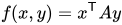
X {\displaystyle X} Y {\displaystyle Y} 標準単体 です。X = { ( x 1 、 … 、 x n ) ∈ [ 0 、 1 ] n : ∑ 私 = 1 n x 私 = 1 } {\textstyle X=\{(x_{1},\dots ,x_{n})\in [0,1]^{n}:\sum _{i=1}^{n}x_{i}=1\}} Y = { ( y 1 、 … 、 y m ) ∈ [ 0 、 1 ] m : ∑ j = 1 m y j = 1 } {\textstyle Y=\{(y_{1},\dots ,y_{m})\in [0,1]^{m}:\sum _{j=1}^{m}y_{j}=1\}} f ( x 、 y ) {\displaystyle f(x,y)} f {\displaystyle f} 双線形 であるため、次のように書くことができる。f ( x 、 y ) = x T A y {\displaystyle f(x,y)=x^{\mathsf {T}}Ay} A ∈ R n × m \displaystyle A\in \mathbb {R} ^{n\times m}} f ( x 、 y ) = ∑ 私 = 1 n ∑ j = 1 m A 私 j x 私 y j {\textstyle f(x,y)=\sum _{i=1}^{n}\sum _{j=1}^{m}A_{ij}x_{i}y_{j}} これらの仮定の下で、フォン・ノイマンは、
最大 x ∈ X ミニ y ∈ Y x T A y = ミニ y ∈ Y 最大 x ∈ X x T A y 。 {\displaystyle \max _{x\in X}\min _{y\in Y}x^{\mathsf {T}}Ay=\min _{y\in Y}\max _{x\in X}x^{\mathsf {T}}Ay.} 2人ゼロサムゲーム の文脈では、集合はX {\displaystyle X} Y {\displaystyle Y} 混合戦略 )で構成され、その利得は利得行列によって定義される。 A {\displaystyle A} f ( x 、 y ) {\displaystyle f(x,y)} 期待利得値 をエンコードしますx {\displaystyle x} y {\displaystyle y}
反例 次の例は、凸凸条件がない場合、最大値-最小値と最小値-最大値が等しくならないことを示しています。[ 8 ] 定義域 X = [0,1] および Y = [0,1] において、 f ( x . y ) = ( x - y ) 2 とします。fは 凸凸ですが、凸凹ではないことに注意してください。すると、次のようになります。
任意の固定されたx に対して、min y f( x , y ) = 0 はy = x で達成されます。したがって、max x min y f(x,y) = 0 となります 。任意の固定された y に対して、max x f( x , y ) = max( y 2 , (1- y ) 2 ) は、x =0 (y>0.5 の場合) またはx =1 (y<0.5 の場合) で達成されます。したがって、min y max x f(x,y) = 0.25 は、 y =0.5で達成されます。
参考文献 ↑ Simons, Stephen (1995), "Minimax Theorems and Their Proofs" , Du, Ding-Zhu; Pardalos, Panos M. (eds.), Minimax and Applications , Nonconvex Optimization and Its Applications, vol. 4, Boston, MA: Springer US, pp. 1–23 , doi : 10.1007/978-1-4613-3557-3_1 , ISBN 978-1-4613-3557-3 2024年10月27日 取得 1 2 フォン・ノイマン、J. (1928)。 「Zur Theorie der Gesellschaftsspiele」。 数学。アン。 100 : 295–320 。 ビブコード : 1928MatAn.100..295V 。 土井 : 10.1007/BF01448847 。 S2CID 122961988 。 ↑ ジョン・L・カスティ(1996)。 『5つの黄金律:20世紀数学の偉大な理論 ― そしてなぜそれが重要なのか 』 ニューヨーク:ワイリー・インターサイエンス。19 ページ 。ISBN 978-0-471-00261-1 。↑ Du, Ding-Zhu; Pardalos, Panos M. 編 (1995). Minimax and Applications . Boston, MA: Springer US. ISBN 9781461335573 。↑ Brandt, Felix ; Brill, Markus; Suksompong, Warut (2016). "順序ミニマックス定理". Games and Economic Behavior . 95 : 107–112 . arXiv : 1412.4198 . doi : 10.1016/j.geb.2015.12.010 . S2CID 360407 . ↑ Sion, Maurice (1958). " On general minimax theorems" . Pacific Journal of Mathematics . 8 (1): 171– 176. doi : 10.2140/pjm.1958.8.171 . MR 0097026. Zbl 0081.11502 . ↑ 小宮英俊 (1988)。 「シオンのミニマックス定理の初歩的な証明」 。 古代数学ジャーナル 。 11 (1): 5–7 . 土井 : 10.2996/kmj/1138038812 。 MR 0930413 。 Zbl 0646.49004 。 ↑ Daskalakis, Constantinos; Skoulakis, Stratis; Zampetakis, Manolis (2021-06-15). "制約付き最小最大最適化の複雑性". 第53回 ACM SIGACT 理論計算機科学シンポジウム議事録 . ニューヨーク州ニューヨーク: Association for Computing Machinery. pp. 1466–1478 . arXiv : 2009.09623 . doi : 10.1145/3406325.3451125 . ISBN 978-1-4503-8053-9 。


![{\textstyle X=\{(x_{1},\dots ,x_{n})\in [0,1]^{n}:\sum _{i=1}^{n}x_{i}=1\}}](https://wikimedia.org/api/rest_v1/media/math/render/svg/cb749fa56cc2d6d273ebce53dc103d1969d6e722)
![{\textstyle Y=\{(y_{1},\dots ,y_{m})\in [0,1]^{m}:\sum _{j=1}^{m}y_{j}=1\}}](https://wikimedia.org/api/rest_v1/media/math/render/svg/30e67b4e838f2cac633d4ed0e7493590ce15ed7d)