定理の記述 (以下、P ( X ) \displaystyle {\mathcal {P}}(X)} は位相空間上の ボレル 確率測度の集合を表す。( X 、 T ) {\displaystyle (X,T)} [ 1 ]
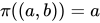
させてY {\displaystyle Y} X {\displaystyle X} 2 つのポーランド空間 (つまり、分離可能で 完全に距離化可能な空間 )である。 させてμ ∈ P ( Y ) {\displaystyle \mu \in {\mathcal {P}}(Y)} させてπ : Y → X {\displaystyle \pi :Y\to X} 可測関数 である。ここでは、π {\displaystyle \pi } Y {\displaystyle Y} Y {\displaystyle Y} { π − 1 ( x ) | x ∈ X } {\displaystyle \{\pi ^{-1}(x)\ |\ x\in X\}} π ( ( 1 、 b ) ) = 1 {\displaystyle \pi ((a,b))=a} ( 1 、 b ) ∈ [ 0 、 1 ] × [ 0 、 1 ] {\displaystyle (a,b)\in [0,1]\times [0,1]} π − 1 ( 1 ) = 1 × [ 0 、 1 ] {\displaystyle \pi ^{-1}(a)=a\times [0,1]} させてν ∈ P ( X ) {\displaystyle \nu \in {\mathcal {P}}(X)} 前進するための措置 となるν = π * ( μ ) = μ ∘ π − 1 {\displaystyle \nu =\pi _{*}(\mu )=\mu \circ \pi ^{-1}} x {\displaystyle x} π − 1 ( x ) \displaystyle \pi ^{-1}(x) 定理の結論:ν {\displaystyle \nu } ほぼあらゆる場所で 一意に決定される確率測度の族{ μ x } x ∈ X ⊆ P ( Y ) {\displaystyle \{\mu _{x}\}_{x\in X}\subseteq {\mathcal {P}}(Y)} μ {\displaystyle \mu } { μ x } x ∈ X {\displaystyle \{\mu _{x}\}_{x\in X}} :
機能x ↦ μ x {\displaystyle x\mapsto \mu _{x}} x ↦ μ x ( B ) {\displaystyle x\mapsto \mu _{x}(B)} B ⊆ Y {\displaystyle B\subseteq Y} μ x {\displaystyle \mu _{x}} 繊維 上で「生き続ける」π − 1 ( x ) \displaystyle \pi ^{-1}(x) ν {\displaystyle \nu } ほぼすべて x ∈ X {\displaystyle x\in X} μ x ( Y ∖ π − 1 ( x ) ) = 0 、 {\displaystyle \mu _{x}\left(Y\setminus \pi ^{-1}(x)\right)=0,} μ x ( E ) = μ x ( E ∩ π − 1 ( x ) ) {\displaystyle \mu _{x}(E)=\mu _{x}(E\cap \pi ^{-1}(x))} すべてのボレル可測関数に対してf : Y → [ 0 、 ∞ ] {\displaystyle f:Y\to [0,\infty ]} ∫ Y f ( y ) d μ ( y ) = ∫ X ∫ π − 1 ( x ) f ( y ) d μ x ( y ) d ν ( x ) 。 {\displaystyle \int _{Y}f(y)\,\mathrm {d} \mu (y)=\int _{X}\int _{\pi ^{-1}(x)}f(y)\,\mathrm {d} \mu _{x}(y)\,\mathrm {d} \nu (x)。} E ⊆ Y {\displaystyle E\subseteq Y} f {\displaystyle f} 指示関数 となるE {\displaystyle E} 2 ] μ ( E ) = ∫ X μ x ( E ) d ν ( x ) 、 {\displaystyle \mu (E)=\int _{X}\mu _{x}(E)\,\mathrm {d} \nu (x),} { μ x } x ∈ X {\displaystyle \{\mu _{x}\}_{x\in X}} これは通常の条件付き確率 です。
アプリケーション
製品スペース 元の例は、分解定理が適用される積空間の問題の特殊なケースであった。
いつY {\displaystyle Y} 直積 として記述されるY = X 1 × X 2 {\displaystyle Y=X_{1}\times X_{2}} π 私 : Y → X 私 {\displaystyle \pi _{i}:Y\to X_{i}} 投影 であれば、各繊維π 1 − 1 ( x 1 ) {\displaystyle \pi _{1}^{-1}(x_{1})} 正統的 に識別できるX 2 {\displaystyle X_{2}} { μ x 1 } x 1 ∈ X 1 {\displaystyle \{\mu _{x_{1}}\}_{x_{1}\in X_{1}}} P ( X 2 ) {\displaystyle {\mathcal {P}}(X_{2})} ( π 1 ) * ( μ ) {\displaystyle (\pi _{1})_{*}(\mu )} μ = ∫ X 1 μ x 1 μ ( π 1 − 1 ( d x 1 ) ) = ∫ X 1 μ x 1 d ( π 1 ) * ( μ ) ( x 1 ) 、 {\displaystyle \mu =\int _{X_{1}}\mu _{x_{1}}\,\mu \left(\pi _{1}^{-1}(\mathrm {d} x_{1})\right)=\int _{X_{1}}\mu _{x_{1}}\,\mathrm {d} (\pi _{1})_{*}(\mu )(x_{1}),} ∫ X 1 × X 2 f ( x 1 、 x 2 ) μ ( d x 1 、 d x 2 ) = ∫ X 1 ( ∫ X 2 f ( x 1 、 x 2 ) μ ( d x 2 ∣ x 1 ) ) μ ( π 1 − 1 ( d x 1 ) ) {\displaystyle \int _{X_{1}\times X_{2}}f(x_{1},x_{2})\,\mu (\mathrm {d} x_{1},\mathrm {d} x_{2})=\int _{X_{1}}\left(\int _{X_{2}}f(x_{1},x_{2})\mu (\mathrm {d} x_{2}\mid x_{1})\right)\mu \left(\pi _{1}^{-1}(\mathrm {d} x_{1})\right)} μ ( A × B ) = ∫ A μ ( B ∣ x 1 ) μ ( π 1 − 1 ( d x 1 ) ) 。 {\displaystyle \mu (A\times B)=\int _{A}\mu \left(B\mid x_{1}\right)\,\mu \left(\pi _{1}^{-1}(\mathrm {d} x_{1})\right).}
条件付き期待値 との関係は、次の恒等式によって与えられる。 E ( f ∣ π 1 ) ( x 1 ) = ∫ X 2 f ( x 1 、 x 2 ) μ ( d x 2 ∣ x 1 ) 、 {\displaystyle \operatorname {E} (f\mid \pi _{1})(x_{1})=\int _{X_{2}}f(x_{1},x_{2})\mu (\mathrm {d} x_{2}\mid x_{1}),} μ ( A × B ∣ π 1 ) ( x 1 ) = 1 A ( x 1 ) ⋅ μ ( B ∣ x 1 ) 。 {\displaystyle \mu (A\times B\mid \pi _{1})(x_{1})=1_{A}(x_{1})\cdot \mu (B\mid x_{1}).}
参考文献 ↑ ボガチェフ 2007 、§10.4、§10.6 ↑ Dellacherie, C.; Meyer, P.-A. (1978). Probabilities and Potential ISBN 0-7204-0701-X 。 ↑ Ambrosio, L.; Gigli, N.; Savaré, G. (2005). Gradient Flows in Metric Spaces and in the Space of Probability Measures . ETH Zürich, Birkhäuser Verlag, Basel. ISBN 978-3-7643-2428-5 . ↑ Chang, J.T.; Pollard, D. (1997). "Conditioning as disintegration"(PDF) . Statistica Neerlandica . 51 (3): 287. CiteSeerX 10.1.1.55.7544 . doi :10.1111/1467-9574.00056. S2CID 16749932.

![{\displaystyle S=[0,1]\times [0,1]}](https://wikimedia.org/api/rest_v1/media/math/render/svg/9cfec53e317e30f420a56a950c0db306a92d9103)


![{\displaystyle L_{x}=\{x\}\times [0,1]}](https://wikimedia.org/api/rest_v1/media/math/render/svg/9dd4abca9ec5b60810aad5b2141cfbeb4bfd8254)




![{\displaystyle \mu (E)=\int _{[0,1]}\mu _{x}(E\cap L_{x})\,\mathrm {d} x}](https://wikimedia.org/api/rest_v1/media/math/render/svg/f47a1870d36eef3db833a3d8c274afb6a9176f7f)



![{\displaystyle (a,b)\in [0,1]\times [0,1]}](https://wikimedia.org/api/rest_v1/media/math/render/svg/c81e0a7eaa0aacc0ba85aac34a5c2f6b1a9afcc7)
![{\displaystyle \pi ^{-1}(a)=a\times [0,1]}](https://wikimedia.org/api/rest_v1/media/math/render/svg/e111a1daddcc7303a8239b7b3cc568b408bf3f3d)









![{\displaystyle f:Y\to [0,\infty ]}](https://wikimedia.org/api/rest_v1/media/math/render/svg/95fb617f884135a105d279508a45f9e6446e6c0a)













